
MathematicsQ1–86 of 87 questions
Page 1 of 2 · English
1
MathematicsMediumMCQTS EAMCET · 2010
$\log _4 2 - \log _8 2 + \log _{16} 2 - \ldots$ is equal to
A
$e^2$
B
$\log _e 2$
C
$1 + \log _e 3$
D
$1 - \log _e 2$
Solution
(D) The given series is $\log _4 2 - \log _8 2 + \log _{16} 2 - \ldots$
Using the property $\log _b a = \frac{1}{\log _a b}$,we get:
$= \frac{1}{\log _2 4} - \frac{1}{\log _2 8} + \frac{1}{\log _2 16} - \ldots$
$= \frac{1}{\log _2 2^2} - \frac{1}{\log _2 2^3} + \frac{1}{\log _2 2^4} - \ldots$
$= \frac{1}{2 \log _2 2} - \frac{1}{3 \log _2 2} + \frac{1}{4 \log _2 2} - \ldots$
Since $\log _2 2 = 1$,the series becomes:
$= \frac{1}{2} - \frac{1}{3} + \frac{1}{4} - \ldots$
We know the Taylor series expansion $\log _e(1 + x) = x - \frac{x^2}{2} + \frac{x^3}{3} - \frac{x^4}{4} + \ldots$
For $x = 1$,$\log _e(1 + 1) = 1 - \frac{1}{2} + \frac{1}{3} - \frac{1}{4} + \ldots$
$\Rightarrow \log _e 2 = 1 - (\frac{1}{2} - \frac{1}{3} + \frac{1}{4} - \ldots)$
$\Rightarrow \frac{1}{2} - \frac{1}{3} + \frac{1}{4} - \ldots = 1 - \log _e 2$
Using the property $\log _b a = \frac{1}{\log _a b}$,we get:
$= \frac{1}{\log _2 4} - \frac{1}{\log _2 8} + \frac{1}{\log _2 16} - \ldots$
$= \frac{1}{\log _2 2^2} - \frac{1}{\log _2 2^3} + \frac{1}{\log _2 2^4} - \ldots$
$= \frac{1}{2 \log _2 2} - \frac{1}{3 \log _2 2} + \frac{1}{4 \log _2 2} - \ldots$
Since $\log _2 2 = 1$,the series becomes:
$= \frac{1}{2} - \frac{1}{3} + \frac{1}{4} - \ldots$
We know the Taylor series expansion $\log _e(1 + x) = x - \frac{x^2}{2} + \frac{x^3}{3} - \frac{x^4}{4} + \ldots$
For $x = 1$,$\log _e(1 + 1) = 1 - \frac{1}{2} + \frac{1}{3} - \frac{1}{4} + \ldots$
$\Rightarrow \log _e 2 = 1 - (\frac{1}{2} - \frac{1}{3} + \frac{1}{4} - \ldots)$
$\Rightarrow \frac{1}{2} - \frac{1}{3} + \frac{1}{4} - \ldots = 1 - \log _e 2$
0 likesView Solution
2
MathematicsDifficultMCQTS EAMCET · 2010
$\left\{x \in R: \frac{14 x}{x+1}-\frac{9 x-30}{x-4} < 0\right\}$ is equal to
A
$(-1,4)$
B
$(1,4) \cup(5,7)$
C
$(1,7)$
D
$(-1,1) \cup(4,6)$
Solution
(D) Given inequality: $\frac{14 x}{x+1}-\frac{9 x-30}{x-4} < 0$
Simplify the expression:
$\frac{14 x(x-4)-(9 x-30)(x+1)}{(x+1)(x-4)} < 0$
$\frac{14 x^2-56 x-(9 x^2+9 x-30 x-30)}{(x+1)(x-4)} < 0$
$\frac{14 x^2-56 x-(9 x^2-21 x-30)}{(x+1)(x-4)} < 0$
$\frac{5 x^2-35 x+30}{(x+1)(x-4)} < 0$
$\frac{5(x^2-7 x+6)}{(x+1)(x-4)} < 0$
$\frac{5(x-1)(x-6)}{(x+1)(x-4)} < 0$
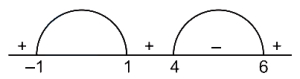
Using the wavy curve method (sign scheme) on the number line with critical points $-1, 1, 4, 6$:
The expression is negative in the intervals $(-1, 1)$ and $(4, 6)$.
Thus,$x \in (-1, 1) \cup (4, 6)$.
Simplify the expression:
$\frac{14 x(x-4)-(9 x-30)(x+1)}{(x+1)(x-4)} < 0$
$\frac{14 x^2-56 x-(9 x^2+9 x-30 x-30)}{(x+1)(x-4)} < 0$
$\frac{14 x^2-56 x-(9 x^2-21 x-30)}{(x+1)(x-4)} < 0$
$\frac{5 x^2-35 x+30}{(x+1)(x-4)} < 0$
$\frac{5(x^2-7 x+6)}{(x+1)(x-4)} < 0$
$\frac{5(x-1)(x-6)}{(x+1)(x-4)} < 0$
Using the wavy curve method (sign scheme) on the number line with critical points $-1, 1, 4, 6$:
The expression is negative in the intervals $(-1, 1)$ and $(4, 6)$.
Thus,$x \in (-1, 1) \cup (4, 6)$.
0 likesView Solution
3
MathematicsDifficultMCQTS EAMCET · 2010
If $\alpha, \beta, \gamma$ are the roots of the equation $x^3-6x^2+11x-6=0$ and if $a=\alpha^2+\beta^2+\gamma^2$,$b=\alpha\beta+\beta\gamma+\gamma\alpha$ and $c=(\alpha+\beta)(\beta+\gamma)(\gamma+\alpha)$,then the correct inequality among the following is
A
$a < b < c$
B
$b < a < c$
C
$b < c < a$
D
$c < a < b$
Solution
(B) Given equation $x^3-6x^2+11x-6=0$ has roots $\alpha, \beta, \gamma$.
By Vieta's formulas:
$\alpha+\beta+\gamma = 6$
$\alpha\beta+\beta\gamma+\gamma\alpha = 11$
$\alpha\beta\gamma = 6$
Calculating $a, b, c$:
$b = \alpha\beta+\beta\gamma+\gamma\alpha = 11$
$a = \alpha^2+\beta^2+\gamma^2 = (\alpha+\beta+\gamma)^2 - 2(\alpha\beta+\beta\gamma+\gamma\alpha) = 6^2 - 2(11) = 36 - 22 = 14$
$c = (\alpha+\beta)(\beta+\gamma)(\gamma+\alpha) = (6-\gamma)(6-\alpha)(6-\beta)$
Since $x^3-6x^2+11x-6 = (x-1)(x-2)(x-3)$,the roots are $1, 2, 3$.
$c = (6-1)(6-2)(6-3) = 5 \times 4 \times 3 = 60$
Comparing the values: $b=11, a=14, c=60$.
Thus,$b < a < c$.
By Vieta's formulas:
$\alpha+\beta+\gamma = 6$
$\alpha\beta+\beta\gamma+\gamma\alpha = 11$
$\alpha\beta\gamma = 6$
Calculating $a, b, c$:
$b = \alpha\beta+\beta\gamma+\gamma\alpha = 11$
$a = \alpha^2+\beta^2+\gamma^2 = (\alpha+\beta+\gamma)^2 - 2(\alpha\beta+\beta\gamma+\gamma\alpha) = 6^2 - 2(11) = 36 - 22 = 14$
$c = (\alpha+\beta)(\beta+\gamma)(\gamma+\alpha) = (6-\gamma)(6-\alpha)(6-\beta)$
Since $x^3-6x^2+11x-6 = (x-1)(x-2)(x-3)$,the roots are $1, 2, 3$.
$c = (6-1)(6-2)(6-3) = 5 \times 4 \times 3 = 60$
Comparing the values: $b=11, a=14, c=60$.
Thus,$b < a < c$.
0 likesView Solution
4
MathematicsDifficultMCQTS EAMCET · 2010
The condition that the roots of $x^3-b x^2+c x-d=0$ are in geometric progression is
A
$c^3=b^3 d$
B
$c^2=b^2 d$
C
$c=b d^3$
D
$c=b d^2$
Solution
(A) Given the cubic equation: $x^3-b x^2+c x-d=0$.
Let the roots in geometric progression be $\frac{a}{r}, a, ar$.
From the relationship between roots and coefficients:
$1$. Sum of roots: $\frac{a}{r} + a + ar = b \Rightarrow a(\frac{1}{r} + 1 + r) = b$ ... $(i)$
$2$. Sum of roots taken two at a time: $\frac{a}{r} \cdot a + a \cdot ar + ar \cdot \frac{a}{r} = c \Rightarrow a^2(\frac{1}{r} + r + 1) = c$ ... (ii)
$3$. Product of roots: $\frac{a}{r} \cdot a \cdot ar = d \Rightarrow a^3 = d$ ... (iii)
Dividing (ii) by $(i)$: $\frac{a^2(\frac{1}{r} + 1 + r)}{a(\frac{1}{r} + 1 + r)} = \frac{c}{b} \Rightarrow a = \frac{c}{b}$.
Substituting $a = \frac{c}{b}$ into (iii): $(\frac{c}{b})^3 = d$ $\Rightarrow \frac{c^3}{b^3} = d$ $\Rightarrow c^3 = b^3 d$.
Let the roots in geometric progression be $\frac{a}{r}, a, ar$.
From the relationship between roots and coefficients:
$1$. Sum of roots: $\frac{a}{r} + a + ar = b \Rightarrow a(\frac{1}{r} + 1 + r) = b$ ... $(i)$
$2$. Sum of roots taken two at a time: $\frac{a}{r} \cdot a + a \cdot ar + ar \cdot \frac{a}{r} = c \Rightarrow a^2(\frac{1}{r} + r + 1) = c$ ... (ii)
$3$. Product of roots: $\frac{a}{r} \cdot a \cdot ar = d \Rightarrow a^3 = d$ ... (iii)
Dividing (ii) by $(i)$: $\frac{a^2(\frac{1}{r} + 1 + r)}{a(\frac{1}{r} + 1 + r)} = \frac{c}{b} \Rightarrow a = \frac{c}{b}$.
Substituting $a = \frac{c}{b}$ into (iii): $(\frac{c}{b})^3 = d$ $\Rightarrow \frac{c^3}{b^3} = d$ $\Rightarrow c^3 = b^3 d$.
0 likesView Solution
5
MathematicsDifficultMCQTS EAMCET · 2010
Let $\alpha \neq 1$ be a real root of the equation $x^3-a x^2+a x-1=0$,where $a \neq -1$ is a real number. Then,a root of this equation,among the following,is
A
$\alpha^2$
B
$-\frac{1}{\alpha}$
C
$\frac{1}{\alpha}$
D
$-\frac{1}{\alpha^2}$
Solution
(C) Given the equation $x^3-a x^2+a x-1=0$.
We can factorize the equation as follows:
$(x^3-1) - a x(x-1) = 0$
$(x-1)(x^2+x+1) - a x(x-1) = 0$
$(x-1)(x^2+x+1-a x) = 0$
$(x-1)(x^2+(1-a)x+1) = 0$.
Since $\alpha \neq 1$ is a root,$\alpha$ must satisfy the quadratic equation $x^2+(1-a)x+1=0$.
Thus,$\alpha^2+(1-a)\alpha+1=0$.
Dividing by $\alpha$ (since $\alpha \neq 0$ as $0$ is not a root),we get $\alpha + (1-a) + \frac{1}{\alpha} = 0$,which implies $\frac{1}{\alpha} = a - 1 - \alpha$.
Alternatively,note that if $x$ is a root,then $\frac{1}{x}$ is also a root because the equation is reciprocal.
Substituting $x = \frac{1}{y}$ into the original equation:
$(\frac{1}{y})^3 - a(\frac{1}{y})^2 + a(\frac{1}{y}) - 1 = 0$
$1 - ay + ay^2 - y^3 = 0$
$y^3 - ay^2 + ay - 1 = 0$.
This is the same equation as the original.
Therefore,if $\alpha$ is a root,then $\frac{1}{\alpha}$ is also a root.
We can factorize the equation as follows:
$(x^3-1) - a x(x-1) = 0$
$(x-1)(x^2+x+1) - a x(x-1) = 0$
$(x-1)(x^2+x+1-a x) = 0$
$(x-1)(x^2+(1-a)x+1) = 0$.
Since $\alpha \neq 1$ is a root,$\alpha$ must satisfy the quadratic equation $x^2+(1-a)x+1=0$.
Thus,$\alpha^2+(1-a)\alpha+1=0$.
Dividing by $\alpha$ (since $\alpha \neq 0$ as $0$ is not a root),we get $\alpha + (1-a) + \frac{1}{\alpha} = 0$,which implies $\frac{1}{\alpha} = a - 1 - \alpha$.
Alternatively,note that if $x$ is a root,then $\frac{1}{x}$ is also a root because the equation is reciprocal.
Substituting $x = \frac{1}{y}$ into the original equation:
$(\frac{1}{y})^3 - a(\frac{1}{y})^2 + a(\frac{1}{y}) - 1 = 0$
$1 - ay + ay^2 - y^3 = 0$
$y^3 - ay^2 + ay - 1 = 0$.
This is the same equation as the original.
Therefore,if $\alpha$ is a root,then $\frac{1}{\alpha}$ is also a root.
0 likesView Solution
6
MathematicsMediumMCQTS EAMCET · 2010
If $z=1+i \sqrt{3}$ then $|\operatorname{Arg} z|+|\operatorname{Arg} \bar{z}|$ is equal to
A
$0$
B
$\frac{\pi}{3}$
C
$\frac{\pi}{2}$
D
$\frac{2 \pi}{3}$
Solution
(D) $z=1+i \sqrt{3}$
Since $z$ is in the first quadrant,$\operatorname{Arg} z = \tan^{-1}\left(\frac{\sqrt{3}}{1}\right) = \frac{\pi}{3}$.
For the conjugate $\bar{z} = 1-i \sqrt{3}$,which is in the fourth quadrant,$\operatorname{Arg} \bar{z} = \tan^{-1}\left(\frac{-\sqrt{3}}{1}\right) = -\frac{\pi}{3}$.
Therefore,$|\operatorname{Arg} z| + |\operatorname{Arg} \bar{z}| = |\frac{\pi}{3}| + |-\frac{\pi}{3}| = \frac{\pi}{3} + \frac{\pi}{3} = \frac{2 \pi}{3}$.
Since $z$ is in the first quadrant,$\operatorname{Arg} z = \tan^{-1}\left(\frac{\sqrt{3}}{1}\right) = \frac{\pi}{3}$.
For the conjugate $\bar{z} = 1-i \sqrt{3}$,which is in the fourth quadrant,$\operatorname{Arg} \bar{z} = \tan^{-1}\left(\frac{-\sqrt{3}}{1}\right) = -\frac{\pi}{3}$.
Therefore,$|\operatorname{Arg} z| + |\operatorname{Arg} \bar{z}| = |\frac{\pi}{3}| + |-\frac{\pi}{3}| = \frac{\pi}{3} + \frac{\pi}{3} = \frac{2 \pi}{3}$.
0 likesView Solution
7
MathematicsDifficultMCQTS EAMCET · 2010
Let $a_n = \frac{10^n}{n!}$ for $n = 1, 2, 3, \ldots$. The greatest value of $n$ for which $a_n$ is the greatest is:
A
$11$
B
$20$
C
$10$
D
$8$
Solution
(C) To find the value of $n$ for which $a_n = \frac{10^n}{n!}$ is maximum,we examine the ratio $\frac{a_n}{a_{n-1}}$.
$\frac{a_n}{a_{n-1}} = \frac{10^n}{n!} \times \frac{(n-1)!}{10^{n-1}} = \frac{10}{n}$.
For $a_n$ to be increasing,we require $\frac{a_n}{a_{n-1}} > 1$,which implies $\frac{10}{n} > 1$,so $n < 10$.
This means $a_1 < a_2 < \ldots < a_9 < a_{10}$.
For $n = 10$,$\frac{a_{10}}{a_9} = \frac{10}{10} = 1$,which implies $a_{10} = a_9$.
For $n > 10$,$\frac{a_n}{a_{n-1}} < 1$,which implies $a_n < a_{n-1}$.
Thus,the sequence $a_n$ reaches its maximum value at both $n = 9$ and $n = 10$.
Since $10$ is the greatest such value,the answer is $10$.
$\frac{a_n}{a_{n-1}} = \frac{10^n}{n!} \times \frac{(n-1)!}{10^{n-1}} = \frac{10}{n}$.
For $a_n$ to be increasing,we require $\frac{a_n}{a_{n-1}} > 1$,which implies $\frac{10}{n} > 1$,so $n < 10$.
This means $a_1 < a_2 < \ldots < a_9 < a_{10}$.
For $n = 10$,$\frac{a_{10}}{a_9} = \frac{10}{10} = 1$,which implies $a_{10} = a_9$.
For $n > 10$,$\frac{a_n}{a_{n-1}} < 1$,which implies $a_n < a_{n-1}$.
Thus,the sequence $a_n$ reaches its maximum value at both $n = 9$ and $n = 10$.
Since $10$ is the greatest such value,the answer is $10$.
0 likesView Solution
8
MathematicsDifficultMCQTS EAMCET · 2010
If $\cos (x-y), \cos x, \cos (x+y)$ are three distinct numbers which are in harmonic progression and $\cos x \neq \cos y$,then $1+\cos y$ is equal to
A
$\cos ^2 x$
B
$-\cos ^2 x$
C
$\cos ^2 x-1$
D
$\cos ^2 x-2$
Solution
(A) Given that $\cos (x-y), \cos x, \cos (x+y)$ are in harmonic progression $(HP)$.
Therefore,$\cos x = \frac{2 \cos (x-y) \cos (x+y)}{\cos (x+y) + \cos (x-y)}$.
Using the identity $2 \cos A \cos B = \cos (A+B) + \cos (A-B)$,we have:
$\cos x = \frac{\cos 2x + \cos 2y}{2 \cos x \cos y}$.
Using $\cos 2\theta = 2 \cos^2 \theta - 1$,we get:
$\cos x = \frac{(2 \cos^2 x - 1) + (2 \cos^2 y - 1)}{2 \cos x \cos y} = \frac{2 \cos^2 x + 2 \cos^2 y - 2}{2 \cos x \cos y}$.
$\cos x = \frac{\cos^2 x + \cos^2 y - 1}{\cos x \cos y}$.
$\cos^2 x \cos y = \cos^2 x + \cos^2 y - 1$.
$\cos^2 x \cos y - \cos^2 x = \cos^2 y - 1$.
$-\cos^2 x (1 - \cos y) = -(1 - \cos^2 y)$.
$\cos^2 x (1 - \cos y) = (1 - \cos y)(1 + \cos y)$.
Since $\cos x \neq \cos y$,we have $1 - \cos y \neq 0$,so we can divide by $(1 - \cos y)$:
$\cos^2 x = 1 + \cos y$.
Therefore,$\cos x = \frac{2 \cos (x-y) \cos (x+y)}{\cos (x+y) + \cos (x-y)}$.
Using the identity $2 \cos A \cos B = \cos (A+B) + \cos (A-B)$,we have:
$\cos x = \frac{\cos 2x + \cos 2y}{2 \cos x \cos y}$.
Using $\cos 2\theta = 2 \cos^2 \theta - 1$,we get:
$\cos x = \frac{(2 \cos^2 x - 1) + (2 \cos^2 y - 1)}{2 \cos x \cos y} = \frac{2 \cos^2 x + 2 \cos^2 y - 2}{2 \cos x \cos y}$.
$\cos x = \frac{\cos^2 x + \cos^2 y - 1}{\cos x \cos y}$.
$\cos^2 x \cos y = \cos^2 x + \cos^2 y - 1$.
$\cos^2 x \cos y - \cos^2 x = \cos^2 y - 1$.
$-\cos^2 x (1 - \cos y) = -(1 - \cos^2 y)$.
$\cos^2 x (1 - \cos y) = (1 - \cos y)(1 + \cos y)$.
Since $\cos x \neq \cos y$,we have $1 - \cos y \neq 0$,so we can divide by $(1 - \cos y)$:
$\cos^2 x = 1 + \cos y$.
0 likesView Solution
9
MathematicsMediumMCQTS EAMCET · 2010
The point dividing the join of $(3, -2, 1)$ and $(-2, 3, 11)$ in the ratio $2:3$ is
A
$(1, 1, 4)$
B
$(1, 0, 5)$
C
$(2, 3, 5)$
D
$(0, 6, -1)$
Solution
(B) Let the required point be $P$. By the section formula,the coordinates of point $P$ dividing the line segment joining $(x_1, y_1, z_1)$ and $(x_2, y_2, z_2)$ in the ratio $m:n$ are given by:
$P = \left(\frac{mx_2 + nx_1}{m+n}, \frac{my_2 + ny_1}{m+n}, \frac{mz_2 + nz_1}{m+n}\right)$
Here,$(x_1, y_1, z_1) = (3, -2, 1)$,$(x_2, y_2, z_2) = (-2, 3, 11)$,$m = 2$,and $n = 3$.
Substituting these values into the formula:
$P = \left(\frac{2(-2) + 3(3)}{2+3}, \frac{2(3) + 3(-2)}{2+3}, \frac{2(11) + 3(1)}{2+3}\right)$
$P = \left(\frac{-4 + 9}{5}, \frac{6 - 6}{5}, \frac{22 + 3}{5}\right)$
$P = \left(\frac{5}{5}, \frac{0}{5}, \frac{25}{5}\right)$
$P = (1, 0, 5)$
$P = \left(\frac{mx_2 + nx_1}{m+n}, \frac{my_2 + ny_1}{m+n}, \frac{mz_2 + nz_1}{m+n}\right)$
Here,$(x_1, y_1, z_1) = (3, -2, 1)$,$(x_2, y_2, z_2) = (-2, 3, 11)$,$m = 2$,and $n = 3$.
Substituting these values into the formula:
$P = \left(\frac{2(-2) + 3(3)}{2+3}, \frac{2(3) + 3(-2)}{2+3}, \frac{2(11) + 3(1)}{2+3}\right)$
$P = \left(\frac{-4 + 9}{5}, \frac{6 - 6}{5}, \frac{22 + 3}{5}\right)$
$P = \left(\frac{5}{5}, \frac{0}{5}, \frac{25}{5}\right)$
$P = (1, 0, 5)$
0 likesView Solution
10
MathematicsMediumMCQTS EAMCET · 2010
The image of the line $x+y-2=0$ in the $y$-axis is
A
$x-y+2=0$
B
$y-x+2=0$
C
$x+y+2=0$
D
$x+y-2=0$
Solution
(A) To find the image of the line $x+y-2=0$ in the $y$-axis,we replace $x$ with $-x$ in the equation of the line.
Substituting $x = -x$ into $x+y-2=0$,we get:
$(-x)+y-2=0$
$-x+y-2=0$
Multiplying by $-1$,we get:
$x-y+2=0$
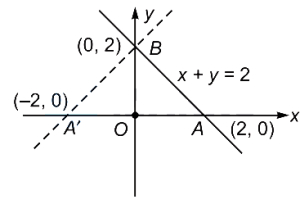
Alternatively,the line $x+y=2$ passes through points $A(2, 0)$ and $B(0, 2)$.
The image of $A(2, 0)$ in the $y$-axis is $A'(-2, 0)$,and the image of $B(0, 2)$ is $B(0, 2)$ itself.
The equation of the line passing through $A'(-2, 0)$ and $B(0, 2)$ is:
$y-0 = \frac{2-0}{0-(-2)}(x-(-2))$
$y = \frac{2}{2}(x+2)$
$y = x+2$
$x-y+2=0$
Substituting $x = -x$ into $x+y-2=0$,we get:
$(-x)+y-2=0$
$-x+y-2=0$
Multiplying by $-1$,we get:
$x-y+2=0$
Alternatively,the line $x+y=2$ passes through points $A(2, 0)$ and $B(0, 2)$.
The image of $A(2, 0)$ in the $y$-axis is $A'(-2, 0)$,and the image of $B(0, 2)$ is $B(0, 2)$ itself.
The equation of the line passing through $A'(-2, 0)$ and $B(0, 2)$ is:
$y-0 = \frac{2-0}{0-(-2)}(x-(-2))$
$y = \frac{2}{2}(x+2)$
$y = x+2$
$x-y+2=0$
0 likesView Solution
11
MathematicsDifficultMCQTS EAMCET · 2010
$A$ straight line which makes equal intercepts on positive $X$ and $Y$ axes and which is at a distance $1$ unit from the origin intersects the straight line $y=2x+3+\sqrt{2}$ at $(x_0, y_0)$. Then $2x_0+y_0$ is equal to
A
$3+\sqrt{2}$
B
$\sqrt{2}-1$
C
$1$
D
$0$
Solution
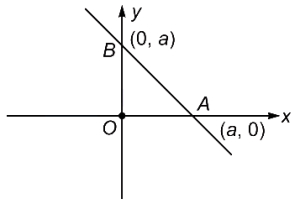
(B) The equation of a line which makes equal intercepts $a$ on the positive $x$ and $y$ axes is given by $\frac{x}{a} + \frac{y}{a} = 1$,which simplifies to $x + y = a$.
Since the distance of this line from the origin $(0, 0)$ is $1$ unit,we have:
$\left| \frac{0 + 0 - a}{\sqrt{1^2 + 1^2}} \right| = 1$
$\left| \frac{-a}{\sqrt{2}} \right| = 1 \implies a = \sqrt{2}$ (since intercepts are on positive axes).
So,the equation of the line is $x + y = \sqrt{2}$.
We are given another line $y = 2x + 3 + \sqrt{2}$,which can be written as $2x - y = -3 - \sqrt{2}$.
To find the intersection point $(x_0, y_0)$,we solve the system:
$x + y = \sqrt{2}$
$2x - y = -3 - \sqrt{2}$
Adding the two equations:
$3x = -3 \implies x_0 = -1$.
Substituting $x_0 = -1$ into $x + y = \sqrt{2}$:
$-1 + y_0 = \sqrt{2} \implies y_0 = \sqrt{2} + 1$.
Now,calculate $2x_0 + y_0$:
$2(-1) + (\sqrt{2} + 1) = -2 + \sqrt{2} + 1 = \sqrt{2} - 1$.
Since the distance of this line from the origin $(0, 0)$ is $1$ unit,we have:
$\left| \frac{0 + 0 - a}{\sqrt{1^2 + 1^2}} \right| = 1$
$\left| \frac{-a}{\sqrt{2}} \right| = 1 \implies a = \sqrt{2}$ (since intercepts are on positive axes).
So,the equation of the line is $x + y = \sqrt{2}$.
We are given another line $y = 2x + 3 + \sqrt{2}$,which can be written as $2x - y = -3 - \sqrt{2}$.
To find the intersection point $(x_0, y_0)$,we solve the system:
$x + y = \sqrt{2}$
$2x - y = -3 - \sqrt{2}$
Adding the two equations:
$3x = -3 \implies x_0 = -1$.
Substituting $x_0 = -1$ into $x + y = \sqrt{2}$:
$-1 + y_0 = \sqrt{2} \implies y_0 = \sqrt{2} + 1$.
Now,calculate $2x_0 + y_0$:
$2(-1) + (\sqrt{2} + 1) = -2 + \sqrt{2} + 1 = \sqrt{2} - 1$.
0 likesView Solution
12
MathematicsDifficultMCQTS EAMCET · 2010
If a straight line $L$ is perpendicular to the line $4x - 2y = 1$ and forms a triangle of area $4 \text{ sq unit}$ with the coordinate axes,then the equation of the line $L$ is
A
$2x + 4y + 7 = 0$
B
$2x - 4y + 8 = 0$
C
$2x + 4y + 8 = 0$
D
$4x - 2y - 8 = 0$
Solution
(C) The given line is $4x - 2y = 1$,which can be written as $2y = 4x - 1$ or $y = 2x - 1/2$. The slope of this line is $m_1 = 2$.
Since line $L$ is perpendicular to this line,its slope $m_2$ must satisfy $m_1 \times m_2 = -1$. Thus,$2 \times m_2 = -1$,so $m_2 = -1/2$.
The equation of line $L$ with slope $-1/2$ can be written as $x + 2y + \lambda = 0$.
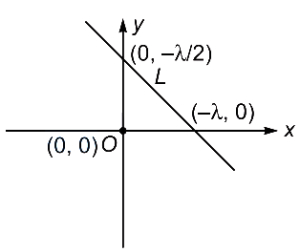
The intercepts of this line on the coordinate axes are found by setting $x=0$ and $y=0$:
For $x=0$,$2y = -\lambda \implies y = -\lambda/2$.
For $y=0$,$x = -\lambda$.
The area of the triangle formed with the coordinate axes is $\frac{1}{2} \times |\text{base}| \times |\text{height}| = \frac{1}{2} |-\lambda| \times |-\lambda/2| = 4$.
$\frac{\lambda^2}{4} = 4 \implies \lambda^2 = 16 \implies \lambda = \pm 4$.
Substituting $\lambda = 4$ into $x + 2y + \lambda = 0$ gives $x + 2y + 4 = 0$,which is equivalent to $2x + 4y + 8 = 0$.
Substituting $\lambda = -4$ gives $x + 2y - 4 = 0$,which is equivalent to $2x + 4y - 8 = 0$.
Since line $L$ is perpendicular to this line,its slope $m_2$ must satisfy $m_1 \times m_2 = -1$. Thus,$2 \times m_2 = -1$,so $m_2 = -1/2$.
The equation of line $L$ with slope $-1/2$ can be written as $x + 2y + \lambda = 0$.
The intercepts of this line on the coordinate axes are found by setting $x=0$ and $y=0$:
For $x=0$,$2y = -\lambda \implies y = -\lambda/2$.
For $y=0$,$x = -\lambda$.
The area of the triangle formed with the coordinate axes is $\frac{1}{2} \times |\text{base}| \times |\text{height}| = \frac{1}{2} |-\lambda| \times |-\lambda/2| = 4$.
$\frac{\lambda^2}{4} = 4 \implies \lambda^2 = 16 \implies \lambda = \pm 4$.
Substituting $\lambda = 4$ into $x + 2y + \lambda = 0$ gives $x + 2y + 4 = 0$,which is equivalent to $2x + 4y + 8 = 0$.
Substituting $\lambda = -4$ gives $x + 2y - 4 = 0$,which is equivalent to $2x + 4y - 8 = 0$.
0 likesView Solution
13
MathematicsDifficultMCQTS EAMCET · 2010
The image of the point $(4, -13)$ with respect to the line $5x + y + 6 = 0$ is
A
$(-1, -14)$
B
$(3, 4)$
C
$(1, 2)$
D
$(-4, 13)$
Solution
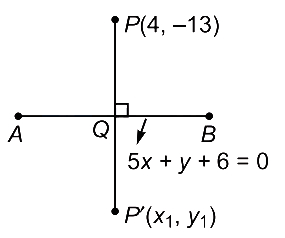
(A) Let the image of the point $P(4, -13)$ be $P^{\prime}(x_1, y_1)$.
The line $AB$ is $5x + y + 6 = 0$.
The formula for the image $(x_1, y_1)$ of a point $(x_0, y_0)$ with respect to the line $ax + by + c = 0$ is given by:
$\frac{x_1 - x_0}{a} = \frac{y_1 - y_0}{b} = -2 \frac{ax_0 + by_0 + c}{a^2 + b^2}$
Substituting the values $x_0 = 4, y_0 = -13, a = 5, b = 1, c = 6$:
$\frac{x_1 - 4}{5} = \frac{y_1 - (-13)}{1} = -2 \frac{5(4) + 1(-13) + 6}{5^2 + 1^2}$
$\frac{x_1 - 4}{5} = \frac{y_1 + 13}{1} = -2 \frac{20 - 13 + 6}{25 + 1}$
$\frac{x_1 - 4}{5} = \frac{y_1 + 13}{1} = -2 \frac{13}{26}$
$\frac{x_1 - 4}{5} = \frac{y_1 + 13}{1} = -1$
Now,solving for $x_1$ and $y_1$:
$\frac{x_1 - 4}{5} = -1$ $\Rightarrow x_1 - 4 = -5$ $\Rightarrow x_1 = -1$
$\frac{y_1 + 13}{1} = -1$ $\Rightarrow y_1 + 13 = -1$ $\Rightarrow y_1 = -14$
Thus,the image of the point is $(-1, -14)$.
The line $AB$ is $5x + y + 6 = 0$.
The formula for the image $(x_1, y_1)$ of a point $(x_0, y_0)$ with respect to the line $ax + by + c = 0$ is given by:
$\frac{x_1 - x_0}{a} = \frac{y_1 - y_0}{b} = -2 \frac{ax_0 + by_0 + c}{a^2 + b^2}$
Substituting the values $x_0 = 4, y_0 = -13, a = 5, b = 1, c = 6$:
$\frac{x_1 - 4}{5} = \frac{y_1 - (-13)}{1} = -2 \frac{5(4) + 1(-13) + 6}{5^2 + 1^2}$
$\frac{x_1 - 4}{5} = \frac{y_1 + 13}{1} = -2 \frac{20 - 13 + 6}{25 + 1}$
$\frac{x_1 - 4}{5} = \frac{y_1 + 13}{1} = -2 \frac{13}{26}$
$\frac{x_1 - 4}{5} = \frac{y_1 + 13}{1} = -1$
Now,solving for $x_1$ and $y_1$:
$\frac{x_1 - 4}{5} = -1$ $\Rightarrow x_1 - 4 = -5$ $\Rightarrow x_1 = -1$
$\frac{y_1 + 13}{1} = -1$ $\Rightarrow y_1 + 13 = -1$ $\Rightarrow y_1 = -14$
Thus,the image of the point is $(-1, -14)$.
0 likesView Solution
14
MathematicsDifficultMCQTS EAMCET · 2010
The distance between the two parallel lines represented by the equation $8x^2 - 24xy + 18y^2 - 6x + 9y - 5 = 0$ is
A
$0$
B
$\frac{3}{4\sqrt{13}}$
C
$\frac{6}{\sqrt{13}}$
D
$\frac{7}{2\sqrt{13}}$
Solution
(D) The given equation is $8x^2 - 24xy + 18y^2 - 6x + 9y - 5 = 0$.
We can rewrite the quadratic part as $2(4x^2 - 12xy + 9y^2) = 2(2x - 3y)^2$.
Let the lines be of the form $(2x - 3y + c_1)(2x - 3y + c_2) = 0$.
Expanding this,we get $4x^2 - 12xy + 9y^2 + 2(c_1 + c_2)x - 3(c_1 + c_2)y + c_1c_2 = 0$.
Comparing this with the given equation $8x^2 - 24xy + 18y^2 - 6x + 9y - 5 = 0$,we divide the given equation by $2$: $4x^2 - 12xy + 9y^2 - 3x + 4.5y - 2.5 = 0$.
Here,$c_1 + c_2 = -3/2$ and $c_1c_2 = -2.5$.
The distance between parallel lines $Ax + By + C_1 = 0$ and $Ax + By + C_2 = 0$ is $\frac{|C_1 - C_2|}{\sqrt{A^2 + B^2}}$.
Using $(c_1 - c_2)^2 = (c_1 + c_2)^2 - 4c_1c_2 = (-1.5)^2 - 4(-2.5) = 2.25 + 10 = 12.25$.
So,$|c_1 - c_2| = \sqrt{12.25} = 3.5 = 7/2$.
The distance is $\frac{7/2}{\sqrt{2^2 + (-3)^2}} = \frac{7/2}{\sqrt{13}} = \frac{7}{2\sqrt{13}}$.
We can rewrite the quadratic part as $2(4x^2 - 12xy + 9y^2) = 2(2x - 3y)^2$.
Let the lines be of the form $(2x - 3y + c_1)(2x - 3y + c_2) = 0$.
Expanding this,we get $4x^2 - 12xy + 9y^2 + 2(c_1 + c_2)x - 3(c_1 + c_2)y + c_1c_2 = 0$.
Comparing this with the given equation $8x^2 - 24xy + 18y^2 - 6x + 9y - 5 = 0$,we divide the given equation by $2$: $4x^2 - 12xy + 9y^2 - 3x + 4.5y - 2.5 = 0$.
Here,$c_1 + c_2 = -3/2$ and $c_1c_2 = -2.5$.
The distance between parallel lines $Ax + By + C_1 = 0$ and $Ax + By + C_2 = 0$ is $\frac{|C_1 - C_2|}{\sqrt{A^2 + B^2}}$.
Using $(c_1 - c_2)^2 = (c_1 + c_2)^2 - 4c_1c_2 = (-1.5)^2 - 4(-2.5) = 2.25 + 10 = 12.25$.
So,$|c_1 - c_2| = \sqrt{12.25} = 3.5 = 7/2$.
The distance is $\frac{7/2}{\sqrt{2^2 + (-3)^2}} = \frac{7/2}{\sqrt{13}} = \frac{7}{2\sqrt{13}}$.
0 likesView Solution
15
MathematicsDifficultMCQTS EAMCET · 2010
$A$ pair of perpendicular lines passes through the origin and also through the points of intersection of the curve $x^2+y^2=4$ with $x+y=a$,where $a>0$. Then $a$ is equal to
A
$2$
B
$3$
C
$4$
D
$5$
Solution
(A) The equation of the pair of lines passing through the origin and the intersection of $x^2+y^2=4$ and $x+y=a$ is obtained by homogenizing the circle equation using the line equation:
$x^2+y^2=4(\frac{x+y}{a})^2$
$a^2(x^2+y^2)=4(x^2+y^2+2xy)$
$(a^2-4)x^2-8xy+(a^2-4)y^2=0$
Since the lines are perpendicular,the sum of the coefficients of $x^2$ and $y^2$ must be zero:
$(a^2-4)+(a^2-4)=0$
$2(a^2-4)=0$
$a^2=4$
Since $a>0$,we have $a=2$.
$x^2+y^2=4(\frac{x+y}{a})^2$
$a^2(x^2+y^2)=4(x^2+y^2+2xy)$
$(a^2-4)x^2-8xy+(a^2-4)y^2=0$
Since the lines are perpendicular,the sum of the coefficients of $x^2$ and $y^2$ must be zero:
$(a^2-4)+(a^2-4)=0$
$2(a^2-4)=0$
$a^2=4$
Since $a>0$,we have $a=2$.
0 likesView Solution
16
MathematicsDifficultMCQTS EAMCET · 2010
If $3x^2-11xy+10y^2-7x+13y+k=0$ denotes a pair of straight lines,then the point of intersection of the lines is
A
$(1,3)$
B
$(3,1)$
C
$(-3,1)$
D
$(1,-3)$
Solution
(B) The given equation of the pair of straight lines is $3x^2-11xy+10y^2-7x+13y+k=0$.
Comparing this with the general equation $ax^2+2hxy+by^2+2gx+2fy+c=0$,we get:
$a=3, h=-\frac{11}{2}, b=10, g=-\frac{7}{2}, f=\frac{13}{2}$.
The point of intersection $(x, y)$ of the pair of lines is given by the formula:
$x = \frac{hf-bg}{ab-h^2}$ and $y = \frac{gh-af}{ab-h^2}$.
First,calculate the denominator: $ab-h^2 = (3)(10) - (-\frac{11}{2})^2 = 30 - \frac{121}{4} = \frac{120-121}{4} = -\frac{1}{4}$.
Now,calculate the numerator for $x$: $hf-bg = (-\frac{11}{2})(\frac{13}{2}) - (10)(-\frac{7}{2}) = -\frac{143}{4} + 35 = \frac{-143+140}{4} = -\frac{3}{4}$.
So,$x = \frac{-3/4}{-1/4} = 3$.
Now,calculate the numerator for $y$: $gh-af = (-\frac{7}{2})(-\frac{11}{2}) - (3)(\frac{13}{2}) = \frac{77}{4} - \frac{39}{2} = \frac{77-78}{4} = -\frac{1}{4}$.
So,$y = \frac{-1/4}{-1/4} = 1$.
Therefore,the point of intersection is $(3, 1)$.
Comparing this with the general equation $ax^2+2hxy+by^2+2gx+2fy+c=0$,we get:
$a=3, h=-\frac{11}{2}, b=10, g=-\frac{7}{2}, f=\frac{13}{2}$.
The point of intersection $(x, y)$ of the pair of lines is given by the formula:
$x = \frac{hf-bg}{ab-h^2}$ and $y = \frac{gh-af}{ab-h^2}$.
First,calculate the denominator: $ab-h^2 = (3)(10) - (-\frac{11}{2})^2 = 30 - \frac{121}{4} = \frac{120-121}{4} = -\frac{1}{4}$.
Now,calculate the numerator for $x$: $hf-bg = (-\frac{11}{2})(\frac{13}{2}) - (10)(-\frac{7}{2}) = -\frac{143}{4} + 35 = \frac{-143+140}{4} = -\frac{3}{4}$.
So,$x = \frac{-3/4}{-1/4} = 3$.
Now,calculate the numerator for $y$: $gh-af = (-\frac{7}{2})(-\frac{11}{2}) - (3)(\frac{13}{2}) = \frac{77}{4} - \frac{39}{2} = \frac{77-78}{4} = -\frac{1}{4}$.
So,$y = \frac{-1/4}{-1/4} = 1$.
Therefore,the point of intersection is $(3, 1)$.
0 likesView Solution
17
MathematicsDifficultMCQTS EAMCET · 2010
If the lengths of the tangents drawn from a point $P$ to the circles $x^2+y^2-8x+40=0$,$5x^2+5y^2-25x+80=0$,and $x^2+y^2-8x+16y+160=0$ are equal,then the coordinates of point $P$ are:
A
$\left(8, \frac{15}{2}\right)$
B
$\left(-8, \frac{15}{2}\right)$
C
$\left(8, -\frac{15}{2}\right)$
D
$\left(-8, -\frac{15}{2}\right)$
Solution
(C) Let $P(x_1, y_1)$ be the point from which the tangents are drawn to the circles:
$S_1 \equiv x^2+y^2-8x+40=0$
$S_2 \equiv x^2+y^2-5x+16=0$ (Dividing by $5$)
$S_3 \equiv x^2+y^2-8x+16y+160=0$
Since the lengths of the tangents from $P$ to the circles $S_1, S_2, S_3$ are equal,we have $\sqrt{S_1} = \sqrt{S_2} = \sqrt{S_3}$,which implies $S_1 = S_2 = S_3$.
Equating $S_1 = S_3$:
$x_1^2+y_1^2-8x_1+40 = x_1^2+y_1^2-8x_1+16y_1+160$
$40 = 16y_1+160$
$16y_1 = -120 \Rightarrow y_1 = -\frac{120}{16} = -\frac{15}{2}$.
Equating $S_1 = S_2$:
$x_1^2+y_1^2-8x_1+40 = x_1^2+y_1^2-5x_1+16$
$-8x_1+40 = -5x_1+16$
$3x_1 = 24 \Rightarrow x_1 = 8$.
Thus,the point $P$ is $\left(8, -\frac{15}{2}\right)$.
$S_1 \equiv x^2+y^2-8x+40=0$
$S_2 \equiv x^2+y^2-5x+16=0$ (Dividing by $5$)
$S_3 \equiv x^2+y^2-8x+16y+160=0$
Since the lengths of the tangents from $P$ to the circles $S_1, S_2, S_3$ are equal,we have $\sqrt{S_1} = \sqrt{S_2} = \sqrt{S_3}$,which implies $S_1 = S_2 = S_3$.
Equating $S_1 = S_3$:
$x_1^2+y_1^2-8x_1+40 = x_1^2+y_1^2-8x_1+16y_1+160$
$40 = 16y_1+160$
$16y_1 = -120 \Rightarrow y_1 = -\frac{120}{16} = -\frac{15}{2}$.
Equating $S_1 = S_2$:
$x_1^2+y_1^2-8x_1+40 = x_1^2+y_1^2-5x_1+16$
$-8x_1+40 = -5x_1+16$
$3x_1 = 24 \Rightarrow x_1 = 8$.
Thus,the point $P$ is $\left(8, -\frac{15}{2}\right)$.
0 likesView Solution
18
MathematicsDifficultMCQTS EAMCET · 2010
The sum of the angles of elevation of the top of a tower from two points distant $a$ and $b$ from the base and in the same straight line with it is $90^{\circ}$. Then,the height of the tower is
A
$a^2 b$
B
$a b^2$
C
$\sqrt{a b}$
D
$a b$
Solution
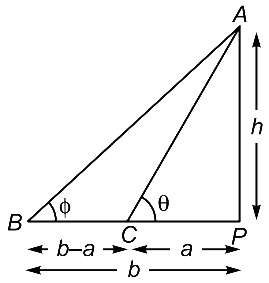
(C) Let the height of the tower be $h$ and the base be $P$. Let the two points be $C$ and $B$ such that $PC = a$ and $PB = b$. The angles of elevation are $\angle ACP = \theta$ and $\angle ABP = \phi$. Given $\theta + \phi = 90^{\circ}$.
In $\triangle ACP$,$\tan \theta = \frac{h}{a}$.
In $\triangle ABP$,$\tan \phi = \frac{h}{b}$.
Since $\theta + \phi = 90^{\circ}$,we have $\phi = 90^{\circ} - \theta$,so $\tan \phi = \tan(90^{\circ} - \theta) = \cot \theta = \frac{1}{\tan \theta}$.
Substituting the values,$\frac{h}{b} = \frac{1}{h/a} = \frac{a}{h}$.
Therefore,$h^2 = ab$,which gives $h = \sqrt{ab}$.
In $\triangle ACP$,$\tan \theta = \frac{h}{a}$.
In $\triangle ABP$,$\tan \phi = \frac{h}{b}$.
Since $\theta + \phi = 90^{\circ}$,we have $\phi = 90^{\circ} - \theta$,so $\tan \phi = \tan(90^{\circ} - \theta) = \cot \theta = \frac{1}{\tan \theta}$.
Substituting the values,$\frac{h}{b} = \frac{1}{h/a} = \frac{a}{h}$.
Therefore,$h^2 = ab$,which gives $h = \sqrt{ab}$.
0 likesView Solution
19
MathematicsMediumMCQTS EAMCET · 2010
If $\frac{3x^2+x+1}{(x-1)^4} = \frac{a}{(x-1)} + \frac{b}{(x-1)^2} + \frac{c}{(x-1)^3} + \frac{d}{(x-1)^4}$,then $\begin{bmatrix} a & b \\ c & d \end{bmatrix}$ is equal to
A
$\begin{bmatrix} 3 & 7 \\ 5 & 0 \end{bmatrix}$
B
$\begin{bmatrix} 0 & 3 \\ 7 & 5 \end{bmatrix}$
C
$\begin{bmatrix} 0 & 7 \\ 3 & 5 \end{bmatrix}$
D
$\begin{bmatrix} 3 & 5 \\ 7 & 0 \end{bmatrix}$
Solution
(B) Let $x-1 = t$,so $x = t+1$. Substituting this into the numerator: $3(t+1)^2 + (t+1) + 1 = 3(t^2+2t+1) + t + 2 = 3t^2 + 7t + 5$.
The expression becomes $\frac{3t^2+7t+5}{t^4} = \frac{3}{t^2} + \frac{7}{t^3} + \frac{5}{t^4}$.
Comparing this with $\frac{a}{t} + \frac{b}{t^2} + \frac{c}{t^3} + \frac{d}{t^4}$,we get $a=0, b=3, c=7, d=5$.
Thus,$\begin{bmatrix} a & b \\ c & d \end{bmatrix} = \begin{bmatrix} 0 & 3 \\ 7 & 5 \end{bmatrix}$.
The expression becomes $\frac{3t^2+7t+5}{t^4} = \frac{3}{t^2} + \frac{7}{t^3} + \frac{5}{t^4}$.
Comparing this with $\frac{a}{t} + \frac{b}{t^2} + \frac{c}{t^3} + \frac{d}{t^4}$,we get $a=0, b=3, c=7, d=5$.
Thus,$\begin{bmatrix} a & b \\ c & d \end{bmatrix} = \begin{bmatrix} 0 & 3 \\ 7 & 5 \end{bmatrix}$.
0 likesView Solution
20
MathematicsDifficultMCQTS EAMCET · 2010
If $m_1$ and $m_2$ are the roots of the equation $x^2+(\sqrt{3}+2)x+(\sqrt{3}-1)=0$,then the area of the triangle formed by the lines $y=m_1x$,$y=m_2x$ and $y=c$ is:
A
$\left(\frac{\sqrt{33}-\sqrt{11}}{4}\right) \cdot c^2$
B
$\left(\frac{\sqrt{33}+\sqrt{11}}{4}\right) \cdot c^2$
C
$\left(\frac{\sqrt{11}-\sqrt{33}}{2}\right) \cdot c^2$
D
$\frac{\sqrt{33}}{2} \cdot c^2$
Solution
(B) Given the quadratic equation $x^2+(\sqrt{3}+2)x+(\sqrt{3}-1)=0$.
By the relation between roots and coefficients,we have:
$m_1+m_2 = -(\sqrt{3}+2)$
$m_1m_2 = \sqrt{3}-1$
We calculate the difference of the roots:
$|m_1-m_2| = \sqrt{(m_1+m_2)^2 - 4m_1m_2} = \sqrt{(\sqrt{3}+2)^2 - 4(\sqrt{3}-1)}$
$= \sqrt{(3+4+4\sqrt{3}) - 4\sqrt{3}+4} = \sqrt{11}$.
The vertices of the triangle formed by $y=m_1x$,$y=m_2x$,and $y=c$ are $(0,0)$,$(c/m_1, c)$,and $(c/m_2, c)$.
The area of the triangle is given by:
$\text{Area} = \frac{1}{2} |x_1(y_2-y_3) + x_2(y_3-y_1) + x_3(y_1-y_2)|$
$= \frac{1}{2} |0(c-c) + \frac{c}{m_1}(c-0) + \frac{c}{m_2}(0-c)| = \frac{1}{2} |\frac{c^2}{m_1} - \frac{c^2}{m_2}| = \frac{c^2}{2} |\frac{m_2-m_1}{m_1m_2}|$
$= \frac{c^2}{2} \cdot \frac{\sqrt{11}}{\sqrt{3}-1} = \frac{c^2}{2} \cdot \frac{\sqrt{11}(\sqrt{3}+1)}{3-1} = \frac{c^2}{2} \cdot \frac{\sqrt{33}+\sqrt{11}}{2} = \left(\frac{\sqrt{33}+\sqrt{11}}{4}\right)c^2$.
By the relation between roots and coefficients,we have:
$m_1+m_2 = -(\sqrt{3}+2)$
$m_1m_2 = \sqrt{3}-1$
We calculate the difference of the roots:
$|m_1-m_2| = \sqrt{(m_1+m_2)^2 - 4m_1m_2} = \sqrt{(\sqrt{3}+2)^2 - 4(\sqrt{3}-1)}$
$= \sqrt{(3+4+4\sqrt{3}) - 4\sqrt{3}+4} = \sqrt{11}$.
The vertices of the triangle formed by $y=m_1x$,$y=m_2x$,and $y=c$ are $(0,0)$,$(c/m_1, c)$,and $(c/m_2, c)$.
The area of the triangle is given by:
$\text{Area} = \frac{1}{2} |x_1(y_2-y_3) + x_2(y_3-y_1) + x_3(y_1-y_2)|$
$= \frac{1}{2} |0(c-c) + \frac{c}{m_1}(c-0) + \frac{c}{m_2}(0-c)| = \frac{1}{2} |\frac{c^2}{m_1} - \frac{c^2}{m_2}| = \frac{c^2}{2} |\frac{m_2-m_1}{m_1m_2}|$
$= \frac{c^2}{2} \cdot \frac{\sqrt{11}}{\sqrt{3}-1} = \frac{c^2}{2} \cdot \frac{\sqrt{11}(\sqrt{3}+1)}{3-1} = \frac{c^2}{2} \cdot \frac{\sqrt{33}+\sqrt{11}}{2} = \left(\frac{\sqrt{33}+\sqrt{11}}{4}\right)c^2$.
0 likesView Solution
21
MathematicsDifficultMCQTS EAMCET · 2010
$(\sqrt{3}+i)^7+(\sqrt{3}-i)^7$ is equal to (in $\sqrt{3}$)
A
$128$
B
$256$
C
$-128$
D
$-256$
Solution
(C) Let $z = \sqrt{3}+i$.
Converting to polar form,$r = \sqrt{(\sqrt{3})^2 + 1^2} = 2$ and $\theta = \tan^{-1}(\frac{1}{\sqrt{3}}) = \frac{\pi}{6}$.
So,$z = 2(\cos \frac{\pi}{6} + i \sin \frac{\pi}{6})$ and $\bar{z} = 2(\cos \frac{\pi}{6} - i \sin \frac{\pi}{6})$.
Using De Moivre's Theorem,$z^7 + \bar{z}^7 = 2^7(\cos \frac{7\pi}{6} + i \sin \frac{7\pi}{6}) + 2^7(\cos \frac{7\pi}{6} - i \sin \frac{7\pi}{6})$.
$= 2^7(2 \cos \frac{7\pi}{6}) = 2^8 \cos(\pi + \frac{\pi}{6})$.
$= -2^8 \cos(\frac{\pi}{6}) = -256 \times \frac{\sqrt{3}}{2} = -128 \sqrt{3}$.
Converting to polar form,$r = \sqrt{(\sqrt{3})^2 + 1^2} = 2$ and $\theta = \tan^{-1}(\frac{1}{\sqrt{3}}) = \frac{\pi}{6}$.
So,$z = 2(\cos \frac{\pi}{6} + i \sin \frac{\pi}{6})$ and $\bar{z} = 2(\cos \frac{\pi}{6} - i \sin \frac{\pi}{6})$.
Using De Moivre's Theorem,$z^7 + \bar{z}^7 = 2^7(\cos \frac{7\pi}{6} + i \sin \frac{7\pi}{6}) + 2^7(\cos \frac{7\pi}{6} - i \sin \frac{7\pi}{6})$.
$= 2^7(2 \cos \frac{7\pi}{6}) = 2^8 \cos(\pi + \frac{\pi}{6})$.
$= -2^8 \cos(\frac{\pi}{6}) = -256 \times \frac{\sqrt{3}}{2} = -128 \sqrt{3}$.
0 likesView Solution
22
MathematicsEasyMCQTS EAMCET · 2010
If $\omega$ is a complex cube root of unity,then $(x+1)(x+\omega)(x-\omega-1)$ is equal to
A
$x^3-1$
B
$x^3+1$
C
$x^3+2$
D
$x^3-2$
Solution
(A) Given that $\omega$ is a complex cube root of unity,we have $\omega^3 = 1$ and $1 + \omega + \omega^2 = 0$.
Consider the expression $(x+1)(x+\omega)(x-\omega-1)$.
Note that $-\omega-1 = \omega^2$ since $1 + \omega + \omega^2 = 0$.
So,the expression becomes $(x+1)(x+\omega)(x+\omega^2)$.
We know the identity $(x-a)(x-b)(x-c) = x^3 - (a+b+c)x^2 + (ab+bc+ca)x - abc$.
Here,the roots are $-1, -\omega, -\omega^2$.
Thus,$(x+1)(x+\omega)(x+\omega^2) = x^3 - (-1-\omega-\omega^2)x^2 + (\omega+\omega^2+\omega^3)x - (1)(\omega)(\omega^2)$.
Since $1+\omega+\omega^2=0$,we have $-1-\omega-\omega^2=0$.
Also,$\omega+\omega^2+\omega^3 = -1 + 1 = 0$.
And $\omega^3 = 1$.
Therefore,the expression simplifies to $x^3 - (0)x^2 + (0)x - 1 = x^3 - 1$.
Consider the expression $(x+1)(x+\omega)(x-\omega-1)$.
Note that $-\omega-1 = \omega^2$ since $1 + \omega + \omega^2 = 0$.
So,the expression becomes $(x+1)(x+\omega)(x+\omega^2)$.
We know the identity $(x-a)(x-b)(x-c) = x^3 - (a+b+c)x^2 + (ab+bc+ca)x - abc$.
Here,the roots are $-1, -\omega, -\omega^2$.
Thus,$(x+1)(x+\omega)(x+\omega^2) = x^3 - (-1-\omega-\omega^2)x^2 + (\omega+\omega^2+\omega^3)x - (1)(\omega)(\omega^2)$.
Since $1+\omega+\omega^2=0$,we have $-1-\omega-\omega^2=0$.
Also,$\omega+\omega^2+\omega^3 = -1 + 1 = 0$.
And $\omega^3 = 1$.
Therefore,the expression simplifies to $x^3 - (0)x^2 + (0)x - 1 = x^3 - 1$.
0 likesView Solution
23
MathematicsMediumMCQTS EAMCET · 2010
Let $a_n = \frac{10^n}{n!}$ for $n = 1, 2, 3, \ldots$. Then the greatest value of $n$ for which $a_n$ is the greatest is
A
$11$
B
$20$
C
$10$
D
$8$
Solution
(C) To find the value of $n$ for which $a_n$ is maximum,we consider the ratio $\frac{a_n}{a_{n-1}}$.
$\frac{a_n}{a_{n-1}} = \frac{10^n}{n!} \times \frac{(n-1)!}{10^{n-1}} = \frac{10}{n}$.
For $a_n$ to be increasing,we require $\frac{a_n}{a_{n-1}} > 1$,which implies $\frac{10}{n} > 1$,so $n < 10$.
This means $a_1 < a_2 < \ldots < a_9 < a_{10}$.
For $n = 10$,$\frac{a_{10}}{a_9} = \frac{10}{10} = 1$,which implies $a_{10} = a_9$.
For $n > 10$,$\frac{a_n}{a_{n-1}} < 1$,which implies $a_n < a_{n-1}$.
Thus,the sequence $a_n$ reaches its maximum value at both $n = 9$ and $n = 10$.
$\frac{a_n}{a_{n-1}} = \frac{10^n}{n!} \times \frac{(n-1)!}{10^{n-1}} = \frac{10}{n}$.
For $a_n$ to be increasing,we require $\frac{a_n}{a_{n-1}} > 1$,which implies $\frac{10}{n} > 1$,so $n < 10$.
This means $a_1 < a_2 < \ldots < a_9 < a_{10}$.
For $n = 10$,$\frac{a_{10}}{a_9} = \frac{10}{10} = 1$,which implies $a_{10} = a_9$.
For $n > 10$,$\frac{a_n}{a_{n-1}} < 1$,which implies $a_n < a_{n-1}$.
Thus,the sequence $a_n$ reaches its maximum value at both $n = 9$ and $n = 10$.
0 likesView Solution
24
MathematicsEasyMCQTS EAMCET · 2010
$A$ polygon has $54$ diagonals. Then,the number of its sides is
A
$7$
B
$9$
C
$10$
D
$12$
Solution
(D) The number of diagonals in a polygon with $n$ sides is given by the formula $\frac{n(n-3)}{2}$.
Given that the number of diagonals is $54$,we have:
$\frac{n(n-3)}{2} = 54$
$n(n-3) = 108$
$n^2 - 3n - 108 = 0$
Factoring the quadratic equation:
$n^2 - 12n + 9n - 108 = 0$
$n(n - 12) + 9(n - 12) = 0$
$(n + 9)(n - 12) = 0$
This gives $n = -9$ or $n = 12$.
Since the number of sides $n$ must be a positive integer,we have $n = 12$.
Given that the number of diagonals is $54$,we have:
$\frac{n(n-3)}{2} = 54$
$n(n-3) = 108$
$n^2 - 3n - 108 = 0$
Factoring the quadratic equation:
$n^2 - 12n + 9n - 108 = 0$
$n(n - 12) + 9(n - 12) = 0$
$(n + 9)(n - 12) = 0$
This gives $n = -9$ or $n = 12$.
Since the number of sides $n$ must be a positive integer,we have $n = 12$.
0 likesView Solution
25
MathematicsDifficultMCQTS EAMCET · 2010
Let $n = 1! + 4! + 7! + \ldots + 400!$. Then the ten's digit of $n$ is
A
$1$
B
$6$
C
$2$
D
$7$
Solution
(B) Given,$n = 1! + 4! + 7! + \ldots + 400!$.
We calculate the values of the factorials:
$1! = 1$
$4! = 24$
$7! = 5040$
$10! = 3628800$
For any $k \ge 10$,$k!$ ends in at least two zeros,so the last two digits of $k!$ are $00$.
Thus,the last two digits of $n$ are the same as the last two digits of $1! + 4! + 7! + 10! + \ldots$.
$1! + 4! + 7! = 1 + 24 + 5040 = 5065$.
Since all subsequent terms $10!, 13!, \ldots$ end in $00$,the sum $n$ ends in $65$.
Therefore,the ten's digit of $n$ is $6$.
We calculate the values of the factorials:
$1! = 1$
$4! = 24$
$7! = 5040$
$10! = 3628800$
For any $k \ge 10$,$k!$ ends in at least two zeros,so the last two digits of $k!$ are $00$.
Thus,the last two digits of $n$ are the same as the last two digits of $1! + 4! + 7! + 10! + \ldots$.
$1! + 4! + 7! = 1 + 24 + 5040 = 5065$.
Since all subsequent terms $10!, 13!, \ldots$ end in $00$,the sum $n$ ends in $65$.
Therefore,the ten's digit of $n$ is $6$.
0 likesView Solution
26
MathematicsMediumMCQTS EAMCET · 2010
The numbers $a_n = 6^n - 5n$ for $n = 1, 2, 3, \ldots$ when divided by $25$ leave the remainder:
A
$9$
B
$7$
C
$3$
D
$1$
Solution
(D) Given,$a_n = 6^n - 5n$ for $n = 1, 2, 3, \ldots$
We can write $6^n$ as $(1 + 5)^n$.
Using the binomial expansion:
$6^n = (1 + 5)^n = {^nC_0} + {^nC_1}(5) + {^nC_2}(5^2) + {^nC_3}(5^3) + \ldots + {^nC_n}(5^n)$
$6^n = 1 + 5n + 25({^nC_2} + {^nC_3}(5) + \ldots + {^nC_n}(5^{n-2}))$
Now,subtract $5n$ from both sides:
$a_n = 6^n - 5n = 1 + 25({^nC_2} + 5{^nC_3} + \ldots + 5^{n-2}{^nC_n})$
Let $k = {^nC_2} + 5{^nC_3} + \ldots + 5^{n-2}{^nC_n}$,where $k$ is an integer for $n \geq 2$.
Thus,$a_n = 1 + 25k$.
For $n = 1$,$a_1 = 6^1 - 5(1) = 1$.
In both cases,$a_n$ divided by $25$ leaves a remainder of $1$.
We can write $6^n$ as $(1 + 5)^n$.
Using the binomial expansion:
$6^n = (1 + 5)^n = {^nC_0} + {^nC_1}(5) + {^nC_2}(5^2) + {^nC_3}(5^3) + \ldots + {^nC_n}(5^n)$
$6^n = 1 + 5n + 25({^nC_2} + {^nC_3}(5) + \ldots + {^nC_n}(5^{n-2}))$
Now,subtract $5n$ from both sides:
$a_n = 6^n - 5n = 1 + 25({^nC_2} + 5{^nC_3} + \ldots + 5^{n-2}{^nC_n})$
Let $k = {^nC_2} + 5{^nC_3} + \ldots + 5^{n-2}{^nC_n}$,where $k$ is an integer for $n \geq 2$.
Thus,$a_n = 1 + 25k$.
For $n = 1$,$a_1 = 6^1 - 5(1) = 1$.
In both cases,$a_n$ divided by $25$ leaves a remainder of $1$.
0 likesView Solution
27
MathematicsMediumMCQTS EAMCET · 2010
For $|x| < \frac{1}{5}$,the coefficient of $x^3$ in the expansion of $\frac{1}{(1-5 x)(1-4 x)}$ is
A
$369$
B
$370$
C
$371$
D
$372$
Solution
(A) Given the expression $\frac{1}{(1-5x)(1-4x)}$ for $|x| < \frac{1}{5}$.
Using the binomial expansion $(1-z)^{-1} = 1 + z + z^2 + z^3 + \dots$,we have:
$(1-5x)^{-1} = 1 + 5x + 25x^2 + 125x^3 + \dots$
$(1-4x)^{-1} = 1 + 4x + 16x^2 + 64x^3 + \dots$
Multiplying these two series:
$(1 + 5x + 25x^2 + 125x^3 + \dots)(1 + 4x + 16x^2 + 64x^3 + \dots)$
The coefficient of $x^3$ is obtained by collecting terms that result in $x^3$:
$1 \cdot (64x^3) + (5x) \cdot (16x^2) + (25x^2) \cdot (4x) + (125x^3) \cdot 1$
$= 64 + 80 + 100 + 125$
$= 369$
Using the binomial expansion $(1-z)^{-1} = 1 + z + z^2 + z^3 + \dots$,we have:
$(1-5x)^{-1} = 1 + 5x + 25x^2 + 125x^3 + \dots$
$(1-4x)^{-1} = 1 + 4x + 16x^2 + 64x^3 + \dots$
Multiplying these two series:
$(1 + 5x + 25x^2 + 125x^3 + \dots)(1 + 4x + 16x^2 + 64x^3 + \dots)$
The coefficient of $x^3$ is obtained by collecting terms that result in $x^3$:
$1 \cdot (64x^3) + (5x) \cdot (16x^2) + (25x^2) \cdot (4x) + (125x^3) \cdot 1$
$= 64 + 80 + 100 + 125$
$= 369$
0 likesView Solution
28
MathematicsMediumMCQTS EAMCET · 2010
If $(1+2x+3x^2)^{10} = a_0+a_1x+a_2x^2+\ldots+a_{20}x^{20}$,then $\frac{a_2}{a_1}$ is equal to
A
$10.5$
B
$21$
C
$10$
D
$5.5$
Solution
(A) Given $(1+2x+3x^2)^{10} = a_0+a_1x+a_2x^2+\ldots+a_{20}x^{20}$.
Using the binomial expansion $(1+y)^n = \sum_{k=0}^n {}^{n}C_k y^k$,let $y = 2x+3x^2$.
$(1+2x+3x^2)^{10} = {}^{10}C_0 + {}^{10}C_1(2x+3x^2) + {}^{10}C_2(2x+3x^2)^2 + \ldots$
$= 1 + 10(2x+3x^2) + 45(4x^2+12x^3+9x^4) + \ldots$
$= 1 + 20x + 30x^2 + 180x^2 + \ldots$
$= 1 + 20x + 210x^2 + \ldots$
Comparing coefficients,we get $a_1 = 20$ and $a_2 = 210$.
Therefore,$\frac{a_2}{a_1} = \frac{210}{20} = 10.5$.
Using the binomial expansion $(1+y)^n = \sum_{k=0}^n {}^{n}C_k y^k$,let $y = 2x+3x^2$.
$(1+2x+3x^2)^{10} = {}^{10}C_0 + {}^{10}C_1(2x+3x^2) + {}^{10}C_2(2x+3x^2)^2 + \ldots$
$= 1 + 10(2x+3x^2) + 45(4x^2+12x^3+9x^4) + \ldots$
$= 1 + 20x + 30x^2 + 180x^2 + \ldots$
$= 1 + 20x + 210x^2 + \ldots$
Comparing coefficients,we get $a_1 = 20$ and $a_2 = 210$.
Therefore,$\frac{a_2}{a_1} = \frac{210}{20} = 10.5$.
0 likesView Solution
29
MathematicsMediumMCQTS EAMCET · 2010
The set of solutions of the equation $(\sqrt{3}-1) \sin \theta+(\sqrt{3}+1) \cos \theta=2$ is
A
$\{2 n \pi \pm \frac{\pi}{4}+\frac{\pi}{12}: n \in Z\}$
B
$\{2 n \pi \pm \frac{\pi}{4}-\frac{\pi}{12}: n \in Z\}$
C
$\{n \pi+(-1)^n \frac{\pi}{4}+\frac{\pi}{12}: n \in Z\}$
D
$\{n \pi+(-1)^n \frac{\pi}{4}-\frac{\pi}{12}: n \in Z\}$
Solution
(A) Given equation: $(\sqrt{3}-1) \sin \theta+(\sqrt{3}+1) \cos \theta=2$
Divide by $\sqrt{(\sqrt{3}-1)^2 + (\sqrt{3}+1)^2} = \sqrt{3+1-2\sqrt{3} + 3+1+2\sqrt{3}} = \sqrt{8} = 2\sqrt{2}$.
$\frac{\sqrt{3}-1}{2\sqrt{2}} \sin \theta + \frac{\sqrt{3}+1}{2\sqrt{2}} \cos \theta = \frac{2}{2\sqrt{2}} = \frac{1}{\sqrt{2}}$.
We know $\cos 15^{\circ} = \cos \frac{\pi}{12} = \frac{\sqrt{3}+1}{2\sqrt{2}}$ and $\sin 15^{\circ} = \sin \frac{\pi}{12} = \frac{\sqrt{3}-1}{2\sqrt{2}}$.
So,$\sin \frac{\pi}{12} \sin \theta + \cos \frac{\pi}{12} \cos \theta = \cos \frac{\pi}{4}$.
$\cos(\theta - \frac{\pi}{12}) = \cos \frac{\pi}{4}$.
General solution: $\theta - \frac{\pi}{12} = 2n\pi \pm \frac{\pi}{4}$.
$\theta = 2n\pi \pm \frac{\pi}{4} + \frac{\pi}{12}$,where $n \in Z$.
Divide by $\sqrt{(\sqrt{3}-1)^2 + (\sqrt{3}+1)^2} = \sqrt{3+1-2\sqrt{3} + 3+1+2\sqrt{3}} = \sqrt{8} = 2\sqrt{2}$.
$\frac{\sqrt{3}-1}{2\sqrt{2}} \sin \theta + \frac{\sqrt{3}+1}{2\sqrt{2}} \cos \theta = \frac{2}{2\sqrt{2}} = \frac{1}{\sqrt{2}}$.
We know $\cos 15^{\circ} = \cos \frac{\pi}{12} = \frac{\sqrt{3}+1}{2\sqrt{2}}$ and $\sin 15^{\circ} = \sin \frac{\pi}{12} = \frac{\sqrt{3}-1}{2\sqrt{2}}$.
So,$\sin \frac{\pi}{12} \sin \theta + \cos \frac{\pi}{12} \cos \theta = \cos \frac{\pi}{4}$.
$\cos(\theta - \frac{\pi}{12}) = \cos \frac{\pi}{4}$.
General solution: $\theta - \frac{\pi}{12} = 2n\pi \pm \frac{\pi}{4}$.
$\theta = 2n\pi \pm \frac{\pi}{4} + \frac{\pi}{12}$,where $n \in Z$.
0 likesView Solution
30
MathematicsMediumMCQTS EAMCET · 2010
If $a \sin^2 \theta + b \cos^2 \theta = c$,then $\tan^2 \theta$ is equal to
A
$\frac{b-c}{a-c}$
B
$\frac{c-b}{a-c}$
C
$\frac{a-c}{b-c}$
D
$\frac{a-c}{c-b}$
Solution
(B) Given: $a \sin^2 \theta + b \cos^2 \theta = c$
Divide both sides by $\cos^2 \theta$:
$a \tan^2 \theta + b = c \sec^2 \theta$
Using the identity $\sec^2 \theta = 1 + \tan^2 \theta$:
$a \tan^2 \theta + b = c(1 + \tan^2 \theta)$
$a \tan^2 \theta + b = c + c \tan^2 \theta$
Rearranging the terms to isolate $\tan^2 \theta$:
$a \tan^2 \theta - c \tan^2 \theta = c - b$
$(a - c) \tan^2 \theta = c - b$
$\tan^2 \theta = \frac{c - b}{a - c}$
Divide both sides by $\cos^2 \theta$:
$a \tan^2 \theta + b = c \sec^2 \theta$
Using the identity $\sec^2 \theta = 1 + \tan^2 \theta$:
$a \tan^2 \theta + b = c(1 + \tan^2 \theta)$
$a \tan^2 \theta + b = c + c \tan^2 \theta$
Rearranging the terms to isolate $\tan^2 \theta$:
$a \tan^2 \theta - c \tan^2 \theta = c - b$
$(a - c) \tan^2 \theta = c - b$
$\tan^2 \theta = \frac{c - b}{a - c}$
0 likesView Solution
31
MathematicsEasyMCQTS EAMCET · 2010
The period of $\left(\tan \theta - \frac{1}{3} \tan^3 \theta\right) \left(\frac{1}{3} - \tan^2 \theta\right)^{-1}$,where $\tan^2 \theta \neq \frac{1}{3}$,is
A
$\frac{\pi}{3}$
B
$\frac{2 \pi}{3}$
C
$\pi$
D
$2 \pi$
Solution
(A) Let the given expression be $f(\theta) = \left(\tan \theta - \frac{1}{3} \tan^3 \theta\right) \left(\frac{1}{3} - \tan^2 \theta\right)^{-1}$.
$f(\theta) = \frac{\tan \theta - \frac{1}{3} \tan^3 \theta}{\frac{1}{3} - \tan^2 \theta} = \frac{3 \tan \theta - \tan^3 \theta}{3(1 - 3 \tan^2 \theta)} \times 3 = \frac{3 \tan \theta - \tan^3 \theta}{1 - 3 \tan^2 \theta}$.
Using the identity $\tan 3\theta = \frac{3 \tan \theta - \tan^3 \theta}{1 - 3 \tan^2 \theta}$,we get $f(\theta) = \tan 3\theta$.
The period of $\tan x$ is $\pi$. Therefore,the period of $\tan 3\theta$ is $\frac{\pi}{|3|} = \frac{\pi}{3}$.
$f(\theta) = \frac{\tan \theta - \frac{1}{3} \tan^3 \theta}{\frac{1}{3} - \tan^2 \theta} = \frac{3 \tan \theta - \tan^3 \theta}{3(1 - 3 \tan^2 \theta)} \times 3 = \frac{3 \tan \theta - \tan^3 \theta}{1 - 3 \tan^2 \theta}$.
Using the identity $\tan 3\theta = \frac{3 \tan \theta - \tan^3 \theta}{1 - 3 \tan^2 \theta}$,we get $f(\theta) = \tan 3\theta$.
The period of $\tan x$ is $\pi$. Therefore,the period of $\tan 3\theta$ is $\frac{\pi}{|3|} = \frac{\pi}{3}$.
0 likesView Solution
32
MathematicsEasyMCQTS EAMCET · 2010
The point dividing the line segment joining $(3, -2, 1)$ and $(-2, 3, 11)$ in the ratio $2:3$ is
A
$(1, 1, 4)$
B
$(1, 0, 5)$
C
$(2, 3, 5)$
D
$(0, 6, -1)$
Solution
(B) Let the required point be $P(x, y, z)$. By the section formula,the coordinates of point $P$ dividing the line segment joining $(x_1, y_1, z_1)$ and $(x_2, y_2, z_2)$ in the ratio $m:n$ are given by:
$P = \left(\frac{mx_2 + nx_1}{m+n}, \frac{my_2 + ny_1}{m+n}, \frac{mz_2 + nz_1}{m+n}\right)$
Here,$(x_1, y_1, z_1) = (3, -2, 1)$,$(x_2, y_2, z_2) = (-2, 3, 11)$,$m = 2$,and $n = 3$.
Substituting these values into the formula:
$P = \left(\frac{2(-2) + 3(3)}{2+3}, \frac{2(3) + 3(-2)}{2+3}, \frac{2(11) + 3(1)}{2+3}\right)$
$P = \left(\frac{-4 + 9}{5}, \frac{6 - 6}{5}, \frac{22 + 3}{5}\right)$
$P = \left(\frac{5}{5}, \frac{0}{5}, \frac{25}{5}\right)$
$P = (1, 0, 5)$
$P = \left(\frac{mx_2 + nx_1}{m+n}, \frac{my_2 + ny_1}{m+n}, \frac{mz_2 + nz_1}{m+n}\right)$
Here,$(x_1, y_1, z_1) = (3, -2, 1)$,$(x_2, y_2, z_2) = (-2, 3, 11)$,$m = 2$,and $n = 3$.
Substituting these values into the formula:
$P = \left(\frac{2(-2) + 3(3)}{2+3}, \frac{2(3) + 3(-2)}{2+3}, \frac{2(11) + 3(1)}{2+3}\right)$
$P = \left(\frac{-4 + 9}{5}, \frac{6 - 6}{5}, \frac{22 + 3}{5}\right)$
$P = \left(\frac{5}{5}, \frac{0}{5}, \frac{25}{5}\right)$
$P = (1, 0, 5)$

0 likesView Solution
33
MathematicsDifficultMCQTS EAMCET · 2010
The equation of the circle concentric with the circle $x^2+y^2-6x+12y+15=0$ and having double its area is:
A
$x^2+y^2-6x+12y-15=0$
B
$x^2+y^2-6x+12y-30=0$
C
$x^2+y^2-6x+12y-25=0$
D
$x^2+y^2-6x+12y-20=0$
Solution
(A) The given circle is $x^2+y^2-6x+12y+15=0$.
Comparing with $x^2+y^2+2gx+2fy+c=0$,we get $g=-3, f=6, c=15$.
The radius $r_1$ is $\sqrt{g^2+f^2-c} = \sqrt{(-3)^2+6^2-15} = \sqrt{9+36-15} = \sqrt{30}$.
The area of the given circle is $A_1 = \pi r_1^2 = 30\pi$.
Let the concentric circle be $x^2+y^2-6x+12y+k=0$.
Its radius $r_2$ satisfies $r_2^2 = g^2+f^2-k = 45-k$.
According to the problem,the area of the new circle is $A_2 = 2A_1 = 60\pi$.
Thus,$\pi r_2^2 = 60\pi$,which implies $r_2^2 = 60$.
Substituting $r_2^2 = 45-k$,we get $45-k = 60$,so $k = -15$.
Therefore,the equation of the circle is $x^2+y^2-6x+12y-15=0$.
Comparing with $x^2+y^2+2gx+2fy+c=0$,we get $g=-3, f=6, c=15$.
The radius $r_1$ is $\sqrt{g^2+f^2-c} = \sqrt{(-3)^2+6^2-15} = \sqrt{9+36-15} = \sqrt{30}$.
The area of the given circle is $A_1 = \pi r_1^2 = 30\pi$.
Let the concentric circle be $x^2+y^2-6x+12y+k=0$.
Its radius $r_2$ satisfies $r_2^2 = g^2+f^2-k = 45-k$.
According to the problem,the area of the new circle is $A_2 = 2A_1 = 60\pi$.
Thus,$\pi r_2^2 = 60\pi$,which implies $r_2^2 = 60$.
Substituting $r_2^2 = 45-k$,we get $45-k = 60$,so $k = -15$.
Therefore,the equation of the circle is $x^2+y^2-6x+12y-15=0$.
0 likesView Solution
34
MathematicsEasyMCQTS EAMCET · 2010
If the lengths of tangents drawn from a point $P$ to the circles $x^2+y^2-8x+40=0$,$5x^2+5y^2-25x+80=0$,and $x^2+y^2-8x+16y+160=0$ are equal,then the point $P$ is:
A
$\left(8, \frac{15}{2}\right)$
B
$\left(-8, \frac{15}{2}\right)$
C
$\left(8, -\frac{15}{2}\right)$
D
$\left(-8, -\frac{15}{2}\right)$
Solution
(C) Let $P(x_1, y_1)$ be the point. The length of the tangent from $P$ to a circle $S=0$ is $\sqrt{S}$.
For the given circles,we normalize them to the form $x^2+y^2+2gx+2fy+c=0$:
$S_1: x^2+y^2-8x+40=0$
$S_2: x^2+y^2-5x+16=0$
$S_3: x^2+y^2-8x+16y+160=0$
Since the lengths of the tangents are equal,$S_1 = S_2 = S_3$ at point $P(x_1, y_1)$:
$x_1^2+y_1^2-8x_1+40 = x_1^2+y_1^2-5x_1+16 = x_1^2+y_1^2-8x_1+16y_1+160$
Equating $S_1 = S_3$:
$-8x_1+40 = -8x_1+16y_1+160$ $\Rightarrow 16y_1 = -120$ $\Rightarrow y_1 = -\frac{15}{2}$
Equating $S_1 = S_2$:
$-8x_1+40 = -5x_1+16$ $\Rightarrow 3x_1 = 24$ $\Rightarrow x_1 = 8$
Thus,the point $P$ is $\left(8, -\frac{15}{2}\right)$.
For the given circles,we normalize them to the form $x^2+y^2+2gx+2fy+c=0$:
$S_1: x^2+y^2-8x+40=0$
$S_2: x^2+y^2-5x+16=0$
$S_3: x^2+y^2-8x+16y+160=0$
Since the lengths of the tangents are equal,$S_1 = S_2 = S_3$ at point $P(x_1, y_1)$:
$x_1^2+y_1^2-8x_1+40 = x_1^2+y_1^2-5x_1+16 = x_1^2+y_1^2-8x_1+16y_1+160$
Equating $S_1 = S_3$:
$-8x_1+40 = -8x_1+16y_1+160$ $\Rightarrow 16y_1 = -120$ $\Rightarrow y_1 = -\frac{15}{2}$
Equating $S_1 = S_2$:
$-8x_1+40 = -5x_1+16$ $\Rightarrow 3x_1 = 24$ $\Rightarrow x_1 = 8$
Thus,the point $P$ is $\left(8, -\frac{15}{2}\right)$.
0 likesView Solution
35
MathematicsDifficultMCQTS EAMCET · 2010
The length of the common chord of the circles of radii $15$ and $20$,whose centers are $25$ units of distance apart,is
A
$12$
B
$16$
C
$24$
D
$25$
Solution
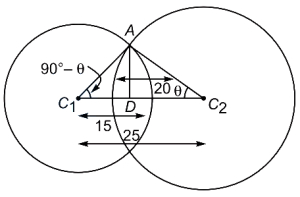
(C) Let the radii of the two circles be $r_1 = 15$ and $r_2 = 20$. The distance between their centers $C_1$ and $C_2$ is $d = 25$.
Note that $r_1^2 + r_2^2 = 15^2 + 20^2 = 225 + 400 = 625 = 25^2 = d^2$.
Since the sum of the squares of the radii equals the square of the distance between the centers,the triangle $\triangle AC_1C_2$ is a right-angled triangle with $\angle C_1AC_2 = 90^\circ$.
The common chord $AB$ is perpendicular to the line joining the centers $C_1C_2$. Let the intersection point be $D$.
In $\triangle AC_1C_2$,the altitude $AD$ to the hypotenuse $C_1C_2$ represents half the length of the common chord.
Using the area of the triangle: $\text{Area} = \frac{1}{2} \times r_1 \times r_2 = \frac{1}{2} \times d \times AD$.
$15 \times 20 = 25 \times AD$.
$AD = \frac{300}{25} = 12$.
The length of the common chord is $2 \times AD = 2 \times 12 = 24$ units.
Note that $r_1^2 + r_2^2 = 15^2 + 20^2 = 225 + 400 = 625 = 25^2 = d^2$.
Since the sum of the squares of the radii equals the square of the distance between the centers,the triangle $\triangle AC_1C_2$ is a right-angled triangle with $\angle C_1AC_2 = 90^\circ$.
The common chord $AB$ is perpendicular to the line joining the centers $C_1C_2$. Let the intersection point be $D$.
In $\triangle AC_1C_2$,the altitude $AD$ to the hypotenuse $C_1C_2$ represents half the length of the common chord.
Using the area of the triangle: $\text{Area} = \frac{1}{2} \times r_1 \times r_2 = \frac{1}{2} \times d \times AD$.
$15 \times 20 = 25 \times AD$.
$AD = \frac{300}{25} = 12$.
The length of the common chord is $2 \times AD = 2 \times 12 = 24$ units.
0 likesView Solution
36
MathematicsDifficultMCQTS EAMCET · 2010
If the circle $x^2+y^2+2x+3y+1=0$ cuts another circle $x^2+y^2+4x+3y+2=0$ at points $A$ and $B$,then the equation of the circle with $AB$ as a diameter is
A
$x^2+y^2+x+3y+3=0$
B
$2x^2+2y^2+2x+6y+1=0$
C
$x^2+y^2+x+6y+1=0$
D
$2x^2+2y^2+x+3y+1=0$
Solution
(B) The equations of the circles are $S_1 \equiv x^2+y^2+2x+3y+1=0$ and $S_2 \equiv x^2+y^2+4x+3y+2=0$.
Since the circles intersect at $A$ and $B$,the equation of the common chord $AB$ is given by $S_1 - S_2 = 0$.
$(x^2+y^2+2x+3y+1) - (x^2+y^2+4x+3y+2) = 0$
$-2x - 1 = 0 \Rightarrow x = -\frac{1}{2}$.
The family of circles passing through the intersection of $S_1$ and $S_2$ is given by $S_1 + \lambda(S_1 - S_2) = 0$.
However,the circle with $AB$ as diameter is given by $S_1 + k(S_1 - S_2) = 0$ where the coefficient of $x^2$ and $y^2$ is $1$.
Alternatively,using the property that the circle with diameter $AB$ is $S_1 + k(S_1 - S_2) = 0$,we substitute $x = -\frac{1}{2}$ into $S_1$:
$S_1 = (-\frac{1}{2})^2 + y^2 + 2(-\frac{1}{2}) + 3y + 1 = y^2 + 3y + \frac{1}{4} = 0$.
The equation of the circle with diameter $AB$ is $S_1 + k(S_1 - S_2) = 0$.
Substituting $x = -\frac{1}{2}$ into $S_1$ and $S_2$ gives the points $A$ and $B$.
The circle with diameter $AB$ is $x^2+y^2+2x+3y+1 + k(2x+1) = 0$.
Since the center lies on the line $x = -\frac{1}{2}$,we find $k$ such that the equation simplifies to $x^2+y^2+x+3y+\frac{1}{2} = 0$,which is $2x^2+2y^2+2x+6y+1 = 0$.
Since the circles intersect at $A$ and $B$,the equation of the common chord $AB$ is given by $S_1 - S_2 = 0$.
$(x^2+y^2+2x+3y+1) - (x^2+y^2+4x+3y+2) = 0$
$-2x - 1 = 0 \Rightarrow x = -\frac{1}{2}$.
The family of circles passing through the intersection of $S_1$ and $S_2$ is given by $S_1 + \lambda(S_1 - S_2) = 0$.
However,the circle with $AB$ as diameter is given by $S_1 + k(S_1 - S_2) = 0$ where the coefficient of $x^2$ and $y^2$ is $1$.
Alternatively,using the property that the circle with diameter $AB$ is $S_1 + k(S_1 - S_2) = 0$,we substitute $x = -\frac{1}{2}$ into $S_1$:
$S_1 = (-\frac{1}{2})^2 + y^2 + 2(-\frac{1}{2}) + 3y + 1 = y^2 + 3y + \frac{1}{4} = 0$.
The equation of the circle with diameter $AB$ is $S_1 + k(S_1 - S_2) = 0$.
Substituting $x = -\frac{1}{2}$ into $S_1$ and $S_2$ gives the points $A$ and $B$.
The circle with diameter $AB$ is $x^2+y^2+2x+3y+1 + k(2x+1) = 0$.
Since the center lies on the line $x = -\frac{1}{2}$,we find $k$ such that the equation simplifies to $x^2+y^2+x+3y+\frac{1}{2} = 0$,which is $2x^2+2y^2+2x+6y+1 = 0$.
0 likesView Solution
37
MathematicsEasyMCQTS EAMCET · 2010
The equation of the radical axis of the pair of circles $7x^2+7y^2-7x+14y+18=0$ and $4x^2+4y^2-7x+8y+20=0$ is
A
$x-2y-5=0$
B
$2x-y+5=0$
C
$21x-68=0$
D
$23x-68=0$
Solution
(C) The equations of the circles are $7x^2+7y^2-7x+14y+18=0$ and $4x^2+4y^2-7x+8y+20=0$.
Divide the first equation by $7$: $x^2+y^2-x+2y+\frac{18}{7}=0$ $(S_1=0)$.
Divide the second equation by $4$: $x^2+y^2-\frac{7}{4}x+2y+5=0$ $(S_2=0)$.
The radical axis is given by $S_1-S_2=0$.
$(x^2+y^2-x+2y+\frac{18}{7}) - (x^2+y^2-\frac{7}{4}x+2y+5) = 0$.
$(-x + \frac{7}{4}x) + (\frac{18}{7} - 5) = 0$.
$\frac{3}{4}x + (\frac{18-35}{7}) = 0$.
$\frac{3}{4}x - \frac{17}{7} = 0$.
$21x - 68 = 0$.
Divide the first equation by $7$: $x^2+y^2-x+2y+\frac{18}{7}=0$ $(S_1=0)$.
Divide the second equation by $4$: $x^2+y^2-\frac{7}{4}x+2y+5=0$ $(S_2=0)$.
The radical axis is given by $S_1-S_2=0$.
$(x^2+y^2-x+2y+\frac{18}{7}) - (x^2+y^2-\frac{7}{4}x+2y+5) = 0$.
$(-x + \frac{7}{4}x) + (\frac{18}{7} - 5) = 0$.
$\frac{3}{4}x + (\frac{18-35}{7}) = 0$.
$\frac{3}{4}x - \frac{17}{7} = 0$.
$21x - 68 = 0$.
0 likesView Solution
38
MathematicsDifficultMCQTS EAMCET · 2010
Find the equation of the parabola whose axis is parallel to the $y$-axis and which passes through the points $(0,4), (1,9)$ and $(4,5)$.
A
$y=-x^2+x+4$
B
$y=-x^2+x+1$
C
$y=\frac{-19}{12} x^2+\frac{79}{12} x+4$
D
$y=\frac{-19}{12} x^2+\frac{89}{12} x+1$
Solution
(C) The general equation of a parabola with an axis parallel to the $y$-axis is given by $y = Ax^2 + Bx + C$ ...$(i)$
Since the parabola passes through $(0,4)$,we have $4 = A(0)^2 + B(0) + C$,which gives $C = 4$ ...(ii)
Since it passes through $(1,9)$,we have $9 = A(1)^2 + B(1) + 4$,which simplifies to $A + B = 5$ ...(iii)
Since it passes through $(4,5)$,we have $5 = A(4)^2 + B(4) + 4$,which simplifies to $16A + 4B = 1$ or $4A + B = \frac{1}{4}$ ...(iv)
Subtracting Eq. (iii) from Eq. (iv): $(4A + B) - (A + B) = \frac{1}{4} - 5$ $\Rightarrow 3A = \frac{-19}{4}$ $\Rightarrow A = \frac{-19}{12}$
Substituting $A$ into Eq. (iii): $\frac{-19}{12} + B = 5 \Rightarrow B = 5 + \frac{19}{12} = \frac{79}{12}$
Substituting $A, B, C$ into Eq. $(i)$,the equation is $y = \frac{-19}{12} x^2 + \frac{79}{12} x + 4$.
Since the parabola passes through $(0,4)$,we have $4 = A(0)^2 + B(0) + C$,which gives $C = 4$ ...(ii)
Since it passes through $(1,9)$,we have $9 = A(1)^2 + B(1) + 4$,which simplifies to $A + B = 5$ ...(iii)
Since it passes through $(4,5)$,we have $5 = A(4)^2 + B(4) + 4$,which simplifies to $16A + 4B = 1$ or $4A + B = \frac{1}{4}$ ...(iv)
Subtracting Eq. (iii) from Eq. (iv): $(4A + B) - (A + B) = \frac{1}{4} - 5$ $\Rightarrow 3A = \frac{-19}{4}$ $\Rightarrow A = \frac{-19}{12}$
Substituting $A$ into Eq. (iii): $\frac{-19}{12} + B = 5 \Rightarrow B = 5 + \frac{19}{12} = \frac{79}{12}$
Substituting $A, B, C$ into Eq. $(i)$,the equation is $y = \frac{-19}{12} x^2 + \frac{79}{12} x + 4$.
0 likesView Solution
39
MathematicsDifficultMCQTS EAMCET · 2010
Let $M$ be the foot of the perpendicular from a point $P$ on the parabola $y^2=8(x-3)$ onto its directrix and let $S$ be the focus of the parabola. If $\triangle SPM$ is an equilateral triangle,then $P$ is equal to
A
$(4 \sqrt{3}, 8)$
B
$(8, 4 \sqrt{3})$
C
$(9, 4 \sqrt{3})$
D
$(4 \sqrt{3}, 9)$
Solution
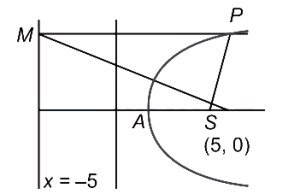
(C) Given that the $\triangle SPM$ is equilateral.
For the parabola $y^2=8(x-3)$,we have $4a=8$,so $a=2$.
The vertex is $(3, 0)$ and the focus $S$ is $(3+a, 0) = (5, 0)$.
The directrix is $x = 3-a = 3-2 = 1$. Wait,the directrix is $x = 3-2 = 1$. Let us re-evaluate.
For $y^2=4a(x-h)$,directrix is $x=h-a$. Here $h=3, a=2$,so $x=3-2=1$.
Let $P$ be $(x, y)$. Since $P$ is on the parabola,$PS = PM$,where $PM$ is the distance to the directrix $x=1$.
$PS = \sqrt{(x-5)^2 + y^2} = \sqrt{(x-5)^2 + 8(x-3)} = \sqrt{x^2-10x+25+8x-24} = \sqrt{x^2-2x+1} = |x-1|$.
$PM = |x-1|$. This confirms the definition of a parabola.
In $\triangle SPM$,$PS=PM$. For it to be equilateral,$PS=PM=SM$.
$SM$ is the distance from $S(5, 0)$ to $M(1, y)$. $SM = \sqrt{(5-1)^2 + (0-y)^2} = \sqrt{16+y^2}$.
Since $PS = |x-1|$,we have $PS^2 = (x-1)^2$.
Also $y^2 = 8(x-3)$,so $PS^2 = (x-1)^2 = x^2-2x+1$.
Equating $PS^2 = SM^2$: $(x-1)^2 = 16+y^2$.
$(x-1)^2 = 16 + 8(x-3) = 16 + 8x - 24 = 8x - 8$.
$x^2 - 2x + 1 = 8x - 8 \Rightarrow x^2 - 10x + 9 = 0$.
$(x-9)(x-1) = 0$. Since $x=1$ is the directrix,$x=9$.
If $x=9$,$y^2 = 8(9-3) = 8(6) = 48$,so $y = \pm 4\sqrt{3}$.
Thus $P = (9, 4\sqrt{3})$ or $(9, -4\sqrt{3})$.
For the parabola $y^2=8(x-3)$,we have $4a=8$,so $a=2$.
The vertex is $(3, 0)$ and the focus $S$ is $(3+a, 0) = (5, 0)$.
The directrix is $x = 3-a = 3-2 = 1$. Wait,the directrix is $x = 3-2 = 1$. Let us re-evaluate.
For $y^2=4a(x-h)$,directrix is $x=h-a$. Here $h=3, a=2$,so $x=3-2=1$.
Let $P$ be $(x, y)$. Since $P$ is on the parabola,$PS = PM$,where $PM$ is the distance to the directrix $x=1$.
$PS = \sqrt{(x-5)^2 + y^2} = \sqrt{(x-5)^2 + 8(x-3)} = \sqrt{x^2-10x+25+8x-24} = \sqrt{x^2-2x+1} = |x-1|$.
$PM = |x-1|$. This confirms the definition of a parabola.
In $\triangle SPM$,$PS=PM$. For it to be equilateral,$PS=PM=SM$.
$SM$ is the distance from $S(5, 0)$ to $M(1, y)$. $SM = \sqrt{(5-1)^2 + (0-y)^2} = \sqrt{16+y^2}$.
Since $PS = |x-1|$,we have $PS^2 = (x-1)^2$.
Also $y^2 = 8(x-3)$,so $PS^2 = (x-1)^2 = x^2-2x+1$.
Equating $PS^2 = SM^2$: $(x-1)^2 = 16+y^2$.
$(x-1)^2 = 16 + 8(x-3) = 16 + 8x - 24 = 8x - 8$.
$x^2 - 2x + 1 = 8x - 8 \Rightarrow x^2 - 10x + 9 = 0$.
$(x-9)(x-1) = 0$. Since $x=1$ is the directrix,$x=9$.
If $x=9$,$y^2 = 8(9-3) = 8(6) = 48$,so $y = \pm 4\sqrt{3}$.
Thus $P = (9, 4\sqrt{3})$ or $(9, -4\sqrt{3})$.
0 likesView Solution
40
MathematicsDifficultMCQTS EAMCET · 2010
If the lines $2x + 3y + 12 = 0$ and $x - y + k = 0$ are conjugate with respect to the parabola $y^2 = 8x$,then $k$ is equal to
A
$10$
B
$\frac{7}{2}$
C
$-12$
D
$-2$
Solution
(C) Given,conjugate lines are $2x + 3y + 12 = 0$ $(i)$ and $x - y + k = 0$ $(ii)$.
Two lines are conjugate with respect to a parabola if the pole of one line lies on the other line.
Let the pole of the line $2x + 3y + 12 = 0$ be $(x_1, y_1)$ with respect to the parabola $y^2 = 8x$.
The equation of the polar of $(x_1, y_1)$ with respect to $y^2 = 8x$ is $yy_1 = 4(x + x_1)$,which simplifies to $4x - yy_1 + 4x_1 = 0$.
Comparing this with $2x + 3y + 12 = 0$,we have $\frac{4}{2} = \frac{-y_1}{3} = \frac{4x_1}{12}$.
From $\frac{4}{2} = \frac{-y_1}{3}$,we get $y_1 = -6$.
From $\frac{4}{2} = \frac{4x_1}{12}$,we get $x_1 = 6$.
Thus,the pole is $(6, -6)$.
Since the lines are conjugate,the pole $(6, -6)$ must lie on the second line $x - y + k = 0$.
Substituting the coordinates: $6 - (-6) + k = 0$.
$12 + k = 0 \Rightarrow k = -12$.
Two lines are conjugate with respect to a parabola if the pole of one line lies on the other line.
Let the pole of the line $2x + 3y + 12 = 0$ be $(x_1, y_1)$ with respect to the parabola $y^2 = 8x$.
The equation of the polar of $(x_1, y_1)$ with respect to $y^2 = 8x$ is $yy_1 = 4(x + x_1)$,which simplifies to $4x - yy_1 + 4x_1 = 0$.
Comparing this with $2x + 3y + 12 = 0$,we have $\frac{4}{2} = \frac{-y_1}{3} = \frac{4x_1}{12}$.
From $\frac{4}{2} = \frac{-y_1}{3}$,we get $y_1 = -6$.
From $\frac{4}{2} = \frac{4x_1}{12}$,we get $x_1 = 6$.
Thus,the pole is $(6, -6)$.
Since the lines are conjugate,the pole $(6, -6)$ must lie on the second line $x - y + k = 0$.
Substituting the coordinates: $6 - (-6) + k = 0$.
$12 + k = 0 \Rightarrow k = -12$.
0 likesView Solution
41
MathematicsDifficultMCQTS EAMCET · 2010
The longest distance of the point $(a, 0)$ from the curve $2x^2+y^2=2x$ is
A
$1+a$
B
$|1-a|$
C
$\sqrt{1-2a+2a^2}$
D
$\sqrt{1-2a+3a^2}$
Solution
(C) Given,the curve is $2x^2+y^2=2x$.
Rearranging the terms,we get $2x^2-2x+y^2=0$.
Completing the square for $x$: $2(x^2-x)+y^2=0 \Rightarrow 2(x-\frac{1}{2})^2+y^2=\frac{1}{2}$.
Dividing by $\frac{1}{2}$,we get $\frac{(x-\frac{1}{2})^2}{1/4} + \frac{y^2}{1/2} = 1$,which represents an ellipse.
Let a point $P$ on the ellipse be $P(\frac{1}{2}+\frac{1}{2}\cos\theta, \frac{1}{\sqrt{2}}\sin\theta)$.
The distance $PQ$ from $Q(a, 0)$ is given by $PQ^2 = (\frac{1}{2}+\frac{1}{2}\cos\theta-a)^2 + (\frac{1}{\sqrt{2}}\sin\theta)^2$.
$PQ^2 = ((\frac{1}{2}-a)+\frac{1}{2}\cos\theta)^2 + \frac{1}{2}\sin^2\theta$.
$PQ^2 = (\frac{1}{2}-a)^2 + \frac{1}{4}\cos^2\theta + (\frac{1}{2}-a)\cos\theta + \frac{1}{2}(1-\cos^2\theta)$.
$PQ^2 = \frac{1}{4}-a+a^2 + \frac{1}{4}\cos^2\theta + (\frac{1}{2}-a)\cos\theta + \frac{1}{2} - \frac{1}{2}\cos^2\theta$.
$PQ^2 = a^2-a+\frac{3}{4} - \frac{1}{4}\cos^2\theta + (\frac{1}{2}-a)\cos\theta$.
To find the maximum distance,we differentiate with respect to $\cos\theta$ and set to $0$,or analyze the quadratic in $\cos\theta$.
After simplification,the maximum distance is $\sqrt{1-2a+2a^2}$.
Rearranging the terms,we get $2x^2-2x+y^2=0$.
Completing the square for $x$: $2(x^2-x)+y^2=0 \Rightarrow 2(x-\frac{1}{2})^2+y^2=\frac{1}{2}$.
Dividing by $\frac{1}{2}$,we get $\frac{(x-\frac{1}{2})^2}{1/4} + \frac{y^2}{1/2} = 1$,which represents an ellipse.
Let a point $P$ on the ellipse be $P(\frac{1}{2}+\frac{1}{2}\cos\theta, \frac{1}{\sqrt{2}}\sin\theta)$.
The distance $PQ$ from $Q(a, 0)$ is given by $PQ^2 = (\frac{1}{2}+\frac{1}{2}\cos\theta-a)^2 + (\frac{1}{\sqrt{2}}\sin\theta)^2$.
$PQ^2 = ((\frac{1}{2}-a)+\frac{1}{2}\cos\theta)^2 + \frac{1}{2}\sin^2\theta$.
$PQ^2 = (\frac{1}{2}-a)^2 + \frac{1}{4}\cos^2\theta + (\frac{1}{2}-a)\cos\theta + \frac{1}{2}(1-\cos^2\theta)$.
$PQ^2 = \frac{1}{4}-a+a^2 + \frac{1}{4}\cos^2\theta + (\frac{1}{2}-a)\cos\theta + \frac{1}{2} - \frac{1}{2}\cos^2\theta$.
$PQ^2 = a^2-a+\frac{3}{4} - \frac{1}{4}\cos^2\theta + (\frac{1}{2}-a)\cos\theta$.
To find the maximum distance,we differentiate with respect to $\cos\theta$ and set to $0$,or analyze the quadratic in $\cos\theta$.
After simplification,the maximum distance is $\sqrt{1-2a+2a^2}$.
0 likesView Solution
42
MathematicsDifficultMCQTS EAMCET · 2010
The product of the perpendicular distances from any point on the hyperbola $\frac{x^2}{a^2}-\frac{y^2}{b^2}=1$ to its asymptotes is
A
$\frac{a^2 b^2}{a^2-b^2}$
B
$\frac{a^2 b^2}{a^2+b^2}$
C
$\frac{a^2+b^2}{a^2 b^2}$
D
$\frac{a^2-b^2}{a^2 b^2}$
Solution
(B) Let $(a \sec \theta, b \tan \theta)$ be any point on the hyperbola $\frac{x^2}{a^2}-\frac{y^2}{b^2}=1$.
The equations of the asymptotes of the given hyperbola are $\frac{x}{a} + \frac{y}{b} = 0$ and $\frac{x}{a} - \frac{y}{b} = 0$.
Let $P_1$ be the length of the perpendicular from $(a \sec \theta, b \tan \theta)$ to $\frac{x}{a} + \frac{y}{b} = 0$.
$P_1 = \frac{|\sec \theta + \tan \theta|}{\sqrt{\frac{1}{a^2} + \frac{1}{b^2}}}$.
Let $P_2$ be the length of the perpendicular from $(a \sec \theta, b \tan \theta)$ to $\frac{x}{a} - \frac{y}{b} = 0$.
$P_2 = \frac{|\sec \theta - \tan \theta|}{\sqrt{\frac{1}{a^2} + \frac{1}{b^2}}}$.
The product $P_1 P_2 = \frac{|\sec^2 \theta - \tan^2 \theta|}{\frac{1}{a^2} + \frac{1}{b^2}} = \frac{1}{\frac{a^2 + b^2}{a^2 b^2}} = \frac{a^2 b^2}{a^2 + b^2}$.
The equations of the asymptotes of the given hyperbola are $\frac{x}{a} + \frac{y}{b} = 0$ and $\frac{x}{a} - \frac{y}{b} = 0$.
Let $P_1$ be the length of the perpendicular from $(a \sec \theta, b \tan \theta)$ to $\frac{x}{a} + \frac{y}{b} = 0$.
$P_1 = \frac{|\sec \theta + \tan \theta|}{\sqrt{\frac{1}{a^2} + \frac{1}{b^2}}}$.
Let $P_2$ be the length of the perpendicular from $(a \sec \theta, b \tan \theta)$ to $\frac{x}{a} - \frac{y}{b} = 0$.
$P_2 = \frac{|\sec \theta - \tan \theta|}{\sqrt{\frac{1}{a^2} + \frac{1}{b^2}}}$.
The product $P_1 P_2 = \frac{|\sec^2 \theta - \tan^2 \theta|}{\frac{1}{a^2} + \frac{1}{b^2}} = \frac{1}{\frac{a^2 + b^2}{a^2 b^2}} = \frac{a^2 b^2}{a^2 + b^2}$.
0 likesView Solution
43
MathematicsDifficultMCQTS EAMCET · 2010
The equation of the hyperbola which passes through the point $(2,3)$ and has the asymptotes $4x+3y-7=0$ and $x-2y-1=0$ is
A
$4x^2+5xy-6y^2-11x+11y+50=0$
B
$4x^2+5xy-6y^2-11x+11y-43=0$
C
$4x^2-5xy-6y^2-11x+11y+57=0$
D
$x^2-5xy-y^2-11x+11y-43=0$
Solution
(C) The equation of a hyperbola with given asymptotes $L_1=0$ and $L_2=0$ is of the form $L_1 \times L_2 + k = 0$.
Given asymptotes are $(4x+3y-7)=0$ and $(x-2y-1)=0$.
So,the equation of the hyperbola is $(4x+3y-7)(x-2y-1)+k=0$ ...$(i)$
Since the hyperbola passes through the point $(2,3)$,we substitute $x=2$ and $y=3$ into Eq. $(i)$:
$(4(2)+3(3)-7)(2-2(3)-1)+k=0$
$(8+9-7)(2-6-1)+k=0$
$(10)(-5)+k=0$
$-50+k=0 \Rightarrow k=50$
Substituting $k=50$ back into Eq. $(i)$:
$(4x+3y-7)(x-2y-1)+50=0$
$4x^2-8xy-4x+3xy-6y^2-3y-7x+14y+7+50=0$
$4x^2-5xy-6y^2-11x+11y+57=0$
Given asymptotes are $(4x+3y-7)=0$ and $(x-2y-1)=0$.
So,the equation of the hyperbola is $(4x+3y-7)(x-2y-1)+k=0$ ...$(i)$
Since the hyperbola passes through the point $(2,3)$,we substitute $x=2$ and $y=3$ into Eq. $(i)$:
$(4(2)+3(3)-7)(2-2(3)-1)+k=0$
$(8+9-7)(2-6-1)+k=0$
$(10)(-5)+k=0$
$-50+k=0 \Rightarrow k=50$
Substituting $k=50$ back into Eq. $(i)$:
$(4x+3y-7)(x-2y-1)+50=0$
$4x^2-8xy-4x+3xy-6y^2-3y-7x+14y+7+50=0$
$4x^2-5xy-6y^2-11x+11y+57=0$
0 likesView Solution
44
MathematicsEasyMCQTS EAMCET · 2010
$\lim _{x \rightarrow 0} \frac{\tan x - \sin x}{x^3}$ is equal to
A
$0$
B
$1$
C
$\frac{1}{2}$
D
$-\frac{1}{2}$
Solution
(C) We evaluate the limit $L = \lim _{x \rightarrow 0} \frac{\tan x - \sin x}{x^3}$.
Since this is a $\frac{0}{0}$ indeterminate form,we apply $L$'Hospital's Rule:
$L = \lim _{x \rightarrow 0} \frac{\sec^2 x - \cos x}{3x^2}$.
This is still a $\frac{0}{0}$ form. Applying $L$'Hospital's Rule again:
$L = \lim _{x \rightarrow 0} \frac{2 \sec^2 x \tan x + \sin x}{6x}$.
Using the standard limits $\lim _{x \rightarrow 0} \frac{\tan x}{x} = 1$ and $\lim _{x \rightarrow 0} \frac{\sin x}{x} = 1$:
$L = \lim _{x}$ ${\rightarrow 0} \left( \frac{2 \sec^2 x \cdot \tan x}{6x} + \frac{\sin x}{6x} \right) = \frac{2(1)(1)}{6} + \frac{1}{6} = \frac{2}{6} + \frac{1}{6} = \frac{3}{6} = \frac{1}{2}$.
Since this is a $\frac{0}{0}$ indeterminate form,we apply $L$'Hospital's Rule:
$L = \lim _{x \rightarrow 0} \frac{\sec^2 x - \cos x}{3x^2}$.
This is still a $\frac{0}{0}$ form. Applying $L$'Hospital's Rule again:
$L = \lim _{x \rightarrow 0} \frac{2 \sec^2 x \tan x + \sin x}{6x}$.
Using the standard limits $\lim _{x \rightarrow 0} \frac{\tan x}{x} = 1$ and $\lim _{x \rightarrow 0} \frac{\sin x}{x} = 1$:
$L = \lim _{x}$ ${\rightarrow 0} \left( \frac{2 \sec^2 x \cdot \tan x}{6x} + \frac{\sin x}{6x} \right) = \frac{2(1)(1)}{6} + \frac{1}{6} = \frac{2}{6} + \frac{1}{6} = \frac{3}{6} = \frac{1}{2}$.
0 likesView Solution
45
MathematicsDifficultMCQTS EAMCET · 2010
In a $\triangle ABC$,if $\angle C = 90^{\circ}$,then $\frac{a^2-b^2}{a^2+b^2}$ is equal to
A
$\sin (A+B)$
B
$\sin (A-B)$
C
$\cos (A+B)$
D
$\cos (A-B)$
Solution
(B) Given $\angle C = 90^{\circ}$,we have $A+B = 90^{\circ}$.
Using the sine rule,$a = k \sin A$,$b = k \sin B$,and $c = k \sin C = k \sin 90^{\circ} = k$.
Then,$\frac{a^2-b^2}{a^2+b^2} = \frac{k^2 \sin^2 A - k^2 \sin^2 B}{k^2 \sin^2 A + k^2 \sin^2 B} = \frac{\sin^2 A - \sin^2 B}{\sin^2 A + \sin^2 B}$.
Since $B = 90^{\circ} - A$,we have $\sin B = \cos A$ and $\cos B = \sin A$.
Substituting these,$\frac{\sin^2 A - \cos^2 A}{\sin^2 A + \cos^2 A} = \frac{-(\cos^2 A - \sin^2 A)}{1} = -\cos 2A$.
Alternatively,using the identity $\sin^2 A - \sin^2 B = \sin(A+B)\sin(A-B)$:
$\frac{\sin(A+B)\sin(A-B)}{\sin^2 A + \cos^2 A} = \sin(90^{\circ})\sin(A-B) = 1 \cdot \sin(A-B) = \sin(A-B)$.
Using the sine rule,$a = k \sin A$,$b = k \sin B$,and $c = k \sin C = k \sin 90^{\circ} = k$.
Then,$\frac{a^2-b^2}{a^2+b^2} = \frac{k^2 \sin^2 A - k^2 \sin^2 B}{k^2 \sin^2 A + k^2 \sin^2 B} = \frac{\sin^2 A - \sin^2 B}{\sin^2 A + \sin^2 B}$.
Since $B = 90^{\circ} - A$,we have $\sin B = \cos A$ and $\cos B = \sin A$.
Substituting these,$\frac{\sin^2 A - \cos^2 A}{\sin^2 A + \cos^2 A} = \frac{-(\cos^2 A - \sin^2 A)}{1} = -\cos 2A$.
Alternatively,using the identity $\sin^2 A - \sin^2 B = \sin(A+B)\sin(A-B)$:
$\frac{\sin(A+B)\sin(A-B)}{\sin^2 A + \cos^2 A} = \sin(90^{\circ})\sin(A-B) = 1 \cdot \sin(A-B) = \sin(A-B)$.
0 likesView Solution
46
MathematicsDifficultMCQTS EAMCET · 2010
If $\Delta = a^2 - (b - c)^2$ is the area of the $\triangle ABC$,then $\tan A$ is equal to
A
$\frac{1}{16}$
B
$\frac{8}{15}$
C
$\frac{3}{4}$
D
$\frac{4}{3}$
Solution
(B) Given $\Delta = a^2 - (b - c)^2$.
Using the identity $x^2 - y^2 = (x - y)(x + y)$,we have $\Delta = (a - (b - c))(a + (b - c)) = (a - b + c)(a + b - c)$.
Since $2s = a + b + c$,we have $a + b - c = 2s - 2c$ and $a - b + c = 2s - 2b$.
Thus,$\Delta = (2s - 2b)(2s - 2c) = 4(s - b)(s - c)$.
We know that $\Delta = \sqrt{s(s - a)(s - b)(s - c)}$.
Equating the two expressions: $\sqrt{s(s - a)(s - b)(s - c)} = 4(s - b)(s - c)$.
Dividing both sides by $\sqrt{(s - b)(s - c)}$,we get $\sqrt{s(s - a)} = 4\sqrt{(s - b)(s - c)}$.
This implies $\sqrt{\frac{(s - b)(s - c)}{s(s - a)}} = \frac{1}{4}$.
Since $\tan \frac{A}{2} = \sqrt{\frac{(s - b)(s - c)}{s(s - a)}}$,we have $\tan \frac{A}{2} = \frac{1}{4}$.
Using the formula $\tan A = \frac{2 \tan \frac{A}{2}}{1 - \tan^2 \frac{A}{2}}$,we get $\tan A = \frac{2 \times \frac{1}{4}}{1 - (\frac{1}{4})^2} = \frac{\frac{1}{2}}{1 - \frac{1}{16}} = \frac{\frac{1}{2}}{\frac{15}{16}} = \frac{8}{15}$.
Using the identity $x^2 - y^2 = (x - y)(x + y)$,we have $\Delta = (a - (b - c))(a + (b - c)) = (a - b + c)(a + b - c)$.
Since $2s = a + b + c$,we have $a + b - c = 2s - 2c$ and $a - b + c = 2s - 2b$.
Thus,$\Delta = (2s - 2b)(2s - 2c) = 4(s - b)(s - c)$.
We know that $\Delta = \sqrt{s(s - a)(s - b)(s - c)}$.
Equating the two expressions: $\sqrt{s(s - a)(s - b)(s - c)} = 4(s - b)(s - c)$.
Dividing both sides by $\sqrt{(s - b)(s - c)}$,we get $\sqrt{s(s - a)} = 4\sqrt{(s - b)(s - c)}$.
This implies $\sqrt{\frac{(s - b)(s - c)}{s(s - a)}} = \frac{1}{4}$.
Since $\tan \frac{A}{2} = \sqrt{\frac{(s - b)(s - c)}{s(s - a)}}$,we have $\tan \frac{A}{2} = \frac{1}{4}$.
Using the formula $\tan A = \frac{2 \tan \frac{A}{2}}{1 - \tan^2 \frac{A}{2}}$,we get $\tan A = \frac{2 \times \frac{1}{4}}{1 - (\frac{1}{4})^2} = \frac{\frac{1}{2}}{1 - \frac{1}{16}} = \frac{\frac{1}{2}}{\frac{15}{16}} = \frac{8}{15}$.
0 likesView Solution
47
MathematicsEasyMCQTS EAMCET · 2010
If $\tanh ^{-1} x = a \log \left(\frac{1+x}{1-x}\right)$,$|x| < 1$,then $a$ is equal to
A
$1$
B
$2$
C
$\frac{1}{2}$
D
$\frac{1}{4}$
Solution
(C) We are given the equation $\tanh ^{-1} x = a \log \left(\frac{1+x}{1-x}\right)$ for $|x| < 1$ ...$(i)$
We know the standard logarithmic definition of the inverse hyperbolic tangent function is $\tanh ^{-1} x = \frac{1}{2} \log \left(\frac{1+x}{1-x}\right)$ ...(ii)
Comparing equation $(i)$ and equation (ii),we can equate the coefficients of the logarithmic term.
Therefore,$a = \frac{1}{2}$.
We know the standard logarithmic definition of the inverse hyperbolic tangent function is $\tanh ^{-1} x = \frac{1}{2} \log \left(\frac{1+x}{1-x}\right)$ ...(ii)
Comparing equation $(i)$ and equation (ii),we can equate the coefficients of the logarithmic term.
Therefore,$a = \frac{1}{2}$.
0 likesView Solution
48
MathematicsDifficultMCQTS EAMCET · 2010
For $x \in R$,the least value of $\frac{x^2-6x+5}{x^2+2x+1}$ is
A
-$1$
B
$-\frac{1}{2}$
C
$-\frac{1}{4}$
D
$-\frac{1}{3}$
Solution
(D) Let $f(x) = \frac{x^2-6x+5}{x^2+2x+1}$ for $x \in R$.
Set $y = \frac{x^2-6x+5}{x^2+2x+1}$.
Then $y(x^2+2x+1) = x^2-6x+5$,which simplifies to $(y-1)x^2 + (2y+6)x + (y-5) = 0$.
Since $x$ is a real number,the discriminant $D$ must be greater than or equal to $0$.
$D = (2y+6)^2 - 4(y-1)(y-5) \geq 0$.
$4(y+3)^2 - 4(y^2-6y+5) \geq 0$.
$(y^2+6y+9) - (y^2-6y+5) \geq 0$.
$12y + 4 \geq 0$.
$12y \geq -4$.
$y \geq -\frac{1}{3}$.
Thus,the least value of the expression is $-\frac{1}{3}$.
Set $y = \frac{x^2-6x+5}{x^2+2x+1}$.
Then $y(x^2+2x+1) = x^2-6x+5$,which simplifies to $(y-1)x^2 + (2y+6)x + (y-5) = 0$.
Since $x$ is a real number,the discriminant $D$ must be greater than or equal to $0$.
$D = (2y+6)^2 - 4(y-1)(y-5) \geq 0$.
$4(y+3)^2 - 4(y^2-6y+5) \geq 0$.
$(y^2+6y+9) - (y^2-6y+5) \geq 0$.
$12y + 4 \geq 0$.
$12y \geq -4$.
$y \geq -\frac{1}{3}$.
Thus,the least value of the expression is $-\frac{1}{3}$.
0 likesView Solution
49
MathematicsMediumMCQTS EAMCET · 2010
The sum of angles of elevation of the top of a tower from two points distant $a$ and $b$ from the base and in the same straight line with it is $90^{\circ}$. Then,the height of the tower is
A
$a^2 b$
B
$a b^2$
C
$\sqrt{a b}$
D
$a b$
Solution
(C) Let the height of the tower be $h$ and the points be $C$ and $B$ at distances $a$ and $b$ from the base $P$ respectively.
In $\triangle ACP$,$\tan \theta = \frac{h}{a} \implies \theta = \arctan(\frac{h}{a})$.
In $\triangle ABP$,$\tan \phi = \frac{h}{b} \implies \phi = \arctan(\frac{h}{b})$.
Given that $\theta + \phi = 90^{\circ}$,we have $\theta = 90^{\circ} - \phi$.
Taking tangent on both sides,$\tan \theta = \tan(90^{\circ} - \phi) = \cot \phi = \frac{1}{\tan \phi}$.
Substituting the values,$\frac{h}{a} = \frac{1}{h/b} = \frac{b}{h}$.
Therefore,$h^2 = ab$,which gives $h = \sqrt{ab}$.
In $\triangle ACP$,$\tan \theta = \frac{h}{a} \implies \theta = \arctan(\frac{h}{a})$.
In $\triangle ABP$,$\tan \phi = \frac{h}{b} \implies \phi = \arctan(\frac{h}{b})$.
Given that $\theta + \phi = 90^{\circ}$,we have $\theta = 90^{\circ} - \phi$.
Taking tangent on both sides,$\tan \theta = \tan(90^{\circ} - \phi) = \cot \phi = \frac{1}{\tan \phi}$.
Substituting the values,$\frac{h}{a} = \frac{1}{h/b} = \frac{b}{h}$.
Therefore,$h^2 = ab$,which gives $h = \sqrt{ab}$.
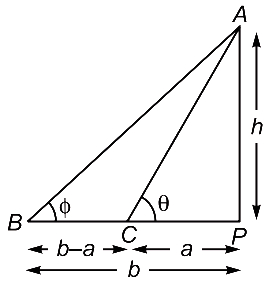
0 likesView Solution
50
MathematicsEasyMCQTS EAMCET · 2010
The set $\{x \in R: \frac{14x}{x+1} - \frac{9x-30}{x-4} < 0\}$ is equal to
A
$(-1, 4)$
B
$(1, 4) \cup (5, 7)$
C
$(1, 7)$
D
$(-1, 1) \cup (4, 6)$
Solution
(D) Given inequality: $\frac{14x}{x+1} - \frac{9x-30}{x-4} < 0$
Simplify the expression by taking a common denominator:
$\frac{14x(x-4) - (9x-30)(x+1)}{(x+1)(x-4)} < 0$
$\frac{14x^2 - 56x - (9x^2 + 9x - 30x - 30)}{(x+1)(x-4)} < 0$
$\frac{14x^2 - 56x - (9x^2 - 21x - 30)}{(x+1)(x-4)} < 0$
$\frac{14x^2 - 56x - 9x^2 + 21x + 30}{(x+1)(x-4)} < 0$
$\frac{5x^2 - 35x + 30}{(x+1)(x-4)} < 0$
Divide by $5$:
$\frac{x^2 - 7x + 6}{(x+1)(x-4)} < 0$
Factor the numerator:
$\frac{(x-1)(x-6)}{(x+1)(x-4)} < 0$
Using the wavy curve method (sign scheme) with critical points $-1, 1, 4, 6$:
The expression is negative in the intervals $(-1, 1)$ and $(4, 6)$.
Therefore,$x \in (-1, 1) \cup (4, 6)$.
Simplify the expression by taking a common denominator:
$\frac{14x(x-4) - (9x-30)(x+1)}{(x+1)(x-4)} < 0$
$\frac{14x^2 - 56x - (9x^2 + 9x - 30x - 30)}{(x+1)(x-4)} < 0$
$\frac{14x^2 - 56x - (9x^2 - 21x - 30)}{(x+1)(x-4)} < 0$
$\frac{14x^2 - 56x - 9x^2 + 21x + 30}{(x+1)(x-4)} < 0$
$\frac{5x^2 - 35x + 30}{(x+1)(x-4)} < 0$
Divide by $5$:
$\frac{x^2 - 7x + 6}{(x+1)(x-4)} < 0$
Factor the numerator:
$\frac{(x-1)(x-6)}{(x+1)(x-4)} < 0$
Using the wavy curve method (sign scheme) with critical points $-1, 1, 4, 6$:
The expression is negative in the intervals $(-1, 1)$ and $(4, 6)$.
Therefore,$x \in (-1, 1) \cup (4, 6)$.
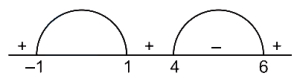
0 likesView Solution
51
MathematicsDifficultMCQTS EAMCET · 2010
If the system of equations
$(k+1)^3 x + (k+2)^3 y = (k+3)^3$
$(k+1) x + (k+2) y = k+3$
$x + y = 1$
is consistent,then the value of $k$ is
$(k+1)^3 x + (k+2)^3 y = (k+3)^3$
$(k+1) x + (k+2) y = k+3$
$x + y = 1$
is consistent,then the value of $k$ is
A
$2$
B
$-2$
C
$-1$
D
$1$
Solution
(B) The given system of equations is:
$(k+1)^3 x + (k+2)^3 y = (k+3)^3$
$(k+1) x + (k+2) y = (k+3)$
$x + y = 1$
For the system to be consistent,the determinant of the augmented matrix must be zero.
Let $D = \begin{vmatrix} (k+1)^3 & (k+2)^3 & (k+3)^3 \\ (k+1) & (k+2) & (k+3) \\ 1 & 1 & 1 \end{vmatrix} = 0$.
Applying column operations $C_2 \rightarrow C_2 - C_1$ and $C_3 \rightarrow C_3 - C_1$:
$D = \begin{vmatrix} (k+1)^3 & (k+2)^3 - (k+1)^3 & (k+3)^3 - (k+1)^3 \\ (k+1) & (k+2) - (k+1) & (k+3) - (k+1) \\ 1 & 0 & 0 \end{vmatrix} = 0$
$D = \begin{vmatrix} (k+1)^3 & 3k^2 + 9k + 7 & 6k^2 + 24k + 26 \\ (k+1) & 1 & 2 \\ 1 & 0 & 0 \end{vmatrix} = 0$
Expanding along the third row:
$1 \cdot [2(3k^2 + 9k + 7) - 1(6k^2 + 24k + 26)] = 0$
$6k^2 + 18k + 14 - 6k^2 - 24k - 26 = 0$
$-6k - 12 = 0$
$-6k = 12 \Rightarrow k = -2$.
$(k+1)^3 x + (k+2)^3 y = (k+3)^3$
$(k+1) x + (k+2) y = (k+3)$
$x + y = 1$
For the system to be consistent,the determinant of the augmented matrix must be zero.
Let $D = \begin{vmatrix} (k+1)^3 & (k+2)^3 & (k+3)^3 \\ (k+1) & (k+2) & (k+3) \\ 1 & 1 & 1 \end{vmatrix} = 0$.
Applying column operations $C_2 \rightarrow C_2 - C_1$ and $C_3 \rightarrow C_3 - C_1$:
$D = \begin{vmatrix} (k+1)^3 & (k+2)^3 - (k+1)^3 & (k+3)^3 - (k+1)^3 \\ (k+1) & (k+2) - (k+1) & (k+3) - (k+1) \\ 1 & 0 & 0 \end{vmatrix} = 0$
$D = \begin{vmatrix} (k+1)^3 & 3k^2 + 9k + 7 & 6k^2 + 24k + 26 \\ (k+1) & 1 & 2 \\ 1 & 0 & 0 \end{vmatrix} = 0$
Expanding along the third row:
$1 \cdot [2(3k^2 + 9k + 7) - 1(6k^2 + 24k + 26)] = 0$
$6k^2 + 18k + 14 - 6k^2 - 24k - 26 = 0$
$-6k - 12 = 0$
$-6k = 12 \Rightarrow k = -2$.
0 likesView Solution
52
MathematicsDifficultTS EAMCET · 2010
Let $R$ denote the set of all real numbers and $R^{+}$ denote the set of all positive real numbers. For the subsets $A$ and $B$ of $R$,define $f: A \rightarrow B$ by $f(x) = x^2$ for $x \in A$. Match the items in Column-$I$ with the items in Column-$II$.
| Column-$I$ | Column-$II$ |
|---|---|
| $A$. $f$ is one-one and onto,if | $1$. $A = R^{+}, B = R$ |
| $B$. $f$ is one-one but not onto,if | $2$. $A = B = R$ |
| $C$. $f$ is onto but not one-one,if | $3$. $A = R, B = R^{+}$ |
| $D$. $f$ is neither one-one nor onto,if | $4$. $A = B = R^{+}$ |
Solution
(A) The function is $f(x) = x^2$.
For $f$ to be one-one,$f(x_1) = f(x_2) \implies x_1^2 = x_2^2$. This implies $x_1 = x_2$ only if $x_1, x_2$ have the same sign.
For $f$ to be onto,the range of $f$ must equal the codomain $B$. The range of $f(x) = x^2$ for $x \in A$ is ${x^2 : x \in A}$.
Analysis:
$(A)$ $A = B = R^{+}$: $f(x) = x^2$ maps positive reals to positive reals. It is one-one (since $x_1^2 = x_2^2$ and $x_1, x_2 > 0 \implies x_1 = x_2$) and onto (since for any $y \in R^{+}$,$x = \sqrt{y} \in R^{+}$ exists). Thus,$A \rightarrow 4$.
$(B)$ $A = R^{+}, B = R$: $f(x) = x^2$ is one-one (as $x > 0$),but not onto because negative values in $B$ are not covered by the range $(R^{+})$. Thus,$B \rightarrow 1$.
$(C)$ $A = R, B = R^{+}$: $f(x) = x^2$ is not one-one (as $f(1) = f(-1) = 1$) but is onto (since every $y \in R^{+}$ has a pre-image $x = \pm \sqrt{y} \in R$). Thus,$C \rightarrow 3$.
$(D)$ $A = B = R$: $f(x) = x^2$ is not one-one (as $f(1) = f(-1)$) and not onto (as negative values in $B$ are not covered). Thus,$D \rightarrow 2$.
The correct matching is $A-4, B-1, C-3, D-2$.
For $f$ to be one-one,$f(x_1) = f(x_2) \implies x_1^2 = x_2^2$. This implies $x_1 = x_2$ only if $x_1, x_2$ have the same sign.
For $f$ to be onto,the range of $f$ must equal the codomain $B$. The range of $f(x) = x^2$ for $x \in A$ is ${x^2 : x \in A}$.
Analysis:
$(A)$ $A = B = R^{+}$: $f(x) = x^2$ maps positive reals to positive reals. It is one-one (since $x_1^2 = x_2^2$ and $x_1, x_2 > 0 \implies x_1 = x_2$) and onto (since for any $y \in R^{+}$,$x = \sqrt{y} \in R^{+}$ exists). Thus,$A \rightarrow 4$.
$(B)$ $A = R^{+}, B = R$: $f(x) = x^2$ is one-one (as $x > 0$),but not onto because negative values in $B$ are not covered by the range $(R^{+})$. Thus,$B \rightarrow 1$.
$(C)$ $A = R, B = R^{+}$: $f(x) = x^2$ is not one-one (as $f(1) = f(-1) = 1$) but is onto (since every $y \in R^{+}$ has a pre-image $x = \pm \sqrt{y} \in R$). Thus,$C \rightarrow 3$.
$(D)$ $A = B = R$: $f(x) = x^2$ is not one-one (as $f(1) = f(-1)$) and not onto (as negative values in $B$ are not covered). Thus,$D \rightarrow 2$.
The correct matching is $A-4, B-1, C-3, D-2$.
0 likesView Solution
53
MathematicsDifficultMCQTS EAMCET · 2010
If $f(0)=0, f(1)=1, f(2)=2$ and $f(x)=f(x-2)+f(x-3)$ for $x=3, 4, 5, \ldots$,then $f(9)$ is equal to
A
$12$
B
$13$
C
$14$
D
$10$
Solution
(D) Given: $f(0)=0, f(1)=1, f(2)=2$ and the recurrence relation $f(x)=f(x-2)+f(x-3)$ for $x \ge 3$.
We calculate the values step by step:
$f(3) = f(1) + f(0) = 1 + 0 = 1$
$f(4) = f(2) + f(1) = 2 + 1 = 3$
$f(5) = f(3) + f(2) = 1 + 2 = 3$
$f(6) = f(4) + f(3) = 3 + 1 = 4$
$f(7) = f(5) + f(4) = 3 + 3 = 6$
$f(8) = f(6) + f(5) = 4 + 3 = 7$
$f(9) = f(7) + f(6) = 6 + 4 = 10$
Therefore,$f(9) = 10$.
We calculate the values step by step:
$f(3) = f(1) + f(0) = 1 + 0 = 1$
$f(4) = f(2) + f(1) = 2 + 1 = 3$
$f(5) = f(3) + f(2) = 1 + 2 = 3$
$f(6) = f(4) + f(3) = 3 + 1 = 4$
$f(7) = f(5) + f(4) = 3 + 3 = 6$
$f(8) = f(6) + f(5) = 4 + 3 = 7$
$f(9) = f(7) + f(6) = 6 + 4 = 10$
Therefore,$f(9) = 10$.
0 likesView Solution
54
MathematicsDifficultMCQTS EAMCET · 2010
If $u=\sin ^{-1}\left(\frac{x^4+y^4}{x+y}\right)$,then $x \frac{\partial u}{\partial x}+y \frac{\partial u}{\partial y}$ is equal to
A
$3 u$
B
$4 u$
C
$3 \sin u$
D
$3 \tan u$
Solution
(D) Given $u=\sin ^{-1}\left(\frac{x^4+y^4}{x+y}\right)$.
Let $v=\sin u=\frac{x^4+y^4}{x+y}$.
Here,$v$ is a homogeneous function of $x$ and $y$ with degree $n = 4 - 1 = 3$.
According to Euler's theorem for homogeneous functions,$x \frac{\partial v}{\partial x} + y \frac{\partial v}{\partial y} = n v$.
Substituting $v = \sin u$ and $n = 3$,we get $x \frac{\partial}{\partial x}(\sin u) + y \frac{\partial}{\partial y}(\sin u) = 3 \sin u$.
Applying the chain rule,$x \cos u \frac{\partial u}{\partial x} + y \cos u \frac{\partial u}{\partial y} = 3 \sin u$.
Dividing both sides by $\cos u$,we get $x \frac{\partial u}{\partial x} + y \frac{\partial u}{\partial y} = 3 \frac{\sin u}{\cos u}$.
Therefore,$x \frac{\partial u}{\partial x} + y \frac{\partial u}{\partial y} = 3 \tan u$.
Let $v=\sin u=\frac{x^4+y^4}{x+y}$.
Here,$v$ is a homogeneous function of $x$ and $y$ with degree $n = 4 - 1 = 3$.
According to Euler's theorem for homogeneous functions,$x \frac{\partial v}{\partial x} + y \frac{\partial v}{\partial y} = n v$.
Substituting $v = \sin u$ and $n = 3$,we get $x \frac{\partial}{\partial x}(\sin u) + y \frac{\partial}{\partial y}(\sin u) = 3 \sin u$.
Applying the chain rule,$x \cos u \frac{\partial u}{\partial x} + y \cos u \frac{\partial u}{\partial y} = 3 \sin u$.
Dividing both sides by $\cos u$,we get $x \frac{\partial u}{\partial x} + y \frac{\partial u}{\partial y} = 3 \frac{\sin u}{\cos u}$.
Therefore,$x \frac{\partial u}{\partial x} + y \frac{\partial u}{\partial y} = 3 \tan u$.
0 likesView Solution
55
MathematicsDifficultMCQTS EAMCET · 2010
If $y=\cos ^{-1}\left(\frac{a^2-x^2}{a^2+x^2}\right)+\sin ^{-1}\left(\frac{2 a x}{a^2+x^2}\right)$,then $\frac{d y}{d x}$ is equal to
A
$\frac{a}{x^2+a^2}$
B
$\frac{2 a}{x^2+a^2}$
C
$\frac{4 a}{x^2+a^2}$
D
$\frac{a^2}{x^2+a^2}$
Solution
(C) Given $y=\cos ^{-1}\left(\frac{a^2-x^2}{a^2+x^2}\right)+\sin ^{-1}\left(\frac{2 a x}{a^2+x^2}\right)$.
Let $x=a \tan \theta$,then $\theta=\tan ^{-1}\left(\frac{x}{a}\right)$.
Substituting $x$ in the expression:
$y=\cos ^{-1}\left(\frac{a^2-a^2 \tan ^2 \theta}{a^2+a^2 \tan ^2 \theta}\right) + \sin ^{-1}\left(\frac{2 a^2 \tan \theta}{a^2+a^2 \tan ^2 \theta}\right)$
$y=\cos ^{-1}\left(\frac{1-\tan ^2 \theta}{1+\tan ^2 \theta}\right) + \sin ^{-1}\left(\frac{2 \tan \theta}{1+\tan ^2 \theta}\right)$
Using trigonometric identities $\cos 2\theta = \frac{1-\tan^2\theta}{1+\tan^2\theta}$ and $\sin 2\theta = \frac{2\tan\theta}{1+\tan^2\theta}$:
$y=\cos ^{-1}(\cos 2 \theta) + \sin ^{-1}(\sin 2 \theta)$
$y=2 \theta + 2 \theta = 4 \theta$.
Substituting back $\theta = \tan ^{-1}\left(\frac{x}{a}\right)$:
$y=4 \tan ^{-1}\left(\frac{x}{a}\right)$.
Now,differentiating with respect to $x$:
$\frac{d y}{d x} = 4 \cdot \frac{1}{1+(\frac{x}{a})^2} \cdot \frac{1}{a}$
$\frac{d y}{d x} = 4 \cdot \frac{a^2}{a^2+x^2} \cdot \frac{1}{a} = \frac{4 a}{a^2+x^2}$.
Let $x=a \tan \theta$,then $\theta=\tan ^{-1}\left(\frac{x}{a}\right)$.
Substituting $x$ in the expression:
$y=\cos ^{-1}\left(\frac{a^2-a^2 \tan ^2 \theta}{a^2+a^2 \tan ^2 \theta}\right) + \sin ^{-1}\left(\frac{2 a^2 \tan \theta}{a^2+a^2 \tan ^2 \theta}\right)$
$y=\cos ^{-1}\left(\frac{1-\tan ^2 \theta}{1+\tan ^2 \theta}\right) + \sin ^{-1}\left(\frac{2 \tan \theta}{1+\tan ^2 \theta}\right)$
Using trigonometric identities $\cos 2\theta = \frac{1-\tan^2\theta}{1+\tan^2\theta}$ and $\sin 2\theta = \frac{2\tan\theta}{1+\tan^2\theta}$:
$y=\cos ^{-1}(\cos 2 \theta) + \sin ^{-1}(\sin 2 \theta)$
$y=2 \theta + 2 \theta = 4 \theta$.
Substituting back $\theta = \tan ^{-1}\left(\frac{x}{a}\right)$:
$y=4 \tan ^{-1}\left(\frac{x}{a}\right)$.
Now,differentiating with respect to $x$:
$\frac{d y}{d x} = 4 \cdot \frac{1}{1+(\frac{x}{a})^2} \cdot \frac{1}{a}$
$\frac{d y}{d x} = 4 \cdot \frac{a^2}{a^2+x^2} \cdot \frac{1}{a} = \frac{4 a}{a^2+x^2}$.
0 likesView Solution
56
MathematicsDifficultMCQTS EAMCET · 2010
If $\int(1-\cos x) \operatorname{cosec}^2 x \, dx = f(x) + c$,then $f(x)$ is equal to
A
$\tan \frac{x}{2}$
B
$\cot \frac{x}{2}$
C
$2 \tan \frac{x}{2}$
D
$\frac{1}{2} \tan \frac{x}{2}$
Solution
(A) We are given the integral $I = \int(1-\cos x) \operatorname{cosec}^2 x \, dx$.
Using the trigonometric identities $1-\cos x = 2 \sin^2 \frac{x}{2}$ and $\sin x = 2 \sin \frac{x}{2} \cos \frac{x}{2}$,we have:
$I = \int (2 \sin^2 \frac{x}{2}) \cdot \frac{1}{\sin^2 x} \, dx$
$I = \int \frac{2 \sin^2 \frac{x}{2}}{(2 \sin \frac{x}{2} \cos \frac{x}{2})^2} \, dx$
$I = \int \frac{2 \sin^2 \frac{x}{2}}{4 \sin^2 \frac{x}{2} \cos^2 \frac{x}{2}} \, dx$
$I = \int \frac{1}{2 \cos^2 \frac{x}{2}} \, dx$
$I = \frac{1}{2} \int \sec^2 \frac{x}{2} \, dx$
Integrating $\sec^2 \frac{x}{2}$,we get:
$I = \frac{1}{2} \cdot \frac{\tan \frac{x}{2}}{1/2} + c = \tan \frac{x}{2} + c$.
Comparing this with $f(x) + c$,we find $f(x) = \tan \frac{x}{2}$.
Using the trigonometric identities $1-\cos x = 2 \sin^2 \frac{x}{2}$ and $\sin x = 2 \sin \frac{x}{2} \cos \frac{x}{2}$,we have:
$I = \int (2 \sin^2 \frac{x}{2}) \cdot \frac{1}{\sin^2 x} \, dx$
$I = \int \frac{2 \sin^2 \frac{x}{2}}{(2 \sin \frac{x}{2} \cos \frac{x}{2})^2} \, dx$
$I = \int \frac{2 \sin^2 \frac{x}{2}}{4 \sin^2 \frac{x}{2} \cos^2 \frac{x}{2}} \, dx$
$I = \int \frac{1}{2 \cos^2 \frac{x}{2}} \, dx$
$I = \frac{1}{2} \int \sec^2 \frac{x}{2} \, dx$
Integrating $\sec^2 \frac{x}{2}$,we get:
$I = \frac{1}{2} \cdot \frac{\tan \frac{x}{2}}{1/2} + c = \tan \frac{x}{2} + c$.
Comparing this with $f(x) + c$,we find $f(x) = \tan \frac{x}{2}$.
0 likesView Solution
57
MathematicsDifficultMCQTS EAMCET · 2010
If $I_n = \int_0^{\pi / 4} \tan^n x \, dx$,then $I_2+I_4, I_3+I_5, I_4+I_6, \ldots$ are in
A
arithmetic progression
B
geometric progression
C
harmonic progression
D
arithmetico-geometric progression
Solution
(C) Given $I_n = \int_0^{\pi / 4} \tan^n x \, dx$.
Consider $I_r + I_{r+2} = \int_0^{\pi / 4} \tan^r x \, dx + \int_0^{\pi / 4} \tan^{r+2} x \, dx$.
$I_r + I_{r+2} = \int_0^{\pi / 4} \tan^r x (1 + \tan^2 x) \, dx$.
Since $1 + \tan^2 x = \sec^2 x$,we have $I_r + I_{r+2} = \int_0^{\pi / 4} \tan^r x \sec^2 x \, dx$.
Let $t = \tan x$,then $dt = \sec^2 x \, dx$. When $x=0, t=0$ and when $x=\pi/4, t=1$.
$I_r + I_{r+2} = \int_0^1 t^r \, dt = \left[ \frac{t^{r+1}}{r+1} \right]_0^1 = \frac{1}{r+1}$.
Thus,$I_2+I_4 = \frac{1}{3}$,$I_3+I_5 = \frac{1}{4}$,$I_4+I_6 = \frac{1}{5}$,and so on.
The terms are $\frac{1}{3}, \frac{1}{4}, \frac{1}{5}, \ldots$,which are in harmonic progression $(HP)$ because their reciprocals $3, 4, 5, \ldots$ are in arithmetic progression.
Consider $I_r + I_{r+2} = \int_0^{\pi / 4} \tan^r x \, dx + \int_0^{\pi / 4} \tan^{r+2} x \, dx$.
$I_r + I_{r+2} = \int_0^{\pi / 4} \tan^r x (1 + \tan^2 x) \, dx$.
Since $1 + \tan^2 x = \sec^2 x$,we have $I_r + I_{r+2} = \int_0^{\pi / 4} \tan^r x \sec^2 x \, dx$.
Let $t = \tan x$,then $dt = \sec^2 x \, dx$. When $x=0, t=0$ and when $x=\pi/4, t=1$.
$I_r + I_{r+2} = \int_0^1 t^r \, dt = \left[ \frac{t^{r+1}}{r+1} \right]_0^1 = \frac{1}{r+1}$.
Thus,$I_2+I_4 = \frac{1}{3}$,$I_3+I_5 = \frac{1}{4}$,$I_4+I_6 = \frac{1}{5}$,and so on.
The terms are $\frac{1}{3}, \frac{1}{4}, \frac{1}{5}, \ldots$,which are in harmonic progression $(HP)$ because their reciprocals $3, 4, 5, \ldots$ are in arithmetic progression.
0 likesView Solution
58
MathematicsMediumMCQTS EAMCET · 2010
If three unit vectors $\overrightarrow{a}, \overrightarrow{b}, \overrightarrow{c}$ satisfy $\overrightarrow{a}+\overrightarrow{b}+\overrightarrow{c}=\overrightarrow{0}$,then the angle between $\overrightarrow{a}$ and $\overrightarrow{b}$ is
A
$\frac{2 \pi}{3}$
B
$\frac{5 \pi}{6}$
C
$\frac{\pi}{3}$
D
$\frac{\pi}{6}$
Solution
(A) Given,the condition is $\vec{a}+\vec{b}+\vec{c}=\vec{0}$ ...$(i)$
Since $\vec{a}, \vec{b}, \vec{c}$ are unit vectors,we have $|\vec{a}|=|\vec{b}|=|\vec{c}|=1$.
Let the angle between $\vec{a}$ and $\vec{b}$ be $\theta$.
From equation $(i)$,we can write: $\vec{a}+\vec{b}=-\vec{c}$.
Squaring both sides,we get: $(\vec{a}+\vec{b})^2 = (-\vec{c})^2$.
This expands to: $|\vec{a}|^2 + |\vec{b}|^2 + 2(\vec{a} \cdot \vec{b}) = |\vec{c}|^2$.
Substituting the magnitudes: $1^2 + 1^2 + 2|\vec{a}||\vec{b}| \cos \theta = 1^2$.
$1 + 1 + 2(1)(1) \cos \theta = 1$.
$2 + 2 \cos \theta = 1$.
$2 \cos \theta = -1$.
$\cos \theta = -\frac{1}{2}$.
Since $\cos \theta = -\frac{1}{2}$,the angle $\theta = \frac{2 \pi}{3}$.
Since $\vec{a}, \vec{b}, \vec{c}$ are unit vectors,we have $|\vec{a}|=|\vec{b}|=|\vec{c}|=1$.
Let the angle between $\vec{a}$ and $\vec{b}$ be $\theta$.
From equation $(i)$,we can write: $\vec{a}+\vec{b}=-\vec{c}$.
Squaring both sides,we get: $(\vec{a}+\vec{b})^2 = (-\vec{c})^2$.
This expands to: $|\vec{a}|^2 + |\vec{b}|^2 + 2(\vec{a} \cdot \vec{b}) = |\vec{c}|^2$.
Substituting the magnitudes: $1^2 + 1^2 + 2|\vec{a}||\vec{b}| \cos \theta = 1^2$.
$1 + 1 + 2(1)(1) \cos \theta = 1$.
$2 + 2 \cos \theta = 1$.
$2 \cos \theta = -1$.
$\cos \theta = -\frac{1}{2}$.
Since $\cos \theta = -\frac{1}{2}$,the angle $\theta = \frac{2 \pi}{3}$.
0 likesView Solution
59
MathematicsDifficultMCQTS EAMCET · 2010
If $\overrightarrow{u}=\overrightarrow{a}-\overrightarrow{b}$,$\overrightarrow{v}=\overrightarrow{a}+\overrightarrow{b}$,$|\overrightarrow{a}|=|\overrightarrow{b}|=2$,then $|\overrightarrow{u} \times \overrightarrow{v}|$ is equal to
A
$2 \sqrt{16-(\overrightarrow{a} \cdot \overrightarrow{b})^2}$
B
$\sqrt{16-(\overrightarrow{a} \cdot \overrightarrow{b})^2}$
C
$2 \sqrt{4-(\overrightarrow{a} \cdot \overrightarrow{b})^2}$
D
$\sqrt{4-(\overrightarrow{a} \cdot \overrightarrow{b})^2}$
Solution
(A) Given $\overrightarrow{u}=\overrightarrow{a}-\overrightarrow{b}$ and $\overrightarrow{v}=\overrightarrow{a}+\overrightarrow{b}$.
$\overrightarrow{u} \times \overrightarrow{v} = (\overrightarrow{a}-\overrightarrow{b}) \times (\overrightarrow{a}+\overrightarrow{b})$
$= \overrightarrow{a} \times \overrightarrow{a} + \overrightarrow{a} \times \overrightarrow{b} - \overrightarrow{b} \times \overrightarrow{a} - \overrightarrow{b} \times \overrightarrow{b}$
Since $\overrightarrow{a} \times \overrightarrow{a} = 0$ and $\overrightarrow{b} \times \overrightarrow{b} = 0$,and $\overrightarrow{b} \times \overrightarrow{a} = -(\overrightarrow{a} \times \overrightarrow{b})$:
$= 0 + \overrightarrow{a} \times \overrightarrow{b} + \overrightarrow{a} \times \overrightarrow{b} - 0 = 2(\overrightarrow{a} \times \overrightarrow{b})$
Taking the magnitude: $|\overrightarrow{u} \times \overrightarrow{v}| = 2|\overrightarrow{a} \times \overrightarrow{b}|$
Using the identity $|\overrightarrow{a} \times \overrightarrow{b}|^2 = |\overrightarrow{a}|^2|\overrightarrow{b}|^2 - (\overrightarrow{a} \cdot \overrightarrow{b})^2$:
$|\overrightarrow{u} \times \overrightarrow{v}| = 2 \sqrt{|\overrightarrow{a}|^2|\overrightarrow{b}|^2 - (\overrightarrow{a} \cdot \overrightarrow{b})^2}$
Given $|\overrightarrow{a}| = 2$ and $|\overrightarrow{b}| = 2$,so $|\overrightarrow{a}|^2 = 4$ and $|\overrightarrow{b}|^2 = 4$:
$|\overrightarrow{u} \times \overrightarrow{v}| = 2 \sqrt{(4)(4) - (\overrightarrow{a} \cdot \overrightarrow{b})^2} = 2 \sqrt{16 - (\overrightarrow{a} \cdot \overrightarrow{b})^2}$
$\overrightarrow{u} \times \overrightarrow{v} = (\overrightarrow{a}-\overrightarrow{b}) \times (\overrightarrow{a}+\overrightarrow{b})$
$= \overrightarrow{a} \times \overrightarrow{a} + \overrightarrow{a} \times \overrightarrow{b} - \overrightarrow{b} \times \overrightarrow{a} - \overrightarrow{b} \times \overrightarrow{b}$
Since $\overrightarrow{a} \times \overrightarrow{a} = 0$ and $\overrightarrow{b} \times \overrightarrow{b} = 0$,and $\overrightarrow{b} \times \overrightarrow{a} = -(\overrightarrow{a} \times \overrightarrow{b})$:
$= 0 + \overrightarrow{a} \times \overrightarrow{b} + \overrightarrow{a} \times \overrightarrow{b} - 0 = 2(\overrightarrow{a} \times \overrightarrow{b})$
Taking the magnitude: $|\overrightarrow{u} \times \overrightarrow{v}| = 2|\overrightarrow{a} \times \overrightarrow{b}|$
Using the identity $|\overrightarrow{a} \times \overrightarrow{b}|^2 = |\overrightarrow{a}|^2|\overrightarrow{b}|^2 - (\overrightarrow{a} \cdot \overrightarrow{b})^2$:
$|\overrightarrow{u} \times \overrightarrow{v}| = 2 \sqrt{|\overrightarrow{a}|^2|\overrightarrow{b}|^2 - (\overrightarrow{a} \cdot \overrightarrow{b})^2}$
Given $|\overrightarrow{a}| = 2$ and $|\overrightarrow{b}| = 2$,so $|\overrightarrow{a}|^2 = 4$ and $|\overrightarrow{b}|^2 = 4$:
$|\overrightarrow{u} \times \overrightarrow{v}| = 2 \sqrt{(4)(4) - (\overrightarrow{a} \cdot \overrightarrow{b})^2} = 2 \sqrt{16 - (\overrightarrow{a} \cdot \overrightarrow{b})^2}$
0 likesView Solution
60
MathematicsDifficultMCQTS EAMCET · 2010
If the angle $\theta$ between the vectors $\overrightarrow{a}=2 x^2 \hat{i}+4 x \hat{j}+\hat{k}$ and $\overrightarrow{b}=7 \hat{i}-2 \hat{j}+x \hat{k}$ is such that $90^{\circ} < \theta < 180^{\circ}$,then $x$ lies in the interval
A
$\left(0, \frac{1}{2}\right)$
B
$\left(\frac{1}{2}, 1\right)$
C
$\left(1, \frac{3}{2}\right)$
D
$\left(\frac{1}{2}, \frac{3}{2}\right)$
Solution
(A) Given,$\overrightarrow{a}=2 x^2 \hat{i}+4 x \hat{j}+\hat{k}$ and $\overrightarrow{b}=7 \hat{i}-2 \hat{j}+x \hat{k}$.
We are given that $90^{\circ} < \theta < 180^{\circ}$,which implies that $\cos \theta < 0$.
We know that $\cos \theta = \frac{\overrightarrow{a} \cdot \overrightarrow{b}}{|\overrightarrow{a}| |\overrightarrow{b}|}$.
Since $|\overrightarrow{a}|$ and $|\overrightarrow{b}|$ are magnitudes,they are always positive. Thus,$\cos \theta < 0$ implies $\overrightarrow{a} \cdot \overrightarrow{b} < 0$.
Calculating the dot product:
$\overrightarrow{a} \cdot \overrightarrow{b} = (2 x^2)(7) + (4 x)(-2) + (1)(x) = 14 x^2 - 8 x + x = 14 x^2 - 7 x$.
Setting the dot product to be less than zero:
$14 x^2 - 7 x < 0$
$7 x(2 x - 1) < 0$
To solve this inequality,we find the critical points $x = 0$ and $x = \frac{1}{2}$.
Testing the intervals:
For $x < 0$,$7 x(2 x - 1) > 0$.
For $0 < x < \frac{1}{2}$,$7 x(2 x - 1) < 0$.
For $x > \frac{1}{2}$,$7 x(2 x - 1) > 0$.
Thus,the interval for which the expression is negative is $x \in \left(0, \frac{1}{2}\right)$.
We are given that $90^{\circ} < \theta < 180^{\circ}$,which implies that $\cos \theta < 0$.
We know that $\cos \theta = \frac{\overrightarrow{a} \cdot \overrightarrow{b}}{|\overrightarrow{a}| |\overrightarrow{b}|}$.
Since $|\overrightarrow{a}|$ and $|\overrightarrow{b}|$ are magnitudes,they are always positive. Thus,$\cos \theta < 0$ implies $\overrightarrow{a} \cdot \overrightarrow{b} < 0$.
Calculating the dot product:
$\overrightarrow{a} \cdot \overrightarrow{b} = (2 x^2)(7) + (4 x)(-2) + (1)(x) = 14 x^2 - 8 x + x = 14 x^2 - 7 x$.
Setting the dot product to be less than zero:
$14 x^2 - 7 x < 0$
$7 x(2 x - 1) < 0$
To solve this inequality,we find the critical points $x = 0$ and $x = \frac{1}{2}$.
Testing the intervals:
For $x < 0$,$7 x(2 x - 1) > 0$.
For $0 < x < \frac{1}{2}$,$7 x(2 x - 1) < 0$.
For $x > \frac{1}{2}$,$7 x(2 x - 1) > 0$.
Thus,the interval for which the expression is negative is $x \in \left(0, \frac{1}{2}\right)$.
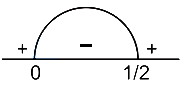
0 likesView Solution
61
MathematicsDifficultMCQTS EAMCET · 2010
If $(2,3,-3)$ is one end of a diameter of the sphere $x^2+y^2+z^2-6x-12y-2z+20=0$,then the other end of the diameter is
A
$(4,9,-1)$
B
$(4,9,5)$
C
$(-8,-15,1)$
D
$(8,15,5)$
Solution
(B) The equation of the sphere is $x^2+y^2+z^2-6x-12y-2z+20=0$.
Comparing this with the general equation of a sphere $x^2+y^2+z^2+2ux+2vy+2wz+d=0$,we get $2u=-6, 2v=-12, 2w=-2$.
Thus,$u=-3, v=-6, w=-1$.
The centre of the sphere is $(-u,-v,-w) = (3,6,1)$.
Let the given end of the diameter be $A = (2,3,-3)$ and the other end be $B = (\alpha, \beta, \gamma)$.
Since the centre $O(3,6,1)$ is the midpoint of the diameter $AB$,we have:
$O = \left( \frac{\alpha+2}{2}, \frac{\beta+3}{2}, \frac{\gamma-3}{2} \right) = (3,6,1)$.
Equating the coordinates:
$\frac{\alpha+2}{2} = 3 \Rightarrow \alpha+2 = 6 \Rightarrow \alpha = 4$.
$\frac{\beta+3}{2} = 6 \Rightarrow \beta+3 = 12 \Rightarrow \beta = 9$.
$\frac{\gamma-3}{2} = 1 \Rightarrow \gamma-3 = 2 \Rightarrow \gamma = 5$.
Therefore,the other end of the diameter is $(4,9,5)$.
Comparing this with the general equation of a sphere $x^2+y^2+z^2+2ux+2vy+2wz+d=0$,we get $2u=-6, 2v=-12, 2w=-2$.
Thus,$u=-3, v=-6, w=-1$.
The centre of the sphere is $(-u,-v,-w) = (3,6,1)$.
Let the given end of the diameter be $A = (2,3,-3)$ and the other end be $B = (\alpha, \beta, \gamma)$.
Since the centre $O(3,6,1)$ is the midpoint of the diameter $AB$,we have:
$O = \left( \frac{\alpha+2}{2}, \frac{\beta+3}{2}, \frac{\gamma-3}{2} \right) = (3,6,1)$.
Equating the coordinates:
$\frac{\alpha+2}{2} = 3 \Rightarrow \alpha+2 = 6 \Rightarrow \alpha = 4$.
$\frac{\beta+3}{2} = 6 \Rightarrow \beta+3 = 12 \Rightarrow \beta = 9$.
$\frac{\gamma-3}{2} = 1 \Rightarrow \gamma-3 = 2 \Rightarrow \gamma = 5$.
Therefore,the other end of the diameter is $(4,9,5)$.
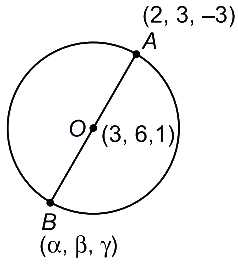
0 likesView Solution
62
MathematicsDifficultMCQTS EAMCET · 2010
If $A_i$ $(i=1, 2, 3, \ldots, n)$ are $n$ independent events with $P(A_i) = \frac{1}{1+i}$ for each $i$,then the probability that none of $A_i$ occurs is
A
$\frac{n-1}{n+1}$
B
$\frac{n}{n+1}$
C
$\frac{n}{n+2}$
D
$\frac{1}{n+1}$
Solution
(D) The probability that event $A_i$ does not occur is given by $P(\bar{A}_i) = 1 - P(A_i)$.
Given $P(A_i) = \frac{1}{1+i}$,we have $P(\bar{A}_i) = 1 - \frac{1}{1+i} = \frac{1+i-1}{1+i} = \frac{i}{1+i}$.
Since $A_i$ are independent events,the probability that none of $A_i$ occurs is the product of the probabilities of their complements:
$P(\text{none of } A_i \text{ occurs}) = P(\bar{A}_1 \cap \bar{A}_2 \cap \ldots \cap \bar{A}_n) = P(\bar{A}_1) \cdot P(\bar{A}_2) \cdot \ldots \cdot P(\bar{A}_n)$.
Substituting the values:
$= \left(\frac{1}{2}\right) \cdot \left(\frac{2}{3}\right) \cdot \left(\frac{3}{4}\right) \cdot \ldots \cdot \left(\frac{n}{n+1}\right)$.
This is a telescoping product where the numerator of each term cancels with the denominator of the previous term:
$= \frac{1}{2} \cdot \frac{2}{3} \cdot \frac{3}{4} \cdot \ldots \cdot \frac{n}{n+1} = \frac{1}{n+1}$.
Given $P(A_i) = \frac{1}{1+i}$,we have $P(\bar{A}_i) = 1 - \frac{1}{1+i} = \frac{1+i-1}{1+i} = \frac{i}{1+i}$.
Since $A_i$ are independent events,the probability that none of $A_i$ occurs is the product of the probabilities of their complements:
$P(\text{none of } A_i \text{ occurs}) = P(\bar{A}_1 \cap \bar{A}_2 \cap \ldots \cap \bar{A}_n) = P(\bar{A}_1) \cdot P(\bar{A}_2) \cdot \ldots \cdot P(\bar{A}_n)$.
Substituting the values:
$= \left(\frac{1}{2}\right) \cdot \left(\frac{2}{3}\right) \cdot \left(\frac{3}{4}\right) \cdot \ldots \cdot \left(\frac{n}{n+1}\right)$.
This is a telescoping product where the numerator of each term cancels with the denominator of the previous term:
$= \frac{1}{2} \cdot \frac{2}{3} \cdot \frac{3}{4} \cdot \ldots \cdot \frac{n}{n+1} = \frac{1}{n+1}$.
0 likesView Solution
63
MathematicsMediumMCQTS EAMCET · 2010
$A$ plane meets the coordinate axes at $A, B, C$ such that the centroid of the triangle $ABC$ is $(1, 2, 4)$. Then,the equation of the plane is
A
$x+2y+4z=12$
B
$4x+2y+z=12$
C
$x+2y+4z=3$
D
$4x+2y+z=3$
Solution
(B) Let the equation of the plane be $\frac{x}{a} + \frac{y}{b} + \frac{z}{c} = 1$ ... $(i)$
Since the plane meets the coordinate axes at $A(a, 0, 0)$,$B(0, b, 0)$,and $C(0, 0, c)$,the centroid of $\triangle ABC$ is given by $\left(\frac{a+0+0}{3}, \frac{0+b+0}{3}, \frac{0+0+c}{3}\right) = \left(\frac{a}{3}, \frac{b}{3}, \frac{c}{3}\right)$.
Given that the centroid is $(1, 2, 4)$,we have:
$\frac{a}{3} = 1 \Rightarrow a = 3$
$\frac{b}{3} = 2 \Rightarrow b = 6$
$\frac{c}{3} = 4 \Rightarrow c = 12$
Substituting these values into equation $(i)$,we get:
$\frac{x}{3} + \frac{y}{6} + \frac{z}{12} = 1$
Multiplying by $12$,we get $4x + 2y + z = 12$.
Since the plane meets the coordinate axes at $A(a, 0, 0)$,$B(0, b, 0)$,and $C(0, 0, c)$,the centroid of $\triangle ABC$ is given by $\left(\frac{a+0+0}{3}, \frac{0+b+0}{3}, \frac{0+0+c}{3}\right) = \left(\frac{a}{3}, \frac{b}{3}, \frac{c}{3}\right)$.
Given that the centroid is $(1, 2, 4)$,we have:
$\frac{a}{3} = 1 \Rightarrow a = 3$
$\frac{b}{3} = 2 \Rightarrow b = 6$
$\frac{c}{3} = 4 \Rightarrow c = 12$
Substituting these values into equation $(i)$,we get:
$\frac{x}{3} + \frac{y}{6} + \frac{z}{12} = 1$
Multiplying by $12$,we get $4x + 2y + z = 12$.
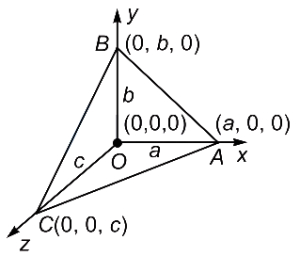
0 likesView Solution
64
MathematicsDifficultMCQTS EAMCET · 2010
The values of a function $f(x)$ at different values of $x$ are as follows:
Then,the approximate area (in square units) bounded by the curve $y=f(x)$ and the $x$-axis between $x=0$ and $x=5$,using the Trapezoidal rule,is:
| $x$ | $0$ | $1$ | $2$ | $3$ | $4$ | $5$ |
|---|---|---|---|---|---|---|
| $f(x)$ | $2$ | $3$ | $6$ | $11$ | $18$ | $27$ |
Then,the approximate area (in square units) bounded by the curve $y=f(x)$ and the $x$-axis between $x=0$ and $x=5$,using the Trapezoidal rule,is:
A
$50$
B
$75$
C
$52.5$
D
$62.5$
Solution
(C) Given $h = 1$ (the difference between consecutive $x$ values).
Let the values of $f(x)$ be $y_0, y_1, y_2, y_3, y_4, y_5$.
Here,$y_0 = 2, y_1 = 3, y_2 = 6, y_3 = 11, y_4 = 18, y_5 = 27$.
By the Trapezoidal rule,the area $A$ is given by:
$A = \frac{h}{2} [ (y_0 + y_5) + 2(y_1 + y_2 + y_3 + y_4) ]$
Substituting the values:
$A = \frac{1}{2} [ (2 + 27) + 2(3 + 6 + 11 + 18) ]$
$A = \frac{1}{2} [ 29 + 2(38) ]$
$A = \frac{1}{2} [ 29 + 76 ]$
$A = \frac{1}{2} [ 105 ] = 52.5$
Thus,the approximate area is $52.5$ square units.
Let the values of $f(x)$ be $y_0, y_1, y_2, y_3, y_4, y_5$.
Here,$y_0 = 2, y_1 = 3, y_2 = 6, y_3 = 11, y_4 = 18, y_5 = 27$.
By the Trapezoidal rule,the area $A$ is given by:
$A = \frac{h}{2} [ (y_0 + y_5) + 2(y_1 + y_2 + y_3 + y_4) ]$
Substituting the values:
$A = \frac{1}{2} [ (2 + 27) + 2(3 + 6 + 11 + 18) ]$
$A = \frac{1}{2} [ 29 + 2(38) ]$
$A = \frac{1}{2} [ 29 + 76 ]$
$A = \frac{1}{2} [ 105 ] = 52.5$
Thus,the approximate area is $52.5$ square units.
0 likesView Solution
65
MathematicsDifficultMCQTS EAMCET · 2010
The area (in square units) of the region enclosed by the two circles $x^2+y^2=1$ and $(x-1)^2+y^2=1$ is
A
$\frac{2 \pi}{3}+\frac{\sqrt{3}}{2}$
B
$\frac{\pi}{3}+\frac{\sqrt{3}}{2}$
C
$\frac{\pi}{3}-\frac{\sqrt{3}}{2}$
D
$\frac{2 \pi}{3}-\frac{\sqrt{3}}{2}$
Solution
(D) The intersection points of the two circles $x^2+y^2=1$ $(i)$ and $(x-1)^2+y^2=1$ (ii) are found by substituting $y^2=1-x^2$ from $(i)$ into (ii):
$(x-1)^2+(1-x^2)=1$
$x^2-2x+1+1-x^2=1$
$-2x+2=1 \Rightarrow x=\frac{1}{2}$
Substituting $x=\frac{1}{2}$ into $(i)$,we get $y^2=1-\frac{1}{4}=\frac{3}{4} \Rightarrow y=\pm\frac{\sqrt{3}}{2}$.
The intersection points are $A\left(\frac{1}{2}, \frac{\sqrt{3}}{2}\right)$ and $C\left(\frac{1}{2}, -\frac{\sqrt{3}}{2}\right)$.
The area of the enclosed region is symmetric about the $x$-axis,so the total area is $2 \times$ (Area of the region in the first quadrant bounded by $x=0, x=\frac{1}{2}, x=1$ and the arcs of the circles).
Area $= 2 \left[ \int_0^{1/2} \sqrt{1-(x-1)^2} dx + \int_{1/2}^1 \sqrt{1-x^2} dx \right]$
Using the formula $\int \sqrt{a^2-x^2} dx = \frac{x}{2}\sqrt{a^2-x^2} + \frac{a^2}{2}\sin^{-1}(\frac{x}{a})$:
Area $= 2 \left[ \left( \frac{x-1}{2}\sqrt{1-(x-1)^2} + \frac{1}{2}\sin^{-1}(x-1) \right)_0^{1/2} + \left( \frac{x}{2}\sqrt{1-x^2} + \frac{1}{2}\sin^{-1}(x) \right)_{1/2}^1 \right]$
$= 2 \left[ \left( \frac{-1}{4}\frac{\sqrt{3}}{2} + \frac{1}{2}\sin^{-1}(-\frac{1}{2}) - (0 + \frac{1}{2}\sin^{-1}(-1)) \right) + \left( (0 + \frac{1}{2}\sin^{-1}(1)) - (\frac{1}{4}\frac{\sqrt{3}}{2} + \frac{1}{2}\sin^{-1}(\frac{1}{2})) \right) \right]$
$= 2 \left[ -\frac{\sqrt{3}}{8} - \frac{\pi}{12} + \frac{\pi}{4} + \frac{\pi}{4} - \frac{\sqrt{3}}{8} - \frac{\pi}{12} \right]$
$= 2 \left[ \frac{2\pi}{3} - \frac{\sqrt{3}}{4} \right] = \frac{2\pi}{3} - \frac{\sqrt{3}}{2}$.
$(x-1)^2+(1-x^2)=1$
$x^2-2x+1+1-x^2=1$
$-2x+2=1 \Rightarrow x=\frac{1}{2}$
Substituting $x=\frac{1}{2}$ into $(i)$,we get $y^2=1-\frac{1}{4}=\frac{3}{4} \Rightarrow y=\pm\frac{\sqrt{3}}{2}$.
The intersection points are $A\left(\frac{1}{2}, \frac{\sqrt{3}}{2}\right)$ and $C\left(\frac{1}{2}, -\frac{\sqrt{3}}{2}\right)$.
The area of the enclosed region is symmetric about the $x$-axis,so the total area is $2 \times$ (Area of the region in the first quadrant bounded by $x=0, x=\frac{1}{2}, x=1$ and the arcs of the circles).
Area $= 2 \left[ \int_0^{1/2} \sqrt{1-(x-1)^2} dx + \int_{1/2}^1 \sqrt{1-x^2} dx \right]$
Using the formula $\int \sqrt{a^2-x^2} dx = \frac{x}{2}\sqrt{a^2-x^2} + \frac{a^2}{2}\sin^{-1}(\frac{x}{a})$:
Area $= 2 \left[ \left( \frac{x-1}{2}\sqrt{1-(x-1)^2} + \frac{1}{2}\sin^{-1}(x-1) \right)_0^{1/2} + \left( \frac{x}{2}\sqrt{1-x^2} + \frac{1}{2}\sin^{-1}(x) \right)_{1/2}^1 \right]$
$= 2 \left[ \left( \frac{-1}{4}\frac{\sqrt{3}}{2} + \frac{1}{2}\sin^{-1}(-\frac{1}{2}) - (0 + \frac{1}{2}\sin^{-1}(-1)) \right) + \left( (0 + \frac{1}{2}\sin^{-1}(1)) - (\frac{1}{4}\frac{\sqrt{3}}{2} + \frac{1}{2}\sin^{-1}(\frac{1}{2})) \right) \right]$
$= 2 \left[ -\frac{\sqrt{3}}{8} - \frac{\pi}{12} + \frac{\pi}{4} + \frac{\pi}{4} - \frac{\sqrt{3}}{8} - \frac{\pi}{12} \right]$
$= 2 \left[ \frac{2\pi}{3} - \frac{\sqrt{3}}{4} \right] = \frac{2\pi}{3} - \frac{\sqrt{3}}{2}$.
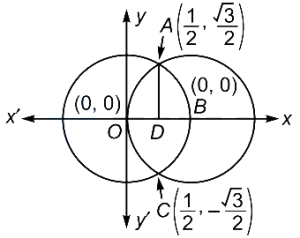
0 likesView Solution
66
MathematicsDifficultMCQTS EAMCET · 2010
If $A$ is a non-zero square matrix of order $n$ with $\det(I+A) \neq 0$ and $A^3=O$,where $I$ and $O$ are the identity and null matrices of order $n \times n$ respectively,then $(I+A)^{-1}$ is equal to
A
$I-A+A^2$
B
$I+A+A^2$
C
$I+A^{-1}$
D
$I+A$
Solution
(A) Given that $\det(I+A) \neq 0$,which implies that $(I+A)$ is an invertible matrix.
We are given $A^3 = O$.
We know the algebraic identity $x^3 + y^3 = (x+y)(x^2 - xy + y^2)$.
Substituting $x = A$ and $y = I$,we get $A^3 + I^3 = (A+I)(A^2 - A + I)$.
Since $A^3 = O$ and $I^3 = I$,the equation becomes $O + I = (A+I)(A^2 - A + I)$.
This simplifies to $I = (A+I)(A^2 - A + I)$.
Multiplying both sides by $(A+I)^{-1}$ from the left,we get $(A+I)^{-1} I = (A+I)^{-1} (A+I)(A^2 - A + I)$.
Since $(A+I)^{-1}(A+I) = I$,we have $(A+I)^{-1} = I(A^2 - A + I) = A^2 - A + I$.
Thus,$(I+A)^{-1} = I - A + A^2$.
We are given $A^3 = O$.
We know the algebraic identity $x^3 + y^3 = (x+y)(x^2 - xy + y^2)$.
Substituting $x = A$ and $y = I$,we get $A^3 + I^3 = (A+I)(A^2 - A + I)$.
Since $A^3 = O$ and $I^3 = I$,the equation becomes $O + I = (A+I)(A^2 - A + I)$.
This simplifies to $I = (A+I)(A^2 - A + I)$.
Multiplying both sides by $(A+I)^{-1}$ from the left,we get $(A+I)^{-1} I = (A+I)^{-1} (A+I)(A^2 - A + I)$.
Since $(A+I)^{-1}(A+I) = I$,we have $(A+I)^{-1} = I(A^2 - A + I) = A^2 - A + I$.
Thus,$(I+A)^{-1} = I - A + A^2$.
0 likesView Solution
67
MathematicsDifficultMCQTS EAMCET · 2010
If $\left|\begin{array}{ccc}x & x^2 & 1+x^3 \\ y & y^2 & 1+y^3 \\ z & z^2 & 1+z^3\end{array}\right|=0$ and $x \neq y \neq z$,then $1+x y z$ is equal to
A
$0$
B
-$1$
C
$1$
D
$2$
Solution
(B) Given the determinant equation: $\left|\begin{array}{ccc}x & x^2 & 1+x^3 \\ y & y^2 & 1+y^3 \\ z & z^2 & 1+z^3\end{array}\right|=0$.
We can split the determinant into two: $\left|\begin{array}{ccc}x & x^2 & 1 \\ y & y^2 & 1 \\ z & z^2 & 1\end{array}\right| + \left|\begin{array}{ccc}x & x^2 & x^3 \\ y & y^2 & y^3 \\ z & z^2 & z^3\end{array}\right| = 0$.
Taking $xyz$ common from the second determinant: $\left|\begin{array}{ccc}x & x^2 & 1 \\ y & y^2 & 1 \\ z & z^2 & 1\end{array}\right| + xyz \left|\begin{array}{ccc}1 & x & x^2 \\ 1 & y & y^2 \\ 1 & z & z^2\end{array}\right| = 0$.
By performing column swaps ($C_1 \leftrightarrow C_2$ then $C_2 \leftrightarrow C_3$),the second determinant becomes $\left|\begin{array}{ccc}x & x^2 & 1 \\ y & y^2 & 1 \\ z & z^2 & 1\end{array}\right|$.
Thus,$(1+xyz) \left|\begin{array}{ccc}x & x^2 & 1 \\ y & y^2 & 1 \\ z & z^2 & 1\end{array}\right| = 0$.
Since $x \neq y \neq z$,the determinant $\left|\begin{array}{ccc}x & x^2 & 1 \\ y & y^2 & 1 \\ z & z^2 & 1\end{array}\right| \neq 0$.
Therefore,$1+xyz = 0$.
We can split the determinant into two: $\left|\begin{array}{ccc}x & x^2 & 1 \\ y & y^2 & 1 \\ z & z^2 & 1\end{array}\right| + \left|\begin{array}{ccc}x & x^2 & x^3 \\ y & y^2 & y^3 \\ z & z^2 & z^3\end{array}\right| = 0$.
Taking $xyz$ common from the second determinant: $\left|\begin{array}{ccc}x & x^2 & 1 \\ y & y^2 & 1 \\ z & z^2 & 1\end{array}\right| + xyz \left|\begin{array}{ccc}1 & x & x^2 \\ 1 & y & y^2 \\ 1 & z & z^2\end{array}\right| = 0$.
By performing column swaps ($C_1 \leftrightarrow C_2$ then $C_2 \leftrightarrow C_3$),the second determinant becomes $\left|\begin{array}{ccc}x & x^2 & 1 \\ y & y^2 & 1 \\ z & z^2 & 1\end{array}\right|$.
Thus,$(1+xyz) \left|\begin{array}{ccc}x & x^2 & 1 \\ y & y^2 & 1 \\ z & z^2 & 1\end{array}\right| = 0$.
Since $x \neq y \neq z$,the determinant $\left|\begin{array}{ccc}x & x^2 & 1 \\ y & y^2 & 1 \\ z & z^2 & 1\end{array}\right| \neq 0$.
Therefore,$1+xyz = 0$.
0 likesView Solution
68
MathematicsMediumMCQTS EAMCET · 2010
If $f(x) = \left| \begin{array}{ccc} 2 \cos x & 1 & 0 \\ x - \frac{\pi}{2} & 2 \cos x & 1 \\ 0 & 1 & 2 \cos x \end{array} \right|$,then $f^{\prime}(\pi)$ is equal to
A
$0$
B
$2$
C
$\frac{\pi}{2}$
D
$\pi - 6$
Solution
(B) Given $f(x) = \left| \begin{array}{ccc} 2 \cos x & 1 & 0 \\ x - \frac{\pi}{2} & 2 \cos x & 1 \\ 0 & 1 & 2 \cos x \end{array} \right|$.
Using the property of differentiation of a determinant,$f^{\prime}(x)$ is the sum of three determinants where each row is differentiated one at a time:
$f^{\prime}(x) = \left| \begin{array}{ccc} -2 \sin x & 0 & 0 \\ x - \frac{\pi}{2} & 2 \cos x & 1 \\ 0 & 1 & 2 \cos x \end{array} \right| + \left| \begin{array}{ccc} 2 \cos x & 1 & 0 \\ 1 & -2 \sin x & 0 \\ 0 & 1 & 2 \cos x \end{array} \right| + \left| \begin{array}{ccc} 2 \cos x & 1 & 0 \\ x - \frac{\pi}{2} & 2 \cos x & 1 \\ 0 & 0 & -2 \sin x \end{array} \right|$.
Now,substitute $x = \pi$ (where $\sin \pi = 0$ and $\cos \pi = -1$):
$f^{\prime}(\pi) = \left| \begin{array}{ccc} 0 & 0 & 0 \\ \frac{\pi}{2} & -2 & 1 \\ 0 & 1 & -2 \end{array} \right| + \left| \begin{array}{ccc} -2 & 1 & 0 \\ 1 & 0 & 0 \\ 0 & 1 & -2 \end{array} \right| + \left| \begin{array}{ccc} -2 & 1 & 0 \\ \frac{\pi}{2} & -2 & 1 \\ 0 & 0 & 0 \end{array} \right|$.
The first determinant is $0$ because the first row is all zeros.
The second determinant is $-2(0 - 0) - 1(-2 - 0) + 0 = 2$.
The third determinant is $0$ because the third row is all zeros.
Thus,$f^{\prime}(\pi) = 0 + 2 + 0 = 2$.
Using the property of differentiation of a determinant,$f^{\prime}(x)$ is the sum of three determinants where each row is differentiated one at a time:
$f^{\prime}(x) = \left| \begin{array}{ccc} -2 \sin x & 0 & 0 \\ x - \frac{\pi}{2} & 2 \cos x & 1 \\ 0 & 1 & 2 \cos x \end{array} \right| + \left| \begin{array}{ccc} 2 \cos x & 1 & 0 \\ 1 & -2 \sin x & 0 \\ 0 & 1 & 2 \cos x \end{array} \right| + \left| \begin{array}{ccc} 2 \cos x & 1 & 0 \\ x - \frac{\pi}{2} & 2 \cos x & 1 \\ 0 & 0 & -2 \sin x \end{array} \right|$.
Now,substitute $x = \pi$ (where $\sin \pi = 0$ and $\cos \pi = -1$):
$f^{\prime}(\pi) = \left| \begin{array}{ccc} 0 & 0 & 0 \\ \frac{\pi}{2} & -2 & 1 \\ 0 & 1 & -2 \end{array} \right| + \left| \begin{array}{ccc} -2 & 1 & 0 \\ 1 & 0 & 0 \\ 0 & 1 & -2 \end{array} \right| + \left| \begin{array}{ccc} -2 & 1 & 0 \\ \frac{\pi}{2} & -2 & 1 \\ 0 & 0 & 0 \end{array} \right|$.
The first determinant is $0$ because the first row is all zeros.
The second determinant is $-2(0 - 0) - 1(-2 - 0) + 0 = 2$.
The third determinant is $0$ because the third row is all zeros.
Thus,$f^{\prime}(\pi) = 0 + 2 + 0 = 2$.
0 likesView Solution
69
MathematicsMediumMCQTS EAMCET · 2010
If the system of equations $ (k+1)^3 x + (k+2)^3 y = (k+3)^3 $,$ (k+1) x + (k+2) y = k+3 $,and $ x + y = 1 $ is consistent,then the value of $ k $ is:
A
$2$
B
$-2$
C
$-1$
D
$1$
Solution
(B) The given system of equations is:
$ (k+1)^3 x + (k+2)^3 y = (k+3)^3 $
$ (k+1) x + (k+2) y = k+3 $
$ x + y = 1 $
For the system to be consistent,the determinant of the augmented matrix must be zero.
Let $ D = \begin{vmatrix} (k+1)^3 & (k+2)^3 & (k+3)^3 \\ k+1 & k+2 & k+3 \\ 1 & 1 & 1 \end{vmatrix} = 0 $.
Applying column operations $ C_2 \rightarrow C_2 - C_1 $ and $ C_3 \rightarrow C_3 - C_1 $:
$ D = \begin{vmatrix} (k+1)^3 & (k+2)^3 - (k+1)^3 & (k+3)^3 - (k+1)^3 \\ k+1 & (k+2) - (k+1) & (k+3) - (k+1) \\ 1 & 1 - 1 & 1 - 1 \end{vmatrix} = 0 $
$ D = \begin{vmatrix} (k+1)^3 & 3k^2 + 9k + 7 & 6k^2 + 24k + 26 \\ k+1 & 1 & 2 \\ 1 & 0 & 0 \end{vmatrix} = 0 $
Expanding along the third row:
$ 1 \cdot [2(3k^2 + 9k + 7) - 1(6k^2 + 24k + 26)] = 0 $
$ 6k^2 + 18k + 14 - 6k^2 - 24k - 26 = 0 $
$ -6k - 12 = 0 $
$ -6k = 12 $
$ k = -2 $.
$ (k+1)^3 x + (k+2)^3 y = (k+3)^3 $
$ (k+1) x + (k+2) y = k+3 $
$ x + y = 1 $
For the system to be consistent,the determinant of the augmented matrix must be zero.
Let $ D = \begin{vmatrix} (k+1)^3 & (k+2)^3 & (k+3)^3 \\ k+1 & k+2 & k+3 \\ 1 & 1 & 1 \end{vmatrix} = 0 $.
Applying column operations $ C_2 \rightarrow C_2 - C_1 $ and $ C_3 \rightarrow C_3 - C_1 $:
$ D = \begin{vmatrix} (k+1)^3 & (k+2)^3 - (k+1)^3 & (k+3)^3 - (k+1)^3 \\ k+1 & (k+2) - (k+1) & (k+3) - (k+1) \\ 1 & 1 - 1 & 1 - 1 \end{vmatrix} = 0 $
$ D = \begin{vmatrix} (k+1)^3 & 3k^2 + 9k + 7 & 6k^2 + 24k + 26 \\ k+1 & 1 & 2 \\ 1 & 0 & 0 \end{vmatrix} = 0 $
Expanding along the third row:
$ 1 \cdot [2(3k^2 + 9k + 7) - 1(6k^2 + 24k + 26)] = 0 $
$ 6k^2 + 18k + 14 - 6k^2 - 24k - 26 = 0 $
$ -6k - 12 = 0 $
$ -6k = 12 $
$ k = -2 $.
0 likesView Solution
70
MathematicsMediumMCQTS EAMCET · 2010
If $\tan ^{-1} x+\tan ^{-1} y+\tan ^{-1} z=\frac{\pi}{2}$,then $1-x y-y z-z x$ is equal to
A
$1$
B
$0$
C
$-1$
D
$2$
Solution
(B) Given that $\tan ^{-1} x+\tan ^{-1} y+\tan ^{-1} z=\frac{\pi}{2}$.
We know the formula $\tan ^{-1} x+\tan ^{-1} y = \tan ^{-1} \left( \frac{x+y}{1-xy} \right)$.
So,$\tan ^{-1} \left( \frac{x+y}{1-xy} \right) + \tan ^{-1} z = \frac{\pi}{2}$.
Taking $\tan$ on both sides,we use $\tan(A+B) = \frac{\tan A + \tan B}{1 - \tan A \tan B}$.
Let $A = \tan ^{-1} \left( \frac{x+y}{1-xy} \right)$ and $B = \tan ^{-1} z$.
Then $\tan(A+B) = \tan \left( \frac{\pi}{2} \right) = \infty$.
For $\tan(A+B)$ to be $\infty$,the denominator must be $0$.
Thus,$1 - \tan A \tan B = 0$.
$1 - \left( \frac{x+y}{1-xy} \right) z = 0$.
$1 - \frac{xz + yz}{1-xy} = 0$.
$1 - xy - xz - yz = 0$.
Therefore,$1 - xy - yz - zx = 0$.
We know the formula $\tan ^{-1} x+\tan ^{-1} y = \tan ^{-1} \left( \frac{x+y}{1-xy} \right)$.
So,$\tan ^{-1} \left( \frac{x+y}{1-xy} \right) + \tan ^{-1} z = \frac{\pi}{2}$.
Taking $\tan$ on both sides,we use $\tan(A+B) = \frac{\tan A + \tan B}{1 - \tan A \tan B}$.
Let $A = \tan ^{-1} \left( \frac{x+y}{1-xy} \right)$ and $B = \tan ^{-1} z$.
Then $\tan(A+B) = \tan \left( \frac{\pi}{2} \right) = \infty$.
For $\tan(A+B)$ to be $\infty$,the denominator must be $0$.
Thus,$1 - \tan A \tan B = 0$.
$1 - \left( \frac{x+y}{1-xy} \right) z = 0$.
$1 - \frac{xz + yz}{1-xy} = 0$.
$1 - xy - xz - yz = 0$.
Therefore,$1 - xy - yz - zx = 0$.
0 likesView Solution
71
MathematicsMediumMCQTS EAMCET · 2010
Let $R$ denote the set of all real numbers and $R^{+}$ denote the set of all positive real numbers. For the subsets $A$ and $B$ of $R$,define $f: A \rightarrow B$ by $f(x) = x^2$ for $x \in A$. Match the following lists:
| Column $I$ | Column $II$ |
| :--- | :--- |
| $A$. $f$ is one-one and onto,if | $1$. $A = R^{+}, B = R$ |
| $B$. $f$ is one-one but not onto,if | $2$. $A = B = R$ |
| $C$. $f$ is onto but not one-one,if | $3$. $A = R, B = R^{+}$ |
| $D$. $f$ is neither one-one nor onto,if | $4$. $A = B = R^{+}$ |
| Column $I$ | Column $II$ |
| :--- | :--- |
| $A$. $f$ is one-one and onto,if | $1$. $A = R^{+}, B = R$ |
| $B$. $f$ is one-one but not onto,if | $2$. $A = B = R$ |
| $C$. $f$ is onto but not one-one,if | $3$. $A = R, B = R^{+}$ |
| $D$. $f$ is neither one-one nor onto,if | $4$. $A = B = R^{+}$ |
A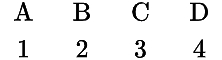
B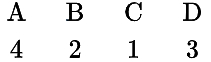
C
D
Solution
(D) The function is defined as $f(x) = x^2$.
$A$. $f$ is one-one and onto,if $A = B = R^{+}$.
For $A = R^{+}$,$f(x) = x^2$ is strictly increasing,so it is one-one. Since $B = R^{+}$,for every $y \in R^{+}$,there exists $x = \sqrt{y} \in R^{+}$ such that $f(x) = y$,so it is onto. Thus,$A \rightarrow 4$.
$B$. $f$ is one-one but not onto,if $A = R^{+}, B = R$.
For $A = R^{+}$,$f(x) = x^2$ is one-one. Since $B = R$,the range is $R^{+}$,which is a proper subset of $B$,so it is not onto. Thus,$B \rightarrow 1$.
$C$. $f$ is onto but not one-one,if $A = R, B = R^{+}$.
For $A = R$,$f(1) = 1$ and $f(-1) = 1$,so it is not one-one. Since $B = R^{+}$,for every $y \in R^{+}$,there exists $x = \pm \sqrt{y} \in R$ such that $f(x) = y$,so it is onto. Thus,$C \rightarrow 3$.
$D$. $f$ is neither one-one nor onto,if $A = B = R$.
For $A = R$,$f(1) = f(-1) = 1$,so it is not one-one. Since $B = R$,the range is $R^{+}$,which is a proper subset of $B$,so it is not onto. Thus,$D \rightarrow 2$.
Therefore,the correct matching is $A \rightarrow 4, B \rightarrow 1, C \rightarrow 3, D \rightarrow 2$.
$A$. $f$ is one-one and onto,if $A = B = R^{+}$.
For $A = R^{+}$,$f(x) = x^2$ is strictly increasing,so it is one-one. Since $B = R^{+}$,for every $y \in R^{+}$,there exists $x = \sqrt{y} \in R^{+}$ such that $f(x) = y$,so it is onto. Thus,$A \rightarrow 4$.
$B$. $f$ is one-one but not onto,if $A = R^{+}, B = R$.
For $A = R^{+}$,$f(x) = x^2$ is one-one. Since $B = R$,the range is $R^{+}$,which is a proper subset of $B$,so it is not onto. Thus,$B \rightarrow 1$.
$C$. $f$ is onto but not one-one,if $A = R, B = R^{+}$.
For $A = R$,$f(1) = 1$ and $f(-1) = 1$,so it is not one-one. Since $B = R^{+}$,for every $y \in R^{+}$,there exists $x = \pm \sqrt{y} \in R$ such that $f(x) = y$,so it is onto. Thus,$C \rightarrow 3$.
$D$. $f$ is neither one-one nor onto,if $A = B = R$.
For $A = R$,$f(1) = f(-1) = 1$,so it is not one-one. Since $B = R$,the range is $R^{+}$,which is a proper subset of $B$,so it is not onto. Thus,$D \rightarrow 2$.
Therefore,the correct matching is $A \rightarrow 4, B \rightarrow 1, C \rightarrow 3, D \rightarrow 2$.
0 likesView Solution
72
MathematicsMediumMCQTS EAMCET · 2010
If $f: R \rightarrow R$ defined by $f(x) = \begin{cases} \frac{1 + 3 x^2 - \cos 2 x}{x^2}, & x \neq 0 \\ k, & x = 0 \end{cases}$ is continuous at $x = 0$,then $k$ is equal to
A
$1$
B
$5$
C
$6$
D
$0$
Solution
(B) For the function $f(x)$ to be continuous at $x = 0$,the limit of $f(x)$ as $x \rightarrow 0$ must exist and be equal to $f(0)$.
$f(0) = k$.
Now,we calculate the limit:
$\lim_{x \rightarrow 0} f(x) = \lim_{x \rightarrow 0} \frac{1 + 3 x^2 - \cos 2 x}{x^2}$
Using the trigonometric identity $\cos 2x = 1 - 2 \sin^2 x$:
$\lim_{x \rightarrow 0} \frac{1 + 3 x^2 - (1 - 2 \sin^2 x)}{x^2}$
$= \lim_{x \rightarrow 0} \frac{1 + 3 x^2 - 1 + 2 \sin^2 x}{x^2}$
$= \lim_{x \rightarrow 0} \frac{3 x^2 + 2 \sin^2 x}{x^2}$
$= \lim_{x \rightarrow 0} \left( \frac{3 x^2}{x^2} + 2 \frac{\sin^2 x}{x^2} \right)$
$= \lim_{x \rightarrow 0} \left( 3 + 2 \left( \frac{\sin x}{x} \right)^2 \right)$
Since $\lim_{x \rightarrow 0} \frac{\sin x}{x} = 1$,we have:
$= 3 + 2(1)^2 = 3 + 2 = 5$.
Since the function is continuous at $x = 0$,$f(0) = \lim_{x \rightarrow 0} f(x)$,therefore $k = 5$.
$f(0) = k$.
Now,we calculate the limit:
$\lim_{x \rightarrow 0} f(x) = \lim_{x \rightarrow 0} \frac{1 + 3 x^2 - \cos 2 x}{x^2}$
Using the trigonometric identity $\cos 2x = 1 - 2 \sin^2 x$:
$\lim_{x \rightarrow 0} \frac{1 + 3 x^2 - (1 - 2 \sin^2 x)}{x^2}$
$= \lim_{x \rightarrow 0} \frac{1 + 3 x^2 - 1 + 2 \sin^2 x}{x^2}$
$= \lim_{x \rightarrow 0} \frac{3 x^2 + 2 \sin^2 x}{x^2}$
$= \lim_{x \rightarrow 0} \left( \frac{3 x^2}{x^2} + 2 \frac{\sin^2 x}{x^2} \right)$
$= \lim_{x \rightarrow 0} \left( 3 + 2 \left( \frac{\sin x}{x} \right)^2 \right)$
Since $\lim_{x \rightarrow 0} \frac{\sin x}{x} = 1$,we have:
$= 3 + 2(1)^2 = 3 + 2 = 5$.
Since the function is continuous at $x = 0$,$f(0) = \lim_{x \rightarrow 0} f(x)$,therefore $k = 5$.
0 likesView Solution
73
MathematicsEasyMCQTS EAMCET · 2010
If $f(x) = \sin x + \cos x$,then $f\left(\frac{\pi}{4}\right) f^{(iv)}\left(\frac{\pi}{4}\right)$ is equal to
A
$1$
B
$2$
C
$3$
D
$4$
Solution
(B) Given $f(x) = \sin x + \cos x$.
First derivative: $f'(x) = \cos x - \sin x$.
Second derivative: $f''(x) = -\sin x - \cos x$.
Third derivative: $f'''(x) = -\cos x + \sin x$.
Fourth derivative: $f^{(iv)}(x) = \sin x + \cos x$.
Now,calculate the value at $x = \frac{\pi}{4}$:
$f\left(\frac{\pi}{4}\right) = \sin\left(\frac{\pi}{4}\right) + \cos\left(\frac{\pi}{4}\right) = \frac{1}{\sqrt{2}} + \frac{1}{\sqrt{2}} = \frac{2}{\sqrt{2}} = \sqrt{2}$.
Similarly,$f^{(iv)}\left(\frac{\pi}{4}\right) = \sin\left(\frac{\pi}{4}\right) + \cos\left(\frac{\pi}{4}\right) = \sqrt{2}$.
Therefore,$f\left(\frac{\pi}{4}\right) f^{(iv)}\left(\frac{\pi}{4}\right) = \sqrt{2} \times \sqrt{2} = 2$.
First derivative: $f'(x) = \cos x - \sin x$.
Second derivative: $f''(x) = -\sin x - \cos x$.
Third derivative: $f'''(x) = -\cos x + \sin x$.
Fourth derivative: $f^{(iv)}(x) = \sin x + \cos x$.
Now,calculate the value at $x = \frac{\pi}{4}$:
$f\left(\frac{\pi}{4}\right) = \sin\left(\frac{\pi}{4}\right) + \cos\left(\frac{\pi}{4}\right) = \frac{1}{\sqrt{2}} + \frac{1}{\sqrt{2}} = \frac{2}{\sqrt{2}} = \sqrt{2}$.
Similarly,$f^{(iv)}\left(\frac{\pi}{4}\right) = \sin\left(\frac{\pi}{4}\right) + \cos\left(\frac{\pi}{4}\right) = \sqrt{2}$.
Therefore,$f\left(\frac{\pi}{4}\right) f^{(iv)}\left(\frac{\pi}{4}\right) = \sqrt{2} \times \sqrt{2} = 2$.
0 likesView Solution
74
MathematicsEasyMCQTS EAMCET · 2010
If $y = \sin(m \sin^{-1} x)$,then $(1-x^2) y_2 - x y_1$ is equal to (Here,$y_n$ denotes $\frac{d^n y}{dx^n}$)
A
$m^2 y$
B
$-m^2 y$
C
$2 m^2 y$
D
$-2 m^2 y$
Solution
(B) Given $y = \sin(m \sin^{-1} x)$.
First,differentiate with respect to $x$:
$y_1 = \cos(m \sin^{-1} x) \cdot \frac{m}{\sqrt{1-x^2}}$.
Multiply both sides by $\sqrt{1-x^2}$:
$y_1 \sqrt{1-x^2} = m \cos(m \sin^{-1} x)$.
Differentiate again with respect to $x$ using the product rule:
$y_2 \sqrt{1-x^2} + y_1 \cdot \frac{1}{2\sqrt{1-x^2}} \cdot (-2x) = m \cdot (-\sin(m \sin^{-1} x)) \cdot \frac{m}{\sqrt{1-x^2}}$.
$y_2 \sqrt{1-x^2} - \frac{x y_1}{\sqrt{1-x^2}} = -\frac{m^2 \sin(m \sin^{-1} x)}{\sqrt{1-x^2}}$.
Multiply the entire equation by $\sqrt{1-x^2}$:
$y_2(1-x^2) - x y_1 = -m^2 \sin(m \sin^{-1} x)$.
Since $y = \sin(m \sin^{-1} x)$,we get:
$(1-x^2) y_2 - x y_1 = -m^2 y$.
First,differentiate with respect to $x$:
$y_1 = \cos(m \sin^{-1} x) \cdot \frac{m}{\sqrt{1-x^2}}$.
Multiply both sides by $\sqrt{1-x^2}$:
$y_1 \sqrt{1-x^2} = m \cos(m \sin^{-1} x)$.
Differentiate again with respect to $x$ using the product rule:
$y_2 \sqrt{1-x^2} + y_1 \cdot \frac{1}{2\sqrt{1-x^2}} \cdot (-2x) = m \cdot (-\sin(m \sin^{-1} x)) \cdot \frac{m}{\sqrt{1-x^2}}$.
$y_2 \sqrt{1-x^2} - \frac{x y_1}{\sqrt{1-x^2}} = -\frac{m^2 \sin(m \sin^{-1} x)}{\sqrt{1-x^2}}$.
Multiply the entire equation by $\sqrt{1-x^2}$:
$y_2(1-x^2) - x y_1 = -m^2 \sin(m \sin^{-1} x)$.
Since $y = \sin(m \sin^{-1} x)$,we get:
$(1-x^2) y_2 - x y_1 = -m^2 y$.
0 likesView Solution
75
MathematicsDifficultMCQTS EAMCET · 2010
If $f(x) = (\cos x)(\cos 2x) \ldots (\cos nx)$,then $f^{\prime}(x) + \sum_{r=1}^n (r \tan rx) f(x)$ is equal to
A
$f(x)$
B
$0$
C
$-f(x)$
D
$2f(x)$
Solution
(B) Given $f(x) = \prod_{r=1}^n \cos(rx)$. Taking the natural logarithm on both sides,we get $\ln|f(x)| = \sum_{r=1}^n \ln|\cos(rx)|$.
Differentiating both sides with respect to $x$,we have $\frac{f^{\prime}(x)}{f(x)} = \sum_{r=1}^n \frac{1}{\cos(rx)} \cdot (-\sin(rx) \cdot r) = -\sum_{r=1}^n r \tan(rx)$.
Multiplying both sides by $f(x)$,we get $f^{\prime}(x) = -f(x) \sum_{r=1}^n r \tan(rx)$.
Rearranging the terms,we obtain $f^{\prime}(x) + \sum_{r=1}^n (r \tan rx) f(x) = 0$.
Differentiating both sides with respect to $x$,we have $\frac{f^{\prime}(x)}{f(x)} = \sum_{r=1}^n \frac{1}{\cos(rx)} \cdot (-\sin(rx) \cdot r) = -\sum_{r=1}^n r \tan(rx)$.
Multiplying both sides by $f(x)$,we get $f^{\prime}(x) = -f(x) \sum_{r=1}^n r \tan(rx)$.
Rearranging the terms,we obtain $f^{\prime}(x) + \sum_{r=1}^n (r \tan rx) f(x) = 0$.
0 likesView Solution
76
MathematicsMediumMCQTS EAMCET · 2010
The height of the cone of maximum volume inscribed in a sphere of radius $R$ is
A
$\frac{R}{3}$
B
$\frac{2 R}{3}$
C
$\frac{4 R}{3}$
D
$\frac{4 R}{\sqrt{3}}$
Solution
(C) Let the height of the cone be $h$ and the radius of the cone be $r$. Given,the radius of the sphere is $R$.
In $\triangle OPB$,by the Pythagorean theorem,we have:
$R^2 = r^2 + (h - R)^2$
$\Rightarrow r^2 = R^2 - (h - R)^2 = R^2 - (h^2 - 2Rh + R^2) = 2Rh - h^2$.
The volume $V$ of the cone is given by:
$V = \frac{1}{3} \pi r^2 h = \frac{1}{3} \pi (2Rh - h^2) h = \frac{\pi}{3} (2Rh^2 - h^3)$.
To find the maximum volume,differentiate $V$ with respect to $h$:
$\frac{dV}{dh} = \frac{\pi}{3} (4Rh - 3h^2)$.
Setting $\frac{dV}{dh} = 0$ for critical points:
$\frac{\pi}{3} h(4R - 3h) = 0$.
Since $h \neq 0$,we have $h = \frac{4R}{3}$.
Checking the second derivative:
$\frac{d^2V}{dh^2} = \frac{\pi}{3} (4R - 6h)$.
At $h = \frac{4R}{3}$,$\frac{d^2V}{dh^2} = \frac{\pi}{3} (4R - 6(\frac{4R}{3})) = \frac{\pi}{3} (4R - 8R) = -\frac{4\pi R}{3} < 0$.
Since the second derivative is negative,the volume is maximum at $h = \frac{4R}{3}$.
In $\triangle OPB$,by the Pythagorean theorem,we have:
$R^2 = r^2 + (h - R)^2$
$\Rightarrow r^2 = R^2 - (h - R)^2 = R^2 - (h^2 - 2Rh + R^2) = 2Rh - h^2$.
The volume $V$ of the cone is given by:
$V = \frac{1}{3} \pi r^2 h = \frac{1}{3} \pi (2Rh - h^2) h = \frac{\pi}{3} (2Rh^2 - h^3)$.
To find the maximum volume,differentiate $V$ with respect to $h$:
$\frac{dV}{dh} = \frac{\pi}{3} (4Rh - 3h^2)$.
Setting $\frac{dV}{dh} = 0$ for critical points:
$\frac{\pi}{3} h(4R - 3h) = 0$.
Since $h \neq 0$,we have $h = \frac{4R}{3}$.
Checking the second derivative:
$\frac{d^2V}{dh^2} = \frac{\pi}{3} (4R - 6h)$.
At $h = \frac{4R}{3}$,$\frac{d^2V}{dh^2} = \frac{\pi}{3} (4R - 6(\frac{4R}{3})) = \frac{\pi}{3} (4R - 8R) = -\frac{4\pi R}{3} < 0$.
Since the second derivative is negative,the volume is maximum at $h = \frac{4R}{3}$.
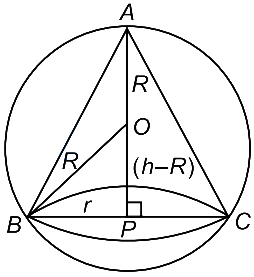
0 likesView Solution
77
MathematicsDifficultMCQTS EAMCET · 2010
If $f_n(x) = \log \log \log \ldots \log x$ (where $\log$ is repeated $n$ times),then $\int (x f_1(x) f_2(x) \ldots f_n(x))^{-1} dx$ is equal to
A
$f_{n+1}(x) + c$
B
$\frac{f_{n+1}(x)}{n+1} + c$
C
$n f_n(x) + c$
D
$\frac{f_n(x)}{n} + c$
Solution
(A) Given $f_n(x) = \log \log \ldots \log x$ ($n$ times).
Let $I = \int \frac{dx}{x f_1(x) f_2(x) \ldots f_n(x)}$.
Let $t = f_n(x) = \log(f_{n-1}(x))$.
Then,$\frac{dt}{dx} = \frac{1}{f_{n-1}(x)} \cdot \frac{d}{dx}(f_{n-1}(x)) = \frac{1}{f_{n-1}(x) f_{n-2}(x) \ldots f_1(x) \cdot x}$.
Thus,$dx = (x f_1(x) f_2(x) \ldots f_{n-1}(x)) dt$.
Substituting this into the integral:
$I = \int \frac{(x f_1(x) f_2(x) \ldots f_{n-1}(x)) dt}{x f_1(x) f_2(x) \ldots f_{n-1}(x) f_n(x)} = \int \frac{dt}{f_n(x)} = \int \frac{dt}{t}$.
$I = \log(t) + c = \log(f_n(x)) + c$.
Since $f_{n+1}(x) = \log(f_n(x))$,we have $I = f_{n+1}(x) + c$.
Let $I = \int \frac{dx}{x f_1(x) f_2(x) \ldots f_n(x)}$.
Let $t = f_n(x) = \log(f_{n-1}(x))$.
Then,$\frac{dt}{dx} = \frac{1}{f_{n-1}(x)} \cdot \frac{d}{dx}(f_{n-1}(x)) = \frac{1}{f_{n-1}(x) f_{n-2}(x) \ldots f_1(x) \cdot x}$.
Thus,$dx = (x f_1(x) f_2(x) \ldots f_{n-1}(x)) dt$.
Substituting this into the integral:
$I = \int \frac{(x f_1(x) f_2(x) \ldots f_{n-1}(x)) dt}{x f_1(x) f_2(x) \ldots f_{n-1}(x) f_n(x)} = \int \frac{dt}{f_n(x)} = \int \frac{dt}{t}$.
$I = \log(t) + c = \log(f_n(x)) + c$.
Since $f_{n+1}(x) = \log(f_n(x))$,we have $I = f_{n+1}(x) + c$.
0 likesView Solution
78
MathematicsMediumMCQTS EAMCET · 2010
If $\int \frac{7 x^8+8 x^7}{\left(1+x+x^8\right)^2} d x=f(x)+c$,then $f(x)$ is equal to
A
$\frac{x^8}{1+x+x^8}$
B
$28 \log \left(1+x+x^8\right)$
C
$\frac{1}{1+x+x^8}$
D
$\frac{-1}{1+x+x^8}$
Solution
(A) To find $f(x)$,we differentiate the given options to see which one yields the integrand $\frac{7 x^8+8 x^7}{\left(1+x+x^8\right)^2}$.
Let $f(x) = \frac{x^8}{1+x+x^8}$.
Using the quotient rule $\frac{d}{dx} \left( \frac{u}{v} \right) = \frac{v u' - u v'}{v^2}$:
$f'(x) = \frac{(1+x+x^8)(8x^7) - x^8(1+8x^7)}{(1+x+x^8)^2}$
$f'(x) = \frac{8x^7 + 8x^8 + 8x^{15} - x^8 - 8x^{15}}{(1+x+x^8)^2}$
$f'(x) = \frac{7x^8 + 8x^7}{(1+x+x^8)^2}$
Since the derivative matches the integrand,$f(x) = \frac{x^8}{1+x+x^8}$ is the correct function.
Let $f(x) = \frac{x^8}{1+x+x^8}$.
Using the quotient rule $\frac{d}{dx} \left( \frac{u}{v} \right) = \frac{v u' - u v'}{v^2}$:
$f'(x) = \frac{(1+x+x^8)(8x^7) - x^8(1+8x^7)}{(1+x+x^8)^2}$
$f'(x) = \frac{8x^7 + 8x^8 + 8x^{15} - x^8 - 8x^{15}}{(1+x+x^8)^2}$
$f'(x) = \frac{7x^8 + 8x^7}{(1+x+x^8)^2}$
Since the derivative matches the integrand,$f(x) = \frac{x^8}{1+x+x^8}$ is the correct function.
0 likesView Solution
79
MathematicsDifficultMCQTS EAMCET · 2010
The solution of $\tan y \frac{dy}{dx} = \sin(x+y) + \sin(x-y)$ is
A
$\sec y = 2 \cos x + c$
B
$\sec y = -2 \cos x + c$
C
$\tan y = -2 \cos x + c$
D
$\sec^2 y = -2 \cos x + c$
Solution
(B) Given equation: $\tan y \frac{dy}{dx} = \sin(x+y) + \sin(x-y)$
Using the identity $\sin C + \sin D = 2 \sin(\frac{C+D}{2}) \cos(\frac{C-D}{2})$:
$\tan y \frac{dy}{dx} = 2 \sin x \cos y$
$\frac{\sin y}{\cos y} \frac{dy}{dx} = 2 \sin x \cos y$
Rearranging the terms:
$\frac{\sin y}{\cos^2 y} dy = 2 \sin x dx$
Integrating both sides:
$\int \frac{\sin y}{\cos^2 y} dy = \int 2 \sin x dx$
Let $t = \cos y$,then $dt = -\sin y dy$,so $-\int \frac{dt}{t^2} = -2 \cos x + c$
$\frac{1}{t} = -2 \cos x + c$
Substituting $t = \cos y$:
$\sec y = -2 \cos x + c$
Using the identity $\sin C + \sin D = 2 \sin(\frac{C+D}{2}) \cos(\frac{C-D}{2})$:
$\tan y \frac{dy}{dx} = 2 \sin x \cos y$
$\frac{\sin y}{\cos y} \frac{dy}{dx} = 2 \sin x \cos y$
Rearranging the terms:
$\frac{\sin y}{\cos^2 y} dy = 2 \sin x dx$
Integrating both sides:
$\int \frac{\sin y}{\cos^2 y} dy = \int 2 \sin x dx$
Let $t = \cos y$,then $dt = -\sin y dy$,so $-\int \frac{dt}{t^2} = -2 \cos x + c$
$\frac{1}{t} = -2 \cos x + c$
Substituting $t = \cos y$:
$\sec y = -2 \cos x + c$
0 likesView Solution
80
MathematicsMediumMCQTS EAMCET · 2010
$A$ family of curves has the differential equation $x y \frac{d y}{d x}=2 y^2-x^2$. Then,the family of curves is
A
$y^2=c x^2+x^3$
B
$y^2=c x^4+x^3$
C
$y^2=x+c x^4$
D
$y^2=x^2+c x^4$
Solution
(D) Given the differential equation: $x y \frac{d y}{d x}=2 y^2-x^2$.
Divide by $x$: $y \frac{d y}{d x} = \frac{2 y^2}{x} - x$.
Rearranging: $y \frac{d y}{d x} - \frac{2 y^2}{x} = -x$ $\ldots$ $(i)$.
Let $v = y^2$. Then $\frac{d v}{d x} = 2 y \frac{d y}{d x}$,which implies $y \frac{d y}{d x} = \frac{1}{2} \frac{d v}{d x}$.
Substituting into $(i)$: $\frac{1}{2} \frac{d v}{d x} - \frac{2 v}{x} = -x$.
Multiply by $2$: $\frac{d v}{d x} - \frac{4 v}{x} = -2 x$.
This is a linear differential equation of the form $\frac{d v}{d x} + P(x) v = Q(x)$,where $P(x) = -\frac{4}{x}$ and $Q(x) = -2 x$.
Integrating factor $IF = e^{\int P(x) d x} = e^{\int -\frac{4}{x} d x} = e^{-4 \ln |x|} = x^{-4}$.
The solution is $v \cdot IF = \int Q(x) \cdot IF d x + c$.
$v \cdot x^{-4} = \int (-2 x) \cdot x^{-4} d x + c = \int -2 x^{-3} d x + c$.
$\frac{v}{x^4} = -2 \left( \frac{x^{-2}}{-2} \right) + c = \frac{1}{x^2} + c$.
$v = x^2 + c x^4$.
Since $v = y^2$,the family of curves is $y^2 = x^2 + c x^4$.
Divide by $x$: $y \frac{d y}{d x} = \frac{2 y^2}{x} - x$.
Rearranging: $y \frac{d y}{d x} - \frac{2 y^2}{x} = -x$ $\ldots$ $(i)$.
Let $v = y^2$. Then $\frac{d v}{d x} = 2 y \frac{d y}{d x}$,which implies $y \frac{d y}{d x} = \frac{1}{2} \frac{d v}{d x}$.
Substituting into $(i)$: $\frac{1}{2} \frac{d v}{d x} - \frac{2 v}{x} = -x$.
Multiply by $2$: $\frac{d v}{d x} - \frac{4 v}{x} = -2 x$.
This is a linear differential equation of the form $\frac{d v}{d x} + P(x) v = Q(x)$,where $P(x) = -\frac{4}{x}$ and $Q(x) = -2 x$.
Integrating factor $IF = e^{\int P(x) d x} = e^{\int -\frac{4}{x} d x} = e^{-4 \ln |x|} = x^{-4}$.
The solution is $v \cdot IF = \int Q(x) \cdot IF d x + c$.
$v \cdot x^{-4} = \int (-2 x) \cdot x^{-4} d x + c = \int -2 x^{-3} d x + c$.
$\frac{v}{x^4} = -2 \left( \frac{x^{-2}}{-2} \right) + c = \frac{1}{x^2} + c$.
$v = x^2 + c x^4$.
Since $v = y^2$,the family of curves is $y^2 = x^2 + c x^4$.
0 likesView Solution
81
MathematicsDifficultMCQTS EAMCET · 2010
Let $OA, OB, OC$ be the co-terminal edges of a rectangular parallelopiped of volume $V$ and let $P$ be the vertex opposite to $O$. Then,$[\overrightarrow{AP} \overrightarrow{BP} \overrightarrow{CP}]$ is equal to
A
$2V$
B
$12V$
C
$3\sqrt{3}V$
D
$0$
Solution
(A) Let $\overrightarrow{OA} = \vec{a}, \overrightarrow{OB} = \vec{b}, \overrightarrow{OC} = \vec{c}$. The volume of the parallelopiped is $V = [\vec{a} \vec{b} \vec{c}]$.
Since $P$ is the vertex opposite to $O$ in the rectangular parallelopiped,the position vector of $P$ is $\vec{p} = \vec{a} + \vec{b} + \vec{c}$.
Now,we express the vectors $\overrightarrow{AP}, \overrightarrow{BP}, \overrightarrow{CP}$ in terms of $\vec{a}, \vec{b}, \vec{c}$:
$\overrightarrow{AP} = \vec{p} - \vec{a} = (\vec{a} + \vec{b} + \vec{c}) - \vec{a} = \vec{b} + \vec{c}$
$\overrightarrow{BP} = \vec{p} - \vec{b} = (\vec{a} + \vec{b} + \vec{c}) - \vec{b} = \vec{a} + \vec{c}$
$\overrightarrow{CP} = \vec{p} - \vec{c} = (\vec{a} + \vec{b} + \vec{c}) - \vec{c} = \vec{a} + \vec{b}$
We need to calculate the scalar triple product $[\overrightarrow{AP} \overrightarrow{BP} \overrightarrow{CP}] = [(\vec{b} + \vec{c}) (\vec{a} + \vec{c}) (\vec{a} + \vec{b})]$.
Using the property of scalar triple product $[\vec{x}+\vec{y}, \vec{y}+\vec{z}, \vec{z}+\vec{x}] = 2[\vec{x} \vec{y} \vec{z}]$,we get:
$[\overrightarrow{AP} \overrightarrow{BP} \overrightarrow{CP}] = 2[\vec{a} \vec{b} \vec{c}] = 2V$.
Since $P$ is the vertex opposite to $O$ in the rectangular parallelopiped,the position vector of $P$ is $\vec{p} = \vec{a} + \vec{b} + \vec{c}$.
Now,we express the vectors $\overrightarrow{AP}, \overrightarrow{BP}, \overrightarrow{CP}$ in terms of $\vec{a}, \vec{b}, \vec{c}$:
$\overrightarrow{AP} = \vec{p} - \vec{a} = (\vec{a} + \vec{b} + \vec{c}) - \vec{a} = \vec{b} + \vec{c}$
$\overrightarrow{BP} = \vec{p} - \vec{b} = (\vec{a} + \vec{b} + \vec{c}) - \vec{b} = \vec{a} + \vec{c}$
$\overrightarrow{CP} = \vec{p} - \vec{c} = (\vec{a} + \vec{b} + \vec{c}) - \vec{c} = \vec{a} + \vec{b}$
We need to calculate the scalar triple product $[\overrightarrow{AP} \overrightarrow{BP} \overrightarrow{CP}] = [(\vec{b} + \vec{c}) (\vec{a} + \vec{c}) (\vec{a} + \vec{b})]$.
Using the property of scalar triple product $[\vec{x}+\vec{y}, \vec{y}+\vec{z}, \vec{z}+\vec{x}] = 2[\vec{x} \vec{y} \vec{z}]$,we get:
$[\overrightarrow{AP} \overrightarrow{BP} \overrightarrow{CP}] = 2[\vec{a} \vec{b} \vec{c}] = 2V$.
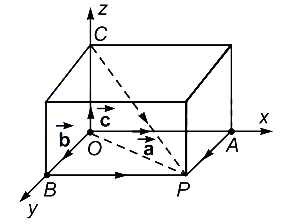
0 likesView Solution
82
MathematicsMediumMCQTS EAMCET · 2010
$(\overrightarrow{a}+2 \overrightarrow{b}-\overrightarrow{c}) \cdot ((\overrightarrow{a}-\overrightarrow{b}) \times (\overrightarrow{a}-\overrightarrow{b}-\overrightarrow{c}))$ is equal to
A
$-[\overrightarrow{a} \overrightarrow{b} \overrightarrow{c}]$
B
$2[\overrightarrow{a} \overrightarrow{b} \overrightarrow{c}]$
C
$3[\overrightarrow{a} \overrightarrow{b} \overrightarrow{c}]$
D
$\overrightarrow{0}$
Solution
(C) Let the expression be $E = (\overrightarrow{a}+2 \overrightarrow{b}-\overrightarrow{c}) \cdot ((\overrightarrow{a}-\overrightarrow{b}) \times (\overrightarrow{a}-\overrightarrow{b}-\overrightarrow{c}))$.
First,simplify the cross product term: $(\overrightarrow{a}-\overrightarrow{b}) \times (\overrightarrow{a}-\overrightarrow{b}-\overrightarrow{c})$.
$= (\overrightarrow{a} \times \overrightarrow{a}) - (\overrightarrow{a} \times \overrightarrow{b}) - (\overrightarrow{a} \times \overrightarrow{c}) - (\overrightarrow{b} \times \overrightarrow{a}) + (\overrightarrow{b} \times \overrightarrow{b}) + (\overrightarrow{b} \times \overrightarrow{c})$.
Since $\overrightarrow{a} \times \overrightarrow{a} = \overrightarrow{0}$ and $\overrightarrow{b} \times \overrightarrow{b} = \overrightarrow{0}$,and using $\overrightarrow{b} \times \overrightarrow{a} = -(\overrightarrow{a} \times \overrightarrow{b})$,we get:
$= \overrightarrow{0} - (\overrightarrow{a} \times \overrightarrow{b}) - (\overrightarrow{a} \times \overrightarrow{c}) + (\overrightarrow{a} \times \overrightarrow{b}) + \overrightarrow{0} + (\overrightarrow{b} \times \overrightarrow{c}) = (\overrightarrow{b} \times \overrightarrow{c}) - (\overrightarrow{a} \times \overrightarrow{c}) = (\overrightarrow{b} \times \overrightarrow{c}) + (\overrightarrow{c} \times \overrightarrow{a})$.
Now,$E = (\overrightarrow{a}+2 \overrightarrow{b}-\overrightarrow{c}) \cdot ((\overrightarrow{b} \times \overrightarrow{c}) + (\overrightarrow{c} \times \overrightarrow{a}))$.
Using the definition of scalar triple product $[\overrightarrow{u} \overrightarrow{v} \overrightarrow{w}] = \overrightarrow{u} \cdot (\overrightarrow{v} \times \overrightarrow{w})$:
$E = \overrightarrow{a} \cdot (\overrightarrow{b} \times \overrightarrow{c}) + \overrightarrow{a} \cdot (\overrightarrow{c} \times \overrightarrow{a}) + 2\overrightarrow{b} \cdot (\overrightarrow{b} \times \overrightarrow{c}) + 2\overrightarrow{b} \cdot (\overrightarrow{c} \times \overrightarrow{a}) - \overrightarrow{c} \cdot (\overrightarrow{b} \times \overrightarrow{c}) - \overrightarrow{c} \cdot (\overrightarrow{c} \times \overrightarrow{a})$.
Note that any scalar triple product with repeated vectors is $0$ (e.g.,$\overrightarrow{a} \cdot (\overrightarrow{c} \times \overrightarrow{a}) = 0$).
$E = [\overrightarrow{a} \overrightarrow{b} \overrightarrow{c}] + 0 + 0 + 2[\overrightarrow{b} \overrightarrow{c} \overrightarrow{a}] - 0 - 0$.
Since $[\overrightarrow{b} \overrightarrow{c} \overrightarrow{a}] = [\overrightarrow{a} \overrightarrow{b} \overrightarrow{c}]$,we have $E = [\overrightarrow{a} \overrightarrow{b} \overrightarrow{c}] + 2[\overrightarrow{a} \overrightarrow{b} \overrightarrow{c}] = 3[\overrightarrow{a} \overrightarrow{b} \overrightarrow{c}]$.
First,simplify the cross product term: $(\overrightarrow{a}-\overrightarrow{b}) \times (\overrightarrow{a}-\overrightarrow{b}-\overrightarrow{c})$.
$= (\overrightarrow{a} \times \overrightarrow{a}) - (\overrightarrow{a} \times \overrightarrow{b}) - (\overrightarrow{a} \times \overrightarrow{c}) - (\overrightarrow{b} \times \overrightarrow{a}) + (\overrightarrow{b} \times \overrightarrow{b}) + (\overrightarrow{b} \times \overrightarrow{c})$.
Since $\overrightarrow{a} \times \overrightarrow{a} = \overrightarrow{0}$ and $\overrightarrow{b} \times \overrightarrow{b} = \overrightarrow{0}$,and using $\overrightarrow{b} \times \overrightarrow{a} = -(\overrightarrow{a} \times \overrightarrow{b})$,we get:
$= \overrightarrow{0} - (\overrightarrow{a} \times \overrightarrow{b}) - (\overrightarrow{a} \times \overrightarrow{c}) + (\overrightarrow{a} \times \overrightarrow{b}) + \overrightarrow{0} + (\overrightarrow{b} \times \overrightarrow{c}) = (\overrightarrow{b} \times \overrightarrow{c}) - (\overrightarrow{a} \times \overrightarrow{c}) = (\overrightarrow{b} \times \overrightarrow{c}) + (\overrightarrow{c} \times \overrightarrow{a})$.
Now,$E = (\overrightarrow{a}+2 \overrightarrow{b}-\overrightarrow{c}) \cdot ((\overrightarrow{b} \times \overrightarrow{c}) + (\overrightarrow{c} \times \overrightarrow{a}))$.
Using the definition of scalar triple product $[\overrightarrow{u} \overrightarrow{v} \overrightarrow{w}] = \overrightarrow{u} \cdot (\overrightarrow{v} \times \overrightarrow{w})$:
$E = \overrightarrow{a} \cdot (\overrightarrow{b} \times \overrightarrow{c}) + \overrightarrow{a} \cdot (\overrightarrow{c} \times \overrightarrow{a}) + 2\overrightarrow{b} \cdot (\overrightarrow{b} \times \overrightarrow{c}) + 2\overrightarrow{b} \cdot (\overrightarrow{c} \times \overrightarrow{a}) - \overrightarrow{c} \cdot (\overrightarrow{b} \times \overrightarrow{c}) - \overrightarrow{c} \cdot (\overrightarrow{c} \times \overrightarrow{a})$.
Note that any scalar triple product with repeated vectors is $0$ (e.g.,$\overrightarrow{a} \cdot (\overrightarrow{c} \times \overrightarrow{a}) = 0$).
$E = [\overrightarrow{a} \overrightarrow{b} \overrightarrow{c}] + 0 + 0 + 2[\overrightarrow{b} \overrightarrow{c} \overrightarrow{a}] - 0 - 0$.
Since $[\overrightarrow{b} \overrightarrow{c} \overrightarrow{a}] = [\overrightarrow{a} \overrightarrow{b} \overrightarrow{c}]$,we have $E = [\overrightarrow{a} \overrightarrow{b} \overrightarrow{c}] + 2[\overrightarrow{a} \overrightarrow{b} \overrightarrow{c}] = 3[\overrightarrow{a} \overrightarrow{b} \overrightarrow{c}]$.
0 likesView Solution
83
MathematicsMediumMCQTS EAMCET · 2010
Let $\overrightarrow{a}=\hat{i}-2 \hat{j}+3 \hat{k}$,$\overrightarrow{b}=2 \hat{i}+3 \hat{j}-\hat{k}$ and $\overrightarrow{c}=\lambda \hat{i}+\hat{j}+(2 \lambda-1) \hat{k}$. If $\overrightarrow{c}$ is parallel to the plane containing $\overrightarrow{a}$ and $\overrightarrow{b}$,then $\lambda$ is equal to
A
$0$
B
$1$
C
$-1$
D
$2$
Solution
(A) Given that,$\overrightarrow{a}=\hat{i}-2 \hat{j}+3 \hat{k}$,$\overrightarrow{b}=2 \hat{i}+3 \hat{j}-\hat{k}$ and $\overrightarrow{c}=\lambda \hat{i}+\hat{j}+(2 \lambda-1) \hat{k}$.
Since $\overrightarrow{a}$ and $\overrightarrow{b}$ lie in the same plane,the vector $(\overrightarrow{a} \times \overrightarrow{b})$ is perpendicular to this plane.
Given that vector $\overrightarrow{c}$ is parallel to the plane containing $\overrightarrow{a}$ and $\overrightarrow{b}$,the vector $\overrightarrow{c}$ must be perpendicular to the normal vector $(\overrightarrow{a} \times \overrightarrow{b})$.
Therefore,the dot product of $(\overrightarrow{a} \times \overrightarrow{b})$ and $\overrightarrow{c}$ must be zero,i.e.,$(\overrightarrow{a} \times \overrightarrow{b}) \cdot \overrightarrow{c} = 0$.
First,calculate the cross product $\overrightarrow{a} \times \overrightarrow{b}$:
$\overrightarrow{a} \times \overrightarrow{b} = \begin{vmatrix} \hat{i} & \hat{j} & \hat{k} \\ 1 & -2 & 3 \\ 2 & 3 & -1 \end{vmatrix} = \hat{i}(2 - 9) - \hat{j}(-1 - 6) + \hat{k}(3 + 4) = -7\hat{i} + 7\hat{j} + 7\hat{k}$.
Now,compute the dot product with $\overrightarrow{c}$:
$(-7\hat{i} + 7\hat{j} + 7\hat{k}) \cdot (\lambda \hat{i} + \hat{j} + (2\lambda - 1)\hat{k}) = 0$.
$-7\lambda + 7(1) + 7(2\lambda - 1) = 0$.
$-7\lambda + 7 + 14\lambda - 7 = 0$.
$7\lambda = 0$.
Thus,$\lambda = 0$.
Since $\overrightarrow{a}$ and $\overrightarrow{b}$ lie in the same plane,the vector $(\overrightarrow{a} \times \overrightarrow{b})$ is perpendicular to this plane.
Given that vector $\overrightarrow{c}$ is parallel to the plane containing $\overrightarrow{a}$ and $\overrightarrow{b}$,the vector $\overrightarrow{c}$ must be perpendicular to the normal vector $(\overrightarrow{a} \times \overrightarrow{b})$.
Therefore,the dot product of $(\overrightarrow{a} \times \overrightarrow{b})$ and $\overrightarrow{c}$ must be zero,i.e.,$(\overrightarrow{a} \times \overrightarrow{b}) \cdot \overrightarrow{c} = 0$.
First,calculate the cross product $\overrightarrow{a} \times \overrightarrow{b}$:
$\overrightarrow{a} \times \overrightarrow{b} = \begin{vmatrix} \hat{i} & \hat{j} & \hat{k} \\ 1 & -2 & 3 \\ 2 & 3 & -1 \end{vmatrix} = \hat{i}(2 - 9) - \hat{j}(-1 - 6) + \hat{k}(3 + 4) = -7\hat{i} + 7\hat{j} + 7\hat{k}$.
Now,compute the dot product with $\overrightarrow{c}$:
$(-7\hat{i} + 7\hat{j} + 7\hat{k}) \cdot (\lambda \hat{i} + \hat{j} + (2\lambda - 1)\hat{k}) = 0$.
$-7\lambda + 7(1) + 7(2\lambda - 1) = 0$.
$-7\lambda + 7 + 14\lambda - 7 = 0$.
$7\lambda = 0$.
Thus,$\lambda = 0$.
0 likesView Solution
84
MathematicsMediumMCQTS EAMCET · 2010
An urn $A$ contains $3$ white and $5$ black balls. Another urn $B$ contains $6$ white and $8$ black balls. $A$ ball is picked from $A$ at random and then transferred to $B$. Then,a ball is picked at random from $B$. The probability that it is a white ball is
A
$\frac{14}{40}$
B
$\frac{15}{40}$
C
$\frac{16}{40}$
D
$\frac{17}{40}$
Solution
(D) Case $I$: $A$ white ball is transferred from urn $A$ to urn $B$.
Probability of selecting a white ball from $A$ is $P(W_1) = \frac{3}{3+5} = \frac{3}{8}$.
After transferring,urn $B$ contains $7$ white and $8$ black balls.
Probability of selecting a white ball from $B$ is $P(W_2|W_1) = \frac{7}{7+8} = \frac{7}{15}$.
Probability of this case $= P(W_1) \times P(W_2|W_1) = \frac{3}{8} \times \frac{7}{15} = \frac{21}{120} = \frac{7}{40}$.
Case $II$: $A$ black ball is transferred from urn $A$ to urn $B$.
Probability of selecting a black ball from $A$ is $P(B_1) = \frac{5}{3+5} = \frac{5}{8}$.
After transferring,urn $B$ contains $6$ white and $9$ black balls.
Probability of selecting a white ball from $B$ is $P(W_2|B_1) = \frac{6}{6+9} = \frac{6}{15}$.
Probability of this case $= P(B_1) \times P(W_2|B_1) = \frac{5}{8} \times \frac{6}{15} = \frac{30}{120} = \frac{10}{40}$.
Total probability $= \frac{7}{40} + \frac{10}{40} = \frac{17}{40}$.
Probability of selecting a white ball from $A$ is $P(W_1) = \frac{3}{3+5} = \frac{3}{8}$.
After transferring,urn $B$ contains $7$ white and $8$ black balls.
Probability of selecting a white ball from $B$ is $P(W_2|W_1) = \frac{7}{7+8} = \frac{7}{15}$.
Probability of this case $= P(W_1) \times P(W_2|W_1) = \frac{3}{8} \times \frac{7}{15} = \frac{21}{120} = \frac{7}{40}$.
Case $II$: $A$ black ball is transferred from urn $A$ to urn $B$.
Probability of selecting a black ball from $A$ is $P(B_1) = \frac{5}{3+5} = \frac{5}{8}$.
After transferring,urn $B$ contains $6$ white and $9$ black balls.
Probability of selecting a white ball from $B$ is $P(W_2|B_1) = \frac{6}{6+9} = \frac{6}{15}$.
Probability of this case $= P(B_1) \times P(W_2|B_1) = \frac{5}{8} \times \frac{6}{15} = \frac{30}{120} = \frac{10}{40}$.
Total probability $= \frac{7}{40} + \frac{10}{40} = \frac{17}{40}$.
0 likesView Solution
85
MathematicsEasyMCQTS EAMCET · 2010
If the mean and variance of a binomial variable $X$ are $2$ and $1$ respectively,then $P(X \geq 1)$ is equal to
A
$\frac{2}{3}$
B
$\frac{15}{16}$
C
$\frac{7}{8}$
D
$\frac{4}{5}$
Solution
(B) For a binomial distribution,the mean is given by $np = 2$ and the variance is given by $npq = 1$.
Dividing the variance by the mean,we get $\frac{npq}{np} = \frac{1}{2}$,which implies $q = \frac{1}{2}$.
Since $p + q = 1$,we have $p = 1 - \frac{1}{2} = \frac{1}{2}$.
Substituting $p = \frac{1}{2}$ into $np = 2$,we get $n \times \frac{1}{2} = 2$,so $n = 4$.
The probability mass function is $P(X = k) = \binom{n}{k} p^k q^{n-k} = \binom{4}{k} (\frac{1}{2})^k (\frac{1}{2})^{4-k} = \binom{4}{k} (\frac{1}{2})^4 = \binom{4}{k} \frac{1}{16}$.
We need to find $P(X \geq 1) = 1 - P(X = 0)$.
$P(X = 0) = \binom{4}{0} (\frac{1}{2})^4 = 1 \times \frac{1}{16} = \frac{1}{16}$.
Therefore,$P(X \geq 1) = 1 - \frac{1}{16} = \frac{15}{16}$.
Dividing the variance by the mean,we get $\frac{npq}{np} = \frac{1}{2}$,which implies $q = \frac{1}{2}$.
Since $p + q = 1$,we have $p = 1 - \frac{1}{2} = \frac{1}{2}$.
Substituting $p = \frac{1}{2}$ into $np = 2$,we get $n \times \frac{1}{2} = 2$,so $n = 4$.
The probability mass function is $P(X = k) = \binom{n}{k} p^k q^{n-k} = \binom{4}{k} (\frac{1}{2})^k (\frac{1}{2})^{4-k} = \binom{4}{k} (\frac{1}{2})^4 = \binom{4}{k} \frac{1}{16}$.
We need to find $P(X \geq 1) = 1 - P(X = 0)$.
$P(X = 0) = \binom{4}{0} (\frac{1}{2})^4 = 1 \times \frac{1}{16} = \frac{1}{16}$.
Therefore,$P(X \geq 1) = 1 - \frac{1}{16} = \frac{15}{16}$.
0 likesView Solution
86
MathematicsMediumMCQTS EAMCET · 2010
Suppose that a random variable $X$ follows a Poisson distribution. If $P(X=1) = P(X=2)$,then $P(X=5)$ is equal to:
A
$\frac{2}{3} e^{-2}$
B
$\frac{3}{4} e^{-2}$
C
$\frac{4}{15} e^{-2}$
D
$\frac{7}{8} e^{-2}$
Solution
(C) Let $\lambda$ be the mean of the Poisson distribution for the random variable $X$.
The probability mass function is given by $P(X=r) = \frac{\lambda^r e^{-\lambda}}{r!}$ for $r = 0, 1, 2, \dots$.
Given $P(X=1) = P(X=2)$,we have:
$\frac{\lambda^1 e^{-\lambda}}{1!} = \frac{\lambda^2 e^{-\lambda}}{2!}$
$\lambda = \frac{\lambda^2}{2}$
Since $\lambda > 0$,we divide by $\lambda$ to get $1 = \frac{\lambda}{2}$,which implies $\lambda = 2$.
Now,we calculate $P(X=5)$:
$P(X=5) = \frac{2^5 e^{-2}}{5!} = \frac{32 e^{-2}}{120}$.
Simplifying the fraction $\frac{32}{120}$ by dividing both numerator and denominator by $8$,we get $\frac{4}{15}$.
Thus,$P(X=5) = \frac{4}{15} e^{-2}$.
The probability mass function is given by $P(X=r) = \frac{\lambda^r e^{-\lambda}}{r!}$ for $r = 0, 1, 2, \dots$.
Given $P(X=1) = P(X=2)$,we have:
$\frac{\lambda^1 e^{-\lambda}}{1!} = \frac{\lambda^2 e^{-\lambda}}{2!}$
$\lambda = \frac{\lambda^2}{2}$
Since $\lambda > 0$,we divide by $\lambda$ to get $1 = \frac{\lambda}{2}$,which implies $\lambda = 2$.
Now,we calculate $P(X=5)$:
$P(X=5) = \frac{2^5 e^{-2}}{5!} = \frac{32 e^{-2}}{120}$.
Simplifying the fraction $\frac{32}{120}$ by dividing both numerator and denominator by $8$,we get $\frac{4}{15}$.
Thus,$P(X=5) = \frac{4}{15} e^{-2}$.
0 likesView Solution
Vedclass Products
For Students
Vedclass Test Series
Mock tests in real TS EAMCET style covering Mathematics with performance analysis. 5-day free trial.
Start Free TrialFor Teachers
Exam Paper Generator
Generate Set A/B/C/D Mathematics papers from 7.5L+ questions in 2 minutes. 3 chapters free.
Try FreeFor Institutes
Online Exam Module
Run live TS EAMCET mock exams with unlimited students, 360° analytics & white-label branding.
See DemoFrequently Asked Questions
How many Mathematics questions are in TS EAMCET 2010?
There are 87 Mathematics questions from the TS EAMCET 2010 paper on Vedclass, each with a detailed step-by-step solution in English.
Are TS EAMCET 2010 Mathematics solutions available in English?
Yes. All solutions on this page are in English. You can also switch to English or Hindi using the language buttons above the questions.
Can I practice TS EAMCET 2010 Mathematics as a timed test?
Yes. Use the Vedclass Test Series to attempt a full TS EAMCET mock test covering Mathematics with time limits and instant score analysis.
Can teachers create Mathematics papers from TS EAMCET previous year questions?
Yes. The Vedclass Exam Paper Generator lets teachers mix TS EAMCET Mathematics questions and generate Set A/B/C/D papers in minutes.
For Teachers & Institutes
Build a Custom Mathematics Paper
Pick TS EAMCET 2010 Mathematics questions, set difficulty, and generate Set A/B/C/D in 2 minutes.