
ChemistryQ1–74 of 193 questions
Page 1 of 4 · English
1
ChemistryMCQTS EAMCET · 2007
If $\vec{a} = \hat{i} - \hat{j} - \hat{k}$ and $\vec{b} = \lambda\hat{i} - 3\hat{j} + \hat{k}$ and the orthogonal projection of $\vec{b}$ on $\vec{a}$ is $\frac{4}{3}(\hat{i} - \hat{j} - \hat{k})$,then $\lambda$ is equal to:
A
$0$
B
$2$
C
$12$
D
$-1$
Solution
(B) The formula for the orthogonal projection of vector $\vec{b}$ on vector $\vec{a}$ is given by $\text{proj}_{\vec{a}} \vec{b} = \frac{(\vec{b} \cdot \vec{a})}{|\vec{a}|^2} \vec{a}$.
Given $\vec{a} = \hat{i} - \hat{j} - \hat{k}$,we have $|\vec{a}|^2 = (1)^2 + (-1)^2 + (-1)^2 = 1 + 1 + 1 = 3$.
Given $\vec{b} = \lambda\hat{i} - 3\hat{j} + \hat{k}$,the dot product is $\vec{b} \cdot \vec{a} = (\lambda)(1) + (-3)(-1) + (1)(-1) = \lambda + 3 - 1 = \lambda + 2$.
Substituting these into the projection formula:
$\frac{(\lambda + 2)}{3} (\hat{i} - \hat{j} - \hat{k}) = \frac{4}{3} (\hat{i} - \hat{j} - \hat{k})$.
Comparing the coefficients of the vectors,we get $\frac{\lambda + 2}{3} = \frac{4}{3}$.
$\lambda + 2 = 4$.
$\lambda = 2$.
Given $\vec{a} = \hat{i} - \hat{j} - \hat{k}$,we have $|\vec{a}|^2 = (1)^2 + (-1)^2 + (-1)^2 = 1 + 1 + 1 = 3$.
Given $\vec{b} = \lambda\hat{i} - 3\hat{j} + \hat{k}$,the dot product is $\vec{b} \cdot \vec{a} = (\lambda)(1) + (-3)(-1) + (1)(-1) = \lambda + 3 - 1 = \lambda + 2$.
Substituting these into the projection formula:
$\frac{(\lambda + 2)}{3} (\hat{i} - \hat{j} - \hat{k}) = \frac{4}{3} (\hat{i} - \hat{j} - \hat{k})$.
Comparing the coefficients of the vectors,we get $\frac{\lambda + 2}{3} = \frac{4}{3}$.
$\lambda + 2 = 4$.
$\lambda = 2$.
0 likesView Solution
2
ChemistryMCQTS EAMCET · 2007
If $\vec{a} = \hat{i} - \hat{j} - \hat{k}$ and $\vec{b} = \lambda \hat{i} - 3\hat{j} + \hat{k}$ and the orthogonal projection of $\vec{b}$ on $\vec{a}$ is $\frac{4}{3}(\hat{i} - \hat{j} - \hat{k})$,then $\lambda$ is equal to
A
$0$
B
$2$
C
$12$
D
$-1$
Solution
(B) The formula for the orthogonal projection of vector $\vec{b}$ on vector $\vec{a}$ is given by $\frac{(\vec{b} \cdot \vec{a})\vec{a}}{|\vec{a}|^2}$.
Given that the projection is $\frac{4}{3}(\hat{i} - \hat{j} - \hat{k})$,we have:
$\frac{(\vec{b} \cdot \vec{a})\vec{a}}{|\vec{a}|^2} = \frac{4}{3}(\hat{i} - \hat{j} - \hat{k})$
First,calculate $|\vec{a}|^2 = (1)^2 + (-1)^2 + (-1)^2 = 1 + 1 + 1 = 3$.
Next,calculate the dot product $\vec{b} \cdot \vec{a} = (\lambda \hat{i} - 3\hat{j} + \hat{k}) \cdot (\hat{i} - \hat{j} - \hat{k}) = \lambda(1) + (-3)(-1) + (1)(-1) = \lambda + 3 - 1 = \lambda + 2$.
Substituting these into the projection formula:
$\frac{(\lambda + 2)(\hat{i} - \hat{j} - \hat{k})}{3} = \frac{4}{3}(\hat{i} - \hat{j} - \hat{k})$
Comparing the coefficients,we get $\frac{\lambda + 2}{3} = \frac{4}{3}$.
$\lambda + 2 = 4 \Rightarrow \lambda = 2$.
Given that the projection is $\frac{4}{3}(\hat{i} - \hat{j} - \hat{k})$,we have:
$\frac{(\vec{b} \cdot \vec{a})\vec{a}}{|\vec{a}|^2} = \frac{4}{3}(\hat{i} - \hat{j} - \hat{k})$
First,calculate $|\vec{a}|^2 = (1)^2 + (-1)^2 + (-1)^2 = 1 + 1 + 1 = 3$.
Next,calculate the dot product $\vec{b} \cdot \vec{a} = (\lambda \hat{i} - 3\hat{j} + \hat{k}) \cdot (\hat{i} - \hat{j} - \hat{k}) = \lambda(1) + (-3)(-1) + (1)(-1) = \lambda + 3 - 1 = \lambda + 2$.
Substituting these into the projection formula:
$\frac{(\lambda + 2)(\hat{i} - \hat{j} - \hat{k})}{3} = \frac{4}{3}(\hat{i} - \hat{j} - \hat{k})$
Comparing the coefficients,we get $\frac{\lambda + 2}{3} = \frac{4}{3}$.
$\lambda + 2 = 4 \Rightarrow \lambda = 2$.
0 likesView Solution
3
ChemistryMCQTS EAMCET · 2007
$CH_3COOH \xrightarrow{LiAlH_4} A$
$A + CH_3COOH \xrightarrow{H_3O^{+}} B + H_2O$
In the above reactions '$A$' and '$B$' respectively are
$A + CH_3COOH \xrightarrow{H_3O^{+}} B + H_2O$
In the above reactions '$A$' and '$B$' respectively are
A
$CH_3COOC_2H_5, C_2H_5OH$
B
$CH_3CHO, C_2H_5OH$
C
$C_2H_5OH, CH_3CHO$
D
$C_2H_5OH, CH_3COOC_2H_5$
Solution
(D) Step $1$: Reduction of acetic acid $(CH_3COOH)$ with $LiAlH_4$ gives ethanol $(C_2H_5OH)$ as product '$A$'.
$CH_3COOH + 4[H] \xrightarrow{LiAlH_4} CH_3CH_2OH (A) + H_2O$
Step $2$: Ethanol $(A)$ reacts with acetic acid in the presence of acid catalyst $(H_3O^+)$ to form ethyl acetate $(CH_3COOC_2H_5)$ as product '$B$' via esterification reaction.
$CH_3CH_2OH (A) + CH_3COOH \xrightarrow{H_3O^+} CH_3COOC_2H_5 (B) + H_2O$
Thus,'$A$' is $C_2H_5OH$ and '$B$' is $CH_3COOC_2H_5$.
$CH_3COOH + 4[H] \xrightarrow{LiAlH_4} CH_3CH_2OH (A) + H_2O$
Step $2$: Ethanol $(A)$ reacts with acetic acid in the presence of acid catalyst $(H_3O^+)$ to form ethyl acetate $(CH_3COOC_2H_5)$ as product '$B$' via esterification reaction.
$CH_3CH_2OH (A) + CH_3COOH \xrightarrow{H_3O^+} CH_3COOC_2H_5 (B) + H_2O$
Thus,'$A$' is $C_2H_5OH$ and '$B$' is $CH_3COOC_2H_5$.
0 likesView Solution
4
ChemistryMCQTS EAMCET · 2007
An organic compound '$X$' on treatment with pyridinium chlorochromate $(PCC)$ in dichloromethane gives compound '$Y$'. Compound '$Y$' reacts with $I_2$ and alkali to form triiodomethane. The compound '$X$' is
A
$C_2H_5OH$
B
$CH_3CHO$
C
$CH_3COCH_3$
D
$CH_3COOH$
Solution
(A) $1$. Pyridinium chlorochromate $(PCC)$ is a mild oxidizing agent that oxidizes primary alcohols to aldehydes and secondary alcohols to ketones.
$2$. The reaction of compound '$Y$' with $I_2$ and alkali (iodoform test) indicates that '$Y$' must be a methyl ketone or acetaldehyde $(CH_3CHO)$.
$3$. If '$X$' is ethanol $(C_2H_5OH)$,its oxidation with $PCC$ yields acetaldehyde $(CH_3CHO)$,which is compound '$Y$'.
$4$. Acetaldehyde $(CH_3CHO)$ gives a positive iodoform test with $I_2$ and $NaOH$ to form triiodomethane $(CHI_3)$.
$5$. The reaction sequence is:
$C_2H_5OH + [O] \xrightarrow{PCC, CH_2Cl_2} CH_3CHO$
$CH_3CHO + 3I_2 + 4NaOH \rightarrow CHI_3 + HCOONa + 3NaI + 3H_2O$
Thus,'$X$' is $C_2H_5OH$.
$2$. The reaction of compound '$Y$' with $I_2$ and alkali (iodoform test) indicates that '$Y$' must be a methyl ketone or acetaldehyde $(CH_3CHO)$.
$3$. If '$X$' is ethanol $(C_2H_5OH)$,its oxidation with $PCC$ yields acetaldehyde $(CH_3CHO)$,which is compound '$Y$'.
$4$. Acetaldehyde $(CH_3CHO)$ gives a positive iodoform test with $I_2$ and $NaOH$ to form triiodomethane $(CHI_3)$.
$5$. The reaction sequence is:
$C_2H_5OH + [O] \xrightarrow{PCC, CH_2Cl_2} CH_3CHO$
$CH_3CHO + 3I_2 + 4NaOH \rightarrow CHI_3 + HCOONa + 3NaI + 3H_2O$
Thus,'$X$' is $C_2H_5OH$.
0 likesView Solution
5
ChemistryMCQTS EAMCET · 2007
The natural frequency of an $L-C$ circuit is $1,25,000 \text{ cycles/s}$. Then the capacitor $C$ is replaced by another capacitor with a dielectric medium of dielectric constant $K$. In this case,the frequency decreases by $25 \text{ kHz}$. The value of $K$ is
A
$3.0$
B
$2.1$
C
$1.56$
D
$1.7$
Solution
(C) The natural frequency of an $L-C$ circuit is given by $f = \frac{1}{2 \pi \sqrt{LC}}$.
This implies $f \propto \frac{1}{\sqrt{C}}$.
When the capacitor $C$ is replaced by a capacitor with a dielectric medium of constant $K$,the new capacitance becomes $C' = KC$.
The new frequency $f'$ is $f - 25 \text{ kHz} = 125 \text{ kHz} - 25 \text{ kHz} = 100 \text{ kHz}$.
Using the ratio $\frac{f'}{f} = \sqrt{\frac{C}{C'}} = \sqrt{\frac{C}{KC}} = \frac{1}{\sqrt{K}}$.
Substituting the values: $\frac{100}{125} = \frac{1}{\sqrt{K}}$.
$\frac{4}{5} = \frac{1}{\sqrt{K}} \implies \sqrt{K} = \frac{5}{4} = 1.25$.
Therefore,$K = (1.25)^2 = 1.5625 \approx 1.56$.
This implies $f \propto \frac{1}{\sqrt{C}}$.
When the capacitor $C$ is replaced by a capacitor with a dielectric medium of constant $K$,the new capacitance becomes $C' = KC$.
The new frequency $f'$ is $f - 25 \text{ kHz} = 125 \text{ kHz} - 25 \text{ kHz} = 100 \text{ kHz}$.
Using the ratio $\frac{f'}{f} = \sqrt{\frac{C}{C'}} = \sqrt{\frac{C}{KC}} = \frac{1}{\sqrt{K}}$.
Substituting the values: $\frac{100}{125} = \frac{1}{\sqrt{K}}$.
$\frac{4}{5} = \frac{1}{\sqrt{K}} \implies \sqrt{K} = \frac{5}{4} = 1.25$.
Therefore,$K = (1.25)^2 = 1.5625 \approx 1.56$.
0 likesView Solution
6
ChemistryMCQTS EAMCET · 2007
Nitrobenzene on reduction with zinc and $NH_4Cl$ gives
A
azobenzene
B
aniline
C
hydrazobenzene
D
$N$-phenyl hydroxylamine
Solution
(D) The reduction of nitrobenzene with $Zn$ dust and aqueous $NH_4Cl$ is a controlled reduction process.
This reaction yields $N$-phenyl hydroxylamine as the major product.
The chemical equation is:
$C_6H_5NO_2 + 4[H] \xrightarrow{Zn, NH_4Cl} C_6H_5NHOH + H_2O$
This reaction yields $N$-phenyl hydroxylamine as the major product.
The chemical equation is:
$C_6H_5NO_2 + 4[H] \xrightarrow{Zn, NH_4Cl} C_6H_5NHOH + H_2O$
0 likesView Solution
7
ChemistryMCQTS EAMCET · 2007
Match the following:
| $1$. Burning candle | $i$. Line spectrum |
| $2$. Sodium vapour | $ii$. Continuous spectrum |
| $3$. Bunsen flame | $iii$. Band spectrum |
| $4$. Dark lines in solar spectrum | $iv$. Absorption spectrum |
A
$1-(iii), 2-(i), 3-(ii), 4-(iv)$
B
$1-(iii), 2-(ii), 3-(i), 4-(iv)$
C
$1-(ii), 2-(iii), 3-(i), 4-(iv)$
D
$1-(ii), 2-(i), 3-(iii), 4-(iv)$
Solution
(D) burning candle emits a continuous spectrum because it contains a wide range of wavelengths.
Sodium vapour emits a characteristic line spectrum due to electronic transitions.
$A$ Bunsen flame often shows a band spectrum due to molecular emissions.
Dark lines in the solar spectrum (Fraunhofer lines) are caused by the absorption of specific wavelengths by gases in the solar atmosphere,forming an absorption spectrum.
Therefore,the correct matching is $1-(ii), 2-(i), 3-(iii), 4-(iv)$.
Sodium vapour emits a characteristic line spectrum due to electronic transitions.
$A$ Bunsen flame often shows a band spectrum due to molecular emissions.
Dark lines in the solar spectrum (Fraunhofer lines) are caused by the absorption of specific wavelengths by gases in the solar atmosphere,forming an absorption spectrum.
Therefore,the correct matching is $1-(ii), 2-(i), 3-(iii), 4-(iv)$.
0 likesView Solution
8
ChemistryMCQTS EAMCET · 2007
Two bodies of $6 \ kg$ and $4 \ kg$ masses have their velocities $5 \hat{i}-2 \hat{j}+10 \hat{k}$ and $10 \hat{i}-2 \hat{j}+5 \hat{k}$ respectively. Then the velocity of their centre of mass is
A
$5 \hat{i}+2 \hat{j}-8 \hat{k}$
B
$7 \hat{i}+2 \hat{j}-8 \hat{k}$
C
$7 \hat{i}-2 \hat{j}+8 \hat{k}$
D
$5 \hat{i}-2 \hat{j}+8 \hat{k}$
Solution
(C) Given,$m_1 = 6 \ kg, m_2 = 4 \ kg$.
$\overrightarrow{v}_1 = 5 \hat{i} - 2 \hat{j} + 10 \hat{k}, \quad \overrightarrow{v}_2 = 10 \hat{i} - 2 \hat{j} + 5 \hat{k}$.
The velocity of the centre of mass is given by the formula:
$\overrightarrow{v}_{cm} = \frac{m_1 \overrightarrow{v}_1 + m_2 \overrightarrow{v}_2}{m_1 + m_2}$.
Substituting the values:
$\overrightarrow{v}_{cm} = \frac{6(5 \hat{i} - 2 \hat{j} + 10 \hat{k}) + 4(10 \hat{i} - 2 \hat{j} + 5 \hat{k})}{6 + 4}$.
$\overrightarrow{v}_{cm} = \frac{(30 \hat{i} - 12 \hat{j} + 60 \hat{k}) + (40 \hat{i} - 8 \hat{j} + 20 \hat{k})}{10}$.
$\overrightarrow{v}_{cm} = \frac{70 \hat{i} - 20 \hat{j} + 80 \hat{k}}{10}$.
$\overrightarrow{v}_{cm} = 7 \hat{i} - 2 \hat{j} + 8 \hat{k}$.
$\overrightarrow{v}_1 = 5 \hat{i} - 2 \hat{j} + 10 \hat{k}, \quad \overrightarrow{v}_2 = 10 \hat{i} - 2 \hat{j} + 5 \hat{k}$.
The velocity of the centre of mass is given by the formula:
$\overrightarrow{v}_{cm} = \frac{m_1 \overrightarrow{v}_1 + m_2 \overrightarrow{v}_2}{m_1 + m_2}$.
Substituting the values:
$\overrightarrow{v}_{cm} = \frac{6(5 \hat{i} - 2 \hat{j} + 10 \hat{k}) + 4(10 \hat{i} - 2 \hat{j} + 5 \hat{k})}{6 + 4}$.
$\overrightarrow{v}_{cm} = \frac{(30 \hat{i} - 12 \hat{j} + 60 \hat{k}) + (40 \hat{i} - 8 \hat{j} + 20 \hat{k})}{10}$.
$\overrightarrow{v}_{cm} = \frac{70 \hat{i} - 20 \hat{j} + 80 \hat{k}}{10}$.
$\overrightarrow{v}_{cm} = 7 \hat{i} - 2 \hat{j} + 8 \hat{k}$.
0 likesView Solution
9
ChemistryMCQTS EAMCET · 2007
Which of the following is not tetrahedral?
A
$BF_4^{-}$
B
$NH_4^{+}$
C
$CO_3^{2-}$
D
$SO_4^{2-}$
Solution
(C) In the $CO_3^{2-}$ ion,the central $C$-atom undergoes $sp^2$-hybridisation.
It possesses a triangular planar structure.
Conversely,$BF_4^{-}$,$NH_4^{+}$,and $SO_4^{2-}$ all exhibit a tetrahedral geometry due to $sp^3$-hybridisation of the central atom.
It possesses a triangular planar structure.
Conversely,$BF_4^{-}$,$NH_4^{+}$,and $SO_4^{2-}$ all exhibit a tetrahedral geometry due to $sp^3$-hybridisation of the central atom.
0 likesView Solution
10
ChemistryMCQTS EAMCET · 2007
Among the following,which is water insoluble?
A
Sodium fluoride
B
Potassium fluoride
C
Beryllium fluoride
D
Magnesium fluoride
Solution
(D) The fluorides of alkaline earth metals,except for $BeF_2$,are generally insoluble in water due to their high lattice energy compared to their hydration energy.
$BeF_2$ is soluble in water due to the high hydration energy of the small $Be^{2+}$ ion.
Among the given options,$MgF_2$ is insoluble in water.
$BeF_2$ is soluble in water due to the high hydration energy of the small $Be^{2+}$ ion.
Among the given options,$MgF_2$ is insoluble in water.
0 likesView Solution
11
ChemistryEasyMCQTS EAMCET · 2007
The equilibrium constant for the reaction $SO_{2(g)} + \frac{1}{2} O_{2(g)} \rightleftharpoons SO_{3(g)}$ is $5 \times 10^{-2} \ atm^{-1/2}$. The equilibrium constant of the reaction $2 SO_{3(g)} \rightleftharpoons 2 SO_{2(g)} + O_{2(g)}$ would be
A
$400 \ atm$
B
$200 \ atm$
C
$4 \times 10^2 \ atm$
D
$6.25 \times 10^4 \ atm$
Solution
(A) For the reaction $SO_{2(g)} + \frac{1}{2} O_{2(g)} \rightleftharpoons SO_{3(g)}$,the equilibrium constant is $K_1 = 5 \times 10^{-2}$.
For the reaction $2 SO_{3(g)} \rightleftharpoons 2 SO_{2(g)} + O_{2(g)}$,the reaction is the reverse of the first reaction multiplied by $2$.
Therefore,the new equilibrium constant $K_2$ is given by $K_2 = \frac{1}{K_1^2}$.
$K_2 = \frac{1}{(5 \times 10^{-2})^2} = \frac{1}{25 \times 10^{-4}} = \frac{10^4}{25} = 400 \ atm$.
For the reaction $2 SO_{3(g)} \rightleftharpoons 2 SO_{2(g)} + O_{2(g)}$,the reaction is the reverse of the first reaction multiplied by $2$.
Therefore,the new equilibrium constant $K_2$ is given by $K_2 = \frac{1}{K_1^2}$.
$K_2 = \frac{1}{(5 \times 10^{-2})^2} = \frac{1}{25 \times 10^{-4}} = \frac{10^4}{25} = 400 \ atm$.
0 likesView Solution
12
ChemistryMCQTS EAMCET · 2007
An oxide of an element is a gas and dissolves in water to give an acidic solution. The element belongs to
A
$II$ group
B
$IV$ group
C
$VIII$ group
D
zero group
Solution
(B) An element that forms a gaseous oxide which dissolves in water to form an acidic solution is typically a non-metal,such as carbon.
Carbon belongs to group $IV$ $(14)$ of the periodic table.
The reaction is as follows:
$C + O_2 \longrightarrow CO_2$
$CO_2 + H_2O \longrightarrow H_2CO_3$ (carbonic acid)
Since $H_2CO_3$ is an acid,the element belongs to group $IV$.
Carbon belongs to group $IV$ $(14)$ of the periodic table.
The reaction is as follows:
$C + O_2 \longrightarrow CO_2$
$CO_2 + H_2O \longrightarrow H_2CO_3$ (carbonic acid)
Since $H_2CO_3$ is an acid,the element belongs to group $IV$.
0 likesView Solution
13
ChemistryMCQTS EAMCET · 2007
An aluminium (resistivity $\rho = 2.2 \times 10^{-8} \Omega \cdot m$) wire of a diameter $1.4 \text{ mm}$ is used to make a $4 \Omega$ resistor. The length of the wire is: (in $text{ m}$)
A
$220$
B
$1000$
C
$280$
D
$1$
Solution
(C) The resistance $R$ of a wire is given by the formula $R = \rho \frac{l}{A}$,where $\rho$ is the resistivity,$l$ is the length,and $A$ is the cross-sectional area.
Given: $R = 4 \Omega$,$\rho = 2.2 \times 10^{-8} \Omega \cdot m$,and diameter $d = 1.4 \text{ mm} = 1.4 \times 10^{-3} \text{ m}$.
The radius $r = \frac{d}{2} = 0.7 \times 10^{-3} \text{ m}$.
The cross-sectional area $A = \pi r^2 = \pi (0.7 \times 10^{-3})^2 \text{ m}^2$.
Rearranging the formula for length: $l = \frac{R A}{\rho}$.
Substituting the values: $l = \frac{4 \times \pi \times (0.7 \times 10^{-3})^2}{2.2 \times 10^{-8}}$.
$l = \frac{4 \times 3.14159 \times 0.49 \times 10^{-6}}{2.2 \times 10^{-8}} \approx \frac{6.1575 \times 10^{-6}}{2.2 \times 10^{-8}} \approx 2.7988 \times 10^2 \approx 280 \text{ m}$.
Given: $R = 4 \Omega$,$\rho = 2.2 \times 10^{-8} \Omega \cdot m$,and diameter $d = 1.4 \text{ mm} = 1.4 \times 10^{-3} \text{ m}$.
The radius $r = \frac{d}{2} = 0.7 \times 10^{-3} \text{ m}$.
The cross-sectional area $A = \pi r^2 = \pi (0.7 \times 10^{-3})^2 \text{ m}^2$.
Rearranging the formula for length: $l = \frac{R A}{\rho}$.
Substituting the values: $l = \frac{4 \times \pi \times (0.7 \times 10^{-3})^2}{2.2 \times 10^{-8}}$.
$l = \frac{4 \times 3.14159 \times 0.49 \times 10^{-6}}{2.2 \times 10^{-8}} \approx \frac{6.1575 \times 10^{-6}}{2.2 \times 10^{-8}} \approx 2.7988 \times 10^2 \approx 280 \text{ m}$.
0 likesView Solution
14
ChemistryMCQTS EAMCET · 2007
In a metre bridge experiment,the ratio of the left gap resistance to the right gap resistance is $2:3$. The balance point from the left is: (in $~cm$)
A
$60$
B
$50$
C
$40$
D
$20$
Solution
(C) In a metre bridge,the balance condition is given by the formula $\frac{P}{Q} = \frac{l}{100-l}$,where $P$ is the resistance in the left gap,$Q$ is the resistance in the right gap,and $l$ is the balance point distance from the left end in $cm$.
Given the ratio $\frac{P}{Q} = \frac{2}{3}$.
Substituting the values into the formula:
$\frac{2}{3} = \frac{l}{100-l}$
Cross-multiplying gives:
$2(100 - l) = 3l$
$200 - 2l = 3l$
$200 = 5l$
$l = \frac{200}{5} = 40 ~cm$.
Therefore,the balance point from the left is $40 ~cm$.
Given the ratio $\frac{P}{Q} = \frac{2}{3}$.
Substituting the values into the formula:
$\frac{2}{3} = \frac{l}{100-l}$
Cross-multiplying gives:
$2(100 - l) = 3l$
$200 - 2l = 3l$
$200 = 5l$
$l = \frac{200}{5} = 40 ~cm$.
Therefore,the balance point from the left is $40 ~cm$.
0 likesView Solution
15
ChemistryMCQTS EAMCET · 2007
Which of the following pairs of transition metal ions have the same calculated values of magnetic moment?
A
$Ti^{2+}$ and $V^{2+}$
B
$Fe^{2+}$ and $Cu^{2+}$
C
$Cr^{2+}$ and $Fe^{2+}$
D
$Co^{2+}$ and $Ti^{2+}$
Solution
(C) The magnetic moment $(\mu)$ is calculated using the formula $\mu = \sqrt{n(n+2)} \text{ BM}$,where $n$ is the number of unpaired electrons.
$Cr^{2+} (Z=24): [Ar] 3d^4$. Number of unpaired electrons $(n) = 4$.
$Fe^{2+} (Z=26): [Ar] 3d^6$. Number of unpaired electrons $(n) = 4$.
Since both $Cr^{2+}$ and $Fe^{2+}$ have $4$ unpaired electrons,they have the same calculated value of magnetic moment.
$Cr^{2+} (Z=24): [Ar] 3d^4$. Number of unpaired electrons $(n) = 4$.
$Fe^{2+} (Z=26): [Ar] 3d^6$. Number of unpaired electrons $(n) = 4$.
Since both $Cr^{2+}$ and $Fe^{2+}$ have $4$ unpaired electrons,they have the same calculated value of magnetic moment.
0 likesView Solution
16
ChemistryMCQTS EAMCET · 2007
In the Sun,the important source of energy is
A
proton-proton cycle
B
carbon-nitrogen cycle
C
carbon-carbon cycle
D
nitrogen-nitrogen cycle
Solution
(A) In the Sun,the primary source of energy is the proton-proton cycle.
In this cycle,hydrogen nuclei (protons) undergo a series of nuclear fusion reactions to form a helium nucleus.
During this fusion process,a small amount of mass is converted into a large amount of energy,as described by Einstein's mass-energy equivalence principle,$E = \Delta mc^2$.
In this cycle,hydrogen nuclei (protons) undergo a series of nuclear fusion reactions to form a helium nucleus.
During this fusion process,a small amount of mass is converted into a large amount of energy,as described by Einstein's mass-energy equivalence principle,$E = \Delta mc^2$.
0 likesView Solution
17
ChemistryMCQTS EAMCET · 2007
In an experiment on photoelectric emission from a metallic surface,the wavelength of incident light is $2 \times 10^{-7} \ m$ and the stopping potential is $2.5 \ V$. The threshold frequency of the metal (in $Hz$) is approximately (charge of electron $e = 1.6 \times 10^{-19} \ C$,Planck's constant $h = 6.6 \times 10^{-34} \ J \cdot s$):
A
$12 \times 10^{15}$
B
$9 \times 10^{15}$
C
$9 \times 10^{14}$
D
$12 \times 10^{13}$
Solution
(C) According to Einstein's photoelectric equation: $e V_0 = h \nu - h \nu_0$
Where $V_0$ is the stopping potential,$\nu$ is the frequency of incident light,and $\nu_0$ is the threshold frequency.
Rearranging for $\nu_0$: $\nu_0 = \nu - \frac{e V_0}{h} = \frac{c}{\lambda} - \frac{e V_0}{h}$
Given: $\lambda = 2 \times 10^{-7} \ m$,$V_0 = 2.5 \ V$,$e = 1.6 \times 10^{-19} \ C$,$h = 6.6 \times 10^{-34} \ J \cdot s$,$c = 3 \times 10^8 \ m/s$.
Calculating frequency of incident light: $\nu = \frac{3 \times 10^8}{2 \times 10^{-7}} = 1.5 \times 10^{15} \ Hz$.
Calculating the work function term: $\frac{e V_0}{h} = \frac{1.6 \times 10^{-19} \times 2.5}{6.6 \times 10^{-34}} \approx 0.606 \times 10^{15} \ Hz$.
Therefore,$\nu_0 = 1.5 \times 10^{15} - 0.606 \times 10^{15} = 0.894 \times 10^{15} \ Hz \approx 9.0 \times 10^{14} \ Hz$.
Where $V_0$ is the stopping potential,$\nu$ is the frequency of incident light,and $\nu_0$ is the threshold frequency.
Rearranging for $\nu_0$: $\nu_0 = \nu - \frac{e V_0}{h} = \frac{c}{\lambda} - \frac{e V_0}{h}$
Given: $\lambda = 2 \times 10^{-7} \ m$,$V_0 = 2.5 \ V$,$e = 1.6 \times 10^{-19} \ C$,$h = 6.6 \times 10^{-34} \ J \cdot s$,$c = 3 \times 10^8 \ m/s$.
Calculating frequency of incident light: $\nu = \frac{3 \times 10^8}{2 \times 10^{-7}} = 1.5 \times 10^{15} \ Hz$.
Calculating the work function term: $\frac{e V_0}{h} = \frac{1.6 \times 10^{-19} \times 2.5}{6.6 \times 10^{-34}} \approx 0.606 \times 10^{15} \ Hz$.
Therefore,$\nu_0 = 1.5 \times 10^{15} - 0.606 \times 10^{15} = 0.894 \times 10^{15} \ Hz \approx 9.0 \times 10^{14} \ Hz$.
0 likesView Solution
18
ChemistryMCQTS EAMCET · 2007
The work function of nickel is $5 \text{ eV}$. When light of wavelength $2000 \text{ \AA}$ falls on it, it emits photoelectrons. The potential difference necessary to stop the fastest electrons emitted is (given $h = 6.67 \times 10^{-34} \text{ J-s}$): (in $\text{ V}$)
A
$1.0$
B
$1.75$
C
$1.25$
D
$0.75$
Solution
(C) The stopping potential $V_0$ is given by the Einstein's photoelectric equation: $e V_0 = K_{\text{max}} = \frac{hc}{\lambda} - \phi$.
Given: $h = 6.67 \times 10^{-34} \text{ J-s}$, $c = 3 \times 10^8 \text{ m/s}$, $\lambda = 2000 \text{ \AA} = 2 \times 10^{-7} \text{ m}$, and $\phi = 5 \text{ eV} = 5 \times 1.6 \times 10^{-19} \text{ J} = 8 \times 10^{-19} \text{ J}$.
Calculating the energy of the incident photon: $E = \frac{hc}{\lambda} = \frac{6.67 \times 10^{-34} \times 3 \times 10^8}{2 \times 10^{-7}} = 10.005 \times 10^{-19} \text{ J}$.
Substituting into the equation: $e V_0 = 10.005 \times 10^{-19} \text{ J} - 8 \times 10^{-19} \text{ J} = 2.005 \times 10^{-19} \text{ J}$.
Therefore, $V_0 = \frac{2.005 \times 10^{-19} \text{ J}}{1.6 \times 10^{-19} \text{ C}} \approx 1.25 \text{ V}$.
Given: $h = 6.67 \times 10^{-34} \text{ J-s}$, $c = 3 \times 10^8 \text{ m/s}$, $\lambda = 2000 \text{ \AA} = 2 \times 10^{-7} \text{ m}$, and $\phi = 5 \text{ eV} = 5 \times 1.6 \times 10^{-19} \text{ J} = 8 \times 10^{-19} \text{ J}$.
Calculating the energy of the incident photon: $E = \frac{hc}{\lambda} = \frac{6.67 \times 10^{-34} \times 3 \times 10^8}{2 \times 10^{-7}} = 10.005 \times 10^{-19} \text{ J}$.
Substituting into the equation: $e V_0 = 10.005 \times 10^{-19} \text{ J} - 8 \times 10^{-19} \text{ J} = 2.005 \times 10^{-19} \text{ J}$.
Therefore, $V_0 = \frac{2.005 \times 10^{-19} \text{ J}}{1.6 \times 10^{-19} \text{ C}} \approx 1.25 \text{ V}$.
0 likesView Solution
19
ChemistryMCQTS EAMCET · 2007
Calculate the $emf$ of the cell $Cu_{(s)}|Cu^{2+}_{(aq)}||Ag^{+}_{(aq)}|Ag_{(s)}$. Given: $E_{Cu^{2+} / Cu}^0 = +0.34 \ V$,$E_{Ag^{+} / Ag}^0 = 0.80 \ V$.
A
$+0.46 \ V$
B
$+1.14 \ V$
C
$+0.57 \ V$
D
$-0.46 \ V$
Solution
(A) The standard $emf$ of the cell is calculated using the formula: $E_{\text{cell}}^{\circ} = E_{\text{cathode}}^{\circ} - E_{\text{anode}}^{\circ}$.
In the given cell representation $Cu_{(s)}|Cu^{2+}_{(aq)}||Ag^{+}_{(aq)}|Ag_{(s)}$,$Ag$ is the cathode and $Cu$ is the anode.
Substituting the given values: $E_{\text{cell}}^{\circ} = 0.80 \ V - 0.34 \ V$.
Therefore,$E_{\text{cell}}^{\circ} = +0.46 \ V$.
In the given cell representation $Cu_{(s)}|Cu^{2+}_{(aq)}||Ag^{+}_{(aq)}|Ag_{(s)}$,$Ag$ is the cathode and $Cu$ is the anode.
Substituting the given values: $E_{\text{cell}}^{\circ} = 0.80 \ V - 0.34 \ V$.
Therefore,$E_{\text{cell}}^{\circ} = +0.46 \ V$.
0 likesView Solution
20
ChemistryMCQTS EAMCET · 2007
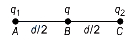
Two unit negative charges are placed on a straight line. $A$ positive charge $q$ is placed exactly at the midpoint between these unit charges. If the system of these three charges is in equilibrium,the value of $q$ (in $C$) is
A
$0.25$
B
$0.5$
C
$1.0$
D
$0.75$
Solution
(A) Let the two unit negative charges be $q_1 = -1 \ C$ and $q_2 = -1 \ C$,separated by a distance $d$.
For the system to be in equilibrium,the net force on each charge must be zero.
Consider the equilibrium of charge $q_1$ at point $A$. The force exerted by $q$ at $B$ and $q_2$ at $C$ on $q_1$ must sum to zero:
$F_{AB} + F_{AC} = 0$
$\frac{1}{4 \pi \varepsilon_0} \frac{q_1 q}{(d/2)^2} + \frac{1}{4 \pi \varepsilon_0} \frac{q_1 q_2}{d^2} = 0$
Dividing by $\frac{q_1}{4 \pi \varepsilon_0}$,we get:
$\frac{q}{(d/2)^2} + \frac{q_2}{d^2} = 0$
$\frac{q}{d^2/4} + \frac{-1}{d^2} = 0$
$\frac{4q}{d^2} = \frac{1}{d^2}$
$4q = 1$
$q = 0.25 \ C$
For the system to be in equilibrium,the net force on each charge must be zero.
Consider the equilibrium of charge $q_1$ at point $A$. The force exerted by $q$ at $B$ and $q_2$ at $C$ on $q_1$ must sum to zero:
$F_{AB} + F_{AC} = 0$
$\frac{1}{4 \pi \varepsilon_0} \frac{q_1 q}{(d/2)^2} + \frac{1}{4 \pi \varepsilon_0} \frac{q_1 q_2}{d^2} = 0$
Dividing by $\frac{q_1}{4 \pi \varepsilon_0}$,we get:
$\frac{q}{(d/2)^2} + \frac{q_2}{d^2} = 0$
$\frac{q}{d^2/4} + \frac{-1}{d^2} = 0$
$\frac{4q}{d^2} = \frac{1}{d^2}$
$4q = 1$
$q = 0.25 \ C$
0 likesView Solution
21
ChemistryMCQTS EAMCET · 2007
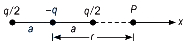
Along the $x$-axis,three charges $\frac{q}{2}, -q$ and $\frac{q}{2}$ are placed at $x=0, x=a$ and $x=2a$ respectively. The resultant electric potential at a point $P$ located at a distance $r$ from the charge $-q$ (where $r > a$) is ($\varepsilon_0$ is the permittivity of free space):
A
$\frac{q a}{4 \pi \varepsilon_0 r^2}$
B
$\frac{q a^2}{4 \pi \varepsilon_0 r^3}$
C
$\frac{q a^2}{16 \pi \varepsilon_0 r^3}$
D
$\frac{q}{4 \pi \varepsilon_0 r}$
Solution
(B) The charges are located at $x=0$ $(q/2)$,$x=a$ $(-q)$,and $x=2a$ $(q/2)$.
The point $P$ is at a distance $r$ from the charge $-q$ at $x=a$. Since $P$ is on the $x$-axis to the right of the charges,its coordinate is $x_P = a + r$.
The distances of point $P$ from the three charges are:
$1$. From $q/2$ at $x=0$: $d_1 = (a+r) - 0 = r+a$
$2$. From $-q$ at $x=a$: $d_2 = (a+r) - a = r$
$3$. From $q/2$ at $x=2a$: $d_3 = (a+r) - 2a = r-a$
The total electric potential $V$ at point $P$ is the sum of potentials due to individual charges:
$V = \frac{1}{4 \pi \varepsilon_0} \left[ \frac{q/2}{r+a} - \frac{q}{r} + \frac{q/2}{r-a} \right]$
$V = \frac{q}{8 \pi \varepsilon_0} \left[ \frac{1}{r+a} - \frac{2}{r} + \frac{1}{r-a} \right]$
$V = \frac{q}{8 \pi \varepsilon_0} \left[ \frac{r(r-a) - 2(r^2-a^2) + r(r+a)}{r(r^2-a^2)} \right]$
$V = \frac{q}{8 \pi \varepsilon_0} \left[ \frac{r^2 - ar - 2r^2 + 2a^2 + r^2 + ar}{r(r^2-a^2)} \right]$
$V = \frac{q}{8 \pi \varepsilon_0} \left[ \frac{2a^2}{r(r^2-a^2)} \right]$
Since $r \gg a$,we can approximate $r^2 - a^2 \approx r^2$:
$V \approx \frac{q}{8 \pi \varepsilon_0} \cdot \frac{2a^2}{r^3} = \frac{q a^2}{4 \pi \varepsilon_0 r^3}$
The point $P$ is at a distance $r$ from the charge $-q$ at $x=a$. Since $P$ is on the $x$-axis to the right of the charges,its coordinate is $x_P = a + r$.
The distances of point $P$ from the three charges are:
$1$. From $q/2$ at $x=0$: $d_1 = (a+r) - 0 = r+a$
$2$. From $-q$ at $x=a$: $d_2 = (a+r) - a = r$
$3$. From $q/2$ at $x=2a$: $d_3 = (a+r) - 2a = r-a$
The total electric potential $V$ at point $P$ is the sum of potentials due to individual charges:
$V = \frac{1}{4 \pi \varepsilon_0} \left[ \frac{q/2}{r+a} - \frac{q}{r} + \frac{q/2}{r-a} \right]$
$V = \frac{q}{8 \pi \varepsilon_0} \left[ \frac{1}{r+a} - \frac{2}{r} + \frac{1}{r-a} \right]$
$V = \frac{q}{8 \pi \varepsilon_0} \left[ \frac{r(r-a) - 2(r^2-a^2) + r(r+a)}{r(r^2-a^2)} \right]$
$V = \frac{q}{8 \pi \varepsilon_0} \left[ \frac{r^2 - ar - 2r^2 + 2a^2 + r^2 + ar}{r(r^2-a^2)} \right]$
$V = \frac{q}{8 \pi \varepsilon_0} \left[ \frac{2a^2}{r(r^2-a^2)} \right]$
Since $r \gg a$,we can approximate $r^2 - a^2 \approx r^2$:
$V \approx \frac{q}{8 \pi \varepsilon_0} \cdot \frac{2a^2}{r^3} = \frac{q a^2}{4 \pi \varepsilon_0 r^3}$
0 likesView Solution
22
ChemistryMCQTS EAMCET · 2007
Along the $X$-axis,three charges $\frac{q}{2}, -q$ and $\frac{q}{2}$ are placed at $x=0, x=a$ and $x=2a$ respectively. The resultant electric potential at $x=a+r$ (if $a \ll r$) is: ($\varepsilon_0$ is the permittivity of free space)
A
$\frac{q a}{4 \pi \varepsilon_0 r^2}$
B
$\frac{q a^2}{4 \pi \varepsilon_0 r^3}$
C
$\frac{q(a^2/4)}{4 \pi \varepsilon_0 r^3}$
D
$\frac{q}{4 \pi \varepsilon_0 r}$
Solution
(B) The electric potential $V$ at a point due to a system of charges is the algebraic sum of the potentials due to individual charges.
The positions of the charges are $x_1 = 0$,$x_2 = a$,and $x_3 = 2a$. The point $P$ is at $x = a+r$.
The distances of point $P$ from the charges are:
$r_1 = (a+r) - 0 = r+a$
$r_2 = (a+r) - a = r$
$r_3 = (a+r) - 2a = r-a$
The total potential $V_P$ is:
$V_P = \frac{1}{4 \pi \varepsilon_0} \left[ \frac{q/2}{r+a} - \frac{q}{r} + \frac{q/2}{r-a} \right]$
$V_P = \frac{q}{4 \pi \varepsilon_0} \left[ \frac{1}{2(r+a)} - \frac{1}{r} + \frac{1}{2(r-a)} \right]$
$V_P = \frac{q}{4 \pi \varepsilon_0} \left[ \frac{r(r-a) - 2(r^2-a^2) + r(r+a)}{2r(r^2-a^2)} \right]$
$V_P = \frac{q}{4 \pi \varepsilon_0} \left[ \frac{r^2 - ar - 2r^2 + 2a^2 + r^2 + ar}{2r(r^2-a^2)} \right]$
$V_P = \frac{q}{4 \pi \varepsilon_0} \left[ \frac{2a^2}{2r(r^2-a^2)} \right] = \frac{q a^2}{4 \pi \varepsilon_0 r(r^2-a^2)}$
Since $a \ll r$,we have $r^2 - a^2 \approx r^2$.
Therefore,$V_P = \frac{q a^2}{4 \pi \varepsilon_0 r^3}$.
The positions of the charges are $x_1 = 0$,$x_2 = a$,and $x_3 = 2a$. The point $P$ is at $x = a+r$.
The distances of point $P$ from the charges are:
$r_1 = (a+r) - 0 = r+a$
$r_2 = (a+r) - a = r$
$r_3 = (a+r) - 2a = r-a$
The total potential $V_P$ is:
$V_P = \frac{1}{4 \pi \varepsilon_0} \left[ \frac{q/2}{r+a} - \frac{q}{r} + \frac{q/2}{r-a} \right]$
$V_P = \frac{q}{4 \pi \varepsilon_0} \left[ \frac{1}{2(r+a)} - \frac{1}{r} + \frac{1}{2(r-a)} \right]$
$V_P = \frac{q}{4 \pi \varepsilon_0} \left[ \frac{r(r-a) - 2(r^2-a^2) + r(r+a)}{2r(r^2-a^2)} \right]$
$V_P = \frac{q}{4 \pi \varepsilon_0} \left[ \frac{r^2 - ar - 2r^2 + 2a^2 + r^2 + ar}{2r(r^2-a^2)} \right]$
$V_P = \frac{q}{4 \pi \varepsilon_0} \left[ \frac{2a^2}{2r(r^2-a^2)} \right] = \frac{q a^2}{4 \pi \varepsilon_0 r(r^2-a^2)}$
Since $a \ll r$,we have $r^2 - a^2 \approx r^2$.
Therefore,$V_P = \frac{q a^2}{4 \pi \varepsilon_0 r^3}$.

0 likesView Solution
23
ChemistryMCQTS EAMCET · 2007
The Bhopal gas tragedy of $1984$ was caused by:
A
carbon monoxide
B
phosgene
C
methyl cyanate
D
methyl isocyanate
Solution
(D) The Bhopal gas tragedy of $1984$ was caused by the leakage of methyl isocyanate $(CH_3NCO)$ gas.
0 likesView Solution
24
ChemistryEasyMCQTS EAMCET · 2007
The $IUPAC$ name of the compound $(CH_3)_2CH-CH=CH-CH(OH)-CH_3$ is:
A
$5-$methylhex$-3-$en$-2-$ol
B
$2-$methylhex$-3-$en$-5-$ol
C
$2-$hydroxy$-5-$methyl$-3-$hexene
D
$5-$hydroxy$-2-$methyl$-3-$hexene
Solution
(A) $1$. Identify the longest carbon chain containing the principal functional group $(-OH)$ and the double bond $(C=C)$. The chain has $6$ carbon atoms,so the parent alkane is hexane.
$2$. Number the chain starting from the end that gives the lowest locant to the principal functional group $(-OH)$. Numbering from right to left gives the $-OH$ group at position $2$.
$3$. The double bond is at position $3$,and the methyl substituent is at position $5$.
$4$. Combining these,the $IUPAC$ name is $5-$methylhex$-3-$en$-2-$ol.
$2$. Number the chain starting from the end that gives the lowest locant to the principal functional group $(-OH)$. Numbering from right to left gives the $-OH$ group at position $2$.
$3$. The double bond is at position $3$,and the methyl substituent is at position $5$.
$4$. Combining these,the $IUPAC$ name is $5-$methylhex$-3-$en$-2-$ol.
0 likesView Solution
25
ChemistryMCQTS EAMCET · 2007
The functional groups present in 'salol' are
A
$-NH_2$ and $-OR$
B
$-OH$ and $-COR$
C
$-NH_2$ and $-COOH$
D
$-OH$ and $-COOR$
Solution
(D) Salol is phenyl salicylate. Its chemical structure consists of a benzene ring substituted with a hydroxyl group $(-OH)$ at the ortho position and an ester group ($-COOR$,specifically phenyl ester) at the adjacent position. Therefore,the functional groups present are $-OH$ and $-COOR$.
0 likesView Solution
26
ChemistryMCQTS EAMCET · 2007
The chemical formula of feldspar is
A
$KAlSi_3O_8$
B
$Na_3AlF_6$
C
$NaAlO_2$
D
$K_2SO_4 \cdot Al_2(SO_4)_3 \cdot 4Al(OH)_3$
Solution
(A) Feldspar is a group of rock-forming tectosilicate minerals that make up about $41\%$ of the Earth's continental crust. The general chemical formula for potassium feldspar is $KAlSi_3O_8$.
0 likesView Solution
27
ChemistryMCQTS EAMCET · 2007
Identify '$B$' in the following reaction:
$CH_2=CH_2 + HCl \xrightarrow{\text{anhy. } AlCl_3} A + 2[H]$
$A \xrightarrow[C_2H_5OH]{Zn-Cu} B + HCl$
$CH_2=CH_2 + HCl \xrightarrow{\text{anhy. } AlCl_3} A + 2[H]$
$A \xrightarrow[C_2H_5OH]{Zn-Cu} B + HCl$
A
$CH_4$
B
$C_2H_6$
C
$C_2H_5Cl$
D
$C_2H_5OH$
Solution
(B) Step $1$: The reaction of ethene $(CH_2=CH_2)$ with $HCl$ in the presence of anhydrous $AlCl_3$ gives ethyl chloride $(CH_3CH_2Cl)$ as product $A$.
$CH_2=CH_2 + HCl \rightarrow CH_3CH_2Cl$ $(A)$
Step $2$: The reduction of ethyl chloride $(A)$ with $Zn-Cu$ couple in the presence of ethanol $(C_2H_5OH)$ is a dehalogenation/reduction reaction that yields ethane $(C_2H_6)$ as product $B$.
$CH_3CH_2Cl + 2[H] \xrightarrow{Zn-Cu, C_2H_5OH} CH_3CH_3$ $(B)$ $+ HCl$
Thus,$B$ is $C_2H_6$.
$CH_2=CH_2 + HCl \rightarrow CH_3CH_2Cl$ $(A)$
Step $2$: The reduction of ethyl chloride $(A)$ with $Zn-Cu$ couple in the presence of ethanol $(C_2H_5OH)$ is a dehalogenation/reduction reaction that yields ethane $(C_2H_6)$ as product $B$.
$CH_3CH_2Cl + 2[H] \xrightarrow{Zn-Cu, C_2H_5OH} CH_3CH_3$ $(B)$ $+ HCl$
Thus,$B$ is $C_2H_6$.
0 likesView Solution
28
ChemistryMCQTS EAMCET · 2007
Which of the following is an example of an interstitial hydride?
A
$NH_3$
B
$CH_4$
C
$ZnH_2$
D
$H_2O$
Solution
(C) $ZnH_2$ is an example of an interstitial (or metallic) hydride,whereas $NH_3$,$CH_4$,and $H_2O$ are examples of covalent (or molecular) hydrides.
0 likesView Solution
29
ChemistryMCQTS EAMCET · 2007
The following are some statements related to $VA$ group hydrides:
$I$. Reducing property increases from $NH_3$ to $BiH_3$.
$II$. Tendency to donate lone pair decreases from $NH_3$ to $BiH_3$.
$III$. Thermal stability of hydrides decreases from $NH_3$ to $BiH_3$.
$IV$. Bond angle of hydrides decreases from $NH_3$ to $BiH_3$.
The correct statements are:
$I$. Reducing property increases from $NH_3$ to $BiH_3$.
$II$. Tendency to donate lone pair decreases from $NH_3$ to $BiH_3$.
$III$. Thermal stability of hydrides decreases from $NH_3$ to $BiH_3$.
$IV$. Bond angle of hydrides decreases from $NH_3$ to $BiH_3$.
The correct statements are:
A
$I, II, III$ and $IV$
B
$I, III$ and $IV$
C
$I, II$ and $IV$
D
$I$ and $IV$
Solution
(A) $I$. The reducing property of $VA$ group hydrides increases from $NH_3$ to $BiH_3$ due to the decrease in bond dissociation enthalpy $(NH_3 < PH_3 < AsH_3 < SbH_3 < BiH_3)$.
$II$. The tendency to donate a lone pair (basic strength) decreases from $NH_3$ to $BiH_3$ because the electron density on the central atom decreases as the size of the central atom increases.
$III$. Thermal stability of $VA$ group hydrides decreases from $NH_3$ to $BiH_3$ as the $M-H$ bond length increases and bond strength decreases $(NH_3 > PH_3 > AsH_3 > SbH_3 > BiH_3)$.
$IV$. Bond angle of $VA$ group hydrides decreases from $NH_3$ to $BiH_3$ due to the decrease in electronegativity of the central atom,which leads to more $p$-character in the bonding orbitals $(NH_3 > PH_3 > AsH_3 > SbH_3 > BiH_3)$.
All statements $I, II, III,$ and $IV$ are correct.
$II$. The tendency to donate a lone pair (basic strength) decreases from $NH_3$ to $BiH_3$ because the electron density on the central atom decreases as the size of the central atom increases.
$III$. Thermal stability of $VA$ group hydrides decreases from $NH_3$ to $BiH_3$ as the $M-H$ bond length increases and bond strength decreases $(NH_3 > PH_3 > AsH_3 > SbH_3 > BiH_3)$.
$IV$. Bond angle of $VA$ group hydrides decreases from $NH_3$ to $BiH_3$ due to the decrease in electronegativity of the central atom,which leads to more $p$-character in the bonding orbitals $(NH_3 > PH_3 > AsH_3 > SbH_3 > BiH_3)$.
All statements $I, II, III,$ and $IV$ are correct.
0 likesView Solution
30
ChemistryMCQTS EAMCET · 2007
Assertion $(A)$: $NaCl$ is less soluble in heavy water than in ordinary water.
Reason $(R)$: Dielectric constant of ordinary water is more than that of heavy water.
The correct answer is
Reason $(R)$: Dielectric constant of ordinary water is more than that of heavy water.
The correct answer is
A
Both $(A)$ and $(R)$ are true and $(R)$ is the correct explanation of $(A)$
B
Both $(A)$ and $(R)$ are true but $(R)$ is not the correct explanation of $(A)$
C
$(A)$ is true,but $(R)$ is not true
D
$(A)$ is not true,but $(R)$ is true
Solution
(A) The solubility of an ionic compound like $NaCl$ depends on the dielectric constant of the solvent. Higher dielectric constant leads to better solvation of ions,which increases solubility.
The dielectric constant of ordinary water $(H_2O)$ is approximately $81$,while that of heavy water $(D_2O)$ is approximately $80$.
Since the dielectric constant of ordinary water is higher,$NaCl$ is more soluble in ordinary water than in heavy water.
Therefore,both Assertion $(A)$ and Reason $(R)$ are true,and $(R)$ is the correct explanation of $(A)$.
The dielectric constant of ordinary water $(H_2O)$ is approximately $81$,while that of heavy water $(D_2O)$ is approximately $80$.
Since the dielectric constant of ordinary water is higher,$NaCl$ is more soluble in ordinary water than in heavy water.
Therefore,both Assertion $(A)$ and Reason $(R)$ are true,and $(R)$ is the correct explanation of $(A)$.
0 likesView Solution
31
ChemistryMCQTS EAMCET · 2007
Which of the following is not a conjugate acid-base pair?
A
$HPO_3^{2-}, PO_3^{3-}$
B
$H_2PO_4^{-}, HPO_4^{2-}$
C
$H_2PO_4^{-}, H_3PO_4$
D
$H_2PO_4^{-}, PO_3^{3-}$
Solution
(D) conjugate acid-base pair differs by only one proton $(H^+)$.
$1.$ $HPO_3^{2-}$ and $PO_3^{3-}$ differ by one $H^+$,so they form a conjugate pair.
$2.$ $H_2PO_4^{-}$ and $HPO_4^{2-}$ differ by one $H^+$,so they form a conjugate pair.
$3.$ $H_3PO_4$ and $H_2PO_4^{-}$ differ by one $H^+$,so they form a conjugate pair.
$4.$ $H_2PO_4^{-}$ and $PO_3^{3-}$ differ by two protons $(2H^+)$,therefore they do not form a conjugate acid-base pair.
$1.$ $HPO_3^{2-}$ and $PO_3^{3-}$ differ by one $H^+$,so they form a conjugate pair.
$2.$ $H_2PO_4^{-}$ and $HPO_4^{2-}$ differ by one $H^+$,so they form a conjugate pair.
$3.$ $H_3PO_4$ and $H_2PO_4^{-}$ differ by one $H^+$,so they form a conjugate pair.
$4.$ $H_2PO_4^{-}$ and $PO_3^{3-}$ differ by two protons $(2H^+)$,therefore they do not form a conjugate acid-base pair.
0 likesView Solution
32
ChemistryMCQTS EAMCET · 2007
Which one of the following salts gives an acidic solution in water?
A
$CH_3COONa$
B
$NH_4Cl$
C
$NaCl$
D
$CH_3COONH_4$
Solution
(B) $NH_4Cl$ is a salt of a weak base $(NH_4OH)$ and a strong acid $(HCl)$.
In water,it undergoes hydrolysis to form $NH_4OH$ (weakly ionized) and $H_3O^{+}$ ions (strongly ionized),which makes the solution acidic.
The reaction is as follows:
$NH_4^{+} + H_2O \rightleftharpoons NH_4OH + H^{+}$
In water,it undergoes hydrolysis to form $NH_4OH$ (weakly ionized) and $H_3O^{+}$ ions (strongly ionized),which makes the solution acidic.
The reaction is as follows:
$NH_4^{+} + H_2O \rightleftharpoons NH_4OH + H^{+}$
0 likesView Solution
33
ChemistryMCQTS EAMCET · 2007
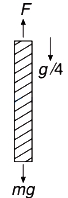
$A$ man slides down a telegraphic pole with an acceleration equal to one-fourth of the acceleration due to gravity. The frictional force between the man and the pole is equal to which of the following in terms of the man's weight $w$?
A
$\frac{w}{4}$
B
$\frac{w}{2}$
C
$\frac{3w}{4}$
D
$w$
Solution
(C) Let the mass of the man be $m$. The weight of the man is $w = mg$.
The forces acting on the man are his weight $mg$ acting downwards and the frictional force $F$ acting upwards.
According to Newton's second law of motion,the net force acting on the man is equal to the product of his mass and acceleration.
Since the man is sliding down with an acceleration $a = g/4$,we have:
$mg - F = ma$
Substituting $a = g/4$:
$mg - F = m(g/4)$
$mg - F = mg/4$
$F = mg - mg/4$
$F = \frac{3mg}{4}$
Since $w = mg$,the frictional force is $F = \frac{3w}{4}$.
The forces acting on the man are his weight $mg$ acting downwards and the frictional force $F$ acting upwards.
According to Newton's second law of motion,the net force acting on the man is equal to the product of his mass and acceleration.
Since the man is sliding down with an acceleration $a = g/4$,we have:
$mg - F = ma$
Substituting $a = g/4$:
$mg - F = m(g/4)$
$mg - F = mg/4$
$F = mg - mg/4$
$F = \frac{3mg}{4}$
Since $w = mg$,the frictional force is $F = \frac{3w}{4}$.
0 likesView Solution
34
ChemistryMCQTS EAMCET · 2007
$A$ bar magnet of magnetic moment $M$ and moment of inertia $I$ is freely suspended such that the magnetic axial line is in the direction of the magnetic meridian. If the magnet is displaced by a very small angle $\theta$,the angular acceleration is (Magnetic induction of earth's horizontal field $= B_H$)
A
$\frac{M B_H \theta}{I}$
B
$\frac{I B_H \theta}{M}$
C
$\frac{M \theta}{I B_H}$
D
$\frac{I \theta}{M B_H}$
Solution
(A) When a magnet is displaced by a very small angle $\theta$,the restoring torque acting on the magnet is given by $\tau = -M B_H \sin \theta$.
The negative sign indicates that the torque is restoring in nature.
Since the torque is also given by $\tau = I \alpha$,where $\alpha$ is the angular acceleration,and for small angles $\sin \theta \approx \theta$,we have:
$I \alpha = -M B_H \theta$.
Taking the magnitude of angular acceleration:
$\alpha = \frac{M B_H \theta}{I}$.
The negative sign indicates that the torque is restoring in nature.
Since the torque is also given by $\tau = I \alpha$,where $\alpha$ is the angular acceleration,and for small angles $\sin \theta \approx \theta$,we have:
$I \alpha = -M B_H \theta$.
Taking the magnitude of angular acceleration:
$\alpha = \frac{M B_H \theta}{I}$.
0 likesView Solution
35
ChemistryMCQTS EAMCET · 2007
Two wires $A$ and $B$ are of lengths $40 \ cm$ and $30 \ cm$. $A$ is bent into a circle of radius $r$ and $B$ into an arc of radius $r$. $A$ current $i_1$ is passed through $A$ and $i_2$ through $B$. To have the same magnetic inductions at the centre,the ratio of $i_1: i_2$ is
A
$3: 4$
B
$3: 5$
C
$2: 3$
D
$4: 3$
Solution
(A) For wire $A$ bent into a circle of radius $r$,the circumference is $2 \pi r = 40 \ cm$. Thus,$r = \frac{40}{2 \pi} \ cm$. The magnetic field at the center is $B_1 = \frac{\mu_0 i_1}{2 r}$.
For wire $B$ bent into an arc of radius $r$,the length of the arc is $l = r \theta = 30 \ cm$. Thus,the angle subtended is $\theta = \frac{30}{r} = \frac{30}{40 / 2 \pi} = \frac{3}{2} \pi$ radians. The magnetic field at the center is $B_2 = \frac{\mu_0 i_2 \theta}{4 \pi r}$.
Given $B_1 = B_2$,we have $\frac{\mu_0 i_1}{2 r} = \frac{\mu_0 i_2 \theta}{4 \pi r}$.
Substituting $\theta = \frac{3}{2} \pi$,we get $\frac{i_1}{2} = \frac{i_2 (3/2 \pi)}{4 \pi} = \frac{3 i_2}{8}$.
Therefore,$\frac{i_1}{i_2} = \frac{3}{8} \times 2 = \frac{3}{4}$.
For wire $B$ bent into an arc of radius $r$,the length of the arc is $l = r \theta = 30 \ cm$. Thus,the angle subtended is $\theta = \frac{30}{r} = \frac{30}{40 / 2 \pi} = \frac{3}{2} \pi$ radians. The magnetic field at the center is $B_2 = \frac{\mu_0 i_2 \theta}{4 \pi r}$.
Given $B_1 = B_2$,we have $\frac{\mu_0 i_1}{2 r} = \frac{\mu_0 i_2 \theta}{4 \pi r}$.
Substituting $\theta = \frac{3}{2} \pi$,we get $\frac{i_1}{2} = \frac{i_2 (3/2 \pi)}{4 \pi} = \frac{3 i_2}{8}$.
Therefore,$\frac{i_1}{i_2} = \frac{3}{8} \times 2 = \frac{3}{4}$.
0 likesView Solution
36
ChemistryMCQTS EAMCET · 2007
An electron beam travels with a velocity of $1.6 \times 10^7 \ m/s$ perpendicularly to a magnetic field of intensity $0.1 \ T$. Calculate the radius of the path of the electron beam. (Given: $m_e = 9 \times 10^{-31} \ kg$,$e = 1.6 \times 10^{-19} \ C$)
A
$9 \times 10^{-5} \ m$
B
$9 \times 10^{-2} \ m$
C
$9 \times 10^{-4} \ m$
D
$9 \times 10^{-3} \ m$
Solution
(C) When a charged particle moves perpendicularly to a magnetic field,it follows a circular path.
The radius $r$ of the circular path is given by the formula:
$r = \frac{mv}{qB}$
Given values:
$m = 9 \times 10^{-31} \ kg$
$v = 1.6 \times 10^7 \ m/s$
$q = e = 1.6 \times 10^{-19} \ C$
$B = 0.1 \ T$
Substituting these values into the formula:
$r = \frac{9 \times 10^{-31} \times 1.6 \times 10^7}{1.6 \times 10^{-19} \times 0.1}$
$r = \frac{9 \times 1.6 \times 10^{-24}}{0.16 \times 10^{-19}}$
$r = \frac{14.4 \times 10^{-24}}{1.6 \times 10^{-20}}$
$r = 9 \times 10^{-4} \ m$
The radius $r$ of the circular path is given by the formula:
$r = \frac{mv}{qB}$
Given values:
$m = 9 \times 10^{-31} \ kg$
$v = 1.6 \times 10^7 \ m/s$
$q = e = 1.6 \times 10^{-19} \ C$
$B = 0.1 \ T$
Substituting these values into the formula:
$r = \frac{9 \times 10^{-31} \times 1.6 \times 10^7}{1.6 \times 10^{-19} \times 0.1}$
$r = \frac{9 \times 1.6 \times 10^{-24}}{0.16 \times 10^{-19}}$
$r = \frac{14.4 \times 10^{-24}}{1.6 \times 10^{-20}}$
$r = 9 \times 10^{-4} \ m$
0 likesView Solution
37
ChemistryMCQTS EAMCET · 2007
Velocity and acceleration vectors of a charged particle moving perpendicular to the direction of a magnetic field at a given instant of time are $\overrightarrow{v}=2 \hat{i}+c \hat{j}$ and $\overrightarrow{a}=3 \hat{i}+4 \hat{j}$ respectively. Then the value of $c$ is
A
$3$
B
$1.5$
C
$-1.5$
D
$-3$
Solution
(C) When a charged particle moves perpendicular to a uniform magnetic field,it undergoes uniform circular motion.
In uniform circular motion,the acceleration (centripetal acceleration) is always directed towards the center of the circle,while the velocity vector is directed along the tangent to the path.
Therefore,the velocity vector $\overrightarrow{v}$ and the acceleration vector $\overrightarrow{a}$ are always perpendicular to each other.
Given,$\overrightarrow{v} = 2 \hat{i} + c \hat{j}$ and $\overrightarrow{a} = 3 \hat{i} + 4 \hat{j}$.
Since $\overrightarrow{v} \perp \overrightarrow{a}$,their dot product must be zero:
$\overrightarrow{v} \cdot \overrightarrow{a} = 0$
$(2 \hat{i} + c \hat{j}) \cdot (3 \hat{i} + 4 \hat{j}) = 0$
$(2)(3) + (c)(4) = 0$
$6 + 4c = 0$
$4c = -6$
$c = -1.5$
In uniform circular motion,the acceleration (centripetal acceleration) is always directed towards the center of the circle,while the velocity vector is directed along the tangent to the path.
Therefore,the velocity vector $\overrightarrow{v}$ and the acceleration vector $\overrightarrow{a}$ are always perpendicular to each other.
Given,$\overrightarrow{v} = 2 \hat{i} + c \hat{j}$ and $\overrightarrow{a} = 3 \hat{i} + 4 \hat{j}$.
Since $\overrightarrow{v} \perp \overrightarrow{a}$,their dot product must be zero:
$\overrightarrow{v} \cdot \overrightarrow{a} = 0$
$(2 \hat{i} + c \hat{j}) \cdot (3 \hat{i} + 4 \hat{j}) = 0$
$(2)(3) + (c)(4) = 0$
$6 + 4c = 0$
$4c = -6$
$c = -1.5$
0 likesView Solution
38
ChemistryMCQTS EAMCET · 2007
The set of values of $x$ for which the inequalities $x^2-3x-10 < 0$ and $10x-x^2-16 > 0$ hold simultaneously,is
A
$(-2, 5)$
B
$(2, 8)$
C
$(-2, 8)$
D
$(2, 5)$
Solution
(D) Given inequalities are:
$x^2 - 3x - 10 < 0$
$(x - 5)(x + 2) < 0$
This implies $x \in (-2, 5)$.
Also,$10x - x^2 - 16 > 0$
Multiplying by $-1$,we get $x^2 - 10x + 16 < 0$
$(x - 2)(x - 8) < 0$
This implies $x \in (2, 8)$.
For both inequalities to hold simultaneously,we take the intersection:
$x \in (-2, 5) \cap (2, 8) = (2, 5)$.
$x^2 - 3x - 10 < 0$
$(x - 5)(x + 2) < 0$
This implies $x \in (-2, 5)$.
Also,$10x - x^2 - 16 > 0$
Multiplying by $-1$,we get $x^2 - 10x + 16 < 0$
$(x - 2)(x - 8) < 0$
This implies $x \in (2, 8)$.
For both inequalities to hold simultaneously,we take the intersection:
$x \in (-2, 5) \cap (2, 8) = (2, 5)$.
0 likesView Solution
39
ChemistryMCQTS EAMCET · 2007
$\sqrt{2+\sqrt{5}-\sqrt{6-3 \sqrt{5}+\sqrt{14-6 \sqrt{5}}}}$ is equal to
A
$1$
B
$2$
C
$3$
D
$4$
Solution
(B) We simplify the expression from the innermost radical outward:
$\sqrt{14-6 \sqrt{5}} = \sqrt{9+5-2 \times 3 \times \sqrt{5}} = \sqrt{(3-\sqrt{5})^2} = 3-\sqrt{5}$
Substituting this back into the expression:
$\sqrt{2+\sqrt{5}-\sqrt{6-3 \sqrt{5} + (3-\sqrt{5})}} = \sqrt{2+\sqrt{5}-\sqrt{9-4 \sqrt{5}}}$
Now,simplify $\sqrt{9-4 \sqrt{5}}$:
$\sqrt{9-2 \times 2 \times \sqrt{5}} = \sqrt{(\sqrt{5}-2)^2} = \sqrt{5}-2$
Substituting this back:
$\sqrt{2+\sqrt{5}-(\sqrt{5}-2)} = \sqrt{2+\sqrt{5}-\sqrt{5}+2} = \sqrt{4} = 2$
$\sqrt{14-6 \sqrt{5}} = \sqrt{9+5-2 \times 3 \times \sqrt{5}} = \sqrt{(3-\sqrt{5})^2} = 3-\sqrt{5}$
Substituting this back into the expression:
$\sqrt{2+\sqrt{5}-\sqrt{6-3 \sqrt{5} + (3-\sqrt{5})}} = \sqrt{2+\sqrt{5}-\sqrt{9-4 \sqrt{5}}}$
Now,simplify $\sqrt{9-4 \sqrt{5}}$:
$\sqrt{9-2 \times 2 \times \sqrt{5}} = \sqrt{(\sqrt{5}-2)^2} = \sqrt{5}-2$
Substituting this back:
$\sqrt{2+\sqrt{5}-(\sqrt{5}-2)} = \sqrt{2+\sqrt{5}-\sqrt{5}+2} = \sqrt{4} = 2$
0 likesView Solution
40
ChemistryMCQTS EAMCET · 2007
$\frac{1}{2}-\frac{1}{2 \cdot 2^2}+\frac{1}{3 \cdot 2^3}-\frac{1}{4 \cdot 2^4}+\ldots$ is equal to
A
$\frac{1}{4}$
B
$\log _3\left(\frac{3}{4}\right)$
C
$\log _e\left(\frac{3}{2}\right)$
D
$\log _e\left(\frac{2}{3}\right)$
Solution
(C) The given series is $\frac{1}{2}-\frac{1}{2 \cdot 2^2}+\frac{1}{3 \cdot 2^3}-\frac{1}{4 \cdot 2^4}+\ldots$
We know the logarithmic expansion $\log _e(1+x) = x - \frac{x^2}{2} + \frac{x^3}{3} - \frac{x^4}{4} + \ldots$ for $|x| < 1$.
Comparing the given series with the expansion,we can write it as $\frac{1}{2} - \frac{(1/2)^2}{2} + \frac{(1/2)^3}{3} - \frac{(1/2)^4}{4} + \ldots$
By substituting $x = \frac{1}{2}$ in the expansion,we get:
$\log _e(1 + \frac{1}{2}) = \log _e(\frac{3}{2})$.
We know the logarithmic expansion $\log _e(1+x) = x - \frac{x^2}{2} + \frac{x^3}{3} - \frac{x^4}{4} + \ldots$ for $|x| < 1$.
Comparing the given series with the expansion,we can write it as $\frac{1}{2} - \frac{(1/2)^2}{2} + \frac{(1/2)^3}{3} - \frac{(1/2)^4}{4} + \ldots$
By substituting $x = \frac{1}{2}$ in the expansion,we get:
$\log _e(1 + \frac{1}{2}) = \log _e(\frac{3}{2})$.
0 likesView Solution
41
ChemistryMCQTS EAMCET · 2007
If $\alpha$ and $\beta$ are the roots of the equation $ax^2+bx+c=0$ and if $px^2+qx+r=0$ has roots $\frac{1-\alpha}{\alpha}$ and $\frac{1-\beta}{\beta}$,then $r$ is equal to
A
$a+2b$
B
$a+b+c$
C
$ab+bc+ca$
D
$abc$
Solution
(B) Given that $\alpha$ and $\beta$ are the roots of $ax^2+bx+c=0$.
Then,$\alpha+\beta = -\frac{b}{a}$ and $\alpha\beta = \frac{c}{a}$.
The roots of the equation $px^2+qx+r=0$ are $x_1 = \frac{1-\alpha}{\alpha} = \frac{1}{\alpha}-1$ and $x_2 = \frac{1-\beta}{\beta} = \frac{1}{\beta}-1$.
The equation with roots $x_1$ and $x_2$ is given by $x^2 - (x_1+x_2)x + x_1x_2 = 0$.
Sum of roots: $x_1+x_2 = (\frac{1}{\alpha}-1) + (\frac{1}{\beta}-1) = \frac{\alpha+\beta}{\alpha\beta} - 2 = \frac{-b/a}{c/a} - 2 = -\frac{b}{c} - 2 = -\frac{b+2c}{c}$.
Product of roots: $x_1x_2 = (\frac{1}{\alpha}-1)(\frac{1}{\beta}-1) = \frac{1}{\alpha\beta} - (\frac{1}{\alpha}+\frac{1}{\beta}) + 1 = \frac{1}{\alpha\beta} - \frac{\alpha+\beta}{\alpha\beta} + 1 = \frac{a}{c} - (\frac{-b/a}{c/a}) + 1 = \frac{a}{c} + \frac{b}{c} + 1 = \frac{a+b+c}{c}$.
Substituting these into the quadratic equation: $x^2 - (-\frac{b+2c}{c})x + \frac{a+b+c}{c} = 0$.
Multiplying by $c$: $cx^2 + (b+2c)x + (a+b+c) = 0$.
Comparing this with $px^2+qx+r=0$,we get $r = a+b+c$.
Then,$\alpha+\beta = -\frac{b}{a}$ and $\alpha\beta = \frac{c}{a}$.
The roots of the equation $px^2+qx+r=0$ are $x_1 = \frac{1-\alpha}{\alpha} = \frac{1}{\alpha}-1$ and $x_2 = \frac{1-\beta}{\beta} = \frac{1}{\beta}-1$.
The equation with roots $x_1$ and $x_2$ is given by $x^2 - (x_1+x_2)x + x_1x_2 = 0$.
Sum of roots: $x_1+x_2 = (\frac{1}{\alpha}-1) + (\frac{1}{\beta}-1) = \frac{\alpha+\beta}{\alpha\beta} - 2 = \frac{-b/a}{c/a} - 2 = -\frac{b}{c} - 2 = -\frac{b+2c}{c}$.
Product of roots: $x_1x_2 = (\frac{1}{\alpha}-1)(\frac{1}{\beta}-1) = \frac{1}{\alpha\beta} - (\frac{1}{\alpha}+\frac{1}{\beta}) + 1 = \frac{1}{\alpha\beta} - \frac{\alpha+\beta}{\alpha\beta} + 1 = \frac{a}{c} - (\frac{-b/a}{c/a}) + 1 = \frac{a}{c} + \frac{b}{c} + 1 = \frac{a+b+c}{c}$.
Substituting these into the quadratic equation: $x^2 - (-\frac{b+2c}{c})x + \frac{a+b+c}{c} = 0$.
Multiplying by $c$: $cx^2 + (b+2c)x + (a+b+c) = 0$.
Comparing this with $px^2+qx+r=0$,we get $r = a+b+c$.
0 likesView Solution
42
ChemistryMCQTS EAMCET · 2007
If $1, 2, 3$ and $4$ are the roots of the equation $x^4+ax^3+bx^2+cx+d=0$,then $a+2b+c$ is equal to
A
$-25$
B
$0$
C
$10$
D
$24$
Solution
(C) Given that $1, 2, 3, 4$ are the roots of the equation $x^4+ax^3+bx^2+cx+d=0$.
Therefore,we can write the polynomial as:
$(x-1)(x-2)(x-3)(x-4) = x^4+ax^3+bx^2+cx+d$
Expanding the left side:
$(x^2-3x+2)(x^2-7x+12) = x^4-7x^3+12x^2-3x^3+21x^2-36x+2x^2-14x+24$
$= x^4-10x^3+35x^2-50x+24$
Comparing the coefficients with $x^4+ax^3+bx^2+cx+d=0$,we get:
$a=-10, b=35, c=-50, d=24$
Now,calculate $a+2b+c$:
$a+2b+c = -10 + 2(35) + (-50)$
$= -10 + 70 - 50 = 10$
Therefore,we can write the polynomial as:
$(x-1)(x-2)(x-3)(x-4) = x^4+ax^3+bx^2+cx+d$
Expanding the left side:
$(x^2-3x+2)(x^2-7x+12) = x^4-7x^3+12x^2-3x^3+21x^2-36x+2x^2-14x+24$
$= x^4-10x^3+35x^2-50x+24$
Comparing the coefficients with $x^4+ax^3+bx^2+cx+d=0$,we get:
$a=-10, b=35, c=-50, d=24$
Now,calculate $a+2b+c$:
$a+2b+c = -10 + 2(35) + (-50)$
$= -10 + 70 - 50 = 10$
0 likesView Solution
43
ChemistryMCQTS EAMCET · 2007
If $\alpha, \beta, \gamma$ are the roots of $x^3-2x^2+3x-4=0$,then the value of $\alpha^2\beta^2+\beta^2\gamma^2+\gamma^2\alpha^2$ is
A
$-7$
B
$-5$
C
$-3$
D
$0$
Solution
(A) Given the cubic equation $x^3-2x^2+3x-4=0$,the roots are $\alpha, \beta, \gamma$.
By Vieta's formulas:
$\alpha+\beta+\gamma = 2$
$\alpha\beta+\beta\gamma+\gamma\alpha = 3$
$\alpha\beta\gamma = 4$
We need to find the value of $\alpha^2\beta^2+\beta^2\gamma^2+\gamma^2\alpha^2$.
Using the identity $(a+b+c)^2 = a^2+b^2+c^2+2(ab+bc+ca)$,let $a=\alpha\beta, b=\beta\gamma, c=\gamma\alpha$.
Then $(\alpha\beta+\beta\gamma+\gamma\alpha)^2 = \alpha^2\beta^2+\beta^2\gamma^2+\gamma^2\alpha^2 + 2(\alpha\beta^2\gamma + \beta\gamma^2\alpha + \gamma\alpha^2\beta)$.
This simplifies to $(\alpha\beta+\beta\gamma+\gamma\alpha)^2 = \alpha^2\beta^2+\beta^2\gamma^2+\gamma^2\alpha^2 + 2\alpha\beta\gamma(\alpha+\beta+\gamma)$.
Substituting the known values:
$(3)^2 = \alpha^2\beta^2+\beta^2\gamma^2+\gamma^2\alpha^2 + 2(4)(2)$.
$9 = \alpha^2\beta^2+\beta^2\gamma^2+\gamma^2\alpha^2 + 16$.
$\alpha^2\beta^2+\beta^2\gamma^2+\gamma^2\alpha^2 = 9 - 16 = -7$.
By Vieta's formulas:
$\alpha+\beta+\gamma = 2$
$\alpha\beta+\beta\gamma+\gamma\alpha = 3$
$\alpha\beta\gamma = 4$
We need to find the value of $\alpha^2\beta^2+\beta^2\gamma^2+\gamma^2\alpha^2$.
Using the identity $(a+b+c)^2 = a^2+b^2+c^2+2(ab+bc+ca)$,let $a=\alpha\beta, b=\beta\gamma, c=\gamma\alpha$.
Then $(\alpha\beta+\beta\gamma+\gamma\alpha)^2 = \alpha^2\beta^2+\beta^2\gamma^2+\gamma^2\alpha^2 + 2(\alpha\beta^2\gamma + \beta\gamma^2\alpha + \gamma\alpha^2\beta)$.
This simplifies to $(\alpha\beta+\beta\gamma+\gamma\alpha)^2 = \alpha^2\beta^2+\beta^2\gamma^2+\gamma^2\alpha^2 + 2\alpha\beta\gamma(\alpha+\beta+\gamma)$.
Substituting the known values:
$(3)^2 = \alpha^2\beta^2+\beta^2\gamma^2+\gamma^2\alpha^2 + 2(4)(2)$.
$9 = \alpha^2\beta^2+\beta^2\gamma^2+\gamma^2\alpha^2 + 16$.
$\alpha^2\beta^2+\beta^2\gamma^2+\gamma^2\alpha^2 = 9 - 16 = -7$.
0 likesView Solution
44
ChemistryMCQTS EAMCET · 2007
$A$ value of $n$ such that $\left(\frac{\sqrt{3}}{2}+\frac{i}{2}\right)^n=1$ is
A
$12$
B
$3$
C
$2$
D
$1$
Solution
(A) Given,$\left(\frac{\sqrt{3}}{2}+\frac{i}{2}\right)^n=1$.
We can write the complex number in polar form as $\cos\left(\frac{\pi}{6}\right) + i \sin\left(\frac{\pi}{6}\right) = e^{i\pi/6}$.
So,$(e^{i\pi/6})^n = 1$.
$e^{in\pi/6} = e^{i(2k\pi)}$ for some integer $k$.
Equating the arguments,$\frac{n\pi}{6} = 2k\pi$.
$n = 12k$.
For the smallest positive integer $n$,we take $k=1$,which gives $n=12$.
We can write the complex number in polar form as $\cos\left(\frac{\pi}{6}\right) + i \sin\left(\frac{\pi}{6}\right) = e^{i\pi/6}$.
So,$(e^{i\pi/6})^n = 1$.
$e^{in\pi/6} = e^{i(2k\pi)}$ for some integer $k$.
Equating the arguments,$\frac{n\pi}{6} = 2k\pi$.
$n = 12k$.
For the smallest positive integer $n$,we take $k=1$,which gives $n=12$.
0 likesView Solution
45
ChemistryMCQTS EAMCET · 2007
If $a = \frac{1-i \sqrt{3}}{2}$,then the correct matching of List-$I$ with List-$II$ is:
| List-$I$ | List-$II$ |
| $(i) \ a \bar{a}$ | $(A) -\frac{\pi}{3}$ |
| $(ii) \ \arg \left(\frac{1}{\bar{a}}\right)$ | $(B) -i \sqrt{3}$ |
| $(iii) \ a-\bar{a}$ | $(C) \frac{2i}{\sqrt{3}}$ |
| $(iv) \ \operatorname{Im}\left(\frac{4}{3a}\right)$ | $(D) 1$ |
| $(E) \frac{\pi}{3}$ | |
| $(F) \frac{2}{\sqrt{3}}$ |
A
$D, E, C, B$
B
$D, A, B, F$
C
$F, E, B, C$
D
$D, A, B, C$
Solution
(B) Given,$a = \frac{1-i \sqrt{3}}{2} = \frac{1}{2} - i \frac{\sqrt{3}}{2}$.
Then,$\bar{a} = \frac{1}{2} + i \frac{\sqrt{3}}{2}$.
$(i) \ a \bar{a} = |a|^2 = \left(\frac{1}{2}\right)^2 + \left(-\frac{\sqrt{3}}{2}\right)^2 = \frac{1}{4} + \frac{3}{4} = 1$. Matches $(D)$.
$(ii) \ \arg \left(\frac{1}{\bar{a}}\right) = \arg(a) = \tan^{-1}\left(\frac{-\sqrt{3}/2}{1/2}\right) = \tan^{-1}(-\sqrt{3}) = -\frac{\pi}{3}$. Matches $(A)$.
$(iii) \ a - \bar{a} = \left(\frac{1}{2} - i \frac{\sqrt{3}}{2}\right) - \left(\frac{1}{2} + i \frac{\sqrt{3}}{2}\right) = -i \sqrt{3}$. Matches $(B)$.
$(iv) \ \frac{4}{3a} = \frac{4}{3} \cdot \frac{1}{a} = \frac{4}{3} \cdot \frac{\bar{a}}{|a|^2} = \frac{4}{3} \left(\frac{1}{2} + i \frac{\sqrt{3}}{2}\right) = \frac{2}{3} + i \frac{2\sqrt{3}}{3} = \frac{2}{3} + i \frac{2}{\sqrt{3}}$.
Thus,$\operatorname{Im}\left(\frac{4}{3a}\right) = \frac{2}{\sqrt{3}}$. Matches $(F)$.
The correct sequence is $(i)-D, (ii)-A, (iii)-B, (iv)-F$.
Then,$\bar{a} = \frac{1}{2} + i \frac{\sqrt{3}}{2}$.
$(i) \ a \bar{a} = |a|^2 = \left(\frac{1}{2}\right)^2 + \left(-\frac{\sqrt{3}}{2}\right)^2 = \frac{1}{4} + \frac{3}{4} = 1$. Matches $(D)$.
$(ii) \ \arg \left(\frac{1}{\bar{a}}\right) = \arg(a) = \tan^{-1}\left(\frac{-\sqrt{3}/2}{1/2}\right) = \tan^{-1}(-\sqrt{3}) = -\frac{\pi}{3}$. Matches $(A)$.
$(iii) \ a - \bar{a} = \left(\frac{1}{2} - i \frac{\sqrt{3}}{2}\right) - \left(\frac{1}{2} + i \frac{\sqrt{3}}{2}\right) = -i \sqrt{3}$. Matches $(B)$.
$(iv) \ \frac{4}{3a} = \frac{4}{3} \cdot \frac{1}{a} = \frac{4}{3} \cdot \frac{\bar{a}}{|a|^2} = \frac{4}{3} \left(\frac{1}{2} + i \frac{\sqrt{3}}{2}\right) = \frac{2}{3} + i \frac{2\sqrt{3}}{3} = \frac{2}{3} + i \frac{2}{\sqrt{3}}$.
Thus,$\operatorname{Im}\left(\frac{4}{3a}\right) = \frac{2}{\sqrt{3}}$. Matches $(F)$.
The correct sequence is $(i)-D, (ii)-A, (iii)-B, (iv)-F$.
0 likesView Solution
46
ChemistryMCQTS EAMCET · 2007
The locus of the point $z=x+iy$ satisfying $\left|\frac{z-2i}{z+2i}\right|=1$ is
A
$x$-axis
B
$y$-axis
C
$y=2$
D
$x=2$
Solution
(A) Given,$\left|\frac{z-2i}{z+2i}\right|=1$
$\Rightarrow |z-2i| = |z+2i|$
Substituting $z=x+iy$:
$|x+i(y-2)| = |x+i(y+2)|$
Squaring both sides:
$x^2 + (y-2)^2 = x^2 + (y+2)^2$
$x^2 + y^2 - 4y + 4 = x^2 + y^2 + 4y + 4$
$-4y = 4y$
$8y = 0$
$y = 0$
This represents the $x$-axis.
$\Rightarrow |z-2i| = |z+2i|$
Substituting $z=x+iy$:
$|x+i(y-2)| = |x+i(y+2)|$
Squaring both sides:
$x^2 + (y-2)^2 = x^2 + (y+2)^2$
$x^2 + y^2 - 4y + 4 = x^2 + y^2 + 4y + 4$
$-4y = 4y$
$8y = 0$
$y = 0$
This represents the $x$-axis.
0 likesView Solution
47
ChemistryMCQTS EAMCET · 2007
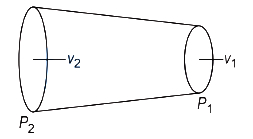
$A$ horizontal pipe of non-uniform cross-section allows water to flow through it with a velocity $1 \ m/s$ when pressure is $50 \ kPa$ at a point. If the velocity of flow has to be $2 \ m/s$ at some other point,the pressure at that point should be (in $kPa$)
A
$50$
B
$100$
C
$48.5$
D
$24.25$
Solution
(C) According to Bernoulli's equation for a horizontal pipe,the sum of pressure energy and kinetic energy per unit volume remains constant:
$P_1 + \frac{1}{2} \rho v_1^2 = P_2 + \frac{1}{2} \rho v_2^2$
Given:
$P_1 = 50 \ kPa = 50 \times 10^3 \ Pa$
$v_1 = 1 \ m/s$
$v_2 = 2 \ m/s$
Density of water $\rho = 1000 \ kg/m^3 = 10^3 \ kg/m^3$
Rearranging the equation to solve for $P_2$:
$P_2 = P_1 + \frac{1}{2} \rho (v_1^2 - v_2^2)$
$P_2 = 50 \times 10^3 + \frac{1}{2} \times 10^3 \times (1^2 - 2^2)$
$P_2 = 50 \times 10^3 + 0.5 \times 10^3 \times (1 - 4)$
$P_2 = 50 \times 10^3 - 1.5 \times 10^3$
$P_2 = 48.5 \times 10^3 \ Pa = 48.5 \ kPa$
$P_1 + \frac{1}{2} \rho v_1^2 = P_2 + \frac{1}{2} \rho v_2^2$
Given:
$P_1 = 50 \ kPa = 50 \times 10^3 \ Pa$
$v_1 = 1 \ m/s$
$v_2 = 2 \ m/s$
Density of water $\rho = 1000 \ kg/m^3 = 10^3 \ kg/m^3$
Rearranging the equation to solve for $P_2$:
$P_2 = P_1 + \frac{1}{2} \rho (v_1^2 - v_2^2)$
$P_2 = 50 \times 10^3 + \frac{1}{2} \times 10^3 \times (1^2 - 2^2)$
$P_2 = 50 \times 10^3 + 0.5 \times 10^3 \times (1 - 4)$
$P_2 = 50 \times 10^3 - 1.5 \times 10^3$
$P_2 = 48.5 \times 10^3 \ Pa = 48.5 \ kPa$
0 likesView Solution
48
ChemistryMCQTS EAMCET · 2007
$A$ liquid does not wet the solid surface if the angle of contact is
A
zero
B
equal to $45^{\circ}$
C
equal to $90^{\circ}$
D
greater than $90^{\circ}$
Solution
(D) liquid does not wet a solid surface if the angle of contact is obtuse,i.e.,greater than $90^{\circ}$.
In this scenario,the cohesive forces between the liquid molecules are stronger than the adhesive forces between the liquid and the solid surface.
Consequently,the liquid tends to minimize contact with the surface,resulting in the surface remaining dry.
In this scenario,the cohesive forces between the liquid molecules are stronger than the adhesive forces between the liquid and the solid surface.
Consequently,the liquid tends to minimize contact with the surface,resulting in the surface remaining dry.
0 likesView Solution
49
ChemistryMCQTS EAMCET · 2007
When a wire of length $10 \ m$ is subjected to a force of $100 \ N$ along its length,the lateral strain produced is $0.01 \times 10^{-3} \ m$. The Poisson's ratio was found to be $0.4$. If the area of cross-section of the wire is $0.025 \ m^2$,its Young's modulus is
A
$1.6 \times 10^8 \ N/m^2$
B
$2.5 \times 10^{10} \ N/m^2$
C
$1.25 \times 10^{11} \ N/m^2$
D
$16 \times 10^9 \ N/m^2$
Solution
(A) Poisson's ratio $(\sigma) = \frac{\text{lateral strain}}{\text{longitudinal strain}}$.
Given: lateral strain $= 0.01 \times 10^{-3}$,$\sigma = 0.4$.
Longitudinal strain $(\frac{\Delta L}{L}) = \frac{\text{lateral strain}}{\sigma} = \frac{0.01 \times 10^{-3}}{0.4} = 0.025 \times 10^{-3} = 2.5 \times 10^{-5}$.
Young's modulus $(Y) = \frac{\text{Stress}}{\text{Strain}} = \frac{F/A}{\Delta L/L} = \frac{F}{A} \times \frac{L}{\Delta L}$.
Given: $F = 100 \ N$,$A = 0.025 \ m^2$,$\frac{\Delta L}{L} = 2.5 \times 10^{-5}$.
$Y = \frac{100}{0.025 \times 2.5 \times 10^{-5}} = \frac{100}{0.0625 \times 10^{-5}} = \frac{100}{6.25 \times 10^{-7}} = 16 \times 10^7 \ N/m^2 = 1.6 \times 10^8 \ N/m^2$.
Given: lateral strain $= 0.01 \times 10^{-3}$,$\sigma = 0.4$.
Longitudinal strain $(\frac{\Delta L}{L}) = \frac{\text{lateral strain}}{\sigma} = \frac{0.01 \times 10^{-3}}{0.4} = 0.025 \times 10^{-3} = 2.5 \times 10^{-5}$.
Young's modulus $(Y) = \frac{\text{Stress}}{\text{Strain}} = \frac{F/A}{\Delta L/L} = \frac{F}{A} \times \frac{L}{\Delta L}$.
Given: $F = 100 \ N$,$A = 0.025 \ m^2$,$\frac{\Delta L}{L} = 2.5 \times 10^{-5}$.
$Y = \frac{100}{0.025 \times 2.5 \times 10^{-5}} = \frac{100}{0.0625 \times 10^{-5}} = \frac{100}{6.25 \times 10^{-7}} = 16 \times 10^7 \ N/m^2 = 1.6 \times 10^8 \ N/m^2$.
0 likesView Solution
50
ChemistryMCQTS EAMCET · 2007
An object of mass $2m$ is projected with a speed of $100 \ m/s$ at an angle $\theta = \sin^{-1}(3/5)$ to the horizontal. At the highest point,the object breaks into two pieces of same mass $m$ and the first one comes to rest. The distance between the point of projection and the point of landing of the bigger piece (in metre) is (Given,$g = 10 \ m/s^2$)
A
$3840$
B
$1280$
C
$1440$
D
$960$
Solution
(C) The initial horizontal velocity of the object is $u_x = u \cos \theta$. Given $\sin \theta = 3/5$,then $\cos \theta = 4/5$. So,$u_x = 100 \times (4/5) = 80 \ m/s$.
The horizontal range $R$ of the projectile is $R = \frac{u^2 \sin 2\theta}{g} = \frac{2 u^2 \sin \theta \cos \theta}{g} = \frac{2 \times 100^2 \times (3/5) \times (4/5)}{10} = 960 \ m$.
The horizontal distance to the highest point is $R/2 = 480 \ m$.
At the highest point,the momentum is conserved. The initial momentum is $P_i = (2m) u_x = (2m)(80) = 160m$.
After the explosion,the first piece $(m)$ comes to rest $(v_1 = 0)$,so $P_f = m(0) + m(v_2) = m v_2$.
Equating $P_i = P_f$,we get $160m = m v_2$,so $v_2 = 160 \ m/s$.
The second piece travels from the highest point with horizontal velocity $160 \ m/s$ for the remaining time of flight $t = \frac{u \sin \theta}{g} = \frac{100 \times (3/5)}{10} = 6 \ s$.
The additional horizontal distance covered by the second piece is $d = v_2 \times t = 160 \times 6 = 960 \ m$.
The total distance from the point of projection is $R/2 + d = 480 + 960 = 1440 \ m$.
The horizontal range $R$ of the projectile is $R = \frac{u^2 \sin 2\theta}{g} = \frac{2 u^2 \sin \theta \cos \theta}{g} = \frac{2 \times 100^2 \times (3/5) \times (4/5)}{10} = 960 \ m$.
The horizontal distance to the highest point is $R/2 = 480 \ m$.
At the highest point,the momentum is conserved. The initial momentum is $P_i = (2m) u_x = (2m)(80) = 160m$.
After the explosion,the first piece $(m)$ comes to rest $(v_1 = 0)$,so $P_f = m(0) + m(v_2) = m v_2$.
Equating $P_i = P_f$,we get $160m = m v_2$,so $v_2 = 160 \ m/s$.
The second piece travels from the highest point with horizontal velocity $160 \ m/s$ for the remaining time of flight $t = \frac{u \sin \theta}{g} = \frac{100 \times (3/5)}{10} = 6 \ s$.
The additional horizontal distance covered by the second piece is $d = v_2 \times t = 160 \times 6 = 960 \ m$.
The total distance from the point of projection is $R/2 + d = 480 + 960 = 1440 \ m$.
0 likesView Solution
51
ChemistryDifficultMCQTS EAMCET · 2007
$CaOCl_2 + H_2O \longrightarrow Ca(OH)_2 + X$
$X + CH_3CHO \longrightarrow Y$
$Y + Ca(OH)_2 \longrightarrow CHCl_3$
What is '$Y$'?
$X + CH_3CHO \longrightarrow Y$
$Y + Ca(OH)_2 \longrightarrow CHCl_3$
What is '$Y$'?
A
$CH_3CH(OH)_2$
B
$CH_2Cl_2$
C
$CCl_3CHO$
D
$CCl_3COCH_3$
Solution
(C) The given reactions represent the haloform reaction process for the preparation of chloroform $(CHCl_3)$:
$1$. Bleaching powder reacts with water to produce chlorine gas $(X = Cl_2)$:
$CaOCl_2 + H_2O \longrightarrow Ca(OH)_2 + Cl_2$
$2$. Chlorine reacts with acetaldehyde $(CH_3CHO)$ to form chloral $(Y = CCl_3CHO)$:
$CH_3CHO + 3Cl_2 \longrightarrow CCl_3CHO + 3HCl$
$3$. Chloral reacts with calcium hydroxide to produce chloroform:
$2CCl_3CHO + Ca(OH)_2 \longrightarrow 2CHCl_3 + (HCOO)_2Ca$
Thus,'$Y$' is $CCl_3CHO$ (chloral).
$1$. Bleaching powder reacts with water to produce chlorine gas $(X = Cl_2)$:
$CaOCl_2 + H_2O \longrightarrow Ca(OH)_2 + Cl_2$
$2$. Chlorine reacts with acetaldehyde $(CH_3CHO)$ to form chloral $(Y = CCl_3CHO)$:
$CH_3CHO + 3Cl_2 \longrightarrow CCl_3CHO + 3HCl$
$3$. Chloral reacts with calcium hydroxide to produce chloroform:
$2CCl_3CHO + Ca(OH)_2 \longrightarrow 2CHCl_3 + (HCOO)_2Ca$
Thus,'$Y$' is $CCl_3CHO$ (chloral).
0 likesView Solution
52
ChemistryEasyMCQTS EAMCET · 2007
The hybridisation of oxygen in diethyl ether is
A
$sp$
B
$sp^2$
C
$sp^3$
D
$sp^3d$
Solution
(C) In diethyl ether $(CH_3CH_2-O-CH_2CH_3)$,the oxygen atom is bonded to two carbon atoms and has two lone pairs of electrons.
According to the steric number rule,the steric number is calculated as: $\text{Steric Number} = \text{Number of sigma bonds} + \text{Number of lone pairs} = 2 + 2 = 4$.
$A$ steric number of $4$ corresponds to $sp^3$ hybridisation.
According to the steric number rule,the steric number is calculated as: $\text{Steric Number} = \text{Number of sigma bonds} + \text{Number of lone pairs} = 2 + 2 = 4$.
$A$ steric number of $4$ corresponds to $sp^3$ hybridisation.
0 likesView Solution
53
ChemistryEasyMCQTS EAMCET · 2007
$A$ radioactive substance $_{88}X^{228}$ $(IIA)$ emits $3$ $\alpha$ and $3$ $\beta$ particles to form $Y$. To which group of the long form of the periodic table does $Y$ belong?
A
$IVA$
B
$VA$
C
$VIA$
D
$VIIA$
Solution
(D) The initial radioactive substance is $_{88}^{228}X$.
Each $\alpha$ emission decreases the atomic number by $2$ and the mass number by $4$.
Each $\beta$ emission increases the atomic number by $1$ and does not change the mass number.
After emitting $3$ $\alpha$ and $3$ $\beta$ particles,the atomic number of $Y$ becomes: $88 - (3 \times 2) + (3 \times 1) = 88 - 6 + 3 = 85$.
The element with atomic number $85$ is Astatine $(At)$,which belongs to group $VIIA$ (Halogens) of the periodic table.
Each $\alpha$ emission decreases the atomic number by $2$ and the mass number by $4$.
Each $\beta$ emission increases the atomic number by $1$ and does not change the mass number.
After emitting $3$ $\alpha$ and $3$ $\beta$ particles,the atomic number of $Y$ becomes: $88 - (3 \times 2) + (3 \times 1) = 88 - 6 + 3 = 85$.
The element with atomic number $85$ is Astatine $(At)$,which belongs to group $VIIA$ (Halogens) of the periodic table.
0 likesView Solution
54
ChemistryMediumMCQTS EAMCET · 2007
Match the following:
The correct match is:
| Reactants | Products |
|---|---|
| $A$. $C_2H_5Cl$,moist $Ag_2O$ | $I$. $CH_3CH_2ONO$ |
| $B$. $C_2H_5Cl$,aqueous ethanolic $AgCN$ | $II$. $C_2H_4$ |
| $C$. $C_2H_5Cl$,aqueous ethanolic $AgNO_2$ | $III$. $CH_3CH_2OH$ |
| $D$. $C_2H_5Cl$,ethanolic $KOH$ | $IV$. $CH_3CH_2NC$ |
The correct match is:
A
$A-V, B-III, C-IV, D-I$
B
$A-I, B-II, C-III, D-IV$
C
$A-III, B-IV, C-I, D-II$
D
$A-IV, B-I, C-II, D-V$
Solution
(C) The reactions are as follows:
Therefore,the correct match is $A-III, B-IV, C-I, D-II$.
| Reactants | Products |
|---|---|
| $A$. $C_2H_5Cl + \text{moist } Ag_2O$ | $III$. $CH_3CH_2OH$ (Substitution) |
| $B$. $C_2H_5Cl + \text{aqueous ethanolic } AgCN$ | $IV$. $CH_3CH_2NC$ (Isocyanide formation) |
| $C$. $C_2H_5Cl + \text{aqueous ethanolic } AgNO_2$ | $I$. $CH_3CH_2ONO$ (Nitrite formation) |
| $D$. $C_2H_5Cl + \text{ethanolic } KOH$ | $II$. $C_2H_4$ (Elimination/Dehydrohalogenation) |
Therefore,the correct match is $A-III, B-IV, C-I, D-II$.
0 likesView Solution
55
ChemistryEasyMCQTS EAMCET · 2007
Which of the following is not correct?
A
Milk is a naturally occurring emulsion
B
Gold sol is a lyophilic sol
C
Physical adsorption decreases with rise in temperature
D
Chemical adsorption is unilayered
Solution
(B) The correct answer is $B$.
Gold sol is a lyophobic sol,not a lyophilic sol.
Milk is a natural emulsion of fat in water.
Physical adsorption (physisorption) is exothermic and decreases with an increase in temperature.
Chemical adsorption (chemisorption) is specific and forms a unilayer (monolayer) on the surface.
Gold sol is a lyophobic sol,not a lyophilic sol.
Milk is a natural emulsion of fat in water.
Physical adsorption (physisorption) is exothermic and decreases with an increase in temperature.
Chemical adsorption (chemisorption) is specific and forms a unilayer (monolayer) on the surface.
0 likesView Solution
56
ChemistryMediumMCQTS EAMCET · 2007
$CH_3COOH \xrightarrow{LiAlH_4} A$
$A + CH_3COOH \xrightarrow{H_3O^+} B + H_2O$
In the above reactions,'$A$' and '$B$' respectively are:
$A + CH_3COOH \xrightarrow{H_3O^+} B + H_2O$
In the above reactions,'$A$' and '$B$' respectively are:
A
$CH_3COOC_2H_5, C_2H_5OH$
B
$CH_3CHO, C_2H_5OH$
C
$C_2H_5OH, CH_3CHO$
D
$C_2H_5OH, CH_3COOC_2H_5$
Solution
(D) Step $1$: Reduction of acetic acid $(CH_3COOH)$ with $LiAlH_4$ is a strong reducing agent that reduces carboxylic acids to primary alcohols.
$CH_3COOH + 4[H] \xrightarrow{LiAlH_4} CH_3CH_2OH + H_2O$
Thus,$A$ is ethanol $(C_2H_5OH)$.
Step $2$: Esterification reaction between ethanol $(A)$ and acetic acid $(CH_3COOH)$ in the presence of an acid catalyst $(H_3O^+)$ yields an ester.
$CH_3CH_2OH + CH_3COOH \xrightarrow{H_3O^+} CH_3COOC_2H_5 + H_2O$
Thus,$B$ is ethyl acetate $(CH_3COOC_2H_5)$.
Therefore,$A = C_2H_5OH$ and $B = CH_3COOC_2H_5$.
$CH_3COOH + 4[H] \xrightarrow{LiAlH_4} CH_3CH_2OH + H_2O$
Thus,$A$ is ethanol $(C_2H_5OH)$.
Step $2$: Esterification reaction between ethanol $(A)$ and acetic acid $(CH_3COOH)$ in the presence of an acid catalyst $(H_3O^+)$ yields an ester.
$CH_3CH_2OH + CH_3COOH \xrightarrow{H_3O^+} CH_3COOC_2H_5 + H_2O$
Thus,$B$ is ethyl acetate $(CH_3COOC_2H_5)$.
Therefore,$A = C_2H_5OH$ and $B = CH_3COOC_2H_5$.
0 likesView Solution
57
ChemistryMediumMCQTS EAMCET · 2007
Given the reactions:
$CaOCl_2 + H_2O \longrightarrow Ca(OH)_2 + X$
$X + CH_3CHO \longrightarrow Y$
$Y + Ca(OH)_2 \longrightarrow CHCl_3$
What is '$Y$'?
$CaOCl_2 + H_2O \longrightarrow Ca(OH)_2 + X$
$X + CH_3CHO \longrightarrow Y$
$Y + Ca(OH)_2 \longrightarrow CHCl_3$
What is '$Y$'?
A
$CH_3CH(OH)_2$
B
$CH_2Cl_2$
C
$CCl_3CHO$
D
$CCl_3COCH_3$
Solution
(C) The reaction sequence represents the haloform reaction for the preparation of chloroform $(CHCl_3)$:
$1$. Bleaching powder reacts with water to produce chlorine gas $(X)$:
$CaOCl_2 + H_2O \longrightarrow Ca(OH)_2 + Cl_2 (X)$
$2$. Acetaldehyde reacts with chlorine to form chloral $(Y)$:
$CH_3CHO + 3Cl_2 \longrightarrow CCl_3CHO (Y) + 3HCl$
$3$. Chloral reacts with calcium hydroxide to produce chloroform:
$2CCl_3CHO + Ca(OH)_2 \longrightarrow 2CHCl_3 + (HCOO)_2Ca$
Thus,'$Y$' is $CCl_3CHO$ (chloral).
$1$. Bleaching powder reacts with water to produce chlorine gas $(X)$:
$CaOCl_2 + H_2O \longrightarrow Ca(OH)_2 + Cl_2 (X)$
$2$. Acetaldehyde reacts with chlorine to form chloral $(Y)$:
$CH_3CHO + 3Cl_2 \longrightarrow CCl_3CHO (Y) + 3HCl$
$3$. Chloral reacts with calcium hydroxide to produce chloroform:
$2CCl_3CHO + Ca(OH)_2 \longrightarrow 2CHCl_3 + (HCOO)_2Ca$
Thus,'$Y$' is $CCl_3CHO$ (chloral).
0 likesView Solution
58
ChemistryMediumMCQTS EAMCET · 2007
Nitrobenzene on reduction with zinc and $NH_4Cl$ gives:
A
azobenzene
B
aniline
C
hydrazobenzene
D
$N$-phenylhydroxylamine
Solution
(D) The reduction of nitrobenzene with zinc dust $(Zn)$ and aqueous ammonium chloride $(NH_4Cl)$ is a controlled reduction process.
This reaction yields $N$-phenylhydroxylamine as the major product.
The chemical equation is:
$C_6H_5NO_2 + 4[H] \xrightarrow{Zn, NH_4Cl} C_6H_5NHOH + H_2O$
This reaction yields $N$-phenylhydroxylamine as the major product.
The chemical equation is:
$C_6H_5NO_2 + 4[H] \xrightarrow{Zn, NH_4Cl} C_6H_5NHOH + H_2O$
0 likesView Solution
59
ChemistryMediumMCQTS EAMCET · 2007
Hybridisation of oxygen in diethyl ether is
A
$sp$
B
$sp^2$
C
$sp^3$
D
$sp^3d$
Solution
(C) The chemical formula of diethyl ether is $C_2H_5-O-C_2H_5$.
In this molecule,the oxygen atom is bonded to two carbon atoms and possesses two lone pairs of electrons.
The steric number of the oxygen atom is calculated as: $\text{Steric Number} = \text{Number of sigma bonds} + \text{Number of lone pairs} = 2 + 2 = 4$.
$A$ steric number of $4$ corresponds to $sp^3$ hybridisation.
In this molecule,the oxygen atom is bonded to two carbon atoms and possesses two lone pairs of electrons.
The steric number of the oxygen atom is calculated as: $\text{Steric Number} = \text{Number of sigma bonds} + \text{Number of lone pairs} = 2 + 2 = 4$.
$A$ steric number of $4$ corresponds to $sp^3$ hybridisation.
0 likesView Solution
60
ChemistryDifficultMCQTS EAMCET · 2007
$A$ radioactive substance ${}_{88}X^{228}$ (Group $IIA$) emits $3 \alpha$ and $3 \beta$ particles to form $Y$. To which group of the long form of the periodic table does $Y$ belong?
A
$IVA$
B
$VA$
C
$VIA$
D
$VIIA$
Solution
(D) The initial element is ${}_{88}X^{228}$ belonging to group $IIA$ (atomic number $Z = 88$).
When an element emits one $\alpha$-particle,its atomic number decreases by $2$ and mass number by $4$.
When an element emits one $\beta$-particle,its atomic number increases by $1$ and mass number remains unchanged.
For the emission of $3 \alpha$ and $3 \beta$ particles:
Change in atomic number $(Z)$ = $(3 \times -2) + (3 \times 1) = -6 + 3 = -3$.
New atomic number of $Y$ = $88 - 3 = 85$.
An element with atomic number $88$ is Radium $(Ra)$,which is in group $IIA$ (alkaline earth metals).
Group $IIA$ elements have a valence shell configuration of $ns^2$.
Atomic number $88$ is in the $7^{th}$ period. The element with atomic number $85$ is Astatine $(At)$.
Astatine $(Z=85)$ belongs to the halogen family,which is group $VIIA$ (or group $17$).
When an element emits one $\alpha$-particle,its atomic number decreases by $2$ and mass number by $4$.
When an element emits one $\beta$-particle,its atomic number increases by $1$ and mass number remains unchanged.
For the emission of $3 \alpha$ and $3 \beta$ particles:
Change in atomic number $(Z)$ = $(3 \times -2) + (3 \times 1) = -6 + 3 = -3$.
New atomic number of $Y$ = $88 - 3 = 85$.
An element with atomic number $88$ is Radium $(Ra)$,which is in group $IIA$ (alkaline earth metals).
Group $IIA$ elements have a valence shell configuration of $ns^2$.
Atomic number $88$ is in the $7^{th}$ period. The element with atomic number $85$ is Astatine $(At)$.
Astatine $(Z=85)$ belongs to the halogen family,which is group $VIIA$ (or group $17$).
0 likesView Solution
61
ChemistryMediumMCQTS EAMCET · 2007
Which of the following pairs of transition metal ions have the same calculated values of magnetic moment?
A
$Ti^{2+}$ and $V^{2+}$
B
$Fe^{2+}$ and $Cu^{2+}$
C
$Cr^{2+}$ and $Fe^{2+}$
D
$Co^{2+}$ and $Ti^{2+}$
Solution
(C) The magnetic moment is calculated using the formula $\mu = \sqrt{n(n+2)} \text{ BM}$,where $n$ is the number of unpaired electrons.
$Cr^{2+} (Z=24): [Ar] 3d^4 4s^0$; $n = 4$ unpaired electrons.
$Fe^{2+} (Z=26): [Ar] 3d^6 4s^0$; $n = 4$ unpaired electrons.
Since $Cr^{2+}$ and $Fe^{2+}$ have the same number of unpaired electrons $(n=4)$,they have the same calculated value of magnetic moment.
$Cr^{2+} (Z=24): [Ar] 3d^4 4s^0$; $n = 4$ unpaired electrons.
$Fe^{2+} (Z=26): [Ar] 3d^6 4s^0$; $n = 4$ unpaired electrons.
Since $Cr^{2+}$ and $Fe^{2+}$ have the same number of unpaired electrons $(n=4)$,they have the same calculated value of magnetic moment.
0 likesView Solution
62
ChemistryMediumMCQTS EAMCET · 2007
Calculate the $emf$ of the cell $Cu_{(s)} | Cu^{2+}_{(aq)} || Ag^+_{(aq)} | Ag_{(s)}$. Given: $E^0_{Cu^{2+}/Cu} = +0.34 \ V$,$E^0_{Ag^+/Ag} = +0.80 \ V$.
A
$+0.46 \ V$
B
$+1.14 \ V$
C
$+0.57 \ V$
D
$-0.46 \ V$
Solution
(A) The cell reaction is: $Cu_{(s)} + 2Ag^+_{(aq)} \rightarrow Cu^{2+}_{(aq)} + 2Ag_{(s)}$.
For the given cell,the cathode is $Ag^+/Ag$ and the anode is $Cu^{2+}/Cu$.
The standard cell potential is calculated as:
$E^0_{cell} = E^0_{cathode} - E^0_{anode}$
$E^0_{cell} = E^0_{Ag^+/Ag} - E^0_{Cu^{2+}/Cu}$
$E^0_{cell} = 0.80 \ V - 0.34 \ V = +0.46 \ V$.
For the given cell,the cathode is $Ag^+/Ag$ and the anode is $Cu^{2+}/Cu$.
The standard cell potential is calculated as:
$E^0_{cell} = E^0_{cathode} - E^0_{anode}$
$E^0_{cell} = E^0_{Ag^+/Ag} - E^0_{Cu^{2+}/Cu}$
$E^0_{cell} = 0.80 \ V - 0.34 \ V = +0.46 \ V$.
0 likesView Solution
63
ChemistryEasyMCQTS EAMCET · 2007
The Bhopal gas tragedy of $1984$ was caused by
A
carbon monoxide
B
phosgene
C
methyl cyanate
D
methyl isocyanate
Solution
(D) The Bhopal gas tragedy of $1984$ was caused by the leakage of methyl isocyanate $(CH_3NCO)$.
0 likesView Solution
64
ChemistryMediumMCQTS EAMCET · 2007
The functional groups present in 'salol' are
A
$-NH_2$ and $-OR$
B
$-OH$ and $-COR$
C
$-NH_2$ and $-COOH$
D
$-OH$ and $-COOR$
Solution
(D) Salol is phenyl salicylate. Its chemical structure consists of a benzene ring substituted with a hydroxyl group $(-OH)$ at the ortho position and an ester group ($-COOC_6H_5$,which is a type of $-COOR$) at the adjacent position.
Therefore,the functional groups present in salol are $-OH$ (hydroxyl) and $-COOR$ (ester).
Therefore,the functional groups present in salol are $-OH$ (hydroxyl) and $-COOR$ (ester).
0 likesView Solution
65
ChemistryMediumMCQTS EAMCET · 2007
Match the following reactants with their corresponding products:
Reactants:
$(A)$ $C_2H_5Cl$,moist $Ag_2O$
$(B)$ $C_2H_5Cl$,ethanolic $AgCN$
$(C)$ $C_2H_5Cl$,ethanolic $AgNO_2$
$(D)$ $C_2H_5Cl$,ethanolic $KOH$
Products:
$(i)$ $CH_3CH_2ONO$
$(ii)$ $C_2H_4$
$(iii)$ $CH_3CH_2OH$
$(iv)$ $CH_3CH_2NC$
Select the correct match:
Reactants:
$(A)$ $C_2H_5Cl$,moist $Ag_2O$
$(B)$ $C_2H_5Cl$,ethanolic $AgCN$
$(C)$ $C_2H_5Cl$,ethanolic $AgNO_2$
$(D)$ $C_2H_5Cl$,ethanolic $KOH$
Products:
$(i)$ $CH_3CH_2ONO$
$(ii)$ $C_2H_4$
$(iii)$ $CH_3CH_2OH$
$(iv)$ $CH_3CH_2NC$
Select the correct match:
A
$A-iii, B-iv, C-i, D-ii$
B
$A-i, B-ii, C-iii, D-iv$
C
$A-iii, B-i, C-iv, D-ii$
D
$A-iv, B-i, C-ii, D-iii$
Solution
(A) $C_2H_5Cl + \text{moist } Ag_2O \rightarrow C_2H_5OH + AgCl$. Thus,$A-iii$.
$(B)$ $C_2H_5Cl + AgCN \rightarrow C_2H_5NC + AgCl$ (Isocyanide is the major product). Thus,$B-iv$.
$(C)$ $C_2H_5Cl + AgNO_2 \rightarrow C_2H_5ONO + AgCl$ (Alkyl nitrite is the major product). Thus,$C-i$.
$(D)$ $C_2H_5Cl + \text{ethanolic } KOH \rightarrow C_2H_4 + KCl + H_2O$ (Dehydrohalogenation). Thus,$D-ii$.
Therefore,the correct match is $A-iii, B-iv, C-i, D-ii$.
$(B)$ $C_2H_5Cl + AgCN \rightarrow C_2H_5NC + AgCl$ (Isocyanide is the major product). Thus,$B-iv$.
$(C)$ $C_2H_5Cl + AgNO_2 \rightarrow C_2H_5ONO + AgCl$ (Alkyl nitrite is the major product). Thus,$C-i$.
$(D)$ $C_2H_5Cl + \text{ethanolic } KOH \rightarrow C_2H_4 + KCl + H_2O$ (Dehydrohalogenation). Thus,$D-ii$.
Therefore,the correct match is $A-iii, B-iv, C-i, D-ii$.
0 likesView Solution
66
ChemistryMediumMCQTS EAMCET · 2007
The following are some statements related to $VA$ group hydrides:
$I$. Reducing property increases from $NH_3$ to $BiH_3$.
$II$. Tendency to donate lone pair decreases from $NH_3$ to $BiH_3$.
$III$. Thermal stability of hydrides decreases from $NH_3$ to $BiH_3$.
$IV$. Bond angle of hydrides decreases from $NH_3$ to $BiH_3$.
The correct statements are:
$I$. Reducing property increases from $NH_3$ to $BiH_3$.
$II$. Tendency to donate lone pair decreases from $NH_3$ to $BiH_3$.
$III$. Thermal stability of hydrides decreases from $NH_3$ to $BiH_3$.
$IV$. Bond angle of hydrides decreases from $NH_3$ to $BiH_3$.
The correct statements are:
A
$I, II, III$ and $IV$
B
$I, III$ and $IV$
C
$I, II$ and $IV$
D
$I$ and $IV$
Solution
(A) The reducing property of the hydrides of $VA$ group increases from $NH_3$ to $BiH_3$ due to the decrease in bond dissociation enthalpy: $NH_3 < PH_3 < AsH_3 < SbH_3 < BiH_3$.
The tendency to donate a lone pair (basic strength) decreases from $NH_3$ to $BiH_3$ because the electron density on the central atom decreases as the size of the atom increases.
Thermal stability of $VA$ group hydrides decreases from $NH_3$ to $BiH_3$ as the $M-H$ bond strength decreases: $NH_3 > PH_3 > AsH_3 > SbH_3 > BiH_3$.
Bond angle of $VA$ group hydrides decreases from $NH_3$ to $BiH_3$ due to the decrease in electronegativity of the central atom: $NH_3 (107.8^{\circ}) > PH_3 (93.6^{\circ}) > AsH_3 (91.8^{\circ}) > SbH_3 (91.3^{\circ}) > BiH_3 (90^{\circ})$.
Thus,all statements $I, II, III,$ and $IV$ are correct.
The tendency to donate a lone pair (basic strength) decreases from $NH_3$ to $BiH_3$ because the electron density on the central atom decreases as the size of the atom increases.
Thermal stability of $VA$ group hydrides decreases from $NH_3$ to $BiH_3$ as the $M-H$ bond strength decreases: $NH_3 > PH_3 > AsH_3 > SbH_3 > BiH_3$.
Bond angle of $VA$ group hydrides decreases from $NH_3$ to $BiH_3$ due to the decrease in electronegativity of the central atom: $NH_3 (107.8^{\circ}) > PH_3 (93.6^{\circ}) > AsH_3 (91.8^{\circ}) > SbH_3 (91.3^{\circ}) > BiH_3 (90^{\circ})$.
Thus,all statements $I, II, III,$ and $IV$ are correct.
0 likesView Solution
67
ChemistryMediumMCQTS EAMCET · 2007
Which of the following statements is correct?
A
Silicon doped with boron is an $n$-type semiconductor
B
Silicon doped with arsenic is a $p$-type semiconductor
C
Metals are good conductors of electricity
D
Electrical conductivity of semiconductors decreases with increasing temperature
Solution
(C) Metals are good conductors of electricity due to the presence of free electrons.
Electrical conductivity of semiconductors increases with an increase in temperature.
Silicon doped with boron (Group $13$ element) creates a $p$-type semiconductor.
Silicon doped with arsenic (Group $15$ element) creates an $n$-type semiconductor.
Electrical conductivity of semiconductors increases with an increase in temperature.
Silicon doped with boron (Group $13$ element) creates a $p$-type semiconductor.
Silicon doped with arsenic (Group $15$ element) creates an $n$-type semiconductor.
0 likesView Solution
68
ChemistryMediumMCQTS EAMCET · 2007
The formula of the product formed,when sodium thiosulphate solution is added to silver bromide is
A
$Ag_2S_2O_3$
B
$Ag_2S$
C
$Na_3[Ag(S_2O_3)_2]$
D
$Ag_3[Na(S_2O_3)_2]$
Solution
(C) When sodium thiosulphate solution is added to $AgBr$,a complex compound called sodium argentothiosulphate is formed,which is soluble in water.
The chemical reaction is:
$AgBr + 2Na_2S_2O_3 \longrightarrow Na_3[Ag(S_2O_3)_2] + NaBr$
The product formed is $Na_3[Ag(S_2O_3)_2]$.
The chemical reaction is:
$AgBr + 2Na_2S_2O_3 \longrightarrow Na_3[Ag(S_2O_3)_2] + NaBr$
The product formed is $Na_3[Ag(S_2O_3)_2]$.
0 likesView Solution
69
ChemistryMediumMCQTS EAMCET · 2007
Which of the following is not a peroxy acid?
A
Perphosphoric acid
B
Pernitric acid
C
Perdisulphuric acid
D
Perchloric acid
Solution
(D) Perchloric acid $(HClO_4)$ is an oxoacid of chlorine where the oxidation state of chlorine is $+7$. It does not contain a peroxy linkage ($-O-O-$ bond).
In contrast,perphosphoric acid $(H_3PO_5)$,pernitric acid $(HNO_4)$,and perdisulphuric acid $(H_2S_2O_8)$ all contain at least one peroxy linkage ($-O-O-$ bond) in their structures.
In contrast,perphosphoric acid $(H_3PO_5)$,pernitric acid $(HNO_4)$,and perdisulphuric acid $(H_2S_2O_8)$ all contain at least one peroxy linkage ($-O-O-$ bond) in their structures.
0 likesView Solution
70
ChemistryEasyMCQTS EAMCET · 2007
Which one of the following noble gases is used in miner's cap lamps?
A
Helium
B
Neon
C
Argon
D
Krypton
Solution
(D) Krypton is used in miner's cap lamps because it provides a high-intensity light and has a long filament life.
0 likesView Solution
71
ChemistryEasyMCQTS EAMCET · 2007
Which of the following is a biodegradable polymer?
A
Polythene
B
Bakelite
C
$PHBV$
D
$PVC$
Solution
(C) $PHBV$ (Polyhydroxy butyrate-co-$\beta$-hydroxy valerate) is a biodegradable polymer.
It is obtained by the copolymerization of $3$-hydroxybutanoic acid and $3$-hydroxypentanoic acid.
It is obtained by the copolymerization of $3$-hydroxybutanoic acid and $3$-hydroxypentanoic acid.
0 likesView Solution
72
ChemistryMediumMCQTS EAMCET · 2007
Which of the following statements is not correct?
A
Milk is a naturally occurring emulsion
B
Gold sol is a lyophilic sol
C
Physical adsorption decreases with rise in temperature
D
Chemical adsorption is unilayered
Solution
(B) Gold sol is a lyophobic sol,not a lyophilic sol. Therefore,option $B$ is incorrect.
0 likesView Solution
73
ChemistryEasyMCQTS EAMCET · 2007
Which of the following biomolecules acts as specific catalysts in biological reactions?
A
Carbohydrates
B
Lipids
C
Vitamins
D
Enzymes
Solution
(D) Enzymes are biological catalysts. They are highly specific in nature and catalyze various biological reactions within living organisms.
0 likesView Solution
74
ChemistryMediumMCQTS EAMCET · 2007
Assertion $(A)$ : $A$ catalyst increases the rate of a reaction.
Reason $(R)$ : In presence of a catalyst,the activation energy of the reaction increases.
The correct answer is
Reason $(R)$ : In presence of a catalyst,the activation energy of the reaction increases.
The correct answer is
A
Both $(A)$ and $(R)$ are true and $(R)$ is the correct explanation of $(A)$
B
Both $(A)$ and $(R)$ are true but $(R)$ is not the correct explanation of $(A)$
C
$(A)$ is true,but $(R)$ is not true
D
$(A)$ is not true,but $(R)$ is true
Solution
(C) catalyst increases the rate of a reaction by providing an alternative pathway with lower activation energy.
Therefore,the assertion $(A)$ is true,but the reason $(R)$ is false because the activation energy decreases,not increases.
Therefore,the assertion $(A)$ is true,but the reason $(R)$ is false because the activation energy decreases,not increases.
0 likesView Solution
Vedclass Products
For Students
Vedclass Test Series
Mock tests in real TS EAMCET style covering Chemistry with performance analysis. 5-day free trial.
Start Free TrialFor Teachers
Exam Paper Generator
Generate Set A/B/C/D Chemistry papers from 7.5L+ questions in 2 minutes. 3 chapters free.
Try FreeFor Institutes
Online Exam Module
Run live TS EAMCET mock exams with unlimited students, 360° analytics & white-label branding.
See DemoFrequently Asked Questions
How many Chemistry questions are in TS EAMCET 2007?
There are 193 Chemistry questions from the TS EAMCET 2007 paper on Vedclass, each with a detailed step-by-step solution in English.
Are TS EAMCET 2007 Chemistry solutions available in English?
Yes. All solutions on this page are in English. You can also switch to English or Hindi using the language buttons above the questions.
Can I practice TS EAMCET 2007 Chemistry as a timed test?
Yes. Use the Vedclass Test Series to attempt a full TS EAMCET mock test covering Chemistry with time limits and instant score analysis.
Can teachers create Chemistry papers from TS EAMCET previous year questions?
Yes. The Vedclass Exam Paper Generator lets teachers mix TS EAMCET Chemistry questions and generate Set A/B/C/D papers in minutes.
For Teachers & Institutes
Build a Custom Chemistry Paper
Pick TS EAMCET 2007 Chemistry questions, set difficulty, and generate Set A/B/C/D in 2 minutes.