
PhysicsQ1–46 of 46 questions
Page 1 of 1 · English
1
PhysicsEasyMCQTS EAMCET · 2007
In two separate collisions,the coefficients of restitution $e_1$ and $e_2$ are in the ratio $3: 1$. In the first collision,the relative velocity of approach is twice the relative velocity of separation. Then,the ratio between the relative velocity of approach and the relative velocity of separation in the second collision is:
A
$1: 6$
B
$2: 3$
C
$3: 2$
D
$6: 1$
Solution
(D) The coefficient of restitution $e$ is defined as the ratio of the relative velocity of separation to the relative velocity of approach:
$e = \frac{v_{\text{sep}}}{v_{\text{app}}}$
For the first collision,we are given that the relative velocity of approach is twice the relative velocity of separation:
$v_{\text{app}, 1} = 2 v_{\text{sep}, 1} \implies e_1 = \frac{v_{\text{sep}, 1}}{v_{\text{app}, 1}} = \frac{1}{2}$
We are given the ratio of the coefficients of restitution as $e_1 : e_2 = 3 : 1$,which means:
$e_2 = \frac{e_1}{3} = \frac{1/2}{3} = \frac{1}{6}$
Since $e_2 = \frac{v_{\text{sep}, 2}}{v_{\text{app}, 2}} = \frac{1}{6}$,the ratio of the relative velocity of approach to the relative velocity of separation in the second collision is:
$\frac{v_{\text{app}, 2}}{v_{\text{sep}, 2}} = \frac{1}{e_2} = 6 = 6: 1$
$e = \frac{v_{\text{sep}}}{v_{\text{app}}}$
For the first collision,we are given that the relative velocity of approach is twice the relative velocity of separation:
$v_{\text{app}, 1} = 2 v_{\text{sep}, 1} \implies e_1 = \frac{v_{\text{sep}, 1}}{v_{\text{app}, 1}} = \frac{1}{2}$
We are given the ratio of the coefficients of restitution as $e_1 : e_2 = 3 : 1$,which means:
$e_2 = \frac{e_1}{3} = \frac{1/2}{3} = \frac{1}{6}$
Since $e_2 = \frac{v_{\text{sep}, 2}}{v_{\text{app}, 2}} = \frac{1}{6}$,the ratio of the relative velocity of approach to the relative velocity of separation in the second collision is:
$\frac{v_{\text{app}, 2}}{v_{\text{sep}, 2}} = \frac{1}{e_2} = 6 = 6: 1$
0 likesView Solution
2
PhysicsEasyMCQTS EAMCET · 2007
$A$ rifle of $20 \,kg$ mass can fire $4$ bullets per second. The mass of each bullet is $35 \times 10^{-3} \,kg$ and its final velocity is $400 \,ms^{-1}$. What force must be applied on the rifle so that it does not move backwards while firing the bullets (in $\,N$)?
A
$80$
B
$28$
C
$-112$
D
$56$
Solution
(D) The force exerted by the bullets on the rifle is equal to the rate of change of momentum of the bullets.
Given:
Mass of rifle $M = 20 \,kg$
Number of bullets per second $n = 4$
Mass of each bullet $m = 35 \times 10^{-3} \,kg$
Velocity of each bullet $v = 400 \,ms^{-1}$
The force $F$ required to keep the rifle stationary is equal to the recoil force exerted by the bullets.
The recoil force is given by the rate of change of momentum of the bullets:
$F = n \times (m \times v)$
$F = 4 \times (35 \times 10^{-3} \,kg) \times (400 \,ms^{-1})$
$F = 4 \times 35 \times 0.4$
$F = 140 \times 0.4 = 56 \,N$
To prevent the rifle from moving backwards,an external force of $56 \,N$ must be applied in the direction of the bullet's motion.
Given:
Mass of rifle $M = 20 \,kg$
Number of bullets per second $n = 4$
Mass of each bullet $m = 35 \times 10^{-3} \,kg$
Velocity of each bullet $v = 400 \,ms^{-1}$
The force $F$ required to keep the rifle stationary is equal to the recoil force exerted by the bullets.
The recoil force is given by the rate of change of momentum of the bullets:
$F = n \times (m \times v)$
$F = 4 \times (35 \times 10^{-3} \,kg) \times (400 \,ms^{-1})$
$F = 4 \times 35 \times 0.4$
$F = 140 \times 0.4 = 56 \,N$
To prevent the rifle from moving backwards,an external force of $56 \,N$ must be applied in the direction of the bullet's motion.
0 likesView Solution
3
PhysicsEasyMCQTS EAMCET · 2007
The mass of a planet is half that of the Earth and the radius of the planet is one-fourth that of the Earth. If we plan to send an artificial satellite from the planet,the escape velocity will be (escape velocity on Earth $v_e = 11 \ km \ s^{-1}$): (in $km \ s^{-1}$)
A
$11$
B
$5.5$
C
$15.55$
D
$7.78$
Solution
(C) The formula for escape velocity is $v_e = \sqrt{\frac{2GM}{R}}$.
Let $M_e$ and $R_e$ be the mass and radius of the Earth,and $M_p$ and $R_p$ be the mass and radius of the planet.
Given: $M_p = \frac{M_e}{2}$ and $R_p = \frac{R_e}{4}$.
The ratio of escape velocities is $\frac{v_p}{v_e} = \sqrt{\frac{M_p}{M_e} \times \frac{R_e}{R_p}}$.
Substituting the values: $\frac{v_p}{v_e} = \sqrt{\frac{M_e/2}{M_e} \times \frac{R_e}{R_e/4}} = \sqrt{\frac{1}{2} \times 4} = \sqrt{2}$.
Therefore,$v_p = v_e \times \sqrt{2} = 11 \times 1.414 = 15.55 \ km \ s^{-1}$.
Let $M_e$ and $R_e$ be the mass and radius of the Earth,and $M_p$ and $R_p$ be the mass and radius of the planet.
Given: $M_p = \frac{M_e}{2}$ and $R_p = \frac{R_e}{4}$.
The ratio of escape velocities is $\frac{v_p}{v_e} = \sqrt{\frac{M_p}{M_e} \times \frac{R_e}{R_p}}$.
Substituting the values: $\frac{v_p}{v_e} = \sqrt{\frac{M_e/2}{M_e} \times \frac{R_e}{R_e/4}} = \sqrt{\frac{1}{2} \times 4} = \sqrt{2}$.
Therefore,$v_p = v_e \times \sqrt{2} = 11 \times 1.414 = 15.55 \ km \ s^{-1}$.
0 likesView Solution
4
PhysicsEasyMCQTS EAMCET · 2007
Two gases $A$ and $B$ having same pressure $P$,volume $V$,and absolute temperature $T$ are mixed. If the mixture has the volume and temperature as $V$ and $T$ respectively,then the pressure of the mixture is
A
$2 P$
B
$P$
C
$\frac{P}{2}$
D
$4 P$
Solution
(A) According to Dalton's Law of Partial Pressures,the total pressure exerted by a mixture of non-reacting gases is the sum of the partial pressures of the individual gases.
For gas $A$,the pressure is $P$ when it occupies volume $V$ at temperature $T$.
For gas $B$,the pressure is $P$ when it occupies volume $V$ at temperature $T$.
When both gases are mixed into the same volume $V$ at the same temperature $T$,the total pressure $P_{mix}$ is the sum of the individual pressures.
$P_{mix} = P_A + P_B = P + P = 2 P$.
For gas $A$,the pressure is $P$ when it occupies volume $V$ at temperature $T$.
For gas $B$,the pressure is $P$ when it occupies volume $V$ at temperature $T$.
When both gases are mixed into the same volume $V$ at the same temperature $T$,the total pressure $P_{mix}$ is the sum of the individual pressures.
$P_{mix} = P_A + P_B = P + P = 2 P$.
0 likesView Solution
5
PhysicsDifficultMCQTS EAMCET · 2007
In two separate collisions,the coefficients of restitution $e_1$ and $e_2$ are in the ratio $3:1$. In the first collision,the relative velocity of approach is twice the relative velocity of separation. Find the ratio between the relative velocity of approach and the relative velocity of separation in the second collision.
A
$1:6$
B
$2:3$
C
$3:2$
D
$6:1$
Solution
(D) The coefficient of restitution $e$ is defined as the ratio of the relative velocity of separation to the relative velocity of approach:
$e = \frac{v_{sep}}{v_{app}}$
For the first collision,we are given that the relative velocity of approach is twice the relative velocity of separation:
$v_{app,1} = 2 v_{sep,1} \implies e_1 = \frac{v_{sep,1}}{v_{app,1}} = \frac{1}{2}$
We are given the ratio of the coefficients of restitution as $e_1 : e_2 = 3 : 1$,which means $e_2 = \frac{e_1}{3}$.
Substituting the value of $e_1$:
$e_2 = \frac{1/2}{3} = \frac{1}{6}$
Since $e_2 = \frac{v_{sep,2}}{v_{app,2}} = \frac{1}{6}$,the ratio of the relative velocity of approach to the relative velocity of separation in the second collision is:
$\frac{v_{app,2}}{v_{sep,2}} = \frac{1}{e_2} = \frac{6}{1}$
$e = \frac{v_{sep}}{v_{app}}$
For the first collision,we are given that the relative velocity of approach is twice the relative velocity of separation:
$v_{app,1} = 2 v_{sep,1} \implies e_1 = \frac{v_{sep,1}}{v_{app,1}} = \frac{1}{2}$
We are given the ratio of the coefficients of restitution as $e_1 : e_2 = 3 : 1$,which means $e_2 = \frac{e_1}{3}$.
Substituting the value of $e_1$:
$e_2 = \frac{1/2}{3} = \frac{1}{6}$
Since $e_2 = \frac{v_{sep,2}}{v_{app,2}} = \frac{1}{6}$,the ratio of the relative velocity of approach to the relative velocity of separation in the second collision is:
$\frac{v_{app,2}}{v_{sep,2}} = \frac{1}{e_2} = \frac{6}{1}$
0 likesView Solution
6
PhysicsDifficultMCQTS EAMCET · 2007
Two bodies of $6 \,kg$ and $4 \,kg$ masses have their velocities $5 \hat{i}-2 \hat{j}+10 \hat{k}$ and $10 \hat{i}-2 \hat{j}+5 \hat{k}$ respectively. Then the velocity of their centre of mass is
A
$5 \hat{i}+2 \hat{j}-8 \hat{k}$
B
$7 \hat{i}+2 \hat{j}-8 \hat{k}$
C
$7 \hat{i}-2 \hat{j}+8 \hat{k}$
D
$5 \hat{i}-2 \hat{j}+8 \hat{k}$
Solution
(C) Given,$m_1 = 6 \,kg, m_2 = 4 \,kg$ and $\overrightarrow{v}_1 = 5 \hat{i}-2 \hat{j}+10 \hat{k}, \overrightarrow{v}_2 = 10 \hat{i}-2 \hat{j}+5 \hat{k}$.
The velocity of the centre of mass $\overrightarrow{v}_{cm}$ is given by the formula:
$\overrightarrow{v}_{cm} = \frac{m_1 \overrightarrow{v}_1 + m_2 \overrightarrow{v}_2}{m_1 + m_2}$
Substituting the values:
$\overrightarrow{v}_{cm} = \frac{6(5 \hat{i}-2 \hat{j}+10 \hat{k}) + 4(10 \hat{i}-2 \hat{j}+5 \hat{k})}{6 + 4}$
$\overrightarrow{v}_{cm} = \frac{(30 \hat{i}-12 \hat{j}+60 \hat{k}) + (40 \hat{i}-8 \hat{j}+20 \hat{k})}{10}$
$\overrightarrow{v}_{cm} = \frac{70 \hat{i}-20 \hat{j}+80 \hat{k}}{10}$
$\overrightarrow{v}_{cm} = 7 \hat{i}-2 \hat{j}+8 \hat{k}$
The velocity of the centre of mass $\overrightarrow{v}_{cm}$ is given by the formula:
$\overrightarrow{v}_{cm} = \frac{m_1 \overrightarrow{v}_1 + m_2 \overrightarrow{v}_2}{m_1 + m_2}$
Substituting the values:
$\overrightarrow{v}_{cm} = \frac{6(5 \hat{i}-2 \hat{j}+10 \hat{k}) + 4(10 \hat{i}-2 \hat{j}+5 \hat{k})}{6 + 4}$
$\overrightarrow{v}_{cm} = \frac{(30 \hat{i}-12 \hat{j}+60 \hat{k}) + (40 \hat{i}-8 \hat{j}+20 \hat{k})}{10}$
$\overrightarrow{v}_{cm} = \frac{70 \hat{i}-20 \hat{j}+80 \hat{k}}{10}$
$\overrightarrow{v}_{cm} = 7 \hat{i}-2 \hat{j}+8 \hat{k}$
0 likesView Solution
7
PhysicsMediumMCQTS EAMCET · 2007
Two gases $A$ and $B$ having the same pressure $P$,volume $V$,and absolute temperature $T$ are mixed. If the mixture has the volume $V$ and temperature $T$,then the pressure of the mixture is:
A
$2 P$
B
$P$
C
$\frac{P}{2}$
D
$4 P$
Solution
(A) According to Dalton's Law of Partial Pressures,the total pressure exerted by a mixture of non-reacting gases is the sum of the partial pressures of the individual gases.
For gas $A$,the pressure is $P$ at volume $V$ and temperature $T$.
For gas $B$,the pressure is $P$ at volume $V$ and temperature $T$.
When mixed in a container of volume $V$ at temperature $T$,the total pressure $P_{mix}$ is given by the sum of the individual pressures:
$P_{mix} = P_A + P_B = P + P = 2 P$.
For gas $A$,the pressure is $P$ at volume $V$ and temperature $T$.
For gas $B$,the pressure is $P$ at volume $V$ and temperature $T$.
When mixed in a container of volume $V$ at temperature $T$,the total pressure $P_{mix}$ is given by the sum of the individual pressures:
$P_{mix} = P_A + P_B = P + P = 2 P$.
0 likesView Solution
8
PhysicsDifficultMCQTS EAMCET · 2007
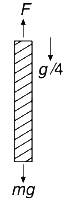
$A$ man slides down a telegraphic pole with an acceleration equal to one-fourth of the acceleration due to gravity. The frictional force between the man and the pole is equal to which of the following in terms of the man's weight $w$?
A
$\frac{w}{4}$
B
$\frac{w}{2}$
C
$\frac{3w}{4}$
D
$w$
Solution
(C) Let the mass of the man be $m$. The weight of the man is $w = mg$. The forces acting on the man are his weight $mg$ acting downwards and the frictional force $F$ acting upwards.
Since the man is sliding down with an acceleration $a = g/4$,according to Newton's second law of motion:
$mg - F = ma$
Substituting $a = g/4$:
$mg - F = m(g/4)$
$mg - F = mg/4$
$F = mg - mg/4$
$F = 3mg/4$
Since $w = mg$,we get:
$F = 3w/4$
Since the man is sliding down with an acceleration $a = g/4$,according to Newton's second law of motion:
$mg - F = ma$
Substituting $a = g/4$:
$mg - F = m(g/4)$
$mg - F = mg/4$
$F = mg - mg/4$
$F = 3mg/4$
Since $w = mg$,we get:
$F = 3w/4$
0 likesView Solution
9
PhysicsDifficultMCQTS EAMCET · 2007
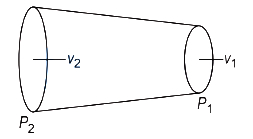
$A$ horizontal pipe of non-uniform cross-section allows water to flow through it with a velocity $1 \ m/s$ when the pressure is $50 \ kPa$ at a point. If the velocity of flow has to be $2 \ m/s$ at some other point,the pressure at that point should be: (in $kPa$)
A
$50$
B
$100$
C
$48.5$
D
$24.25$
Solution
(C) According to Bernoulli's equation for a horizontal pipe (where height $h_1 = h_2$):
$P_1 + \frac{1}{2} \rho v_1^2 = P_2 + \frac{1}{2} \rho v_2^2$
Given:
$P_1 = 50 \ kPa = 50 \times 10^3 \ Pa$
$v_1 = 1 \ m/s$
$v_2 = 2 \ m/s$
Density of water $\rho = 1000 \ kg/m^3 = 10^3 \ kg/m^3$
Rearranging the equation to solve for $P_2$:
$P_2 = P_1 + \frac{1}{2} \rho (v_1^2 - v_2^2)$
$P_2 = 50 \times 10^3 + \frac{1}{2} \times 10^3 \times (1^2 - 2^2)$
$P_2 = 50 \times 10^3 + 0.5 \times 10^3 \times (1 - 4)$
$P_2 = 50 \times 10^3 + 0.5 \times 10^3 \times (-3)$
$P_2 = 50 \times 10^3 - 1.5 \times 10^3$
$P_2 = 48.5 \times 10^3 \ Pa = 48.5 \ kPa$
$P_1 + \frac{1}{2} \rho v_1^2 = P_2 + \frac{1}{2} \rho v_2^2$
Given:
$P_1 = 50 \ kPa = 50 \times 10^3 \ Pa$
$v_1 = 1 \ m/s$
$v_2 = 2 \ m/s$
Density of water $\rho = 1000 \ kg/m^3 = 10^3 \ kg/m^3$
Rearranging the equation to solve for $P_2$:
$P_2 = P_1 + \frac{1}{2} \rho (v_1^2 - v_2^2)$
$P_2 = 50 \times 10^3 + \frac{1}{2} \times 10^3 \times (1^2 - 2^2)$
$P_2 = 50 \times 10^3 + 0.5 \times 10^3 \times (1 - 4)$
$P_2 = 50 \times 10^3 + 0.5 \times 10^3 \times (-3)$
$P_2 = 50 \times 10^3 - 1.5 \times 10^3$
$P_2 = 48.5 \times 10^3 \ Pa = 48.5 \ kPa$
0 likesView Solution
10
PhysicsMediumMCQTS EAMCET · 2007
$A$ liquid does not wet the solid surface if the angle of contact is
A
zero
B
equal to $45^{\circ}$
C
equal to $90^{\circ}$
D
greater than $90^{\circ}$
Solution
(D) liquid does not wet a solid surface if the angle of contact is obtuse,i.e.,greater than $90^{\circ}$.
In this condition,the cohesive forces between the liquid molecules are stronger than the adhesive forces between the liquid and the solid surface.
Consequently,the liquid tends to minimize contact with the surface,resulting in the liquid not wetting the solid.
In this condition,the cohesive forces between the liquid molecules are stronger than the adhesive forces between the liquid and the solid surface.
Consequently,the liquid tends to minimize contact with the surface,resulting in the liquid not wetting the solid.
0 likesView Solution
11
PhysicsDifficultMCQTS EAMCET · 2007
When a wire of length $10 \ m$ is subjected to a force of $100 \ N$ along its length,the lateral strain produced is $0.01 \times 10^{-3} \ m$. The Poisson's ratio was found to be $0.4$. If the area of cross-section of the wire is $0.025 \ m^2$,its Young's modulus is:
A
$1.6 \times 10^8 \ N/m^2$
B
$2.5 \times 10^{10} \ N/m^2$
C
$1.25 \times 10^{11} \ N/m^2$
D
$16 \times 10^9 \ N/m^2$
Solution
(A) Poisson's ratio $(\sigma) = \frac{\text{lateral strain}}{\text{longitudinal strain}}$.
Given lateral strain $= 0.01 \times 10^{-3} \ m$ (Note: Strain is dimensionless,assuming the value represents the change in diameter $\Delta D$ or similar,but here we use it directly as the numerator for the ratio).
$\sigma = \frac{\text{lateral strain}}{\Delta L / L} = 0.4$.
$\frac{\Delta L}{L} = \frac{0.01 \times 10^{-3}}{0.4} = 0.025 \times 10^{-3} = 2.5 \times 10^{-5}$.
Young's modulus $Y = \frac{F/A}{\Delta L/L} = \frac{F \cdot L}{A \cdot \Delta L}$.
$Y = \frac{100 \ N}{0.025 \ m^2 \times (2.5 \times 10^{-5})} = \frac{100}{0.0625 \times 10^{-5}} = \frac{100}{6.25 \times 10^{-7}} = 16 \times 10^7 = 1.6 \times 10^8 \ N/m^2$.
Given lateral strain $= 0.01 \times 10^{-3} \ m$ (Note: Strain is dimensionless,assuming the value represents the change in diameter $\Delta D$ or similar,but here we use it directly as the numerator for the ratio).
$\sigma = \frac{\text{lateral strain}}{\Delta L / L} = 0.4$.
$\frac{\Delta L}{L} = \frac{0.01 \times 10^{-3}}{0.4} = 0.025 \times 10^{-3} = 2.5 \times 10^{-5}$.
Young's modulus $Y = \frac{F/A}{\Delta L/L} = \frac{F \cdot L}{A \cdot \Delta L}$.
$Y = \frac{100 \ N}{0.025 \ m^2 \times (2.5 \times 10^{-5})} = \frac{100}{0.0625 \times 10^{-5}} = \frac{100}{6.25 \times 10^{-7}} = 16 \times 10^7 = 1.6 \times 10^8 \ N/m^2$.
0 likesView Solution
12
PhysicsDifficultMCQTS EAMCET · 2007
An object of mass $2m$ is projected with a speed of $100 \ m/s$ at an angle $\theta = \sin^{-1}(3/5)$ to the horizontal. At the highest point,the object breaks into two pieces of same mass $m$ and the first one comes to rest. The distance between the point of projection and the point of landing of the second piece (in metres) is $(g = 10 \ m/s^2)$.
A
$3840$
B
$1280$
C
$1440$
D
$960$
Solution
(C) The initial horizontal velocity of the object is $u_x = u \cos \theta$. Given $\sin \theta = 3/5$,then $\cos \theta = 4/5$. So,$u_x = 100 \times (4/5) = 80 \ m/s$.
At the highest point,the vertical velocity is $0$,and the horizontal velocity is $80 \ m/s$. The momentum of the system at the highest point is $P = (2m) \times 80 = 160m$.
After the explosion,the first piece $(m)$ comes to rest,so its velocity is $0$. Let the velocity of the second piece $(m)$ be $v$. By conservation of linear momentum: $160m = m(0) + m(v)$,which gives $v = 160 \ m/s$.
The time taken to reach the highest point is $t = (u \sin \theta) / g = (100 \times 3/5) / 10 = 6 \ s$. The horizontal distance covered to reach the highest point is $x_1 = u_x \times t = 80 \times 6 = 480 \ m$.
The second piece travels from the highest point to the ground in time $t = 6 \ s$ with a constant horizontal velocity of $160 \ m/s$. The additional horizontal distance covered is $x_2 = v \times t = 160 \times 6 = 960 \ m$.
The total distance from the point of projection is $x_1 + x_2 = 480 + 960 = 1440 \ m$.
At the highest point,the vertical velocity is $0$,and the horizontal velocity is $80 \ m/s$. The momentum of the system at the highest point is $P = (2m) \times 80 = 160m$.
After the explosion,the first piece $(m)$ comes to rest,so its velocity is $0$. Let the velocity of the second piece $(m)$ be $v$. By conservation of linear momentum: $160m = m(0) + m(v)$,which gives $v = 160 \ m/s$.
The time taken to reach the highest point is $t = (u \sin \theta) / g = (100 \times 3/5) / 10 = 6 \ s$. The horizontal distance covered to reach the highest point is $x_1 = u_x \times t = 80 \times 6 = 480 \ m$.
The second piece travels from the highest point to the ground in time $t = 6 \ s$ with a constant horizontal velocity of $160 \ m/s$. The additional horizontal distance covered is $x_2 = v \times t = 160 \times 6 = 960 \ m$.
The total distance from the point of projection is $x_1 + x_2 = 480 + 960 = 1440 \ m$.
0 likesView Solution
13
PhysicsMediumMCQTS EAMCET · 2007
The magnitude of maximum acceleration is $\pi$ times that of maximum velocity of a simple harmonic oscillator. The time period of the oscillator in seconds is
A
$4$
B
$2$
C
$1$
D
$0.5$
Solution
(B) The maximum acceleration of a simple harmonic oscillator is given by $a_{max} = \omega^2 A$,where $\omega$ is the angular frequency and $A$ is the amplitude.
The maximum velocity is given by $v_{max} = \omega A$.
According to the problem,the magnitude of maximum acceleration is $\pi$ times the maximum velocity:
$a_{max} = \pi \cdot v_{max}$
Substituting the expressions:
$\omega^2 A = \pi \cdot \omega A$
Dividing both sides by $\omega A$ (assuming $\omega, A \neq 0$):
$\omega = \pi$
We know that the angular frequency $\omega$ is related to the time period $T$ by the formula $\omega = \frac{2\pi}{T}$.
Substituting $\omega = \pi$:
$\pi = \frac{2\pi}{T}$
$T = 2 \text{ s}$.
The maximum velocity is given by $v_{max} = \omega A$.
According to the problem,the magnitude of maximum acceleration is $\pi$ times the maximum velocity:
$a_{max} = \pi \cdot v_{max}$
Substituting the expressions:
$\omega^2 A = \pi \cdot \omega A$
Dividing both sides by $\omega A$ (assuming $\omega, A \neq 0$):
$\omega = \pi$
We know that the angular frequency $\omega$ is related to the time period $T$ by the formula $\omega = \frac{2\pi}{T}$.
Substituting $\omega = \pi$:
$\pi = \frac{2\pi}{T}$
$T = 2 \text{ s}$.
0 likesView Solution
14
PhysicsMediumMCQTS EAMCET · 2007
Two solid spheres ($A$ and $B$) are made of metals of different densities $\rho_A$ and $\rho_B$ respectively. If their masses are equal,the ratio of their moments of inertia $(I_B / I_A)$ about their respective diameter is
A
$(\rho_B / \rho_A)^{2/3}$
B
$(\rho_A / \rho_B)^{2/3}$
C
$\rho_A / \rho_B$
D
$\rho_B / \rho_A$
Solution
(B) Given that the masses of the two solid spheres are equal,$m_A = m_B$.
Since mass $m = \text{Volume} \times \text{Density} = \frac{4}{3} \pi R^3 \rho$,we have:
$\frac{4}{3} \pi R_A^3 \rho_A = \frac{4}{3} \pi R_B^3 \rho_B$
$\Rightarrow \frac{R_A^3}{R_B^3} = \frac{\rho_B}{\rho_A} \Rightarrow \frac{R_A}{R_B} = \left(\frac{\rho_B}{\rho_A}\right)^{1/3}$.
The moment of inertia of a solid sphere about its diameter is $I = \frac{2}{5} m R^2$.
Since $m_A = m_B$,the ratio of moments of inertia is:
$\frac{I_B}{I_A} = \frac{\frac{2}{5} m_B R_B^2}{\frac{2}{5} m_A R_A^2} = \left(\frac{R_B}{R_A}\right)^2$.
Substituting the ratio of radii:
$\frac{I_B}{I_A} = \left[ \left( \frac{\rho_A}{\rho_B} \right)^{1/3} \right]^2 = \left( \frac{\rho_A}{\rho_B} \right)^{2/3}$.
Since mass $m = \text{Volume} \times \text{Density} = \frac{4}{3} \pi R^3 \rho$,we have:
$\frac{4}{3} \pi R_A^3 \rho_A = \frac{4}{3} \pi R_B^3 \rho_B$
$\Rightarrow \frac{R_A^3}{R_B^3} = \frac{\rho_B}{\rho_A} \Rightarrow \frac{R_A}{R_B} = \left(\frac{\rho_B}{\rho_A}\right)^{1/3}$.
The moment of inertia of a solid sphere about its diameter is $I = \frac{2}{5} m R^2$.
Since $m_A = m_B$,the ratio of moments of inertia is:
$\frac{I_B}{I_A} = \frac{\frac{2}{5} m_B R_B^2}{\frac{2}{5} m_A R_A^2} = \left(\frac{R_B}{R_A}\right)^2$.
Substituting the ratio of radii:
$\frac{I_B}{I_A} = \left[ \left( \frac{\rho_A}{\rho_B} \right)^{1/3} \right]^2 = \left( \frac{\rho_A}{\rho_B} \right)^{2/3}$.
0 likesView Solution
15
PhysicsMediumMCQTS EAMCET · 2007
$A$ black body radiates energy at the rate of $E \text{ W/m}^2$ at a high temperature $T \text{ K}$. When the temperature is reduced to $\left(\frac{T}{2}\right) \text{ K}$,the radiant energy is
A
$\frac{E}{2}$
B
$2 E$
C
$\frac{E}{4}$
D
$\frac{E}{16}$
Solution
(D) According to Stefan-Boltzmann law,the radiant energy emitted per unit area per unit time is proportional to the fourth power of the absolute temperature:
$E \propto T^4$
Let $E_1 = E$ at temperature $T_1 = T$.
Let $E_2$ be the new radiant energy at temperature $T_2 = \frac{T}{2}$.
Using the ratio method:
$\frac{E_2}{E_1} = \left(\frac{T_2}{T_1}\right)^4$
Substituting the values:
$\frac{E_2}{E} = \left(\frac{T/2}{T}\right)^4 = \left(\frac{1}{2}\right)^4$
$\frac{E_2}{E} = \frac{1}{16}$
$E_2 = \frac{E}{16}$
$E \propto T^4$
Let $E_1 = E$ at temperature $T_1 = T$.
Let $E_2$ be the new radiant energy at temperature $T_2 = \frac{T}{2}$.
Using the ratio method:
$\frac{E_2}{E_1} = \left(\frac{T_2}{T_1}\right)^4$
Substituting the values:
$\frac{E_2}{E} = \left(\frac{T/2}{T}\right)^4 = \left(\frac{1}{2}\right)^4$
$\frac{E_2}{E} = \frac{1}{16}$
$E_2 = \frac{E}{16}$
0 likesView Solution
16
PhysicsDifficultMCQTS EAMCET · 2007
$A$ clock which keeps correct time at $20^{\circ} C$,is subjected to $40^{\circ} C$. If the coefficient of linear expansion of the pendulum is $12 \times 10^{-6} /{ }^{\circ} C$,how much time will it gain or lose per day?
A
$10.3 ~s/\text{day}$
B
$20.6 ~s/\text{day}$
C
$5 ~s/\text{day}$
D
$20 ~min/\text{day}$
Solution
(A) The time period of a simple pendulum is given by $T = 2\pi \sqrt{\frac{l}{g}}$.
Taking the fractional change,we have $\frac{\Delta T}{T} = \frac{1}{2} \frac{\Delta l}{l} = \frac{1}{2} \alpha \Delta \theta$.
Given $\alpha = 12 \times 10^{-6} /{ }^{\circ} C$ and $\Delta \theta = 40^{\circ} C - 20^{\circ} C = 20^{\circ} C$.
Substituting the values: $\frac{\Delta T}{T} = \frac{1}{2} \times 12 \times 10^{-6} \times 20 = 120 \times 10^{-6} = 1.2 \times 10^{-4}$.
The time lost or gained in a day $(T = 86400 ~s)$ is $\Delta T = T \times \frac{\Delta T}{T} = 86400 \times 1.2 \times 10^{-4} \approx 10.368 ~s$.
Since the temperature increases,the length of the pendulum increases,the time period increases,and the clock loses time.
Taking the fractional change,we have $\frac{\Delta T}{T} = \frac{1}{2} \frac{\Delta l}{l} = \frac{1}{2} \alpha \Delta \theta$.
Given $\alpha = 12 \times 10^{-6} /{ }^{\circ} C$ and $\Delta \theta = 40^{\circ} C - 20^{\circ} C = 20^{\circ} C$.
Substituting the values: $\frac{\Delta T}{T} = \frac{1}{2} \times 12 \times 10^{-6} \times 20 = 120 \times 10^{-6} = 1.2 \times 10^{-4}$.
The time lost or gained in a day $(T = 86400 ~s)$ is $\Delta T = T \times \frac{\Delta T}{T} = 86400 \times 1.2 \times 10^{-4} \approx 10.368 ~s$.
Since the temperature increases,the length of the pendulum increases,the time period increases,and the clock loses time.
0 likesView Solution
17
PhysicsDifficultMCQTS EAMCET · 2007
Two cylinders $A$ and $B$ fitted with pistons contain equal number of moles of an ideal monoatomic gas at $400 \,K$. The piston of $A$ is free to move while that of $B$ is held fixed. The same amount of heat energy is given to the gas in each cylinder. If the rise in temperature of the gas in $A$ is $42 \,K$, what is the rise in temperature of the gas in $B$ (in $\,K$)? (Given $\gamma = 5/3$)
A
$25.2$
B
$35$
C
$42$
D
$70$
Solution
(D) For a monoatomic gas, the molar heat capacity at constant volume is $C_v = \frac{3}{2}R$ and at constant pressure is $C_p = \frac{5}{2}R$.
In cylinder $B$, the piston is fixed, so the process is isochoric (constant volume). The heat supplied is $\Delta Q = n C_v \Delta T_B = n (\frac{3}{2}R) \Delta T_B$.
In cylinder $A$, the piston is free to move, so the process is isobaric (constant pressure). The heat supplied is $\Delta Q = n C_p \Delta T_A = n (\frac{5}{2}R) \Delta T_A$.
Since the heat supplied is the same in both cases, we have $n (\frac{3}{2}R) \Delta T_B = n (\frac{5}{2}R) \Delta T_A$.
Given $\Delta T_A = 42 \,K$, we substitute the values: $\frac{3}{2} \Delta T_B = \frac{5}{2} \times 42$.
$3 \Delta T_B = 5 \times 42 = 210$.
$\Delta T_B = \frac{210}{3} = 70 \,K$.
In cylinder $B$, the piston is fixed, so the process is isochoric (constant volume). The heat supplied is $\Delta Q = n C_v \Delta T_B = n (\frac{3}{2}R) \Delta T_B$.
In cylinder $A$, the piston is free to move, so the process is isobaric (constant pressure). The heat supplied is $\Delta Q = n C_p \Delta T_A = n (\frac{5}{2}R) \Delta T_A$.
Since the heat supplied is the same in both cases, we have $n (\frac{3}{2}R) \Delta T_B = n (\frac{5}{2}R) \Delta T_A$.
Given $\Delta T_A = 42 \,K$, we substitute the values: $\frac{3}{2} \Delta T_B = \frac{5}{2} \times 42$.
$3 \Delta T_B = 5 \times 42 = 210$.
$\Delta T_B = \frac{210}{3} = 70 \,K$.
0 likesView Solution
18
PhysicsMediumMCQTS EAMCET · 2007
The temperature of the system decreases in the process of
A
free expansion
B
adiabatic expansion
C
isothermal expansion
D
isothermal compression
Solution
(B) In an adiabatic process,the system does not exchange heat with the surroundings,so $Q = 0$.
According to the first law of thermodynamics,$\Delta U = Q - W$.
Since $Q = 0$,we have $\Delta U = -W$.
In an adiabatic expansion,the gas does work on the surroundings,so $W > 0$.
This implies $\Delta U < 0$,which means the internal energy of the system decreases.
Since the internal energy of an ideal gas is directly proportional to its temperature $(U \propto T)$,a decrease in internal energy leads to a decrease in the temperature of the system.
According to the first law of thermodynamics,$\Delta U = Q - W$.
Since $Q = 0$,we have $\Delta U = -W$.
In an adiabatic expansion,the gas does work on the surroundings,so $W > 0$.
This implies $\Delta U < 0$,which means the internal energy of the system decreases.
Since the internal energy of an ideal gas is directly proportional to its temperature $(U \propto T)$,a decrease in internal energy leads to a decrease in the temperature of the system.
0 likesView Solution
19
PhysicsMediumMCQTS EAMCET · 2007
Some physical constants are given in List-$I$ and their dimensional formulae are given in List-$II$. Match the following:
The correct answer is:
| List-$I$ | List-$II$ |
| $(1)$ Planck's constant | $(i)$ $[ML^{-1} T^{-2}]$ |
| $(2)$ Gravitational constant | (ii) $[ML^{-1} T^{-1}]$ |
| $(3)$ Bulk modulus | (iii) $[ML^2 T^{-1}]$ |
| $(4)$ Coefficient of viscosity | (iv) $[M^{-1} L^3 T^{-2}]$ |
The correct answer is:
A
(iv),(iii),(ii),$(i)$
B
$(i)$,(ii),(iii),(iv)
C
(iii),(ii),$(i)$,(iv)
D
(iii),(iv),$(i)$,(ii)
Solution
(D) $(1)$ Planck's constant $(h)$: $E = h\nu \implies [h] = [E]/[\nu] = [ML^2 T^{-2}] / [T^{-1}] = [ML^2 T^{-1}]$. This matches (iii).
$(2)$ Gravitational constant $(G)$: $F = G(m_1 m_2)/r^2 \implies [G] = [F r^2] / [M^2] = [MLT^{-2}][L^2] / [M^2] = [M^{-1} L^3 T^{-2}]$. This matches (iv).
$(3)$ Bulk modulus $(B)$: $B = \text{Stress} / \text{Strain} = [ML^{-1} T^{-2}] / [M^0 L^0 T^0] = [ML^{-1} T^{-2}]$. This matches $(i)$.
$(4)$ Coefficient of viscosity $(\eta)$: $F = \eta A (dv/dx) \implies [\eta] = [F] / ([A][dv/dx]) = [MLT^{-2}] / ([L^2][LT^{-1}/L]) = [MLT^{-2}] / [L^2 T^{-1}] = [ML^{-1} T^{-1}]$. This matches (ii).
Therefore,the correct matching is $(1)$-(iii),$(2)$-(iv),$(3)$-$(i)$,$(4)$-(ii). Hence,option $(d)$ is correct.
$(2)$ Gravitational constant $(G)$: $F = G(m_1 m_2)/r^2 \implies [G] = [F r^2] / [M^2] = [MLT^{-2}][L^2] / [M^2] = [M^{-1} L^3 T^{-2}]$. This matches (iv).
$(3)$ Bulk modulus $(B)$: $B = \text{Stress} / \text{Strain} = [ML^{-1} T^{-2}] / [M^0 L^0 T^0] = [ML^{-1} T^{-2}]$. This matches $(i)$.
$(4)$ Coefficient of viscosity $(\eta)$: $F = \eta A (dv/dx) \implies [\eta] = [F] / ([A][dv/dx]) = [MLT^{-2}] / ([L^2][LT^{-1}/L]) = [MLT^{-2}] / [L^2 T^{-1}] = [ML^{-1} T^{-1}]$. This matches (ii).
Therefore,the correct matching is $(1)$-(iii),$(2)$-(iv),$(3)$-$(i)$,$(4)$-(ii). Hence,option $(d)$ is correct.
0 likesView Solution
20
PhysicsEasyMCQTS EAMCET · 2007
$A$ whistle of frequency $540 Hz$ rotates in a horizontal circle of radius $2 m$ at an angular speed of $15 rad/s$. What is the highest frequency heard by a listener at rest with respect to the center of the circle (in $Hz$)? (Velocity of sound in air $= 330 m/s$)
A
$590$
B
$594$
C
$598$
D
$602$
Solution
(B) The velocity of the source $v_s$ is given by $v_s = r \omega$.
Given $r = 2 m$ and $\omega = 15 rad/s$,we have $v_s = 2 \times 15 = 30 m/s$.
The Doppler effect formula for a stationary listener and a moving source is $f' = f \left( \frac{v}{v - v_s \cos \theta} \right)$.
The highest frequency is heard when the source is moving directly towards the listener,which corresponds to $\theta = 0^\circ$,so $\cos \theta = 1$.
Substituting the values: $f' = 540 \left( \frac{330}{330 - 30} \right) = 540 \left( \frac{330}{300} \right) = 540 \times 1.1 = 594 Hz$.
Given $r = 2 m$ and $\omega = 15 rad/s$,we have $v_s = 2 \times 15 = 30 m/s$.
The Doppler effect formula for a stationary listener and a moving source is $f' = f \left( \frac{v}{v - v_s \cos \theta} \right)$.
The highest frequency is heard when the source is moving directly towards the listener,which corresponds to $\theta = 0^\circ$,so $\cos \theta = 1$.
Substituting the values: $f' = 540 \left( \frac{330}{330 - 30} \right) = 540 \left( \frac{330}{300} \right) = 540 \times 1.1 = 594 Hz$.
0 likesView Solution
21
PhysicsDifficultMCQTS EAMCET · 2007
$A$ segment of wire vibrates with a fundamental frequency of $450 \,Hz$ under a tension of $9 \,kg-wt$. The tension at which the fundamental frequency of the same wire becomes $900 \,Hz$ is:
A
$36 \,kg-wt$
B
$27 \,kg-wt$
C
$18 \,kg-wt$
D
$72 \,kg-wt$
Solution
(A) The fundamental frequency $f$ of a vibrating wire is given by the formula: $f = \frac{1}{2L} \sqrt{\frac{T}{\mu}}$, where $T$ is the tension and $\mu$ is the linear mass density.
Since $L$ and $\mu$ are constant for the same wire, we have $f \propto \sqrt{T}$.
Therefore, the ratio of frequencies is given by: $\frac{f_2}{f_1} = \sqrt{\frac{T_2}{T_1}}$.
Given $f_1 = 450 \,Hz$, $T_1 = 9 \,kg-wt$, and $f_2 = 900 \,Hz$.
Substituting the values: $\frac{900}{450} = \sqrt{\frac{T_2}{9}}$.
$2 = \sqrt{\frac{T_2}{9}}$.
Squaring both sides: $4 = \frac{T_2}{9}$.
$T_2 = 4 \times 9 = 36 \,kg-wt$.
Since $L$ and $\mu$ are constant for the same wire, we have $f \propto \sqrt{T}$.
Therefore, the ratio of frequencies is given by: $\frac{f_2}{f_1} = \sqrt{\frac{T_2}{T_1}}$.
Given $f_1 = 450 \,Hz$, $T_1 = 9 \,kg-wt$, and $f_2 = 900 \,Hz$.
Substituting the values: $\frac{900}{450} = \sqrt{\frac{T_2}{9}}$.
$2 = \sqrt{\frac{T_2}{9}}$.
Squaring both sides: $4 = \frac{T_2}{9}$.
$T_2 = 4 \times 9 = 36 \,kg-wt$.
0 likesView Solution
22
PhysicsDifficultMCQTS EAMCET · 2007
$A$ bucket filled with water is tied to a rope of length $0.5 \,m$ and is rotated in a circular path in a vertical plane. The minimum velocity it should have at the lowest point of the circle so that the water does not spill is, $(g=10 \,m/s^2)$
A
$\sqrt{5} \,m/s$
B
$\sqrt{10} \,m/s$
C
$5 \,m/s$
D
$2\sqrt{5} \,m/s$
Solution
(C) For water not to spill out of the bucket, the bucket must complete the vertical circular motion.
At the highest point, the minimum velocity required is $v_{top} = \sqrt{gR}$.
Using the principle of conservation of energy between the lowest point (bottom) and the highest point (top):
$\frac{1}{2}mv_{bottom}^2 = \frac{1}{2}mv_{top}^2 + mg(2R)$
$v_{bottom}^2 = v_{top}^2 + 4gR$
$v_{bottom}^2 = gR + 4gR = 5gR$
$v_{bottom} = \sqrt{5gR}$
Given $g = 10 \,m/s^2$ and $R = 0.5 \,m$:
$v_{bottom} = \sqrt{5 \times 10 \times 0.5} = \sqrt{25} = 5 \,m/s$.
At the highest point, the minimum velocity required is $v_{top} = \sqrt{gR}$.
Using the principle of conservation of energy between the lowest point (bottom) and the highest point (top):
$\frac{1}{2}mv_{bottom}^2 = \frac{1}{2}mv_{top}^2 + mg(2R)$
$v_{bottom}^2 = v_{top}^2 + 4gR$
$v_{bottom}^2 = gR + 4gR = 5gR$
$v_{bottom} = \sqrt{5gR}$
Given $g = 10 \,m/s^2$ and $R = 0.5 \,m$:
$v_{bottom} = \sqrt{5 \times 10 \times 0.5} = \sqrt{25} = 5 \,m/s$.
0 likesView Solution
23
PhysicsDifficultMCQTS EAMCET · 2007
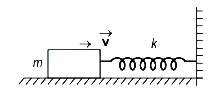
$A$ block of mass $m=25 \ kg$ sliding on a smooth horizontal surface with a velocity $v=3 \ ms^{-1}$ meets a spring of spring constant $k=100 \ N/m$ fixed at one end as shown in the figure. The maximum compression of the spring and the velocity of the block as it returns to the original position are,respectively:
A
$1.5 \ m, -3 \ ms^{-1}$
B
$1.5 \ m, 0.01 \ ms^{-1}$
C
$1.0 \ m, 3 \ ms^{-1}$
D
$0.5 \ m, 2 \ ms^{-1}$
Solution
(A) When the block strikes the spring,the kinetic energy of the block is converted into the elastic potential energy of the spring. According to the law of conservation of energy:
$\frac{1}{2} mv^2 = \frac{1}{2} kx^2$
where $x$ is the maximum compression in the spring.
Solving for $x$:
$x = \sqrt{\frac{mv^2}{k}} = \sqrt{\frac{25 \times (3)^2}{100}} = \sqrt{\frac{225}{100}} = \sqrt{2.25} = 1.5 \ m$
When the block returns to its original position,the potential energy stored in the spring is fully converted back into the kinetic energy of the block. Since the surface is smooth (no friction),energy is conserved. The magnitude of the velocity remains the same,but the direction is reversed as the block moves away from the spring.
Therefore,the velocity of the block is $v = -3 \ ms^{-1}$.
$\frac{1}{2} mv^2 = \frac{1}{2} kx^2$
where $x$ is the maximum compression in the spring.
Solving for $x$:
$x = \sqrt{\frac{mv^2}{k}} = \sqrt{\frac{25 \times (3)^2}{100}} = \sqrt{\frac{225}{100}} = \sqrt{2.25} = 1.5 \ m$
When the block returns to its original position,the potential energy stored in the spring is fully converted back into the kinetic energy of the block. Since the surface is smooth (no friction),energy is conserved. The magnitude of the velocity remains the same,but the direction is reversed as the block moves away from the spring.
Therefore,the velocity of the block is $v = -3 \ ms^{-1}$.
0 likesView Solution
24
PhysicsMediumMCQTS EAMCET · 2007
$A$ bar-magnet of moment of inertia $49 \times 10^{-2} \,kg-m^2$ vibrates in a magnetic field of induction $0.5 \times 10^{-4} \,T$. The time period of vibration is $8.8 \,s$. The magnetic moment of the bar magnet is (in $\,A-m^2$)
A
$350$
B
$490$
C
$3300$
D
$5000$
Solution
(D) The time period $T$ of a vibrating bar magnet is given by the formula:
$T = 2 \pi \sqrt{\frac{I}{MH}}$
where $I$ is the moment of inertia,$M$ is the magnetic moment,and $H$ is the magnetic field induction.
Squaring both sides,we get:
$T^2 = 4 \pi^2 \frac{I}{MH}$
Rearranging to solve for $M$:
$M = \frac{4 \pi^2 I}{T^2 H}$
Given values:
$I = 49 \times 10^{-2} \,kg-m^2$
$H = 0.5 \times 10^{-4} \,T$
$T = 8.8 \,s$
Substituting these values:
$M = \frac{4 \times (3.14)^2 \times 49 \times 10^{-2}}{(8.8)^2 \times 0.5 \times 10^{-4}}$
$M = \frac{4 \times 9.8596 \times 49 \times 10^{-2}}{77.44 \times 0.5 \times 10^{-4}}$
$M = \frac{1932.48 \times 10^{-2}}{38.72 \times 10^{-4}}$
$M = 49.909 \times 10^2 \approx 5000 \,A-m^2$
$T = 2 \pi \sqrt{\frac{I}{MH}}$
where $I$ is the moment of inertia,$M$ is the magnetic moment,and $H$ is the magnetic field induction.
Squaring both sides,we get:
$T^2 = 4 \pi^2 \frac{I}{MH}$
Rearranging to solve for $M$:
$M = \frac{4 \pi^2 I}{T^2 H}$
Given values:
$I = 49 \times 10^{-2} \,kg-m^2$
$H = 0.5 \times 10^{-4} \,T$
$T = 8.8 \,s$
Substituting these values:
$M = \frac{4 \times (3.14)^2 \times 49 \times 10^{-2}}{(8.8)^2 \times 0.5 \times 10^{-4}}$
$M = \frac{4 \times 9.8596 \times 49 \times 10^{-2}}{77.44 \times 0.5 \times 10^{-4}}$
$M = \frac{1932.48 \times 10^{-2}}{38.72 \times 10^{-4}}$
$M = 49.909 \times 10^2 \approx 5000 \,A-m^2$
0 likesView Solution
25
PhysicsEasyMCQTS EAMCET · 2007
In a Ramsden eyepiece,two planoconvex lenses,each of focal length $f$,are separated by a distance of $12 \ cm$. The equivalent focal length (in $cm$) of the eyepiece is:
A
$10.5$
B
$12.0$
C
$13.5$
D
$15.5$
Solution
(C) In a Ramsden eyepiece,the two planoconvex lenses have the same focal length $f$ and are separated by a distance $d = \frac{2f}{3}$.
Given the separation distance $d = 12 \ cm$,we can find $f$:
$d = \frac{2f}{3} \implies 12 = \frac{2f}{3} \implies f = \frac{12 \times 3}{2} = 18 \ cm$.
The equivalent focal length $f_{eq}$ of a combination of two lenses with focal lengths $f_1$ and $f_2$ separated by distance $d$ is given by:
$\frac{1}{f_{eq}} = \frac{1}{f_1} + \frac{1}{f_2} - \frac{d}{f_1 f_2}$.
For a Ramsden eyepiece,$f_1 = f_2 = f$ and $d = \frac{2f}{3}$.
Substituting these values:
$\frac{1}{f_{eq}} = \frac{1}{f} + \frac{1}{f} - \frac{2f/3}{f^2} = \frac{2}{f} - \frac{2}{3f} = \frac{6-2}{3f} = \frac{4}{3f}$.
Therefore,$f_{eq} = \frac{3f}{4}$.
Substituting $f = 18 \ cm$:
$f_{eq} = \frac{3 \times 18}{4} = \frac{54}{4} = 13.5 \ cm$.
Given the separation distance $d = 12 \ cm$,we can find $f$:
$d = \frac{2f}{3} \implies 12 = \frac{2f}{3} \implies f = \frac{12 \times 3}{2} = 18 \ cm$.
The equivalent focal length $f_{eq}$ of a combination of two lenses with focal lengths $f_1$ and $f_2$ separated by distance $d$ is given by:
$\frac{1}{f_{eq}} = \frac{1}{f_1} + \frac{1}{f_2} - \frac{d}{f_1 f_2}$.
For a Ramsden eyepiece,$f_1 = f_2 = f$ and $d = \frac{2f}{3}$.
Substituting these values:
$\frac{1}{f_{eq}} = \frac{1}{f} + \frac{1}{f} - \frac{2f/3}{f^2} = \frac{2}{f} - \frac{2}{3f} = \frac{6-2}{3f} = \frac{4}{3f}$.
Therefore,$f_{eq} = \frac{3f}{4}$.
Substituting $f = 18 \ cm$:
$f_{eq} = \frac{3 \times 18}{4} = \frac{54}{4} = 13.5 \ cm$.
0 likesView Solution
26
PhysicsDifficultMCQTS EAMCET · 2007
The natural frequency of an $L-C$ circuit is $1,25,000 \text{ cycle/s}$. Then the capacitor $C$ is replaced by another capacitor with a dielectric medium of dielectric constant $K$. In this case,the frequency decreases by $25 \text{ kHz}$. The value of $K$ is
A
$3.0$
B
$2.1$
C
$1.56$
D
$1.7$
Solution
(C) The natural frequency of an $L-C$ circuit is given by $f = \frac{1}{2 \pi \sqrt{LC}}$.
This implies $f \propto \frac{1}{\sqrt{C}}$.
When the capacitor $C$ is replaced by a capacitor $C'$ with a dielectric medium of constant $K$,the new capacitance becomes $C' = KC$.
The new frequency $f'$ is given as $f' = f - 25 \text{ kHz} = 125 \text{ kHz} - 25 \text{ kHz} = 100 \text{ kHz}$.
Taking the ratio of the frequencies:
$\frac{f'}{f} = \sqrt{\frac{C}{C'}} = \sqrt{\frac{C}{KC}} = \frac{1}{\sqrt{K}}$.
Substituting the values:
$\frac{100}{125} = \frac{1}{\sqrt{K}}$.
$\frac{4}{5} = \frac{1}{\sqrt{K}} \implies \sqrt{K} = \frac{5}{4} = 1.25$.
Therefore,$K = (1.25)^2 = 1.5625 \approx 1.56$.
This implies $f \propto \frac{1}{\sqrt{C}}$.
When the capacitor $C$ is replaced by a capacitor $C'$ with a dielectric medium of constant $K$,the new capacitance becomes $C' = KC$.
The new frequency $f'$ is given as $f' = f - 25 \text{ kHz} = 125 \text{ kHz} - 25 \text{ kHz} = 100 \text{ kHz}$.
Taking the ratio of the frequencies:
$\frac{f'}{f} = \sqrt{\frac{C}{C'}} = \sqrt{\frac{C}{KC}} = \frac{1}{\sqrt{K}}$.
Substituting the values:
$\frac{100}{125} = \frac{1}{\sqrt{K}}$.
$\frac{4}{5} = \frac{1}{\sqrt{K}} \implies \sqrt{K} = \frac{5}{4} = 1.25$.
Therefore,$K = (1.25)^2 = 1.5625 \approx 1.56$.
0 likesView Solution
27
PhysicsMediumMCQTS EAMCET · 2007
Match the following:
| $1$. Burning candle | $i$. Line spectrum |
| $2$. Sodium vapour | $ii$. Continuous spectrum |
| $3$. Bunsen flame | $iii$. Band spectrum |
| $4$. Dark lines in solar spectrum | $iv$. Absorption spectrum |
A
$1-(iii), 2-(i), 3-(ii), 4-(iv)$
B
$1-(iii), 2-(ii), 3-(i), 4-(iv)$
C
$1-(ii), 2-(iii), 3-(i), 4-(iv)$
D
$1-(ii), 2-(i), 3-(iii), 4-(iv)$
Solution
(D) The correct matches are as follows:
$1$. $A$ burning candle emits light across a wide range of wavelengths,resulting in a continuous spectrum.
$2$. Sodium vapour,when excited,emits light at specific discrete wavelengths,resulting in a line spectrum.
$3$. $A$ Bunsen flame (often containing molecular species) produces a band spectrum.
$4$. Dark lines in the solar spectrum (Fraunhofer lines) are caused by the absorption of specific wavelengths by gases in the solar atmosphere,resulting in an absorption spectrum.
Therefore,the correct matching is $1-(ii), 2-(i), 3-(iii), 4-(iv)$.
$1$. $A$ burning candle emits light across a wide range of wavelengths,resulting in a continuous spectrum.
$2$. Sodium vapour,when excited,emits light at specific discrete wavelengths,resulting in a line spectrum.
$3$. $A$ Bunsen flame (often containing molecular species) produces a band spectrum.
$4$. Dark lines in the solar spectrum (Fraunhofer lines) are caused by the absorption of specific wavelengths by gases in the solar atmosphere,resulting in an absorption spectrum.
Therefore,the correct matching is $1-(ii), 2-(i), 3-(iii), 4-(iv)$.
0 likesView Solution
28
PhysicsDifficultMCQTS EAMCET · 2007
An aluminium (resistivity $\rho = 2.2 \times 10^{-8} \Omega \cdot m$) wire of diameter $1.4 \text{ mm}$ is used to make a $4 \Omega$ resistor. The length of the wire is: (in $\text{ m}$)
A
$220$
B
$1000$
C
$280$
D
$1$
Solution
(C) The resistance $R$ of a wire is given by the formula $R = \rho \frac{l}{A}$, where $\rho$ is the resistivity, $l$ is the length, and $A$ is the cross-sectional area.
Given: $R = 4 \Omega$, $\rho = 2.2 \times 10^{-8} \Omega \cdot m$, and diameter $d = 1.4 \text{ mm} = 1.4 \times 10^{-3} \text{ m}$.
The radius $r = \frac{d}{2} = 0.7 \times 10^{-3} \text{ m}$.
The cross-sectional area $A = \pi r^2 = \pi (0.7 \times 10^{-3})^2 \text{ m}^2$.
Rearranging the formula for length $l$: $l = \frac{R A}{\rho}$.
Substituting the values: $l = \frac{4 \times \pi \times (0.7 \times 10^{-3})^2}{2.2 \times 10^{-8}}$.
$l = \frac{4 \times 3.14159 \times 0.49 \times 10^{-6}}{2.2 \times 10^{-8}} = \frac{6.1575 \times 10^{-6}}{2.2 \times 10^{-8}} \approx 280 \text{ m}$.
Given: $R = 4 \Omega$, $\rho = 2.2 \times 10^{-8} \Omega \cdot m$, and diameter $d = 1.4 \text{ mm} = 1.4 \times 10^{-3} \text{ m}$.
The radius $r = \frac{d}{2} = 0.7 \times 10^{-3} \text{ m}$.
The cross-sectional area $A = \pi r^2 = \pi (0.7 \times 10^{-3})^2 \text{ m}^2$.
Rearranging the formula for length $l$: $l = \frac{R A}{\rho}$.
Substituting the values: $l = \frac{4 \times \pi \times (0.7 \times 10^{-3})^2}{2.2 \times 10^{-8}}$.
$l = \frac{4 \times 3.14159 \times 0.49 \times 10^{-6}}{2.2 \times 10^{-8}} = \frac{6.1575 \times 10^{-6}}{2.2 \times 10^{-8}} \approx 280 \text{ m}$.
0 likesView Solution
29
PhysicsDifficultMCQTS EAMCET · 2007
In a meter bridge experiment,the ratio of the left gap resistance to the right gap resistance is $2:3$. The balance length from the left end is (in $\,cm$)
A
$20$
B
$60$
C
$50$
D
$40$
Solution
(D) In a meter bridge,the principle is given by the formula $\frac{R}{S} = \frac{l_1}{100 - l_1}$,where $R$ is the resistance in the left gap and $S$ is the resistance in the right gap.
Given the ratio $\frac{R}{S} = \frac{2}{3}$.
Substituting the values into the formula: $\frac{2}{3} = \frac{l_1}{100 - l_1}$.
Cross-multiplying gives: $2(100 - l_1) = 3l_1$.
$200 - 2l_1 = 3l_1$.
$200 = 5l_1$.
$l_1 = \frac{200}{5} = 40 \,cm$.
Therefore,the balance length from the left end is $40 \,cm$.
Given the ratio $\frac{R}{S} = \frac{2}{3}$.
Substituting the values into the formula: $\frac{2}{3} = \frac{l_1}{100 - l_1}$.
Cross-multiplying gives: $2(100 - l_1) = 3l_1$.
$200 - 2l_1 = 3l_1$.
$200 = 5l_1$.
$l_1 = \frac{200}{5} = 40 \,cm$.
Therefore,the balance length from the left end is $40 \,cm$.
0 likesView Solution
30
PhysicsMediumMCQTS EAMCET · 2007
In a metre bridge experiment,the ratio of the left gap resistance to the right gap resistance is $2:3$. The balance point from the left is: (in $cm$)
A
$60$
B
$50$
C
$40$
D
$20$
Solution
(C) In a metre bridge,the condition for the balance point is given by the formula: $\frac{P}{Q} = \frac{l}{100-l}$,where $P$ is the resistance in the left gap,$Q$ is the resistance in the right gap,and $l$ is the balance length from the left end.
Given the ratio $\frac{P}{Q} = \frac{2}{3}$.
Substituting the values into the formula:
$\frac{2}{3} = \frac{l}{100-l}$
Cross-multiplying gives:
$2(100-l) = 3l$
$200 - 2l = 3l$
$200 = 5l$
$l = \frac{200}{5} = 40 \ cm$.
Therefore,the balance point from the left is $40 \ cm$.
Given the ratio $\frac{P}{Q} = \frac{2}{3}$.
Substituting the values into the formula:
$\frac{2}{3} = \frac{l}{100-l}$
Cross-multiplying gives:
$2(100-l) = 3l$
$200 - 2l = 3l$
$200 = 5l$
$l = \frac{200}{5} = 40 \ cm$.
Therefore,the balance point from the left is $40 \ cm$.
0 likesView Solution
31
PhysicsEasyMCQTS EAMCET · 2007
In the Sun,the important source of energy is
A
proton-proton cycle
B
carbon-nitrogen cycle
C
carbon-carbon cycle
D
nitrogen-nitrogen cycle
Solution
(A) In the Sun,the primary source of energy is the proton-proton cycle.
In this cycle,hydrogen nuclei undergo a series of nuclear fusion reactions to form helium nuclei.
During this fusion process,a significant amount of mass is converted into energy according to Einstein's mass-energy equivalence principle,$E = mc^2$.
In this cycle,hydrogen nuclei undergo a series of nuclear fusion reactions to form helium nuclei.
During this fusion process,a significant amount of mass is converted into energy according to Einstein's mass-energy equivalence principle,$E = mc^2$.
0 likesView Solution
32
PhysicsDifficultMCQTS EAMCET · 2007
In an experiment on photoelectric emission from a metallic surface,the wavelength of incident light is $2 \times 10^{-7} \,m$ and the stopping potential is $2.5 \,V$. The threshold frequency of the metal (in $Hz$) is approximately (charge of electron $e=1.6 \times 10^{-19} \,C$,Planck's constant $h=6.6 \times 10^{-34} \,J-s$):
A
$12 \times 10^{15}$
B
$9 \times 10^{15}$
C
$9 \times 10^{14}$
D
$12 \times 10^{13}$
Solution
(C) According to Einstein's photoelectric equation: $e V_0 = h \nu - h \nu_0$,where $V_0$ is the stopping potential,$\nu$ is the frequency of incident light,and $\nu_0$ is the threshold frequency.
Rearranging for the threshold frequency $\nu_0$: $\nu_0 = \nu - \frac{e V_0}{h}$.
Since $\nu = \frac{c}{\lambda}$,we have $\nu_0 = \frac{c}{\lambda} - \frac{e V_0}{h}$.
Substituting the given values: $c = 3 \times 10^8 \,m/s$,$\lambda = 2 \times 10^{-7} \,m$,$e = 1.6 \times 10^{-19} \,C$,$V_0 = 2.5 \,V$,and $h = 6.6 \times 10^{-34} \,J-s$.
$\nu_0 = \frac{3 \times 10^8}{2 \times 10^{-7}} - \frac{1.6 \times 10^{-19} \times 2.5}{6.6 \times 10^{-34}}$
$\nu_0 = 1.5 \times 10^{15} - 0.606 \times 10^{15} \approx 0.894 \times 10^{15} \,Hz$.
Rounding to the nearest significant value,$\nu_0 \approx 9.0 \times 10^{14} \,Hz$.
Rearranging for the threshold frequency $\nu_0$: $\nu_0 = \nu - \frac{e V_0}{h}$.
Since $\nu = \frac{c}{\lambda}$,we have $\nu_0 = \frac{c}{\lambda} - \frac{e V_0}{h}$.
Substituting the given values: $c = 3 \times 10^8 \,m/s$,$\lambda = 2 \times 10^{-7} \,m$,$e = 1.6 \times 10^{-19} \,C$,$V_0 = 2.5 \,V$,and $h = 6.6 \times 10^{-34} \,J-s$.
$\nu_0 = \frac{3 \times 10^8}{2 \times 10^{-7}} - \frac{1.6 \times 10^{-19} \times 2.5}{6.6 \times 10^{-34}}$
$\nu_0 = 1.5 \times 10^{15} - 0.606 \times 10^{15} \approx 0.894 \times 10^{15} \,Hz$.
Rounding to the nearest significant value,$\nu_0 \approx 9.0 \times 10^{14} \,Hz$.
0 likesView Solution
33
PhysicsDifficultMCQTS EAMCET · 2007
The work function of nickel is $5 \text{ eV}$. When light of wavelength $2000 \text{ Å}$ falls on it,it emits photoelectrons. The potential difference necessary to stop the fastest emitted electrons is (given $h = 6.67 \times 10^{-34} \text{ J-s}$): (in $\text{ V}$)
A
$1.0$
B
$1.75$
C
$1.25$
D
$0.75$
Solution
(C) The stopping potential $V_0$ is related to the incident energy and work function by the Einstein's photoelectric equation: $e V_0 = K_{\text{max}} = \frac{hc}{\lambda} - \phi$.
Given:
Work function $\phi = 5 \text{ eV} = 5 \times 1.6 \times 10^{-19} \text{ J} = 8 \times 10^{-19} \text{ J}$.
Wavelength $\lambda = 2000 \text{ Å} = 2 \times 10^{-7} \text{ m}$.
Planck's constant $h = 6.67 \times 10^{-34} \text{ J-s}$.
Speed of light $c = 3 \times 10^8 \text{ m/s}$.
Calculating the energy of incident photon:
$E = \frac{hc}{\lambda} = \frac{6.67 \times 10^{-34} \times 3 \times 10^8}{2 \times 10^{-7}} = 10.005 \times 10^{-19} \text{ J}$.
Now,substituting into the equation:
$e V_0 = 10.005 \times 10^{-19} \text{ J} - 8 \times 10^{-19} \text{ J} = 2.005 \times 10^{-19} \text{ J}$.
$V_0 = \frac{2.005 \times 10^{-19} \text{ J}}{1.6 \times 10^{-19} \text{ C}} \approx 1.25 \text{ V}$.
Given:
Work function $\phi = 5 \text{ eV} = 5 \times 1.6 \times 10^{-19} \text{ J} = 8 \times 10^{-19} \text{ J}$.
Wavelength $\lambda = 2000 \text{ Å} = 2 \times 10^{-7} \text{ m}$.
Planck's constant $h = 6.67 \times 10^{-34} \text{ J-s}$.
Speed of light $c = 3 \times 10^8 \text{ m/s}$.
Calculating the energy of incident photon:
$E = \frac{hc}{\lambda} = \frac{6.67 \times 10^{-34} \times 3 \times 10^8}{2 \times 10^{-7}} = 10.005 \times 10^{-19} \text{ J}$.
Now,substituting into the equation:
$e V_0 = 10.005 \times 10^{-19} \text{ J} - 8 \times 10^{-19} \text{ J} = 2.005 \times 10^{-19} \text{ J}$.
$V_0 = \frac{2.005 \times 10^{-19} \text{ J}}{1.6 \times 10^{-19} \text{ C}} \approx 1.25 \text{ V}$.
0 likesView Solution
34
PhysicsDifficultMCQTS EAMCET · 2007
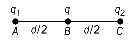
Two unit negative charges are placed on a straight line. $A$ positive charge $q$ is placed exactly at the midpoint between these unit charges. If the system of these three charges is in equilibrium,the value of $q$ (in $C$) is
A
$0.25$
B
$0.75$
C
$0.5$
D
$1.0$
Solution
(A) Let the two unit negative charges be $q_1 = q_2 = -1 \text{ C}$ separated by a distance $d$. The charge $q$ is placed at the midpoint. For the system to be in equilibrium,the net force on each charge must be zero.
Consider the force on charge $q_1$ at point $A$ due to charges $q$ at $B$ and $q_2$ at $C$:
$F_A = \frac{1}{4 \pi \varepsilon_0} \frac{q_1 q}{(d/2)^2} + \frac{1}{4 \pi \varepsilon_0} \frac{q_1 q_2}{d^2} = 0$
Dividing by $\frac{1}{4 \pi \varepsilon_0} q_1$,we get:
$\frac{q}{(d/2)^2} + \frac{q_2}{d^2} = 0$
$\frac{4q}{d^2} + \frac{q_2}{d^2} = 0$
$4q = -q_2$
Since $q_2 = -1 \text{ C}$,we have $4q = -(-1) = 1$.
Therefore,$q = \frac{1}{4} = 0.25 \text{ C}$.
Consider the force on charge $q_1$ at point $A$ due to charges $q$ at $B$ and $q_2$ at $C$:
$F_A = \frac{1}{4 \pi \varepsilon_0} \frac{q_1 q}{(d/2)^2} + \frac{1}{4 \pi \varepsilon_0} \frac{q_1 q_2}{d^2} = 0$
Dividing by $\frac{1}{4 \pi \varepsilon_0} q_1$,we get:
$\frac{q}{(d/2)^2} + \frac{q_2}{d^2} = 0$
$\frac{4q}{d^2} + \frac{q_2}{d^2} = 0$
$4q = -q_2$
Since $q_2 = -1 \text{ C}$,we have $4q = -(-1) = 1$.
Therefore,$q = \frac{1}{4} = 0.25 \text{ C}$.
0 likesView Solution
35
PhysicsDifficultMCQTS EAMCET · 2007
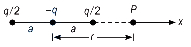
Along the $x$-axis,three charges $\frac{q}{2}, -q$ and $\frac{q}{2}$ are placed at $x=0, x=a$ and $x=2a$ respectively. The resultant electric potential at a point $P$ located at a distance $r$ from the charge $-q$ $(r > a)$ is ($\varepsilon_0$ is the permittivity of free space):
A
$\frac{q a}{4 \pi \varepsilon_0 r^2}$
B
$\frac{q a^2}{4 \pi \varepsilon_0 r^3}$
C
$\frac{q(a^2/4)}{4 \pi \varepsilon_0 r^3}$
D
$\frac{q}{4 \pi \varepsilon_0 r}$
Solution
(B) The charges are located at $x=0$ $(q/2)$,$x=a$ $(-q)$,and $x=2a$ $(q/2)$. Point $P$ is at distance $r$ from the charge $-q$ at $x=a$. Since $P$ is on the $x$-axis at distance $r$ from $x=a$,its coordinate is $x = a + r$.
The potential $V$ at point $P$ is the sum of potentials due to individual charges:
$V = \frac{1}{4 \pi \varepsilon_0} \left[ \frac{q/2}{r+a} - \frac{q}{r} + \frac{q/2}{r-a} \right]$
Factoring out $q/2$:
$V = \frac{q}{8 \pi \varepsilon_0} \left[ \frac{1}{r+a} - \frac{2}{r} + \frac{1}{r-a} \right]$
Combining the terms:
$V = \frac{q}{8 \pi \varepsilon_0} \left[ \frac{r(r-a) - 2(r^2-a^2) + r(r+a)}{r(r^2-a^2)} \right]$
Simplifying the numerator:
$V = \frac{q}{8 \pi \varepsilon_0} \left[ \frac{r^2 - ar - 2r^2 + 2a^2 + r^2 + ar}{r(r^2-a^2)} \right] = \frac{q}{8 \pi \varepsilon_0} \left[ \frac{2a^2}{r(r^2-a^2)} \right]$
Since $r \gg a$,we can approximate $r^2 - a^2 \approx r^2$:
$V \approx \frac{q}{8 \pi \varepsilon_0} \cdot \frac{2a^2}{r^3} = \frac{q a^2}{4 \pi \varepsilon_0 r^3}$
The potential $V$ at point $P$ is the sum of potentials due to individual charges:
$V = \frac{1}{4 \pi \varepsilon_0} \left[ \frac{q/2}{r+a} - \frac{q}{r} + \frac{q/2}{r-a} \right]$
Factoring out $q/2$:
$V = \frac{q}{8 \pi \varepsilon_0} \left[ \frac{1}{r+a} - \frac{2}{r} + \frac{1}{r-a} \right]$
Combining the terms:
$V = \frac{q}{8 \pi \varepsilon_0} \left[ \frac{r(r-a) - 2(r^2-a^2) + r(r+a)}{r(r^2-a^2)} \right]$
Simplifying the numerator:
$V = \frac{q}{8 \pi \varepsilon_0} \left[ \frac{r^2 - ar - 2r^2 + 2a^2 + r^2 + ar}{r(r^2-a^2)} \right] = \frac{q}{8 \pi \varepsilon_0} \left[ \frac{2a^2}{r(r^2-a^2)} \right]$
Since $r \gg a$,we can approximate $r^2 - a^2 \approx r^2$:
$V \approx \frac{q}{8 \pi \varepsilon_0} \cdot \frac{2a^2}{r^3} = \frac{q a^2}{4 \pi \varepsilon_0 r^3}$
0 likesView Solution
36
PhysicsDifficultMCQTS EAMCET · 2007
Along the $X$-axis,three charges $\frac{q}{2}, -q$ and $\frac{q}{2}$ are placed at $x=0, x=a$ and $x=2a$ respectively. The resultant electric potential at $x=a+r$ (if $a << r$) is: ($\varepsilon_0$ is the permittivity of free space)
A
$\frac{q a}{4 \pi \varepsilon_0 r^2}$
B
$\frac{q a^2}{4 \pi \varepsilon_0 r^3}$
C
$\frac{q(a^2/4)}{4 \pi \varepsilon_0 r^3}$
D
$\frac{q}{4 \pi \varepsilon_0 r}$
Solution
(B) The electric potential $V$ at a point due to a system of charges is the algebraic sum of the potentials due to individual charges.
Let the point $P$ be at $x = a + r$. The distances of the charges from $P$ are:
For charge $\frac{q}{2}$ at $x=0$: distance $d_1 = (a+r) - 0 = r+a$
For charge $-q$ at $x=a$: distance $d_2 = (a+r) - a = r$
For charge $\frac{q}{2}$ at $x=2a$: distance $d_3 = |(a+r) - 2a| = |r-a| = r-a$ (since $r >> a$)
The total potential $V_P$ is:
$V_P = \frac{1}{4 \pi \varepsilon_0} \left[ \frac{q/2}{r+a} - \frac{q}{r} + \frac{q/2}{r-a} \right]$
$V_P = \frac{q}{4 \pi \varepsilon_0} \left[ \frac{1}{2(r+a)} - \frac{1}{r} + \frac{1}{2(r-a)} \right]$
$V_P = \frac{q}{4 \pi \varepsilon_0} \left[ \frac{r(r-a) - 2(r^2-a^2) + r(r+a)}{2r(r^2-a^2)} \right]$
$V_P = \frac{q}{4 \pi \varepsilon_0} \left[ \frac{r^2 - ar - 2r^2 + 2a^2 + r^2 + ar}{2r(r^2-a^2)} \right]$
$V_P = \frac{q}{4 \pi \varepsilon_0} \left[ \frac{2a^2}{2r(r^2-a^2)} \right] = \frac{q a^2}{4 \pi \varepsilon_0 r(r^2-a^2)}$
Since $r >> a$,we have $r^2 - a^2 \approx r^2$.
Therefore,$V_P = \frac{q a^2}{4 \pi \varepsilon_0 r^3}$.
Let the point $P$ be at $x = a + r$. The distances of the charges from $P$ are:
For charge $\frac{q}{2}$ at $x=0$: distance $d_1 = (a+r) - 0 = r+a$
For charge $-q$ at $x=a$: distance $d_2 = (a+r) - a = r$
For charge $\frac{q}{2}$ at $x=2a$: distance $d_3 = |(a+r) - 2a| = |r-a| = r-a$ (since $r >> a$)
The total potential $V_P$ is:
$V_P = \frac{1}{4 \pi \varepsilon_0} \left[ \frac{q/2}{r+a} - \frac{q}{r} + \frac{q/2}{r-a} \right]$
$V_P = \frac{q}{4 \pi \varepsilon_0} \left[ \frac{1}{2(r+a)} - \frac{1}{r} + \frac{1}{2(r-a)} \right]$
$V_P = \frac{q}{4 \pi \varepsilon_0} \left[ \frac{r(r-a) - 2(r^2-a^2) + r(r+a)}{2r(r^2-a^2)} \right]$
$V_P = \frac{q}{4 \pi \varepsilon_0} \left[ \frac{r^2 - ar - 2r^2 + 2a^2 + r^2 + ar}{2r(r^2-a^2)} \right]$
$V_P = \frac{q}{4 \pi \varepsilon_0} \left[ \frac{2a^2}{2r(r^2-a^2)} \right] = \frac{q a^2}{4 \pi \varepsilon_0 r(r^2-a^2)}$
Since $r >> a$,we have $r^2 - a^2 \approx r^2$.
Therefore,$V_P = \frac{q a^2}{4 \pi \varepsilon_0 r^3}$.

0 likesView Solution
37
PhysicsDifficultMCQTS EAMCET · 2007
$A$ bar magnet of magnetic moment $M$ and moment of inertia $I$ is freely suspended such that the magnetic axial line is in the direction of the magnetic meridian. If the magnet is displaced by a very small angle $\theta$,the angular acceleration is (Magnetic induction of earth's horizontal field $= B_H$)
A
$\frac{M B_H \theta}{I}$
B
$\frac{I B_H \theta}{M}$
C
$\frac{M \theta}{I B_H}$
D
$\frac{I \theta}{M B_H}$
Solution
(A) When a magnet is displaced by a very small angle $\theta$,the restoring torque acting on the magnet is given by $\tau = -M B_H \sin \theta$.
The negative sign indicates the restoring nature of the torque.
Since $\tau = I \alpha$,where $I$ is the moment of inertia and $\alpha$ is the angular acceleration,we have $I \alpha = -M B_H \sin \theta$.
For small angular displacements,$\sin \theta \approx \theta$.
Therefore,$I \alpha = -M B_H \theta$.
The magnitude of the angular acceleration is $\alpha = \frac{M B_H \theta}{I}$.
The negative sign indicates the restoring nature of the torque.
Since $\tau = I \alpha$,where $I$ is the moment of inertia and $\alpha$ is the angular acceleration,we have $I \alpha = -M B_H \sin \theta$.
For small angular displacements,$\sin \theta \approx \theta$.
Therefore,$I \alpha = -M B_H \theta$.
The magnitude of the angular acceleration is $\alpha = \frac{M B_H \theta}{I}$.
0 likesView Solution
38
PhysicsDifficultMCQTS EAMCET · 2007
Two wires $A$ and $B$ are of lengths $40 \ cm$ and $30 \ cm$. $A$ is bent into a circle of radius $r$ and $B$ into an arc of radius $r$. $A$ current $i_1$ is passed through $A$ and $i_2$ through $B$. To have the same magnetic inductions at the centre,the ratio of $i_1: i_2$ is
A
$3: 4$
B
$3: 5$
C
$2: 3$
D
$4: 3$
Solution
(A) For wire $A$,the magnetic field at the center of a circular loop is $B_1 = \frac{\mu_0 i_1}{2r}$.
Given the length of wire $A$ is $40 \ cm$,the circumference is $2\pi r = 40 \ cm$,so $r = \frac{40}{2\pi}$.
For wire $B$,the magnetic field at the center of an arc of radius $r$ subtending an angle $\theta$ is $B_2 = \frac{\mu_0 i_2 \theta}{4\pi r}$.
The length of wire $B$ is $30 \ cm$,so the arc length $s = r\theta = 30 \ cm$.
Thus,$\theta = \frac{30}{r} = \frac{30}{40/2\pi} = \frac{3}{2}\pi$.
Setting $B_1 = B_2$:
$\frac{\mu_0 i_1}{2r} = \frac{\mu_0 i_2 \theta}{4\pi r}$
$\frac{i_1}{2} = \frac{i_2 \theta}{4\pi} = \frac{i_2 (3\pi/2)}{4\pi} = \frac{3i_2}{8}$
$\frac{i_1}{i_2} = \frac{3}{8} \times 2 = \frac{3}{4}$.
Therefore,the ratio $i_1: i_2$ is $3: 4$.
Given the length of wire $A$ is $40 \ cm$,the circumference is $2\pi r = 40 \ cm$,so $r = \frac{40}{2\pi}$.
For wire $B$,the magnetic field at the center of an arc of radius $r$ subtending an angle $\theta$ is $B_2 = \frac{\mu_0 i_2 \theta}{4\pi r}$.
The length of wire $B$ is $30 \ cm$,so the arc length $s = r\theta = 30 \ cm$.
Thus,$\theta = \frac{30}{r} = \frac{30}{40/2\pi} = \frac{3}{2}\pi$.
Setting $B_1 = B_2$:
$\frac{\mu_0 i_1}{2r} = \frac{\mu_0 i_2 \theta}{4\pi r}$
$\frac{i_1}{2} = \frac{i_2 \theta}{4\pi} = \frac{i_2 (3\pi/2)}{4\pi} = \frac{3i_2}{8}$
$\frac{i_1}{i_2} = \frac{3}{8} \times 2 = \frac{3}{4}$.
Therefore,the ratio $i_1: i_2$ is $3: 4$.
0 likesView Solution
39
PhysicsDifficultMCQTS EAMCET · 2007
An electron beam travels with a velocity of $1.6 \times 10^7 \ m/s$ perpendicularly to a magnetic field of intensity $0.1 \ T$. Calculate the radius of the path of the electron beam. (Given: mass of electron $m_e = 9 \times 10^{-31} \ kg$)
A
$9 \times 10^{-5} \ m$
B
$9 \times 10^{-2} \ m$
C
$9 \times 10^{-4} \ m$
D
$9 \times 10^{-3} \ m$
Solution
(C) When a charged particle moves perpendicularly to a uniform magnetic field,it follows a circular path.
The radius $r$ of the circular path is given by the formula:
$r = \frac{mv}{qB}$
Given values:
Mass of electron $m = 9 \times 10^{-31} \ kg$
Velocity $v = 1.6 \times 10^7 \ m/s$
Charge of electron $e = 1.6 \times 10^{-19} \ C$
Magnetic field $B = 0.1 \ T$
Substituting these values into the formula:
$r = \frac{9 \times 10^{-31} \times 1.6 \times 10^7}{1.6 \times 10^{-19} \times 0.1}$
$r = \frac{9 \times 1.6 \times 10^{-24}}{1.6 \times 10^{-20}}$
$r = 9 \times 10^{-4} \ m$
The radius $r$ of the circular path is given by the formula:
$r = \frac{mv}{qB}$
Given values:
Mass of electron $m = 9 \times 10^{-31} \ kg$
Velocity $v = 1.6 \times 10^7 \ m/s$
Charge of electron $e = 1.6 \times 10^{-19} \ C$
Magnetic field $B = 0.1 \ T$
Substituting these values into the formula:
$r = \frac{9 \times 10^{-31} \times 1.6 \times 10^7}{1.6 \times 10^{-19} \times 0.1}$
$r = \frac{9 \times 1.6 \times 10^{-24}}{1.6 \times 10^{-20}}$
$r = 9 \times 10^{-4} \ m$
0 likesView Solution
40
PhysicsDifficultMCQTS EAMCET · 2007
Velocity and acceleration vectors of a charged particle moving perpendicular to the direction of a magnetic field at a given instant of time are $\overrightarrow{v}=2 \hat{i}+c \hat{j}$ and $\overrightarrow{a}=3 \hat{i}+4 \hat{j}$ respectively. Then the value of $c$ is
A
$3$
B
$1.5$
C
$-1.5$
D
$-3$
Solution
(C) When a charged particle moves perpendicular to a uniform magnetic field,it follows a circular path. On a circular path,the velocity vector is always tangent to the path,and the acceleration vector (centripetal acceleration) is directed towards the center of the circle. Therefore,the velocity and acceleration vectors are always perpendicular to each other at any instant.
Given,$\overrightarrow{v}=2 \hat{i}+c \hat{j}$ and $\overrightarrow{a}=3 \hat{i}+4 \hat{j}$.
Since $\overrightarrow{v} \perp \overrightarrow{a}$,their dot product must be zero:
$\overrightarrow{v} \cdot \overrightarrow{a} = 0$
$(2 \hat{i} + c \hat{j}) \cdot (3 \hat{i} + 4 \hat{j}) = 0$
$(2)(3) + (c)(4) = 0$
$6 + 4c = 0$
$4c = -6$
$c = -1.5$
Given,$\overrightarrow{v}=2 \hat{i}+c \hat{j}$ and $\overrightarrow{a}=3 \hat{i}+4 \hat{j}$.
Since $\overrightarrow{v} \perp \overrightarrow{a}$,their dot product must be zero:
$\overrightarrow{v} \cdot \overrightarrow{a} = 0$
$(2 \hat{i} + c \hat{j}) \cdot (3 \hat{i} + 4 \hat{j}) = 0$
$(2)(3) + (c)(4) = 0$
$6 + 4c = 0$
$4c = -6$
$c = -1.5$
0 likesView Solution
41
PhysicsDifficultMCQTS EAMCET · 2007
$A$ bar magnet of moment of inertia $49 \times 10^{-2} \,kg-m^2$ vibrates in a magnetic field of induction $0.5 \times 10^{-4} \,T$. The time period of vibration is $8.8 \,s$. The magnetic moment of the bar magnet is (in $\,A-m^2$)
A
$350$
B
$490$
C
$3300$
D
$5000$
Solution
(D) The time period $T$ of a vibrating bar magnet in a magnetic field is given by the formula:
$T = 2 \pi \sqrt{\frac{I}{MH}}$
Where $I$ is the moment of inertia,$M$ is the magnetic moment,and $H$ is the magnetic field induction.
Squaring both sides,we get:
$T^2 = 4 \pi^2 \frac{I}{MH}$
Rearranging for $M$:
$M = \frac{4 \pi^2 I}{T^2 H}$
Substituting the given values:
$I = 49 \times 10^{-2} \,kg-m^2$,$H = 0.5 \times 10^{-4} \,T$,$T = 8.8 \,s$,and $\pi \approx 3.14$:
$M = \frac{4 \times (3.14)^2 \times 49 \times 10^{-2}}{(8.8)^2 \times 0.5 \times 10^{-4}}$
$M = \frac{4 \times 9.8596 \times 49 \times 10^{-2}}{77.44 \times 0.5 \times 10^{-4}}$
$M = \frac{1932.48 \times 10^{-2}}{38.72 \times 10^{-4}}$
$M = 49.909 \times 10^2 \approx 5000 \,A-m^2$.
$T = 2 \pi \sqrt{\frac{I}{MH}}$
Where $I$ is the moment of inertia,$M$ is the magnetic moment,and $H$ is the magnetic field induction.
Squaring both sides,we get:
$T^2 = 4 \pi^2 \frac{I}{MH}$
Rearranging for $M$:
$M = \frac{4 \pi^2 I}{T^2 H}$
Substituting the given values:
$I = 49 \times 10^{-2} \,kg-m^2$,$H = 0.5 \times 10^{-4} \,T$,$T = 8.8 \,s$,and $\pi \approx 3.14$:
$M = \frac{4 \times (3.14)^2 \times 49 \times 10^{-2}}{(8.8)^2 \times 0.5 \times 10^{-4}}$
$M = \frac{4 \times 9.8596 \times 49 \times 10^{-2}}{77.44 \times 0.5 \times 10^{-4}}$
$M = \frac{1932.48 \times 10^{-2}}{38.72 \times 10^{-4}}$
$M = 49.909 \times 10^2 \approx 5000 \,A-m^2$.
0 likesView Solution
42
PhysicsDifficultMCQTS EAMCET · 2007
In a Ramsden eyepiece,two plano-convex lenses,each of focal length $f$,are separated by a distance of $d = 2f/3$. If the separation distance is $12 \ cm$,what is the equivalent focal length (in $cm$) of the eyepiece?
A
$10.5$
B
$12.0$
C
$13.5$
D
$15.5$
Solution
(C) For a Ramsden eyepiece,the separation distance $d$ between the two plano-convex lenses is given by $d = \frac{2f}{3}$.
Given that $d = 12 \ cm$,we can find the focal length $f$ of each lens:
$12 = \frac{2f}{3} \implies f = \frac{12 \times 3}{2} = 18 \ cm$.
The equivalent focal length $f_{eq}$ of a Ramsden eyepiece is given by the formula:
$f_{eq} = \frac{f_1 f_2}{f_1 + f_2 - d}$.
Substituting $f_1 = f_2 = f$ and $d = \frac{2f}{3}$:
$f_{eq} = \frac{f^2}{2f - \frac{2f}{3}} = \frac{f^2}{\frac{4f}{3}} = \frac{3f}{4}$.
Substituting $f = 18 \ cm$:
$f_{eq} = \frac{3 \times 18}{4} = \frac{54}{4} = 13.5 \ cm$.
Given that $d = 12 \ cm$,we can find the focal length $f$ of each lens:
$12 = \frac{2f}{3} \implies f = \frac{12 \times 3}{2} = 18 \ cm$.
The equivalent focal length $f_{eq}$ of a Ramsden eyepiece is given by the formula:
$f_{eq} = \frac{f_1 f_2}{f_1 + f_2 - d}$.
Substituting $f_1 = f_2 = f$ and $d = \frac{2f}{3}$:
$f_{eq} = \frac{f^2}{2f - \frac{2f}{3}} = \frac{f^2}{\frac{4f}{3}} = \frac{3f}{4}$.
Substituting $f = 18 \ cm$:
$f_{eq} = \frac{3 \times 18}{4} = \frac{54}{4} = 13.5 \ cm$.
0 likesView Solution
43
PhysicsDifficultMCQTS EAMCET · 2007
The refractive index of the material of a double convex lens is $1.5$ and its focal length is $5 \,cm$. If the radii of curvature are equal, the value of the radius of curvature (in $cm$) is
A
$5.0$
B
$6.5$
C
$8.0$
D
$9.5$
Solution
(A) The lens maker's formula is given by $\frac{1}{f} = (\mu - 1) \left( \frac{1}{R_1} - \frac{1}{R_2} \right)$.
For a double convex lens, the radii of curvature are $R_1 = R$ and $R_2 = -R$.
Given $\mu = 1.5$ and $f = 5 \,cm$.
Substituting these values into the formula:
$\frac{1}{5} = (1.5 - 1) \left( \frac{1}{R} - \frac{1}{-R} \right)$
$\frac{1}{5} = 0.5 \times \left( \frac{1}{R} + \frac{1}{R} \right)$
$\frac{1}{5} = 0.5 \times \frac{2}{R}$
$\frac{1}{5} = \frac{1}{R}$
Therefore, $R = 5 \,cm$.
For a double convex lens, the radii of curvature are $R_1 = R$ and $R_2 = -R$.
Given $\mu = 1.5$ and $f = 5 \,cm$.
Substituting these values into the formula:
$\frac{1}{5} = (1.5 - 1) \left( \frac{1}{R} - \frac{1}{-R} \right)$
$\frac{1}{5} = 0.5 \times \left( \frac{1}{R} + \frac{1}{R} \right)$
$\frac{1}{5} = 0.5 \times \frac{2}{R}$
$\frac{1}{5} = \frac{1}{R}$
Therefore, $R = 5 \,cm$.
0 likesView Solution
44
PhysicsMediumMCQTS EAMCET · 2007
In an $n$-type semiconductor,the Fermi energy level lies
A
in the forbidden energy gap nearer to the conduction band
B
in the forbidden energy gap nearer to the valence band
C
in the middle of forbidden energy gap
D
outside the forbidden energy gap
Solution
(A) In an $n$-type semiconductor,the addition of donor impurity atoms creates discrete energy levels just below the conduction band.
As the concentration of electrons in the conduction band increases due to these donor levels,the Fermi energy level shifts upward from the middle of the forbidden gap.
Therefore,in an $n$-type semiconductor,the Fermi energy level lies in the forbidden energy gap,closer to the conduction band.
As the concentration of electrons in the conduction band increases due to these donor levels,the Fermi energy level shifts upward from the middle of the forbidden gap.
Therefore,in an $n$-type semiconductor,the Fermi energy level lies in the forbidden energy gap,closer to the conduction band.
0 likesView Solution
45
PhysicsMediumMCQTS EAMCET · 2007
Temperature of cold junction in a thermocouple is $10^{\circ} C$ and neutral temperature is $270^{\circ} C$,then the temperature of inversion is (in $^{\circ} C$)
A
$540$
B
$530$
C
$280$
D
$260$
Solution
(B) The relationship between the temperature of inversion $(T_i)$,neutral temperature $(T_n)$,and the temperature of the cold junction $(T_0)$ is given by the formula:
$T_n = \frac{T_i + T_0}{2}$
Rearranging the formula to solve for $T_i$:
$T_i = 2T_n - T_0$
Given values are $T_0 = 10^{\circ} C$ and $T_n = 270^{\circ} C$.
Substituting these values into the equation:
$T_i = 2 \times 270^{\circ} C - 10^{\circ} C$
$T_i = 540^{\circ} C - 10^{\circ} C$
$T_i = 530^{\circ} C$
Therefore,the temperature of inversion is $530^{\circ} C$.
$T_n = \frac{T_i + T_0}{2}$
Rearranging the formula to solve for $T_i$:
$T_i = 2T_n - T_0$
Given values are $T_0 = 10^{\circ} C$ and $T_n = 270^{\circ} C$.
Substituting these values into the equation:
$T_i = 2 \times 270^{\circ} C - 10^{\circ} C$
$T_i = 540^{\circ} C - 10^{\circ} C$
$T_i = 530^{\circ} C$
Therefore,the temperature of inversion is $530^{\circ} C$.
0 likesView Solution
46
PhysicsMediumMCQTS EAMCET · 2007
In Huygen's eyepiece,
A
the cross wires are outside the eyepiece
B
condition for achromatism is satisfied
C
condition for minimum spherical aberration is not satisfied
D
the image formed by the objective is a virtual image
Solution
(B) The Huygen eyepiece is designed such that the distance between the two plano-convex lenses is equal to half the sum of their focal lengths. This specific configuration satisfies the condition for achromatism (elimination of chromatic aberration) and also minimizes spherical aberration.
0 likesView Solution
Vedclass Products
For Students
Vedclass Test Series
Mock tests in real TS EAMCET style covering Physics with performance analysis. 5-day free trial.
Start Free TrialFor Teachers
Exam Paper Generator
Generate Set A/B/C/D Physics papers from 7.5L+ questions in 2 minutes. 3 chapters free.
Try FreeFor Institutes
Online Exam Module
Run live TS EAMCET mock exams with unlimited students, 360° analytics & white-label branding.
See DemoFrequently Asked Questions
How many Physics questions are in TS EAMCET 2007?
There are 46 Physics questions from the TS EAMCET 2007 paper on Vedclass, each with a detailed step-by-step solution in English.
Are TS EAMCET 2007 Physics solutions available in English?
Yes. All solutions on this page are in English. You can also switch to English or Hindi using the language buttons above the questions.
Can I practice TS EAMCET 2007 Physics as a timed test?
Yes. Use the Vedclass Test Series to attempt a full TS EAMCET mock test covering Physics with time limits and instant score analysis.
Can teachers create Physics papers from TS EAMCET previous year questions?
Yes. The Vedclass Exam Paper Generator lets teachers mix TS EAMCET Physics questions and generate Set A/B/C/D papers in minutes.
For Teachers & Institutes
Build a Custom Physics Paper
Pick TS EAMCET 2007 Physics questions, set difficulty, and generate Set A/B/C/D in 2 minutes.