
ChemistryQ1–71 of 71 questions
Page 1 of 1 · English
1
ChemistryMCQNEET · 2014
When the margins of sepals or petals overlap one another without any particular direction,the condition is termed as
A
vexillary
B
imbricate
C
twisted
D
valvate
Solution
(B) : Aestivation is the arrangement of accessory floral organs (sepals or petals) in relation to one another in a floral bud. It may be of open,valvate,twisted,or imbricate type.
In imbricate aestivation,there is an irregular overlapping of petals or sepals by one another without any specific direction.
It has subtypes such as quincuncial,ascending imbricate,and descending imbricate (also known as vexillary).
Examples include $Cassia$ and $Gulmohur$.
In imbricate aestivation,there is an irregular overlapping of petals or sepals by one another without any specific direction.
It has subtypes such as quincuncial,ascending imbricate,and descending imbricate (also known as vexillary).
Examples include $Cassia$ and $Gulmohur$.
0 likesView Solution
2
ChemistryMCQNEET · 2014
Which one of the following is a non-reducing carbohydrate?
A
Maltose
B
Sucrose
C
Lactose
D
Ribose $5$-phosphate
Solution
(B) The correct answer is $B$.
In non-reducing sugars,a free aldehyde or ketonic group is absent.
Sucrose is a non-reducing sugar formed by the condensation of one molecule each of glucose and fructose with the release of a water molecule.
$A$ glycosidic bond is established between carbon atom $1$ of glucose and carbon atom $2$ of fructose,which masks the functional groups required for reduction.
In non-reducing sugars,a free aldehyde or ketonic group is absent.
Sucrose is a non-reducing sugar formed by the condensation of one molecule each of glucose and fructose with the release of a water molecule.
$A$ glycosidic bond is established between carbon atom $1$ of glucose and carbon atom $2$ of fructose,which masks the functional groups required for reduction.
0 likesView Solution
3
ChemistryMCQNEET · 2014
Geitonogamy involves
A
fertilization of a flower by the pollen from another flower of the same plant
B
fertilization of a flower by the pollen from the same flower
C
fertilization of a flower by the pollen from a flower of another plant in the same population
D
fertilization of a flower by the pollen from a flower of another plant belonging to a distant population.
Solution
(A) $Geitonogamy$ is the transfer of pollen grains from the anther to the stigma of another flower of the same plant.
Since the flowers are borne on the same plant,they are genetically identical.
Therefore,genetically,$Geitonogamy$ is a type of self-pollination ($Autogamy$ equivalent).
However,because it requires a pollinating agent to transfer the pollen,it is ecologically considered a type of cross-pollination.
Since the flowers are borne on the same plant,they are genetically identical.
Therefore,genetically,$Geitonogamy$ is a type of self-pollination ($Autogamy$ equivalent).
However,because it requires a pollinating agent to transfer the pollen,it is ecologically considered a type of cross-pollination.
0 likesView Solution
4
ChemistryMCQNEET · 2014
Forelimbs of cat,lizard used in walking; forelimbs of whale used in swimming and forelimbs of bats used in flying are an example of
A
analogous organs
B
adaptive radiation
C
homologous organs
D
convergent evolution
Solution
(C) : The organs which have the same fundamental structure but are different in functions are called homologous organs.
These organs follow the same basic plan of organisation during their development.
However,in the adult condition,these organs are modified to perform different functions as an adaptation to different environments.
The forelimbs of cat,lizard,whale,and bat have the same basic structural plan.
In each case,the forelimb consists of humerus,radius-ulna,carpals,metacarpals,and digits.
The skeletal parts of the forelimbs of all these vertebrates are similar in structure and arrangement.
But the forelimbs of these animals have different shapes and functions.
In lizard,they are used for walking; in cat,for running; in whale,for swimming; and in bat,for flying.
These organs follow the same basic plan of organisation during their development.
However,in the adult condition,these organs are modified to perform different functions as an adaptation to different environments.
The forelimbs of cat,lizard,whale,and bat have the same basic structural plan.
In each case,the forelimb consists of humerus,radius-ulna,carpals,metacarpals,and digits.
The skeletal parts of the forelimbs of all these vertebrates are similar in structure and arrangement.
But the forelimbs of these animals have different shapes and functions.
In lizard,they are used for walking; in cat,for running; in whale,for swimming; and in bat,for flying.
0 likesView Solution
5
ChemistryMediumMCQNEET · 2014
Equal masses of $H_2, O_2$ and methane have been taken in a container of volume $V$ at temperature $27 \ ^oC$ in identical conditions. The ratio of the volumes of gases $H_2 : O_2 :$ methane would be
A
$8 : 16 : 1$
B
$16 : 8 : 1$
C
$16 : 1 : 2$
D
$8 : 1 : 2$
Solution
(C) According to Avogadro's hypothesis,the volume of a gas $(V)$ is directly proportional to the number of moles $(n)$ at constant temperature and pressure.
Therefore,the ratio of the volumes of gases is equal to the ratio of their moles.
Let the mass of each gas be $m$.
The molar masses are: $M_{H_2} = 2 \ g/mol$,$M_{O_2} = 32 \ g/mol$,and $M_{CH_4} = 16 \ g/mol$.
The ratio of volumes is:
$V_{H_2} : V_{O_2} : V_{CH_4} = n_{H_2} : n_{O_2} : n_{CH_4} = \frac{m}{2} : \frac{m}{32} : \frac{m}{16}$.
Multiplying by $32/m$,we get:
$16 : 1 : 2$.
Therefore,the ratio of the volumes of gases is equal to the ratio of their moles.
Let the mass of each gas be $m$.
The molar masses are: $M_{H_2} = 2 \ g/mol$,$M_{O_2} = 32 \ g/mol$,and $M_{CH_4} = 16 \ g/mol$.
The ratio of volumes is:
$V_{H_2} : V_{O_2} : V_{CH_4} = n_{H_2} : n_{O_2} : n_{CH_4} = \frac{m}{2} : \frac{m}{32} : \frac{m}{16}$.
Multiplying by $32/m$,we get:
$16 : 1 : 2$.
0 likesView Solution
6
ChemistryMCQNEET · 2014
When $22.4 \ L$ of $H_{2(g)}$ is mixed with $11.2 \ L$ of $Cl_{2(g)}$,each at $S.T.P.$,the moles of $HCl_{(g)}$ formed is equal to
A
$1 \ mol$ of $HCl_{(g)}$
B
$2 \ mol$ of $HCl_{(g)}$
C
$0.5 \ mol$ of $HCl_{(g)}$
D
$1.5 \ mol$ of $HCl_{(g)}$
Solution
(A) The reaction is: $H_{2(g)} + Cl_{2(g)} \rightarrow 2HCl_{(g)}$
At $S.T.P.$,$22.4 \ L$ of any gas corresponds to $1 \ mol$.
Initial moles of $H_2 = \frac{22.4 \ L}{22.4 \ L/mol} = 1 \ mol$.
Initial moles of $Cl_2 = \frac{11.2 \ L}{22.4 \ L/mol} = 0.5 \ mol$.
According to the stoichiometry,$1 \ mol$ of $H_2$ reacts with $1 \ mol$ of $Cl_2$.
Since $Cl_2$ is present in a smaller amount $(0.5 \ mol < 1 \ mol)$,it is the limiting reagent.
The amount of $HCl$ formed is determined by the limiting reagent $(Cl_2)$:
$1 \ mol$ of $Cl_2$ produces $2 \ mol$ of $HCl$.
Therefore,$0.5 \ mol$ of $Cl_2$ produces $2 \times 0.5 = 1.0 \ mol$ of $HCl$.
At $S.T.P.$,$22.4 \ L$ of any gas corresponds to $1 \ mol$.
Initial moles of $H_2 = \frac{22.4 \ L}{22.4 \ L/mol} = 1 \ mol$.
Initial moles of $Cl_2 = \frac{11.2 \ L}{22.4 \ L/mol} = 0.5 \ mol$.
According to the stoichiometry,$1 \ mol$ of $H_2$ reacts with $1 \ mol$ of $Cl_2$.
Since $Cl_2$ is present in a smaller amount $(0.5 \ mol < 1 \ mol)$,it is the limiting reagent.
The amount of $HCl$ formed is determined by the limiting reagent $(Cl_2)$:
$1 \ mol$ of $Cl_2$ produces $2 \ mol$ of $HCl$.
Therefore,$0.5 \ mol$ of $Cl_2$ produces $2 \times 0.5 = 1.0 \ mol$ of $HCl$.
0 likesView Solution
7
ChemistryDifficultMCQNEET · 2014
$1.0 \ g$ of magnesium is burnt with $0.56 \ g \ O_2$ in a closed vessel. Which reactant is left in excess and how much? (At. $wt. \ Mg = 24, O = 16$)
A
$Mg, 0.16 \ g$
B
$O_2, 0.16 \ g$
C
$Mg, 0.44 \ g$
D
$O_2, 0.28 \ g$
Solution
(A) The balanced chemical reaction is: $2Mg + O_2 \rightarrow 2MgO$.
Moles of $Mg = \frac{1.0 \ g}{24 \ g/mol} = 0.04167 \ mol$.
Moles of $O_2 = \frac{0.56 \ g}{32 \ g/mol} = 0.0175 \ mol$.
According to the stoichiometry,$2 \ mol$ of $Mg$ requires $1 \ mol$ of $O_2$.
Therefore,$0.04167 \ mol$ of $Mg$ would require $\frac{0.04167}{2} = 0.020835 \ mol$ of $O_2$.
Since we have only $0.0175 \ mol$ of $O_2$,$O_2$ is the limiting reagent.
$Mg$ consumed $= 2 \times \text{moles of } O_2 = 2 \times 0.0175 = 0.035 \ mol$.
$Mg$ left $= 0.04167 - 0.035 = 0.00667 \ mol$.
Mass of $Mg$ left $= 0.00667 \ mol \times 24 \ g/mol = 0.16 \ g$.
Moles of $Mg = \frac{1.0 \ g}{24 \ g/mol} = 0.04167 \ mol$.
Moles of $O_2 = \frac{0.56 \ g}{32 \ g/mol} = 0.0175 \ mol$.
According to the stoichiometry,$2 \ mol$ of $Mg$ requires $1 \ mol$ of $O_2$.
Therefore,$0.04167 \ mol$ of $Mg$ would require $\frac{0.04167}{2} = 0.020835 \ mol$ of $O_2$.
Since we have only $0.0175 \ mol$ of $O_2$,$O_2$ is the limiting reagent.
$Mg$ consumed $= 2 \times \text{moles of } O_2 = 2 \times 0.0175 = 0.035 \ mol$.
$Mg$ left $= 0.04167 - 0.035 = 0.00667 \ mol$.
Mass of $Mg$ left $= 0.00667 \ mol \times 24 \ g/mol = 0.16 \ g$.
0 likesView Solution
8
ChemistryMediumMCQNEET · 2014
What is the maximum number of orbitals that can be identified with the following quantum numbers?
$n = 3, l = 1, m_l = 0$
$n = 3, l = 1, m_l = 0$
A
$1$
B
$2$
C
$3$
D
$4$
Solution
(A) The quantum numbers $n = 3$,$l = 1$,and $m_l = 0$ uniquely define a single orbital.
$n = 3$ indicates the third shell.
$l = 1$ indicates a $p$-subshell.
$m_l = 0$ specifies a particular orbital within the $p$-subshell (typically $3p_z$).
Since all three quantum numbers are fixed,they correspond to exactly $1$ orbital.
$n = 3$ indicates the third shell.
$l = 1$ indicates a $p$-subshell.
$m_l = 0$ specifies a particular orbital within the $p$-subshell (typically $3p_z$).
Since all three quantum numbers are fixed,they correspond to exactly $1$ orbital.
0 likesView Solution
9
ChemistryMediumMCQNEET · 2014
Calculate the energy in joule corresponding to light of wavelength $45 \ nm$. (Planck's constant,$h = 6.63 \times 10^{-34} \ J \ s$,speed of light,$c = 3 \times 10^8 \ m \ s^{-1}$)
A
$6.67 \times 10^{15}$
B
$6.67 \times 10^{11}$
C
$4.42 \times 10^{-15}$
D
$4.42 \times 10^{-18}$
Solution
(D) The energy $E$ of a photon is related to its wavelength $\lambda$ by the equation: $E = \frac{hc}{\lambda}$.
Given values are: $h = 6.63 \times 10^{-34} \ J \ s$,$c = 3 \times 10^8 \ m \ s^{-1}$,and $\lambda = 45 \ nm = 45 \times 10^{-9} \ m$.
Substituting these values into the equation:
$E = \frac{(6.63 \times 10^{-34} \ J \ s) \times (3 \times 10^8 \ m \ s^{-1})}{45 \times 10^{-9} \ m}$
$E = \frac{19.89 \times 10^{-26}}{45 \times 10^{-9}} \ J$
$E = 0.442 \times 10^{-17} \ J = 4.42 \times 10^{-18} \ J$.
Given values are: $h = 6.63 \times 10^{-34} \ J \ s$,$c = 3 \times 10^8 \ m \ s^{-1}$,and $\lambda = 45 \ nm = 45 \times 10^{-9} \ m$.
Substituting these values into the equation:
$E = \frac{(6.63 \times 10^{-34} \ J \ s) \times (3 \times 10^8 \ m \ s^{-1})}{45 \times 10^{-9} \ m}$
$E = \frac{19.89 \times 10^{-26}}{45 \times 10^{-9}} \ J$
$E = 0.442 \times 10^{-17} \ J = 4.42 \times 10^{-18} \ J$.
0 likesView Solution
10
ChemistryMediumMCQNEET · 2014
$Be^{2+}$ is isoelectronic with which of the following ions?
A
$H^{+}$
B
$Li^{+}$
C
$Na^{+}$
D
$Mg^{2+}$
Solution
(B) Isoelectronic species contain the same number of electrons.
$Be^{2+}$ has an atomic number of $4$,so $Be^{2+}$ contains $4 - 2 = 2$ electrons.
Among the given options:
$H^{+}$ contains $1 - 1 = 0$ electrons.
$Li^{+}$ has an atomic number of $3$,so $Li^{+}$ contains $3 - 1 = 2$ electrons.
$Na^{+}$ has an atomic number of $11$,so $Na^{+}$ contains $11 - 1 = 10$ electrons.
$Mg^{2+}$ has an atomic number of $12$,so $Mg^{2+}$ contains $12 - 2 = 10$ electrons.
Since $Li^{+}$ has $2$ electrons,it is isoelectronic with $Be^{2+}$.
$Be^{2+}$ has an atomic number of $4$,so $Be^{2+}$ contains $4 - 2 = 2$ electrons.
Among the given options:
$H^{+}$ contains $1 - 1 = 0$ electrons.
$Li^{+}$ has an atomic number of $3$,so $Li^{+}$ contains $3 - 1 = 2$ electrons.
$Na^{+}$ has an atomic number of $11$,so $Na^{+}$ contains $11 - 1 = 10$ electrons.
$Mg^{2+}$ has an atomic number of $12$,so $Mg^{2+}$ contains $12 - 2 = 10$ electrons.
Since $Li^{+}$ has $2$ electrons,it is isoelectronic with $Be^{2+}$.
0 likesView Solution
11
ChemistryMediumMCQNEET · 2014
Which of the following orders of ionic radii is correctly represented?
A
$H^{-} > H^{+} > H$
B
$Na^{+} > F^{-} > O^{2-}$
C
$F^{-} > O^{2-} > Na^{+}$
D
None of the above
Solution
(D) Cations lose electrons and are smaller in size than the parent atom,whereas anions gain electrons and are larger in size than the parent atom.
For the hydrogen species,the order is $H^{-} > H > H^{+}$.
For isoelectronic species,the ionic radius decreases as the atomic number (nuclear charge) increases.
Comparing $O^{2-}$,$F^{-}$,and $Na^{+}$,all have $10$ electrons. Their atomic numbers are $8$,$9$,and $11$ respectively.
Therefore,the correct order of ionic radii is $O^{2-} > F^{-} > Na^{+}$.
Since none of the provided options $A$,$B$,or $C$ correctly represent this order,the correct answer is $D$.
For the hydrogen species,the order is $H^{-} > H > H^{+}$.
For isoelectronic species,the ionic radius decreases as the atomic number (nuclear charge) increases.
Comparing $O^{2-}$,$F^{-}$,and $Na^{+}$,all have $10$ electrons. Their atomic numbers are $8$,$9$,and $11$ respectively.
Therefore,the correct order of ionic radii is $O^{2-} > F^{-} > Na^{+}$.
Since none of the provided options $A$,$B$,or $C$ correctly represent this order,the correct answer is $D$.
0 likesView Solution
12
ChemistryMediumMCQNEET · 2014
Which of the following molecules has the maximum dipole moment?
A
$CO_2$
B
$CH_4$
C
$NH_3$
D
$NF_3$
Solution
(C) $CO_2$ and $CH_4$ have zero dipole moment as these are symmetrical in nature.
Between $NH_3$ and $NF_3$,$NH_3$ has a greater dipole moment than $NF_3$. In both $NH_3$ and $NF_3$,the nitrogen atom possesses one lone pair of electrons.
In $NH_3$,the net $N-H$ bond dipole is in the same direction as the dipole of the lone pair,leading to their addition. However,in $NF_3$,the net bond dipole of the three $N-F$ bonds is in the opposite direction to that of the lone pair dipole,leading to partial cancellation. Thus,$NH_3$ has the maximum dipole moment.
Between $NH_3$ and $NF_3$,$NH_3$ has a greater dipole moment than $NF_3$. In both $NH_3$ and $NF_3$,the nitrogen atom possesses one lone pair of electrons.
In $NH_3$,the net $N-H$ bond dipole is in the same direction as the dipole of the lone pair,leading to their addition. However,in $NF_3$,the net bond dipole of the three $N-F$ bonds is in the opposite direction to that of the lone pair dipole,leading to partial cancellation. Thus,$NH_3$ has the maximum dipole moment.
0 likesView Solution
13
ChemistryMediumMCQNEET · 2014
Which one of the following species has a plane triangular shape?
A
$N_3^-$
B
$NO_3^-$
C
$NO_2^-$
D
$CO_2$
Solution
(B) Species with $sp^2$ hybridization exhibit a plane triangular shape.
In $NO_3^-$,the central $N$ atom is $sp^2$ hybridized and has no lone pair of electrons,resulting in a trigonal planar (plane triangular) geometry.
$N_3^-$ (azide ion),$NO_2^-$ (nitrite ion),and $CO_2$ (carbon dioxide) are $sp$ hybridized and possess a linear shape.
In $NO_3^-$,the central $N$ atom is $sp^2$ hybridized and has no lone pair of electrons,resulting in a trigonal planar (plane triangular) geometry.
$N_3^-$ (azide ion),$NO_2^-$ (nitrite ion),and $CO_2$ (carbon dioxide) are $sp$ hybridized and possess a linear shape.
0 likesView Solution
14
ChemistryDifficultMCQNEET · 2014
For the reaction,$X_2O_{4(l)} \to 2XO_{2(g)}$,$\Delta U = 2.1 \ kcal$ and $\Delta S = 20 \ cal \ K^{-1}$ at $300 \ K$. Calculate $\Delta G$ in $kcal$.
A
$2.7$
B
$-2.7$
C
$9.3$
D
$-9.3$
Solution
(B) The relation between enthalpy change and internal energy change is $\Delta H = \Delta U + \Delta n_g RT$.
Given $\Delta U = 2.1 \ kcal$,$\Delta n_g = 2 - 0 = 2$ (since $X_2O_4$ is liquid),$R = 2 \times 10^{-3} \ kcal \ K^{-1} \ mol^{-1}$,and $T = 300 \ K$.
$\Delta H = 2.1 + (2 \times 2 \times 10^{-3} \times 300) = 2.1 + 1.2 = 3.3 \ kcal$.
Now,using the Gibbs free energy equation: $\Delta G = \Delta H - T\Delta S$.
Given $\Delta S = 20 \ cal \ K^{-1} = 20 \times 10^{-3} \ kcal \ K^{-1}$.
$\Delta G = 3.3 - (300 \times 20 \times 10^{-3}) = 3.3 - 6.0 = -2.7 \ kcal$.
Given $\Delta U = 2.1 \ kcal$,$\Delta n_g = 2 - 0 = 2$ (since $X_2O_4$ is liquid),$R = 2 \times 10^{-3} \ kcal \ K^{-1} \ mol^{-1}$,and $T = 300 \ K$.
$\Delta H = 2.1 + (2 \times 2 \times 10^{-3} \times 300) = 2.1 + 1.2 = 3.3 \ kcal$.
Now,using the Gibbs free energy equation: $\Delta G = \Delta H - T\Delta S$.
Given $\Delta S = 20 \ cal \ K^{-1} = 20 \times 10^{-3} \ kcal \ K^{-1}$.
$\Delta G = 3.3 - (300 \times 20 \times 10^{-3}) = 3.3 - 6.0 = -2.7 \ kcal$.
0 likesView Solution
15
ChemistryEasyMCQNEET · 2014
Which of the following salts will give the highest $pH$ in water?
A
$KCl$
B
$NaCl$
C
$Na_2CO_3$
D
$CuSO_4$
Solution
(C) $Na_2CO_3$ is a salt of a strong base $(NaOH)$ and a weak acid $(H_2CO_3)$.
When dissolved in water,it undergoes anionic hydrolysis to produce $OH^-$ ions,making the solution basic with a $pH > 7$.
$KCl$ and $NaCl$ are salts of strong acids and strong bases,resulting in a neutral solution $(pH \approx 7)$.
$CuSO_4$ is a salt of a weak base $(Cu(OH)_2)$ and a strong acid $(H_2SO_4)$,resulting in an acidic solution $(pH < 7)$.
When dissolved in water,it undergoes anionic hydrolysis to produce $OH^-$ ions,making the solution basic with a $pH > 7$.
$KCl$ and $NaCl$ are salts of strong acids and strong bases,resulting in a neutral solution $(pH \approx 7)$.
$CuSO_4$ is a salt of a weak base $(Cu(OH)_2)$ and a strong acid $(H_2SO_4)$,resulting in an acidic solution $(pH < 7)$.
0 likesView Solution
16
ChemistryAdvancedMCQNEET · 2014
Using the Gibbs energy change,$\Delta G^{o} = +63.3 \ kJ \ mol^{-1}$,for the following reaction in water at $25 \ ^{\circ}C$,calculate the solubility product constant $(K_{sp})$:
$Ag_{2}CO_{3(s)} \rightleftharpoons 2Ag^{+}_{(aq)} + C{O_{3}}^{2-}_{(aq)}$
$(R = 8.314 \ J \ K^{-1} \ mol^{-1})$
$Ag_{2}CO_{3(s)} \rightleftharpoons 2Ag^{+}_{(aq)} + C{O_{3}}^{2-}_{(aq)}$
$(R = 8.314 \ J \ K^{-1} \ mol^{-1})$
A
$3.2 \times 10^{-26}$
B
$8.0 \times 10^{-12}$
C
$2.9 \times 10^{-3}$
D
$7.9 \times 10^{-2}$
Solution
(B) The relationship between standard Gibbs energy change and the equilibrium constant is given by $\Delta G^{o} = -RT \ln K_{sp}$ or $\Delta G^{o} = -2.303 \ RT \log K_{sp}$.
Given $\Delta G^{o} = +63.3 \ kJ \ mol^{-1} = 63.3 \times 10^{3} \ J \ mol^{-1}$,$R = 8.314 \ J \ K^{-1} \ mol^{-1}$,and $T = 25 + 273 = 298 \ K$.
Substituting these values into the equation:
$63.3 \times 10^{3} = -2.303 \times 8.314 \times 298 \times \log K_{sp}$
$63.3 \times 10^{3} = -5705.84 \times \log K_{sp}$
$\log K_{sp} = -\frac{63300}{5705.84} \approx -11.094$
$K_{sp} = 10^{-11.094} = 8.05 \times 10^{-12} \approx 8.0 \times 10^{-12}$.
Given $\Delta G^{o} = +63.3 \ kJ \ mol^{-1} = 63.3 \times 10^{3} \ J \ mol^{-1}$,$R = 8.314 \ J \ K^{-1} \ mol^{-1}$,and $T = 25 + 273 = 298 \ K$.
Substituting these values into the equation:
$63.3 \times 10^{3} = -2.303 \times 8.314 \times 298 \times \log K_{sp}$
$63.3 \times 10^{3} = -5705.84 \times \log K_{sp}$
$\log K_{sp} = -\frac{63300}{5705.84} \approx -11.094$
$K_{sp} = 10^{-11.094} = 8.05 \times 10^{-12} \approx 8.0 \times 10^{-12}$.
0 likesView Solution
17
ChemistryAdvancedMCQNEET · 2014
For the reversible reaction,
$N_{2(g)} + 3H_{2(g)} \rightleftharpoons 2NH_{3(g)} + \text{heat}$
The equilibrium shifts in the forward direction:
$N_{2(g)} + 3H_{2(g)} \rightleftharpoons 2NH_{3(g)} + \text{heat}$
The equilibrium shifts in the forward direction:
A
by increasing the concentration of $NH_{3(g)}$
B
by decreasing the pressure
C
by decreasing the concentrations of $N_{2(g)}$ and $H_{2(g)}$
D
by increasing pressure and decreasing temperature.
Solution
(D) According to Le Chatelier's principle,if a change is applied to a system at equilibrium,the system will shift in a direction that counteracts the change.
$N_{2(g)} + 3H_{2(g)} \rightleftharpoons 2NH_{3(g)} + \text{Heat}$
$(a)$ Increasing the concentration of $NH_{3(g)}$ shifts the equilibrium in the backward direction to consume the added product.
$(b)$ Decreasing the pressure shifts the equilibrium toward the side with more moles of gas (the reactant side,$4 \text{ moles}$ vs $2 \text{ moles}$),which is the backward direction.
$(c)$ Decreasing the concentration of $N_{2(g)}$ and $H_{2(g)}$ shifts the equilibrium in the backward direction to produce more reactants.
$(d)$ Increasing pressure shifts the equilibrium toward the side with fewer moles of gas (the product side,$2 \text{ moles}$ vs $4 \text{ moles}$),which is the forward direction. Since the reaction is exothermic,decreasing the temperature also favors the forward direction.
$N_{2(g)} + 3H_{2(g)} \rightleftharpoons 2NH_{3(g)} + \text{Heat}$
$(a)$ Increasing the concentration of $NH_{3(g)}$ shifts the equilibrium in the backward direction to consume the added product.
$(b)$ Decreasing the pressure shifts the equilibrium toward the side with more moles of gas (the reactant side,$4 \text{ moles}$ vs $2 \text{ moles}$),which is the backward direction.
$(c)$ Decreasing the concentration of $N_{2(g)}$ and $H_{2(g)}$ shifts the equilibrium in the backward direction to produce more reactants.
$(d)$ Increasing pressure shifts the equilibrium toward the side with fewer moles of gas (the product side,$2 \text{ moles}$ vs $4 \text{ moles}$),which is the forward direction. Since the reaction is exothermic,decreasing the temperature also favors the forward direction.
0 likesView Solution
18
ChemistryDifficultMCQNEET · 2014
For a given exothermic reaction,$K_p$ and $K'_p$ are the equilibrium constants at temperatures $T_1$ and $T_2,$ respectively. Assuming that the heat of reaction is constant in the temperature range between $T_1$ and $T_2,$ where $T_2 > T_1,$ it is readily observed that:
A
$K_p > K'_p$
B
$K_p < K'_p$
C
$K_p = K'_p$
D
$K_p = \frac{1}{K'_p}$
Solution
(A) The relationship between equilibrium constants at two different temperatures is given by the van't Hoff equation: $\log \frac{K'_p}{K_p} = -\frac{\Delta H}{2.303 R} \left[ \frac{1}{T_2} - \frac{1}{T_1} \right]$.
For an exothermic reaction,the enthalpy change $\Delta H$ is negative $(\Delta H < 0)$.
Given that $T_2 > T_1$,the term $\left( \frac{1}{T_2} - \frac{1}{T_1} \right)$ is negative.
Substituting these into the equation: $\log \frac{K'_p}{K_p} = -\frac{(-ve)}{2.303 R} \times (-ve) = -ve$.
Since $\log \frac{K'_p}{K_p} < 0$,it implies $\frac{K'_p}{K_p} < 1$,which means $K'_p < K_p$ or $K_p > K'_p$.
For an exothermic reaction,the enthalpy change $\Delta H$ is negative $(\Delta H < 0)$.
Given that $T_2 > T_1$,the term $\left( \frac{1}{T_2} - \frac{1}{T_1} \right)$ is negative.
Substituting these into the equation: $\log \frac{K'_p}{K_p} = -\frac{(-ve)}{2.303 R} \times (-ve) = -ve$.
Since $\log \frac{K'_p}{K_p} < 0$,it implies $\frac{K'_p}{K_p} < 1$,which means $K'_p < K_p$ or $K_p > K'_p$.
0 likesView Solution
19
ChemistryDifficultMCQNEET · 2014
The pair of compounds that can exist together is
A
$FeCl_3, SnCl_2$
B
$HgCl_2, SnCl_2$
C
$FeCl_2, SnCl_2$
D
$FeCl_3, KI$
Solution
(C) Two compounds can exist together if they do not react with each other via a redox reaction.
$FeCl_3$ and $SnCl_2$ react as $2FeCl_3 + SnCl_2 \rightarrow 2FeCl_2 + SnCl_4$.
$HgCl_2$ and $SnCl_2$ react as $2HgCl_2 + SnCl_2 \rightarrow Hg_2Cl_2 + SnCl_4$.
$FeCl_3$ and $KI$ react as $2FeCl_3 + 2KI \rightarrow 2FeCl_2 + 2KCl + I_2$.
$FeCl_2$ and $SnCl_2$ do not react with each other because both are in their lower oxidation states and cannot act as oxidizing agents for each other.
$FeCl_3$ and $SnCl_2$ react as $2FeCl_3 + SnCl_2 \rightarrow 2FeCl_2 + SnCl_4$.
$HgCl_2$ and $SnCl_2$ react as $2HgCl_2 + SnCl_2 \rightarrow Hg_2Cl_2 + SnCl_4$.
$FeCl_3$ and $KI$ react as $2FeCl_3 + 2KI \rightarrow 2FeCl_2 + 2KCl + I_2$.
$FeCl_2$ and $SnCl_2$ do not react with each other because both are in their lower oxidation states and cannot act as oxidizing agents for each other.
0 likesView Solution
20
ChemistryMediumMCQNEET · 2014
$I. \, H_2O_2 + O_3 \rightarrow H_2O + 2O_2$
$II. \, H_2O_2 + Ag_2O \rightarrow 2Ag + H_2O + O_2$
The role of hydrogen peroxide in the above reactions is respectively:
$II. \, H_2O_2 + Ag_2O \rightarrow 2Ag + H_2O + O_2$
The role of hydrogen peroxide in the above reactions is respectively:
A
oxidizing in $I$ and reducing in $II$
B
reducing in $I$ and oxidizing in $II$
C
reducing in $I$ and $II$
D
oxidizing in $I$ and $II$
Solution
(C) In reaction $I$: The oxidation state of oxygen in $H_2O_2$ is $-1$. It changes to $0$ in $O_2$. Since the oxidation state increases,$H_2O_2$ acts as a reducing agent.
In reaction $II$: The oxidation state of oxygen in $H_2O_2$ is $-1$. It changes to $0$ in $O_2$. Since the oxidation state increases,$H_2O_2$ acts as a reducing agent.
Therefore,$H_2O_2$ acts as a reducing agent in both reactions.
In reaction $II$: The oxidation state of oxygen in $H_2O_2$ is $-1$. It changes to $0$ in $O_2$. Since the oxidation state increases,$H_2O_2$ acts as a reducing agent.
Therefore,$H_2O_2$ acts as a reducing agent in both reactions.
0 likesView Solution
21
ChemistryDifficultMCQNEET · 2014
In acidic medium,$H_2O_2$ changes $Cr_2O_7^{2-}$ to $CrO_5$ which has two $(-O-O-)$ bonds. Oxidation state of $Cr$ in $CrO_5$ is
A
$+5$
B
$+3$
C
$+6$
D
$-10$
Solution
(C) When $H_2O_2$ is added to an acidified solution of a dichromate $Cr_2O_7^{2-}$,a deep blue coloured complex,chromic peroxide $CrO_5$ (or $CrO(O_2)_2$) is formed.
$Cr_2O_7^{2-} + 2H^{+} + 4H_2O_2 \rightarrow 2CrO(O_2)_2 + 5H_2O$
This deep blue coloured complex has a butterfly structure with two peroxide linkages $(-O-O-)$ and one double-bonded oxygen.
Let the oxidation state of $Cr$ be $x$.
In $CrO_5$,there is one oxygen atom with oxidation state $-2$ and four oxygen atoms in two peroxide linkages with oxidation state $-1$ each.
Thus,$x + 1(-2) + 4(-1) = 0$.
$x - 2 - 4 = 0$.
$x = +6$.
$Cr_2O_7^{2-} + 2H^{+} + 4H_2O_2 \rightarrow 2CrO(O_2)_2 + 5H_2O$
This deep blue coloured complex has a butterfly structure with two peroxide linkages $(-O-O-)$ and one double-bonded oxygen.
Let the oxidation state of $Cr$ be $x$.
In $CrO_5$,there is one oxygen atom with oxidation state $-2$ and four oxygen atoms in two peroxide linkages with oxidation state $-1$ each.
Thus,$x + 1(-2) + 4(-1) = 0$.
$x - 2 - 4 = 0$.
$x = +6$.
0 likesView Solution
22
ChemistryDifficultMCQNEET · 2014
In the Kjeldahl's method for estimation of nitrogen present in a soil sample,ammonia evolved from $0.75 \ g$ of sample neutralized $10 \ mL$ of $1 \ M \ H_2SO_4$. The percentage of nitrogen in the soil is (in $.33$)
A
$37$
B
$45$
C
$35$
D
$43$
Solution
(A) The reaction between ammonia and sulfuric acid is: $2NH_3 + H_2SO_4 \longrightarrow (NH_4)_2SO_4$.
Number of millimoles of $H_2SO_4$ used = $M \times V(mL) = 1 \ M \times 10 \ mL = 10 \ mmol$.
Since $1 \ mol$ of $H_2SO_4$ reacts with $2 \ mol$ of $NH_3$,the number of millimoles of $NH_3$ produced = $2 \times 10 \ mmol = 20 \ mmol = 20 \times 10^{-3} \ mol$.
Mass of nitrogen = $20 \times 10^{-3} \ mol \times 14 \ g/mol = 0.28 \ g$.
Percentage of nitrogen = $\frac{\text{Mass of Nitrogen}}{\text{Mass of Sample}} \times 100 = \frac{0.28}{0.75} \times 100 = 37.33 \ \%$.
Number of millimoles of $H_2SO_4$ used = $M \times V(mL) = 1 \ M \times 10 \ mL = 10 \ mmol$.
Since $1 \ mol$ of $H_2SO_4$ reacts with $2 \ mol$ of $NH_3$,the number of millimoles of $NH_3$ produced = $2 \times 10 \ mmol = 20 \ mmol = 20 \times 10^{-3} \ mol$.
Mass of nitrogen = $20 \times 10^{-3} \ mol \times 14 \ g/mol = 0.28 \ g$.
Percentage of nitrogen = $\frac{\text{Mass of Nitrogen}}{\text{Mass of Sample}} \times 100 = \frac{0.28}{0.75} \times 100 = 37.33 \ \%$.
0 likesView Solution
23
ChemistryDifficultMCQNEET · 2014
What products are formed when the following compound is treated with $Br_2$ in the presence of $FeBr_3$?

A
$1-$bromo$-2,3-$dimethylbenzene and $4-$bromo$-1,2-$dimethylbenzene
B
$2-$bromo$-1,3-$dimethylbenzene and $4-$bromo$-1,3-$dimethylbenzene
C
$4-$bromo$-1,3-$dimethylbenzene and $6-$bromo$-1,3-$dimethylbenzene
D
$4-$bromo$-1,3-$dimethylbenzene and $5-$bromo$-1,3-$dimethylbenzene
Solution
(C) The $-CH_3$ group is an $o, p$-directing group. In $m$-xylene ($1,3$-dimethylbenzene),the positions available for electrophilic substitution are $2, 4, 5,$ and $6$.
$1$. The position between the two $-CH_3$ groups (position $2$) is sterically hindered,so no significant substitution occurs there.
$2$. The $4$ and $6$ positions are equivalent and are ortho to one $-CH_3$ group and para to the other,making them the most favorable sites for substitution.
$3$. The $5$ position is meta to both $-CH_3$ groups and is less activated.
Therefore,the major products formed are $4$-bromo-$1,3$-dimethylbenzene and $6$-bromo-$1,3$-dimethylbenzene (which are equivalent due to symmetry) or substitution at the $4$ and $6$ positions relative to the methyl groups.
$1$. The position between the two $-CH_3$ groups (position $2$) is sterically hindered,so no significant substitution occurs there.
$2$. The $4$ and $6$ positions are equivalent and are ortho to one $-CH_3$ group and para to the other,making them the most favorable sites for substitution.
$3$. The $5$ position is meta to both $-CH_3$ groups and is less activated.
Therefore,the major products formed are $4$-bromo-$1,3$-dimethylbenzene and $6$-bromo-$1,3$-dimethylbenzene (which are equivalent due to symmetry) or substitution at the $4$ and $6$ positions relative to the methyl groups.
0 likesView Solution
24
ChemistryAdvancedMCQNEET · 2014
Which of the following organic compounds has the same hybridization as its combustion product $(CO_2)$?
A
Ethane
B
Ethyne
C
Ethene
D
Ethanol
Solution
(B) In $CO_2$,the carbon atom is $sp$ hybridized.
Among the given options,Ethyne $(HC \equiv CH)$ also has $sp$ hybridized carbon atoms.
Ethane $(CH_3-CH_3)$ has $sp^3$ hybridization,Ethene $(CH_2=CH_2)$ has $sp^2$ hybridization,and Ethanol $(CH_3-CH_2-OH)$ has $sp^3$ hybridized carbon atoms.
Among the given options,Ethyne $(HC \equiv CH)$ also has $sp$ hybridized carbon atoms.
Ethane $(CH_3-CH_3)$ has $sp^3$ hybridization,Ethene $(CH_2=CH_2)$ has $sp^2$ hybridization,and Ethanol $(CH_3-CH_2-OH)$ has $sp^3$ hybridized carbon atoms.
0 likesView Solution
25
ChemistryMediumMCQNEET · 2014
Which one of the following is not a common component of Photochemical smog?
A
Ozone
B
Acrolein
C
Peroxyacetyl nitrate
D
Chlorofluorocarbons
Solution
(D) Photochemical smog is formed by the reaction of nitrogen oxides $(NO_x)$,volatile organic compounds $(VOCs)$,and sunlight.
Common components of photochemical smog include ozone $(O_3)$,acrolein $(CH_2=CH-CHO)$,formaldehyde,and peroxyacetyl nitrate $(PAN)$.
Chlorofluorocarbons $(CFCs)$ are primarily responsible for the depletion of the ozone layer in the stratosphere and are not components of photochemical smog.
Common components of photochemical smog include ozone $(O_3)$,acrolein $(CH_2=CH-CHO)$,formaldehyde,and peroxyacetyl nitrate $(PAN)$.
Chlorofluorocarbons $(CFCs)$ are primarily responsible for the depletion of the ozone layer in the stratosphere and are not components of photochemical smog.
0 likesView Solution
26
ChemistryDifficultMCQNEET · 2014
The reaction of aqueous $KMnO_4$ with $H_2O_2$ in acidic conditions gives
A
$Mn^{4+}$ and $O_2$
B
$Mn^{2+}$ and $O_2$
C
$Mn^{2+}$ and $O_3$
D
$Mn^{4+}$ and $MnO_2$
Solution
(B) The reaction of aqueous $KMnO_4$ with $H_2O_2$ in acidic medium is $3H_2SO_4 + 2KMnO_4 + 5H_2O_2 \rightarrow 5O_2 + 2MnSO_4 + 8H_2O + K_2SO_4$.
In the above reaction,$KMnO_4$ oxidises $H_2O_2$ to $O_2$ and itself $[MnO_4^-]$ gets reduced to $Mn^{2+}$ ion as $MnSO_4$.
Hence,aqueous solution of $KMnO_4$ with $H_2O_2$ yields $Mn^{2+}$ and $O_2$ in acidic conditions.
In the above reaction,$KMnO_4$ oxidises $H_2O_2$ to $O_2$ and itself $[MnO_4^-]$ gets reduced to $Mn^{2+}$ ion as $MnSO_4$.
Hence,aqueous solution of $KMnO_4$ with $H_2O_2$ yields $Mn^{2+}$ and $O_2$ in acidic conditions.
0 likesView Solution
27
ChemistryMCQNEET · 2014
Tubectomy is a method of sterilization in which
A
Ovaries are removed surgically
B
Small part of vas deferens is removed or tied up
C
Uterus is removed surgically
D
Small part of fallopian tube is removed or tied up.
Solution
(D) Tubectomy is a surgical sterilization procedure performed in females.
In this method,a small part of the fallopian tubes is either removed or tied up (ligated) to block the passage of the ovum.
This prevents the fertilization of the egg by the sperm,thereby acting as a permanent method of contraception.
Option $A$ refers to Oophorectomy.
Option $B$ refers to Vasectomy (performed in males).
Option $C$ refers to Hysterectomy.
In this method,a small part of the fallopian tubes is either removed or tied up (ligated) to block the passage of the ovum.
This prevents the fertilization of the egg by the sperm,thereby acting as a permanent method of contraception.
Option $A$ refers to Oophorectomy.
Option $B$ refers to Vasectomy (performed in males).
Option $C$ refers to Hysterectomy.
0 likesView Solution
28
ChemistryMCQNEET · 2014
Anoxygenic photosynthesis is characteristic of
A
Rhodospirillum
B
Spirogyra
C
Chlamydomonas
D
Ulva
Solution
(A) Anoxygenic photosynthesis is a process in which light energy is used to synthesize organic compounds from carbon dioxide,but water is not used as an electron donor,and therefore,oxygen is not produced as a byproduct.
This process is characteristic of purple and green photosynthetic bacteria,such as $Rhodospirillum$.
In contrast,$Spirogyra$,$Chlamydomonas$,and $Ulva$ are algae that perform oxygenic photosynthesis,similar to higher plants,where water is used as an electron donor and oxygen is released.
This process is characteristic of purple and green photosynthetic bacteria,such as $Rhodospirillum$.
In contrast,$Spirogyra$,$Chlamydomonas$,and $Ulva$ are algae that perform oxygenic photosynthesis,similar to higher plants,where water is used as an electron donor and oxygen is released.
0 likesView Solution
29
ChemistryMCQNEET · 2014
$A$ person with blood group $AB$ is considered a universal recipient because they have:
A
Both $A$ and $B$ antigens on $RBC$s but no antibodies in the plasma.
B
Both $A$ and $B$ antibodies in the plasma.
C
No antigen on $RBC$s and no antibody in the plasma.
D
Both $A$ and $B$ antigens in the plasma but no antibodies.
Solution
(A) In the $ABO$ blood grouping system,individuals with blood group $AB$ possess both $A$ and $B$ antigens on the surface of their red blood cells ($RBC$s).
Because their immune system recognizes both $A$ and $B$ antigens as 'self',they do not produce anti-$A$ or anti-$B$ antibodies in their blood plasma.
Consequently,they can receive blood from any $ABO$ blood group ($A, B, AB,$ or $O$) without triggering an immune reaction,making them universal recipients.
Because their immune system recognizes both $A$ and $B$ antigens as 'self',they do not produce anti-$A$ or anti-$B$ antibodies in their blood plasma.
Consequently,they can receive blood from any $ABO$ blood group ($A, B, AB,$ or $O$) without triggering an immune reaction,making them universal recipients.
0 likesView Solution
30
ChemistryMCQNEET · 2014
Stimulation of a muscle fiber by a motor neuron occurs at:
A
the neuromuscular junction
B
the transverse tubules
C
the myofibril
D
the sarcoplasmic reticulum
Solution
(A) The stimulation of a muscle fiber by a motor neuron occurs at the neuromuscular junction (also known as the motor end plate).
This is a chemical synapse between a motor neuron and a muscle fiber.
When an action potential reaches the axon terminal of the motor neuron,it triggers the release of the neurotransmitter acetylcholine into the synaptic cleft.
This neurotransmitter binds to receptors on the sarcolemma of the muscle fiber,initiating an action potential that leads to muscle contraction.
This is a chemical synapse between a motor neuron and a muscle fiber.
When an action potential reaches the axon terminal of the motor neuron,it triggers the release of the neurotransmitter acetylcholine into the synaptic cleft.
This neurotransmitter binds to receptors on the sarcolemma of the muscle fiber,initiating an action potential that leads to muscle contraction.
0 likesView Solution
31
ChemistryMCQNEET · 2014
Which of the following causes an increase in sodium reabsorption in the distal convoluted tubule?
A
Increase in aldosterone levels
B
Increase in cortisol hormone level
C
Decrease in aldosterone levels
D
Decrease in antidiuretic hormone levels
Solution
(A) Aldosterone is a steroid hormone secreted by the adrenal cortex.
It acts primarily on the distal convoluted tubules $(DCT)$ and collecting ducts of the nephron.
Its main function is to stimulate the reabsorption of sodium ions $(Na^+)$ and water from the renal filtrate back into the blood,while promoting the excretion of potassium ions $(K^+)$.
Therefore,an increase in aldosterone levels leads to an increase in sodium reabsorption.
It acts primarily on the distal convoluted tubules $(DCT)$ and collecting ducts of the nephron.
Its main function is to stimulate the reabsorption of sodium ions $(Na^+)$ and water from the renal filtrate back into the blood,while promoting the excretion of potassium ions $(K^+)$.
Therefore,an increase in aldosterone levels leads to an increase in sodium reabsorption.
0 likesView Solution
32
ChemistryMCQNEET · 2014
Identify the hormone with its correct matching of source and function.
A
Oxytocin-posterior pituitary,growth and maintenance of mammary glands
B
Melatonin-pineal gland,regulates the normal rhythm of sleep-wake cycle.
C
Progesterone-corpus luteum,stimulation of growth and activities of female secondary sex organs.
D
Atrial natriuretic factor-ventricular wall,increases the blood pressure.
Solution
(B) The correct match is $B$.
$1$. Melatonin is secreted by the pineal gland and plays a crucial role in regulating the $24$-hour (diurnal) rhythm of our body,such as the sleep-wake cycle and body temperature.
$2$. Oxytocin is secreted by the posterior pituitary,but its function is to stimulate contraction of smooth muscles of the uterus and milk ejection,not the growth of mammary glands.
$3$. Progesterone is secreted by the corpus luteum,but its primary function is to support pregnancy,whereas the stimulation of growth and activities of female secondary sex organs is the function of estrogen.
$4$. Atrial natriuretic factor $(ANF)$ is secreted by the atrial wall of the heart,not the ventricular wall,and it decreases blood pressure by causing vasodilation.
$1$. Melatonin is secreted by the pineal gland and plays a crucial role in regulating the $24$-hour (diurnal) rhythm of our body,such as the sleep-wake cycle and body temperature.
$2$. Oxytocin is secreted by the posterior pituitary,but its function is to stimulate contraction of smooth muscles of the uterus and milk ejection,not the growth of mammary glands.
$3$. Progesterone is secreted by the corpus luteum,but its primary function is to support pregnancy,whereas the stimulation of growth and activities of female secondary sex organs is the function of estrogen.
$4$. Atrial natriuretic factor $(ANF)$ is secreted by the atrial wall of the heart,not the ventricular wall,and it decreases blood pressure by causing vasodilation.
0 likesView Solution
33
ChemistryMCQNEET · 2014
Fight-or-flight reactions cause activation of
A
the parathyroid glands,leading to increased metabolic rate
B
the kidney leading to suppression of renin-angiotensin-aldosterone pathway
C
the adrenal medulla,leading to increased secretion of epinephrine and norepinephrine
D
the pancreas leading to a reduction in the blood sugar levels
Solution
(C) The 'fight-or-flight' response is a physiological reaction that occurs in response to a perceived harmful event,attack,or threat to survival.
This response is primarily mediated by the sympathetic nervous system.
When the body perceives a threat,the sympathetic nerves stimulate the adrenal medulla.
The adrenal medulla then secretes catecholamines,specifically epinephrine (adrenaline) and norepinephrine (noradrenaline),into the bloodstream.
These hormones prepare the body for immediate physical action by increasing heart rate,dilating airways,and mobilizing energy reserves.
This response is primarily mediated by the sympathetic nervous system.
When the body perceives a threat,the sympathetic nerves stimulate the adrenal medulla.
The adrenal medulla then secretes catecholamines,specifically epinephrine (adrenaline) and norepinephrine (noradrenaline),into the bloodstream.
These hormones prepare the body for immediate physical action by increasing heart rate,dilating airways,and mobilizing energy reserves.
0 likesView Solution
34
ChemistryMCQNEET · 2014
The Five Kingdom system of classification suggested by $R.H. Whittaker$ is not based on:
A
Presence or absence of a well-defined nucleus
B
Mode of reproduction
C
Mode of nutrition
D
Complexity of body organization
Solution
(A) . $R.H. Whittaker$'s classification was based on five main criteria: complexity of cell structure,complexity of body organization,mode of nutrition,phylogenetic relationships,and mode of reproduction.
While cell structure complexity distinguishes prokaryotes from eukaryotes,the 'presence or absence of a well-defined nucleus' is a characteristic feature of cell structure rather than a separate primary criterion in his system.
While cell structure complexity distinguishes prokaryotes from eukaryotes,the 'presence or absence of a well-defined nucleus' is a characteristic feature of cell structure rather than a separate primary criterion in his system.
0 likesView Solution
35
ChemistryMCQNEET · 2014
Viruses have
A
$DNA$ enclosed in a protein coat
B
Prokaryotic nucleus
C
Single chromosome
D
Both $DNA$ and $RNA$
Solution
(A) Viruses are non-cellular organisms that are characterized by having an inert crystalline structure outside the living cell.
Structurally,a virus consists of a genetic material (either $DNA$ or $RNA$) which is enclosed within a protective protein coat called a capsid.
Viruses never contain both $DNA$ and $RNA$ simultaneously.
They lack a cellular structure,meaning they do not have a nucleus,cytoplasm,or organelles.
Therefore,the correct description is that they have genetic material enclosed in a protein coat.
Structurally,a virus consists of a genetic material (either $DNA$ or $RNA$) which is enclosed within a protective protein coat called a capsid.
Viruses never contain both $DNA$ and $RNA$ simultaneously.
They lack a cellular structure,meaning they do not have a nucleus,cytoplasm,or organelles.
Therefore,the correct description is that they have genetic material enclosed in a protein coat.
0 likesView Solution
36
ChemistryMCQNEET · 2014
Which one of the following shows isogamy with non-flagellated gametes?
A
Sargassum
B
Ectocarpus
C
Ulothrix
D
Spirogyra
Solution
(D) Isogamy is a type of sexual reproduction where the fusing gametes are morphologically similar.
In $Spirogyra$,sexual reproduction occurs through conjugation,where the gametes are non-flagellated (non-motile) and isogamous.
$Sargassum$ shows oogamy.
$Ectocarpus$ shows isogamy or anisogamy with flagellated gametes.
$Ulothrix$ shows isogamy with flagellated gametes.
Therefore,the correct option is $D$.
In $Spirogyra$,sexual reproduction occurs through conjugation,where the gametes are non-flagellated (non-motile) and isogamous.
$Sargassum$ shows oogamy.
$Ectocarpus$ shows isogamy or anisogamy with flagellated gametes.
$Ulothrix$ shows isogamy with flagellated gametes.
Therefore,the correct option is $D$.
0 likesView Solution
37
ChemistryMCQNEET · 2014
Select the taxon mentioned that represents both marine and fresh water species.
A
Mammals
B
Ctenophora
C
Cephalochordata
D
Cnidaria
Solution
(D) The phylum $Cnidaria$ (also known as $Coelenterata$) includes organisms that are primarily marine,but it also contains some species that inhabit fresh water. $A$ classic example of a freshwater cnidarian is $Hydra$.
In contrast,$Ctenophora$,$Cephalochordata$,and the majority of $Mammals$ (excluding aquatic mammals which are marine) do not fit the description of having significant representation in both freshwater and marine environments in the same way $Cnidaria$ does. Therefore,$Cnidaria$ is the correct taxon.
In contrast,$Ctenophora$,$Cephalochordata$,and the majority of $Mammals$ (excluding aquatic mammals which are marine) do not fit the description of having significant representation in both freshwater and marine environments in the same way $Cnidaria$ does. Therefore,$Cnidaria$ is the correct taxon.
0 likesView Solution
38
ChemistryMCQNEET · 2014
Planaria possesses high capacity of
A
Metamorphosis
B
Regeneration
C
Alternation of generation
D
Bioluminescence
Solution
(B) $Planaria$ belongs to the phylum $Platyhelminthes$.
It exhibits a remarkable capacity for $Regeneration$.
When the body of $Planaria$ is cut into pieces,each fragment can develop into a complete individual.
This process is a form of asexual reproduction where the lost body parts are regrown through the proliferation of specialized cells called neoblasts.
It exhibits a remarkable capacity for $Regeneration$.
When the body of $Planaria$ is cut into pieces,each fragment can develop into a complete individual.
This process is a form of asexual reproduction where the lost body parts are regrown through the proliferation of specialized cells called neoblasts.
0 likesView Solution
39
ChemistryMCQNEET · 2014
$A$ marine cartilaginous fish that can produce electric current is
A
Pristis
B
Torpedo
C
Trygon
D
Scoliodon
Solution
(B) $Torpedo$ is a marine cartilaginous fish (Chondrichthyes) that possesses specialized electric organs on either side of its head.
These organs are modified muscle tissues capable of generating a powerful electric discharge,which the fish uses for defense and to stun its prey.
$Pristis$ is the sawfish,$Trygon$ is the stingray,and $Scoliodon$ is the dogfish (shark).
These organs are modified muscle tissues capable of generating a powerful electric discharge,which the fish uses for defense and to stun its prey.
$Pristis$ is the sawfish,$Trygon$ is the stingray,and $Scoliodon$ is the dogfish (shark).
0 likesView Solution
40
ChemistryMCQNEET · 2014
You are given a fairly old piece of dicot stem and a dicot root. Which of the following anatomical structures will you use to distinguish between the two?
A
Secondary xylem
B
Secondary phloem
C
Protoxylem
D
Cortical cells
Solution
(C) To distinguish between an old dicot stem and an old dicot root,the position of the $Protoxylem$ is the most reliable anatomical feature.
In dicot stems,the $Protoxylem$ is situated towards the center (endarch condition).
In dicot roots,the $Protoxylem$ is situated towards the periphery (exarch condition).
Even in older specimens where secondary growth has occurred,the primary xylem remains at its original position,allowing for clear identification.
In dicot stems,the $Protoxylem$ is situated towards the center (endarch condition).
In dicot roots,the $Protoxylem$ is situated towards the periphery (exarch condition).
Even in older specimens where secondary growth has occurred,the primary xylem remains at its original position,allowing for clear identification.
0 likesView Solution
41
ChemistryMCQNEET · 2014
Tracheids differ from other tracheary elements in
A
having casparian strips
B
being imperforate
C
lacking nucleus
D
being lignified
Solution
(B) Tracheary elements include tracheids and vessels.
Tracheids are elongated,tube-like cells with tapering ends.
Unlike vessels,which have perforated end walls allowing for the continuous flow of water,tracheids are imperforate,meaning they lack open pores or perforations at their ends.
Both tracheids and vessels are lignified and lack a nucleus at maturity,but the lack of perforations is the distinguishing feature of tracheids.
Tracheids are elongated,tube-like cells with tapering ends.
Unlike vessels,which have perforated end walls allowing for the continuous flow of water,tracheids are imperforate,meaning they lack open pores or perforations at their ends.
Both tracheids and vessels are lignified and lack a nucleus at maturity,but the lack of perforations is the distinguishing feature of tracheids.
0 likesView Solution
42
ChemistryMCQNEET · 2014
Which of the following is responsible for the formation of peat?
A
Marchantia
B
Riccia
C
Funaria
D
Sphagnum
Solution
(D) Sphagnum,a moss,provides peat that has long been used as fuel. It is also used as packing material for trans-shipment of living material because of its high water-holding capacity. Therefore,it is responsible for the formation of peat.
0 likesView Solution
43
ChemistryMediumMCQNEET · 2014
When $22.4 \ L$ of $H_{2(g)}$ is mixed with $11.2 \ L$ of $Cl_{2(g)}$,each at $S.T.P.$,the moles of $HCl_{(g)}$ formed is equal to
A
$1 \ mol$ of $HCl_{(g)}$
B
$2 \ mol$ of $HCl_{(g)}$
C
$0.5 \ mol$ of $HCl_{(g)}$
D
$1.5 \ mol$ of $HCl_{(g)}$
Solution
(A) The balanced chemical equation for the reaction is: $H_{2(g)} + Cl_{2(g)} \to 2HCl_{(g)}$
Calculate the initial moles of reactants at $S.T.P.$:
$n_{H_2} = \frac{22.4 \ L}{22.4 \ L/mol} = 1 \ mol$
$n_{Cl_2} = \frac{11.2 \ L}{22.4 \ L/mol} = 0.5 \ mol$
According to the stoichiometry,$1 \ mol$ of $H_2$ reacts with $1 \ mol$ of $Cl_2$. Since we have $0.5 \ mol$ of $Cl_2$,it acts as the limiting reagent.
Therefore,$0.5 \ mol$ of $Cl_2$ will react with $0.5 \ mol$ of $H_2$ to produce $2 \times 0.5 = 1 \ mol$ of $HCl_{(g)}$.
Calculate the initial moles of reactants at $S.T.P.$:
$n_{H_2} = \frac{22.4 \ L}{22.4 \ L/mol} = 1 \ mol$
$n_{Cl_2} = \frac{11.2 \ L}{22.4 \ L/mol} = 0.5 \ mol$
According to the stoichiometry,$1 \ mol$ of $H_2$ reacts with $1 \ mol$ of $Cl_2$. Since we have $0.5 \ mol$ of $Cl_2$,it acts as the limiting reagent.
Therefore,$0.5 \ mol$ of $Cl_2$ will react with $0.5 \ mol$ of $H_2$ to produce $2 \times 0.5 = 1 \ mol$ of $HCl_{(g)}$.
0 likesView Solution
44
ChemistryMCQNEET · 2014
Among the following complexes,the one which shows zero Crystal Field Stabilization Energy $(CFSE)$ is
A
$[Mn(H_2O)_6]^{3+}$
B
$[Fe(H_2O)_6]^{3+}$
C
$[Co(H_2O)_6]^{2+}$
D
$[Co(H_2O)_6]^{3+}$
Solution
(B) The $CFSE$ is calculated using the formula: $CFSE = [(-0.4 \times n_{t_{2g}}) + (0.6 \times n_{e_g})] \Delta_0$.
For a complex to have zero $CFSE$,the configuration must be such that the stabilization energy of electrons in $t_{2g}$ orbitals is exactly cancelled by the destabilization energy of electrons in $e_g$ orbitals.
Let's analyze the electronic configurations of the metal ions in the given complexes (all are high-spin complexes with $H_2O$ as a weak field ligand):
$A) [Mn(H_2O)_6]^{3+}: Mn^{3+} = 3d^4$. Configuration: $t_{2g}^3 e_g^1$. $CFSE = [(-0.4 \times 3) + (0.6 \times 1)] \Delta_0 = [-1.2 + 0.6] \Delta_0 = -0.6 \Delta_0$.
$B) [Fe(H_2O)_6]^{3+}: Fe^{3+} = 3d^5$. Configuration: $t_{2g}^3 e_g^2$. $CFSE = [(-0.4 \times 3) + (0.6 \times 2)] \Delta_0 = [-1.2 + 1.2] \Delta_0 = 0$.
$C) [Co(H_2O)_6]^{2+}: Co^{2+} = 3d^7$. Configuration: $t_{2g}^5 e_g^2$. $CFSE = [(-0.4 \times 5) + (0.6 \times 2)] \Delta_0 = [-2.0 + 1.2] \Delta_0 = -0.8 \Delta_0$.
$D) [Co(H_2O)_6]^{3+}: Co^{3+} = 3d^6$. Configuration: $t_{2g}^4 e_g^2$. $CFSE = [(-0.4 \times 4) + (0.6 \times 2)] \Delta_0 = [-1.6 + 1.2] \Delta_0 = -0.4 \Delta_0$.
Thus,$[Fe(H_2O)_6]^{3+}$ has zero $CFSE$.
For a complex to have zero $CFSE$,the configuration must be such that the stabilization energy of electrons in $t_{2g}$ orbitals is exactly cancelled by the destabilization energy of electrons in $e_g$ orbitals.
Let's analyze the electronic configurations of the metal ions in the given complexes (all are high-spin complexes with $H_2O$ as a weak field ligand):
$A) [Mn(H_2O)_6]^{3+}: Mn^{3+} = 3d^4$. Configuration: $t_{2g}^3 e_g^1$. $CFSE = [(-0.4 \times 3) + (0.6 \times 1)] \Delta_0 = [-1.2 + 0.6] \Delta_0 = -0.6 \Delta_0$.
$B) [Fe(H_2O)_6]^{3+}: Fe^{3+} = 3d^5$. Configuration: $t_{2g}^3 e_g^2$. $CFSE = [(-0.4 \times 3) + (0.6 \times 2)] \Delta_0 = [-1.2 + 1.2] \Delta_0 = 0$.
$C) [Co(H_2O)_6]^{2+}: Co^{2+} = 3d^7$. Configuration: $t_{2g}^5 e_g^2$. $CFSE = [(-0.4 \times 5) + (0.6 \times 2)] \Delta_0 = [-2.0 + 1.2] \Delta_0 = -0.8 \Delta_0$.
$D) [Co(H_2O)_6]^{3+}: Co^{3+} = 3d^6$. Configuration: $t_{2g}^4 e_g^2$. $CFSE = [(-0.4 \times 4) + (0.6 \times 2)] \Delta_0 = [-1.6 + 1.2] \Delta_0 = -0.4 \Delta_0$.
Thus,$[Fe(H_2O)_6]^{3+}$ has zero $CFSE$.
0 likesView Solution
45
ChemistryMCQNEET · 2014
Acidity of diprotic acids in aqueous solutions increases in the order
A
$H_2S < H_2Se < H_2Te$
B
$H_2Se < H_2S < H_2Te$
C
$H_2Te < H_2S < H_2Se$
D
$H_2Se < H_2Te < H_2S$
Solution
(A) The acidity of hydrides of group $16$ elements increases down the group as the bond dissociation enthalpy decreases.
As we move from $S$ to $Se$ to $Te$,the size of the central atom increases,which leads to a weaker $H-E$ bond.
Therefore,the ease of release of $H^+$ ions increases,making the acidity order: $H_2S < H_2Se < H_2Te$.
As we move from $S$ to $Se$ to $Te$,the size of the central atom increases,which leads to a weaker $H-E$ bond.
Therefore,the ease of release of $H^+$ ions increases,making the acidity order: $H_2S < H_2Se < H_2Te$.
0 likesView Solution
46
ChemistryMCQNEET · 2014
Which of the following molecules has the maximum dipole moment?
A
$CO_2$
B
$CH_4$
C
$NH_3$
D
$NF_3$
Solution
(C) The dipole moment of $CO_2$ is $0 \, D$ because it is a linear molecule where the bond dipoles cancel each other.
The dipole moment of $CH_4$ is $0 \, D$ because it is a symmetrical tetrahedral molecule where the bond dipoles cancel each other.
In $NH_3$,the bond dipoles of the three $N-H$ bonds and the lone pair on $N$ are in the same direction,resulting in a net dipole moment of $1.46 \, D$.
In $NF_3$,the bond dipoles of the three $N-F$ bonds are in the opposite direction to the lone pair dipole,which significantly reduces the net dipole moment to $0.24 \, D$.
Therefore,$NH_3$ has the maximum dipole moment among the given molecules.
The dipole moment of $CH_4$ is $0 \, D$ because it is a symmetrical tetrahedral molecule where the bond dipoles cancel each other.
In $NH_3$,the bond dipoles of the three $N-H$ bonds and the lone pair on $N$ are in the same direction,resulting in a net dipole moment of $1.46 \, D$.
In $NF_3$,the bond dipoles of the three $N-F$ bonds are in the opposite direction to the lone pair dipole,which significantly reduces the net dipole moment to $0.24 \, D$.
Therefore,$NH_3$ has the maximum dipole moment among the given molecules.
0 likesView Solution
47
ChemistryMCQNEET · 2014
Approximately $70\%$ of carbon dioxide absorbed by the blood will be transported to the lungs:
A
as bicarbonate ions
B
in the form of dissolved gas molecules
C
by binding to $RBC$
D
as carbamino-haemoglobin
Solution
(A) $CO_2$ is transported from the respiratory tissues to the lungs by the blood in $3$ ways:
$(i)$ In dissolved state or as a physical solution: $A$ very small amount is physically dissolved in plasma ($7\%$ i.e.,$0.3\, ml$ of $CO_2$ per $100\, ml$ of blood).
$(ii)$ Bicarbonate ions: About $70\%$ (i.e.,$2.5\, ml$ per $100\, ml$ of blood) of $CO_2$ diffuses into plasma and then into $RBCs$,where it combines with $H_2O$ in the presence of the enzyme carbonic anhydrase to form carbonic acid,which then dissociates into hydrogen ions and bicarbonate ions.
$(iii)$ Carbaminohaemoglobin: $23\%$ (i.e.,$1\, ml$ of $CO_2$ per $100\, ml$ of blood) combines with haemoglobin to form an unstable compound called carbaminohaemoglobin.
$(i)$ In dissolved state or as a physical solution: $A$ very small amount is physically dissolved in plasma ($7\%$ i.e.,$0.3\, ml$ of $CO_2$ per $100\, ml$ of blood).
$(ii)$ Bicarbonate ions: About $70\%$ (i.e.,$2.5\, ml$ per $100\, ml$ of blood) of $CO_2$ diffuses into plasma and then into $RBCs$,where it combines with $H_2O$ in the presence of the enzyme carbonic anhydrase to form carbonic acid,which then dissociates into hydrogen ions and bicarbonate ions.
$(iii)$ Carbaminohaemoglobin: $23\%$ (i.e.,$1\, ml$ of $CO_2$ per $100\, ml$ of blood) combines with haemoglobin to form an unstable compound called carbaminohaemoglobin.
0 likesView Solution
48
ChemistryMediumMCQNEET · 2014
Which of the following statements is correct for the spontaneous adsorption of a gas?
A
$\Delta S$ is negative and,therefore $\Delta H$ should be highly positive.
B
$\Delta S$ is negative and therefore,$\Delta H$ should be highly negative.
C
$\Delta S$ is positive and therefore,$\Delta H$ should be negative.
D
$\Delta S$ is positive and therefore,$\Delta H$ should also be highly positive.
Solution
(B) The spontaneity of a process is determined by the Gibbs free energy equation: $\Delta G = \Delta H - T \Delta S$.
For a process to be spontaneous,$\Delta G$ must be negative.
During the adsorption of a gas on a solid surface,the gas molecules become restricted,leading to a decrease in randomness,so $\Delta S < 0$ (negative).
Substituting this into the equation: $\Delta G = \Delta H - T(\text{negative}) = \Delta H + T \Delta S$.
For $\Delta G$ to be negative,$\Delta H$ must be sufficiently negative to overcome the positive $T \Delta S$ term.
Therefore,$\Delta H$ must be highly negative.
For a process to be spontaneous,$\Delta G$ must be negative.
During the adsorption of a gas on a solid surface,the gas molecules become restricted,leading to a decrease in randomness,so $\Delta S < 0$ (negative).
Substituting this into the equation: $\Delta G = \Delta H - T(\text{negative}) = \Delta H + T \Delta S$.
For $\Delta G$ to be negative,$\Delta H$ must be sufficiently negative to overcome the positive $T \Delta S$ term.
Therefore,$\Delta H$ must be highly negative.
0 likesView Solution
49
ChemistryDifficultMCQNEET · 2014
Identify $Z$ in the sequence of reactions :
$CH_3CH_2CH=CH_2$ $\xrightarrow{HBr/H_2O_2} Y$ $\xrightarrow{C_2H_5ONa} Z$
$CH_3CH_2CH=CH_2$ $\xrightarrow{HBr/H_2O_2} Y$ $\xrightarrow{C_2H_5ONa} Z$
A
$CH_3(CH_2)_3 - O - CH_2CH_3$
B
$(CH_3)_2CH - O - CH_2CH_3$
C
$CH_3(CH_2)_4 - O - CH_3$
D
$CH_3CH_2 - CH(CH_3) - O - CH_2CH_3$
Solution
(A) The reaction of $CH_3CH_2CH=CH_2$ with $HBr$ in the presence of $H_2O_2$ (peroxide effect or Kharasch effect) follows anti-Markovnikov addition to give $CH_3CH_2CH_2CH_2Br$ $(Y)$.
Then,$CH_3CH_2CH_2CH_2Br$ reacts with sodium ethoxide $(C_2H_5ONa)$ via the Williamson ether synthesis mechanism to form $CH_3(CH_2)_3 - O - CH_2CH_3$ $(Z)$.
Then,$CH_3CH_2CH_2CH_2Br$ reacts with sodium ethoxide $(C_2H_5ONa)$ via the Williamson ether synthesis mechanism to form $CH_3(CH_2)_3 - O - CH_2CH_3$ $(Z)$.
0 likesView Solution
50
ChemistryMediumMCQNEET · 2014
If $a$ is the length of the side of a cube,the distance between the body-centered atom and one corner atom in the cube will be
A
$\frac{2}{\sqrt{3}} a$
B
$\frac{4}{\sqrt{3}} a$
C
$\frac{\sqrt{3}}{4} a$
D
$\frac{\sqrt{3}}{2} a$
Solution
(D) In a body-centered cubic $(bcc)$ unit cell,the body-centered atom is located at the center of the cube.
The distance from the center of the cube to any corner is equal to half of the body diagonal.
The length of the body diagonal of a cube with side length $a$ is $\sqrt{3} a$.
Therefore,the distance between the body-centered atom and one corner atom is $\frac{1}{2} \times \sqrt{3} a = \frac{\sqrt{3}}{2} a$.
The distance from the center of the cube to any corner is equal to half of the body diagonal.
The length of the body diagonal of a cube with side length $a$ is $\sqrt{3} a$.
Therefore,the distance between the body-centered atom and one corner atom is $\frac{1}{2} \times \sqrt{3} a = \frac{\sqrt{3}}{2} a$.
0 likesView Solution
51
ChemistryEasyMCQNEET · 2014
Of the following $0.10 \ m$ aqueous solutions,which one will exhibit the largest freezing point depression?
A
$KCl$
B
$C_6H_{12}O_6$
C
$Al_2(SO_4)_3$
D
$K_2SO_4$
Solution
(C) The depression in freezing point $(\Delta T_f)$ is given by the formula $\Delta T_f = i \times K_f \times m$,where $i$ is the van't Hoff factor,$K_f$ is the cryoscopic constant,and $m$ is the molality.
Since $K_f$ and $m$ are constant for all solutions,$\Delta T_f \propto i$.
We calculate the van't Hoff factor $(i)$ for each solute:
$1. KCl \rightarrow K^+ + Cl^-$,so $i = 2$.
$2. C_6H_{12}O_6$ (glucose) is a non-electrolyte,so $i = 1$.
$3. Al_2(SO_4)_3 \rightarrow 2Al^{3+} + 3SO_4^{2-}$,so $i = 5$.
$4. K_2SO_4 \rightarrow 2K^+ + SO_4^{2-}$,so $i = 3$.
Since $Al_2(SO_4)_3$ has the largest van't Hoff factor $(i = 5)$,it will exhibit the largest freezing point depression.
Since $K_f$ and $m$ are constant for all solutions,$\Delta T_f \propto i$.
We calculate the van't Hoff factor $(i)$ for each solute:
$1. KCl \rightarrow K^+ + Cl^-$,so $i = 2$.
$2. C_6H_{12}O_6$ (glucose) is a non-electrolyte,so $i = 1$.
$3. Al_2(SO_4)_3 \rightarrow 2Al^{3+} + 3SO_4^{2-}$,so $i = 5$.
$4. K_2SO_4 \rightarrow 2K^+ + SO_4^{2-}$,so $i = 3$.
Since $Al_2(SO_4)_3$ has the largest van't Hoff factor $(i = 5)$,it will exhibit the largest freezing point depression.
0 likesView Solution
52
ChemistryMediumMCQNEET · 2014
When $0.1 \ mol$ of $MnO_4^{2-}$ is oxidized,the quantity of electricity required to completely oxidize $MnO_4^{2-}$ to $MnO_4^-$ is $........ \ C$.
A
$96500$
B
$2 \times 96500$
C
$9650$
D
$96.50$
Solution
(C) The oxidation half-reaction is:
$MnO_4^{2-} \longrightarrow MnO_4^- + e^-$
From the stoichiometry of the reaction,$1 \ mol$ of $MnO_4^{2-}$ requires $1 \ mol$ of electrons for oxidation to $MnO_4^-$.
Therefore,$0.1 \ mol$ of $MnO_4^{2-}$ requires $0.1 \ mol$ of electrons.
The quantity of electricity $Q$ is given by $Q = n \times F$,where $n$ is the number of moles of electrons and $F$ is Faraday's constant $(96500 \ C \ mol^{-1})$.
$Q = 0.1 \ mol \times 96500 \ C \ mol^{-1} = 9650 \ C$.
$MnO_4^{2-} \longrightarrow MnO_4^- + e^-$
From the stoichiometry of the reaction,$1 \ mol$ of $MnO_4^{2-}$ requires $1 \ mol$ of electrons for oxidation to $MnO_4^-$.
Therefore,$0.1 \ mol$ of $MnO_4^{2-}$ requires $0.1 \ mol$ of electrons.
The quantity of electricity $Q$ is given by $Q = n \times F$,where $n$ is the number of moles of electrons and $F$ is Faraday's constant $(96500 \ C \ mol^{-1})$.
$Q = 0.1 \ mol \times 96500 \ C \ mol^{-1} = 9650 \ C$.
0 likesView Solution
53
ChemistryAdvancedMCQNEET · 2014
The weight of silver $(at. \ wt. = 108)$ displaced by a quantity of electricity which displaces $5600 \ mL$ of $O_2$ at $STP$ will be ............ $g.$
A
$5.4$
B
$10.8$
C
$54.0$
D
$108.0$
Solution
(D) According to Faraday's second law of electrolysis,the number of equivalents of substances displaced are equal.
Equivalent weight of $Ag = \frac{108}{1} = 108 \ g/eq$.
Equivalent volume of $O_2$ at $STP = \frac{22400 \ mL}{4} = 5600 \ mL/eq$.
Number of equivalents of $O_2 = \frac{5600 \ mL}{5600 \ mL/eq} = 1 \ eq$.
Since the number of equivalents is equal,the equivalents of $Ag$ displaced = $1 \ eq$.
Weight of $Ag = \text{Equivalents} \times \text{Equivalent weight} = 1 \times 108 = 108 \ g$.
Equivalent weight of $Ag = \frac{108}{1} = 108 \ g/eq$.
Equivalent volume of $O_2$ at $STP = \frac{22400 \ mL}{4} = 5600 \ mL/eq$.
Number of equivalents of $O_2 = \frac{5600 \ mL}{5600 \ mL/eq} = 1 \ eq$.
Since the number of equivalents is equal,the equivalents of $Ag$ displaced = $1 \ eq$.
Weight of $Ag = \text{Equivalents} \times \text{Equivalent weight} = 1 \times 108 = 108 \ g$.
0 likesView Solution
54
ChemistryEasyMCQNEET · 2014
Which property of colloidal solution is independent of charge on the colloidal particles?
A
Electro-osmosis
B
Tyndall effect
C
Coagulation
D
Electrophoresis
Solution
(B) The $Tyndall \ effect$ is independent of the charge on the colloidal particles.
It is an optical property that depends on the size of the colloidal particles and the wavelength of light used.
The $Tyndall \ effect$,also known as $Tyndall \ scattering$,is the scattering of light by particles in a colloid or a fine suspension.
In contrast,$electro-osmosis$,$coagulation$,and $electrophoresis$ are electrical properties that directly depend on the charge present on the colloidal particles.
It is an optical property that depends on the size of the colloidal particles and the wavelength of light used.
The $Tyndall \ effect$,also known as $Tyndall \ scattering$,is the scattering of light by particles in a colloid or a fine suspension.
In contrast,$electro-osmosis$,$coagulation$,and $electrophoresis$ are electrical properties that directly depend on the charge present on the colloidal particles.
0 likesView Solution
55
ChemistryEasyMCQNEET · 2014
Which property of colloids is not dependent on the charge on colloidal particles?
A
Coagulation
B
Electrophoresis
C
Electro-osmosis
D
Tyndall effect
Solution
(D) The $Tyndall \ effect$ is an optical phenomenon that occurs due to the scattering of light by colloidal particles.
It depends on the size of the particles and the refractive index difference between the dispersed phase and the dispersion medium,but it is independent of the charge on the particles.
In contrast,$Coagulation$,$Electrophoresis$,and $Electro-osmosis$ are all properties that depend on the electrical charge of the colloidal particles.
It depends on the size of the particles and the refractive index difference between the dispersed phase and the dispersion medium,but it is independent of the charge on the particles.
In contrast,$Coagulation$,$Electrophoresis$,and $Electro-osmosis$ are all properties that depend on the electrical charge of the colloidal particles.
0 likesView Solution
56
ChemistryDifficultMCQNEET · 2014
Acidity of diprotic acids in aqueous solutions increases in the order:
A
$H_2S < H_2Se < H_2Te$
B
$H_2Se < H_2S < H_2Te$
C
$H_2Te < H_2S < H_2Se$
D
$H_2Se < H_2Te < H_2S$
Solution
(A) The acidic strength of hydrides increases as the size of the central atom increases,which weakens the $M-H$ bond.
Since the atomic size increases from $S$ to $Se$ to $Te$,the bond dissociation enthalpy decreases,leading to an increase in acidic strength.
The order is $H_2S < H_2Se < H_2Te$.
Acidic nature $\propto \frac{1}{\text{Bond dissociation enthalpy}}$.
Since the atomic size increases from $S$ to $Se$ to $Te$,the bond dissociation enthalpy decreases,leading to an increase in acidic strength.
The order is $H_2S < H_2Se < H_2Te$.
Acidic nature $\propto \frac{1}{\text{Bond dissociation enthalpy}}$.
0 likesView Solution
57
ChemistryMediumMCQNEET · 2014
Magnetic moment $2.83 \ BM$ is given by which of the following ions?
(At. nos. $Ti = 22, Cr = 24, Mn = 25, Ni = 28$)
(At. nos. $Ti = 22, Cr = 24, Mn = 25, Ni = 28$)
A
$Ti^{3+}$
B
$Ni^{2+}$
C
$Cr^{3+}$
D
$Mn^{2+}$
Solution
(B) The magnetic moment is given by the formula $\mu = \sqrt{n(n+2)} \ BM$,where $n$ is the number of unpaired electrons.
Given $\mu = 2.83 \ BM$,we have:
$2.83 = \sqrt{n(n+2)}$
$(2.83)^2 = n(n+2)$
$8.00 \approx n^2 + 2n$
$n^2 + 2n - 8 = 0$
$(n+4)(n-2) = 0$
Since $n$ cannot be negative,$n = 2$.
Now,let us check the number of unpaired electrons for each ion:
$1. Ti^{3+} (Z=22): [Ar] 3d^1 \rightarrow n = 1$
$2. Ni^{2+} (Z=28): [Ar] 3d^8 \rightarrow n = 2$
$3. Cr^{3+} (Z=24): [Ar] 3d^3 \rightarrow n = 3$
$4. Mn^{2+} (Z=25): [Ar] 3d^5 \rightarrow n = 5$
Since $Ni^{2+}$ has $2$ unpaired electrons,it corresponds to a magnetic moment of $2.83 \ BM$.
Given $\mu = 2.83 \ BM$,we have:
$2.83 = \sqrt{n(n+2)}$
$(2.83)^2 = n(n+2)$
$8.00 \approx n^2 + 2n$
$n^2 + 2n - 8 = 0$
$(n+4)(n-2) = 0$
Since $n$ cannot be negative,$n = 2$.
Now,let us check the number of unpaired electrons for each ion:
$1. Ti^{3+} (Z=22): [Ar] 3d^1 \rightarrow n = 1$
$2. Ni^{2+} (Z=28): [Ar] 3d^8 \rightarrow n = 2$
$3. Cr^{3+} (Z=24): [Ar] 3d^3 \rightarrow n = 3$
$4. Mn^{2+} (Z=25): [Ar] 3d^5 \rightarrow n = 5$
Since $Ni^{2+}$ has $2$ unpaired electrons,it corresponds to a magnetic moment of $2.83 \ BM$.
0 likesView Solution
58
ChemistryEasyMCQNEET · 2014
The reason for lanthanoid contraction is
A
negligible screening effect of $f$-orbitals
B
increasing nuclear charge
C
decreasing nuclear charge
D
decreasing screening effect
Solution
(A) Lanthanoid contraction is the regular decrease in atomic and ionic radii of lanthanides.
This is due to the imperfect shielding (or poor screening effect) of $f$-orbitals.
Due to their diffused shape,$f$-orbitals are unable to effectively counterbalance the effect of the increased nuclear charge.
Hence,the net result is a contraction in the size of lanthanoids.
This is due to the imperfect shielding (or poor screening effect) of $f$-orbitals.
Due to their diffused shape,$f$-orbitals are unable to effectively counterbalance the effect of the increased nuclear charge.
Hence,the net result is a contraction in the size of lanthanoids.
0 likesView Solution
59
ChemistryDifficultMCQNEET · 2014
Among the following complexes,the one which shows zero crystal field stabilization energy $(CFSE)$ is
A
$[Mn(H_2O)_6]^{3+}$
B
$[Fe(H_2O)_6]^{3+}$
C
$[Co(H_2O)_6]^{2+}$
D
$[Co(H_2O)_6]^{3+}$
Solution
(B) $H_2O$ is a weak field ligand,hence $\Delta_o < $ pairing energy.
$CFSE = (-0.4x + 0.6y) \Delta_o$
where $x$ and $y$ are the number of electrons occupying $t_{2g}$ and $e_g$ orbitals respectively.
For $[Fe(H_2O)_6]^{3+}$ complex ion:
$Fe^{3+}$ is a $3d^5$ system. In a weak field,the configuration is $t_{2g}^3 e_g^2$.
$CFSE = (-0.4 \times 3) + (0.6 \times 2) = -1.2 + 1.2 = 0 \Delta_o$.
$CFSE = (-0.4x + 0.6y) \Delta_o$
where $x$ and $y$ are the number of electrons occupying $t_{2g}$ and $e_g$ orbitals respectively.
For $[Fe(H_2O)_6]^{3+}$ complex ion:
$Fe^{3+}$ is a $3d^5$ system. In a weak field,the configuration is $t_{2g}^3 e_g^2$.
$CFSE = (-0.4 \times 3) + (0.6 \times 2) = -1.2 + 1.2 = 0 \Delta_o$.
0 likesView Solution
60
ChemistryMediumMCQNEET · 2014
Which of the following complexes is used as an anticancer agent?
A
$mer-[Co(NH_3)_3Cl_3]$
B
$cis-[PtCl_2(NH_3)_2]$
C
$cis-K_2[PtCl_2Br_2]$
D
$Na_2CoCl_4$
Solution
(B) Cis-platin is a well-known anticancer agent.
The chemical formula of cis-platin is $cis-[PtCl_2(NH_3)_2]$.
In this complex,the $cis$ isomer is specifically effective in inhibiting the growth of cancer cells,making it a vital antitumour agent.
The chemical formula of cis-platin is $cis-[PtCl_2(NH_3)_2]$.
In this complex,the $cis$ isomer is specifically effective in inhibiting the growth of cancer cells,making it a vital antitumour agent.
0 likesView Solution
61
ChemistryMediumMCQNEET · 2014
Which of the following compounds will undergo racemisation when hydrolysed by an aqueous $KOH$ solution?
$(i)$ $C_6H_5CH_2Cl$
$(ii)$ $CH_3CH_2CH_2Cl$
$(iii)$ $(CH_3)_2CHCH_2Cl$
$(iv)$ $CH_3CH(Cl)C_2H_5$
$(i)$ $C_6H_5CH_2Cl$
$(ii)$ $CH_3CH_2CH_2Cl$
$(iii)$ $(CH_3)_2CHCH_2Cl$
$(iv)$ $CH_3CH(Cl)C_2H_5$
A
$(i)$ and $(ii)$
B
$(ii)$ and $(iv)$
C
$(iii)$ and $(iv)$
D
None of the above
Solution
(D) Racemisation occurs in $S_N1$ reactions where a chiral carbocation intermediate is formed,allowing the nucleophile to attack from both sides.
Compound $(iv)$,$CH_3CH(Cl)C_2H_5$,is a secondary alkyl halide that can form a stable carbocation and possesses a chiral center,leading to a racemic mixture upon hydrolysis.
Compounds $(i)$,$(ii)$,and $(iii)$ are primary alkyl halides. Primary halides typically undergo $S_N2$ reactions,which result in Walden inversion rather than racemisation. Therefore,only $(iv)$ undergoes racemisation.
Compound $(iv)$,$CH_3CH(Cl)C_2H_5$,is a secondary alkyl halide that can form a stable carbocation and possesses a chiral center,leading to a racemic mixture upon hydrolysis.
Compounds $(i)$,$(ii)$,and $(iii)$ are primary alkyl halides. Primary halides typically undergo $S_N2$ reactions,which result in Walden inversion rather than racemisation. Therefore,only $(iv)$ undergoes racemisation.
0 likesView Solution
62
ChemistryMediumMCQNEET · 2014
Among the following sets of reactants,which one produces anisole?
A
$CH_3CHO; \, RMgX$
B
$C_6H_5OH; \, NaOH; \, CH_3I$
C
$C_6H_5OH; \, \text{neutral } FeCl_3$
D
$C_6H_5CH_3; \, CH_3COCl; \, AlCl_3$
Solution
(B) The reaction of phenol $(C_6H_5OH)$ with sodium hydroxide $(NaOH)$ forms sodium phenoxide $(C_6H_5ONa)$.
Sodium phenoxide then undergoes a nucleophilic substitution reaction $(S_N2)$ with methyl iodide $(CH_3I)$ to produce anisole $(C_6H_5OCH_3)$.
This process is an example of Williamson's ether synthesis.
Sodium phenoxide then undergoes a nucleophilic substitution reaction $(S_N2)$ with methyl iodide $(CH_3I)$ to produce anisole $(C_6H_5OCH_3)$.
This process is an example of Williamson's ether synthesis.
0 likesView Solution
63
ChemistryMediumMCQNEET · 2014
Which of the following will not be soluble in sodium hydrogen carbonate?
A
$2,4,6-$ Trinitrophenol
B
Benzoic acid
C
$o-$ Nitrophenol
D
Benzenesulphonic acid
Solution
(C) The solubility of an organic acid in $NaHCO_3$ depends on its acidity. An acid will react with $NaHCO_3$ to form a salt and evolve $CO_2$ gas if it is stronger than carbonic acid $(H_2CO_3)$.
The general reaction is: $\text{Acid} + NaHCO_3 \longrightarrow \text{Salt} + H_2O + CO_2$.
$1$. $2,4,6-$Trinitrophenol (picric acid),benzoic acid,and benzenesulphonic acid are stronger acids than $H_2CO_3$ and thus dissolve in $NaHCO_3$ solution.
$2$. $o-$Nitrophenol is a weaker acid than $H_2CO_3$ due to intramolecular hydrogen bonding,which stabilizes the molecule and hinders the release of the proton. Therefore,it does not react with $NaHCO_3$ and is not soluble in it.
The general reaction is: $\text{Acid} + NaHCO_3 \longrightarrow \text{Salt} + H_2O + CO_2$.
$1$. $2,4,6-$Trinitrophenol (picric acid),benzoic acid,and benzenesulphonic acid are stronger acids than $H_2CO_3$ and thus dissolve in $NaHCO_3$ solution.
$2$. $o-$Nitrophenol is a weaker acid than $H_2CO_3$ due to intramolecular hydrogen bonding,which stabilizes the molecule and hinders the release of the proton. Therefore,it does not react with $NaHCO_3$ and is not soluble in it.
0 likesView Solution
64
ChemistryMediumMCQNEET · 2014
Which one is most reactive towards nucleophilic addition reaction?
A
Benzaldehyde
B
Acetophenone
C
$p$-Methylbenzaldehyde
D
$p$-Nitrobenzaldehyde
Solution
(D) The reactivity of carbonyl compounds towards nucleophilic addition reactions is primarily governed by the electrophilicity of the carbonyl carbon.
$1$. Electron-withdrawing groups ($-I, -M$ effects) increase the positive charge on the carbonyl carbon,thereby increasing its reactivity towards nucleophilic attack.
$2$. Electron-donating groups ($+I, +M$ effects) decrease the positive charge on the carbonyl carbon,thereby decreasing its reactivity.
$3$. Steric hindrance also plays a role; aldehydes are generally more reactive than ketones due to less steric hindrance.
Comparing the given compounds:
- $p$-Nitrobenzaldehyde has a strong electron-withdrawing $-NO_2$ group ($-I, -M$ effect),which significantly increases the electrophilicity of the carbonyl carbon.
- Benzaldehyde has no substituent.
- $p$-Methylbenzaldehyde has an electron-donating $-CH_3$ group ($+I$ effect).
- Acetophenone is a ketone and has an electron-donating $-CH_3$ group attached to the carbonyl carbon,making it the least reactive.
Thus,the order of reactivity is: $p$-Nitrobenzaldehyde > Benzaldehyde > $p$-Methylbenzaldehyde > Acetophenone.
Therefore,$p$-Nitrobenzaldehyde is the most reactive.
$1$. Electron-withdrawing groups ($-I, -M$ effects) increase the positive charge on the carbonyl carbon,thereby increasing its reactivity towards nucleophilic attack.
$2$. Electron-donating groups ($+I, +M$ effects) decrease the positive charge on the carbonyl carbon,thereby decreasing its reactivity.
$3$. Steric hindrance also plays a role; aldehydes are generally more reactive than ketones due to less steric hindrance.
Comparing the given compounds:
- $p$-Nitrobenzaldehyde has a strong electron-withdrawing $-NO_2$ group ($-I, -M$ effect),which significantly increases the electrophilicity of the carbonyl carbon.
- Benzaldehyde has no substituent.
- $p$-Methylbenzaldehyde has an electron-donating $-CH_3$ group ($+I$ effect).
- Acetophenone is a ketone and has an electron-donating $-CH_3$ group attached to the carbonyl carbon,making it the least reactive.
Thus,the order of reactivity is: $p$-Nitrobenzaldehyde > Benzaldehyde > $p$-Methylbenzaldehyde > Acetophenone.
Therefore,$p$-Nitrobenzaldehyde is the most reactive.
0 likesView Solution
65
ChemistryMediumMCQNEET · 2014
In the following reaction,the product $(A)$ is
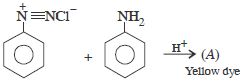
A
The structure of $p$-aminoazobenzene
B
The structure of $o$-aminoazobenzene
C
The structure of $m$-aminoazobenzene
D
The structure of $N$-phenyl$-1,4-$phenylenediamine
Solution
(A) The reaction shown is a coupling reaction between benzenediazonium chloride and aniline.
This reaction is an electrophilic aromatic substitution where the diazonium cation acts as the electrophile.
Since the $-NH_2$ group is a strong ortho/para-directing group,the electrophile attacks the para-position to the $-NH_2$ group,yielding $p$-aminoazobenzene,which is a yellow dye.
This reaction is an electrophilic aromatic substitution where the diazonium cation acts as the electrophile.
Since the $-NH_2$ group is a strong ortho/para-directing group,the electrophile attacks the para-position to the $-NH_2$ group,yielding $p$-aminoazobenzene,which is a yellow dye.
0 likesView Solution
66
ChemistryMediumMCQNEET · 2014
Which of the following diazonium salts $RN_2^+X^-$ will be the most stable?
A
$CH_3N_2^+X^-$
B
$C_6H_5N_2^+X^-$
C
$CH_3CH_2N_2^+X^-$
D
$C_6H_5CH_2N_2^+X^-$
Solution
(B) The diazonium salt containing an aryl group directly linked to the nitrogen atom $(C_6H_5N_2^+X^-)$ is the most stable.
This stability is due to the resonance stabilization between the benzene ring and the diazonium group $(-N_2^+)$,which delocalizes the positive charge over the benzene ring.
Aliphatic diazonium salts are highly unstable and decompose readily to form carbocations and nitrogen gas.
The resonance structures of the benzene diazonium ion are shown below:
(The image provided shows the resonance structures where the positive charge is delocalized into the ortho and para positions of the benzene ring.)
This stability is due to the resonance stabilization between the benzene ring and the diazonium group $(-N_2^+)$,which delocalizes the positive charge over the benzene ring.
Aliphatic diazonium salts are highly unstable and decompose readily to form carbocations and nitrogen gas.
The resonance structures of the benzene diazonium ion are shown below:
(The image provided shows the resonance structures where the positive charge is delocalized into the ortho and para positions of the benzene ring.)
0 likesView Solution
67
ChemistryDifficultMCQNEET · 2014
$D(+)$-glucose reacts with hydroxylamine $(NH_2OH)$ and yields an oxime. The structure of the oxime would be:
A
$CH=NOH - C(H)(OH) - C(OH)(H) - C(OH)(H) - CH_2 - CH_2OH$
B
$CH=NOH - C(OH)(H) - C(OH)(H) - C(H)(OH) - C(H)(OH) - CH_2OH$
C
$CH=NOH - C(OH)(H) - C(H)(OH) - C(OH)(H) - C(H)(OH) - CH_2OH$
D
$CH=NOH - C(H)(OH) - C(OH)(H) - C(H)(OH) - C(H)(OH) - CH_2OH$
Solution
(D) $D(+)$-glucose contains an aldehyde group at $C1$.
When it reacts with hydroxylamine $(NH_2OH)$,the carbonyl oxygen is replaced by $=NOH$ to form an oxime.
The configuration of the chiral centers ($C2$ to $C5$) remains the same as in $D$-glucose ($C2-OH$ right,$C3-OH$ left,$C4-OH$ right,$C5-OH$ right).
The structure is: $CH=NOH - C(H)(OH) - C(OH)(H) - C(H)(OH) - C(H)(OH) - CH_2OH$.
When it reacts with hydroxylamine $(NH_2OH)$,the carbonyl oxygen is replaced by $=NOH$ to form an oxime.
The configuration of the chiral centers ($C2$ to $C5$) remains the same as in $D$-glucose ($C2-OH$ right,$C3-OH$ left,$C4-OH$ right,$C5-OH$ right).
The structure is: $CH=NOH - C(H)(OH) - C(OH)(H) - C(H)(OH) - C(H)(OH) - CH_2OH$.
0 likesView Solution
68
ChemistryMediumMCQNEET · 2014
Which of the following hormones is produced under conditions of stress and stimulates glycogenolysis in the liver of human beings?
A
Thyroxin
B
Insulin
C
Adrenaline
D
Estradiol
Solution
(C) Adrenaline is known as the emergency hormone.
It is released during stress conditions.
It stimulates glycogenolysis in the liver,which leads to the release of glucose into the bloodstream to provide energy for the 'fight or flight' response.
It is released during stress conditions.
It stimulates glycogenolysis in the liver,which leads to the release of glucose into the bloodstream to provide energy for the 'fight or flight' response.
0 likesView Solution
69
ChemistryDifficultMCQNEET · 2014
Which one of the following is an example of a thermosetting polymer?
A
$(-CH_2-C(Cl)=CH-CH_2-)_n$
B
$(-CH_2-CH(Cl)-)_n$
C
$(-NH-(CH_2)_6-NH-CO-(CH_2)_4-CO-)_n$
D
Bakelite
Solution
(D) Bakelite is a thermosetting polymer. These polymers are cross-linked or heavily branched molecules,which on heating undergo extensive cross-linking in moulds and become infusible. They cannot be reused.
Option $(A)$ is Neoprene (elastomer),$(B)$ is $PVC$ (thermoplastic),and $(C)$ is Nylon $6,6$ (fiber).
Option $(A)$ is Neoprene (elastomer),$(B)$ is $PVC$ (thermoplastic),and $(C)$ is Nylon $6,6$ (fiber).
0 likesView Solution
70
ChemistryDifficultMCQNEET · 2014
Which of the following organic compounds polymerizes to form the polyester dacron?
A
Propylene and para-$HO-(C_6H_4)-OH$
B
Benzoic acid and ethanol
C
Terephthalic acid and ethylene glycol
D
Benzoic acid and para-$HO-(C_6H_4)-OH$
Solution
(C) Dacron,also known as terylene,is a condensation polymer formed by the polymerization of terephthalic acid $(HOOC-C_6H_4-COOH)$ and ethylene glycol $(HO-CH_2-CH_2-OH)$.
This reaction occurs by heating the mixture at $420-460 \ K$ in the presence of zinc acetate and antimony trioxide as a catalyst,resulting in the elimination of water molecules.
This reaction occurs by heating the mixture at $420-460 \ K$ in the presence of zinc acetate and antimony trioxide as a catalyst,resulting in the elimination of water molecules.
0 likesView Solution
71
ChemistryMediumMCQNEET · 2014
The artificial sweetener which is stable under cold conditions only is
A
saccharine
B
sucralose
C
aspartame
D
alitame
Solution
(C) Aspartame is the most successful and widely used artificial sweetener.
It is roughly $180$ times as sweet as cane sugar.
It is unstable at cooking temperatures,which limits its use to cold foods and soft drinks.
It is roughly $180$ times as sweet as cane sugar.
It is unstable at cooking temperatures,which limits its use to cold foods and soft drinks.
0 likesView Solution
Vedclass Products
For Students
Vedclass Test Series
Mock tests in real NEET style covering Chemistry with performance analysis. 5-day free trial.
Start Free TrialFor Teachers
Exam Paper Generator
Generate Set A/B/C/D Chemistry papers from 7.5L+ questions in 2 minutes. 3 chapters free.
Try FreeFor Institutes
Online Exam Module
Run live NEET mock exams with unlimited students, 360° analytics & white-label branding.
See DemoFrequently Asked Questions
How many Chemistry questions are in NEET 2014?
There are 71 Chemistry questions from the NEET 2014 paper on Vedclass, each with a detailed step-by-step solution in English.
Are NEET 2014 Chemistry solutions available in English?
Yes. All solutions on this page are in English. You can also switch to English or Hindi using the language buttons above the questions.
Can I practice NEET 2014 Chemistry as a timed test?
Yes. Use the Vedclass Test Series to attempt a full NEET mock test covering Chemistry with time limits and instant score analysis.
Can teachers create Chemistry papers from NEET previous year questions?
Yes. The Vedclass Exam Paper Generator lets teachers mix NEET Chemistry questions and generate Set A/B/C/D papers in minutes.
For Teachers & Institutes
Build a Custom Chemistry Paper
Pick NEET 2014 Chemistry questions, set difficulty, and generate Set A/B/C/D in 2 minutes.