
BiologyQ1–96 of 104 questions
Page 1 of 2 · English
1
BiologyMediumMCQNEET · 2014
The five kingdom system of classification suggested by $R.H. Whittaker$ is not based on:
A
Presence or absence of a well-defined nucleus
B
Mode of reproduction
C
Mode of nutrition
D
Complexity of body organization
Solution
(B) $R.H. Whittaker$ proposed the five kingdom system of classification based on the following criteria:
$1$. Complexity of cell structure (prokaryotic vs. eukaryotic).
$2$. Complexity of body organization (unicellular vs. multicellular).
$3$. Mode of nutrition (autotrophic vs. heterotrophic).
$4$. Ecological lifestyle.
$5$. Phylogenetic relationships.
Mode of reproduction was not a primary criterion used in this system. Therefore,the correct option is $B$.
$1$. Complexity of cell structure (prokaryotic vs. eukaryotic).
$2$. Complexity of body organization (unicellular vs. multicellular).
$3$. Mode of nutrition (autotrophic vs. heterotrophic).
$4$. Ecological lifestyle.
$5$. Phylogenetic relationships.
Mode of reproduction was not a primary criterion used in this system. Therefore,the correct option is $B$.
0 likesView Solution
2
BiologyEasyMCQNEET · 2014
Which of the following shows coiled $RNA$ strand and capsomeres?
A
Polio virus
B
Tobacco mosaic virus
C
Measles virus
D
Retrovirus
Solution
(B) : Tobacco mosaic virus $(TMV)$ is a $RNA$ virus that causes tobacco mosaic disease.
It contains a single-stranded coiled $RNA$ molecule as its genetic material.
The protein coat,known as the capsid,consists of approximately $2130$ capsomeres.
These capsomeres are arranged in a helical pattern to form a hollow cylinder with a diameter of about $4 \ nm$.
It contains a single-stranded coiled $RNA$ molecule as its genetic material.
The protein coat,known as the capsid,consists of approximately $2130$ capsomeres.
These capsomeres are arranged in a helical pattern to form a hollow cylinder with a diameter of about $4 \ nm$.
0 likesView Solution
3
BiologyMediumMCQNEET · 2014
Viruses have
A
$DNA$ enclosed in a protein coat
B
prokaryotic nucleus
C
single chromosome
D
both $DNA$ and $RNA$
Solution
(A) The correct answer is $A$.
Viruses are non-cellular,nucleoprotein entities that utilize the synthetic machinery of a living host cell for their replication.
They do not possess a cellular structure,such as a nucleus or organelles.
Their genetic material consists of either $DNA$ or $RNA$,but never both.
This genetic material is enclosed within a protective protein coat called a capsid.
Viruses are non-cellular,nucleoprotein entities that utilize the synthetic machinery of a living host cell for their replication.
They do not possess a cellular structure,such as a nucleus or organelles.
Their genetic material consists of either $DNA$ or $RNA$,but never both.
This genetic material is enclosed within a protective protein coat called a capsid.
0 likesView Solution
4
BiologyMediumMCQNEET · 2014
Archaebacteria differ from eubacteria in:
A
cell membrane structure
B
mode of nutrition
C
cell shape
D
mode of reproduction
Solution
(A) : Archaebacteria are the 'ancient' bacteria that include extremophiles like methanogens,halophiles,and thermophiles. They represent some of the most ancient life forms that persist today.
They possess both eubacterial and eukaryotic characters in addition to features unique to them.
Their mode of reproduction,nutrition,and cell shape and size resemble typical eubacteria.
However,their cell walls are made of a variety of polymers and do not contain peptidoglycan,unlike eubacteria.
Furthermore,the lipids of their cytoplasmic membranes are ether-linked,whereas eubacteria contain glycerol ester-linked lipids in their cell membranes.
They possess both eubacterial and eukaryotic characters in addition to features unique to them.
Their mode of reproduction,nutrition,and cell shape and size resemble typical eubacteria.
However,their cell walls are made of a variety of polymers and do not contain peptidoglycan,unlike eubacteria.
Furthermore,the lipids of their cytoplasmic membranes are ether-linked,whereas eubacteria contain glycerol ester-linked lipids in their cell membranes.
0 likesView Solution
5
BiologyMediumMCQNEET · 2014
Which structures perform the function of mitochondria in bacteria?
A
Nucleoid
B
Ribosomes
C
Cell wall
D
Mesosomes
Solution
(D) $(D) :$ Mesosomes are characteristic circular or villiform specializations of the bacterial cell membrane that develop as an ingrowth.
They consist of vesicles,tubules,and lamellae.
Mesosomes may be septal or lateral.
Septal mesosomes connect the nucleoid with the plasma membrane and assist in replication and septum formation during cell division.
Lateral mesosomes are not connected to the nucleoid,contain respiratory enzymes,and perform functions similar to eukaryotic mitochondria; hence,they are also called chondrioids.
They also increase the surface area of the plasma membrane and enzymatic contact.
They consist of vesicles,tubules,and lamellae.
Mesosomes may be septal or lateral.
Septal mesosomes connect the nucleoid with the plasma membrane and assist in replication and septum formation during cell division.
Lateral mesosomes are not connected to the nucleoid,contain respiratory enzymes,and perform functions similar to eukaryotic mitochondria; hence,they are also called chondrioids.
They also increase the surface area of the plasma membrane and enzymatic contact.
0 likesView Solution
6
BiologyMediumMCQNEET · 2014
The motile bacteria are able to move by
A
fimbriae
B
flagella
C
cilia
D
pili
Solution
(B) : Flagellum is the organ of motility in bacteria.
Bacterial flagella are unistranded,equivalent to a single microtubular fiber,and are composed of a protein called flagellin.
They perform rotatory movements to facilitate locomotion.
Bacterial flagella are unistranded,equivalent to a single microtubular fiber,and are composed of a protein called flagellin.
They perform rotatory movements to facilitate locomotion.
0 likesView Solution
7
BiologyMediumMCQNEET · 2014
Anoxygenic photosynthesis is characteristic of
A
Rhodospirillum
B
Spirogyra
C
Chlamydomonas
D
Ulva
Solution
(A) $Rhodospirillum$ is a purple non-sulfur bacterium that performs anoxygenic photosynthesis.
In this process,organic compounds or other substances (like $H_2S$) are used as electron donors instead of water $(H_2O)$.
Since water is not used as the electron donor,oxygen $(O_2)$ is not evolved as a byproduct.
In contrast,$Spirogyra$,$Chlamydomonas$,and $Ulva$ are algae that perform oxygenic photosynthesis,where water is the electron donor and oxygen is released during the photolysis of water.
In this process,organic compounds or other substances (like $H_2S$) are used as electron donors instead of water $(H_2O)$.
Since water is not used as the electron donor,oxygen $(O_2)$ is not evolved as a byproduct.
In contrast,$Spirogyra$,$Chlamydomonas$,and $Ulva$ are algae that perform oxygenic photosynthesis,where water is the electron donor and oxygen is released during the photolysis of water.
0 likesView Solution
8
BiologyMediumMCQNEET · 2014
Which one of the following is wrong about $Chara$?
A
Upper oogonium and lower round antheridium
B
Globule and nucule present on the same plant
C
Upper antheridium and lower oogonium
D
Globule is male reproductive structure
Solution
(C) $Chara$ exhibits highly advanced oogamy.
In $Chara$,the sex organs are complex and distinct.
The male reproductive structure is called the $globule$ $(antheridium)$,and the female reproductive structure is called the $nucule$ $(oogonium)$.
These structures are borne at the nodes of the branches.
The $nucule$ is always situated at a higher position (upper side) than the $globule$ (lower side) on the same plant.
Therefore,the statement that the upper structure is the $antheridium$ and the lower is the $oogonium$ is incorrect.
In $Chara$,the sex organs are complex and distinct.
The male reproductive structure is called the $globule$ $(antheridium)$,and the female reproductive structure is called the $nucule$ $(oogonium)$.
These structures are borne at the nodes of the branches.
The $nucule$ is always situated at a higher position (upper side) than the $globule$ (lower side) on the same plant.
Therefore,the statement that the upper structure is the $antheridium$ and the lower is the $oogonium$ is incorrect.
0 likesView Solution
9
BiologyEasyMCQNEET · 2014
Which of the following is responsible for peat formation?
A
Marchantia
B
Riccia
C
Funaria
D
Sphagnum
Solution
(D) : Among the bryophytes,$Sphagnum$ holds the most significant economic importance. It is popularly known as bog moss or peat moss. It is a perennial plant,and its growth continues year after year.
Older portions of the plant die but do not decompose due to the secretion of acids,which provide antibacterial and antifungal properties.
The increasing mass of dead remains accumulates over time,forming a compact,dark-colored,carbon-rich substance known as peat.
Peat is used as a fuel source. Additionally,substances like paraffin,acetic acid,peat tar,and ammonia are produced as by-products from peat for industrial applications.
Older portions of the plant die but do not decompose due to the secretion of acids,which provide antibacterial and antifungal properties.
The increasing mass of dead remains accumulates over time,forming a compact,dark-colored,carbon-rich substance known as peat.
Peat is used as a fuel source. Additionally,substances like paraffin,acetic acid,peat tar,and ammonia are produced as by-products from peat for industrial applications.
0 likesView Solution
10
BiologyMediumMCQNEET · 2014
Select the taxon mentioned that represents both marine and fresh water species.
A
Echinoderms
B
Ctenophora
C
Cephalochordata
D
Cnidaria
Solution
(D) : Cnidarians are sac-like animals that are aquatic. They are mostly marine,but some species like $Hydra$ are found in fresh water. They are the simplest organisms that have attained a tissue level of organization. Members of $Ctenophora$,$Cephalochordata$,and $Echinodermata$ are exclusively marine.
0 likesView Solution
11
BiologyEasyMCQNEET · 2014
Which one of the following living organisms completely lacks a cell wall?
A
Cyanobacteria
B
Sea fan (Gorgonia)
C
Saccharomyces
D
Blue-green algae
Solution
(B) : $Gorgonia$ (sea fan) is an animal belonging to the phylum $Coelenterata$ (also known as $Cnidaria$).
All animals lack a cell wall,as their cells are bounded only by a plasma membrane.
$Cyanobacteria$ and blue-green algae (which are the same) have a peptidoglycan cell wall.
$Saccharomyces$ (yeast) is a fungus and possesses a chitinous cell wall.
All animals lack a cell wall,as their cells are bounded only by a plasma membrane.
$Cyanobacteria$ and blue-green algae (which are the same) have a peptidoglycan cell wall.
$Saccharomyces$ (yeast) is a fungus and possesses a chitinous cell wall.
0 likesView Solution
12
BiologyEasyMCQNEET · 2014
Planaria possesses high capacity of
A
metamorphosis
B
regeneration
C
alternation of generation
D
bioluminescence
Solution
(B) $Planaria$ possesses a high degree of regeneration. Both epimorphosis,in which the missing parts are formed,and morphallaxis,in which the whole body can be regenerated from a fragment of the body,occur in this organism.
0 likesView Solution
13
BiologyEasyMCQNEET · 2014
$A$ marine cartilaginous fish that can produce electric current is
A
Pristis
B
Torpedo
C
Trygon
D
Scoliodon
Solution
(B) $Torpedo$ is a bottom-living marine cartilaginous fish that can discharge electricity,which is sufficient to stun prey such as small fishes.
$A$ pair of electric organs are situated on the dorsal side of the trunk region.
In fact,these electric organs are modified lateral muscle plates innervated by the cranial nerves.
$A$ pair of electric organs are situated on the dorsal side of the trunk region.
In fact,these electric organs are modified lateral muscle plates innervated by the cranial nerves.
0 likesView Solution
14
BiologyMediumMCQNEET · 2014
Placenta and pericarp are both edible portions in
A
apple
B
banana
C
tomato
D
potato
Solution
(C) The correct answer is $C$.
In a tomato,which is a berry,the fruit develops from a bicarpellary,syncarpous,and multi-locular ovary.
The pericarp consists of the outer skin (epicarp) and the fleshy middle part (mesocarp).
The placenta is the tissue that attaches the seeds to the ovary wall,and in tomatoes,it becomes fleshy,pulpy,and edible along with the endocarp and septa.
Therefore,both the pericarp and the placenta are edible parts of the tomato fruit.
In a tomato,which is a berry,the fruit develops from a bicarpellary,syncarpous,and multi-locular ovary.
The pericarp consists of the outer skin (epicarp) and the fleshy middle part (mesocarp).
The placenta is the tissue that attaches the seeds to the ovary wall,and in tomatoes,it becomes fleshy,pulpy,and edible along with the endocarp and septa.
Therefore,both the pericarp and the placenta are edible parts of the tomato fruit.
0 likesView Solution
15
BiologyMediumMCQNEET · 2014
An example of an edible underground stem is
A
carrot
B
groundnut
C
sweet potato
D
potato
Solution
(D) : Carrot and sweet potato are root modifications,while the edible part of groundnut is the seed. Potato is an edible underground stem (tuber).
0 likesView Solution
16
BiologyMediumMCQNEET · 2014
You are given a fairly old piece of dicot stem and a dicot root. Which of the following anatomical structures will you use to distinguish between the two?
A
Secondary xylem
B
Secondary phloem
C
Protoxylem
D
Cortical cells
Solution
(C) : In stems,the protoxylem lies towards the centre (pith) and the metaxylem lies towards the periphery. This type of primary xylem arrangement is called $endarch$. In roots,the protoxylem lies towards the periphery and the metaxylem lies towards the centre; such an arrangement is called $exarch$.
0 likesView Solution
17
BiologyMediumMCQNEET · 2014
Tracheids differ from other tracheary elements in
A
having casparian strips
B
being imperforate
C
lacking nucleus
D
being lignified.
Solution
(B) : Tracheids are elongated,dead cells with hard lignified walls,wide lumens,and narrow walls with spiral,annular,reticulate,scalariform,and pitted thickening,but they lack perforated end walls or septa.
This means they have intact end walls,unlike vessels.
Vessels are long,cylindrical,tube-like structures made of many cells called vessel members,each with lignified walls and a large central cavity.
Vessel members are interconnected through perforations in their common walls,making them perforated,whereas tracheids are imperforate.
This means they have intact end walls,unlike vessels.
Vessels are long,cylindrical,tube-like structures made of many cells called vessel members,each with lignified walls and a large central cavity.
Vessel members are interconnected through perforations in their common walls,making them perforated,whereas tracheids are imperforate.
0 likesView Solution
18
BiologyMediumMCQNEET · 2014
Choose the correctly matched pair.
A
Tendon $\to$ Specialized connective tissue
B
Adipose tissue $\to$ Dense connective tissue
C
Areolar tissue $\to$ Loose connective tissue
D
Cartilage $\to$ Loose connective tissue
Solution
(C) : Areolar tissue is the most widely distributed loose connective tissue in the body.
Tendon is a type of dense regular connective tissue.
Adipose tissue is a type of loose connective tissue that stores fat.
Cartilage is a type of specialized connective tissue.
Tendon is a type of dense regular connective tissue.
Adipose tissue is a type of loose connective tissue that stores fat.
Cartilage is a type of specialized connective tissue.
0 likesView Solution
19
BiologyMediumMCQNEET · 2014
Choose the correctly matched pair.
A
Inner lining of salivary ducts $\rightarrow$ Ciliated epithelium
B
Moist surface of buccal cavity $\rightarrow$ Glandular epithelium
C
Tubular parts of nephrons $\rightarrow$ Cuboidal epithelium
D
Inner surface of bronchioles $\rightarrow$ Squamous epithelium
Solution
(C) The correct answer is $C$.
$1$. Inner lining of salivary ducts is lined by simple cuboidal epithelium.
$2$. The moist surface of the buccal cavity is lined by non-keratinized stratified squamous epithelium.
$3$. The tubular parts of nephrons (like proximal convoluted tubule) are lined by cuboidal epithelium.
$4$. The inner surface of bronchioles is lined by ciliated columnar epithelium.
$1$. Inner lining of salivary ducts is lined by simple cuboidal epithelium.
$2$. The moist surface of the buccal cavity is lined by non-keratinized stratified squamous epithelium.
$3$. The tubular parts of nephrons (like proximal convoluted tubule) are lined by cuboidal epithelium.
$4$. The inner surface of bronchioles is lined by ciliated columnar epithelium.
0 likesView Solution
20
BiologyEasyMCQNEET · 2014
The solid linear cytoskeletal elements having a diameter of $6 \ nm$ and made up of a single type of monomer are known as
A
microtubules
B
microfilaments
C
intermediate filaments
D
lamins
Solution
(B) The correct answer is $(b)$.
Microfilaments (also known as actin filaments) are solid,linear cytoskeletal elements with a diameter of approximately $6 \ nm$.
They are composed of a single type of globular protein monomer called $G$-actin,which polymerizes to form $F$-actin filaments.
Microtubules are hollow structures with a diameter of about $24 \ nm$ made of tubulin.
Intermediate filaments have a diameter of about $8-10 \ nm$ and are composed of various fibrous proteins.
Microfilaments (also known as actin filaments) are solid,linear cytoskeletal elements with a diameter of approximately $6 \ nm$.
They are composed of a single type of globular protein monomer called $G$-actin,which polymerizes to form $F$-actin filaments.
Microtubules are hollow structures with a diameter of about $24 \ nm$ made of tubulin.
Intermediate filaments have a diameter of about $8-10 \ nm$ and are composed of various fibrous proteins.
0 likesView Solution
21
BiologyMediumMCQNEET · 2014
The osmotic expansion of a cell kept in water is chiefly regulated by
A
mitochondria
B
vacuoles
C
plastids
D
ribosomes
Solution
(B) The correct answer is $B$.
Vacuoles are membrane-bound organelles found in the cytoplasm of plant cells,separated from the cytoplasm by a single membrane called the tonoplast.
In mature plant cells,a large central vacuole occupies a significant portion of the cell volume.
These vacuoles store water,ions,and solutes,which create turgor pressure against the cell wall.
This turgor pressure is responsible for the osmotic expansion and maintenance of the cell's shape and rigidity.
Vacuoles are membrane-bound organelles found in the cytoplasm of plant cells,separated from the cytoplasm by a single membrane called the tonoplast.
In mature plant cells,a large central vacuole occupies a significant portion of the cell volume.
These vacuoles store water,ions,and solutes,which create turgor pressure against the cell wall.
This turgor pressure is responsible for the osmotic expansion and maintenance of the cell's shape and rigidity.
0 likesView Solution
22
BiologyMediumMCQNEET · 2014
Match the following and select the correct answer.
| $(A)$ Centriole | $(i)$ Infoldings in mitochondria |
| $(B)$ Chlorophyll | $(ii)$ Thylakoids |
| $(C)$ Cristae | $(iii)$ Nucleic acids |
| $(D)$ Ribozymes | $(iv)$ Basal body of cilia or flagella |
A
$(A)-(iv), (B)-(ii), (C)-(i), (D)-(iii)$
B
$(A)-(i), (B)-(ii), (C)-(iv), (D)-(iii)$
C
$(A)-(i), (B)-(iii), (C)-(ii), (D)-(iv)$
D
$(A)-(iv), (B)-(iii), (C)-(i), (D)-(ii)$
Solution
(A) The correct matches are as follows:
$1$. $(A)$ Centriole: It forms the basal body of cilia or flagella $(iv)$.
$2$. $(B)$ Chlorophyll: It is present in the thylakoids of chloroplasts $(ii)$.
$3$. $(C)$ Cristae: These are the infoldings of the inner mitochondrial membrane $(i)$.
$4$. $(D)$ Ribozymes: These are catalytic $RNA$ molecules, which are nucleic acids $(iii)$.
Therefore, the correct sequence is $(A)-(iv), (B)-(ii), (C)-(i), (D)-(iii)$.
$1$. $(A)$ Centriole: It forms the basal body of cilia or flagella $(iv)$.
$2$. $(B)$ Chlorophyll: It is present in the thylakoids of chloroplasts $(ii)$.
$3$. $(C)$ Cristae: These are the infoldings of the inner mitochondrial membrane $(i)$.
$4$. $(D)$ Ribozymes: These are catalytic $RNA$ molecules, which are nucleic acids $(iii)$.
Therefore, the correct sequence is $(A)-(iv), (B)-(ii), (C)-(i), (D)-(iii)$.
0 likesView Solution
23
BiologyMediumMCQNEET · 2014
Select the option which is not correct with respect to enzyme action.
A
Substrate binds with enzyme at its active site.
B
Addition of lot of succinate does not reverse the inhibition of succinic dehydrogenase by malonate.
C
$A$ non-competitive inhibitor binds the enzyme at a site distinct from that which binds the substrate.
D
Malonate is a competitive inhibitor of succinic dehydrogenase.
Solution
(B) The correct answer is $B$. The inhibition of succinate dehydrogenase by malonate is a classic example of competitive inhibition.
Competitive inhibition is a reversible process where the inhibitor competes with the substrate for the active site of the enzyme.
Because the inhibitor is structurally similar to the substrate,it occupies the active site,preventing the substrate from binding.
Since this binding is temporary and reversible,increasing the concentration of the substrate (succinate) allows it to outcompete the inhibitor (malonate) for the active site,thereby reversing the inhibition.
Therefore,the statement that adding a lot of succinate does not reverse the inhibition is incorrect.
Competitive inhibition is a reversible process where the inhibitor competes with the substrate for the active site of the enzyme.
Because the inhibitor is structurally similar to the substrate,it occupies the active site,preventing the substrate from binding.
Since this binding is temporary and reversible,increasing the concentration of the substrate (succinate) allows it to outcompete the inhibitor (malonate) for the active site,thereby reversing the inhibition.
Therefore,the statement that adding a lot of succinate does not reverse the inhibition is incorrect.
0 likesView Solution
24
BiologyMediumMCQNEET · 2014
During which phase$(s)$ of the cell cycle does the amount of $DNA$ in a cell remain at the $4C$ level,if the initial amount is denoted as $2C$?
A
$G_0$ and $G_1$
B
$G_1$ and $S$
C
Only $G_2$
D
$G_2$ and $M$
Solution
(D) The cell cycle consists of $G_1$,$S$,$G_2$,and $M$ phases.
In the $G_1$ phase,the $DNA$ content is $2C$.
During the $S$ phase,$DNA$ replication occurs,causing the $DNA$ content to increase from $2C$ to $4C$.
In the $G_2$ phase,the cell prepares for division,and the $DNA$ content remains at $4C$.
During the $M$ phase (mitosis),the $DNA$ is distributed into two daughter cells,returning the content to $2C$ in each cell.
Therefore,the $DNA$ amount remains at the $4C$ level throughout the $G_2$ phase and the early stages of the $M$ phase (prophase and metaphase) before the chromatids separate.
In the $G_1$ phase,the $DNA$ content is $2C$.
During the $S$ phase,$DNA$ replication occurs,causing the $DNA$ content to increase from $2C$ to $4C$.
In the $G_2$ phase,the cell prepares for division,and the $DNA$ content remains at $4C$.
During the $M$ phase (mitosis),the $DNA$ is distributed into two daughter cells,returning the content to $2C$ in each cell.
Therefore,the $DNA$ amount remains at the $4C$ level throughout the $G_2$ phase and the early stages of the $M$ phase (prophase and metaphase) before the chromatids separate.
0 likesView Solution
25
BiologyMediumMCQNEET · 2014
In the $S$ phase of the cell cycle:
A
the amount of $DNA$ doubles in each cell.
B
the amount of $DNA$ remains the same in each cell.
C
the chromosome number increases.
D
the amount of $DNA$ is reduced to half in each cell.
Solution
(A) The correct answer is $A$.
During the $S$ phase (Synthesis phase) of the cell cycle,the replication of $DNA$ occurs.
As a result,the amount of $DNA$ per cell doubles,increasing from $2C$ to $4C$ in diploid cells.
However,the number of chromosomes remains the same because the sister chromatids remain attached at the centromere.
During the $S$ phase (Synthesis phase) of the cell cycle,the replication of $DNA$ occurs.
As a result,the amount of $DNA$ per cell doubles,increasing from $2C$ to $4C$ in diploid cells.
However,the number of chromosomes remains the same because the sister chromatids remain attached at the centromere.
0 likesView Solution
26
BiologyMediumMCQNEET · 2014
The enzyme recombinase is required at which stage of meiosis?
A
Pachytene
B
Zygotene
C
Diplotene
D
Diakinesis
Solution
(A) The $Pachytene$ stage is characterized by the appearance of recombination nodules,which are the sites where crossing over occurs between non-sister chromatids of homologous chromosomes.
These nodules contain a multienzyme complex known as $Recombinase$.
$Recombinase$ is composed of various enzymes such as endonuclease,exonuclease,unwindase,and $R$-protein,which facilitate the exchange of genetic material.
These nodules contain a multienzyme complex known as $Recombinase$.
$Recombinase$ is composed of various enzymes such as endonuclease,exonuclease,unwindase,and $R$-protein,which facilitate the exchange of genetic material.
0 likesView Solution
27
BiologyMediumMCQNEET · 2014
Deficiency symptoms of nitrogen and potassium are visible first in
A
senescent leaves
B
young leaves
C
roots
D
buds
Solution
(A) The deficiency symptoms of elements that are actively mobilized within the plants,such as $N$,$K$,and $Mg$,appear first in the older,senescent leaves. This occurs because these elements are transported from the older,senescing tissues to the younger,developing tissues to support their growth. Conversely,elements that are relatively immobile,such as $Ca$ and $S$,show deficiency symptoms first in young leaves.
0 likesView Solution
28
BiologyMediumMCQNEET · 2014
In which one of the following processes $CO_2$ is not released?
A
Aerobic respiration in plants
B
Aerobic respiration in animals
C
Alcoholic fermentation
D
Lactate fermentation
Solution
(D) The correct answer is $(d)$.
Anaerobic respiration or fermentation is of two main types: lactate fermentation and alcoholic (ethanol) fermentation.
In lactate fermentation,pyruvic acid produced during glycolysis is directly reduced by $NADH$ to form lactic acid. This process does not involve the decarboxylation step,and therefore,no $CO_2$ is released.
In contrast,alcoholic fermentation involves the conversion of pyruvate to acetaldehyde and then to ethanol,a process that releases $CO_2$.
Aerobic respiration in both plants and animals involves the Krebs cycle and the electron transport system,which release $CO_2$ as a byproduct.
Anaerobic respiration or fermentation is of two main types: lactate fermentation and alcoholic (ethanol) fermentation.
In lactate fermentation,pyruvic acid produced during glycolysis is directly reduced by $NADH$ to form lactic acid. This process does not involve the decarboxylation step,and therefore,no $CO_2$ is released.
In contrast,alcoholic fermentation involves the conversion of pyruvate to acetaldehyde and then to ethanol,a process that releases $CO_2$.
Aerobic respiration in both plants and animals involves the Krebs cycle and the electron transport system,which release $CO_2$ as a byproduct.
0 likesView Solution
29
BiologyMediumMCQNEET · 2014
Dr. $F$. Went noted that if coleoptile tips were removed and placed on agar for one hour,the agar would produce a bending when placed on one side of freshly-cut coleoptile stumps. Of what significance is this experiment?
A
It made possible the isolation and exact identification of auxin.
B
It is the basis for quantitative determination of small amounts of growth-promoting substances.
C
It supports the hypothesis that $IAA$ is auxin.
D
It demonstrated polar movement of auxins.
Solution
(B) The experiment conducted by $F.W. Went$ is known as the $Avena$ curvature test.
This experiment demonstrated that the substance responsible for growth (auxin) diffuses from the coleoptile tip into the agar block.
By placing the agar block on one side of a decapitated coleoptile,the differential growth caused by the auxin leads to bending.
This method allows for the quantitative measurement of the concentration of growth-promoting substances (auxins) based on the degree of curvature produced,making it the basis for the bioassay of auxins.
This experiment demonstrated that the substance responsible for growth (auxin) diffuses from the coleoptile tip into the agar block.
By placing the agar block on one side of a decapitated coleoptile,the differential growth caused by the auxin leads to bending.
This method allows for the quantitative measurement of the concentration of growth-promoting substances (auxins) based on the degree of curvature produced,making it the basis for the bioassay of auxins.
0 likesView Solution
30
BiologyMediumMCQNEET · 2014
$A$ few normal seedlings of tomato were kept in a dark room. After a few days,they were found to have become white-coloured like albinos. Which of the following terms will you use to describe them?
A
Mutated
B
Embolised
C
Etiolated
D
Defoliated
Solution
(C) : Etiolation is the process of abnormal growth observed when plants are grown in darkness or severely reduced light. Plants grown in the dark lack chlorophyll,which is necessary for photosynthesis,causing them to appear pale yellow or white. Such plants characteristically exhibit long,weak stems,small,underdeveloped leaves,and reduced root systems.
0 likesView Solution
31
BiologyEasyMCQNEET · 2014
Which one of the following growth regulators is known as 'stress hormone'?
A
Abscisic acid
B
Ethylene
C
$GA_3$
D
Indole acetic acid
Solution
(A) $Abscisic$ $\text{acid}$ $(ABA)$ is known as the stress hormone.
It prepares plants to cope with adverse environmental conditions such as drought, salinity, or extreme temperatures.
It induces stomatal closure to reduce water loss through transpiration.
Therefore, it is commonly referred to as the stress hormone.
It prepares plants to cope with adverse environmental conditions such as drought, salinity, or extreme temperatures.
It induces stomatal closure to reduce water loss through transpiration.
Therefore, it is commonly referred to as the stress hormone.
0 likesView Solution
32
BiologyMediumMCQNEET · 2014
The initial step in the digestion of milk in humans is carried out by
A
lipase
B
trypsin
C
rennin
D
pepsin
Solution
(C) The correct answer is $C$.
$Rennin$ (also known as $chymosin$) is a proteolytic enzyme secreted by the peptic cells (chief cells) present in the epithelium of gastric glands.
It is primarily found in the gastric juice of human infants and calves to facilitate the digestion of milk.
In adults, the secretion of $rennin$ is absent.
$Rennin$ acts on the milk protein $casein$ and converts it into $paracasein$ (calcium paracaseinate), which leads to the coagulation or curdling of milk, allowing it to stay in the stomach longer for further digestion by $pepsin$.
$Rennin$ (also known as $chymosin$) is a proteolytic enzyme secreted by the peptic cells (chief cells) present in the epithelium of gastric glands.
It is primarily found in the gastric juice of human infants and calves to facilitate the digestion of milk.
In adults, the secretion of $rennin$ is absent.
$Rennin$ acts on the milk protein $casein$ and converts it into $paracasein$ (calcium paracaseinate), which leads to the coagulation or curdling of milk, allowing it to stay in the stomach longer for further digestion by $pepsin$.
0 likesView Solution
33
BiologyEasyMCQNEET · 2014
Fructose is absorbed into the blood through mucosa cells of the intestine by the process called
A
active transport
B
facilitated transport
C
simple diffusion
D
co-transport mechanism
Solution
(B) $Fructose$ and $mannose$ are absorbed into the blood through the intestinal mucosa by the process of facilitated diffusion.
This process occurs with the help of specific carrier proteins.
It takes place along the concentration gradient,meaning substances move from an area of higher concentration to an area of lower concentration without the expenditure of energy.
This process occurs with the help of specific carrier proteins.
It takes place along the concentration gradient,meaning substances move from an area of higher concentration to an area of lower concentration without the expenditure of energy.
0 likesView Solution
34
BiologyMediumMCQNEET · 2014
Approximately $70\%$ of carbon dioxide absorbed by the blood is transported to the lungs:
A
as bicarbonate ions
B
in the form of dissolved gas molecules
C
by binding to $RBCs$
D
as carbamino-haemoglobin
Solution
(A) Approximately $70\%$ of $CO_2$ (about $2.5 \ ml$ per $100 \ ml$ of blood) received by the blood from the tissues enters the $RBCs$,where it reacts with water to form carbonic acid $(H_2CO_3)$.
Carbonic anhydrase,an enzyme found exclusively in $RBCs$,speeds up the formation of $H_2CO_3$ and rapidly converts it back to carbon dioxide and water when the blood reaches the lungs.
Almost as rapidly as it is formed,the carbonic acid in $RBCs$ dissociates into hydrogen ions $(H^+)$ and bicarbonate ions $(HCO_3^-)$.
These bicarbonate ions are then transported in the plasma to the lungs.
Carbonic anhydrase,an enzyme found exclusively in $RBCs$,speeds up the formation of $H_2CO_3$ and rapidly converts it back to carbon dioxide and water when the blood reaches the lungs.
Almost as rapidly as it is formed,the carbonic acid in $RBCs$ dissociates into hydrogen ions $(H^+)$ and bicarbonate ions $(HCO_3^-)$.
These bicarbonate ions are then transported in the plasma to the lungs.
0 likesView Solution
35
BiologyMediumMCQNEET · 2014
$A$ person with blood group $AB$ is considered a universal recipient because they have:
A
both $A$ and $B$ antigens on $RBC$s but no antibodies in the plasma
B
both $A$ and $B$ antibodies in the plasma
C
no antigen on $RBC$s and no antibody in the plasma
D
both $A$ and $B$ antigens in the plasma but no antibodies
Solution
(A) Individuals with blood group $AB$ possess both antigen $A$ and antigen $B$ on the surface of their $RBC$s.
They do not have any anti-$A$ or anti-$B$ antibodies in their plasma.
Because they lack these antibodies,their immune system does not attack the $RBC$s of donors with blood groups $A, B, AB,$ or $O$.
Therefore,they are known as universal recipients.
They do not have any anti-$A$ or anti-$B$ antibodies in their plasma.
Because they lack these antibodies,their immune system does not attack the $RBC$s of donors with blood groups $A, B, AB,$ or $O$.
Therefore,they are known as universal recipients.
0 likesView Solution
36
BiologyMediumMCQNEET · 2014
How do parasympathetic neural signals affect the working of the heart?
A
Reduce both heart rate and cardiac output.
B
Heart rate is increased without affecting the cardiac output.
C
Both heart rate and cardiac output increase.
D
Heart rate decreases but cardiac output increases.
Solution
(A) The correct answer is $A$.
$A$ special neural center in the medulla oblongata can moderate cardiac function through the autonomic nervous system $(ANS)$.
Neural signals through the sympathetic nerves (part of $ANS$) increase the rate of heartbeat,the strength of ventricular contraction,and thereby the cardiac output.
Conversely,parasympathetic neural signals (another component of $ANS$) decrease the rate of heartbeat,the speed of conduction of action potential,and thereby reduce the cardiac output.
$A$ special neural center in the medulla oblongata can moderate cardiac function through the autonomic nervous system $(ANS)$.
Neural signals through the sympathetic nerves (part of $ANS$) increase the rate of heartbeat,the strength of ventricular contraction,and thereby the cardiac output.
Conversely,parasympathetic neural signals (another component of $ANS$) decrease the rate of heartbeat,the speed of conduction of action potential,and thereby reduce the cardiac output.
0 likesView Solution
37
BiologyMediumMCQNEET · 2014
Which of the following causes an increase in sodium reabsorption in the distal convoluted tubule?
A
Increase in aldosterone levels
B
Increase in antidiuretic hormone levels
C
Decrease in aldosterone levels
D
Decrease in antidiuretic hormone levels
Solution
(A) : Aldosterone is a mineralocorticoid hormone secreted by the adrenal cortex.
When blood pressure or blood volume decreases,the adrenal cortex is stimulated to release aldosterone.
Aldosterone acts on the distal convoluted tubule $(DCT)$ and the collecting duct to increase the reabsorption of $Na^+$ ions and water.
This process helps in maintaining blood pressure and electrolyte balance.
Therefore,an increase in aldosterone levels leads to increased sodium reabsorption.
When blood pressure or blood volume decreases,the adrenal cortex is stimulated to release aldosterone.
Aldosterone acts on the distal convoluted tubule $(DCT)$ and the collecting duct to increase the reabsorption of $Na^+$ ions and water.
This process helps in maintaining blood pressure and electrolyte balance.
Therefore,an increase in aldosterone levels leads to increased sodium reabsorption.
0 likesView Solution
38
BiologyMediumMCQNEET · 2014
Select the correct matching of the type of the joint with the example in the human skeletal system.
A
Cartilaginous joint $\Rightarrow$ Between frontal and parietal
B
Pivot joint $\Rightarrow$ Between third and fourth cervical vertebrae
C
Hinge joint $\Rightarrow$ Between humerus and pectoral girdle
D
Gliding joint $\Rightarrow$ Between carpals
Solution
(D) The correct match is $D$.
$1$. Cartilaginous joint: Found between adjacent vertebrae in the vertebral column.
$2$. Pivot joint: Found between the atlas and axis (first and second cervical vertebrae).
$3$. Hinge joint: Found in the knee joint or elbow joint.
$4$. Ball and socket joint: Found between the head of the humerus and the glenoid cavity of the pectoral girdle.
$5$. Fibrous joint: Found between the frontal and parietal bones of the skull (sutures).
$6$. Gliding joint: Found between the carpals (bones of the wrist),which allows for sliding movement.
$1$. Cartilaginous joint: Found between adjacent vertebrae in the vertebral column.
$2$. Pivot joint: Found between the atlas and axis (first and second cervical vertebrae).
$3$. Hinge joint: Found in the knee joint or elbow joint.
$4$. Ball and socket joint: Found between the head of the humerus and the glenoid cavity of the pectoral girdle.
$5$. Fibrous joint: Found between the frontal and parietal bones of the skull (sutures).
$6$. Gliding joint: Found between the carpals (bones of the wrist),which allows for sliding movement.
0 likesView Solution
39
BiologyMediumMCQNEET · 2014
Stimulation of a muscle fiber by a motor neuron occurs at
A
the neuromuscular junction
B
the transverse tubules
C
the myofibril
D
the sarcoplasmic reticulum
Solution
(A) The stimulation of a muscle fiber by a motor neuron occurs at the neuromuscular junction.
$1$. $A$ motor neuron is a nerve cell that transmits impulses to muscle tissue.
$2$. $A$ motor unit consists of a single motor neuron and all the muscle fibers it innervates.
$3$. The region where the axon terminal of a motor neuron meets the sarcolemma (muscle plasma membrane) is known as the motor end plate.
$4$. The junction between the axon terminal and the motor end plate is called the neuromuscular junction or motor end plate junction,where neurotransmitters like acetylcholine are released to initiate muscle contraction.
$1$. $A$ motor neuron is a nerve cell that transmits impulses to muscle tissue.
$2$. $A$ motor unit consists of a single motor neuron and all the muscle fibers it innervates.
$3$. The region where the axon terminal of a motor neuron meets the sarcolemma (muscle plasma membrane) is known as the motor end plate.
$4$. The junction between the axon terminal and the motor end plate is called the neuromuscular junction or motor end plate junction,where neurotransmitters like acetylcholine are released to initiate muscle contraction.
0 likesView Solution
40
BiologyMediumMCQNEET · 2014
Injury localized to the hypothalamus would most likely disrupt
A
short-term memory
B
coordination during locomotion
C
executive functions, such as decision making
D
regulation of body temperature
Solution
(D) : The hypothalamus is located at the base of the thalamus. It provides an anatomical connection between the nervous and endocrine systems through its relationship with the pituitary gland. The hypothalamus acts as the thermoregulatory center of the body. Hence, it is often called the "thermostat" of the body. It maintains the body temperature at approximately $37^{\circ}C$ through a complex feedback system. Therefore, any localized injury to the hypothalamus will disrupt the regulation of body temperature.
0 likesView Solution
41
BiologyMediumMCQNEET · 2014
Which one of the following statements is not correct?
A
Retinal is the light absorbing portion of visual photo pigments.
B
In retina the rods have the photopigment rhodopsin while cones have three different photopigments.
C
Retinal is a derivative of vitamin $C$.
D
Rhodopsin is the purplish red protein present in rods only.
Solution
(C) The correct answer is $C$. Retinal is an aldehyde derivative of vitamin $A$,not vitamin $C$. Vitamin $A$ (retinol) is essential for the synthesis of retinal,which combines with opsin (a protein) to form photopigments like rhodopsin in the rods of the retina. Therefore,the statement that retinal is a derivative of vitamin $C$ is scientifically incorrect.
0 likesView Solution
42
BiologyMediumMCQNEET · 2014
Identify the hormone with its correct matching of source and function.
A
Oxytocin - posterior pituitary, growth and maintenance of mammary glands.
B
Melatonin - pineal gland, regulates the normal rhythm of sleep-wake cycle.
C
Progesterone - corpus luteum, stimulation of growth and activities of female secondary sex organs.
D
Atrial natriuretic factor - ventricular wall, increases the blood pressure.
Solution
(B) is the correct answer.
$1$. Melatonin is secreted by the pineal gland and plays a very important role in the regulation of a $24$-hour $(diurnal)$ rhythm of our body, such as the sleep-wake cycle and body temperature.
$2$. Oxytocin is synthesized by the hypothalamus and stored/released by the posterior pituitary. It acts on the smooth muscles of our body and stimulates their contraction (e.g., uterine contraction during childbirth and milk ejection from mammary glands).
$3$. Progesterone is secreted by the corpus luteum. It supports pregnancy and acts on the mammary glands to stimulate the formation of alveoli and milk secretion.
$4$. Atrial natriuretic factor $(ANF)$ is secreted by the atrial wall of the heart in response to increased blood flow, which causes dilation of blood vessels and decreases blood pressure.
$1$. Melatonin is secreted by the pineal gland and plays a very important role in the regulation of a $24$-hour $(diurnal)$ rhythm of our body, such as the sleep-wake cycle and body temperature.
$2$. Oxytocin is synthesized by the hypothalamus and stored/released by the posterior pituitary. It acts on the smooth muscles of our body and stimulates their contraction (e.g., uterine contraction during childbirth and milk ejection from mammary glands).
$3$. Progesterone is secreted by the corpus luteum. It supports pregnancy and acts on the mammary glands to stimulate the formation of alveoli and milk secretion.
$4$. Atrial natriuretic factor $(ANF)$ is secreted by the atrial wall of the heart in response to increased blood flow, which causes dilation of blood vessels and decreases blood pressure.
0 likesView Solution
43
BiologyMediumMCQNEET · 2014
Fight-or-flight reactions cause activation of
A
the parathyroid glands,leading to increased metabolic rate
B
the kidney,leading to suppression of renin-angiotensin-aldosterone pathway
C
the adrenal medulla,leading to increased secretion of epinephrine and norepinephrine
D
the pancreas leading to a reduction in the blood sugar levels.
Solution
(C) The correct answer is $C$.
Fight-or-flight reactions are mediated by the sympathetic nervous system,which triggers the adrenal medulla to secrete catecholamines,specifically epinephrine (adrenaline) and norepinephrine (noradrenaline).
These hormones are known as emergency hormones or hormones of fight-or-flight.
They prepare the body to deal with stress by increasing heart rate,blood pressure,and blood glucose levels to provide energy for immediate action.
Fight-or-flight reactions are mediated by the sympathetic nervous system,which triggers the adrenal medulla to secrete catecholamines,specifically epinephrine (adrenaline) and norepinephrine (noradrenaline).
These hormones are known as emergency hormones or hormones of fight-or-flight.
They prepare the body to deal with stress by increasing heart rate,blood pressure,and blood glucose levels to provide energy for immediate action.
0 likesView Solution
44
BiologyMediumMCQNEET · 2014
Which one of the following shows isogamy with non-flagellated gametes?
A
Sargassum
B
Ectocarpus
C
Ulothrix
D
Spirogyra
Solution
(D) : Sexual reproduction in algae occurs through the fusion of two gametes.
In $Spirogyra$, the gametes are similar in size (isogamy) and are non-flagellated (non-motile).
$Sargassum$ shows oogamy.
$Ectocarpus$ shows isogamy with flagellated gametes.
$Ulothrix$ shows isogamy with flagellated gametes.
In $Spirogyra$, the gametes are similar in size (isogamy) and are non-flagellated (non-motile).
$Sargassum$ shows oogamy.
$Ectocarpus$ shows isogamy with flagellated gametes.
$Ulothrix$ shows isogamy with flagellated gametes.
0 likesView Solution
45
BiologyMediumMCQNEET · 2014
An aggregate fruit is one which develops from
A
multicarpellary syncarpous gynoecium
B
multicarpellary apocarpous gynoecium
C
complete inflorescence
D
multicarpellary superior ovary
Solution
(B) An aggregate fruit,also known as an etaerio,is a collection of simple fruitlets that develop from the free ovaries (apocarpous condition) of a single flower. In this condition,the gynoecium consists of multiple carpels that are not fused together,allowing each carpel to develop into an individual fruitlet.
0 likesView Solution
46
BiologyEasyMCQNEET · 2014
Which one of the following fungi contains hallucinogens?
A
Morchella esculenta
B
Amanita muscaria
C
Neurospora sp.
D
Ustilago sp.
Solution
(B) $Amanita \ muscaria$ is a member of Class $Basidiomycetes$.
It is a poisonous mushroom and possesses hallucinogenic properties.
It produces toxic alkaloids such as muscarine,which mimics the effects of acetylcholine and binds to muscarinic receptors,as well as ibotenic acid,which binds to different receptors.
This interaction leads to the excitation of neurons bearing these receptors,resulting in hallucinations.
It is a poisonous mushroom and possesses hallucinogenic properties.
It produces toxic alkaloids such as muscarine,which mimics the effects of acetylcholine and binds to muscarinic receptors,as well as ibotenic acid,which binds to different receptors.
This interaction leads to the excitation of neurons bearing these receptors,resulting in hallucinations.
0 likesView Solution
47
BiologyMediumMCQNEET · 2014
Which of the following algae can be used as food by humans?
A
Ulothrix
B
Chlorella
C
Spirogyra
D
Polysiphonia
Solution
(B) Many species of marine algae,such as $Porphyra$,$Laminaria$,and $Sargassum$,are among the $70$ species of marine algae used as food.
$Chlorella$ is a unicellular green alga that is rich in proteins and is used as a food supplement by space travelers.
Therefore,$Chlorella$ is the correct answer.
$Chlorella$ is a unicellular green alga that is rich in proteins and is used as a food supplement by space travelers.
Therefore,$Chlorella$ is the correct answer.
0 likesView Solution
48
BiologyMediumMCQNEET · 2014
Which of the following produces isogamous and non-flagellated gametes?
A
Sargassum
B
Ectocarpus
C
Ulothrix
D
Spirogyra
Solution
(D) In $Spirogyra$, sexual reproduction occurs through conjugation. The gametes produced are isogamous (morphologically similar) and non-flagellated (non-motile).
$Ulothrix$ produces isogamous and flagellated gametes.
$Ectocarpus$ shows isogamy, anisogamy, and oogamy with flagellated gametes.
$Sargassum$ exhibits oogamy.
$Ulothrix$ produces isogamous and flagellated gametes.
$Ectocarpus$ shows isogamy, anisogamy, and oogamy with flagellated gametes.
$Sargassum$ exhibits oogamy.
0 likesView Solution
49
BiologyMediumMCQNEET · 2014
$A$ fruit developed from $.......$ is called an aggregate fruit.
A
Multicarpellary syncarpous ovary
B
Multicarpellary apocarpous ovary
C
Entire inflorescence
D
Multicarpellary superior ovary
Solution
(B) An aggregate fruit is formed from a single flower that has a multicarpellary apocarpous (free carpels) gynoecium.
Each free carpel develops into a fruitlet,and these fruitlets together form an aggregate fruit.
Examples include strawberry,raspberry,and custard apple.
In contrast,simple fruits develop from a single ovary,and composite fruits develop from an entire inflorescence.
Each free carpel develops into a fruitlet,and these fruitlets together form an aggregate fruit.
Examples include strawberry,raspberry,and custard apple.
In contrast,simple fruits develop from a single ovary,and composite fruits develop from an entire inflorescence.
0 likesView Solution
50
BiologyMediumMCQNEET · 2014
Which of the following is an example of an edible underground stem?
A
Carrot
B
Groundnut
C
Sweet potato
D
Potato
Solution
(D) The potato ($Solanum$ $tuberosum$) is a modified underground stem known as a tuber.
It stores food in the form of starch and possesses 'eyes' which are axillary buds.
In contrast,carrots and sweet potatoes are modified roots (taproot and adventitious root,respectively),and groundnuts are fruits that develop underground.
It stores food in the form of starch and possesses 'eyes' which are axillary buds.
In contrast,carrots and sweet potatoes are modified roots (taproot and adventitious root,respectively),and groundnuts are fruits that develop underground.
0 likesView Solution
51
BiologyMediumMCQNEET · 2014
The male gametophyte with the least number of cells is present in:
A
Pteris
B
Funaria
C
Lilium
D
Pinus
Solution
(C) The correct answer is $C$.
$Pteris$ (a pteridophyte) has a multicellular gametophytic prothallus that bears both antheridia and archegonia.
$Funaria$ (a bryophyte) has a bisexual leafy gametophyte which represents the dominant phase of its life cycle.
In $Pinus$ (a gymnosperm),the male gametophyte is highly reduced and consists of $4$ cells at the time of pollination.
In $Lilium$ (an angiosperm),the male gametophyte is the most reduced,consisting of only $2$ cells (a vegetative cell and a generative cell) at the time of pollen release.
Therefore,the male gametophyte with the least number of cells is present in $Lilium$.
$Pteris$ (a pteridophyte) has a multicellular gametophytic prothallus that bears both antheridia and archegonia.
$Funaria$ (a bryophyte) has a bisexual leafy gametophyte which represents the dominant phase of its life cycle.
In $Pinus$ (a gymnosperm),the male gametophyte is highly reduced and consists of $4$ cells at the time of pollination.
In $Lilium$ (an angiosperm),the male gametophyte is the most reduced,consisting of only $2$ cells (a vegetative cell and a generative cell) at the time of pollen release.
Therefore,the male gametophyte with the least number of cells is present in $Lilium$.
0 likesView Solution
52
BiologyMediumMCQNEET · 2014
Which one of the following statements is correct?
A
The seed in grasses is not endospermic.
B
Mango is a parthenocarpic fruit.
C
$A$ proteinaceous aleurone layer is present in maize grain.
D
$A$ sterile pistil is called a staminode.
Solution
(C) is the correct statement.
$1$. Grass seeds (like maize,wheat) are endospermic (albuminous).
$2$. Mango is a drupe fruit,not a parthenocarpic fruit.
$3$. In maize grain,the outer covering of endosperm is separated by a proteinaceous layer called the aleurone layer. This layer is rich in proteins and enzymes that help in the mobilization of stored nutrients during germination.
$4$. $A$ sterile pistil is called a pistillode,whereas a sterile stamen is called a staminode.
$1$. Grass seeds (like maize,wheat) are endospermic (albuminous).
$2$. Mango is a drupe fruit,not a parthenocarpic fruit.
$3$. In maize grain,the outer covering of endosperm is separated by a proteinaceous layer called the aleurone layer. This layer is rich in proteins and enzymes that help in the mobilization of stored nutrients during germination.
$4$. $A$ sterile pistil is called a pistillode,whereas a sterile stamen is called a staminode.
0 likesView Solution
53
BiologyMediumMCQNEET · 2014
Pollen tablets are available in the market for
A
in vitro fertilization
B
breeding programmes
C
supplementing food
D
$ex-situ$ conservation
Solution
(C) The correct answer is $(C)$. Pollen grains are rich in nutrients,containing proteins $(7-26 \%)$,carbohydrates $(24-48 \%)$,and fats $(0.9-14.5 \%)$.
They are consumed as food supplements in the form of tablets or syrups to improve overall health.
Additionally,they are used to enhance the performance of athletes and racehorses.
They are consumed as food supplements in the form of tablets or syrups to improve overall health.
Additionally,they are used to enhance the performance of athletes and racehorses.
0 likesView Solution
54
BiologyMediumMCQNEET · 2014
The function of the filiform apparatus is to
A
recognize the suitable pollen at the stigma
B
stimulate the division of the generative cell
C
produce nectar
D
guide the entry of the pollen tube
Solution
(D) The correct answer is $D$.
In the ovule,the pollen tube is attracted by secretions from the synergids.
Typically,the pollen tube enters the embryo sac by passing into one of the two synergids.
The filiform apparatus,which consists of finger-like projections in the synergids,plays a crucial role in guiding the pollen tube towards the egg cell.
Once the pollen tube reaches the synergid,it ruptures and releases its male gametes into the embryo sac for fertilization.
In the ovule,the pollen tube is attracted by secretions from the synergids.
Typically,the pollen tube enters the embryo sac by passing into one of the two synergids.
The filiform apparatus,which consists of finger-like projections in the synergids,plays a crucial role in guiding the pollen tube towards the egg cell.
Once the pollen tube reaches the synergid,it ruptures and releases its male gametes into the embryo sac for fertilization.
0 likesView Solution
55
BiologyMediumMCQNEET · 2014
Non-albuminous seed is produced in
A
maize
B
castor
C
wheat
D
pea
Solution
(D) The correct answer is $D$.
Non-albuminous or exalbuminous seeds are those in which the endosperm is completely consumed during embryo development.
In these seeds,the food is stored in the cotyledons.
Examples include pea,bean,and groundnut.
In contrast,albuminous or endospermic seeds (like maize,wheat,and castor) retain a portion of the endosperm in the mature seed.
Non-albuminous or exalbuminous seeds are those in which the endosperm is completely consumed during embryo development.
In these seeds,the food is stored in the cotyledons.
Examples include pea,bean,and groundnut.
In contrast,albuminous or endospermic seeds (like maize,wheat,and castor) retain a portion of the endosperm in the mature seed.
0 likesView Solution
56
BiologyMediumMCQNEET · 2014
The shared terminal duct of the reproductive and urinary system in the human male is
A
urethra
B
ureter
C
vas deferens
D
vasa efferentia
Solution
(A) The $A$ (urethra) is the common duct for both the reproductive and urinary systems in human males.
It originates from the neck of the urinary bladder and extends through the penis to the exterior.
In males,it serves as a common pathway for the transport of both urine and semen.
It originates from the neck of the urinary bladder and extends through the penis to the exterior.
In males,it serves as a common pathway for the transport of both urine and semen.
0 likesView Solution
57
BiologyMediumMCQNEET · 2014
The main function of the mammalian corpus luteum is to produce:
A
estrogen only
B
progesterone
C
human chorionic gonadotropin
D
relaxin only
Solution
(B) The $corpus$ $luteum$ is a temporary endocrine structure formed from the ruptured follicle after ovulation.
Its primary function is to secrete large amounts of $progesterone$, which is essential for maintaining the $endometrium$ of the uterus for potential pregnancy.
It also secretes some amount of $estrogen$.
Therefore, $progesterone$ is the principal hormone produced by the $corpus$ $luteum$.
Its primary function is to secrete large amounts of $progesterone$, which is essential for maintaining the $endometrium$ of the uterus for potential pregnancy.
It also secretes some amount of $estrogen$.
Therefore, $progesterone$ is the principal hormone produced by the $corpus$ $luteum$.
0 likesView Solution
58
BiologyMediumMCQNEET · 2014
Select the correct option describing gonadotropin activity in a normal pregnant female.
A
High level of $FSH$ and $LH$ stimulates the thickening of endometrium.
B
High level of $FSH$ and $LH$ facilitates implantation of the embryo.
C
High level of $hCG$ stimulates the synthesis of estrogen and progesterone.
D
High level of $hCG$ stimulates the thickening of endometrium.
Solution
(C) The correct option is $C$.
During pregnancy,the trophoblastic cells of the developing embryo secrete a hormone called human chorionic gonadotropin $(hCG)$.
$hCG$ has biological properties similar to the luteinizing hormone $(LH)$ produced by the anterior pituitary gland.
It acts on the corpus luteum in the ovary and stimulates it to continue the synthesis and secretion of progesterone and estrogen.
These hormones are essential for maintaining the endometrium of the uterus,preventing its shedding (menstruation),and supporting the pregnancy.
During pregnancy,the trophoblastic cells of the developing embryo secrete a hormone called human chorionic gonadotropin $(hCG)$.
$hCG$ has biological properties similar to the luteinizing hormone $(LH)$ produced by the anterior pituitary gland.
It acts on the corpus luteum in the ovary and stimulates it to continue the synthesis and secretion of progesterone and estrogen.
These hormones are essential for maintaining the endometrium of the uterus,preventing its shedding (menstruation),and supporting the pregnancy.
0 likesView Solution
59
BiologyMediumMCQNEET · 2014
Tubectomy is a method of sterilization in which
A
small part of the Fallopian tube is removed or tied up
B
ovaries are removed surgically
C
small part of vas deferens is removed or tied up
D
uterus is removed surgically.
Solution
(A) : Sterilization provides a permanent and sure birth control method.
In females,this surgical procedure is called tubectomy.
Tubectomy involves the blocking of the Fallopian tubes to prevent the meeting of sperm and ovum.
$A$ small part of the Fallopian tube is removed or tied up through a small incision in the abdomen or through the vagina.
In females,this surgical procedure is called tubectomy.
Tubectomy involves the blocking of the Fallopian tubes to prevent the meeting of sperm and ovum.
$A$ small part of the Fallopian tube is removed or tied up through a small incision in the abdomen or through the vagina.
0 likesView Solution
60
BiologyMediumMCQNEET · 2014
Which of the following is a hormone releasing Intra Uterine Device $(IUD)$?
A
Multiload $375$
B
$LNG-20$
C
Cervical cap
D
Vault
Solution
(B) The correct answer is $(B)$.
Intra Uterine Devices $(IUDs)$ are devices inserted by doctors into the uterus through the vagina to prevent pregnancy.
These are categorized into three types:
$1$. Non-medicated $IUDs$: Example includes Lippes loop.
$2$. Copper-releasing $IUDs$: Examples include $CuT$,$Cu7$,and Multiload $375$.
$3$. Hormone-releasing $IUDs$: Examples include Progestasert and $LNG-20$.
Cervical caps and Vaults are barrier methods,not $IUDs$.
Intra Uterine Devices $(IUDs)$ are devices inserted by doctors into the uterus through the vagina to prevent pregnancy.
These are categorized into three types:
$1$. Non-medicated $IUDs$: Example includes Lippes loop.
$2$. Copper-releasing $IUDs$: Examples include $CuT$,$Cu7$,and Multiload $375$.
$3$. Hormone-releasing $IUDs$: Examples include Progestasert and $LNG-20$.
Cervical caps and Vaults are barrier methods,not $IUDs$.
0 likesView Solution
61
BiologyMediumMCQNEET · 2014
Assisted reproductive technology, $IVF$ involves transfer of
A
ovum into the Fallopian tube
B
zygote into the Fallopian tube
C
zygote into the uterus
D
embryo with $16$ blastomeres into the Fallopian tube.
Solution
(B) : Assisted reproductive technologies $(ART)$ include a number of special techniques which assist infertile couples to have children.
An important technique of $ART$ is the test tube baby programme.
The baby produced by conceiving in a culture dish and nursing in the uterus is called a test tube baby.
This method involves in vitro fertilization $(IVF)$, $i.e.$, fertilization of male and female gamete outside the body in conditions similar to those in the body, followed by embryo transfer $(ET)$.
Zygote or early embryo up to $8$ blastomeres is transferred into the Fallopian tube $(ZIFT - \text{Zygote Intra Fallopian Transfer})$, and an embryo with more than $8$ blastomeres is transferred to the uterus to complete its further development.
An important technique of $ART$ is the test tube baby programme.
The baby produced by conceiving in a culture dish and nursing in the uterus is called a test tube baby.
This method involves in vitro fertilization $(IVF)$, $i.e.$, fertilization of male and female gamete outside the body in conditions similar to those in the body, followed by embryo transfer $(ET)$.
Zygote or early embryo up to $8$ blastomeres is transferred into the Fallopian tube $(ZIFT - \text{Zygote Intra Fallopian Transfer})$, and an embryo with more than $8$ blastomeres is transferred to the uterus to complete its further development.
0 likesView Solution
62
BiologyMediumMCQNEET · 2014
Fruit colour in squash is an example of
A
recessive epistasis
B
dominant epistasis
C
complementary genes
D
inhibitory genes.
Solution
(B) : $A$ dominant epistatic allele suppresses the expression of a non-allelic gene, whether the latter is dominant or recessive.
The gene that suppresses the expression of a non-allelic gene is known as an epistatic gene.
The gene or locus that is suppressed by the presence of a non-allelic gene is termed as a hypostatic gene.
In summer squash or $Cucurbita \text{ } pepo$, there are three types of fruit colour: white, yellow, and green.
White colour is dominant over other colours, while yellow is dominant over green.
Yellow colour is formed only when the dominant epistatic gene is represented by its recessive allele $(w)$.
When the hypostatic gene is also recessive $(y)$, the colour of the fruit is green.
Thus, the inheritance pattern is:
$W-Y- \text{ or } W-yy \rightarrow \text{White}$
$wwY- \rightarrow \text{Yellow}$
$wwyy \rightarrow \text{Green}$
The gene that suppresses the expression of a non-allelic gene is known as an epistatic gene.
The gene or locus that is suppressed by the presence of a non-allelic gene is termed as a hypostatic gene.
In summer squash or $Cucurbita \text{ } pepo$, there are three types of fruit colour: white, yellow, and green.
White colour is dominant over other colours, while yellow is dominant over green.
Yellow colour is formed only when the dominant epistatic gene is represented by its recessive allele $(w)$.
When the hypostatic gene is also recessive $(y)$, the colour of the fruit is green.
Thus, the inheritance pattern is:
$W-Y- \text{ or } W-yy \rightarrow \text{White}$
$wwY- \rightarrow \text{Yellow}$
$wwyy \rightarrow \text{Green}$
0 likesView Solution
63
BiologyMediumMCQNEET · 2014
$A$ man whose father was colour blind marries a woman who had a colour blind mother and normal father. What percentage of male children of this couple will be colour blind (in $\%$)?
A
$25$
B
$0$
C
$50$
D
$75$
Solution
(C) Colour blindness is an $X$-linked recessive disorder.
$1$. The man's father was colour blind,but the man himself is normal because he inherits his $Y$ chromosome from his father and his $X$ chromosome from his mother. Thus,the man's genotype is $XY$.
$2$. The woman had a colour blind mother $(X^cX^c)$ and a normal father $(XY)$. She must have inherited an $X^c$ chromosome from her mother and an $X$ chromosome from her father. Thus,the woman's genotype is $X^cX$.
$3$. Cross: $XY \times X^cX$
- Offspring genotypes: $XX, X^cX, XY, X^cY$
- The male children are $XY$ (normal) and $X^cY$ (colour blind).
$4$. Out of the male children,$50\%$ are colour blind.
$1$. The man's father was colour blind,but the man himself is normal because he inherits his $Y$ chromosome from his father and his $X$ chromosome from his mother. Thus,the man's genotype is $XY$.
$2$. The woman had a colour blind mother $(X^cX^c)$ and a normal father $(XY)$. She must have inherited an $X^c$ chromosome from her mother and an $X$ chromosome from her father. Thus,the woman's genotype is $X^cX$.
$3$. Cross: $XY \times X^cX$
- Offspring genotypes: $XX, X^cX, XY, X^cY$
- The male children are $XY$ (normal) and $X^cY$ (colour blind).
$4$. Out of the male children,$50\%$ are colour blind.
0 likesView Solution
64
BiologyMediumMCQNEET · 2014
$A$ human female with Turner's syndrome:
A
has $45$ chromosomes with $XO$
B
has one additional $X$ chromosome
C
exhibits male characters
D
is able to produce children with a normal husband
Solution
(A) Turner's syndrome is a chromosomal disorder caused by the absence of one of the $X$ chromosomes,resulting in a $45, XO$ genotype.
This condition occurs in human females who have only one sex chromosome,i.e.,$44 + XO = 45$ chromosomes.
Such females are sterile and possess rudimentary ovaries.
Other associated phenotypes include short stature,webbed neck,broad chest,and a lack of secondary sexual characteristics.
Therefore,any imbalance in the number of sex chromosomes disrupts the genetic information necessary for normal sexual development.
This condition occurs in human females who have only one sex chromosome,i.e.,$44 + XO = 45$ chromosomes.
Such females are sterile and possess rudimentary ovaries.
Other associated phenotypes include short stature,webbed neck,broad chest,and a lack of secondary sexual characteristics.
Therefore,any imbalance in the number of sex chromosomes disrupts the genetic information necessary for normal sexual development.
0 likesView Solution
65
BiologyMediumMCQNEET · 2014
Which one of the following is wrongly matched?
A
Transcription - Writing information from $DNA$ to $tRNA$.
B
Translation - Using information in $mRNA$ to make protein.
C
Operon - Structural genes,operator and promoter.
D
Both $(a)$ and $(c)$
Solution
(D) The correct answer is $(d)$.
Transcription is the process in living cells in which the genetic information of $DNA$ is transferred to $mRNA$,not $tRNA$,as the first step of gene expression.
An operon consists of structural genes,a promoter,an operator,and a regulator gene. Therefore,the definition in $(c)$ is incomplete as it omits the regulator gene.
Since both $(a)$ and $(c)$ are incorrectly matched,$(d)$ is the correct choice.
Transcription is the process in living cells in which the genetic information of $DNA$ is transferred to $mRNA$,not $tRNA$,as the first step of gene expression.
An operon consists of structural genes,a promoter,an operator,and a regulator gene. Therefore,the definition in $(c)$ is incomplete as it omits the regulator gene.
Since both $(a)$ and $(c)$ are incorrectly matched,$(d)$ is the correct choice.
0 likesView Solution
66
BiologyMediumMCQNEET · 2014
Transformation was discovered by
A
Meselson and Stahl
B
Hershey and Chase
C
Griffith
D
Watson and Crick
Solution
(C) Transformation was first studied by $F. Griffith$ in $1928$ while studying $Streptococcus$ $pneumoniae$.
He found that $R$-type non-virulent bacteria pick up virulence from heat-killed virulent $S$-type bacteria and transform into virulent forms.
It was this experiment which indicated the presence of a 'transforming principle', which was later identified as $DNA$ by $Avery$ et al.
He found that $R$-type non-virulent bacteria pick up virulence from heat-killed virulent $S$-type bacteria and transform into virulent forms.
It was this experiment which indicated the presence of a 'transforming principle', which was later identified as $DNA$ by $Avery$ et al.
0 likesView Solution
67
BiologyMediumMCQNEET · 2014
Select the correct option regarding the direction of $RNA$ synthesis and the direction of reading of the template $DNA$ strand.
| Direction of $RNA$ synthesis | Direction of reading of the template $DNA$ |
| $A$. $5'-3'$ | $3'-5'$ |
| $B$. $3'-5'$ | $5'-3'$ |
| $C$. $5'-3'$ | $5'-3'$ |
| $D$. $3'-5'$ | $3'-5'$ |
A
$A$
B
$B$
C
$C$
D
$D$
Solution
(A) During the process of transcription, the enzyme $RNA$ polymerase catalyzes the synthesis of $RNA$ in the $5'$ to $3'$ direction.
The $DNA$ template strand, which is used for complementary base pairing, has a polarity of $3'$ to $5'$.
Therefore, the $RNA$ polymerase reads the template $DNA$ strand in the $3'$ to $5'$ direction to synthesize a new $RNA$ strand in the $5'$ to $3'$ direction.
Thus, option $A$ is the correct choice.
The $DNA$ template strand, which is used for complementary base pairing, has a polarity of $3'$ to $5'$.
Therefore, the $RNA$ polymerase reads the template $DNA$ strand in the $3'$ to $5'$ direction to synthesize a new $RNA$ strand in the $5'$ to $3'$ direction.
Thus, option $A$ is the correct choice.
0 likesView Solution
68
BiologyMediumMCQNEET · 2014
In a population of $1000$ individuals, $360$ belong to genotype $AA$, $480$ to $Aa$, and the remaining $160$ to $aa$. Based on this data, the frequency of allele $A$ in the population is:
A
$0.4$
B
$0.5$
C
$0.6$
D
$0.7$
Solution
(C) The total number of individuals is $1000$.
Each individual has $2$ alleles, so the total number of alleles in the population is $1000 \times 2 = 2000$.
The genotype $AA$ has $360$ individuals, contributing $360 \times 2 = 720$ alleles of $A$.
The genotype $Aa$ has $480$ individuals, contributing $480$ alleles of $A$.
The genotype $aa$ has $160$ individuals, contributing $0$ alleles of $A$.
Total number of $A$ alleles = $720 + 480 + 0 = 1200$.
Frequency of allele $A$ $(p)$ = $\frac{\text{Total number of } A \text{ alleles}}{\text{Total number of alleles}} = \frac{1200}{2000} = 0.6$.
Each individual has $2$ alleles, so the total number of alleles in the population is $1000 \times 2 = 2000$.
The genotype $AA$ has $360$ individuals, contributing $360 \times 2 = 720$ alleles of $A$.
The genotype $Aa$ has $480$ individuals, contributing $480$ alleles of $A$.
The genotype $aa$ has $160$ individuals, contributing $0$ alleles of $A$.
Total number of $A$ alleles = $720 + 480 + 0 = 1200$.
Frequency of allele $A$ $(p)$ = $\frac{\text{Total number of } A \text{ alleles}}{\text{Total number of alleles}} = \frac{1200}{2000} = 0.6$.
0 likesView Solution
69
BiologyMediumMCQNEET · 2014
Which one of the following are analogous structures?
A
Wings of bat and wings of pigeon
B
Gills of prawn and lungs of man
C
Thorns of Bougainvillea and tendrils of Cucurbita
D
Both $(a)$ and $(b)$
Solution
(D) : Analogous organs are those that perform similar functions but have different structural origins and developmental patterns.
Wings of a bat (mammal) and wings of a pigeon (bird) have different anatomical structures but both are adapted for flight,making them analogous.
Similarly,the gills of a prawn (crustacean) and the lungs of a man (mammal) are both respiratory organs used for gas exchange,yet they possess entirely different structural designs and evolutionary origins.
In contrast,thorns of Bougainvillea and tendrils of Cucurbita are examples of homologous structures,as they share a common origin (axillary buds) despite having different functions.
Wings of a bat (mammal) and wings of a pigeon (bird) have different anatomical structures but both are adapted for flight,making them analogous.
Similarly,the gills of a prawn (crustacean) and the lungs of a man (mammal) are both respiratory organs used for gas exchange,yet they possess entirely different structural designs and evolutionary origins.
In contrast,thorns of Bougainvillea and tendrils of Cucurbita are examples of homologous structures,as they share a common origin (axillary buds) despite having different functions.
0 likesView Solution
70
BiologyMediumMCQNEET · 2014
Which is the particular type of drug that is obtained from the plant whose one flowering branch is shown here?
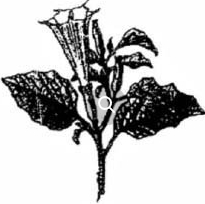
A
Hallucinogen
B
Depressant
C
Stimulant
D
Pain killer
Solution
(A) : The plant illustrated in the diagram is $Datura$.
$Datura$ is well-known for its hallucinogenic properties.
The seeds and flowers of $Datura$ contain alkaloids like atropine,hyoscyamine,and scopolamine,which act as hallucinogens when consumed.
These substances alter perception,thoughts,and feelings,leading to hallucinations.
$Datura$ is well-known for its hallucinogenic properties.
The seeds and flowers of $Datura$ contain alkaloids like atropine,hyoscyamine,and scopolamine,which act as hallucinogens when consumed.
These substances alter perception,thoughts,and feelings,leading to hallucinations.
0 likesView Solution
71
BiologyMediumMCQNEET · 2014
At which stage of $HIV$ infection does one usually show symptoms of $AIDS$?
A
Within $15$ days of sexual contact with an infected person
B
When the infected retrovirus enters host cells
C
When $HIV$ damages a large number of helper $T$-lymphocytes
D
When the viral $DNA$ is produced by reverse transcriptase
Solution
(C) $AIDS$ is a disorder of the cell-mediated immune system of the body.
$HIV$ (Human Immunodeficiency Virus) is the causative agent of $AIDS$.
Upon infection,the virus replicates and progressively destroys helper $T$-lymphocytes ($CD4^+$ cells).
When the count of these helper $T$-cells drops significantly,the body loses its ability to fight off infections and cancers,leading to the clinical manifestation of $AIDS$ symptoms.
Therefore,the correct stage is when $HIV$ damages a large number of helper $T$-lymphocytes.
$HIV$ (Human Immunodeficiency Virus) is the causative agent of $AIDS$.
Upon infection,the virus replicates and progressively destroys helper $T$-lymphocytes ($CD4^+$ cells).
When the count of these helper $T$-cells drops significantly,the body loses its ability to fight off infections and cancers,leading to the clinical manifestation of $AIDS$ symptoms.
Therefore,the correct stage is when $HIV$ damages a large number of helper $T$-lymphocytes.
0 likesView Solution
72
BiologyMediumMCQNEET · 2014
In vitro clonal propagation in plants is characterized by
A
$PCR$ and $RAPD$
B
northern blotting
C
electrophoresis and $HPLC$
D
microscopy
Solution
(A) : Clonal propagation can be characterized by $PCR$ and $RAPD$.
The polymerase chain reaction $(PCR)$ technique generates microgram $(\mu g)$ quantities of $DNA$ copies (up to billion copies) of the desired $DNA$ (or $RNA$) segment, present even as a single copy in the initial preparation, in a matter of a few hours.
$RAPD$ stands for Random Amplification of Polymorphic $DNA$.
It is a type of $PCR$, but the segments of $DNA$ that are amplified are random.
No knowledge of the $DNA$ sequence for the targeted gene is required, as the primers will bind somewhere in the sequence, but it is not certain exactly where.
Its resolving power is much lower than targeted, species-specific $DNA$ comparison methods, such as short tandem repeats.
The polymerase chain reaction $(PCR)$ technique generates microgram $(\mu g)$ quantities of $DNA$ copies (up to billion copies) of the desired $DNA$ (or $RNA$) segment, present even as a single copy in the initial preparation, in a matter of a few hours.
$RAPD$ stands for Random Amplification of Polymorphic $DNA$.
It is a type of $PCR$, but the segments of $DNA$ that are amplified are random.
No knowledge of the $DNA$ sequence for the targeted gene is required, as the primers will bind somewhere in the sequence, but it is not certain exactly where.
Its resolving power is much lower than targeted, species-specific $DNA$ comparison methods, such as short tandem repeats.
0 likesView Solution
73
BiologyMediumMCQNEET · 2014
To obtain virus-free healthy plants from a diseased one by tissue culture technique,which part/parts of the diseased plant will be taken?
A
Apical meristem only
B
Palisade parenchyma
C
Both apical and axillary meristems
D
Epidermis only
Solution
(C) : Meristem is a localized group of cells,which are actively dividing and undifferentiated but ultimately give rise to permanent tissue.
Even if the plant is infected with a virus,the meristematic tissue remains free of the virus.
Therefore,the meristem can be removed and grown in vitro to obtain virus-free plants.
Cultivation of axillary or apical shoot meristems is called meristem culture.
Both apical and axillary meristems are generally free from viruses.
Even if the plant is infected with a virus,the meristematic tissue remains free of the virus.
Therefore,the meristem can be removed and grown in vitro to obtain virus-free plants.
Cultivation of axillary or apical shoot meristems is called meristem culture.
Both apical and axillary meristems are generally free from viruses.
0 likesView Solution
74
BiologyMediumMCQNEET · 2014
An alga which can be employed as food for human beings is
A
Ulothrix
B
Chlorella
C
Spirogyra
D
Polysiphonia
Solution
(B) $Chlorella$ is a single-celled green alga (chlorophycean) with a high protein content.
It is widely recognized as a source of $SCP$ (Single Cell Protein).
Due to its high nutritional value,it is also used as a food supplement for astronauts during long space travels.
It is widely recognized as a source of $SCP$ (Single Cell Protein).
Due to its high nutritional value,it is also used as a food supplement for astronauts during long space travels.
0 likesView Solution
75
BiologyMediumMCQNEET · 2014
What gases are produced in anaerobic sludge digesters?
A
Methane and $CO_2$ only
B
Methane,Hydrogen sulphide and $CO_2$
C
Methane,Hydrogen sulphide and $O_2$
D
Hydrogen sulphide and $CO_2$
Solution
(B) The correct answer is $B$.
During the process of sewage treatment,anaerobic sludge digesters are used to decompose organic matter.
Microbial activity in these digesters depends on the specific microbes and the organic substrates present.
Methanogens are a group of anaerobic bacteria that act on cellulosic material to produce large amounts of methane $(CH_4)$ along with carbon dioxide $(CO_2)$.
Additionally,other anaerobic bacteria present in the sludge produce gases such as hydrogen sulphide $(H_2S)$ and ammonia $(NH_3)$.
Therefore,the mixture of gases produced in anaerobic sludge digesters typically includes methane,hydrogen sulphide,and carbon dioxide.
During the process of sewage treatment,anaerobic sludge digesters are used to decompose organic matter.
Microbial activity in these digesters depends on the specific microbes and the organic substrates present.
Methanogens are a group of anaerobic bacteria that act on cellulosic material to produce large amounts of methane $(CH_4)$ along with carbon dioxide $(CO_2)$.
Additionally,other anaerobic bacteria present in the sludge produce gases such as hydrogen sulphide $(H_2S)$ and ammonia $(NH_3)$.
Therefore,the mixture of gases produced in anaerobic sludge digesters typically includes methane,hydrogen sulphide,and carbon dioxide.
0 likesView Solution
76
BiologyMediumMCQNEET · 2014
The first human hormone produced by recombinant $DNA$ technology is
A
insulin
B
estrogen
C
thyroxin
D
progesterone
Solution
(A) : Recombinant $DNA$ technology has significantly impacted healthcare by enabling the mass production of safe and effective therapeutic drugs.
In $1983$, the American company Eli Lily first synthesized two $DNA$ sequences corresponding to the $A$ and $B$ chains of human insulin.
These sequences were introduced into plasmids of $Escherichia \text{ } coli$ to produce the insulin chains.
The $A$ and $B$ chains were produced separately, extracted, and then combined by creating disulfide bonds to form functional human insulin, known as humulin.
In $1983$, the American company Eli Lily first synthesized two $DNA$ sequences corresponding to the $A$ and $B$ chains of human insulin.
These sequences were introduced into plasmids of $Escherichia \text{ } coli$ to produce the insulin chains.
The $A$ and $B$ chains were produced separately, extracted, and then combined by creating disulfide bonds to form functional human insulin, known as humulin.
0 likesView Solution
77
BiologyMediumMCQNEET · 2014
Just as a person moving from Delhi to Shimla to escape the heat for the duration of hot summer,thousands of migratory birds from Siberia and other extremely cold northern regions move to:
A
Western Ghats
B
Meghalaya
C
Corbett National Park
D
Keoladeo National Park
Solution
(D) Many migratory birds from Siberia and other extremely cold northern regions migrate to India during the winter season to escape the harsh,freezing conditions of their native habitats. $A$ well-known example is the migration of birds to the $Keoladeo$ $National$ $Park$ (formerly known as $Bharatpur$ $Bird$ $Sanctuary$) in Rajasthan,India,which provides a suitable environment for them to survive the winter.
0 likesView Solution
78
BiologyMediumMCQNEET · 2014
Match the following and select the correct option.
| $A.$ Earthworm | $(i)$ Pioneer species |
| $B.$ Succession | $(ii)$ Detritivore |
| $C.$ Ecosystem service | $(iii)$ Natality |
| $D.$ Population growth | $(iv)$ Pollination |
A
$A-(i), B-(ii), C-(iii), D-(iv)$
B
$A-(iv), B-(i), C-(iii), D-(ii)$
C
$A-(iii), B-(ii), C-(iv), D-(i)$
D
$A-(ii), B-(i), C-(iv), D-(iii)$
Solution
(D) The correct matching is as follows:
$A.$ Earthworm is a detritivore, as it feeds on decaying organic matter $(A-ii)$.
$B.$ Succession is the process of development of a community, and pioneer species are the first organisms to colonize a barren area $(B-i)$.
$C.$ Ecosystem service refers to the benefits humans obtain from ecosystems, such as pollination $(C-iv)$.
$D.$ Population growth is characterized by factors like natality (birth rate) and mortality (death rate) $(D-iii)$.
Therefore, the correct sequence is $A-ii, B-i, C-iv, D-iii$.
$A.$ Earthworm is a detritivore, as it feeds on decaying organic matter $(A-ii)$.
$B.$ Succession is the process of development of a community, and pioneer species are the first organisms to colonize a barren area $(B-i)$.
$C.$ Ecosystem service refers to the benefits humans obtain from ecosystems, such as pollination $(C-iv)$.
$D.$ Population growth is characterized by factors like natality (birth rate) and mortality (death rate) $(D-iii)$.
Therefore, the correct sequence is $A-ii, B-i, C-iv, D-iii$.
0 likesView Solution
79
BiologyMediumMCQNEET · 2014
Given below is a simplified model of phosphorus cycling in a terrestrial ecosystem with four blanks $(A-D)$. Identify the blanks.
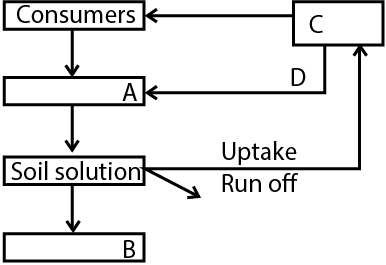
A
$A$-Rock minerals,$B$-Detritus,$C$-Litter fall,$D$-Producers
B
$A$-Litter fall,$B$-Producers,$C$-Rock minerals,$D$-Detritus
C
$A$-Detritus,$B$-Rock minerals,$C$-Producers,$D$-Litter fall
D
$A$-Producers,$B$-Litter fall,$C$-Rock minerals,$D$-Detritus
Solution
(C) In the phosphorus cycle of a terrestrial ecosystem:
$1$. Producers (plants) take up phosphorus from the soil solution.
$2$. Through litter fall,organic matter (detritus) is added to the soil.
$3$. Consumers feed on producers and contribute to the detritus pool.
$4$. Detritus decomposes to release phosphorus back into the soil solution.
$5$. Rock minerals act as the primary reservoir,weathering to add phosphorus to the soil solution.
Based on the provided diagram:
- $C$ represents Producers (which take up phosphorus).
- $D$ represents Litter fall (organic matter returning to the soil).
- $A$ represents Detritus (organic waste from consumers).
- $B$ represents Rock minerals (the source of phosphorus).
Therefore,the correct mapping is $A$-Detritus,$B$-Rock minerals,$C$-Producers,$D$-Litter fall.
$1$. Producers (plants) take up phosphorus from the soil solution.
$2$. Through litter fall,organic matter (detritus) is added to the soil.
$3$. Consumers feed on producers and contribute to the detritus pool.
$4$. Detritus decomposes to release phosphorus back into the soil solution.
$5$. Rock minerals act as the primary reservoir,weathering to add phosphorus to the soil solution.
Based on the provided diagram:
- $C$ represents Producers (which take up phosphorus).
- $D$ represents Litter fall (organic matter returning to the soil).
- $A$ represents Detritus (organic waste from consumers).
- $B$ represents Rock minerals (the source of phosphorus).
Therefore,the correct mapping is $A$-Detritus,$B$-Rock minerals,$C$-Producers,$D$-Litter fall.
0 likesView Solution
80
BiologyMediumMCQNEET · 2014
If $20 \ J$ of energy is trapped at the producer level,then how much energy will be available to the peacock as food in the following food chain (in $J$)?
Plant $\rightarrow$ Mice $\rightarrow$ Snake $\rightarrow$ Peacock
Plant $\rightarrow$ Mice $\rightarrow$ Snake $\rightarrow$ Peacock
A
$0.02$
B
$0.002$
C
$0.2$
D
$0.0002$
Solution
(A) According to the $10\%$ law proposed by Lindemann,only $10\%$ of the energy is transferred from one trophic level to the next,while the remaining $90\%$ is lost as heat or used in metabolic activities.
$1$. Producer (Plant): $20 \ J$
$2$. Primary Consumer (Mice): $10\%$ of $20 \ J = 2 \ J$
$3$. Secondary Consumer (Snake): $10\%$ of $2 \ J = 0.2 \ J$
$4$. Tertiary Consumer (Peacock): $10\%$ of $0.2 \ J = 0.02 \ J$
Therefore,the energy available to the peacock is $0.02 \ J$.
$1$. Producer (Plant): $20 \ J$
$2$. Primary Consumer (Mice): $10\%$ of $20 \ J = 2 \ J$
$3$. Secondary Consumer (Snake): $10\%$ of $2 \ J = 0.2 \ J$
$4$. Tertiary Consumer (Peacock): $10\%$ of $0.2 \ J = 0.02 \ J$
Therefore,the energy available to the peacock is $0.02 \ J$.
0 likesView Solution
81
BiologyMediumMCQNEET · 2014
An example of $ex \, situ$ conservation is
A
national park
B
seed bank
C
wildlife sanctuary
D
sacred grove
Solution
(B) $In \, situ$ (on-site) conservation involves the protection of the entire ecosystem and its biodiversity at all levels to safeguard threatened species. Examples include national parks, wildlife sanctuaries, biosphere reserves, and sacred groves.
$Ex \, situ$ (off-site) conservation involves the protection of selected rare plants or animals in locations outside their natural habitats. Examples include seed banks, gene banks, botanical gardens, zoological parks, $in \, vitro$ fertilization, cryopreservation, and tissue culture. Therefore, a seed bank is an example of $ex \, situ$ conservation.
$Ex \, situ$ (off-site) conservation involves the protection of selected rare plants or animals in locations outside their natural habitats. Examples include seed banks, gene banks, botanical gardens, zoological parks, $in \, vitro$ fertilization, cryopreservation, and tissue culture. Therefore, a seed bank is an example of $ex \, situ$ conservation.
0 likesView Solution
82
BiologyMediumMCQNEET · 2014
$A$ species facing an extremely high risk of extinction in the immediate future is called:
A
vulnerable
B
endemic
C
critically endangered
D
extinct
Solution
(C) The correct answer is $C$.
According to the $IUCN$ Red List criteria,a species is classified as 'critically endangered' when it is facing an extremely high risk of extinction in the wild in the immediate future.
'Vulnerable' species are those facing a high risk of extinction in the medium-term future.
'Endemic' species are those restricted to a specific geographic area.
'Extinct' species are those that no longer have any living individuals.
According to the $IUCN$ Red List criteria,a species is classified as 'critically endangered' when it is facing an extremely high risk of extinction in the wild in the immediate future.
'Vulnerable' species are those facing a high risk of extinction in the medium-term future.
'Endemic' species are those restricted to a specific geographic area.
'Extinct' species are those that no longer have any living individuals.
0 likesView Solution
83
BiologyMediumMCQNEET · 2014
The organization which publishes the Red List of species is
A
$ICFRE$
B
$IUCN$
C
$UNEP$
D
$WWF$
Solution
(B) $IUCN$ stands for International Union for Conservation of Nature and Natural Resources,now known as the World Conservation Union $(WCU)$.
It is headquartered in Gland,Switzerland.
It maintains the Red Data Book or Red List,which is a comprehensive catalogue of taxa (species) facing the risk of extinction.
The Red Data Book or Red List initiative was started in $1963$ to document and track the conservation status of various species globally.
It is headquartered in Gland,Switzerland.
It maintains the Red Data Book or Red List,which is a comprehensive catalogue of taxa (species) facing the risk of extinction.
The Red Data Book or Red List initiative was started in $1963$ to document and track the conservation status of various species globally.
0 likesView Solution
84
BiologyMediumMCQNEET · 2014
Given below is the representation of the extent of global diversity of invertebrates. What groups do the four portions $(a, b, c, d)$ represent respectively?
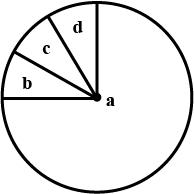
A
$a$-Insects,$b$-Crustaceans,$c$-Other animal groups,$d$-Molluscs
B
$a$-Crustaceans,$b$-Insects,$c$-Molluscs,$d$-Other animal groups
C
$a$-Molluscs,$b$-Other animal groups,$c$-Crustaceans,$d$-Insects
D
$a$-Insects,$b$-Molluscs,$c$-Crustaceans,$d$-Other animal groups
Solution
(D) According to the pie chart representing the global diversity of invertebrates,the largest portion $(a)$ represents insects,which are the most diverse group of animals on Earth. The next portion $(b)$ represents molluscs,followed by crustaceans $(c)$,and the remaining portion $(d)$ represents other animal groups. Therefore,the correct sequence is $a$-Insects,$b$-Molluscs,$c$-Crustaceans,$d$-Other animal groups.
0 likesView Solution
85
BiologyMediumMCQNEET · 2014
$A$ location with luxuriant growth of lichens on the trees indicates that the
A
trees are very healthy
B
trees are heavily infested
C
location is highly polluted
D
location is not polluted.
Solution
(D) : Lichens are very sensitive to $SO_2$ pollution. They are completely destroyed at places where there is $SO_2$ pollution in the atmosphere. Therefore,they act as very good indicators of $SO_2$ pollution. $A$ luxuriant growth of lichens signifies that the air quality is good and the area is free from $SO_2$ contamination.
0 likesView Solution
86
BiologyEasyMCQNEET · 2014
The zone of the atmosphere in which the ozone layer is present is called:
A
ionosphere
B
mesosphere
C
stratosphere
D
troposphere
Solution
(C) The correct answer is $C$. The ozone layer or ozone shield is present in the stratosphere.
It functions as a protective shield against strong $UV$ radiations coming from the sun.
$UV$ radiations are highly harmful and can cause mutations in living organisms.
Thinning of the ozone layer increases the amount of $UV$ radiations reaching the Earth.
This leads to an increased occurrence of cataracts,skin cancers,vision impairment,photoburning,and a weakened immune system.
It functions as a protective shield against strong $UV$ radiations coming from the sun.
$UV$ radiations are highly harmful and can cause mutations in living organisms.
Thinning of the ozone layer increases the amount of $UV$ radiations reaching the Earth.
This leads to an increased occurrence of cataracts,skin cancers,vision impairment,photoburning,and a weakened immune system.
0 likesView Solution
87
BiologyMediumMCQNEET · 2014
$A$ scrubber in the exhaust of a chemical industrial plant removes
A
gases like sulphur dioxide
B
particulate matter of the size $5$ micrometer or above
C
gases like ozone and methane
D
particulate matter of the size $2.5$ micrometer or less
Solution
(A) The correct answer is $A$.
Scrubbers are pollution control devices used in industrial exhaust systems to remove harmful substances.
They are primarily used to remove gaseous pollutants,such as sulphur dioxide $(SO_2)$,from the exhaust gases of chemical industrial plants.
While scrubbers can also be used to separate particulate matter by passing the exhaust through dry or wet packing materials,their most common and significant application in industrial settings is the removal of acidic gases like $SO_2$ through a wet scrubbing process.
Scrubbers are pollution control devices used in industrial exhaust systems to remove harmful substances.
They are primarily used to remove gaseous pollutants,such as sulphur dioxide $(SO_2)$,from the exhaust gases of chemical industrial plants.
While scrubbers can also be used to separate particulate matter by passing the exhaust through dry or wet packing materials,their most common and significant application in industrial settings is the removal of acidic gases like $SO_2$ through a wet scrubbing process.
0 likesView Solution
88
BiologyMediumMCQNEET · 2014
Non-albuminous seeds are produced in ..........
A
Maize
B
Castor
C
Wheat
D
Pea
Solution
(D) Non-albuminous seeds,also known as exalbuminous seeds,are those in which the endosperm is completely consumed by the developing embryo before the seed matures.
In these seeds,food is stored in the cotyledons.
Examples of non-albuminous seeds include pea,bean,and groundnut.
In contrast,maize,castor,and wheat are examples of albuminous (endospermic) seeds,where the endosperm persists in the mature seed.
Therefore,the correct option is $D$.
In these seeds,food is stored in the cotyledons.
Examples of non-albuminous seeds include pea,bean,and groundnut.
In contrast,maize,castor,and wheat are examples of albuminous (endospermic) seeds,where the endosperm persists in the mature seed.
Therefore,the correct option is $D$.
0 likesView Solution
89
BiologyMediumMCQNEET · 2014
Which of the following statements is correct?
A
Seeds in grasses are non-endospermic.
B
Mango is an apomictic fruit.
C
The proteinaceous layer in maize grain is called the aleurone layer.
D
$A$ sterile pistil is called a staminode.
Solution
(C) $1$. In grasses (monocots),seeds are typically endospermic,so option $A$ is incorrect.
$2$. Mango is a drupe fruit,not an apomictic fruit,so option $B$ is incorrect.
$3$. In maize grains,the outer covering of the endosperm separates the embryo by a proteinaceous layer known as the aleurone layer. Thus,option $C$ is correct.
$4$. $A$ sterile stamen is called a staminode,while a sterile pistil is called a pistillode. Therefore,option $D$ is incorrect.
$2$. Mango is a drupe fruit,not an apomictic fruit,so option $B$ is incorrect.
$3$. In maize grains,the outer covering of the endosperm separates the embryo by a proteinaceous layer known as the aleurone layer. Thus,option $C$ is correct.
$4$. $A$ sterile stamen is called a staminode,while a sterile pistil is called a pistillode. Therefore,option $D$ is incorrect.
0 likesView Solution
90
BiologyMediumMCQNEET · 2014
Which vector can clone small pieces of $DNA$?
A
Bacterial Artificial Chromosome $(BAC)$
B
Yeast Artificial Chromosome $(YAC)$
C
Plasmid
D
Cosmid
Solution
(C) Plasmids are small,circular,extrachromosomal $DNA$ molecules found in bacteria that are widely used as vectors in genetic engineering.
They are ideal for cloning small fragments of $DNA$ (typically up to $10 \ kb$).
In contrast,$BAC$s and $YAC$s are used for cloning large $DNA$ inserts,and cosmids are used for intermediate sizes.
Therefore,the correct option is $C$.
They are ideal for cloning small fragments of $DNA$ (typically up to $10 \ kb$).
In contrast,$BAC$s and $YAC$s are used for cloning large $DNA$ inserts,and cosmids are used for intermediate sizes.
Therefore,the correct option is $C$.
0 likesView Solution
91
BiologyMediumMCQNEET · 2014
Which of the following techniques is associated with the cloning method of tissue culture performed under in vitro conditions?
A
$PCR$ and $RAPD$
B
Northern blotting
C
Electrophoresis and $HPLC$
D
Microscopy
Solution
(A) Tissue culture, specifically micropropagation, involves the production of genetically identical plants (clones) in an $in vitro$ environment.
To verify the genetic uniformity of these clones, molecular markers are used.
$PCR$ (Polymerase Chain Reaction) and $RAPD$ (Random Amplified Polymorphic $DNA$) are standard molecular techniques used to assess genetic stability and ensure that the tissue-cultured plants are true-to-type clones.
To verify the genetic uniformity of these clones, molecular markers are used.
$PCR$ (Polymerase Chain Reaction) and $RAPD$ (Random Amplified Polymorphic $DNA$) are standard molecular techniques used to assess genetic stability and ensure that the tissue-cultured plants are true-to-type clones.
0 likesView Solution
92
BiologyMediumMCQNEET · 2014
Which of the following is not used in the Southern hybridization technique for chromosomal $DNA$ analysis?
A
Electrophoresis
B
Blotting
C
Autoradiography
D
$PCR$
Solution
(D) Southern hybridization is a technique used for the detection of specific $DNA$ sequences in $DNA$ samples.
The steps involved in Southern hybridization are:
$1$. Digestion of $DNA$ with restriction endonucleases.
$2$. Separation of $DNA$ fragments by gel electrophoresis.
$3$. Transfer of separated $DNA$ fragments onto a nitrocellulose or nylon membrane (Blotting).
$4$. Hybridization with a labeled probe.
$5$. Detection of the hybridized probe using autoradiography.
$PCR$ (Polymerase Chain Reaction) is a separate technique used for the amplification of specific $DNA$ sequences and is not a step in the standard Southern hybridization procedure.
The steps involved in Southern hybridization are:
$1$. Digestion of $DNA$ with restriction endonucleases.
$2$. Separation of $DNA$ fragments by gel electrophoresis.
$3$. Transfer of separated $DNA$ fragments onto a nitrocellulose or nylon membrane (Blotting).
$4$. Hybridization with a labeled probe.
$5$. Detection of the hybridized probe using autoradiography.
$PCR$ (Polymerase Chain Reaction) is a separate technique used for the amplification of specific $DNA$ sequences and is not a step in the standard Southern hybridization procedure.
0 likesView Solution
93
BiologyMediumMCQNEET · 2014
Which vectors are commonly used in the sequencing of the human genome?
A
$T-DNA$
B
$BAC$ and $YAC$
C
Expression vectors
D
$T/A$ cloning vectors
Solution
(B) The Human Genome Project $(HGP)$ involved the sequencing of the entire human genome. Due to the large size of the human genome,specialized vectors were required to clone large fragments of $DNA$. The most commonly used vectors were $BAC$ (Bacterial Artificial Chromosomes) and $YAC$ (Yeast Artificial Chromosomes). These vectors are capable of carrying large inserts of $DNA$,which facilitated the mapping and sequencing process.
0 likesView Solution
94
BiologyMediumMCQNEET · 2014
Just as a person moves from Delhi to Shimla to escape the summer heat,where do millions of migratory birds go to escape the harsh winter of Siberia and other northern regions?
A
Western Ghats
B
Meghalaya
C
Corbett National Park
D
Keoladeo National Park
Solution
(D) Many migratory birds from Siberia and other extremely cold northern regions migrate to warmer areas during the winter to survive. In India,the $Keoladeo$ $National$ $Park$ (formerly known as $Bharatpur$ $Bird$ $Sanctuary$) in Rajasthan is a famous destination for these migratory birds. They travel thousands of kilometers to reach this wetland habitat to escape the severe cold of their breeding grounds.
0 likesView Solution
95
BiologyMediumMCQNEET · 2014
Geitonogamy involves
A
fertilization of a flower by the pollen from another flower of the same plant
B
fertilization of a flower by the pollen from the same flower
C
fertilization of a flower by the pollen from a flower of another plant in the same population
D
fertilization of a flower by the pollen from a flower of another plant belonging to a distant population
Solution
(A) Geitonogamy is a type of pollination where pollen grains are transferred from the anther of one flower to the stigma of another flower on the same plant. Although it is functionally cross-pollination involving a pollinating agent,genetically it is similar to self-pollination because the pollen grains come from the same plant.
0 likesView Solution
96
BiologyMediumMCQNEET · 2014
Forelimbs of cat,lizard used in walking; forelimbs of whale used in swimming and forelimbs of bats used in flying are an example of
A
Analogous organs
B
Adaptive radiation
C
Homologous organs
D
Convergent evolution
Solution
(C) Organs that share a common fundamental anatomical structure and similar embryonic origin,despite performing different functions,are known as homologous organs.
In the case of the forelimbs of a cat,lizard,whale,and bat,they all possess the same basic skeletal arrangement (humerus,radius,ulna,carpals,metacarpals,and phalanges).
Although these limbs are adapted for different functions like walking,swimming,or flying,their underlying structural similarity indicates a common evolutionary ancestry.
Therefore,they are classic examples of homologous organs.
In the case of the forelimbs of a cat,lizard,whale,and bat,they all possess the same basic skeletal arrangement (humerus,radius,ulna,carpals,metacarpals,and phalanges).
Although these limbs are adapted for different functions like walking,swimming,or flying,their underlying structural similarity indicates a common evolutionary ancestry.
Therefore,they are classic examples of homologous organs.
0 likesView Solution
Vedclass Products
For Students
Vedclass Test Series
Mock tests in real NEET style covering Biology with performance analysis. 5-day free trial.
Start Free TrialFor Teachers
Exam Paper Generator
Generate Set A/B/C/D Biology papers from 7.5L+ questions in 2 minutes. 3 chapters free.
Try FreeFor Institutes
Online Exam Module
Run live NEET mock exams with unlimited students, 360° analytics & white-label branding.
See DemoFrequently Asked Questions
How many Biology questions are in NEET 2014?
There are 104 Biology questions from the NEET 2014 paper on Vedclass, each with a detailed step-by-step solution in English.
Are NEET 2014 Biology solutions available in English?
Yes. All solutions on this page are in English. You can also switch to English or Hindi using the language buttons above the questions.
Can I practice NEET 2014 Biology as a timed test?
Yes. Use the Vedclass Test Series to attempt a full NEET mock test covering Biology with time limits and instant score analysis.
Can teachers create Biology papers from NEET previous year questions?
Yes. The Vedclass Exam Paper Generator lets teachers mix NEET Biology questions and generate Set A/B/C/D papers in minutes.
For Teachers & Institutes
Build a Custom Biology Paper
Pick NEET 2014 Biology questions, set difficulty, and generate Set A/B/C/D in 2 minutes.