
MathematicsQ251–300 of 589 questions
Page 6 of 9 · English
251
MathematicsMediumMCQMHT CET · 2023
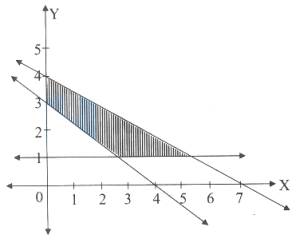
If the feasible region is as shown in the figure,then the related inequalities are:
A
$3x + 4y \geq 12, 4x + 7y \leq 28, y \leq 1, x \geq 0, y \geq 0$
B
$3x + 4y \geq 12, 4x + 7y \leq 28, y \geq 1, x \geq 0, y \geq 0$
C
$3x + 4y \leq 12, 4x + 7y \leq 28, y \leq 1, x \geq 0, y \geq 0$
D
$3x + 4y \leq 12, 4x + 7y \geq 28, y \geq 1, x \geq 0, y \geq 0$
Solution
(B) $1$. Identify the lines bounding the region: The lines are $3x + 4y = 12$ (intercepts $(4,0)$ and $(0,3)$),$4x + 7y = 28$ (intercepts $(7,0)$ and $(0,4)$),and $y = 1$.
$2$. Analyze the inequalities:
- For the line $3x + 4y = 12$,the shaded region is away from the origin,so the inequality is $3x + 4y \geq 12$.
- For the line $4x + 7y = 28$,the shaded region is towards the origin,so the inequality is $4x + 7y \leq 28$.
- For the line $y = 1$,the shaded region is above the line,so the inequality is $y \geq 1$.
- Since the region is in the first quadrant,we have $x \geq 0$ and $y \geq 0$.
$3$. Combining these,the system of inequalities is $3x + 4y \geq 12, 4x + 7y \leq 28, y \geq 1, x \geq 0, y \geq 0$.
$2$. Analyze the inequalities:
- For the line $3x + 4y = 12$,the shaded region is away from the origin,so the inequality is $3x + 4y \geq 12$.
- For the line $4x + 7y = 28$,the shaded region is towards the origin,so the inequality is $4x + 7y \leq 28$.
- For the line $y = 1$,the shaded region is above the line,so the inequality is $y \geq 1$.
- Since the region is in the first quadrant,we have $x \geq 0$ and $y \geq 0$.
$3$. Combining these,the system of inequalities is $3x + 4y \geq 12, 4x + 7y \leq 28, y \geq 1, x \geq 0, y \geq 0$.
0 likesView Solution
252
MathematicsMediumMCQMHT CET · 2023
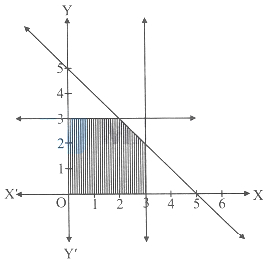
The shaded area in the given figure is a solution set for some system of inequations. The maximum value of the function $z=10x+25y$ subject to the linear constraints given by the system is
A
$80$
B
$100$
C
$95$
D
$105$
Solution
(C) The feasible region is a polygon with vertices $(0,0)$,$(3,0)$,$(3,2)$,$(2,3)$,and $(0,3)$.
We evaluate the objective function $z=10x+25y$ at each vertex:
At $(0,0)$,$z=10(0)+25(0)=0$
At $(3,0)$,$z=10(3)+25(0)=30$
At $(3,2)$,$z=10(3)+25(2)=30+50=80$
At $(2,3)$,$z=10(2)+25(3)=20+75=95$
At $(0,3)$,$z=10(0)+25(3)=75$
Comparing these values,the maximum value of $z$ is $95$.
We evaluate the objective function $z=10x+25y$ at each vertex:
At $(0,0)$,$z=10(0)+25(0)=0$
At $(3,0)$,$z=10(3)+25(0)=30$
At $(3,2)$,$z=10(3)+25(2)=30+50=80$
At $(2,3)$,$z=10(2)+25(3)=20+75=95$
At $(0,3)$,$z=10(0)+25(3)=75$
Comparing these values,the maximum value of $z$ is $95$.
0 likesView Solution
253
MathematicsDifficultMCQMHT CET · 2023
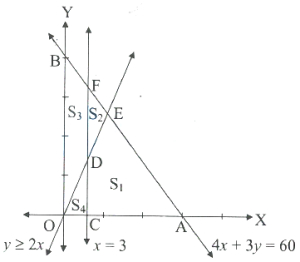
The solution set of the inequalities $4x + 3y \leq 60$,$y \geq 2x$,$x \geq 3$,$x, y \geq 0$ is represented by which region?
A
$S_2$ region
B
$S_1$ region
C
$S_3$ region
D
$S_4$ region
Solution
(A) To find the feasible region,we analyze the given inequalities:
$1$. $4x + 3y \leq 60$: This represents the region on or below the line passing through $(15, 0)$ and $(0, 20)$.
$2$. $y \geq 2x$: This represents the region on or above the line passing through $(0, 0)$ and $(3, 6)$.
$3$. $x \geq 3$: This represents the region to the right of the vertical line $x = 3$.
$4$. $x, y \geq 0$: This represents the first quadrant.
By testing a point $(4, 10)$ which lies in the $S_2$ region:
- $4(4) + 3(10) = 16 + 30 = 46 \leq 60$ (True)
- $10 \geq 2(4) = 8$ (True)
- $4 \geq 3$ (True)
- $4, 10 \geq 0$ (True)
Since all conditions are satisfied,the solution set is represented by the $S_2$ region.
$1$. $4x + 3y \leq 60$: This represents the region on or below the line passing through $(15, 0)$ and $(0, 20)$.
$2$. $y \geq 2x$: This represents the region on or above the line passing through $(0, 0)$ and $(3, 6)$.
$3$. $x \geq 3$: This represents the region to the right of the vertical line $x = 3$.
$4$. $x, y \geq 0$: This represents the first quadrant.
By testing a point $(4, 10)$ which lies in the $S_2$ region:
- $4(4) + 3(10) = 16 + 30 = 46 \leq 60$ (True)
- $10 \geq 2(4) = 8$ (True)
- $4 \geq 3$ (True)
- $4, 10 \geq 0$ (True)
Since all conditions are satisfied,the solution set is represented by the $S_2$ region.
0 likesView Solution
254
MathematicsMediumMCQMHT CET · 2023
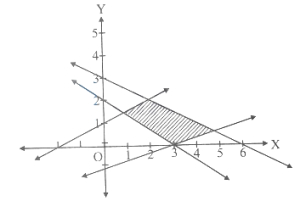
The shaded region in the following figure represents the solution set for a certain linear programming problem. The linear constraints for this region are given by:
A
$2x + 3y \geq 6, -x + 2y \geq 2, 3x + 6y \leq 18, x - 3y \geq 3, x \geq 0, y \geq 0$
B
$2x + 3y \geq 6, -x + 2y \leq 2, x - 3y \leq 3, x + 2y \geq 18, x \geq 0, y \geq 0$
C
$2x + 3y \leq 6, -x + 2y \geq 2, 3x + 6y \leq 18, x - 3y \leq 3, x \geq 0, y \geq 0$
D
$2x + 3y \geq 6, 3x + 6y \leq 18, x - 3y \leq 3, -x + 2y \leq 2, x \geq 0, y \geq 0$
Solution
(D) To determine the linear constraints,we analyze the boundary lines of the shaded region:
$1$. The line passing through $(3, 0)$ and $(0, 2)$ is $2x + 3y = 6$. Since the shaded region is away from the origin,the constraint is $2x + 3y \geq 6$.
$2$. The line passing through $(0, 3)$ and $(6, 0)$ is $3x + 6y = 18$. Since the shaded region is towards the origin,the constraint is $3x + 6y \leq 18$.
$3$. The line passing through $(3, 0)$ and $(0, -1)$ is $x - 3y = 3$. Since the shaded region is towards the origin,the constraint is $x - 3y \leq 3$.
$4$. The line passing through $(0, 1)$ and $(2, 2)$ is $-x + 2y = 2$. Since the shaded region is towards the origin,the constraint is $-x + 2y \leq 2$.
$5$. Since the region is in the first quadrant,$x \geq 0$ and $y \geq 0$.
Thus,the correct constraints are $2x + 3y \geq 6, 3x + 6y \leq 18, x - 3y \leq 3, -x + 2y \leq 2, x \geq 0, y \geq 0$.
$1$. The line passing through $(3, 0)$ and $(0, 2)$ is $2x + 3y = 6$. Since the shaded region is away from the origin,the constraint is $2x + 3y \geq 6$.
$2$. The line passing through $(0, 3)$ and $(6, 0)$ is $3x + 6y = 18$. Since the shaded region is towards the origin,the constraint is $3x + 6y \leq 18$.
$3$. The line passing through $(3, 0)$ and $(0, -1)$ is $x - 3y = 3$. Since the shaded region is towards the origin,the constraint is $x - 3y \leq 3$.
$4$. The line passing through $(0, 1)$ and $(2, 2)$ is $-x + 2y = 2$. Since the shaded region is towards the origin,the constraint is $-x + 2y \leq 2$.
$5$. Since the region is in the first quadrant,$x \geq 0$ and $y \geq 0$.
Thus,the correct constraints are $2x + 3y \geq 6, 3x + 6y \leq 18, x - 3y \leq 3, -x + 2y \leq 2, x \geq 0, y \geq 0$.
0 likesView Solution
255
MathematicsEasyMCQMHT CET · 2023
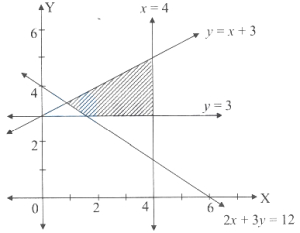
The shaded area in the figure given below is a solution set of a system of inequations. The minimum value of the objective function $Z = 3x + 5y$,subject to the linear constraints given by this system of inequations,is:
A
$19.5$
B
$2$
C
$195$
D
$19.8$
Solution
(A) The corner points of the feasible region are $A, B, C, D$.
From the graph,the lines are $y = 3$,$x = 4$,$y = x + 3$,and $2x + 3y = 12$.
$1$. Point $A$ is the intersection of $y = 3$ and $2x + 3y = 12$:
$2x + 3(3) = 12 \implies 2x = 3 \implies x = 1.5$. So,$A = (1.5, 3)$.
$2$. Point $B$ is the intersection of $y = 3$ and $x = 4$. So,$B = (4, 3)$.
$3$. Point $C$ is the intersection of $x = 4$ and $y = x + 3$:
$y = 4 + 3 = 7$. So,$C = (4, 7)$.
$4$. Point $D$ is the intersection of $y = x + 3$ and $2x + 3y = 12$:
$2x + 3(x + 3) = 12 \implies 5x + 9 = 12 \implies 5x = 3 \implies x = 0.6$.
$y = 0.6 + 3 = 3.6$. So,$D = (0.6, 3.6)$.
Now,evaluate $Z = 3x + 5y$ at these points:
$Z(A) = 3(1.5) + 5(3) = 4.5 + 15 = 19.5$.
$Z(B) = 3(4) + 5(3) = 12 + 15 = 27$.
$Z(C) = 3(4) + 5(7) = 12 + 35 = 47$.
$Z(D) = 3(0.6) + 5(3.6) = 1.8 + 18 = 19.8$.
The minimum value of $Z$ is $19.5$.
From the graph,the lines are $y = 3$,$x = 4$,$y = x + 3$,and $2x + 3y = 12$.
$1$. Point $A$ is the intersection of $y = 3$ and $2x + 3y = 12$:
$2x + 3(3) = 12 \implies 2x = 3 \implies x = 1.5$. So,$A = (1.5, 3)$.
$2$. Point $B$ is the intersection of $y = 3$ and $x = 4$. So,$B = (4, 3)$.
$3$. Point $C$ is the intersection of $x = 4$ and $y = x + 3$:
$y = 4 + 3 = 7$. So,$C = (4, 7)$.
$4$. Point $D$ is the intersection of $y = x + 3$ and $2x + 3y = 12$:
$2x + 3(x + 3) = 12 \implies 5x + 9 = 12 \implies 5x = 3 \implies x = 0.6$.
$y = 0.6 + 3 = 3.6$. So,$D = (0.6, 3.6)$.
Now,evaluate $Z = 3x + 5y$ at these points:
$Z(A) = 3(1.5) + 5(3) = 4.5 + 15 = 19.5$.
$Z(B) = 3(4) + 5(3) = 12 + 15 = 27$.
$Z(C) = 3(4) + 5(7) = 12 + 35 = 47$.
$Z(D) = 3(0.6) + 5(3.6) = 1.8 + 18 = 19.8$.
The minimum value of $Z$ is $19.5$.
0 likesView Solution
256
MathematicsMediumMCQMHT CET · 2023
Let $A = \begin{bmatrix} 1 & 1 & 1 \\ 0 & 1 & 3 \\ 1 & -2 & 1 \end{bmatrix}$,$B = \begin{bmatrix} 6 \\ 11 \\ 0 \end{bmatrix}$ and $X = \begin{bmatrix} a \\ b \\ c \end{bmatrix}$. If $AX = B$,then the value of $2a + b + 2c$ is:
A
$10$
B
$8$
C
$6$
D
$12$
Solution
(A) Given the matrix equation $AX = B$:
$\begin{bmatrix} 1 & 1 & 1 \\ 0 & 1 & 3 \\ 1 & -2 & 1 \end{bmatrix} \begin{bmatrix} a \\ b \\ c \end{bmatrix} = \begin{bmatrix} 6 \\ 11 \\ 0 \end{bmatrix}$
This corresponds to the system of linear equations:
$1) \quad a + b + c = 6$
$2) \quad b + 3c = 11$
$3) \quad a - 2b + c = 0$
From equation $(3)$,we have $a + c = 2b$.
Substitute $a + c = 2b$ into equation $(1)$:
$2b + b = 6 \implies 3b = 6 \implies b = 2$.
Now,substitute $b = 2$ into equation $(2)$:
$2 + 3c = 11 \implies 3c = 9 \implies c = 3$.
Finally,substitute $b = 2$ and $c = 3$ into equation $(1)$:
$a + 2 + 3 = 6 \implies a + 5 = 6 \implies a = 1$.
We need to find the value of $2a + b + 2c$:
$2(1) + 2 + 2(3) = 2 + 2 + 6 = 10$.
$\begin{bmatrix} 1 & 1 & 1 \\ 0 & 1 & 3 \\ 1 & -2 & 1 \end{bmatrix} \begin{bmatrix} a \\ b \\ c \end{bmatrix} = \begin{bmatrix} 6 \\ 11 \\ 0 \end{bmatrix}$
This corresponds to the system of linear equations:
$1) \quad a + b + c = 6$
$2) \quad b + 3c = 11$
$3) \quad a - 2b + c = 0$
From equation $(3)$,we have $a + c = 2b$.
Substitute $a + c = 2b$ into equation $(1)$:
$2b + b = 6 \implies 3b = 6 \implies b = 2$.
Now,substitute $b = 2$ into equation $(2)$:
$2 + 3c = 11 \implies 3c = 9 \implies c = 3$.
Finally,substitute $b = 2$ and $c = 3$ into equation $(1)$:
$a + 2 + 3 = 6 \implies a + 5 = 6 \implies a = 1$.
We need to find the value of $2a + b + 2c$:
$2(1) + 2 + 2(3) = 2 + 2 + 6 = 10$.
0 likesView Solution
257
MathematicsMediumMCQMHT CET · 2023
If $A=\begin{bmatrix} 2a & -3b \\ 3 & 2 \end{bmatrix}$ and $A \cdot \operatorname{adj} A = A A^{T}$,then $2a + 3b$ is
A
$-1$
B
$1$
C
$5$
D
$-5$
Solution
(C) Given $A = \begin{bmatrix} 2a & -3b \\ 3 & 2 \end{bmatrix}$.
We know that $A \cdot \operatorname{adj} A = |A| I = \begin{bmatrix} |A| & 0 \\ 0 & |A| \end{bmatrix}$.
Calculating the determinant $|A| = (2a)(2) - (-3b)(3) = 4a + 9b$.
So,$A \cdot \operatorname{adj} A = \begin{bmatrix} 4a + 9b & 0 \\ 0 & 4a + 9b \end{bmatrix}$.
Now,calculate $A A^{T}$:
$A A^{T} = \begin{bmatrix} 2a & -3b \\ 3 & 2 \end{bmatrix} \begin{bmatrix} 2a & 3 \\ -3b & 2 \end{bmatrix} = \begin{bmatrix} 4a^2 + 9b^2 & 6a - 6b \\ 6a - 6b & 9 + 4 \end{bmatrix} = \begin{bmatrix} 4a^2 + 9b^2 & 6a - 6b \\ 6a - 6b & 13 \end{bmatrix}$.
Given $A \cdot \operatorname{adj} A = A A^{T}$,we equate the matrices:
$\begin{bmatrix} 4a + 9b & 0 \\ 0 & 4a + 9b \end{bmatrix} = \begin{bmatrix} 4a^2 + 9b^2 & 6a - 6b \\ 6a - 6b & 13 \end{bmatrix}$.
Comparing the elements:
$6a - 6b = 0 \implies a = b$.
$4a + 9b = 13$.
Substituting $a = b$ into the second equation: $4a + 9a = 13 \implies 13a = 13 \implies a = 1$.
Since $a = b$,we have $a = 1$ and $b = 1$.
Therefore,$2a + 3b = 2(1) + 3(1) = 5$.
We know that $A \cdot \operatorname{adj} A = |A| I = \begin{bmatrix} |A| & 0 \\ 0 & |A| \end{bmatrix}$.
Calculating the determinant $|A| = (2a)(2) - (-3b)(3) = 4a + 9b$.
So,$A \cdot \operatorname{adj} A = \begin{bmatrix} 4a + 9b & 0 \\ 0 & 4a + 9b \end{bmatrix}$.
Now,calculate $A A^{T}$:
$A A^{T} = \begin{bmatrix} 2a & -3b \\ 3 & 2 \end{bmatrix} \begin{bmatrix} 2a & 3 \\ -3b & 2 \end{bmatrix} = \begin{bmatrix} 4a^2 + 9b^2 & 6a - 6b \\ 6a - 6b & 9 + 4 \end{bmatrix} = \begin{bmatrix} 4a^2 + 9b^2 & 6a - 6b \\ 6a - 6b & 13 \end{bmatrix}$.
Given $A \cdot \operatorname{adj} A = A A^{T}$,we equate the matrices:
$\begin{bmatrix} 4a + 9b & 0 \\ 0 & 4a + 9b \end{bmatrix} = \begin{bmatrix} 4a^2 + 9b^2 & 6a - 6b \\ 6a - 6b & 13 \end{bmatrix}$.
Comparing the elements:
$6a - 6b = 0 \implies a = b$.
$4a + 9b = 13$.
Substituting $a = b$ into the second equation: $4a + 9a = 13 \implies 13a = 13 \implies a = 1$.
Since $a = b$,we have $a = 1$ and $b = 1$.
Therefore,$2a + 3b = 2(1) + 3(1) = 5$.
0 likesView Solution
258
MathematicsMediumMCQMHT CET · 2023
If $B = \begin{bmatrix} 1 & \alpha & 2 \\ 1 & 2 & 2 \\ 2 & 3 & 3 \end{bmatrix}$ is the adjoint of a $3 \times 3$ matrix $A$ and $|A| = 5$,then $\alpha$ is equal to
A
$25$
B
$27$
C
$3 \sqrt{3}$
D
$5$
Solution
(B) We know that for a square matrix $A$ of order $n$,$|\operatorname{Adj} A| = |A|^{n-1}$.
Given that $B = \operatorname{Adj}(A)$ and $A$ is a $3 \times 3$ matrix,we have $n = 3$.
Therefore,$|B| = |A|^{3-1} = |A|^2$.
Given $|A| = 5$,we have $|B| = 5^2 = 25$.
Now,calculate the determinant of $B$:
$|B| = \begin{vmatrix} 1 & \alpha & 2 \\ 1 & 2 & 2 \\ 2 & 3 & 3 \end{vmatrix} = 1(2 \times 3 - 2 \times 3) - \alpha(1 \times 3 - 2 \times 2) + 2(1 \times 3 - 2 \times 2)$.
$|B| = 1(6 - 6) - \alpha(3 - 4) + 2(3 - 4)$.
$|B| = 0 - \alpha(-1) + 2(-1) = \alpha - 2$.
Equating the two values of $|B|$:
$\alpha - 2 = 25$.
$\alpha = 27$.
Given that $B = \operatorname{Adj}(A)$ and $A$ is a $3 \times 3$ matrix,we have $n = 3$.
Therefore,$|B| = |A|^{3-1} = |A|^2$.
Given $|A| = 5$,we have $|B| = 5^2 = 25$.
Now,calculate the determinant of $B$:
$|B| = \begin{vmatrix} 1 & \alpha & 2 \\ 1 & 2 & 2 \\ 2 & 3 & 3 \end{vmatrix} = 1(2 \times 3 - 2 \times 3) - \alpha(1 \times 3 - 2 \times 2) + 2(1 \times 3 - 2 \times 2)$.
$|B| = 1(6 - 6) - \alpha(3 - 4) + 2(3 - 4)$.
$|B| = 0 - \alpha(-1) + 2(-1) = \alpha - 2$.
Equating the two values of $|B|$:
$\alpha - 2 = 25$.
$\alpha = 27$.
0 likesView Solution
259
MathematicsEasyMCQMHT CET · 2023
If $B = \begin{bmatrix} 3 & \alpha & -1 \\ 1 & 3 & 1 \\ -1 & 1 & 3 \end{bmatrix}$ is the adjoint of a $3 \times 3$ matrix $A$ and $|A| = 4$,then $\alpha$ is equal to:
A
$1$
B
$0$
C
$-1$
D
$-2$
Solution
(A) We know that for a square matrix $A$ of order $n$,$|\operatorname{adj} A| = |A|^{n-1}$.
Given that $B = \operatorname{adj} A$ and $n = 3$,we have $|B| = |A|^{3-1} = |A|^2$.
Given $|A| = 4$,so $|B| = 4^2 = 16$.
Now,calculate the determinant of $B$:
$|B| = \begin{vmatrix} 3 & \alpha & -1 \\ 1 & 3 & 1 \\ -1 & 1 & 3 \end{vmatrix} = 3(9-1) - \alpha(3+1) - 1(1+3) = 3(8) - 4\alpha - 4 = 24 - 4\alpha - 4 = 20 - 4\alpha$.
Equating the two values of $|B|$:
$20 - 4\alpha = 16$
$4\alpha = 4$
$\alpha = 1$.
Given that $B = \operatorname{adj} A$ and $n = 3$,we have $|B| = |A|^{3-1} = |A|^2$.
Given $|A| = 4$,so $|B| = 4^2 = 16$.
Now,calculate the determinant of $B$:
$|B| = \begin{vmatrix} 3 & \alpha & -1 \\ 1 & 3 & 1 \\ -1 & 1 & 3 \end{vmatrix} = 3(9-1) - \alpha(3+1) - 1(1+3) = 3(8) - 4\alpha - 4 = 24 - 4\alpha - 4 = 20 - 4\alpha$.
Equating the two values of $|B|$:
$20 - 4\alpha = 16$
$4\alpha = 4$
$\alpha = 1$.
0 likesView Solution
260
MathematicsEasyMCQMHT CET · 2023
If $P = \begin{bmatrix} 1 & \alpha & 3 \\ 1 & 3 & 3 \\ 2 & 4 & 4 \end{bmatrix}$ is the adjoint of a $3 \times 3$ matrix $A$ and $|A| = 4$,then the value of $\alpha$ is:
A
$4$
B
$11$
C
$5$
D
$0$
Solution
(B) We are given that $P = \text{adj}(A)$ and $|A| = 4$.
We know the property of the adjoint of a matrix: $|\text{adj}(A)| = |A|^{n-1}$,where $n$ is the order of the matrix.
Here,$n = 3$,so $|P| = |\text{adj}(A)| = |A|^{3-1} = |A|^2$.
Given $|A| = 4$,we have $|P| = 4^2 = 16$.
Now,calculate the determinant of $P$:
$|P| = \begin{vmatrix} 1 & \alpha & 3 \\ 1 & 3 & 3 \\ 2 & 4 & 4 \end{vmatrix}$
$= 1(3 \times 4 - 3 \times 4) - \alpha(1 \times 4 - 3 \times 2) + 3(1 \times 4 - 3 \times 2)$
$= 1(12 - 12) - \alpha(4 - 6) + 3(4 - 6)$
$= 0 - \alpha(-2) + 3(-2)$
$= 2\alpha - 6$.
Equating the two values of $|P|$:
$2\alpha - 6 = 16$
$2\alpha = 22$
$\alpha = 11$.
We know the property of the adjoint of a matrix: $|\text{adj}(A)| = |A|^{n-1}$,where $n$ is the order of the matrix.
Here,$n = 3$,so $|P| = |\text{adj}(A)| = |A|^{3-1} = |A|^2$.
Given $|A| = 4$,we have $|P| = 4^2 = 16$.
Now,calculate the determinant of $P$:
$|P| = \begin{vmatrix} 1 & \alpha & 3 \\ 1 & 3 & 3 \\ 2 & 4 & 4 \end{vmatrix}$
$= 1(3 \times 4 - 3 \times 4) - \alpha(1 \times 4 - 3 \times 2) + 3(1 \times 4 - 3 \times 2)$
$= 1(12 - 12) - \alpha(4 - 6) + 3(4 - 6)$
$= 0 - \alpha(-2) + 3(-2)$
$= 2\alpha - 6$.
Equating the two values of $|P|$:
$2\alpha - 6 = 16$
$2\alpha = 22$
$\alpha = 11$.
0 likesView Solution
261
MathematicsEasyMCQMHT CET · 2023
If $A = \begin{bmatrix} 1 & 2 & 3 \\ -1 & 1 & 2 \\ 1 & 2 & 4 \end{bmatrix}$ and $A_{ij}$ is the cofactor of $a_{ij}$,then the value of $a_{21}A_{21} + a_{22}A_{22} + a_{23}A_{23}$ is
A
$0$
B
-$2$
C
$4$
D
$3$
Solution
(D) The sum of the product of elements of any row (or column) with their corresponding cofactors is equal to the determinant of the matrix $A$,i.e.,$\sum_{j=1}^{3} a_{ij}A_{ij} = |A|$.
Given $A = \begin{bmatrix} 1 & 2 & 3 \\ -1 & 1 & 2 \\ 1 & 2 & 4 \end{bmatrix}$.
The expression $a_{21}A_{21} + a_{22}A_{22} + a_{23}A_{23}$ represents the determinant of matrix $A$ expanded along the second row.
Calculating the cofactors:
$A_{21} = (-1)^{2+1} \begin{vmatrix} 2 & 3 \\ 2 & 4 \end{vmatrix} = -1(8 - 6) = -2$
$A_{22} = (-1)^{2+2} \begin{vmatrix} 1 & 3 \\ 1 & 4 \end{vmatrix} = 1(4 - 3) = 1$
$A_{23} = (-1)^{2+3} \begin{vmatrix} 1 & 2 \\ 1 & 2 \end{vmatrix} = -1(2 - 2) = 0$
Now,substituting the values:
$a_{21}A_{21} + a_{22}A_{22} + a_{23}A_{23} = (-1)(-2) + (1)(1) + (2)(0)$
$= 2 + 1 + 0 = 3$.
Given $A = \begin{bmatrix} 1 & 2 & 3 \\ -1 & 1 & 2 \\ 1 & 2 & 4 \end{bmatrix}$.
The expression $a_{21}A_{21} + a_{22}A_{22} + a_{23}A_{23}$ represents the determinant of matrix $A$ expanded along the second row.
Calculating the cofactors:
$A_{21} = (-1)^{2+1} \begin{vmatrix} 2 & 3 \\ 2 & 4 \end{vmatrix} = -1(8 - 6) = -2$
$A_{22} = (-1)^{2+2} \begin{vmatrix} 1 & 3 \\ 1 & 4 \end{vmatrix} = 1(4 - 3) = 1$
$A_{23} = (-1)^{2+3} \begin{vmatrix} 1 & 2 \\ 1 & 2 \end{vmatrix} = -1(2 - 2) = 0$
Now,substituting the values:
$a_{21}A_{21} + a_{22}A_{22} + a_{23}A_{23} = (-1)(-2) + (1)(1) + (2)(0)$
$= 2 + 1 + 0 = 3$.
0 likesView Solution
262
MathematicsMediumMCQMHT CET · 2023
Let $A = \begin{bmatrix} 2 & -1 \\ 0 & 2 \end{bmatrix}$. If $B = I - {}^{3}C_{1}(\operatorname{adj} A) + {}^{3}C_{2}(\operatorname{adj} A)^{2} - {}^{3}C_{3}(\operatorname{adj} A)^{3}$,then the sum of all elements of the matrix $B$ is
A
$-1$
B
$-3$
C
$-4$
D
$-5$
Solution
(D) Given $B = I - {}^{3}C_{1}(\operatorname{adj} A) + {}^{3}C_{2}(\operatorname{adj} A)^{2} - {}^{3}C_{3}(\operatorname{adj} A)^{3}$.
Using the binomial expansion $(I - X)^{3} = I - {}^{3}C_{1}X + {}^{3}C_{2}X^{2} - {}^{3}C_{3}X^{3}$,we get $B = (I - \operatorname{adj} A)^{3}$.
For $A = \begin{bmatrix} 2 & -1 \\ 0 & 2 \end{bmatrix}$,the adjoint is $\operatorname{adj} A = \begin{bmatrix} 2 & 1 \\ 0 & 2 \end{bmatrix}$.
Then $I - \operatorname{adj} A = \begin{bmatrix} 1 & 0 \\ 0 & 1 \end{bmatrix} - \begin{bmatrix} 2 & 1 \\ 0 & 2 \end{bmatrix} = \begin{bmatrix} -1 & -1 \\ 0 & -1 \end{bmatrix}$.
Now,$B = \begin{bmatrix} -1 & -1 \\ 0 & -1 \end{bmatrix}^{3} = \begin{bmatrix} -1 & -1 \\ 0 & -1 \end{bmatrix} \begin{bmatrix} -1 & -1 \\ 0 & -1 \end{bmatrix} \begin{bmatrix} -1 & -1 \\ 0 & -1 \end{bmatrix}$.
Calculating the square: $\begin{bmatrix} -1 & -1 \\ 0 & -1 \end{bmatrix} \begin{bmatrix} -1 & -1 \\ 0 & -1 \end{bmatrix} = \begin{bmatrix} 1 & 2 \\ 0 & 1 \end{bmatrix}$.
Calculating the cube: $\begin{bmatrix} 1 & 2 \\ 0 & 1 \end{bmatrix} \begin{bmatrix} -1 & -1 \\ 0 & -1 \end{bmatrix} = \begin{bmatrix} -1 & -3 \\ 0 & -1 \end{bmatrix}$.
The sum of all elements of matrix $B$ is $(-1) + (-3) + 0 + (-1) = -5$.
Using the binomial expansion $(I - X)^{3} = I - {}^{3}C_{1}X + {}^{3}C_{2}X^{2} - {}^{3}C_{3}X^{3}$,we get $B = (I - \operatorname{adj} A)^{3}$.
For $A = \begin{bmatrix} 2 & -1 \\ 0 & 2 \end{bmatrix}$,the adjoint is $\operatorname{adj} A = \begin{bmatrix} 2 & 1 \\ 0 & 2 \end{bmatrix}$.
Then $I - \operatorname{adj} A = \begin{bmatrix} 1 & 0 \\ 0 & 1 \end{bmatrix} - \begin{bmatrix} 2 & 1 \\ 0 & 2 \end{bmatrix} = \begin{bmatrix} -1 & -1 \\ 0 & -1 \end{bmatrix}$.
Now,$B = \begin{bmatrix} -1 & -1 \\ 0 & -1 \end{bmatrix}^{3} = \begin{bmatrix} -1 & -1 \\ 0 & -1 \end{bmatrix} \begin{bmatrix} -1 & -1 \\ 0 & -1 \end{bmatrix} \begin{bmatrix} -1 & -1 \\ 0 & -1 \end{bmatrix}$.
Calculating the square: $\begin{bmatrix} -1 & -1 \\ 0 & -1 \end{bmatrix} \begin{bmatrix} -1 & -1 \\ 0 & -1 \end{bmatrix} = \begin{bmatrix} 1 & 2 \\ 0 & 1 \end{bmatrix}$.
Calculating the cube: $\begin{bmatrix} 1 & 2 \\ 0 & 1 \end{bmatrix} \begin{bmatrix} -1 & -1 \\ 0 & -1 \end{bmatrix} = \begin{bmatrix} -1 & -3 \\ 0 & -1 \end{bmatrix}$.
The sum of all elements of matrix $B$ is $(-1) + (-3) + 0 + (-1) = -5$.
0 likesView Solution
263
MathematicsEasyMCQMHT CET · 2023
If $A = \begin{bmatrix} 2 & -1 \\ -1 & 3 \end{bmatrix}$,then the inverse of $(2A^2 + 5A)$ is
A
$\frac{1}{95} \begin{bmatrix} 7 & 3 \\ 3 & 4 \end{bmatrix}$
B
$\frac{1}{95} \begin{bmatrix} -7 & 3 \\ 3 & -4 \end{bmatrix}$
C
$\frac{1}{95} \begin{bmatrix} -7 & -3 \\ 3 & 4 \end{bmatrix}$
D
$\frac{1}{95} \begin{bmatrix} 4 & 3 \\ 3 & 7 \end{bmatrix}$
Solution
(A) Given $A = \begin{bmatrix} 2 & -1 \\ -1 & 3 \end{bmatrix}$.
First,calculate $A^2 = A \times A = \begin{bmatrix} 2 & -1 \\ -1 & 3 \end{bmatrix} \begin{bmatrix} 2 & -1 \\ -1 & 3 \end{bmatrix} = \begin{bmatrix} 4+1 & -2-3 \\ -2-3 & 1+9 \end{bmatrix} = \begin{bmatrix} 5 & -5 \\ -5 & 10 \end{bmatrix}$.
Now,calculate $2A^2 + 5A = 2 \begin{bmatrix} 5 & -5 \\ -5 & 10 \end{bmatrix} + 5 \begin{bmatrix} 2 & -1 \\ -1 & 3 \end{bmatrix} = \begin{bmatrix} 10 & -10 \\ -10 & 20 \end{bmatrix} + \begin{bmatrix} 10 & -5 \\ -5 & 15 \end{bmatrix} = \begin{bmatrix} 20 & -15 \\ -15 & 35 \end{bmatrix}$.
Let $M = 2A^2 + 5A = \begin{bmatrix} 20 & -15 \\ -15 & 35 \end{bmatrix}$.
The determinant $|M| = (20)(35) - (-15)(-15) = 700 - 225 = 475$.
The inverse $M^{-1} = \frac{1}{|M|} \text{adj}(M) = \frac{1}{475} \begin{bmatrix} 35 & 15 \\ 15 & 20 \end{bmatrix}$.
Dividing by $5$,we get $M^{-1} = \frac{1}{95} \begin{bmatrix} 7 & 3 \\ 3 & 4 \end{bmatrix}$.
First,calculate $A^2 = A \times A = \begin{bmatrix} 2 & -1 \\ -1 & 3 \end{bmatrix} \begin{bmatrix} 2 & -1 \\ -1 & 3 \end{bmatrix} = \begin{bmatrix} 4+1 & -2-3 \\ -2-3 & 1+9 \end{bmatrix} = \begin{bmatrix} 5 & -5 \\ -5 & 10 \end{bmatrix}$.
Now,calculate $2A^2 + 5A = 2 \begin{bmatrix} 5 & -5 \\ -5 & 10 \end{bmatrix} + 5 \begin{bmatrix} 2 & -1 \\ -1 & 3 \end{bmatrix} = \begin{bmatrix} 10 & -10 \\ -10 & 20 \end{bmatrix} + \begin{bmatrix} 10 & -5 \\ -5 & 15 \end{bmatrix} = \begin{bmatrix} 20 & -15 \\ -15 & 35 \end{bmatrix}$.
Let $M = 2A^2 + 5A = \begin{bmatrix} 20 & -15 \\ -15 & 35 \end{bmatrix}$.
The determinant $|M| = (20)(35) - (-15)(-15) = 700 - 225 = 475$.
The inverse $M^{-1} = \frac{1}{|M|} \text{adj}(M) = \frac{1}{475} \begin{bmatrix} 35 & 15 \\ 15 & 20 \end{bmatrix}$.
Dividing by $5$,we get $M^{-1} = \frac{1}{95} \begin{bmatrix} 7 & 3 \\ 3 & 4 \end{bmatrix}$.
0 likesView Solution
264
MathematicsEasyMCQMHT CET · 2023
If $A = \begin{bmatrix} i & 1 \\ 1 & 0 \end{bmatrix}$ where $i = \sqrt{-1}$ and $B = A^{2029}$,then $B^{-1} =$
A
$-A$
B
$\operatorname{adj} A$
C
$-I$
D
$-\operatorname{adj} A$
Solution
(D) Given $A = \begin{bmatrix} i & 1 \\ 1 & 0 \end{bmatrix}$.
Calculate $A^2 = \begin{bmatrix} i & 1 \\ 1 & 0 \end{bmatrix} \begin{bmatrix} i & 1 \\ 1 & 0 \end{bmatrix} = \begin{bmatrix} i^2+1 & i \\ i & 1 \end{bmatrix} = \begin{bmatrix} 0 & i \\ i & 1 \end{bmatrix}$.
Calculate $A^3 = A^2 \times A = \begin{bmatrix} 0 & i \\ i & 1 \end{bmatrix} \begin{bmatrix} i & 1 \\ 1 & 0 \end{bmatrix} = \begin{bmatrix} i & 0 \\ 0 & i \end{bmatrix} = iI$.
Then $A^6 = (A^3)^2 = (iI)^2 = i^2 I = -I$.
Now,$B = A^{2029} = A^{6 \times 338 + 1} = (A^6)^{338} \times A = (-I)^{338} \times A = I \times A = A$.
Since $B = A$,we need $B^{-1} = A^{-1}$.
$|A| = (i)(0) - (1)(1) = -1$.
$A^{-1} = \frac{1}{|A|} \operatorname{adj} A = \frac{1}{-1} \operatorname{adj} A = -\operatorname{adj} A$.
Therefore,$B^{-1} = -\operatorname{adj} A$.
Calculate $A^2 = \begin{bmatrix} i & 1 \\ 1 & 0 \end{bmatrix} \begin{bmatrix} i & 1 \\ 1 & 0 \end{bmatrix} = \begin{bmatrix} i^2+1 & i \\ i & 1 \end{bmatrix} = \begin{bmatrix} 0 & i \\ i & 1 \end{bmatrix}$.
Calculate $A^3 = A^2 \times A = \begin{bmatrix} 0 & i \\ i & 1 \end{bmatrix} \begin{bmatrix} i & 1 \\ 1 & 0 \end{bmatrix} = \begin{bmatrix} i & 0 \\ 0 & i \end{bmatrix} = iI$.
Then $A^6 = (A^3)^2 = (iI)^2 = i^2 I = -I$.
Now,$B = A^{2029} = A^{6 \times 338 + 1} = (A^6)^{338} \times A = (-I)^{338} \times A = I \times A = A$.
Since $B = A$,we need $B^{-1} = A^{-1}$.
$|A| = (i)(0) - (1)(1) = -1$.
$A^{-1} = \frac{1}{|A|} \operatorname{adj} A = \frac{1}{-1} \operatorname{adj} A = -\operatorname{adj} A$.
Therefore,$B^{-1} = -\operatorname{adj} A$.
0 likesView Solution
265
MathematicsMediumMCQMHT CET · 2023
If the matrix $A = \begin{bmatrix} 1 & 2 \\ -5 & 1 \end{bmatrix}$ and $A^{-1} = xA + yI$,where $I$ is a unit matrix of order $2$,then the value of $2x + 3y$ is
A
$\frac{8}{11}$
B
$\frac{4}{11}$
C
$\frac{-8}{11}$
D
$\frac{-4}{11}$
Solution
(B) Given $A = \begin{bmatrix} 1 & 2 \\ -5 & 1 \end{bmatrix}$.
First,we find the determinant $|A| = (1)(1) - (2)(-5) = 1 + 10 = 11$.
Next,we find the inverse $A^{-1} = \frac{1}{|A|} \text{adj}(A) = \frac{1}{11} \begin{bmatrix} 1 & -2 \\ 5 & 1 \end{bmatrix} = \begin{bmatrix} \frac{1}{11} & \frac{-2}{11} \\ \frac{5}{11} & \frac{1}{11} \end{bmatrix}$.
Given $A^{-1} = xA + yI$,we have:
$\begin{bmatrix} \frac{1}{11} & \frac{-2}{11} \\ \frac{5}{11} & \frac{1}{11} \end{bmatrix} = x \begin{bmatrix} 1 & 2 \\ -5 & 1 \end{bmatrix} + y \begin{bmatrix} 1 & 0 \\ 0 & 1 \end{bmatrix} = \begin{bmatrix} x+y & 2x \\ -5x & x+y \end{bmatrix}$.
Comparing the elements,we get $2x = \frac{-2}{11} \Rightarrow x = \frac{-1}{11}$.
Also,$x+y = \frac{1}{11} \Rightarrow \frac{-1}{11} + y = \frac{1}{11} \Rightarrow y = \frac{2}{11}$.
Finally,$2x + 3y = 2(\frac{-1}{11}) + 3(\frac{2}{11}) = \frac{-2}{11} + \frac{6}{11} = \frac{4}{11}$.
First,we find the determinant $|A| = (1)(1) - (2)(-5) = 1 + 10 = 11$.
Next,we find the inverse $A^{-1} = \frac{1}{|A|} \text{adj}(A) = \frac{1}{11} \begin{bmatrix} 1 & -2 \\ 5 & 1 \end{bmatrix} = \begin{bmatrix} \frac{1}{11} & \frac{-2}{11} \\ \frac{5}{11} & \frac{1}{11} \end{bmatrix}$.
Given $A^{-1} = xA + yI$,we have:
$\begin{bmatrix} \frac{1}{11} & \frac{-2}{11} \\ \frac{5}{11} & \frac{1}{11} \end{bmatrix} = x \begin{bmatrix} 1 & 2 \\ -5 & 1 \end{bmatrix} + y \begin{bmatrix} 1 & 0 \\ 0 & 1 \end{bmatrix} = \begin{bmatrix} x+y & 2x \\ -5x & x+y \end{bmatrix}$.
Comparing the elements,we get $2x = \frac{-2}{11} \Rightarrow x = \frac{-1}{11}$.
Also,$x+y = \frac{1}{11} \Rightarrow \frac{-1}{11} + y = \frac{1}{11} \Rightarrow y = \frac{2}{11}$.
Finally,$2x + 3y = 2(\frac{-1}{11}) + 3(\frac{2}{11}) = \frac{-2}{11} + \frac{6}{11} = \frac{4}{11}$.
0 likesView Solution
266
MathematicsMediumMCQMHT CET · 2023
If $A = \begin{bmatrix} 1 & \tan x \\ -\tan x & 1 \end{bmatrix}$,then $A^T \cdot A^{-1} = $
A
$\begin{bmatrix} -\cos 2x & \sin 2x \\ -\sin 2x & \cos 2x \end{bmatrix}$
B
$\begin{bmatrix} \cos 2x & -\sin 2x \\ \sin 2x & \cos 2x \end{bmatrix}$
C
$\begin{bmatrix} \cos 2x & \sin 2x \\ -\sin 2x & \cos 2x \end{bmatrix}$
D
$\begin{bmatrix} \cos 2x & -\sin 2x \\ -\sin 2x & \cos 2x \end{bmatrix}$
Solution
(B) Given $A = \begin{bmatrix} 1 & \tan x \\ -\tan x & 1 \end{bmatrix}$.
The determinant $|A| = (1)(1) - (\tan x)(-\tan x) = 1 + \tan^2 x = \sec^2 x$.
The transpose $A^T = \begin{bmatrix} 1 & -\tan x \\ \tan x & 1 \end{bmatrix}$.
The inverse $A^{-1} = \frac{1}{|A|} \text{adj}(A) = \frac{1}{1 + \tan^2 x} \begin{bmatrix} 1 & -\tan x \\ \tan x & 1 \end{bmatrix}$.
Now,$A^T \cdot A^{-1} = \begin{bmatrix} 1 & -\tan x \\ \tan x & 1 \end{bmatrix} \cdot \frac{1}{1 + \tan^2 x} \begin{bmatrix} 1 & -\tan x \\ \tan x & 1 \end{bmatrix}$
$= \frac{1}{1 + \tan^2 x} \begin{bmatrix} 1 - \tan^2 x & -\tan x - \tan x \\ \tan x + \tan x & -\tan^2 x + 1 \end{bmatrix}$
$= \frac{1}{1 + \tan^2 x} \begin{bmatrix} 1 - \tan^2 x & -2 \tan x \\ 2 \tan x & 1 - \tan^2 x \end{bmatrix}$
$= \begin{bmatrix} \frac{1 - \tan^2 x}{1 + \tan^2 x} & \frac{-2 \tan x}{1 + \tan^2 x} \\ \frac{2 \tan x}{1 + \tan^2 x} & \frac{1 - \tan^2 x}{1 + \tan^2 x} \end{bmatrix}$
Using trigonometric identities $\cos 2x = \frac{1 - \tan^2 x}{1 + \tan^2 x}$ and $\sin 2x = \frac{2 \tan x}{1 + \tan^2 x}$,we get:
$A^T \cdot A^{-1} = \begin{bmatrix} \cos 2x & -\sin 2x \\ \sin 2x & \cos 2x \end{bmatrix}$.
The determinant $|A| = (1)(1) - (\tan x)(-\tan x) = 1 + \tan^2 x = \sec^2 x$.
The transpose $A^T = \begin{bmatrix} 1 & -\tan x \\ \tan x & 1 \end{bmatrix}$.
The inverse $A^{-1} = \frac{1}{|A|} \text{adj}(A) = \frac{1}{1 + \tan^2 x} \begin{bmatrix} 1 & -\tan x \\ \tan x & 1 \end{bmatrix}$.
Now,$A^T \cdot A^{-1} = \begin{bmatrix} 1 & -\tan x \\ \tan x & 1 \end{bmatrix} \cdot \frac{1}{1 + \tan^2 x} \begin{bmatrix} 1 & -\tan x \\ \tan x & 1 \end{bmatrix}$
$= \frac{1}{1 + \tan^2 x} \begin{bmatrix} 1 - \tan^2 x & -\tan x - \tan x \\ \tan x + \tan x & -\tan^2 x + 1 \end{bmatrix}$
$= \frac{1}{1 + \tan^2 x} \begin{bmatrix} 1 - \tan^2 x & -2 \tan x \\ 2 \tan x & 1 - \tan^2 x \end{bmatrix}$
$= \begin{bmatrix} \frac{1 - \tan^2 x}{1 + \tan^2 x} & \frac{-2 \tan x}{1 + \tan^2 x} \\ \frac{2 \tan x}{1 + \tan^2 x} & \frac{1 - \tan^2 x}{1 + \tan^2 x} \end{bmatrix}$
Using trigonometric identities $\cos 2x = \frac{1 - \tan^2 x}{1 + \tan^2 x}$ and $\sin 2x = \frac{2 \tan x}{1 + \tan^2 x}$,we get:
$A^T \cdot A^{-1} = \begin{bmatrix} \cos 2x & -\sin 2x \\ \sin 2x & \cos 2x \end{bmatrix}$.
0 likesView Solution
267
MathematicsEasyMCQMHT CET · 2023
If $A = \begin{bmatrix} 1 & -1 \\ 2 & -1 \end{bmatrix}$ and $B = \begin{bmatrix} 1 & 1 \\ 4 & -1 \end{bmatrix}$,then $(A+B)^{-1}$ is
A
$\begin{bmatrix} -\frac{1}{2} & 0 \\ -\frac{3}{2} & \frac{1}{2} \end{bmatrix}$
B
$\begin{bmatrix} \frac{1}{2} & 0 \\ \frac{3}{2} & -\frac{1}{2} \end{bmatrix}$
C
$\begin{bmatrix} \frac{1}{2} & 0 \\ -\frac{3}{2} & \frac{1}{2} \end{bmatrix}$
D
$\begin{bmatrix} \frac{1}{2} & 0 \\ \frac{3}{2} & \frac{1}{2} \end{bmatrix}$
Solution
(B) First,calculate the sum of matrices $A$ and $B$:
$A+B = \begin{bmatrix} 1 & -1 \\ 2 & -1 \end{bmatrix} + \begin{bmatrix} 1 & 1 \\ 4 & -1 \end{bmatrix} = \begin{bmatrix} 2 & 0 \\ 6 & -2 \end{bmatrix}$
Next,find the determinant of $(A+B)$:
$|A+B| = (2)(-2) - (0)(6) = -4 - 0 = -4$
Since $|A+B| \neq 0$,the inverse exists.
For a matrix $M = \begin{bmatrix} a & b \\ c & d \end{bmatrix}$,$M^{-1} = \frac{1}{|M|} \begin{bmatrix} d & -b \\ -c & a \end{bmatrix}$.
Applying this to $A+B$:
$(A+B)^{-1} = \frac{1}{-4} \begin{bmatrix} -2 & 0 \\ -6 & 2 \end{bmatrix} = \begin{bmatrix} \frac{-2}{-4} & \frac{0}{-4} \\ \frac{-6}{-4} & \frac{2}{-4} \end{bmatrix} = \begin{bmatrix} \frac{1}{2} & 0 \\ \frac{3}{2} & -\frac{1}{2} \end{bmatrix}$
$A+B = \begin{bmatrix} 1 & -1 \\ 2 & -1 \end{bmatrix} + \begin{bmatrix} 1 & 1 \\ 4 & -1 \end{bmatrix} = \begin{bmatrix} 2 & 0 \\ 6 & -2 \end{bmatrix}$
Next,find the determinant of $(A+B)$:
$|A+B| = (2)(-2) - (0)(6) = -4 - 0 = -4$
Since $|A+B| \neq 0$,the inverse exists.
For a matrix $M = \begin{bmatrix} a & b \\ c & d \end{bmatrix}$,$M^{-1} = \frac{1}{|M|} \begin{bmatrix} d & -b \\ -c & a \end{bmatrix}$.
Applying this to $A+B$:
$(A+B)^{-1} = \frac{1}{-4} \begin{bmatrix} -2 & 0 \\ -6 & 2 \end{bmatrix} = \begin{bmatrix} \frac{-2}{-4} & \frac{0}{-4} \\ \frac{-6}{-4} & \frac{2}{-4} \end{bmatrix} = \begin{bmatrix} \frac{1}{2} & 0 \\ \frac{3}{2} & -\frac{1}{2} \end{bmatrix}$
0 likesView Solution
268
MathematicsMediumMCQMHT CET · 2023
Two cards are drawn successively with replacement from a well-shuffled pack of $52$ cards. The mean of the number of tens is:
A
$\frac{1}{13}$
B
$\frac{1}{169}$
C
$\frac{2}{13}$
D
$\frac{4}{169}$
Solution
(C) Let $p$ be the probability of drawing a ten in a single draw. Since there are $4$ tens in a pack of $52$ cards,$p = \frac{4}{52} = \frac{1}{13}$.
The probability of not drawing a ten is $q = 1 - p = 1 - \frac{1}{13} = \frac{12}{13}$.
Since the cards are drawn with replacement,the number of tens $X$ follows a binomial distribution $B(n, p)$ with $n = 2$ and $p = \frac{1}{13}$.
The mean of a binomial distribution is given by $E(X) = np$.
Therefore,the mean number of tens is $E(X) = 2 \times \frac{1}{13} = \frac{2}{13}$.
The probability of not drawing a ten is $q = 1 - p = 1 - \frac{1}{13} = \frac{12}{13}$.
Since the cards are drawn with replacement,the number of tens $X$ follows a binomial distribution $B(n, p)$ with $n = 2$ and $p = \frac{1}{13}$.
The mean of a binomial distribution is given by $E(X) = np$.
Therefore,the mean number of tens is $E(X) = 2 \times \frac{1}{13} = \frac{2}{13}$.
0 likesView Solution
269
MathematicsMediumMCQMHT CET · 2023
$A$ man takes a step forward with probability $0.4$ and backwards with probability $0.6$. The probability that at the end of eleven steps,he is one step away from the starting point is
A
${ }^{11} C_6(0.24)^6$
B
${ }^{11} C_6(0.4)^6(0.6)^5$
C
${ }^{11} C_6(0.24)^5$
D
${ }^{11} C_6(0.4)^5(0.6)^6$
Solution
(C) Let a step forward be a success $(p = 0.4)$ and a step backward be a failure $(q = 0.6)$.
To be one step away from the starting point after $11$ steps,the number of forward steps $(n_f)$ and backward steps $(n_b)$ must satisfy $n_f - n_b = 1$ or $n_b - n_f = 1$.
Since $n_f + n_b = 11$,the possible cases are:
Case $1$: $n_f = 6$ and $n_b = 5$.
Case $2$: $n_f = 5$ and $n_b = 6$.
The required probability is $P = { }^{11} C_6 p^6 q^5 + { }^{11} C_5 p^5 q^6$.
Since ${ }^{11} C_6 = { }^{11} C_5$,we have:
$P = { }^{11} C_6 (p^6 q^5 + p^5 q^6) = { }^{11} C_6 p^5 q^5 (p + q)$.
Given $p + q = 0.4 + 0.6 = 1$,we get:
$P = { }^{11} C_6 (0.4)^5 (0.6)^5 (1) = { }^{11} C_6 (0.24)^5$.
To be one step away from the starting point after $11$ steps,the number of forward steps $(n_f)$ and backward steps $(n_b)$ must satisfy $n_f - n_b = 1$ or $n_b - n_f = 1$.
Since $n_f + n_b = 11$,the possible cases are:
Case $1$: $n_f = 6$ and $n_b = 5$.
Case $2$: $n_f = 5$ and $n_b = 6$.
The required probability is $P = { }^{11} C_6 p^6 q^5 + { }^{11} C_5 p^5 q^6$.
Since ${ }^{11} C_6 = { }^{11} C_5$,we have:
$P = { }^{11} C_6 (p^6 q^5 + p^5 q^6) = { }^{11} C_6 p^5 q^5 (p + q)$.
Given $p + q = 0.4 + 0.6 = 1$,we get:
$P = { }^{11} C_6 (0.4)^5 (0.6)^5 (1) = { }^{11} C_6 (0.24)^5$.
0 likesView Solution
270
MathematicsMediumMCQMHT CET · 2023
In a game,$3$ coins are tossed. $A$ person is paid ₹ $7$ if he gets all heads or all tails,and he is supposed to pay ₹ $3$ if he gets one head or two heads. The amount he can expect to win on an average per game is ₹
A
$-0.5$
B
$0.5$
C
$1$
D
$-1$
Solution
(A) When $3$ coins are tossed,the total number of outcomes is $2^3 = 8$.
The outcomes are: ${HHH, HHT, HTH, THH, HTT, THT, TTH, TTT}$.
$P(\text{all heads or all tails}) = P({HHH, TTT}) = \frac{2}{8} = \frac{1}{4}$.
$P(\text{one head or two heads}) = P({HTT, THT, TTH, HHT, HTH, THH}) = \frac{6}{8} = \frac{3}{4}$.
Let $X$ be the random variable representing the amount won.
$P(X = 7) = \frac{1}{4}$ and $P(X = -3) = \frac{3}{4}$.
The expected value $E(X) = \sum x_i p_i = 7 \times \frac{1}{4} + (-3) \times \frac{3}{4} = \frac{7}{4} - \frac{9}{4} = -\frac{2}{4} = -0.5$.
Thus,the expected amount to win per game is ₹ $-0.5$.
The outcomes are: ${HHH, HHT, HTH, THH, HTT, THT, TTH, TTT}$.
$P(\text{all heads or all tails}) = P({HHH, TTT}) = \frac{2}{8} = \frac{1}{4}$.
$P(\text{one head or two heads}) = P({HTT, THT, TTH, HHT, HTH, THH}) = \frac{6}{8} = \frac{3}{4}$.
Let $X$ be the random variable representing the amount won.
$P(X = 7) = \frac{1}{4}$ and $P(X = -3) = \frac{3}{4}$.
The expected value $E(X) = \sum x_i p_i = 7 \times \frac{1}{4} + (-3) \times \frac{3}{4} = \frac{7}{4} - \frac{9}{4} = -\frac{2}{4} = -0.5$.
Thus,the expected amount to win per game is ₹ $-0.5$.
0 likesView Solution
271
MathematicsDifficultMCQMHT CET · 2023
An irregular six-faced die is thrown. The probability that in $5$ throws it will give $3$ even numbers is twice the probability that it will give $2$ even numbers. The number of times,in $6804$ sets of $5$ throws,you expect to get no even number is:
A
$18$
B
$28$
C
$27$
D
$19$
Solution
(B) Let $p$ be the probability of getting an even number and $q = 1 - p$ be the probability of getting an odd number.
Let the random variable $X \sim B(n, p)$ where $n = 5$.
Given that $P(X = 3) = 2 P(X = 2)$.
Using the binomial probability formula $P(X = k) = { }^n C_k p^k q^{n-k}$:
${ }^5 C_3 p^3 q^2 = 2 \times { }^5 C_2 p^2 q^3$.
Since ${ }^5 C_3 = 10$ and ${ }^5 C_2 = 10$,we have $10 p^3 q^2 = 20 p^2 q^3$.
Dividing both sides by $10 p^2 q^2$ (assuming $p, q \neq 0$),we get $p = 2q$.
Since $p + q = 1$,substituting $p = 2q$ gives $3q = 1$,so $q = \frac{1}{3}$ and $p = \frac{2}{3}$.
The probability of getting no even number in $5$ throws is $P(X = 0) = { }^5 C_0 p^0 q^5 = q^5 = (\frac{1}{3})^5 = \frac{1}{243}$.
In $6804$ sets of $5$ throws,the expected number of times to get no even number is $6804 \times \frac{1}{243} = 28$.
Let the random variable $X \sim B(n, p)$ where $n = 5$.
Given that $P(X = 3) = 2 P(X = 2)$.
Using the binomial probability formula $P(X = k) = { }^n C_k p^k q^{n-k}$:
${ }^5 C_3 p^3 q^2 = 2 \times { }^5 C_2 p^2 q^3$.
Since ${ }^5 C_3 = 10$ and ${ }^5 C_2 = 10$,we have $10 p^3 q^2 = 20 p^2 q^3$.
Dividing both sides by $10 p^2 q^2$ (assuming $p, q \neq 0$),we get $p = 2q$.
Since $p + q = 1$,substituting $p = 2q$ gives $3q = 1$,so $q = \frac{1}{3}$ and $p = \frac{2}{3}$.
The probability of getting no even number in $5$ throws is $P(X = 0) = { }^5 C_0 p^0 q^5 = q^5 = (\frac{1}{3})^5 = \frac{1}{243}$.
In $6804$ sets of $5$ throws,the expected number of times to get no even number is $6804 \times \frac{1}{243} = 28$.
0 likesView Solution
272
MathematicsMediumMCQMHT CET · 2023
For an initial screening of an entrance exam,a candidate is given $50$ problems to solve. If the probability that the candidate can solve any problem is $\frac{4}{5}$,then the probability that he is unable to solve less than $2$ problems is:
A
$\frac{201}{5}\left(\frac{1}{5}\right)^{49}$
B
$\frac{316}{25}\left(\frac{4}{5}\right)^{48}$
C
$\frac{54}{5}\left(\frac{4}{5}\right)^{49}$
D
$\frac{164}{25}\left(\frac{1}{5}\right)^{48}$
Solution
(C) Let $X$ be the number of problems the candidate is unable to solve. The probability of being unable to solve a problem is $p = 1 - \frac{4}{5} = \frac{1}{5}$.
The probability of being able to solve a problem is $q = \frac{4}{5}$.
Given $n = 50$ problems.
We need to find the probability that he is unable to solve less than $2$ problems,i.e.,$P(X < 2) = P(X = 0) + P(X = 1)$.
Using the binomial distribution formula $P(X = k) = {}^{n}C_{k} p^{k} q^{n-k}$:
$P(X = 0) = {}^{50}C_{0} \left(\frac{1}{5}\right)^{0} \left(\frac{4}{5}\right)^{50} = \left(\frac{4}{5}\right)^{50}$.
$P(X = 1) = {}^{50}C_{1} \left(\frac{1}{5}\right)^{1} \left(\frac{4}{5}\right)^{49} = 50 \times \frac{1}{5} \times \left(\frac{4}{5}\right)^{49} = 10 \times \left(\frac{4}{5}\right)^{49}$.
$P(X < 2) = \left(\frac{4}{5}\right) \left(\frac{4}{5}\right)^{49} + 10 \left(\frac{4}{5}\right)^{49} = \left(\frac{4}{5} + 10\right) \left(\frac{4}{5}\right)^{49} = \left(\frac{4 + 50}{5}\right) \left(\frac{4}{5}\right)^{49} = \frac{54}{5} \left(\frac{4}{5}\right)^{49}$.
The probability of being able to solve a problem is $q = \frac{4}{5}$.
Given $n = 50$ problems.
We need to find the probability that he is unable to solve less than $2$ problems,i.e.,$P(X < 2) = P(X = 0) + P(X = 1)$.
Using the binomial distribution formula $P(X = k) = {}^{n}C_{k} p^{k} q^{n-k}$:
$P(X = 0) = {}^{50}C_{0} \left(\frac{1}{5}\right)^{0} \left(\frac{4}{5}\right)^{50} = \left(\frac{4}{5}\right)^{50}$.
$P(X = 1) = {}^{50}C_{1} \left(\frac{1}{5}\right)^{1} \left(\frac{4}{5}\right)^{49} = 50 \times \frac{1}{5} \times \left(\frac{4}{5}\right)^{49} = 10 \times \left(\frac{4}{5}\right)^{49}$.
$P(X < 2) = \left(\frac{4}{5}\right) \left(\frac{4}{5}\right)^{49} + 10 \left(\frac{4}{5}\right)^{49} = \left(\frac{4}{5} + 10\right) \left(\frac{4}{5}\right)^{49} = \left(\frac{4 + 50}{5}\right) \left(\frac{4}{5}\right)^{49} = \frac{54}{5} \left(\frac{4}{5}\right)^{49}$.
0 likesView Solution
273
MathematicsEasyMCQMHT CET · 2023
Two cards are drawn successively with replacement from a well-shuffled pack of $52$ cards. Find the probability distribution of the number of queens.
A
| $X = x$ | $0$ | $1$ | $2$ |
| $P(X = x)$ | $\frac{144}{169}$ | $\frac{24}{169}$ | $\frac{1}{169}$ |
B
| $X = x$ | $0$ | $1$ | $2$ |
| $P(X = x)$ | $\frac{1}{169}$ | $\frac{24}{169}$ | $\frac{144}{169}$ |
C
| $X = x$ | $0$ | $1$ | $2$ |
| $P(X = x)$ | $\frac{24}{169}$ | $\frac{1}{169}$ | $\frac{144}{169}$ |
D
| $X = x$ | $0$ | $1$ | $2$ |
| $P(X = x)$ | $\frac{1}{169}$ | $\frac{25}{169}$ | $\frac{143}{169}$ |
Solution
(A) Let $X$ denote the number of queens obtained in two draws with replacement.
The probability of drawing a queen in a single draw is $p = \frac{4}{52} = \frac{1}{13}$.
The probability of not drawing a queen is $q = 1 - p = 1 - \frac{1}{13} = \frac{12}{13}$.
Since the draws are with replacement,the trials are independent and follow a binomial distribution $B(n, p)$ with $n = 2$ and $p = \frac{1}{13}$.
$P(X = 0) = ^2C_0 \times (\frac{12}{13})^2 = 1 \times \frac{144}{169} = \frac{144}{169}$.
$P(X = 1) = ^2C_1 \times (\frac{1}{13})^1 \times (\frac{12}{13})^1 = 2 \times \frac{12}{169} = \frac{24}{169}$.
$P(X = 2) = ^2C_2 \times (\frac{1}{13})^2 = 1 \times \frac{1}{169} = \frac{1}{169}$.
Thus,the probability distribution is as given in option $A$.
The probability of drawing a queen in a single draw is $p = \frac{4}{52} = \frac{1}{13}$.
The probability of not drawing a queen is $q = 1 - p = 1 - \frac{1}{13} = \frac{12}{13}$.
Since the draws are with replacement,the trials are independent and follow a binomial distribution $B(n, p)$ with $n = 2$ and $p = \frac{1}{13}$.
$P(X = 0) = ^2C_0 \times (\frac{12}{13})^2 = 1 \times \frac{144}{169} = \frac{144}{169}$.
$P(X = 1) = ^2C_1 \times (\frac{1}{13})^1 \times (\frac{12}{13})^1 = 2 \times \frac{12}{169} = \frac{24}{169}$.
$P(X = 2) = ^2C_2 \times (\frac{1}{13})^2 = 1 \times \frac{1}{169} = \frac{1}{169}$.
Thus,the probability distribution is as given in option $A$.
0 likesView Solution
274
MathematicsEasyMCQMHT CET · 2023
If $A$ and $B$ are two events such that $P(A) = \frac{1}{3}$,$P(B) = \frac{1}{5}$,and $P(A \cup B) = \frac{1}{3}$,then the value of $P(A^{\prime} | B^{\prime}) + P(B^{\prime} | A^{\prime})$ is:
A
$\frac{5}{6}$
B
$1$
C
$\frac{1}{6}$
D
$\frac{11}{6}$
Solution
(D) Given $P(A) = \frac{1}{3}$,$P(B) = \frac{1}{5}$,and $P(A \cup B) = \frac{1}{3}$.
First,find $P(A^{\prime} \cap B^{\prime}) = 1 - P(A \cup B) = 1 - \frac{1}{3} = \frac{2}{3}$.
Also,$P(A^{\prime}) = 1 - P(A) = 1 - \frac{1}{3} = \frac{2}{3}$ and $P(B^{\prime}) = 1 - P(B) = 1 - \frac{1}{5} = \frac{4}{5}$.
Now,$P(A^{\prime} | B^{\prime}) = \frac{P(A^{\prime} \cap B^{\prime})}{P(B^{\prime})} = \frac{2/3}{4/5} = \frac{2}{3} \times \frac{5}{4} = \frac{5}{6}$.
And $P(B^{\prime} | A^{\prime}) = \frac{P(A^{\prime} \cap B^{\prime})}{P(A^{\prime})} = \frac{2/3}{2/3} = 1$.
Therefore,$P(A^{\prime} | B^{\prime}) + P(B^{\prime} | A^{\prime}) = \frac{5}{6} + 1 = \frac{11}{6}$.
First,find $P(A^{\prime} \cap B^{\prime}) = 1 - P(A \cup B) = 1 - \frac{1}{3} = \frac{2}{3}$.
Also,$P(A^{\prime}) = 1 - P(A) = 1 - \frac{1}{3} = \frac{2}{3}$ and $P(B^{\prime}) = 1 - P(B) = 1 - \frac{1}{5} = \frac{4}{5}$.
Now,$P(A^{\prime} | B^{\prime}) = \frac{P(A^{\prime} \cap B^{\prime})}{P(B^{\prime})} = \frac{2/3}{4/5} = \frac{2}{3} \times \frac{5}{4} = \frac{5}{6}$.
And $P(B^{\prime} | A^{\prime}) = \frac{P(A^{\prime} \cap B^{\prime})}{P(A^{\prime})} = \frac{2/3}{2/3} = 1$.
Therefore,$P(A^{\prime} | B^{\prime}) + P(B^{\prime} | A^{\prime}) = \frac{5}{6} + 1 = \frac{11}{6}$.
0 likesView Solution
275
MathematicsEasyMCQMHT CET · 2023
$A$ lot of $100$ bulbs contains $10$ defective bulbs. Five bulbs are selected at random from the lot and are sent to a retail store. Then the probability that the store will receive at most one defective bulb is
A
$\frac{7}{5}\left(\frac{9}{10}\right)^4$
B
$\frac{7}{5}\left(\frac{9}{10}\right)^5$
C
$\frac{6}{5}\left(\frac{9}{10}\right)^4$
D
$\frac{6}{5}\left(\frac{9}{10}\right)^5$
Solution
(A) Let $X$ denote the number of defective bulbs.
$p$ is the probability that a bulb is defective:
$p = \frac{10}{100} = \frac{1}{10}$
$q = 1 - p = 1 - \frac{1}{10} = \frac{9}{10}$
Since the bulbs are selected from a large lot,we use the binomial distribution:
$P(X = r) = { }^5 C_r \left(\frac{1}{10}\right)^r \left(\frac{9}{10}\right)^{5-r}, r = 0, 1, \dots, 5$
We need to find the probability that the store receives at most one defective bulb,i.e.,$P(X \leq 1)$:
$P(X \leq 1) = P(X = 0) + P(X = 1)$
$P(X = 0) = { }^5 C_0 \left(\frac{1}{10}\right)^0 \left(\frac{9}{10}\right)^5 = \left(\frac{9}{10}\right)^5$
$P(X = 1) = { }^5 C_1 \left(\frac{1}{10}\right)^1 \left(\frac{9}{10}\right)^4 = 5 \times \frac{1}{10} \times \left(\frac{9}{10}\right)^4 = \frac{1}{2} \left(\frac{9}{10}\right)^4$
$P(X \leq 1) = \left(\frac{9}{10}\right)^5 + \frac{1}{2} \left(\frac{9}{10}\right)^4 = \left(\frac{9}{10}\right)^4 \left[ \frac{9}{10} + \frac{1}{2} \right] = \left(\frac{9}{10}\right)^4 \left[ \frac{9+5}{10} \right] = \left(\frac{9}{10}\right)^4 \left( \frac{14}{10} \right) = \frac{7}{5} \left(\frac{9}{10}\right)^4$
$p$ is the probability that a bulb is defective:
$p = \frac{10}{100} = \frac{1}{10}$
$q = 1 - p = 1 - \frac{1}{10} = \frac{9}{10}$
Since the bulbs are selected from a large lot,we use the binomial distribution:
$P(X = r) = { }^5 C_r \left(\frac{1}{10}\right)^r \left(\frac{9}{10}\right)^{5-r}, r = 0, 1, \dots, 5$
We need to find the probability that the store receives at most one defective bulb,i.e.,$P(X \leq 1)$:
$P(X \leq 1) = P(X = 0) + P(X = 1)$
$P(X = 0) = { }^5 C_0 \left(\frac{1}{10}\right)^0 \left(\frac{9}{10}\right)^5 = \left(\frac{9}{10}\right)^5$
$P(X = 1) = { }^5 C_1 \left(\frac{1}{10}\right)^1 \left(\frac{9}{10}\right)^4 = 5 \times \frac{1}{10} \times \left(\frac{9}{10}\right)^4 = \frac{1}{2} \left(\frac{9}{10}\right)^4$
$P(X \leq 1) = \left(\frac{9}{10}\right)^5 + \frac{1}{2} \left(\frac{9}{10}\right)^4 = \left(\frac{9}{10}\right)^4 \left[ \frac{9}{10} + \frac{1}{2} \right] = \left(\frac{9}{10}\right)^4 \left[ \frac{9+5}{10} \right] = \left(\frac{9}{10}\right)^4 \left( \frac{14}{10} \right) = \frac{7}{5} \left(\frac{9}{10}\right)^4$
0 likesView Solution
276
MathematicsEasyMCQMHT CET · 2023
$A$ and $B$ are independent events with $P(A)=\frac{1}{4}$ and $P(A \cup B)=2 P(B)-P(A)$,then $P(B)$ is
A
$\frac{1}{4}$
B
$\frac{3}{5}$
C
$\frac{2}{3}$
D
$\frac{2}{5}$
Solution
(D) Given that $A$ and $B$ are independent events,we have $P(A \cap B) = P(A) \cdot P(B)$.
From the given equation: $P(A \cup B) = 2P(B) - P(A)$.
Using the formula $P(A \cup B) = P(A) + P(B) - P(A \cap B)$,we get:
$P(A) + P(B) - P(A \cap B) = 2P(B) - P(A)$.
Substituting $P(A \cap B) = P(A) \cdot P(B)$:
$P(A) + P(B) - P(A) \cdot P(B) = 2P(B) - P(A)$.
Rearranging the terms to solve for $P(B)$:
$2P(A) = P(B) + P(A) \cdot P(B)$.
$2P(A) = P(B)(1 + P(A))$.
$P(B) = \frac{2P(A)}{1 + P(A)}$.
Given $P(A) = \frac{1}{4}$,we substitute the value:
$P(B) = \frac{2 \times \frac{1}{4}}{1 + \frac{1}{4}} = \frac{\frac{1}{2}}{\frac{5}{4}} = \frac{1}{2} \times \frac{4}{5} = \frac{2}{5}$.
From the given equation: $P(A \cup B) = 2P(B) - P(A)$.
Using the formula $P(A \cup B) = P(A) + P(B) - P(A \cap B)$,we get:
$P(A) + P(B) - P(A \cap B) = 2P(B) - P(A)$.
Substituting $P(A \cap B) = P(A) \cdot P(B)$:
$P(A) + P(B) - P(A) \cdot P(B) = 2P(B) - P(A)$.
Rearranging the terms to solve for $P(B)$:
$2P(A) = P(B) + P(A) \cdot P(B)$.
$2P(A) = P(B)(1 + P(A))$.
$P(B) = \frac{2P(A)}{1 + P(A)}$.
Given $P(A) = \frac{1}{4}$,we substitute the value:
$P(B) = \frac{2 \times \frac{1}{4}}{1 + \frac{1}{4}} = \frac{\frac{1}{2}}{\frac{5}{4}} = \frac{1}{2} \times \frac{4}{5} = \frac{2}{5}$.
0 likesView Solution
277
MathematicsEasyMCQMHT CET · 2023
An experiment succeeds twice as often as it fails. Then the probability,that in the next $6$ trials there will be at least $4$ successes,is
A
$\frac{1}{729}$
B
$\frac{496}{729}$
C
$\frac{233}{729}$
D
$\frac{491}{729}$
Solution
(B) An experiment succeeds twice as often as it fails.
Let $p$ be the probability of success and $q$ be the probability of failure.
Given $p = 2q$.
Since $p + q = 1$,we have $2q + q = 1$,which implies $3q = 1$,so $q = \frac{1}{3}$ and $p = \frac{2}{3}$.
We have $n = 6$ trials. Let $X$ be the number of successes,where $X \sim B(n, p)$.
The required probability is $P(X \geq 4) = P(X = 4) + P(X = 5) + P(X = 6)$.
Using the binomial distribution formula $P(X = k) = {^nC_k} p^k q^{n-k}$:
$P(X = 4) = {^6C_4} (\frac{2}{3})^4 (\frac{1}{3})^2 = 15 \times \frac{16}{81} \times \frac{1}{9} = \frac{240}{729}$.
$P(X = 5) = {^6C_5} (\frac{2}{3})^5 (\frac{1}{3})^1 = 6 \times \frac{32}{243} \times \frac{1}{3} = \frac{192}{729}$.
$P(X = 6) = {^6C_6} (\frac{2}{3})^6 (\frac{1}{3})^0 = 1 \times \frac{64}{729} \times 1 = \frac{64}{729}$.
Adding these probabilities: $P(X \geq 4) = \frac{240 + 192 + 64}{729} = \frac{496}{729}$.
Let $p$ be the probability of success and $q$ be the probability of failure.
Given $p = 2q$.
Since $p + q = 1$,we have $2q + q = 1$,which implies $3q = 1$,so $q = \frac{1}{3}$ and $p = \frac{2}{3}$.
We have $n = 6$ trials. Let $X$ be the number of successes,where $X \sim B(n, p)$.
The required probability is $P(X \geq 4) = P(X = 4) + P(X = 5) + P(X = 6)$.
Using the binomial distribution formula $P(X = k) = {^nC_k} p^k q^{n-k}$:
$P(X = 4) = {^6C_4} (\frac{2}{3})^4 (\frac{1}{3})^2 = 15 \times \frac{16}{81} \times \frac{1}{9} = \frac{240}{729}$.
$P(X = 5) = {^6C_5} (\frac{2}{3})^5 (\frac{1}{3})^1 = 6 \times \frac{32}{243} \times \frac{1}{3} = \frac{192}{729}$.
$P(X = 6) = {^6C_6} (\frac{2}{3})^6 (\frac{1}{3})^0 = 1 \times \frac{64}{729} \times 1 = \frac{64}{729}$.
Adding these probabilities: $P(X \geq 4) = \frac{240 + 192 + 64}{729} = \frac{496}{729}$.
0 likesView Solution
278
MathematicsMediumMCQMHT CET · 2023
In a Binomial distribution with $n=4$,if $2 P(X=3)=3 P(X=2)$,then the variance is
A
$\frac{36}{169}$
B
$\frac{144}{169}$
C
$\frac{9}{169}$
D
$\frac{16}{169}$
Solution
(B) The probability mass function for a Binomial distribution is given by $P(X=k) = { }^n C_k p^k (1-p)^{n-k}$.
Given $n=4$,we have:
$P(X=3) = { }^4 C_3 p^3 (1-p)^1 = 4p^3(1-p)$
$P(X=2) = { }^4 C_2 p^2 (1-p)^2 = 6p^2(1-p)^2$
Given the condition $2 P(X=3) = 3 P(X=2)$:
$2 \times [4p^3(1-p)] = 3 \times [6p^2(1-p)^2]$
$8p^3(1-p) = 18p^2(1-p)^2$
Dividing both sides by $2p^2(1-p)$ (assuming $p \neq 0, 1$):
$4p = 9(1-p)$
$4p = 9 - 9p$
$13p = 9 \implies p = \frac{9}{13}$
Then $q = 1 - p = 1 - \frac{9}{13} = \frac{4}{13}$.
The variance of a Binomial distribution is $npq$:
$\text{Variance} = 4 \times \frac{9}{13} \times \frac{4}{13} = \frac{144}{169}$.
Given $n=4$,we have:
$P(X=3) = { }^4 C_3 p^3 (1-p)^1 = 4p^3(1-p)$
$P(X=2) = { }^4 C_2 p^2 (1-p)^2 = 6p^2(1-p)^2$
Given the condition $2 P(X=3) = 3 P(X=2)$:
$2 \times [4p^3(1-p)] = 3 \times [6p^2(1-p)^2]$
$8p^3(1-p) = 18p^2(1-p)^2$
Dividing both sides by $2p^2(1-p)$ (assuming $p \neq 0, 1$):
$4p = 9(1-p)$
$4p = 9 - 9p$
$13p = 9 \implies p = \frac{9}{13}$
Then $q = 1 - p = 1 - \frac{9}{13} = \frac{4}{13}$.
The variance of a Binomial distribution is $npq$:
$\text{Variance} = 4 \times \frac{9}{13} \times \frac{4}{13} = \frac{144}{169}$.
0 likesView Solution
279
MathematicsDifficultMCQMHT CET · 2023
For a binomial variate $X$ with $n=6$,if $P(X=4)=\frac{135}{2^{12}}$,then its variance is
A
$\frac{8}{9}$
B
$\frac{1}{4}$
C
$4$
D
$\frac{9}{8}$
Solution
(D) Given,$P(X=4) = \frac{135}{2^{12}}$.
Using the binomial probability formula $P(X=k) = {}^nC_k p^k q^{n-k}$,we have:
${}^6C_4 p^4 q^2 = \frac{135}{2^{12}}$.
Since ${}^6C_4 = 15$,we get $15 p^4 q^2 = \frac{135}{2^{12}}$.
Dividing by $15$,$p^4 q^2 = \frac{9}{2^{12}} = \frac{3^2}{(2^6)^2} = \left(\frac{3}{64}\right)^2$.
Taking the square root,$p^2 q = \frac{3}{64}$.
Substituting $q = 1-p$,we have $p^2(1-p) = \frac{3}{64}$.
By inspection,if $p = \frac{1}{4}$,then $p^2(1-p) = (\frac{1}{16})(\frac{3}{4}) = \frac{3}{64}$.
Thus,$p = \frac{1}{4}$ and $q = \frac{3}{4}$.
The variance of a binomial distribution is given by $npq$.
Variance $= 6 \times \frac{1}{4} \times \frac{3}{4} = \frac{18}{16} = \frac{9}{8}$.
Using the binomial probability formula $P(X=k) = {}^nC_k p^k q^{n-k}$,we have:
${}^6C_4 p^4 q^2 = \frac{135}{2^{12}}$.
Since ${}^6C_4 = 15$,we get $15 p^4 q^2 = \frac{135}{2^{12}}$.
Dividing by $15$,$p^4 q^2 = \frac{9}{2^{12}} = \frac{3^2}{(2^6)^2} = \left(\frac{3}{64}\right)^2$.
Taking the square root,$p^2 q = \frac{3}{64}$.
Substituting $q = 1-p$,we have $p^2(1-p) = \frac{3}{64}$.
By inspection,if $p = \frac{1}{4}$,then $p^2(1-p) = (\frac{1}{16})(\frac{3}{4}) = \frac{3}{64}$.
Thus,$p = \frac{1}{4}$ and $q = \frac{3}{4}$.
The variance of a binomial distribution is given by $npq$.
Variance $= 6 \times \frac{1}{4} \times \frac{3}{4} = \frac{18}{16} = \frac{9}{8}$.
0 likesView Solution
280
MathematicsMediumMCQMHT CET · 2023
Let $X$ be a random variable having a Binomial distribution $B(7, p)$. If $P(X=3) = 5 P(X=4)$,then the variance of $X$ is:
A
$\frac{7}{6}$
B
$\frac{35}{36}$
C
$\frac{77}{36}$
D
$\frac{1}{36}$
Solution
(B) Given the Binomial distribution $B(n, p)$ with $n=7$,the probability mass function is $P(X=k) = {^nC_k} p^k q^{n-k}$,where $q = 1-p$.
Given $P(X=3) = 5 P(X=4)$.
Substituting the formula:
${^7C_3} p^3 q^4 = 5 \times {^7C_4} p^4 q^3$
Since ${^7C_3} = {^7C_4} = 35$,we can divide both sides by $35 p^3 q^3$:
$q = 5p$
Since $q = 1-p$,we have $1-p = 5p$,which implies $6p = 1$,so $p = \frac{1}{6}$.
Then $q = 1 - \frac{1}{6} = \frac{5}{6}$.
The variance of a Binomial distribution is given by $Var(X) = npq$.
$Var(X) = 7 \times \frac{1}{6} \times \frac{5}{6} = \frac{35}{36}$.
Given $P(X=3) = 5 P(X=4)$.
Substituting the formula:
${^7C_3} p^3 q^4 = 5 \times {^7C_4} p^4 q^3$
Since ${^7C_3} = {^7C_4} = 35$,we can divide both sides by $35 p^3 q^3$:
$q = 5p$
Since $q = 1-p$,we have $1-p = 5p$,which implies $6p = 1$,so $p = \frac{1}{6}$.
Then $q = 1 - \frac{1}{6} = \frac{5}{6}$.
The variance of a Binomial distribution is given by $Var(X) = npq$.
$Var(X) = 7 \times \frac{1}{6} \times \frac{5}{6} = \frac{35}{36}$.
0 likesView Solution
281
MathematicsEasyMCQMHT CET · 2023
If the sum of the mean and the variance of a Binomial distribution for $5$ trials is $1.8$,then the value of $p$ is
A
$0.4$
B
$0.8$
C
$0.18$
D
$0.2$
Solution
(D) For a Binomial distribution with $n$ trials,the mean is $\mu = np$ and the variance is $\sigma^2 = npq$,where $q = 1 - p$.
Given $n = 5$ and $\mu + \sigma^2 = 1.8$.
Substituting the values,we get:
$np + npq = 1.8$
$5p + 5p(1 - p) = 1.8$
$5p + 5p - 5p^2 = 1.8$
$10p - 5p^2 = 1.8$
$5p^2 - 10p + 1.8 = 0$
Multiplying by $10$ to clear the decimal:
$50p^2 - 100p + 18 = 0$
Dividing by $2$:
$25p^2 - 50p + 9 = 0$
Using the quadratic formula $p = \frac{-b \pm \sqrt{b^2 - 4ac}}{2a}$:
$p = \frac{50 \pm \sqrt{2500 - 4(25)(9)}}{50} = \frac{50 \pm \sqrt{2500 - 900}}{50} = \frac{50 \pm \sqrt{1600}}{50} = \frac{50 \pm 40}{50}$
$p_1 = \frac{90}{50} = 1.8$ (Not possible since $0 \le p \le 1$)
$p_2 = \frac{10}{50} = 0.2$
Thus,$p = 0.2$.
Given $n = 5$ and $\mu + \sigma^2 = 1.8$.
Substituting the values,we get:
$np + npq = 1.8$
$5p + 5p(1 - p) = 1.8$
$5p + 5p - 5p^2 = 1.8$
$10p - 5p^2 = 1.8$
$5p^2 - 10p + 1.8 = 0$
Multiplying by $10$ to clear the decimal:
$50p^2 - 100p + 18 = 0$
Dividing by $2$:
$25p^2 - 50p + 9 = 0$
Using the quadratic formula $p = \frac{-b \pm \sqrt{b^2 - 4ac}}{2a}$:
$p = \frac{50 \pm \sqrt{2500 - 4(25)(9)}}{50} = \frac{50 \pm \sqrt{2500 - 900}}{50} = \frac{50 \pm \sqrt{1600}}{50} = \frac{50 \pm 40}{50}$
$p_1 = \frac{90}{50} = 1.8$ (Not possible since $0 \le p \le 1$)
$p_2 = \frac{10}{50} = 0.2$
Thus,$p = 0.2$.
0 likesView Solution
282
MathematicsMediumMCQMHT CET · 2023
Three fair coins,each numbered $1$ and $0$,are tossed simultaneously. The variance $\operatorname{Var}(X)$ of the probability distribution of the random variable $X$,where $X$ is the sum of the numbers on the uppermost faces,is:
A
$0.7$
B
$0.75$
C
$0.65$
D
$0.62$
Solution
(B) Three fair coins numbered $1$ and $0$ are tossed.
The sample space $S = \{111, 110, 101, 011, 100, 010, 001, 000\}$.
The total number of outcomes $n(S) = 8$.
$X$ represents the sum of the numbers on the uppermost faces.
The probability distribution of $X$ is:
$E(X) = \sum x_i P(x_i) = 0 \times \frac{1}{8} + 1 \times \frac{3}{8} + 2 \times \frac{3}{8} + 3 \times \frac{1}{8} = \frac{0+3+6+3}{8} = \frac{12}{8} = \frac{3}{2}$.
$E(X^2) = \sum x_i^2 P(x_i) = 0^2 \times \frac{1}{8} + 1^2 \times \frac{3}{8} + 2^2 \times \frac{3}{8} + 3^2 \times \frac{1}{8} = \frac{0+3+12+9}{8} = \frac{24}{8} = 3$.
$\operatorname{Var}(X) = E(X^2) - [E(X)]^2 = 3 - (\frac{3}{2})^2 = 3 - \frac{9}{4} = \frac{12-9}{4} = \frac{3}{4} = 0.75$.
The sample space $S = \{111, 110, 101, 011, 100, 010, 001, 000\}$.
The total number of outcomes $n(S) = 8$.
$X$ represents the sum of the numbers on the uppermost faces.
The probability distribution of $X$ is:
| $X$ | $0$ | $1$ | $2$ | $3$ |
| $P(X)$ | $1/8$ | $3/8$ | $3/8$ | $1/8$ |
$E(X) = \sum x_i P(x_i) = 0 \times \frac{1}{8} + 1 \times \frac{3}{8} + 2 \times \frac{3}{8} + 3 \times \frac{1}{8} = \frac{0+3+6+3}{8} = \frac{12}{8} = \frac{3}{2}$.
$E(X^2) = \sum x_i^2 P(x_i) = 0^2 \times \frac{1}{8} + 1^2 \times \frac{3}{8} + 2^2 \times \frac{3}{8} + 3^2 \times \frac{1}{8} = \frac{0+3+12+9}{8} = \frac{24}{8} = 3$.
$\operatorname{Var}(X) = E(X^2) - [E(X)]^2 = 3 - (\frac{3}{2})^2 = 3 - \frac{9}{4} = \frac{12-9}{4} = \frac{3}{4} = 0.75$.
0 likesView Solution
283
MathematicsMediumMCQMHT CET · 2023
The probability mass function of a random variable $X$ is given by $P[X = r] = \begin{cases} \frac{^n C_r}{32}, & r = 0, 1, 2, \dots, n \\ 0, & \text{otherwise} \end{cases}$. Then,$P[X \leq 2] = $
A
$\frac{1}{3}$
B
$\frac{1}{2}$
C
$\frac{1}{4}$
D
$\frac{1}{5}$
Solution
(B) We know that the sum of all probabilities in a probability mass function must be equal to $1$.
Thus,$\sum_{r = 0}^n P(X = r) = 1$.
$\frac{^n C_0 + ^n C_1 + ^n C_2 + \dots + ^n C_n}{32} = 1$.
Using the identity $\sum_{r = 0}^n n C_r = 2^n$,we get $\frac{2^n}{32} = 1$.
$2^n = 32$,which implies $2^n = 2^5$,so $n = 5$.
Now,we need to calculate $P[X \leq 2] = P(X = 0) + P(X = 1) + P(X = 2)$.
$P[X \leq 2] = \frac{^5 C_0}{32} + \frac{^5 C_1}{32} + \frac{^5 C_2}{32}$.
Substituting the values: $^5 C_0 = 1$,$^5 C_1 = 5$,and $^5 C_2 = \frac{5 \times 4}{2} = 10$.
$P[X \leq 2] = \frac{1 + 5 + 10}{32} = \frac{16}{32} = \frac{1}{2}$.
Thus,$\sum_{r = 0}^n P(X = r) = 1$.
$\frac{^n C_0 + ^n C_1 + ^n C_2 + \dots + ^n C_n}{32} = 1$.
Using the identity $\sum_{r = 0}^n n C_r = 2^n$,we get $\frac{2^n}{32} = 1$.
$2^n = 32$,which implies $2^n = 2^5$,so $n = 5$.
Now,we need to calculate $P[X \leq 2] = P(X = 0) + P(X = 1) + P(X = 2)$.
$P[X \leq 2] = \frac{^5 C_0}{32} + \frac{^5 C_1}{32} + \frac{^5 C_2}{32}$.
Substituting the values: $^5 C_0 = 1$,$^5 C_1 = 5$,and $^5 C_2 = \frac{5 \times 4}{2} = 10$.
$P[X \leq 2] = \frac{1 + 5 + 10}{32} = \frac{16}{32} = \frac{1}{2}$.
0 likesView Solution
284
MathematicsMediumMCQMHT CET · 2023
$A$ random variable $X$ assumes values $1, 2, 3, \ldots, n$ with equal probabilities. If $\operatorname{Var}(X) = E(X)$,then $n$ is:
A
$4$
B
$5$
C
$7$
D
$9$
Solution
(C) Given that $X$ takes values $1, 2, \ldots, n$ with equal probability $P(X) = \frac{1}{n}$.
$E(X) = \sum_{i=1}^{n} x_i p_i = \frac{1}{n} \sum_{i=1}^{n} i = \frac{1}{n} \cdot \frac{n(n+1)}{2} = \frac{n+1}{2}$.
$E(X^2) = \sum_{i=1}^{n} x_i^2 p_i = \frac{1}{n} \sum_{i=1}^{n} i^2 = \frac{1}{n} \cdot \frac{n(n+1)(2n+1)}{6} = \frac{(n+1)(2n+1)}{6}$.
$\operatorname{Var}(X) = E(X^2) - [E(X)]^2 = \frac{(n+1)(2n+1)}{6} - \left(\frac{n+1}{2}\right)^2$.
Given $\operatorname{Var}(X) = E(X)$,we have:
$\frac{(n+1)(2n+1)}{6} - \frac{(n+1)^2}{4} = \frac{n+1}{2}$.
Dividing by $(n+1)$ (since $n \neq -1$):
$\frac{2n+1}{6} - \frac{n+1}{4} = \frac{1}{2}$.
Multiply by $12$:
$2(2n+1) - 3(n+1) = 6$.
$4n + 2 - 3n - 3 = 6$.
$n - 1 = 6 \implies n = 7$.
$E(X) = \sum_{i=1}^{n} x_i p_i = \frac{1}{n} \sum_{i=1}^{n} i = \frac{1}{n} \cdot \frac{n(n+1)}{2} = \frac{n+1}{2}$.
$E(X^2) = \sum_{i=1}^{n} x_i^2 p_i = \frac{1}{n} \sum_{i=1}^{n} i^2 = \frac{1}{n} \cdot \frac{n(n+1)(2n+1)}{6} = \frac{(n+1)(2n+1)}{6}$.
$\operatorname{Var}(X) = E(X^2) - [E(X)]^2 = \frac{(n+1)(2n+1)}{6} - \left(\frac{n+1}{2}\right)^2$.
Given $\operatorname{Var}(X) = E(X)$,we have:
$\frac{(n+1)(2n+1)}{6} - \frac{(n+1)^2}{4} = \frac{n+1}{2}$.
Dividing by $(n+1)$ (since $n \neq -1$):
$\frac{2n+1}{6} - \frac{n+1}{4} = \frac{1}{2}$.
Multiply by $12$:
$2(2n+1) - 3(n+1) = 6$.
$4n + 2 - 3n - 3 = 6$.
$n - 1 = 6 \implies n = 7$.
0 likesView Solution
285
MathematicsMediumMCQMHT CET · 2023
$A$ player tosses $2$ fair coins. He wins ₹ $5$ if $2$ heads appear,₹ $2$ if one head appears,and ₹ $1$ if no head appears. Then the variance of his winning amount in ₹ is
A
$6$
B
$\frac{5}{2}$
C
$\frac{9}{4}$
D
$\frac{17}{2}$
Solution
(C) When a player tosses $2$ fair coins,the sample space is $S = \{HH, HT, TH, TT\}$.
Let $X$ be a random variable that denotes the amount received by the player.
The possible values for $X$ are $5, 2,$ and $1$.
The probabilities are:
$P(X=5) = P(\{HH\}) = \frac{1}{4}$
$P(X=2) = P(\{HT, TH\}) = \frac{2}{4} = \frac{1}{2}$
$P(X=1) = P(\{TT\}) = \frac{1}{4}$
The probability distribution is:
$E(X) = \sum X P(X) = 5 \times \frac{1}{4} + 2 \times \frac{1}{2} + 1 \times \frac{1}{4} = \frac{5}{4} + 1 + \frac{1}{4} = \frac{10}{4} = 2.5$
$E(X^2) = \sum X^2 P(X) = 5^2 \times \frac{1}{4} + 2^2 \times \frac{1}{2} + 1^2 \times \frac{1}{4} = \frac{25}{4} + 2 + \frac{1}{4} = \frac{34}{4} = 8.5$
$\text{Variance}(X) = E(X^2) - [E(X)]^2 = \frac{34}{4} - \left(\frac{10}{4}\right)^2 = \frac{34}{4} - \frac{100}{16} = \frac{136 - 100}{16} = \frac{36}{16} = \frac{9}{4}$.
Let $X$ be a random variable that denotes the amount received by the player.
The possible values for $X$ are $5, 2,$ and $1$.
The probabilities are:
$P(X=5) = P(\{HH\}) = \frac{1}{4}$
$P(X=2) = P(\{HT, TH\}) = \frac{2}{4} = \frac{1}{2}$
$P(X=1) = P(\{TT\}) = \frac{1}{4}$
The probability distribution is:
$E(X) = \sum X P(X) = 5 \times \frac{1}{4} + 2 \times \frac{1}{2} + 1 \times \frac{1}{4} = \frac{5}{4} + 1 + \frac{1}{4} = \frac{10}{4} = 2.5$
$E(X^2) = \sum X^2 P(X) = 5^2 \times \frac{1}{4} + 2^2 \times \frac{1}{2} + 1^2 \times \frac{1}{4} = \frac{25}{4} + 2 + \frac{1}{4} = \frac{34}{4} = 8.5$
$\text{Variance}(X) = E(X^2) - [E(X)]^2 = \frac{34}{4} - \left(\frac{10}{4}\right)^2 = \frac{34}{4} - \frac{100}{16} = \frac{136 - 100}{16} = \frac{36}{16} = \frac{9}{4}$.
0 likesView Solution
286
MathematicsMediumMCQMHT CET · 2023
The p.d.f. of a discrete random variable $X$ is defined as $f(x) = \begin{cases} kx^2, & x \in \{0, 1, 2, 3, 4, 5, 6\} \\ 0, & \text{otherwise} \end{cases}$. Then the value of $F(4)$ (c.d.f.) is:
A
$\frac{30}{91}$
B
$\frac{30}{97}$
C
$\frac{15}{47}$
D
$\frac{15}{97}$
Solution
(A) For a discrete random variable,the sum of probabilities must be $1$.
$\sum_{x=0}^{6} f(x) = 1$
$k(0^2 + 1^2 + 2^2 + 3^2 + 4^2 + 5^2 + 6^2) = 1$
$k(0 + 1 + 4 + 9 + 16 + 25 + 36) = 1$
$91k = 1 \implies k = \frac{1}{91}$
The cumulative distribution function $F(4)$ is defined as $P(X \leq 4)$.
$F(4) = P(X=0) + P(X=1) + P(X=2) + P(X=3) + P(X=4)$
$F(4) = k(0^2 + 1^2 + 2^2 + 3^2 + 4^2)$
$F(4) = k(0 + 1 + 4 + 9 + 16) = 30k$
Substituting $k = \frac{1}{91}$,we get:
$F(4) = 30 \times \frac{1}{91} = \frac{30}{91}$
$\sum_{x=0}^{6} f(x) = 1$
$k(0^2 + 1^2 + 2^2 + 3^2 + 4^2 + 5^2 + 6^2) = 1$
$k(0 + 1 + 4 + 9 + 16 + 25 + 36) = 1$
$91k = 1 \implies k = \frac{1}{91}$
The cumulative distribution function $F(4)$ is defined as $P(X \leq 4)$.
$F(4) = P(X=0) + P(X=1) + P(X=2) + P(X=3) + P(X=4)$
$F(4) = k(0^2 + 1^2 + 2^2 + 3^2 + 4^2)$
$F(4) = k(0 + 1 + 4 + 9 + 16) = 30k$
Substituting $k = \frac{1}{91}$,we get:
$F(4) = 30 \times \frac{1}{91} = \frac{30}{91}$
0 likesView Solution
287
MathematicsMediumMCQMHT CET · 2023
$A$ fair die is tossed twice in succession. If $X$ denotes the number of sixes in $2$ tosses,then the probability distribution of $X$ is given by
A
| $X = x$ | $0$ | $1$ | $2$ |
| $P(X = x)$ | $\frac{25}{36}$ | $\frac{1}{36}$ | $\frac{5}{18}$ |
B
| $X = x$ | $0$ | $1$ | $2$ |
| $P(X = x)$ | $\frac{5}{18}$ | $\frac{1}{36}$ | $\frac{25}{36}$ |
C
| $X = x$ | $0$ | $1$ | $2$ |
| $P(X = x)$ | $\frac{25}{36}$ | $\frac{5}{18}$ | $\frac{1}{36}$ |
D
| $X = x$ | $0$ | $1$ | $2$ |
| $P(X = x)$ | $\frac{5}{18}$ | $\frac{25}{36}$ | $\frac{1}{36}$ |
Solution
(C) The random variable $X$ represents the number of sixes in $2$ tosses of a fair die. The possible values for $X$ are $0, 1, 2$.
The probability of getting a six in a single toss is $p = \frac{1}{6}$,and the probability of not getting a six is $q = 1 - \frac{1}{6} = \frac{5}{6}$.
For $X = 0$ (no sixes): $P(X = 0) = q \times q = \frac{5}{6} \times \frac{5}{6} = \frac{25}{36}$.
For $X = 1$ (one six): $P(X = 1) = (p \times q) + (q \times p) = (\frac{1}{6} \times \frac{5}{6}) + (\frac{5}{6} \times \frac{1}{6}) = \frac{5}{36} + \frac{5}{36} = \frac{10}{36} = \frac{5}{18}$.
For $X = 2$ (two sixes): $P(X = 2) = p \times p = \frac{1}{6} \times \frac{1}{6} = \frac{1}{36}$.
The probability distribution is:
The probability of getting a six in a single toss is $p = \frac{1}{6}$,and the probability of not getting a six is $q = 1 - \frac{1}{6} = \frac{5}{6}$.
For $X = 0$ (no sixes): $P(X = 0) = q \times q = \frac{5}{6} \times \frac{5}{6} = \frac{25}{36}$.
For $X = 1$ (one six): $P(X = 1) = (p \times q) + (q \times p) = (\frac{1}{6} \times \frac{5}{6}) + (\frac{5}{6} \times \frac{1}{6}) = \frac{5}{36} + \frac{5}{36} = \frac{10}{36} = \frac{5}{18}$.
For $X = 2$ (two sixes): $P(X = 2) = p \times p = \frac{1}{6} \times \frac{1}{6} = \frac{1}{36}$.
The probability distribution is:
| $X = x$ | $0$ | $1$ | $2$ |
| $P(X = x)$ | $\frac{25}{36}$ | $\frac{5}{18}$ | $\frac{1}{36}$ |
0 likesView Solution
288
MathematicsMediumMCQMHT CET · 2023
If the sum of mean and variance of a Binomial Distribution is $\frac{15}{2}$ for $10$ trials,then the variance is (in $.5$)
A
$1$
B
$2$
C
$4$
D
$3$
Solution
(B) For a Binomial Distribution,the mean is $\mu = np$ and the variance is $\sigma^2 = npq$,where $n$ is the number of trials,$p$ is the probability of success,and $q = 1-p$ is the probability of failure.
Given $n = 10$ and $\text{mean} + \text{variance} = \frac{15}{2}$.
Substituting the formulas: $np + npq = \frac{15}{2}$.
Since $q = 1-p$,we have $np + np(1-p) = \frac{15}{2}$.
$10p + 10p(1-p) = 7.5$.
$10p + 10p - 10p^2 = 7.5$.
$20p - 10p^2 = 7.5$.
Divide by $2.5$: $8p - 4p^2 = 3$.
$4p^2 - 8p + 3 = 0$.
Solving the quadratic equation: $(2p-1)(2p-3) = 0$.
This gives $p = \frac{1}{2}$ or $p = \frac{3}{2}$.
Since $0 < p < 1$,we must have $p = \frac{1}{2}$.
Then $q = 1 - \frac{1}{2} = \frac{1}{2}$.
Therefore,the variance is $\sigma^2 = npq = 10 \times \frac{1}{2} \times \frac{1}{2} = 2.5$.
Given $n = 10$ and $\text{mean} + \text{variance} = \frac{15}{2}$.
Substituting the formulas: $np + npq = \frac{15}{2}$.
Since $q = 1-p$,we have $np + np(1-p) = \frac{15}{2}$.
$10p + 10p(1-p) = 7.5$.
$10p + 10p - 10p^2 = 7.5$.
$20p - 10p^2 = 7.5$.
Divide by $2.5$: $8p - 4p^2 = 3$.
$4p^2 - 8p + 3 = 0$.
Solving the quadratic equation: $(2p-1)(2p-3) = 0$.
This gives $p = \frac{1}{2}$ or $p = \frac{3}{2}$.
Since $0 < p < 1$,we must have $p = \frac{1}{2}$.
Then $q = 1 - \frac{1}{2} = \frac{1}{2}$.
Therefore,the variance is $\sigma^2 = npq = 10 \times \frac{1}{2} \times \frac{1}{2} = 2.5$.
0 likesView Solution
289
MathematicsEasyMCQMHT CET · 2023
$A$ binomial random variable $X$ satisfies $9 \cdot P(X=4) = P(X=2)$ when $n=6$. Then $p$ is equal to
A
$\frac{1}{4}$
B
$\frac{1}{2}$
C
$\frac{1}{8}$
D
$\frac{1}{5}$
Solution
(A) The probability mass function for a binomial distribution is given by $P(X=k) = {^nC_k} p^k q^{n-k}$,where $q = 1-p$.
Given $n=6$,we have $P(X=4) = {^6C_4} p^4 q^2$ and $P(X=2) = {^6C_2} p^2 q^4$.
The condition is $9 \cdot P(X=4) = P(X=2)$.
Substituting the values: $9 \cdot {^6C_4} p^4 q^2 = {^6C_2} p^2 q^4$.
Since ${^6C_4} = \frac{6 \times 5}{2 \times 1} = 15$ and ${^6C_2} = \frac{6 \times 5}{2 \times 1} = 15$,the equation becomes:
$9 \cdot 15 \cdot p^4 q^2 = 15 \cdot p^2 q^4$.
Dividing both sides by $15 p^2 q^2$ (assuming $p, q \neq 0$):
$9 p^2 = q^2$.
Taking the square root of both sides: $3p = q$.
Since $q = 1-p$,we have $3p = 1-p$.
$4p = 1$,which gives $p = \frac{1}{4}$.
Given $n=6$,we have $P(X=4) = {^6C_4} p^4 q^2$ and $P(X=2) = {^6C_2} p^2 q^4$.
The condition is $9 \cdot P(X=4) = P(X=2)$.
Substituting the values: $9 \cdot {^6C_4} p^4 q^2 = {^6C_2} p^2 q^4$.
Since ${^6C_4} = \frac{6 \times 5}{2 \times 1} = 15$ and ${^6C_2} = \frac{6 \times 5}{2 \times 1} = 15$,the equation becomes:
$9 \cdot 15 \cdot p^4 q^2 = 15 \cdot p^2 q^4$.
Dividing both sides by $15 p^2 q^2$ (assuming $p, q \neq 0$):
$9 p^2 = q^2$.
Taking the square root of both sides: $3p = q$.
Since $q = 1-p$,we have $3p = 1-p$.
$4p = 1$,which gives $p = \frac{1}{4}$.
0 likesView Solution
290
MathematicsMediumMCQMHT CET · 2023
From a lot of $20$ baskets,which includes $6$ defective baskets,a sample of $2$ baskets is drawn at random one by one without replacement. The expected value of the number of defective baskets is
A
$0.6$
B
$0.06$
C
$0.006$
D
$1.07$
Solution
(A) Let $X$ be the random variable representing the number of defective baskets drawn. Since we draw $2$ baskets without replacement,$X$ can take values $0, 1, 2$.
Total baskets = $20$,Defective = $6$,Non-defective = $14$.
$P(X=0) = \frac{14}{20} \times \frac{13}{19} = \frac{182}{380}$
$P(X=1) = \frac{6}{20} \times \frac{14}{19} + \frac{14}{20} \times \frac{6}{19} = \frac{84+84}{380} = \frac{168}{380}$
$P(X=2) = \frac{6}{20} \times \frac{5}{19} = \frac{30}{380}$
The expected value $E(X) = \sum x_i P(x_i) = 0 \times P(X=0) + 1 \times P(X=1) + 2 \times P(X=2)$
$E(X) = 0 + \frac{168}{380} + 2 \times \frac{30}{380} = \frac{168 + 60}{380} = \frac{228}{380} = 0.6$.
Total baskets = $20$,Defective = $6$,Non-defective = $14$.
$P(X=0) = \frac{14}{20} \times \frac{13}{19} = \frac{182}{380}$
$P(X=1) = \frac{6}{20} \times \frac{14}{19} + \frac{14}{20} \times \frac{6}{19} = \frac{84+84}{380} = \frac{168}{380}$
$P(X=2) = \frac{6}{20} \times \frac{5}{19} = \frac{30}{380}$
The expected value $E(X) = \sum x_i P(x_i) = 0 \times P(X=0) + 1 \times P(X=1) + 2 \times P(X=2)$
$E(X) = 0 + \frac{168}{380} + 2 \times \frac{30}{380} = \frac{168 + 60}{380} = \frac{228}{380} = 0.6$.
0 likesView Solution
291
MathematicsMediumMCQMHT CET · 2023
Let a random variable $X$ have a Binomial distribution with mean $8$ and variance $4$. If $P(X \leq 2) = \frac{K}{2^{16}}$,then $K$ is
A
$17$
B
$121$
C
$136$
D
$137$
Solution
(D) Let $X \sim B(n, p)$.
Given that the mean $np = 8$ and variance $npq = 4$.
Since $q = 1 - p$,we have $8q = 4$,which implies $q = \frac{1}{2}$ and $p = \frac{1}{2}$.
Substituting $p = \frac{1}{2}$ into $np = 8$,we get $n = 16$.
We need to find $P(X \leq 2) = P(X=0) + P(X=1) + P(X=2)$.
Using the formula $P(X=r) = {}^{n}C_{r} p^{r} q^{n-r}$,we have:
$P(X \leq 2) = {}^{16}C_{0} (\frac{1}{2})^{0} (\frac{1}{2})^{16} + {}^{16}C_{1} (\frac{1}{2})^{1} (\frac{1}{2})^{15} + {}^{16}C_{2} (\frac{1}{2})^{2} (\frac{1}{2})^{14}$.
$P(X \leq 2) = \frac{{}^{16}C_{0} + {}^{16}C_{1} + {}^{16}C_{2}}{2^{16}}$.
Calculating the combinations: ${}^{16}C_{0} = 1$,${}^{16}C_{1} = 16$,and ${}^{16}C_{2} = \frac{16 \times 15}{2} = 120$.
Thus,$P(X \leq 2) = \frac{1 + 16 + 120}{2^{16}} = \frac{137}{2^{16}}$.
Comparing this with $\frac{K}{2^{16}}$,we get $K = 137$.
Given that the mean $np = 8$ and variance $npq = 4$.
Since $q = 1 - p$,we have $8q = 4$,which implies $q = \frac{1}{2}$ and $p = \frac{1}{2}$.
Substituting $p = \frac{1}{2}$ into $np = 8$,we get $n = 16$.
We need to find $P(X \leq 2) = P(X=0) + P(X=1) + P(X=2)$.
Using the formula $P(X=r) = {}^{n}C_{r} p^{r} q^{n-r}$,we have:
$P(X \leq 2) = {}^{16}C_{0} (\frac{1}{2})^{0} (\frac{1}{2})^{16} + {}^{16}C_{1} (\frac{1}{2})^{1} (\frac{1}{2})^{15} + {}^{16}C_{2} (\frac{1}{2})^{2} (\frac{1}{2})^{14}$.
$P(X \leq 2) = \frac{{}^{16}C_{0} + {}^{16}C_{1} + {}^{16}C_{2}}{2^{16}}$.
Calculating the combinations: ${}^{16}C_{0} = 1$,${}^{16}C_{1} = 16$,and ${}^{16}C_{2} = \frac{16 \times 15}{2} = 120$.
Thus,$P(X \leq 2) = \frac{1 + 16 + 120}{2^{16}} = \frac{137}{2^{16}}$.
Comparing this with $\frac{K}{2^{16}}$,we get $K = 137$.
0 likesView Solution
292
MathematicsDifficultMCQMHT CET · 2023
$A$ fair die is tossed twice in succession. If $X$ denotes the number of fours in $2$ tosses,then the probability distribution of $X$ is given by
A
| $X = x_i$ | $0$ | $1$ | $2$ |
| $P_i$ | $\frac{1}{36}$ | $\frac{25}{36}$ | $\frac{5}{18}$ |
B
| $X = x_i$ | $0$ | $1$ | $2$ |
| $P_i$ | $\frac{25}{36}$ | $\frac{1}{36}$ | $\frac{5}{18}$ |
C
| $X = x_i$ | $0$ | $1$ | $2$ |
| $P_i$ | $\frac{25}{36}$ | $\frac{5}{18}$ | $\frac{1}{36}$ |
D
| $X = x_i$ | $0$ | $1$ | $2$ |
| $P_i$ | $\frac{5}{18}$ | $\frac{1}{36}$ | $\frac{25}{36}$ |
Solution
(C) fair die is tossed twice in succession. The total number of outcomes is $6 \times 6 = 36$.
Let $X$ be the number of fours in $2$ tosses.
The possible values for $X$ are $0, 1, 2$.
$1$. For $X = 0$: The outcomes are all pairs where neither die shows a $4$. There are $5 \times 5 = 25$ such outcomes. Thus,$P(X = 0) = \frac{25}{36}$.
$2$. For $X = 1$: The outcomes are $(4, \text{not } 4)$ or $(\text{not } 4, 4)$. There are $1 \times 5 + 5 \times 1 = 10$ such outcomes. Thus,$P(X = 1) = \frac{10}{36} = \frac{5}{18}$.
$3$. For $X = 2$: The only outcome is $(4, 4)$. There is $1$ such outcome. Thus,$P(X = 2) = \frac{1}{36}$.
The probability distribution is:
Let $X$ be the number of fours in $2$ tosses.
The possible values for $X$ are $0, 1, 2$.
$1$. For $X = 0$: The outcomes are all pairs where neither die shows a $4$. There are $5 \times 5 = 25$ such outcomes. Thus,$P(X = 0) = \frac{25}{36}$.
$2$. For $X = 1$: The outcomes are $(4, \text{not } 4)$ or $(\text{not } 4, 4)$. There are $1 \times 5 + 5 \times 1 = 10$ such outcomes. Thus,$P(X = 1) = \frac{10}{36} = \frac{5}{18}$.
$3$. For $X = 2$: The only outcome is $(4, 4)$. There is $1$ such outcome. Thus,$P(X = 2) = \frac{1}{36}$.
The probability distribution is:
| $X = x_i$ | $0$ | $1$ | $2$ |
| $P_i$ | $\frac{25}{36}$ | $\frac{5}{18}$ | $\frac{1}{36}$ |
0 likesView Solution
293
MathematicsMediumMCQMHT CET · 2023
Two cards are drawn successively with replacement from a well-shuffled pack of $52$ cards. Then the probability distribution of the number of jacks is:
A
| $X = x$ | $0$ | $1$ | $2$ |
| $P(X = x)$ | $\frac{144}{169}$ | $\frac{24}{169}$ | $\frac{1}{169}$ |
B
| $X = x$ | $0$ | $1$ | $2$ |
| $P(X = x)$ | $\frac{1}{169}$ | $\frac{144}{169}$ | $\frac{24}{169}$ |
C
| $X = x$ | $0$ | $1$ | $2$ |
| $P(X = x)$ | $\frac{24}{169}$ | $\frac{1}{169}$ | $\frac{144}{169}$ |
D
| $X = x$ | $0$ | $1$ | $2$ |
| $P(X = x)$ | $\frac{144}{169}$ | $\frac{1}{169}$ | $\frac{24}{169}$ |
Solution
(A) Let $X$ be the random variable representing the number of jacks drawn in $2$ trials with replacement.
The total number of cards is $52$,and the number of jacks is $4$.
The probability of drawing a jack in a single trial is $p = \frac{4}{52} = \frac{1}{13}$.
The probability of not drawing a jack is $q = 1 - p = 1 - \frac{1}{13} = \frac{12}{13}$.
Since the trials are independent (with replacement),$X$ follows a binomial distribution $B(n, p)$ where $n = 2$.
$P(X = x) = ^nC_x p^x q^{n-x}$
$P(X = 0) = ^2C_0 (\frac{1}{13})^0 (\frac{12}{13})^2 = 1 \times 1 \times \frac{144}{169} = \frac{144}{169}$
$P(X = 1) = ^2C_1 (\frac{1}{13})^1 (\frac{12}{13})^1 = 2 \times \frac{1}{13} \times \frac{12}{13} = \frac{24}{169}$
$P(X = 2) = ^2C_2 (\frac{1}{13})^2 (\frac{12}{13})^0 = 1 \times \frac{1}{169} \times 1 = \frac{1}{169}$
Thus,the probability distribution is given by option $(A)$.
The total number of cards is $52$,and the number of jacks is $4$.
The probability of drawing a jack in a single trial is $p = \frac{4}{52} = \frac{1}{13}$.
The probability of not drawing a jack is $q = 1 - p = 1 - \frac{1}{13} = \frac{12}{13}$.
Since the trials are independent (with replacement),$X$ follows a binomial distribution $B(n, p)$ where $n = 2$.
$P(X = x) = ^nC_x p^x q^{n-x}$
$P(X = 0) = ^2C_0 (\frac{1}{13})^0 (\frac{12}{13})^2 = 1 \times 1 \times \frac{144}{169} = \frac{144}{169}$
$P(X = 1) = ^2C_1 (\frac{1}{13})^1 (\frac{12}{13})^1 = 2 \times \frac{1}{13} \times \frac{12}{13} = \frac{24}{169}$
$P(X = 2) = ^2C_2 (\frac{1}{13})^2 (\frac{12}{13})^0 = 1 \times \frac{1}{169} \times 1 = \frac{1}{169}$
Thus,the probability distribution is given by option $(A)$.
0 likesView Solution
294
MathematicsMediumMCQMHT CET · 2023
The p.m.f of a random variable $X$ is given by $P(X) = \frac{2x}{n(n+1)}$ for $x = 1, 2, 3, \ldots, n$,and $0$ otherwise. Then $E(X) = $
A
$\frac{n+1}{3}$
B
$\frac{2n+1}{3}$
C
$\frac{n+2}{3}$
D
$\frac{2n-1}{3}$
Solution
(B) The expected value $E(X)$ is defined as $\sum_{x=1}^{n} x \cdot P(X=x)$.
Given $P(X=x) = \frac{2x}{n(n+1)}$ for $x = 1, 2, \ldots, n$.
Thus,$E(X) = \sum_{x=1}^{n} x \cdot \frac{2x}{n(n+1)}$.
$E(X) = \frac{2}{n(n+1)} \sum_{x=1}^{n} x^2$.
Using the formula for the sum of squares of the first $n$ natural numbers,$\sum_{x=1}^{n} x^2 = \frac{n(n+1)(2n+1)}{6}$.
Substituting this into the expression:
$E(X) = \frac{2}{n(n+1)} \cdot \frac{n(n+1)(2n+1)}{6}$.
$E(X) = \frac{2(2n+1)}{6} = \frac{2n+1}{3}$.
Given $P(X=x) = \frac{2x}{n(n+1)}$ for $x = 1, 2, \ldots, n$.
Thus,$E(X) = \sum_{x=1}^{n} x \cdot \frac{2x}{n(n+1)}$.
$E(X) = \frac{2}{n(n+1)} \sum_{x=1}^{n} x^2$.
Using the formula for the sum of squares of the first $n$ natural numbers,$\sum_{x=1}^{n} x^2 = \frac{n(n+1)(2n+1)}{6}$.
Substituting this into the expression:
$E(X) = \frac{2}{n(n+1)} \cdot \frac{n(n+1)(2n+1)}{6}$.
$E(X) = \frac{2(2n+1)}{6} = \frac{2n+1}{3}$.
0 likesView Solution
295
MathematicsMediumMCQMHT CET · 2023
Three fair coins with faces numbered $1$ and $0$ are tossed simultaneously. The variance $(X)$ of the probability distribution of random variable $X$,where $X$ is the sum of numbers on the uppermost faces,is
A
$0.7$
B
$0.75$
C
$0.65$
D
$0.6$
Solution
(B) Let $X$ be the random variable representing the sum of the numbers on the uppermost faces. The possible values of $X$ are $0, 1, 2, 3$.
Since there are $3$ coins,the total number of outcomes is $2^3 = 8$.
The probability distribution is:
$P(X=0) = \frac{1}{8}$
$P(X=1) = \frac{3}{8}$
$P(X=2) = \frac{3}{8}$
$P(X=3) = \frac{1}{8}$
$E(X) = \sum x_i p_i = 0 \times \frac{1}{8} + 1 \times \frac{3}{8} + 2 \times \frac{3}{8} + 3 \times \frac{1}{8} = \frac{0+3+6+3}{8} = \frac{12}{8} = 1.5$.
$E(X^2) = \sum x_i^2 p_i = 0^2 \times \frac{1}{8} + 1^2 \times \frac{3}{8} + 2^2 \times \frac{3}{8} + 3^2 \times \frac{1}{8} = \frac{0+3+12+9}{8} = \frac{24}{8} = 3$.
$Variance(X) = E(X^2) - [E(X)]^2 = 3 - (1.5)^2 = 3 - 2.25 = 0.75$.
Since there are $3$ coins,the total number of outcomes is $2^3 = 8$.
The probability distribution is:
$P(X=0) = \frac{1}{8}$
$P(X=1) = \frac{3}{8}$
$P(X=2) = \frac{3}{8}$
$P(X=3) = \frac{1}{8}$
$E(X) = \sum x_i p_i = 0 \times \frac{1}{8} + 1 \times \frac{3}{8} + 2 \times \frac{3}{8} + 3 \times \frac{1}{8} = \frac{0+3+6+3}{8} = \frac{12}{8} = 1.5$.
$E(X^2) = \sum x_i^2 p_i = 0^2 \times \frac{1}{8} + 1^2 \times \frac{3}{8} + 2^2 \times \frac{3}{8} + 3^2 \times \frac{1}{8} = \frac{0+3+12+9}{8} = \frac{24}{8} = 3$.
$Variance(X) = E(X^2) - [E(X)]^2 = 3 - (1.5)^2 = 3 - 2.25 = 0.75$.
0 likesView Solution
296
MathematicsEasyMCQMHT CET · 2023
The discrete random variable $X$ can take all possible integer values from $1$ to $k$,each with a probability $\frac{1}{k}$. Then its variance is
A
$\frac{k^2-1}{12}$
B
$\frac{k^2-1}{6}$
C
$\frac{k^2+1}{12}$
D
$\frac{k^2+1}{6}$
Solution
(A) The probability distribution is given by:
$E(X) = \sum_{i=1}^{k} x_i p_i = \frac{1}{k} + \frac{2}{k} + \dots + \frac{k}{k} = \frac{1}{k} \sum_{i=1}^{k} i = \frac{1}{k} \cdot \frac{k(k+1)}{2} = \frac{k+1}{2}$
$E(X^2) = \sum_{i=1}^{k} x_i^2 p_i = \frac{1^2 + 2^2 + \dots + k^2}{k} = \frac{1}{k} \cdot \frac{k(k+1)(2k+1)}{6} = \frac{(k+1)(2k+1)}{6}$
Variance $= E(X^2) - [E(X)]^2$
$= \frac{(k+1)(2k+1)}{6} - \left( \frac{k+1}{2} \right)^2$
$= \frac{2k^2 + 3k + 1}{6} - \frac{k^2 + 2k + 1}{4}$
$= \frac{2(2k^2 + 3k + 1) - 3(k^2 + 2k + 1)}{12}$
$= \frac{4k^2 + 6k + 2 - 3k^2 - 6k - 3}{12}$
$= \frac{k^2 - 1}{12}$
$E(X) = \sum_{i=1}^{k} x_i p_i = \frac{1}{k} + \frac{2}{k} + \dots + \frac{k}{k} = \frac{1}{k} \sum_{i=1}^{k} i = \frac{1}{k} \cdot \frac{k(k+1)}{2} = \frac{k+1}{2}$
$E(X^2) = \sum_{i=1}^{k} x_i^2 p_i = \frac{1^2 + 2^2 + \dots + k^2}{k} = \frac{1}{k} \cdot \frac{k(k+1)(2k+1)}{6} = \frac{(k+1)(2k+1)}{6}$
Variance $= E(X^2) - [E(X)]^2$
$= \frac{(k+1)(2k+1)}{6} - \left( \frac{k+1}{2} \right)^2$
$= \frac{2k^2 + 3k + 1}{6} - \frac{k^2 + 2k + 1}{4}$
$= \frac{2(2k^2 + 3k + 1) - 3(k^2 + 2k + 1)}{12}$
$= \frac{4k^2 + 6k + 2 - 3k^2 - 6k - 3}{12}$
$= \frac{k^2 - 1}{12}$
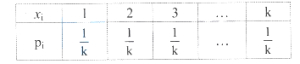
0 likesView Solution
297
MathematicsEasyMCQMHT CET · 2023
$A$ random variable $X$ has the following probability distribution:
Then $P(X < 2)$ is:
| $X = x$ | $0$ | $1$ | $2$ |
| $P(X = x)$ | $4k - 10k^2$ | $5k - 1$ | $3k^3$ |
Then $P(X < 2)$ is:
A
$\frac{2}{9}$
B
$\frac{5}{9}$
C
$\frac{8}{9}$
D
$\frac{4}{9}$
Solution
(C) The sum of probabilities in a probability distribution must be equal to $1$.
$\sum P(X=x) = P(X=0) + P(X=1) + P(X=2) = 1$
$(4k - 10k^2) + (5k - 1) + 3k^3 = 1$
$3k^3 - 10k^2 + 9k - 2 = 0$
By testing values,we find that $k = \frac{1}{3}$ is a root:
$3(\frac{1}{27}) - 10(\frac{1}{9}) + 9(\frac{1}{3}) - 2 = \frac{1}{9} - \frac{10}{9} + 3 - 2 = -1 + 1 = 0$
Factoring the polynomial,we get $(k - \frac{1}{3})(3k^2 - 9k + 6) = 0$,which simplifies to $(k - \frac{1}{3})(k - 1)(k - 2) = 0$.
If $k = 1$,$P(X=0) = 4(1) - 10(1)^2 = -6$,which is impossible as probability cannot be negative.
If $k = 2$,$P(X=0) = 4(2) - 10(4) = 8 - 40 = -32$,which is impossible.
Thus,$k = \frac{1}{3}$ is the only valid value.
We need to find $P(X < 2) = P(X=0) + P(X=1)$.
$P(X < 2) = (4k - 10k^2) + (5k - 1) = 9k - 10k^2 - 1$
Substituting $k = \frac{1}{3}$:
$P(X < 2) = 9(\frac{1}{3}) - 10(\frac{1}{9}) - 1 = 3 - \frac{10}{9} - 1 = 2 - \frac{10}{9} = \frac{18 - 10}{9} = \frac{8}{9}$.
$\sum P(X=x) = P(X=0) + P(X=1) + P(X=2) = 1$
$(4k - 10k^2) + (5k - 1) + 3k^3 = 1$
$3k^3 - 10k^2 + 9k - 2 = 0$
By testing values,we find that $k = \frac{1}{3}$ is a root:
$3(\frac{1}{27}) - 10(\frac{1}{9}) + 9(\frac{1}{3}) - 2 = \frac{1}{9} - \frac{10}{9} + 3 - 2 = -1 + 1 = 0$
Factoring the polynomial,we get $(k - \frac{1}{3})(3k^2 - 9k + 6) = 0$,which simplifies to $(k - \frac{1}{3})(k - 1)(k - 2) = 0$.
If $k = 1$,$P(X=0) = 4(1) - 10(1)^2 = -6$,which is impossible as probability cannot be negative.
If $k = 2$,$P(X=0) = 4(2) - 10(4) = 8 - 40 = -32$,which is impossible.
Thus,$k = \frac{1}{3}$ is the only valid value.
We need to find $P(X < 2) = P(X=0) + P(X=1)$.
$P(X < 2) = (4k - 10k^2) + (5k - 1) = 9k - 10k^2 - 1$
Substituting $k = \frac{1}{3}$:
$P(X < 2) = 9(\frac{1}{3}) - 10(\frac{1}{9}) - 1 = 3 - \frac{10}{9} - 1 = 2 - \frac{10}{9} = \frac{18 - 10}{9} = \frac{8}{9}$.
0 likesView Solution
298
MathematicsEasyMCQMHT CET · 2023
$A$ random variable $X$ has the following probability distribution:
| $X=x$ | $1$ | $2$ | $3$ | $4$ | $5$ | $6$ | $7$ | $8$ |
| :--- | :--- | :--- | :--- | :--- | :--- | :--- | :--- | :--- |
| $P(X=x)$ | $0.15$ | $0.23$ | $0.12$ | $0.20$ | $0.08$ | $0.10$ | $0.05$ | $0.07$ |
For the events $E = \{X \text{ is a prime number}\}$ and $F = \{X < 5\}$,find $P(E \cup F)$.
| $X=x$ | $1$ | $2$ | $3$ | $4$ | $5$ | $6$ | $7$ | $8$ |
| :--- | :--- | :--- | :--- | :--- | :--- | :--- | :--- | :--- |
| $P(X=x)$ | $0.15$ | $0.23$ | $0.12$ | $0.20$ | $0.08$ | $0.10$ | $0.05$ | $0.07$ |
For the events $E = \{X \text{ is a prime number}\}$ and $F = \{X < 5\}$,find $P(E \cup F)$.
A
$0.63$
B
$0.75$
C
$0.83$
D
$0.90$
Solution
(C) The prime numbers in the set of values for $X$ are $\{2, 3, 5, 7\}$.
$P(E) = P(X=2) + P(X=3) + P(X=5) + P(X=7) = 0.23 + 0.12 + 0.08 + 0.05 = 0.48$.
The event $F = \{X < 5\}$ corresponds to $X \in \{1, 2, 3, 4\}$.
$P(F) = P(X=1) + P(X=2) + P(X=3) + P(X=4) = 0.15 + 0.23 + 0.12 + 0.20 = 0.70$.
The event $E \cap F$ represents $X$ being a prime number less than $5$,which is $\{2, 3\}$.
$P(E \cap F) = P(X=2) + P(X=3) = 0.23 + 0.12 = 0.35$.
Using the addition theorem of probability:
$P(E \cup F) = P(E) + P(F) - P(E \cap F)$
$P(E \cup F) = 0.48 + 0.70 - 0.35 = 0.83$.
$P(E) = P(X=2) + P(X=3) + P(X=5) + P(X=7) = 0.23 + 0.12 + 0.08 + 0.05 = 0.48$.
The event $F = \{X < 5\}$ corresponds to $X \in \{1, 2, 3, 4\}$.
$P(F) = P(X=1) + P(X=2) + P(X=3) + P(X=4) = 0.15 + 0.23 + 0.12 + 0.20 = 0.70$.
The event $E \cap F$ represents $X$ being a prime number less than $5$,which is $\{2, 3\}$.
$P(E \cap F) = P(X=2) + P(X=3) = 0.23 + 0.12 = 0.35$.
Using the addition theorem of probability:
$P(E \cup F) = P(E) + P(F) - P(E \cap F)$
$P(E \cup F) = 0.48 + 0.70 - 0.35 = 0.83$.
0 likesView Solution
299
MathematicsMediumMCQMHT CET · 2023
If $f(x) = \begin{cases} 3(1 - 2x^2) & ; 0 < x < 1 \\ 0 & ; \text{otherwise} \end{cases}$ is a probability density function of $X$,then $P\left(\frac{1}{4} < x < \frac{1}{3}\right)$ is
A
$\frac{75}{243}$
B
$\frac{23}{96}$
C
$\frac{179}{864}$
D
$\frac{52}{243}$
Solution
(C) We are given the probability density function $f(x) = 3(1 - 2x^2)$ for $0 < x < 1$.
To find $P\left(\frac{1}{4} < x < \frac{1}{3}\right)$,we integrate the function over the given interval:
$P\left(\frac{1}{4} < x < \frac{1}{3}\right) = \int_{\frac{1}{4}}^{\frac{1}{3}} 3(1 - 2x^2) dx$
$= \int_{\frac{1}{4}}^{\frac{1}{3}} (3 - 6x^2) dx$
$= [3x - 2x^3]_{\frac{1}{4}}^{\frac{1}{3}}$
$= \left(3\left(\frac{1}{3}\right) - 2\left(\frac{1}{3}\right)^3\right) - \left(3\left(\frac{1}{4}\right) - 2\left(\frac{1}{4}\right)^3\right)$
$= \left(1 - \frac{2}{27}\right) - \left(\frac{3}{4} - \frac{2}{64}\right)$
$= \left(\frac{25}{27}\right) - \left(\frac{3}{4} - \frac{1}{32}\right)$
$= \frac{25}{27} - \frac{3}{4} + \frac{1}{32}$
Finding a common denominator $(864)$:
$= \frac{25 \times 32 - 3 \times 216 + 1 \times 27}{864}$
$= \frac{800 - 648 + 27}{864} = \frac{179}{864}$
To find $P\left(\frac{1}{4} < x < \frac{1}{3}\right)$,we integrate the function over the given interval:
$P\left(\frac{1}{4} < x < \frac{1}{3}\right) = \int_{\frac{1}{4}}^{\frac{1}{3}} 3(1 - 2x^2) dx$
$= \int_{\frac{1}{4}}^{\frac{1}{3}} (3 - 6x^2) dx$
$= [3x - 2x^3]_{\frac{1}{4}}^{\frac{1}{3}}$
$= \left(3\left(\frac{1}{3}\right) - 2\left(\frac{1}{3}\right)^3\right) - \left(3\left(\frac{1}{4}\right) - 2\left(\frac{1}{4}\right)^3\right)$
$= \left(1 - \frac{2}{27}\right) - \left(\frac{3}{4} - \frac{2}{64}\right)$
$= \left(\frac{25}{27}\right) - \left(\frac{3}{4} - \frac{1}{32}\right)$
$= \frac{25}{27} - \frac{3}{4} + \frac{1}{32}$
Finding a common denominator $(864)$:
$= \frac{25 \times 32 - 3 \times 216 + 1 \times 27}{864}$
$= \frac{800 - 648 + 27}{864} = \frac{179}{864}$
0 likesView Solution
300
MathematicsMediumMCQMHT CET · 2023
The p.m.f. of a random variable $X$ is $P(x) = \begin{cases} \frac{2x}{n(n+1)}, & x = 1, 2, 3, \ldots, n \\ 0, & \text{otherwise} \end{cases}$,then $E(X)$ is
A
$\frac{n+1}{6}$
B
$\frac{2n+1}{6}$
C
$\frac{n+1}{3}$
D
$\frac{2n+1}{3}$
Solution
(D) The expected value $E(X)$ is defined as $\sum x_i \cdot P(x_i)$.
Given $P(x) = \frac{2x}{n(n+1)}$ for $x = 1, 2, \ldots, n$.
$E(X) = \sum_{x=1}^{n} x \cdot \frac{2x}{n(n+1)}$
$E(X) = \frac{2}{n(n+1)} \sum_{x=1}^{n} x^2$
Using the formula for the sum of squares of the first $n$ natural numbers,$\sum_{x=1}^{n} x^2 = \frac{n(n+1)(2n+1)}{6}$.
$E(X) = \frac{2}{n(n+1)} \cdot \frac{n(n+1)(2n+1)}{6}$
$E(X) = \frac{2n+1}{3}$
Given $P(x) = \frac{2x}{n(n+1)}$ for $x = 1, 2, \ldots, n$.
$E(X) = \sum_{x=1}^{n} x \cdot \frac{2x}{n(n+1)}$
$E(X) = \frac{2}{n(n+1)} \sum_{x=1}^{n} x^2$
Using the formula for the sum of squares of the first $n$ natural numbers,$\sum_{x=1}^{n} x^2 = \frac{n(n+1)(2n+1)}{6}$.
$E(X) = \frac{2}{n(n+1)} \cdot \frac{n(n+1)(2n+1)}{6}$
$E(X) = \frac{2n+1}{3}$
0 likesView Solution
Vedclass Products
For Students
Vedclass Test Series
Mock tests in real MHT CET style covering Mathematics with performance analysis. 5-day free trial.
Start Free TrialFor Teachers
Exam Paper Generator
Generate Set A/B/C/D Mathematics papers from 7.5L+ questions in 2 minutes. 3 chapters free.
Try FreeFor Institutes
Online Exam Module
Run live MHT CET mock exams with unlimited students, 360° analytics & white-label branding.
See DemoFrequently Asked Questions
How many Mathematics questions are in MHT CET 2023?
There are 589 Mathematics questions from the MHT CET 2023 paper on Vedclass, each with a detailed step-by-step solution in English.
Are MHT CET 2023 Mathematics solutions available in English?
Yes. All solutions on this page are in English. You can also switch to English or Hindi using the language buttons above the questions.
Can I practice MHT CET 2023 Mathematics as a timed test?
Yes. Use the Vedclass Test Series to attempt a full MHT CET mock test covering Mathematics with time limits and instant score analysis.
Can teachers create Mathematics papers from MHT CET previous year questions?
Yes. The Vedclass Exam Paper Generator lets teachers mix MHT CET Mathematics questions and generate Set A/B/C/D papers in minutes.
For Teachers & Institutes
Build a Custom Mathematics Paper
Pick MHT CET 2023 Mathematics questions, set difficulty, and generate Set A/B/C/D in 2 minutes.