
MathematicsQ151–215 of 589 questions
Page 4 of 9 · English
151
MathematicsEasyMCQMHT CET · 2023
If $\tan \theta = \frac{\sin \alpha - \cos \alpha}{\sin \alpha + \cos \alpha}$ and $0 \leq \alpha \leq \frac{\pi}{2}$,then the value of $\cos 2 \theta$ is
A
$\cos 2 \alpha$
B
$\sin \alpha$
C
$\cos \alpha$
D
$\sin 2 \alpha$
Solution
(D) Given $\tan \theta = \frac{\sin \alpha - \cos \alpha}{\sin \alpha + \cos \alpha}$.
Dividing the numerator and denominator by $\cos \alpha$,we get $\tan \theta = \frac{\tan \alpha - 1}{\tan \alpha + 1}$.
We know that $\tan(\frac{\pi}{4}) = 1$,so $\tan \theta = \frac{\tan \alpha - \tan(\frac{\pi}{4})}{1 + \tan \alpha \tan(\frac{\pi}{4})}$.
Using the formula $\tan(A - B) = \frac{\tan A - \tan B}{1 + \tan A \tan B}$,we get $\tan \theta = \tan(\alpha - \frac{\pi}{4})$.
Thus,$\theta = \alpha - \frac{\pi}{4}$.
Then $2 \theta = 2 \alpha - \frac{\pi}{2}$.
Therefore,$\cos 2 \theta = \cos(2 \alpha - \frac{\pi}{2})$.
Using the identity $\cos(x - \frac{\pi}{2}) = \sin x$,we get $\cos 2 \theta = \sin 2 \alpha$.
Dividing the numerator and denominator by $\cos \alpha$,we get $\tan \theta = \frac{\tan \alpha - 1}{\tan \alpha + 1}$.
We know that $\tan(\frac{\pi}{4}) = 1$,so $\tan \theta = \frac{\tan \alpha - \tan(\frac{\pi}{4})}{1 + \tan \alpha \tan(\frac{\pi}{4})}$.
Using the formula $\tan(A - B) = \frac{\tan A - \tan B}{1 + \tan A \tan B}$,we get $\tan \theta = \tan(\alpha - \frac{\pi}{4})$.
Thus,$\theta = \alpha - \frac{\pi}{4}$.
Then $2 \theta = 2 \alpha - \frac{\pi}{2}$.
Therefore,$\cos 2 \theta = \cos(2 \alpha - \frac{\pi}{2})$.
Using the identity $\cos(x - \frac{\pi}{2}) = \sin x$,we get $\cos 2 \theta = \sin 2 \alpha$.
0 likesView Solution
152
MathematicsEasyMCQMHT CET · 2023
The value of $\cos(18^{\circ}-A) \cdot \cos(18^{\circ}+A) - \cos(72^{\circ}-A) \cdot \cos(72^{\circ}+A)$ is:
A
$\cos 72^{\circ}$
B
$\sin 54^{\circ}$
C
$\sin 18^{\circ}$
D
$\cos 54^{\circ}$
Solution
(B) Using the identity $\cos(x-y)\cos(x+y) = \cos^2 x - \sin^2 y$,we have:
$\cos(18^{\circ}-A)\cos(18^{\circ}+A) = \cos^2 18^{\circ} - \sin^2 A$
$\cos(72^{\circ}-A)\cos(72^{\circ}+A) = \cos^2 72^{\circ} - \sin^2 A$
Subtracting these:
$(\cos^2 18^{\circ} - \sin^2 A) - (\cos^2 72^{\circ} - \sin^2 A) = \cos^2 18^{\circ} - \cos^2 72^{\circ}$
Since $\cos 72^{\circ} = \sin 18^{\circ}$,this becomes $\cos^2 18^{\circ} - \sin^2 18^{\circ} = \cos(2 \times 18^{\circ}) = \cos 36^{\circ}$.
Alternatively,using $\cos(x-y)\cos(x+y) = \frac{1}{2}(\cos 2x + \cos 2y)$:
$\frac{1}{2}(\cos 36^{\circ} + \cos 2A) - \frac{1}{2}(\cos 144^{\circ} + \cos 2A) = \frac{1}{2}(\cos 36^{\circ} - \cos 144^{\circ})$
Since $\cos 144^{\circ} = -\cos 36^{\circ}$,we get $\frac{1}{2}(\cos 36^{\circ} + \cos 36^{\circ}) = \cos 36^{\circ} = \sin 54^{\circ}$.
$\cos(18^{\circ}-A)\cos(18^{\circ}+A) = \cos^2 18^{\circ} - \sin^2 A$
$\cos(72^{\circ}-A)\cos(72^{\circ}+A) = \cos^2 72^{\circ} - \sin^2 A$
Subtracting these:
$(\cos^2 18^{\circ} - \sin^2 A) - (\cos^2 72^{\circ} - \sin^2 A) = \cos^2 18^{\circ} - \cos^2 72^{\circ}$
Since $\cos 72^{\circ} = \sin 18^{\circ}$,this becomes $\cos^2 18^{\circ} - \sin^2 18^{\circ} = \cos(2 \times 18^{\circ}) = \cos 36^{\circ}$.
Alternatively,using $\cos(x-y)\cos(x+y) = \frac{1}{2}(\cos 2x + \cos 2y)$:
$\frac{1}{2}(\cos 36^{\circ} + \cos 2A) - \frac{1}{2}(\cos 144^{\circ} + \cos 2A) = \frac{1}{2}(\cos 36^{\circ} - \cos 144^{\circ})$
Since $\cos 144^{\circ} = -\cos 36^{\circ}$,we get $\frac{1}{2}(\cos 36^{\circ} + \cos 36^{\circ}) = \cos 36^{\circ} = \sin 54^{\circ}$.
0 likesView Solution
153
MathematicsEasyMCQMHT CET · 2023
The solutions of $\sin x + \sin 5x = \sin 3x$ in the interval $(0, \frac{\pi}{2})$ are
A
$\frac{\pi}{4}, \frac{\pi}{10}$
B
$\frac{\pi}{6}, \frac{\pi}{3}$
C
$\frac{\pi}{4}, \frac{\pi}{12}$
D
$\frac{\pi}{8}, \frac{\pi}{16}$
Solution
(B) Given equation: $\sin x + \sin 5x = \sin 3x$
Using the sum-to-product formula $\sin A + \sin B = 2 \sin(\frac{A+B}{2}) \cos(\frac{A-B}{2})$:
$2 \sin(\frac{x+5x}{2}) \cos(\frac{x-5x}{2}) = \sin 3x$
$2 \sin 3x \cos(-2x) = \sin 3x$
Since $\cos(-2x) = \cos 2x$,we have:
$2 \sin 3x \cos 2x - \sin 3x = 0$
$\sin 3x (2 \cos 2x - 1) = 0$
Case $1$: $\sin 3x = 0 \implies 3x = n\pi \implies x = \frac{n\pi}{3}$. For $x \in (0, \frac{\pi}{2})$,$x = \frac{\pi}{3}$ is a solution.
Case $2$: $2 \cos 2x - 1 = 0 \implies \cos 2x = \frac{1}{2} = \cos \frac{\pi}{3}$.
$2x = 2n\pi \pm \frac{\pi}{3} \implies x = n\pi \pm \frac{\pi}{6}$. For $x \in (0, \frac{\pi}{2})$,$x = \frac{\pi}{6}$ is a solution.
Thus,the solutions are $x = \frac{\pi}{6}, \frac{\pi}{3}$.
Using the sum-to-product formula $\sin A + \sin B = 2 \sin(\frac{A+B}{2}) \cos(\frac{A-B}{2})$:
$2 \sin(\frac{x+5x}{2}) \cos(\frac{x-5x}{2}) = \sin 3x$
$2 \sin 3x \cos(-2x) = \sin 3x$
Since $\cos(-2x) = \cos 2x$,we have:
$2 \sin 3x \cos 2x - \sin 3x = 0$
$\sin 3x (2 \cos 2x - 1) = 0$
Case $1$: $\sin 3x = 0 \implies 3x = n\pi \implies x = \frac{n\pi}{3}$. For $x \in (0, \frac{\pi}{2})$,$x = \frac{\pi}{3}$ is a solution.
Case $2$: $2 \cos 2x - 1 = 0 \implies \cos 2x = \frac{1}{2} = \cos \frac{\pi}{3}$.
$2x = 2n\pi \pm \frac{\pi}{3} \implies x = n\pi \pm \frac{\pi}{6}$. For $x \in (0, \frac{\pi}{2})$,$x = \frac{\pi}{6}$ is a solution.
Thus,the solutions are $x = \frac{\pi}{6}, \frac{\pi}{3}$.
0 likesView Solution
154
MathematicsEasyMCQMHT CET · 2023
If $\sin (\theta-\alpha), \sin \theta$ and $\sin (\theta+\alpha)$ are in $H.P.$,then the value of $\cos 2 \theta$ is
A
$1+4 \cos ^2 \frac{\alpha}{2}$
B
$1-4 \cos ^2 \frac{\alpha}{2}$
C
$-1-4 \cos ^2 \frac{\alpha}{2}$
D
$-1+4 \cos ^2 \frac{\alpha}{2}$
Solution
(B) Given that $\sin (\theta-\alpha), \sin \theta, \sin (\theta+\alpha)$ are in $H.P.$
$\Rightarrow \frac{1}{\sin (\theta-\alpha)}, \frac{1}{\sin \theta}, \frac{1}{\sin (\theta+\alpha)}$ are in $A.P.$
$\therefore \frac{2}{\sin \theta} = \frac{1}{\sin (\theta-\alpha)} + \frac{1}{\sin (\theta+\alpha)}$
$\Rightarrow \frac{2}{\sin \theta} = \frac{\sin (\theta+\alpha) + \sin (\theta-\alpha)}{\sin (\theta-\alpha) \sin (\theta+\alpha)}$
Using the formula $\sin(A+B) + \sin(A-B) = 2 \sin A \cos B$ and $\sin(A+B) \sin(A-B) = \sin^2 A - \sin^2 B$:
$\Rightarrow \frac{2}{\sin \theta} = \frac{2 \sin \theta \cos \alpha}{\sin^2 \theta - \sin^2 \alpha}$
$\Rightarrow \sin^2 \theta - \sin^2 \alpha = \sin^2 \theta \cos \alpha$
$\Rightarrow \sin^2 \theta (1 - \cos \alpha) = \sin^2 \alpha$
Using $1 - \cos \alpha = 2 \sin^2 \frac{\alpha}{2}$ and $\sin \alpha = 2 \sin \frac{\alpha}{2} \cos \frac{\alpha}{2}$:
$\Rightarrow \sin^2 \theta (2 \sin^2 \frac{\alpha}{2}) = 4 \sin^2 \frac{\alpha}{2} \cos^2 \frac{\alpha}{2}$
$\Rightarrow \sin^2 \theta = 2 \cos^2 \frac{\alpha}{2}$
$\Rightarrow 1 - \cos^2 \theta = 2 \cos^2 \frac{\alpha}{2}$
$\Rightarrow \cos^2 \theta = 1 - 2 \cos^2 \frac{\alpha}{2}$
Multiplying by $2$ and subtracting $1$ to get $\cos 2 \theta = 2 \cos^2 \theta - 1$:
$\Rightarrow 2 \cos^2 \theta - 1 = 2(1 - 2 \cos^2 \frac{\alpha}{2}) - 1$
$\Rightarrow \cos 2 \theta = 2 - 4 \cos^2 \frac{\alpha}{2} - 1 = 1 - 4 \cos^2 \frac{\alpha}{2}$
$\Rightarrow \frac{1}{\sin (\theta-\alpha)}, \frac{1}{\sin \theta}, \frac{1}{\sin (\theta+\alpha)}$ are in $A.P.$
$\therefore \frac{2}{\sin \theta} = \frac{1}{\sin (\theta-\alpha)} + \frac{1}{\sin (\theta+\alpha)}$
$\Rightarrow \frac{2}{\sin \theta} = \frac{\sin (\theta+\alpha) + \sin (\theta-\alpha)}{\sin (\theta-\alpha) \sin (\theta+\alpha)}$
Using the formula $\sin(A+B) + \sin(A-B) = 2 \sin A \cos B$ and $\sin(A+B) \sin(A-B) = \sin^2 A - \sin^2 B$:
$\Rightarrow \frac{2}{\sin \theta} = \frac{2 \sin \theta \cos \alpha}{\sin^2 \theta - \sin^2 \alpha}$
$\Rightarrow \sin^2 \theta - \sin^2 \alpha = \sin^2 \theta \cos \alpha$
$\Rightarrow \sin^2 \theta (1 - \cos \alpha) = \sin^2 \alpha$
Using $1 - \cos \alpha = 2 \sin^2 \frac{\alpha}{2}$ and $\sin \alpha = 2 \sin \frac{\alpha}{2} \cos \frac{\alpha}{2}$:
$\Rightarrow \sin^2 \theta (2 \sin^2 \frac{\alpha}{2}) = 4 \sin^2 \frac{\alpha}{2} \cos^2 \frac{\alpha}{2}$
$\Rightarrow \sin^2 \theta = 2 \cos^2 \frac{\alpha}{2}$
$\Rightarrow 1 - \cos^2 \theta = 2 \cos^2 \frac{\alpha}{2}$
$\Rightarrow \cos^2 \theta = 1 - 2 \cos^2 \frac{\alpha}{2}$
Multiplying by $2$ and subtracting $1$ to get $\cos 2 \theta = 2 \cos^2 \theta - 1$:
$\Rightarrow 2 \cos^2 \theta - 1 = 2(1 - 2 \cos^2 \frac{\alpha}{2}) - 1$
$\Rightarrow \cos 2 \theta = 2 - 4 \cos^2 \frac{\alpha}{2} - 1 = 1 - 4 \cos^2 \frac{\alpha}{2}$
0 likesView Solution
155
MathematicsEasyMCQMHT CET · 2023
If $a \cos 2 \theta + b \sin 2 \theta = c$ has $\alpha$ and $\beta$ as its roots,then the value of $\tan \alpha + \tan \beta$ is
A
$\frac{2 b}{c+a}$
B
$\frac{2 a}{b+c}$
C
$\frac{b}{c+a}$
D
$\frac{a}{b+c}$
Solution
(A) Given the equation: $a \cos 2 \theta + b \sin 2 \theta = c$
Using the identities $\cos 2 \theta = \frac{1 - \tan^2 \theta}{1 + \tan^2 \theta}$ and $\sin 2 \theta = \frac{2 \tan \theta}{1 + \tan^2 \theta}$,we get:
$a \left( \frac{1 - \tan^2 \theta}{1 + \tan^2 \theta} \right) + b \left( \frac{2 \tan \theta}{1 + \tan^2 \theta} \right) = c$
Multiplying both sides by $(1 + \tan^2 \theta)$:
$a(1 - \tan^2 \theta) + 2b \tan \theta = c(1 + \tan^2 \theta)$
$a - a \tan^2 \theta + 2b \tan \theta = c + c \tan^2 \theta$
Rearranging the terms to form a quadratic equation in $\tan \theta$:
$(a + c) \tan^2 \theta - 2b \tan \theta + (c - a) = 0$
Since $\alpha$ and $\beta$ are the roots,$\tan \alpha$ and $\tan \beta$ are the roots of this quadratic equation.
Using the sum of roots formula for $Ax^2 + Bx + C = 0$,which is $-\frac{B}{A}$:
$\tan \alpha + \tan \beta = -\frac{-2b}{a + c} = \frac{2b}{c + a}$
Using the identities $\cos 2 \theta = \frac{1 - \tan^2 \theta}{1 + \tan^2 \theta}$ and $\sin 2 \theta = \frac{2 \tan \theta}{1 + \tan^2 \theta}$,we get:
$a \left( \frac{1 - \tan^2 \theta}{1 + \tan^2 \theta} \right) + b \left( \frac{2 \tan \theta}{1 + \tan^2 \theta} \right) = c$
Multiplying both sides by $(1 + \tan^2 \theta)$:
$a(1 - \tan^2 \theta) + 2b \tan \theta = c(1 + \tan^2 \theta)$
$a - a \tan^2 \theta + 2b \tan \theta = c + c \tan^2 \theta$
Rearranging the terms to form a quadratic equation in $\tan \theta$:
$(a + c) \tan^2 \theta - 2b \tan \theta + (c - a) = 0$
Since $\alpha$ and $\beta$ are the roots,$\tan \alpha$ and $\tan \beta$ are the roots of this quadratic equation.
Using the sum of roots formula for $Ax^2 + Bx + C = 0$,which is $-\frac{B}{A}$:
$\tan \alpha + \tan \beta = -\frac{-2b}{a + c} = \frac{2b}{c + a}$
0 likesView Solution
156
MathematicsMediumMCQMHT CET · 2023
If $\sin 18^{\circ} = \frac{\sqrt{5}-1}{4}$,then the value of $\cos ^2 48^{\circ} - \sin ^2 12^{\circ}$ is:
A
$\frac{-\sqrt{5}+1}{8}$
B
$\frac{\sqrt{5}-1}{8}$
C
$\frac{\sqrt{5}+1}{8}$
D
$\frac{-1-\sqrt{5}}{8}$
Solution
(C) We use the trigonometric identity: $\cos ^2 A - \sin ^2 B = \cos(A+B) \cdot \cos(A-B)$.
Applying this to the given expression with $A = 48^{\circ}$ and $B = 12^{\circ}$:
$\cos ^2 48^{\circ} - \sin ^2 12^{\circ} = \cos(48^{\circ} + 12^{\circ}) \cdot \cos(48^{\circ} - 12^{\circ})$
$= \cos(60^{\circ}) \cdot \cos(36^{\circ})$
Since $\cos(60^{\circ}) = \frac{1}{2}$ and $\cos(36^{\circ}) = 1 - 2\sin ^2(18^{\circ})$:
$= \frac{1}{2} \cdot (1 - 2\sin ^2 18^{\circ})$
$= \frac{1}{2} \left[ 1 - 2 \left( \frac{\sqrt{5}-1}{4} \right)^2 \right]$
$= \frac{1}{2} \left[ 1 - 2 \left( \frac{5 + 1 - 2\sqrt{5}}{16} \right) \right]$
$= \frac{1}{2} \left[ 1 - \frac{6 - 2\sqrt{5}}{8} \right] = \frac{1}{2} \left[ \frac{8 - 6 + 2\sqrt{5}}{8} \right]$
$= \frac{1}{2} \left[ \frac{2 + 2\sqrt{5}}{8} \right] = \frac{1 + \sqrt{5}}{8}$.
Applying this to the given expression with $A = 48^{\circ}$ and $B = 12^{\circ}$:
$\cos ^2 48^{\circ} - \sin ^2 12^{\circ} = \cos(48^{\circ} + 12^{\circ}) \cdot \cos(48^{\circ} - 12^{\circ})$
$= \cos(60^{\circ}) \cdot \cos(36^{\circ})$
Since $\cos(60^{\circ}) = \frac{1}{2}$ and $\cos(36^{\circ}) = 1 - 2\sin ^2(18^{\circ})$:
$= \frac{1}{2} \cdot (1 - 2\sin ^2 18^{\circ})$
$= \frac{1}{2} \left[ 1 - 2 \left( \frac{\sqrt{5}-1}{4} \right)^2 \right]$
$= \frac{1}{2} \left[ 1 - 2 \left( \frac{5 + 1 - 2\sqrt{5}}{16} \right) \right]$
$= \frac{1}{2} \left[ 1 - \frac{6 - 2\sqrt{5}}{8} \right] = \frac{1}{2} \left[ \frac{8 - 6 + 2\sqrt{5}}{8} \right]$
$= \frac{1}{2} \left[ \frac{2 + 2\sqrt{5}}{8} \right] = \frac{1 + \sqrt{5}}{8}$.
0 likesView Solution
157
MathematicsMediumMCQMHT CET · 2023
The value of $\tan \frac{\pi}{8}$ is
A
$1-\sqrt{2}$
B
$-1-\sqrt{2}$
C
$\sqrt{2}-1$
D
$\sqrt{2}+1$
Solution
(C) We know that $\tan 2\theta = \frac{2\tan \theta}{1-\tan^2 \theta}$.
Setting $\theta = \frac{\pi}{8}$,we have $\tan \frac{\pi}{4} = \frac{2\tan \frac{\pi}{8}}{1-\tan^2 \frac{\pi}{8}}$.
Since $\tan \frac{\pi}{4} = 1$,let $y = \tan \frac{\pi}{8}$.
Then $1 = \frac{2y}{1-y^2}$,which implies $1 - y^2 = 2y$,or $y^2 + 2y - 1 = 0$.
Using the quadratic formula $y = \frac{-b \pm \sqrt{b^2 - 4ac}}{2a}$,we get $y = \frac{-2 \pm \sqrt{4 - 4(1)(-1)}}{2} = \frac{-2 \pm \sqrt{8}}{2} = -1 \pm \sqrt{2}$.
Since $\frac{\pi}{8}$ is in the $1^{\text{st}}$ quadrant,$\tan \frac{\pi}{8} > 0$.
Therefore,$\tan \frac{\pi}{8} = \sqrt{2} - 1$.
Setting $\theta = \frac{\pi}{8}$,we have $\tan \frac{\pi}{4} = \frac{2\tan \frac{\pi}{8}}{1-\tan^2 \frac{\pi}{8}}$.
Since $\tan \frac{\pi}{4} = 1$,let $y = \tan \frac{\pi}{8}$.
Then $1 = \frac{2y}{1-y^2}$,which implies $1 - y^2 = 2y$,or $y^2 + 2y - 1 = 0$.
Using the quadratic formula $y = \frac{-b \pm \sqrt{b^2 - 4ac}}{2a}$,we get $y = \frac{-2 \pm \sqrt{4 - 4(1)(-1)}}{2} = \frac{-2 \pm \sqrt{8}}{2} = -1 \pm \sqrt{2}$.
Since $\frac{\pi}{8}$ is in the $1^{\text{st}}$ quadrant,$\tan \frac{\pi}{8} > 0$.
Therefore,$\tan \frac{\pi}{8} = \sqrt{2} - 1$.
0 likesView Solution
158
MathematicsEasyMCQMHT CET · 2023
$\cos ^2 48^{\circ}-\sin ^2 12^{\circ} = $ . . . . . . ,if $\sin 18^{\circ} = \frac{\sqrt{5}-1}{4}$
A
$\frac{-\sqrt{5}+1}{8}$
B
$\frac{\sqrt{5}-1}{8}$
C
$\frac{\sqrt{5}+1}{8}$
D
$\frac{-\sqrt{5}-1}{8}$
Solution
(C) We use the identity $\cos^2 A - \sin^2 B = \cos(A+B) \cos(A-B)$.
Here,$A = 48^{\circ}$ and $B = 12^{\circ}$.
$\cos^2 48^{\circ} - \sin^2 12^{\circ} = \cos(48^{\circ} + 12^{\circ}) \cos(48^{\circ} - 12^{\circ})$
$= \cos 60^{\circ} \cos 36^{\circ}$
We know that $\cos 60^{\circ} = \frac{1}{2}$ and $\cos 36^{\circ} = \frac{\sqrt{5}+1}{4}$.
Therefore,the expression equals $\frac{1}{2} \times \frac{\sqrt{5}+1}{4} = \frac{\sqrt{5}+1}{8}$.
Here,$A = 48^{\circ}$ and $B = 12^{\circ}$.
$\cos^2 48^{\circ} - \sin^2 12^{\circ} = \cos(48^{\circ} + 12^{\circ}) \cos(48^{\circ} - 12^{\circ})$
$= \cos 60^{\circ} \cos 36^{\circ}$
We know that $\cos 60^{\circ} = \frac{1}{2}$ and $\cos 36^{\circ} = \frac{\sqrt{5}+1}{4}$.
Therefore,the expression equals $\frac{1}{2} \times \frac{\sqrt{5}+1}{4} = \frac{\sqrt{5}+1}{8}$.
0 likesView Solution
159
MathematicsMediumMCQMHT CET · 2023
If $(1+\sqrt{1+x}) \tan x=1+\sqrt{1-x}$,then $\sin 4x$ is
A
$x$
B
$-x$
C
$4x$
D
$-4x$
Solution
(A) Given equation: $(1+\sqrt{1+x}) \tan x = 1+\sqrt{1-x}$
$\tan x = \frac{1+\sqrt{1-x}}{1+\sqrt{1+x}}$
Let $x = \sin \theta$.
$\tan x = \frac{1+\sqrt{1-\sin \theta}}{1+\sqrt{1+\sin \theta}} = \frac{1+\sqrt{(\cos \frac{\theta}{2} - \sin \frac{\theta}{2})^2}}{1+\sqrt{(\cos \frac{\theta}{2} + \sin \frac{\theta}{2})^2}}$
$= \frac{1+\cos \frac{\theta}{2} - \sin \frac{\theta}{2}}{1+\cos \frac{\theta}{2} + \sin \frac{\theta}{2}}$
$= \frac{2\cos^2 \frac{\theta}{4} - 2\sin \frac{\theta}{4}\cos \frac{\theta}{4}}{2\cos^2 \frac{\theta}{4} + 2\sin \frac{\theta}{4}\cos \frac{\theta}{4}}$
$= \frac{2\cos \frac{\theta}{4}(\cos \frac{\theta}{4} - \sin \frac{\theta}{4})}{2\cos \frac{\theta}{4}(\cos \frac{\theta}{4} + \sin \frac{\theta}{4})} = \frac{1 - \tan \frac{\theta}{4}}{1 + \tan \frac{\theta}{4}} = \tan(\frac{\pi}{4} - \frac{\theta}{4})$
Thus,$x = \frac{\pi}{4} - \frac{\theta}{4} \Rightarrow 4x = \pi - \theta$.
$\sin 4x = \sin(\pi - \theta) = \sin \theta = x$.
$\tan x = \frac{1+\sqrt{1-x}}{1+\sqrt{1+x}}$
Let $x = \sin \theta$.
$\tan x = \frac{1+\sqrt{1-\sin \theta}}{1+\sqrt{1+\sin \theta}} = \frac{1+\sqrt{(\cos \frac{\theta}{2} - \sin \frac{\theta}{2})^2}}{1+\sqrt{(\cos \frac{\theta}{2} + \sin \frac{\theta}{2})^2}}$
$= \frac{1+\cos \frac{\theta}{2} - \sin \frac{\theta}{2}}{1+\cos \frac{\theta}{2} + \sin \frac{\theta}{2}}$
$= \frac{2\cos^2 \frac{\theta}{4} - 2\sin \frac{\theta}{4}\cos \frac{\theta}{4}}{2\cos^2 \frac{\theta}{4} + 2\sin \frac{\theta}{4}\cos \frac{\theta}{4}}$
$= \frac{2\cos \frac{\theta}{4}(\cos \frac{\theta}{4} - \sin \frac{\theta}{4})}{2\cos \frac{\theta}{4}(\cos \frac{\theta}{4} + \sin \frac{\theta}{4})} = \frac{1 - \tan \frac{\theta}{4}}{1 + \tan \frac{\theta}{4}} = \tan(\frac{\pi}{4} - \frac{\theta}{4})$
Thus,$x = \frac{\pi}{4} - \frac{\theta}{4} \Rightarrow 4x = \pi - \theta$.
$\sin 4x = \sin(\pi - \theta) = \sin \theta = x$.
0 likesView Solution
160
MathematicsMediumMCQMHT CET · 2023
If $\cos 2B = \frac{\cos(A+C)}{\cos(A-C)}$,then $\tan A, \tan B, \tan C$ are in
A
Geometric Progression.
B
Arithmetic Progression.
C
Harmonic Progression.
D
Arithmetico-Geometric Progression.
Solution
(A) Given $\cos 2B = \frac{\cos(A+C)}{\cos(A-C)}$.
Using the formula $\cos 2B = \frac{1-\tan^2 B}{1+\tan^2 B}$ and expanding the right side:
$\frac{1-\tan^2 B}{1+\tan^2 B} = \frac{\cos A \cos C - \sin A \sin C}{\cos A \cos C + \sin A \sin C}$.
Dividing numerator and denominator by $\cos A \cos C$:
$\frac{1-\tan^2 B}{1+\tan^2 B} = \frac{1-\tan A \tan C}{1+\tan A \tan C}$.
By componendo and dividendo or cross-multiplication:
$(1-\tan^2 B)(1+\tan A \tan C) = (1+\tan^2 B)(1-\tan A \tan C)$.
$1 + \tan A \tan C - \tan^2 B - \tan^2 B \tan A \tan C = 1 - \tan A \tan C + \tan^2 B - \tan^2 B \tan A \tan C$.
Simplifying the equation:
$2 \tan A \tan C = 2 \tan^2 B$.
$\tan^2 B = \tan A \tan C$.
Therefore,$\tan A, \tan B, \tan C$ are in Geometric Progression $(G.P.)$.
Using the formula $\cos 2B = \frac{1-\tan^2 B}{1+\tan^2 B}$ and expanding the right side:
$\frac{1-\tan^2 B}{1+\tan^2 B} = \frac{\cos A \cos C - \sin A \sin C}{\cos A \cos C + \sin A \sin C}$.
Dividing numerator and denominator by $\cos A \cos C$:
$\frac{1-\tan^2 B}{1+\tan^2 B} = \frac{1-\tan A \tan C}{1+\tan A \tan C}$.
By componendo and dividendo or cross-multiplication:
$(1-\tan^2 B)(1+\tan A \tan C) = (1+\tan^2 B)(1-\tan A \tan C)$.
$1 + \tan A \tan C - \tan^2 B - \tan^2 B \tan A \tan C = 1 - \tan A \tan C + \tan^2 B - \tan^2 B \tan A \tan C$.
Simplifying the equation:
$2 \tan A \tan C = 2 \tan^2 B$.
$\tan^2 B = \tan A \tan C$.
Therefore,$\tan A, \tan B, \tan C$ are in Geometric Progression $(G.P.)$.
0 likesView Solution
161
MathematicsDifficultMCQMHT CET · 2023
In a triangle $ABC$,with usual notations,if $c=4$,then the value of $(a-b)^2 \cos^2 \frac{C}{2} + (a+b)^2 \sin^2 \frac{C}{2}$ is
A
$4$
B
$16$
C
$9$
D
$2$
Solution
(B) We are given the expression: $(a-b)^2 \cos^2 \frac{C}{2} + (a+b)^2 \sin^2 \frac{C}{2}$
Expanding the terms,we get: $(a^2 - 2ab + b^2) \cos^2 \frac{C}{2} + (a^2 + 2ab + b^2) \sin^2 \frac{C}{2}$
Grouping the terms: $(a^2 + b^2) (\cos^2 \frac{C}{2} + \sin^2 \frac{C}{2}) - 2ab \cos^2 \frac{C}{2} + 2ab \sin^2 \frac{C}{2}$
Since $\cos^2 \theta + \sin^2 \theta = 1$,this simplifies to: $(a^2 + b^2) - 2ab (\cos^2 \frac{C}{2} - \sin^2 \frac{C}{2})$
Using the identity $\cos 2\theta = \cos^2 \theta - \sin^2 \theta$,we have $\cos C = \cos^2 \frac{C}{2} - \sin^2 \frac{C}{2}$:
$= a^2 + b^2 - 2ab \cos C$
By the Law of Cosines,$c^2 = a^2 + b^2 - 2ab \cos C$,so:
$= c^2$
Given $c = 4$,the value is $4^2 = 16$.
Expanding the terms,we get: $(a^2 - 2ab + b^2) \cos^2 \frac{C}{2} + (a^2 + 2ab + b^2) \sin^2 \frac{C}{2}$
Grouping the terms: $(a^2 + b^2) (\cos^2 \frac{C}{2} + \sin^2 \frac{C}{2}) - 2ab \cos^2 \frac{C}{2} + 2ab \sin^2 \frac{C}{2}$
Since $\cos^2 \theta + \sin^2 \theta = 1$,this simplifies to: $(a^2 + b^2) - 2ab (\cos^2 \frac{C}{2} - \sin^2 \frac{C}{2})$
Using the identity $\cos 2\theta = \cos^2 \theta - \sin^2 \theta$,we have $\cos C = \cos^2 \frac{C}{2} - \sin^2 \frac{C}{2}$:
$= a^2 + b^2 - 2ab \cos C$
By the Law of Cosines,$c^2 = a^2 + b^2 - 2ab \cos C$,so:
$= c^2$
Given $c = 4$,the value is $4^2 = 16$.
0 likesView Solution
162
MathematicsEasyMCQMHT CET · 2023
The value of $\tan \left(\frac{\pi}{8}\right)$ is
A
$\sqrt{2}-1$
B
$1-\sqrt{2}$
C
$\sqrt{2}$
D
$\sqrt{2}+1$
Solution
(A) We know the formula $\tan \left(\frac{A}{2}\right) = \frac{1-\cos A}{\sin A}$.
Putting $A = \frac{\pi}{4}$,we get $\frac{A}{2} = \frac{\pi}{8}$.
Therefore,$\tan \left(\frac{\pi}{8}\right) = \frac{1-\cos(\pi/4)}{\sin(\pi/4)}$.
Substituting the values $\cos(\pi/4) = \frac{1}{\sqrt{2}}$ and $\sin(\pi/4) = \frac{1}{\sqrt{2}}$,we get:
$\tan \left(\frac{\pi}{8}\right) = \frac{1 - \frac{1}{\sqrt{2}}}{\frac{1}{\sqrt{2}}} = \frac{\frac{\sqrt{2}-1}{\sqrt{2}}}{\frac{1}{\sqrt{2}}} = \sqrt{2}-1$.
Putting $A = \frac{\pi}{4}$,we get $\frac{A}{2} = \frac{\pi}{8}$.
Therefore,$\tan \left(\frac{\pi}{8}\right) = \frac{1-\cos(\pi/4)}{\sin(\pi/4)}$.
Substituting the values $\cos(\pi/4) = \frac{1}{\sqrt{2}}$ and $\sin(\pi/4) = \frac{1}{\sqrt{2}}$,we get:
$\tan \left(\frac{\pi}{8}\right) = \frac{1 - \frac{1}{\sqrt{2}}}{\frac{1}{\sqrt{2}}} = \frac{\frac{\sqrt{2}-1}{\sqrt{2}}}{\frac{1}{\sqrt{2}}} = \sqrt{2}-1$.
0 likesView Solution
163
MathematicsMediumMCQMHT CET · 2023
The number of solutions in $[0, 2\pi]$ of the equation $16^{\sin^2 x} + 16^{\cos^2 x} = 10$ is
A
$2$
B
$4$
C
$6$
D
$8$
Solution
(D) Given equation: $16^{\sin^2 x} + 16^{\cos^2 x} = 10$
Since $\cos^2 x = 1 - \sin^2 x$,we have:
$16^{\sin^2 x} + 16^{1 - \sin^2 x} = 10$
$16^{\sin^2 x} + \frac{16}{16^{\sin^2 x}} = 10$
Let $t = 16^{\sin^2 x}$. Then $t + \frac{16}{t} = 10$,which implies $t^2 - 10t + 16 = 0$.
Solving for $t$: $(t - 8)(t - 2) = 0$,so $t = 8$ or $t = 2$.
Case $1$: $16^{\sin^2 x} = 2$ $\Rightarrow 2^{4\sin^2 x} = 2^1$ $\Rightarrow 4\sin^2 x = 1$ $\Rightarrow \sin^2 x = \frac{1}{4}$ $\Rightarrow \sin x = \pm \frac{1}{2}$.
In $[0, 2\pi]$,$\sin x = \pm \frac{1}{2}$ gives $x = \frac{\pi}{6}, \frac{5\pi}{6}, \frac{7\pi}{6}, \frac{11\pi}{6}$ ($4$ solutions).
Case $2$: $16^{\sin^2 x} = 8$ $\Rightarrow 2^{4\sin^2 x} = 2^3$ $\Rightarrow 4\sin^2 x = 3$ $\Rightarrow \sin^2 x = \frac{3}{4}$ $\Rightarrow \sin x = \pm \frac{\sqrt{3}}{2}$.
In $[0, 2\pi]$,$\sin x = \pm \frac{\sqrt{3}}{2}$ gives $x = \frac{\pi}{3}, \frac{2\pi}{3}, \frac{4\pi}{3}, \frac{5\pi}{3}$ ($4$ solutions).
Total number of solutions = $4 + 4 = 8$.
Since $\cos^2 x = 1 - \sin^2 x$,we have:
$16^{\sin^2 x} + 16^{1 - \sin^2 x} = 10$
$16^{\sin^2 x} + \frac{16}{16^{\sin^2 x}} = 10$
Let $t = 16^{\sin^2 x}$. Then $t + \frac{16}{t} = 10$,which implies $t^2 - 10t + 16 = 0$.
Solving for $t$: $(t - 8)(t - 2) = 0$,so $t = 8$ or $t = 2$.
Case $1$: $16^{\sin^2 x} = 2$ $\Rightarrow 2^{4\sin^2 x} = 2^1$ $\Rightarrow 4\sin^2 x = 1$ $\Rightarrow \sin^2 x = \frac{1}{4}$ $\Rightarrow \sin x = \pm \frac{1}{2}$.
In $[0, 2\pi]$,$\sin x = \pm \frac{1}{2}$ gives $x = \frac{\pi}{6}, \frac{5\pi}{6}, \frac{7\pi}{6}, \frac{11\pi}{6}$ ($4$ solutions).
Case $2$: $16^{\sin^2 x} = 8$ $\Rightarrow 2^{4\sin^2 x} = 2^3$ $\Rightarrow 4\sin^2 x = 3$ $\Rightarrow \sin^2 x = \frac{3}{4}$ $\Rightarrow \sin x = \pm \frac{\sqrt{3}}{2}$.
In $[0, 2\pi]$,$\sin x = \pm \frac{\sqrt{3}}{2}$ gives $x = \frac{\pi}{3}, \frac{2\pi}{3}, \frac{4\pi}{3}, \frac{5\pi}{3}$ ($4$ solutions).
Total number of solutions = $4 + 4 = 8$.
0 likesView Solution
164
MathematicsEasyMCQMHT CET · 2023
The centroid of a tetrahedron with vertices at $A(-1, 2, 3)$,$B(3, -2, 1)$,$C(2, 1, 3)$,and $D(-1, -2, 4)$ is:
A
$\left(\frac{3}{4}, \frac{-1}{4}, \frac{11}{4}\right)$
B
$\left(\frac{5}{4}, \frac{-3}{4}, \frac{7}{4}\right)$
C
$\left(\frac{-3}{4}, \frac{-1}{4}, \frac{11}{4}\right)$
D
$\left(\frac{-5}{4}, \frac{-3}{4}, \frac{-7}{4}\right)$
Solution
(A) The centroid $(G)$ of a tetrahedron with vertices $(x_1, y_1, z_1)$,$(x_2, y_2, z_2)$,$(x_3, y_3, z_3)$,and $(x_4, y_4, z_4)$ is given by the formula:
$G = \left(\frac{x_1+x_2+x_3+x_4}{4}, \frac{y_1+y_2+y_3+y_4}{4}, \frac{z_1+z_2+z_3+z_4}{4}\right)$
Substituting the given coordinates $A(-1, 2, 3)$,$B(3, -2, 1)$,$C(2, 1, 3)$,and $D(-1, -2, 4)$:
$G = \left(\frac{-1+3+2-1}{4}, \frac{2-2+1-2}{4}, \frac{3+1+3+4}{4}\right)$
$G = \left(\frac{3}{4}, \frac{-1}{4}, \frac{11}{4}\right)$
Thus,the correct option is $A$.
$G = \left(\frac{x_1+x_2+x_3+x_4}{4}, \frac{y_1+y_2+y_3+y_4}{4}, \frac{z_1+z_2+z_3+z_4}{4}\right)$
Substituting the given coordinates $A(-1, 2, 3)$,$B(3, -2, 1)$,$C(2, 1, 3)$,and $D(-1, -2, 4)$:
$G = \left(\frac{-1+3+2-1}{4}, \frac{2-2+1-2}{4}, \frac{3+1+3+4}{4}\right)$
$G = \left(\frac{3}{4}, \frac{-1}{4}, \frac{11}{4}\right)$
Thus,the correct option is $A$.
0 likesView Solution
165
MathematicsMediumMCQMHT CET · 2023
The variance of $20$ observations is $5$. If each of the observations is multiplied by $2$,then the variance of the resulting observations is:
A
$40$
B
$80$
C
$20$
D
$10$
Solution
(C) Let the observations be $x_1, x_2, \dots, x_{20}$.
Given,variance $\sigma^2 = 5$.
We know that if each observation is multiplied by a constant $k$,the new variance $\sigma'^2$ is given by $\sigma'^2 = k^2 \times \sigma^2$.
Here,$k = 2$ and $\sigma^2 = 5$.
Therefore,the new variance $\sigma'^2 = (2)^2 \times 5 = 4 \times 5 = 20$.
Given,variance $\sigma^2 = 5$.
We know that if each observation is multiplied by a constant $k$,the new variance $\sigma'^2$ is given by $\sigma'^2 = k^2 \times \sigma^2$.
Here,$k = 2$ and $\sigma^2 = 5$.
Therefore,the new variance $\sigma'^2 = (2)^2 \times 5 = 4 \times 5 = 20$.
0 likesView Solution
166
MathematicsMediumMCQMHT CET · 2023
If $g$ is the inverse of $f$ and $f^{\prime}(x)=\frac{1}{1+x^3}$,then $g^{\prime}(x)$ is
A
$\frac{1}{1+(g(x))^3}$
B
$1+(g(x))^3$
C
$\frac{g(x)}{1+(g(x))^3}$
D
$\frac{(g(x))^3}{1+(g(x))^3}$
Solution
(B) Given that $g(x)$ is the inverse of the function $f(x)$,we have $g(x) = f^{-1}(x)$.
This implies $f(g(x)) = x$.
Differentiating both sides with respect to $x$ using the chain rule,we get:
$f^{\prime}(g(x)) \cdot g^{\prime}(x) = 1$
Therefore,$g^{\prime}(x) = \frac{1}{f^{\prime}(g(x))}$ ... $(i)$
Given $f^{\prime}(x) = \frac{1}{1+x^3}$,we substitute $x$ with $g(x)$ to get:
$f^{\prime}(g(x)) = \frac{1}{1+(g(x))^3}$ ... $(ii)$
Substituting $(ii)$ into $(i)$,we get:
$g^{\prime}(x) = \frac{1}{\frac{1}{1+(g(x))^3}} = 1+(g(x))^3$.
This implies $f(g(x)) = x$.
Differentiating both sides with respect to $x$ using the chain rule,we get:
$f^{\prime}(g(x)) \cdot g^{\prime}(x) = 1$
Therefore,$g^{\prime}(x) = \frac{1}{f^{\prime}(g(x))}$ ... $(i)$
Given $f^{\prime}(x) = \frac{1}{1+x^3}$,we substitute $x$ with $g(x)$ to get:
$f^{\prime}(g(x)) = \frac{1}{1+(g(x))^3}$ ... $(ii)$
Substituting $(ii)$ into $(i)$,we get:
$g^{\prime}(x) = \frac{1}{\frac{1}{1+(g(x))^3}} = 1+(g(x))^3$.
0 likesView Solution
167
MathematicsEasyMCQMHT CET · 2023
The displacement $S$ of a moving particle at a time $t$ is given by $S=5+\frac{48}{t}+t^3$. Then its acceleration when the velocity is zero,is
A
$12$
B
$20$
C
$16$
D
$24$
Solution
(D) Given,$S=5+\frac{48}{t}+t^3$.
Velocity $(V) = \frac{dS}{dt} = 0 - \frac{48}{t^2} + 3t^2$.
Setting $V=0$:
$-\frac{48}{t^2} + 3t^2 = 0
\Rightarrow 3t^2 = \frac{48}{t^2}
\Rightarrow t^4 = 16
\Rightarrow t = 2$ (since $t > 0$).
Now,acceleration $(A) = \frac{dV}{dt} = \frac{d}{dt}(-\frac{48}{t^2} + 3t^2) = \frac{96}{t^3} + 6t$.
At $t=2$,$A = \frac{96}{2^3} + 6(2) = \frac{96}{8} + 12 = 12 + 12 = 24$.
Velocity $(V) = \frac{dS}{dt} = 0 - \frac{48}{t^2} + 3t^2$.
Setting $V=0$:
$-\frac{48}{t^2} + 3t^2 = 0
\Rightarrow 3t^2 = \frac{48}{t^2}
\Rightarrow t^4 = 16
\Rightarrow t = 2$ (since $t > 0$).
Now,acceleration $(A) = \frac{dV}{dt} = \frac{d}{dt}(-\frac{48}{t^2} + 3t^2) = \frac{96}{t^3} + 6t$.
At $t=2$,$A = \frac{96}{2^3} + 6(2) = \frac{96}{8} + 12 = 12 + 12 = 24$.
0 likesView Solution
168
MathematicsMediumMCQMHT CET · 2023
Let $f: R \rightarrow R$ be a function such that $f(x)=x^3+x^2 f^{\prime}(1)+x f^{\prime \prime}(2)+6, x \in R$,then $f(2)$ equals
A
$30$
B
$-4$
C
$-2$
D
$8$
Solution
(C) Given $f(x)=x^3+x^2 f^{\prime}(1)+x f^{\prime \prime}(2)+6$.
Differentiating with respect to $x$,we get $f^{\prime}(x)=3 x^2+2 x f^{\prime}(1)+f^{\prime \prime}(2)$.
Differentiating again,we get $f^{\prime \prime}(x)=6 x+2 f^{\prime}(1)$.
Substituting $x=1$ in the expression for $f^{\prime}(x)$:
$f^{\prime}(1)=3(1)^2+2(1) f^{\prime}(1)+f^{\prime \prime}(2) \Rightarrow f^{\prime}(1)+f^{\prime \prime}(2)=-3$ (Equation $I$).
Substituting $x=2$ in the expression for $f^{\prime \prime}(x)$:
$f^{\prime \prime}(2)=6(2)+2 f^{\prime}(1) \Rightarrow f^{\prime \prime}(2)=12+2 f^{\prime}(1)$ (Equation $II$).
Substituting $f^{\prime \prime}(2)$ from Equation $II$ into Equation $I$:
$f^{\prime}(1)+12+2 f^{\prime}(1)=-3 \Rightarrow 3 f^{\prime}(1)=-15 \Rightarrow f^{\prime}(1)=-5$.
Now,find $f^{\prime \prime}(2)$ using Equation $II$:
$f^{\prime \prime}(2)=12+2(-5)=12-10=2$.
Finally,substitute $f^{\prime}(1)$ and $f^{\prime \prime}(2)$ into the original function $f(x)$ at $x=2$:
$f(2)=2^3+2^2(-5)+2(2)+6 = 8-20+4+6 = -2$.
Differentiating with respect to $x$,we get $f^{\prime}(x)=3 x^2+2 x f^{\prime}(1)+f^{\prime \prime}(2)$.
Differentiating again,we get $f^{\prime \prime}(x)=6 x+2 f^{\prime}(1)$.
Substituting $x=1$ in the expression for $f^{\prime}(x)$:
$f^{\prime}(1)=3(1)^2+2(1) f^{\prime}(1)+f^{\prime \prime}(2) \Rightarrow f^{\prime}(1)+f^{\prime \prime}(2)=-3$ (Equation $I$).
Substituting $x=2$ in the expression for $f^{\prime \prime}(x)$:
$f^{\prime \prime}(2)=6(2)+2 f^{\prime}(1) \Rightarrow f^{\prime \prime}(2)=12+2 f^{\prime}(1)$ (Equation $II$).
Substituting $f^{\prime \prime}(2)$ from Equation $II$ into Equation $I$:
$f^{\prime}(1)+12+2 f^{\prime}(1)=-3 \Rightarrow 3 f^{\prime}(1)=-15 \Rightarrow f^{\prime}(1)=-5$.
Now,find $f^{\prime \prime}(2)$ using Equation $II$:
$f^{\prime \prime}(2)=12+2(-5)=12-10=2$.
Finally,substitute $f^{\prime}(1)$ and $f^{\prime \prime}(2)$ into the original function $f(x)$ at $x=2$:
$f(2)=2^3+2^2(-5)+2(2)+6 = 8-20+4+6 = -2$.
0 likesView Solution
169
MathematicsDifficultMCQMHT CET · 2023
For $x>1$,if $(2 x)^{2 y}=4 e^{2 x-2 y}$,then $(1+\log 2 x)^2 \frac{d y}{d x}$ is equal to
A
$\frac{x \log 2 x+\log 2}{x}$
B
$\frac{x \log 2 x-\log 2}{x}$
C
$x \log 2 x$
D
$\log 2 x$
Solution
(B) Given equation: $(2 x)^{2 y}=4 e^{2 x-2 y}$.
Taking natural logarithm on both sides:
$2 y \log(2 x) = \log(4) + \log(e^{2 x-2 y})$
$2 y \log(2 x) = 2 \log 2 + 2 x - 2 y$
Dividing by $2$:
$y \log(2 x) = \log 2 + x - y$
$y(1 + \log(2 x)) = x + \log 2$
$y = \frac{x + \log 2}{1 + \log(2 x)}$
Differentiating with respect to $x$ using the quotient rule:
$\frac{d y}{d x} = \frac{(1 + \log(2 x)) \cdot \frac{d}{d x}(x + \log 2) - (x + \log 2) \cdot \frac{d}{d x}(1 + \log(2 x))}{(1 + \log(2 x))^2}$
$\frac{d y}{d x} = \frac{(1 + \log(2 x)) \cdot 1 - (x + \log 2) \cdot \frac{1}{2 x} \cdot 2}{(1 + \log(2 x))^2}$
$\frac{d y}{d x} = \frac{1 + \log(2 x) - \frac{x + \log 2}{x}}{(1 + \log(2 x))^2}$
Multiplying by $(1 + \log(2 x))^2$:
$(1 + \log(2 x))^2 \frac{d y}{d x} = 1 + \log(2 x) - 1 - \frac{\log 2}{x}$
$= \log(2 x) - \frac{\log 2}{x} = \frac{x \log(2 x) - \log 2}{x}$.
Taking natural logarithm on both sides:
$2 y \log(2 x) = \log(4) + \log(e^{2 x-2 y})$
$2 y \log(2 x) = 2 \log 2 + 2 x - 2 y$
Dividing by $2$:
$y \log(2 x) = \log 2 + x - y$
$y(1 + \log(2 x)) = x + \log 2$
$y = \frac{x + \log 2}{1 + \log(2 x)}$
Differentiating with respect to $x$ using the quotient rule:
$\frac{d y}{d x} = \frac{(1 + \log(2 x)) \cdot \frac{d}{d x}(x + \log 2) - (x + \log 2) \cdot \frac{d}{d x}(1 + \log(2 x))}{(1 + \log(2 x))^2}$
$\frac{d y}{d x} = \frac{(1 + \log(2 x)) \cdot 1 - (x + \log 2) \cdot \frac{1}{2 x} \cdot 2}{(1 + \log(2 x))^2}$
$\frac{d y}{d x} = \frac{1 + \log(2 x) - \frac{x + \log 2}{x}}{(1 + \log(2 x))^2}$
Multiplying by $(1 + \log(2 x))^2$:
$(1 + \log(2 x))^2 \frac{d y}{d x} = 1 + \log(2 x) - 1 - \frac{\log 2}{x}$
$= \log(2 x) - \frac{\log 2}{x} = \frac{x \log(2 x) - \log 2}{x}$.
0 likesView Solution
170
MathematicsMediumMCQMHT CET · 2023
At present,a firm is manufacturing $1000$ items. It is estimated that the rate of change of production $P$ with respect to the additional number of workers $x$ is given by $\frac{dP}{dx} = 100 - 12\sqrt{x}$. If the firm employs $9$ more workers,then the new level of production of items is:
A
$1684$
B
$1648$
C
$2116$
D
$1116$
Solution
(A) Given the rate of change of production: $\frac{dP}{dx} = 100 - 12\sqrt{x}$.
Integrating both sides with respect to $x$:
$\int dP = \int (100 - 12x^{1/2}) dx$
$P = 100x - 12 \cdot \frac{x^{3/2}}{3/2} + C$
$P = 100x - 8x^{3/2} + C$
Given that the initial production $P = 1000$ when $x = 0$:
$1000 = 100(0) - 8(0)^{3/2} + C \implies C = 1000$.
Thus,the production function is $P(x) = 100x - 8x\sqrt{x} + 1000$.
For $x = 9$ additional workers:
$P(9) = 100(9) - 8(9)\sqrt{9} + 1000$
$P(9) = 900 - 8(9)(3) + 1000$
$P(9) = 900 - 216 + 1000 = 1684$.
The new level of production is $1684$ items.
Integrating both sides with respect to $x$:
$\int dP = \int (100 - 12x^{1/2}) dx$
$P = 100x - 12 \cdot \frac{x^{3/2}}{3/2} + C$
$P = 100x - 8x^{3/2} + C$
Given that the initial production $P = 1000$ when $x = 0$:
$1000 = 100(0) - 8(0)^{3/2} + C \implies C = 1000$.
Thus,the production function is $P(x) = 100x - 8x\sqrt{x} + 1000$.
For $x = 9$ additional workers:
$P(9) = 100(9) - 8(9)\sqrt{9} + 1000$
$P(9) = 900 - 8(9)(3) + 1000$
$P(9) = 900 - 216 + 1000 = 1684$.
The new level of production is $1684$ items.
0 likesView Solution
171
MathematicsMediumMCQMHT CET · 2023
The set of all points,where the derivative of the function $f(x) = \frac{x}{1+|x|}$ exists,is
A
$(-\infty, \infty)$
B
$[0, \infty)$
C
$(-\infty, 0) \cup (0, \infty)$
D
$(0, \infty)$
Solution
(A) The function is defined as $f(x) = \frac{x}{1+|x|}$.
We can express this piecewise as:
$f(x) = \begin{cases} \frac{x}{1-x}, & x < 0 \\ \frac{x}{1+x}, & x \geq 0 \end{cases}$
Now,we check the differentiability at $x = 0$:
Left-hand derivative $(LHD)$ at $x = 0$:
$LHD = \lim_{h \to 0^-} \frac{f(0+h) - f(0)}{h} = \lim_{h \to 0^-} \frac{\frac{h}{1-h} - 0}{h} = \lim_{h \to 0^-} \frac{1}{1-h} = 1$
Right-hand derivative $(RHD)$ at $x = 0$:
$RHD = \lim_{h \to 0^+} \frac{f(0+h) - f(0)}{h} = \lim_{h \to 0^+} \frac{\frac{h}{1+h} - 0}{h} = \lim_{h \to 0^+} \frac{1}{1+h} = 1$
Since $LHD = RHD = 1$,the function is differentiable at $x = 0$.
For $x \neq 0$,the function is a rational function with a non-zero denominator,so it is differentiable everywhere.
Thus,the derivative exists for all $x \in (-\infty, \infty)$.
We can express this piecewise as:
$f(x) = \begin{cases} \frac{x}{1-x}, & x < 0 \\ \frac{x}{1+x}, & x \geq 0 \end{cases}$
Now,we check the differentiability at $x = 0$:
Left-hand derivative $(LHD)$ at $x = 0$:
$LHD = \lim_{h \to 0^-} \frac{f(0+h) - f(0)}{h} = \lim_{h \to 0^-} \frac{\frac{h}{1-h} - 0}{h} = \lim_{h \to 0^-} \frac{1}{1-h} = 1$
Right-hand derivative $(RHD)$ at $x = 0$:
$RHD = \lim_{h \to 0^+} \frac{f(0+h) - f(0)}{h} = \lim_{h \to 0^+} \frac{\frac{h}{1+h} - 0}{h} = \lim_{h \to 0^+} \frac{1}{1+h} = 1$
Since $LHD = RHD = 1$,the function is differentiable at $x = 0$.
For $x \neq 0$,the function is a rational function with a non-zero denominator,so it is differentiable everywhere.
Thus,the derivative exists for all $x \in (-\infty, \infty)$.
0 likesView Solution
172
MathematicsEasyMCQMHT CET · 2023
The domain of the function $f(x) = \sin^{-1}\left(\frac{|x|+5}{x^2+1}\right)$ is $(-\infty, -a] \cup [a, \infty)$. Then $a$ is equal to
A
$\frac{\sqrt{17}}{2} + 1$
B
$\frac{\sqrt{17} - 1}{2}$
C
$\frac{1 + \sqrt{17}}{2}$
D
$\frac{\sqrt{17}}{2} - 1$
Solution
(C) $f(x) = \sin^{-1}\left(\frac{|x|+5}{x^2+1}\right)$ is defined if $-1 \leq \frac{|x|+5}{x^2+1} \leq 1$.
Since $|x|+5 > 0$ and $x^2+1 > 0$,the left inequality $\frac{|x|+5}{x^2+1} \geq -1$ is always true.
We only need to solve $\frac{|x|+5}{x^2+1} \leq 1$.
$|x|+5 \leq x^2+1$
$x^2 - |x| - 4 \geq 0$.
Let $t = |x|$,where $t \geq 0$. Then $t^2 - t - 4 \geq 0$.
The roots of $t^2 - t - 4 = 0$ are $t = \frac{1 \pm \sqrt{1 - 4(1)(-4)}}{2} = \frac{1 \pm \sqrt{17}}{2}$.
Since $t \geq 0$,we have $t \geq \frac{1 + \sqrt{17}}{2}$.
Thus,$|x| \geq \frac{1 + \sqrt{17}}{2}$,which implies $x \in \left(-\infty, -\frac{1 + \sqrt{17}}{2}\right] \cup \left[\frac{1 + \sqrt{17}}{2}, \infty\right)$.
Comparing this with $(-\infty, -a] \cup [a, \infty)$,we get $a = \frac{1 + \sqrt{17}}{2}$.
Since $|x|+5 > 0$ and $x^2+1 > 0$,the left inequality $\frac{|x|+5}{x^2+1} \geq -1$ is always true.
We only need to solve $\frac{|x|+5}{x^2+1} \leq 1$.
$|x|+5 \leq x^2+1$
$x^2 - |x| - 4 \geq 0$.
Let $t = |x|$,where $t \geq 0$. Then $t^2 - t - 4 \geq 0$.
The roots of $t^2 - t - 4 = 0$ are $t = \frac{1 \pm \sqrt{1 - 4(1)(-4)}}{2} = \frac{1 \pm \sqrt{17}}{2}$.
Since $t \geq 0$,we have $t \geq \frac{1 + \sqrt{17}}{2}$.
Thus,$|x| \geq \frac{1 + \sqrt{17}}{2}$,which implies $x \in \left(-\infty, -\frac{1 + \sqrt{17}}{2}\right] \cup \left[\frac{1 + \sqrt{17}}{2}, \infty\right)$.
Comparing this with $(-\infty, -a] \cup [a, \infty)$,we get $a = \frac{1 + \sqrt{17}}{2}$.
0 likesView Solution
173
MathematicsEasyMCQMHT CET · 2023
The domain of the function given by $2^x+2^y=2$ is
A
$0 < x \leq 1$
B
$0 \leq x \leq 1$
C
$-\infty < x \leq 0$
D
$-\infty < x < 1$
Solution
(D) Given the equation $2^x+2^y=2$.
We can rewrite this as $2^y = 2 - 2^x$.
For $y$ to be defined,the argument of the logarithm must be positive: $2 - 2^x > 0$.
This implies $2^x < 2$.
Since the base $2 > 1$,the inequality holds when $x < 1$.
Thus,the domain is $(-\infty, 1)$ or $-\infty < x < 1$.
We can rewrite this as $2^y = 2 - 2^x$.
For $y$ to be defined,the argument of the logarithm must be positive: $2 - 2^x > 0$.
This implies $2^x < 2$.
Since the base $2 > 1$,the inequality holds when $x < 1$.
Thus,the domain is $(-\infty, 1)$ or $-\infty < x < 1$.
0 likesView Solution
174
MathematicsEasyMCQMHT CET · 2023
The domain of the definition of the function $y(x)$ given by the equation $2^x+2^y=2$ is
A
$0 < x \leq 1$
B
$0 \leq x \leq 1$
C
$-\infty < x \leq 0$
D
$-\infty < x < 1$
Solution
(D) Given the equation $2^x + 2^y = 2$.
Rearranging for $2^y$,we get $2^y = 2 - 2^x$.
Since $2^y > 0$ for all real $y$,the expression $2 - 2^x$ must be strictly greater than $0$.
$2 - 2^x > 0 \Rightarrow 2^x < 2$.
Since $2 = 2^1$,we have $2^x < 2^1$.
Since the base $2 > 1$,the inequality holds for $x < 1$.
Thus,the domain is $(-\infty, 1)$,which is written as $-\infty < x < 1$.
Rearranging for $2^y$,we get $2^y = 2 - 2^x$.
Since $2^y > 0$ for all real $y$,the expression $2 - 2^x$ must be strictly greater than $0$.
$2 - 2^x > 0 \Rightarrow 2^x < 2$.
Since $2 = 2^1$,we have $2^x < 2^1$.
Since the base $2 > 1$,the inequality holds for $x < 1$.
Thus,the domain is $(-\infty, 1)$,which is written as $-\infty < x < 1$.
0 likesView Solution
175
MathematicsEasyMCQMHT CET · 2023
For all real $x$,the minimum value of $\frac{1-x+x^2}{1+x+x^2}$ is
A
$0$
B
$1$
C
$\frac{1}{3}$
D
$3$
Solution
(C) Let $f(x) = \frac{1-x+x^2}{1+x+x^2}$.
Using the quotient rule,$f'(x) = \frac{(1+x+x^2)(-1+2x) - (1-x+x^2)(1+2x)}{(1+x+x^2)^2}$.
Expanding the numerator: $(1+x+x^2)(-1+2x) = -1+2x-x+2x^2-x^2+2x^3 = 2x^3+x^2+x-1$.
$(1-x+x^2)(1+2x) = 1+2x-x-2x^2+x^2+2x^3 = 2x^3-x^2+x+1$.
Subtracting these: $(2x^3+x^2+x-1) - (2x^3-x^2+x+1) = 2x^2-2$.
Thus,$f'(x) = \frac{2x^2-2}{(1+x+x^2)^2}$.
Setting $f'(x) = 0$ gives $2x^2-2 = 0$,so $x^2 = 1$,which means $x = 1$ or $x = -1$.
Evaluating $f(x)$ at these points:
$f(1) = \frac{1-1+1}{1+1+1} = \frac{1}{3}$.
$f(-1) = \frac{1-(-1)+(-1)^2}{1+(-1)+(-1)^2} = \frac{1+1+1}{1-1+1} = \frac{3}{1} = 3$.
Therefore,the minimum value of $f(x)$ is $\frac{1}{3}$.
Using the quotient rule,$f'(x) = \frac{(1+x+x^2)(-1+2x) - (1-x+x^2)(1+2x)}{(1+x+x^2)^2}$.
Expanding the numerator: $(1+x+x^2)(-1+2x) = -1+2x-x+2x^2-x^2+2x^3 = 2x^3+x^2+x-1$.
$(1-x+x^2)(1+2x) = 1+2x-x-2x^2+x^2+2x^3 = 2x^3-x^2+x+1$.
Subtracting these: $(2x^3+x^2+x-1) - (2x^3-x^2+x+1) = 2x^2-2$.
Thus,$f'(x) = \frac{2x^2-2}{(1+x+x^2)^2}$.
Setting $f'(x) = 0$ gives $2x^2-2 = 0$,so $x^2 = 1$,which means $x = 1$ or $x = -1$.
Evaluating $f(x)$ at these points:
$f(1) = \frac{1-1+1}{1+1+1} = \frac{1}{3}$.
$f(-1) = \frac{1-(-1)+(-1)^2}{1+(-1)+(-1)^2} = \frac{1+1+1}{1-1+1} = \frac{3}{1} = 3$.
Therefore,the minimum value of $f(x)$ is $\frac{1}{3}$.
0 likesView Solution
176
MathematicsEasyMCQMHT CET · 2023
The range of the function $f(x) = \frac{x^2}{x^2+1}$ is
A
$(0, 1)$
B
$[0, 1)$
C
$(0, 1]$
D
$[0, 1]$
Solution
(B) Let $y = \frac{x^2}{x^2+1}$.
$y(x^2+1) = x^2$
$yx^2 + y = x^2$
$x^2(y-1) = -y$
$x^2 = \frac{y}{1-y}$.
For $x$ to be a real number,$x^2 \geq 0$.
Therefore,$\frac{y}{1-y} \geq 0$.
This implies $y(1-y) \geq 0$ and $y \neq 1$.
Solving the inequality $y(y-1) \leq 0$,we get $0 \leq y < 1$.
Thus,the range of the function is $[0, 1)$.
$y(x^2+1) = x^2$
$yx^2 + y = x^2$
$x^2(y-1) = -y$
$x^2 = \frac{y}{1-y}$.
For $x$ to be a real number,$x^2 \geq 0$.
Therefore,$\frac{y}{1-y} \geq 0$.
This implies $y(1-y) \geq 0$ and $y \neq 1$.
Solving the inequality $y(y-1) \leq 0$,we get $0 \leq y < 1$.
Thus,the range of the function is $[0, 1)$.
0 likesView Solution
177
MathematicsEasyMCQMHT CET · 2023
$f: R - \left(-\frac{3}{5}\right) \rightarrow R$ is defined by $f(x) = \frac{3x-2}{5x+3}$,then $f \circ f(1)$ is
A
$1$
B
$-\frac{13}{29}$
C
$\frac{13}{29}$
D
$-1$
Solution
(B) Given $f(x) = \frac{3x-2}{5x+3}$.
First,calculate $f(1)$:
$f(1) = \frac{3(1)-2}{5(1)+3} = \frac{3-2}{5+3} = \frac{1}{8}$.
Now,calculate $f(f(1)) = f\left(\frac{1}{8}\right)$:
$f\left(\frac{1}{8}\right) = \frac{3\left(\frac{1}{8}\right)-2}{5\left(\frac{1}{8}\right)+3} = \frac{\frac{3}{8}-2}{\frac{5}{8}+3}$.
Multiply numerator and denominator by $8$:
$f\left(\frac{1}{8}\right) = \frac{3-16}{5+24} = \frac{-13}{29}$.
First,calculate $f(1)$:
$f(1) = \frac{3(1)-2}{5(1)+3} = \frac{3-2}{5+3} = \frac{1}{8}$.
Now,calculate $f(f(1)) = f\left(\frac{1}{8}\right)$:
$f\left(\frac{1}{8}\right) = \frac{3\left(\frac{1}{8}\right)-2}{5\left(\frac{1}{8}\right)+3} = \frac{\frac{3}{8}-2}{\frac{5}{8}+3}$.
Multiply numerator and denominator by $8$:
$f\left(\frac{1}{8}\right) = \frac{3-16}{5+24} = \frac{-13}{29}$.
0 likesView Solution
178
MathematicsDifficultMCQMHT CET · 2023
$f: R \rightarrow R$ and $g: R \rightarrow R$ are two functions such that $f(x)=2x-3$ and $g(x)=x^3+5$. Then,$(f \circ g)^{-1}(-9)$ is
A
$-2$
B
$2$
C
$-\sqrt{2}$
D
$\sqrt{2}$
Solution
(A) Given functions are $f(x)=2x-3$ and $g(x)=x^3+5$.
First,we find the composite function $(f \circ g)(x) = f(g(x))$.
$(f \circ g)(x) = 2(g(x)) - 3 = 2(x^3+5) - 3 = 2x^3 + 10 - 3 = 2x^3 + 7$.
Let $y = (f \circ g)(x) = 2x^3 + 7$.
To find the inverse $(f \circ g)^{-1}(y)$,we solve for $x$ in terms of $y$:
$y - 7 = 2x^3$
$x^3 = \frac{y-7}{2}$
$x = \left(\frac{y-7}{2}\right)^{1/3}$.
Thus,$(f \circ g)^{-1}(y) = \left(\frac{y-7}{2}\right)^{1/3}$.
Now,substitute $y = -9$:
$(f \circ g)^{-1}(-9) = \left(\frac{-9-7}{2}\right)^{1/3} = \left(\frac{-16}{2}\right)^{1/3} = (-8)^{1/3} = -2$.
First,we find the composite function $(f \circ g)(x) = f(g(x))$.
$(f \circ g)(x) = 2(g(x)) - 3 = 2(x^3+5) - 3 = 2x^3 + 10 - 3 = 2x^3 + 7$.
Let $y = (f \circ g)(x) = 2x^3 + 7$.
To find the inverse $(f \circ g)^{-1}(y)$,we solve for $x$ in terms of $y$:
$y - 7 = 2x^3$
$x^3 = \frac{y-7}{2}$
$x = \left(\frac{y-7}{2}\right)^{1/3}$.
Thus,$(f \circ g)^{-1}(y) = \left(\frac{y-7}{2}\right)^{1/3}$.
Now,substitute $y = -9$:
$(f \circ g)^{-1}(-9) = \left(\frac{-9-7}{2}\right)^{1/3} = \left(\frac{-16}{2}\right)^{1/3} = (-8)^{1/3} = -2$.
0 likesView Solution
179
MathematicsEasyMCQMHT CET · 2023
If $f(x)=e^x$,$g(x)=\sin^{-1} x$ and $h(x)=f(g(x))$,then $\frac{h^{\prime}(x)}{h(x)}$ is
A
$e^{\sin^{-1} x}$
B
$\frac{1}{\sqrt{1-x^2}}$
C
$\sin^{-1} x$
D
$\frac{e^{\sin^{-1} x}}{\sqrt{1-x^2}}$
Solution
(B) $h(x) = f(g(x))$
$h(x) = f(\sin^{-1} x) = e^{\sin^{-1} x}$
Differentiating $h(x)$ with respect to $x$ using the chain rule:
$h^{\prime}(x) = \frac{d}{dx}(e^{\sin^{-1} x}) = e^{\sin^{-1} x} \cdot \frac{d}{dx}(\sin^{-1} x)$
$h^{\prime}(x) = e^{\sin^{-1} x} \cdot \frac{1}{\sqrt{1-x^2}}$
Now,calculating the ratio $\frac{h^{\prime}(x)}{h(x)}$:
$\frac{h^{\prime}(x)}{h(x)} = \frac{e^{\sin^{-1} x} \cdot \frac{1}{\sqrt{1-x^2}}}{e^{\sin^{-1} x}}$
$\frac{h^{\prime}(x)}{h(x)} = \frac{1}{\sqrt{1-x^2}}$
$h(x) = f(\sin^{-1} x) = e^{\sin^{-1} x}$
Differentiating $h(x)$ with respect to $x$ using the chain rule:
$h^{\prime}(x) = \frac{d}{dx}(e^{\sin^{-1} x}) = e^{\sin^{-1} x} \cdot \frac{d}{dx}(\sin^{-1} x)$
$h^{\prime}(x) = e^{\sin^{-1} x} \cdot \frac{1}{\sqrt{1-x^2}}$
Now,calculating the ratio $\frac{h^{\prime}(x)}{h(x)}$:
$\frac{h^{\prime}(x)}{h(x)} = \frac{e^{\sin^{-1} x} \cdot \frac{1}{\sqrt{1-x^2}}}{e^{\sin^{-1} x}}$
$\frac{h^{\prime}(x)}{h(x)} = \frac{1}{\sqrt{1-x^2}}$
0 likesView Solution
180
MathematicsDifficultMCQMHT CET · 2023
Let $f(x)=e^x-x$ and $g(x)=x^2-x, \forall x \in R$. Then the set of all $x \in R$,where the function $h(x)=(fog)(x)$ is increasing is
A
$\left[0, \frac{1}{2}\right] \cup [1, \infty)$
B
$\left[-1, -\frac{1}{2}\right] \cup \left[\frac{1}{2}, \infty\right)$
C
$[0, \infty)$
D
$\left[-\frac{1}{2}, 0\right] \cup [1, \infty)$
Solution
(A) Given $f(x) = e^x - x$ and $g(x) = x^2 - x$.
$h(x) = (fog)(x) = f(g(x)) = e^{x^2-x} - (x^2-x) = e^{x^2-x} - x^2 + x$.
Now,differentiate $h(x)$ with respect to $x$:
$h'(x) = e^{x^2-x}(2x-1) - 2x + 1$.
$h'(x) = (2x-1)(e^{x^2-x} - 1)$.
For $h(x)$ to be increasing,we require $h'(x) \geq 0$.
$(2x-1)(e^{x^2-x} - 1) \geq 0$.
Let $u = x^2-x$. Since $e^u - 1$ has the same sign as $u$,we have $(2x-1)(x^2-x) \geq 0$.
$(2x-1)x(x-1) \geq 0$.
Using the sign scheme for the critical points $0, \frac{1}{2}, 1$:
For $x \in [0, \frac{1}{2}]$,$(2x-1) \leq 0$ and $x(x-1) \leq 0$,so the product is $\geq 0$.
For $x \in [1, \infty)$,$(2x-1) > 0$ and $x(x-1) \geq 0$,so the product is $\geq 0$.
Thus,$h(x)$ is increasing for $x \in [0, \frac{1}{2}] \cup [1, \infty)$.
$h(x) = (fog)(x) = f(g(x)) = e^{x^2-x} - (x^2-x) = e^{x^2-x} - x^2 + x$.
Now,differentiate $h(x)$ with respect to $x$:
$h'(x) = e^{x^2-x}(2x-1) - 2x + 1$.
$h'(x) = (2x-1)(e^{x^2-x} - 1)$.
For $h(x)$ to be increasing,we require $h'(x) \geq 0$.
$(2x-1)(e^{x^2-x} - 1) \geq 0$.
Let $u = x^2-x$. Since $e^u - 1$ has the same sign as $u$,we have $(2x-1)(x^2-x) \geq 0$.
$(2x-1)x(x-1) \geq 0$.
Using the sign scheme for the critical points $0, \frac{1}{2}, 1$:
For $x \in [0, \frac{1}{2}]$,$(2x-1) \leq 0$ and $x(x-1) \leq 0$,so the product is $\geq 0$.
For $x \in [1, \infty)$,$(2x-1) > 0$ and $x(x-1) \geq 0$,so the product is $\geq 0$.
Thus,$h(x)$ is increasing for $x \in [0, \frac{1}{2}] \cup [1, \infty)$.
0 likesView Solution
181
MathematicsEasyMCQMHT CET · 2023
Let $f(x)=\log (\sin x), 0 < x < \pi$ and $g(x)=\sin ^{-1}(e^{-x}), x \geq 0$. If $\alpha$ is a positive real number such that $a=(f \circ g)^{\prime}(\alpha)$ and $b=(f \circ g)(\alpha)$,then
A
$a \alpha^2-b \alpha-a=0$
B
$a \alpha^2-b \alpha-a=1$
C
$a \alpha^2+b \alpha-a=-2 \alpha^2$
D
$a \alpha^2+b \alpha+a=0$
Solution
(B) Given $f(x)=\log (\sin x)$ for $0 < x < \pi$ and $g(x)=\sin ^{-1}(e^{-x})$ for $x \geq 0$.
First,we find the composition $(f \circ g)(x) = f(g(x))$.
$(f \circ g)(x) = \log(\sin(\sin^{-1}(e^{-x}))) = \log(e^{-x}) = -x$.
Now,we find the derivative $(f \circ g)^{\prime}(x) = \frac{d}{dx}(-x) = -1$.
Given $a = (f \circ g)^{\prime}(\alpha) = -1$ and $b = (f \circ g)(\alpha) = -\alpha$.
Substitute these values into the options:
For option $(B)$: $a \alpha^2 - b \alpha - a = (-1)\alpha^2 - (-\alpha)\alpha - (-1) = -\alpha^2 + \alpha^2 + 1 = 1$.
Thus,$a \alpha^2 - b \alpha - a = 1$ is correct.
First,we find the composition $(f \circ g)(x) = f(g(x))$.
$(f \circ g)(x) = \log(\sin(\sin^{-1}(e^{-x}))) = \log(e^{-x}) = -x$.
Now,we find the derivative $(f \circ g)^{\prime}(x) = \frac{d}{dx}(-x) = -1$.
Given $a = (f \circ g)^{\prime}(\alpha) = -1$ and $b = (f \circ g)(\alpha) = -\alpha$.
Substitute these values into the options:
For option $(B)$: $a \alpha^2 - b \alpha - a = (-1)\alpha^2 - (-\alpha)\alpha - (-1) = -\alpha^2 + \alpha^2 + 1 = 1$.
Thus,$a \alpha^2 - b \alpha - a = 1$ is correct.
0 likesView Solution
182
MathematicsEasyMCQMHT CET · 2023
If $f(x)=\frac{3x+4}{5x-7}$ and $g(x)=\frac{7x+4}{5x-3}$,then $f(g(x))=$
A
$\frac{x^3+1}{x^2+2}$
B
$41x$
C
$g(f(x))$
D
$\frac{5x-7}{41}$
Solution
(C) $f(g(x)) = f\left(\frac{7x+4}{5x-3}\right)$
$= \frac{3\left(\frac{7x+4}{5x-3}\right)+4}{5\left(\frac{7x+4}{5x-3}\right)-7}$
$= \frac{21x+12+20x-12}{35x+20-35x+21}$
$= \frac{41x}{41}$
$= x$
Similarly,$g(f(x)) = g\left(\frac{3x+4}{5x-7}\right)$
$= \frac{7\left(\frac{3x+4}{5x-7}\right)+4}{5\left(\frac{3x+4}{5x-7}\right)-3}$
$= \frac{21x+28+20x-28}{15x+20-15x+21}$
$= \frac{41x}{41}$
$= x$
Therefore,$f(g(x)) = g(f(x)) = x$. Since $x$ is not explicitly listed as an option,but $g(f(x))$ is given as option $C$,and we proved $f(g(x)) = g(f(x))$,the correct choice is $C$.
$= \frac{3\left(\frac{7x+4}{5x-3}\right)+4}{5\left(\frac{7x+4}{5x-3}\right)-7}$
$= \frac{21x+12+20x-12}{35x+20-35x+21}$
$= \frac{41x}{41}$
$= x$
Similarly,$g(f(x)) = g\left(\frac{3x+4}{5x-7}\right)$
$= \frac{7\left(\frac{3x+4}{5x-7}\right)+4}{5\left(\frac{3x+4}{5x-7}\right)-3}$
$= \frac{21x+28+20x-28}{15x+20-15x+21}$
$= \frac{41x}{41}$
$= x$
Therefore,$f(g(x)) = g(f(x)) = x$. Since $x$ is not explicitly listed as an option,but $g(f(x))$ is given as option $C$,and we proved $f(g(x)) = g(f(x))$,the correct choice is $C$.
0 likesView Solution
183
MathematicsDifficultMCQMHT CET · 2023
If $g(x)=1+\sqrt{x}$ and $f(g(x))=3+2 \sqrt{x}+x$,then $f(f(x))$ is
A
$x^2+4 x+6$
B
$x^4+x^2+6$
C
$x^2+x+6$
D
$x^4+4 x^2+6$
Solution
(D) Given $g(x)=1+\sqrt{x}$ and $f(g(x))=3+2 \sqrt{x}+x$.
We can rewrite $f(g(x))$ as:
$f(g(x)) = (1 + 2\sqrt{x} + x) + 2$
$f(g(x)) = (1 + \sqrt{x})^2 + 2$
Since $g(x) = 1 + \sqrt{x}$,we substitute $g(x)$ into the equation:
$f(g(x)) = [g(x)]^2 + 2$
Therefore,the function $f(x)$ is defined as $f(x) = x^2 + 2$.
Now,we need to find $f(f(x))$:
$f(f(x)) = f(x^2 + 2)$
$f(f(x)) = (x^2 + 2)^2 + 2$
$f(f(x)) = x^4 + 4x^2 + 4 + 2$
$f(f(x)) = x^4 + 4x^2 + 6$.
We can rewrite $f(g(x))$ as:
$f(g(x)) = (1 + 2\sqrt{x} + x) + 2$
$f(g(x)) = (1 + \sqrt{x})^2 + 2$
Since $g(x) = 1 + \sqrt{x}$,we substitute $g(x)$ into the equation:
$f(g(x)) = [g(x)]^2 + 2$
Therefore,the function $f(x)$ is defined as $f(x) = x^2 + 2$.
Now,we need to find $f(f(x))$:
$f(f(x)) = f(x^2 + 2)$
$f(f(x)) = (x^2 + 2)^2 + 2$
$f(f(x)) = x^4 + 4x^2 + 4 + 2$
$f(f(x)) = x^4 + 4x^2 + 6$.
0 likesView Solution
184
MathematicsDifficultMCQMHT CET · 2023
If $f(x)=x^2+1$ and $g(x)=\frac{1}{x}$,then the value of $f(g(g(f(x))))$ at $x=1$ is
A
$4$
B
$1$
C
$5$
D
$3$
Solution
(C) Given functions are $f(x)=x^2+1$ and $g(x)=\frac{1}{x}$.
First,we find the composite function $f(g(g(f(x))))$:
$f(x) = x^2+1$
$g(f(x)) = g(x^2+1) = \frac{1}{x^2+1}$
$g(g(f(x))) = g\left(\frac{1}{x^2+1}\right) = \frac{1}{\frac{1}{x^2+1}} = x^2+1$
$f(g(g(f(x)))) = f(x^2+1) = (x^2+1)^2+1$
Now,substitute $x=1$ into the expression:
$f(g(g(f(1)))) = (1^2+1)^2+1$
$= (1+1)^2+1$
$= 2^2+1$
$= 4+1 = 5$
First,we find the composite function $f(g(g(f(x))))$:
$f(x) = x^2+1$
$g(f(x)) = g(x^2+1) = \frac{1}{x^2+1}$
$g(g(f(x))) = g\left(\frac{1}{x^2+1}\right) = \frac{1}{\frac{1}{x^2+1}} = x^2+1$
$f(g(g(f(x)))) = f(x^2+1) = (x^2+1)^2+1$
Now,substitute $x=1$ into the expression:
$f(g(g(f(1)))) = (1^2+1)^2+1$
$= (1+1)^2+1$
$= 2^2+1$
$= 4+1 = 5$
0 likesView Solution
185
MathematicsEasyMCQMHT CET · 2023
If $f(x) = \frac{2x - 3}{3x - 4}$,$x \neq \frac{4}{3}$,then the value of $f^{-1}(x)$ is
A
$\frac{4x - 3}{3x - 2}$
B
$\frac{3x - 2}{4x + 3}$
C
$\frac{3x - 4}{4x - 2}$
D
$\frac{2x + 3}{4x - 3}$
Solution
(A) Let $f(x) = y$,which implies $x = f^{-1}(y)$.
Given $y = \frac{2x - 3}{3x - 4}$.
Multiply both sides by $(3x - 4)$:
$y(3x - 4) = 2x - 3$
$3xy - 4y = 2x - 3$
Rearrange the terms to isolate $x$:
$3xy - 2x = 4y - 3$
$x(3y - 2) = 4y - 3$
$x = \frac{4y - 3}{3y - 2}$
Since $x = f^{-1}(y)$,we have $f^{-1}(y) = \frac{4y - 3}{3y - 2}$.
Replacing $y$ with $x$,we get $f^{-1}(x) = \frac{4x - 3}{3x - 2}$.
Given $y = \frac{2x - 3}{3x - 4}$.
Multiply both sides by $(3x - 4)$:
$y(3x - 4) = 2x - 3$
$3xy - 4y = 2x - 3$
Rearrange the terms to isolate $x$:
$3xy - 2x = 4y - 3$
$x(3y - 2) = 4y - 3$
$x = \frac{4y - 3}{3y - 2}$
Since $x = f^{-1}(y)$,we have $f^{-1}(y) = \frac{4y - 3}{3y - 2}$.
Replacing $y$ with $x$,we get $f^{-1}(x) = \frac{4x - 3}{3x - 2}$.
0 likesView Solution
186
MathematicsDifficultMCQMHT CET · 2023
If $3 f(x) - f\left(\frac{1}{x}\right) = 8 \log_2 x^3$ for $x > 0$,then $f(2), f(4), f(8)$ are in
A
$A$.$P$.
B
$G$.$P$.
C
$H$.$P$.
D
Arithmetico Geometric Progression.
Solution
(A) Given the equation: $3 f(x) - f\left(\frac{1}{x}\right) = 8 \log_2 x^3 = 24 \log_2 x$ $(i)$
Replace $x$ with $\frac{1}{x}$: $3 f\left(\frac{1}{x}\right) - f(x) = 24 \log_2 \left(\frac{1}{x}\right) = -24 \log_2 x$ $(ii)$
Multiply $(i)$ by $3$: $9 f(x) - 3 f\left(\frac{1}{x}\right) = 72 \log_2 x$ $(iii)$
Add $(ii)$ and $(iii)$: $(9 f(x) - f(x)) + (3 f\left(\frac{1}{x}\right) - 3 f\left(\frac{1}{x}\right)) = 72 \log_2 x - 24 \log_2 x$
$8 f(x) = 48 \log_2 x \Rightarrow f(x) = 6 \log_2 x$
Now,calculate the values:
$f(2) = 6 \log_2 2 = 6(1) = 6$
$f(4) = 6 \log_2 4 = 6(2) = 12$
$f(8) = 6 \log_2 8 = 6(3) = 18$
Since $12 - 6 = 6$ and $18 - 12 = 6$,the common difference is constant.
Therefore,$f(2), f(4), f(8)$ are in $A$.$P$.
Replace $x$ with $\frac{1}{x}$: $3 f\left(\frac{1}{x}\right) - f(x) = 24 \log_2 \left(\frac{1}{x}\right) = -24 \log_2 x$ $(ii)$
Multiply $(i)$ by $3$: $9 f(x) - 3 f\left(\frac{1}{x}\right) = 72 \log_2 x$ $(iii)$
Add $(ii)$ and $(iii)$: $(9 f(x) - f(x)) + (3 f\left(\frac{1}{x}\right) - 3 f\left(\frac{1}{x}\right)) = 72 \log_2 x - 24 \log_2 x$
$8 f(x) = 48 \log_2 x \Rightarrow f(x) = 6 \log_2 x$
Now,calculate the values:
$f(2) = 6 \log_2 2 = 6(1) = 6$
$f(4) = 6 \log_2 4 = 6(2) = 12$
$f(8) = 6 \log_2 8 = 6(3) = 18$
Since $12 - 6 = 6$ and $18 - 12 = 6$,the common difference is constant.
Therefore,$f(2), f(4), f(8)$ are in $A$.$P$.
0 likesView Solution
187
MathematicsMediumMCQMHT CET · 2023
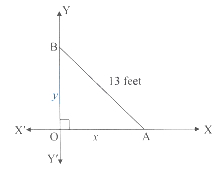
$A$ rod $AB$,$13 \text{ feet}$ long,moves with its ends $A$ and $B$ on two perpendicular lines $OX$ and $OY$ respectively. When $A$ is $5 \text{ feet}$ from $O$,it is moving away at the rate of $3 \text{ feet/sec}$. At this instant,$B$ is moving at the rate of:
A
$\frac{5}{4} \text{ ft/sec}$ upwards.
B
$\frac{4}{5} \text{ ft/sec}$ upwards.
C
$\frac{5}{4} \text{ ft/sec}$ downwards.
D
$\frac{4}{5} \text{ ft/sec}$ downwards.
Solution
(C) Note that $\triangle OAB$ is a right-angled triangle. Let $OA = x \text{ ft}$ and $OB = y \text{ ft}$.
By Pythagoras theorem,$x^2 + y^2 = 13^2 = 169$.
Therefore,$y^2 = 169 - x^2$.
Differentiating with respect to time $t$,we get $2y \frac{dy}{dt} = -2x \frac{dx}{dt}$,which simplifies to $y \frac{dy}{dt} = -x \frac{dx}{dt}$.
Given that at $x = 5 \text{ ft}$,$\frac{dx}{dt} = 3 \text{ ft/sec}$.
When $x = 5$,$y = \sqrt{169 - 5^2} = \sqrt{144} = 12 \text{ ft}$.
Substituting these values: $12 \frac{dy}{dt} = -5(3) = -15$.
Thus,$\frac{dy}{dt} = -\frac{15}{12} = -\frac{5}{4} \text{ ft/sec}$.
The negative sign indicates that $B$ is moving downwards towards $O$.
Therefore,$B$ is moving at the rate of $\frac{5}{4} \text{ ft/sec}$ downwards.
By Pythagoras theorem,$x^2 + y^2 = 13^2 = 169$.
Therefore,$y^2 = 169 - x^2$.
Differentiating with respect to time $t$,we get $2y \frac{dy}{dt} = -2x \frac{dx}{dt}$,which simplifies to $y \frac{dy}{dt} = -x \frac{dx}{dt}$.
Given that at $x = 5 \text{ ft}$,$\frac{dx}{dt} = 3 \text{ ft/sec}$.
When $x = 5$,$y = \sqrt{169 - 5^2} = \sqrt{144} = 12 \text{ ft}$.
Substituting these values: $12 \frac{dy}{dt} = -5(3) = -15$.
Thus,$\frac{dy}{dt} = -\frac{15}{12} = -\frac{5}{4} \text{ ft/sec}$.
The negative sign indicates that $B$ is moving downwards towards $O$.
Therefore,$B$ is moving at the rate of $\frac{5}{4} \text{ ft/sec}$ downwards.
0 likesView Solution
188
MathematicsEasyMCQMHT CET · 2023
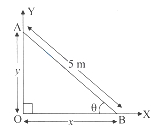
$A$ ladder $5 \ m$ long rests against a vertical wall. If its top slides downwards at the rate of $10 \ cm/s$,then the angle between the ladder and the floor is decreasing at the rate of how many $rad/s$ when its lower end is $4 \ m$ away from the wall?
A
$0.1$
B
$0.025$
C
$0.05$
D
$0.0125$
Solution
(B) Let $x$ be the distance of the lower end from the wall and $y$ be the height of the top of the ladder from the floor. The length of the ladder is $L = 5 \ m$.
From the Pythagorean theorem,$x^2 + y^2 = 5^2 = 25$.
We are given that the top slides downwards at $10 \ cm/s = 0.1 \ m/s$,so $\frac{dy}{dt} = -0.1 \ m/s$.
We want to find the rate of change of the angle $\theta$ between the ladder and the floor,where $\sin \theta = \frac{y}{5}$.
Differentiating with respect to $t$: $\cos \theta \frac{d\theta}{dt} = \frac{1}{5} \frac{dy}{dt}$.
When $x = 4 \ m$,$y = \sqrt{5^2 - 4^2} = 3 \ m$.
Then $\cos \theta = \frac{x}{5} = \frac{4}{5}$.
Substituting the values: $\frac{4}{5} \frac{d\theta}{dt} = \frac{1}{5} (-0.1)$.
$\frac{d\theta}{dt} = -\frac{0.1}{4} = -0.025 \ rad/s$.
The rate of decrease is $0.025 \ rad/s$.
From the Pythagorean theorem,$x^2 + y^2 = 5^2 = 25$.
We are given that the top slides downwards at $10 \ cm/s = 0.1 \ m/s$,so $\frac{dy}{dt} = -0.1 \ m/s$.
We want to find the rate of change of the angle $\theta$ between the ladder and the floor,where $\sin \theta = \frac{y}{5}$.
Differentiating with respect to $t$: $\cos \theta \frac{d\theta}{dt} = \frac{1}{5} \frac{dy}{dt}$.
When $x = 4 \ m$,$y = \sqrt{5^2 - 4^2} = 3 \ m$.
Then $\cos \theta = \frac{x}{5} = \frac{4}{5}$.
Substituting the values: $\frac{4}{5} \frac{d\theta}{dt} = \frac{1}{5} (-0.1)$.
$\frac{d\theta}{dt} = -\frac{0.1}{4} = -0.025 \ rad/s$.
The rate of decrease is $0.025 \ rad/s$.
0 likesView Solution
189
MathematicsMediumMCQMHT CET · 2023
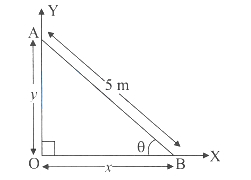
$A$ ladder,$5 \ m$ long,rests against a vertical wall. If its top slides downwards at the rate of $10 \ cm/s$,then the angle between the ladder and the floor is decreasing at the rate of how many radians/second when its lower end is $4 \ m$ away from the wall?
A
$-0.1$
B
$-0.025$
C
$0.1$
D
$0.025$
Solution
(D) Let $x$ be the distance of the foot of the ladder from the wall and $y$ be the height of the top of the ladder from the floor. The length of the ladder is $L = 5 \ m$.
From the Pythagorean theorem,$x^2 + y^2 = 5^2 = 25$.
We are given that the top slides downwards at $10 \ cm/s = 0.1 \ m/s$,so $\frac{dy}{dt} = -0.1 \ m/s$.
We want to find the rate of change of the angle $\theta$ between the ladder and the floor,where $\sin \theta = \frac{y}{5}$.
Differentiating with respect to $t$: $\cos \theta \frac{d\theta}{dt} = \frac{1}{5} \frac{dy}{dt}$.
When $x = 4 \ m$,$y = \sqrt{25 - 4^2} = \sqrt{9} = 3 \ m$.
Then $\cos \theta = \frac{x}{5} = \frac{4}{5}$.
Substituting the values: $\frac{4}{5} \frac{d\theta}{dt} = \frac{1}{5} (-0.1)$.
$\frac{d\theta}{dt} = -\frac{0.1}{4} = -0.025 \ rad/s$.
The angle is decreasing at the rate of $0.025 \ rad/s$.
From the Pythagorean theorem,$x^2 + y^2 = 5^2 = 25$.
We are given that the top slides downwards at $10 \ cm/s = 0.1 \ m/s$,so $\frac{dy}{dt} = -0.1 \ m/s$.
We want to find the rate of change of the angle $\theta$ between the ladder and the floor,where $\sin \theta = \frac{y}{5}$.
Differentiating with respect to $t$: $\cos \theta \frac{d\theta}{dt} = \frac{1}{5} \frac{dy}{dt}$.
When $x = 4 \ m$,$y = \sqrt{25 - 4^2} = \sqrt{9} = 3 \ m$.
Then $\cos \theta = \frac{x}{5} = \frac{4}{5}$.
Substituting the values: $\frac{4}{5} \frac{d\theta}{dt} = \frac{1}{5} (-0.1)$.
$\frac{d\theta}{dt} = -\frac{0.1}{4} = -0.025 \ rad/s$.
The angle is decreasing at the rate of $0.025 \ rad/s$.
0 likesView Solution
190
MathematicsEasyMCQMHT CET · 2023
If the line $ax + by + c = 0$ is a normal to the curve $xy = 1$,then
A
$a > 0, b > 0$
B
$a > 0, b < 0$
C
$a < 0, b < 0$
D
$a = 0, b = 0$
Solution
(B) Given the curve $xy = 1$,we have $y = \frac{1}{x}$.
Taking the derivative with respect to $x$,we get $\frac{dy}{dx} = -\frac{1}{x^2}$.
The slope of the tangent at any point $(x, y)$ is $-\frac{1}{x^2}$.
The slope of the normal is the negative reciprocal of the tangent slope,which is $x^2$.
The slope of the line $ax + by + c = 0$ is $-\frac{a}{b}$.
Since the line is a normal to the curve,we equate the slopes: $x^2 = -\frac{a}{b}$.
Since $x^2$ is always non-negative for real $x$,we must have $-\frac{a}{b} > 0$,which implies $\frac{a}{b} < 0$.
This condition holds if $a$ and $b$ have opposite signs,i.e.,$(a > 0, b < 0)$ or $(a < 0, b > 0)$.
Taking the derivative with respect to $x$,we get $\frac{dy}{dx} = -\frac{1}{x^2}$.
The slope of the tangent at any point $(x, y)$ is $-\frac{1}{x^2}$.
The slope of the normal is the negative reciprocal of the tangent slope,which is $x^2$.
The slope of the line $ax + by + c = 0$ is $-\frac{a}{b}$.
Since the line is a normal to the curve,we equate the slopes: $x^2 = -\frac{a}{b}$.
Since $x^2$ is always non-negative for real $x$,we must have $-\frac{a}{b} > 0$,which implies $\frac{a}{b} < 0$.
This condition holds if $a$ and $b$ have opposite signs,i.e.,$(a > 0, b < 0)$ or $(a < 0, b > 0)$.
0 likesView Solution
191
MathematicsEasyMCQMHT CET · 2023
$\int \frac{1}{\sin (x-a) \sin x} \,d x=$
A
$\sin a(\log (\sin (x-a) \cdot \operatorname{cosec} x))+c$, where $c$ is a constant of integration.
B
$\operatorname{cosec} a(\log |\frac{\sin (x-a)}{\sin x}|)+c$, where $c$ is a constant of integration.
C
$-\sin a(\log (\sin (x-a) \cdot \sin x))+c$, where $c$ is a constant of integration.
D
$-\operatorname{cosec} a(\log (\sin (x-a) \cdot \sin x))+c$, where $c$ is a constant of integration.
Solution
(B) Let $I = \int \frac{1}{\sin (x-a) \sin x} \,d x$.
Multiply and divide by $\sin a$:
$I = \frac{1}{\sin a} \int \frac{\sin a}{\sin (x-a) \sin x} \,d x$.
Express $\sin a$ as $\sin (x - (x-a))$:
$I = \frac{1}{\sin a} \int \frac{\sin (x - (x-a))}{\sin (x-a) \sin x} \,d x$.
Using the identity $\sin (A-B) = \sin A \cos B - \cos A \sin B$:
$I = \frac{1}{\sin a} \int \frac{\sin x \cos (x-a) - \cos x \sin (x-a)}{\sin (x-a) \sin x} \,d x$.
Split the integral:
$I = \frac{1}{\sin a} \left[ \int \frac{\sin x \cos (x-a)}{\sin (x-a) \sin x} \,d x - \int \frac{\cos x \sin (x-a)}{\sin (x-a) \sin x} \,d x \right]$.
$I = \frac{1}{\sin a} \left[ \int \cot (x-a) \,d x - \int \cot x \,d x \right]$.
Integrating:
$I = \frac{1}{\sin a} [\log |\sin (x-a)| - \log |\sin x|] + c$.
$I = \operatorname{cosec} a \log |\frac{\sin (x-a)}{\sin x}| + c$.
Multiply and divide by $\sin a$:
$I = \frac{1}{\sin a} \int \frac{\sin a}{\sin (x-a) \sin x} \,d x$.
Express $\sin a$ as $\sin (x - (x-a))$:
$I = \frac{1}{\sin a} \int \frac{\sin (x - (x-a))}{\sin (x-a) \sin x} \,d x$.
Using the identity $\sin (A-B) = \sin A \cos B - \cos A \sin B$:
$I = \frac{1}{\sin a} \int \frac{\sin x \cos (x-a) - \cos x \sin (x-a)}{\sin (x-a) \sin x} \,d x$.
Split the integral:
$I = \frac{1}{\sin a} \left[ \int \frac{\sin x \cos (x-a)}{\sin (x-a) \sin x} \,d x - \int \frac{\cos x \sin (x-a)}{\sin (x-a) \sin x} \,d x \right]$.
$I = \frac{1}{\sin a} \left[ \int \cot (x-a) \,d x - \int \cot x \,d x \right]$.
Integrating:
$I = \frac{1}{\sin a} [\log |\sin (x-a)| - \log |\sin x|] + c$.
$I = \operatorname{cosec} a \log |\frac{\sin (x-a)}{\sin x}| + c$.
0 likesView Solution
192
MathematicsDifficultMCQMHT CET · 2023
If $I=\int \frac{\sin x+\sin ^3 x}{\cos 2 x} \,d x=P \cos x+Q \log \left|\frac{\sqrt{2} \cos x-1}{\sqrt{2} \cos x+1}\right|+c,$ (where $c$ is a constant of integration),then the values of $P$ and $Q$ are respectively
A
$\frac{1}{2}, \frac{3}{4 \sqrt{2}}$
B
$\frac{1}{2}, \frac{-3}{4 \sqrt{2}}$
C
$\frac{1}{2}, \frac{3}{2 \sqrt{2}}$
D
$\frac{1}{2}, \frac{-3}{2 \sqrt{2}}$
Solution
(B) Given $I = \int \frac{\sin x + \sin^3 x}{\cos 2x} dx$.
Using $\sin^2 x = 1 - \cos^2 x$,we have $\sin x(1 + \sin^2 x) = \sin x(1 + 1 - \cos^2 x) = \sin x(2 - \cos^2 x)$.
So,$I = \int \frac{\sin x(2 - \cos^2 x)}{2 \cos^2 x - 1} dx$.
Let $\cos x = t$,then $-\sin x dx = dt$,so $\sin x dx = -dt$.
$I = \int \frac{t^2 - 2}{2t^2 - 1} (-dt) = \int \frac{2 - t^2}{2t^2 - 1} dt$.
$I = \frac{1}{2} \int \frac{4 - 2t^2}{2t^2 - 1} dt = \frac{1}{2} \int \frac{-(2t^2 - 1) + 3}{2t^2 - 1} dt$.
$I = \frac{1}{2} \int (-1 + \frac{3}{2t^2 - 1}) dt = \frac{1}{2} [-t + \frac{3}{2\sqrt{2}} \log |\frac{\sqrt{2}t - 1}{\sqrt{2}t + 1}|] + c$.
$I = -\frac{1}{2} \cos x + \frac{3}{4\sqrt{2}} \log |\frac{\sqrt{2} \cos x - 1}{\sqrt{2} \cos x + 1}| + c$.
Comparing with $P \cos x + Q \log |\frac{\sqrt{2} \cos x - 1}{\sqrt{2} \cos x + 1}| + c$,we get $P = -\frac{1}{2}$ and $Q = \frac{3}{4\sqrt{2}}$.
Note: The provided options seem to have a sign discrepancy for $P$. Based on the standard integral form,$P = -1/2$ and $Q = 3/(4\sqrt{2})$. If $P$ is $1/2$,the numerator in the integral must be $\sin x(\cos^2 x - 2)$.
Using $\sin^2 x = 1 - \cos^2 x$,we have $\sin x(1 + \sin^2 x) = \sin x(1 + 1 - \cos^2 x) = \sin x(2 - \cos^2 x)$.
So,$I = \int \frac{\sin x(2 - \cos^2 x)}{2 \cos^2 x - 1} dx$.
Let $\cos x = t$,then $-\sin x dx = dt$,so $\sin x dx = -dt$.
$I = \int \frac{t^2 - 2}{2t^2 - 1} (-dt) = \int \frac{2 - t^2}{2t^2 - 1} dt$.
$I = \frac{1}{2} \int \frac{4 - 2t^2}{2t^2 - 1} dt = \frac{1}{2} \int \frac{-(2t^2 - 1) + 3}{2t^2 - 1} dt$.
$I = \frac{1}{2} \int (-1 + \frac{3}{2t^2 - 1}) dt = \frac{1}{2} [-t + \frac{3}{2\sqrt{2}} \log |\frac{\sqrt{2}t - 1}{\sqrt{2}t + 1}|] + c$.
$I = -\frac{1}{2} \cos x + \frac{3}{4\sqrt{2}} \log |\frac{\sqrt{2} \cos x - 1}{\sqrt{2} \cos x + 1}| + c$.
Comparing with $P \cos x + Q \log |\frac{\sqrt{2} \cos x - 1}{\sqrt{2} \cos x + 1}| + c$,we get $P = -\frac{1}{2}$ and $Q = \frac{3}{4\sqrt{2}}$.
Note: The provided options seem to have a sign discrepancy for $P$. Based on the standard integral form,$P = -1/2$ and $Q = 3/(4\sqrt{2})$. If $P$ is $1/2$,the numerator in the integral must be $\sin x(\cos^2 x - 2)$.
0 likesView Solution
193
MathematicsDifficultMCQMHT CET · 2023
$\int \frac{e^{\tan ^{-1} x}}{1+x^2}\left[\left(\sec ^{-1} \sqrt{1+x^2}\right)^2+\cos ^{-1}\left(\frac{1-x^2}{1+x^2}\right)\right] d x, x>0=$
A
$\left(\tan ^{-1} x\right)^2 e^{\tan ^{-1} x}+c$,where $c$ is a constant of integration.
B
$\left(\tan ^{-1} x\right) e^{\tan ^{-1} x}+c$,where $c$ is a constant of integration.
C
$\left(\tan ^{-1} x\right) e^{2 \tan ^{-1} x}+c$,where $c$ is a constant of integration.
D
$\left(\tan ^{-1} x\right)^2 e^{2 \tan ^{-1} x}+c$,where $c$ is a constant of integration.
Solution
(A) Let $I = \int \frac{e^{\tan ^{-1} x}}{1+x^2}\left[\left(\sec ^{-1} \sqrt{1+x^2}\right)^2+\cos ^{-1}\left(\frac{1-x^2}{1+x^2}\right)\right] d x$.
Substitute $x = \tan t$,so $dx = \sec^2 t dt$.
Since $x > 0$,$t = \tan^{-1} x \in (0, \pi/2)$.
Note that $\sec^{-1} \sqrt{1+x^2} = \sec^{-1} \sqrt{1+\tan^2 t} = \sec^{-1} \sec t = t$.
Also,$\cos^{-1} \left(\frac{1-x^2}{1+x^2}\right) = \cos^{-1} \cos 2t = 2t$.
Substituting these into the integral:
$I = \int \frac{e^t}{1+\tan^2 t} [t^2 + 2t] \sec^2 t dt = \int e^t (t^2 + 2t) dt$.
Using the formula $\int e^t (f(t) + f'(t)) dt = e^t f(t) + c$,where $f(t) = t^2$ and $f'(t) = 2t$:
$I = e^t t^2 + c = e^{\tan^{-1} x} (\tan^{-1} x)^2 + c$.
Substitute $x = \tan t$,so $dx = \sec^2 t dt$.
Since $x > 0$,$t = \tan^{-1} x \in (0, \pi/2)$.
Note that $\sec^{-1} \sqrt{1+x^2} = \sec^{-1} \sqrt{1+\tan^2 t} = \sec^{-1} \sec t = t$.
Also,$\cos^{-1} \left(\frac{1-x^2}{1+x^2}\right) = \cos^{-1} \cos 2t = 2t$.
Substituting these into the integral:
$I = \int \frac{e^t}{1+\tan^2 t} [t^2 + 2t] \sec^2 t dt = \int e^t (t^2 + 2t) dt$.
Using the formula $\int e^t (f(t) + f'(t)) dt = e^t f(t) + c$,where $f(t) = t^2$ and $f'(t) = 2t$:
$I = e^t t^2 + c = e^{\tan^{-1} x} (\tan^{-1} x)^2 + c$.
0 likesView Solution
194
MathematicsEasyMCQMHT CET · 2023
$\int \frac{x+1}{x(1+x e^x)^2} d x=$
A
$\log \left|\frac{x e^x}{1+x e^x}\right|+c$,where $c$ is a constant of integration.
B
$\log \left|\frac{x e^x}{1+x e^x}\right|-\frac{1}{1+x e^x}+c$,where $c$ is a constant of integration.
C
$\log \left|1+x e^x\right|+\frac{1}{1+x e^x}+c$,where $c$ is a constant of integration.
D
$\log \left|\frac{x e^x}{1+x e^x}\right|+\frac{1}{1+x e^x}+c$,where $c$ is a constant of integration.
Solution
(D) Let $I = \int \frac{x+1}{x(1+x e^x)^2} dx$.
Multiply numerator and denominator by $e^x$:
$I = \int \frac{e^x(x+1)}{x e^x(1+x e^x)^2} dx$.
Let $t = x e^x$. Then $dt = (e^x + x e^x) dx = e^x(1+x) dx$.
Substituting this into the integral:
$I = \int \frac{dt}{t(1+t)^2}$.
Using partial fractions: $\frac{1}{t(1+t)^2} = \frac{A}{t} + \frac{B}{1+t} + \frac{C}{(1+t)^2}$.
Solving for constants: $1 = A(1+t)^2 + Bt(1+t) + Ct$.
For $t=0$,$A=1$. For $t=-1$,$C=-1$. Comparing coefficients of $t^2$,$A+B=0 \Rightarrow B=-1$.
So,$I = \int \left( \frac{1}{t} - \frac{1}{1+t} - \frac{1}{(1+t)^2} \right) dt$.
$I = \log |t| - \log |1+t| + \frac{1}{1+t} + c$.
Substituting $t = x e^x$:
$I = \log |x e^x| - \log |1+x e^x| + \frac{1}{1+x e^x} + c$.
$I = \log \left| \frac{x e^x}{1+x e^x} \right| + \frac{1}{1+x e^x} + c$.
Multiply numerator and denominator by $e^x$:
$I = \int \frac{e^x(x+1)}{x e^x(1+x e^x)^2} dx$.
Let $t = x e^x$. Then $dt = (e^x + x e^x) dx = e^x(1+x) dx$.
Substituting this into the integral:
$I = \int \frac{dt}{t(1+t)^2}$.
Using partial fractions: $\frac{1}{t(1+t)^2} = \frac{A}{t} + \frac{B}{1+t} + \frac{C}{(1+t)^2}$.
Solving for constants: $1 = A(1+t)^2 + Bt(1+t) + Ct$.
For $t=0$,$A=1$. For $t=-1$,$C=-1$. Comparing coefficients of $t^2$,$A+B=0 \Rightarrow B=-1$.
So,$I = \int \left( \frac{1}{t} - \frac{1}{1+t} - \frac{1}{(1+t)^2} \right) dt$.
$I = \log |t| - \log |1+t| + \frac{1}{1+t} + c$.
Substituting $t = x e^x$:
$I = \log |x e^x| - \log |1+x e^x| + \frac{1}{1+x e^x} + c$.
$I = \log \left| \frac{x e^x}{1+x e^x} \right| + \frac{1}{1+x e^x} + c$.
0 likesView Solution
195
MathematicsMediumMCQMHT CET · 2023
Let $\alpha \in (0, \frac{\pi}{2})$ be fixed. If the integral $\int \frac{\tan x+\tan \alpha}{\tan x-\tan \alpha} dx = A(x) \cos 2\alpha + B(x) \sin 2\alpha + c$ (where $c$ is a constant of integration),then functions $A(x)$ and $B(x)$ are respectively
A
$x+\alpha$ and $\log |\sin (x+\alpha)|$.
B
$x-\alpha$ and $\log |\sin (x-\alpha)|$.
C
$x-\alpha$ and $\log |\cos (x-\alpha)|$.
D
$x+\alpha$ and $\log |\sin (x-\alpha)|$.
Solution
(B) Let $I = \int \frac{\tan x + \tan \alpha}{\tan x - \tan \alpha} dx$.
$= \int \frac{\frac{\sin x}{\cos x} + \frac{\sin \alpha}{\cos \alpha}}{\frac{\sin x}{\cos x} - \frac{\sin \alpha}{\cos \alpha}} dx$
$= \int \frac{\sin x \cos \alpha + \sin \alpha \cos x}{\sin x \cos \alpha - \sin \alpha \cos x} dx$
$= \int \frac{\sin (x+\alpha)}{\sin (x-\alpha)} dx$.
Let $t = x - \alpha$,so $x = t + \alpha$ and $dx = dt$.
$I = \int \frac{\sin (t + 2\alpha)}{\sin t} dt$
$= \int \frac{\sin t \cos 2\alpha + \cos t \sin 2\alpha}{\sin t} dt$
$= \cos 2\alpha \int 1 dt + \sin 2\alpha \int \cot t dt$
$= t \cos 2\alpha + \sin 2\alpha \log |\sin t| + c$
$= (x - \alpha) \cos 2\alpha + \log |\sin (x - \alpha)| \sin 2\alpha + c$.
Comparing this with $A(x) \cos 2\alpha + B(x) \sin 2\alpha + c$,we get $A(x) = x - \alpha$ and $B(x) = \log |\sin (x - \alpha)|$.
$= \int \frac{\frac{\sin x}{\cos x} + \frac{\sin \alpha}{\cos \alpha}}{\frac{\sin x}{\cos x} - \frac{\sin \alpha}{\cos \alpha}} dx$
$= \int \frac{\sin x \cos \alpha + \sin \alpha \cos x}{\sin x \cos \alpha - \sin \alpha \cos x} dx$
$= \int \frac{\sin (x+\alpha)}{\sin (x-\alpha)} dx$.
Let $t = x - \alpha$,so $x = t + \alpha$ and $dx = dt$.
$I = \int \frac{\sin (t + 2\alpha)}{\sin t} dt$
$= \int \frac{\sin t \cos 2\alpha + \cos t \sin 2\alpha}{\sin t} dt$
$= \cos 2\alpha \int 1 dt + \sin 2\alpha \int \cot t dt$
$= t \cos 2\alpha + \sin 2\alpha \log |\sin t| + c$
$= (x - \alpha) \cos 2\alpha + \log |\sin (x - \alpha)| \sin 2\alpha + c$.
Comparing this with $A(x) \cos 2\alpha + B(x) \sin 2\alpha + c$,we get $A(x) = x - \alpha$ and $B(x) = \log |\sin (x - \alpha)|$.
0 likesView Solution
196
MathematicsMediumMCQMHT CET · 2023
$\int(\sqrt{\tan x}+\sqrt{\cot x}) d x=$
A
$\sqrt{2} \sin ^{-1}(\sin x-\cos x)+c$,where $c$ is a constant of integration.
B
$\frac{1}{\sqrt{2}} \sin ^{-1}(\sin x-\cos x)+c$,where $c$ is a constant of integration.
C
$\sin ^{-1}(\sin x-\cos x)+c$,where $c$ is a constant of integration.
D
$2 \sin ^{-1}(\sin x-\cos x)+c$,where $c$ is a constant of integration.
Solution
(A) Let $I = \int(\sqrt{\tan x} + \sqrt{\cot x}) dx$.
We can write this as $I = \int \left(\sqrt{\frac{\sin x}{\cos x}} + \sqrt{\frac{\cos x}{\sin x}}\right) dx$.
Simplifying the integrand,we get $I = \int \frac{\sin x + \cos x}{\sqrt{\sin x \cos x}} dx$.
Let $t = \sin x - \cos x$. Then $dt = (\cos x + \sin x) dx$.
Squaring both sides of $t = \sin x - \cos x$,we get $t^2 = \sin^2 x + \cos^2 x - 2 \sin x \cos x = 1 - 2 \sin x \cos x$.
Thus,$2 \sin x \cos x = 1 - t^2$,which implies $\sin x \cos x = \frac{1 - t^2}{2}$.
Substituting these into the integral,we get $I = \int \frac{dt}{\sqrt{\frac{1 - t^2}{2}}} = \sqrt{2} \int \frac{dt}{\sqrt{1 - t^2}}$.
Integrating,we obtain $I = \sqrt{2} \sin^{-1}(t) + c$.
Substituting $t = \sin x - \cos x$ back,we get $I = \sqrt{2} \sin^{-1}(\sin x - \cos x) + c$.
We can write this as $I = \int \left(\sqrt{\frac{\sin x}{\cos x}} + \sqrt{\frac{\cos x}{\sin x}}\right) dx$.
Simplifying the integrand,we get $I = \int \frac{\sin x + \cos x}{\sqrt{\sin x \cos x}} dx$.
Let $t = \sin x - \cos x$. Then $dt = (\cos x + \sin x) dx$.
Squaring both sides of $t = \sin x - \cos x$,we get $t^2 = \sin^2 x + \cos^2 x - 2 \sin x \cos x = 1 - 2 \sin x \cos x$.
Thus,$2 \sin x \cos x = 1 - t^2$,which implies $\sin x \cos x = \frac{1 - t^2}{2}$.
Substituting these into the integral,we get $I = \int \frac{dt}{\sqrt{\frac{1 - t^2}{2}}} = \sqrt{2} \int \frac{dt}{\sqrt{1 - t^2}}$.
Integrating,we obtain $I = \sqrt{2} \sin^{-1}(t) + c$.
Substituting $t = \sin x - \cos x$ back,we get $I = \sqrt{2} \sin^{-1}(\sin x - \cos x) + c$.
0 likesView Solution
197
MathematicsMediumMCQMHT CET · 2023
If $\int \frac{\sin x}{3+4 \cos ^2 x} \,dx = A \tan ^{-1}(B \cos x) + C$, (where $C$ is a constant of integration), then the value of $A+B$ is
A
$\frac{5}{2 \sqrt{3}}$
B
$\frac{-1}{2 \sqrt{3}}$
C
$\frac{-2}{\sqrt{3}}$
D
$\frac{\sqrt{3}}{2}$
Solution
(D) Let $I = \int \frac{\sin x}{3+4 \cos ^2 x} \,dx$.
Substitute $\cos x = t$, then $-\sin x \,dx = dt$, which implies $\sin x \,dx = -dt$.
Substituting these into the integral, we get $I = \int \frac{-dt}{3+4 t^2} = -\int \frac{dt}{(\sqrt{3})^2 + (2t)^2}$.
Using the standard integral formula $\int \frac{dx}{a^2 + x^2} = \frac{1}{a} \tan^{-1}(\frac{x}{a}) + C$, we have:
$I = -\frac{1}{\sqrt{3}} \cdot \frac{1}{2} \tan^{-1}(\frac{2t}{\sqrt{3}}) + C = -\frac{1}{2\sqrt{3}} \tan^{-1}(\frac{2 \cos x}{\sqrt{3}}) + C$.
Comparing this with $A \tan^{-1}(B \cos x) + C$, we identify $A = -\frac{1}{2\sqrt{3}}$ and $B = \frac{2}{\sqrt{3}}$.
Therefore, $A + B = -\frac{1}{2\sqrt{3}} + \frac{2}{\sqrt{3}} = \frac{-1 + 4}{2\sqrt{3}} = \frac{3}{2\sqrt{3}} = \frac{\sqrt{3}}{2}$.
Substitute $\cos x = t$, then $-\sin x \,dx = dt$, which implies $\sin x \,dx = -dt$.
Substituting these into the integral, we get $I = \int \frac{-dt}{3+4 t^2} = -\int \frac{dt}{(\sqrt{3})^2 + (2t)^2}$.
Using the standard integral formula $\int \frac{dx}{a^2 + x^2} = \frac{1}{a} \tan^{-1}(\frac{x}{a}) + C$, we have:
$I = -\frac{1}{\sqrt{3}} \cdot \frac{1}{2} \tan^{-1}(\frac{2t}{\sqrt{3}}) + C = -\frac{1}{2\sqrt{3}} \tan^{-1}(\frac{2 \cos x}{\sqrt{3}}) + C$.
Comparing this with $A \tan^{-1}(B \cos x) + C$, we identify $A = -\frac{1}{2\sqrt{3}}$ and $B = \frac{2}{\sqrt{3}}$.
Therefore, $A + B = -\frac{1}{2\sqrt{3}} + \frac{2}{\sqrt{3}} = \frac{-1 + 4}{2\sqrt{3}} = \frac{3}{2\sqrt{3}} = \frac{\sqrt{3}}{2}$.
0 likesView Solution
198
MathematicsMediumMCQMHT CET · 2023
If $I=\int \frac{dx}{x^2(x^4+1)^{3/4}}$,then $I$ is
A
$\left(\frac{x^4+1}{x}\right)^{1/4}+c$,where $c$ is a constant of integration.
B
$\frac{(x^4-1)^{1/4}}{x}+c$,where $c$ is a constant of integration.
C
$-\frac{(x^4+1)^{1/4}}{x}+c$,where $c$ is a constant of integration.
D
$-\left(\frac{x^4+1}{x}\right)^{1/4}+c$,where $c$ is a constant of integration.
Solution
(C) Given $I = \int \frac{dx}{x^2(x^4+1)^{3/4}}$.
We can rewrite the integral by taking $x^4$ common from the bracket:
$I = \int \frac{dx}{x^2 \left[x^4(1 + \frac{1}{x^4})\right]^{3/4}} = \int \frac{dx}{x^2 \cdot x^3 (1 + \frac{1}{x^4})^{3/4}} = \int \frac{dx}{x^5 (1 + \frac{1}{x^4})^{3/4}}$.
Let $t = 1 + \frac{1}{x^4}$. Then $dt = -\frac{4}{x^5} dx$,which implies $\frac{dx}{x^5} = -\frac{1}{4} dt$.
Substituting these into the integral:
$I = \int -\frac{1}{4} t^{-3/4} dt = -\frac{1}{4} \cdot \frac{t^{1/4}}{1/4} + c = -t^{1/4} + c$.
Substituting back $t = 1 + \frac{1}{x^4} = \frac{x^4+1}{x^4}$:
$I = -(1 + \frac{1}{x^4})^{1/4} + c = -\left(\frac{x^4+1}{x^4}\right)^{1/4} + c = -\frac{(x^4+1)^{1/4}}{x} + c$.
We can rewrite the integral by taking $x^4$ common from the bracket:
$I = \int \frac{dx}{x^2 \left[x^4(1 + \frac{1}{x^4})\right]^{3/4}} = \int \frac{dx}{x^2 \cdot x^3 (1 + \frac{1}{x^4})^{3/4}} = \int \frac{dx}{x^5 (1 + \frac{1}{x^4})^{3/4}}$.
Let $t = 1 + \frac{1}{x^4}$. Then $dt = -\frac{4}{x^5} dx$,which implies $\frac{dx}{x^5} = -\frac{1}{4} dt$.
Substituting these into the integral:
$I = \int -\frac{1}{4} t^{-3/4} dt = -\frac{1}{4} \cdot \frac{t^{1/4}}{1/4} + c = -t^{1/4} + c$.
Substituting back $t = 1 + \frac{1}{x^4} = \frac{x^4+1}{x^4}$:
$I = -(1 + \frac{1}{x^4})^{1/4} + c = -\left(\frac{x^4+1}{x^4}\right)^{1/4} + c = -\frac{(x^4+1)^{1/4}}{x} + c$.
0 likesView Solution
199
MathematicsMediumMCQMHT CET · 2023
$\int \frac{d x}{\sin x+\cos x}=$
A
$\sqrt{2} \log \tan \left(x+\frac{\pi}{4}\right)+c$,where $c$ is a constant of integration.
B
$\frac{1}{\sqrt{2}} \log \tan \left(\frac{x}{2}+\frac{\pi}{8}\right)+c$,where $c$ is a constant of integration.
C
$\frac{1}{\sqrt{2}} \log \left(\frac{\tan \frac{x}{2}-\sqrt{2}+1}{\tan \frac{x}{2}+\sqrt{2}+1}\right)+c$,where $c$ is a constant of integration.
D
$-\frac{1}{\sqrt{2}} \log \left(\frac{\tan \frac{x}{2}-(\sqrt{2}+1)}{\tan \frac{x}{2}+\sqrt{2}-1}\right)+c$,where $c$ is a constant of integration.
Solution
(D) Let $I = \int \frac{dx}{\sin x + \cos x}$.
Using the substitution $\tan \frac{x}{2} = t$,we have $dx = \frac{2}{1+t^2} dt$,$\sin x = \frac{2t}{1+t^2}$,and $\cos x = \frac{1-t^2}{1+t^2}$.
Substituting these into the integral:
$I = \int \frac{\frac{2}{1+t^2}}{\frac{2t}{1+t^2} + \frac{1-t^2}{1+t^2}} dt = \int \frac{2}{2t + 1 - t^2} dt = -2 \int \frac{1}{t^2 - 2t - 1} dt$.
Completing the square in the denominator:
$t^2 - 2t - 1 = (t-1)^2 - 2 = (t-1)^2 - (\sqrt{2})^2$.
Using the formula $\int \frac{dx}{x^2 - a^2} = \frac{1}{2a} \log \left| \frac{x-a}{x+a} \right| + c$:
$I = -2 \times \frac{1}{2\sqrt{2}} \log \left| \frac{t-1-\sqrt{2}}{t-1+\sqrt{2}} \right| + c = -\frac{1}{\sqrt{2}} \log \left| \frac{\tan \frac{x}{2} - 1 - \sqrt{2}}{\tan \frac{x}{2} - 1 + \sqrt{2}} \right| + c$.
Simplifying the expression:
$I = -\frac{1}{\sqrt{2}} \log \left| \frac{\tan \frac{x}{2} - (\sqrt{2} + 1)}{\tan \frac{x}{2} + \sqrt{2} - 1} \right| + c$.
Using the substitution $\tan \frac{x}{2} = t$,we have $dx = \frac{2}{1+t^2} dt$,$\sin x = \frac{2t}{1+t^2}$,and $\cos x = \frac{1-t^2}{1+t^2}$.
Substituting these into the integral:
$I = \int \frac{\frac{2}{1+t^2}}{\frac{2t}{1+t^2} + \frac{1-t^2}{1+t^2}} dt = \int \frac{2}{2t + 1 - t^2} dt = -2 \int \frac{1}{t^2 - 2t - 1} dt$.
Completing the square in the denominator:
$t^2 - 2t - 1 = (t-1)^2 - 2 = (t-1)^2 - (\sqrt{2})^2$.
Using the formula $\int \frac{dx}{x^2 - a^2} = \frac{1}{2a} \log \left| \frac{x-a}{x+a} \right| + c$:
$I = -2 \times \frac{1}{2\sqrt{2}} \log \left| \frac{t-1-\sqrt{2}}{t-1+\sqrt{2}} \right| + c = -\frac{1}{\sqrt{2}} \log \left| \frac{\tan \frac{x}{2} - 1 - \sqrt{2}}{\tan \frac{x}{2} - 1 + \sqrt{2}} \right| + c$.
Simplifying the expression:
$I = -\frac{1}{\sqrt{2}} \log \left| \frac{\tan \frac{x}{2} - (\sqrt{2} + 1)}{\tan \frac{x}{2} + \sqrt{2} - 1} \right| + c$.
0 likesView Solution
200
MathematicsDifficultMCQMHT CET · 2023
The value of $\int \frac{(x^2-1) dx}{x^3 \sqrt{2x^4-2x^2+1}}$ is
A
$2 \sqrt{2-\frac{2}{x^2}+\frac{1}{x^4}}+c$,where $c$ is a constant of integration.
B
$2 \sqrt{2+\frac{2}{x^2}+\frac{1}{x^4}}+c$,where $c$ is a constant of integration.
C
$\frac{1}{2} \sqrt{2-\frac{2}{x^2}+\frac{1}{x^4}}+c$,where $c$ is a constant of integration.
D
$2 \sqrt{2-\frac{2}{x^2}-\frac{1}{x^4}}+c$,where $c$ is a constant of integration.
Solution
(C) Let $I = \int \frac{(x^2-1) dx}{x^3 \sqrt{2x^4-2x^2+1}}$.
Divide the numerator and denominator inside the square root by $x^4$:
$I = \int \frac{(x^2-1) dx}{x^3 \cdot x^2 \sqrt{2-\frac{2}{x^2}+\frac{1}{x^4}}} = \int \frac{(\frac{1}{x^3} - \frac{1}{x^5}) dx}{\sqrt{2-\frac{2}{x^2}+\frac{1}{x^4}}}$.
Let $t = 2-\frac{2}{x^2}+\frac{1}{x^4}$.
Then $dt = (\frac{4}{x^3} - \frac{4}{x^5}) dx$,which implies $(\frac{1}{x^3} - \frac{1}{x^5}) dx = \frac{dt}{4}$.
Substituting these into the integral:
$I = \int \frac{dt/4}{\sqrt{t}} = \frac{1}{4} \int t^{-1/2} dt = \frac{1}{4} \cdot \frac{t^{1/2}}{1/2} + c = \frac{1}{2} \sqrt{t} + c$.
Substituting $t$ back,we get $I = \frac{1}{2} \sqrt{2-\frac{2}{x^2}+\frac{1}{x^4}} + c$.
Divide the numerator and denominator inside the square root by $x^4$:
$I = \int \frac{(x^2-1) dx}{x^3 \cdot x^2 \sqrt{2-\frac{2}{x^2}+\frac{1}{x^4}}} = \int \frac{(\frac{1}{x^3} - \frac{1}{x^5}) dx}{\sqrt{2-\frac{2}{x^2}+\frac{1}{x^4}}}$.
Let $t = 2-\frac{2}{x^2}+\frac{1}{x^4}$.
Then $dt = (\frac{4}{x^3} - \frac{4}{x^5}) dx$,which implies $(\frac{1}{x^3} - \frac{1}{x^5}) dx = \frac{dt}{4}$.
Substituting these into the integral:
$I = \int \frac{dt/4}{\sqrt{t}} = \frac{1}{4} \int t^{-1/2} dt = \frac{1}{4} \cdot \frac{t^{1/2}}{1/2} + c = \frac{1}{2} \sqrt{t} + c$.
Substituting $t$ back,we get $I = \frac{1}{2} \sqrt{2-\frac{2}{x^2}+\frac{1}{x^4}} + c$.
0 likesView Solution
201
MathematicsMediumMCQMHT CET · 2023
If $\int \frac{5 \tan x}{\tan x-2} \, dx = x + a \log |\sin x - 2 \cos x| + c$ (where $c$ is a constant of integration),then the value of $a$ is
A
$1$
B
$\frac{1}{2}$
C
$2$
D
$3$
Solution
(C) Let $I = \int \frac{5 \tan x}{\tan x - 2} \, dx = \int \frac{5 \sin x}{\sin x - 2 \cos x} \, dx$.
We express the numerator as $5 \sin x = A(\sin x - 2 \cos x) + B \frac{d}{dx}(\sin x - 2 \cos x)$.
$5 \sin x = A(\sin x - 2 \cos x) + B(\cos x + 2 \sin x)$.
Equating the coefficients of $\sin x$ and $\cos x$:
$A + 2B = 5$ and $-2A + B = 0$.
From the second equation,$B = 2A$. Substituting into the first: $A + 2(2A) = 5 \implies 5A = 5 \implies A = 1$.
Then $B = 2(1) = 2$.
Thus,$I = \int \left( 1 + 2 \frac{\cos x + 2 \sin x}{\sin x - 2 \cos x} \right) \, dx$.
$I = \int 1 \, dx + 2 \int \frac{d(\sin x - 2 \cos x)}{\sin x - 2 \cos x} = x + 2 \log |\sin x - 2 \cos x| + c$.
Comparing this with $x + a \log |\sin x - 2 \cos x| + c$,we get $a = 2$.
We express the numerator as $5 \sin x = A(\sin x - 2 \cos x) + B \frac{d}{dx}(\sin x - 2 \cos x)$.
$5 \sin x = A(\sin x - 2 \cos x) + B(\cos x + 2 \sin x)$.
Equating the coefficients of $\sin x$ and $\cos x$:
$A + 2B = 5$ and $-2A + B = 0$.
From the second equation,$B = 2A$. Substituting into the first: $A + 2(2A) = 5 \implies 5A = 5 \implies A = 1$.
Then $B = 2(1) = 2$.
Thus,$I = \int \left( 1 + 2 \frac{\cos x + 2 \sin x}{\sin x - 2 \cos x} \right) \, dx$.
$I = \int 1 \, dx + 2 \int \frac{d(\sin x - 2 \cos x)}{\sin x - 2 \cos x} = x + 2 \log |\sin x - 2 \cos x| + c$.
Comparing this with $x + a \log |\sin x - 2 \cos x| + c$,we get $a = 2$.
0 likesView Solution
202
MathematicsMediumMCQMHT CET · 2023
The value of $\int \frac{d x}{x^2(x^4+1)^{\frac{3}{4}}}$ is
A
$\left(\frac{x^4+1}{x^4}\right)^{\frac{1}{4}}+c$,where $c$ is a constant of integration.
B
$(x^4+1)^{\frac{1}{4}}+c$,where $c$ is a constant of integration.
C
$-(x^4+1)^{\frac{1}{4}}+c$,where $c$ is a constant of integration.
D
$-\left(\frac{x^4+1}{x^4}\right)^{\frac{1}{4}}+c$,where $c$ is a constant of integration.
Solution
(D) Let $I = \int \frac{dx}{x^2(x^4+1)^{\frac{3}{4}}}$.
We can rewrite the integral as $I = \int \frac{dx}{x^2 \cdot x^3 (1 + \frac{1}{x^4})^{\frac{3}{4}}} = \int \frac{dx}{x^5 (1 + \frac{1}{x^4})^{\frac{3}{4}}}$.
Let $t = 1 + \frac{1}{x^4}$. Then $dt = -\frac{4}{x^5} dx$,which implies $\frac{dx}{x^5} = -\frac{1}{4} dt$.
Substituting these into the integral,we get:
$I = -\frac{1}{4} \int t^{-\frac{3}{4}} dt$.
Integrating with respect to $t$,we have:
$I = -\frac{1}{4} \cdot \frac{t^{\frac{1}{4}}}{\frac{1}{4}} + c = -t^{\frac{1}{4}} + c$.
Substituting back $t = 1 + \frac{1}{x^4}$,we get:
$I = -(1 + \frac{1}{x^4})^{\frac{1}{4}} + c = -\left(\frac{x^4+1}{x^4}\right)^{\frac{1}{4}} + c$.
We can rewrite the integral as $I = \int \frac{dx}{x^2 \cdot x^3 (1 + \frac{1}{x^4})^{\frac{3}{4}}} = \int \frac{dx}{x^5 (1 + \frac{1}{x^4})^{\frac{3}{4}}}$.
Let $t = 1 + \frac{1}{x^4}$. Then $dt = -\frac{4}{x^5} dx$,which implies $\frac{dx}{x^5} = -\frac{1}{4} dt$.
Substituting these into the integral,we get:
$I = -\frac{1}{4} \int t^{-\frac{3}{4}} dt$.
Integrating with respect to $t$,we have:
$I = -\frac{1}{4} \cdot \frac{t^{\frac{1}{4}}}{\frac{1}{4}} + c = -t^{\frac{1}{4}} + c$.
Substituting back $t = 1 + \frac{1}{x^4}$,we get:
$I = -(1 + \frac{1}{x^4})^{\frac{1}{4}} + c = -\left(\frac{x^4+1}{x^4}\right)^{\frac{1}{4}} + c$.
0 likesView Solution
203
MathematicsDifficultMCQMHT CET · 2023
$\int \frac{\log (\cot x)}{\sin 2 x} \,d x=$
A
$-\log (\cot x)^2+c$, where $c$ is constant of integration.
B
$2(\log (\cot x))^2+c$, where $c$ is constant of integration.
C
$\frac{-1}{4}(\log (\sin x))^2+c$, where $c$ is constant of integration.
D
$\frac{-1}{4}(\log (\cot x))^2+c$, where $c$ is constant of integration.
Solution
(D) Let $I = \int \frac{\log (\cot x)}{\sin 2 x} \,d x$.
Put $\log (\cot x) = t$.
Differentiating both sides with respect to $x$:
$\frac{1}{\cot x} \cdot (-\csc^2 x) \,d x = dt$.
$\Rightarrow \frac{\sin x}{\cos x} \cdot (-\frac{1}{\sin^2 x}) \,d x = dt$.
$\Rightarrow \frac{-1}{\sin x \cos x} \,d x = dt$.
Since $\sin 2x = 2 \sin x \cos x$, we have $\sin x \cos x = \frac{\sin 2x}{2}$.
Substituting this: $\frac{-1}{\frac{\sin 2x}{2}} \,d x = dt \Rightarrow \frac{-2}{\sin 2x} \,d x = dt \Rightarrow \frac{d x}{\sin 2x} = \frac{-dt}{2}$.
Now, substitute these into the integral:
$I = \int t \cdot (\frac{-dt}{2}) = -\frac{1}{2} \int t \,dt$.
$I = -\frac{1}{2} \cdot \frac{t^2}{2} + c = -\frac{1}{4} t^2 + c$.
Substituting $t = \log (\cot x)$ back:
$I = -\frac{1}{4} [\log (\cot x)]^2 + c$.
Put $\log (\cot x) = t$.
Differentiating both sides with respect to $x$:
$\frac{1}{\cot x} \cdot (-\csc^2 x) \,d x = dt$.
$\Rightarrow \frac{\sin x}{\cos x} \cdot (-\frac{1}{\sin^2 x}) \,d x = dt$.
$\Rightarrow \frac{-1}{\sin x \cos x} \,d x = dt$.
Since $\sin 2x = 2 \sin x \cos x$, we have $\sin x \cos x = \frac{\sin 2x}{2}$.
Substituting this: $\frac{-1}{\frac{\sin 2x}{2}} \,d x = dt \Rightarrow \frac{-2}{\sin 2x} \,d x = dt \Rightarrow \frac{d x}{\sin 2x} = \frac{-dt}{2}$.
Now, substitute these into the integral:
$I = \int t \cdot (\frac{-dt}{2}) = -\frac{1}{2} \int t \,dt$.
$I = -\frac{1}{2} \cdot \frac{t^2}{2} + c = -\frac{1}{4} t^2 + c$.
Substituting $t = \log (\cot x)$ back:
$I = -\frac{1}{4} [\log (\cot x)]^2 + c$.
0 likesView Solution
204
MathematicsMediumMCQMHT CET · 2023
If $\int \frac{dx}{x \sqrt{1-x^3}} = k \log \left(\frac{\sqrt{1-x^3}-1}{\sqrt{1-x^3}+1}\right) + c$,(where $c$ is a constant of integration),then the value of $k$ is
A
$\frac{2}{3}$
B
$-\frac{2}{3}$
C
$\frac{1}{3}$
D
$-\frac{1}{3}$
Solution
(C) Let $I = \int \frac{dx}{x \sqrt{1-x^3}}$.
Multiply the numerator and denominator by $x^2$:
$I = \int \frac{x^2 dx}{x^3 \sqrt{1-x^3}}$.
Let $1-x^3 = t^2$,then $-3x^2 dx = 2t dt$,so $x^2 dx = -\frac{2}{3} t dt$.
Also,$x^3 = 1-t^2$.
Substituting these into the integral:
$I = \int \frac{-\frac{2}{3} t dt}{(1-t^2) t} = -\frac{2}{3} \int \frac{dt}{1-t^2} = \frac{2}{3} \int \frac{dt}{t^2-1}$.
Using the formula $\int \frac{dx}{x^2-a^2} = \frac{1}{2a} \log \left|\frac{x-a}{x+a}\right| + c$:
$I = \frac{2}{3} \times \frac{1}{2} \log \left|\frac{t-1}{t+1}\right| + c = \frac{1}{3} \log \left|\frac{\sqrt{1-x^3}-1}{\sqrt{1-x^3}+1}\right| + c$.
Comparing this with the given expression,we find $k = \frac{1}{3}$.
Multiply the numerator and denominator by $x^2$:
$I = \int \frac{x^2 dx}{x^3 \sqrt{1-x^3}}$.
Let $1-x^3 = t^2$,then $-3x^2 dx = 2t dt$,so $x^2 dx = -\frac{2}{3} t dt$.
Also,$x^3 = 1-t^2$.
Substituting these into the integral:
$I = \int \frac{-\frac{2}{3} t dt}{(1-t^2) t} = -\frac{2}{3} \int \frac{dt}{1-t^2} = \frac{2}{3} \int \frac{dt}{t^2-1}$.
Using the formula $\int \frac{dx}{x^2-a^2} = \frac{1}{2a} \log \left|\frac{x-a}{x+a}\right| + c$:
$I = \frac{2}{3} \times \frac{1}{2} \log \left|\frac{t-1}{t+1}\right| + c = \frac{1}{3} \log \left|\frac{\sqrt{1-x^3}-1}{\sqrt{1-x^3}+1}\right| + c$.
Comparing this with the given expression,we find $k = \frac{1}{3}$.
0 likesView Solution
205
MathematicsDifficultMCQMHT CET · 2023
$\int \frac{e^x(1+x)}{\cos ^2(e^x \cdot x)} dx =$
A
$-\cot(e^x) + c$,where $c$ is a constant of integration.
B
$\tan(x \cdot e^x) + c$,where $c$ is a constant of integration.
C
$\tan(e^x) + c$,where $c$ is a constant of integration.
D
$-\cot(x \cdot e^x) + c$,where $c$ is a constant of integration.
Solution
(B) Let $I = \int \frac{e^x(1+x)}{\cos^2(e^x \cdot x)} dx$.
Substitute $t = e^x \cdot x$.
Then,by the product rule,$dt = (e^x \cdot x + e^x \cdot 1) dx = e^x(x+1) dx$.
Substituting these into the integral,we get:
$I = \int \frac{dt}{\cos^2 t} = \int \sec^2 t dt$.
The integral of $\sec^2 t$ is $\tan t + c$.
Therefore,$I = \tan(x \cdot e^x) + c$.
Substitute $t = e^x \cdot x$.
Then,by the product rule,$dt = (e^x \cdot x + e^x \cdot 1) dx = e^x(x+1) dx$.
Substituting these into the integral,we get:
$I = \int \frac{dt}{\cos^2 t} = \int \sec^2 t dt$.
The integral of $\sec^2 t$ is $\tan t + c$.
Therefore,$I = \tan(x \cdot e^x) + c$.
0 likesView Solution
206
MathematicsMediumMCQMHT CET · 2023
The value of $\int(1-\cos x) \operatorname{cosec}^2 x \, dx$ is
A
$\frac{1}{2} \tan \frac{x}{2} + c$,where $c$ is a constant of integration.
B
$\tan \frac{x}{2} + c$,where $c$ is a constant of integration.
C
$2 \cot \frac{x}{2} + c$,where $c$ is a constant of integration.
D
$\cot \frac{x}{2} + c$,where $c$ is a constant of integration.
Solution
(B) Let $I = \int (1 - \cos x) \operatorname{cosec}^2 x \, dx$
Using the identity $1 - \cos x = 2 \sin^2 \frac{x}{2}$ and $\sin x = 2 \sin \frac{x}{2} \cos \frac{x}{2}$,we have:
$I = \int \frac{2 \sin^2 \frac{x}{2}}{\sin^2 x} \, dx$
$I = \int \frac{2 \sin^2 \frac{x}{2}}{(2 \sin \frac{x}{2} \cos \frac{x}{2})^2} \, dx$
$I = \int \frac{2 \sin^2 \frac{x}{2}}{4 \sin^2 \frac{x}{2} \cos^2 \frac{x}{2}} \, dx$
$I = \frac{1}{2} \int \frac{1}{\cos^2 \frac{x}{2}} \, dx$
$I = \frac{1}{2} \int \sec^2 \frac{x}{2} \, dx$
Integrating $\sec^2 \frac{x}{2}$,we get:
$I = \frac{1}{2} \cdot \frac{\tan \frac{x}{2}}{1/2} + c$
$I = \tan \frac{x}{2} + c$
Using the identity $1 - \cos x = 2 \sin^2 \frac{x}{2}$ and $\sin x = 2 \sin \frac{x}{2} \cos \frac{x}{2}$,we have:
$I = \int \frac{2 \sin^2 \frac{x}{2}}{\sin^2 x} \, dx$
$I = \int \frac{2 \sin^2 \frac{x}{2}}{(2 \sin \frac{x}{2} \cos \frac{x}{2})^2} \, dx$
$I = \int \frac{2 \sin^2 \frac{x}{2}}{4 \sin^2 \frac{x}{2} \cos^2 \frac{x}{2}} \, dx$
$I = \frac{1}{2} \int \frac{1}{\cos^2 \frac{x}{2}} \, dx$
$I = \frac{1}{2} \int \sec^2 \frac{x}{2} \, dx$
Integrating $\sec^2 \frac{x}{2}$,we get:
$I = \frac{1}{2} \cdot \frac{\tan \frac{x}{2}}{1/2} + c$
$I = \tan \frac{x}{2} + c$
0 likesView Solution
207
MathematicsDifficultMCQMHT CET · 2023
If $\int \frac{\cos 8 x+1}{\cot 2 x-\tan 2 x} \,d x=A \cos 8 x+c$, where $c$ is an arbitrary constant, then the value of $A$ is
A
$\frac{1}{16}$
B
$\frac{1}{8}$
C
$\frac{-1}{8}$
D
$\frac{-1}{16}$
Solution
(D) Given integral $I = \int \frac{\cos 8 x+1}{\cot 2 x-\tan 2 x} \,d x$.
Using the identity $1+\cos \theta = 2 \cos^2 \frac{\theta}{2}$, we have $\cos 8x + 1 = 2 \cos^2 4x$.
The denominator is $\frac{\cos 2x}{\sin 2x} - \frac{\sin 2x}{\cos 2x} = \frac{\cos^2 2x - \sin^2 2x}{\sin 2x \cos 2x} = \frac{\cos 4x}{\frac{1}{2} \sin 4x} = \frac{2 \cos 4x}{\sin 4x}$.
Substituting these into the integral:
$I = \int \frac{2 \cos^2 4x}{\frac{2 \cos 4x}{\sin 4x}} \,d x = \int \cos 4x \sin 4x \,d x$.
Multiply and divide by $2$:
$I = \frac{1}{2} \int 2 \sin 4x \cos 4x \,d x = \frac{1}{2} \int \sin 8x \,d x$.
Integrating $\sin 8x$ gives $\frac{-\cos 8x}{8}$.
So, $I = \frac{1}{2} \left( \frac{-\cos 8x}{8} \right) + c = \frac{-\cos 8x}{16} + c$.
Comparing with $A \cos 8x + c$, we get $A = \frac{-1}{16}$.
Using the identity $1+\cos \theta = 2 \cos^2 \frac{\theta}{2}$, we have $\cos 8x + 1 = 2 \cos^2 4x$.
The denominator is $\frac{\cos 2x}{\sin 2x} - \frac{\sin 2x}{\cos 2x} = \frac{\cos^2 2x - \sin^2 2x}{\sin 2x \cos 2x} = \frac{\cos 4x}{\frac{1}{2} \sin 4x} = \frac{2 \cos 4x}{\sin 4x}$.
Substituting these into the integral:
$I = \int \frac{2 \cos^2 4x}{\frac{2 \cos 4x}{\sin 4x}} \,d x = \int \cos 4x \sin 4x \,d x$.
Multiply and divide by $2$:
$I = \frac{1}{2} \int 2 \sin 4x \cos 4x \,d x = \frac{1}{2} \int \sin 8x \,d x$.
Integrating $\sin 8x$ gives $\frac{-\cos 8x}{8}$.
So, $I = \frac{1}{2} \left( \frac{-\cos 8x}{8} \right) + c = \frac{-\cos 8x}{16} + c$.
Comparing with $A \cos 8x + c$, we get $A = \frac{-1}{16}$.
0 likesView Solution
208
MathematicsDifficultMCQMHT CET · 2023
$\int x \sqrt{\frac{2 \sin \left(x^2+1\right)-\sin 2\left(x^2+1\right)}{2 \sin \left(x^2+1\right)+\sin 2\left(x^2+1\right)}} \, dx =$
A
$\log \left(\sec \left(\frac{x^2+1}{2}\right)\right)+c$,where $c$ is a constant of integration.
B
$\log \left(\frac{x^2+1}{2}\right)+c$,where $c$ is a constant of integration.
C
$\log \left(\sin \left(\frac{x^2+1}{2}\right)\right)+c$,where $c$ is a constant of integration.
D
$2 \log \left(x^2+1\right)+c$,where $c$ is a constant of integration.
Solution
(A) Let $I = \int x \sqrt{\frac{2 \sin \left(x^2+1\right)-\sin 2\left(x^2+1\right)}{2 \sin \left(x^2+1\right)+\sin 2\left(x^2+1\right)}} \, dx$
Using $\sin 2\theta = 2 \sin \theta \cos \theta$,we get:
$I = \int x \sqrt{\frac{2 \sin \left(x^2+1\right) - 2 \sin \left(x^2+1\right) \cos \left(x^2+1\right)}{2 \sin \left(x^2+1\right) + 2 \sin \left(x^2+1\right) \cos \left(x^2+1\right)}} \, dx$
$I = \int x \sqrt{\frac{1 - \cos \left(x^2+1\right)}{1 + \cos \left(x^2+1\right)}} \, dx$
Using $1 - \cos \theta = 2 \sin^2(\theta/2)$ and $1 + \cos \theta = 2 \cos^2(\theta/2)$:
$I = \int x \sqrt{\frac{2 \sin^2 \left(\frac{x^2+1}{2}\right)}{2 \cos^2 \left(\frac{x^2+1}{2}\right)}} \, dx$
$I = \int x \tan \left(\frac{x^2+1}{2}\right) \, dx$
Let $t = \frac{x^2+1}{2}$,then $dt = x \, dx$.
$I = \int \tan t \, dt = \log |\sec t| + c$
$I = \log \left| \sec \left(\frac{x^2+1}{2}\right) \right| + c$
Using $\sin 2\theta = 2 \sin \theta \cos \theta$,we get:
$I = \int x \sqrt{\frac{2 \sin \left(x^2+1\right) - 2 \sin \left(x^2+1\right) \cos \left(x^2+1\right)}{2 \sin \left(x^2+1\right) + 2 \sin \left(x^2+1\right) \cos \left(x^2+1\right)}} \, dx$
$I = \int x \sqrt{\frac{1 - \cos \left(x^2+1\right)}{1 + \cos \left(x^2+1\right)}} \, dx$
Using $1 - \cos \theta = 2 \sin^2(\theta/2)$ and $1 + \cos \theta = 2 \cos^2(\theta/2)$:
$I = \int x \sqrt{\frac{2 \sin^2 \left(\frac{x^2+1}{2}\right)}{2 \cos^2 \left(\frac{x^2+1}{2}\right)}} \, dx$
$I = \int x \tan \left(\frac{x^2+1}{2}\right) \, dx$
Let $t = \frac{x^2+1}{2}$,then $dt = x \, dx$.
$I = \int \tan t \, dt = \log |\sec t| + c$
$I = \log \left| \sec \left(\frac{x^2+1}{2}\right) \right| + c$
0 likesView Solution
209
MathematicsDifficultMCQMHT CET · 2023
The integral $\int \frac{\sin ^2 x \cos ^2 x}{\left(\sin ^5 x+\cos ^3 x \sin ^2 x+\sin ^3 x \cos ^2 x+\cos ^5 x\right)^2} \,d x$ is equal to
A
$\frac{1}{3\left(1+\tan ^3 x\right)}+c$, where $c$ is a constant of integration.
B
$\frac{-1}{3\left(1+\tan ^3 x\right)}+c$, where $c$ is a constant of integration.
C
$\frac{1}{1+\cot ^3 x}+c$, where $c$ is a constant of integration.
D
$\frac{-1}{1+\cos ^3 x}+c$, where $c$ is a constant of integration.
Solution
(B) Let $I = \int \frac{\sin ^2 x \cos ^2 x}{(\sin ^5 x + \cos ^3 x \sin ^2 x + \sin ^3 x \cos ^2 x + \cos ^5 x)^2} \,dx$.
Factor the denominator: $\sin ^5 x + \sin ^3 x \cos ^2 x + \cos ^3 x \sin ^2 x + \cos ^5 x = \sin ^3 x(\sin ^2 x + \cos ^2 x) + \cos ^3 x(\sin ^2 x + \cos ^2 x) = \sin ^3 x + \cos ^3 x$.
Thus, $I = \int \frac{\sin ^2 x \cos ^2 x}{(\sin ^3 x + \cos ^3 x)^2} \,dx$.
Divide the numerator and denominator by $\cos ^6 x$: $I = \int \frac{\tan ^2 x \sec ^2 x}{(1 + \tan ^3 x)^2} \,dx$.
Let $t = 1 + \tan ^3 x$. Then $dt = 3 \tan ^2 x \sec ^2 x \,dx$, which implies $\tan ^2 x \sec ^2 x \,dx = \frac{1}{3} dt$.
Substituting these into the integral: $I = \frac{1}{3} \int \frac{1}{t^2} \,dt = \frac{1}{3} (-t^{-1}) + c = -\frac{1}{3t} + c$.
Substituting $t$ back: $I = \frac{-1}{3(1 + \tan ^3 x)} + c$.
Factor the denominator: $\sin ^5 x + \sin ^3 x \cos ^2 x + \cos ^3 x \sin ^2 x + \cos ^5 x = \sin ^3 x(\sin ^2 x + \cos ^2 x) + \cos ^3 x(\sin ^2 x + \cos ^2 x) = \sin ^3 x + \cos ^3 x$.
Thus, $I = \int \frac{\sin ^2 x \cos ^2 x}{(\sin ^3 x + \cos ^3 x)^2} \,dx$.
Divide the numerator and denominator by $\cos ^6 x$: $I = \int \frac{\tan ^2 x \sec ^2 x}{(1 + \tan ^3 x)^2} \,dx$.
Let $t = 1 + \tan ^3 x$. Then $dt = 3 \tan ^2 x \sec ^2 x \,dx$, which implies $\tan ^2 x \sec ^2 x \,dx = \frac{1}{3} dt$.
Substituting these into the integral: $I = \frac{1}{3} \int \frac{1}{t^2} \,dt = \frac{1}{3} (-t^{-1}) + c = -\frac{1}{3t} + c$.
Substituting $t$ back: $I = \frac{-1}{3(1 + \tan ^3 x)} + c$.
0 likesView Solution
210
MathematicsMediumMCQMHT CET · 2023
$\int \frac{\operatorname{cosec} x \, dx}{\cos^2(1 + \log \tan \frac{x}{2})} = $
A
$\tan(1 + \log(\tan \frac{x}{2})) + c$,where $c$ is the constant of integration
B
$\tan(1 + \log(\tan x)) + c$,where $c$ is the constant of integration
C
$\tan(\log(\tan \frac{x}{2})) + c$,where $c$ is the constant of integration
D
$\tan(\tan \frac{x}{2}) + c$,where $c$ is the constant of integration
Solution
(A) Let $I = \int \frac{\operatorname{cosec} x \, dx}{\cos^2(1 + \log \tan \frac{x}{2})}$.
Let $t = 1 + \log(\tan \frac{x}{2})$.
Differentiating both sides with respect to $x$,we get:
$dt = \frac{1}{\tan \frac{x}{2}} \cdot \sec^2 \frac{x}{2} \cdot \frac{1}{2} \, dx$.
Using the identity $\tan \frac{x}{2} = \frac{\sin \frac{x}{2}}{\cos \frac{x}{2}}$ and $\sec^2 \frac{x}{2} = \frac{1}{\cos^2 \frac{x}{2}}$,we have:
$dt = \frac{\cos \frac{x}{2}}{\sin \frac{x}{2}} \cdot \frac{1}{\cos^2 \frac{x}{2}} \cdot \frac{1}{2} \, dx = \frac{1}{2 \sin \frac{x}{2} \cos \frac{x}{2}} \, dx$.
Since $\sin x = 2 \sin \frac{x}{2} \cos \frac{x}{2}$,we get $dt = \frac{1}{\sin x} \, dx = \operatorname{cosec} x \, dx$.
Substituting these into the integral:
$I = \int \frac{1}{\cos^2 t} \, dt = \int \sec^2 t \, dt$.
Integrating,we get $I = \tan t + c$.
Substituting back the value of $t$,we get $I = \tan(1 + \log(\tan \frac{x}{2})) + c$.
Let $t = 1 + \log(\tan \frac{x}{2})$.
Differentiating both sides with respect to $x$,we get:
$dt = \frac{1}{\tan \frac{x}{2}} \cdot \sec^2 \frac{x}{2} \cdot \frac{1}{2} \, dx$.
Using the identity $\tan \frac{x}{2} = \frac{\sin \frac{x}{2}}{\cos \frac{x}{2}}$ and $\sec^2 \frac{x}{2} = \frac{1}{\cos^2 \frac{x}{2}}$,we have:
$dt = \frac{\cos \frac{x}{2}}{\sin \frac{x}{2}} \cdot \frac{1}{\cos^2 \frac{x}{2}} \cdot \frac{1}{2} \, dx = \frac{1}{2 \sin \frac{x}{2} \cos \frac{x}{2}} \, dx$.
Since $\sin x = 2 \sin \frac{x}{2} \cos \frac{x}{2}$,we get $dt = \frac{1}{\sin x} \, dx = \operatorname{cosec} x \, dx$.
Substituting these into the integral:
$I = \int \frac{1}{\cos^2 t} \, dt = \int \sec^2 t \, dt$.
Integrating,we get $I = \tan t + c$.
Substituting back the value of $t$,we get $I = \tan(1 + \log(\tan \frac{x}{2})) + c$.
0 likesView Solution
211
MathematicsEasyMCQMHT CET · 2023
$\int \left( \frac{\tan \left( \frac{1}{x} \right)}{x} \right)^2 \, dx =$
A
$x - \tan x + c$,where $c$ is a constant of integration.
B
$\frac{1}{x} - \tan \left( \frac{1}{x} \right) + c$,where $c$ is a constant of integration.
C
$\frac{1}{x} + \tan \left( \frac{1}{x} \right) + c$,where $c$ is a constant of integration.
D
$x + \tan x + c$,where $c$ is a constant of integration.
Solution
(B) Let $I = \int \left( \frac{\tan \left( \frac{1}{x} \right)}{x} \right)^2 \, dx$.
Substitute $t = \frac{1}{x}$,then $dt = -\frac{1}{x^2} \, dx$,which implies $dx = -x^2 \, dt = -\frac{1}{t^2} \, dt$.
Substituting these into the integral:
$I = \int \tan^2(t) \cdot \frac{1}{x^2} \cdot (-x^2 \, dt) = -\int \tan^2(t) \, dt$.
Using the identity $\tan^2(t) = \sec^2(t) - 1$:
$I = -\int (\sec^2(t) - 1) \, dt = \int (1 - \sec^2(t)) \, dt$.
Integrating term by term:
$I = t - \tan(t) + c$.
Substituting back $t = \frac{1}{x}$:
$I = \frac{1}{x} - \tan \left( \frac{1}{x} \right) + c$.
Substitute $t = \frac{1}{x}$,then $dt = -\frac{1}{x^2} \, dx$,which implies $dx = -x^2 \, dt = -\frac{1}{t^2} \, dt$.
Substituting these into the integral:
$I = \int \tan^2(t) \cdot \frac{1}{x^2} \cdot (-x^2 \, dt) = -\int \tan^2(t) \, dt$.
Using the identity $\tan^2(t) = \sec^2(t) - 1$:
$I = -\int (\sec^2(t) - 1) \, dt = \int (1 - \sec^2(t)) \, dt$.
Integrating term by term:
$I = t - \tan(t) + c$.
Substituting back $t = \frac{1}{x}$:
$I = \frac{1}{x} - \tan \left( \frac{1}{x} \right) + c$.
0 likesView Solution
212
MathematicsDifficultMCQMHT CET · 2023
$\int \frac{1}{\cos ^3 x \sqrt{\sin 2 x}} \,d x=$
A
$\sqrt{2}\left(\sqrt{\tan x}+\frac{1}{5}(\tan x)^{\frac{5}{2}}\right)+c$,where $c$ is a constant of integration.
B
$\left(\sqrt{\tan x}+\frac{2}{5}(\tan x)^{\frac{5}{2}}\right)+c$,where $c$ is a constant of integration.
C
$\frac{1}{\sqrt{2}}\left(\sqrt{\tan x}+\frac{2}{5}(\tan x)^{\frac{5}{2}}\right)+c$,where $c$ is a constant of integration.
D
$2\left(\sqrt{\tan x}+\frac{1}{5}(\tan x)^{\frac{5}{2}}\right)+c$,where $c$ is a constant of integration.
Solution
(A) Let $I = \int \frac{1}{\cos ^3 x \sqrt{\sin 2 x}} \,d x$.
Since $\sin 2x = 2 \sin x \cos x$,we have $I = \int \frac{1}{\cos ^3 x \sqrt{2 \sin x \cos x}} \,d x = \frac{1}{\sqrt{2}} \int \frac{1}{\cos ^3 x \sqrt{\sin x} \sqrt{\cos x}} \,d x$.
This simplifies to $I = \frac{1}{\sqrt{2}} \int \frac{1}{\cos^{3.5} x \sqrt{\sin x}} \,d x = \frac{1}{\sqrt{2}} \int \frac{\sec^{3.5} x}{\sqrt{\tan x}} \,d x$.
Wait,let us rewrite the integrand as $\frac{\sec^2 x \cdot \sec^2 x}{\sqrt{2 \sin x \cos x}} = \frac{\sec^2 x \cdot \sec^2 x}{\sqrt{2 \tan x \cos^2 x}} = \frac{\sec^4 x}{\sqrt{2 \tan x}}$.
So,$I = \frac{1}{\sqrt{2}} \int \frac{\sec^4 x}{\sqrt{\tan x}} \,d x = \frac{1}{\sqrt{2}} \int \frac{(1+\tan^2 x) \sec^2 x}{\sqrt{\tan x}} \,d x$.
Let $\tan x = t$,then $\sec^2 x \,d x = dt$.
$I = \frac{1}{\sqrt{2}} \int \frac{1+t^2}{\sqrt{t}} \,dt = \frac{1}{\sqrt{2}} \int (t^{-1/2} + t^{3/2}) \,dt$.
$I = \frac{1}{\sqrt{2}} \left( \frac{t^{1/2}}{1/2} + \frac{t^{5/2}}{5/2} \right) + c = \frac{1}{\sqrt{2}} \left( 2\sqrt{t} + \frac{2}{5} t^{5/2} \right) + c$.
$I = \sqrt{2} \sqrt{t} + \frac{\sqrt{2}}{5} t^{5/2} + c = \sqrt{2} \left( \sqrt{\tan x} + \frac{1}{5} (\tan x)^{5/2} \right) + c$.
Since $\sin 2x = 2 \sin x \cos x$,we have $I = \int \frac{1}{\cos ^3 x \sqrt{2 \sin x \cos x}} \,d x = \frac{1}{\sqrt{2}} \int \frac{1}{\cos ^3 x \sqrt{\sin x} \sqrt{\cos x}} \,d x$.
This simplifies to $I = \frac{1}{\sqrt{2}} \int \frac{1}{\cos^{3.5} x \sqrt{\sin x}} \,d x = \frac{1}{\sqrt{2}} \int \frac{\sec^{3.5} x}{\sqrt{\tan x}} \,d x$.
Wait,let us rewrite the integrand as $\frac{\sec^2 x \cdot \sec^2 x}{\sqrt{2 \sin x \cos x}} = \frac{\sec^2 x \cdot \sec^2 x}{\sqrt{2 \tan x \cos^2 x}} = \frac{\sec^4 x}{\sqrt{2 \tan x}}$.
So,$I = \frac{1}{\sqrt{2}} \int \frac{\sec^4 x}{\sqrt{\tan x}} \,d x = \frac{1}{\sqrt{2}} \int \frac{(1+\tan^2 x) \sec^2 x}{\sqrt{\tan x}} \,d x$.
Let $\tan x = t$,then $\sec^2 x \,d x = dt$.
$I = \frac{1}{\sqrt{2}} \int \frac{1+t^2}{\sqrt{t}} \,dt = \frac{1}{\sqrt{2}} \int (t^{-1/2} + t^{3/2}) \,dt$.
$I = \frac{1}{\sqrt{2}} \left( \frac{t^{1/2}}{1/2} + \frac{t^{5/2}}{5/2} \right) + c = \frac{1}{\sqrt{2}} \left( 2\sqrt{t} + \frac{2}{5} t^{5/2} \right) + c$.
$I = \sqrt{2} \sqrt{t} + \frac{\sqrt{2}}{5} t^{5/2} + c = \sqrt{2} \left( \sqrt{\tan x} + \frac{1}{5} (\tan x)^{5/2} \right) + c$.
0 likesView Solution
213
MathematicsDifficultMCQMHT CET · 2023
If $f(x)=\int \frac{x^2 \, dx}{(1+x^2)(1+\sqrt{1+x^2})}$ and $f(0)=0$,then $f(1)$ is
A
$\log (1+\sqrt{2})$
B
$\log (1+\sqrt{2})-\frac{\pi}{4}$
C
$\log (1+\sqrt{2})+\frac{\pi}{4}$
D
$\log (1-\sqrt{2})$
Solution
(B) Substitute $x = \tan \theta$,then $dx = \sec^2 \theta \, d\theta$.
Then,$f(x) = \int \frac{\tan^2 \theta \sec^2 \theta \, d\theta}{\sec^2 \theta(1+\sec \theta)} = \int \frac{\tan^2 \theta \, d\theta}{1+\sec \theta}$.
Since $\tan^2 \theta = \sec^2 \theta - 1$,we have $\int \frac{\sec^2 \theta - 1}{1+\sec \theta} \, d\theta = \int (\sec \theta - 1) \, d\theta$.
Integrating gives $f(x) = \log |\sec \theta + \tan \theta| - \theta + c$.
Substituting back $x = \tan \theta$ and $\sec \theta = \sqrt{1+x^2}$,we get $f(x) = \log |x + \sqrt{1+x^2}| - \tan^{-1} x + c$.
Given $f(0) = 0$,we have $\log |0 + 1| - \tan^{-1}(0) + c = 0$,which implies $c = 0$.
Thus,$f(x) = \log |x + \sqrt{1+x^2}| - \tan^{-1} x$.
Evaluating at $x=1$,$f(1) = \log |1 + \sqrt{2}| - \tan^{-1}(1) = \log (1+\sqrt{2}) - \frac{\pi}{4}$.
Then,$f(x) = \int \frac{\tan^2 \theta \sec^2 \theta \, d\theta}{\sec^2 \theta(1+\sec \theta)} = \int \frac{\tan^2 \theta \, d\theta}{1+\sec \theta}$.
Since $\tan^2 \theta = \sec^2 \theta - 1$,we have $\int \frac{\sec^2 \theta - 1}{1+\sec \theta} \, d\theta = \int (\sec \theta - 1) \, d\theta$.
Integrating gives $f(x) = \log |\sec \theta + \tan \theta| - \theta + c$.
Substituting back $x = \tan \theta$ and $\sec \theta = \sqrt{1+x^2}$,we get $f(x) = \log |x + \sqrt{1+x^2}| - \tan^{-1} x + c$.
Given $f(0) = 0$,we have $\log |0 + 1| - \tan^{-1}(0) + c = 0$,which implies $c = 0$.
Thus,$f(x) = \log |x + \sqrt{1+x^2}| - \tan^{-1} x$.
Evaluating at $x=1$,$f(1) = \log |1 + \sqrt{2}| - \tan^{-1}(1) = \log (1+\sqrt{2}) - \frac{\pi}{4}$.
0 likesView Solution
214
MathematicsMediumMCQMHT CET · 2023
If $\int x^5 e^{-4 x^3} \,d x=\frac{1}{48} e^{-4 x^3} f(x)+c$,where $c$ is a constant of integration,then $f(x)$ is given by
A
$4 x^3+1$
B
$-4 x^3-1$
C
$-2 x^3-1$
D
$-2 x^3+1$
Solution
(B) Let $I = \int x^5 e^{-4 x^3} \,d x$.
Substitute $x^3 = t$,then $3x^2 \,d x = dt$,which implies $x^2 \,d x = \frac{1}{3} dt$.
Since $x^5 = x^3 \cdot x^2$,the integral becomes $I = \frac{1}{3} \int t e^{-4 t} dt$.
Using integration by parts,$\int u v \,dt = u \int v \,dt - \int (u' \int v \,dt) dt$,where $u = t$ and $v = e^{-4 t}$.
$I = \frac{1}{3} \left( t \cdot \frac{e^{-4 t}}{-4} - \int 1 \cdot \frac{e^{-4 t}}{-4} dt \right)$.
$I = \frac{1}{3} \left( -\frac{t e^{-4 t}}{4} + \frac{1}{4} \int e^{-4 t} dt \right)$.
$I = \frac{1}{3} \left( -\frac{t e^{-4 t}}{4} - \frac{e^{-4 t}}{16} \right) + c$.
$I = -\frac{t e^{-4 t}}{12} - \frac{e^{-4 t}}{48} + c$.
$I = \frac{e^{-4 t}}{48} (-4 t - 1) + c$.
Substituting $t = x^3$ back,we get $I = \frac{1}{48} e^{-4 x^3} (-4 x^3 - 1) + c$.
Comparing this with the given form,$f(x) = -4 x^3 - 1$.
Substitute $x^3 = t$,then $3x^2 \,d x = dt$,which implies $x^2 \,d x = \frac{1}{3} dt$.
Since $x^5 = x^3 \cdot x^2$,the integral becomes $I = \frac{1}{3} \int t e^{-4 t} dt$.
Using integration by parts,$\int u v \,dt = u \int v \,dt - \int (u' \int v \,dt) dt$,where $u = t$ and $v = e^{-4 t}$.
$I = \frac{1}{3} \left( t \cdot \frac{e^{-4 t}}{-4} - \int 1 \cdot \frac{e^{-4 t}}{-4} dt \right)$.
$I = \frac{1}{3} \left( -\frac{t e^{-4 t}}{4} + \frac{1}{4} \int e^{-4 t} dt \right)$.
$I = \frac{1}{3} \left( -\frac{t e^{-4 t}}{4} - \frac{e^{-4 t}}{16} \right) + c$.
$I = -\frac{t e^{-4 t}}{12} - \frac{e^{-4 t}}{48} + c$.
$I = \frac{e^{-4 t}}{48} (-4 t - 1) + c$.
Substituting $t = x^3$ back,we get $I = \frac{1}{48} e^{-4 x^3} (-4 x^3 - 1) + c$.
Comparing this with the given form,$f(x) = -4 x^3 - 1$.
0 likesView Solution
215
MathematicsMediumMCQMHT CET · 2023
$\int \frac{\log \left(x^2+a^2\right)}{x^2} \,d x=$
A
$-\frac{\log \left(x^2+a^2\right)}{x}+\frac{1}{a} \tan ^{-1} \frac{x}{a}+c$,where $c$ is a constant of integration.
B
$-\frac{\log \left(x^2+a^2\right)}{x}+\frac{2}{a} \tan ^{-1} \frac{x}{a}+c$,where $c$ is a constant of integration.
C
$\frac{\log \left(x^2+a^2\right)}{x^2}-\frac{1}{a} \tan ^{-1} \frac{x}{a}+c$,where $c$ is a constant of integration.
D
$\frac{\log \left(x^2+a^2\right)}{x^2}-\frac{2}{a} \tan ^{-1} \frac{x}{a}+c$,where $c$ is a constant of integration.
Solution
(B) Let $I = \int \frac{\log \left(x^2+a^2\right)}{x^2} \,d x$.
Using integration by parts,$\int u v \,d x = u \int v \,d x - \int \left( \frac{du}{dx} \int v \,d x \right) d x$.
Let $u = \log \left(x^2+a^2\right)$ and $v = x^{-2}$.
Then $\frac{du}{dx} = \frac{2x}{x^2+a^2}$ and $\int v \,d x = -\frac{1}{x}$.
$I = \log \left(x^2+a^2\right) \cdot \left(-\frac{1}{x}\right) - \int \left( \frac{2x}{x^2+a^2} \cdot \left(-\frac{1}{x}\right) \right) d x$.
$I = -\frac{\log \left(x^2+a^2\right)}{x} + 2 \int \frac{1}{x^2+a^2} \,d x$.
Using the standard integral $\int \frac{1}{x^2+a^2} \,d x = \frac{1}{a} \tan^{-1} \left(\frac{x}{a}\right) + c$.
$I = -\frac{\log \left(x^2+a^2\right)}{x} + \frac{2}{a} \tan^{-1} \left(\frac{x}{a}\right) + c$.
Using integration by parts,$\int u v \,d x = u \int v \,d x - \int \left( \frac{du}{dx} \int v \,d x \right) d x$.
Let $u = \log \left(x^2+a^2\right)$ and $v = x^{-2}$.
Then $\frac{du}{dx} = \frac{2x}{x^2+a^2}$ and $\int v \,d x = -\frac{1}{x}$.
$I = \log \left(x^2+a^2\right) \cdot \left(-\frac{1}{x}\right) - \int \left( \frac{2x}{x^2+a^2} \cdot \left(-\frac{1}{x}\right) \right) d x$.
$I = -\frac{\log \left(x^2+a^2\right)}{x} + 2 \int \frac{1}{x^2+a^2} \,d x$.
Using the standard integral $\int \frac{1}{x^2+a^2} \,d x = \frac{1}{a} \tan^{-1} \left(\frac{x}{a}\right) + c$.
$I = -\frac{\log \left(x^2+a^2\right)}{x} + \frac{2}{a} \tan^{-1} \left(\frac{x}{a}\right) + c$.
0 likesView Solution
Vedclass Products
For Students
Vedclass Test Series
Mock tests in real MHT CET style covering Mathematics with performance analysis. 5-day free trial.
Start Free TrialFor Teachers
Exam Paper Generator
Generate Set A/B/C/D Mathematics papers from 7.5L+ questions in 2 minutes. 3 chapters free.
Try FreeFor Institutes
Online Exam Module
Run live MHT CET mock exams with unlimited students, 360° analytics & white-label branding.
See DemoFrequently Asked Questions
How many Mathematics questions are in MHT CET 2023?
There are 589 Mathematics questions from the MHT CET 2023 paper on Vedclass, each with a detailed step-by-step solution in English.
Are MHT CET 2023 Mathematics solutions available in English?
Yes. All solutions on this page are in English. You can also switch to English or Hindi using the language buttons above the questions.
Can I practice MHT CET 2023 Mathematics as a timed test?
Yes. Use the Vedclass Test Series to attempt a full MHT CET mock test covering Mathematics with time limits and instant score analysis.
Can teachers create Mathematics papers from MHT CET previous year questions?
Yes. The Vedclass Exam Paper Generator lets teachers mix MHT CET Mathematics questions and generate Set A/B/C/D papers in minutes.
For Teachers & Institutes
Build a Custom Mathematics Paper
Pick MHT CET 2023 Mathematics questions, set difficulty, and generate Set A/B/C/D in 2 minutes.