
MathematicsQ101–200 of 589 questions
Page 3 of 9 · English
101
MathematicsMediumMCQMHT CET · 2023
In $\triangle ABC$ with usual notation,$\frac{\cos A}{a}=\frac{\cos B}{b}=\frac{\cos C}{c}$ and $a=\frac{1}{\sqrt{6}}$,then the area of the triangle is
A
$\frac{1}{8}$ sq. units.
B
$\frac{1}{24 \sqrt{3}}$ sq. units.
C
$\frac{1}{24}$ sq. units.
D
$\frac{1}{8 \sqrt{3}}$ sq. units.
Solution
(D) Given $\frac{\cos A}{a} = \frac{\cos B}{b} = \frac{\cos C}{c}$.
Using the Sine Rule,$\frac{a}{\sin A} = \frac{b}{\sin B} = \frac{c}{\sin C} = 2R$,we have $a = 2R \sin A$,$b = 2R \sin B$,and $c = 2R \sin C$.
Substituting these,we get $\frac{\cos A}{2R \sin A} = \frac{\cos B}{2R \sin B} = \frac{\cos C}{2R \sin C}$,which implies $\cot A = \cot B = \cot C$.
Since $A, B, C$ are angles of a triangle,$A = B = C = 60^\circ$,so the triangle is equilateral.
Given $a = \frac{1}{\sqrt{6}}$,the area of an equilateral triangle is $\frac{\sqrt{3}}{4} a^2$.
Area $= \frac{\sqrt{3}}{4} \left( \frac{1}{\sqrt{6}} \right)^2 = \frac{\sqrt{3}}{4} \times \frac{1}{6} = \frac{\sqrt{3}}{24} = \frac{1}{8 \sqrt{3}}$ sq. units.
Using the Sine Rule,$\frac{a}{\sin A} = \frac{b}{\sin B} = \frac{c}{\sin C} = 2R$,we have $a = 2R \sin A$,$b = 2R \sin B$,and $c = 2R \sin C$.
Substituting these,we get $\frac{\cos A}{2R \sin A} = \frac{\cos B}{2R \sin B} = \frac{\cos C}{2R \sin C}$,which implies $\cot A = \cot B = \cot C$.
Since $A, B, C$ are angles of a triangle,$A = B = C = 60^\circ$,so the triangle is equilateral.
Given $a = \frac{1}{\sqrt{6}}$,the area of an equilateral triangle is $\frac{\sqrt{3}}{4} a^2$.
Area $= \frac{\sqrt{3}}{4} \left( \frac{1}{\sqrt{6}} \right)^2 = \frac{\sqrt{3}}{4} \times \frac{1}{6} = \frac{\sqrt{3}}{24} = \frac{1}{8 \sqrt{3}}$ sq. units.
0 likesView Solution
102
MathematicsMediumMCQMHT CET · 2023
In $\triangle ABC$,with usual notations,if $\frac{b+c}{11}=\frac{c+a}{12}=\frac{a+b}{13}$,then the value of $\cos A+\cos B+\cos C$ is
A
$\frac{17}{35}$
B
$\frac{51}{35}$
C
$\frac{5}{7}$
D
$\frac{19}{35}$
Solution
(B) Let $\frac{b+c}{11}=\frac{c+a}{12}=\frac{a+b}{13}=k$.
$b+c=11k$ $(i)$,$c+a=12k$ $(ii)$,$a+b=13k$ $(iii)$.
Adding $(i), (ii), (iii)$,we get $2(a+b+c)=36k$,so $a+b+c=18k$ $(iv)$.
From $(iv)$,$a=(a+b+c)-(b+c)=18k-11k=7k$.
$b=(a+b+c)-(c+a)=18k-12k=6k$.
$c=(a+b+c)-(a+b)=18k-13k=5k$.
Using the cosine rule:
$\cos A = \frac{b^2+c^2-a^2}{2bc} = \frac{(6k)^2+(5k)^2-(7k)^2}{2(6k)(5k)} = \frac{36k^2+25k^2-49k^2}{60k^2} = \frac{12k^2}{60k^2} = \frac{1}{5}$.
$\cos B = \frac{c^2+a^2-b^2}{2ca} = \frac{(5k)^2+(7k)^2-(6k)^2}{2(5k)(7k)} = \frac{25k^2+49k^2-36k^2}{70k^2} = \frac{38k^2}{70k^2} = \frac{19}{35}$.
$\cos C = \frac{a^2+b^2-c^2}{2ab} = \frac{(7k)^2+(6k)^2-(5k)^2}{2(7k)(6k)} = \frac{49k^2+36k^2-25k^2}{84k^2} = \frac{60k^2}{84k^2} = \frac{5}{7}$.
Therefore,$\cos A+\cos B+\cos C = \frac{1}{5}+\frac{19}{35}+\frac{5}{7} = \frac{7+19+25}{35} = \frac{51}{35}$.
$b+c=11k$ $(i)$,$c+a=12k$ $(ii)$,$a+b=13k$ $(iii)$.
Adding $(i), (ii), (iii)$,we get $2(a+b+c)=36k$,so $a+b+c=18k$ $(iv)$.
From $(iv)$,$a=(a+b+c)-(b+c)=18k-11k=7k$.
$b=(a+b+c)-(c+a)=18k-12k=6k$.
$c=(a+b+c)-(a+b)=18k-13k=5k$.
Using the cosine rule:
$\cos A = \frac{b^2+c^2-a^2}{2bc} = \frac{(6k)^2+(5k)^2-(7k)^2}{2(6k)(5k)} = \frac{36k^2+25k^2-49k^2}{60k^2} = \frac{12k^2}{60k^2} = \frac{1}{5}$.
$\cos B = \frac{c^2+a^2-b^2}{2ca} = \frac{(5k)^2+(7k)^2-(6k)^2}{2(5k)(7k)} = \frac{25k^2+49k^2-36k^2}{70k^2} = \frac{38k^2}{70k^2} = \frac{19}{35}$.
$\cos C = \frac{a^2+b^2-c^2}{2ab} = \frac{(7k)^2+(6k)^2-(5k)^2}{2(7k)(6k)} = \frac{49k^2+36k^2-25k^2}{84k^2} = \frac{60k^2}{84k^2} = \frac{5}{7}$.
Therefore,$\cos A+\cos B+\cos C = \frac{1}{5}+\frac{19}{35}+\frac{5}{7} = \frac{7+19+25}{35} = \frac{51}{35}$.
0 likesView Solution
103
MathematicsMediumMCQMHT CET · 2023
If the angles $A, B$ and $C$ of a triangle are in an Arithmetic Progression and if $a, b$ and $c$ denote the lengths of the sides opposite to $A, B$ and $C$ respectively,then the value of the expression $\frac{a}{c} \sin 2C + \frac{c}{a} \sin 2A$ is
A
$\frac{1}{2}$
B
$\frac{\sqrt{3}}{2}$
C
$1$
D
$\sqrt{3}$
Solution
(D) Given that $A, B, C$ are in an Arithmetic Progression ($A$.$P$.).
Since $A + B + C = 180^{\circ}$,we have $3B = 180^{\circ}$,which implies $B = 60^{\circ}$.
By the sine rule,$\frac{\sin A}{a} = \frac{\sin B}{b} = \frac{\sin C}{c} = k$,so $\sin A = ak, \sin B = bk, \sin C = ck$.
The expression is $E = \frac{a}{c} \sin 2C + \frac{c}{a} \sin 2A$.
$E = \frac{a}{c} (2 \sin C \cos C) + \frac{c}{a} (2 \sin A \cos A)$.
Substituting $\sin C = ck$ and $\sin A = ak$:
$E = \frac{a}{c} (2 ck \cos C) + \frac{c}{a} (2 ak \cos A) = 2ak \cos C + 2ck \cos A$.
$E = 2k (a \cos C + c \cos A)$.
Using the projection formula $b = a \cos C + c \cos A$,we get:
$E = 2kb = 2 \sin B$.
Since $B = 60^{\circ}$,$E = 2 \sin 60^{\circ} = 2 \times \frac{\sqrt{3}}{2} = \sqrt{3}$.
Since $A + B + C = 180^{\circ}$,we have $3B = 180^{\circ}$,which implies $B = 60^{\circ}$.
By the sine rule,$\frac{\sin A}{a} = \frac{\sin B}{b} = \frac{\sin C}{c} = k$,so $\sin A = ak, \sin B = bk, \sin C = ck$.
The expression is $E = \frac{a}{c} \sin 2C + \frac{c}{a} \sin 2A$.
$E = \frac{a}{c} (2 \sin C \cos C) + \frac{c}{a} (2 \sin A \cos A)$.
Substituting $\sin C = ck$ and $\sin A = ak$:
$E = \frac{a}{c} (2 ck \cos C) + \frac{c}{a} (2 ak \cos A) = 2ak \cos C + 2ck \cos A$.
$E = 2k (a \cos C + c \cos A)$.
Using the projection formula $b = a \cos C + c \cos A$,we get:
$E = 2kb = 2 \sin B$.
Since $B = 60^{\circ}$,$E = 2 \sin 60^{\circ} = 2 \times \frac{\sqrt{3}}{2} = \sqrt{3}$.
0 likesView Solution
104
MathematicsMediumMCQMHT CET · 2023
In $\triangle ABC$,with usual notations,$2ac \sin \left(\frac{1}{2}(A-B+C)\right)$ is equal to
A
$a^2+b^2-c^2$
B
$c^2+a^2-b^2$
C
$b^2-c^2-a^2$
D
$c^2-a^2-b^2$
Solution
(B) We know that in $\triangle ABC$,$A+B+C = \pi$,so $A+C = \pi-B$.
Substituting this into the expression:
$2ac \sin \left(\frac{(A+C)-B}{2}\right) = 2ac \sin \left(\frac{(\pi-B)-B}{2}\right)$
$= 2ac \sin \left(\frac{\pi-2B}{2}\right) = 2ac \sin \left(\frac{\pi}{2}-B\right)$
$= 2ac \cos B$
Using the cosine rule,$\cos B = \frac{a^2+c^2-b^2}{2ac}$.
Substituting this value:
$2ac \left(\frac{a^2+c^2-b^2}{2ac}\right) = a^2+c^2-b^2$.
Substituting this into the expression:
$2ac \sin \left(\frac{(A+C)-B}{2}\right) = 2ac \sin \left(\frac{(\pi-B)-B}{2}\right)$
$= 2ac \sin \left(\frac{\pi-2B}{2}\right) = 2ac \sin \left(\frac{\pi}{2}-B\right)$
$= 2ac \cos B$
Using the cosine rule,$\cos B = \frac{a^2+c^2-b^2}{2ac}$.
Substituting this value:
$2ac \left(\frac{a^2+c^2-b^2}{2ac}\right) = a^2+c^2-b^2$.
0 likesView Solution
105
MathematicsEasyMCQMHT CET · 2023
In $\Delta PQR$,if $\sin P, \sin Q$ and $\sin R$ are in $A$.$P$.,then:
A
its altitudes are in $A$.$P$.
B
its altitudes are in $H$.$P$.
C
its medians are in $G$.$P$.
D
its medians are in $A$.$P$.
Solution
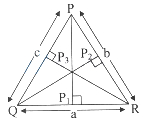
(B) Let $h_1, h_2, h_3$ be the altitudes of $\triangle PQR$ corresponding to sides $a, b, c$ respectively.
Area of $\triangle PQR = \frac{1}{2} \times \text{base} \times \text{height}$.
$\text{Area} = \frac{1}{2} a h_1 = \frac{1}{2} b h_2 = \frac{1}{2} c h_3$.
Thus,$h_1 = \frac{2 \times \text{Area}}{a}$,$h_2 = \frac{2 \times \text{Area}}{b}$,and $h_3 = \frac{2 \times \text{Area}}{c}$.
By the sine rule,$\frac{a}{\sin P} = \frac{b}{\sin Q} = \frac{c}{\sin R} = 2R$ (where $R$ is the circumradius).
So,$a = 2R \sin P$,$b = 2R \sin Q$,and $c = 2R \sin R$.
Since $\sin P, \sin Q, \sin R$ are in $A$.$P$.,it follows that $a, b, c$ are in $A$.$P$.
Therefore,$\frac{1}{a}, \frac{1}{b}, \frac{1}{c}$ are in $H$.$P$.
Substituting $a, b, c$ in terms of $h_1, h_2, h_3$,we get $\frac{h_1}{2 \times \text{Area}}, \frac{h_2}{2 \times \text{Area}}, \frac{h_3}{2 \times \text{Area}}$ are in $H$.$P$.
Hence,the altitudes $h_1, h_2, h_3$ are in $H$.$P$.
Area of $\triangle PQR = \frac{1}{2} \times \text{base} \times \text{height}$.
$\text{Area} = \frac{1}{2} a h_1 = \frac{1}{2} b h_2 = \frac{1}{2} c h_3$.
Thus,$h_1 = \frac{2 \times \text{Area}}{a}$,$h_2 = \frac{2 \times \text{Area}}{b}$,and $h_3 = \frac{2 \times \text{Area}}{c}$.
By the sine rule,$\frac{a}{\sin P} = \frac{b}{\sin Q} = \frac{c}{\sin R} = 2R$ (where $R$ is the circumradius).
So,$a = 2R \sin P$,$b = 2R \sin Q$,and $c = 2R \sin R$.
Since $\sin P, \sin Q, \sin R$ are in $A$.$P$.,it follows that $a, b, c$ are in $A$.$P$.
Therefore,$\frac{1}{a}, \frac{1}{b}, \frac{1}{c}$ are in $H$.$P$.
Substituting $a, b, c$ in terms of $h_1, h_2, h_3$,we get $\frac{h_1}{2 \times \text{Area}}, \frac{h_2}{2 \times \text{Area}}, \frac{h_3}{2 \times \text{Area}}$ are in $H$.$P$.
Hence,the altitudes $h_1, h_2, h_3$ are in $H$.$P$.
0 likesView Solution
106
MathematicsEasyMCQMHT CET · 2023
If the angles of a triangle are in the ratio $4:1:1$,then the ratio of the longest side to its perimeter is
A
$\sqrt{3}:(2+\sqrt{3})$
B
$2:(1+\sqrt{3})$
C
$1:(2+\sqrt{3})$
D
$2:3$
Solution
(A) Let the angles of the triangle be $4x, x$,and $x$.
Since the sum of angles in a triangle is $180^{\circ}$,we have $4x + x + x = 180^{\circ}$,which implies $6x = 180^{\circ}$,so $x = 30^{\circ}$.
The angles are $120^{\circ}, 30^{\circ}$,and $30^{\circ}$.
Using the Sine Rule,$\frac{a}{\sin A} = \frac{b}{\sin B} = \frac{c}{\sin C} = k$,where $a$ is the longest side opposite to $120^{\circ}$.
Then $a = k \sin 120^{\circ}$,$b = k \sin 30^{\circ}$,and $c = k \sin 30^{\circ}$.
The ratio of the longest side to the perimeter is $\frac{a}{a+b+c} = \frac{\sin 120^{\circ}}{\sin 120^{\circ} + \sin 30^{\circ} + \sin 30^{\circ}}$.
Substituting the values: $\frac{\frac{\sqrt{3}}{2}}{\frac{\sqrt{3}}{2} + \frac{1}{2} + \frac{1}{2}} = \frac{\frac{\sqrt{3}}{2}}{\frac{\sqrt{3}+2}{2}} = \frac{\sqrt{3}}{2+\sqrt{3}}$.
Since the sum of angles in a triangle is $180^{\circ}$,we have $4x + x + x = 180^{\circ}$,which implies $6x = 180^{\circ}$,so $x = 30^{\circ}$.
The angles are $120^{\circ}, 30^{\circ}$,and $30^{\circ}$.
Using the Sine Rule,$\frac{a}{\sin A} = \frac{b}{\sin B} = \frac{c}{\sin C} = k$,where $a$ is the longest side opposite to $120^{\circ}$.
Then $a = k \sin 120^{\circ}$,$b = k \sin 30^{\circ}$,and $c = k \sin 30^{\circ}$.
The ratio of the longest side to the perimeter is $\frac{a}{a+b+c} = \frac{\sin 120^{\circ}}{\sin 120^{\circ} + \sin 30^{\circ} + \sin 30^{\circ}}$.
Substituting the values: $\frac{\frac{\sqrt{3}}{2}}{\frac{\sqrt{3}}{2} + \frac{1}{2} + \frac{1}{2}} = \frac{\frac{\sqrt{3}}{2}}{\frac{\sqrt{3}+2}{2}} = \frac{\sqrt{3}}{2+\sqrt{3}}$.
0 likesView Solution
107
MathematicsMediumMCQMHT CET · 2023
In $\triangle ABC$,with usual notations,$m \angle C = \frac{\pi}{2}$. If $\tan \left(\frac{A}{2}\right)$ and $\tan \left(\frac{B}{2}\right)$ are the roots of the equation $a_1 x^2 + b_1 x + c_1 = 0$ $(a_1 \neq 0)$,then:
A
$a_1 + b_1 = c_1$
B
$b_1 + c_1 = a_1$
C
$a_1 + c_1 = b_1$
D
$b_1 = c_1$
Solution
(A) In $\triangle ABC$,$\angle A + \angle B + \angle C = 180^{\circ}$.
Since $\angle C = \frac{\pi}{2} = 90^{\circ}$,we have $\angle A + \angle B = 90^{\circ}$.
Therefore,$\frac{A}{2} + \frac{B}{2} = 45^{\circ} = \frac{\pi}{4}$.
Given that $\tan \left(\frac{A}{2}\right)$ and $\tan \left(\frac{B}{2}\right)$ are the roots of $a_1 x^2 + b_1 x + c_1 = 0$,by the relation between roots and coefficients:
Sum of roots: $\tan \left(\frac{A}{2}\right) + \tan \left(\frac{B}{2}\right) = -\frac{b_1}{a_1}$.
Product of roots: $\tan \left(\frac{A}{2}\right) \cdot \tan \left(\frac{B}{2}\right) = \frac{c_1}{a_1}$.
Using the formula $\tan \left(\frac{A}{2} + \frac{B}{2}\right) = \frac{\tan \left(\frac{A}{2}\right) + \tan \left(\frac{B}{2}\right)}{1 - \tan \left(\frac{A}{2}\right) \tan \left(\frac{B}{2}\right)}$:
$\tan \left(\frac{\pi}{4}\right) = \frac{-\frac{b_1}{a_1}}{1 - \frac{c_1}{a_1}}$.
$1 = \frac{-b_1}{a_1 - c_1}$.
$a_1 - c_1 = -b_1$,which implies $a_1 + b_1 = c_1$.
Since $\angle C = \frac{\pi}{2} = 90^{\circ}$,we have $\angle A + \angle B = 90^{\circ}$.
Therefore,$\frac{A}{2} + \frac{B}{2} = 45^{\circ} = \frac{\pi}{4}$.
Given that $\tan \left(\frac{A}{2}\right)$ and $\tan \left(\frac{B}{2}\right)$ are the roots of $a_1 x^2 + b_1 x + c_1 = 0$,by the relation between roots and coefficients:
Sum of roots: $\tan \left(\frac{A}{2}\right) + \tan \left(\frac{B}{2}\right) = -\frac{b_1}{a_1}$.
Product of roots: $\tan \left(\frac{A}{2}\right) \cdot \tan \left(\frac{B}{2}\right) = \frac{c_1}{a_1}$.
Using the formula $\tan \left(\frac{A}{2} + \frac{B}{2}\right) = \frac{\tan \left(\frac{A}{2}\right) + \tan \left(\frac{B}{2}\right)}{1 - \tan \left(\frac{A}{2}\right) \tan \left(\frac{B}{2}\right)}$:
$\tan \left(\frac{\pi}{4}\right) = \frac{-\frac{b_1}{a_1}}{1 - \frac{c_1}{a_1}}$.
$1 = \frac{-b_1}{a_1 - c_1}$.
$a_1 - c_1 = -b_1$,which implies $a_1 + b_1 = c_1$.
0 likesView Solution
108
MathematicsEasyMCQMHT CET · 2023
The lengths of the sides of a triangle are three consecutive natural numbers and its largest angle is twice the smallest one. Then the lengths of the sides of the triangle (in units) are
A
$3, 4, 5$
B
$4, 5, 6$
C
$5, 6, 7$
D
$2, 3, 4$
Solution
(B) Let the sides of the triangle be $a, a+1, a+2$ where $a \in \mathbb{N}$. Let the angles opposite to these sides be $A, B, C$ respectively,such that $A < B < C$. Given $C = 2A$.
Using the Sine Rule: $\frac{\sin A}{a} = \frac{\sin C}{a+2} = k$.
Thus,$\sin C = k(a+2)$ and $\sin A = ka$.
Since $C = 2A$,$\sin C = 2 \sin A \cos A$,which implies $k(a+2) = 2(ka) \cos A$,so $\cos A = \frac{a+2}{2a}$.
Using the Cosine Rule: $\cos A = \frac{(a+1)^2 + (a+2)^2 - a^2}{2(a+1)(a+2)} = \frac{a^2+6a+5}{2(a^2+3a+2)}$.
Equating the two expressions for $\cos A$: $\frac{a+2}{2a} = \frac{(a+1)(a+5)}{2(a+1)(a+2)} = \frac{a+5}{2(a+2)}$.
$(a+2)^2 = a(a+5) \Rightarrow a^2+4a+4 = a^2+5a$.
$a = 4$.
The sides are $4, 5, 6$.
Using the Sine Rule: $\frac{\sin A}{a} = \frac{\sin C}{a+2} = k$.
Thus,$\sin C = k(a+2)$ and $\sin A = ka$.
Since $C = 2A$,$\sin C = 2 \sin A \cos A$,which implies $k(a+2) = 2(ka) \cos A$,so $\cos A = \frac{a+2}{2a}$.
Using the Cosine Rule: $\cos A = \frac{(a+1)^2 + (a+2)^2 - a^2}{2(a+1)(a+2)} = \frac{a^2+6a+5}{2(a^2+3a+2)}$.
Equating the two expressions for $\cos A$: $\frac{a+2}{2a} = \frac{(a+1)(a+5)}{2(a+1)(a+2)} = \frac{a+5}{2(a+2)}$.
$(a+2)^2 = a(a+5) \Rightarrow a^2+4a+4 = a^2+5a$.
$a = 4$.
The sides are $4, 5, 6$.
0 likesView Solution
109
MathematicsEasyMCQMHT CET · 2023
Angles of a triangle are in the ratio $4:1:1$. Then the ratio of its greatest side to its perimeter is
A
$3:(2+\sqrt{3})$
B
$\sqrt{3}:(2+\sqrt{3})$
C
$\sqrt{3}:(2-\sqrt{3})$
D
$1:(2+\sqrt{3})$
Solution
(B) Let the angles of the triangle be $4x, x,$ and $x$.
Since the sum of angles in a triangle is $180^{\circ}$,we have $4x + x + x = 180^{\circ}$,which implies $6x = 180^{\circ}$,so $x = 30^{\circ}$.
The angles are $120^{\circ}, 30^{\circ},$ and $30^{\circ}$.
By the sine rule,$\frac{a}{\sin 120^{\circ}} = \frac{b}{\sin 30^{\circ}} = \frac{c}{\sin 30^{\circ}} = k$.
Thus,$a = k \sin 120^{\circ} = k \frac{\sqrt{3}}{2}$,$b = k \sin 30^{\circ} = k \frac{1}{2}$,and $c = k \sin 30^{\circ} = k \frac{1}{2}$.
The greatest side is $a$ (opposite to $120^{\circ}$).
The perimeter is $a + b + c = k(\frac{\sqrt{3}}{2} + \frac{1}{2} + \frac{1}{2}) = k(\frac{\sqrt{3}+2}{2})$.
The ratio of the greatest side to the perimeter is $\frac{a}{a+b+c} = \frac{k \frac{\sqrt{3}}{2}}{k \frac{\sqrt{3}+2}{2}} = \frac{\sqrt{3}}{2+\sqrt{3}}$.
Since the sum of angles in a triangle is $180^{\circ}$,we have $4x + x + x = 180^{\circ}$,which implies $6x = 180^{\circ}$,so $x = 30^{\circ}$.
The angles are $120^{\circ}, 30^{\circ},$ and $30^{\circ}$.
By the sine rule,$\frac{a}{\sin 120^{\circ}} = \frac{b}{\sin 30^{\circ}} = \frac{c}{\sin 30^{\circ}} = k$.
Thus,$a = k \sin 120^{\circ} = k \frac{\sqrt{3}}{2}$,$b = k \sin 30^{\circ} = k \frac{1}{2}$,and $c = k \sin 30^{\circ} = k \frac{1}{2}$.
The greatest side is $a$ (opposite to $120^{\circ}$).
The perimeter is $a + b + c = k(\frac{\sqrt{3}}{2} + \frac{1}{2} + \frac{1}{2}) = k(\frac{\sqrt{3}+2}{2})$.
The ratio of the greatest side to the perimeter is $\frac{a}{a+b+c} = \frac{k \frac{\sqrt{3}}{2}}{k \frac{\sqrt{3}+2}{2}} = \frac{\sqrt{3}}{2+\sqrt{3}}$.
0 likesView Solution
110
MathematicsEasyMCQMHT CET · 2023
The sides of a triangle are three consecutive natural numbers and its largest angle is twice the smallest one,then the sides of the triangle (in units) are
A
$3, 4, 5$
B
$4, 5, 6$
C
$5, 6, 7$
D
$2, 3, 4$
Solution
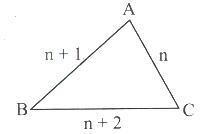
(B) Let the sides be $n, n+1, n+2$. The smallest side is $n$ and the largest side is $n+2$. Let the angles opposite to these sides be $B$ and $A$ respectively. Thus,$A = 2B$.
By the sine rule,$\frac{\sin A}{n+2} = \frac{\sin B}{n} = \frac{\sin C}{n+1}$.
Since $A = 2B$,we have $\frac{\sin 2B}{n+2} = \frac{\sin B}{n}$ $\Rightarrow \frac{2 \sin B \cos B}{n+2} = \frac{\sin B}{n}$ $\Rightarrow \cos B = \frac{n+2}{2n}$.
Using the cosine rule,$\cos B = \frac{(n+1)^2 + n^2 - (n+2)^2}{2n(n+1)} = \frac{n^2+2n+1+n^2-n^2-4n-4}{2n(n+1)} = \frac{n^2-2n-3}{2n(n+1)} = \frac{(n-3)(n+1)}{2n(n+1)} = \frac{n-3}{2n}$.
Equating the two expressions for $\cos B$: $\frac{n+2}{2n} = \frac{n-3}{2n} \Rightarrow n+2 = n-3$,which is impossible.
Re-evaluating: Let sides be $a=n, b=n+1, c=n+2$. Smallest angle is $A$ (opposite to $n$),largest is $C$ (opposite to $n+2$). Given $C = 2A$.
By sine rule,$\frac{\sin A}{n} = \frac{\sin 2A}{n+2}$ $\Rightarrow \frac{\sin A}{n} = \frac{2 \sin A \cos A}{n+2}$ $\Rightarrow \cos A = \frac{n+2}{2n}$.
By cosine rule,$\cos A = \frac{(n+1)^2 + (n+2)^2 - n^2}{2(n+1)(n+2)} = \frac{n^2+2n+1+n^2+4n+4-n^2}{2(n+1)(n+2)} = \frac{n^2+6n+5}{2(n+1)(n+2)} = \frac{(n+1)(n+5)}{2(n+1)(n+2)} = \frac{n+5}{2(n+2)}$.
Equating: $\frac{n+2}{2n} = \frac{n+5}{2(n+2)}$ $\Rightarrow (n+2)^2 = n(n+5)$ $\Rightarrow n^2+4n+4 = n^2+5n$ $\Rightarrow n=4$.
The sides are $4, 5, 6$.
By the sine rule,$\frac{\sin A}{n+2} = \frac{\sin B}{n} = \frac{\sin C}{n+1}$.
Since $A = 2B$,we have $\frac{\sin 2B}{n+2} = \frac{\sin B}{n}$ $\Rightarrow \frac{2 \sin B \cos B}{n+2} = \frac{\sin B}{n}$ $\Rightarrow \cos B = \frac{n+2}{2n}$.
Using the cosine rule,$\cos B = \frac{(n+1)^2 + n^2 - (n+2)^2}{2n(n+1)} = \frac{n^2+2n+1+n^2-n^2-4n-4}{2n(n+1)} = \frac{n^2-2n-3}{2n(n+1)} = \frac{(n-3)(n+1)}{2n(n+1)} = \frac{n-3}{2n}$.
Equating the two expressions for $\cos B$: $\frac{n+2}{2n} = \frac{n-3}{2n} \Rightarrow n+2 = n-3$,which is impossible.
Re-evaluating: Let sides be $a=n, b=n+1, c=n+2$. Smallest angle is $A$ (opposite to $n$),largest is $C$ (opposite to $n+2$). Given $C = 2A$.
By sine rule,$\frac{\sin A}{n} = \frac{\sin 2A}{n+2}$ $\Rightarrow \frac{\sin A}{n} = \frac{2 \sin A \cos A}{n+2}$ $\Rightarrow \cos A = \frac{n+2}{2n}$.
By cosine rule,$\cos A = \frac{(n+1)^2 + (n+2)^2 - n^2}{2(n+1)(n+2)} = \frac{n^2+2n+1+n^2+4n+4-n^2}{2(n+1)(n+2)} = \frac{n^2+6n+5}{2(n+1)(n+2)} = \frac{(n+1)(n+5)}{2(n+1)(n+2)} = \frac{n+5}{2(n+2)}$.
Equating: $\frac{n+2}{2n} = \frac{n+5}{2(n+2)}$ $\Rightarrow (n+2)^2 = n(n+5)$ $\Rightarrow n^2+4n+4 = n^2+5n$ $\Rightarrow n=4$.
The sides are $4, 5, 6$.
0 likesView Solution
111
MathematicsDifficultMCQMHT CET · 2023
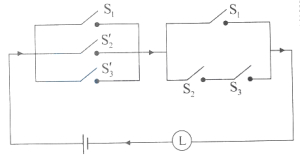
The given circuit is equivalent to
A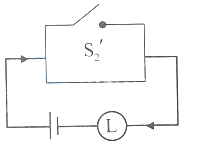
B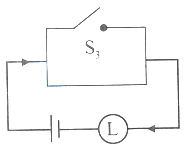
C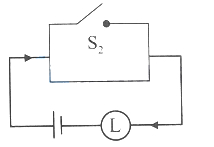
D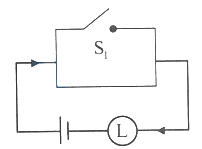
Solution
(D) The symbolic form of the given circuit is $(p \vee \sim q \vee \sim r) \wedge (p \vee (q \wedge r))$.
Applying the distributive law,we get $p \vee [(\sim q \vee \sim r) \wedge (q \wedge r)]$.
Using De Morgan's law,this becomes $p \vee [\sim (q \wedge r) \wedge (q \wedge r)]$.
Applying the complement law,we get $p \vee F$.
Finally,by the identity law,this simplifies to $p$.
Thus,the circuit is equivalent to a circuit with only switch $S_1$.
Applying the distributive law,we get $p \vee [(\sim q \vee \sim r) \wedge (q \wedge r)]$.
Using De Morgan's law,this becomes $p \vee [\sim (q \wedge r) \wedge (q \wedge r)]$.
Applying the complement law,we get $p \vee F$.
Finally,by the identity law,this simplifies to $p$.
Thus,the circuit is equivalent to a circuit with only switch $S_1$.
0 likesView Solution
112
MathematicsDifficultMCQMHT CET · 2023
If both mean and variance of $50$ observations $x_1, x_2, \ldots, x_{50}$ are equal to $16$ and $256$ respectively,then the mean of $(x_1-5)^2, (x_2-5)^2, \ldots, (x_{50}-5)^2$ is
A
$357$
B
$367$
C
$377$
D
$387$
Solution
(C) Given that the mean $\bar{x} = 16$ and variance $\sigma^2 = 256$ for $n = 50$ observations.
$\text{Mean} = \frac{\sum x_i}{n}$ $\Rightarrow 16 = \frac{\sum x_i}{50}$ $\Rightarrow \sum x_i = 800$.
$\text{Variance} = \frac{\sum x_i^2}{n} - (\bar{x})^2 \Rightarrow 256 = \frac{\sum x_i^2}{50} - (16)^2$.
$256 = \frac{\sum x_i^2}{50} - 256$ $\Rightarrow \frac{\sum x_i^2}{50} = 512$ $\Rightarrow \sum x_i^2 = 25600$.
We need to find the mean of $(x_i - 5)^2$ for $i = 1, 2, \ldots, 50$.
$\text{New Mean} = \frac{\sum (x_i - 5)^2}{50} = \frac{\sum (x_i^2 - 10x_i + 25)}{50}$.
$= \frac{\sum x_i^2 - 10 \sum x_i + \sum 25}{50} = \frac{25600 - 10(800) + 25(50)}{50}$.
$= \frac{25600 - 8000 + 1250}{50} = \frac{18850}{50} = 377$.
$\text{Mean} = \frac{\sum x_i}{n}$ $\Rightarrow 16 = \frac{\sum x_i}{50}$ $\Rightarrow \sum x_i = 800$.
$\text{Variance} = \frac{\sum x_i^2}{n} - (\bar{x})^2 \Rightarrow 256 = \frac{\sum x_i^2}{50} - (16)^2$.
$256 = \frac{\sum x_i^2}{50} - 256$ $\Rightarrow \frac{\sum x_i^2}{50} = 512$ $\Rightarrow \sum x_i^2 = 25600$.
We need to find the mean of $(x_i - 5)^2$ for $i = 1, 2, \ldots, 50$.
$\text{New Mean} = \frac{\sum (x_i - 5)^2}{50} = \frac{\sum (x_i^2 - 10x_i + 25)}{50}$.
$= \frac{\sum x_i^2 - 10 \sum x_i + \sum 25}{50} = \frac{25600 - 10(800) + 25(50)}{50}$.
$= \frac{25600 - 8000 + 1250}{50} = \frac{18850}{50} = 377$.
0 likesView Solution
113
MathematicsEasyMCQMHT CET · 2023
The standard deviation of the following distribution is:
| $C$.$I$. | $0$ - $6$ | $6$ - $12$ | $12$ - $18$ |
| f_i | $2$ | $4$ | $6$ |
A
$5 \sqrt{2}$
B
$\sqrt{5}$
C
$2 \sqrt{5}$
D
$20$
Solution
(C) First,we find the midpoints $(x_i)$ for each class interval ($C$.$I$.):
For $0-6$,$x_1 = \frac{0+6}{2} = 3$
For $6-12$,$x_2 = \frac{6+12}{2} = 9$
For $12-18$,$x_3 = \frac{12+18}{2} = 15$
Now,calculate $\sum f_i$,$\sum f_i x_i$,and $\sum f_i x_i^2$:
$\sum f_i = 2 + 4 + 6 = 12$
$\sum f_i x_i = (2 \times 3) + (4 \times 9) + (6 \times 15) = 6 + 36 + 90 = 132$
$\sum f_i x_i^2 = (2 \times 3^2) + (4 \times 9^2) + (6 \times 15^2) = (2 \times 9) + (4 \times 81) + (6 \times 225) = 18 + 324 + 1350 = 1692$
The variance $V(X)$ is given by:
$V(X) = \frac{\sum f_i x_i^2}{\sum f_i} - \left( \frac{\sum f_i x_i}{\sum f_i} \right)^2$
$V(X) = \frac{1692}{12} - \left( \frac{132}{12} \right)^2$
$V(X) = 141 - (11)^2$
$V(X) = 141 - 121 = 20$
Standard deviation $\sigma = \sqrt{V(X)} = \sqrt{20} = 2 \sqrt{5}$.
For $0-6$,$x_1 = \frac{0+6}{2} = 3$
For $6-12$,$x_2 = \frac{6+12}{2} = 9$
For $12-18$,$x_3 = \frac{12+18}{2} = 15$
Now,calculate $\sum f_i$,$\sum f_i x_i$,and $\sum f_i x_i^2$:
$\sum f_i = 2 + 4 + 6 = 12$
$\sum f_i x_i = (2 \times 3) + (4 \times 9) + (6 \times 15) = 6 + 36 + 90 = 132$
$\sum f_i x_i^2 = (2 \times 3^2) + (4 \times 9^2) + (6 \times 15^2) = (2 \times 9) + (4 \times 81) + (6 \times 225) = 18 + 324 + 1350 = 1692$
The variance $V(X)$ is given by:
$V(X) = \frac{\sum f_i x_i^2}{\sum f_i} - \left( \frac{\sum f_i x_i}{\sum f_i} \right)^2$
$V(X) = \frac{1692}{12} - \left( \frac{132}{12} \right)^2$
$V(X) = 141 - (11)^2$
$V(X) = 141 - 121 = 20$
Standard deviation $\sigma = \sqrt{V(X)} = \sqrt{20} = 2 \sqrt{5}$.
0 likesView Solution
114
MathematicsEasyMCQMHT CET · 2023
If the mean and standard deviation ($S$.$D$.) of the data $3, 5, 7, a, b$ are $5$ and $2$ respectively,then $a$ and $b$ are the roots of the equation:
A
$x^2-10x+18=0$
B
$2x^2-20x+19=0$
C
$x^2-10x+19=0$
D
$x^2-20x+18=0$
Solution
(C) Given,$\text{Mean} = 5$ and $\text{S.D.} = 2$.
For the data $3, 5, 7, a, b$ with $n=5$:
$\text{Mean} = \frac{3+5+7+a+b}{5} = 5$
$\Rightarrow 15+a+b = 25$
$\Rightarrow a+b = 10$ ... $(i)$
Using the formula for variance,$\text{Var} = \text{S.D.}^2 = 2^2 = 4$:
$\text{Var} = \frac{\sum x_i^2}{n} - (\text{Mean})^2$
$4 = \frac{3^2+5^2+7^2+a^2+b^2}{5} - 5^2$
$4 = \frac{9+25+49+a^2+b^2}{5} - 25$
$29 = \frac{83+a^2+b^2}{5}$
$145 = 83 + a^2 + b^2$
$a^2 + b^2 = 62$ ... $(ii)$
We know that $(a+b)^2 = a^2 + b^2 + 2ab$.
$10^2 = 62 + 2ab$
$100 - 62 = 2ab$
$38 = 2ab \Rightarrow ab = 19$.
The quadratic equation with roots $a$ and $b$ is given by $x^2 - (a+b)x + ab = 0$.
Substituting the values,we get $x^2 - 10x + 19 = 0$.
For the data $3, 5, 7, a, b$ with $n=5$:
$\text{Mean} = \frac{3+5+7+a+b}{5} = 5$
$\Rightarrow 15+a+b = 25$
$\Rightarrow a+b = 10$ ... $(i)$
Using the formula for variance,$\text{Var} = \text{S.D.}^2 = 2^2 = 4$:
$\text{Var} = \frac{\sum x_i^2}{n} - (\text{Mean})^2$
$4 = \frac{3^2+5^2+7^2+a^2+b^2}{5} - 5^2$
$4 = \frac{9+25+49+a^2+b^2}{5} - 25$
$29 = \frac{83+a^2+b^2}{5}$
$145 = 83 + a^2 + b^2$
$a^2 + b^2 = 62$ ... $(ii)$
We know that $(a+b)^2 = a^2 + b^2 + 2ab$.
$10^2 = 62 + 2ab$
$100 - 62 = 2ab$
$38 = 2ab \Rightarrow ab = 19$.
The quadratic equation with roots $a$ and $b$ is given by $x^2 - (a+b)x + ab = 0$.
Substituting the values,we get $x^2 - 10x + 19 = 0$.
0 likesView Solution
115
MathematicsEasyMCQMHT CET · 2023
If the variance of $x_1, x_2, \ldots, x_n$ is $\sigma_x^2$,then the variance of $\lambda x_1, \lambda x_2, \ldots, \lambda x_n$ (where $\lambda \neq 0$) is:
A
$\lambda \cdot \sigma_x$
B
$\lambda \cdot \sigma_x^2$
C
$\lambda^2 \cdot \sigma_x$
D
$\lambda^2 \cdot \sigma_x^2$
Solution
(D) The variance of a set of observations $x_i$ is defined as $\sigma_x^2 = \frac{1}{n} \sum_{i=1}^{n} (x_i - \bar{x})^2$,where $\bar{x}$ is the mean.
When each observation is multiplied by a constant $\lambda$,the new mean becomes $\bar{x}' = \lambda \bar{x}$.
The new variance is $\sigma_{new}^2 = \frac{1}{n} \sum_{i=1}^{n} (\lambda x_i - \lambda \bar{x})^2$.
$\sigma_{new}^2 = \frac{1}{n} \sum_{i=1}^{n} \lambda^2 (x_i - \bar{x})^2$.
$\sigma_{new}^2 = \lambda^2 \left[ \frac{1}{n} \sum_{i=1}^{n} (x_i - \bar{x})^2 \right] = \lambda^2 \sigma_x^2$.
Therefore,the new variance is $\lambda^2 \sigma_x^2$.
When each observation is multiplied by a constant $\lambda$,the new mean becomes $\bar{x}' = \lambda \bar{x}$.
The new variance is $\sigma_{new}^2 = \frac{1}{n} \sum_{i=1}^{n} (\lambda x_i - \lambda \bar{x})^2$.
$\sigma_{new}^2 = \frac{1}{n} \sum_{i=1}^{n} \lambda^2 (x_i - \bar{x})^2$.
$\sigma_{new}^2 = \lambda^2 \left[ \frac{1}{n} \sum_{i=1}^{n} (x_i - \bar{x})^2 \right] = \lambda^2 \sigma_x^2$.
Therefore,the new variance is $\lambda^2 \sigma_x^2$.
0 likesView Solution
116
MathematicsEasyMCQMHT CET · 2023
The variance for the first six prime numbers greater than $5$ is
A
$27$
B
$28$
C
$15$
D
$20$
Solution
(B) The first six prime numbers greater than $5$ are $7, 11, 13, 17, 19, 23$.
The mean $\bar{x} = \frac{7+11+13+17+19+23}{6} = \frac{90}{6} = 15$.
The variance $\sigma^2$ is given by $\frac{1}{n} \sum (x_i - \bar{x})^2$.
$\sigma^2 = \frac{(7-15)^2 + (11-15)^2 + (13-15)^2 + (17-15)^2 + (19-15)^2 + (23-15)^2}{6}$
$\sigma^2 = \frac{(-8)^2 + (-4)^2 + (-2)^2 + (2)^2 + (4)^2 + (8)^2}{6}$
$\sigma^2 = \frac{64 + 16 + 4 + 4 + 16 + 64}{6} = \frac{168}{6} = 28$.
The mean $\bar{x} = \frac{7+11+13+17+19+23}{6} = \frac{90}{6} = 15$.
The variance $\sigma^2$ is given by $\frac{1}{n} \sum (x_i - \bar{x})^2$.
$\sigma^2 = \frac{(7-15)^2 + (11-15)^2 + (13-15)^2 + (17-15)^2 + (19-15)^2 + (23-15)^2}{6}$
$\sigma^2 = \frac{(-8)^2 + (-4)^2 + (-2)^2 + (2)^2 + (4)^2 + (8)^2}{6}$
$\sigma^2 = \frac{64 + 16 + 4 + 4 + 16 + 64}{6} = \frac{168}{6} = 28$.
0 likesView Solution
117
MathematicsEasyMCQMHT CET · 2023
The mean and variance of six observations are $8$ and $16$ respectively. If each observation is multiplied by $3$,then the new variance of the resulting observations is:
A
$16$
B
$48$
C
$24$
D
$144$
Solution
(D) Let the original observations be $x_1, x_2, \dots, x_6$ with variance $\sigma^2 = 16$.
When each observation is multiplied by a constant $\lambda$,the new variance $\sigma'^2$ is given by $\sigma'^2 = \lambda^2 \sigma^2$.
Here,$\lambda = 3$ and $\sigma^2 = 16$.
Therefore,the new variance is:
$\sigma'^2 = 3^2 \times 16$
$\sigma'^2 = 9 \times 16$
$\sigma'^2 = 144$
When each observation is multiplied by a constant $\lambda$,the new variance $\sigma'^2$ is given by $\sigma'^2 = \lambda^2 \sigma^2$.
Here,$\lambda = 3$ and $\sigma^2 = 16$.
Therefore,the new variance is:
$\sigma'^2 = 3^2 \times 16$
$\sigma'^2 = 9 \times 16$
$\sigma'^2 = 144$
0 likesView Solution
118
MathematicsMediumMCQMHT CET · 2023
If both mean and variance of $50$ observations $x_1, x_2, \ldots, x_{50}$ are equal to $16$ and $256$ respectively,then the mean of $(x_1-5)^2, (x_2-5)^2, \ldots, (x_{50}-5)^2$ is
A
$357$
B
$387$
C
$377$
D
$397$
Solution
(C) Given $n=50$,$\bar{x}=16$,and $\sigma_x^2=256$.
Since $\sigma_x^2 = \frac{1}{n} \sum x_i^2 - (\bar{x})^2$,we have $256 = \frac{1}{50} \sum x_i^2 - 16^2$.
$256 = \frac{1}{50} \sum x_i^2 - 256 \implies \frac{1}{50} \sum x_i^2 = 512 \implies \sum x_i^2 = 25600$.
We need the mean of $(x_i-5)^2$,which is $\frac{1}{50} \sum_{i=1}^{50} (x_i-5)^2$.
Expanding the sum: $\sum (x_i^2 - 10x_i + 25) = \sum x_i^2 - 10 \sum x_i + \sum 25$.
Since $\bar{x} = \frac{1}{50} \sum x_i = 16$,then $\sum x_i = 50 \times 16 = 800$.
Thus,$\sum (x_i-5)^2 = 25600 - 10(800) + 50(25) = 25600 - 8000 + 1250 = 18850$.
Required mean $= \frac{18850}{50} = 377$.
Since $\sigma_x^2 = \frac{1}{n} \sum x_i^2 - (\bar{x})^2$,we have $256 = \frac{1}{50} \sum x_i^2 - 16^2$.
$256 = \frac{1}{50} \sum x_i^2 - 256 \implies \frac{1}{50} \sum x_i^2 = 512 \implies \sum x_i^2 = 25600$.
We need the mean of $(x_i-5)^2$,which is $\frac{1}{50} \sum_{i=1}^{50} (x_i-5)^2$.
Expanding the sum: $\sum (x_i^2 - 10x_i + 25) = \sum x_i^2 - 10 \sum x_i + \sum 25$.
Since $\bar{x} = \frac{1}{50} \sum x_i = 16$,then $\sum x_i = 50 \times 16 = 800$.
Thus,$\sum (x_i-5)^2 = 25600 - 10(800) + 50(25) = 25600 - 8000 + 1250 = 18850$.
Required mean $= \frac{18850}{50} = 377$.
0 likesView Solution
119
MathematicsEasyMCQMHT CET · 2023
If the variance of the numbers $-1, 0, 1, k$ is $5$,where $k > 0$,then $k$ is equal to
A
$2 \sqrt{\frac{10}{3}}$
B
$2 \sqrt{6}$
C
$4 \sqrt{\frac{5}{3}}$
D
$\sqrt{6}$
Solution
(B) The formula for variance is $\sigma^2 = \frac{1}{n} \sum_{i=1}^{n} x_i^2 - \bar{x}^2$.
Here,$n = 4$ and variance $\sigma^2 = 5$.
The mean $\bar{x} = \frac{-1 + 0 + 1 + k}{4} = \frac{k}{4}$.
Substituting the values into the formula:
$5 = \frac{1}{4} [(-1)^2 + 0^2 + 1^2 + k^2] - (\frac{k}{4})^2$.
$5 = \frac{2 + k^2}{4} - \frac{k^2}{16}$.
Multiply the entire equation by $16$ to clear the denominators:
$80 = 4(2 + k^2) - k^2$.
$80 = 8 + 4k^2 - k^2$.
$80 - 8 = 3k^2$.
$72 = 3k^2$.
$k^2 = 24$.
Since $k > 0$,$k = \sqrt{24} = 2 \sqrt{6}$.
Here,$n = 4$ and variance $\sigma^2 = 5$.
The mean $\bar{x} = \frac{-1 + 0 + 1 + k}{4} = \frac{k}{4}$.
Substituting the values into the formula:
$5 = \frac{1}{4} [(-1)^2 + 0^2 + 1^2 + k^2] - (\frac{k}{4})^2$.
$5 = \frac{2 + k^2}{4} - \frac{k^2}{16}$.
Multiply the entire equation by $16$ to clear the denominators:
$80 = 4(2 + k^2) - k^2$.
$80 = 8 + 4k^2 - k^2$.
$80 - 8 = 3k^2$.
$72 = 3k^2$.
$k^2 = 24$.
Since $k > 0$,$k = \sqrt{24} = 2 \sqrt{6}$.
0 likesView Solution
120
MathematicsDifficultMCQMHT CET · 2023
For $20$ observations of variable $x$,if $\sum(x_{i}-2)=20$ and $\sum(x_{i}-2)^2=100$,then the standard deviation of variable $x$ is
A
$2$
B
$3$
C
$4$
D
$9$
Solution
(A) The standard deviation is independent of the change of origin.
$\therefore$ $S$.$D$. of $x_{i} = \text{S.D. of } (x_{i}-2)$.
Let $y_{i} = x_{i}-2$. Then $\sum y_{i} = 20$ and $\sum y_{i}^2 = 100$ for $n = 20$.
$\text{S.D. of } y = \sqrt{\frac{\sum y_{i}^2}{n} - \left(\frac{\sum y_{i}}{n}\right)^2}$.
$\text{S.D. of } y = \sqrt{\frac{100}{20} - \left(\frac{20}{20}\right)^2}$.
$\text{S.D. of } y = \sqrt{5 - 1^2} = \sqrt{4} = 2$.
Thus,the standard deviation of $x$ is $2$.
$\therefore$ $S$.$D$. of $x_{i} = \text{S.D. of } (x_{i}-2)$.
Let $y_{i} = x_{i}-2$. Then $\sum y_{i} = 20$ and $\sum y_{i}^2 = 100$ for $n = 20$.
$\text{S.D. of } y = \sqrt{\frac{\sum y_{i}^2}{n} - \left(\frac{\sum y_{i}}{n}\right)^2}$.
$\text{S.D. of } y = \sqrt{\frac{100}{20} - \left(\frac{20}{20}\right)^2}$.
$\text{S.D. of } y = \sqrt{5 - 1^2} = \sqrt{4} = 2$.
Thus,the standard deviation of $x$ is $2$.
0 likesView Solution
121
MathematicsMediumMCQMHT CET · 2023
The raw data $x_1, x_2, \ldots, x_{n}$ is an $A$.$P$. with common difference $d$ and first term $0$. If $\bar{x}$ and $\sigma^2$ are the mean and variance of $x_{i}, i=1, 2, \ldots, n$,then $\sigma^2$ is:
A
$\frac{(n^2+1) d^2}{24}$
B
$\frac{(n^2-1) d^2}{24}$
C
$\frac{(n^2+1) d^2}{12}$
D
$\frac{(n^2-1) d^2}{12}$
Solution
(D) The terms are $x_i = (i-1)d$ for $i=1, 2, \ldots, n$.
$\bar{x} = \frac{1}{n} \sum_{i=1}^{n} (i-1)d = \frac{d}{n} \frac{(n-1)n}{2} = \frac{(n-1)d}{2}$.
$\sum x_i^2 = \sum_{i=1}^{n} (i-1)^2 d^2 = d^2 \sum_{k=0}^{n-1} k^2 = d^2 \frac{(n-1)n(2n-1)}{6}$.
$\sigma^2 = \frac{1}{n} \sum x_i^2 - (\bar{x})^2 = \frac{d^2(n-1)(2n-1)}{6} - \frac{(n-1)^2 d^2}{4}$.
$\sigma^2 = \frac{d^2(n-1)}{2} \left[ \frac{2n-1}{3} - \frac{n-1}{2} \right] = \frac{d^2(n-1)}{2} \left[ \frac{4n-2-3n+3}{6} \right] = \frac{d^2(n-1)(n+1)}{12} = \frac{(n^2-1)d^2}{12}$.
$\bar{x} = \frac{1}{n} \sum_{i=1}^{n} (i-1)d = \frac{d}{n} \frac{(n-1)n}{2} = \frac{(n-1)d}{2}$.
$\sum x_i^2 = \sum_{i=1}^{n} (i-1)^2 d^2 = d^2 \sum_{k=0}^{n-1} k^2 = d^2 \frac{(n-1)n(2n-1)}{6}$.
$\sigma^2 = \frac{1}{n} \sum x_i^2 - (\bar{x})^2 = \frac{d^2(n-1)(2n-1)}{6} - \frac{(n-1)^2 d^2}{4}$.
$\sigma^2 = \frac{d^2(n-1)}{2} \left[ \frac{2n-1}{3} - \frac{n-1}{2} \right] = \frac{d^2(n-1)}{2} \left[ \frac{4n-2-3n+3}{6} \right] = \frac{d^2(n-1)(n+1)}{12} = \frac{(n^2-1)d^2}{12}$.
0 likesView Solution
122
MathematicsEasyMCQMHT CET · 2023
Variance of first $2n$ natural numbers is
A
$\frac{4n^2+1}{12}$
B
$\frac{(2n-1)^2}{12}$
C
$\frac{n^2}{3}-1$
D
$\frac{4n^2-1}{12}$
Solution
(D) The variance $\sigma^2$ of the first $N$ natural numbers is given by $\sigma^2 = \frac{N^2-1}{12}$.
Here,$N = 2n$.
Substituting $N = 2n$ into the formula:
$\sigma^2 = \frac{(2n)^2-1}{12}$
$\sigma^2 = \frac{4n^2-1}{12}$
Here,$N = 2n$.
Substituting $N = 2n$ into the formula:
$\sigma^2 = \frac{(2n)^2-1}{12}$
$\sigma^2 = \frac{4n^2-1}{12}$
0 likesView Solution
123
MathematicsMediumMCQMHT CET · 2023
If one side of a triangle is double the other and the angles opposite to these sides differ by $60^{\circ}$,then the triangle is
A
obtuse angled
B
right angled
C
acute angled
D
isosceles
Solution
(B) In $\triangle ABC$,by the sine rule,$\frac{\sin A}{a} = \frac{\sin B}{b} = \frac{\sin C}{c}$.
Given $a = 2b$ and $A - B = 60^{\circ}$,so $A = 60^{\circ} + B$.
Substituting these into the sine rule:
$\frac{\sin(60^{\circ} + B)}{2b} = \frac{\sin B}{b}$
$\sin(60^{\circ} + B) = 2 \sin B$
$\sin 60^{\circ} \cos B + \cos 60^{\circ} \sin B = 2 \sin B$
$\frac{\sqrt{3}}{2} \cos B + \frac{1}{2} \sin B = 2 \sin B$
$\frac{\sqrt{3}}{2} \cos B = \frac{3}{2} \sin B$
$\tan B = \frac{\sqrt{3}}{3} = \frac{1}{\sqrt{3}}$.
Thus,$B = 30^{\circ}$.
Then $A = 60^{\circ} + 30^{\circ} = 90^{\circ}$.
Since one angle is $90^{\circ}$,the triangle is right angled.
Given $a = 2b$ and $A - B = 60^{\circ}$,so $A = 60^{\circ} + B$.
Substituting these into the sine rule:
$\frac{\sin(60^{\circ} + B)}{2b} = \frac{\sin B}{b}$
$\sin(60^{\circ} + B) = 2 \sin B$
$\sin 60^{\circ} \cos B + \cos 60^{\circ} \sin B = 2 \sin B$
$\frac{\sqrt{3}}{2} \cos B + \frac{1}{2} \sin B = 2 \sin B$
$\frac{\sqrt{3}}{2} \cos B = \frac{3}{2} \sin B$
$\tan B = \frac{\sqrt{3}}{3} = \frac{1}{\sqrt{3}}$.
Thus,$B = 30^{\circ}$.
Then $A = 60^{\circ} + 30^{\circ} = 90^{\circ}$.
Since one angle is $90^{\circ}$,the triangle is right angled.
0 likesView Solution
124
MathematicsMediumMCQMHT CET · 2023
Two sides of a square are along the lines $5x - 12y + 39 = 0$ and $5x - 12y + 78 = 0$. The area of the square is:
A
$9$ sq. units.
B
$\frac{1}{3}$ sq. units.
C
$18$ sq. units.
D
$3$ sq. units.
Solution
(A) The given equations of the lines are $5x - 12y + 39 = 0$ and $5x - 12y + 78 = 0$.
Since the coefficients of $x$ and $y$ are proportional,the lines are parallel.
The distance $d$ between two parallel lines $ax + by + c_1 = 0$ and $ax + by + c_2 = 0$ is given by $d = \left| \frac{c_1 - c_2}{\sqrt{a^2 + b^2}} \right|$.
Here,$a = 5$,$b = -12$,$c_1 = 39$,and $c_2 = 78$.
$d = \left| \frac{39 - 78}{\sqrt{5^2 + (-12)^2}} \right| = \left| \frac{-39}{\sqrt{25 + 144}} \right| = \left| \frac{-39}{\sqrt{169}} \right| = \frac{39}{13} = 3$ units.
Since the distance between two parallel sides of a square is equal to its side length,the side of the square is $s = 3$ units.
The area of the square is $s^2 = 3^2 = 9$ sq. units.
Since the coefficients of $x$ and $y$ are proportional,the lines are parallel.
The distance $d$ between two parallel lines $ax + by + c_1 = 0$ and $ax + by + c_2 = 0$ is given by $d = \left| \frac{c_1 - c_2}{\sqrt{a^2 + b^2}} \right|$.
Here,$a = 5$,$b = -12$,$c_1 = 39$,and $c_2 = 78$.
$d = \left| \frac{39 - 78}{\sqrt{5^2 + (-12)^2}} \right| = \left| \frac{-39}{\sqrt{25 + 144}} \right| = \left| \frac{-39}{\sqrt{169}} \right| = \frac{39}{13} = 3$ units.
Since the distance between two parallel sides of a square is equal to its side length,the side of the square is $s = 3$ units.
The area of the square is $s^2 = 3^2 = 9$ sq. units.
0 likesView Solution
125
MathematicsEasyMCQMHT CET · 2023
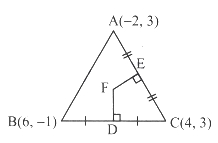
If the vertices of a triangle are $(-2,3), (6,-1)$ and $(4,3)$,then the coordinates of the circumcentre of the triangle are
A
$(1,1)$
B
$(-1,-1)$
C
$(-1,1)$
D
$(1,-1)$
Solution
(D) Let the vertices of the triangle be $A(-2,3)$,$B(6,-1)$,and $C(4,3)$. Let $F(x,y)$ be the circumcentre. The circumcentre is equidistant from the vertices,so $FA^2 = FB^2 = FC^2$.
$FA^2 = (x+2)^2 + (y-3)^2$
$FB^2 = (x-6)^2 + (y+1)^2$
$FC^2 = (x-4)^2 + (y-3)^2$
Equating $FA^2 = FC^2$:
$(x+2)^2 + (y-3)^2 = (x-4)^2 + (y-3)^2$
$(x+2)^2 = (x-4)^2$
$x^2 + 4x + 4 = x^2 - 8x + 16$
$12x = 12 \implies x = 1$
Equating $FA^2 = FB^2$:
$(1+2)^2 + (y-3)^2 = (1-6)^2 + (y+1)^2$
$9 + y^2 - 6y + 9 = 25 + y^2 + 2y + 1$
$18 - 6y = 26 + 2y$
$-8 = 8y \implies y = -1$
Thus,the coordinates of the circumcentre are $(1,-1)$.
$FA^2 = (x+2)^2 + (y-3)^2$
$FB^2 = (x-6)^2 + (y+1)^2$
$FC^2 = (x-4)^2 + (y-3)^2$
Equating $FA^2 = FC^2$:
$(x+2)^2 + (y-3)^2 = (x-4)^2 + (y-3)^2$
$(x+2)^2 = (x-4)^2$
$x^2 + 4x + 4 = x^2 - 8x + 16$
$12x = 12 \implies x = 1$
Equating $FA^2 = FB^2$:
$(1+2)^2 + (y-3)^2 = (1-6)^2 + (y+1)^2$
$9 + y^2 - 6y + 9 = 25 + y^2 + 2y + 1$
$18 - 6y = 26 + 2y$
$-8 = 8y \implies y = -1$
Thus,the coordinates of the circumcentre are $(1,-1)$.
0 likesView Solution
126
MathematicsMediumMCQMHT CET · 2023
$A$ line is drawn through the point $(1, 2)$ to meet the coordinate axes at $P$ and $Q$ such that it forms a $\triangle OPQ$,where $O$ is the origin. If the area of $\triangle OPQ$ is least,then the slope of the line $PQ$ is
A
$-2$
B
$2$
C
$\frac{-1}{2}$
D
$\frac{1}{2}$
Solution
(A) The equation of line $PQ$ passing through $(1, 2)$ is $y - 2 = m(x - 1)$.
The $x$-intercept (Point $P$) is $(1 - \frac{2}{m}, 0)$ and the $y$-intercept (Point $Q$) is $(0, 2 - m)$.
Since the area must be positive,we consider the magnitude of the intercepts. For the triangle to exist in the first quadrant,$m$ must be negative. Let $m = -k$ where $k > 0$.
The intercepts are $P = (1 + \frac{2}{k}, 0)$ and $Q = (0, 2 + k)$.
Area $A = \frac{1}{2} \times (1 + \frac{2}{k}) \times (2 + k) = \frac{1}{2} (2 + k + \frac{4}{k} + 2) = \frac{1}{2} (4 + k + \frac{4}{k}) = 2 + \frac{k}{2} + \frac{2}{k}$.
By $AM$-$GM$ inequality,$\frac{k}{2} + \frac{2}{k} \ge 2 \sqrt{\frac{k}{2} \times \frac{2}{k}} = 2$.
Equality holds when $\frac{k}{2} = \frac{2}{k} \implies k^2 = 4 \implies k = 2$.
Since $m = -k$,the slope $m = -2$.
The $x$-intercept (Point $P$) is $(1 - \frac{2}{m}, 0)$ and the $y$-intercept (Point $Q$) is $(0, 2 - m)$.
Since the area must be positive,we consider the magnitude of the intercepts. For the triangle to exist in the first quadrant,$m$ must be negative. Let $m = -k$ where $k > 0$.
The intercepts are $P = (1 + \frac{2}{k}, 0)$ and $Q = (0, 2 + k)$.
Area $A = \frac{1}{2} \times (1 + \frac{2}{k}) \times (2 + k) = \frac{1}{2} (2 + k + \frac{4}{k} + 2) = \frac{1}{2} (4 + k + \frac{4}{k}) = 2 + \frac{k}{2} + \frac{2}{k}$.
By $AM$-$GM$ inequality,$\frac{k}{2} + \frac{2}{k} \ge 2 \sqrt{\frac{k}{2} \times \frac{2}{k}} = 2$.
Equality holds when $\frac{k}{2} = \frac{2}{k} \implies k^2 = 4 \implies k = 2$.
Since $m = -k$,the slope $m = -2$.
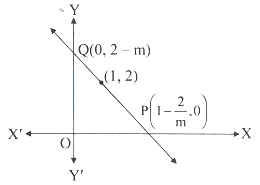
0 likesView Solution
127
MathematicsMediumMCQMHT CET · 2023
The base of an equilateral triangle is represented by the equation $2x - y - 1 = 0$ and its vertex is $(1, 2)$. Then,the length (in units) of the side of the triangle is:
A
$\sqrt{\frac{20}{13}}$
B
$\frac{2}{\sqrt{15}}$
C
$\sqrt{\frac{8}{15}}$
D
$\sqrt{\frac{15}{2}}$
Solution
(B) Let the vertex be $A(1, 2)$ and the base $BC$ lie on the line $2x - y - 1 = 0$.
The altitude $AD$ from vertex $A$ to the base $BC$ is the perpendicular distance from $(1, 2)$ to the line $2x - y - 1 = 0$.
$AD = \left| \frac{2(1) - (2) - 1}{\sqrt{2^2 + (-1)^2}} \right| = \left| \frac{2 - 2 - 1}{\sqrt{5}} \right| = \frac{1}{\sqrt{5}}$.
In an equilateral triangle,the altitude $AD$ is related to the side length $s$ by $AD = s \sin 60^{\circ} = s \frac{\sqrt{3}}{2}$.
Therefore,$\frac{1}{\sqrt{5}} = s \frac{\sqrt{3}}{2}$.
$s = \frac{2}{\sqrt{5} \cdot \sqrt{3}} = \frac{2}{\sqrt{15}}$.
The altitude $AD$ from vertex $A$ to the base $BC$ is the perpendicular distance from $(1, 2)$ to the line $2x - y - 1 = 0$.
$AD = \left| \frac{2(1) - (2) - 1}{\sqrt{2^2 + (-1)^2}} \right| = \left| \frac{2 - 2 - 1}{\sqrt{5}} \right| = \frac{1}{\sqrt{5}}$.
In an equilateral triangle,the altitude $AD$ is related to the side length $s$ by $AD = s \sin 60^{\circ} = s \frac{\sqrt{3}}{2}$.
Therefore,$\frac{1}{\sqrt{5}} = s \frac{\sqrt{3}}{2}$.
$s = \frac{2}{\sqrt{5} \cdot \sqrt{3}} = \frac{2}{\sqrt{15}}$.
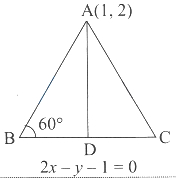
0 likesView Solution
128
MathematicsEasyMCQMHT CET · 2023
$PS$ is the median of the triangle with vertices at $P(2, 2)$,$Q(6, -1)$,and $R(7, 3)$. The intercepts on the coordinate axes of the line passing through point $(1, -1)$ and parallel to $PS$ are respectively:
A
$\frac{7}{2}, \frac{-7}{9}$
B
$\frac{2}{7}, \frac{9}{7}$
C
$\frac{-7}{2}, \frac{-7}{9}$
D
$-2, -9$
Solution
(C) $S$ is the midpoint of $QR = \left(\frac{6+7}{2}, \frac{-1+3}{2}\right) = \left(\frac{13}{2}, 1\right)$.
Slope of $PS = \frac{2-1}{2-\frac{13}{2}} = \frac{1}{-\frac{9}{2}} = -\frac{2}{9}$.
The line is parallel to $PS$,so its slope is $m = -\frac{2}{9}$.
The equation of the line passing through $(1, -1)$ with slope $m = -\frac{2}{9}$ is $y - (-1) = -\frac{2}{9}(x - 1)$.
$9(y + 1) = -2(x - 1)$ $\Rightarrow 9y + 9 = -2x + 2$ $\Rightarrow 2x + 9y + 7 = 0$.
To find the $X$-intercept,set $y = 0$: $2x + 7 = 0 \Rightarrow x = -\frac{7}{2}$.
To find the $Y$-intercept,set $x = 0$: $9y + 7 = 0 \Rightarrow y = -\frac{7}{9}$.
Thus,the intercepts are $-\frac{7}{2}$ and $-\frac{7}{9}$.
Slope of $PS = \frac{2-1}{2-\frac{13}{2}} = \frac{1}{-\frac{9}{2}} = -\frac{2}{9}$.
The line is parallel to $PS$,so its slope is $m = -\frac{2}{9}$.
The equation of the line passing through $(1, -1)$ with slope $m = -\frac{2}{9}$ is $y - (-1) = -\frac{2}{9}(x - 1)$.
$9(y + 1) = -2(x - 1)$ $\Rightarrow 9y + 9 = -2x + 2$ $\Rightarrow 2x + 9y + 7 = 0$.
To find the $X$-intercept,set $y = 0$: $2x + 7 = 0 \Rightarrow x = -\frac{7}{2}$.
To find the $Y$-intercept,set $x = 0$: $9y + 7 = 0 \Rightarrow y = -\frac{7}{9}$.
Thus,the intercepts are $-\frac{7}{2}$ and $-\frac{7}{9}$.
0 likesView Solution
129
MathematicsMediumMCQMHT CET · 2023
In a triangle $ABC$,$m \angle A, m \angle B, m \angle C$ are in $A$.$P$. and the lengths of the two larger sides are $10$ units and $9$ units respectively. Then the length (in units) of the third side is:
A
$5+\sqrt{6}$
B
$\sqrt{5}-1$
C
$\sqrt{6}+1$
D
$5-\sqrt{6}$
Solution
(D) Given that $\angle A, \angle B, \angle C$ are in $A$.$P$.,we have $2B = A + C$.
Since $A + B + C = 180^{\circ}$,we get $3B = 180^{\circ}$,which implies $B = 60^{\circ}$.
Let the sides opposite to $A, B, C$ be $a, b, c$ respectively. Given $a = 10$ and $b = 9$ (the two larger sides).
Using the Law of Cosines: $\cos B = \frac{a^2 + c^2 - b^2}{2ac}$.
Substituting the values: $\cos 60^{\circ} = \frac{10^2 + c^2 - 9^2}{2(10)c}$.
$\frac{1}{2} = \frac{100 + c^2 - 81}{20c} \Rightarrow 10c = c^2 + 19$.
$c^2 - 10c + 19 = 0$.
Using the quadratic formula: $c = \frac{10 \pm \sqrt{100 - 76}}{2} = \frac{10 \pm \sqrt{24}}{2} = 5 \pm \sqrt{6}$.
Since $b=9$ is the second largest side,$c$ must be the smallest side. Thus,$c = 5 - \sqrt{6}$.
Since $A + B + C = 180^{\circ}$,we get $3B = 180^{\circ}$,which implies $B = 60^{\circ}$.
Let the sides opposite to $A, B, C$ be $a, b, c$ respectively. Given $a = 10$ and $b = 9$ (the two larger sides).
Using the Law of Cosines: $\cos B = \frac{a^2 + c^2 - b^2}{2ac}$.
Substituting the values: $\cos 60^{\circ} = \frac{10^2 + c^2 - 9^2}{2(10)c}$.
$\frac{1}{2} = \frac{100 + c^2 - 81}{20c} \Rightarrow 10c = c^2 + 19$.
$c^2 - 10c + 19 = 0$.
Using the quadratic formula: $c = \frac{10 \pm \sqrt{100 - 76}}{2} = \frac{10 \pm \sqrt{24}}{2} = 5 \pm \sqrt{6}$.
Since $b=9$ is the second largest side,$c$ must be the smallest side. Thus,$c = 5 - \sqrt{6}$.
0 likesView Solution
130
MathematicsMediumMCQMHT CET · 2023
Let $P \equiv (-3, 0)$,$Q \equiv (0, 0)$,and $R \equiv (3, 3\sqrt{3})$ be three points. Then the equation of the bisector of the angle $\angle PQR$ is
A
$\frac{\sqrt{3}}{2} x + y = 0$
B
$x + \sqrt{3} y = 0$
C
$\sqrt{3} x + y = 0$
D
$x + \frac{\sqrt{3}}{2} y = 0$
Solution
(C) The coordinates of the points are $P(-3, 0)$,$Q(0, 0)$,and $R(3, 3\sqrt{3})$.
$QP$ lies along the negative $X$-axis,so the angle it makes with the positive $X$-axis is $180^{\circ}$.
The slope of $QR$ is $m = \frac{3\sqrt{3} - 0}{3 - 0} = \sqrt{3}$.
Since $\tan \theta = \sqrt{3}$,the angle $\theta$ that $QR$ makes with the positive $X$-axis is $60^{\circ}$.
The angle $\angle PQR$ is the angle between $QP$ and $QR$,which is $180^{\circ} - 60^{\circ} = 120^{\circ}$.
The angle bisector of $\angle PQR$ divides this angle into two equal parts of $60^{\circ}$ each.
The angle that the bisector makes with the positive $X$-axis is $180^{\circ} - 60^{\circ} = 120^{\circ}$.
The slope of the bisector is $\tan 120^{\circ} = -\sqrt{3}$.
Since the bisector passes through the origin $Q(0, 0)$,its equation is $y - 0 = -\sqrt{3}(x - 0)$,which simplifies to $y = -\sqrt{3}x$ or $\sqrt{3}x + y = 0$.
$QP$ lies along the negative $X$-axis,so the angle it makes with the positive $X$-axis is $180^{\circ}$.
The slope of $QR$ is $m = \frac{3\sqrt{3} - 0}{3 - 0} = \sqrt{3}$.
Since $\tan \theta = \sqrt{3}$,the angle $\theta$ that $QR$ makes with the positive $X$-axis is $60^{\circ}$.
The angle $\angle PQR$ is the angle between $QP$ and $QR$,which is $180^{\circ} - 60^{\circ} = 120^{\circ}$.
The angle bisector of $\angle PQR$ divides this angle into two equal parts of $60^{\circ}$ each.
The angle that the bisector makes with the positive $X$-axis is $180^{\circ} - 60^{\circ} = 120^{\circ}$.
The slope of the bisector is $\tan 120^{\circ} = -\sqrt{3}$.
Since the bisector passes through the origin $Q(0, 0)$,its equation is $y - 0 = -\sqrt{3}(x - 0)$,which simplifies to $y = -\sqrt{3}x$ or $\sqrt{3}x + y = 0$.
0 likesView Solution
131
MathematicsEasyMCQMHT CET · 2023
The points $(1,3)$ and $(5,1)$ are opposite vertices of a diagonal of a rectangle. If the other two vertices lie on the line $y=2x+c$,then one of the vertices on the other diagonal is
A
$(1,-2)$
B
$(0,-4)$
C
$(2,0)$
D
$(3,2)$
Solution
(C) Diagonals of a rectangle bisect each other.
Midpoint of $(1,3)$ and $(5,1)$ is $(\frac{1+5}{2}, \frac{3+1}{2}) = (3,2)$.
Since the other two vertices lie on the line $y=2x+c$,the midpoint $(3,2)$ must also lie on this line.
Substituting $(3,2)$ into $y=2x+c$ gives $2 = 2(3) + c$,so $c = -4$.
The equation of the line containing the other two vertices is $y=2x-4$.
Let the coordinates of a vertex be $(x, 2x-4)$.
Since the angle between adjacent sides of a rectangle is $90^{\circ}$,the product of the slopes of the sides meeting at a vertex is $-1$.
Let the given vertices be $A(1,3)$ and $C(5,1)$. Let the other vertices be $B(x, 2x-4)$ and $D$. The slope of $AB$ is $\frac{2x-4-3}{x-1} = \frac{2x-7}{x-1}$.
The slope of $BC$ is $\frac{2x-4-1}{x-5} = \frac{2x-5}{x-5}$.
Since $AB \perp BC$,we have $(\frac{2x-7}{x-1})(\frac{2x-5}{x-5}) = -1$.
$(2x-7)(2x-5) = -(x-1)(x-5)$
$4x^2 - 24x + 35 = -(x^2 - 6x + 5)$
$4x^2 - 24x + 35 = -x^2 + 6x - 5$
$5x^2 - 30x + 40 = 0$
$x^2 - 6x + 8 = 0$
$(x-4)(x-2) = 0$
So $x=4$ or $x=2$.
If $x=4$,$y=2(4)-4=4$. If $x=2$,$y=2(2)-4=0$.
The vertices are $(4,4)$ and $(2,0)$.
Thus,one of the vertices is $(2,0)$.
Midpoint of $(1,3)$ and $(5,1)$ is $(\frac{1+5}{2}, \frac{3+1}{2}) = (3,2)$.
Since the other two vertices lie on the line $y=2x+c$,the midpoint $(3,2)$ must also lie on this line.
Substituting $(3,2)$ into $y=2x+c$ gives $2 = 2(3) + c$,so $c = -4$.
The equation of the line containing the other two vertices is $y=2x-4$.
Let the coordinates of a vertex be $(x, 2x-4)$.
Since the angle between adjacent sides of a rectangle is $90^{\circ}$,the product of the slopes of the sides meeting at a vertex is $-1$.
Let the given vertices be $A(1,3)$ and $C(5,1)$. Let the other vertices be $B(x, 2x-4)$ and $D$. The slope of $AB$ is $\frac{2x-4-3}{x-1} = \frac{2x-7}{x-1}$.
The slope of $BC$ is $\frac{2x-4-1}{x-5} = \frac{2x-5}{x-5}$.
Since $AB \perp BC$,we have $(\frac{2x-7}{x-1})(\frac{2x-5}{x-5}) = -1$.
$(2x-7)(2x-5) = -(x-1)(x-5)$
$4x^2 - 24x + 35 = -(x^2 - 6x + 5)$
$4x^2 - 24x + 35 = -x^2 + 6x - 5$
$5x^2 - 30x + 40 = 0$
$x^2 - 6x + 8 = 0$
$(x-4)(x-2) = 0$
So $x=4$ or $x=2$.
If $x=4$,$y=2(4)-4=4$. If $x=2$,$y=2(2)-4=0$.
The vertices are $(4,4)$ and $(2,0)$.
Thus,one of the vertices is $(2,0)$.
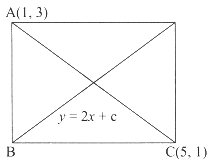
0 likesView Solution
132
MathematicsEasyMCQMHT CET · 2023
$a$ and $b$ are the intercepts made by a line on the coordinate axes. If $3a = b$ and the line passes through $(1, 3)$,then the equation of the line is
A
$x + 3y = 10$
B
$3x + y = 6$
C
$x - 3y + 8 = 0$
D
$3x - 2y + 3 = 0$
Solution
(B) The intercept form of the equation of a line is $\frac{x}{a} + \frac{y}{b} = 1$.
Given that the line passes through $(1, 3)$,we substitute these coordinates into the equation:
$\frac{1}{a} + \frac{3}{b} = 1$.
We are also given $b = 3a$. Substituting this into the equation:
$\frac{1}{a} + \frac{3}{3a} = 1$
$\frac{1}{a} + \frac{1}{a} = 1$
$\frac{2}{a} = 1 \Rightarrow a = 2$.
Since $b = 3a$,we have $b = 3(2) = 6$.
Substituting $a = 2$ and $b = 6$ into the intercept form:
$\frac{x}{2} + \frac{y}{6} = 1$.
Multiplying by $6$ to clear the denominators:
$3x + y = 6$.
Given that the line passes through $(1, 3)$,we substitute these coordinates into the equation:
$\frac{1}{a} + \frac{3}{b} = 1$.
We are also given $b = 3a$. Substituting this into the equation:
$\frac{1}{a} + \frac{3}{3a} = 1$
$\frac{1}{a} + \frac{1}{a} = 1$
$\frac{2}{a} = 1 \Rightarrow a = 2$.
Since $b = 3a$,we have $b = 3(2) = 6$.
Substituting $a = 2$ and $b = 6$ into the intercept form:
$\frac{x}{2} + \frac{y}{6} = 1$.
Multiplying by $6$ to clear the denominators:
$3x + y = 6$.
0 likesView Solution
133
MathematicsEasyMCQMHT CET · 2023
$p$ is the length of the perpendicular from the origin to the line whose intercepts on the axes are $a$ and $b$ respectively,then $\frac{1}{a^2} + \frac{1}{b^2}$ equals
A
$p^2$
B
$\frac{2}{p^2}$
C
$\frac{1}{p^2}$
D
$\frac{1}{2p^2}$
Solution
(C) The equation of the line in intercept form is $\frac{x}{a} + \frac{y}{b} = 1$,which can be written as $\frac{1}{a}x + \frac{1}{b}y - 1 = 0$.
The length of the perpendicular $p$ from the origin $(0,0)$ to the line $Ax + By + C = 0$ is given by $p = \left| \frac{C}{\sqrt{A^2 + B^2}} \right|$.
Substituting the values $A = \frac{1}{a}$,$B = \frac{1}{b}$,and $C = -1$,we get $p = \left| \frac{-1}{\sqrt{(\frac{1}{a})^2 + (\frac{1}{b})^2}} \right|$.
Squaring both sides,we have $p^2 = \frac{1}{\frac{1}{a^2} + \frac{1}{b^2}}$.
Therefore,$\frac{1}{a^2} + \frac{1}{b^2} = \frac{1}{p^2}$.
The length of the perpendicular $p$ from the origin $(0,0)$ to the line $Ax + By + C = 0$ is given by $p = \left| \frac{C}{\sqrt{A^2 + B^2}} \right|$.
Substituting the values $A = \frac{1}{a}$,$B = \frac{1}{b}$,and $C = -1$,we get $p = \left| \frac{-1}{\sqrt{(\frac{1}{a})^2 + (\frac{1}{b})^2}} \right|$.
Squaring both sides,we have $p^2 = \frac{1}{\frac{1}{a^2} + \frac{1}{b^2}}$.
Therefore,$\frac{1}{a^2} + \frac{1}{b^2} = \frac{1}{p^2}$.
0 likesView Solution
134
MathematicsMediumMCQMHT CET · 2023
The distance of a point $(2, 5)$ from the line $3x + y + 4 = 0$ measured along the lines $L_1$ and $L_2$ are the same. If the slope of line $L_1$ is $\frac{3}{4}$,then the slope of the line $L_2$ is
A
$\frac{-3}{4}$
B
$\frac{1}{3}$
C
$\frac{1}{4}$
D
$0$
Solution
(D) Let the given line be $L: 3x + y + 4 = 0$. The slope of $L$ is $m = -3$.
Let the slopes of lines $L_1$ and $L_2$ be $m_1 = \frac{3}{4}$ and $m_2$ respectively.
Since the distances measured along $L_1$ and $L_2$ from point $A(2, 5)$ to the line $L$ are equal,the angles $\theta_1$ and $\theta_2$ that $L_1$ and $L_2$ make with the line $L$ must satisfy $\tan \theta_1 = \tan \theta_2$ or $\tan \theta_1 = -\tan \theta_2$.
Using the formula for the angle between two lines with slopes $m$ and $m'$,$\tan \theta = \left| \frac{m - m'}{1 + mm'} \right|$.
For $L_1$: $\tan \theta = \left| \frac{-3 - 3/4}{1 + (-3)(3/4)} \right| = \left| \frac{-15/4}{1 - 9/4} \right| = \left| \frac{-15/4}{-5/4} \right| = 3$.
For $L_2$: $\left| \frac{-3 - m_2}{1 - 3m_2} \right| = 3$.
Case $1$: $\frac{-3 - m_2}{1 - 3m_2} = 3$ $\Rightarrow -3 - m_2 = 3 - 9m_2$ $\Rightarrow 8m_2 = 6$ $\Rightarrow m_2 = \frac{3}{4}$ (This is $L_1$ itself).
Case $2$: $\frac{-3 - m_2}{1 - 3m_2} = -3$ $\Rightarrow -3 - m_2 = -3 + 9m_2$ $\Rightarrow 10m_2 = 0$ $\Rightarrow m_2 = 0$.
Thus,the slope of $L_2$ is $0$.
Let the slopes of lines $L_1$ and $L_2$ be $m_1 = \frac{3}{4}$ and $m_2$ respectively.
Since the distances measured along $L_1$ and $L_2$ from point $A(2, 5)$ to the line $L$ are equal,the angles $\theta_1$ and $\theta_2$ that $L_1$ and $L_2$ make with the line $L$ must satisfy $\tan \theta_1 = \tan \theta_2$ or $\tan \theta_1 = -\tan \theta_2$.
Using the formula for the angle between two lines with slopes $m$ and $m'$,$\tan \theta = \left| \frac{m - m'}{1 + mm'} \right|$.
For $L_1$: $\tan \theta = \left| \frac{-3 - 3/4}{1 + (-3)(3/4)} \right| = \left| \frac{-15/4}{1 - 9/4} \right| = \left| \frac{-15/4}{-5/4} \right| = 3$.
For $L_2$: $\left| \frac{-3 - m_2}{1 - 3m_2} \right| = 3$.
Case $1$: $\frac{-3 - m_2}{1 - 3m_2} = 3$ $\Rightarrow -3 - m_2 = 3 - 9m_2$ $\Rightarrow 8m_2 = 6$ $\Rightarrow m_2 = \frac{3}{4}$ (This is $L_1$ itself).
Case $2$: $\frac{-3 - m_2}{1 - 3m_2} = -3$ $\Rightarrow -3 - m_2 = -3 + 9m_2$ $\Rightarrow 10m_2 = 0$ $\Rightarrow m_2 = 0$.
Thus,the slope of $L_2$ is $0$.
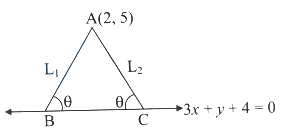
0 likesView Solution
135
MathematicsMediumMCQMHT CET · 2023
If the distance between the parallel lines given by the equation $x^2+4xy+4y^2+3x+6y-4=0$ is $\lambda$,then $\lambda^2=$
A
$5$
B
$\sqrt{5}$
C
$25$
D
$\frac{9}{5}$
Solution
(A) The given equation is $x^2+4xy+4y^2+3x+6y-4=0$.
This can be written as $(x+2y)^2+3(x+2y)-4=0$.
Let $t = x+2y$,then $t^2+3t-4=0$.
$(t+4)(t-1)=0$,so $(x+2y+4)(x+2y-1)=0$.
The two parallel lines are $L_1: x+2y+4=0$ and $L_2: x+2y-1=0$.
The distance $\lambda$ between two parallel lines $ax+by+c_1=0$ and $ax+by+c_2=0$ is given by $\lambda = \frac{|c_1-c_2|}{\sqrt{a^2+b^2}}$.
$\lambda = \frac{|4-(-1)|}{\sqrt{1^2+2^2}} = \frac{5}{\sqrt{5}} = \sqrt{5}$.
Therefore,$\lambda^2 = (\sqrt{5})^2 = 5$.
This can be written as $(x+2y)^2+3(x+2y)-4=0$.
Let $t = x+2y$,then $t^2+3t-4=0$.
$(t+4)(t-1)=0$,so $(x+2y+4)(x+2y-1)=0$.
The two parallel lines are $L_1: x+2y+4=0$ and $L_2: x+2y-1=0$.
The distance $\lambda$ between two parallel lines $ax+by+c_1=0$ and $ax+by+c_2=0$ is given by $\lambda = \frac{|c_1-c_2|}{\sqrt{a^2+b^2}}$.
$\lambda = \frac{|4-(-1)|}{\sqrt{1^2+2^2}} = \frac{5}{\sqrt{5}} = \sqrt{5}$.
Therefore,$\lambda^2 = (\sqrt{5})^2 = 5$.
0 likesView Solution
136
MathematicsEasyMCQMHT CET · 2023
The equation of a line,whose perpendicular distance from the origin is $7$ units and the angle,which the perpendicular to the line from the origin makes,is $120^{\circ}$ with the positive $X$-axis,is
A
$x+\sqrt{3} y-14=0$
B
$x+\sqrt{3} y+14=0$
C
$x-\sqrt{3} y+14=0$
D
$x-\sqrt{3} y-14=0$
Solution
(C) The normal form of the equation of a line is given by $x \cos \alpha + y \sin \alpha = p$.
Here,the perpendicular distance from the origin is $p = 7$ and the angle $\alpha = 120^{\circ}$.
Substituting these values into the equation:
$x \cos 120^{\circ} + y \sin 120^{\circ} = 7$
Since $\cos 120^{\circ} = -\frac{1}{2}$ and $\sin 120^{\circ} = \frac{\sqrt{3}}{2}$,we get:
$x(-\frac{1}{2}) + y(\frac{\sqrt{3}}{2}) = 7$
Multiplying both sides by $2$:
$-x + \sqrt{3}y = 14$
Rearranging the terms to the standard form:
$x - \sqrt{3}y + 14 = 0$
Here,the perpendicular distance from the origin is $p = 7$ and the angle $\alpha = 120^{\circ}$.
Substituting these values into the equation:
$x \cos 120^{\circ} + y \sin 120^{\circ} = 7$
Since $\cos 120^{\circ} = -\frac{1}{2}$ and $\sin 120^{\circ} = \frac{\sqrt{3}}{2}$,we get:
$x(-\frac{1}{2}) + y(\frac{\sqrt{3}}{2}) = 7$
Multiplying both sides by $2$:
$-x + \sqrt{3}y = 14$
Rearranging the terms to the standard form:
$x - \sqrt{3}y + 14 = 0$
0 likesView Solution
137
MathematicsMediumMCQMHT CET · 2023
The coordinates of the points on the line $2x - y = 5$ which are at a distance of $1$ unit from the line $3x + 4y = 5$ are:
A
$\left(\frac{30}{11}, \frac{5}{11}\right), \left(\frac{20}{11}, \frac{-15}{11}\right)$
B
$\left(\frac{-30}{11}, \frac{5}{11}\right), \left(\frac{-20}{11}, \frac{15}{11}\right)$
C
$\left(\frac{30}{11}, \frac{-5}{11}\right), \left(\frac{20}{11}, \frac{15}{11}\right)$
D
$\left(\frac{-30}{11}, \frac{5}{11}\right), \left(\frac{-20}{11}, \frac{-15}{11}\right)$
Solution
(A) Let the point be $P(x_1, y_1)$. Since $P$ lies on $2x - y = 5$,we have $y_1 = 2x_1 - 5$.
The distance of $P(x_1, y_1)$ from the line $3x + 4y - 5 = 0$ is given by $d = \left|\frac{3x_1 + 4y_1 - 5}{\sqrt{3^2 + 4^2}}\right| = 1$.
Substituting $y_1 = 2x_1 - 5$ into the distance formula:
$\left|\frac{3x_1 + 4(2x_1 - 5) - 5}{5}\right| = 1$
$\left|\frac{3x_1 + 8x_1 - 20 - 5}{5}\right| = 1$
$\left|\frac{11x_1 - 25}{5}\right| = 1$
$11x_1 - 25 = 5$ or $11x_1 - 25 = -5$
Case $1$: $11x_1 = 30 \implies x_1 = \frac{30}{11}$. Then $y_1 = 2(\frac{30}{11}) - 5 = \frac{60-55}{11} = \frac{5}{11}$.
Case $2$: $11x_1 = 20 \implies x_1 = \frac{20}{11}$. Then $y_1 = 2(\frac{20}{11}) - 5 = \frac{40-55}{11} = \frac{-15}{11}$.
Thus,the points are $\left(\frac{30}{11}, \frac{5}{11}\right)$ and $\left(\frac{20}{11}, \frac{-15}{11}\right)$.
The distance of $P(x_1, y_1)$ from the line $3x + 4y - 5 = 0$ is given by $d = \left|\frac{3x_1 + 4y_1 - 5}{\sqrt{3^2 + 4^2}}\right| = 1$.
Substituting $y_1 = 2x_1 - 5$ into the distance formula:
$\left|\frac{3x_1 + 4(2x_1 - 5) - 5}{5}\right| = 1$
$\left|\frac{3x_1 + 8x_1 - 20 - 5}{5}\right| = 1$
$\left|\frac{11x_1 - 25}{5}\right| = 1$
$11x_1 - 25 = 5$ or $11x_1 - 25 = -5$
Case $1$: $11x_1 = 30 \implies x_1 = \frac{30}{11}$. Then $y_1 = 2(\frac{30}{11}) - 5 = \frac{60-55}{11} = \frac{5}{11}$.
Case $2$: $11x_1 = 20 \implies x_1 = \frac{20}{11}$. Then $y_1 = 2(\frac{20}{11}) - 5 = \frac{40-55}{11} = \frac{-15}{11}$.
Thus,the points are $\left(\frac{30}{11}, \frac{5}{11}\right)$ and $\left(\frac{20}{11}, \frac{-15}{11}\right)$.
0 likesView Solution
138
MathematicsMediumMCQMHT CET · 2023
The number of integral values of $p$ in the domain $[-5, 5]$ such that the equation $2x^2 + 4xy - py^2 + 4x + qy + 1 = 0$ represents a pair of lines is:
A
$3$
B
$4$
C
$7$
D
$8$
Solution
(A) The general equation of a second-degree curve is $ax^2 + 2hxy + by^2 + 2gx + 2fy + c = 0$. For this to represent a pair of lines,the determinant must be zero:
$abc + 2fgh - af^2 - bg^2 - ch^2 = 0$.
Comparing $2x^2 + 4xy - py^2 + 4x + qy + 1 = 0$ with the general form,we have $a=2, h=2, b=-p, g=2, f=q/2, c=1$.
Substituting these into the determinant condition:
$2(-p)(1) + 2(q/2)(2)(2) - 2(q/2)^2 - (-p)(2)^2 - 1(2)^2 = 0$.
$-2p + 4q - q^2/2 + 4p - 4 = 0$.
Multiplying by $-2$: $q^2 - 8q - 4p + 8 = 0$.
For $q$ to be an integer,the discriminant of this quadratic in $q$ must be a perfect square:
$D = (-8)^2 - 4(1)(8 - 4p) = 64 - 32 + 16p = 32 + 16p = 16(2 + p)$.
For $D$ to be a perfect square,$2 + p$ must be a perfect square $k^2$.
Given $p \in [-5, 5]$,$2 + p$ can take values from $-3$ to $7$.
The perfect squares in this range are $0, 1, 4$.
$2 + p = 0 \Rightarrow p = -2$.
$2 + p = 1 \Rightarrow p = -1$.
$2 + p = 4 \Rightarrow p = 2$.
Thus,the possible integral values of $p$ are $\{-2, -1, 2\}$.
The number of such values is $3$.
$abc + 2fgh - af^2 - bg^2 - ch^2 = 0$.
Comparing $2x^2 + 4xy - py^2 + 4x + qy + 1 = 0$ with the general form,we have $a=2, h=2, b=-p, g=2, f=q/2, c=1$.
Substituting these into the determinant condition:
$2(-p)(1) + 2(q/2)(2)(2) - 2(q/2)^2 - (-p)(2)^2 - 1(2)^2 = 0$.
$-2p + 4q - q^2/2 + 4p - 4 = 0$.
Multiplying by $-2$: $q^2 - 8q - 4p + 8 = 0$.
For $q$ to be an integer,the discriminant of this quadratic in $q$ must be a perfect square:
$D = (-8)^2 - 4(1)(8 - 4p) = 64 - 32 + 16p = 32 + 16p = 16(2 + p)$.
For $D$ to be a perfect square,$2 + p$ must be a perfect square $k^2$.
Given $p \in [-5, 5]$,$2 + p$ can take values from $-3$ to $7$.
The perfect squares in this range are $0, 1, 4$.
$2 + p = 0 \Rightarrow p = -2$.
$2 + p = 1 \Rightarrow p = -1$.
$2 + p = 4 \Rightarrow p = 2$.
Thus,the possible integral values of $p$ are $\{-2, -1, 2\}$.
The number of such values is $3$.
0 likesView Solution
139
MathematicsMediumMCQMHT CET · 2023
The joint equation of a pair of lines passing through the origin and making an angle of $\frac{\pi}{4}$ with the line $3x + 2y - 8 = 0$ is
A
$5x^2 + 24xy - 5y^2 = 0$
B
$5x^2 - 24xy + 5y^2 = 0$
C
$5x^2 - 24xy - 5y^2 = 0$
D
$5x^2 + 24xy + 5y^2 = 0$
Solution
(A) The slope of the line $3x + 2y - 8 = 0$ is $m_1 = -\frac{3}{2}$.
Let $m$ be the slope of the lines passing through the origin that make an angle of $\frac{\pi}{4}$ with the given line.
Using the formula $\tan \theta = \left| \frac{m - m_1}{1 + mm_1} \right|$,we have:
$\tan \frac{\pi}{4} = \left| \frac{m - (-3/2)}{1 + m(-3/2)} \right|$
$1 = \left| \frac{2m + 3}{2 - 3m} \right|$
Squaring both sides:
$(2 - 3m)^2 = (2m + 3)^2$
$4 - 12m + 9m^2 = 4m^2 + 12m + 9$
$5m^2 - 24m - 5 = 0$
Since the lines pass through the origin,their equations are $y = mx$,so $m = \frac{y}{x}$.
Substituting $m = \frac{y}{x}$ into the auxiliary equation:
$5(\frac{y}{x})^2 - 24(\frac{y}{x}) - 5 = 0$
Multiplying by $x^2$,we get:
$5y^2 - 24xy - 5x^2 = 0$
Rearranging,we get $5x^2 + 24xy - 5y^2 = 0$.
Let $m$ be the slope of the lines passing through the origin that make an angle of $\frac{\pi}{4}$ with the given line.
Using the formula $\tan \theta = \left| \frac{m - m_1}{1 + mm_1} \right|$,we have:
$\tan \frac{\pi}{4} = \left| \frac{m - (-3/2)}{1 + m(-3/2)} \right|$
$1 = \left| \frac{2m + 3}{2 - 3m} \right|$
Squaring both sides:
$(2 - 3m)^2 = (2m + 3)^2$
$4 - 12m + 9m^2 = 4m^2 + 12m + 9$
$5m^2 - 24m - 5 = 0$
Since the lines pass through the origin,their equations are $y = mx$,so $m = \frac{y}{x}$.
Substituting $m = \frac{y}{x}$ into the auxiliary equation:
$5(\frac{y}{x})^2 - 24(\frac{y}{x}) - 5 = 0$
Multiplying by $x^2$,we get:
$5y^2 - 24xy - 5x^2 = 0$
Rearranging,we get $5x^2 + 24xy - 5y^2 = 0$.
0 likesView Solution
140
MathematicsMediumMCQMHT CET · 2023
If $k_{i}$ are possible values of $k$ for which lines $kx + 2y + 2 = 0$,$2x + ky + 3 = 0$,and $3x + 3y + k = 0$ are concurrent,then $\sum k_{i}$ has the value
A
$0$
B
$-2$
C
$2$
D
$5$
Solution
(A) For three lines $a_1 x + b_1 y + c_1 = 0$,$a_2 x + b_2 y + c_2 = 0$,and $a_3 x + b_3 y + c_3 = 0$ to be concurrent,the determinant of their coefficients must be zero:
$\begin{vmatrix} k & 2 & 2 \\ 2 & k & 3 \\ 3 & 3 & k \end{vmatrix} = 0$
Expanding the determinant:
$k(k^2 - 9) - 2(2k - 9) + 2(6 - 3k) = 0$
$k^3 - 9k - 4k + 18 + 12 - 6k = 0$
$k^3 - 19k + 30 = 0$
By testing roots,we find $(k - 2)$ is a factor:
$(k - 2)(k^2 + 2k - 15) = 0$
$(k - 2)(k + 5)(k - 3) = 0$
The possible values are $k_1 = 2$,$k_2 = -5$,and $k_3 = 3$.
The sum $\sum k_i = 2 + (-5) + 3 = 0$.
$\begin{vmatrix} k & 2 & 2 \\ 2 & k & 3 \\ 3 & 3 & k \end{vmatrix} = 0$
Expanding the determinant:
$k(k^2 - 9) - 2(2k - 9) + 2(6 - 3k) = 0$
$k^3 - 9k - 4k + 18 + 12 - 6k = 0$
$k^3 - 19k + 30 = 0$
By testing roots,we find $(k - 2)$ is a factor:
$(k - 2)(k^2 + 2k - 15) = 0$
$(k - 2)(k + 5)(k - 3) = 0$
The possible values are $k_1 = 2$,$k_2 = -5$,and $k_3 = 3$.
The sum $\sum k_i = 2 + (-5) + 3 = 0$.
0 likesView Solution
141
MathematicsMediumMCQMHT CET · 2023
If two vertices of a triangle are $A(3,1,4)$ and $B(-4,5,-3)$ and the centroid of the triangle is $G(-1,2,1)$,then the third vertex $C$ of the triangle is
A
$(2,0,2)$
B
$(-2,0,2)$
C
$(0,-2,2)$
D
$(2,-2,0)$
Solution
(B) Let the coordinates of the third vertex $C$ be $(x, y, z)$.
Since $G$ is the centroid of $\triangle ABC$,the coordinates of $G$ are given by the formula:
$G = \left( \frac{x_A + x_B + x_C}{3}, \frac{y_A + y_B + y_C}{3}, \frac{z_A + z_B + z_C}{3} \right)$
Given $A(3, 1, 4)$,$B(-4, 5, -3)$,and $G(-1, 2, 1)$:
$-1 = \frac{3 - 4 + x}{3} \implies -3 = -1 + x \implies x = -2$
$2 = \frac{1 + 5 + y}{3} \implies 6 = 6 + y \implies y = 0$
$1 = \frac{4 - 3 + z}{3} \implies 3 = 1 + z \implies z = 2$
Therefore,the third vertex $C$ is $(-2, 0, 2)$.
Since $G$ is the centroid of $\triangle ABC$,the coordinates of $G$ are given by the formula:
$G = \left( \frac{x_A + x_B + x_C}{3}, \frac{y_A + y_B + y_C}{3}, \frac{z_A + z_B + z_C}{3} \right)$
Given $A(3, 1, 4)$,$B(-4, 5, -3)$,and $G(-1, 2, 1)$:
$-1 = \frac{3 - 4 + x}{3} \implies -3 = -1 + x \implies x = -2$
$2 = \frac{1 + 5 + y}{3} \implies 6 = 6 + y \implies y = 0$
$1 = \frac{4 - 3 + z}{3} \implies 3 = 1 + z \implies z = 2$
Therefore,the third vertex $C$ is $(-2, 0, 2)$.
0 likesView Solution
142
MathematicsEasyMCQMHT CET · 2023
If $A(1,4,2)$ and $C(5,-7,1)$ are two vertices of triangle $ABC$ and $G\left(\frac{4}{3}, 0, \frac{-2}{3}\right)$ is the centroid of the triangle $ABC$,then the midpoint of side $BC$ is
A
$\left(-2,-2, \frac{3}{2}\right)$
B
$\left(2,2, \frac{3}{2}\right)$
C
$\left(\frac{3}{2}, 2,-2\right)$
D
$\left(\frac{3}{2},-2,-2\right)$
Solution
(D) Let the coordinates of vertex $B$ be $(x_1, y_1, z_1)$.
The centroid $G$ of a triangle with vertices $A(x_A, y_A, z_A)$,$B(x_B, y_B, z_B)$,and $C(x_C, y_C, z_C)$ is given by $\left(\frac{x_A+x_B+x_C}{3}, \frac{y_A+y_B+y_C}{3}, \frac{z_A+z_B+z_C}{3}\right)$.
Given $A(1,4,2)$,$C(5,-7,1)$,and $G\left(\frac{4}{3}, 0, \frac{-2}{3}\right)$,we have:
$\frac{1+x_1+5}{3} = \frac{4}{3} \Rightarrow 6+x_1 = 4 \Rightarrow x_1 = -2$
$\frac{4+y_1-7}{3} = 0 \Rightarrow y_1-3 = 0 \Rightarrow y_1 = 3$
$\frac{2+z_1+1}{3} = \frac{-2}{3} \Rightarrow 3+z_1 = -2 \Rightarrow z_1 = -5$
So,$B = (-2, 3, -5)$.
The midpoint of side $BC$ is $\left(\frac{x_B+x_C}{2}, \frac{y_B+y_C}{2}, \frac{z_B+z_C}{2}\right)$.
Midpoint $= \left(\frac{-2+5}{2}, \frac{3-7}{2}, \frac{-5+1}{2}\right) = \left(\frac{3}{2}, -2, -2\right)$.
The centroid $G$ of a triangle with vertices $A(x_A, y_A, z_A)$,$B(x_B, y_B, z_B)$,and $C(x_C, y_C, z_C)$ is given by $\left(\frac{x_A+x_B+x_C}{3}, \frac{y_A+y_B+y_C}{3}, \frac{z_A+z_B+z_C}{3}\right)$.
Given $A(1,4,2)$,$C(5,-7,1)$,and $G\left(\frac{4}{3}, 0, \frac{-2}{3}\right)$,we have:
$\frac{1+x_1+5}{3} = \frac{4}{3} \Rightarrow 6+x_1 = 4 \Rightarrow x_1 = -2$
$\frac{4+y_1-7}{3} = 0 \Rightarrow y_1-3 = 0 \Rightarrow y_1 = 3$
$\frac{2+z_1+1}{3} = \frac{-2}{3} \Rightarrow 3+z_1 = -2 \Rightarrow z_1 = -5$
So,$B = (-2, 3, -5)$.
The midpoint of side $BC$ is $\left(\frac{x_B+x_C}{2}, \frac{y_B+y_C}{2}, \frac{z_B+z_C}{2}\right)$.
Midpoint $= \left(\frac{-2+5}{2}, \frac{3-7}{2}, \frac{-5+1}{2}\right) = \left(\frac{3}{2}, -2, -2\right)$.
0 likesView Solution
143
MathematicsMediumMCQMHT CET · 2023
If the general solution of the equation $\frac{\tan 3x - 1}{\tan 3x + 1} = \sqrt{3}$ is $x = \frac{n\pi}{p} + \frac{7\pi}{q}$ where $n, p, q \in \mathbb{Z}$,then $\frac{p}{q}$ is
A
$12$
B
$\frac{1}{12}$
C
$3$
D
$36$
Solution
(B) Given the equation $\frac{\tan 3x - 1}{\tan 3x + 1} = \sqrt{3}$.
Using the formula $\tan(A - B) = \frac{\tan A - \tan B}{1 + \tan A \tan B}$,we can rewrite the equation as:
$\frac{\tan 3x - \tan(\frac{\pi}{4})}{1 + \tan 3x \tan(\frac{\pi}{4})} = \sqrt{3}$.
This simplifies to $\tan(3x - \frac{\pi}{4}) = \tan(\frac{\pi}{3})$.
The general solution for $\tan \theta = \tan \alpha$ is $\theta = n\pi + \alpha$.
So,$3x - \frac{\pi}{4} = n\pi + \frac{\pi}{3}$.
$3x = n\pi + \frac{\pi}{3} + \frac{\pi}{4} = n\pi + \frac{7\pi}{12}$.
$x = \frac{n\pi}{3} + \frac{7\pi}{36}$.
Comparing this with $x = \frac{n\pi}{p} + \frac{7\pi}{q}$,we get $p = 3$ and $q = 36$.
Therefore,$\frac{p}{q} = \frac{3}{36} = \frac{1}{12}$.
Using the formula $\tan(A - B) = \frac{\tan A - \tan B}{1 + \tan A \tan B}$,we can rewrite the equation as:
$\frac{\tan 3x - \tan(\frac{\pi}{4})}{1 + \tan 3x \tan(\frac{\pi}{4})} = \sqrt{3}$.
This simplifies to $\tan(3x - \frac{\pi}{4}) = \tan(\frac{\pi}{3})$.
The general solution for $\tan \theta = \tan \alpha$ is $\theta = n\pi + \alpha$.
So,$3x - \frac{\pi}{4} = n\pi + \frac{\pi}{3}$.
$3x = n\pi + \frac{\pi}{3} + \frac{\pi}{4} = n\pi + \frac{7\pi}{12}$.
$x = \frac{n\pi}{3} + \frac{7\pi}{36}$.
Comparing this with $x = \frac{n\pi}{p} + \frac{7\pi}{q}$,we get $p = 3$ and $q = 36$.
Therefore,$\frac{p}{q} = \frac{3}{36} = \frac{1}{12}$.
0 likesView Solution
144
MathematicsDifficultMCQMHT CET · 2023
If the general solution of $\cos ^2 \theta - 2 \sin \theta + \frac{1}{4} = 0$ is $\theta = \frac{n \pi}{A} + (-1)^{n} \frac{\pi}{B}, n \in Z$,then $A + B$ has the value
A
$7$
B
$6$
C
$1$
D
$-7$
Solution
(A) Given equation: $\cos ^2 \theta - 2 \sin \theta + \frac{1}{4} = 0$
Substitute $\cos ^2 \theta = 1 - \sin ^2 \theta$:
$(1 - \sin ^2 \theta) - 2 \sin \theta + \frac{1}{4} = 0$
$\sin ^2 \theta + 2 \sin \theta - \frac{5}{4} = 0$
Multiply by $4$:
$4 \sin ^2 \theta + 8 \sin \theta - 5 = 0$
Factorize the quadratic:
$4 \sin ^2 \theta + 10 \sin \theta - 2 \sin \theta - 5 = 0$
$2 \sin \theta(2 \sin \theta + 5) - 1(2 \sin \theta + 5) = 0$
$(2 \sin \theta - 1)(2 \sin \theta + 5) = 0$
So,$\sin \theta = \frac{1}{2}$ or $\sin \theta = -\frac{5}{2}$.
Since $-1 \le \sin \theta \le 1$,$\sin \theta = -\frac{5}{2}$ is impossible.
Thus,$\sin \theta = \frac{1}{2} = \sin \frac{\pi}{6}$.
The general solution is $\theta = n \pi + (-1)^n \frac{\pi}{6}$.
Comparing with $\theta = \frac{n \pi}{A} + (-1)^n \frac{\pi}{B}$,we get $A = 1$ and $B = 6$.
Therefore,$A + B = 1 + 6 = 7$.
Substitute $\cos ^2 \theta = 1 - \sin ^2 \theta$:
$(1 - \sin ^2 \theta) - 2 \sin \theta + \frac{1}{4} = 0$
$\sin ^2 \theta + 2 \sin \theta - \frac{5}{4} = 0$
Multiply by $4$:
$4 \sin ^2 \theta + 8 \sin \theta - 5 = 0$
Factorize the quadratic:
$4 \sin ^2 \theta + 10 \sin \theta - 2 \sin \theta - 5 = 0$
$2 \sin \theta(2 \sin \theta + 5) - 1(2 \sin \theta + 5) = 0$
$(2 \sin \theta - 1)(2 \sin \theta + 5) = 0$
So,$\sin \theta = \frac{1}{2}$ or $\sin \theta = -\frac{5}{2}$.
Since $-1 \le \sin \theta \le 1$,$\sin \theta = -\frac{5}{2}$ is impossible.
Thus,$\sin \theta = \frac{1}{2} = \sin \frac{\pi}{6}$.
The general solution is $\theta = n \pi + (-1)^n \frac{\pi}{6}$.
Comparing with $\theta = \frac{n \pi}{A} + (-1)^n \frac{\pi}{B}$,we get $A = 1$ and $B = 6$.
Therefore,$A + B = 1 + 6 = 7$.
0 likesView Solution
145
MathematicsEasyMCQMHT CET · 2023
The general solution of the equation $3 \sec^2 \theta = 2 \operatorname{cosec} \theta$ is
A
$n \pi + \frac{\pi}{4}, n \in Z$
B
$2 n \pi + (-1)^n \frac{\pi}{12}, n \in Z$
C
$n \pi + (-1)^n \frac{\pi}{6}, n \in Z$
D
$n \pi + (-1)^n \frac{\pi}{3}, n \in Z$
Solution
(C) Given equation: $3 \sec^2 \theta = 2 \operatorname{cosec} \theta$
$\Rightarrow \frac{3}{\cos^2 \theta} = \frac{2}{\sin \theta}$
$\Rightarrow \frac{3}{1 - \sin^2 \theta} = \frac{2}{\sin \theta}$
$\Rightarrow 3 \sin \theta = 2 - 2 \sin^2 \theta$
$\Rightarrow 2 \sin^2 \theta + 3 \sin \theta - 2 = 0$
$\Rightarrow (2 \sin \theta - 1)(\sin \theta + 2) = 0$
Since $\sin \theta$ cannot be $-2$,we have $\sin \theta = \frac{1}{2} = \sin \frac{\pi}{6}$.
The general solution for $\sin \theta = \sin \alpha$ is $\theta = n \pi + (-1)^n \alpha$.
Therefore,$\theta = n \pi + (-1)^n \frac{\pi}{6}, n \in Z$.
$\Rightarrow \frac{3}{\cos^2 \theta} = \frac{2}{\sin \theta}$
$\Rightarrow \frac{3}{1 - \sin^2 \theta} = \frac{2}{\sin \theta}$
$\Rightarrow 3 \sin \theta = 2 - 2 \sin^2 \theta$
$\Rightarrow 2 \sin^2 \theta + 3 \sin \theta - 2 = 0$
$\Rightarrow (2 \sin \theta - 1)(\sin \theta + 2) = 0$
Since $\sin \theta$ cannot be $-2$,we have $\sin \theta = \frac{1}{2} = \sin \frac{\pi}{6}$.
The general solution for $\sin \theta = \sin \alpha$ is $\theta = n \pi + (-1)^n \alpha$.
Therefore,$\theta = n \pi + (-1)^n \frac{\pi}{6}, n \in Z$.
0 likesView Solution
146
MathematicsEasyMCQMHT CET · 2023
The principal solutions of the equation $\sec x + \tan x = 2 \cos x$ are
A
$\frac{\pi}{6}, \frac{5 \pi}{6}$
B
$\frac{\pi}{6}, \frac{\pi}{20}$
C
$\frac{\pi}{6}, \frac{2 \pi}{3}$
D
$\frac{\pi}{6}, \frac{\pi}{12}$
Solution
(A) The given equation is defined for $x \neq \frac{\pi}{2}, \frac{3 \pi}{2}$.
Given equation: $\sec x + \tan x = 2 \cos x$
$\Rightarrow \frac{1}{\cos x} + \frac{\sin x}{\cos x} = 2 \cos x$
$\Rightarrow 1 + \sin x = 2 \cos^2 x$
$\Rightarrow 1 + \sin x = 2(1 - \sin^2 x)$
$\Rightarrow 1 + \sin x = 2(1 - \sin x)(1 + \sin x)$
Since $\sin x = -1$ makes $\cos x = 0$,which is undefined,we have $1 + \sin x \neq 0$.
Dividing both sides by $(1 + \sin x)$,we get:
$1 = 2(1 - \sin x)$
$\Rightarrow 1 = 2 - 2 \sin x$
$\Rightarrow 2 \sin x = 1$
$\Rightarrow \sin x = \frac{1}{2}$
In the interval $[0, 2 \pi)$,the solutions are $x = \frac{\pi}{6}$ and $x = \pi - \frac{\pi}{6} = \frac{5 \pi}{6}$.
Given equation: $\sec x + \tan x = 2 \cos x$
$\Rightarrow \frac{1}{\cos x} + \frac{\sin x}{\cos x} = 2 \cos x$
$\Rightarrow 1 + \sin x = 2 \cos^2 x$
$\Rightarrow 1 + \sin x = 2(1 - \sin^2 x)$
$\Rightarrow 1 + \sin x = 2(1 - \sin x)(1 + \sin x)$
Since $\sin x = -1$ makes $\cos x = 0$,which is undefined,we have $1 + \sin x \neq 0$.
Dividing both sides by $(1 + \sin x)$,we get:
$1 = 2(1 - \sin x)$
$\Rightarrow 1 = 2 - 2 \sin x$
$\Rightarrow 2 \sin x = 1$
$\Rightarrow \sin x = \frac{1}{2}$
In the interval $[0, 2 \pi)$,the solutions are $x = \frac{\pi}{6}$ and $x = \pi - \frac{\pi}{6} = \frac{5 \pi}{6}$.
0 likesView Solution
147
MathematicsMediumMCQMHT CET · 2023
The number of solutions of $\tan x + \sec x = 2 \cos x$ in $[0, 2 \pi]$ are
A
$6$
B
$4$
C
$3$
D
$2$
Solution
(D) The given equation is defined for $x \neq \frac{\pi}{2}, \frac{3 \pi}{2}$.
Given: $\tan x + \sec x = 2 \cos x$
$\Rightarrow \frac{\sin x}{\cos x} + \frac{1}{\cos x} = 2 \cos x$
$\Rightarrow \sin x + 1 = 2 \cos^2 x$
$\Rightarrow \sin x + 1 = 2(1 - \sin^2 x)$
$\Rightarrow \sin x + 1 = 2(1 - \sin x)(1 + \sin x)$
$\Rightarrow (1 + \sin x)[2(1 - \sin x) - 1] = 0$
Since $\sin x = -1$ implies $\cos x = 0$,which makes $\tan x$ and $\sec x$ undefined,we have $1 + \sin x \neq 0$.
Therefore,$2(1 - \sin x) - 1 = 0$
$\Rightarrow 2 - 2 \sin x - 1 = 0$
$\Rightarrow 2 \sin x = 1$
$\Rightarrow \sin x = \frac{1}{2}$
In the interval $[0, 2 \pi]$,$\sin x = \frac{1}{2}$ at $x = \frac{\pi}{6}$ and $x = \frac{5 \pi}{6}$.
Thus,the number of solutions is $2$.
Given: $\tan x + \sec x = 2 \cos x$
$\Rightarrow \frac{\sin x}{\cos x} + \frac{1}{\cos x} = 2 \cos x$
$\Rightarrow \sin x + 1 = 2 \cos^2 x$
$\Rightarrow \sin x + 1 = 2(1 - \sin^2 x)$
$\Rightarrow \sin x + 1 = 2(1 - \sin x)(1 + \sin x)$
$\Rightarrow (1 + \sin x)[2(1 - \sin x) - 1] = 0$
Since $\sin x = -1$ implies $\cos x = 0$,which makes $\tan x$ and $\sec x$ undefined,we have $1 + \sin x \neq 0$.
Therefore,$2(1 - \sin x) - 1 = 0$
$\Rightarrow 2 - 2 \sin x - 1 = 0$
$\Rightarrow 2 \sin x = 1$
$\Rightarrow \sin x = \frac{1}{2}$
In the interval $[0, 2 \pi]$,$\sin x = \frac{1}{2}$ at $x = \frac{\pi}{6}$ and $x = \frac{5 \pi}{6}$.
Thus,the number of solutions is $2$.
0 likesView Solution
148
MathematicsDifficultMCQMHT CET · 2023
The number of possible solutions of $\sin \theta + \sin 4 \theta + \sin 7 \theta = 0$ for $\theta \in (0, \pi)$ is:
A
$3$
B
$4$
C
$6$
D
$8$
Solution
(C) Given equation: $\sin 7 \theta + \sin \theta + \sin 4 \theta = 0$
Using the sum-to-product formula $\sin C + \sin D = 2 \sin \frac{C+D}{2} \cos \frac{C-D}{2}$:
$2 \sin 4 \theta \cos 3 \theta + \sin 4 \theta = 0$
$\sin 4 \theta (2 \cos 3 \theta + 1) = 0$
Case $1$: $\sin 4 \theta = 0 \implies 4 \theta = n \pi \implies \theta = \frac{n \pi}{4}$.
For $\theta \in (0, \pi)$,$n = 1, 2, 3$,so $\theta = \frac{\pi}{4}, \frac{\pi}{2}, \frac{3 \pi}{4}$.
Case $2$: $\cos 3 \theta = -\frac{1}{2} = \cos \frac{2 \pi}{3} \implies 3 \theta = 2 n \pi \pm \frac{2 \pi}{3} \implies \theta = \frac{2 n \pi}{3} \pm \frac{2 \pi}{9}$.
For $\theta \in (0, \pi)$:
If $n=0$,$\theta = \frac{2 \pi}{9}$ (since $-\frac{2 \pi}{9}$ is outside range).
If $n=1$,$\theta = \frac{2 \pi}{3} \pm \frac{2 \pi}{9} = \frac{8 \pi}{9}, \frac{4 \pi}{9}$.
If $n=2$,$\theta = \frac{4 \pi}{3} \pm \frac{2 \pi}{9}$ (both outside range).
The solutions are $\theta \in \{\frac{\pi}{4}, \frac{\pi}{2}, \frac{3 \pi}{4}, \frac{2 \pi}{9}, \frac{4 \pi}{9}, \frac{8 \pi}{9}\}$.
Total number of solutions $= 6$.
Using the sum-to-product formula $\sin C + \sin D = 2 \sin \frac{C+D}{2} \cos \frac{C-D}{2}$:
$2 \sin 4 \theta \cos 3 \theta + \sin 4 \theta = 0$
$\sin 4 \theta (2 \cos 3 \theta + 1) = 0$
Case $1$: $\sin 4 \theta = 0 \implies 4 \theta = n \pi \implies \theta = \frac{n \pi}{4}$.
For $\theta \in (0, \pi)$,$n = 1, 2, 3$,so $\theta = \frac{\pi}{4}, \frac{\pi}{2}, \frac{3 \pi}{4}$.
Case $2$: $\cos 3 \theta = -\frac{1}{2} = \cos \frac{2 \pi}{3} \implies 3 \theta = 2 n \pi \pm \frac{2 \pi}{3} \implies \theta = \frac{2 n \pi}{3} \pm \frac{2 \pi}{9}$.
For $\theta \in (0, \pi)$:
If $n=0$,$\theta = \frac{2 \pi}{9}$ (since $-\frac{2 \pi}{9}$ is outside range).
If $n=1$,$\theta = \frac{2 \pi}{3} \pm \frac{2 \pi}{9} = \frac{8 \pi}{9}, \frac{4 \pi}{9}$.
If $n=2$,$\theta = \frac{4 \pi}{3} \pm \frac{2 \pi}{9}$ (both outside range).
The solutions are $\theta \in \{\frac{\pi}{4}, \frac{\pi}{2}, \frac{3 \pi}{4}, \frac{2 \pi}{9}, \frac{4 \pi}{9}, \frac{8 \pi}{9}\}$.
Total number of solutions $= 6$.
0 likesView Solution
149
MathematicsMediumMCQMHT CET · 2023
If $\cos x + \cos y - \cos (x + y) = \frac{3}{2}$,then
A
$x + y = 0$
B
$x = 2y$
C
$x = y$
D
$2x = y$
Solution
(C) Given: $\cos x + \cos y - \cos (x + y) = \frac{3}{2}$
Using the formula $\cos x + \cos y = 2 \cos \left(\frac{x+y}{2}\right) \cos \left(\frac{x-y}{2}\right)$ and $\cos (x+y) = 2 \cos^2 \left(\frac{x+y}{2}\right) - 1$,we get:
$2 \cos \left(\frac{x+y}{2}\right) \cos \left(\frac{x-y}{2}\right) - (2 \cos^2 \left(\frac{x+y}{2}\right) - 1) = \frac{3}{2}$
$2 \cos \left(\frac{x+y}{2}\right) \cos \left(\frac{x-y}{2}\right) - 2 \cos^2 \left(\frac{x+y}{2}\right) = \frac{1}{2}$
Multiplying by $2$:
$4 \cos^2 \left(\frac{x+y}{2}\right) - 4 \cos \left(\frac{x+y}{2}\right) \cos \left(\frac{x-y}{2}\right) + 1 = 0$
Let $t = \cos \left(\frac{x+y}{2}\right)$. Then $4t^2 - 4t \cos \left(\frac{x-y}{2}\right) + 1 = 0$.
Since $t$ is real,the discriminant $D \geq 0$:
$(-4 \cos \left(\frac{x-y}{2}\right))^2 - 4(4)(1) \geq 0$
$16 \cos^2 \left(\frac{x-y}{2}\right) - 16 \geq 0$
$\cos^2 \left(\frac{x-y}{2}\right) \geq 1$.
Since the maximum value of $\cos^2 \theta$ is $1$,we must have $\cos^2 \left(\frac{x-y}{2}\right) = 1$.
This implies $\frac{x-y}{2} = 0$,so $x = y$.
Using the formula $\cos x + \cos y = 2 \cos \left(\frac{x+y}{2}\right) \cos \left(\frac{x-y}{2}\right)$ and $\cos (x+y) = 2 \cos^2 \left(\frac{x+y}{2}\right) - 1$,we get:
$2 \cos \left(\frac{x+y}{2}\right) \cos \left(\frac{x-y}{2}\right) - (2 \cos^2 \left(\frac{x+y}{2}\right) - 1) = \frac{3}{2}$
$2 \cos \left(\frac{x+y}{2}\right) \cos \left(\frac{x-y}{2}\right) - 2 \cos^2 \left(\frac{x+y}{2}\right) = \frac{1}{2}$
Multiplying by $2$:
$4 \cos^2 \left(\frac{x+y}{2}\right) - 4 \cos \left(\frac{x+y}{2}\right) \cos \left(\frac{x-y}{2}\right) + 1 = 0$
Let $t = \cos \left(\frac{x+y}{2}\right)$. Then $4t^2 - 4t \cos \left(\frac{x-y}{2}\right) + 1 = 0$.
Since $t$ is real,the discriminant $D \geq 0$:
$(-4 \cos \left(\frac{x-y}{2}\right))^2 - 4(4)(1) \geq 0$
$16 \cos^2 \left(\frac{x-y}{2}\right) - 16 \geq 0$
$\cos^2 \left(\frac{x-y}{2}\right) \geq 1$.
Since the maximum value of $\cos^2 \theta$ is $1$,we must have $\cos^2 \left(\frac{x-y}{2}\right) = 1$.
This implies $\frac{x-y}{2} = 0$,so $x = y$.
0 likesView Solution
150
MathematicsMediumMCQMHT CET · 2023
The solution set of $8 \cos^2 \theta + 14 \cos \theta + 5 = 0$ in the interval $[0, 2\pi]$ is
A
$\left\{\frac{\pi}{3}, \frac{2\pi}{3}\right\}$
B
$\left\{\frac{\pi}{3}, \frac{4\pi}{3}\right\}$
C
$\left\{\frac{2\pi}{3}, \frac{4\pi}{3}\right\}$
D
$\left\{\frac{2\pi}{3}, \frac{5\pi}{3}\right\}$
Solution
(C) Given equation: $8 \cos^2 \theta + 14 \cos \theta + 5 = 0$
Factorizing the quadratic equation: $8 \cos^2 \theta + 10 \cos \theta + 4 \cos \theta + 5 = 0$
$\therefore 2 \cos \theta (4 \cos \theta + 5) + 1 (4 \cos \theta + 5) = 0$
$\therefore (2 \cos \theta + 1)(4 \cos \theta + 5) = 0$
$\therefore \cos \theta = -\frac{1}{2}$ or $\cos \theta = -\frac{5}{4}$
Since the range of $\cos \theta$ is $[-1, 1]$,the value $\cos \theta = -\frac{5}{4}$ is impossible.
$\therefore \cos \theta = -\frac{1}{2}$
In the interval $[0, 2\pi]$,$\cos \theta = -\frac{1}{2}$ at $\theta = \frac{2\pi}{3}$ and $\theta = \frac{4\pi}{3}$.
Thus,the solution set is $\left\{\frac{2\pi}{3}, \frac{4\pi}{3}\right\}$.
Factorizing the quadratic equation: $8 \cos^2 \theta + 10 \cos \theta + 4 \cos \theta + 5 = 0$
$\therefore 2 \cos \theta (4 \cos \theta + 5) + 1 (4 \cos \theta + 5) = 0$
$\therefore (2 \cos \theta + 1)(4 \cos \theta + 5) = 0$
$\therefore \cos \theta = -\frac{1}{2}$ or $\cos \theta = -\frac{5}{4}$
Since the range of $\cos \theta$ is $[-1, 1]$,the value $\cos \theta = -\frac{5}{4}$ is impossible.
$\therefore \cos \theta = -\frac{1}{2}$
In the interval $[0, 2\pi]$,$\cos \theta = -\frac{1}{2}$ at $\theta = \frac{2\pi}{3}$ and $\theta = \frac{4\pi}{3}$.
Thus,the solution set is $\left\{\frac{2\pi}{3}, \frac{4\pi}{3}\right\}$.
0 likesView Solution
151
MathematicsEasyMCQMHT CET · 2023
If $f^{\prime}(x)=x-\frac{5}{x^5}$ and $f(1)=4$,then $f(x)$ is
A
$\frac{x^2}{2}+\frac{9}{4} \frac{1}{x^4}+\frac{5}{4}$
B
$\frac{x^2}{2}-\frac{5}{4} \frac{1}{x^4}+\frac{9}{4}$
C
$\frac{x^2}{2}+\frac{5}{4} \frac{1}{x^4}+\frac{9}{4}$
D
$\frac{x^2}{2}-\frac{9}{4} \frac{1}{x^4}+\frac{5}{4}$
Solution
(C) Given $f^{\prime}(x)=x-\frac{5}{x^5}$.
Integrating both sides with respect to $x$,we get:
$f(x) = \int \left(x - 5x^{-5}\right) dx$
$f(x) = \frac{x^2}{2} - 5 \left( \frac{x^{-4}}{-4} \right) + c$
$f(x) = \frac{x^2}{2} + \frac{5}{4x^4} + c$
Given $f(1) = 4$,substitute $x=1$:
$4 = \frac{1^2}{2} + \frac{5}{4(1)^4} + c$
$4 = \frac{1}{2} + \frac{5}{4} + c$
$4 = \frac{2+5}{4} + c$
$4 = \frac{7}{4} + c$
$c = 4 - \frac{7}{4} = \frac{16-7}{4} = \frac{9}{4}$
Thus,$f(x) = \frac{x^2}{2} + \frac{5}{4x^4} + \frac{9}{4}$.
Integrating both sides with respect to $x$,we get:
$f(x) = \int \left(x - 5x^{-5}\right) dx$
$f(x) = \frac{x^2}{2} - 5 \left( \frac{x^{-4}}{-4} \right) + c$
$f(x) = \frac{x^2}{2} + \frac{5}{4x^4} + c$
Given $f(1) = 4$,substitute $x=1$:
$4 = \frac{1^2}{2} + \frac{5}{4(1)^4} + c$
$4 = \frac{1}{2} + \frac{5}{4} + c$
$4 = \frac{2+5}{4} + c$
$4 = \frac{7}{4} + c$
$c = 4 - \frac{7}{4} = \frac{16-7}{4} = \frac{9}{4}$
Thus,$f(x) = \frac{x^2}{2} + \frac{5}{4x^4} + \frac{9}{4}$.
0 likesView Solution
152
MathematicsMediumMCQMHT CET · 2023
General solution of the differential equation $\cos x(1+\cos y) dx - \sin y(1+\sin x) dy = 0$ is
A
$(1+\cos x)(1+\sin y) = c$
B
$1+\sin x + \cos y = c$
C
$(1+\sin x)(1+\cos y) = c$
D
$1+\sin x \cdot \cos y = c$
Solution
(C) Given differential equation is $\cos x(1+\cos y) dx - \sin y(1+\sin x) dy = 0$.
Rearranging the terms to separate the variables,we get:
$\cos x(1+\cos y) dx = \sin y(1+\sin x) dy$
$\frac{\cos x}{1+\sin x} dx = \frac{\sin y}{1+\cos y} dy$
Integrating both sides:
$\int \frac{\cos x}{1+\sin x} dx = \int \frac{\sin y}{1+\cos y} dy$
Let $u = 1+\sin x$,then $du = \cos x dx$.
Let $v = 1+\cos y$,then $dv = -\sin y dy$,so $\sin y dy = -dv$.
Substituting these into the integral:
$\int \frac{1}{u} du = \int -\frac{1}{v} dv$
$\ln|u| = -\ln|v| + \ln|c|$
$\ln|1+\sin x| = -\ln|1+\cos y| + \ln|c|$
$\ln|1+\sin x| + \ln|1+\cos y| = \ln|c|$
$\ln|(1+\sin x)(1+\cos y)| = \ln|c|$
Taking the exponential of both sides:
$(1+\sin x)(1+\cos y) = c$.
Rearranging the terms to separate the variables,we get:
$\cos x(1+\cos y) dx = \sin y(1+\sin x) dy$
$\frac{\cos x}{1+\sin x} dx = \frac{\sin y}{1+\cos y} dy$
Integrating both sides:
$\int \frac{\cos x}{1+\sin x} dx = \int \frac{\sin y}{1+\cos y} dy$
Let $u = 1+\sin x$,then $du = \cos x dx$.
Let $v = 1+\cos y$,then $dv = -\sin y dy$,so $\sin y dy = -dv$.
Substituting these into the integral:
$\int \frac{1}{u} du = \int -\frac{1}{v} dv$
$\ln|u| = -\ln|v| + \ln|c|$
$\ln|1+\sin x| = -\ln|1+\cos y| + \ln|c|$
$\ln|1+\sin x| + \ln|1+\cos y| = \ln|c|$
$\ln|(1+\sin x)(1+\cos y)| = \ln|c|$
Taking the exponential of both sides:
$(1+\sin x)(1+\cos y) = c$.
0 likesView Solution
153
MathematicsEasyMCQMHT CET · 2023
The differential equation $\frac{dy}{dx} = \frac{\sqrt{1-y^2}}{y}$ determines a family of circles with
A
variable radii and fixed centre at $(0,1)$.
B
variable radii and fixed centre at $(0,-1)$.
C
fixed radius of $1$ unit and variable centre along the $Y$-axis.
D
fixed radius of $1$ unit and variable centre along the $X$-axis.
Solution
(D) Given the differential equation: $\frac{dy}{dx} = \frac{\sqrt{1-y^2}}{y}$
Separate the variables: $\int \frac{y}{\sqrt{1-y^2}} dy = \int dx$
Let $u = 1-y^2$,then $du = -2y dy$,so $y dy = -\frac{1}{2} du$.
The integral becomes: $-\frac{1}{2} \int u^{-1/2} du = x + C$
$-\frac{1}{2} (2u^{1/2}) = x + C$
$-\sqrt{1-y^2} = x + C$
Square both sides: $1-y^2 = (x+C)^2$
$(x+C)^2 + y^2 = 1$
This is the equation of a circle $(x-h)^2 + (y-k)^2 = r^2$ where $h = -C$,$k = 0$,and $r = 1$.
Thus,the radius is fixed at $1$ unit and the centre $(-C, 0)$ varies along the $X$-axis.
Separate the variables: $\int \frac{y}{\sqrt{1-y^2}} dy = \int dx$
Let $u = 1-y^2$,then $du = -2y dy$,so $y dy = -\frac{1}{2} du$.
The integral becomes: $-\frac{1}{2} \int u^{-1/2} du = x + C$
$-\frac{1}{2} (2u^{1/2}) = x + C$
$-\sqrt{1-y^2} = x + C$
Square both sides: $1-y^2 = (x+C)^2$
$(x+C)^2 + y^2 = 1$
This is the equation of a circle $(x-h)^2 + (y-k)^2 = r^2$ where $h = -C$,$k = 0$,and $r = 1$.
Thus,the radius is fixed at $1$ unit and the centre $(-C, 0)$ varies along the $X$-axis.
0 likesView Solution
154
MathematicsEasyMCQMHT CET · 2023
The solution of the differential equation $\frac{dy}{dx} = \frac{1+y^2}{1+x^2}$ is
A
$x+y = c(1-xy)$,where $c$ is a constant of integration.
B
$y-x = c(1+xy)$,where $c$ is a constant of integration.
C
$x+y = c(1+xy)$,where $c$ is a constant of integration.
D
$y-x = c(1-xy)$,where $c$ is a constant of integration.
Solution
(B) Given the differential equation: $\frac{dy}{dx} = \frac{1+y^2}{1+x^2}$.
By separating the variables,we get: $\frac{dy}{1+y^2} = \frac{dx}{1+x^2}$.
Integrating both sides: $\int \frac{dy}{1+y^2} = \int \frac{dx}{1+x^2}$.
This yields: $\tan^{-1}(y) = \tan^{-1}(x) + C$,where $C$ is a constant of integration.
Rearranging the terms: $\tan^{-1}(y) - \tan^{-1}(x) = C$.
Using the formula $\tan^{-1}(A) - \tan^{-1}(B) = \tan^{-1}(\frac{A-B}{1+AB})$,we get: $\tan^{-1}(\frac{y-x}{1+xy}) = C$.
Taking the tangent of both sides: $\frac{y-x}{1+xy} = \tan(C)$.
Let $\tan(C) = c$,where $c$ is a new constant.
Thus,$y-x = c(1+xy)$.
By separating the variables,we get: $\frac{dy}{1+y^2} = \frac{dx}{1+x^2}$.
Integrating both sides: $\int \frac{dy}{1+y^2} = \int \frac{dx}{1+x^2}$.
This yields: $\tan^{-1}(y) = \tan^{-1}(x) + C$,where $C$ is a constant of integration.
Rearranging the terms: $\tan^{-1}(y) - \tan^{-1}(x) = C$.
Using the formula $\tan^{-1}(A) - \tan^{-1}(B) = \tan^{-1}(\frac{A-B}{1+AB})$,we get: $\tan^{-1}(\frac{y-x}{1+xy}) = C$.
Taking the tangent of both sides: $\frac{y-x}{1+xy} = \tan(C)$.
Let $\tan(C) = c$,where $c$ is a new constant.
Thus,$y-x = c(1+xy)$.
0 likesView Solution
155
MathematicsMediumMCQMHT CET · 2023
If $\log (x+y)=2xy$,then $\frac{dy}{dx}$ at $x=0$ is
A
$1$
B
$-1$
C
$2$
D
$-2$
Solution
(A) Given equation: $\log(x+y) = 2xy$ $(i)$
Differentiating both sides with respect to $x$:
$\frac{1}{x+y} \left(1 + \frac{dy}{dx}\right) = 2y + 2x \frac{dy}{dx}$ $(ii)$
At $x=0$,from $(i)$: $\log(0+y) = 2(0)y \implies \log(y) = 0 \implies y = e^0 = 1$.
Substituting $x=0$ and $y=1$ into $(ii)$:
$\frac{1}{0+1} \left(1 + \frac{dy}{dx}\right) = 2(1) + 2(0) \frac{dy}{dx}$
$1 + \frac{dy}{dx} = 2$
$\frac{dy}{dx} = 2 - 1 = 1$
Thus,the value of $\frac{dy}{dx}$ at $x=0$ is $1$.
Differentiating both sides with respect to $x$:
$\frac{1}{x+y} \left(1 + \frac{dy}{dx}\right) = 2y + 2x \frac{dy}{dx}$ $(ii)$
At $x=0$,from $(i)$: $\log(0+y) = 2(0)y \implies \log(y) = 0 \implies y = e^0 = 1$.
Substituting $x=0$ and $y=1$ into $(ii)$:
$\frac{1}{0+1} \left(1 + \frac{dy}{dx}\right) = 2(1) + 2(0) \frac{dy}{dx}$
$1 + \frac{dy}{dx} = 2$
$\frac{dy}{dx} = 2 - 1 = 1$
Thus,the value of $\frac{dy}{dx}$ at $x=0$ is $1$.
0 likesView Solution
156
MathematicsEasyMCQMHT CET · 2023
If $\frac{dy}{dx} = y + 3$ and $y(0) = 2$,then find the value of $y(\log 2)$.
A
$5$
B
$7$
C
$13$
D
$-2$
Solution
(B) Given the differential equation $\frac{dy}{dx} = y + 3$.
Separating the variables,we get $\frac{dy}{y + 3} = dx$.
Integrating both sides,we have $\int \frac{dy}{y + 3} = \int dx + C$.
This gives $\log|y + 3| = x + C$.
Given the initial condition $y(0) = 2$,substituting $x = 0$ and $y = 2$ into the equation:
$\log|2 + 3| = 0 + C \implies C = \log 5$.
Thus,the equation becomes $\log(y + 3) = x + \log 5$.
Taking the exponential of both sides,$y + 3 = e^{x + \log 5} = 5e^x$.
So,$y = 5e^x - 3$.
Now,calculating $y(\log 2)$:
$y(\log 2) = 5e^{\log 2} - 3$.
Since $e^{\log 2} = 2$,we get $y(\log 2) = 5(2) - 3 = 10 - 3 = 7$.
Separating the variables,we get $\frac{dy}{y + 3} = dx$.
Integrating both sides,we have $\int \frac{dy}{y + 3} = \int dx + C$.
This gives $\log|y + 3| = x + C$.
Given the initial condition $y(0) = 2$,substituting $x = 0$ and $y = 2$ into the equation:
$\log|2 + 3| = 0 + C \implies C = \log 5$.
Thus,the equation becomes $\log(y + 3) = x + \log 5$.
Taking the exponential of both sides,$y + 3 = e^{x + \log 5} = 5e^x$.
So,$y = 5e^x - 3$.
Now,calculating $y(\log 2)$:
$y(\log 2) = 5e^{\log 2} - 3$.
Since $e^{\log 2} = 2$,we get $y(\log 2) = 5(2) - 3 = 10 - 3 = 7$.
0 likesView Solution
157
MathematicsMediumMCQMHT CET · 2023
The differential equation $\cos (x+y) dy = dx$ has the general solution given by
A
$y = \sin (x+y) + c$,where $c$ is a constant.
B
$y = \tan (x+y) + c$,where $c$ is a constant.
C
$y = \tan \left(\frac{x+y}{2}\right) + c$,where $c$ is a constant.
D
$y = \frac{1}{2} \tan (x+y) + c$,where $c$ is a constant.
Solution
(C) Given the differential equation: $\cos (x+y) dy = dx$.
Dividing by $dy$,we get $\frac{dx}{dy} = \cos (x+y)$.
Let $x+y = u$. Differentiating with respect to $y$,we get $\frac{dx}{dy} + 1 = \frac{du}{dy}$,which implies $\frac{dx}{dy} = \frac{du}{dy} - 1$.
Substituting this into the differential equation: $\frac{du}{dy} - 1 = \cos u$.
Rearranging the terms: $\frac{du}{dy} = 1 + \cos u$.
Separating the variables: $\frac{du}{1 + \cos u} = dy$.
Using the identity $1 + \cos u = 2 \cos^2 \left(\frac{u}{2}\right)$,we get $\frac{du}{2 \cos^2 \left(\frac{u}{2}\right)} = dy$,which simplifies to $\frac{1}{2} \sec^2 \left(\frac{u}{2}\right) du = dy$.
Integrating both sides: $\int \frac{1}{2} \sec^2 \left(\frac{u}{2}\right) du = \int dy$.
This gives $\tan \left(\frac{u}{2}\right) = y + c$.
Substituting $u = x+y$ back,we get $\tan \left(\frac{x+y}{2}\right) = y + c$,or $y = \tan \left(\frac{x+y}{2}\right) - c$. Since $c$ is an arbitrary constant,we can write the general solution as $y = \tan \left(\frac{x+y}{2}\right) + c$.
Dividing by $dy$,we get $\frac{dx}{dy} = \cos (x+y)$.
Let $x+y = u$. Differentiating with respect to $y$,we get $\frac{dx}{dy} + 1 = \frac{du}{dy}$,which implies $\frac{dx}{dy} = \frac{du}{dy} - 1$.
Substituting this into the differential equation: $\frac{du}{dy} - 1 = \cos u$.
Rearranging the terms: $\frac{du}{dy} = 1 + \cos u$.
Separating the variables: $\frac{du}{1 + \cos u} = dy$.
Using the identity $1 + \cos u = 2 \cos^2 \left(\frac{u}{2}\right)$,we get $\frac{du}{2 \cos^2 \left(\frac{u}{2}\right)} = dy$,which simplifies to $\frac{1}{2} \sec^2 \left(\frac{u}{2}\right) du = dy$.
Integrating both sides: $\int \frac{1}{2} \sec^2 \left(\frac{u}{2}\right) du = \int dy$.
This gives $\tan \left(\frac{u}{2}\right) = y + c$.
Substituting $u = x+y$ back,we get $\tan \left(\frac{x+y}{2}\right) = y + c$,or $y = \tan \left(\frac{x+y}{2}\right) - c$. Since $c$ is an arbitrary constant,we can write the general solution as $y = \tan \left(\frac{x+y}{2}\right) + c$.
0 likesView Solution
158
MathematicsDifficultMCQMHT CET · 2023
The solution of $e^{y-x} \frac{dy}{dx} = \frac{y(\sin x + \cos x)}{1 + y \log y}$ is
A
$\frac{e^y}{y} = e^x \sin x + c$,where $c$ is a constant of integration.
B
$e^y \log y = e^x \cos x + c$,where $c$ is a constant of integration.
C
$e^y \log y = e^x \sin x + c$,where $c$ is a constant of integration.
D
$e^y y = e^x \sin x + c$,where $c$ is a constant of integration.
Solution
(C) Given the differential equation: $e^{y-x} \frac{dy}{dx} = \frac{y(\sin x + \cos x)}{1 + y \log y}$
Separate the variables: $e^y \frac{1 + y \log y}{y} dy = e^x (\sin x + \cos x) dx$
Simplify the left side: $e^y (\log y + \frac{1}{y}) dy = e^x (\sin x + \cos x) dx$
Integrate both sides: $\int e^y (\log y + \frac{1}{y}) dy = \int e^x (\sin x + \cos x) dx$
Using the standard integral formula $\int e^t (f(t) + f'(t)) dt = e^t f(t) + c$,where $f(y) = \log y$ and $f(x) = \sin x$:
$e^y \log y = e^x \sin x + c$
Thus,the correct option is $C$.
Separate the variables: $e^y \frac{1 + y \log y}{y} dy = e^x (\sin x + \cos x) dx$
Simplify the left side: $e^y (\log y + \frac{1}{y}) dy = e^x (\sin x + \cos x) dx$
Integrate both sides: $\int e^y (\log y + \frac{1}{y}) dy = \int e^x (\sin x + \cos x) dx$
Using the standard integral formula $\int e^t (f(t) + f'(t)) dt = e^t f(t) + c$,where $f(y) = \log y$ and $f(x) = \sin x$:
$e^y \log y = e^x \sin x + c$
Thus,the correct option is $C$.
0 likesView Solution
159
MathematicsEasyMCQMHT CET · 2023
The particular solution of the differential equation $e^{\frac{dy}{dx}} = (x+1)$ with the condition $y(0) = 3$ is
A
$y = x \log x - x + 2$
B
$y = (x+1) \log (x+1) - x + 3$
C
$y = (x+1) \log (x+1) + x - 3$
D
$y = x \log x + x - 2$
Solution
(B) Given the differential equation: $e^{\frac{dy}{dx}} = (x+1)$.
Taking the natural logarithm on both sides,we get: $\frac{dy}{dx} = \log(x+1)$.
Integrating both sides with respect to $x$: $\int dy = \int \log(x+1) dx + C$.
Using integration by parts for $\int \log(x+1) dx$ (let $u = \log(x+1)$ and $dv = dx$):
$y = (x+1) \log(x+1) - \int (x+1) \cdot \frac{1}{x+1} dx + C$.
$y = (x+1) \log(x+1) - \int 1 dx + C$.
$y = (x+1) \log(x+1) - x + C$.
Given the condition $y(0) = 3$,substitute $x = 0$ and $y = 3$:
$3 = (0+1) \log(0+1) - 0 + C$.
$3 = 1 \cdot \log(1) + C$.
Since $\log(1) = 0$,we have $3 = 0 + C$,so $C = 3$.
Therefore,the particular solution is $y = (x+1) \log(x+1) - x + 3$.
Taking the natural logarithm on both sides,we get: $\frac{dy}{dx} = \log(x+1)$.
Integrating both sides with respect to $x$: $\int dy = \int \log(x+1) dx + C$.
Using integration by parts for $\int \log(x+1) dx$ (let $u = \log(x+1)$ and $dv = dx$):
$y = (x+1) \log(x+1) - \int (x+1) \cdot \frac{1}{x+1} dx + C$.
$y = (x+1) \log(x+1) - \int 1 dx + C$.
$y = (x+1) \log(x+1) - x + C$.
Given the condition $y(0) = 3$,substitute $x = 0$ and $y = 3$:
$3 = (0+1) \log(0+1) - 0 + C$.
$3 = 1 \cdot \log(1) + C$.
Since $\log(1) = 0$,we have $3 = 0 + C$,so $C = 3$.
Therefore,the particular solution is $y = (x+1) \log(x+1) - x + 3$.
0 likesView Solution
160
MathematicsMediumMCQMHT CET · 2023
The solution of the differential equation $e^{-x}(y+1) dy + (\cos^2 x - \sin 2x) y dx = 0$ at $x=0, y=1$ is
A
$(y+1) + e^x \cos^2 x = 2$
B
$y + \log y = e^x \cos^2 x$
C
$\log(y+1) + e^x \cos^2 x = 1$
D
$y + \log y + e^x \cos^2 x = 2$
Solution
(D) Given differential equation: $e^{-x}(y+1) dy + (\cos^2 x - \sin 2x) y dx = 0$
Dividing by $y e^{-x}$,we get: $\frac{y+1}{y} dy + e^x(\cos^2 x - \sin 2x) dx = 0$
Integrating both sides: $\int (1 + \frac{1}{y}) dy + \int e^x(\cos^2 x - 2 \sin x \cos x) dx = C$
Using the integral formula $\int e^x(f(x) + f'(x)) dx = e^x f(x) + C$,where $f(x) = \cos^2 x$ and $f'(x) = -2 \cos x \sin x = -\sin 2x$:
$y + \log |y| + e^x \cos^2 x = C$
Given $x=0, y=1$:
$1 + \log(1) + e^0 \cos^2(0) = C$
$1 + 0 + 1(1) = C \Rightarrow C = 2$
Thus,the solution is $y + \log |y| + e^x \cos^2 x = 2$.
Dividing by $y e^{-x}$,we get: $\frac{y+1}{y} dy + e^x(\cos^2 x - \sin 2x) dx = 0$
Integrating both sides: $\int (1 + \frac{1}{y}) dy + \int e^x(\cos^2 x - 2 \sin x \cos x) dx = C$
Using the integral formula $\int e^x(f(x) + f'(x)) dx = e^x f(x) + C$,where $f(x) = \cos^2 x$ and $f'(x) = -2 \cos x \sin x = -\sin 2x$:
$y + \log |y| + e^x \cos^2 x = C$
Given $x=0, y=1$:
$1 + \log(1) + e^0 \cos^2(0) = C$
$1 + 0 + 1(1) = C \Rightarrow C = 2$
Thus,the solution is $y + \log |y| + e^x \cos^2 x = 2$.
0 likesView Solution
161
MathematicsMediumMCQMHT CET · 2023
The solution of $(1+xy)y \, dx + (1-xy)x \, dy = 0$ is:
A
$\log \left(\frac{x}{y}\right) + \frac{1}{xy} = k$,where $k$ is the constant of integration.
B
$\log \left(\frac{x}{y}\right) = \frac{1}{xy} + k$,where $k$ is the constant of integration.
C
$\log \left(\frac{x}{y}\right) + xy = k$,where $k$ is the constant of integration.
D
$\log \left(\frac{x}{y}\right) = xy + k$,where $k$ is the constant of integration.
Solution
(B) Given differential equation: $(1+xy)y \, dx + (1-xy)x \, dy = 0$
Expanding the terms: $y \, dx + xy^2 \, dx + x \, dy - x^2y \, dy = 0$
Rearranging: $(y \, dx + x \, dy) + xy(y \, dx - x \, dy) = 0$
Dividing by $x^2y^2$: $\frac{y \, dx + x \, dy}{x^2y^2} + \frac{y \, dx - x \, dy}{xy} = 0$
This can be written as: $\frac{d(xy)}{(xy)^2} - \left(\frac{x \, dy - y \, dx}{xy}\right) = 0$
Integrating both sides: $\int \frac{d(xy)}{(xy)^2} - \int d\left(\log \frac{x}{y}\right) = \int 0$
$-\frac{1}{xy} - \log \left(\frac{x}{y}\right) = -k$
$\log \left(\frac{x}{y}\right) = \frac{1}{xy} + k$
Expanding the terms: $y \, dx + xy^2 \, dx + x \, dy - x^2y \, dy = 0$
Rearranging: $(y \, dx + x \, dy) + xy(y \, dx - x \, dy) = 0$
Dividing by $x^2y^2$: $\frac{y \, dx + x \, dy}{x^2y^2} + \frac{y \, dx - x \, dy}{xy} = 0$
This can be written as: $\frac{d(xy)}{(xy)^2} - \left(\frac{x \, dy - y \, dx}{xy}\right) = 0$
Integrating both sides: $\int \frac{d(xy)}{(xy)^2} - \int d\left(\log \frac{x}{y}\right) = \int 0$
$-\frac{1}{xy} - \log \left(\frac{x}{y}\right) = -k$
$\log \left(\frac{x}{y}\right) = \frac{1}{xy} + k$
0 likesView Solution
162
MathematicsMediumMCQMHT CET · 2023
General solution of the differential equation $\cos x(1+\cos y) dx - \sin y(1+\sin x) dy = 0$ is
A
$(1+\cos x)(1+\sin y) = c$,where $c$ is a constant of integration.
B
$1+\sin x+\cos y = c$,where $c$ is a constant of integration.
C
$(1+\sin x)(1+\cos y) = c$,where $c$ is a constant of integration.
D
$1+\sin x \cos y = c$,where $c$ is a constant of integration.
Solution
(C) Given differential equation is $\cos x(1+\cos y) dx - \sin y(1+\sin x) dy = 0$.
Rearranging the terms to separate the variables,we get:
$\frac{\cos x}{1+\sin x} dx = \frac{\sin y}{1+\cos y} dy$.
Integrating both sides:
$\int \frac{\cos x}{1+\sin x} dx = \int \frac{\sin y}{1+\cos y} dy$.
Let $u = 1+\sin x$,then $du = \cos x dx$.
Let $v = 1+\cos y$,then $dv = -\sin y dy$.
Substituting these into the integral:
$\int \frac{1}{u} du = -\int \frac{1}{v} dv$.
$\ln |u| = -\ln |v| + \ln |c|$.
$\ln |u| + \ln |v| = \ln |c|$.
$\ln |uv| = \ln |c|$.
$uv = c$.
Substituting back the values of $u$ and $v$:
$(1+\sin x)(1+\cos y) = c$.
Rearranging the terms to separate the variables,we get:
$\frac{\cos x}{1+\sin x} dx = \frac{\sin y}{1+\cos y} dy$.
Integrating both sides:
$\int \frac{\cos x}{1+\sin x} dx = \int \frac{\sin y}{1+\cos y} dy$.
Let $u = 1+\sin x$,then $du = \cos x dx$.
Let $v = 1+\cos y$,then $dv = -\sin y dy$.
Substituting these into the integral:
$\int \frac{1}{u} du = -\int \frac{1}{v} dv$.
$\ln |u| = -\ln |v| + \ln |c|$.
$\ln |u| + \ln |v| = \ln |c|$.
$\ln |uv| = \ln |c|$.
$uv = c$.
Substituting back the values of $u$ and $v$:
$(1+\sin x)(1+\cos y) = c$.
0 likesView Solution
163
MathematicsMediumMCQMHT CET · 2023
The general solution of the differential equation $\frac{dy}{dx} + \left(\frac{3x^2}{1+x^3}\right)y = \frac{1}{x^3+1}$ is
A
$y(1+x^3) = x^3 + c$,where $c$ is a constant of integration.
B
$y(1+x^3) = x + c$,where $c$ is a constant of integration.
C
$y(1+x^3) = x^2 + c$,where $c$ is a constant of integration.
D
$y(1+x^3) = 2x + c$,where $c$ is a constant of integration.
Solution
(B) The given differential equation is of the form $\frac{dy}{dx} + Py = Q$,where $P = \frac{3x^2}{1+x^3}$ and $Q = \frac{1}{1+x^3}$.
First,we find the Integrating Factor ($I$.$F$.):
$\text{I.F.} = e^{\int P dx} = e^{\int \frac{3x^2}{1+x^3} dx} = e^{\ln(1+x^3)} = 1+x^3$.
The general solution is given by $y \cdot (\text{I.F.}) = \int Q \cdot (\text{I.F.}) dx + c$.
Substituting the values:
$y(1+x^3) = \int \left(\frac{1}{1+x^3}\right) \cdot (1+x^3) dx + c$
$y(1+x^3) = \int 1 dx + c$
$y(1+x^3) = x + c$.
First,we find the Integrating Factor ($I$.$F$.):
$\text{I.F.} = e^{\int P dx} = e^{\int \frac{3x^2}{1+x^3} dx} = e^{\ln(1+x^3)} = 1+x^3$.
The general solution is given by $y \cdot (\text{I.F.}) = \int Q \cdot (\text{I.F.}) dx + c$.
Substituting the values:
$y(1+x^3) = \int \left(\frac{1}{1+x^3}\right) \cdot (1+x^3) dx + c$
$y(1+x^3) = \int 1 dx + c$
$y(1+x^3) = x + c$.
0 likesView Solution
164
MathematicsEasyMCQMHT CET · 2023
The solution of the differential equation $\frac{dy}{dx} + \frac{y}{x} = \sin x$ is
A
$xy + \cos x = \sin x + c$,where $c$ is a constant of integration.
B
$x(y + \cos x) = \sin x + c$,where $c$ is a constant of integration.
C
$y(x + \cos x) = \sin x + c$,where $c$ is a constant of integration.
D
$xy + \sin x = \cos x + c$,where $c$ is a constant of integration.
Solution
(B) The given differential equation is a linear differential equation of the form $\frac{dy}{dx} + Py = Q$,where $P = \frac{1}{x}$ and $Q = \sin x$.
First,we find the Integrating Factor ($I$.$F$.):
$I.F. = e^{\int P dx} = e^{\int \frac{1}{x} dx} = e^{\ln x} = x$.
The general solution is given by $y \cdot (I.F.) = \int (Q \cdot I.F.) dx + c$.
Substituting the values:
$yx = \int (\sin x \cdot x) dx + c$.
Using integration by parts $(\int u v dx = u \int v dx - \int (u' \int v dx) dx)$:
Let $u = x$ and $v = \sin x$.
$yx = x(-\cos x) - \int (1 \cdot -\cos x) dx + c$.
$yx = -x \cos x + \int \cos x dx + c$.
$yx = -x \cos x + \sin x + c$.
Rearranging the terms:
$yx + x \cos x = \sin x + c$.
$x(y + \cos x) = \sin x + c$.
First,we find the Integrating Factor ($I$.$F$.):
$I.F. = e^{\int P dx} = e^{\int \frac{1}{x} dx} = e^{\ln x} = x$.
The general solution is given by $y \cdot (I.F.) = \int (Q \cdot I.F.) dx + c$.
Substituting the values:
$yx = \int (\sin x \cdot x) dx + c$.
Using integration by parts $(\int u v dx = u \int v dx - \int (u' \int v dx) dx)$:
Let $u = x$ and $v = \sin x$.
$yx = x(-\cos x) - \int (1 \cdot -\cos x) dx + c$.
$yx = -x \cos x + \int \cos x dx + c$.
$yx = -x \cos x + \sin x + c$.
Rearranging the terms:
$yx + x \cos x = \sin x + c$.
$x(y + \cos x) = \sin x + c$.
0 likesView Solution
165
MathematicsMediumMCQMHT CET · 2023
The solution of $\frac{dx}{dy} + \frac{x}{y} = x^2$ is
A
$\frac{1}{y} = cx - x \log x$,where $c$ is a constant of integration.
B
$\frac{1}{x} = cy - y \log y$,where $c$ is a constant of integration.
C
$\frac{1}{x} = cx - x \log y$,where $c$ is a constant of integration.
D
$\frac{1}{y} = cx - y \log x$,where $c$ is a constant of integration.
Solution
(B) Given equation: $\frac{dx}{dy} + \frac{x}{y} = x^2$
Divide both sides by $x^2$: $\frac{1}{x^2} \frac{dx}{dy} + \frac{1}{xy} = 1 \dots (i)$
Let $\frac{1}{x} = t$. Then $-\frac{1}{x^2} \frac{dx}{dy} = \frac{dt}{dy}$,so $\frac{1}{x^2} \frac{dx}{dy} = -\frac{dt}{dy}$.
Substituting into $(i)$: $-\frac{dt}{dy} + \frac{t}{y} = 1$,which simplifies to $\frac{dt}{dy} - \frac{t}{y} = -1$.
This is a linear differential equation in $t$. The Integrating Factor ($I$.$F$.) is $e^{\int -\frac{1}{y} dy} = e^{-\log y} = \frac{1}{y}$.
The solution is $t(I.F.) = \int (-1)(I.F.) dy + c$.
$t(\frac{1}{y}) = \int -\frac{1}{y} dy + c = -\log y + c$.
Substituting $t = \frac{1}{x}$: $\frac{1}{xy} = -\log y + c$.
Therefore,$\frac{1}{x} = cy - y \log y$.
Divide both sides by $x^2$: $\frac{1}{x^2} \frac{dx}{dy} + \frac{1}{xy} = 1 \dots (i)$
Let $\frac{1}{x} = t$. Then $-\frac{1}{x^2} \frac{dx}{dy} = \frac{dt}{dy}$,so $\frac{1}{x^2} \frac{dx}{dy} = -\frac{dt}{dy}$.
Substituting into $(i)$: $-\frac{dt}{dy} + \frac{t}{y} = 1$,which simplifies to $\frac{dt}{dy} - \frac{t}{y} = -1$.
This is a linear differential equation in $t$. The Integrating Factor ($I$.$F$.) is $e^{\int -\frac{1}{y} dy} = e^{-\log y} = \frac{1}{y}$.
The solution is $t(I.F.) = \int (-1)(I.F.) dy + c$.
$t(\frac{1}{y}) = \int -\frac{1}{y} dy + c = -\log y + c$.
Substituting $t = \frac{1}{x}$: $\frac{1}{xy} = -\log y + c$.
Therefore,$\frac{1}{x} = cy - y \log y$.
0 likesView Solution
166
MathematicsMediumMCQMHT CET · 2023
If $x \, dy = y(dx + y \, dy)$,$y(1) = 1$,$y(x) > 0$,then $y(-3)$ is
A
$1$
B
$2$
C
$3$
D
$4$
Solution
(C) Given equation: $x \, dy = y(dx + y \, dy)$
Rearranging the terms: $x \, dy = y \, dx + y^2 \, dy$
$y \, dx = (x - y^2) \, dy$
Dividing by $y \, dy$: $\frac{dx}{dy} = \frac{x}{y} - y$
$\frac{dx}{dy} - \frac{1}{y} x = -y$
This is a linear differential equation of the form $\frac{dx}{dy} + P(y)x = Q(y)$,where $P(y) = -\frac{1}{y}$ and $Q(y) = -y$.
Integrating Factor ($I$.$F$.) $= e^{\int P(y) \, dy} = e^{\int -\frac{1}{y} \, dy} = e^{-\ln y} = \frac{1}{y}$.
The solution is given by $x \cdot (I.F.) = \int Q(y) \cdot (I.F.) \, dy + C$.
$x \cdot \frac{1}{y} = \int (-y) \cdot \frac{1}{y} \, dy + C$
$\frac{x}{y} = \int -1 \, dy + C$
$\frac{x}{y} = -y + C$
Given $y(1) = 1$,substitute $x = 1$ and $y = 1$:
$\frac{1}{1} = -1 + C \Rightarrow C = 2$.
So,$\frac{x}{y} = -y + 2$.
To find $y(-3)$,substitute $x = -3$:
$\frac{-3}{y} = -y + 2$
$-3 = -y^2 + 2y$
$y^2 - 2y - 3 = 0$
$(y - 3)(y + 1) = 0$
Since $y(x) > 0$,we have $y = 3$.
Rearranging the terms: $x \, dy = y \, dx + y^2 \, dy$
$y \, dx = (x - y^2) \, dy$
Dividing by $y \, dy$: $\frac{dx}{dy} = \frac{x}{y} - y$
$\frac{dx}{dy} - \frac{1}{y} x = -y$
This is a linear differential equation of the form $\frac{dx}{dy} + P(y)x = Q(y)$,where $P(y) = -\frac{1}{y}$ and $Q(y) = -y$.
Integrating Factor ($I$.$F$.) $= e^{\int P(y) \, dy} = e^{\int -\frac{1}{y} \, dy} = e^{-\ln y} = \frac{1}{y}$.
The solution is given by $x \cdot (I.F.) = \int Q(y) \cdot (I.F.) \, dy + C$.
$x \cdot \frac{1}{y} = \int (-y) \cdot \frac{1}{y} \, dy + C$
$\frac{x}{y} = \int -1 \, dy + C$
$\frac{x}{y} = -y + C$
Given $y(1) = 1$,substitute $x = 1$ and $y = 1$:
$\frac{1}{1} = -1 + C \Rightarrow C = 2$.
So,$\frac{x}{y} = -y + 2$.
To find $y(-3)$,substitute $x = -3$:
$\frac{-3}{y} = -y + 2$
$-3 = -y^2 + 2y$
$y^2 - 2y - 3 = 0$
$(y - 3)(y + 1) = 0$
Since $y(x) > 0$,we have $y = 3$.
0 likesView Solution
167
MathematicsMediumMCQMHT CET · 2023
The differential equation of all circles,passing through the origin and having their centres on the $X$-axis,is
A
$y^2=x^2+xy \frac{dy}{dx}$
B
$x^2=y^2+2xy \frac{dy}{dx}$
C
$y^2=x^2+2xy \frac{dy}{dx}$
D
$x^2=y^2-xy \frac{dy}{dx}$
Solution
(C) The general equation of a circle passing through the origin with its center on the $X$-axis is given by $(x-a)^2 + (y-0)^2 = a^2$,where $(a, 0)$ is the center and $a$ is the radius.
Expanding this,we get $x^2 - 2ax + a^2 + y^2 = a^2$,which simplifies to $x^2 + y^2 - 2ax = 0 ... (i)$.
Differentiating equation $(i)$ with respect to $x$,we get $2x + 2y \frac{dy}{dx} - 2a = 0$,which implies $2a = 2x + 2y \frac{dy}{dx} ... (ii)$.
Substituting the value of $2a$ from equation $(ii)$ into equation $(i)$,we get $x^2 + y^2 - x(2x + 2y \frac{dy}{dx}) = 0$.
Simplifying this,$x^2 + y^2 - 2x^2 - 2xy \frac{dy}{dx} = 0$.
Thus,$y^2 - x^2 - 2xy \frac{dy}{dx} = 0$,which gives $y^2 = x^2 + 2xy \frac{dy}{dx}$.
Expanding this,we get $x^2 - 2ax + a^2 + y^2 = a^2$,which simplifies to $x^2 + y^2 - 2ax = 0 ... (i)$.
Differentiating equation $(i)$ with respect to $x$,we get $2x + 2y \frac{dy}{dx} - 2a = 0$,which implies $2a = 2x + 2y \frac{dy}{dx} ... (ii)$.
Substituting the value of $2a$ from equation $(ii)$ into equation $(i)$,we get $x^2 + y^2 - x(2x + 2y \frac{dy}{dx}) = 0$.
Simplifying this,$x^2 + y^2 - 2x^2 - 2xy \frac{dy}{dx} = 0$.
Thus,$y^2 - x^2 - 2xy \frac{dy}{dx} = 0$,which gives $y^2 = x^2 + 2xy \frac{dy}{dx}$.
0 likesView Solution
168
MathematicsEasyMCQMHT CET · 2023
$A$ spherical raindrop evaporates at a rate proportional to its surface area. If originally its radius is $3 \ mm$ and $1 \ hour$ later it reduces to $2 \ mm$,then the expression for the radius $R$ of the raindrop at any time $t$ is
A
$6R = t + 2$
B
$R(t + 2) = 6$
C
$R = 6(t + 2)$
D
$6R = t$
Solution
(B) The rate of evaporation is proportional to the surface area $S = 4\pi R^2$. Since the volume $V = \frac{4}{3}\pi R^3$,the rate of change of volume is $\frac{dV}{dt} = 4\pi R^2 \frac{dR}{dt}$.
Given $\frac{dV}{dt} = -k(4\pi R^2)$,we have $4\pi R^2 \frac{dR}{dt} = -k(4\pi R^2)$,which simplifies to $\frac{dR}{dt} = -k$.
Integrating this,we get $R(t) = -kt + C$.
At $t = 0$,$R = 3$,so $C = 3$. Thus $R(t) = -kt + 3$.
At $t = 1$,$R = 2$,so $2 = -k(1) + 3$,which gives $k = 1$.
Therefore,$R(t) = -t + 3$.
Checking the options,we see that for $R(t) = 3 - t$,the expression $R(t + 2) = (3 - t)(t + 2)$ does not yield a constant. However,re-evaluating the provided options against the boundary conditions $R(0)=3$ and $R(1)=2$:
Option $(B)$ $R(t + 2) = 6 \implies R = \frac{6}{t + 2}$. At $t=0, R=3$. At $t=1, R=2$. This matches the given conditions.
Given $\frac{dV}{dt} = -k(4\pi R^2)$,we have $4\pi R^2 \frac{dR}{dt} = -k(4\pi R^2)$,which simplifies to $\frac{dR}{dt} = -k$.
Integrating this,we get $R(t) = -kt + C$.
At $t = 0$,$R = 3$,so $C = 3$. Thus $R(t) = -kt + 3$.
At $t = 1$,$R = 2$,so $2 = -k(1) + 3$,which gives $k = 1$.
Therefore,$R(t) = -t + 3$.
Checking the options,we see that for $R(t) = 3 - t$,the expression $R(t + 2) = (3 - t)(t + 2)$ does not yield a constant. However,re-evaluating the provided options against the boundary conditions $R(0)=3$ and $R(1)=2$:
Option $(B)$ $R(t + 2) = 6 \implies R = \frac{6}{t + 2}$. At $t=0, R=3$. At $t=1, R=2$. This matches the given conditions.
0 likesView Solution
169
MathematicsMediumMCQMHT CET · 2023
$A$ water tank has the shape of an inverted right circular cone whose semi-vertical angle is $\tan^{-1}\left(\frac{1}{2}\right)$. Water is poured into it at a constant rate of $5 \text{ m}^3/\text{min}$. The rate at which the level of water is rising in $\text{m/min}$ at the instant when the depth of water in the tank is $10 \text{ m}$ is:
A
$\frac{1}{5 \pi}$
B
$\frac{1}{15 \pi}$
C
$\frac{2}{\pi}$
D
$\frac{1}{10 \pi}$
Solution
(A) Let the semi-vertical angle be $\alpha = \tan^{-1}\left(\frac{1}{2}\right)$.
Then,$\tan \alpha = \frac{r}{h} = \frac{1}{2}$,which implies $r = \frac{h}{2}$.
The volume of the cone is given by $V = \frac{1}{3} \pi r^2 h$.
Substituting $r = \frac{h}{2}$,we get $V = \frac{1}{3} \pi \left(\frac{h}{2}\right)^2 h = \frac{1}{12} \pi h^3$.
Differentiating with respect to time $t$,we get $\frac{dV}{dt} = \frac{1}{12} \pi (3h^2) \frac{dh}{dt} = \frac{1}{4} \pi h^2 \frac{dh}{dt}$.
Given $\frac{dV}{dt} = 5 \text{ m}^3/\text{min}$,we have $5 = \frac{1}{4} \pi h^2 \frac{dh}{dt}$,so $\frac{dh}{dt} = \frac{20}{\pi h^2}$.
At $h = 10 \text{ m}$,the rate of change of the water level is $\frac{dh}{dt} = \frac{20}{\pi (10)^2} = \frac{20}{100 \pi} = \frac{1}{5 \pi} \text{ m/min}$.
Then,$\tan \alpha = \frac{r}{h} = \frac{1}{2}$,which implies $r = \frac{h}{2}$.
The volume of the cone is given by $V = \frac{1}{3} \pi r^2 h$.
Substituting $r = \frac{h}{2}$,we get $V = \frac{1}{3} \pi \left(\frac{h}{2}\right)^2 h = \frac{1}{12} \pi h^3$.
Differentiating with respect to time $t$,we get $\frac{dV}{dt} = \frac{1}{12} \pi (3h^2) \frac{dh}{dt} = \frac{1}{4} \pi h^2 \frac{dh}{dt}$.
Given $\frac{dV}{dt} = 5 \text{ m}^3/\text{min}$,we have $5 = \frac{1}{4} \pi h^2 \frac{dh}{dt}$,so $\frac{dh}{dt} = \frac{20}{\pi h^2}$.
At $h = 10 \text{ m}$,the rate of change of the water level is $\frac{dh}{dt} = \frac{20}{\pi (10)^2} = \frac{20}{100 \pi} = \frac{1}{5 \pi} \text{ m/min}$.
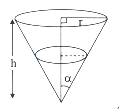
0 likesView Solution
170
MathematicsMediumMCQMHT CET · 2023
The population $P=P(t)$ at time $t$ of a certain species follows the differential equation $\frac{dP}{dt}=0.5 P-450$. If $P(0)=850$,then the time at which the population becomes zero is
A
$2 \log 18$
B
$\log 9$
C
$\frac{1}{2} \log 18$
D
$\log 18$
Solution
(A) Given the differential equation: $\frac{dP}{dt} = 0.5 P - 450 = \frac{1}{2}(P - 900)$.
Separating the variables,we get: $\frac{2 dP}{P - 900} = dt$.
Integrating both sides: $2 \int \frac{dP}{P - 900} = \int dt \Rightarrow 2 \ln |P - 900| = t + C$.
Using the initial condition $P(0) = 850$: $2 \ln |850 - 900| = 0 + C \Rightarrow C = 2 \ln 50$.
Thus,the equation is $2 \ln |P - 900| = t + 2 \ln 50$.
To find the time $t$ when the population $P$ becomes $0$:
$2 \ln |0 - 900| = t + 2 \ln 50$
$2 \ln 900 = t + 2 \ln 50$
$t = 2 \ln 900 - 2 \ln 50 = 2 \ln \left( \frac{900}{50} \right) = 2 \ln 18$.
Separating the variables,we get: $\frac{2 dP}{P - 900} = dt$.
Integrating both sides: $2 \int \frac{dP}{P - 900} = \int dt \Rightarrow 2 \ln |P - 900| = t + C$.
Using the initial condition $P(0) = 850$: $2 \ln |850 - 900| = 0 + C \Rightarrow C = 2 \ln 50$.
Thus,the equation is $2 \ln |P - 900| = t + 2 \ln 50$.
To find the time $t$ when the population $P$ becomes $0$:
$2 \ln |0 - 900| = t + 2 \ln 50$
$2 \ln 900 = t + 2 \ln 50$
$t = 2 \ln 900 - 2 \ln 50 = 2 \ln \left( \frac{900}{50} \right) = 2 \ln 18$.
0 likesView Solution
171
MathematicsDifficultMCQMHT CET · 2023
In a certain culture of bacteria,the rate of increase is proportional to the number of bacteria present at that instant. It is found that there are $10,000$ bacteria at the end of $3$ hours and $40,000$ bacteria at the end of $5$ hours. Find the number of bacteria present in the beginning.
A
$1250$
B
$1200$
C
$1350$
D
$1300$
Solution
(A) Let $x$ be the number of bacteria present at time $t$.
The rate of increase is proportional to the number of bacteria,so $\frac{dx}{dt} = kx$.
Separating variables,we get $\frac{dx}{x} = k dt$.
Integrating both sides,we get $\log x = kt + c$ ... $(i)$.
Given that at $t = 3$,$x = 10,000$,we have $\log(10,000) = 3k + c$ ... $(ii)$.
Given that at $t = 5$,$x = 40,000$,we have $\log(40,000) = 5k + c$ ... $(iii)$.
Subtracting $(ii)$ from $(iii)$,we get $\log(40,000) - \log(10,000) = 2k$,which simplifies to $\log(4) = 2k$,so $k = \log(2)$.
Substituting $k = \log(2)$ into $(ii)$,we get $\log(10,000) = 3\log(2) + c$.
Thus,$c = \log(10,000) - \log(8) = \log(\frac{10,000}{8}) = \log(1250)$.
Initially,at $t = 0$,$\log x = k(0) + c$,so $\log x = \log(1250)$.
Therefore,the initial number of bacteria is $x = 1250$.
The rate of increase is proportional to the number of bacteria,so $\frac{dx}{dt} = kx$.
Separating variables,we get $\frac{dx}{x} = k dt$.
Integrating both sides,we get $\log x = kt + c$ ... $(i)$.
Given that at $t = 3$,$x = 10,000$,we have $\log(10,000) = 3k + c$ ... $(ii)$.
Given that at $t = 5$,$x = 40,000$,we have $\log(40,000) = 5k + c$ ... $(iii)$.
Subtracting $(ii)$ from $(iii)$,we get $\log(40,000) - \log(10,000) = 2k$,which simplifies to $\log(4) = 2k$,so $k = \log(2)$.
Substituting $k = \log(2)$ into $(ii)$,we get $\log(10,000) = 3\log(2) + c$.
Thus,$c = \log(10,000) - \log(8) = \log(\frac{10,000}{8}) = \log(1250)$.
Initially,at $t = 0$,$\log x = k(0) + c$,so $\log x = \log(1250)$.
Therefore,the initial number of bacteria is $x = 1250$.
0 likesView Solution
172
MathematicsMediumMCQMHT CET · 2023
If $f(1)=1$ and $f^{\prime}(1)=3$,then the derivative of $f(f(f(x)))+(f(x))^2$ at $x=1$ is
A
$12$
B
$19$
C
$23$
D
$33$
Solution
(D) Let $y = f(f(f(x))) + (f(x))^2$.
Applying the chain rule,the derivative is:
$\frac{dy}{dx} = f^{\prime}(f(f(x))) \cdot f^{\prime}(f(x)) \cdot f^{\prime}(x) + 2f(x)f^{\prime}(x)$.
At $x = 1$,we have $f(1) = 1$ and $f^{\prime}(1) = 3$.
Substituting these values:
$f(f(1)) = f(1) = 1$.
$f(f(f(1))) = f(1) = 1$.
Therefore,$\left. \frac{dy}{dx} \right|_{x=1} = f^{\prime}(f(f(1))) \cdot f^{\prime}(f(1)) \cdot f^{\prime}(1) + 2f(1)f^{\prime}(1)$.
$= f^{\prime}(1) \cdot f^{\prime}(1) \cdot f^{\prime}(1) + 2(1)(3)$.
$= 3 \cdot 3 \cdot 3 + 6 = 27 + 6 = 33$.
Applying the chain rule,the derivative is:
$\frac{dy}{dx} = f^{\prime}(f(f(x))) \cdot f^{\prime}(f(x)) \cdot f^{\prime}(x) + 2f(x)f^{\prime}(x)$.
At $x = 1$,we have $f(1) = 1$ and $f^{\prime}(1) = 3$.
Substituting these values:
$f(f(1)) = f(1) = 1$.
$f(f(f(1))) = f(1) = 1$.
Therefore,$\left. \frac{dy}{dx} \right|_{x=1} = f^{\prime}(f(f(1))) \cdot f^{\prime}(f(1)) \cdot f^{\prime}(1) + 2f(1)f^{\prime}(1)$.
$= f^{\prime}(1) \cdot f^{\prime}(1) \cdot f^{\prime}(1) + 2(1)(3)$.
$= 3 \cdot 3 \cdot 3 + 6 = 27 + 6 = 33$.
0 likesView Solution
173
MathematicsMediumMCQMHT CET · 2023
If $y=\log_{\sin x} \tan x$,then $\left(\frac{dy}{dx}\right)_{x=\frac{\pi}{4}}$ has the value
A
$\frac{4}{\log 2}$
B
$-3 \log 2$
C
$\frac{-4}{\log 2}$
D
$3 \log 2$
Solution
(C) Given $y = \log_{\sin x} \tan x$. Using the change of base formula,we can write $y = \frac{\log \tan x}{\log \sin x}$.
Applying the quotient rule $\frac{d}{dx} \left( \frac{u}{v} \right) = \frac{v u' - u v'}{v^2}$,where $u = \log \tan x$ and $v = \log \sin x$:
$u' = \frac{1}{\tan x} \cdot \sec^2 x = \frac{\cos x}{\sin x} \cdot \frac{1}{\cos^2 x} = \frac{1}{\sin x \cos x} = 2 \csc(2x)$.
$v' = \frac{1}{\sin x} \cdot \cos x = \cot x$.
Thus,$\frac{dy}{dx} = \frac{(\log \sin x)(2 \csc 2x) - (\log \tan x)(\cot x)}{(\log \sin x)^2}$.
At $x = \frac{\pi}{4}$,$\sin x = \frac{1}{\sqrt{2}}$,$\tan x = 1$,$\log \tan x = 0$,$\csc 2x = \csc \frac{\pi}{2} = 1$,and $\cot x = 1$.
Substituting these values:
$\left(\frac{dy}{dx}\right)_{x=\frac{\pi}{4}} = \frac{(\log \frac{1}{\sqrt{2}})(2 \cdot 1) - (0)(1)}{(\log \frac{1}{\sqrt{2}})^2} = \frac{2 \log(2^{-1/2})}{(\log 2^{-1/2})^2} = \frac{2 \cdot (-\frac{1}{2} \log 2)}{(-\frac{1}{2} \log 2)^2} = \frac{-\log 2}{\frac{1}{4} (\log 2)^2} = \frac{-4}{\log 2}$.
Applying the quotient rule $\frac{d}{dx} \left( \frac{u}{v} \right) = \frac{v u' - u v'}{v^2}$,where $u = \log \tan x$ and $v = \log \sin x$:
$u' = \frac{1}{\tan x} \cdot \sec^2 x = \frac{\cos x}{\sin x} \cdot \frac{1}{\cos^2 x} = \frac{1}{\sin x \cos x} = 2 \csc(2x)$.
$v' = \frac{1}{\sin x} \cdot \cos x = \cot x$.
Thus,$\frac{dy}{dx} = \frac{(\log \sin x)(2 \csc 2x) - (\log \tan x)(\cot x)}{(\log \sin x)^2}$.
At $x = \frac{\pi}{4}$,$\sin x = \frac{1}{\sqrt{2}}$,$\tan x = 1$,$\log \tan x = 0$,$\csc 2x = \csc \frac{\pi}{2} = 1$,and $\cot x = 1$.
Substituting these values:
$\left(\frac{dy}{dx}\right)_{x=\frac{\pi}{4}} = \frac{(\log \frac{1}{\sqrt{2}})(2 \cdot 1) - (0)(1)}{(\log \frac{1}{\sqrt{2}})^2} = \frac{2 \log(2^{-1/2})}{(\log 2^{-1/2})^2} = \frac{2 \cdot (-\frac{1}{2} \log 2)}{(-\frac{1}{2} \log 2)^2} = \frac{-\log 2}{\frac{1}{4} (\log 2)^2} = \frac{-4}{\log 2}$.
0 likesView Solution
174
MathematicsEasyMCQMHT CET · 2023
If $y = [(x+1)(2x+1)(3x+1) \ldots (nx+1)]^{\frac{3}{2}}$,then $\frac{dy}{dx}$ at $x=0$ is
A
$\frac{3n(n+1)}{4}$
B
$\frac{n(n+1)}{2}$
C
$\frac{3n(n+1)}{2}$
D
$\frac{n(n+1)}{4}$
Solution
(A) $y = [(x+1)(2x+1)(3x+1) \ldots (nx+1)]^{\frac{3}{2}}$
Taking $\log$ on both sides,we get
$\log y = \frac{3}{2} [\log(x+1) + \log(2x+1) + \log(3x+1) + \ldots + \log(nx+1)]$
Differentiating with respect to $x$,we get
$\frac{1}{y} \frac{dy}{dx} = \frac{3}{2} \left[ \frac{1}{x+1} + \frac{2}{2x+1} + \frac{3}{3x+1} + \ldots + \frac{n}{nx+1} \right]$
$\therefore \frac{dy}{dx} = \frac{3y}{2} \left[ \frac{1}{x+1} + \frac{2}{2x+1} + \frac{3}{3x+1} + \ldots + \frac{n}{nx+1} \right]$
Now at $x=0$,$y = [(1)(1)(1) \ldots (1)]^{\frac{3}{2}} = 1$
$\left. \frac{dy}{dx} \right|_{x=0} = \frac{3(1)}{2} \left[ \frac{1}{0+1} + \frac{2}{0+1} + \frac{3}{0+1} + \ldots + \frac{n}{0+1} \right]$
$= \frac{3}{2} (1 + 2 + 3 + \ldots + n)$
$= \frac{3}{2} \times \frac{n(n+1)}{2}$
$= \frac{3n(n+1)}{4}$
Taking $\log$ on both sides,we get
$\log y = \frac{3}{2} [\log(x+1) + \log(2x+1) + \log(3x+1) + \ldots + \log(nx+1)]$
Differentiating with respect to $x$,we get
$\frac{1}{y} \frac{dy}{dx} = \frac{3}{2} \left[ \frac{1}{x+1} + \frac{2}{2x+1} + \frac{3}{3x+1} + \ldots + \frac{n}{nx+1} \right]$
$\therefore \frac{dy}{dx} = \frac{3y}{2} \left[ \frac{1}{x+1} + \frac{2}{2x+1} + \frac{3}{3x+1} + \ldots + \frac{n}{nx+1} \right]$
Now at $x=0$,$y = [(1)(1)(1) \ldots (1)]^{\frac{3}{2}} = 1$
$\left. \frac{dy}{dx} \right|_{x=0} = \frac{3(1)}{2} \left[ \frac{1}{0+1} + \frac{2}{0+1} + \frac{3}{0+1} + \ldots + \frac{n}{0+1} \right]$
$= \frac{3}{2} (1 + 2 + 3 + \ldots + n)$
$= \frac{3}{2} \times \frac{n(n+1)}{2}$
$= \frac{3n(n+1)}{4}$
0 likesView Solution
175
MathematicsMediumMCQMHT CET · 2023
If $y=(1+x)(1+x^2)(1+x^4) \dots (1+x^{2n})$,then the value of $\frac{dy}{dx}$ at $x=0$ is
A
$0$
B
-$1$
C
$1$
D
$2$
Solution
(C) Given $y=(1+x)(1+x^2)(1+x^4) \dots (1+x^{2n})$.
Taking $\log$ on both sides,we get $\log y = \log(1+x) + \log(1+x^2) + \log(1+x^4) + \dots + \log(1+x^{2n})$.
Differentiating both sides with respect to $x$,we get $\frac{1}{y} \frac{dy}{dx} = \frac{1}{1+x} + \frac{2x}{1+x^2} + \frac{4x^3}{1+x^4} + \dots + \frac{2n \cdot x^{2n-1}}{1+x^{2n}}$.
At $x=0$,the value of $y = (1+0)(1+0) \dots (1+0) = 1$.
Substituting $x=0$ and $y=1$ in the derivative equation,we get $\frac{1}{1} \left. \frac{dy}{dx} \right|_{x=0} = \frac{1}{1+0} + 0 + 0 + \dots + 0$.
Therefore,$\left. \frac{dy}{dx} \right|_{x=0} = 1$.
Taking $\log$ on both sides,we get $\log y = \log(1+x) + \log(1+x^2) + \log(1+x^4) + \dots + \log(1+x^{2n})$.
Differentiating both sides with respect to $x$,we get $\frac{1}{y} \frac{dy}{dx} = \frac{1}{1+x} + \frac{2x}{1+x^2} + \frac{4x^3}{1+x^4} + \dots + \frac{2n \cdot x^{2n-1}}{1+x^{2n}}$.
At $x=0$,the value of $y = (1+0)(1+0) \dots (1+0) = 1$.
Substituting $x=0$ and $y=1$ in the derivative equation,we get $\frac{1}{1} \left. \frac{dy}{dx} \right|_{x=0} = \frac{1}{1+0} + 0 + 0 + \dots + 0$.
Therefore,$\left. \frac{dy}{dx} \right|_{x=0} = 1$.
0 likesView Solution
176
MathematicsMediumMCQMHT CET · 2023
If $\tan y = \frac{x \sin \alpha}{1-x \cos \alpha}$ and $\frac{dy}{dx} = \frac{m}{x^2+2nx+1}$,then $m^2+n^2$ is
A
$2$
B
$3$
C
$1$
D
$4$
Solution
(C) Given $\tan y = \frac{x \sin \alpha}{1-x \cos \alpha}$.
Taking the derivative with respect to $x$ on both sides:
$\frac{d}{dx}(\tan y) = \frac{d}{dx}\left(\frac{x \sin \alpha}{1-x \cos \alpha}\right)$
$\sec^2 y \cdot \frac{dy}{dx} = \frac{(1-x \cos \alpha)(\sin \alpha) - (x \sin \alpha)(-\cos \alpha)}{(1-x \cos \alpha)^2}$
$\sec^2 y \cdot \frac{dy}{dx} = \frac{\sin \alpha - x \sin \alpha \cos \alpha + x \sin \alpha \cos \alpha}{(1-x \cos \alpha)^2} = \frac{\sin \alpha}{(1-x \cos \alpha)^2}$
Since $\tan y = \frac{x \sin \alpha}{1-x \cos \alpha}$,we have $\sec^2 y = 1 + \tan^2 y = 1 + \frac{x^2 \sin^2 \alpha}{(1-x \cos \alpha)^2} = \frac{(1-x \cos \alpha)^2 + x^2 \sin^2 \alpha}{(1-x \cos \alpha)^2} = \frac{1 - 2x \cos \alpha + x^2 \cos^2 \alpha + x^2 \sin^2 \alpha}{(1-x \cos \alpha)^2} = \frac{1 - 2x \cos \alpha + x^2}{(1-x \cos \alpha)^2}$.
Substituting this back:
$\frac{1 - 2x \cos \alpha + x^2}{(1-x \cos \alpha)^2} \cdot \frac{dy}{dx} = \frac{\sin \alpha}{(1-x \cos \alpha)^2}$
$\frac{dy}{dx} = \frac{\sin \alpha}{x^2 - 2x \cos \alpha + 1}$.
Comparing this with $\frac{dy}{dx} = \frac{m}{x^2+2nx+1}$,we get $m = \sin \alpha$ and $n = -\cos \alpha$.
Therefore,$m^2 + n^2 = \sin^2 \alpha + (-\cos \alpha)^2 = \sin^2 \alpha + \cos^2 \alpha = 1$.
Taking the derivative with respect to $x$ on both sides:
$\frac{d}{dx}(\tan y) = \frac{d}{dx}\left(\frac{x \sin \alpha}{1-x \cos \alpha}\right)$
$\sec^2 y \cdot \frac{dy}{dx} = \frac{(1-x \cos \alpha)(\sin \alpha) - (x \sin \alpha)(-\cos \alpha)}{(1-x \cos \alpha)^2}$
$\sec^2 y \cdot \frac{dy}{dx} = \frac{\sin \alpha - x \sin \alpha \cos \alpha + x \sin \alpha \cos \alpha}{(1-x \cos \alpha)^2} = \frac{\sin \alpha}{(1-x \cos \alpha)^2}$
Since $\tan y = \frac{x \sin \alpha}{1-x \cos \alpha}$,we have $\sec^2 y = 1 + \tan^2 y = 1 + \frac{x^2 \sin^2 \alpha}{(1-x \cos \alpha)^2} = \frac{(1-x \cos \alpha)^2 + x^2 \sin^2 \alpha}{(1-x \cos \alpha)^2} = \frac{1 - 2x \cos \alpha + x^2 \cos^2 \alpha + x^2 \sin^2 \alpha}{(1-x \cos \alpha)^2} = \frac{1 - 2x \cos \alpha + x^2}{(1-x \cos \alpha)^2}$.
Substituting this back:
$\frac{1 - 2x \cos \alpha + x^2}{(1-x \cos \alpha)^2} \cdot \frac{dy}{dx} = \frac{\sin \alpha}{(1-x \cos \alpha)^2}$
$\frac{dy}{dx} = \frac{\sin \alpha}{x^2 - 2x \cos \alpha + 1}$.
Comparing this with $\frac{dy}{dx} = \frac{m}{x^2+2nx+1}$,we get $m = \sin \alpha$ and $n = -\cos \alpha$.
Therefore,$m^2 + n^2 = \sin^2 \alpha + (-\cos \alpha)^2 = \sin^2 \alpha + \cos^2 \alpha = 1$.
0 likesView Solution
177
MathematicsDifficultMCQMHT CET · 2023
$y=\frac{\sqrt[3]{1+3 x} \sqrt[4]{1+4 x} \sqrt[5]{1+5 x}}{\sqrt[7]{1+7 x} \sqrt[8]{1+8 x}}$. Then $\frac{d y}{d x}$ at $x=0$ is
A
$3$
B
$-1$
C
$1$
D
$2$
Solution
(C) Given $y=\frac{\sqrt[3]{1+3 x} \sqrt[4]{1+4 x} \sqrt[5]{1+5 x}}{\sqrt[7]{1+7 x} \sqrt[8]{1+8 x}}$.
Taking logarithm on both sides:
$\log y = \frac{1}{3} \log (1+3 x) + \frac{1}{4} \log (1+4 x) + \frac{1}{5} \log (1+5 x) - \frac{1}{7} \log (1+7 x) - \frac{1}{8} \log (1+8 x)$.
Differentiating both sides with respect to $x$:
$\frac{1}{y} \frac{d y}{d x} = \frac{1}{3} \cdot \frac{3}{1+3 x} + \frac{1}{4} \cdot \frac{4}{1+4 x} + \frac{1}{5} \cdot \frac{5}{1+5 x} - \frac{1}{7} \cdot \frac{7}{1+7 x} - \frac{1}{8} \cdot \frac{8}{1+8 x}$.
$\frac{1}{y} \frac{d y}{d x} = \frac{1}{1+3 x} + \frac{1}{1+4 x} + \frac{1}{1+5 x} - \frac{1}{1+7 x} - \frac{1}{1+8 x}$.
At $x=0$,$y = \frac{\sqrt[3]{1} \sqrt[4]{1} \sqrt[5]{1}}{\sqrt[7]{1} \sqrt[8]{1}} = 1$.
Substituting $x=0$ and $y=1$ into the derivative equation:
$\frac{1}{1} \left(\frac{d y}{d x}\right)_{x=0} = \frac{1}{1+0} + \frac{1}{1+0} + \frac{1}{1+0} - \frac{1}{1+0} - \frac{1}{1+0} = 1 + 1 + 1 - 1 - 1 = 1$.
Thus,$\left(\frac{d y}{d x}\right)_{x=0} = 1$.
Taking logarithm on both sides:
$\log y = \frac{1}{3} \log (1+3 x) + \frac{1}{4} \log (1+4 x) + \frac{1}{5} \log (1+5 x) - \frac{1}{7} \log (1+7 x) - \frac{1}{8} \log (1+8 x)$.
Differentiating both sides with respect to $x$:
$\frac{1}{y} \frac{d y}{d x} = \frac{1}{3} \cdot \frac{3}{1+3 x} + \frac{1}{4} \cdot \frac{4}{1+4 x} + \frac{1}{5} \cdot \frac{5}{1+5 x} - \frac{1}{7} \cdot \frac{7}{1+7 x} - \frac{1}{8} \cdot \frac{8}{1+8 x}$.
$\frac{1}{y} \frac{d y}{d x} = \frac{1}{1+3 x} + \frac{1}{1+4 x} + \frac{1}{1+5 x} - \frac{1}{1+7 x} - \frac{1}{1+8 x}$.
At $x=0$,$y = \frac{\sqrt[3]{1} \sqrt[4]{1} \sqrt[5]{1}}{\sqrt[7]{1} \sqrt[8]{1}} = 1$.
Substituting $x=0$ and $y=1$ into the derivative equation:
$\frac{1}{1} \left(\frac{d y}{d x}\right)_{x=0} = \frac{1}{1+0} + \frac{1}{1+0} + \frac{1}{1+0} - \frac{1}{1+0} - \frac{1}{1+0} = 1 + 1 + 1 - 1 - 1 = 1$.
Thus,$\left(\frac{d y}{d x}\right)_{x=0} = 1$.
0 likesView Solution
178
MathematicsMediumMCQMHT CET · 2023
If $y = [(x+1)(2x+1)(3x+1) \ldots (nx+1)]^n$,then $\frac{dy}{dx}$ at $x=0$ is
A
$\frac{n(n+1)}{2}$
B
$\frac{n^2(n+1)}{2}$
C
$\frac{n(n+1)}{4}$
D
$\frac{n^2(n-1)}{2}$
Solution
(B) Given $y = [(x+1)(2x+1)(3x+1) \ldots (nx+1)]^n$.
Taking the natural logarithm on both sides:
$\log y = n [\log(x+1) + \log(2x+1) + \log(3x+1) + \ldots + \log(nx+1)]$.
Differentiating both sides with respect to $x$:
$\frac{1}{y} \frac{dy}{dx} = n \left[ \frac{1}{x+1} + \frac{2}{2x+1} + \frac{3}{3x+1} + \ldots + \frac{n}{nx+1} \right]$.
At $x=0$,$y = [(1)(1)(1) \ldots (1)]^n = 1^n = 1$.
Substituting $x=0$ and $y=1$ into the derivative expression:
$\frac{1}{1} \left( \frac{dy}{dx} \right)_{x=0} = n [1 + 2 + 3 + \ldots + n]$.
Using the sum formula $\sum_{k=1}^n k = \frac{n(n+1)}{2}$:
$\left( \frac{dy}{dx} \right)_{x=0} = n \left[ \frac{n(n+1)}{2} \right] = \frac{n^2(n+1)}{2}$.
Taking the natural logarithm on both sides:
$\log y = n [\log(x+1) + \log(2x+1) + \log(3x+1) + \ldots + \log(nx+1)]$.
Differentiating both sides with respect to $x$:
$\frac{1}{y} \frac{dy}{dx} = n \left[ \frac{1}{x+1} + \frac{2}{2x+1} + \frac{3}{3x+1} + \ldots + \frac{n}{nx+1} \right]$.
At $x=0$,$y = [(1)(1)(1) \ldots (1)]^n = 1^n = 1$.
Substituting $x=0$ and $y=1$ into the derivative expression:
$\frac{1}{1} \left( \frac{dy}{dx} \right)_{x=0} = n [1 + 2 + 3 + \ldots + n]$.
Using the sum formula $\sum_{k=1}^n k = \frac{n(n+1)}{2}$:
$\left( \frac{dy}{dx} \right)_{x=0} = n \left[ \frac{n(n+1)}{2} \right] = \frac{n^2(n+1)}{2}$.
0 likesView Solution
179
MathematicsEasyMCQMHT CET · 2023
If $y=\sqrt{(x-\sin x)+\sqrt{(x-\sin x)+\sqrt{(x-\sin x) \ldots}}}$,then $\frac{dy}{dx}=$
A
$\frac{1-\cos x}{2y-1}$
B
$\frac{1+\cos x}{2y-1}$
C
$\frac{1-\cos x}{2y+1}$
D
$\frac{1-\sin x}{2y-1}$
Solution
(A) Given the expression $y=\sqrt{(x-\sin x)+\sqrt{(x-\sin x)+\sqrt{(x-\sin x)+\ldots}}}$.
We can rewrite this as $y=\sqrt{(x-\sin x)+y}$.
Squaring both sides,we get $y^2 = x - \sin x + y$.
Differentiating both sides with respect to $x$,we get $2y \frac{dy}{dx} = 1 - \cos x + \frac{dy}{dx}$.
Rearranging the terms to solve for $\frac{dy}{dx}$,we have $2y \frac{dy}{dx} - \frac{dy}{dx} = 1 - \cos x$.
Factoring out $\frac{dy}{dx}$,we get $\frac{dy}{dx}(2y-1) = 1 - \cos x$.
Therefore,$\frac{dy}{dx} = \frac{1-\cos x}{2y-1}$.
We can rewrite this as $y=\sqrt{(x-\sin x)+y}$.
Squaring both sides,we get $y^2 = x - \sin x + y$.
Differentiating both sides with respect to $x$,we get $2y \frac{dy}{dx} = 1 - \cos x + \frac{dy}{dx}$.
Rearranging the terms to solve for $\frac{dy}{dx}$,we have $2y \frac{dy}{dx} - \frac{dy}{dx} = 1 - \cos x$.
Factoring out $\frac{dy}{dx}$,we get $\frac{dy}{dx}(2y-1) = 1 - \cos x$.
Therefore,$\frac{dy}{dx} = \frac{1-\cos x}{2y-1}$.
0 likesView Solution
180
MathematicsMediumMCQMHT CET · 2023
If $f^{\prime}(x)=\sin (\log x)$ and $y=f\left(\frac{2 x+3}{3-2 x}\right)$,then $\frac{d y}{d x}$ at $x=1$ is
A
$6 \sin (\log 5)$
B
$5 \sin (\log 6)$
C
$12 \sin (\log 5)$
D
$5 \sin (\log 12)$
Solution
(C) Given $y=f\left(\frac{2 x+3}{3-2 x}\right)$.
Applying the chain rule,we have $\frac{d y}{d x}=f^{\prime}\left(\frac{2 x+3}{3-2 x}\right) \cdot \frac{d}{d x}\left(\frac{2 x+3}{3-2 x}\right)$.
Using the quotient rule for $\frac{d}{d x}\left(\frac{2 x+3}{3-2 x}\right)$:
$\frac{d}{d x}\left(\frac{2 x+3}{3-2 x}\right) = \frac{(3-2 x)(2) - (2 x+3)(-2)}{(3-2 x)^2} = \frac{6-4 x+4 x+6}{(3-2 x)^2} = \frac{12}{(3-2 x)^2}$.
Since $f^{\prime}(x)=\sin (\log x)$,then $f^{\prime}\left(\frac{2 x+3}{3-2 x}\right) = \sin \left(\log \left(\frac{2 x+3}{3-2 x}\right)\right)$.
Thus,$\frac{d y}{d x} = \sin \left(\log \left(\frac{2 x+3}{3-2 x}\right)\right) \cdot \frac{12}{(3-2 x)^2}$.
At $x=1$,the argument of the function is $\frac{2(1)+3}{3-2(1)} = \frac{5}{1} = 5$.
The derivative at $x=1$ is $\sin (\log 5) \cdot \frac{12}{(3-2)^2} = 12 \sin (\log 5)$.
Applying the chain rule,we have $\frac{d y}{d x}=f^{\prime}\left(\frac{2 x+3}{3-2 x}\right) \cdot \frac{d}{d x}\left(\frac{2 x+3}{3-2 x}\right)$.
Using the quotient rule for $\frac{d}{d x}\left(\frac{2 x+3}{3-2 x}\right)$:
$\frac{d}{d x}\left(\frac{2 x+3}{3-2 x}\right) = \frac{(3-2 x)(2) - (2 x+3)(-2)}{(3-2 x)^2} = \frac{6-4 x+4 x+6}{(3-2 x)^2} = \frac{12}{(3-2 x)^2}$.
Since $f^{\prime}(x)=\sin (\log x)$,then $f^{\prime}\left(\frac{2 x+3}{3-2 x}\right) = \sin \left(\log \left(\frac{2 x+3}{3-2 x}\right)\right)$.
Thus,$\frac{d y}{d x} = \sin \left(\log \left(\frac{2 x+3}{3-2 x}\right)\right) \cdot \frac{12}{(3-2 x)^2}$.
At $x=1$,the argument of the function is $\frac{2(1)+3}{3-2(1)} = \frac{5}{1} = 5$.
The derivative at $x=1$ is $\sin (\log 5) \cdot \frac{12}{(3-2)^2} = 12 \sin (\log 5)$.
0 likesView Solution
181
MathematicsMediumMCQMHT CET · 2023
If $y$ is a function of $x$ and $\log(x+y)=2xy$,then $\frac{dy}{dx}$ at $x=0$ is
A
$0$
B
$-1$
C
$1$
D
$2$
Solution
(C) Given equation: $\log(x+y)=2xy$ ... $(i)$
At $x=0$,$\log(0+y)=2(0)y$,which implies $\log(y)=0$,so $y=e^0=1$.
Differentiating both sides of $(i)$ with respect to $x$:
$\frac{1}{x+y} \left(1 + \frac{dy}{dx}\right) = 2y + 2x \frac{dy}{dx}$
Substitute $x=0$ and $y=1$ into the differentiated equation:
$\frac{1}{0+1} \left(1 + \frac{dy}{dx}\right) = 2(1) + 2(0) \frac{dy}{dx}$
$1 + \frac{dy}{dx} = 2$
$\frac{dy}{dx} = 2 - 1 = 1$
Thus,the value of $\frac{dy}{dx}$ at $x=0$ is $1$.
At $x=0$,$\log(0+y)=2(0)y$,which implies $\log(y)=0$,so $y=e^0=1$.
Differentiating both sides of $(i)$ with respect to $x$:
$\frac{1}{x+y} \left(1 + \frac{dy}{dx}\right) = 2y + 2x \frac{dy}{dx}$
Substitute $x=0$ and $y=1$ into the differentiated equation:
$\frac{1}{0+1} \left(1 + \frac{dy}{dx}\right) = 2(1) + 2(0) \frac{dy}{dx}$
$1 + \frac{dy}{dx} = 2$
$\frac{dy}{dx} = 2 - 1 = 1$
Thus,the value of $\frac{dy}{dx}$ at $x=0$ is $1$.
0 likesView Solution
182
MathematicsMediumMCQMHT CET · 2023
For $x > 1$,if $(2x)^{2y} = 4e^{2x-2y}$,then $\left(1 + \log_e 2x\right)^2 \frac{dy}{dx}$ is equal to
A
$\frac{x \log_e 2x + \log_e 2}{x}$
B
$\frac{x \log_e 2x - \log_e 2}{x}$
C
$x \log_e 2x + \frac{\log_e 2}{x}$
D
$x \log_e 2x - \frac{\log_e 2}{2}$
Solution
(B) Given the equation: $(2x)^{2y} = 4e^{2x-2y}$.
Taking the natural logarithm $(\log_e)$ on both sides:
$2y \log_e(2x) = \log_e 4 + (2x - 2y) \log_e e$
Since $\log_e 4 = 2 \log_e 2$ and $\log_e e = 1$,we have:
$2y \log_e(2x) = 2 \log_e 2 + 2x - 2y$
Dividing by $2$:
$y \log_e(2x) = \log_e 2 + x - y$
Rearranging to solve for $y$:
$y(1 + \log_e 2x) = x + \log_e 2$
$y = \frac{x + \log_e 2}{1 + \log_e 2x} \quad \dots(i)$
Differentiating both sides with respect to $x$:
$\frac{dy}{dx} (1 + \log_e 2x) + y \left( \frac{1}{2x} \cdot 2 \right) = 1 - \frac{dy}{dx}$
$\frac{dy}{dx} (1 + \log_e 2x) + \frac{y}{x} = 1 - \frac{dy}{dx}$
$\frac{dy}{dx} (1 + \log_e 2x + 1) = 1 - \frac{y}{x}$
$\frac{dy}{dx} (2 + \log_e 2x) = \frac{x - y}{x}$
Wait,let us re-evaluate the derivative step:
From $y(1 + \log_e 2x) = x + \log_e 2$,differentiate:
$\frac{dy}{dx} (1 + \log_e 2x) + y \left( \frac{1}{x} \right) = 1$
$\frac{dy}{dx} (1 + \log_e 2x) = 1 - \frac{y}{x} = \frac{x - y}{x}$
Substitute $y$ from $(i)$:
$\frac{dy}{dx} (1 + \log_e 2x) = \frac{x - \frac{x + \log_e 2}{1 + \log_e 2x}}{x} = \frac{x(1 + \log_e 2x) - (x + \log_e 2)}{x(1 + \log_e 2x)}$
$= \frac{x + x \log_e 2x - x - \log_e 2}{x(1 + \log_e 2x)} = \frac{x \log_e 2x - \log_e 2}{x(1 + \log_e 2x)}$
Multiplying both sides by $(1 + \log_e 2x)$:
$(1 + \log_e 2x)^2 \frac{dy}{dx} = \frac{x \log_e 2x - \log_e 2}{x}$
Taking the natural logarithm $(\log_e)$ on both sides:
$2y \log_e(2x) = \log_e 4 + (2x - 2y) \log_e e$
Since $\log_e 4 = 2 \log_e 2$ and $\log_e e = 1$,we have:
$2y \log_e(2x) = 2 \log_e 2 + 2x - 2y$
Dividing by $2$:
$y \log_e(2x) = \log_e 2 + x - y$
Rearranging to solve for $y$:
$y(1 + \log_e 2x) = x + \log_e 2$
$y = \frac{x + \log_e 2}{1 + \log_e 2x} \quad \dots(i)$
Differentiating both sides with respect to $x$:
$\frac{dy}{dx} (1 + \log_e 2x) + y \left( \frac{1}{2x} \cdot 2 \right) = 1 - \frac{dy}{dx}$
$\frac{dy}{dx} (1 + \log_e 2x) + \frac{y}{x} = 1 - \frac{dy}{dx}$
$\frac{dy}{dx} (1 + \log_e 2x + 1) = 1 - \frac{y}{x}$
$\frac{dy}{dx} (2 + \log_e 2x) = \frac{x - y}{x}$
Wait,let us re-evaluate the derivative step:
From $y(1 + \log_e 2x) = x + \log_e 2$,differentiate:
$\frac{dy}{dx} (1 + \log_e 2x) + y \left( \frac{1}{x} \right) = 1$
$\frac{dy}{dx} (1 + \log_e 2x) = 1 - \frac{y}{x} = \frac{x - y}{x}$
Substitute $y$ from $(i)$:
$\frac{dy}{dx} (1 + \log_e 2x) = \frac{x - \frac{x + \log_e 2}{1 + \log_e 2x}}{x} = \frac{x(1 + \log_e 2x) - (x + \log_e 2)}{x(1 + \log_e 2x)}$
$= \frac{x + x \log_e 2x - x - \log_e 2}{x(1 + \log_e 2x)} = \frac{x \log_e 2x - \log_e 2}{x(1 + \log_e 2x)}$
Multiplying both sides by $(1 + \log_e 2x)$:
$(1 + \log_e 2x)^2 \frac{dy}{dx} = \frac{x \log_e 2x - \log_e 2}{x}$
0 likesView Solution
183
MathematicsMediumMCQMHT CET · 2023
If $x^2+y^2=t+\frac{1}{t}$ and $x^4+y^4=t^2+\frac{1}{t^2}$,then $\frac{dy}{dx}$ is equal to
A
$\frac{y}{x}$
B
$\frac{-y}{x}$
C
$\frac{x}{y}$
D
$\frac{-x}{y}$
Solution
(B) Given: $x^2+y^2=t+\frac{1}{t}$ and $x^4+y^4=t^2+\frac{1}{t^2}$.
Squaring the first equation on both sides,we get:
$(x^2+y^2)^2 = (t+\frac{1}{t})^2$
$x^4+y^4+2x^2y^2 = t^2+\frac{1}{t^2}+2$.
Since $x^4+y^4=t^2+\frac{1}{t^2}$,we substitute this into the equation:
$(t^2+\frac{1}{t^2})+2x^2y^2 = t^2+\frac{1}{t^2}+2$.
This simplifies to $2x^2y^2 = 2$,which implies $x^2y^2 = 1$.
Differentiating both sides with respect to $x$:
$\frac{d}{dx}(x^2y^2) = \frac{d}{dx}(1)$
$x^2(2y\frac{dy}{dx}) + y^2(2x) = 0$.
$2x^2y\frac{dy}{dx} = -2xy^2$.
$\frac{dy}{dx} = \frac{-2xy^2}{2x^2y} = \frac{-y}{x}$.
Squaring the first equation on both sides,we get:
$(x^2+y^2)^2 = (t+\frac{1}{t})^2$
$x^4+y^4+2x^2y^2 = t^2+\frac{1}{t^2}+2$.
Since $x^4+y^4=t^2+\frac{1}{t^2}$,we substitute this into the equation:
$(t^2+\frac{1}{t^2})+2x^2y^2 = t^2+\frac{1}{t^2}+2$.
This simplifies to $2x^2y^2 = 2$,which implies $x^2y^2 = 1$.
Differentiating both sides with respect to $x$:
$\frac{d}{dx}(x^2y^2) = \frac{d}{dx}(1)$
$x^2(2y\frac{dy}{dx}) + y^2(2x) = 0$.
$2x^2y\frac{dy}{dx} = -2xy^2$.
$\frac{dy}{dx} = \frac{-2xy^2}{2x^2y} = \frac{-y}{x}$.
0 likesView Solution
184
MathematicsEasyMCQMHT CET · 2023
If $y$ is a function of $x$ and $\log (x+y)=2xy$,then the value of $y^{\prime}(0)$ is
A
$1$
B
$-1$
C
$2$
D
$0$
Solution
(A) Given the equation: $\log (x+y)=2xy \quad ...(i)$
Differentiating both sides with respect to $x$ using the chain rule and product rule:
$\frac{1}{x+y} \cdot (1 + y^{\prime}) = 2(x y^{\prime} + y)$
Rearranging to solve for $y^{\prime}$:
$1 + y^{\prime} = 2(x+y)(x y^{\prime} + y)$
$1 + y^{\prime} = 2x^2 y^{\prime} + 2xy + 2xy y^{\prime} + 2y^2$
$y^{\prime}(1 - 2x^2 - 2xy) = 2xy + 2y^2 - 1$
$y^{\prime} = \frac{2xy + 2y^2 - 1}{1 - 2x^2 - 2xy}$
Now,find the value of $y$ when $x=0$ from equation $(i)$:
$\log(0+y) = 2(0)y$
$\log(y) = 0$
$y = e^0 = 1$
Substitute $x=0$ and $y=1$ into the expression for $y^{\prime}$:
$y^{\prime}(0) = \frac{2(0)(1) + 2(1)^2 - 1}{1 - 2(0)^2 - 2(0)(1)}$
$y^{\prime}(0) = \frac{0 + 2 - 1}{1 - 0 - 0} = \frac{1}{1} = 1$
Differentiating both sides with respect to $x$ using the chain rule and product rule:
$\frac{1}{x+y} \cdot (1 + y^{\prime}) = 2(x y^{\prime} + y)$
Rearranging to solve for $y^{\prime}$:
$1 + y^{\prime} = 2(x+y)(x y^{\prime} + y)$
$1 + y^{\prime} = 2x^2 y^{\prime} + 2xy + 2xy y^{\prime} + 2y^2$
$y^{\prime}(1 - 2x^2 - 2xy) = 2xy + 2y^2 - 1$
$y^{\prime} = \frac{2xy + 2y^2 - 1}{1 - 2x^2 - 2xy}$
Now,find the value of $y$ when $x=0$ from equation $(i)$:
$\log(0+y) = 2(0)y$
$\log(y) = 0$
$y = e^0 = 1$
Substitute $x=0$ and $y=1$ into the expression for $y^{\prime}$:
$y^{\prime}(0) = \frac{2(0)(1) + 2(1)^2 - 1}{1 - 2(0)^2 - 2(0)(1)}$
$y^{\prime}(0) = \frac{0 + 2 - 1}{1 - 0 - 0} = \frac{1}{1} = 1$
0 likesView Solution
185
MathematicsEasyMCQMHT CET · 2023
If $f(x)=3^x$ and $g(x)=4^x$,then $\frac{f^{\prime}(0)-g^{\prime}(0)}{1+f^{\prime}(0) g^{\prime}(0)}$ is
A
$\frac{\log \left(\frac{3}{4}\right)}{1+(\log 3)(\log 4)}$
B
$\frac{\log \left(\frac{3}{4}\right)}{1+\log 12}$
C
$\frac{\log 12}{1+\log 12}$
D
$\frac{\log \left(\frac{3}{4}\right)}{1-\log 12}$
Solution
(A) Given $f(x) = 3^x$,the derivative is $f^{\prime}(x) = 3^x \log 3$. Evaluating at $x = 0$,we get $f^{\prime}(0) = 3^0 \log 3 = \log 3$.
Given $g(x) = 4^x$,the derivative is $g^{\prime}(x) = 4^x \log 4$. Evaluating at $x = 0$,we get $g^{\prime}(0) = 4^0 \log 4 = \log 4$.
Substituting these values into the expression,we have $\frac{f^{\prime}(0)-g^{\prime}(0)}{1+f^{\prime}(0) g^{\prime}(0)} = \frac{\log 3 - \log 4}{1 + (\log 3)(\log 4)}$.
Using the logarithmic property $\log a - \log b = \log \left(\frac{a}{b}\right)$,the numerator becomes $\log \left(\frac{3}{4}\right)$.
Thus,the expression is $\frac{\log \left(\frac{3}{4}\right)}{1 + (\log 3)(\log 4)}$.
Given $g(x) = 4^x$,the derivative is $g^{\prime}(x) = 4^x \log 4$. Evaluating at $x = 0$,we get $g^{\prime}(0) = 4^0 \log 4 = \log 4$.
Substituting these values into the expression,we have $\frac{f^{\prime}(0)-g^{\prime}(0)}{1+f^{\prime}(0) g^{\prime}(0)} = \frac{\log 3 - \log 4}{1 + (\log 3)(\log 4)}$.
Using the logarithmic property $\log a - \log b = \log \left(\frac{a}{b}\right)$,the numerator becomes $\log \left(\frac{3}{4}\right)$.
Thus,the expression is $\frac{\log \left(\frac{3}{4}\right)}{1 + (\log 3)(\log 4)}$.
0 likesView Solution
186
MathematicsEasyMCQMHT CET · 2023
The derivative of $f(\sec x)$ with respect to $g(\tan x)$ at $x=\frac{\pi}{4}$,where $f^{\prime}(\sqrt{2})=4$ and $g^{\prime}(1)=2$,is
A
$2$
B
$\frac{1}{\sqrt{2}}$
C
$\sqrt{2}$
D
$\frac{1}{2\sqrt{2}}$
Solution
(C) Let $y = f(\sec x)$ and $z = g(\tan x)$.
Using the chain rule,we find the derivatives with respect to $x$:
$\frac{dy}{dx} = f^{\prime}(\sec x) \cdot \sec x \tan x$
$\frac{dz}{dx} = g^{\prime}(\tan x) \cdot \sec^2 x$
Now,the derivative of $y$ with respect to $z$ is given by:
$\frac{dy}{dz} = \frac{dy/dx}{dz/dx} = \frac{f^{\prime}(\sec x) \cdot \sec x \tan x}{g^{\prime}(\tan x) \cdot \sec^2 x} = \frac{f^{\prime}(\sec x) \tan x}{g^{\prime}(\tan x) \sec x}$
At $x = \frac{\pi}{4}$,we have $\sec(\frac{\pi}{4}) = \sqrt{2}$ and $\tan(\frac{\pi}{4}) = 1$.
Substituting these values:
$\left. \frac{dy}{dz} \right|_{x=\frac{\pi}{4}} = \frac{f^{\prime}(\sqrt{2}) \cdot 1}{g^{\prime}(1) \cdot \sqrt{2}} = \frac{4 \cdot 1}{2 \cdot \sqrt{2}} = \frac{2}{\sqrt{2}} = \sqrt{2}$.
Using the chain rule,we find the derivatives with respect to $x$:
$\frac{dy}{dx} = f^{\prime}(\sec x) \cdot \sec x \tan x$
$\frac{dz}{dx} = g^{\prime}(\tan x) \cdot \sec^2 x$
Now,the derivative of $y$ with respect to $z$ is given by:
$\frac{dy}{dz} = \frac{dy/dx}{dz/dx} = \frac{f^{\prime}(\sec x) \cdot \sec x \tan x}{g^{\prime}(\tan x) \cdot \sec^2 x} = \frac{f^{\prime}(\sec x) \tan x}{g^{\prime}(\tan x) \sec x}$
At $x = \frac{\pi}{4}$,we have $\sec(\frac{\pi}{4}) = \sqrt{2}$ and $\tan(\frac{\pi}{4}) = 1$.
Substituting these values:
$\left. \frac{dy}{dz} \right|_{x=\frac{\pi}{4}} = \frac{f^{\prime}(\sqrt{2}) \cdot 1}{g^{\prime}(1) \cdot \sqrt{2}} = \frac{4 \cdot 1}{2 \cdot \sqrt{2}} = \frac{2}{\sqrt{2}} = \sqrt{2}$.
0 likesView Solution
187
MathematicsEasyMCQMHT CET · 2023
The rate of change of $\sqrt{x^2+16}$ with respect to $\frac{x}{x-1}$ at $x=5$ is
A
$\frac{-80}{\sqrt{41}}$
B
$\frac{80}{\sqrt{41}}$
C
$\frac{12}{5}$
D
$\frac{-12}{5}$
Solution
(A) Let $y = \sqrt{x^2+16}$.
Then,$\frac{dy}{dx} = \frac{1}{2\sqrt{x^2+16}} \cdot (2x) = \frac{x}{\sqrt{x^2+16}}$.
Let $z = \frac{x}{x-1}$.
Using the quotient rule,$\frac{dz}{dx} = \frac{(x-1)(1) - x(1)}{(x-1)^2} = \frac{-1}{(x-1)^2}$.
We need to find $\frac{dy}{dz} = \frac{dy/dx}{dz/dx}$.
$\frac{dy}{dz} = \frac{x}{\sqrt{x^2+16}} \div \left( \frac{-1}{(x-1)^2} \right) = -\frac{x(x-1)^2}{\sqrt{x^2+16}}$.
At $x=5$:
$\frac{dy}{dz} = -\frac{5(5-1)^2}{\sqrt{5^2+16}} = -\frac{5(16)}{\sqrt{25+16}} = -\frac{80}{\sqrt{41}}$.
Then,$\frac{dy}{dx} = \frac{1}{2\sqrt{x^2+16}} \cdot (2x) = \frac{x}{\sqrt{x^2+16}}$.
Let $z = \frac{x}{x-1}$.
Using the quotient rule,$\frac{dz}{dx} = \frac{(x-1)(1) - x(1)}{(x-1)^2} = \frac{-1}{(x-1)^2}$.
We need to find $\frac{dy}{dz} = \frac{dy/dx}{dz/dx}$.
$\frac{dy}{dz} = \frac{x}{\sqrt{x^2+16}} \div \left( \frac{-1}{(x-1)^2} \right) = -\frac{x(x-1)^2}{\sqrt{x^2+16}}$.
At $x=5$:
$\frac{dy}{dz} = -\frac{5(5-1)^2}{\sqrt{5^2+16}} = -\frac{5(16)}{\sqrt{25+16}} = -\frac{80}{\sqrt{41}}$.
0 likesView Solution
188
MathematicsEasyMCQMHT CET · 2023
If $x=3 \tan t$ and $y=3 \sec t$,then the value of $\frac{d^2 y}{d x^2}$ at $t=\frac{\pi}{4}$ is
A
$\frac{-1}{6 \sqrt{2}}$
B
$\frac{1}{6 \sqrt{2}}$
C
$\frac{1}{3 \sqrt{2}}$
D
$\frac{3}{2 \sqrt{2}}$
Solution
(B) Given $x=3 \tan t$ and $y=3 \sec t$.
First,find the derivatives with respect to $t$:
$\frac{dx}{dt} = 3 \sec^2 t$
$\frac{dy}{dt} = 3 \sec t \tan t$
Now,find the first derivative $\frac{dy}{dx}$:
$\frac{dy}{dx} = \frac{dy/dt}{dx/dt} = \frac{3 \sec t \tan t}{3 \sec^2 t} = \frac{\tan t}{\sec t} = \sin t$
Now,find the second derivative $\frac{d^2y}{dx^2}$:
$\frac{d^2y}{dx^2} = \frac{d}{dx}(\sin t) = \frac{d}{dt}(\sin t) \cdot \frac{dt}{dx} = \cos t \cdot \frac{1}{3 \sec^2 t} = \frac{\cos t}{3 \sec^2 t} = \frac{\cos^3 t}{3}$
Finally,evaluate at $t = \frac{\pi}{4}$:
$\left(\frac{d^2y}{dx^2}\right)_{t=\frac{\pi}{4}} = \frac{(\cos(\pi/4))^3}{3} = \frac{(1/\sqrt{2})^3}{3} = \frac{1/(2\sqrt{2})}{3} = \frac{1}{6\sqrt{2}}$
First,find the derivatives with respect to $t$:
$\frac{dx}{dt} = 3 \sec^2 t$
$\frac{dy}{dt} = 3 \sec t \tan t$
Now,find the first derivative $\frac{dy}{dx}$:
$\frac{dy}{dx} = \frac{dy/dt}{dx/dt} = \frac{3 \sec t \tan t}{3 \sec^2 t} = \frac{\tan t}{\sec t} = \sin t$
Now,find the second derivative $\frac{d^2y}{dx^2}$:
$\frac{d^2y}{dx^2} = \frac{d}{dx}(\sin t) = \frac{d}{dt}(\sin t) \cdot \frac{dt}{dx} = \cos t \cdot \frac{1}{3 \sec^2 t} = \frac{\cos t}{3 \sec^2 t} = \frac{\cos^3 t}{3}$
Finally,evaluate at $t = \frac{\pi}{4}$:
$\left(\frac{d^2y}{dx^2}\right)_{t=\frac{\pi}{4}} = \frac{(\cos(\pi/4))^3}{3} = \frac{(1/\sqrt{2})^3}{3} = \frac{1/(2\sqrt{2})}{3} = \frac{1}{6\sqrt{2}}$
0 likesView Solution
189
MathematicsDifficultMCQMHT CET · 2023
Derivative of $\tan ^{-1}\left(\frac{\sqrt{1+x^2}-\sqrt{1-x^2}}{\sqrt{1+x^2}+\sqrt{1-x^2}}\right)$ with respect to $\cos ^{-1} x^2$ is
A
$-\frac{1}{2}$
B
$-1$
C
$\frac{1}{2}$
D
$1$
Solution
(A) Let $y = \tan ^{-1}\left(\frac{\sqrt{1+x^2}-\sqrt{1-x^2}}{\sqrt{1+x^2}+\sqrt{1-x^2}}\right)$ and $z = \cos ^{-1}(x^2)$.
Substitute $x^2 = \cos 2\theta$,which implies $\theta = \frac{1}{2} \cos ^{-1}(x^2)$.
Then,$y = \tan ^{-1}\left(\frac{\sqrt{1+\cos 2\theta}-\sqrt{1-\cos 2\theta}}{\sqrt{1+\cos 2\theta}+\sqrt{1-\cos 2\theta}}\right)$.
Using the identities $1+\cos 2\theta = 2\cos^2 \theta$ and $1-\cos 2\theta = 2\sin^2 \theta$,we get:
$y = \tan ^{-1}\left(\frac{\sqrt{2}\cos \theta - \sqrt{2}\sin \theta}{\sqrt{2}\cos \theta + \sqrt{2}\sin \theta}\right) = \tan ^{-1}\left(\frac{\cos \theta - \sin \theta}{\cos \theta + \sin \theta}\right)$.
Dividing numerator and denominator by $\cos \theta$,we have:
$y = \tan ^{-1}\left(\frac{1 - \tan \theta}{1 + \tan \theta}\right) = \tan ^{-1}\left(\tan\left(\frac{\pi}{4} - \theta\right)\right) = \frac{\pi}{4} - \theta$.
Substituting $\theta = \frac{1}{2} \cos ^{-1}(x^2)$ back into the equation:
$y = \frac{\pi}{4} - \frac{1}{2} \cos ^{-1}(x^2) = \frac{\pi}{4} - \frac{1}{2} z$.
Now,differentiating $y$ with respect to $z$:
$\frac{dy}{dz} = \frac{d}{dz}\left(\frac{\pi}{4} - \frac{1}{2} z\right) = -\frac{1}{2}$.
Substitute $x^2 = \cos 2\theta$,which implies $\theta = \frac{1}{2} \cos ^{-1}(x^2)$.
Then,$y = \tan ^{-1}\left(\frac{\sqrt{1+\cos 2\theta}-\sqrt{1-\cos 2\theta}}{\sqrt{1+\cos 2\theta}+\sqrt{1-\cos 2\theta}}\right)$.
Using the identities $1+\cos 2\theta = 2\cos^2 \theta$ and $1-\cos 2\theta = 2\sin^2 \theta$,we get:
$y = \tan ^{-1}\left(\frac{\sqrt{2}\cos \theta - \sqrt{2}\sin \theta}{\sqrt{2}\cos \theta + \sqrt{2}\sin \theta}\right) = \tan ^{-1}\left(\frac{\cos \theta - \sin \theta}{\cos \theta + \sin \theta}\right)$.
Dividing numerator and denominator by $\cos \theta$,we have:
$y = \tan ^{-1}\left(\frac{1 - \tan \theta}{1 + \tan \theta}\right) = \tan ^{-1}\left(\tan\left(\frac{\pi}{4} - \theta\right)\right) = \frac{\pi}{4} - \theta$.
Substituting $\theta = \frac{1}{2} \cos ^{-1}(x^2)$ back into the equation:
$y = \frac{\pi}{4} - \frac{1}{2} \cos ^{-1}(x^2) = \frac{\pi}{4} - \frac{1}{2} z$.
Now,differentiating $y$ with respect to $z$:
$\frac{dy}{dz} = \frac{d}{dz}\left(\frac{\pi}{4} - \frac{1}{2} z\right) = -\frac{1}{2}$.
0 likesView Solution
190
MathematicsMediumMCQMHT CET · 2023
The derivative of $f(\tan x)$ with respect to $g(\sec x)$ at $x = \frac{\pi}{4}$,where $f^{\prime}(1) = 2$ and $g^{\prime}(\sqrt{2}) = 4$,is:
A
$\frac{1}{\sqrt{2}}$
B
$\sqrt{2}$
C
$1$
D
$0$
Solution
(A) Let $p = f(\tan x)$ and $q = g(\sec x)$.
Using the chain rule,we find the derivatives with respect to $x$:
$\frac{dp}{dx} = f^{\prime}(\tan x) \cdot \sec^2 x$
$\frac{dq}{dx} = g^{\prime}(\sec x) \cdot \sec x \tan x$
At $x = \frac{\pi}{4}$,we have $\tan x = 1$ and $\sec x = \sqrt{2}$.
$\left. \frac{dp}{dx} \right|_{x=\frac{\pi}{4}} = f^{\prime}(1) \cdot (\sqrt{2})^2 = 2 \cdot 2 = 4$.
$\left. \frac{dq}{dx} \right|_{x=\frac{\pi}{4}} = g^{\prime}(\sqrt{2}) \cdot (\sqrt{2} \cdot 1) = 4 \cdot \sqrt{2} = 4\sqrt{2}$.
The required derivative is $\frac{dp}{dq} = \frac{dp/dx}{dq/dx} = \frac{4}{4\sqrt{2}} = \frac{1}{\sqrt{2}}$.
Using the chain rule,we find the derivatives with respect to $x$:
$\frac{dp}{dx} = f^{\prime}(\tan x) \cdot \sec^2 x$
$\frac{dq}{dx} = g^{\prime}(\sec x) \cdot \sec x \tan x$
At $x = \frac{\pi}{4}$,we have $\tan x = 1$ and $\sec x = \sqrt{2}$.
$\left. \frac{dp}{dx} \right|_{x=\frac{\pi}{4}} = f^{\prime}(1) \cdot (\sqrt{2})^2 = 2 \cdot 2 = 4$.
$\left. \frac{dq}{dx} \right|_{x=\frac{\pi}{4}} = g^{\prime}(\sqrt{2}) \cdot (\sqrt{2} \cdot 1) = 4 \cdot \sqrt{2} = 4\sqrt{2}$.
The required derivative is $\frac{dp}{dq} = \frac{dp/dx}{dq/dx} = \frac{4}{4\sqrt{2}} = \frac{1}{\sqrt{2}}$.
0 likesView Solution
191
MathematicsDifficultMCQMHT CET · 2023
Differentiation of $\tan ^{-1}\left(\frac{\sqrt{1+x^2}-1}{x}\right)$ with respect to $\cos ^{-1}\left(\sqrt{\frac{1+\sqrt{1+x^2}}{2 \sqrt{1+x^2}}}\right)$ is
A
$\frac{1}{2}$
B
$1$
C
$2$
D
$\frac{1}{4}$
Solution
(B) Let $u = \tan ^{-1}\left[\frac{\sqrt{1+x^2}-1}{x}\right]$ and $v = \cos ^{-1}\left[\sqrt{\frac{1+\sqrt{1+x^2}}{2 \sqrt{1+x^2}}}\right]$.
Substitute $x = \tan \theta$,then $\theta = \tan ^{-1} x$.
For $u$:
$u = \tan ^{-1}\left[\frac{\sec \theta - 1}{\tan \theta}\right] = \tan ^{-1}\left[\frac{1-\cos \theta}{\sin \theta}\right] = \tan ^{-1}\left[\frac{2 \sin ^2 (\theta/2)}{2 \sin (\theta/2) \cos (\theta/2)}\right] = \tan ^{-1}(\tan (\theta/2)) = \frac{\theta}{2} = \frac{\tan ^{-1} x}{2}$.
For $v$:
$v = \cos ^{-1}\left[\sqrt{\frac{1+\sec \theta}{2 \sec \theta}}\right] = \cos ^{-1}\left[\sqrt{\frac{\cos \theta + 1}{2}}\right] = \cos ^{-1}\left[\sqrt{\frac{2 \cos ^2 (\theta/2)}{2}}\right] = \cos ^{-1}(\cos (\theta/2)) = \frac{\theta}{2} = \frac{\tan ^{-1} x}{2}$.
Since $u = v$,we have $\frac{du}{dv} = \frac{d}{dv}(v) = 1$.
Substitute $x = \tan \theta$,then $\theta = \tan ^{-1} x$.
For $u$:
$u = \tan ^{-1}\left[\frac{\sec \theta - 1}{\tan \theta}\right] = \tan ^{-1}\left[\frac{1-\cos \theta}{\sin \theta}\right] = \tan ^{-1}\left[\frac{2 \sin ^2 (\theta/2)}{2 \sin (\theta/2) \cos (\theta/2)}\right] = \tan ^{-1}(\tan (\theta/2)) = \frac{\theta}{2} = \frac{\tan ^{-1} x}{2}$.
For $v$:
$v = \cos ^{-1}\left[\sqrt{\frac{1+\sec \theta}{2 \sec \theta}}\right] = \cos ^{-1}\left[\sqrt{\frac{\cos \theta + 1}{2}}\right] = \cos ^{-1}\left[\sqrt{\frac{2 \cos ^2 (\theta/2)}{2}}\right] = \cos ^{-1}(\cos (\theta/2)) = \frac{\theta}{2} = \frac{\tan ^{-1} x}{2}$.
Since $u = v$,we have $\frac{du}{dv} = \frac{d}{dv}(v) = 1$.
0 likesView Solution
192
MathematicsDifficultMCQMHT CET · 2023
If $x=\log _e\left(\frac{\cos \frac{y}{2}-\sin \frac{y}{2}}{\cos \frac{y}{2}+\sin \frac{y}{2}}\right)$ and $\tan \frac{y}{2}=\sqrt{\frac{1-t}{1+t}}$,then the value of $\left(\frac{dy}{dx}\right)_{t=\frac{1}{2}}$ is
A
$\frac{1}{2}$
B
$-\frac{1}{2}$
C
$\frac{1}{4}$
D
$-\frac{1}{4}$
Solution
(B) Given $x=\log _{e}\left(\frac{\cos \frac{y}{2}-\sin \frac{y}{2}}{\cos \frac{y}{2}+\sin \frac{y}{2}}\right)$.
Dividing numerator and denominator by $\cos \frac{y}{2}$,we get $e^x=\frac{1-\tan \frac{y}{2}}{1+\tan \frac{y}{2}} = \tan \left(\frac{\pi}{4}-\frac{y}{2}\right) \quad \dots(i)$.
Differentiating both sides with respect to $x$,we get $e^x = \sec^2 \left(\frac{\pi}{4}-\frac{y}{2}\right) \cdot \left(-\frac{1}{2}\right) \frac{dy}{dx}$.
Thus,$\frac{dy}{dx} = -2e^x \cos^2 \left(\frac{\pi}{4}-\frac{y}{2}\right)$.
When $t=\frac{1}{2}$,$\tan \frac{y}{2} = \sqrt{\frac{1-1/2}{1+1/2}} = \sqrt{\frac{1/2}{3/2}} = \frac{1}{\sqrt{3}}$.
So,$\frac{y}{2} = \frac{\pi}{6}$.
Substituting $\frac{y}{2} = \frac{\pi}{6}$ into equation $(i)$,$e^x = \tan \left(\frac{\pi}{4}-\frac{\pi}{6}\right) = \tan \frac{\pi}{12} = 2-\sqrt{3}$.
Now,$\cos^2 \left(\frac{\pi}{4}-\frac{\pi}{6}\right) = \cos^2 \frac{\pi}{12} = \left(\frac{\sqrt{3}+1}{2\sqrt{2}}\right)^2 = \frac{3+1+2\sqrt{3}}{8} = \frac{4+2\sqrt{3}}{8} = \frac{2+\sqrt{3}}{4}$.
Therefore,$\left(\frac{dy}{dx}\right)_{t=\frac{1}{2}} = -2(2-\sqrt{3}) \cdot \frac{2+\sqrt{3}}{4} = -\frac{1}{2}(4-3) = -\frac{1}{2}$.
Dividing numerator and denominator by $\cos \frac{y}{2}$,we get $e^x=\frac{1-\tan \frac{y}{2}}{1+\tan \frac{y}{2}} = \tan \left(\frac{\pi}{4}-\frac{y}{2}\right) \quad \dots(i)$.
Differentiating both sides with respect to $x$,we get $e^x = \sec^2 \left(\frac{\pi}{4}-\frac{y}{2}\right) \cdot \left(-\frac{1}{2}\right) \frac{dy}{dx}$.
Thus,$\frac{dy}{dx} = -2e^x \cos^2 \left(\frac{\pi}{4}-\frac{y}{2}\right)$.
When $t=\frac{1}{2}$,$\tan \frac{y}{2} = \sqrt{\frac{1-1/2}{1+1/2}} = \sqrt{\frac{1/2}{3/2}} = \frac{1}{\sqrt{3}}$.
So,$\frac{y}{2} = \frac{\pi}{6}$.
Substituting $\frac{y}{2} = \frac{\pi}{6}$ into equation $(i)$,$e^x = \tan \left(\frac{\pi}{4}-\frac{\pi}{6}\right) = \tan \frac{\pi}{12} = 2-\sqrt{3}$.
Now,$\cos^2 \left(\frac{\pi}{4}-\frac{\pi}{6}\right) = \cos^2 \frac{\pi}{12} = \left(\frac{\sqrt{3}+1}{2\sqrt{2}}\right)^2 = \frac{3+1+2\sqrt{3}}{8} = \frac{4+2\sqrt{3}}{8} = \frac{2+\sqrt{3}}{4}$.
Therefore,$\left(\frac{dy}{dx}\right)_{t=\frac{1}{2}} = -2(2-\sqrt{3}) \cdot \frac{2+\sqrt{3}}{4} = -\frac{1}{2}(4-3) = -\frac{1}{2}$.
0 likesView Solution
193
MathematicsMediumMCQMHT CET · 2023
If $y=\cos ^{-1}\left(\frac{a^2}{\sqrt{x^4+a^4}}\right)$,then $\frac{d y}{d x}$ is
A
$\frac{2 a^2 x}{x^4+a^4}$
B
$\frac{2 a^2 x^2}{\sqrt{x^4+a^4}}$
C
$\frac{a^4 x^4}{x^4+a^4}$
D
$\frac{a^4 x^2}{2 \sqrt{x^4+a^4}}$
Solution
(A) Given $y=\cos ^{-1}\left(\frac{a^2}{\sqrt{x^4+a^4}}\right)$.
Let $x^2=a^2 \tan \theta$,then $\theta=\tan ^{-1}\left(\frac{x^2}{a^2}\right)$.
Substituting $x^2$ in the expression for $y$:
$y=\cos ^{-1}\left(\frac{a^2}{\sqrt{(a^2 \tan \theta)^2+a^4}}\right) = \cos ^{-1}\left(\frac{a^2}{\sqrt{a^4 \tan ^2 \theta+a^4}}\right)$
$y=\cos ^{-1}\left(\frac{a^2}{a^2 \sqrt{\tan ^2 \theta+1}}\right) = \cos ^{-1}\left(\frac{1}{\sec \theta}\right)$
$y=\cos ^{-1}(\cos \theta) = \theta$
Thus,$y=\tan ^{-1}\left(\frac{x^2}{a^2}\right)$.
Differentiating with respect to $x$ using the chain rule:
$\frac{d y}{d x} = \frac{1}{1+\left(\frac{x^2}{a^2}\right)^2} \cdot \frac{d}{d x}\left(\frac{x^2}{a^2}\right)$
$\frac{d y}{d x} = \frac{1}{1+\frac{x^4}{a^4}} \cdot \frac{2x}{a^2} = \frac{a^4}{a^4+x^4} \cdot \frac{2x}{a^2}$
$\frac{d y}{d x} = \frac{2 a^2 x}{x^4+a^4}$.
Let $x^2=a^2 \tan \theta$,then $\theta=\tan ^{-1}\left(\frac{x^2}{a^2}\right)$.
Substituting $x^2$ in the expression for $y$:
$y=\cos ^{-1}\left(\frac{a^2}{\sqrt{(a^2 \tan \theta)^2+a^4}}\right) = \cos ^{-1}\left(\frac{a^2}{\sqrt{a^4 \tan ^2 \theta+a^4}}\right)$
$y=\cos ^{-1}\left(\frac{a^2}{a^2 \sqrt{\tan ^2 \theta+1}}\right) = \cos ^{-1}\left(\frac{1}{\sec \theta}\right)$
$y=\cos ^{-1}(\cos \theta) = \theta$
Thus,$y=\tan ^{-1}\left(\frac{x^2}{a^2}\right)$.
Differentiating with respect to $x$ using the chain rule:
$\frac{d y}{d x} = \frac{1}{1+\left(\frac{x^2}{a^2}\right)^2} \cdot \frac{d}{d x}\left(\frac{x^2}{a^2}\right)$
$\frac{d y}{d x} = \frac{1}{1+\frac{x^4}{a^4}} \cdot \frac{2x}{a^2} = \frac{a^4}{a^4+x^4} \cdot \frac{2x}{a^2}$
$\frac{d y}{d x} = \frac{2 a^2 x}{x^4+a^4}$.
0 likesView Solution
194
MathematicsMediumMCQMHT CET · 2023
If $y=\tan ^{-1}\left(\frac{\log \left(\frac{e}{x^2}\right)}{\log \left(e x^2\right)}\right)+\tan ^{-1}\left(\frac{4+2 \log x}{1-8 \log x}\right)$,then $\frac{d y}{d x}$ is
A
$0$
B
$\frac{1}{2}$
C
$\frac{1}{4}$
D
$1$
Solution
(A) Given $y=\tan ^{-1}\left(\frac{\log \left(\frac{e}{x^2}\right)}{\log \left(ex^2\right)}\right)+\tan ^{-1}\left(\frac{4+2 \log x}{1-8 \log x}\right)$.
Using properties of logarithms,$\log(\frac{e}{x^2}) = \log e - \log x^2 = 1 - 2\log x$ and $\log(ex^2) = \log e + \log x^2 = 1 + 2\log x$.
So,$y = \tan^{-1}\left(\frac{1-2\log x}{1+2\log x}\right) + \tan^{-1}\left(\frac{4+2\log x}{1-8\log x}\right)$.
Using $\tan^{-1} A - \tan^{-1} B = \tan^{-1}\left(\frac{A-B}{1+AB}\right)$,we have $\tan^{-1}(1) - \tan^{-1}(2\log x) = \tan^{-1}\left(\frac{1-2\log x}{1+2\log x}\right)$.
Also,$\tan^{-1}(4) + \tan^{-1}(2\log x) = \tan^{-1}\left(\frac{4+2\log x}{1-4(2\log x)}\right) = \tan^{-1}\left(\frac{4+2\log x}{1-8\log x}\right)$.
Substituting these back,$y = \tan^{-1}(1) - \tan^{-1}(2\log x) + \tan^{-1}(4) + \tan^{-1}(2\log x)$.
$y = \tan^{-1}(1) + \tan^{-1}(4)$.
Since $y$ is a constant,$\frac{dy}{dx} = 0$.
Using properties of logarithms,$\log(\frac{e}{x^2}) = \log e - \log x^2 = 1 - 2\log x$ and $\log(ex^2) = \log e + \log x^2 = 1 + 2\log x$.
So,$y = \tan^{-1}\left(\frac{1-2\log x}{1+2\log x}\right) + \tan^{-1}\left(\frac{4+2\log x}{1-8\log x}\right)$.
Using $\tan^{-1} A - \tan^{-1} B = \tan^{-1}\left(\frac{A-B}{1+AB}\right)$,we have $\tan^{-1}(1) - \tan^{-1}(2\log x) = \tan^{-1}\left(\frac{1-2\log x}{1+2\log x}\right)$.
Also,$\tan^{-1}(4) + \tan^{-1}(2\log x) = \tan^{-1}\left(\frac{4+2\log x}{1-4(2\log x)}\right) = \tan^{-1}\left(\frac{4+2\log x}{1-8\log x}\right)$.
Substituting these back,$y = \tan^{-1}(1) - \tan^{-1}(2\log x) + \tan^{-1}(4) + \tan^{-1}(2\log x)$.
$y = \tan^{-1}(1) + \tan^{-1}(4)$.
Since $y$ is a constant,$\frac{dy}{dx} = 0$.
0 likesView Solution
195
MathematicsMediumMCQMHT CET · 2023
If $y=\sqrt{\frac{1-\sin ^{-1}(x)}{1+\sin ^{-1}(x)}}$,then $\frac{dy}{dx}$ at $x=0$ and $y=1$ is
A
$-2$
B
$-1$
C
$1$
D
$2$
Solution
(B) Given $y=\sqrt{\frac{1-\sin ^{-1}(x)}{1+\sin ^{-1}(x)}}$.
Taking the natural logarithm on both sides:
$\log y = \frac{1}{2} [\log(1-\sin^{-1}x) - \log(1+\sin^{-1}x)]$.
Differentiating both sides with respect to $x$:
$\frac{1}{y} \frac{dy}{dx} = \frac{1}{2} \left[ \frac{1}{1-\sin^{-1}x} \cdot \left(-\frac{1}{\sqrt{1-x^2}}\right) - \frac{1}{1+\sin^{-1}x} \cdot \left(\frac{1}{\sqrt{1-x^2}}\right) \right]$.
Simplifying the expression:
$\frac{dy}{dx} = -\frac{y}{2\sqrt{1-x^2}} \left( \frac{1}{1-\sin^{-1}x} + \frac{1}{1+\sin^{-1}x} \right)$.
At $x=0$,$\sin^{-1}(0)=0$ and $y=1$:
$\left(\frac{dy}{dx}\right)_{(0,1)} = -\frac{1}{2\sqrt{1-0}} \left( \frac{1}{1-0} + \frac{1}{1+0} \right) = -\frac{1}{2} (1+1) = -1$.
Taking the natural logarithm on both sides:
$\log y = \frac{1}{2} [\log(1-\sin^{-1}x) - \log(1+\sin^{-1}x)]$.
Differentiating both sides with respect to $x$:
$\frac{1}{y} \frac{dy}{dx} = \frac{1}{2} \left[ \frac{1}{1-\sin^{-1}x} \cdot \left(-\frac{1}{\sqrt{1-x^2}}\right) - \frac{1}{1+\sin^{-1}x} \cdot \left(\frac{1}{\sqrt{1-x^2}}\right) \right]$.
Simplifying the expression:
$\frac{dy}{dx} = -\frac{y}{2\sqrt{1-x^2}} \left( \frac{1}{1-\sin^{-1}x} + \frac{1}{1+\sin^{-1}x} \right)$.
At $x=0$,$\sin^{-1}(0)=0$ and $y=1$:
$\left(\frac{dy}{dx}\right)_{(0,1)} = -\frac{1}{2\sqrt{1-0}} \left( \frac{1}{1-0} + \frac{1}{1+0} \right) = -\frac{1}{2} (1+1) = -1$.
0 likesView Solution
196
MathematicsMediumMCQMHT CET · 2023
If $f(x) = \sin^{-1}\left(\frac{2 \log x}{1+(\log x)^2}\right)$,then $f^{\prime}(e)$ is
A
$\frac{2}{e}$
B
$\frac{1}{2e}$
C
$e$
D
$\frac{1}{e}$
Solution
(D) Let $u = \log x$. Then $f(x) = \sin^{-1}\left(\frac{2u}{1+u^2}\right)$.
Using the substitution $u = \tan \theta$,we have $\frac{2u}{1+u^2} = \sin(2\theta)$.
Thus,$f(x) = \sin^{-1}(\sin(2\theta)) = 2\theta = 2 \tan^{-1}(u) = 2 \tan^{-1}(\log x)$.
Now,differentiate with respect to $x$:
$f^{\prime}(x) = 2 \times \frac{1}{1+(\log x)^2} \times \frac{d}{dx}(\log x)$
$f^{\prime}(x) = \frac{2}{1+(\log x)^2} \times \frac{1}{x} = \frac{2}{x(1+(\log x)^2)}$.
Substitute $x = e$:
$f^{\prime}(e) = \frac{2}{e(1+(\log e)^2)} = \frac{2}{e(1+1^2)} = \frac{2}{e(2)} = \frac{1}{e}$.
Using the substitution $u = \tan \theta$,we have $\frac{2u}{1+u^2} = \sin(2\theta)$.
Thus,$f(x) = \sin^{-1}(\sin(2\theta)) = 2\theta = 2 \tan^{-1}(u) = 2 \tan^{-1}(\log x)$.
Now,differentiate with respect to $x$:
$f^{\prime}(x) = 2 \times \frac{1}{1+(\log x)^2} \times \frac{d}{dx}(\log x)$
$f^{\prime}(x) = \frac{2}{1+(\log x)^2} \times \frac{1}{x} = \frac{2}{x(1+(\log x)^2)}$.
Substitute $x = e$:
$f^{\prime}(e) = \frac{2}{e(1+(\log e)^2)} = \frac{2}{e(1+1^2)} = \frac{2}{e(2)} = \frac{1}{e}$.
0 likesView Solution
197
MathematicsDifficultMCQMHT CET · 2023
If $y=\tan ^{-1}\left(\frac{4 \sin 2 x}{\cos 2 x-6 \sin ^2 x}\right)$,then $\left(\frac{d y}{d x}\right)$ at $x=0$ is
A
$3$
B
$5$
C
$8$
D
$1$
Solution
(C) Given $y=\tan ^{-1}\left(\frac{4 \sin 2 x}{\cos 2 x-6 \sin ^2 x}\right)$.
Using the identities $\sin 2x = 2 \sin x \cos x$ and $\cos 2x = \cos^2 x - \sin^2 x$:
$y = \tan^{-1} \left( \frac{8 \sin x \cos x}{\cos^2 x - \sin^2 x - 6 \sin^2 x} \right) = \tan^{-1} \left( \frac{8 \sin x \cos x}{\cos^2 x - 7 \sin^2 x} \right)$.
Divide numerator and denominator by $\cos^2 x$:
$y = \tan^{-1} \left( \frac{8 \tan x}{1 - 7 \tan^2 x} \right)$.
We can write $8 \tan x = 7 \tan x + \tan x$:
$y = \tan^{-1} \left( \frac{7 \tan x + \tan x}{1 - (7 \tan x)(\tan x)} \right)$.
Using the formula $\tan^{-1} A + \tan^{-1} B = \tan^{-1} \left( \frac{A+B}{1-AB} \right)$:
$y = \tan^{-1}(7 \tan x) + \tan^{-1}(\tan x) = \tan^{-1}(7 \tan x) + x$.
Differentiating with respect to $x$:
$\frac{dy}{dx} = \frac{1}{1 + (7 \tan x)^2} \cdot 7 \sec^2 x + 1 = \frac{7 \sec^2 x}{1 + 49 \tan^2 x} + 1$.
At $x=0$,$\tan 0 = 0$ and $\sec 0 = 1$:
$\left(\frac{dy}{dx}\right)_{x=0} = \frac{7(1)^2}{1 + 49(0)^2} + 1 = \frac{7}{1} + 1 = 8$.
Using the identities $\sin 2x = 2 \sin x \cos x$ and $\cos 2x = \cos^2 x - \sin^2 x$:
$y = \tan^{-1} \left( \frac{8 \sin x \cos x}{\cos^2 x - \sin^2 x - 6 \sin^2 x} \right) = \tan^{-1} \left( \frac{8 \sin x \cos x}{\cos^2 x - 7 \sin^2 x} \right)$.
Divide numerator and denominator by $\cos^2 x$:
$y = \tan^{-1} \left( \frac{8 \tan x}{1 - 7 \tan^2 x} \right)$.
We can write $8 \tan x = 7 \tan x + \tan x$:
$y = \tan^{-1} \left( \frac{7 \tan x + \tan x}{1 - (7 \tan x)(\tan x)} \right)$.
Using the formula $\tan^{-1} A + \tan^{-1} B = \tan^{-1} \left( \frac{A+B}{1-AB} \right)$:
$y = \tan^{-1}(7 \tan x) + \tan^{-1}(\tan x) = \tan^{-1}(7 \tan x) + x$.
Differentiating with respect to $x$:
$\frac{dy}{dx} = \frac{1}{1 + (7 \tan x)^2} \cdot 7 \sec^2 x + 1 = \frac{7 \sec^2 x}{1 + 49 \tan^2 x} + 1$.
At $x=0$,$\tan 0 = 0$ and $\sec 0 = 1$:
$\left(\frac{dy}{dx}\right)_{x=0} = \frac{7(1)^2}{1 + 49(0)^2} + 1 = \frac{7}{1} + 1 = 8$.
0 likesView Solution
198
MathematicsMediumMCQMHT CET · 2023
If $f^{\prime}(x)=\tan ^{-1}(\sec x+\tan x),-\frac{\pi}{2} < x < \frac{\pi}{2}$ and $f(0)=0$,then $f(1)$ is
A
$\frac{\pi+1}{4}$
B
$\frac{\pi+2}{4}$
C
$\pi+\frac{1}{4}$
D
$\frac{\pi-1}{4}$
Solution
(A) Given $f^{\prime}(x) = \tan ^{-1}(\sec x + \tan x)$.
Simplifying the expression inside the inverse tangent:
$f^{\prime}(x) = \tan ^{-1}\left(\frac{1+\sin x}{\cos x}\right)$
Using half-angle identities $\sin x = 2\sin\frac{x}{2}\cos\frac{x}{2}$,$\cos x = \cos^2\frac{x}{2} - \sin^2\frac{x}{2}$,and $1 = \cos^2\frac{x}{2} + \sin^2\frac{x}{2}$:
$f^{\prime}(x) = \tan ^{-1}\left[\frac{(\cos \frac{x}{2} + \sin \frac{x}{2})^2}{(\cos \frac{x}{2} - \sin \frac{x}{2})(\cos \frac{x}{2} + \sin \frac{x}{2})}\right]$
$f^{\prime}(x) = \tan ^{-1}\left(\frac{\cos \frac{x}{2} + \sin \frac{x}{2}}{\cos \frac{x}{2} - \sin \frac{x}{2}}\right)$
Dividing numerator and denominator by $\cos \frac{x}{2}$:
$f^{\prime}(x) = \tan ^{-1}\left(\frac{1 + \tan \frac{x}{2}}{1 - \tan \frac{x}{2}}\right) = \tan ^{-1}\left[\tan \left(\frac{\pi}{4} + \frac{x}{2}\right)\right]$
Thus,$f^{\prime}(x) = \frac{\pi}{4} + \frac{x}{2}$.
Integrating with respect to $x$:
$f(x) = \int \left(\frac{\pi}{4} + \frac{x}{2}\right) dx = \frac{\pi x}{4} + \frac{x^2}{4} + C$.
Given $f(0) = 0$,we get $C = 0$.
So,$f(x) = \frac{\pi x + x^2}{4}$.
Therefore,$f(1) = \frac{\pi(1) + (1)^2}{4} = \frac{\pi+1}{4}$.
Simplifying the expression inside the inverse tangent:
$f^{\prime}(x) = \tan ^{-1}\left(\frac{1+\sin x}{\cos x}\right)$
Using half-angle identities $\sin x = 2\sin\frac{x}{2}\cos\frac{x}{2}$,$\cos x = \cos^2\frac{x}{2} - \sin^2\frac{x}{2}$,and $1 = \cos^2\frac{x}{2} + \sin^2\frac{x}{2}$:
$f^{\prime}(x) = \tan ^{-1}\left[\frac{(\cos \frac{x}{2} + \sin \frac{x}{2})^2}{(\cos \frac{x}{2} - \sin \frac{x}{2})(\cos \frac{x}{2} + \sin \frac{x}{2})}\right]$
$f^{\prime}(x) = \tan ^{-1}\left(\frac{\cos \frac{x}{2} + \sin \frac{x}{2}}{\cos \frac{x}{2} - \sin \frac{x}{2}}\right)$
Dividing numerator and denominator by $\cos \frac{x}{2}$:
$f^{\prime}(x) = \tan ^{-1}\left(\frac{1 + \tan \frac{x}{2}}{1 - \tan \frac{x}{2}}\right) = \tan ^{-1}\left[\tan \left(\frac{\pi}{4} + \frac{x}{2}\right)\right]$
Thus,$f^{\prime}(x) = \frac{\pi}{4} + \frac{x}{2}$.
Integrating with respect to $x$:
$f(x) = \int \left(\frac{\pi}{4} + \frac{x}{2}\right) dx = \frac{\pi x}{4} + \frac{x^2}{4} + C$.
Given $f(0) = 0$,we get $C = 0$.
So,$f(x) = \frac{\pi x + x^2}{4}$.
Therefore,$f(1) = \frac{\pi(1) + (1)^2}{4} = \frac{\pi+1}{4}$.
0 likesView Solution
199
MathematicsDifficultMCQMHT CET · 2023
If $y = (\sin^{-1} x)^2 + (\cos^{-1} x)^2$,then $(1 - x^2) y_2 - x y_1 =$
A
$1$
B
$4$
C
$-4$
D
$-1$
Solution
(B) Given $y = (\sin^{-1} x)^2 + (\cos^{-1} x)^2$.
We know that $\sin^{-1} x + \cos^{-1} x = \frac{\pi}{2}$,so $\cos^{-1} x = \frac{\pi}{2} - \sin^{-1} x$.
Substituting this,$y = (\sin^{-1} x)^2 + (\frac{\pi}{2} - \sin^{-1} x)^2$.
Differentiating with respect to $x$:
$\frac{dy}{dx} = 2(\sin^{-1} x) \cdot \frac{1}{\sqrt{1-x^2}} + 2(\frac{\pi}{2} - \sin^{-1} x) \cdot (-\frac{1}{\sqrt{1-x^2}})$.
$\frac{dy}{dx} = \frac{2}{\sqrt{1-x^2}} (\sin^{-1} x - \frac{\pi}{2} + \sin^{-1} x) = \frac{2(2\sin^{-1} x - \frac{\pi}{2})}{\sqrt{1-x^2}}$.
Multiplying by $\sqrt{1-x^2}$: $\sqrt{1-x^2} y_1 = 4\sin^{-1} x - \pi$.
Differentiating again with respect to $x$:
$\sqrt{1-x^2} y_2 + y_1 \cdot (\frac{-2x}{2\sqrt{1-x^2}}) = \frac{4}{\sqrt{1-x^2}}$.
Multiplying throughout by $\sqrt{1-x^2}$: $(1-x^2) y_2 - x y_1 = 4$.
We know that $\sin^{-1} x + \cos^{-1} x = \frac{\pi}{2}$,so $\cos^{-1} x = \frac{\pi}{2} - \sin^{-1} x$.
Substituting this,$y = (\sin^{-1} x)^2 + (\frac{\pi}{2} - \sin^{-1} x)^2$.
Differentiating with respect to $x$:
$\frac{dy}{dx} = 2(\sin^{-1} x) \cdot \frac{1}{\sqrt{1-x^2}} + 2(\frac{\pi}{2} - \sin^{-1} x) \cdot (-\frac{1}{\sqrt{1-x^2}})$.
$\frac{dy}{dx} = \frac{2}{\sqrt{1-x^2}} (\sin^{-1} x - \frac{\pi}{2} + \sin^{-1} x) = \frac{2(2\sin^{-1} x - \frac{\pi}{2})}{\sqrt{1-x^2}}$.
Multiplying by $\sqrt{1-x^2}$: $\sqrt{1-x^2} y_1 = 4\sin^{-1} x - \pi$.
Differentiating again with respect to $x$:
$\sqrt{1-x^2} y_2 + y_1 \cdot (\frac{-2x}{2\sqrt{1-x^2}}) = \frac{4}{\sqrt{1-x^2}}$.
Multiplying throughout by $\sqrt{1-x^2}$: $(1-x^2) y_2 - x y_1 = 4$.
0 likesView Solution
200
MathematicsMediumMCQMHT CET · 2023
If $x = \sqrt{e^{\sin^{-1} t}}$ and $y = \sqrt{e^{\cos^{-1} t}}$,then $\frac{d^2 y}{dx^2}$ is
A
$\frac{-y}{x^2}$
B
$\frac{y^2}{2x^2}$
C
$\frac{2y}{x^2}$
D
$\frac{-2y}{x^2}$
Solution
(C) Given $x = \sqrt{e^{\sin^{-1} t}}$ and $y = \sqrt{e^{\cos^{-1} t}}$.
Multiplying $x$ and $y$,we get:
$xy = \sqrt{e^{\sin^{-1} t}} \cdot \sqrt{e^{\cos^{-1} t}} = \sqrt{e^{\sin^{-1} t + \cos^{-1} t}}$.
Since $\sin^{-1} t + \cos^{-1} t = \frac{\pi}{2}$,we have $xy = \sqrt{e^{\pi/2}}$,which is a constant.
Differentiating both sides with respect to $x$:
$x \frac{dy}{dx} + y = 0 \Rightarrow \frac{dy}{dx} = -\frac{y}{x} \quad ... (i)$.
Differentiating again with respect to $x$:
$\frac{d^2 y}{dx^2} = -\frac{d}{dx} \left( \frac{y}{x} \right) = -\left( \frac{x \frac{dy}{dx} - y}{x^2} \right)$.
Substituting $\frac{dy}{dx} = -\frac{y}{x}$ from $(i)$:
$\frac{d^2 y}{dx^2} = -\left( \frac{x(-\frac{y}{x}) - y}{x^2} \right) = -\left( \frac{-y - y}{x^2} \right) = -\left( \frac{-2y}{x^2} \right) = \frac{2y}{x^2}$.
Multiplying $x$ and $y$,we get:
$xy = \sqrt{e^{\sin^{-1} t}} \cdot \sqrt{e^{\cos^{-1} t}} = \sqrt{e^{\sin^{-1} t + \cos^{-1} t}}$.
Since $\sin^{-1} t + \cos^{-1} t = \frac{\pi}{2}$,we have $xy = \sqrt{e^{\pi/2}}$,which is a constant.
Differentiating both sides with respect to $x$:
$x \frac{dy}{dx} + y = 0 \Rightarrow \frac{dy}{dx} = -\frac{y}{x} \quad ... (i)$.
Differentiating again with respect to $x$:
$\frac{d^2 y}{dx^2} = -\frac{d}{dx} \left( \frac{y}{x} \right) = -\left( \frac{x \frac{dy}{dx} - y}{x^2} \right)$.
Substituting $\frac{dy}{dx} = -\frac{y}{x}$ from $(i)$:
$\frac{d^2 y}{dx^2} = -\left( \frac{x(-\frac{y}{x}) - y}{x^2} \right) = -\left( \frac{-y - y}{x^2} \right) = -\left( \frac{-2y}{x^2} \right) = \frac{2y}{x^2}$.
0 likesView Solution
Vedclass Products
For Students
Vedclass Test Series
Mock tests in real MHT CET style covering Mathematics with performance analysis. 5-day free trial.
Start Free TrialFor Teachers
Exam Paper Generator
Generate Set A/B/C/D Mathematics papers from 7.5L+ questions in 2 minutes. 3 chapters free.
Try FreeFor Institutes
Online Exam Module
Run live MHT CET mock exams with unlimited students, 360° analytics & white-label branding.
See DemoFrequently Asked Questions
How many Mathematics questions are in MHT CET 2023?
There are 589 Mathematics questions from the MHT CET 2023 paper on Vedclass, each with a detailed step-by-step solution in English.
Are MHT CET 2023 Mathematics solutions available in English?
Yes. All solutions on this page are in English. You can also switch to English or Hindi using the language buttons above the questions.
Can I practice MHT CET 2023 Mathematics as a timed test?
Yes. Use the Vedclass Test Series to attempt a full MHT CET mock test covering Mathematics with time limits and instant score analysis.
Can teachers create Mathematics papers from MHT CET previous year questions?
Yes. The Vedclass Exam Paper Generator lets teachers mix MHT CET Mathematics questions and generate Set A/B/C/D papers in minutes.
For Teachers & Institutes
Build a Custom Mathematics Paper
Pick MHT CET 2023 Mathematics questions, set difficulty, and generate Set A/B/C/D in 2 minutes.