
MathematicsQ401–424 of 589 questions
Page 9 of 9 · English
401
MathematicsMediumMCQMHT CET · 2023
If $\overline{a}, \overline{b}, \overline{c}$ are three vectors with magnitudes $\sqrt{3}, 1, 2$ respectively,such that $\overline{a} \times (\overline{a} \times \overline{c}) + 3 \overline{b} = \overline{0}$,and if $\theta$ is the angle between $\overline{a}$ and $\overline{c}$,then $\sec^2 \theta$ is:
A
$1$
B
$\frac{3}{2}$
C
$\frac{4}{3}$
D
$\frac{2}{\sqrt{3}}$
Solution
(C) Given $|\overline{a}| = \sqrt{3}, |\overline{b}| = 1, |\overline{c}| = 2$.
Using the vector triple product formula $\overline{a} \times (\overline{a} \times \overline{c}) = (\overline{a} \cdot \overline{c}) \overline{a} - (\overline{a} \cdot \overline{a}) \overline{c}$.
Substituting this into the given equation: $(\overline{a} \cdot \overline{c}) \overline{a} - |\overline{a}|^2 \overline{c} + 3 \overline{b} = \overline{0}$.
Since $|\overline{a}|^2 = (\sqrt{3})^2 = 3$,we have $(\overline{a} \cdot \overline{c}) \overline{a} - 3 \overline{c} = -3 \overline{b}$.
Taking the squared magnitude on both sides: $|(\overline{a} \cdot \overline{c}) \overline{a} - 3 \overline{c}|^2 = |-3 \overline{b}|^2$.
Expanding the left side: $(\overline{a} \cdot \overline{c})^2 |\overline{a}|^2 + 9 |\overline{c}|^2 - 6 (\overline{a} \cdot \overline{c})(\overline{a} \cdot \overline{c}) = 9 |\overline{b}|^2$.
$(\overline{a} \cdot \overline{c})^2 (3) + 9 (2)^2 - 6 (\overline{a} \cdot \overline{c})^2 = 9 (1)^2$.
$-3 (\overline{a} \cdot \overline{c})^2 + 36 = 9$.
$-3 (\overline{a} \cdot \overline{c})^2 = -27 \implies (\overline{a} \cdot \overline{c})^2 = 9$.
Thus,$\overline{a} \cdot \overline{c} = \pm 3$.
Since $\overline{a} \cdot \overline{c} = |\overline{a}| |\overline{c}| \cos \theta$,we have $(\sqrt{3})(2) \cos \theta = \pm 3$.
$\cos \theta = \pm \frac{3}{2\sqrt{3}} = \pm \frac{\sqrt{3}}{2}$.
Therefore,$\sec^2 \theta = \frac{1}{\cos^2 \theta} = \frac{1}{3/4} = \frac{4}{3}$.
Using the vector triple product formula $\overline{a} \times (\overline{a} \times \overline{c}) = (\overline{a} \cdot \overline{c}) \overline{a} - (\overline{a} \cdot \overline{a}) \overline{c}$.
Substituting this into the given equation: $(\overline{a} \cdot \overline{c}) \overline{a} - |\overline{a}|^2 \overline{c} + 3 \overline{b} = \overline{0}$.
Since $|\overline{a}|^2 = (\sqrt{3})^2 = 3$,we have $(\overline{a} \cdot \overline{c}) \overline{a} - 3 \overline{c} = -3 \overline{b}$.
Taking the squared magnitude on both sides: $|(\overline{a} \cdot \overline{c}) \overline{a} - 3 \overline{c}|^2 = |-3 \overline{b}|^2$.
Expanding the left side: $(\overline{a} \cdot \overline{c})^2 |\overline{a}|^2 + 9 |\overline{c}|^2 - 6 (\overline{a} \cdot \overline{c})(\overline{a} \cdot \overline{c}) = 9 |\overline{b}|^2$.
$(\overline{a} \cdot \overline{c})^2 (3) + 9 (2)^2 - 6 (\overline{a} \cdot \overline{c})^2 = 9 (1)^2$.
$-3 (\overline{a} \cdot \overline{c})^2 + 36 = 9$.
$-3 (\overline{a} \cdot \overline{c})^2 = -27 \implies (\overline{a} \cdot \overline{c})^2 = 9$.
Thus,$\overline{a} \cdot \overline{c} = \pm 3$.
Since $\overline{a} \cdot \overline{c} = |\overline{a}| |\overline{c}| \cos \theta$,we have $(\sqrt{3})(2) \cos \theta = \pm 3$.
$\cos \theta = \pm \frac{3}{2\sqrt{3}} = \pm \frac{\sqrt{3}}{2}$.
Therefore,$\sec^2 \theta = \frac{1}{\cos^2 \theta} = \frac{1}{3/4} = \frac{4}{3}$.
0 likesView Solution
402
MathematicsMediumMCQMHT CET · 2023
If $\overline{a}, \overline{b}, \overline{c}$ are unit vectors and $\theta$ is the angle between $\overline{a}$ and $\overline{c}$ and $\overline{a}+2 \overline{b}+2 \overline{c}=\overline{0}$,then $|\overline{a} \times \overline{c}|=$
A
$\frac{\sqrt{15}}{2}$
B
$\frac{\sqrt{15}}{4}$
C
$\sqrt{15}$
D
$\frac{\sqrt{15}}{3}$
Solution
(B) Given that $\overline{a}, \overline{b}, \overline{c}$ are unit vectors,so $|\overline{a}| = |\overline{b}| = |\overline{c}| = 1$.
Given equation: $\overline{a} + 2\overline{c} = -2\overline{b}$.
Squaring both sides:
$|\overline{a} + 2\overline{c}|^2 = |-2\overline{b}|^2$
$|\overline{a}|^2 + 4|\overline{c}|^2 + 4(\overline{a} \cdot \overline{c}) = 4|\overline{b}|^2$
Since $|\overline{a}| = |\overline{b}| = |\overline{c}| = 1$,we have:
$1 + 4(1) + 4(\overline{a} \cdot \overline{c}) = 4(1)$
$5 + 4(\overline{a} \cdot \overline{c}) = 4$
$4(\overline{a} \cdot \overline{c}) = -1$
$\overline{a} \cdot \overline{c} = -\frac{1}{4}$
Since $\overline{a} \cdot \overline{c} = |\overline{a}||\overline{c}| \cos \theta = \cos \theta$,we have $\cos \theta = -\frac{1}{4}$.
Then $\sin \theta = \sqrt{1 - \cos^2 \theta} = \sqrt{1 - (-\frac{1}{4})^2} = \sqrt{1 - \frac{1}{16}} = \sqrt{\frac{15}{16}} = \frac{\sqrt{15}}{4}$.
Finally,$|\overline{a} \times \overline{c}| = |\overline{a}||\overline{c}| \sin \theta = (1)(1) \frac{\sqrt{15}}{4} = \frac{\sqrt{15}}{4}$.
Given equation: $\overline{a} + 2\overline{c} = -2\overline{b}$.
Squaring both sides:
$|\overline{a} + 2\overline{c}|^2 = |-2\overline{b}|^2$
$|\overline{a}|^2 + 4|\overline{c}|^2 + 4(\overline{a} \cdot \overline{c}) = 4|\overline{b}|^2$
Since $|\overline{a}| = |\overline{b}| = |\overline{c}| = 1$,we have:
$1 + 4(1) + 4(\overline{a} \cdot \overline{c}) = 4(1)$
$5 + 4(\overline{a} \cdot \overline{c}) = 4$
$4(\overline{a} \cdot \overline{c}) = -1$
$\overline{a} \cdot \overline{c} = -\frac{1}{4}$
Since $\overline{a} \cdot \overline{c} = |\overline{a}||\overline{c}| \cos \theta = \cos \theta$,we have $\cos \theta = -\frac{1}{4}$.
Then $\sin \theta = \sqrt{1 - \cos^2 \theta} = \sqrt{1 - (-\frac{1}{4})^2} = \sqrt{1 - \frac{1}{16}} = \sqrt{\frac{15}{16}} = \frac{\sqrt{15}}{4}$.
Finally,$|\overline{a} \times \overline{c}| = |\overline{a}||\overline{c}| \sin \theta = (1)(1) \frac{\sqrt{15}}{4} = \frac{\sqrt{15}}{4}$.
0 likesView Solution
403
MathematicsMediumMCQMHT CET · 2023
Let $\overline{a}, \overline{b}, \overline{c}$ be three vectors such that $|\overline{a}|=\sqrt{3}$,$|\overline{b}|=5$,$\overline{b} \cdot \overline{c}=10$ and the angle between $\overline{b}$ and $\overline{c}$ is $\frac{\pi}{3}$. If $\overline{a}$ is perpendicular to the vector $\overline{b} \times \overline{c}$,then $|\overline{a} \times(\overline{b} \times \overline{c})|$ is equal to
A
$10 \sqrt{3}$
B
$5 \sqrt{3}$
C
$60$
D
$30$
Solution
(D) Given $\overline{b} \cdot \overline{c} = 10$.
Since $\overline{b} \cdot \overline{c} = |\overline{b}| |\overline{c}| \cos(\frac{\pi}{3}) = 10$,we have $(5) |\overline{c}| (\frac{1}{2}) = 10$,which implies $|\overline{c}| = 4$.
We are given that $\overline{a}$ is perpendicular to $\overline{b} \times \overline{c}$,so the angle between $\overline{a}$ and $\overline{b} \times \overline{c}$ is $\frac{\pi}{2}$.
Therefore,$|\overline{a} \times (\overline{b} \times \overline{c})| = |\overline{a}| |\overline{b} \times \overline{c}| \sin(\frac{\pi}{2}) = |\overline{a}| |\overline{b} \times \overline{c}|$.
Now,$|\overline{b} \times \overline{c}| = |\overline{b}| |\overline{c}| \sin(\frac{\pi}{3}) = (5)(4)(\frac{\sqrt{3}}{2}) = 10\sqrt{3}$.
Thus,$|\overline{a} \times (\overline{b} \times \overline{c})| = (\sqrt{3})(10\sqrt{3}) = 10 \times 3 = 30$.
Since $\overline{b} \cdot \overline{c} = |\overline{b}| |\overline{c}| \cos(\frac{\pi}{3}) = 10$,we have $(5) |\overline{c}| (\frac{1}{2}) = 10$,which implies $|\overline{c}| = 4$.
We are given that $\overline{a}$ is perpendicular to $\overline{b} \times \overline{c}$,so the angle between $\overline{a}$ and $\overline{b} \times \overline{c}$ is $\frac{\pi}{2}$.
Therefore,$|\overline{a} \times (\overline{b} \times \overline{c})| = |\overline{a}| |\overline{b} \times \overline{c}| \sin(\frac{\pi}{2}) = |\overline{a}| |\overline{b} \times \overline{c}|$.
Now,$|\overline{b} \times \overline{c}| = |\overline{b}| |\overline{c}| \sin(\frac{\pi}{3}) = (5)(4)(\frac{\sqrt{3}}{2}) = 10\sqrt{3}$.
Thus,$|\overline{a} \times (\overline{b} \times \overline{c})| = (\sqrt{3})(10\sqrt{3}) = 10 \times 3 = 30$.
0 likesView Solution
404
MathematicsMediumMCQMHT CET · 2023
If $|\overline{a}|=3$,$|\overline{b}|=5$,$\overline{b} \cdot \overline{c}=10$,the angle between $\overline{b}$ and $\overline{c}$ is $\frac{\pi}{3}$,and $\overline{a}$ is perpendicular to $\overline{b} \times \overline{c}$,then the value of $|\overline{a} \times(\overline{b} \times \overline{c})|$ is
A
$20$
B
$30$
C
$60$
D
$40$
Solution
(B) Given: $|\overline{a}|=3$,$|\overline{b}|=5$,$\overline{b} \cdot \overline{c}=10$,and the angle $\theta$ between $\overline{b}$ and $\overline{c}$ is $\frac{\pi}{3}$.
First,find $|\overline{c}|$: $\overline{b} \cdot \overline{c} = |\overline{b}| |\overline{c}| \cos(\frac{\pi}{3}) = 10$.
$5 \times |\overline{c}| \times \frac{1}{2} = 10 \implies |\overline{c}| = 4$.
Next,find $|\overline{b} \times \overline{c}|$: $|\overline{b} \times \overline{c}| = |\overline{b}| |\overline{c}| \sin(\frac{\pi}{3}) = 5 \times 4 \times \frac{\sqrt{3}}{2} = 10\sqrt{3}$.
Since $\overline{a}$ is perpendicular to $\overline{b} \times \overline{c}$,the angle between $\overline{a}$ and $(\overline{b} \times \overline{c})$ is $\frac{\pi}{2}$.
Therefore,$|\overline{a} \times (\overline{b} \times \overline{c})| = |\overline{a}| |\overline{b} \times \overline{c}| \sin(\frac{\pi}{2}) = 3 \times 10\sqrt{3} \times 1 = 30\sqrt{3}$.
Wait,re-evaluating the options provided,there might be a typo in the question or options. Given the standard interpretation,the result is $30\sqrt{3}$. If we assume the question implies $\overline{a}$ is in the plane of $\overline{b}$ and $\overline{c}$ or similar,the result changes. However,based on the provided perpendicular condition,the calculation holds.
First,find $|\overline{c}|$: $\overline{b} \cdot \overline{c} = |\overline{b}| |\overline{c}| \cos(\frac{\pi}{3}) = 10$.
$5 \times |\overline{c}| \times \frac{1}{2} = 10 \implies |\overline{c}| = 4$.
Next,find $|\overline{b} \times \overline{c}|$: $|\overline{b} \times \overline{c}| = |\overline{b}| |\overline{c}| \sin(\frac{\pi}{3}) = 5 \times 4 \times \frac{\sqrt{3}}{2} = 10\sqrt{3}$.
Since $\overline{a}$ is perpendicular to $\overline{b} \times \overline{c}$,the angle between $\overline{a}$ and $(\overline{b} \times \overline{c})$ is $\frac{\pi}{2}$.
Therefore,$|\overline{a} \times (\overline{b} \times \overline{c})| = |\overline{a}| |\overline{b} \times \overline{c}| \sin(\frac{\pi}{2}) = 3 \times 10\sqrt{3} \times 1 = 30\sqrt{3}$.
Wait,re-evaluating the options provided,there might be a typo in the question or options. Given the standard interpretation,the result is $30\sqrt{3}$. If we assume the question implies $\overline{a}$ is in the plane of $\overline{b}$ and $\overline{c}$ or similar,the result changes. However,based on the provided perpendicular condition,the calculation holds.
0 likesView Solution
405
MathematicsEasyMCQMHT CET · 2023
Let $x_0$ be the point of local minima of $f(x) = \overline{a} \cdot (\overline{b} \times \overline{c})$ where $\overline{a} = x \hat{i} - 2 \hat{j} + 3 \hat{k}$,$\overline{b} = -2 \hat{i} + x \hat{j} - \hat{k}$,and $\overline{c} = 7 \hat{i} - 2 \hat{j} + x \hat{k}$. Then the value of $\overline{a} \cdot \overline{b}$ at $x = x_0$ is:
A
$15$
B
$-15$
C
$12$
D
$-12$
Solution
(B) The function $f(x)$ is defined as the scalar triple product of vectors $\overline{a}, \overline{b}, \text{ and } \overline{c}$:
$f(x) = \begin{vmatrix} x & -2 & 3 \\ -2 & x & -1 \\ 7 & -2 & x \end{vmatrix}$
Expanding the determinant along the first row:
$f(x) = x(x^2 - 2) - (-2)(-2x + 7) + 3(4 - 7x)$
$f(x) = x^3 - 2x + 4x - 14 + 12 - 21x$
$f(x) = x^3 - 19x - 2$ (Note: Correcting the expansion: $x(x^2-2) + 2(-2x+7) + 3(4-7x) = x^3 - 2x - 4x + 14 + 12 - 21x = x^3 - 27x + 26$)
To find the local minima,we find the critical points by setting $f'(x) = 0$:
$f'(x) = 3x^2 - 27 = 0$
$3(x^2 - 9) = 0 \Rightarrow x = \pm 3$
Using the second derivative test,$f''(x) = 6x$:
At $x = 3$,$f''(3) = 18 > 0$,so $x_0 = 3$ is the point of local minima.
At $x = 3$,$\overline{a} = 3 \hat{i} - 2 \hat{j} + 3 \hat{k}$ and $\overline{b} = -2 \hat{i} + 3 \hat{j} - \hat{k}$.
Calculating the dot product $\overline{a} \cdot \overline{b}$:
$\overline{a} \cdot \overline{b} = (3)(-2) + (-2)(3) + (3)(-1) = -6 - 6 - 3 = -15$.
$f(x) = \begin{vmatrix} x & -2 & 3 \\ -2 & x & -1 \\ 7 & -2 & x \end{vmatrix}$
Expanding the determinant along the first row:
$f(x) = x(x^2 - 2) - (-2)(-2x + 7) + 3(4 - 7x)$
$f(x) = x^3 - 2x + 4x - 14 + 12 - 21x$
$f(x) = x^3 - 19x - 2$ (Note: Correcting the expansion: $x(x^2-2) + 2(-2x+7) + 3(4-7x) = x^3 - 2x - 4x + 14 + 12 - 21x = x^3 - 27x + 26$)
To find the local minima,we find the critical points by setting $f'(x) = 0$:
$f'(x) = 3x^2 - 27 = 0$
$3(x^2 - 9) = 0 \Rightarrow x = \pm 3$
Using the second derivative test,$f''(x) = 6x$:
At $x = 3$,$f''(3) = 18 > 0$,so $x_0 = 3$ is the point of local minima.
At $x = 3$,$\overline{a} = 3 \hat{i} - 2 \hat{j} + 3 \hat{k}$ and $\overline{b} = -2 \hat{i} + 3 \hat{j} - \hat{k}$.
Calculating the dot product $\overline{a} \cdot \overline{b}$:
$\overline{a} \cdot \overline{b} = (3)(-2) + (-2)(3) + (3)(-1) = -6 - 6 - 3 = -15$.
0 likesView Solution
406
MathematicsEasyMCQMHT CET · 2023
Let $\overline{a}=\hat{i}+2 \hat{j}-\hat{k}$ and $\overline{b}=\hat{i}+\hat{j}-\hat{k}$ be two vectors. If $\overline{c}$ is a vector such that $\overline{b} \times \overline{c}=\overline{b} \times \overline{a}$ and $\overline{c} \cdot \overline{a}=0$,then $\overline{c} \cdot \overline{b}$ is
A
$\frac{1}{2}$
B
$\frac{3}{2}$
C
$-\frac{3}{2}$
D
$-\frac{1}{2}$
Solution
(D) Given,$\overline{b} \times \overline{c} = \overline{b} \times \overline{a}$.
This implies $\overline{b} \times (\overline{c} - \overline{a}) = \overline{0}$.
Thus,$\overline{c} - \overline{a} = \lambda \overline{b}$ for some scalar $\lambda$,so $\overline{c} = \overline{a} + \lambda \overline{b}$.
Given $\overline{c} \cdot \overline{a} = 0$,we have $(\overline{a} + \lambda \overline{b}) \cdot \overline{a} = 0$.
This gives $|\overline{a}|^2 + \lambda (\overline{b} \cdot \overline{a}) = 0$.
Calculating the values: $|\overline{a}|^2 = 1^2 + 2^2 + (-1)^2 = 6$ and $\overline{b} \cdot \overline{a} = (1)(1) + (1)(2) + (-1)(-1) = 1 + 2 + 1 = 4$.
Substituting these: $6 + 4\lambda = 0 \Rightarrow \lambda = -\frac{6}{4} = -\frac{3}{2}$.
Now,$\overline{c} = \overline{a} - \frac{3}{2} \overline{b}$.
Then $\overline{c} \cdot \overline{b} = (\overline{a} - \frac{3}{2} \overline{b}) \cdot \overline{b} = \overline{a} \cdot \overline{b} - \frac{3}{2} |\overline{b}|^2$.
We have $\overline{a} \cdot \overline{b} = 4$ and $|\overline{b}|^2 = 1^2 + 1^2 + (-1)^2 = 3$.
Therefore,$\overline{c} \cdot \overline{b} = 4 - \frac{3}{2}(3) = 4 - \frac{9}{2} = -\frac{1}{2}$.
This implies $\overline{b} \times (\overline{c} - \overline{a}) = \overline{0}$.
Thus,$\overline{c} - \overline{a} = \lambda \overline{b}$ for some scalar $\lambda$,so $\overline{c} = \overline{a} + \lambda \overline{b}$.
Given $\overline{c} \cdot \overline{a} = 0$,we have $(\overline{a} + \lambda \overline{b}) \cdot \overline{a} = 0$.
This gives $|\overline{a}|^2 + \lambda (\overline{b} \cdot \overline{a}) = 0$.
Calculating the values: $|\overline{a}|^2 = 1^2 + 2^2 + (-1)^2 = 6$ and $\overline{b} \cdot \overline{a} = (1)(1) + (1)(2) + (-1)(-1) = 1 + 2 + 1 = 4$.
Substituting these: $6 + 4\lambda = 0 \Rightarrow \lambda = -\frac{6}{4} = -\frac{3}{2}$.
Now,$\overline{c} = \overline{a} - \frac{3}{2} \overline{b}$.
Then $\overline{c} \cdot \overline{b} = (\overline{a} - \frac{3}{2} \overline{b}) \cdot \overline{b} = \overline{a} \cdot \overline{b} - \frac{3}{2} |\overline{b}|^2$.
We have $\overline{a} \cdot \overline{b} = 4$ and $|\overline{b}|^2 = 1^2 + 1^2 + (-1)^2 = 3$.
Therefore,$\overline{c} \cdot \overline{b} = 4 - \frac{3}{2}(3) = 4 - \frac{9}{2} = -\frac{1}{2}$.
0 likesView Solution
407
MathematicsMediumMCQMHT CET · 2023
Let $\overline{a}=2 \hat{i}+\hat{j}-2 \hat{k}$ and $\overline{b}=\hat{i}+\hat{j}$. If $\overline{c}$ is a vector such that $\overline{a} \cdot \overline{c}=|\overline{c}|$,$|\overline{c}-\overline{a}|=2 \sqrt{2}$,and the angle between $\overline{a} \times \overline{b}$ and $\overline{c}$ is $\frac{2 \pi}{3}$,then $|(\overline{a} \times \overline{b}) \times \overline{c}|=$
A
$\frac{\sqrt{3}}{2}$
B
$\frac{3\sqrt{3}}{2}$
C
$3\sqrt{3}$
D
$4\sqrt{3}$
Solution
(B) Given $|\overline{c}-\overline{a}|=2 \sqrt{2}$. Squaring both sides,we get $|\overline{c}|^2+|\overline{a}|^2-2(\overline{a} \cdot \overline{c})=8$.
Since $|\overline{a}| = \sqrt{2^2+1^2+(-2)^2} = \sqrt{9} = 3$ and $\overline{a} \cdot \overline{c}=|\overline{c}|$,we have $|\overline{c}|^2+9-2|\overline{c}|=8$.
This simplifies to $|\overline{c}|^2-2|\overline{c}|+1=0$,which is $(|\overline{c}|-1)^2=0$,so $|\overline{c}|=1$.
Next,calculate $\overline{a} \times \overline{b} = \begin{vmatrix} \hat{i} & \hat{j} & \hat{k} \\ 2 & 1 & -2 \\ 1 & 1 & 0 \end{vmatrix} = \hat{i}(0 - (-2)) - \hat{j}(0 - (-2)) + \hat{k}(2 - 1) = 2\hat{i}-2\hat{j}+\hat{k}$.
The magnitude is $|\overline{a} \times \overline{b}| = \sqrt{2^2+(-2)^2+1^2} = \sqrt{9} = 3$.
Finally,$|(\overline{a} \times \overline{b}) \times \overline{c}| = |\overline{a} \times \overline{b}| |\overline{c}| \sin\left(\frac{2\pi}{3}\right) = 3 \times 1 \times \frac{\sqrt{3}}{2} = \frac{3\sqrt{3}}{2}$.
Since $|\overline{a}| = \sqrt{2^2+1^2+(-2)^2} = \sqrt{9} = 3$ and $\overline{a} \cdot \overline{c}=|\overline{c}|$,we have $|\overline{c}|^2+9-2|\overline{c}|=8$.
This simplifies to $|\overline{c}|^2-2|\overline{c}|+1=0$,which is $(|\overline{c}|-1)^2=0$,so $|\overline{c}|=1$.
Next,calculate $\overline{a} \times \overline{b} = \begin{vmatrix} \hat{i} & \hat{j} & \hat{k} \\ 2 & 1 & -2 \\ 1 & 1 & 0 \end{vmatrix} = \hat{i}(0 - (-2)) - \hat{j}(0 - (-2)) + \hat{k}(2 - 1) = 2\hat{i}-2\hat{j}+\hat{k}$.
The magnitude is $|\overline{a} \times \overline{b}| = \sqrt{2^2+(-2)^2+1^2} = \sqrt{9} = 3$.
Finally,$|(\overline{a} \times \overline{b}) \times \overline{c}| = |\overline{a} \times \overline{b}| |\overline{c}| \sin\left(\frac{2\pi}{3}\right) = 3 \times 1 \times \frac{\sqrt{3}}{2} = \frac{3\sqrt{3}}{2}$.
0 likesView Solution
408
MathematicsEasyMCQMHT CET · 2023
The volume of a parallelepiped,whose coterminous edges are given by $\bar{u}=\hat{i}+\hat{j}+\lambda \hat{k}$,$\bar{v}=\hat{i}+\hat{j}+3 \hat{k}$,and $\bar{w}=2 \hat{i}+\hat{j}+\hat{k}$,is $1$ cubic unit. If $\theta$ is the angle between $\bar{u}$ and $\bar{w}$,then the value of $\cos \theta$ is:
A
$\frac{3}{4}$
B
$\frac{5}{6}$
C
$\frac{1}{5}$
D
$\frac{1}{6}$
Solution
(B) The volume of a parallelepiped is given by the scalar triple product $|[\bar{u} \bar{v} \bar{w}]| = 1$.
Calculating the determinant:
$\begin{vmatrix} 1 & 1 & \lambda \\ 1 & 1 & 3 \\ 2 & 1 & 1 \end{vmatrix} = \pm 1$.
Expanding along the first row:
$1(1-3) - 1(1-6) + \lambda(1-2) = \pm 1$
$-2 + 5 - \lambda = \pm 1$
$3 - \lambda = \pm 1$.
Case $1$: $3 - \lambda = 1 \Rightarrow \lambda = 2$.
Case $2$: $3 - \lambda = -1 \Rightarrow \lambda = 4$.
Given $\bar{u} = \hat{i} + \hat{j} + \lambda \hat{k}$ and $\bar{w} = 2\hat{i} + \hat{j} + \hat{k}$.
For $\lambda = 2$: $\bar{u} = \hat{i} + \hat{j} + 2\hat{k}$.
$\cos \theta = \frac{\bar{u} \cdot \bar{w}}{|\bar{u}| |\bar{w}|} = \frac{(1)(2) + (1)(1) + (2)(1)}{\sqrt{1^2+1^2+2^2} \sqrt{2^2+1^2+1^2}} = \frac{2+1+2}{\sqrt{6} \cdot \sqrt{6}} = \frac{5}{6}$.
Calculating the determinant:
$\begin{vmatrix} 1 & 1 & \lambda \\ 1 & 1 & 3 \\ 2 & 1 & 1 \end{vmatrix} = \pm 1$.
Expanding along the first row:
$1(1-3) - 1(1-6) + \lambda(1-2) = \pm 1$
$-2 + 5 - \lambda = \pm 1$
$3 - \lambda = \pm 1$.
Case $1$: $3 - \lambda = 1 \Rightarrow \lambda = 2$.
Case $2$: $3 - \lambda = -1 \Rightarrow \lambda = 4$.
Given $\bar{u} = \hat{i} + \hat{j} + \lambda \hat{k}$ and $\bar{w} = 2\hat{i} + \hat{j} + \hat{k}$.
For $\lambda = 2$: $\bar{u} = \hat{i} + \hat{j} + 2\hat{k}$.
$\cos \theta = \frac{\bar{u} \cdot \bar{w}}{|\bar{u}| |\bar{w}|} = \frac{(1)(2) + (1)(1) + (2)(1)}{\sqrt{1^2+1^2+2^2} \sqrt{2^2+1^2+1^2}} = \frac{2+1+2}{\sqrt{6} \cdot \sqrt{6}} = \frac{5}{6}$.
0 likesView Solution
409
MathematicsMediumMCQMHT CET · 2023
If $[(\overline{a}+2 \overline{b}+3 \overline{c}) \times(\overline{b}+2 \overline{c}+3 \overline{a})] \cdot(\overline{c}+2 \overline{a}+3 \overline{b})=54$,then the value of $[\overline{a} \ \overline{b} \ \overline{c}]$ is
A
$0$
B
$1$
C
$3$
D
$2$
Solution
(C) Let the scalar triple product be denoted by $[\overline{a} \ \overline{b} \ \overline{c}] = V$.
The given expression is $[(\overline{a}+2 \overline{b}+3 \overline{c}) \times(\overline{b}+2 \overline{c}+3 \overline{a})] \cdot(\overline{c}+2 \overline{a}+3 \overline{b}) = 54$.
This is the scalar triple product of the vectors $\overline{u} = \overline{a}+2 \overline{b}+3 \overline{c}$,$\overline{v} = \overline{b}+2 \overline{c}+3 \overline{a}$,and $\overline{w} = \overline{c}+2 \overline{a}+3 \overline{b}$.
The scalar triple product can be represented as the determinant of the coefficients:
$\begin{vmatrix} 1 & 2 & 3 \\ 3 & 1 & 2 \\ 2 & 3 & 1 \end{vmatrix} [\overline{a} \ \overline{b} \ \overline{c}] = 54$.
Calculating the determinant:
$1(1-6) - 2(3-4) + 3(9-2) = 1(-5) - 2(-1) + 3(7) = -5 + 2 + 21 = 18$.
Thus,$18 [\overline{a} \ \overline{b} \ \overline{c}] = 54$.
Therefore,$[\overline{a} \ \overline{b} \ \overline{c}] = \frac{54}{18} = 3$.
The given expression is $[(\overline{a}+2 \overline{b}+3 \overline{c}) \times(\overline{b}+2 \overline{c}+3 \overline{a})] \cdot(\overline{c}+2 \overline{a}+3 \overline{b}) = 54$.
This is the scalar triple product of the vectors $\overline{u} = \overline{a}+2 \overline{b}+3 \overline{c}$,$\overline{v} = \overline{b}+2 \overline{c}+3 \overline{a}$,and $\overline{w} = \overline{c}+2 \overline{a}+3 \overline{b}$.
The scalar triple product can be represented as the determinant of the coefficients:
$\begin{vmatrix} 1 & 2 & 3 \\ 3 & 1 & 2 \\ 2 & 3 & 1 \end{vmatrix} [\overline{a} \ \overline{b} \ \overline{c}] = 54$.
Calculating the determinant:
$1(1-6) - 2(3-4) + 3(9-2) = 1(-5) - 2(-1) + 3(7) = -5 + 2 + 21 = 18$.
Thus,$18 [\overline{a} \ \overline{b} \ \overline{c}] = 54$.
Therefore,$[\overline{a} \ \overline{b} \ \overline{c}] = \frac{54}{18} = 3$.
0 likesView Solution
410
MathematicsEasyMCQMHT CET · 2023
The scalar product of the vector $\hat{i}+\hat{j}+\hat{k}$ with a unit vector along the sum of the vectors $2 \hat{i}+4 \hat{j}-5 \hat{k}$ and $\lambda \hat{i}+2 \hat{j}+3 \hat{k}$ is equal to $1$. Then the value of $\lambda$ is:
A
$1$
B
$2$
C
$3$
D
$4$
Solution
(A) Let $\vec{a} = \hat{i}+\hat{j}+\hat{k}$.
Let $\vec{b} = 2 \hat{i}+4 \hat{j}-5 \hat{k}$ and $\vec{c} = \lambda \hat{i}+2 \hat{j}+3 \hat{k}$.
The sum of the vectors is $\vec{v} = \vec{b} + \vec{c} = (2+\lambda) \hat{i}+6 \hat{j}-2 \hat{k}$.
The unit vector along $\vec{v}$ is $\hat{v} = \frac{(2+\lambda) \hat{i}+6 \hat{j}-2 \hat{k}}{\sqrt{(2+\lambda)^2+6^2+(-2)^2}} = \frac{(2+\lambda) \hat{i}+6 \hat{j}-2 \hat{k}}{\sqrt{\lambda^2+4 \lambda+44}}$.
The scalar product of $\vec{a}$ and $\hat{v}$ is $1$:
$\vec{a} \cdot \hat{v} = 1$
$\frac{(1)(2+\lambda) + (1)(6) + (1)(-2)}{\sqrt{\lambda^2+4 \lambda+44}} = 1$
$\frac{\lambda+6}{\sqrt{\lambda^2+4 \lambda+44}} = 1$
$\lambda+6 = \sqrt{\lambda^2+4 \lambda+44}$
Squaring both sides:
$(\lambda+6)^2 = \lambda^2+4 \lambda+44$
$\lambda^2+12 \lambda+36 = \lambda^2+4 \lambda+44$
$8 \lambda = 8$
$\lambda = 1$.
Let $\vec{b} = 2 \hat{i}+4 \hat{j}-5 \hat{k}$ and $\vec{c} = \lambda \hat{i}+2 \hat{j}+3 \hat{k}$.
The sum of the vectors is $\vec{v} = \vec{b} + \vec{c} = (2+\lambda) \hat{i}+6 \hat{j}-2 \hat{k}$.
The unit vector along $\vec{v}$ is $\hat{v} = \frac{(2+\lambda) \hat{i}+6 \hat{j}-2 \hat{k}}{\sqrt{(2+\lambda)^2+6^2+(-2)^2}} = \frac{(2+\lambda) \hat{i}+6 \hat{j}-2 \hat{k}}{\sqrt{\lambda^2+4 \lambda+44}}$.
The scalar product of $\vec{a}$ and $\hat{v}$ is $1$:
$\vec{a} \cdot \hat{v} = 1$
$\frac{(1)(2+\lambda) + (1)(6) + (1)(-2)}{\sqrt{\lambda^2+4 \lambda+44}} = 1$
$\frac{\lambda+6}{\sqrt{\lambda^2+4 \lambda+44}} = 1$
$\lambda+6 = \sqrt{\lambda^2+4 \lambda+44}$
Squaring both sides:
$(\lambda+6)^2 = \lambda^2+4 \lambda+44$
$\lambda^2+12 \lambda+36 = \lambda^2+4 \lambda+44$
$8 \lambda = 8$
$\lambda = 1$.
0 likesView Solution
411
MathematicsEasyMCQMHT CET · 2023
The value of $\alpha$,so that the volume of the parallelepiped formed by $\hat{i}+\alpha \hat{j}+\hat{k}$,$\hat{j}+\alpha \hat{k}$,and $\alpha \hat{i}+\hat{k}$ becomes maximum,is
A
$\frac{-1}{\sqrt{3}}$
B
$\frac{1}{\sqrt{3}}$
C
$-\sqrt{3}$
D
$\sqrt{3}$
Solution
(A) The volume $V$ of a parallelepiped formed by vectors $\vec{a}, \vec{b}, \vec{c}$ is given by the scalar triple product $|[\vec{a} \vec{b} \vec{c}]|$.
$V = \left| \begin{vmatrix} 1 & \alpha & 1 \\ 0 & 1 & \alpha \\ \alpha & 0 & 1 \end{vmatrix} \right| = |1(1-0) - \alpha(0-\alpha^2) + 1(0-\alpha)| = |1 + \alpha^3 - \alpha|$.
Let $f(\alpha) = 1 + \alpha^3 - \alpha$.
To find the maximum,we differentiate $f(\alpha)$ with respect to $\alpha$:
$f'(\alpha) = 3\alpha^2 - 1$.
Setting $f'(\alpha) = 0$,we get $3\alpha^2 = 1$,which implies $\alpha = \pm \frac{1}{\sqrt{3}}$.
Now,we check the second derivative: $f''(\alpha) = 6\alpha$.
For $\alpha = \frac{1}{\sqrt{3}}$,$f''(\alpha) = 6(\frac{1}{\sqrt{3}}) > 0$ (local minimum).
For $\alpha = -\frac{1}{\sqrt{3}}$,$f''(\alpha) = 6(-\frac{1}{\sqrt{3}}) < 0$ (local maximum).
Thus,the volume is maximum at $\alpha = -\frac{1}{\sqrt{3}}$.
$V = \left| \begin{vmatrix} 1 & \alpha & 1 \\ 0 & 1 & \alpha \\ \alpha & 0 & 1 \end{vmatrix} \right| = |1(1-0) - \alpha(0-\alpha^2) + 1(0-\alpha)| = |1 + \alpha^3 - \alpha|$.
Let $f(\alpha) = 1 + \alpha^3 - \alpha$.
To find the maximum,we differentiate $f(\alpha)$ with respect to $\alpha$:
$f'(\alpha) = 3\alpha^2 - 1$.
Setting $f'(\alpha) = 0$,we get $3\alpha^2 = 1$,which implies $\alpha = \pm \frac{1}{\sqrt{3}}$.
Now,we check the second derivative: $f''(\alpha) = 6\alpha$.
For $\alpha = \frac{1}{\sqrt{3}}$,$f''(\alpha) = 6(\frac{1}{\sqrt{3}}) > 0$ (local minimum).
For $\alpha = -\frac{1}{\sqrt{3}}$,$f''(\alpha) = 6(-\frac{1}{\sqrt{3}}) < 0$ (local maximum).
Thus,the volume is maximum at $\alpha = -\frac{1}{\sqrt{3}}$.
0 likesView Solution
412
MathematicsMediumMCQMHT CET · 2023
If $\bar{a}, \bar{b}$ and $\bar{c}$ are any three non-zero vectors,then $(\bar{a}+2 \bar{b}+\bar{c}) \cdot[(\bar{a}-\bar{b}) \times(\bar{a}-\bar{b}-\bar{c})]=$
A
$\left[\bar{a} \bar{b} \bar{c}\right]$
B
$2\left[\bar{a} \bar{b} \bar{c}\right]$
C
$3\left[\bar{a} \bar{b} \bar{c}\right]$
D
$4\left[\bar{a} \bar{b} \bar{c}\right]$
Solution
(C) Let the expression be $E = (\bar{a}+2 \bar{b}+\bar{c}) \cdot [(\bar{a}-\bar{b}) \times (\bar{a}-\bar{b}-\bar{c})]$.
First,simplify the cross product part:
$(\bar{a}-\bar{b}) \times (\bar{a}-\bar{b}-\bar{c}) = (\bar{a} \times \bar{a}) - (\bar{a} \times \bar{b}) - (\bar{a} \times \bar{c}) - (\bar{b} \times \bar{a}) + (\bar{b} \times \bar{b}) + (\bar{b} \times \bar{c})$.
Since $\bar{a} \times \bar{a} = 0$,$\bar{b} \times \bar{b} = 0$,and $\bar{b} \times \bar{a} = -(\bar{a} \times \bar{b})$,we get:
$= 0 - (\bar{a} \times \bar{b}) - (\bar{a} \times \bar{c}) + (\bar{a} \times \bar{b}) + 0 + (\bar{b} \times \bar{c}) = (\bar{b} \times \bar{c}) - (\bar{a} \times \bar{c}) = (\bar{b} \times \bar{c}) + (\bar{c} \times \bar{a})$.
Now,compute the dot product:
$E = (\bar{a}+2 \bar{b}+\bar{c}) \cdot (\bar{b} \times \bar{c} + \bar{c} \times \bar{a})$.
$= \bar{a} \cdot (\bar{b} \times \bar{c}) + \bar{a} \cdot (\bar{c} \times \bar{a}) + 2\bar{b} \cdot (\bar{b} \times \bar{c}) + 2\bar{b} \cdot (\bar{c} \times \bar{a}) + \bar{c} \cdot (\bar{b} \times \bar{c}) + \bar{c} \cdot (\bar{c} \times \bar{a})$.
Using properties of scalar triple products,terms like $\bar{a} \cdot (\bar{c} \times \bar{a}) = 0$ and $\bar{b} \cdot (\bar{b} \times \bar{c}) = 0$ vanish.
$E = [\bar{a} \bar{b} \bar{c}] + 0 + 0 + 2[\bar{b} \bar{c} \bar{a}] + 0 + 0$.
Since $[\bar{b} \bar{c} \bar{a}] = [\bar{a} \bar{b} \bar{c}]$,we have:
$E = [\bar{a} \bar{b} \bar{c}] + 2[\bar{a} \bar{b} \bar{c}] = 3[\bar{a} \bar{b} \bar{c}]$.
First,simplify the cross product part:
$(\bar{a}-\bar{b}) \times (\bar{a}-\bar{b}-\bar{c}) = (\bar{a} \times \bar{a}) - (\bar{a} \times \bar{b}) - (\bar{a} \times \bar{c}) - (\bar{b} \times \bar{a}) + (\bar{b} \times \bar{b}) + (\bar{b} \times \bar{c})$.
Since $\bar{a} \times \bar{a} = 0$,$\bar{b} \times \bar{b} = 0$,and $\bar{b} \times \bar{a} = -(\bar{a} \times \bar{b})$,we get:
$= 0 - (\bar{a} \times \bar{b}) - (\bar{a} \times \bar{c}) + (\bar{a} \times \bar{b}) + 0 + (\bar{b} \times \bar{c}) = (\bar{b} \times \bar{c}) - (\bar{a} \times \bar{c}) = (\bar{b} \times \bar{c}) + (\bar{c} \times \bar{a})$.
Now,compute the dot product:
$E = (\bar{a}+2 \bar{b}+\bar{c}) \cdot (\bar{b} \times \bar{c} + \bar{c} \times \bar{a})$.
$= \bar{a} \cdot (\bar{b} \times \bar{c}) + \bar{a} \cdot (\bar{c} \times \bar{a}) + 2\bar{b} \cdot (\bar{b} \times \bar{c}) + 2\bar{b} \cdot (\bar{c} \times \bar{a}) + \bar{c} \cdot (\bar{b} \times \bar{c}) + \bar{c} \cdot (\bar{c} \times \bar{a})$.
Using properties of scalar triple products,terms like $\bar{a} \cdot (\bar{c} \times \bar{a}) = 0$ and $\bar{b} \cdot (\bar{b} \times \bar{c}) = 0$ vanish.
$E = [\bar{a} \bar{b} \bar{c}] + 0 + 0 + 2[\bar{b} \bar{c} \bar{a}] + 0 + 0$.
Since $[\bar{b} \bar{c} \bar{a}] = [\bar{a} \bar{b} \bar{c}]$,we have:
$E = [\bar{a} \bar{b} \bar{c}] + 2[\bar{a} \bar{b} \bar{c}] = 3[\bar{a} \bar{b} \bar{c}]$.
0 likesView Solution
413
MathematicsMediumMCQMHT CET · 2023
The value of $\alpha$,so that the volume of the parallelepiped formed by $\hat{i}+\alpha \hat{j}+\hat{k}$,$\hat{j}+\alpha \hat{k}$,and $\alpha \hat{i}+\hat{k}$ becomes minimum,is
A
$-3$
B
$3$
C
$\frac{1}{\sqrt{3}}$
D
$-\frac{1}{\sqrt{3}}$
Solution
(C) The volume $V$ of the parallelepiped formed by vectors $\vec{a} = \hat{i}+\alpha \hat{j}+\hat{k}$,$\vec{b} = \hat{j}+\alpha \hat{k}$,and $\vec{c} = \alpha \hat{i}+\hat{k}$ is given by the absolute value of the scalar triple product:
$V = |\vec{a} \cdot (\vec{b} \times \vec{c})| = \left|\begin{array}{ccc} 1 & \alpha & 1 \\ 0 & 1 & \alpha \\ \alpha & 0 & 1 \end{array}\right|$
Expanding the determinant:
$V = 1(1 - 0) - \alpha(0 - \alpha^2) + 1(0 - \alpha) = 1 + \alpha^3 - \alpha$
To find the minimum volume,we differentiate $V$ with respect to $\alpha$ and set it to zero:
$\frac{dV}{d\alpha} = 3\alpha^2 - 1 = 0$
$\alpha^2 = \frac{1}{3} \implies \alpha = \pm \frac{1}{\sqrt{3}}$
Now,we check the second derivative:
$\frac{d^2V}{d\alpha^2} = 6\alpha$
For $\alpha = \frac{1}{\sqrt{3}}$,$\frac{d^2V}{d\alpha^2} = 6(\frac{1}{\sqrt{3}}) > 0$,which indicates a local minimum.
Thus,the volume is minimum at $\alpha = \frac{1}{\sqrt{3}}$.
$V = |\vec{a} \cdot (\vec{b} \times \vec{c})| = \left|\begin{array}{ccc} 1 & \alpha & 1 \\ 0 & 1 & \alpha \\ \alpha & 0 & 1 \end{array}\right|$
Expanding the determinant:
$V = 1(1 - 0) - \alpha(0 - \alpha^2) + 1(0 - \alpha) = 1 + \alpha^3 - \alpha$
To find the minimum volume,we differentiate $V$ with respect to $\alpha$ and set it to zero:
$\frac{dV}{d\alpha} = 3\alpha^2 - 1 = 0$
$\alpha^2 = \frac{1}{3} \implies \alpha = \pm \frac{1}{\sqrt{3}}$
Now,we check the second derivative:
$\frac{d^2V}{d\alpha^2} = 6\alpha$
For $\alpha = \frac{1}{\sqrt{3}}$,$\frac{d^2V}{d\alpha^2} = 6(\frac{1}{\sqrt{3}}) > 0$,which indicates a local minimum.
Thus,the volume is minimum at $\alpha = \frac{1}{\sqrt{3}}$.
0 likesView Solution
414
MathematicsMediumMCQMHT CET · 2023
If the volume of a tetrahedron,whose vertices are with position vectors $\hat{i}-6 \hat{j}+10 \hat{k}$,$-\hat{i}-3 \hat{j}+7 \hat{k}$,$5 \hat{i}-\hat{j}+\lambda \hat{k}$ and $7 \hat{i}-4 \hat{j}+7 \hat{k}$ is $11$ cubic units,then the value of $\lambda$ is:
A
$4$
B
$5$
C
$7$
D
$6$
Solution
(C) Let the position vectors of the vertices be $\vec{a} = \hat{i}-6 \hat{j}+10 \hat{k}$,$\vec{b} = -\hat{i}-3 \hat{j}+7 \hat{k}$,$\vec{c} = 5 \hat{i}-\hat{j}+\lambda \hat{k}$,and $\vec{d} = 7 \hat{i}-4 \hat{j}+7 \hat{k}$.
The vectors representing the edges are:
$\vec{AB} = \vec{b} - \vec{a} = (-1-1)\hat{i} + (-3+6)\hat{j} + (7-10)\hat{k} = -2\hat{i} + 3\hat{j} - 3\hat{k}$
$\vec{AC} = \vec{c} - \vec{a} = (5-1)\hat{i} + (-1+6)\hat{j} + (\lambda-10)\hat{k} = 4\hat{i} + 5\hat{j} + (\lambda-10)\hat{k}$
$\vec{AD} = \vec{d} - \vec{a} = (7-1)\hat{i} + (-4+6)\hat{j} + (7-10)\hat{k} = 6\hat{i} + 2\hat{j} - 3\hat{k}$
The volume of the tetrahedron is given by $V = \frac{1}{6} |[\vec{AB} \ \vec{AC} \ \vec{AD}]|$.
Given $V = 11$,we have $11 = \frac{1}{6} |\det(\vec{AB}, \vec{AC}, \vec{AD})|$.
$66 = |\det \begin{bmatrix} -2 & 3 & -3 \\ 4 & 5 & \lambda-10 \\ 6 & 2 & -3 \end{bmatrix}|$.
Calculating the determinant:
$-2(5(-3) - 2(\lambda-10)) - 3(4(-3) - 6(\lambda-10)) - 3(4(2) - 6(5))$
$= -2(-15 - 2\lambda + 20) - 3(-12 - 6\lambda + 60) - 3(8 - 30)$
$= -2(5 - 2\lambda) - 3(48 - 6\lambda) - 3(-22)$
$= -10 + 4\lambda - 144 + 18\lambda + 66$
$= 22\lambda - 88$.
Since $66 = |22\lambda - 88|$,we have $22\lambda - 88 = 66$ or $22\lambda - 88 = -66$.
Case $1$: $22\lambda = 154 \Rightarrow \lambda = 7$.
Case $2$: $22\lambda = 22 \Rightarrow \lambda = 1$.
Given the options,$\lambda = 7$ is the correct value.
The vectors representing the edges are:
$\vec{AB} = \vec{b} - \vec{a} = (-1-1)\hat{i} + (-3+6)\hat{j} + (7-10)\hat{k} = -2\hat{i} + 3\hat{j} - 3\hat{k}$
$\vec{AC} = \vec{c} - \vec{a} = (5-1)\hat{i} + (-1+6)\hat{j} + (\lambda-10)\hat{k} = 4\hat{i} + 5\hat{j} + (\lambda-10)\hat{k}$
$\vec{AD} = \vec{d} - \vec{a} = (7-1)\hat{i} + (-4+6)\hat{j} + (7-10)\hat{k} = 6\hat{i} + 2\hat{j} - 3\hat{k}$
The volume of the tetrahedron is given by $V = \frac{1}{6} |[\vec{AB} \ \vec{AC} \ \vec{AD}]|$.
Given $V = 11$,we have $11 = \frac{1}{6} |\det(\vec{AB}, \vec{AC}, \vec{AD})|$.
$66 = |\det \begin{bmatrix} -2 & 3 & -3 \\ 4 & 5 & \lambda-10 \\ 6 & 2 & -3 \end{bmatrix}|$.
Calculating the determinant:
$-2(5(-3) - 2(\lambda-10)) - 3(4(-3) - 6(\lambda-10)) - 3(4(2) - 6(5))$
$= -2(-15 - 2\lambda + 20) - 3(-12 - 6\lambda + 60) - 3(8 - 30)$
$= -2(5 - 2\lambda) - 3(48 - 6\lambda) - 3(-22)$
$= -10 + 4\lambda - 144 + 18\lambda + 66$
$= 22\lambda - 88$.
Since $66 = |22\lambda - 88|$,we have $22\lambda - 88 = 66$ or $22\lambda - 88 = -66$.
Case $1$: $22\lambda = 154 \Rightarrow \lambda = 7$.
Case $2$: $22\lambda = 22 \Rightarrow \lambda = 1$.
Given the options,$\lambda = 7$ is the correct value.
0 likesView Solution
415
MathematicsMediumMCQMHT CET · 2023
If the volume of the parallelepiped is $158 \text{ cubic units}$,whose coterminous edges are given by the vectors $\bar{a} = (\hat{i} + \hat{j} + n \hat{k})$,$\bar{b} = (2 \hat{i} + 4 \hat{j} - n \hat{k})$,and $\bar{c} = (\hat{i} + n \hat{j} + 3 \hat{k})$,where $n \geq 0$,then the value of $n$ is:
A
$8$
B
$\frac{19}{3}$
C
$7$
D
$19$
Solution
(A) The volume of a parallelepiped with coterminous edges $\bar{a}, \bar{b}, \bar{c}$ is given by the scalar triple product $|[\bar{a} \bar{b} \bar{c}]|$.
Given,volume $= 158$.
$|\bar{a} \cdot (\bar{b} \times \bar{c})| = \left|\begin{vmatrix} 1 & 1 & n \\ 2 & 4 & -n \\ 1 & n & 3 \end{vmatrix}\right| = 158$.
Expanding the determinant:
$1(12 - (-n^2)) - 1(6 - (-n)) + n(2n - 4) = \pm 158$.
$(12 + n^2) - (6 + n) + (2n^2 - 4n) = \pm 158$.
$3n^2 - 5n + 6 = \pm 158$.
Case $1$: $3n^2 - 5n + 6 = 158 \Rightarrow 3n^2 - 5n - 152 = 0$.
Using the quadratic formula $n = \frac{-b \pm \sqrt{b^2 - 4ac}}{2a}$:
$n = \frac{5 \pm \sqrt{25 - 4(3)(-152)}}{6} = \frac{5 \pm \sqrt{25 + 1824}}{6} = \frac{5 \pm \sqrt{1849}}{6} = \frac{5 \pm 43}{6}$.
Since $n \geq 0$,$n = \frac{48}{6} = 8$.
Case $2$: $3n^2 - 5n + 6 = -158 \Rightarrow 3n^2 - 5n + 164 = 0$.
The discriminant $D = 25 - 4(3)(164) < 0$,so no real solution exists.
Thus,$n = 8$.
Given,volume $= 158$.
$|\bar{a} \cdot (\bar{b} \times \bar{c})| = \left|\begin{vmatrix} 1 & 1 & n \\ 2 & 4 & -n \\ 1 & n & 3 \end{vmatrix}\right| = 158$.
Expanding the determinant:
$1(12 - (-n^2)) - 1(6 - (-n)) + n(2n - 4) = \pm 158$.
$(12 + n^2) - (6 + n) + (2n^2 - 4n) = \pm 158$.
$3n^2 - 5n + 6 = \pm 158$.
Case $1$: $3n^2 - 5n + 6 = 158 \Rightarrow 3n^2 - 5n - 152 = 0$.
Using the quadratic formula $n = \frac{-b \pm \sqrt{b^2 - 4ac}}{2a}$:
$n = \frac{5 \pm \sqrt{25 - 4(3)(-152)}}{6} = \frac{5 \pm \sqrt{25 + 1824}}{6} = \frac{5 \pm \sqrt{1849}}{6} = \frac{5 \pm 43}{6}$.
Since $n \geq 0$,$n = \frac{48}{6} = 8$.
Case $2$: $3n^2 - 5n + 6 = -158 \Rightarrow 3n^2 - 5n + 164 = 0$.
The discriminant $D = 25 - 4(3)(164) < 0$,so no real solution exists.
Thus,$n = 8$.
0 likesView Solution
416
MathematicsMediumMCQMHT CET · 2023
If the volume of a tetrahedron,whose vertices are $A(1, 2, 3)$,$B(-3, -1, 1)$,$C(2, 1, 3)$,and $D(-1, 2, x)$ is $\frac{11}{6}$ cubic units,then the value of $x$ is:
A
$3$
B
$-2$
C
$4$
D
$-1$
Solution
(C) The volume of a tetrahedron with vertices $A, B, C, D$ is given by $V = \frac{1}{6} |(\vec{AB} \times \vec{AC}) \cdot \vec{AD}| = \frac{1}{6} |[\vec{AB} \vec{AC} \vec{AD}]|$.
First,we find the vectors:
$\vec{AB} = (-3-1)\hat{i} + (-1-2)\hat{j} + (1-3)\hat{k} = -4\hat{i} - 3\hat{j} - 2\hat{k}$
$\vec{AC} = (2-1)\hat{i} + (1-2)\hat{j} + (3-3)\hat{k} = 1\hat{i} - 1\hat{j} + 0\hat{k}$
$\vec{AD} = (-1-1)\hat{i} + (2-2)\hat{j} + (x-3)\hat{k} = -2\hat{i} + 0\hat{j} + (x-3)\hat{k}$
The scalar triple product is the determinant:
$|\vec{AB} \vec{AC} \vec{AD}| = \begin{vmatrix} -4 & -3 & -2 \\ 1 & -1 & 0 \\ -2 & 0 & x-3 \end{vmatrix}$
$= -4(-1(x-3) - 0) - (-3)(1(x-3) - 0) + (-2)(0 - 2)$
$= -4(-x+3) + 3(x-3) + 4$
$= 4x - 12 + 3x - 9 + 4 = 7x - 17$
Given volume $V = \frac{11}{6}$,so $\frac{1}{6} |7x - 17| = \frac{11}{6} \implies |7x - 17| = 11$.
Case $1$: $7x - 17 = 11 \implies 7x = 28 \implies x = 4$.
Case $2$: $7x - 17 = -11 \implies 7x = 6 \implies x = \frac{6}{7}$.
Comparing with the given options,$x = 4$ is the correct value.
First,we find the vectors:
$\vec{AB} = (-3-1)\hat{i} + (-1-2)\hat{j} + (1-3)\hat{k} = -4\hat{i} - 3\hat{j} - 2\hat{k}$
$\vec{AC} = (2-1)\hat{i} + (1-2)\hat{j} + (3-3)\hat{k} = 1\hat{i} - 1\hat{j} + 0\hat{k}$
$\vec{AD} = (-1-1)\hat{i} + (2-2)\hat{j} + (x-3)\hat{k} = -2\hat{i} + 0\hat{j} + (x-3)\hat{k}$
The scalar triple product is the determinant:
$|\vec{AB} \vec{AC} \vec{AD}| = \begin{vmatrix} -4 & -3 & -2 \\ 1 & -1 & 0 \\ -2 & 0 & x-3 \end{vmatrix}$
$= -4(-1(x-3) - 0) - (-3)(1(x-3) - 0) + (-2)(0 - 2)$
$= -4(-x+3) + 3(x-3) + 4$
$= 4x - 12 + 3x - 9 + 4 = 7x - 17$
Given volume $V = \frac{11}{6}$,so $\frac{1}{6} |7x - 17| = \frac{11}{6} \implies |7x - 17| = 11$.
Case $1$: $7x - 17 = 11 \implies 7x = 28 \implies x = 4$.
Case $2$: $7x - 17 = -11 \implies 7x = 6 \implies x = \frac{6}{7}$.
Comparing with the given options,$x = 4$ is the correct value.
0 likesView Solution
417
MathematicsMediumMCQMHT CET · 2023
Consider $\overrightarrow{r}, \overrightarrow{a}, \overrightarrow{b}$ and $\overrightarrow{c}$ are non-zero vectors such that $\overrightarrow{r} \cdot \overrightarrow{a}=0$,$|\overrightarrow{r} \times \overrightarrow{b}|=|\overrightarrow{r}||\overrightarrow{b}|$,and $|\overrightarrow{r} \times \overrightarrow{c}|=|\overrightarrow{r}||\overrightarrow{c}|$. Then,the scalar triple product $[\overrightarrow{a} \overrightarrow{b} \overrightarrow{c}]$ is:
A
$2$
B
$3$
C
$4$
D
$0$
Solution
(D) Given that $\overrightarrow{r} \cdot \overrightarrow{a} = 0$,this implies that $\overrightarrow{r}$ is perpendicular to $\overrightarrow{a}$.
From $|\overrightarrow{r} \times \overrightarrow{b}| = |\overrightarrow{r}| |\overrightarrow{b}|$,we know that $\sin \theta = 1$,where $\theta$ is the angle between $\overrightarrow{r}$ and $\overrightarrow{b}$. Thus,$\overrightarrow{r}$ is perpendicular to $\overrightarrow{b}$.
Similarly,from $|\overrightarrow{r} \times \overrightarrow{c}| = |\overrightarrow{r}| |\overrightarrow{c}|$,we conclude that $\overrightarrow{r}$ is perpendicular to $\overrightarrow{c}$.
Since $\overrightarrow{r}$ is a non-zero vector perpendicular to $\overrightarrow{a}, \overrightarrow{b},$ and $\overrightarrow{c}$,these three vectors must lie in a plane perpendicular to $\overrightarrow{r}$.
Therefore,$\overrightarrow{a}, \overrightarrow{b},$ and $\overrightarrow{c}$ are coplanar.
For any three coplanar vectors,their scalar triple product is zero.
Thus,$[\overrightarrow{a} \overrightarrow{b} \overrightarrow{c}] = 0$.
From $|\overrightarrow{r} \times \overrightarrow{b}| = |\overrightarrow{r}| |\overrightarrow{b}|$,we know that $\sin \theta = 1$,where $\theta$ is the angle between $\overrightarrow{r}$ and $\overrightarrow{b}$. Thus,$\overrightarrow{r}$ is perpendicular to $\overrightarrow{b}$.
Similarly,from $|\overrightarrow{r} \times \overrightarrow{c}| = |\overrightarrow{r}| |\overrightarrow{c}|$,we conclude that $\overrightarrow{r}$ is perpendicular to $\overrightarrow{c}$.
Since $\overrightarrow{r}$ is a non-zero vector perpendicular to $\overrightarrow{a}, \overrightarrow{b},$ and $\overrightarrow{c}$,these three vectors must lie in a plane perpendicular to $\overrightarrow{r}$.
Therefore,$\overrightarrow{a}, \overrightarrow{b},$ and $\overrightarrow{c}$ are coplanar.
For any three coplanar vectors,their scalar triple product is zero.
Thus,$[\overrightarrow{a} \overrightarrow{b} \overrightarrow{c}] = 0$.
0 likesView Solution
418
MathematicsMediumMCQMHT CET · 2023
The scalar product of vectors $\bar{a}=\hat{i}+2 \hat{j}+\hat{k}$ and a unit vector along the sum of vectors $\bar{b}=2 \hat{i}-4 \hat{j}+5 \hat{k}$ and $\bar{c}=\lambda \hat{i}+2 \hat{j}-3 \hat{k}$ is $1$. Then the value of $\lambda$ is:
A
$1$
B
$-2$
C
$-3$
D
$2$
Solution
(C) Let $\bar{s} = \bar{b} + \bar{c} = (2+\lambda) \hat{i} - 2 \hat{j} + 2 \hat{k}$.
The unit vector along $\bar{s}$ is $\hat{s} = \frac{\bar{s}}{|\bar{s}|} = \frac{(2+\lambda) \hat{i} - 2 \hat{j} + 2 \hat{k}}{\sqrt{(2+\lambda)^2 + (-2)^2 + 2^2}} = \frac{(2+\lambda) \hat{i} - 2 \hat{j} + 2 \hat{k}}{\sqrt{\lambda^2 + 4\lambda + 12}}$.
Given that $\bar{a} \cdot \hat{s} = 1$,we have:
$(\hat{i} + 2 \hat{j} + \hat{k}) \cdot \left( \frac{(2+\lambda) \hat{i} - 2 \hat{j} + 2 \hat{k}}{\sqrt{\lambda^2 + 4\lambda + 12}} \right) = 1$.
Taking the dot product in the numerator:
$\frac{(2+\lambda) - 4 + 2}{\sqrt{\lambda^2 + 4\lambda + 12}} = 1$.
$\frac{\lambda}{\sqrt{\lambda^2 + 4\lambda + 12}} = 1$.
Squaring both sides:
$\lambda^2 = \lambda^2 + 4\lambda + 12$.
$4\lambda = -12$.
$\lambda = -3$.
The unit vector along $\bar{s}$ is $\hat{s} = \frac{\bar{s}}{|\bar{s}|} = \frac{(2+\lambda) \hat{i} - 2 \hat{j} + 2 \hat{k}}{\sqrt{(2+\lambda)^2 + (-2)^2 + 2^2}} = \frac{(2+\lambda) \hat{i} - 2 \hat{j} + 2 \hat{k}}{\sqrt{\lambda^2 + 4\lambda + 12}}$.
Given that $\bar{a} \cdot \hat{s} = 1$,we have:
$(\hat{i} + 2 \hat{j} + \hat{k}) \cdot \left( \frac{(2+\lambda) \hat{i} - 2 \hat{j} + 2 \hat{k}}{\sqrt{\lambda^2 + 4\lambda + 12}} \right) = 1$.
Taking the dot product in the numerator:
$\frac{(2+\lambda) - 4 + 2}{\sqrt{\lambda^2 + 4\lambda + 12}} = 1$.
$\frac{\lambda}{\sqrt{\lambda^2 + 4\lambda + 12}} = 1$.
Squaring both sides:
$\lambda^2 = \lambda^2 + 4\lambda + 12$.
$4\lambda = -12$.
$\lambda = -3$.
0 likesView Solution
419
MathematicsMediumMCQMHT CET · 2023
If $\bar{a}, \bar{b}, \bar{c}$ are non-coplanar unit vectors such that $\bar{a} \times(\bar{b} \times \bar{c})=\frac{(\bar{b}+\bar{c})}{\sqrt{2}}$,then the angle between $\bar{a}$ and $\bar{b}$ is
A
$\frac{3 \pi}{4}$
B
$\frac{\pi}{4}$
C
$\frac{\pi}{2}$
D
$\pi$
Solution
(A) Using the vector triple product formula,$\bar{a} \times(\bar{b} \times \bar{c}) = (\bar{a} \cdot \bar{c}) \bar{b} - (\bar{a} \cdot \bar{b}) \bar{c}$.
Given $\bar{a} \times(\bar{b} \times \bar{c}) = \frac{\bar{b}+\bar{c}}{\sqrt{2}}$,we have:
$(\bar{a} \cdot \bar{c}) \bar{b} - (\bar{a} \cdot \bar{b}) \bar{c} = \frac{1}{\sqrt{2}} \bar{b} + \frac{1}{\sqrt{2}} \bar{c}$.
Rearranging the terms,we get:
$(\bar{a} \cdot \bar{c} - \frac{1}{\sqrt{2}}) \bar{b} - (\bar{a} \cdot \bar{b} + \frac{1}{\sqrt{2}}) \bar{c} = 0$.
Since $\bar{b}$ and $\bar{c}$ are non-coplanar (and thus linearly independent),the coefficients must be zero:
$\bar{a} \cdot \bar{b} + \frac{1}{\sqrt{2}} = 0 \Rightarrow \bar{a} \cdot \bar{b} = -\frac{1}{\sqrt{2}}$.
Since $\bar{a}$ and $\bar{b}$ are unit vectors,$|\bar{a}| = 1$ and $|\bar{b}| = 1$.
Thus,$|\bar{a}| |\bar{b}| \cos \theta = -\frac{1}{\sqrt{2}}$,where $\theta$ is the angle between $\bar{a}$ and $\bar{b}$.
$\cos \theta = -\frac{1}{\sqrt{2}}$.
Therefore,$\theta = \frac{3 \pi}{4}$.
Given $\bar{a} \times(\bar{b} \times \bar{c}) = \frac{\bar{b}+\bar{c}}{\sqrt{2}}$,we have:
$(\bar{a} \cdot \bar{c}) \bar{b} - (\bar{a} \cdot \bar{b}) \bar{c} = \frac{1}{\sqrt{2}} \bar{b} + \frac{1}{\sqrt{2}} \bar{c}$.
Rearranging the terms,we get:
$(\bar{a} \cdot \bar{c} - \frac{1}{\sqrt{2}}) \bar{b} - (\bar{a} \cdot \bar{b} + \frac{1}{\sqrt{2}}) \bar{c} = 0$.
Since $\bar{b}$ and $\bar{c}$ are non-coplanar (and thus linearly independent),the coefficients must be zero:
$\bar{a} \cdot \bar{b} + \frac{1}{\sqrt{2}} = 0 \Rightarrow \bar{a} \cdot \bar{b} = -\frac{1}{\sqrt{2}}$.
Since $\bar{a}$ and $\bar{b}$ are unit vectors,$|\bar{a}| = 1$ and $|\bar{b}| = 1$.
Thus,$|\bar{a}| |\bar{b}| \cos \theta = -\frac{1}{\sqrt{2}}$,where $\theta$ is the angle between $\bar{a}$ and $\bar{b}$.
$\cos \theta = -\frac{1}{\sqrt{2}}$.
Therefore,$\theta = \frac{3 \pi}{4}$.
0 likesView Solution
420
MathematicsMediumMCQMHT CET · 2023
Let $\overline{a}, \overline{b}$ and $\overline{c}$ be three unit vectors such that $\overline{a} \times(\overline{b} \times \overline{c})=\frac{\sqrt{3}}{2}(\overline{b}+\overline{c})$. If $\overline{b}$ is not parallel to $\overline{c}$,then the angle between $\overline{a}$ and $\overline{b}$ is
A
$\frac{5 \pi}{6}$
B
$\frac{2 \pi}{3}$
C
$\frac{\pi}{6}$
D
$\frac{\pi}{3}$
Solution
(A) Using the vector triple product identity,we have $\overline{a} \times (\overline{b} \times \overline{c}) = (\overline{a} \cdot \overline{c}) \overline{b} - (\overline{a} \cdot \overline{b}) \overline{c}$.
Given $\overline{a} \times (\overline{b} \times \overline{c}) = \frac{\sqrt{3}}{2} \overline{b} + \frac{\sqrt{3}}{2} \overline{c}$,we compare the coefficients of $\overline{b}$ and $\overline{c}$ since $\overline{b}$ and $\overline{c}$ are not parallel.
Thus,$\overline{a} \cdot \overline{c} = \frac{\sqrt{3}}{2}$ and $-\overline{a} \cdot \overline{b} = \frac{\sqrt{3}}{2}$,which implies $\overline{a} \cdot \overline{b} = -\frac{\sqrt{3}}{2}$.
Since $\overline{a}$ and $\overline{b}$ are unit vectors,$\overline{a} \cdot \overline{b} = |\overline{a}| |\overline{b}| \cos \theta = (1)(1) \cos \theta = \cos \theta$.
Therefore,$\cos \theta = -\frac{\sqrt{3}}{2}$.
Since $\theta \in [0, \pi]$,we have $\theta = \frac{5\pi}{6}$.
Given $\overline{a} \times (\overline{b} \times \overline{c}) = \frac{\sqrt{3}}{2} \overline{b} + \frac{\sqrt{3}}{2} \overline{c}$,we compare the coefficients of $\overline{b}$ and $\overline{c}$ since $\overline{b}$ and $\overline{c}$ are not parallel.
Thus,$\overline{a} \cdot \overline{c} = \frac{\sqrt{3}}{2}$ and $-\overline{a} \cdot \overline{b} = \frac{\sqrt{3}}{2}$,which implies $\overline{a} \cdot \overline{b} = -\frac{\sqrt{3}}{2}$.
Since $\overline{a}$ and $\overline{b}$ are unit vectors,$\overline{a} \cdot \overline{b} = |\overline{a}| |\overline{b}| \cos \theta = (1)(1) \cos \theta = \cos \theta$.
Therefore,$\cos \theta = -\frac{\sqrt{3}}{2}$.
Since $\theta \in [0, \pi]$,we have $\theta = \frac{5\pi}{6}$.
0 likesView Solution
421
MathematicsDifficultMCQMHT CET · 2023
Let $\overline{a}=2 \hat{i}+\hat{j}-2 \hat{k}$ and $\overline{b}=\hat{i}+\hat{j}$. If $\overline{c}$ is a vector such that $\overline{a} \cdot \overline{c}=|\overline{c}|$,$|\overline{c}-\overline{a}|=2 \sqrt{2}$ and the angle between $(\overline{a} \times \overline{b})$ and $\overline{c}$ is $\frac{\pi}{6}$,then $|(\overline{a} \times \overline{b}) \times \overline{c}|$ is
A
$\frac{3}{2}$
B
$\frac{2}{3}$
C
$1$
D
$\frac{3}{4}$
Solution
(A) Given $\overline{a}=2 \hat{i}+\hat{j}-2 \hat{k}$,so $|\overline{a}|^2 = 2^2 + 1^2 + (-2)^2 = 4+1+4 = 9$,which implies $|\overline{a}|=3$.
Given $|\overline{c}-\overline{a}|=2 \sqrt{2}$,squaring both sides gives $|\overline{c}-\overline{a}|^2 = (2 \sqrt{2})^2 = 8$.
Expanding this,we get $|\overline{c}|^2 + |\overline{a}|^2 - 2(\overline{a} \cdot \overline{c}) = 8$.
Substituting $\overline{a} \cdot \overline{c} = |\overline{c}|$ and $|\overline{a}|^2 = 9$,we have $|\overline{c}|^2 + 9 - 2|\overline{c}| = 8$,which simplifies to $|\overline{c}|^2 - 2|\overline{c}| + 1 = 0$.
This is $(|\overline{c}|-1)^2 = 0$,so $|\overline{c}| = 1$.
Next,calculate $\overline{a} \times \overline{b} = \begin{vmatrix} \hat{i} & \hat{j} & \hat{k} \\ 2 & 1 & -2 \\ 1 & 1 & 0 \end{vmatrix} = \hat{i}(0 - (-2)) - \hat{j}(0 - (-2)) + \hat{k}(2 - 1) = 2 \hat{i} - 2 \hat{j} + \hat{k}$.
Thus,$|\overline{a} \times \overline{b}| = \sqrt{2^2 + (-2)^2 + 1^2} = \sqrt{4+4+1} = \sqrt{9} = 3$.
Finally,$|(\overline{a} \times \overline{b}) \times \overline{c}| = |\overline{a} \times \overline{b}| |\overline{c}| \sin(\frac{\pi}{6}) = 3 \times 1 \times \frac{1}{2} = \frac{3}{2}$.
Given $|\overline{c}-\overline{a}|=2 \sqrt{2}$,squaring both sides gives $|\overline{c}-\overline{a}|^2 = (2 \sqrt{2})^2 = 8$.
Expanding this,we get $|\overline{c}|^2 + |\overline{a}|^2 - 2(\overline{a} \cdot \overline{c}) = 8$.
Substituting $\overline{a} \cdot \overline{c} = |\overline{c}|$ and $|\overline{a}|^2 = 9$,we have $|\overline{c}|^2 + 9 - 2|\overline{c}| = 8$,which simplifies to $|\overline{c}|^2 - 2|\overline{c}| + 1 = 0$.
This is $(|\overline{c}|-1)^2 = 0$,so $|\overline{c}| = 1$.
Next,calculate $\overline{a} \times \overline{b} = \begin{vmatrix} \hat{i} & \hat{j} & \hat{k} \\ 2 & 1 & -2 \\ 1 & 1 & 0 \end{vmatrix} = \hat{i}(0 - (-2)) - \hat{j}(0 - (-2)) + \hat{k}(2 - 1) = 2 \hat{i} - 2 \hat{j} + \hat{k}$.
Thus,$|\overline{a} \times \overline{b}| = \sqrt{2^2 + (-2)^2 + 1^2} = \sqrt{4+4+1} = \sqrt{9} = 3$.
Finally,$|(\overline{a} \times \overline{b}) \times \overline{c}| = |\overline{a} \times \overline{b}| |\overline{c}| \sin(\frac{\pi}{6}) = 3 \times 1 \times \frac{1}{2} = \frac{3}{2}$.
0 likesView Solution
422
MathematicsDifficultMCQMHT CET · 2023
Let $\bar{a}=2 \hat{i}+\hat{j}-2 \hat{k}$,$\bar{b}=\hat{i}+\hat{j}$ and $\bar{c}$ be a vector such that $|\bar{c}-\bar{a}|=4$,$|(\bar{a} \times \bar{b}) \times \bar{c}|=3$ and the angle between $\bar{c}$ and $\bar{a} \times \bar{b}$ is $\frac{\pi}{6}$,then $\bar{a} \cdot \bar{c}$ is equal to
A
$-3$
B
$\frac{3}{2}$
C
$3$
D
$\frac{-3}{2}$
Solution
(D) Given $\bar{a}=2 \hat{i}+\hat{j}-2 \hat{k}$ and $\bar{b}=\hat{i}+\hat{j}$.
First,calculate the magnitude of $\bar{a}$:
$|\bar{a}|=\sqrt{2^2+1^2+(-2)^2}=\sqrt{4+1+4}=3$.
Next,calculate the cross product $\bar{a} \times \bar{b}$:
$\bar{a} \times \bar{b}=\begin{vmatrix} \hat{i} & \hat{j} & \hat{k} \\ 2 & 1 & -2 \\ 1 & 1 & 0 \end{vmatrix} = \hat{i}(0 - (-2)) - \hat{j}(0 - (-2)) + \hat{k}(2 - 1) = 2 \hat{i}-2 \hat{j}+\hat{k}$.
The magnitude is $|\bar{a} \times \bar{b}|=\sqrt{2^2+(-2)^2+1^2}=\sqrt{4+4+1}=3$.
Given $|(\bar{a} \times \bar{b}) \times \bar{c}|=3$ and the angle $\theta$ between $\bar{c}$ and $\bar{a} \times \bar{b}$ is $\frac{\pi}{6}$.
Using the formula $|\bar{u} \times \bar{v}| = |\bar{u}||\bar{v}| \sin \theta$:
$|(\bar{a} \times \bar{b}) \times \bar{c}| = |\bar{a} \times \bar{b}| |\bar{c}| \sin \frac{\pi}{6} = 3$.
$3 \cdot |\bar{c}| \cdot \frac{1}{2} = 3 \Rightarrow |\bar{c}|=2$.
Now,use the given $|\bar{c}-\bar{a}|=4$:
$|\bar{c}-\bar{a}|^2 = |\bar{c}|^2 + |\bar{a}|^2 - 2(\bar{a} \cdot \bar{c}) = 4^2$.
$2^2 + 3^2 - 2(\bar{a} \cdot \bar{c}) = 16$.
$4 + 9 - 2(\bar{a} \cdot \bar{c}) = 16$.
$13 - 2(\bar{a} \cdot \bar{c}) = 16$.
$-2(\bar{a} \cdot \bar{c}) = 3$.
$\bar{a} \cdot \bar{c} = -\frac{3}{2}$.
First,calculate the magnitude of $\bar{a}$:
$|\bar{a}|=\sqrt{2^2+1^2+(-2)^2}=\sqrt{4+1+4}=3$.
Next,calculate the cross product $\bar{a} \times \bar{b}$:
$\bar{a} \times \bar{b}=\begin{vmatrix} \hat{i} & \hat{j} & \hat{k} \\ 2 & 1 & -2 \\ 1 & 1 & 0 \end{vmatrix} = \hat{i}(0 - (-2)) - \hat{j}(0 - (-2)) + \hat{k}(2 - 1) = 2 \hat{i}-2 \hat{j}+\hat{k}$.
The magnitude is $|\bar{a} \times \bar{b}|=\sqrt{2^2+(-2)^2+1^2}=\sqrt{4+4+1}=3$.
Given $|(\bar{a} \times \bar{b}) \times \bar{c}|=3$ and the angle $\theta$ between $\bar{c}$ and $\bar{a} \times \bar{b}$ is $\frac{\pi}{6}$.
Using the formula $|\bar{u} \times \bar{v}| = |\bar{u}||\bar{v}| \sin \theta$:
$|(\bar{a} \times \bar{b}) \times \bar{c}| = |\bar{a} \times \bar{b}| |\bar{c}| \sin \frac{\pi}{6} = 3$.
$3 \cdot |\bar{c}| \cdot \frac{1}{2} = 3 \Rightarrow |\bar{c}|=2$.
Now,use the given $|\bar{c}-\bar{a}|=4$:
$|\bar{c}-\bar{a}|^2 = |\bar{c}|^2 + |\bar{a}|^2 - 2(\bar{a} \cdot \bar{c}) = 4^2$.
$2^2 + 3^2 - 2(\bar{a} \cdot \bar{c}) = 16$.
$4 + 9 - 2(\bar{a} \cdot \bar{c}) = 16$.
$13 - 2(\bar{a} \cdot \bar{c}) = 16$.
$-2(\bar{a} \cdot \bar{c}) = 3$.
$\bar{a} \cdot \bar{c} = -\frac{3}{2}$.
0 likesView Solution
423
MathematicsMediumMCQMHT CET · 2023
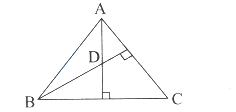
$A, B, C, D$ are four points in a plane with position vectors $\overline{a}, \overline{b}, \overline{c}, \overline{d}$ respectively such that $(\overline{a}-\overline{d}) \cdot(\overline{b}-\overline{c})=(\overline{b}-\overline{d}) \cdot(\overline{c}-\overline{a})=0$. Then the point $D$ is the $\dots$ of $\triangle ABC$.
A
centroid
B
circumcentre
C
incentre
D
orthocentre
Solution
(D) Given that $(\overline{a}-\overline{d}) \cdot(\overline{b}-\overline{c})=0$ and $(\overline{b}-\overline{d}) \cdot(\overline{c}-\overline{a})=0$.
This can be written in terms of vectors as $\overline{AD} \cdot \overline{BC} = 0$ and $\overline{BD} \cdot \overline{CA} = 0$.
This implies that $\overline{AD} \perp \overline{BC}$ and $\overline{BD} \perp \overline{CA}$.
Since $D$ is the point of intersection of the altitudes $AD$ and $BD$ of $\triangle ABC$,$D$ is the orthocentre of $\triangle ABC$.
This can be written in terms of vectors as $\overline{AD} \cdot \overline{BC} = 0$ and $\overline{BD} \cdot \overline{CA} = 0$.
This implies that $\overline{AD} \perp \overline{BC}$ and $\overline{BD} \perp \overline{CA}$.
Since $D$ is the point of intersection of the altitudes $AD$ and $BD$ of $\triangle ABC$,$D$ is the orthocentre of $\triangle ABC$.
0 likesView Solution
424
MathematicsMediumMCQMHT CET · 2023
Given $0 \leq x \leq \frac{1}{2}$,then the value of $\tan \left[\sin ^{-1}\left\{\frac{x}{\sqrt{2}}+\frac{\sqrt{1-x^{2}}}{\sqrt{2}}\right\}-\sin ^{-1} x\right]$ is:
A
$ \sqrt{3} $
B
$ \frac{1}{\sqrt{3}} $
C
$ 1 $
D
$ -1 $
Solution
(C) Let the given expression be $E = \tan \left[\sin ^{-1}\left\{\frac{x}{\sqrt{2}}+\frac{\sqrt{1-x^{2}}}{\sqrt{2}}\right\}-\sin ^{-1} x\right]$.
Substitute $x = \sin \theta$,where $\theta = \sin^{-1} x$.
Since $0 \leq x \leq \frac{1}{2}$,we have $0 \leq \theta \leq \frac{\pi}{6}$.
The expression inside the $\sin^{-1}$ becomes $\frac{\sin \theta}{\sqrt{2}} + \frac{\cos \theta}{\sqrt{2}} = \sin \theta \cos \frac{\pi}{4} + \cos \theta \sin \frac{\pi}{4} = \sin \left(\theta + \frac{\pi}{4}\right)$.
Now,the expression becomes $E = \tan \left[\sin ^{-1}\left\{\sin \left(\theta + \frac{\pi}{4}\right)\right\} - \theta\right]$.
Since $0 \leq \theta \leq \frac{\pi}{6}$,then $\frac{\pi}{4} \leq \theta + \frac{\pi}{4} \leq \frac{\pi}{6} + \frac{\pi}{4} = \frac{5\pi}{12}$.
Since $\frac{\pi}{4} \leq \theta + \frac{\pi}{4} \leq \frac{5\pi}{12}$,the value lies within the principal range of $\sin^{-1}$,so $\sin^{-1}(\sin(\theta + \frac{\pi}{4})) = \theta + \frac{\pi}{4}$.
Thus,$E = \tan \left(\theta + \frac{\pi}{4} - \theta\right) = \tan \frac{\pi}{4} = 1$.
Substitute $x = \sin \theta$,where $\theta = \sin^{-1} x$.
Since $0 \leq x \leq \frac{1}{2}$,we have $0 \leq \theta \leq \frac{\pi}{6}$.
The expression inside the $\sin^{-1}$ becomes $\frac{\sin \theta}{\sqrt{2}} + \frac{\cos \theta}{\sqrt{2}} = \sin \theta \cos \frac{\pi}{4} + \cos \theta \sin \frac{\pi}{4} = \sin \left(\theta + \frac{\pi}{4}\right)$.
Now,the expression becomes $E = \tan \left[\sin ^{-1}\left\{\sin \left(\theta + \frac{\pi}{4}\right)\right\} - \theta\right]$.
Since $0 \leq \theta \leq \frac{\pi}{6}$,then $\frac{\pi}{4} \leq \theta + \frac{\pi}{4} \leq \frac{\pi}{6} + \frac{\pi}{4} = \frac{5\pi}{12}$.
Since $\frac{\pi}{4} \leq \theta + \frac{\pi}{4} \leq \frac{5\pi}{12}$,the value lies within the principal range of $\sin^{-1}$,so $\sin^{-1}(\sin(\theta + \frac{\pi}{4})) = \theta + \frac{\pi}{4}$.
Thus,$E = \tan \left(\theta + \frac{\pi}{4} - \theta\right) = \tan \frac{\pi}{4} = 1$.
0 likesView Solution
Vedclass Products
For Students
Vedclass Test Series
Mock tests in real MHT CET style covering Mathematics with performance analysis. 5-day free trial.
Start Free TrialFor Teachers
Exam Paper Generator
Generate Set A/B/C/D Mathematics papers from 7.5L+ questions in 2 minutes. 3 chapters free.
Try FreeFor Institutes
Online Exam Module
Run live MHT CET mock exams with unlimited students, 360° analytics & white-label branding.
See DemoFrequently Asked Questions
How many Mathematics questions are in MHT CET 2023?
There are 589 Mathematics questions from the MHT CET 2023 paper on Vedclass, each with a detailed step-by-step solution in English.
Are MHT CET 2023 Mathematics solutions available in English?
Yes. All solutions on this page are in English. You can also switch to English or Hindi using the language buttons above the questions.
Can I practice MHT CET 2023 Mathematics as a timed test?
Yes. Use the Vedclass Test Series to attempt a full MHT CET mock test covering Mathematics with time limits and instant score analysis.
Can teachers create Mathematics papers from MHT CET previous year questions?
Yes. The Vedclass Exam Paper Generator lets teachers mix MHT CET Mathematics questions and generate Set A/B/C/D papers in minutes.
For Teachers & Institutes
Build a Custom Mathematics Paper
Pick MHT CET 2023 Mathematics questions, set difficulty, and generate Set A/B/C/D in 2 minutes.