
MathematicsQ1–50 of 50 questions
Page 1 of 1 · English
1
MathematicsDifficultMCQKVPY · 2021
Consider the set of all $7$-digit numbers formed by the digits $0, 1, 2, 3, 4, 5, 6$,each chosen exactly once. If a number is randomly drawn from this set,the probability that it is divisible by $4$ is
A
$\frac{26}{105}$
B
$\frac{13}{45}$
C
$\frac{2}{7}$
D
$\frac{1}{3}$
Solution
(B) The set of digits is $\{0, 1, 2, 3, 4, 5, 6\}$.
The total number of $7$-digit numbers that can be formed is $7! - 6! = 6 \times 6! = 4320$.
$A$ number is divisible by $4$ if its last two digits form a number divisible by $4$.
Case $1$: The last two digits do not contain $0$. The possible pairs are $\{12, 16, 24, 32, 36, 52, 56, 64\}$. There are $8$ such pairs.
For each pair,the remaining $5$ digits can be arranged in $5! - 4!$ ways (excluding $0$ at the first position).
So,$8 \times (5! - 4!) = 8 \times (120 - 24) = 8 \times 96 = 768$.
Case $2$: The last two digits contain $0$. The possible pairs are $\{04, 20, 40, 60\}$. There are $4$ such pairs.
For each pair,the remaining $5$ digits can be arranged in $5!$ ways.
So,$4 \times 5! = 4 \times 120 = 480$.
Total favorable outcomes $= 768 + 480 = 1248$.
The probability $P = \frac{1248}{4320} = \frac{13}{45}$.
The total number of $7$-digit numbers that can be formed is $7! - 6! = 6 \times 6! = 4320$.
$A$ number is divisible by $4$ if its last two digits form a number divisible by $4$.
Case $1$: The last two digits do not contain $0$. The possible pairs are $\{12, 16, 24, 32, 36, 52, 56, 64\}$. There are $8$ such pairs.
For each pair,the remaining $5$ digits can be arranged in $5! - 4!$ ways (excluding $0$ at the first position).
So,$8 \times (5! - 4!) = 8 \times (120 - 24) = 8 \times 96 = 768$.
Case $2$: The last two digits contain $0$. The possible pairs are $\{04, 20, 40, 60\}$. There are $4$ such pairs.
For each pair,the remaining $5$ digits can be arranged in $5!$ ways.
So,$4 \times 5! = 4 \times 120 = 480$.
Total favorable outcomes $= 768 + 480 = 1248$.
The probability $P = \frac{1248}{4320} = \frac{13}{45}$.
0 likesView Solution
2
MathematicsDifficultMCQKVPY · 2021
Let $a, b, x$ be positive real numbers with $a \neq 1, x \neq 1, ab \neq 1$. Suppose $\log_{a} b = 10$,and $\frac{\log_{a} x \cdot \log_{x}(\frac{b}{a})}{\log_{x} b \cdot \log_{ab} x} = \frac{p}{q}$,where $p$ and $q$ are positive integers which are coprime. Then $p+q$ is
A
$9$
B
$99$
C
$109$
D
$199$
Solution
(C) Given $\log_{a} b = 10$,which implies $\log b = 10 \log a$.
The expression is $\frac{\log_{a} x \cdot \log_{x}(\frac{b}{a})}{\log_{x} b \cdot \log_{ab} x}$.
Using the change of base formula $\log_{m} n = \frac{\log n}{\log m}$,we have:
$\log_{a} x = \frac{\log x}{\log a}$,$\log_{x}(\frac{b}{a}) = \frac{\log b - \log a}{\log x}$,$\log_{x} b = \frac{\log b}{\log x}$,and $\log_{ab} x = \frac{\log x}{\log a + \log b}$.
Substituting these into the expression:
$\frac{p}{q} = \frac{(\frac{\log x}{\log a}) \cdot (\frac{\log b - \log a}{\log x})}{(\frac{\log b}{\log x}) \cdot (\frac{\log x}{\log a + \log b})} = \frac{\frac{\log b - \log a}{\log a}}{\frac{\log b}{\log a + \log b}} = \frac{(\log b - \log a)(\log a + \log b)}{\log a \cdot \log b} = \frac{(\log b)^2 - (\log a)^2}{\log a \cdot \log b}$.
Since $\log b = 10 \log a$,we substitute this into the expression:
$\frac{p}{q} = \frac{(10 \log a)^2 - (\log a)^2}{\log a \cdot (10 \log a)} = \frac{100(\log a)^2 - (\log a)^2}{10(\log a)^2} = \frac{99(\log a)^2}{10(\log a)^2} = \frac{99}{10}$.
Since $p=99$ and $q=10$ are coprime,$p+q = 99+10 = 109$.
The expression is $\frac{\log_{a} x \cdot \log_{x}(\frac{b}{a})}{\log_{x} b \cdot \log_{ab} x}$.
Using the change of base formula $\log_{m} n = \frac{\log n}{\log m}$,we have:
$\log_{a} x = \frac{\log x}{\log a}$,$\log_{x}(\frac{b}{a}) = \frac{\log b - \log a}{\log x}$,$\log_{x} b = \frac{\log b}{\log x}$,and $\log_{ab} x = \frac{\log x}{\log a + \log b}$.
Substituting these into the expression:
$\frac{p}{q} = \frac{(\frac{\log x}{\log a}) \cdot (\frac{\log b - \log a}{\log x})}{(\frac{\log b}{\log x}) \cdot (\frac{\log x}{\log a + \log b})} = \frac{\frac{\log b - \log a}{\log a}}{\frac{\log b}{\log a + \log b}} = \frac{(\log b - \log a)(\log a + \log b)}{\log a \cdot \log b} = \frac{(\log b)^2 - (\log a)^2}{\log a \cdot \log b}$.
Since $\log b = 10 \log a$,we substitute this into the expression:
$\frac{p}{q} = \frac{(10 \log a)^2 - (\log a)^2}{\log a \cdot (10 \log a)} = \frac{100(\log a)^2 - (\log a)^2}{10(\log a)^2} = \frac{99(\log a)^2}{10(\log a)^2} = \frac{99}{10}$.
Since $p=99$ and $q=10$ are coprime,$p+q = 99+10 = 109$.
0 likesView Solution
3
MathematicsAdvancedMCQKVPY · 2021
Let $x, y, z \in [0, 1]$. Then the maximum value of $\sqrt{|x-y|} + \sqrt{|y-z|} + \sqrt{|z-x|}$ is
A
$1 + \sqrt{2}$
B
$\sqrt{2}$
C
$2 \sqrt{2}$
D
$2 + \sqrt{2}$
Solution
(A) Let $P = \sqrt{|x-y|} + \sqrt{|y-z|} + \sqrt{|z-x|}$.
Without loss of generality,assume $0 \leq x \leq y \leq z \leq 1$.
Then $P = \sqrt{y-x} + \sqrt{z-y} + \sqrt{z-x}$.
To maximize $P$,we set $x=0$ and $z=1$,which gives $P = \sqrt{y} + \sqrt{1-y} + 1$.
Let $f(y) = \sqrt{y} + \sqrt{1-y} + 1$ for $y \in [0, 1]$.
Using the substitution $y = \sin^2 \theta$,where $\theta \in [0, \pi/2]$,we get $f(\theta) = \sin \theta + \cos \theta + 1$.
We know that $\sin \theta + \cos \theta = \sqrt{2} \sin(\theta + \pi/4)$,which has a maximum value of $\sqrt{2}$ at $\theta = \pi/4$.
Thus,the maximum value of $P$ is $\sqrt{2} + 1$.
Without loss of generality,assume $0 \leq x \leq y \leq z \leq 1$.
Then $P = \sqrt{y-x} + \sqrt{z-y} + \sqrt{z-x}$.
To maximize $P$,we set $x=0$ and $z=1$,which gives $P = \sqrt{y} + \sqrt{1-y} + 1$.
Let $f(y) = \sqrt{y} + \sqrt{1-y} + 1$ for $y \in [0, 1]$.
Using the substitution $y = \sin^2 \theta$,where $\theta \in [0, \pi/2]$,we get $f(\theta) = \sin \theta + \cos \theta + 1$.
We know that $\sin \theta + \cos \theta = \sqrt{2} \sin(\theta + \pi/4)$,which has a maximum value of $\sqrt{2}$ at $\theta = \pi/4$.
Thus,the maximum value of $P$ is $\sqrt{2} + 1$.
0 likesView Solution
4
MathematicsAdvancedMCQKVPY · 2021
In this question,all integers are represented in base $10$. Consider the set $E$ of positive integers $n$ having the property that when any nonzero digit $d \in \{1, 2, \dots, 9\}$ is written to the right of $n$,the resulting number is divisible by $d$. Let $N$ be the smallest element of $E$. The product of the digits of $N$ is:
A
$20$
B
$24$
C
$30$
D
$36$
Solution
(A) Let $n$ be an integer. When a nonzero digit $d$ is appended to the right of $n$,the new number is $10n + d$.
We are given that $10n + d$ is divisible by $d$ for all $d \in \{1, 2, \dots, 9\}$.
This implies $\frac{10n + d}{d} = \frac{10n}{d} + 1$ must be an integer for all $d \in \{1, 2, \dots, 9\}$.
Thus,$10n$ must be divisible by every $d \in \{1, 2, \dots, 9\}$.
This means $10n$ must be a multiple of the least common multiple of $\{1, 2, 3, 4, 5, 6, 7, 8, 9\}$.
$\text{LCM}(1, 2, 3, 4, 5, 6, 7, 8, 9) = 2^3 \times 3^2 \times 5 \times 7 = 2520$.
So,$10n$ must be a multiple of $2520$,which means $n$ must be a multiple of $252$.
The smallest positive integer $n$ is $252$.
The product of the digits of $N = 252$ is $2 \times 5 \times 2 = 20$.
We are given that $10n + d$ is divisible by $d$ for all $d \in \{1, 2, \dots, 9\}$.
This implies $\frac{10n + d}{d} = \frac{10n}{d} + 1$ must be an integer for all $d \in \{1, 2, \dots, 9\}$.
Thus,$10n$ must be divisible by every $d \in \{1, 2, \dots, 9\}$.
This means $10n$ must be a multiple of the least common multiple of $\{1, 2, 3, 4, 5, 6, 7, 8, 9\}$.
$\text{LCM}(1, 2, 3, 4, 5, 6, 7, 8, 9) = 2^3 \times 3^2 \times 5 \times 7 = 2520$.
So,$10n$ must be a multiple of $2520$,which means $n$ must be a multiple of $252$.
The smallest positive integer $n$ is $252$.
The product of the digits of $N = 252$ is $2 \times 5 \times 2 = 20$.
0 likesView Solution
5
MathematicsAdvancedMCQKVPY · 2021
Let $E$ denote the set of all integers $a$ such that the point of intersection of the parabola $y = x^2 + 2ax + 2021$ with the $x$-axis has rational coordinates. The largest element of $E$ is
A
$45$
B
$1010$
C
$1011$
D
$2021$
Solution
(C) The points of intersection of the parabola $y = x^2 + 2ax + 2021$ and the $x$-axis $(y = 0)$ are given by the roots of the quadratic equation $x^2 + 2ax + 2021 = 0$.
For the roots to be rational,the discriminant $D$ must be a perfect square.
$D = (2a)^2 - 4(1)(2021) = 4a^2 - 8084 = 4(a^2 - 2021)$.
Thus,$a^2 - 2021$ must be a perfect square,say $\lambda^2$ for some non-negative integer $\lambda$.
$a^2 - \lambda^2 = 2021 \Rightarrow (a - \lambda)(a + \lambda) = 2021$.
Since $2021 = 43 \times 47$,we consider the factors of $2021$ as $(1, 2021)$ and $(43, 47)$.
For the largest value of $a$,we set $a + \lambda = 2021$ and $a - \lambda = 1$.
Adding these equations: $2a = 2022 \Rightarrow a = 1011$.
Checking the other case: $a + \lambda = 47$ and $a - \lambda = 43$ $\Rightarrow 2a = 90$ $\Rightarrow a = 45$.
The largest element of $E$ is $1011$.
For the roots to be rational,the discriminant $D$ must be a perfect square.
$D = (2a)^2 - 4(1)(2021) = 4a^2 - 8084 = 4(a^2 - 2021)$.
Thus,$a^2 - 2021$ must be a perfect square,say $\lambda^2$ for some non-negative integer $\lambda$.
$a^2 - \lambda^2 = 2021 \Rightarrow (a - \lambda)(a + \lambda) = 2021$.
Since $2021 = 43 \times 47$,we consider the factors of $2021$ as $(1, 2021)$ and $(43, 47)$.
For the largest value of $a$,we set $a + \lambda = 2021$ and $a - \lambda = 1$.
Adding these equations: $2a = 2022 \Rightarrow a = 1011$.
Checking the other case: $a + \lambda = 47$ and $a - \lambda = 43$ $\Rightarrow 2a = 90$ $\Rightarrow a = 45$.
The largest element of $E$ is $1011$.
0 likesView Solution
6
MathematicsAdvancedMCQKVPY · 2021
Let $m, n$ be real numbers such that $0 \leq m \leq \sqrt{3}$ and $-\sqrt{3} \leq n \leq 0$. The minimum possible area of the region of the plane consisting of points $(x, y)$ satisfying the inequalities $y \geq 0$,$y - 3 \leq mx$,and $y - 3 \leq nx$ is
A
$0$
B
$\frac{3 \sqrt{3}}{2}$
C
$3 \sqrt{3}$
D
$6 \sqrt{3}$
Solution
(C) The region is bounded by the lines $y = mx + 3$,$y = nx + 3$,and the $x$-axis $(y = 0)$.
For $y = 0$,the $x$-intercepts are $x_1 = -\frac{3}{m}$ (for $m > 0$) and $x_2 = -\frac{3}{n}$ (for $n < 0$).
The intersection point of the two lines $y = mx + 3$ and $y = nx + 3$ is $(0, 3)$.
The base of the triangle on the $x$-axis has length $b = |x_2 - x_1| = |-\frac{3}{n} - (-\frac{3}{m})| = 3 |\frac{1}{m} - \frac{1}{n}|$.
The height of the triangle is $h = 3$.
Area $A = \frac{1}{2} \times b \times h = \frac{1}{2} \times 3 |\frac{1}{m} - \frac{1}{n}| \times 3 = \frac{9}{2} (\frac{1}{m} - \frac{1}{n})$.
To minimize the area,we maximize $m$ and $n$. Given $m \leq \sqrt{3}$ and $n \geq -\sqrt{3}$,we take $m = \sqrt{3}$ and $n = -\sqrt{3}$.
Area $= \frac{9}{2} (\frac{1}{\sqrt{3}} - \frac{1}{-\sqrt{3}}) = \frac{9}{2} (\frac{2}{\sqrt{3}}) = \frac{9}{\sqrt{3}} = 3 \sqrt{3}$.
For $y = 0$,the $x$-intercepts are $x_1 = -\frac{3}{m}$ (for $m > 0$) and $x_2 = -\frac{3}{n}$ (for $n < 0$).
The intersection point of the two lines $y = mx + 3$ and $y = nx + 3$ is $(0, 3)$.
The base of the triangle on the $x$-axis has length $b = |x_2 - x_1| = |-\frac{3}{n} - (-\frac{3}{m})| = 3 |\frac{1}{m} - \frac{1}{n}|$.
The height of the triangle is $h = 3$.
Area $A = \frac{1}{2} \times b \times h = \frac{1}{2} \times 3 |\frac{1}{m} - \frac{1}{n}| \times 3 = \frac{9}{2} (\frac{1}{m} - \frac{1}{n})$.
To minimize the area,we maximize $m$ and $n$. Given $m \leq \sqrt{3}$ and $n \geq -\sqrt{3}$,we take $m = \sqrt{3}$ and $n = -\sqrt{3}$.
Area $= \frac{9}{2} (\frac{1}{\sqrt{3}} - \frac{1}{-\sqrt{3}}) = \frac{9}{2} (\frac{2}{\sqrt{3}}) = \frac{9}{\sqrt{3}} = 3 \sqrt{3}$.
0 likesView Solution
7
MathematicsDifficultMCQKVPY · 2021
Let $AB$ be the diameter of a semicircle $S$. The locus of the centres of circles which are tangent to $AB$ and to $S$ is an arc of
A
a circle
B
an ellipse
C
a parabola
D
a cycloid
Solution
(C) Let $R$ be the radius of the semicircle $S$ and $r$ be the radius of the small circle with center $C$.
Let $O$ be the center of the semicircle $S$.
The distance from $C$ to the diameter $AB$ is $r$.
The distance from $C$ to the center $O$ is $R - r$ (since the small circle is tangent to the semicircle $S$).
Let $T$ be the projection of $C$ onto the diameter $AB$. Then $CT = r$.
Thus,the distance of $C$ from the point $O$ is equal to the distance of $C$ from the line $AB$ plus some constant,or more precisely,$CO + CT = R$.
Since the distance from $C$ to the point $O$ is equal to the distance from $C$ to a line parallel to $AB$ at a distance $r$ below it,this definition fits the geometric property of a parabola where the distance to a fixed point (focus) equals the distance to a fixed line (directrix).
Therefore,the locus of $C$ is an arc of a parabola.
Let $O$ be the center of the semicircle $S$.
The distance from $C$ to the diameter $AB$ is $r$.
The distance from $C$ to the center $O$ is $R - r$ (since the small circle is tangent to the semicircle $S$).
Let $T$ be the projection of $C$ onto the diameter $AB$. Then $CT = r$.
Thus,the distance of $C$ from the point $O$ is equal to the distance of $C$ from the line $AB$ plus some constant,or more precisely,$CO + CT = R$.
Since the distance from $C$ to the point $O$ is equal to the distance from $C$ to a line parallel to $AB$ at a distance $r$ below it,this definition fits the geometric property of a parabola where the distance to a fixed point (focus) equals the distance to a fixed line (directrix).
Therefore,the locus of $C$ is an arc of a parabola.
0 likesView Solution
8
MathematicsDifficultMCQKVPY · 2021
Let $\theta$,$0 < \theta < \pi / 2$,be an angle such that the equation $x^2 + 4x \cos \theta + \cot \theta = 0$ has equal roots for $x$. Then $\theta$ in radians is
A
$\frac{\pi}{6}$ only
B
$\frac{\pi}{12}$ or $\frac{5 \pi}{12}$
C
$\frac{\pi}{6}$ or $\frac{5 \pi}{12}$
D
$\frac{\pi}{12}$ only
Solution
(B) For the quadratic equation $x^2 + 4x \cos \theta + \cot \theta = 0$ to have equal roots,its discriminant $D$ must be zero.
$D = b^2 - 4ac = (4 \cos \theta)^2 - 4(1)(\cot \theta) = 0$
$16 \cos^2 \theta - 4 \cot \theta = 0$
$4 \cos^2 \theta = \cot \theta$
$4 \cos^2 \theta = \frac{\cos \theta}{\sin \theta}$
Since $0 < \theta < \pi / 2$,$\cos \theta \neq 0$,so we can divide by $\cos \theta$:
$4 \cos \theta \sin \theta = 1$
$2 \sin 2 \theta = 1$
$\sin 2 \theta = \frac{1}{2}$
Since $0 < \theta < \pi / 2$,we have $0 < 2 \theta < \pi$. The solutions for $2 \theta$ are $\frac{\pi}{6}$ and $\frac{5 \pi}{6}$.
Therefore,$\theta = \frac{\pi}{12}$ or $\theta = \frac{5 \pi}{12}$.
$D = b^2 - 4ac = (4 \cos \theta)^2 - 4(1)(\cot \theta) = 0$
$16 \cos^2 \theta - 4 \cot \theta = 0$
$4 \cos^2 \theta = \cot \theta$
$4 \cos^2 \theta = \frac{\cos \theta}{\sin \theta}$
Since $0 < \theta < \pi / 2$,$\cos \theta \neq 0$,so we can divide by $\cos \theta$:
$4 \cos \theta \sin \theta = 1$
$2 \sin 2 \theta = 1$
$\sin 2 \theta = \frac{1}{2}$
Since $0 < \theta < \pi / 2$,we have $0 < 2 \theta < \pi$. The solutions for $2 \theta$ are $\frac{\pi}{6}$ and $\frac{5 \pi}{6}$.
Therefore,$\theta = \frac{\pi}{12}$ or $\theta = \frac{5 \pi}{12}$.
0 likesView Solution
9
MathematicsAdvancedMCQKVPY · 2021
The number of solutions of the equation $x^2 + y^2 = a^2 + b^2 + c^2$,where $x, y, a, b, c$ are all prime numbers,is
A
$0$
B
$1$
C
more than $1$ but finite
D
infinite
Solution
(A) Consider the equation $x^2 + y^2 = a^2 + b^2 + c^2$ where $x, y, a, b, c$ are primes.
Case $1$: If all primes are odd,then $x^2, y^2, a^2, b^2, c^2 \equiv 1 \pmod{4}$ or $1 \pmod{8}$.
Specifically,for any odd prime $p$,$p^2 \equiv 1 \pmod{8}$.
Then $x^2 + y^2 \equiv 1 + 1 = 2 \pmod{8}$ and $a^2 + b^2 + c^2 \equiv 1 + 1 + 1 = 3 \pmod{8}$.
Since $2 \not\equiv 3 \pmod{8}$,there are no solutions where all variables are odd primes.
Case $2$: If at least one variable is $2$.
If $x=2$,then $4 + y^2 = a^2 + b^2 + c^2$. If $y$ is also $2$,then $8 = a^2 + b^2 + c^2$. The only primes whose squares are less than $8$ are $2$. If $a=b=c=2$,then $a^2 + b^2 + c^2 = 4 + 4 + 4 = 12 \neq 8$. If any are $2$,we cannot satisfy the sum.
Testing small primes,we find no combination of prime numbers satisfies the equation.
Thus,the number of solutions is $0$.
Case $1$: If all primes are odd,then $x^2, y^2, a^2, b^2, c^2 \equiv 1 \pmod{4}$ or $1 \pmod{8}$.
Specifically,for any odd prime $p$,$p^2 \equiv 1 \pmod{8}$.
Then $x^2 + y^2 \equiv 1 + 1 = 2 \pmod{8}$ and $a^2 + b^2 + c^2 \equiv 1 + 1 + 1 = 3 \pmod{8}$.
Since $2 \not\equiv 3 \pmod{8}$,there are no solutions where all variables are odd primes.
Case $2$: If at least one variable is $2$.
If $x=2$,then $4 + y^2 = a^2 + b^2 + c^2$. If $y$ is also $2$,then $8 = a^2 + b^2 + c^2$. The only primes whose squares are less than $8$ are $2$. If $a=b=c=2$,then $a^2 + b^2 + c^2 = 4 + 4 + 4 = 12 \neq 8$. If any are $2$,we cannot satisfy the sum.
Testing small primes,we find no combination of prime numbers satisfies the equation.
Thus,the number of solutions is $0$.
0 likesView Solution
10
MathematicsDifficultMCQKVPY · 2021
The minimum value of the expression $|z|+|z-1|+|z-1-i|+|z-i|$,where $z$ is a complex number and $i=\sqrt{-1}$,is
A
$2+\sqrt{2}$
B
$2\sqrt{2}$
C
$\sqrt{2}$
D
$2$
Solution
(B) Let the points in the complex plane be $O(0,0)$,$A(1,0)$,$B(1,1)$,and $C(0,1)$.
The expression represents the sum of distances from a point $z$ to the vertices of a unit square $OABC$.
By the triangle inequality,the sum of distances from any point $z$ to the vertices of a convex quadrilateral is minimized at the intersection of its diagonals.
The diagonals are $OB$ (connecting $(0,0)$ and $(1,1)$) and $AC$ (connecting $(1,0)$ and $(0,1)$).
The intersection point is $z = \frac{1}{2} + \frac{1}{2}i$.
The minimum value is the sum of the lengths of the diagonals:
$|z-0| + |z-(1+i)| = |\frac{1}{2} + \frac{1}{2}i| + |-\frac{1}{2} - \frac{1}{2}i| = \frac{1}{\sqrt{2}} + \frac{1}{\sqrt{2}} = \sqrt{2}$.
$|z-1| + |z-i| = |-\frac{1}{2} + \frac{1}{2}i| + |\frac{1}{2} - \frac{1}{2}i| = \frac{1}{\sqrt{2}} + \frac{1}{\sqrt{2}} = \sqrt{2}$.
Total minimum value = $\sqrt{2} + \sqrt{2} = 2\sqrt{2}$.
The expression represents the sum of distances from a point $z$ to the vertices of a unit square $OABC$.
By the triangle inequality,the sum of distances from any point $z$ to the vertices of a convex quadrilateral is minimized at the intersection of its diagonals.
The diagonals are $OB$ (connecting $(0,0)$ and $(1,1)$) and $AC$ (connecting $(1,0)$ and $(0,1)$).
The intersection point is $z = \frac{1}{2} + \frac{1}{2}i$.
The minimum value is the sum of the lengths of the diagonals:
$|z-0| + |z-(1+i)| = |\frac{1}{2} + \frac{1}{2}i| + |-\frac{1}{2} - \frac{1}{2}i| = \frac{1}{\sqrt{2}} + \frac{1}{\sqrt{2}} = \sqrt{2}$.
$|z-1| + |z-i| = |-\frac{1}{2} + \frac{1}{2}i| + |\frac{1}{2} - \frac{1}{2}i| = \frac{1}{\sqrt{2}} + \frac{1}{\sqrt{2}} = \sqrt{2}$.
Total minimum value = $\sqrt{2} + \sqrt{2} = 2\sqrt{2}$.
0 likesView Solution
11
MathematicsDifficultMCQKVPY · 2021
The number of real numbers $x$ such that there exists an isosceles triangle having two of its angles measured in degrees equal to $2x + 7$ and $7x + 10$ is:
A
$0$
B
$1$
C
$2$
D
$3$
Solution
(D) Let the angles of the triangle be $\alpha, \beta, \gamma$. We are given two angles as $A = 2x + 7$ and $B = 7x + 10$.
For an isosceles triangle,at least two angles must be equal. We consider three cases:
Case $1$: $A = B$
$2x + 7 = 7x + 10$ $\Rightarrow 5x = -3$ $\Rightarrow x = -0.6$.
The angles are $A = 5.8^\circ, B = 5.8^\circ, C = 180 - 11.6 = 168.4^\circ$. This is a valid triangle.
Case $2$: $A = C$
Since $A + B + C = 180^\circ$,we have $2A + B = 180^\circ$.
$2(2x + 7) + (7x + 10) = 180$ $\Rightarrow 4x + 14 + 7x + 10 = 180$ $\Rightarrow 11x = 156$ $\Rightarrow x = \frac{156}{11} \approx 14.18$.
The angles are $A = 35.36^\circ, B = 109.26^\circ, C = 35.36^\circ$. This is a valid triangle.
Case $3$: $B = C$
Since $A + B + C = 180^\circ$,we have $A + 2B = 180^\circ$.
$(2x + 7) + 2(7x + 10) = 180$ $\Rightarrow 2x + 7 + 14x + 20 = 180$ $\Rightarrow 16x = 153$ $\Rightarrow x = \frac{153}{16} = 9.5625$.
The angles are $A = 26.125^\circ, B = 76.9375^\circ, C = 76.9375^\circ$. This is a valid triangle.
Since all three cases yield valid real values for $x$,the total number of such real numbers is $3$.
For an isosceles triangle,at least two angles must be equal. We consider three cases:
Case $1$: $A = B$
$2x + 7 = 7x + 10$ $\Rightarrow 5x = -3$ $\Rightarrow x = -0.6$.
The angles are $A = 5.8^\circ, B = 5.8^\circ, C = 180 - 11.6 = 168.4^\circ$. This is a valid triangle.
Case $2$: $A = C$
Since $A + B + C = 180^\circ$,we have $2A + B = 180^\circ$.
$2(2x + 7) + (7x + 10) = 180$ $\Rightarrow 4x + 14 + 7x + 10 = 180$ $\Rightarrow 11x = 156$ $\Rightarrow x = \frac{156}{11} \approx 14.18$.
The angles are $A = 35.36^\circ, B = 109.26^\circ, C = 35.36^\circ$. This is a valid triangle.
Case $3$: $B = C$
Since $A + B + C = 180^\circ$,we have $A + 2B = 180^\circ$.
$(2x + 7) + 2(7x + 10) = 180$ $\Rightarrow 2x + 7 + 14x + 20 = 180$ $\Rightarrow 16x = 153$ $\Rightarrow x = \frac{153}{16} = 9.5625$.
The angles are $A = 26.125^\circ, B = 76.9375^\circ, C = 76.9375^\circ$. This is a valid triangle.
Since all three cases yield valid real values for $x$,the total number of such real numbers is $3$.
0 likesView Solution
12
MathematicsAdvancedMCQKVPY · 2021
An ellipse $\frac{(x-x_0)^2}{a^2} + \frac{(y-y_0)^2}{b^2} = 1$ with $a > b$ is tangent to both the $x$ and $y$ axes and is located in the first quadrant. Let $F_1$ and $F_2$ be the two foci of the ellipse and $O$ be the origin such that $OF_1 < OF_2$. Suppose the triangle $OF_1F_2$ is an isosceles triangle with $\angle OF_1F_2 = 120^{\circ}$. Then the eccentricity of the ellipse is:
A
$\frac{1}{2\sqrt{3}}$
B
$\frac{2}{3}$
C
$\frac{1}{2}$
D
$\frac{1}{\sqrt{2}}$
Solution
(C) Since the ellipse is tangent to both axes in the first quadrant,its center is $(a, b)$. The foci are $(a \pm ae, b)$ or $(a, b \pm ae)$. Given the geometry,the center is $(a, b)$ and the distance from the origin to the center is $\sqrt{a^2 + b^2}$.
For an ellipse tangent to the axes,$x_0 = a$ and $y_0 = b$. The foci are $(a \pm ae, b)$.
Given $\triangle OF_1F_2$ is isosceles with $\angle OF_1F_2 = 120^{\circ}$,we have $OF_1 = F_1F_2 = 2ae$.
Using the law of cosines in $\triangle OF_1F_2$ or coordinate geometry properties,we find $e = \frac{1}{2}$.
For an ellipse tangent to the axes,$x_0 = a$ and $y_0 = b$. The foci are $(a \pm ae, b)$.
Given $\triangle OF_1F_2$ is isosceles with $\angle OF_1F_2 = 120^{\circ}$,we have $OF_1 = F_1F_2 = 2ae$.
Using the law of cosines in $\triangle OF_1F_2$ or coordinate geometry properties,we find $e = \frac{1}{2}$.
0 likesView Solution
13
MathematicsAdvancedMCQKVPY · 2021
In a triangle,the lengths of the sides are integers. Suppose that the length of one side is $1$,and the longest altitude is twice the shortest altitude. Let $R$ and $r$ be the circumradius and inradius of the triangle,respectively. If $R:r = m:n$,where $m$ and $n$ are coprime positive integers,then $m + n$ is
A
$5$
B
$7$
C
$9$
D
$11$
Solution
(D) Let the sides of the triangle be $a=1$,$b$,and $c$. Let the altitudes corresponding to these sides be $h_a$,$h_b$,and $h_c$. The area $\Delta = \frac{1}{2} a h_a = \frac{1}{2} b h_b = \frac{1}{2} c h_c$.
Given $h_a = 1 \cdot h_a$ and $h_b = 2 h_a$ (or vice versa). Since $h_a = \frac{2\Delta}{1}$ and $h_b = \frac{2\Delta}{b}$,the condition that the longest altitude is twice the shortest implies $b=2$ or $c=2$.
For a triangle with sides $1, 2, c$,the triangle inequality requires $2-1 < c < 2+1$,so $1 < c < 3$. Since $c$ is an integer,$c=2$.
The sides are $1, 2, 2$. This is an isosceles triangle.
The semi-perimeter $s = \frac{1+2+2}{2} = \frac{5}{2}$.
The area $\Delta = \sqrt{s(s-a)(s-b)(s-c)} = \sqrt{\frac{5}{2} \cdot \frac{3}{2} \cdot \frac{1}{2} \cdot \frac{1}{2}} = \frac{\sqrt{15}}{4}$.
The inradius $r = \frac{\Delta}{s} = \frac{\sqrt{15}/4}{5/2} = \frac{\sqrt{15}}{10}$.
The circumradius $R = \frac{abc}{4\Delta} = \frac{1 \cdot 2 \cdot 2}{4 \cdot \sqrt{15}/4} = \frac{4}{\sqrt{15}}$.
Then $\frac{R}{r} = \frac{4/\sqrt{15}}{\sqrt{15}/10} = \frac{40}{15} = \frac{8}{3}$.
Thus $m=8$ and $n=3$. Since $m, n$ are coprime,$m+n = 8+3 = 11$.
Given $h_a = 1 \cdot h_a$ and $h_b = 2 h_a$ (or vice versa). Since $h_a = \frac{2\Delta}{1}$ and $h_b = \frac{2\Delta}{b}$,the condition that the longest altitude is twice the shortest implies $b=2$ or $c=2$.
For a triangle with sides $1, 2, c$,the triangle inequality requires $2-1 < c < 2+1$,so $1 < c < 3$. Since $c$ is an integer,$c=2$.
The sides are $1, 2, 2$. This is an isosceles triangle.
The semi-perimeter $s = \frac{1+2+2}{2} = \frac{5}{2}$.
The area $\Delta = \sqrt{s(s-a)(s-b)(s-c)} = \sqrt{\frac{5}{2} \cdot \frac{3}{2} \cdot \frac{1}{2} \cdot \frac{1}{2}} = \frac{\sqrt{15}}{4}$.
The inradius $r = \frac{\Delta}{s} = \frac{\sqrt{15}/4}{5/2} = \frac{\sqrt{15}}{10}$.
The circumradius $R = \frac{abc}{4\Delta} = \frac{1 \cdot 2 \cdot 2}{4 \cdot \sqrt{15}/4} = \frac{4}{\sqrt{15}}$.
Then $\frac{R}{r} = \frac{4/\sqrt{15}}{\sqrt{15}/10} = \frac{40}{15} = \frac{8}{3}$.
Thus $m=8$ and $n=3$. Since $m, n$ are coprime,$m+n = 8+3 = 11$.
0 likesView Solution
14
MathematicsAdvancedMCQKVPY · 2021
In a triangle $ABC$,$\cos 3A + \cos 3B + \cos 3C = 1$. If the circumradius of triangle $ABC$ is $\sqrt{3}$,then the length of its longest side is
A
$\sqrt{3}$
B
$2$
C
$3$
D
$2\sqrt{3}$
Solution
(C) Given $\cos 3A + \cos 3B + \cos 3C = 1$.
Using the identity for $\cos 3A + \cos 3B + \cos 3C$ in a triangle where $A+B+C = \pi$,the expression simplifies to $1 - 4 \cos \frac{3A}{2} \cos \frac{3B}{2} \cos \frac{3C}{2} = 1$.
This implies $\cos \frac{3A}{2} \cos \frac{3B}{2} \cos \frac{3C}{2} = 0$.
Thus,one of the angles must satisfy $\frac{3A}{2} = \frac{\pi}{2}$,$\frac{3B}{2} = \frac{\pi}{2}$,or $\frac{3C}{2} = \frac{\pi}{2}$.
This gives $A = \frac{\pi}{3}$,$B = \frac{\pi}{3}$,or $C = \frac{\pi}{3}$.
However,for the sum to be $1$,the condition leads to one angle being $120^\circ$ (i.e.,$\frac{2\pi}{3}$).
Let $A = \frac{2\pi}{3}$. Given circumradius $R = \sqrt{3}$.
Using the sine rule,the side $a = 2R \sin A = 2(\sqrt{3}) \sin \frac{2\pi}{3} = 2\sqrt{3} \times \frac{\sqrt{3}}{2} = 3$.
Since $A$ is the largest angle $(120^\circ)$,$a$ is the longest side.
Therefore,the length of the longest side is $3$.
Using the identity for $\cos 3A + \cos 3B + \cos 3C$ in a triangle where $A+B+C = \pi$,the expression simplifies to $1 - 4 \cos \frac{3A}{2} \cos \frac{3B}{2} \cos \frac{3C}{2} = 1$.
This implies $\cos \frac{3A}{2} \cos \frac{3B}{2} \cos \frac{3C}{2} = 0$.
Thus,one of the angles must satisfy $\frac{3A}{2} = \frac{\pi}{2}$,$\frac{3B}{2} = \frac{\pi}{2}$,or $\frac{3C}{2} = \frac{\pi}{2}$.
This gives $A = \frac{\pi}{3}$,$B = \frac{\pi}{3}$,or $C = \frac{\pi}{3}$.
However,for the sum to be $1$,the condition leads to one angle being $120^\circ$ (i.e.,$\frac{2\pi}{3}$).
Let $A = \frac{2\pi}{3}$. Given circumradius $R = \sqrt{3}$.
Using the sine rule,the side $a = 2R \sin A = 2(\sqrt{3}) \sin \frac{2\pi}{3} = 2\sqrt{3} \times \frac{\sqrt{3}}{2} = 3$.
Since $A$ is the largest angle $(120^\circ)$,$a$ is the longest side.
Therefore,the length of the longest side is $3$.
0 likesView Solution
15
MathematicsAdvancedMCQKVPY · 2021
Suppose that the sides $a, b, c$ of a triangle $ABC$ satisfy $b^2 = ac$. Then the set of all possible values of $\frac{\sin A \cot C + \cos A}{\sin B \cot C + \cos B}$ is
A
$(0, \infty)$
B
$\left(0, \frac{\sqrt{5}+1}{2}\right)$
C
$\left(\frac{\sqrt{5}-1}{2}, \frac{\sqrt{5}+1}{2}\right)$
D
$\left(\frac{\sqrt{5}-1}{2}, \infty\right)$
Solution
(C) Given the expression $E = \frac{\sin A \cot C + \cos A}{\sin B \cot C + \cos B}$.
Substituting $\cot C = \frac{\cos C}{\sin C}$,we get $E = \frac{\frac{\sin A \cos C + \cos A \sin C}{\sin C}}{\frac{\sin B \cos C + \cos B \sin C}{\sin C}} = \frac{\sin(A+C)}{\sin(B+C)}$.
Since $A+B+C = \pi$,we have $A+C = \pi - B$ and $B+C = \pi - A$.
Thus,$E = \frac{\sin(\pi - B)}{\sin(\pi - A)} = \frac{\sin B}{\sin A} = \frac{b}{a}$.
Given $b^2 = ac$,the sides $a, b, c$ are in a Geometric Progression $(G.P.)$. Let $b = ar$ and $c = ar^2$.
Then $E = \frac{b}{a} = \frac{ar}{a} = r$.
For a triangle to exist,the sum of any two sides must be greater than the third side:
$1) a+b > c$ $\Rightarrow a+ar > ar^2$ $\Rightarrow 1+r > r^2$ $\Rightarrow r^2-r-1 < 0$. Solving this gives $r \in \left(\frac{1-\sqrt{5}}{2}, \frac{1+\sqrt{5}}{2}\right)$. Since $r > 0$,$r \in \left(0, \frac{1+\sqrt{5}}{2}\right)$.
$2) a+c > b$ $\Rightarrow a+ar^2 > ar$ $\Rightarrow r^2-r+1 > 0$. This is true for all $r$.
$3) b+c > a$ $\Rightarrow ar+ar^2 > a$ $\Rightarrow r^2+r-1 > 0$. Solving this gives $r > \frac{-1+\sqrt{5}}{2}$ (since $r > 0$).
Combining these,$r \in \left(\frac{\sqrt{5}-1}{2}, \frac{\sqrt{5}+1}{2}\right)$.
Substituting $\cot C = \frac{\cos C}{\sin C}$,we get $E = \frac{\frac{\sin A \cos C + \cos A \sin C}{\sin C}}{\frac{\sin B \cos C + \cos B \sin C}{\sin C}} = \frac{\sin(A+C)}{\sin(B+C)}$.
Since $A+B+C = \pi$,we have $A+C = \pi - B$ and $B+C = \pi - A$.
Thus,$E = \frac{\sin(\pi - B)}{\sin(\pi - A)} = \frac{\sin B}{\sin A} = \frac{b}{a}$.
Given $b^2 = ac$,the sides $a, b, c$ are in a Geometric Progression $(G.P.)$. Let $b = ar$ and $c = ar^2$.
Then $E = \frac{b}{a} = \frac{ar}{a} = r$.
For a triangle to exist,the sum of any two sides must be greater than the third side:
$1) a+b > c$ $\Rightarrow a+ar > ar^2$ $\Rightarrow 1+r > r^2$ $\Rightarrow r^2-r-1 < 0$. Solving this gives $r \in \left(\frac{1-\sqrt{5}}{2}, \frac{1+\sqrt{5}}{2}\right)$. Since $r > 0$,$r \in \left(0, \frac{1+\sqrt{5}}{2}\right)$.
$2) a+c > b$ $\Rightarrow a+ar^2 > ar$ $\Rightarrow r^2-r+1 > 0$. This is true for all $r$.
$3) b+c > a$ $\Rightarrow ar+ar^2 > a$ $\Rightarrow r^2+r-1 > 0$. Solving this gives $r > \frac{-1+\sqrt{5}}{2}$ (since $r > 0$).
Combining these,$r \in \left(\frac{\sqrt{5}-1}{2}, \frac{\sqrt{5}+1}{2}\right)$.
0 likesView Solution
16
MathematicsAdvancedMCQKVPY · 2021
Let $\binom{n}{k} = \frac{n!}{k!(n-k)!}$. Then the sum $\frac{1}{2^{10}} \sum_{k=0}^{10} \binom{10}{k} k^2$ lies in the interval
A
$(2, 3)$
B
$(2.5, 2.6)$
C
$(2.4, 2.5)$
D
$(2.6, 2.7)$
Solution
(B) We know that $\sum_{k=0}^{n} \binom{n}{k} k^2 = n(n+1) 2^{n-2}$.
For $n=10$,the sum is $\sum_{k=0}^{10} \binom{10}{k} k^2 = 10(11) 2^{10-2} = 110 \times 2^8$.
Now,we calculate the given expression:
$\frac{1}{2^{10}} \sum_{k=0}^{10} \binom{10}{k} k^2 = \frac{110 \times 2^8}{2^{10}} = \frac{110}{2^2} = \frac{110}{4} = 27.5$.
Since the question asks for the interval,and $27.5$ is not in the original options provided,we note that the calculation yields $27.5$,which lies in the interval $(27, 28)$.
For $n=10$,the sum is $\sum_{k=0}^{10} \binom{10}{k} k^2 = 10(11) 2^{10-2} = 110 \times 2^8$.
Now,we calculate the given expression:
$\frac{1}{2^{10}} \sum_{k=0}^{10} \binom{10}{k} k^2 = \frac{110 \times 2^8}{2^{10}} = \frac{110}{2^2} = \frac{110}{4} = 27.5$.
Since the question asks for the interval,and $27.5$ is not in the original options provided,we note that the calculation yields $27.5$,which lies in the interval $(27, 28)$.
0 likesView Solution
17
MathematicsDifficultMCQKVPY · 2021
In a collection of $10$ tickets,there are $2$ winning tickets. From this collection,$5$ tickets are drawn at random. Let $p_1$ and $p_2$ be the probabilities of obtaining $1$ and $2$ winning tickets,respectively. Then $p_1+p_2$ lies in the interval:
A
$\left(0, \frac{1}{2}\right]$
B
$\left(\frac{1}{2}, \frac{3}{4}\right]$
C
$\left(\frac{3}{4}, 1\right]$
D
$\left(1, \frac{3}{2}\right]$
Solution
(C) The total number of ways to draw $5$ tickets from $10$ is $^{10}C_5 = \frac{10 \times 9 \times 8 \times 7 \times 6}{5 \times 4 \times 3 \times 2 \times 1} = 252$.
$p_1$ is the probability of obtaining exactly $1$ winning ticket:
$p_1 = \frac{^2C_1 \cdot ^8C_4}{^{10}C_5} = \frac{2 \times 70}{252} = \frac{140}{252} = \frac{5}{9}$.
$p_2$ is the probability of obtaining exactly $2$ winning tickets:
$p_2 = \frac{^2C_2 \cdot ^8C_3}{^{10}C_5} = \frac{1 \times 56}{252} = \frac{56}{252} = \frac{2}{9}$.
Therefore,$p_1 + p_2 = \frac{5}{9} + \frac{2}{9} = \frac{7}{9}$.
Since $\frac{3}{4} = 0.75$ and $\frac{7}{9} \approx 0.777$,the value $\frac{7}{9}$ lies in the interval $\left(\frac{3}{4}, 1\right]$.
$p_1$ is the probability of obtaining exactly $1$ winning ticket:
$p_1 = \frac{^2C_1 \cdot ^8C_4}{^{10}C_5} = \frac{2 \times 70}{252} = \frac{140}{252} = \frac{5}{9}$.
$p_2$ is the probability of obtaining exactly $2$ winning tickets:
$p_2 = \frac{^2C_2 \cdot ^8C_3}{^{10}C_5} = \frac{1 \times 56}{252} = \frac{56}{252} = \frac{2}{9}$.
Therefore,$p_1 + p_2 = \frac{5}{9} + \frac{2}{9} = \frac{7}{9}$.
Since $\frac{3}{4} = 0.75$ and $\frac{7}{9} \approx 0.777$,the value $\frac{7}{9}$ lies in the interval $\left(\frac{3}{4}, 1\right]$.
0 likesView Solution
18
MathematicsAdvancedMCQKVPY · 2021
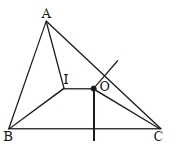
Let $ABC$ be a scalene triangle with incentre $I$ and circumcentre $O$. Suppose $B, C, I, O$ are concyclic points. Then $\angle B + \angle C$ is (in $^{\circ}$)
A
$60$
B
$105$
C
$120$
D
$135$
Solution
(C) If $B, I, O, C$ are concyclic,then $\angle BIC = \angle BOC$ (Angles in the same segment).
We know that $\angle BIC = 90^{\circ} + \frac{A}{2}$ and $\angle BOC = 2A$.
Equating these,we get $90^{\circ} + \frac{A}{2} = 2A$.
$\frac{3A}{2} = 90^{\circ} \implies A = 60^{\circ}$.
Since the sum of angles in a triangle is $180^{\circ}$,$\angle B + \angle C = 180^{\circ} - A = 180^{\circ} - 60^{\circ} = 120^{\circ}$.
We know that $\angle BIC = 90^{\circ} + \frac{A}{2}$ and $\angle BOC = 2A$.
Equating these,we get $90^{\circ} + \frac{A}{2} = 2A$.
$\frac{3A}{2} = 90^{\circ} \implies A = 60^{\circ}$.
Since the sum of angles in a triangle is $180^{\circ}$,$\angle B + \angle C = 180^{\circ} - A = 180^{\circ} - 60^{\circ} = 120^{\circ}$.
0 likesView Solution
19
MathematicsDifficultMCQKVPY · 2021
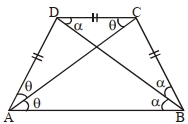
Suppose $ABCD$ $(AB \parallel CD)$ is a trapezium such that the diagonals $AC$ and $BD$ bisect the angles $\angle DAB$ and $\angle CBA$,respectively. Then
A
no two sides of the trapezium are equal
B
exactly two sides of the trapezium are equal
C
exactly three sides of the trapezium are equal
D
none of the options above can be concluded
Solution
(C) Given that $AC$ is the bisector of $\angle DAB$,we have $\angle DAC = \angle CAB$.
Since $DC \parallel AB$,the alternate interior angles are equal,so $\angle CAB = \angle ACD$.
Therefore,$\angle DAC = \angle ACD$,which implies that $\triangle ADC$ is an isosceles triangle with $AD = DC$.
Similarly,since $BD$ is the bisector of $\angle CBA$,we have $\angle CBD = \angle DBA$.
Since $DC \parallel AB$,the alternate interior angles are equal,so $\angle DBA = \angle BDC$.
Therefore,$\angle CBD = \angle BDC$,which implies that $\triangle BCD$ is an isosceles triangle with $BC = DC$.
Since $AD = DC$ and $BC = DC$,we have $AD = BC = DC$.
Thus,exactly three sides of the trapezium are equal.
Since $DC \parallel AB$,the alternate interior angles are equal,so $\angle CAB = \angle ACD$.
Therefore,$\angle DAC = \angle ACD$,which implies that $\triangle ADC$ is an isosceles triangle with $AD = DC$.
Similarly,since $BD$ is the bisector of $\angle CBA$,we have $\angle CBD = \angle DBA$.
Since $DC \parallel AB$,the alternate interior angles are equal,so $\angle DBA = \angle BDC$.
Therefore,$\angle CBD = \angle BDC$,which implies that $\triangle BCD$ is an isosceles triangle with $BC = DC$.
Since $AD = DC$ and $BC = DC$,we have $AD = BC = DC$.
Thus,exactly three sides of the trapezium are equal.
0 likesView Solution
20
MathematicsAdvancedMCQKVPY · 2021
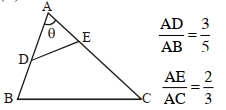
Suppose $ABC$ is a triangle and $D, E$ are points on the sides $AB$ and $AC$ respectively. If $AD : AB = 3 : 5$ and $AE : AC = 2 : 3$,then the ratio of the areas of the triangles $ABC$ and $ADE$ lies in the interval.
A
$(1, 2]$
B
$\left(2, \frac{5}{2}\right]$
C
$\left(\frac{5}{2}, 3\right]$
D
$\left(3, \frac{7}{2}\right]$
Solution
(B) Let $\angle A = \theta$.
The area of $\triangle ABC$ is given by $\text{ar}(\triangle ABC) = \frac{1}{2} \cdot AB \cdot AC \cdot \sin \theta$.
The area of $\triangle ADE$ is given by $\text{ar}(\triangle ADE) = \frac{1}{2} \cdot AD \cdot AE \cdot \sin \theta$.
Therefore,the ratio of the areas is:
$\frac{\text{ar}(\triangle ABC)}{\text{ar}(\triangle ADE)} = \frac{\frac{1}{2} \cdot AB \cdot AC \cdot \sin \theta}{\frac{1}{2} \cdot AD \cdot AE \cdot \sin \theta} = \frac{AB}{AD} \times \frac{AC}{AE}$.
Given $AD : AB = 3 : 5$,we have $\frac{AB}{AD} = \frac{5}{3}$.
Given $AE : AC = 2 : 3$,we have $\frac{AC}{AE} = \frac{3}{2}$.
Thus,the ratio is $\frac{5}{3} \times \frac{3}{2} = \frac{5}{2} = 2.5$.
The value $2.5$ lies in the interval $\left(2, \frac{5}{2}\right]$.
Hence,the correct option is $B$.
The area of $\triangle ABC$ is given by $\text{ar}(\triangle ABC) = \frac{1}{2} \cdot AB \cdot AC \cdot \sin \theta$.
The area of $\triangle ADE$ is given by $\text{ar}(\triangle ADE) = \frac{1}{2} \cdot AD \cdot AE \cdot \sin \theta$.
Therefore,the ratio of the areas is:
$\frac{\text{ar}(\triangle ABC)}{\text{ar}(\triangle ADE)} = \frac{\frac{1}{2} \cdot AB \cdot AC \cdot \sin \theta}{\frac{1}{2} \cdot AD \cdot AE \cdot \sin \theta} = \frac{AB}{AD} \times \frac{AC}{AE}$.
Given $AD : AB = 3 : 5$,we have $\frac{AB}{AD} = \frac{5}{3}$.
Given $AE : AC = 2 : 3$,we have $\frac{AC}{AE} = \frac{3}{2}$.
Thus,the ratio is $\frac{5}{3} \times \frac{3}{2} = \frac{5}{2} = 2.5$.
The value $2.5$ lies in the interval $\left(2, \frac{5}{2}\right]$.
Hence,the correct option is $B$.
0 likesView Solution
21
MathematicsAdvancedMCQKVPY · 2021
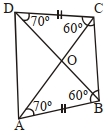
Let $ABCD$ be a convex quadrilateral in which $AC = BD$,$AB = CD$,$\angle BAC = 70^{\circ}$ and $\angle BCD = 60^{\circ}$. The acute angle between $AC$ and $BD$ is (in $^{\circ}$)
A
$70$
B
$75$
C
$80$
D
$85$
Solution
(C) In $\triangle ABC$ and $\triangle DCB$,
$AB = DC$ (Given)
$BC = CB$ (Common side)
$AC = DB$ (Given)
By $SSS$ congruence criterion,$\triangle ABC \cong \triangle DCB$.
Therefore,$\angle BAC = \angle CDB = 70^{\circ}$ and $\angle ABC = \angle DCB = 60^{\circ}$.
In $\triangle ABC$,$\angle ACB = 180^{\circ} - \angle BAC - \angle ABC = 180^{\circ} - 70^{\circ} - 60^{\circ} = 50^{\circ}$.
Now,$\angle DCO = \angle BCD - \angle ACB = 60^{\circ} - 50^{\circ} = 10^{\circ}$.
In $\triangle DOC$,$\angle DOC = 180^{\circ} - \angle ODC - \angle DCO = 180^{\circ} - 70^{\circ} - 10^{\circ} = 100^{\circ}$.
The acute angle between $AC$ and $BD$ is $180^{\circ} - 100^{\circ} = 80^{\circ}$.
$AB = DC$ (Given)
$BC = CB$ (Common side)
$AC = DB$ (Given)
By $SSS$ congruence criterion,$\triangle ABC \cong \triangle DCB$.
Therefore,$\angle BAC = \angle CDB = 70^{\circ}$ and $\angle ABC = \angle DCB = 60^{\circ}$.
In $\triangle ABC$,$\angle ACB = 180^{\circ} - \angle BAC - \angle ABC = 180^{\circ} - 70^{\circ} - 60^{\circ} = 50^{\circ}$.
Now,$\angle DCO = \angle BCD - \angle ACB = 60^{\circ} - 50^{\circ} = 10^{\circ}$.
In $\triangle DOC$,$\angle DOC = 180^{\circ} - \angle ODC - \angle DCO = 180^{\circ} - 70^{\circ} - 10^{\circ} = 100^{\circ}$.
The acute angle between $AC$ and $BD$ is $180^{\circ} - 100^{\circ} = 80^{\circ}$.
0 likesView Solution
22
MathematicsAdvancedMCQKVPY · 2021
Integers $1, 2, 3, \ldots, n$ $(n \geq 3)$ are written on a blackboard and an integer $k$ $(1 < k < n)$ is erased. The average of the remaining numbers is $16$. Then $n + k$ is
A
$31$
B
$40$
C
$47$
D
$50$
Solution
(C) The sum of the first $n$ integers is given by $S_n = \frac{n(n+1)}{2}$.
After erasing the integer $k$,the sum of the remaining $(n-1)$ integers is $\frac{n(n+1)}{2} - k$.
The average of the remaining numbers is given as $16$,so:
$\frac{\frac{n(n+1)}{2} - k}{n-1} = 16$
$n(n+1) - 2k = 32(n-1)$
$n^2 + n - 2k = 32n - 32$
$2k = n^2 - 31n + 32$
$k = \frac{n^2 - 31n + 32}{2}$
Since $1 < k < n$,we have:
$1 < \frac{n^2 - 31n + 32}{2} < n$
From $k < n$: $n^2 - 31n + 32 < 2n \implies n^2 - 33n + 32 < 0 \implies (n-32)(n-1) < 0$. Since $n \geq 3$,we have $n < 32$.
From $k > 1$: $n^2 - 31n + 32 > 2 \implies n^2 - 31n + 30 > 0 \implies (n-30)(n-1) > 0$. Since $n \geq 3$,we have $n > 30$.
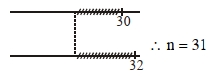
Thus,$n$ must be $31$.
Substituting $n = 31$ into the equation for $k$:
$k = \frac{31^2 - 31(31) + 32}{2} = \frac{32}{2} = 16$.
Therefore,$n + k = 31 + 16 = 47$.
After erasing the integer $k$,the sum of the remaining $(n-1)$ integers is $\frac{n(n+1)}{2} - k$.
The average of the remaining numbers is given as $16$,so:
$\frac{\frac{n(n+1)}{2} - k}{n-1} = 16$
$n(n+1) - 2k = 32(n-1)$
$n^2 + n - 2k = 32n - 32$
$2k = n^2 - 31n + 32$
$k = \frac{n^2 - 31n + 32}{2}$
Since $1 < k < n$,we have:
$1 < \frac{n^2 - 31n + 32}{2} < n$
From $k < n$: $n^2 - 31n + 32 < 2n \implies n^2 - 33n + 32 < 0 \implies (n-32)(n-1) < 0$. Since $n \geq 3$,we have $n < 32$.
From $k > 1$: $n^2 - 31n + 32 > 2 \implies n^2 - 31n + 30 > 0 \implies (n-30)(n-1) > 0$. Since $n \geq 3$,we have $n > 30$.
Thus,$n$ must be $31$.
Substituting $n = 31$ into the equation for $k$:
$k = \frac{31^2 - 31(31) + 32}{2} = \frac{32}{2} = 16$.
Therefore,$n + k = 31 + 16 = 47$.
0 likesView Solution
23
MathematicsAdvancedMCQKVPY · 2021
Let $p = 99$ and $q = 101$. Define $p_1 = \log_{10} \left(\frac{p+q}{2}\right)$ and $q_1 = \frac{1}{2}(\log_{10} p + \log_{10} q)$,and $p_2 = \log_{10} \left(\frac{p_1+q_1}{2}\right)$,$q_2 = \frac{1}{2}(\log_{10} p_1 + \log_{10} q_1)$. Then:
A
$\log p_1 > p_2 > q_2 > \log q_1$
B
$\log p_1 > q_2 > p_2 > \log q_1$
C
$\log q_1 > p_2 > q_2 > \log p_1$
D
$\log q_1 > q_2 > p_2 > \log p_1$
Solution
(A) Given $p = 99$ and $q = 101$.
$p_1 = \log_{10} \left(\frac{99+101}{2}\right) = \log_{10} 100 = 2$.
$q_1 = \frac{1}{2}(\log_{10} 99 + \log_{10} 101) = \log_{10} \sqrt{99 \times 101} = \log_{10} \sqrt{9999}$.
Since $9999 < 10000$,$\sqrt{9999} < 100$,so $q_1 < \log_{10} 100 = 2$.
Thus,$p_1 > q_1$.
By the Arithmetic Mean-Geometric Mean inequality,for any two positive numbers $a$ and $b$,$\frac{a+b}{2} > \sqrt{ab}$ if $a \neq b$.
Since $p_1 > q_1$,we have $\frac{p_1+q_1}{2} > \sqrt{p_1 q_1}$.
Taking $\log_{10}$ on both sides,$\log_{10} \left(\frac{p_1+q_1}{2}\right) > \log_{10} \sqrt{p_1 q_1} = \frac{1}{2}(\log_{10} p_1 + \log_{10} q_1)$.
This implies $p_2 > q_2$.
Also,since $p_1 > q_1$,it follows that $\log_{10} p_1 > \log_{10} q_1$.
Since $p_1 > \frac{p_1+q_1}{2} > q_1$,applying the logarithm function (which is strictly increasing) gives $\log_{10} p_1 > p_2 > \log_{10} q_1$.
Combining these,we get $\log_{10} p_1 > p_2 > q_2 > \log_{10} q_1$.
$p_1 = \log_{10} \left(\frac{99+101}{2}\right) = \log_{10} 100 = 2$.
$q_1 = \frac{1}{2}(\log_{10} 99 + \log_{10} 101) = \log_{10} \sqrt{99 \times 101} = \log_{10} \sqrt{9999}$.
Since $9999 < 10000$,$\sqrt{9999} < 100$,so $q_1 < \log_{10} 100 = 2$.
Thus,$p_1 > q_1$.
By the Arithmetic Mean-Geometric Mean inequality,for any two positive numbers $a$ and $b$,$\frac{a+b}{2} > \sqrt{ab}$ if $a \neq b$.
Since $p_1 > q_1$,we have $\frac{p_1+q_1}{2} > \sqrt{p_1 q_1}$.
Taking $\log_{10}$ on both sides,$\log_{10} \left(\frac{p_1+q_1}{2}\right) > \log_{10} \sqrt{p_1 q_1} = \frac{1}{2}(\log_{10} p_1 + \log_{10} q_1)$.
This implies $p_2 > q_2$.
Also,since $p_1 > q_1$,it follows that $\log_{10} p_1 > \log_{10} q_1$.
Since $p_1 > \frac{p_1+q_1}{2} > q_1$,applying the logarithm function (which is strictly increasing) gives $\log_{10} p_1 > p_2 > \log_{10} q_1$.
Combining these,we get $\log_{10} p_1 > p_2 > q_2 > \log_{10} q_1$.
0 likesView Solution
24
MathematicsDifficultMCQKVPY · 2021
Let $a$ be the largest real root and $b$ be the smallest real root of the polynomial equation $x^6-6x^5+15x^4-20x^3+15x^2-6x+1=0$. Then $\frac{a^2+b^2}{a+b+1}$ is
A
$\frac{1}{2}$
B
$\frac{2}{3}$
C
$\frac{5}{4}$
D
$\frac{13}{7}$
Solution
(B) The given polynomial equation is $x^6-6x^5+15x^4-20x^3+15x^2-6x+1=0$.
This expression follows the binomial expansion of $(x-1)^6$.
Thus,the equation can be written as $(x-1)^6=0$.
This implies that all roots of the equation are equal to $1$.
Therefore,the largest real root $a = 1$ and the smallest real root $b = 1$.
Substituting these values into the expression,we get $\frac{a^2+b^2}{a+b+1} = \frac{1^2+1^2}{1+1+1} = \frac{1+1}{3} = \frac{2}{3}$.
This expression follows the binomial expansion of $(x-1)^6$.
Thus,the equation can be written as $(x-1)^6=0$.
This implies that all roots of the equation are equal to $1$.
Therefore,the largest real root $a = 1$ and the smallest real root $b = 1$.
Substituting these values into the expression,we get $\frac{a^2+b^2}{a+b+1} = \frac{1^2+1^2}{1+1+1} = \frac{1+1}{3} = \frac{2}{3}$.
0 likesView Solution
25
MathematicsAdvancedMCQKVPY · 2021
The number of ordered pairs $(a, b)$ of integers such that $1 \leq a, b \leq 2021$ and the equations $x^2 - ax + b = 0$ and $x^3 - ax^2 + bx + a - b = 0$ have a common real root is
A
$2017$
B
$2018$
C
$2019$
D
$2021$
Solution
(B) Let $\alpha$ be the common real root of the equations $x^2 - ax + b = 0$ and $x^3 - ax^2 + bx + a - b = 0$.
Since $\alpha$ is a root of the first equation,we have $\alpha^2 - a\alpha + b = 0$.
Substituting this into the second equation: $\alpha(\alpha^2 - a\alpha + b) + a - b = 0$.
Since $\alpha^2 - a\alpha + b = 0$,this simplifies to $a - b = 0$,which means $a = b$.
Substituting $a = b$ into the first equation,we get $x^2 - ax + a = 0$.
For the roots to be real,the discriminant $D \geq 0$,so $a^2 - 4a \geq 0$.
This implies $a(a - 4) \geq 0$,which gives $a \leq 0$ or $a \geq 4$.
Given $1 \leq a, b \leq 2021$ and $a = b$,we must have $4 \leq a \leq 2021$.
The number of such integers $a$ is $2021 - 4 + 1 = 2018$.
Since $\alpha$ is a root of the first equation,we have $\alpha^2 - a\alpha + b = 0$.
Substituting this into the second equation: $\alpha(\alpha^2 - a\alpha + b) + a - b = 0$.
Since $\alpha^2 - a\alpha + b = 0$,this simplifies to $a - b = 0$,which means $a = b$.
Substituting $a = b$ into the first equation,we get $x^2 - ax + a = 0$.
For the roots to be real,the discriminant $D \geq 0$,so $a^2 - 4a \geq 0$.
This implies $a(a - 4) \geq 0$,which gives $a \leq 0$ or $a \geq 4$.
Given $1 \leq a, b \leq 2021$ and $a = b$,we must have $4 \leq a \leq 2021$.
The number of such integers $a$ is $2021 - 4 + 1 = 2018$.

0 likesView Solution
26
MathematicsDifficultMCQKVPY · 2021
The number of positive integers $x$ satisfying the equation $\frac{1}{x} + \frac{1}{x+1} + \frac{1}{x+2} = \frac{13}{12}$ is:
A
$0$
B
$1$
C
$2$
D
more than $2$
Solution
(B) Given equation: $\frac{1}{x} + \frac{1}{x+1} + \frac{1}{x+2} = \frac{13}{12}$.
Combining the fractions on the left side:
$\frac{(x+1)(x+2) + x(x+2) + x(x+1)}{x(x+1)(x+2)} = \frac{13}{12}$.
Expanding the numerator:
$\frac{(x^2 + 3x + 2) + (x^2 + 2x) + (x^2 + x)}{x(x+1)(x+2)} = \frac{13}{12}$.
$\frac{3x^2 + 6x + 2}{x^3 + 3x^2 + 2x} = \frac{13}{12}$.
Cross-multiplying:
$12(3x^2 + 6x + 2) = 13(x^3 + 3x^2 + 2x)$.
$36x^2 + 72x + 24 = 13x^3 + 39x^2 + 26x$.
Rearranging into a cubic equation:
$13x^3 + 3x^2 - 46x - 24 = 0$.
Testing for integer roots using the Rational Root Theorem,we find $x=2$ is a root:
$13(8) + 3(4) - 46(2) - 24 = 104 + 12 - 92 - 24 = 0$.
Dividing the cubic by $(x-2)$ gives $(x-2)(13x^2 + 29x + 12) = 0$.
The quadratic $13x^2 + 29x + 12 = 0$ has discriminant $D = 29^2 - 4(13)(12) = 841 - 624 = 217$,which is not a perfect square,so the roots are not integers.
Thus,the only positive integer solution is $x=2$.
Combining the fractions on the left side:
$\frac{(x+1)(x+2) + x(x+2) + x(x+1)}{x(x+1)(x+2)} = \frac{13}{12}$.
Expanding the numerator:
$\frac{(x^2 + 3x + 2) + (x^2 + 2x) + (x^2 + x)}{x(x+1)(x+2)} = \frac{13}{12}$.
$\frac{3x^2 + 6x + 2}{x^3 + 3x^2 + 2x} = \frac{13}{12}$.
Cross-multiplying:
$12(3x^2 + 6x + 2) = 13(x^3 + 3x^2 + 2x)$.
$36x^2 + 72x + 24 = 13x^3 + 39x^2 + 26x$.
Rearranging into a cubic equation:
$13x^3 + 3x^2 - 46x - 24 = 0$.
Testing for integer roots using the Rational Root Theorem,we find $x=2$ is a root:
$13(8) + 3(4) - 46(2) - 24 = 104 + 12 - 92 - 24 = 0$.
Dividing the cubic by $(x-2)$ gives $(x-2)(13x^2 + 29x + 12) = 0$.
The quadratic $13x^2 + 29x + 12 = 0$ has discriminant $D = 29^2 - 4(13)(12) = 841 - 624 = 217$,which is not a perfect square,so the roots are not integers.
Thus,the only positive integer solution is $x=2$.
0 likesView Solution
27
MathematicsDifficultMCQKVPY · 2021
$A$ contractor has two teams of workers,team $A$ and team $B$. Team $A$ can complete a project $P$ in $12$ days and team $B$ can complete $P$ in $36$ days. Team $A$ starts working on $P$ and team $B$ joins team $A$ after four days. Team $A$ is withdrawn after another two days and team $B$ is asked to double its efficiency. The number of additional days required for team $B$ to complete $P$ is
A
$6$
B
$8$
C
$15$
D
$16$
Solution
(B) Work done by Team $A$ in one day $= \frac{1}{12}$.
Work done by Team $B$ in one day $= \frac{1}{36}$.
Work done by Team $A$ in first $4$ days $= 4 \times \frac{1}{12} = \frac{1}{3}$.
Work done by Team $A$ and $B$ together in the next $2$ days $= 2 \times (\frac{1}{12} + \frac{1}{36}) = 2 \times (\frac{3+1}{36}) = 2 \times \frac{4}{36} = \frac{2}{9}$.
Total work done in $6$ days $= \frac{1}{3} + \frac{2}{9} = \frac{3+2}{9} = \frac{5}{9}$.
Remaining work $= 1 - \frac{5}{9} = \frac{4}{9}$.
Team $B$ doubles its efficiency,so new efficiency $= 2 \times \frac{1}{36} = \frac{1}{18}$.
Additional days required for Team $B$ to complete the remaining work $= \frac{4/9}{1/18} = \frac{4}{9} \times 18 = 8$ days.
Work done by Team $B$ in one day $= \frac{1}{36}$.
Work done by Team $A$ in first $4$ days $= 4 \times \frac{1}{12} = \frac{1}{3}$.
Work done by Team $A$ and $B$ together in the next $2$ days $= 2 \times (\frac{1}{12} + \frac{1}{36}) = 2 \times (\frac{3+1}{36}) = 2 \times \frac{4}{36} = \frac{2}{9}$.
Total work done in $6$ days $= \frac{1}{3} + \frac{2}{9} = \frac{3+2}{9} = \frac{5}{9}$.
Remaining work $= 1 - \frac{5}{9} = \frac{4}{9}$.
Team $B$ doubles its efficiency,so new efficiency $= 2 \times \frac{1}{36} = \frac{1}{18}$.
Additional days required for Team $B$ to complete the remaining work $= \frac{4/9}{1/18} = \frac{4}{9} \times 18 = 8$ days.
0 likesView Solution
28
MathematicsMediumMCQKVPY · 2021
The number of positive integers $n$ such that $n+3$ divides $n^3-3$ is
A
$3$
B
$4$
C
$5$
D
$8$
Solution
(C) We are given that $(n+3)$ divides $(n^3-3)$.
Using polynomial division,we can write:
$\frac{n^3-3}{n+3} = \frac{n^3+27-30}{n+3} = \frac{(n+3)(n^2-3n+9)-30}{n+3} = (n^2-3n+9) - \frac{30}{n+3}$.
For the expression to be an integer,$(n+3)$ must be a divisor of $30$.
Since $n$ is a positive integer,$n \ge 1$,so $n+3 \ge 4$.
The divisors of $30$ are $1, 2, 3, 5, 6, 10, 15, 30$.
Considering the condition $n+3 \ge 4$,the possible values for $(n+3)$ are $5, 6, 10, 15, 30$.
Calculating $n$ for each case:
$n+3 = 5 \Rightarrow n = 2$
$n+3 = 6 \Rightarrow n = 3$
$n+3 = 10 \Rightarrow n = 7$
$n+3 = 15 \Rightarrow n = 12$
$n+3 = 30 \Rightarrow n = 27$
Thus,there are $5$ such positive integers $n$.
Using polynomial division,we can write:
$\frac{n^3-3}{n+3} = \frac{n^3+27-30}{n+3} = \frac{(n+3)(n^2-3n+9)-30}{n+3} = (n^2-3n+9) - \frac{30}{n+3}$.
For the expression to be an integer,$(n+3)$ must be a divisor of $30$.
Since $n$ is a positive integer,$n \ge 1$,so $n+3 \ge 4$.
The divisors of $30$ are $1, 2, 3, 5, 6, 10, 15, 30$.
Considering the condition $n+3 \ge 4$,the possible values for $(n+3)$ are $5, 6, 10, 15, 30$.
Calculating $n$ for each case:
$n+3 = 5 \Rightarrow n = 2$
$n+3 = 6 \Rightarrow n = 3$
$n+3 = 10 \Rightarrow n = 7$
$n+3 = 15 \Rightarrow n = 12$
$n+3 = 30 \Rightarrow n = 27$
Thus,there are $5$ such positive integers $n$.
0 likesView Solution
29
MathematicsDifficultMCQKVPY · 2021
Suppose we have an arithmetic progression $a_1, a_2, \ldots, a_n, \ldots$ with $a_1 = 1$ and $a_2 - a_1 = 5$. The median of the finite sequence $a_1, a_2, \ldots, a_k$,where $a_k \leq 2021$ and $a_{k+1} > 2021$,is
A
$1011$
B
$1011.5$
C
$1013.5$
D
$1016$
Solution
(A) Given the arithmetic progression $a_1, a_2, \ldots, a_n$ with $a_1 = 1$ and common difference $d = a_2 - a_1 = 5$.
The $n$-th term is given by $a_n = a_1 + (n - 1)d = 1 + (n - 1)5 = 5n - 4$.
We are given $a_k \leq 2021$,so $5k - 4 \leq 2021$,which implies $5k \leq 2025$,or $k \leq 405$.
Since $a_{k+1} > 2021$,the sequence is $a_1, a_2, \ldots, a_{405}$.
The number of terms is $405$,which is odd. The median of a sequence with $n$ terms (where $n$ is odd) is the term at position $\frac{n+1}{2}$.
Here,the median is the term at position $\frac{405+1}{2} = 203$.
The $203$-rd term is $a_{203} = a_1 + (203 - 1)d = 1 + 202 \times 5 = 1 + 1010 = 1011$.
The $n$-th term is given by $a_n = a_1 + (n - 1)d = 1 + (n - 1)5 = 5n - 4$.
We are given $a_k \leq 2021$,so $5k - 4 \leq 2021$,which implies $5k \leq 2025$,or $k \leq 405$.
Since $a_{k+1} > 2021$,the sequence is $a_1, a_2, \ldots, a_{405}$.
The number of terms is $405$,which is odd. The median of a sequence with $n$ terms (where $n$ is odd) is the term at position $\frac{n+1}{2}$.
Here,the median is the term at position $\frac{405+1}{2} = 203$.
The $203$-rd term is $a_{203} = a_1 + (203 - 1)d = 1 + 202 \times 5 = 1 + 1010 = 1011$.
0 likesView Solution
30
MathematicsMediumMCQKVPY · 2021
The value of the fifth root of $10^{10^{10}}$ is
A
$10^{2 \times 10^9}$
B
$10^{20 \times 10^9}$
C
$10^{10^2}$
D
$10^{2^{10}}$
Solution
(A) The fifth root of a number $x$ is given by $x^{1/5}$.
Given the expression: $\left(10^{10^{10}}\right)^{\frac{1}{5}}$.
Using the power rule $(a^m)^n = a^{m \times n}$,we get:
$= 10^{10^{10} \times \frac{1}{5}}$.
We can rewrite $10^{10}$ as $10 \times 10^9$:
$= 10^{\frac{10}{5} \times 10^9}$.
$= 10^{2 \times 10^9}$.
Given the expression: $\left(10^{10^{10}}\right)^{\frac{1}{5}}$.
Using the power rule $(a^m)^n = a^{m \times n}$,we get:
$= 10^{10^{10} \times \frac{1}{5}}$.
We can rewrite $10^{10}$ as $10 \times 10^9$:
$= 10^{\frac{10}{5} \times 10^9}$.
$= 10^{2 \times 10^9}$.
0 likesView Solution
31
MathematicsDifficultMCQKVPY · 2021
Let $A$ denote the set of all $2$-digit numbers in base $10$ that are equal to four times the sum of the factorials of their digits. The sum of the numbers in $A$ is
A
$12$
B
$34$
C
$44$
D
$54$
Solution
(C) Let the $2$-digit number be represented as $10a + b$,where $a \in \{1, 2, \dots, 9\}$ and $b \in \{0, 1, \dots, 9\}$.
According to the problem,$10a + b = 4(a! + b!)$.
Since $10a + b \leq 99$,we have $4(a! + b!) \leq 99$,which implies $a! + b! \leq 24.75$.
This restricts $a$ and $b$ to values $\leq 4$ because $5! = 120 > 24$.
Testing possible values for $a \in \{1, 2, 3, 4\}$ and $b \in \{0, 1, 2, 3, 4\}$:
If $a=1$: $10(1) + b = 4(1! + b!)$ $\Rightarrow 10 + b = 4(1 + b!)$ $\Rightarrow 6 + b = 4b!$. For $b=2$,$6+2 = 4(2!) = 8$. So,$12$ is a solution.
If $a=2$: $20 + b = 4(2! + b!)$ $\Rightarrow 20 + b = 8 + 4b!$ $\Rightarrow 12 + b = 4b!$. No integer solution for $b \in \{0, 1, 2, 3, 4\}$.
If $a=3$: $30 + b = 4(3! + b!)$ $\Rightarrow 30 + b = 24 + 4b!$ $\Rightarrow 6 + b = 4b!$. For $b=2$,$6+2 = 4(2!) = 8$. So,$32$ is a solution.
If $a=4$: $40 + b = 4(4! + b!) \Rightarrow 40 + b = 96 + 4b!$. No solution as $40+b < 96$.
The set $A = \{12, 32\}$.
The sum of the numbers in $A$ is $12 + 32 = 44$.
According to the problem,$10a + b = 4(a! + b!)$.
Since $10a + b \leq 99$,we have $4(a! + b!) \leq 99$,which implies $a! + b! \leq 24.75$.
This restricts $a$ and $b$ to values $\leq 4$ because $5! = 120 > 24$.
Testing possible values for $a \in \{1, 2, 3, 4\}$ and $b \in \{0, 1, 2, 3, 4\}$:
If $a=1$: $10(1) + b = 4(1! + b!)$ $\Rightarrow 10 + b = 4(1 + b!)$ $\Rightarrow 6 + b = 4b!$. For $b=2$,$6+2 = 4(2!) = 8$. So,$12$ is a solution.
If $a=2$: $20 + b = 4(2! + b!)$ $\Rightarrow 20 + b = 8 + 4b!$ $\Rightarrow 12 + b = 4b!$. No integer solution for $b \in \{0, 1, 2, 3, 4\}$.
If $a=3$: $30 + b = 4(3! + b!)$ $\Rightarrow 30 + b = 24 + 4b!$ $\Rightarrow 6 + b = 4b!$. For $b=2$,$6+2 = 4(2!) = 8$. So,$32$ is a solution.
If $a=4$: $40 + b = 4(4! + b!) \Rightarrow 40 + b = 96 + 4b!$. No solution as $40+b < 96$.
The set $A = \{12, 32\}$.
The sum of the numbers in $A$ is $12 + 32 = 44$.
0 likesView Solution
32
MathematicsDifficultMCQKVPY · 2021
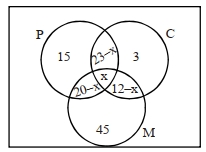
In a class of $100$ students,$15$ students chose only physics (but not mathematics and chemistry),$3$ chose only chemistry (but not mathematics and physics),and $45$ chose only mathematics (but not physics and chemistry). Of the remaining students,it is found that $23$ have taken physics and chemistry,$20$ have taken physics and mathematics,and $12$ have taken mathematics and chemistry. The number of students who chose all the three subjects is
A
$6$
B
$9$
C
$12$
D
$15$
Solution
(B) Let $x$ be the number of students who chose all three subjects.
Using the Venn diagram approach,the total number of students is the sum of all disjoint regions:
$100 = 15 + 3 + 45 + (23 - x) + (20 - x) + (12 - x) + x$
$100 = 63 + 55 - 2x$
$100 = 118 - 2x$
$2x = 118 - 100$
$2x = 18$
$x = 9$
Thus,the number of students who chose all three subjects is $9$.
Using the Venn diagram approach,the total number of students is the sum of all disjoint regions:
$100 = 15 + 3 + 45 + (23 - x) + (20 - x) + (12 - x) + x$
$100 = 63 + 55 - 2x$
$100 = 118 - 2x$
$2x = 118 - 100$
$2x = 18$
$x = 9$
Thus,the number of students who chose all three subjects is $9$.
0 likesView Solution
33
MathematicsAdvancedMCQKVPY · 2021
The sum of the sides of a right-angled triangle is $42$,and the difference between the median and altitude drawn from the vertex at the right angle is $2$. The area of the triangle is
A
$42$
B
$51$
C
$63$
D
$9 \sqrt{51}$
Solution
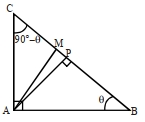
(C) Let the sides of the right-angled triangle be $b$,$c$ (legs) and $x$ (hypotenuse).
Given $b + c + x = 42$ --- $(1)$
In a right-angled triangle,the median to the hypotenuse is half the hypotenuse,so $M = \frac{x}{2}$.
The altitude $h$ to the hypotenuse is given by $h = \frac{bc}{x}$.
Given $M - h = 2$,so $\frac{x}{2} - \frac{bc}{x} = 2 \Rightarrow x^2 - 2bc = 4x$ --- $(2)$
From $(1)$,$b + c = 42 - x$. Squaring both sides: $b^2 + c^2 + 2bc = (42 - x)^2$.
Since $b^2 + c^2 = x^2$,we have $x^2 + 2bc = (42 - x)^2$ --- $(3)$
Adding $(2)$ and $(3)$: $2x^2 = (42 - x)^2 + 4x$.
$2x^2 = 1764 - 84x + x^2 + 4x \Rightarrow x^2 + 80x - 1764 = 0$.
Solving the quadratic equation: $(x + 98)(x - 18) = 0$. Since $x > 0$,$x = 18$.
Substitute $x = 18$ into $(2)$: $18^2 - 2bc = 4(18)$ $\Rightarrow 324 - 2bc = 72$ $\Rightarrow 2bc = 252$ $\Rightarrow bc = 126$.
The area of the triangle is $\frac{1}{2}bc = \frac{1}{2} \times 126 = 63$.
Given $b + c + x = 42$ --- $(1)$
In a right-angled triangle,the median to the hypotenuse is half the hypotenuse,so $M = \frac{x}{2}$.
The altitude $h$ to the hypotenuse is given by $h = \frac{bc}{x}$.
Given $M - h = 2$,so $\frac{x}{2} - \frac{bc}{x} = 2 \Rightarrow x^2 - 2bc = 4x$ --- $(2)$
From $(1)$,$b + c = 42 - x$. Squaring both sides: $b^2 + c^2 + 2bc = (42 - x)^2$.
Since $b^2 + c^2 = x^2$,we have $x^2 + 2bc = (42 - x)^2$ --- $(3)$
Adding $(2)$ and $(3)$: $2x^2 = (42 - x)^2 + 4x$.
$2x^2 = 1764 - 84x + x^2 + 4x \Rightarrow x^2 + 80x - 1764 = 0$.
Solving the quadratic equation: $(x + 98)(x - 18) = 0$. Since $x > 0$,$x = 18$.
Substitute $x = 18$ into $(2)$: $18^2 - 2bc = 4(18)$ $\Rightarrow 324 - 2bc = 72$ $\Rightarrow 2bc = 252$ $\Rightarrow bc = 126$.
The area of the triangle is $\frac{1}{2}bc = \frac{1}{2} \times 126 = 63$.
0 likesView Solution
34
MathematicsAdvancedMCQKVPY · 2021
The number of ordered pairs $(a, b)$ of integers such that $a-b$ is a root of $x^2+ax+b=0$ is
A
$3$
B
$4$
C
$5$
D
$6$
Solution
(B) Given the quadratic equation $x^2+ax+b=0$. Since $a-b$ is a root,it must satisfy the equation:
$(a-b)^2 + a(a-b) + b = 0$
$a^2 - 2ab + b^2 + a^2 - ab + b = 0$
$b^2 - 3ab + b + 2a^2 = 0$
$b^2 + b(1-3a) + 2a^2 = 0$
Solving for $b$ using the quadratic formula:
$b = \frac{-(1-3a) \pm \sqrt{(3a-1)^2 - 8a^2}}{2} = \frac{(3a-1) \pm \sqrt{9a^2 - 6a + 1 - 8a^2}}{2} = \frac{(3a-1) \pm \sqrt{a^2 - 6a + 1}}{2}$
For $b$ to be an integer,the discriminant $D = a^2 - 6a + 1$ must be a perfect square,say $k^2$.
$a^2 - 6a + 1 = k^2$
$(a-3)^2 - 8 = k^2$
$(a-3)^2 - k^2 = 8$
$(a-3-k)(a-3+k) = 8$
Since the product is $8$ (even),both factors must be even. Let $X = a-3-k$ and $Y = a-3+k$. Then $XY = 8$ and $X+Y = 2(a-3)$.
Possible pairs $(X, Y)$ such that $XY=8$ and $X, Y$ are even:
$1$) $X=2, Y=4 \implies 2(a-3)=6 \implies a-3=3 \implies a=6$. Then $k=1$,$b = \frac{(3(6)-1) \pm 1}{2} = \frac{17 \pm 1}{2} \implies b=9, 8$.
$2$) $X=-4, Y=-2 \implies 2(a-3)=-6 \implies a-3=-3 \implies a=0$. Then $k=1$,$b = \frac{(3(0)-1) \pm 1}{2} = \frac{-1 \pm 1}{2} \implies b=0, -1$.
Thus,the pairs $(a, b)$ are $(6, 9), (6, 8), (0, 0), (0, -1)$.
There are $4$ such ordered pairs.
$(a-b)^2 + a(a-b) + b = 0$
$a^2 - 2ab + b^2 + a^2 - ab + b = 0$
$b^2 - 3ab + b + 2a^2 = 0$
$b^2 + b(1-3a) + 2a^2 = 0$
Solving for $b$ using the quadratic formula:
$b = \frac{-(1-3a) \pm \sqrt{(3a-1)^2 - 8a^2}}{2} = \frac{(3a-1) \pm \sqrt{9a^2 - 6a + 1 - 8a^2}}{2} = \frac{(3a-1) \pm \sqrt{a^2 - 6a + 1}}{2}$
For $b$ to be an integer,the discriminant $D = a^2 - 6a + 1$ must be a perfect square,say $k^2$.
$a^2 - 6a + 1 = k^2$
$(a-3)^2 - 8 = k^2$
$(a-3)^2 - k^2 = 8$
$(a-3-k)(a-3+k) = 8$
Since the product is $8$ (even),both factors must be even. Let $X = a-3-k$ and $Y = a-3+k$. Then $XY = 8$ and $X+Y = 2(a-3)$.
Possible pairs $(X, Y)$ such that $XY=8$ and $X, Y$ are even:
$1$) $X=2, Y=4 \implies 2(a-3)=6 \implies a-3=3 \implies a=6$. Then $k=1$,$b = \frac{(3(6)-1) \pm 1}{2} = \frac{17 \pm 1}{2} \implies b=9, 8$.
$2$) $X=-4, Y=-2 \implies 2(a-3)=-6 \implies a-3=-3 \implies a=0$. Then $k=1$,$b = \frac{(3(0)-1) \pm 1}{2} = \frac{-1 \pm 1}{2} \implies b=0, -1$.
Thus,the pairs $(a, b)$ are $(6, 9), (6, 8), (0, 0), (0, -1)$.
There are $4$ such ordered pairs.
0 likesView Solution
35
MathematicsAdvancedMCQKVPY · 2021
Let $a, b, c, d$ be positive integers. Consider the following statements:
$I$. If $9$ divides $a^3+b^3+c^3$,then $3$ divides $abc$.
$II$. If $9$ divides $a^3+b^3+c^3+d^3$,then $3$ divides $abcd$.
$I$. If $9$ divides $a^3+b^3+c^3$,then $3$ divides $abc$.
$II$. If $9$ divides $a^3+b^3+c^3+d^3$,then $3$ divides $abcd$.
A
$I$ and $II$ are both true
B
$I$ is true but $II$ is false
C
$I$ is false but $II$ is true
D
$I$ and $II$ are both false
Solution
(B) For any integer $n$,$n^3 \equiv 0, 1, \text{ or } 8 \pmod{9}$,which is equivalent to $n^3 \equiv 0, 1, -1 \pmod{9}$.
Statement $I$: We want to check if $a^3+b^3+c^3 \equiv 0 \pmod{9}$ implies $abc \equiv 0 \pmod{3}$.
If $abc$ is not divisible by $3$,then $a, b, c \not\equiv 0 \pmod{3}$. Thus $a, b, c \equiv 1, 2 \pmod{3}$.
Then $a^3, b^3, c^3 \equiv 1, 8 \pmod{9}$ (since $1^3=1$ and $2^3=8 \equiv -1 \pmod{9}$).
To have $a^3+b^3+c^3 \equiv 0 \pmod{9}$,we need the sum of three values from ${1, -1}$ to be $0 \pmod{9}$,which is impossible as the possible sums are $\{3, 1, -1, -3\}$.
Thus,at least one of $a, b, c$ must be a multiple of $3$,so $abc$ is divisible by $3$. Statement $I$ is true.
Statement $II$: Consider $a=1, b=2, c=1, d=2$.
Then $a^3+b^3+c^3+d^3 = 1^3+2^3+1^3+2^3 = 1+8+1+8 = 18$,which is divisible by $9$.
However,$abcd = 1 \times 2 \times 1 \times 2 = 4$,which is not divisible by $3$.
Thus,Statement $II$ is false.
Statement $I$: We want to check if $a^3+b^3+c^3 \equiv 0 \pmod{9}$ implies $abc \equiv 0 \pmod{3}$.
If $abc$ is not divisible by $3$,then $a, b, c \not\equiv 0 \pmod{3}$. Thus $a, b, c \equiv 1, 2 \pmod{3}$.
Then $a^3, b^3, c^3 \equiv 1, 8 \pmod{9}$ (since $1^3=1$ and $2^3=8 \equiv -1 \pmod{9}$).
To have $a^3+b^3+c^3 \equiv 0 \pmod{9}$,we need the sum of three values from ${1, -1}$ to be $0 \pmod{9}$,which is impossible as the possible sums are $\{3, 1, -1, -3\}$.
Thus,at least one of $a, b, c$ must be a multiple of $3$,so $abc$ is divisible by $3$. Statement $I$ is true.
Statement $II$: Consider $a=1, b=2, c=1, d=2$.
Then $a^3+b^3+c^3+d^3 = 1^3+2^3+1^3+2^3 = 1+8+1+8 = 18$,which is divisible by $9$.
However,$abcd = 1 \times 2 \times 1 \times 2 = 4$,which is not divisible by $3$.
Thus,Statement $II$ is false.
0 likesView Solution
36
MathematicsAdvancedMCQKVPY · 2021
Let $\lambda$ be the positive root of the equation $x^2-x-1=0$,and set $a_n = \frac{1}{\sqrt{5}}\left(\lambda^n - (1-\lambda)^n\right)$ for $n \in N$,where $N$ is the set of all natural numbers. Consider the sets $A = \{ n \in N : a_n \text{ is a rational number, but not an integer} \}$ and $B = \{ n \in N : a_n \text{ is an irrational number} \}$. Then:
A
both the sets $A$ and $B$ are empty
B
the set $A$ is empty but the set $B$ is non-empty
C
the set $A$ is non-empty and the set $B$ is empty
D
both the sets $A$ and $B$ are non-empty
Solution
(A) The given equation is $x^2-x-1=0$. The roots are $x = \frac{1 \pm \sqrt{5}}{2}$.
Given $\lambda = \frac{1+\sqrt{5}}{2}$,then $1-\lambda = \frac{1-\sqrt{5}}{2}$.
Note that $a_n$ is the $n$-th Fibonacci number $F_n$,defined by the Binet formula.
$a_n = \frac{1}{\sqrt{5}}\left(\left(\frac{1+\sqrt{5}}{2}\right)^n - \left(\frac{1-\sqrt{5}}{2}\right)^n\right)$.
Expanding using the binomial theorem:
$(1+\sqrt{5})^n = \sum_{k=0}^n \binom{n}{k} (\sqrt{5})^k$ and $(1-\sqrt{5})^n = \sum_{k=0}^n \binom{n}{k} (-\sqrt{5})^k$.
Then $(1+\sqrt{5})^n - (1-\sqrt{5})^n = 2 \sum_{k \text{ odd}} \binom{n}{k} 5^{(k-1)/2} \cdot 5^{1/2} = 2\sqrt{5} \sum_{j=0}^{\lfloor (n-1)/2 \rfloor} \binom{n}{2j+1} 5^j$.
Thus,$a_n = \frac{1}{\sqrt{5}} \cdot \frac{1}{2^n} \cdot 2\sqrt{5} \sum_{j=0}^{\lfloor (n-1)/2 \rfloor} \binom{n}{2j+1} 5^j = \frac{1}{2^{n-1}} \sum_{j=0}^{\lfloor (n-1)/2 \rfloor} \binom{n}{2j+1} 5^j$.
Since $a_n$ is the $n$-th Fibonacci number,$a_n$ is an integer for all $n \in N$.
Therefore,$a_n$ is never a non-integer rational number,so $A = \emptyset$.
Also,$a_n$ is never an irrational number,so $B = \emptyset$.
Hence,both sets $A$ and $B$ are empty.
Given $\lambda = \frac{1+\sqrt{5}}{2}$,then $1-\lambda = \frac{1-\sqrt{5}}{2}$.
Note that $a_n$ is the $n$-th Fibonacci number $F_n$,defined by the Binet formula.
$a_n = \frac{1}{\sqrt{5}}\left(\left(\frac{1+\sqrt{5}}{2}\right)^n - \left(\frac{1-\sqrt{5}}{2}\right)^n\right)$.
Expanding using the binomial theorem:
$(1+\sqrt{5})^n = \sum_{k=0}^n \binom{n}{k} (\sqrt{5})^k$ and $(1-\sqrt{5})^n = \sum_{k=0}^n \binom{n}{k} (-\sqrt{5})^k$.
Then $(1+\sqrt{5})^n - (1-\sqrt{5})^n = 2 \sum_{k \text{ odd}} \binom{n}{k} 5^{(k-1)/2} \cdot 5^{1/2} = 2\sqrt{5} \sum_{j=0}^{\lfloor (n-1)/2 \rfloor} \binom{n}{2j+1} 5^j$.
Thus,$a_n = \frac{1}{\sqrt{5}} \cdot \frac{1}{2^n} \cdot 2\sqrt{5} \sum_{j=0}^{\lfloor (n-1)/2 \rfloor} \binom{n}{2j+1} 5^j = \frac{1}{2^{n-1}} \sum_{j=0}^{\lfloor (n-1)/2 \rfloor} \binom{n}{2j+1} 5^j$.
Since $a_n$ is the $n$-th Fibonacci number,$a_n$ is an integer for all $n \in N$.
Therefore,$a_n$ is never a non-integer rational number,so $A = \emptyset$.
Also,$a_n$ is never an irrational number,so $B = \emptyset$.
Hence,both sets $A$ and $B$ are empty.
0 likesView Solution
37
MathematicsAdvancedMCQKVPY · 2021
The number of integers $q$,$1 \leq q \leq 2021$,such that $\sqrt{q}$ is rational and $\frac{1}{q}$ has a terminating decimal expansion,is
A
$1$
B
$11$
C
$22$
D
$44$
Solution
(B) For $\frac{1}{q}$ to have a terminating decimal expansion,$q$ must be of the form $2^m 5^n$ where $m, n \in \mathbb{W}$.
For $\sqrt{q}$ to be rational,$q$ must be a perfect square.
If $q = 2^m 5^n$ is a perfect square,then both $m$ and $n$ must be even.
Let $m = 2a$ and $n = 2b$ where $a, b \in \mathbb{W}$.
Then $q = 2^{2a} 5^{2b} = (2^a 5^b)^2$.
We are given $1 \leq q \leq 2021$,so $1 \leq (2^a 5^b)^2 \leq 2021$,which implies $1 \leq 2^a 5^b \leq \sqrt{2021} \approx 44.95$.
We list the possible values for $2^a 5^b \leq 44$:
If $b=0$: $2^a \leq 44 \Rightarrow a \in \{0, 1, 2, 3, 4, 5\}$ (Values: $1, 2, 4, 8, 16, 32$)
If $b=1$: $2^a \cdot 5 \leq 44$ $\Rightarrow 2^a \leq 8.8$ $\Rightarrow a \in \{0, 1, 2, 3\}$ (Values: $5, 10, 20, 40$)
If $b=2$: $2^a \cdot 25 \leq 44$ $\Rightarrow 2^a \leq 1.76$ $\Rightarrow a = 0$ (Value: $25$)
Total values for $2^a 5^b$ are $6 + 4 + 1 = 11$.
Thus,there are $11$ such integers $q$.
For $\sqrt{q}$ to be rational,$q$ must be a perfect square.
If $q = 2^m 5^n$ is a perfect square,then both $m$ and $n$ must be even.
Let $m = 2a$ and $n = 2b$ where $a, b \in \mathbb{W}$.
Then $q = 2^{2a} 5^{2b} = (2^a 5^b)^2$.
We are given $1 \leq q \leq 2021$,so $1 \leq (2^a 5^b)^2 \leq 2021$,which implies $1 \leq 2^a 5^b \leq \sqrt{2021} \approx 44.95$.
We list the possible values for $2^a 5^b \leq 44$:
If $b=0$: $2^a \leq 44 \Rightarrow a \in \{0, 1, 2, 3, 4, 5\}$ (Values: $1, 2, 4, 8, 16, 32$)
If $b=1$: $2^a \cdot 5 \leq 44$ $\Rightarrow 2^a \leq 8.8$ $\Rightarrow a \in \{0, 1, 2, 3\}$ (Values: $5, 10, 20, 40$)
If $b=2$: $2^a \cdot 25 \leq 44$ $\Rightarrow 2^a \leq 1.76$ $\Rightarrow a = 0$ (Value: $25$)
Total values for $2^a 5^b$ are $6 + 4 + 1 = 11$.
Thus,there are $11$ such integers $q$.
0 likesView Solution
38
MathematicsAdvancedMCQKVPY · 2021
Let $R$ be the set of all real numbers and $\alpha \in R$ be positive. Define a function $f: R \rightarrow R$ by $f(0)=0$ and $f(x)=|x|^\alpha \sum \limits_{n=0}^{\infty}\left(1+x^2\right)^{-n}$,for $x \neq 0$. Then the set of real numbers $\alpha$ for which $f$ is continuous at $x = 0$ has
A
$2$ elements
B
$3$ elements
C
$4$ elements
D
more than $4$ elements
Solution
(D) For $x \neq 0$,the function is given by the sum of a geometric series:
$f(x) = |x|^\alpha \sum \limits_{n=0}^{\infty} \left(\frac{1}{1+x^2}\right)^n$.
Since $|\frac{1}{1+x^2}| < 1$ for $x \neq 0$,the sum of the infinite geometric series is $\frac{1}{1 - \frac{1}{1+x^2}} = \frac{1+x^2}{x^2}$.
Thus,$f(x) = |x|^\alpha \cdot \frac{1+x^2}{x^2} = |x|^\alpha \cdot |x|^{-2} (1+x^2) = |x|^{\alpha-2} (1+x^2)$.
For $f$ to be continuous at $x = 0$,we must have $\lim_{x \to 0} f(x) = f(0) = 0$.
$\lim_{x \to 0} |x|^{\alpha-2} (1+x^2) = 0$ holds if and only if $\alpha - 2 > 0$,which means $\alpha > 2$.
The set of such real numbers $\alpha$ is the interval $(2, \infty)$.
Since this interval contains infinitely many real numbers,the set has more than $4$ elements.
$f(x) = |x|^\alpha \sum \limits_{n=0}^{\infty} \left(\frac{1}{1+x^2}\right)^n$.
Since $|\frac{1}{1+x^2}| < 1$ for $x \neq 0$,the sum of the infinite geometric series is $\frac{1}{1 - \frac{1}{1+x^2}} = \frac{1+x^2}{x^2}$.
Thus,$f(x) = |x|^\alpha \cdot \frac{1+x^2}{x^2} = |x|^\alpha \cdot |x|^{-2} (1+x^2) = |x|^{\alpha-2} (1+x^2)$.
For $f$ to be continuous at $x = 0$,we must have $\lim_{x \to 0} f(x) = f(0) = 0$.
$\lim_{x \to 0} |x|^{\alpha-2} (1+x^2) = 0$ holds if and only if $\alpha - 2 > 0$,which means $\alpha > 2$.
The set of such real numbers $\alpha$ is the interval $(2, \infty)$.
Since this interval contains infinitely many real numbers,the set has more than $4$ elements.
0 likesView Solution
39
MathematicsAdvancedMCQKVPY · 2021
Let $R$ be the set of all real numbers. The number of continuous functions $f: R \rightarrow R$ such that for all real $x$,$f(x) + f(2x) = 0$ is
A
$0$
B
$1$
C
$2$
D
not finite
Solution
(B) Given the functional equation $f(x) + f(2x) = 0$ for all $x \in R$.
Substituting $x = 0$,we get $f(0) + f(0) = 0$,which implies $2f(0) = 0$,so $f(0) = 0$.
From the given equation,$f(x) = -f(x/2)$.
By iterating this relation,we get $f(x) = -f(x/2) = f(x/4) = -f(x/8) = \dots = (-1)^n f(x/2^n)$.
Since $f$ is continuous at $x = 0$,we have $\lim_{n \to \infty} f(x/2^n) = f(\lim_{n \to \infty} x/2^n) = f(0) = 0$.
Thus,$f(x) = \lim_{n \to \infty} (-1)^n f(x/2^n) = 0$.
Therefore,the only continuous function satisfying the condition is the zero function $f(x) = 0$.
Hence,there is only $1$ such function.
Substituting $x = 0$,we get $f(0) + f(0) = 0$,which implies $2f(0) = 0$,so $f(0) = 0$.
From the given equation,$f(x) = -f(x/2)$.
By iterating this relation,we get $f(x) = -f(x/2) = f(x/4) = -f(x/8) = \dots = (-1)^n f(x/2^n)$.
Since $f$ is continuous at $x = 0$,we have $\lim_{n \to \infty} f(x/2^n) = f(\lim_{n \to \infty} x/2^n) = f(0) = 0$.
Thus,$f(x) = \lim_{n \to \infty} (-1)^n f(x/2^n) = 0$.
Therefore,the only continuous function satisfying the condition is the zero function $f(x) = 0$.
Hence,there is only $1$ such function.
0 likesView Solution
40
MathematicsAdvancedMCQKVPY · 2021
The graph of the function $f(x) = \frac{\cos x}{\cos 2x}$ in the domain $\left(-\frac{\pi}{4}, \frac{\pi}{4}\right)$ is
A
increasing on $\left(-\frac{\pi}{4}, \frac{\pi}{4}\right)$
B
decreasing on $\left(-\frac{\pi}{4}, \frac{\pi}{4}\right)$
C
decreasing on $\left(-\frac{\pi}{4}, 0\right)$ and increasing on $\left(0, \frac{\pi}{4}\right)$
D
increasing on $\left(-\frac{\pi}{4}, 0\right)$ and decreasing on $\left(0, \frac{\pi}{4}\right)$
Solution
(C) Given $f(x) = \frac{\cos x}{\cos 2x}$.
Using the quotient rule,$f'(x) = \frac{-\sin x \cos 2x - \cos x (-2 \sin 2x)}{(\cos 2x)^2} = \frac{-\sin x \cos 2x + 2 \sin 2x \cos x}{(\cos 2x)^2}$.
Using the identity $\sin(A-B) = \sin A \cos B - \cos A \sin B$,we have $f'(x) = \frac{\sin(2x-x) + \sin 2x \cos x}{(\cos 2x)^2} = \frac{\sin x + 2 \sin x \cos^2 x}{(\cos 2x)^2}$.
$f'(x) = \frac{\sin x (1 + 2 \cos^2 x)}{(\cos 2x)^2}$.
Since $(1 + 2 \cos^2 x) > 0$ and $(\cos 2x)^2 > 0$ for all $x \in \left(-\frac{\pi}{4}, \frac{\pi}{4}\right)$,the sign of $f'(x)$ depends only on $\sin x$.
For $x \in \left(-\frac{\pi}{4}, 0\right)$,$\sin x < 0$,so $f'(x) < 0$,meaning $f(x)$ is decreasing.
For $x \in \left(0, \frac{\pi}{4}\right)$,$\sin x > 0$,so $f'(x) > 0$,meaning $f(x)$ is increasing.
Thus,the correct option is $C$.
Using the quotient rule,$f'(x) = \frac{-\sin x \cos 2x - \cos x (-2 \sin 2x)}{(\cos 2x)^2} = \frac{-\sin x \cos 2x + 2 \sin 2x \cos x}{(\cos 2x)^2}$.
Using the identity $\sin(A-B) = \sin A \cos B - \cos A \sin B$,we have $f'(x) = \frac{\sin(2x-x) + \sin 2x \cos x}{(\cos 2x)^2} = \frac{\sin x + 2 \sin x \cos^2 x}{(\cos 2x)^2}$.
$f'(x) = \frac{\sin x (1 + 2 \cos^2 x)}{(\cos 2x)^2}$.
Since $(1 + 2 \cos^2 x) > 0$ and $(\cos 2x)^2 > 0$ for all $x \in \left(-\frac{\pi}{4}, \frac{\pi}{4}\right)$,the sign of $f'(x)$ depends only on $\sin x$.
For $x \in \left(-\frac{\pi}{4}, 0\right)$,$\sin x < 0$,so $f'(x) < 0$,meaning $f(x)$ is decreasing.
For $x \in \left(0, \frac{\pi}{4}\right)$,$\sin x > 0$,so $f'(x) > 0$,meaning $f(x)$ is increasing.
Thus,the correct option is $C$.
0 likesView Solution
41
MathematicsDifficultMCQKVPY · 2021
The number of differentiable functions $y: (-\infty, \infty) \rightarrow [0, \infty)$ satisfying $y^{\prime} = 2 \sqrt{y}$ and $y(0) = 0$ is
A
$1$
B
$2$
C
finite but more than $2$
D
infinite
Solution
(D) Given the differential equation $\frac{dy}{dx} = 2 \sqrt{y}$ with the initial condition $y(0) = 0$.
Case $I$: The trivial solution $y(x) = 0$ for all $x \in \mathbb{R}$ satisfies the equation and the initial condition.
Case $II$: For any constant $a \geq 0$,we can define a family of functions:
$y(x) = \begin{cases} 0 & x < a \\ (x-a)^2 & x \geq a \end{cases}$
Let us check the differentiability at $x = a$:
Left-hand derivative: $\lim_{h \to 0^-} \frac{y(a+h) - y(a)}{h} = \lim_{h \to 0^-} \frac{0 - 0}{h} = 0$.
Right-hand derivative: $\lim_{h \to 0^+} \frac{y(a+h) - y(a)}{h} = \lim_{h \to 0^+} \frac{(a+h-a)^2 - 0}{h} = \lim_{h \to 0^+} \frac{h^2}{h} = 0$.
Since the left-hand derivative equals the right-hand derivative,the function is differentiable at $x = a$.
For $x > a$,$y'(x) = 2(x-a) = 2\sqrt{(x-a)^2} = 2\sqrt{y(x)}$.
Since $a$ can be any non-negative real number,there are infinitely many such functions.
Case $I$: The trivial solution $y(x) = 0$ for all $x \in \mathbb{R}$ satisfies the equation and the initial condition.
Case $II$: For any constant $a \geq 0$,we can define a family of functions:
$y(x) = \begin{cases} 0 & x < a \\ (x-a)^2 & x \geq a \end{cases}$
Let us check the differentiability at $x = a$:
Left-hand derivative: $\lim_{h \to 0^-} \frac{y(a+h) - y(a)}{h} = \lim_{h \to 0^-} \frac{0 - 0}{h} = 0$.
Right-hand derivative: $\lim_{h \to 0^+} \frac{y(a+h) - y(a)}{h} = \lim_{h \to 0^+} \frac{(a+h-a)^2 - 0}{h} = \lim_{h \to 0^+} \frac{h^2}{h} = 0$.
Since the left-hand derivative equals the right-hand derivative,the function is differentiable at $x = a$.
For $x > a$,$y'(x) = 2(x-a) = 2\sqrt{(x-a)^2} = 2\sqrt{y(x)}$.
Since $a$ can be any non-negative real number,there are infinitely many such functions.
0 likesView Solution
42
MathematicsAdvancedMCQKVPY · 2021
The number of continuous functions $f:[0,1] \rightarrow(-\infty, \infty)$ satisfying the condition $\int_0^1 (f(x))^2 dx = 2 \int_0^1 f(x) dx$ is
A
$2$
B
$3$
C
$4$
D
more than $4$
Solution
(D) Given the condition: $\int_0^1 (f(x))^2 dx = 2 \int_0^1 f(x) dx$.
Rearranging the terms,we get: $\int_0^1 (f(x))^2 dx - 2 \int_0^1 f(x) dx = 0$.
Adding and subtracting $1$ inside the integral: $\int_0^1 ((f(x))^2 - 2f(x) + 1 - 1) dx = 0$.
This simplifies to: $\int_0^1 (f(x) - 1)^2 dx - \int_0^1 1 dx = 0$.
Therefore,$\int_0^1 (f(x) - 1)^2 dx = 1$.
We are looking for continuous functions $f(x)$ such that the integral of $(f(x) - 1)^2$ over $[0, 1]$ is $1$.
Let $g(x) = f(x) - 1$. Then we need $\int_0^1 (g(x))^2 dx = 1$.
There are infinitely many continuous functions $g(x)$ that satisfy this condition (e.g.,$g(x) = 1$,$g(x) = -1$,$g(x) = \sqrt{3}x$,$g(x) = \sqrt{5}x^2$,etc.).
Since there are infinitely many such functions $g(x)$,there are infinitely many such functions $f(x) = g(x) + 1$.
Thus,the number of such functions is more than $4$.
Rearranging the terms,we get: $\int_0^1 (f(x))^2 dx - 2 \int_0^1 f(x) dx = 0$.
Adding and subtracting $1$ inside the integral: $\int_0^1 ((f(x))^2 - 2f(x) + 1 - 1) dx = 0$.
This simplifies to: $\int_0^1 (f(x) - 1)^2 dx - \int_0^1 1 dx = 0$.
Therefore,$\int_0^1 (f(x) - 1)^2 dx = 1$.
We are looking for continuous functions $f(x)$ such that the integral of $(f(x) - 1)^2$ over $[0, 1]$ is $1$.
Let $g(x) = f(x) - 1$. Then we need $\int_0^1 (g(x))^2 dx = 1$.
There are infinitely many continuous functions $g(x)$ that satisfy this condition (e.g.,$g(x) = 1$,$g(x) = -1$,$g(x) = \sqrt{3}x$,$g(x) = \sqrt{5}x^2$,etc.).
Since there are infinitely many such functions $g(x)$,there are infinitely many such functions $f(x) = g(x) + 1$.
Thus,the number of such functions is more than $4$.
0 likesView Solution
43
MathematicsDifficultMCQKVPY · 2021
The value of the definite integral $\int \limits_0^{\pi / 2} \frac{\sin x \cos x}{1+\cos ^4 x} d x$ is:
A
$\frac{\pi}{8}$
B
$\frac{\pi}{4}$
C
$1$
D
$2$
Solution
(A) Let $I = \int \limits_0^{\pi / 2} \frac{\sin x \cos x}{1+\cos ^4 x} d x$.
Substitute $\cos ^2 x = t$. Then,differentiating both sides with respect to $x$,we get $2 \cos x (-\sin x) d x = d t$,which implies $\sin x \cos x d x = -\frac{1}{2} d t$.
Change the limits of integration:
When $x = 0$,$t = \cos ^2(0) = 1$.
When $x = \frac{\pi}{2}$,$t = \cos ^2(\frac{\pi}{2}) = 0$.
Substituting these into the integral:
$I = \int \limits_1^0 \frac{-1/2}{1+t^2} d t = \frac{1}{2} \int \limits_0^1 \frac{1}{1+t^2} d t$.
Evaluating the integral:
$I = \frac{1}{2} [\tan ^{-1}(t)]_0^1 = \frac{1}{2} (\tan ^{-1}(1) - \tan ^{-1}(0)) = \frac{1}{2} (\frac{\pi}{4} - 0) = \frac{\pi}{8}$.
Substitute $\cos ^2 x = t$. Then,differentiating both sides with respect to $x$,we get $2 \cos x (-\sin x) d x = d t$,which implies $\sin x \cos x d x = -\frac{1}{2} d t$.
Change the limits of integration:
When $x = 0$,$t = \cos ^2(0) = 1$.
When $x = \frac{\pi}{2}$,$t = \cos ^2(\frac{\pi}{2}) = 0$.
Substituting these into the integral:
$I = \int \limits_1^0 \frac{-1/2}{1+t^2} d t = \frac{1}{2} \int \limits_0^1 \frac{1}{1+t^2} d t$.
Evaluating the integral:
$I = \frac{1}{2} [\tan ^{-1}(t)]_0^1 = \frac{1}{2} (\tan ^{-1}(1) - \tan ^{-1}(0)) = \frac{1}{2} (\frac{\pi}{4} - 0) = \frac{\pi}{8}$.
0 likesView Solution
44
MathematicsDifficultMCQKVPY · 2021
Let $\vec{v}$ be a vector such that $\vec{v} \times ((\hat{i}-\hat{k}) \times ((3\hat{i}+4\hat{j}) \times (\hat{j}+\hat{k}))) = \vec{0}$. Suppose $\vec{v} \cdot \hat{j} = -7$. Then $\vec{v} \cdot \hat{i}$ is
A
$-3$
B
$-2$
C
$-1$
D
$0$
Solution
(A) We use the vector triple product formula: $\vec{a} \times (\vec{b} \times \vec{c}) = (\vec{a} \cdot \vec{c}) \vec{b} - (\vec{a} \cdot \vec{b}) \vec{c}$.
First,calculate the inner cross product: $(3\hat{i}+4\hat{j}) \times (\hat{j}+\hat{k}) = 3(\hat{i} \times \hat{j}) + 3(\hat{i} \times \hat{k}) + 4(\hat{j} \times \hat{j}) + 4(\hat{j} \times \hat{k}) = 3\hat{k} - 3\hat{j} + 0 + 4\hat{i} = 4\hat{i} - 3\hat{j} + 3\hat{k}$.
Now,calculate the next cross product: $(\hat{i}-\hat{k}) \times (4\hat{i}-3\hat{j}+3\hat{k}) = \hat{i} \times (4\hat{i}-3\hat{j}+3\hat{k}) - \hat{k} \times (4\hat{i}-3\hat{j}+3\hat{k}) = (0 - 3\hat{k} - 3\hat{j}) - (4\hat{j} + 3\hat{i} + 0) = -3\hat{i} - 7\hat{j} - 3\hat{k}$.
Given $\vec{v} \times (-3\hat{i} - 7\hat{j} - 3\hat{k}) = \vec{0}$,this implies $\vec{v}$ is parallel to $3\hat{i} + 7\hat{j} + 3\hat{k}$.
Let $\vec{v} = \lambda(3\hat{i} + 7\hat{j} + 3\hat{k})$.
Given $\vec{v} \cdot \hat{j} = -7$,we have $7\lambda = -7$,so $\lambda = -1$.
Thus,$\vec{v} = -3\hat{i} - 7\hat{j} - 3\hat{k}$.
Therefore,$\vec{v} \cdot \hat{i} = -3$.
First,calculate the inner cross product: $(3\hat{i}+4\hat{j}) \times (\hat{j}+\hat{k}) = 3(\hat{i} \times \hat{j}) + 3(\hat{i} \times \hat{k}) + 4(\hat{j} \times \hat{j}) + 4(\hat{j} \times \hat{k}) = 3\hat{k} - 3\hat{j} + 0 + 4\hat{i} = 4\hat{i} - 3\hat{j} + 3\hat{k}$.
Now,calculate the next cross product: $(\hat{i}-\hat{k}) \times (4\hat{i}-3\hat{j}+3\hat{k}) = \hat{i} \times (4\hat{i}-3\hat{j}+3\hat{k}) - \hat{k} \times (4\hat{i}-3\hat{j}+3\hat{k}) = (0 - 3\hat{k} - 3\hat{j}) - (4\hat{j} + 3\hat{i} + 0) = -3\hat{i} - 7\hat{j} - 3\hat{k}$.
Given $\vec{v} \times (-3\hat{i} - 7\hat{j} - 3\hat{k}) = \vec{0}$,this implies $\vec{v}$ is parallel to $3\hat{i} + 7\hat{j} + 3\hat{k}$.
Let $\vec{v} = \lambda(3\hat{i} + 7\hat{j} + 3\hat{k})$.
Given $\vec{v} \cdot \hat{j} = -7$,we have $7\lambda = -7$,so $\lambda = -1$.
Thus,$\vec{v} = -3\hat{i} - 7\hat{j} - 3\hat{k}$.
Therefore,$\vec{v} \cdot \hat{i} = -3$.
0 likesView Solution
45
MathematicsDifficultMCQKVPY · 2021
In a multiple-choice test consisting of $8$ questions,each question has four options. For each of the questions,exactly one of the four options is the right answer. $A$ student answers all the questions by choosing one option for each question. The number of ways in which the student can get exactly $5$ correct answers is
A
$56$
B
$168$
C
$504$
D
$1512$
Solution
(D) The total number of questions is $n = 8$.
Each question has $4$ options,meaning there is $1$ correct option and $3$ incorrect options.
The student needs to choose exactly $5$ correct answers out of $8$.
The number of ways to select $5$ questions to be correct is given by the combination formula $\binom{8}{5}$.
For the $5$ correct questions,there is only $1$ way to choose the correct option.
For the remaining $8 - 5 = 3$ incorrect questions,each can be answered in $3$ different ways (since there are $4$ options and $1$ is correct,$4 - 1 = 3$ are incorrect).
Thus,the total number of ways is $\binom{8}{5} \times (1)^5 \times (3)^3$.
Calculating this: $\binom{8}{5} = \binom{8}{3} = \frac{8 \times 7 \times 6}{3 \times 2 \times 1} = 56$.
Total ways $= 56 \times 1 \times 27 = 1512$.
Each question has $4$ options,meaning there is $1$ correct option and $3$ incorrect options.
The student needs to choose exactly $5$ correct answers out of $8$.
The number of ways to select $5$ questions to be correct is given by the combination formula $\binom{8}{5}$.
For the $5$ correct questions,there is only $1$ way to choose the correct option.
For the remaining $8 - 5 = 3$ incorrect questions,each can be answered in $3$ different ways (since there are $4$ options and $1$ is correct,$4 - 1 = 3$ are incorrect).
Thus,the total number of ways is $\binom{8}{5} \times (1)^5 \times (3)^3$.
Calculating this: $\binom{8}{5} = \binom{8}{3} = \frac{8 \times 7 \times 6}{3 \times 2 \times 1} = 56$.
Total ways $= 56 \times 1 \times 27 = 1512$.
0 likesView Solution
46
MathematicsMediumMCQKVPY · 2021
$A$ disease affects two-thirds of the population of a country. $A$ test for the disease gives the correct outcome with probability $\frac{2}{3}$. $A$ person $X$ tests positive for the disease. The probability that $X$ has the disease is
A
$\frac{1}{3}$
B
$\frac{2}{3}$
C
$\frac{4}{9}$
D
$\frac{4}{5}$
Solution
(D) Let $E$ be the event that the person has the disease,and $E^c$ be the event that the person does not have the disease. Let $A$ be the event that the test result is positive.
Given:
$P(E) = \frac{2}{3}$
$P(E^c) = 1 - \frac{2}{3} = \frac{1}{3}$
$P(A|E) = \frac{2}{3}$ (Probability of testing positive given the person has the disease)
$P(A|E^c) = 1 - \frac{2}{3} = \frac{1}{3}$ (Probability of testing positive given the person does not have the disease)
Using the Law of Total Probability,the probability that a person tests positive is:
$P(A) = P(E) \times P(A|E) + P(E^c) \times P(A|E^c)$
$P(A) = \left(\frac{2}{3} \times \frac{2}{3}\right) + \left(\frac{1}{3} \times \frac{1}{3}\right) = \frac{4}{9} + \frac{1}{9} = \frac{5}{9}$
By Bayes' Theorem,the probability that the person has the disease given that they tested positive is:
$P(E|A) = \frac{P(E) \times P(A|E)}{P(A)}$
$P(E|A) = \frac{\frac{2}{3} \times \frac{2}{3}}{\frac{5}{9}} = \frac{\frac{4}{9}}{\frac{5}{9}} = \frac{4}{5}$
Given:
$P(E) = \frac{2}{3}$
$P(E^c) = 1 - \frac{2}{3} = \frac{1}{3}$
$P(A|E) = \frac{2}{3}$ (Probability of testing positive given the person has the disease)
$P(A|E^c) = 1 - \frac{2}{3} = \frac{1}{3}$ (Probability of testing positive given the person does not have the disease)
Using the Law of Total Probability,the probability that a person tests positive is:
$P(A) = P(E) \times P(A|E) + P(E^c) \times P(A|E^c)$
$P(A) = \left(\frac{2}{3} \times \frac{2}{3}\right) + \left(\frac{1}{3} \times \frac{1}{3}\right) = \frac{4}{9} + \frac{1}{9} = \frac{5}{9}$
By Bayes' Theorem,the probability that the person has the disease given that they tested positive is:
$P(E|A) = \frac{P(E) \times P(A|E)}{P(A)}$
$P(E|A) = \frac{\frac{2}{3} \times \frac{2}{3}}{\frac{5}{9}} = \frac{\frac{4}{9}}{\frac{5}{9}} = \frac{4}{5}$
0 likesView Solution
47
MathematicsAdvancedMCQKVPY · 2021
The value of the integral $\int_0^{\infty} \frac{dx}{(1+x^2)(1+x)^2}$ is
A
$\frac{1}{4}$
B
$\frac{1}{2}$
C
$\frac{3}{4}$
D
$\infty$
Solution
(B) Let $I = \int_0^{\infty} \frac{dx}{(1+x^2)(1+x)^2}$.
Substitute $x = \tan \theta$,then $dx = \sec^2 \theta \, d\theta$.
When $x = 0$,$\theta = 0$,and when $x \to \infty$,$\theta = \frac{\pi}{2}$.
$I = \int_0^{\pi/2} \frac{\sec^2 \theta \, d\theta}{(1+\tan^2 \theta)(1+\tan \theta)^2} = \int_0^{\pi/2} \frac{\sec^2 \theta \, d\theta}{\sec^2 \theta (1+\tan \theta)^2} = \int_0^{\pi/2} \frac{d\theta}{(1+\tan \theta)^2}$.
Using the property $\int_0^a f(\theta) \, d\theta = \int_0^a f(a-\theta) \, d\theta$,we have:
$I = \int_0^{\pi/2} \frac{d\theta}{(1+\tan(\frac{\pi}{2}-\theta))^2} = \int_0^{\pi/2} \frac{d\theta}{(1+\cot \theta)^2} = \int_0^{\pi/2} \frac{\tan^2 \theta \, d\theta}{(\tan \theta + 1)^2}$.
Adding the two expressions for $I$:
$2I = \int_0^{\pi/2} \frac{1 + \tan^2 \theta}{(1+\tan \theta)^2} \, d\theta = \int_0^{\pi/2} \frac{\sec^2 \theta}{(1+\tan \theta)^2} \, d\theta$.
Let $u = 1 + \tan \theta$,then $du = \sec^2 \theta \, d\theta$.
$2I = \int_1^{\infty} \frac{du}{u^2} = \left[ -\frac{1}{u} \right]_1^{\infty} = 0 - (-1) = 1$.
Therefore,$I = \frac{1}{2}$.
Substitute $x = \tan \theta$,then $dx = \sec^2 \theta \, d\theta$.
When $x = 0$,$\theta = 0$,and when $x \to \infty$,$\theta = \frac{\pi}{2}$.
$I = \int_0^{\pi/2} \frac{\sec^2 \theta \, d\theta}{(1+\tan^2 \theta)(1+\tan \theta)^2} = \int_0^{\pi/2} \frac{\sec^2 \theta \, d\theta}{\sec^2 \theta (1+\tan \theta)^2} = \int_0^{\pi/2} \frac{d\theta}{(1+\tan \theta)^2}$.
Using the property $\int_0^a f(\theta) \, d\theta = \int_0^a f(a-\theta) \, d\theta$,we have:
$I = \int_0^{\pi/2} \frac{d\theta}{(1+\tan(\frac{\pi}{2}-\theta))^2} = \int_0^{\pi/2} \frac{d\theta}{(1+\cot \theta)^2} = \int_0^{\pi/2} \frac{\tan^2 \theta \, d\theta}{(\tan \theta + 1)^2}$.
Adding the two expressions for $I$:
$2I = \int_0^{\pi/2} \frac{1 + \tan^2 \theta}{(1+\tan \theta)^2} \, d\theta = \int_0^{\pi/2} \frac{\sec^2 \theta}{(1+\tan \theta)^2} \, d\theta$.
Let $u = 1 + \tan \theta$,then $du = \sec^2 \theta \, d\theta$.
$2I = \int_1^{\infty} \frac{du}{u^2} = \left[ -\frac{1}{u} \right]_1^{\infty} = 0 - (-1) = 1$.
Therefore,$I = \frac{1}{2}$.
0 likesView Solution
48
MathematicsAdvancedMCQKVPY · 2021
The number of continuous functions $f : [0, \frac{3}{2}] \rightarrow (0, \infty)$ satisfying the equation $4 \int_0^{3/2} f(x) dx + 125 \int_0^{3/2} \frac{dx}{\sqrt{f(x)+x^2}} = 108$ is
A
$0$
B
$1$
C
$2$
D
greater than $2$
Solution
(B) Let $f(x) + x^2 = g^2(x)$ where $g(x) > 0$.
Substituting $f(x) = g^2(x) - x^2$ into the equation:
$4 \int_0^{3/2} (g^2(x) - x^2) dx + 125 \int_0^{3/2} \frac{dx}{g(x)} = 108$
$4 \int_0^{3/2} g^2(x) dx + 125 \int_0^{3/2} \frac{dx}{g(x)} = 108 + 4 \int_0^{3/2} x^2 dx$
$4 \int_0^{3/2} g^2(x) dx + 125 \int_0^{3/2} \frac{dx}{g(x)} = 108 + 4 [\frac{x^3}{3}]_0^{3/2} = 108 + 4(\frac{27/8}{3}) = 108 + 4.5 = 112.5$.
Using the Arithmetic Mean-Geometric Mean inequality $(AM \geq GM)$ for the integrand $4g^2(x) + \frac{125}{g(x)} = 4g^2(x) + \frac{62.5}{g(x)} + \frac{62.5}{g(x)}$:
$4g^2(x) + \frac{62.5}{g(x)} + \frac{62.5}{g(x)} \geq 3 \sqrt[3]{4g^2(x) \cdot \frac{62.5}{g(x)} \cdot \frac{62.5}{g(x)}} = 3 \sqrt[3]{4 \cdot 3906.25} = 3 \sqrt[3]{15625} = 3 \cdot 25 = 75$.
Integrating both sides from $0$ to $3/2$:
$\int_0^{3/2} (4g^2(x) + \frac{125}{g(x)}) dx \geq \int_0^{3/2} 75 dx = 75 \cdot \frac{3}{2} = 112.5$.
Since the integral equals $112.5$,the equality must hold for all $x \in [0, 3/2]$.
Thus,$4g^2(x) = \frac{62.5}{g(x)} \Rightarrow g^3(x) = \frac{62.5}{4} = 15.625 = (2.5)^3$.
So,$g(x) = 2.5 = 5/2$.
Therefore,$f(x) = g^2(x) - x^2 = \frac{25}{4} - x^2$.
There is exactly $1$ such function.
Substituting $f(x) = g^2(x) - x^2$ into the equation:
$4 \int_0^{3/2} (g^2(x) - x^2) dx + 125 \int_0^{3/2} \frac{dx}{g(x)} = 108$
$4 \int_0^{3/2} g^2(x) dx + 125 \int_0^{3/2} \frac{dx}{g(x)} = 108 + 4 \int_0^{3/2} x^2 dx$
$4 \int_0^{3/2} g^2(x) dx + 125 \int_0^{3/2} \frac{dx}{g(x)} = 108 + 4 [\frac{x^3}{3}]_0^{3/2} = 108 + 4(\frac{27/8}{3}) = 108 + 4.5 = 112.5$.
Using the Arithmetic Mean-Geometric Mean inequality $(AM \geq GM)$ for the integrand $4g^2(x) + \frac{125}{g(x)} = 4g^2(x) + \frac{62.5}{g(x)} + \frac{62.5}{g(x)}$:
$4g^2(x) + \frac{62.5}{g(x)} + \frac{62.5}{g(x)} \geq 3 \sqrt[3]{4g^2(x) \cdot \frac{62.5}{g(x)} \cdot \frac{62.5}{g(x)}} = 3 \sqrt[3]{4 \cdot 3906.25} = 3 \sqrt[3]{15625} = 3 \cdot 25 = 75$.
Integrating both sides from $0$ to $3/2$:
$\int_0^{3/2} (4g^2(x) + \frac{125}{g(x)}) dx \geq \int_0^{3/2} 75 dx = 75 \cdot \frac{3}{2} = 112.5$.
Since the integral equals $112.5$,the equality must hold for all $x \in [0, 3/2]$.
Thus,$4g^2(x) = \frac{62.5}{g(x)} \Rightarrow g^3(x) = \frac{62.5}{4} = 15.625 = (2.5)^3$.
So,$g(x) = 2.5 = 5/2$.
Therefore,$f(x) = g^2(x) - x^2 = \frac{25}{4} - x^2$.
There is exactly $1$ such function.
0 likesView Solution
49
MathematicsAdvancedMCQKVPY · 2021
For each real number $x$,let $[x]$ denote the greatest integer less than or equal to $x$,and let $\{x\} = x - [x]$. Then the smallest positive integer $M$ for which $\int_1^M \{x\}^{[x]} dx > 1$ is
A
$2$
B
$3$
C
$4$
D
$5$
Solution
(C) We are given the integral $I = \int_1^M \{x\}^{[x]} dx$. Since $[x]$ is constant on intervals $[n, n+1)$,we can write the integral as a sum of integrals over unit intervals:
$I = \sum_{n=1}^{M-1} \int_n^{n+1} (x-n)^n dx$.
Let $u = x-n$,then $du = dx$. The integral becomes $\int_0^1 u^n du = \left[ \frac{u^{n+1}}{n+1} \right]_0^1 = \frac{1}{n+1}$.
Thus,$I = \sum_{n=1}^{M-1} \frac{1}{n+1} = \frac{1}{2} + \frac{1}{3} + \dots + \frac{1}{M}$.
For $M=2$,$I = \frac{1}{2} = 0.5 < 1$.
For $M=3$,$I = \frac{1}{2} + \frac{1}{3} = \frac{5}{6} \approx 0.833 < 1$.
For $M=4$,$I = \frac{1}{2} + \frac{1}{3} + \frac{1}{4} = \frac{6+4+3}{12} = \frac{13}{12} > 1$.
Therefore,the smallest positive integer $M$ is $4$.
$I = \sum_{n=1}^{M-1} \int_n^{n+1} (x-n)^n dx$.
Let $u = x-n$,then $du = dx$. The integral becomes $\int_0^1 u^n du = \left[ \frac{u^{n+1}}{n+1} \right]_0^1 = \frac{1}{n+1}$.
Thus,$I = \sum_{n=1}^{M-1} \frac{1}{n+1} = \frac{1}{2} + \frac{1}{3} + \dots + \frac{1}{M}$.
For $M=2$,$I = \frac{1}{2} = 0.5 < 1$.
For $M=3$,$I = \frac{1}{2} + \frac{1}{3} = \frac{5}{6} \approx 0.833 < 1$.
For $M=4$,$I = \frac{1}{2} + \frac{1}{3} + \frac{1}{4} = \frac{6+4+3}{12} = \frac{13}{12} > 1$.
Therefore,the smallest positive integer $M$ is $4$.
0 likesView Solution
50
MathematicsAdvancedMCQKVPY · 2021
The number of real values of $x$ at which the function $f(x) = \left| \begin{array}{ccc} 1 & |x| & x^2 \\ 1 & |x-1| & (x-1)^2 \\ 1 & |x-2| & (x-2)^2 \end{array} \right|$ is not differentiable is
A
$0$
B
$1$
C
$2$
D
$3$
Solution
(C) Expanding the determinant $f(x)$ along the first column:
$f(x) = 1 \cdot (|x-1|(x-2)^2 - |x-2|(x-1)^2) - |x| \cdot ((x-2)^2 - (x-1)^2) + x^2 \cdot (|x-2| - |x-1|)$
Simplifying the expression:
$f(x) = |x-1|(x^2-4x+4) - |x-2|(x^2-2x+1) - |x|(x^2-4x+4 - x^2+2x-1) + x^2(|x-2|-|x-1|)$
$f(x) = |x-1|(x^2-4x+4-x^2) + |x-2|(x^2-x^2+2x-1) - |x|(-2x+3)$
$f(x) = |x-1|(4-4x) + |x-2|(2x-1) - |x|(3-2x)$
We check for non-differentiability at the critical points of the absolute values: $x = 0, 1, 2$.
At $x=0$: The term $|x|$ is non-differentiable,but the coefficient $(3-2x)$ is $3 \neq 0$. Thus,$f(x)$ is non-differentiable at $x=0$.
At $x=1$: The term $|x-1|$ is non-differentiable,but the coefficient $(4-4x)$ is $0$. Thus,the non-differentiability is removed.
At $x=2$: The term $|x-2|$ is non-differentiable,but the coefficient $(2x-1)$ is $3 \neq 0$. Thus,$f(x)$ is non-differentiable at $x=2$.
Therefore,the function is non-differentiable at $x=0$ and $x=2$. The number of such values is $2$.
$f(x) = 1 \cdot (|x-1|(x-2)^2 - |x-2|(x-1)^2) - |x| \cdot ((x-2)^2 - (x-1)^2) + x^2 \cdot (|x-2| - |x-1|)$
Simplifying the expression:
$f(x) = |x-1|(x^2-4x+4) - |x-2|(x^2-2x+1) - |x|(x^2-4x+4 - x^2+2x-1) + x^2(|x-2|-|x-1|)$
$f(x) = |x-1|(x^2-4x+4-x^2) + |x-2|(x^2-x^2+2x-1) - |x|(-2x+3)$
$f(x) = |x-1|(4-4x) + |x-2|(2x-1) - |x|(3-2x)$
We check for non-differentiability at the critical points of the absolute values: $x = 0, 1, 2$.
At $x=0$: The term $|x|$ is non-differentiable,but the coefficient $(3-2x)$ is $3 \neq 0$. Thus,$f(x)$ is non-differentiable at $x=0$.
At $x=1$: The term $|x-1|$ is non-differentiable,but the coefficient $(4-4x)$ is $0$. Thus,the non-differentiability is removed.
At $x=2$: The term $|x-2|$ is non-differentiable,but the coefficient $(2x-1)$ is $3 \neq 0$. Thus,$f(x)$ is non-differentiable at $x=2$.
Therefore,the function is non-differentiable at $x=0$ and $x=2$. The number of such values is $2$.
0 likesView Solution
Vedclass Products
For Students
Vedclass Test Series
Mock tests in real KVPY style covering Mathematics with performance analysis. 5-day free trial.
Start Free TrialFor Teachers
Exam Paper Generator
Generate Set A/B/C/D Mathematics papers from 7.5L+ questions in 2 minutes. 3 chapters free.
Try FreeFor Institutes
Online Exam Module
Run live KVPY mock exams with unlimited students, 360° analytics & white-label branding.
See DemoFrequently Asked Questions
How many Mathematics questions are in KVPY 2021?
There are 50 Mathematics questions from the KVPY 2021 paper on Vedclass, each with a detailed step-by-step solution in English.
Are KVPY 2021 Mathematics solutions available in English?
Yes. All solutions on this page are in English. You can also switch to English or Hindi using the language buttons above the questions.
Can I practice KVPY 2021 Mathematics as a timed test?
Yes. Use the Vedclass Test Series to attempt a full KVPY mock test covering Mathematics with time limits and instant score analysis.
Can teachers create Mathematics papers from KVPY previous year questions?
Yes. The Vedclass Exam Paper Generator lets teachers mix KVPY Mathematics questions and generate Set A/B/C/D papers in minutes.
For Teachers & Institutes
Build a Custom Mathematics Paper
Pick KVPY 2021 Mathematics questions, set difficulty, and generate Set A/B/C/D in 2 minutes.