
MathematicsQ1–50 of 50 questions
Page 1 of 1 · English
1
MathematicsDifficultMCQKVPY · 2018
On any given arc of positive length on the unit circle $|z|=1$ in the complex plane,
A
there need not be any root of unity
B
there lies exactly one root of unity
C
there are more than one but finitely many roots of unity
D
there are infinitely many roots of unity
Solution
(D) The roots of unity are given by the solutions to the equation $z^n = 1$ for all positive integers $n \in \mathbb{N}$.
These roots are of the form $z_k = e^{i \frac{2k\pi}{n}}$ for $k = 0, 1, 2, \dots, n-1$.
As $n$ increases,the set of all roots of unity $\bigcup_{n=1}^{\infty} \{e^{i \frac{2k\pi}{n}} : k=0, 1, \dots, n-1\}$ becomes dense on the unit circle $|z|=1$.
Since any arc of positive length on the unit circle contains infinitely many points from this dense set,there are infinitely many roots of unity on any such arc.
Therefore,the correct option is $D$.
These roots are of the form $z_k = e^{i \frac{2k\pi}{n}}$ for $k = 0, 1, 2, \dots, n-1$.
As $n$ increases,the set of all roots of unity $\bigcup_{n=1}^{\infty} \{e^{i \frac{2k\pi}{n}} : k=0, 1, \dots, n-1\}$ becomes dense on the unit circle $|z|=1$.
Since any arc of positive length on the unit circle contains infinitely many points from this dense set,there are infinitely many roots of unity on any such arc.
Therefore,the correct option is $D$.
0 likesView Solution
2
MathematicsAdvancedMCQKVPY · 2018
For $0 < \theta < \frac{\pi}{2}$,four tangents are drawn at the four points $(\pm 3 \cos \theta, \pm 2 \sin \theta)$ to the ellipse $\frac{x^2}{9}+\frac{y^2}{4}=1$. If $A(\theta)$ denotes the area of the quadrilateral formed by these four tangents,the minimum value of $A(\theta)$ is
A
$21$
B
$24$
C
$27$
D
$30$
Solution
(B) The equation of the ellipse is $\frac{x^2}{9}+\frac{y^2}{4}=1$.
The equation of the tangent at the point $(3 \cos \theta, 2 \sin \theta)$ is $\frac{x}{3} \cos \theta + \frac{y}{2} \sin \theta = 1$.
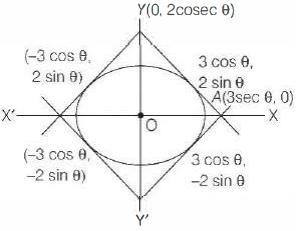
The intercepts of this tangent on the coordinate axes are $(3 \sec \theta, 0)$ and $(0, 2 \operatorname{cosec} \theta)$.
The four tangents form a rhombus with vertices at $(\pm 3 \sec \theta, 0)$ and $(0, \pm 2 \operatorname{cosec} \theta)$.
The area of this quadrilateral (rhombus) is given by $A(\theta) = 4 \times \left( \frac{1}{2} \times |3 \sec \theta| \times |2 \operatorname{cosec} \theta| \right)$.
$A(\theta) = 12 \sec \theta \operatorname{cosec} \theta = \frac{12}{\sin \theta \cos \theta} = \frac{24}{2 \sin \theta \cos \theta} = \frac{24}{\sin 2 \theta}$.
Since $0 < \theta < \frac{\pi}{2}$,the maximum value of $\sin 2 \theta$ is $1$ (at $\theta = \frac{\pi}{4}$).
Therefore,the minimum value of $A(\theta) = \frac{24}{1} = 24$.
The equation of the tangent at the point $(3 \cos \theta, 2 \sin \theta)$ is $\frac{x}{3} \cos \theta + \frac{y}{2} \sin \theta = 1$.
The intercepts of this tangent on the coordinate axes are $(3 \sec \theta, 0)$ and $(0, 2 \operatorname{cosec} \theta)$.
The four tangents form a rhombus with vertices at $(\pm 3 \sec \theta, 0)$ and $(0, \pm 2 \operatorname{cosec} \theta)$.
The area of this quadrilateral (rhombus) is given by $A(\theta) = 4 \times \left( \frac{1}{2} \times |3 \sec \theta| \times |2 \operatorname{cosec} \theta| \right)$.
$A(\theta) = 12 \sec \theta \operatorname{cosec} \theta = \frac{12}{\sin \theta \cos \theta} = \frac{24}{2 \sin \theta \cos \theta} = \frac{24}{\sin 2 \theta}$.
Since $0 < \theta < \frac{\pi}{2}$,the maximum value of $\sin 2 \theta$ is $1$ (at $\theta = \frac{\pi}{4}$).
Therefore,the minimum value of $A(\theta) = \frac{24}{1} = 24$.
0 likesView Solution
3
MathematicsDifficultMCQKVPY · 2018
Let $S = \{x \in R : \cos(x) + \cos(\sqrt{2}x) < 2\}$,then
A
$S = \emptyset$
B
$S$ is a non-empty finite set
C
$S$ is an infinite proper subset of $R - \{0\}$
D
$S = R - \{0\}$
Solution
(D) We are given the set $S = \{x \in R : \cos(x) + \cos(\sqrt{2}x) < 2\}$.
We know that the maximum value of the cosine function is $1$,which occurs when the argument is an integer multiple of $2\pi$.
For $\cos(x) + \cos(\sqrt{2}x) = 2$,both $\cos(x)$ and $\cos(\sqrt{2}x)$ must simultaneously be equal to $1$.
This implies $x = 2n\pi$ and $\sqrt{2}x = 2m\pi$ for some integers $n, m$.
If $x = 0$,then $n = 0$ and $m = 0$,which satisfies the condition $\cos(0) + \cos(0) = 1 + 1 = 2$.
If $x \neq 0$,then $\frac{\sqrt{2}x}{x} = \frac{2m\pi}{2n\pi} \implies \sqrt{2} = \frac{m}{n}$,which is impossible since $\sqrt{2}$ is irrational.
Thus,the sum $\cos(x) + \cos(\sqrt{2}x)$ is equal to $2$ if and only if $x = 0$,and it is strictly less than $2$ for all $x \in R \setminus \{0\}$.
Therefore,$S = R \setminus \{0\}$.
We know that the maximum value of the cosine function is $1$,which occurs when the argument is an integer multiple of $2\pi$.
For $\cos(x) + \cos(\sqrt{2}x) = 2$,both $\cos(x)$ and $\cos(\sqrt{2}x)$ must simultaneously be equal to $1$.
This implies $x = 2n\pi$ and $\sqrt{2}x = 2m\pi$ for some integers $n, m$.
If $x = 0$,then $n = 0$ and $m = 0$,which satisfies the condition $\cos(0) + \cos(0) = 1 + 1 = 2$.
If $x \neq 0$,then $\frac{\sqrt{2}x}{x} = \frac{2m\pi}{2n\pi} \implies \sqrt{2} = \frac{m}{n}$,which is impossible since $\sqrt{2}$ is irrational.
Thus,the sum $\cos(x) + \cos(\sqrt{2}x)$ is equal to $2$ if and only if $x = 0$,and it is strictly less than $2$ for all $x \in R \setminus \{0\}$.
Therefore,$S = R \setminus \{0\}$.
0 likesView Solution
4
MathematicsAdvancedMCQKVPY · 2018
On a rectangular hyperbola $x^2-y^2=a^2, a > 0$,three points $A, B, C$ are taken as follows: $A=(-a, 0)$; $B$ and $C$ are placed symmetrically with respect to the $X$-axis on the branch of the hyperbola not containing $A$. Suppose that the $\triangle ABC$ is equilateral. If the side length of the $\triangle ABC$ is $ka$,then $k$ lies in the interval
A
$(0, 2]$
B
$(2, 4]$
C
$(4, 6]$
D
$(6, 8]$
Solution
(B) The rectangular hyperbola is given by $x^2-y^2=a^2$.
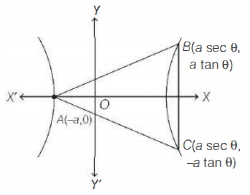
Let the coordinates of $B$ be $(a \sec \theta, a \tan \theta)$ and $C$ be $(a \sec \theta, -a \tan \theta)$.
Since $\triangle ABC$ is equilateral,$AB^2 = BC^2$.
The distance $BC = 2a \tan \theta$.
The distance $AB^2 = (a \sec \theta - (-a))^2 + (a \tan \theta - 0)^2 = a^2(\sec \theta + 1)^2 + a^2 \tan^2 \theta$.
Equating $AB^2 = BC^2$:
$a^2(\sec \theta + 1)^2 + a^2 \tan^2 \theta = (2a \tan \theta)^2 = 4a^2 \tan^2 \theta$.
$(\sec \theta + 1)^2 = 3 \tan^2 \theta = 3(\sec^2 \theta - 1) = 3(\sec \theta + 1)(\sec \theta - 1)$.
Since $\sec \theta + 1 \neq 0$,we have $\sec \theta + 1 = 3(\sec \theta - 1)$.
$\sec \theta + 1 = 3 \sec \theta - 3 \implies 2 \sec \theta = 4 \implies \sec \theta = 2$.
Thus,$\tan^2 \theta = \sec^2 \theta - 1 = 4 - 1 = 3$,so $\tan \theta = \sqrt{3}$.
The side length $BC = 2a \tan \theta = 2a \sqrt{3}$.
Given the side length is $ka$,we have $ka = 2a \sqrt{3}$,so $k = 2 \sqrt{3} \approx 2 \times 1.732 = 3.464$.
Since $2 < 3.464 \leq 4$,$k$ lies in the interval $(2, 4]$.
Let the coordinates of $B$ be $(a \sec \theta, a \tan \theta)$ and $C$ be $(a \sec \theta, -a \tan \theta)$.
Since $\triangle ABC$ is equilateral,$AB^2 = BC^2$.
The distance $BC = 2a \tan \theta$.
The distance $AB^2 = (a \sec \theta - (-a))^2 + (a \tan \theta - 0)^2 = a^2(\sec \theta + 1)^2 + a^2 \tan^2 \theta$.
Equating $AB^2 = BC^2$:
$a^2(\sec \theta + 1)^2 + a^2 \tan^2 \theta = (2a \tan \theta)^2 = 4a^2 \tan^2 \theta$.
$(\sec \theta + 1)^2 = 3 \tan^2 \theta = 3(\sec^2 \theta - 1) = 3(\sec \theta + 1)(\sec \theta - 1)$.
Since $\sec \theta + 1 \neq 0$,we have $\sec \theta + 1 = 3(\sec \theta - 1)$.
$\sec \theta + 1 = 3 \sec \theta - 3 \implies 2 \sec \theta = 4 \implies \sec \theta = 2$.
Thus,$\tan^2 \theta = \sec^2 \theta - 1 = 4 - 1 = 3$,so $\tan \theta = \sqrt{3}$.
The side length $BC = 2a \tan \theta = 2a \sqrt{3}$.
Given the side length is $ka$,we have $ka = 2a \sqrt{3}$,so $k = 2 \sqrt{3} \approx 2 \times 1.732 = 3.464$.
Since $2 < 3.464 \leq 4$,$k$ lies in the interval $(2, 4]$.
0 likesView Solution
5
MathematicsAdvancedMCQKVPY · 2018
The number of real solutions $x$ of the equation $\cos^2(x \sin(2x)) + \frac{1}{1+x^2} = \cos^2 x + \sec^2 x$ is
A
$0$
B
$1$
C
$2$
D
infinite
Solution
(B) Given the equation: $\cos^2(x \sin(2x)) + \frac{1}{1+x^2} = \cos^2 x + \sec^2 x$.
Consider the Left Hand Side $(LHS)$: $f(x) = \cos^2(x \sin(2x)) + \frac{1}{1+x^2}$.
Since $\cos^2(\theta) \leq 1$ and $\frac{1}{1+x^2} \leq 1$ for all real $x$,we have $f(x) \leq 1 + 1 = 2$.
Consider the Right Hand Side $(RHS)$: $g(x) = \cos^2 x + \sec^2 x$.
By the Arithmetic Mean-Geometric Mean inequality $(AM \geq GM)$,$\cos^2 x + \sec^2 x \geq 2 \sqrt{\cos^2 x \cdot \sec^2 x} = 2 \sqrt{1} = 2$.
For the equation to hold,we must have $f(x) = 2$ and $g(x) = 2$.
$g(x) = 2$ occurs when $\cos^2 x = \sec^2 x$,which implies $\cos^4 x = 1$,so $\cos x = \pm 1$,meaning $x = n\pi$ for $n \in \mathbb{Z}$.
If $x = 0$,$f(0) = \cos^2(0) + \frac{1}{1+0} = 1 + 1 = 2$ and $g(0) = \cos^2(0) + \sec^2(0) = 1 + 1 = 2$.
If $x = n\pi$ where $n \neq 0$,then $\frac{1}{1+x^2} < 1$,so $f(x) < 2$,which contradicts $f(x) = 2$.
Thus,the only real solution is $x = 0$.
Consider the Left Hand Side $(LHS)$: $f(x) = \cos^2(x \sin(2x)) + \frac{1}{1+x^2}$.
Since $\cos^2(\theta) \leq 1$ and $\frac{1}{1+x^2} \leq 1$ for all real $x$,we have $f(x) \leq 1 + 1 = 2$.
Consider the Right Hand Side $(RHS)$: $g(x) = \cos^2 x + \sec^2 x$.
By the Arithmetic Mean-Geometric Mean inequality $(AM \geq GM)$,$\cos^2 x + \sec^2 x \geq 2 \sqrt{\cos^2 x \cdot \sec^2 x} = 2 \sqrt{1} = 2$.
For the equation to hold,we must have $f(x) = 2$ and $g(x) = 2$.
$g(x) = 2$ occurs when $\cos^2 x = \sec^2 x$,which implies $\cos^4 x = 1$,so $\cos x = \pm 1$,meaning $x = n\pi$ for $n \in \mathbb{Z}$.
If $x = 0$,$f(0) = \cos^2(0) + \frac{1}{1+0} = 1 + 1 = 2$ and $g(0) = \cos^2(0) + \sec^2(0) = 1 + 1 = 2$.
If $x = n\pi$ where $n \neq 0$,then $\frac{1}{1+x^2} < 1$,so $f(x) < 2$,which contradicts $f(x) = 2$.
Thus,the only real solution is $x = 0$.
0 likesView Solution
6
MathematicsAdvancedMCQKVPY · 2018
Let $\frac{x^2}{a^2}+\frac{y^2}{b^2}=1, a>b$ be an ellipse with foci $F_1$ and $F_2$. Let $AO$ be its semi-minor axis,where $O$ is the centre of the ellipse. The lines $AF_1$ and $AF_2$,when extended,cut the ellipse again at points $B$ and $C$ respectively. Suppose that the $\triangle ABC$ is equilateral. Then,the eccentricity of the ellipse is
A
$\frac{1}{\sqrt{2}}$
B
$\frac{1}{\sqrt{3}}$
C
$\frac{1}{3}$
D
$\frac{1}{2}$
Solution
(D) Given the ellipse $\frac{x^2}{a^2}+\frac{y^2}{b^2}=1$ with $a>b$.
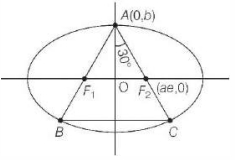
Since $\triangle ABC$ is equilateral,the angle $\angle BAC = 60^{\circ}$.
Due to the symmetry of the ellipse,the line $AO$ (the $y$-axis) bisects $\angle BAC$,so $\angle OAF_2 = 30^{\circ}$.
In the right-angled $\triangle AOF_2$,we have $\tan(30^{\circ}) = \frac{OF_2}{OA}$.
Here,$OF_2 = ae$ and $OA = b$.
So,$\frac{1}{\sqrt{3}} = \frac{ae}{b}$,which implies $b = \sqrt{3}ae$.
Squaring both sides,$b^2 = 3a^2e^2$.
Using the relation $b^2 = a^2(1-e^2)$,we get $a^2(1-e^2) = 3a^2e^2$.
Dividing by $a^2$,we have $1-e^2 = 3e^2$,which simplifies to $4e^2 = 1$.
Thus,$e^2 = \frac{1}{4}$,and since $e>0$,$e = \frac{1}{2}$.
Since $\triangle ABC$ is equilateral,the angle $\angle BAC = 60^{\circ}$.
Due to the symmetry of the ellipse,the line $AO$ (the $y$-axis) bisects $\angle BAC$,so $\angle OAF_2 = 30^{\circ}$.
In the right-angled $\triangle AOF_2$,we have $\tan(30^{\circ}) = \frac{OF_2}{OA}$.
Here,$OF_2 = ae$ and $OA = b$.
So,$\frac{1}{\sqrt{3}} = \frac{ae}{b}$,which implies $b = \sqrt{3}ae$.
Squaring both sides,$b^2 = 3a^2e^2$.
Using the relation $b^2 = a^2(1-e^2)$,we get $a^2(1-e^2) = 3a^2e^2$.
Dividing by $a^2$,we have $1-e^2 = 3e^2$,which simplifies to $4e^2 = 1$.
Thus,$e^2 = \frac{1}{4}$,and since $e>0$,$e = \frac{1}{2}$.
0 likesView Solution
7
MathematicsDifficultMCQKVPY · 2018
Let $a = \cos 1^{\circ}$ and $b = \sin 1^{\circ}$. We say that a real number is algebraic if it is a root of a polynomial with integer coefficients. Then,
A
$a$ is algebraic but $b$ is not algebraic
B
$b$ is algebraic but $a$ is not algebraic
C
both $a$ and $b$ are algebraic
D
neither $a$ nor $b$ is algebraic
Solution
(C) We know that $\cos(n\theta) + i \sin(n\theta) = (\cos \theta + i \sin \theta)^n$.
For $\theta = 1^{\circ}$ and $n = 90$,we have $\cos 90^{\circ} + i \sin 90^{\circ} = (\cos 1^{\circ} + i \sin 1^{\circ})^{90} = i$.
This implies that $\cos 1^{\circ} + i \sin 1^{\circ}$ is a root of the polynomial $z^{90} - i = 0$.
Since $a + ib$ is a root of $z^{90} - i = 0$,it is an algebraic number.
Any complex number $z = a + ib$ is algebraic if and only if both its real part $a$ and imaginary part $b$ are algebraic.
Since $\cos 1^{\circ} + i \sin 1^{\circ}$ is a root of $z^{90} = i$,then $z^{180} = -1$,or $z^{180} + 1 = 0$.
Thus,$\cos 1^{\circ} + i \sin 1^{\circ}$ is an algebraic number.
It is a known result that if $\alpha$ is an algebraic number,then $\cos \alpha$ and $\sin \alpha$ are algebraic for rational multiples of $\pi$.
Since $1^{\circ} = \frac{\pi}{180}$ radians,both $\cos 1^{\circ}$ and $\sin 1^{\circ}$ are algebraic numbers.
For $\theta = 1^{\circ}$ and $n = 90$,we have $\cos 90^{\circ} + i \sin 90^{\circ} = (\cos 1^{\circ} + i \sin 1^{\circ})^{90} = i$.
This implies that $\cos 1^{\circ} + i \sin 1^{\circ}$ is a root of the polynomial $z^{90} - i = 0$.
Since $a + ib$ is a root of $z^{90} - i = 0$,it is an algebraic number.
Any complex number $z = a + ib$ is algebraic if and only if both its real part $a$ and imaginary part $b$ are algebraic.
Since $\cos 1^{\circ} + i \sin 1^{\circ}$ is a root of $z^{90} = i$,then $z^{180} = -1$,or $z^{180} + 1 = 0$.
Thus,$\cos 1^{\circ} + i \sin 1^{\circ}$ is an algebraic number.
It is a known result that if $\alpha$ is an algebraic number,then $\cos \alpha$ and $\sin \alpha$ are algebraic for rational multiples of $\pi$.
Since $1^{\circ} = \frac{\pi}{180}$ radians,both $\cos 1^{\circ}$ and $\sin 1^{\circ}$ are algebraic numbers.
0 likesView Solution
8
MathematicsAdvancedMCQKVPY · 2018
Let $x_k$ be real numbers such that $x_k \geq k^4+k^2+1$ for $1 \leq k \leq 2018$. Denote $N=\sum_{k=1}^{2018} k$. Consider the following inequalities.
$I$. $\left(\sum_{k=1}^{2018} k x_k\right)^2 \leq N\left(\sum_{k=1}^{2018} k x_k^2\right)$
$II$. $\left(\sum_{k=1}^{2018} k x_k\right)^2 \leq N\left(\sum_{k=1}^{2018} k^2 x_k^2\right)$
Then,
$I$. $\left(\sum_{k=1}^{2018} k x_k\right)^2 \leq N\left(\sum_{k=1}^{2018} k x_k^2\right)$
$II$. $\left(\sum_{k=1}^{2018} k x_k\right)^2 \leq N\left(\sum_{k=1}^{2018} k^2 x_k^2\right)$
Then,
A
both $I$ and $II$ are true
B
$I$ is true and $II$ is false
C
$I$ is false and $II$ is true
D
both $I$ and $II$ are false
Solution
(A) Let $n = 2018$. We are given $N = \sum_{k=1}^{n} k = \frac{n(n+1)}{2}$.
For inequality $I$,we use the Cauchy-Schwarz inequality in the form $(\sum a_k b_k)^2 \leq (\sum a_k^2)(\sum b_k^2)$.
Let $a_k = \sqrt{k}$ and $b_k = \sqrt{k} x_k$. Then:
$\left(\sum_{k=1}^{n} \sqrt{k} \cdot \sqrt{k} x_k\right)^2 \leq \left(\sum_{k=1}^{n} (\sqrt{k})^2\right) \left(\sum_{k=1}^{n} (\sqrt{k} x_k)^2\right)$
$\left(\sum_{k=1}^{n} k x_k\right)^2 \leq \left(\sum_{k=1}^{n} k\right) \left(\sum_{k=1}^{n} k x_k^2\right) = N \sum_{k=1}^{n} k x_k^2$.
Thus,$I$ is true.
For inequality $II$,we note that since $k \geq 1$,we have $k^2 \geq k$ for all $k \in \{1, 2, \dots, n\}$.
Therefore,$\sum_{k=1}^{n} k^2 x_k^2 \geq \sum_{k=1}^{n} k x_k^2$.
Since $I$ is true,we have $\left(\sum_{k=1}^{n} k x_k\right)^2 \leq N \sum_{k=1}^{n} k x_k^2 \leq N \sum_{k=1}^{n} k^2 x_k^2$.
Thus,$II$ is also true.
Therefore,both $I$ and $II$ are true.
For inequality $I$,we use the Cauchy-Schwarz inequality in the form $(\sum a_k b_k)^2 \leq (\sum a_k^2)(\sum b_k^2)$.
Let $a_k = \sqrt{k}$ and $b_k = \sqrt{k} x_k$. Then:
$\left(\sum_{k=1}^{n} \sqrt{k} \cdot \sqrt{k} x_k\right)^2 \leq \left(\sum_{k=1}^{n} (\sqrt{k})^2\right) \left(\sum_{k=1}^{n} (\sqrt{k} x_k)^2\right)$
$\left(\sum_{k=1}^{n} k x_k\right)^2 \leq \left(\sum_{k=1}^{n} k\right) \left(\sum_{k=1}^{n} k x_k^2\right) = N \sum_{k=1}^{n} k x_k^2$.
Thus,$I$ is true.
For inequality $II$,we note that since $k \geq 1$,we have $k^2 \geq k$ for all $k \in \{1, 2, \dots, n\}$.
Therefore,$\sum_{k=1}^{n} k^2 x_k^2 \geq \sum_{k=1}^{n} k x_k^2$.
Since $I$ is true,we have $\left(\sum_{k=1}^{n} k x_k\right)^2 \leq N \sum_{k=1}^{n} k x_k^2 \leq N \sum_{k=1}^{n} k^2 x_k^2$.
Thus,$II$ is also true.
Therefore,both $I$ and $II$ are true.
0 likesView Solution
9
MathematicsAdvancedMCQKVPY · 2018
Let $x^2=4ky, k>0$ be a parabola with vertex $O(0,0)$. Let $BC$ be its latus rectum. An ellipse with center $P$ on $BC$ touches the parabola at $O$,and cuts $BC$ at points $D$ and $E$ such that $BD=DE=EC$ ($B, D, E, C$ in that order). The eccentricity of the ellipse is
A
$\frac{1}{\sqrt{2}}$
B
$\frac{1}{\sqrt{3}}$
C
$\frac{\sqrt{5}}{3}$
D
$\frac{\sqrt{3}}{2}$
Solution
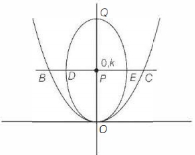
(C) The parabola is $x^2=4ky$. The latus rectum $BC$ is the line $y=k$. The coordinates of $B$ and $C$ are $(-2k, k)$ and $(2k, k)$ respectively.
Since $BD=DE=EC$ and $BC=4k$,we have $DE = \frac{4k}{3}$.
The center of the ellipse $P$ is the midpoint of $DE$,which is $(0, k)$.
The ellipse touches the parabola at the origin $O(0,0)$. Let the equation of the ellipse be $\frac{x^2}{a^2} + \frac{(y-k)^2}{b^2} = 1$.
Since it passes through $O(0,0)$,we have $\frac{0}{a^2} + \frac{(-k)^2}{b^2} = 1$,so $b^2 = k^2$.
The ellipse cuts $BC$ (the line $y=k$) at $D$ and $E$. Substituting $y=k$ into the ellipse equation gives $\frac{x^2}{a^2} + 0 = 1$,so $x = \pm a$.
Thus,$D = (-a, k)$ and $E = (a, k)$. Since $DE = 2a = \frac{4k}{3}$,we have $a = \frac{2k}{3}$.
Since $a < b$ (as $\frac{2k}{3} < k$),the ellipse is vertical. The eccentricity $e$ is given by $e^2 = 1 - \frac{a^2}{b^2} = 1 - \frac{(2k/3)^2}{k^2} = 1 - \frac{4}{9} = \frac{5}{9}$.
Therefore,$e = \frac{\sqrt{5}}{3}$.
Since $BD=DE=EC$ and $BC=4k$,we have $DE = \frac{4k}{3}$.
The center of the ellipse $P$ is the midpoint of $DE$,which is $(0, k)$.
The ellipse touches the parabola at the origin $O(0,0)$. Let the equation of the ellipse be $\frac{x^2}{a^2} + \frac{(y-k)^2}{b^2} = 1$.
Since it passes through $O(0,0)$,we have $\frac{0}{a^2} + \frac{(-k)^2}{b^2} = 1$,so $b^2 = k^2$.
The ellipse cuts $BC$ (the line $y=k$) at $D$ and $E$. Substituting $y=k$ into the ellipse equation gives $\frac{x^2}{a^2} + 0 = 1$,so $x = \pm a$.
Thus,$D = (-a, k)$ and $E = (a, k)$. Since $DE = 2a = \frac{4k}{3}$,we have $a = \frac{2k}{3}$.
Since $a < b$ (as $\frac{2k}{3} < k$),the ellipse is vertical. The eccentricity $e$ is given by $e^2 = 1 - \frac{a^2}{b^2} = 1 - \frac{(2k/3)^2}{k^2} = 1 - \frac{4}{9} = \frac{5}{9}$.
Therefore,$e = \frac{\sqrt{5}}{3}$.
0 likesView Solution
10
MathematicsDifficultMCQKVPY · 2018
Let $R$ be a rectangle,$C$ be a circle,and $T$ be a triangle in the plane. The maximum possible number of points common to the perimeters of $R, C$ and $T$ is
A
$3$
B
$4$
C
$5$
D
$6$
Solution
(D) The maximum possible number of points common to the perimeters of a rectangle $R$,a circle $C$,and a triangle $T$ is $6$. This can be visualized by arranging the shapes such that the boundaries intersect at $6$ distinct points,as shown in the provided figure.
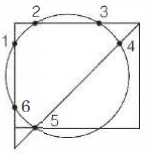
0 likesView Solution
11
MathematicsAdvancedMCQKVPY · 2018
The number of different possible values for the sum $x+y+z$,where $x, y, z$ are real numbers such that $x^4+4y^4+16z^4+64=32xyz$ is
A
$1$
B
$2$
C
$4$
D
$8$
Solution
(C) Given the equation $x^4+4y^4+16z^4+64=32xyz$.
Applying the Arithmetic Mean-Geometric Mean $(AM \geq GM)$ inequality to the four positive terms $x^4, 4y^4, 16z^4, 64$:
$\frac{x^4+4y^4+16z^4+64}{4} \geq \sqrt[4]{x^4 \cdot 4y^4 \cdot 16z^4 \cdot 64} = \sqrt[4]{4096 x^4 y^4 z^4} = 8|xyz|$.
Thus,$x^4+4y^4+16z^4+64 \geq 32|xyz|$.
For the equality to hold,we must have $x^4 = 4y^4 = 16z^4 = 64$,which implies $|x|=2\sqrt{2}, |y|=2, |z|=\sqrt{2}$.
Also,the product $xyz$ must be positive for the equality $32xyz = 32|xyz|$ to hold.
The possible combinations for $(x, y, z)$ are:
$1$. $(2\sqrt{2}, 2, \sqrt{2}) \implies x+y+z = 2\sqrt{2}+2+\sqrt{2} = 3\sqrt{2}+2$.
$2$. $(2\sqrt{2}, -2, -\sqrt{2}) \implies x+y+z = 2\sqrt{2}-2-\sqrt{2} = \sqrt{2}-2$.
$3$. $(-2\sqrt{2}, 2, -\sqrt{2}) \implies x+y+z = -2\sqrt{2}+2-\sqrt{2} = 2-3\sqrt{2}$.
$4$. $(-2\sqrt{2}, -2, \sqrt{2}) \implies x+y+z = -2\sqrt{2}-2+\sqrt{2} = -\sqrt{2}-2$.
There are $4$ distinct possible values for the sum $x+y+z$.
Applying the Arithmetic Mean-Geometric Mean $(AM \geq GM)$ inequality to the four positive terms $x^4, 4y^4, 16z^4, 64$:
$\frac{x^4+4y^4+16z^4+64}{4} \geq \sqrt[4]{x^4 \cdot 4y^4 \cdot 16z^4 \cdot 64} = \sqrt[4]{4096 x^4 y^4 z^4} = 8|xyz|$.
Thus,$x^4+4y^4+16z^4+64 \geq 32|xyz|$.
For the equality to hold,we must have $x^4 = 4y^4 = 16z^4 = 64$,which implies $|x|=2\sqrt{2}, |y|=2, |z|=\sqrt{2}$.
Also,the product $xyz$ must be positive for the equality $32xyz = 32|xyz|$ to hold.
The possible combinations for $(x, y, z)$ are:
$1$. $(2\sqrt{2}, 2, \sqrt{2}) \implies x+y+z = 2\sqrt{2}+2+\sqrt{2} = 3\sqrt{2}+2$.
$2$. $(2\sqrt{2}, -2, -\sqrt{2}) \implies x+y+z = 2\sqrt{2}-2-\sqrt{2} = \sqrt{2}-2$.
$3$. $(-2\sqrt{2}, 2, -\sqrt{2}) \implies x+y+z = -2\sqrt{2}+2-\sqrt{2} = 2-3\sqrt{2}$.
$4$. $(-2\sqrt{2}, -2, \sqrt{2}) \implies x+y+z = -2\sqrt{2}-2+\sqrt{2} = -\sqrt{2}-2$.
There are $4$ distinct possible values for the sum $x+y+z$.
0 likesView Solution
12
MathematicsAdvancedMCQKVPY · 2018
Let $\Gamma$ be a circle with diameter $AB$ and centre $O$. Let $l$ be the tangent to $\Gamma$ at $B$. For each point $M$ on $\Gamma$ different from $A$,consider the tangent $t$ at $M$ and let it intersect $l$ at $P$. Draw a line parallel to $AB$ through $P$ intersecting $OM$ at $Q$. The locus of $Q$ as $M$ varies over $\Gamma$ is
A
an arc of a circle
B
a parabola
C
an arc of an ellipse
D
a branch of a hyperbola
Solution
(B) Let the circle be $x^2 + y^2 = r^2$ with centre $O(0, 0)$.
Let $M = (r \cos \theta, r \sin \theta)$.
The tangent at $M$ is $x \cos \theta + y \sin \theta = r$.
The tangent $l$ at $B(r, 0)$ is $x = r$.
Intersection $P$ of tangent at $M$ and $l$ is found by substituting $x = r$ into the tangent equation:
$r \cos \theta + y \sin \theta = r \implies y \sin \theta = r(1 - \cos \theta) \implies y = r \tan(\theta/2)$.
So,$P = (r, r \tan(\theta/2))$.
The line through $P$ parallel to $AB$ (the $x$-axis) is $y = r \tan(\theta/2)$.
The line $OM$ passes through $(0, 0)$ and $(r \cos \theta, r \sin \theta)$,so its equation is $y = x \tan \theta$.
$Q(h, k)$ is the intersection of $y = r \tan(\theta/2)$ and $y = x \tan \theta$.
Thus,$k = r \tan(\theta/2)$ and $k = h \tan \theta$.
Using $\tan \theta = \frac{2 \tan(\theta/2)}{1 - \tan^2(\theta/2)}$,we have $k = h \cdot \frac{2(k/r)}{1 - (k/r)^2}$.
$1 - k^2/r^2 = 2h/r \implies r^2 - k^2 = 2hr \implies k^2 = -2r(h - r/2)$.
The locus of $Q(x, y)$ is $y^2 = -2r(x - r/2)$,which is a parabola.
Let $M = (r \cos \theta, r \sin \theta)$.
The tangent at $M$ is $x \cos \theta + y \sin \theta = r$.
The tangent $l$ at $B(r, 0)$ is $x = r$.
Intersection $P$ of tangent at $M$ and $l$ is found by substituting $x = r$ into the tangent equation:
$r \cos \theta + y \sin \theta = r \implies y \sin \theta = r(1 - \cos \theta) \implies y = r \tan(\theta/2)$.
So,$P = (r, r \tan(\theta/2))$.
The line through $P$ parallel to $AB$ (the $x$-axis) is $y = r \tan(\theta/2)$.
The line $OM$ passes through $(0, 0)$ and $(r \cos \theta, r \sin \theta)$,so its equation is $y = x \tan \theta$.
$Q(h, k)$ is the intersection of $y = r \tan(\theta/2)$ and $y = x \tan \theta$.
Thus,$k = r \tan(\theta/2)$ and $k = h \tan \theta$.
Using $\tan \theta = \frac{2 \tan(\theta/2)}{1 - \tan^2(\theta/2)}$,we have $k = h \cdot \frac{2(k/r)}{1 - (k/r)^2}$.
$1 - k^2/r^2 = 2h/r \implies r^2 - k^2 = 2hr \implies k^2 = -2r(h - r/2)$.
The locus of $Q(x, y)$ is $y^2 = -2r(x - r/2)$,which is a parabola.
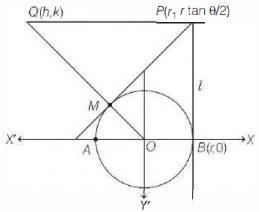
0 likesView Solution
13
MathematicsAdvancedMCQKVPY · 2018
The number of solutions $x$ of the equation $\sin(x+x^2) - \sin(x^2) = \sin x$ in the interval $[2, 3]$ is
A
$0$
B
$1$
C
$2$
D
$3$
Solution
(C) Given equation: $\sin(x+x^2) - \sin(x^2) = \sin x$
Using the identity $\sin A - \sin B = 2 \sin(\frac{A-B}{2}) \cos(\frac{A+B}{2})$,we get:
$2 \sin(\frac{x}{2}) \cos(\frac{2x^2+x}{2}) = \sin x$
Since $\sin x = 2 \sin(\frac{x}{2}) \cos(\frac{x}{2})$,the equation becomes:
$2 \sin(\frac{x}{2}) \cos(\frac{2x^2+x}{2}) = 2 \sin(\frac{x}{2}) \cos(\frac{x}{2})$
This implies $2 \sin(\frac{x}{2}) [\cos(\frac{2x^2+x}{2}) - \cos(\frac{x}{2})] = 0$
Case $1$: $\sin(\frac{x}{2}) = 0$ $\Rightarrow \frac{x}{2} = n\pi$ $\Rightarrow x = 2n\pi$. For $n=1$,$x=2\pi \approx 6.28$,which is outside $[2, 3]$.
Case $2$: $\cos(\frac{2x^2+x}{2}) = \cos(\frac{x}{2}) \Rightarrow \frac{2x^2+x}{2} = 2k\pi \pm \frac{x}{2}$
Subcase $2a$: $x^2 + \frac{x}{2} = 2k\pi + \frac{x}{2} \Rightarrow x^2 = 2k\pi$. For $k=1$,$x = \sqrt{2\pi} \approx \sqrt{6.28} \approx 2.506$ (in $[2, 3]$).
Subcase $2b$: $x^2 + \frac{x}{2} = 2k\pi - \frac{x}{2} \Rightarrow x^2 + x - 2k\pi = 0$. For $k=1$,$x^2 + x - 2\pi = 0$. Roots are $x = \frac{-1 \pm \sqrt{1 + 8\pi}}{2}$. Taking positive root,$x = \frac{-1 + \sqrt{1 + 25.13}}{2} \approx \frac{-1 + 5.11}{2} \approx 2.055$ (in $[2, 3]$).
Thus,there are $2$ solutions.
Using the identity $\sin A - \sin B = 2 \sin(\frac{A-B}{2}) \cos(\frac{A+B}{2})$,we get:
$2 \sin(\frac{x}{2}) \cos(\frac{2x^2+x}{2}) = \sin x$
Since $\sin x = 2 \sin(\frac{x}{2}) \cos(\frac{x}{2})$,the equation becomes:
$2 \sin(\frac{x}{2}) \cos(\frac{2x^2+x}{2}) = 2 \sin(\frac{x}{2}) \cos(\frac{x}{2})$
This implies $2 \sin(\frac{x}{2}) [\cos(\frac{2x^2+x}{2}) - \cos(\frac{x}{2})] = 0$
Case $1$: $\sin(\frac{x}{2}) = 0$ $\Rightarrow \frac{x}{2} = n\pi$ $\Rightarrow x = 2n\pi$. For $n=1$,$x=2\pi \approx 6.28$,which is outside $[2, 3]$.
Case $2$: $\cos(\frac{2x^2+x}{2}) = \cos(\frac{x}{2}) \Rightarrow \frac{2x^2+x}{2} = 2k\pi \pm \frac{x}{2}$
Subcase $2a$: $x^2 + \frac{x}{2} = 2k\pi + \frac{x}{2} \Rightarrow x^2 = 2k\pi$. For $k=1$,$x = \sqrt{2\pi} \approx \sqrt{6.28} \approx 2.506$ (in $[2, 3]$).
Subcase $2b$: $x^2 + \frac{x}{2} = 2k\pi - \frac{x}{2} \Rightarrow x^2 + x - 2k\pi = 0$. For $k=1$,$x^2 + x - 2\pi = 0$. Roots are $x = \frac{-1 \pm \sqrt{1 + 8\pi}}{2}$. Taking positive root,$x = \frac{-1 + \sqrt{1 + 25.13}}{2} \approx \frac{-1 + 5.11}{2} \approx 2.055$ (in $[2, 3]$).
Thus,there are $2$ solutions.
0 likesView Solution
14
MathematicsAdvancedMCQKVPY · 2018
The maximum possible area bounded by the parabola $y=x^2+x+10$ and a chord of the parabola of length $1$ is
A
$\frac{1}{12}$
B
$\frac{1}{6}$
C
$\frac{1}{3}$
D
$\frac{1}{2}$
Solution
(B) Given the parabola $y=x^2+x+10$.
Completing the square,we get $y = (x + \frac{1}{2})^2 + \frac{39}{4}$,or $(x + \frac{1}{2})^2 = (y - \frac{39}{4})$.
This is a parabola of the form $X^2 = 4aY$ where $4a = 1$,so the length of the latus rectum is $1$.
The area bounded by a parabola and a chord of length $L$ is given by the formula $A = \frac{1}{6} L^3 \cdot \frac{1}{a}$,where $4a$ is the length of the latus rectum.
Here,$L = 1$ and $4a = 1$,so $a = \frac{1}{4}$.
Substituting these values,the area $A = \frac{1}{6} \times (1)^3 \times \frac{1}{1/4} = \frac{1}{6} \times 4 = \frac{2}{3}$ is incorrect based on standard formula application. Let's re-evaluate: The area between a parabola $y^2 = 4ax$ and a chord perpendicular to the axis is $\frac{2}{3} \times \text{base} \times \text{height}$. For a chord of length $L$ perpendicular to the axis,the height is $h = \frac{L^2}{8a}$.
Here $L=1$ and $4a=1$,so $a=1/4$. Thus $h = \frac{1^2}{8(1/4)} = \frac{1}{2}$.
Area $= \frac{2}{3} \times L \times h = \frac{2}{3} \times 1 \times \frac{1}{2} = \frac{1}{3}$.
Wait,the standard formula for the area cut off by a chord of length $L$ in a parabola with latus rectum $4a$ is $\frac{L^3}{6 \cdot (4a)} = \frac{1^3}{6 \cdot 1} = \frac{1}{6}$.
Completing the square,we get $y = (x + \frac{1}{2})^2 + \frac{39}{4}$,or $(x + \frac{1}{2})^2 = (y - \frac{39}{4})$.
This is a parabola of the form $X^2 = 4aY$ where $4a = 1$,so the length of the latus rectum is $1$.
The area bounded by a parabola and a chord of length $L$ is given by the formula $A = \frac{1}{6} L^3 \cdot \frac{1}{a}$,where $4a$ is the length of the latus rectum.
Here,$L = 1$ and $4a = 1$,so $a = \frac{1}{4}$.
Substituting these values,the area $A = \frac{1}{6} \times (1)^3 \times \frac{1}{1/4} = \frac{1}{6} \times 4 = \frac{2}{3}$ is incorrect based on standard formula application. Let's re-evaluate: The area between a parabola $y^2 = 4ax$ and a chord perpendicular to the axis is $\frac{2}{3} \times \text{base} \times \text{height}$. For a chord of length $L$ perpendicular to the axis,the height is $h = \frac{L^2}{8a}$.
Here $L=1$ and $4a=1$,so $a=1/4$. Thus $h = \frac{1^2}{8(1/4)} = \frac{1}{2}$.
Area $= \frac{2}{3} \times L \times h = \frac{2}{3} \times 1 \times \frac{1}{2} = \frac{1}{3}$.
Wait,the standard formula for the area cut off by a chord of length $L$ in a parabola with latus rectum $4a$ is $\frac{L^3}{6 \cdot (4a)} = \frac{1^3}{6 \cdot 1} = \frac{1}{6}$.
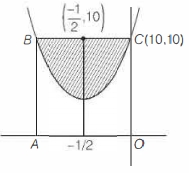
0 likesView Solution
15
MathematicsAdvancedMCQKVPY · 2018
Suppose $z$ is any root of $11 z^8 + 21 i z^7 + 10 i z - 22 = 0$ where $i = \sqrt{-1}$. Then,$S = |z|^2 + |z| + 1$ satisfies
A
$S \leq 3$
B
$3 < S < 7$
C
$7 \leq S < 13$
D
$S \geq 13$
Solution
(B) Given the equation $11 z^8 + 21 i z^7 + 10 i z - 22 = 0$.
We can rewrite this as $11 z^8 - 22 = -21 i z^7 - 10 i z$.
Taking the modulus on both sides,we get $|11 z^8 - 22| = |-21 i z^7 - 10 i z|$.
Using the triangle inequality,$|11 z^8 - 22| \leq |11 z^8| + |-22| = 11|z|^8 + 22$.
Also,$|-21 i z^7 - 10 i z| = |21 i z^7 + 10 i z| = |z| |21 i z^6 + 10 i| \leq |z| (21|z|^6 + 10)$.
By Rouché's theorem or analyzing the bounds of the roots,it can be shown that for this polynomial,the roots satisfy $1 < |z| < 2$.
Let $r = |z|$. Then $1 < r < 2$.
We define $S = r^2 + r + 1$.
Since $1 < r < 2$,we have $1^2 + 1 + 1 < r^2 + r + 1 < 2^2 + 2 + 1$.
This simplifies to $3 < S < 7$.
Thus,the correct option is $B$.
We can rewrite this as $11 z^8 - 22 = -21 i z^7 - 10 i z$.
Taking the modulus on both sides,we get $|11 z^8 - 22| = |-21 i z^7 - 10 i z|$.
Using the triangle inequality,$|11 z^8 - 22| \leq |11 z^8| + |-22| = 11|z|^8 + 22$.
Also,$|-21 i z^7 - 10 i z| = |21 i z^7 + 10 i z| = |z| |21 i z^6 + 10 i| \leq |z| (21|z|^6 + 10)$.
By Rouché's theorem or analyzing the bounds of the roots,it can be shown that for this polynomial,the roots satisfy $1 < |z| < 2$.
Let $r = |z|$. Then $1 < r < 2$.
We define $S = r^2 + r + 1$.
Since $1 < r < 2$,we have $1^2 + 1 + 1 < r^2 + r + 1 < 2^2 + 2 + 1$.
This simplifies to $3 < S < 7$.
Thus,the correct option is $B$.
0 likesView Solution
16
MathematicsAdvancedMCQKVPY · 2018
The number of pairs $(a, b)$ of positive real numbers satisfying $a^4+b^4 < 1$ and $a^2+b^2 > 1$ is
A
$0$
B
$1$
C
$2$
D
More than $2$
Solution
(D) The given inequalities are $a^4+b^4 < 1$ and $a^2+b^2 > 1$ for positive real numbers $a$ and $b$.
Consider the curves $x^2+y^2=1$ (a circle of radius $1$) and $x^4+y^4=1$ (a squircle) in the first quadrant where $x, y > 0$.
For any point $(x, y)$ on the circle $x^2+y^2=1$,we have $x^4+y^4 = (x^2+y^2)^2 - 2x^2y^2 = 1 - 2x^2y^2$. Since $x, y > 0$,$x^2y^2 > 0$,which implies $x^4+y^4 < 1$.
This means the region $a^4+b^4 < 1$ lies outside the circle $a^2+b^2=1$ in the first quadrant,while the region $a^2+b^2 > 1$ lies outside the circle. However,the curve $a^4+b^4=1$ actually encloses a larger area than the circle $a^2+b^2=1$ in the first quadrant.
Specifically,for $a, b > 0$,the region $a^2+b^2 > 1$ and $a^4+b^4 < 1$ represents the area between the circle and the squircle in the first quadrant.
Since this region has a non-zero area,there are infinitely many pairs $(a, b)$ of positive real numbers satisfying these inequalities.
Thus,the number of such pairs is more than $2$.
Consider the curves $x^2+y^2=1$ (a circle of radius $1$) and $x^4+y^4=1$ (a squircle) in the first quadrant where $x, y > 0$.
For any point $(x, y)$ on the circle $x^2+y^2=1$,we have $x^4+y^4 = (x^2+y^2)^2 - 2x^2y^2 = 1 - 2x^2y^2$. Since $x, y > 0$,$x^2y^2 > 0$,which implies $x^4+y^4 < 1$.
This means the region $a^4+b^4 < 1$ lies outside the circle $a^2+b^2=1$ in the first quadrant,while the region $a^2+b^2 > 1$ lies outside the circle. However,the curve $a^4+b^4=1$ actually encloses a larger area than the circle $a^2+b^2=1$ in the first quadrant.
Specifically,for $a, b > 0$,the region $a^2+b^2 > 1$ and $a^4+b^4 < 1$ represents the area between the circle and the squircle in the first quadrant.
Since this region has a non-zero area,there are infinitely many pairs $(a, b)$ of positive real numbers satisfying these inequalities.
Thus,the number of such pairs is more than $2$.
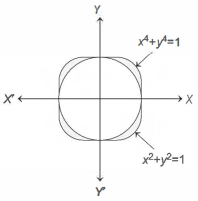
0 likesView Solution
17
MathematicsAdvancedMCQKVPY · 2018
The number of real roots of the polynomial equation $x^4-x^2+2x-1=0$ is
A
$0$
B
$2$
C
$3$
D
$4$
Solution
(B) Given equation: $x^4-x^2+2x-1=0$
Rewrite the equation as: $x^4-(x^2-2x+1)=0$
This simplifies to: $x^4-(x-1)^2=0$
Using the difference of squares formula $a^2-b^2=(a-b)(a+b)$,we get:
$(x^2-(x-1))(x^2+(x-1))=0$
$(x^2-x+1)(x^2+x-1)=0$
Case $1$: $x^2-x+1=0$. The discriminant $D = (-1)^2 - 4(1)(1) = 1-4 = -3$. Since $D < 0$,there are no real roots.
Case $2$: $x^2+x-1=0$. The discriminant $D = (1)^2 - 4(1)(-1) = 1+4 = 5$. Since $D > 0$,there are two distinct real roots.
Therefore,the total number of real roots is $2$.
Rewrite the equation as: $x^4-(x^2-2x+1)=0$
This simplifies to: $x^4-(x-1)^2=0$
Using the difference of squares formula $a^2-b^2=(a-b)(a+b)$,we get:
$(x^2-(x-1))(x^2+(x-1))=0$
$(x^2-x+1)(x^2+x-1)=0$
Case $1$: $x^2-x+1=0$. The discriminant $D = (-1)^2 - 4(1)(1) = 1-4 = -3$. Since $D < 0$,there are no real roots.
Case $2$: $x^2+x-1=0$. The discriminant $D = (1)^2 - 4(1)(-1) = 1+4 = 5$. Since $D > 0$,there are two distinct real roots.
Therefore,the total number of real roots is $2$.
0 likesView Solution
18
MathematicsDifficultMCQKVPY · 2018
Suppose the sum of the first $m$ terms of an arithmetic progression is $n$ and the sum of its first $n$ terms is $m$,where $m \neq n$. Then,the sum of the first $(m+n)$ terms of the arithmetic progression is
A
$1-mn$
B
$mn-5$
C
$-(m+n)$
D
$m+n$
Solution
(C) Given,$S_m = n$ and $S_n = m$.
The formula for the sum of the first $k$ terms is $S_k = \frac{k}{2}[2a + (k-1)d]$.
Thus,$S_m = \frac{m}{2}[2a + (m-1)d] = n \implies 2a + (m-1)d = \frac{2n}{m} \quad (i)$.
Similarly,$S_n = \frac{n}{2}[2a + (n-1)d] = m \implies 2a + (n-1)d = \frac{2m}{n} \quad (ii)$.
Subtracting $(ii)$ from $(i)$:
$(m-1)d - (n-1)d = \frac{2n}{m} - \frac{2m}{n}$
$(m-n)d = \frac{2(n^2 - m^2)}{mn} = \frac{-2(m-n)(m+n)}{mn}$
$d = \frac{-2(m+n)}{mn}$.
Substituting $d$ into $(i)$:
$2a = \frac{2n}{m} - (m-1)d = \frac{2n}{m} + (m-1) \frac{2(m+n)}{mn} = \frac{2n^2 + 2(m-1)(m+n)}{mn} = \frac{2n^2 + 2(m^2 + mn - m - n)}{mn}$.
The sum $S_{m+n} = \frac{m+n}{2}[2a + (m+n-1)d]$.
Substituting $2a$ and $d$:
$S_{m+n} = \frac{m+n}{2} [\frac{2n^2 + 2m^2 + 2mn - 2m - 2n}{mn} + (m+n-1)(\frac{-2(m+n)}{mn})]$.
Simplifying the expression inside the bracket:
$= \frac{m+n}{2} [\frac{2n^2 + 2m^2 + 2mn - 2m - 2n - 2(m+n)^2 + 2(m+n)}{mn}]$
$= \frac{m+n}{2} [\frac{2n^2 + 2m^2 + 2mn - 2m - 2n - 2(m^2 + n^2 + 2mn) + 2m + 2n}{mn}]$
$= \frac{m+n}{2} [\frac{2n^2 + 2m^2 + 2mn - 2m^2 - 2n^2 - 4mn}{mn}] = \frac{m+n}{2} [\frac{-2mn}{mn}] = \frac{m+n}{2} (-2) = -(m+n)$.
The formula for the sum of the first $k$ terms is $S_k = \frac{k}{2}[2a + (k-1)d]$.
Thus,$S_m = \frac{m}{2}[2a + (m-1)d] = n \implies 2a + (m-1)d = \frac{2n}{m} \quad (i)$.
Similarly,$S_n = \frac{n}{2}[2a + (n-1)d] = m \implies 2a + (n-1)d = \frac{2m}{n} \quad (ii)$.
Subtracting $(ii)$ from $(i)$:
$(m-1)d - (n-1)d = \frac{2n}{m} - \frac{2m}{n}$
$(m-n)d = \frac{2(n^2 - m^2)}{mn} = \frac{-2(m-n)(m+n)}{mn}$
$d = \frac{-2(m+n)}{mn}$.
Substituting $d$ into $(i)$:
$2a = \frac{2n}{m} - (m-1)d = \frac{2n}{m} + (m-1) \frac{2(m+n)}{mn} = \frac{2n^2 + 2(m-1)(m+n)}{mn} = \frac{2n^2 + 2(m^2 + mn - m - n)}{mn}$.
The sum $S_{m+n} = \frac{m+n}{2}[2a + (m+n-1)d]$.
Substituting $2a$ and $d$:
$S_{m+n} = \frac{m+n}{2} [\frac{2n^2 + 2m^2 + 2mn - 2m - 2n}{mn} + (m+n-1)(\frac{-2(m+n)}{mn})]$.
Simplifying the expression inside the bracket:
$= \frac{m+n}{2} [\frac{2n^2 + 2m^2 + 2mn - 2m - 2n - 2(m+n)^2 + 2(m+n)}{mn}]$
$= \frac{m+n}{2} [\frac{2n^2 + 2m^2 + 2mn - 2m - 2n - 2(m^2 + n^2 + 2mn) + 2m + 2n}{mn}]$
$= \frac{m+n}{2} [\frac{2n^2 + 2m^2 + 2mn - 2m^2 - 2n^2 - 4mn}{mn}] = \frac{m+n}{2} [\frac{-2mn}{mn}] = \frac{m+n}{2} (-2) = -(m+n)$.
0 likesView Solution
19
MathematicsAdvancedMCQKVPY · 2018
Consider the following two statements:
$I$. Any pair of consistent linear equations in two variables must have a unique solution.
$II$. There do not exist two consecutive integers,the sum of whose squares is $365$.
Then,
$I$. Any pair of consistent linear equations in two variables must have a unique solution.
$II$. There do not exist two consecutive integers,the sum of whose squares is $365$.
Then,
A
both $I$ and $II$ are true
B
both $I$ and $II$ are false
C
$I$ is true and $II$ is false
D
$I$ is false and $II$ is true
Solution
(B) Statement $I$ is false. $A$ pair of consistent linear equations can have either a unique solution (intersecting lines) or infinitely many solutions (coincident lines).
Statement $II$ is false. Let the two consecutive integers be $x$ and $x+1$.
According to the problem,$x^2 + (x+1)^2 = 365$.
$x^2 + x^2 + 2x + 1 = 365$
$2x^2 + 2x - 364 = 0$
$x^2 + x - 182 = 0$
$(x + 14)(x - 13) = 0$
So,$x = 13$ or $x = -14$.
If $x = 13$,the integers are $13$ and $14$. Check: $13^2 + 14^2 = 169 + 196 = 365$.
Since such integers exist,statement $II$ is false.
Therefore,both $I$ and $II$ are false.
Statement $II$ is false. Let the two consecutive integers be $x$ and $x+1$.
According to the problem,$x^2 + (x+1)^2 = 365$.
$x^2 + x^2 + 2x + 1 = 365$
$2x^2 + 2x - 364 = 0$
$x^2 + x - 182 = 0$
$(x + 14)(x - 13) = 0$
So,$x = 13$ or $x = -14$.
If $x = 13$,the integers are $13$ and $14$. Check: $13^2 + 14^2 = 169 + 196 = 365$.
Since such integers exist,statement $II$ is false.
Therefore,both $I$ and $II$ are false.
0 likesView Solution
20
MathematicsAdvancedMCQKVPY · 2018
The number of polynomials $p(x)$ with integer coefficients such that the curve $y=p(x)$ passes through $(2,2)$ and $(4,5)$ is
A
$0$
B
$1$
C
more than $1$ but finite
D
infinite
Solution
(A) Let $p(x) = a_n x^n + a_{n-1} x^{n-1} + \ldots + a_1 x + a_0$ where $a_i \in \mathbb{Z}$.
Given $p(2) = 2$ and $p(4) = 5$.
By the property of polynomials with integer coefficients,for any two distinct integers $a$ and $b$,$(a-b)$ must divide $(p(a) - p(b))$.
Here,$a = 4$ and $b = 2$.
So,$(4-2)$ must divide $(p(4) - p(2))$.
$(4-2) = 2$ and $(p(4) - p(2)) = 5 - 2 = 3$.
Since $2$ does not divide $3$,there is no such polynomial with integer coefficients.
Therefore,the number of such polynomials is $0$.
Given $p(2) = 2$ and $p(4) = 5$.
By the property of polynomials with integer coefficients,for any two distinct integers $a$ and $b$,$(a-b)$ must divide $(p(a) - p(b))$.
Here,$a = 4$ and $b = 2$.
So,$(4-2)$ must divide $(p(4) - p(2))$.
$(4-2) = 2$ and $(p(4) - p(2)) = 5 - 2 = 3$.
Since $2$ does not divide $3$,there is no such polynomial with integer coefficients.
Therefore,the number of such polynomials is $0$.
0 likesView Solution
21
MathematicsAdvancedMCQKVPY · 2018
The median of all $4$-digit numbers that are divisible by $7$ is
A
$5797$
B
$5498.5$
C
$5499.5$
D
$5490$
Solution
(B) The $4$-digit numbers divisible by $7$ form an arithmetic progression: $1001, 1008, 1015, \ldots, 9996$.
Here,the first term $a = 1001$ and the common difference $d = 7$.
The last term $l = a + (n-1)d$,so $9996 = 1001 + (n-1)7$.
$8995 = (n-1)7 \implies n-1 = 1285 \implies n = 1286$.
Since the number of terms $n = 1286$ is even,the median is the average of the $\left(\frac{n}{2}\right)^{\text{th}}$ and $\left(\frac{n}{2}+1\right)^{\text{th}}$ terms.
Median $= \frac{a_{643} + a_{644}}{2}$.
$a_{643} = 1001 + (643-1)7 = 1001 + 4494 = 5495$.
$a_{644} = 1001 + (644-1)7 = 1001 + 4501 = 5502$.
Median $= \frac{5495 + 5502}{2} = \frac{10997}{2} = 5498.5$.
Here,the first term $a = 1001$ and the common difference $d = 7$.
The last term $l = a + (n-1)d$,so $9996 = 1001 + (n-1)7$.
$8995 = (n-1)7 \implies n-1 = 1285 \implies n = 1286$.
Since the number of terms $n = 1286$ is even,the median is the average of the $\left(\frac{n}{2}\right)^{\text{th}}$ and $\left(\frac{n}{2}+1\right)^{\text{th}}$ terms.
Median $= \frac{a_{643} + a_{644}}{2}$.
$a_{643} = 1001 + (643-1)7 = 1001 + 4494 = 5495$.
$a_{644} = 1001 + (644-1)7 = 1001 + 4501 = 5502$.
Median $= \frac{5495 + 5502}{2} = \frac{10997}{2} = 5498.5$.
0 likesView Solution
22
MathematicsAdvancedMCQKVPY · 2018
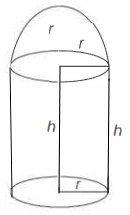
$A$ solid hemisphere is attached to the top of a cylinder,having the same radius as that of the cylinder. If the height of the cylinder were doubled (keeping both radii fixed),the volume of the entire system would have increased by $50\,\%$. By what percentage would the volume have increased if the radii of the hemisphere and the cylinder were doubled (keeping the height fixed) (in $,\%$)?
A
$300$
B
$400$
C
$500$
D
$600$
Solution
(C) Let the height of the cylinder be $h$ and the radius be $r$.
The volume of the cylinder is $V_{cyl} = \pi r^2 h$ and the volume of the hemisphere is $V_{hemi} = \frac{2}{3} \pi r^3$.
The total volume of the system is $V_1 = \pi r^2 h + \frac{2}{3} \pi r^3$.
When the height of the cylinder is doubled $(h \to 2h)$,the new volume $V_2$ is:
$V_2 = \pi r^2 (2h) + \frac{2}{3} \pi r^3 = 2 \pi r^2 h + \frac{2}{3} \pi r^3$.
Given that the volume increases by $50\,\%$,we have $V_2 = 1.5 V_1 = \frac{3}{2} V_1$.
$\frac{2 \pi r^2 h + \frac{2}{3} \pi r^3}{\pi r^2 h + \frac{2}{3} \pi r^3} = \frac{3}{2}$.
Cross-multiplying gives $4 \pi r^2 h + \frac{4}{3} \pi r^3 = 3 \pi r^2 h + 2 \pi r^3$.
$\pi r^2 h = \frac{2}{3} \pi r^3$,which implies $h = \frac{2}{3} r$.
Now,if the radii are doubled $(r \to 2r)$ while keeping the height $h$ fixed,the new volume $V'_2$ is:
$V'_2 = \pi (2r)^2 h + \frac{2}{3} \pi (2r)^3 = 4 \pi r^2 h + \frac{16}{3} \pi r^3$.
Substituting $h = \frac{2}{3} r$ into the expression for $V'_2$:
$V'_2 = 4 \pi r^2 (\frac{2}{3} r) + \frac{16}{3} \pi r^3 = \frac{8}{3} \pi r^3 + \frac{16}{3} \pi r^3 = \frac{24}{3} \pi r^3 = 8 \pi r^3$.
The original volume $V_1$ in terms of $r$ is:
$V_1 = \pi r^2 (\frac{2}{3} r) + \frac{2}{3} \pi r^3 = \frac{2}{3} \pi r^3 + \frac{2}{3} \pi r^3 = \frac{4}{3} \pi r^3$.
The ratio $\frac{V'_2}{V_1} = \frac{8 \pi r^3}{\frac{4}{3} \pi r^3} = 8 \times \frac{3}{4} = 6$.
The increase in volume is $V'_2 - V_1 = 6 V_1 - V_1 = 5 V_1$.
Percentage increase = $\frac{5 V_1}{V_1} \times 100\,\% = 500\,\%$.
The volume of the cylinder is $V_{cyl} = \pi r^2 h$ and the volume of the hemisphere is $V_{hemi} = \frac{2}{3} \pi r^3$.
The total volume of the system is $V_1 = \pi r^2 h + \frac{2}{3} \pi r^3$.
When the height of the cylinder is doubled $(h \to 2h)$,the new volume $V_2$ is:
$V_2 = \pi r^2 (2h) + \frac{2}{3} \pi r^3 = 2 \pi r^2 h + \frac{2}{3} \pi r^3$.
Given that the volume increases by $50\,\%$,we have $V_2 = 1.5 V_1 = \frac{3}{2} V_1$.
$\frac{2 \pi r^2 h + \frac{2}{3} \pi r^3}{\pi r^2 h + \frac{2}{3} \pi r^3} = \frac{3}{2}$.
Cross-multiplying gives $4 \pi r^2 h + \frac{4}{3} \pi r^3 = 3 \pi r^2 h + 2 \pi r^3$.
$\pi r^2 h = \frac{2}{3} \pi r^3$,which implies $h = \frac{2}{3} r$.
Now,if the radii are doubled $(r \to 2r)$ while keeping the height $h$ fixed,the new volume $V'_2$ is:
$V'_2 = \pi (2r)^2 h + \frac{2}{3} \pi (2r)^3 = 4 \pi r^2 h + \frac{16}{3} \pi r^3$.
Substituting $h = \frac{2}{3} r$ into the expression for $V'_2$:
$V'_2 = 4 \pi r^2 (\frac{2}{3} r) + \frac{16}{3} \pi r^3 = \frac{8}{3} \pi r^3 + \frac{16}{3} \pi r^3 = \frac{24}{3} \pi r^3 = 8 \pi r^3$.
The original volume $V_1$ in terms of $r$ is:
$V_1 = \pi r^2 (\frac{2}{3} r) + \frac{2}{3} \pi r^3 = \frac{2}{3} \pi r^3 + \frac{2}{3} \pi r^3 = \frac{4}{3} \pi r^3$.
The ratio $\frac{V'_2}{V_1} = \frac{8 \pi r^3}{\frac{4}{3} \pi r^3} = 8 \times \frac{3}{4} = 6$.
The increase in volume is $V'_2 - V_1 = 6 V_1 - V_1 = 5 V_1$.
Percentage increase = $\frac{5 V_1}{V_1} \times 100\,\% = 500\,\%$.
0 likesView Solution
23
MathematicsAdvancedMCQKVPY · 2018
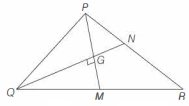
Consider a $\triangle PQR$ in which the relation $QR^2 + PR^2 = 5PQ^2$ holds. Let $G$ be the point of intersection of medians $PM$ and $QN$. Then,$\angle QGM$ is always
A
less than $45^{\circ}$
B
obtuse
C
a right angle
D
acute and larger than $45^{\circ}$
Solution
(C) In $\triangle PQR$,let the vertices be $P, Q, R$. Let $M$ be the midpoint of $QR$ and $N$ be the midpoint of $PR$. The medians $PM$ and $QN$ intersect at the centroid $G$.
Using the property of medians,$QG = \frac{2}{3}QN$ and $GM = \frac{1}{3}PM$.
In $\triangle QGM$,by the Pythagorean theorem,if $\angle QGM = 90^{\circ}$,then $QG^2 + GM^2 = QM^2$.
We know $QM = \frac{1}{2}QR$,so $QM^2 = \frac{1}{4}QR^2$.
Using Apollonius theorem for medians:
$QN^2 = \frac{2PQ^2 + 2QR^2 - PR^2}{4}$ and $PM^2 = \frac{2PQ^2 + 2PR^2 - QR^2}{4}$.
Then $QG^2 + GM^2 = \left(\frac{2}{3}QN\right)^2 + \left(\frac{1}{3}PM\right)^2 = \frac{4}{9}QN^2 + \frac{1}{9}PM^2$.
Substituting the expressions for $QN^2$ and $PM^2$:
$= \frac{4}{9} \left(\frac{2PQ^2 + 2QR^2 - PR^2}{4}\right) + \frac{1}{9} \left(\frac{2PQ^2 + 2PR^2 - QR^2}{4}\right)$
$= \frac{1}{9} \left( \frac{8PQ^2 + 8QR^2 - 4PR^2 + 2PQ^2 + 2PR^2 - QR^2}{4} \right)$
$= \frac{1}{9} \left( \frac{10PQ^2 + 7QR^2 - 2PR^2}{4} \right)$.
Given $PR^2 = 5PQ^2 - QR^2$,substitute this:
$= \frac{1}{9} \left( \frac{10PQ^2 + 7QR^2 - 2(5PQ^2 - QR^2)}{4} \right)$
$= \frac{1}{9} \left( \frac{10PQ^2 + 7QR^2 - 10PQ^2 + 2QR^2}{4} \right) = \frac{1}{9} \left( \frac{9QR^2}{4} \right) = \frac{1}{4}QR^2 = QM^2$.
Since $QG^2 + GM^2 = QM^2$,$\triangle QGM$ is a right-angled triangle with $\angle QGM = 90^{\circ}$.
Using the property of medians,$QG = \frac{2}{3}QN$ and $GM = \frac{1}{3}PM$.
In $\triangle QGM$,by the Pythagorean theorem,if $\angle QGM = 90^{\circ}$,then $QG^2 + GM^2 = QM^2$.
We know $QM = \frac{1}{2}QR$,so $QM^2 = \frac{1}{4}QR^2$.
Using Apollonius theorem for medians:
$QN^2 = \frac{2PQ^2 + 2QR^2 - PR^2}{4}$ and $PM^2 = \frac{2PQ^2 + 2PR^2 - QR^2}{4}$.
Then $QG^2 + GM^2 = \left(\frac{2}{3}QN\right)^2 + \left(\frac{1}{3}PM\right)^2 = \frac{4}{9}QN^2 + \frac{1}{9}PM^2$.
Substituting the expressions for $QN^2$ and $PM^2$:
$= \frac{4}{9} \left(\frac{2PQ^2 + 2QR^2 - PR^2}{4}\right) + \frac{1}{9} \left(\frac{2PQ^2 + 2PR^2 - QR^2}{4}\right)$
$= \frac{1}{9} \left( \frac{8PQ^2 + 8QR^2 - 4PR^2 + 2PQ^2 + 2PR^2 - QR^2}{4} \right)$
$= \frac{1}{9} \left( \frac{10PQ^2 + 7QR^2 - 2PR^2}{4} \right)$.
Given $PR^2 = 5PQ^2 - QR^2$,substitute this:
$= \frac{1}{9} \left( \frac{10PQ^2 + 7QR^2 - 2(5PQ^2 - QR^2)}{4} \right)$
$= \frac{1}{9} \left( \frac{10PQ^2 + 7QR^2 - 10PQ^2 + 2QR^2}{4} \right) = \frac{1}{9} \left( \frac{9QR^2}{4} \right) = \frac{1}{4}QR^2 = QM^2$.
Since $QG^2 + GM^2 = QM^2$,$\triangle QGM$ is a right-angled triangle with $\angle QGM = 90^{\circ}$.
0 likesView Solution
24
MathematicsAdvancedMCQKVPY · 2018
Let $a, b, c$ be the side-lengths of a triangle and $l, m, n$ be the lengths of its medians. Put $K = \frac{l+m+n}{a+b+c}$. Then,as $a, b, c$ vary,$K$ can assume every value in the interval
A
$\left(\frac{1}{4}, \frac{2}{3}\right)$
B
$\left(\frac{1}{2}, \frac{4}{5}\right)$
C
$\left(\frac{3}{4}, 1\right)$
D
$\left(\frac{4}{5}, \frac{5}{4}\right)$
Solution
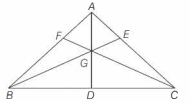
(C) Let the side lengths of $\triangle ABC$ be $BC = a, AC = b, AB = c$ and the lengths of the medians be $AD = l, BE = m, CF = n$.
In any triangle,the length of a median is less than the semi-sum of the adjacent sides. Thus,$l < \frac{b+c}{2}$,$m < \frac{a+c}{2}$,and $n < \frac{a+b}{2}$.
Summing these inequalities,we get $l+m+n < \frac{b+c+a+c+a+b}{2} = a+b+c$.
Therefore,$K = \frac{l+m+n}{a+b+c} < 1$.
Also,let $G$ be the centroid of the triangle. In $\triangle BGC$,by the triangle inequality,$BG + GC > BC$. Since the centroid divides the median in the ratio $2:1$,we have $BG = \frac{2}{3}m$ and $GC = \frac{2}{3}n$. Thus,$\frac{2}{3}(m+n) > a$.
Similarly,$\frac{2}{3}(n+l) > b$ and $\frac{2}{3}(l+m) > c$.
Adding these three inequalities,we get $\frac{4}{3}(l+m+n) > a+b+c$,which implies $K = \frac{l+m+n}{a+b+c} > \frac{3}{4}$.
Combining these results,$K \in \left(\frac{3}{4}, 1\right)$.
In any triangle,the length of a median is less than the semi-sum of the adjacent sides. Thus,$l < \frac{b+c}{2}$,$m < \frac{a+c}{2}$,and $n < \frac{a+b}{2}$.
Summing these inequalities,we get $l+m+n < \frac{b+c+a+c+a+b}{2} = a+b+c$.
Therefore,$K = \frac{l+m+n}{a+b+c} < 1$.
Also,let $G$ be the centroid of the triangle. In $\triangle BGC$,by the triangle inequality,$BG + GC > BC$. Since the centroid divides the median in the ratio $2:1$,we have $BG = \frac{2}{3}m$ and $GC = \frac{2}{3}n$. Thus,$\frac{2}{3}(m+n) > a$.
Similarly,$\frac{2}{3}(n+l) > b$ and $\frac{2}{3}(l+m) > c$.
Adding these three inequalities,we get $\frac{4}{3}(l+m+n) > a+b+c$,which implies $K = \frac{l+m+n}{a+b+c} > \frac{3}{4}$.
Combining these results,$K \in \left(\frac{3}{4}, 1\right)$.
0 likesView Solution
25
MathematicsAdvancedMCQKVPY · 2018
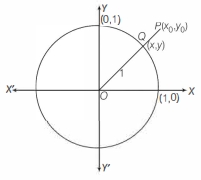
Let $x_0, y_0$ be fixed real numbers such that $x_0^2+y_0^2 > 1$. If $x, y$ are arbitrary real numbers such that $x^2+y^2 \leq 1$,then the minimum value of $(x-x_0)^2+(y-y_0)^2$ is
A
$(\sqrt{x_0^2+y_0^2}-1)^2$
B
$x_0^2+y_0^2-1$
C
$(|x_0|+|y_0|-1)^2$
D
$(|x_0|+|y_0|)^2-1$
Solution
(A) Let $P(x_0, y_0)$ be a fixed point outside the unit circle $x^2+y^2 \leq 1$.
Let $Q(x, y)$ be any point on or inside the unit circle.
The expression $(x-x_0)^2+(y-y_0)^2$ represents the square of the distance $PQ^2$ between points $P$ and $Q$.
Let $O$ be the origin $(0, 0)$. The distance $OP = \sqrt{x_0^2+y_0^2}$.
Since $P$ is outside the circle,$OP > 1$.
The distance $PQ$ is minimized when $Q$ lies on the line segment $OP$.
In this case,the distance $PQ = OP - OQ$.
Since the minimum distance $PQ$ occurs when $Q$ is on the boundary of the circle,we have $OQ = 1$.
Thus,the minimum distance $PQ = \sqrt{x_0^2+y_0^2} - 1$.
The minimum value of $PQ^2$ is $(\sqrt{x_0^2+y_0^2}-1)^2$.
Let $Q(x, y)$ be any point on or inside the unit circle.
The expression $(x-x_0)^2+(y-y_0)^2$ represents the square of the distance $PQ^2$ between points $P$ and $Q$.
Let $O$ be the origin $(0, 0)$. The distance $OP = \sqrt{x_0^2+y_0^2}$.
Since $P$ is outside the circle,$OP > 1$.
The distance $PQ$ is minimized when $Q$ lies on the line segment $OP$.
In this case,the distance $PQ = OP - OQ$.
Since the minimum distance $PQ$ occurs when $Q$ is on the boundary of the circle,we have $OQ = 1$.
Thus,the minimum distance $PQ = \sqrt{x_0^2+y_0^2} - 1$.
The minimum value of $PQ^2$ is $(\sqrt{x_0^2+y_0^2}-1)^2$.
0 likesView Solution
26
MathematicsAdvancedMCQKVPY · 2018
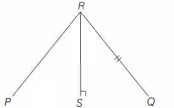
Let $PQR$ be a triangle in which $PQ=3$. From the vertex $R$,draw the altitude $RS$ to meet $PQ$ at $S$. Assume that $RS=\sqrt{3}$ and $PS=QR$. Then,$PR$ equals
A
$\sqrt{5}$
B
$\sqrt{6}$
C
$\sqrt{7}$
D
$\sqrt{8}$
Solution
(C) Given,in $\triangle PQR$,
$PQ=3$
Altitude $RS=\sqrt{3}$
$PS=QR$
In $\triangle SQR$,by the Pythagorean theorem,$QR^2=SR^2+SQ^2$.
Since $PS=QR$,we have $PS^2=SR^2+SQ^2$.
We know $SQ=PQ-PS=3-PS$.
Substituting the values,$PS^2=(\sqrt{3})^2+(3-PS)^2$.
$PS^2=3+9-6PS+PS^2$
$6PS=12 \Rightarrow PS=2$.
In $\triangle PRS$,by the Pythagorean theorem,$PR^2=PS^2+RS^2$.
$PR^2=2^2+(\sqrt{3})^2=4+3=7$.
Therefore,$PR=\sqrt{7}$.
$PQ=3$
Altitude $RS=\sqrt{3}$
$PS=QR$
In $\triangle SQR$,by the Pythagorean theorem,$QR^2=SR^2+SQ^2$.
Since $PS=QR$,we have $PS^2=SR^2+SQ^2$.
We know $SQ=PQ-PS=3-PS$.
Substituting the values,$PS^2=(\sqrt{3})^2+(3-PS)^2$.
$PS^2=3+9-6PS+PS^2$
$6PS=12 \Rightarrow PS=2$.
In $\triangle PRS$,by the Pythagorean theorem,$PR^2=PS^2+RS^2$.
$PR^2=2^2+(\sqrt{3})^2=4+3=7$.
Therefore,$PR=\sqrt{7}$.
0 likesView Solution
27
MathematicsMediumMCQKVPY · 2018
$A$ $100$ mark examination was administered to a class of $50$ students. Despite only integer marks being given,the average score of the class was $47.5$. The maximum number of students who could have received marks greater than the class average is:
A
$25$
B
$35$
C
$45$
D
$49$
Solution
(D) Total number of students $n = 50$.
Average marks $\bar{x} = 47.5$.
Total marks obtained by all students $= 50 \times 47.5 = 2375$.
Let $k$ be the number of students who scored more than the average $(47.5)$. Since marks are integers,these students must have scored at least $48$ marks.
Let the remaining $(50 - k)$ students score the minimum possible marks,which is $0$.
To maximize $k$,we assume these $k$ students scored the minimum possible marks greater than the average,which is $48$.
Thus,$48k + (50 - k) \times 0 \leq 2375$.
$48k \leq 2375$.
$k \leq \frac{2375}{48} \approx 49.479$.
Since $k$ must be an integer,the maximum value of $k$ is $49$.
Average marks $\bar{x} = 47.5$.
Total marks obtained by all students $= 50 \times 47.5 = 2375$.
Let $k$ be the number of students who scored more than the average $(47.5)$. Since marks are integers,these students must have scored at least $48$ marks.
Let the remaining $(50 - k)$ students score the minimum possible marks,which is $0$.
To maximize $k$,we assume these $k$ students scored the minimum possible marks greater than the average,which is $48$.
Thus,$48k + (50 - k) \times 0 \leq 2375$.
$48k \leq 2375$.
$k \leq \frac{2375}{48} \approx 49.479$.
Since $k$ must be an integer,the maximum value of $k$ is $49$.
0 likesView Solution
28
MathematicsAdvancedMCQKVPY · 2018
Let $S$ be the sum of the digits of the number $15^2 \times 5^{18}$ in base $10$. Then,
A
$S < 6$
B
$6 \leq S < 140$
C
$140 \leq S < 148$
D
$S \geq 148$
Solution
(B) Given number $n = 15^2 \times 5^{18}$.
$n = (3 \times 5)^2 \times 5^{18} = 3^2 \times 5^2 \times 5^{18} = 9 \times 5^{20}$.
To find the number of digits,we calculate $\log_{10} n = \log_{10} (9 \times 5^{20}) = \log_{10} 9 + 20 \log_{10} 5$.
Using $\log_{10} 3 \approx 0.4771$ and $\log_{10} 5 \approx 0.6990$:
$\log_{10} n = 2 \times 0.4771 + 20 \times 0.6990 = 0.9542 + 13.98 = 14.9342$.
Since the characteristic is $14$,the number $n$ has $14 + 1 = 15$ digits.
The maximum possible sum of digits for a $15$-digit number is $9 \times 15 = 135$. However,$n = 9 \times 5^{20}$ ends in $5$ (since $5^k$ ends in $5$ for $k \geq 1$),so the last digit is $5$.
The sum of digits $S$ satisfies $S \leq 9 \times 14 + 5 = 126 + 5 = 131$.
Since the number is not zero,$S \geq 1$ (actually $S \geq 6$ as the sum of digits of a multiple of $9$ is a multiple of $9$,and $131$ is not a multiple of $9$,but $S$ must be at least $6$ based on the options provided).
Thus,$6 \leq S < 140$.
$n = (3 \times 5)^2 \times 5^{18} = 3^2 \times 5^2 \times 5^{18} = 9 \times 5^{20}$.
To find the number of digits,we calculate $\log_{10} n = \log_{10} (9 \times 5^{20}) = \log_{10} 9 + 20 \log_{10} 5$.
Using $\log_{10} 3 \approx 0.4771$ and $\log_{10} 5 \approx 0.6990$:
$\log_{10} n = 2 \times 0.4771 + 20 \times 0.6990 = 0.9542 + 13.98 = 14.9342$.
Since the characteristic is $14$,the number $n$ has $14 + 1 = 15$ digits.
The maximum possible sum of digits for a $15$-digit number is $9 \times 15 = 135$. However,$n = 9 \times 5^{20}$ ends in $5$ (since $5^k$ ends in $5$ for $k \geq 1$),so the last digit is $5$.
The sum of digits $S$ satisfies $S \leq 9 \times 14 + 5 = 126 + 5 = 131$.
Since the number is not zero,$S \geq 1$ (actually $S \geq 6$ as the sum of digits of a multiple of $9$ is a multiple of $9$,and $131$ is not a multiple of $9$,but $S$ must be at least $6$ based on the options provided).
Thus,$6 \leq S < 140$.
0 likesView Solution
29
MathematicsAdvancedMCQKVPY · 2018
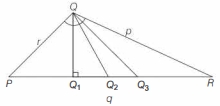
Let $PQR$ be an acute-angled triangle in which $PQ < QR$. From the vertex $Q$,draw the altitude $QQ_1$,the angle bisector $QQ_2$,and the median $QQ_3$,with $Q_1, Q_2, Q_3$ lying on $PR$. Then,
A
$PQ_1 < PQ_2 < PQ_3$
B
$PQ_2 < PQ_1 < PQ_3$
C
$PQ_1 < PQ_3 < PQ_2$
D
$PQ_3 < PQ_1 < PQ_2$
Solution
(A) In $\triangle PQR$,let $PQ = r$,$QR = p$,and $PR = q$. Since $PQ < QR$,we have $r < p$.
$1$. The altitude $QQ_1$ is the shortest segment from $Q$ to the line $PR$. Thus,$PQ_1$ is the smallest distance.
$2$. The median $QQ_3$ bisects $PR$,so $PQ_3 = \frac{1}{2} PR$.
$3$. By the Angle Bisector Theorem,the angle bisector $QQ_2$ divides $PR$ in the ratio of the adjacent sides $PQ:QR = r:p$. Thus,$PQ_2 = \left(\frac{r}{r+p}\right) PR$.
Since $r < p$,we have $r+p > 2r$,which implies $\frac{r}{r+p} < \frac{r}{2r} = \frac{1}{2}$.
Therefore,$PQ_2 < \frac{1}{2} PR = PQ_3$.
Comparing the positions of the feet on $PR$,we have $PQ_1 < PQ_2 < PQ_3$. The correct option is $A$.
$1$. The altitude $QQ_1$ is the shortest segment from $Q$ to the line $PR$. Thus,$PQ_1$ is the smallest distance.
$2$. The median $QQ_3$ bisects $PR$,so $PQ_3 = \frac{1}{2} PR$.
$3$. By the Angle Bisector Theorem,the angle bisector $QQ_2$ divides $PR$ in the ratio of the adjacent sides $PQ:QR = r:p$. Thus,$PQ_2 = \left(\frac{r}{r+p}\right) PR$.
Since $r < p$,we have $r+p > 2r$,which implies $\frac{r}{r+p} < \frac{r}{2r} = \frac{1}{2}$.
Therefore,$PQ_2 < \frac{1}{2} PR = PQ_3$.
Comparing the positions of the feet on $PR$,we have $PQ_1 < PQ_2 < PQ_3$. The correct option is $A$.
0 likesView Solution
30
MathematicsAdvancedMCQKVPY · 2018
All the vertices of a rectangle are of the form $(a, b)$ with $a, b$ integers satisfying the equation $(a-8)^2-(b-7)^2=5$. Then,the perimeter of the rectangle is
A
$20$
B
$22$
C
$24$
D
$26$
Solution
(A) Given the equation: $(a-8)^2-(b-7)^2=5$
This can be written as: $(a-8-b+7)(a-8+b-7)=5$
$\Rightarrow (a-b-1)(a+b-15)=5$
Since $a$ and $b$ are integers,$(a-b-1)$ and $(a+b-15)$ must be integer factors of $5$. The possible pairs of factors $(x, y)$ such that $xy=5$ are $(1, 5), (5, 1), (-1, -5), (-5, -1)$.
Case $1$: $a-b-1=1$ and $a+b-15=5 \Rightarrow a-b=2$ and $a+b=20$. Adding gives $2a=22 \Rightarrow a=11$,then $b=9$.
Case $2$: $a-b-1=5$ and $a+b-15=1 \Rightarrow a-b=6$ and $a+b=16$. Adding gives $2a=22 \Rightarrow a=11$,then $b=5$.
Case $3$: $a-b-1=-1$ and $a+b-15=-5 \Rightarrow a-b=0$ and $a+b=10$. Adding gives $2a=10 \Rightarrow a=5$,then $b=5$.
Case $4$: $a-b-1=-5$ and $a+b-15=-1 \Rightarrow a-b=-4$ and $a+b=14$. Adding gives $2a=10 \Rightarrow a=5$,then $b=9$.
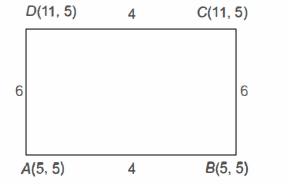
The vertices are $(11, 9), (11, 5), (5, 5), (5, 9)$.
The length of the sides are the distances between adjacent vertices:
Length $L = \sqrt{(11-11)^2+(9-5)^2} = 4$
Width $W = \sqrt{(11-5)^2+(5-5)^2} = 6$
Perimeter $= 2(L+W) = 2(4+6) = 20$.
This can be written as: $(a-8-b+7)(a-8+b-7)=5$
$\Rightarrow (a-b-1)(a+b-15)=5$
Since $a$ and $b$ are integers,$(a-b-1)$ and $(a+b-15)$ must be integer factors of $5$. The possible pairs of factors $(x, y)$ such that $xy=5$ are $(1, 5), (5, 1), (-1, -5), (-5, -1)$.
Case $1$: $a-b-1=1$ and $a+b-15=5 \Rightarrow a-b=2$ and $a+b=20$. Adding gives $2a=22 \Rightarrow a=11$,then $b=9$.
Case $2$: $a-b-1=5$ and $a+b-15=1 \Rightarrow a-b=6$ and $a+b=16$. Adding gives $2a=22 \Rightarrow a=11$,then $b=5$.
Case $3$: $a-b-1=-1$ and $a+b-15=-5 \Rightarrow a-b=0$ and $a+b=10$. Adding gives $2a=10 \Rightarrow a=5$,then $b=5$.
Case $4$: $a-b-1=-5$ and $a+b-15=-1 \Rightarrow a-b=-4$ and $a+b=14$. Adding gives $2a=10 \Rightarrow a=5$,then $b=9$.
The vertices are $(11, 9), (11, 5), (5, 5), (5, 9)$.
The length of the sides are the distances between adjacent vertices:
Length $L = \sqrt{(11-11)^2+(9-5)^2} = 4$
Width $W = \sqrt{(11-5)^2+(5-5)^2} = 6$
Perimeter $= 2(L+W) = 2(4+6) = 20$.
0 likesView Solution
31
MathematicsAdvancedMCQKVPY · 2018
What is the sum of all natural numbers $n$ such that the product of the digits of $n$ (in base $10$) is equal to $n^2-10n-36$?
A
$12$
B
$13$
C
$124$
D
$2612$
Solution
(B) Let $P(n)$ be the product of the digits of $n$. We are given $P(n) = n^2-10n-36$.
Since $P(n) \geq 0$,we have $n^2-10n-36 \geq 0$. Solving $n^2-10n-36 = 0$ gives $n = 5 \pm \sqrt{61}$. Since $n$ is a natural number,$n \geq 5 + \sqrt{61} \approx 12.8$,so $n \geq 13$.
If $n$ is a $2$-digit number,$n = 10a+b$,then $P(n) = ab \leq 81$. Thus $n^2-10n-36 \leq 81$,which implies $n^2-10n-117 \leq 0$. The roots are $5 \pm \sqrt{142} \approx 5 \pm 11.9$,so $n \leq 16.9$. Thus $n \in \{13, 14, 15, 16\}$.
For $n=13$,$P(13) = 1 \times 3 = 3$ and $13^2-10(13)-36 = 169-130-36 = 3$. This works.
For $n=14$,$P(14) = 4$ and $14^2-10(14)-36 = 196-140-36 = 20 \neq 4$.
For $n=15$,$P(15) = 5$ and $15^2-10(15)-36 = 225-150-36 = 39 \neq 5$.
For $n=16$,$P(16) = 6$ and $16^2-10(16)-36 = 256-160-36 = 60 \neq 6$.
If $n$ is a $3$-digit number,$n \geq 100$,then $n^2-10n-36 > 100^2-1000-36 = 8964$,but the maximum product of digits for a $3$-digit number is $9^3 = 729$. Thus,no $3$-digit or higher number works.
The only solution is $n=13$.
Since $P(n) \geq 0$,we have $n^2-10n-36 \geq 0$. Solving $n^2-10n-36 = 0$ gives $n = 5 \pm \sqrt{61}$. Since $n$ is a natural number,$n \geq 5 + \sqrt{61} \approx 12.8$,so $n \geq 13$.
If $n$ is a $2$-digit number,$n = 10a+b$,then $P(n) = ab \leq 81$. Thus $n^2-10n-36 \leq 81$,which implies $n^2-10n-117 \leq 0$. The roots are $5 \pm \sqrt{142} \approx 5 \pm 11.9$,so $n \leq 16.9$. Thus $n \in \{13, 14, 15, 16\}$.
For $n=13$,$P(13) = 1 \times 3 = 3$ and $13^2-10(13)-36 = 169-130-36 = 3$. This works.
For $n=14$,$P(14) = 4$ and $14^2-10(14)-36 = 196-140-36 = 20 \neq 4$.
For $n=15$,$P(15) = 5$ and $15^2-10(15)-36 = 225-150-36 = 39 \neq 5$.
For $n=16$,$P(16) = 6$ and $16^2-10(16)-36 = 256-160-36 = 60 \neq 6$.
If $n$ is a $3$-digit number,$n \geq 100$,then $n^2-10n-36 > 100^2-1000-36 = 8964$,but the maximum product of digits for a $3$-digit number is $9^3 = 729$. Thus,no $3$-digit or higher number works.
The only solution is $n=13$.
0 likesView Solution
32
MathematicsAdvancedMCQKVPY · 2018
Let $m$ (respectively,$n$) be the number of $5$-digit integers obtained by using the digits $1, 2, 3, 4, 5$ with repetitions (respectively,without repetitions) such that the sum of any two adjacent digits is odd. Then $\frac{m}{n}$ is equal to
A
$9$
B
$12$
C
$15$
D
$18$
Solution
(C) For the sum of two adjacent digits to be odd,one must be even and the other must be odd. The set of digits is $\{1, 2, 3, 4, 5\}$,where odd digits are $O = \{1, 3, 5\}$ (count $3$) and even digits are $E = \{2, 4\}$ (count $2$).
Case $I$: With repetition $(m)$
Pattern $1$: $O-E-O-E-O$. Number of ways $= 3 \times 2 \times 3 \times 2 \times 3 = 108$.
Pattern $2$: $E-O-E-O-E$. Number of ways $= 2 \times 3 \times 2 \times 3 \times 2 = 72$.
Total $m = 108 + 72 = 180$.
Case $II$: Without repetition $(n)$
Pattern $1$: $O-E-O-E-O$. Number of ways $= 3 \times 2 \times 2 \times 1 \times 1 = 12$.
Pattern $2$: $E-O-E-O-E$. This is impossible because we only have $2$ even digits,and this pattern requires $3$ even digits.
Total $n = 12$.
Therefore,$\frac{m}{n} = \frac{180}{12} = 15$.
Case $I$: With repetition $(m)$
Pattern $1$: $O-E-O-E-O$. Number of ways $= 3 \times 2 \times 3 \times 2 \times 3 = 108$.
Pattern $2$: $E-O-E-O-E$. Number of ways $= 2 \times 3 \times 2 \times 3 \times 2 = 72$.
Total $m = 108 + 72 = 180$.
Case $II$: Without repetition $(n)$
Pattern $1$: $O-E-O-E-O$. Number of ways $= 3 \times 2 \times 2 \times 1 \times 1 = 12$.
Pattern $2$: $E-O-E-O-E$. This is impossible because we only have $2$ even digits,and this pattern requires $3$ even digits.
Total $n = 12$.
Therefore,$\frac{m}{n} = \frac{180}{12} = 15$.
0 likesView Solution
33
MathematicsAdvancedMCQKVPY · 2018
The number of solid cones with integer radius and integer height each having its volume numerically equal to its total surface area is
A
$0$
B
$1$
C
$2$
D
$infinite$
Solution
(B) Let the height and radius of the cone be $h$ and $r$ respectively,where $h, r \in \mathbb{Z}^+$.
Given that the volume of the cone is numerically equal to its total surface area:
$\frac{1}{3} \pi r^2 h = \pi r l + \pi r^2$,where $l = \sqrt{h^2 + r^2}$.
Dividing by $\pi r$ (since $r \neq 0$):
$\frac{1}{3} r h = \sqrt{h^2 + r^2} + r$
$\frac{1}{3} r h - r = \sqrt{h^2 + r^2}$
$r(\frac{h}{3} - 1) = \sqrt{h^2 + r^2}$
Squaring both sides:
$r^2(\frac{h-3}{3})^2 = h^2 + r^2$
$r^2(\frac{h^2 - 6h + 9}{9}) = h^2 + r^2$
$r^2(h^2 - 6h + 9) = 9h^2 + 9r^2$
$r^2 h^2 - 6h r^2 + 9r^2 = 9h^2 + 9r^2$
$r^2 h^2 - 6h r^2 = 9h^2$
Since $h \neq 0$,divide by $h$:
$r^2 h - 6r^2 = 9h$
$h(r^2 - 9) = 6r^2$
$h = \frac{6r^2}{r^2 - 9} = \frac{6(r^2 - 9) + 54}{r^2 - 9} = 6 + \frac{54}{r^2 - 9}$.
For $h$ to be an integer,$r^2 - 9$ must be a divisor of $54$. Also,$r^2 - 9 > 0$ implies $r > 3$.
The divisors of $54$ are $1, 2, 3, 6, 9, 18, 27, 54$.
Testing $r^2 - 9 = k$:
If $r^2 - 9 = 27$,$r^2 = 36 \Rightarrow r = 6$. Then $h = 6 + \frac{54}{27} = 6 + 2 = 8$.
If $r^2 - 9 = 54$,$r^2 = 63$ (not a perfect square).
Other values of $k$ do not yield integer $r$.
Thus,only one such cone exists with $(r, h) = (6, 8)$.
Given that the volume of the cone is numerically equal to its total surface area:
$\frac{1}{3} \pi r^2 h = \pi r l + \pi r^2$,where $l = \sqrt{h^2 + r^2}$.
Dividing by $\pi r$ (since $r \neq 0$):
$\frac{1}{3} r h = \sqrt{h^2 + r^2} + r$
$\frac{1}{3} r h - r = \sqrt{h^2 + r^2}$
$r(\frac{h}{3} - 1) = \sqrt{h^2 + r^2}$
Squaring both sides:
$r^2(\frac{h-3}{3})^2 = h^2 + r^2$
$r^2(\frac{h^2 - 6h + 9}{9}) = h^2 + r^2$
$r^2(h^2 - 6h + 9) = 9h^2 + 9r^2$
$r^2 h^2 - 6h r^2 + 9r^2 = 9h^2 + 9r^2$
$r^2 h^2 - 6h r^2 = 9h^2$
Since $h \neq 0$,divide by $h$:
$r^2 h - 6r^2 = 9h$
$h(r^2 - 9) = 6r^2$
$h = \frac{6r^2}{r^2 - 9} = \frac{6(r^2 - 9) + 54}{r^2 - 9} = 6 + \frac{54}{r^2 - 9}$.
For $h$ to be an integer,$r^2 - 9$ must be a divisor of $54$. Also,$r^2 - 9 > 0$ implies $r > 3$.
The divisors of $54$ are $1, 2, 3, 6, 9, 18, 27, 54$.
Testing $r^2 - 9 = k$:
If $r^2 - 9 = 27$,$r^2 = 36 \Rightarrow r = 6$. Then $h = 6 + \frac{54}{27} = 6 + 2 = 8$.
If $r^2 - 9 = 54$,$r^2 = 63$ (not a perfect square).
Other values of $k$ do not yield integer $r$.
Thus,only one such cone exists with $(r, h) = (6, 8)$.
0 likesView Solution
34
MathematicsAdvancedMCQKVPY · 2018
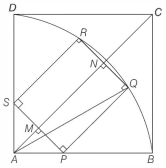
Let $ABCD$ be a square. An arc of a circle with $A$ as center and $AB$ as radius is drawn inside the square joining the points $B$ and $D$. Points $P$ on $AB$,$S$ on $AD$,$Q$ and $R$ on $\operatorname{arc} BD$ are taken such that $PQRS$ is a square. Further suppose that $PQ$ and $RS$ are parallel to $AC$. Then,$\frac{\text{Area}(PQRS)}{\text{Area}(ABCD)}$ is
A
$\frac{1}{8}$
B
$\frac{1}{5}$
C
$\frac{1}{4}$
D
$\frac{2}{5}$
Solution
(D) Let the side length of square $ABCD$ be $1$. Thus,$AB = AD = 1$.
Let the side length of square $PQRS$ be $s$.
Since $PQ$ and $RS$ are parallel to $AC$,the diagonal $AC$ makes an angle of $45^{\circ}$ with $AB$ and $AD$.
Let $A$ be the origin $(0,0)$. Then $A=(0,0)$,$B=(1,0)$,$D=(0,1)$.
The arc $BD$ is part of the circle $x^2 + y^2 = 1$.
The line $AC$ is $y=x$. Since $PQ$ is parallel to $AC$,its equation is $y=x+c$.
Let $P=(p,0)$ and $S=(0,s_0)$. Since $PQRS$ is a square,the vector $\vec{PS} = (-p, s_0)$ must be perpendicular to $\vec{PQ}$.
Using the geometry of the square and the arc,let $AM$ be the perpendicular distance from $A$ to $PS$. Since $PQRS$ is a square,$PS = s$. $AM = s/2$.
Given the symmetry and the parallel condition,the side length $s$ of the square $PQRS$ satisfies $s^2 = 2/5$ when the side of $ABCD$ is $1$.
Thus,the ratio of the areas is $\frac{s^2}{1^2} = \frac{2}{5}$.
Let the side length of square $PQRS$ be $s$.
Since $PQ$ and $RS$ are parallel to $AC$,the diagonal $AC$ makes an angle of $45^{\circ}$ with $AB$ and $AD$.
Let $A$ be the origin $(0,0)$. Then $A=(0,0)$,$B=(1,0)$,$D=(0,1)$.
The arc $BD$ is part of the circle $x^2 + y^2 = 1$.
The line $AC$ is $y=x$. Since $PQ$ is parallel to $AC$,its equation is $y=x+c$.
Let $P=(p,0)$ and $S=(0,s_0)$. Since $PQRS$ is a square,the vector $\vec{PS} = (-p, s_0)$ must be perpendicular to $\vec{PQ}$.
Using the geometry of the square and the arc,let $AM$ be the perpendicular distance from $A$ to $PS$. Since $PQRS$ is a square,$PS = s$. $AM = s/2$.
Given the symmetry and the parallel condition,the side length $s$ of the square $PQRS$ satisfies $s^2 = 2/5$ when the side of $ABCD$ is $1$.
Thus,the ratio of the areas is $\frac{s^2}{1^2} = \frac{2}{5}$.
0 likesView Solution
35
MathematicsAdvancedMCQKVPY · 2018
Suppose $ABCD$ is a trapezium whose sides and height are integers and $AB$ is parallel to $CD$. If the area of $ABCD$ is $12$ and the sides are distinct,then $|AB-CD|$ is:
A
is $2$
B
is $4$
C
is $8$
D
cannot be determined from the data
Solution
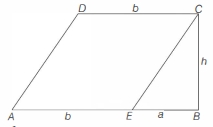
(B) Let the parallel sides be $AB = x$ and $CD = y$,and the height be $h$. The area of the trapezium is given by $\frac{1}{2} \times h(x + y) = 12$,which implies $h(x + y) = 24$.
Since $h, x, y$ are integers,$h$ must be a factor of $24$. Also,for a trapezium,the slant side must be greater than the height $h$. Let the non-parallel sides be $s_1$ and $s_2$. By dropping perpendiculars from $C$ and $D$ to $AB$,we have $x = y + p + q$,where $p^2 + h^2 = s_1^2$ and $q^2 + h^2 = s_2^2$.
For $h=3$,$x+y=8$. If we assume a right-angled trapezium where one slant side is the height,let $s_1 = h = 3$. Then $s_2 = \sqrt{(x-y)^2 + h^2}$. For $s_2$ to be an integer,$(x-y, h, s_2)$ must be a Pythagorean triple. With $h=3$,the triple is $(4, 3, 5)$,so $x-y=4$.
Solving $x+y=8$ and $x-y=4$ gives $2x=12 \Rightarrow x=6$ and $2y=4 \Rightarrow y=2$.
The sides are $6, 3, 2, 5$,which are all integers and distinct.
Thus,$|AB-CD| = |6-2| = 4$.
Since $h, x, y$ are integers,$h$ must be a factor of $24$. Also,for a trapezium,the slant side must be greater than the height $h$. Let the non-parallel sides be $s_1$ and $s_2$. By dropping perpendiculars from $C$ and $D$ to $AB$,we have $x = y + p + q$,where $p^2 + h^2 = s_1^2$ and $q^2 + h^2 = s_2^2$.
For $h=3$,$x+y=8$. If we assume a right-angled trapezium where one slant side is the height,let $s_1 = h = 3$. Then $s_2 = \sqrt{(x-y)^2 + h^2}$. For $s_2$ to be an integer,$(x-y, h, s_2)$ must be a Pythagorean triple. With $h=3$,the triple is $(4, 3, 5)$,so $x-y=4$.
Solving $x+y=8$ and $x-y=4$ gives $2x=12 \Rightarrow x=6$ and $2y=4 \Rightarrow y=2$.
The sides are $6, 3, 2, 5$,which are all integers and distinct.
Thus,$|AB-CD| = |6-2| = 4$.
0 likesView Solution
36
MathematicsDifficultMCQKVPY · 2018
Suppose $A = \begin{bmatrix} a & b \\ c & d \end{bmatrix}$ is a real matrix with non-zero entries,$ad - bc = 0$ and $A^2 = A$. Then,$a + d$ equals
A
$1$
B
$2$
C
$3$
D
$4$
Solution
(A) Given $A = \begin{bmatrix} a & b \\ c & d \end{bmatrix}$ and $A^2 = A$.
Calculating $A^2$:
$A^2 = \begin{bmatrix} a & b \\ c & d \end{bmatrix} \begin{bmatrix} a & b \\ c & d \end{bmatrix} = \begin{bmatrix} a^2 + bc & ab + bd \\ ac + cd & bc + d^2 \end{bmatrix}$.
Since $A^2 = A$,we have:
$\begin{bmatrix} a^2 + bc & ab + bd \\ ac + cd & bc + d^2 \end{bmatrix} = \begin{bmatrix} a & b \\ c & d \end{bmatrix}$.
Comparing the elements,we get $ab + bd = b$,which implies $b(a + d) = b$.
Since the entries are non-zero,$b \neq 0$,so we can divide by $b$ to get $a + d = 1$.
Calculating $A^2$:
$A^2 = \begin{bmatrix} a & b \\ c & d \end{bmatrix} \begin{bmatrix} a & b \\ c & d \end{bmatrix} = \begin{bmatrix} a^2 + bc & ab + bd \\ ac + cd & bc + d^2 \end{bmatrix}$.
Since $A^2 = A$,we have:
$\begin{bmatrix} a^2 + bc & ab + bd \\ ac + cd & bc + d^2 \end{bmatrix} = \begin{bmatrix} a & b \\ c & d \end{bmatrix}$.
Comparing the elements,we get $ab + bd = b$,which implies $b(a + d) = b$.
Since the entries are non-zero,$b \neq 0$,so we can divide by $b$ to get $a + d = 1$.
0 likesView Solution
37
MathematicsAdvancedMCQKVPY · 2018
$A$ rectangle with its sides parallel to the $X$-axis and $Y$-axis is inscribed in the region bounded by the curves $y=x^2-4$ and $y=\frac{4-x^2}{2}$. The maximum possible area of such a rectangle is closest to the integer.
A
$10$
B
$9$
C
$8$
D
$7$
Solution
(B) The curves are $y_1 = x^2-4$ and $y_2 = \frac{4-x^2}{2}$.
Let the vertices of the rectangle be $C(h, y_2)$ and $D(-h, y_2)$ on the upper curve,and $B(h, y_1)$ and $A(-h, y_1)$ on the lower curve,where $h > 0$.
The width of the rectangle is $2h$ and the height is $y_2 - y_1 = \frac{4-x^2}{2} - (x^2-4) = 2 - \frac{x^2}{2} - x^2 + 4 = 6 - \frac{3x^2}{2}$.
Substituting $h$ for $x$,the area $A(h) = 2h \times (6 - \frac{3h^2}{2}) = 12h - 3h^3$.
To find the maximum area,differentiate with respect to $h$: $\frac{dA}{dh} = 12 - 9h^2$.
Setting $\frac{dA}{dh} = 0$,we get $9h^2 = 12$,so $h^2 = \frac{4}{3}$,which means $h = \frac{2}{\sqrt{3}}$.
The maximum area is $A = 12(\frac{2}{\sqrt{3}}) - 3(\frac{2}{\sqrt{3}})^3 = \frac{24}{\sqrt{3}} - 3(\frac{8}{3\sqrt{3}}) = \frac{24}{\sqrt{3}} - \frac{8}{\sqrt{3}} = \frac{16}{\sqrt{3}} = \frac{16\sqrt{3}}{3}$.
Using $\sqrt{3} \approx 1.732$,$A \approx \frac{16 \times 1.732}{3} \approx 9.237$.
The integer closest to $9.237$ is $9$.
Let the vertices of the rectangle be $C(h, y_2)$ and $D(-h, y_2)$ on the upper curve,and $B(h, y_1)$ and $A(-h, y_1)$ on the lower curve,where $h > 0$.
The width of the rectangle is $2h$ and the height is $y_2 - y_1 = \frac{4-x^2}{2} - (x^2-4) = 2 - \frac{x^2}{2} - x^2 + 4 = 6 - \frac{3x^2}{2}$.
Substituting $h$ for $x$,the area $A(h) = 2h \times (6 - \frac{3h^2}{2}) = 12h - 3h^3$.
To find the maximum area,differentiate with respect to $h$: $\frac{dA}{dh} = 12 - 9h^2$.
Setting $\frac{dA}{dh} = 0$,we get $9h^2 = 12$,so $h^2 = \frac{4}{3}$,which means $h = \frac{2}{\sqrt{3}}$.
The maximum area is $A = 12(\frac{2}{\sqrt{3}}) - 3(\frac{2}{\sqrt{3}})^3 = \frac{24}{\sqrt{3}} - 3(\frac{8}{3\sqrt{3}}) = \frac{24}{\sqrt{3}} - \frac{8}{\sqrt{3}} = \frac{16}{\sqrt{3}} = \frac{16\sqrt{3}}{3}$.
Using $\sqrt{3} \approx 1.732$,$A \approx \frac{16 \times 1.732}{3} \approx 9.237$.
The integer closest to $9.237$ is $9$.
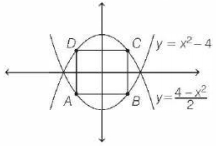
0 likesView Solution
38
MathematicsDifficultMCQKVPY · 2018
Let $f(x) = x |\sin x|$,$x \in R$. Then,
A
$f$ is differentiable for all $x$,except at $x = n\pi, n = 1, 2, 3, \dots$
B
$f$ is differentiable for all $x$,except at $x = n\pi, n = \pm 1, \pm 2, \pm 3, \dots$
C
$f$ is differentiable for all $x$,except at $x = n\pi, n = 0, 1, 2, 3, \dots$
D
$f$ is differentiable for all $x$,except at $x = n\pi, n = 0, \pm 1, \pm 2, \pm 3, \dots$
Solution
(B) Given $f(x) = x |\sin x|$.
At $x = n\pi$ (where $n \in Z$),we check the differentiability using the limit definition:
$f'(n\pi) = \lim_{x \to n\pi} \frac{f(x) - f(n\pi)}{x - n\pi} = \lim_{x \to n\pi} \frac{x |\sin x| - 0}{x - n\pi} = \lim_{x \to n\pi} \frac{x |\sin x|}{x - n\pi}$.
Let $x = n\pi + h$,where $h \to 0$.
Then $f'(n\pi) = \lim_{h \to 0} \frac{(n\pi + h) |\sin(n\pi + h)|}{h} = \lim_{h \to 0} \frac{(n\pi + h) |(-1)^n \sin h|}{h} = \lim_{h \to 0} (n\pi + h) \frac{|\sin h|}{|h|} \cdot |h| \cdot \frac{(-1)^n}{h}$.
Since $\frac{|\sin h|}{h} \to 1$ as $h \to 0$,the limit becomes $\lim_{h \to 0} (n\pi + h) \cdot 1 \cdot \frac{|h|}{h} \cdot (-1)^n$.
For $n = 0$,$f'(0) = \lim_{h \to 0} h \cdot \frac{|h|}{h} = \lim_{h \to 0} |h| = 0$. Thus,$f(x)$ is differentiable at $x = 0$.
For $n \neq 0$,the limit $\lim_{h \to 0} n\pi \cdot (-1)^n \cdot \frac{|h|}{h}$ does not exist because the left-hand limit is $-n\pi(-1)^n$ and the right-hand limit is $n\pi(-1)^n$.
Therefore,$f(x)$ is differentiable for all $x$ except at $x = n\pi$ for $n = \pm 1, \pm 2, \pm 3, \dots$.
At $x = n\pi$ (where $n \in Z$),we check the differentiability using the limit definition:
$f'(n\pi) = \lim_{x \to n\pi} \frac{f(x) - f(n\pi)}{x - n\pi} = \lim_{x \to n\pi} \frac{x |\sin x| - 0}{x - n\pi} = \lim_{x \to n\pi} \frac{x |\sin x|}{x - n\pi}$.
Let $x = n\pi + h$,where $h \to 0$.
Then $f'(n\pi) = \lim_{h \to 0} \frac{(n\pi + h) |\sin(n\pi + h)|}{h} = \lim_{h \to 0} \frac{(n\pi + h) |(-1)^n \sin h|}{h} = \lim_{h \to 0} (n\pi + h) \frac{|\sin h|}{|h|} \cdot |h| \cdot \frac{(-1)^n}{h}$.
Since $\frac{|\sin h|}{h} \to 1$ as $h \to 0$,the limit becomes $\lim_{h \to 0} (n\pi + h) \cdot 1 \cdot \frac{|h|}{h} \cdot (-1)^n$.
For $n = 0$,$f'(0) = \lim_{h \to 0} h \cdot \frac{|h|}{h} = \lim_{h \to 0} |h| = 0$. Thus,$f(x)$ is differentiable at $x = 0$.
For $n \neq 0$,the limit $\lim_{h \to 0} n\pi \cdot (-1)^n \cdot \frac{|h|}{h}$ does not exist because the left-hand limit is $-n\pi(-1)^n$ and the right-hand limit is $n\pi(-1)^n$.
Therefore,$f(x)$ is differentiable for all $x$ except at $x = n\pi$ for $n = \pm 1, \pm 2, \pm 3, \dots$.
0 likesView Solution
39
MathematicsAdvancedMCQKVPY · 2018
Let $f:[-1,1] \rightarrow R$ be a function defined by $f(x)=\begin{cases} x^2 \left| \cos \left(\frac{\pi}{x}\right) \right| & \text{for } x \neq 0 \\ 0 & \text{for } x=0 \end{cases}$. The set of points where $f$ is not differentiable is
A
$\{x \in [-1,1]: x \neq 0\}$
B
$\{x \in [-1,1]: x=0 \text{ or } x=\frac{2}{2n+1}, n \in Z\}$
C
$\{x \in [-1,1]: x=\frac{2}{2n+1}, n \in Z\}$
D
$[-1,1]$
Solution
(C) To check the differentiability of $f(x)$ at $x=0$,we examine the limit of the difference quotient:
$f'(0) = \lim_{h \to 0} \frac{f(h) - f(0)}{h} = \lim_{h \to 0} \frac{h^2 \left| \cos \left(\frac{\pi}{h}\right) \right| - 0}{h} = \lim_{h \to 0} h \left| \cos \left(\frac{\pi}{h}\right) \right|$.
Since $|\cos(\frac{\pi}{h})| \leq 1$,by the Squeeze Theorem,$\lim_{h \to 0} h \left| \cos \left(\frac{\pi}{h}\right) \right| = 0$. Thus,$f$ is differentiable at $x=0$.
For $x \neq 0$,$f(x) = x^2 |\cos(\frac{\pi}{x})|$. The function $|\cos(\frac{\pi}{x})|$ is not differentiable where the argument of the absolute value is zero,i.e.,$\cos(\frac{\pi}{x}) = 0$.
$\cos(\frac{\pi}{x}) = 0 \implies \frac{\pi}{x} = (2n+1)\frac{\pi}{2}$ for $n \in Z$.
$x = \frac{2}{2n+1}$.
Thus,$f$ is not differentiable at points where $\cos(\frac{\pi}{x}) = 0$,which are $x = \frac{2}{2n+1}$ for $n \in Z$.
$f'(0) = \lim_{h \to 0} \frac{f(h) - f(0)}{h} = \lim_{h \to 0} \frac{h^2 \left| \cos \left(\frac{\pi}{h}\right) \right| - 0}{h} = \lim_{h \to 0} h \left| \cos \left(\frac{\pi}{h}\right) \right|$.
Since $|\cos(\frac{\pi}{h})| \leq 1$,by the Squeeze Theorem,$\lim_{h \to 0} h \left| \cos \left(\frac{\pi}{h}\right) \right| = 0$. Thus,$f$ is differentiable at $x=0$.
For $x \neq 0$,$f(x) = x^2 |\cos(\frac{\pi}{x})|$. The function $|\cos(\frac{\pi}{x})|$ is not differentiable where the argument of the absolute value is zero,i.e.,$\cos(\frac{\pi}{x}) = 0$.
$\cos(\frac{\pi}{x}) = 0 \implies \frac{\pi}{x} = (2n+1)\frac{\pi}{2}$ for $n \in Z$.
$x = \frac{2}{2n+1}$.
Thus,$f$ is not differentiable at points where $\cos(\frac{\pi}{x}) = 0$,which are $x = \frac{2}{2n+1}$ for $n \in Z$.
0 likesView Solution
40
MathematicsDifficultMCQKVPY · 2018
The value of the integral $\int_0^\pi(1-|\sin 8 x|) d x$ is
A
$0$
B
$\pi-1$
C
$\pi-2$
D
$\pi-3$
Solution
(C) Let $I = \int_0^\pi (1 - |\sin 8x|) dx$.
We can split the integral as:
$I = \int_0^\pi 1 dx - \int_0^\pi |\sin 8x| dx$.
The first part is $\int_0^\pi dx = \pi$.
For the second part,let $f(x) = |\sin 8x|$. The period of $|\sin 8x|$ is $\frac{\pi}{8}$.
Since the interval $[0, \pi]$ contains $8$ full periods of the function $|\sin 8x|$,we can write:
$\int_0^\pi |\sin 8x| dx = 8 \int_0^{\pi/8} |\sin 8x| dx$.
In the interval $[0, \pi/8]$,$\sin 8x \ge 0$,so $|\sin 8x| = \sin 8x$.
Thus,$8 \int_0^{\pi/8} \sin 8x dx = 8 \left[ -\frac{\cos 8x}{8} \right]_0^{\pi/8} = -(\cos \pi - \cos 0) = -(-1 - 1) = 2$.
Substituting these values back into the expression for $I$:
$I = \pi - 2$.
We can split the integral as:
$I = \int_0^\pi 1 dx - \int_0^\pi |\sin 8x| dx$.
The first part is $\int_0^\pi dx = \pi$.
For the second part,let $f(x) = |\sin 8x|$. The period of $|\sin 8x|$ is $\frac{\pi}{8}$.
Since the interval $[0, \pi]$ contains $8$ full periods of the function $|\sin 8x|$,we can write:
$\int_0^\pi |\sin 8x| dx = 8 \int_0^{\pi/8} |\sin 8x| dx$.
In the interval $[0, \pi/8]$,$\sin 8x \ge 0$,so $|\sin 8x| = \sin 8x$.
Thus,$8 \int_0^{\pi/8} \sin 8x dx = 8 \left[ -\frac{\cos 8x}{8} \right]_0^{\pi/8} = -(\cos \pi - \cos 0) = -(-1 - 1) = 2$.
Substituting these values back into the expression for $I$:
$I = \pi - 2$.
0 likesView Solution
41
MathematicsAdvancedMCQKVPY · 2018
Let $\ln x$ denote the logarithm of $x$ with respect to the base $e$. Let $S \subset R$ be the set of all points where the function $\ln(x^2-1)$ is well-defined. Then,the number of functions $f: S \rightarrow R$ that are differentiable,satisfy $f^{\prime}(x)=\ln(x^2-1)$ for all $x \in S$ and $f(2)=0$,is
A
$0$
B
$1$
C
$2$
D
infinite
Solution
(D) The function $f^{\prime}(x) = \ln(x^2-1)$ is defined when $x^2-1 > 0$,which implies $x \in (-\infty, -1) \cup (1, \infty)$.
Since $S = (-\infty, -1) \cup (1, \infty)$ is a disconnected set consisting of two disjoint intervals,the constant of integration can be chosen independently for each interval.
Let $f(x) = \int \ln(x^2-1) dx + C_1$ for $x \in (1, \infty)$ and $f(x) = \int \ln(x^2-1) dx + C_2$ for $x \in (-\infty, -1)$.
Given $f(2) = 0$,we can determine $C_1$ uniquely.
However,there is no condition linking the value of the function on the interval $(1, \infty)$ to the interval $(-\infty, -1)$.
Since the constant $C_2$ can be any real number,there are infinitely many such functions $f$.
Since $S = (-\infty, -1) \cup (1, \infty)$ is a disconnected set consisting of two disjoint intervals,the constant of integration can be chosen independently for each interval.
Let $f(x) = \int \ln(x^2-1) dx + C_1$ for $x \in (1, \infty)$ and $f(x) = \int \ln(x^2-1) dx + C_2$ for $x \in (-\infty, -1)$.
Given $f(2) = 0$,we can determine $C_1$ uniquely.
However,there is no condition linking the value of the function on the interval $(1, \infty)$ to the interval $(-\infty, -1)$.
Since the constant $C_2$ can be any real number,there are infinitely many such functions $f$.
0 likesView Solution
42
MathematicsAdvancedMCQKVPY · 2018
Let $S$ be the set of real numbers $p$ such that there is no non-zero continuous function $f: \mathbb{R} \rightarrow \mathbb{R}$ satisfying $\int_0^x f(t) dt = p f(x)$ for all $x \in \mathbb{R}$. Then,$S$ is
A
the empty set
B
the set of all rational numbers
C
the set of all irrational numbers
D
the whole set $\mathbb{R}$
Solution
(D) Given the equation $\int_0^x f(t) dt = p f(x)$.
If $p = 0$,then $\int_0^x f(t) dt = 0$ for all $x \in \mathbb{R}$. Differentiating with respect to $x$,we get $f(x) = 0$ for all $x$. Thus,there is no non-zero function $f$ for $p = 0$.
If $p \neq 0$,we differentiate both sides with respect to $x$ using the Fundamental Theorem of Calculus:
$f(x) = p f'(x) \implies \frac{f'(x)}{f(x)} = \frac{1}{p}$.
Integrating both sides,we get $\ln|f(x)| = \frac{x}{p} + C$,which implies $f(x) = A e^{x/p}$ for some constant $A$.
Substituting this back into the original integral equation at $x = 0$:
$\int_0^0 f(t) dt = p f(0) \implies 0 = p A e^0 \implies p A = 0$.
Since $p \neq 0$,we must have $A = 0$,which implies $f(x) = 0$ for all $x$.
Thus,for any $p \in \mathbb{R}$,there exists no non-zero continuous function $f$ satisfying the given equation.
Therefore,$S = \mathbb{R}$.
If $p = 0$,then $\int_0^x f(t) dt = 0$ for all $x \in \mathbb{R}$. Differentiating with respect to $x$,we get $f(x) = 0$ for all $x$. Thus,there is no non-zero function $f$ for $p = 0$.
If $p \neq 0$,we differentiate both sides with respect to $x$ using the Fundamental Theorem of Calculus:
$f(x) = p f'(x) \implies \frac{f'(x)}{f(x)} = \frac{1}{p}$.
Integrating both sides,we get $\ln|f(x)| = \frac{x}{p} + C$,which implies $f(x) = A e^{x/p}$ for some constant $A$.
Substituting this back into the original integral equation at $x = 0$:
$\int_0^0 f(t) dt = p f(0) \implies 0 = p A e^0 \implies p A = 0$.
Since $p \neq 0$,we must have $A = 0$,which implies $f(x) = 0$ for all $x$.
Thus,for any $p \in \mathbb{R}$,there exists no non-zero continuous function $f$ satisfying the given equation.
Therefore,$S = \mathbb{R}$.
0 likesView Solution
43
MathematicsAdvancedMCQKVPY · 2018
The probability of men getting a certain disease is $\frac{1}{2}$ and that of women getting the same disease is $\frac{1}{5}$. The blood test that identifies the disease gives the correct result with probability $\frac{4}{5}$. Suppose a person is chosen at random from a group of $30$ males and $20$ females,and the blood test of that person is found to be positive. What is the probability that the chosen person is a man?
A
$\frac{75}{107}$
B
$\frac{3}{5}$
C
$\frac{15}{19}$
D
$\frac{3}{10}$
Solution
(A) Let $M$ be the event that a man is chosen and $W$ be the event that a woman is chosen. Let $D$ be the event that the person has the disease and $D^c$ be the event that the person does not have the disease. Let $T^+$ be the event that the blood test is positive.
Given:
$P(M) = \frac{30}{50} = \frac{3}{5}$
$P(W) = \frac{20}{50} = \frac{2}{5}$
$P(D|M) = \frac{1}{2}$,so $P(D^c|M) = 1 - \frac{1}{2} = \frac{1}{2}$
$P(D|W) = \frac{1}{5}$,so $P(D^c|W) = 1 - \frac{1}{5} = \frac{4}{5}$
The test is correct with probability $\frac{4}{5}$,so:
$P(T^+|D) = \frac{4}{5}$ (True positive)
$P(T^+|D^c) = 1 - \frac{4}{5} = \frac{1}{5}$ (False positive)
We want to find $P(M|T^+)$. By Bayes' Theorem:
$P(M|T^+) = \frac{P(M) \cdot P(T^+|M)}{P(T^+)}$
$P(T^+|M) = P(T^+|D)P(D|M) + P(T^+|D^c)P(D^c|M) = (\frac{4}{5} \times \frac{1}{2}) + (\frac{1}{5} \times \frac{1}{2}) = \frac{4}{10} + \frac{1}{10} = \frac{5}{10} = \frac{1}{2}$
$P(T^+|W) = P(T^+|D)P(D|W) + P(T^+|D^c)P(D^c|W) = (\frac{4}{5} \times \frac{1}{5}) + (\frac{1}{5} \times \frac{4}{5}) = \frac{4}{25} + \frac{4}{25} = \frac{8}{25}$
$P(T^+) = P(M)P(T^+|M) + P(W)P(T^+|W) = (\frac{3}{5} \times \frac{1}{2}) + (\frac{2}{5} \times \frac{8}{25}) = \frac{3}{10} + \frac{16}{125} = \frac{75 + 32}{250} = \frac{107}{250}$
$P(M|T^+) = \frac{\frac{3}{5} \times \frac{1}{2}}{\frac{107}{250}} = \frac{3/10}{107/250} = \frac{3}{10} \times \frac{250}{107} = \frac{75}{107}$
Given:
$P(M) = \frac{30}{50} = \frac{3}{5}$
$P(W) = \frac{20}{50} = \frac{2}{5}$
$P(D|M) = \frac{1}{2}$,so $P(D^c|M) = 1 - \frac{1}{2} = \frac{1}{2}$
$P(D|W) = \frac{1}{5}$,so $P(D^c|W) = 1 - \frac{1}{5} = \frac{4}{5}$
The test is correct with probability $\frac{4}{5}$,so:
$P(T^+|D) = \frac{4}{5}$ (True positive)
$P(T^+|D^c) = 1 - \frac{4}{5} = \frac{1}{5}$ (False positive)
We want to find $P(M|T^+)$. By Bayes' Theorem:
$P(M|T^+) = \frac{P(M) \cdot P(T^+|M)}{P(T^+)}$
$P(T^+|M) = P(T^+|D)P(D|M) + P(T^+|D^c)P(D^c|M) = (\frac{4}{5} \times \frac{1}{2}) + (\frac{1}{5} \times \frac{1}{2}) = \frac{4}{10} + \frac{1}{10} = \frac{5}{10} = \frac{1}{2}$
$P(T^+|W) = P(T^+|D)P(D|W) + P(T^+|D^c)P(D^c|W) = (\frac{4}{5} \times \frac{1}{5}) + (\frac{1}{5} \times \frac{4}{5}) = \frac{4}{25} + \frac{4}{25} = \frac{8}{25}$
$P(T^+) = P(M)P(T^+|M) + P(W)P(T^+|W) = (\frac{3}{5} \times \frac{1}{2}) + (\frac{2}{5} \times \frac{8}{25}) = \frac{3}{10} + \frac{16}{125} = \frac{75 + 32}{250} = \frac{107}{250}$
$P(M|T^+) = \frac{\frac{3}{5} \times \frac{1}{2}}{\frac{107}{250}} = \frac{3/10}{107/250} = \frac{3}{10} \times \frac{250}{107} = \frac{75}{107}$
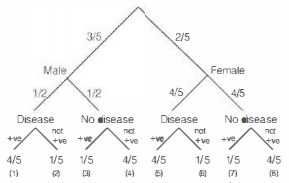
0 likesView Solution
44
MathematicsAdvancedMCQKVPY · 2018
The number of functions $f:[0,1] \rightarrow [0,1]$ satisfying $|f(x)-f(y)|=|x-y|$ for all $x, y \in [0,1]$ is
A
exactly $1$
B
exactly $2$
C
more than $2$,but finite
D
infinite
Solution
(B) Given the condition $|f(x)-f(y)|=|x-y|$ for all $x, y \in [0,1]$.
This implies that the slope of the function $f$ must be $\pm 1$,i.e.,$f'(x) = 1$ or $f'(x) = -1$.
Case $1$: If $f'(x) = 1$,then $f(x) = x + c$. Since the codomain is $[0,1]$,for $f:[0,1] \rightarrow [0,1]$,we must have $f(0) \ge 0$ and $f(1) \le 1$. Thus,$0+c \ge 0$ and $1+c \le 1$,which gives $c=0$. So,$f(x) = x$.
Case $2$: If $f'(x) = -1$,then $f(x) = -x + c$. For $f:[0,1] \rightarrow [0,1]$,we must have $f(0) \le 1$ and $f(1) \ge 0$. Thus,$0+c \le 1$ and $-1+c \ge 0$,which gives $c=1$. So,$f(x) = 1-x$.
Therefore,there are exactly $2$ such functions: $f(x) = x$ and $f(x) = 1-x$.
This implies that the slope of the function $f$ must be $\pm 1$,i.e.,$f'(x) = 1$ or $f'(x) = -1$.
Case $1$: If $f'(x) = 1$,then $f(x) = x + c$. Since the codomain is $[0,1]$,for $f:[0,1] \rightarrow [0,1]$,we must have $f(0) \ge 0$ and $f(1) \le 1$. Thus,$0+c \ge 0$ and $1+c \le 1$,which gives $c=0$. So,$f(x) = x$.
Case $2$: If $f'(x) = -1$,then $f(x) = -x + c$. For $f:[0,1] \rightarrow [0,1]$,we must have $f(0) \le 1$ and $f(1) \ge 0$. Thus,$0+c \le 1$ and $-1+c \ge 0$,which gives $c=1$. So,$f(x) = 1-x$.
Therefore,there are exactly $2$ such functions: $f(x) = x$ and $f(x) = 1-x$.
0 likesView Solution
45
MathematicsAdvancedMCQKVPY · 2018
Suppose $A$ is a $3 \times 3$ matrix consisting of integer entries that are chosen at random from the set $\{-1000, -999, \ldots, 999, 1000\}$. Let $P$ be the probability that either $A^2 = -I$ or $A$ is diagonal,where $I$ is the $3 \times 3$ identity matrix. Then,
A
$P < \frac{1}{10^{18}}$
B
$P = \frac{1}{10^{18}}$
C
$\frac{5^2}{10^{18}} \leq P \leq \frac{5^3}{10^{18}}$
D
$P \leq \frac{5^4}{10^{18}}$
Solution
(A) The matrix $A$ is a $3 \times 3$ matrix with entries from the set $S = \{-1000, -999, \ldots, 1000\}$. The total number of elements in $S$ is $2001$.
The total number of possible matrices $A$ is $(2001)^9$.
Case $1$: $A^2 = -I$. If $A$ is a $3 \times 3$ matrix,the characteristic equation is given by $\det(A - \lambda I) = 0$. By the Cayley-Hamilton theorem,$A$ satisfies its characteristic equation. If $A^2 = -I$,then the minimal polynomial divides $x^2 + 1$. Since the degree of the minimal polynomial must divide the dimension $3$,and $x^2+1$ has no real roots,this is impossible for a $3 \times 3$ matrix with real (integer) entries. Thus,the number of such matrices is $0$.
Case $2$: $A$ is a diagonal matrix. Let $A = \text{diag}(a, b, c)$. The number of such matrices is $(2001)^3$.
Therefore,the total number of favorable outcomes is $(2001)^3$.
The probability $P$ is given by $P = \frac{(2001)^3}{(2001)^9} = \frac{1}{(2001)^6}$.
We have $P = \frac{1}{(2001)^6} = \frac{1}{(2000 + 1)^6} = \frac{1}{2000^6 (1 + \frac{1}{2000})^6} = \frac{1}{64 \times 10^{18} (1 + \frac{1}{2000})^6}$.
Since $(1 + \frac{1}{2000})^6 > 1$,it follows that $P < \frac{1}{64 \times 10^{18}} < \frac{1}{10^{18}}$.
Thus,$P < \frac{1}{10^{18}}$.
The total number of possible matrices $A$ is $(2001)^9$.
Case $1$: $A^2 = -I$. If $A$ is a $3 \times 3$ matrix,the characteristic equation is given by $\det(A - \lambda I) = 0$. By the Cayley-Hamilton theorem,$A$ satisfies its characteristic equation. If $A^2 = -I$,then the minimal polynomial divides $x^2 + 1$. Since the degree of the minimal polynomial must divide the dimension $3$,and $x^2+1$ has no real roots,this is impossible for a $3 \times 3$ matrix with real (integer) entries. Thus,the number of such matrices is $0$.
Case $2$: $A$ is a diagonal matrix. Let $A = \text{diag}(a, b, c)$. The number of such matrices is $(2001)^3$.
Therefore,the total number of favorable outcomes is $(2001)^3$.
The probability $P$ is given by $P = \frac{(2001)^3}{(2001)^9} = \frac{1}{(2001)^6}$.
We have $P = \frac{1}{(2001)^6} = \frac{1}{(2000 + 1)^6} = \frac{1}{2000^6 (1 + \frac{1}{2000})^6} = \frac{1}{64 \times 10^{18} (1 + \frac{1}{2000})^6}$.
Since $(1 + \frac{1}{2000})^6 > 1$,it follows that $P < \frac{1}{64 \times 10^{18}} < \frac{1}{10^{18}}$.
Thus,$P < \frac{1}{10^{18}}$.
0 likesView Solution
46
MathematicsDifficultMCQKVPY · 2018
Let $f:[0,1] \rightarrow [-1,1]$ and $g:[-1,1] \rightarrow [0,2]$ be two functions such that $g$ is injective and $g \circ f: [0,1] \rightarrow [0,2]$ is surjective. Then,
A
$f$ must be injective but need not be surjective
B
$f$ must be surjective but need not be injective
C
$f$ must be bijective
D
$f$ must be a constant function
Solution
(B) Let $h(x) = g(f(x))$. We are given that $h: [0,1] \rightarrow [0,2]$ is surjective.
Since $h$ is surjective,the range of $h$ is equal to its codomain,which is $[0,2]$.
Since $h(x) = g(f(x))$,the range of $h$ is a subset of the range of $g$.
Thus,the range of $g$ must contain $[0,2]$.
However,the codomain of $g$ is $[0,2]$,so the range of $g$ must be exactly $[0,2]$.
This implies that $g$ is surjective.
Since $g$ is given as injective and is now shown to be surjective,$g$ is a bijection.
For $h = g \circ f$ to be surjective,$f$ must be surjective.
If $f$ were not surjective,there would exist some $y \in [-1,1]$ such that $y \notin \text{Range}(f)$.
Since $g$ is a bijection,$g(y)$ would not be in the range of $g \circ f$,contradicting the surjectivity of $h$.
Therefore,$f$ must be surjective.
Since $h$ is surjective,the range of $h$ is equal to its codomain,which is $[0,2]$.
Since $h(x) = g(f(x))$,the range of $h$ is a subset of the range of $g$.
Thus,the range of $g$ must contain $[0,2]$.
However,the codomain of $g$ is $[0,2]$,so the range of $g$ must be exactly $[0,2]$.
This implies that $g$ is surjective.
Since $g$ is given as injective and is now shown to be surjective,$g$ is a bijection.
For $h = g \circ f$ to be surjective,$f$ must be surjective.
If $f$ were not surjective,there would exist some $y \in [-1,1]$ such that $y \notin \text{Range}(f)$.
Since $g$ is a bijection,$g(y)$ would not be in the range of $g \circ f$,contradicting the surjectivity of $h$.
Therefore,$f$ must be surjective.
0 likesView Solution
47
MathematicsAdvancedMCQKVPY · 2018
The number of polynomials $p: \mathbb{R} \rightarrow \mathbb{R}$ satisfying $p(0)=0$,$p(x) > x^2$ for all $x \neq 0$,and $p^{\prime \prime}(0) = \frac{1}{2}$ is
A
$0$
B
$1$
C
more than $1$,but finite
D
infinite
Solution
(A) Let $g(x) = p(x) - x^2$.
Given $p(0) = 0$,we have $g(0) = p(0) - 0^2 = 0$.
Since $p(x) > x^2$ for all $x \neq 0$,it follows that $g(x) > 0$ for all $x \neq 0$.
Thus,$x = 0$ is a local minimum for the function $g(x)$.
For a differentiable function $g(x)$ to have a local minimum at $x = 0$,the second derivative must satisfy $g^{\prime \prime}(0) \geq 0$.
Calculating the second derivative of $g(x)$:
$g^{\prime}(x) = p^{\prime}(x) - 2x$
$g^{\prime \prime}(x) = p^{\prime \prime}(x) - 2$
At $x = 0$:
$g^{\prime \prime}(0) = p^{\prime \prime}(0) - 2 = \frac{1}{2} - 2 = -\frac{3}{2}$.
Since $-\frac{3}{2} < 0$,the condition $g^{\prime \prime}(0) \geq 0$ is violated.
Therefore,no such polynomial $p(x)$ exists.
The number of such polynomials is $0$.
Given $p(0) = 0$,we have $g(0) = p(0) - 0^2 = 0$.
Since $p(x) > x^2$ for all $x \neq 0$,it follows that $g(x) > 0$ for all $x \neq 0$.
Thus,$x = 0$ is a local minimum for the function $g(x)$.
For a differentiable function $g(x)$ to have a local minimum at $x = 0$,the second derivative must satisfy $g^{\prime \prime}(0) \geq 0$.
Calculating the second derivative of $g(x)$:
$g^{\prime}(x) = p^{\prime}(x) - 2x$
$g^{\prime \prime}(x) = p^{\prime \prime}(x) - 2$
At $x = 0$:
$g^{\prime \prime}(0) = p^{\prime \prime}(0) - 2 = \frac{1}{2} - 2 = -\frac{3}{2}$.
Since $-\frac{3}{2} < 0$,the condition $g^{\prime \prime}(0) \geq 0$ is violated.
Therefore,no such polynomial $p(x)$ exists.
The number of such polynomials is $0$.
0 likesView Solution
48
MathematicsAdvancedMCQKVPY · 2018
Suppose the limit $L = \lim_{n \rightarrow \infty} \sqrt{n} \int_0^1 \frac{1}{(1+x^2)^n} dx$ exists and is larger than $\frac{1}{2}$. Then,
A
$\frac{1}{2} < L < 2$
B
$2 < L < 3$
C
$3 < L < 4$
D
$L \geq 4$
Solution
(A) We evaluate the limit $L = \lim_{n \rightarrow \infty} \sqrt{n} \int_0^1 \frac{1}{(1+x^2)^n} dx$.
Using the substitution $x = \frac{t}{\sqrt{n}}$,we have $dx = \frac{dt}{\sqrt{n}}$.
As $n \rightarrow \infty$,the integral becomes $L = \lim_{n \rightarrow \infty} \sqrt{n} \int_0^{\sqrt{n}} \frac{1}{(1 + t^2/n)^n} \cdot \frac{dt}{\sqrt{n}} = \lim_{n \rightarrow \infty} \int_0^{\sqrt{n}} \left(1 + \frac{t^2}{n}\right)^{-n} dt$.
By the definition of the exponential function,$\lim_{n \rightarrow \infty} (1 + t^2/n)^{-n} = e^{-t^2}$.
Thus,$L = \int_0^{\infty} e^{-t^2} dt$.
We know that the Gaussian integral $\int_0^{\infty} e^{-t^2} dt = \frac{\sqrt{\pi}}{2}$.
Since $\pi \approx 3.14159$,$\sqrt{\pi} \approx 1.772$.
Therefore,$L = \frac{1.772}{2} = 0.886$.
Since $0.5 < 0.886 < 2$,the correct option is $\frac{1}{2} < L < 2$.
Using the substitution $x = \frac{t}{\sqrt{n}}$,we have $dx = \frac{dt}{\sqrt{n}}$.
As $n \rightarrow \infty$,the integral becomes $L = \lim_{n \rightarrow \infty} \sqrt{n} \int_0^{\sqrt{n}} \frac{1}{(1 + t^2/n)^n} \cdot \frac{dt}{\sqrt{n}} = \lim_{n \rightarrow \infty} \int_0^{\sqrt{n}} \left(1 + \frac{t^2}{n}\right)^{-n} dt$.
By the definition of the exponential function,$\lim_{n \rightarrow \infty} (1 + t^2/n)^{-n} = e^{-t^2}$.
Thus,$L = \int_0^{\infty} e^{-t^2} dt$.
We know that the Gaussian integral $\int_0^{\infty} e^{-t^2} dt = \frac{\sqrt{\pi}}{2}$.
Since $\pi \approx 3.14159$,$\sqrt{\pi} \approx 1.772$.
Therefore,$L = \frac{1.772}{2} = 0.886$.
Since $0.5 < 0.886 < 2$,the correct option is $\frac{1}{2} < L < 2$.
0 likesView Solution
49
MathematicsAdvancedMCQKVPY · 2018
Consider the set $A_n$ of points $(x, y)$ such that $0 \leq x \leq n, 0 \leq y \leq n$,where $n, x, y$ are integers. Let $S_n$ be the set of all lines passing through at least two distinct points from $A_n$. Suppose we choose a line $l$ at random from $S_n$. Let $P_n$ be the probability that $l$ is tangent to the circle $x^2+y^2=n^2\left(1+\left(1-\frac{1}{\sqrt{n}}\right)^2\right)$. Then,the limit $\lim _{n \rightarrow \infty} P_n$ is
A
$0$
B
$1$
C
$\frac{1}{\pi}$
D
$\frac{1}{\sqrt{2}}$
Solution
(A) The set $A_n$ consists of $(n+1)^2$ points in the grid. The total number of lines $S_n$ passing through at least two points grows as $O(n^4)$.
The equation of a line passing through two points $(x_1, y_1)$ and $(x_2, y_2)$ is $ax+by+c=0$,where $a, b, c$ are integers.
The perpendicular distance from the origin to this line is $d = \frac{|c|}{\sqrt{a^2+b^2}}$.
The circle is given by $x^2+y^2=R^2$,where $R^2 = n^2\left(1+\left(1-\frac{1}{\sqrt{n}}\right)^2\right)$.
$A$ line is tangent to the circle if $d^2 = R^2$,which implies $\frac{c^2}{a^2+b^2} = n^2\left(1+\left(1-\frac{1}{\sqrt{n}}\right)^2\right)$.
Since $a, b, c$ are integers,$\frac{c^2}{a^2+b^2}$ is a rational number. However,for most $n$,$R^2$ is irrational. Even when $R^2$ is rational,the number of lines satisfying this condition is negligible compared to the total number of lines in $S_n$ as $n \rightarrow \infty$.
Thus,the probability $P_n$ that a randomly chosen line is tangent to the circle approaches $0$ as $n \rightarrow \infty$.
The equation of a line passing through two points $(x_1, y_1)$ and $(x_2, y_2)$ is $ax+by+c=0$,where $a, b, c$ are integers.
The perpendicular distance from the origin to this line is $d = \frac{|c|}{\sqrt{a^2+b^2}}$.
The circle is given by $x^2+y^2=R^2$,where $R^2 = n^2\left(1+\left(1-\frac{1}{\sqrt{n}}\right)^2\right)$.
$A$ line is tangent to the circle if $d^2 = R^2$,which implies $\frac{c^2}{a^2+b^2} = n^2\left(1+\left(1-\frac{1}{\sqrt{n}}\right)^2\right)$.
Since $a, b, c$ are integers,$\frac{c^2}{a^2+b^2}$ is a rational number. However,for most $n$,$R^2$ is irrational. Even when $R^2$ is rational,the number of lines satisfying this condition is negligible compared to the total number of lines in $S_n$ as $n \rightarrow \infty$.
Thus,the probability $P_n$ that a randomly chosen line is tangent to the circle approaches $0$ as $n \rightarrow \infty$.
0 likesView Solution
50
MathematicsAdvancedMCQKVPY · 2018
Let $f:[0,1] \rightarrow \mathbb{R}$ be an injective continuous function that satisfies the condition $-1 < f(0) < f(1) < 1$. Then,the number of functions $g:[-1,1] \rightarrow [0,1]$ such that $(g \circ f)(x) = x$ for all $x \in [0,1]$ is
A
$0$
B
$1$
C
more than $1$,but finite
D
infinite
Solution
(D) Given that $f:[0,1] \rightarrow \mathbb{R}$ is an injective continuous function with $-1 < f(0) < f(1) < 1$.
Since $f$ is continuous and injective on $[0,1]$,it must be strictly monotonic.
Given $f(0) < f(1)$,$f$ is strictly increasing.
The range of $f$ is $[f(0), f(1)]$,which is a subset of $(-1, 1)$.
We are looking for functions $g:[-1,1] \rightarrow [0,1]$ such that $(g \circ f)(x) = x$ for all $x \in [0,1]$.
This implies that for any $y \in [f(0), f(1)]$,$g(y) = f^{-1}(y)$.
However,for $y \in [-1, 1] \setminus [f(0), f(1)]$,the function $g(y)$ can take any value in $[0, 1]$ because there is no restriction on $g$ for these values of $y$.
Since the set $[-1, 1] \setminus [f(0), f(1)]$ is non-empty and contains infinitely many points,we can define $g(y)$ in infinitely many ways for $y$ in this set.
Therefore,there are infinitely many such functions $g$.
Since $f$ is continuous and injective on $[0,1]$,it must be strictly monotonic.
Given $f(0) < f(1)$,$f$ is strictly increasing.
The range of $f$ is $[f(0), f(1)]$,which is a subset of $(-1, 1)$.
We are looking for functions $g:[-1,1] \rightarrow [0,1]$ such that $(g \circ f)(x) = x$ for all $x \in [0,1]$.
This implies that for any $y \in [f(0), f(1)]$,$g(y) = f^{-1}(y)$.
However,for $y \in [-1, 1] \setminus [f(0), f(1)]$,the function $g(y)$ can take any value in $[0, 1]$ because there is no restriction on $g$ for these values of $y$.
Since the set $[-1, 1] \setminus [f(0), f(1)]$ is non-empty and contains infinitely many points,we can define $g(y)$ in infinitely many ways for $y$ in this set.
Therefore,there are infinitely many such functions $g$.
0 likesView Solution
Vedclass Products
For Students
Vedclass Test Series
Mock tests in real KVPY style covering Mathematics with performance analysis. 5-day free trial.
Start Free TrialFor Teachers
Exam Paper Generator
Generate Set A/B/C/D Mathematics papers from 7.5L+ questions in 2 minutes. 3 chapters free.
Try FreeFor Institutes
Online Exam Module
Run live KVPY mock exams with unlimited students, 360° analytics & white-label branding.
See DemoFrequently Asked Questions
How many Mathematics questions are in KVPY 2018?
There are 50 Mathematics questions from the KVPY 2018 paper on Vedclass, each with a detailed step-by-step solution in English.
Are KVPY 2018 Mathematics solutions available in English?
Yes. All solutions on this page are in English. You can also switch to English or Hindi using the language buttons above the questions.
Can I practice KVPY 2018 Mathematics as a timed test?
Yes. Use the Vedclass Test Series to attempt a full KVPY mock test covering Mathematics with time limits and instant score analysis.
Can teachers create Mathematics papers from KVPY previous year questions?
Yes. The Vedclass Exam Paper Generator lets teachers mix KVPY Mathematics questions and generate Set A/B/C/D papers in minutes.
For Teachers & Institutes
Build a Custom Mathematics Paper
Pick KVPY 2018 Mathematics questions, set difficulty, and generate Set A/B/C/D in 2 minutes.