
MathematicsQ1–50 of 50 questions
Page 1 of 1 · English
1
MathematicsDifficultMCQKVPY · 2019
The number of four-letter words that can be formed with letters $a, b, c$ such that all three letters occur is
A
$30$
B
$36$
C
$81$
D
$256$
Solution
(B) To form a four-letter word using the letters $a, b, c$ such that all three letters occur,we must select one letter to be repeated twice and the other two letters to appear once each.
Step $1$: Select the letter to be repeated from the set $\{a, b, c\}$. This can be done in $^3C_1 = 3$ ways.
Step $2$: Arrange the four letters (e.g.,if $a$ is repeated,the letters are $a, a, b, c$). The number of ways to arrange these four letters is $\frac{4!}{2!} = \frac{24}{2} = 12$.
Step $3$: The total number of words is the product of the number of ways to select the letter and the number of ways to arrange them:
$3 \times 12 = 36$.
Step $1$: Select the letter to be repeated from the set $\{a, b, c\}$. This can be done in $^3C_1 = 3$ ways.
Step $2$: Arrange the four letters (e.g.,if $a$ is repeated,the letters are $a, a, b, c$). The number of ways to arrange these four letters is $\frac{4!}{2!} = \frac{24}{2} = 12$.
Step $3$: The total number of words is the product of the number of ways to select the letter and the number of ways to arrange them:
$3 \times 12 = 36$.
0 likesView Solution
2
MathematicsDifficultMCQKVPY · 2019
Let $A = \{\theta \in R : (\frac{1}{3} \sin \theta + \frac{2}{3} \cos \theta)^2 = \frac{1}{3} \sin^2 \theta + \frac{2}{3} \cos^2 \theta\}$. Then:
A
$A \cap [0, \pi]$ is an empty set
B
$A \cap [0, \pi]$ has exactly one point
C
$A \cap [0, \pi]$ has exactly two points
D
$A \cap [0, \pi]$ has more than two points
Solution
(B) Given the trigonometric relation:
$(\frac{1}{3} \sin \theta + \frac{2}{3} \cos \theta)^2 = \frac{1}{3} \sin^2 \theta + \frac{2}{3} \cos^2 \theta$
Expanding the left side:
$\frac{1}{9} \sin^2 \theta + \frac{4}{9} \cos^2 \theta + \frac{4}{9} \sin \theta \cos \theta = \frac{1}{3} \sin^2 \theta + \frac{2}{3} \cos^2 \theta$
Multiplying by $9$:
$\sin^2 \theta + 4 \cos^2 \theta + 4 \sin \theta \cos \theta = 3 \sin^2 \theta + 6 \cos^2 \theta$
Rearranging terms:
$2 \sin^2 \theta + 2 \cos^2 \theta - 4 \sin \theta \cos \theta = 0$
Dividing by $2$:
$\sin^2 \theta + \cos^2 \theta - 2 \sin \theta \cos \theta = 0$
$(\sin \theta - \cos \theta)^2 = 0$
$\sin \theta = \cos \theta \Rightarrow \tan \theta = 1$
For $\theta \in [0, \pi]$,$\tan \theta = 1$ implies $\theta = \frac{\pi}{4}$.
Thus,$A \cap [0, \pi] = \{\frac{\pi}{4}\}$,which has exactly one point.
$(\frac{1}{3} \sin \theta + \frac{2}{3} \cos \theta)^2 = \frac{1}{3} \sin^2 \theta + \frac{2}{3} \cos^2 \theta$
Expanding the left side:
$\frac{1}{9} \sin^2 \theta + \frac{4}{9} \cos^2 \theta + \frac{4}{9} \sin \theta \cos \theta = \frac{1}{3} \sin^2 \theta + \frac{2}{3} \cos^2 \theta$
Multiplying by $9$:
$\sin^2 \theta + 4 \cos^2 \theta + 4 \sin \theta \cos \theta = 3 \sin^2 \theta + 6 \cos^2 \theta$
Rearranging terms:
$2 \sin^2 \theta + 2 \cos^2 \theta - 4 \sin \theta \cos \theta = 0$
Dividing by $2$:
$\sin^2 \theta + \cos^2 \theta - 2 \sin \theta \cos \theta = 0$
$(\sin \theta - \cos \theta)^2 = 0$
$\sin \theta = \cos \theta \Rightarrow \tan \theta = 1$
For $\theta \in [0, \pi]$,$\tan \theta = 1$ implies $\theta = \frac{\pi}{4}$.
Thus,$A \cap [0, \pi] = \{\frac{\pi}{4}\}$,which has exactly one point.
0 likesView Solution
3
MathematicsAdvancedMCQKVPY · 2019
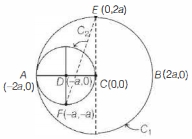
Let $AB$ be a line segment with mid-point $C$ and $D$ be the mid-point of $AC$. Let $C_1$ be the circle with diameter $AB$ and $C_2$ be the circle with diameter $AC$. Let $E$ be a point on $C_1$ such that $EC$ is perpendicular to $AB$. Let $F$ be a point on $C_2$ such that $DF$ is perpendicular to $AB$ and $E$ and $F$ lie on opposite sides of $AB$. Then,the value of $\sin \angle FEC$ is
A
$\frac{1}{\sqrt{10}}$
B
$\frac{2}{\sqrt{10}}$
C
$\frac{1}{\sqrt{13}}$
D
$\frac{2}{\sqrt{13}}$
Solution
(A) Let the radius of circle $C_1$ be $2a$. Place the center $C$ at the origin $(0,0)$ and $AB$ along the $X$-axis. Then $B = (2a, 0)$,$A = (-2a, 0)$,$C = (0, 0)$,and $D = (-a, 0)$.
Since $E$ is on $C_1$ and $EC \perp AB$,$E$ has coordinates $(0, 2a)$.
Since $F$ is on $C_2$ (diameter $AC$,center $D(-a, 0)$,radius $a$) and $DF \perp AB$,$F$ has coordinates $(-a, -a)$.
We need to find $\sin \angle FEC$. Let $\angle FEC = \theta$.
Vector $\vec{EC} = C - E = (0, 0) - (0, 2a) = (0, -2a)$.
Vector $\vec{EF} = F - E = (-a, -a) - (0, 2a) = (-a, -3a)$.
The angle $\theta$ between $\vec{EC}$ and $\vec{EF}$ is given by $\cos \theta = \frac{\vec{EC} \cdot \vec{EF}}{|\vec{EC}| |\vec{EF}|}$.
$\vec{EC} \cdot \vec{EF} = (0)(-a) + (-2a)(-3a) = 6a^2$.
$|\vec{EC}| = \sqrt{0^2 + (-2a)^2} = 2a$.
$|\vec{EF}| = \sqrt{(-a)^2 + (-3a)^2} = \sqrt{a^2 + 9a^2} = a\sqrt{10}$.
$\cos \theta = \frac{6a^2}{(2a)(a\sqrt{10})} = \frac{6}{2\sqrt{10}} = \frac{3}{\sqrt{10}}$.
Since $\sin^2 \theta = 1 - \cos^2 \theta = 1 - \frac{9}{10} = \frac{1}{10}$,we have $\sin \theta = \frac{1}{\sqrt{10}}$.
Since $E$ is on $C_1$ and $EC \perp AB$,$E$ has coordinates $(0, 2a)$.
Since $F$ is on $C_2$ (diameter $AC$,center $D(-a, 0)$,radius $a$) and $DF \perp AB$,$F$ has coordinates $(-a, -a)$.
We need to find $\sin \angle FEC$. Let $\angle FEC = \theta$.
Vector $\vec{EC} = C - E = (0, 0) - (0, 2a) = (0, -2a)$.
Vector $\vec{EF} = F - E = (-a, -a) - (0, 2a) = (-a, -3a)$.
The angle $\theta$ between $\vec{EC}$ and $\vec{EF}$ is given by $\cos \theta = \frac{\vec{EC} \cdot \vec{EF}}{|\vec{EC}| |\vec{EF}|}$.
$\vec{EC} \cdot \vec{EF} = (0)(-a) + (-2a)(-3a) = 6a^2$.
$|\vec{EC}| = \sqrt{0^2 + (-2a)^2} = 2a$.
$|\vec{EF}| = \sqrt{(-a)^2 + (-3a)^2} = \sqrt{a^2 + 9a^2} = a\sqrt{10}$.
$\cos \theta = \frac{6a^2}{(2a)(a\sqrt{10})} = \frac{6}{2\sqrt{10}} = \frac{3}{\sqrt{10}}$.
Since $\sin^2 \theta = 1 - \cos^2 \theta = 1 - \frac{9}{10} = \frac{1}{10}$,we have $\sin \theta = \frac{1}{\sqrt{10}}$.
0 likesView Solution
4
MathematicsAdvancedMCQKVPY · 2019
Let $S$ be a subset of the plane defined by $S = \{(x, y) : |x| + 2|y| = 1\}$. Then,the radius of the smallest circle with centre at the origin and having non-empty intersection with $S$ is
A
$\frac{1}{5}$
B
$\frac{1}{\sqrt{5}}$
C
$\frac{1}{2}$
D
$\frac{2}{\sqrt{5}}$
Solution
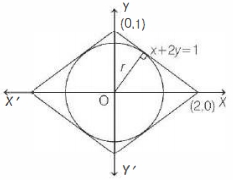
(B) The set $S = \{(x, y) : |x| + 2|y| = 1\}$ represents a rhombus in the Cartesian plane with vertices at $(1, 0), (-1, 0), (0, 1/2),$ and $(0, -1/2)$.
The smallest circle with centre at the origin $(0, 0)$ that has a non-empty intersection with $S$ is the circle inscribed in this rhombus.
The radius $r$ of this inscribed circle is the perpendicular distance from the origin $(0, 0)$ to any of the sides of the rhombus.
Consider the side in the first quadrant,which is given by the line $x + 2y = 1$ or $x + 2y - 1 = 0$.
The perpendicular distance $r$ from the origin $(0, 0)$ to the line $Ax + By + C = 0$ is given by $r = \frac{|Ax_0 + By_0 + C|}{\sqrt{A^2 + B^2}}$.
Substituting $A = 1, B = 2, C = -1$ and $(x_0, y_0) = (0, 0)$:
$r = \frac{|1(0) + 2(0) - 1|}{\sqrt{1^2 + 2^2}} = \frac{|-1|}{\sqrt{1 + 4}} = \frac{1}{\sqrt{5}}$.
The smallest circle with centre at the origin $(0, 0)$ that has a non-empty intersection with $S$ is the circle inscribed in this rhombus.
The radius $r$ of this inscribed circle is the perpendicular distance from the origin $(0, 0)$ to any of the sides of the rhombus.
Consider the side in the first quadrant,which is given by the line $x + 2y = 1$ or $x + 2y - 1 = 0$.
The perpendicular distance $r$ from the origin $(0, 0)$ to the line $Ax + By + C = 0$ is given by $r = \frac{|Ax_0 + By_0 + C|}{\sqrt{A^2 + B^2}}$.
Substituting $A = 1, B = 2, C = -1$ and $(x_0, y_0) = (0, 0)$:
$r = \frac{|1(0) + 2(0) - 1|}{\sqrt{1^2 + 2^2}} = \frac{|-1|}{\sqrt{1 + 4}} = \frac{1}{\sqrt{5}}$.
0 likesView Solution
5
MathematicsDifficultMCQKVPY · 2019
The number of solutions of the equation $\sin(9x) + \sin(3x) = 0$ in the closed interval $[0, 2\pi]$ is
A
$7$
B
$13$
C
$19$
D
$25$
Solution
(B) Given equation: $\sin(9x) + \sin(3x) = 0$
Using the sum-to-product formula $\sin A + \sin B = 2 \sin(\frac{A+B}{2}) \cos(\frac{A-B}{2})$:
$2 \sin(6x) \cos(3x) = 0$
This implies $\sin(6x) = 0$ or $\cos(3x) = 0$.
Case $1$: $\sin(6x) = 0$ $\Rightarrow 6x = n\pi$ $\Rightarrow x = \frac{n\pi}{6}$ for $n \in \mathbb{Z}$.
For $x \in [0, 2\pi]$,$n$ can be $0, 1, 2, 3, 4, 5, 6, 7, 8, 9, 10, 11, 12$.
Values: $x \in \{0, \frac{\pi}{6}, \frac{2\pi}{6}, \frac{3\pi}{6}, \frac{4\pi}{6}, \frac{5\pi}{6}, \frac{6\pi}{6}, \frac{7\pi}{6}, \frac{8\pi}{6}, \frac{9\pi}{6}, \frac{10\pi}{6}, \frac{11\pi}{6}, \frac{12\pi}{6}\}$ (Total $13$ values).
Case $2$: $\cos(3x) = 0$ $\Rightarrow 3x = (2k+1)\frac{\pi}{2}$ $\Rightarrow x = (2k+1)\frac{\pi}{6}$ for $k \in \mathbb{Z}$.
For $x \in [0, 2\pi]$,$k$ can be $0, 1, 2, 3, 4, 5$.
Values: $x \in \{\frac{\pi}{6}, \frac{3\pi}{6}, \frac{5\pi}{6}, \frac{7\pi}{6}, \frac{9\pi}{6}, \frac{11\pi}{6}\}$.
All these values are already included in the set from Case $1$.
Thus,the total number of distinct solutions is $13$.
Using the sum-to-product formula $\sin A + \sin B = 2 \sin(\frac{A+B}{2}) \cos(\frac{A-B}{2})$:
$2 \sin(6x) \cos(3x) = 0$
This implies $\sin(6x) = 0$ or $\cos(3x) = 0$.
Case $1$: $\sin(6x) = 0$ $\Rightarrow 6x = n\pi$ $\Rightarrow x = \frac{n\pi}{6}$ for $n \in \mathbb{Z}$.
For $x \in [0, 2\pi]$,$n$ can be $0, 1, 2, 3, 4, 5, 6, 7, 8, 9, 10, 11, 12$.
Values: $x \in \{0, \frac{\pi}{6}, \frac{2\pi}{6}, \frac{3\pi}{6}, \frac{4\pi}{6}, \frac{5\pi}{6}, \frac{6\pi}{6}, \frac{7\pi}{6}, \frac{8\pi}{6}, \frac{9\pi}{6}, \frac{10\pi}{6}, \frac{11\pi}{6}, \frac{12\pi}{6}\}$ (Total $13$ values).
Case $2$: $\cos(3x) = 0$ $\Rightarrow 3x = (2k+1)\frac{\pi}{2}$ $\Rightarrow x = (2k+1)\frac{\pi}{6}$ for $k \in \mathbb{Z}$.
For $x \in [0, 2\pi]$,$k$ can be $0, 1, 2, 3, 4, 5$.
Values: $x \in \{\frac{\pi}{6}, \frac{3\pi}{6}, \frac{5\pi}{6}, \frac{7\pi}{6}, \frac{9\pi}{6}, \frac{11\pi}{6}\}$.
All these values are already included in the set from Case $1$.
Thus,the total number of distinct solutions is $13$.
0 likesView Solution
6
MathematicsDifficultMCQKVPY · 2019
Among all the parallelograms whose diagonals are $10$ and $4$,the one having maximum area has its perimeter lying in the interval
A
$(19, 20]$
B
$(20, 21]$
C
$(21, 22]$
D
$(22, 23]$
Solution
(C) Let the diagonals of the parallelogram be $d_1 = 10$ and $d_2 = 4$. Let the angle between the diagonals be $\theta$.
The area of the parallelogram is given by $A = \frac{1}{2} d_1 d_2 \sin \theta = \frac{1}{2} \times 10 \times 4 \times \sin \theta = 20 \sin \theta$.
The area is maximum when $\sin \theta = 1$,i.e.,$\theta = \frac{\pi}{2}$.
When the diagonals intersect at right angles,the parallelogram is a rhombus.
The sides of the rhombus $s$ are given by $s = \sqrt{(\frac{d_1}{2})^2 + (\frac{d_2}{2})^2} = \sqrt{5^2 + 2^2} = \sqrt{25 + 4} = \sqrt{29}$.
The perimeter of the rhombus is $P = 4s = 4\sqrt{29}$.
Since $5 < \sqrt{29} < 6$,we have $20 < 4\sqrt{29} < 24$.
More precisely,$\sqrt{29} \approx 5.385$,so $P \approx 4 \times 5.385 = 21.54$.
Thus,the perimeter lies in the interval $(21, 22]$.
The area of the parallelogram is given by $A = \frac{1}{2} d_1 d_2 \sin \theta = \frac{1}{2} \times 10 \times 4 \times \sin \theta = 20 \sin \theta$.
The area is maximum when $\sin \theta = 1$,i.e.,$\theta = \frac{\pi}{2}$.
When the diagonals intersect at right angles,the parallelogram is a rhombus.
The sides of the rhombus $s$ are given by $s = \sqrt{(\frac{d_1}{2})^2 + (\frac{d_2}{2})^2} = \sqrt{5^2 + 2^2} = \sqrt{25 + 4} = \sqrt{29}$.
The perimeter of the rhombus is $P = 4s = 4\sqrt{29}$.
Since $5 < \sqrt{29} < 6$,we have $20 < 4\sqrt{29} < 24$.
More precisely,$\sqrt{29} \approx 5.385$,so $P \approx 4 \times 5.385 = 21.54$.
Thus,the perimeter lies in the interval $(21, 22]$.
0 likesView Solution
7
MathematicsAdvancedMCQKVPY · 2019
The number of ordered pairs $(a, b)$ of positive integers such that $\frac{2a-1}{b}$ and $\frac{2b-1}{a}$ are both integers is
A
$1$
B
$2$
C
$3$
D
more than $3$
Solution
(C) Let $\frac{2a-1}{b} = \alpha$ and $\frac{2b-1}{a} = \beta$,where $\alpha, \beta \in \mathbb{Z}^+$.
Since $a, b \ge 1$,we have $2a-1 \ge 1$ and $2b-1 \ge 1$,so $\alpha, \beta \ge 1$.
From the equations,$2a-1 = \alpha b$ and $2b-1 = \beta a$.
Substituting $b = \frac{2a-1}{\alpha}$ into the second equation: $2(\frac{2a-1}{\alpha}) - 1 = \beta a$.
$4a - 2 - \alpha = \alpha \beta a$,which implies $a(4 - \alpha \beta) = \alpha + 2$.
Since $a > 0$ and $\alpha + 2 > 0$,we must have $4 - \alpha \beta > 0$,so $\alpha \beta < 4$.
Possible pairs $(\alpha, \beta)$ are $(1, 1), (1, 2), (1, 3), (2, 1), (3, 1)$.
Case $1$: $(\alpha, \beta) = (1, 1) \implies a(4-1) = 1+2 \implies 3a = 3 \implies a = 1$. Then $b = \frac{2(1)-1}{1} = 1$. Pair: $(1, 1)$.
Case $2$: $(\alpha, \beta) = (1, 2) \implies a(4-2) = 1+2 \implies 2a = 3$,no integer solution.
Case $3$: $(\alpha, \beta) = (1, 3) \implies a(4-3) = 1+2 \implies a = 3$. Then $b = \frac{2(3)-1}{1} = 5$. Pair: $(3, 5)$.
Case $4$: $(\alpha, \beta) = (2, 1) \implies a(4-2) = 2+2 \implies 2a = 4 \implies a = 2$. Then $b = \frac{2(2)-1}{2} = 1.5$,not an integer.
Case $5$: $(\alpha, \beta) = (3, 1) \implies a(4-3) = 3+2 \implies a = 5$. Then $b = \frac{2(5)-1}{3} = 3$. Pair: $(5, 3)$.
The ordered pairs are $(1, 1), (3, 5), (5, 3)$. Total $3$ pairs.
Since $a, b \ge 1$,we have $2a-1 \ge 1$ and $2b-1 \ge 1$,so $\alpha, \beta \ge 1$.
From the equations,$2a-1 = \alpha b$ and $2b-1 = \beta a$.
Substituting $b = \frac{2a-1}{\alpha}$ into the second equation: $2(\frac{2a-1}{\alpha}) - 1 = \beta a$.
$4a - 2 - \alpha = \alpha \beta a$,which implies $a(4 - \alpha \beta) = \alpha + 2$.
Since $a > 0$ and $\alpha + 2 > 0$,we must have $4 - \alpha \beta > 0$,so $\alpha \beta < 4$.
Possible pairs $(\alpha, \beta)$ are $(1, 1), (1, 2), (1, 3), (2, 1), (3, 1)$.
Case $1$: $(\alpha, \beta) = (1, 1) \implies a(4-1) = 1+2 \implies 3a = 3 \implies a = 1$. Then $b = \frac{2(1)-1}{1} = 1$. Pair: $(1, 1)$.
Case $2$: $(\alpha, \beta) = (1, 2) \implies a(4-2) = 1+2 \implies 2a = 3$,no integer solution.
Case $3$: $(\alpha, \beta) = (1, 3) \implies a(4-3) = 1+2 \implies a = 3$. Then $b = \frac{2(3)-1}{1} = 5$. Pair: $(3, 5)$.
Case $4$: $(\alpha, \beta) = (2, 1) \implies a(4-2) = 2+2 \implies 2a = 4 \implies a = 2$. Then $b = \frac{2(2)-1}{2} = 1.5$,not an integer.
Case $5$: $(\alpha, \beta) = (3, 1) \implies a(4-3) = 3+2 \implies a = 5$. Then $b = \frac{2(5)-1}{3} = 3$. Pair: $(5, 3)$.
The ordered pairs are $(1, 1), (3, 5), (5, 3)$. Total $3$ pairs.
0 likesView Solution
8
MathematicsAdvancedMCQKVPY · 2019
Let $z=x+iy$ and $w=u+iv$ be complex numbers on the unit circle such that $z^2+w^2=1$. Then the number of ordered pairs $(z, w)$ is
A
$0$
B
$4$
C
$8$
D
infinite
Solution
(C) Given that $z$ and $w$ are complex numbers on the unit circle,we have $|z|=1$ and $|w|=1$.
This implies $z\bar{z}=1 \Rightarrow \bar{z}=\frac{1}{z}$ and $w\bar{w}=1 \Rightarrow \bar{w}=\frac{1}{w}$.
Given $z^2+w^2=1$.
Taking the conjugate of both sides,we get $\bar{z}^2+\bar{w}^2=1$.
Substituting $\bar{z}=\frac{1}{z}$ and $\bar{w}=\frac{1}{w}$,we get $\frac{1}{z^2}+\frac{1}{w^2}=1$,which simplifies to $\frac{z^2+w^2}{z^2w^2}=1$.
Since $z^2+w^2=1$,we have $\frac{1}{z^2w^2}=1$,so $z^2w^2=1$,which means $(zw)^2=1$,so $zw=1$ or $zw=-1$.
Case $1$: $zw=1$. Then $w=\frac{1}{z}$. Substituting into $z^2+w^2=1$,we get $z^2+\frac{1}{z^2}=1 \Rightarrow z^4-z^2+1=0$. This is a quadratic in $z^2$,giving $z^2 = \frac{1 \pm \sqrt{1-4}}{2} = \frac{1 \pm i\sqrt{3}}{2} = e^{\pm i\pi/3}$. Thus $z^2 = e^{i\pi/3}$ or $z^2 = e^{-i\pi/3}$. Each gives $2$ values for $z$,total $4$ values.
Case $2$: $zw=-1$. Then $w=-\frac{1}{z}$. Substituting into $z^2+w^2=1$,we get $z^2+\frac{1}{z^2}=1$,which is the same equation as Case $1$. This also gives $4$ values for $z$.
Total number of ordered pairs $(z, w)$ is $4+4=8$.
This implies $z\bar{z}=1 \Rightarrow \bar{z}=\frac{1}{z}$ and $w\bar{w}=1 \Rightarrow \bar{w}=\frac{1}{w}$.
Given $z^2+w^2=1$.
Taking the conjugate of both sides,we get $\bar{z}^2+\bar{w}^2=1$.
Substituting $\bar{z}=\frac{1}{z}$ and $\bar{w}=\frac{1}{w}$,we get $\frac{1}{z^2}+\frac{1}{w^2}=1$,which simplifies to $\frac{z^2+w^2}{z^2w^2}=1$.
Since $z^2+w^2=1$,we have $\frac{1}{z^2w^2}=1$,so $z^2w^2=1$,which means $(zw)^2=1$,so $zw=1$ or $zw=-1$.
Case $1$: $zw=1$. Then $w=\frac{1}{z}$. Substituting into $z^2+w^2=1$,we get $z^2+\frac{1}{z^2}=1 \Rightarrow z^4-z^2+1=0$. This is a quadratic in $z^2$,giving $z^2 = \frac{1 \pm \sqrt{1-4}}{2} = \frac{1 \pm i\sqrt{3}}{2} = e^{\pm i\pi/3}$. Thus $z^2 = e^{i\pi/3}$ or $z^2 = e^{-i\pi/3}$. Each gives $2$ values for $z$,total $4$ values.
Case $2$: $zw=-1$. Then $w=-\frac{1}{z}$. Substituting into $z^2+w^2=1$,we get $z^2+\frac{1}{z^2}=1$,which is the same equation as Case $1$. This also gives $4$ values for $z$.
Total number of ordered pairs $(z, w)$ is $4+4=8$.
0 likesView Solution
9
MathematicsDifficultMCQKVPY · 2019
Let $E$ denote the set of letters of the English alphabet,$V = \{a, e, i, o, u\}$ and $C$ be the complement of $V$ in $E$. Then,the number of four-letter words (where repetitions of letters are allowed) having at least one letter from $V$ and at least one letter from $C$ is
A
$261870$
B
$314160$
C
$425880$
D
$851760$
Solution
(A) The total number of four-letter words that can be formed using $26$ letters is $26^4 = 456976$.
The number of four-letter words formed using only letters from set $V$ (vowels) is $5^4 = 625$.
The number of four-letter words formed using only letters from set $C$ (consonants) is $21^4 = 194481$.
The number of words containing at least one vowel and at least one consonant is given by the total number of words minus the words containing only vowels and the words containing only consonants.
Number of words $= 26^4 - 5^4 - 21^4$
$= 456976 - 625 - 194481$
$= 261870$.
The number of four-letter words formed using only letters from set $V$ (vowels) is $5^4 = 625$.
The number of four-letter words formed using only letters from set $C$ (consonants) is $21^4 = 194481$.
The number of words containing at least one vowel and at least one consonant is given by the total number of words minus the words containing only vowels and the words containing only consonants.
Number of words $= 26^4 - 5^4 - 21^4$
$= 456976 - 625 - 194481$
$= 261870$.
0 likesView Solution
10
MathematicsAdvancedMCQKVPY · 2019
Let $a > 0, a \neq 1$. Then,the set $S$ of all positive real numbers $b$ satisfying $(1+a^2)(1+b^2) = 4ab$ is
A
an empty set
B
a singleton set
C
a finite set containing more than one element
D
$(0, \infty)$
Solution
(A) Given the equation: $(1+a^2)(1+b^2) = 4ab$
Expanding the left side: $1 + b^2 + a^2 + a^2b^2 = 4ab$
Rearranging the terms: $a^2 - 2ab + b^2 + a^2b^2 - 2ab + 1 = 0$
This can be written as: $(a-b)^2 + (ab-1)^2 = 0$
Since $a$ and $b$ are real numbers,the sum of squares is zero if and only if each term is zero:
$(a-b)^2 = 0 \implies a = b$
$(ab-1)^2 = 0 \implies ab = 1$
Substituting $b=a$ into $ab=1$,we get $a^2 = 1$,which implies $a = 1$ or $a = -1$.
However,the problem states $a > 0$ and $a \neq 1$. Thus,there is no value of $b$ that satisfies the equation under the given constraints.
Therefore,the set $S$ is an empty set.
Expanding the left side: $1 + b^2 + a^2 + a^2b^2 = 4ab$
Rearranging the terms: $a^2 - 2ab + b^2 + a^2b^2 - 2ab + 1 = 0$
This can be written as: $(a-b)^2 + (ab-1)^2 = 0$
Since $a$ and $b$ are real numbers,the sum of squares is zero if and only if each term is zero:
$(a-b)^2 = 0 \implies a = b$
$(ab-1)^2 = 0 \implies ab = 1$
Substituting $b=a$ into $ab=1$,we get $a^2 = 1$,which implies $a = 1$ or $a = -1$.
However,the problem states $a > 0$ and $a \neq 1$. Thus,there is no value of $b$ that satisfies the equation under the given constraints.
Therefore,the set $S$ is an empty set.
0 likesView Solution
11
MathematicsAdvancedMCQKVPY · 2019
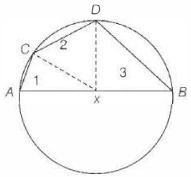
The points $C$ and $D$ on a semicircle with $AB$ as diameter are such that $AC=1, CD=2$ and $DB=3$. Then,the length of $AB$ lies in the interval.
A
$[4, 4.1)$
B
$[4.1, 4.2)$
C
$[4.2, 4.3)$
D
$[4.3, \infty)$
Solution
(B) Let the diameter $AB = x$.
Since $AB$ is the diameter,$\angle ACB = 90^\circ$ and $\angle ADB = 90^\circ$.
In $\triangle ACB$,$BC = \sqrt{x^2 - 1}$.
In $\triangle ADB$,$AD = \sqrt{x^2 - 9}$.
Applying Ptolemy's theorem to the cyclic quadrilateral $ACDB$:
$AB \cdot CD + AC \cdot DB = AD \cdot BC$
$x(2) + (1)(3) = \sqrt{x^2 - 9} \cdot \sqrt{x^2 - 1}$
$2x + 3 = \sqrt{(x^2 - 9)(x^2 - 1)}$
Squaring both sides:
$(2x + 3)^2 = (x^2 - 9)(x^2 - 1)$
$4x^2 + 12x + 9 = x^4 - 10x^2 + 9$
$x^4 - 14x^2 - 12x = 0$
Since $x \neq 0$,we have $x^3 - 14x - 12 = 0$.
Let $f(x) = x^3 - 14x - 12$.
$f(4) = 64 - 56 - 12 = -4$.
$f(4.1) = (4.1)^3 - 14(4.1) - 12 = 68.921 - 57.4 - 12 = -0.479$.
$f(4.2) = (4.2)^3 - 14(4.2) - 12 = 74.088 - 58.8 - 12 = 3.288$.
Since $f(4.1) < 0$ and $f(4.2) > 0$,the root lies in $[4.1, 4.2)$.
Since $AB$ is the diameter,$\angle ACB = 90^\circ$ and $\angle ADB = 90^\circ$.
In $\triangle ACB$,$BC = \sqrt{x^2 - 1}$.
In $\triangle ADB$,$AD = \sqrt{x^2 - 9}$.
Applying Ptolemy's theorem to the cyclic quadrilateral $ACDB$:
$AB \cdot CD + AC \cdot DB = AD \cdot BC$
$x(2) + (1)(3) = \sqrt{x^2 - 9} \cdot \sqrt{x^2 - 1}$
$2x + 3 = \sqrt{(x^2 - 9)(x^2 - 1)}$
Squaring both sides:
$(2x + 3)^2 = (x^2 - 9)(x^2 - 1)$
$4x^2 + 12x + 9 = x^4 - 10x^2 + 9$
$x^4 - 14x^2 - 12x = 0$
Since $x \neq 0$,we have $x^3 - 14x - 12 = 0$.
Let $f(x) = x^3 - 14x - 12$.
$f(4) = 64 - 56 - 12 = -4$.
$f(4.1) = (4.1)^3 - 14(4.1) - 12 = 68.921 - 57.4 - 12 = -0.479$.
$f(4.2) = (4.2)^3 - 14(4.2) - 12 = 74.088 - 58.8 - 12 = 3.288$.
Since $f(4.1) < 0$ and $f(4.2) > 0$,the root lies in $[4.1, 4.2)$.
0 likesView Solution
12
MathematicsAdvancedMCQKVPY · 2019
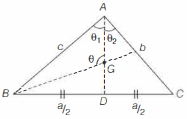
Let $ABC$ be a triangle and let $D$ be the mid-point of $BC$. Suppose $\cot (\angle CAD) : \cot (\angle BAD) = 2 : 1$. If $G$ is the centroid of $\triangle ABC$,then the measure of $\angle BGA$ is (in $^{\circ}$)
A
$90$
B
$105$
C
$120$
D
$135$
Solution
(A) Let $\angle CAD = \theta_2$ and $\angle BAD = \theta_1$. We are given $\cot \theta_2 : \cot \theta_1 = 2 : 1$,so $\cot \theta_2 = 2 \cot \theta_1$.
Using the cotangent rule in $\triangle ADC$ and $\triangle ADB$ with $AD$ as a common side and $BD = DC = a/2$:
$\cot \theta_2 = \frac{AD^2 + b^2 - (a/2)^2}{2 \cdot AD \cdot (a/2) \cdot \sin \theta_2} \cdot \sin \theta_2 = \frac{AD^2 + b^2 - a^2/4}{2 \cdot \text{Area}(\triangle ADC)}$
Since $\text{Area}(\triangle ADC) = \text{Area}(\triangle ADB)$,the condition $\cot \theta_2 = 2 \cot \theta_1$ implies:
$AD^2 + b^2 - a^2/4 = 2(AD^2 + c^2 - a^2/4)$
$AD^2 = b^2 - 2c^2 + a^2/4$
Using Apollonius theorem,$AD^2 = \frac{2b^2 + 2c^2 - a^2}{4}$.
Equating the two expressions for $AD^2$:
$\frac{2b^2 + 2c^2 - a^2}{4} = b^2 - 2c^2 + \frac{a^2}{4}$
$2b^2 + 2c^2 - a^2 = 4b^2 - 8c^2 + a^2$
$10c^2 = 2b^2 + 2a^2 \Rightarrow b^2 + a^2 = 5c^2$.
In $\triangle BGA$,by the Law of Cosines:
$\cos(\angle BGA) = \frac{AG^2 + BG^2 - AB^2}{2 \cdot AG \cdot BG}$.
Using $AG = \frac{2}{3}m_a$ and $BG = \frac{2}{3}m_b$,where $m_a^2 = \frac{2b^2+2c^2-a^2}{4}$ and $m_b^2 = \frac{2a^2+2c^2-b^2}{4}$,and substituting $a^2+b^2=5c^2$,we find $\cos(\angle BGA) = 0$,so $\angle BGA = 90^{\circ}$.
Using the cotangent rule in $\triangle ADC$ and $\triangle ADB$ with $AD$ as a common side and $BD = DC = a/2$:
$\cot \theta_2 = \frac{AD^2 + b^2 - (a/2)^2}{2 \cdot AD \cdot (a/2) \cdot \sin \theta_2} \cdot \sin \theta_2 = \frac{AD^2 + b^2 - a^2/4}{2 \cdot \text{Area}(\triangle ADC)}$
Since $\text{Area}(\triangle ADC) = \text{Area}(\triangle ADB)$,the condition $\cot \theta_2 = 2 \cot \theta_1$ implies:
$AD^2 + b^2 - a^2/4 = 2(AD^2 + c^2 - a^2/4)$
$AD^2 = b^2 - 2c^2 + a^2/4$
Using Apollonius theorem,$AD^2 = \frac{2b^2 + 2c^2 - a^2}{4}$.
Equating the two expressions for $AD^2$:
$\frac{2b^2 + 2c^2 - a^2}{4} = b^2 - 2c^2 + \frac{a^2}{4}$
$2b^2 + 2c^2 - a^2 = 4b^2 - 8c^2 + a^2$
$10c^2 = 2b^2 + 2a^2 \Rightarrow b^2 + a^2 = 5c^2$.
In $\triangle BGA$,by the Law of Cosines:
$\cos(\angle BGA) = \frac{AG^2 + BG^2 - AB^2}{2 \cdot AG \cdot BG}$.
Using $AG = \frac{2}{3}m_a$ and $BG = \frac{2}{3}m_b$,where $m_a^2 = \frac{2b^2+2c^2-a^2}{4}$ and $m_b^2 = \frac{2a^2+2c^2-b^2}{4}$,and substituting $a^2+b^2=5c^2$,we find $\cos(\angle BGA) = 0$,so $\angle BGA = 90^{\circ}$.
0 likesView Solution
13
MathematicsAdvancedMCQKVPY · 2019
Let $f(x) = x^6 - 2x^5 + x^3 + x^2 - x - 1$ and $g(x) = x^4 - x^3 - x^2 - 1$ be two polynomials. Let $a, b, c,$ and $d$ be the roots of $g(x) = 0$. Then,the value of $f(a) + f(b) + f(c) + f(d)$ is
A
$-5$
B
$0$
C
$4$
D
$5$
Solution
(B) Given $f(x) = x^6 - 2x^5 + x^3 + x^2 - x - 1$ and $g(x) = x^4 - x^3 - x^2 - 1$.
By performing polynomial division of $f(x)$ by $g(x)$,we get:
$f(x) = (x^2 - x)g(x) + (2x^2 - 2x - 1)$.
Since $a, b, c, d$ are roots of $g(x) = 0$,we have $g(a) = g(b) = g(c) = g(d) = 0$.
Thus,$f(a) = 2a^2 - 2a - 1$,$f(b) = 2b^2 - 2b - 1$,$f(c) = 2c^2 - 2c - 1$,and $f(d) = 2d^2 - 2d - 1$.
Summing these,we get $\sum f(a) = 2\sum a^2 - 2\sum a - 4$.
From $g(x) = x^4 - x^3 - x^2 - 1 = 0$,by Vieta's formulas,$\sum a = 1$ and $\sum ab = -1$.
We know $\sum a^2 = (\sum a)^2 - 2\sum ab = (1)^2 - 2(-1) = 1 + 2 = 3$.
Substituting these values,$\sum f(a) = 2(3) - 2(1) - 4 = 6 - 2 - 4 = 0$.
By performing polynomial division of $f(x)$ by $g(x)$,we get:
$f(x) = (x^2 - x)g(x) + (2x^2 - 2x - 1)$.
Since $a, b, c, d$ are roots of $g(x) = 0$,we have $g(a) = g(b) = g(c) = g(d) = 0$.
Thus,$f(a) = 2a^2 - 2a - 1$,$f(b) = 2b^2 - 2b - 1$,$f(c) = 2c^2 - 2c - 1$,and $f(d) = 2d^2 - 2d - 1$.
Summing these,we get $\sum f(a) = 2\sum a^2 - 2\sum a - 4$.
From $g(x) = x^4 - x^3 - x^2 - 1 = 0$,by Vieta's formulas,$\sum a = 1$ and $\sum ab = -1$.
We know $\sum a^2 = (\sum a)^2 - 2\sum ab = (1)^2 - 2(-1) = 1 + 2 = 3$.
Substituting these values,$\sum f(a) = 2(3) - 2(1) - 4 = 6 - 2 - 4 = 0$.
0 likesView Solution
14
MathematicsAdvancedMCQKVPY · 2019
The number of solutions to $\sin(\pi \sin^2 \theta) + \sin(\pi \cos^2 \theta) = 2 \cos(\frac{\pi}{2} \cos \theta)$ satisfying $0 \leq \theta \leq 2\pi$ is
A
$1$
B
$2$
C
$4$
D
$7$
Solution
(D) The given equation is $\sin(\pi \sin^2 \theta) + \sin(\pi \cos^2 \theta) = 2 \cos(\frac{\pi}{2} \cos \theta)$.
Using the identity $\sin A + \sin B = 2 \sin(\frac{A+B}{2}) \cos(\frac{A-B}{2})$,we get:
$2 \sin(\frac{\pi(\sin^2 \theta + \cos^2 \theta)}{2}) \cos(\frac{\pi(\sin^2 \theta - \cos^2 \theta)}{2}) = 2 \cos(\frac{\pi}{2} \cos \theta)$.
Since $\sin^2 \theta + \cos^2 \theta = 1$ and $\sin^2 \theta - \cos^2 \theta = -\cos 2\theta$,we have:
$2 \sin(\frac{\pi}{2}) \cos(-\frac{\pi}{2} \cos 2\theta) = 2 \cos(\frac{\pi}{2} \cos \theta)$.
Since $\sin(\frac{\pi}{2}) = 1$ and $\cos(-x) = \cos x$,this simplifies to:
$\cos(\frac{\pi}{2} \cos 2\theta) = \cos(\frac{\pi}{2} \cos \theta)$.
This implies $\frac{\pi}{2} \cos 2\theta = 2n\pi \pm \frac{\pi}{2} \cos \theta$,so $\cos 2\theta = 4n \pm \cos \theta$ for $n \in Z$.
Case $I$: $\cos 2\theta - \cos \theta = 4n$. For $n=0$,$2\cos^2 \theta - 1 - \cos \theta = 0$,so $(2\cos \theta + 1)(\cos \theta - 1) = 0$. Thus $\cos \theta = 1$ or $\cos \theta = -1/2$. Solutions in $[0, 2\pi]$ are $\theta = 0, 2\pi, 2\pi/3, 4\pi/3$.
Case $II$: $\cos 2\theta + \cos \theta = 4n$. For $n=0$,$2\cos^2 \theta + \cos \theta - 1 = 0$,so $(2\cos \theta - 1)(\cos \theta + 1) = 0$. Thus $\cos \theta = 1/2$ or $\cos \theta = -1$. Solutions in $[0, 2\pi]$ are $\theta = \pi, \pi/3, 5\pi/3$.
Total solutions are ${0, 2\pi, 2\pi/3, 4\pi/3, \pi, \pi/3, 5\pi/3}$,which is $7$ solutions.
Using the identity $\sin A + \sin B = 2 \sin(\frac{A+B}{2}) \cos(\frac{A-B}{2})$,we get:
$2 \sin(\frac{\pi(\sin^2 \theta + \cos^2 \theta)}{2}) \cos(\frac{\pi(\sin^2 \theta - \cos^2 \theta)}{2}) = 2 \cos(\frac{\pi}{2} \cos \theta)$.
Since $\sin^2 \theta + \cos^2 \theta = 1$ and $\sin^2 \theta - \cos^2 \theta = -\cos 2\theta$,we have:
$2 \sin(\frac{\pi}{2}) \cos(-\frac{\pi}{2} \cos 2\theta) = 2 \cos(\frac{\pi}{2} \cos \theta)$.
Since $\sin(\frac{\pi}{2}) = 1$ and $\cos(-x) = \cos x$,this simplifies to:
$\cos(\frac{\pi}{2} \cos 2\theta) = \cos(\frac{\pi}{2} \cos \theta)$.
This implies $\frac{\pi}{2} \cos 2\theta = 2n\pi \pm \frac{\pi}{2} \cos \theta$,so $\cos 2\theta = 4n \pm \cos \theta$ for $n \in Z$.
Case $I$: $\cos 2\theta - \cos \theta = 4n$. For $n=0$,$2\cos^2 \theta - 1 - \cos \theta = 0$,so $(2\cos \theta + 1)(\cos \theta - 1) = 0$. Thus $\cos \theta = 1$ or $\cos \theta = -1/2$. Solutions in $[0, 2\pi]$ are $\theta = 0, 2\pi, 2\pi/3, 4\pi/3$.
Case $II$: $\cos 2\theta + \cos \theta = 4n$. For $n=0$,$2\cos^2 \theta + \cos \theta - 1 = 0$,so $(2\cos \theta - 1)(\cos \theta + 1) = 0$. Thus $\cos \theta = 1/2$ or $\cos \theta = -1$. Solutions in $[0, 2\pi]$ are $\theta = \pi, \pi/3, 5\pi/3$.
Total solutions are ${0, 2\pi, 2\pi/3, 4\pi/3, \pi, \pi/3, 5\pi/3}$,which is $7$ solutions.
0 likesView Solution
15
MathematicsAdvancedMCQKVPY · 2019
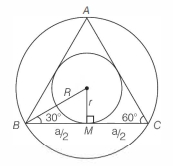
Let $ABC$ be an equilateral triangle with side length $a$. Let $R$ and $r$ denote the radii of the circumcircle and the incircle of triangle $ABC$ respectively. Then,as a function of $a$,the ratio $\frac{R}{r}$
A
strictly increases
B
strictly decreases
C
remains constant
D
strictly increases for $a < 1$ and strictly decreases for $a > 1$
Solution
(C) For an equilateral triangle $ABC$ with side length $a$,let $R$ be the circumradius and $r$ be the inradius.
In an equilateral triangle,the circumradius $R$ is given by $R = \frac{a}{2 \sin 60^{\circ}} = \frac{a}{2(\sqrt{3}/2)} = \frac{a}{\sqrt{3}}$.
The inradius $r$ is given by $r = \frac{a}{2 \tan 60^{\circ}} = \frac{a}{2\sqrt{3}}$.
Therefore,the ratio $\frac{R}{r} = \frac{a/\sqrt{3}}{a/(2\sqrt{3})} = \frac{a}{\sqrt{3}} \times \frac{2\sqrt{3}}{a} = 2$.
Since the ratio is $2$,which is independent of $a$,it remains constant.
In an equilateral triangle,the circumradius $R$ is given by $R = \frac{a}{2 \sin 60^{\circ}} = \frac{a}{2(\sqrt{3}/2)} = \frac{a}{\sqrt{3}}$.
The inradius $r$ is given by $r = \frac{a}{2 \tan 60^{\circ}} = \frac{a}{2\sqrt{3}}$.
Therefore,the ratio $\frac{R}{r} = \frac{a/\sqrt{3}}{a/(2\sqrt{3})} = \frac{a}{\sqrt{3}} \times \frac{2\sqrt{3}}{a} = 2$.
Since the ratio is $2$,which is independent of $a$,it remains constant.
0 likesView Solution
16
MathematicsAdvancedMCQKVPY · 2019
Let $b$ be a non-zero real number. Suppose the quadratic equation $2x^2 + bx + \frac{1}{b} = 0$ has two distinct real roots. Then:
A
$b + \frac{1}{b} > \frac{5}{2}$
B
$b + \frac{1}{b} < \frac{5}{2}$
C
$b^2 - 3b > -2$
D
$b^2 + \frac{1}{b^2} < 4$
Solution
(C) Given the quadratic equation $2x^2 + bx + \frac{1}{b} = 0$,it has two distinct real roots,so the discriminant $D > 0$.
$D = b^2 - 4(2)(\frac{1}{b}) > 0$
$b^2 - \frac{8}{b} > 0 \Rightarrow \frac{b^3 - 8}{b} > 0$
Using the factorization $b^3 - 8 = (b - 2)(b^2 + 2b + 4)$,and noting that $b^2 + 2b + 4 = (b + 1)^2 + 3 > 0$ for all real $b$,the inequality simplifies to:
$\frac{b - 2}{b} > 0$
This holds when $b \in (-\infty, 0) \cup (2, \infty)$.
Now,check option $(c)$:
$b^2 - 3b > -2 \Rightarrow b^2 - 3b + 2 > 0$
$(b - 2)(b - 1) > 0$
This holds when $b \in (-\infty, 1) \cup (2, \infty)$.
Since the set $(-\infty, 0) \cup (2, \infty)$ is a subset of $(-\infty, 1) \cup (2, \infty)$,the condition $b^2 - 3b > -2$ is satisfied for all $b$ that satisfy the original quadratic equation condition.
$D = b^2 - 4(2)(\frac{1}{b}) > 0$
$b^2 - \frac{8}{b} > 0 \Rightarrow \frac{b^3 - 8}{b} > 0$
Using the factorization $b^3 - 8 = (b - 2)(b^2 + 2b + 4)$,and noting that $b^2 + 2b + 4 = (b + 1)^2 + 3 > 0$ for all real $b$,the inequality simplifies to:
$\frac{b - 2}{b} > 0$
This holds when $b \in (-\infty, 0) \cup (2, \infty)$.
Now,check option $(c)$:
$b^2 - 3b > -2 \Rightarrow b^2 - 3b + 2 > 0$
$(b - 2)(b - 1) > 0$
This holds when $b \in (-\infty, 1) \cup (2, \infty)$.
Since the set $(-\infty, 0) \cup (2, \infty)$ is a subset of $(-\infty, 1) \cup (2, \infty)$,the condition $b^2 - 3b > -2$ is satisfied for all $b$ that satisfy the original quadratic equation condition.
0 likesView Solution
17
MathematicsAdvancedMCQKVPY · 2019
Let $p(x) = x^2 + ax + b$ have two distinct real roots,where $a, b$ are real numbers. Define $g(x) = p(x^3)$ for all real numbers $x$. Then,which of the following statements are true?
$I.$ $g$ has exactly two distinct real roots.
$II.$ $g$ can have more than two distinct real roots.
$III.$ There exists a real number $\alpha$ such that $g(x) \geq \alpha$ for all real $x$.
$I.$ $g$ has exactly two distinct real roots.
$II.$ $g$ can have more than two distinct real roots.
$III.$ There exists a real number $\alpha$ such that $g(x) \geq \alpha$ for all real $x$.
A
Only $I$
B
Both $I$ and $III$
C
Only $II$
D
Both $II$ and $III$
Solution
(B) Given $p(x) = x^2 + ax + b$ has two distinct real roots,say $r_1$ and $r_2$. Thus,$p(x) = (x - r_1)(x - r_2)$.
Then $g(x) = p(x^3) = (x^3 - r_1)(x^3 - r_2)$.
Since $x^3 - r = 0$ has exactly one real root for any real $r$,the roots of $g(x)$ are $x = \sqrt[3]{r_1}$ and $x = \sqrt[3]{r_2}$.
Since $r_1 \neq r_2$,we have $\sqrt[3]{r_1} \neq \sqrt[3]{r_2}$. Thus,$g(x)$ has exactly two distinct real roots. Statement $I$ is true and $II$ is false.
For statement $III$,$g(x) = (x^3)^2 + a(x^3) + b = x^6 + ax^3 + b$. As $x \to \infty$,$g(x) \to \infty$. Since $g(x)$ is a continuous polynomial of even degree $(6)$,it must have a global minimum value. Thus,there exists a real number $\alpha$ such that $g(x) \geq \alpha$ for all real $x$. Statement $III$ is true.
Therefore,both $I$ and $III$ are true.
Then $g(x) = p(x^3) = (x^3 - r_1)(x^3 - r_2)$.
Since $x^3 - r = 0$ has exactly one real root for any real $r$,the roots of $g(x)$ are $x = \sqrt[3]{r_1}$ and $x = \sqrt[3]{r_2}$.
Since $r_1 \neq r_2$,we have $\sqrt[3]{r_1} \neq \sqrt[3]{r_2}$. Thus,$g(x)$ has exactly two distinct real roots. Statement $I$ is true and $II$ is false.
For statement $III$,$g(x) = (x^3)^2 + a(x^3) + b = x^6 + ax^3 + b$. As $x \to \infty$,$g(x) \to \infty$. Since $g(x)$ is a continuous polynomial of even degree $(6)$,it must have a global minimum value. Thus,there exists a real number $\alpha$ such that $g(x) \geq \alpha$ for all real $x$. Statement $III$ is true.
Therefore,both $I$ and $III$ are true.
0 likesView Solution
18
MathematicsDifficultMCQKVPY · 2019
Let $a_n, n \geq 1$,be an arithmetic progression with first term $2$ and common difference $4$. Let $M_n$ be the average of the first $n$ terms. Then the sum $\sum_{n=1}^{10} M_n$ is
A
$110$
B
$335$
C
$770$
D
$1100$
Solution
(A) The sum of the first $n$ terms of an arithmetic progression with first term $a = 2$ and common difference $d = 4$ is given by:
$S_n = \frac{n}{2}[2a + (n-1)d] = \frac{n}{2}[2(2) + (n-1)4] = \frac{n}{2}[4 + 4n - 4] = \frac{n}{2}[4n] = 2n^2$.
The average of the first $n$ terms is $M_n = \frac{S_n}{n} = \frac{2n^2}{n} = 2n$.
We need to calculate the sum $\sum_{n=1}^{10} M_n = \sum_{n=1}^{10} 2n$.
$= 2 \sum_{n=1}^{10} n = 2 \times \frac{10(10+1)}{2} = 10 \times 11 = 110$.
$S_n = \frac{n}{2}[2a + (n-1)d] = \frac{n}{2}[2(2) + (n-1)4] = \frac{n}{2}[4 + 4n - 4] = \frac{n}{2}[4n] = 2n^2$.
The average of the first $n$ terms is $M_n = \frac{S_n}{n} = \frac{2n^2}{n} = 2n$.
We need to calculate the sum $\sum_{n=1}^{10} M_n = \sum_{n=1}^{10} 2n$.
$= 2 \sum_{n=1}^{10} n = 2 \times \frac{10(10+1)}{2} = 10 \times 11 = 110$.
0 likesView Solution
19
MathematicsAdvancedMCQKVPY · 2019
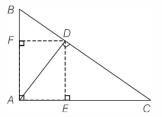
In a triangle $ABC$,$\angle BAC = 90^{\circ}$; $AD$ is the altitude from $A$ onto $BC$. Draw $DE$ perpendicular to $AC$ and $DF$ perpendicular to $AB$. Suppose $AB = 15$ and $BC = 25$. Then the length of $EF$ is
A
$12$
B
$10$
C
$5 \sqrt{3}$
D
$5 \sqrt{5}$
Solution
(A) Given that in $\triangle ABC$,$\angle BAC = 90^{\circ}$ and $AD$ is the altitude from $A$ onto $BC$.
Since $AB = 15$ and $BC = 25$,by the Pythagorean theorem:
$AC = \sqrt{BC^2 - AB^2} = \sqrt{25^2 - 15^2} = \sqrt{625 - 225} = \sqrt{400} = 20$.
The area of $\triangle ABC$ can be calculated in two ways:
Area $= \frac{1}{2} \times AB \times AC = \frac{1}{2} \times 15 \times 20 = 150$.
Also,Area $= \frac{1}{2} \times BC \times AD = \frac{1}{2} \times 25 \times AD$.
Equating the two areas: $\frac{1}{2} \times 25 \times AD = 150 \implies AD = \frac{300}{25} = 12$.
In quadrilateral $AEDF$,$\angle FAE = 90^{\circ}$,$\angle AFD = 90^{\circ}$,and $\angle AED = 90^{\circ}$. Thus,$AEDF$ is a rectangle.
In a rectangle,the diagonals are equal. Therefore,$EF = AD$.
Since $AD = 12$,the length of $EF$ is $12$.
Since $AB = 15$ and $BC = 25$,by the Pythagorean theorem:
$AC = \sqrt{BC^2 - AB^2} = \sqrt{25^2 - 15^2} = \sqrt{625 - 225} = \sqrt{400} = 20$.
The area of $\triangle ABC$ can be calculated in two ways:
Area $= \frac{1}{2} \times AB \times AC = \frac{1}{2} \times 15 \times 20 = 150$.
Also,Area $= \frac{1}{2} \times BC \times AD = \frac{1}{2} \times 25 \times AD$.
Equating the two areas: $\frac{1}{2} \times 25 \times AD = 150 \implies AD = \frac{300}{25} = 12$.
In quadrilateral $AEDF$,$\angle FAE = 90^{\circ}$,$\angle AFD = 90^{\circ}$,and $\angle AED = 90^{\circ}$. Thus,$AEDF$ is a rectangle.
In a rectangle,the diagonals are equal. Therefore,$EF = AD$.
Since $AD = 12$,the length of $EF$ is $12$.
0 likesView Solution
20
MathematicsDifficultMCQKVPY · 2019
The sides $a, b, c$ of a triangle satisfy the relations $c^2=2ab$ and $a^2+c^2=3b^2$. Then the measure of $\angle BAC$,in degrees,is
A
$30$
B
$45$
C
$60$
D
$90$
Solution
(B) Given relations for the sides of the triangle are:
$c^2 = 2ab$ $(i)$
$a^2 + c^2 = 3b^2$ $(ii)$
Substituting $(i)$ into $(ii)$:
$a^2 + 2ab = 3b^2$
$a^2 + 2ab - 3b^2 = 0$
$(a + 3b)(a - b) = 0$
Since $a$ and $b$ are side lengths,$a, b > 0$,so $a = b$.
Substituting $a = b$ into $(i)$:
$c^2 = 2(b)(b) = 2b^2$
$c = \sqrt{2}b$
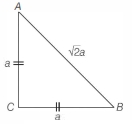
Now,we have sides $a = b$,$b = b$,and $c = \sqrt{2}b$.
Since $a^2 + b^2 = b^2 + b^2 = 2b^2 = c^2$,the triangle is a right-angled triangle with the right angle at $C$ (i.e.,$\angle C = 90^{\circ}$).
Since $a = b$,the triangle is an isosceles right-angled triangle.
Therefore,$\angle A = \angle B = 45^{\circ}$.
The measure of $\angle BAC$ is $45^{\circ}$.
$c^2 = 2ab$ $(i)$
$a^2 + c^2 = 3b^2$ $(ii)$
Substituting $(i)$ into $(ii)$:
$a^2 + 2ab = 3b^2$
$a^2 + 2ab - 3b^2 = 0$
$(a + 3b)(a - b) = 0$
Since $a$ and $b$ are side lengths,$a, b > 0$,so $a = b$.
Substituting $a = b$ into $(i)$:
$c^2 = 2(b)(b) = 2b^2$
$c = \sqrt{2}b$
Now,we have sides $a = b$,$b = b$,and $c = \sqrt{2}b$.
Since $a^2 + b^2 = b^2 + b^2 = 2b^2 = c^2$,the triangle is a right-angled triangle with the right angle at $C$ (i.e.,$\angle C = 90^{\circ}$).
Since $a = b$,the triangle is an isosceles right-angled triangle.
Therefore,$\angle A = \angle B = 45^{\circ}$.
The measure of $\angle BAC$ is $45^{\circ}$.
0 likesView Solution
21
MathematicsAdvancedMCQKVPY · 2019
Let $N$ be the least positive integer such that whenever a non-zero digit $c \in \{1, 2, \dots, 9\}$ is written after the last digit of $N$,the resulting number is divisible by $c$. The sum of the digits of $N$ is:
A
$9$
B
$18$
C
$27$
D
$36$
Solution
(A) Let the number be $N$. When a non-zero digit $c$ is appended to $N$,the new number is $10N + c$.
Given that $10N + c$ is divisible by $c$ for all $c \in \{1, 2, \dots, 9\}$.
This implies that $10N$ must be divisible by $c$ for all $c \in \{1, 2, \dots, 9\}$.
Therefore,$10N$ must be a multiple of the least common multiple $(LCM)$ of the digits $\{1, 2, 3, 4, 5, 6, 7, 8, 9\}$.
$LCM(1, 2, 3, 4, 5, 6, 7, 8, 9) = 2^3 \times 3^2 \times 5 \times 7 = 8 \times 9 \times 5 \times 7 = 2520$.
So,$10N$ must be a multiple of $2520$,which means $N$ must be a multiple of $252$.
The least positive integer $N$ is $252$.
The sum of the digits of $N$ is $2 + 5 + 2 = 9$.
Given that $10N + c$ is divisible by $c$ for all $c \in \{1, 2, \dots, 9\}$.
This implies that $10N$ must be divisible by $c$ for all $c \in \{1, 2, \dots, 9\}$.
Therefore,$10N$ must be a multiple of the least common multiple $(LCM)$ of the digits $\{1, 2, 3, 4, 5, 6, 7, 8, 9\}$.
$LCM(1, 2, 3, 4, 5, 6, 7, 8, 9) = 2^3 \times 3^2 \times 5 \times 7 = 8 \times 9 \times 5 \times 7 = 2520$.
So,$10N$ must be a multiple of $2520$,which means $N$ must be a multiple of $252$.
The least positive integer $N$ is $252$.
The sum of the digits of $N$ is $2 + 5 + 2 = 9$.
0 likesView Solution
22
MathematicsDifficultMCQKVPY · 2019
Let $x_1, x_2, \ldots, x_{11}$ be $11$ distinct positive integers. If we replace the largest of these integers by the median of the other $10$ integers,then:
A
the median remains the same
B
the mean increases
C
the median decreases
D
the mean remains the same
Solution
(C) Let the $11$ distinct positive integers be arranged in increasing order: $x_1 < x_2 < x_3 < x_4 < x_5 < x_6 < x_7 < x_8 < x_9 < x_{10} < x_{11}$.
The median of these $11$ integers is $x_6$.
The other $10$ integers are $x_1, x_2, x_3, x_4, x_5, x_6, x_7, x_8, x_9, x_{10}$.
The median of these $10$ integers is $m = \frac{x_5 + x_6}{2}$.
Since $x_5 < x_6$,it follows that $x_5 < \frac{x_5 + x_6}{2} < x_6$,so $x_5 < m < x_6$.
Replacing the largest integer $x_{11}$ with $m$,the new set of $11$ integers in increasing order is $x_1, x_2, x_3, x_4, x_5, m, x_6, x_7, x_8, x_9, x_{10}$.
The new median is the $6^{th}$ term,which is $m$.
Since $m < x_6$,the median decreases.
The median of these $11$ integers is $x_6$.
The other $10$ integers are $x_1, x_2, x_3, x_4, x_5, x_6, x_7, x_8, x_9, x_{10}$.
The median of these $10$ integers is $m = \frac{x_5 + x_6}{2}$.
Since $x_5 < x_6$,it follows that $x_5 < \frac{x_5 + x_6}{2} < x_6$,so $x_5 < m < x_6$.
Replacing the largest integer $x_{11}$ with $m$,the new set of $11$ integers in increasing order is $x_1, x_2, x_3, x_4, x_5, m, x_6, x_7, x_8, x_9, x_{10}$.
The new median is the $6^{th}$ term,which is $m$.
Since $m < x_6$,the median decreases.
0 likesView Solution
23
MathematicsAdvancedMCQKVPY · 2019
$A$ two-digit number $\overline{ab}$ is called almost prime if one obtains a two-digit prime number by changing at most one of its digits $a$ or $b$. (For example,$18$ is an almost prime number because $13$ is a prime number). The number of almost prime two-digit numbers is:
A
$56$
B
$75$
C
$87$
D
$90$
Solution
(D) two-digit number $\overline{ab}$ is almost prime if it can be transformed into a prime number by changing at most one digit.
Every two-digit number $\overline{ab}$ can be written as $10a + b$,where $a \in \{1, 2, \dots, 9\}$ and $b \in \{0, 1, \dots, 9\}$.
There are $90$ two-digit numbers in total,ranging from $10$ to $99$.
Any prime number $p$ (where $10 \le p \le 99$) is itself an almost prime number because we can change zero digits to obtain a prime.
For any non-prime two-digit number,we check if it can be changed into a prime by altering one digit.
Since there are many primes ending in $1, 3, 7, 9$,almost every two-digit number can be converted into a prime by changing the units digit $b$.
For example,any number $\overline{a0}, \overline{a2}, \overline{a4}, \overline{a5}, \overline{a6}, \overline{a8}$ can be changed to a prime by modifying the last digit.
Exhaustive checking shows that all $90$ two-digit numbers satisfy this condition.
Thus,the total count is $90$.
Every two-digit number $\overline{ab}$ can be written as $10a + b$,where $a \in \{1, 2, \dots, 9\}$ and $b \in \{0, 1, \dots, 9\}$.
There are $90$ two-digit numbers in total,ranging from $10$ to $99$.
Any prime number $p$ (where $10 \le p \le 99$) is itself an almost prime number because we can change zero digits to obtain a prime.
For any non-prime two-digit number,we check if it can be changed into a prime by altering one digit.
Since there are many primes ending in $1, 3, 7, 9$,almost every two-digit number can be converted into a prime by changing the units digit $b$.
For example,any number $\overline{a0}, \overline{a2}, \overline{a4}, \overline{a5}, \overline{a6}, \overline{a8}$ can be changed to a prime by modifying the last digit.
Exhaustive checking shows that all $90$ two-digit numbers satisfy this condition.
Thus,the total count is $90$.
0 likesView Solution
24
MathematicsAdvancedMCQKVPY · 2019
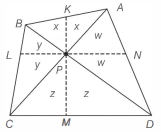
Let $P$ be an interior point of a convex quadrilateral $ABCD$ and $K, L, M, N$ be the mid-points of $AB, BC, CD, DA$ respectively. If $\text{Area}(PKAN) = 25$,$\text{Area}(PLBK) = 36$,and $\text{Area}(PMDN) = 41$,then $\text{Area}(PLCM)$ is
A
$20$
B
$29$
C
$52$
D
$54$
Solution
(C) Let $P$ be an interior point of a convex quadrilateral $ABCD$ and $K, L, M, N$ be the mid-points of $AB, BC, CD, DA$ respectively.
Let the areas of the triangles be as follows:
$\text{Area}(\triangle AKP) = \text{Area}(\triangle BKP) = x$
$\text{Area}(\triangle BLP) = \text{Area}(\triangle CLP) = y$
$\text{Area}(\triangle CPM) = \text{Area}(\triangle DPM) = z$
$\text{Area}(\triangle DNP) = \text{Area}(\triangle ANP) = w$
Given:
$\text{Area}(PKAN) = x + w = 25$
$\text{Area}(PLBK) = x + y = 36$
$\text{Area}(PMDN) = z + w = 41$
We need to find $\text{Area}(PLCM) = y + z$.
From the equations:
$(x + y) + (z + w) = 36 + 41 = 77$
$(x + w) + (y + z) = 77$
$25 + (y + z) = 77$
$y + z = 77 - 25 = 52$
Thus,$\text{Area}(PLCM) = 52$.
Let the areas of the triangles be as follows:
$\text{Area}(\triangle AKP) = \text{Area}(\triangle BKP) = x$
$\text{Area}(\triangle BLP) = \text{Area}(\triangle CLP) = y$
$\text{Area}(\triangle CPM) = \text{Area}(\triangle DPM) = z$
$\text{Area}(\triangle DNP) = \text{Area}(\triangle ANP) = w$
Given:
$\text{Area}(PKAN) = x + w = 25$
$\text{Area}(PLBK) = x + y = 36$
$\text{Area}(PMDN) = z + w = 41$
We need to find $\text{Area}(PLCM) = y + z$.
From the equations:
$(x + y) + (z + w) = 36 + 41 = 77$
$(x + w) + (y + z) = 77$
$25 + (y + z) = 77$
$y + z = 77 - 25 = 52$
Thus,$\text{Area}(PLCM) = 52$.
0 likesView Solution
25
MathematicsDifficultMCQKVPY · 2019
The number of non-negative integer solutions of the equations $6x + 4y + z = 200$ and $x + y + z = 100$ is
A
$3$
B
$5$
C
$7$
D
Infinite
Solution
(C) Given equations are:
$6x + 4y + z = 200$ $(i)$
$x + y + z = 100$ $(ii)$
Subtracting equation $(ii)$ from $(i)$:
$(6x - x) + (4y - y) + (z - z) = 200 - 100$
$5x + 3y = 100$
Since $x$ and $y$ must be non-negative integers,we can express $y$ as $y = \frac{100 - 5x}{3} = \frac{5(20 - x)}{3}$.
For $y$ to be an integer,$(20 - x)$ must be a multiple of $3$. Let $20 - x = 3k$,where $k$ is an integer.
Then $x = 20 - 3k$. Since $x \ge 0$,$20 - 3k \ge 0 \implies 3k \le 20 \implies k \le 6.66$.
Also,since $y \ge 0$,$5(20 - x) \ge 0 \implies x \le 20$. Since $y = 5k$,$k$ must be $\ge 0$.
Possible values for $k$ are $0, 1, 2, 3, 4, 5, 6$.
For each $k$,we find $x = 20 - 3k$ and $y = 5k$. Then $z = 100 - x - y = 100 - (20 - 3k) - 5k = 80 - 2k$.
Since $k \in \{0, 1, 2, 3, 4, 5, 6\}$,$z$ will always be non-negative $(80, 78, 76, 74, 72, 70, 68)$.
There are $7$ such solutions.
$6x + 4y + z = 200$ $(i)$
$x + y + z = 100$ $(ii)$
Subtracting equation $(ii)$ from $(i)$:
$(6x - x) + (4y - y) + (z - z) = 200 - 100$
$5x + 3y = 100$
Since $x$ and $y$ must be non-negative integers,we can express $y$ as $y = \frac{100 - 5x}{3} = \frac{5(20 - x)}{3}$.
For $y$ to be an integer,$(20 - x)$ must be a multiple of $3$. Let $20 - x = 3k$,where $k$ is an integer.
Then $x = 20 - 3k$. Since $x \ge 0$,$20 - 3k \ge 0 \implies 3k \le 20 \implies k \le 6.66$.
Also,since $y \ge 0$,$5(20 - x) \ge 0 \implies x \le 20$. Since $y = 5k$,$k$ must be $\ge 0$.
Possible values for $k$ are $0, 1, 2, 3, 4, 5, 6$.
For each $k$,we find $x = 20 - 3k$ and $y = 5k$. Then $z = 100 - x - y = 100 - (20 - 3k) - 5k = 80 - 2k$.
Since $k \in \{0, 1, 2, 3, 4, 5, 6\}$,$z$ will always be non-negative $(80, 78, 76, 74, 72, 70, 68)$.
There are $7$ such solutions.
0 likesView Solution
26
MathematicsAdvancedMCQKVPY · 2019
Let $N_1 = 2^{55} + 1$ and $N_2 = 165$. Then:
A
$N_1$ and $N_2$ are coprime
B
the $HCF$ of $N_1$ and $N_2$ is $55$
C
the $HCF$ of $N_1$ and $N_2$ is $11$
D
the $HCF$ of $N_1$ and $N_2$ is $33$
Solution
(D) Given $N_2 = 165 = 3 \times 5 \times 11$ and $N_1 = 2^{55} + 1$.
We know that if $n$ is an odd integer,then $x^n + y^n$ is divisible by $x + y$.
Since $55$ is odd,$N_1 = 2^{55} + 1^{55}$ is divisible by $2 + 1 = 3$.
Also,$N_1 = (2^5)^{11} + 1^{11} = 32^{11} + 1^{11}$,which is divisible by $32 + 1 = 33$.
Since $33 = 3 \times 11$,$N_1$ is divisible by both $3$ and $11$.
$N_2 = 165 = 15 \times 11 = 5 \times 33$.
Since $N_1$ is a multiple of $33$ and $N_2$ is a multiple of $33$,and $N_1$ is not divisible by $5$ (as $2^{55} + 1 \equiv (2^2)^{27} \times 2 + 1 \equiv (-1)^{27} \times 2 + 1 \equiv -2 + 1 \equiv -1 \equiv 4 \pmod{5}$),the $HCF$ of $N_1$ and $N_2$ is $33$.
We know that if $n$ is an odd integer,then $x^n + y^n$ is divisible by $x + y$.
Since $55$ is odd,$N_1 = 2^{55} + 1^{55}$ is divisible by $2 + 1 = 3$.
Also,$N_1 = (2^5)^{11} + 1^{11} = 32^{11} + 1^{11}$,which is divisible by $32 + 1 = 33$.
Since $33 = 3 \times 11$,$N_1$ is divisible by both $3$ and $11$.
$N_2 = 165 = 15 \times 11 = 5 \times 33$.
Since $N_1$ is a multiple of $33$ and $N_2$ is a multiple of $33$,and $N_1$ is not divisible by $5$ (as $2^{55} + 1 \equiv (2^2)^{27} \times 2 + 1 \equiv (-1)^{27} \times 2 + 1 \equiv -2 + 1 \equiv -1 \equiv 4 \pmod{5}$),the $HCF$ of $N_1$ and $N_2$ is $33$.
0 likesView Solution
27
MathematicsAdvancedMCQKVPY · 2019
Let $l > 0$ be a real number,$C$ denote a circle with circumference $l$,and $T$ denote a triangle with perimeter $l$. Then:
A
given any positive real number $\alpha$,we can choose $C$ and $T$ as above such that the ratio $\frac{\operatorname{Area}(C)}{\operatorname{Area}(T)}$ is greater than $\alpha$
B
given any positive real number $\alpha$,we can choose $C$ and $T$ as above such that the ratio $\frac{\operatorname{Area}(C)}{\operatorname{Area}(T)}$ is less than $\alpha$
C
for any $C$ and $T$ as above,the ratio $\frac{\operatorname{Area}(C)}{\operatorname{Area}(T)}$ is independent of $C$ and $T$
D
there exist real numbers $a$ and $b$ such that for any circle $C$ and triangle $T$ as above,we must have $a < \frac{\operatorname{Area}(C)}{\operatorname{Area}(T)} < b$
Solution
(A) Given the circumference of circle $C$ is $l$,we have $2 \pi r = l$,which implies $r = \frac{l}{2 \pi}$.
Thus,the area of circle $C$ is $A_C = \pi r^2 = \frac{l^2}{4 \pi}$.
For a triangle $T$ with perimeter $l$,the area $A_T$ can be arbitrarily small by choosing a very thin triangle (e.g.,sides $\frac{l}{2}-\epsilon, \frac{l}{2}-\epsilon, 2\epsilon$).
Since $A_C$ is fixed for a given $l$ and $A_T$ can be made arbitrarily close to $0$,the ratio $\frac{A_C}{A_T}$ can be made arbitrarily large.
Therefore,for any positive real number $\alpha$,we can choose $T$ such that $\frac{\operatorname{Area}(C)}{\operatorname{Area}(T)} > \alpha$.
Thus,the area of circle $C$ is $A_C = \pi r^2 = \frac{l^2}{4 \pi}$.
For a triangle $T$ with perimeter $l$,the area $A_T$ can be arbitrarily small by choosing a very thin triangle (e.g.,sides $\frac{l}{2}-\epsilon, \frac{l}{2}-\epsilon, 2\epsilon$).
Since $A_C$ is fixed for a given $l$ and $A_T$ can be made arbitrarily close to $0$,the ratio $\frac{A_C}{A_T}$ can be made arbitrarily large.
Therefore,for any positive real number $\alpha$,we can choose $T$ such that $\frac{\operatorname{Area}(C)}{\operatorname{Area}(T)} > \alpha$.
0 likesView Solution
28
MathematicsAdvancedMCQKVPY · 2019
The number of three-digit numbers $\overline{abc}$ such that the arithmetic mean of $b$ and $c$ is equal to the square of their geometric mean is
A
$9$
B
$18$
C
$36$
D
$54$
Solution
(B) Let the three-digit number be $\overline{abc}$,where $a \in \{1, 2, \dots, 9\}$ and $b, c \in \{0, 1, \dots, 9\}$.
The arithmetic mean of $b$ and $c$ is $\frac{b+c}{2}$.
The geometric mean of $b$ and $c$ is $\sqrt{bc}$. The square of the geometric mean is $bc$.
Given that $\frac{b+c}{2} = bc$,which implies $b+c = 2bc$.
Case $1$: If $b=0$,then $c=0$. Since $a$ can be any digit from $1$ to $9$,there are $9$ such numbers $(100, 200, \dots, 900)$.
Case $2$: If $b, c \neq 0$,then $\frac{1}{c} + \frac{1}{b} = 2$. For $b, c \in \{1, 2, \dots, 9\}$,the only solution is $b=1$ and $c=1$.
Since $a$ can be any digit from $1$ to $9$,there are $9$ such numbers $(111, 211, \dots, 911)$.
Total number of such three-digit numbers = $9 + 9 = 18$.
The arithmetic mean of $b$ and $c$ is $\frac{b+c}{2}$.
The geometric mean of $b$ and $c$ is $\sqrt{bc}$. The square of the geometric mean is $bc$.
Given that $\frac{b+c}{2} = bc$,which implies $b+c = 2bc$.
Case $1$: If $b=0$,then $c=0$. Since $a$ can be any digit from $1$ to $9$,there are $9$ such numbers $(100, 200, \dots, 900)$.
Case $2$: If $b, c \neq 0$,then $\frac{1}{c} + \frac{1}{b} = 2$. For $b, c \in \{1, 2, \dots, 9\}$,the only solution is $b=1$ and $c=1$.
Since $a$ can be any digit from $1$ to $9$,there are $9$ such numbers $(111, 211, \dots, 911)$.
Total number of such three-digit numbers = $9 + 9 = 18$.
0 likesView Solution
29
MathematicsAdvancedMCQKVPY · 2019
Let $a, b, c, d$ be distinct real numbers such that $a, b$ are roots of $x^2-5cx-6d=0$,and $c, d$ are roots of $x^2-5ax-6b=0$. Then $b+d$ is
A
$180$
B
$162$
C
$144$
D
$126$
Solution
(C) Given that $a, b$ are roots of $x^2-5cx-6d=0$,we have:
$a+b=5c$ $(1)$
$ab=-6d$ $(2)$
Given that $c, d$ are roots of $x^2-5ax-6b=0$,we have:
$c+d=5a$ $(3)$
$cd=-6b$ $(4)$
Subtracting $(3)$ from $(1)$:
$(a+b)-(c+d) = 5c-5a$
$(a-c)+(b-d) = -5(a-c)$
$b-d = -6(a-c) = 6(c-a)$ $(5)$
Adding $(1)$ and $(3)$:
$(a+b)+(c+d) = 5c+5a$
$(b+d) = 4(a+c)$ $(6)$
From $(2)$ and $(4)$,$ab-cd = -6d+6b = 6(b-d)$.
Substituting $(5)$ into this: $ab-cd = 6(6(c-a)) = 36(c-a)$.
Also,$ab-cd = a(5c-a) - c(5a-c) = 5ac - a^2 - 5ac + c^2 = c^2-a^2 = (c-a)(c+a)$.
Since $a, b, c, d$ are distinct,$c-a \neq 0$,so $c+a = 36$.
Substituting this into $(6)$: $b+d = 4(36) = 144$.
$a+b=5c$ $(1)$
$ab=-6d$ $(2)$
Given that $c, d$ are roots of $x^2-5ax-6b=0$,we have:
$c+d=5a$ $(3)$
$cd=-6b$ $(4)$
Subtracting $(3)$ from $(1)$:
$(a+b)-(c+d) = 5c-5a$
$(a-c)+(b-d) = -5(a-c)$
$b-d = -6(a-c) = 6(c-a)$ $(5)$
Adding $(1)$ and $(3)$:
$(a+b)+(c+d) = 5c+5a$
$(b+d) = 4(a+c)$ $(6)$
From $(2)$ and $(4)$,$ab-cd = -6d+6b = 6(b-d)$.
Substituting $(5)$ into this: $ab-cd = 6(6(c-a)) = 36(c-a)$.
Also,$ab-cd = a(5c-a) - c(5a-c) = 5ac - a^2 - 5ac + c^2 = c^2-a^2 = (c-a)(c+a)$.
Since $a, b, c, d$ are distinct,$c-a \neq 0$,so $c+a = 36$.
Substituting this into $(6)$: $b+d = 4(36) = 144$.
0 likesView Solution
30
MathematicsAdvancedMCQKVPY · 2019
Let $S=\{1, 2, 3, \ldots, 100\}$. Suppose $b$ and $c$ are chosen at random from the set $S$. The probability that $4x^2+bx+c=0$ has equal roots is
A
$0.001$
B
$0.004$
C
$0.007$
D
$0.01$
Solution
(A) The quadratic equation $4x^2+bx+c=0$ has equal roots if its discriminant $D = b^2 - 4(4)(c) = 0$.
This implies $b^2 = 16c$,or $b^2 = (4\sqrt{c})^2$,which means $b = 4\sqrt{c}$.
Since $b$ must be an integer and $b \in S$,$c$ must be a perfect square such that $4\sqrt{c} \in \{1, 2, \ldots, 100\}$.
Let $c = k^2$ for some integer $k$. Then $b = 4k$.
Since $1 \le b \le 100$,we have $1 \le 4k \le 100$,which implies $1 \le k \le 25$.
Also,$c = k^2$ must be in $S$,so $1 \le k^2 \le 100$,which implies $1 \le k \le 10$.
Thus,the possible values for $k$ are $\{1, 2, 3, 4, 5, 6, 7, 8, 9, 10\}$.
There are $10$ such pairs $(b, c)$.
The total number of ways to choose $b$ and $c$ from $S$ is $100 \times 100 = 10000$.
The probability is $\frac{10}{10000} = \frac{1}{1000} = 0.001$.
This implies $b^2 = 16c$,or $b^2 = (4\sqrt{c})^2$,which means $b = 4\sqrt{c}$.
Since $b$ must be an integer and $b \in S$,$c$ must be a perfect square such that $4\sqrt{c} \in \{1, 2, \ldots, 100\}$.
Let $c = k^2$ for some integer $k$. Then $b = 4k$.
Since $1 \le b \le 100$,we have $1 \le 4k \le 100$,which implies $1 \le k \le 25$.
Also,$c = k^2$ must be in $S$,so $1 \le k^2 \le 100$,which implies $1 \le k \le 10$.
Thus,the possible values for $k$ are $\{1, 2, 3, 4, 5, 6, 7, 8, 9, 10\}$.
There are $10$ such pairs $(b, c)$.
The total number of ways to choose $b$ and $c$ from $S$ is $100 \times 100 = 10000$.
The probability is $\frac{10}{10000} = \frac{1}{1000} = 0.001$.
0 likesView Solution
31
MathematicsAdvancedMCQKVPY · 2019
$A$ prime number $p$ is called special if there exist primes $p_1, p_2, p_3, p_4$ such that $p = p_1 + p_2 = p_3 - p_4$. The number of special primes is
A
$0$
B
$1$
C
more than one but finite
D
infinite
Solution
(B) Given $p = p_1 + p_2 = p_3 - p_4$ where $p, p_1, p_2, p_3, p_4$ are primes.
Case $I$: If all $p_1, p_2, p_3, p_4$ are odd,then $p_1 + p_2$ is even,which implies $p$ is even. Since $p$ is a prime,$p = 2$. However,$p_1 + p_2 = 2$ is impossible for primes $p_1, p_2 \ge 2$.
Case $II$: At least one of $p_1, p_2$ must be $2$. Let $p_2 = 2$. Then $p = p_1 + 2$. Since $p$ and $p_1$ are primes,$p_1$ must be odd (unless $p_1=2$,then $p=4$ not prime). If $p_1$ is odd,$p$ is odd.
From $p = p_3 - p_4$,we have $p_3 = p + p_4$. Since $p$ is odd,for $p_3$ to be prime,$p_4$ must be $2$ (if $p_4$ were odd,$p_3$ would be even and $>2$,hence not prime).
Thus,$p = p_1 + 2$ and $p = p_3 - 2$,which means $p_3 = p + 2$ and $p_1 = p - 2$.
We need $p-2, p, p+2$ to be primes. This is a prime triplet of the form $(n, n+2, n+4)$. The only such triplet is $(3, 5, 7)$.
Therefore,$p = 5$ is the only solution.
The number of special primes is $1$.
Case $I$: If all $p_1, p_2, p_3, p_4$ are odd,then $p_1 + p_2$ is even,which implies $p$ is even. Since $p$ is a prime,$p = 2$. However,$p_1 + p_2 = 2$ is impossible for primes $p_1, p_2 \ge 2$.
Case $II$: At least one of $p_1, p_2$ must be $2$. Let $p_2 = 2$. Then $p = p_1 + 2$. Since $p$ and $p_1$ are primes,$p_1$ must be odd (unless $p_1=2$,then $p=4$ not prime). If $p_1$ is odd,$p$ is odd.
From $p = p_3 - p_4$,we have $p_3 = p + p_4$. Since $p$ is odd,for $p_3$ to be prime,$p_4$ must be $2$ (if $p_4$ were odd,$p_3$ would be even and $>2$,hence not prime).
Thus,$p = p_1 + 2$ and $p = p_3 - 2$,which means $p_3 = p + 2$ and $p_1 = p - 2$.
We need $p-2, p, p+2$ to be primes. This is a prime triplet of the form $(n, n+2, n+4)$. The only such triplet is $(3, 5, 7)$.
Therefore,$p = 5$ is the only solution.
The number of special primes is $1$.
0 likesView Solution
32
MathematicsAdvancedMCQKVPY · 2019
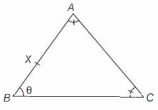
Let $ABC$ be a triangle in which $AB=BC$. Let $X$ be a point on $AB$ such that $AX:XB=AB:AX$. If $AC=AX$,then the measure of $\angle ABC$ equals (in $^{\circ}$)
A
$18$
B
$36$
C
$54$
D
$72$
Solution
(B) Given in $\triangle ABC$,$AB=BC$ and $\frac{AX}{XB} = \frac{AB}{AX} = k$.
Since $AB = AX + XB$,we have $\frac{AB}{AX} = \frac{AX+XB}{AX} = 1 + \frac{XB}{AX} = 1 + \frac{1}{k}$.
Thus,$k = 1 + \frac{1}{k} \Rightarrow k^2 - k - 1 = 0$.
Since $k > 0$,$k = \frac{1+\sqrt{5}}{2}$.
Then $\frac{AX}{AB} = \frac{1}{k} = \frac{2}{1+\sqrt{5}} = \frac{\sqrt{5}-1}{2}$.
Let $\angle ABC = \theta$. Since $AB=BC$,$\angle BAC = \angle BCA = \frac{180^{\circ}-\theta}{2} = 90^{\circ} - \frac{\theta}{2}$.
In $\triangle AXC$,$AC=AX$,so $\angle AXC = \angle ACX = \angle BCA = 90^{\circ} - \frac{\theta}{2}$.
Then $\angle XAC = 180^{\circ} - 2(90^{\circ} - \frac{\theta}{2}) = \theta$.
Since $\angle BAC = 90^{\circ} - \frac{\theta}{2}$,we have $\angle BAX = \angle BAC - \angle XAC = (90^{\circ} - \frac{\theta}{2}) - \theta = 90^{\circ} - \frac{3\theta}{2}$.
In $\triangle BAX$,by the Law of Sines: $\frac{AX}{\sin \theta} = \frac{AB}{\sin(90^{\circ}-\frac{\theta}{2})}$.
$\frac{AX}{AB} = \frac{\sin \theta}{\cos(\theta/2)} = \frac{2\sin(\theta/2)\cos(\theta/2)}{\cos(\theta/2)} = 2\sin(\theta/2)$.
Equating the two expressions for $\frac{AX}{AB}$: $2\sin(\theta/2) = \frac{\sqrt{5}-1}{2} \Rightarrow \sin(\theta/2) = \frac{\sqrt{5}-1}{4} = \sin 18^{\circ}$.
Therefore,$\frac{\theta}{2} = 18^{\circ} \Rightarrow \theta = 36^{\circ}$.
Since $AB = AX + XB$,we have $\frac{AB}{AX} = \frac{AX+XB}{AX} = 1 + \frac{XB}{AX} = 1 + \frac{1}{k}$.
Thus,$k = 1 + \frac{1}{k} \Rightarrow k^2 - k - 1 = 0$.
Since $k > 0$,$k = \frac{1+\sqrt{5}}{2}$.
Then $\frac{AX}{AB} = \frac{1}{k} = \frac{2}{1+\sqrt{5}} = \frac{\sqrt{5}-1}{2}$.
Let $\angle ABC = \theta$. Since $AB=BC$,$\angle BAC = \angle BCA = \frac{180^{\circ}-\theta}{2} = 90^{\circ} - \frac{\theta}{2}$.
In $\triangle AXC$,$AC=AX$,so $\angle AXC = \angle ACX = \angle BCA = 90^{\circ} - \frac{\theta}{2}$.
Then $\angle XAC = 180^{\circ} - 2(90^{\circ} - \frac{\theta}{2}) = \theta$.
Since $\angle BAC = 90^{\circ} - \frac{\theta}{2}$,we have $\angle BAX = \angle BAC - \angle XAC = (90^{\circ} - \frac{\theta}{2}) - \theta = 90^{\circ} - \frac{3\theta}{2}$.
In $\triangle BAX$,by the Law of Sines: $\frac{AX}{\sin \theta} = \frac{AB}{\sin(90^{\circ}-\frac{\theta}{2})}$.
$\frac{AX}{AB} = \frac{\sin \theta}{\cos(\theta/2)} = \frac{2\sin(\theta/2)\cos(\theta/2)}{\cos(\theta/2)} = 2\sin(\theta/2)$.
Equating the two expressions for $\frac{AX}{AB}$: $2\sin(\theta/2) = \frac{\sqrt{5}-1}{2} \Rightarrow \sin(\theta/2) = \frac{\sqrt{5}-1}{4} = \sin 18^{\circ}$.
Therefore,$\frac{\theta}{2} = 18^{\circ} \Rightarrow \theta = 36^{\circ}$.
0 likesView Solution
33
MathematicsDifficultMCQKVPY · 2019
The area of the region bounded by the lines $x=1, x=2$,and the curves $x(y-e^x)=\sin x$ and $2xy=2\sin x+x^3$ is
A
$e^2-e-\frac{1}{6}$
B
$e^2-e-\frac{7}{6}$
C
$e^2-e+\frac{1}{6}$
D
$e^2-e+\frac{7}{6}$
Solution
(B) Given the curves:
$x(y-e^x)=\sin x \implies y = \frac{\sin x}{x} + e^x$
$2xy = 2\sin x + x^3 \implies y = \frac{\sin x}{x} + \frac{x^2}{2}$
For $x \in [1, 2]$,$e^x > \frac{x^2}{2}$,so the area $A$ is given by:
$A = \int_{1}^{2} \left( \left( \frac{\sin x}{x} + e^x \right) - \left( \frac{\sin x}{x} + \frac{x^2}{2} \right) \right) dx$
$A = \int_{1}^{2} \left( e^x - \frac{x^2}{2} \right) dx$
$A = \left[ e^x - \frac{x^3}{6} \right]_{1}^{2}$
$A = \left( e^2 - \frac{2^3}{6} \right) - \left( e^1 - \frac{1^3}{6} \right)$
$A = e^2 - \frac{8}{6} - e + \frac{1}{6}$
$A = e^2 - e - \frac{7}{6}$
$x(y-e^x)=\sin x \implies y = \frac{\sin x}{x} + e^x$
$2xy = 2\sin x + x^3 \implies y = \frac{\sin x}{x} + \frac{x^2}{2}$
For $x \in [1, 2]$,$e^x > \frac{x^2}{2}$,so the area $A$ is given by:
$A = \int_{1}^{2} \left( \left( \frac{\sin x}{x} + e^x \right) - \left( \frac{\sin x}{x} + \frac{x^2}{2} \right) \right) dx$
$A = \int_{1}^{2} \left( e^x - \frac{x^2}{2} \right) dx$
$A = \left[ e^x - \frac{x^3}{6} \right]_{1}^{2}$
$A = \left( e^2 - \frac{2^3}{6} \right) - \left( e^1 - \frac{1^3}{6} \right)$
$A = e^2 - \frac{8}{6} - e + \frac{1}{6}$
$A = e^2 - e - \frac{7}{6}$
0 likesView Solution
34
MathematicsDifficultMCQKVPY · 2019
The number of integers $x$ satisfying $-3 x^4 + \operatorname{det}\begin{bmatrix} 1 & x & x^2 \\ 1 & x^2 & x^4 \\ 1 & x^3 & x^6 \end{bmatrix} = 0$ is equal to
A
$1$
B
$2$
C
$5$
D
$8$
Solution
(B) Given the equation: $-3 x^4 + \operatorname{det}\begin{bmatrix} 1 & x & x^2 \\ 1 & x^2 & x^4 \\ 1 & x^3 & x^6 \end{bmatrix} = 0$.
First,we evaluate the determinant $D = \operatorname{det}\begin{bmatrix} 1 & x & x^2 \\ 1 & x^2 & x^4 \\ 1 & x^3 & x^6 \end{bmatrix}$.
Using the property of Vandermonde-like determinants or direct expansion:
$D = 1(x^2 \cdot x^6 - x^4 \cdot x^3) - x(1 \cdot x^6 - x^4 \cdot 1) + x^2(1 \cdot x^3 - x^2 \cdot 1)$
$D = (x^8 - x^7) - x(x^6 - x^4) + x^2(x^3 - x^2)$
$D = x^8 - x^7 - x^7 + x^5 + x^5 - x^4 = x^8 - 2x^7 + 2x^5 - x^4$.
Substituting this into the original equation:
$-3x^4 + x^8 - 2x^7 + 2x^5 - x^4 = 0$
$x^8 - 2x^7 + 2x^5 - 4x^4 = 0$.
Factoring the expression:
$x^4(x^4 - 2x^3 + 2x - 4) = 0$
$x^4(x^3(x - 2) + 2(x - 2)) = 0$
$x^4(x^3 + 2)(x - 2) = 0$.
Setting each factor to zero:
$x^4 = 0 \implies x = 0$
$x^3 + 2 = 0 \implies x^3 = -2 \implies x = \sqrt[3]{-2}$ (not an integer)
$x - 2 = 0 \implies x = 2$.
Since $x$ must be an integer,the possible values are $x = 0$ and $x = 2$.
Thus,there are $2$ such integers.
First,we evaluate the determinant $D = \operatorname{det}\begin{bmatrix} 1 & x & x^2 \\ 1 & x^2 & x^4 \\ 1 & x^3 & x^6 \end{bmatrix}$.
Using the property of Vandermonde-like determinants or direct expansion:
$D = 1(x^2 \cdot x^6 - x^4 \cdot x^3) - x(1 \cdot x^6 - x^4 \cdot 1) + x^2(1 \cdot x^3 - x^2 \cdot 1)$
$D = (x^8 - x^7) - x(x^6 - x^4) + x^2(x^3 - x^2)$
$D = x^8 - x^7 - x^7 + x^5 + x^5 - x^4 = x^8 - 2x^7 + 2x^5 - x^4$.
Substituting this into the original equation:
$-3x^4 + x^8 - 2x^7 + 2x^5 - x^4 = 0$
$x^8 - 2x^7 + 2x^5 - 4x^4 = 0$.
Factoring the expression:
$x^4(x^4 - 2x^3 + 2x - 4) = 0$
$x^4(x^3(x - 2) + 2(x - 2)) = 0$
$x^4(x^3 + 2)(x - 2) = 0$.
Setting each factor to zero:
$x^4 = 0 \implies x = 0$
$x^3 + 2 = 0 \implies x^3 = -2 \implies x = \sqrt[3]{-2}$ (not an integer)
$x - 2 = 0 \implies x = 2$.
Since $x$ must be an integer,the possible values are $x = 0$ and $x = 2$.
Thus,there are $2$ such integers.
0 likesView Solution
35
MathematicsAdvancedMCQKVPY · 2019
Let $P$ be a non-zero polynomial such that $P(1+x)=P(1-x)$ for all real $x$ and $P(1)=0$. Let $m$ be the largest integer such that $(x-1)^m$ divides $P(x)$ for all such $P(x)$. Then,$m$ equals
A
$1$
B
$2$
C
$3$
D
$4$
Solution
(B) Given that $P(x)$ is a non-zero polynomial satisfying $P(1+x)=P(1-x)$ for all real $x$ and $P(1)=0$.
Differentiating both sides with respect to $x$,we get:
$P'(1+x) = -P'(1-x)$.
Setting $x=0$,we obtain:
$P'(1) = -P'(1) \implies 2P'(1) = 0 \implies P'(1) = 0$.
Since $P(1)=0$ and $P'(1)=0$,by the Factor Theorem,$(x-1)^2$ must be a factor of $P(x)$.
To check if $m$ can be larger,consider $P(x) = (x-1)^2$. This satisfies $P(1+x) = (1+x-1)^2 = x^2$ and $P(1-x) = (1-x-1)^2 = (-x)^2 = x^2$. Thus,$P(1+x)=P(1-x)$ holds.
Since $P(x) = (x-1)^2$ is a valid polynomial,the largest integer $m$ such that $(x-1)^m$ divides $P(x)$ for all such $P(x)$ is $2$.
Differentiating both sides with respect to $x$,we get:
$P'(1+x) = -P'(1-x)$.
Setting $x=0$,we obtain:
$P'(1) = -P'(1) \implies 2P'(1) = 0 \implies P'(1) = 0$.
Since $P(1)=0$ and $P'(1)=0$,by the Factor Theorem,$(x-1)^2$ must be a factor of $P(x)$.
To check if $m$ can be larger,consider $P(x) = (x-1)^2$. This satisfies $P(1+x) = (1+x-1)^2 = x^2$ and $P(1-x) = (1-x-1)^2 = (-x)^2 = x^2$. Thus,$P(1+x)=P(1-x)$ holds.
Since $P(x) = (x-1)^2$ is a valid polynomial,the largest integer $m$ such that $(x-1)^m$ divides $P(x)$ for all such $P(x)$ is $2$.
0 likesView Solution
36
MathematicsDifficultMCQKVPY · 2019
Let $f(x) = \begin{cases} x \sin \left(\frac{1}{x}\right) & \text{when } x \neq 0 \\ 1 & \text{when } x = 0 \end{cases}$ and $A = \{x \in \mathbb{R} : f(x) = 1\}$. Then,$A$ has
A
exactly one element
B
exactly two elements
C
exactly three elements
D
infinitely many elements
Solution
(A) Given the function $f(x) = \begin{cases} x \sin \left(\frac{1}{x}\right) & \text{when } x \neq 0 \\ 1 & \text{when } x = 0 \end{cases}$.
We want to find the set $A = \{x \in \mathbb{R} : f(x) = 1\}$.
Case $1$: If $x = 0$,then $f(0) = 1$. Thus,$0 \in A$.
Case $2$: If $x \neq 0$,we solve $x \sin \left(\frac{1}{x}\right) = 1$,which implies $\sin \left(\frac{1}{x}\right) = \frac{1}{x}$.
Let $t = \frac{1}{x}$. Then the equation becomes $\sin(t) = t$.
We know that for all $t \neq 0$,$|\sin(t)| < |t|$.
Specifically,if $t > 0$,$\sin(t) < t$,and if $t < 0$,$\sin(t) > t$.
Therefore,the equation $\sin(t) = t$ has only one solution at $t = 0$.
However,our substitution was $t = \frac{1}{x}$,and $x \neq 0$ implies $t$ cannot be $0$.
Thus,there are no solutions for $x \neq 0$.
Consequently,the only element in set $A$ is ${0}$.
Therefore,$A$ has exactly one element.
We want to find the set $A = \{x \in \mathbb{R} : f(x) = 1\}$.
Case $1$: If $x = 0$,then $f(0) = 1$. Thus,$0 \in A$.
Case $2$: If $x \neq 0$,we solve $x \sin \left(\frac{1}{x}\right) = 1$,which implies $\sin \left(\frac{1}{x}\right) = \frac{1}{x}$.
Let $t = \frac{1}{x}$. Then the equation becomes $\sin(t) = t$.
We know that for all $t \neq 0$,$|\sin(t)| < |t|$.
Specifically,if $t > 0$,$\sin(t) < t$,and if $t < 0$,$\sin(t) > t$.
Therefore,the equation $\sin(t) = t$ has only one solution at $t = 0$.
However,our substitution was $t = \frac{1}{x}$,and $x \neq 0$ implies $t$ cannot be $0$.
Thus,there are no solutions for $x \neq 0$.
Consequently,the only element in set $A$ is ${0}$.
Therefore,$A$ has exactly one element.
0 likesView Solution
37
MathematicsAdvancedMCQKVPY · 2019
Let $\sigma_1, \sigma_2, \sigma_3$ be planes passing through the origin. Assume that $\sigma_1$ is perpendicular to the vector $(1, 1, 1)$,$\sigma_2$ is perpendicular to a vector $(a, b, c)$,and $\sigma_3$ is perpendicular to the vector $(a^2, b^2, c^2)$. What are all the positive values of $a, b$,and $c$ so that $\sigma_1 \cap \sigma_2 \cap \sigma_3$ is a single point?
A
Any positive value of $a, b$,and $c$ other than $1$.
B
Any positive values of $a, b$,and $c$ where either $a \neq b, b \neq c$ or $a \neq c$.
C
Any three distinct positive values of $a, b$,and $c$.
D
There exist no such positive real numbers $a, b$,and $c$.
Solution
(C) The equations of the planes passing through the origin are given by the dot product of the normal vectors with the position vector $(x, y, z) = 0$.
$\sigma_1: x + y + z = 0$
$\sigma_2: ax + by + cz = 0$
$\sigma_3: a^2x + b^2y + c^2z = 0$
For the intersection of these three planes to be a single point (the origin),the determinant of the coefficient matrix must be non-zero:
$\Delta = \begin{vmatrix} 1 & 1 & 1 \\ a & b & c \\ a^2 & b^2 & c^2 \end{vmatrix} \neq 0$
This is a standard Vandermonde determinant. We can simplify it by performing column operations:
Apply $C_2 \rightarrow C_2 - C_1$ and $C_3 \rightarrow C_3 - C_1$:
$\Delta = \begin{vmatrix} 1 & 0 & 0 \\ a & b-a & c-a \\ a^2 & b^2-a^2 & c^2-a^2 \end{vmatrix} = (b-a)(c-a) \begin{vmatrix} 1 & 0 & 0 \\ a & 1 & 1 \\ a^2 & b+a & c+a \end{vmatrix}$
Apply $C_3 \rightarrow C_3 - C_2$:
$\Delta = (b-a)(c-a) \begin{vmatrix} 1 & 0 & 0 \\ a & 1 & 0 \\ a^2 & b+a & c-b \end{vmatrix} = (b-a)(c-a)(c-b) = -(a-b)(b-c)(c-a)$
For $\Delta \neq 0$,we must have $a \neq b$,$b \neq c$,and $c \neq a$. Thus,$a, b$,and $c$ must be three distinct positive values.
$\sigma_1: x + y + z = 0$
$\sigma_2: ax + by + cz = 0$
$\sigma_3: a^2x + b^2y + c^2z = 0$
For the intersection of these three planes to be a single point (the origin),the determinant of the coefficient matrix must be non-zero:
$\Delta = \begin{vmatrix} 1 & 1 & 1 \\ a & b & c \\ a^2 & b^2 & c^2 \end{vmatrix} \neq 0$
This is a standard Vandermonde determinant. We can simplify it by performing column operations:
Apply $C_2 \rightarrow C_2 - C_1$ and $C_3 \rightarrow C_3 - C_1$:
$\Delta = \begin{vmatrix} 1 & 0 & 0 \\ a & b-a & c-a \\ a^2 & b^2-a^2 & c^2-a^2 \end{vmatrix} = (b-a)(c-a) \begin{vmatrix} 1 & 0 & 0 \\ a & 1 & 1 \\ a^2 & b+a & c+a \end{vmatrix}$
Apply $C_3 \rightarrow C_3 - C_2$:
$\Delta = (b-a)(c-a) \begin{vmatrix} 1 & 0 & 0 \\ a & 1 & 0 \\ a^2 & b+a & c-b \end{vmatrix} = (b-a)(c-a)(c-b) = -(a-b)(b-c)(c-a)$
For $\Delta \neq 0$,we must have $a \neq b$,$b \neq c$,and $c \neq a$. Thus,$a, b$,and $c$ must be three distinct positive values.
0 likesView Solution
38
MathematicsDifficultMCQKVPY · 2019
Ravi and Rashmi each hold $2$ red cards and $2$ black cards (all four red and all four black cards are identical). Ravi picks a card at random from Rashmi and then Rashmi picks a card at random from Ravi. This process is repeated a second time. Let $p$ be the probability that both have all $4$ cards of the same colour. Then,$p$ satisfies
A
$p \leq 5 \%$
B
$5 \% < p \leq 10 \%$
C
$10 \% < p \leq 15 \%$
D
$15 \% < p$
Solution
(A) Initially,Ravi has ${2R, 2B}$ and Rashmi has ${2R, 2B}$. Total cards with each is $4$.
Step $1$: Ravi picks a card from Rashmi. Rashmi now has $3$ cards. Then Rashmi picks a card from Ravi. Ravi now has $4$ cards again.
To have all $4$ cards of the same colour,Ravi must end up with $4$ Red cards and Rashmi with $4$ Black cards,or vice versa.
Case $1$: Ravi ends with $4$ Red cards and Rashmi with $4$ Black cards.
In the first exchange,Ravi must pick a Red card from Rashmi (prob $\frac{2}{4}$) and Rashmi must pick a Black card from Ravi (prob $\frac{2}{4}$). After this,Ravi has ${2R, 1B, 1R} = {3R, 1B}$ and Rashmi has ${1R, 2B, 1B} = {1R, 3B}$.
In the second exchange,Ravi must pick the remaining Red card from Rashmi (prob $\frac{1}{4}$) and Rashmi must pick the remaining Black card from Ravi (prob $\frac{1}{4}$).
Probability of Case $1$ = $(\frac{2}{4} \times \frac{2}{4}) \times (\frac{1}{4} \times \frac{1}{4}) = \frac{4}{16} \times \frac{1}{16} = \frac{4}{256} = \frac{1}{64}$.
Case $2$: Ravi ends with $4$ Black cards and Rashmi with $4$ Red cards.
By symmetry,the probability is also $\frac{1}{64}$.
Total probability $p = \frac{1}{64} + \frac{1}{64} = \frac{2}{64} = \frac{1}{32} = 0.03125 = 3.125 \%$.
Since $3.125 \% \leq 5 \%$,the correct option is $A$.
Step $1$: Ravi picks a card from Rashmi. Rashmi now has $3$ cards. Then Rashmi picks a card from Ravi. Ravi now has $4$ cards again.
To have all $4$ cards of the same colour,Ravi must end up with $4$ Red cards and Rashmi with $4$ Black cards,or vice versa.
Case $1$: Ravi ends with $4$ Red cards and Rashmi with $4$ Black cards.
In the first exchange,Ravi must pick a Red card from Rashmi (prob $\frac{2}{4}$) and Rashmi must pick a Black card from Ravi (prob $\frac{2}{4}$). After this,Ravi has ${2R, 1B, 1R} = {3R, 1B}$ and Rashmi has ${1R, 2B, 1B} = {1R, 3B}$.
In the second exchange,Ravi must pick the remaining Red card from Rashmi (prob $\frac{1}{4}$) and Rashmi must pick the remaining Black card from Ravi (prob $\frac{1}{4}$).
Probability of Case $1$ = $(\frac{2}{4} \times \frac{2}{4}) \times (\frac{1}{4} \times \frac{1}{4}) = \frac{4}{16} \times \frac{1}{16} = \frac{4}{256} = \frac{1}{64}$.
Case $2$: Ravi ends with $4$ Black cards and Rashmi with $4$ Red cards.
By symmetry,the probability is also $\frac{1}{64}$.
Total probability $p = \frac{1}{64} + \frac{1}{64} = \frac{2}{64} = \frac{1}{32} = 0.03125 = 3.125 \%$.
Since $3.125 \% \leq 5 \%$,the correct option is $A$.
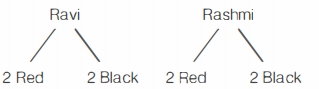
0 likesView Solution
39
MathematicsAdvancedMCQKVPY · 2019
Let $A_1, A_2$ and $A_3$ be the regions on $\mathbb{R}^2$ defined by:
$A_1 = \{(x, y) : x \geq 0, y \geq 0, 2x + 2y - x^2 - y^2 > 1 > x + y\}$
$A_2 = \{(x, y) : x \geq 0, y \geq 0, x + y > 1 > x^2 + y^2\}$
$A_3 = \{(x, y) : x \geq 0, y \geq 0, x + y > 1 > x^3 + y^3\}$
Denote by $|A_1|, |A_2|$ and $|A_3|$ the areas of the regions $A_1, A_2$ and $A_3$ respectively. Then,
$A_1 = \{(x, y) : x \geq 0, y \geq 0, 2x + 2y - x^2 - y^2 > 1 > x + y\}$
$A_2 = \{(x, y) : x \geq 0, y \geq 0, x + y > 1 > x^2 + y^2\}$
$A_3 = \{(x, y) : x \geq 0, y \geq 0, x + y > 1 > x^3 + y^3\}$
Denote by $|A_1|, |A_2|$ and $|A_3|$ the areas of the regions $A_1, A_2$ and $A_3$ respectively. Then,
A
$|A_1| > |A_2| > |A_3|$
B
$|A_1| > |A_3| > |A_2|$
C
$|A_1| = |A_2| < |A_3|$
D
$|A_1| = |A_3| > |A_2|$
Solution
(C) The region $A_1$ is defined by $x \geq 0, y \geq 0$ and $2x + 2y - x^2 - y^2 > 1 > x + y$.
Rearranging the inequality $2x + 2y - x^2 - y^2 > 1$,we get $x^2 - 2x + y^2 - 2y < -1$,which simplifies to $(x-1)^2 + (y-1)^2 < 1$. This is the interior of a circle centered at $(1, 1)$ with radius $1$. The condition $x + y < 1$ represents the region below the line $x + y = 1$ in the first quadrant.
For $A_2$,the region is $x \geq 0, y \geq 0$ and $x + y > 1 > x^2 + y^2$. This is the region between the line $x + y = 1$ and the circle $x^2 + y^2 = 1$ in the first quadrant.
For $A_3$,the region is $x \geq 0, y \geq 0$ and $x + y > 1 > x^3 + y^3$. This is the region between the line $x + y = 1$ and the curve $x^3 + y^3 = 1$ in the first quadrant.
By symmetry and geometric transformation,$|A_1| = |A_2|$.
Comparing the curves $x^2 + y^2 = 1$ and $x^3 + y^3 = 1$ in the first quadrant,for $0 < x < 1$,$x^3 < x^2$ and $y^3 < y^2$,so $x^3 + y^3 < x^2 + y^2$. Thus,the region bounded by $x^3 + y^3 = 1$ and $x + y = 1$ is larger than the region bounded by $x^2 + y^2 = 1$ and $x + y = 1$.
Therefore,$|A_3| > |A_2| = |A_1|$.
Hence,the correct option is $(c)$.
Rearranging the inequality $2x + 2y - x^2 - y^2 > 1$,we get $x^2 - 2x + y^2 - 2y < -1$,which simplifies to $(x-1)^2 + (y-1)^2 < 1$. This is the interior of a circle centered at $(1, 1)$ with radius $1$. The condition $x + y < 1$ represents the region below the line $x + y = 1$ in the first quadrant.
For $A_2$,the region is $x \geq 0, y \geq 0$ and $x + y > 1 > x^2 + y^2$. This is the region between the line $x + y = 1$ and the circle $x^2 + y^2 = 1$ in the first quadrant.
For $A_3$,the region is $x \geq 0, y \geq 0$ and $x + y > 1 > x^3 + y^3$. This is the region between the line $x + y = 1$ and the curve $x^3 + y^3 = 1$ in the first quadrant.
By symmetry and geometric transformation,$|A_1| = |A_2|$.
Comparing the curves $x^2 + y^2 = 1$ and $x^3 + y^3 = 1$ in the first quadrant,for $0 < x < 1$,$x^3 < x^2$ and $y^3 < y^2$,so $x^3 + y^3 < x^2 + y^2$. Thus,the region bounded by $x^3 + y^3 = 1$ and $x + y = 1$ is larger than the region bounded by $x^2 + y^2 = 1$ and $x + y = 1$.
Therefore,$|A_3| > |A_2| = |A_1|$.
Hence,the correct option is $(c)$.
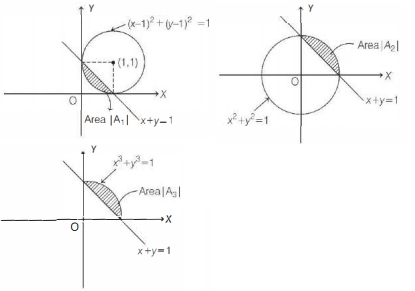
0 likesView Solution
40
MathematicsAdvancedMCQKVPY · 2019
Let $f: R \rightarrow R$ be a continuous function such that $f(x^2) = f(x^3)$ for all $x \in R$. Consider the following statements:
$I.$ $f$ is an odd function.
$II.$ $f$ is an even function.
$III.$ $f$ is differentiable everywhere.
Then,
$I.$ $f$ is an odd function.
$II.$ $f$ is an even function.
$III.$ $f$ is differentiable everywhere.
Then,
A
$I$ is true and $III$ is false
B
$II$ is true and $III$ is false
C
Both $I$ and $III$ are true
D
Both $II$ and $III$ are true
Solution
(D) Given $f(x^2) = f(x^3)$ for all $x \in R$.
For any $x > 0$,let $x = t^6$. Then $f(t^{12}) = f(t^{18})$.
More generally,for any $x > 0$,we can write $x = t^{6^n}$.
By repeating the substitution,$f(x) = f(x^{2/3}) = f(x^{(2/3)^2}) = \dots = f(x^{(2/3)^n})$.
As $n \to \infty$,$(2/3)^n \to 0$,so $f(x) = f(x^0) = f(1)$ for all $x > 0$.
Since $f$ is continuous at $x = 0$,$f(0) = \lim_{x \to 0^+} f(x) = f(1)$.
For $x < 0$,let $x = -t$ where $t > 0$. Then $f((-t)^2) = f((-t)^3) \implies f(t^2) = f(-t^3)$.
Since $f(t^2) = f(1)$,we have $f(-t^3) = f(1)$.
As $t^3$ covers all positive values,$f(x) = f(1)$ for all $x < 0$.
Thus,$f(x) = c$ (a constant) for all $x \in R$.
$A$ constant function is an even function because $f(-x) = c = f(x)$.
$A$ constant function is also differentiable everywhere with $f'(x) = 0$.
Therefore,both $II$ and $III$ are true.
For any $x > 0$,let $x = t^6$. Then $f(t^{12}) = f(t^{18})$.
More generally,for any $x > 0$,we can write $x = t^{6^n}$.
By repeating the substitution,$f(x) = f(x^{2/3}) = f(x^{(2/3)^2}) = \dots = f(x^{(2/3)^n})$.
As $n \to \infty$,$(2/3)^n \to 0$,so $f(x) = f(x^0) = f(1)$ for all $x > 0$.
Since $f$ is continuous at $x = 0$,$f(0) = \lim_{x \to 0^+} f(x) = f(1)$.
For $x < 0$,let $x = -t$ where $t > 0$. Then $f((-t)^2) = f((-t)^3) \implies f(t^2) = f(-t^3)$.
Since $f(t^2) = f(1)$,we have $f(-t^3) = f(1)$.
As $t^3$ covers all positive values,$f(x) = f(1)$ for all $x < 0$.
Thus,$f(x) = c$ (a constant) for all $x \in R$.
$A$ constant function is an even function because $f(-x) = c = f(x)$.
$A$ constant function is also differentiable everywhere with $f'(x) = 0$.
Therefore,both $II$ and $III$ are true.
0 likesView Solution
41
MathematicsAdvancedMCQKVPY · 2019
Suppose a continuous function $f:(0, \infty) \rightarrow R$ satisfies $f(x)=2 \int_0^x t f(t) d t+1, \forall x \geq 0$. Then,$f(1)$ equals
A
$e$
B
$e^2$
C
$e^4$
D
$e^6$
Solution
(A) Given the continuous function $f:[0, \infty) \rightarrow R$ satisfying $f(x) = 2 \int_0^x t f(t) d t + 1, \forall x \geq 0$.
Applying the Leibniz rule for differentiation under the integral sign,we differentiate both sides with respect to $x$:
$f'(x) = 2x f(x)$.
Rearranging the terms,we get $\frac{f'(x)}{f(x)} = 2x$.
Integrating both sides with respect to $x$:
$\int \frac{f'(x)}{f(x)} dx = \int 2x dx$.
$\ln |f(x)| = x^2 + C$.
$f(x) = K e^{x^2}$,where $K = e^C$.
To find $K$,we evaluate the original equation at $x=0$:
$f(0) = 2 \int_0^0 t f(t) dt + 1 = 0 + 1 = 1$.
Substituting $x=0$ into $f(x) = K e^{x^2}$,we get $f(0) = K e^0 = K$.
Thus,$K = 1$,which gives $f(x) = e^{x^2}$.
Finally,$f(1) = e^{(1)^2} = e^1 = e$.
Applying the Leibniz rule for differentiation under the integral sign,we differentiate both sides with respect to $x$:
$f'(x) = 2x f(x)$.
Rearranging the terms,we get $\frac{f'(x)}{f(x)} = 2x$.
Integrating both sides with respect to $x$:
$\int \frac{f'(x)}{f(x)} dx = \int 2x dx$.
$\ln |f(x)| = x^2 + C$.
$f(x) = K e^{x^2}$,where $K = e^C$.
To find $K$,we evaluate the original equation at $x=0$:
$f(0) = 2 \int_0^0 t f(t) dt + 1 = 0 + 1 = 1$.
Substituting $x=0$ into $f(x) = K e^{x^2}$,we get $f(0) = K e^0 = K$.
Thus,$K = 1$,which gives $f(x) = e^{x^2}$.
Finally,$f(1) = e^{(1)^2} = e^1 = e$.
0 likesView Solution
42
MathematicsAdvancedMCQKVPY · 2019
Let $f: R \rightarrow R$ be a function defined by $f(x)=\begin{cases} \frac{\sin(x^2)}{x} & \text{if } x \neq 0 \\ 0 & \text{if } x=0 \end{cases}$. Then,at $x=0$,$f$ is
A
not continuous
B
continuous but not differentiable
C
differentiable and the derivative is not continuous
D
differentiable and the derivative is continuous
Solution
(D) Given the function $f(x) = \begin{cases} \frac{\sin(x^2)}{x} & x \neq 0 \\ 0 & x = 0 \end{cases}$.
First,check for continuity at $x=0$:
$\lim_{x \rightarrow 0} f(x) = \lim_{x \rightarrow 0} \frac{\sin(x^2)}{x} = \lim_{x \rightarrow 0} x \cdot \frac{\sin(x^2)}{x^2} = 0 \cdot 1 = 0 = f(0)$.
Since the limit equals the function value,$f(x)$ is continuous at $x=0$.
Next,check for differentiability at $x=0$:
$f'(0) = \lim_{h \rightarrow 0} \frac{f(0+h) - f(0)}{h} = \lim_{h \rightarrow 0} \frac{\frac{\sin(h^2)}{h} - 0}{h} = \lim_{h \rightarrow 0} \frac{\sin(h^2)}{h^2} = 1$.
Since the limit exists,$f(x)$ is differentiable at $x=0$ and $f'(0) = 1$.
Now,find $f'(x)$ for $x \neq 0$:
$f'(x) = \frac{d}{dx} \left( \frac{\sin(x^2)}{x} \right) = \frac{x \cdot \cos(x^2) \cdot 2x - \sin(x^2) \cdot 1}{x^2} = 2\cos(x^2) - \frac{\sin(x^2)}{x^2}$.
Check if $f'(x)$ is continuous at $x=0$:
$\lim_{x \rightarrow 0} f'(x) = \lim_{x \rightarrow 0} \left( 2\cos(x^2) - \frac{\sin(x^2)}{x^2} \right) = 2(1) - 1 = 1$.
Since $\lim_{x \rightarrow 0} f'(x) = f'(0) = 1$,the derivative is continuous at $x=0$.
Thus,$f$ is differentiable and the derivative is continuous.
First,check for continuity at $x=0$:
$\lim_{x \rightarrow 0} f(x) = \lim_{x \rightarrow 0} \frac{\sin(x^2)}{x} = \lim_{x \rightarrow 0} x \cdot \frac{\sin(x^2)}{x^2} = 0 \cdot 1 = 0 = f(0)$.
Since the limit equals the function value,$f(x)$ is continuous at $x=0$.
Next,check for differentiability at $x=0$:
$f'(0) = \lim_{h \rightarrow 0} \frac{f(0+h) - f(0)}{h} = \lim_{h \rightarrow 0} \frac{\frac{\sin(h^2)}{h} - 0}{h} = \lim_{h \rightarrow 0} \frac{\sin(h^2)}{h^2} = 1$.
Since the limit exists,$f(x)$ is differentiable at $x=0$ and $f'(0) = 1$.
Now,find $f'(x)$ for $x \neq 0$:
$f'(x) = \frac{d}{dx} \left( \frac{\sin(x^2)}{x} \right) = \frac{x \cdot \cos(x^2) \cdot 2x - \sin(x^2) \cdot 1}{x^2} = 2\cos(x^2) - \frac{\sin(x^2)}{x^2}$.
Check if $f'(x)$ is continuous at $x=0$:
$\lim_{x \rightarrow 0} f'(x) = \lim_{x \rightarrow 0} \left( 2\cos(x^2) - \frac{\sin(x^2)}{x^2} \right) = 2(1) - 1 = 1$.
Since $\lim_{x \rightarrow 0} f'(x) = f'(0) = 1$,the derivative is continuous at $x=0$.
Thus,$f$ is differentiable and the derivative is continuous.
0 likesView Solution
43
MathematicsAdvancedMCQKVPY · 2019
Let $a = \hat{i} + \hat{j} + \hat{k}$,$b = 2\hat{i} + 2\hat{j} + \hat{k}$,and $c = 5\hat{i} + \hat{j} - \hat{k}$ be three vectors. The area of the region formed by the set of points whose position vectors $\vec{r}$ satisfy the equations $\vec{r} \cdot \vec{a} = 5$ and $|\vec{r} - \vec{b}| + |\vec{r} - \vec{c}| = 4$ is closest to which integer?
A
$4$
B
$9$
C
$14$
D
$19$
Solution
(A) The equation $\vec{r} \cdot \vec{a} = 5$ represents a plane $x + y + z = 5$.
The equation $|\vec{r} - \vec{b}| + |\vec{r} - \vec{c}| = 4$ represents an ellipse in space with foci at $\vec{b}$ and $\vec{c}$,provided the plane contains the foci.
First,check if $\vec{b}$ and $\vec{c}$ lie on the plane $x + y + z = 5$:
For $\vec{b}(2, 2, 1)$,$2 + 2 + 1 = 5$ (True).
For $\vec{c}(5, 1, -1)$,$5 + 1 - 1 = 5$ (True).
Since both foci lie on the plane,the intersection is an ellipse in the plane.
The length of the major axis is $2a = 4$,so $a = 2$.
The distance between the foci is $2ae = |\vec{b} - \vec{c}| = |(2-5)\hat{i} + (2-1)\hat{j} + (1-(-1))\hat{k}| = |-3\hat{i} + \hat{j} + 2\hat{k}| = \sqrt{(-3)^2 + 1^2 + 2^2} = \sqrt{9 + 1 + 4} = \sqrt{14}$.
Thus,$2ae = \sqrt{14} \Rightarrow 4e = \sqrt{14} \Rightarrow e = \frac{\sqrt{14}}{4}$.
Using $b^2 = a^2(1 - e^2)$,we get $b^2 = 4(1 - \frac{14}{16}) = 4(\frac{2}{16}) = \frac{8}{16} = \frac{1}{2}$,so $b = \frac{1}{\sqrt{2}}$.
The area of the ellipse is $\pi ab = \pi(2)(\frac{1}{\sqrt{2}}) = \sqrt{2}\pi \approx 1.414 \times 3.14159 \approx 4.44$.
The closest integer is $4$.
The equation $|\vec{r} - \vec{b}| + |\vec{r} - \vec{c}| = 4$ represents an ellipse in space with foci at $\vec{b}$ and $\vec{c}$,provided the plane contains the foci.
First,check if $\vec{b}$ and $\vec{c}$ lie on the plane $x + y + z = 5$:
For $\vec{b}(2, 2, 1)$,$2 + 2 + 1 = 5$ (True).
For $\vec{c}(5, 1, -1)$,$5 + 1 - 1 = 5$ (True).
Since both foci lie on the plane,the intersection is an ellipse in the plane.
The length of the major axis is $2a = 4$,so $a = 2$.
The distance between the foci is $2ae = |\vec{b} - \vec{c}| = |(2-5)\hat{i} + (2-1)\hat{j} + (1-(-1))\hat{k}| = |-3\hat{i} + \hat{j} + 2\hat{k}| = \sqrt{(-3)^2 + 1^2 + 2^2} = \sqrt{9 + 1 + 4} = \sqrt{14}$.
Thus,$2ae = \sqrt{14} \Rightarrow 4e = \sqrt{14} \Rightarrow e = \frac{\sqrt{14}}{4}$.
Using $b^2 = a^2(1 - e^2)$,we get $b^2 = 4(1 - \frac{14}{16}) = 4(\frac{2}{16}) = \frac{8}{16} = \frac{1}{2}$,so $b = \frac{1}{\sqrt{2}}$.
The area of the ellipse is $\pi ab = \pi(2)(\frac{1}{\sqrt{2}}) = \sqrt{2}\pi \approx 1.414 \times 3.14159 \approx 4.44$.
The closest integer is $4$.
0 likesView Solution
44
MathematicsDifficultMCQKVPY · 2019
Let $J = \int_0^1 \frac{x}{1+x^8} dx$. Consider the following assertions:
$I$. $J > \frac{1}{4}$
$II$. $J < \frac{\pi}{8}$
Then,
$I$. $J > \frac{1}{4}$
$II$. $J < \frac{\pi}{8}$
Then,
A
only $I$ is true
B
only $II$ is true
C
both $I$ and $II$ are true
D
neither $I$ nor $II$ is true
Solution
(A) To evaluate $J = \int_0^1 \frac{x}{1+x^8} dx$,we analyze the assertions.
For assertion $I$:
Since $1+x^8 < 2$ for all $x \in (0, 1)$,we have $\frac{1}{1+x^8} > \frac{1}{2}$.
Multiplying by $x > 0$,we get $\frac{x}{1+x^8} > \frac{x}{2}$.
Integrating both sides from $0$ to $1$:
$J = \int_0^1 \frac{x}{1+x^8} dx > \int_0^1 \frac{x}{2} dx = \left[ \frac{x^2}{4} \right]_0^1 = \frac{1}{4}$.
Thus,assertion $I$ is true.
For assertion $II$:
Let $u = x^4$,then $du = 4x^3 dx$,which is not directly helpful. Instead,consider the integral $J = \int_0^1 \frac{x}{1+x^8} dx$. Let $u = x^4$,then $du = 4x^3 dx$. This doesn't simplify easily. Let's use the substitution $u = x^4$,$du = 4x^3 dx$. Then $J = \int_0^1 \frac{x}{1+(x^4)^2} dx$. Let $u = x^4$,$du = 4x^3 dx$. This is not standard.
Actually,let $u = x^4$,then $du = 4x^3 dx$. The integral is $J = \frac{1}{4} \int_0^1 \frac{4x^3}{x^2(1+x^8)} dx$.
Alternatively,note that for $x \in (0, 1)$,$x^8 < x^4$,so $1+x^8 < 1+x^4$.
Thus $\frac{1}{1+x^8} > \frac{1}{1+x^4}$.
Then $J = \int_0^1 \frac{x}{1+x^8} dx > \int_0^1 \frac{x}{1+x^4} dx$.
Let $u = x^2$,$du = 2x dx$. Then $\int_0^1 \frac{x}{1+x^4} dx = \frac{1}{2} \int_0^1 \frac{du}{1+u^2} = \frac{1}{2} [\tan^{-1}(u)]_0^1 = \frac{1}{2} \cdot \frac{\pi}{4} = \frac{\pi}{8}$.
Since $J > \frac{\pi}{8}$,assertion $II$ is false.
Therefore,only $I$ is true.
For assertion $I$:
Since $1+x^8 < 2$ for all $x \in (0, 1)$,we have $\frac{1}{1+x^8} > \frac{1}{2}$.
Multiplying by $x > 0$,we get $\frac{x}{1+x^8} > \frac{x}{2}$.
Integrating both sides from $0$ to $1$:
$J = \int_0^1 \frac{x}{1+x^8} dx > \int_0^1 \frac{x}{2} dx = \left[ \frac{x^2}{4} \right]_0^1 = \frac{1}{4}$.
Thus,assertion $I$ is true.
For assertion $II$:
Let $u = x^4$,then $du = 4x^3 dx$,which is not directly helpful. Instead,consider the integral $J = \int_0^1 \frac{x}{1+x^8} dx$. Let $u = x^4$,then $du = 4x^3 dx$. This doesn't simplify easily. Let's use the substitution $u = x^4$,$du = 4x^3 dx$. Then $J = \int_0^1 \frac{x}{1+(x^4)^2} dx$. Let $u = x^4$,$du = 4x^3 dx$. This is not standard.
Actually,let $u = x^4$,then $du = 4x^3 dx$. The integral is $J = \frac{1}{4} \int_0^1 \frac{4x^3}{x^2(1+x^8)} dx$.
Alternatively,note that for $x \in (0, 1)$,$x^8 < x^4$,so $1+x^8 < 1+x^4$.
Thus $\frac{1}{1+x^8} > \frac{1}{1+x^4}$.
Then $J = \int_0^1 \frac{x}{1+x^8} dx > \int_0^1 \frac{x}{1+x^4} dx$.
Let $u = x^2$,$du = 2x dx$. Then $\int_0^1 \frac{x}{1+x^4} dx = \frac{1}{2} \int_0^1 \frac{du}{1+u^2} = \frac{1}{2} [\tan^{-1}(u)]_0^1 = \frac{1}{2} \cdot \frac{\pi}{4} = \frac{\pi}{8}$.
Since $J > \frac{\pi}{8}$,assertion $II$ is false.
Therefore,only $I$ is true.
0 likesView Solution
45
MathematicsAdvancedMCQKVPY · 2019
Let $f:(-1,1) \rightarrow R$ be a differentiable function satisfying $(f^{\prime}(x))^4 = 16(f(x))^2$ for all $x \in (-1,1)$ and $f(0)=0$. The number of such functions is:
A
$2$
B
$3$
C
$4$
D
more than $4$
Solution
(D) Given the differential equation $(f^{\prime}(x))^4 = 16(f(x))^2$,we have $(f^{\prime}(x))^2 = \pm 4f(x)$.
Since $(f^{\prime}(x))^2 \geq 0$,we must have $4f(x) \geq 0$,so $f(x) \geq 0$.
Thus,$(f^{\prime}(x))^2 = 4f(x)$,which implies $f^{\prime}(x) = \pm 2\sqrt{f(x)}$.
If $f(x) > 0$,then $\frac{f^{\prime}(x)}{\sqrt{f(x)}} = \pm 2$. Integrating both sides,we get $2\sqrt{f(x)} = \pm 2x + C$. Since $f(0)=0$,$C=0$,so $\sqrt{f(x)} = \pm x$,which gives $f(x) = x^2$.
We can construct solutions by patching $f(x) = x^2$,$f(x) = -x^2$ (only if $f(x) \geq 0$ is not strictly required,but here $f(x) \geq 0$ is forced by the square),and $f(x) = 0$.
Specifically,for any $a, b \in [0, 1)$,we can define $f(x)$ piecewise using $x^2$ and $0$ such that it remains differentiable at $x=0$. Since there are infinitely many such combinations,the number of such functions is more than $4$.
Since $(f^{\prime}(x))^2 \geq 0$,we must have $4f(x) \geq 0$,so $f(x) \geq 0$.
Thus,$(f^{\prime}(x))^2 = 4f(x)$,which implies $f^{\prime}(x) = \pm 2\sqrt{f(x)}$.
If $f(x) > 0$,then $\frac{f^{\prime}(x)}{\sqrt{f(x)}} = \pm 2$. Integrating both sides,we get $2\sqrt{f(x)} = \pm 2x + C$. Since $f(0)=0$,$C=0$,so $\sqrt{f(x)} = \pm x$,which gives $f(x) = x^2$.
We can construct solutions by patching $f(x) = x^2$,$f(x) = -x^2$ (only if $f(x) \geq 0$ is not strictly required,but here $f(x) \geq 0$ is forced by the square),and $f(x) = 0$.
Specifically,for any $a, b \in [0, 1)$,we can define $f(x)$ piecewise using $x^2$ and $0$ such that it remains differentiable at $x=0$. Since there are infinitely many such combinations,the number of such functions is more than $4$.
0 likesView Solution
46
MathematicsAdvancedMCQKVPY · 2019
For $x \in \mathbb{R}$,let $f(x) = |\sin x|$ and $g(x) = \int_0^x f(t) \, dt$. Let $p(x) = g(x) - \frac{2}{\pi} x$. Then:
A
$p(x + \pi) = p(x)$ for all $x$
B
$p(x + \pi) \neq p(x)$ for at least one but finitely many $x$
C
$p(x + \pi) \neq p(x)$ for infinitely many $x$
D
$p$ is a one-one function
Solution
(A) Given $f(x) = |\sin x|$ and $g(x) = \int_0^x |\sin t| \, dt$.
$p(x) = g(x) - \frac{2}{\pi} x$.
We evaluate $p(x + \pi) = g(x + \pi) - \frac{2}{\pi}(x + \pi)$.
$g(x + \pi) = \int_0^{x + \pi} |\sin t| \, dt = \int_0^{\pi} |\sin t| \, dt + \int_{\pi}^{x + \pi} |\sin t| \, dt$.
Since $|\sin t|$ is periodic with period $\pi$,$\int_{\pi}^{x + \pi} |\sin t| \, dt = \int_0^x |\sin t| \, dt = g(x)$.
Also,$\int_0^{\pi} |\sin t| \, dt = 2 \int_0^{\pi/2} \sin t \, dt = 2[-\cos t]_0^{\pi/2} = 2(0 - (-1)) = 2$.
Thus,$g(x + \pi) = 2 + g(x)$.
Substituting this into $p(x + \pi)$:
$p(x + \pi) = (2 + g(x)) - \frac{2}{\pi} x - \frac{2}{\pi} \cdot \pi = 2 + g(x) - \frac{2}{\pi} x - 2 = g(x) - \frac{2}{\pi} x = p(x)$.
Therefore,$p(x + \pi) = p(x)$ for all $x$.
$p(x) = g(x) - \frac{2}{\pi} x$.
We evaluate $p(x + \pi) = g(x + \pi) - \frac{2}{\pi}(x + \pi)$.
$g(x + \pi) = \int_0^{x + \pi} |\sin t| \, dt = \int_0^{\pi} |\sin t| \, dt + \int_{\pi}^{x + \pi} |\sin t| \, dt$.
Since $|\sin t|$ is periodic with period $\pi$,$\int_{\pi}^{x + \pi} |\sin t| \, dt = \int_0^x |\sin t| \, dt = g(x)$.
Also,$\int_0^{\pi} |\sin t| \, dt = 2 \int_0^{\pi/2} \sin t \, dt = 2[-\cos t]_0^{\pi/2} = 2(0 - (-1)) = 2$.
Thus,$g(x + \pi) = 2 + g(x)$.
Substituting this into $p(x + \pi)$:
$p(x + \pi) = (2 + g(x)) - \frac{2}{\pi} x - \frac{2}{\pi} \cdot \pi = 2 + g(x) - \frac{2}{\pi} x - 2 = g(x) - \frac{2}{\pi} x = p(x)$.
Therefore,$p(x + \pi) = p(x)$ for all $x$.
0 likesView Solution
47
MathematicsAdvancedMCQKVPY · 2019
Let $A$ be the set of vectors $a = (a_1, a_2, a_3)$ satisfying $\left(\sum_{i=1}^3 \frac{a_i}{2^i}\right)^2 = \sum_{i=1}^3 \frac{a_i^2}{2^i}$. Then,
A
$A$ is empty
B
$A$ contains exactly one element
C
$A$ has $6$ elements
D
$A$ has infinitely many elements
Solution
(B) Given the equation: $\left(\frac{a_1}{2} + \frac{a_2}{4} + \frac{a_3}{8}\right)^2 = \frac{a_1^2}{2} + \frac{a_2^2}{4} + \frac{a_3^2}{8}$.
Expanding the left side: $\frac{a_1^2}{4} + \frac{a_2^2}{16} + \frac{a_3^2}{64} + \frac{a_1 a_2}{4} + \frac{a_2 a_3}{16} + \frac{a_3 a_1}{8} = \frac{a_1^2}{2} + \frac{a_2^2}{4} + \frac{a_3^2}{8}$.
Multiplying by $64$ to clear denominators: $16a_1^2 + 4a_2^2 + a_3^2 + 16a_1 a_2 + 4a_2 a_3 + 8a_3 a_1 = 32a_1^2 + 16a_2^2 + 8a_3^2$.
Rearranging terms: $16a_1^2 + 12a_2^2 + 7a_3^2 - 16a_1 a_2 - 4a_2 a_3 - 8a_3 a_1 = 0$.
This can be rewritten as: $8(a_1 - a_2)^2 + (2a_2 - a_3)^2 + 2(a_3 - 2a_1)^2 + 4a_3^2 = 0$.
Since the sum of squares is zero,each term must be zero: $a_1 - a_2 = 0$,$2a_2 - a_3 = 0$,$a_3 - 2a_1 = 0$,and $a_3 = 0$.
This implies $a_1 = a_2 = a_3 = 0$.
Thus,the set $A$ contains exactly one element,which is the zero vector $(0, 0, 0)$.
Expanding the left side: $\frac{a_1^2}{4} + \frac{a_2^2}{16} + \frac{a_3^2}{64} + \frac{a_1 a_2}{4} + \frac{a_2 a_3}{16} + \frac{a_3 a_1}{8} = \frac{a_1^2}{2} + \frac{a_2^2}{4} + \frac{a_3^2}{8}$.
Multiplying by $64$ to clear denominators: $16a_1^2 + 4a_2^2 + a_3^2 + 16a_1 a_2 + 4a_2 a_3 + 8a_3 a_1 = 32a_1^2 + 16a_2^2 + 8a_3^2$.
Rearranging terms: $16a_1^2 + 12a_2^2 + 7a_3^2 - 16a_1 a_2 - 4a_2 a_3 - 8a_3 a_1 = 0$.
This can be rewritten as: $8(a_1 - a_2)^2 + (2a_2 - a_3)^2 + 2(a_3 - 2a_1)^2 + 4a_3^2 = 0$.
Since the sum of squares is zero,each term must be zero: $a_1 - a_2 = 0$,$2a_2 - a_3 = 0$,$a_3 - 2a_1 = 0$,and $a_3 = 0$.
This implies $a_1 = a_2 = a_3 = 0$.
Thus,the set $A$ contains exactly one element,which is the zero vector $(0, 0, 0)$.
0 likesView Solution
48
MathematicsAdvancedMCQKVPY · 2019
Let $f:[0,1] \rightarrow [0,1]$ be a continuous function such that $x^2+(f(x))^2 \leq 1$ for all $x \in [0,1]$ and $\int_0^1 f(x) dx = \frac{\pi}{4}$. Then,$\int_{\frac{1}{2}}^{\frac{1}{\sqrt{2}}} \frac{f(x)}{1-x^2} dx$ equals
A
$\frac{\pi}{12}$
B
$\frac{\pi}{15}$
C
$\frac{\sqrt{2}-1}{2} \pi$
D
$\frac{\pi}{10}$
Solution
(A) Given that $f:[0,1] \rightarrow [0,1]$ is a continuous function satisfying $x^2+(f(x))^2 \leq 1$ for all $x \in [0,1]$.
This implies $(f(x))^2 \leq 1-x^2$,so $f(x) \leq \sqrt{1-x^2}$ since $f(x) \geq 0$.
Integrating both sides from $0$ to $1$,we get $\int_0^1 f(x) dx \leq \int_0^1 \sqrt{1-x^2} dx$.
The integral $\int_0^1 \sqrt{1-x^2} dx$ represents the area of a quarter circle of radius $1$,which is $\frac{1}{4} \pi (1)^2 = \frac{\pi}{4}$.
Since it is given that $\int_0^1 f(x) dx = \frac{\pi}{4}$,the equality must hold,which implies $f(x) = \sqrt{1-x^2}$ for all $x \in [0,1]$.
Now,we evaluate the integral $\int_{\frac{1}{2}}^{\frac{1}{\sqrt{2}}} \frac{f(x)}{1-x^2} dx = \int_{\frac{1}{2}}^{\frac{1}{\sqrt{2}}} \frac{\sqrt{1-x^2}}{1-x^2} dx = \int_{\frac{1}{2}}^{\frac{1}{\sqrt{2}}} \frac{1}{\sqrt{1-x^2}} dx$.
This is equal to $[\sin^{-1} x]_{\frac{1}{2}}^{\frac{1}{\sqrt{2}}} = \sin^{-1}(\frac{1}{\sqrt{2}}) - \sin^{-1}(\frac{1}{2}) = \frac{\pi}{4} - \frac{\pi}{6} = \frac{\pi}{12}$.
This implies $(f(x))^2 \leq 1-x^2$,so $f(x) \leq \sqrt{1-x^2}$ since $f(x) \geq 0$.
Integrating both sides from $0$ to $1$,we get $\int_0^1 f(x) dx \leq \int_0^1 \sqrt{1-x^2} dx$.
The integral $\int_0^1 \sqrt{1-x^2} dx$ represents the area of a quarter circle of radius $1$,which is $\frac{1}{4} \pi (1)^2 = \frac{\pi}{4}$.
Since it is given that $\int_0^1 f(x) dx = \frac{\pi}{4}$,the equality must hold,which implies $f(x) = \sqrt{1-x^2}$ for all $x \in [0,1]$.
Now,we evaluate the integral $\int_{\frac{1}{2}}^{\frac{1}{\sqrt{2}}} \frac{f(x)}{1-x^2} dx = \int_{\frac{1}{2}}^{\frac{1}{\sqrt{2}}} \frac{\sqrt{1-x^2}}{1-x^2} dx = \int_{\frac{1}{2}}^{\frac{1}{\sqrt{2}}} \frac{1}{\sqrt{1-x^2}} dx$.
This is equal to $[\sin^{-1} x]_{\frac{1}{2}}^{\frac{1}{\sqrt{2}}} = \sin^{-1}(\frac{1}{\sqrt{2}}) - \sin^{-1}(\frac{1}{2}) = \frac{\pi}{4} - \frac{\pi}{6} = \frac{\pi}{12}$.
0 likesView Solution
49
MathematicsAdvancedMCQKVPY · 2019
The number of cubic polynomials $P(x)$ satisfying $P(1)=2, P(2)=4, P(3)=6, P(4)=8$ is
A
$0$
B
$1$
C
more than one but finitely many
D
infinitely many
Solution
(A) Let $P(x)$ be a cubic polynomial. We are given $P(x) = 2x$ for $x = 1, 2, 3, 4$.
Define a new polynomial $Q(x) = P(x) - 2x$.
Since $P(x)$ is a cubic polynomial,$Q(x)$ is also a polynomial of degree at most $3$.
From the given conditions,$Q(1) = P(1) - 2(1) = 2 - 2 = 0$,$Q(2) = P(2) - 2(2) = 4 - 4 = 0$,$Q(3) = P(3) - 2(3) = 6 - 6 = 0$,and $Q(4) = P(4) - 2(4) = 8 - 8 = 0$.
Thus,$1, 2, 3, 4$ are the roots of $Q(x)$.
Since $Q(x)$ is a polynomial of degree at most $3$ and it has $4$ distinct roots,$Q(x)$ must be the zero polynomial.
Therefore,$P(x) - 2x = 0$,which implies $P(x) = 2x$.
However,$P(x) = 2x$ is a polynomial of degree $1$,not $3$.
Thus,there is no cubic polynomial $P(x)$ that satisfies the given conditions.
Hence,the number of such cubic polynomials is $0$.
Define a new polynomial $Q(x) = P(x) - 2x$.
Since $P(x)$ is a cubic polynomial,$Q(x)$ is also a polynomial of degree at most $3$.
From the given conditions,$Q(1) = P(1) - 2(1) = 2 - 2 = 0$,$Q(2) = P(2) - 2(2) = 4 - 4 = 0$,$Q(3) = P(3) - 2(3) = 6 - 6 = 0$,and $Q(4) = P(4) - 2(4) = 8 - 8 = 0$.
Thus,$1, 2, 3, 4$ are the roots of $Q(x)$.
Since $Q(x)$ is a polynomial of degree at most $3$ and it has $4$ distinct roots,$Q(x)$ must be the zero polynomial.
Therefore,$P(x) - 2x = 0$,which implies $P(x) = 2x$.
However,$P(x) = 2x$ is a polynomial of degree $1$,not $3$.
Thus,there is no cubic polynomial $P(x)$ that satisfies the given conditions.
Hence,the number of such cubic polynomials is $0$.
0 likesView Solution
50
MathematicsAdvancedMCQKVPY · 2019
Let $N$ be the set of positive integers. For all $n \in N$,let $f_n = (n+1)^{1/3} - n^{1/3}$ and $A = \{n \in N : f_{n+1} < \frac{1}{3(n+1)^{2/3}} < f_n\}$. Then,
A
$A = N$
B
$A$ is a finite set
C
the complement of $A$ in $N$ is nonempty,but finite
D
$A$ and its complement in $N$ are both infinite
Solution
(A) Using the identity $a^3 - b^3 = (a-b)(a^2 + ab + b^2)$,let $a = (n+1)^{1/3}$ and $b = n^{1/3}$.
Then $f_n = a - b = \frac{a^3 - b^3}{a^2 + ab + b^2} = \frac{1}{(n+1)^{2/3} + (n+1)^{1/3}n^{1/3} + n^{2/3}}$.
Since $n < n+1$,we have $n^{2/3} < (n+1)^{2/3}$.
Thus,$3n^{2/3} < (n+1)^{2/3} + (n+1)^{1/3}n^{1/3} + n^{2/3} < 3(n+1)^{2/3}$.
Taking the reciprocal,we get $\frac{1}{3(n+1)^{2/3}} < f_n < \frac{1}{3n^{2/3}}$.
Replacing $n$ with $n+1$,we get $\frac{1}{3(n+2)^{2/3}} < f_{n+1} < \frac{1}{3(n+1)^{2/3}}$.
Combining these inequalities,we have $f_{n+1} < \frac{1}{3(n+1)^{2/3}} < f_n$ for all $n \in N$.
Therefore,$A = N$.
Then $f_n = a - b = \frac{a^3 - b^3}{a^2 + ab + b^2} = \frac{1}{(n+1)^{2/3} + (n+1)^{1/3}n^{1/3} + n^{2/3}}$.
Since $n < n+1$,we have $n^{2/3} < (n+1)^{2/3}$.
Thus,$3n^{2/3} < (n+1)^{2/3} + (n+1)^{1/3}n^{1/3} + n^{2/3} < 3(n+1)^{2/3}$.
Taking the reciprocal,we get $\frac{1}{3(n+1)^{2/3}} < f_n < \frac{1}{3n^{2/3}}$.
Replacing $n$ with $n+1$,we get $\frac{1}{3(n+2)^{2/3}} < f_{n+1} < \frac{1}{3(n+1)^{2/3}}$.
Combining these inequalities,we have $f_{n+1} < \frac{1}{3(n+1)^{2/3}} < f_n$ for all $n \in N$.
Therefore,$A = N$.
0 likesView Solution
Vedclass Products
For Students
Vedclass Test Series
Mock tests in real KVPY style covering Mathematics with performance analysis. 5-day free trial.
Start Free TrialFor Teachers
Exam Paper Generator
Generate Set A/B/C/D Mathematics papers from 7.5L+ questions in 2 minutes. 3 chapters free.
Try FreeFor Institutes
Online Exam Module
Run live KVPY mock exams with unlimited students, 360° analytics & white-label branding.
See DemoFrequently Asked Questions
How many Mathematics questions are in KVPY 2019?
There are 50 Mathematics questions from the KVPY 2019 paper on Vedclass, each with a detailed step-by-step solution in English.
Are KVPY 2019 Mathematics solutions available in English?
Yes. All solutions on this page are in English. You can also switch to English or Hindi using the language buttons above the questions.
Can I practice KVPY 2019 Mathematics as a timed test?
Yes. Use the Vedclass Test Series to attempt a full KVPY mock test covering Mathematics with time limits and instant score analysis.
Can teachers create Mathematics papers from KVPY previous year questions?
Yes. The Vedclass Exam Paper Generator lets teachers mix KVPY Mathematics questions and generate Set A/B/C/D papers in minutes.
For Teachers & Institutes
Build a Custom Mathematics Paper
Pick KVPY 2019 Mathematics questions, set difficulty, and generate Set A/B/C/D in 2 minutes.