
PhysicsQ251–350 of 719 questions
Page 6 of 8 · English
251
PhysicsMediumMCQJEE Main · 2023
$1\,kg$ of water at $100^{\circ}C$ is converted into steam at $100^{\circ}C$ by boiling at atmospheric pressure. The volume of water changes from $1.00 \times 10^{-3}\,m^3$ as a liquid to $1.671\,m^3$ as steam. The change in internal energy of the system during the process will be $........kJ$ (Given latent heat of vaporisation $= 2257\,kJ/kg$. Atmospheric pressure $= 1 \times 10^5\,Pa$)
A
$+2090$
B
$-2090$
C
$-2426$
D
$+2476$
Solution
(A) According to the first law of thermodynamics,$\Delta Q = \Delta U + \Delta W$.
Therefore,the change in internal energy is $\Delta U = \Delta Q - \Delta W$.
Here,$\Delta Q = mL_v = (1\,kg) \times (2257\,kJ/kg) = 2257\,kJ = 2257 \times 10^3\,J$.
The work done by the system during expansion is $\Delta W = P \Delta V = P(V_f - V_i)$.
$\Delta W = (1 \times 10^5\,Pa) \times (1.671\,m^3 - 1.00 \times 10^{-3}\,m^3) = 10^5 \times (1.671 - 0.001) = 10^5 \times 1.670 = 167000\,J = 167\,kJ$.
Now,$\Delta U = 2257\,kJ - 167\,kJ = 2090\,kJ$.
Therefore,the change in internal energy is $\Delta U = \Delta Q - \Delta W$.
Here,$\Delta Q = mL_v = (1\,kg) \times (2257\,kJ/kg) = 2257\,kJ = 2257 \times 10^3\,J$.
The work done by the system during expansion is $\Delta W = P \Delta V = P(V_f - V_i)$.
$\Delta W = (1 \times 10^5\,Pa) \times (1.671\,m^3 - 1.00 \times 10^{-3}\,m^3) = 10^5 \times (1.671 - 0.001) = 10^5 \times 1.670 = 167000\,J = 167\,kJ$.
Now,$\Delta U = 2257\,kJ - 167\,kJ = 2090\,kJ$.
0 likesView Solution
252
PhysicsMediumMCQJEE Main · 2023
The variation of kinetic energy $(KE)$ of a particle executing simple harmonic motion with the displacement $(x)$ starting from mean position to extreme position $(A)$ is given by
A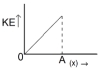
B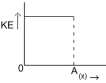
C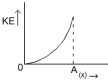
D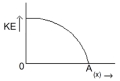
Solution
(D) For a particle executing simple harmonic motion $(SHM)$,the kinetic energy $(KE)$ as a function of displacement $(x)$ is given by the formula:
$KE = \frac{1}{2} m \omega^2 (A^2 - x^2)$
where $m$ is the mass of the particle,$\omega$ is the angular frequency,and $A$ is the amplitude.
$1$. At the mean position $(x = 0)$,the kinetic energy is maximum: $KE_{max} = \frac{1}{2} m \omega^2 A^2$.
$2$. At the extreme position ($x = A$ or $x = -A$),the kinetic energy is zero: $KE = 0$.
$3$. The equation $KE = \frac{1}{2} m \omega^2 A^2 - \frac{1}{2} m \omega^2 x^2$ represents a downward-opening parabola with respect to $x$.
Comparing this with the given options,the graph that shows maximum $KE$ at $x = 0$ and zero $KE$ at $x = A$ with a parabolic shape is represented by option $(D)$.
$KE = \frac{1}{2} m \omega^2 (A^2 - x^2)$
where $m$ is the mass of the particle,$\omega$ is the angular frequency,and $A$ is the amplitude.
$1$. At the mean position $(x = 0)$,the kinetic energy is maximum: $KE_{max} = \frac{1}{2} m \omega^2 A^2$.
$2$. At the extreme position ($x = A$ or $x = -A$),the kinetic energy is zero: $KE = 0$.
$3$. The equation $KE = \frac{1}{2} m \omega^2 A^2 - \frac{1}{2} m \omega^2 x^2$ represents a downward-opening parabola with respect to $x$.
Comparing this with the given options,the graph that shows maximum $KE$ at $x = 0$ and zero $KE$ at $x = A$ with a parabolic shape is represented by option $(D)$.
0 likesView Solution
253
PhysicsMediumMCQJEE Main · 2023
On a temperature scale $X$,the boiling point of water is $65^{\circ} X$ and the freezing point is $-15^{\circ} X$. Assume that the $X$ scale is linear. The equivalent temperature corresponding to $-95^{\circ} X$ on the Fahrenheit scale would be $..........^{\circ} F$.
A
$-63$
B
$-112$
C
$-48$
D
$-148$
Solution
(D) The relationship between any linear temperature scale and the Fahrenheit scale is given by the formula:
$\frac{X - X_{\text{freezing}}}{X_{\text{boiling}} - X_{\text{freezing}}} = \frac{F - 32}{212 - 32}$
Given:
$X_{\text{boiling}} = 65^{\circ} X$
$X_{\text{freezing}} = -15^{\circ} X$
$X = -95^{\circ} X$
Substituting the values into the formula:
$\frac{-95 - (-15)}{65 - (-15)} = \frac{F - 32}{180}$
$\frac{-95 + 15}{65 + 15} = \frac{F - 32}{180}$
$\frac{-80}{80} = \frac{F - 32}{180}$
$-1 = \frac{F - 32}{180}$
$-180 = F - 32$
$F = -180 + 32 = -148^{\circ} F$
$\frac{X - X_{\text{freezing}}}{X_{\text{boiling}} - X_{\text{freezing}}} = \frac{F - 32}{212 - 32}$
Given:
$X_{\text{boiling}} = 65^{\circ} X$
$X_{\text{freezing}} = -15^{\circ} X$
$X = -95^{\circ} X$
Substituting the values into the formula:
$\frac{-95 - (-15)}{65 - (-15)} = \frac{F - 32}{180}$
$\frac{-95 + 15}{65 + 15} = \frac{F - 32}{180}$
$\frac{-80}{80} = \frac{F - 32}{180}$
$-1 = \frac{F - 32}{180}$
$-180 = F - 32$
$F = -180 + 32 = -148^{\circ} F$
0 likesView Solution
254
PhysicsMediumMCQJEE Main · 2023
Given below are two statements:
Statement $I$: Astronomical unit $(AU)$,Parsec $(pc)$,and Light year $(ly)$ are units for measuring astronomical distances.
Statement $II$: $AU < pc < ly$
In the light of the above statements,choose the most appropriate answer from the options given below:
Statement $I$: Astronomical unit $(AU)$,Parsec $(pc)$,and Light year $(ly)$ are units for measuring astronomical distances.
Statement $II$: $AU < pc < ly$
In the light of the above statements,choose the most appropriate answer from the options given below:
A
Both Statement $I$ and Statement $II$ are correct.
B
Statement $I$ is correct but Statement $II$ is incorrect.
C
Both Statement $I$ and Statement $II$ are incorrect.
D
Statement $I$ is incorrect but Statement $II$ is correct.
Solution
(B) The values of the given units in meters are:
$1 \text{ AU} = 1.496 \times 10^{11} \text{ m}$
$1 \text{ ly} = 9.46 \times 10^{15} \text{ m}$
$1 \text{ pc} = 3.08 \times 10^{16} \text{ m}$
Comparing these values,we get $1 \text{ AU} < 1 \text{ ly} < 1 \text{ pc}$.
Statement $I$ is correct as these are units of distance.
Statement $II$ is incorrect because the correct order is $AU < ly < pc$.
$1 \text{ AU} = 1.496 \times 10^{11} \text{ m}$
$1 \text{ ly} = 9.46 \times 10^{15} \text{ m}$
$1 \text{ pc} = 3.08 \times 10^{16} \text{ m}$
Comparing these values,we get $1 \text{ AU} < 1 \text{ ly} < 1 \text{ pc}$.
Statement $I$ is correct as these are units of distance.
Statement $II$ is incorrect because the correct order is $AU < ly < pc$.
0 likesView Solution
255
PhysicsMediumMCQJEE Main · 2023
Three vessels of equal volume contain gases at the same temperature and pressure. The first vessel contains neon (monoatomic),the second contains chlorine (diatomic) and the third contains uranium hexafluoride (polyatomic). Arrange these on the basis of their root mean square speed $(v_{rms})$ and choose the correct answer from the options given below:
A
$v_{rms}(\text{mono}) = v_{rms}(\text{dia}) = v_{rms}(\text{poly})$
B
$v_{rms}(\text{mono}) > v_{rms}(\text{dia}) > v_{rms}(\text{poly})$
C
$v_{rms}(\text{dia}) < v_{rms}(\text{poly}) < v_{rms}(\text{mono})$
D
$v_{rms}(\text{mono}) < v_{rms}(\text{dia}) < v_{rms}(\text{poly})$
Solution
(B) The root mean square speed of a gas is given by the formula $v_{rms} = \sqrt{\frac{3RT}{M}}$,where $R$ is the universal gas constant,$T$ is the absolute temperature,and $M$ is the molar mass of the gas.
Since $T$ is the same for all three vessels,$v_{rms} \propto \frac{1}{\sqrt{M}}$.
The molar masses are:
Neon (monoatomic): $M_1 \approx 20 \text{ g/mol}$.
Chlorine (diatomic): $M_2 \approx 71 \text{ g/mol}$.
Uranium hexafluoride (polyatomic): $M_3 \approx 352 \text{ g/mol}$.
Since $M_1 < M_2 < M_3$,it follows that $\frac{1}{\sqrt{M_1}} > \frac{1}{\sqrt{M_2}} > \frac{1}{\sqrt{M_3}}$.
Therefore,$v_{rms}(\text{mono}) > v_{rms}(\text{dia}) > v_{rms}(\text{poly})$.
Since $T$ is the same for all three vessels,$v_{rms} \propto \frac{1}{\sqrt{M}}$.
The molar masses are:
Neon (monoatomic): $M_1 \approx 20 \text{ g/mol}$.
Chlorine (diatomic): $M_2 \approx 71 \text{ g/mol}$.
Uranium hexafluoride (polyatomic): $M_3 \approx 352 \text{ g/mol}$.
Since $M_1 < M_2 < M_3$,it follows that $\frac{1}{\sqrt{M_1}} > \frac{1}{\sqrt{M_2}} > \frac{1}{\sqrt{M_3}}$.
Therefore,$v_{rms}(\text{mono}) > v_{rms}(\text{dia}) > v_{rms}(\text{poly})$.
0 likesView Solution
256
PhysicsMediumMCQJEE Main · 2023
An average force of $125\,N$ is applied on a machine gun firing bullets each of mass $10\,g$ at the speed of $250\,m/s$ to keep it in position. The number of bullets fired per second by the machine gun is:
A
$5$
B
$50$
C
$100$
D
$25$
Solution
(B) The force exerted by the machine gun is equal to the rate of change of momentum of the bullets.
$F = \frac{dp}{dt} = n \cdot m \cdot v$
where $n$ is the number of bullets fired per second,$m$ is the mass of each bullet,and $v$ is the velocity of the bullets.
Given:
Force $F = 125\,N$
Mass $m = 10\,g = 10 \times 10^{-3}\,kg = 0.01\,kg$
Velocity $v = 250\,m/s$
Substituting the values into the formula:
$125 = n \times 0.01 \times 250$
$125 = n \times 2.5$
$n = \frac{125}{2.5} = 50$
Therefore,the number of bullets fired per second is $50$.
$F = \frac{dp}{dt} = n \cdot m \cdot v$
where $n$ is the number of bullets fired per second,$m$ is the mass of each bullet,and $v$ is the velocity of the bullets.
Given:
Force $F = 125\,N$
Mass $m = 10\,g = 10 \times 10^{-3}\,kg = 0.01\,kg$
Velocity $v = 250\,m/s$
Substituting the values into the formula:
$125 = n \times 0.01 \times 250$
$125 = n \times 2.5$
$n = \frac{125}{2.5} = 50$
Therefore,the number of bullets fired per second is $50$.
0 likesView Solution
257
PhysicsEasyMCQJEE Main · 2023
The equation of a wave is given by $Y = 10^{-2} \sin 2 \pi (160 t - 0.5 x + \frac{\pi}{4})$,where $x$ and $Y$ are in $m$ and $t$ is in $s$. The speed of the wave is $..... \, km \, h^{-1}$.
A
$1151$
B
$1152$
C
$1150$
D
$1156$
Solution
(B) The standard wave equation is $Y = A \sin (\omega t - kx + \phi)$.
Comparing the given equation $Y = 10^{-2} \sin 2 \pi (160 t - 0.5 x + \frac{\pi}{4})$ with the standard form,we have:
$\omega = 2 \pi \times 160 \, rad/s$
$k = 2 \pi \times 0.5 \, m^{-1}$
The speed of the wave $v$ is given by $v = \frac{\omega}{k} = \frac{2 \pi \times 160}{2 \pi \times 0.5} = \frac{160}{0.5} = 320 \, m/s$.
To convert the speed from $m/s$ to $km/h$,we multiply by $\frac{18}{5}$:
$v = 320 \times \frac{18}{5} = 64 \times 18 = 1152 \, km/h$.
Comparing the given equation $Y = 10^{-2} \sin 2 \pi (160 t - 0.5 x + \frac{\pi}{4})$ with the standard form,we have:
$\omega = 2 \pi \times 160 \, rad/s$
$k = 2 \pi \times 0.5 \, m^{-1}$
The speed of the wave $v$ is given by $v = \frac{\omega}{k} = \frac{2 \pi \times 160}{2 \pi \times 0.5} = \frac{160}{0.5} = 320 \, m/s$.
To convert the speed from $m/s$ to $km/h$,we multiply by $\frac{18}{5}$:
$v = 320 \times \frac{18}{5} = 64 \times 18 = 1152 \, km/h$.
1 likesView Solution
258
PhysicsMediumMCQJEE Main · 2023
$A$ force $\overrightarrow{F} = (2 + 3x) \hat{i}$ acts on a particle in the $x$ direction,where $F$ is in newton $(N)$ and $x$ is in meter $(m)$. The work done by this force during a displacement from $x = 0$ to $x = 4 \, m$ is ....... $J$.
A
$31$
B
$32$
C
$30$
D
$35$
Solution
(B) The work done by a variable force is given by the integral of the force with respect to displacement: $W = \int_{x_1}^{x_2} F(x) dx$.
Given $F(x) = 2 + 3x$,$x_1 = 0$,and $x_2 = 4$.
$W = \int_{0}^{4} (2 + 3x) dx$.
Integrating the expression: $W = [2x + \frac{3x^2}{2}]_{0}^{4}$.
Substituting the limits: $W = (2(4) + \frac{3(4)^2}{2}) - (2(0) + \frac{3(0)^2}{2})$.
$W = (8 + \frac{3 \times 16}{2}) - 0$.
$W = 8 + 3 \times 8 = 8 + 24 = 32 \, J$.
Given $F(x) = 2 + 3x$,$x_1 = 0$,and $x_2 = 4$.
$W = \int_{0}^{4} (2 + 3x) dx$.
Integrating the expression: $W = [2x + \frac{3x^2}{2}]_{0}^{4}$.
Substituting the limits: $W = (2(4) + \frac{3(4)^2}{2}) - (2(0) + \frac{3(0)^2}{2})$.
$W = (8 + \frac{3 \times 16}{2}) - 0$.
$W = 8 + 3 \times 8 = 8 + 24 = 32 \, J$.
0 likesView Solution
259
PhysicsMediumMCQJEE Main · 2023
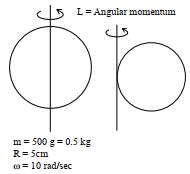
$A$ solid sphere of mass $500\,g$ and radius $5\,cm$ is rotated about one of its diameters with an angular speed of $10\,rad\,s^{-1}$. If the moment of inertia of the sphere about its tangent is $x \times 10^{-2}$ times its angular momentum about the diameter,then the value of $x$ will be ..............
A
$34$
B
$35$
C
$36$
D
$38$
Solution
(B) The moment of inertia of a solid sphere about its diameter is $I_d = \frac{2}{5}mR^2$.
The angular momentum of the sphere about its diameter is $L = I_d \omega = \frac{2}{5}mR^2 \omega$.
The moment of inertia of the sphere about its tangent is given by the parallel axis theorem: $I_t = I_{cm} + mR^2 = \frac{2}{5}mR^2 + mR^2 = \frac{7}{5}mR^2$.
According to the problem,$I_t = (x \times 10^{-2}) \times L$.
Substituting the expressions: $\frac{7}{5}mR^2 = (x \times 10^{-2}) \times (\frac{2}{5}mR^2 \omega)$.
Canceling $\frac{1}{5}mR^2$ from both sides: $7 = (x \times 10^{-2}) \times 2 \omega$.
Given $\omega = 10\,rad\,s^{-1}$,we have: $7 = (x \times 10^{-2}) \times 2 \times 10$.
$7 = x \times 10^{-2} \times 20$.
$7 = x \times 0.2$.
$x = \frac{7}{0.2} = 35$.
The angular momentum of the sphere about its diameter is $L = I_d \omega = \frac{2}{5}mR^2 \omega$.
The moment of inertia of the sphere about its tangent is given by the parallel axis theorem: $I_t = I_{cm} + mR^2 = \frac{2}{5}mR^2 + mR^2 = \frac{7}{5}mR^2$.
According to the problem,$I_t = (x \times 10^{-2}) \times L$.
Substituting the expressions: $\frac{7}{5}mR^2 = (x \times 10^{-2}) \times (\frac{2}{5}mR^2 \omega)$.
Canceling $\frac{1}{5}mR^2$ from both sides: $7 = (x \times 10^{-2}) \times 2 \omega$.
Given $\omega = 10\,rad\,s^{-1}$,we have: $7 = (x \times 10^{-2}) \times 2 \times 10$.
$7 = x \times 10^{-2} \times 20$.
$7 = x \times 0.2$.
$x = \frac{7}{0.2} = 35$.
0 likesView Solution
260
PhysicsMediumMCQJEE Main · 2023
The length of a wire becomes $l_1$ and $l_2$ when $100\,N$ and $120\,N$ tensions are applied respectively. If $10l_2 = 11l_1$,the natural length of the wire will be $\frac{1}{x} l_1$. Here,the value of $x$ is ........
A
$8$
B
$2$
C
$6$
D
$4$
Solution
(B) Let the natural length of the wire be $\ell_0$ and the force constant be $K$.
According to Hooke's Law,$T = K(\ell - \ell_0)$.
For the first case: $100 = K(l_1 - \ell_0)$ --- $(1)$
For the second case: $120 = K(l_2 - \ell_0)$ --- $(2)$
Dividing equation $(1)$ by $(2)$:
$\frac{100}{120} = \frac{l_1 - \ell_0}{l_2 - \ell_0} \Rightarrow \frac{5}{6} = \frac{l_1 - \ell_0}{l_2 - \ell_0}$
$5(l_2 - \ell_0) = 6(l_1 - \ell_0)$
$5l_2 - 5\ell_0 = 6l_1 - 6\ell_0$
$\ell_0 = 6l_1 - 5l_2$
Given that $10l_2 = 11l_1$,so $l_2 = \frac{11}{10}l_1$.
Substituting $l_2$ in the equation for $\ell_0$:
$\ell_0 = 6l_1 - 5(\frac{11}{10}l_1)$
$\ell_0 = 6l_1 - \frac{11}{2}l_1$
$\ell_0 = \frac{12l_1 - 11l_1}{2} = \frac{1}{2}l_1$
Comparing this with $\frac{1}{x}l_1$,we get $x = 2$.
According to Hooke's Law,$T = K(\ell - \ell_0)$.
For the first case: $100 = K(l_1 - \ell_0)$ --- $(1)$
For the second case: $120 = K(l_2 - \ell_0)$ --- $(2)$
Dividing equation $(1)$ by $(2)$:
$\frac{100}{120} = \frac{l_1 - \ell_0}{l_2 - \ell_0} \Rightarrow \frac{5}{6} = \frac{l_1 - \ell_0}{l_2 - \ell_0}$
$5(l_2 - \ell_0) = 6(l_1 - \ell_0)$
$5l_2 - 5\ell_0 = 6l_1 - 6\ell_0$
$\ell_0 = 6l_1 - 5l_2$
Given that $10l_2 = 11l_1$,so $l_2 = \frac{11}{10}l_1$.
Substituting $l_2$ in the equation for $\ell_0$:
$\ell_0 = 6l_1 - 5(\frac{11}{10}l_1)$
$\ell_0 = 6l_1 - \frac{11}{2}l_1$
$\ell_0 = \frac{12l_1 - 11l_1}{2} = \frac{1}{2}l_1$
Comparing this with $\frac{1}{x}l_1$,we get $x = 2$.
0 likesView Solution
261
PhysicsDifficultMCQJEE Main · 2023
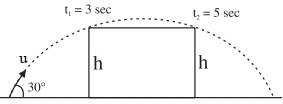
$A$ projectile fired at $30^{\circ}$ to the ground is observed to be at the same height at time $t_1 = 3 \, s$ and $t_2 = 5 \, s$ after projection,during its flight. The speed of projection of the projectile is $......... \, m \, s^{-1}$ (Given $g = 10 \, m \, s^{-2}$).
A
$70$
B
$80$
C
$60$
D
$50$
Solution
(B) For a projectile,the time of flight $T$ is the total time taken to return to the ground. If a projectile is at the same height $h$ at two different times $t_1$ and $t_2$,then the total time of flight $T$ is given by $T = t_1 + t_2$.
Given $t_1 = 3 \, s$ and $t_2 = 5 \, s$,the total time of flight is $T = 3 + 5 = 8 \, s$.
The formula for the time of flight is $T = \frac{2 u \sin \theta}{g}$,where $u$ is the initial speed,$\theta$ is the angle of projection,and $g$ is the acceleration due to gravity.
Substituting the given values: $8 = \frac{2 u \sin 30^{\circ}}{10}$.
Since $\sin 30^{\circ} = 0.5$,we have $8 = \frac{2 u (0.5)}{10}$.
$8 = \frac{u}{10}$.
Therefore,$u = 80 \, m \, s^{-1}$.
Given $t_1 = 3 \, s$ and $t_2 = 5 \, s$,the total time of flight is $T = 3 + 5 = 8 \, s$.
The formula for the time of flight is $T = \frac{2 u \sin \theta}{g}$,where $u$ is the initial speed,$\theta$ is the angle of projection,and $g$ is the acceleration due to gravity.
Substituting the given values: $8 = \frac{2 u \sin 30^{\circ}}{10}$.
Since $\sin 30^{\circ} = 0.5$,we have $8 = \frac{2 u (0.5)}{10}$.
$8 = \frac{u}{10}$.
Therefore,$u = 80 \, m \, s^{-1}$.
0 likesView Solution
262
PhysicsDifficultMCQJEE Main · 2023
Eight equal drops of water are falling through air with a steady speed of $10\,cm/s$. If the drops coalesce,the new velocity is $.........\,cm/s$.
A
$10$
B
$40$
C
$16$
D
$5$
Solution
(B) For a small drop falling through a viscous medium at terminal velocity,the terminal velocity $v$ is given by $v = \frac{2}{9} \frac{r^2 (\rho - \sigma) g}{\eta}$,which implies $v \propto r^2$.
Let $r$ be the radius of each small drop and $R$ be the radius of the large drop formed by coalescing $8$ small drops.
Since the volume is conserved,$8 \times (\frac{4}{3} \pi r^3) = \frac{4}{3} \pi R^3$,which gives $R^3 = 8r^3$,so $R = 2r$.
Using the proportionality $v \propto r^2$,we have $\frac{v_1}{v_2} = (\frac{r}{R})^2$.
Substituting the values,$\frac{10}{v_2} = (\frac{r}{2r})^2 = (\frac{1}{2})^2 = \frac{1}{4}$.
Therefore,$v_2 = 10 \times 4 = 40\,cm/s$.
Let $r$ be the radius of each small drop and $R$ be the radius of the large drop formed by coalescing $8$ small drops.
Since the volume is conserved,$8 \times (\frac{4}{3} \pi r^3) = \frac{4}{3} \pi R^3$,which gives $R^3 = 8r^3$,so $R = 2r$.
Using the proportionality $v \propto r^2$,we have $\frac{v_1}{v_2} = (\frac{r}{R})^2$.
Substituting the values,$\frac{10}{v_2} = (\frac{r}{2r})^2 = (\frac{1}{2})^2 = \frac{1}{4}$.
Therefore,$v_2 = 10 \times 4 = 40\,cm/s$.
0 likesView Solution
263
PhysicsMediumMCQJEE Main · 2023
$A$ car $P$ travelling at $20\,ms^{-1}$ sounds its horn at a frequency of $400\,Hz$. Another car $Q$ is travelling behind the first car in the same direction with a velocity $40\,ms^{-1}$. The frequency heard by the passenger of the car $Q$ is approximately $.......\,Hz$. [Take,velocity of sound $= 360\,ms^{-1}$]
A
$514$
B
$421$
C
$485$
D
$471$
Solution
(B) According to the Doppler effect,the observed frequency $f$ is given by the formula:
$f = f_0 \left( \frac{c + v_o}{c + v_s} \right)$
Where:
$f_0 = 400\,Hz$ (source frequency)
$c = 360\,ms^{-1}$ (velocity of sound)
$v_o = 40\,ms^{-1}$ (velocity of the observer,car $Q$,moving towards the source)
$v_s = 20\,ms^{-1}$ (velocity of the source,car $P$,moving away from the observer)
Substituting the values:
$f = 400 \left( \frac{360 + 40}{360 + 20} \right)$
$f = 400 \left( \frac{400}{380} \right)$
$f = 400 \times 1.0526$
$f \approx 421.05\,Hz$
Thus,the frequency heard by the passenger is approximately $421\,Hz$.
$f = f_0 \left( \frac{c + v_o}{c + v_s} \right)$
Where:
$f_0 = 400\,Hz$ (source frequency)
$c = 360\,ms^{-1}$ (velocity of sound)
$v_o = 40\,ms^{-1}$ (velocity of the observer,car $Q$,moving towards the source)
$v_s = 20\,ms^{-1}$ (velocity of the source,car $P$,moving away from the observer)
Substituting the values:
$f = 400 \left( \frac{360 + 40}{360 + 20} \right)$
$f = 400 \left( \frac{400}{380} \right)$
$f = 400 \times 1.0526$
$f \approx 421.05\,Hz$
Thus,the frequency heard by the passenger is approximately $421\,Hz$.
0 likesView Solution
264
PhysicsMediumMCQJEE Main · 2023
If force $(F)$,velocity $(V)$,and time $(T)$ are considered as fundamental physical quantities,then the dimensional formula of density will be:
A
$F V^{-2} T^2$
B
$F V^{-4} T^{-2}$
C
$F V^{-4} T^2$
D
$F^2 V^{-2} T^6$
Solution
(B) The dimensional formula for density $(\rho)$ is $[M L^{-3}]$.
Let the dimensional formula be expressed as $[\rho] = [F]^a [V]^b [T]^c$.
Substituting the dimensions: $[M L^{-3}] = [M L T^{-2}]^a [L T^{-1}]^b [T]^c$.
$[M L^{-3}] = [M^a L^{a+b} T^{-2a-b+c}]$.
Comparing the powers of $M$,$L$,and $T$ on both sides:
For $M$: $a = 1$.
For $L$: $a + b = -3 \Rightarrow 1 + b = -3 \Rightarrow b = -4$.
For $T$: $-2a - b + c = 0 \Rightarrow -2(1) - (-4) + c = 0 \Rightarrow -2 + 4 + c = 0 \Rightarrow 2 + c = 0 \Rightarrow c = -2$.
Thus,the dimensional formula is $[F^1 V^{-4} T^{-2}]$.
Let the dimensional formula be expressed as $[\rho] = [F]^a [V]^b [T]^c$.
Substituting the dimensions: $[M L^{-3}] = [M L T^{-2}]^a [L T^{-1}]^b [T]^c$.
$[M L^{-3}] = [M^a L^{a+b} T^{-2a-b+c}]$.
Comparing the powers of $M$,$L$,and $T$ on both sides:
For $M$: $a = 1$.
For $L$: $a + b = -3 \Rightarrow 1 + b = -3 \Rightarrow b = -4$.
For $T$: $-2a - b + c = 0 \Rightarrow -2(1) - (-4) + c = 0 \Rightarrow -2 + 4 + c = 0 \Rightarrow 2 + c = 0 \Rightarrow c = -2$.
Thus,the dimensional formula is $[F^1 V^{-4} T^{-2}]$.
0 likesView Solution
265
PhysicsDifficultMCQJEE Main · 2023
If $V$ is the gravitational potential due to a sphere of uniform density on its surface,then its value at the center of the sphere will be:
A
$\frac{3 V}{2}$
B
$V$
C
$\frac{4}{3} V$
D
$\frac{V}{2}$
Solution
(A) The gravitational potential $V$ inside a uniform solid sphere at a distance $r$ from the center is given by $V(r) = \frac{GM}{2R^3}(3R^2 - r^2)$.
At the surface,$r = R$,so $V_{surface} = \frac{GM}{2R^3}(3R^2 - R^2) = \frac{GM}{2R^3}(2R^2) = \frac{GM}{R} = V$.
At the center,$r = 0$,so $V_{center} = \frac{GM}{2R^3}(3R^2 - 0) = \frac{3GM}{2R}$.
Substituting $V = \frac{GM}{R}$,we get $V_{center} = \frac{3}{2} V$.
At the surface,$r = R$,so $V_{surface} = \frac{GM}{2R^3}(3R^2 - R^2) = \frac{GM}{2R^3}(2R^2) = \frac{GM}{R} = V$.
At the center,$r = 0$,so $V_{center} = \frac{GM}{2R^3}(3R^2 - 0) = \frac{3GM}{2R}$.
Substituting $V = \frac{GM}{R}$,we get $V_{center} = \frac{3}{2} V$.
2 likesView Solution
266
PhysicsMediumMCQJEE Main · 2023
$A$ body of mass $500\,g$ moves along the $x$-axis such that its velocity varies with displacement $x$ according to the relation $v = 10\sqrt{x}\,m/s$. The force acting on the body is $...........\,N$.
A
$166$
B
$25$
C
$125$
D
$5$
Solution
(B) Given mass $m = 500\,g = 0.5\,kg$.
The velocity is given by $v = 10\sqrt{x}$.
Squaring both sides,we get $v^2 = 100x$.
Differentiating both sides with respect to $x$,we get $2v \frac{dv}{dx} = 100$.
Since acceleration $a = v \frac{dv}{dx}$,we can write $2a = 100$,which gives $a = 50\,m/s^2$.
The force acting on the body is $F = ma$.
Substituting the values,$F = 0.5\,kg \times 50\,m/s^2 = 25\,N$.
The velocity is given by $v = 10\sqrt{x}$.
Squaring both sides,we get $v^2 = 100x$.
Differentiating both sides with respect to $x$,we get $2v \frac{dv}{dx} = 100$.
Since acceleration $a = v \frac{dv}{dx}$,we can write $2a = 100$,which gives $a = 50\,m/s^2$.
The force acting on the body is $F = ma$.
Substituting the values,$F = 0.5\,kg \times 50\,m/s^2 = 25\,N$.
0 likesView Solution
267
PhysicsMediumMCQJEE Main · 2023
$A$ projectile is projected at $30^{\circ}$ from horizontal with initial velocity $40\,m/s$. The velocity of the projectile at $t = 2\,s$ from the start will be $........$ (Given $g = 10\,m/s^2$)
A
$20\sqrt{3}\,m/s$
B
$40\sqrt{3}\,m/s$
C
$20\,m/s$
D
Zero
Solution
(A) The initial velocity components are:
$u_x = u \cos 30^{\circ} = 40 \times \frac{\sqrt{3}}{2} = 20\sqrt{3}\,m/s$
$u_y = u \sin 30^{\circ} = 40 \times \frac{1}{2} = 20\,m/s$
At time $t = 2\,s$,the horizontal component of velocity remains constant:
$v_x = u_x = 20\sqrt{3}\,m/s$
The vertical component of velocity is given by $v_y = u_y - gt$:
$v_y = 20 - (10 \times 2) = 20 - 20 = 0\,m/s$
Since the vertical component is zero,the resultant velocity is $v = \sqrt{v_x^2 + v_y^2} = \sqrt{(20\sqrt{3})^2 + 0^2} = 20\sqrt{3}\,m/s$.
$u_x = u \cos 30^{\circ} = 40 \times \frac{\sqrt{3}}{2} = 20\sqrt{3}\,m/s$
$u_y = u \sin 30^{\circ} = 40 \times \frac{1}{2} = 20\,m/s$
At time $t = 2\,s$,the horizontal component of velocity remains constant:
$v_x = u_x = 20\sqrt{3}\,m/s$
The vertical component of velocity is given by $v_y = u_y - gt$:
$v_y = 20 - (10 \times 2) = 20 - 20 = 0\,m/s$
Since the vertical component is zero,the resultant velocity is $v = \sqrt{v_x^2 + v_y^2} = \sqrt{(20\sqrt{3})^2 + 0^2} = 20\sqrt{3}\,m/s$.
1 likesView Solution
268
PhysicsMediumMCQJEE Main · 2023
$A$ spaceship of mass $2 \times 10^4 \, kg$ is launched into a circular orbit close to the Earth's surface. The additional velocity to be imparted to the spaceship in the orbit to overcome the gravitational pull will be $......$ (given $g = 10 \, m/s^2$ and radius of Earth $R = 6400 \, km$).
A
$11.2(\sqrt{2}-1) \, km/s$
B
$7.9(\sqrt{2}-1) \, km/s$
C
$8(\sqrt{2}-1) \, km/s$
D
$7.4(\sqrt{2}-1) \, km/s$
Solution
(C) The orbital velocity of a satellite close to the Earth's surface is given by $v_{\text{orbit}} = \sqrt{gR}$.
Substituting the values: $v_{\text{orbit}} = \sqrt{10 \times 6.4 \times 10^6} = \sqrt{64 \times 10^6} = 8000 \, m/s = 8 \, km/s$.
The escape velocity from the Earth's surface is given by $v_{\text{escape}} = \sqrt{2gR} = \sqrt{2} \times v_{\text{orbit}}$.
Substituting the value: $v_{\text{escape}} = 8\sqrt{2} \, km/s$.
The additional velocity required to overcome the gravitational pull is $\Delta v = v_{\text{escape}} - v_{\text{orbit}}$.
$\Delta v = 8\sqrt{2} - 8 = 8(\sqrt{2}-1) \, km/s$.
Substituting the values: $v_{\text{orbit}} = \sqrt{10 \times 6.4 \times 10^6} = \sqrt{64 \times 10^6} = 8000 \, m/s = 8 \, km/s$.
The escape velocity from the Earth's surface is given by $v_{\text{escape}} = \sqrt{2gR} = \sqrt{2} \times v_{\text{orbit}}$.
Substituting the value: $v_{\text{escape}} = 8\sqrt{2} \, km/s$.
The additional velocity required to overcome the gravitational pull is $\Delta v = v_{\text{escape}} - v_{\text{orbit}}$.
$\Delta v = 8\sqrt{2} - 8 = 8(\sqrt{2}-1) \, km/s$.
0 likesView Solution
269
PhysicsEasyMCQJEE Main · 2023
The thermodynamic process,in which the internal energy of the system remains constant is ...........
A
Isochoric
B
Isothermal
C
Adiabatic
D
Isobaric
Solution
(B) The internal energy $(U)$ of an ideal gas is a function of temperature $(T)$ only,given by $U = f(T)$.
If the internal energy remains constant,then the change in internal energy $\Delta U = 0$.
Since $\Delta U = nC_v\Delta T$,this implies that $\Delta T = 0$,meaning the temperature remains constant.
$A$ process in which the temperature of the system remains constant is called an isothermal process.
If the internal energy remains constant,then the change in internal energy $\Delta U = 0$.
Since $\Delta U = nC_v\Delta T$,this implies that $\Delta T = 0$,meaning the temperature remains constant.
$A$ process in which the temperature of the system remains constant is called an isothermal process.
0 likesView Solution
270
PhysicsEasyMCQJEE Main · 2023
The root mean square speed of molecules of nitrogen gas at $27^{\circ} C$ is approximately $.......m/s$. (Given: mass of a nitrogen molecule $= 4.6 \times 10^{-26} \, kg$ and Boltzmann constant $k_{B} = 1.4 \times 10^{-23} \, J K^{-1}$)
A
$523$
B
$1260$
C
$91$
D
$27.4$
Solution
(A) The root mean square speed $(V_{rms})$ of gas molecules is given by the formula: $V_{rms} = \sqrt{\frac{3 k_{B} T}{m}}$.
Given:
Temperature $T = 27^{\circ} C = 27 + 273 = 300 \, K$.
Mass of a nitrogen molecule $m = 4.6 \times 10^{-26} \, kg$.
Boltzmann constant $k_{B} = 1.4 \times 10^{-23} \, J K^{-1}$.
Substituting the values into the formula:
$V_{rms} = \sqrt{\frac{3 \times 1.4 \times 10^{-23} \times 300}{4.6 \times 10^{-26}}}$
$V_{rms} = \sqrt{\frac{1260 \times 10^{-23}}{4.6 \times 10^{-26}}}$
$V_{rms} = \sqrt{273.91 \times 10^{3}} \approx \sqrt{273910} \approx 523.36 \, m/s$.
Thus,the approximate speed is $523 \, m/s$.
Given:
Temperature $T = 27^{\circ} C = 27 + 273 = 300 \, K$.
Mass of a nitrogen molecule $m = 4.6 \times 10^{-26} \, kg$.
Boltzmann constant $k_{B} = 1.4 \times 10^{-23} \, J K^{-1}$.
Substituting the values into the formula:
$V_{rms} = \sqrt{\frac{3 \times 1.4 \times 10^{-23} \times 300}{4.6 \times 10^{-26}}}$
$V_{rms} = \sqrt{\frac{1260 \times 10^{-23}}{4.6 \times 10^{-26}}}$
$V_{rms} = \sqrt{273.91 \times 10^{3}} \approx \sqrt{273910} \approx 523.36 \, m/s$.
Thus,the approximate speed is $523 \, m/s$.
0 likesView Solution
271
PhysicsEasyMCQJEE Main · 2023
When vector $\overrightarrow{A} = 2\hat{i} + 3\hat{j} + 2\hat{k}$ is subtracted from vector $\vec{B}$,it gives a vector equal to $2\hat{j}$. Then the magnitude of vector $\vec{B}$ will be:
A
$\sqrt{13}$
B
$\sqrt{33}$
C
$\sqrt{6}$
D
$\sqrt{5}$
Solution
(B) Given that $\vec{B} - \overrightarrow{A} = 2\hat{j}$.
Substituting the value of $\overrightarrow{A} = 2\hat{i} + 3\hat{j} + 2\hat{k}$ into the equation:
$\vec{B} - (2\hat{i} + 3\hat{j} + 2\hat{k}) = 2\hat{j}$
$\vec{B} = 2\hat{j} + (2\hat{i} + 3\hat{j} + 2\hat{k})$
$\vec{B} = 2\hat{i} + 5\hat{j} + 2\hat{k}$
The magnitude of vector $\vec{B}$ is given by $|\vec{B}| = \sqrt{x^2 + y^2 + z^2}$.
$|\vec{B}| = \sqrt{2^2 + 5^2 + 2^2}$
$|\vec{B}| = \sqrt{4 + 25 + 4}$
$|\vec{B}| = \sqrt{33}$
Substituting the value of $\overrightarrow{A} = 2\hat{i} + 3\hat{j} + 2\hat{k}$ into the equation:
$\vec{B} - (2\hat{i} + 3\hat{j} + 2\hat{k}) = 2\hat{j}$
$\vec{B} = 2\hat{j} + (2\hat{i} + 3\hat{j} + 2\hat{k})$
$\vec{B} = 2\hat{i} + 5\hat{j} + 2\hat{k}$
The magnitude of vector $\vec{B}$ is given by $|\vec{B}| = \sqrt{x^2 + y^2 + z^2}$.
$|\vec{B}| = \sqrt{2^2 + 5^2 + 2^2}$
$|\vec{B}| = \sqrt{4 + 25 + 4}$
$|\vec{B}| = \sqrt{33}$
0 likesView Solution
272
PhysicsMediumMCQJEE Main · 2023
$A$ circular plate is rotating in a horizontal plane about an axis passing through its center and perpendicular to the plate with an angular velocity $\omega$. $A$ person sits at the center holding two dumbbells. When he stretches out his hands,the moment of inertia of the system becomes triple. If $E$ is the initial kinetic energy of the system,then the final kinetic energy will be $\frac{E}{x}$. The value of $x$ is $....$
A
$3$
B
$6$
C
$9$
D
$12$
Solution
(A) The rotational kinetic energy is given by $K = \frac{L^2}{2I}$,where $L$ is the angular momentum and $I$ is the moment of inertia.
Since there are no external torques acting on the system,the angular momentum $L$ remains constant.
Therefore,the kinetic energy is inversely proportional to the moment of inertia: $K \propto \frac{1}{I}$.
Let $I_i$ and $K_i = E$ be the initial moment of inertia and initial kinetic energy,respectively.
Let $I_f$ and $K_f$ be the final moment of inertia and final kinetic energy,respectively.
Given that $I_f = 3I_i$,we have:
$\frac{K_f}{K_i} = \frac{I_i}{I_f} = \frac{I_i}{3I_i} = \frac{1}{3}$.
Thus,$K_f = \frac{K_i}{3} = \frac{E}{3}$.
Comparing this with $\frac{E}{x}$,we get $x = 3$.
Since there are no external torques acting on the system,the angular momentum $L$ remains constant.
Therefore,the kinetic energy is inversely proportional to the moment of inertia: $K \propto \frac{1}{I}$.
Let $I_i$ and $K_i = E$ be the initial moment of inertia and initial kinetic energy,respectively.
Let $I_f$ and $K_f$ be the final moment of inertia and final kinetic energy,respectively.
Given that $I_f = 3I_i$,we have:
$\frac{K_f}{K_i} = \frac{I_i}{I_f} = \frac{I_i}{3I_i} = \frac{1}{3}$.
Thus,$K_f = \frac{K_i}{3} = \frac{E}{3}$.
Comparing this with $\frac{E}{x}$,we get $x = 3$.
0 likesView Solution
273
PhysicsDifficultMCQJEE Main · 2023
$A$ block of mass $5\,kg$ starting from rest is pulled up on a smooth inclined plane making an angle of $30^{\circ}$ with the horizontal with an effective acceleration of $1\,m/s^2$. The power delivered by the pulling force at $t = 10\,s$ from the start is $.....\,W$. [Use $g = 10\,m/s^2$] (calculate the nearest integer value).
A
$300$
B
$50$
C
$100$
D
$200$
Solution
(A) Given: Mass $m = 5\,kg$,acceleration $a = 1\,m/s^2$,angle $\theta = 30^{\circ}$,time $t = 10\,s$,$g = 10\,m/s^2$.
Applying Newton's second law along the incline:
$F - mg \sin 30^{\circ} = ma$
$F - 5 \times 10 \times 0.5 = 5 \times 1$
$F - 25 = 5 \Rightarrow F = 30\,N$.
Calculating velocity at $t = 10\,s$ using $v = u + at$:
$v = 0 + 1 \times 10 = 10\,m/s$.
Calculating power $P = F \times v$:
$P = 30 \times 10 = 300\,W$.
Applying Newton's second law along the incline:
$F - mg \sin 30^{\circ} = ma$
$F - 5 \times 10 \times 0.5 = 5 \times 1$
$F - 25 = 5 \Rightarrow F = 30\,N$.
Calculating velocity at $t = 10\,s$ using $v = u + at$:
$v = 0 + 1 \times 10 = 10\,m/s$.
Calculating power $P = F \times v$:
$P = 30 \times 10 = 300\,W$.
0 likesView Solution
274
PhysicsMediumMCQJEE Main · 2023
$A$ wire of density $8 \times 10^3\,kg/m^3$ is stretched between two clamps $0.5\,m$ apart. The extension developed in the wire is $3.2 \times 10^{-4}\,m$. If Young's modulus $Y = 8 \times 10^{10}\,N/m^2$,the fundamental frequency of vibration in the wire will be $......\,Hz$.
A
$80$
B
$60$
C
$40$
D
$20$
Solution
(A) The fundamental frequency of a stretched wire is given by $f = \frac{1}{2L} \sqrt{\frac{T}{\mu}}$.
Here,$T$ is the tension and $\mu$ is the linear mass density.
We know that $T = Y A \frac{\Delta L}{L}$ and $\mu = \rho A$,where $A$ is the cross-sectional area.
Substituting these into the frequency formula:
$f = \frac{1}{2L} \sqrt{\frac{Y A \Delta L / L}{\rho A}} = \frac{1}{2L} \sqrt{\frac{Y \Delta L}{\rho L}}$.
Given values: $L = 0.5\,m$,$\Delta L = 3.2 \times 10^{-4}\,m$,$Y = 8 \times 10^{10}\,N/m^2$,$\rho = 8 \times 10^3\,kg/m^3$.
$f = \frac{1}{2 \times 0.5} \sqrt{\frac{8 \times 10^{10} \times 3.2 \times 10^{-4}}{8 \times 10^3 \times 0.5}}$.
$f = 1 \times \sqrt{\frac{25.6 \times 10^6}{4 \times 10^3}} = \sqrt{6.4 \times 10^3} = \sqrt{6400} = 80\,Hz$.
Here,$T$ is the tension and $\mu$ is the linear mass density.
We know that $T = Y A \frac{\Delta L}{L}$ and $\mu = \rho A$,where $A$ is the cross-sectional area.
Substituting these into the frequency formula:
$f = \frac{1}{2L} \sqrt{\frac{Y A \Delta L / L}{\rho A}} = \frac{1}{2L} \sqrt{\frac{Y \Delta L}{\rho L}}$.
Given values: $L = 0.5\,m$,$\Delta L = 3.2 \times 10^{-4}\,m$,$Y = 8 \times 10^{10}\,N/m^2$,$\rho = 8 \times 10^3\,kg/m^3$.
$f = \frac{1}{2 \times 0.5} \sqrt{\frac{8 \times 10^{10} \times 3.2 \times 10^{-4}}{8 \times 10^3 \times 0.5}}$.
$f = 1 \times \sqrt{\frac{25.6 \times 10^6}{4 \times 10^3}} = \sqrt{6.4 \times 10^3} = \sqrt{6400} = 80\,Hz$.
0 likesView Solution
275
PhysicsMediumMCQJEE Main · 2023
The surface tension of a soap solution is $3.5 \times 10^{-2} \, N m^{-1}$. The amount of work done required to increase the radius of a soap bubble from $10 \, cm$ to $20 \, cm$ is $..... \times 10^{-4} \, J$.
A
$264$
B
$263$
C
$262$
D
$265$
Solution
(A) The surface tension $T = 3.5 \times 10^{-2} \, N m^{-1}$.
Initial radius $r_1 = 10 \, cm = 0.1 \, m$.
Final radius $r_2 = 20 \, cm = 0.2 \, m$.
$A$ soap bubble has two surfaces (inner and outer),so the change in surface area is $\Delta A = 2 \times (4 \pi r_2^2 - 4 \pi r_1^2) = 8 \pi (r_2^2 - r_1^2)$.
The work done $W = T \times \Delta A = T \times 8 \pi (r_2^2 - r_1^2)$.
Substituting the values: $W = 3.5 \times 10^{-2} \times 8 \times 3.14159 \times (0.2^2 - 0.1^2)$.
$W = 3.5 \times 10^{-2} \times 8 \times 3.14159 \times (0.04 - 0.01) = 3.5 \times 10^{-2} \times 8 \times 3.14159 \times 0.03$.
$W = 0.28 \times 3.14159 \times 0.03 = 0.026389 \, J$.
Converting to the required format: $W \approx 264 \times 10^{-4} \, J$.
Initial radius $r_1 = 10 \, cm = 0.1 \, m$.
Final radius $r_2 = 20 \, cm = 0.2 \, m$.
$A$ soap bubble has two surfaces (inner and outer),so the change in surface area is $\Delta A = 2 \times (4 \pi r_2^2 - 4 \pi r_1^2) = 8 \pi (r_2^2 - r_1^2)$.
The work done $W = T \times \Delta A = T \times 8 \pi (r_2^2 - r_1^2)$.
Substituting the values: $W = 3.5 \times 10^{-2} \times 8 \times 3.14159 \times (0.2^2 - 0.1^2)$.
$W = 3.5 \times 10^{-2} \times 8 \times 3.14159 \times (0.04 - 0.01) = 3.5 \times 10^{-2} \times 8 \times 3.14159 \times 0.03$.
$W = 0.28 \times 3.14159 \times 0.03 = 0.026389 \, J$.
Converting to the required format: $W \approx 264 \times 10^{-4} \, J$.
0 likesView Solution
276
PhysicsMediumMCQJEE Main · 2023
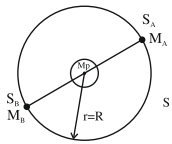
Two satellites $A$ and $B$ move around the Earth in the same orbit. The mass of $A$ is twice the mass of $B$. The quantity which is the same for the two satellites will be:
A
Potential energy
B
Total energy
C
Kinetic energy
D
Speed
Solution
(D) Let $M_p$ be the mass of the Earth,$m$ be the mass of the satellite,and $R$ be the orbital radius.
Potential energy $(U)$ $= -\frac{G M_p m}{R}$. Since $m_A = 2m_B$,$U_A \neq U_B$.
Kinetic energy $(K)$ $= \frac{G M_p m}{2R}$. Since $m_A = 2m_B$,$K_A \neq K_B$.
Total energy $(E)$ $= U + K = -\frac{G M_p m}{2R}$. Since $m_A = 2m_B$,$E_A \neq E_B$.
Orbital speed $(v)$ $= \sqrt{\frac{G M_p}{R}}$.
As seen from the formula,the orbital speed is independent of the mass of the satellite $(m)$. Therefore,both satellites will have the same speed.
Potential energy $(U)$ $= -\frac{G M_p m}{R}$. Since $m_A = 2m_B$,$U_A \neq U_B$.
Kinetic energy $(K)$ $= \frac{G M_p m}{2R}$. Since $m_A = 2m_B$,$K_A \neq K_B$.
Total energy $(E)$ $= U + K = -\frac{G M_p m}{2R}$. Since $m_A = 2m_B$,$E_A \neq E_B$.
Orbital speed $(v)$ $= \sqrt{\frac{G M_p}{R}}$.
As seen from the formula,the orbital speed is independent of the mass of the satellite $(m)$. Therefore,both satellites will have the same speed.
0 likesView Solution
277
PhysicsEasyMCQJEE Main · 2023
If the r.m.s. speed of a chlorine molecule is $490\,m/s$ at $27^{\circ}C$,the r.m.s. speed of argon molecules at the same temperature will be $......\,m/s$ (Atomic mass of argon $= 39.9\,u$,molecular mass of chlorine $= 70.9\,u$). (in $.7$)
A
$751$
B
$451$
C
$651$
D
$551$
Solution
(C) The root mean square (r.m.s.) speed of a gas molecule is given by the formula $v_{rms} = \sqrt{\frac{3RT}{M}}$,where $R$ is the universal gas constant,$T$ is the absolute temperature,and $M$ is the molar mass.
Since the temperature $T$ is the same for both gases,we have $v_{rms} \propto \frac{1}{\sqrt{M}}$.
Therefore,the ratio of the r.m.s. speeds is $\frac{v_{Ar}}{v_{Cl}} = \sqrt{\frac{M_{Cl}}{M_{Ar}}}$.
Given $v_{Cl} = 490\,m/s$,$M_{Cl} = 70.9\,u$,and $M_{Ar} = 39.9\,u$.
Substituting the values: $v_{Ar} = 490 \times \sqrt{\frac{70.9}{39.9}}$.
$v_{Ar} = 490 \times \sqrt{1.7769} \approx 490 \times 1.333 = 653.17\,m/s$.
Rounding to the nearest provided option,we get $651.7\,m/s$.
Since the temperature $T$ is the same for both gases,we have $v_{rms} \propto \frac{1}{\sqrt{M}}$.
Therefore,the ratio of the r.m.s. speeds is $\frac{v_{Ar}}{v_{Cl}} = \sqrt{\frac{M_{Cl}}{M_{Ar}}}$.
Given $v_{Cl} = 490\,m/s$,$M_{Cl} = 70.9\,u$,and $M_{Ar} = 39.9\,u$.
Substituting the values: $v_{Ar} = 490 \times \sqrt{\frac{70.9}{39.9}}$.
$v_{Ar} = 490 \times \sqrt{1.7769} \approx 490 \times 1.333 = 653.17\,m/s$.
Rounding to the nearest provided option,we get $651.7\,m/s$.
0 likesView Solution
278
PhysicsMediumMCQJEE Main · 2023
Match List $I$ with List $II$:
Choose the correct answer from the options given below:
| List $I$ | List $II$ |
| $A$. Spring constant | $I$. $(T^{-1})$ |
| $B$. Angular speed | $II$. $(MT^{-2})$ |
| $C$. Angular momentum | $III$. $(ML^2)$ |
| $D$. Moment of inertia | $IV$. $(ML^2T^{-1})$ |
Choose the correct answer from the options given below:
A
$(A)-(II), (B)-(I), (C)-(IV), (D)-(III)$
B
$(A)-(IV), (B)-(I), (C)-(III), (D)-(II)$
C
$(A)-(II), (B)-(III), (C)-(I), (D)-(IV)$
D
$(A)-(I), (B)-(III), (C)-(II), (D)-(IV)$
Solution
(A) $1$. Spring constant $(k)$: $F = kx \implies [k] = [F]/[x] = (MLT^{-2}) / L = MT^{-2}$. Thus,$A-II$.
$2$. Angular speed $(\omega)$: $\omega = \Delta\theta / \Delta t \implies [\omega] = [1] / T = T^{-1}$. Thus,$B-I$.
$3$. Angular momentum $(L)$: $L = mvr \implies [L] = M(LT^{-1})L = ML^2T^{-1}$. Thus,$C-IV$.
$4$. Moment of inertia $(I)$: $I = mr^2 \implies [I] = ML^2$. Thus,$D-III$.
Therefore,the correct matching is $(A)-(II), (B)-(I), (C)-(IV), (D)-(III)$.
$2$. Angular speed $(\omega)$: $\omega = \Delta\theta / \Delta t \implies [\omega] = [1] / T = T^{-1}$. Thus,$B-I$.
$3$. Angular momentum $(L)$: $L = mvr \implies [L] = M(LT^{-1})L = ML^2T^{-1}$. Thus,$C-IV$.
$4$. Moment of inertia $(I)$: $I = mr^2 \implies [I] = ML^2$. Thus,$D-III$.
Therefore,the correct matching is $(A)-(II), (B)-(I), (C)-(IV), (D)-(III)$.
0 likesView Solution
279
PhysicsMediumMCQJEE Main · 2023
Three forces $F_1=10\,N$,$F_2=8\,N$,and $F_3=6\,N$ are acting on a particle of mass $5\,kg$. The forces $F_2$ and $F_3$ are applied perpendicular to each other such that the particle remains at rest. If the force $F_1$ is removed,then the acceleration of the particle is $......\,m/s^2$.
A
$2$
B
$0.5$
C
$4.8$
D
$7$
Solution
(A) Given that the particle is in equilibrium under the action of three forces $F_1$,$F_2$,and $F_3$.
Since $F_2$ and $F_3$ are perpendicular,their resultant force $F_{23}$ is given by $F_{23} = \sqrt{F_2^2 + F_3^2} = \sqrt{8^2 + 6^2} = \sqrt{64 + 36} = \sqrt{100} = 10\,N$.
For the particle to be at rest,the resultant of all forces must be zero,meaning $F_1$ must be equal and opposite to the resultant of $F_2$ and $F_3$.
When $F_1$ is removed,the only forces acting on the particle are $F_2$ and $F_3$.
The net force acting on the particle becomes the resultant of $F_2$ and $F_3$,which is $10\,N$.
Using Newton's second law,$F_{net} = ma$,we have $10\,N = 5\,kg \times a$.
Therefore,$a = \frac{10}{5} = 2\,m/s^2$.
Since $F_2$ and $F_3$ are perpendicular,their resultant force $F_{23}$ is given by $F_{23} = \sqrt{F_2^2 + F_3^2} = \sqrt{8^2 + 6^2} = \sqrt{64 + 36} = \sqrt{100} = 10\,N$.
For the particle to be at rest,the resultant of all forces must be zero,meaning $F_1$ must be equal and opposite to the resultant of $F_2$ and $F_3$.
When $F_1$ is removed,the only forces acting on the particle are $F_2$ and $F_3$.
The net force acting on the particle becomes the resultant of $F_2$ and $F_3$,which is $10\,N$.
Using Newton's second law,$F_{net} = ma$,we have $10\,N = 5\,kg \times a$.
Therefore,$a = \frac{10}{5} = 2\,m/s^2$.
0 likesView Solution
280
PhysicsMediumMCQJEE Main · 2023
$A$ body cools from $80^{\circ} C$ to $60^{\circ} C$ in $5$ minutes. The temperature of the surrounding is $20^{\circ} C$. The time it takes to cool from $60^{\circ} C$ to $40^{\circ} C$ is........... $s$
A
$500$
B
$600$
C
$450$
D
$420$
Solution
(A) According to Newton's Law of Cooling,the rate of cooling is proportional to the temperature difference between the body and its surroundings: $\frac{dT}{dt} = k(T - T_s)$.
For the first interval ($80^{\circ} C$ to $60^{\circ} C$):
$\frac{80 - 60}{5} = k \left( \frac{80 + 60}{2} - 20 \right)$
$\frac{20}{5} = k(70 - 20)$
$4 = 50k \Rightarrow k = \frac{4}{50} = 0.08 \text{ min}^{-1}$.
For the second interval ($60^{\circ} C$ to $40^{\circ} C$):
$\frac{60 - 40}{t} = k \left( \frac{60 + 40}{2} - 20 \right)$
$\frac{20}{t} = k(50 - 20)$
$\frac{20}{t} = 30k$.
Substituting $k = \frac{4}{50}$:
$\frac{20}{t} = 30 \times \frac{4}{50}$
$\frac{20}{t} = \frac{120}{50} = 2.4$
$t = \frac{20}{2.4} = \frac{200}{24} = \frac{25}{3} \text{ minutes}$.
Converting to seconds:
$t = \frac{25}{3} \times 60 = 25 \times 20 = 500 \text{ seconds}$.
For the first interval ($80^{\circ} C$ to $60^{\circ} C$):
$\frac{80 - 60}{5} = k \left( \frac{80 + 60}{2} - 20 \right)$
$\frac{20}{5} = k(70 - 20)$
$4 = 50k \Rightarrow k = \frac{4}{50} = 0.08 \text{ min}^{-1}$.
For the second interval ($60^{\circ} C$ to $40^{\circ} C$):
$\frac{60 - 40}{t} = k \left( \frac{60 + 40}{2} - 20 \right)$
$\frac{20}{t} = k(50 - 20)$
$\frac{20}{t} = 30k$.
Substituting $k = \frac{4}{50}$:
$\frac{20}{t} = 30 \times \frac{4}{50}$
$\frac{20}{t} = \frac{120}{50} = 2.4$
$t = \frac{20}{2.4} = \frac{200}{24} = \frac{25}{3} \text{ minutes}$.
Converting to seconds:
$t = \frac{25}{3} \times 60 = 25 \times 20 = 500 \text{ seconds}$.
0 likesView Solution
281
PhysicsMediumMCQJEE Main · 2023
An engine operating between the boiling and freezing points of water will have:
$1.$ Efficiency more than $27 \%$
$2.$ Efficiency less than the efficiency of a Carnot engine operating between the same two temperatures.
$3.$ Efficiency equal to $27 \%$
$4.$ Efficiency less than $27 \%$
$1.$ Efficiency more than $27 \%$
$2.$ Efficiency less than the efficiency of a Carnot engine operating between the same two temperatures.
$3.$ Efficiency equal to $27 \%$
$4.$ Efficiency less than $27 \%$
A
$2$ and $4$ only
B
$2$ and $3$ only
C
$1$ and $2$ only
D
$3$ and $4$ only
Solution
(A) The temperatures are $T_1 = 373 \text{ K}$ (boiling point) and $T_2 = 273 \text{ K}$ (freezing point).
The efficiency of a Carnot engine is given by $\eta = 1 - \frac{T_2}{T_1} = 1 - \frac{273}{373} \approx 0.268$ or $26.8 \%$.
Any real engine operating between these two temperatures must have an efficiency less than the Carnot efficiency $(\eta < 26.8 \%)$.
Therefore,the efficiency is less than $26.8 \%$,which implies it is less than $27 \%$.
Thus,statements $2$ and $4$ are correct.
The efficiency of a Carnot engine is given by $\eta = 1 - \frac{T_2}{T_1} = 1 - \frac{273}{373} \approx 0.268$ or $26.8 \%$.
Any real engine operating between these two temperatures must have an efficiency less than the Carnot efficiency $(\eta < 26.8 \%)$.
Therefore,the efficiency is less than $26.8 \%$,which implies it is less than $27 \%$.
Thus,statements $2$ and $4$ are correct.
0 likesView Solution
282
PhysicsMediumMCQJEE Main · 2023
Given below are two statements:
Statement $I$: $A$ truck and a car moving with the same kinetic energy are brought to rest by applying brakes which provide equal retarding forces. Both come to rest in equal distance.
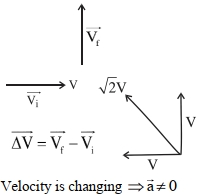
Statement $II$: $A$ car moving towards the east takes a turn and moves towards the north, the speed remains unchanged. The acceleration of the car is zero.
In the light of the given statements, choose the most appropriate answer from the options given below.
Statement $I$: $A$ truck and a car moving with the same kinetic energy are brought to rest by applying brakes which provide equal retarding forces. Both come to rest in equal distance.
Statement $II$: $A$ car moving towards the east takes a turn and moves towards the north, the speed remains unchanged. The acceleration of the car is zero.
In the light of the given statements, choose the most appropriate answer from the options given below.
A
Statement $I$ is correct but Statement $II$ is incorrect.
B
Statement $I$ is incorrect but Statement $II$ is correct.
C
Both Statement $I$ and Statement $II$ are correct.
D
Both Statement $I$ and Statement $II$ are false.
Solution
(A) According to the Work-Energy Theorem, the work done by the retarding force is equal to the change in kinetic energy.
$W = \Delta KE$
Since the final kinetic energy is $0$ and the initial kinetic energy is $K$, the work done is $W = -F \cdot S = 0 - K$, where $F$ is the retarding force and $S$ is the stopping distance.
Thus, $S = \frac{K}{F}$.
Since both the truck and the car have the same initial kinetic energy $K$ and are subjected to the same retarding force $F$, they will come to rest in the same distance $S$. Therefore, Statement $I$ is correct.
For Statement $II$, although the speed (magnitude of velocity) remains unchanged, the direction of the velocity changes as the car turns from east to north.
Acceleration is defined as the rate of change of velocity $(\vec{a} = \frac{d\vec{v}}{dt})$. Since the direction of velocity changes, the velocity vector changes, which means there must be a non-zero acceleration.
Therefore, Statement $II$ is incorrect.
$W = \Delta KE$
Since the final kinetic energy is $0$ and the initial kinetic energy is $K$, the work done is $W = -F \cdot S = 0 - K$, where $F$ is the retarding force and $S$ is the stopping distance.
Thus, $S = \frac{K}{F}$.
Since both the truck and the car have the same initial kinetic energy $K$ and are subjected to the same retarding force $F$, they will come to rest in the same distance $S$. Therefore, Statement $I$ is correct.
For Statement $II$, although the speed (magnitude of velocity) remains unchanged, the direction of the velocity changes as the car turns from east to north.
Acceleration is defined as the rate of change of velocity $(\vec{a} = \frac{d\vec{v}}{dt})$. Since the direction of velocity changes, the velocity vector changes, which means there must be a non-zero acceleration.
Therefore, Statement $II$ is incorrect.
0 likesView Solution
283
PhysicsMediumMCQJEE Main · 2023
$A$ particle is executing Simple Harmonic Motion $(SHM)$. The ratio of potential energy and kinetic energy of the particle when its displacement is half of its amplitude will be
A
$1: 1$
B
$2: 1$
C
$1: 4$
D
$1: 3$
Solution
(D) The potential energy $(P.E.)$ of a particle in $SHM$ at displacement $x$ is given by $P.E. = \frac{1}{2} kx^2$.
The kinetic energy $(K.E.)$ of the particle at displacement $x$ is given by $K.E. = \frac{1}{2} k(A^2 - x^2)$,where $A$ is the amplitude.
Given that the displacement $x = \frac{A}{2}$.
Substituting $x$ into the potential energy formula: $P.E. = \frac{1}{2} k(\frac{A}{2})^2 = \frac{1}{2} k(\frac{A^2}{4}) = \frac{1}{8} kA^2$.
Substituting $x$ into the kinetic energy formula: $K.E. = \frac{1}{2} k(A^2 - (\frac{A}{2})^2) = \frac{1}{2} k(A^2 - \frac{A^2}{4}) = \frac{1}{2} k(\frac{3A^2}{4}) = \frac{3}{8} kA^2$.
The ratio of potential energy to kinetic energy is $\frac{P.E.}{K.E.} = \frac{\frac{1}{8} kA^2}{\frac{3}{8} kA^2} = \frac{1}{3}$.
The kinetic energy $(K.E.)$ of the particle at displacement $x$ is given by $K.E. = \frac{1}{2} k(A^2 - x^2)$,where $A$ is the amplitude.
Given that the displacement $x = \frac{A}{2}$.
Substituting $x$ into the potential energy formula: $P.E. = \frac{1}{2} k(\frac{A}{2})^2 = \frac{1}{2} k(\frac{A^2}{4}) = \frac{1}{8} kA^2$.
Substituting $x$ into the kinetic energy formula: $K.E. = \frac{1}{2} k(A^2 - (\frac{A}{2})^2) = \frac{1}{2} k(A^2 - \frac{A^2}{4}) = \frac{1}{2} k(\frac{3A^2}{4}) = \frac{3}{8} kA^2$.
The ratio of potential energy to kinetic energy is $\frac{P.E.}{K.E.} = \frac{\frac{1}{8} kA^2}{\frac{3}{8} kA^2} = \frac{1}{3}$.
0 likesView Solution
284
PhysicsMediumMCQJEE Main · 2023
$A$ ball is thrown vertically upward with an initial velocity of $150\,m/s$. The ratio of velocity after $3\,s$ and $5\,s$ is $\frac{x+1}{x}$. The value of $x$ is $...........$ Take $g=10\,m/s^2$.
A
$6$
B
$5$
C
$-5$
D
$10$
Solution
(B) Using the first equation of motion,$v = u + at$.
Here,initial velocity $u = 150\,m/s$,acceleration $a = -g = -10\,m/s^2$,and $t$ is the time in seconds.
So,$v(t) = 150 - 10t$.
Velocity after $3\,s$ is $v(3) = 150 - 10(3) = 150 - 30 = 120\,m/s$.
Velocity after $5\,s$ is $v(5) = 150 - 10(5) = 150 - 50 = 100\,m/s$.
The ratio of velocities is $\frac{v(3)}{v(5)} = \frac{120}{100} = \frac{6}{5}$.
Given that the ratio is $\frac{x+1}{x}$,we have $\frac{x+1}{x} = \frac{6}{5}$.
Comparing the terms,$x = 5$.
Here,initial velocity $u = 150\,m/s$,acceleration $a = -g = -10\,m/s^2$,and $t$ is the time in seconds.
So,$v(t) = 150 - 10t$.
Velocity after $3\,s$ is $v(3) = 150 - 10(3) = 150 - 30 = 120\,m/s$.
Velocity after $5\,s$ is $v(5) = 150 - 10(5) = 150 - 50 = 100\,m/s$.
The ratio of velocities is $\frac{v(3)}{v(5)} = \frac{120}{100} = \frac{6}{5}$.
Given that the ratio is $\frac{x+1}{x}$,we have $\frac{x+1}{x} = \frac{6}{5}$.
Comparing the terms,$x = 5$.
0 likesView Solution
285
PhysicsMediumMCQJEE Main · 2023
The ratio of the escape velocity of a planet to the escape velocity of the Earth will be: Given: Mass of the planet is $16$ times the mass of the Earth and the radius of the planet is $4$ times the radius of the Earth.
A
$4:1$
B
$2:1$
C
$1: \sqrt{2}$
D
$1: 4$
Solution
(B) The formula for escape velocity is $V_e = \sqrt{\frac{2GM}{R}}$.
Let $M_E$ and $R_E$ be the mass and radius of the Earth,and $M_P$ and $R_P$ be the mass and radius of the planet.
Given: $M_P = 16 M_E$ and $R_P = 4 R_E$.
The escape velocity of the planet is $V_P = \sqrt{\frac{2GM_P}{R_P}} = \sqrt{\frac{2G(16M_E)}{4R_E}} = \sqrt{4 \times \frac{2GM_E}{R_E}} = 2 \sqrt{\frac{2GM_E}{R_E}}$.
Since $V_E = \sqrt{\frac{2GM_E}{R_E}}$,we have $V_P = 2 V_E$.
Therefore,the ratio $\frac{V_P}{V_E} = \frac{2}{1}$,which is $2:1$.
Let $M_E$ and $R_E$ be the mass and radius of the Earth,and $M_P$ and $R_P$ be the mass and radius of the planet.
Given: $M_P = 16 M_E$ and $R_P = 4 R_E$.
The escape velocity of the planet is $V_P = \sqrt{\frac{2GM_P}{R_P}} = \sqrt{\frac{2G(16M_E)}{4R_E}} = \sqrt{4 \times \frac{2GM_E}{R_E}} = 2 \sqrt{\frac{2GM_E}{R_E}}$.
Since $V_E = \sqrt{\frac{2GM_E}{R_E}}$,we have $V_P = 2 V_E$.
Therefore,the ratio $\frac{V_P}{V_E} = \frac{2}{1}$,which is $2:1$.
0 likesView Solution
286
PhysicsMediumMCQJEE Main · 2023
For a certain organ pipe,the first three resonance frequencies are in the ratio of $1:3:5$ respectively. If the frequency of the fifth harmonic is $405 \, Hz$ and the speed of sound in air is $324 \, ms^{-1}$,the length of the organ pipe is $.......... m$.
A
$0$
B
$2$
C
$3$
D
$1$
Solution
(D) The ratio of resonance frequencies $1:3:5$ indicates that the organ pipe is closed at one end.
For a closed organ pipe,the $n^{th}$ harmonic frequency is given by $f_n = \frac{n V}{4 \ell}$,where $n$ must be an odd integer $(n = 1, 3, 5, ...)$.
The fifth harmonic corresponds to $n = 5$.
Given $f_5 = 405 \, Hz$,$V = 324 \, ms^{-1}$,and $n = 5$.
Substituting these values into the formula: $405 = \frac{5 \times 324}{4 \ell}$.
Rearranging for $\ell$: $\ell = \frac{5 \times 324}{4 \times 405}$.
$\ell = \frac{1620}{1620} = 1 \, m$.
For a closed organ pipe,the $n^{th}$ harmonic frequency is given by $f_n = \frac{n V}{4 \ell}$,where $n$ must be an odd integer $(n = 1, 3, 5, ...)$.
The fifth harmonic corresponds to $n = 5$.
Given $f_5 = 405 \, Hz$,$V = 324 \, ms^{-1}$,and $n = 5$.
Substituting these values into the formula: $405 = \frac{5 \times 324}{4 \ell}$.
Rearranging for $\ell$: $\ell = \frac{5 \times 324}{4 \times 405}$.
$\ell = \frac{1620}{1620} = 1 \, m$.
0 likesView Solution
287
PhysicsMediumMCQJEE Main · 2023
For a rolling spherical shell,the ratio of rotational kinetic energy and total kinetic energy is $\frac{x}{5}$. The value of $x$ is ................
A
$4$
B
$6$
C
$8$
D
$2$
Solution
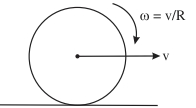
(D) The rotational kinetic energy of a body is given by $K_{\text{rot}} = \frac{1}{2} I \omega^2$,where $I$ is the moment of inertia and $\omega$ is the angular velocity.
For a spherical shell,the moment of inertia about its center is $I = \frac{2}{3} mR^2$.
For pure rolling,$\omega = \frac{v}{R}$,so $K_{\text{rot}} = \frac{1}{2} (\frac{2}{3} mR^2) (\frac{v}{R})^2 = \frac{1}{3} mv^2$.
The total kinetic energy is $K_{\text{total}} = K_{\text{trans}} + K_{\text{rot}} = \frac{1}{2} mv^2 + \frac{1}{3} mv^2 = \frac{5}{6} mv^2$.
The ratio of rotational kinetic energy to total kinetic energy is $\frac{K_{\text{rot}}}{K_{\text{total}}} = \frac{\frac{1}{3} mv^2}{\frac{5}{6} mv^2} = \frac{1}{3} \times \frac{6}{5} = \frac{2}{5}$.
Given that the ratio is $\frac{x}{5}$,we have $\frac{x}{5} = \frac{2}{5}$,which implies $x = 2$.
For a spherical shell,the moment of inertia about its center is $I = \frac{2}{3} mR^2$.
For pure rolling,$\omega = \frac{v}{R}$,so $K_{\text{rot}} = \frac{1}{2} (\frac{2}{3} mR^2) (\frac{v}{R})^2 = \frac{1}{3} mv^2$.
The total kinetic energy is $K_{\text{total}} = K_{\text{trans}} + K_{\text{rot}} = \frac{1}{2} mv^2 + \frac{1}{3} mv^2 = \frac{5}{6} mv^2$.
The ratio of rotational kinetic energy to total kinetic energy is $\frac{K_{\text{rot}}}{K_{\text{total}}} = \frac{\frac{1}{3} mv^2}{\frac{5}{6} mv^2} = \frac{1}{3} \times \frac{6}{5} = \frac{2}{5}$.
Given that the ratio is $\frac{x}{5}$,we have $\frac{x}{5} = \frac{2}{5}$,which implies $x = 2$.
0 likesView Solution
288
PhysicsMediumMCQJEE Main · 2023
To maintain a speed of $80\,km/h$ by a bus of mass $500\,kg$ on a plane rough road for $4\,km$ distance,the work done by the engine of the bus will be $........\,kJ$. [The coefficient of friction between the tyre of the bus and the road is $0.04$].
A
$785$
B
$786$
C
$777$
D
$784$
Solution
(D) Since the bus moves at a constant speed,the net work done on the bus is zero according to the Work-Energy Theorem.
$W_{\text{net}} = W_{\text{engine}} + W_{\text{friction}} = 0$
Therefore,$W_{\text{engine}} = -W_{\text{friction}}$.
The work done by friction is given by $W_{\text{friction}} = -f_k \cdot d = -(\mu mg) \cdot d$.
Here,$\mu = 0.04$,$m = 500\,kg$,$g = 9.8\,m/s^2$,and $d = 4\,km = 4000\,m$.
$W_{\text{engine}} = \mu mgd = 0.04 \times 500 \times 9.8 \times 4000$.
$W_{\text{engine}} = 20 \times 9.8 \times 4000 = 196 \times 4000 = 784000\,J$.
Converting to $kJ$,$W_{\text{engine}} = 784\,kJ$.
$W_{\text{net}} = W_{\text{engine}} + W_{\text{friction}} = 0$
Therefore,$W_{\text{engine}} = -W_{\text{friction}}$.
The work done by friction is given by $W_{\text{friction}} = -f_k \cdot d = -(\mu mg) \cdot d$.
Here,$\mu = 0.04$,$m = 500\,kg$,$g = 9.8\,m/s^2$,and $d = 4\,km = 4000\,m$.
$W_{\text{engine}} = \mu mgd = 0.04 \times 500 \times 9.8 \times 4000$.
$W_{\text{engine}} = 20 \times 9.8 \times 4000 = 196 \times 4000 = 784000\,J$.
Converting to $kJ$,$W_{\text{engine}} = 784\,kJ$.
0 likesView Solution
289
PhysicsDifficultMCQJEE Main · 2023
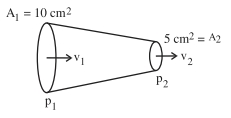
Glycerine of density $1.25 \times 10^3 \, kg \, m^{-3}$ is flowing through a conical section of a pipe. The area of cross-section of the pipe at its ends is $10 \, cm^2$ and $5 \, cm^2$, and the pressure drop across its length is $3 \, N \, m^{-2}$. The rate of flow of glycerine through the pipe is $x \times 10^{-5} \, m^3 \, s^{-1}$. The value of $x$ is $..............$.
A
$2$
B
$6$
C
$8$
D
$4$
Solution
(D) Given: Density $\rho = 1.25 \times 10^3 \, kg \, m^{-3}$, $A_1 = 10 \, cm^2 = 10 \times 10^{-4} \, m^2$, $A_2 = 5 \, cm^2 = 5 \times 10^{-4} \, m^2$, $\Delta P = P_1 - P_2 = 3 \, N \, m^{-2}$.
By the equation of continuity, $A_1 v_1 = A_2 v_2$.
Therefore, $v_1 = \frac{A_2}{A_1} v_2 = \frac{5}{10} v_2 = 0.5 v_2$.
Using Bernoulli's equation for horizontal flow: $P_1 + \frac{1}{2} \rho v_1^2 = P_2 + \frac{1}{2} \rho v_2^2$.
$\Delta P = P_1 - P_2 = \frac{1}{2} \rho (v_2^2 - v_1^2)$.
Substituting $v_1 = 0.5 v_2$:
$3 = \frac{1}{2} \times (1.25 \times 10^3) \times (v_2^2 - (0.5 v_2)^2)$.
$3 = 0.625 \times 10^3 \times (v_2^2 - 0.25 v_2^2) = 0.625 \times 10^3 \times 0.75 v_2^2$.
$3 = 468.75 v_2^2$.
$v_2^2 = \frac{3}{468.75} = 0.0064$.
$v_2 = \sqrt{0.0064} = 0.08 \, m \, s^{-1}$.
The rate of flow (discharge) $Q = A_2 v_2 = (5 \times 10^{-4} \, m^2) \times (0.08 \, m \, s^{-1}) = 40 \times 10^{-6} \, m^3 \, s^{-1} = 4 \times 10^{-5} \, m^3 \, s^{-1}$.
Comparing with $x \times 10^{-5} \, m^3 \, s^{-1}$, we get $x = 4$.
By the equation of continuity, $A_1 v_1 = A_2 v_2$.
Therefore, $v_1 = \frac{A_2}{A_1} v_2 = \frac{5}{10} v_2 = 0.5 v_2$.
Using Bernoulli's equation for horizontal flow: $P_1 + \frac{1}{2} \rho v_1^2 = P_2 + \frac{1}{2} \rho v_2^2$.
$\Delta P = P_1 - P_2 = \frac{1}{2} \rho (v_2^2 - v_1^2)$.
Substituting $v_1 = 0.5 v_2$:
$3 = \frac{1}{2} \times (1.25 \times 10^3) \times (v_2^2 - (0.5 v_2)^2)$.
$3 = 0.625 \times 10^3 \times (v_2^2 - 0.25 v_2^2) = 0.625 \times 10^3 \times 0.75 v_2^2$.
$3 = 468.75 v_2^2$.
$v_2^2 = \frac{3}{468.75} = 0.0064$.
$v_2 = \sqrt{0.0064} = 0.08 \, m \, s^{-1}$.
The rate of flow (discharge) $Q = A_2 v_2 = (5 \times 10^{-4} \, m^2) \times (0.08 \, m \, s^{-1}) = 40 \times 10^{-6} \, m^3 \, s^{-1} = 4 \times 10^{-5} \, m^3 \, s^{-1}$.
Comparing with $x \times 10^{-5} \, m^3 \, s^{-1}$, we get $x = 4$.
0 likesView Solution
290
PhysicsMediumMCQJEE Main · 2023
Two trains '$A$' and '$B$' of length '$l$' and '$4l$' are travelling into a tunnel of length '$L$' on parallel tracks from opposite directions with velocities $108\,km/h$ and $72\,km/h$,respectively. If train '$A$' takes $35\,s$ less time than train '$B$' to cross the tunnel,then the length '$L$' of the tunnel is $...........\,m$. (Given $L = 60l$)
A
$1200$
B
$2700$
C
$1800$
D
$900$
Solution
(C) First,convert the velocities from $km/h$ to $m/s$:
$v_A = 108 \times \frac{5}{18} = 30\,m/s$
$v_B = 72 \times \frac{5}{18} = 20\,m/s$
To cross the tunnel,each train must cover a distance equal to the sum of the tunnel length and its own length.
Time taken by train '$A$': $t_A = \frac{L + l}{v_A} = \frac{60l + l}{30} = \frac{61l}{30}$
Time taken by train '$B$': $t_B = \frac{L + 4l}{v_B} = \frac{60l + 4l}{20} = \frac{64l}{20} = \frac{16l}{5}$
Given that $t_B - t_A = 35\,s$:
$\frac{16l}{5} - \frac{61l}{30} = 35$
$\frac{96l - 61l}{30} = 35$
$\frac{35l}{30} = 35$
$l = 30\,m$
Therefore,$L = 60l = 60 \times 30 = 1800\,m$.
$v_A = 108 \times \frac{5}{18} = 30\,m/s$
$v_B = 72 \times \frac{5}{18} = 20\,m/s$
To cross the tunnel,each train must cover a distance equal to the sum of the tunnel length and its own length.
Time taken by train '$A$': $t_A = \frac{L + l}{v_A} = \frac{60l + l}{30} = \frac{61l}{30}$
Time taken by train '$B$': $t_B = \frac{L + 4l}{v_B} = \frac{60l + 4l}{20} = \frac{64l}{20} = \frac{16l}{5}$
Given that $t_B - t_A = 35\,s$:
$\frac{16l}{5} - \frac{61l}{30} = 35$
$\frac{96l - 61l}{30} = 35$
$\frac{35l}{30} = 35$
$l = 30\,m$
Therefore,$L = 60l = 60 \times 30 = 1800\,m$.
0 likesView Solution
291
PhysicsMediumMCQJEE Main · 2023
The ratio of powers of two motors is $\frac{3 \sqrt{x}}{\sqrt{x}+1}$,which are capable of raising $300 \ kg$ of water in $5 \ minutes$ and $50 \ kg$ of water in $2 \ minutes$ respectively from a well of $100 \ m$ depth. The value of $x$ is:
A
$2$
B
$4$
C
$2.4$
D
$16$
Solution
(D) Average Power is defined as the total work done divided by the total time taken.
$P = \frac{W}{t} = \frac{mgh}{t}$
Given the ratio of powers of two motors is $\frac{P_1}{P_2} = \frac{3 \sqrt{x}}{\sqrt{x}+1}$.
For the first motor: $m_1 = 300 \ kg$,$t_1 = 5 \ minutes = 300 \ s$,$h = 100 \ m$.
For the second motor: $m_2 = 50 \ kg$,$t_2 = 2 \ minutes = 120 \ s$,$h = 100 \ m$.
Calculating the ratio of powers:
$\frac{P_1}{P_2} = \frac{m_1 g h / t_1}{m_2 g h / t_2} = \frac{m_1}{t_1} \times \frac{t_2}{m_2}$
$\frac{P_1}{P_2} = \frac{300}{5} \times \frac{2}{50} = 60 \times 0.04 = 2.4$
Equating the two expressions:
$\frac{3 \sqrt{x}}{\sqrt{x}+1} = 2.4$
$3 \sqrt{x} = 2.4 \sqrt{x} + 2.4$
$0.6 \sqrt{x} = 2.4$
$\sqrt{x} = 4$
$x = 16$
$P = \frac{W}{t} = \frac{mgh}{t}$
Given the ratio of powers of two motors is $\frac{P_1}{P_2} = \frac{3 \sqrt{x}}{\sqrt{x}+1}$.
For the first motor: $m_1 = 300 \ kg$,$t_1 = 5 \ minutes = 300 \ s$,$h = 100 \ m$.
For the second motor: $m_2 = 50 \ kg$,$t_2 = 2 \ minutes = 120 \ s$,$h = 100 \ m$.
Calculating the ratio of powers:
$\frac{P_1}{P_2} = \frac{m_1 g h / t_1}{m_2 g h / t_2} = \frac{m_1}{t_1} \times \frac{t_2}{m_2}$
$\frac{P_1}{P_2} = \frac{300}{5} \times \frac{2}{50} = 60 \times 0.04 = 2.4$
Equating the two expressions:
$\frac{3 \sqrt{x}}{\sqrt{x}+1} = 2.4$
$3 \sqrt{x} = 2.4 \sqrt{x} + 2.4$
$0.6 \sqrt{x} = 2.4$
$\sqrt{x} = 4$
$x = 16$
0 likesView Solution
292
PhysicsMediumMCQJEE Main · 2023
$A$ planet having mass $9 M_e$ and radius $4 R_e$,where $M_e$ and $R_e$ are the mass and radius of the Earth respectively,has an escape velocity in $km/s$ given by: (Given escape velocity on Earth $V_e = 11.2 \times 10^3 \, m/s$)
A
$67.2$
B
$16.8$
C
$33.6$
D
$11.2$
Solution
(B) The formula for escape velocity is $V = \sqrt{\frac{2GM}{R}}$.
For Earth,$V_e = \sqrt{\frac{2GM_e}{R_e}} = 11.2 \, km/s$.
For the planet,$V_p = \sqrt{\frac{2G(9M_e)}{4R_e}} = \sqrt{\frac{9}{4}} \times \sqrt{\frac{2GM_e}{R_e}}$.
$V_p = \frac{3}{2} \times V_e$.
Substituting the value of $V_e = 11.2 \, km/s$:
$V_p = 1.5 \times 11.2 \, km/s = 16.8 \, km/s$.
For Earth,$V_e = \sqrt{\frac{2GM_e}{R_e}} = 11.2 \, km/s$.
For the planet,$V_p = \sqrt{\frac{2G(9M_e)}{4R_e}} = \sqrt{\frac{9}{4}} \times \sqrt{\frac{2GM_e}{R_e}}$.
$V_p = \frac{3}{2} \times V_e$.
Substituting the value of $V_e = 11.2 \, km/s$:
$V_p = 1.5 \times 11.2 \, km/s = 16.8 \, km/s$.
0 likesView Solution
293
PhysicsMediumMCQJEE Main · 2023
$A$ bullet of mass $10\,g$ leaves the barrel of a gun with a velocity of $600\,m/s$. If the barrel of the gun is $50\,cm$ long and the mass of the gun is $3\,kg$,then the value of the impulse supplied to the gun will be $.....\,Ns$.
A
$12$
B
$6$
C
$36$
D
$3$
Solution
(B) The impulse supplied to the gun is equal to the change in momentum of the bullet.
Given:
Mass of the bullet,$m = 10\,g = 0.01\,kg$
Velocity of the bullet,$v = 600\,m/s$
Mass of the gun,$M = 3\,kg$
Impulse $J = \Delta p = m \times v$
$J = 0.01\,kg \times 600\,m/s = 6\,Ns$
Since the system is initially at rest,the impulse imparted to the gun is equal in magnitude to the momentum gained by the bullet.
Given:
Mass of the bullet,$m = 10\,g = 0.01\,kg$
Velocity of the bullet,$v = 600\,m/s$
Mass of the gun,$M = 3\,kg$
Impulse $J = \Delta p = m \times v$
$J = 0.01\,kg \times 600\,m/s = 6\,Ns$
Since the system is initially at rest,the impulse imparted to the gun is equal in magnitude to the momentum gained by the bullet.
0 likesView Solution
294
PhysicsMediumMCQJEE Main · 2023
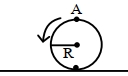
$A$ disc is rolling without slipping on a surface. The radius of the disc is $R$. At $t=0$,the top most point on the disc is $A$ as shown in the figure. When the disc completes half of its rotation,the displacement of point $A$ from its initial position is
A
$R \sqrt{\pi^2+4}$
B
$R \sqrt{\pi^2+1}$
C
$2 R$
D
$2 R \sqrt{1+4 \pi^2}$
Solution
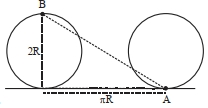
(A) When the disc rolls without slipping,the center of the disc moves forward by a distance equal to the arc length covered. For half a rotation,the center moves by a horizontal distance of $\pi R$.
The point $A$,which was initially at the top,moves to the bottom of the disc after half a rotation. The vertical displacement of point $A$ is equal to the diameter of the disc,which is $2R$.
The horizontal displacement of point $A$ is equal to the distance moved by the center,which is $\pi R$.
The total displacement $d$ is the vector sum of the horizontal and vertical displacements:
$d = \sqrt{(\text{horizontal displacement})^2 + (\text{vertical displacement})^2}$
$d = \sqrt{(\pi R)^2 + (2R)^2}$
$d = \sqrt{\pi^2 R^2 + 4R^2}$
$d = R \sqrt{\pi^2 + 4}$
The point $A$,which was initially at the top,moves to the bottom of the disc after half a rotation. The vertical displacement of point $A$ is equal to the diameter of the disc,which is $2R$.
The horizontal displacement of point $A$ is equal to the distance moved by the center,which is $\pi R$.
The total displacement $d$ is the vector sum of the horizontal and vertical displacements:
$d = \sqrt{(\text{horizontal displacement})^2 + (\text{vertical displacement})^2}$
$d = \sqrt{(\pi R)^2 + (2R)^2}$
$d = \sqrt{\pi^2 R^2 + 4R^2}$
$d = R \sqrt{\pi^2 + 4}$
0 likesView Solution
295
PhysicsMediumMCQJEE Main · 2023
The rms speed of an oxygen molecule in a vessel at a particular temperature is $\left(1+\frac{5}{x}\right)^{\frac{1}{2}} v$,where $v$ is the average speed of the molecule. The value of $x$ will be: (Take $\pi=\frac{22}{7}$)
A
$28$
B
$27$
C
$8$
D
$4$
Solution
(A) The root mean square (rms) speed of a gas molecule is given by $v_{rms} = \sqrt{\frac{3RT}{M}}$.
The average speed of a gas molecule is given by $v_{avg} = \sqrt{\frac{8RT}{\pi M}}$.
According to the problem,$v_{rms} = \left(1+\frac{5}{x}\right)^{\frac{1}{2}} v_{avg}$.
Substituting the formulas: $\sqrt{\frac{3RT}{M}} = \left(1+\frac{5}{x}\right)^{\frac{1}{2}} \sqrt{\frac{8RT}{\pi M}}$.
Squaring both sides: $\frac{3RT}{M} = \left(1+\frac{5}{x}\right) \frac{8RT}{\pi M}$.
Canceling $\frac{RT}{M}$ from both sides: $3 = \left(1+\frac{5}{x}\right) \frac{8}{\pi}$.
Given $\pi = \frac{22}{7}$,we have $3 = \left(1+\frac{5}{x}\right) \frac{8}{22/7} = \left(1+\frac{5}{x}\right) \frac{8 \times 7}{22} = \left(1+\frac{5}{x}\right) \frac{56}{22} = \left(1+\frac{5}{x}\right) \frac{28}{11}$.
$\Rightarrow 1+\frac{5}{x} = 3 \times \frac{11}{28} = \frac{33}{28}$.
$\Rightarrow \frac{5}{x} = \frac{33}{28} - 1 = \frac{5}{28}$.
$\Rightarrow x = 28$.
The average speed of a gas molecule is given by $v_{avg} = \sqrt{\frac{8RT}{\pi M}}$.
According to the problem,$v_{rms} = \left(1+\frac{5}{x}\right)^{\frac{1}{2}} v_{avg}$.
Substituting the formulas: $\sqrt{\frac{3RT}{M}} = \left(1+\frac{5}{x}\right)^{\frac{1}{2}} \sqrt{\frac{8RT}{\pi M}}$.
Squaring both sides: $\frac{3RT}{M} = \left(1+\frac{5}{x}\right) \frac{8RT}{\pi M}$.
Canceling $\frac{RT}{M}$ from both sides: $3 = \left(1+\frac{5}{x}\right) \frac{8}{\pi}$.
Given $\pi = \frac{22}{7}$,we have $3 = \left(1+\frac{5}{x}\right) \frac{8}{22/7} = \left(1+\frac{5}{x}\right) \frac{8 \times 7}{22} = \left(1+\frac{5}{x}\right) \frac{56}{22} = \left(1+\frac{5}{x}\right) \frac{28}{11}$.
$\Rightarrow 1+\frac{5}{x} = 3 \times \frac{11}{28} = \frac{33}{28}$.
$\Rightarrow \frac{5}{x} = \frac{33}{28} - 1 = \frac{5}{28}$.
$\Rightarrow x = 28$.
1 likesView Solution
296
PhysicsMediumMCQJEE Main · 2023
$A$ body of mass $(5 \pm 0.5) \ kg$ is moving with a velocity of $(20 \pm 0.4) \ m/s$. Its kinetic energy will be
A
$(1000 \pm 140) \ J$
B
$(1000 \pm 0.14) \ J$
C
$(500 \pm 0.14) \ J$
D
$(500 \pm 140) \ J$
Solution
(A) The formula for kinetic energy is $K = \frac{1}{2}mv^2$.
First,calculate the mean value of kinetic energy:
$K = \frac{1}{2} \times 5 \times (20)^2 = \frac{1}{2} \times 5 \times 400 = 1000 \ J$.
Next,calculate the relative error using the formula for propagation of errors:
$\frac{\Delta K}{K} = \frac{\Delta m}{m} + 2 \frac{\Delta v}{v}$.
Substitute the given values:
$\frac{\Delta K}{1000} = \frac{0.5}{5} + 2 \times \frac{0.4}{20} = 0.1 + 0.04 = 0.14$.
Calculate the absolute error $\Delta K$:
$\Delta K = 1000 \times 0.14 = 140 \ J$.
Therefore,the kinetic energy is $(1000 \pm 140) \ J$.
First,calculate the mean value of kinetic energy:
$K = \frac{1}{2} \times 5 \times (20)^2 = \frac{1}{2} \times 5 \times 400 = 1000 \ J$.
Next,calculate the relative error using the formula for propagation of errors:
$\frac{\Delta K}{K} = \frac{\Delta m}{m} + 2 \frac{\Delta v}{v}$.
Substitute the given values:
$\frac{\Delta K}{1000} = \frac{0.5}{5} + 2 \times \frac{0.4}{20} = 0.1 + 0.04 = 0.14$.
Calculate the absolute error $\Delta K$:
$\Delta K = 1000 \times 0.14 = 140 \ J$.
Therefore,the kinetic energy is $(1000 \pm 140) \ J$.
0 likesView Solution
297
PhysicsEasyMCQJEE Main · 2023
Two bodies have kinetic energies in the ratio $16: 9$. If they have the same linear momentum,the ratio of their masses respectively is
A
$4: 3$
B
$3: 4$
C
$16: 9$
D
$9: 16$
Solution
(D) The kinetic energy $K$ of a body with mass $m$ and linear momentum $p$ is given by $K = \frac{p^2}{2m}$.
Given that the linear momenta are equal,i.e.,$p_1 = p_2 = p$.
Therefore,the ratio of kinetic energies is $\frac{K_1}{K_2} = \frac{p^2 / 2m_1}{p^2 / 2m_2} = \frac{m_2}{m_1}$.
Given $\frac{K_1}{K_2} = \frac{16}{9}$,we have $\frac{m_2}{m_1} = \frac{16}{9}$.
Thus,the ratio of their masses $\frac{m_1}{m_2} = \frac{9}{16}$.
Given that the linear momenta are equal,i.e.,$p_1 = p_2 = p$.
Therefore,the ratio of kinetic energies is $\frac{K_1}{K_2} = \frac{p^2 / 2m_1}{p^2 / 2m_2} = \frac{m_2}{m_1}$.
Given $\frac{K_1}{K_2} = \frac{16}{9}$,we have $\frac{m_2}{m_1} = \frac{16}{9}$.
Thus,the ratio of their masses $\frac{m_1}{m_2} = \frac{9}{16}$.
0 likesView Solution
298
PhysicsDifficultMCQJEE Main · 2023
The figure shows a liquid of given density flowing steadily in a horizontal tube of varying cross-section. The cross-sectional areas at $A$ is $1.5 \, cm^2$,and at $B$ is $25 \, mm^2$. If the speed of the liquid at $B$ is $60 \, cm/s$,then find $(P_A - P_B)$ in $Pa$. (Given: $P_A$ and $P_B$ are liquid pressures at points $A$ and $B$ respectively. Density $\rho = 1000 \, kg/m^3$. $A$ and $B$ are on the axis of the tube.)
A
$175$
B
$27$
C
$135$
D
$36$
Solution
(A) Given:
Area at $A$,$A_A = 1.5 \, cm^2 = 1.5 \times 10^{-4} \, m^2$
Area at $B$,$A_B = 25 \, mm^2 = 25 \times 10^{-6} \, m^2$
Velocity at $B$,$v_B = 60 \, cm/s = 0.6 \, m/s$
Density,$\rho = 1000 \, kg/m^3$
Using the equation of continuity,$A_A v_A = A_B v_B$:
$1.5 \times 10^{-4} \times v_A = 25 \times 10^{-6} \times 0.6$
$v_A = \frac{25 \times 10^{-6} \times 0.6}{1.5 \times 10^{-4}} = \frac{15 \times 10^{-6}}{1.5 \times 10^{-4}} = 10 \times 10^{-2} = 0.1 \, m/s$
Using Bernoulli's equation for a horizontal tube $(h_A = h_B)$:
$P_A + \frac{1}{2} \rho v_A^2 = P_B + \frac{1}{2} \rho v_B^2$
$P_A - P_B = \frac{1}{2} \rho (v_B^2 - v_A^2)$
$P_A - P_B = \frac{1}{2} \times 1000 \times ((0.6)^2 - (0.1)^2)$
$P_A - P_B = 500 \times (0.36 - 0.01)$
$P_A - P_B = 500 \times 0.35 = 175 \, Pa$
Area at $A$,$A_A = 1.5 \, cm^2 = 1.5 \times 10^{-4} \, m^2$
Area at $B$,$A_B = 25 \, mm^2 = 25 \times 10^{-6} \, m^2$
Velocity at $B$,$v_B = 60 \, cm/s = 0.6 \, m/s$
Density,$\rho = 1000 \, kg/m^3$
Using the equation of continuity,$A_A v_A = A_B v_B$:
$1.5 \times 10^{-4} \times v_A = 25 \times 10^{-6} \times 0.6$
$v_A = \frac{25 \times 10^{-6} \times 0.6}{1.5 \times 10^{-4}} = \frac{15 \times 10^{-6}}{1.5 \times 10^{-4}} = 10 \times 10^{-2} = 0.1 \, m/s$
Using Bernoulli's equation for a horizontal tube $(h_A = h_B)$:
$P_A + \frac{1}{2} \rho v_A^2 = P_B + \frac{1}{2} \rho v_B^2$
$P_A - P_B = \frac{1}{2} \rho (v_B^2 - v_A^2)$
$P_A - P_B = \frac{1}{2} \times 1000 \times ((0.6)^2 - (0.1)^2)$
$P_A - P_B = 500 \times (0.36 - 0.01)$
$P_A - P_B = 500 \times 0.35 = 175 \, Pa$
0 likesView Solution
299
PhysicsDifficultMCQJEE Main · 2023
Under isothermal condition,the pressure of a gas is given by $P = aV^{-3}$,where $a$ is a constant and $V$ is the volume of the gas. The bulk modulus at constant temperature is equal to $..........\,P$.
A
$0.5$
B
$3$
C
$2$
D
$1$
Solution
(B) The bulk modulus $B$ is defined as $B = -V \frac{dP}{dV}$.
Given the relation $P = aV^{-3}$.
Differentiating $P$ with respect to $V$:
$\frac{dP}{dV} = a(-3)V^{-4} = -3 \frac{aV^{-3}}{V} = -3 \frac{P}{V}$.
Substituting this into the formula for bulk modulus:
$B = -V \left( -3 \frac{P}{V} \right) = 3P$.
Therefore,the bulk modulus is $3P$.
Given the relation $P = aV^{-3}$.
Differentiating $P$ with respect to $V$:
$\frac{dP}{dV} = a(-3)V^{-4} = -3 \frac{aV^{-3}}{V} = -3 \frac{P}{V}$.
Substituting this into the formula for bulk modulus:
$B = -V \left( -3 \frac{P}{V} \right) = 3P$.
Therefore,the bulk modulus is $3P$.
0 likesView Solution
300
PhysicsMediumMCQJEE Main · 2023
Which graph represents the difference between total energy and potential energy of a particle executing $SHM$ versus its distance from the mean position?
A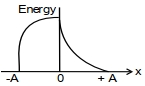
B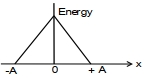
C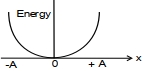
D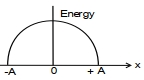
Solution
(D) The total energy $(TE)$ of a particle executing $SHM$ is constant,given by $TE = \frac{1}{2} m \omega^2 A^2$.
The potential energy $(PE)$ at a displacement $x$ from the mean position is given by $PE = \frac{1}{2} m \omega^2 x^2$.
The difference between total energy and potential energy is the kinetic energy $(KE)$:
$KE = TE - PE$
$KE = \frac{1}{2} m \omega^2 A^2 - \frac{1}{2} m \omega^2 x^2$
$KE = \frac{1}{2} m \omega^2 (A^2 - x^2)$
This equation represents a downward-opening parabola with its vertex at $x = 0$ and roots at $x = \pm A$. This matches the shape shown in graph $D$.
The potential energy $(PE)$ at a displacement $x$ from the mean position is given by $PE = \frac{1}{2} m \omega^2 x^2$.
The difference between total energy and potential energy is the kinetic energy $(KE)$:
$KE = TE - PE$
$KE = \frac{1}{2} m \omega^2 A^2 - \frac{1}{2} m \omega^2 x^2$
$KE = \frac{1}{2} m \omega^2 (A^2 - x^2)$
This equation represents a downward-opening parabola with its vertex at $x = 0$ and roots at $x = \pm A$. This matches the shape shown in graph $D$.
0 likesView Solution
301
PhysicsMediumMCQJEE Main · 2023
In the photoelectric effect:
$A.$ The photocurrent is proportional to the intensity of the incident radiation.
$B.$ The maximum kinetic energy with which photoelectrons are emitted depends on the intensity of incident light.
$C.$ The maximum kinetic energy with which photoelectrons are emitted depends on the frequency of incident light.
$D.$ The emission of photoelectrons requires a minimum threshold intensity of incident radiation.
$E.$ The maximum kinetic energy of the photoelectrons is independent of the frequency of the incident light.
Choose the correct answer from the options given below:
$A.$ The photocurrent is proportional to the intensity of the incident radiation.
$B.$ The maximum kinetic energy with which photoelectrons are emitted depends on the intensity of incident light.
$C.$ The maximum kinetic energy with which photoelectrons are emitted depends on the frequency of incident light.
$D.$ The emission of photoelectrons requires a minimum threshold intensity of incident radiation.
$E.$ The maximum kinetic energy of the photoelectrons is independent of the frequency of the incident light.
Choose the correct answer from the options given below:
A
$A$ and $C$ only
B
$A$ and $E$ only
C
$B$ and $C$ only
D
$A$ and $B$ only
Solution
(A) $1$. The photocurrent is directly proportional to the intensity of the incident radiation because intensity is proportional to the number of incident photons,which in turn is proportional to the number of emitted photoelectrons. Thus,statement $A$ is correct.
$2$. According to Einstein's photoelectric equation,$KE_{\max} = h\nu - \phi$,where $h$ is Planck's constant,$\nu$ is the frequency of incident light,and $\phi$ is the work function of the metal. This equation shows that $KE_{\max}$ depends on the frequency of the incident light,not its intensity. Thus,statement $C$ is correct,while statements $B$ and $E$ are incorrect.
$3$. The emission of photoelectrons requires a minimum threshold frequency,not a minimum threshold intensity. Thus,statement $D$ is incorrect.
Therefore,statements $A$ and $C$ are correct.
$2$. According to Einstein's photoelectric equation,$KE_{\max} = h\nu - \phi$,where $h$ is Planck's constant,$\nu$ is the frequency of incident light,and $\phi$ is the work function of the metal. This equation shows that $KE_{\max}$ depends on the frequency of the incident light,not its intensity. Thus,statement $C$ is correct,while statements $B$ and $E$ are incorrect.
$3$. The emission of photoelectrons requires a minimum threshold frequency,not a minimum threshold intensity. Thus,statement $D$ is incorrect.
Therefore,statements $A$ and $C$ are correct.
0 likesView Solution
302
PhysicsMediumMCQJEE Main · 2023
An $emf$ of $0.08\,V$ is induced in a metal rod of length $10\,cm$ held normal to a uniform magnetic field of $0.4\,T$,when it moves with a velocity of .......... $m/s$.
A
$2$
B
$3.2$
C
$0.5$
D
$20$
Solution
(A) The formula for motional $emf$ induced in a conductor moving in a magnetic field is given by:
$e = Blv$
Given:
$e = 0.08\,V$
$l = 10\,cm = 0.1\,m$
$B = 0.4\,T$
Substituting the values into the formula:
$0.08 = 0.4 \times 0.1 \times v$
$0.08 = 0.04 \times v$
$v = \frac{0.08}{0.04} = 2\,m/s$
Thus,the velocity is $2\,m/s$.
$e = Blv$
Given:
$e = 0.08\,V$
$l = 10\,cm = 0.1\,m$
$B = 0.4\,T$
Substituting the values into the formula:
$0.08 = 0.4 \times 0.1 \times v$
$0.08 = 0.04 \times v$
$v = \frac{0.08}{0.04} = 2\,m/s$
Thus,the velocity is $2\,m/s$.
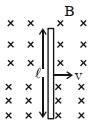
0 likesView Solution
303
PhysicsEasyMCQJEE Main · 2023
The power radiated from a linear antenna of length $l$ is proportional to (Given,$\lambda =$ wavelength of the wave):
A
$\frac{l}{\lambda}$
B
$\frac{l}{\lambda^2}$
C
$\frac{l^2}{\lambda}$
D
$\left(\frac{l}{\lambda}\right)^2$
Solution
(D) The power radiated $P$ by a short linear antenna of length $l$ is given by the relation $P \propto \left(\frac{l}{\lambda}\right)^2$.
This indicates that the radiated power is directly proportional to the square of the ratio of the antenna length to the wavelength of the electromagnetic wave.
This indicates that the radiated power is directly proportional to the square of the ratio of the antenna length to the wavelength of the electromagnetic wave.
0 likesView Solution
304
PhysicsMediumMCQJEE Main · 2023
$A$ series combination of a resistor of resistance $100\,\Omega$,an inductor of inductance $1\,H$,and a capacitor of capacitance $6.25\,\mu F$ is connected to an $AC$ source. The quality factor of the circuit will be $.............$.
A
$4$
B
$3$
C
$2$
D
$1$
Solution
(A) The quality factor $(Q)$ of a series $LCR$ circuit at resonance is given by the formula:
$Q = \frac{1}{R} \sqrt{\frac{L}{C}}$
Given values:
Resistance $R = 100\,\Omega$
Inductance $L = 1\,H$
Capacitance $C = 6.25 \times 10^{-6}\,F$
Substituting the values into the formula:
$Q = \frac{1}{100} \sqrt{\frac{1}{6.25 \times 10^{-6}}}$
$Q = \frac{1}{100} \sqrt{\frac{10^6}{6.25}}$
$Q = \frac{1}{100} \times \frac{1000}{2.5}$
$Q = \frac{10}{2.5} = 4$
Thus,the quality factor of the circuit is $4$.
$Q = \frac{1}{R} \sqrt{\frac{L}{C}}$
Given values:
Resistance $R = 100\,\Omega$
Inductance $L = 1\,H$
Capacitance $C = 6.25 \times 10^{-6}\,F$
Substituting the values into the formula:
$Q = \frac{1}{100} \sqrt{\frac{1}{6.25 \times 10^{-6}}}$
$Q = \frac{1}{100} \sqrt{\frac{10^6}{6.25}}$
$Q = \frac{1}{100} \times \frac{1000}{2.5}$
$Q = \frac{10}{2.5} = 4$
Thus,the quality factor of the circuit is $4$.
1 likesView Solution
305
PhysicsMediumMCQJEE Main · 2023
The ratio of wavelength of spectral lines $H_\alpha$ and $H_\beta$ in the Balmer series is $\frac{x}{20}$. The value of $x$ is $...............$
A
$27$
B
$26$
C
$25$
D
$24$
Solution
(A) The Rydberg formula for the wavelength of spectral lines in the $H$-atom is given by $\frac{1}{\lambda} = R \left[ \frac{1}{n_1^2} - \frac{1}{n_2^2} \right]$.
For the Balmer series,$n_1 = 2$.
For the $H_\alpha$ line,$n_2 = 3$. Thus,$\frac{1}{\lambda_{H_\alpha}} = R \left[ \frac{1}{2^2} - \frac{1}{3^2} \right] = R \left[ \frac{1}{4} - \frac{1}{9} \right] = \frac{5R}{36}$.
For the $H_\beta$ line,$n_2 = 4$. Thus,$\frac{1}{\lambda_{H_\beta}} = R \left[ \frac{1}{2^2} - \frac{1}{4^2} \right] = R \left[ \frac{1}{4} - \frac{1}{16} \right] = \frac{3R}{16}$.
Taking the ratio of the wavelengths: $\frac{\lambda_{H_\alpha}}{\lambda_{H_\beta}} = \frac{\lambda_{H_\beta}^{-1}}{\lambda_{H_\alpha}^{-1}} = \frac{3R/16}{5R/36} = \frac{3}{16} \times \frac{36}{5} = \frac{3 \times 9}{4 \times 5} = \frac{27}{20}$.
Comparing this with $\frac{x}{20}$,we get $x = 27$.
For the Balmer series,$n_1 = 2$.
For the $H_\alpha$ line,$n_2 = 3$. Thus,$\frac{1}{\lambda_{H_\alpha}} = R \left[ \frac{1}{2^2} - \frac{1}{3^2} \right] = R \left[ \frac{1}{4} - \frac{1}{9} \right] = \frac{5R}{36}$.
For the $H_\beta$ line,$n_2 = 4$. Thus,$\frac{1}{\lambda_{H_\beta}} = R \left[ \frac{1}{2^2} - \frac{1}{4^2} \right] = R \left[ \frac{1}{4} - \frac{1}{16} \right] = \frac{3R}{16}$.
Taking the ratio of the wavelengths: $\frac{\lambda_{H_\alpha}}{\lambda_{H_\beta}} = \frac{\lambda_{H_\beta}^{-1}}{\lambda_{H_\alpha}^{-1}} = \frac{3R/16}{5R/36} = \frac{3}{16} \times \frac{36}{5} = \frac{3 \times 9}{4 \times 5} = \frac{27}{20}$.
Comparing this with $\frac{x}{20}$,we get $x = 27$.
0 likesView Solution
306
PhysicsEasyMCQJEE Main · 2023
The number density of free electrons in copper is nearly $8 \times 10^{28} \ m^{-3}$. $A$ copper wire has an area of cross-section $= 2 \times 10^{-6} \ m^2$ and is carrying a current of $3.2 \ A$. The drift speed of the electrons is $..... \times 10^{-6} \ m \ s^{-1}$.
A
$125$
B
$124$
C
$123$
D
$122$
Solution
(A) Given:
Number density of electrons,$n = 8 \times 10^{28} \ m^{-3}$
Area of cross-section,$A = 2 \times 10^{-6} \ m^2$
Current,$I = 3.2 \ A$
Charge of an electron,$e = 1.6 \times 10^{-19} \ C$
The formula for drift velocity $(v_d)$ is given by:
$I = n e A v_d$
Rearranging for $v_d$:
$v_d = \frac{I}{n e A}$
Substituting the values:
$v_d = \frac{3.2}{(8 \times 10^{28}) \times (1.6 \times 10^{-19}) \times (2 \times 10^{-6})}$
$v_d = \frac{3.2}{25.6 \times 10^3}$
$v_d = 0.125 \times 10^{-3} \ m/s$
$v_d = 125 \times 10^{-6} \ m/s$
Thus,the drift speed is $125 \times 10^{-6} \ m/s$.
Number density of electrons,$n = 8 \times 10^{28} \ m^{-3}$
Area of cross-section,$A = 2 \times 10^{-6} \ m^2$
Current,$I = 3.2 \ A$
Charge of an electron,$e = 1.6 \times 10^{-19} \ C$
The formula for drift velocity $(v_d)$ is given by:
$I = n e A v_d$
Rearranging for $v_d$:
$v_d = \frac{I}{n e A}$
Substituting the values:
$v_d = \frac{3.2}{(8 \times 10^{28}) \times (1.6 \times 10^{-19}) \times (2 \times 10^{-6})}$
$v_d = \frac{3.2}{25.6 \times 10^3}$
$v_d = 0.125 \times 10^{-3} \ m/s$
$v_d = 125 \times 10^{-6} \ m/s$
Thus,the drift speed is $125 \times 10^{-6} \ m/s$.
0 likesView Solution
307
PhysicsDifficultMCQJEE Main · 2023
$A$ $600\,pF$ capacitor is charged by a $200\,V$ supply. It is then disconnected from the supply and connected to another uncharged $600\,pF$ capacitor. The electrostatic energy lost in the process is $.........\,\mu J$.
A
$6$
B
$5$
C
$4$
D
$3$
Solution
(A) Initial charge on the capacitor: $Q = CV = 600 \times 10^{-12} \, F \times 200 \, V = 12 \times 10^{-8} \, C$.
Initial electrostatic energy stored: $U_i = \frac{1}{2} CV^2 = \frac{1}{2} \times 600 \times 10^{-12} \times (200)^2 = 12 \times 10^{-6} \, J = 12 \, \mu J$.
When the charged capacitor is connected to an identical uncharged capacitor,the charge $Q$ is redistributed equally between them because the capacitors are in parallel and have the same capacitance.
New charge on each capacitor: $Q' = \frac{Q}{2} = 6 \times 10^{-8} \, C$.
Final electrostatic energy stored in the system: $U_f = 2 \times \left( \frac{Q'^2}{2C} \right) = \frac{Q'^2}{C} = \frac{(6 \times 10^{-8})^2}{600 \times 10^{-12}} = \frac{36 \times 10^{-16}}{600 \times 10^{-12}} = 6 \times 10^{-6} \, J = 6 \, \mu J$.
Energy lost in the process: $\Delta U = U_i - U_f = 12 \, \mu J - 6 \, \mu J = 6 \, \mu J$.
Initial electrostatic energy stored: $U_i = \frac{1}{2} CV^2 = \frac{1}{2} \times 600 \times 10^{-12} \times (200)^2 = 12 \times 10^{-6} \, J = 12 \, \mu J$.
When the charged capacitor is connected to an identical uncharged capacitor,the charge $Q$ is redistributed equally between them because the capacitors are in parallel and have the same capacitance.
New charge on each capacitor: $Q' = \frac{Q}{2} = 6 \times 10^{-8} \, C$.
Final electrostatic energy stored in the system: $U_f = 2 \times \left( \frac{Q'^2}{2C} \right) = \frac{Q'^2}{C} = \frac{(6 \times 10^{-8})^2}{600 \times 10^{-12}} = \frac{36 \times 10^{-16}}{600 \times 10^{-12}} = 6 \times 10^{-6} \, J = 6 \, \mu J$.
Energy lost in the process: $\Delta U = U_i - U_f = 12 \, \mu J - 6 \, \mu J = 6 \, \mu J$.
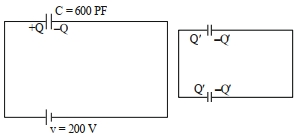
0 likesView Solution
308
PhysicsMediumMCQJEE Main · 2023
Two transparent media having refractive indices $1.0$ and $1.5$ are separated by a spherical refracting surface of radius of curvature $30\,cm$. The centre of curvature of the surface is towards the denser medium and a point object is placed on the principal axis in the rarer medium at a distance of $15\,cm$ from the pole of the surface. The distance of the image from the pole of the surface is .......$cm$.
A
$30$
B
$15$
C
$7.5$
D
$60$
Solution
(A) Given: Refractive index of rarer medium $\mu_1 = 1.0$,refractive index of denser medium $\mu_2 = 1.5$. Radius of curvature $R = +30\,cm$ (as the centre of curvature is in the direction of light propagation). Object distance $u = -15\,cm$ (measured against the direction of light).
Using the formula for refraction at a spherical surface:
$\frac{\mu_2}{v} - \frac{\mu_1}{u} = \frac{\mu_2 - \mu_1}{R}$
Substituting the values:
$\frac{1.5}{v} - \frac{1.0}{-15} = \frac{1.5 - 1.0}{30}$
$\frac{1.5}{v} + \frac{1}{15} = \frac{0.5}{30}$
$\frac{1.5}{v} + \frac{1}{15} = \frac{1}{60}$
$\frac{1.5}{v} = \frac{1}{60} - \frac{1}{15}$
$\frac{1.5}{v} = \frac{1 - 4}{60} = \frac{-3}{60} = -\frac{1}{20}$
$v = 1.5 \times (-20) = -30\,cm$.
The negative sign indicates that the image is formed on the same side as the object at a distance of $30\,cm$ from the pole.
Using the formula for refraction at a spherical surface:
$\frac{\mu_2}{v} - \frac{\mu_1}{u} = \frac{\mu_2 - \mu_1}{R}$
Substituting the values:
$\frac{1.5}{v} - \frac{1.0}{-15} = \frac{1.5 - 1.0}{30}$
$\frac{1.5}{v} + \frac{1}{15} = \frac{0.5}{30}$
$\frac{1.5}{v} + \frac{1}{15} = \frac{1}{60}$
$\frac{1.5}{v} = \frac{1}{60} - \frac{1}{15}$
$\frac{1.5}{v} = \frac{1 - 4}{60} = \frac{-3}{60} = -\frac{1}{20}$
$v = 1.5 \times (-20) = -30\,cm$.
The negative sign indicates that the image is formed on the same side as the object at a distance of $30\,cm$ from the pole.
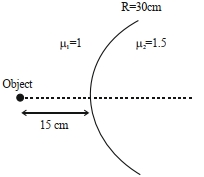
0 likesView Solution
309
PhysicsMediumMCQJEE Main · 2023
The ratio of the magnetic field at the centre of a current-carrying coil of radius $r$ to the magnetic field at a distance $r$ from the centre of the coil on its axis is $\sqrt{x}: 1$. The value of $x$ is $............$
A
$8$
B
$4$
C
$2$
D
$6$
Solution
(A) The magnetic field at the centre of the coil is given by $B_1 = \frac{\mu_0 I}{2r}$.
The magnetic field at a distance $d$ on the axis of the coil is given by $B_2 = \frac{\mu_0 I r^2}{2(r^2 + d^2)^{3/2}}$.
Given that $d = r$,we substitute this into the formula for $B_2$:
$B_2 = \frac{\mu_0 I r^2}{2(r^2 + r^2)^{3/2}} = \frac{\mu_0 I r^2}{2(2r^2)^{3/2}} = \frac{\mu_0 I r^2}{2(2^{3/2} r^3)} = \frac{\mu_0 I}{2(2\sqrt{2})r} = \frac{\mu_0 I}{4\sqrt{2}r}$.
Now,calculate the ratio $\frac{B_1}{B_2}$:
$\frac{B_1}{B_2} = \frac{\mu_0 I}{2r} \times \frac{4\sqrt{2}r}{\mu_0 I} = \frac{4\sqrt{2}}{2} = 2\sqrt{2} = \sqrt{4 \times 2} = \sqrt{8}$.
Comparing this with $\sqrt{x}: 1$,we get $\sqrt{x} = \sqrt{8}$,which implies $x = 8$.
The magnetic field at a distance $d$ on the axis of the coil is given by $B_2 = \frac{\mu_0 I r^2}{2(r^2 + d^2)^{3/2}}$.
Given that $d = r$,we substitute this into the formula for $B_2$:
$B_2 = \frac{\mu_0 I r^2}{2(r^2 + r^2)^{3/2}} = \frac{\mu_0 I r^2}{2(2r^2)^{3/2}} = \frac{\mu_0 I r^2}{2(2^{3/2} r^3)} = \frac{\mu_0 I}{2(2\sqrt{2})r} = \frac{\mu_0 I}{4\sqrt{2}r}$.
Now,calculate the ratio $\frac{B_1}{B_2}$:
$\frac{B_1}{B_2} = \frac{\mu_0 I}{2r} \times \frac{4\sqrt{2}r}{\mu_0 I} = \frac{4\sqrt{2}}{2} = 2\sqrt{2} = \sqrt{4 \times 2} = \sqrt{8}$.
Comparing this with $\sqrt{x}: 1$,we get $\sqrt{x} = \sqrt{8}$,which implies $x = 8$.
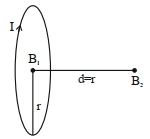
0 likesView Solution
310
PhysicsMediumMCQJEE Main · 2023
$A$ Zener diode of power rating $1.6\,W$ is to be used as a voltage regulator. If the Zener diode has a breakdown voltage of $8\,V$ and it has to regulate an input voltage fluctuating between $3\,V$ and $10\,V$, the value of series resistance $R_s$ for the safe operation of the diode will be $.........\Omega$.
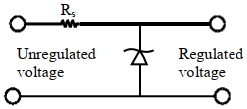
A
$13.3$
B
$12$
C
$10$
D
$13$
Solution
(C) The power rating of the Zener diode is $P = 1.6\,W$ and the breakdown voltage is $V_z = 8\,V$.
The maximum current that can flow through the Zener diode is $I_{z,max} = \frac{P}{V_z} = \frac{1.6\,W}{8\,V} = 0.2\,A$.
For the Zener diode to act as a voltage regulator, the input voltage $V_{in}$ must be greater than the breakdown voltage $V_z$. Here, the input voltage fluctuates between $3\,V$ and $10\,V$. The Zener diode will only regulate when $V_{in} \geq 8\,V$. Therefore, we consider the maximum input voltage $V_{in,max} = 10\,V$ to ensure the diode does not exceed its power rating.
The voltage drop across the series resistance $R_s$ at maximum input voltage is $V_{R_s} = V_{in,max} - V_z = 10\,V - 8\,V = 2\,V$.
To ensure safe operation, the current through the series resistance $R_s$ must be equal to the maximum current the Zener diode can handle (assuming no load current is connected, which is the worst-case scenario for the diode).
Thus, $R_s = \frac{V_{R_s}}{I_{z,max}} = \frac{2\,V}{0.2\,A} = 10\,\Omega$.
The maximum current that can flow through the Zener diode is $I_{z,max} = \frac{P}{V_z} = \frac{1.6\,W}{8\,V} = 0.2\,A$.
For the Zener diode to act as a voltage regulator, the input voltage $V_{in}$ must be greater than the breakdown voltage $V_z$. Here, the input voltage fluctuates between $3\,V$ and $10\,V$. The Zener diode will only regulate when $V_{in} \geq 8\,V$. Therefore, we consider the maximum input voltage $V_{in,max} = 10\,V$ to ensure the diode does not exceed its power rating.
The voltage drop across the series resistance $R_s$ at maximum input voltage is $V_{R_s} = V_{in,max} - V_z = 10\,V - 8\,V = 2\,V$.
To ensure safe operation, the current through the series resistance $R_s$ must be equal to the maximum current the Zener diode can handle (assuming no load current is connected, which is the worst-case scenario for the diode).
Thus, $R_s = \frac{V_{R_s}}{I_{z,max}} = \frac{2\,V}{0.2\,A} = 10\,\Omega$.
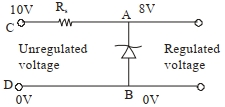
0 likesView Solution
311
PhysicsMediumMCQJEE Main · 2023
$A$ carrier wave of amplitude $15\,V$ is modulated by a sinusoidal baseband signal of amplitude $3\,V$. The ratio of maximum amplitude to minimum amplitude in an amplitude modulated wave is:
A
$2$
B
$\frac{3}{2}$
C
$5$
D
$1$
Solution
(B) Given,carrier wave amplitude $A_c = 15\,V$.
Baseband signal amplitude $A_m = 3\,V$.
The maximum amplitude of the amplitude modulated wave is given by $A_{\max} = A_c + A_m = 15 + 3 = 18\,V$.
The minimum amplitude of the amplitude modulated wave is given by $A_{\min} = A_c - A_m = 15 - 3 = 12\,V$.
The ratio of maximum amplitude to minimum amplitude is $\frac{A_{\max}}{A_{\min}} = \frac{18}{12} = \frac{3}{2}$.
Baseband signal amplitude $A_m = 3\,V$.
The maximum amplitude of the amplitude modulated wave is given by $A_{\max} = A_c + A_m = 15 + 3 = 18\,V$.
The minimum amplitude of the amplitude modulated wave is given by $A_{\min} = A_c - A_m = 15 - 3 = 12\,V$.
The ratio of maximum amplitude to minimum amplitude is $\frac{A_{\max}}{A_{\min}} = \frac{18}{12} = \frac{3}{2}$.
0 likesView Solution
312
PhysicsMediumMCQJEE Main · 2023
The angular momentum for the electron in the first Bohr orbit is $L$. If the electron is assumed to revolve in the second orbit of a hydrogen atom,then the change in angular momentum will be:
A
$\frac{L}{2}$
B
$0$
C
$L$
D
$2L$
Solution
(C) According to Bohr's postulate,the angular momentum $L$ of an electron in the $n^{th}$ orbit is given by $L_n = \frac{nh}{2\pi}$.
For the first orbit $(n=1)$,the angular momentum is $L_1 = L = \frac{1 \cdot h}{2\pi}$.
For the second orbit $(n=2)$,the angular momentum is $L_2 = \frac{2h}{2\pi} = 2 \left( \frac{h}{2\pi} \right) = 2L$.
The change in angular momentum is $\Delta L = L_2 - L_1 = 2L - L = L$.
For the first orbit $(n=1)$,the angular momentum is $L_1 = L = \frac{1 \cdot h}{2\pi}$.
For the second orbit $(n=2)$,the angular momentum is $L_2 = \frac{2h}{2\pi} = 2 \left( \frac{h}{2\pi} \right) = 2L$.
The change in angular momentum is $\Delta L = L_2 - L_1 = 2L - L = L$.
0 likesView Solution
313
PhysicsMediumMCQJEE Main · 2023
Given below are two statements:
Statement $I$: If the number of turns in the coil of a moving coil galvanometer is doubled,then the current sensitivity becomes double.
Statement $II$: Increasing the current sensitivity of a moving coil galvanometer by only increasing the number of turns in the coil will also increase its voltage sensitivity in the same ratio.
In the light of the above statements,choose the correct answer from the options given below:
Statement $I$: If the number of turns in the coil of a moving coil galvanometer is doubled,then the current sensitivity becomes double.
Statement $II$: Increasing the current sensitivity of a moving coil galvanometer by only increasing the number of turns in the coil will also increase its voltage sensitivity in the same ratio.
In the light of the above statements,choose the correct answer from the options given below:
A
Statement $I$ is false but Statement $II$ is true.
B
Both Statement $I$ and Statement $II$ are true.
C
Both Statement $I$ and Statement $II$ are false.
D
Statement $I$ is true but Statement $II$ is false.
Solution
(D) For a moving coil galvanometer,the torque is given by $\tau = NIAB \sin \theta = k \phi$,where $N$ is the number of turns,$I$ is the current,$A$ is the area,$B$ is the magnetic field,and $k$ is the torsional constant.
The current sensitivity is defined as $S_i = \frac{\phi}{I} = \frac{NBA}{k}$.
If $N$ is doubled,$S_i$ becomes $2 \times \frac{NBA}{k}$,so Statement $I$ is true.
The voltage sensitivity is defined as $S_v = \frac{\phi}{V} = \frac{\phi}{IR} = \frac{S_i}{R} = \frac{NBA}{kR}$.
When the number of turns $N$ is doubled,the length of the wire in the coil also doubles,which means the resistance $R$ of the coil also doubles $(R \propto N)$.
Therefore,$S_v = \frac{(2N)BA}{k(2R)} = \frac{NBA}{kR}$.
Since $S_v$ remains unchanged,Statement $II$ is false.
The current sensitivity is defined as $S_i = \frac{\phi}{I} = \frac{NBA}{k}$.
If $N$ is doubled,$S_i$ becomes $2 \times \frac{NBA}{k}$,so Statement $I$ is true.
The voltage sensitivity is defined as $S_v = \frac{\phi}{V} = \frac{\phi}{IR} = \frac{S_i}{R} = \frac{NBA}{kR}$.
When the number of turns $N$ is doubled,the length of the wire in the coil also doubles,which means the resistance $R$ of the coil also doubles $(R \propto N)$.
Therefore,$S_v = \frac{(2N)BA}{k(2R)} = \frac{NBA}{kR}$.
Since $S_v$ remains unchanged,Statement $II$ is false.
0 likesView Solution
314
PhysicsMediumMCQJEE Main · 2023
The equivalent resistance of the circuit shown below between points $a$ and $b$ is $..........\Omega$
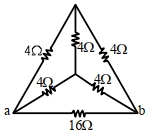
A
$24$
B
$3.2$
C
$20$
D
$16$
Solution
(B) The circuit consists of a central node connected to points $a$,$b$,and the top vertex.
Let the top vertex be $c$. The resistors connected to $c$ are in series with the resistors connected to $a$ and $b$.
Specifically,the branch from $a$ to $c$ has two $4\,\Omega$ resistors in series,giving $4+4=8\,\Omega$.
The branch from $b$ to $c$ has two $4\,\Omega$ resistors in series,giving $4+4=8\,\Omega$.
These two branches are in parallel with each other,and their equivalent resistance is $\frac{8 \times 8}{8+8} = 4\,\Omega$.
Finally,this $4\,\Omega$ equivalent resistance is in parallel with the $16\,\Omega$ resistor connected directly between $a$ and $b$.
$R_{eq} = \frac{4 \times 16}{4+16} = \frac{64}{20} = 3.2\,\Omega$.
Let the top vertex be $c$. The resistors connected to $c$ are in series with the resistors connected to $a$ and $b$.
Specifically,the branch from $a$ to $c$ has two $4\,\Omega$ resistors in series,giving $4+4=8\,\Omega$.
The branch from $b$ to $c$ has two $4\,\Omega$ resistors in series,giving $4+4=8\,\Omega$.
These two branches are in parallel with each other,and their equivalent resistance is $\frac{8 \times 8}{8+8} = 4\,\Omega$.
Finally,this $4\,\Omega$ equivalent resistance is in parallel with the $16\,\Omega$ resistor connected directly between $a$ and $b$.
$R_{eq} = \frac{4 \times 16}{4+16} = \frac{64}{20} = 3.2\,\Omega$.
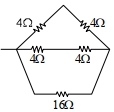
0 likesView Solution
315
PhysicsMediumMCQJEE Main · 2023
Given below are two statements:
Statement $I$: Maximum power is dissipated in a circuit containing an inductor, a capacitor, and a resistor connected in series with an $AC$ source, when resonance occurs.
Statement $II$: Maximum power is dissipated in a circuit containing a pure resistor due to zero phase difference between current and voltage.
In the light of the above statements, choose the correct answer from the options given below:
Statement $I$: Maximum power is dissipated in a circuit containing an inductor, a capacitor, and a resistor connected in series with an $AC$ source, when resonance occurs.
Statement $II$: Maximum power is dissipated in a circuit containing a pure resistor due to zero phase difference between current and voltage.
In the light of the above statements, choose the correct answer from the options given below:
A
Statement $I$ is false but Statement $II$ is true.
B
Statement $I$ is true but Statement $II$ is false.
C
Both Statement $I$ and Statement $II$ are true.
D
Both Statement $I$ and Statement $II$ are false.
Solution
(C) The power dissipated in an $AC$ circuit is given by $P = V_{rms} I_{rms} \cos \phi$, where $\cos \phi$ is the power factor.
For a series $LCR$ circuit, the impedance is $Z = \sqrt{R^2 + (X_L - X_C)^2}$.
At resonance, $X_L = X_C$, which makes the impedance $Z$ minimum $(Z = R)$ and the phase difference $\phi = 0$. Thus, $\cos \phi = 1$, and power dissipation is maximum. Therefore, Statement $I$ is true.
In a pure resistive circuit, the current and voltage are in the same phase $(\phi = 0)$, so $\cos \phi = 1$. This results in maximum power dissipation for a given voltage. Therefore, Statement $II$ is true.
Hence, both statements are correct.
For a series $LCR$ circuit, the impedance is $Z = \sqrt{R^2 + (X_L - X_C)^2}$.
At resonance, $X_L = X_C$, which makes the impedance $Z$ minimum $(Z = R)$ and the phase difference $\phi = 0$. Thus, $\cos \phi = 1$, and power dissipation is maximum. Therefore, Statement $I$ is true.
In a pure resistive circuit, the current and voltage are in the same phase $(\phi = 0)$, so $\cos \phi = 1$. This results in maximum power dissipation for a given voltage. Therefore, Statement $II$ is true.
Hence, both statements are correct.
0 likesView Solution
316
PhysicsMediumMCQJEE Main · 2023
The equivalent capacitance of the combination shown is
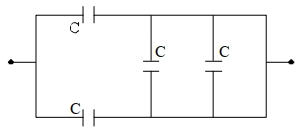
A
$\frac{C}{2}$
B
$4 C$
C
$C$
D
$\frac{5}{3} C$
Solution
(NONE) The circuit consists of two branches connected in parallel.
$1$. The top branch has two capacitors of capacitance $C$ in series. Their equivalent capacitance $C_1$ is given by $\frac{1}{C_1} = \frac{1}{C} + \frac{1}{C} = \frac{2}{C}$,so $C_1 = \frac{C}{2}$.
$2$. The bottom branch also has two capacitors of capacitance $C$ in series. Their equivalent capacitance $C_2$ is given by $\frac{1}{C_2} = \frac{1}{C} + \frac{1}{C} = \frac{2}{C}$,so $C_2 = \frac{C}{2}$.
$3$. These two branches are connected in parallel. Therefore,the total equivalent capacitance $C_{eq}$ is $C_{eq} = C_1 + C_2 = \frac{C}{2} + \frac{C}{2} = C$.
$1$. The top branch has two capacitors of capacitance $C$ in series. Their equivalent capacitance $C_1$ is given by $\frac{1}{C_1} = \frac{1}{C} + \frac{1}{C} = \frac{2}{C}$,so $C_1 = \frac{C}{2}$.
$2$. The bottom branch also has two capacitors of capacitance $C$ in series. Their equivalent capacitance $C_2$ is given by $\frac{1}{C_2} = \frac{1}{C} + \frac{1}{C} = \frac{2}{C}$,so $C_2 = \frac{C}{2}$.
$3$. These two branches are connected in parallel. Therefore,the total equivalent capacitance $C_{eq}$ is $C_{eq} = C_1 + C_2 = \frac{C}{2} + \frac{C}{2} = C$.
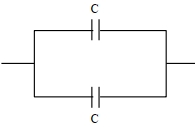
0 likesView Solution
317
PhysicsMediumMCQJEE Main · 2023
The energy of an electromagnetic wave contained in a small volume oscillates with
A
zero frequency
B
half the frequency of the wave
C
double the frequency of the wave
D
the frequency of the wave
Solution
(C) The electric field of an electromagnetic wave is given by $E = E_0 \sin(\omega t - kx)$.
The energy density $u$ is proportional to the square of the electric field,$u \propto E^2$.
Thus,$u \propto \sin^2(\omega t - kx)$.
Using the trigonometric identity $\sin^2 \theta = \frac{1 - \cos(2\theta)}{2}$,we get $u \propto \frac{1 - \cos(2(\omega t - kx))}{2}$.
The frequency of the oscillation of the energy density is determined by the term $2\omega t$.
Since the angular frequency of the wave is $\omega = 2\pi f$,the angular frequency of the energy oscillation is $2\omega = 2(2\pi f) = 2\pi(2f)$.
Therefore,the frequency of the energy oscillation is $2f$,which is double the frequency of the wave.
The energy density $u$ is proportional to the square of the electric field,$u \propto E^2$.
Thus,$u \propto \sin^2(\omega t - kx)$.
Using the trigonometric identity $\sin^2 \theta = \frac{1 - \cos(2\theta)}{2}$,we get $u \propto \frac{1 - \cos(2(\omega t - kx))}{2}$.
The frequency of the oscillation of the energy density is determined by the term $2\omega t$.
Since the angular frequency of the wave is $\omega = 2\pi f$,the angular frequency of the energy oscillation is $2\omega = 2(2\pi f) = 2\pi(2f)$.
Therefore,the frequency of the energy oscillation is $2f$,which is double the frequency of the wave.
0 likesView Solution
318
PhysicsMediumMCQJEE Main · 2023
An object is placed at a distance of $12\,cm$ in front of a plane mirror. $A$ virtual and erect image is formed by the mirror. Now,the mirror is moved by $4\,cm$ towards the stationary object. The distance by which the position of the image would be shifted is:
A
$4\,cm$ towards the mirror
B
$8\,cm$ towards the mirror
C
$8\,cm$ away from the mirror
D
$2\,cm$ towards the mirror
Solution
(B) Initially,the object is at $x = -12\,cm$ and the mirror is at $x = 0$. The image is formed at $x = +12\,cm$.
When the mirror is moved $4\,cm$ towards the object,the new position of the mirror is $x = -4\,cm$.
The distance of the object from the new mirror position is $u = |-12 - (-4)| = 8\,cm$.
Since the image is formed at the same distance behind the mirror,the new image position $x_i$ satisfies $|x_i - (-4)| = 8\,cm$,so $x_i = 4\,cm$.
The initial position of the image was $12\,cm$ and the final position is $4\,cm$.
Therefore,the shift in the position of the image is $12\,cm - 4\,cm = 8\,cm$ towards the mirror.
When the mirror is moved $4\,cm$ towards the object,the new position of the mirror is $x = -4\,cm$.
The distance of the object from the new mirror position is $u = |-12 - (-4)| = 8\,cm$.
Since the image is formed at the same distance behind the mirror,the new image position $x_i$ satisfies $|x_i - (-4)| = 8\,cm$,so $x_i = 4\,cm$.
The initial position of the image was $12\,cm$ and the final position is $4\,cm$.
Therefore,the shift in the position of the image is $12\,cm - 4\,cm = 8\,cm$ towards the mirror.
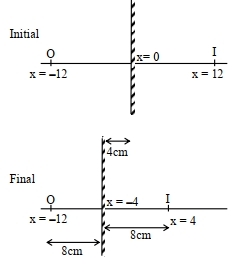
0 likesView Solution
319
PhysicsMediumMCQJEE Main · 2023
The de Broglie wavelength of a molecule in a gas at room temperature $(300 \ K)$ is $\lambda_1$. If the temperature of the gas is increased to $600 \ K$,then the de Broglie wavelength of the same gas molecule becomes $..............$.
A
$\frac{1}{\sqrt{2}} \lambda_1$
B
$2 \lambda_1$
C
$\frac{1}{2} \lambda_1$
D
$\sqrt{2} \lambda_1$
Solution
(A) From the Kinetic Theory of Gases ($K$.$T$.$G$.),the root mean square velocity of a gas molecule is given by $v_{RMS} = \sqrt{\frac{3 k_B T}{m}}$.
This implies that $v_{RMS} \propto \sqrt{T}$.
The de Broglie wavelength is given by $\lambda = \frac{h}{p} = \frac{h}{m v_{RMS}}$.
Since $v_{RMS} \propto \sqrt{T}$,we have $\lambda \propto \frac{1}{\sqrt{T}}$.
Therefore,the ratio of the wavelengths is $\frac{\lambda_2}{\lambda_1} = \sqrt{\frac{T_1}{T_2}}$.
Given $T_1 = 300 \ K$ and $T_2 = 600 \ K$,we get $\frac{\lambda_2}{\lambda_1} = \sqrt{\frac{300}{600}} = \sqrt{\frac{1}{2}} = \frac{1}{\sqrt{2}}$.
Thus,the new wavelength is $\lambda_2 = \frac{\lambda_1}{\sqrt{2}}$.
This implies that $v_{RMS} \propto \sqrt{T}$.
The de Broglie wavelength is given by $\lambda = \frac{h}{p} = \frac{h}{m v_{RMS}}$.
Since $v_{RMS} \propto \sqrt{T}$,we have $\lambda \propto \frac{1}{\sqrt{T}}$.
Therefore,the ratio of the wavelengths is $\frac{\lambda_2}{\lambda_1} = \sqrt{\frac{T_1}{T_2}}$.
Given $T_1 = 300 \ K$ and $T_2 = 600 \ K$,we get $\frac{\lambda_2}{\lambda_1} = \sqrt{\frac{300}{600}} = \sqrt{\frac{1}{2}} = \frac{1}{\sqrt{2}}$.
Thus,the new wavelength is $\lambda_2 = \frac{\lambda_1}{\sqrt{2}}$.
0 likesView Solution
320
PhysicsMediumMCQJEE Main · 2023
Unpolarised light of intensity $32 \, W m^{-2}$ passes through a combination of three polaroids such that the pass axis of the last polaroid is perpendicular to that of the pass axis of the first polaroid. If the intensity of the emerging light is $3 \, W m^{-2}$,then the angle between the pass axis of the first two polaroids is $............ \, ^{\circ}$.
A
$20$
B
$40$
C
$90$
D
$30$
Solution
(D) Let the intensity of unpolarised light be $I_0 = 32 \, W m^{-2}$.
After passing through the first polaroid,the intensity becomes $I_1 = \frac{I_0}{2} = 16 \, W m^{-2}$.
Let $\theta$ be the angle between the pass axis of the first and second polaroid.
The intensity after the second polaroid is $I_2 = I_1 \cos^2 \theta = \frac{I_0}{2} \cos^2 \theta$.
The angle between the second and third polaroid is $(90^{\circ} - \theta)$ because the first and third polaroids are perpendicular.
The intensity after the third polaroid is $I_3 = I_2 \cos^2(90^{\circ} - \theta) = I_2 \sin^2 \theta$.
Substituting $I_2$,we get $I_3 = \frac{I_0}{2} \cos^2 \theta \sin^2 \theta = \frac{I_0}{8} (2 \sin \theta \cos \theta)^2 = \frac{I_0}{8} \sin^2(2 \theta)$.
Given $I_3 = 3 \, W m^{-2}$ and $I_0 = 32 \, W m^{-2}$,we have $3 = \frac{32}{8} \sin^2(2 \theta) = 4 \sin^2(2 \theta)$.
$\sin^2(2 \theta) = \frac{3}{4} \implies \sin(2 \theta) = \frac{\sqrt{3}}{2}$.
Thus,$2 \theta = 60^{\circ}$ or $120^{\circ}$,which gives $\theta = 30^{\circ}$ or $60^{\circ}$.
After passing through the first polaroid,the intensity becomes $I_1 = \frac{I_0}{2} = 16 \, W m^{-2}$.
Let $\theta$ be the angle between the pass axis of the first and second polaroid.
The intensity after the second polaroid is $I_2 = I_1 \cos^2 \theta = \frac{I_0}{2} \cos^2 \theta$.
The angle between the second and third polaroid is $(90^{\circ} - \theta)$ because the first and third polaroids are perpendicular.
The intensity after the third polaroid is $I_3 = I_2 \cos^2(90^{\circ} - \theta) = I_2 \sin^2 \theta$.
Substituting $I_2$,we get $I_3 = \frac{I_0}{2} \cos^2 \theta \sin^2 \theta = \frac{I_0}{8} (2 \sin \theta \cos \theta)^2 = \frac{I_0}{8} \sin^2(2 \theta)$.
Given $I_3 = 3 \, W m^{-2}$ and $I_0 = 32 \, W m^{-2}$,we have $3 = \frac{32}{8} \sin^2(2 \theta) = 4 \sin^2(2 \theta)$.
$\sin^2(2 \theta) = \frac{3}{4} \implies \sin(2 \theta) = \frac{\sqrt{3}}{2}$.
Thus,$2 \theta = 60^{\circ}$ or $120^{\circ}$,which gives $\theta = 30^{\circ}$ or $60^{\circ}$.
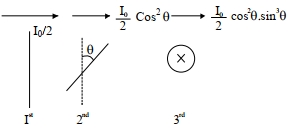
0 likesView Solution
321
PhysicsMediumMCQJEE Main · 2023
The current required to be passed through a solenoid of $15\,cm$ length and $60$ turns in order to demagnetize a bar magnet of magnetic intensity $2.4 \times 10^3\,A/m$ is $.........A$.
A
$3$
B
$2$
C
$8$
D
$6$
Solution
(D) The magnetic intensity $H$ inside a solenoid is given by the formula $H = ni$,where $n$ is the number of turns per unit length and $i$ is the current.
Given:
Length of solenoid $\ell = 15\,cm = 0.15\,m$
Number of turns $N = 60$
Magnetic intensity $H = 2.4 \times 10^3\,A/m$
First,calculate the number of turns per unit length $n$:
$n = \frac{N}{\ell} = \frac{60}{0.15} = 400\,turns/m$
Now,use the formula $H = ni$ to find the current $i$:
$2.4 \times 10^3 = 400 \times i$
$i = \frac{2400}{400} = 6\,A$
Therefore,the required current is $6\,A$.
Given:
Length of solenoid $\ell = 15\,cm = 0.15\,m$
Number of turns $N = 60$
Magnetic intensity $H = 2.4 \times 10^3\,A/m$
First,calculate the number of turns per unit length $n$:
$n = \frac{N}{\ell} = \frac{60}{0.15} = 400\,turns/m$
Now,use the formula $H = ni$ to find the current $i$:
$2.4 \times 10^3 = 400 \times i$
$i = \frac{2400}{400} = 6\,A$
Therefore,the required current is $6\,A$.
0 likesView Solution
322
PhysicsMediumMCQJEE Main · 2023
$A$ $1\,m$ long metal rod $XY$ completes the circuit as shown in the figure. The plane of the circuit is perpendicular to the magnetic field of flux density $0.15\,T$. If the resistance of the circuit is $5\,\Omega$,the force needed to move the rod in the direction indicated with a constant speed of $4\,m/s$ will be $................\,10^{-3}\,N$.
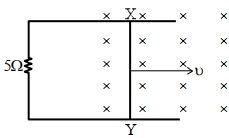
A
$9$
B
$45$
C
$16$
D
$18$
Solution
(D) The motional electromotive force $(EMF)$ induced in the rod is given by $\varepsilon = B \ell v$.
Given: $B = 0.15\,T$,$\ell = 1\,m$,$v = 4\,m/s$,and $R = 5\,\Omega$.
The induced current in the circuit is $i = \frac{\varepsilon}{R} = \frac{B \ell v}{R}$.
The magnetic force acting on the rod is $F = i \ell B$.
Substituting the expression for $i$,we get $F = \left( \frac{B \ell v}{R} \right) \ell B = \frac{B^2 \ell^2 v}{R}$.
Substituting the values: $F = \frac{(0.15)^2 \times (1)^2 \times 4}{5}$.
$F = \frac{0.0225 \times 4}{5} = \frac{0.09}{5} = 0.018\,N$.
Converting to the required units: $0.018\,N = 18 \times 10^{-3}\,N$.
Given: $B = 0.15\,T$,$\ell = 1\,m$,$v = 4\,m/s$,and $R = 5\,\Omega$.
The induced current in the circuit is $i = \frac{\varepsilon}{R} = \frac{B \ell v}{R}$.
The magnetic force acting on the rod is $F = i \ell B$.
Substituting the expression for $i$,we get $F = \left( \frac{B \ell v}{R} \right) \ell B = \frac{B^2 \ell^2 v}{R}$.
Substituting the values: $F = \frac{(0.15)^2 \times (1)^2 \times 4}{5}$.
$F = \frac{0.0225 \times 4}{5} = \frac{0.09}{5} = 0.018\,N$.
Converting to the required units: $0.018\,N = 18 \times 10^{-3}\,N$.
0 likesView Solution
323
PhysicsDifficultMCQJEE Main · 2023
The decay constant for a radioactive nuclide is $1.5 \times 10^{-5} \, s^{-1}$. The molar mass of the substance is $60 \, g \, mol^{-1}$,$(N_A = 6 \times 10^{23})$. The activity of $1.0 \, \mu g$ of the substance is $....... \times 10^{10} \, Bq$.
A
$14$
B
$13$
C
$12$
D
$15$
Solution
(D) Given: Decay constant $\lambda = 1.5 \times 10^{-5} \, s^{-1}$.
Mass of substance $m = 1.0 \, \mu g = 1.0 \times 10^{-6} \, g$.
Molar mass $M = 60 \, g \, mol^{-1}$.
Number of moles $n = \frac{m}{M} = \frac{1.0 \times 10^{-6}}{60} = \frac{1}{6} \times 10^{-7} \, mol$.
Number of atoms $N = n \times N_A = (\frac{1}{6} \times 10^{-7}) \times (6 \times 10^{23}) = 10^{16}$ atoms.
Activity $A = N \lambda = 10^{16} \times 1.5 \times 10^{-5} \, Bq$.
$A = 1.5 \times 10^{11} \, Bq = 15 \times 10^{10} \, Bq$.
Therefore,the value is $15$.
Mass of substance $m = 1.0 \, \mu g = 1.0 \times 10^{-6} \, g$.
Molar mass $M = 60 \, g \, mol^{-1}$.
Number of moles $n = \frac{m}{M} = \frac{1.0 \times 10^{-6}}{60} = \frac{1}{6} \times 10^{-7} \, mol$.
Number of atoms $N = n \times N_A = (\frac{1}{6} \times 10^{-7}) \times (6 \times 10^{23}) = 10^{16}$ atoms.
Activity $A = N \lambda = 10^{16} \times 1.5 \times 10^{-5} \, Bq$.
$A = 1.5 \times 10^{11} \, Bq = 15 \times 10^{10} \, Bq$.
Therefore,the value is $15$.
0 likesView Solution
324
PhysicsDifficultMCQJEE Main · 2023
Three concentric spherical metallic shells $X$,$Y$,and $Z$ of radii $a$,$b$,and $c$ respectively $[a < b < c]$ have surface charge densities $\sigma$,$-\sigma$,and $\sigma$,respectively. The shells $X$ and $Z$ are at the same potential. If the radii of $X$ and $Y$ are $2\,cm$ and $3\,cm$,respectively,then the radius of shell $Z$ is $......\,cm$.
A
$4$
B
$3$
C
$2$
D
$5$
Solution
(D) The charges on the shells are:
$q_x = \sigma(4\pi a^2)$
$q_y = -\sigma(4\pi b^2)$
$q_z = \sigma(4\pi c^2)$
Since the potential of shell $X$ is equal to the potential of shell $Z$ $(V_x = V_z)$:
$V_x = \frac{1}{4\pi\varepsilon_0} \left( \frac{q_x}{a} + \frac{q_y}{b} + \frac{q_z}{c} \right)$
$V_z = \frac{1}{4\pi\varepsilon_0} \left( \frac{q_x}{c} + \frac{q_y}{c} + \frac{q_z}{c} \right)$
Equating $V_x$ and $V_z$:
$\frac{\sigma 4\pi a^2}{a} - \frac{\sigma 4\pi b^2}{b} + \frac{\sigma 4\pi c^2}{c} = \frac{\sigma 4\pi a^2}{c} - \frac{\sigma 4\pi b^2}{c} + \frac{\sigma 4\pi c^2}{c}$
Simplifying the equation:
$a - b + \frac{c^2}{c} = \frac{a^2 - b^2 + c^2}{c}$
$a - b + c = \frac{a^2 - b^2 + c^2}{c}$
$c(a - b + c) = a^2 - b^2 + c^2$
$c(a - b) + c^2 = a^2 - b^2 + c^2$
$c(a - b) = a^2 - b^2$
$c(a - b) = (a - b)(a + b)$
$c = a + b$
Given $a = 2\,cm$ and $b = 3\,cm$:
$c = 2 + 3 = 5\,cm$.
$q_x = \sigma(4\pi a^2)$
$q_y = -\sigma(4\pi b^2)$
$q_z = \sigma(4\pi c^2)$
Since the potential of shell $X$ is equal to the potential of shell $Z$ $(V_x = V_z)$:
$V_x = \frac{1}{4\pi\varepsilon_0} \left( \frac{q_x}{a} + \frac{q_y}{b} + \frac{q_z}{c} \right)$
$V_z = \frac{1}{4\pi\varepsilon_0} \left( \frac{q_x}{c} + \frac{q_y}{c} + \frac{q_z}{c} \right)$
Equating $V_x$ and $V_z$:
$\frac{\sigma 4\pi a^2}{a} - \frac{\sigma 4\pi b^2}{b} + \frac{\sigma 4\pi c^2}{c} = \frac{\sigma 4\pi a^2}{c} - \frac{\sigma 4\pi b^2}{c} + \frac{\sigma 4\pi c^2}{c}$
Simplifying the equation:
$a - b + \frac{c^2}{c} = \frac{a^2 - b^2 + c^2}{c}$
$a - b + c = \frac{a^2 - b^2 + c^2}{c}$
$c(a - b + c) = a^2 - b^2 + c^2$
$c(a - b) + c^2 = a^2 - b^2 + c^2$
$c(a - b) = a^2 - b^2$
$c(a - b) = (a - b)(a + b)$
$c = a + b$
Given $a = 2\,cm$ and $b = 3\,cm$:
$c = 2 + 3 = 5\,cm$.
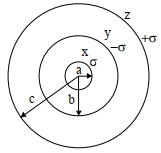
0 likesView Solution
325
PhysicsMediumMCQJEE Main · 2023
$10$ resistors,each of resistance $10\,\Omega$,can be connected to obtain maximum and minimum equivalent resistance. The ratio of maximum to minimum equivalent resistance will be $..........$.
A
$90$
B
$80$
C
$70$
D
$100$
Solution
(D) Maximum resistance is obtained when all resistors are connected in a series combination.
$R_{\max} = n \times R$,where $n = 10$ and $R = 10\,\Omega$.
$R_{\max} = 10 \times 10 = 100\,\Omega$.
Minimum resistance is obtained when all resistors are connected in a parallel combination.
$R_{\min} = \frac{R}{n}$,where $n = 10$ and $R = 10\,\Omega$.
$R_{\min} = \frac{10}{10} = 1\,\Omega$.
The ratio of maximum to minimum equivalent resistance is:
$\frac{R_{\max}}{R_{\min}} = \frac{100}{1} = 100$.
$R_{\max} = n \times R$,where $n = 10$ and $R = 10\,\Omega$.
$R_{\max} = 10 \times 10 = 100\,\Omega$.
Minimum resistance is obtained when all resistors are connected in a parallel combination.
$R_{\min} = \frac{R}{n}$,where $n = 10$ and $R = 10\,\Omega$.
$R_{\min} = \frac{10}{10} = 1\,\Omega$.
The ratio of maximum to minimum equivalent resistance is:
$\frac{R_{\max}}{R_{\min}} = \frac{100}{1} = 100$.
0 likesView Solution
326
PhysicsMediumMCQJEE Main · 2023
The half-life of a radioactive substance is $T$. The time taken for disintegrating $\frac{7}{8}$th part of its original mass will be
A
$3T$
B
$8T$
C
$T$
D
$2T$
Solution
(A) The half-life of the substance is given as $t_{1/2} = T$.
If the original mass is $N_0$,then after disintegrating $\frac{7}{8}$th of its mass,the remaining mass $N$ is:
$N = N_0 - \frac{7}{8}N_0 = \frac{1}{8}N_0$.
We know that the remaining mass after $n$ half-lives is given by $N = N_0 \left(\frac{1}{2}\right)^n$.
Substituting the values: $\frac{1}{8}N_0 = N_0 \left(\frac{1}{2}\right)^n$.
$\left(\frac{1}{2}\right)^3 = \left(\frac{1}{2}\right)^n$,which implies $n = 3$.
The total time taken is $t = n \times T = 3T$.
If the original mass is $N_0$,then after disintegrating $\frac{7}{8}$th of its mass,the remaining mass $N$ is:
$N = N_0 - \frac{7}{8}N_0 = \frac{1}{8}N_0$.
We know that the remaining mass after $n$ half-lives is given by $N = N_0 \left(\frac{1}{2}\right)^n$.
Substituting the values: $\frac{1}{8}N_0 = N_0 \left(\frac{1}{2}\right)^n$.
$\left(\frac{1}{2}\right)^3 = \left(\frac{1}{2}\right)^n$,which implies $n = 3$.
The total time taken is $t = n \times T = 3T$.
0 likesView Solution
327
PhysicsMediumMCQJEE Main · 2023
Given below are two statements:
Statement $I:$ For a diamagnetic substance $-1 \leq \chi < 0$,where $\chi$ is the magnetic susceptibility.
Statement $II:$ Diamagnetic substances,when placed in an external non-uniform magnetic field,tend to move from the stronger to the weaker part of the field.
In the light of the above statements,choose the correct answer from the options given below.
Statement $I:$ For a diamagnetic substance $-1 \leq \chi < 0$,where $\chi$ is the magnetic susceptibility.
Statement $II:$ Diamagnetic substances,when placed in an external non-uniform magnetic field,tend to move from the stronger to the weaker part of the field.
In the light of the above statements,choose the correct answer from the options given below.
A
Both Statement $I$ and Statement $II$ are false.
B
Both Statement $I$ and Statement $II$ are true.
C
Statement $I$ is incorrect but Statement $II$ is true.
D
Statement $I$ is correct but Statement $II$ is false.
Solution
(B) Statement $I$ is true: For diamagnetic materials,the magnetic susceptibility $\chi$ is negative and lies in the range $-1 \leq \chi < 0$. This indicates that the material develops a weak magnetization in the direction opposite to the applied magnetic field.
Statement $II$ is true: Due to the negative susceptibility,diamagnetic materials are weakly repelled by magnets. When placed in a non-uniform magnetic field,they experience a force that pushes them from regions of stronger magnetic field intensity to regions of weaker magnetic field intensity.
Statement $II$ is true: Due to the negative susceptibility,diamagnetic materials are weakly repelled by magnets. When placed in a non-uniform magnetic field,they experience a force that pushes them from regions of stronger magnetic field intensity to regions of weaker magnetic field intensity.
0 likesView Solution
328
PhysicsMediumMCQJEE Main · 2023
The distance between two plates of a capacitor is $d$ and its capacitance is $C_1$,when air is the medium between the plates. If a metal sheet of thickness $\frac{2d}{3}$ and of same area as the plate is introduced between the plates,the capacitance of the capacitor becomes $C_2$. The ratio $\frac{C_2}{C_1}$ is: (in $:1$)
A
$2$
B
$4$
C
$3$
D
$1$
Solution
(C) The capacitance of a parallel plate capacitor with air as the medium is given by $C_1 = \frac{\epsilon_0 A}{d}$.
When a metal sheet of thickness $t = \frac{2d}{3}$ is introduced between the plates,the effective distance between the plates decreases.
The capacitance $C_2$ of a capacitor with a dielectric slab (or metal sheet) of thickness $t$ is given by $C_2 = \frac{\epsilon_0 A}{d - t + \frac{t}{K}}$.
For a metal sheet,the dielectric constant $K = \infty$.
Substituting the values,we get $C_2 = \frac{\epsilon_0 A}{d - \frac{2d}{3} + \frac{2d/3}{\infty}} = \frac{\epsilon_0 A}{d - \frac{2d}{3} + 0} = \frac{\epsilon_0 A}{d/3} = 3 \frac{\epsilon_0 A}{d}$.
Since $C_1 = \frac{\epsilon_0 A}{d}$,we have $C_2 = 3C_1$.
Therefore,the ratio $\frac{C_2}{C_1} = 3:1$.
When a metal sheet of thickness $t = \frac{2d}{3}$ is introduced between the plates,the effective distance between the plates decreases.
The capacitance $C_2$ of a capacitor with a dielectric slab (or metal sheet) of thickness $t$ is given by $C_2 = \frac{\epsilon_0 A}{d - t + \frac{t}{K}}$.
For a metal sheet,the dielectric constant $K = \infty$.
Substituting the values,we get $C_2 = \frac{\epsilon_0 A}{d - \frac{2d}{3} + \frac{2d/3}{\infty}} = \frac{\epsilon_0 A}{d - \frac{2d}{3} + 0} = \frac{\epsilon_0 A}{d/3} = 3 \frac{\epsilon_0 A}{d}$.
Since $C_1 = \frac{\epsilon_0 A}{d}$,we have $C_2 = 3C_1$.
Therefore,the ratio $\frac{C_2}{C_1} = 3:1$.
0 likesView Solution
329
PhysicsEasyMCQJEE Main · 2023
The amplitude of the magnetic field in an electromagnetic wave propagating along the $y$-axis is $6.0 \times 10^{-7} \, T$. The maximum value of the electric field in the electromagnetic wave is:
A
$5 \times 10^{14} \, Vm^{-1}$
B
$180 \, Vm^{-1}$
C
$2 \times 10^{15} \, Vm^{-1}$
D
$6.0 \times 10^{-7} \, Vm^{-1}$
Solution
(B) The relationship between the amplitude of the electric field $(E_0)$ and the magnetic field $(B_0)$ in an electromagnetic wave is given by the equation: $E_0 = B_0 c$,where $c$ is the speed of light in vacuum.
Given:
$B_0 = 6.0 \times 10^{-7} \, T$
$c = 3.0 \times 10^8 \, ms^{-1}$
Substituting the values:
$E_0 = (6.0 \times 10^{-7} \, T) \times (3.0 \times 10^8 \, ms^{-1})$
$E_0 = 18 \times 10^1 \, Vm^{-1}$
$E_0 = 180 \, Vm^{-1}$
Given:
$B_0 = 6.0 \times 10^{-7} \, T$
$c = 3.0 \times 10^8 \, ms^{-1}$
Substituting the values:
$E_0 = (6.0 \times 10^{-7} \, T) \times (3.0 \times 10^8 \, ms^{-1})$
$E_0 = 18 \times 10^1 \, Vm^{-1}$
$E_0 = 180 \, Vm^{-1}$
0 likesView Solution
330
PhysicsMediumMCQJEE Main · 2023
The ratio of intensities at two points $P$ and $Q$ on the screen in a Young's double-slit experiment,where the phase differences between two waves of the same amplitude are $\pi / 3$ and $\pi / 2$ respectively,is:
A
$1: 3$
B
$3: 1$
C
$3: 2$
D
$2: 3$
Solution
(C) The resultant intensity $I$ for two waves of equal intensity $I_0$ with a phase difference $\phi$ is given by the formula: $I = I_0 + I_0 + 2\sqrt{I_0 I_0} \cos \phi = 2I_0(1 + \cos \phi) = 4I_0 \cos^2(\phi/2)$.
For point $P$,the phase difference is $\phi_1 = \pi/3$. The intensity $I_P$ is:
$I_P = 2I_0(1 + \cos(\pi/3)) = 2I_0(1 + 0.5) = 3I_0$.
For point $Q$,the phase difference is $\phi_2 = \pi/2$. The intensity $I_Q$ is:
$I_Q = 2I_0(1 + \cos(\pi/2)) = 2I_0(1 + 0) = 2I_0$.
The ratio of intensities at $P$ and $Q$ is:
$\frac{I_P}{I_Q} = \frac{3I_0}{2I_0} = \frac{3}{2}$ or $3:2$.
For point $P$,the phase difference is $\phi_1 = \pi/3$. The intensity $I_P$ is:
$I_P = 2I_0(1 + \cos(\pi/3)) = 2I_0(1 + 0.5) = 3I_0$.
For point $Q$,the phase difference is $\phi_2 = \pi/2$. The intensity $I_Q$ is:
$I_Q = 2I_0(1 + \cos(\pi/2)) = 2I_0(1 + 0) = 2I_0$.
The ratio of intensities at $P$ and $Q$ is:
$\frac{I_P}{I_Q} = \frac{3I_0}{2I_0} = \frac{3}{2}$ or $3:2$.
0 likesView Solution
331
PhysicsMediumMCQJEE Main · 2023
The variation of stopping potential $(V_0)$ as a function of the frequency $\nu \ (\times 10^{14} \ Hz)$ of the incident light for a metal is shown in the figure. The work function of the surface is $........... \ eV$.
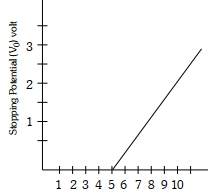
A
$18.6$
B
$2.98$
C
$2.07$
D
$1.36$
Solution
(C) According to Einstein's photoelectric equation,the stopping potential $V_0$ is given by:
$eV_0 = h\nu - \phi$
where $h$ is Planck's constant,$\nu$ is the frequency,and $\phi$ is the work function.
From the graph,the threshold frequency $\nu_0$ (where $V_0 = 0$) is $5 \times 10^{14} \ Hz$.
At the threshold frequency,$h\nu_0 = \phi$.
Using $h = 6.63 \times 10^{-34} \ J \cdot s$:
$\phi = (6.63 \times 10^{-34} \ J \cdot s) \times (5 \times 10^{14} \ Hz)$
$\phi = 33.15 \times 10^{-20} \ J$
To convert this into electron-volts $(eV)$,divide by the charge of an electron $(1.6 \times 10^{-19} \ C)$:
$\phi = \frac{33.15 \times 10^{-20}}{1.6 \times 10^{-19}} \ eV \approx 2.07 \ eV$.
$eV_0 = h\nu - \phi$
where $h$ is Planck's constant,$\nu$ is the frequency,and $\phi$ is the work function.
From the graph,the threshold frequency $\nu_0$ (where $V_0 = 0$) is $5 \times 10^{14} \ Hz$.
At the threshold frequency,$h\nu_0 = \phi$.
Using $h = 6.63 \times 10^{-34} \ J \cdot s$:
$\phi = (6.63 \times 10^{-34} \ J \cdot s) \times (5 \times 10^{14} \ Hz)$
$\phi = 33.15 \times 10^{-20} \ J$
To convert this into electron-volts $(eV)$,divide by the charge of an electron $(1.6 \times 10^{-19} \ C)$:
$\phi = \frac{33.15 \times 10^{-20}}{1.6 \times 10^{-19}} \ eV \approx 2.07 \ eV$.
0 likesView Solution
332
PhysicsMediumMCQJEE Main · 2023
In a metallic conductor,under the effect of an applied electric field,the free electrons of the conductor
A
drift from higher potential to lower potential.
B
move in curved paths from lower potential to higher potential.
C
move with uniform velocity throughout from lower potential to higher potential.
D
move in straight-line paths in the same direction.
Solution
(B) When an electric field $E$ is applied to a metallic conductor,the free electrons experience an electrostatic force $F = -eE$ in the direction opposite to the electric field.
Since the electric field points from higher potential to lower potential,the electrons are accelerated towards the higher potential.
However,due to continuous collisions with the positive ions of the metallic lattice,the electrons do not move in straight lines but follow random,curved paths between successive collisions.
On average,they exhibit a net drift velocity towards the higher potential region.
Thus,the motion of free electrons between collisions is along curved paths.
Since the electric field points from higher potential to lower potential,the electrons are accelerated towards the higher potential.
However,due to continuous collisions with the positive ions of the metallic lattice,the electrons do not move in straight lines but follow random,curved paths between successive collisions.
On average,they exhibit a net drift velocity towards the higher potential region.
Thus,the motion of free electrons between collisions is along curved paths.
0 likesView Solution
333
PhysicsEasyMCQJEE Main · 2023
$A$ message signal of frequency $3\,kHz$ is used to modulate a carrier signal of frequency $1.5\,MHz$. The bandwidth of the amplitude modulated wave is
A
$3\,kHz$
B
$6\,MHz$
C
$3\,MHz$
D
$6\,kHz$
Solution
(D) The bandwidth of an amplitude modulated $(AM)$ wave is given by the formula:
Bandwidth $= 2 f_{m}$
where $f_{m}$ is the frequency of the message signal.
Given,$f_{m} = 3\,kHz$.
Therefore,Bandwidth $= 2 \times 3\,kHz = 6\,kHz$.
Bandwidth $= 2 f_{m}$
where $f_{m}$ is the frequency of the message signal.
Given,$f_{m} = 3\,kHz$.
Therefore,Bandwidth $= 2 \times 3\,kHz = 6\,kHz$.
0 likesView Solution
334
PhysicsMediumMCQJEE Main · 2023
If each diode has a forward bias resistance of $25\,\Omega$ in the circuit shown below,which of the following options is correct?
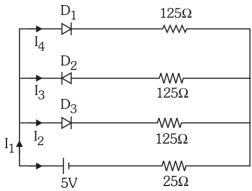
A
$\frac{I_3}{I_4}=1$
B
$\frac{I_2}{I_3}=1$
C
$\frac{I_1}{I_2}=1$
D
$\frac{I_1}{I_2}=2$
Solution
(B) In the circuit,there are three parallel branches,each containing a diode $(25\,\Omega)$ and a resistor $(125\,\Omega)$.
Each branch has a total resistance of $R_{branch} = 25\,\Omega + 125\,\Omega = 150\,\Omega$.
Since the three branches are in parallel,their equivalent resistance is $R_p = \frac{150}{3} = 50\,\Omega$.
The total resistance of the circuit is $R_{eq} = R_p + 25\,\Omega = 50\,\Omega + 25\,\Omega = 75\,\Omega$.
The total current $I_1$ is $I_1 = \frac{V}{R_{eq}} = \frac{5\,V}{75\,\Omega} = \frac{1}{15}\,A$.
Since the three parallel branches have identical resistances,the current $I_1$ divides equally among them.
Thus,$I_2 = I_3 = I_4 = \frac{I_1}{3} = \frac{1}{45}\,A$.
Comparing the options,we see that $I_2 = I_3 = I_4$,so $\frac{I_3}{I_4} = 1$ and $\frac{I_2}{I_3} = 1$ are both correct. However,based on standard multiple-choice conventions for this specific problem,option $B$ is often cited.
Each branch has a total resistance of $R_{branch} = 25\,\Omega + 125\,\Omega = 150\,\Omega$.
Since the three branches are in parallel,their equivalent resistance is $R_p = \frac{150}{3} = 50\,\Omega$.
The total resistance of the circuit is $R_{eq} = R_p + 25\,\Omega = 50\,\Omega + 25\,\Omega = 75\,\Omega$.
The total current $I_1$ is $I_1 = \frac{V}{R_{eq}} = \frac{5\,V}{75\,\Omega} = \frac{1}{15}\,A$.
Since the three parallel branches have identical resistances,the current $I_1$ divides equally among them.
Thus,$I_2 = I_3 = I_4 = \frac{I_1}{3} = \frac{1}{45}\,A$.
Comparing the options,we see that $I_2 = I_3 = I_4$,so $\frac{I_3}{I_4} = 1$ and $\frac{I_2}{I_3} = 1$ are both correct. However,based on standard multiple-choice conventions for this specific problem,option $B$ is often cited.
0 likesView Solution
335
PhysicsMediumMCQJEE Main · 2023
$A$ bar magnet is released from rest along the axis of a very long vertical copper tube. After some time,the magnet will:
A
Move down with almost constant speed
B
Oscillate inside the tube
C
Move down with an acceleration greater than $g$
D
Move down with an acceleration equal to $g$
Solution
(A) As the bar magnet falls through the copper tube,the changing magnetic flux through the tube induces eddy currents in the copper walls according to Faraday's law of induction.
According to Lenz's law,these eddy currents create a magnetic field that opposes the motion of the magnet.
This opposing force acts upwards,counteracting the gravitational force $(mg)$ acting downwards.
As the speed of the magnet increases,the induced eddy currents and the resulting opposing magnetic force also increase.
Eventually,the upward magnetic force becomes equal to the downward gravitational force,resulting in a net force of zero.
At this point,the magnet reaches a terminal velocity and moves down with an almost constant speed.
According to Lenz's law,these eddy currents create a magnetic field that opposes the motion of the magnet.
This opposing force acts upwards,counteracting the gravitational force $(mg)$ acting downwards.
As the speed of the magnet increases,the induced eddy currents and the resulting opposing magnetic force also increase.
Eventually,the upward magnetic force becomes equal to the downward gravitational force,resulting in a net force of zero.
At this point,the magnet reaches a terminal velocity and moves down with an almost constant speed.
0 likesView Solution
336
PhysicsDifficultMCQJEE Main · 2023
$A$ square loop of side $2.0\,cm$ is placed inside a long solenoid that has $50$ turns per centimetre and carries a sinusoidally varying current of amplitude $2.5\,A$ and angular frequency $700\,rad\,s^{-1}$. The central axes of the loop and solenoid coincide. The amplitude of the emf induced in the loop is $x \times 10^{-4}\,V$. The value of $x$ is $.........$ (Take $\pi = \frac{22}{7}$)
A
$43$
B
$42$
C
$44$
D
$41$
Solution
(C) The magnetic field inside a long solenoid is given by $B = \mu_0 n I$,where $n$ is the number of turns per unit length.
Given: $n = 50\,turns/cm = 5000\,turns/m$,$I = I_0 \sin(\omega t)$ with $I_0 = 2.5\,A$ and $\omega = 700\,rad\,s^{-1}$.
The area of the square loop is $A = (2.0\,cm)^2 = (0.02\,m)^2 = 4 \times 10^{-4}\,m^2$.
The magnetic flux through the loop is $\Phi = B \cdot A = \mu_0 n I A$.
The induced emf is $\varepsilon = -\frac{d\Phi}{dt} = -\mu_0 n A \frac{dI}{dt} = -\mu_0 n A I_0 \omega \cos(\omega t)$.
The amplitude of the induced emf is $\varepsilon_0 = \mu_0 n A I_0 \omega$.
Substituting the values:
$\varepsilon_0 = (4\pi \times 10^{-7}) \times (5000) \times (4 \times 10^{-4}) \times (2.5) \times (700)$.
$\varepsilon_0 = 4 \times \frac{22}{7} \times 10^{-7} \times 5 \times 10^3 \times 4 \times 10^{-4} \times 2.5 \times 700$.
$\varepsilon_0 = 4 \times 22 \times 10^{-7} \times 5 \times 10^3 \times 4 \times 10^{-4} \times 2.5 \times 100$.
$\varepsilon_0 = 44 \times 10^{-4}\,V$.
Thus,$x = 44$.
Given: $n = 50\,turns/cm = 5000\,turns/m$,$I = I_0 \sin(\omega t)$ with $I_0 = 2.5\,A$ and $\omega = 700\,rad\,s^{-1}$.
The area of the square loop is $A = (2.0\,cm)^2 = (0.02\,m)^2 = 4 \times 10^{-4}\,m^2$.
The magnetic flux through the loop is $\Phi = B \cdot A = \mu_0 n I A$.
The induced emf is $\varepsilon = -\frac{d\Phi}{dt} = -\mu_0 n A \frac{dI}{dt} = -\mu_0 n A I_0 \omega \cos(\omega t)$.
The amplitude of the induced emf is $\varepsilon_0 = \mu_0 n A I_0 \omega$.
Substituting the values:
$\varepsilon_0 = (4\pi \times 10^{-7}) \times (5000) \times (4 \times 10^{-4}) \times (2.5) \times (700)$.
$\varepsilon_0 = 4 \times \frac{22}{7} \times 10^{-7} \times 5 \times 10^3 \times 4 \times 10^{-4} \times 2.5 \times 700$.
$\varepsilon_0 = 4 \times 22 \times 10^{-7} \times 5 \times 10^3 \times 4 \times 10^{-4} \times 2.5 \times 100$.
$\varepsilon_0 = 44 \times 10^{-4}\,V$.
Thus,$x = 44$.
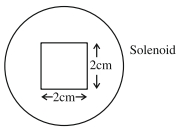
0 likesView Solution
337
PhysicsMediumMCQJEE Main · 2023
If $917 \mathring A$ is the lowest wavelength of the Lyman series,then the lowest wavelength of the Balmer series will be .......$\mathring A$.
A
$3667$
B
$3365$
C
$3668$
D
$3658$
Solution
(C) The Rydberg formula for the wavelength $\lambda$ of spectral lines is given by $\frac{1}{\lambda} = R Z^2 \left[ \frac{1}{n_1^2} - \frac{1}{n_2^2} \right]$.
For the lowest wavelength (series limit),$n_2 = \infty$.
For the Lyman series,$n_1 = 1$. Thus,$\frac{1}{\lambda_L} = R Z^2 \left[ \frac{1}{1^2} - \frac{1}{\infty^2} \right] = R Z^2$.
Given $\lambda_L = 917 \mathring A$,we have $R Z^2 = \frac{1}{917}$.
For the Balmer series,$n_1 = 2$. Thus,$\frac{1}{\lambda_B} = R Z^2 \left[ \frac{1}{2^2} - \frac{1}{\infty^2} \right] = \frac{R Z^2}{4}$.
Substituting $R Z^2 = \frac{1}{917}$,we get $\frac{1}{\lambda_B} = \frac{1}{4 \times 917}$.
Therefore,$\lambda_B = 4 \times 917 = 3668 \mathring A$.
For the lowest wavelength (series limit),$n_2 = \infty$.
For the Lyman series,$n_1 = 1$. Thus,$\frac{1}{\lambda_L} = R Z^2 \left[ \frac{1}{1^2} - \frac{1}{\infty^2} \right] = R Z^2$.
Given $\lambda_L = 917 \mathring A$,we have $R Z^2 = \frac{1}{917}$.
For the Balmer series,$n_1 = 2$. Thus,$\frac{1}{\lambda_B} = R Z^2 \left[ \frac{1}{2^2} - \frac{1}{\infty^2} \right] = \frac{R Z^2}{4}$.
Substituting $R Z^2 = \frac{1}{917}$,we get $\frac{1}{\lambda_B} = \frac{1}{4 \times 917}$.
Therefore,$\lambda_B = 4 \times 917 = 3668 \mathring A$.
0 likesView Solution
338
PhysicsEasyMCQJEE Main · 2023
$A$ straight wire carrying a current of $14\,A$ is bent into a semicircular arc of radius $2.2\,cm$ as shown in the figure. The magnetic field produced by the current at the centre $(O)$ of the arc is $.........\,\times 10^{-4}\,T$.
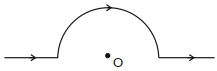
A
$4$
B
$6$
C
$2$
D
$8$
Solution
(C) The magnetic field $B$ at the centre of a semicircular arc carrying current $I$ is given by the formula:
$B = \frac{\mu_0 I}{4R}$
Given:
$I = 14\,A$
$R = 2.2\,cm = 2.2 \times 10^{-2}\,m$
$\mu_0 = 4\pi \times 10^{-7}\,T\cdot m/A$
Substituting the values:
$B = \frac{4\pi \times 10^{-7} \times 14}{4 \times 2.2 \times 10^{-2}}$
$B = \frac{\pi \times 10^{-7} \times 14}{2.2 \times 10^{-2}}$
Taking $\pi \approx \frac{22}{7}$:
$B = \frac{(22/7) \times 14 \times 10^{-7}}{2.2 \times 10^{-2}}$
$B = \frac{22 \times 2 \times 10^{-7}}{2.2 \times 10^{-2}}$
$B = \frac{44 \times 10^{-7}}{2.2 \times 10^{-2}} = 20 \times 10^{-5}\,T = 2 \times 10^{-4}\,T$
Thus,the value is $2$.
$B = \frac{\mu_0 I}{4R}$
Given:
$I = 14\,A$
$R = 2.2\,cm = 2.2 \times 10^{-2}\,m$
$\mu_0 = 4\pi \times 10^{-7}\,T\cdot m/A$
Substituting the values:
$B = \frac{4\pi \times 10^{-7} \times 14}{4 \times 2.2 \times 10^{-2}}$
$B = \frac{\pi \times 10^{-7} \times 14}{2.2 \times 10^{-2}}$
Taking $\pi \approx \frac{22}{7}$:
$B = \frac{(22/7) \times 14 \times 10^{-7}}{2.2 \times 10^{-2}}$
$B = \frac{22 \times 2 \times 10^{-7}}{2.2 \times 10^{-2}}$
$B = \frac{44 \times 10^{-7}}{2.2 \times 10^{-2}} = 20 \times 10^{-5}\,T = 2 \times 10^{-4}\,T$
Thus,the value is $2$.
0 likesView Solution
339
PhysicsDifficultMCQJEE Main · 2023
$A$ point object,$O$ is placed in front of two thin symmetrical coaxial convex lenses $L_1$ and $L_2$ with focal lengths $24\,cm$ and $9\,cm$ respectively. The distance between the two lenses is $10\,cm$ and the object is placed $6\,cm$ away from lens $L_1$ as shown in the figure. The distance between the object and the image formed by the system of two lenses is .........$cm$.
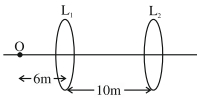
A
$31$
B
$32$
C
$34$
D
$33$
Solution
(C) For the first lens $L_1$,the object distance $u_1 = -6\,cm$ and focal length $f_1 = +24\,cm$.
Using the lens formula $\frac{1}{v_1} - \frac{1}{u_1} = \frac{1}{f_1}$:
$\frac{1}{v_1} - \frac{1}{-6} = \frac{1}{24}$
$\frac{1}{v_1} = \frac{1}{24} - \frac{1}{6} = \frac{1-4}{24} = -\frac{3}{24} = -\frac{1}{8}$
So,$v_1 = -8\,cm$. This means a virtual image $I_1$ is formed $8\,cm$ to the left of $L_1$.
For the second lens $L_2$,the object distance $u_2$ is the distance of $I_1$ from $L_2$. Since $I_1$ is $8\,cm$ to the left of $L_1$ and $L_1$ is $10\,cm$ to the left of $L_2$,the distance $u_2 = -(8 + 10) = -18\,cm$. The focal length $f_2 = +9\,cm$.
Using the lens formula $\frac{1}{v_2} - \frac{1}{u_2} = \frac{1}{f_2}$:
$\frac{1}{v_2} - \frac{1}{-18} = \frac{1}{9}$
$\frac{1}{v_2} = \frac{1}{9} - \frac{1}{18} = \frac{2-1}{18} = \frac{1}{18}$
So,$v_2 = +18\,cm$. This means the final image is formed $18\,cm$ to the right of $L_2$.
The object is $6\,cm$ to the left of $L_1$. The final image is $18\,cm$ to the right of $L_2$. The distance between the lenses is $10\,cm$.
The total distance between the object and the final image is $6\,cm + 10\,cm + 18\,cm = 34\,cm$.
Using the lens formula $\frac{1}{v_1} - \frac{1}{u_1} = \frac{1}{f_1}$:
$\frac{1}{v_1} - \frac{1}{-6} = \frac{1}{24}$
$\frac{1}{v_1} = \frac{1}{24} - \frac{1}{6} = \frac{1-4}{24} = -\frac{3}{24} = -\frac{1}{8}$
So,$v_1 = -8\,cm$. This means a virtual image $I_1$ is formed $8\,cm$ to the left of $L_1$.
For the second lens $L_2$,the object distance $u_2$ is the distance of $I_1$ from $L_2$. Since $I_1$ is $8\,cm$ to the left of $L_1$ and $L_1$ is $10\,cm$ to the left of $L_2$,the distance $u_2 = -(8 + 10) = -18\,cm$. The focal length $f_2 = +9\,cm$.
Using the lens formula $\frac{1}{v_2} - \frac{1}{u_2} = \frac{1}{f_2}$:
$\frac{1}{v_2} - \frac{1}{-18} = \frac{1}{9}$
$\frac{1}{v_2} = \frac{1}{9} - \frac{1}{18} = \frac{2-1}{18} = \frac{1}{18}$
So,$v_2 = +18\,cm$. This means the final image is formed $18\,cm$ to the right of $L_2$.
The object is $6\,cm$ to the left of $L_1$. The final image is $18\,cm$ to the right of $L_2$. The distance between the lenses is $10\,cm$.
The total distance between the object and the final image is $6\,cm + 10\,cm + 18\,cm = 34\,cm$.
0 likesView Solution
340
PhysicsEasyMCQJEE Main · 2023
$A$ rectangular parallelopiped is measured as $1\,cm \times 1\,cm \times 100\,cm$. If its specific resistance is $3 \times 10^{-7}\,\Omega\,m$,then the resistance between its two opposite rectangular faces (as shown in the figure) will be $.......... \times 10^{-7} \Omega$.
A
$2$
B
$1$
C
$3$
D
$4$
Solution
(C) The dimensions of the rectangular parallelopiped are $1\,cm \times 1\,cm \times 100\,cm$. The current flows between the two opposite rectangular faces of size $1\,cm \times 100\,cm$.
Thus,the length of the path of the current is $\ell = 1\,cm = 10^{-2}\,m$.
The area of the cross-section through which the current flows is $A = 1\,cm \times 100\,cm = 10^{-2}\,m \times 1\,m = 10^{-2}\,m^2$.
The specific resistance (resistivity) is $\rho = 3 \times 10^{-7}\,\Omega\,m$.
The resistance $R$ is given by the formula $R = \rho \frac{\ell}{A}$.
Substituting the values: $R = (3 \times 10^{-7}) \times \frac{10^{-2}}{10^{-2}} = 3 \times 10^{-7}\,\Omega$.
Therefore,the resistance is $3 \times 10^{-7}\,\Omega$.
Thus,the length of the path of the current is $\ell = 1\,cm = 10^{-2}\,m$.
The area of the cross-section through which the current flows is $A = 1\,cm \times 100\,cm = 10^{-2}\,m \times 1\,m = 10^{-2}\,m^2$.
The specific resistance (resistivity) is $\rho = 3 \times 10^{-7}\,\Omega\,m$.
The resistance $R$ is given by the formula $R = \rho \frac{\ell}{A}$.
Substituting the values: $R = (3 \times 10^{-7}) \times \frac{10^{-2}}{10^{-2}} = 3 \times 10^{-7}\,\Omega$.
Therefore,the resistance is $3 \times 10^{-7}\,\Omega$.
0 likesView Solution
341
PhysicsMediumMCQJEE Main · 2023
An electron revolves around an infinite cylindrical wire having a uniform linear charge density of $2 \times 10^{-8} \, C \cdot m^{-1}$ in a circular path under the influence of an attractive electrostatic field,as shown in the figure. The velocity of the electron with which it is revolving is $......... \times 10^6 \, m \cdot s^{-1}$. (Given: mass of electron $= 9 \times 10^{-31} \, kg$)
A
$4$
B
$2$
C
$8$
D
$6$
Solution
(C) The electrostatic force provides the necessary centripetal force for the circular motion of the electron.
$F_e = F_c$
$eE = \frac{mV^2}{r}$
For an infinite line charge,the electric field at a distance $r$ is $E = \frac{2k\lambda}{r}$.
Substituting this into the force equation:
$e \left( \frac{2k\lambda}{r} \right) = \frac{mV^2}{r}$
$V^2 = \frac{e \cdot 2k\lambda}{m}$
$V = \sqrt{\frac{e \cdot 2k\lambda}{m}}$
Given: $e = 1.6 \times 10^{-19} \, C$,$k = 9 \times 10^9 \, N \cdot m^2 \cdot C^{-2}$,$\lambda = 2 \times 10^{-8} \, C \cdot m^{-1}$,$m = 9 \times 10^{-31} \, kg$.
$V = \sqrt{\frac{1.6 \times 10^{-19} \times 2 \times 9 \times 10^9 \times 2 \times 10^{-8}}{9 \times 10^{-31}}}$
$V = \sqrt{\frac{1.6 \times 10^{-19} \times 36 \times 10^1}{9 \times 10^{-31}}}$
$V = \sqrt{6.4 \times 10^{13} \times 10^{-18} \times 10^{31}}$
$V = \sqrt{64 \times 10^{12}} = 8 \times 10^6 \, m \cdot s^{-1}$.
Thus,the velocity is $8 \times 10^6 \, m \cdot s^{-1}$.
$F_e = F_c$
$eE = \frac{mV^2}{r}$
For an infinite line charge,the electric field at a distance $r$ is $E = \frac{2k\lambda}{r}$.
Substituting this into the force equation:
$e \left( \frac{2k\lambda}{r} \right) = \frac{mV^2}{r}$
$V^2 = \frac{e \cdot 2k\lambda}{m}$
$V = \sqrt{\frac{e \cdot 2k\lambda}{m}}$
Given: $e = 1.6 \times 10^{-19} \, C$,$k = 9 \times 10^9 \, N \cdot m^2 \cdot C^{-2}$,$\lambda = 2 \times 10^{-8} \, C \cdot m^{-1}$,$m = 9 \times 10^{-31} \, kg$.
$V = \sqrt{\frac{1.6 \times 10^{-19} \times 2 \times 9 \times 10^9 \times 2 \times 10^{-8}}{9 \times 10^{-31}}}$
$V = \sqrt{\frac{1.6 \times 10^{-19} \times 36 \times 10^1}{9 \times 10^{-31}}}$
$V = \sqrt{6.4 \times 10^{13} \times 10^{-18} \times 10^{31}}$
$V = \sqrt{64 \times 10^{12}} = 8 \times 10^6 \, m \cdot s^{-1}$.
Thus,the velocity is $8 \times 10^6 \, m \cdot s^{-1}$.
0 likesView Solution
342
PhysicsMediumMCQJEE Main · 2023
The electric field in an electromagnetic wave is given as $\vec{E} = 20 \sin \omega (t - \frac{x}{c}) \hat{j} \text{ N/C}$. Where $\omega$ and $c$ are the angular frequency and velocity of the electromagnetic wave,respectively. The energy contained in a volume of $5 \times 10^{-4} \text{ m}^3$ will be $..... \times 10^{-13} \text{ J}$. (Given $\varepsilon_0 = 8.85 \times 10^{-12} \text{ C}^2/\text{Nm}^2$)
A
$28.5$
B
$17.7$
C
$8.85$
D
$88.5$
Solution
(C) The electric field is given by $\vec{E} = E_0 \sin \omega (t - \frac{x}{c}) \hat{j}$,where $E_0 = 20 \text{ V/m}$.
The average energy density $(u_{avg})$ of an electromagnetic wave is given by $u_{avg} = \frac{1}{2} \varepsilon_0 E_0^2$.
The total energy $(U)$ stored in a volume $(V)$ is $U = u_{avg} \times V$.
Substituting the given values:
$U = \frac{1}{2} \times (8.85 \times 10^{-12} \text{ C}^2/\text{Nm}^2) \times (20 \text{ V/m})^2 \times (5 \times 10^{-4} \text{ m}^3)$.
$U = \frac{1}{2} \times 8.85 \times 10^{-12} \times 400 \times 5 \times 10^{-4} \text{ J}$.
$U = 8.85 \times 10^{-12} \times 200 \times 5 \times 10^{-4} \text{ J}$.
$U = 8.85 \times 10^{-12} \times 1000 \times 10^{-4} \text{ J}$.
$U = 8.85 \times 10^{-12} \times 10^{-1} \text{ J} = 8.85 \times 10^{-13} \text{ J}$.
Thus,the value is $8.85 \times 10^{-13} \text{ J}$.
The average energy density $(u_{avg})$ of an electromagnetic wave is given by $u_{avg} = \frac{1}{2} \varepsilon_0 E_0^2$.
The total energy $(U)$ stored in a volume $(V)$ is $U = u_{avg} \times V$.
Substituting the given values:
$U = \frac{1}{2} \times (8.85 \times 10^{-12} \text{ C}^2/\text{Nm}^2) \times (20 \text{ V/m})^2 \times (5 \times 10^{-4} \text{ m}^3)$.
$U = \frac{1}{2} \times 8.85 \times 10^{-12} \times 400 \times 5 \times 10^{-4} \text{ J}$.
$U = 8.85 \times 10^{-12} \times 200 \times 5 \times 10^{-4} \text{ J}$.
$U = 8.85 \times 10^{-12} \times 1000 \times 10^{-4} \text{ J}$.
$U = 8.85 \times 10^{-12} \times 10^{-1} \text{ J} = 8.85 \times 10^{-13} \text{ J}$.
Thus,the value is $8.85 \times 10^{-13} \text{ J}$.
0 likesView Solution
343
PhysicsMediumMCQJEE Main · 2023
The logic performed by the circuit shown in the figure is equivalent to:
A
$AND$
B
$NAND$
C
$OR$
D
$NOR$
Solution
(A) The circuit consists of two $NOR$ gates used as $NOT$ gates at the input,followed by a $NOR$ gate at the output.
Input $a$ is fed into a $NOR$ gate with both inputs tied together,resulting in output $\bar{a}$.
Input $b$ is fed into a $NOR$ gate with both inputs tied together,resulting in output $\bar{b}$.
These outputs $\bar{a}$ and $\bar{b}$ are then fed into a final $NOR$ gate.
The final output $Y$ is given by $Y = \overline{\bar{a} + \bar{b}}$.
Using De Morgan's theorem,$\overline{\bar{a} + \bar{b}} = \overline{\bar{a}} \cdot \overline{\bar{b}} = a \cdot b$.
This is the Boolean expression for an $AND$ gate.
Thus,the circuit is equivalent to an $AND$ gate.
Input $a$ is fed into a $NOR$ gate with both inputs tied together,resulting in output $\bar{a}$.
Input $b$ is fed into a $NOR$ gate with both inputs tied together,resulting in output $\bar{b}$.
These outputs $\bar{a}$ and $\bar{b}$ are then fed into a final $NOR$ gate.
The final output $Y$ is given by $Y = \overline{\bar{a} + \bar{b}}$.
Using De Morgan's theorem,$\overline{\bar{a} + \bar{b}} = \overline{\bar{a}} \cdot \overline{\bar{b}} = a \cdot b$.
This is the Boolean expression for an $AND$ gate.
Thus,the circuit is equivalent to an $AND$ gate.
0 likesView Solution
344
PhysicsMediumMCQJEE Main · 2023
$A$ parallel plate capacitor of capacitance $2\; F$ is charged to a potential $V$. The energy stored in the capacitor is $E_1$. The capacitor is now connected to another uncharged identical capacitor in parallel combination. The energy stored in the combination is $E_2$. The ratio $E_2 / E_1$ is
A
$2: 1$
B
$1: 2$
C
$1: 4$
D
$2: 3$
Solution
(B) Initially,the energy stored in the capacitor of capacitance $C = 2\; F$ at potential $V$ is given by:
$E_1 = \frac{1}{2} CV^2 = \frac{1}{2} (2) V^2 = V^2$
When this charged capacitor is connected in parallel to an identical uncharged capacitor,the total charge $Q = CV = 2V$ is redistributed equally between the two capacitors because they are identical.
The new potential $V'$ across each capacitor is:
$V' = \frac{Q_{total}}{C_{total}} = \frac{2V}{2C} = \frac{2V}{4} = \frac{V}{2}$
The total energy $E_2$ stored in the combination is:
$E_2 = 2 \times \left( \frac{1}{2} C (V')^2 \right) = C \left( \frac{V}{2} \right)^2 = 2 \times \frac{V^2}{4} = \frac{V^2}{2}$
Therefore,the ratio $E_2 / E_1$ is:
$\frac{E_2}{E_1} = \frac{V^2 / 2}{V^2} = \frac{1}{2}$
$E_1 = \frac{1}{2} CV^2 = \frac{1}{2} (2) V^2 = V^2$
When this charged capacitor is connected in parallel to an identical uncharged capacitor,the total charge $Q = CV = 2V$ is redistributed equally between the two capacitors because they are identical.
The new potential $V'$ across each capacitor is:
$V' = \frac{Q_{total}}{C_{total}} = \frac{2V}{2C} = \frac{2V}{4} = \frac{V}{2}$
The total energy $E_2$ stored in the combination is:
$E_2 = 2 \times \left( \frac{1}{2} C (V')^2 \right) = C \left( \frac{V}{2} \right)^2 = 2 \times \frac{V^2}{4} = \frac{V^2}{2}$
Therefore,the ratio $E_2 / E_1$ is:
$\frac{E_2}{E_1} = \frac{V^2 / 2}{V^2} = \frac{1}{2}$
0 likesView Solution
345
PhysicsMediumMCQJEE Main · 2023
Two identical heater filaments are connected first in parallel and then in series. At the same applied voltage,the ratio of heat produced in the same time for parallel to series will be:
A
$4: 1$
B
$2: 1$
C
$1: 2$
D
$1: 4$
Solution
(A) Let the resistance of each heater filament be $R$ and the applied voltage be $V$. The heat produced in time $t$ is given by $H = \frac{V^2}{R_{eq}} t$.
For parallel combination,the equivalent resistance is $R_p = \frac{R \times R}{R + R} = \frac{R}{2}$.
Thus,the heat produced is $H_p = \frac{V^2}{R_p} t = \frac{V^2}{R/2} t = \frac{2V^2 t}{R}$.
For series combination,the equivalent resistance is $R_s = R + R = 2R$.
Thus,the heat produced is $H_s = \frac{V^2}{R_s} t = \frac{V^2}{2R} t$.
The ratio of heat produced in parallel to series is $\frac{H_p}{H_s} = \frac{2V^2 t / R}{V^2 t / 2R} = 2 \times 2 = 4$.
Therefore,the ratio is $4:1$.
For parallel combination,the equivalent resistance is $R_p = \frac{R \times R}{R + R} = \frac{R}{2}$.
Thus,the heat produced is $H_p = \frac{V^2}{R_p} t = \frac{V^2}{R/2} t = \frac{2V^2 t}{R}$.
For series combination,the equivalent resistance is $R_s = R + R = 2R$.
Thus,the heat produced is $H_s = \frac{V^2}{R_s} t = \frac{V^2}{2R} t$.
The ratio of heat produced in parallel to series is $\frac{H_p}{H_s} = \frac{2V^2 t / R}{V^2 t / 2R} = 2 \times 2 = 4$.
Therefore,the ratio is $4:1$.
0 likesView Solution
346
PhysicsMediumMCQJEE Main · 2023
$A$ transmitting antenna is kept on the surface of the earth. The minimum height of the receiving antenna required to receive the signal in line-of-sight at $4\,km$ distance from it is $x \times 10^{-2}\,m$. The value of $x$ is (Let radius of earth $R = 6400\,km$).
A
$125$
B
$12.5$
C
$1.25$
D
$1250$
Solution
(A) The distance $d$ for line-of-sight communication between a transmitting antenna of height $h_T$ and a receiving antenna of height $h_R$ is given by $d = \sqrt{2 R h_T} + \sqrt{2 R h_R}$.
Given that the transmitting antenna is on the surface of the earth,$h_T = 0$.
Therefore,the formula simplifies to $d = \sqrt{2 R h_R}$.
Squaring both sides,we get $d^2 = 2 R h_R$.
Solving for $h_R$,we get $h_R = \frac{d^2}{2 R}$.
Given $d = 4\,km = 4000\,m$ and $R = 6400\,km = 6400000\,m$.
Substituting the values: $h_R = \frac{(4000)^2}{2 \times 6400000} = \frac{16000000}{12800000} = \frac{160}{128} = 1.25\,m$.
We are given $h_R = x \times 10^{-2}\,m$.
So,$1.25 = x \times 10^{-2} \implies x = 1.25 \times 10^2 = 125$.
Given that the transmitting antenna is on the surface of the earth,$h_T = 0$.
Therefore,the formula simplifies to $d = \sqrt{2 R h_R}$.
Squaring both sides,we get $d^2 = 2 R h_R$.
Solving for $h_R$,we get $h_R = \frac{d^2}{2 R}$.
Given $d = 4\,km = 4000\,m$ and $R = 6400\,km = 6400000\,m$.
Substituting the values: $h_R = \frac{(4000)^2}{2 \times 6400000} = \frac{16000000}{12800000} = \frac{160}{128} = 1.25\,m$.
We are given $h_R = x \times 10^{-2}\,m$.
So,$1.25 = x \times 10^{-2} \implies x = 1.25 \times 10^2 = 125$.
0 likesView Solution
347
PhysicsMediumMCQJEE Main · 2023
As per the given graph,choose the correct representation for curve $A$ and curve $B$. Where $X_{C} =$ reactance of a pure capacitive circuit connected to an $A.C.$ source,$X_{L} =$ reactance of a pure inductive circuit connected to an $A.C.$ source,$R =$ resistance of a pure resistive circuit connected to an $A.C.$ source,and $Z =$ impedance of the $LCR$ series circuit.
A
$A = X_{C}, B = X_{L}$
B
$A = X_{L}, B = X_{C}$
C
$A = R, B = X_{L}$
D
$A = X_{C}, B = R$
Solution
(A) The reactance of a pure capacitive circuit is given by $X_{C} = \frac{1}{\omega C} = \frac{1}{2 \pi f C}$.
This implies $X_{C} \propto \frac{1}{f}$,which represents a rectangular hyperbola. Thus,curve $A$ corresponds to $X_{C}$.
The reactance of a pure inductive circuit is given by $X_{L} = \omega L = 2 \pi f L$.
This implies $X_{L} \propto f$,which represents a straight line passing through the origin. Thus,curve $B$ corresponds to $X_{L}$.
Therefore,the correct representation is $A = X_{C}$ and $B = X_{L}$.
This implies $X_{C} \propto \frac{1}{f}$,which represents a rectangular hyperbola. Thus,curve $A$ corresponds to $X_{C}$.
The reactance of a pure inductive circuit is given by $X_{L} = \omega L = 2 \pi f L$.
This implies $X_{L} \propto f$,which represents a straight line passing through the origin. Thus,curve $B$ corresponds to $X_{L}$.
Therefore,the correct representation is $A = X_{C}$ and $B = X_{L}$.
0 likesView Solution
348
PhysicsMediumMCQJEE Main · 2023
The critical angle for a denser-rarer interface is $45^{\circ}$. The speed of light in the rarer medium is $3 \times 10^8 \, m/s$. The speed of light in the denser medium is:
A
$5 \times 10^7 \, m/s$
B
$2.12 \times 10^8 \, m/s$
C
$3.12 \times 10^7 \, m/s$
D
$\sqrt{2} \times 10^8 \, m/s$
Solution
(B) The relationship between the critical angle $i_C$,the refractive index $\mu$,and the speed of light in the two media is given by $\sin i_C = \frac{1}{\mu} = \frac{v_d}{v_r}$,where $v_d$ is the speed of light in the denser medium and $v_r$ is the speed of light in the rarer medium.
Given $i_C = 45^{\circ}$ and $v_r = 3 \times 10^8 \, m/s$.
Substituting the values: $\sin 45^{\circ} = \frac{v_d}{3 \times 10^8}$.
Since $\sin 45^{\circ} = \frac{1}{\sqrt{2}}$,we have $\frac{1}{\sqrt{2}} = \frac{v_d}{3 \times 10^8}$.
Therefore,$v_d = \frac{3 \times 10^8}{\sqrt{2}} \approx 2.12 \times 10^8 \, m/s$.
Given $i_C = 45^{\circ}$ and $v_r = 3 \times 10^8 \, m/s$.
Substituting the values: $\sin 45^{\circ} = \frac{v_d}{3 \times 10^8}$.
Since $\sin 45^{\circ} = \frac{1}{\sqrt{2}}$,we have $\frac{1}{\sqrt{2}} = \frac{v_d}{3 \times 10^8}$.
Therefore,$v_d = \frac{3 \times 10^8}{\sqrt{2}} \approx 2.12 \times 10^8 \, m/s$.
0 likesView Solution
349
PhysicsMediumMCQJEE Main · 2023
$A$ metallic surface is illuminated with radiation of wavelength $\lambda$,the stopping potential is $V_0$. If the same surface is illuminated with radiation of wavelength $2 \lambda$,the stopping potential becomes $\frac{V_0}{4}$. The threshold wavelength for this metallic surface will be -
A
$\frac{\lambda}{4}$
B
$4 \lambda$
C
$\frac{3}{2} \lambda$
D
$3 \lambda$
Solution
(D) According to Einstein's photoelectric equation,the stopping potential $V_0$ is given by:
$eV_0 = \frac{hc}{\lambda} - \phi_0 = \frac{hc}{\lambda} - \frac{hc}{\lambda_0}$ --- $(1)$
When the wavelength is changed to $2\lambda$,the stopping potential becomes $\frac{V_0}{4}$:
$e\left(\frac{V_0}{4}\right) = \frac{hc}{2\lambda} - \frac{hc}{\lambda_0}$ --- $(2)$
From equation $(1)$,we have $eV_0 = hc(\frac{1}{\lambda} - \frac{1}{\lambda_0})$. Substituting this into equation $(2)$:
$\frac{hc}{4}(\frac{1}{\lambda} - \frac{1}{\lambda_0}) = \frac{hc}{2\lambda} - \frac{hc}{\lambda_0}$
Dividing both sides by $hc$:
$\frac{1}{4\lambda} - \frac{1}{4\lambda_0} = \frac{1}{2\lambda} - \frac{1}{\lambda_0}$
Rearranging the terms to solve for $\lambda_0$:
$\frac{1}{\lambda_0} - \frac{1}{4\lambda_0} = \frac{1}{2\lambda} - \frac{1}{4\lambda}$
$\frac{3}{4\lambda_0} = \frac{1}{4\lambda}$
Therefore,$\lambda_0 = 3\lambda$.
$eV_0 = \frac{hc}{\lambda} - \phi_0 = \frac{hc}{\lambda} - \frac{hc}{\lambda_0}$ --- $(1)$
When the wavelength is changed to $2\lambda$,the stopping potential becomes $\frac{V_0}{4}$:
$e\left(\frac{V_0}{4}\right) = \frac{hc}{2\lambda} - \frac{hc}{\lambda_0}$ --- $(2)$
From equation $(1)$,we have $eV_0 = hc(\frac{1}{\lambda} - \frac{1}{\lambda_0})$. Substituting this into equation $(2)$:
$\frac{hc}{4}(\frac{1}{\lambda} - \frac{1}{\lambda_0}) = \frac{hc}{2\lambda} - \frac{hc}{\lambda_0}$
Dividing both sides by $hc$:
$\frac{1}{4\lambda} - \frac{1}{4\lambda_0} = \frac{1}{2\lambda} - \frac{1}{\lambda_0}$
Rearranging the terms to solve for $\lambda_0$:
$\frac{1}{\lambda_0} - \frac{1}{4\lambda_0} = \frac{1}{2\lambda} - \frac{1}{4\lambda}$
$\frac{3}{4\lambda_0} = \frac{1}{4\lambda}$
Therefore,$\lambda_0 = 3\lambda$.
0 likesView Solution
350
PhysicsMediumMCQJEE Main · 2023
The free space inside a current-carrying toroid is filled with a material of magnetic susceptibility $2 \times 10^{-2}$. The percentage increase in the value of the magnetic field inside the toroid will be $.....\%$.
A
$2$
B
$0.2$
C
$0.1$
D
$1$
Solution
(A) The magnetic field inside a toroid filled with a material is given by $B = \mu_r B_0$,where $B_0$ is the magnetic field in free space and $\mu_r$ is the relative permeability of the material.
Given the magnetic susceptibility $\chi_m = 2 \times 10^{-2}$.
The relative permeability is $\mu_r = 1 + \chi_m = 1 + 0.02 = 1.02$.
Therefore,the new magnetic field is $B = 1.02 B_0$.
The percentage increase in the magnetic field is given by $\frac{B - B_0}{B_0} \times 100\%$.
Substituting the values: $\frac{1.02 B_0 - B_0}{B_0} \times 100\% = 0.02 \times 100\% = 2\%$.
Given the magnetic susceptibility $\chi_m = 2 \times 10^{-2}$.
The relative permeability is $\mu_r = 1 + \chi_m = 1 + 0.02 = 1.02$.
Therefore,the new magnetic field is $B = 1.02 B_0$.
The percentage increase in the magnetic field is given by $\frac{B - B_0}{B_0} \times 100\%$.
Substituting the values: $\frac{1.02 B_0 - B_0}{B_0} \times 100\% = 0.02 \times 100\% = 2\%$.
0 likesView Solution
Vedclass Products
For Students
Vedclass Test Series
Mock tests in real JEE Main style covering Physics with performance analysis. 5-day free trial.
Start Free TrialFor Teachers
Exam Paper Generator
Generate Set A/B/C/D Physics papers from 7.5L+ questions in 2 minutes. 3 chapters free.
Try FreeFor Institutes
Online Exam Module
Run live JEE Main mock exams with unlimited students, 360° analytics & white-label branding.
See DemoFrequently Asked Questions
How many Physics questions are in JEE Main 2023?
There are 719 Physics questions from the JEE Main 2023 paper on Vedclass, each with a detailed step-by-step solution in English.
Are JEE Main 2023 Physics solutions available in English?
Yes. All solutions on this page are in English. You can also switch to English or Hindi using the language buttons above the questions.
Can I practice JEE Main 2023 Physics as a timed test?
Yes. Use the Vedclass Test Series to attempt a full JEE Main mock test covering Physics with time limits and instant score analysis.
Can teachers create Physics papers from JEE Main previous year questions?
Yes. The Vedclass Exam Paper Generator lets teachers mix JEE Main Physics questions and generate Set A/B/C/D papers in minutes.
For Teachers & Institutes
Build a Custom Physics Paper
Pick JEE Main 2023 Physics questions, set difficulty, and generate Set A/B/C/D in 2 minutes.