
The variation of kinetic energy $(KE)$ of a particle executing simple harmonic motion with the displacement $(x)$ starting from mean position to extreme position $(A)$ is given by
- A
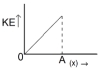
- B
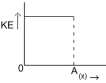
- C
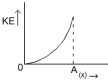
- D
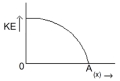
Explore More
Similar Questions
The displacement of a simple harmonic motion of amplitude $6 \text{ cm}$ when its kinetic energy is equal to its potential energy is:
$A$ particle of mass $m$ executes simple harmonic motion with amplitude $a$ and frequency $v$. The average kinetic energy during its motion from the position of equilibrium to the end is
DifficultAIEEE 2007
View SolutionFor a particle executing $S.H.M.$,the displacement $x$ is given by $x = A \cos \omega t$. Identify the graphs which represent the variation of potential energy $(P.E.)$ as a function of time $t$ and displacement $x$.
MediumIIT 2003
View Solution$A$ body is performing $SHO$ with a total energy of $100\,J$. In the table below, column-$I$ shows the kinetic energy $(K)$ at a specific time, and column-$II$ shows the potential energy $(U)$ at that same time. Match them appropriately.
Column-$I$ Column-$II$ $(a)$ $K = 10\,J$ $(i)$ $U = 40\,J$ $(b)$ $K = 60\,J$ $(ii)$ $U = 90\,J$ $(iii)$ $U = 50\,J$
| Column-$I$ | Column-$II$ |
| $(a)$ $K = 10\,J$ | $(i)$ $U = 40\,J$ |
| $(b)$ $K = 60\,J$ | $(ii)$ $U = 90\,J$ |
| $(iii)$ $U = 50\,J$ |
Easy
View Solution$A$ block is executing $SHM.$ Let the time period of variation of velocity be $T_1$ and time period of variation of kinetic energy be $T_2.$ The relation between $T_1$ and $T_2$ is
Medium
View SolutionVedclass Products
For Students
Vedclass Test Series
Mock tests in real JEE/NEET style with performance analysis. 5-day free trial.
Start Free TrialFor Teachers
Exam Paper Generator
Generate Set A/B/C/D exam papers from 7.5L+ questions in 2 minutes. 3 chapters free.
Try FreeFor Institutes
Online Exam Module
Live online exams with unlimited students, 360° analytics & white-label branding.
See Demo