
PhysicsQ351–387 of 719 questions
Page 8 of 8 · English
351
PhysicsMediumMCQJEE Main · 2023
The radius of the $2^{nd}$ orbit of $He^{+}$ in Bohr's model is $r_1$ and that of the fourth orbit of $Be^{3+}$ is represented as $r_2$. If the ratio $\frac{r_2}{r_1}$ is $x : 1$,then the value of $x$ is .........
A
$4$
B
$6$
C
$2$
D
$10$
Solution
(C) The radius of an orbit in Bohr's model is given by the formula $r_n = a_0 \frac{n^2}{Z}$,where $n$ is the principal quantum number and $Z$ is the atomic number.
For $He^{+}$ $(Z=2)$,the radius of the $2^{nd}$ orbit $(n=2)$ is $r_1 = a_0 \frac{2^2}{2} = 2a_0$.
For $Be^{3+}$ $(Z=4)$,the radius of the $4^{th}$ orbit $(n=4)$ is $r_2 = a_0 \frac{4^2}{4} = 4a_0$.
The ratio $\frac{r_2}{r_1} = \frac{4a_0}{2a_0} = 2$.
Since the ratio is $x : 1$,we have $x = 2$.
For $He^{+}$ $(Z=2)$,the radius of the $2^{nd}$ orbit $(n=2)$ is $r_1 = a_0 \frac{2^2}{2} = 2a_0$.
For $Be^{3+}$ $(Z=4)$,the radius of the $4^{th}$ orbit $(n=4)$ is $r_2 = a_0 \frac{4^2}{4} = 4a_0$.
The ratio $\frac{r_2}{r_1} = \frac{4a_0}{2a_0} = 2$.
Since the ratio is $x : 1$,we have $x = 2$.
0 likesView Solution
352
PhysicsDifficultMCQJEE Main · 2023
$A$ thin infinite sheet charge and an infinite line charge of respective charge densities $+\sigma$ and $+\lambda$ are placed parallel at $5 \ m$ distance from each other. Points $P$ and $Q$ are at $\frac{3}{\pi} \ m$ and $\frac{4}{\pi} \ m$ perpendicular distance from the line charge towards the sheet charge,respectively. $E_P$ and $E_Q$ are the magnitudes of the resultant electric field intensities at points $P$ and $Q$,respectively. If $\frac{E_P}{E_Q} = \frac{4}{a}$ for $2|\sigma| = |\lambda|$,then the value of $a$ is ...........
A
$3$
B
$9$
C
$6$
D
$12$
Solution
(C) The electric field due to an infinite line charge is $E_L = \frac{\lambda}{2 \pi \varepsilon_0 r}$ and due to an infinite sheet charge is $E_S = \frac{\sigma}{2 \varepsilon_0}$.
Since the points $P$ and $Q$ are between the line and the sheet,the fields are in opposite directions.
At point $P$ $(r_P = \frac{3}{\pi} \ m)$: $E_P = \frac{\lambda}{2 \pi \varepsilon_0 (3/\pi)} - \frac{\sigma}{2 \varepsilon_0} = \frac{1}{2 \varepsilon_0} (\frac{\lambda}{3} - \sigma)$.
At point $Q$ $(r_Q = \frac{4}{\pi} \ m)$: $E_Q = \frac{\lambda}{2 \pi \varepsilon_0 (4/\pi)} - \frac{\sigma}{2 \varepsilon_0} = \frac{1}{2 \varepsilon_0} (\frac{\lambda}{4} - \sigma)$.
Given $2|\sigma| = |\lambda|$,we take $\lambda = 2\sigma$.
$E_P = \frac{1}{2 \varepsilon_0} (\frac{2\sigma}{3} - \sigma) = \frac{1}{2 \varepsilon_0} (-\frac{\sigma}{3})$. Magnitude $|E_P| = \frac{\sigma}{6 \varepsilon_0}$.
$E_Q = \frac{1}{2 \varepsilon_0} (\frac{2\sigma}{4} - \sigma) = \frac{1}{2 \varepsilon_0} (-\frac{\sigma}{2})$. Magnitude $|E_Q| = \frac{\sigma}{4 \varepsilon_0}$.
$\frac{E_P}{E_Q} = \frac{\sigma / 6 \varepsilon_0}{\sigma / 4 \varepsilon_0} = \frac{4}{6}$.
Comparing with $\frac{4}{a}$,we get $a = 6$.
Since the points $P$ and $Q$ are between the line and the sheet,the fields are in opposite directions.
At point $P$ $(r_P = \frac{3}{\pi} \ m)$: $E_P = \frac{\lambda}{2 \pi \varepsilon_0 (3/\pi)} - \frac{\sigma}{2 \varepsilon_0} = \frac{1}{2 \varepsilon_0} (\frac{\lambda}{3} - \sigma)$.
At point $Q$ $(r_Q = \frac{4}{\pi} \ m)$: $E_Q = \frac{\lambda}{2 \pi \varepsilon_0 (4/\pi)} - \frac{\sigma}{2 \varepsilon_0} = \frac{1}{2 \varepsilon_0} (\frac{\lambda}{4} - \sigma)$.
Given $2|\sigma| = |\lambda|$,we take $\lambda = 2\sigma$.
$E_P = \frac{1}{2 \varepsilon_0} (\frac{2\sigma}{3} - \sigma) = \frac{1}{2 \varepsilon_0} (-\frac{\sigma}{3})$. Magnitude $|E_P| = \frac{\sigma}{6 \varepsilon_0}$.
$E_Q = \frac{1}{2 \varepsilon_0} (\frac{2\sigma}{4} - \sigma) = \frac{1}{2 \varepsilon_0} (-\frac{\sigma}{2})$. Magnitude $|E_Q| = \frac{\sigma}{4 \varepsilon_0}$.
$\frac{E_P}{E_Q} = \frac{\sigma / 6 \varepsilon_0}{\sigma / 4 \varepsilon_0} = \frac{4}{6}$.
Comparing with $\frac{4}{a}$,we get $a = 6$.
0 likesView Solution
353
PhysicsDifficultMCQJEE Main · 2023
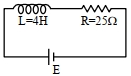
In the given figure,an inductor of $L = 4 \, H$ and a resistor of $R = 25 \, \Omega$ are connected in series with a battery of emf $E$ volt. $\frac{E^a}{2b} \, J/s$ represents the maximum rate at which energy is stored in the magnetic field of the inductor. The numerical value of $\frac{b}{a}$ is ............
A
$24$
B
$23$
C
$25$
D
$22$
Solution
(C) The energy stored in an inductor is given by $U = \frac{1}{2} L I^2$.
The rate of energy storage is $P = \frac{dU}{dt} = L I \frac{dI}{dt}$.
For an $R-L$ circuit,the current at time $t$ is $I = \frac{E}{R} (1 - e^{-tR/L})$.
The rate of change of current is $\frac{dI}{dt} = \frac{E}{L} e^{-tR/L}$.
Substituting these into the power equation:
$P = L \left[ \frac{E}{R} (1 - e^{-tR/L}) \right] \left[ \frac{E}{L} e^{-tR/L} \right] = \frac{E^2}{R} (e^{-tR/L} - e^{-2tR/L})$.
To find the maximum rate,we differentiate $P$ with respect to $t$ and set it to zero:
$\frac{dP}{dt} = \frac{E^2}{R} \left( -\frac{R}{L} e^{-tR/L} + \frac{2R}{L} e^{-2tR/L} \right) = 0$.
This implies $e^{-tR/L} = 2 e^{-2tR/L}$,so $e^{tR/L} = 2$,or $t = \frac{L}{R} \ln 2$.
At this time,$e^{-tR/L} = \frac{1}{2}$.
Substituting this back into the power equation:
$P_{max} = \frac{E^2}{R} \left( \frac{1}{2} - (\frac{1}{2})^2 \right) = \frac{E^2}{R} (\frac{1}{4}) = \frac{E^2}{4R}$.
Given $R = 25 \, \Omega$,we have $P_{max} = \frac{E^2}{4 \times 25} = \frac{E^2}{100}$.
Comparing this with $\frac{E^a}{2b}$,we get $a = 2$ and $b = 50$.
Therefore,$\frac{b}{a} = \frac{50}{2} = 25$.
The rate of energy storage is $P = \frac{dU}{dt} = L I \frac{dI}{dt}$.
For an $R-L$ circuit,the current at time $t$ is $I = \frac{E}{R} (1 - e^{-tR/L})$.
The rate of change of current is $\frac{dI}{dt} = \frac{E}{L} e^{-tR/L}$.
Substituting these into the power equation:
$P = L \left[ \frac{E}{R} (1 - e^{-tR/L}) \right] \left[ \frac{E}{L} e^{-tR/L} \right] = \frac{E^2}{R} (e^{-tR/L} - e^{-2tR/L})$.
To find the maximum rate,we differentiate $P$ with respect to $t$ and set it to zero:
$\frac{dP}{dt} = \frac{E^2}{R} \left( -\frac{R}{L} e^{-tR/L} + \frac{2R}{L} e^{-2tR/L} \right) = 0$.
This implies $e^{-tR/L} = 2 e^{-2tR/L}$,so $e^{tR/L} = 2$,or $t = \frac{L}{R} \ln 2$.
At this time,$e^{-tR/L} = \frac{1}{2}$.
Substituting this back into the power equation:
$P_{max} = \frac{E^2}{R} \left( \frac{1}{2} - (\frac{1}{2})^2 \right) = \frac{E^2}{R} (\frac{1}{4}) = \frac{E^2}{4R}$.
Given $R = 25 \, \Omega$,we have $P_{max} = \frac{E^2}{4 \times 25} = \frac{E^2}{100}$.
Comparing this with $\frac{E^a}{2b}$,we get $a = 2$ and $b = 50$.
Therefore,$\frac{b}{a} = \frac{50}{2} = 25$.
0 likesView Solution
354
PhysicsMediumMCQJEE Main · 2023
$A$ fish rising vertically upward with a uniform velocity of $8\,ms^{-1}$ observes that a bird is diving vertically downward towards the fish with a velocity of $12\,ms^{-1}$. If the refractive index of water is $\frac{4}{3}$,then the actual velocity of the diving bird to pick the fish will be $.......\,ms^{-1}$.
A
$6$
B
$9$
C
$3$
D
$12$
Solution
(C) Let the velocity of the fish be $v_f = 8\,ms^{-1}$ (upward) and the velocity of the bird be $v_b$ (downward).
The apparent velocity of the bird as seen by the fish is given by $v_{b/f} = 12\,ms^{-1}$ (downward).
According to the formula for apparent velocity due to refraction at a plane surface,the apparent velocity of an object in a rarer medium as seen from a denser medium is $v_{app} = \mu \cdot v_{actual}$.
Here,the bird is in air $(\mu_1 = 1)$ and the fish is in water $(\mu_2 = 4/3)$.
The velocity of the bird relative to the water surface is $v_b$. The velocity of the fish relative to the water surface is $v_f = 8\,ms^{-1}$.
The apparent velocity of the bird relative to the fish is $v_{b/f} = v_{b,app} - v_f$.
Since the bird is in air,its apparent velocity as seen from water is $v_{b,app} = \mu \cdot v_b = \frac{4}{3} v_b$.
Given $v_{b/f} = 12\,ms^{-1}$ (downward),we have:
$12 = \frac{4}{3} v_b + 8$
$12 - 8 = \frac{4}{3} v_b$
$4 = \frac{4}{3} v_b$
$v_b = 3\,ms^{-1}$.
The apparent velocity of the bird as seen by the fish is given by $v_{b/f} = 12\,ms^{-1}$ (downward).
According to the formula for apparent velocity due to refraction at a plane surface,the apparent velocity of an object in a rarer medium as seen from a denser medium is $v_{app} = \mu \cdot v_{actual}$.
Here,the bird is in air $(\mu_1 = 1)$ and the fish is in water $(\mu_2 = 4/3)$.
The velocity of the bird relative to the water surface is $v_b$. The velocity of the fish relative to the water surface is $v_f = 8\,ms^{-1}$.
The apparent velocity of the bird relative to the fish is $v_{b/f} = v_{b,app} - v_f$.
Since the bird is in air,its apparent velocity as seen from water is $v_{b,app} = \mu \cdot v_b = \frac{4}{3} v_b$.
Given $v_{b/f} = 12\,ms^{-1}$ (downward),we have:
$12 = \frac{4}{3} v_b + 8$
$12 - 8 = \frac{4}{3} v_b$
$4 = \frac{4}{3} v_b$
$v_b = 3\,ms^{-1}$.
0 likesView Solution
355
PhysicsDifficultMCQJEE Main · 2023
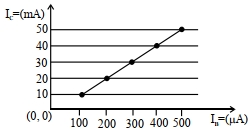
From the given transfer characteristic of a transistor in $CE$ configuration,the value of power gain of this configuration is $10^x$,for $R_B = 10\,k\Omega$ and $R_C = 1\,k\Omega$. The value of $x$ is $.....$.
A
$6$
B
$9$
C
$3$
D
$12$
Solution
(C) The current gain $\beta$ is defined as the slope of the $I_C$ versus $I_B$ graph: $\beta = \frac{\Delta I_C}{\Delta I_B}$.
From the graph,taking two points $(100\,\mu A, 10\,mA)$ and $(200\,\mu A, 20\,mA)$:
$\beta = \frac{(20 - 10) \times 10^{-3} \, A}{(200 - 100) \times 10^{-6} \, A} = \frac{10 \times 10^{-3}}{100 \times 10^{-6}} = 100$.
The power gain $A_P$ is given by $A_P = \beta^2 \times \frac{R_C}{R_B}$.
Substituting the values: $A_P = (100)^2 \times \frac{1 \times 10^3 \, \Omega}{10 \times 10^3 \, \Omega} = 10000 \times 0.1 = 1000 = 10^3$.
Comparing this with $10^x$,we get $x = 3$.
From the graph,taking two points $(100\,\mu A, 10\,mA)$ and $(200\,\mu A, 20\,mA)$:
$\beta = \frac{(20 - 10) \times 10^{-3} \, A}{(200 - 100) \times 10^{-6} \, A} = \frac{10 \times 10^{-3}}{100 \times 10^{-6}} = 100$.
The power gain $A_P$ is given by $A_P = \beta^2 \times \frac{R_C}{R_B}$.
Substituting the values: $A_P = (100)^2 \times \frac{1 \times 10^3 \, \Omega}{10 \times 10^3 \, \Omega} = 10000 \times 0.1 = 1000 = 10^3$.
Comparing this with $10^x$,we get $x = 3$.
0 likesView Solution
356
PhysicsMediumMCQJEE Main · 2023
Given below are two statements: one is labelled as Assertion $A$ and the other is labelled as Reason $R$.
Assertion $A:$ The binding energy per nucleon is practically independent of the atomic number for nuclei of mass number in the range $30$ to $170$.
Reason $R:$ Nuclear force is short-ranged.
In the light of the above statements, choose the correct answer from the options given below:
Assertion $A:$ The binding energy per nucleon is practically independent of the atomic number for nuclei of mass number in the range $30$ to $170$.
Reason $R:$ Nuclear force is short-ranged.
In the light of the above statements, choose the correct answer from the options given below:
A
Both $A$ and $R$ are true but $R$ is $NOT$ the correct explanation of $A$.
B
$A$ is true but $R$ is false.
C
$A$ is false but $R$ is true.
D
Both $A$ and $R$ are true and $R$ is the correct explanation of $A$.
Solution
(D) The binding energy per nucleon curve shows that for nuclei with mass numbers between $30$ and $170$, the binding energy per nucleon is nearly constant (approximately $8 \text{ MeV}$ per nucleon).
This happens because the nuclear force is short-ranged, meaning a nucleon only interacts with its nearest neighbors.
As the mass number increases, the number of neighbors remains effectively constant for a given nucleon, making the binding energy per nucleon independent of the total number of nucleons.
Therefore, both the Assertion and the Reason are true, and the short-range nature of the nuclear force is the reason for the saturation of binding energy per nucleon.
This happens because the nuclear force is short-ranged, meaning a nucleon only interacts with its nearest neighbors.
As the mass number increases, the number of neighbors remains effectively constant for a given nucleon, making the binding energy per nucleon independent of the total number of nucleons.
Therefore, both the Assertion and the Reason are true, and the short-range nature of the nuclear force is the reason for the saturation of binding energy per nucleon.
0 likesView Solution
357
PhysicsMediumMCQJEE Main · 2023
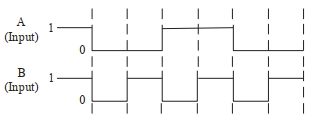
The output from a $NAND$ gate having inputs $A$ and $B$ given below will be:
A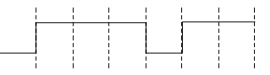
B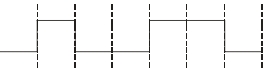
C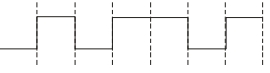
D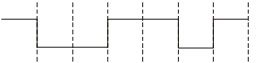
Solution
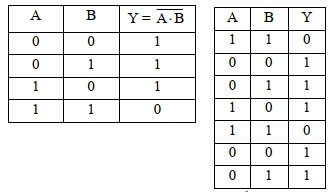
(D) $NAND$ gate produces a low output $(0)$ only when both inputs are high $(1)$. Otherwise, it produces a high output $(1)$. The truth table for a $NAND$ gate is:
| $A$ | $B$ | $Y = \overline{A \cdot B}$ |
|---|---|---|
| $0$ | $0$ | $1$ |
| $0$ | $1$ | $1$ |
| $1$ | $0$ | $1$ |
| $1$ | $1$ | $0$ |
By analyzing the input waveforms for $A$ and $B$ at different time intervals:
$1$. For the first interval, $A=1, B=1$, so $Y=0$.
$2$. For the second interval, $A=0, B=0$, so $Y=1$.
$3$. For the third interval, $A=0, B=1$, so $Y=1$.
$4$. For the fourth interval, $A=1, B=0$, so $Y=1$.
$5$. For the fifth interval, $A=1, B=1$, so $Y=0$.
$6$. For the sixth interval, $A=0, B=0$, so $Y=1$.
$7$. For the seventh interval, $A=0, B=1$, so $Y=1$.
Comparing this sequence $(0, 1, 1, 1, 0, 1, 1)$ with the given options, the waveform in image $D$ matches this output.
| $A$ | $B$ | $Y = \overline{A \cdot B}$ |
|---|---|---|
| $0$ | $0$ | $1$ |
| $0$ | $1$ | $1$ |
| $1$ | $0$ | $1$ |
| $1$ | $1$ | $0$ |
By analyzing the input waveforms for $A$ and $B$ at different time intervals:
$1$. For the first interval, $A=1, B=1$, so $Y=0$.
$2$. For the second interval, $A=0, B=0$, so $Y=1$.
$3$. For the third interval, $A=0, B=1$, so $Y=1$.
$4$. For the fourth interval, $A=1, B=0$, so $Y=1$.
$5$. For the fifth interval, $A=1, B=1$, so $Y=0$.
$6$. For the sixth interval, $A=0, B=0$, so $Y=1$.
$7$. For the seventh interval, $A=0, B=1$, so $Y=1$.
Comparing this sequence $(0, 1, 1, 1, 0, 1, 1)$ with the given options, the waveform in image $D$ matches this output.
0 likesView Solution
358
PhysicsMediumMCQJEE Main · 2023
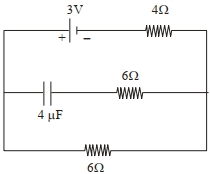
In the network shown below,the charge accumulated in the capacitor in steady state will be ........... $\mu C$.
A
$7.2$
B
$4.8$
C
$10.3$
D
$12$
Solution
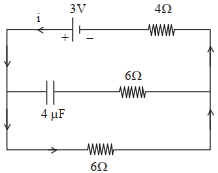
(A) In the steady state,the capacitor acts as an open circuit,meaning no current flows through the branch containing the capacitor.
The current $I$ flows through the outer loop containing the $3 \text{ V}$ battery and the two $6 \,\Omega$ and $4 \,\Omega$ resistors in series.
$I = \frac{V}{R_{eq}} = \frac{3 \text{ V}}{6 \,\Omega + 4 \,\Omega} = \frac{3}{10} \text{ A} = 0.3 \text{ A}$.
The potential difference across the $6 \,\Omega$ resistor (which is in parallel with the capacitor branch) is:
$V_{cap} = I \times R = 0.3 \text{ A} \times 6 \,\Omega = 1.8 \text{ V}$.
Since the capacitor is connected in parallel to this $6 \,\Omega$ resistor,the potential difference across the capacitor is $1.8 \text{ V}$.
The charge $q$ accumulated in the capacitor is given by:
$q = C \times V_{cap} = 4 \,\mu\text{F} \times 1.8 \text{ V} = 7.2 \,\mu\text{C}$.
The current $I$ flows through the outer loop containing the $3 \text{ V}$ battery and the two $6 \,\Omega$ and $4 \,\Omega$ resistors in series.
$I = \frac{V}{R_{eq}} = \frac{3 \text{ V}}{6 \,\Omega + 4 \,\Omega} = \frac{3}{10} \text{ A} = 0.3 \text{ A}$.
The potential difference across the $6 \,\Omega$ resistor (which is in parallel with the capacitor branch) is:
$V_{cap} = I \times R = 0.3 \text{ A} \times 6 \,\Omega = 1.8 \text{ V}$.
Since the capacitor is connected in parallel to this $6 \,\Omega$ resistor,the potential difference across the capacitor is $1.8 \text{ V}$.
The charge $q$ accumulated in the capacitor is given by:
$q = C \times V_{cap} = 4 \,\mu\text{F} \times 1.8 \text{ V} = 7.2 \,\mu\text{C}$.
0 likesView Solution
359
PhysicsEasyMCQJEE Main · 2023
In an electromagnetic wave,at an instant and at a particular position,the electric field is along the negative $z$-axis and the magnetic field is along the positive $x$-axis. Then the direction of propagation of the electromagnetic wave is
A
at $45^{\circ}$ angle from positive $y$-axis
B
negative $y$-axis
C
positive $z$-axis
D
positive $y$-axis
Solution
(B) The direction of propagation of an electromagnetic wave is given by the direction of the Poynting vector,which is $\overrightarrow{S} = \overrightarrow{E} \times \overrightarrow{B}$.
Given,the electric field $\overrightarrow{E} = -E_0 \hat{k}$ (along negative $z$-axis).
The magnetic field $\overrightarrow{B} = B_0 \hat{i}$ (along positive $x$-axis).
The direction of propagation is $\hat{k}_{prop} = \hat{E} \times \hat{B} = (-\hat{k}) \times (\hat{i})$.
Using the cross product rules for unit vectors ($\hat{i} \times \hat{j} = \hat{k}$,$\hat{j} \times \hat{k} = \hat{i}$,$\hat{k} \times \hat{i} = \hat{j}$),we get:
$(-\hat{k}) \times \hat{i} = -(\hat{k} \times \hat{i}) = -\hat{j}$.
Therefore,the direction of propagation is along the negative $y$-axis.
Given,the electric field $\overrightarrow{E} = -E_0 \hat{k}$ (along negative $z$-axis).
The magnetic field $\overrightarrow{B} = B_0 \hat{i}$ (along positive $x$-axis).
The direction of propagation is $\hat{k}_{prop} = \hat{E} \times \hat{B} = (-\hat{k}) \times (\hat{i})$.
Using the cross product rules for unit vectors ($\hat{i} \times \hat{j} = \hat{k}$,$\hat{j} \times \hat{k} = \hat{i}$,$\hat{k} \times \hat{i} = \hat{j}$),we get:
$(-\hat{k}) \times \hat{i} = -(\hat{k} \times \hat{i}) = -\hat{j}$.
Therefore,the direction of propagation is along the negative $y$-axis.
0 likesView Solution
360
PhysicsMediumMCQJEE Main · 2023
An electron is moving along the positive $x$-axis. If a uniform magnetic field is applied parallel to the negative $z$-axis,then:
$A.$ The electron will experience a magnetic force along the positive $y$-axis.
$B.$ The electron will experience a magnetic force along the negative $y$-axis.
$C.$ The electron will not experience any force in the magnetic field.
$D.$ The electron will continue to move along the positive $x$-axis.
$E.$ The electron will move along a circular path in the magnetic field.
Choose the correct answer from the options given below:
$A.$ The electron will experience a magnetic force along the positive $y$-axis.
$B.$ The electron will experience a magnetic force along the negative $y$-axis.
$C.$ The electron will not experience any force in the magnetic field.
$D.$ The electron will continue to move along the positive $x$-axis.
$E.$ The electron will move along a circular path in the magnetic field.
Choose the correct answer from the options given below:
A
$B$ and $E$ only
B
$A$ and $E$ only
C
$C$ and $D$ only
D
$B$ and $D$ only
Solution
(A) The magnetic force on a moving charge is given by the Lorentz force formula: $\overrightarrow{F} = q(\overrightarrow{v} \times \overrightarrow{B})$.
For an electron,$q = -e$. The velocity vector is $\overrightarrow{v} = v\hat{i}$ and the magnetic field is $\overrightarrow{B} = -B\hat{k}$.
Substituting these values: $\overrightarrow{F} = -e(v\hat{i} \times -B\hat{k}) = evB(\hat{i} \times \hat{k}) = evB(-\hat{j})$.
Thus,the force acts along the negative $y$-axis ($B$ is correct).
Since the magnetic force is always perpendicular to the velocity,it acts as a centripetal force,causing the electron to move in a circular path ($E$ is correct).
Therefore,the correct options are $B$ and $E$.
For an electron,$q = -e$. The velocity vector is $\overrightarrow{v} = v\hat{i}$ and the magnetic field is $\overrightarrow{B} = -B\hat{k}$.
Substituting these values: $\overrightarrow{F} = -e(v\hat{i} \times -B\hat{k}) = evB(\hat{i} \times \hat{k}) = evB(-\hat{j})$.
Thus,the force acts along the negative $y$-axis ($B$ is correct).
Since the magnetic force is always perpendicular to the velocity,it acts as a centripetal force,causing the electron to move in a circular path ($E$ is correct).
Therefore,the correct options are $B$ and $E$.
0 likesView Solution
361
PhysicsMediumMCQJEE Main · 2023
Given below are two statements:
Statement $I$: An $AC$ circuit undergoes electrical resonance if it contains either a capacitor or an inductor.
Statement $II$: An $AC$ circuit containing a pure capacitor or a pure inductor consumes high power due to its non-zero power factor.
In the light of the above statements,choose the correct answer from the options given below:
Statement $I$: An $AC$ circuit undergoes electrical resonance if it contains either a capacitor or an inductor.
Statement $II$: An $AC$ circuit containing a pure capacitor or a pure inductor consumes high power due to its non-zero power factor.
In the light of the above statements,choose the correct answer from the options given below:
A
Both Statement $I$ and Statement $II$ are false.
B
Statement $I$ is true but Statement $II$ is false.
C
Both Statement $I$ and Statement $II$ are true.
D
Statement $I$ is false but Statement $II$ is true.
Solution
(A) Statement $I$ is false because electrical resonance in an $AC$ circuit requires the presence of both an inductor $(L)$ and a capacitor $(C)$ so that the inductive reactance $(X_L = \omega L)$ and capacitive reactance $(X_C = 1/\omega C)$ can cancel each other out,resulting in a phase angle $\phi = 0$.
Statement $II$ is false because for a pure inductor or a pure capacitor,the phase difference between voltage and current is $\pi/2$. The power factor is $\cos(\pi/2) = 0$. Therefore,the average power consumed by a pure inductor or a pure capacitor is $P = V_{rms} I_{rms} \cos(\phi) = 0$. They do not consume high power; they consume zero power.
Since both statements are incorrect,the correct option is $A$.
Statement $II$ is false because for a pure inductor or a pure capacitor,the phase difference between voltage and current is $\pi/2$. The power factor is $\cos(\pi/2) = 0$. Therefore,the average power consumed by a pure inductor or a pure capacitor is $P = V_{rms} I_{rms} \cos(\phi) = 0$. They do not consume high power; they consume zero power.
Since both statements are incorrect,the correct option is $A$.
0 likesView Solution
362
PhysicsEasyMCQJEE Main · 2023
To radiate $EM$ signal of wavelength $\lambda$ with high efficiency,the antennas should have a minimum size equal to
A
$\frac{\lambda}{2}$
B
$\frac{\lambda}{4}$
C
$2 \lambda$
D
$\lambda$
Solution
(B) For an antenna to radiate electromagnetic signals with high efficiency,its length must be comparable to the wavelength of the signal. Specifically,the minimum length required for an antenna to act as an effective radiator is $\frac{\lambda}{4}$,which is known as a quarter-wave antenna.
0 likesView Solution
363
PhysicsMediumMCQJEE Main · 2023
Given below are two statements:
Statement $I$: Out of microwaves,infrared rays,and ultraviolet rays,ultraviolet rays are the most effective for the emission of electrons from a metallic surface.
Statement $II$: Above the threshold frequency,the maximum kinetic energy of photoelectrons is inversely proportional to the frequency of the incident light.
In the light of the above statements,choose the correct answer from the options given below:
Statement $I$: Out of microwaves,infrared rays,and ultraviolet rays,ultraviolet rays are the most effective for the emission of electrons from a metallic surface.
Statement $II$: Above the threshold frequency,the maximum kinetic energy of photoelectrons is inversely proportional to the frequency of the incident light.
In the light of the above statements,choose the correct answer from the options given below:
A
Statement $I$ is true but Statement $II$ is false.
B
Both Statement $I$ and Statement $II$ are true.
C
Statement $I$ is false but Statement $II$ is true.
D
Both Statement $I$ and Statement $II$ are false.
Solution
(A) Statement $I$: The energy of a photon is given by $E = hf$. Ultraviolet $(UV)$ rays have a higher frequency compared to infrared rays and microwaves. Since $E = hf$,$UV$ rays carry more energy per photon,making them more effective at overcoming the work function of a metal to emit electrons. Thus,Statement $I$ is true.
Statement $II$: According to Einstein's photoelectric equation,$KE_{\max} = hf - \phi$,where $hf$ is the energy of the incident photon and $\phi = hf_0$ is the work function. This equation shows that $KE_{\max}$ increases linearly with the frequency $f$ of the incident light,not inversely. Thus,Statement $II$ is false.
Statement $II$: According to Einstein's photoelectric equation,$KE_{\max} = hf - \phi$,where $hf$ is the energy of the incident photon and $\phi = hf_0$ is the work function. This equation shows that $KE_{\max}$ increases linearly with the frequency $f$ of the incident light,not inversely. Thus,Statement $II$ is false.
0 likesView Solution
364
PhysicsDifficultMCQJEE Main · 2023
$A$ $10\,\mu C$ charge is divided into two parts and placed at $1\,cm$ distance so that the repulsive force between them is maximum. The charges of the two parts are :
A
$9\,\mu C , 1\,\mu C$
B
$5\,\mu C , 5\,\mu C$
C
$7\,\mu C , 3\,\mu C$
D
$8\,\mu C , 2\,\mu C$
Solution
(B) Let the total charge $q = 10\,\mu C$ be divided into two parts $x$ and $(q - x)$.
The electrostatic repulsive force between them at a distance $r$ is given by Coulomb's Law:
$F = \frac{K x(q - x)}{r^2}$
To find the condition for maximum force,we differentiate $F$ with respect to $x$ and set it to zero:
$\frac{dF}{dx} = \frac{K}{r^2} \frac{d}{dx} (qx - x^2) = 0$
$\frac{K}{r^2} (q - 2x) = 0$
Since $\frac{K}{r^2} \neq 0$,we have $q - 2x = 0$,which implies $x = \frac{q}{2}$.
Given $q = 10\,\mu C$,the two parts are:
$x = \frac{10\,\mu C}{2} = 5\,\mu C$
$(q - x) = 10\,\mu C - 5\,\mu C = 5\,\mu C$.
Thus,the charges are $5\,\mu C$ and $5\,\mu C$.
The electrostatic repulsive force between them at a distance $r$ is given by Coulomb's Law:
$F = \frac{K x(q - x)}{r^2}$
To find the condition for maximum force,we differentiate $F$ with respect to $x$ and set it to zero:
$\frac{dF}{dx} = \frac{K}{r^2} \frac{d}{dx} (qx - x^2) = 0$
$\frac{K}{r^2} (q - 2x) = 0$
Since $\frac{K}{r^2} \neq 0$,we have $q - 2x = 0$,which implies $x = \frac{q}{2}$.
Given $q = 10\,\mu C$,the two parts are:
$x = \frac{10\,\mu C}{2} = 5\,\mu C$
$(q - x) = 10\,\mu C - 5\,\mu C = 5\,\mu C$.
Thus,the charges are $5\,\mu C$ and $5\,\mu C$.
0 likesView Solution
365
PhysicsMediumMCQJEE Main · 2023
In a Young's double slit experiment,the ratio of the amplitude of light coming from the slits is $2:1$. The ratio of the maximum to minimum intensity in the interference pattern is:
A
$9:1$
B
$4:1$
C
$2:1$
D
$25:9$
Solution
(A) Given the ratio of amplitudes of light from the two slits is $\frac{A_1}{A_2} = \frac{2}{1}$.
The intensity $I$ is proportional to the square of the amplitude,$I \propto A^2$.
The formula for the ratio of maximum intensity to minimum intensity is given by:
$\frac{I_{\max}}{I_{\min}} = \left( \frac{A_1 + A_2}{A_1 - A_2} \right)^2$.
Substituting the given values:
$\frac{I_{\max}}{I_{\min}} = \left( \frac{2 + 1}{2 - 1} \right)^2 = \left( \frac{3}{1} \right)^2 = \frac{9}{1}$.
Therefore,the ratio of maximum to minimum intensity is $9:1$.
The intensity $I$ is proportional to the square of the amplitude,$I \propto A^2$.
The formula for the ratio of maximum intensity to minimum intensity is given by:
$\frac{I_{\max}}{I_{\min}} = \left( \frac{A_1 + A_2}{A_1 - A_2} \right)^2$.
Substituting the given values:
$\frac{I_{\max}}{I_{\min}} = \left( \frac{2 + 1}{2 - 1} \right)^2 = \left( \frac{3}{1} \right)^2 = \frac{9}{1}$.
Therefore,the ratio of maximum to minimum intensity is $9:1$.
0 likesView Solution
366
PhysicsMediumMCQJEE Main · 2023
$A$ bi-convex lens of focal length $10\,cm$ is cut into two identical parts along a plane perpendicular to the principal axis. The power of each lens after the cut is $...........\,D$.
A
$4$
B
$5$
C
$3$
D
$2$
Solution
(B) The power of a lens is given by $P = \frac{1}{f(m)}$.
For the original lens,$f = 10\,cm = 0.1\,m$,so the power $P = \frac{1}{0.1} = 10\,D$.
When a lens is cut perpendicular to the principal axis,the focal length of each part becomes double the original focal length $(f' = 2f = 20\,cm = 0.2\,m)$.
The power of each new lens is $P' = \frac{1}{f'} = \frac{1}{0.2} = 5\,D$.
For the original lens,$f = 10\,cm = 0.1\,m$,so the power $P = \frac{1}{0.1} = 10\,D$.
When a lens is cut perpendicular to the principal axis,the focal length of each part becomes double the original focal length $(f' = 2f = 20\,cm = 0.2\,m)$.
The power of each new lens is $P' = \frac{1}{f'} = \frac{1}{0.2} = 5\,D$.

0 likesView Solution
367
PhysicsMediumMCQJEE Main · 2023
An atom absorbs a photon of wavelength $500\,nm$ and emits another photon of wavelength $600\,nm$. The net energy absorbed by the atom in this process is $n \times 10^{-4}\,eV$. The value of $n$ is ............ [Assume the atom to be stationary during the absorption and emission process] (Take $h = 6.6 \times 10^{-34}\,Js$ and $c = 3 \times 10^8\,m/s$)
A
$4124$
B
$4125$
C
$4123$
D
$4122$
Solution
(B) The net energy absorbed by the atom is given by the difference between the energy of the absorbed photon and the emitted photon.
$E_{\text{net}} = E_{\text{absorbed}} - E_{\text{emitted}} = \frac{hc}{\lambda_1} - \frac{hc}{\lambda_2} = hc \left( \frac{1}{\lambda_1} - \frac{1}{\lambda_2} \right)$
Substituting the given values:
$E_{\text{net}} = (6.6 \times 10^{-34}) \times (3 \times 10^8) \left( \frac{1}{500 \times 10^{-9}} - \frac{1}{600 \times 10^{-9}} \right)$
$E_{\text{net}} = 19.8 \times 10^{-26} \left( \frac{600 - 500}{300000 \times 10^{-18}} \right) = 19.8 \times 10^{-26} \left( \frac{100}{3 \times 10^{-13}} \right)$
$E_{\text{net}} = 19.8 \times 10^{-26} \times 33.33 \times 10^{13} = 6.6 \times 10^{-20}\,J$
To convert this energy into $eV$,divide by $1.6 \times 10^{-19}\,J/eV$:
$E_{\text{net}} = \frac{6.6 \times 10^{-20}}{1.6 \times 10^{-19}} = 4.125 \times 10^{-1}\,eV$
$E_{\text{net}} = 4125 \times 10^{-4}\,eV$
Comparing this with $n \times 10^{-4}\,eV$,we get $n = 4125$.
$E_{\text{net}} = E_{\text{absorbed}} - E_{\text{emitted}} = \frac{hc}{\lambda_1} - \frac{hc}{\lambda_2} = hc \left( \frac{1}{\lambda_1} - \frac{1}{\lambda_2} \right)$
Substituting the given values:
$E_{\text{net}} = (6.6 \times 10^{-34}) \times (3 \times 10^8) \left( \frac{1}{500 \times 10^{-9}} - \frac{1}{600 \times 10^{-9}} \right)$
$E_{\text{net}} = 19.8 \times 10^{-26} \left( \frac{600 - 500}{300000 \times 10^{-18}} \right) = 19.8 \times 10^{-26} \left( \frac{100}{3 \times 10^{-13}} \right)$
$E_{\text{net}} = 19.8 \times 10^{-26} \times 33.33 \times 10^{13} = 6.6 \times 10^{-20}\,J$
To convert this energy into $eV$,divide by $1.6 \times 10^{-19}\,J/eV$:
$E_{\text{net}} = \frac{6.6 \times 10^{-20}}{1.6 \times 10^{-19}} = 4.125 \times 10^{-1}\,eV$
$E_{\text{net}} = 4125 \times 10^{-4}\,eV$
Comparing this with $n \times 10^{-4}\,eV$,we get $n = 4125$.
0 likesView Solution
368
PhysicsMediumMCQJEE Main · 2023
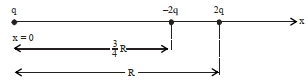
Three point charges $q$,$-2q$,and $2q$ are placed on the $x$-axis at distances $x=0$,$x=\frac{3}{4}R$,and $x=R$ respectively from the origin as shown. If $q = 2 \times 10^{-6} \, C$ and $R = 2 \, cm$,the magnitude of the net force experienced by the charge $-2q$ is .......... $N$.
A
$5442$
B
$5440$
C
$5448$
D
$5475$
Solution
(B) Let the charges be $q_1 = q$ at $x=0$,$q_2 = -2q$ at $x=\frac{3}{4}R$,and $q_3 = 2q$ at $x=R$.
The force on $q_2$ due to $q_1$ is $F_{21} = \frac{k |q_1 q_2|}{r_{21}^2} = \frac{k |q(-2q)|}{(\frac{3}{4}R)^2} = \frac{2kq^2}{\frac{9}{16}R^2} = \frac{32kq^2}{9R^2}$ (directed towards the origin,i.e.,in $-x$ direction).
The force on $q_2$ due to $q_3$ is $F_{23} = \frac{k |q_2 q_3|}{r_{23}^2} = \frac{k |(-2q)(2q)|}{(R - \frac{3}{4}R)^2} = \frac{4kq^2}{(\frac{1}{4}R)^2} = \frac{4kq^2}{\frac{1}{16}R^2} = \frac{64kq^2}{R^2}$ (directed towards $x=R$,i.e.,in $+x$ direction).
The net force on $-2q$ is $F_{net} = F_{23} - F_{21} = \frac{64kq^2}{R^2} - \frac{32kq^2}{9R^2} = \frac{576kq^2 - 32kq^2}{9R^2} = \frac{544kq^2}{9R^2}$.
Substituting values $k = 9 \times 10^9 \, N \cdot m^2/C^2$,$q = 2 \times 10^{-6} \, C$,and $R = 0.02 \, m$:
$F_{net} = \frac{544 \times 9 \times 10^9 \times (2 \times 10^{-6})^2}{9 \times (0.02)^2} = \frac{544 \times 10^9 \times 4 \times 10^{-12}}{4 \times 10^{-4}} = 544 \times 10^1 = 5440 \, N$.
The force on $q_2$ due to $q_1$ is $F_{21} = \frac{k |q_1 q_2|}{r_{21}^2} = \frac{k |q(-2q)|}{(\frac{3}{4}R)^2} = \frac{2kq^2}{\frac{9}{16}R^2} = \frac{32kq^2}{9R^2}$ (directed towards the origin,i.e.,in $-x$ direction).
The force on $q_2$ due to $q_3$ is $F_{23} = \frac{k |q_2 q_3|}{r_{23}^2} = \frac{k |(-2q)(2q)|}{(R - \frac{3}{4}R)^2} = \frac{4kq^2}{(\frac{1}{4}R)^2} = \frac{4kq^2}{\frac{1}{16}R^2} = \frac{64kq^2}{R^2}$ (directed towards $x=R$,i.e.,in $+x$ direction).
The net force on $-2q$ is $F_{net} = F_{23} - F_{21} = \frac{64kq^2}{R^2} - \frac{32kq^2}{9R^2} = \frac{576kq^2 - 32kq^2}{9R^2} = \frac{544kq^2}{9R^2}$.
Substituting values $k = 9 \times 10^9 \, N \cdot m^2/C^2$,$q = 2 \times 10^{-6} \, C$,and $R = 0.02 \, m$:
$F_{net} = \frac{544 \times 9 \times 10^9 \times (2 \times 10^{-6})^2}{9 \times (0.02)^2} = \frac{544 \times 10^9 \times 4 \times 10^{-12}}{4 \times 10^{-4}} = 544 \times 10^1 = 5440 \, N$.
0 likesView Solution
369
PhysicsDifficultMCQJEE Main · 2023
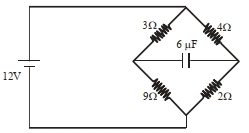
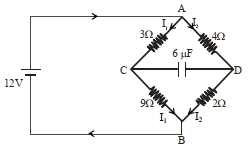
In the circuit shown,the energy stored in the capacitor is $n\,\mu J$. The value of $n$ is ..............
A
$70$
B
$75$
C
$74$
D
$73$
Solution
(B) The circuit consists of two parallel branches connected across a $12\,V$ source.
Branch $1$ has resistors of $3\,\Omega$ and $9\,\Omega$ in series. The current in this branch is $I_1 = \frac{12}{3+9} = 1\,A$.
The potential at point $C$ relative to point $A$ is $V_A - V_C = I_1 \times 3 = 1 \times 3 = 3\,V$.
Branch $2$ has resistors of $4\,\Omega$ and $2\,\Omega$ in series. The current in this branch is $I_2 = \frac{12}{4+2} = 2\,A$.
The potential at point $D$ relative to point $A$ is $V_A - V_D = I_2 \times 4 = 2 \times 4 = 8\,V$.
The potential difference across the capacitor is $V_{CD} = |(V_A - V_D) - (V_A - V_C)| = |8 - 3| = 5\,V$.
The energy stored in the capacitor is $U = \frac{1}{2} CV^2 = \frac{1}{2} \times 6\,\mu F \times (5\,V)^2 = 3 \times 25 = 75\,\mu J$.
Thus,$n = 75$.
Branch $1$ has resistors of $3\,\Omega$ and $9\,\Omega$ in series. The current in this branch is $I_1 = \frac{12}{3+9} = 1\,A$.
The potential at point $C$ relative to point $A$ is $V_A - V_C = I_1 \times 3 = 1 \times 3 = 3\,V$.
Branch $2$ has resistors of $4\,\Omega$ and $2\,\Omega$ in series. The current in this branch is $I_2 = \frac{12}{4+2} = 2\,A$.
The potential at point $D$ relative to point $A$ is $V_A - V_D = I_2 \times 4 = 2 \times 4 = 8\,V$.
The potential difference across the capacitor is $V_{CD} = |(V_A - V_D) - (V_A - V_C)| = |8 - 3| = 5\,V$.
The energy stored in the capacitor is $U = \frac{1}{2} CV^2 = \frac{1}{2} \times 6\,\mu F \times (5\,V)^2 = 3 \times 25 = 75\,\mu J$.
Thus,$n = 75$.
0 likesView Solution
370
PhysicsMediumMCQJEE Main · 2023
An insulated copper wire of $100$ turns is wrapped around a wooden cylindrical core of the cross-sectional area $24\,cm^2$. The two ends of the wire are connected to a resistor. The total resistance in the circuit is $12\,\Omega$. If an externally applied uniform magnetic field in the core along its axis changes from $1.5\,T$ in one direction to $1.5\,T$ in the opposite direction,the charge flowing through a point in the circuit during the change of magnetic field will be $.........\,mC$.
A
$50$
B
$60$
C
$40$
D
$30$
Solution
(B) The change in magnetic flux $\Delta \phi$ is given by $\Delta \phi = N A (B_2 - B_1)$.
Given: $N = 100$,$A = 24\,cm^2 = 24 \times 10^{-4}\,m^2$,$R = 12\,\Omega$,$B_1 = 1.5\,T$,and $B_2 = -1.5\,T$.
Thus,$\Delta \phi = 100 \times 24 \times 10^{-4} \times (-1.5 - 1.5) = 0.24 \times (-3) = -0.72\,Wb$.
The induced charge $Q$ is given by $Q = \frac{|\Delta \phi|}{R}$.
$Q = \frac{0.72}{12} = 0.06\,C$.
Converting to $mC$: $0.06\,C = 60\,mC$.
Given: $N = 100$,$A = 24\,cm^2 = 24 \times 10^{-4}\,m^2$,$R = 12\,\Omega$,$B_1 = 1.5\,T$,and $B_2 = -1.5\,T$.
Thus,$\Delta \phi = 100 \times 24 \times 10^{-4} \times (-1.5 - 1.5) = 0.24 \times (-3) = -0.72\,Wb$.
The induced charge $Q$ is given by $Q = \frac{|\Delta \phi|}{R}$.
$Q = \frac{0.72}{12} = 0.06\,C$.
Converting to $mC$: $0.06\,C = 60\,mC$.
0 likesView Solution
371
PhysicsMediumMCQJEE Main · 2023
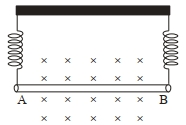
$A$ straight wire $AB$ of mass $40\,g$ and length $50\,cm$ is suspended by a pair of flexible leads in a uniform magnetic field of magnitude $0.40\,T$ as shown in the figure. The magnitude of the current required in the wire to remove the tension in the supporting leads is ...........$A$. (Take $g=10\,ms^{-2}$).
A
$4$
B
$2$
C
$6$
D
$8$
Solution
(B) Given:
Mass of the wire,$m = 40\,g = 40 \times 10^{-3}\,kg$
Length of the wire,$\ell = 50\,cm = 50 \times 10^{-2}\,m = 0.5\,m$
Magnetic field,$B = 0.40\,T$
Acceleration due to gravity,$g = 10\,ms^{-2}$
To remove the tension in the supporting leads,the upward magnetic force on the wire must balance the downward gravitational force (weight) of the wire.
Magnetic force,$F_m = I\ell B$
Weight of the wire,$W = mg$
For equilibrium,$F_m = W$
$I\ell B = mg$
Substituting the values:
$I \times 0.5 \times 0.4 = 40 \times 10^{-3} \times 10$
$I \times 0.2 = 0.4$
$I = \frac{0.4}{0.2} = 2\,A$
Thus,the magnitude of the current required is $2\,A$.
Mass of the wire,$m = 40\,g = 40 \times 10^{-3}\,kg$
Length of the wire,$\ell = 50\,cm = 50 \times 10^{-2}\,m = 0.5\,m$
Magnetic field,$B = 0.40\,T$
Acceleration due to gravity,$g = 10\,ms^{-2}$
To remove the tension in the supporting leads,the upward magnetic force on the wire must balance the downward gravitational force (weight) of the wire.
Magnetic force,$F_m = I\ell B$
Weight of the wire,$W = mg$
For equilibrium,$F_m = W$
$I\ell B = mg$
Substituting the values:
$I \times 0.5 \times 0.4 = 40 \times 10^{-3} \times 10$
$I \times 0.2 = 0.4$
$I = \frac{0.4}{0.2} = 2\,A$
Thus,the magnitude of the current required is $2\,A$.
0 likesView Solution
372
PhysicsMediumMCQJEE Main · 2023
The electric field due to a short electric dipole at a large distance $(r)$ from the center of the dipole on the equatorial plane varies with distance as:
A
$1$
B
$\frac{1}{r}$
C
$\frac{1}{r^3}$
D
$\frac{1}{r^2}$
Solution
(C) The electric field $E$ due to a short electric dipole at a distance $r$ on its equatorial plane is given by the formula:
$E = \frac{kp}{r^3}$
where $k$ is the Coulomb constant and $p$ is the dipole moment.
Since $k$ and $p$ are constants,the electric field $E$ is proportional to $\frac{1}{r^3}$.
Therefore,the electric field varies with distance as $\frac{1}{r^3}$.
$E = \frac{kp}{r^3}$
where $k$ is the Coulomb constant and $p$ is the dipole moment.
Since $k$ and $p$ are constants,the electric field $E$ is proportional to $\frac{1}{r^3}$.
Therefore,the electric field varies with distance as $\frac{1}{r^3}$.
0 likesView Solution
373
PhysicsMediumMCQJEE Main · 2023
The height of the transmitting antenna is $180\,m$ and the height of the receiving antenna is $245\,m$. The maximum distance between them for satisfactory communication in line of sight will be .......... $km$ (given $R = 6400\,km$).
A
$48$
B
$56$
C
$96$
D
$104$
Solution
(D) The maximum line-of-sight distance $d_{\max}$ between a transmitting antenna of height $h_t$ and a receiving antenna of height $h_r$ is given by the formula:
$d_{\max} = \sqrt{2Rh_t} + \sqrt{2Rh_r}$
Given:
$R = 6400\,km = 64 \times 10^5\,m$
$h_t = 180\,m$
$h_r = 245\,m$
Substituting the values:
$d_{\max} = \sqrt{2 \times 64 \times 10^5 \times 180} + \sqrt{2 \times 64 \times 10^5 \times 245}$
$d_{\max} = \sqrt{128 \times 180 \times 10^5} + \sqrt{128 \times 245 \times 10^5}$
$d_{\max} = \sqrt{23040 \times 10^5} + \sqrt{31360 \times 10^5}$
$d_{\max} = \sqrt{2304 \times 10^6} + \sqrt{3136 \times 10^6}$
$d_{\max} = (48 \times 10^3) + (56 \times 10^3)\,m$
$d_{\max} = 48\,km + 56\,km = 104\,km$.
$d_{\max} = \sqrt{2Rh_t} + \sqrt{2Rh_r}$
Given:
$R = 6400\,km = 64 \times 10^5\,m$
$h_t = 180\,m$
$h_r = 245\,m$
Substituting the values:
$d_{\max} = \sqrt{2 \times 64 \times 10^5 \times 180} + \sqrt{2 \times 64 \times 10^5 \times 245}$
$d_{\max} = \sqrt{128 \times 180 \times 10^5} + \sqrt{128 \times 245 \times 10^5}$
$d_{\max} = \sqrt{23040 \times 10^5} + \sqrt{31360 \times 10^5}$
$d_{\max} = \sqrt{2304 \times 10^6} + \sqrt{3136 \times 10^6}$
$d_{\max} = (48 \times 10^3) + (56 \times 10^3)\,m$
$d_{\max} = 48\,km + 56\,km = 104\,km$.
0 likesView Solution
374
PhysicsMediumMCQJEE Main · 2023
The half-life of a radioactive nucleus is $5$ years. The fraction of the original sample that would decay in $15$ years is
A
$\frac{1}{8}$
B
$\frac{1}{4}$
C
$\frac{7}{8}$
D
$\frac{3}{4}$
Solution
(C) The half-life $T_{1/2} = 5$ years.
Total time $t = 15$ years.
The number of half-lives $n = \frac{t}{T_{1/2}} = \frac{15}{5} = 3$.
The fraction of nuclei remaining after $n$ half-lives is given by $\frac{N}{N_0} = (\frac{1}{2})^n = (\frac{1}{2})^3 = \frac{1}{8}$.
The fraction of the sample that decays is $1 - \frac{N}{N_0} = 1 - \frac{1}{8} = \frac{7}{8}$.
Total time $t = 15$ years.
The number of half-lives $n = \frac{t}{T_{1/2}} = \frac{15}{5} = 3$.
The fraction of nuclei remaining after $n$ half-lives is given by $\frac{N}{N_0} = (\frac{1}{2})^n = (\frac{1}{2})^3 = \frac{1}{8}$.
The fraction of the sample that decays is $1 - \frac{N}{N_0} = 1 - \frac{1}{8} = \frac{7}{8}$.
0 likesView Solution
375
PhysicsEasyMCQJEE Main · 2023
The de Broglie wavelength of an electron having kinetic energy $E$ is $\lambda$. If the kinetic energy of the electron becomes $\frac{E}{4}$,then its de Broglie wavelength will be:
A
$\frac{\lambda}{\sqrt{2}}$
B
$\frac{\lambda}{2}$
C
$2 \lambda$
D
$\sqrt{2} \lambda$
Solution
(C) The de Broglie wavelength $\lambda$ of an electron with kinetic energy $E$ is given by the formula: $\lambda = \frac{h}{\sqrt{2mE}}$.
When the kinetic energy becomes $E' = \frac{E}{4}$,the new de Broglie wavelength $\lambda'$ is:
$\lambda' = \frac{h}{\sqrt{2mE'}} = \frac{h}{\sqrt{2m(\frac{E}{4})}}$.
Simplifying the expression:
$\lambda' = \frac{h}{\sqrt{\frac{2mE}{4}}} = \frac{h}{\frac{1}{2}\sqrt{2mE}} = 2 \left( \frac{h}{\sqrt{2mE}} \right)$.
Substituting $\lambda$ into the equation:
$\lambda' = 2\lambda$.
When the kinetic energy becomes $E' = \frac{E}{4}$,the new de Broglie wavelength $\lambda'$ is:
$\lambda' = \frac{h}{\sqrt{2mE'}} = \frac{h}{\sqrt{2m(\frac{E}{4})}}$.
Simplifying the expression:
$\lambda' = \frac{h}{\sqrt{\frac{2mE}{4}}} = \frac{h}{\frac{1}{2}\sqrt{2mE}} = 2 \left( \frac{h}{\sqrt{2mE}} \right)$.
Substituting $\lambda$ into the equation:
$\lambda' = 2\lambda$.
0 likesView Solution
376
PhysicsMediumMCQJEE Main · 2023
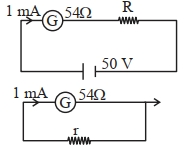
For designing a voltmeter of range $50\,V$ and an ammeter of range $10\,mA$ using a galvanometer which has a coil of resistance $54\,\Omega$ showing a full scale deflection for $1\,mA$ as in figure.
$(A)$ for voltmeter $R \approx 50\,k\Omega$
$(B)$ for ammeter $r \approx 0.2\,\Omega$
$(C)$ for ammeter $r \approx 6\,\Omega$
$(D)$ for voltmeter $R \approx 5\,k \Omega$
$(E)$ for voltmeter $R \approx 500 \Omega$
Choose the correct answer from the options given below
$(A)$ for voltmeter $R \approx 50\,k\Omega$
$(B)$ for ammeter $r \approx 0.2\,\Omega$
$(C)$ for ammeter $r \approx 6\,\Omega$
$(D)$ for voltmeter $R \approx 5\,k \Omega$
$(E)$ for voltmeter $R \approx 500 \Omega$
Choose the correct answer from the options given below
A
$(C)$ and $(E)$
B
$(C)$ and $(D)$
C
$(A)$ and $(C)$
D
$(A)$ and $(B)$
Solution
(C) For the voltmeter:
The resistance $R$ to be connected in series is given by $R = \frac{V}{I_g} - G$.
Given $V = 50\,V$,$I_g = 1\,mA = 10^{-3}\,A$,and $G = 54\,\Omega$.
$R = \frac{50}{10^{-3}} - 54 = 50000 - 54 = 49946\,\Omega \approx 50\,k\Omega$.
Thus,statement $(A)$ is correct.
For the ammeter:
The shunt resistance $r$ to be connected in parallel is given by $r = \frac{I_g G}{I - I_g}$.
Given $I = 10\,mA = 10^{-2}\,A$,$I_g = 1\,mA = 10^{-3}\,A$,and $G = 54\,\Omega$.
$r = \frac{10^{-3} \times 54}{10 \times 10^{-3} - 1 \times 10^{-3}} = \frac{54 \times 10^{-3}}{9 \times 10^{-3}} = 6\,\Omega$.
Thus,statement $(C)$ is correct.
Therefore,the correct option is $(A)$ and $(C)$.
The resistance $R$ to be connected in series is given by $R = \frac{V}{I_g} - G$.
Given $V = 50\,V$,$I_g = 1\,mA = 10^{-3}\,A$,and $G = 54\,\Omega$.
$R = \frac{50}{10^{-3}} - 54 = 50000 - 54 = 49946\,\Omega \approx 50\,k\Omega$.
Thus,statement $(A)$ is correct.
For the ammeter:
The shunt resistance $r$ to be connected in parallel is given by $r = \frac{I_g G}{I - I_g}$.
Given $I = 10\,mA = 10^{-2}\,A$,$I_g = 1\,mA = 10^{-3}\,A$,and $G = 54\,\Omega$.
$r = \frac{10^{-3} \times 54}{10 \times 10^{-3} - 1 \times 10^{-3}} = \frac{54 \times 10^{-3}}{9 \times 10^{-3}} = 6\,\Omega$.
Thus,statement $(C)$ is correct.
Therefore,the correct option is $(A)$ and $(C)$.
0 likesView Solution
377
PhysicsMediumMCQJEE Main · 2023
Given below are two statements:
Statement $I:$ The equivalent resistance of resistors in a series combination is smaller than the least resistance used in the combination.
Statement $II:$ The resistivity of the material is independent of temperature.
In the light of the above statements,choose the correct answer from the options given below:
Statement $I:$ The equivalent resistance of resistors in a series combination is smaller than the least resistance used in the combination.
Statement $II:$ The resistivity of the material is independent of temperature.
In the light of the above statements,choose the correct answer from the options given below:
A
Statement $I$ is false but Statement $II$ is true.
B
Both Statement $I$ and Statement $II$ are false.
C
Statement $I$ is true but Statement $II$ is false.
D
Both Statement $I$ and Statement $II$ are true.
Solution
(B) For Statement $I$: In a series combination,the equivalent resistance is given by $R_{eq} = R_1 + R_2 + ... + R_n$. Since all resistances are positive,$R_{eq}$ is always greater than any individual resistance in the combination. Therefore,Statement $I$ is false.
For Statement $II$: The resistivity of a material is temperature-dependent. For metals,resistivity increases with an increase in temperature according to the relation $\rho_T = \rho_0 [1 + \alpha(T - T_0)]$. Therefore,Statement $II$ is false.
Conclusion: Both Statement $I$ and Statement $II$ are false.
For Statement $II$: The resistivity of a material is temperature-dependent. For metals,resistivity increases with an increase in temperature according to the relation $\rho_T = \rho_0 [1 + \alpha(T - T_0)]$. Therefore,Statement $II$ is false.
Conclusion: Both Statement $I$ and Statement $II$ are false.
0 likesView Solution
378
PhysicsMediumMCQJEE Main · 2023
$A$ $12\,V$ battery connected to a coil of resistance $6\,\Omega$ through a switch,drives a constant current in the circuit. The switch is opened in $1\,ms$. The emf induced across the coil is $20\,V$. The inductance of the coil is ........... $mH$.
A
$5$
B
$12$
C
$8$
D
$10$
Solution
(D) The initial current $I$ in the circuit is given by Ohm's law: $I = \frac{V}{R} = \frac{12\,V}{6\,\Omega} = 2\,A$.
When the switch is opened,the current drops from $2\,A$ to $0\,A$ in a time interval $\Delta t = 1\,ms = 10^{-3}\,s$.
The magnitude of the induced emf is given by the formula: $|\varepsilon| = L \left| \frac{\Delta I}{\Delta t} \right|$.
Substituting the given values: $20 = L \times \frac{2 - 0}{10^{-3}}$.
$20 = L \times \frac{2}{10^{-3}}$.
$20 = L \times 2000$.
$L = \frac{20}{2000} = 0.01\,H$.
Converting to millihenry $(mH)$: $L = 0.01 \times 1000\,mH = 10\,mH$.
When the switch is opened,the current drops from $2\,A$ to $0\,A$ in a time interval $\Delta t = 1\,ms = 10^{-3}\,s$.
The magnitude of the induced emf is given by the formula: $|\varepsilon| = L \left| \frac{\Delta I}{\Delta t} \right|$.
Substituting the given values: $20 = L \times \frac{2 - 0}{10^{-3}}$.
$20 = L \times \frac{2}{10^{-3}}$.
$20 = L \times 2000$.
$L = \frac{20}{2000} = 0.01\,H$.
Converting to millihenry $(mH)$: $L = 0.01 \times 1000\,mH = 10\,mH$.
0 likesView Solution
379
PhysicsMediumMCQJEE Main · 2023
Match List $I$ with List $II$ of electromagnetic waves with their corresponding wavelength ranges:
Choose the correct answer from the options given below:
| List $I$ | List $II$ |
| $(A)$ Microwave | $(I)$ $400\,nm$ to $1\,nm$ |
| $(B)$ Ultraviolet | $(II)$ $1\,nm$ to $10^{-3}\,nm$ |
| $(C)$ $X$-Ray | $(III)$ $1\,mm$ to $700\,nm$ |
| $(D)$ Infra-red | $(IV)$ $0.1\,m$ to $1\,mm$ |
Choose the correct answer from the options given below:
A
$(A)-(I), (B)-(IV), (C)-(II), (D)-(III)$
B
$(A)-(IV), (B)-(I), (C)-(II), (D)-(III)$
C
$(A)-(IV), (B)-(II), (C)-(I), (D)-(III)$
D
$(A)-(IV), (B)-(I), (C)-(III), (D)-(II)$
Solution
(B) The wavelength ranges for the given electromagnetic waves are as follows:
$(A)$ Microwave: The wavelength range is $0.1\,m$ to $1\,mm$ (matches $(IV)$).
$(B)$ Ultraviolet: The wavelength range is $400\,nm$ to $1\,nm$ (matches $(I)$).
$(C)$ $X$-Ray: The wavelength range is $1\,nm$ to $10^{-3}\,nm$ (matches $(II)$).
$(D)$ Infra-red: The wavelength range is $1\,mm$ to $700\,nm$ (matches $(III)$).
Therefore,the correct matching is $(A)-(IV), (B)-(I), (C)-(II), (D)-(III)$.
$(A)$ Microwave: The wavelength range is $0.1\,m$ to $1\,mm$ (matches $(IV)$).
$(B)$ Ultraviolet: The wavelength range is $400\,nm$ to $1\,nm$ (matches $(I)$).
$(C)$ $X$-Ray: The wavelength range is $1\,nm$ to $10^{-3}\,nm$ (matches $(II)$).
$(D)$ Infra-red: The wavelength range is $1\,mm$ to $700\,nm$ (matches $(III)$).
Therefore,the correct matching is $(A)-(IV), (B)-(I), (C)-(II), (D)-(III)$.
1 likesView Solution
380
PhysicsEasyMCQJEE Main · 2023
$A$ single slit of width $a$ is illuminated by a monochromatic light of wavelength $600 \, nm$. The value of $a$ for which the first minimum appears at $\theta = 30^{\circ}$ on the screen will be ........... $\mu m$.
A
$0.6$
B
$1.2$
C
$1.8$
D
$3$
Solution
(B) For the first minimum in a single-slit diffraction pattern, the condition is given by the formula:
$a \sin \theta = n \lambda$
For the first minimum, $n = 1$, so the equation becomes:
$a \sin \theta = \lambda$
Given:
$\lambda = 600 \, nm = 600 \times 10^{-9} \, m$
$\theta = 30^{\circ}$
Substituting the values into the equation:
$a \sin 30^{\circ} = 600 \times 10^{-9} \, m$
Since $\sin 30^{\circ} = 0.5$:
$a \times 0.5 = 600 \times 10^{-9} \, m$
$a = 1200 \times 10^{-9} \, m$
$a = 1.2 \times 10^{-6} \, m$
$a = 1.2 \, \mu m$
$a \sin \theta = n \lambda$
For the first minimum, $n = 1$, so the equation becomes:
$a \sin \theta = \lambda$
Given:
$\lambda = 600 \, nm = 600 \times 10^{-9} \, m$
$\theta = 30^{\circ}$
Substituting the values into the equation:
$a \sin 30^{\circ} = 600 \times 10^{-9} \, m$
Since $\sin 30^{\circ} = 0.5$:
$a \times 0.5 = 600 \times 10^{-9} \, m$
$a = 1200 \times 10^{-9} \, m$
$a = 1.2 \times 10^{-6} \, m$
$a = 1.2 \, \mu m$
0 likesView Solution
381
PhysicsMediumMCQJEE Main · 2023
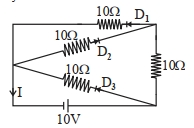
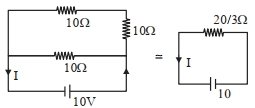
In the given circuit,the current $(I)$ through the battery will be $..........\,A$.
A
$1.5$
B
$1$
C
$2.5$
D
$2$
Solution
(A) In the given circuit,diodes $D_1$ and $D_3$ are connected in forward bias,while diode $D_2$ is connected in reverse bias.
Therefore,the branch containing $D_2$ acts as an open circuit.
The circuit simplifies to two parallel branches connected to the $10\,V$ battery.
The first branch consists of a $10\,\Omega$ resistor in series with $D_1$ and another $10\,\Omega$ resistor,giving a total resistance of $R_1 = 10\,\Omega + 10\,\Omega = 20\,\Omega$.
The second branch consists of a $10\,\Omega$ resistor in series with $D_3$,giving a resistance of $R_2 = 10\,\Omega$.
The equivalent resistance $(R_{eq})$ of these two parallel branches is given by:
$\frac{1}{R_{eq}} = \frac{1}{R_1} + \frac{1}{R_2} = \frac{1}{20} + \frac{1}{10} = \frac{1+2}{20} = \frac{3}{20}$
$R_{eq} = \frac{20}{3}\,\Omega$
Using Ohm's law,the current $(I)$ through the battery is:
$I = \frac{V}{R_{eq}} = \frac{10}{20/3} = \frac{30}{20} = 1.5\,A$.
Therefore,the branch containing $D_2$ acts as an open circuit.
The circuit simplifies to two parallel branches connected to the $10\,V$ battery.
The first branch consists of a $10\,\Omega$ resistor in series with $D_1$ and another $10\,\Omega$ resistor,giving a total resistance of $R_1 = 10\,\Omega + 10\,\Omega = 20\,\Omega$.
The second branch consists of a $10\,\Omega$ resistor in series with $D_3$,giving a resistance of $R_2 = 10\,\Omega$.
The equivalent resistance $(R_{eq})$ of these two parallel branches is given by:
$\frac{1}{R_{eq}} = \frac{1}{R_1} + \frac{1}{R_2} = \frac{1}{20} + \frac{1}{10} = \frac{1+2}{20} = \frac{3}{20}$
$R_{eq} = \frac{20}{3}\,\Omega$
Using Ohm's law,the current $(I)$ through the battery is:
$I = \frac{V}{R_{eq}} = \frac{10}{20/3} = \frac{30}{20} = 1.5\,A$.
0 likesView Solution
382
PhysicsMediumMCQJEE Main · 2023
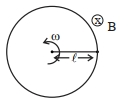
$A$ $20\,cm$ long metallic rod is rotated with $210\,rpm$ about an axis normal to the rod passing through its one end. The other end of the rod is in contact with a circular metallic ring. $A$ constant and uniform magnetic field of $0.2\,T$ parallel to the axis exists everywhere. The emf developed between the centre and the ring is $.......\,mV$. Take $\pi=\frac{22}{7}$.
A
$88$
B
$66$
C
$55$
D
$44$
Solution
(A) Given:
Length of the rod,$\ell = 20\,cm = 0.2\,m$
Angular velocity,$\omega = 210\,rpm = 210 \times \frac{2\pi}{60}\,rad/s = 7\pi\,rad/s$
Magnetic field,$B = 0.2\,T$
The motional emf induced in a rod rotating in a uniform magnetic field is given by the formula:
$\varepsilon = \frac{1}{2} B \omega \ell^2$
Substituting the given values:
$\varepsilon = \frac{1}{2} \times 0.2 \times (7\pi) \times (0.2)^2$
$\varepsilon = 0.1 \times 7 \times \frac{22}{7} \times 0.04$
$\varepsilon = 0.1 \times 22 \times 0.04$
$\varepsilon = 0.088\,V$
Converting to millivolts $(mV)$:
$\varepsilon = 0.088 \times 1000\,mV = 88\,mV$
Length of the rod,$\ell = 20\,cm = 0.2\,m$
Angular velocity,$\omega = 210\,rpm = 210 \times \frac{2\pi}{60}\,rad/s = 7\pi\,rad/s$
Magnetic field,$B = 0.2\,T$
The motional emf induced in a rod rotating in a uniform magnetic field is given by the formula:
$\varepsilon = \frac{1}{2} B \omega \ell^2$
Substituting the given values:
$\varepsilon = \frac{1}{2} \times 0.2 \times (7\pi) \times (0.2)^2$
$\varepsilon = 0.1 \times 7 \times \frac{22}{7} \times 0.04$
$\varepsilon = 0.1 \times 22 \times 0.04$
$\varepsilon = 0.088\,V$
Converting to millivolts $(mV)$:
$\varepsilon = 0.088 \times 1000\,mV = 88\,mV$
0 likesView Solution
383
PhysicsMediumMCQJEE Main · 2023
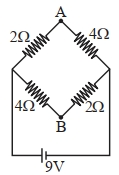
$A$ network of four resistances is connected to a $9\,V$ battery,as shown in the figure. The magnitude of the voltage difference between the points $A$ and $B$ is .......... $V.$
A
$3$
B
$6$
C
$9$
D
$12$
Solution
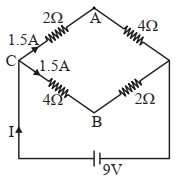
(A) The circuit consists of two parallel branches connected across the $9\,V$ battery.
Branch $1$ (left side) has a total resistance of $2\,\Omega + 4\,\Omega = 6\,\Omega$. The current in this branch is $I_1 = \frac{9\,V}{6\,\Omega} = 1.5\,A$.
The potential at point $A$ relative to the left junction (let's call it $C$) is $V_C - V_A = I_1 \times 2\,\Omega = 1.5 \times 2 = 3\,V$.
Branch $2$ (right side) has a total resistance of $4\,\Omega + 2\,\Omega = 6\,\Omega$. The current in this branch is $I_2 = \frac{9\,V}{6\,\Omega} = 1.5\,A$.
The potential at point $B$ relative to the left junction $C$ is $V_C - V_B = I_1 \times 4\,\Omega = 1.5 \times 4 = 6\,V$.
Now,the potential difference between $A$ and $B$ is $|V_A - V_B| = |(V_C - 3) - (V_C - 6)| = |6 - 3| = 3\,V$.
Branch $1$ (left side) has a total resistance of $2\,\Omega + 4\,\Omega = 6\,\Omega$. The current in this branch is $I_1 = \frac{9\,V}{6\,\Omega} = 1.5\,A$.
The potential at point $A$ relative to the left junction (let's call it $C$) is $V_C - V_A = I_1 \times 2\,\Omega = 1.5 \times 2 = 3\,V$.
Branch $2$ (right side) has a total resistance of $4\,\Omega + 2\,\Omega = 6\,\Omega$. The current in this branch is $I_2 = \frac{9\,V}{6\,\Omega} = 1.5\,A$.
The potential at point $B$ relative to the left junction $C$ is $V_C - V_B = I_1 \times 4\,\Omega = 1.5 \times 4 = 6\,V$.
Now,the potential difference between $A$ and $B$ is $|V_A - V_B| = |(V_C - 3) - (V_C - 6)| = |6 - 3| = 3\,V$.
0 likesView Solution
384
PhysicsDifficultMCQJEE Main · 2023
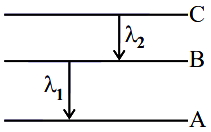
As per the given figure,$A$,$B$,and $C$ are the first,second,and third excited energy levels of a hydrogen atom,respectively. If the ratio of the two wavelengths (i.e.,$\frac{\lambda_1}{\lambda_2}$) is $\frac{7}{4n}$,then the value of $n$ will be
A
$5$
B
$10$
C
$15$
D
$20$
Solution
(A) The energy levels for a hydrogen atom are given by $n=1$ (ground state),$n=2$ (first excited state),$n=3$ (second excited state),and $n=4$ (third excited state).
From the figure,$A$ corresponds to $n=2$,$B$ corresponds to $n=3$,and $C$ corresponds to $n=4$.
The wavelength $\lambda$ for a transition from $n_2$ to $n_1$ is given by the Rydberg formula: $\frac{1}{\lambda} = R Z^2 \left[ \frac{1}{n_1^2} - \frac{1}{n_2^2} \right]$.
For transition $\lambda_1$ (from $n=3$ to $n=2$): $\frac{1}{\lambda_1} = R(1)^2 \left[ \frac{1}{2^2} - \frac{1}{3^2} \right] = R \left[ \frac{1}{4} - \frac{1}{9} \right] = R \left( \frac{5}{36} \right)$.
For transition $\lambda_2$ (from $n=4$ to $n=3$): $\frac{1}{\lambda_2} = R(1)^2 \left[ \frac{1}{3^2} - \frac{1}{4^2} \right] = R \left[ \frac{1}{9} - \frac{1}{16} \right] = R \left( \frac{7}{144} \right)$.
Now,calculate the ratio $\frac{\lambda_1}{\lambda_2}$:
$\frac{\lambda_1}{\lambda_2} = \frac{1/\lambda_2}{1/\lambda_1} = \frac{R(7/144)}{R(5/36)} = \frac{7}{144} \times \frac{36}{5} = \frac{7}{4 \times 5} = \frac{7}{20}$.
Given the ratio is $\frac{7}{4n}$,we have $\frac{7}{20} = \frac{7}{4n}$,which implies $4n = 20$,so $n = 5$.
From the figure,$A$ corresponds to $n=2$,$B$ corresponds to $n=3$,and $C$ corresponds to $n=4$.
The wavelength $\lambda$ for a transition from $n_2$ to $n_1$ is given by the Rydberg formula: $\frac{1}{\lambda} = R Z^2 \left[ \frac{1}{n_1^2} - \frac{1}{n_2^2} \right]$.
For transition $\lambda_1$ (from $n=3$ to $n=2$): $\frac{1}{\lambda_1} = R(1)^2 \left[ \frac{1}{2^2} - \frac{1}{3^2} \right] = R \left[ \frac{1}{4} - \frac{1}{9} \right] = R \left( \frac{5}{36} \right)$.
For transition $\lambda_2$ (from $n=4$ to $n=3$): $\frac{1}{\lambda_2} = R(1)^2 \left[ \frac{1}{3^2} - \frac{1}{4^2} \right] = R \left[ \frac{1}{9} - \frac{1}{16} \right] = R \left( \frac{7}{144} \right)$.
Now,calculate the ratio $\frac{\lambda_1}{\lambda_2}$:
$\frac{\lambda_1}{\lambda_2} = \frac{1/\lambda_2}{1/\lambda_1} = \frac{R(7/144)}{R(5/36)} = \frac{7}{144} \times \frac{36}{5} = \frac{7}{4 \times 5} = \frac{7}{20}$.
Given the ratio is $\frac{7}{4n}$,we have $\frac{7}{20} = \frac{7}{4n}$,which implies $4n = 20$,so $n = 5$.
0 likesView Solution
385
PhysicsMediumMCQJEE Main · 2023
The refractive index of a transparent liquid filled in an equilateral hollow prism is $\sqrt{2}$. The angle of minimum deviation for the liquid will be (in $^{\circ}$)
A
$30$
B
$20$
C
$40$
D
$50$
Solution
(A) The formula for the refractive index $\mu$ of a prism is given by $\mu = \frac{\sin((D_{\min} + A)/2)}{\sin(A/2)}$.
Given that the prism is equilateral,the angle of the prism $A = 60^{\circ}$.
The refractive index $\mu = \sqrt{2}$.
Substituting these values into the formula:
$\sqrt{2} = \frac{\sin((D_{\min} + 60^{\circ})/2)}{\sin(60^{\circ}/2)}$
$\sqrt{2} = \frac{\sin((D_{\min} + 60^{\circ})/2)}{\sin(30^{\circ})}$
Since $\sin(30^{\circ}) = 1/2$,we have:
$\sqrt{2} = \frac{\sin((D_{\min} + 60^{\circ})/2)}{1/2}$
$\frac{\sqrt{2}}{2} = \sin((D_{\min} + 60^{\circ})/2)$
$\frac{1}{\sqrt{2}} = \sin((D_{\min} + 60^{\circ})/2)$
Since $\sin(45^{\circ}) = 1/\sqrt{2}$,we get:
$(D_{\min} + 60^{\circ})/2 = 45^{\circ}$
$D_{\min} + 60^{\circ} = 90^{\circ}$
$D_{\min} = 30^{\circ}$.
Given that the prism is equilateral,the angle of the prism $A = 60^{\circ}$.
The refractive index $\mu = \sqrt{2}$.
Substituting these values into the formula:
$\sqrt{2} = \frac{\sin((D_{\min} + 60^{\circ})/2)}{\sin(60^{\circ}/2)}$
$\sqrt{2} = \frac{\sin((D_{\min} + 60^{\circ})/2)}{\sin(30^{\circ})}$
Since $\sin(30^{\circ}) = 1/2$,we have:
$\sqrt{2} = \frac{\sin((D_{\min} + 60^{\circ})/2)}{1/2}$
$\frac{\sqrt{2}}{2} = \sin((D_{\min} + 60^{\circ})/2)$
$\frac{1}{\sqrt{2}} = \sin((D_{\min} + 60^{\circ})/2)$
Since $\sin(45^{\circ}) = 1/\sqrt{2}$,we get:
$(D_{\min} + 60^{\circ})/2 = 45^{\circ}$
$D_{\min} + 60^{\circ} = 90^{\circ}$
$D_{\min} = 30^{\circ}$.
0 likesView Solution
386
PhysicsMediumMCQJEE Main · 2023
An electron in a hydrogen atom revolves around its nucleus with a speed of $6.76 \times 10^6 \, m/s$ in an orbit of radius $0.52 \, \mathring{A}$. The magnetic field produced at the nucleus of the hydrogen atom is $...... \, T$.
A
$10$
B
$20$
C
$30$
D
$40$
Solution
(D) The magnetic field $B$ at the center of a circular loop carrying current $I$ is given by $B = \frac{\mu_0 I}{2r}$.
The current $I$ produced by an electron revolving with speed $v$ in an orbit of radius $r$ is $I = \frac{ev}{2\pi r}$.
Substituting $I$ into the magnetic field formula: $B = \frac{\mu_0}{2r} \left( \frac{ev}{2\pi r} \right) = \frac{\mu_0 ev}{4\pi r^2}$.
Given values: $e = 1.6 \times 10^{-19} \, C$,$v = 6.76 \times 10^6 \, m/s$,$r = 0.52 \times 10^{-10} \, m$,and $\frac{\mu_0}{4\pi} = 10^{-7} \, T \cdot m/A$.
$B = 10^{-7} \times \frac{1.6 \times 10^{-19} \times 6.76 \times 10^6}{(0.52 \times 10^{-10})^2}$.
$B = 10^{-7} \times \frac{10.816 \times 10^{-13}}{0.2704 \times 10^{-20}} = 10^{-7} \times 40 \times 10^7 = 40 \, T$.
The current $I$ produced by an electron revolving with speed $v$ in an orbit of radius $r$ is $I = \frac{ev}{2\pi r}$.
Substituting $I$ into the magnetic field formula: $B = \frac{\mu_0}{2r} \left( \frac{ev}{2\pi r} \right) = \frac{\mu_0 ev}{4\pi r^2}$.
Given values: $e = 1.6 \times 10^{-19} \, C$,$v = 6.76 \times 10^6 \, m/s$,$r = 0.52 \times 10^{-10} \, m$,and $\frac{\mu_0}{4\pi} = 10^{-7} \, T \cdot m/A$.
$B = 10^{-7} \times \frac{1.6 \times 10^{-19} \times 6.76 \times 10^6}{(0.52 \times 10^{-10})^2}$.
$B = 10^{-7} \times \frac{10.816 \times 10^{-13}}{0.2704 \times 10^{-20}} = 10^{-7} \times 40 \times 10^7 = 40 \, T$.
0 likesView Solution
387
PhysicsMediumMCQJEE Main · 2023
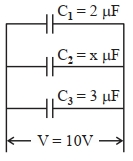
In the given figure,the total charge stored in the combination of capacitors is $100\,\mu C$. The value of '$x$' is $............$.
A
$5$
B
$10$
C
$15$
D
$20$
Solution
(A) The capacitors are connected in parallel,so the potential difference across each capacitor is the same,$V = 10\,V$.
The charge on each capacitor is given by $Q = CV$.
Charge on $C_1$ is $Q_1 = C_1 V = 2\,\mu F \times 10\,V = 20\,\mu C$.
Charge on $C_2$ is $Q_2 = C_2 V = x\,\mu F \times 10\,V = 10x\,\mu C$.
Charge on $C_3$ is $Q_3 = C_3 V = 3\,\mu F \times 10\,V = 30\,\mu C$.
The total charge stored in the combination is $Q_{total} = Q_1 + Q_2 + Q_3$.
Given $Q_{total} = 100\,\mu C$,we have:
$20 + 10x + 30 = 100$
$50 + 10x = 100$
$10x = 50$
$x = 5$.
The charge on each capacitor is given by $Q = CV$.
Charge on $C_1$ is $Q_1 = C_1 V = 2\,\mu F \times 10\,V = 20\,\mu C$.
Charge on $C_2$ is $Q_2 = C_2 V = x\,\mu F \times 10\,V = 10x\,\mu C$.
Charge on $C_3$ is $Q_3 = C_3 V = 3\,\mu F \times 10\,V = 30\,\mu C$.
The total charge stored in the combination is $Q_{total} = Q_1 + Q_2 + Q_3$.
Given $Q_{total} = 100\,\mu C$,we have:
$20 + 10x + 30 = 100$
$50 + 10x = 100$
$10x = 50$
$x = 5$.
0 likesView Solution
Vedclass Products
For Students
Vedclass Test Series
Mock tests in real JEE Main style covering Physics with performance analysis. 5-day free trial.
Start Free TrialFor Teachers
Exam Paper Generator
Generate Set A/B/C/D Physics papers from 7.5L+ questions in 2 minutes. 3 chapters free.
Try FreeFor Institutes
Online Exam Module
Run live JEE Main mock exams with unlimited students, 360° analytics & white-label branding.
See DemoFrequently Asked Questions
How many Physics questions are in JEE Main 2023?
There are 719 Physics questions from the JEE Main 2023 paper on Vedclass, each with a detailed step-by-step solution in English.
Are JEE Main 2023 Physics solutions available in English?
Yes. All solutions on this page are in English. You can also switch to English or Hindi using the language buttons above the questions.
Can I practice JEE Main 2023 Physics as a timed test?
Yes. Use the Vedclass Test Series to attempt a full JEE Main mock test covering Physics with time limits and instant score analysis.
Can teachers create Physics papers from JEE Main previous year questions?
Yes. The Vedclass Exam Paper Generator lets teachers mix JEE Main Physics questions and generate Set A/B/C/D papers in minutes.
For Teachers & Institutes
Build a Custom Physics Paper
Pick JEE Main 2023 Physics questions, set difficulty, and generate Set A/B/C/D in 2 minutes.