
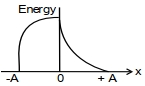
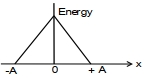
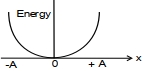
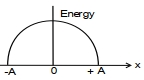
Which graph represents the difference between total energy and potential energy of a particle executing $SHM$ versus its distance from the mean position?
- A
- B
- C
- D
Explore More
Similar Questions
$A$ linear harmonic oscillator of force constant $2 \times 10^6 \, N/m$ and amplitude $0.01 \, m$ has a total mechanical energy of $160 \, J$. Its
MediumIIT 1989
View Solution$A$ particle starts oscillating simple harmonically from its mean position with time period $T$. At time $t = T/6$,the ratio of the potential energy to kinetic energy of the particle is $\left[\sin 30^{\circ} = \cos 60^{\circ} = 0.5, \cos 30^{\circ} = \sin 60^{\circ} = \sqrt{3}/2\right]$
$A$ body is performing $SHO$ with a total energy of $100\,J$. In the table below, column-$I$ shows the kinetic energy $(K)$ at a specific time, and column-$II$ shows the potential energy $(U)$ at that same time. Match them appropriately.
Column-$I$ Column-$II$ $(a)$ $K = 10\,J$ $(i)$ $U = 40\,J$ $(b)$ $K = 60\,J$ $(ii)$ $U = 90\,J$ $(iii)$ $U = 50\,J$
| Column-$I$ | Column-$II$ |
| $(a)$ $K = 10\,J$ | $(i)$ $U = 40\,J$ |
| $(b)$ $K = 60\,J$ | $(ii)$ $U = 90\,J$ |
| $(iii)$ $U = 50\,J$ |
Easy
View SolutionWhen a longitudinal wave propagates through a medium,the particles of the medium execute simple harmonic oscillations about their mean positions. These oscillations of a particle are characterised by an invariant
Easy
View SolutionWhen the displacement is half the amplitude,the ratio of potential energy to the total energy is
Easy
View SolutionVedclass Products
For Students
Vedclass Test Series
Mock tests in real JEE/NEET style with performance analysis. 5-day free trial.
Start Free TrialFor Teachers
Exam Paper Generator
Generate Set A/B/C/D exam papers from 7.5L+ questions in 2 minutes. 3 chapters free.
Try FreeFor Institutes
Online Exam Module
Live online exams with unlimited students, 360° analytics & white-label branding.
See Demo