
ChemistryQ1–98 of 100 questions
Page 1 of 2 · English
1
ChemistryMCQJEE Main · 2016
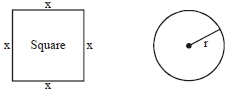
$A$ wire of length $2$ units is cut into two parts which are bent respectively to form a square of side $= x$ units and a circle of radius $= r$ units. If the sum of the areas of the square and the circle so formed is minimum,then:
A
$x = 2r$
B
$2x = r$
C
$2x = (\pi + 4)r$
D
$(4 - \pi)x = \pi r$
Solution
(A) Given that the total length of the wire is $2$ units.
Perimeter of the square $= 4x$ and circumference of the circle $= 2\pi r$.
Thus,$4x + 2\pi r = 2$,which simplifies to $2x + \pi r = 1$.
From this,we get $r = \frac{1 - 2x}{\pi}$.
The sum of the areas $A$ is given by $A = x^2 + \pi r^2$.
Substituting the value of $r$,we get $A = x^2 + \pi \left( \frac{1 - 2x}{\pi} \right)^2 = x^2 + \frac{(1 - 2x)^2}{\pi}$.
To find the minimum area,we differentiate $A$ with respect to $x$ and set it to zero:
$\frac{dA}{dx} = 2x + \frac{2(1 - 2x)(-2)}{\pi} = 0$.
$2x - \frac{4(1 - 2x)}{\pi} = 0$.
Multiplying by $\pi$,we get $2\pi x - 4 + 8x = 0$.
$x(2\pi + 8) = 4$,so $x = \frac{4}{2\pi + 8} = \frac{2}{\pi + 4}$.
Now,substitute $x$ back into the perimeter equation: $2(\frac{2}{\pi + 4}) + \pi r = 1$.
$\pi r = 1 - \frac{4}{\pi + 4} = \frac{\pi + 4 - 4}{\pi + 4} = \frac{\pi}{\pi + 4}$.
Therefore,$r = \frac{1}{\pi + 4}$.
Comparing $x$ and $r$,we see that $x = \frac{2}{\pi + 4}$ and $r = \frac{1}{\pi + 4}$,which implies $x = 2r$.
Perimeter of the square $= 4x$ and circumference of the circle $= 2\pi r$.
Thus,$4x + 2\pi r = 2$,which simplifies to $2x + \pi r = 1$.
From this,we get $r = \frac{1 - 2x}{\pi}$.
The sum of the areas $A$ is given by $A = x^2 + \pi r^2$.
Substituting the value of $r$,we get $A = x^2 + \pi \left( \frac{1 - 2x}{\pi} \right)^2 = x^2 + \frac{(1 - 2x)^2}{\pi}$.
To find the minimum area,we differentiate $A$ with respect to $x$ and set it to zero:
$\frac{dA}{dx} = 2x + \frac{2(1 - 2x)(-2)}{\pi} = 0$.
$2x - \frac{4(1 - 2x)}{\pi} = 0$.
Multiplying by $\pi$,we get $2\pi x - 4 + 8x = 0$.
$x(2\pi + 8) = 4$,so $x = \frac{4}{2\pi + 8} = \frac{2}{\pi + 4}$.
Now,substitute $x$ back into the perimeter equation: $2(\frac{2}{\pi + 4}) + \pi r = 1$.
$\pi r = 1 - \frac{4}{\pi + 4} = \frac{\pi + 4 - 4}{\pi + 4} = \frac{\pi}{\pi + 4}$.
Therefore,$r = \frac{1}{\pi + 4}$.
Comparing $x$ and $r$,we see that $x = \frac{2}{\pi + 4}$ and $r = \frac{1}{\pi + 4}$,which implies $x = 2r$.
0 likesView Solution
2
ChemistryMCQJEE Main · 2016
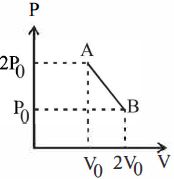
$n$ moles of an ideal gas undergo a process $A \rightarrow B$ as shown in the figure. The maximum temperature of the gas during the process will be
A
$\frac{9P_0V_0}{2nR}$
B
$\frac{9P_0V_0}{nR}$
C
$\frac{9P_0V_0}{4nR}$
D
$\frac{3P_0V_0}{2nR}$
Solution
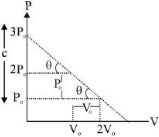
(C) The equation for the line passing through points $(V_0, 2P_0)$ and $(2V_0, P_0)$ is:
Slope $m = \frac{P_0 - 2P_0}{2V_0 - V_0} = \frac{-P_0}{V_0}$.
Using the point-slope form $P - P_0 = m(V - V_0)$:
$P - 2P_0 = \frac{-P_0}{V_0}(V - V_0)$
$P = \frac{-P_0}{V_0}V + P_0 + 2P_0 = \frac{-P_0}{V_0}V + 3P_0$.
From the ideal gas law,$PV = nRT$,so $T = \frac{PV}{nR}$.
Substituting $P$:
$T = \frac{1}{nR} \left( \frac{-P_0}{V_0}V + 3P_0 \right)V = \frac{1}{nR} \left( \frac{-P_0}{V_0}V^2 + 3P_0V \right)$.
For maximum temperature,$\frac{dT}{dV} = 0$:
$\frac{dT}{dV} = \frac{1}{nR} \left( \frac{-2P_0}{V_0}V + 3P_0 \right) = 0$.
$\frac{2P_0}{V_0}V = 3P_0 \implies V = \frac{3}{2}V_0$.
Substituting $V = \frac{3}{2}V_0$ back into the equation for $T$:
$T_{\text{max}} = \frac{1}{nR} \left( \frac{-P_0}{V_0} \left( \frac{3}{2}V_0 \right)^2 + 3P_0 \left( \frac{3}{2}V_0 \right) \right)$
$T_{\text{max}} = \frac{1}{nR} \left( \frac{-9}{4}P_0V_0 + \frac{9}{2}P_0V_0 \right) = \frac{1}{nR} \left( \frac{9}{4}P_0V_0 \right) = \frac{9P_0V_0}{4nR}$.
Slope $m = \frac{P_0 - 2P_0}{2V_0 - V_0} = \frac{-P_0}{V_0}$.
Using the point-slope form $P - P_0 = m(V - V_0)$:
$P - 2P_0 = \frac{-P_0}{V_0}(V - V_0)$
$P = \frac{-P_0}{V_0}V + P_0 + 2P_0 = \frac{-P_0}{V_0}V + 3P_0$.
From the ideal gas law,$PV = nRT$,so $T = \frac{PV}{nR}$.
Substituting $P$:
$T = \frac{1}{nR} \left( \frac{-P_0}{V_0}V + 3P_0 \right)V = \frac{1}{nR} \left( \frac{-P_0}{V_0}V^2 + 3P_0V \right)$.
For maximum temperature,$\frac{dT}{dV} = 0$:
$\frac{dT}{dV} = \frac{1}{nR} \left( \frac{-2P_0}{V_0}V + 3P_0 \right) = 0$.
$\frac{2P_0}{V_0}V = 3P_0 \implies V = \frac{3}{2}V_0$.
Substituting $V = \frac{3}{2}V_0$ back into the equation for $T$:
$T_{\text{max}} = \frac{1}{nR} \left( \frac{-P_0}{V_0} \left( \frac{3}{2}V_0 \right)^2 + 3P_0 \left( \frac{3}{2}V_0 \right) \right)$
$T_{\text{max}} = \frac{1}{nR} \left( \frac{-9}{4}P_0V_0 + \frac{9}{2}P_0V_0 \right) = \frac{1}{nR} \left( \frac{9}{4}P_0V_0 \right) = \frac{9P_0V_0}{4nR}$.
0 likesView Solution
3
ChemistryMediumMCQJEE Main · 2016
$A$ stream of electrons from a heated filament was passed between two charged plates kept at a potential difference $V$ esu. If $e$ and $m$ are the charge and mass of an electron, respectively, then the value of $h/\lambda$ (where $\lambda$ is the wavelength associated with the electron wave) is given by:
A
$\sqrt{meV}$
B
$\sqrt{2meV}$
C
$meV$
D
$2meV$
Solution
(B) The kinetic energy acquired by an electron accelerated through a potential difference $V$ is given by $K.E. = eV = \frac{1}{2}mu^2$, where $u$ is the velocity of the electron.
Rearranging for velocity: $u = \sqrt{\frac{2eV}{m}}$.
According to the de Broglie relation, the wavelength $\lambda$ is given by $\lambda = \frac{h}{mu}$, which implies $\frac{h}{\lambda} = mu$.
Substituting the expression for $u$ into the equation for $\frac{h}{\lambda}$:
$\frac{h}{\lambda} = m \times \sqrt{\frac{2eV}{m}} = \sqrt{m^2 \times \frac{2eV}{m}} = \sqrt{2meV}$.
Rearranging for velocity: $u = \sqrt{\frac{2eV}{m}}$.
According to the de Broglie relation, the wavelength $\lambda$ is given by $\lambda = \frac{h}{mu}$, which implies $\frac{h}{\lambda} = mu$.
Substituting the expression for $u$ into the equation for $\frac{h}{\lambda}$:
$\frac{h}{\lambda} = m \times \sqrt{\frac{2eV}{m}} = \sqrt{m^2 \times \frac{2eV}{m}} = \sqrt{2meV}$.
0 likesView Solution
4
ChemistryMediumMCQJEE Main · 2016
The species in which the $N$ atom is in a state of $sp$ hybridization is:
A
$NO_{3}^{-}$
B
$NO_{2}$
C
$NO_{2}^{+}$
D
$NO_{2}^{-}$
Solution
(C) To determine the hybridization of the $N$ atom,we use the formula: $\text{Steric Number} = \frac{1}{2} [V + M - C + A]$,where $V$ is the number of valence electrons,$M$ is the number of monovalent atoms,$C$ is the cationic charge,and $A$ is the anionic charge.
For $NO_{2}^{+}$: $\text{Steric Number} = \frac{1}{2} [5 + 0 - 1 + 0] = \frac{4}{2} = 2$. $A$ steric number of $2$ corresponds to $sp$ hybridization.
For $NO_{3}^{-}$: $\text{Steric Number} = \frac{1}{2} [5 + 0 - 0 + 1] = 3$ ($sp^2$ hybridization).
For $NO_{2}$: The $N$ atom has one unpaired electron and is $sp^2$ hybridized.
For $NO_{2}^{-}$: $\text{Steric Number} = \frac{1}{2} [5 + 0 - 0 + 1] = 3$ ($sp^2$ hybridization).
Thus,the $N$ atom is $sp$ hybridized in $NO_{2}^{+}$.
Therefore,the correct option is $C$.
For $NO_{2}^{+}$: $\text{Steric Number} = \frac{1}{2} [5 + 0 - 1 + 0] = \frac{4}{2} = 2$. $A$ steric number of $2$ corresponds to $sp$ hybridization.
For $NO_{3}^{-}$: $\text{Steric Number} = \frac{1}{2} [5 + 0 - 0 + 1] = 3$ ($sp^2$ hybridization).
For $NO_{2}$: The $N$ atom has one unpaired electron and is $sp^2$ hybridized.
For $NO_{2}^{-}$: $\text{Steric Number} = \frac{1}{2} [5 + 0 - 0 + 1] = 3$ ($sp^2$ hybridization).
Thus,the $N$ atom is $sp$ hybridized in $NO_{2}^{+}$.
Therefore,the correct option is $C$.
0 likesView Solution
5
ChemistryDifficultMCQJEE Main · 2016
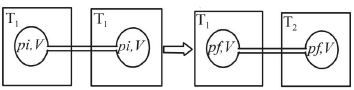
Two closed bulbs of equal volume $V$ containing an ideal gas initially at pressure $P_i$ and temperature $T_1$ are connected through a narrow tube of negligible volume as shown in the figure below. The temperature of one of the bulbs is then raised to $T_2$. The final pressure $P_f$ is:
A
$2 P_i \left( \frac{T_2}{T_1 + T_2} \right)$
B
$2 P_i \left( \frac{T_1 T_2}{T_1 + T_2} \right)$
C
$P_i \left( \frac{T_1 T_2}{T_1 + T_2} \right)$
D
$2 P_i \left( \frac{T_1}{T_1 + T_2} \right)$
Solution
(A) Initially,the number of moles of gas in each bulb is $n_1 = \frac{P_i V}{R T_1}$ and $n_2 = \frac{P_i V}{R T_1}$.
After the temperature of the second bulb is raised to $T_2$,the number of moles of gas in both bulbs are $n_1' = \frac{P_f V}{R T_1}$ and $n_2' = \frac{P_f V}{R T_2}$.
Since the total number of moles of gas in both bulbs remains constant:
$n_1 + n_2 = n_1' + n_2'$
$\frac{P_i V}{R T_1} + \frac{P_i V}{R T_1} = \frac{P_f V}{R T_1} + \frac{P_f V}{R T_2}$
$\frac{2 P_i V}{R T_1} = \frac{P_f V}{R} \left( \frac{1}{T_1} + \frac{1}{T_2} \right)$
$\frac{2 P_i}{T_1} = P_f \left( \frac{T_2 + T_1}{T_1 T_2} \right)$
$P_f = \frac{2 P_i T_2}{T_1 + T_2}$
After the temperature of the second bulb is raised to $T_2$,the number of moles of gas in both bulbs are $n_1' = \frac{P_f V}{R T_1}$ and $n_2' = \frac{P_f V}{R T_2}$.
Since the total number of moles of gas in both bulbs remains constant:
$n_1 + n_2 = n_1' + n_2'$
$\frac{P_i V}{R T_1} + \frac{P_i V}{R T_1} = \frac{P_f V}{R T_1} + \frac{P_f V}{R T_2}$
$\frac{2 P_i V}{R T_1} = \frac{P_f V}{R} \left( \frac{1}{T_1} + \frac{1}{T_2} \right)$
$\frac{2 P_i}{T_1} = P_f \left( \frac{T_2 + T_1}{T_1 T_2} \right)$
$P_f = \frac{2 P_i T_2}{T_1 + T_2}$
0 likesView Solution
6
ChemistryMediumMCQJEE Main · 2016
The heats of combustion of carbon and carbon monoxide are $-393.5 \ kJ \ mol^{-1}$ and $-283.5 \ kJ \ mol^{-1},$ respectively. The heat of formation (in $kJ \ mol^{-1}$) of carbon monoxide per mole is:
A
$-676.5$
B
$-110$
C
$110.5$
D
$676.5$
Solution
(B) The heat of formation of $CO$ corresponds to the reaction: $C_{(s)} + \frac{1}{2} O_{2(g)} \rightarrow CO_{(g)}$.
Given reactions:
$1) C_{(s)} + O_{2(g)} \rightarrow CO_{2(g)}; \Delta H_1 = -393.5 \ kJ \ mol^{-1}$
$2) CO_{(g)} + \frac{1}{2} O_{2(g)} \rightarrow CO_{2(g)}; \Delta H_2 = -283.5 \ kJ \ mol^{-1}$
To obtain the target reaction,subtract equation $(2)$ from equation $(1)$:
$(C_{(s)} + O_{2(g)}) - (CO_{(g)} + \frac{1}{2} O_{2(g)}) \rightarrow CO_{2(g)} - CO_{2(g)}$
$C_{(s)} + \frac{1}{2} O_{2(g)} \rightarrow CO_{(g)}$
Therefore,$\Delta H_f = \Delta H_1 - \Delta H_2 = -393.5 - (-283.5) = -110 \ kJ \ mol^{-1}$.
Given reactions:
$1) C_{(s)} + O_{2(g)} \rightarrow CO_{2(g)}; \Delta H_1 = -393.5 \ kJ \ mol^{-1}$
$2) CO_{(g)} + \frac{1}{2} O_{2(g)} \rightarrow CO_{2(g)}; \Delta H_2 = -283.5 \ kJ \ mol^{-1}$
To obtain the target reaction,subtract equation $(2)$ from equation $(1)$:
$(C_{(s)} + O_{2(g)}) - (CO_{(g)} + \frac{1}{2} O_{2(g)}) \rightarrow CO_{2(g)} - CO_{2(g)}$
$C_{(s)} + \frac{1}{2} O_{2(g)} \rightarrow CO_{(g)}$
Therefore,$\Delta H_f = \Delta H_1 - \Delta H_2 = -393.5 - (-283.5) = -110 \ kJ \ mol^{-1}$.
0 likesView Solution
7
ChemistryDifficultMCQJEE Main · 2016
The equilibrium constant at $298 \ K$ for a reaction $A + B \rightleftharpoons C + D$ is $100$. If the initial concentration of all the four species were $1 \ M$ each,then the equilibrium concentration of $D$ (in $mol \ L^{-1}$) will be:
A
$1.818$
B
$1.182$
C
$0.182$
D
$0.818$
Solution
(A) For the reaction $A + B \rightleftharpoons C + D$,the equilibrium constant $K_c = 100$.
Initial concentrations: $[A]_0 = 1 \ M, [B]_0 = 1 \ M, [C]_0 = 1 \ M, [D]_0 = 1 \ M$.
Let $x$ be the change in concentration at equilibrium.
At equilibrium: $[A] = 1-x, [B] = 1-x, [C] = 1+x, [D] = 1+x$.
$K_c = \frac{[C][D]}{[A][B]} = \frac{(1+x)(1+x)}{(1-x)(1-x)} = \left(\frac{1+x}{1-x}\right)^2 = 100$.
Taking the square root of both sides: $\frac{1+x}{1-x} = 10$.
$1+x = 10 - 10x \implies 11x = 9 \implies x = \frac{9}{11} \approx 0.818$.
Equilibrium concentration of $D$ is $[D] = 1 + x = 1 + 0.818 = 1.818 \ M$.
Initial concentrations: $[A]_0 = 1 \ M, [B]_0 = 1 \ M, [C]_0 = 1 \ M, [D]_0 = 1 \ M$.
Let $x$ be the change in concentration at equilibrium.
At equilibrium: $[A] = 1-x, [B] = 1-x, [C] = 1+x, [D] = 1+x$.
$K_c = \frac{[C][D]}{[A][B]} = \frac{(1+x)(1+x)}{(1-x)(1-x)} = \left(\frac{1+x}{1-x}\right)^2 = 100$.
Taking the square root of both sides: $\frac{1+x}{1-x} = 10$.
$1+x = 10 - 10x \implies 11x = 9 \implies x = \frac{9}{11} \approx 0.818$.
Equilibrium concentration of $D$ is $[D] = 1 + x = 1 + 0.818 = 1.818 \ M$.
0 likesView Solution
8
ChemistryDifficultMCQJEE Main · 2016
Which one of the following statements about water is $FALSE$?
A
There is extensive intramolecular hydrogen bonding in the condensed phase.
B
Ice formed by heavy water sinks in normal water.
C
Water is oxidized to oxygen during photosynthesis.
D
Water can act both as an acid and as a base.
Solution
(A) The statement regarding intramolecular hydrogen bonding is $FALSE$. In the condensed phase (liquid or solid),water molecules exhibit extensive $intermolecular$ hydrogen bonding,not $intramolecular$ hydrogen bonding.
0 likesView Solution
9
ChemistryMediumMCQJEE Main · 2016
Which of the following atoms has the highest first ionization energy?
A
$K$
B
$Sc$
C
$Rb$
D
$Na$
Solution
(B) The first ionization energy is the energy required to remove the most loosely bound electron from an isolated gaseous atom.
$K$ $(Z=19)$ and $Na$ $(Z=11)$ are alkali metals (Group $1$),which have the lowest ionization energies in their respective periods.
$Rb$ $(Z=37)$ is also an alkali metal with an even lower ionization energy than $K$ due to its larger atomic size.
$Sc$ $(Z=21)$ is a $d$-block transition metal.
Transition metals generally have higher first ionization energies compared to alkali metals in the same or adjacent periods because of their smaller atomic radii and higher effective nuclear charge,which holds the valence electrons more tightly.
$K$ $(Z=19)$ and $Na$ $(Z=11)$ are alkali metals (Group $1$),which have the lowest ionization energies in their respective periods.
$Rb$ $(Z=37)$ is also an alkali metal with an even lower ionization energy than $K$ due to its larger atomic size.
$Sc$ $(Z=21)$ is a $d$-block transition metal.
Transition metals generally have higher first ionization energies compared to alkali metals in the same or adjacent periods because of their smaller atomic radii and higher effective nuclear charge,which holds the valence electrons more tightly.
0 likesView Solution
10
ChemistryMediumMCQJEE Main · 2016
The main oxides formed on combustion of $Li, Na$ and $K$ in excess of air are,respectively:
A
$Li_2O_2, Na_2O_2$ and $KO_2$
B
$Li_2O, Na_2O_2$ and $KO_2$
C
$Li_2O, Na_2O$ and $KO_2$
D
$LiO_2, Na_2O_2$ and $K_2O$
Solution
(B) When alkali metals are heated in excess of air,they form different types of oxides based on their size and polarizability:
$1$. Lithium forms the monoxide: $4Li + O_2 \longrightarrow 2Li_2O$
$2$. Sodium forms the peroxide: $2Na + O_2 \longrightarrow Na_2O_2$
$3$. Potassium forms the superoxide: $K + O_2 \longrightarrow KO_2$
Thus,the correct sequence is $Li_2O, Na_2O_2$ and $KO_2$.
$1$. Lithium forms the monoxide: $4Li + O_2 \longrightarrow 2Li_2O$
$2$. Sodium forms the peroxide: $2Na + O_2 \longrightarrow Na_2O_2$
$3$. Potassium forms the superoxide: $K + O_2 \longrightarrow KO_2$
Thus,the correct sequence is $Li_2O, Na_2O_2$ and $KO_2$.
0 likesView Solution
11
ChemistryMediumMCQJEE Main · 2016
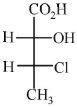
The absolute configuration of the given molecule is:
A
$ (2S, 3S) $
B
$ (2R, 3R) $
C
$ (2R, 3S) $
D
$ (2S, 3R) $
Solution
(D) To determine the absolute configuration,we assign priorities to the groups attached to each chiral carbon using the Cahn-Ingold-Prelog $(CIP)$ rules.
For the $C-2$ carbon:
The groups are $-OH$ (priority $1$),$-CH(Cl)CH_3$ (priority $2$),$-CO_2H$ (priority $3$),and $-H$ (priority $4$).
Since the lowest priority group $(-H)$ is on a horizontal bond,the configuration is reversed. The sequence $1$ $\rightarrow 2$ $\rightarrow 3$ is clockwise,which would be $R$,but due to the horizontal $-H$,it becomes $S$. Thus,$C-2$ is $2S$.
For the $C-3$ carbon:
The groups are $-Cl$ (priority $1$),$-CH(OH)CO_2H$ (priority $2$),$-CH_3$ (priority $3$),and $-H$ (priority $4$).
Since the lowest priority group $(-H)$ is on a horizontal bond,the configuration is reversed. The sequence $1$ $\rightarrow 2$ $\rightarrow 3$ is counter-clockwise,which would be $S$,but due to the horizontal $-H$,it becomes $R$. Thus,$C-3$ is $3R$.
Therefore,the absolute configuration is $(2S, 3R)$.
For the $C-2$ carbon:
The groups are $-OH$ (priority $1$),$-CH(Cl)CH_3$ (priority $2$),$-CO_2H$ (priority $3$),and $-H$ (priority $4$).
Since the lowest priority group $(-H)$ is on a horizontal bond,the configuration is reversed. The sequence $1$ $\rightarrow 2$ $\rightarrow 3$ is clockwise,which would be $R$,but due to the horizontal $-H$,it becomes $S$. Thus,$C-2$ is $2S$.
For the $C-3$ carbon:
The groups are $-Cl$ (priority $1$),$-CH(OH)CO_2H$ (priority $2$),$-CH_3$ (priority $3$),and $-H$ (priority $4$).
Since the lowest priority group $(-H)$ is on a horizontal bond,the configuration is reversed. The sequence $1$ $\rightarrow 2$ $\rightarrow 3$ is counter-clockwise,which would be $S$,but due to the horizontal $-H$,it becomes $R$. Thus,$C-3$ is $3R$.
Therefore,the absolute configuration is $(2S, 3R)$.
0 likesView Solution
12
ChemistryMediumMCQJEE Main · 2016
The distillation technique most suited for separating glycerol from spent-lye in the soap industry is:
A
Steam distillation.
B
Distillation under reduced pressure.
C
Simple distillation.
D
Fractional distillation.
Solution
(B) Spent-lye and glycerol are separated by distillation under reduced pressure.
Under reduced pressure,the liquid boils at a lower temperature,preventing thermal decomposition.
For example,glycerol boils at $290^{\circ}C$ with decomposition at atmospheric pressure,but at reduced pressure,it boils at $180^{\circ}C$ without decomposition.
Under reduced pressure,the liquid boils at a lower temperature,preventing thermal decomposition.
For example,glycerol boils at $290^{\circ}C$ with decomposition at atmospheric pressure,but at reduced pressure,it boils at $180^{\circ}C$ without decomposition.
0 likesView Solution
13
ChemistryDifficultMCQJEE Main · 2016
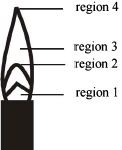
The hottest region of the Bunsen flame shown in the figure below is:
A
region $3$
B
region $4$
C
region $1$
D
region $2$
Solution
(A) Bunsen flame consists of several zones based on the extent of combustion.
Region $1$ is the innermost dark zone containing unburnt fuel.
Region $2$ is the luminous zone where incomplete combustion occurs.
Region $3$ is the non-luminous zone where complete combustion occurs,making it the hottest part of the flame.
Region $4$ is the tip of the flame.
Therefore,the hottest region is region $3$.
Region $1$ is the innermost dark zone containing unburnt fuel.
Region $2$ is the luminous zone where incomplete combustion occurs.
Region $3$ is the non-luminous zone where complete combustion occurs,making it the hottest part of the flame.
Region $4$ is the tip of the flame.
Therefore,the hottest region is region $3$.
0 likesView Solution
14
ChemistryDifficultMCQJEE Main · 2016
At $300 \ K$ and $1 \ atm$,$15 \ mL$ of a gaseous hydrocarbon requires $375 \ mL$ of air containing $20 \% \ O_2$ by volume for complete combustion. After combustion,the gases occupy $330 \ mL$. Assuming that the water formed is in liquid form and the volumes were measured at the same temperature and pressure,the formula of the hydrocarbon is:
A
$C_4H_8$
B
$C_4H_{10}$
C
$C_3H_6$
D
$C_3H_8$
Solution
(D) The combustion reaction is: $C_xH_y + (x + \frac{y}{4}) O_2 \rightarrow x CO_2 + \frac{y}{2} H_2O_{(l)}$
Volume of $O_2$ used $= 375 \times 0.20 = 75 \ mL$.
From the stoichiometry: $15(x + \frac{y}{4}) = 75$,which simplifies to $x + \frac{y}{4} = 5$,or $4x + y = 20$.
The final volume $330 \ mL$ consists of $CO_2$ produced and the remaining $N_2$ from the air.
Volume of $N_2 = 375 - 75 = 300 \ mL$.
Volume of $CO_2 = 330 - 300 = 30 \ mL$.
Since $15 \ mL$ of hydrocarbon produces $30 \ mL$ of $CO_2$,$x = 2$. Wait,checking stoichiometry: $15x = 30 \implies x = 2$.
Substituting $x=2$ into $4x + y = 20$: $4(2) + y = 20 \implies y = 12$. This suggests $C_2H_{12}$ which is impossible.
Re-evaluating: The total volume $330 \ mL$ includes $CO_2$ and $N_2$. $15x = 30 \implies x = 2$. If $x=3$,$15x = 45 \ mL$ of $CO_2$. Then $N_2 = 300 \ mL$,total $= 345 \ mL$. If $x=3$,$4(3) + y = 20 \implies y = 8$. This gives $C_3H_8$. $15 \ mL$ of $C_3H_8$ produces $45 \ mL$ of $CO_2$. Total volume $= 45 + 300 = 345 \ mL$. Given $330 \ mL$,let's check $C_3H_6$: $x=3, y=6$. $4(3)+6 = 18 \neq 20$. The correct hydrocarbon is $C_3H_8$.
Volume of $O_2$ used $= 375 \times 0.20 = 75 \ mL$.
From the stoichiometry: $15(x + \frac{y}{4}) = 75$,which simplifies to $x + \frac{y}{4} = 5$,or $4x + y = 20$.
The final volume $330 \ mL$ consists of $CO_2$ produced and the remaining $N_2$ from the air.
Volume of $N_2 = 375 - 75 = 300 \ mL$.
Volume of $CO_2 = 330 - 300 = 30 \ mL$.
Since $15 \ mL$ of hydrocarbon produces $30 \ mL$ of $CO_2$,$x = 2$. Wait,checking stoichiometry: $15x = 30 \implies x = 2$.
Substituting $x=2$ into $4x + y = 20$: $4(2) + y = 20 \implies y = 12$. This suggests $C_2H_{12}$ which is impossible.
Re-evaluating: The total volume $330 \ mL$ includes $CO_2$ and $N_2$. $15x = 30 \implies x = 2$. If $x=3$,$15x = 45 \ mL$ of $CO_2$. Then $N_2 = 300 \ mL$,total $= 345 \ mL$. If $x=3$,$4(3) + y = 20 \implies y = 8$. This gives $C_3H_8$. $15 \ mL$ of $C_3H_8$ produces $45 \ mL$ of $CO_2$. Total volume $= 45 + 300 = 345 \ mL$. Given $330 \ mL$,let's check $C_3H_6$: $x=3, y=6$. $4(3)+6 = 18 \neq 20$. The correct hydrocarbon is $C_3H_8$.
0 likesView Solution
15
ChemistryDifficultMCQJEE Main · 2016
The reaction of propene with $HOCl$ $(Cl_2 + H_2O)$ proceeds through the intermediate $:$
A
$CH_3-CH(OH)-CH_2^+$
B
$CH_3-CHCl-CH_2^+$
C
$CH_3-CH^+-CH_2-OH$
D
$CH_3-CH^+-CH_2-Cl$
Solution
(D) The reaction of propene with $HOCl$ involves the electrophilic attack of $Cl^+$ on the double bond.
The $Cl^+$ ion attacks the double bond to form a cyclic chloronium ion intermediate,which is then opened by the nucleophilic attack of $H_2O$ or $OH^-$.
However,in terms of carbocation character during the ring opening,the positive charge is stabilized on the more substituted carbon atom.
The intermediate formed is $CH_3-CH^+-CH_2-Cl$.
The $Cl^+$ ion attacks the double bond to form a cyclic chloronium ion intermediate,which is then opened by the nucleophilic attack of $H_2O$ or $OH^-$.
However,in terms of carbocation character during the ring opening,the positive charge is stabilized on the more substituted carbon atom.
The intermediate formed is $CH_3-CH^+-CH_2-Cl$.
0 likesView Solution
16
ChemistryDifficultMCQJEE Main · 2016
The concentration of fluoride,lead,nitrate and iron in a water sample from an underground lake was found to be $1000 \ ppb, 40 \ ppb, 100 \ ppm$ and $0.2 \ ppm,$ respectively. This water is unsuitable for drinking due to high concentration of:
A
Nitrate
B
Iron
C
Fluoride
D
Lead
Solution
(A) First,convert all concentrations to $ppm$ $(1 \ ppm = 1000 \ ppb)$:
$1.$ Fluoride: $1000 \ ppb = 1 \ ppm$ (Permissible limit is $1 \ ppm$)
$2.$ Lead: $40 \ ppb = 0.04 \ ppm$ (Permissible limit is $0.05 \ ppm$)
$3.$ Nitrate: $100 \ ppm$ (Permissible limit is $45 \ ppm$)
$4.$ Iron: $0.2 \ ppm$ (Permissible limit is $0.2 \ ppm$)
The concentration of nitrate $(100 \ ppm)$ is significantly higher than the permissible limit of $45 \ ppm$. Excess nitrate in drinking water causes methemoglobinemia,also known as blue baby syndrome.
$1.$ Fluoride: $1000 \ ppb = 1 \ ppm$ (Permissible limit is $1 \ ppm$)
$2.$ Lead: $40 \ ppb = 0.04 \ ppm$ (Permissible limit is $0.05 \ ppm$)
$3.$ Nitrate: $100 \ ppm$ (Permissible limit is $45 \ ppm$)
$4.$ Iron: $0.2 \ ppm$ (Permissible limit is $0.2 \ ppm$)
The concentration of nitrate $(100 \ ppm)$ is significantly higher than the permissible limit of $45 \ ppm$. Excess nitrate in drinking water causes methemoglobinemia,also known as blue baby syndrome.
0 likesView Solution
17
ChemistryMCQJEE Main · 2016
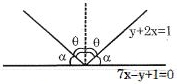
$A$ ray of light is incident along a line which meets another line,$7x - y + 1 = 0$,at the point $(0, 1)$. The ray is then reflected from this point along the line $y + 2x = 1$. Find the equation of the line of incidence of the ray of light.
A
$41x - 25y + 25 = 0$
B
$41x + 25y - 25 = 0$
C
$41x - 38y + 38 = 0$
D
$41x + 38y - 38 = 0$
Solution
(C) Let the equation of the incident ray be $y - 1 = m(x - 0)$,which is $mx - y + 1 = 0$.
The angle between the incident ray and the mirror line $7x - y + 1 = 0$ is equal to the angle between the reflected ray $2x + y - 1 = 0$ and the mirror line.
The slope of the incident ray is $m_1 = m$,the slope of the mirror is $m_2 = 7$,and the slope of the reflected ray is $m_3 = -2$.
Using the formula $\tan \theta = |\frac{m_1 - m_2}{1 + m_1 m_2}| = |\frac{m_2 - m_3}{1 + m_2 m_3}|$:
$|\frac{m - 7}{1 + 7m}| = |\frac{7 - (-2)}{1 + 7(-2)}| = |\frac{9}{1 - 14}| = |\frac{9}{-13}| = \frac{9}{13}$.
Case $1$: $\frac{m - 7}{1 + 7m} = \frac{9}{13}$ $\Rightarrow 13m - 91 = 9 + 63m$ $\Rightarrow -50m = 100$ $\Rightarrow m = -2$ (This is the reflected ray).
Case $2$: $\frac{m - 7}{1 + 7m} = -\frac{9}{13}$ $\Rightarrow 13m - 91 = -9 - 63m$ $\Rightarrow 76m = 82$ $\Rightarrow m = \frac{41}{38}$.
The equation of the incident ray is $y - 1 = \frac{41}{38}(x - 0)$ $\Rightarrow 38y - 38 = 41x$ $\Rightarrow 41x - 38y + 38 = 0$.
The angle between the incident ray and the mirror line $7x - y + 1 = 0$ is equal to the angle between the reflected ray $2x + y - 1 = 0$ and the mirror line.
The slope of the incident ray is $m_1 = m$,the slope of the mirror is $m_2 = 7$,and the slope of the reflected ray is $m_3 = -2$.
Using the formula $\tan \theta = |\frac{m_1 - m_2}{1 + m_1 m_2}| = |\frac{m_2 - m_3}{1 + m_2 m_3}|$:
$|\frac{m - 7}{1 + 7m}| = |\frac{7 - (-2)}{1 + 7(-2)}| = |\frac{9}{1 - 14}| = |\frac{9}{-13}| = \frac{9}{13}$.
Case $1$: $\frac{m - 7}{1 + 7m} = \frac{9}{13}$ $\Rightarrow 13m - 91 = 9 + 63m$ $\Rightarrow -50m = 100$ $\Rightarrow m = -2$ (This is the reflected ray).
Case $2$: $\frac{m - 7}{1 + 7m} = -\frac{9}{13}$ $\Rightarrow 13m - 91 = -9 - 63m$ $\Rightarrow 76m = 82$ $\Rightarrow m = \frac{41}{38}$.
The equation of the incident ray is $y - 1 = \frac{41}{38}(x - 0)$ $\Rightarrow 38y - 38 = 41x$ $\Rightarrow 41x - 38y + 38 = 0$.
0 likesView Solution
18
ChemistryMCQJEE Main · 2016
An ideal gas undergoes a quasi-static, reversible process in which its molar heat capacity $C$ remains constant. If during this process the relation of pressure $P$ and volume $V$ is given by $PV^n = \text{constant}$, then $n$ is given by (Here $C_P$ and $C_V$ are molar specific heat at constant pressure and constant volume, respectively).
A
$n = \frac{C - C_V}{C - C_P}$
B
$n = \frac{C_P}{C_V}$
C
$n = \frac{C - C_P}{C - C_V}$
D
$n = \frac{C_P - C}{C - C_V}$
Solution
(C) For a polytropic process $PV^n = \text{constant}$, the molar heat capacity $C$ is given by the formula:
$C = C_V + \frac{R}{1 - n}$
Rearranging the formula to solve for $n$:
$C - C_V = \frac{R}{1 - n}$
Since $R = C_P - C_V$, we substitute this into the equation:
$C - C_V = \frac{C_P - C_V}{1 - n}$
$1 - n = \frac{C_P - C_V}{C - C_V}$
$n = 1 - \frac{C_P - C_V}{C - C_V}$
$n = \frac{C - C_V - (C_P - C_V)}{C - C_V}$
$n = \frac{C - C_V - C_P + C_V}{C - C_V}$
$n = \frac{C - C_P}{C - C_V}$
$C = C_V + \frac{R}{1 - n}$
Rearranging the formula to solve for $n$:
$C - C_V = \frac{R}{1 - n}$
Since $R = C_P - C_V$, we substitute this into the equation:
$C - C_V = \frac{C_P - C_V}{1 - n}$
$1 - n = \frac{C_P - C_V}{C - C_V}$
$n = 1 - \frac{C_P - C_V}{C - C_V}$
$n = \frac{C - C_V - (C_P - C_V)}{C - C_V}$
$n = \frac{C - C_V - C_P + C_V}{C - C_V}$
$n = \frac{C - C_P}{C - C_V}$
0 likesView Solution
19
ChemistryMCQJEE Main · 2016
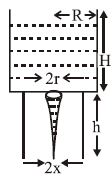
Consider a water jar of radius $R$ that has water filled up to height $H$ and is kept on a stand of height $h$ (see figure). Through a hole of radius $r$ $(r << R)$ at its bottom,the water leaks out and the stream of water coming down towards the ground has a shape like a funnel as shown in the figure. If the radius of the cross-section of the water stream when it hits the ground is $x$,then:
A
$x = r{\left( {\frac{H}{{H + h}}} \right)^2}$
B
$x = r{\left( {\frac{H}{{H + h}}} \right)^{\frac{1}{2}}}$
C
$x = r\left( {\frac{H}{{H + h}}} \right)$
D
$x = r{\left( {\frac{H}{{H + h}}} \right)^{\frac{1}{4}}}$
Solution
(D) Let $v_1$ be the velocity of water at the hole and $v_2$ be the velocity of water when it hits the ground.
Using Torricelli's Law,the velocity of water at the hole is $v_1 = \sqrt{2gH}$.
Using the equation of motion for a freely falling body,the velocity at the ground is $v_2 = \sqrt{v_1^2 + 2gh} = \sqrt{2gH + 2gh} = \sqrt{2g(H+h)}$.
According to the equation of continuity,$A_1 v_1 = A_2 v_2$,where $A_1 = \pi r^2$ is the area of the hole and $A_2 = \pi x^2$ is the area of the stream at the ground.
So,$\pi r^2 \sqrt{2gH} = \pi x^2 \sqrt{2g(H+h)}$.
Dividing both sides by $\pi \sqrt{2g}$,we get $r^2 \sqrt{H} = x^2 \sqrt{H+h}$.
Squaring both sides,$r^4 H = x^4 (H+h)$.
Therefore,$x^4 = r^4 \left( \frac{H}{H+h} \right)$,which gives $x = r \left( \frac{H}{H+h} \right)^{\frac{1}{4}}$.
Using Torricelli's Law,the velocity of water at the hole is $v_1 = \sqrt{2gH}$.
Using the equation of motion for a freely falling body,the velocity at the ground is $v_2 = \sqrt{v_1^2 + 2gh} = \sqrt{2gH + 2gh} = \sqrt{2g(H+h)}$.
According to the equation of continuity,$A_1 v_1 = A_2 v_2$,where $A_1 = \pi r^2$ is the area of the hole and $A_2 = \pi x^2$ is the area of the stream at the ground.
So,$\pi r^2 \sqrt{2gH} = \pi x^2 \sqrt{2g(H+h)}$.
Dividing both sides by $\pi \sqrt{2g}$,we get $r^2 \sqrt{H} = x^2 \sqrt{H+h}$.
Squaring both sides,$r^4 H = x^4 (H+h)$.
Therefore,$x^4 = r^4 \left( \frac{H}{H+h} \right)$,which gives $x = r \left( \frac{H}{H+h} \right)^{\frac{1}{4}}$.
0 likesView Solution
20
ChemistryDifficultMCQJEE Main · 2016
The gas evolved on heating $CH_3MgBr$ in methanol is
A
Methane
B
Ethane
C
Propane
D
$HBr$
Solution
(A) $CH_3MgBr$ is a Grignard reagent,which acts as a strong base.
Methanol $(CH_3OH)$ contains an acidic hydrogen atom attached to the oxygen atom.
When $CH_3MgBr$ reacts with $CH_3OH$,the methyl group $(CH_3^-)$ abstracts the acidic proton from the methanol to form methane $(CH_4)$ gas.
The reaction is: $CH_3MgBr + CH_3OH \rightarrow CH_4 \uparrow + Mg(OCH_3)Br$.
Methanol $(CH_3OH)$ contains an acidic hydrogen atom attached to the oxygen atom.
When $CH_3MgBr$ reacts with $CH_3OH$,the methyl group $(CH_3^-)$ abstracts the acidic proton from the methanol to form methane $(CH_4)$ gas.
The reaction is: $CH_3MgBr + CH_3OH \rightarrow CH_4 \uparrow + Mg(OCH_3)Br$.
0 likesView Solution
21
ChemistryEasyMCQJEE Main · 2016
The total number of orbitals associated with the principal quantum number $n = 5$ is
A
$20$
B
$25$
C
$10$
D
$5$
Solution
(B) The total number of orbitals in a shell is given by the formula $n^2$,where $n$ is the principal quantum number.
For $n = 5$,the number of orbitals $= (5)^2 = 25$.
For $n = 5$,the number of orbitals $= (5)^2 = 25$.
0 likesView Solution
22
ChemistryEasyMCQJEE Main · 2016
$BOD$ stands for
A
Biochemical Oxidation Demand
B
Biological Ozon Demand
C
Biochemical Oxygen Demand
D
Bacterial Oxidation Demand
Solution
(C) $BOD$ stands for Biochemical Oxygen Demand. It is a measure of the amount of dissolved oxygen required by aerobic microorganisms to decompose the organic matter present in a given water sample at a specific temperature over a specific time period.
0 likesView Solution
23
ChemistryDifficultMCQJEE Main · 2016
Identify the incorrect statement regarding heavy water $(D_2O)$.
A
It reacts with $SO_3$ to form deuterated sulphuric acid $(D_2SO_4).$
B
It is used as a coolant in nuclear reactors.
C
It reacts with $CaC_2$ to produce $C_2D_2$ and $Ca(OD)_2.$
D
It reacts with $Al_4C_3$ to produce $CD_4$ and $Al(OD)_3.$
Solution
(B) Heavy water $(D_2O)$ is used as a moderator in nuclear reactors to slow down fast-moving neutrons,not as a coolant.
Chemical reactions of $D_2O$ are analogous to $H_2O$:
$1$. $SO_3 + D_2O \rightarrow D_2SO_4$
$2$. $CaC_2 + 2D_2O \rightarrow C_2D_2 + Ca(OD)_2$
$3$. $Al_4C_3 + 12D_2O \rightarrow 3CD_4 + 4Al(OD)_3$
Therefore,the statement that it is used as a coolant is incorrect.
Chemical reactions of $D_2O$ are analogous to $H_2O$:
$1$. $SO_3 + D_2O \rightarrow D_2SO_4$
$2$. $CaC_2 + 2D_2O \rightarrow C_2D_2 + Ca(OD)_2$
$3$. $Al_4C_3 + 12D_2O \rightarrow 3CD_4 + 4Al(OD)_3$
Therefore,the statement that it is used as a coolant is incorrect.
0 likesView Solution
24
ChemistryDifficultMCQJEE Main · 2016
At very high pressures,the compressibility factor of one mole of a gas is given by
A
$1 + \frac{Pb}{RT}$
B
$\frac{Pb}{RT}$
C
$1 - \frac{Pb}{RT}$
D
$1 - \frac{Pb}{VRT}$
Solution
(A) For one mole of a real gas,the van der Waals equation is given by:
$(P + \frac{a}{V^2})(V - b) = RT$
At very high pressures,the volume $V$ is small,so the term $\frac{a}{V^2}$ becomes negligible compared to $P$.
Thus,the equation simplifies to:
$P(V - b) = RT$
$PV - Pb = RT$
$PV = RT + Pb$
Dividing both sides by $RT$:
$\frac{PV}{RT} = 1 + \frac{Pb}{RT}$
Since the compressibility factor $Z = \frac{PV}{RT}$,we get:
$Z = 1 + \frac{Pb}{RT}$
$(P + \frac{a}{V^2})(V - b) = RT$
At very high pressures,the volume $V$ is small,so the term $\frac{a}{V^2}$ becomes negligible compared to $P$.
Thus,the equation simplifies to:
$P(V - b) = RT$
$PV - Pb = RT$
$PV = RT + Pb$
Dividing both sides by $RT$:
$\frac{PV}{RT} = 1 + \frac{Pb}{RT}$
Since the compressibility factor $Z = \frac{PV}{RT}$,we get:
$Z = 1 + \frac{Pb}{RT}$
0 likesView Solution
25
ChemistryMediumMCQJEE Main · 2016
The non-metal that does not exhibit a positive oxidation state is
A
Chlorine
B
Iodine
C
Fluorine
D
Oxygen
Solution
(C) Fluorine is the most electronegative element in the periodic table.
Due to its highest electronegativity,it always attracts electrons and never loses them to form positive oxidation states.
Therefore,it exhibits an oxidation state of $-1$ only.
Due to its highest electronegativity,it always attracts electrons and never loses them to form positive oxidation states.
Therefore,it exhibits an oxidation state of $-1$ only.
0 likesView Solution
26
ChemistryDifficultMCQJEE Main · 2016
$5 \, L$ of an alkane requires $25 \, L$ of oxygen for its complete combustion. If all volumes are measured at constant temperature and pressure,the alkane is
A
Isobutane
B
Ethane
C
Butane
D
Propane
Solution
(D) The general combustion reaction for an alkane $C_nH_{2n+2}$ is:
$C_nH_{2n+2} + (\frac{3n+1}{2})O_2 \to nCO_2 + (n+1)H_2O$
According to Avogadro's law,at constant temperature and pressure,the volume of a gas is directly proportional to the number of moles.
Therefore,the ratio of volumes is equal to the ratio of stoichiometric coefficients:
$\frac{V_{alkane}}{V_{O_2}} = \frac{1}{\frac{3n+1}{2}} = \frac{2}{3n+1}$
Given $V_{alkane} = 5 \, L$ and $V_{O_2} = 25 \, L$:
$\frac{5}{25} = \frac{2}{3n+1}$
$\frac{1}{5} = \frac{2}{3n+1}$
$3n+1 = 10$
$3n = 9$
$n = 3$
Since $n=3$,the alkane is propane $(C_3H_8)$.
$C_nH_{2n+2} + (\frac{3n+1}{2})O_2 \to nCO_2 + (n+1)H_2O$
According to Avogadro's law,at constant temperature and pressure,the volume of a gas is directly proportional to the number of moles.
Therefore,the ratio of volumes is equal to the ratio of stoichiometric coefficients:
$\frac{V_{alkane}}{V_{O_2}} = \frac{1}{\frac{3n+1}{2}} = \frac{2}{3n+1}$
Given $V_{alkane} = 5 \, L$ and $V_{O_2} = 25 \, L$:
$\frac{5}{25} = \frac{2}{3n+1}$
$\frac{1}{5} = \frac{2}{3n+1}$
$3n+1 = 10$
$3n = 9$
$n = 3$
Since $n=3$,the alkane is propane $(C_3H_8)$.
0 likesView Solution
27
ChemistryDifficultMCQJEE Main · 2016
The correct order of the solubility of alkaline earth metal sulphates in water is
A
$Mg > Ca > Sr > Ba$
B
$Mg > Sr > Ca > Ba$
C
$Mg < Ca < Sr < Ba$
D
$Mg < Sr < Ca < Ba$
Solution
(A) The solubility of alkaline earth metal sulphates decreases down the group from $Be$ to $Ba$.
This is because the hydration energy decreases more rapidly than the lattice energy as the size of the cation increases down the group.
Since the sulphate ion is very large,the lattice energy remains relatively constant,while the hydration energy decreases significantly.
Therefore,the correct order of solubility is $MgSO_4 > CaSO_4 > SrSO_4 > BaSO_4$.
This is because the hydration energy decreases more rapidly than the lattice energy as the size of the cation increases down the group.
Since the sulphate ion is very large,the lattice energy remains relatively constant,while the hydration energy decreases significantly.
Therefore,the correct order of solubility is $MgSO_4 > CaSO_4 > SrSO_4 > BaSO_4$.
0 likesView Solution
28
ChemistryDifficultMCQJEE Main · 2016
The group of molecules having identical shape is
A
$PCl_5, IF_5, XeO_2F_2$
B
$BF_3, PCl_3, XeO_3$
C
$SF_4, XeF_4, CCl_4$
D
$ClF_3, XeOF_2, XeF_3^+$
Solution
(D) To determine the shape,we calculate the hybridization and number of lone pairs for each molecule in option $D$:
$ClF_3$: Hybridization $= 3 + \frac{1}{2}[7 - 3] = 5$ $(sp^3d)$,with $2$ lone pairs,resulting in a $T$-shaped geometry.
$XeOF_2$: Hybridization $= 3 + \frac{1}{2}[8 - 4] = 5$ $(sp^3d)$,with $2$ lone pairs,resulting in a $T$-shaped geometry.
$XeF_3^+$: Hybridization $= 3 + \frac{1}{2}[8 - 3 - 1] = 5$ $(sp^3d)$,with $2$ lone pairs,resulting in a $T$-shaped geometry.
Since all three molecules have $sp^3d$ hybridization and $2$ lone pairs,they all possess an identical $T$-shaped geometry.
$ClF_3$: Hybridization $= 3 + \frac{1}{2}[7 - 3] = 5$ $(sp^3d)$,with $2$ lone pairs,resulting in a $T$-shaped geometry.
$XeOF_2$: Hybridization $= 3 + \frac{1}{2}[8 - 4] = 5$ $(sp^3d)$,with $2$ lone pairs,resulting in a $T$-shaped geometry.
$XeF_3^+$: Hybridization $= 3 + \frac{1}{2}[8 - 3 - 1] = 5$ $(sp^3d)$,with $2$ lone pairs,resulting in a $T$-shaped geometry.
Since all three molecules have $sp^3d$ hybridization and $2$ lone pairs,they all possess an identical $T$-shaped geometry.
0 likesView Solution
29
ChemistryDifficultMCQJEE Main · 2016
Which intermolecular force is most responsible for allowing $Xe$ gas to liquefy?
A
Instantaneous dipole-induced dipole
B
Ion-dipole
C
Ionic
D
Dipole-dipole
Solution
(A) The noble gas $Xe$ is non-polar and consists of individual atoms.
For non-polar species,the only intermolecular forces present are London dispersion forces,also known as instantaneous dipole-induced dipole forces.
These weak forces are responsible for the liquefaction of $Xe$ gas at low temperatures.
For non-polar species,the only intermolecular forces present are London dispersion forces,also known as instantaneous dipole-induced dipole forces.
These weak forces are responsible for the liquefaction of $Xe$ gas at low temperatures.
0 likesView Solution
30
ChemistryDifficultMCQJEE Main · 2016
Match the items in Column $I$ with its main use listed in Column $II$.
| Column $I$ | Column $II$ |
|---|---|
| $A$. Silica gel | $i$. Transistor |
| $B$. Silicon | $ii$. Ion-exchanger |
| $C$. Silicone | $iii$. Drying agent |
| $D$. Silicate | $iv$. Sealant |
A
$A-iii, B-i, C-iv, D-ii$
B
$A-iv, B-i, C-ii, D-iii$
C
$A-ii, B-i, C-iv, D-iii$
D
$A-ii, B-iv, C-i, D-iii$
Solution
(A) . Silica gel is used as a drying agent to absorb moisture.
$B$. Silicon is a semiconductor used in the manufacturing of transistors.
$C$. Silicones are synthetic polymers used as sealants,greases,and electrical insulators.
$D$. Silicates are used as ion-exchangers in water softening processes.
Therefore,the correct matching is $A-iii, B-i, C-iv, D-ii$.
$B$. Silicon is a semiconductor used in the manufacturing of transistors.
$C$. Silicones are synthetic polymers used as sealants,greases,and electrical insulators.
$D$. Silicates are used as ion-exchangers in water softening processes.
Therefore,the correct matching is $A-iii, B-i, C-iv, D-ii$.
0 likesView Solution
31
ChemistryDifficultMCQJEE Main · 2016
The hydrocarbon with seven carbon atoms containing a neopentyl and a vinyl group is:
A
$2, 2-$dimethyl$-4-$pentene
B
$4, 4-$dimethyl$-1-$pentene
C
Isopropyl$-2-$butene
D
$2, 2-$dimethyl$-3-$pentene
Solution
(B) neopentyl group is $(CH_3)_3C-CH_2-$ and a vinyl group is $CH_2=CH-$.
Combining these two groups,we get the structure: $CH_2=CH-CH_2-C(CH_3)_3$.
According to $IUPAC$ rules,the numbering of the parent chain starts from the end closer to the double bond.
The longest chain contains $5$ carbon atoms.
Thus,the name is $4, 4-$dimethyl$-1-$pentene.
Combining these two groups,we get the structure: $CH_2=CH-CH_2-C(CH_3)_3$.
According to $IUPAC$ rules,the numbering of the parent chain starts from the end closer to the double bond.
The longest chain contains $5$ carbon atoms.
Thus,the name is $4, 4-$dimethyl$-1-$pentene.
0 likesView Solution
32
ChemistryDifficultMCQJEE Main · 2016
An organic compound contains $C$,$H$ and $S$. The minimum molecular weight of the compound containing $8\%$ sulphur is........$g\,mol^{-1}$ (atomic weight of $S = 32\,amu$)
A
$600$
B
$200$
C
$400$
D
$300$
Solution
(C) The percentage of an element in a compound is given by the formula:
$\% \text{ of Sulphur} = \frac{\text{Atomic weight of } S \times \text{number of atoms}}{\text{Molecular weight of compound}} \times 100$
For the minimum molecular weight,we assume there is at least $1$ atom of sulphur per molecule.
$8 = \frac{32 \times 1}{\text{Molecular weight}} \times 100$
$\text{Molecular weight} = \frac{32 \times 100}{8} = 400\,g\,mol^{-1}$
$\% \text{ of Sulphur} = \frac{\text{Atomic weight of } S \times \text{number of atoms}}{\text{Molecular weight of compound}} \times 100$
For the minimum molecular weight,we assume there is at least $1$ atom of sulphur per molecule.
$8 = \frac{32 \times 1}{\text{Molecular weight}} \times 100$
$\text{Molecular weight} = \frac{32 \times 100}{8} = 400\,g\,mol^{-1}$
0 likesView Solution
33
ChemistryDifficultMCQJEE Main · 2016
The amount of arsenic pentasulphide that can be obtained when $35.5 \ g$ of arsenic acid $(H_3AsO_4)$ is treated with excess $H_2S$ in the presence of conc. $HCl$ (assuming $100\%$ conversion) is $.... \ mol$.
A
$0.25$
B
$0.50$
C
$0.333$
D
$0.125$
Solution
(D) The balanced chemical equation is:
$2H_3AsO_4 + 5H_2S \xrightarrow{\text{conc. } HCl} As_2S_5 + 8H_2O$
First,calculate the molar mass of arsenic acid $(H_3AsO_4)$:
$M = (3 \times 1) + 74.92 + (4 \times 16) \approx 142 \ g/mol$.
Number of moles of $H_3AsO_4 = \frac{\text{mass}}{\text{molar mass}} = \frac{35.5 \ g}{142 \ g/mol} = 0.25 \ mol$.
According to the stoichiometry of the reaction,$2 \ mol$ of $H_3AsO_4$ produce $1 \ mol$ of $As_2S_5$.
Therefore,$0.25 \ mol$ of $H_3AsO_4$ will produce:
$\frac{0.25}{2} = 0.125 \ mol$ of $As_2S_5$.
$2H_3AsO_4 + 5H_2S \xrightarrow{\text{conc. } HCl} As_2S_5 + 8H_2O$
First,calculate the molar mass of arsenic acid $(H_3AsO_4)$:
$M = (3 \times 1) + 74.92 + (4 \times 16) \approx 142 \ g/mol$.
Number of moles of $H_3AsO_4 = \frac{\text{mass}}{\text{molar mass}} = \frac{35.5 \ g}{142 \ g/mol} = 0.25 \ mol$.
According to the stoichiometry of the reaction,$2 \ mol$ of $H_3AsO_4$ produce $1 \ mol$ of $As_2S_5$.
Therefore,$0.25 \ mol$ of $H_3AsO_4$ will produce:
$\frac{0.25}{2} = 0.125 \ mol$ of $As_2S_5$.
0 likesView Solution
34
ChemistryDifficultMCQJEE Main · 2016
For the reaction,$A_{(g)} + B_{(g)} \to C_{(g)} + D_{(g)}$,$\Delta H^o$ and $\Delta S^o$ are,respectively,$-29.8 \, kJ \, mol^{-1}$ and $-0.100 \, kJ \, K^{-1} \, mol^{-1}$ at $298 \, K$. The equilibrium constant for the reaction at $298 \, K$ is
A
$1.0 \times 10^{-10}$
B
$10$
C
$1$
D
$1.0 \times 10^{10}$
Solution
(C) Given: $\Delta H^o = -29.8 \, kJ \, mol^{-1}$,$\Delta S^o = -0.100 \, kJ \, K^{-1} \, mol^{-1}$,and $T = 298 \, K$.
Using the Gibbs free energy equation: $\Delta G^o = \Delta H^o - T\Delta S^o$.
Substituting the values: $\Delta G^o = -29.8 \, kJ \, mol^{-1} - (298 \, K \times -0.100 \, kJ \, K^{-1} \, mol^{-1})$.
$\Delta G^o = -29.8 + 29.8 = 0 \, kJ \, mol^{-1}$.
Since $\Delta G^o = -RT \ln K_{eq}$,and $\Delta G^o = 0$,we have $0 = -RT \ln K_{eq}$.
This implies $\ln K_{eq} = 0$,which means $K_{eq} = e^0 = 1$.
Using the Gibbs free energy equation: $\Delta G^o = \Delta H^o - T\Delta S^o$.
Substituting the values: $\Delta G^o = -29.8 \, kJ \, mol^{-1} - (298 \, K \times -0.100 \, kJ \, K^{-1} \, mol^{-1})$.
$\Delta G^o = -29.8 + 29.8 = 0 \, kJ \, mol^{-1}$.
Since $\Delta G^o = -RT \ln K_{eq}$,and $\Delta G^o = 0$,we have $0 = -RT \ln K_{eq}$.
This implies $\ln K_{eq} = 0$,which means $K_{eq} = e^0 = 1$.
0 likesView Solution
35
ChemistryDifficultMCQJEE Main · 2016
$A$ reaction at $1 \ bar$ is non-spontaneous at low temperature but becomes spontaneous at high temperature. Identify the correct statement about the reaction among the following:
A
$\Delta H$ is positive and $\Delta S$ is positive
B
$\Delta H$ is negative and $\Delta S$ is negative
C
$\Delta H$ is positive and $\Delta S$ is negative
D
$\Delta H$ is negative and $\Delta S$ is positive
Solution
(A) The spontaneity of a reaction is determined by the Gibbs free energy equation: $\Delta G = \Delta H - T\Delta S$.
For a reaction to be spontaneous,$\Delta G$ must be negative $(\Delta G < 0)$.
If $\Delta H > 0$ (endothermic) and $\Delta S > 0$ (increase in entropy),then at high temperatures,the term $T\Delta S$ becomes larger than $\Delta H$.
Consequently,$\Delta G = \Delta H - T\Delta S$ becomes negative,making the reaction spontaneous at high temperatures.
At low temperatures,$T\Delta S < \Delta H$,so $\Delta G$ is positive,making the reaction non-spontaneous.
For a reaction to be spontaneous,$\Delta G$ must be negative $(\Delta G < 0)$.
If $\Delta H > 0$ (endothermic) and $\Delta S > 0$ (increase in entropy),then at high temperatures,the term $T\Delta S$ becomes larger than $\Delta H$.
Consequently,$\Delta G = \Delta H - T\Delta S$ becomes negative,making the reaction spontaneous at high temperatures.
At low temperatures,$T\Delta S < \Delta H$,so $\Delta G$ is positive,making the reaction non-spontaneous.
0 likesView Solution
36
ChemistryMCQJEE Main · 2016
The minimum distance of a point on the curve $y = x^2 - 4$ from the origin is
A
$\frac{\sqrt{15}}{2}$
B
$\sqrt{\frac{19}{2}}$
C
$\sqrt{\frac{15}{2}}$
D
$\frac{\sqrt{19}}{2}$
Solution
(A) Let a point on the curve be $P(\alpha, \alpha^2 - 4)$. The distance $D$ of this point from the origin $(0,0)$ is given by $D = \sqrt{\alpha^2 + (\alpha^2 - 4)^2}$.
To minimize $D$,we minimize $f(\alpha) = D^2 = \alpha^2 + (\alpha^2 - 4)^2$.
$f(\alpha) = \alpha^2 + \alpha^4 - 8\alpha^2 + 16 = \alpha^4 - 7\alpha^2 + 16$.
Taking the derivative with respect to $\alpha$ and setting it to zero:
$f'(\alpha) = 4\alpha^3 - 14\alpha = 0$.
$2\alpha(2\alpha^2 - 7) = 0$.
This gives $\alpha = 0$ or $\alpha^2 = \frac{7}{2}$.
If $\alpha^2 = 0$,$f(0) = 16$.
If $\alpha^2 = \frac{7}{2}$,$f(\alpha) = (\frac{7}{2})^2 - 7(\frac{7}{2}) + 16 = \frac{49}{4} - \frac{49}{2} + 16 = -\frac{49}{4} + 16 = \frac{15}{4}$.
Since $\frac{15}{4} < 16$,the minimum value of $D^2$ is $\frac{15}{4}$.
Thus,the minimum distance $D = \sqrt{\frac{15}{4}} = \frac{\sqrt{15}}{2}$.
To minimize $D$,we minimize $f(\alpha) = D^2 = \alpha^2 + (\alpha^2 - 4)^2$.
$f(\alpha) = \alpha^2 + \alpha^4 - 8\alpha^2 + 16 = \alpha^4 - 7\alpha^2 + 16$.
Taking the derivative with respect to $\alpha$ and setting it to zero:
$f'(\alpha) = 4\alpha^3 - 14\alpha = 0$.
$2\alpha(2\alpha^2 - 7) = 0$.
This gives $\alpha = 0$ or $\alpha^2 = \frac{7}{2}$.
If $\alpha^2 = 0$,$f(0) = 16$.
If $\alpha^2 = \frac{7}{2}$,$f(\alpha) = (\frac{7}{2})^2 - 7(\frac{7}{2}) + 16 = \frac{49}{4} - \frac{49}{2} + 16 = -\frac{49}{4} + 16 = \frac{15}{4}$.
Since $\frac{15}{4} < 16$,the minimum value of $D^2$ is $\frac{15}{4}$.
Thus,the minimum distance $D = \sqrt{\frac{15}{4}} = \frac{\sqrt{15}}{2}$.
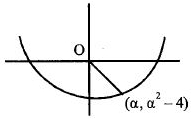
0 likesView Solution
37
ChemistryMCQJEE Main · 2016
If $\int \frac{dx}{\cos^3 x \sqrt{2 \sin 2x}} = (\tan x)^A + C(\tan x)^B + k,$ where $k$ is a constant of integration,then $A + B + C$ equals
A
$\frac{16}{5}$
B
$\frac{27}{10}$
C
$\frac{7}{10}$
D
$\frac{21}{5}$
Solution
(A) We have the integral $I = \int \frac{dx}{\cos^3 x \sqrt{2 \sin 2x}}$.
Using $\sin 2x = 2 \sin x \cos x$,the integral becomes:
$I = \int \frac{dx}{\cos^3 x \sqrt{4 \sin x \cos x}} = \int \frac{dx}{2 \cos^3 x \sqrt{\sin x \cos x}} = \int \frac{dx}{2 \cos^4 x \sqrt{\tan x}}$.
Since $\frac{1}{\cos^4 x} = \sec^4 x = (1 + \tan^2 x) \sec^2 x$,we have:
$I = \frac{1}{2} \int \frac{(1 + \tan^2 x) \sec^2 x}{\sqrt{\tan x}} dx$.
Let $u = \tan x$,then $du = \sec^2 x dx$:
$I = \frac{1}{2} \int \frac{1 + u^2}{\sqrt{u}} du = \frac{1}{2} \int (u^{-1/2} + u^{3/2}) du$.
Integrating term by term:
$I = \frac{1}{2} \left( \frac{u^{1/2}}{1/2} + \frac{u^{5/2}}{5/2} \right) + k = u^{1/2} + \frac{1}{5} u^{5/2} + k$.
Substituting $u = \tan x$ back:
$I = (\tan x)^{1/2} + \frac{1}{5} (\tan x)^{5/2} + k$.
Comparing this with the given form $(\tan x)^A + C(\tan x)^B + k$,we get $A = 1/2$,$B = 5/2$,and $C = 1/5$.
Therefore,$A + B + C = \frac{1}{2} + \frac{5}{2} + \frac{1}{5} = 3 + \frac{1}{5} = \frac{16}{5}$.
Using $\sin 2x = 2 \sin x \cos x$,the integral becomes:
$I = \int \frac{dx}{\cos^3 x \sqrt{4 \sin x \cos x}} = \int \frac{dx}{2 \cos^3 x \sqrt{\sin x \cos x}} = \int \frac{dx}{2 \cos^4 x \sqrt{\tan x}}$.
Since $\frac{1}{\cos^4 x} = \sec^4 x = (1 + \tan^2 x) \sec^2 x$,we have:
$I = \frac{1}{2} \int \frac{(1 + \tan^2 x) \sec^2 x}{\sqrt{\tan x}} dx$.
Let $u = \tan x$,then $du = \sec^2 x dx$:
$I = \frac{1}{2} \int \frac{1 + u^2}{\sqrt{u}} du = \frac{1}{2} \int (u^{-1/2} + u^{3/2}) du$.
Integrating term by term:
$I = \frac{1}{2} \left( \frac{u^{1/2}}{1/2} + \frac{u^{5/2}}{5/2} \right) + k = u^{1/2} + \frac{1}{5} u^{5/2} + k$.
Substituting $u = \tan x$ back:
$I = (\tan x)^{1/2} + \frac{1}{5} (\tan x)^{5/2} + k$.
Comparing this with the given form $(\tan x)^A + C(\tan x)^B + k$,we get $A = 1/2$,$B = 5/2$,and $C = 1/5$.
Therefore,$A + B + C = \frac{1}{2} + \frac{5}{2} + \frac{1}{5} = 3 + \frac{1}{5} = \frac{16}{5}$.
0 likesView Solution
38
ChemistryDifficultMCQJEE Main · 2016
The volume of $0.1 \, N$ dibasic acid sufficient to neutralize $1 \, g$ of a base that furnishes $0.04 \, mole$ of $OH^{-}$ in aqueous solution is ............ $mL$
A
$400$
B
$600$
C
$200$
D
$800$
Solution
(A) According to the law of equivalence,the number of equivalents of acid must equal the number of equivalents of base.
Equivalents of base = (moles of $OH^-$) $\times$ (acidity of base) = $0.04 \times 1 = 0.04 \, eq$.
Equivalents of acid = Normality $\times$ Volume (in $L$).
$0.1 \times V = 0.04$.
$V = \frac{0.04}{0.1} = 0.4 \, L$.
Converting to $mL$: $0.4 \times 1000 = 400 \, mL$.
Equivalents of base = (moles of $OH^-$) $\times$ (acidity of base) = $0.04 \times 1 = 0.04 \, eq$.
Equivalents of acid = Normality $\times$ Volume (in $L$).
$0.1 \times V = 0.04$.
$V = \frac{0.04}{0.1} = 0.4 \, L$.
Converting to $mL$: $0.4 \times 1000 = 400 \, mL$.
0 likesView Solution
39
ChemistryMediumMCQJEE Main · 2016
Aqueous solution of which salt will not contain ions with the electronic configuration $1s^2 \, 2s^2 \, 2p^6 \, 3s^2 \, 3p^6$?
A
$NaF$
B
$KBr$
C
$NaCl$
D
$CaI_2$
Solution
(A) The electronic configuration $1s^2 \, 2s^2 \, 2p^6 \, 3s^2 \, 3p^6$ corresponds to the $Ar$ (Argon) noble gas core,which has $18$ electrons.
In $NaF$,the ions are $Na^+$ ($10$ electrons: $1s^2 \, 2s^2 \, 2p^6$) and $F^-$ ($10$ electrons: $1s^2 \, 2s^2 \, 2p^6$). Neither ion has the $18$-electron configuration.
In $KBr$,$K^+$ ($18$ electrons) and $Br^-$ ($36$ electrons) are present. $K^+$ has the $18$-electron configuration.
In $NaCl$,$Cl^-$ ($18$ electrons) is present.
In $CaI_2$,$Ca^{2+}$ ($18$ electrons) is present.
Therefore,the aqueous solution of $NaF$ does not contain any ions with the $1s^2 \, 2s^2 \, 2p^6 \, 3s^2 \, 3p^6$ configuration.
In $NaF$,the ions are $Na^+$ ($10$ electrons: $1s^2 \, 2s^2 \, 2p^6$) and $F^-$ ($10$ electrons: $1s^2 \, 2s^2 \, 2p^6$). Neither ion has the $18$-electron configuration.
In $KBr$,$K^+$ ($18$ electrons) and $Br^-$ ($36$ electrons) are present. $K^+$ has the $18$-electron configuration.
In $NaCl$,$Cl^-$ ($18$ electrons) is present.
In $CaI_2$,$Ca^{2+}$ ($18$ electrons) is present.
Therefore,the aqueous solution of $NaF$ does not contain any ions with the $1s^2 \, 2s^2 \, 2p^6 \, 3s^2 \, 3p^6$ configuration.
0 likesView Solution
40
ChemistryDifficultMCQJEE Main · 2016
Sodium extract is heated with concentrated $HNO_3$ before testing for halogens because
A
$Ag_2S$ and $AgCN$ are soluble in acidic medium
B
Silver halides are totally insoluble in nitric acid
C
$S^{2-}$ and $CN^{-}$ ions,if present,are decomposed by conc. $HNO_3$ and hence do not interfere in the test
D
$Ag$ reacts faster with halides in acidic medium
Solution
(C) Sodium extract is heated with conc. $HNO_3$ to convert any $NaCN$ formed during fusion into $HCN$ and sulphide into $H_2S$.
This is done when the compound contains $N$ or $S$ along with halogens.
$HCN$ and $H_2S$ formed escape as they are volatile.
Otherwise,they interfere with the test for halogens as they also form a precipitate with $AgNO_3$.
$NaCN + HNO_3 \rightarrow NaNO_3 + HCN \uparrow$
$Na_2S + 2HNO_3 \rightarrow 2NaNO_3 + H_2S \uparrow$
This is done when the compound contains $N$ or $S$ along with halogens.
$HCN$ and $H_2S$ formed escape as they are volatile.
Otherwise,they interfere with the test for halogens as they also form a precipitate with $AgNO_3$.
$NaCN + HNO_3 \rightarrow NaNO_3 + HCN \uparrow$
$Na_2S + 2HNO_3 \rightarrow 2NaNO_3 + H_2S \uparrow$
0 likesView Solution
41
ChemistryDifficultMCQJEE Main · 2016
The commercial name for calcium oxide is
A
Quick lime
B
Milk of lime
C
Slaked lime
D
Limestone
Solution
(A) The chemical formula for calcium oxide is $CaO$.
It is commercially known as Quick lime.
It is commercially known as Quick lime.
0 likesView Solution
42
ChemistryMediumMCQJEE Main · 2016
Which one of the following substances used in dry cleaning is a better strategy to control environmental pollution?
A
Sulphur dioxide
B
Carbon dioxide
C
Nitrogen dioxide
D
Tetrachloroethylene
Solution
(B) Liquefied $CO_2$ is considered a better strategy for dry cleaning because it is environmentally friendly and replaces the use of hazardous solvents like $Cl_2C=CCl_2$ (Tetrachloroethylene),which is a suspected carcinogen and groundwater pollutant. Therefore,$CO_2$ is the preferred choice for sustainable dry cleaning.
0 likesView Solution
43
ChemistryDifficultMCQJEE Main · 2016
The bond angle $H-X-H$ is the greatest in the compound
A
$PH_3$
B
$CH_4$
C
$NH_3$
D
$H_2O$
Solution
(B) The bond angle depends on the hybridization of the central atom and the repulsion between lone pairs and bond pairs.
In $CH_4$,the central atom $C$ is $sp^3$ hybridized with no lone pair,resulting in a tetrahedral geometry with a bond angle of $109.5^{\circ}$.
In $NH_3$,$H_2O$,and $PH_3$,the central atoms have lone pairs which cause bond pair-lone pair repulsion,leading to a decrease in bond angle from the ideal tetrahedral angle.
Specifically,$PH_3$ has a bond angle of approximately $93.5^{\circ}$ due to the lack of hybridization and the large size of the $P$ atom.
Therefore,$CH_4$ has the greatest bond angle among the given options.
In $CH_4$,the central atom $C$ is $sp^3$ hybridized with no lone pair,resulting in a tetrahedral geometry with a bond angle of $109.5^{\circ}$.
In $NH_3$,$H_2O$,and $PH_3$,the central atoms have lone pairs which cause bond pair-lone pair repulsion,leading to a decrease in bond angle from the ideal tetrahedral angle.
Specifically,$PH_3$ has a bond angle of approximately $93.5^{\circ}$ due to the lack of hybridization and the large size of the $P$ atom.
Therefore,$CH_4$ has the greatest bond angle among the given options.
0 likesView Solution
44
ChemistryMediumMCQJEE Main · 2016
Identify the reaction which does not liberate hydrogen.
A
Reaction of lithium hydride with $B_2H_6$
B
Electrolysis of acidified water using $Pt$ electrodes
C
Reaction of zinc with aqueous alkali
D
Allowing a solution of sodium in liquid ammonia to stand
Solution
(A) In the reaction of lithium hydride $(LiH)$ with diborane $(B_2H_6)$,lithium borohydride is formed without the evolution of hydrogen gas:
$2LiH + B_2H_6 \longrightarrow 2Li[BH_4]$
In contrast,the other reactions listed liberate hydrogen gas:
$1$. Electrolysis of acidified water: $2H_2O \longrightarrow 2H_2 + O_2$
$2$. Zinc with aqueous alkali: $Zn + 2NaOH + 2H_2O \longrightarrow Na_2[Zn(OH)_4] + H_2$
$3$. Sodium in liquid ammonia: $2Na + 2NH_3 \longrightarrow 2NaNH_2 + H_2$
$2LiH + B_2H_6 \longrightarrow 2Li[BH_4]$
In contrast,the other reactions listed liberate hydrogen gas:
$1$. Electrolysis of acidified water: $2H_2O \longrightarrow 2H_2 + O_2$
$2$. Zinc with aqueous alkali: $Zn + 2NaOH + 2H_2O \longrightarrow Na_2[Zn(OH)_4] + H_2$
$3$. Sodium in liquid ammonia: $2Na + 2NH_3 \longrightarrow 2NaNH_2 + H_2$
0 likesView Solution
45
ChemistryMediumMCQJEE Main · 2016
$A$ solid $XY$ kept in an evacuated sealed container undergoes decomposition to form a mixture of gases $X$ and $Y$ at temperature $T$. The equilibrium pressure is $10 \, bar$ in the vessel. $K_p$ for this reaction is
A
$25$
B
$100$
C
$10$
D
$5$
Solution
(A) The decomposition reaction is: $XY_{(s)} \leftrightarrow X_{(g)} + Y_{(g)}$
Let the partial pressure of each gas $X$ and $Y$ at equilibrium be $P$.
Total pressure at equilibrium is given by: $P_{total} = P_X + P_Y = P + P = 2P$
Given that the total equilibrium pressure is $10 \, bar$,we have: $2P = 10 \, bar$
Therefore,$P = 5 \, bar$.
The equilibrium constant $K_p$ is defined as: $K_p = P_X \times P_Y = P \times P = P^2$
Substituting the value of $P$: $K_p = (5)^2 = 25$
Let the partial pressure of each gas $X$ and $Y$ at equilibrium be $P$.
Total pressure at equilibrium is given by: $P_{total} = P_X + P_Y = P + P = 2P$
Given that the total equilibrium pressure is $10 \, bar$,we have: $2P = 10 \, bar$
Therefore,$P = 5 \, bar$.
The equilibrium constant $K_p$ is defined as: $K_p = P_X \times P_Y = P \times P = P^2$
Substituting the value of $P$: $K_p = (5)^2 = 25$
0 likesView Solution
46
ChemistryDifficultMCQJEE Main · 2016
If $100$ mole of $H_2O_2$ decomposes at $1$ bar and $300$ $K$,the work done $(kJ)$ by $50$ mole of $O_{2(g)}$ as it expands against $1$ bar pressure is............. $kJ$
$2H_2O_{2(l)} \rightleftharpoons 2H_2O_{(l)} + O_{2(g)}$
$(R = 8.3 \ J \ K^{-1} \ mol^{-1})$
$2H_2O_{2(l)} \rightleftharpoons 2H_2O_{(l)} + O_{2(g)}$
$(R = 8.3 \ J \ K^{-1} \ mol^{-1})$
A
$124.50$
B
$249$
C
$498$
D
$62.25$
Solution
(A) The decomposition reaction is: $2H_2O_{2(l)} \rightarrow 2H_2O_{(l)} + O_{2(g)}$
From the stoichiometry,$2$ moles of $H_2O_2$ produce $1$ mole of $O_{2(g)}$.
Therefore,$100$ moles of $H_2O_2$ produce $50$ moles of $O_{2(g)}$.
The work done during expansion against constant external pressure is given by $W = -P_{ext} \Delta V$.
Since $P_{ext} \Delta V = \Delta n_g RT$,we have $W = -(\Delta n_g)RT$.
Here,$\Delta n_g = 50$ moles of $O_{2(g)}$.
$W = -(50 \ mol) \times (8.3 \ J \ K^{-1} \ mol^{-1}) \times (300 \ K) = -124500 \ J$.
Converting to $kJ$,$W = -124.5 \ kJ$.
The magnitude of work done is $124.5 \ kJ$.
From the stoichiometry,$2$ moles of $H_2O_2$ produce $1$ mole of $O_{2(g)}$.
Therefore,$100$ moles of $H_2O_2$ produce $50$ moles of $O_{2(g)}$.
The work done during expansion against constant external pressure is given by $W = -P_{ext} \Delta V$.
Since $P_{ext} \Delta V = \Delta n_g RT$,we have $W = -(\Delta n_g)RT$.
Here,$\Delta n_g = 50$ moles of $O_{2(g)}$.
$W = -(50 \ mol) \times (8.3 \ J \ K^{-1} \ mol^{-1}) \times (300 \ K) = -124500 \ J$.
Converting to $kJ$,$W = -124.5 \ kJ$.
The magnitude of work done is $124.5 \ kJ$.
0 likesView Solution
47
ChemistryDifficultMCQJEE Main · 2016
Bromination of cyclohexene under the conditions given below yields:
Cyclohexene $\xrightarrow{Br_2/hv}$ ?
Cyclohexene $\xrightarrow{Br_2/hv}$ ?
A
$3-$Bromocyclohexene
B
$1,2-$Dibromocyclohexane
C
trans$-1,2-$Dibromocyclohexane
D
$1-$Bromocyclohexene
Solution
(A) In the presence of sunlight $(hv)$,alkenes undergo free radical substitution at the allylic position.
$1$. The $Br_2$ molecule undergoes homolytic cleavage to form bromine radicals $(Br\cdot)$.
$2$. The bromine radical abstracts an allylic hydrogen atom from cyclohexene to form an allylic radical.
$3$. The allylic radical then reacts with another $Br_2$ molecule to form $3-$bromocyclohexene.
Therefore,the product is $3-$bromocyclohexene.
$1$. The $Br_2$ molecule undergoes homolytic cleavage to form bromine radicals $(Br\cdot)$.
$2$. The bromine radical abstracts an allylic hydrogen atom from cyclohexene to form an allylic radical.
$3$. The allylic radical then reacts with another $Br_2$ molecule to form $3-$bromocyclohexene.
Therefore,the product is $3-$bromocyclohexene.
0 likesView Solution
48
ChemistryDifficultMCQJEE Main · 2016
Assertion : Among the carbon allotropes,diamond is an insulator,whereas,graphite is a good conductor of electricity.
Reason : Hybridization of carbon in diamond and graphite are $sp^3$ and $sp^2$,respectively.
Reason : Hybridization of carbon in diamond and graphite are $sp^3$ and $sp^2$,respectively.
A
Both assertion and reason are correct,but the reason is not the correct explanation for the assertion
B
Both assertion and reason are correct,and the reason is the correct explanation for the assertion
C
Both assertion and reason are incorrect
D
Assertion is incorrect statement,but the reason is correct
Solution
(B) In diamond,each $C$ atom is covalently bonded to four other $C$ atoms to give a tetrahedral unit. Each $C$ atom is $sp^3$ hybridized,and all four valence electrons are involved in sigma bond formation,leaving no free electrons. Thus,diamond is an insulator.
In graphite,each $C$ atom is covalently bonded to three other $C$ atoms in a trigonal planar geometry. Each $C$ atom is $sp^2$ hybridized. Three valence electrons are used in sigma bond formation,while the fourth electron remains in an unhybridized $p$-orbital,which is delocalized over the layers. This free electron makes graphite a good conductor of electricity.
Since the difference in electrical conductivity is directly due to the difference in hybridization and the resulting availability of free electrons,the reason is the correct explanation for the assertion.
In graphite,each $C$ atom is covalently bonded to three other $C$ atoms in a trigonal planar geometry. Each $C$ atom is $sp^2$ hybridized. Three valence electrons are used in sigma bond formation,while the fourth electron remains in an unhybridized $p$-orbital,which is delocalized over the layers. This free electron makes graphite a good conductor of electricity.
Since the difference in electrical conductivity is directly due to the difference in hybridization and the resulting availability of free electrons,the reason is the correct explanation for the assertion.
0 likesView Solution
49
ChemistryDifficultMCQJEE Main · 2016
Consider the reaction sequence below:
Anisole $\xrightarrow[AlCl_3]{\text{Succinic anhydride}} A$ $\xrightarrow[\text{Clemmensen's reduction}]{\text{Cyclization}} X$
Identify $X$.
Anisole $\xrightarrow[AlCl_3]{\text{Succinic anhydride}} A$ $\xrightarrow[\text{Clemmensen's reduction}]{\text{Cyclization}} X$
Identify $X$.
A
$6-$methoxy$-1-$tetralone derivative
B
$7-$methoxy$-1-$tetralone derivative
C
$6-$methoxytetralin
D
$5-$methoxytetralin
Solution
(C) $1$. The reaction of anisole with succinic anhydride in the presence of $AlCl_3$ (Friedel-Crafts acylation) occurs primarily at the para-position due to the activating and ortho/para-directing nature of the $-OCH_3$ group. This yields $4-(4-methoxyphenyl)-4-oxobutanoic$ acid as intermediate $A$.
$2$. Clemmensen's reduction $(Zn-Hg/conc. HCl)$ reduces the ketone group to a methylene group,yielding $4-(4-methoxyphenyl)butanoic$ acid.
$3$. Subsequent cyclization (often using $PCl_5$ followed by $AlCl_3$ or polyphosphoric acid) leads to the formation of $6-methoxytetralone$. Further reduction of the ketone gives $6-methoxytetralin$.
$4$. Based on the provided options and the final structure in the solution image,the product $X$ is $6-methoxytetralin$.
$2$. Clemmensen's reduction $(Zn-Hg/conc. HCl)$ reduces the ketone group to a methylene group,yielding $4-(4-methoxyphenyl)butanoic$ acid.
$3$. Subsequent cyclization (often using $PCl_5$ followed by $AlCl_3$ or polyphosphoric acid) leads to the formation of $6-methoxytetralone$. Further reduction of the ketone gives $6-methoxytetralin$.
$4$. Based on the provided options and the final structure in the solution image,the product $X$ is $6-methoxytetralin$.
0 likesView Solution
50
ChemistryMediumMCQJEE Main · 2016
Initially,the root mean square $(rms)$ velocity of $N_2$ molecules at a certain temperature is $u$. If this temperature is doubled and all the nitrogen molecules dissociate into nitrogen atoms,then the new $rms$ velocity will be:
A
$2 \ u$
B
$14 \ u$
C
$4 \ u$
D
$u/2$
Solution
(A) The formula for $rms$ velocity is $v_{rms} = \sqrt{\frac{3RT}{M}}$.
Initially,for $N_2$ molecules at temperature $T$,$u = \sqrt{\frac{3RT}{28 \times 10^{-3} \ kg/mol}}$.
After the temperature is doubled $(T' = 2T)$ and $N_2$ dissociates into $N$ atoms,the molar mass becomes $M' = 14 \times 10^{-3} \ kg/mol$.
The new $rms$ velocity $v'$ is given by $v' = \sqrt{\frac{3R(2T)}{14 \times 10^{-3}}} = \sqrt{4 \times \frac{3RT}{28 \times 10^{-3}}} = 2 \times \sqrt{\frac{3RT}{28 \times 10^{-3}}}$.
Therefore,$v' = 2u$.
Initially,for $N_2$ molecules at temperature $T$,$u = \sqrt{\frac{3RT}{28 \times 10^{-3} \ kg/mol}}$.
After the temperature is doubled $(T' = 2T)$ and $N_2$ dissociates into $N$ atoms,the molar mass becomes $M' = 14 \times 10^{-3} \ kg/mol$.
The new $rms$ velocity $v'$ is given by $v' = \sqrt{\frac{3R(2T)}{14 \times 10^{-3}}} = \sqrt{4 \times \frac{3RT}{28 \times 10^{-3}}} = 2 \times \sqrt{\frac{3RT}{28 \times 10^{-3}}}$.
Therefore,$v' = 2u$.
0 likesView Solution
51
ChemistryDifficultMCQJEE Main · 2016
Which of the following ores is best concentrated by the froth-flotation method?
A
Galena
B
Cassiterite
C
Magnetite
D
Malachite
Solution
(A) The correct answer is $(A)$.
Froth-flotation is a process specifically used for the concentration of sulphide ores.
Galena $(PbS)$ is a sulphide ore.
Cassiterite $(SnO_2)$ is an oxide ore.
Magnetite $(Fe_3O_4)$ is an oxide ore.
Malachite $(Cu(OH)_2 \cdot CuCO_3)$ is a carbonate ore.
Therefore,only Galena is concentrated by the froth-flotation method,which relies on the preferential wetting of sulphide particles by oil (frothing agent) and gangue particles by water.
Froth-flotation is a process specifically used for the concentration of sulphide ores.
Galena $(PbS)$ is a sulphide ore.
Cassiterite $(SnO_2)$ is an oxide ore.
Magnetite $(Fe_3O_4)$ is an oxide ore.
Malachite $(Cu(OH)_2 \cdot CuCO_3)$ is a carbonate ore.
Therefore,only Galena is concentrated by the froth-flotation method,which relies on the preferential wetting of sulphide particles by oil (frothing agent) and gangue particles by water.
0 likesView Solution
52
ChemistryMediumMCQJEE Main · 2016
For a linear plot of $\log(x/m)$ versus $\log p$ in a Freundlich adsorption isotherm,which of the following statements is correct? ($k$ and $n$ are constants)
A
Only $1/n$ appears as the slope.
B
$\log(1/n)$ appears as the intercept.
C
Both $k$ and $1/n$ appear in the slope term.
D
$1/n$ appears as the intercept.
Solution
(A) The Freundlich adsorption isotherm is given by the equation: $\frac{x}{m} = k p^{1/n}$.
Taking the logarithm on both sides,we get: $\log\left(\frac{x}{m}\right) = \log k + \frac{1}{n} \log p$.
Comparing this with the linear equation $y = mx + c$,where $y = \log(x/m)$,$x = \log p$,the slope is $1/n$ and the intercept is $\log k$.
Therefore,only $1/n$ appears as the slope.
Taking the logarithm on both sides,we get: $\log\left(\frac{x}{m}\right) = \log k + \frac{1}{n} \log p$.
Comparing this with the linear equation $y = mx + c$,where $y = \log(x/m)$,$x = \log p$,the slope is $1/n$ and the intercept is $\log k$.
Therefore,only $1/n$ appears as the slope.
0 likesView Solution
53
ChemistryDifficultMCQJEE Main · 2016
$18 \ g$ glucose $(C_6H_{12}O_6)$ is added to $178.2 \ g$ water. The vapour pressure of this aqueous solution at $100 \ ^{\circ}C$ (in $torr$) is:
A
$752.4$
B
$759.0$
C
$7.6$
D
$76.0$
Solution
(A) According to Raoult's Law for non-volatile solutes:
$\frac{P^{\circ} - P_s}{P^{\circ}} = \frac{n_B}{n_A + n_B}$
Given:
Mass of glucose $(W_B) = 18 \ g$,Molar mass $(M_B) = 180 \ g/mol$
Moles of glucose $(n_B) = \frac{18}{180} = 0.1 \ mol$
Mass of water $(W_A) = 178.2 \ g$,Molar mass $(M_A) = 18 \ g/mol$
Moles of water $(n_A) = \frac{178.2}{18} = 9.9 \ mol$
Vapour pressure of pure water at $100 \ ^{\circ}C$ $(P^{\circ}) = 760 \ torr$
Substituting the values:
$\frac{760 - P_s}{760} = \frac{0.1}{9.9 + 0.1} = \frac{0.1}{10} = 0.01$
$760 - P_s = 760 \times 0.01 = 7.6$
$P_s = 760 - 7.6 = 752.4 \ torr$
$\frac{P^{\circ} - P_s}{P^{\circ}} = \frac{n_B}{n_A + n_B}$
Given:
Mass of glucose $(W_B) = 18 \ g$,Molar mass $(M_B) = 180 \ g/mol$
Moles of glucose $(n_B) = \frac{18}{180} = 0.1 \ mol$
Mass of water $(W_A) = 178.2 \ g$,Molar mass $(M_A) = 18 \ g/mol$
Moles of water $(n_A) = \frac{178.2}{18} = 9.9 \ mol$
Vapour pressure of pure water at $100 \ ^{\circ}C$ $(P^{\circ}) = 760 \ torr$
Substituting the values:
$\frac{760 - P_s}{760} = \frac{0.1}{9.9 + 0.1} = \frac{0.1}{10} = 0.01$
$760 - P_s = 760 \times 0.01 = 7.6$
$P_s = 760 - 7.6 = 752.4 \ torr$
1 likesView Solution
54
ChemistryEasyMCQJEE Main · 2016
Galvanization is applying a coating of:
A
$Cu$
B
$Zn$
C
$Pb$
D
$Cr$
Solution
(B) Galvanization is the process of applying a protective $Zn$ coating to steel or iron to prevent rusting.
The most common method is hot-dip galvanizing,in which the parts are submerged in a bath of molten $Zn$.
The most common method is hot-dip galvanizing,in which the parts are submerged in a bath of molten $Zn$.
0 likesView Solution
55
ChemistryAdvancedMCQJEE Main · 2016
Decomposition of $H_2O_2$ follows a first order reaction. In $50 \ min$,the concentration of $H_2O_2$ decreases from $0.5 \ M$ to $0.125 \ M$. For such decomposition,when the concentration of $H_2O_2$ reaches $0.05 \ M$,the rate of formation of $O_2$ will be:
A
$2.66 \ L \ min^{-1}$ at $STP$
B
$1.34 \times 10^{-2} \ mol \ min^{-1}$
C
$6.96 \times 10^{-2} \ mol \ min^{-1}$
D
$6.93 \times 10^{-4} \ mol \ min^{-1}$
Solution
(D) The decomposition reaction is: $H_2O_{2(aq)} \rightarrow H_2O_{(l)} + \frac{1}{2} O_{2(g)}$
For a first order reaction,the rate constant $k$ is given by: $k = \frac{2.303}{t} \log \frac{[A]_0}{[A]_t}$
Given $[A]_0 = 0.5 \ M$,$[A]_t = 0.125 \ M$,and $t = 50 \ min$:
$k = \frac{2.303}{50} \log \frac{0.5}{0.125} = \frac{2.303}{50} \log(4) = \frac{2.303 \times 0.602}{50} \approx 0.0277 \ min^{-1}$
When $[H_2O_2] = 0.05 \ M$,the rate of disappearance of $H_2O_2$ is:
$Rate_{H_2O_2} = k[H_2O_2] = 0.0277 \times 0.05 = 1.385 \times 10^{-3} \ mol \ L^{-1} \ min^{-1}$
From the stoichiometry,$-\frac{d[H_2O_2]}{dt} = 2 \frac{d[O_2]}{dt}$,so the rate of formation of $O_2$ is:
$\frac{d[O_2]}{dt} = \frac{1}{2} \times Rate_{H_2O_2} = \frac{1.385 \times 10^{-3}}{2} = 6.925 \times 10^{-4} \ mol \ L^{-1} \ min^{-1} \approx 6.93 \times 10^{-4} \ mol \ min^{-1}$
For a first order reaction,the rate constant $k$ is given by: $k = \frac{2.303}{t} \log \frac{[A]_0}{[A]_t}$
Given $[A]_0 = 0.5 \ M$,$[A]_t = 0.125 \ M$,and $t = 50 \ min$:
$k = \frac{2.303}{50} \log \frac{0.5}{0.125} = \frac{2.303}{50} \log(4) = \frac{2.303 \times 0.602}{50} \approx 0.0277 \ min^{-1}$
When $[H_2O_2] = 0.05 \ M$,the rate of disappearance of $H_2O_2$ is:
$Rate_{H_2O_2} = k[H_2O_2] = 0.0277 \times 0.05 = 1.385 \times 10^{-3} \ mol \ L^{-1} \ min^{-1}$
From the stoichiometry,$-\frac{d[H_2O_2]}{dt} = 2 \frac{d[O_2]}{dt}$,so the rate of formation of $O_2$ is:
$\frac{d[O_2]}{dt} = \frac{1}{2} \times Rate_{H_2O_2} = \frac{1.385 \times 10^{-3}}{2} = 6.925 \times 10^{-4} \ mol \ L^{-1} \ min^{-1} \approx 6.93 \times 10^{-4} \ mol \ min^{-1}$
0 likesView Solution
56
ChemistryEasyMCQJEE Main · 2016
Which one of the following ores is best concentrated by froth floatation method?
A
Galena
B
Malachite
C
Magnetite
D
Siderite
Solution
(A) The froth floatation method is primarily used for the concentration of sulphide ores because sulphide ores are preferentially wetted by oil,while gangue particles are wetted by water.
$1$. Malachite: $Cu(OH)_2 \cdot CuCO_3$ (Carbonate ore)
$2$. Magnetite: $Fe_3O_4$ (Oxide ore)
$3$. Siderite: $FeCO_3$ (Carbonate ore)
$4$. Galena: $PbS$ (Sulphide ore)
Since $PbS$ is a sulphide ore,it is best concentrated by the froth floatation method.
$1$. Malachite: $Cu(OH)_2 \cdot CuCO_3$ (Carbonate ore)
$2$. Magnetite: $Fe_3O_4$ (Oxide ore)
$3$. Siderite: $FeCO_3$ (Carbonate ore)
$4$. Galena: $PbS$ (Sulphide ore)
Since $PbS$ is a sulphide ore,it is best concentrated by the froth floatation method.
0 likesView Solution
57
ChemistryMediumMCQJEE Main · 2016
The pair in which phosphorus atoms have a formal oxidation state of $+3$ is:
A
Orthophosphorous and hypophosphoric acids
B
Pyrophosphorous and pyrophosphoric acids
C
Orthophosphorous and pyrophosphorous acids
D
Pyrophosphorous and hypophosphoric acids
Solution
(C) $1.$ Orthophosphorous acid $(H_3PO_3)$: $3(+1) + x + 3(-2) = 0 \Rightarrow x = +3$
$2.$ Pyrophosphorous acid $(H_4P_2O_5)$: $4(+1) + 2x + 5(-2) = 0$ $\Rightarrow 2x = 6$ $\Rightarrow x = +3$
$3.$ Hypophosphoric acid $(H_4P_2O_6)$: $4(+1) + 2x + 6(-2) = 0$ $\Rightarrow 2x = 8$ $\Rightarrow x = +4$
$4.$ Pyrophosphoric acid $(H_4P_2O_7)$: $4(+1) + 2x + 7(-2) = 0$ $\Rightarrow 2x = 10$ $\Rightarrow x = +5$
Therefore,the pair with $+3$ oxidation state is Orthophosphorous and pyrophosphorous acids.
$2.$ Pyrophosphorous acid $(H_4P_2O_5)$: $4(+1) + 2x + 5(-2) = 0$ $\Rightarrow 2x = 6$ $\Rightarrow x = +3$
$3.$ Hypophosphoric acid $(H_4P_2O_6)$: $4(+1) + 2x + 6(-2) = 0$ $\Rightarrow 2x = 8$ $\Rightarrow x = +4$
$4.$ Pyrophosphoric acid $(H_4P_2O_7)$: $4(+1) + 2x + 7(-2) = 0$ $\Rightarrow 2x = 10$ $\Rightarrow x = +5$
Therefore,the pair with $+3$ oxidation state is Orthophosphorous and pyrophosphorous acids.
0 likesView Solution
58
ChemistryAdvancedMCQJEE Main · 2016
The reaction of zinc with dilute and concentrated nitric acid,respectively,produces:
A
$NO$ and $N_2O$
B
$N_2O$ and $NO_2$
C
$NO_2$ and $N_2O$
D
$NO_2$ and $NO$
Solution
(B) The reaction of $Zn$ with dilute $HNO_3$ is given by:
$4 Zn + 10 HNO_3 (dil.) \longrightarrow 4 Zn(NO_3)_2 + 5 H_2O + N_2O$
Thus,dilute $HNO_3$ produces $N_2O$.
The reaction of $Zn$ with concentrated $HNO_3$ is given by:
$Zn + 4 HNO_3 (conc.) \longrightarrow Zn(NO_3)_2 + 2 H_2O + 2 NO_2$
Thus,concentrated $HNO_3$ produces $NO_2$.
Therefore,the products are $N_2O$ and $NO_2$ respectively.
$4 Zn + 10 HNO_3 (dil.) \longrightarrow 4 Zn(NO_3)_2 + 5 H_2O + N_2O$
Thus,dilute $HNO_3$ produces $N_2O$.
The reaction of $Zn$ with concentrated $HNO_3$ is given by:
$Zn + 4 HNO_3 (conc.) \longrightarrow Zn(NO_3)_2 + 2 H_2O + 2 NO_2$
Thus,concentrated $HNO_3$ produces $NO_2$.
Therefore,the products are $N_2O$ and $NO_2$ respectively.
0 likesView Solution
59
ChemistryMediumMCQJEE Main · 2016
Which of the following compounds is metallic and ferromagnetic?
A
$VO_2$
B
$MnO_2$
C
$TiO_2$
D
$CrO_2$
Solution
(D) Among the given metallic oxides,$CrO_2$ is strongly attracted by a magnetic field.
This magnetic property persists even after the removal of the external magnetic field.
Therefore,$CrO_2$ is classified as a metallic and ferromagnetic compound.
This magnetic property persists even after the removal of the external magnetic field.
Therefore,$CrO_2$ is classified as a metallic and ferromagnetic compound.
0 likesView Solution
60
ChemistryDifficultMCQJEE Main · 2016
Which one of the following complexes shows optical isomerism? $(en = \text{ethylenediamine})$
A
$trans-[Co(en)_2Cl_2]Cl$
B
$[Co(NH_3)_4Cl_2]Cl$
C
$[Co(NH_3)_3Cl_3]$
D
$cis-[Co(en)_2Cl_2]Cl$
Solution
(D) Optical isomerism is shown by complexes that are chiral,meaning they do not have a plane of symmetry or a center of inversion.
In the case of octahedral complexes of the type $[M(AA)_2X_2]$,the $cis$-isomer is chiral and exists as a pair of enantiomers (non-superimposable mirror images).
The $trans$-isomer,however,has a plane of symmetry and is achiral.
Therefore,$cis-[Co(en)_2Cl_2]Cl$ shows optical isomerism.
In the case of octahedral complexes of the type $[M(AA)_2X_2]$,the $cis$-isomer is chiral and exists as a pair of enantiomers (non-superimposable mirror images).
The $trans$-isomer,however,has a plane of symmetry and is achiral.
Therefore,$cis-[Co(en)_2Cl_2]Cl$ shows optical isomerism.
0 likesView Solution
61
ChemistryDifficultMCQJEE Main · 2016
The pair having the same magnetic moment is $:$
[At. No.$: $ $Cr= 24, Mn= 25, Fe= 26, Co= 27$]
[At. No.$: $ $Cr= 24, Mn= 25, Fe= 26, Co= 27$]
A
$[Mn(H_2O)_6]^{2+}$ and $[Cr(H_2O)_6]^{2+}$
B
$[CoCl_4]^{2-}$ and $[Fe(H_2O)_6]^{2+}$
C
$[Cr(H_2O)_6]^{2+}$ and $[CoCl_4]^{2-}$
D
$[Cr(H_2O)_6]^{2+}$ and $[Fe(H_2O)_6]^{2+}$
Solution
(D) The magnetic moment is calculated using the formula $\mu = \sqrt{n(n+2)} \text{ B.M.}$,where $n$ is the number of unpaired electrons.
$1$. $[Cr(H_2O)_6]^{2+}$: $Cr$ is in $+2$ oxidation state $(3d^4)$. It has $4$ unpaired electrons $(n=4)$.
$2$. $[Fe(H_2O)_6]^{2+}$: $Fe$ is in $+2$ oxidation state $(3d^6)$. In a weak field ligand like $H_2O$,it has $4$ unpaired electrons $(n=4)$.
$3$. $[Mn(H_2O)_6]^{2+}$: $Mn$ is in $+2$ oxidation state $(3d^5)$,having $5$ unpaired electrons $(n=5)$.
$4$. $[CoCl_4]^{2-}$: $Co$ is in $+2$ oxidation state $(3d^7)$,having $3$ unpaired electrons $(n=3)$.
Since $[Cr(H_2O)_6]^{2+}$ and $[Fe(H_2O)_6]^{2+}$ both have $4$ unpaired electrons,they have the same magnetic moment.
$1$. $[Cr(H_2O)_6]^{2+}$: $Cr$ is in $+2$ oxidation state $(3d^4)$. It has $4$ unpaired electrons $(n=4)$.
$2$. $[Fe(H_2O)_6]^{2+}$: $Fe$ is in $+2$ oxidation state $(3d^6)$. In a weak field ligand like $H_2O$,it has $4$ unpaired electrons $(n=4)$.
$3$. $[Mn(H_2O)_6]^{2+}$: $Mn$ is in $+2$ oxidation state $(3d^5)$,having $5$ unpaired electrons $(n=5)$.
$4$. $[CoCl_4]^{2-}$: $Co$ is in $+2$ oxidation state $(3d^7)$,having $3$ unpaired electrons $(n=3)$.
Since $[Cr(H_2O)_6]^{2+}$ and $[Fe(H_2O)_6]^{2+}$ both have $4$ unpaired electrons,they have the same magnetic moment.
0 likesView Solution
62
ChemistryEasyMCQJEE Main · 2016
Thiol group is present in:
A
Cysteine
B
Methionine
C
Cytosine
D
Cystine
Solution
(A) The thiol group $(-SH)$ is a functional group consisting of a sulfur atom bonded to a hydrogen atom.
Among the given options,$Cysteine$ is an amino acid that contains a thiol group in its side chain.
The structure of $Cysteine$ is $HS-CH_2-CH(NH_2)-COOH$.
Among the given options,$Cysteine$ is an amino acid that contains a thiol group in its side chain.
The structure of $Cysteine$ is $HS-CH_2-CH(NH_2)-COOH$.
0 likesView Solution
63
ChemistryDifficultMCQJEE Main · 2016
The product of the reaction given below is :
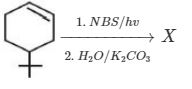
A
$A$ cyclohexenone derivative with a tert-butyl group.
B
$A$ cyclohexene carboxylic acid derivative with a tert-butyl group.
C
$A$ cyclohexene derivative with a tert-butyl group.
D
$4-$tert-butylcyclohex$-2-$en$-1-$ol.
Solution
(D) The reaction proceeds in two steps:
$1$. Allylic bromination using $NBS$ ($N$-Bromosuccinimide) under $hv$ (light) conditions,which introduces a bromine atom at the allylic position.
$2$. Nucleophilic substitution of the bromine atom with a hydroxyl group using $H_2O/K_2CO_3$,resulting in the formation of an allylic alcohol.
The final product is $4$-tert-butylcyclohex-$2$-en-$1$-ol.
$1$. Allylic bromination using $NBS$ ($N$-Bromosuccinimide) under $hv$ (light) conditions,which introduces a bromine atom at the allylic position.
$2$. Nucleophilic substitution of the bromine atom with a hydroxyl group using $H_2O/K_2CO_3$,resulting in the formation of an allylic alcohol.
The final product is $4$-tert-butylcyclohex-$2$-en-$1$-ol.
0 likesView Solution
64
ChemistryDifficultMCQJEE Main · 2016
$2-$chloro$-2-$methylpentane on reaction with sodium methoxide in methanol yields:
$(1)\ C_2H_5-CH_2-C(CH_3)_2-OCH_3$
$(2)\ C_2H_5-CH_2-C(CH_3)=CH_2$
$(3)\ C_2H_5-CH=C(CH_3)_2$
$(1)\ C_2H_5-CH_2-C(CH_3)_2-OCH_3$
$(2)\ C_2H_5-CH_2-C(CH_3)=CH_2$
$(3)\ C_2H_5-CH=C(CH_3)_2$
A
$(3)$ only
B
$(1)$ and $(2)$
C
All of these
D
$(1)$ and $(3)$
Solution
(C) $2-$chloro$-2-$methylpentane is a tertiary $(3^{\circ})$ alkyl halide.
In the presence of a strong base/nucleophile like sodium methoxide $(CH_3ONa)$ in methanol $(CH_3OH)$,it can undergo both substitution and elimination reactions.
$1.$ Substitution $(S_N1)$: The $Cl^-$ is replaced by $-OCH_3$ to form $2-$methoxy$-2-$methylpentane (Product $(1)$).
$2.$ Elimination $(E2)$: Removal of $HCl$ from $\beta-$carbons.
$-$ From the terminal methyl group,it forms $2-$methylpent$-1-$ene (Product $(2)$).
$-$ From the internal methylene group,it forms $2-$methylpent$-2-$ene (Product $(3)$).
Thus,all three products are obtained.
In the presence of a strong base/nucleophile like sodium methoxide $(CH_3ONa)$ in methanol $(CH_3OH)$,it can undergo both substitution and elimination reactions.
$1.$ Substitution $(S_N1)$: The $Cl^-$ is replaced by $-OCH_3$ to form $2-$methoxy$-2-$methylpentane (Product $(1)$).
$2.$ Elimination $(E2)$: Removal of $HCl$ from $\beta-$carbons.
$-$ From the terminal methyl group,it forms $2-$methylpent$-1-$ene (Product $(2)$).
$-$ From the internal methylene group,it forms $2-$methylpent$-2-$ene (Product $(3)$).
Thus,all three products are obtained.
0 likesView Solution
65
ChemistryMediumMCQJEE Main · 2016
In the $Hofmann$ bromamide degradation reaction,the number of moles of $NaOH$ and $Br_2$ used per mole of amine produced are:
A
$Two$ moles of $NaOH$ and $two$ moles of $Br_2$.
B
$Four$ moles of $NaOH$ and $one$ mole of $Br_2$.
C
$One$ mole of $NaOH$ and $one$ mole of $Br_2$.
D
$Four$ moles of $NaOH$ and $two$ moles of $Br_2$.
Solution
(B) The $Hofmann$ bromamide degradation reaction is represented by the following chemical equation:
$RCONH_2 + 4NaOH + Br_2 \rightarrow RNH_2 + Na_2CO_3 + 2NaBr + 2H_2O$
From the stoichiometry of the balanced equation,it is clear that for every $1$ mole of amine $(RNH_2)$ produced,$4$ moles of $NaOH$ and $1$ mole of $Br_2$ are consumed.
$RCONH_2 + 4NaOH + Br_2 \rightarrow RNH_2 + Na_2CO_3 + 2NaBr + 2H_2O$
From the stoichiometry of the balanced equation,it is clear that for every $1$ mole of amine $(RNH_2)$ produced,$4$ moles of $NaOH$ and $1$ mole of $Br_2$ are consumed.
0 likesView Solution
66
ChemistryMediumMCQJEE Main · 2016
Which of the following is an anionic detergent?
A
Cetyltrimethyl ammonium bromide
B
Glyceryl oleate
C
Sodium stearate
D
Sodium lauryl sulphate
Solution
(D) Anionic detergents are sodium salts of sulphonated long chain alcohols or hydrocarbons.
In anionic detergents,the anionic part of the molecule is involved in the cleansing action.
$Sodium \ lauryl \ sulphate$ $(CH_3(CH_2)_{11}SO_4^-Na^+)$ is an anionic detergent.
$Cetyltrimethylammonium \ bromide$ is a popular cationic detergent used in hair conditioners.
$Glyceryl \ oleate$ is an ester of glycerin and oleic acid.
$Sodium \ stearate$ is a soap,which is the sodium salt of stearic acid.
In anionic detergents,the anionic part of the molecule is involved in the cleansing action.
$Sodium \ lauryl \ sulphate$ $(CH_3(CH_2)_{11}SO_4^-Na^+)$ is an anionic detergent.
$Cetyltrimethylammonium \ bromide$ is a popular cationic detergent used in hair conditioners.
$Glyceryl \ oleate$ is an ester of glycerin and oleic acid.
$Sodium \ stearate$ is a soap,which is the sodium salt of stearic acid.
0 likesView Solution
67
ChemistryMediumMCQJEE Main · 2016
Which of the following statements about low density polythene is $FALSE$?
A
Its synthesis requires dioxygen or a peroxide initiator as a catalyst.
B
It is used in the manufacture of buckets,dust-bins etc.
C
Its synthesis requires high pressure.
D
It is a poor conductor of electricity.
Solution
(B) Low density polythene $(LDPE)$ is a poor conductor of electricity.
Its synthesis involves the polymerization of ethene at high pressure $(1000-2000 \ atm)$ and temperatures $(350-570 \ K)$ in the presence of traces of dioxygen or a peroxide initiator as a catalyst.
$LDPE$ is chemically inert and tough but flexible,making it suitable for squeeze bottles,toys,and flexible pipes.
High density polythene $(HDPE)$ is used in the manufacture of buckets,dust-bins,and bottles.
Therefore,the statement that $LDPE$ is used in the manufacture of buckets and dust-bins is $FALSE$.
Its synthesis involves the polymerization of ethene at high pressure $(1000-2000 \ atm)$ and temperatures $(350-570 \ K)$ in the presence of traces of dioxygen or a peroxide initiator as a catalyst.
$LDPE$ is chemically inert and tough but flexible,making it suitable for squeeze bottles,toys,and flexible pipes.
High density polythene $(HDPE)$ is used in the manufacture of buckets,dust-bins,and bottles.
Therefore,the statement that $LDPE$ is used in the manufacture of buckets and dust-bins is $FALSE$.
0 likesView Solution
68
ChemistryDifficultMCQJEE Main · 2016
Which one of the following complexes will consume more equivalents of aqueous solution of $AgNO_3$?
A
$Na_2[CrCl_5(H_2O)]$
B
$Na_3[CrCl_6]$
C
$[Cr(H_2O)_5Cl]Cl_2$
D
$[Cr(H_2O)_6]Cl_3$
Solution
(D) The consumption of $AgNO_3$ depends on the number of ionizable $Cl^-$ ions present outside the coordination sphere.
$Na_2[CrCl_5(H_2O)]$ provides $0$ ionizable $Cl^-$ ions.
$Na_3[CrCl_6]$ provides $0$ ionizable $Cl^-$ ions.
$[Cr(H_2O)_5Cl]Cl_2$ provides $2$ ionizable $Cl^-$ ions.
$[Cr(H_2O)_6]Cl_3$ provides $3$ ionizable $Cl^-$ ions.
Since $[Cr(H_2O)_6]Cl_3$ furnishes the highest number of $Cl^-$ ions ($3$ moles per mole of complex),it will consume the most equivalents of $AgNO_3$.
$Na_2[CrCl_5(H_2O)]$ provides $0$ ionizable $Cl^-$ ions.
$Na_3[CrCl_6]$ provides $0$ ionizable $Cl^-$ ions.
$[Cr(H_2O)_5Cl]Cl_2$ provides $2$ ionizable $Cl^-$ ions.
$[Cr(H_2O)_6]Cl_3$ provides $3$ ionizable $Cl^-$ ions.
Since $[Cr(H_2O)_6]Cl_3$ furnishes the highest number of $Cl^-$ ions ($3$ moles per mole of complex),it will consume the most equivalents of $AgNO_3$.
0 likesView Solution
69
ChemistryMediumMCQJEE Main · 2016
$A$ particular adsorption process has the following characteristics: $(i)$ It arises due to van der Waals forces and $(ii)$ it is reversible. Identify the correct statement that describes the above adsorption process.
A
Adsorption is monolayer.
B
Adsorption increases with increase in temperature.
C
Enthalpy of adsorption is greater than $100 \ kJ \ mol^{-1}$.
D
Energy of activation is low.
Solution
(D) The characteristics given suggest that this is physical adsorption (physisorption).
Physical adsorption is characterized by weak van der Waals forces,reversibility,and the formation of multimolecular layers.
It is an exothermic process that typically decreases with an increase in temperature.
The enthalpy of adsorption is low (usually $20-40 \ kJ \ mol^{-1}$).
Since it involves weak forces and no chemical bond formation,the energy of activation required is very low.
Physical adsorption is characterized by weak van der Waals forces,reversibility,and the formation of multimolecular layers.
It is an exothermic process that typically decreases with an increase in temperature.
The enthalpy of adsorption is low (usually $20-40 \ kJ \ mol^{-1}$).
Since it involves weak forces and no chemical bond formation,the energy of activation required is very low.
0 likesView Solution
70
ChemistryDifficultMCQJEE Main · 2016
Bouveault-Blanc reduction reaction involves:
A
Reduction of an acyl halide with $H_2/Pd$
B
Reduction of an anhydride with $LiAlH_4$
C
Reduction of an ester with $Na/C_2H_5OH$
D
Reduction of a carbonyl compound with $Na/Hg$ and $HCl$
Solution
(C) The Bouveault-Blanc reduction involves the reduction of esters to primary alcohols using sodium metal in the presence of an alcohol (usually ethanol).
The general reaction is: $R-COOR' + 4[H] \xrightarrow{Na/C_2H_5OH} R-CH_2OH + R'OH$.
The general reaction is: $R-COOR' + 4[H] \xrightarrow{Na/C_2H_5OH} R-CH_2OH + R'OH$.
0 likesView Solution
71
ChemistryMediumMCQJEE Main · 2016
Consider the following sequence for aspartic acid:
$H_3N^+-CH(COOH)-CH_2COOH \leftrightarrow{pK_1=1.88} H_3N^+-CH(COO^-)-CH_2COOH \leftrightarrow{pK_R=3.65} H_3N^+-CH(COO^-)-CH_2COO^- \leftrightarrow{pK_2=9.60} H_2N-CH(COO^-)-CH_2COO^-$
The $pI$ (isoelectric point) of aspartic acid is:
$H_3N^+-CH(COOH)-CH_2COOH \leftrightarrow{pK_1=1.88} H_3N^+-CH(COO^-)-CH_2COOH \leftrightarrow{pK_R=3.65} H_3N^+-CH(COO^-)-CH_2COO^- \leftrightarrow{pK_2=9.60} H_2N-CH(COO^-)-CH_2COO^-$
The $pI$ (isoelectric point) of aspartic acid is:
A
$3.65$
B
$2.77$
C
$5.74$
D
$1.88$
Solution
(B) For an acidic amino acid like aspartic acid,the isoelectric point $(pI)$ is calculated as the average of the two $pK_a$ values that flank the zwitterionic form.
The zwitterionic form of aspartic acid exists between the first deprotonation of the $\alpha$-carboxyl group $(pK_1 = 1.88)$ and the deprotonation of the side-chain carboxyl group $(pK_R = 3.65)$.
$pI = \frac{pK_1 + pK_R}{2}$
$pI = \frac{1.88 + 3.65}{2} = \frac{5.53}{2} = 2.765 \approx 2.77$
The zwitterionic form of aspartic acid exists between the first deprotonation of the $\alpha$-carboxyl group $(pK_1 = 1.88)$ and the deprotonation of the side-chain carboxyl group $(pK_R = 3.65)$.
$pI = \frac{pK_1 + pK_R}{2}$
$pI = \frac{1.88 + 3.65}{2} = \frac{5.53}{2} = 2.765 \approx 2.77$
0 likesView Solution
72
ChemistryDifficultMCQJEE Main · 2016
What will occur if a block of copper metal is dropped into a beaker containing a solution of $1 \ M \ ZnSO_4$?
A
The copper metal will dissolve with evolution of oxygen gas
B
The copper metal will dissolve with evolution of hydrogen gas
C
No reaction will occur
D
The copper metal will dissolve and zinc metal will be deposited
Solution
(C) No reaction will occur because $Zn$ is placed above $Cu$ in the electrochemical series.
Since $Cu$ is a weaker reducing agent than $Zn$,it cannot displace $Zn^{2+}$ ions from the $ZnSO_4$ solution.
Therefore,no displacement reaction takes place.
Since $Cu$ is a weaker reducing agent than $Zn$,it cannot displace $Zn^{2+}$ ions from the $ZnSO_4$ solution.
Therefore,no displacement reaction takes place.
0 likesView Solution
73
ChemistryMediumMCQJEE Main · 2016
Assertion: Rayon is a semi-synthetic polymer whose properties are better than natural cotton.
Reason: Mechanical and aesthetic properties of cellulose can be improved by acetylation.
Reason: Mechanical and aesthetic properties of cellulose can be improved by acetylation.
A
Both assertion and reason are correct,but the reason is not the correct explanation for the assertion.
B
Both assertion and reason are correct,and the reason is the correct explanation for the assertion.
C
Assertion is incorrect statement,but the reason is correct.
D
Both assertion and reason are incorrect.
Solution
(B) Both the assertion and the reason are correct statements,and the reason is the correct explanation for the assertion.
Assertion:
Rayon (specifically cellulose acetate) is a semi-synthetic polymer that exhibits superior properties compared to natural cotton fiber.
Reason:
The mechanical and aesthetic properties of cellulose are significantly enhanced through the process of acetylation. Since rayon is produced via the acetylation of cellulose,it possesses improved characteristics over natural cotton.
Conclusion:
Therefore,the reason correctly explains why rayon has better properties than natural cotton.
Assertion:
Rayon (specifically cellulose acetate) is a semi-synthetic polymer that exhibits superior properties compared to natural cotton fiber.
Reason:
The mechanical and aesthetic properties of cellulose are significantly enhanced through the process of acetylation. Since rayon is produced via the acetylation of cellulose,it possesses improved characteristics over natural cotton.
Conclusion:
Therefore,the reason correctly explains why rayon has better properties than natural cotton.
0 likesView Solution
74
ChemistryDifficultMCQJEE Main · 2016
The plot shows the variation of $- \ln K_p$ versus temperature for the two reactions:
$M_{(s)} + \frac{1}{2} O_{2(g)} \to MO_{(s)}$ and $C_{(s)} + \frac{1}{2} O_{2(g)} \to CO_{(g)}$
Identify the correct statement.
$M_{(s)} + \frac{1}{2} O_{2(g)} \to MO_{(s)}$ and $C_{(s)} + \frac{1}{2} O_{2(g)} \to CO_{(g)}$
Identify the correct statement.
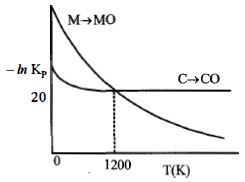
A
At $T < 1200 \ K$,oxidation of carbon is unfavourable.
B
Oxidation of carbon is favourable at all temperatures.
C
At $T < 1200 \ K$,the reaction $MO_{(s)} + C_{(s)} \to M_{(s)} + CO_{(g)}$ is spontaneous.
D
At $T > 1200 \ K$,carbon will reduce $MO_{(s)}$ to $M_{(s)}$.
Solution
(D) The relationship between Gibbs free energy change and equilibrium constant is $\Delta G^\circ = -RT \ln K_p$,which can be rewritten as $-\ln K_p = \frac{\Delta G^\circ}{RT}$.
For a reaction to be spontaneous,$\Delta G^\circ < 0$,which implies $-\ln K_p < 0$.
From the Ellingham diagram,at $T > 1200 \ K$,the value of $-\ln K_p$ for the reaction $C_{(s)} + \frac{1}{2} O_{2(g)} \to CO_{(g)}$ is lower than that for $M_{(s)} + \frac{1}{2} O_{2(g)} \to MO_{(s)}$.
This indicates that the formation of $CO$ is more thermodynamically stable than $MO$ at $T > 1200 \ K$.
Therefore,carbon can reduce $MO_{(s)}$ to $M_{(s)}$ at temperatures above $1200 \ K$ according to the reaction $MO_{(s)} + C_{(s)} \to M_{(s)} + CO_{(g)}$.
For a reaction to be spontaneous,$\Delta G^\circ < 0$,which implies $-\ln K_p < 0$.
From the Ellingham diagram,at $T > 1200 \ K$,the value of $-\ln K_p$ for the reaction $C_{(s)} + \frac{1}{2} O_{2(g)} \to CO_{(g)}$ is lower than that for $M_{(s)} + \frac{1}{2} O_{2(g)} \to MO_{(s)}$.
This indicates that the formation of $CO$ is more thermodynamically stable than $MO$ at $T > 1200 \ K$.
Therefore,carbon can reduce $MO_{(s)}$ to $M_{(s)}$ at temperatures above $1200 \ K$ according to the reaction $MO_{(s)} + C_{(s)} \to M_{(s)} + CO_{(g)}$.
0 likesView Solution
75
ChemistryDifficultMCQJEE Main · 2016
The most appropriate method of making egg albumin sol is
A
Break an egg carefully and transfer the transparent part of the content to $100 \ mL$ of $5 \ \% \ (w/V)$ saline solution and stir well.
B
Keep the egg in boiling water for $10 \ minutes$. After removing the shell,transfer the yellow part of the content to $100 \ mL$ of $5 \ \% \ (w/V)$ saline solution and homogenize with a mechanical shaker.
C
Keep the egg in boiling water for $10 \ minutes$. After removing the shell,transfer the white part of the content to $100 \ mL$ of $5 \ \% \ (w/V)$ saline solution and homogenize with a mechanical shaker.
D
Break an egg carefully and transfer only the yellow part of the content to $100 \ mL$ of $5 \ \% \ (w/V)$ saline solution and stir well.
Solution
(A) Preparation of egg albumin sol is done in the following two steps:
$(i)$ Prepare $100 \ mL$ of $5 \ \% \ (w/V)$ solution of $NaCl$ in water in a $250 \ mL$ beaker.
$(ii)$ Break one egg in a porcelain dish,pipette out the albumin (the transparent white part),and pour it into the sodium chloride solution. Stir well to ensure the preparation of the sol.
$(i)$ Prepare $100 \ mL$ of $5 \ \% \ (w/V)$ solution of $NaCl$ in water in a $250 \ mL$ beaker.
$(ii)$ Break one egg in a porcelain dish,pipette out the albumin (the transparent white part),and pour it into the sodium chloride solution. Stir well to ensure the preparation of the sol.
0 likesView Solution
76
ChemistryDifficultMCQJEE Main · 2016
The reaction of ozone with oxygen atoms in the presence of chlorine atoms can occur by a two-step process shown below:
$O_{3(g)} + Cl_{(g)}^{\bullet} \to O_{2(g)} + ClO_{(g)}^{\bullet}$ ..... $(i)$ $K_i = 5.2 \times 10^9 \ L \ mol^{-1} \ s^{-1}$
$ClO_{(g)}^{\bullet} + O_{(g)}^{\bullet} \to O_{2(g)} + Cl_{(g)}^{\bullet}$ ..... $(ii)$ $K_{ii} = 2.6 \times 10^{10} \ L \ mol^{-1} \ s^{-1}$
The closest rate constant for the overall reaction
$O_{3(g)} + O_{(g)}^{\bullet} \to 2O_{2(g)}$ is ........... $L \ mol^{-1} \ s^{-1}$
$O_{3(g)} + Cl_{(g)}^{\bullet} \to O_{2(g)} + ClO_{(g)}^{\bullet}$ ..... $(i)$ $K_i = 5.2 \times 10^9 \ L \ mol^{-1} \ s^{-1}$
$ClO_{(g)}^{\bullet} + O_{(g)}^{\bullet} \to O_{2(g)} + Cl_{(g)}^{\bullet}$ ..... $(ii)$ $K_{ii} = 2.6 \times 10^{10} \ L \ mol^{-1} \ s^{-1}$
The closest rate constant for the overall reaction
$O_{3(g)} + O_{(g)}^{\bullet} \to 2O_{2(g)}$ is ........... $L \ mol^{-1} \ s^{-1}$
A
$1.4 \times 10^{20}$
B
$3.1 \times 10^{10}$
C
$5.2 \times 10^9$
D
$2.6 \times 10^{10}$
Solution
(A) The overall reaction is obtained by adding the two elementary steps:
Step $(i): O_{3(g)} + Cl_{(g)}^{\bullet} \to O_{2(g)} + ClO_{(g)}^{\bullet}$
Step $(ii): ClO_{(g)}^{\bullet} + O_{(g)}^{\bullet} \to O_{2(g)} + Cl_{(g)}^{\bullet}$
Adding these gives: $O_{3(g)} + O_{(g)}^{\bullet} \to 2O_{2(g)}$
The rate of the overall reaction is determined by the product of the rate constants of the elementary steps in a mechanism where the intermediate $(ClO^{\bullet})$ cancels out.
$K_{overall} = K_i \times K_{ii}$
$K_{overall} = (5.2 \times 10^9) \times (2.6 \times 10^{10})$
$K_{overall} \approx 1.352 \times 10^{20} \approx 1.4 \times 10^{20} \ L \ mol^{-1} \ s^{-1}$
Step $(i): O_{3(g)} + Cl_{(g)}^{\bullet} \to O_{2(g)} + ClO_{(g)}^{\bullet}$
Step $(ii): ClO_{(g)}^{\bullet} + O_{(g)}^{\bullet} \to O_{2(g)} + Cl_{(g)}^{\bullet}$
Adding these gives: $O_{3(g)} + O_{(g)}^{\bullet} \to 2O_{2(g)}$
The rate of the overall reaction is determined by the product of the rate constants of the elementary steps in a mechanism where the intermediate $(ClO^{\bullet})$ cancels out.
$K_{overall} = K_i \times K_{ii}$
$K_{overall} = (5.2 \times 10^9) \times (2.6 \times 10^{10})$
$K_{overall} \approx 1.352 \times 10^{20} \approx 1.4 \times 10^{20} \ L \ mol^{-1} \ s^{-1}$
0 likesView Solution
77
ChemistryEasyMCQJEE Main · 2016
The artificial sweetener that has the highest sweetness value in comparison to cane sugar is
A
Sucralose
B
Aspartame
C
Saccharin
D
Alitame
Solution
(D) Alitame is a high-potency artificial sweetener that is approximately $2,000$ times as sweet as cane sugar.
It is much sweeter than other common artificial sweeteners like Aspartame ($100$ times),Saccharin ($550$ times),and Sucralose ($600$ times).
It is much sweeter than other common artificial sweeteners like Aspartame ($100$ times),Saccharin ($550$ times),and Sucralose ($600$ times).
0 likesView Solution
78
ChemistryDifficultMCQJEE Main · 2016
Which one of the following species is stable in aqueous solution?
A
$Cr^{2+}$
B
$MnO_4^{2-}$
C
$MnO_4^{3-}$
D
$Cu^{+}$
Solution
(B) The stability of species in aqueous solution depends on their tendency to undergo disproportionation or oxidation-reduction reactions.
$Cr^{2+}$ is a strong reducing agent and is easily oxidized to $Cr^{3+}$ in the presence of air or water.
$Cu^{+}$ undergoes disproportionation in aqueous solution: $2Cu^{+} \to Cu^{2+} + Cu$.
$MnO_4^{3-}$ is highly unstable and disproportionates rapidly.
$MnO_4^{2-}$ (manganate ion) is stable in strongly alkaline solutions,whereas it disproportionates in neutral or acidic media. Among the given options,$MnO_4^{2-}$ is the most stable species in specific aqueous conditions (alkaline medium).
$Cr^{2+}$ is a strong reducing agent and is easily oxidized to $Cr^{3+}$ in the presence of air or water.
$Cu^{+}$ undergoes disproportionation in aqueous solution: $2Cu^{+} \to Cu^{2+} + Cu$.
$MnO_4^{3-}$ is highly unstable and disproportionates rapidly.
$MnO_4^{2-}$ (manganate ion) is stable in strongly alkaline solutions,whereas it disproportionates in neutral or acidic media. Among the given options,$MnO_4^{2-}$ is the most stable species in specific aqueous conditions (alkaline medium).
0 likesView Solution
79
ChemistryDifficultMCQJEE Main · 2016
The test used to distinguish between primary,secondary,and tertiary amines is:
A
Sandmeyer's reaction
B
Carbylamine reaction
C
Mustard oil test
D
$C_6H_5SO_2Cl$
Solution
(D) Primary,secondary,and tertiary amines are distinguished by the Hinsberg reagent test.
The Hinsberg reagent is benzene sulphonyl chloride,represented as $C_6H_5SO_2Cl$.
The Hinsberg reagent is benzene sulphonyl chloride,represented as $C_6H_5SO_2Cl$.
0 likesView Solution
80
ChemistryMediumMCQJEE Main · 2016
The solubility of $N_2$ in water at $300 \ K$ and $500 \ torr$ partial pressure is $0.01 \ g \ L^{-1}$. The solubility (in $g \ L^{-1}$) at $750 \ torr$ partial pressure is
A
$0.0075$
B
$0.005$
C
$0.02$
D
$0.015$
Solution
(D) According to Henry's law,the solubility $(S)$ of a gas is directly proportional to its partial pressure $(P)$: $S \propto P$ or $S = kP$.
Given: $P_1 = 500 \ torr$,$S_1 = 0.01 \ g \ L^{-1}$,$P_2 = 750 \ torr$.
Using the relation $\frac{S_1}{S_2} = \frac{P_1}{P_2}$:
$\frac{0.01}{S_2} = \frac{500}{750}$
$S_2 = \frac{0.01 \times 750}{500} = 0.015 \ g \ L^{-1}$.
Given: $P_1 = 500 \ torr$,$S_1 = 0.01 \ g \ L^{-1}$,$P_2 = 750 \ torr$.
Using the relation $\frac{S_1}{S_2} = \frac{P_1}{P_2}$:
$\frac{0.01}{S_2} = \frac{500}{750}$
$S_2 = \frac{0.01 \times 750}{500} = 0.015 \ g \ L^{-1}$.
0 likesView Solution
81
ChemistryDifficultMCQJEE Main · 2016
Identify the correct trend given below.
(Atomic No. $= Ti : 22, Cr : 24$ and $Mo : 42$)
(Atomic No. $= Ti : 22, Cr : 24$ and $Mo : 42$)
A
$\Delta _0$ of $[Cr(H_2O)_6]^{2+} > [Mo(H_2O)_6]^{2+}$ and $\Delta _0$ of $[Ti(H_2O)_6]^{3+} > [Ti(H_2O)_6]^{2+}$
B
$\Delta _0$ of $[Cr(H_2O)_6]^{2+} > [Mo(H_2O)_6]^{2+}$ and $\Delta _0$ of $[Ti(H_2O)_6]^{3+} < [Ti(H_2O)_6]^{2+}$
C
$\Delta _0$ of $[Cr(H_2O)_6]^{2+} < [Mo(H_2O)_6]^{2+}$ and $\Delta _0$ of $[Ti(H_2O)_6]^{3+} > [Ti(H_2O)_6]^{2+}$
D
$\Delta _0$ of $[Cr(H_2O)_6]^{2+} < [Mo(H_2O)_6]^{2+}$ and $\Delta _0$ of $[Ti(H_2O)_6]^{3+} < [Ti(H_2O)_6]^{2+}$
Solution
(C) The crystal field splitting energy $(\Delta _0)$ is directly proportional to the oxidation state of the central metal ion. $A$ higher oxidation state results in a greater electrostatic attraction between the ligands and the metal,leading to larger splitting.
Therefore,$\Delta _0$ of $[Ti(H_2O)_6]^{3+} > \Delta _0$ of $[Ti(H_2O)_6]^{2+}$.
Additionally,$\Delta _0$ increases down a group because the $4d$ orbitals are more extended than $3d$ orbitals,leading to stronger interaction with ligands. Thus,$\Delta _0$ of $[Mo(H_2O)_6]^{2+} > \Delta _0$ of $[Cr(H_2O)_6]^{2+}$.
Combining these,the correct trend is $\Delta _0$ of $[Cr(H_2O)_6]^{2+} < [Mo(H_2O)_6]^{2+}$ and $\Delta _0$ of $[Ti(H_2O)_6]^{3+} > [Ti(H_2O)_6]^{2+}$.
Therefore,$\Delta _0$ of $[Ti(H_2O)_6]^{3+} > \Delta _0$ of $[Ti(H_2O)_6]^{2+}$.
Additionally,$\Delta _0$ increases down a group because the $4d$ orbitals are more extended than $3d$ orbitals,leading to stronger interaction with ligands. Thus,$\Delta _0$ of $[Mo(H_2O)_6]^{2+} > \Delta _0$ of $[Cr(H_2O)_6]^{2+}$.
Combining these,the correct trend is $\Delta _0$ of $[Cr(H_2O)_6]^{2+} < [Mo(H_2O)_6]^{2+}$ and $\Delta _0$ of $[Ti(H_2O)_6]^{3+} > [Ti(H_2O)_6]^{2+}$.
0 likesView Solution
82
ChemistryMediumMCQJEE Main · 2016
Which of the following polymers is synthesized using a free radical polymerization technique?
A
Terylene
B
Melamine polymer
C
Nylon $6, 6$
D
Teflon
Solution
(D) Teflon (polytetrafluoroethene) is an addition polymer formed by the free radical polymerization of its monomer,tetrafluoroethene $(CF_2 = CF_2)$.
In contrast,Terylene,Melamine polymer,and Nylon-$6, 6$ are condensation polymers formed by the elimination of small molecules like water or alcohol.
In contrast,Terylene,Melamine polymer,and Nylon-$6, 6$ are condensation polymers formed by the elimination of small molecules like water or alcohol.
0 likesView Solution
83
ChemistryDifficultMCQJEE Main · 2016
Fluorination of an aromatic ring is easily accomplished by treating a diazonium salt with $HBF_4$. Which of the following conditions is correct about this reaction?
A
$NaF/Cu$
B
$Cu_2O/H_2O$
C
Only heat
D
$NaNO_2/Cu$
Solution
(C) The reaction described is the Balz-Schiemann reaction.
In this reaction,an aromatic diazonium salt is treated with fluoroboric acid $(HBF_4)$ to form an insoluble diazonium fluoroborate salt $(ArN_2^ BF_4^-)$.
Upon heating this salt,it undergoes thermal decomposition to yield an aryl fluoride,nitrogen gas $(N_2)$,and boron trifluoride $(BF_3)$.
Therefore,the condition required for the conversion of the diazonium fluoroborate to the aryl fluoride is simply heating $(\Delta)$.
In this reaction,an aromatic diazonium salt is treated with fluoroboric acid $(HBF_4)$ to form an insoluble diazonium fluoroborate salt $(ArN_2^ BF_4^-)$.
Upon heating this salt,it undergoes thermal decomposition to yield an aryl fluoride,nitrogen gas $(N_2)$,and boron trifluoride $(BF_3)$.
Therefore,the condition required for the conversion of the diazonium fluoroborate to the aryl fluoride is simply heating $(\Delta)$.
0 likesView Solution
84
ChemistryDifficultMCQJEE Main · 2016
Gold numbers of some colloids are: Gelatin $0.005-0.01$,Gum arabic: $0.15-0.25$; Oleate: $0.04-1.0$; Starch: $15-25$. Which among these is a better protective colloid?
A
Gelatin
B
Starch
C
Oleate
D
Gum arabic
Solution
(A) The protective power of a colloid is inversely proportional to its gold number.
$\text{Gold number} \propto \frac{1}{\text{Protective power}}$
This means that the smaller the value of the gold number of a lyophilic sol,the greater is its protective action.
Comparing the given values: Gelatin $(0.005-0.01)$ has the lowest gold number among the options.
Therefore,Gelatin is the best protective colloid.
$\text{Gold number} \propto \frac{1}{\text{Protective power}}$
This means that the smaller the value of the gold number of a lyophilic sol,the greater is its protective action.
Comparing the given values: Gelatin $(0.005-0.01)$ has the lowest gold number among the options.
Therefore,Gelatin is the best protective colloid.
0 likesView Solution
85
ChemistryDifficultMCQJEE Main · 2016
The $N$ atom which does not contribute to the basicity of the given compound is:
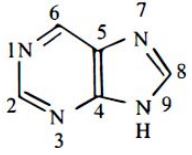
A
$N-9$
B
$N-3$
C
$N-1$
D
$N-7$
Solution
(A) The given compound is purine.
In purine,the lone pair of electrons on the $N-9$ atom is involved in the aromatic sextet of the imidazole ring.
Therefore,this lone pair is not available for protonation,and $N-9$ does not contribute to the basicity of the compound.
Other nitrogen atoms $(N-1, N-3, N-7)$ have lone pairs in $sp^2$ hybridized orbitals that are not involved in aromaticity,making them available for protonation.
In purine,the lone pair of electrons on the $N-9$ atom is involved in the aromatic sextet of the imidazole ring.
Therefore,this lone pair is not available for protonation,and $N-9$ does not contribute to the basicity of the compound.
Other nitrogen atoms $(N-1, N-3, N-7)$ have lone pairs in $sp^2$ hybridized orbitals that are not involved in aromaticity,making them available for protonation.
0 likesView Solution
86
ChemistryDifficultMCQJEE Main · 2016
Which one of the following reagents is not suitable for the elimination reaction shown in the image?

A
$NaI$
B
$NaOEt/EtOH$
C
$NaOH/H_2O$
D
$NaOH/EtOH$
Solution
(A) The reaction shown is the dehydrohalogenation of an alkyl halide to form an alkene,which is an elimination reaction.
$NaOEt/EtOH$ (sodium ethoxide in ethanol) is a strong base and is highly effective for $E2$ elimination reactions.
$NaOH/EtOH$ (sodium hydroxide in ethanol) is also a strong base and is commonly used for elimination reactions.
$NaOH/H_2O$ (aqueous sodium hydroxide) primarily favors substitution ($S_N2$ or $S_N1$) over elimination because water is a polar protic solvent that solvates the hydroxide ion,reducing its basicity.
$NaI$ (sodium iodide) is a nucleophile and is typically used in substitution reactions,such as the Finkelstein reaction,to convert alkyl chlorides or bromides into alkyl iodides. It is not a base and therefore cannot promote an elimination reaction.
Thus,both $NaI$ and $NaOH/H_2O$ are not suitable for elimination,but $NaI$ is the most distinct reagent that acts as a nucleophile rather than a base.
$NaOEt/EtOH$ (sodium ethoxide in ethanol) is a strong base and is highly effective for $E2$ elimination reactions.
$NaOH/EtOH$ (sodium hydroxide in ethanol) is also a strong base and is commonly used for elimination reactions.
$NaOH/H_2O$ (aqueous sodium hydroxide) primarily favors substitution ($S_N2$ or $S_N1$) over elimination because water is a polar protic solvent that solvates the hydroxide ion,reducing its basicity.
$NaI$ (sodium iodide) is a nucleophile and is typically used in substitution reactions,such as the Finkelstein reaction,to convert alkyl chlorides or bromides into alkyl iodides. It is not a base and therefore cannot promote an elimination reaction.
Thus,both $NaI$ and $NaOH/H_2O$ are not suitable for elimination,but $NaI$ is the most distinct reagent that acts as a nucleophile rather than a base.
0 likesView Solution
87
ChemistryDifficultMCQJEE Main · 2016
The transition metal ions responsible for colour in ruby and emerald are,respectively:
A
$Co^{3+}$ and $Cr^{3+}$
B
$Co^{3+}$ and $Co^{3+}$
C
$Cr^{3+}$ and $Cr^{3+}$
D
$Cr^{3+}$ and $Co^{3+}$
Solution
(C) ruby is a crystal of alumina,aluminum oxide $(Al_2O_3)$,containing a trace of chromium $(III)$ ions replacing some of the aluminum ions.
In ruby,each $Al^{3+}$ ion and $Cr^{3+}$ ion is surrounded by six oxide ions in an octahedral arrangement.
The origin of the color of emeralds is similar to that of the color of rubies.
However,the bulk of an emerald crystal is composed of beryl,beryllium aluminum silicate $(Be_3Al_2(SiO_3)_6)$,instead of the alumina which forms rubies.
The color is produced by chromium $(III)$ ions,which replace some of the aluminum ions in the crystal.
In emeralds,the $Cr^{3+}$ is surrounded by six silicate ions,rather than the six oxide ions in ruby.
Therefore,both ruby and emerald derive their color from the presence of $Cr^{3+}$ ions.
In ruby,each $Al^{3+}$ ion and $Cr^{3+}$ ion is surrounded by six oxide ions in an octahedral arrangement.
The origin of the color of emeralds is similar to that of the color of rubies.
However,the bulk of an emerald crystal is composed of beryl,beryllium aluminum silicate $(Be_3Al_2(SiO_3)_6)$,instead of the alumina which forms rubies.
The color is produced by chromium $(III)$ ions,which replace some of the aluminum ions in the crystal.
In emeralds,the $Cr^{3+}$ is surrounded by six silicate ions,rather than the six oxide ions in ruby.
Therefore,both ruby and emerald derive their color from the presence of $Cr^{3+}$ ions.
0 likesView Solution
88
ChemistryMediumMCQJEE Main · 2016
An aqueous solution of a salt $MX_2$ at a certain temperature has a van't Hoff factor of $2$. The degree of dissociation for this solution of the salt is
A
$0.50$
B
$0.33$
C
$0.67$
D
$0.80$
Solution
(A) The dissociation of the salt $MX_2$ is represented as: $MX_2 \rightleftharpoons M^{2+} + 2X^-$.
Let the initial concentration be $1$ mole.
At equilibrium,the moles are: $M^{2+} = \alpha$,$X^- = 2\alpha$,and $MX_2 = 1 - \alpha$,where $\alpha$ is the degree of dissociation.
The total number of particles at equilibrium is $(1 - \alpha) + \alpha + 2\alpha = 1 + 2\alpha$.
The van't Hoff factor $i$ is given by the ratio of the total number of particles at equilibrium to the initial number of particles: $i = \frac{1 + 2\alpha}{1}$.
Given $i = 2$,we have $1 + 2\alpha = 2$.
Solving for $\alpha$: $2\alpha = 1$,which gives $\alpha = 0.50$.
Let the initial concentration be $1$ mole.
At equilibrium,the moles are: $M^{2+} = \alpha$,$X^- = 2\alpha$,and $MX_2 = 1 - \alpha$,where $\alpha$ is the degree of dissociation.
The total number of particles at equilibrium is $(1 - \alpha) + \alpha + 2\alpha = 1 + 2\alpha$.
The van't Hoff factor $i$ is given by the ratio of the total number of particles at equilibrium to the initial number of particles: $i = \frac{1 + 2\alpha}{1}$.
Given $i = 2$,we have $1 + 2\alpha = 2$.
Solving for $\alpha$: $2\alpha = 1$,which gives $\alpha = 0.50$.
0 likesView Solution
89
ChemistryDifficultMCQJEE Main · 2016
Oxidation of succinate ion produces ethylene and carbon dioxide gases. On passing $0.2 \ F$ electricity through an aqueous solution of potassium succinate,the total volume of gases (at both cathode and anode) at $STP$ ($1 \ atm$ and $273 \ K$) is .............. $L$
A
$8.96$
B
$4.48$
C
$6.72$
D
$2.24$
Solution
(A) At Anode: $^-OOC-CH_2-CH_2-COO^- \rightarrow CH_2=CH_2 + 2CO_2 + 2e^-$. For $2 \ F$ electricity,$3 \ moles$ of gas ($1 \ mole \ C_2H_4$ and $2 \ moles \ CO_2$) are produced.
At Cathode: $2H_2O + 2e^- \rightarrow H_2 + 2OH^-$. For $2 \ F$ electricity,$1 \ mole \ H_2$ gas is produced.
Total moles of gas for $2 \ F = 3 + 1 = 4 \ moles$.
Total moles of gas for $0.2 \ F = (4/2) \times 0.2 = 0.4 \ moles$.
Total volume at $STP = 0.4 \times 22.4 = 8.96 \ L$.
At Cathode: $2H_2O + 2e^- \rightarrow H_2 + 2OH^-$. For $2 \ F$ electricity,$1 \ mole \ H_2$ gas is produced.
Total moles of gas for $2 \ F = 3 + 1 = 4 \ moles$.
Total moles of gas for $0.2 \ F = (4/2) \times 0.2 = 0.4 \ moles$.
Total volume at $STP = 0.4 \times 22.4 = 8.96 \ L$.
0 likesView Solution
90
ChemistryMediumMCQJEE Main · 2016
Observation of "Ruhemann's purple" is a confirmatory test for the presence of
A
Starch
B
Reducing sugar
C
Protein
D
Cupric ion
Solution
(C) Ninhydrin is often used to detect $\alpha$-amino acids and also free amino and carboxylic acid groups on proteins and peptides.
When about $0.5 \ mL$ of a $0.1\%$ solution of ninhydrin is boiled for one or two minutes with a few $mL$ of dilute amino acid or protein solution,a blue color develops.
Ninhydrin degrades amino acids into aldehydes,ammonia,and $CO_2$ through a series of reactions; the net result is ninhydrin in a partially reduced form,hydrindantin.
Ninhydrin then condenses with ammonia and hydrindantin to produce an intensely blue or purple pigment,sometimes called Ruhemann's purple.
When about $0.5 \ mL$ of a $0.1\%$ solution of ninhydrin is boiled for one or two minutes with a few $mL$ of dilute amino acid or protein solution,a blue color develops.
Ninhydrin degrades amino acids into aldehydes,ammonia,and $CO_2$ through a series of reactions; the net result is ninhydrin in a partially reduced form,hydrindantin.
Ninhydrin then condenses with ammonia and hydrindantin to produce an intensely blue or purple pigment,sometimes called Ruhemann's purple.
0 likesView Solution
91
ChemistryDifficultMCQJEE Main · 2016
The correct statement about the synthesis of pentaerythritol $(C(CH_2OH)_4)$ used in the preparation of $PETN$ is
A
The synthesis requires three aldol condensations and one Cannizzaro reaction
B
Alpha hydrogens of ethanol and methanol are involved in this reaction.
C
The synthesis requires two aldol condensations and two Cannizzaro reactions
D
The synthesis requires four aldol condensations between methanol and ethanol
Solution
(A) Pentaerythritol is produced by a base-catalyzed reaction of acetaldehyde with excess formaldehyde.
First,three moles of formaldehyde undergo aldol condensation with one mole of acetaldehyde to form pentaerythrose: $CH_3CHO + 3HCHO \to C(CH_2OH)_3CHO$.
This is followed by a crossed Cannizzaro reaction between the intermediate and another mole of formaldehyde to yield pentaerythritol and sodium formate: $C(CH_2OH)_3CHO + HCHO + NaOH \to C(CH_2OH)_4 + HCOONa$.
Thus,the process involves three aldol condensations and one Cannizzaro reaction.
First,three moles of formaldehyde undergo aldol condensation with one mole of acetaldehyde to form pentaerythrose: $CH_3CHO + 3HCHO \to C(CH_2OH)_3CHO$.
This is followed by a crossed Cannizzaro reaction between the intermediate and another mole of formaldehyde to yield pentaerythritol and sodium formate: $C(CH_2OH)_3CHO + HCHO + NaOH \to C(CH_2OH)_4 + HCOONa$.
Thus,the process involves three aldol condensations and one Cannizzaro reaction.
0 likesView Solution
92
ChemistryMediumMCQJEE Main · 2016
Which of the following is a bactericidal antibiotic?
A
Ofloxacin
B
Tetracycline
C
Chloramphenicol
D
Erythromycin
Solution
(A) Antibiotics are classified as either bactericidal (kill bacteria) or bacteriostatic (inhibit the growth of bacteria).
$Ofloxacin$ is a bactericidal antibiotic.
$Tetracycline$,$Chloramphenicol$,and $Erythromycin$ are examples of bacteriostatic antibiotics.
$Ofloxacin$ is a bactericidal antibiotic.
$Tetracycline$,$Chloramphenicol$,and $Erythromycin$ are examples of bacteriostatic antibiotics.
0 likesView Solution
93
ChemistryDifficultMCQJEE Main · 2016
Identify the incorrect statement.
A
The $S-S-S$ bond angles in the $S_8$ and $S_6$ rings are the same.
B
Rhombic and monoclinic sulphur have $S_8$ molecules.
C
$S_2$ is paramagnetic like oxygen.
D
$S_8$ ring has a crown shape.
Solution
(A) The $S_6$ molecule has a chair-form hexagon ring with the same bond length as that in $S_8$,but with somewhat smaller bond angles. Therefore,the bond angles in $S_8$ (crown shape,$\approx 107^{\circ}$) and $S_6$ (chair shape,$\approx 102^{\circ}$) are different. Thus,statement $A$ is incorrect.
0 likesView Solution
94
ChemistryMediumMCQJEE Main · 2016
Extraction of copper by smelting uses silica as an additive to remove
A
$Cu_2O$
B
$FeS$
C
$FeO$
D
$Cu_2S$
Solution
(C) In the extraction of copper,$FeO$ is present as a basic gangue impurity.
$SiO_2$ is added as an acidic flux to remove this impurity.
They react to form a fusible slag,$FeSiO_3$.
The reaction is: $\mathop {FeO}\limits_{\text{Basic impurity}} + \mathop {SiO_2}\limits_{\text{Acidic flux}}$ $\longrightarrow \mathop {FeSiO_3}\limits_{\text{Slag}}$
$SiO_2$ is added as an acidic flux to remove this impurity.
They react to form a fusible slag,$FeSiO_3$.
The reaction is: $\mathop {FeO}\limits_{\text{Basic impurity}} + \mathop {SiO_2}\limits_{\text{Acidic flux}}$ $\longrightarrow \mathop {FeSiO_3}\limits_{\text{Slag}}$
0 likesView Solution
95
ChemistryDifficultMCQJEE Main · 2016
The rate law for the reaction below is given by the expression $Rate = k[A][B]$.
$A + B \to \text{Product}$
If the concentration of $B$ is increased from $0.1 \ M$ to $0.3 \ M$,keeping the concentration of $A$ constant at $0.1 \ M$,the rate constant $(k)$ will be:
$A + B \to \text{Product}$
If the concentration of $B$ is increased from $0.1 \ M$ to $0.3 \ M$,keeping the concentration of $A$ constant at $0.1 \ M$,the rate constant $(k)$ will be:
A
$3k$
B
$9k$
C
$k/3$
D
$k$
Solution
(D) The rate constant $(k)$ is a characteristic property of a reaction at a given temperature.
It does not depend on the concentration of the reactants.
Therefore,changing the concentration of $B$ will change the reaction rate,but the rate constant $(k)$ remains unchanged.
It does not depend on the concentration of the reactants.
Therefore,changing the concentration of $B$ will change the reaction rate,but the rate constant $(k)$ remains unchanged.
0 likesView Solution
96
ChemistryMediumMCQJEE Main · 2016
The following statements concern elements in the periodic table. Which of the following is true?
A
For Group $15$ elements,the stability of $+5$ oxidation state increases down the group
B
Elements of Group $16$ have lower ionization enthalpy values compared to those of Group $15$ in the corresponding periods
C
The Group $13$ elements are all metals
D
All the elements in Group $17$ are gases
Solution
(B) Group $15$ elements have a stable half-filled $ns^2 np^3$ electronic configuration.
Due to this extra stability,they have higher ionization enthalpy values compared to Group $16$ elements in the corresponding periods.
Therefore,Group $16$ elements have lower ionization enthalpy values compared to Group $15$ elements.
Due to this extra stability,they have higher ionization enthalpy values compared to Group $16$ elements in the corresponding periods.
Therefore,Group $16$ elements have lower ionization enthalpy values compared to Group $15$ elements.
0 likesView Solution
97
ChemistryDifficultMCQJEE Main · 2016
Which of the following is an example of a homoleptic complex?
A
$[Co(NH_3)_6]Cl_3$
B
$[Pt(NH_3)_2Cl_2]$
C
$[Co(NH_3)_4Cl_2]$
D
$[Co(NH_3)_5Cl]Cl_2$
Solution
(A) homoleptic complex is a coordination compound in which the metal atom or ion is bonded to only one type of donor atom or ligand.
In the complex $[Co(NH_3)_6]Cl_3$,the central metal ion $Co^{3+}$ is bonded to six $NH_3$ ligands,which are all of the same type.
Therefore,$[Co(NH_3)_6]Cl_3$ is a homoleptic complex.
In the complex $[Co(NH_3)_6]Cl_3$,the central metal ion $Co^{3+}$ is bonded to six $NH_3$ ligands,which are all of the same type.
Therefore,$[Co(NH_3)_6]Cl_3$ is a homoleptic complex.
0 likesView Solution
98
ChemistryDifficultMCQJEE Main · 2016
Identify the correct statement.
A
Corrosion of iron can be minimized by forming a contact with another metal with a higher reduction potential.
B
Iron corrodes in oxygen-free water.
C
Corrosion of iron can be minimized by forming an impermeable barrier at its surface.
D
Iron corrodes more rapidly in salt water because its electrochemical potential is higher.
Solution
(C) Corrosion of iron is an electrochemical process that requires both oxygen and moisture.
It can be prevented or minimized by creating an impermeable barrier (like paint or galvanization) on the surface of the iron to prevent contact with air and moisture.
Option $A$ is incorrect because iron should be in contact with a metal having a lower reduction potential (like $Zn$) for cathodic protection.
Option $B$ is incorrect as iron does not corrode significantly in oxygen-free water.
Option $D$ is incorrect because salt water acts as an electrolyte,increasing the conductivity and rate of the electrochemical reaction,not because the potential of iron changes.
It can be prevented or minimized by creating an impermeable barrier (like paint or galvanization) on the surface of the iron to prevent contact with air and moisture.
Option $A$ is incorrect because iron should be in contact with a metal having a lower reduction potential (like $Zn$) for cathodic protection.
Option $B$ is incorrect as iron does not corrode significantly in oxygen-free water.
Option $D$ is incorrect because salt water acts as an electrolyte,increasing the conductivity and rate of the electrochemical reaction,not because the potential of iron changes.
0 likesView Solution
Vedclass Products
For Students
Vedclass Test Series
Mock tests in real JEE Main style covering Chemistry with performance analysis. 5-day free trial.
Start Free TrialFor Teachers
Exam Paper Generator
Generate Set A/B/C/D Chemistry papers from 7.5L+ questions in 2 minutes. 3 chapters free.
Try FreeFor Institutes
Online Exam Module
Run live JEE Main mock exams with unlimited students, 360° analytics & white-label branding.
See DemoFrequently Asked Questions
How many Chemistry questions are in JEE Main 2016?
There are 100 Chemistry questions from the JEE Main 2016 paper on Vedclass, each with a detailed step-by-step solution in English.
Are JEE Main 2016 Chemistry solutions available in English?
Yes. All solutions on this page are in English. You can also switch to English or Hindi using the language buttons above the questions.
Can I practice JEE Main 2016 Chemistry as a timed test?
Yes. Use the Vedclass Test Series to attempt a full JEE Main mock test covering Chemistry with time limits and instant score analysis.
Can teachers create Chemistry papers from JEE Main previous year questions?
Yes. The Vedclass Exam Paper Generator lets teachers mix JEE Main Chemistry questions and generate Set A/B/C/D papers in minutes.
For Teachers & Institutes
Build a Custom Chemistry Paper
Pick JEE Main 2016 Chemistry questions, set difficulty, and generate Set A/B/C/D in 2 minutes.