
BiologyQ1–40 of 40 questions
Page 1 of 1 · English
1
BiologyEasyMCQGUJCET · 2026
Which of the following bacteria is free-living in the soil?
A
Azospirillum
B
Rhizobium
C
Oscillatoria
D
Trichoderma
Solution
(A) $Azospirillum$ is a well-known nitrogen-fixing bacterium that lives freely in the soil.
Unlike $Rhizobium$,which forms a symbiotic relationship with the root nodules of leguminous plants,$Azospirillum$ can fix atmospheric nitrogen while living independently in the soil.
Unlike $Rhizobium$,which forms a symbiotic relationship with the root nodules of leguminous plants,$Azospirillum$ can fix atmospheric nitrogen while living independently in the soil.
0 likesView Solution
2
BiologyEasyMCQGUJCET · 2026
During which geological period did the order $Gnetales$ of gymnosperms evolve?
A
Cretaceous
B
Jurassic
C
Triassic
D
Permian
Solution
(A) The order $Gnetales$,which comprises the genera $Gnetum$,$Ephedra$,and $Welwitschia$,is considered one of the most advanced groups of gymnosperms.
Fossil evidence suggests that this group evolved and diversified significantly during the $Cretaceous$ period.
Fossil evidence suggests that this group evolved and diversified significantly during the $Cretaceous$ period.
0 likesView Solution
3
BiologyMediumMCQGUJCET · 2026
Which two parts of different plants can be fused for the formation of a new plant in somatic hybridisation?
A
Eggs
B
Protoplast
C
Male and female gametes
D
Pollen grains
Solution
(B) Somatic hybridization is a technique in plant tissue culture that involves the fusion of protoplasts from two different plant species.
$1$. The cell walls of the plant cells are removed using enzymes to obtain protoplasts.
$2$. These protoplasts are then fused together using chemical or electrical methods to form a hybrid cell.
$3$. This hybrid cell is then cultured to develop into a new somatic hybrid plant.
$1$. The cell walls of the plant cells are removed using enzymes to obtain protoplasts.
$2$. These protoplasts are then fused together using chemical or electrical methods to form a hybrid cell.
$3$. This hybrid cell is then cultured to develop into a new somatic hybrid plant.
0 likesView Solution
4
BiologyMediumMCQGUJCET · 2026
In Meselson and Stahl's experiment,heavy $DNA$ molecules could be distinguished from normal $DNA$ by centrifugation in a . . . . . . density gradient.
A
Trichloroacetic acid
B
Ethidium bromide
C
CsCl
D
NH4Cl
Solution
(C) Meselson and Stahl used $CsCl$ (Cesium chloride) density gradient centrifugation to distinguish between $^{15}N$ (heavy) and $^{14}N$ (light) $DNA$ isotopes based on their density differences. The $CsCl$ solution creates a density gradient that allows $DNA$ molecules to settle at positions corresponding to their buoyant density.
0 likesView Solution
5
BiologyMediumMCQGUJCET · 2026
Select the incorrect option for mutation.
A
Results in changes in genotype and phenotype
B
According to Hugo de Vries,mutation is small and directional
C
According to De Vries,mutation is the reason for speciation
D
Results in alteration of $DNA$ sequence
Solution
(B) According to Hugo de Vries,mutations are large,random,and directionless (saltation),not small and directional. Therefore,option $B$ is incorrect.
0 likesView Solution
6
BiologyMediumMCQGUJCET · 2026
In the given assisted reproductive technologies,which method involves the process of fertilization taking place inside the body?
A
$ICSI$
B
$IUT$
C
$ZIFT$
D
$GIFT$
Solution
(D) $GIFT$ ($Gamete$ $Intra-Fallopian$ $Transfer$) is an assisted reproductive technology where gametes (ovum and sperm) are transferred directly into the fallopian tube of the female. Since the gametes are placed in the fallopian tube,the process of fertilization occurs naturally inside the female body. In contrast,$ICSI$,$IUT$,and $ZIFT$ involve fertilization outside the body ($in$ $vitro$).
0 likesView Solution
7
BiologyMediumMCQGUJCET · 2026
Which of the following hormones is not produced by the placenta?
A
Relaxin
B
Estrogen
C
Human placental Lactogen
D
Gonadotropin
Solution
(A) The placenta acts as an endocrine tissue and produces several hormones essential for pregnancy,including $hCG$ (Human Chorionic Gonadotropin),$hPL$ (Human placental Lactogen),estrogen,and progesterone.
Relaxin is primarily secreted by the corpus luteum in the ovary,not by the placenta.
Relaxin is primarily secreted by the corpus luteum in the ovary,not by the placenta.
0 likesView Solution
8
BiologyMediumMCQGUJCET · 2026
In an angiosperm plant,the endosperm cell has $24$ chromosomes. How many chromosomes are present in the $MMC$ of the same plant?
A
$8$
B
$12$
C
$16$
D
$32$
Solution
(C) In angiosperms,the endosperm is formed by the fusion of two polar nuclei and one male gamete,making it triploid $(3n)$.
Given that the endosperm cell has $3n = 24$ chromosomes,we can calculate the haploid number $(n)$ as $n = 24 / 3 = 8$.
The Megaspore Mother Cell $(MMC)$ is a diploid cell $(2n)$ found in the ovule.
Therefore,the number of chromosomes in the $MMC$ is $2n = 2 \times 8 = 16$.
Given that the endosperm cell has $3n = 24$ chromosomes,we can calculate the haploid number $(n)$ as $n = 24 / 3 = 8$.
The Megaspore Mother Cell $(MMC)$ is a diploid cell $(2n)$ found in the ovule.
Therefore,the number of chromosomes in the $MMC$ is $2n = 2 \times 8 = 16$.
0 likesView Solution
9
BiologyEasyMCQGUJCET · 2026
Match List-$I$ and List-$II$ and choose the correct option.
| List-$I$ | List-$II$ |
|---|---|
| $(i)$ Dodo | $(p)$ Africa |
| $(ii)$ Quagga | $(q)$ Mauritius |
| $(iii)$ Thylacine | $(r)$ Russia |
| $(iv)$ Steller's sea cow | $(s)$ Australia |
A
$(i-q), (ii-p), (iii-s), (iv-r)$
B
$(i-s), (ii-r), (iii-q), (iv-p)$
C
$(i-q), (ii-r), (iii-s), (iv-p)$
D
$(i-r), (ii-s), (iii-p), (iv-q)$
Solution
(A) The correct matches are as follows:
$(i)$ Dodo is from Mauritius $(i-q)$.
$(ii)$ Quagga is from Africa $(ii-p)$.
$(iii)$ Thylacine is from Australia $(iii-s)$.
$(iv)$ Steller's sea cow is from Russia $(iv-r)$.
Therefore,the correct sequence is $(i-q), (ii-p), (iii-s), (iv-r)$.
$(i)$ Dodo is from Mauritius $(i-q)$.
$(ii)$ Quagga is from Africa $(ii-p)$.
$(iii)$ Thylacine is from Australia $(iii-s)$.
$(iv)$ Steller's sea cow is from Russia $(iv-r)$.
Therefore,the correct sequence is $(i-q), (ii-p), (iii-s), (iv-r)$.
0 likesView Solution
10
BiologyMediumMCQGUJCET · 2026
In the given statements,select the correct option for the process of decomposition.
$(1)$ Moist environment favours decomposition.
$(2)$ Low temperature and anaerobiosis inhibit decomposition.
$(3)$ Decomposition is slower,if detritus is rich in nitrogen.
$(4)$ Decomposition is quicker if detritus is rich in chitin.
$(5)$ Warm environment favours decomposition.
$(1)$ Moist environment favours decomposition.
$(2)$ Low temperature and anaerobiosis inhibit decomposition.
$(3)$ Decomposition is slower,if detritus is rich in nitrogen.
$(4)$ Decomposition is quicker if detritus is rich in chitin.
$(5)$ Warm environment favours decomposition.
A
$1, 5$ are true
B
$3, 4, 5$ are true
C
$1, 2, 5$ are true
D
$1, 2, 3, 5$ are true
Solution
(C) Decomposition is the process of breakdown of complex organic matter into inorganic substances.
$(1)$ Moist environments provide necessary water for microbial activity,thus favouring decomposition.
$(2)$ Low temperature and anaerobic conditions (lack of oxygen) slow down the metabolic activities of decomposers,thus inhibiting the process.
$(3)$ Decomposition is faster if detritus is rich in nitrogen and water-soluble substances like sugars. Thus,statement $(3)$ is false.
$(4)$ Decomposition is slower if detritus is rich in lignin and chitin. Thus,statement $(4)$ is false.
$(5)$ Warm environments increase the rate of enzymatic reactions,thus favouring decomposition.
Therefore,statements $(1)$,$(2)$,and $(5)$ are true.
$(1)$ Moist environments provide necessary water for microbial activity,thus favouring decomposition.
$(2)$ Low temperature and anaerobic conditions (lack of oxygen) slow down the metabolic activities of decomposers,thus inhibiting the process.
$(3)$ Decomposition is faster if detritus is rich in nitrogen and water-soluble substances like sugars. Thus,statement $(3)$ is false.
$(4)$ Decomposition is slower if detritus is rich in lignin and chitin. Thus,statement $(4)$ is false.
$(5)$ Warm environments increase the rate of enzymatic reactions,thus favouring decomposition.
Therefore,statements $(1)$,$(2)$,and $(5)$ are true.
0 likesView Solution
11
BiologyDifficultMCQGUJCET · 2026
In a forest,there are initially $100$ deer. Over a certain period,$30$ are born and $10$ die. Assuming food is abundant and predators are few,calculate the intrinsic rate of natural increase for that population.
A
$0.015$
B
$0.2$
C
$0.18$
D
$0.4$
Solution
(B) The initial population size $(N)$ is $100$.
Number of births $(B)$ is $30$.
Number of deaths $(D)$ is $10$.
The net increase in population is calculated as $B - D = 30 - 10 = 20$.
The intrinsic rate of natural increase $(r)$ is calculated by dividing the net increase by the initial population size.
$r = \frac{20}{100} = 0.2$.
Therefore,the intrinsic rate of natural increase for the population is $0.2$.
Number of births $(B)$ is $30$.
Number of deaths $(D)$ is $10$.
The net increase in population is calculated as $B - D = 30 - 10 = 20$.
The intrinsic rate of natural increase $(r)$ is calculated by dividing the net increase by the initial population size.
$r = \frac{20}{100} = 0.2$.
Therefore,the intrinsic rate of natural increase for the population is $0.2$.
0 likesView Solution
12
BiologyEasyMCQGUJCET · 2026
At present,about . . . . . . recombinant therapeutics have been approved for human use,the world over.
A
$30$
B
$15$
C
$25$
D
$10$
Solution
(A) According to the $NCERT$ Biology textbook,there are about $30$ recombinant therapeutics that have been approved for human use worldwide.
0 likesView Solution
13
BiologyEasyMCQGUJCET · 2026
The separated bands of $DNA$ are cut out from the agarose gel and extracted from the gel piece. This step is known as . . . . . . .
A
Extension
B
Biolistics
C
Micro-injection
D
Elution
Solution
(D) In gel electrophoresis,the separated $DNA$ fragments are visualized and then cut out from the agarose gel. The process of extracting $DNA$ from the gel piece is known as elution.
0 likesView Solution
14
BiologyMediumMCQGUJCET · 2026
Which chemical causes the side-effect of enlargement of the clitoris in females?
A
Narcotic analgesics
B
Peptide Hormone
C
Anabolic steroids
D
Diuretics
Solution
(C) Anabolic steroids are synthetic variants of the male sex hormone testosterone. When used by females,they can cause masculinizing side-effects such as the enlargement of the clitoris,increased hair growth,and deepening of the voice.
0 likesView Solution
15
BiologyMediumMCQGUJCET · 2026
Match List-$I$ and List-$II$ and choose the correct option.
| List-$I$ | List-$II$ |
| $(i)$ $65$ million years ago | $(p)$ Sea weeds existed |
| $(ii)$ $350$ million years ago | $(q)$ Invertebrates formed |
| $(iii)$ $500$ million years ago | $(r)$ Jawless fish evolved |
| $(iv)$ $320$ million years ago | $(s)$ Dinosaurs disappeared |
A
$(i-q), (ii-p), (iii-s), (iv-r)$
B
$(i-s), (ii-r), (iii-p), (iv-q)$
C
$(i-r), (ii-p), (iii-s), (iv-q)$
D
$(i-s), (ii-r), (iii-q), (iv-p)$
Solution
(D) The evolutionary timeline is as follows:
$(i)$ $65$ million years ago: Dinosaurs disappeared $(s)$.
$(ii)$ $350$ million years ago: Jawless fish evolved $(r)$.
$(iii)$ $500$ million years ago: Invertebrates formed $(q)$.
$(iv)$ $320$ million years ago: Sea weeds existed $(p)$.
Therefore,the correct matching is $(i-s), (ii-r), (iii-q), (iv-p)$.
The correct option is $(D)$.
$(i)$ $65$ million years ago: Dinosaurs disappeared $(s)$.
$(ii)$ $350$ million years ago: Jawless fish evolved $(r)$.
$(iii)$ $500$ million years ago: Invertebrates formed $(q)$.
$(iv)$ $320$ million years ago: Sea weeds existed $(p)$.
Therefore,the correct matching is $(i-s), (ii-r), (iii-q), (iv-p)$.
The correct option is $(D)$.
0 likesView Solution
16
BiologyEasyMCQGUJCET · 2026
What is the full form of $UTR$?
A
Unbound Transcribed Regions
B
Untranslated Regions
C
Ultra Transcribed Regions
D
Uni Translated Regions
Solution
(B) $UTR$ stands for Untranslated Regions.
These are sequences present at the $5'$ and $3'$ ends of $mRNA$ that are not translated into proteins but are crucial for translation regulation.
These are sequences present at the $5'$ and $3'$ ends of $mRNA$ that are not translated into proteins but are crucial for translation regulation.
0 likesView Solution
17
BiologyEasyMCQGUJCET · 2026
Which term is coined for the physical association of $2$ genes on the same chromosome?
A
Recombination
B
Linkage
C
Pleiotropy
D
Gene flow
Solution
(B) Linkage is the phenomenon where genes located close together on the same chromosome tend to be inherited together because they are physically associated. This physical proximity prevents them from segregating independently during meiosis,thus maintaining their association in the offspring.
0 likesView Solution
18
BiologyMediumMCQGUJCET · 2026
Which of the following contraceptive methods can be used by both males and females?
A
Implants and Sterilisation
B
IUDs and Barriers
C
Barriers and Implants
D
Barriers and Sterilisation
Solution
(D) Barrier methods (such as condoms) are available for both males and females. Similarly,sterilization procedures are available for both males (vasectomy) and females (tubectomy). Therefore,both barrier methods and sterilization are applicable to both genders.
0 likesView Solution
19
BiologyMediumMCQGUJCET · 2026
The seminiferous tubules of the testis open into '$X$' through '$Y$'.
A
$X$ - Vasa efferentia,$Y$ - rete testis
B
$X$ - Vas deferens,$Y$ - Epididymis
C
$X$ - rete testis,$Y$ - vasa efferentia
D
$X$ - Vas deferens,$Y$ - rete testis
Solution
(C) The seminiferous tubules of the testis open into the rete testis.
From the rete testis,the sperm cells pass into the vasa efferentia.
Therefore,the pathway is: Seminiferous tubules $\rightarrow$ Rete testis $\rightarrow$ Vasa efferentia $\rightarrow$ Epididymis.
Given the structure of the question,the seminiferous tubules open into the rete testis $(X)$ through the vasa efferentia $(Y)$ is a common misinterpretation; however,based on the standard anatomical flow,the tubules open into the rete testis,and the rete testis connects to the vasa efferentia. Option $C$ correctly identifies the sequence of structures involved in the transport of sperm.
From the rete testis,the sperm cells pass into the vasa efferentia.
Therefore,the pathway is: Seminiferous tubules $\rightarrow$ Rete testis $\rightarrow$ Vasa efferentia $\rightarrow$ Epididymis.
Given the structure of the question,the seminiferous tubules open into the rete testis $(X)$ through the vasa efferentia $(Y)$ is a common misinterpretation; however,based on the standard anatomical flow,the tubules open into the rete testis,and the rete testis connects to the vasa efferentia. Option $C$ correctly identifies the sequence of structures involved in the transport of sperm.
0 likesView Solution
20
BiologyMediumMCQGUJCET · 2026
Identify '$X$','$Y$',and '$Z$' from the given diagram.
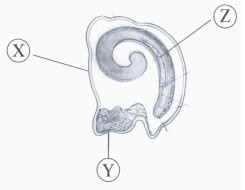
A
$X$ - Pericarp : $Y$ - Endosperm : $Z$ - Scutellum
B
$X$ - Pericarp : $Y$ - Root tip : $Z$ - Endosperm
C
$X$ - Seed coat : $Y$ - Endosperm : $Z$ - Cotyledon
D
$X$ - Seed coat : $Y$ - Cotyledon : $Z$ - Endosperm
Solution
(A) The provided diagram represents the structure of a monocot seed (specifically a maize grain).
$1$. '$X$' points to the outermost layer,which is the Pericarp (fused with the seed coat).
$2$. '$Y$' points to the large,nutrient-rich storage tissue known as the Endosperm.
$3$. '$Z$' points to the shield-shaped cotyledon,which is characteristic of monocots and is called the Scutellum.
Therefore,the correct identification is $X$ - Pericarp,$Y$ - Endosperm,and $Z$ - Scutellum.
$1$. '$X$' points to the outermost layer,which is the Pericarp (fused with the seed coat).
$2$. '$Y$' points to the large,nutrient-rich storage tissue known as the Endosperm.
$3$. '$Z$' points to the shield-shaped cotyledon,which is characteristic of monocots and is called the Scutellum.
Therefore,the correct identification is $X$ - Pericarp,$Y$ - Endosperm,and $Z$ - Scutellum.
0 likesView Solution
21
BiologyMediumMCQGUJCET · 2026
Assertion $(A)$: Geitonogamy is genetically similar to autogamy.
Reason $(R)$: In geitonogamy,pollen grains come from the same plant.
Reason $(R)$: In geitonogamy,pollen grains come from the same plant.
A
$A$ is wrong but $R$ is correct.
B
$A$ is correct but $R$ is wrong.
C
$A$ and $R$ both are correct,$R$ is not the correct explanation of $A$.
D
$A$ and $R$ both are correct,$R$ is the correct explanation of $A$.
Solution
(D) Geitonogamy is the transfer of pollen grains from the anther to the stigma of another flower on the same plant.
Since the pollen grains and the ovules originate from the same plant,the genetic makeup of the offspring remains identical to that of autogamy (self-pollination).
Therefore,both the assertion and the reason are correct,and the reason provides the correct explanation for the assertion.
Since the pollen grains and the ovules originate from the same plant,the genetic makeup of the offspring remains identical to that of autogamy (self-pollination).
Therefore,both the assertion and the reason are correct,and the reason provides the correct explanation for the assertion.
0 likesView Solution
22
BiologyMediumMCQGUJCET · 2026
Oxygen available from nature belongs to which biodiversity conservation category?
A
Ethical
B
Broadly utilitarian
C
Intangible benefits
D
Narrowly utilitarian
Solution
(B) Biodiversity conservation is categorized based on how human beings derive benefits from nature. The categories include:
$(1)$ Narrowly utilitarian: derived from direct economic benefits like food,firewood,fiber,perfumes,industrial products,and medicinal drugs.
$(2)$ Broadly utilitarian: derived from ecosystem services like production of oxygen,pollination,and aesthetic pleasures.
$(3)$ Ethical: based on the belief that every species has an intrinsic value and we have a moral duty to care for their well-being.
Since oxygen production is an ecosystem service,it falls under the Broadly utilitarian category.
$(1)$ Narrowly utilitarian: derived from direct economic benefits like food,firewood,fiber,perfumes,industrial products,and medicinal drugs.
$(2)$ Broadly utilitarian: derived from ecosystem services like production of oxygen,pollination,and aesthetic pleasures.
$(3)$ Ethical: based on the belief that every species has an intrinsic value and we have a moral duty to care for their well-being.
Since oxygen production is an ecosystem service,it falls under the Broadly utilitarian category.
0 likesView Solution
23
BiologyMediumMCQGUJCET · 2026
Sparrow eats seeds. Afterwards,it eats insects. In which trophic level does the sparrow belong in both situations,respectively?
A
Primary - Tertiary
B
Secondary - Tertiary
C
Tertiary - Quarternary
D
Primary - Secondary
Solution
(B) trophic level is the position an organism occupies in a food chain.
$(1)$ Producers (plants) form the first trophic level.
$(2)$ Primary consumers (herbivores) eat producers and form the second trophic level.
$(3)$ Secondary consumers eat primary consumers and form the third trophic level.
When a sparrow eats seeds,it acts as a primary consumer (second trophic level).
When it eats insects (which are primary consumers),it acts as a secondary consumer (third trophic level).
Therefore,the sequence is Second - Third trophic level,which corresponds to the options provided as Secondary - Tertiary.
$(1)$ Producers (plants) form the first trophic level.
$(2)$ Primary consumers (herbivores) eat producers and form the second trophic level.
$(3)$ Secondary consumers eat primary consumers and form the third trophic level.
When a sparrow eats seeds,it acts as a primary consumer (second trophic level).
When it eats insects (which are primary consumers),it acts as a secondary consumer (third trophic level).
Therefore,the sequence is Second - Third trophic level,which corresponds to the options provided as Secondary - Tertiary.
0 likesView Solution
24
BiologyEasyMCQGUJCET · 2026
In which kind of population interaction,one species is harmed whereas the other is unaffected?
A
Parasitism
B
Commensalism
C
Amensalism
D
Competition
Solution
(C) Population interactions are classified based on the effect on the two interacting species ($A$ and $B$):
$(1)$ Mutualism $(+, +)$
$(2)$ Competition $(-, -)$
$(3)$ Predation $(+, -)$
$(4)$ Parasitism $(+, -)$
$(5)$ Commensalism $(+, 0)$
$(6)$ Amensalism $(-, 0)$
In amensalism,one species is harmed (negatively affected) while the other remains unaffected $(0)$.
$(1)$ Mutualism $(+, +)$
$(2)$ Competition $(-, -)$
$(3)$ Predation $(+, -)$
$(4)$ Parasitism $(+, -)$
$(5)$ Commensalism $(+, 0)$
$(6)$ Amensalism $(-, 0)$
In amensalism,one species is harmed (negatively affected) while the other remains unaffected $(0)$.
0 likesView Solution
25
BiologyEasyMCQGUJCET · 2026
What is the correct nomenclature for restriction enzyme-$I$,obtained from $Bacillus$ $amyloliquefaciens$ $H$?
A
Bam $IH$
B
Baam $HI$
C
Bac $HI$
D
Bam $HI$
Solution
(D) The convention for naming restriction enzymes involves using the first letter of the genus and the first two letters of the species of the prokaryotic cell.
Thus,$Bacillus$ $amyloliquefaciens$ gives '$Bam$'.
The strain is indicated by the following letter ('$H$'),and the Roman numeral indicates the order of discovery.
Therefore,it is named $Bam$ $HI$.
Thus,$Bacillus$ $amyloliquefaciens$ gives '$Bam$'.
The strain is indicated by the following letter ('$H$'),and the Roman numeral indicates the order of discovery.
Therefore,it is named $Bam$ $HI$.
0 likesView Solution
26
BiologyMediumMCQGUJCET · 2026
Which group of microbes are acting as bio control agents? Select the correct option.
A
Azospirillum,Anabaena,Bacillus thuringiensis
B
Trichoderma,Baculo virus,Bacillus thuringiensis
C
Azotobacter,Trichoderma,Glomus
D
Baculo virus,Oscillatoria,Rhizobium
Solution
(B) Biological control agents are organisms that control pests and diseases.
$1$. $Trichoderma$ is a fungus used against plant pathogens.
$2$. $Baculoviruses$ (genus $Nucleopolyhedrovirus$) are effective narrow-spectrum insecticides.
$3$. $Bacillus$ $thuringiensis$ is a bacterium whose crystal toxins are used as pesticides.
Other options contain biofertilizers (like $Azospirillum$,$Anabaena$,$Azotobacter$,$Glomus$,$Rhizobium$).
$1$. $Trichoderma$ is a fungus used against plant pathogens.
$2$. $Baculoviruses$ (genus $Nucleopolyhedrovirus$) are effective narrow-spectrum insecticides.
$3$. $Bacillus$ $thuringiensis$ is a bacterium whose crystal toxins are used as pesticides.
Other options contain biofertilizers (like $Azospirillum$,$Anabaena$,$Azotobacter$,$Glomus$,$Rhizobium$).
0 likesView Solution
27
BiologyMediumMCQGUJCET · 2026
Snake venom antibody,which is prepared against snake venom,is an example of which type of immunization?
A
Allergies
B
Passive immunity
C
Auto immunity
D
Active immunity
Solution
(B) Active immunity involves the body producing its own antibodies in response to an antigen.
Passive immunity involves the direct injection of pre-formed antibodies,as seen in the case of antitoxins for snake venom,tetanus,or diphtheria.
This provides immediate protection,which is the characteristic feature of passive immunization.
Passive immunity involves the direct injection of pre-formed antibodies,as seen in the case of antitoxins for snake venom,tetanus,or diphtheria.
This provides immediate protection,which is the characteristic feature of passive immunization.
0 likesView Solution
28
BiologyMediumMCQGUJCET · 2026
In natural selection,more individuals acquire value other than the mean character value,which indicates . . . . . . .
A
Directional
B
Disruptive
C
Stabilising Directional both
D
Stabilising
Solution
(A) Natural selection outcomes are classified as follows:
$(1)$ Stabilizing selection: More individuals acquire the mean character value.
$(2)$ Directional selection: More individuals acquire a value other than the mean character value in one specific direction.
$(3)$ Disruptive selection: More individuals acquire peripheral character values at both ends of the distribution curve.
Therefore,when more individuals acquire a value other than the mean character value,it indicates Directional selection.
$(1)$ Stabilizing selection: More individuals acquire the mean character value.
$(2)$ Directional selection: More individuals acquire a value other than the mean character value in one specific direction.
$(3)$ Disruptive selection: More individuals acquire peripheral character values at both ends of the distribution curve.
Therefore,when more individuals acquire a value other than the mean character value,it indicates Directional selection.
0 likesView Solution
29
BiologyMediumMCQGUJCET · 2026
In the Human Genome Project,among the two major approaches for sequencing the whole set of the genome,the one that contained all the coding and non-coding sequences and later assigned different functions to different regions in the sequence is called . . . . . . .
A
Single nucleotide polymorphism
B
Expressed Sequence Tags
C
Sequence Annotation
D
Bioinformatics
Solution
(C) Two approaches were used in the Human Genome Project $(HGP)$:
$(1)$ Expressed Sequence Tags $(ESTs)$: This approach focused only on identifying all the genes that are expressed as $RNA$ (coding sequences).
$(2)$ Sequence Annotation: This approach involved sequencing the whole set of the genome,which included both coding and non-coding sequences,and then assigning functions to each region in the sequence.
Therefore,the correct answer is Sequence Annotation.
$(1)$ Expressed Sequence Tags $(ESTs)$: This approach focused only on identifying all the genes that are expressed as $RNA$ (coding sequences).
$(2)$ Sequence Annotation: This approach involved sequencing the whole set of the genome,which included both coding and non-coding sequences,and then assigning functions to each region in the sequence.
Therefore,the correct answer is Sequence Annotation.
0 likesView Solution
30
BiologyMediumMCQGUJCET · 2026
$A$ colour blind man marries a female with homozygous normal vision. What will be the possibility of colour blindness in their male children?
A
$0$
B
$0.25$
C
$0.5$
D
$1$
Solution
(A) Colour blindness is a sex-linked recessive trait.
Let $X^c$ be the recessive gene for colour blindness and $X$ be the normal gene.
Genotype of the man: $X^cY$.
Genotype of the woman (homozygous normal): $XX$.
Cross: $X^cY \times XX$.
Offspring genotypes: $X^cX$ (carrier daughter),$X^cX$ (carrier daughter),$XY$ (normal son),$XY$ (normal son).
Since all sons receive their $X$ chromosome from the mother,who is homozygous normal,all male children will have normal vision.
Therefore,the possibility of colour blindness in their male children is $0$.
Let $X^c$ be the recessive gene for colour blindness and $X$ be the normal gene.
Genotype of the man: $X^cY$.
Genotype of the woman (homozygous normal): $XX$.
Cross: $X^cY \times XX$.
Offspring genotypes: $X^cX$ (carrier daughter),$X^cX$ (carrier daughter),$XY$ (normal son),$XY$ (normal son).
Since all sons receive their $X$ chromosome from the mother,who is homozygous normal,all male children will have normal vision.
Therefore,the possibility of colour blindness in their male children is $0$.
0 likesView Solution
31
BiologyMediumMCQGUJCET · 2026
In the following STIs,which one is not completely curable?
A
Gonorrhoea,$HIV$,Chlamydiasis
B
Hepatitis-$B$,Genital herpes,$HIV$
C
Trichomoniasis,$HIV$,Syphilis
D
Genital warts,Chlamydiasis,$HIV$
Solution
(B) Among the options provided,Hepatitis-$B$,Genital herpes,and $HIV$ are viral infections.
While treatments exist to manage these conditions and reduce transmission,there is currently no cure to completely eliminate the virus from the body for these specific infections.
While treatments exist to manage these conditions and reduce transmission,there is currently no cure to completely eliminate the virus from the body for these specific infections.
0 likesView Solution
32
BiologyMediumMCQGUJCET · 2026
In the given diagram,choose the correct option for the labels $X$,$Y$,and $Z$.
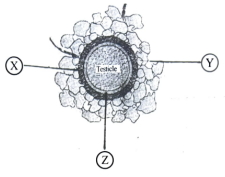
A
$X$ - Zona pellucida,$Y$ - Corona radiata,$Z$ - Perivitelline space
B
$X$ - Zona pellucida,$Y$ - Perivitelline space,$Z$ - Corona radiata
C
$X$ - Corona radiata,$Y$ - Zona pellucida,$Z$ - Perivitelline space
D
$X$ - Perivitelline space,$Y$ - Corona radiata,$Z$ - Zona pellucida
Solution
(A) Based on the biological structure of an ovum (oocyte):
$1$. The outermost layer of follicular cells is the $Corona \text{ } radiata$ (labeled $Y$ in the diagram).
$2$. The thick,transparent glycoprotein layer surrounding the oocyte membrane is the $Zona \text{ } pellucida$ (labeled $X$ in the diagram).
$3$. The space between the $Zona \text{ } pellucida$ and the oocyte membrane is the $Perivitelline \text{ } space$ (labeled $Z$ in the diagram).
Therefore,the correct identification is $X$ - $Zona \text{ } pellucida$,$Y$ - $Corona \text{ } radiata$,$Z$ - $Perivitelline \text{ } space$.
$1$. The outermost layer of follicular cells is the $Corona \text{ } radiata$ (labeled $Y$ in the diagram).
$2$. The thick,transparent glycoprotein layer surrounding the oocyte membrane is the $Zona \text{ } pellucida$ (labeled $X$ in the diagram).
$3$. The space between the $Zona \text{ } pellucida$ and the oocyte membrane is the $Perivitelline \text{ } space$ (labeled $Z$ in the diagram).
Therefore,the correct identification is $X$ - $Zona \text{ } pellucida$,$Y$ - $Corona \text{ } radiata$,$Z$ - $Perivitelline \text{ } space$.
0 likesView Solution
33
BiologyMediumMCQGUJCET · 2026
Match the following columns regarding plant breeding systems and select the correct option:
Column-$I$: $(i)$ Monoecious,(ii) Dioecious
Column-$II$: $(p)$ Prevents both autogamy and geitonogamy,$(q)$ Prevents autogamy but not geitonogamy
Column-$III$: $(x)$ Papaya and Date palm,$(y)$ Castor and Maize
Column-$I$: $(i)$ Monoecious,(ii) Dioecious
Column-$II$: $(p)$ Prevents both autogamy and geitonogamy,$(q)$ Prevents autogamy but not geitonogamy
Column-$III$: $(x)$ Papaya and Date palm,$(y)$ Castor and Maize
A
(i - q,y),(ii - p,x)
B
(i - p,x),(ii - q,y)
C
(i - q,x),(ii - p,y)
D
(i - p,y),(ii - q,x)
Solution
(A) $1$. Monoecious plants $(i)$ have both male and female flowers on the same plant. This arrangement prevents autogamy (self-pollination within the same flower) but does not prevent geitonogamy (pollination between different flowers on the same plant). Examples include Castor and Maize $(y)$.
$2$. Dioecious plants (ii) have male and female flowers on different plants. This arrangement prevents both autogamy and geitonogamy. Examples include Papaya and Date palm $(x)$.
$3$. Therefore,the correct matching is: (i - q,y) and (ii - p,x).
$2$. Dioecious plants (ii) have male and female flowers on different plants. This arrangement prevents both autogamy and geitonogamy. Examples include Papaya and Date palm $(x)$.
$3$. Therefore,the correct matching is: (i - q,y) and (ii - p,x).
0 likesView Solution
34
BiologyEasyMCQGUJCET · 2026
The term Biodiversity is popularized by . . . . . . .
A
Von Humboldt
B
David Tilman
C
Edward Wilson
D
Paul Ehrlich
Solution
(C) The term 'Biodiversity' was coined by Walter $G$. Rosen in $1985$,but it was popularized by the sociobiologist Edward $O$. Wilson to describe the combined diversity at all levels of biological organization.
0 likesView Solution
35
BiologyMediumMCQGUJCET · 2026
In an ecosystem,$1000 \ J$ of energy is stored at the producer level. How much energy will be available at the secondary consumer level (in $J$)?
A
$10$
B
$0.1$
C
$100$
D
$1$
Solution
(A) According to the $10\%$ law of energy transfer in ecosystems,only about $10\%$ of the energy is transferred from one trophic level to the next.
Step $1$: Energy at the producer level = $1000 \ J$.
Step $2$: Energy at the primary consumer level = $10\%$ of $1000 \ J = 100 \ J$.
Step $3$: Energy at the secondary consumer level = $10\%$ of $100 \ J = 10 \ J$.
Therefore,the energy available at the secondary consumer level is $10 \ J$.
Step $1$: Energy at the producer level = $1000 \ J$.
Step $2$: Energy at the primary consumer level = $10\%$ of $1000 \ J = 100 \ J$.
Step $3$: Energy at the secondary consumer level = $10\%$ of $100 \ J = 10 \ J$.
Therefore,the energy available at the secondary consumer level is $10 \ J$.
0 likesView Solution
36
BiologyEasyMCQGUJCET · 2026
Whose field experiment showed that on the rocky sea coast,the larger and competitively superior barnacle excludes the smaller barnacle?
A
Verhulst-Pearl
B
Gause
C
Mac Arthur
D
Connell
Solution
(D) Joseph Connell performed elegant field experiments on the rocky sea coasts of Scotland.
He demonstrated that the larger and competitively superior barnacle,$Balanus$,dominates the intertidal area and excludes the smaller barnacle,$Chthamalus$,from that zone.
He demonstrated that the larger and competitively superior barnacle,$Balanus$,dominates the intertidal area and excludes the smaller barnacle,$Chthamalus$,from that zone.
0 likesView Solution
37
BiologyMediumMCQGUJCET · 2026
$RNA$ interference involves silencing of specific mRNA due to a complementary . . . . . . molecule that binds to and prevents translation of the mRNA.
A
ss-$DNA$
B
ds-$RNA$
C
ss-$RNA$
D
ds-$DNA$
Solution
(B) $RNA$ interference $(RNAi)$ is a biological process in which $RNA$ molecules inhibit gene expression or translation by neutralizing targeted $mRNA$ molecules. This process is initiated by double-stranded $RNA$ $(ds-RNA)$,which binds to the complementary $mRNA$ sequence,thereby preventing its translation into protein.
0 likesView Solution
38
BiologyEasyMCQGUJCET · 2026
Enzyme used for the extension process in the $PCR$ method.
A
$DNA$ Ligase
B
$DNA$ Helicase
C
Restriction Endonuclease
D
Taq polymerase
Solution
(D) In the $PCR$ (Polymerase Chain Reaction) method,$Taq$ polymerase is the heat-stable $DNA$ polymerase enzyme used in the extension phase to synthesize $DNA$ strands. It is derived from the bacterium $Thermus$ $aquaticus$ and can withstand the high temperatures required for denaturing $DNA$.
0 likesView Solution
39
BiologyMediumMCQGUJCET · 2026
Identify the mis-matched pair from the following list of microorganisms and their commercial products.
A
Saccharomyces cerevisiae - Ethanol
B
Monascus purpureus - Statins
C
Streptococcus - Streptokinase
D
Aspergillus niger - Cyclosporin $A$
Solution
(D) Let us analyze the given pairs:
$(A)$ $Saccharomyces$ $cerevisiae$ is used for the production of ethanol (Correct).
$(B)$ $Monascus$ $purpureus$ is a yeast used for the production of statins,which act as blood-cholesterol lowering agents (Correct).
$(C)$ $Streptococcus$ is used for the production of streptokinase,which is used as a 'clot buster' for removing clots from the blood vessels of patients who have undergone myocardial infarction (Correct).
$(D)$ $Aspergillus$ $niger$ is a fungus used for the production of citric acid. Cyclosporin $A$ is produced by the fungus $Trichoderma$ $polysporum$ (Incorrect).
Therefore,the mis-matched pair is $Aspergillus$ $niger$ - Cyclosporin $A$.
$(A)$ $Saccharomyces$ $cerevisiae$ is used for the production of ethanol (Correct).
$(B)$ $Monascus$ $purpureus$ is a yeast used for the production of statins,which act as blood-cholesterol lowering agents (Correct).
$(C)$ $Streptococcus$ is used for the production of streptokinase,which is used as a 'clot buster' for removing clots from the blood vessels of patients who have undergone myocardial infarction (Correct).
$(D)$ $Aspergillus$ $niger$ is a fungus used for the production of citric acid. Cyclosporin $A$ is produced by the fungus $Trichoderma$ $polysporum$ (Incorrect).
Therefore,the mis-matched pair is $Aspergillus$ $niger$ - Cyclosporin $A$.
0 likesView Solution
40
BiologyMediumMCQGUJCET · 2026
The molecule shown in the given structure is naturally obtained from which plant?
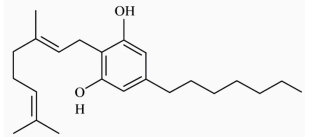
A
Atropa belladonna
B
Erythroxylum coca
C
Cannabis sativa
D
Papaver somniferum
Solution
(C) The structure provided in the image is that of Cannabidiol $(CBD)$,which is a major cannabinoid found in the plant *Cannabis sativa*.
Cannabinoids are a class of diverse chemical compounds that act on cannabinoid receptors in cells that repress neurotransmitter release in the brain.
*Cannabis sativa* is the natural source of these compounds,including $THC$ and $CBD$.
Cannabinoids are a class of diverse chemical compounds that act on cannabinoid receptors in cells that repress neurotransmitter release in the brain.
*Cannabis sativa* is the natural source of these compounds,including $THC$ and $CBD$.
0 likesView Solution
Vedclass Products
For Students
Vedclass Test Series
Mock tests in real GUJCET style covering Biology with performance analysis. 5-day free trial.
Start Free TrialFor Teachers
Exam Paper Generator
Generate Set A/B/C/D Biology papers from 7.5L+ questions in 2 minutes. 3 chapters free.
Try FreeFor Institutes
Online Exam Module
Run live GUJCET mock exams with unlimited students, 360° analytics & white-label branding.
See DemoFrequently Asked Questions
How many Biology questions are in GUJCET 2026?
There are 40 Biology questions from the GUJCET 2026 paper on Vedclass, each with a detailed step-by-step solution in English.
Are GUJCET 2026 Biology solutions available in English?
Yes. All solutions on this page are in English. You can also switch to English or Hindi using the language buttons above the questions.
Can I practice GUJCET 2026 Biology as a timed test?
Yes. Use the Vedclass Test Series to attempt a full GUJCET mock test covering Biology with time limits and instant score analysis.
Can teachers create Biology papers from GUJCET previous year questions?
Yes. The Vedclass Exam Paper Generator lets teachers mix GUJCET Biology questions and generate Set A/B/C/D papers in minutes.
For Teachers & Institutes
Build a Custom Biology Paper
Pick GUJCET 2026 Biology questions, set difficulty, and generate Set A/B/C/D in 2 minutes.