
ChemistryQ1–40 of 40 questions
Page 1 of 1 · English
1
ChemistryMediumMCQGUJCET · 2026
$\text{CH}_3\text{COOH} \xrightarrow{\text{LiAlH}_4} \text{X} \xrightarrow{\text{PCl}_5} \text{Y} \xrightarrow{\text{Alcoholic KOH}} \text{Z}$. Find product '$Z$' in the above reaction.
A
Ethyne
B
Ethanol
C
Ethene
D
Ethanal
Solution
(C) The reaction proceeds as follows:
$1$) Reduction of $\text{CH}_3\text{COOH}$ by $\text{LiAlH}_4$ gives $\text{CH}_3\text{CH}_2\text{OH}$ (Ethanol),which is product $\text{X}$.
$2$) Reaction of $\text{CH}_3\text{CH}_2\text{OH}$ with $\text{PCl}_5$ gives $\text{CH}_3\text{CH}_2\text{Cl}$ (Ethyl chloride),which is product $\text{Y}$.
$3$) Dehydrohalogenation (elimination reaction) of $\text{CH}_3\text{CH}_2\text{Cl}$ with alcoholic $\text{KOH}$ gives $\text{CH}_2=\text{CH}_2$ (Ethene),which is product $\text{Z}$.
$1$) Reduction of $\text{CH}_3\text{COOH}$ by $\text{LiAlH}_4$ gives $\text{CH}_3\text{CH}_2\text{OH}$ (Ethanol),which is product $\text{X}$.
$2$) Reaction of $\text{CH}_3\text{CH}_2\text{OH}$ with $\text{PCl}_5$ gives $\text{CH}_3\text{CH}_2\text{Cl}$ (Ethyl chloride),which is product $\text{Y}$.
$3$) Dehydrohalogenation (elimination reaction) of $\text{CH}_3\text{CH}_2\text{Cl}$ with alcoholic $\text{KOH}$ gives $\text{CH}_2=\text{CH}_2$ (Ethene),which is product $\text{Z}$.
0 likesView Solution
2
ChemistryDifficultMCQGUJCET · 2026
Calculate the equilibrium constant of the following reaction:
$\text{Cu(s)} + 2\text{Ag}^+_{\text{(aq)}} \rightarrow \text{Cu}^{2+}_{\text{(aq)}} + 2\text{Ag(s)}$,given $E^\circ_{\text{cell}} = 0.46 \text{ V}$.
$\text{Cu(s)} + 2\text{Ag}^+_{\text{(aq)}} \rightarrow \text{Cu}^{2+}_{\text{(aq)}} + 2\text{Ag(s)}$,given $E^\circ_{\text{cell}} = 0.46 \text{ V}$.
A
$3.92 \times 10^{14}$
B
$4.92 \times 10^{13}$
C
$4.92 \times 10^{14}$
D
$3.92 \times 10^{15}$
Solution
(D) The relationship between the standard cell potential $(E^\circ_{\text{cell}})$ and the equilibrium constant $(K)$ is given by the Nernst equation at equilibrium:
$\log K = \frac{n E^\circ_{\text{cell}}}{0.0591}$
Here,the number of electrons transferred $(n)$ is $2$,and $E^\circ_{\text{cell}} = 0.46 \text{ V}$.
Substituting the values:
$\log K = \frac{2 \times 0.46}{0.0591} = \frac{0.92}{0.0591} \approx 15.5668$
Now,$K = 10^{15.5668} = 10^{0.5668} \times 10^{15} \approx 3.68 \times 10^{15}$.
Comparing this with the given options,the closest value is $3.92 \times 10^{15}$.
$\log K = \frac{n E^\circ_{\text{cell}}}{0.0591}$
Here,the number of electrons transferred $(n)$ is $2$,and $E^\circ_{\text{cell}} = 0.46 \text{ V}$.
Substituting the values:
$\log K = \frac{2 \times 0.46}{0.0591} = \frac{0.92}{0.0591} \approx 15.5668$
Now,$K = 10^{15.5668} = 10^{0.5668} \times 10^{15} \approx 3.68 \times 10^{15}$.
Comparing this with the given options,the closest value is $3.92 \times 10^{15}$.
0 likesView Solution
3
ChemistryMediumMCQGUJCET · 2026
Which of the following statements is not true for a fuel cell?
A
Converting fuel energy directly into electrical energy.
B
Water produced during the reaction cannot be used for drinking.
C
The reaction of hydrogen with oxygen to form water.
D
They are pollution-free.
Solution
(B) Fuel cells (like the $H_2-O_2$ fuel cell) convert chemical energy directly into electrical energy.
They produce pure water as a byproduct,which is suitable for drinking,especially in space applications.
Therefore,the statement that water produced during the reaction cannot be used for drinking is incorrect.
They produce pure water as a byproduct,which is suitable for drinking,especially in space applications.
Therefore,the statement that water produced during the reaction cannot be used for drinking is incorrect.
0 likesView Solution
4
ChemistryMediumMCQGUJCET · 2026
Which of the following metals behaves as the weakest reducing agent?
$E^\circ_{(\text{Li}^+/\text{Li})} = -3.05 \text{ V}$,$E^\circ_{(\text{Au}^{3+}/\text{Au})} = 1.40 \text{ V}$,$E^\circ_{(\text{Ag}^+/\text{Ag})} = 0.80 \text{ V}$,$E^\circ_{(\text{Mg}^{2+}/\text{Mg})} = -2.36 \text{ V}$
$E^\circ_{(\text{Li}^+/\text{Li})} = -3.05 \text{ V}$,$E^\circ_{(\text{Au}^{3+}/\text{Au})} = 1.40 \text{ V}$,$E^\circ_{(\text{Ag}^+/\text{Ag})} = 0.80 \text{ V}$,$E^\circ_{(\text{Mg}^{2+}/\text{Mg})} = -2.36 \text{ V}$
A
Li
B
Ag
C
Au
D
Mg
Solution
(C) The reducing power of a metal is inversely proportional to its standard reduction potential $(E^\circ)$.
$A$ lower (more negative) $E^\circ$ value indicates a stronger reducing agent,while a higher (more positive) $E^\circ$ value indicates a weaker reducing agent.
Comparing the given values:
$E^\circ_{(\text{Li}^+/\text{Li})} = -3.05 \text{ V}$
$E^\circ_{(\text{Mg}^{2+}/\text{Mg})} = -2.36 \text{ V}$
$E^\circ_{(\text{Ag}^+/\text{Ag})} = 0.80 \text{ V}$
$E^\circ_{(\text{Au}^{3+}/\text{Au})} = 1.40 \text{ V}$
Since $\text{Au}^{3+}/\text{Au}$ has the highest positive standard reduction potential $(1.40 \text{ V})$,it is the weakest reducing agent.
$A$ lower (more negative) $E^\circ$ value indicates a stronger reducing agent,while a higher (more positive) $E^\circ$ value indicates a weaker reducing agent.
Comparing the given values:
$E^\circ_{(\text{Li}^+/\text{Li})} = -3.05 \text{ V}$
$E^\circ_{(\text{Mg}^{2+}/\text{Mg})} = -2.36 \text{ V}$
$E^\circ_{(\text{Ag}^+/\text{Ag})} = 0.80 \text{ V}$
$E^\circ_{(\text{Au}^{3+}/\text{Au})} = 1.40 \text{ V}$
Since $\text{Au}^{3+}/\text{Au}$ has the highest positive standard reduction potential $(1.40 \text{ V})$,it is the weakest reducing agent.
0 likesView Solution
5
ChemistryMediumMCQGUJCET · 2026
Which of the following solutions will show negative deviation from Raoult's law?
A
Chloroform + Acetone
B
Benzene + Toluene
C
Ethanol + Acetone
D
Bromoethane + Chloroethane
Solution
(A) Negative deviation from Raoult's law occurs when the intermolecular forces between the solute and solvent molecules are stronger than the forces between the pure components (solute-solute and solvent-solvent interactions).
When Chloroform $(CHCl_3)$ is mixed with Acetone $(CH_3COCH_3)$,a strong hydrogen bond is formed between the oxygen atom of the acetone and the hydrogen atom of the chloroform.
This increased intermolecular attraction results in a decrease in total volume and vapor pressure,which is characteristic of negative deviation.
When Chloroform $(CHCl_3)$ is mixed with Acetone $(CH_3COCH_3)$,a strong hydrogen bond is formed between the oxygen atom of the acetone and the hydrogen atom of the chloroform.
This increased intermolecular attraction results in a decrease in total volume and vapor pressure,which is characteristic of negative deviation.
0 likesView Solution
6
ChemistryDifficultMCQGUJCET · 2026
Calculate the mass of ascorbic acid $(\text{C}_6\text{H}_8\text{O}_6)$ to be dissolved in $75 \text{ g}$ of acetic acid to lower its melting point by $1.5^\circ\text{C}$. $[K_f = 3.9 \text{ K kg mol}^{-1}, \text{H} = 1, \text{C} = 12, \text{O} = 16 \text{ amu}]$ (in $\text{ g}$)
A
$5.770$
B
$4.077$
C
$5.077$
D
$4.770$
Solution
(C) First, calculate the molar mass of ascorbic acid $(\text{C}_6\text{H}_8\text{O}_6)$:
$\text{Molar mass} = (6 \times 12) + (8 \times 1) + (6 \times 16) = 72 + 8 + 96 = 176 \text{ g/mol}$.
Use the formula for depression in freezing point: $\Delta T_f = K_f \times m$, where $m$ is the molality.
$m = \frac{w \times 1000}{M \times W_{\text{solvent}}}$, where $w$ is the mass of solute and $W_{\text{solvent}}$ is the mass of solvent in grams.
Substituting the given values: $1.5 = 3.9 \times \frac{w \times 1000}{176 \times 75}$.
Solving for $w$: $w = \frac{1.5 \times 176 \times 75}{3.9 \times 1000} = \frac{19800}{3900} \approx 5.077 \text{ g}$.
$\text{Molar mass} = (6 \times 12) + (8 \times 1) + (6 \times 16) = 72 + 8 + 96 = 176 \text{ g/mol}$.
Use the formula for depression in freezing point: $\Delta T_f = K_f \times m$, where $m$ is the molality.
$m = \frac{w \times 1000}{M \times W_{\text{solvent}}}$, where $w$ is the mass of solute and $W_{\text{solvent}}$ is the mass of solvent in grams.
Substituting the given values: $1.5 = 3.9 \times \frac{w \times 1000}{176 \times 75}$.
Solving for $w$: $w = \frac{1.5 \times 176 \times 75}{3.9 \times 1000} = \frac{19800}{3900} \approx 5.077 \text{ g}$.
0 likesView Solution
7
ChemistryEasyMCQGUJCET · 2026
For the ideal solutions,which of the following condition is suitable?
A
$\Delta_{\text{mix}}H \neq 0; \Delta_{\text{mix}}V \neq 0$
B
$\Delta_{\text{mix}}H = 0; \Delta_{\text{mix}}V = 0$
C
$\Delta_{\text{mix}}H \neq 0; \Delta_{\text{mix}}V = 0$
D
$\Delta_{\text{mix}}H = 0; \Delta_{\text{mix}}V \neq 0$
Solution
(B) An ideal solution is defined as a solution that obeys Raoult's law over the entire range of concentration.
For an ideal solution,the enthalpy of mixing is zero $(\Delta_{\text{mix}}H = 0)$,meaning no heat is absorbed or evolved during the mixing process.
Additionally,the volume of mixing is zero $(\Delta_{\text{mix}}V = 0)$,meaning the total volume of the solution is equal to the sum of the volumes of the individual components.
Therefore,the correct condition is $\Delta_{\text{mix}}H = 0$ and $\Delta_{\text{mix}}V = 0$.
For an ideal solution,the enthalpy of mixing is zero $(\Delta_{\text{mix}}H = 0)$,meaning no heat is absorbed or evolved during the mixing process.
Additionally,the volume of mixing is zero $(\Delta_{\text{mix}}V = 0)$,meaning the total volume of the solution is equal to the sum of the volumes of the individual components.
Therefore,the correct condition is $\Delta_{\text{mix}}H = 0$ and $\Delta_{\text{mix}}V = 0$.
0 likesView Solution
8
ChemistryDifficultMCQGUJCET · 2026
The molarity of a solution containing $15 \text{ g}$ of $\text{NaOH}$ in $900 \text{ ml}$ of solution will be . . . . . . . (in $\text{ M}$)
A
$0.42$
B
$0.042$
C
$4.2$
D
$42.0$
Solution
(A) The molar mass of $\text{NaOH}$ is calculated as $23 + 16 + 1 = 40 \text{ g/mol}$.
Number of moles of $\text{NaOH} = \frac{\text{mass}}{\text{molar mass}} = \frac{15 \text{ g}}{40 \text{ g/mol}} = 0.375 \text{ mol}$.
The volume of the solution is $900 \text{ ml} = 0.9 \text{ L}$.
Molarity $(M)$ is defined as the number of moles of solute per liter of solution.
$M = \frac{0.375 \text{ mol}}{0.9 \text{ L}} = 0.4166... \text{ M} \approx 0.42 \text{ M}$.
Number of moles of $\text{NaOH} = \frac{\text{mass}}{\text{molar mass}} = \frac{15 \text{ g}}{40 \text{ g/mol}} = 0.375 \text{ mol}$.
The volume of the solution is $900 \text{ ml} = 0.9 \text{ L}$.
Molarity $(M)$ is defined as the number of moles of solute per liter of solution.
$M = \frac{0.375 \text{ mol}}{0.9 \text{ L}} = 0.4166... \text{ M} \approx 0.42 \text{ M}$.
0 likesView Solution
9
ChemistryEasyMCQGUJCET · 2026
Which of the following hormones is responsible for the development of secondary female characteristics and participates in the control of the menstrual cycle?
A
Glucagon
B
Testosterone
C
Progesterone
D
Estradiol
Solution
(D) Estradiol is the primary estrogen hormone responsible for the development of secondary female sexual characteristics and plays a crucial role in regulating the menstrual cycle.
0 likesView Solution
10
ChemistryEasyMCQGUJCET · 2026
Which of the following diseases occurs due to the deficiency of pyridoxine?
A
Cheilosis
B
Beri-beri
C
Scurvy
D
Convulsions
Solution
(D) Pyridoxine is also known as Vitamin $B_6$.
Deficiency of Vitamin $B_6$ leads to neurological disorders such as convulsions (seizures) and skin conditions like dermatitis.
Cheilosis is caused by the deficiency of Riboflavin (Vitamin $B_2$).
Beri-beri is caused by the deficiency of Thiamine (Vitamin $B_1$).
Scurvy is caused by the deficiency of Ascorbic acid (Vitamin $C$).
Therefore,the correct answer is convulsions.
Deficiency of Vitamin $B_6$ leads to neurological disorders such as convulsions (seizures) and skin conditions like dermatitis.
Cheilosis is caused by the deficiency of Riboflavin (Vitamin $B_2$).
Beri-beri is caused by the deficiency of Thiamine (Vitamin $B_1$).
Scurvy is caused by the deficiency of Ascorbic acid (Vitamin $C$).
Therefore,the correct answer is convulsions.
0 likesView Solution
11
ChemistryEasyMCQGUJCET · 2026
Which of the following is not a polysaccharide?
A
Ribose
B
Starch
C
Gum
D
Glycogen
Solution
(A) polysaccharide is a carbohydrate that consists of a number of sugar molecules bonded together.
$Ribose$ is a simple sugar or a monosaccharide (specifically a pentose sugar).
$Starch$,$Gum$,and $Glycogen$ are all examples of polysaccharides.
Therefore,$Ribose$ is not a polysaccharide.
$Ribose$ is a simple sugar or a monosaccharide (specifically a pentose sugar).
$Starch$,$Gum$,and $Glycogen$ are all examples of polysaccharides.
Therefore,$Ribose$ is not a polysaccharide.
0 likesView Solution
12
ChemistryMediumMCQGUJCET · 2026
Which product is formed on carbylamine reaction with $4$-methylaniline?
A
$4-$methylbenzonitrile
B
$4-$methylphenyl isocyanide
C
$4-$methylnitrobenzene
D
$4-$methylbenzenediazonium chloride
Solution
(B) The carbylamine reaction (or isocyanide test) is a characteristic reaction of primary amines. In this reaction,a primary amine reacts with chloroform $(CHCl_3)$ and an alcoholic base (like $KOH$) to form an isocyanide (carbylamine),which has a foul,offensive smell.
The reaction for $4$-methylaniline ($p$-toluidine) is as follows:
$CH_3-C_6H_4-NH_2 + CHCl_3 + 3KOH (alc.) \rightarrow CH_3-C_6H_4-NC + 3KCl + 3H_2O$
Here,$4$-methylaniline reacts with $CHCl_3$ and $KOH$ to produce $4$-methylphenyl isocyanide $(CH_3-C_6H_4-NC)$.
The reaction for $4$-methylaniline ($p$-toluidine) is as follows:
$CH_3-C_6H_4-NH_2 + CHCl_3 + 3KOH (alc.) \rightarrow CH_3-C_6H_4-NC + 3KCl + 3H_2O$
Here,$4$-methylaniline reacts with $CHCl_3$ and $KOH$ to produce $4$-methylphenyl isocyanide $(CH_3-C_6H_4-NC)$.
0 likesView Solution
13
ChemistryMediumMCQGUJCET · 2026
What is the correct order of basic strength in substituted amines in an aqueous solution?
A
$NH_3 > C_2H_5NH_2 > (C_2H_5)_3 N > (C_2H_5)_2 NH$
B
$(C_2H_5)_3 N > (C_2H_5)_2 NH > C_2H_5NH_2 > NH_3$
C
$(C_2H_5)_2 NH > (C_2H_5)_3 N > C_2H_5NH_2 > NH_3$
D
$NH_3 > C_2H_5NH_2 > (C_2H_5)_2 NH > (C_2H_5)_3 N$
Solution
(C) In an aqueous solution,the basic strength of ethyl-substituted amines is determined by the interplay of three factors: the inductive effect ($+I$ effect),the solvation effect (hydrogen bonding),and steric hindrance.
For ethyl-substituted amines,the secondary amine $(2^\circ)$ is the most basic due to the optimal balance of these factors.
The tertiary amine $(3^\circ)$ is less basic than the secondary amine due to steric hindrance,but more basic than the primary amine $(1^\circ)$.
Thus,the correct order of basic strength is $(C_2H_5)_2 NH > (C_2H_5)_3 N > C_2H_5NH_2 > NH_3$.
For ethyl-substituted amines,the secondary amine $(2^\circ)$ is the most basic due to the optimal balance of these factors.
The tertiary amine $(3^\circ)$ is less basic than the secondary amine due to steric hindrance,but more basic than the primary amine $(1^\circ)$.
Thus,the correct order of basic strength is $(C_2H_5)_2 NH > (C_2H_5)_3 N > C_2H_5NH_2 > NH_3$.
0 likesView Solution
14
ChemistryDifficultMCQGUJCET · 2026
What will be the name of the product formed upon the ammonolysis of benzyl chloride followed by the reaction of the resulting amine with two moles of $CH_3Cl$?
A
$N$,$N$-dimethylphenylmethanamine
B
$N$,$N$-diphenylmethanamine
C
$N$,$N$-diphenylethanamine
D
$N$-methyl,$N$-phenylmethanamine
Solution
(A) $1$. Ammonolysis of benzyl chloride $(C_6H_5CH_2Cl)$ involves the nucleophilic substitution of the chlorine atom by an ammonia molecule,resulting in the formation of benzylamine $(C_6H_5CH_2NH_2)$.
$2$. Benzylamine is a primary amine. When it reacts with two moles of methyl chloride $(CH_3Cl)$,the two hydrogen atoms attached to the nitrogen atom are replaced by two methyl groups through nucleophilic substitution.
$3$. The final product formed is $C_6H_5CH_2N(CH_3)_2$.
$4$. According to $IUPAC$ nomenclature,this compound is named $N$,$N$-dimethylphenylmethanamine.
$2$. Benzylamine is a primary amine. When it reacts with two moles of methyl chloride $(CH_3Cl)$,the two hydrogen atoms attached to the nitrogen atom are replaced by two methyl groups through nucleophilic substitution.
$3$. The final product formed is $C_6H_5CH_2N(CH_3)_2$.
$4$. According to $IUPAC$ nomenclature,this compound is named $N$,$N$-dimethylphenylmethanamine.
0 likesView Solution
15
ChemistryMediumMCQGUJCET · 2026
Which of the following statements is true for Benzenediazonium fluoroborate?
A
When heated with $NaNO_2$ in the presence of $Cu$,it gives aniline.
B
On heating,it does not decompose to yield fluorobenzene.
C
It is water-insoluble and stable at room temperature.
D
It is water-soluble and unstable at room temperature.
Solution
(C) Benzenediazonium fluoroborate $(C_6H_5N_2^+BF_4^-)$ is unique among diazonium salts because it is water-insoluble and relatively stable at room temperature,which allows it to be dried and stored.
Upon heating,it undergoes thermal decomposition to yield fluorobenzene,a process known as the Schiemann reaction.
Upon heating,it undergoes thermal decomposition to yield fluorobenzene,a process known as the Schiemann reaction.
0 likesView Solution
16
ChemistryEasyMCQGUJCET · 2026
Which of the following compounds is used for the production of $Nylon-6,6$?
A
Adipic acid
B
Succinic acid
C
Malonic acid
D
Glutaric acid
Solution
(A) $Nylon-6,6$ is a synthetic polymer formed by the condensation polymerization of two monomers: hexamethylenediamine $(H_2N(CH_2)_6NH_2)$ and adipic acid $(HOOC(CH_2)_4COOH)$.
These two monomers undergo a condensation reaction to form the polyamide chain,releasing water molecules as a byproduct.
These two monomers undergo a condensation reaction to form the polyamide chain,releasing water molecules as a byproduct.
0 likesView Solution
17
ChemistryMediumMCQGUJCET · 2026
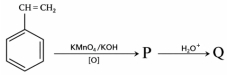
Identify $P$ and $Q$ in the above reaction respectively.
A
Benzoic acid; Potassium benzoate
B
Potassium benzoate; Benzoic acid
C
Benzoic acid; Benzaldehyde
D
Potassium benzoate; Benzaldehyde
Solution
(B) The oxidation of alkyl benzene side chains with $KMnO_4/KOH$ (alkaline potassium permanganate) results in the cleavage of the side chain to form the potassium salt of benzoic acid (potassium benzoate,$P$).
This reaction is a standard method for the oxidation of alkyl groups attached to a benzene ring.
Upon subsequent acidification with $H_3O^+$,the potassium benzoate $(P)$ is converted into benzoic acid $(Q)$.
Therefore,$P$ is potassium benzoate and $Q$ is benzoic acid.
This reaction is a standard method for the oxidation of alkyl groups attached to a benzene ring.
Upon subsequent acidification with $H_3O^+$,the potassium benzoate $(P)$ is converted into benzoic acid $(Q)$.
Therefore,$P$ is potassium benzoate and $Q$ is benzoic acid.
0 likesView Solution
18
ChemistryMediumMCQGUJCET · 2026
Which of the following aldehydes does not give the Cannizzaro reaction?
A
$HCHO$
B
$CCl_3CHO$
C
Benzaldehyde
D
$CH_3CH_2CHO$
Solution
(D) The Cannizzaro reaction is a characteristic reaction of aldehydes that do not possess any $\alpha$-hydrogen atoms.
$1$. $HCHO$ (Formaldehyde) has no $\alpha$-hydrogen.
$2$. $CCl_3CHO$ (Trichloroacetaldehyde) has no $\alpha$-hydrogen.
$3$. Benzaldehyde $(C_6H_5CHO)$ has no $\alpha$-hydrogen.
All of the above compounds undergo the Cannizzaro reaction.
$4$. Propanal $(CH_3CH_2CHO)$ contains two $\alpha$-hydrogen atoms attached to the $\alpha$-carbon. Therefore,it undergoes aldol condensation in the presence of a dilute base,not the Cannizzaro reaction.
Thus,the correct answer is $CH_3CH_2CHO$.
$1$. $HCHO$ (Formaldehyde) has no $\alpha$-hydrogen.
$2$. $CCl_3CHO$ (Trichloroacetaldehyde) has no $\alpha$-hydrogen.
$3$. Benzaldehyde $(C_6H_5CHO)$ has no $\alpha$-hydrogen.
All of the above compounds undergo the Cannizzaro reaction.
$4$. Propanal $(CH_3CH_2CHO)$ contains two $\alpha$-hydrogen atoms attached to the $\alpha$-carbon. Therefore,it undergoes aldol condensation in the presence of a dilute base,not the Cannizzaro reaction.
Thus,the correct answer is $CH_3CH_2CHO$.
0 likesView Solution
19
ChemistryMediumMCQGUJCET · 2026
In potassium trioxalatoaluminate $(III)$,what are the primary and secondary valency of the central atom respectively?
A
$3$,$6$
B
$3$,$3$
C
$6$,$3$
D
$6$,$6$
Solution
(A) The chemical formula for potassium trioxalatoaluminate $(III)$ is $K_3[Al(C_2O_4)_3]$.
$1$. The primary valency corresponds to the oxidation state of the central metal atom $(Al)$. In this complex,$Al + 3(-2) = -3$,which gives $Al = +3$. Thus,the primary valency is $3$.
$2$. The secondary valency corresponds to the coordination number of the central metal atom. The oxalate ion $(C_2O_4^{2-})$ is a bidentate ligand. Since there are $3$ oxalate ligands,the coordination number is $3 \times 2 = 6$. Thus,the secondary valency is $6$.
Therefore,the primary and secondary valencies are $3$ and $6$ respectively.
$1$. The primary valency corresponds to the oxidation state of the central metal atom $(Al)$. In this complex,$Al + 3(-2) = -3$,which gives $Al = +3$. Thus,the primary valency is $3$.
$2$. The secondary valency corresponds to the coordination number of the central metal atom. The oxalate ion $(C_2O_4^{2-})$ is a bidentate ligand. Since there are $3$ oxalate ligands,the coordination number is $3 \times 2 = 6$. Thus,the secondary valency is $6$.
Therefore,the primary and secondary valencies are $3$ and $6$ respectively.
0 likesView Solution
20
ChemistryMediumMCQGUJCET · 2026
What is the $IUPAC$ name of Mesityl oxide?
A
$3-$methylpent$-4-$en$-2-$one
B
$4,4-$dimethylbut$-3-$en$-2-$one
C
$4-$methylpent$-3-$en$-2-$one
D
$1-$methylpent$-2-$en$-4-$one
Solution
(C) Mesityl oxide has the chemical structure $(CH_3)_2C=CHCOCH_3$.
To determine the $IUPAC$ name,we identify the longest carbon chain containing the ketone functional group.
The chain has $5$ carbon atoms,so the parent alkane is pentane.
The ketone group is at position $2$,so it is a pentan-$2$-one.
$A$ double bond is present at position $3$,making it a pent-$3$-en-$2$-one.
There is a methyl group at position $4$.
Combining these,the $IUPAC$ name is $4$-methylpent-$3$-en-$2$-one.
To determine the $IUPAC$ name,we identify the longest carbon chain containing the ketone functional group.
The chain has $5$ carbon atoms,so the parent alkane is pentane.
The ketone group is at position $2$,so it is a pentan-$2$-one.
$A$ double bond is present at position $3$,making it a pent-$3$-en-$2$-one.
There is a methyl group at position $4$.
Combining these,the $IUPAC$ name is $4$-methylpent-$3$-en-$2$-one.
0 likesView Solution
21
ChemistryMediumMCQGUJCET · 2026
Which reaction is used to prepare $2$-hydroxybenzaldehyde from phenol?
A
Reimer-Tiemann reaction
B
Kolbe's reaction
C
Williamson synthesis
D
Etard's reaction
Solution
(A) The Reimer-Tiemann reaction is specifically used to introduce a formyl group $(-\text{CHO})$ into the ortho position of a phenol by using chloroform $(CHCl_3)$ and aqueous sodium hydroxide $(NaOH)$.
This reaction results in the formation of $2$-hydroxybenzaldehyde,commonly known as salicylaldehyde.
This reaction results in the formation of $2$-hydroxybenzaldehyde,commonly known as salicylaldehyde.
0 likesView Solution
22
ChemistryMediumMCQGUJCET · 2026
Which product is not obtained when $\text{CH}_3\text{CH}_2\text{OH}$ reacts with $\text{H}_2\text{SO}_4$?
A
$\text{CH}_2 = \text{CH}_2$
B
$\text{CH} \equiv \text{CH}$
C
$\text{C}_2\text{H}_5\text{OC}_2\text{H}_5$
D
$\text{C}_2\text{H}_5\text{HSO}_4$
Solution
(B) The dehydration of ethanol $(\text{CH}_3\text{CH}_2\text{OH})$ with concentrated $\text{H}_2\text{SO}_4$ depends on the reaction conditions.
$1$. At $413 \text{ K}$ $(140^{\circ}\text{C})$,the reaction proceeds via an $S_N2$ mechanism to form diethyl ether $(\text{C}_2\text{H}_5\text{OC}_2\text{H}_5)$.
$2$. At $443 \text{ K}$ $(170^{\circ}\text{C})$,the reaction proceeds via an $E1$ mechanism to form ethene $(\text{CH}_2 = \text{CH}_2)$.
$3$. Ethyl hydrogen sulfate $(\text{C}_2\text{H}_5\text{HSO}_4)$ is formed as an intermediate in both processes.
$4$. Acetylene $(\text{CH} \equiv \text{CH})$ is not a product of this reaction.
$1$. At $413 \text{ K}$ $(140^{\circ}\text{C})$,the reaction proceeds via an $S_N2$ mechanism to form diethyl ether $(\text{C}_2\text{H}_5\text{OC}_2\text{H}_5)$.
$2$. At $443 \text{ K}$ $(170^{\circ}\text{C})$,the reaction proceeds via an $E1$ mechanism to form ethene $(\text{CH}_2 = \text{CH}_2)$.
$3$. Ethyl hydrogen sulfate $(\text{C}_2\text{H}_5\text{HSO}_4)$ is formed as an intermediate in both processes.
$4$. Acetylene $(\text{CH} \equiv \text{CH})$ is not a product of this reaction.
0 likesView Solution
23
ChemistryMediumMCQGUJCET · 2026
Which of the following compounds gives only a primary alcohol on reaction with a Grignard reagent $(RMgX)$?
A
$CH_3CH_2CHO$
B
$HCHO$
C
$CH_3CH_2COCH_3$
D
$C_6H_5COCH_3$
Solution
(B) Formaldehyde $(HCHO)$ is the simplest aldehyde. When it reacts with a Grignard reagent $(RMgX)$,it forms an addition product which,upon acidic hydrolysis,yields a primary alcohol $(RCH_2OH)$.
Other aldehydes $(R'CHO)$ react with Grignard reagents to form secondary alcohols $(R'CH(OH)R)$.
Ketones $(R'COR'')$ react with Grignard reagents to form tertiary alcohols $(R'R''C(OH)R)$.
Other aldehydes $(R'CHO)$ react with Grignard reagents to form secondary alcohols $(R'CH(OH)R)$.
Ketones $(R'COR'')$ react with Grignard reagents to form tertiary alcohols $(R'R''C(OH)R)$.
0 likesView Solution
24
ChemistryMediumMCQGUJCET · 2026
What is the $IUPAC$ name of methyl isopropyl ether?
A
$2-$methoxypropane
B
$1-$methoxypropane
C
Ethoxyethane
D
Methyl propyl ether
Solution
(A) The structure of methyl isopropyl ether is $\text{CH}_3-\text{O}-\text{CH}(\text{CH}_3)_2$.
In $IUPAC$ nomenclature for ethers,the smaller alkyl group is treated as an alkoxy substituent attached to the longer alkane chain.
Here,the longest carbon chain is propane ($3$ carbons).
The methoxy group $(-\text{OCH}_3)$ is attached to the $2$nd carbon atom of the propane chain.
Therefore,the $IUPAC$ name is $2$-methoxypropane.
In $IUPAC$ nomenclature for ethers,the smaller alkyl group is treated as an alkoxy substituent attached to the longer alkane chain.
Here,the longest carbon chain is propane ($3$ carbons).
The methoxy group $(-\text{OCH}_3)$ is attached to the $2$nd carbon atom of the propane chain.
Therefore,the $IUPAC$ name is $2$-methoxypropane.
0 likesView Solution
25
ChemistryMediumMCQGUJCET · 2026
Which of the following reagents is not used in qualitative and quantitative chemical analysis?
A
$EDTA$
B
Cupron
C
$DMG$
D
$D$-penicillamine
Solution
(D) $EDTA$,$Cupron$,and $DMG$ (Dimethylglyoxime) are standard analytical reagents used for complexometric or gravimetric analysis.
$D$-penicillamine is primarily used as a medication for Wilson's disease and is not a standard reagent for general quantitative chemical analysis.
$D$-penicillamine is primarily used as a medication for Wilson's disease and is not a standard reagent for general quantitative chemical analysis.
0 likesView Solution
26
ChemistryMediumMCQGUJCET · 2026
Which of the following compounds has a chiral carbon atom?
A
$2-$chlorobutane
B
$2,2-$dichlorobutane
C
$1-$chlorobutane
D
$2-$chloro$-2-$methylpropane
Solution
(A) chiral carbon atom is a carbon atom that is bonded to four different groups or atoms.
In $2$-chlorobutane $(CH_3-CHCl-CH_2-CH_3)$,the carbon atom at position $2$ is bonded to four different groups: a hydrogen atom $(-H)$,a chlorine atom $(-Cl)$,a methyl group $(-CH_3)$,and an ethyl group $(-CH_2CH_3)$.
Since all four groups attached to this carbon are distinct,it is a chiral center.
In the other options,the carbon atoms are either bonded to identical groups (e.g.,two methyl groups or two hydrogen atoms),making them achiral.
In $2$-chlorobutane $(CH_3-CHCl-CH_2-CH_3)$,the carbon atom at position $2$ is bonded to four different groups: a hydrogen atom $(-H)$,a chlorine atom $(-Cl)$,a methyl group $(-CH_3)$,and an ethyl group $(-CH_2CH_3)$.
Since all four groups attached to this carbon are distinct,it is a chiral center.
In the other options,the carbon atoms are either bonded to identical groups (e.g.,two methyl groups or two hydrogen atoms),making them achiral.
0 likesView Solution
27
ChemistryEasyMCQGUJCET · 2026
By which reaction is Freon-$12$ manufactured from tetrachloromethane?
A
Finkelstein reaction
B
Grignard reaction
C
Stephen reaction
D
Swarts reaction
Solution
(D) The Swarts reaction is used to replace chlorine atoms with fluorine atoms in alkyl halides using inorganic fluorides like $\text{SbF}_3$ or $\text{Hg}_2\text{F}_2$.
This is the method used for the fluorination of $\text{CCl}_4$ to form $\text{CCl}_2\text{F}_2$ (Freon-$12$).
The reaction is: $\text{CCl}_4 + 2\text{HF} \xrightarrow{\text{SbF}_3} \text{CCl}_2\text{F}_2 + 2\text{HCl}$.
This is the method used for the fluorination of $\text{CCl}_4$ to form $\text{CCl}_2\text{F}_2$ (Freon-$12$).
The reaction is: $\text{CCl}_4 + 2\text{HF} \xrightarrow{\text{SbF}_3} \text{CCl}_2\text{F}_2 + 2\text{HCl}$.
0 likesView Solution
28
ChemistryMediumMCQGUJCET · 2026
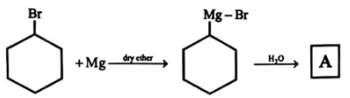
Identify '$A$' in the following reaction.
A
Cyclohexene
B
Cyclohexane
C
Cyclohexanol
D
Benzene
Solution
(B) The reaction of bromocyclohexane with magnesium in the presence of dry ether forms a Grignard reagent,which is cyclohexylmagnesium bromide $(C_6H_{11}MgBr)$.
When this Grignard reagent is treated with water $(\text{H}_2\text{O})$,it undergoes protonolysis to yield cyclohexane $(C_6H_{12})$ as the final product '$A$'.
When this Grignard reagent is treated with water $(\text{H}_2\text{O})$,it undergoes protonolysis to yield cyclohexane $(C_6H_{12})$ as the final product '$A$'.
0 likesView Solution
29
ChemistryEasyMCQGUJCET · 2026
$A$ mixture of an alkyl halide and an aryl halide is treated with sodium in dry ether. What is the name of this reaction?
A
Fittig reaction
B
Finkelstein reaction
C
Wurtz-Fittig reaction
D
Wurtz reaction
Solution
(C) The reaction involving the coupling of an alkyl halide and an aryl halide in the presence of sodium metal and dry ether to form an alkylbenzene is known as the Wurtz-Fittig reaction.
General equation: $R-X + 2Na + X-Ar \xrightarrow{\text{dry ether}} R-Ar + 2NaX$.
General equation: $R-X + 2Na + X-Ar \xrightarrow{\text{dry ether}} R-Ar + 2NaX$.
0 likesView Solution
30
ChemistryMediumMCQGUJCET · 2026
Which of the following compounds is not an allylic chloride?
A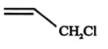
B
$CH_3-CH=CH-CH_2-Cl$
C
D
Solution
(C) An allylic chloride is a compound in which the chlorine atom is attached to an $\text{sp}^3$ hybridized carbon atom that is adjacent to a carbon-carbon double bond (i.e.,an allylic carbon).
$1$. In $CH_2=CH-CH_2-Cl$,the chlorine is attached to an $\text{sp}^3$ carbon adjacent to a double bond,so it is an allylic chloride.
$2$. In $CH_3-CH=CH-CH_2-Cl$,the chlorine is attached to an $\text{sp}^3$ carbon adjacent to a double bond,so it is an allylic chloride.
$3$. In chlorobenzene,the chlorine atom is attached directly to an $\text{sp}^2$ hybridized carbon atom of the benzene ring. This is an aryl chloride,not an allylic chloride.
$4$. In vinyl chloride $(CH_2=CH-Cl)$,the chlorine is attached directly to an $\text{sp}^2$ hybridized carbon atom of the double bond. This is a vinylic chloride,not an allylic chloride.
Since both chlorobenzene and vinyl chloride are not allylic chlorides,and typically in such multiple-choice questions,the most distinct non-allylic example is sought,chlorobenzene is a classic example of an aryl halide.
$1$. In $CH_2=CH-CH_2-Cl$,the chlorine is attached to an $\text{sp}^3$ carbon adjacent to a double bond,so it is an allylic chloride.
$2$. In $CH_3-CH=CH-CH_2-Cl$,the chlorine is attached to an $\text{sp}^3$ carbon adjacent to a double bond,so it is an allylic chloride.
$3$. In chlorobenzene,the chlorine atom is attached directly to an $\text{sp}^2$ hybridized carbon atom of the benzene ring. This is an aryl chloride,not an allylic chloride.
$4$. In vinyl chloride $(CH_2=CH-Cl)$,the chlorine is attached directly to an $\text{sp}^2$ hybridized carbon atom of the double bond. This is a vinylic chloride,not an allylic chloride.
Since both chlorobenzene and vinyl chloride are not allylic chlorides,and typically in such multiple-choice questions,the most distinct non-allylic example is sought,chlorobenzene is a classic example of an aryl halide.
0 likesView Solution
31
ChemistryMediumMCQGUJCET · 2026
Which of the following statements is not applicable to Valence Bond Theory?
A
It does not give quantitative interpretation of magnetic data.
B
It does not distinguish between weak and strong ligands.
C
It explains the colour exhibited by coordination compounds.
D
It does not make exact predictions regarding the structures of $4-$coordinate complexes.
Solution
(C) Valence Bond Theory $(VBT)$ is fundamentally qualitative in nature.
It successfully explains the geometry and magnetic properties (diamagnetic or paramagnetic) based on hybridization,but it fails to provide a quantitative interpretation of magnetic data,such as calculating the exact magnetic moment.
It also does not distinguish between strong and weak ligands (a concept addressed by Crystal Field Theory).
Crucially,$VBT$ fails to explain the electronic spectra or the colours exhibited by coordination compounds.
Therefore,the statement that it explains the colour of coordination compounds is incorrect and not applicable to the theory.
It successfully explains the geometry and magnetic properties (diamagnetic or paramagnetic) based on hybridization,but it fails to provide a quantitative interpretation of magnetic data,such as calculating the exact magnetic moment.
It also does not distinguish between strong and weak ligands (a concept addressed by Crystal Field Theory).
Crucially,$VBT$ fails to explain the electronic spectra or the colours exhibited by coordination compounds.
Therefore,the statement that it explains the colour of coordination compounds is incorrect and not applicable to the theory.
0 likesView Solution
32
ChemistryMediumMCQGUJCET · 2026
What is the correct $IUPAC$ name of the coordination compound $\text{Hg[Co(SCN)}_4]$?
A
Mercury$(II)$ tetrathiocyanato-$S$-cobaltate$(II)$
B
Mercury$(II)$ tetrathiocyanato-$N$-cobaltate$(II)$
C
Mercury$(I)$ tetrathiocyanato-$S$-cobalt$(III)$
D
Mercury$(I)$ tetrathiocyanato-$N$-cobalt$(III)$
Solution
(A) $1$. The given coordination compound is $\text{Hg[Co(SCN)}_4]$.
$2$. The compound dissociates into $\text{Hg}^{2+}$ and $\text{[Co(SCN)}_4]^{2-}$.
$3$. In the complex anion $\text{[Co(SCN)}_4]^{2-}$,the ligand is thiocyanate $(SCN^-)$,which is bonded through the sulfur atom,hence it is named 'thiocyanato-$S$'.
$4$. Let the oxidation state of cobalt $(Co)$ be $x$. Since the charge on the complex is $-2$ and the charge on $SCN^-$ is $-1$,we have: $x + 4(-1) = -2$,which gives $x = +2$.
$5$. The cation is mercury,which is in the $+2$ oxidation state,so it is named 'Mercury$(II)$'.
$6$. The complex anion is named 'tetrathiocyanato-$S$-cobaltate$(II)$' because the metal is in an anionic complex.
$7$. Combining these,the correct $IUPAC$ name is 'Mercury$(II)$ tetrathiocyanato-$S$-cobaltate$(II)$'.
$2$. The compound dissociates into $\text{Hg}^{2+}$ and $\text{[Co(SCN)}_4]^{2-}$.
$3$. In the complex anion $\text{[Co(SCN)}_4]^{2-}$,the ligand is thiocyanate $(SCN^-)$,which is bonded through the sulfur atom,hence it is named 'thiocyanato-$S$'.
$4$. Let the oxidation state of cobalt $(Co)$ be $x$. Since the charge on the complex is $-2$ and the charge on $SCN^-$ is $-1$,we have: $x + 4(-1) = -2$,which gives $x = +2$.
$5$. The cation is mercury,which is in the $+2$ oxidation state,so it is named 'Mercury$(II)$'.
$6$. The complex anion is named 'tetrathiocyanato-$S$-cobaltate$(II)$' because the metal is in an anionic complex.
$7$. Combining these,the correct $IUPAC$ name is 'Mercury$(II)$ tetrathiocyanato-$S$-cobaltate$(II)$'.
0 likesView Solution
33
ChemistryEasyMCQGUJCET · 2026
Which catalyst is used in the Wacker process?
A
$CdCl_2$
B
$ZnCl_2$
C
$PbCl_2$
D
$PdCl_2$
Solution
(D) The Wacker process involves the oxidation of ethylene to acetaldehyde using oxygen in the presence of a palladium$(II)$ chloride $(PdCl_2)$ catalyst and a copper$(II)$ chloride $(CuCl_2)$ co-catalyst.
The chemical equation for the reaction is: $C_2H_4 + \frac{1}{2}O_2 \xrightarrow{PdCl_2, CuCl_2} CH_3CHO$.
Thus,$PdCl_2$ acts as the primary catalyst in this industrial process.
The chemical equation for the reaction is: $C_2H_4 + \frac{1}{2}O_2 \xrightarrow{PdCl_2, CuCl_2} CH_3CHO$.
Thus,$PdCl_2$ acts as the primary catalyst in this industrial process.
0 likesView Solution
34
ChemistryMediumMCQGUJCET · 2026
Which of the following ions has the highest magnetic moment value?
A
$\text{Cr}^{2+}$
B
$\text{Ni}^{2+}$
C
$\text{Cu}^{2+}$
D
$\text{Co}^{2+}$
Solution
(A) Magnetic moment is calculated using the formula $\mu = \sqrt{n(n+2)}$ $B$.$M$.,where $n$ is the number of unpaired electrons.
$1$. $\text{Cr}^{2+}: [Ar]3d^4 \implies n=4$,$\mu = \sqrt{4(4+2)} = \sqrt{24} \approx 4.90$ $B$.$M$.
$2$. $\text{Ni}^{2+}: [Ar]3d^8 \implies n=2$,$\mu = \sqrt{2(2+2)} = \sqrt{8} \approx 2.83$ $B$.$M$.
$3$. $\text{Cu}^{2+}: [Ar]3d^9 \implies n=1$,$\mu = \sqrt{1(1+2)} = \sqrt{3} \approx 1.73$ $B$.$M$.
$4$. $\text{Co}^{2+}: [Ar]3d^7 \implies n=3$,$\mu = \sqrt{3(3+2)} = \sqrt{15} \approx 3.87$ $B$.$M$.
Comparing the values,$\text{Cr}^{2+}$ has the highest number of unpaired electrons $(n=4)$,and therefore,it has the highest magnetic moment.
$1$. $\text{Cr}^{2+}: [Ar]3d^4 \implies n=4$,$\mu = \sqrt{4(4+2)} = \sqrt{24} \approx 4.90$ $B$.$M$.
$2$. $\text{Ni}^{2+}: [Ar]3d^8 \implies n=2$,$\mu = \sqrt{2(2+2)} = \sqrt{8} \approx 2.83$ $B$.$M$.
$3$. $\text{Cu}^{2+}: [Ar]3d^9 \implies n=1$,$\mu = \sqrt{1(1+2)} = \sqrt{3} \approx 1.73$ $B$.$M$.
$4$. $\text{Co}^{2+}: [Ar]3d^7 \implies n=3$,$\mu = \sqrt{3(3+2)} = \sqrt{15} \approx 3.87$ $B$.$M$.
Comparing the values,$\text{Cr}^{2+}$ has the highest number of unpaired electrons $(n=4)$,and therefore,it has the highest magnetic moment.
0 likesView Solution
35
ChemistryMediumMCQGUJCET · 2026
Which of the following metals does not liberate $\text{H}_2$ gas by reacting with $\text{HCl}$?
A
Co
B
Cu
C
Ni
D
Zn
Solution
(B) Metals that have a negative standard reduction potential relative to hydrogen $(E^\circ < 0 \text{ V})$ can liberate $\text{H}_2$ gas from $\text{HCl}$.
Copper $(Cu)$ has a positive standard reduction potential $(E^\circ_{Cu^{2+}/Cu} \approx +0.34 \text{ V})$.
Since its reduction potential is higher than that of hydrogen $(E^\circ_{H^+/H_2} = 0.00 \text{ V})$,it is less reactive than hydrogen and cannot displace it from acids.
Copper $(Cu)$ has a positive standard reduction potential $(E^\circ_{Cu^{2+}/Cu} \approx +0.34 \text{ V})$.
Since its reduction potential is higher than that of hydrogen $(E^\circ_{H^+/H_2} = 0.00 \text{ V})$,it is less reactive than hydrogen and cannot displace it from acids.
0 likesView Solution
36
ChemistryDifficultMCQGUJCET · 2026
The rate of the chemical reaction doubles for an increase of $10 \text{ K}$ in absolute temperature from $298 \text{ K}$. What will be the activation energy?
A
$52.897 \text{ kJ mol}^{-1}$
B
$51.897 \text{ kJ mol}^{-1}$
C
$42.897 \text{ kJ mol}^{-1}$
D
$41.897 \text{ kJ mol}^{-1}$
Solution
(A) Using the Arrhenius equation: $\ln(\frac{k_2}{k_1}) = \frac{E_a}{R} (\frac{T_2 - T_1}{T_1 T_2})$.
Given that the rate doubles,$\frac{k_2}{k_1} = 2$,$T_1 = 298 \text{ K}$,and $T_2 = 308 \text{ K}$.
Substituting the values: $\ln(2) = \frac{E_a}{8.314} (\frac{308 - 298}{298 \times 308})$.
$0.693 = \frac{E_a}{8.314} (\frac{10}{91784})$.
$E_a = \frac{0.693 \times 8.314 \times 91784}{10}$.
$E_a \approx 52897 \text{ J mol}^{-1} = 52.897 \text{ kJ mol}^{-1}$.
Given that the rate doubles,$\frac{k_2}{k_1} = 2$,$T_1 = 298 \text{ K}$,and $T_2 = 308 \text{ K}$.
Substituting the values: $\ln(2) = \frac{E_a}{8.314} (\frac{308 - 298}{298 \times 308})$.
$0.693 = \frac{E_a}{8.314} (\frac{10}{91784})$.
$E_a = \frac{0.693 \times 8.314 \times 91784}{10}$.
$E_a \approx 52897 \text{ J mol}^{-1} = 52.897 \text{ kJ mol}^{-1}$.
0 likesView Solution
37
ChemistryDifficultMCQGUJCET · 2026
When the value of rate constant $(k)$ is $2.0 \text{ min}^{-1}$,then what will be the half-life of the reaction $(t_{1/2})$ in seconds?
A
$34.4$
B
$24.6$
C
$30.2$
D
$20.8$
Solution
(D) For a first-order reaction,the rate constant is given as $k = 2.0 \text{ min}^{-1}$.
The formula for the half-life $(t_{1/2})$ of a first-order reaction is $t_{1/2} = \frac{0.693}{k}$.
Substituting the value of $k$: $t_{1/2} = \frac{0.693}{2.0} = 0.3465 \text{ min}$.
To convert the half-life from minutes to seconds,multiply by $60$: $0.3465 \text{ min} \times 60 \text{ s/min} = 20.79 \text{ s}$.
Rounding to one decimal place,we get $20.8 \text{ seconds}$.
The formula for the half-life $(t_{1/2})$ of a first-order reaction is $t_{1/2} = \frac{0.693}{k}$.
Substituting the value of $k$: $t_{1/2} = \frac{0.693}{2.0} = 0.3465 \text{ min}$.
To convert the half-life from minutes to seconds,multiply by $60$: $0.3465 \text{ min} \times 60 \text{ s/min} = 20.79 \text{ s}$.
Rounding to one decimal place,we get $20.8 \text{ seconds}$.
0 likesView Solution
38
ChemistryMediumMCQGUJCET · 2026
If the rate constant $k = 4.5 \times 10^{-7} \text{ L}^2 \text{ mol}^{-2} \text{ s}^{-1}$,then what is the order of the reaction?
A
$0$
B
$3$
C
$2$
D
$4$
Solution
(B) The general unit for the rate constant $k$ of an $n^{th}$ order reaction is given by the formula: $\text{mol}^{1-n} \text{L}^{n-1} \text{s}^{-1}$.
Given the unit of the rate constant is $\text{L}^2 \text{mol}^{-2} \text{s}^{-1}$.
Comparing the exponent of $\text{L}$ (liters) in the given unit with the general formula: $n - 1 = 2$.
Solving for $n$,we get $n = 3$.
Therefore,the order of the reaction is $3$.
Given the unit of the rate constant is $\text{L}^2 \text{mol}^{-2} \text{s}^{-1}$.
Comparing the exponent of $\text{L}$ (liters) in the given unit with the general formula: $n - 1 = 2$.
Solving for $n$,we get $n = 3$.
Therefore,the order of the reaction is $3$.
0 likesView Solution
39
ChemistryMediumMCQGUJCET · 2026
According to the Arrhenius equation,in a graph of $\log k$ versus $\frac{1}{T}$,the slope will be . . . . . . .
A
$-\frac{E_a}{R}$
B
$\frac{E_a}{R}$
C
$-\frac{E_a}{2.303R}$
D
$\frac{E_a}{2.303R}$
Solution
(C) The Arrhenius equation is given by $k = A e^{-E_a/RT}$.
Taking the logarithm to the base $10$ on both sides,we get:
$\log_{10} k = \log_{10} A - \frac{E_a}{2.303RT}$.
This equation is in the form of a straight line $y = mx + c$,where $y = \log_{10} k$,$x = \frac{1}{T}$,$c = \log_{10} A$,and the slope $m = -\frac{E_a}{2.303R}$.
Therefore,the slope of the graph of $\log k$ versus $\frac{1}{T}$ is $-\frac{E_a}{2.303R}$.
Taking the logarithm to the base $10$ on both sides,we get:
$\log_{10} k = \log_{10} A - \frac{E_a}{2.303RT}$.
This equation is in the form of a straight line $y = mx + c$,where $y = \log_{10} k$,$x = \frac{1}{T}$,$c = \log_{10} A$,and the slope $m = -\frac{E_a}{2.303R}$.
Therefore,the slope of the graph of $\log k$ versus $\frac{1}{T}$ is $-\frac{E_a}{2.303R}$.
0 likesView Solution
40
ChemistryDifficultMCQGUJCET · 2026
How much electricity in terms of Faraday is required to produce $40.0 \text{ g}$ of $\text{Al}$ from molten $\text{Al}_2\text{O}_3$ (in $\text{ F}$)?
A
$4.44$
B
$4.14$
C
$8.88$
D
$8.14$
Solution
(A) The reduction reaction for the production of aluminum is: $\text{Al}^{3+} + 3e^- \to \text{Al}$.
According to the stoichiometry,$1 \text{ mole}$ of $\text{Al}$ $(27 \text{ g})$ requires $3 \text{ Faradays}$ $(3 \text{ F})$ of electricity.
To produce $40.0 \text{ g}$ of $\text{Al}$,the charge required is calculated as:
$\text{Charge} = \frac{3 \text{ F}}{27 \text{ g}} \times 40.0 \text{ g} = \frac{120}{27} \text{ F} \approx 4.44 \text{ F}$.
Thus,the amount of electricity required is $4.44 \text{ F}$.
According to the stoichiometry,$1 \text{ mole}$ of $\text{Al}$ $(27 \text{ g})$ requires $3 \text{ Faradays}$ $(3 \text{ F})$ of electricity.
To produce $40.0 \text{ g}$ of $\text{Al}$,the charge required is calculated as:
$\text{Charge} = \frac{3 \text{ F}}{27 \text{ g}} \times 40.0 \text{ g} = \frac{120}{27} \text{ F} \approx 4.44 \text{ F}$.
Thus,the amount of electricity required is $4.44 \text{ F}$.
0 likesView Solution
Vedclass Products
For Students
Vedclass Test Series
Mock tests in real GUJCET style covering Chemistry with performance analysis. 5-day free trial.
Start Free TrialFor Teachers
Exam Paper Generator
Generate Set A/B/C/D Chemistry papers from 7.5L+ questions in 2 minutes. 3 chapters free.
Try FreeFor Institutes
Online Exam Module
Run live GUJCET mock exams with unlimited students, 360° analytics & white-label branding.
See DemoFrequently Asked Questions
How many Chemistry questions are in GUJCET 2026?
There are 40 Chemistry questions from the GUJCET 2026 paper on Vedclass, each with a detailed step-by-step solution in English.
Are GUJCET 2026 Chemistry solutions available in English?
Yes. All solutions on this page are in English. You can also switch to English or Hindi using the language buttons above the questions.
Can I practice GUJCET 2026 Chemistry as a timed test?
Yes. Use the Vedclass Test Series to attempt a full GUJCET mock test covering Chemistry with time limits and instant score analysis.
Can teachers create Chemistry papers from GUJCET previous year questions?
Yes. The Vedclass Exam Paper Generator lets teachers mix GUJCET Chemistry questions and generate Set A/B/C/D papers in minutes.
For Teachers & Institutes
Build a Custom Chemistry Paper
Pick GUJCET 2026 Chemistry questions, set difficulty, and generate Set A/B/C/D in 2 minutes.