
BiologyQ1–51 of 100 questions
Page 1 of 2 · English
1
BiologyEasyMCQGSEB · 2024
Large reservoir of erythrocytes is . . . . . . .
A
Spleen
B
Liver
C
Appendix
D
Thymus gland
Solution
(A) The $Spleen$ is known as the 'graveyard of erythrocytes' because it removes old and damaged red blood cells from circulation. Additionally, it acts as a large reservoir of erythrocytes, storing them and releasing them into the bloodstream when the body requires an increased oxygen-carrying capacity, such as during exercise or hemorrhage.
0 likesView Solution
2
BiologyMediumMCQGSEB · 2024
Which part of the tobacco plant is infected by $Meloidogyne \ incognita$?
A
Stem
B
Root
C
Flower
D
Leaf
Solution
(B) $Meloidogyne \ incognita$ is a nematode that infects the roots of tobacco plants,causing a significant reduction in yield. This infection is prevented using $RNA$ interference $(RNAi)$ technology.
0 likesView Solution
3
BiologyEasyMCQGSEB · 2024
How many more hotspots have been added in the list of biodiversity?
A
$9$
B
$5$
C
$3$
D
$7$
Solution
(A) Initially,$9$ biodiversity hotspots were identified in the world. Later,$25$ more hotspots were added to the list,bringing the total number of biodiversity hotspots to $34$. Therefore,$25$ more hotspots were added. However,based on the provided options,the question likely refers to the addition of $9$ hotspots in a specific context or a revision. Given the standard $NCERT$ context,the total is $34$. If the question implies the most recent additions to the original list of $25$,the answer is $9$.
0 likesView Solution
4
BiologyEasyMCQGSEB · 2024
Clarias gariepinus is harmful to which organism?
A
Steller's Sea cow
B
Nile perch
C
Cichlid fishes
D
Indigenous catfish
Solution
(D) $Clarias \text{ } gariepinus$ (African catfish) is an invasive species introduced illegally for aquaculture purposes in India. It is harmful to indigenous catfish species because it competes with them for food and habitat, and it is also predatory in nature, leading to a decline in the population of native catfish.
0 likesView Solution
5
BiologyEasyMCQGSEB · 2024
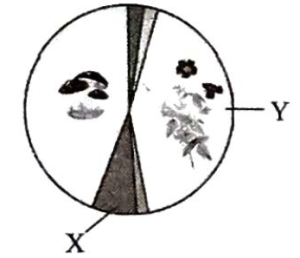
The diagram represents the global biodiversity of major plant taxa. Identify $X$ and $Y$ from the given diagram.
A
$X$ - Algae,$Y$ - Moss
B
$X$ - Lichen,$Y$ - Algae
C
$X$ - Fungi,$Y$ - Algae
D
$X$ - Algae,$Y$ - Angiosperm
Solution
(D) According to the $NCERT$ textbook diagram representing the global biodiversity of major plant taxa,the pie chart shows the distribution of different plant groups.
In this diagram,the largest portion represents Angiosperms $(Y)$,which constitute the majority of plant species.
The portion labeled $X$ represents Algae.
Therefore,$X$ is Algae and $Y$ is Angiosperm.
In this diagram,the largest portion represents Angiosperms $(Y)$,which constitute the majority of plant species.
The portion labeled $X$ represents Algae.
Therefore,$X$ is Algae and $Y$ is Angiosperm.
0 likesView Solution
6
BiologyEasyMCQGSEB · 2024
Which of the following is not a part of in situ conservation?
A
National Park
B
Biosphere reserve
C
Sanctuaries
D
Zoological parks
Solution
(D) In situ conservation involves the protection of plants and animals within their natural habitats.
$A$,$B$,and $C$ (National Parks,Biosphere Reserves,and Wildlife Sanctuaries) are examples of in situ conservation.
$D$ (Zoological parks) is an example of ex situ conservation,where organisms are kept in a protected environment outside their natural habitat for care and breeding.
Therefore,the correct answer is $D$.
$A$,$B$,and $C$ (National Parks,Biosphere Reserves,and Wildlife Sanctuaries) are examples of in situ conservation.
$D$ (Zoological parks) is an example of ex situ conservation,where organisms are kept in a protected environment outside their natural habitat for care and breeding.
Therefore,the correct answer is $D$.
0 likesView Solution
7
BiologyEasyMCQGSEB · 2024
What is the main cause of biodiversity loss in the Amazon rain forest?
A
Habitat loss and fragmentation
B
Alien species invasion
C
Over-exploitation
D
Co-extinction
Solution
(A) The Amazon rain forest,often referred to as the '$Lungs$ of the planet',is being cut and cleared for cultivating soya beans or for conversion to grasslands for raising beef cattle. This large-scale deforestation is the primary cause of biodiversity loss in this region,which is categorized as habitat loss and fragmentation.
0 likesView Solution
8
BiologyEasyMCQGSEB · 2024
Who among the following established naturalistic species-area relationships?
A
Paul Ehrlich
B
Robert May
C
Alexander Von Humboldt
D
David Tilman
Solution
(C) Alexander Von Humboldt observed that within a region,species richness increased with increasing explored area,but only up to a limit. This relationship is described by the equation $S = CA^z$,where $S$ is species richness,$A$ is area,$Z$ is the slope of the line (regression coefficient),and $C$ is the $Y$-intercept. This fundamental concept in ecology was established by the German naturalist and geographer Alexander Von Humboldt.
0 likesView Solution
9
BiologyEasyMCQGSEB · 2024
How much human protein is present in one litre of milk from the transgenic cow 'Rosie' (in $\text{ gm}$)?
A
$4.2$
B
$2.8$
C
$5.2$
D
$2.4$
Solution
(D) The transgenic cow 'Rosie', produced in $1997$, was the first transgenic cow to produce human protein-enriched milk.
Rosie's milk contained the human alpha-lactalbumin protein.
The concentration of this human protein in her milk was $2.4 \text{ gm}$ per litre.
Therefore, the correct option is $D$.
Rosie's milk contained the human alpha-lactalbumin protein.
The concentration of this human protein in her milk was $2.4 \text{ gm}$ per litre.
Therefore, the correct option is $D$.
0 likesView Solution
10
BiologyEasyMCQGSEB · 2024
What is the full form of $G.E.A.C.$?
A
General engineering applied concept
B
Genetic Engineering Approval Committee
C
Genetic engineering approval concept
D
General engineering approval committee
Solution
(B) The full form of $G.E.A.C.$ is Genetic Engineering Approval Committee.
This committee is responsible for making decisions regarding the validity of research involving genetically modified organisms $(GMOs)$ and the safety of introducing genetically modified organisms for public services.
This committee is responsible for making decisions regarding the validity of research involving genetically modified organisms $(GMOs)$ and the safety of introducing genetically modified organisms for public services.
0 likesView Solution
11
BiologyEasyMCQGSEB · 2024
$BT$ cotton is not a ?
A
Transgenic plant
B
Insect resistant
C
$A$ bacterial gene expression system
D
Resistant to all insecticides
Solution
(D) $BT$ cotton is a genetically modified or transgenic crop that expresses the $cry$ gene from the bacterium $Bacillus$ $thuringiensis$.
This gene produces an insecticidal protein that provides resistance against specific lepidopteran,coleopteran,and dipteran pests.
Therefore,it is a transgenic plant and is insect-resistant.
However,it is not resistant to all insecticides; it is specifically engineered to target certain pests,and its resistance is limited to those specific insect groups.
Thus,the statement that it is resistant to all insecticides is incorrect.
This gene produces an insecticidal protein that provides resistance against specific lepidopteran,coleopteran,and dipteran pests.
Therefore,it is a transgenic plant and is insect-resistant.
However,it is not resistant to all insecticides; it is specifically engineered to target certain pests,and its resistance is limited to those specific insect groups.
Thus,the statement that it is resistant to all insecticides is incorrect.
0 likesView Solution
12
BiologyEasyMCQGSEB · 2024
Genetic engineering is useful for the production of?
A
Transgenic mice used to test the safety of the polio vaccine before it is used in humans.
B
Transgenic models useful for studying new treatments for certain heart-related diseases.
C
Genetically modified cows giving high-fat milk useful for making ghee.
D
More powerful,axe-like animals for agricultural use.
Solution
(A) Genetic engineering,specifically the creation of transgenic animals,has significant applications in medicine and research.
$1$. Transgenic mice are used to test the safety of vaccines,such as the polio vaccine,before they are administered to humans. This ensures that the vaccine is safe and effective.
$2$. Transgenic models are also used to study human diseases,including heart-related conditions,to develop new treatments.
While options $A$ and $B$ are both scientifically valid applications,in the context of standard $NCERT$ biology curriculum,the use of transgenic mice for vaccine safety testing is a primary example cited for the application of biotechnology in medicine.
$1$. Transgenic mice are used to test the safety of vaccines,such as the polio vaccine,before they are administered to humans. This ensures that the vaccine is safe and effective.
$2$. Transgenic models are also used to study human diseases,including heart-related conditions,to develop new treatments.
While options $A$ and $B$ are both scientifically valid applications,in the context of standard $NCERT$ biology curriculum,the use of transgenic mice for vaccine safety testing is a primary example cited for the application of biotechnology in medicine.
0 likesView Solution
13
BiologyEasyMCQGSEB · 2024
In which disease is $\alpha-1$ antitrypsin used for treatment?
A
Asthma
B
Common cold
C
Pneumonia
D
Emphysema
Solution
(D) The correct answer is $D$. $\alpha-1$ antitrypsin is a proteinase inhibitor used to treat emphysema. Emphysema is a chronic respiratory disorder in which alveolar walls are damaged due to which respiratory surface is decreased. This protein is produced through transgenic animals (specifically sheep) to treat this deficiency.
0 likesView Solution
14
BiologyEasyMCQGSEB · 2024
In mature insulin,chain $A$ and chain $B$ are interlinked by which bond?
A
Peptide bond
B
Hydrogen bond
C
Glycosidic bond
D
Disulphide bond
Solution
(D) Mature insulin consists of two short polypeptide chains: chain $A$ and chain $B$.
These two chains are linked together by two inter-chain disulphide bonds.
Additionally,there is an intra-chain disulphide bond within chain $A$.
Therefore,the correct answer is $D$.
These two chains are linked together by two inter-chain disulphide bonds.
Additionally,there is an intra-chain disulphide bond within chain $A$.
Therefore,the correct answer is $D$.
0 likesView Solution
15
BiologyEasyMCQGSEB · 2024
Golden rice is enriched with which vitamin?
A
Vitamin $A$
B
Vitamin $C$
C
Vitamin $B$
D
Vitamin $D$
Solution
(A) Golden rice is a genetically modified crop developed to combat vitamin deficiency. It is engineered to produce high levels of beta-carotene,which is a precursor to $Vitamin \ A$. When consumed,the human body converts this beta-carotene into $Vitamin \ A$. Therefore,the correct option is $A$.
0 likesView Solution
16
BiologyEasyMCQGSEB · 2024
Crystals of $Bt$ toxin produced by some bacteria do not kill the bacteria themselves because . . . . . .
A
Bacteria are resistant to the toxin
B
Toxin is inactive
C
Toxin is mature
D
Bacteria encloses toxin in a special sac
Solution
(B) The $Bt$ toxin produced by the bacterium $Bacillus \text{ } thuringiensis$ exists in an inactive protoxin form within the bacterial cell.
It only becomes active when it is ingested by an insect, where the alkaline $pH$ of the insect's gut solubilizes the crystals and converts the protoxin into its active toxic form.
Therefore, the bacteria remain unharmed because the toxin is not in its active state while inside the bacterial cell.
It only becomes active when it is ingested by an insect, where the alkaline $pH$ of the insect's gut solubilizes the crystals and converts the protoxin into its active toxic form.
Therefore, the bacteria remain unharmed because the toxin is not in its active state while inside the bacterial cell.
0 likesView Solution
17
BiologyEasyMCQGSEB · 2024
Which specific protein is responsible for the control of corn borer?
A
Cry $II$ Ac
B
Cry $II$ Ab
C
Cry $I$ Ac
D
Cry $I$ Ab
Solution
(D) The corn borer is controlled by the protein encoded by the gene $cry I Ab$.
This gene is derived from the bacterium $Bacillus thuringiensis$.
When the corn borer ingests the plant tissue containing this protein,the toxin is activated in the alkaline gut of the insect,leading to its death.
Therefore,the correct option is $D$.
This gene is derived from the bacterium $Bacillus thuringiensis$.
When the corn borer ingests the plant tissue containing this protein,the toxin is activated in the alkaline gut of the insect,leading to its death.
Therefore,the correct option is $D$.
0 likesView Solution
18
BiologyEasyMCQGSEB · 2024
Identify the antibiotic resistance gene from the following options.
A
BamH $I$
B
Hind $III$
C
Sal $I$
D
$amp^R$
Solution
(D) In the context of cloning vectors like $pBR322$,$BamH I$,$Hind III$,and $Sal I$ are specific restriction endonuclease recognition sites. The term $amp^R$ stands for ampicillin resistance,which is a gene that provides resistance to the antibiotic ampicillin. Therefore,$amp^R$ is the antibiotic resistance gene.
0 likesView Solution
19
BiologyEasyMCQGSEB · 2024
$DNA$ can be studied after staining with . . . . . . in various fields.
A
Eosin
B
Ethidium Chloride
C
Ethidium Bromide
D
Fast Green
Solution
(C) The correct answer is $C$.
Ethidium Bromide $(EtBr)$ is a fluorescent dye used to stain $DNA$ in agarose gel electrophoresis.
When exposed to ultraviolet $(UV)$ light,the $EtBr$ molecules intercalate between the base pairs of the $DNA$,causing the $DNA$ bands to fluoresce orange,which allows for the visualization and study of $DNA$ fragments.
Ethidium Bromide $(EtBr)$ is a fluorescent dye used to stain $DNA$ in agarose gel electrophoresis.
When exposed to ultraviolet $(UV)$ light,the $EtBr$ molecules intercalate between the base pairs of the $DNA$,causing the $DNA$ bands to fluoresce orange,which allows for the visualization and study of $DNA$ fragments.
0 likesView Solution
20
BiologyEasyMCQGSEB · 2024
Endonuclease . . . . . . .
A
It creates billion copies of $DNA$
B
It removes nucleotides from the ends of $DNA$
C
It joins the nucleotide in $DNA$
D
It makes cut at the specific position within the $DNA$
Solution
(D) Restriction endonucleases are enzymes that recognize specific nucleotide sequences in $DNA$ and make cuts at these specific positions within the $DNA$ molecule.
Option $A$ describes the function of $PCR$ (Polymerase Chain Reaction).
Option $B$ describes the function of exonucleases.
Option $C$ describes the function of $DNA$ ligase.
Therefore,the correct option is $D$.
Option $A$ describes the function of $PCR$ (Polymerase Chain Reaction).
Option $B$ describes the function of exonucleases.
Option $C$ describes the function of $DNA$ ligase.
Therefore,the correct option is $D$.
0 likesView Solution
21
BiologyEasyMCQGSEB · 2024
Eco-$RI$ cuts the $DNA$ between . . . . . . only when the sequence $GAATTC$ is present in the $DNA$.
A
$G$ and $A$
B
$T$ and $C$
C
$A$ and $T$
D
$A$ and $A$
Solution
(A) The restriction endonuclease $EcoRI$ recognizes the specific palindromic sequence $5'-GAATTC-3'$.
It cleaves the phosphodiester bond between the bases $G$ (Guanine) and $A$ (Adenine) on both strands of the $DNA$ molecule.
This specific cleavage results in the formation of sticky ends or cohesive ends,which are essential for recombinant $DNA$ technology.
Therefore,the correct site of cleavage for $EcoRI$ is between $G$ and $A$.
It cleaves the phosphodiester bond between the bases $G$ (Guanine) and $A$ (Adenine) on both strands of the $DNA$ molecule.
This specific cleavage results in the formation of sticky ends or cohesive ends,which are essential for recombinant $DNA$ technology.
Therefore,the correct site of cleavage for $EcoRI$ is between $G$ and $A$.
0 likesView Solution
22
BiologyEasyMCQGSEB · 2024
Which chemical is utilised during the isolation of $DNA$ at the end of precipitation?
A
Chilled methanol
B
Chilled butanol
C
Chilled ethanol
D
Chilled phenol
Solution
(C) During the process of $DNA$ isolation,the final step involves the precipitation of purified $DNA$. This is achieved by adding chilled ethanol to the $DNA$ solution. The chilled ethanol reduces the solubility of $DNA$ in the aqueous solution,causing it to precipitate out as fine threads,which can then be collected by spooling.
0 likesView Solution
23
BiologyEasyMCQGSEB · 2024
$pBR322$ contains the recognition sites for which of the following endonucleases at the $amp^R$ site?
A
$Pvu$ $II$ and $Pvu$ $I$
B
$Pst$ $I$ and $Pvu$ $I$
C
$Sal$ $I$ and $Bam$ $HI$
D
$Pst$ $I$ and $Sal$ $I$
Solution
(B) The plasmid $pBR322$ is a widely used cloning vector in $E. coli$.
It contains two antibiotic resistance genes: $amp^R$ (ampicillin resistance) and $tet^R$ (tetracycline resistance).
The $amp^R$ gene contains recognition sites for the restriction endonucleases $Pst$ $I$ and $Pvu$ $I$.
The $tet^R$ gene contains recognition sites for $Bam$ $HI$ and $Sal$ $I$.
Therefore,the correct option is $B$.
It contains two antibiotic resistance genes: $amp^R$ (ampicillin resistance) and $tet^R$ (tetracycline resistance).
The $amp^R$ gene contains recognition sites for the restriction endonucleases $Pst$ $I$ and $Pvu$ $I$.
The $tet^R$ gene contains recognition sites for $Bam$ $HI$ and $Sal$ $I$.
Therefore,the correct option is $B$.
0 likesView Solution
24
BiologyEasyMCQGSEB · 2024
Which metals are used in a gene gun for the insertion of alien $DNA$ into a competent host?
A
Gold and Zinc
B
Gold and Tungsten
C
Copper and Gold
D
Tungsten and Iron
Solution
(B) In the gene gun method (also known as biolistics or microprojectile bombardment),cells are bombarded with high-velocity microparticles of gold or tungsten coated with $DNA$. These heavy metals are used because they are inert and do not react with the biological tissues,ensuring the safe delivery of the alien $DNA$ into the host cell. Therefore,the correct option is $B$.
0 likesView Solution
25
BiologyEasyMCQGSEB · 2024
The number of trophic levels in the grazing food chain is restricted as the transfer of energy follows . . . . . . %. (in $%$)
A
$16$
B
$10$
C
$9$
D
$12$
Solution
(B) According to the $10\%$ law of energy transfer proposed by Lindeman, only about $10\%$ of the energy available at one trophic level is transferred to the next trophic level. The remaining $90\%$ of the energy is lost as heat during metabolic processes or remains in the form of chemical energy in the biomass that is not consumed. Due to this significant loss of energy at each step, the number of trophic levels in a grazing food chain is typically limited to $4$ or $5$.
0 likesView Solution
26
BiologyEasyMCQGSEB · 2024
Which of the following statements is true regarding humus?
$(P)$ It contains colloids.
$(Q)$ It contains nutrients.
$(R)$ Its decomposition is not possible.
$(P)$ It contains colloids.
$(Q)$ It contains nutrients.
$(R)$ Its decomposition is not possible.
A
$(P)$ and $(Q)$
B
$(Q)$ and $(R)$
C
Only $(Q)$
D
Only $(R)$
Solution
(A) Humus is a dark-colored,amorphous substance formed by the process of humification during decomposition.
$(P)$ Humus acts as a reservoir of nutrients and possesses colloidal properties,which help in retaining moisture and nutrients in the soil.
$(Q)$ It is rich in nutrients like nitrogen,phosphorus,and potassium,which are released slowly into the soil.
$(R)$ Humus is highly resistant to microbial action and undergoes decomposition at a very slow rate,but it is not impossible to decompose. Therefore,statement $(R)$ is incorrect.
Thus,statements $(P)$ and $(Q)$ are correct.
$(P)$ Humus acts as a reservoir of nutrients and possesses colloidal properties,which help in retaining moisture and nutrients in the soil.
$(Q)$ It is rich in nutrients like nitrogen,phosphorus,and potassium,which are released slowly into the soil.
$(R)$ Humus is highly resistant to microbial action and undergoes decomposition at a very slow rate,but it is not impossible to decompose. Therefore,statement $(R)$ is incorrect.
Thus,statements $(P)$ and $(Q)$ are correct.
0 likesView Solution
27
BiologyEasyMCQGSEB · 2024
In any population group,if the rate of natality and immigration increases,then the density of the population is . . . . . . .
A
Zero
B
Decrease
C
Stable
D
Increase
Solution
(D) The population density $(N)$ is influenced by four primary factors: natality $(B)$,mortality $(D)$,immigration $(I)$,and emigration $(E)$.
The formula for population density at time $t+1$ is given by: $N_{t+1} = N_t + [(B + I) - (D + E)]$.
Natality $(B)$ refers to the number of births in a population during a given period,which adds individuals to the population.
Immigration $(I)$ refers to the number of individuals of the same species that have come into the habitat from elsewhere during the time period under consideration,which also adds individuals to the population.
Since both natality and immigration contribute to an increase in the number of individuals,an increase in these rates will lead to an increase in the overall population density.
The formula for population density at time $t+1$ is given by: $N_{t+1} = N_t + [(B + I) - (D + E)]$.
Natality $(B)$ refers to the number of births in a population during a given period,which adds individuals to the population.
Immigration $(I)$ refers to the number of individuals of the same species that have come into the habitat from elsewhere during the time period under consideration,which also adds individuals to the population.
Since both natality and immigration contribute to an increase in the number of individuals,an increase in these rates will lead to an increase in the overall population density.
0 likesView Solution
28
BiologyEasyMCQGSEB · 2024
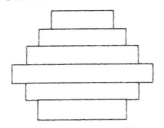
The given age pyramid for human population indicates:
A
Expanding human population
B
Declining human population
C
Stable human population
D
Fluctuating human population
Solution
(B) The provided age pyramid shows a base (pre-reproductive age group) that is narrower than the middle section (reproductive age group).
This shape is characteristic of a declining population,where the number of individuals in the reproductive age group is higher than those in the pre-reproductive age group,leading to a decrease in the population over time.
This shape is characteristic of a declining population,where the number of individuals in the reproductive age group is higher than those in the pre-reproductive age group,leading to a decrease in the population over time.
0 likesView Solution
29
BiologyEasyMCQGSEB · 2024
In a particular climatic condition,the decomposition rate is . . . . . . if detritus is rich in lignin and chitin.
A
zero
B
slower
C
stable
D
faster
Solution
(B) The rate of decomposition is controlled by the chemical composition of detritus and climatic factors.
Detritus rich in nitrogen and water-soluble substances like sugars decomposes faster.
Conversely,detritus rich in lignin and chitin decomposes much slower because these substances are complex,resistant to enzymatic degradation,and require specific microbial enzymes that are not easily produced by all decomposers.
Therefore,the correct option is $B$.
Detritus rich in nitrogen and water-soluble substances like sugars decomposes faster.
Conversely,detritus rich in lignin and chitin decomposes much slower because these substances are complex,resistant to enzymatic degradation,and require specific microbial enzymes that are not easily produced by all decomposers.
Therefore,the correct option is $B$.
0 likesView Solution
30
BiologyEasyMCQGSEB · 2024
The second trophic level in a lake is . . . . . . .
A
Phytoplankton
B
Algae
C
Zooplankton
D
Fishes
Solution
(C) In an aquatic ecosystem like a lake,the trophic levels are organized as follows:
$1$. The first trophic level consists of producers,which are phytoplankton,algae,and submerged plants.
$2$. The second trophic level consists of primary consumers,which feed on the producers. In a lake,these are zooplankton.
$3$. The third trophic level consists of secondary consumers,such as small fishes.
$4$. Therefore,the second trophic level is represented by zooplankton.
$1$. The first trophic level consists of producers,which are phytoplankton,algae,and submerged plants.
$2$. The second trophic level consists of primary consumers,which feed on the producers. In a lake,these are zooplankton.
$3$. The third trophic level consists of secondary consumers,such as small fishes.
$4$. Therefore,the second trophic level is represented by zooplankton.
0 likesView Solution
31
BiologyEasyMCQGSEB · 2024
Choose the correct option for the given statements:
($T$ = True,$F$ = False)
$(A)$ Pyramid of energy is always upright.
$(B)$ Pyramid of number in a sea is generally inverted.
$(C)$ Pyramid of biomass in a sea is generally inverted.
$(D)$ In most ecosystems,the pyramid of number and energy are always inverted.
($T$ = True,$F$ = False)
$(A)$ Pyramid of energy is always upright.
$(B)$ Pyramid of number in a sea is generally inverted.
$(C)$ Pyramid of biomass in a sea is generally inverted.
$(D)$ In most ecosystems,the pyramid of number and energy are always inverted.
A
$FTFT$
B
$TFTT$
C
$FFTF$
D
$TFTF$
Solution
(D) The pyramid of energy is always upright because energy flow is unidirectional and some energy is lost as heat at each trophic level. This statement is $True$ $(T)$.
$(B)$ The pyramid of number in a sea is generally upright (e.g.,many small phytoplankton support fewer zooplankton,which support even fewer small fish). This statement is $False$ $(F)$.
$(C)$ The pyramid of biomass in a sea is generally inverted because the biomass of phytoplankton (producers) is smaller than the biomass of zooplankton and fish (consumers) at any given time. This statement is $True$ $(T)$.
$(D)$ In most ecosystems,the pyramid of energy is always upright,and the pyramid of number is often upright. This statement is $False$ $(F)$.
Therefore,the sequence is $T, F, T, F$.
$(B)$ The pyramid of number in a sea is generally upright (e.g.,many small phytoplankton support fewer zooplankton,which support even fewer small fish). This statement is $False$ $(F)$.
$(C)$ The pyramid of biomass in a sea is generally inverted because the biomass of phytoplankton (producers) is smaller than the biomass of zooplankton and fish (consumers) at any given time. This statement is $True$ $(T)$.
$(D)$ In most ecosystems,the pyramid of energy is always upright,and the pyramid of number is often upright. This statement is $False$ $(F)$.
Therefore,the sequence is $T, F, T, F$.
0 likesView Solution
32
BiologyEasyMCQGSEB · 2024
Detritus food chain begins from . . . . . . .
A
Phytoplankton
B
Dead organic matter
C
Zooplankton
D
Grass
Solution
(B) The Detritus Food Chain $(DFC)$ begins with dead organic matter. It is made up of decomposers which are heterotrophic organisms,mainly fungi and bacteria. These organisms meet their energy and nutrient requirements by degrading dead organic matter or detritus. These are also known as saprotrophs ($SAPRO$ = to decompose).
0 likesView Solution
33
BiologyEasyMCQGSEB · 2024
What is the percentage of photosynthetically active radiation $(PAR)$ in the incident solar radiation?
A
$100$ %
B
< $20-30$ %
C
< $50$ %
D
< $2-10$ %
Solution
(C) The incident solar radiation consists of various wavelengths of light.
Photosynthetically active radiation $(PAR)$ refers to the spectral range of solar radiation from $400 \ nm$ to $700 \ nm$ that photosynthetic organisms are able to use in the process of photosynthesis.
It is observed that $PAR$ constitutes less than $50$ % of the total incident solar radiation reaching the Earth's surface.
Therefore, the correct option is $C$.
Photosynthetically active radiation $(PAR)$ refers to the spectral range of solar radiation from $400 \ nm$ to $700 \ nm$ that photosynthetic organisms are able to use in the process of photosynthesis.
It is observed that $PAR$ constitutes less than $50$ % of the total incident solar radiation reaching the Earth's surface.
Therefore, the correct option is $C$.
0 likesView Solution
34
BiologyEasyMCQGSEB · 2024
The brain capacity of $Homo \text{ } habilis$ is . . . . . . .
A
$650$ to $800 \text{ } CC$
B
$900$ to $1200 \text{ } CC$
C
$1400$ to $1600 \text{ } CC$
D
$850$ to $950 \text{ } CC$
Solution
(A) $Homo \text{ } habilis$ is considered the first human-like hominid. Their brain capacity ranged between $650 \text{ } CC$ and $800 \text{ } CC$. They did not eat meat. Therefore, the correct option is $A$.
0 likesView Solution
35
BiologyEasyMCQGSEB · 2024
Which type of animals first evolved from lobefins?
A
Aves
B
Reptiles
C
Amphibians
D
Mammals
Solution
(C) Lobefins were fish with stout and strong fins that could move on land and go back to water.
In $1938$,a fish caught in South Africa happened to be a Coelacanth,which was thought to be extinct.
These animals,called lobefins,evolved into the first amphibians that lived on both land and water.
Therefore,the correct answer is $C$ (Amphibians).
In $1938$,a fish caught in South Africa happened to be a Coelacanth,which was thought to be extinct.
These animals,called lobefins,evolved into the first amphibians that lived on both land and water.
Therefore,the correct answer is $C$ (Amphibians).
0 likesView Solution
36
BiologyEasyMCQGSEB · 2024
Which scientist explained adaptive radiation from his study on Galapagos Island?
A
Alfred Wallace
B
Lamarck
C
Hugo de Vries
D
Darwin
Solution
(D) Charles $Darwin$ observed a variety of small black birds in the Galapagos Islands,now known as $Darwin's$ finches. He realized that many varieties of finches existed on the same island. All the varieties,he conjectured,evolved on the island itself. From the original seed-eating features,many other forms with altered beaks arose,enabling them to become insectivorous and vegetarian finches. This process of evolution of different species in a given geographical area starting from a point and literally radiating to other areas of geography (habitats) is called adaptive radiation.
0 likesView Solution
37
BiologyEasyMCQGSEB · 2024
In a population,the frequency of the $M$ allele is $0.8$. Calculate the frequency of the homozygous recessive genotype in that population. (in $\%$)
A
$64$
B
$4$
C
$32$
D
$10$
Solution
(B) According to the Hardy-Weinberg principle,$p + q = 1$,where $p$ is the frequency of the dominant allele and $q$ is the frequency of the recessive allele.
Given that the frequency of the $M$ allele $(p)$ is $0.8$,we can calculate the frequency of the recessive allele $(q)$ as:
$q = 1 - p = 1 - 0.8 = 0.2$.
The frequency of the homozygous recessive genotype is represented by $q^2$.
Therefore,$q^2 = (0.2)^2 = 0.04$.
Converting this to a percentage: $0.04 \times 100 = 4\%$.
Thus,the correct option is $B$.
Given that the frequency of the $M$ allele $(p)$ is $0.8$,we can calculate the frequency of the recessive allele $(q)$ as:
$q = 1 - p = 1 - 0.8 = 0.2$.
The frequency of the homozygous recessive genotype is represented by $q^2$.
Therefore,$q^2 = (0.2)^2 = 0.04$.
Converting this to a percentage: $0.04 \times 100 = 4\%$.
Thus,the correct option is $B$.
0 likesView Solution
38
BiologyEasyMCQGSEB · 2024
Single step,large mutation is known as saltation. This statement is given by . . . . . . .
A
Darwin
B
Thomas Malthus
C
Hugo de Vries
D
Lamarck
Solution
(C) The concept of saltation was proposed by Hugo de Vries. He defined saltation as a single-step,large mutation that leads to speciation. Unlike Darwin's theory of gradual evolution through small variations,de Vries emphasized that evolution occurs through sudden,discontinuous variations or mutations.
0 likesView Solution
39
BiologyEasyMCQGSEB · 2024
The brain capacity of Neanderthal man was . . . . . . . (in $cc$)
A
$900$
B
$650$
C
$1400$
D
$800$
Solution
(C) The brain capacity of Neanderthal man was approximately $1400 \text{ cc}$.
Neanderthals lived in near east and central Asia between $100,000$ to $40,000$ years back.
They used hides to protect their body and buried their dead.
Their cranial capacity was significantly larger than that of $Homo \text{ habilis}$ and $Homo \text{ erectus}$.
Neanderthals lived in near east and central Asia between $100,000$ to $40,000$ years back.
They used hides to protect their body and buried their dead.
Their cranial capacity was significantly larger than that of $Homo \text{ habilis}$ and $Homo \text{ erectus}$.
0 likesView Solution
40
BiologyEasyMCQGSEB · 2024
Which is the correct example for divergent evolution?
A
Thorn of Bougainvillea and tendril of Cucurbita
B
Flippers of Penguins and Dolphins
C
Octopus and human eye
D
Sweet potato and potato
Solution
(A) Divergent evolution occurs when organisms with a common ancestor evolve different traits to adapt to different environments,resulting in homologous structures.
$1$. Thorn of Bougainvillea and tendril of Cucurbita are homologous structures because both are modified branches,representing divergent evolution.
$2$. Flippers of Penguins and Dolphins,Octopus and human eye,and Sweet potato and potato are examples of convergent evolution,where unrelated organisms evolve similar traits due to similar environmental pressures,resulting in analogous structures.
Therefore,the correct option is $A$.
$1$. Thorn of Bougainvillea and tendril of Cucurbita are homologous structures because both are modified branches,representing divergent evolution.
$2$. Flippers of Penguins and Dolphins,Octopus and human eye,and Sweet potato and potato are examples of convergent evolution,where unrelated organisms evolve similar traits due to similar environmental pressures,resulting in analogous structures.
Therefore,the correct option is $A$.
0 likesView Solution
41
BiologyEasyMCQGSEB · 2024
How many years ago did modern man, $Homo \text{ } sapiens$, arise?
A
$1,00,000 - 90,000$
B
$5,000 - 4,000$
C
$1,50,000 - 1,30,000$
D
$75,000 - 10,000$
Solution
(D) According to evolutionary biology and the fossil record, modern humans, $Homo \text{ } sapiens$, appeared approximately $75,000$ to $10,000$ years ago during the Ice Age.
While earlier forms of $Homo \text{ } sapiens$ existed before this, the emergence of modern human behavior and widespread dispersal is generally categorized within this timeframe in standard textbooks.
Thus, option $D$ is the correct answer.
While earlier forms of $Homo \text{ } sapiens$ existed before this, the emergence of modern human behavior and widespread dispersal is generally categorized within this timeframe in standard textbooks.
Thus, option $D$ is the correct answer.
0 likesView Solution
42
BiologyEasyMCQGSEB · 2024
'Contact inhibition' is the property of which cells?
A
neoplastic cells
B
normal cells
C
the cells that possess oncogenes
D
benign tumor cells
Solution
(B) Contact inhibition is a regulatory mechanism that functions to keep the cells growing to a layer one cell thick (a monolayer).
Normal cells in the body exhibit this property,which prevents them from dividing uncontrollably when they come into contact with neighboring cells.
In contrast,cancer cells (neoplastic cells) lose this property,which allows them to continue dividing and piling up on top of each other,eventually forming a tumor.
Normal cells in the body exhibit this property,which prevents them from dividing uncontrollably when they come into contact with neighboring cells.
In contrast,cancer cells (neoplastic cells) lose this property,which allows them to continue dividing and piling up on top of each other,eventually forming a tumor.
0 likesView Solution
43
BiologyEasyMCQGSEB · 2024
$\alpha-1$ antitrypsin is used to treat which disease?
A
Asthma
B
Common cold
C
Pneumonia
D
Emphysema
Solution
(D) $\alpha-1$ antitrypsin is a protein produced by the liver that protects the lungs from damage caused by inflammation.
It is used to treat emphysema, a condition where the air sacs in the lungs are damaged, leading to breathing difficulties.
This protein inhibits the enzyme elastase, which can break down lung tissue if left unchecked.
Therefore, the correct option is $D$.
It is used to treat emphysema, a condition where the air sacs in the lungs are damaged, leading to breathing difficulties.
This protein inhibits the enzyme elastase, which can break down lung tissue if left unchecked.
Therefore, the correct option is $D$.
0 likesView Solution
44
BiologyEasyMCQGSEB · 2024
Which of the following sexually transmitted infections is not considered completely curable?
A
Gonorrhoea
B
Syphilis
C
Trichomoniasis
D
Hepatitis-$B$
Solution
(D) Among the options provided, $Gonorrhoea$, $Syphilis$, and $Trichomoniasis$ are caused by bacteria or protozoa and can be completely cured if detected early and treated with appropriate antibiotics or medications.
However, $Hepatitis-B$ is a viral infection. While vaccines are available for prevention, there is no definitive cure for chronic $Hepatitis-B$ infection, as the virus can persist in the body. Therefore, it is considered not completely curable.
However, $Hepatitis-B$ is a viral infection. While vaccines are available for prevention, there is no definitive cure for chronic $Hepatitis-B$ infection, as the virus can persist in the body. Therefore, it is considered not completely curable.
0 likesView Solution
45
BiologyEasyMCQGSEB · 2024
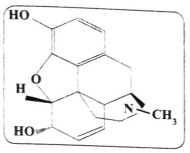
The chemical structure of which drug is given below?
A
Amphetamine
B
Cannabinoids
C
Barbiturates
D
Morphine
Solution
(D) The chemical structure shown in the image represents Morphine.
Morphine is an alkaloid extracted from the latex of the poppy plant,Papaver somniferum.
It is a potent sedative and painkiller,which is very useful in patients who have undergone surgery.
It acts on the central nervous system to relieve pain and induce sleep.
Morphine is an alkaloid extracted from the latex of the poppy plant,Papaver somniferum.
It is a potent sedative and painkiller,which is very useful in patients who have undergone surgery.
It acts on the central nervous system to relieve pain and induce sleep.
0 likesView Solution
46
BiologyEasyMCQGSEB · 2024
Secretion of interferon is which type of barrier?
A
Physical barrier
B
Cytokine barrier
C
Cellular barrier
D
Physiological barrier
Solution
(B) Interferons are proteins secreted by virus-infected cells which protect non-infected cells from further viral infection.
These proteins act as a cytokine barrier in the innate immune system.
Therefore,the secretion of interferon is a cytokine barrier.
These proteins act as a cytokine barrier in the innate immune system.
Therefore,the secretion of interferon is a cytokine barrier.
0 likesView Solution
47
BiologyEasyMCQGSEB · 2024
Which one of the following is diploid?
A
Spermatid
B
Primary spermatocytes
C
Secondary spermatocytes
D
Spermatozoa
Solution
(B) In the process of spermatogenesis,the $2n$ (diploid) spermatogonia undergo mitosis to form primary spermatocytes,which are also $2n$ (diploid).
These primary spermatocytes then undergo meiosis $I$ to form secondary spermatocytes,which are $n$ (haploid).
Secondary spermatocytes undergo meiosis $II$ to form spermatids ($n$,haploid),which eventually differentiate into spermatozoa ($n$,haploid).
Therefore,only the primary spermatocytes are diploid $(2n)$.
These primary spermatocytes then undergo meiosis $I$ to form secondary spermatocytes,which are $n$ (haploid).
Secondary spermatocytes undergo meiosis $II$ to form spermatids ($n$,haploid),which eventually differentiate into spermatozoa ($n$,haploid).
Therefore,only the primary spermatocytes are diploid $(2n)$.
0 likesView Solution
48
BiologyEasyMCQGSEB · 2024
Which option shows correctly matched pairs for Column-$I$ and Column-$II$?
| Column-$I$ (Cell/Gland) | Column-$II$ (Function/Secretion) |
|---|---|
| $(p)$ Leydig cells | $(iii)$ Secretion of Androgens |
| $(q)$ Sertoli cells | $(iv)$ Provide nutrition to the sperm |
| $(r)$ Corpus luteum | $(ii)$ Secretion of progesterone |
| $(s)$ Bulbourethral gland | $(i)$ Help in the lubrication of the penis |
A
$(p-ii), (q-i), (r-iv), (s-iii)$
B
$(p-iv), (q-iii), (r-ii), (s-i)$
C
$(p-iii), (q-iv), (r-ii), (s-i)$
D
$(p-i), (q-ii), (r-iii), (s-iv)$
Solution
(C) The correct matching is as follows:
- $(p)$ Leydig cells are responsible for the secretion of androgens (testosterone).
- $(q)$ Sertoli cells provide nutrition to the developing spermatozoa.
- $(r)$ Corpus luteum is an endocrine structure that secretes progesterone.
- $(s)$ Bulbourethral gland secretes a fluid that helps in the lubrication of the penis.
Therefore,the correct sequence is $(p-iii), (q-iv), (r-ii), (s-i)$,which corresponds to option $(C)$.
- $(p)$ Leydig cells are responsible for the secretion of androgens (testosterone).
- $(q)$ Sertoli cells provide nutrition to the developing spermatozoa.
- $(r)$ Corpus luteum is an endocrine structure that secretes progesterone.
- $(s)$ Bulbourethral gland secretes a fluid that helps in the lubrication of the penis.
Therefore,the correct sequence is $(p-iii), (q-iv), (r-ii), (s-i)$,which corresponds to option $(C)$.
0 likesView Solution
49
BiologyEasyMCQGSEB · 2024
Which of the following hormones is secreted in a high amount,causing ovulation in women?
A
Estrogen
B
Luteinizing Hormone $(LH)$
C
Follicle Stimulating Hormone $(FSH)$
D
Androgens
Solution
(B) The process of ovulation is triggered by a rapid surge in the secretion of Luteinizing Hormone $(LH)$ from the anterior pituitary gland. This phenomenon is known as the $LH$ surge. This surge occurs towards the middle of the menstrual cycle (around the $14^{th}$ day) and induces the rupture of the Graafian follicle,leading to the release of the secondary oocyte (ovum). Therefore,the correct option is $B$.
0 likesView Solution
50
BiologyEasyMCQGSEB · 2024
Which gland helps in the lubrication of the penis during coitus?
A
Prostate glands
B
Bulbourethral glands
C
Seminal vesicle
D
Testis
Solution
(B) The $Bulbourethral$ glands (also known as $Cowper's$ glands) are a pair of small exocrine glands in the male reproductive system.
Their primary function is to secrete a clear,alkaline fluid into the urethra before ejaculation.
This secretion helps in the lubrication of the penis during coitus and also neutralizes the acidic environment of the urethra caused by urine,thereby protecting the sperm.
Their primary function is to secrete a clear,alkaline fluid into the urethra before ejaculation.
This secretion helps in the lubrication of the penis during coitus and also neutralizes the acidic environment of the urethra caused by urine,thereby protecting the sperm.
0 likesView Solution
51
BiologyEasyMCQGSEB · 2024
The large holes in 'Swiss cheese' are due to the production of . . . . . . .
A
$CO_2$
B
$NO_2$
C
$CH_4$
D
$O_2$
Solution
(A) The large holes in 'Swiss cheese' are caused by the production of a large amount of $CO_2$ by the bacterium $Propionibacterium$ $sharmanii$.
During the fermentation process, this bacterium releases carbon dioxide gas, which gets trapped in the cheese curd, creating the characteristic large holes.
During the fermentation process, this bacterium releases carbon dioxide gas, which gets trapped in the cheese curd, creating the characteristic large holes.
0 likesView Solution
Vedclass Products
For Students
Vedclass Test Series
Mock tests in real GSEB style covering Biology with performance analysis. 5-day free trial.
Start Free TrialFor Teachers
Exam Paper Generator
Generate Set A/B/C/D Biology papers from 7.5L+ questions in 2 minutes. 3 chapters free.
Try FreeFor Institutes
Online Exam Module
Run live GSEB mock exams with unlimited students, 360° analytics & white-label branding.
See DemoFrequently Asked Questions
How many Biology questions are in GSEB 2024?
There are 100 Biology questions from the GSEB 2024 paper on Vedclass, each with a detailed step-by-step solution in English.
Are GSEB 2024 Biology solutions available in English?
Yes. All solutions on this page are in English. You can also switch to English or Hindi using the language buttons above the questions.
Can I practice GSEB 2024 Biology as a timed test?
Yes. Use the Vedclass Test Series to attempt a full GSEB mock test covering Biology with time limits and instant score analysis.
Can teachers create Biology papers from GSEB previous year questions?
Yes. The Vedclass Exam Paper Generator lets teachers mix GSEB Biology questions and generate Set A/B/C/D papers in minutes.
For Teachers & Institutes
Build a Custom Biology Paper
Pick GSEB 2024 Biology questions, set difficulty, and generate Set A/B/C/D in 2 minutes.