
BiologyQ51–99 of 100 questions
Page 2 of 2 · English
51
BiologyEasyMCQGSEB · 2024
Baculo viruses are included in which genus?
A
Hepatitis Virus
B
$T$.$M$.$V$. Virus
C
Nucleopolyhedrovirus
D
Rhinovirus
Solution
(C) Baculo viruses are pathogens that attack insects and other arthropods. The majority of baculo viruses used as biological control agents are in the genus $Nucleopolyhedrovirus$. These viruses are excellent candidates for species-specific,narrow-spectrum insecticidal applications and have been shown to have no negative impacts on plants,mammals,birds,fish,or even on non-target insects. Therefore,the correct option is $C$.
0 likesView Solution
52
BiologyEasyMCQGSEB · 2024
Production of which beverage is carried out without distillation?
A
Rum
B
Brandy
C
Wine
D
Whisky
Solution
(C) The production of alcoholic beverages depends on the type of raw material used for fermentation and the type of processing (with or without distillation).
$1$. Beverages like Wine and Beer are produced by fermentation of fruit juices or malted cereals,respectively,without the process of distillation. This results in a lower alcohol content.
$2$. Beverages like Whisky,Brandy,and Rum are produced by the distillation of the fermented broth,which increases the alcohol concentration.
Therefore,Wine is the correct answer as it is produced without distillation.
$1$. Beverages like Wine and Beer are produced by fermentation of fruit juices or malted cereals,respectively,without the process of distillation. This results in a lower alcohol content.
$2$. Beverages like Whisky,Brandy,and Rum are produced by the distillation of the fermented broth,which increases the alcohol concentration.
Therefore,Wine is the correct answer as it is produced without distillation.
0 likesView Solution
53
BiologyEasyMCQGSEB · 2024
Which option shows the correctly matched pairs from the table below?
| Column-$I$ | Column-$II$ |
| $1$. Trichoderma polysporum | $(A)$. Butyric acid |
| $2$. Monascus purpureus | $(B)$. Cyclosporin $A$ |
| $3$. Clostridium butyricum | $(C)$. Citric acid |
| $4$. Aspergillus niger | $(D)$. Statins |
A
$(1-D), (2-B), (3-A), (4-C)$
B
$(1-B), (2-D), (3-A), (4-C)$
C
$(1-B), (2-A), (3-C), (4-D)$
D
$(1-A), (2-B), (3-C), (4-D)$
Solution
(B) The correct matching is as follows:
$1$. Trichoderma polysporum produces Cyclosporin $A$,which is used as an immunosuppressive agent $(1-B)$.
$2$. Monascus purpureus produces Statins,which act as blood-cholesterol lowering agents $(2-D)$.
$3$. Clostridium butyricum produces Butyric acid $(3-A)$.
$4$. Aspergillus niger produces Citric acid $(4-C)$.
Therefore,the correct sequence is $(1-B), (2-D), (3-A), (4-C)$.
$1$. Trichoderma polysporum produces Cyclosporin $A$,which is used as an immunosuppressive agent $(1-B)$.
$2$. Monascus purpureus produces Statins,which act as blood-cholesterol lowering agents $(2-D)$.
$3$. Clostridium butyricum produces Butyric acid $(3-A)$.
$4$. Aspergillus niger produces Citric acid $(4-C)$.
Therefore,the correct sequence is $(1-B), (2-D), (3-A), (4-C)$.
0 likesView Solution
54
BiologyEasyMCQGSEB · 2024
Which fungus is taking part in the formation of mycorrhiza?
A
Mucor
B
Glomus
C
Rhizopus
D
Monascus
Solution
(B) The correct answer is $B$.
Mycorrhiza is a symbiotic association between a fungus and the roots of higher plants.
Many members of the genus $Glomus$ form mycorrhiza.
The fungal symbiont in these associations absorbs phosphorus from the soil and passes it to the plant.
Mycorrhiza is a symbiotic association between a fungus and the roots of higher plants.
Many members of the genus $Glomus$ form mycorrhiza.
The fungal symbiont in these associations absorbs phosphorus from the soil and passes it to the plant.
0 likesView Solution
55
BiologyEasyMCQGSEB · 2024
Assertion $(A)$: The statin produced by the yeast $Monascus$ $purpureus$ lowers blood cholesterol.
Reason $(R)$: Statins act by competitively inhibiting the enzyme responsible for the synthesis of cholesterol.
Reason $(R)$: Statins act by competitively inhibiting the enzyme responsible for the synthesis of cholesterol.
A
$A$ and $R$ both are correct and $R$ is the correct explanation of $A$
B
$A$ is correct and $R$ is wrong
C
$A$ and $R$ both are correct and $R$ is not the correct explanation of $A$
D
$A$ is wrong and $R$ is correct
Solution
(A) The yeast $Monascus$ $purpureus$ is commercially used in the production of blood-cholesterol lowering agents called statins.
These statins act by competitively inhibiting the enzyme responsible for the synthesis of cholesterol in the liver.
Therefore,both the Assertion and the Reason are correct,and the Reason provides the correct explanation for the Assertion.
These statins act by competitively inhibiting the enzyme responsible for the synthesis of cholesterol in the liver.
Therefore,both the Assertion and the Reason are correct,and the Reason provides the correct explanation for the Assertion.
0 likesView Solution
56
BiologyEasyMCQGSEB · 2024
Match the Column-$I$ and Column-$II$.
| Column-$I$ | Column-$II$ |
|---|---|
| $1$. < em>Aspergillus niger | $(A)$ Acetic acid |
| $2$. < em>Acetobacter aceti | $(B)$ Butyric acid |
| $3$. < em>Clostridium butyricum | $(C)$ Citric acid |
| $4$. < em>Lactobacillus | $(D)$ Lactic acid |
A
$(1-A), (2-B), (3-C), (4-D)$
B
$(1-C), (2-A), (3-B), (4-D)$
C
$(1-D), (2-C), (3-A), (4-B)$
D
$(1-D), (2-C), (3-B), (4-A)$
Solution
(B) The correct matches are as follows:
$1$. < em>Aspergillus niger is a fungus used for the commercial production of Citric acid $(C)$.
$2$. < em>Acetobacter aceti is a bacterium used for the commercial production of Acetic acid $(A)$.
$3$. < em>Clostridium butyricum is a bacterium used for the commercial production of Butyric acid $(B)$.
$4$. < em>Lactobacillus is a bacterium used for the production of Lactic acid $(D)$.
Therefore,the correct matching is $(1-C), (2-A), (3-B), (4-D)$,which corresponds to option $B$.
$1$. < em>Aspergillus niger is a fungus used for the commercial production of Citric acid $(C)$.
$2$. < em>Acetobacter aceti is a bacterium used for the commercial production of Acetic acid $(A)$.
$3$. < em>Clostridium butyricum is a bacterium used for the commercial production of Butyric acid $(B)$.
$4$. < em>Lactobacillus is a bacterium used for the production of Lactic acid $(D)$.
Therefore,the correct matching is $(1-C), (2-A), (3-B), (4-D)$,which corresponds to option $B$.
0 likesView Solution
57
BiologyEasyMCQGSEB · 2024
Which bioactive molecule is produced by $Trichoderma$ $polysporum$?
A
Streptokinase
B
Pectinase
C
Cyclosporin $A$
D
Lipases
Solution
(C) The fungus $Trichoderma$ $polysporum$ is used for the commercial production of $Cyclosporin$ $A$.
This bioactive molecule is widely used as an immunosuppressive agent in organ transplant patients to prevent organ rejection by the immune system.
This bioactive molecule is widely used as an immunosuppressive agent in organ transplant patients to prevent organ rejection by the immune system.
0 likesView Solution
58
BiologyEasyMCQGSEB · 2024
What is the sequence of mRNA if the sequence of the coding strand in a transcription unit is written as $5'-ATGCATGCA-3'$?
A
$ATGCATGCA$
B
$UACGUACGU$
C
$AUGCAUGCA$
D
$TACGTACGT$
Solution
(C) In a transcription unit,the coding strand (also known as the sense strand) has the same sequence as the mRNA,except that thymine $(T)$ in $DNA$ is replaced by uracil $(U)$ in $RNA$.
Given coding strand: $5'-ATGCATGCA-3'$
Replacing $T$ with $U$ gives the mRNA sequence: $5'-AUGCAUGCA-3'$.
Therefore,the correct option is $C$.
Given coding strand: $5'-ATGCATGCA-3'$
Replacing $T$ with $U$ gives the mRNA sequence: $5'-AUGCAUGCA-3'$.
Therefore,the correct option is $C$.
0 likesView Solution
59
BiologyEasyMCQGSEB · 2024
Which is the initiator codon?
A
$AUG$
B
$UUU$
C
$CAC$
D
$CAA$
Solution
(A) The initiator codon is $AUG$. It codes for the amino acid methionine $(Met)$ in eukaryotes and $N$-formylmethionine $(fMet)$ in prokaryotes. It signals the start of protein synthesis during the process of translation.
0 likesView Solution
60
BiologyEasyMCQGSEB · 2024
Histones are rich in which basic amino acids?
A
Valine and methionine
B
Phenylalanine and methionine
C
Valine and glutamine
D
Lysine and Arginine
Solution
(D) Histones are positively charged,basic proteins that are associated with $DNA$ in eukaryotic cells.
They are rich in the basic amino acids $Lysine$ and $Arginine$.
These amino acids carry positive charges in their side chains,which allow them to interact strongly with the negatively charged phosphate backbone of the $DNA$ molecule.
Therefore,the correct option is $D$.
They are rich in the basic amino acids $Lysine$ and $Arginine$.
These amino acids carry positive charges in their side chains,which allow them to interact strongly with the negatively charged phosphate backbone of the $DNA$ molecule.
Therefore,the correct option is $D$.
0 likesView Solution
61
BiologyEasyMCQGSEB · 2024
Bacteriophage $\phi \times 174$ possesses . . . . . . nucleotides. (in $bp$)
A
$8653$
B
$8356$
C
$5386$
D
$6538$
Solution
(C) The bacteriophage $\phi \times 174$ is a well-known virus that contains a single-stranded $DNA$ genome.
According to the $NCERT$ textbook,the genome of bacteriophage $\phi \times 174$ consists of $5386$ nucleotides.
Therefore,the correct option is $C$.
According to the $NCERT$ textbook,the genome of bacteriophage $\phi \times 174$ consists of $5386$ nucleotides.
Therefore,the correct option is $C$.
0 likesView Solution
62
BiologyEasyMCQGSEB · 2024
If $E. coli$ was allowed to grow for $60$ minutes,then what would be the respective proportions of light and hybrid density $DNA$ molecules?
A
$1: 1$
B
$3: 1$
C
$1: 3$
D
$7: 1$
Solution
(B) In the Meselson and Stahl experiment,$E. coli$ divides every $20$ minutes.
Starting with one heavy $(^{15}N^{15}N)$ $DNA$ molecule:
After $20$ minutes (first generation): $2$ hybrid $(^{15}N^{14}N)$ $DNA$ molecules are formed.
After $40$ minutes (second generation): $2$ hybrid $(^{15}N^{14}N)$ and $2$ light $(^{14}N^{14}N)$ $DNA$ molecules are formed.
After $60$ minutes (third generation): The $2$ hybrid molecules produce $2$ hybrid and $2$ light molecules,and the $2$ light molecules produce $4$ light molecules.
Total $DNA$ molecules = $8$.
Number of hybrid molecules = $2$.
Number of light molecules = $6$.
Ratio of light to hybrid = $6: 2$,which simplifies to $3: 1$.
Starting with one heavy $(^{15}N^{15}N)$ $DNA$ molecule:
After $20$ minutes (first generation): $2$ hybrid $(^{15}N^{14}N)$ $DNA$ molecules are formed.
After $40$ minutes (second generation): $2$ hybrid $(^{15}N^{14}N)$ and $2$ light $(^{14}N^{14}N)$ $DNA$ molecules are formed.
After $60$ minutes (third generation): The $2$ hybrid molecules produce $2$ hybrid and $2$ light molecules,and the $2$ light molecules produce $4$ light molecules.
Total $DNA$ molecules = $8$.
Number of hybrid molecules = $2$.
Number of light molecules = $6$.
Ratio of light to hybrid = $6: 2$,which simplifies to $3: 1$.
0 likesView Solution
63
BiologyEasyMCQGSEB · 2024
The length of $DNA$ double helix in human sperm is approximately . . . . . . .
A
$1.36$ mm
B
$2.2$ m
C
$1.1$ m
D
$2.2$ mm
Solution
(C) The total number of base pairs in a human diploid cell is $6.6 \times 10^9$ bp.
Since a sperm cell is haploid,it contains half the amount of $DNA$,which is $3.3 \times 10^9$ bp.
The distance between two consecutive base pairs is $0.34 \ \text{nm}$ or $0.34 \times 10^{-9} \ \text{m}$.
The total length of the $DNA$ double helix is calculated as: $\text{Length} = \text{Number of base pairs} \times \text{Distance between base pairs}$.
$\text{Length} = (3.3 \times 10^9) \times (0.34 \times 10^{-9} \ \text{m}) = 1.122 \ \text{m}$.
Therefore,the length is approximately $1.1 \ \text{m}$.
Since a sperm cell is haploid,it contains half the amount of $DNA$,which is $3.3 \times 10^9$ bp.
The distance between two consecutive base pairs is $0.34 \ \text{nm}$ or $0.34 \times 10^{-9} \ \text{m}$.
The total length of the $DNA$ double helix is calculated as: $\text{Length} = \text{Number of base pairs} \times \text{Distance between base pairs}$.
$\text{Length} = (3.3 \times 10^9) \times (0.34 \times 10^{-9} \ \text{m}) = 1.122 \ \text{m}$.
Therefore,the length is approximately $1.1 \ \text{m}$.
0 likesView Solution
64
BiologyEasyMCQGSEB · 2024
If a double-stranded $DNA$ has $35 \%$ Guanine,calculate the percent of Thymine in the $DNA$. (in $\%$)
A
$35$
B
$70$
C
$15$
D
$30$
Solution
(C) According to Chargaff's rule,in double-stranded $DNA$,the amount of Adenine $(A)$ is equal to Thymine $(T)$,and the amount of Guanine $(G)$ is equal to Cytosine $(C)$.
Given: $G = 35 \%$.
Since $G = C$,therefore $C = 35 \%$.
The sum of all four bases is $100 \%$,so $A + T + G + C = 100 \%$.
Substituting the values: $A + T + 35 \% + 35 \% = 100 \%$.
$A + T + 70 \% = 100 \%$.
$A + T = 30 \%$.
Since $A = T$,we can write $2T = 30 \%$.
Therefore,$T = 15 \%$.
Given: $G = 35 \%$.
Since $G = C$,therefore $C = 35 \%$.
The sum of all four bases is $100 \%$,so $A + T + G + C = 100 \%$.
Substituting the values: $A + T + 35 \% + 35 \% = 100 \%$.
$A + T + 70 \% = 100 \%$.
$A + T = 30 \%$.
Since $A = T$,we can write $2T = 30 \%$.
Therefore,$T = 15 \%$.
0 likesView Solution
65
BiologyEasyMCQGSEB · 2024
The $RNA$ polymerase $III$ is responsible for the transcription of which $RNA$?
A
$tRNA$
B
$18S$ $rRNA$
C
$mRNA$
D
$hnRNA$
Solution
(A) In eukaryotes,there are three main types of $RNA$ polymerases responsible for the transcription of different types of $RNA$s:
$1$. $RNA$ polymerase $I$ transcribes $rRNA$ ($28S$,$18S$,and $5.8S$).
$2$. $RNA$ polymerase $II$ transcribes the precursor of $mRNA$,which is $hnRNA$ (heterogeneous nuclear $RNA$).
$3$. $RNA$ polymerase $III$ is responsible for the transcription of $tRNA$,$5S$ $rRNA$,and $snRNA$ (small nuclear $RNA$).
Therefore,the correct option is $A$.
$1$. $RNA$ polymerase $I$ transcribes $rRNA$ ($28S$,$18S$,and $5.8S$).
$2$. $RNA$ polymerase $II$ transcribes the precursor of $mRNA$,which is $hnRNA$ (heterogeneous nuclear $RNA$).
$3$. $RNA$ polymerase $III$ is responsible for the transcription of $tRNA$,$5S$ $rRNA$,and $snRNA$ (small nuclear $RNA$).
Therefore,the correct option is $A$.
0 likesView Solution
66
BiologyEasyMCQGSEB · 2024
Select the correct statement which explains best parasitism.
A
One organism is benefited,other is affected.
B
Both the organisms are benefited.
C
One organism is benefited,other is not affected.
D
One organism is benefited.
Solution
(A) Parasitism is a type of population interaction between two species where one species (the parasite) is benefited and the other species (the host) is harmed or affected. In this relationship,the parasite derives its nutrition directly from the host,which leads to the host's detriment. Therefore,the correct statement is that one organism is benefited and the other is affected (harmed).
0 likesView Solution
67
BiologyEasyMCQGSEB · 2024
Which of the following is an example of competitive interaction?
A
Starfish $Pisaster$ and clownfish
B
$Cuscuta$ and Mycorrhiza
C
Visiting flamingos and resident fishes of shallow South American lakes
D
Monarch butterfly and $Balanus$
Solution
(C) Competitive interaction occurs when two species compete for the same limiting resource. In shallow South American lakes,visiting flamingos and resident fishes both compete for their common food resource,which is zooplankton. This is a classic example of interspecific competition where both species are negatively affected by the presence of the other.
0 likesView Solution
68
BiologyEasyMCQGSEB · 2024
Which type of interrelation is observed in species $A$ $(+)$ and species $B$ $(-)$?
A
Amensalism
B
Predation
C
Commensalism
D
Mutualism
Solution
(B) In ecological interactions,the symbol $(+)$ denotes a beneficial effect,while $(-)$ denotes a detrimental effect.
In the case of Predation,the predator (species $A$) benefits $(+)$ by consuming the prey,while the prey (species $B$) is harmed $(-)$.
Therefore,the interaction where one species benefits and the other is harmed is known as Predation.
Amensalism involves $(-, 0)$,Commensalism involves $(+, 0)$,and Mutualism involves $(+, +)$.
In the case of Predation,the predator (species $A$) benefits $(+)$ by consuming the prey,while the prey (species $B$) is harmed $(-)$.
Therefore,the interaction where one species benefits and the other is harmed is known as Predation.
Amensalism involves $(-, 0)$,Commensalism involves $(+, 0)$,and Mutualism involves $(+, +)$.
0 likesView Solution
69
BiologyEasyMCQGSEB · 2024
Statement $(A)$: The pyramid of energy is always upright.
Reason $(R)$: Some energy is always lost as heat at each step.
Reason $(R)$: Some energy is always lost as heat at each step.
A
$A$ is wrong and $R$ is right.
B
$A$ and $R$ both are true but $R$ is not the correct explanation of $A$.
C
$A$ is right and $R$ is wrong.
D
$A$ and $R$ both are true, $R$ is the correct explanation of statement-$A$.
Solution
(D) The pyramid of energy represents the flow of energy through different trophic levels in an ecosystem.
According to the $10\%$ law of energy transfer, only $10\%$ of the energy is transferred from one trophic level to the next, while the remaining energy is lost as heat during metabolic processes.
Since energy is lost at each successive trophic level, the amount of energy available at higher trophic levels is always less than at lower levels.
Therefore, the pyramid of energy is always upright.
Both statement $A$ and reason $R$ are true, and $R$ provides the correct scientific explanation for why the pyramid of energy is always upright.
According to the $10\%$ law of energy transfer, only $10\%$ of the energy is transferred from one trophic level to the next, while the remaining energy is lost as heat during metabolic processes.
Since energy is lost at each successive trophic level, the amount of energy available at higher trophic levels is always less than at lower levels.
Therefore, the pyramid of energy is always upright.
Both statement $A$ and reason $R$ are true, and $R$ provides the correct scientific explanation for why the pyramid of energy is always upright.
0 likesView Solution
70
BiologyEasyMCQGSEB · 2024
Match the Column-$I$ and Column-$II$:
| Column-$I$ | Column-$II$ |
| $(P)$ Lichens | $(i)$ Parasitism |
| $(Q)$ Abingdon tortoise and goat | $(ii)$ Commensalism |
| $(R)$ Sea anemone and clown fish | $(iii)$ Competition |
| $(S)$ Human and liver fluke | $(iv)$ Mutualism |
A
$(P-i)$,$(Q-ii)$,$(R-iii)$,$(S-iv)$
B
$(P-iii)$,$(Q-iv)$,$(R-ii)$,$(S-i)$
C
$(P-iv)$,$(Q-iii)$,$(R-i)$,$(S-ii)$
D
$(P-iv)$,$(Q-iii)$,$(R-ii)$,$(S-i)$
Solution
(D) The correct matches are as follows:
$(P)$ Lichens represent a symbiotic association between algae and fungi,which is an example of Mutualism $(iv)$.
$(Q)$ Abingdon tortoise and goats in the Galapagos Islands compete for the same food source (grass),representing Competition $(iii)$.
$(R)$ Sea anemone and clown fish exhibit Commensalism $(ii)$,where the clown fish gets protection from predators while the anemone remains unaffected.
$(S)$ Human and liver fluke represent Parasitism $(i)$,where the liver fluke derives nutrition from the human host,causing harm.
Therefore,the correct sequence is $(P-iv, Q-iii, R-ii, S-i)$.
$(P)$ Lichens represent a symbiotic association between algae and fungi,which is an example of Mutualism $(iv)$.
$(Q)$ Abingdon tortoise and goats in the Galapagos Islands compete for the same food source (grass),representing Competition $(iii)$.
$(R)$ Sea anemone and clown fish exhibit Commensalism $(ii)$,where the clown fish gets protection from predators while the anemone remains unaffected.
$(S)$ Human and liver fluke represent Parasitism $(i)$,where the liver fluke derives nutrition from the human host,causing harm.
Therefore,the correct sequence is $(P-iv, Q-iii, R-ii, S-i)$.
0 likesView Solution
71
BiologyEasyMCQGSEB · 2024
Which of the following is the correct equation for Verhulst-Pearl logistic growth?
A
$dN/dt = rN$
B
$N_t = N_0 e^{rt}$
C
$dN/dt = rN((K - N)/K)$
D
$dN/dt = rN(K / (K - N))$
Solution
(C) The Verhulst-Pearl logistic growth model describes population growth in an environment with limited resources. The equation is given by $dN/dt = rN((K - N)/K)$,where $dN/dt$ is the rate of change in population size,$r$ is the intrinsic rate of natural increase,$N$ is the population density at time $t$,and $K$ is the carrying capacity of the environment.
0 likesView Solution
72
BiologyEasyMCQGSEB · 2024
'India is a country of pre-reproductive aged people.' On the basis of this statement,what is the representation of age pyramids for Indians?
A
Declining
B
Stable
C
Irregular
D
Expanding
Solution
(D) An age pyramid represents the distribution of various age groups in a population.
When a population has a high proportion of individuals in the pre-reproductive age group,the base of the age pyramid is very broad.
This broad base indicates that the population is growing rapidly,as these individuals will soon enter the reproductive age.
Such a pyramid is referred to as an 'Expanding' or 'Triangular' age pyramid.
Since India has a large young population,its age pyramid is expanding.
When a population has a high proportion of individuals in the pre-reproductive age group,the base of the age pyramid is very broad.
This broad base indicates that the population is growing rapidly,as these individuals will soon enter the reproductive age.
Such a pyramid is referred to as an 'Expanding' or 'Triangular' age pyramid.
Since India has a large young population,its age pyramid is expanding.
0 likesView Solution
73
BiologyEasyMCQGSEB · 2024
At one time,the number of cheetahs in a habitat is $80$. Their birth rate is $4$ and death rate is $2$. Among them,$6$ cheetahs are internal migrants (immigration) and $3$ cheetahs are migratory (emigration). Calculate the population density of cheetahs in that habitat.
A
$85$
B
$90$
C
$83$
D
$95$
Solution
(A) The population density $(N_{t+1})$ at time $t+1$ is calculated using the formula:
$N_{t+1} = N_t + [(B + I) - (D + E)]$
Where:
$N_t$ = Initial population = $80$
$B$ = Birth rate = $4$
$I$ = Immigration = $6$
$D$ = Death rate = $2$
$E$ = Emigration = $3$
Substituting the values:
$N_{t+1} = 80 + [(4 + 6) - (2 + 3)]$
$N_{t+1} = 80 + [10 - 5]$
$N_{t+1} = 80 + 5 = 85$
Therefore,the population density is $85$.
$N_{t+1} = N_t + [(B + I) - (D + E)]$
Where:
$N_t$ = Initial population = $80$
$B$ = Birth rate = $4$
$I$ = Immigration = $6$
$D$ = Death rate = $2$
$E$ = Emigration = $3$
Substituting the values:
$N_{t+1} = 80 + [(4 + 6) - (2 + 3)]$
$N_{t+1} = 80 + [10 - 5]$
$N_{t+1} = 80 + 5 = 85$
Therefore,the population density is $85$.
0 likesView Solution
74
BiologyEasyMCQGSEB · 2024
Hugo de Vries worked on which plant and proposed the idea of mutation?
A
Dog flower
B
Commelina
C
Evening Primrose
D
Pea
Solution
(C) Hugo de Vries, a Dutch botanist, conducted his experiments on the Evening Primrose $(Oenothera \, lamarckiana)$.
Based on his observations of this plant, he proposed the mutation theory, which suggests that evolution is a discontinuous process caused by large, sudden, and heritable changes in the genetic material, known as mutations.
Based on his observations of this plant, he proposed the mutation theory, which suggests that evolution is a discontinuous process caused by large, sudden, and heritable changes in the genetic material, known as mutations.
0 likesView Solution
75
BiologyEasyMCQGSEB · 2024
Choose the correct option regarding genetic disorders and inheritance patterns.
A
Klinefelter syndrome is caused due to monosomy of sex chromosomes.
B
Gametes are formed by equational division in male honey bees.
C
Colour blindness is due to a defect in autosomes.
D
Sickle-cell anaemia occurs due to a frame-shift mutation.
Solution
(B) In male honey bees (drones),gametes are produced by mitosis (equational division) because they are haploid $(n)$.
$A$: Klinefelter syndrome $(47, XXY)$ is caused by trisomy of sex chromosomes,not monosomy.
$C$: Colour blindness is an $X$-linked recessive disorder,meaning it is caused by a defect in sex chromosomes,not autosomes.
$D$: Sickle-cell anaemia is caused by a point mutation (substitution of glutamic acid by valine),not a frame-shift mutation.
$A$: Klinefelter syndrome $(47, XXY)$ is caused by trisomy of sex chromosomes,not monosomy.
$C$: Colour blindness is an $X$-linked recessive disorder,meaning it is caused by a defect in sex chromosomes,not autosomes.
$D$: Sickle-cell anaemia is caused by a point mutation (substitution of glutamic acid by valine),not a frame-shift mutation.
0 likesView Solution
76
BiologyEasyMCQGSEB · 2024
Which of the following is a Mendelian disorder?
A
Cystic fibrosis
B
Malaria
C
Pneumonia
D
Filariasis
Solution
(A) Mendelian disorder is primarily determined by alteration or mutation in a single gene.
$A$. Cystic fibrosis is an autosomal recessive genetic disorder caused by mutations in the $CFTR$ gene,making it a classic example of a Mendelian disorder.
$B$. Malaria is an infectious disease caused by protozoan parasites of the genus $Plasmodium$.
$C$. Pneumonia is an inflammatory condition of the lung,typically caused by infection.
$D$. Filariasis is a parasitic disease caused by infection with roundworms of the Filarioidea type.
Therefore,the correct option is $A$.
$A$. Cystic fibrosis is an autosomal recessive genetic disorder caused by mutations in the $CFTR$ gene,making it a classic example of a Mendelian disorder.
$B$. Malaria is an infectious disease caused by protozoan parasites of the genus $Plasmodium$.
$C$. Pneumonia is an inflammatory condition of the lung,typically caused by infection.
$D$. Filariasis is a parasitic disease caused by infection with roundworms of the Filarioidea type.
Therefore,the correct option is $A$.
0 likesView Solution
77
BiologyEasyMCQGSEB · 2024
Identify the recessive character of the pea plant studied by Mendel.
A
Terminal flower
B
Violet flower
C
Inflated pod shape
D
Round seed
Solution
(A) Mendel studied $7$ pairs of contrasting traits in pea plants.
Among the options provided,the traits are categorized as follows:
$1$. Violet flower color is dominant,while white is recessive.
$2$. Inflated pod shape is dominant,while constricted is recessive.
$3$. Round seed shape is dominant,while wrinkled is recessive.
$4$. Terminal flower position is recessive,while axial is dominant.
Therefore,the correct recessive character is the terminal flower position.
Among the options provided,the traits are categorized as follows:
$1$. Violet flower color is dominant,while white is recessive.
$2$. Inflated pod shape is dominant,while constricted is recessive.
$3$. Round seed shape is dominant,while wrinkled is recessive.
$4$. Terminal flower position is recessive,while axial is dominant.
Therefore,the correct recessive character is the terminal flower position.
0 likesView Solution
78
BiologyEasyMCQGSEB · 2024
What is represented by the following cross?
$Tt \times tt$
$Tt \times tt$
A
Test cross
B
Dihybrid cross
C
Co-dominance
D
Incomplete dominance
Solution
(A) test cross is defined as a cross between an individual of unknown genotype (showing a dominant phenotype) and a homozygous recessive individual.
In the given cross,$Tt$ (heterozygous dominant) is crossed with $tt$ (homozygous recessive).
This specific type of cross is used to determine the zygosity of the dominant phenotype,which is the fundamental definition of a test cross.
In the given cross,$Tt$ (heterozygous dominant) is crossed with $tt$ (homozygous recessive).
This specific type of cross is used to determine the zygosity of the dominant phenotype,which is the fundamental definition of a test cross.
0 likesView Solution
79
BiologyEasyMCQGSEB · 2024
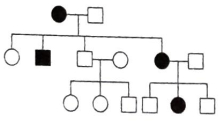
In the given pedigree chart,which Mendelian disorder is represented?
A
Autosomal dominant trait
B
Sex-linked dominant trait
C
Autosomal recessive trait
D
Sex-linked recessive trait
Solution
(A) The correct answer is $A$ (Autosomal dominant trait).
$1$. Analysis of the pedigree shows that the trait appears in every generation (it does not skip generations),which is a characteristic feature of a dominant trait.
$2$. Affected individuals have at least one affected parent.
$3$. The trait is observed in both males and females,and affected mothers pass the trait to both sons and daughters,which rules out sex-linked recessive inheritance.
$4$. Since an affected mother passes the trait to her offspring regardless of their sex,and it does not show the specific pattern of criss-cross inheritance,it is identified as an autosomal dominant trait.
$1$. Analysis of the pedigree shows that the trait appears in every generation (it does not skip generations),which is a characteristic feature of a dominant trait.
$2$. Affected individuals have at least one affected parent.
$3$. The trait is observed in both males and females,and affected mothers pass the trait to both sons and daughters,which rules out sex-linked recessive inheritance.
$4$. Since an affected mother passes the trait to her offspring regardless of their sex,and it does not show the specific pattern of criss-cross inheritance,it is identified as an autosomal dominant trait.
0 likesView Solution
80
BiologyEasyMCQGSEB · 2024
In Klinefelter syndrome . . . . . . .
A
Monosomy of $23^{\text{rd}}$ pair of chromosome
B
Trisomy of $23^{\text{rd}}$ pair of chromosome
C
Monosomy of $21^{\text{st}}$ pair of chromosome
D
Trisomy of $21^{\text{st}}$ pair of chromosome
Solution
(B) Klinefelter syndrome is a genetic disorder caused by the presence of an extra $X$ chromosome in males.
This results in a chromosomal constitution of $47, XXY$.
Since the $23^{\text{rd}}$ pair of chromosomes represents the sex chromosomes,the presence of an additional $X$ chromosome constitutes a trisomy of the $23^{\text{rd}}$ pair.
Therefore,the correct option is $B$.
This results in a chromosomal constitution of $47, XXY$.
Since the $23^{\text{rd}}$ pair of chromosomes represents the sex chromosomes,the presence of an additional $X$ chromosome constitutes a trisomy of the $23^{\text{rd}}$ pair.
Therefore,the correct option is $B$.
0 likesView Solution
81
BiologyEasyMCQGSEB · 2024
The contraceptive pills for females are composed of . . . . . . .
A
$hCG$
B
$Testosterone$
C
$Progestogen$
D
$Oxytocin$
Solution
(C) Contraceptive pills for females,often referred to as oral contraceptives,primarily contain either a combination of synthetic $Progestogen$ and $Estrogen$ or only $Progestogen$.
These hormones work by inhibiting ovulation,altering the cervical mucus to prevent sperm entry,and changing the lining of the uterus to prevent implantation.
Therefore,the correct option is $C$.
These hormones work by inhibiting ovulation,altering the cervical mucus to prevent sperm entry,and changing the lining of the uterus to prevent implantation.
Therefore,the correct option is $C$.
0 likesView Solution
82
BiologyEasyMCQGSEB · 2024
Which is a contraceptive method with no side effects?
A
IUDs
B
Physical Barrier
C
Natural Method
D
Sterilization
Solution
(C) The correct answer is $C$. Natural methods of contraception,such as the rhythm method,withdrawal,or lactational amenorrhea,involve no use of chemicals,hormones,or surgical procedures. Therefore,they have no side effects compared to other methods like $IUDs$ (which may cause bleeding or pain),physical barriers (which may cause allergic reactions),or sterilization (which is a surgical procedure with potential risks).
0 likesView Solution
83
BiologyEasyMCQGSEB · 2024
Which of the following is a second-generation (copper-releasing) $IUD$?
A
Lippes Loop
B
Multiload $375$
C
$LNG$-$20$
D
Progestasert
Solution
(B) Intrauterine devices (IUDs) are classified into generations based on their mechanism of action:
$1$. First-generation IUDs are non-medicated or inert IUDs, such as the $Lippes Loop$.
$2$. Second-generation IUDs are copper-releasing IUDs, which include $CuT$, $Cu7$, and $Multiload 375$.
$3$. Third-generation IUDs are hormone-releasing IUDs, such as $Progestasert$ and $LNG-20$.
Therefore, $Multiload 375$ is a second-generation (copper-releasing) $IUD$.
$1$. First-generation IUDs are non-medicated or inert IUDs, such as the $Lippes Loop$.
$2$. Second-generation IUDs are copper-releasing IUDs, which include $CuT$, $Cu7$, and $Multiload 375$.
$3$. Third-generation IUDs are hormone-releasing IUDs, such as $Progestasert$ and $LNG-20$.
Therefore, $Multiload 375$ is a second-generation (copper-releasing) $IUD$.
0 likesView Solution
84
BiologyEasyMCQGSEB · 2024
What is the full form of $CDRI$?
A
Central Drug Research Institute
B
Central Drug Resource Institute
C
Central Drug Research Investigation
D
Central Disease Research Institute
Solution
(A) The full form of $CDRI$ is Central Drug Research Institute. It is a premier research laboratory located in Lucknow,India,which is involved in drug discovery and development,including the development of contraceptive pills like $Saheli$.
0 likesView Solution
85
BiologyEasyMCQGSEB · 2024
MTPs are considered relatively safe during the first . . . . . . . (in $weeks$)
A
$30$
B
$18$
C
$24$
D
$12$
Solution
(D) Medical Termination of Pregnancy $(MTP)$ is considered relatively safe during the first trimester,which corresponds to the first $12$ weeks of pregnancy.
After this period,the procedure becomes significantly more risky for the mother.
After this period,the procedure becomes significantly more risky for the mother.
0 likesView Solution
86
BiologyEasyMCQGSEB · 2024
$LNG-20$ is . . . . . . .
A
Hormone releasing $IUD$
B
Vaults
C
Copper releasing $IUD$
D
Non-medicated $IUD$
Solution
(A) $LNG-20$ is a hormone-releasing Intrauterine Device $(IUD)$.
It releases the hormone levonorgestrel into the uterus,which makes the uterus unsuitable for implantation and the cervix hostile to the sperm.
Therefore,the correct option is $A$.
It releases the hormone levonorgestrel into the uterus,which makes the uterus unsuitable for implantation and the cervix hostile to the sperm.
Therefore,the correct option is $A$.
0 likesView Solution
87
BiologyEasyMCQGSEB · 2024
Statutory ban on 'amniocentesis' is for . . . . . . .
A
Down's syndrome
B
Sickle-cell anemia
C
Haemophilia
D
Sex determination
Solution
(D) Amniocentesis is a prenatal diagnostic technique used to detect chromosomal abnormalities and developmental disorders in the fetus by analyzing the amniotic fluid.
However,this technique is frequently misused for sex determination,leading to female foeticide.
To prevent this illegal practice,the government has imposed a statutory ban on the misuse of amniocentesis for sex determination.
However,this technique is frequently misused for sex determination,leading to female foeticide.
To prevent this illegal practice,the government has imposed a statutory ban on the misuse of amniocentesis for sex determination.
0 likesView Solution
88
BiologyEasyMCQGSEB · 2024
In vasectomy, a small part of which of the following is cut for sterilization?
A
Vas deferens
B
Urethra
C
Vasa efferentia
D
Rete Testis
Solution
(A) Vasectomy is a surgical procedure for male sterilization or permanent contraception. In this procedure, a small part of the $Vas deferens$ is removed or tied up through a small incision made on the scrotum. This prevents the transport of sperm from the testes to the urethra, thereby preventing fertilization.
0 likesView Solution
89
BiologyEasyMCQGSEB · 2024
In which process is sperm directly introduced into the ovum?
A
$AI$
B
$ZIFT$
C
$ICSI$
D
$GIFT$
Solution
(C) The correct answer is $ICSI$ (Intracytoplasmic Sperm Injection).
In this assisted reproductive technology,a single sperm is directly injected into the cytoplasm of the ovum to facilitate fertilization.
$AI$ (Artificial Insemination) involves introducing semen into the female reproductive tract.
$ZIFT$ (Zygote Intrafallopian Transfer) involves transferring a zygote into the fallopian tube.
$GIFT$ (Gamete Intrafallopian Transfer) involves transferring gametes (ovum and sperm) into the fallopian tube.
In this assisted reproductive technology,a single sperm is directly injected into the cytoplasm of the ovum to facilitate fertilization.
$AI$ (Artificial Insemination) involves introducing semen into the female reproductive tract.
$ZIFT$ (Zygote Intrafallopian Transfer) involves transferring a zygote into the fallopian tube.
$GIFT$ (Gamete Intrafallopian Transfer) involves transferring gametes (ovum and sperm) into the fallopian tube.
0 likesView Solution
90
BiologyEasyMCQGSEB · 2024
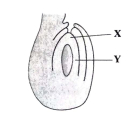
Identify $X$ and $Y$ in the given diagram of an anatropous ovule.
A
$X$ - Nucellus,$Y$ - Embryo sac
B
$X$ - Outer integument,$Y$ - Embryo sac
C
$X$ - Micropyle,$Y$ - Nucellus
D
$X$ - Micropylar pole,$Y$ - Nucellus
Solution
(C) In the provided diagram of an anatropous ovule:
$X$ points to the small opening at the apex of the ovule,which is the Micropyle.
$Y$ points to the mass of nutritive tissue enclosed within the integuments,which is the Nucellus.
Therefore,the correct identification is $X$ - Micropyle and $Y$ - Nucellus.
$X$ points to the small opening at the apex of the ovule,which is the Micropyle.
$Y$ points to the mass of nutritive tissue enclosed within the integuments,which is the Nucellus.
Therefore,the correct identification is $X$ - Micropyle and $Y$ - Nucellus.
0 likesView Solution
91
BiologyEasyMCQGSEB · 2024
Which type of endosperm is present in coconut?
A
Only non-cellular endosperm
B
Only cellular endosperm
C
Both free nuclear endosperm and cellular endosperm
D
Only free nuclear endosperm
Solution
(C) In coconut,the endosperm development is unique. The primary endosperm nucleus undergoes successive free nuclear divisions,which give rise to free nuclear endosperm (the coconut water). Subsequently,the endosperm becomes cellular towards the periphery,forming the white kernel (cellular endosperm). Therefore,coconut contains both free nuclear and cellular endosperm.
0 likesView Solution
92
BiologyEasyMCQGSEB · 2024
. . . . . . is an example of a parthenocarpic fruit.
A
Banana
B
Mango
C
Apple
D
Ground-nut
Solution
(A) Parthenocarpy is the development of fruit without fertilization. In such fruits, the ovary develops into a fruit without the formation of seeds. $Banana$ is a classic example of a naturally occurring parthenocarpic fruit, as it is seedless and develops without fertilization.
0 likesView Solution
93
BiologyEasyMCQGSEB · 2024
Which plant seeds possess perisperm?
A
Black pepper,maize
B
Maize,beet
C
Black pepper,beet
D
Wheat,black pepper
Solution
(C) In some seeds, such as black pepper $(Piper \text{ } nigrum)$ and beet $(Beta \text{ } vulgaris)$, the nucellus is not completely consumed during the development of the embryo. The persistent, residual nucellus is known as the perisperm. Therefore, the correct answer is black pepper and beet.
0 likesView Solution
94
BiologyEasyMCQGSEB · 2024
$Parthenium$ (carrot grass) that came into India has become ubiquitous in occurrence and causes pollen allergy.
A
Runner
B
Carrot grass
C
Water Hyacinth
D
Sea grass
Solution
(B) $Parthenium$ or carrot grass was introduced into India as a contaminant with imported wheat. It has since spread throughout the country and is now ubiquitous. Its pollen grains are a well-known cause of respiratory allergies in humans.
0 likesView Solution
95
BiologyEasyMCQGSEB · 2024
Which pollinating agent is responsible for pollination in water hyacinth and water lily?
A
Wind,Water
B
Insects,Water
C
Insects,Wind
D
Insects or Wind
Solution
(D) In both $Water \text{ } Hyacinth$ $(Eichhornia)$ and $Water \text{ } Lily$ $(Nymphaea)$, the flowers emerge above the level of water. Although they are aquatic plants, they are not pollinated by water. Instead, they are pollinated by insects or wind, which is a common feature in many aquatic plants where flowers are raised above the water surface. Therefore, the correct answer is $Insects \text{ } or \text{ } Wind$.
0 likesView Solution
96
BiologyEasyMCQGSEB · 2024
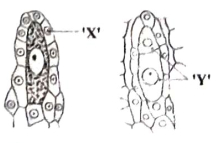
In the given figure,megasporogenesis is shown in angiosperms. What are the ploidy levels in given '$X$' and '$Y$' respectively?
A
$n, 2n$
B
$2n, n$
C
$3n, n$
D
$n, n$
Solution
(B) In the process of megasporogenesis,the nucellus contains diploid $(2n)$ cells.
'$X$' represents the cells of the nucellus,which are diploid $(2n)$.
'$Y$' represents the megaspore mother cell $(MMC)$ or the developing megaspore,which undergoes meiosis to form haploid $(n)$ megaspores.
Therefore,the ploidy of '$X$' is $2n$ and the ploidy of '$Y$' is $n$.
'$X$' represents the cells of the nucellus,which are diploid $(2n)$.
'$Y$' represents the megaspore mother cell $(MMC)$ or the developing megaspore,which undergoes meiosis to form haploid $(n)$ megaspores.
Therefore,the ploidy of '$X$' is $2n$ and the ploidy of '$Y$' is $n$.
0 likesView Solution
97
BiologyEasyMCQGSEB · 2024
Which of the following layers of the microsporangium provides nutrition to the developing pollen grains?
A
Epidermis
B
Middle layer
C
Endothecium
D
Tapetum
Solution
(D) The microsporangium is surrounded by four wall layers: the epidermis,endothecium,middle layers,and tapetum.
$1$. The outer three wall layers (epidermis,endothecium,and middle layers) perform the function of protection and help in the dehiscence of the anther to release the pollen.
$2$. The innermost wall layer is the $Tapetum$.
$3$. The $Tapetum$ nourishes the developing pollen grains.
Therefore,the correct option is $D$.
$1$. The outer three wall layers (epidermis,endothecium,and middle layers) perform the function of protection and help in the dehiscence of the anther to release the pollen.
$2$. The innermost wall layer is the $Tapetum$.
$3$. The $Tapetum$ nourishes the developing pollen grains.
Therefore,the correct option is $D$.
0 likesView Solution
98
BiologyEasyMCQGSEB · 2024
In which of the following,thalamus contributes to fruit formation?
A
Mango
B
Sapota
C
Strawberry
D
Orange
Solution
(C) In most plants,the fruit develops only from the ovary,and other floral parts degenerate and fall off. Such fruits are called true fruits. However,in some species like apple,strawberry,and cashew,the thalamus also contributes to fruit formation. Such fruits are called false fruits or accessory fruits. Therefore,the correct answer is $C$ (Strawberry).
0 likesView Solution
99
BiologyEasyMCQGSEB · 2024
Emasculation in angiospermic plant is . . . . . . .
A
Removal of anther
B
Removal of petals
C
Removal of style
D
Removal of calyx
Solution
(A) Emasculation is a technique used in plant breeding to prevent self-pollination.
It involves the removal of anthers from the bisexual flower bud before they dehisce (release pollen).
This ensures that the female reproductive part (stigma) is available for cross-pollination with pollen from a desired male parent.
Therefore,the correct answer is $A$.
It involves the removal of anthers from the bisexual flower bud before they dehisce (release pollen).
This ensures that the female reproductive part (stigma) is available for cross-pollination with pollen from a desired male parent.
Therefore,the correct answer is $A$.
0 likesView Solution
Vedclass Products
For Students
Vedclass Test Series
Mock tests in real GSEB style covering Biology with performance analysis. 5-day free trial.
Start Free TrialFor Teachers
Exam Paper Generator
Generate Set A/B/C/D Biology papers from 7.5L+ questions in 2 minutes. 3 chapters free.
Try FreeFor Institutes
Online Exam Module
Run live GSEB mock exams with unlimited students, 360° analytics & white-label branding.
See DemoFrequently Asked Questions
How many Biology questions are in GSEB 2024?
There are 100 Biology questions from the GSEB 2024 paper on Vedclass, each with a detailed step-by-step solution in English.
Are GSEB 2024 Biology solutions available in English?
Yes. All solutions on this page are in English. You can also switch to English or Hindi using the language buttons above the questions.
Can I practice GSEB 2024 Biology as a timed test?
Yes. Use the Vedclass Test Series to attempt a full GSEB mock test covering Biology with time limits and instant score analysis.
Can teachers create Biology papers from GSEB previous year questions?
Yes. The Vedclass Exam Paper Generator lets teachers mix GSEB Biology questions and generate Set A/B/C/D papers in minutes.
For Teachers & Institutes
Build a Custom Biology Paper
Pick GSEB 2024 Biology questions, set difficulty, and generate Set A/B/C/D in 2 minutes.