
PhysicsQ1–50 of 79 questions
Page 1 of 2 · English
1
PhysicsEasyMCQGSEB · 2024
An $L-C-R$ series circuit is connected to an $AC$ source of peak voltage $240 \ V$. The phase difference between voltage and current of this circuit is $45^{\circ}$ and the resistance is $100 \ \Omega$. The $rms$ value of current through the circuit is . . . . . . . (in $A$)
A
$5.25$
B
$3.5$
C
$1.7$
D
$1.2$
Solution
(D) For an $L-C-R$ series circuit,the phase difference $\phi$ is given by $\tan \phi = \frac{|X_C - X_L|}{R}$.
Given $\phi = 45^{\circ}$ and $R = 100 \ \Omega$,we have $\tan 45^{\circ} = 1 = \frac{|X_C - X_L|}{R}$,which implies $|X_C - X_L| = R = 100 \ \Omega$.
The impedance $Z$ of the circuit is $Z = \sqrt{R^2 + (X_C - X_L)^2} = \sqrt{R^2 + R^2} = R\sqrt{2} = 100\sqrt{2} \ \Omega$.
The peak voltage $V_m = 240 \ V$. The $rms$ voltage is $V_{rms} = \frac{V_m}{\sqrt{2}} = \frac{240}{\sqrt{2}} \ V$.
The $rms$ current is $I_{rms} = \frac{V_{rms}}{Z} = \frac{240 / \sqrt{2}}{100\sqrt{2}} = \frac{240}{100 \times 2} = \frac{240}{200} = 1.2 \ A$.
Given $\phi = 45^{\circ}$ and $R = 100 \ \Omega$,we have $\tan 45^{\circ} = 1 = \frac{|X_C - X_L|}{R}$,which implies $|X_C - X_L| = R = 100 \ \Omega$.
The impedance $Z$ of the circuit is $Z = \sqrt{R^2 + (X_C - X_L)^2} = \sqrt{R^2 + R^2} = R\sqrt{2} = 100\sqrt{2} \ \Omega$.
The peak voltage $V_m = 240 \ V$. The $rms$ voltage is $V_{rms} = \frac{V_m}{\sqrt{2}} = \frac{240}{\sqrt{2}} \ V$.
The $rms$ current is $I_{rms} = \frac{V_{rms}}{Z} = \frac{240 / \sqrt{2}}{100\sqrt{2}} = \frac{240}{100 \times 2} = \frac{240}{200} = 1.2 \ A$.
0 likesView Solution
2
PhysicsEasyMCQGSEB · 2024
From which of the following options can the power factor of an $AC$ circuit be zero?
A
$R$ and $L$ in series
B
$L-C-R$ in series
C
$R$ and $C$ in series
D
$L$ and $C$ in series
Solution
$(D)$ The power factor $(\cos \phi)$ of an $AC$ circuit is given by $\cos \phi = \frac{R}{Z}$, where $R$ is the resistance and $Z$ is the impedance of the circuit.
For the power factor to be zero, the resistance $R$ must be zero.
In an ideal circuit containing only an inductor $(L)$ and a capacitor $(C)$ in series, the resistance $R = 0$.
Therefore, the power factor $\cos \phi = \frac{0}{Z} = 0$.
Thus, the correct option is $(D)$.
For the power factor to be zero, the resistance $R$ must be zero.
In an ideal circuit containing only an inductor $(L)$ and a capacitor $(C)$ in series, the resistance $R = 0$.
Therefore, the power factor $\cos \phi = \frac{0}{Z} = 0$.
Thus, the correct option is $(D)$.
0 likesView Solution
3
PhysicsEasyMCQGSEB · 2024
The ground state energy of a hydrogen atom is $-13.6 \ eV$. In this state,the potential energy is . . . . . . $eV$.
A
-$27.2$
B
-$23.6$
C
-$13.6$
D
-$31.6$
Solution
(A) The total energy $(E)$ of an electron in a hydrogen atom is the sum of its kinetic energy $(K)$ and potential energy $(U)$.
For a hydrogen atom,the relationship between total energy $(E)$,kinetic energy $(K)$,and potential energy $(U)$ is given by $E = -K = U/2$.
Given the ground state energy $E = -13.6 \ eV$.
Therefore,the potential energy $U = 2 \times E$.
$U = 2 \times (-13.6 \ eV) = -27.2 \ eV$.
Thus,the correct option is $A$.
For a hydrogen atom,the relationship between total energy $(E)$,kinetic energy $(K)$,and potential energy $(U)$ is given by $E = -K = U/2$.
Given the ground state energy $E = -13.6 \ eV$.
Therefore,the potential energy $U = 2 \times E$.
$U = 2 \times (-13.6 \ eV) = -27.2 \ eV$.
Thus,the correct option is $A$.
0 likesView Solution
4
PhysicsEasyMCQGSEB · 2024
Kinetic energy of an electron in one of the orbits of a hydrogen atom is $x$. Then, its total energy is . . . . . . .
A
$-x$
B
$-2x$
C
$-\frac{x}{2}$
D
$-\frac{x}{8}$
Solution
(A) In the Bohr model of a hydrogen atom, the kinetic energy $(K)$, potential energy $(U)$, and total energy $(E)$ of an electron in an orbit are related as follows:
$K = -E$
$U = 2E$
$K = -\frac{U}{2}$
Given that the kinetic energy is $K = x$.
Since $K = -E$, we have $x = -E$, which implies $E = -x$.
Therefore, the total energy of the electron is $-x$.
$K = -E$
$U = 2E$
$K = -\frac{U}{2}$
Given that the kinetic energy is $K = x$.
Since $K = -E$, we have $x = -E$, which implies $E = -x$.
Therefore, the total energy of the electron is $-x$.
0 likesView Solution
5
PhysicsEasyMCQGSEB · 2024
In accordance with the Bohr model,the quantum number that characterizes the Earth's revolution around the Sun in an orbit of radius $1.5 \times 10^{11} \ m$ with an orbital speed of $3 \times 10^{4} \ m/s$ is . . . . . . .
[Mass of the Earth is $6.0 \times 10^{24} \ kg$,$h = 6.625 \times 10^{-34} \ J \ s$]
[Mass of the Earth is $6.0 \times 10^{24} \ kg$,$h = 6.625 \times 10^{-34} \ J \ s$]
A
$2.6 \times 10^{72}$
B
$2.6 \times 10^{39}$
C
$2.6 \times 10^{74}$
D
$2.6 \times 10^{73}$
Solution
(C) According to Bohr's quantization condition for angular momentum,the orbital angular momentum $L$ is given by:
$L = mvr = \frac{nh}{2\pi}$
Where:
$m = 6.0 \times 10^{24} \ kg$ (Mass of the Earth)
$v = 3 \times 10^{4} \ m/s$ (Orbital speed)
$r = 1.5 \times 10^{11} \ m$ (Orbital radius)
$h = 6.625 \times 10^{-34} \ J \ s$ (Planck's constant)
Rearranging the formula to solve for the quantum number $n$:
$n = \frac{2\pi mvr}{h}$
Substituting the values:
$n = \frac{2 \times 3.14159 \times (6.0 \times 10^{24}) \times (3 \times 10^{4}) \times (1.5 \times 10^{11})}{6.625 \times 10^{-34}}$
$n = \frac{169.646 \times 10^{39}}{6.625 \times 10^{-34}}$
$n \approx 25.6 \times 10^{73} = 2.56 \times 10^{74} \approx 2.6 \times 10^{74}$
Thus,the quantum number is $2.6 \times 10^{74}$.
$L = mvr = \frac{nh}{2\pi}$
Where:
$m = 6.0 \times 10^{24} \ kg$ (Mass of the Earth)
$v = 3 \times 10^{4} \ m/s$ (Orbital speed)
$r = 1.5 \times 10^{11} \ m$ (Orbital radius)
$h = 6.625 \times 10^{-34} \ J \ s$ (Planck's constant)
Rearranging the formula to solve for the quantum number $n$:
$n = \frac{2\pi mvr}{h}$
Substituting the values:
$n = \frac{2 \times 3.14159 \times (6.0 \times 10^{24}) \times (3 \times 10^{4}) \times (1.5 \times 10^{11})}{6.625 \times 10^{-34}}$
$n = \frac{169.646 \times 10^{39}}{6.625 \times 10^{-34}}$
$n \approx 25.6 \times 10^{73} = 2.56 \times 10^{74} \approx 2.6 \times 10^{74}$
Thus,the quantum number is $2.6 \times 10^{74}$.
0 likesView Solution
6
PhysicsEasyMCQGSEB · 2024
The size of an atom in Thomson's model is . . . . . . the size in Rutherford's model.
A
much greater than
B
much less than
C
not different from
D
double
Solution
(C) In both Thomson's model and Rutherford's model, the atom is considered to be a sphere of radius approximately $10^{-10} \, m$ (or $1 \, \text{Å}$). Therefore, the size of the atom is the same in both models. The difference between the models lies in the distribution of positive and negative charges, not in the overall size of the atom. Thus, the correct option is $C$.
0 likesView Solution
7
PhysicsEasyMCQGSEB · 2024
If the radius of a hydrogen atom in its first orbit is $a_{0}$,then its radius in the third excited state is . . . . . . . (in $a_{0}$)
A
$3$
B
$9$
C
$4$
D
$16$
Solution
(D) The radius of the $n^{th}$ orbit of a hydrogen atom is given by $r_{n} = n^{2} a_{0}$,where $a_{0}$ is the Bohr radius.
For the first orbit,$n = 1$,so $r_{1} = (1)^{2} a_{0} = a_{0}$.
The third excited state corresponds to $n = 4$ (since ground state is $n=1$,first excited is $n=2$,second excited is $n=3$,and third excited is $n=4$).
Therefore,the radius in the third excited state is $r_{4} = (4)^{2} a_{0} = 16 a_{0}$.
For the first orbit,$n = 1$,so $r_{1} = (1)^{2} a_{0} = a_{0}$.
The third excited state corresponds to $n = 4$ (since ground state is $n=1$,first excited is $n=2$,second excited is $n=3$,and third excited is $n=4$).
Therefore,the radius in the third excited state is $r_{4} = (4)^{2} a_{0} = 16 a_{0}$.
0 likesView Solution
8
PhysicsEasyMCQGSEB · 2024
The power wasted in the connecting wires of voltage $V$ and finite resistance $R_C$ from the power station to the device of power $P$ is . . . . . . .
A
$\frac{PR_C^2}{V^2}$
B
$\frac{P^2 R_C}{V^2}$
C
$\frac{PR_C^2}{V}$
D
$\frac{P^2 R_C^2}{V^2}$
Solution
(B) The power $P$ delivered to the device is given by $P = V I$,where $V$ is the voltage and $I$ is the current flowing through the wires.
From this,the current $I$ can be expressed as $I = \frac{P}{V}$.
The power wasted in the connecting wires due to their finite resistance $R_C$ is given by the formula $P_C = I^2 R_C$.
Substituting the expression for $I$ into the power loss formula,we get $P_C = \left( \frac{P}{V} \right)^2 R_C$.
Therefore,the power wasted is $P_C = \frac{P^2 R_C}{V^2}$.
From this,the current $I$ can be expressed as $I = \frac{P}{V}$.
The power wasted in the connecting wires due to their finite resistance $R_C$ is given by the formula $P_C = I^2 R_C$.
Substituting the expression for $I$ into the power loss formula,we get $P_C = \left( \frac{P}{V} \right)^2 R_C$.
Therefore,the power wasted is $P_C = \frac{P^2 R_C}{V^2}$.
0 likesView Solution
9
PhysicsEasyMCQGSEB · 2024
If there are $3$ parallelly connected cells of emf $\varepsilon_1 = 1.2 \ V, \varepsilon_2 = 1.4 \ V$ and $\varepsilon_3 = 1.5 \ V$ and of internal resistances $r_1 = 0.1 \ \Omega, r_2 = 0.2 \ \Omega$ and $r_3 = 0.3 \ \Omega$,then find $\frac{\varepsilon_{eq}}{r_{eq}} = $ . . . . . . $V \Omega^{-1}$.
A
$34$
B
$3.4$
C
$2.4$
D
$24$
Solution
(D) For cells connected in parallel,the equivalent emf $\varepsilon_{eq}$ and equivalent internal resistance $r_{eq}$ are given by the formula:
$\frac{\varepsilon_{eq}}{r_{eq}} = \sum \frac{\varepsilon_i}{r_i} = \frac{\varepsilon_1}{r_1} + \frac{\varepsilon_2}{r_2} + \frac{\varepsilon_3}{r_3}$
Substituting the given values:
$\frac{\varepsilon_{eq}}{r_{eq}} = \frac{1.2}{0.1} + \frac{1.4}{0.2} + \frac{1.5}{0.3}$
$\frac{\varepsilon_{eq}}{r_{eq}} = 12 + 7 + 5$
$\frac{\varepsilon_{eq}}{r_{eq}} = 24 \ V \Omega^{-1}$
Thus,the correct option is $D$.
$\frac{\varepsilon_{eq}}{r_{eq}} = \sum \frac{\varepsilon_i}{r_i} = \frac{\varepsilon_1}{r_1} + \frac{\varepsilon_2}{r_2} + \frac{\varepsilon_3}{r_3}$
Substituting the given values:
$\frac{\varepsilon_{eq}}{r_{eq}} = \frac{1.2}{0.1} + \frac{1.4}{0.2} + \frac{1.5}{0.3}$
$\frac{\varepsilon_{eq}}{r_{eq}} = 12 + 7 + 5$
$\frac{\varepsilon_{eq}}{r_{eq}} = 24 \ V \Omega^{-1}$
Thus,the correct option is $D$.
0 likesView Solution
10
PhysicsEasyMCQGSEB · 2024
$A$ negligibly small current is passed through a wire of length $15 \ m$ and uniform cross-section $6 \times 10^{-7} \ m^2$,and its resistance is measured to be $5 \ \Omega$. The resistivity of the material at the temperature of the experiment is . . . . . . $\Omega \ m$.
A
$2 \times 10^7$
B
$3 \times 10^{-7}$
C
$2 \times 10^{-7}$
D
$3 \times 10^{+7}$
Solution
(C) The resistance $R$ of a wire is given by the formula: $R = \frac{\rho l}{A}$,where $\rho$ is the resistivity,$l$ is the length,and $A$ is the cross-sectional area.
Rearranging the formula to solve for resistivity $\rho$: $\rho = \frac{RA}{l}$.
Given values: $R = 5 \ \Omega$,$l = 15 \ m$,and $A = 6 \times 10^{-7} \ m^2$.
Substituting these values into the equation:
$\rho = \frac{5 \times 6 \times 10^{-7}}{15}$
$\rho = \frac{30 \times 10^{-7}}{15}$
$\rho = 2 \times 10^{-7} \ \Omega \ m$.
Rearranging the formula to solve for resistivity $\rho$: $\rho = \frac{RA}{l}$.
Given values: $R = 5 \ \Omega$,$l = 15 \ m$,and $A = 6 \times 10^{-7} \ m^2$.
Substituting these values into the equation:
$\rho = \frac{5 \times 6 \times 10^{-7}}{15}$
$\rho = \frac{30 \times 10^{-7}}{15}$
$\rho = 2 \times 10^{-7} \ \Omega \ m$.
0 likesView Solution
11
PhysicsEasyMCQGSEB · 2024
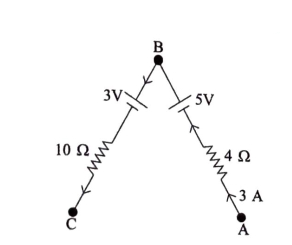
For the given circuit,$V_A - V_C = \text{ . . . . . . } \ V$.
A
$40$
B
$15$
C
$20$
D
$30$
Solution
(A) To find $V_A - V_C$,we travel from point $A$ to point $C$ through point $B$.
Starting from $A$,the current $I = 3 \ A$ flows towards $B$ through the $4 \ \Omega$ resistor.
Applying the potential drop formula $V_B = V_A - I R + E$,we move from $A$ to $B$:
$V_B = V_A - (3 \ A)(4 \ \Omega) + 5 \ V = V_A - 12 + 5 = V_A - 7$.
Now,moving from $B$ to $C$ through the $3 \ V$ battery and $10 \ \Omega$ resistor,the current $I = 3 \ A$ flows from $B$ to $C$:
$V_C = V_B - E - I R = V_B - 3 - (3 \ A)(10 \ \Omega) = V_B - 3 - 30 = V_B - 33$.
Substituting $V_B = V_A - 7$ into the equation for $V_C$:
$V_C = (V_A - 7) - 33 = V_A - 40$.
Therefore,$V_A - V_C = 40 \ V$.
Starting from $A$,the current $I = 3 \ A$ flows towards $B$ through the $4 \ \Omega$ resistor.
Applying the potential drop formula $V_B = V_A - I R + E$,we move from $A$ to $B$:
$V_B = V_A - (3 \ A)(4 \ \Omega) + 5 \ V = V_A - 12 + 5 = V_A - 7$.
Now,moving from $B$ to $C$ through the $3 \ V$ battery and $10 \ \Omega$ resistor,the current $I = 3 \ A$ flows from $B$ to $C$:
$V_C = V_B - E - I R = V_B - 3 - (3 \ A)(10 \ \Omega) = V_B - 3 - 30 = V_B - 33$.
Substituting $V_B = V_A - 7$ into the equation for $V_C$:
$V_C = (V_A - 7) - 33 = V_A - 40$.
Therefore,$V_A - V_C = 40 \ V$.
0 likesView Solution
12
PhysicsEasyMCQGSEB · 2024
The storage battery of a car has an emf of $12 \ V$. If the internal resistance of the battery is $0.6 \ \Omega$,then the maximum current that can be drawn from the battery is . . . . . . . (in $A$)
A
$20$
B
$30$
C
$25$
D
$75$
Solution
(A) The maximum current $(I_{\max})$ that can be drawn from a battery is obtained when the external resistance is zero (short circuit condition).
Using Ohm's law for a circuit,$I = \frac{\varepsilon}{R + r}$.
For maximum current,$R = 0$,so $I_{\max} = \frac{\varepsilon}{r}$.
Given: $\varepsilon = 12 \ V$ and $r = 0.6 \ \Omega$.
$I_{\max} = \frac{12}{0.6} = \frac{120}{6} = 20 \ A$.
Therefore,the correct option is $A$.
Using Ohm's law for a circuit,$I = \frac{\varepsilon}{R + r}$.
For maximum current,$R = 0$,so $I_{\max} = \frac{\varepsilon}{r}$.
Given: $\varepsilon = 12 \ V$ and $r = 0.6 \ \Omega$.
$I_{\max} = \frac{12}{0.6} = \frac{120}{6} = 20 \ A$.
Therefore,the correct option is $A$.
0 likesView Solution
13
PhysicsEasyMCQGSEB · 2024
Resistivity of which of the following substances decreases on increasing the temperature?
A
Copper
B
Aluminium
C
Silicon
D
Nichrome
Solution
(C) The correct option is $C$.
Silicon is a semiconductor.
In semiconductors,the number density of charge carriers (electrons and holes) increases exponentially with an increase in temperature.
Although the relaxation time decreases with temperature,the increase in the number density of charge carriers dominates,leading to a decrease in resistivity as temperature increases.
In contrast,metals like Copper,Aluminium,and alloys like Nichrome show an increase in resistivity with an increase in temperature.
Silicon is a semiconductor.
In semiconductors,the number density of charge carriers (electrons and holes) increases exponentially with an increase in temperature.
Although the relaxation time decreases with temperature,the increase in the number density of charge carriers dominates,leading to a decrease in resistivity as temperature increases.
In contrast,metals like Copper,Aluminium,and alloys like Nichrome show an increase in resistivity with an increase in temperature.
0 likesView Solution
14
PhysicsEasyMCQGSEB · 2024
If a conducting wire of length $L$ is uniformly stretched to double its length, then its conductivity becomes . . . . . . .
A
double
B
halved
C
$4$ times
D
remain same
Solution
(D) The correct option is $D$.
Conductivity $(\sigma)$ is an intrinsic property of a material.
It depends only on the nature of the material, its temperature, and pressure.
It does not depend on the physical dimensions of the conductor, such as its length $(L)$ or cross-sectional area $(A)$.
Therefore, when the wire is stretched, its resistance changes, but its conductivity remains the same.
Conductivity $(\sigma)$ is an intrinsic property of a material.
It depends only on the nature of the material, its temperature, and pressure.
It does not depend on the physical dimensions of the conductor, such as its length $(L)$ or cross-sectional area $(A)$.
Therefore, when the wire is stretched, its resistance changes, but its conductivity remains the same.
0 likesView Solution
15
PhysicsEasyMCQGSEB · 2024
The momentum of a photon of light of frequency $f$ is . . . . . . .
A
$\frac{h c}{f}$
B
$\frac{h f}{c}$
C
$\frac{h}{c f}$
D
$h c f$
Solution
(B) The energy of a photon is given by $E = hf$,where $h$ is Planck's constant and $f$ is the frequency.
According to Einstein's mass-energy equivalence relation,$E = mc^2$.
Equating the two expressions for energy: $mc^2 = hf$.
Since momentum $p = mc$,we can write $mc^2 = (mc)c = pc = hf$.
Therefore,the momentum $p = \frac{hf}{c}$.
According to Einstein's mass-energy equivalence relation,$E = mc^2$.
Equating the two expressions for energy: $mc^2 = hf$.
Since momentum $p = mc$,we can write $mc^2 = (mc)c = pc = hf$.
Therefore,the momentum $p = \frac{hf}{c}$.
0 likesView Solution
16
PhysicsEasyMCQGSEB · 2024
Threshold frequency of which of the following metals does not lie in the ultraviolet region (in the case of the photoelectric effect)?
A
Zinc
B
Magnesium
C
Cadmium
D
Sodium
Solution
(D) The threshold frequency $\nu_0$ is related to the work function $\Phi$ by the equation $\Phi = h\nu_0$,where $h$ is Planck's constant.
Metals like Zinc,Magnesium,and Cadmium have high work functions,meaning their threshold frequencies lie in the ultraviolet $(UV)$ region of the electromagnetic spectrum.
Sodium is an alkali metal with a very low work function (approximately $2.3 \ eV$ to $2.7 \ eV$).
Because of this low work function,the threshold frequency of Sodium lies in the visible region,not the ultraviolet region.
Therefore,the correct option is $D$.
Metals like Zinc,Magnesium,and Cadmium have high work functions,meaning their threshold frequencies lie in the ultraviolet $(UV)$ region of the electromagnetic spectrum.
Sodium is an alkali metal with a very low work function (approximately $2.3 \ eV$ to $2.7 \ eV$).
Because of this low work function,the threshold frequency of Sodium lies in the visible region,not the ultraviolet region.
Therefore,the correct option is $D$.
0 likesView Solution
17
PhysicsEasyMCQGSEB · 2024
If the de Broglie wavelength of a dust particle of mass $1.0 \times 10^{-9} \,kg$ is $3 \times 10^{-25} \,m$, then the speed of the particle is . . . . . . . $\left(h=6.625 \times 10^{-34} \,J \,s\right)$
A
$1.1 \,m \,s^{-1}$
B
$1.2 \,km \,s^{-1}$
C
$1.0 \,km \,s^{-1}$
D
$2.2 \,m \,s^{-1}$
Solution
(D) The de Broglie wavelength $\lambda$ is given by the formula: $\lambda = \frac{h}{mv}$.
Rearranging the formula to solve for the speed $v$:
$v = \frac{h}{m \lambda}$.
Given values:
$h = 6.625 \times 10^{-34} \,J \,s$
$m = 1.0 \times 10^{-9} \,kg$
$\lambda = 3 \times 10^{-25} \,m$
Substituting these values into the equation:
$v = \frac{6.625 \times 10^{-34}}{(1.0 \times 10^{-9}) \times (3 \times 10^{-25})}$
$v = \frac{6.625 \times 10^{-34}}{3.0 \times 10^{-34}}$
$v = 2.2083... \,m \,s^{-1} \approx 2.2 \,m \,s^{-1}$.
Thus, the correct option is $D$.
Rearranging the formula to solve for the speed $v$:
$v = \frac{h}{m \lambda}$.
Given values:
$h = 6.625 \times 10^{-34} \,J \,s$
$m = 1.0 \times 10^{-9} \,kg$
$\lambda = 3 \times 10^{-25} \,m$
Substituting these values into the equation:
$v = \frac{6.625 \times 10^{-34}}{(1.0 \times 10^{-9}) \times (3 \times 10^{-25})}$
$v = \frac{6.625 \times 10^{-34}}{3.0 \times 10^{-34}}$
$v = 2.2083... \,m \,s^{-1} \approx 2.2 \,m \,s^{-1}$.
Thus, the correct option is $D$.
0 likesView Solution
18
PhysicsEasyMCQGSEB · 2024
The photoelectric cut-off voltage in a certain experiment is $1.5 \ V$. What is the maximum kinetic energy of the emitted photoelectrons?
A
$1.5 \ eV$
B
$1.5 \ J$
C
$3.0 \ eV$
D
$1.6 \times 10^{-19} \ J$
Solution
(A) The relationship between the maximum kinetic energy $(K_{\text{max}})$ of photoelectrons and the stopping potential (cut-off voltage,$V_0$) is given by the equation:
$K_{\text{max}} = e V_0$
Given that the cut-off voltage $V_0 = 1.5 \ V$,we substitute this value into the equation:
$K_{\text{max}} = e \times 1.5 \ V$
$K_{\text{max}} = 1.5 \ eV$
Therefore,the maximum kinetic energy of the emitted photoelectrons is $1.5 \ eV$.
$K_{\text{max}} = e V_0$
Given that the cut-off voltage $V_0 = 1.5 \ V$,we substitute this value into the equation:
$K_{\text{max}} = e \times 1.5 \ V$
$K_{\text{max}} = 1.5 \ eV$
Therefore,the maximum kinetic energy of the emitted photoelectrons is $1.5 \ eV$.
0 likesView Solution
19
PhysicsEasyMCQGSEB · 2024
In the case of the photoelectric effect, on increasing the frequency of incident light:
A
Photoelectric current increases.
B
Photoelectric current decreases.
C
Stopping potential increases.
D
Stopping potential decreases.
Solution
(C) According to Einstein's photoelectric equation, $K_{max} = h\nu - \phi_0$, where $K_{max}$ is the maximum kinetic energy of emitted photoelectrons, $h$ is Planck's constant, $\nu$ is the frequency of incident light, and $\phi_0$ is the work function of the metal.
Since $K_{max} = eV_s$ (where $e$ is the charge of an electron and $V_s$ is the stopping potential), we have $eV_s = h\nu - \phi_0$.
Rearranging for the stopping potential, $V_s = \frac{h}{e}\nu - \frac{\phi_0}{e}$.
As the frequency $\nu$ of the incident light increases, the term $\frac{h}{e}\nu$ increases, which leads to an increase in the stopping potential $V_s$.
The photoelectric current depends on the intensity of the incident light, not its frequency, provided the frequency is above the threshold frequency.
Since $K_{max} = eV_s$ (where $e$ is the charge of an electron and $V_s$ is the stopping potential), we have $eV_s = h\nu - \phi_0$.
Rearranging for the stopping potential, $V_s = \frac{h}{e}\nu - \frac{\phi_0}{e}$.
As the frequency $\nu$ of the incident light increases, the term $\frac{h}{e}\nu$ increases, which leads to an increase in the stopping potential $V_s$.
The photoelectric current depends on the intensity of the incident light, not its frequency, provided the frequency is above the threshold frequency.
0 likesView Solution
20
PhysicsEasyMCQGSEB · 2024
When dipole moment $\vec{P}$ is parallel to a non-uniform electric field $\vec{E}$,the net force on the electric dipole is . . . . . . .
A
Zero
B
Perpendicular to $\vec{E}$
C
In the direction of decreasing field.
D
In the direction of increasing field.
Solution
(D)
When an electric dipole is placed in a non-uniform electric field,the two charges ($+q$ and $-q$) experience forces of different magnitudes because the electric field intensity varies at their respective positions.
Let the electric field at the position of $+q$ be $E_1$ and at $-q$ be $E_2$.
The force on $+q$ is $F_1 = qE_1$ and the force on $-q$ is $F_2 = -qE_2$.
The net force is $F_{net} = q(E_1 - E_2)$.
Since the dipole moment $\vec{P}$ is parallel to $\vec{E}$,the positive charge is in a region of higher field strength compared to the negative charge.
Therefore,the net force acts in the direction of the increasing electric field.
When an electric dipole is placed in a non-uniform electric field,the two charges ($+q$ and $-q$) experience forces of different magnitudes because the electric field intensity varies at their respective positions.
Let the electric field at the position of $+q$ be $E_1$ and at $-q$ be $E_2$.
The force on $+q$ is $F_1 = qE_1$ and the force on $-q$ is $F_2 = -qE_2$.
The net force is $F_{net} = q(E_1 - E_2)$.
Since the dipole moment $\vec{P}$ is parallel to $\vec{E}$,the positive charge is in a region of higher field strength compared to the negative charge.
Therefore,the net force acts in the direction of the increasing electric field.
0 likesView Solution
21
PhysicsEasyMCQGSEB · 2024
If a body contains $10^{24}$ electrons and $10^{26}$ protons,the total amount of charge on the body is . . . . . . $C$.
A
$1.6 \times 10^{-17}$
B
$1.58 \times 10^7$
C
$1.6 \times 10^{17}$
D
$1.58 \times 10^{-7}$
Solution
(B) The charge of a proton on a body is $q_p = n_p e = 10^{26} \times 1.6 \times 10^{-19} \ C = 1.6 \times 10^7 \ C$.
The charge of an electron on a body is $q_e = -n_e e = -10^{24} \times 1.6 \times 10^{-19} \ C = -1.6 \times 10^5 \ C$.
The total charge $Q$ on the body is the sum of the charges of protons and electrons:
$Q = q_p + q_e = (1.6 \times 10^7) - (1.6 \times 10^5) \ C$.
$Q = (160 \times 10^5) - (1.6 \times 10^5) \ C$.
$Q = 158.4 \times 10^5 \ C = 1.584 \times 10^7 \ C$.
Rounding to two significant figures,we get $Q \approx 1.58 \times 10^7 \ C$.
The charge of an electron on a body is $q_e = -n_e e = -10^{24} \times 1.6 \times 10^{-19} \ C = -1.6 \times 10^5 \ C$.
The total charge $Q$ on the body is the sum of the charges of protons and electrons:
$Q = q_p + q_e = (1.6 \times 10^7) - (1.6 \times 10^5) \ C$.
$Q = (160 \times 10^5) - (1.6 \times 10^5) \ C$.
$Q = 158.4 \times 10^5 \ C = 1.584 \times 10^7 \ C$.
Rounding to two significant figures,we get $Q \approx 1.58 \times 10^7 \ C$.
0 likesView Solution
22
PhysicsEasyMCQGSEB · 2024
If electric flux through a cubic Gaussian surface is $1.9 \times 10^5 \text{ Nm}^2 \text{C}^{-1}$,then the electric charge at its center is . . . . . . . (Edge length of cube = $9.0 \text{ cm}$).
A
$2 \mu \text{C}$
B
$2 \text{ mC}$
C
$4 \mu \text{C}$
D
$4 \text{ mC}$
Solution
(A) According to Gauss's Law,the electric flux $\phi$ through a closed surface is given by $\phi = \frac{q}{\varepsilon_0}$,where $q$ is the enclosed charge and $\varepsilon_0$ is the permittivity of free space $(8.854 \times 10^{-12} \text{ C}^2 \text{N}^{-1} \text{m}^{-2})$.
Given $\phi = 1.9 \times 10^5 \text{ Nm}^2 \text{C}^{-1}$.
Rearranging the formula to find the charge: $q = \phi \varepsilon_0$.
Substituting the values: $q = (1.9 \times 10^5) \times (8.854 \times 10^{-12})$.
$q = 16.8226 \times 10^{-7} \text{ C}$.
$q \approx 1.68 \times 10^{-6} \text{ C} = 1.68 \mu \text{C}$.
Rounding to the nearest provided option,we get $q \approx 2.0 \mu \text{C}$.
Given $\phi = 1.9 \times 10^5 \text{ Nm}^2 \text{C}^{-1}$.
Rearranging the formula to find the charge: $q = \phi \varepsilon_0$.
Substituting the values: $q = (1.9 \times 10^5) \times (8.854 \times 10^{-12})$.
$q = 16.8226 \times 10^{-7} \text{ C}$.
$q \approx 1.68 \times 10^{-6} \text{ C} = 1.68 \mu \text{C}$.
Rounding to the nearest provided option,we get $q \approx 2.0 \mu \text{C}$.
0 likesView Solution
23
PhysicsEasyMCQGSEB · 2024
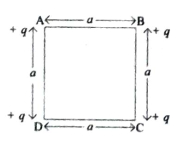
As shown in the figure,charges $+q$ each are placed at the four vertices of a square of side length $a$. The Coulomb force acting on the charge placed at vertex $D$ is . . . . . . .
A
$\left(\sqrt{2}+\frac{1}{2}\right) \frac{k q^2}{a^2}$
B
$\frac{\sqrt{2} k q^2}{a^2}$
C
$\left(\sqrt{2}-\frac{1}{2}\right) \frac{k q^2}{a^2}$
D
$\frac{k q^2}{2 a^2}$
Solution
(A) Let the vertices of the square be $A, B, C,$ and $D$ in order. The charges at $A, B, C$ exert forces on the charge at $D$.
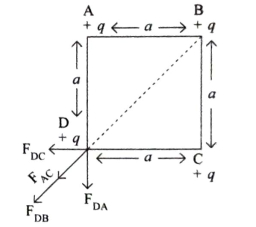
$1$. Force due to charge at $A$ $(F_{DA})$: This force acts along $DA$ (upwards) with magnitude $F_{DA} = \frac{k q^2}{a^2}$.
$2$. Force due to charge at $C$ $(F_{DC})$: This force acts along $DC$ (leftwards) with magnitude $F_{DC} = \frac{k q^2}{a^2}$.
$3$. Force due to charge at $B$ $(F_{DB})$: The distance between $B$ and $D$ is the diagonal of the square,which is $\sqrt{2}a$. The force acts along the diagonal $BD$ (outwards) with magnitude $F_{DB} = \frac{k q^2}{(\sqrt{2}a)^2} = \frac{k q^2}{2a^2}$.
The resultant force of $F_{DA}$ and $F_{DC}$ is $F_{AC} = \sqrt{F_{DA}^2 + F_{DC}^2} = \sqrt{\left(\frac{k q^2}{a^2}\right)^2 + \left(\frac{k q^2}{a^2}\right)^2} = \frac{\sqrt{2} k q^2}{a^2}$. This resultant force acts along the diagonal $BD$.
Since $F_{AC}$ and $F_{DB}$ are in the same direction,the net force is $F_{net} = F_{AC} + F_{DB} = \frac{\sqrt{2} k q^2}{a^2} + \frac{k q^2}{2a^2} = \left(\sqrt{2} + \frac{1}{2}\right) \frac{k q^2}{a^2}$.
$1$. Force due to charge at $A$ $(F_{DA})$: This force acts along $DA$ (upwards) with magnitude $F_{DA} = \frac{k q^2}{a^2}$.
$2$. Force due to charge at $C$ $(F_{DC})$: This force acts along $DC$ (leftwards) with magnitude $F_{DC} = \frac{k q^2}{a^2}$.
$3$. Force due to charge at $B$ $(F_{DB})$: The distance between $B$ and $D$ is the diagonal of the square,which is $\sqrt{2}a$. The force acts along the diagonal $BD$ (outwards) with magnitude $F_{DB} = \frac{k q^2}{(\sqrt{2}a)^2} = \frac{k q^2}{2a^2}$.
The resultant force of $F_{DA}$ and $F_{DC}$ is $F_{AC} = \sqrt{F_{DA}^2 + F_{DC}^2} = \sqrt{\left(\frac{k q^2}{a^2}\right)^2 + \left(\frac{k q^2}{a^2}\right)^2} = \frac{\sqrt{2} k q^2}{a^2}$. This resultant force acts along the diagonal $BD$.
Since $F_{AC}$ and $F_{DB}$ are in the same direction,the net force is $F_{net} = F_{AC} + F_{DB} = \frac{\sqrt{2} k q^2}{a^2} + \frac{k q^2}{2a^2} = \left(\sqrt{2} + \frac{1}{2}\right) \frac{k q^2}{a^2}$.
0 likesView Solution
24
PhysicsEasyMCQGSEB · 2024
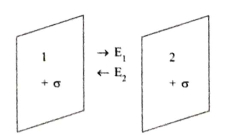
If two infinite plane sheets having same surface charge density $\sigma$ are placed parallel to each other,then the electric field between the two sheets is . . . . . . .
A
Zero
B
$\frac{\sigma}{2 \varepsilon_0}$
C
$\frac{\sigma}{\varepsilon_0}$
D
$\frac{2 \sigma}{\varepsilon_0}$
Solution
(A) The electric field due to an infinite plane sheet of charge with surface charge density $\sigma$ is given by $E = \frac{\sigma}{2 \varepsilon_0}$.
For two parallel sheets with the same positive surface charge density $\sigma$,the electric field produced by sheet $1$ $(E_1)$ points away from it (to the right in the region between the sheets),and the electric field produced by sheet $2$ $(E_2)$ points away from it (to the left in the region between the sheets).
In the region between the two sheets,the net electric field is the vector sum of the two fields:
$E_{net} = E_1 - E_2$
Since both sheets have the same surface charge density $\sigma$,$E_1 = E_2 = \frac{\sigma}{2 \varepsilon_0}$.
Therefore,$E_{net} = \frac{\sigma}{2 \varepsilon_0} - \frac{\sigma}{2 \varepsilon_0} = 0$.
Thus,the electric field between the two sheets is zero.
For two parallel sheets with the same positive surface charge density $\sigma$,the electric field produced by sheet $1$ $(E_1)$ points away from it (to the right in the region between the sheets),and the electric field produced by sheet $2$ $(E_2)$ points away from it (to the left in the region between the sheets).
In the region between the two sheets,the net electric field is the vector sum of the two fields:
$E_{net} = E_1 - E_2$
Since both sheets have the same surface charge density $\sigma$,$E_1 = E_2 = \frac{\sigma}{2 \varepsilon_0}$.
Therefore,$E_{net} = \frac{\sigma}{2 \varepsilon_0} - \frac{\sigma}{2 \varepsilon_0} = 0$.
Thus,the electric field between the two sheets is zero.
0 likesView Solution
25
PhysicsEasyMCQGSEB · 2024
Three equal charges $+q$ each are placed at the three vertices of an equilateral triangle. The electric field at the centroid of the triangle is . . . . . . . ('$r$' is the length of the side of the triangle).
A
$\frac{3 k q}{r^2}$
B
Zero
C
$\frac{k q}{r^2}$
D
$\frac{\sqrt{3} k q}{2 r^2}$
Solution
(B) The correct option is $B$.
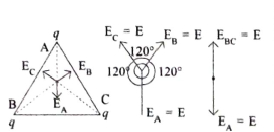
Let the vertices of the equilateral triangle be $A$,$B$,and $C$,each having a charge $+q$. The distance from each vertex to the centroid $O$ is the same,let it be $d$.
The electric field intensity produced by each charge at the centroid $O$ has the same magnitude $E = \frac{kq}{d^2}$.
These electric field vectors $E_A$,$E_B$,and $E_C$ are directed away from the charges along the medians of the triangle. Since the triangle is equilateral,these vectors are oriented at angles of $120^{\circ}$ with respect to each other.
According to the principle of superposition,the net electric field at the centroid is the vector sum of these three fields: $\vec{E}_{net} = \vec{E}_A + \vec{E}_B + \vec{E}_C$.
Since the vectors have equal magnitude and are separated by $120^{\circ}$,their vector sum is zero. Therefore,the net electric field at the centroid is zero.
Let the vertices of the equilateral triangle be $A$,$B$,and $C$,each having a charge $+q$. The distance from each vertex to the centroid $O$ is the same,let it be $d$.
The electric field intensity produced by each charge at the centroid $O$ has the same magnitude $E = \frac{kq}{d^2}$.
These electric field vectors $E_A$,$E_B$,and $E_C$ are directed away from the charges along the medians of the triangle. Since the triangle is equilateral,these vectors are oriented at angles of $120^{\circ}$ with respect to each other.
According to the principle of superposition,the net electric field at the centroid is the vector sum of these three fields: $\vec{E}_{net} = \vec{E}_A + \vec{E}_B + \vec{E}_C$.
Since the vectors have equal magnitude and are separated by $120^{\circ}$,their vector sum is zero. Therefore,the net electric field at the centroid is zero.
0 likesView Solution
26
PhysicsEasyMCQGSEB · 2024
Two identical conducting spheres $A$ and $B$ having charges $+q$ and $-q$ respectively are kept at a distance $d$ apart and experience a Coulombian force $F$ between them. If $50\%$ of the charge is transferred from sphere $B$ to $A$,then the new Coulombian force between them is . . . . . . .
A
$F$
B
$\frac{F}{4}$
C
$\frac{F}{2}$
D
$\frac{2F}{3}$
Solution
(B) The initial Coulombian force between the two spheres is given by Coulomb's law:
$F = \frac{k(q)(-q)}{d^2} = -\frac{kq^2}{d^2}$
When $50\%$ of the charge is transferred from sphere $B$ (charge $-q$) to sphere $A$ (charge $+q$),the amount of charge transferred is $\frac{q}{2}$.
The new charges on the spheres are:
$q_A = q - \frac{q}{2} = \frac{q}{2}$
$q_B = -q + \frac{q}{2} = -\frac{q}{2}$
The new Coulombian force $F^{\prime}$ is:
$F^{\prime} = \frac{k(q_A)(q_B)}{d^2} = \frac{k(\frac{q}{2})(-\frac{q}{2})}{d^2}$
$F^{\prime} = -\frac{kq^2}{4d^2}$
Since $F = -\frac{kq^2}{d^2}$,we can substitute this into the expression for $F^{\prime}$:
$F^{\prime} = \frac{F}{4}$
$F = \frac{k(q)(-q)}{d^2} = -\frac{kq^2}{d^2}$
When $50\%$ of the charge is transferred from sphere $B$ (charge $-q$) to sphere $A$ (charge $+q$),the amount of charge transferred is $\frac{q}{2}$.
The new charges on the spheres are:
$q_A = q - \frac{q}{2} = \frac{q}{2}$
$q_B = -q + \frac{q}{2} = -\frac{q}{2}$
The new Coulombian force $F^{\prime}$ is:
$F^{\prime} = \frac{k(q_A)(q_B)}{d^2} = \frac{k(\frac{q}{2})(-\frac{q}{2})}{d^2}$
$F^{\prime} = -\frac{kq^2}{4d^2}$
Since $F = -\frac{kq^2}{d^2}$,we can substitute this into the expression for $F^{\prime}$:
$F^{\prime} = \frac{F}{4}$
0 likesView Solution
27
PhysicsEasyMCQGSEB · 2024
The dimensional formula of electric field is . . . . . . .
A
$M^1 L^1 T^{-3} A^{-1}$
B
$M^1 L^1 T^{-2} A^{-1}$
C
$M^1 L^2 T^{-3} A^{-1}$
D
$M^0 L^1 T^{-3} A^{-1}$
Solution
(A) The electric field $E$ is defined as the force $F$ per unit charge $q$,given by the formula $E = \frac{F}{q}$.
The dimensional formula for force $F$ is $[F] = M^1 L^1 T^{-2}$.
The dimensional formula for electric charge $q$ is $[q] = A^1 T^1$.
Substituting these into the formula for $E$:
$[E] = \frac{[F]}{[q]} = \frac{M^1 L^1 T^{-2}}{A^1 T^1}$.
Simplifying the exponents:
$[E] = M^1 L^1 T^{-2-1} A^{-1} = M^1 L^1 T^{-3} A^{-1}$.
Therefore,the correct option is $A$.
The dimensional formula for force $F$ is $[F] = M^1 L^1 T^{-2}$.
The dimensional formula for electric charge $q$ is $[q] = A^1 T^1$.
Substituting these into the formula for $E$:
$[E] = \frac{[F]}{[q]} = \frac{M^1 L^1 T^{-2}}{A^1 T^1}$.
Simplifying the exponents:
$[E] = M^1 L^1 T^{-2-1} A^{-1} = M^1 L^1 T^{-3} A^{-1}$.
Therefore,the correct option is $A$.
0 likesView Solution
28
PhysicsEasyMCQGSEB · 2024
If an electric charge $q$ is placed at the centre of a cube,then the flux associated with each surface of the cube is . . . . . . .
A
$\frac{q}{\varepsilon_0}$
B
$\frac{q}{4 \varepsilon_0}$
C
$\frac{q}{6 \varepsilon_0}$
D
$\frac{q}{2 \varepsilon_0}$
Solution
(C) According to Gauss's Law,the total electric flux $\phi_{total}$ through a closed surface is given by $\phi_{total} = \frac{q}{\varepsilon_0}$.
Since the cube is a symmetric closed surface with $6$ identical faces,the flux is distributed equally among all faces.
Therefore,the flux $\phi$ associated with each surface of the cube is $\phi = \frac{\phi_{total}}{6} = \frac{q}{6 \varepsilon_0}$.
Since the cube is a symmetric closed surface with $6$ identical faces,the flux is distributed equally among all faces.
Therefore,the flux $\phi$ associated with each surface of the cube is $\phi = \frac{\phi_{total}}{6} = \frac{q}{6 \varepsilon_0}$.
0 likesView Solution
29
PhysicsEasyGSEB · 2024
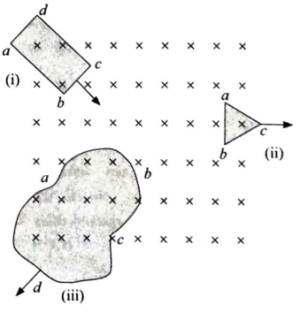
The following figure shows planar loops of different shapes moving into or out of a region of a magnetic field which is directed normal to the plane of the loop,away from the reader. Determine the direction of the induced current in each loop using Lenz's law.
Solution
(A) According to Lenz's law,the direction of the induced current is such that it opposes the change in magnetic flux that produced it.
$(i)$ The rectangular loop $abcd$ is moving into the magnetic field region. The magnetic flux through the loop increases. To oppose this increase,the induced current must create a magnetic field directed out of the page. By the right-hand rule,the induced current flows in the counter-clockwise direction,i.e.,along $adcba$.
(ii) The triangular loop $abc$ is moving out of the magnetic field region. The magnetic flux through the loop decreases. To oppose this decrease,the induced current must create a magnetic field directed into the page. By the right-hand rule,the induced current flows in the clockwise direction,i.e.,along $abc$.
(iii) The irregular loop $abcd$ is moving out of the magnetic field region. The magnetic flux through the loop decreases. To oppose this decrease,the induced current must create a magnetic field directed into the page. By the right-hand rule,the induced current flows in the clockwise direction,i.e.,along $abcda$.
$(i)$ The rectangular loop $abcd$ is moving into the magnetic field region. The magnetic flux through the loop increases. To oppose this increase,the induced current must create a magnetic field directed out of the page. By the right-hand rule,the induced current flows in the counter-clockwise direction,i.e.,along $adcba$.
(ii) The triangular loop $abc$ is moving out of the magnetic field region. The magnetic flux through the loop decreases. To oppose this decrease,the induced current must create a magnetic field directed into the page. By the right-hand rule,the induced current flows in the clockwise direction,i.e.,along $abc$.
(iii) The irregular loop $abcd$ is moving out of the magnetic field region. The magnetic flux through the loop decreases. To oppose this decrease,the induced current must create a magnetic field directed into the page. By the right-hand rule,the induced current flows in the clockwise direction,i.e.,along $abcda$.
0 likesView Solution
30
PhysicsEasyMCQGSEB · 2024
The expression for the magnetic energy per unit volume stored in a solenoid in terms of magnetic field is . . . . . . .
A
$\frac{1}{2} B^2 \mu_0$
B
$\frac{1}{2} B \mu_0^2$
C
$\frac{1}{2} \frac{B}{\mu_0}$
D
$\frac{B^2}{2 \mu_0}$
Solution
(D) The magnetic energy stored in a solenoid is given by $U_B = \frac{1}{2} LI^2$.
For a solenoid,the self-inductance is $L = \mu_0 n^2 Al$ and the magnetic field is $B = \mu_0 nI$,which implies $I = \frac{B}{\mu_0 n}$.
Substituting these into the energy expression:
$U_B = \frac{1}{2} (\mu_0 n^2 Al) \left( \frac{B}{\mu_0 n} \right)^2 = \frac{1}{2} (\mu_0 n^2 Al) \left( \frac{B^2}{\mu_0^2 n^2} \right) = \frac{B^2 Al}{2 \mu_0}$.
The magnetic energy per unit volume $(u_B)$ is defined as the total energy divided by the volume $(V = Al)$:
$u_B = \frac{U_B}{V} = \frac{B^2 Al / (2 \mu_0)}{Al} = \frac{B^2}{2 \mu_0}$.
For a solenoid,the self-inductance is $L = \mu_0 n^2 Al$ and the magnetic field is $B = \mu_0 nI$,which implies $I = \frac{B}{\mu_0 n}$.
Substituting these into the energy expression:
$U_B = \frac{1}{2} (\mu_0 n^2 Al) \left( \frac{B}{\mu_0 n} \right)^2 = \frac{1}{2} (\mu_0 n^2 Al) \left( \frac{B^2}{\mu_0^2 n^2} \right) = \frac{B^2 Al}{2 \mu_0}$.
The magnetic energy per unit volume $(u_B)$ is defined as the total energy divided by the volume $(V = Al)$:
$u_B = \frac{U_B}{V} = \frac{B^2 Al / (2 \mu_0)}{Al} = \frac{B^2}{2 \mu_0}$.
0 likesView Solution
31
PhysicsEasyMCQGSEB · 2024
$A$ wheel with $10$ metallic spokes,each $0.5 \ m$ long,is rotated with a speed of $120 \ rev/min$ in a plane normal to the horizontal component of Earth's magnetic field $H_E$ at a place. If $H_E = 0.4 \ G$ at the place,then the induced emf is: $(1 \ G = 10^{-4} \ T)$
A
$6.28 \times 10^{-5} \ mV$
B
$6.28 \times 10^{-2} \ \mu V$
C
$6.28 \times 10^{-2} \ mV$
D
$6.28 \times 10^{-5} \ \mu V$
Solution
(C) Given: Length of each spoke $R = 0.5 \ m$,angular speed $\omega = 120 \ rev/min$,and magnetic field $B = H_E = 0.4 \ G = 0.4 \times 10^{-4} \ T$.
First,convert the angular speed to $rad/s$:
$\omega = \frac{120 \times 2\pi}{60} = 4\pi \ rad/s$.
The induced emf across the spokes of a rotating wheel in a magnetic field is given by the formula:
$\varepsilon = \frac{1}{2} B \omega R^2$.
Substituting the values:
$\varepsilon = \frac{1}{2} \times (0.4 \times 10^{-4} \ T) \times (4\pi \ rad/s) \times (0.5 \ m)^2$.
$\varepsilon = 0.2 \times 10^{-4} \times 4\pi \times 0.25$.
$\varepsilon = 0.2 \times 10^{-4} \times \pi$.
$\varepsilon = 0.2 \times 3.14159 \times 10^{-4} \ V$.
$\varepsilon = 0.6283 \times 10^{-4} \ V = 6.283 \times 10^{-5} \ V$.
Converting to millivolts $(mV)$:
$\varepsilon = 6.283 \times 10^{-5} \times 10^3 \ mV = 6.283 \times 10^{-2} \ mV$.
Thus,the correct option is $C$.
First,convert the angular speed to $rad/s$:
$\omega = \frac{120 \times 2\pi}{60} = 4\pi \ rad/s$.
The induced emf across the spokes of a rotating wheel in a magnetic field is given by the formula:
$\varepsilon = \frac{1}{2} B \omega R^2$.
Substituting the values:
$\varepsilon = \frac{1}{2} \times (0.4 \times 10^{-4} \ T) \times (4\pi \ rad/s) \times (0.5 \ m)^2$.
$\varepsilon = 0.2 \times 10^{-4} \times 4\pi \times 0.25$.
$\varepsilon = 0.2 \times 10^{-4} \times \pi$.
$\varepsilon = 0.2 \times 3.14159 \times 10^{-4} \ V$.
$\varepsilon = 0.6283 \times 10^{-4} \ V = 6.283 \times 10^{-5} \ V$.
Converting to millivolts $(mV)$:
$\varepsilon = 6.283 \times 10^{-5} \times 10^3 \ mV = 6.283 \times 10^{-2} \ mV$.
Thus,the correct option is $C$.
0 likesView Solution
32
PhysicsEasyMCQGSEB · 2024
The dimensional formula of self-inductance is . . . . . . .
A
$M^1 L^2 T^{-2} A^{-2}$
B
$M^1 L^{-2} T^{-2} A^2$
C
$M^{-1} L^{-2} T^{-2} A^{-2}$
D
$M^1 L^2 T^{-2} A^2$
Solution
(A) The formula for self-inductance $L$ is given by $L = \frac{\varepsilon dt}{dI}$.
Here,$\varepsilon$ is the induced electromotive force $(EMF)$,which has dimensions $[M^1 L^2 T^{-3} A^{-1}]$.
$dt$ is the time interval with dimensions $[T^1]$.
$dI$ is the change in current with dimensions $[A^1]$.
Substituting these dimensions into the formula:
$L = \frac{[M^1 L^2 T^{-3} A^{-1}] \cdot [T^1]}{[A^1]}$
$L = [M^1 L^2 T^{-2} A^{-2}]$.
Therefore,the correct option is $A$.
Here,$\varepsilon$ is the induced electromotive force $(EMF)$,which has dimensions $[M^1 L^2 T^{-3} A^{-1}]$.
$dt$ is the time interval with dimensions $[T^1]$.
$dI$ is the change in current with dimensions $[A^1]$.
Substituting these dimensions into the formula:
$L = \frac{[M^1 L^2 T^{-3} A^{-1}] \cdot [T^1]}{[A^1]}$
$L = [M^1 L^2 T^{-2} A^{-2}]$.
Therefore,the correct option is $A$.
0 likesView Solution
33
PhysicsEasyMCQGSEB · 2024
Current in a circuit falls from $5.0 \ A$ to $0.00 \ A$ in $0.1 \ s$. If an average emf of $200 \ V$ is induced,then the self-inductance of the circuit is . . . . . . $H$.
A
$0.4$
B
$4.0$
C
$40$
D
$0.004$
Solution
(B) Given:
Initial current $I_1 = 5.0 \ A$
Final current $I_2 = 0.0 \ A$
Time interval $dt = 0.1 \ s$
Induced emf $\varepsilon = 200 \ V$
The formula for induced emf in an inductor is given by:
$\varepsilon = -L \frac{dI}{dt}$
Rearranging the formula to solve for self-inductance $L$:
$L = -\frac{\varepsilon \cdot dt}{dI}$
Where $dI = I_2 - I_1 = 0.0 - 5.0 = -5.0 \ A$.
Substituting the values:
$L = -\frac{200 \times 0.1}{-5.0}$
$L = \frac{20}{5} = 4 \ H$
Therefore,the self-inductance of the circuit is $4.0 \ H$.
Initial current $I_1 = 5.0 \ A$
Final current $I_2 = 0.0 \ A$
Time interval $dt = 0.1 \ s$
Induced emf $\varepsilon = 200 \ V$
The formula for induced emf in an inductor is given by:
$\varepsilon = -L \frac{dI}{dt}$
Rearranging the formula to solve for self-inductance $L$:
$L = -\frac{\varepsilon \cdot dt}{dI}$
Where $dI = I_2 - I_1 = 0.0 - 5.0 = -5.0 \ A$.
Substituting the values:
$L = -\frac{200 \times 0.1}{-5.0}$
$L = \frac{20}{5} = 4 \ H$
Therefore,the self-inductance of the circuit is $4.0 \ H$.
0 likesView Solution
34
PhysicsEasyMCQGSEB · 2024
$A$ $1.0 \ m$ metallic rod is rotated with an angular frequency $200 \ rad \ s^{-1}$ about an axis normal to the rod passing through its one end. The other end of the rod is in contact with a circular metallic ring. $A$ constant and uniform magnetic field of $0.5 \ T$ parallel to the axis exists everywhere. The emf developed between the centre and the ring is . . . . . . . (in $V$)
A
$100$
B
$50$
C
$200$
D
$400$
Solution
(B) Given:
Length of the rod,$l = 1.0 \ m$
Angular frequency,$\omega = 200 \ rad \ s^{-1}$
Magnetic field,$B = 0.5 \ T$
The motional electromotive force (emf) induced in a rod rotating about one of its ends in a uniform magnetic field is given by the formula:
$\varepsilon = \frac{1}{2} B \omega l^2$
Substituting the given values into the formula:
$\varepsilon = \frac{1}{2} \times 0.5 \times 200 \times (1.0)^2$
$\varepsilon = 0.5 \times 100$
$\varepsilon = 50 \ V$
Thus,the emf developed between the centre and the ring is $50 \ V$.
Length of the rod,$l = 1.0 \ m$
Angular frequency,$\omega = 200 \ rad \ s^{-1}$
Magnetic field,$B = 0.5 \ T$
The motional electromotive force (emf) induced in a rod rotating about one of its ends in a uniform magnetic field is given by the formula:
$\varepsilon = \frac{1}{2} B \omega l^2$
Substituting the given values into the formula:
$\varepsilon = \frac{1}{2} \times 0.5 \times 200 \times (1.0)^2$
$\varepsilon = 0.5 \times 100$
$\varepsilon = 50 \ V$
Thus,the emf developed between the centre and the ring is $50 \ V$.
0 likesView Solution
35
PhysicsEasyMCQGSEB · 2024
The mutual inductance of a system of two coils does not depend on . . . . . . .
A
Number of turns of the coils.
B
The relative permeability of the medium within the coils.
C
Distance between the two coils.
D
Current passing through the coils.
Solution
(D) The correct answer is $D$.
Mutual inductance $(M)$ of a system of two coils depends on the geometric factors such as the number of turns $(N_1, N_2)$, the area of cross-section $(A)$, the distance between the coils, and the magnetic permeability $(\mu)$ of the medium between them.
It is defined by the relation $\phi_2 = M I_1$, where $\phi_2$ is the magnetic flux linked with the second coil and $I_1$ is the current in the first coil.
Since $M = \frac{\phi_2}{I_1}$, the value of $M$ is independent of the magnitude of the current $I_1$ flowing through the coils.
Mutual inductance $(M)$ of a system of two coils depends on the geometric factors such as the number of turns $(N_1, N_2)$, the area of cross-section $(A)$, the distance between the coils, and the magnetic permeability $(\mu)$ of the medium between them.
It is defined by the relation $\phi_2 = M I_1$, where $\phi_2$ is the magnetic flux linked with the second coil and $I_1$ is the current in the first coil.
Since $M = \frac{\phi_2}{I_1}$, the value of $M$ is independent of the magnitude of the current $I_1$ flowing through the coils.
0 likesView Solution
36
PhysicsEasyMCQGSEB · 2024
Current in a circuit falls from $5.0 \ A$ to $0.0 \ A$ in $0.1 \ s$. If an average emf of $100 \ V$ is induced,then the value of self-inductance of the circuit is . . . . . . . (in $H$)
A
$0.5$
B
$2$
C
$1$
D
$4$
Solution
(B) Given:
Initial current $I_1 = 5.0 \ A$
Final current $I_2 = 0.0 \ A$
Change in current $dI = I_2 - I_1 = 0.0 - 5.0 = -5.0 \ A$
Time interval $dt = 0.1 \ s$
Induced emf $\varepsilon = 100 \ V$
The formula for induced emf due to self-inductance is given by:
$\varepsilon = -L \frac{dI}{dt}$
Substituting the values:
$100 = -L \left( \frac{-5.0}{0.1} \right)$
$100 = L \times 50$
$L = \frac{100}{50} = 2 \ H$
Therefore,the self-inductance of the circuit is $2 \ H$.
Initial current $I_1 = 5.0 \ A$
Final current $I_2 = 0.0 \ A$
Change in current $dI = I_2 - I_1 = 0.0 - 5.0 = -5.0 \ A$
Time interval $dt = 0.1 \ s$
Induced emf $\varepsilon = 100 \ V$
The formula for induced emf due to self-inductance is given by:
$\varepsilon = -L \frac{dI}{dt}$
Substituting the values:
$100 = -L \left( \frac{-5.0}{0.1} \right)$
$100 = L \times 50$
$L = \frac{100}{50} = 2 \ H$
Therefore,the self-inductance of the circuit is $2 \ H$.
0 likesView Solution
37
PhysicsEasyMCQGSEB · 2024
The flux associated with a closed loop is $\phi = 3t^2 + 2t + 5 \text{ Wb}$. If the resistance of the loop is $14 \ \Omega$,then the current induced in this coil at $t = 2 \text{ s}$ is . . . . . . . (in $\text{ A}$)
A
$1$
B
$1.5$
C
$2$
D
$2.5$
Solution
(A) According to Faraday's law of electromagnetic induction,the induced electromotive force $(EMF)$ is given by $\varepsilon = -\frac{d\phi}{dt}$.
Taking the magnitude of the induced $EMF$:
$|\varepsilon| = \left| \frac{d}{dt}(3t^2 + 2t + 5) \right|$
$|\varepsilon| = 6t + 2$
At time $t = 2 \text{ s}$,the induced $EMF$ is:
$|\varepsilon| = 6(2) + 2 = 14 \text{ V}$
The induced current $I$ is given by Ohm's law: $I = \frac{|\varepsilon|}{R}$.
Given $R = 14 \ \Omega$,we have:
$I = \frac{14 \text{ V}}{14 \ \Omega} = 1 \text{ A}$.
Taking the magnitude of the induced $EMF$:
$|\varepsilon| = \left| \frac{d}{dt}(3t^2 + 2t + 5) \right|$
$|\varepsilon| = 6t + 2$
At time $t = 2 \text{ s}$,the induced $EMF$ is:
$|\varepsilon| = 6(2) + 2 = 14 \text{ V}$
The induced current $I$ is given by Ohm's law: $I = \frac{|\varepsilon|}{R}$.
Given $R = 14 \ \Omega$,we have:
$I = \frac{14 \text{ V}}{14 \ \Omega} = 1 \text{ A}$.
0 likesView Solution
38
PhysicsEasyMCQGSEB · 2024
$Ultraviolet$ radiations are used in $LASIK$ surgery.
A
Infrared
B
Ultraviolet
C
Radio
D
Gamma
Solution
(B) In $LASIK$ (Laser-Assisted In Situ Keratomileusis) eye surgery,an excimer laser is used to reshape the cornea. This laser emits $Ultraviolet$ radiation,specifically at a wavelength of $193 \ nm$. This high-energy radiation is capable of breaking molecular bonds in the corneal tissue,allowing for precise removal of tissue without causing thermal damage to surrounding areas.
0 likesView Solution
39
PhysicsEasyMCQGSEB · 2024
Which of the following waves is used in a speed gun to measure the speed of a ball in a cricket match?
A
Radio wave
B
Infrared waves
C
Microwave
D
Ultraviolet wave
Solution
(C) speed gun used in cricket matches operates on the principle of the Doppler effect. It emits electromagnetic waves,specifically microwaves,towards the moving ball. When these waves reflect off the ball,their frequency changes due to the motion of the ball. By measuring this frequency shift,the speed gun calculates the velocity of the ball. Therefore,microwaves are the correct type of electromagnetic wave used for this purpose.
0 likesView Solution
40
PhysicsEasyMCQGSEB · 2024
Which of the following options represents the Ampere-Maxwell Law?
A
$\oint \vec{B} \cdot d\vec{l} = \mu_{0} i_{c} + \mu_{0} \frac{d\phi_{E}}{dt}$
B
$\oint \vec{B} \cdot d\vec{l} = \mu_{0} i_{c} + \frac{d\phi_{E}}{dt}$
C
$\oint \vec{B} \cdot d\vec{l} = \mu_{0} i_{c} + \varepsilon_{0} \frac{d\phi_{E}}{dt}$
D
$\oint \vec{B} \cdot d\vec{l} = \mu_{0} i_{c} + \mu_{0} \varepsilon_{0} \frac{d\phi_{E}}{dt}$
Solution
(D) The Ampere-Maxwell Law is a modification of Ampere's Law that accounts for the displacement current.
The mathematical expression is given by:
$\oint \vec{B} \cdot d\vec{l} = \mu_{0} i_{c} + \mu_{0} \varepsilon_{0} \frac{d\phi_{E}}{dt}$
where:
- $\oint \vec{B} \cdot d\vec{l}$ is the line integral of the magnetic field.
- $i_{c}$ is the conduction current.
- $\varepsilon_{0} \frac{d\phi_{E}}{dt}$ is the displacement current $(i_{d})$.
- $\mu_{0}$ is the permeability of free space.
- $\varepsilon_{0}$ is the permittivity of free space.
Therefore,option $D$ is the correct representation.
The mathematical expression is given by:
$\oint \vec{B} \cdot d\vec{l} = \mu_{0} i_{c} + \mu_{0} \varepsilon_{0} \frac{d\phi_{E}}{dt}$
where:
- $\oint \vec{B} \cdot d\vec{l}$ is the line integral of the magnetic field.
- $i_{c}$ is the conduction current.
- $\varepsilon_{0} \frac{d\phi_{E}}{dt}$ is the displacement current $(i_{d})$.
- $\mu_{0}$ is the permeability of free space.
- $\varepsilon_{0}$ is the permittivity of free space.
Therefore,option $D$ is the correct representation.
0 likesView Solution
41
PhysicsEasyMCQGSEB · 2024
For a parallel plate capacitor having plates with finite area,the electric field lines bend outward at the edges. This effect is called . . . . . . .
A
Electrostatic shielding
B
Fringing of the field
C
Diffraction
D
Polarisation
Solution
(B) In an ideal parallel plate capacitor,we assume the plates are infinite in extent,resulting in a uniform electric field between them.
However,for real capacitors with finite plate dimensions,the electric field lines do not remain perfectly parallel near the edges.
Instead,they bulge or bend outward at the edges of the plates.
This phenomenon is known as the fringing of the field.
However,for real capacitors with finite plate dimensions,the electric field lines do not remain perfectly parallel near the edges.
Instead,they bulge or bend outward at the edges of the plates.
This phenomenon is known as the fringing of the field.
0 likesView Solution
42
PhysicsEasyMCQGSEB · 2024
$A$ $12 \text{ pF}$ capacitor is connected to a $50 \text{ V}$ battery. The electrostatic energy stored in the capacitor will be . . . . . . $\text{J}$.
A
$1.5 \times 10^{-8}$
B
$1.5 \times 10^{-10}$
C
$2.5 \times 10^{-8}$
D
$2.5 \times 10^{-10}$
Solution
(A) Given:
Capacitance $C = 12 \text{ pF} = 12 \times 10^{-12} \text{ F}$
Potential difference $V = 50 \text{ V}$
The electrostatic energy $U$ stored in a capacitor is given by the formula:
$U = \frac{1}{2} C V^2$
Substituting the given values:
$U = \frac{1}{2} \times (12 \times 10^{-12} \text{ F}) \times (50 \text{ V})^2$
$U = 6 \times 10^{-12} \times 2500$
$U = 15000 \times 10^{-12} \text{ J}$
$U = 1.5 \times 10^4 \times 10^{-12} \text{ J}$
$U = 1.5 \times 10^{-8} \text{ J}$
Therefore,the energy stored is $1.5 \times 10^{-8} \text{ J}$.
Capacitance $C = 12 \text{ pF} = 12 \times 10^{-12} \text{ F}$
Potential difference $V = 50 \text{ V}$
The electrostatic energy $U$ stored in a capacitor is given by the formula:
$U = \frac{1}{2} C V^2$
Substituting the given values:
$U = \frac{1}{2} \times (12 \times 10^{-12} \text{ F}) \times (50 \text{ V})^2$
$U = 6 \times 10^{-12} \times 2500$
$U = 15000 \times 10^{-12} \text{ J}$
$U = 1.5 \times 10^4 \times 10^{-12} \text{ J}$
$U = 1.5 \times 10^{-8} \text{ J}$
Therefore,the energy stored is $1.5 \times 10^{-8} \text{ J}$.
0 likesView Solution
43
PhysicsEasyMCQGSEB · 2024
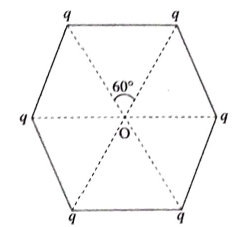
$A$ regular hexagon of side $9 \ cm$ has a charge $5 \mu C$ at each of its vertices. The electric potential at its centre is $..........V$. $(k = 9 \times 10^9 \ Nm^2 C^{-2})$
A
$3 \times 10^7$
B
$3 \times 10^5$
C
$3 \times 10^6$
D
$3 \times 10^8$
Solution
(C) In a regular hexagon,the distance from the centre to each vertex is equal to the side length of the hexagon. Given side length $r = 9 \ cm = 0.09 \ m$.
Each vertex has a charge $q = 5 \mu C = 5 \times 10^{-6} \ C$.
The electric potential $V$ at the centre due to a single charge $q$ at distance $r$ is $V_i = \frac{kq}{r}$.
Since there are $6$ identical charges at the vertices,the total potential $V$ at the centre is the sum of potentials due to each charge:
$V = 6 \times \frac{kq}{r}$
Substituting the values:
$V = 6 \times \frac{9 \times 10^9 \times 5 \times 10^{-6}}{0.09}$
$V = 6 \times \frac{45 \times 10^3}{9 \times 10^{-2}}$
$V = 6 \times 5 \times 10^5$
$V = 30 \times 10^5 = 3 \times 10^6 \ V$.
Each vertex has a charge $q = 5 \mu C = 5 \times 10^{-6} \ C$.
The electric potential $V$ at the centre due to a single charge $q$ at distance $r$ is $V_i = \frac{kq}{r}$.
Since there are $6$ identical charges at the vertices,the total potential $V$ at the centre is the sum of potentials due to each charge:
$V = 6 \times \frac{kq}{r}$
Substituting the values:
$V = 6 \times \frac{9 \times 10^9 \times 5 \times 10^{-6}}{0.09}$
$V = 6 \times \frac{45 \times 10^3}{9 \times 10^{-2}}$
$V = 6 \times 5 \times 10^5$
$V = 30 \times 10^5 = 3 \times 10^6 \ V$.
0 likesView Solution
44
PhysicsEasyMCQGSEB · 2024
If a $12 \ pF$ capacitor is connected to a $50 \ V$ battery,then the electrostatic energy stored in the capacitor is . . . . . . .
A
$1.5 \times 10^{-12} \ J$
B
$1.5 \times 10^{-8} \ J$
C
$1.5 \times 10^{-6} \ J$
D
$3 \times 10^{-8} \ J$
Solution
(B) The energy $U$ stored in a capacitor is given by the formula $U = \frac{1}{2} CV^2$.
Given:
Capacitance $C = 12 \ pF = 12 \times 10^{-12} \ F$
Potential difference $V = 50 \ V$
Substituting the values into the formula:
$U = \frac{1}{2} \times (12 \times 10^{-12} \ F) \times (50 \ V)^2$
$U = 6 \times 10^{-12} \times 2500 \ J$
$U = 15000 \times 10^{-12} \ J$
$U = 1.5 \times 10^4 \times 10^{-12} \ J$
$U = 1.5 \times 10^{-8} \ J$
Therefore,the correct option is $B$.
Given:
Capacitance $C = 12 \ pF = 12 \times 10^{-12} \ F$
Potential difference $V = 50 \ V$
Substituting the values into the formula:
$U = \frac{1}{2} \times (12 \times 10^{-12} \ F) \times (50 \ V)^2$
$U = 6 \times 10^{-12} \times 2500 \ J$
$U = 15000 \times 10^{-12} \ J$
$U = 1.5 \times 10^4 \times 10^{-12} \ J$
$U = 1.5 \times 10^{-8} \ J$
Therefore,the correct option is $B$.
0 likesView Solution
45
PhysicsEasyMCQGSEB · 2024
$A$ charged capacitor is disconnected from the battery and if the distance between the two plates of the capacitor is increased then . . . . . . .
A
Charge on plate will decrease.
B
The potential difference between the two plates will decrease.
C
Charge on plate will remain same.
D
Capacitance of the capacitor will increase.
Solution
(C) When a charged capacitor is disconnected from the battery,the charge $Q$ on its plates remains constant because there is no path for the charge to flow.
As the distance $d$ between the plates is increased,the capacitance $C = \frac{\epsilon_0 A}{d}$ decreases.
Since $Q = CV$,and $Q$ is constant,the potential difference $V = \frac{Q}{C}$ will increase as $C$ decreases.
Therefore,the charge on the plates remains the same.
As the distance $d$ between the plates is increased,the capacitance $C = \frac{\epsilon_0 A}{d}$ decreases.
Since $Q = CV$,and $Q$ is constant,the potential difference $V = \frac{Q}{C}$ will increase as $C$ decreases.
Therefore,the charge on the plates remains the same.
0 likesView Solution
46
PhysicsEasyMCQGSEB · 2024
By keeping a conductor in an external electric field and from the results obtained by electrostatics,which of the following options is wrong?
A
Inside a conductor,the electrostatic field is zero.
B
The interior of the conductor has excess charge in a static situation.
C
At the surface of a charged conductor,the electric field must be perpendicular to the surface.
D
The electrostatic potential is constant throughout the volume of the conductor.
Solution
(B) In a static situation,the interior of a conductor cannot have any excess charge. According to Gauss's Law,if there were an excess charge $q$ inside a closed surface,there would be a net electric flux $\phi = q/\epsilon_0$ through the surface. However,since the electric field inside a conductor is zero,the flux must be zero,implying that the net charge inside any volume of the conductor is zero. Therefore,any excess charge must reside on the surface of the conductor. Thus,option $B$ is incorrect.
0 likesView Solution
47
PhysicsEasyMCQGSEB · 2024
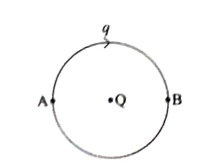
$A$ charge $+Q$ is placed at the centre of a circular path of radius $r$. The work done to bring a charge $+q$ from one end of the diameter to the other end of the circular path in the electric field produced by charge $+Q$ is $.......$
A
$\frac{k Q q}{r}$
B
Zero
C
$\frac{k Q q}{2 r}$
D
$\frac{2 k Q q}{r}$
Solution
(B) The electric potential $V$ at a distance $r$ from a point charge $Q$ is given by $V = \frac{kQ}{r}$.
Since the circular path is centered at $Q$,every point on the circumference is at the same distance $r$ from the charge $Q$.
Therefore,the electric potential at any point on the circular path is constant.
Let $V_A$ be the potential at point $A$ and $V_B$ be the potential at point $B$. Since both points are on the circle,$V_A = V_B = \frac{kQ}{r}$.
The work done $W$ in moving a charge $q$ from point $A$ to point $B$ is given by $W = q(V_B - V_A)$.
Substituting the values,$W = q(\frac{kQ}{r} - \frac{kQ}{r}) = q(0) = 0$.
Thus,the work done is zero.
Since the circular path is centered at $Q$,every point on the circumference is at the same distance $r$ from the charge $Q$.
Therefore,the electric potential at any point on the circular path is constant.
Let $V_A$ be the potential at point $A$ and $V_B$ be the potential at point $B$. Since both points are on the circle,$V_A = V_B = \frac{kQ}{r}$.
The work done $W$ in moving a charge $q$ from point $A$ to point $B$ is given by $W = q(V_B - V_A)$.
Substituting the values,$W = q(\frac{kQ}{r} - \frac{kQ}{r}) = q(0) = 0$.
Thus,the work done is zero.
0 likesView Solution
48
PhysicsEasyMCQGSEB · 2024
The phenomenon of perfect diamagnetism in superconductors is called the . . . . . . .
A
Curie's effect
B
Lorentz effect
C
Meissner effect
D
Crompton effect
Solution
(C) The correct answer is $C$.
When a material is cooled below its critical temperature $(T_c)$ to become a superconductor,it expels all magnetic flux from its interior.
This expulsion of magnetic field lines is known as the Meissner effect.
It is a characteristic property of superconductors,demonstrating perfect diamagnetism where the magnetic susceptibility $\chi = -1$.
When a material is cooled below its critical temperature $(T_c)$ to become a superconductor,it expels all magnetic flux from its interior.
This expulsion of magnetic field lines is known as the Meissner effect.
It is a characteristic property of superconductors,demonstrating perfect diamagnetism where the magnetic susceptibility $\chi = -1$.
0 likesView Solution
49
PhysicsEasyMCQGSEB · 2024
The magnetic needle of a magnetic compass is made up of $\qquad$ .
A
bismuth
B
lodestone
C
copper
D
aluminium
Solution
(B) The correct answer is $B$.
$A$ magnetic needle in a compass is typically made of a ferromagnetic material that can be permanently magnetized.
Lodestone is a naturally occurring magnetized piece of the mineral magnetite,which has been historically used to create magnetic needles for compasses.
$A$ magnetic needle in a compass is typically made of a ferromagnetic material that can be permanently magnetized.
Lodestone is a naturally occurring magnetized piece of the mineral magnetite,which has been historically used to create magnetic needles for compasses.
0 likesView Solution
50
PhysicsEasyMCQGSEB · 2024
$A$ short bar magnet placed with its axis at $30^{\circ}$ with a uniform external magnetic field of $0.25 \ T$ experiences a torque of magnitude $4.5 \times 10^{-2} \ J$. The magnitude of the magnetic moment of the magnet will be . . . . . . $J \ T^{-1}$.
A
$0.18$
B
$0.54$
C
$0.36$
D
$0.72$
Solution
(C) The torque $\tau$ experienced by a magnetic dipole in an external magnetic field $B$ is given by the formula: $\tau = m B \sin \theta$,where $m$ is the magnetic moment and $\theta$ is the angle between the axis of the magnet and the magnetic field.
Given values are: $\tau = 4.5 \times 10^{-2} \ J$,$B = 0.25 \ T$,and $\theta = 30^{\circ}$.
Rearranging the formula to solve for $m$: $m = \frac{\tau}{B \sin \theta}$.
Substituting the values: $m = \frac{4.5 \times 10^{-2}}{0.25 \times \sin 30^{\circ}}$.
Since $\sin 30^{\circ} = 0.5$,we have: $m = \frac{4.5 \times 10^{-2}}{0.25 \times 0.5} = \frac{4.5 \times 10^{-2}}{0.125}$.
Calculating the result: $m = 36 \times 10^{-2} = 0.36 \ J \ T^{-1}$.
Given values are: $\tau = 4.5 \times 10^{-2} \ J$,$B = 0.25 \ T$,and $\theta = 30^{\circ}$.
Rearranging the formula to solve for $m$: $m = \frac{\tau}{B \sin \theta}$.
Substituting the values: $m = \frac{4.5 \times 10^{-2}}{0.25 \times \sin 30^{\circ}}$.
Since $\sin 30^{\circ} = 0.5$,we have: $m = \frac{4.5 \times 10^{-2}}{0.25 \times 0.5} = \frac{4.5 \times 10^{-2}}{0.125}$.
Calculating the result: $m = 36 \times 10^{-2} = 0.36 \ J \ T^{-1}$.
0 likesView Solution
Vedclass Products
For Students
Vedclass Test Series
Mock tests in real GSEB style covering Physics with performance analysis. 5-day free trial.
Start Free TrialFor Teachers
Exam Paper Generator
Generate Set A/B/C/D Physics papers from 7.5L+ questions in 2 minutes. 3 chapters free.
Try FreeFor Institutes
Online Exam Module
Run live GSEB mock exams with unlimited students, 360° analytics & white-label branding.
See DemoFrequently Asked Questions
How many Physics questions are in GSEB 2024?
There are 79 Physics questions from the GSEB 2024 paper on Vedclass, each with a detailed step-by-step solution in English.
Are GSEB 2024 Physics solutions available in English?
Yes. All solutions on this page are in English. You can also switch to English or Hindi using the language buttons above the questions.
Can I practice GSEB 2024 Physics as a timed test?
Yes. Use the Vedclass Test Series to attempt a full GSEB mock test covering Physics with time limits and instant score analysis.
Can teachers create Physics papers from GSEB previous year questions?
Yes. The Vedclass Exam Paper Generator lets teachers mix GSEB Physics questions and generate Set A/B/C/D papers in minutes.
For Teachers & Institutes
Build a Custom Physics Paper
Pick GSEB 2024 Physics questions, set difficulty, and generate Set A/B/C/D in 2 minutes.