
BiologyQ1–39 of 39 questions
Page 1 of 1 · English
1
BiologyEasyMCQGSEB · 2022
. . . . . . is an example of a trematode parasite.
A
Plasmodium
B
Nematode
C
Human liver flukes
D
Wuchereria
Solution
(C) The correct answer is $C$. Human liver flukes (such as $Fasciola \ hepatica$ or $Clonorchis \ sinensis$) belong to the class $Trematoda$ within the phylum $Platyhelminthes$. $Plasmodium$ is a protozoan,$Nematode$ is a separate phylum (roundworms),and $Wuchereria$ is a nematode parasite.
0 likesView Solution
2
BiologyEasyMCQGSEB · 2022
Which among the following seeds has a scutellum?
A
Beans
B
Black gram
C
Maize
D
Green gram
Solution
(C) The scutellum is a modified,shield-shaped cotyledon found in the embryos of monocotyledonous seeds.
Among the given options,$A$ (Beans),$B$ (Black gram),and $D$ (Green gram) are dicotyledonous seeds,which possess two cotyledons.
$C$ (Maize) is a monocotyledonous seed,which contains a single large cotyledon known as the scutellum.
Therefore,the correct option is $C$.
Among the given options,$A$ (Beans),$B$ (Black gram),and $D$ (Green gram) are dicotyledonous seeds,which possess two cotyledons.
$C$ (Maize) is a monocotyledonous seed,which contains a single large cotyledon known as the scutellum.
Therefore,the correct option is $C$.
0 likesView Solution
3
BiologyEasyMCQGSEB · 2022
How many biodiversity hotspots are there in the world?
A
$25$
B
$34$
C
$43$
D
$48$
Solution
(B) Currently,there are $36$ recognized biodiversity hotspots in the world. However,in the context of standard $NCERT$ textbooks,the number $34$ is often cited as the recognized count. $A$ biodiversity hotspot is a biogeographic region with a significant reservoir of biodiversity that is under threat from humans. To qualify as a biodiversity hotspot,a region must meet two strict criteria: it must contain at least $1,500$ species of vascular plants as endemics,and it must have lost at least $70$ percent of its primary native vegetation.
0 likesView Solution
4
BiologyEasyMCQGSEB · 2022
Among the classes of invertebrates that represent global biodiversity, which are the most abundant?
A
Mollusca
B
Crustaceans
C
Annelida
D
Insects
Solution
(D) The correct answer is $D$.
Insects are the most species-rich taxonomic group on the planet, representing more than $70\%$ of all recorded animal species.
According to global biodiversity estimates, for every $10$ animals on this planet, $7$ are insects.
Therefore, among invertebrates, insects are the most abundant class.
Insects are the most species-rich taxonomic group on the planet, representing more than $70\%$ of all recorded animal species.
According to global biodiversity estimates, for every $10$ animals on this planet, $7$ are insects.
Therefore, among invertebrates, insects are the most abundant class.
0 likesView Solution
5
BiologyEasyMCQGSEB · 2022
Which of the following is not present in a bioreactor?
A
pH controller
B
Light distribution system
C
Oxygen distribution system
D
Foam breaker system
Solution
(B) bioreactor is a vessel in which raw materials are biologically converted into specific products by microbes,plant/animal cells,or their enzymes.
Standard bioreactors are equipped with essential components to maintain optimal growth conditions,including:
$1$. An agitator system for mixing.
$2$. An oxygen delivery system for aeration.
$3$. $A$ foam control system to manage foaming.
$4$. $A$ temperature control system.
$5$. $A$ pH control system.
$6$. Sampling ports for periodic withdrawal of the culture.
Light distribution systems are typically required for photobioreactors (used for photosynthetic organisms like algae),but they are not standard components of a general-purpose industrial bioreactor.
Standard bioreactors are equipped with essential components to maintain optimal growth conditions,including:
$1$. An agitator system for mixing.
$2$. An oxygen delivery system for aeration.
$3$. $A$ foam control system to manage foaming.
$4$. $A$ temperature control system.
$5$. $A$ pH control system.
$6$. Sampling ports for periodic withdrawal of the culture.
Light distribution systems are typically required for photobioreactors (used for photosynthetic organisms like algae),but they are not standard components of a general-purpose industrial bioreactor.
0 likesView Solution
6
BiologyEasyMCQGSEB · 2022
At which stage of $PCR$,does the template join with the primer?
A
Annealing
B
Denaturation
C
Elongation
D
Centrifugation
Solution
(A) The Polymerase Chain Reaction $(PCR)$ consists of three main steps:
$1$. Denaturation: The double-stranded $DNA$ is heated to separate it into two single strands.
$2$. Annealing: The temperature is lowered to allow the primers to bind (join) to their complementary sequences on the single-stranded template $DNA$.
$3$. Extension (Elongation): The $Taq$ polymerase enzyme synthesizes the new $DNA$ strand by adding nucleotides to the primer.
Therefore,the stage where the template joins with the primer is Annealing.
$1$. Denaturation: The double-stranded $DNA$ is heated to separate it into two single strands.
$2$. Annealing: The temperature is lowered to allow the primers to bind (join) to their complementary sequences on the single-stranded template $DNA$.
$3$. Extension (Elongation): The $Taq$ polymerase enzyme synthesizes the new $DNA$ strand by adding nucleotides to the primer.
Therefore,the stage where the template joins with the primer is Annealing.
0 likesView Solution
7
BiologyEasyMCQGSEB · 2022
Which of the following is not a palindromic $DNA$ sequence?
A
$5^{\prime}$-$GTCGTC$-$3^{\prime}$,$3^{\prime}$-$CAGCAG$-$5^{\prime}$
B
$5^{\prime}$-$GAATTC$-$3^{\prime}$,$3^{\prime}$-$CTTAAG$-$5^{\prime}$
C
$5^{\prime}$-$AAATTT$-$3^{\prime}$,$3^{\prime}$-$TTTAAA$-$5^{\prime}$
D
$5^{\prime}$-$GACCTC$-$3^{\prime}$,$3^{\prime}$-$CTGGAG$-$5^{\prime}$
Solution
(A) palindromic $DNA$ sequence is a sequence of base pairs that reads the same on the two strands when the orientation of reading is kept the same (e.g.,$5^{\prime} \rightarrow 3^{\prime}$).
$1$. Option $A$: $5^{\prime}$-$GTCGTC$-$3^{\prime}$ and its complement $3^{\prime}$-$CAGCAG$-$5^{\prime}$. Reading the complement in $5^{\prime} \rightarrow 3^{\prime}$ direction gives $5^{\prime}$-$GACGAC$-$3^{\prime}$,which is not the same as $5^{\prime}$-$GTCGTC$-$3^{\prime}$. Thus,it is not palindromic.
$2$. Option $B$: $5^{\prime}$-$GAATTC$-$3^{\prime}$ and $3^{\prime}$-$CTTAAG$-$5^{\prime}$. Reading the complement in $5^{\prime} \rightarrow 3^{\prime}$ gives $5^{\prime}$-$GAATTC$-$3^{\prime}$,which is palindromic.
$3$. Option $C$: $5^{\prime}$-$AAATTT$-$3^{\prime}$ and $3^{\prime}$-$TTTAAA$-$5^{\prime}$. Reading the complement in $5^{\prime} \rightarrow 3^{\prime}$ gives $5^{\prime}$-$AAATTT$-$3^{\prime}$,which is palindromic.
$4$. Option $D$: $5^{\prime}$-$GACCTC$-$3^{\prime}$ and $3^{\prime}$-$CTGGAG$-$5^{\prime}$. Reading the complement in $5^{\prime} \rightarrow 3^{\prime}$ gives $5^{\prime}$-$GACCTC$-$3^{\prime}$,which is palindromic.
Therefore,option $A$ is the correct answer.
$1$. Option $A$: $5^{\prime}$-$GTCGTC$-$3^{\prime}$ and its complement $3^{\prime}$-$CAGCAG$-$5^{\prime}$. Reading the complement in $5^{\prime} \rightarrow 3^{\prime}$ direction gives $5^{\prime}$-$GACGAC$-$3^{\prime}$,which is not the same as $5^{\prime}$-$GTCGTC$-$3^{\prime}$. Thus,it is not palindromic.
$2$. Option $B$: $5^{\prime}$-$GAATTC$-$3^{\prime}$ and $3^{\prime}$-$CTTAAG$-$5^{\prime}$. Reading the complement in $5^{\prime} \rightarrow 3^{\prime}$ gives $5^{\prime}$-$GAATTC$-$3^{\prime}$,which is palindromic.
$3$. Option $C$: $5^{\prime}$-$AAATTT$-$3^{\prime}$ and $3^{\prime}$-$TTTAAA$-$5^{\prime}$. Reading the complement in $5^{\prime} \rightarrow 3^{\prime}$ gives $5^{\prime}$-$AAATTT$-$3^{\prime}$,which is palindromic.
$4$. Option $D$: $5^{\prime}$-$GACCTC$-$3^{\prime}$ and $3^{\prime}$-$CTGGAG$-$5^{\prime}$. Reading the complement in $5^{\prime} \rightarrow 3^{\prime}$ gives $5^{\prime}$-$GACCTC$-$3^{\prime}$,which is palindromic.
Therefore,option $A$ is the correct answer.
0 likesView Solution
8
BiologyEasyMCQGSEB · 2022
Where is $BamHI$ located in $pBR322$?
A
$tet^R$
B
$amp^R$
C
$ori$
D
$rop$
Solution
(A) In the plasmid vector $pBR322$,the restriction enzyme recognition site for $BamHI$ is located within the tetracycline resistance gene $(tet^R)$. This is significant because the insertion of foreign $DNA$ at this site inactivates the tetracycline resistance gene,allowing for the selection of recombinant colonies through insertional inactivation.
0 likesView Solution
9
BiologyEasyMCQGSEB · 2022
Zooplanktons are included in which trophic level?
A
Primary producer
B
Primary consumers
C
Secondary consumers
D
Tertiary consumers
Solution
(B) In an aquatic ecosystem,phytoplankton are the primary producers that synthesize food through photosynthesis. Zooplanktons feed on these phytoplankton. Since they consume the primary producers,zooplanktons are classified as primary consumers,occupying the second trophic level $(T_2)$.
0 likesView Solution
10
BiologyEasyMCQGSEB · 2022
In which ecosystem is the pyramid of biomass inverted?
A
Forest ecosystem
B
Terrestrial ecosystem
C
Marine ecosystem
D
Desert ecosystem
Solution
(C) In a $Marine$ ecosystem,the pyramid of biomass is inverted. This is because the biomass of phytoplankton (producers) is much lower than that of the zooplankton and small fish (primary consumers) and large fish (secondary consumers) that feed on them. The rapid turnover rate of phytoplankton allows a small standing crop to support a larger biomass of consumers.
0 likesView Solution
11
BiologyEasyMCQGSEB · 2022
Which of the following examples show divergent evolution?
A
Flippers of penguins and dolphins
B
Eye of Octopus and Mammals
C
The root of sweet potatoes and the growth of potatoes
D
Hearts and brains of vertebrates
Solution
(D) Divergent evolution occurs when related species evolve different traits due to different environmental pressures,leading to homologous structures.
$A$. Flippers of penguins and dolphins are analogous structures (convergent evolution).
$B$. Eye of octopus and mammals are analogous structures (convergent evolution).
$C$. Sweet potato (root modification) and potato (stem modification) are analogous structures (convergent evolution).
$D$. Hearts and brains of vertebrates share a common ancestral plan but have evolved into different forms in various groups,representing homologous structures which are a result of divergent evolution.
$A$. Flippers of penguins and dolphins are analogous structures (convergent evolution).
$B$. Eye of octopus and mammals are analogous structures (convergent evolution).
$C$. Sweet potato (root modification) and potato (stem modification) are analogous structures (convergent evolution).
$D$. Hearts and brains of vertebrates share a common ancestral plan but have evolved into different forms in various groups,representing homologous structures which are a result of divergent evolution.
0 likesView Solution
12
BiologyEasyMCQGSEB · 2022
Frequency of heterozygous gene in Hardy-Weinberg principle is represented by . . . . . . .
A
$p^2$
B
$q^2$
C
$2pq$
D
$A^2$
Solution
(C) In the Hardy-Weinberg principle,the equation is given by $(p + q)^2 = p^2 + 2pq + q^2 = 1$.
Here,$p$ represents the frequency of the dominant allele and $q$ represents the frequency of the recessive allele.
$p^2$ represents the frequency of homozygous dominant individuals.
$q^2$ represents the frequency of homozygous recessive individuals.
$2pq$ represents the frequency of heterozygous individuals.
Therefore,the frequency of the heterozygous gene is represented by $2pq$.
Here,$p$ represents the frequency of the dominant allele and $q$ represents the frequency of the recessive allele.
$p^2$ represents the frequency of homozygous dominant individuals.
$q^2$ represents the frequency of homozygous recessive individuals.
$2pq$ represents the frequency of heterozygous individuals.
Therefore,the frequency of the heterozygous gene is represented by $2pq$.
0 likesView Solution
13
BiologyEasyMCQGSEB · 2022
Brain capacity of $Homo$ $erectus$ was . . . . . . .
A
$650 - 800$ $C.C.$
B
$900$ $C.C.$
C
$1400$ $C.C.$
D
$950 - 1000$ $C.C.$
Solution
(B) The brain capacity of $Homo$ $erectus$ is estimated to be approximately $900$ $C.C.$ (cubic centimeters).
$Homo$ $habilis$ had a brain capacity between $650 - 800$ $C.C.$,while $Homo$ $sapiens$ $neanderthalensis$ had a brain capacity of about $1400$ $C.C.$
$Homo$ $habilis$ had a brain capacity between $650 - 800$ $C.C.$,while $Homo$ $sapiens$ $neanderthalensis$ had a brain capacity of about $1400$ $C.C.$
0 likesView Solution
14
BiologyEasyMCQGSEB · 2022
Which gases were taken in the closed flask in $S$. $L$. Miller's experiment?
A
$CH_3, H_2O, NH_3, H_2$
B
$NO_2, H_2O, CH_3, H_2$
C
$NO_3, H_2, NH_3, CH_3$
D
$CH_4, NH_3, H_2O, H_2$
Solution
(D) In $1953$,$S$. $L$. Miller conducted an experiment to test the Oparin-Haldane hypothesis regarding the origin of life.
He created a closed system using a flask containing a mixture of gases: methane $(CH_4)$,ammonia $(NH_3)$,hydrogen $(H_2)$,and water vapor $(H_2O)$.
He provided energy for the reaction by using electric discharges in the flask,simulating lightning.
After a week,he observed the formation of amino acids in the mixture,supporting the theory of chemical evolution.
He created a closed system using a flask containing a mixture of gases: methane $(CH_4)$,ammonia $(NH_3)$,hydrogen $(H_2)$,and water vapor $(H_2O)$.
He provided energy for the reaction by using electric discharges in the flask,simulating lightning.
After a week,he observed the formation of amino acids in the mixture,supporting the theory of chemical evolution.
0 likesView Solution
15
BiologyEasyMCQGSEB · 2022
Which of the following organs is a primary lymphoid organ?
A
Bone marrow
B
Thymus gland
C
Lymph node
D
Both Bone marrow and Thymus gland
Solution
(D) In the human body, primary lymphoid organs are the sites where lymphocytes originate and/or mature and become antigen-sensitive.
These organs include the $Bone marrow$ and the $Thymus gland$.
In the $Bone marrow$, all blood cells including lymphocytes are produced.
In the $Thymus gland$, $T$-lymphocytes mature.
Therefore, both $Bone marrow$ and $Thymus gland$ are primary lymphoid organs.
These organs include the $Bone marrow$ and the $Thymus gland$.
In the $Bone marrow$, all blood cells including lymphocytes are produced.
In the $Thymus gland$, $T$-lymphocytes mature.
Therefore, both $Bone marrow$ and $Thymus gland$ are primary lymphoid organs.
0 likesView Solution
16
BiologyEasyMCQGSEB · 2022
Which is the diagnostic test for typhoid?
A
Widal Test
B
$W$. $B$. Test
C
$ELISA$ Test
D
$PSA$ Test
Solution
(A) The diagnostic test for typhoid fever is the $Widal$ test. It is a serological test that detects the presence of antibodies against the bacterium $Salmonella$ $typhi$ in the patient's blood serum. The test works on the principle of agglutination,where the antibodies in the serum react with the $Salmonella$ antigens.
0 likesView Solution
17
BiologyEasyMCQGSEB · 2022
Identify the barrier of innate immunity in which virus-infected cells secrete proteins called interferons.
A
Cytokine barriers
B
Physiological barriers
C
Cellular barriers
D
Physical barriers
Solution
(A) Innate immunity consists of four types of barriers: physical,physiological,cellular,and cytokine barriers.
$1$. Physical barriers include skin and mucus coatings.
$2$. Physiological barriers include acid in the stomach,saliva in the mouth,and tears from eyes.
$3$. Cellular barriers include leukocytes like polymorphonuclear leukocytes ($PMNL$-neutrophils),monocytes,and natural killer cells.
$4$. Cytokine barriers involve virus-infected cells that secrete proteins called interferons,which protect non-infected cells from further viral infection.
Therefore,the correct answer is $A$.
$1$. Physical barriers include skin and mucus coatings.
$2$. Physiological barriers include acid in the stomach,saliva in the mouth,and tears from eyes.
$3$. Cellular barriers include leukocytes like polymorphonuclear leukocytes ($PMNL$-neutrophils),monocytes,and natural killer cells.
$4$. Cytokine barriers involve virus-infected cells that secrete proteins called interferons,which protect non-infected cells from further viral infection.
Therefore,the correct answer is $A$.
0 likesView Solution
18
BiologyEasyMCQGSEB · 2022
Fertilisation takes place in . . . . . . of Human.
A
Infundibulum
B
Ampullary region
C
Uterine cavity
D
Vagina
Solution
(B) In humans,fertilisation is the process of fusion of a sperm with an ovum. This process occurs in the $Ampullary$ region of the fallopian tube. The ovum released by the ovary is transported to the $Ampullary$ region where it meets the sperm. Fertilisation can only occur if the ovum and sperms are transported simultaneously to the $Ampullary$ region. Therefore,the correct option is $B$.
0 likesView Solution
19
BiologyEasyMCQGSEB · 2022
Which of the following hormones is not produced by the placenta?
A
hCG
B
Relaxin
C
hPL
D
Estrogens
Solution
(B) The placenta acts as an endocrine tissue and produces several hormones essential for pregnancy,such as human Chorionic Gonadotropin $(hCG)$,human Placental Lactogen $(hPL)$,estrogens,and progestogens.
Relaxin is also produced during the later stages of pregnancy,but it is primarily secreted by the ovary (corpus luteum) and not the placenta.
Therefore,the correct option is $B$.
Relaxin is also produced during the later stages of pregnancy,but it is primarily secreted by the ovary (corpus luteum) and not the placenta.
Therefore,the correct option is $B$.
0 likesView Solution
20
BiologyEasyMCQGSEB · 2022
$Blastocyst$ is formed from the cleavage of zygote which gets implanted on the uterus.
A
Four-celled stage
B
Eight-celled stage
C
Blastocyst
D
Morula
Solution
(C) The process of cleavage in the zygote leads to the formation of a $16$-celled stage called the $Morula$. The $Morula$ continues to divide and transforms into the $Blastocyst$. It is the $Blastocyst$ that gets embedded or implanted into the endometrium of the uterus to initiate pregnancy.
0 likesView Solution
21
BiologyEasyMCQGSEB · 2022
Why is $Trichoderma$ fungus used?
A
To get rid of aphids and mosquitoes
B
Treatment of plant diseases
C
To control bollworms
D
For narrow-spectrum insecticidal activity
Solution
(B) $Trichoderma$ species are free-living fungi that are very common in the root ecosystems. They are effective biocontrol agents of several plant pathogens. They act as antagonists to various soil-borne plant pathogens,thereby helping in the treatment and prevention of plant diseases. Therefore,option $B$ is the correct answer.
0 likesView Solution
22
BiologyEasyMCQGSEB · 2022
The key substance between primary and secondary treatment in Sewage Treatment Plants $(STP)$ is?
A
Effluent
B
Flocs
C
Primary sludge
D
Active sludge
Solution
(A) In a Sewage Treatment Plant $(STP)$, the primary treatment involves the physical removal of particles through filtration and sedimentation.
The sediment that settles at the bottom during this process is known as primary sludge.
The supernatant liquid that remains above the primary sludge is called the primary effluent.
This primary effluent is then taken for secondary treatment (biological treatment), where it is passed into large aeration tanks.
Therefore, the primary effluent is the key substance that acts as the link between primary and secondary treatment.
The sediment that settles at the bottom during this process is known as primary sludge.
The supernatant liquid that remains above the primary sludge is called the primary effluent.
This primary effluent is then taken for secondary treatment (biological treatment), where it is passed into large aeration tanks.
Therefore, the primary effluent is the key substance that acts as the link between primary and secondary treatment.
0 likesView Solution
23
BiologyEasyMCQGSEB · 2022
Match the following columns.
| Column $I$ | Column $II$ |
| $1$. $Streptococcus$ $pneumoniae$ | $(A)$ acetic acid |
| $2$. $Aspergillus$ $niger$ | $(B)$ butyric acid |
| $3$. $Clostridium$ $butyricum$ | $(C)$ streptokinase |
| $4$. $Acetobacter$ $aceti$ | $(D)$ citric acid |
A
$(1-B), (2-A), (3-C), (4-D)$
B
$(1-A), (2-B), (3-C), (4-D)$
C
$(1-C), (2-D), (3-B), (4-A)$
D
$(1-D), (2-C), (3-A), (4-B)$
Solution
(C) The correct matching is as follows:
$1$. $Streptococcus$ $pneumoniae$ produces the enzyme $streptokinase$, which is used as a 'clot buster' for removing clots from the blood vessels of patients who have undergone myocardial infarction.
$2$. $Aspergillus$ $niger$ is a fungus used for the commercial production of $citric$ $acid$.
$3$. $Clostridium$ $butyricum$ is a bacterium used for the production of $butyric$ $acid$.
$4$. $Acetobacter$ $aceti$ is a bacterium used for the production of $acetic$ $acid$.
Therefore, the correct sequence is $1-C, 2-D, 3-B, 4-A$.
$1$. $Streptococcus$ $pneumoniae$ produces the enzyme $streptokinase$, which is used as a 'clot buster' for removing clots from the blood vessels of patients who have undergone myocardial infarction.
$2$. $Aspergillus$ $niger$ is a fungus used for the commercial production of $citric$ $acid$.
$3$. $Clostridium$ $butyricum$ is a bacterium used for the production of $butyric$ $acid$.
$4$. $Acetobacter$ $aceti$ is a bacterium used for the production of $acetic$ $acid$.
Therefore, the correct sequence is $1-C, 2-D, 3-B, 4-A$.
0 likesView Solution
24
BiologyEasyMCQGSEB · 2022
The length of $DNA$ in $E. coli$ is . . . . . . .
A
$1.36 \ mm$
B
$1.34 \ mm$
C
$1.8 \ m$
D
$2.2 \ m$
Solution
(A) The total length of $DNA$ in $E. coli$ is calculated by multiplying the total number of base pairs by the distance between two consecutive base pairs.
$E. coli$ has $4.6 \times 10^6$ base pairs.
The distance between two consecutive base pairs is $0.34 \times 10^{-9} \ m$.
Length = $(4.6 \times 10^6) \times (0.34 \times 10^{-9} \ m) \approx 1.36 \times 10^{-3} \ m = 1.36 \ mm$.
Therefore,the correct option is $A$.
$E. coli$ has $4.6 \times 10^6$ base pairs.
The distance between two consecutive base pairs is $0.34 \times 10^{-9} \ m$.
Length = $(4.6 \times 10^6) \times (0.34 \times 10^{-9} \ m) \approx 1.36 \times 10^{-3} \ m = 1.36 \ mm$.
Therefore,the correct option is $A$.
0 likesView Solution
25
BiologyEasyMCQGSEB · 2022
What is indicated by $AUG$?
A
Initiator Codon
B
Degenerate Codon
C
Nonsense Codon
D
Stop Codon
Solution
(A) $AUG$ is a dual-function codon.
$1$. It codes for the amino acid Methionine $(Met)$.
$2$. It acts as an initiator codon,which signals the start of protein synthesis (translation) on the mRNA strand.
Therefore,the correct option is $A$.
$1$. It codes for the amino acid Methionine $(Met)$.
$2$. It acts as an initiator codon,which signals the start of protein synthesis (translation) on the mRNA strand.
Therefore,the correct option is $A$.
0 likesView Solution
26
BiologyEasyMCQGSEB · 2022
What will be the anticodon on $t-RNA$,if the $DNA$ template has the sequence $ATG$?
A
$AUG$
B
$UAC$
C
$AGU$
D
$UCA$
Solution
(A) The $DNA$ template strand is $ATG$.
First,the $mRNA$ is synthesized from the $DNA$ template through transcription. According to the base-pairing rules ($A$ pairs with $U$,$T$ pairs with $A$,$G$ pairs with $C$),the $mRNA$ sequence will be $UAC$.
Next,the $t-RNA$ anticodon pairs with the $mRNA$ codon. The $mRNA$ codon is $UAC$.
The anticodon on $t-RNA$ is complementary to the $mRNA$ codon ($U$ pairs with $A$,$A$ pairs with $U$,$C$ pairs with $G$).
Therefore,the anticodon on $t-RNA$ will be $AUG$.
First,the $mRNA$ is synthesized from the $DNA$ template through transcription. According to the base-pairing rules ($A$ pairs with $U$,$T$ pairs with $A$,$G$ pairs with $C$),the $mRNA$ sequence will be $UAC$.
Next,the $t-RNA$ anticodon pairs with the $mRNA$ codon. The $mRNA$ codon is $UAC$.
The anticodon on $t-RNA$ is complementary to the $mRNA$ codon ($U$ pairs with $A$,$A$ pairs with $U$,$C$ pairs with $G$).
Therefore,the anticodon on $t-RNA$ will be $AUG$.
0 likesView Solution
27
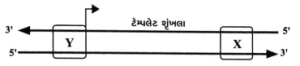
BiologyEasyMCQGSEB · 2022
What do '$X$' and '$Y$' indicate in the given diagram?
A
$X$ = Promotor,$Y$ = Coding Strand
B
$X$ = Promotor,$Y$ = Terminator
C
$X$ = Terminator,$Y$ = Promotor
D
$X$ = Coding Strand,$Y$ = Terminator
Solution
(C) In the process of transcription,the $DNA$ double helix has two strands with opposite polarity ($5' \rightarrow 3'$ and $3' \rightarrow 5'$).
The promoter is located at the $5'$ end (upstream) of the coding strand,which corresponds to the $3'$ end of the template strand.
The terminator is located at the $3'$ end (downstream) of the coding strand,which corresponds to the $5'$ end of the template strand.
In the provided diagram,'$X$' is at the $3'$ end of the coding strand (which is the $5'$ end of the template strand),identifying it as the Terminator.
'$Y$' is at the $5'$ end of the coding strand (which is the $3'$ end of the template strand),identifying it as the Promoter.
Therefore,$X = \text{Terminator}$ and $Y = \text{Promoter}$.
The promoter is located at the $5'$ end (upstream) of the coding strand,which corresponds to the $3'$ end of the template strand.
The terminator is located at the $3'$ end (downstream) of the coding strand,which corresponds to the $5'$ end of the template strand.
In the provided diagram,'$X$' is at the $3'$ end of the coding strand (which is the $5'$ end of the template strand),identifying it as the Terminator.
'$Y$' is at the $5'$ end of the coding strand (which is the $3'$ end of the template strand),identifying it as the Promoter.
Therefore,$X = \text{Terminator}$ and $Y = \text{Promoter}$.
0 likesView Solution
28
BiologyEasyMCQGSEB · 2022
If the population at time $t$ is $N_t$,then its population at time $t + 1$ is . . . . . . .
A
$N_{t+1} = N_t - [(B + I) - (D + E)]$
B
$N_{t+1} = N_t + [(B + I) - (D + E)]$
C
$N_{t+1} = N_t + [(B - I) + (D + E)]$
D
$N_{t+1} = N_t + [(B + I) - (D - E)]$
Solution
(B) The population density at time $t+1$ is calculated by considering the initial population at time $t$ and adding the net changes due to births $(B)$,immigration $(I)$,deaths $(D)$,and emigration $(E)$.
The formula is given by: $N_{t+1} = N_t + [(B + I) - (D + E)]$.
Here,$(B + I)$ represents the total number of individuals added to the population,and $(D + E)$ represents the total number of individuals lost from the population. Therefore,the correct option is $B$.
The formula is given by: $N_{t+1} = N_t + [(B + I) - (D + E)]$.
Here,$(B + I)$ represents the total number of individuals added to the population,and $(D + E)$ represents the total number of individuals lost from the population. Therefore,the correct option is $B$.
0 likesView Solution
29
BiologyEasyMCQGSEB · 2022
When the reactions are not growth limiting,the growth curve is . . . . . . .
A
$J$-shaped
B
$S$-shaped
C
$L$-shaped
D
$K$-shaped
Solution
(A) When resources are unlimited and there are no environmental resistance factors (growth-limiting factors),the population grows exponentially. This type of growth is represented by a $J$-shaped curve. In contrast,an $S$-shaped (sigmoid) curve represents logistic growth,which occurs when resources are limited and environmental resistance is present.
0 likesView Solution
30
BiologyEasyMCQGSEB · 2022
If a person has $45$ chromosomes with $XO$ chromosomal abnormality,then it is considered as which disorder?
A
Super female
B
Down's syndrome
C
Klinefelter's syndrome
D
Turner's syndrome
Solution
(D) The condition characterized by the presence of $45$ chromosomes with an $XO$ genotype (where one $X$ chromosome is missing) is known as Turner's syndrome.
In this disorder,the individual is phenotypically female but has underdeveloped ovaries and lacks secondary sexual characteristics.
Down's syndrome involves trisomy of chromosome $21$ ($47$ chromosomes).
Klinefelter's syndrome involves an $XXY$ genotype ($47$ chromosomes).
Therefore,the correct option is $D$.
In this disorder,the individual is phenotypically female but has underdeveloped ovaries and lacks secondary sexual characteristics.
Down's syndrome involves trisomy of chromosome $21$ ($47$ chromosomes).
Klinefelter's syndrome involves an $XXY$ genotype ($47$ chromosomes).
Therefore,the correct option is $D$.
0 likesView Solution
31
BiologyEasyMCQGSEB · 2022
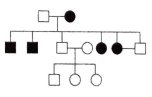
Which type of abnormality is seen in the given pedigree chart?
A
Autosomal dominant
B
$X$-Linked dominant
C
Autosomal recessive
D
$X$-Linked recessive
Solution
(A) To determine the mode of inheritance from the pedigree chart:
$1$. Observe that an affected mother (filled circle) and an unaffected father (empty square) produce both affected sons and affected daughters.
$2$. Since the trait appears in every generation and affected individuals have at least one affected parent,it is a dominant trait.
$3$. If it were $X$-linked dominant,an affected father would pass the trait to all his daughters,which is not observed here. Also,an affected mother would pass it to all her sons,but here she has an unaffected son as well.
$4$. The pattern of inheritance where an affected mother passes the trait to both sons and daughters,and the trait does not skip generations,is characteristic of Autosomal Dominant inheritance.
$5$. Therefore,the correct option is $A$.
$1$. Observe that an affected mother (filled circle) and an unaffected father (empty square) produce both affected sons and affected daughters.
$2$. Since the trait appears in every generation and affected individuals have at least one affected parent,it is a dominant trait.
$3$. If it were $X$-linked dominant,an affected father would pass the trait to all his daughters,which is not observed here. Also,an affected mother would pass it to all her sons,but here she has an unaffected son as well.
$4$. The pattern of inheritance where an affected mother passes the trait to both sons and daughters,and the trait does not skip generations,is characteristic of Autosomal Dominant inheritance.
$5$. Therefore,the correct option is $A$.
0 likesView Solution
32
BiologyEasyMCQGSEB · 2022
The genes $HBA1$ and $HBA2$ associated with alpha-thalassemia are located on which chromosome in humans?
A
$11^{\text{th}}$ Chromosome
B
$16^{\text{th}}$ Chromosome
C
$18^{\text{th}}$ Chromosome
D
$14^{\text{th}}$ Chromosome
Solution
(B) Alpha-thalassemia is a genetic blood disorder caused by mutations in the genes responsible for the production of the alpha-globin chain of hemoglobin.
The genes $HBA1$ and $HBA2$ are responsible for encoding the alpha-globin protein.
These two genes are located on the short arm of chromosome $16$ $(16p13.3)$.
Therefore,the correct option is $B$.
The genes $HBA1$ and $HBA2$ are responsible for encoding the alpha-globin protein.
These two genes are located on the short arm of chromosome $16$ $(16p13.3)$.
Therefore,the correct option is $B$.
0 likesView Solution
33
BiologyEasyMCQGSEB · 2022
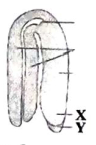
What is depicted by "$X$" and "$Y$" in the following diagram?
A
$X$ - Plumule, $Y$ - Cotyledon
B
$X$ - Plumule, $Y$ - Root cap
C
$X$ - Root cap, $Y$ - Radicle
D
$X$ - Radicle, $Y$ - Root cap
Solution
(D) The provided diagram represents the structure of a dicot embryo. In this structure, the lower pointed portion is the radicle, which is covered by a protective sheath-like structure at the tip known as the root cap. Therefore, "$X$" represents the radicle and "$Y$" represents the root cap. Thus, the correct option is $D$.
0 likesView Solution
34
BiologyEasyMCQGSEB · 2022
Primary Endosperm Nucleus $(PEN)$ is . . . . . . .
A
Haploid
B
Diploid
C
Triploid
D
Tetraploid
Solution
(C) In angiosperms,the process of double fertilization involves the fusion of one male gamete $(n)$ with two polar nuclei $(n + n)$ or a secondary nucleus $(2n)$ present in the central cell.
This fusion results in the formation of the Primary Endosperm Nucleus $(PEN)$,which is $3n$ or triploid.
Therefore,the correct option is $C$.
This fusion results in the formation of the Primary Endosperm Nucleus $(PEN)$,which is $3n$ or triploid.
Therefore,the correct option is $C$.
0 likesView Solution
35
BiologyEasyMCQGSEB · 2022
Which of the following plant organs is diploid?
A
Pollen grains
B
Egg cell
C
Male gamete
D
Zygote
Solution
(D) In flowering plants,the life cycle involves an alternation of generations between the haploid gametophyte and the diploid sporophyte.
$A$. Pollen grains are haploid $(n)$ structures produced by meiosis.
$B$. The egg cell is a haploid $(n)$ female gamete.
$C$. The male gamete is a haploid $(n)$ cell.
$D$. The zygote is formed by the fusion of the male and female gametes $(n + n)$,resulting in a diploid $(2n)$ cell.
Therefore,the zygote is the diploid structure.
$A$. Pollen grains are haploid $(n)$ structures produced by meiosis.
$B$. The egg cell is a haploid $(n)$ female gamete.
$C$. The male gamete is a haploid $(n)$ cell.
$D$. The zygote is formed by the fusion of the male and female gametes $(n + n)$,resulting in a diploid $(2n)$ cell.
Therefore,the zygote is the diploid structure.
0 likesView Solution
36
BiologyEasyMCQGSEB · 2022
Residual persistent nucellus in seed is called . . . . . .
A
Perisperm
B
Pericarp
C
Coleorrhiza
D
Coleoptile
Solution
(A) The residual,persistent nucellus in a seed is known as $Perisperm$.
In some seeds,such as those of black pepper and beet,the nucellus is not completely consumed during the development of the embryo and remains as a nutritive tissue surrounding the embryo.
$Pericarp$ is the wall of the fruit developed from the ovary wall.
$Coleorrhiza$ and $Coleoptile$ are protective sheaths found in monocot embryos.
In some seeds,such as those of black pepper and beet,the nucellus is not completely consumed during the development of the embryo and remains as a nutritive tissue surrounding the embryo.
$Pericarp$ is the wall of the fruit developed from the ovary wall.
$Coleorrhiza$ and $Coleoptile$ are protective sheaths found in monocot embryos.
0 likesView Solution
37
BiologyEasyMCQGSEB · 2022
The ploidy level in an egg cell is . . . . . . and in the endosperm is . . . . . . .
A
Haploid,Diploid
B
Diploid,Haploid
C
Diploid,Triploid
D
Haploid,Triploid
Solution
(D) In angiosperms,the egg cell is a female gamete formed through meiosis,so it is haploid $(n)$.
The endosperm is formed by the fusion of one male gamete $(n)$ with two polar nuclei $(n + n)$,a process known as triple fusion,resulting in a triploid $(3n)$ structure.
Therefore,the egg cell is haploid and the endosperm is triploid.
The endosperm is formed by the fusion of one male gamete $(n)$ with two polar nuclei $(n + n)$,a process known as triple fusion,resulting in a triploid $(3n)$ structure.
Therefore,the egg cell is haploid and the endosperm is triploid.
0 likesView Solution
38
BiologyEasyMCQGSEB · 2022
Which aquatic plant is pollinated by insects or wind?
A
Vallisneria
B
Hydrilla
C
Zostera
D
Water lily
Solution
(D) In many aquatic plants, such as $Vallisneria$ and $Hydrilla$, pollination occurs through water (hydrophily).
However, in several freshwater plants like $Water \text{ } lily$ (Nymphaea) and $Water \text{ } hyacinth$, the flowers emerge above the level of water.
In these cases, pollination is brought about by insects or wind, similar to most of the land plants.
Therefore, $Water \text{ } lily$ is the correct answer.
However, in several freshwater plants like $Water \text{ } lily$ (Nymphaea) and $Water \text{ } hyacinth$, the flowers emerge above the level of water.
In these cases, pollination is brought about by insects or wind, similar to most of the land plants.
Therefore, $Water \text{ } lily$ is the correct answer.
0 likesView Solution
39
BiologyEasyMCQGSEB · 2022
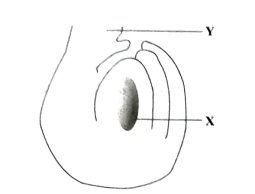
What do '$X$' and '$Y$' indicate in the given figure?
A
$X = \text{Embryo sac}, Y = \text{Funicle}$
B
$X = \text{Hilum}, Y = \text{Embryo sac}$
C
$X = \text{Nucellus}, Y = \text{Micropyle}$
D
$X = \text{Funicle}, Y = \text{Embryo sac}$
Solution
(A) In the provided diagram of an anatropous ovule:
$X$ points to the central structure within the nucellus,which is the embryo sac (female gametophyte).
$Y$ points to the stalk that attaches the ovule to the placenta,known as the funicle.
Therefore,the correct identification is $X = \text{Embryo sac}$ and $Y = \text{Funicle}$.
$X$ points to the central structure within the nucellus,which is the embryo sac (female gametophyte).
$Y$ points to the stalk that attaches the ovule to the placenta,known as the funicle.
Therefore,the correct identification is $X = \text{Embryo sac}$ and $Y = \text{Funicle}$.
0 likesView Solution
Vedclass Products
For Students
Vedclass Test Series
Mock tests in real GSEB style covering Biology with performance analysis. 5-day free trial.
Start Free TrialFor Teachers
Exam Paper Generator
Generate Set A/B/C/D Biology papers from 7.5L+ questions in 2 minutes. 3 chapters free.
Try FreeFor Institutes
Online Exam Module
Run live GSEB mock exams with unlimited students, 360° analytics & white-label branding.
See DemoFrequently Asked Questions
How many Biology questions are in GSEB 2022?
There are 39 Biology questions from the GSEB 2022 paper on Vedclass, each with a detailed step-by-step solution in English.
Are GSEB 2022 Biology solutions available in English?
Yes. All solutions on this page are in English. You can also switch to English or Hindi using the language buttons above the questions.
Can I practice GSEB 2022 Biology as a timed test?
Yes. Use the Vedclass Test Series to attempt a full GSEB mock test covering Biology with time limits and instant score analysis.
Can teachers create Biology papers from GSEB previous year questions?
Yes. The Vedclass Exam Paper Generator lets teachers mix GSEB Biology questions and generate Set A/B/C/D papers in minutes.
For Teachers & Institutes
Build a Custom Biology Paper
Pick GSEB 2022 Biology questions, set difficulty, and generate Set A/B/C/D in 2 minutes.