
BiologyQ1–38 of 38 questions
Page 1 of 1 · English
1
BiologyEasyMCQGSEB · 2023
The discovery of blood circulation was made by which scientist?
A
George Gamow
B
Karl Landsteiner
C
Norman Borlaug
D
William Harvey
Solution
(D) The discovery of blood circulation was made by $William \ Harvey$ in the year $1628$. He demonstrated that blood circulates throughout the body in a closed system,pumped by the heart. Therefore,the correct option is $D$.
0 likesView Solution
2
BiologyEasyMCQGSEB · 2023
Identify the free-living $N_2$-fixing bacteria.
A
Rhizobium
B
Bacillus thuringiensis
C
Azospirillum
D
Staphylococci
Solution
(C) $Azospirillum$ and $Azotobacter$ are well-known examples of free-living nitrogen-fixing bacteria.
$Rhizobium$ is a symbiotic nitrogen-fixing bacterium found in the root nodules of leguminous plants.
$Bacillus thuringiensis$ is used as a bio-insecticide.
$Staphylococci$ are pathogenic bacteria.
Therefore,the correct option is $C$.
$Rhizobium$ is a symbiotic nitrogen-fixing bacterium found in the root nodules of leguminous plants.
$Bacillus thuringiensis$ is used as a bio-insecticide.
$Staphylococci$ are pathogenic bacteria.
Therefore,the correct option is $C$.
0 likesView Solution
3
BiologyEasyMCQGSEB · 2023
What is the reason behind the extinction of the Steller's sea cow?
A
Alien species invasions
B
Co-extinction
C
Over-exploitation
D
Loss of habitat
Solution
(C) The Steller's sea cow $(Hydrodamalis \text{ gigas})$ was a large marine mammal that became extinct in the $18^{th}$ century. The primary reason for its extinction was over-exploitation by humans for its meat, fat, and skin. Within less than $30$ years of its discovery by Europeans, the species was hunted to extinction. Therefore, the correct option is $C$.
0 likesView Solution
4
BiologyEasyMCQGSEB · 2023
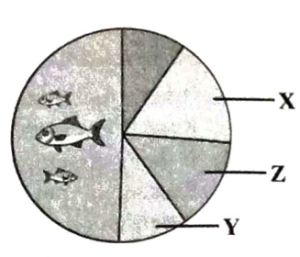
According to the representation of global biodiversity proportions for the number of species of major taxa of vertebrates,select the appropriate option for the labels $X$,$Y$,and $Z$ in the given figure.
A
$X$ - Mammals,$Y$ - Birds,$Z$ - Amphibians
B
$X$ - Birds,$Y$ - Amphibians,$Z$ - Reptiles
C
$X$ - Reptiles,$Y$ - Amphibians,$Z$ - Birds
D
$X$ - Amphibians,$Y$ - Birds,$Z$ - Mammals
Solution
(B) According to the $NCERT$ textbook figure representing the global biodiversity of vertebrates,the largest portion is occupied by fishes. Among the remaining groups,the proportions are as follows:
$1$. $X$ represents Birds.
$2$. $Z$ represents Reptiles.
$3$. $Y$ represents Amphibians.
Therefore,the correct sequence for the labels $X$,$Y$,and $Z$ is $X$ - Birds,$Y$ - Amphibians,and $Z$ - Reptiles. This corresponds to option $B$.
$1$. $X$ represents Birds.
$2$. $Z$ represents Reptiles.
$3$. $Y$ represents Amphibians.
Therefore,the correct sequence for the labels $X$,$Y$,and $Z$ is $X$ - Birds,$Y$ - Amphibians,and $Z$ - Reptiles. This corresponds to option $B$.
0 likesView Solution
5
BiologyEasyMCQGSEB · 2023
Statement $(A)$: The Caspian tiger, a subspecies of tiger, is one of the recently extinct animals.
Reason $(R)$: The colonization of tropical Pacific islands by humans.
Reason $(R)$: The colonization of tropical Pacific islands by humans.
A
Statement $(A)$ is wrong but Reason $(R)$ is right.
B
Statement $(A)$ and Reason $(R)$ both are true but $(R)$ is not the correct explanation of $(A)$.
C
Statement $(A)$ is right but Reason $(R)$ is wrong.
D
Statement $(A)$ and Reason $(R)$ both are true, $(R)$ is the correct explanation of statement $(A)$.
Solution
(C) Statement $(A)$ is correct because the Caspian tiger $(Panthera \text{ tigris virgata})$ is indeed one of the recently extinct subspecies of tigers.
Reason $(R)$ is incorrect because the colonization of tropical Pacific islands by humans is associated with the extinction of the Dodo (from Mauritius) and other island species, not the Caspian tiger, which inhabited regions around the Caspian Sea.
Reason $(R)$ is incorrect because the colonization of tropical Pacific islands by humans is associated with the extinction of the Dodo (from Mauritius) and other island species, not the Caspian tiger, which inhabited regions around the Caspian Sea.
0 likesView Solution
6
BiologyEasyMCQGSEB · 2023
In $Bt$ cotton,$Bt$ toxin is present as protoxin,it gets activated because of . . . . . . .
A
Due to activity of microbes in midgut
B
Due to acidic pH of insect midgut
C
Due to alkaline pH of insect midgut
D
Due to neutral pH of insect midgut
Solution
(C) $Bt$ toxin is produced by the bacterium $Bacillus$ $thuringiensis$ as an inactive protoxin. When an insect ingests the $Bt$ cotton,the inactive protoxin enters the insect's midgut. The alkaline pH of the insect's midgut solubilizes the crystals and converts the inactive protoxin into its active form,which then binds to the surface of midgut epithelial cells and creates pores,causing cell swelling and lysis,eventually leading to the death of the insect.
0 likesView Solution
7
BiologyEasyMCQGSEB · 2023
In the treatment of $ADA$ deficiency during gene therapy,which cells are collected from the patient's blood?
A
Leukocytes
B
Red blood cells
C
Lymphocytes
D
Platelets
Solution
(C) The correct answer is $C$. In the treatment of $ADA$ (Adenosine Deaminase) deficiency using gene therapy,lymphocytes are extracted from the patient's blood. These cells are then cultured in vitro,and a functional $ADA$ $cDNA$ is introduced into them using a retroviral vector. The genetically modified lymphocytes are then returned to the patient's body. Since these cells are not immortal,the patient requires periodic infusions of such genetically engineered lymphocytes.
0 likesView Solution
8
BiologyEasyMCQGSEB · 2023
The first human hormone prepared by using recombinant $DNA$ technology is?
A
Insulin
B
Estrogen
C
Thyroxine
D
Progesterone
Solution
(A) The first human hormone produced using recombinant $DNA$ technology is $Insulin$.
In $1983$,an American company named $Eli$ $Lilly$ prepared two $DNA$ sequences corresponding to $A$ and $B$ chains of human insulin and introduced them in plasmids of $E. coli$ to produce insulin chains.
These chains were then extracted and combined by creating disulfide bonds to form human insulin,which is commercially known as $Humulin$.
In $1983$,an American company named $Eli$ $Lilly$ prepared two $DNA$ sequences corresponding to $A$ and $B$ chains of human insulin and introduced them in plasmids of $E. coli$ to produce insulin chains.
These chains were then extracted and combined by creating disulfide bonds to form human insulin,which is commercially known as $Humulin$.
0 likesView Solution
9
BiologyEasyMCQGSEB · 2023
Select the correct option. The $E. coli$ cloning vector $pBR322$ contains antibiotic resistance genes.
A
Bam $HI$,Sal $I$
B
Hind $III$,$amp^R$
C
$amp^R$,$tet^R$
D
Pvu $II$,$tet^R$
Solution
(C) The cloning vector $pBR322$ is one of the most widely used $E. coli$ cloning vectors.
It contains two distinct antibiotic resistance genes,which serve as selectable markers.
These are the ampicillin resistance gene $(amp^R)$ and the tetracycline resistance gene $(tet^R)$.
Therefore,the correct option is $C$.
It contains two distinct antibiotic resistance genes,which serve as selectable markers.
These are the ampicillin resistance gene $(amp^R)$ and the tetracycline resistance gene $(tet^R)$.
Therefore,the correct option is $C$.
0 likesView Solution
10
BiologyEasyMCQGSEB · 2023
Which of the following is the correct sequence for $PCR$?
A
Denaturation $\rightarrow$ Elongation $\rightarrow$ Annealing
B
Elongation $\rightarrow$ Denaturation $\rightarrow$ Annealing
C
Annealing $\rightarrow$ Denaturation $\rightarrow$ Elongation
D
Denaturation $\rightarrow$ Annealing $\rightarrow$ Elongation
Solution
(D) The Polymerase Chain Reaction $(PCR)$ consists of three main steps that are repeated in cycles:
$1$. Denaturation: The double-stranded $DNA$ is heated to a high temperature (around $94-95^{\circ}C$) to separate the two strands.
$2$. Annealing: The temperature is lowered (usually $50-65^{\circ}C$) to allow the primers to bind to the complementary sequences on the single-stranded $DNA$ templates.
$3$. Elongation (Extension): The temperature is adjusted (usually $72^{\circ}C$) for the $DNA$ polymerase enzyme to synthesize the new $DNA$ strand by adding nucleotides.
Therefore,the correct sequence is Denaturation $\rightarrow$ Annealing $\rightarrow$ Elongation.
$1$. Denaturation: The double-stranded $DNA$ is heated to a high temperature (around $94-95^{\circ}C$) to separate the two strands.
$2$. Annealing: The temperature is lowered (usually $50-65^{\circ}C$) to allow the primers to bind to the complementary sequences on the single-stranded $DNA$ templates.
$3$. Elongation (Extension): The temperature is adjusted (usually $72^{\circ}C$) for the $DNA$ polymerase enzyme to synthesize the new $DNA$ strand by adding nucleotides.
Therefore,the correct sequence is Denaturation $\rightarrow$ Annealing $\rightarrow$ Elongation.
0 likesView Solution
11
BiologyEasyMCQGSEB · 2023
Which of the following is not a step of downstream processing?
A
Purification
B
Isolation
C
Clinical trials
D
Expression
Solution
(D) Downstream processing refers to the processes involved in the separation and purification of the product after the biosynthesis stage. It includes separation,purification,and formulation. Expression of the gene (production of the desired protein) occurs during the upstream processing or the fermentation stage,not the downstream processing. Therefore,$D$ is the correct answer.
0 likesView Solution
12
BiologyEasyMCQGSEB · 2023
In which ecological pyramid does a small standing crop of phytoplankton support a large standing crop of zooplankton?
A
Straight pyramid of number
B
Inverted pyramid of biomass
C
Straight pyramid of energy
D
Straight pyramid of biomass
Solution
(B) In an aquatic ecosystem,the pyramid of biomass is often inverted. This is because the standing crop of phytoplankton (producers) is small at any given time due to their rapid turnover rate,while they support a much larger standing crop of zooplankton (primary consumers) that feed on them. Therefore,the biomass of producers is less than the biomass of consumers,resulting in an inverted pyramid.
0 likesView Solution
13
BiologyEasyMCQGSEB · 2023
Select the incorrect statement for the detritus food chain.
A
Complex organic materials are formed from waste materials by decomposers.
B
Bacteria meet their nutrient requirements by degrading dead organic matter.
C
Decomposers secrete digestive enzymes.
D
It begins with dead organic matter.
Solution
(A) The correct answer is $A$. In a detritus food chain,decomposers (saprotrophs) break down complex organic matter into simpler inorganic substances. Therefore,the statement that 'complex organic materials are formed from waste materials by decomposers' is incorrect,as the process involves the breakdown of complex organic matter into simpler forms,not the synthesis of complex materials from waste.
0 likesView Solution
14
BiologyEasyMCQGSEB · 2023
In a population of $1000$ individuals,$490$ belong to genotype $MM$,$420$ to $Mm$,and the remaining to $mm$. Based on this data,the frequency of allele $m$ in the population is . . . . . . .
A
$0.6$
B
$4.9$
C
$4.2$
D
$0.3$
Solution
(D) Total population $(N)$ = $1000$.
Number of $MM$ individuals = $490$.
Number of $Mm$ individuals = $420$.
Number of $mm$ individuals = $1000 - (490 + 420) = 1000 - 910 = 90$.
Frequency of allele $m$ $(q)$ can be calculated as:
$q = \frac{(\text{Number of } mm \text{ individuals} \times 2) + (\text{Number of } Mm \text{ individuals})}{2 \times \text{Total population}}$
$q = \frac{(90 \times 2) + 420}{2 \times 1000} = \frac{180 + 420}{2000} = \frac{600}{2000} = 0.3$.
Therefore,the frequency of allele $m$ is $0.3$.
Number of $MM$ individuals = $490$.
Number of $Mm$ individuals = $420$.
Number of $mm$ individuals = $1000 - (490 + 420) = 1000 - 910 = 90$.
Frequency of allele $m$ $(q)$ can be calculated as:
$q = \frac{(\text{Number of } mm \text{ individuals} \times 2) + (\text{Number of } Mm \text{ individuals})}{2 \times \text{Total population}}$
$q = \frac{(90 \times 2) + 420}{2 \times 1000} = \frac{180 + 420}{2000} = \frac{600}{2000} = 0.3$.
Therefore,the frequency of allele $m$ is $0.3$.
0 likesView Solution
15
BiologyEasyMCQGSEB · 2023
Among the statements given below,which statement is correct on the basis of the observations of Ernst Haeckel?
A
Embryos never pass through the adult stages of other animals.
B
Certain features during the embryonic stage are common to all vertebrates but are absent in adults.
C
Similarities in proteins and genes performing a given function among diverse organisms.
D
Homologous structures are a result of convergent evolution.
Solution
(B) Ernst Haeckel proposed the theory of recapitulation,also known as the biogenetic law. His observations suggested that embryos of various vertebrates show certain common features during early development,such as pharyngeal gill slits,which are present in the embryonic stage but disappear or are modified in the adult stage. Therefore,option $B$ is the correct statement based on his observations.
0 likesView Solution
16
BiologyEasyMCQGSEB · 2023
For Assertion $A$ and Reason $R$:
Assertion $A$: Smoking increases blood pressure and heart rate.
Reason $R$: Nicotine stimulates the adrenal gland.
Assertion $A$: Smoking increases blood pressure and heart rate.
Reason $R$: Nicotine stimulates the adrenal gland.
A
Both Assertion $A$ and Reason $R$ are true,and $R$ is the correct explanation of $A$.
B
Assertion $A$ is true and Reason $R$ is false.
C
Assertion $A$ is false and Reason $R$ is true.
D
Both Assertion $A$ and Reason $R$ are true,but $R$ is not the correct explanation of $A$.
Solution
(A) Smoking involves the inhalation of tobacco smoke,which contains $Nicotine$.
$Nicotine$ acts as a stimulant that triggers the release of adrenaline and noradrenaline from the adrenal glands.
These hormones increase the heart rate and constrict blood vessels,which leads to an increase in blood pressure.
Therefore,both the Assertion and the Reason are true,and the Reason correctly explains why smoking increases blood pressure and heart rate.
$Nicotine$ acts as a stimulant that triggers the release of adrenaline and noradrenaline from the adrenal glands.
These hormones increase the heart rate and constrict blood vessels,which leads to an increase in blood pressure.
Therefore,both the Assertion and the Reason are true,and the Reason correctly explains why smoking increases blood pressure and heart rate.
0 likesView Solution
17
BiologyEasyMCQGSEB · 2023
$Trichoderma$ is a . . . . . . .
A
Blue green algae
B
Fungus
C
Bryophytes
D
Protozoa
Solution
(B) $Trichoderma$ is a genus of fungi that is present in all soils,where they are the most prevalent culturable fungi. It is widely used as a biological control agent against various plant pathogens.
0 likesView Solution
18
BiologyEasyMCQGSEB · 2023
While examining a patient, the following symptoms are observed:
$(i)$ Chronic inflammation in the lymphatic vessels of the lower limbs.
$(ii)$ Genital organs are also affected.
What is the disease diagnosed by the doctor?
$(i)$ Chronic inflammation in the lymphatic vessels of the lower limbs.
$(ii)$ Genital organs are also affected.
What is the disease diagnosed by the doctor?
A
Ringworm
B
Filariasis
C
Amoebiasis
D
Ascariasis
Solution
(B) The symptoms described, such as chronic inflammation of the lymphatic vessels (often leading to swelling of the legs) and the involvement of genital organs, are characteristic of $Filariasis$ (also known as $Elephantiasis$).
This disease is caused by filarial worms, such as $Wuchereria$ $\text{bancrofti}$ and $Wuchereria$ $\text{malayi}$.
The parasites live for many years in the lymphatic vessels, causing blockage and severe swelling.
This disease is caused by filarial worms, such as $Wuchereria$ $\text{bancrofti}$ and $Wuchereria$ $\text{malayi}$.
The parasites live for many years in the lymphatic vessels, causing blockage and severe swelling.
0 likesView Solution
19
BiologyEasyMCQGSEB · 2023
In humans,fertilization is possible only when,
A
Ovum and sperm are transported simultaneously to the ampullary region
B
Haploid ovum (ootid) enters into the fallopian tube and sperm enters into the uterus at the same time
C
Ovum and sperm enter into the uterus at the same time
D
The haploid ovum (ootid) is released from the ovary and insemination to the vaginal orifice occurs at the same time
Solution
(A) Fertilization is the fusion of the male and female gametes. In humans,this process occurs in the ampullary region of the fallopian tube. For fertilization to be successful,both the ovum and the sperm must be transported to the ampullary region simultaneously. If they do not reach this specific site at the same time,fertilization cannot occur.
0 likesView Solution
20
BiologyEasyMCQGSEB · 2023
During which days of the menstrual cycle does the secretion of $LH$ from the pituitary reach its maximum level?
A
$25$ to $28$ days
B
$13$ to $15$ days
C
$19$ to $23$ days
D
$1$ to $5$ days
Solution
(B) In a typical $28$-day menstrual cycle,the levels of $LH$ (Luteinizing Hormone) and $FSH$ (Follicle Stimulating Hormone) attain a peak level in the middle of the cycle,around the $14$th day.
This rapid secretion of $LH$ is known as the $LH$ surge,which induces the rupture of the Graafian follicle and thereby leads to ovulation.
Therefore,the maximum level of $LH$ occurs between the $13$th and $15$th days of the menstrual cycle.
This rapid secretion of $LH$ is known as the $LH$ surge,which induces the rupture of the Graafian follicle and thereby leads to ovulation.
Therefore,the maximum level of $LH$ occurs between the $13$th and $15$th days of the menstrual cycle.
0 likesView Solution
21
BiologyEasyMCQGSEB · 2023
Trichoderma is a . . . . . . .
A
Blue-green algae
B
Fungus
C
Bryophyte
D
Protozoan
Solution
(B) $Trichoderma$ is a genus of fungi that are present in all soils,where they are the most prevalent culturable fungi. They are used as biocontrol agents against several plant pathogens.
0 likesView Solution
22
BiologyEasyMCQGSEB · 2023
. . . . . . is the first step of sewage treatment.
A
Filtration and sedimentation
B
Chlorination
C
Aeration by force
D
Formation of activated sludge
Solution
(A) The first step of sewage treatment is the primary treatment,which involves the physical removal of large and small particles from the sewage through filtration and sedimentation.
$1$. Filtration is used to remove floating debris.
$2$. Sedimentation is used to remove grit (soil and small pebbles).
Therefore,the correct option is $A$.
$1$. Filtration is used to remove floating debris.
$2$. Sedimentation is used to remove grit (soil and small pebbles).
Therefore,the correct option is $A$.
0 likesView Solution
23
BiologyEasyMCQGSEB · 2023
Duplication of one or two bases of $DNA$ produces . . . . . . .
A
Point Mutation
B
Frame shift insertion
C
Loss distortion
D
Prob Mutation
Solution
(B) When one or two bases are added (inserted) or duplicated in a $DNA$ sequence,the reading frame of the genetic code is altered from the point of insertion onwards. This type of mutation is known as a $Frame-shift$ $insertion$ mutation. Since the genetic code is read in triplets (codons),the addition of one or two bases shifts the entire sequence,leading to the synthesis of a completely different protein or a premature stop codon.
0 likesView Solution
24
BiologyEasyMCQGSEB · 2023
$E. coli$ has $4.6 \times 10^6 \text{ bp}$, its rate of multiplication during replication is about $ . . . . . . $ per second. (in $\text{ bp}$)
A
$7000$
B
$5000$
C
$2000$
D
$9000$
Solution
(C) The genome of $E. coli$ contains $4.6 \times 10^6 \text{ bp}$.
$E. coli$ completes its replication process in approximately $38$ minutes ($2280$ seconds).
The rate of replication is calculated as:
$\text{Rate} = \frac{\text{Total base pairs}}{\text{Total time in seconds}}$
$\text{Rate} = \frac{4.6 \times 10^6}{2280} \approx 2017 \text{ bp/second}$.
Rounding this to the nearest standard value provided in the options, we get $2000 \text{ bp/second}$.
$E. coli$ completes its replication process in approximately $38$ minutes ($2280$ seconds).
The rate of replication is calculated as:
$\text{Rate} = \frac{\text{Total base pairs}}{\text{Total time in seconds}}$
$\text{Rate} = \frac{4.6 \times 10^6}{2280} \approx 2017 \text{ bp/second}$.
Rounding this to the nearest standard value provided in the options, we get $2000 \text{ bp/second}$.
0 likesView Solution
25
BiologyEasyMCQGSEB · 2023
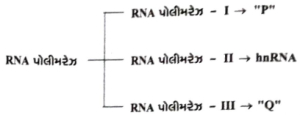
What do '$P$' and '$Q$' indicate in the given chart regarding eukaryotic $RNA$ polymerases?
A
$P = rRNAs (28S, 18S, 5.8S), Q = tRNA, 5S rRNA, snRNAs$
B
$P = mRNA (18S, 28S), Q = rRNA (8.5S, hnRNA)$
C
$P = tRNA, snRNAs, 18S, Q = 28S, 18S, 5.8S$
D
$P = tRNA, 18S, 5.8S, Q = 28S, snRNA, hnRNA$
Solution
(A) In eukaryotic cells,there are three main types of $RNA$ polymerases,each responsible for transcribing specific types of $RNA$:
$1$. $RNA$ polymerase-$I$ transcribes rRNAs $(28S, 18S, 5.8S)$. Thus,'$P$' represents these rRNAs.
$2$. $RNA$ polymerase-$II$ transcribes the precursor of mRNA,which is hnRNA.
$3$. $RNA$ polymerase-$III$ is responsible for the transcription of tRNA,$5S$ rRNA,and snRNAs. Thus,'$Q$' represents these molecules.
Therefore,the correct option is $A$.
$1$. $RNA$ polymerase-$I$ transcribes rRNAs $(28S, 18S, 5.8S)$. Thus,'$P$' represents these rRNAs.
$2$. $RNA$ polymerase-$II$ transcribes the precursor of mRNA,which is hnRNA.
$3$. $RNA$ polymerase-$III$ is responsible for the transcription of tRNA,$5S$ rRNA,and snRNAs. Thus,'$Q$' represents these molecules.
Therefore,the correct option is $A$.
0 likesView Solution
26
BiologyEasyMCQGSEB · 2023
For the genetic code,choose the correct option for the given statements. Where $T$ stands for True and $F$ stands for False.
$(1)$ Phenylalanine $(Phe)$ amino acid is coded by more than three codons.
$(2)$ The codon is read in $t-RNA$ in a contiguous fashion.
$(3)$ $UUC$ would code for phenylalanine.
$(4)$ $AUG$ codes for Methionine.
$(1)$ Phenylalanine $(Phe)$ amino acid is coded by more than three codons.
$(2)$ The codon is read in $t-RNA$ in a contiguous fashion.
$(3)$ $UUC$ would code for phenylalanine.
$(4)$ $AUG$ codes for Methionine.
A
$FFTT$
B
$TTFT$
C
$FTTF$
D
$FTFT$
Solution
(A) Statement $(1)$ is False: Phenylalanine is coded by two codons ($UUU$ and $UUC$),not more than three.
Statement $(2)$ is False: The codon is read in $mRNA$ in a contiguous fashion,not $t-RNA$.
Statement $(3)$ is True: $UUC$ is one of the two codons for Phenylalanine.
Statement $(4)$ is True: $AUG$ is the start codon and codes for Methionine.
Therefore,the sequence is $F, F, T, T$. The correct option is $A$.
Statement $(2)$ is False: The codon is read in $mRNA$ in a contiguous fashion,not $t-RNA$.
Statement $(3)$ is True: $UUC$ is one of the two codons for Phenylalanine.
Statement $(4)$ is True: $AUG$ is the start codon and codes for Methionine.
Therefore,the sequence is $F, F, T, T$. The correct option is $A$.
0 likesView Solution
27
BiologyEasyMCQGSEB · 2023
Select the correct sequence for the process of $\text{VNTR}$ technique.
$X =$ Hybridisation using labelled $\text{VNTR}$ probe
$Y =$ Digestion of $\text{DNA}$ by restriction endonucleases
$Z =$ Transferring (blotting) of separated $\text{DNA}$ fragments to synthetic membrane,such as nitrocellulose
$X =$ Hybridisation using labelled $\text{VNTR}$ probe
$Y =$ Digestion of $\text{DNA}$ by restriction endonucleases
$Z =$ Transferring (blotting) of separated $\text{DNA}$ fragments to synthetic membrane,such as nitrocellulose
A
$Y \rightarrow X \rightarrow Z$
B
$Z \rightarrow X \rightarrow Y$
C
$Y \rightarrow Z \rightarrow X$
D
$X \rightarrow Z \rightarrow Y$
Solution
(C) The process of $\text{DNA}$ fingerprinting using $\text{VNTR}$ involves the following steps:
$1$. First,the $\text{DNA}$ is isolated and digested by restriction endonucleases $(Y)$.
$2$. The separated $\text{DNA}$ fragments are then transferred (blotted) onto a synthetic membrane like nitrocellulose or nylon $(Z)$.
$3$. Finally,hybridisation is performed using a labelled $\text{VNTR}$ probe $(X)$.
Therefore,the correct sequence is $Y \rightarrow Z \rightarrow X$.
$1$. First,the $\text{DNA}$ is isolated and digested by restriction endonucleases $(Y)$.
$2$. The separated $\text{DNA}$ fragments are then transferred (blotted) onto a synthetic membrane like nitrocellulose or nylon $(Z)$.
$3$. Finally,hybridisation is performed using a labelled $\text{VNTR}$ probe $(X)$.
Therefore,the correct sequence is $Y \rightarrow Z \rightarrow X$.
0 likesView Solution
28
BiologyEasyMCQGSEB · 2023
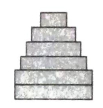
The given diagram of an age pyramid represents . . . . . . .
A
Stable human population
B
Expanding human population
C
Decreasing human population
D
Increasing and decreasing human population
Solution
(A) The given age pyramid shows a bell-shaped structure,which is characteristic of a stable population.
In a stable population,the proportion of individuals in the pre-reproductive and reproductive age groups remains relatively constant.
This indicates that the birth rate is roughly equal to the death rate,leading to a stable population size over time.
Therefore,the correct option is $A$.
In a stable population,the proportion of individuals in the pre-reproductive and reproductive age groups remains relatively constant.
This indicates that the birth rate is roughly equal to the death rate,leading to a stable population size over time.
Therefore,the correct option is $A$.
0 likesView Solution
29
BiologyEasyMCQGSEB · 2023
Which of the following is not a Mendelian disorder?
A
Ascariasis
B
Cystic fibrosis
C
Phenylketonuria
D
Sickle-cell anemia
Solution
(A) Mendelian disorders are primarily determined by alteration or mutation in a single gene.
$A$. Ascariasis is an infectious disease caused by the parasitic roundworm $Ascaris$ $lumbricoides$,not a genetic disorder.
$B$. Cystic fibrosis is an autosomal recessive Mendelian disorder.
$C$. Phenylketonuria is an inborn error of metabolism and an autosomal recessive Mendelian disorder.
$D$. Sickle-cell anemia is an autosomal linked recessive trait that can be transmitted from parents to the offspring when both the partners are carrier for the gene.
Therefore,the correct answer is $A$.
$A$. Ascariasis is an infectious disease caused by the parasitic roundworm $Ascaris$ $lumbricoides$,not a genetic disorder.
$B$. Cystic fibrosis is an autosomal recessive Mendelian disorder.
$C$. Phenylketonuria is an inborn error of metabolism and an autosomal recessive Mendelian disorder.
$D$. Sickle-cell anemia is an autosomal linked recessive trait that can be transmitted from parents to the offspring when both the partners are carrier for the gene.
Therefore,the correct answer is $A$.
0 likesView Solution
30
BiologyEasyMCQGSEB · 2023
Select the correct options for the given statements:
Statements:
$X$: Formation of Haemoglobin is controlled by two closely linked genes $HBA1$ and $HBA2$ on chromosome $16$ of each parent.
$Y$: $\beta$-Thalassemia is controlled by a single gene $HBB$ on chromosome $21$ of each parent.
Statements:
$X$: Formation of Haemoglobin is controlled by two closely linked genes $HBA1$ and $HBA2$ on chromosome $16$ of each parent.
$Y$: $\beta$-Thalassemia is controlled by a single gene $HBB$ on chromosome $21$ of each parent.
A
$X$ and $Y$ both are Wrong
B
$X$ is Wrong and $Y$ is Correct
C
$X$ and $Y$ both are Correct
D
$X$ is Correct and $Y$ is Wrong
Solution
(D) Statement $X$ is Correct: The synthesis of the $\alpha$-globin chain of haemoglobin is controlled by two closely linked genes,$HBA1$ and $HBA2$,located on chromosome $16$ in each parent.
Statement $Y$ is Wrong: $\beta$-Thalassemia is indeed controlled by a single gene,$HBB$,but this gene is located on chromosome $11$,not chromosome $21$.
Therefore,$X$ is Correct and $Y$ is Wrong.
Statement $Y$ is Wrong: $\beta$-Thalassemia is indeed controlled by a single gene,$HBB$,but this gene is located on chromosome $11$,not chromosome $21$.
Therefore,$X$ is Correct and $Y$ is Wrong.
0 likesView Solution
31
BiologyEasyMCQGSEB · 2023
What is the correct chromosome composition in a karyotype of Klinefelter's syndrome?
A
$22AA + XY$
B
$22AA + XO$
C
$22AA + XXX$
D
$22AA + XXY$
Solution
(D) Klinefelter's syndrome is a genetic disorder caused by the presence of an extra $X$ chromosome in males.
In this condition,the individual has a total of $47$ chromosomes instead of the normal $46$.
The chromosomal constitution is $44$ autosomes plus $XXY$ sex chromosomes,which can be represented as $22AA + XXY$.
Therefore,the correct option is $D$.
In this condition,the individual has a total of $47$ chromosomes instead of the normal $46$.
The chromosomal constitution is $44$ autosomes plus $XXY$ sex chromosomes,which can be represented as $22AA + XXY$.
Therefore,the correct option is $D$.
0 likesView Solution
32
BiologyEasyMCQGSEB · 2023
Find the correct sentence from the sentences given below.
A
All sexually transmitted diseases are completely curable.
B
$MTP$ performed up to $12$ weeks of pregnancy is considered safe.
C
Volts are used by men as a barrier method of contraception.
D
$MTP$ performed in the second trimester after $12$ weeks of pregnancy is considered safe.
Solution
(B) The correct statement is that $MTP$ (Medical Termination of Pregnancy) performed up to $12$ weeks of pregnancy is considered relatively safe.
$A$ is incorrect because some sexually transmitted diseases like $HIV/AIDS$ are not completely curable.
$C$ is incorrect because 'Volts' is not a contraceptive method; barrier methods include condoms,diaphragms,etc.
$D$ is incorrect because $MTP$ performed in the second trimester is much more risky than in the first trimester.
$A$ is incorrect because some sexually transmitted diseases like $HIV/AIDS$ are not completely curable.
$C$ is incorrect because 'Volts' is not a contraceptive method; barrier methods include condoms,diaphragms,etc.
$D$ is incorrect because $MTP$ performed in the second trimester is much more risky than in the first trimester.
0 likesView Solution
33
BiologyEasyMCQGSEB · 2023
When can emergency contraceptives be used?
A
$72$ hours before the menstrual cycle starts
B
$72$ hours before coitus
C
Within $72$ hours of coitus
D
Within $72$ hours before secondary oocyte release
Solution
(C) Emergency contraceptives (such as pills containing progestogens or progestogen-estrogen combinations) are effective in preventing pregnancy if administered within $72$ hours of unprotected coitus. They work by preventing or delaying ovulation,altering the cervical mucus,or preventing implantation of the fertilized egg. Therefore,the correct timing is within $72$ hours of coitus.
0 likesView Solution
34
BiologyEasyMCQGSEB · 2023
In vasectomy,initially,what is the first step performed?
A
a small incision on the scrotum
B
a small incision on the middle part of testis
C
an incision on upper part of the abdominal region
D
removal of rete testis
Solution
(A) Vasectomy is a surgical procedure for male sterilization or permanent contraception. During this procedure,the surgeon makes a small incision on the scrotum to access the vas deferens. The vas deferens are then cut and tied or sealed to prevent sperm from entering the ejaculate. Therefore,the initial step is making a small incision on the scrotum.
0 likesView Solution
35
BiologyEasyMCQGSEB · 2023
Which option shows correctly matched pairs for Column-$I$ and Column-$II$?
| Column-$I$ | Column-$II$ |
|---|---|
| $p$. Natural method | $i$. Cervical caps |
| $q$. Barrier method | $ii$. Hormone releasing $IUD$ |
| $r$. Multiload $375$ | $iii$. Coitus interruptus |
| $s$. $LNG-20$ | $iv$. Non-medicated $IUD$ |
| $v$. Copper releasing $IUD$ |
A
$(p-iv), (q-i), (r-v), (s-ii)$
B
$(p-iii), (q-iv), (r-ii), (s-v)$
C
$(p-iii), (q-i), (r-v), (s-ii)$
D
$(p-i), (q-iv), (r-v), (s-ii)$
Solution
(C) The correct matching is as follows:
$p$. Natural method: $iii$. Coitus interruptus (a method of avoiding pregnancy by withdrawing the penis before ejaculation).
$q$. Barrier method: $i$. Cervical caps (devices that prevent sperm from reaching the cervix).
$r$. Multiload $375$: $v$. Copper releasing $IUD$ (a device that releases copper ions to suppress sperm motility).
$s$. $LNG-20$: $ii$. Hormone releasing $IUD$ (a device that releases levonorgestrel to prevent implantation and thicken cervical mucus).
Therefore,the correct sequence is $(p-iii), (q-i), (r-v), (s-ii)$.
$p$. Natural method: $iii$. Coitus interruptus (a method of avoiding pregnancy by withdrawing the penis before ejaculation).
$q$. Barrier method: $i$. Cervical caps (devices that prevent sperm from reaching the cervix).
$r$. Multiload $375$: $v$. Copper releasing $IUD$ (a device that releases copper ions to suppress sperm motility).
$s$. $LNG-20$: $ii$. Hormone releasing $IUD$ (a device that releases levonorgestrel to prevent implantation and thicken cervical mucus).
Therefore,the correct sequence is $(p-iii), (q-i), (r-v), (s-ii)$.
0 likesView Solution
36
BiologyEasyMCQGSEB · 2023
Choose the correct option showing the right arrangement of different wall layers from the sporogenous tissue to the periphery in a $T.S.$ of a young anther.
A
Tapetum, Middle layer, Endothecium, Epidermis
B
Tapetum, Endothecium, Middle layer, Epidermis
C
Epidermis, Endothecium, Middle layer, Tapetum
D
Epidermis, Middle layer, Endothecium, Tapetum
Solution
(A) The wall layers of a young anther, starting from the innermost layer (closest to the sporogenous tissue) to the outermost layer (periphery), are arranged as follows:
$1$. $Tapetum$ (innermost layer, surrounding the sporogenous tissue).
$2$. $Middle \text{ } layers$ (located between the tapetum and endothecium).
$3$. $Endothecium$ (located beneath the epidermis).
$4$. $Epidermis$ (the outermost protective layer).
Therefore, the correct sequence from the sporogenous tissue to the periphery is $Tapetum \rightarrow Middle \text{ } layers \rightarrow Endothecium \rightarrow Epidermis$.
$1$. $Tapetum$ (innermost layer, surrounding the sporogenous tissue).
$2$. $Middle \text{ } layers$ (located between the tapetum and endothecium).
$3$. $Endothecium$ (located beneath the epidermis).
$4$. $Epidermis$ (the outermost protective layer).
Therefore, the correct sequence from the sporogenous tissue to the periphery is $Tapetum \rightarrow Middle \text{ } layers \rightarrow Endothecium \rightarrow Epidermis$.
0 likesView Solution
37
BiologyEasyMCQGSEB · 2023
Which of the following options is not correct regarding pollen grains?
A
When a pollen grain is mature,it contains two cells: the vegetative cell and the male gamete.
B
Pollen grains measure about $25-50 \ \mu m$ in diameter.
C
The pollen grain exine has prominent apertures called germ pores.
D
The exine is made up of sporopollenin.
Solution
(A) The correct answer is $A$. In a mature pollen grain,there are two cells: the vegetative cell and the generative cell. The generative cell later divides to form two male gametes. Therefore,stating that it contains a 'male gamete' instead of a 'generative cell' is incorrect. Option $B$ is correct as pollen grains are generally spherical measuring $25-50 \ \mu m$. Option $C$ is correct as the exine layer has germ pores where sporopollenin is absent. Option $D$ is correct as the exine is composed of the highly resistant organic material,sporopollenin.
0 likesView Solution
38
BiologyEasyMCQGSEB · 2023
Choose the correct option for the given statements:
$(i)$ In western countries, a large number of pollen products in the form of syrups are available in the market.
$(ii)$ In rice, pollen grains lose viability within $30$ minutes of their release.
$(iii)$ Pollen grains are stored at $-196^{\circ}C$ (cryopreservation) in liquid nitrogen, not at room temperature, for future use.
$(iv)$ Pollen grains are released from the anther, not from the seeds of wheat and rice.
$(i)$ In western countries, a large number of pollen products in the form of syrups are available in the market.
$(ii)$ In rice, pollen grains lose viability within $30$ minutes of their release.
$(iii)$ Pollen grains are stored at $-196^{\circ}C$ (cryopreservation) in liquid nitrogen, not at room temperature, for future use.
$(iv)$ Pollen grains are released from the anther, not from the seeds of wheat and rice.
A
$(i)$, $(iii)$ and $(iv)$ true
B
$(i)$ and $(ii)$ true
C
$(i)$, $(ii)$ and $(iv)$ true
D
$(i)$ true
Solution
(D) Statement $(i)$ is correct: Pollen products like tablets and syrups are indeed marketed as food supplements in western countries.
Statement $(ii)$ is incorrect: In rice and wheat, pollen grains lose viability within $30$ minutes of their release, not $30$ months.
Statement $(iii)$ is incorrect: Pollen grains cannot be stored at room temperature for long periods; they are stored using cryopreservation at $-196^{\circ}C$ in liquid nitrogen.
Statement $(iv)$ is incorrect: Pollen grains are released from the anther, not from the seeds, and their dispersal is a mechanism of pollination, not a result of seed bursting.
Therefore, only statement $(i)$ is true.
Statement $(ii)$ is incorrect: In rice and wheat, pollen grains lose viability within $30$ minutes of their release, not $30$ months.
Statement $(iii)$ is incorrect: Pollen grains cannot be stored at room temperature for long periods; they are stored using cryopreservation at $-196^{\circ}C$ in liquid nitrogen.
Statement $(iv)$ is incorrect: Pollen grains are released from the anther, not from the seeds, and their dispersal is a mechanism of pollination, not a result of seed bursting.
Therefore, only statement $(i)$ is true.
0 likesView Solution
Vedclass Products
For Students
Vedclass Test Series
Mock tests in real GSEB style covering Biology with performance analysis. 5-day free trial.
Start Free TrialFor Teachers
Exam Paper Generator
Generate Set A/B/C/D Biology papers from 7.5L+ questions in 2 minutes. 3 chapters free.
Try FreeFor Institutes
Online Exam Module
Run live GSEB mock exams with unlimited students, 360° analytics & white-label branding.
See DemoFrequently Asked Questions
How many Biology questions are in GSEB 2023?
There are 38 Biology questions from the GSEB 2023 paper on Vedclass, each with a detailed step-by-step solution in English.
Are GSEB 2023 Biology solutions available in English?
Yes. All solutions on this page are in English. You can also switch to English or Hindi using the language buttons above the questions.
Can I practice GSEB 2023 Biology as a timed test?
Yes. Use the Vedclass Test Series to attempt a full GSEB mock test covering Biology with time limits and instant score analysis.
Can teachers create Biology papers from GSEB previous year questions?
Yes. The Vedclass Exam Paper Generator lets teachers mix GSEB Biology questions and generate Set A/B/C/D papers in minutes.
For Teachers & Institutes
Build a Custom Biology Paper
Pick GSEB 2023 Biology questions, set difficulty, and generate Set A/B/C/D in 2 minutes.