
ChemistryQ1–65 of 93 questions
Page 1 of 2 · English
1
ChemistryMCQGSEB · 2024
Which part of the tobacco plant is infected by $Meloidogyne$ $incognita$?
A
Leaf
B
Stem
C
Root
D
Flower
Solution
(C) The nematode $Meloidogyne$ $incognita$ infects the roots of tobacco plants.
This infection causes a significant reduction in the yield of the crop.
To prevent this,$RNA$ interference $(RNAi)$ technology is used to silence the specific mRNA of the nematode,thereby protecting the plant roots from infestation.
This infection causes a significant reduction in the yield of the crop.
To prevent this,$RNA$ interference $(RNAi)$ technology is used to silence the specific mRNA of the nematode,thereby protecting the plant roots from infestation.
0 likesView Solution
2
ChemistryMCQGSEB · 2024
The general solution of the differential equation $\frac{y dx - x dy}{y} = 0$ is
A
$y = C x^2$
B
$y = C x$
C
$x = C y^2$
D
$x y = C$
Solution
(B) Given differential equation is $\frac{y dx - x dy}{y} = 0$.
Divide both sides by $xy$ (assuming $x \neq 0, y \neq 0$):
$\frac{y dx - x dy}{xy} = 0$
This can be rewritten as:
$\frac{dx}{x} - \frac{dy}{y} = 0$
Integrating both sides with respect to their variables:
$\int \frac{1}{x} dx - \int \frac{1}{y} dy = \int 0 dx$
$\log |x| - \log |y| = \log |C|$
Using the logarithmic property $\log a - \log b = \log(\frac{a}{b})$:
$\log \left| \frac{x}{y} \right| = \log |C|$
Taking the exponential of both sides:
$\frac{x}{y} = C$
Rearranging for $y$:
$y = \frac{1}{C} x$
Since $\frac{1}{C}$ is an arbitrary constant,we can write it as $C_1$:
$y = C_1 x$
Thus,the correct option is $B$.
Divide both sides by $xy$ (assuming $x \neq 0, y \neq 0$):
$\frac{y dx - x dy}{xy} = 0$
This can be rewritten as:
$\frac{dx}{x} - \frac{dy}{y} = 0$
Integrating both sides with respect to their variables:
$\int \frac{1}{x} dx - \int \frac{1}{y} dy = \int 0 dx$
$\log |x| - \log |y| = \log |C|$
Using the logarithmic property $\log a - \log b = \log(\frac{a}{b})$:
$\log \left| \frac{x}{y} \right| = \log |C|$
Taking the exponential of both sides:
$\frac{x}{y} = C$
Rearranging for $y$:
$y = \frac{1}{C} x$
Since $\frac{1}{C}$ is an arbitrary constant,we can write it as $C_1$:
$y = C_1 x$
Thus,the correct option is $B$.
0 likesView Solution
3
ChemistryMCQGSEB · 2024
In an $n-$type silicon,which of the following statements is true?
A
Electrons are majority carriers and trivalent atoms are the dopants.
B
Electrons are minority carriers and pentavalent atoms are the dopants.
C
Holes are minority carriers and pentavalent atoms are the dopants.
D
Holes are majority carriers and trivalent atoms are the dopants.
Solution
(C) In an $n-$type semiconductor,the majority charge carriers are electrons and the minority charge carriers are holes.
To create an $n-$type semiconductor,silicon (a tetravalent element) is doped with pentavalent impurity atoms (such as phosphorus,arsenic,or antimony).
These pentavalent atoms provide extra electrons to the conduction band,making electrons the majority carriers.
Therefore,holes are the minority carriers and pentavalent atoms are the dopants.
Thus,the correct statement is $(c)$.
To create an $n-$type semiconductor,silicon (a tetravalent element) is doped with pentavalent impurity atoms (such as phosphorus,arsenic,or antimony).
These pentavalent atoms provide extra electrons to the conduction band,making electrons the majority carriers.
Therefore,holes are the minority carriers and pentavalent atoms are the dopants.
Thus,the correct statement is $(c)$.
0 likesView Solution
4
ChemistryMCQGSEB · 2024
Carbon,silicon,and germanium have four valence electrons each. These are characterized by valence and conduction bands separated by energy band gaps equal to $(E_{g})_{C}$,$(E_{g})_{Si}$,and $(E_{g})_{Ge}$ respectively. Which of the following statements is true?
A
$(E_{g})_{C} > (E_{g})_{Si} > (E_{g})_{Ge}$
B
$(E_{g})_{Si} < (E_{g})_{Ge} < (E_{g})_{C}$
C
$(E_{g})_{C} < (E_{g})_{Ge} > (E_{g})_{Si}$
D
$(E_{g})_{C} = (E_{g})_{Si} = (E_{g})_{Ge}$
Solution
(A) The energy band gap $(E_{g})$ is the energy difference between the top of the valence band and the bottom of the conduction band.
For elements in Group $14$ of the periodic table,as we move down the group,the atomic size increases and the strength of the covalent bonds decreases.
Consequently,the energy required to excite an electron from the valence band to the conduction band decreases.
The energy band gaps for these elements are approximately:
Carbon (Diamond): $(E_{g}) \approx 5.4 \ eV$
Silicon: $(E_{g}) \approx 1.1 \ eV$
Germanium: $(E_{g}) \approx 0.7 \ eV$
Therefore,the correct relationship is $(E_{g})_{C} > (E_{g})_{Si} > (E_{g})_{Ge}$.
For elements in Group $14$ of the periodic table,as we move down the group,the atomic size increases and the strength of the covalent bonds decreases.
Consequently,the energy required to excite an electron from the valence band to the conduction band decreases.
The energy band gaps for these elements are approximately:
Carbon (Diamond): $(E_{g}) \approx 5.4 \ eV$
Silicon: $(E_{g}) \approx 1.1 \ eV$
Germanium: $(E_{g}) \approx 0.7 \ eV$
Therefore,the correct relationship is $(E_{g})_{C} > (E_{g})_{Si} > (E_{g})_{Ge}$.
0 likesView Solution
5
ChemistryEasyMCQGSEB · 2024
Assertion : Boiling point of $p$-nitrophenol is higher than that of $o$-nitrophenol.
Reason : $p$-nitrophenol has intermolecular hydrogen bond whereas $o$-nitrophenol has intramolecular hydrogen bond.
Reason : $p$-nitrophenol has intermolecular hydrogen bond whereas $o$-nitrophenol has intramolecular hydrogen bond.
A
Both assertion and reason are wrong
B
Assertion is wrong but reason is correct
C
Assertion is correct but reason is wrong
D
Both assertion and reason are correct
Solution
(D) $p$-nitrophenol exhibits intermolecular hydrogen bonding,which leads to the association of molecules,thereby increasing the boiling point.
In contrast,$o$-nitrophenol exhibits intramolecular hydrogen bonding,which prevents the association of molecules,resulting in a lower boiling point.
Therefore,both the assertion and the reason are correct,and the reason is the correct explanation for the assertion.
The correct option is $D$.
In contrast,$o$-nitrophenol exhibits intramolecular hydrogen bonding,which prevents the association of molecules,resulting in a lower boiling point.
Therefore,both the assertion and the reason are correct,and the reason is the correct explanation for the assertion.
The correct option is $D$.
0 likesView Solution
6
ChemistryEasyMCQGSEB · 2024
Number of $\sigma$ (sigma) and $\pi$ (pi) bonds in aspirin are respectively . . . . . . .
A
$22$ and $4$
B
$22$ and $5$
C
$21$ and $4$
D
$21$ and $5$
Solution
(D) Aspirin is acetylsalicylic acid with the chemical formula $C_9H_8O_4$.
Its structure consists of a benzene ring,a carboxylic acid group $(-COOH)$,and an ester group $(-OCOCH_3)$.
Counting the bonds:
$1$. The benzene ring has $6$ $C-C$ $\sigma$ bonds,$3$ $C-C$ $\pi$ bonds,and $4$ $C-H$ $\sigma$ bonds.
$2$. The carboxylic acid group has $1$ $C-C$ $\sigma$ bond,$1$ $C=O$ $\sigma$ bond,$1$ $C=O$ $\pi$ bond,$1$ $C-O$ $\sigma$ bond,and $1$ $O-H$ $\sigma$ bond.
$3$. The ester group has $1$ $C-O$ $\sigma$ bond,$1$ $C=O$ $\sigma$ bond,$1$ $C=O$ $\pi$ bond,$1$ $C-C$ $\sigma$ bond,and $3$ $C-H$ $\sigma$ bonds.
Total $\sigma$ bonds = $6 (ring) + 4 (C-H) + 1 (C-C) + 1 (C=O) + 1 (C-O) + 1 (O-H) + 1 (C-O) + 1 (C=O) + 1 (C-C) + 3 (C-H) = 21$.
Total $\pi$ bonds = $3 (ring) + 1 (C=O) + 1 (C=O) = 5$.
Therefore,the number of $\sigma$ and $\pi$ bonds are $21$ and $5$ respectively.
Its structure consists of a benzene ring,a carboxylic acid group $(-COOH)$,and an ester group $(-OCOCH_3)$.
Counting the bonds:
$1$. The benzene ring has $6$ $C-C$ $\sigma$ bonds,$3$ $C-C$ $\pi$ bonds,and $4$ $C-H$ $\sigma$ bonds.
$2$. The carboxylic acid group has $1$ $C-C$ $\sigma$ bond,$1$ $C=O$ $\sigma$ bond,$1$ $C=O$ $\pi$ bond,$1$ $C-O$ $\sigma$ bond,and $1$ $O-H$ $\sigma$ bond.
$3$. The ester group has $1$ $C-O$ $\sigma$ bond,$1$ $C=O$ $\sigma$ bond,$1$ $C=O$ $\pi$ bond,$1$ $C-C$ $\sigma$ bond,and $3$ $C-H$ $\sigma$ bonds.
Total $\sigma$ bonds = $6 (ring) + 4 (C-H) + 1 (C-C) + 1 (C=O) + 1 (C-O) + 1 (O-H) + 1 (C-O) + 1 (C=O) + 1 (C-C) + 3 (C-H) = 21$.
Total $\pi$ bonds = $3 (ring) + 1 (C=O) + 1 (C=O) = 5$.
Therefore,the number of $\sigma$ and $\pi$ bonds are $21$ and $5$ respectively.
0 likesView Solution
7
ChemistryEasyMCQGSEB · 2024
Name the following compound according to the $IUPAC$ system: $(CH_3)_2CH-CH_2-CH(OH)-CH(CH_2OH)-CH_3$
A
$2,5-$dimethylhexane$-1,3-$diol
B
$2-$methyl$-4-$hydroxy$-5-$(methyl alcohol) hexane
C
$2,5-$dimethylhexane$-4,6-$diol
D
$5-$methyl$-3-$hydroxy$-$(methyl alcohol) hexane
Solution
(A) $1$. Identify the longest carbon chain containing the principal functional groups (hydroxyl groups). The chain has $6$ carbons,so the parent alkane is hexane.
$2$. Number the chain from the end that gives the lowest locants to the substituents and functional groups. Numbering from right to left gives the hydroxyl groups at positions $1$ and $3$,and the methyl group at position $5$.
$3$. The structure is $(CH_3)_2CH-CH_2-CH(OH)-CH(CH_2OH)-CH_3$. The longest chain is $6$ carbons long. The substituents are a methyl group at $C-5$ and two hydroxyl groups at $C-1$ and $C-3$.
$4$. The correct $IUPAC$ name is $2,5-$dimethylhexane$-1,3-$diol.
$2$. Number the chain from the end that gives the lowest locants to the substituents and functional groups. Numbering from right to left gives the hydroxyl groups at positions $1$ and $3$,and the methyl group at position $5$.
$3$. The structure is $(CH_3)_2CH-CH_2-CH(OH)-CH(CH_2OH)-CH_3$. The longest chain is $6$ carbons long. The substituents are a methyl group at $C-5$ and two hydroxyl groups at $C-1$ and $C-3$.
$4$. The correct $IUPAC$ name is $2,5-$dimethylhexane$-1,3-$diol.
0 likesView Solution
8
ChemistryEasyMCQGSEB · 2024
$2-$methylbut$-2-$ene $\xrightarrow[\text{(ii) } Zn / H_2 O]{\text{(i) } O_3}$ products here are . . . . . . .
A
$CH_3COCH_3 + CH_3CHO$
B
$CH_3CHO + CH_3CH_2CHO$
C
$CH_3COCH_3 + CH_3CH_2CHO$
D
$CH_3COCH_3 + CH_3CHO$
Solution
(A) The reaction of $2-$methylbut$-2-$ene with ozone $(O_3)$ followed by reductive workup with $Zn / H_2 O$ is known as ozonolysis.
In this reaction,the double bond $(C=C)$ is cleaved to form carbonyl compounds.
The structure of $2-$methylbut$-2-$ene is $CH_3-C(CH_3)=CH-CH_3$.
Upon ozonolysis,the bond breaks at the double bond position:
$CH_3-C(CH_3)=CH-CH_3 \rightarrow CH_3COCH_3 + CH_3CHO$.
The products formed are acetone $(CH_3COCH_3)$ and acetaldehyde $(CH_3CHO)$.
In this reaction,the double bond $(C=C)$ is cleaved to form carbonyl compounds.
The structure of $2-$methylbut$-2-$ene is $CH_3-C(CH_3)=CH-CH_3$.
Upon ozonolysis,the bond breaks at the double bond position:
$CH_3-C(CH_3)=CH-CH_3 \rightarrow CH_3COCH_3 + CH_3CHO$.
The products formed are acetone $(CH_3COCH_3)$ and acetaldehyde $(CH_3CHO)$.
0 likesView Solution
9
ChemistryEasyMCQGSEB · 2024
Which product is obtained on heating sodium acetate with sodalime?
A
Butane
B
Propane
C
Ethane
D
Methane
Solution
(D) The reaction of sodium acetate $(CH_3COONa)$ with sodalime $(NaOH + CaO)$ is known as decarboxylation.
When sodium acetate is heated with sodalime,it loses a molecule of $CO_2$ to form methane $(CH_4)$ and sodium carbonate $(Na_2CO_3)$.
The chemical equation is: $CH_3COONa + NaOH \xrightarrow{CaO, \Delta} CH_4 + Na_2CO_3$.
Thus,the product obtained is methane.
When sodium acetate is heated with sodalime,it loses a molecule of $CO_2$ to form methane $(CH_4)$ and sodium carbonate $(Na_2CO_3)$.
The chemical equation is: $CH_3COONa + NaOH \xrightarrow{CaO, \Delta} CH_4 + Na_2CO_3$.
Thus,the product obtained is methane.
0 likesView Solution
10
ChemistryMCQGSEB · 2024
Which part of the tobacco plant is infected by the nematode $Meloidogyne \ incognita$?
A
Stem
B
Leaf
C
Root
D
Fruit
Solution
(C) The nematode $Meloidogyne \ incognita$ infects the roots of tobacco plants. This infection causes a significant reduction in the yield of the crop. To prevent this,$RNA$ interference $(RNAi)$ technology is used to create pest-resistant tobacco plants.
0 likesView Solution
11
ChemistryMCQGSEB · 2024
The general solution of the differential equation $\frac{y dx - x dy}{y} = 0$ is . . . . . . .
A
$y = Cx^2$
B
$y = Cx$
C
$x = Cy^2$
D
$xy = C$
Solution
(B) Given the differential equation: $\frac{y dx - x dy}{y} = 0$.
Since $y \neq 0$,we can multiply by $y$ to get $y dx - x dy = 0$.
Rearranging the terms,we have $y dx = x dy$.
Separating the variables,we get $\frac{dx}{x} = \frac{dy}{y}$.
Integrating both sides,we obtain $\int \frac{dx}{x} = \int \frac{dy}{y}$.
This results in $\ln|x| = \ln|y| + \ln|C|$,where $\ln|C|$ is the constant of integration.
Using the property of logarithms,$\ln|x| = \ln|Cy|$.
Taking the exponential of both sides,we get $x = Cy$,which can be rewritten as $y = \frac{1}{C} x$.
Since $\frac{1}{C}$ is also an arbitrary constant,we can write $y = Cx$.
Since $y \neq 0$,we can multiply by $y$ to get $y dx - x dy = 0$.
Rearranging the terms,we have $y dx = x dy$.
Separating the variables,we get $\frac{dx}{x} = \frac{dy}{y}$.
Integrating both sides,we obtain $\int \frac{dx}{x} = \int \frac{dy}{y}$.
This results in $\ln|x| = \ln|y| + \ln|C|$,where $\ln|C|$ is the constant of integration.
Using the property of logarithms,$\ln|x| = \ln|Cy|$.
Taking the exponential of both sides,we get $x = Cy$,which can be rewritten as $y = \frac{1}{C} x$.
Since $\frac{1}{C}$ is also an arbitrary constant,we can write $y = Cx$.
0 likesView Solution
12
ChemistryEasyMCQGSEB · 2024
When acidified $K_2Cr_2O_7$ solution is added to $Sn^{2+}$ salt,then $Sn^{2+}$ changes to . . . . . . .
A
$Sn^{4+}$
B
$Sn^{3+}$
C
$Sn$
D
$Sn^4$
Solution
(A) Acidified potassium dichromate $(K_2Cr_2O_7)$ is a strong oxidizing agent.
It oxidizes stannous ions $(Sn^{2+})$ to stannic ions $(Sn^{4+})$ in an acidic medium.
The balanced chemical equation is:
$Cr_2O_7^{2-} + 14H^+ + 3Sn^{2+} \rightarrow 2Cr^{3+} + 3Sn^{4+} + 7H_2O$
Therefore,$Sn^{2+}$ changes to $Sn^{4+}$.
It oxidizes stannous ions $(Sn^{2+})$ to stannic ions $(Sn^{4+})$ in an acidic medium.
The balanced chemical equation is:
$Cr_2O_7^{2-} + 14H^+ + 3Sn^{2+} \rightarrow 2Cr^{3+} + 3Sn^{4+} + 7H_2O$
Therefore,$Sn^{2+}$ changes to $Sn^{4+}$.
0 likesView Solution
13
ChemistryEasyMCQGSEB · 2024
What is the formula of the manganate ion?
A
$MnO_2^-$
B
$MnO_4^-$
C
$MnO_4^{2-}$
D
$Mn^{2+}$
Solution
(C) The manganate ion is represented by the chemical formula $MnO_4^{2-}$.
In this ion,manganese is in the $+6$ oxidation state.
In contrast,the permanganate ion is represented by the formula $MnO_4^-$,where manganese is in the $+7$ oxidation state.
Therefore,the correct option is $C$.
In this ion,manganese is in the $+6$ oxidation state.
In contrast,the permanganate ion is represented by the formula $MnO_4^-$,where manganese is in the $+7$ oxidation state.
Therefore,the correct option is $C$.
0 likesView Solution
14
ChemistryEasyMCQGSEB · 2024
Which of the following molecules is non-polar?
A
$HCl$
B
$NH_3$
C
$H_2O$
D
$H_2$
Solution
(D) molecule is non-polar if its net dipole moment is zero.
$HCl$ is a polar molecule because there is an electronegativity difference between $H$ and $Cl$ atoms.
$NH_3$ has a pyramidal geometry with a net dipole moment due to the lone pair on the nitrogen atom.
$H_2O$ has a bent geometry,which results in a net dipole moment.
$H_2$ is a homonuclear diatomic molecule where both atoms have the same electronegativity,leading to a net dipole moment of $0$. Thus,$H_2$ is non-polar.
$HCl$ is a polar molecule because there is an electronegativity difference between $H$ and $Cl$ atoms.
$NH_3$ has a pyramidal geometry with a net dipole moment due to the lone pair on the nitrogen atom.
$H_2O$ has a bent geometry,which results in a net dipole moment.
$H_2$ is a homonuclear diatomic molecule where both atoms have the same electronegativity,leading to a net dipole moment of $0$. Thus,$H_2$ is non-polar.
0 likesView Solution
15
ChemistryEasyMCQGSEB · 2024
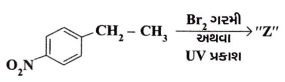
Which is the major product "$Z$" in the following reaction?
A
$1-$nitro$-4-$($1$-bromoethyl)benzene
B
$1-$nitro$-4-$($2$-bromoethyl)benzene
C
$2-$bromo$-1-$nitro$-4-$ethylbenzene
D
$1-$bromo$-2-$nitro$-4-$ethylbenzene
Solution
(A) The reaction of $p$-ethylnitrobenzene with $Br_2$ in the presence of heat or $UV$ light proceeds via a free radical substitution mechanism.
In this mechanism,the bromine radical abstracts a hydrogen atom from the benzylic position because the resulting benzylic radical is stabilized by resonance with the benzene ring.
Specifically,the hydrogen atom is removed from the $\alpha$-carbon (the carbon attached directly to the benzene ring) of the ethyl group.
This leads to the formation of a stable benzylic radical,which then reacts with $Br_2$ to form the major product,$1-nitro-4-(1-bromoethyl)benzene$.
Therefore,the correct structure is $O_2N-C_6H_4-CH(Br)CH_3$.
In this mechanism,the bromine radical abstracts a hydrogen atom from the benzylic position because the resulting benzylic radical is stabilized by resonance with the benzene ring.
Specifically,the hydrogen atom is removed from the $\alpha$-carbon (the carbon attached directly to the benzene ring) of the ethyl group.
This leads to the formation of a stable benzylic radical,which then reacts with $Br_2$ to form the major product,$1-nitro-4-(1-bromoethyl)benzene$.
Therefore,the correct structure is $O_2N-C_6H_4-CH(Br)CH_3$.
0 likesView Solution
16
ChemistryEasyMCQGSEB · 2024
$C_6H_5OC_2H_5 + HI \rightarrow X + Y$. Here $X$ and $Y$ are . . . . . . .
A
$C_6H_5OH$ and $C_2H_5I$
B
$C_6H_5I$ and $C_2H_5OH$
C
$C_6H_5I$ and $C_2H_5I$
D
$C_6H_5OH$ and $C_2H_5OH$
Solution
(A) The reaction of an alkyl aryl ether with $HI$ involves the cleavage of the $C_{alkyl}-O$ bond because the $C_{aryl}-O$ bond has partial double bond character due to resonance and is stronger.
Therefore,the reaction proceeds as follows:
$C_6H_5-O-C_2H_5 + HI \rightarrow C_6H_5OH + C_2H_5I$
Here,$X$ is $C_6H_5OH$ (phenol) and $Y$ is $C_2H_5I$ (ethyl iodide).
Thus,the correct option is $A$.
Therefore,the reaction proceeds as follows:
$C_6H_5-O-C_2H_5 + HI \rightarrow C_6H_5OH + C_2H_5I$
Here,$X$ is $C_6H_5OH$ (phenol) and $Y$ is $C_2H_5I$ (ethyl iodide).
Thus,the correct option is $A$.
0 likesView Solution
17
ChemistryEasyMCQGSEB · 2024
Which of the following reactions is not an electrophilic substitution reaction?
A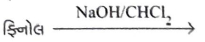
Phenol $\xrightarrow{NaOH / CHCl_3}$
B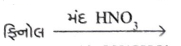
Phenol $\xrightarrow{\text{dil } HNO_3}$
C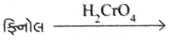
Phenol $\xrightarrow{H_2CrO_4}$
D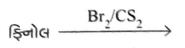
Phenol $\xrightarrow{Br_2 / CS_2}$
Solution
(C) The reaction of phenol with $H_2CrO_4$ (chromic acid) is an oxidation reaction,not an electrophilic substitution reaction.
In this reaction,phenol is oxidized to $p$-benzoquinone.
Other reactions listed:
$(A)$ Reimer-Tiemann reaction (electrophilic substitution),
$(B)$ Nitration of phenol (electrophilic substitution),
$(D)$ Bromination of phenol (electrophilic substitution).
In this reaction,phenol is oxidized to $p$-benzoquinone.
Other reactions listed:
$(A)$ Reimer-Tiemann reaction (electrophilic substitution),
$(B)$ Nitration of phenol (electrophilic substitution),
$(D)$ Bromination of phenol (electrophilic substitution).
0 likesView Solution
18
ChemistryEasyMCQGSEB · 2024
Reduction of which compound gives an optically active alcohol?
A
Methyl butanoate
B
Butanone
C
Butanoic acid
D
Butanal
Solution
(B) The reduction of $Butanone$ $(CH_3COCH_2CH_3)$ using a reducing agent like $NaBH_4$ or $LiAlH_4$ yields $Butan-2-ol$ $(CH_3CH(OH)CH_2CH_3)$.
In $Butan-2-ol$,the carbon atom attached to the $-OH$ group is bonded to four different groups: $-H$,$-OH$,$-CH_3$,and $-CH_2CH_3$.
Since this carbon is a chiral center,$Butan-2-ol$ exists as a pair of enantiomers and is optically active.
The other options yield primary alcohols $(Butan-1-ol)$ which are achiral.
In $Butan-2-ol$,the carbon atom attached to the $-OH$ group is bonded to four different groups: $-H$,$-OH$,$-CH_3$,and $-CH_2CH_3$.
Since this carbon is a chiral center,$Butan-2-ol$ exists as a pair of enantiomers and is optically active.
The other options yield primary alcohols $(Butan-1-ol)$ which are achiral.
0 likesView Solution
19
ChemistryEasyMCQGSEB · 2024
Which compound gives a fast reaction with Lucas's reagent?
A
$CH_3CH_2CH(CH_3)OH$
B
$(CH_3)_2CHOH$
C
$(CH_3)_3COH$
D
$CH_3CH_2CH_2OH$
Solution
(C) The reactivity of alcohols with Lucas's reagent $(conc. \ HCl + anhydrous \ ZnCl_2)$ follows the order: $3^\circ > 2^\circ > 1^\circ$.
This is because the reaction proceeds via an $S_N1$ mechanism involving the formation of a carbocation intermediate.
$3^\circ$ alcohols form the most stable carbocation and thus react the fastest,typically at room temperature.
$(CH_3)_3COH$ is a tertiary $(3^\circ)$ alcohol,while the others are secondary $(2^\circ)$ or primary $(1^\circ)$ alcohols.
Therefore,$(CH_3)_3COH$ gives the fastest reaction.
This is because the reaction proceeds via an $S_N1$ mechanism involving the formation of a carbocation intermediate.
$3^\circ$ alcohols form the most stable carbocation and thus react the fastest,typically at room temperature.
$(CH_3)_3COH$ is a tertiary $(3^\circ)$ alcohol,while the others are secondary $(2^\circ)$ or primary $(1^\circ)$ alcohols.
Therefore,$(CH_3)_3COH$ gives the fastest reaction.
0 likesView Solution
20
ChemistryEasyMCQGSEB · 2024
Predict the products '$X$' and '$Y$' of the following reaction respectively.
$(CH_3)_3C-O-C_2H_5 \xrightarrow{HI} X + Y$
$(CH_3)_3C-O-C_2H_5 \xrightarrow{HI} X + Y$
A
$(CH_3)_3C-OH + C_2H_5I$
B
$(CH_3)_3C-I + C_2H_5OH$
C
$C_4H_{10} + C_2H_6$
D
$(CH_3)_3C-I + CH_3OH$
Solution
(B) The reaction of an ether with $HI$ proceeds via an $S_N1$ mechanism when one of the alkyl groups is tertiary.
In the given ether,$(CH_3)_3C-O-C_2H_5$,the tert-butyl group $(CH_3)_3C-$ is capable of forming a stable tertiary carbocation.
Therefore,the $C-O$ bond between the tert-butyl group and the oxygen atom breaks,leading to the formation of tert-butyl iodide $(CH_3)_3C-I$ and ethanol $C_2H_5OH$.
Thus,$X = (CH_3)_3C-I$ and $Y = C_2H_5OH$.
In the given ether,$(CH_3)_3C-O-C_2H_5$,the tert-butyl group $(CH_3)_3C-$ is capable of forming a stable tertiary carbocation.
Therefore,the $C-O$ bond between the tert-butyl group and the oxygen atom breaks,leading to the formation of tert-butyl iodide $(CH_3)_3C-I$ and ethanol $C_2H_5OH$.
Thus,$X = (CH_3)_3C-I$ and $Y = C_2H_5OH$.
0 likesView Solution
21
ChemistryEasyMCQGSEB · 2024
Which is the final product of the Reimer-Tiemann reaction?
A
Salicylaldehyde
B
Aspirin
C
Salicylic acid
D
Phenol
Solution
(A) The Reimer-Tiemann reaction involves the treatment of phenol with chloroform $(CHCl_3)$ in the presence of an aqueous base like sodium hydroxide $(NaOH)$.
This reaction leads to the introduction of a formyl group $(-CHO)$ at the ortho position of the phenol ring.
The final product formed is $2$-hydroxybenzaldehyde,commonly known as Salicylaldehyde.
Therefore,the correct option is $A$.
This reaction leads to the introduction of a formyl group $(-CHO)$ at the ortho position of the phenol ring.
The final product formed is $2$-hydroxybenzaldehyde,commonly known as Salicylaldehyde.
Therefore,the correct option is $A$.
0 likesView Solution
22
ChemistryEasyMCQGSEB · 2024
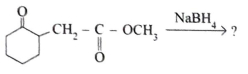
Write the structure of the product of the following reaction.
A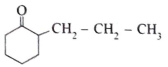
B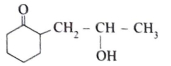
C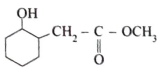
D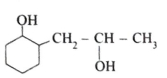
Solution
(C) $NaBH_4$ (Sodium borohydride) is a selective reducing agent that reduces aldehydes and ketones to their corresponding alcohols,but it does not reduce esters under normal conditions.
In the given molecule,there is a ketone group in the cyclohexane ring and an ester group $(-COOCH_3)$.
$NaBH_4$ will selectively reduce the ketone group to a secondary alcohol $(-CH(OH)-)$ while leaving the ester group intact.
Therefore,the product is a molecule with a cyclohexanol ring attached to a $-CH_2-COOCH_3$ group.
This corresponds to the structure shown in option $C$.
In the given molecule,there is a ketone group in the cyclohexane ring and an ester group $(-COOCH_3)$.
$NaBH_4$ will selectively reduce the ketone group to a secondary alcohol $(-CH(OH)-)$ while leaving the ester group intact.
Therefore,the product is a molecule with a cyclohexanol ring attached to a $-CH_2-COOCH_3$ group.
This corresponds to the structure shown in option $C$.
0 likesView Solution
23
ChemistryEasyMCQGSEB · 2024
$C_6H_5CHO + C_6H_5COCH_3 \xrightarrow[293 \ K]{OH^{-}}$ product of reaction is . . . . . . .
A
$C_6H_5-CO-CH_2-CO-C_6H_5$
B
$C_6H_5-CH=CH-CO-C_6H_5$
C
$C_6H_5-CH_2-CO-CH_2-C_6H_5$
D
$C_6H_5-CH=CH-CH_2-C_6H_5$
Solution
(B) The reaction between benzaldehyde $(C_6H_5CHO)$ and acetophenone $(C_6H_5COCH_3)$ in the presence of a dilute base $(OH^-)$ is a Claisen-Schmidt condensation reaction.
In this reaction,the enolate ion formed from acetophenone attacks the carbonyl carbon of benzaldehyde.
The initial product is a $\beta$-hydroxy ketone,which subsequently undergoes dehydration to form an $\alpha,\beta$-unsaturated ketone.
The reaction is:
$C_6H_5CHO + CH_3COC_6H_5$ $\xrightarrow{OH^-} C_6H_5CH(OH)CH_2COC_6H_5$ $\xrightarrow{-H_2O} C_6H_5CH=CHCOC_6H_5$
The final product is benzalacetophenone (also known as chalcone),which corresponds to option $B$.
In this reaction,the enolate ion formed from acetophenone attacks the carbonyl carbon of benzaldehyde.
The initial product is a $\beta$-hydroxy ketone,which subsequently undergoes dehydration to form an $\alpha,\beta$-unsaturated ketone.
The reaction is:
$C_6H_5CHO + CH_3COC_6H_5$ $\xrightarrow{OH^-} C_6H_5CH(OH)CH_2COC_6H_5$ $\xrightarrow{-H_2O} C_6H_5CH=CHCOC_6H_5$
The final product is benzalacetophenone (also known as chalcone),which corresponds to option $B$.
0 likesView Solution
24
ChemistryEasyMCQGSEB · 2024
Which of the following compounds is used as a food preservative?
A
Acetone
B
Benzaldehyde
C
Sodium phenoxide
D
Sodium benzoate
Solution
(D) Sodium benzoate $(C_6H_5COONa)$ is widely used as a food preservative because it inhibits the growth of bacteria,yeast,and mold in acidic conditions.
Therefore,the correct option is $D$.
Therefore,the correct option is $D$.
0 likesView Solution
25
ChemistryEasyMCQGSEB · 2024
Which of the following compounds has the highest $pK_a$ value?
A
Benzoic acid
B
$p$-Nitrobenzoic acid
C
$p$-Methylbenzoic acid
D
$p$-Chlorobenzoic acid
Solution
(C) The $pK_a$ value is inversely proportional to the acidity of the compound. $A$ stronger acid has a lower $pK_a$ value,while a weaker acid has a higher $pK_a$ value.
Acidity depends on the stability of the conjugate base (carboxylate ion). Electron-withdrawing groups $(EWG)$ increase acidity,while electron-donating groups $(EDG)$ decrease acidity.
Comparing the substituents on the benzene ring:
$1$. $-NO_2$ is a strong $EWG$ (increases acidity).
$2$. $-Cl$ is a weak $EWG$ (increases acidity).
$3$. $-H$ is the reference.
$4$. $-CH_3$ is an $EDG$ (decreases acidity).
Since $-CH_3$ is an electron-donating group,it destabilizes the carboxylate ion,making $p$-methylbenzoic acid the weakest acid among the given options.
Therefore,$p$-methylbenzoic acid has the highest $pK_a$ value.
Acidity depends on the stability of the conjugate base (carboxylate ion). Electron-withdrawing groups $(EWG)$ increase acidity,while electron-donating groups $(EDG)$ decrease acidity.
Comparing the substituents on the benzene ring:
$1$. $-NO_2$ is a strong $EWG$ (increases acidity).
$2$. $-Cl$ is a weak $EWG$ (increases acidity).
$3$. $-H$ is the reference.
$4$. $-CH_3$ is an $EDG$ (decreases acidity).
Since $-CH_3$ is an electron-donating group,it destabilizes the carboxylate ion,making $p$-methylbenzoic acid the weakest acid among the given options.
Therefore,$p$-methylbenzoic acid has the highest $pK_a$ value.
0 likesView Solution
26
ChemistryEasyMCQGSEB · 2024
Which compound can reduce Fehling reagent?
A
Acetophenone
B
Acetaldehyde
C
Acetone
D
Benzaldehyde
Solution
(B) Fehling reagent is a mild oxidizing agent that is used to distinguish between aliphatic aldehydes and ketones.
Aliphatic aldehydes,such as $CH_3CHO$ (Acetaldehyde),are easily oxidized by Fehling reagent to their corresponding carboxylate ions,resulting in a reddish-brown precipitate of $Cu_2O$.
Ketones (like Acetophenone and Acetone) and aromatic aldehydes (like Benzaldehyde) do not reduce Fehling reagent.
Therefore,the correct answer is $B$ (Acetaldehyde).
Aliphatic aldehydes,such as $CH_3CHO$ (Acetaldehyde),are easily oxidized by Fehling reagent to their corresponding carboxylate ions,resulting in a reddish-brown precipitate of $Cu_2O$.
Ketones (like Acetophenone and Acetone) and aromatic aldehydes (like Benzaldehyde) do not reduce Fehling reagent.
Therefore,the correct answer is $B$ (Acetaldehyde).
0 likesView Solution
27
ChemistryEasyMCQGSEB · 2024
Which of the following reactions does not produce benzaldehyde?
A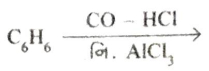
$C_6H_6 \xrightarrow[\text{Anhy. } AlCl_3]{CO, HCl} C_6H_5CHO$
B
$C_6H_5CH_3 \xrightarrow[CS_2]{CrO_2Cl_2} C_6H_5CHO$
C
$C_6H_5CH_3 \xrightarrow{KMnO_4 + KOH} C_6H_5COOK$
D
$C_6H_5COCl \xrightarrow[Pd-BaSO_4]{H_2} C_6H_5CHO$
Solution
(C) . Gattermann-Koch reaction: $C_6H_6 + CO + HCl \xrightarrow{\text{Anhy. } AlCl_3} C_6H_5CHO$ (Produces benzaldehyde).
$B$. Etard reaction: $C_6H_5CH_3 + CrO_2Cl_2 \xrightarrow{CS_2} C_6H_5CHO$ (Produces benzaldehyde).
$C$. Oxidation of toluene with $KMnO_4 + KOH$ yields potassium benzoate $(C_6H_5COOK)$,which upon acidification gives benzoic acid $(C_6H_5COOH)$,not benzaldehyde.
$D$. Rosenmund reduction: $C_6H_5COCl + H_2 \xrightarrow{Pd-BaSO_4} C_6H_5CHO$ (Produces benzaldehyde).
Therefore,the reaction that does not produce benzaldehyde is $C$.
$B$. Etard reaction: $C_6H_5CH_3 + CrO_2Cl_2 \xrightarrow{CS_2} C_6H_5CHO$ (Produces benzaldehyde).
$C$. Oxidation of toluene with $KMnO_4 + KOH$ yields potassium benzoate $(C_6H_5COOK)$,which upon acidification gives benzoic acid $(C_6H_5COOH)$,not benzaldehyde.
$D$. Rosenmund reduction: $C_6H_5COCl + H_2 \xrightarrow{Pd-BaSO_4} C_6H_5CHO$ (Produces benzaldehyde).
Therefore,the reaction that does not produce benzaldehyde is $C$.
0 likesView Solution
28
ChemistryEasyMCQGSEB · 2024
Which of the following compounds has the highest $K_a$ value?
A
$NO_2CH_2COOH$
B
$BrCH_2COOH$
C
$CCl_3COOH$
D
$CH_3COOH$
Solution
(C) The acidity of carboxylic acids is determined by the stability of the conjugate base (carboxylate ion).
Electron-withdrawing groups (EWGs) stabilize the carboxylate ion through the inductive effect ($-I$ effect),thereby increasing the acidity and the $K_a$ value.
Comparing the substituents:
$1$. $NO_2$ group has a strong $-I$ effect.
$2$. $Br$ group has a moderate $-I$ effect.
$3$. $CCl_3$ group has a very strong $-I$ effect due to three highly electronegative chlorine atoms.
$4$. $CH_3$ group is an electron-donating group ($+I$ effect),which decreases acidity.
Among the given options,$CCl_3COOH$ has the strongest electron-withdrawing effect,making it the strongest acid with the highest $K_a$ value.
Electron-withdrawing groups (EWGs) stabilize the carboxylate ion through the inductive effect ($-I$ effect),thereby increasing the acidity and the $K_a$ value.
Comparing the substituents:
$1$. $NO_2$ group has a strong $-I$ effect.
$2$. $Br$ group has a moderate $-I$ effect.
$3$. $CCl_3$ group has a very strong $-I$ effect due to three highly electronegative chlorine atoms.
$4$. $CH_3$ group is an electron-donating group ($+I$ effect),which decreases acidity.
Among the given options,$CCl_3COOH$ has the strongest electron-withdrawing effect,making it the strongest acid with the highest $K_a$ value.
0 likesView Solution
29
ChemistryEasyMCQGSEB · 2024
Which of the following compounds gives the Iodoform reaction?
A
Propanal
B
Acetone
C
Pent-$3$-one
D
Benzophenone
Solution
(B) The Iodoform reaction is given by compounds containing the $CH_3CO-$ group or the $CH_3CH(OH)-$ group.
$1$. Propanal $(CH_3CH_2CHO)$ does not contain the $CH_3CO-$ group.
$2$. Acetone $(CH_3COCH_3)$ contains the $CH_3CO-$ group and thus gives a positive Iodoform test.
$3$. Pent-$3$-one $(CH_3CH_2COCH_2CH_3)$ does not contain a methyl group attached to the carbonyl carbon.
$4$. Benzophenone $(C_6H_5COC_6H_5)$ does not contain a methyl group attached to the carbonyl carbon.
Therefore,the correct answer is $B$.
$1$. Propanal $(CH_3CH_2CHO)$ does not contain the $CH_3CO-$ group.
$2$. Acetone $(CH_3COCH_3)$ contains the $CH_3CO-$ group and thus gives a positive Iodoform test.
$3$. Pent-$3$-one $(CH_3CH_2COCH_2CH_3)$ does not contain a methyl group attached to the carbonyl carbon.
$4$. Benzophenone $(C_6H_5COC_6H_5)$ does not contain a methyl group attached to the carbonyl carbon.
Therefore,the correct answer is $B$.
0 likesView Solution
30
ChemistryEasyMCQGSEB · 2024
Which product is obtained when cyclopentanone reacts with hydroxylamine in an acidic medium?
A
Cyclopentanone oxime
B
Cyclopentanol
C
Cyclopentanone hydrazone
D
Cyclopentenamide
Solution
(A) The reaction of a ketone with hydroxylamine $(NH_2OH)$ in an acidic medium is a nucleophilic addition-elimination reaction (condensation reaction).
Cyclopentanone reacts with hydroxylamine to form cyclopentanone oxime and water.
The reaction is represented as:
$C_5H_8O + NH_2OH \xrightarrow{H^+} C_5H_8NOH + H_2O$.
Therefore,the correct product is cyclopentanone oxime.
Cyclopentanone reacts with hydroxylamine to form cyclopentanone oxime and water.
The reaction is represented as:
$C_5H_8O + NH_2OH \xrightarrow{H^+} C_5H_8NOH + H_2O$.
Therefore,the correct product is cyclopentanone oxime.
0 likesView Solution
31
ChemistryEasyMCQGSEB · 2024
The Cannizzaro reaction is not given by . . . . . . .
A
$HCHO$
B
$C_6H_5CHO$
C
$1\text{-methylcyclohexanecarbaldehyde}$
D
$CH_3CHO$
Solution
(D) The Cannizzaro reaction is a disproportionation reaction given by aldehydes that do not possess an $\alpha$-hydrogen atom.
$HCHO$ (formaldehyde) has no $\alpha$-hydrogen.
$C_6H_5CHO$ (benzaldehyde) has no $\alpha$-hydrogen.
$1\text{-methylcyclohexanecarbaldehyde}$ has no $\alpha$-hydrogen at the carbonyl carbon position.
$CH_3CHO$ (acetaldehyde) possesses three $\alpha$-hydrogen atoms,so it undergoes aldol condensation instead of the Cannizzaro reaction.
$HCHO$ (formaldehyde) has no $\alpha$-hydrogen.
$C_6H_5CHO$ (benzaldehyde) has no $\alpha$-hydrogen.
$1\text{-methylcyclohexanecarbaldehyde}$ has no $\alpha$-hydrogen at the carbonyl carbon position.
$CH_3CHO$ (acetaldehyde) possesses three $\alpha$-hydrogen atoms,so it undergoes aldol condensation instead of the Cannizzaro reaction.
0 likesView Solution
32
ChemistryEasyMCQGSEB · 2024
Which reagent is used in the preparation of benzaldehyde from benzene by the Gatterman-Koch reaction?
A
$CH_3COCl$ and anhydrous $AlCl_3$
B
$SnCl_2$ and $HCl$
C
$CO$,$HCl$ and anhydrous $AlCl_3$
D
$CrO_2Cl_2$ and $CS_2$
Solution
(C) The Gatterman-Koch reaction is a specific form of Friedel-Crafts acylation used to introduce a formyl group $(-CHO)$ into an aromatic ring.
In this reaction,benzene is treated with carbon monoxide $(CO)$ and hydrogen chloride $(HCl)$ in the presence of anhydrous aluminum chloride $(AlCl_3)$ or cuprous chloride $(CuCl)$ to produce benzaldehyde.
The reaction is represented as: $C_6H_6 + CO + HCl \xrightarrow{anhydrous \ AlCl_3 / CuCl} C_6H_5CHO$.
In this reaction,benzene is treated with carbon monoxide $(CO)$ and hydrogen chloride $(HCl)$ in the presence of anhydrous aluminum chloride $(AlCl_3)$ or cuprous chloride $(CuCl)$ to produce benzaldehyde.
The reaction is represented as: $C_6H_6 + CO + HCl \xrightarrow{anhydrous \ AlCl_3 / CuCl} C_6H_5CHO$.
0 likesView Solution
33
ChemistryEasyMCQGSEB · 2024
Match the vitamin given in Column-$I$ with their chemical name given in Column-$II$.
| Column-$I$ (Vitamin) | Column-$II$ (Chemical Name) |
|---|---|
| $(i)$ Vitamin $B_6$ | $(P)$ Ascorbic acid |
| $(ii)$ Vitamin $B_1$ | $(Q)$ Riboflavin |
| $(iii)$ Vitamin $B_2$ | $(R)$ Thiamine |
| $(iv)$ Vitamin $C$ | $(S)$ Pyridoxine |
A
$(i)$ $\rightarrow S, (ii)$ $\rightarrow Q, (iii)$ $\rightarrow R, (iv)$ $\rightarrow P$
B
$(i)$ $\rightarrow Q, (ii)$ $\rightarrow R, (iii)$ $\rightarrow S, (iv)$ $\rightarrow P$
C
$(i)$ $\rightarrow S, (ii)$ $\rightarrow R, (iii)$ $\rightarrow Q, (iv)$ $\rightarrow P$
D
$(i)$ $\rightarrow R, (ii)$ $\rightarrow Q, (iii)$ $\rightarrow S, (iv)$ $\rightarrow P$
Solution
(C) The chemical names of the vitamins are as follows:
$(i)$ Vitamin $B_6$ is Pyridoxine $(S)$.
$(ii)$ Vitamin $B_1$ is Thiamine $(R)$.
$(iii)$ Vitamin $B_2$ is Riboflavin $(Q)$.
$(iv)$ Vitamin $C$ is Ascorbic acid $(P)$.
Therefore,the correct matching is $(i)$ $\rightarrow S, (ii)$ $\rightarrow R, (iii)$ $\rightarrow Q, (iv)$ $\rightarrow P$.
$(i)$ Vitamin $B_6$ is Pyridoxine $(S)$.
$(ii)$ Vitamin $B_1$ is Thiamine $(R)$.
$(iii)$ Vitamin $B_2$ is Riboflavin $(Q)$.
$(iv)$ Vitamin $C$ is Ascorbic acid $(P)$.
Therefore,the correct matching is $(i)$ $\rightarrow S, (ii)$ $\rightarrow R, (iii)$ $\rightarrow Q, (iv)$ $\rightarrow P$.
0 likesView Solution
34
ChemistryEasyMCQGSEB · 2024
Which carbohydrate is present in the liver?
A
Glycogen
B
Amylose
C
Amylopectin
D
Cellulose
Solution
(A) The carbohydrate stored in the liver of animals is $Glycogen$.
It is often referred to as animal starch because its structure is similar to $Amylopectin$ and it serves as the primary storage form of glucose in animals.
It is often referred to as animal starch because its structure is similar to $Amylopectin$ and it serves as the primary storage form of glucose in animals.
0 likesView Solution
35
ChemistryEasyMCQGSEB · 2024
$Testosterone$ is responsible for the development of secondary male characteristics like deep voice and facial hair.
A
Estratriol
B
Progesterone
C
Estradiol
D
Testosterone
Solution
(D) $Testosterone$ is the primary male sex hormone and an anabolic steroid.
It plays a key role in the development of male reproductive tissues such as the testes and prostate,as well as promoting secondary sexual characteristics such as increased muscle and bone mass,and the growth of body hair and deepening of the voice.
Therefore,the correct option is $D$.
It plays a key role in the development of male reproductive tissues such as the testes and prostate,as well as promoting secondary sexual characteristics such as increased muscle and bone mass,and the growth of body hair and deepening of the voice.
Therefore,the correct option is $D$.
0 likesView Solution
36
ChemistryEasyMCQGSEB · 2024
Which is a bicyclic base?
A
$U$
B
$C$
C
$T$
D
$G$
Solution
(D) In nucleic acids,the nitrogenous bases are classified into two types based on their structure:
$1$. $\text{Purines}$ (bicyclic bases with two fused rings): Adenine $(A)$ and Guanine $(G)$.
$2$. $\text{Pyrimidines}$ (monocyclic bases with one ring): Cytosine $(C)$,Thymine $(T)$,and Uracil $(U)$.
Since Guanine $(G)$ is a purine,it possesses a bicyclic (double-ring) structure. Therefore,the correct answer is $G$.
$1$. $\text{Purines}$ (bicyclic bases with two fused rings): Adenine $(A)$ and Guanine $(G)$.
$2$. $\text{Pyrimidines}$ (monocyclic bases with one ring): Cytosine $(C)$,Thymine $(T)$,and Uracil $(U)$.
Since Guanine $(G)$ is a purine,it possesses a bicyclic (double-ring) structure. Therefore,the correct answer is $G$.
0 likesView Solution
37
ChemistryEasyMCQGSEB · 2024
Which amino acid is not optically active?
A
Leucine
B
Alanine
C
Glycine
D
Valine
Solution
(C) An amino acid is optically active if it contains a chiral carbon atom (a carbon atom bonded to four different groups).
Glycine has the structure $NH_2-CH_2-COOH$.
In glycine,the central carbon atom is bonded to two identical hydrogen atoms,meaning it is not a chiral center.
Therefore,glycine is the only amino acid among the options that is not optically active.
Glycine has the structure $NH_2-CH_2-COOH$.
In glycine,the central carbon atom is bonded to two identical hydrogen atoms,meaning it is not a chiral center.
Therefore,glycine is the only amino acid among the options that is not optically active.
0 likesView Solution
38
ChemistryEasyMCQGSEB · 2024
Hydrogen bond is present in which two pairs of bases in the double helix structure of $DNA$?
A
Guanine and Thymine
B
Adenine and Thymine
C
Adenine and Cytosine
D
Cytosine and Thymine
Solution
(B) In the double helix structure of $DNA$,nitrogenous bases form specific base pairs through hydrogen bonding.
$Adenine$ $(A)$ pairs with $Thymine$ $(T)$ via two hydrogen bonds.
$Guanine$ $(G)$ pairs with $Cytosine$ $(C)$ via three hydrogen bonds.
Therefore,the correct pair among the options is $Adenine$ and $Thymine$.
$Adenine$ $(A)$ pairs with $Thymine$ $(T)$ via two hydrogen bonds.
$Guanine$ $(G)$ pairs with $Cytosine$ $(C)$ via three hydrogen bonds.
Therefore,the correct pair among the options is $Adenine$ and $Thymine$.
0 likesView Solution
39
ChemistryEasyMCQGSEB · 2024
Which of the following acids is a vitamin?
A
Ascorbic acid
B
Picric acid
C
Adipic acid
D
Aspartic acid
Solution
(A) The correct answer is $A$.
Ascorbic acid is chemically known as $Vitamin \ C$,which is an essential water-soluble vitamin required for the synthesis of collagen and as an antioxidant.
Ascorbic acid is chemically known as $Vitamin \ C$,which is an essential water-soluble vitamin required for the synthesis of collagen and as an antioxidant.
0 likesView Solution
40
ChemistryEasyMCQGSEB · 2024
What is the hydrolysis product of $Lactose$?
A
$Glucose$ and $Glucose$
B
$Glucose$ and $Fructose$
C
$Galactose$ and $Glucose$
D
$Galactose$ and $Fructose$
Solution
(C) $Lactose$ is a disaccharide composed of two monosaccharide units.
Upon hydrolysis,$Lactose$ breaks down into one molecule of $D-(+)-Glucose$ and one molecule of $D-(+)-Galactose$.
The reaction is: $C_{12}H_{22}O_{11} + H_2O \rightarrow C_6H_{12}O_6 (Glucose) + C_6H_{12}O_6 (Galactose)$.
Upon hydrolysis,$Lactose$ breaks down into one molecule of $D-(+)-Glucose$ and one molecule of $D-(+)-Galactose$.
The reaction is: $C_{12}H_{22}O_{11} + H_2O \rightarrow C_6H_{12}O_6 (Glucose) + C_6H_{12}O_6 (Galactose)$.
0 likesView Solution
41
ChemistryEasyMCQGSEB · 2024
What is the value of the slope of the plot $\ln K$ versus $\frac{1}{T}$ for a reaction having $E_{a} = 33.256 \ J \ mol^{-1}$?
A
$-1.74$
B
$-4$
C
$1.74$
D
$4$
Solution
(B) According to the Arrhenius equation,$\ln K = \ln A - \frac{E_{a}}{RT}$.
Comparing this with the equation of a straight line $y = mx + c$,where $y = \ln K$,$x = \frac{1}{T}$,and $m$ is the slope.
The slope $m = -\frac{E_{a}}{R}$.
Given $E_{a} = 33.256 \ J \ mol^{-1}$ and the gas constant $R = 8.314 \ J \ K^{-1} \ mol^{-1}$.
Slope $m = -\frac{33.256}{8.314} = -4$.
Comparing this with the equation of a straight line $y = mx + c$,where $y = \ln K$,$x = \frac{1}{T}$,and $m$ is the slope.
The slope $m = -\frac{E_{a}}{R}$.
Given $E_{a} = 33.256 \ J \ mol^{-1}$ and the gas constant $R = 8.314 \ J \ K^{-1} \ mol^{-1}$.
Slope $m = -\frac{33.256}{8.314} = -4$.
0 likesView Solution
42
ChemistryEasyMCQGSEB · 2024
In the presence of a catalyst,the heat evolved or absorbed during the reaction . . . . . . .
A
may increase or decrease
B
decreases
C
remains unchanged
D
increase
Solution
(C) catalyst provides an alternative reaction pathway with a lower activation energy $(E_a)$.
It increases the rate of both the forward and backward reactions equally.
However,it does not affect the thermodynamic properties of the reaction,such as the enthalpy change $(\Delta H)$.
Therefore,the heat evolved or absorbed during the reaction remains unchanged.
It increases the rate of both the forward and backward reactions equally.
However,it does not affect the thermodynamic properties of the reaction,such as the enthalpy change $(\Delta H)$.
Therefore,the heat evolved or absorbed during the reaction remains unchanged.
0 likesView Solution
43
ChemistryEasyMCQGSEB · 2024
For a first order reaction,the half-life period is $5 \ min$. What time will it take for $99.9 \%$ completion of the reaction (in $min$)?
A
$40$
B
$25$
C
$20$
D
$50$
Solution
(D) For a first-order reaction,the rate constant $k$ is given by $k = \frac{0.693}{t_{1/2}}$.
Given $t_{1/2} = 5 \ min$,so $k = \frac{0.693}{5} \ min^{-1}$.
The time $t$ required for $99.9 \%$ completion is given by the formula $t = \frac{2.303}{k} \log \frac{[A]_0}{[A]_t}$.
For $99.9 \%$ completion,$[A]_t = [A]_0 - 0.999[A]_0 = 0.001[A]_0$.
Substituting the values: $t = \frac{2.303}{0.693/5} \log \frac{[A]_0}{0.001[A]_0}$.
$t = \frac{2.303 \times 5}{0.693} \log(1000)$.
Since $\log(1000) = 3$ and $\frac{2.303}{0.693} \approx 3.32$,we have $t \approx 3.32 \times 5 \times 3 = 49.8 \approx 50 \ min$.
Thus,the correct option is $D$.
Given $t_{1/2} = 5 \ min$,so $k = \frac{0.693}{5} \ min^{-1}$.
The time $t$ required for $99.9 \%$ completion is given by the formula $t = \frac{2.303}{k} \log \frac{[A]_0}{[A]_t}$.
For $99.9 \%$ completion,$[A]_t = [A]_0 - 0.999[A]_0 = 0.001[A]_0$.
Substituting the values: $t = \frac{2.303}{0.693/5} \log \frac{[A]_0}{0.001[A]_0}$.
$t = \frac{2.303 \times 5}{0.693} \log(1000)$.
Since $\log(1000) = 3$ and $\frac{2.303}{0.693} \approx 3.32$,we have $t \approx 3.32 \times 5 \times 3 = 49.8 \approx 50 \ min$.
Thus,the correct option is $D$.
0 likesView Solution
44
ChemistryEasyMCQGSEB · 2024
$A$ reaction $A + B \rightarrow C$ is second order in $A$ and zeroth order in $B$. How is the rate affected when the concentration of $A$ is doubled and $B$ is halved?
A
$1/2$ times
B
$2$ times
C
$8$ times
D
$4$ times
Solution
(D) The rate law for the reaction is given by: $Rate = k[A]^2[B]^0 = k[A]^2$.
When the concentration of $A$ is doubled $([A]' = 2[A])$ and the concentration of $B$ is halved $([B]' = 0.5[B])$,the new rate $(Rate')$ is:
$Rate' = k(2[A])^2(0.5[B])^0 = k(4[A]^2)(1) = 4k[A]^2$.
Comparing the new rate with the initial rate,we get $Rate' = 4 \times Rate$.
Therefore,the rate becomes $4$ times the original rate.
When the concentration of $A$ is doubled $([A]' = 2[A])$ and the concentration of $B$ is halved $([B]' = 0.5[B])$,the new rate $(Rate')$ is:
$Rate' = k(2[A])^2(0.5[B])^0 = k(4[A]^2)(1) = 4k[A]^2$.
Comparing the new rate with the initial rate,we get $Rate' = 4 \times Rate$.
Therefore,the rate becomes $4$ times the original rate.
0 likesView Solution
45
ChemistryEasyMCQGSEB · 2024
For a certain reaction,the rate constant $K = 2.37 \times 10^2 \ L^2 \ mol^{-2} \ s^{-1}$. What is the order of the reaction?
A
$3$
B
$0$
C
$2$
D
$1$
Solution
(A) The unit of the rate constant $K$ for a reaction of order $n$ is given by the formula: $(mol \ L^{-1})^{1-n} \ s^{-1}$.
Given the unit is $L^2 \ mol^{-2} \ s^{-1}$,which can be rewritten as $mol^{-2} \ L^2 \ s^{-1}$.
Comparing this with $(mol \ L^{-1})^{1-n} \ s^{-1}$,we have:
$(mol \ L^{-1})^{1-n} = mol^{-2} \ L^2$.
This implies $1-n = -2$.
Solving for $n$,we get $n = 1 + 2 = 3$.
Therefore,the order of the reaction is $3$.
Given the unit is $L^2 \ mol^{-2} \ s^{-1}$,which can be rewritten as $mol^{-2} \ L^2 \ s^{-1}$.
Comparing this with $(mol \ L^{-1})^{1-n} \ s^{-1}$,we have:
$(mol \ L^{-1})^{1-n} = mol^{-2} \ L^2$.
This implies $1-n = -2$.
Solving for $n$,we get $n = 1 + 2 = 3$.
Therefore,the order of the reaction is $3$.
0 likesView Solution
46
ChemistryEasyMCQGSEB · 2024
Which of the following relations is correct for a zero order reaction?
A
$t_{1/2} \propto [R]_0^2$
B
$t_{1/2} \propto \frac{1}{[R]_0^2}$
C
$t_{1/2} \propto \frac{1}{[R]_0}$
D
$t_{1/2} \propto [R]_0$
Solution
(D) For a zero order reaction,the rate law is given by $Rate = k[R]^0 = k$.
Integrating this,we get $[R]_t = [R]_0 - kt$.
At half-life $(t = t_{1/2})$,the concentration $[R]_t = \frac{[R]_0}{2}$.
Substituting this into the integrated rate equation: $\frac{[R]_0}{2} = [R]_0 - kt_{1/2}$.
Rearranging for $t_{1/2}$,we get $kt_{1/2} = \frac{[R]_0}{2}$,which simplifies to $t_{1/2} = \frac{[R]_0}{2k}$.
Since $k$ is a constant,$t_{1/2} \propto [R]_0$.
Therefore,the correct relation is $t_{1/2} \propto [R]_0$.
Integrating this,we get $[R]_t = [R]_0 - kt$.
At half-life $(t = t_{1/2})$,the concentration $[R]_t = \frac{[R]_0}{2}$.
Substituting this into the integrated rate equation: $\frac{[R]_0}{2} = [R]_0 - kt_{1/2}$.
Rearranging for $t_{1/2}$,we get $kt_{1/2} = \frac{[R]_0}{2}$,which simplifies to $t_{1/2} = \frac{[R]_0}{2k}$.
Since $k$ is a constant,$t_{1/2} \propto [R]_0$.
Therefore,the correct relation is $t_{1/2} \propto [R]_0$.
0 likesView Solution
47
ChemistryEasyMCQGSEB · 2024
Which statement is true with respect to a catalyst?
A
Does not alter Gibbs energy
B
It increases equilibrium constant
C
It increases value of activation energy
D
It increases potential energy barrier
Solution
(A) catalyst provides an alternative reaction pathway with a lower activation energy.
It does not change the Gibbs energy $( \Delta G )$ of the reaction,nor does it alter the equilibrium constant $( K_{eq} )$.
It simply speeds up the attainment of equilibrium by lowering the activation energy barrier.
Therefore,the statement that it does not alter Gibbs energy is true.
It does not change the Gibbs energy $( \Delta G )$ of the reaction,nor does it alter the equilibrium constant $( K_{eq} )$.
It simply speeds up the attainment of equilibrium by lowering the activation energy barrier.
Therefore,the statement that it does not alter Gibbs energy is true.
0 likesView Solution
48
ChemistryEasyMCQGSEB · 2024
$A$ reaction is first order with respect to $A$ and second order with respect to $B$. How many times the rate of reaction is affected on increasing the concentration of $B$ three times?
A
$9$ times decreases
B
$9$ times increases
C
$6$ times increases
D
$6$ times decreases
Solution
(B) The rate law for the reaction is given by $Rate = k[A]^1[B]^2$.
If the concentration of $B$ is increased three times,the new concentration becomes $[B]' = 3[B]$.
The new rate of reaction $Rate'$ will be $Rate' = k[A]^1(3[B])^2$.
$Rate' = k[A]^1(9[B]^2) = 9 \times k[A]^1[B]^2$.
$Rate' = 9 \times Rate$.
Therefore,the rate of reaction increases by $9$ times.
Note: The rate constant $k$ remains unaffected by changes in concentration.
If the concentration of $B$ is increased three times,the new concentration becomes $[B]' = 3[B]$.
The new rate of reaction $Rate'$ will be $Rate' = k[A]^1(3[B])^2$.
$Rate' = k[A]^1(9[B]^2) = 9 \times k[A]^1[B]^2$.
$Rate' = 9 \times Rate$.
Therefore,the rate of reaction increases by $9$ times.
Note: The rate constant $k$ remains unaffected by changes in concentration.
0 likesView Solution
49
ChemistryEasyMCQGSEB · 2024
What is the slope of the graph between $\ln K$ and $\frac{1}{T}$ according to the Arrhenius equation?
A
$\frac{-2.303 E_a}{R}$
B
$\frac{K}{2.303}$
C
$\frac{-E_a}{R}$
D
$\ln A$
Solution
(C) The Arrhenius equation is given by $K = A e^{-E_a / RT}$.
Taking the natural logarithm on both sides,we get $\ln K = \ln A - \frac{E_a}{RT}$.
Comparing this with the equation of a straight line $y = mx + c$,where $y = \ln K$,$x = \frac{1}{T}$,$m$ is the slope,and $c$ is the intercept.
Here,the slope $m = -\frac{E_a}{R}$.
Therefore,the correct option is $C$.
Taking the natural logarithm on both sides,we get $\ln K = \ln A - \frac{E_a}{RT}$.
Comparing this with the equation of a straight line $y = mx + c$,where $y = \ln K$,$x = \frac{1}{T}$,$m$ is the slope,and $c$ is the intercept.
Here,the slope $m = -\frac{E_a}{R}$.
Therefore,the correct option is $C$.
0 likesView Solution
50
ChemistryEasyMCQGSEB · 2024
If the value of the rate constant $K = 2.3 \times 10^{-5} \ L \ mol^{-1} \ s^{-1}$,then identify the reaction order:
A
Second order
B
Third order
C
First order
D
Zero order
Solution
(A) The unit of the rate constant $K$ for a reaction of order $n$ is given by $(mol \ L^{-1})^{1-n} \ s^{-1}$.
For a second-order reaction $(n = 2)$,the unit is $(mol \ L^{-1})^{1-2} \ s^{-1} = (mol \ L^{-1})^{-1} \ s^{-1} = L \ mol^{-1} \ s^{-1}$.
Since the given unit is $L \ mol^{-1} \ s^{-1}$,the reaction is of the second order.
For a second-order reaction $(n = 2)$,the unit is $(mol \ L^{-1})^{1-2} \ s^{-1} = (mol \ L^{-1})^{-1} \ s^{-1} = L \ mol^{-1} \ s^{-1}$.
Since the given unit is $L \ mol^{-1} \ s^{-1}$,the reaction is of the second order.
0 likesView Solution
51
ChemistryEasyMCQGSEB · 2024
Which of the following compounds is diamagnetic and tetrahedral?
A
$K_2[NiF_4]$
B
$K_2[Ni(CN)_4]$
C
$[Ni(CO)_4]$
D
$K_2[NiCl_4]$
Solution
(C) The complex $[Ni(CO)_4]$ involves $Ni$ in the $0$ oxidation state. The electronic configuration of $Ni$ is $[Ar] 3d^8 4s^2$. In the presence of strong field ligand $CO$,the $4s$ electrons pair up into the $3d$ orbitals,resulting in a $3d^{10}$ configuration. This leads to $sp^3$ hybridization,which corresponds to a tetrahedral geometry. Since all electrons are paired,it is diamagnetic. The other options like $[NiCl_4]^{2-}$ are tetrahedral but paramagnetic due to the presence of unpaired electrons in the $3d$ orbitals.
0 likesView Solution
52
ChemistryEasyMCQGSEB · 2024
Which one is correct for a high spin complex?
A
$\Delta_0 \geq P$
B
$\Delta_0 < P$
C
$\Delta_0 = P$
D
$\Delta_0 > P$
Solution
(B) In a coordination complex,the crystal field splitting energy $(\Delta_0)$ and the pairing energy $(P)$ determine the electronic configuration of the metal ion.
For a high spin complex,the crystal field splitting energy is less than the pairing energy $(\Delta_0 < P)$.
This means that electrons prefer to occupy higher energy orbitals rather than pairing up in the lower energy orbitals,resulting in a maximum number of unpaired electrons.
Therefore,the correct condition is $\Delta_0 < P$.
For a high spin complex,the crystal field splitting energy is less than the pairing energy $(\Delta_0 < P)$.
This means that electrons prefer to occupy higher energy orbitals rather than pairing up in the lower energy orbitals,resulting in a maximum number of unpaired electrons.
Therefore,the correct condition is $\Delta_0 < P$.
0 likesView Solution
53
ChemistryEasyMCQGSEB · 2024
Chlorophyll is a coordination compound of . . . . . . .
A
Nickel
B
Cobalt
C
Iron
D
Magnesium
Solution
(D) Chlorophyll is a green pigment found in plants that plays a vital role in photosynthesis.
It is a porphyrin derivative containing a central metal ion.
The central metal ion in the chlorophyll molecule is $Mg^{2+}$ (Magnesium ion).
Therefore,chlorophyll is a coordination compound of Magnesium.
It is a porphyrin derivative containing a central metal ion.
The central metal ion in the chlorophyll molecule is $Mg^{2+}$ (Magnesium ion).
Therefore,chlorophyll is a coordination compound of Magnesium.
0 likesView Solution
54
ChemistryEasyMCQGSEB · 2024
Indicate the complex entity which shows optical isomerism.
A
$Trans-[PtCl_2(en)_2]^{2+}$
B
$[Co(NH_3)_4Cl_2]^{4+}$
C
$Cis-[CrCl_2(ox)_2]^{3-}$
D
$[Co(NH_3)_3(NO_3)_3]$
Solution
(C) Optical isomerism is shown by complexes that lack a plane of symmetry and a center of inversion.
$Cis-[CrCl_2(ox)_2]^{3-}$ contains two bidentate oxalate $(ox^{2-})$ ligands and two chloride ligands in a cis configuration.
This complex lacks a plane of symmetry and is chiral,meaning it exists as a pair of non-superimposable mirror images (enantiomers).
In contrast,$Trans-[PtCl_2(en)_2]^{2+}$ has a plane of symmetry,and the other options are either achiral or do not exhibit optical isomerism due to their specific geometry.
$Cis-[CrCl_2(ox)_2]^{3-}$ contains two bidentate oxalate $(ox^{2-})$ ligands and two chloride ligands in a cis configuration.
This complex lacks a plane of symmetry and is chiral,meaning it exists as a pair of non-superimposable mirror images (enantiomers).
In contrast,$Trans-[PtCl_2(en)_2]^{2+}$ has a plane of symmetry,and the other options are either achiral or do not exhibit optical isomerism due to their specific geometry.
0 likesView Solution
55
ChemistryEasyMCQGSEB · 2024
How many total number of ions are obtained by ionisation of Iron $(III)$ hexacyanoferrate $(II)$ complex?
A
$5$
B
$4$
C
$3$
D
$7$
Solution
(D) The chemical formula of Iron $(III)$ hexacyanoferrate $(II)$ is $Fe_4[Fe(CN)_6]_3$.
On ionization,it dissociates as follows:
$Fe_4[Fe(CN)_6]_3 \rightarrow 4Fe^{3+} + 3[Fe(CN)_6]^{4-}$
Total number of ions = $4 + 3 = 7$.
On ionization,it dissociates as follows:
$Fe_4[Fe(CN)_6]_3 \rightarrow 4Fe^{3+} + 3[Fe(CN)_6]^{4-}$
Total number of ions = $4 + 3 = 7$.
0 likesView Solution
56
ChemistryEasyMCQGSEB · 2024
Amongst the following,the most stable complex is . . . . . . .
A
$[Fe(C_2O_4)_3]^{3-}$
B
$[Fe(NH_3)_6]^{3+}$
C
$[Fe(H_2O)_6]^{3+}$
D
$[FeCl_6]^{3-}$
Solution
(A) The stability of a coordination complex is influenced by the chelate effect.
$C_2O_4^{2-}$ (oxalate) is a bidentate ligand,which forms a five-membered chelate ring with the central metal ion.
Complexes containing chelate rings are significantly more stable than those containing only monodentate ligands like $NH_3$,$H_2O$,or $Cl^-$.
Therefore,$[Fe(C_2O_4)_3]^{3-}$ is the most stable complex among the given options due to the chelate effect.
$C_2O_4^{2-}$ (oxalate) is a bidentate ligand,which forms a five-membered chelate ring with the central metal ion.
Complexes containing chelate rings are significantly more stable than those containing only monodentate ligands like $NH_3$,$H_2O$,or $Cl^-$.
Therefore,$[Fe(C_2O_4)_3]^{3-}$ is the most stable complex among the given options due to the chelate effect.
0 likesView Solution
57
ChemistryEasyMCQGSEB · 2024
Which of the following is an ambidentate ligand?
A
$H_2O$
B
$C_2O_4^{2-}$
C
$SCN^{-}$
D
$[EDTA]^{4-}$
Solution
(C) An ambidentate ligand is a ligand that can coordinate to the central metal atom through two different donor atoms.
$SCN^{-}$ is an ambidentate ligand because it can coordinate through the sulfur atom (thiocyanato-$S$) or the nitrogen atom (isothiocyanato-$N$).
$H_2O$ is a monodentate ligand,$C_2O_4^{2-}$ is a bidentate ligand,and $[EDTA]^{4-}$ is a hexadentate ligand.
$SCN^{-}$ is an ambidentate ligand because it can coordinate through the sulfur atom (thiocyanato-$S$) or the nitrogen atom (isothiocyanato-$N$).
$H_2O$ is a monodentate ligand,$C_2O_4^{2-}$ is a bidentate ligand,and $[EDTA]^{4-}$ is a hexadentate ligand.
0 likesView Solution
58
ChemistryEasyMCQGSEB · 2024
How many number of unpaired electrons are there in the complex ion $[Ni(CN)_4]^{2-}$?
A
$4$
B
$3$
C
$2$
D
$0$
Solution
(D) The central metal atom is $Ni$ with atomic number $28$. The electronic configuration of $Ni$ is $[Ar] 3d^8 4s^2$.
In the complex ion $[Ni(CN)_4]^{2-}$,the oxidation state of $Ni$ is $x + 4(-1) = -2$,which gives $x = +2$.
Thus,$Ni^{2+}$ has the configuration $[Ar] 3d^8$.
$CN^-$ is a strong field ligand,which causes pairing of electrons in the $3d$ orbitals.
After pairing,all $8$ electrons occupy the $d_{xy}, d_{yz}, d_{xz},$ and $d_{z^2}$ orbitals in pairs,leaving no unpaired electrons.
Therefore,the number of unpaired electrons is $0$.
In the complex ion $[Ni(CN)_4]^{2-}$,the oxidation state of $Ni$ is $x + 4(-1) = -2$,which gives $x = +2$.
Thus,$Ni^{2+}$ has the configuration $[Ar] 3d^8$.
$CN^-$ is a strong field ligand,which causes pairing of electrons in the $3d$ orbitals.
After pairing,all $8$ electrons occupy the $d_{xy}, d_{yz}, d_{xz},$ and $d_{z^2}$ orbitals in pairs,leaving no unpaired electrons.
Therefore,the number of unpaired electrons is $0$.
0 likesView Solution
59
ChemistryEasyMCQGSEB · 2024
$[Co(NH_3)_5Cl]SO_4$ and $[Co(NH_3)_5SO_4]Cl$ are which type of isomers?
A
Ionisation isomer
B
Linkage isomer
C
Solvate isomer
D
Coordination isomer
Solution
(A) The given complexes $[Co(NH_3)_5Cl]SO_4$ and $[Co(NH_3)_5SO_4]Cl$ differ in the counter ion present outside the coordination sphere.
In the first complex,the $SO_4^{2-}$ ion is the counter ion,while in the second complex,the $Cl^-$ ion is the counter ion.
When these complexes are dissolved in water,they give different ions in the solution.
This type of isomerism,where the counter ion is exchanged with a ligand from the coordination sphere,is known as ionisation isomerism.
Therefore,the correct option is $A$.
In the first complex,the $SO_4^{2-}$ ion is the counter ion,while in the second complex,the $Cl^-$ ion is the counter ion.
When these complexes are dissolved in water,they give different ions in the solution.
This type of isomerism,where the counter ion is exchanged with a ligand from the coordination sphere,is known as ionisation isomerism.
Therefore,the correct option is $A$.
0 likesView Solution
60
ChemistryEasyMCQGSEB · 2024
Primary and Secondary valency of $Co$ in the complex compound $[Co(en)_3]Cl_3$ is respectively . . . . . . .
A
$2, 3$
B
$3, 6$
C
$3, 3$
D
$4, 6$
Solution
(B) In the coordination compound $[Co(en)_3]Cl_3$,the central metal atom is $Co$.
Primary valency corresponds to the oxidation state of the central metal atom. Let the oxidation state of $Co$ be $x$. Since $en$ (ethylenediamine) is a neutral ligand and $Cl$ has a charge of $-1$,we have $x + 3(0) + 3(-1) = 0$,which gives $x = +3$. Thus,the primary valency is $3$.
Secondary valency corresponds to the coordination number of the central metal atom. $en$ is a bidentate ligand,so $3$ molecules of $en$ provide $3 \times 2 = 6$ donor atoms. Thus,the coordination number is $6$.
Therefore,the primary and secondary valencies are $3$ and $6$ respectively.
Primary valency corresponds to the oxidation state of the central metal atom. Let the oxidation state of $Co$ be $x$. Since $en$ (ethylenediamine) is a neutral ligand and $Cl$ has a charge of $-1$,we have $x + 3(0) + 3(-1) = 0$,which gives $x = +3$. Thus,the primary valency is $3$.
Secondary valency corresponds to the coordination number of the central metal atom. $en$ is a bidentate ligand,so $3$ molecules of $en$ provide $3 \times 2 = 6$ donor atoms. Thus,the coordination number is $6$.
Therefore,the primary and secondary valencies are $3$ and $6$ respectively.
0 likesView Solution
61
ChemistryEasyMCQGSEB · 2024
Which of the following ions is green in colour?
A
$MnO_4^{2-}$
B
$Cr_2O_7^{2-}$
C
$MnO_4^{-}$
D
$CrO_4^{2-}$
Solution
(A) The ion $MnO_4^{2-}$ (manganate ion) is green in colour.
$MnO_4^{-}$ (permanganate ion) is purple.
$Cr_2O_7^{2-}$ (dichromate ion) is orange.
$CrO_4^{2-}$ (chromate ion) is yellow.
Therefore,the correct option is $A$.
$MnO_4^{-}$ (permanganate ion) is purple.
$Cr_2O_7^{2-}$ (dichromate ion) is orange.
$CrO_4^{2-}$ (chromate ion) is yellow.
Therefore,the correct option is $A$.
0 likesView Solution
62
ChemistryEasyMCQGSEB · 2024
Bronze is a mixture of . . . . . . metals.
A
$Cu + Ag$
B
$Cu + Sn$
C
$Cu + Ni$
D
$Cu + Zn$
Solution
(B) Bronze is an alloy primarily composed of copper $(Cu)$ and tin $(Sn)$. Therefore,the correct option is $B$.
0 likesView Solution
63
ChemistryEasyMCQGSEB · 2024
What is used as a catalyst in the Wacker process?
A
$AgCl$
B
$PtCl_4$
C
$FeCl_3$
D
$PdCl_2$
Solution
(D) The Wacker process is an industrial method for the oxidation of ethylene to acetaldehyde.
In this process,$PdCl_2$ (palladium$(II)$ chloride) is used as the primary catalyst,typically in the presence of $CuCl_2$ as a co-catalyst.
Therefore,the correct option is $D$.
In this process,$PdCl_2$ (palladium$(II)$ chloride) is used as the primary catalyst,typically in the presence of $CuCl_2$ as a co-catalyst.
Therefore,the correct option is $D$.
0 likesView Solution
64
ChemistryEasyMCQGSEB · 2024
Which ion has the highest magnetic moment (only spin)?
A
$Fe^{3+}$
B
$Cr^{3+}$
C
$Co^{3+}$
D
$Ti^{3+}$
Solution
(A) The magnetic moment (spin-only) is calculated using the formula $\mu = \sqrt{n(n+2)} \ BM$,where $n$ is the number of unpaired electrons.
$1$. For $Fe^{3+}$ $(Z=26)$: Electronic configuration is $[Ar] 3d^5$. Number of unpaired electrons $(n)$ = $5$.
$2$. For $Cr^{3+}$ $(Z=24)$: Electronic configuration is $[Ar] 3d^3$. Number of unpaired electrons $(n)$ = $3$.
$3$. For $Co^{3+}$ $(Z=27)$: Electronic configuration is $[Ar] 3d^6$. Number of unpaired electrons $(n)$ = $4$.
$4$. For $Ti^{3+}$ $(Z=22)$: Electronic configuration is $[Ar] 3d^1$. Number of unpaired electrons $(n)$ = $1$.
Since $Fe^{3+}$ has the highest number of unpaired electrons $(n=5)$,it has the highest magnetic moment.
$1$. For $Fe^{3+}$ $(Z=26)$: Electronic configuration is $[Ar] 3d^5$. Number of unpaired electrons $(n)$ = $5$.
$2$. For $Cr^{3+}$ $(Z=24)$: Electronic configuration is $[Ar] 3d^3$. Number of unpaired electrons $(n)$ = $3$.
$3$. For $Co^{3+}$ $(Z=27)$: Electronic configuration is $[Ar] 3d^6$. Number of unpaired electrons $(n)$ = $4$.
$4$. For $Ti^{3+}$ $(Z=22)$: Electronic configuration is $[Ar] 3d^1$. Number of unpaired electrons $(n)$ = $1$.
Since $Fe^{3+}$ has the highest number of unpaired electrons $(n=5)$,it has the highest magnetic moment.
0 likesView Solution
65
ChemistryEasyMCQGSEB · 2024
Which transition element does not exhibit variable oxidation states?
A
Chromium
B
Nickel
C
Copper
D
Scandium
Solution
(D) Transition elements are characterized by the presence of partially filled $d$-orbitals,which allow them to exhibit variable oxidation states.
However,$Scandium$ ($Sc$,atomic number $21$) has an electronic configuration of $[Ar] 3d^1 4s^2$.
In its compounds,it loses all three valence electrons to form the $Sc^{3+}$ ion,which has a stable noble gas configuration $([Ar])$.
Because it does not have other stable oxidation states,$Scandium$ is the only transition element among the choices that does not exhibit variable oxidation states.
Therefore,the correct option is $D$.
However,$Scandium$ ($Sc$,atomic number $21$) has an electronic configuration of $[Ar] 3d^1 4s^2$.
In its compounds,it loses all three valence electrons to form the $Sc^{3+}$ ion,which has a stable noble gas configuration $([Ar])$.
Because it does not have other stable oxidation states,$Scandium$ is the only transition element among the choices that does not exhibit variable oxidation states.
Therefore,the correct option is $D$.
0 likesView Solution
Vedclass Products
For Students
Vedclass Test Series
Mock tests in real GSEB style covering Chemistry with performance analysis. 5-day free trial.
Start Free TrialFor Teachers
Exam Paper Generator
Generate Set A/B/C/D Chemistry papers from 7.5L+ questions in 2 minutes. 3 chapters free.
Try FreeFor Institutes
Online Exam Module
Run live GSEB mock exams with unlimited students, 360° analytics & white-label branding.
See DemoFrequently Asked Questions
How many Chemistry questions are in GSEB 2024?
There are 93 Chemistry questions from the GSEB 2024 paper on Vedclass, each with a detailed step-by-step solution in English.
Are GSEB 2024 Chemistry solutions available in English?
Yes. All solutions on this page are in English. You can also switch to English or Hindi using the language buttons above the questions.
Can I practice GSEB 2024 Chemistry as a timed test?
Yes. Use the Vedclass Test Series to attempt a full GSEB mock test covering Chemistry with time limits and instant score analysis.
Can teachers create Chemistry papers from GSEB previous year questions?
Yes. The Vedclass Exam Paper Generator lets teachers mix GSEB Chemistry questions and generate Set A/B/C/D papers in minutes.
For Teachers & Institutes
Build a Custom Chemistry Paper
Pick GSEB 2024 Chemistry questions, set difficulty, and generate Set A/B/C/D in 2 minutes.