
BiologyQ1–54 of 59 questions
Page 1 of 2 · English
1
BiologyEasyMCQGSEB · 2020
. . . . . . is a major storehouse of erythrocytes.
A
Liver
B
The spleen
C
Kidney
D
Thymus
Solution
(B) The spleen is known as the 'graveyard of erythrocytes' because it removes old and damaged red blood cells from circulation. Additionally,it acts as a major reservoir or storehouse for erythrocytes,releasing them into the bloodstream when the body requires an increased oxygen-carrying capacity.
0 likesView Solution
2
BiologyEasyMCQGSEB · 2020
Which of the following are free-living nitrogen-fixing bacteria?
A
Rhizobium,Azotobacter
B
Pseudomonas,Chlamydomonas
C
Nostoc,Anabaena
D
Azospirillum,Azotobacter
Solution
(D) The correct answer is $D$.
$Azospirillum$ and $Azotobacter$ are well-known examples of free-living nitrogen-fixing bacteria found in the soil.
$Rhizobium$ is a symbiotic nitrogen-fixing bacterium.
$Nostoc$ and $Anabaena$ are cyanobacteria that can fix nitrogen,but they are often associated with symbiotic relationships (e.g.,in $Azolla$ or $Cycas$ roots) or exist in colonies,whereas $Azospirillum$ and $Azotobacter$ are specifically classified as free-living soil bacteria.
$Azospirillum$ and $Azotobacter$ are well-known examples of free-living nitrogen-fixing bacteria found in the soil.
$Rhizobium$ is a symbiotic nitrogen-fixing bacterium.
$Nostoc$ and $Anabaena$ are cyanobacteria that can fix nitrogen,but they are often associated with symbiotic relationships (e.g.,in $Azolla$ or $Cycas$ roots) or exist in colonies,whereas $Azospirillum$ and $Azotobacter$ are specifically classified as free-living soil bacteria.
0 likesView Solution
3
BiologyEasyMCQGSEB · 2020
Which of the following contains an $N$-glycosidic bond?
A
Disaccharide
B
Dipeptide
C
Triglyceride
D
Nucleoside
Solution
(D) nucleoside is formed by the attachment of a nitrogenous base to a pentose sugar. The bond formed between the nitrogen of the nitrogenous base and the $1'$ carbon of the sugar is known as an $N$-glycosidic bond.
- Disaccharides contain glycosidic bonds (between two sugars).
- Dipeptides contain peptide bonds.
- Triglycerides contain ester bonds.
Therefore,the correct option is $D$.
- Disaccharides contain glycosidic bonds (between two sugars).
- Dipeptides contain peptide bonds.
- Triglycerides contain ester bonds.
Therefore,the correct option is $D$.
0 likesView Solution
4
BiologyEasyMCQGSEB · 2020
Which chemical is produced from acorns that is harmful to grazing animals?
A
Glycosides
B
Strychnine
C
Quinine
D
Caffeine
Solution
(A) Acorns contain high concentrations of tannins,which are a type of phenolic compound. However,in the context of toxic secondary metabolites produced by plants to deter herbivores,glycosides (specifically tannins or related compounds) are often cited. Among the given options,$A$ (Glycosides) is the correct classification for the chemical compounds found in acorns that cause toxicity in grazing animals like cattle and sheep.
0 likesView Solution
5
BiologyEasyMCQGSEB · 2020
Statement $A$: As moving from equator to polar region,species diversity decreases.
Statement $R$: Amazon rain forest of South America has less biodiversity.
Statement $R$: Amazon rain forest of South America has less biodiversity.
A
Statement $A$ and reason $R$ both are correct but $R$ is not correct explanation of $A$.
B
Statement $A$ and reason $R$ both are correct but $R$ is correct explanation of $A$.
C
Statement $A$ is correct and reason $R$ is wrong.
D
Statement $A$ is wrong and reason $R$ is correct.
Solution
(C) Statement $A$ is correct because species diversity generally decreases as we move from the equator towards the poles due to variations in climate and solar energy.
Statement $R$ is incorrect because the Amazon rain forest in South America is known for having the greatest biodiversity on Earth,not less.
Statement $R$ is incorrect because the Amazon rain forest in South America is known for having the greatest biodiversity on Earth,not less.
0 likesView Solution
6
BiologyEasyMCQGSEB · 2020
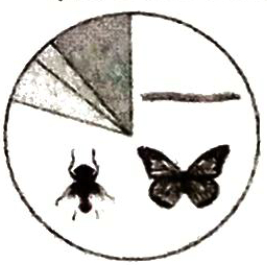
Based on the provided pie chart representing the diversity of invertebrates,which taxa represent the maximum and minimum proportions,respectively?
A
Molluscs,Insects
B
Insects,Other animal groups
C
Crustaceans,Molluscs
D
Insects,Crustaceans
Solution
(B) According to the $NCERT$ textbook diagram representing the global biodiversity of invertebrates,insects constitute the largest group,occupying the largest sector of the pie chart. The 'Other animal groups' (which includes minor phyla) occupy the smallest sector of the pie chart. Therefore,the correct sequence for maximum and minimum taxa is Insects and Other animal groups,respectively. Thus,option $B$ is correct.
0 likesView Solution
7
BiologyEasyMCQGSEB · 2020
Which organism infects tobacco root and decreases its yield?
A
Nematode- Meloidogyne incognitia
B
Bacteria- Meloidogyne incognitia
C
Bacteria- Thermus aquaticus
D
Nematode- Wuchereria
Solution
(A) The correct answer is $A$. The nematode $Meloidogyne \, incognitia$ infects the roots of tobacco plants and causes a significant reduction in yield. Biotechnology, specifically $RNA$ interference $(RNAi)$, is used to develop pest-resistant tobacco plants by silencing specific genes of this nematode.
0 likesView Solution
8
BiologyEasyMCQGSEB · 2020
Adenosine deaminase $(ADA)$ deficiency is most commonly caused by which genetic abnormality?
A
Inversion
B
Duplication
C
Deletion
D
Transposons
Solution
(C) The correct answer is $C$. Adenosine deaminase $(ADA)$ deficiency is a severe combined immunodeficiency $(SCID)$ disorder. It is most commonly caused by a deletion in the gene that codes for the enzyme adenosine deaminase. This enzyme is crucial for the proper functioning of the immune system,specifically for the maturation of $T$-lymphocytes. The absence of this enzyme leads to the accumulation of toxic metabolites,which destroy the immune cells.
0 likesView Solution
9
BiologyEasyMCQGSEB · 2020
Rosie is . . . . . . .
A
Transgenic plant
B
Transgenic vaccine
C
Transgenic cow
D
Transgenic insecticidal
Solution
(C) Rosie was the first transgenic cow produced by scientists.
She was genetically engineered to produce human protein-enriched milk,specifically containing human alpha-lactalbumin.
This milk was nutritionally more balanced for human babies than natural cow milk.
She was genetically engineered to produce human protein-enriched milk,specifically containing human alpha-lactalbumin.
This milk was nutritionally more balanced for human babies than natural cow milk.
0 likesView Solution
10
BiologyEasyMCQGSEB · 2020
$CryIAc$ and $CryIAb$ code for the proteins which control . . . . . . and . . . . . . respectively.
A
Cotton bollworm - Corn borer
B
Corn borer - Cotton bollworm
C
Lepidopterans - Coleopterans
D
Coleopterans - Lepidopterans
Solution
(A) The proteins encoded by the genes $CryIAc$ and $CryIAb$ are used to control cotton bollworms and corn borers,respectively.
These genes are derived from the bacterium $Bacillus$ $thuringiensis$ $(Bt)$.
$CryIAc$ is specifically effective against cotton bollworms,while $CryIAb$ is effective against corn borers.
Therefore,the correct sequence is Cotton bollworm and Corn borer.
These genes are derived from the bacterium $Bacillus$ $thuringiensis$ $(Bt)$.
$CryIAc$ is specifically effective against cotton bollworms,while $CryIAb$ is effective against corn borers.
Therefore,the correct sequence is Cotton bollworm and Corn borer.
0 likesView Solution
11
BiologyEasyMCQGSEB · 2020
Which restriction site is present in the $tet^{R}$ gene in $pBR322$?
A
$BamH I$
B
$Pvu I$
C
$Hind III$
D
$EcoR I$
Solution
(A) In the $pBR322$ cloning vector,the $tet^{R}$ (tetracycline resistance) gene contains restriction sites for $BamH I$ and $Sal I$.
The $amp^{R}$ (ampicillin resistance) gene contains restriction sites for $Pst I$ and $Pvu I$.
Therefore,$BamH I$ is the correct restriction site present in the $tet^{R}$ gene.
The $amp^{R}$ (ampicillin resistance) gene contains restriction sites for $Pst I$ and $Pvu I$.
Therefore,$BamH I$ is the correct restriction site present in the $tet^{R}$ gene.
0 likesView Solution
12
BiologyEasyMCQGSEB · 2020
Which enzymes are responsible for the breakdown of bacterial,plant,and fungal cell walls,respectively?
A
Lysozyme,cellulase,chitinase
B
Cellulase,chitinase,lysozyme
C
Chitinase,cellulase,lysozyme
D
Lysozyme,chitinase,cellulase
Solution
(A) In biotechnology,the isolation of $DNA$ from cells requires the breakdown of the cell wall to release the genetic material.
$1$. Bacterial cell walls are composed of peptidoglycan,which is degraded by the enzyme $Lysozyme$.
$2$. Plant cell walls are composed of cellulose,which is degraded by the enzyme $Cellulase$.
$3$. Fungal cell walls are composed of chitin,which is degraded by the enzyme $Chitinase$.
Therefore,the correct sequence for bacterial,plant,and fungal cell wall breakdown is $Lysozyme$,$Cellulase$,and $Chitinase$ respectively.
$1$. Bacterial cell walls are composed of peptidoglycan,which is degraded by the enzyme $Lysozyme$.
$2$. Plant cell walls are composed of cellulose,which is degraded by the enzyme $Cellulase$.
$3$. Fungal cell walls are composed of chitin,which is degraded by the enzyme $Chitinase$.
Therefore,the correct sequence for bacterial,plant,and fungal cell wall breakdown is $Lysozyme$,$Cellulase$,and $Chitinase$ respectively.
0 likesView Solution
13
BiologyEasyMCQGSEB · 2020
. . . . . . converts normal cells into cancerous cells.
A
Rhinovirus
B
Retrovirus
C
Bacteriophage
D
$TMV$
Solution
(B) Retroviruses are a group of viruses that contain $RNA$ as their genetic material. They possess an enzyme called reverse transcriptase,which allows them to convert their $RNA$ into $DNA$ inside the host cell. This viral $DNA$ then integrates into the host genome. Certain retroviruses,known as oncogenic retroviruses,carry viral oncogenes $(v-onc)$ or can activate host proto-oncogenes,which leads to the transformation of normal cells into cancerous cells.
0 likesView Solution
14
BiologyEasyMCQGSEB · 2020
If the primary producers have $100 \ J$ of energy,how much energy does the secondary consumer receive (in $J$)?
A
$10$
B
$100$
C
$1$
D
$0.1$
Solution
(C) According to the $10\%$ Law of energy transfer in an ecosystem,only about $10\%$ of the energy available at one trophic level is transferred to the next trophic level.
$1$. Primary Producers: $100 \ J$
$2$. Primary Consumers (First trophic level to second): $10\%$ of $100 \ J = 10 \ J$
$3$. Secondary Consumers (Second trophic level to third): $10\%$ of $10 \ J = 1 \ J$
Therefore,the secondary consumer receives $1 \ J$ of energy.
$1$. Primary Producers: $100 \ J$
$2$. Primary Consumers (First trophic level to second): $10\%$ of $100 \ J = 10 \ J$
$3$. Secondary Consumers (Second trophic level to third): $10\%$ of $10 \ J = 1 \ J$
Therefore,the secondary consumer receives $1 \ J$ of energy.
0 likesView Solution
15
BiologyEasyMCQGSEB · 2020
If a sparrow feeds on insects and worms,it is included in which of the following trophic levels?
A
Primary producer
B
Secondary consumer
C
Tertiary consumer
D
Quaternary consumer
Solution
(B) In an ecosystem,the trophic level is determined by the organism's position in the food chain.
$1$. The primary producers (plants) occupy the first trophic level.
$2$. Primary consumers (herbivores) feed on producers and occupy the second trophic level.
$3$. Insects and worms that feed on plants are primary consumers.
$4$. Since the sparrow feeds on these insects and worms,it acts as a carnivore that consumes primary consumers,placing it at the third trophic level,which is defined as a secondary consumer.
$1$. The primary producers (plants) occupy the first trophic level.
$2$. Primary consumers (herbivores) feed on producers and occupy the second trophic level.
$3$. Insects and worms that feed on plants are primary consumers.
$4$. Since the sparrow feeds on these insects and worms,it acts as a carnivore that consumes primary consumers,placing it at the third trophic level,which is defined as a secondary consumer.
0 likesView Solution
16
BiologyEasyMCQGSEB · 2020
The annual net primary productivity of the whole biosphere is approximately . . . . . . of dry weight of organic matter.
A
$170$ billion tons
B
$150$ billion tons
C
$190$ billion tons
D
$210$ billion tons
Solution
(A) The annual net primary productivity of the whole biosphere is estimated to be approximately $170$ billion tons (dry weight) of organic matter. This value represents the total amount of biomass produced by all producers (plants, algae, and bacteria) across the entire planet in a year.
0 likesView Solution
17
BiologyEasyMCQGSEB · 2020
In a marine ecosystem,the biomass pyramid is . . . . . . .
A
Upright
B
Inverted
C
Linear
D
Cyclic
Solution
(B) In a marine ecosystem,the biomass pyramid is inverted. This is because the biomass of producers (phytoplankton) is significantly lower than the biomass of the consumers (zooplankton and small fish) that feed on them. Since the producers have a very high turnover rate,they support a larger biomass of consumers at any given time,resulting in an inverted shape.
0 likesView Solution
18
BiologyEasyMCQGSEB · 2020
Which type of evolution is shown by tendrils of Cucurbita and thorns of Bougainvillea?
A
Divergent
B
Convergent
C
Divergent and Convergent
D
Directional
Solution
(A) Tendrils of $Cucurbita$ and thorns of $Bougainvillea$ are classic examples of homologous organs.
Homologous organs are those that share a common anatomical structure and developmental origin but may perform different functions.
This phenomenon,where organisms with a common ancestor evolve different traits to adapt to different environments,is known as divergent evolution.
Therefore,the correct answer is $A$ (Divergent).
Homologous organs are those that share a common anatomical structure and developmental origin but may perform different functions.
This phenomenon,where organisms with a common ancestor evolve different traits to adapt to different environments,is known as divergent evolution.
Therefore,the correct answer is $A$ (Divergent).
0 likesView Solution
19
BiologyEasyMCQGSEB · 2020
During evolution, . . . . . . evolved into the first amphibians.
A
Cartilaginous fish
B
Bony fish
C
Reptiles
D
Lobe fins
Solution
(D) The correct answer is $D$. Lobe-finned fish (coelacanths) are considered the ancestors of the first amphibians. These fish had fins with fleshy lobes that allowed them to move on land for short periods,eventually leading to the evolution of tetrapods (amphibians).
0 likesView Solution
20
BiologyEasyMCQGSEB · 2020
In the diagrammatic representation of the operation of natural selection,two peaks are formed. This condition shows the effect of . . . . . . .
A
Directional
B
Stabilising
C
Disruptive
D
Destructive
Solution
(C) The correct answer is $C$.
Natural selection can lead to three different outcomes based on the distribution of traits in a population:
$1$. Stabilising selection: The mean value of the trait is favoured,resulting in a single,narrower peak.
$2$. Directional selection: One extreme phenotype is favoured,shifting the peak in one direction.
$3$. Disruptive selection: Both extreme phenotypes are favoured over the intermediate phenotype,resulting in the formation of two peaks in the distribution graph.
Therefore,the formation of two peaks indicates the effect of disruptive selection.
Natural selection can lead to three different outcomes based on the distribution of traits in a population:
$1$. Stabilising selection: The mean value of the trait is favoured,resulting in a single,narrower peak.
$2$. Directional selection: One extreme phenotype is favoured,shifting the peak in one direction.
$3$. Disruptive selection: Both extreme phenotypes are favoured over the intermediate phenotype,resulting in the formation of two peaks in the distribution graph.
Therefore,the formation of two peaks indicates the effect of disruptive selection.
0 likesView Solution
21
BiologyEasyMCQGSEB · 2020
The bones of forelimbs have similar anatomical structure is . . . . . . .
A
Divergent evolution
B
Convergent evolution
C
Peripheral evolution
D
Radial evolution
Solution
(A) The similarity in the anatomical structure of the forelimbs of different mammals (like humans,whales,bats,and cheetahs) is an example of homologous organs.
These organs share a common ancestral origin but have evolved to perform different functions due to adaptation to different environments.
This process,where organisms with a common ancestor evolve different traits,is known as $Divergent$ $evolution$.
These organs share a common ancestral origin but have evolved to perform different functions due to adaptation to different environments.
This process,where organisms with a common ancestor evolve different traits,is known as $Divergent$ $evolution$.
0 likesView Solution
22
BiologyEasyMCQGSEB · 2020
Symptoms of restlessness,shivering,nausea,and sweating are seen in which disease?
A
Turner's syndrome
B
Down's syndrome
C
Klinefelter syndrome
D
Withdrawal syndrome
Solution
(D) The correct answer is $D$.
Withdrawal syndrome refers to the set of physical and psychological symptoms that occur when a person who is dependent on a substance (such as drugs or alcohol) suddenly stops or reduces its intake.
Common symptoms include restlessness,shivering,nausea,sweating,anxiety,and tremors.
Turner's syndrome,Down's syndrome,and Klinefelter syndrome are genetic disorders caused by chromosomal abnormalities,not by the cessation of substance use.
Withdrawal syndrome refers to the set of physical and psychological symptoms that occur when a person who is dependent on a substance (such as drugs or alcohol) suddenly stops or reduces its intake.
Common symptoms include restlessness,shivering,nausea,sweating,anxiety,and tremors.
Turner's syndrome,Down's syndrome,and Klinefelter syndrome are genetic disorders caused by chromosomal abnormalities,not by the cessation of substance use.
0 likesView Solution
23
BiologyEasyMCQGSEB · 2020
Which of the following is not related to passive resistance?
A
Polio vaccine
B
Vaccine against snake venom
C
Colostrum
D
Tetanus antitoxin
Solution
(A) Passive immunity (or passive resistance) occurs when ready-made antibodies are directly given to the body to protect against a foreign agent.
$A$. Polio vaccine (oral) contains weakened pathogens that stimulate the body to produce its own antibodies,which is an example of active immunity.
$B$. Vaccine against snake venom (antivenom) contains pre-formed antibodies,which is passive immunity.
$C$. Colostrum contains $IgA$ antibodies transferred from mother to infant,which is natural passive immunity.
$D$. Tetanus antitoxin contains pre-formed antibodies,which is passive immunity.
Therefore,the Polio vaccine is the only option that relates to active immunity rather than passive resistance.
$A$. Polio vaccine (oral) contains weakened pathogens that stimulate the body to produce its own antibodies,which is an example of active immunity.
$B$. Vaccine against snake venom (antivenom) contains pre-formed antibodies,which is passive immunity.
$C$. Colostrum contains $IgA$ antibodies transferred from mother to infant,which is natural passive immunity.
$D$. Tetanus antitoxin contains pre-formed antibodies,which is passive immunity.
Therefore,the Polio vaccine is the only option that relates to active immunity rather than passive resistance.
0 likesView Solution
24
BiologyEasyMCQGSEB · 2020
What is obtained by the acetylation of morphine?
A
Brown sugar
B
Opium
C
Cocaine
D
Heroin
Solution
(D) The acetylation of morphine produces $Heroin$ (also known as $Diacetylmorphine$).
$Heroin$ is a white,odorless,bitter crystalline compound.
It is synthesized by the acetylation of morphine,which is extracted from the latex of the poppy plant,$Papaver$ $somniferum$.
Therefore,the correct option is $D$.
$Heroin$ is a white,odorless,bitter crystalline compound.
It is synthesized by the acetylation of morphine,which is extracted from the latex of the poppy plant,$Papaver$ $somniferum$.
Therefore,the correct option is $D$.
0 likesView Solution
25
BiologyEasyMCQGSEB · 2020
. . . . . . transforms a normal cell into a cancerous cell.
A
Rhinovirus
B
Retroviruses
C
Bacteriophage
D
$T$.$M$.$V$
Solution
(B) Certain viruses known as oncogenic viruses have genes called viral oncogenes that can cause the transformation of normal cells into cancerous cells. Among the given options,$Retroviruses$ are well-known for their ability to transform normal cells into cancerous cells through the action of their viral oncogenes $(v-onc)$.
0 likesView Solution
26
BiologyEasyMCQGSEB · 2020
Antibodies . . . . . . are abundant in colostrum.
A
IgA
B
IgG
C
IgM
D
IgE
Solution
(A) The correct answer is $IgA$.
Colostrum is the yellowish fluid secreted by the mother during the initial days of lactation.
It contains abundant antibodies,specifically $IgA$,which are essential to provide passive immunity to the newborn infant.
Colostrum is the yellowish fluid secreted by the mother during the initial days of lactation.
It contains abundant antibodies,specifically $IgA$,which are essential to provide passive immunity to the newborn infant.
0 likesView Solution
27
BiologyEasyMCQGSEB · 2020
Match the correct pairs:
| Column $1$ | Column $2$ |
|---|---|
| $(i)$ Salmonella typhi | $(p)$ Malaria |
| (ii) Plasmodium | $(q)$ Typhoid |
| (iii) Entamoeba histolytica | $(r)$ Ringworm |
| (iv) Epidermophyton | $(s)$ Amoebiasis |
A
(i - q),(ii - p),(iii - s),(iv - r)
B
(i - r),(ii - q),(iii - p),(iv - s)
C
(i - q),(ii - r),(iii - s),(iv - p)
D
(i - p),(ii - q),(iii - r),(iv - s)
Solution
(A) The correct matches are as follows:
$(i)$ Salmonella typhi causes Typhoid fever $(q)$.
(ii) Plasmodium is the parasite responsible for Malaria $(p)$.
(iii) Entamoeba histolytica causes Amoebiasis $(s)$.
(iv) Epidermophyton is a fungus that causes Ringworm $(r)$.
Therefore,the correct matching is (i - q),(ii - p),(iii - s),(iv - r). The correct option is $A$.
$(i)$ Salmonella typhi causes Typhoid fever $(q)$.
(ii) Plasmodium is the parasite responsible for Malaria $(p)$.
(iii) Entamoeba histolytica causes Amoebiasis $(s)$.
(iv) Epidermophyton is a fungus that causes Ringworm $(r)$.
Therefore,the correct matching is (i - q),(ii - p),(iii - s),(iv - r). The correct option is $A$.
0 likesView Solution
28
BiologyMediumMCQGSEB · 2020
The secretion of interferon is inhibited by . . . . . . .
A
Physical barriers
B
Viral infection
C
Cellulose
D
Chemical agents
Solution
(D) Interferons are antiviral proteins secreted by virus-infected cells to protect neighboring healthy cells. They are part of the innate immune system. None of the provided options $(A, B, C, D)$ are known to specifically inhibit the secretion of interferons in a physiological context. Viral infection actually stimulates the production of interferons. Therefore,the question is scientifically flawed as none of the options act as an inhibitor of interferon secretion.
0 likesView Solution
29
BiologyEasyMCQGSEB · 2020
$A$ cancer patient is given $.........$ as biological response modifiers.
A
$\alpha$-interferon
B
$\beta$-interferon
C
$\gamma$-interferon
D
$\delta$-interferon
Solution
(A) Biological response modifiers are substances that stimulate the body's immune system to fight cancer. $\alpha$-interferons are commonly used as biological response modifiers in cancer treatment because they help activate the immune system to destroy tumor cells.
0 likesView Solution
30
BiologyEasyMCQGSEB · 2020
Testicular hormones like androgens are synthesized by . . . . . . .
A
Leydig's cells
B
Sertoli cells
C
Spermatogonia
D
Spermatozoa
Solution
(A) The correct answer is $A$.
Leydig's cells,also known as interstitial cells,are located in the interstitial spaces outside the seminiferous tubules.
These cells synthesize and secrete testicular hormones called androgens,primarily testosterone,under the influence of Luteinizing Hormone $(LH)$.
Leydig's cells,also known as interstitial cells,are located in the interstitial spaces outside the seminiferous tubules.
These cells synthesize and secrete testicular hormones called androgens,primarily testosterone,under the influence of Luteinizing Hormone $(LH)$.
0 likesView Solution
31
BiologyEasyMCQGSEB · 2020
Name the cells which provide nourishment to the spermatogonia.
A
Leydig's cells
B
Sertoli cells
C
Stem cells
D
Follicular epithelial cells
Solution
(B) Sertoli cells (also known as nurse cells) are specialized cells found within the seminiferous tubules of the testes. Their primary function is to provide structural and metabolic support,as well as nourishment,to the developing germ cells (spermatogonia) during the process of spermatogenesis.
0 likesView Solution
32
BiologyEasyMCQGSEB · 2020
Hormone responsible for causing stronger uterine contractions is . . . . . . .
A
$FSH$
B
$LH$
C
Oxytocin
D
Progesterone
Solution
(C) Oxytocin is a peptide hormone produced by the hypothalamus and released by the posterior pituitary gland.
It plays a critical role in the process of parturition (childbirth) by stimulating powerful contractions of the smooth muscles of the uterus.
These contractions help in the expulsion of the fetus from the birth canal.
Therefore,the correct option is $C$.
It plays a critical role in the process of parturition (childbirth) by stimulating powerful contractions of the smooth muscles of the uterus.
These contractions help in the expulsion of the fetus from the birth canal.
Therefore,the correct option is $C$.
0 likesView Solution
33
BiologyEasyMCQGSEB · 2020
Choose the correct pair.
A
Cyclosporin-$A$ - an immunosuppressive agent
B
Aspergillus niger - acetic acid
C
Clostridium butyricum - citric acid
D
Streptococcus - statin
Solution
(A) The correct pair is $Cyclosporin-A$ - an immunosuppressive agent.
$Cyclosporin-A$ is produced by the fungus $Trichoderma$ $polysporum$ and is used as an immunosuppressive agent in organ transplant patients.
$Aspergillus$ $niger$ produces citric acid,not acetic acid.
$Clostridium$ $butyricum$ produces butyric acid,not citric acid.
$Streptococcus$ is used for clot busters (streptokinase),whereas statins are produced by $Monascus$ $purpureus$.
$Cyclosporin-A$ is produced by the fungus $Trichoderma$ $polysporum$ and is used as an immunosuppressive agent in organ transplant patients.
$Aspergillus$ $niger$ produces citric acid,not acetic acid.
$Clostridium$ $butyricum$ produces butyric acid,not citric acid.
$Streptococcus$ is used for clot busters (streptokinase),whereas statins are produced by $Monascus$ $purpureus$.
0 likesView Solution
34
BiologyEasyMCQGSEB · 2020
Which virus is used as a biocontrol agent?
A
Baculoviruses
B
Adenovirus
C
Tobacco mosaic virus
D
Bacteriophage
Solution
(A) Baculoviruses are pathogens that attack insects and other arthropods. The majority of baculoviruses used as biological control agents are in the genus $Nucleopolyhedrovirus$. These viruses are excellent candidates for species-specific,narrow-spectrum insecticidal applications. They have been shown to have no negative impacts on plants,mammals,birds,fish,or even non-target insects,making them ideal for integrated pest management $(IPM)$ programs.
0 likesView Solution
35
BiologyEasyMCQGSEB · 2020
The bottled fruit juices bought from the market are clearer as compared to those made at home. This is because the bottled juices are cleared by the use of . . . . . . .
A
Pectinase
B
Proteases
C
Pectinase and proteases
D
Streptokinase
Solution
(C) Bottled fruit juices are clearer than homemade juices because they are treated with enzymes like $Pectinase$ and $Proteases$. These enzymes break down the pectin and proteins present in the fruit pulp,which helps in clarifying the juice and removing turbidity.
0 likesView Solution
36
BiologyEasyMCQGSEB · 2020
Flocs means . . . . . .
A
Activated sludge
B
Anaerobic sludge
C
Fungi mycelium and microbes
D
Primary sludge
Solution
(C) Flocs are masses of bacteria associated with fungal filaments to form mesh-like structures.
These structures are known as flocs.
They are formed during the secondary treatment of sewage,where aerobic microbes consume the organic matter in the effluent.
Therefore,flocs consist of fungi mycelium and microbes.
These structures are known as flocs.
They are formed during the secondary treatment of sewage,where aerobic microbes consume the organic matter in the effluent.
Therefore,flocs consist of fungi mycelium and microbes.
0 likesView Solution
37
BiologyEasyMCQGSEB · 2020
Which genus of fungi is used to form mycorrhiza?
A
Trichoderma
B
Saccharomyces
C
Glomus
D
Monascus
Solution
(C) The correct answer is $C$.
Mycorrhiza is a symbiotic association between a fungus and the roots of higher plants.
Many members of the genus $Glomus$ form mycorrhiza.
The fungal symbiont in these associations absorbs phosphorus from the soil and passes it to the plant.
Mycorrhiza is a symbiotic association between a fungus and the roots of higher plants.
Many members of the genus $Glomus$ form mycorrhiza.
The fungal symbiont in these associations absorbs phosphorus from the soil and passes it to the plant.
0 likesView Solution
38
BiologyEasyMCQGSEB · 2020
Which of the following options represents the stop codons (termination signals) in the genetic code?
A
$UAA$,$UAG$,$UGA$
B
$UGG$,$UGC$,$UCG$
C
$AAU$,$AUG$,$AAG$
D
$UGU$,$UGG$,$UGA$
Solution
(A) In the genetic code,there are $64$ codons,out of which $3$ codons do not code for any amino acid. These are known as stop codons or termination signals because they signal the end of the protein synthesis process. These three codons are $UAA$,$UAG$,and $UGA$.
0 likesView Solution
39
BiologyEasyMCQGSEB · 2020
If the template strand of $DNA$ has the sequence $ACG$,what will be the corresponding anticodon on the $tRNA$?
A
$UGC$
B
$ACG$
C
$TCG$
D
$UAC$
Solution
(B) The process of protein synthesis involves two main steps: transcription and translation.
$1$. During transcription,the template strand of $DNA$ $(ACG)$ is transcribed into $mRNA$. According to the base-pairing rules ($A$ pairs with $U$,$T$ pairs with $A$,$C$ pairs with $G$,and $G$ pairs with $C$),the $mRNA$ codon will be $UGC$.
$2$. During translation,the $tRNA$ carries an anticodon that is complementary to the $mRNA$ codon.
$3$. Since the $mRNA$ codon is $UGC$,the complementary anticodon on the $tRNA$ will be $ACG$ ($U$ pairs with $A$,$G$ pairs with $C$,and $C$ pairs with $G$).
Therefore,the correct option is $B$.
$1$. During transcription,the template strand of $DNA$ $(ACG)$ is transcribed into $mRNA$. According to the base-pairing rules ($A$ pairs with $U$,$T$ pairs with $A$,$C$ pairs with $G$,and $G$ pairs with $C$),the $mRNA$ codon will be $UGC$.
$2$. During translation,the $tRNA$ carries an anticodon that is complementary to the $mRNA$ codon.
$3$. Since the $mRNA$ codon is $UGC$,the complementary anticodon on the $tRNA$ will be $ACG$ ($U$ pairs with $A$,$G$ pairs with $C$,and $C$ pairs with $G$).
Therefore,the correct option is $B$.
0 likesView Solution
40
BiologyEasyMCQGSEB · 2020
How many hydrogen bonds are found between nitrogen bases in $DNA$ having $50$ nitrogen base pairs with $20$ thymine?
A
$40$
B
$90$
C
$50$
D
$130$
Solution
(D) According to Chargaff's rule,in a double-stranded $DNA$ molecule,the amount of Adenine $(A)$ equals the amount of Thymine $(T)$,and the amount of Guanine $(G)$ equals the amount of Cytosine $(C)$.
Given: Total base pairs = $50$,so total nitrogen bases = $100$.
Number of Thymine $(T)$ = $20$.
Therefore,number of Adenine $(A)$ = $20$.
Number of $A-T$ pairs = $20$.
Number of $G-C$ pairs = Total base pairs - $A-T$ pairs = $50 - 20 = 30$.
Hydrogen bonds between $A$ and $T$ = $2 \times 20 = 40$.
Hydrogen bonds between $G$ and $C$ = $3 \times 30 = 90$.
Total hydrogen bonds = $40 + 90 = 130$.
Given: Total base pairs = $50$,so total nitrogen bases = $100$.
Number of Thymine $(T)$ = $20$.
Therefore,number of Adenine $(A)$ = $20$.
Number of $A-T$ pairs = $20$.
Number of $G-C$ pairs = Total base pairs - $A-T$ pairs = $50 - 20 = 30$.
Hydrogen bonds between $A$ and $T$ = $2 \times 20 = 40$.
Hydrogen bonds between $G$ and $C$ = $3 \times 30 = 90$.
Total hydrogen bonds = $40 + 90 = 130$.
0 likesView Solution
41
BiologyEasyMCQGSEB · 2020
Determining the coding and non-coding functions of the genome is called . . . . . . .
A
Expressed
B
Sequence Annotation
C
Bacterial artificial chromosomes
D
Yeast artificial chromosome
Solution
(B) The process of identifying all the genes in a genome and determining their functions,including both coding and non-coding sequences,is known as $Sequence \ Annotation$. This is a crucial step in the Human Genome Project to understand the biological significance of the sequenced $DNA$.
0 likesView Solution
42
BiologyEasyMCQGSEB · 2020
Which plant exhibits sexual deceit for the purpose of pollination?
A
All orchids
B
Vallisneria
C
Mediterranean orchid
D
Fig
Solution
(C) Sexual deceit is a specialized pollination strategy where a plant mimics the female of a specific insect species to attract the male of that species for pollination.
In the case of the Mediterranean orchid $(Ophrys)$,one petal of the flower bears an uncanny resemblance to the female of the bee species in size,color,and markings.
The male bee perceives the flower as a female and attempts to copulate with it,a process known as pseudocopulation.
During this attempt,pollen grains are dusted onto the bee's body,which are then transferred to another flower when the bee visits it,thus ensuring pollination.
In the case of the Mediterranean orchid $(Ophrys)$,one petal of the flower bears an uncanny resemblance to the female of the bee species in size,color,and markings.
The male bee perceives the flower as a female and attempts to copulate with it,a process known as pseudocopulation.
During this attempt,pollen grains are dusted onto the bee's body,which are then transferred to another flower when the bee visits it,thus ensuring pollination.
0 likesView Solution
43
BiologyEasyMCQGSEB · 2020
Select the correct statement for parasitism.
A
Harmful for both the organisms.
B
Beneficial to both the organisms.
C
Beneficial for one organism and no effect on the other organism.
D
Beneficial for one organism and harmful to the other organism.
Solution
(D) Parasitism is a type of population interaction where one organism,known as the parasite,derives nutrition and shelter from another organism,known as the host. In this interaction,the parasite is benefited $(+)$ while the host is harmed $(-)$. Therefore,it is a $(+, -)$ interaction.
0 likesView Solution
44
BiologyEasyMCQGSEB · 2020
Which of the following organisms reproduces only once in its lifetime?
A
Oyster
B
Desert lizard
C
Bamboo
D
Kangaroo rat
Solution
(C) The correct answer is $C$.
Some organisms,such as bamboo,reproduce only once in their lifetime.
Bamboo species are known for their unique life history strategy where they grow vegetatively for many years (often $50-100$ years) and then flower and produce seeds only once before dying (monocarpic).
Some organisms,such as bamboo,reproduce only once in their lifetime.
Bamboo species are known for their unique life history strategy where they grow vegetatively for many years (often $50-100$ years) and then flower and produce seeds only once before dying (monocarpic).
0 likesView Solution
45
BiologyEasyMCQGSEB · 2020
On which chromosomes are the genes associated with $\alpha$-thalassemia and $\beta$-thalassemia respectively located?
A
$16^{\text{th}}$ and $11^{\text{th}}$
B
$11^{\text{th}}$ and $16^{\text{th}}$
C
$18^{\text{th}}$ and $11^{\text{th}}$
D
$12^{\text{th}}$ and $18^{\text{th}}$
Solution
(A) Thalassemia is an autosomal recessive blood disorder.
$\alpha$-thalassemia is caused by mutations in the genes $HBA1$ and $HBA2$,which are located on chromosome $16$.
$\beta$-thalassemia is caused by mutations in the $HBB$ gene,which is located on chromosome $11$.
Therefore,the genes associated with $\alpha$-thalassemia and $\beta$-thalassemia are located on the $16^{\text{th}}$ and $11^{\text{th}}$ chromosomes,respectively.
$\alpha$-thalassemia is caused by mutations in the genes $HBA1$ and $HBA2$,which are located on chromosome $16$.
$\beta$-thalassemia is caused by mutations in the $HBB$ gene,which is located on chromosome $11$.
Therefore,the genes associated with $\alpha$-thalassemia and $\beta$-thalassemia are located on the $16^{\text{th}}$ and $11^{\text{th}}$ chromosomes,respectively.
0 likesView Solution
46
BiologyEasyMCQGSEB · 2020
Which of the following is a Mendelian disorder?
A
Turner's syndrome
B
Cystic fibrosis
C
Klinefelter's syndrome
D
Down's syndrome
Solution
(B) Mendelian disorders are primarily determined by alteration or mutation in a single gene.
$A$,$C$,and $D$ are chromosomal disorders caused by an excess,absence,or abnormal arrangement of chromosomes.
$B$ (Cystic fibrosis) is an autosomal recessive Mendelian disorder caused by a mutation in the $CFTR$ gene.
Therefore,the correct option is $B$.
$A$,$C$,and $D$ are chromosomal disorders caused by an excess,absence,or abnormal arrangement of chromosomes.
$B$ (Cystic fibrosis) is an autosomal recessive Mendelian disorder caused by a mutation in the $CFTR$ gene.
Therefore,the correct option is $B$.
0 likesView Solution
47
BiologyEasyMCQGSEB · 2020
The expression of only one parental trait in $F_1$ and the expression of both parental traits in $F_2$ can be explained by $ . . . . . . $.
A
Law of Segregation
B
Punnett Square
C
Law of dominance
D
Multivariate genes
Solution
(C) The $Law$ $of$ $Dominance$ states that in a heterozygous condition, only one allele (the dominant one) expresses its phenotype in the $F_1$ generation, masking the other (recessive) allele. However, during gamete formation, these alleles segregate, allowing the recessive trait to reappear in the $F_2$ generation when the recessive alleles pair up again. Thus, the appearance of only one trait in $F_1$ and both traits in $F_2$ is explained by the $Law$ $of$ $Dominance$.
0 likesView Solution
48
BiologyEasyMCQGSEB · 2020
In bees,the female gamete does not fertilize and produces offspring. This event is known as . . . . . .
A
Parthenogenesis
B
Sexual reproduction
C
Multiplicity
D
Coincidental generation
Solution
(A) In bees,the process where an unfertilized egg develops into a new individual is called Parthenogenesis. In this system,the queen bee produces eggs by meiosis,and if an egg remains unfertilized,it develops into a male (drone) by parthenogenesis. This is a form of asexual reproduction occurring within a sexual species.
0 likesView Solution
49
BiologyEasyMCQGSEB · 2020
If the father gives $I^B$ allele and the mother gives $I^A$ allele,state the genotype and blood group of the offspring.
A
$I^A I^B - AB$
B
$I^A I^B - A$
C
$I^A I^B - B$
D
$I^A I^A - AB$
Solution
(A) In human blood group inheritance,the $ABO$ blood group system is controlled by the gene $I$. The gene $I$ has three alleles: $I^A$,$I^B$,and $i$.
When the father contributes the $I^B$ allele and the mother contributes the $I^A$ allele,the resulting genotype of the offspring is $I^A I^B$.
According to the principle of codominance,both $I^A$ and $I^B$ alleles are expressed equally in the presence of each other.
Therefore,the individual with the genotype $I^A I^B$ will have blood group $AB$.
When the father contributes the $I^B$ allele and the mother contributes the $I^A$ allele,the resulting genotype of the offspring is $I^A I^B$.
According to the principle of codominance,both $I^A$ and $I^B$ alleles are expressed equally in the presence of each other.
Therefore,the individual with the genotype $I^A I^B$ will have blood group $AB$.
0 likesView Solution
50
BiologyEasyMCQGSEB · 2020
Which of the following is an incompatible reason for Medical Termination of Pregnancy $(MTP)$?
A
Contraceptive failure
B
In case of rape
C
It was legalized by the Government of India in $1971$
D
If the embryo is female
Solution
(D) The Medical Termination of Pregnancy $(MTP)$ Act,$1971$,was enacted by the Government of India to reduce illegal abortions and maternal mortality.
$MTP$ is permitted in cases of contraceptive failure,rape,or when the pregnancy poses a risk to the life of the mother or the child.
However,the use of $MTP$ for sex-selective abortion (i.e.,if the embryo is female) is illegal and strictly prohibited under the Pre-Conception and Pre-Natal Diagnostic Techniques $(PCPNDT)$ Act,$1994$.
$MTP$ is permitted in cases of contraceptive failure,rape,or when the pregnancy poses a risk to the life of the mother or the child.
However,the use of $MTP$ for sex-selective abortion (i.e.,if the embryo is female) is illegal and strictly prohibited under the Pre-Conception and Pre-Natal Diagnostic Techniques $(PCPNDT)$ Act,$1994$.
0 likesView Solution
51
BiologyEasyMCQGSEB · 2020
In which assisted reproductive technology is a donor's ovum transferred to the fallopian tube of another woman who cannot produce one?
A
$GIFT$
B
$ZIFT$
C
$IUT$
D
$AFT$
Solution
(A) $GIFT$ (Gamete Intra Fallopian Transfer) is the technique where an ovum collected from a donor is transferred into the fallopian tube of another female who cannot produce one,but can provide a suitable environment for fertilization and further development. Note: The original question mentioned 'testis',which is biologically incorrect for this procedure; it has been corrected to 'ovum'.
0 likesView Solution
52
BiologyEasyMCQGSEB · 2020
Which of the following methods is applicable in the case of a test tube baby?
A
$ICSI$
B
$IUI$
C
$GIFT$
D
$ZIFT$
Solution
(D) The term $Test$ $Tube$ $Baby$ refers to the process of $In$ $Vitro$ $Fertilization$ $(IVF)$,where fertilization occurs outside the body in a laboratory setting.
After fertilization,the resulting zygote or early embryo (up to $8$ blastomeres) is transferred into the fallopian tube,a procedure known as $Zygote$ $Intra$ $Fallopian$ $Transfer$ $(ZIFT)$.
$GIFT$ ($Gamete$ $Intra$ $Fallopian$ $Transfer$) involves transferring gametes,not embryos,and is used when fertilization cannot occur in vivo.
$IUI$ ($Intra$ $Uterine$ $Insemination$) is a technique where sperm is placed directly into the uterus.
$ICSI$ ($Intra$ $Cytoplasmic$ $Sperm$ $Injection$) is a specialized procedure to form an embryo in the laboratory.
Therefore,$ZIFT$ is the specific method used to transfer the embryo formed via $IVF$ into the fallopian tube.
After fertilization,the resulting zygote or early embryo (up to $8$ blastomeres) is transferred into the fallopian tube,a procedure known as $Zygote$ $Intra$ $Fallopian$ $Transfer$ $(ZIFT)$.
$GIFT$ ($Gamete$ $Intra$ $Fallopian$ $Transfer$) involves transferring gametes,not embryos,and is used when fertilization cannot occur in vivo.
$IUI$ ($Intra$ $Uterine$ $Insemination$) is a technique where sperm is placed directly into the uterus.
$ICSI$ ($Intra$ $Cytoplasmic$ $Sperm$ $Injection$) is a specialized procedure to form an embryo in the laboratory.
Therefore,$ZIFT$ is the specific method used to transfer the embryo formed via $IVF$ into the fallopian tube.
0 likesView Solution
53
BiologyEasyMCQGSEB · 2020
Chlamydia,trichomoniasis and syphilis are . . . . . . diseases.
A
$STI$
B
$MTP$
C
$IUI$
D
Non-infectious diseases
Solution
(A) Chlamydia,trichomoniasis,and syphilis are all examples of Sexually Transmitted Infections ($STI$s).
$STI$s are diseases or infections which are transmitted through sexual intercourse with an infected person.
$MTP$ stands for Medical Termination of Pregnancy,which is a procedure,not a disease.
$IUI$ stands for Intrauterine Insemination,which is an assisted reproductive technology.
Therefore,the correct option is $A$.
$STI$s are diseases or infections which are transmitted through sexual intercourse with an infected person.
$MTP$ stands for Medical Termination of Pregnancy,which is a procedure,not a disease.
$IUI$ stands for Intrauterine Insemination,which is an assisted reproductive technology.
Therefore,the correct option is $A$.
0 likesView Solution
54
BiologyEasyMCQGSEB · 2020
Lactational amenorrhea is . . . . . . .
A
Lack of menstruation during heavy milk secretion
B
The beginning of the menstrual cycle
C
The corpus luteum disintegrates.
D
Lack of milk secretion
Solution
(A) Lactational amenorrhea refers to the natural absence of menstruation that occurs during the period of intense lactation following childbirth.
During this phase,high levels of prolactin inhibit the release of gonadotropin-releasing hormone $(GnRH)$ from the hypothalamus,which in turn prevents the secretion of follicle-stimulating hormone $(FSH)$ and luteinizing hormone $(LH)$.
As a result,ovulation does not occur,and the menstrual cycle is temporarily suspended.
This method is used as a natural contraceptive,effective for up to $6$ months postpartum.
During this phase,high levels of prolactin inhibit the release of gonadotropin-releasing hormone $(GnRH)$ from the hypothalamus,which in turn prevents the secretion of follicle-stimulating hormone $(FSH)$ and luteinizing hormone $(LH)$.
As a result,ovulation does not occur,and the menstrual cycle is temporarily suspended.
This method is used as a natural contraceptive,effective for up to $6$ months postpartum.
0 likesView Solution
Vedclass Products
For Students
Vedclass Test Series
Mock tests in real GSEB style covering Biology with performance analysis. 5-day free trial.
Start Free TrialFor Teachers
Exam Paper Generator
Generate Set A/B/C/D Biology papers from 7.5L+ questions in 2 minutes. 3 chapters free.
Try FreeFor Institutes
Online Exam Module
Run live GSEB mock exams with unlimited students, 360° analytics & white-label branding.
See DemoFrequently Asked Questions
How many Biology questions are in GSEB 2020?
There are 59 Biology questions from the GSEB 2020 paper on Vedclass, each with a detailed step-by-step solution in English.
Are GSEB 2020 Biology solutions available in English?
Yes. All solutions on this page are in English. You can also switch to English or Hindi using the language buttons above the questions.
Can I practice GSEB 2020 Biology as a timed test?
Yes. Use the Vedclass Test Series to attempt a full GSEB mock test covering Biology with time limits and instant score analysis.
Can teachers create Biology papers from GSEB previous year questions?
Yes. The Vedclass Exam Paper Generator lets teachers mix GSEB Biology questions and generate Set A/B/C/D papers in minutes.
For Teachers & Institutes
Build a Custom Biology Paper
Pick GSEB 2020 Biology questions, set difficulty, and generate Set A/B/C/D in 2 minutes.