
ChemistryQ51–83 of 111 questions
Page 2 of 2 · English
51
ChemistryMCQAIPMT · 2005
There exists a close association between the alga and the fungus within a lichen. The fungus
A
provides protection,anchorage and absorption for the alga
B
provides food for the alga
C
fixes the atmospheric nitrogen for the alga
D
release oxygen for the alga
Solution
(A) lichen is a symbiotic association between an alga (phycobiont) and a fungus (mycobiont).
In this mutualistic relationship,the alga is responsible for photosynthesis,providing food for both partners.
The fungus provides protection,anchorage,and absorption of water and mineral nutrients from the environment for the alga.
Therefore,the correct function of the fungus is to provide protection,anchorage,and absorption for the alga.
In this mutualistic relationship,the alga is responsible for photosynthesis,providing food for both partners.
The fungus provides protection,anchorage,and absorption of water and mineral nutrients from the environment for the alga.
Therefore,the correct function of the fungus is to provide protection,anchorage,and absorption for the alga.
0 likesView Solution
52
ChemistryMCQAIPMT · 2005
Ectophloic siphonostele is found in ...........
A
Adiantum and Cucurbitaceae
B
Osmunda and Equisetum
C
Marsilea and Botrychium
D
Dicksonia and Maidenhair fern
Solution
(B) An ectophloic siphonostele is a type of stele in which the phloem is present only on the outer side of the xylem. This arrangement is characteristic of certain Pteridophytes. Specifically,it is found in genera such as $Osmunda$ and $Equisetum$. In these plants,the central pith is surrounded by a ring of xylem,which is in turn surrounded by a ring of phloem.
0 likesView Solution
53
ChemistryMCQAIPMT · 2005
Through which cell of the embryo sac does the pollen tube enter the embryo sac?
A
Egg cell
B
Persistent synergid
C
Degenerated synergid
D
Central cell
Solution
(C) The pollen tube enters the embryo sac through the filiform apparatus present in the synergids. As the pollen tube approaches the micropylar end,one of the two synergids begins to degenerate. The pollen tube then enters the embryo sac through this degenerated synergid.
0 likesView Solution
54
ChemistryMCQAIPMT · 2005
Which of the following is the simplest amino acid?
A
Alanine
B
Asparagine
C
Glycine
D
Tyrosine
Solution
(C) The general structure of an amino acid is $R-CH(NH_2)-COOH$.
In this structure,$R$ represents the side chain.
For the simplest amino acid,the side chain $R$ must be the smallest possible group,which is a hydrogen atom $(H)$.
When $R = H$,the amino acid is Glycine $(NH_2-CH_2-COOH)$.
Since it has the smallest side chain,Glycine is considered the simplest amino acid.
In this structure,$R$ represents the side chain.
For the simplest amino acid,the side chain $R$ must be the smallest possible group,which is a hydrogen atom $(H)$.
When $R = H$,the amino acid is Glycine $(NH_2-CH_2-COOH)$.
Since it has the smallest side chain,Glycine is considered the simplest amino acid.
0 likesView Solution
55
ChemistryMCQAIPMT · 2005
Which of the following is an incorrect pair?
A
Combustion of fossil fuels - Release of $CO_2$
B
Nuclear energy - Radioactive waste
C
Solar energy - Greenhouse effect
D
Biomass fuel - Release of $CO_2$
Solution
(C) The correct answer is $C$. Solar energy is a clean,renewable source of energy that does not contribute to the greenhouse effect. In contrast,the combustion of fossil fuels and biomass releases $CO_2$,which is a greenhouse gas. Nuclear energy produces radioactive waste as a byproduct. Therefore,the pairing of solar energy with the greenhouse effect is incorrect.
0 likesView Solution
56
ChemistryMCQAIPMT · 2005
The displacement $x$ of a particle varies with time $t$ as $x = a e^{-\alpha t} + b e^{\beta t}$,where $a, b, \alpha$,and $\beta$ are positive constants. The velocity of the particle will:
A
be independent of $\beta$
B
drop to zero when $\alpha = \beta$
C
go on decreasing with time
D
go on increasing with time
Solution
(D) The displacement is given by $x = a e^{-\alpha t} + b e^{\beta t}$.
The velocity $v$ is the time derivative of displacement: $v = \frac{dx}{dt}$.
$v = \frac{d}{dt}(a e^{-\alpha t} + b e^{\beta t}) = a(-\alpha) e^{-\alpha t} + b(\beta) e^{\beta t}$.
$v = -a \alpha e^{-\alpha t} + b \beta e^{\beta t}$.
As time $t$ increases,the term $e^{-\alpha t}$ decreases towards zero,while the term $e^{\beta t}$ increases exponentially. Since $b, \beta > 0$,the term $b \beta e^{\beta t}$ will dominate for large $t$,causing the velocity $v$ to increase with time.
The velocity $v$ is the time derivative of displacement: $v = \frac{dx}{dt}$.
$v = \frac{d}{dt}(a e^{-\alpha t} + b e^{\beta t}) = a(-\alpha) e^{-\alpha t} + b(\beta) e^{\beta t}$.
$v = -a \alpha e^{-\alpha t} + b \beta e^{\beta t}$.
As time $t$ increases,the term $e^{-\alpha t}$ decreases towards zero,while the term $e^{\beta t}$ increases exponentially. Since $b, \beta > 0$,the term $b \beta e^{\beta t}$ will dominate for large $t$,causing the velocity $v$ to increase with time.
0 likesView Solution
57
ChemistryMCQAIPMT · 2005
Which one of the following arrangements represents the correct order of electron gain enthalpy (with negative sign) of the given atomic species :-
A
$Cl < F < S < O$
B
$O < S < F < Cl$
C
$S < O < Cl < F$
D
$F < Cl < O < S$
Solution
(B) The correct order of electron gain enthalpy (with negative sign) is $O < S < F < Cl$.
Generally,electron gain enthalpy becomes more negative (higher magnitude) across a period from left to right due to an increase in effective nuclear charge and a decrease in atomic size.
Down a group,electron gain enthalpy becomes less negative due to an increase in atomic size.
However,$F$ and $O$ have smaller sizes compared to $Cl$ and $S$ respectively,leading to strong inter-electronic repulsions in the $2p$ subshell. Consequently,$Cl$ has a higher electron gain enthalpy than $F$,and $S$ has a higher electron gain enthalpy than $O$.
Generally,electron gain enthalpy becomes more negative (higher magnitude) across a period from left to right due to an increase in effective nuclear charge and a decrease in atomic size.
Down a group,electron gain enthalpy becomes less negative due to an increase in atomic size.
However,$F$ and $O$ have smaller sizes compared to $Cl$ and $S$ respectively,leading to strong inter-electronic repulsions in the $2p$ subshell. Consequently,$Cl$ has a higher electron gain enthalpy than $F$,and $S$ has a higher electron gain enthalpy than $O$.
0 likesView Solution
58
ChemistryMCQAIPMT · 2005
The work functions for metals $A, B$ and $C$ are respectively $1.92\, eV, 2.0\, eV$ and $5\, eV$. According to Einstein's photoelectric equation,which of these metals will emit photoelectrons for an incident radiation of wavelength $4100\, \mathring{A}$?
A
None
B
$A$ only
C
$A$ and $B$ only
D
All the three metals
Solution
(C) The energy of an incident photon is given by $E = \frac{hc}{\lambda}$.
Using the approximation $E \approx \frac{12400}{\lambda (\text{in } \mathring{A})} eV$,we get:
$E = \frac{12400}{4100} \approx 3.02\, eV$.
Photoelectric emission occurs if the energy of the incident photon is greater than or equal to the work function $(\phi)$ of the metal.
For metal $A$: $\phi_A = 1.92\, eV$. Since $3.02\, eV > 1.92\, eV$,metal $A$ will emit photoelectrons.
For metal $B$: $\phi_B = 2.0\, eV$. Since $3.02\, eV > 2.0\, eV$,metal $B$ will emit photoelectrons.
For metal $C$: $\phi_C = 5.0\, eV$. Since $3.02\, eV < 5.0\, eV$,metal $C$ will not emit photoelectrons.
Therefore,only metals $A$ and $B$ will emit photoelectrons.
Using the approximation $E \approx \frac{12400}{\lambda (\text{in } \mathring{A})} eV$,we get:
$E = \frac{12400}{4100} \approx 3.02\, eV$.
Photoelectric emission occurs if the energy of the incident photon is greater than or equal to the work function $(\phi)$ of the metal.
For metal $A$: $\phi_A = 1.92\, eV$. Since $3.02\, eV > 1.92\, eV$,metal $A$ will emit photoelectrons.
For metal $B$: $\phi_B = 2.0\, eV$. Since $3.02\, eV > 2.0\, eV$,metal $B$ will emit photoelectrons.
For metal $C$: $\phi_C = 5.0\, eV$. Since $3.02\, eV < 5.0\, eV$,metal $C$ will not emit photoelectrons.
Therefore,only metals $A$ and $B$ will emit photoelectrons.
0 likesView Solution
59
ChemistryMCQAIPMT · 2005
Two vibrating tuning forks produce progressive waves given by $Y_1 = 4 \sin(500\pi t)$ and $Y_2 = 2 \sin(506\pi t)$. The number of beats produced per minute is:
A
$3$
B
$360$
C
$180$
D
$60$
Solution
(C) The general equation for a progressive wave is $Y = A \sin(2\pi n t)$,where $n$ is the frequency.
For the first tuning fork,$2\pi n_1 = 500\pi$,so $n_1 = 250 \text{ Hz}$.
For the second tuning fork,$2\pi n_2 = 506\pi$,so $n_2 = 253 \text{ Hz}$.
The number of beats per second is given by $|n_2 - n_1| = |253 - 250| = 3 \text{ beats/second}$.
To find the number of beats per minute,we multiply by $60$ seconds:
$\text{Beats per minute} = 3 \times 60 = 180$.
For the first tuning fork,$2\pi n_1 = 500\pi$,so $n_1 = 250 \text{ Hz}$.
For the second tuning fork,$2\pi n_2 = 506\pi$,so $n_2 = 253 \text{ Hz}$.
The number of beats per second is given by $|n_2 - n_1| = |253 - 250| = 3 \text{ beats/second}$.
To find the number of beats per minute,we multiply by $60$ seconds:
$\text{Beats per minute} = 3 \times 60 = 180$.
0 likesView Solution
60
ChemistryMCQAIPMT · 2005
The correct sequence of increasing covalent character is represented by:
A
$LiCl < NaCl < BeCl_2$
B
$BeCl_2 < LiCl < NaCl$
C
$NaCl < LiCl < BeCl_2$
D
$BeCl_2 < NaCl < LiCl$
Solution
(C) According to $Fajan's \ rule$,the covalent character of an ionic bond increases with an increase in the polarizing power of the cation.
Polarizing power is directly proportional to the charge density of the cation (charge/size ratio).
Comparing the cations $Na^+$,$Li^+$,and $Be^{2+}$:
$1$. $Na^+$ has a charge of $+1$ and a larger ionic radius.
$2$. $Li^+$ has a charge of $+1$ and a smaller ionic radius than $Na^+$.
$3$. $Be^{2+}$ has a higher charge of $+2$ and the smallest ionic radius among the three.
Thus,the polarizing power increases in the order: $Na^+ < Li^+ < Be^{2+}$.
Consequently,the covalent character increases in the order: $NaCl < LiCl < BeCl_2$.
Polarizing power is directly proportional to the charge density of the cation (charge/size ratio).
Comparing the cations $Na^+$,$Li^+$,and $Be^{2+}$:
$1$. $Na^+$ has a charge of $+1$ and a larger ionic radius.
$2$. $Li^+$ has a charge of $+1$ and a smaller ionic radius than $Na^+$.
$3$. $Be^{2+}$ has a higher charge of $+2$ and the smallest ionic radius among the three.
Thus,the polarizing power increases in the order: $Na^+ < Li^+ < Be^{2+}$.
Consequently,the covalent character increases in the order: $NaCl < LiCl < BeCl_2$.
0 likesView Solution
61
ChemistryMCQAIPMT · 2005
The angular resolution of a $10\,cm$ diameter telescope at a wavelength of $5000\,\mathring{A}$ is of the order of:
A
$10^{-4}\,\text{rad}$
B
$10^{-5}\,\text{rad}$
C
$10^{6}\,\text{rad}$
D
$10^{-2}\,\text{rad}$
Solution
(B) The angular resolution $\Delta \theta$ of a telescope is given by the formula: $\Delta \theta = \frac{1.22 \lambda}{D}$.
Given:
Diameter of the telescope,$D = 10\,cm = 0.1\,m$.
Wavelength,$\lambda = 5000\,\mathring{A} = 5000 \times 10^{-10}\,m = 5 \times 10^{-7}\,m$.
Substituting the values into the formula:
$\Delta \theta = \frac{1.22 \times 5 \times 10^{-7}}{0.1}$.
$\Delta \theta = 1.22 \times 5 \times 10^{-6}$.
$\Delta \theta = 6.1 \times 10^{-6}\,\text{rad}$.
This value is of the order of $10^{-5}\,\text{rad}$.
Given:
Diameter of the telescope,$D = 10\,cm = 0.1\,m$.
Wavelength,$\lambda = 5000\,\mathring{A} = 5000 \times 10^{-10}\,m = 5 \times 10^{-7}\,m$.
Substituting the values into the formula:
$\Delta \theta = \frac{1.22 \times 5 \times 10^{-7}}{0.1}$.
$\Delta \theta = 1.22 \times 5 \times 10^{-6}$.
$\Delta \theta = 6.1 \times 10^{-6}\,\text{rad}$.
This value is of the order of $10^{-5}\,\text{rad}$.
0 likesView Solution
62
ChemistryMCQAIPMT · 2005
In any fission process,the ratio $\frac{\text{mass of fission products}}{\text{mass of parent nucleus}}$ is
A
Less than $1$
B
Greater than $1$
C
Equal to $1$
D
Depends on the mass of the parent nucleus
Solution
(A) In a nuclear fission process,a heavy parent nucleus splits into lighter daughter nuclei (fission products).
According to Einstein's mass-energy equivalence principle,$E = \Delta m c^2$,the total mass of the fission products is slightly less than the mass of the parent nucleus because some mass is converted into energy (binding energy).
Therefore,$\text{mass of fission products} < \text{mass of parent nucleus}$.
Consequently,the ratio $\frac{\text{mass of fission products}}{\text{mass of parent nucleus}} < 1$.
According to Einstein's mass-energy equivalence principle,$E = \Delta m c^2$,the total mass of the fission products is slightly less than the mass of the parent nucleus because some mass is converted into energy (binding energy).
Therefore,$\text{mass of fission products} < \text{mass of parent nucleus}$.
Consequently,the ratio $\frac{\text{mass of fission products}}{\text{mass of parent nucleus}} < 1$.
0 likesView Solution
63
ChemistryMCQAIPMT · 2005
Carbon,Silicon,and Germanium atoms have four valence electrons each. Their valence and conduction bands are separated by energy band gaps represented by $(E_g)_C$,$(E_g)_{Si}$,and $(E_g)_{Ge}$ respectively. Which one of the following relationships is true in their case?
A
$(E_g)_C < (E_g)_{Ge}$
B
$(E_g)_C > (E_g)_{Si}$
C
$(E_g)_C = (E_g)_{Si}$
D
$(E_g)_C < (E_g)_{Si}$
Solution
(B) The energy band gap $(E_g)$ is the energy difference between the valence band and the conduction band.
For Carbon (diamond),the band gap is approximately $5.5 \ eV$.
For Silicon,the band gap is approximately $1.1 \ eV$.
For Germanium,the band gap is approximately $0.7 \ eV$.
Comparing these values,we find that $(E_g)_C > (E_g)_{Si} > (E_g)_{Ge}$.
Therefore,the relationship $(E_g)_C > (E_g)_{Si}$ is true.
For Carbon (diamond),the band gap is approximately $5.5 \ eV$.
For Silicon,the band gap is approximately $1.1 \ eV$.
For Germanium,the band gap is approximately $0.7 \ eV$.
Comparing these values,we find that $(E_g)_C > (E_g)_{Si} > (E_g)_{Ge}$.
Therefore,the relationship $(E_g)_C > (E_g)_{Si}$ is true.
0 likesView Solution
64
ChemistryMCQAIPMT · 2005
Carbon,Silicon,and Germanium atoms have four valence electrons each. Their valence and conduction bands are separated by energy band gaps represented by $(E_g)_C$,$(E_g)_{Si}$,and $(E_g)_{Ge}$ respectively. Which one of the following relationships is true in their case?
A
$(E_g)_C < (E_g)_{Ge}$
B
$(E_g)_C > (E_g)_{Si}$
C
$(E_g)_C = (E_g)_{Si}$
D
$(E_g)_C < (E_g)_{Si}$
Solution
(B) The energy band gap $(E_g)$ is the energy difference between the conduction band and the valence band.
For Carbon (diamond),Silicon,and Germanium,the energy band gaps are approximately:
$(E_g)_C \approx 5.4 \ eV$
$(E_g)_{Si} \approx 1.1 \ eV$
$(E_g)_{Ge} \approx 0.7 \ eV$
Comparing these values,we observe that $(E_g)_C > (E_g)_{Si} > (E_g)_{Ge}$.
Therefore,the relationship $(E_g)_C > (E_g)_{Si}$ is true.
For Carbon (diamond),Silicon,and Germanium,the energy band gaps are approximately:
$(E_g)_C \approx 5.4 \ eV$
$(E_g)_{Si} \approx 1.1 \ eV$
$(E_g)_{Ge} \approx 0.7 \ eV$
Comparing these values,we observe that $(E_g)_C > (E_g)_{Si} > (E_g)_{Ge}$.
Therefore,the relationship $(E_g)_C > (E_g)_{Si}$ is true.
0 likesView Solution
65
ChemistryMCQAIPMT · 2005
The angular resolution of a $10\,cm$ diameter telescope at a wavelength of $5000\,\mathring{A}$ is of the order of
A
$10^6\,rad$
B
$10^{-2}\,rad$
C
$10^{-4}\,rad$
D
$10^{-6}\,rad$
Solution
(D) The angular resolution $(d\theta)$ of a telescope is given by the formula: $d\theta = \frac{1.22 \lambda}{D}$.
Given:
Wavelength $\lambda = 5000\,\mathring{A} = 5000 \times 10^{-10}\,m = 5 \times 10^{-7}\,m$.
Diameter $D = 10\,cm = 0.1\,m$.
Substituting the values into the formula:
$d\theta = \frac{1.22 \times 5 \times 10^{-7}}{0.1} = 1.22 \times 5 \times 10^{-6} = 6.1 \times 10^{-6}\,rad$.
This value is of the order of $10^{-6}\,rad$.
Given:
Wavelength $\lambda = 5000\,\mathring{A} = 5000 \times 10^{-10}\,m = 5 \times 10^{-7}\,m$.
Diameter $D = 10\,cm = 0.1\,m$.
Substituting the values into the formula:
$d\theta = \frac{1.22 \times 5 \times 10^{-7}}{0.1} = 1.22 \times 5 \times 10^{-6} = 6.1 \times 10^{-6}\,rad$.
This value is of the order of $10^{-6}\,rad$.
0 likesView Solution
66
ChemistryMCQAIPMT · 2005
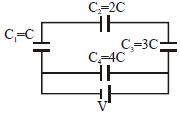
$A$ network of four capacitors with capacitances $C_1 = C$,$C_2 = 2C$,$C_3 = 3C$,and $C_4 = 4C$ is connected to a battery of voltage $V$ as shown in the figure. The ratio of the charges on $C_2$ and $C_4$ is
A
$\frac{22}{3}$
B
$\frac{3}{22}$
C
$\frac{7}{4}$
D
$\frac{4}{7}$
Solution
(B) The capacitor $C_4$ is connected directly across the battery of voltage $V$. Therefore,the charge on $C_4$ is $q_4 = C_4 \times V = 4CV$.
The capacitors $C_1$,$C_2$,and $C_3$ are connected in series with each other,and this series combination is connected in parallel with $C_4$ across the battery.
Let the equivalent capacitance of the series combination of $C_1$,$C_2$,and $C_3$ be $C'$.
$\frac{1}{C'} = \frac{1}{C_1} + \frac{1}{C_2} + \frac{1}{C_3} = \frac{1}{C} + \frac{1}{2C} + \frac{1}{3C} = \frac{6+3+2}{6C} = \frac{11}{6C}$.
Thus,$C' = \frac{6C}{11}$.
The charge $q'$ flowing through the series combination of $C_1$,$C_2$,and $C_3$ is given by $q' = C' \times V = \frac{6C}{11} \times V = \frac{6CV}{11}$.
Since $C_1$,$C_2$,and $C_3$ are in series,the charge on each of them is the same,which is $q'$.
Therefore,the charge on $C_2$ is $q_2 = q' = \frac{6CV}{11}$.
The ratio of the charges on $C_2$ and $C_4$ is $\frac{q_2}{q_4} = \frac{6CV/11}{4CV} = \frac{6}{44} = \frac{3}{22}$.
The capacitors $C_1$,$C_2$,and $C_3$ are connected in series with each other,and this series combination is connected in parallel with $C_4$ across the battery.
Let the equivalent capacitance of the series combination of $C_1$,$C_2$,and $C_3$ be $C'$.
$\frac{1}{C'} = \frac{1}{C_1} + \frac{1}{C_2} + \frac{1}{C_3} = \frac{1}{C} + \frac{1}{2C} + \frac{1}{3C} = \frac{6+3+2}{6C} = \frac{11}{6C}$.
Thus,$C' = \frac{6C}{11}$.
The charge $q'$ flowing through the series combination of $C_1$,$C_2$,and $C_3$ is given by $q' = C' \times V = \frac{6C}{11} \times V = \frac{6CV}{11}$.
Since $C_1$,$C_2$,and $C_3$ are in series,the charge on each of them is the same,which is $q'$.
Therefore,the charge on $C_2$ is $q_2 = q' = \frac{6CV}{11}$.
The ratio of the charges on $C_2$ and $C_4$ is $\frac{q_2}{q_4} = \frac{6CV/11}{4CV} = \frac{6}{44} = \frac{3}{22}$.
0 likesView Solution
67
ChemistryMCQAIPMT · 2005
Which one of the following oxides is expected to exhibit paramagnetic behaviour?
A
$CO_2$
B
$ClO_2$
C
$SO_2$
D
$SiO_2$
Solution
(B) Paramagnetism is observed in species that contain at least one unpaired electron.
$CO_2$,$SO_2$,and $SiO_2$ are all diamagnetic as they have all electrons paired.
$ClO_2$ has a total of $19$ valence electrons $(7 + 6 \times 2 = 19)$,making it an odd-electron species.
Due to the presence of an unpaired electron,$ClO_2$ exhibits paramagnetic behaviour.
$CO_2$,$SO_2$,and $SiO_2$ are all diamagnetic as they have all electrons paired.
$ClO_2$ has a total of $19$ valence electrons $(7 + 6 \times 2 = 19)$,making it an odd-electron species.
Due to the presence of an unpaired electron,$ClO_2$ exhibits paramagnetic behaviour.
0 likesView Solution
68
ChemistryMCQAIPMT · 2005
Carbon,silicon,and germanium atoms have four valence electrons each. Their valence and conduction bands are separated by energy band gaps represented by $(Eg)_C$,$(Eg)_{Si}$,and $(Eg)_{Ge}$ respectively. Which one of the following relationships is true in their case?
A
$(Eg)_C > (Eg)_{Si}$
B
$(Eg)_C < (Eg)_{Si}$
C
$(Eg)_C = (Eg)_{Si}$
D
$(Eg)_C < (Eg)_{Ge}$
Solution
(A) The energy band gap $(Eg)$ is the energy difference between the valence band and the conduction band.
For Carbon (diamond),the band gap is approximately $5.5 \, eV$.
For Silicon,the band gap is approximately $1.1 \, eV$.
For Germanium,the band gap is approximately $0.7 \, eV$.
Comparing these values,we find that $(Eg)_C > (Eg)_{Si} > (Eg)_{Ge}$.
Therefore,the relationship $(Eg)_C > (Eg)_{Si}$ is true.
For Carbon (diamond),the band gap is approximately $5.5 \, eV$.
For Silicon,the band gap is approximately $1.1 \, eV$.
For Germanium,the band gap is approximately $0.7 \, eV$.
Comparing these values,we find that $(Eg)_C > (Eg)_{Si} > (Eg)_{Ge}$.
Therefore,the relationship $(Eg)_C > (Eg)_{Si}$ is true.
0 likesView Solution
69
ChemistryMCQAIPMT · 2005
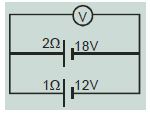
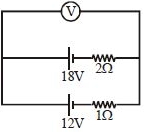
Two batteries,one of $emf$ $18 \, V$ and internal resistance $2 \, \Omega$ and the other of $emf$ $12 \, V$ and internal resistance $1 \, \Omega$,are connected in parallel as shown in the figure. The voltmeter $V$ will record a reading of ............. $V$.
A
$18$
B
$30$
C
$14$
D
$15$
Solution
(C) When two cells with $emf$ $E_1$ and $E_2$ and internal resistances $r_1$ and $r_2$ are connected in parallel,the equivalent $emf$ $E_{eq}$ is given by the formula:
$E_{eq} = \frac{E_1 r_2 + E_2 r_1}{r_1 + r_2}$
Given: $E_1 = 18 \, V$,$r_1 = 2 \, \Omega$,$E_2 = 12 \, V$,$r_2 = 1 \, \Omega$.
Substituting the values into the formula:
$E_{eq} = \frac{(18 \times 1) + (12 \times 2)}{2 + 1}$
$E_{eq} = \frac{18 + 24}{3}$
$E_{eq} = \frac{42}{3} = 14 \, V$
The voltmeter connected across the parallel combination will measure the equivalent $emf$ of the circuit.
Therefore,the reading of the voltmeter is $14 \, V$.
$E_{eq} = \frac{E_1 r_2 + E_2 r_1}{r_1 + r_2}$
Given: $E_1 = 18 \, V$,$r_1 = 2 \, \Omega$,$E_2 = 12 \, V$,$r_2 = 1 \, \Omega$.
Substituting the values into the formula:
$E_{eq} = \frac{(18 \times 1) + (12 \times 2)}{2 + 1}$
$E_{eq} = \frac{18 + 24}{3}$
$E_{eq} = \frac{42}{3} = 14 \, V$
The voltmeter connected across the parallel combination will measure the equivalent $emf$ of the circuit.
Therefore,the reading of the voltmeter is $14 \, V$.
0 likesView Solution
70
ChemistryMCQAIPMT · 2005
Two vibrating tuning forks produce progressive waves given by $Y_1 = 4 \sin(500 \pi t)$ and $Y_2 = 2 \sin(506 \pi t)$. The number of beats produced per minute is:
A
$3$
B
$360$
C
$180$
D
$60$
Solution
(C) The given wave equations are $Y_1 = 4 \sin(500 \pi t)$ and $Y_2 = 2 \sin(506 \pi t)$.
Comparing these with the standard equation $Y = A \sin(\omega t)$,where $\omega = 2 \pi \nu$:
For the first wave: $\omega_1 = 500 \pi \implies 2 \pi \nu_1 = 500 \pi \implies \nu_1 = 250 \text{ Hz}$.
For the second wave: $\omega_2 = 506 \pi \implies 2 \pi \nu_2 = 506 \pi \implies \nu_2 = 253 \text{ Hz}$.
The beat frequency is the difference between the two frequencies: $\nu_{beat} = |\nu_2 - \nu_1| = |253 - 250| = 3 \text{ beats/s}$.
To find the number of beats per minute,multiply the beats per second by $60$: $3 \times 60 = 180 \text{ beats/min}$.
Comparing these with the standard equation $Y = A \sin(\omega t)$,where $\omega = 2 \pi \nu$:
For the first wave: $\omega_1 = 500 \pi \implies 2 \pi \nu_1 = 500 \pi \implies \nu_1 = 250 \text{ Hz}$.
For the second wave: $\omega_2 = 506 \pi \implies 2 \pi \nu_2 = 506 \pi \implies \nu_2 = 253 \text{ Hz}$.
The beat frequency is the difference between the two frequencies: $\nu_{beat} = |\nu_2 - \nu_1| = |253 - 250| = 3 \text{ beats/s}$.
To find the number of beats per minute,multiply the beats per second by $60$: $3 \times 60 = 180 \text{ beats/min}$.
0 likesView Solution
71
ChemistryMCQAIPMT · 2005
If the magnetic dipole moment of an atom of diamagnetic material,paramagnetic material and ferromagnetic material are denoted by $\mu_d$,$\mu_p$ and $\mu_f$ respectively,then
A
$\mu_p = 0$ and $\mu_f \neq 0$
B
$\mu_d \neq 0$ and $\mu_p = 0$
C
$\mu_d \neq 0$ and $\mu_f \neq 0$
D
$\mu_d = 0$ and $\mu_p \neq 0$
Solution
(D) $1$. Diamagnetic materials consist of atoms where the orbital and spin magnetic moments of electrons cancel each other out,resulting in a net atomic magnetic dipole moment of $\mu_d = 0$.
$2$. Paramagnetic materials consist of atoms that possess a permanent magnetic dipole moment due to unpaired electrons,so $\mu_p \neq 0$.
$3$. Ferromagnetic materials consist of atoms that also possess a permanent magnetic dipole moment,so $\mu_f \neq 0$.
$4$. Therefore,the correct relationship is $\mu_d = 0$ and $\mu_p \neq 0$ (and $\mu_f \neq 0$).
$2$. Paramagnetic materials consist of atoms that possess a permanent magnetic dipole moment due to unpaired electrons,so $\mu_p \neq 0$.
$3$. Ferromagnetic materials consist of atoms that also possess a permanent magnetic dipole moment,so $\mu_f \neq 0$.
$4$. Therefore,the correct relationship is $\mu_d = 0$ and $\mu_p \neq 0$ (and $\mu_f \neq 0$).
0 likesView Solution
72
ChemistryMCQAIPMT · 2005
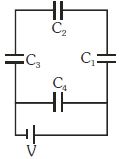
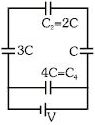
$A$ network of four capacitors with capacitances $C_1 = C$,$C_2 = 2C$,$C_3 = 3C$,and $C_4 = 4C$ is connected to a battery of potential $V$ as shown in the figure. The ratio of the charges on $C_2$ and $C_4$ is
A
$\frac{7}{4}$
B
$\frac{22}{3}$
C
$\frac{3}{22}$
D
$\frac{4}{7}$
Solution
(C) The capacitor $C_4$ is connected directly across the battery,so the potential difference across it is $V$. The charge on $C_4$ is $Q_4 = C_4 V = (4C)V = 4CV$.
The capacitors $C_3$,$C_2$,and $C_1$ are in series. Their equivalent capacitance $C_{eq}$ is given by $\frac{1}{C_{eq}} = \frac{1}{C_3} + \frac{1}{C_2} + \frac{1}{C_1} = \frac{1}{3C} + \frac{1}{2C} + \frac{1}{C} = \frac{2+3+6}{6C} = \frac{11}{6C}$.
Thus,$C_{eq} = \frac{6C}{11}$.
The charge on this series combination is $Q_{series} = C_{eq} V = \frac{6CV}{11}$.
Since $C_2$ is part of this series branch,the charge on $C_2$ is $Q_2 = Q_{series} = \frac{6CV}{11}$.
The ratio of the charges is $\frac{Q_2}{Q_4} = \frac{6CV/11}{4CV} = \frac{6}{44} = \frac{3}{22}$.
The capacitors $C_3$,$C_2$,and $C_1$ are in series. Their equivalent capacitance $C_{eq}$ is given by $\frac{1}{C_{eq}} = \frac{1}{C_3} + \frac{1}{C_2} + \frac{1}{C_1} = \frac{1}{3C} + \frac{1}{2C} + \frac{1}{C} = \frac{2+3+6}{6C} = \frac{11}{6C}$.
Thus,$C_{eq} = \frac{6C}{11}$.
The charge on this series combination is $Q_{series} = C_{eq} V = \frac{6CV}{11}$.
Since $C_2$ is part of this series branch,the charge on $C_2$ is $Q_2 = Q_{series} = \frac{6CV}{11}$.
The ratio of the charges is $\frac{Q_2}{Q_4} = \frac{6CV/11}{4CV} = \frac{6}{44} = \frac{3}{22}$.
0 likesView Solution
73
ChemistryMCQAIPMT · 2005
$A$ drum of radius $R$ and mass $M$ rolls down without slipping along an inclined plane of angle $\theta$. The frictional force
A
Decreases the rotational and translational motion
B
Dissipates energy as heat
C
Decreases the rotational motion
D
Converts translational energy to rotational energy
Solution
(D) When a body rolls down an inclined plane without slipping,the force of static friction acts on it.
This frictional force provides the necessary torque to initiate and maintain the rotational motion of the drum.
As the drum moves down,the gravitational potential energy is converted into both translational kinetic energy and rotational kinetic energy.
The frictional force acts to convert a portion of the translational energy into rotational energy,ensuring the condition of pure rolling (no slipping) is maintained.
Therefore,the frictional force converts translational energy into rotational energy.
This frictional force provides the necessary torque to initiate and maintain the rotational motion of the drum.
As the drum moves down,the gravitational potential energy is converted into both translational kinetic energy and rotational kinetic energy.
The frictional force acts to convert a portion of the translational energy into rotational energy,ensuring the condition of pure rolling (no slipping) is maintained.
Therefore,the frictional force converts translational energy into rotational energy.
0 likesView Solution
74
ChemistryMCQAIPMT · 2005
The work functions for metals $A, B$ and $C$ are respectively $1.92\, eV$,$2.0\, eV$ and $5\, eV$. According to Einstein's photoelectric equation,the metals which will emit photoelectrons for a radiation of wavelength $4100\, \mathring{A}$ is/are:
A
None
B
$A$ only
C
$A$ and $B$ only
D
All the three metals
Solution
(C) The energy of an incident photon is given by the formula $E = \frac{hc}{\lambda}$.
Using the approximation $hc \approx 12400\, eV\cdot\mathring{A}$,we get:
$E = \frac{12400\, eV\cdot\mathring{A}}{4100\, \mathring{A}} \approx 3.02\, eV$.
Photoelectric emission occurs if the energy of the incident photon is greater than the work function $(\Phi)$ of the metal.
For metal $A$: $\Phi_A = 1.92\, eV$. Since $3.02\, eV > 1.92\, eV$,metal $A$ will emit photoelectrons.
For metal $B$: $\Phi_B = 2.0\, eV$. Since $3.02\, eV > 2.0\, eV$,metal $B$ will emit photoelectrons.
For metal $C$: $\Phi_C = 5.0\, eV$. Since $3.02\, eV < 5.0\, eV$,metal $C$ will not emit photoelectrons.
Therefore,metals $A$ and $B$ will emit photoelectrons.
Using the approximation $hc \approx 12400\, eV\cdot\mathring{A}$,we get:
$E = \frac{12400\, eV\cdot\mathring{A}}{4100\, \mathring{A}} \approx 3.02\, eV$.
Photoelectric emission occurs if the energy of the incident photon is greater than the work function $(\Phi)$ of the metal.
For metal $A$: $\Phi_A = 1.92\, eV$. Since $3.02\, eV > 1.92\, eV$,metal $A$ will emit photoelectrons.
For metal $B$: $\Phi_B = 2.0\, eV$. Since $3.02\, eV > 2.0\, eV$,metal $B$ will emit photoelectrons.
For metal $C$: $\Phi_C = 5.0\, eV$. Since $3.02\, eV < 5.0\, eV$,metal $C$ will not emit photoelectrons.
Therefore,metals $A$ and $B$ will emit photoelectrons.
0 likesView Solution
75
ChemistryMCQAIPMT · 2005
In a circuit,$L$,$C$,and $R$ are connected in series with an alternating voltage source of frequency $f$. The current leads the voltage by $45^{\circ}$. The value of $C$ is
A
$\frac{1}{2 \pi f(2 \pi f L+R)}$
B
$\frac{1}{\pi f(2 \pi f L+R)}$
C
$\frac{1}{2 \pi f(2 \pi f L-R)}$
D
$\frac{1}{\pi f(2 \pi f L-R)}$
Solution
(A) The phase angle $\phi$ in an $LCR$ series circuit is given by $\tan \phi = \frac{X_C - X_L}{R}$,where the current leads the voltage when $X_C > X_L$.
Given that the current leads the voltage by $45^{\circ}$,we have $\phi = -45^{\circ}$ (or using the magnitude,$\tan 45^{\circ} = \frac{X_C - X_L}{R}$).
Substituting $X_C = \frac{1}{\omega C}$ and $X_L = \omega L$:
$1 = \frac{\frac{1}{\omega C} - \omega L}{R}$
$R = \frac{1}{\omega C} - \omega L$
$\frac{1}{\omega C} = R + \omega L$
$C = \frac{1}{\omega(R + \omega L)}$
Since $\omega = 2 \pi f$,we get:
$C = \frac{1}{2 \pi f(R + 2 \pi f L)}$
Given that the current leads the voltage by $45^{\circ}$,we have $\phi = -45^{\circ}$ (or using the magnitude,$\tan 45^{\circ} = \frac{X_C - X_L}{R}$).
Substituting $X_C = \frac{1}{\omega C}$ and $X_L = \omega L$:
$1 = \frac{\frac{1}{\omega C} - \omega L}{R}$
$R = \frac{1}{\omega C} - \omega L$
$\frac{1}{\omega C} = R + \omega L$
$C = \frac{1}{\omega(R + \omega L)}$
Since $\omega = 2 \pi f$,we get:
$C = \frac{1}{2 \pi f(R + 2 \pi f L)}$
0 likesView Solution
76
ChemistryMCQAIPMT · 2005
One of the most important functions of botanical gardens is that
A
they provide a beautiful area for recreation.
B
one can observe tropical plants there.
C
they allow ex-situ conservation of germ plasm.
D
they provide the natural habitat for wildlife.
Solution
(C) Ex-situ conservation refers to off-site conservation.
It is the process of protecting an endangered species of plant or animal by removing it from an unsafe or threatened habitat and placing it or part of it under human care.
Botanical gardens serve as a primary method for the ex-situ conservation of plant germplasm,ensuring the survival of species outside their natural environment.
It is the process of protecting an endangered species of plant or animal by removing it from an unsafe or threatened habitat and placing it or part of it under human care.
Botanical gardens serve as a primary method for the ex-situ conservation of plant germplasm,ensuring the survival of species outside their natural environment.
0 likesView Solution
77
ChemistryMCQAIPMT · 2005
Which one of the following characters is not typical of the class Mammalia?
A
Seven cervical vertebrae
B
Thecodont dentition
C
Ten pairs of cranial nerves
D
Alveolar lungs
Solution
(C) The class Mammalia is characterized by having $12$ pairs of cranial nerves. The option stating 'Ten pairs of cranial nerves' is incorrect for mammals,as this is a characteristic feature of amphibians and fishes. Therefore,it is not a typical character of mammals.
0 likesView Solution
78
ChemistryMCQAIPMT · 2005
According to the widely accepted "fluid mosaic model", cell membranes are semi-fluid, where lipids and integral proteins can diffuse randomly. In recent years, this model has been modified in several respects. In this regard, which of the following statements is incorrect?
A
Proteins in cell membranes can travel within the lipid bilayer.
B
Proteins can also undergo flip-flop movements in the lipid bilayer.
C
Proteins can remain confined within certain domains of the membrane.
D
Many proteins remain completely embedded within the lipid bilayer.
Solution
(B) The fluid mosaic model describes the cell membrane as a quasi-fluid structure where lipids and proteins can move laterally.
$A$, $C$, and $D$ are consistent with the fluid nature and the structural organization of the membrane.
However, $B$ is incorrect because proteins do not undergo flip-flop movements (transverse diffusion) across the lipid bilayer due to their large size and polar nature, which makes it energetically unfavorable to pass through the hydrophobic core of the membrane.
$A$, $C$, and $D$ are consistent with the fluid nature and the structural organization of the membrane.
However, $B$ is incorrect because proteins do not undergo flip-flop movements (transverse diffusion) across the lipid bilayer due to their large size and polar nature, which makes it energetically unfavorable to pass through the hydrophobic core of the membrane.
0 likesView Solution
79
ChemistryMCQAIPMT · 2005
For retting of jute,the fermenting microbe used is:
A
Helicobacter pylori
B
Methophilic bacteria
C
Streptococcus lactis
D
Butyric acid bacteria
Solution
(D) Retting is a process that uses microorganisms and moisture to dissolve or rot away cellular tissues and the pectin surrounding bast-fiber bundles,facilitating the separation of the fiber from the stem. This process is primarily facilitated by anaerobic butyric acid bacteria,such as species of the genus $Clostridium$ (e.g.,$Clostridium$ $butyricum$).
0 likesView Solution
80
ChemistryMCQAIPMT · 2005
$G-6-P$ dehydrogenase deficiency is associated with haemolysis of:
A
Lymphocytes
B
$RBCs$
C
Platelets
D
Leucocytes
Solution
(B) $G-6-P$ (Glucose$-6-$phosphate) dehydrogenase is an enzyme essential for the proper functioning of red blood cells $(RBCs)$.
It plays a critical role in the pentose phosphate pathway,which generates $NADPH$,a molecule that protects $RBCs$ from oxidative damage.
When this enzyme is deficient,$RBCs$ become susceptible to oxidative stress,leading to their premature destruction,a process known as haemolysis.
It plays a critical role in the pentose phosphate pathway,which generates $NADPH$,a molecule that protects $RBCs$ from oxidative damage.
When this enzyme is deficient,$RBCs$ become susceptible to oxidative stress,leading to their premature destruction,a process known as haemolysis.
0 likesView Solution
81
ChemistryMCQAIPMT · 2005
Which of the following is not a hereditary disease?
A
Cretinism
B
Cystic fibrosis
C
Thalassemia
D
Haemophilia
Solution
(A) Cretinism is a condition characterized by severe physical and mental developmental delays,caused by a deficiency of thyroid hormones during fetal development or early infancy. It is not a genetic or hereditary disease.
Cystic fibrosis,Thalassemia,and Haemophilia are all examples of hereditary diseases caused by mutations in specific genes.
Cystic fibrosis,Thalassemia,and Haemophilia are all examples of hereditary diseases caused by mutations in specific genes.
0 likesView Solution
82
ChemistryMCQAIPMT · 2005
The salivary gland chromosomes in the dipteran larvae are useful in gene mapping because
A
These are much longer in size
B
These are easy to stain
C
These are fused
D
They have endoreduplicated chromosomes
Solution
(D) Salivary gland chromosomes,also known as polytene chromosomes,are found in the salivary glands of dipteran larvae.
These chromosomes are formed through a process called endoreduplication,where the $DNA$ replicates multiple times without cell division.
This results in giant chromosomes with distinct banding patterns,which are highly useful for gene mapping and identifying chromosomal aberrations.
These chromosomes are formed through a process called endoreduplication,where the $DNA$ replicates multiple times without cell division.
This results in giant chromosomes with distinct banding patterns,which are highly useful for gene mapping and identifying chromosomal aberrations.
0 likesView Solution
83
ChemistryMCQAIPMT · 2005
Which of the following is not true for a species?
A
Members of a species can interbreed
B
Variations occur among members of a species
C
Each species is reproductively isolated from every other species
D
Gene flow does not occur between the populations of a species
Solution
(D) Gene flow refers to the transfer of genetic material from one population to another through the movement of individuals or their gametes (e.g.,spores,seeds,pollen).
Gene flow is a fundamental process that maintains the integrity of a species by ensuring that different populations share a common gene pool.
Therefore,it is incorrect to state that gene flow does not occur between populations of a species; in fact,gene flow actively occurs and reduces genetic differences between populations.
Gene flow is a fundamental process that maintains the integrity of a species by ensuring that different populations share a common gene pool.
Therefore,it is incorrect to state that gene flow does not occur between populations of a species; in fact,gene flow actively occurs and reduces genetic differences between populations.
0 likesView Solution
Vedclass Products
For Students
Vedclass Test Series
Mock tests in real AIPMT style covering Chemistry with performance analysis. 5-day free trial.
Start Free TrialFor Teachers
Exam Paper Generator
Generate Set A/B/C/D Chemistry papers from 7.5L+ questions in 2 minutes. 3 chapters free.
Try FreeFor Institutes
Online Exam Module
Run live AIPMT mock exams with unlimited students, 360° analytics & white-label branding.
See DemoFrequently Asked Questions
How many Chemistry questions are in AIPMT 2005?
There are 111 Chemistry questions from the AIPMT 2005 paper on Vedclass, each with a detailed step-by-step solution in English.
Are AIPMT 2005 Chemistry solutions available in English?
Yes. All solutions on this page are in English. You can also switch to English or Hindi using the language buttons above the questions.
Can I practice AIPMT 2005 Chemistry as a timed test?
Yes. Use the Vedclass Test Series to attempt a full AIPMT mock test covering Chemistry with time limits and instant score analysis.
Can teachers create Chemistry papers from AIPMT previous year questions?
Yes. The Vedclass Exam Paper Generator lets teachers mix AIPMT Chemistry questions and generate Set A/B/C/D papers in minutes.
For Teachers & Institutes
Build a Custom Chemistry Paper
Pick AIPMT 2005 Chemistry questions, set difficulty, and generate Set A/B/C/D in 2 minutes.