
ChemistryQ1–59 of 59 questions
Page 1 of 1 · English
1
ChemistryEasyMCQAIPMT · 2002
For azimuthal quantum number $l = 3$,the maximum number of electrons will be
A
$2$
B
$6$
C
$10$
D
$14$
Solution
(D) The maximum number of electrons in a subshell is given by the formula $2(2l + 1)$.
For the azimuthal quantum number $l = 3$,the subshell is the $f$-subshell.
Substituting $l = 3$ into the formula: $2(2 \times 3 + 1) = 2(6 + 1) = 2(7) = 14$.
Therefore,the maximum number of electrons is $14$.
For the azimuthal quantum number $l = 3$,the subshell is the $f$-subshell.
Substituting $l = 3$ into the formula: $2(2 \times 3 + 1) = 2(6 + 1) = 2(7) = 14$.
Therefore,the maximum number of electrons is $14$.
1 likesView Solution
2
ChemistryMediumMCQAIPMT · 2002
In $H_2O_2$ molecule,the dihedral angle between the two $O-H$ planes is ............. $^o$.
A
$90$
B
$101$
C
$103$
D
$105$
Solution
(A) The $H_2O_2$ molecule has a non-planar 'open book' structure in the gas phase.
In this structure,the dihedral angle between the two $O-H$ planes is approximately $111.5^o$.
However,in the solid state,this angle is approximately $90.2^o$.
Given the standard options provided,the closest value representing the dihedral angle in the solid state is $90^o$.
In this structure,the dihedral angle between the two $O-H$ planes is approximately $111.5^o$.
However,in the solid state,this angle is approximately $90.2^o$.
Given the standard options provided,the closest value representing the dihedral angle in the solid state is $90^o$.
0 likesView Solution
3
ChemistryEasyMCQAIPMT · 2002
The Van der Waals equation reduces itself to the ideal gas equation at
A
High pressure and low temperature
B
Low pressure and low temperature
C
Low pressure and high temperature
D
High pressure and high temperature
Solution
(C) The Van der Waals equation is given by,
$(P + \frac{a}{V^2})(V - b) = RT$
At low pressure,the volume $V$ is very large,so the correction factor $b$ can be neglected compared to $V$.
At high temperature,the kinetic energy of molecules is high,making the attractive forces represented by the term $\frac{a}{V^2}$ negligible.
Under these conditions of low pressure and high temperature,the equation simplifies to $PV = RT$,which is the ideal gas equation.
$(P + \frac{a}{V^2})(V - b) = RT$
At low pressure,the volume $V$ is very large,so the correction factor $b$ can be neglected compared to $V$.
At high temperature,the kinetic energy of molecules is high,making the attractive forces represented by the term $\frac{a}{V^2}$ negligible.
Under these conditions of low pressure and high temperature,the equation simplifies to $PV = RT$,which is the ideal gas equation.
0 likesView Solution
4
ChemistryMediumMCQAIPMT · 2002
The equilibrium constant $K_c$ for the reaction $HA + B \rightleftharpoons BH^{+} + A^{-}$ is $100$. If the rate constant for the forward reaction is $10^5$,then the rate constant for the backward reaction is:
A
$10^7$
B
$10^3$
C
$10^{-3}$
D
$10^{-5}$
Solution
(B) The relationship between the equilibrium constant $(K_c)$,forward rate constant $(K_f)$,and backward rate constant $(K_b)$ is given by the expression: $K_c = \frac{K_f}{K_b}$.
Given that $K_c = 100$ and $K_f = 10^5$,we can rearrange the formula to solve for $K_b$:
$K_b = \frac{K_f}{K_c} = \frac{10^5}{100} = \frac{10^5}{10^2} = 10^3$.
Therefore,the rate constant for the backward reaction is $10^3$.
Given that $K_c = 100$ and $K_f = 10^5$,we can rearrange the formula to solve for $K_b$:
$K_b = \frac{K_f}{K_c} = \frac{10^5}{100} = \frac{10^5}{10^2} = 10^3$.
Therefore,the rate constant for the backward reaction is $10^3$.
0 likesView Solution
5
ChemistryMediumMCQAIPMT · 2002
In which one of the following gaseous equilibria is $K_p$ less than $K_c$?
A
$N_2O_4 \rightleftharpoons 2NO_2$
B
$2HI \rightleftharpoons H_2 + I_2$
C
$2SO_2 + O_2 \rightleftharpoons 2SO_3$
D
$N_2 + O_2 \rightleftharpoons 2NO$
Solution
(C) The relationship between $K_p$ and $K_c$ is given by the equation $K_p = K_c(RT)^{\Delta n}$,where $\Delta n$ is the change in the number of moles of gaseous products and reactants.
For $K_p < K_c$,the value of $\Delta n$ must be negative.
$(A)$ $N_2O_4 \rightleftharpoons 2NO_2$: $\Delta n = 2 - 1 = 1$
$(B)$ $2HI \rightleftharpoons H_2 + I_2$: $\Delta n = (1 + 1) - 2 = 0$
$(C)$ $2SO_2 + O_2 \rightleftharpoons 2SO_3$: $\Delta n = 2 - (2 + 1) = -1$
$(D)$ $N_2 + O_2 \rightleftharpoons 2NO$: $\Delta n = 2 - (1 + 1) = 0$
Since $\Delta n = -1$ for reaction $(C)$,$K_p = K_c(RT)^{-1} = K_c / RT$,which means $K_p < K_c$.
For $K_p < K_c$,the value of $\Delta n$ must be negative.
$(A)$ $N_2O_4 \rightleftharpoons 2NO_2$: $\Delta n = 2 - 1 = 1$
$(B)$ $2HI \rightleftharpoons H_2 + I_2$: $\Delta n = (1 + 1) - 2 = 0$
$(C)$ $2SO_2 + O_2 \rightleftharpoons 2SO_3$: $\Delta n = 2 - (2 + 1) = -1$
$(D)$ $N_2 + O_2 \rightleftharpoons 2NO$: $\Delta n = 2 - (1 + 1) = 0$
Since $\Delta n = -1$ for reaction $(C)$,$K_p = K_c(RT)^{-1} = K_c / RT$,which means $K_p < K_c$.
0 likesView Solution
6
ChemistryEasyMCQAIPMT · 2002
For the chemical reaction: $BaO_{2(s)} \rightleftharpoons BaO_{(s)} + \frac{1}{2} O_{2(g)}$,$\Delta H = +ve$. At equilibrium,the pressure of $O_2$ depends upon:
A
Increasing the mass of $BaO_{(s)}$
B
Increasing the mass of $BaO_{2(s)}$
C
Increasing the temperature
D
Increasing the mass of both $BaO_{2(s)}$ and $BaO_{(s)}$
Solution
(C) The given reaction is $BaO_{2(s)} \rightleftharpoons BaO_{(s)} + \frac{1}{2} O_{2(g)}$.
Since $BaO_2$ and $BaO$ are in the solid state,their active masses are taken as unity $(1)$.
The equilibrium constant expression is $K_p = P_{O_2}^{1/2}$.
This shows that the equilibrium pressure of $O_2$ is independent of the amounts of solid reactants or products present.
However,since the reaction is endothermic $(\Delta H > 0)$,according to Le Chatelier's principle,an increase in temperature will shift the equilibrium in the forward direction to absorb the heat,thereby increasing the equilibrium pressure of $O_2$.
Since $BaO_2$ and $BaO$ are in the solid state,their active masses are taken as unity $(1)$.
The equilibrium constant expression is $K_p = P_{O_2}^{1/2}$.
This shows that the equilibrium pressure of $O_2$ is independent of the amounts of solid reactants or products present.
However,since the reaction is endothermic $(\Delta H > 0)$,according to Le Chatelier's principle,an increase in temperature will shift the equilibrium in the forward direction to absorb the heat,thereby increasing the equilibrium pressure of $O_2$.
1 likesView Solution
7
ChemistryMediumMCQAIPMT · 2002
The solubility of an $MX_2$ type electrolyte is $0.5 \times 10^{-4} \ mol/L$. The value of $K_{sp}$ of the electrolyte is:
A
$5 \times 10^{-13}$
B
$25 \times 10^{-10}$
C
$1.25 \times 10^{-13}$
D
$5 \times 10^{12}$
Solution
(A) For an $MX_2$ type electrolyte,the dissociation equilibrium is:
$MX_2(s) \rightleftharpoons M^{2+}(aq) + 2X^{-}(aq)$
If $S$ is the solubility,then $[M^{2+}] = S$ and $[X^{-}] = 2S$.
The solubility product expression is:
$K_{sp} = [M^{2+}][X^{-}]^2 = (S)(2S)^2 = 4S^3$
Given $S = 0.5 \times 10^{-4} \ mol/L$:
$K_{sp} = 4 \times (0.5 \times 10^{-4})^3$
$K_{sp} = 4 \times (0.125 \times 10^{-12})$
$K_{sp} = 0.5 \times 10^{-12} = 5 \times 10^{-13}$
$MX_2(s) \rightleftharpoons M^{2+}(aq) + 2X^{-}(aq)$
If $S$ is the solubility,then $[M^{2+}] = S$ and $[X^{-}] = 2S$.
The solubility product expression is:
$K_{sp} = [M^{2+}][X^{-}]^2 = (S)(2S)^2 = 4S^3$
Given $S = 0.5 \times 10^{-4} \ mol/L$:
$K_{sp} = 4 \times (0.5 \times 10^{-4})^3$
$K_{sp} = 4 \times (0.125 \times 10^{-12})$
$K_{sp} = 0.5 \times 10^{-12} = 5 \times 10^{-13}$
0 likesView Solution
8
ChemistryMediumMCQAIPMT · 2002
The aqueous solution of which of the following salts has the lowest $pH$?
A
$NaClO$
B
$NaClO_2$
C
$NaClO_3$
D
$NaClO_4$
Solution
(D) The $pH$ of an aqueous salt solution depends on the strength of the parent acid and base.
$NaClO$,$NaClO_2$,$NaClO_3$,and $NaClO_4$ are salts of a strong base $(NaOH)$ and their respective oxyacids: $HClO$,$HClO_2$,$HClO_3$,and $HClO_4$.
As the oxidation state of chlorine increases,the strength of the corresponding oxyacid increases $(HClO < HClO_2 < HClO_3 < HClO_4)$.
Since $HClO_4$ is the strongest acid among these,its conjugate base $ClO_4^-$ is the weakest,resulting in the least hydrolysis and the lowest $pH$ for the salt $NaClO_4$.
$NaClO$,$NaClO_2$,$NaClO_3$,and $NaClO_4$ are salts of a strong base $(NaOH)$ and their respective oxyacids: $HClO$,$HClO_2$,$HClO_3$,and $HClO_4$.
As the oxidation state of chlorine increases,the strength of the corresponding oxyacid increases $(HClO < HClO_2 < HClO_3 < HClO_4)$.
Since $HClO_4$ is the strongest acid among these,its conjugate base $ClO_4^-$ is the weakest,resulting in the least hydrolysis and the lowest $pH$ for the salt $NaClO_4$.
0 likesView Solution
9
ChemistryMediumMCQAIPMT · 2002
The solubility of $AgCl$ at $20 \, ^oC$ is $1.435 \times 10^{-3} \, g/L$. The solubility product $(K_{sp})$ of $AgCl$ is:
A
$1.435 \times 10^{-3}$
B
$1 \times 10^{-10}$
C
$1.435 \times 10^{-5}$
D
$108 \times 10^{-3}$
Solution
(B) The molar mass of $AgCl$ is $108 + 35.5 = 143.5 \, g/mol$.
The solubility in $g/L$ is given as $S = 1.435 \times 10^{-3} \, g/L$.
The molar solubility $(S)$ in $mol/L$ is calculated as: $S = \frac{1.435 \times 10^{-3} \, g/L}{143.5 \, g/mol} = 10^{-5} \, mol/L$.
For $AgCl$,the dissociation is $AgCl(s) \rightleftharpoons Ag^+(aq) + Cl^-(aq)$.
The solubility product is $K_{sp} = [Ag^+][Cl^-] = S \times S = S^2$.
Therefore,$K_{sp} = (10^{-5})^2 = 10^{-10}$.
The solubility in $g/L$ is given as $S = 1.435 \times 10^{-3} \, g/L$.
The molar solubility $(S)$ in $mol/L$ is calculated as: $S = \frac{1.435 \times 10^{-3} \, g/L}{143.5 \, g/mol} = 10^{-5} \, mol/L$.
For $AgCl$,the dissociation is $AgCl(s) \rightleftharpoons Ag^+(aq) + Cl^-(aq)$.
The solubility product is $K_{sp} = [Ag^+][Cl^-] = S \times S = S^2$.
Therefore,$K_{sp} = (10^{-5})^2 = 10^{-10}$.
0 likesView Solution
10
ChemistryMediumMCQAIPMT · 2002
For the reaction $N_2 + 3H_2 \rightleftharpoons 2NH_3$,what is the relationship between $\Delta H$ and $\Delta E$?
A
$\Delta E - RT$
B
$\Delta E - 2RT$
C
$\Delta E + RT$
D
$\Delta E + 2RT$
Solution
(B) The relationship between enthalpy change $(\Delta H)$ and internal energy change $(\Delta E)$ is given by the equation: $\Delta H = \Delta E + \Delta n_g RT$.
For the reaction $N_2(g) + 3H_2(g) \rightleftharpoons 2NH_3(g)$,the change in the number of gaseous moles is $\Delta n_g = n_p - n_r = 2 - (1 + 3) = 2 - 4 = -2$.
Substituting this value into the equation,we get: $\Delta H = \Delta E + (-2)RT = \Delta E - 2RT$.
For the reaction $N_2(g) + 3H_2(g) \rightleftharpoons 2NH_3(g)$,the change in the number of gaseous moles is $\Delta n_g = n_p - n_r = 2 - (1 + 3) = 2 - 4 = -2$.
Substituting this value into the equation,we get: $\Delta H = \Delta E + (-2)RT = \Delta E - 2RT$.
0 likesView Solution
11
ChemistryMediumMCQAIPMT · 2002
In a closed insulated container,a liquid is stirred with a paddle to increase its temperature. In this process,which of the following is true?
A
$ \Delta E = W = Q = 0 $
B
$ \Delta E \neq 0, \ Q = W = 0 $
C
$ \Delta E = W \neq 0, \ Q = 0 $
D
$ \Delta E = Q \neq 0, \ W = 0 $
Solution
(C) According to the first law of thermodynamics,$\Delta E = Q + W$.
Since the container is insulated,there is no exchange of heat with the surroundings,so $Q = 0$.
Work is done on the system by the paddle,so $W \neq 0$.
Therefore,the change in internal energy is equal to the work done,$\Delta E = W \neq 0$.
Since the container is insulated,there is no exchange of heat with the surroundings,so $Q = 0$.
Work is done on the system by the paddle,so $W \neq 0$.
Therefore,the change in internal energy is equal to the work done,$\Delta E = W \neq 0$.
0 likesView Solution
12
ChemistryEasyMCQAIPMT · 2002
The unit of entropy is
A
$J\,mol^{-1}$
B
$J\,K\,mol^{-1}$
C
$J\,K^{-1}\,mol^{-1}$
D
$J^{-1}\,K^{-1}\,mol^{1}$
Solution
(C) The change in entropy is defined by the formula $\Delta S = \frac{q_{rev}}{T}$.
Here,$q_{rev}$ is the heat exchanged in Joules $(J)$ and $T$ is the temperature in Kelvin $(K)$.
For one mole of a substance,the unit of molar entropy is $J\,K^{-1}\,mol^{-1}$.
Therefore,the correct option is $C$.
Here,$q_{rev}$ is the heat exchanged in Joules $(J)$ and $T$ is the temperature in Kelvin $(K)$.
For one mole of a substance,the unit of molar entropy is $J\,K^{-1}\,mol^{-1}$.
Therefore,the correct option is $C$.
0 likesView Solution
13
ChemistryMediumMCQAIPMT · 2002
Heats of combustion $(\Delta H^o)$ for $C_{(s)}$,$H_{2(g)}$ and $CH_{4(g)}$ are $-94$,$-68$ and $-213 \ kcal/mol$ respectively. The value of $\Delta H^o$ for the reaction,$C_{(s)} + 2H_{2(g)} \to CH_{4(g)}$ is $..... \ kcal$.
A
$-85$
B
$-111$
C
$-17$
D
$-170$
Solution
(C) The target reaction is: $C_{(s)} + 2H_{2(g)} \to CH_{4(g)}$ $(i)$
Given:
$C_{(s)} + O_{2(g)} \to CO_{2(g)}$,$\Delta H = -94 \ kcal/mol$ $(ii)$
$H_{2(g)} + \frac{1}{2}O_{2(g)} \to H_2O_{(l)}$,$\Delta H = -68 \ kcal/mol$ $(iii)$
$CH_{4(g)} + 2O_{2(g)} \to CO_{2(g)} + 2H_2O_{(l)}$,$\Delta H = -213 \ kcal/mol$ $(iv)$
To obtain reaction $(i)$,perform the operation: $(ii) + 2 \times (iii) - (iv)$
$\Delta H = (-94) + 2 \times (-68) - (-213)$
$\Delta H = -94 - 136 + 213$
$\Delta H = -230 + 213 = -17 \ kcal/mol$.
Given:
$C_{(s)} + O_{2(g)} \to CO_{2(g)}$,$\Delta H = -94 \ kcal/mol$ $(ii)$
$H_{2(g)} + \frac{1}{2}O_{2(g)} \to H_2O_{(l)}$,$\Delta H = -68 \ kcal/mol$ $(iii)$
$CH_{4(g)} + 2O_{2(g)} \to CO_{2(g)} + 2H_2O_{(l)}$,$\Delta H = -213 \ kcal/mol$ $(iv)$
To obtain reaction $(i)$,perform the operation: $(ii) + 2 \times (iii) - (iv)$
$\Delta H = (-94) + 2 \times (-68) - (-213)$
$\Delta H = -94 - 136 + 213$
$\Delta H = -230 + 213 = -17 \ kcal/mol$.
0 likesView Solution
14
ChemistryEasyMCQAIPMT · 2002
If an atom has electronic configuration $1s^2 2s^2 2p^6 3s^2 3p^6 3d^3 4s^2$,it will be placed in
A
Second group
B
Third group
C
Fifth group
D
Sixth group
Solution
(C) The electronic configuration is $1s^2 2s^2 2p^6 3s^2 3p^6 3d^3 4s^2$.
For $d$-block elements,the group number is determined by the sum of $(n-1)d$ electrons and $ns$ electrons.
Here,the number of electrons in the $(n-1)d$ subshell is $3$ and in the $ns$ subshell is $2$.
Total electrons $= 3 + 2 = 5$.
Therefore,the element is placed in the $5^{th}$ group of the periodic table.
For $d$-block elements,the group number is determined by the sum of $(n-1)d$ electrons and $ns$ electrons.
Here,the number of electrons in the $(n-1)d$ subshell is $3$ and in the $ns$ subshell is $2$.
Total electrons $= 3 + 2 = 5$.
Therefore,the element is placed in the $5^{th}$ group of the periodic table.
1 likesView Solution
15
ChemistryMediumMCQAIPMT · 2002
Which of the following reactions is not feasible?
A
$2KI + Br_2 \to 2KBr + I_2$
B
$2H_2O + 2F_2 \to 4HF + O_2$
C
$2KBr + I_2 \to 2KI + Br_2$
D
$2KBr + Cl_2 \to 2KCl + Br_2$
Solution
(C) The feasibility of displacement reactions between halogens depends on their standard reduction potentials. $A$ halogen with a higher reduction potential can displace a halogen with a lower reduction potential from its salt.
The order of oxidizing power is $F_2 > Cl_2 > Br_2 > I_2$.
In option $(C)$,$I_2$ is a weaker oxidizing agent than $Br_2$. Therefore,$I_2$ cannot displace $Br^-$ from $KBr$ to form $Br_2$. Thus,the reaction $2KBr + I_2 \to 2KI + Br_2$ is not feasible.
The order of oxidizing power is $F_2 > Cl_2 > Br_2 > I_2$.
In option $(C)$,$I_2$ is a weaker oxidizing agent than $Br_2$. Therefore,$I_2$ cannot displace $Br^-$ from $KBr$ to form $Br_2$. Thus,the reaction $2KBr + I_2 \to 2KI + Br_2$ is not feasible.
0 likesView Solution
16
ChemistryMediumMCQAIPMT · 2002
In the borax bead test,which of the following compounds is formed?
A
Meta borate
B
Tetra borate
C
Double oxide
D
Ortho borate
Solution
(A) $Na_2B_4O_7 \cdot 10H_2O \xrightarrow[-10H_2O]{\Delta} Na_2B_4O_7$
$Na_2B_4O_7 \xrightarrow{\Delta} 2NaBO_2 + B_2O_3$
$CuO + B_2O_3 \to \underset{(\text{Copper meta borate, blue})}{Cu(BO_2)_2}$
In the borax bead test,the metal oxide reacts with $B_2O_3$ to form a metal meta borate,which gives a characteristic color to the bead.
$Na_2B_4O_7 \xrightarrow{\Delta} 2NaBO_2 + B_2O_3$
$CuO + B_2O_3 \to \underset{(\text{Copper meta borate, blue})}{Cu(BO_2)_2}$
In the borax bead test,the metal oxide reacts with $B_2O_3$ to form a metal meta borate,which gives a characteristic color to the bead.
0 likesView Solution
17
ChemistryMediumMCQAIPMT · 2002
The $IUPAC$ name of the compound $CH_2=CH-CH_2-CH_2-C\equiv CH$ is
A
$1, 5-$hexenyne
B
$1-$hexyne$-5-$ene
C
$1, 5-$hexynene
D
$1-$hexene$-5-$yne
Solution
(D) The double bond is given priority over the triple bond when numbering the carbon chain.
Numbering starts from the end that gives the double bond the lowest possible locant.
Thus,the chain is numbered from left to right: $\stackrel{1}{CH_2}=\stackrel{2}{CH}-\stackrel{3}{CH_2}-\stackrel{4}{CH_2}-\stackrel{5}{C}\equiv\stackrel{6}{CH}$.
The parent chain has $6$ carbons,so the root is 'hex'.
The double bond is at position $1$ and the triple bond is at position $5$.
Therefore,the $IUPAC$ name is $1-$hexene$-5-$yne.
Numbering starts from the end that gives the double bond the lowest possible locant.
Thus,the chain is numbered from left to right: $\stackrel{1}{CH_2}=\stackrel{2}{CH}-\stackrel{3}{CH_2}-\stackrel{4}{CH_2}-\stackrel{5}{C}\equiv\stackrel{6}{CH}$.
The parent chain has $6$ carbons,so the root is 'hex'.
The double bond is at position $1$ and the triple bond is at position $5$.
Therefore,the $IUPAC$ name is $1-$hexene$-5-$yne.
0 likesView Solution
18
ChemistryDifficultMCQAIPMT · 2002
Geometrical isomers differ in
A
Position of atoms
B
Length of carbon
C
Spatial arrangement of atoms
D
Position of functional group
Solution
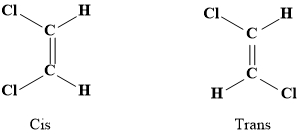
(C) Geometrical isomers have the same molecular formula and the same connectivity of atoms but differ in the spatial arrangement of groups around the double bond.
Geometrical isomerism is observed due to restricted rotation around the carbon-carbon double bond.
In geometrical isomerism,there is no change in the position of the double bond or the $C=C$ bond length; there is only a change in the spatial arrangement of the groups across the double bond.
Geometrical isomerism is observed due to restricted rotation around the carbon-carbon double bond.
In geometrical isomerism,there is no change in the position of the double bond or the $C=C$ bond length; there is only a change in the spatial arrangement of the groups across the double bond.
0 likesView Solution
19
ChemistryMediumMCQAIPMT · 2002
The reaction $CH_4 + Cl_2 \xrightarrow{uv \ light} CH_3Cl + HCl$ is an example of
A
Addition reactions
B
Substitution reaction
C
Elimination reaction
D
Rearrangement reaction
Solution
(B) The reaction $CH_4 + Cl_2 \xrightarrow{uv \ light} CH_3Cl + HCl$ involves the replacement of a hydrogen atom in methane $(CH_4)$ by a chlorine atom $(Cl)$.
This type of reaction,where one atom or group of atoms in a molecule is replaced by another atom or group,is known as a substitution reaction.
Specifically,this is a free-radical substitution reaction initiated by $UV$ light.
This type of reaction,where one atom or group of atoms in a molecule is replaced by another atom or group,is known as a substitution reaction.
Specifically,this is a free-radical substitution reaction initiated by $UV$ light.
0 likesView Solution
20
ChemistryMediumMCQAIPMT · 2002
Which of the following is not used to distinguish ethene from ethane?
A
Iodine in $CCl_4$
B
Bromine in $CCl_4$
C
Alkaline $KMnO_4$
D
Ammoniacal $Cu_2Cl_2$
Solution
(A) Ethene is an alkene $(C_2H_4)$ and ethane is an alkane $(C_2H_6)$.
$A.$ Iodine in $CCl_4$ is generally not used for unsaturation tests because the reaction is reversible and slow.
$B.$ Bromine in $CCl_4$ (Bromine water test) is used to distinguish alkenes from alkanes. Alkenes decolorize the reddish-brown color of bromine,while alkanes do not.
$C.$ Alkaline $KMnO_4$ (Baeyer's reagent) is used to distinguish alkenes from alkanes. Alkenes decolorize the purple color of $KMnO_4$ to form a brown precipitate of $MnO_2$,while alkanes do not react.
$D.$ Ammoniacal $Cu_2Cl_2$ (Cuprous chloride) is used specifically to identify terminal alkynes (forming red precipitates of copper acetylides). It does not react with ethene or ethane.
Since both $A$ and $D$ are not used to distinguish ethene from ethane,but $D$ is a specific reagent for terminal alkynes,$A$ is the most appropriate choice in the context of standard laboratory tests for unsaturation where iodine is ineffective.
$A.$ Iodine in $CCl_4$ is generally not used for unsaturation tests because the reaction is reversible and slow.
$B.$ Bromine in $CCl_4$ (Bromine water test) is used to distinguish alkenes from alkanes. Alkenes decolorize the reddish-brown color of bromine,while alkanes do not.
$C.$ Alkaline $KMnO_4$ (Baeyer's reagent) is used to distinguish alkenes from alkanes. Alkenes decolorize the purple color of $KMnO_4$ to form a brown precipitate of $MnO_2$,while alkanes do not react.
$D.$ Ammoniacal $Cu_2Cl_2$ (Cuprous chloride) is used specifically to identify terminal alkynes (forming red precipitates of copper acetylides). It does not react with ethene or ethane.
Since both $A$ and $D$ are not used to distinguish ethene from ethane,but $D$ is a specific reagent for terminal alkynes,$A$ is the most appropriate choice in the context of standard laboratory tests for unsaturation where iodine is ineffective.
0 likesView Solution
21
ChemistryEasyMCQAIPMT · 2002
Which of the following has the maximum number of molecules?
A
$16 \ g$ of $O_2$
B
$16 \ g$ of $NO_2$
C
$7 \ g$ of $N_2$
D
$2 \ g$ of $H_2$
Solution
(D) To find the number of molecules,we calculate the number of moles $(n = \text{mass} / \text{molar mass})$ and multiply by Avogadro's number $(N_A)$:
$A) \ 16 \ g \ O_2: n = 16 / 32 = 0.5 \ mol$
$B) \ 16 \ g \ NO_2: n = 16 / 46 \approx 0.348 \ mol$
$C) \ 7 \ g \ N_2: n = 7 / 28 = 0.25 \ mol$
$D) \ 2 \ g \ H_2: n = 2 / 2 = 1.0 \ mol$
Since $H_2$ has the highest number of moles $(1.0 \ mol)$,it contains the maximum number of molecules.
$A) \ 16 \ g \ O_2: n = 16 / 32 = 0.5 \ mol$
$B) \ 16 \ g \ NO_2: n = 16 / 46 \approx 0.348 \ mol$
$C) \ 7 \ g \ N_2: n = 7 / 28 = 0.25 \ mol$
$D) \ 2 \ g \ H_2: n = 2 / 2 = 1.0 \ mol$
Since $H_2$ has the highest number of moles $(1.0 \ mol)$,it contains the maximum number of molecules.
0 likesView Solution
22
ChemistryMediumMCQAIPMT · 2002
The number of molecules in $4.25 \ g$ of ammonia is approximately
A
$0.5 \times 10^{23}$
B
$1.5 \times 10^{23}$
C
$3.5 \times 10^{23}$
D
$2.5 \times 10^{23}$
Solution
(B) The molar mass of ammonia $(NH_3)$ is $14 + (3 \times 1) = 17 \ g/mol$.
Number of moles of $NH_3 = \frac{\text{Given mass}}{\text{Molar mass}} = \frac{4.25 \ g}{17 \ g/mol} = 0.25 \ mol$.
Number of molecules = $\text{Number of moles} \times N_A = 0.25 \times 6.022 \times 10^{23} \approx 1.505 \times 10^{23}$.
Thus,the number of molecules is approximately $1.5 \times 10^{23}$.
Number of moles of $NH_3 = \frac{\text{Given mass}}{\text{Molar mass}} = \frac{4.25 \ g}{17 \ g/mol} = 0.25 \ mol$.
Number of molecules = $\text{Number of moles} \times N_A = 0.25 \times 6.022 \times 10^{23} \approx 1.505 \times 10^{23}$.
Thus,the number of molecules is approximately $1.5 \times 10^{23}$.
0 likesView Solution
23
ChemistryMediumMCQAIPMT · 2002
$Zn$ reacts with $H_2SO_4$ and $HCl$ to produce hydrogen gas,but it does not produce hydrogen gas with $HNO_3$ because:
A
$NO_3^-$ is reduced in preference to $H_3O^+$
B
$HNO_3$ is a stronger oxidizing agent than $H_2SO_4$ and $HCl$
C
$Zn$ acts as an oxidizing agent when it reacts with $HNO_3$
D
In the electrochemical series,$Zn$ is placed above hydrogen
Solution
(B) $HNO_3$ is a strong oxidizing agent.
When $Zn$ reacts with $HNO_3$,the hydrogen gas $(H_2)$ initially produced is immediately oxidized by $HNO_3$ to water $(H_2O)$.
Consequently,$H_2$ gas is not evolved in the reaction.
When $Zn$ reacts with $HNO_3$,the hydrogen gas $(H_2)$ initially produced is immediately oxidized by $HNO_3$ to water $(H_2O)$.
Consequently,$H_2$ gas is not evolved in the reaction.
0 likesView Solution
24
ChemistryMCQAIPMT · 2002
In which of the following is the notochord present in the embryonic stage?
A
Vertebrates
B
Some chordates
C
All chordates
D
Non-chordates
Solution
(C) The notochord is the primary diagnostic feature of the phylum $Chordata$.
All chordates possess a notochord at some stage in their life cycle,specifically during the early embryonic period.
In some chordates,it persists throughout their life,while in others (like vertebrates),it is replaced by a vertebral column in the adult stage.
All chordates possess a notochord at some stage in their life cycle,specifically during the early embryonic period.
In some chordates,it persists throughout their life,while in others (like vertebrates),it is replaced by a vertebral column in the adult stage.
0 likesView Solution
25
ChemistryMCQAIPMT · 2002
Which of the following absorbs light energy during photosynthesis?
A
Chlorophyll
B
Water molecule
C
$O_2$
D
$RuBP$
Solution
(A) Photosynthesis is the process by which green plants convert light energy into chemical energy.
Chlorophyll is the primary photosynthetic pigment located in the thylakoid membranes of chloroplasts.
It is responsible for absorbing light energy,primarily in the blue and red regions of the electromagnetic spectrum,which then drives the light-dependent reactions of photosynthesis.
Water molecules are split (photolysis) to provide electrons,$O_2$ is a byproduct,and $RuBP$ is a carbon dioxide acceptor in the Calvin cycle.
Chlorophyll is the primary photosynthetic pigment located in the thylakoid membranes of chloroplasts.
It is responsible for absorbing light energy,primarily in the blue and red regions of the electromagnetic spectrum,which then drives the light-dependent reactions of photosynthesis.
Water molecules are split (photolysis) to provide electrons,$O_2$ is a byproduct,and $RuBP$ is a carbon dioxide acceptor in the Calvin cycle.
0 likesView Solution
26
ChemistryMCQAIPMT · 2002
Which type of cartilage is found at the ends of long bones?
A
Hyaline cartilage
B
Fibrous cartilage
C
Calcified cartilage
D
Elastic cartilage
Solution
(A) The ends of long bones are covered by articular cartilage,which is a type of hyaline cartilage. Hyaline cartilage is the most abundant type of cartilage in the body and provides a smooth,low-friction surface for joint movement. It is characterized by a glassy,translucent appearance and a matrix containing fine collagen fibers.
0 likesView Solution
27
ChemistryMCQAIPMT · 2002
Which type of cartilage is found at the ends of long bones?
A
Calcified cartilage
B
Hyaline cartilage
C
Elastic cartilage
D
Fibrous cartilage
Solution
(B) The ends of long bones are covered by $Hyaline$ cartilage,which is the most abundant type of cartilage in the body. It provides a smooth,low-friction surface for joints,allowing bones to slide over each other easily. It is also found in the nose,larynx,and trachea.
0 likesView Solution
28
ChemistryMCQAIPMT · 2002
Which of the following is absent in polluted water?
A
Hydrilla
B
Water hyacinth
C
Stonefly nymphs
D
Blue-green algae
Solution
(C) Stonefly nymphs are highly sensitive to water pollution and low dissolved oxygen levels. They serve as biological indicators of clean,well-oxygenated water. Therefore,their presence indicates good water quality,and they are typically absent in polluted water bodies. In contrast,organisms like blue-green algae and water hyacinth often thrive in nutrient-rich,polluted water.
0 likesView Solution
29
ChemistryMCQAIPMT · 2002
Which of the following is absent in polluted water?
A
Hydrilla
B
Water hyacinth
C
Stonefly nymphs
D
Blue-green algae
Solution
(C) Stonefly nymphs are highly sensitive to water pollution and low dissolved oxygen levels. They serve as biological indicators of clean,well-oxygenated water. Therefore,their presence indicates good water quality,and they are typically absent in polluted water bodies. In contrast,organisms like Hydrilla,water hyacinth,and blue-green algae can often thrive in nutrient-rich or polluted aquatic environments.
0 likesView Solution
30
ChemistryMCQAIPMT · 2002
Tetrarch vascular bundles are found in .......
A
Dicot root
B
Monocot root
C
Dicot stem
D
Monocot stem
Solution
(A) In plants,the number of vascular bundles (xylem and phloem) varies based on the organ.
In dicot roots,the xylem is typically radial and limited in number,usually ranging from $2$ to $6$ bundles.
$A$ root with $4$ xylem bundles is specifically termed 'tetrarch'.
Monocot roots typically exhibit 'polyarch' conditions,having more than $6$ xylem bundles.
Stems generally have conjoint vascular bundles,not radial ones.
Therefore,tetrarch vascular bundles are characteristic of dicot roots.
In dicot roots,the xylem is typically radial and limited in number,usually ranging from $2$ to $6$ bundles.
$A$ root with $4$ xylem bundles is specifically termed 'tetrarch'.
Monocot roots typically exhibit 'polyarch' conditions,having more than $6$ xylem bundles.
Stems generally have conjoint vascular bundles,not radial ones.
Therefore,tetrarch vascular bundles are characteristic of dicot roots.
0 likesView Solution
31
ChemistryMCQAIPMT · 2002
Continuous bleeding from an injured part of the body is due to the deficiency of:
A
Vitamin $A$
B
Vitamin $B$
C
Vitamin $K$
D
Vitamin $E$
Solution
(C) Vitamin $K$ is essential for the synthesis of clotting factors in the liver,such as prothrombin and factors $VII$,$IX$,and $X$.
When there is a deficiency of Vitamin $K$,the blood clotting mechanism is impaired,leading to prolonged or continuous bleeding from an injured site.
When there is a deficiency of Vitamin $K$,the blood clotting mechanism is impaired,leading to prolonged or continuous bleeding from an injured site.
0 likesView Solution
32
ChemistryMCQAIPMT · 2002
What type of relationship is observed between insect-pollinated flowers and their pollinating insects?
A
Mutualism
B
Commensalism
C
Cooperation
D
Co-evolution
Solution
(A) The relationship between insect-pollinated flowers and their pollinating insects is an example of $Mutualism$ (also known as $Mutualism$ or $Symbiosis$).
In this interaction,both species benefit: the plant receives pollination services,and the insect receives a reward in the form of nectar or pollen.
While $Co-evolution$ often occurs alongside this relationship,the fundamental ecological interaction describing the benefit to both parties is $Mutualism$.
In this interaction,both species benefit: the plant receives pollination services,and the insect receives a reward in the form of nectar or pollen.
While $Co-evolution$ often occurs alongside this relationship,the fundamental ecological interaction describing the benefit to both parties is $Mutualism$.
0 likesView Solution
33
ChemistryMCQAIPMT · 2002
Which is the best material for studying mitosis in a laboratory?
A
Anther
B
Root tip
C
Leaf tip
D
Ovary
Solution
(B) Mitosis is the process of somatic cell division,which occurs most actively in regions of rapid growth known as meristems.
Root tips are the most commonly used material for studying mitosis in laboratories because they contain apical meristems where cells are constantly dividing.
These cells are easily accessible,and the root tip can be squashed to observe different stages of mitosis under a microscope.
Therefore,the root tip is the ideal material for this study.
Root tips are the most commonly used material for studying mitosis in laboratories because they contain apical meristems where cells are constantly dividing.
These cells are easily accessible,and the root tip can be squashed to observe different stages of mitosis under a microscope.
Therefore,the root tip is the ideal material for this study.
0 likesView Solution
34
ChemistryMCQAIPMT · 2002
What is collagen?
A
Fibrous protein
B
Globular protein
C
Lipid
D
Carbohydrate
Solution
(A) Collagen is the most abundant protein in the animal world. It is a structural protein that provides strength and support to tissues. Structurally,it is classified as a fibrous protein because its polypeptide chains are arranged in long,parallel strands held together by cross-links,making it insoluble in water.
0 likesView Solution
35
ChemistryMCQAIPMT · 2002
Phenol reacts with $CHCl_3$ and $NaOH$ at $340 \ K$ to give .......
A
$o$-Chlorophenol
B
Salicylaldehyde
C
Benzaldehyde
D
Chlorobenzene
Solution
(B) The reaction of phenol with chloroform $(CHCl_3)$ in the presence of aqueous sodium hydroxide $(NaOH)$ at $340 \ K$ is known as the Reimer-Tiemann reaction.
This reaction introduces an aldehyde group $(-CHO)$ at the ortho position of the phenol ring,resulting in the formation of salicylaldehyde ($2$-hydroxybenzaldehyde).
The chemical equation is:
$C_6H_5OH + CHCl_3 + 3NaOH \rightarrow C_6H_4(OH)(CHO) + 3NaCl + 2H_2O$.
This reaction introduces an aldehyde group $(-CHO)$ at the ortho position of the phenol ring,resulting in the formation of salicylaldehyde ($2$-hydroxybenzaldehyde).
The chemical equation is:
$C_6H_5OH + CHCl_3 + 3NaOH \rightarrow C_6H_4(OH)(CHO) + 3NaCl + 2H_2O$.
0 likesView Solution
36
ChemistryMCQAIPMT · 2002
Cellulose is a polymer of......
A
Fructose
B
Ribose
C
Glucose
D
Sucrose
Solution
(C) Cellulose is a linear polysaccharide consisting of several hundred to many thousands of $D$-glucose units joined by $\beta-1,4-glycosidic$ linkages. Therefore,it is a polymer of glucose.
0 likesView Solution
37
ChemistryMCQAIPMT · 2002
Which of the following is a reducing sugar?
A
Galactose
B
Gluconic acid
C
$\beta -$ Methyl galactoside
D
Sucrose
Solution
(A) reducing sugar is a carbohydrate that possesses a free aldehyde $(-CHO)$ or a free ketone $(-C=O)$ group,which allows it to act as a reducing agent.
Galactose is a monosaccharide that contains a free aldehyde group in its open-chain form,making it a reducing sugar.
Gluconic acid is an oxidation product of glucose where the aldehyde group is converted to a carboxylic acid group,so it is not a reducing sugar.
$\beta -$ Methyl galactoside is a glycoside where the anomeric carbon is involved in a bond,preventing the formation of an open-chain aldehyde,thus it is non-reducing.
Sucrose is a disaccharide formed by a glycosidic linkage between the anomeric carbons of glucose and fructose,leaving no free aldehyde or ketone group,making it a non-reducing sugar.
Galactose is a monosaccharide that contains a free aldehyde group in its open-chain form,making it a reducing sugar.
Gluconic acid is an oxidation product of glucose where the aldehyde group is converted to a carboxylic acid group,so it is not a reducing sugar.
$\beta -$ Methyl galactoside is a glycoside where the anomeric carbon is involved in a bond,preventing the formation of an open-chain aldehyde,thus it is non-reducing.
Sucrose is a disaccharide formed by a glycosidic linkage between the anomeric carbons of glucose and fructose,leaving no free aldehyde or ketone group,making it a non-reducing sugar.
0 likesView Solution
38
ChemistryMCQAIPMT · 2002
In green plants,cell elongation in the internodal regions is caused by which of the following?
A
Indole Acetic Acid
B
Cytokinin
C
Gibberellin
D
Ethylene
Solution
(C) Gibberellins are plant hormones that promote stem elongation by stimulating cell division and cell elongation in the internodal regions of plants. This is particularly evident in 'rosette' plants like cabbage and sugar beet,where they induce 'bolting' (internode elongation just prior to flowering). Therefore,the correct option is $C$.
0 likesView Solution
39
ChemistryMCQAIPMT · 2002
For a cell,the terminal potential difference $(P.D.)$ is $2.2 \, V$ when the circuit is open and reduces to $1.8 \, V$ when the cell is connected to an external resistance of $R = 5 \, \Omega$. Determine the internal resistance of the cell $(r)$.
A
$\frac{10}{9} \, \Omega$
B
$\frac{9}{10} \, \Omega$
C
$\frac{11}{9} \, \Omega$
D
$\frac{5}{9} \, \Omega$
Solution
(A) When the circuit is open,the terminal potential difference is equal to the electromotive force $(E)$ of the cell. Thus,$E = 2.2 \, V$.
When the cell is connected to an external resistance $R$,the terminal potential difference $(V)$ is given by the formula: $V = E - Ir$,where $I = \frac{E}{R+r}$.
Substituting $I$,we get $V = E - (\frac{E}{R+r})r = E(\frac{R}{R+r})$.
Given $V = 1.8 \, V$,$E = 2.2 \, V$,and $R = 5 \, \Omega$:
$1.8 = 2.2 \times \frac{5}{5+r}$
$1.8(5+r) = 11$
$9 + 1.8r = 11$
$1.8r = 2$
$r = \frac{2}{1.8} = \frac{20}{18} = \frac{10}{9} \, \Omega$.
When the cell is connected to an external resistance $R$,the terminal potential difference $(V)$ is given by the formula: $V = E - Ir$,where $I = \frac{E}{R+r}$.
Substituting $I$,we get $V = E - (\frac{E}{R+r})r = E(\frac{R}{R+r})$.
Given $V = 1.8 \, V$,$E = 2.2 \, V$,and $R = 5 \, \Omega$:
$1.8 = 2.2 \times \frac{5}{5+r}$
$1.8(5+r) = 11$
$9 + 1.8r = 11$
$1.8r = 2$
$r = \frac{2}{1.8} = \frac{20}{18} = \frac{10}{9} \, \Omega$.
0 likesView Solution
40
ChemistryMCQAIPMT · 2002
$A$ whistle revolves in a circle with an angular speed of $20\, rad/s$ using a string of length $50\, cm$. If the frequency of sound from the whistle is $385\, Hz$,then what is the minimum frequency heard by an observer,who is far away from the centre in the same plane? (Speed of sound is $340\, m/s$)
A
$333$
B
$374$
C
$385$
D
$394$
Solution
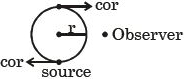
(B) The radius of the circle is $r = 50\, cm = 0.5\, m$.
The angular speed is $\omega = 20\, rad/s$.
The linear speed of the source is $v_s = r\omega = 0.5 \times 20 = 10\, m/s$.
The frequency of the source is $f = 385\, Hz$ and the speed of sound is $V = 340\, m/s$.
The observer is far away in the same plane. The minimum frequency is heard when the source is moving directly away from the observer.
The formula for the observed frequency is $f' = f \left[ \frac{V}{V + v_s} \right]$.
Substituting the values:
$f_{\min} = 385 \left[ \frac{340}{340 + 10} \right]$
$f_{\min} = 385 \left[ \frac{340}{350} \right]$
$f_{\min} = 385 \times \frac{34}{35} = 11 \times 34 = 374\, Hz$.
The angular speed is $\omega = 20\, rad/s$.
The linear speed of the source is $v_s = r\omega = 0.5 \times 20 = 10\, m/s$.
The frequency of the source is $f = 385\, Hz$ and the speed of sound is $V = 340\, m/s$.
The observer is far away in the same plane. The minimum frequency is heard when the source is moving directly away from the observer.
The formula for the observed frequency is $f' = f \left[ \frac{V}{V + v_s} \right]$.
Substituting the values:
$f_{\min} = 385 \left[ \frac{340}{340 + 10} \right]$
$f_{\min} = 385 \left[ \frac{340}{350} \right]$
$f_{\min} = 385 \times \frac{34}{35} = 11 \times 34 = 374\, Hz$.
0 likesView Solution
41
ChemistryMCQAIPMT · 2002
For a cell,the terminal potential difference is $2.2 \, V$ when the circuit is open and reduces to $1.8 \, V$ when the cell is connected to an external resistance of $R = 5 \, \Omega$. Determine the internal resistance of the cell.
A
$\frac{10}{9} \, \Omega$
B
$\frac{9}{10} \, \Omega$
C
$\frac{11}{9} \, \Omega$
D
$\frac{5}{9} \, \Omega$
Solution
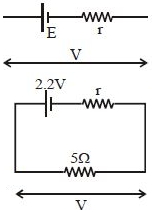
(A) When the circuit is open,the terminal potential difference is equal to the electromotive force $(E)$ of the cell.
$E = 2.2 \, V$
When the cell is connected to an external resistance $R = 5 \, \Omega$,the terminal potential difference $(V)$ is $1.8 \, V$.
The current $(I)$ flowing through the circuit is given by Ohm's law:
$I = \frac{V}{R} = \frac{1.8}{5} = 0.36 \, A$
The relation between electromotive force $(E)$,terminal potential difference $(V)$,current $(I)$,and internal resistance $(r)$ is:
$V = E - Ir$
Substituting the known values:
$1.8 = 2.2 - (0.36)r$
$0.36r = 2.2 - 1.8$
$0.36r = 0.4$
$r = \frac{0.4}{0.36} = \frac{40}{36} = \frac{10}{9} \, \Omega$
$E = 2.2 \, V$
When the cell is connected to an external resistance $R = 5 \, \Omega$,the terminal potential difference $(V)$ is $1.8 \, V$.
The current $(I)$ flowing through the circuit is given by Ohm's law:
$I = \frac{V}{R} = \frac{1.8}{5} = 0.36 \, A$
The relation between electromotive force $(E)$,terminal potential difference $(V)$,current $(I)$,and internal resistance $(r)$ is:
$V = E - Ir$
Substituting the known values:
$1.8 = 2.2 - (0.36)r$
$0.36r = 2.2 - 1.8$
$0.36r = 0.4$
$r = \frac{0.4}{0.36} = \frac{40}{36} = \frac{10}{9} \, \Omega$
0 likesView Solution
42
ChemistryMCQAIPMT · 2002
Axillary bud and terminal bud are derived from the activity of
A
Lateral meristem
B
Intercalary meristem
C
Apical meristem
D
Parenchyma
Solution
(C) The shoot apical meristem is responsible for the growth of the main axis and the formation of the terminal bud. During the elongation of the shoot,some cells are left behind from the apical meristem,which develop into axillary buds in the axils of leaves. These buds are capable of forming a branch or a flower.
0 likesView Solution
43
ChemistryMCQAIPMT · 2002
Which of the following crops have been brought to India from the New World?
A
Cashewnut,potato,rubber
B
Mango,tea
C
Tea,rubber,mango
D
Coffee
Solution
(A) The term 'New World' refers to the Americas. Crops such as cashewnut,potato,rubber,maize,and tomato were introduced to India from the New World. Mango,tea,and coffee are considered 'Old World' crops as they originated in Asia or Africa.
0 likesView Solution
44
ChemistryMediumMCQAIPMT · 2002
If $1 \ M$ and $2.5 \ L$ $NaOH$ solution is mixed with another $0.5 \ M$ and $3 \ L$ $NaOH$ solution,then the molarity of the resultant solution will be $........ \ M$.
A
$1.0$
B
$0.73$
C
$0.80$
D
$0.50$
Solution
(B) The molarity of the resultant solution is calculated using the formula $M_3 = \frac{M_1V_1 + M_2V_2}{V_1 + V_2}$.
Given: $M_1 = 1 \ M$,$V_1 = 2.5 \ L$,$M_2 = 0.5 \ M$,$V_2 = 3 \ L$.
Total moles of $NaOH = (1 \times 2.5) + (0.5 \times 3) = 2.5 + 1.5 = 4 \ mol$.
Total volume of the solution $= 2.5 \ L + 3 \ L = 5.5 \ L$.
Resultant molarity $M_3 = \frac{4 \ mol}{5.5 \ L} \approx 0.73 \ M$.
Given: $M_1 = 1 \ M$,$V_1 = 2.5 \ L$,$M_2 = 0.5 \ M$,$V_2 = 3 \ L$.
Total moles of $NaOH = (1 \times 2.5) + (0.5 \times 3) = 2.5 + 1.5 = 4 \ mol$.
Total volume of the solution $= 2.5 \ L + 3 \ L = 5.5 \ L$.
Resultant molarity $M_3 = \frac{4 \ mol}{5.5 \ L} \approx 0.73 \ M$.
0 likesView Solution
45
ChemistryEasyMCQAIPMT · 2002
$A$ solution contains a non-volatile solute of molecular mass $M_p$. Which of the following can be used to calculate the molecular mass of the solute in terms of osmotic pressure ($m = \text{Mass of solute}$,$V = \text{Volume of solution}$,and $\pi = \text{Osmotic pressure}$)?
A
$M_p = (\frac{m}{\pi}) VRT$
B
$M_p = (\frac{m}{V}) \frac{RT}{\pi}$
C
$M_p = (\frac{m}{V}) \frac{\pi}{RT}$
D
$M_p = (\frac{m}{V}) \pi RT$
Solution
(B) The formula for osmotic pressure is given by $\pi = CRT$,where $C$ is the molar concentration.
Since $C = \frac{n}{V}$ and $n = \frac{m}{M_p}$,we can write $\pi = (\frac{m}{M_p V}) RT$.
Rearranging this equation to solve for $M_p$,we get $M_p = (\frac{m}{V}) \frac{RT}{\pi}$.
Therefore,the correct option is $B$.
Since $C = \frac{n}{V}$ and $n = \frac{m}{M_p}$,we can write $\pi = (\frac{m}{M_p V}) RT$.
Rearranging this equation to solve for $M_p$,we get $M_p = (\frac{m}{V}) \frac{RT}{\pi}$.
Therefore,the correct option is $B$.
0 likesView Solution
46
ChemistryMediumMCQAIPMT · 2002
If $3A \to 2B$,then the rate of reaction of $+\frac{d[B]}{dt}$ is equal to
A
$+2\frac{d[A]}{dt}$
B
$-\frac{1}{3}\frac{d[A]}{dt}$
C
$-\frac{2}{3}\frac{d[A]}{dt}$
D
$-\frac{3}{2}\frac{d[A]}{dt}$
Solution
(C) For the reaction $3A \to 2B$,the rate of reaction is expressed as:
Rate = $-\frac{1}{3}\frac{d[A]}{dt} = +\frac{1}{2}\frac{d[B]}{dt}$
To find the rate of formation of $B$,which is $+\frac{d[B]}{dt}$,we multiply both sides by $2$:
$+\frac{d[B]}{dt} = -\frac{2}{3}\frac{d[A]}{dt}$
Rate = $-\frac{1}{3}\frac{d[A]}{dt} = +\frac{1}{2}\frac{d[B]}{dt}$
To find the rate of formation of $B$,which is $+\frac{d[B]}{dt}$,we multiply both sides by $2$:
$+\frac{d[B]}{dt} = -\frac{2}{3}\frac{d[A]}{dt}$
0 likesView Solution
47
ChemistryMediumMCQAIPMT · 2002
The cell reaction of a cell is $Mg_{(s)} + Cu^{2+}_{(aq)} \to Cu_{(s)} + Mg^{2+}_{(aq)}$. If the standard reduction potentials of $Mg$ and $Cu$ are $-2.37 \ V$ and $+0.34 \ V$ respectively,the $EMF$ of the cell is ................. $V$.
A
$2.03$
B
$-2.03$
C
$+2.71$
D
$-2.71$
Solution
(C) The cell reaction is $Mg_{(s)} + Cu^{2+}_{(aq)} \to Cu_{(s)} + Mg^{2+}_{(aq)}$.
Here,$Mg$ is oxidized at the anode and $Cu^{2+}$ is reduced at the cathode.
The standard $EMF$ of the cell is calculated as:
$E_{cell}^o = E_{cathode}^o - E_{anode}^o$
$E_{cell}^o = E^o_{(Cu^{2+}/Cu)} - E^o_{(Mg^{2+}/Mg)}$
$E_{cell}^o = 0.34 \ V - (-2.37 \ V) = +2.71 \ V$.
Here,$Mg$ is oxidized at the anode and $Cu^{2+}$ is reduced at the cathode.
The standard $EMF$ of the cell is calculated as:
$E_{cell}^o = E_{cathode}^o - E_{anode}^o$
$E_{cell}^o = E^o_{(Cu^{2+}/Cu)} - E^o_{(Mg^{2+}/Mg)}$
$E_{cell}^o = 0.34 \ V - (-2.37 \ V) = +2.71 \ V$.
0 likesView Solution
48
ChemistryEasyMCQAIPMT · 2002
Highest $(+7)$ oxidation state is shown by
A
$Co$
B
$Cr$
C
$V$
D
$Mn$
Solution
(D) $Mn$ (Manganese) belongs to group $7$ of the periodic table. Its electronic configuration is $[Ar] 3d^5 4s^2$. It can lose all $7$ valence electrons to exhibit a maximum oxidation state of $+7$,as seen in compounds like $KMnO_4$.
0 likesView Solution
49
ChemistryAdvancedMCQAIPMT · 2002
Copper sulphate solution reacts with $KCN$ to give
A
$Cu(CN)_2$
B
$CuCN$
C
$K_2[Cu(CN)_4]$
D
$K_3[Cu(CN)_4]$
Solution
(D) The reaction of copper sulphate with potassium cyanide proceeds in steps:
$1$. $CuSO_4 + 2KCN \to Cu(CN)_2 + K_2SO_4$
$2$. The unstable $Cu(CN)_2$ decomposes to give $Cu_2(CN)_2$ and cyanogen gas: $2Cu(CN)_2 \to Cu_2(CN)_2 + (CN)_2$
$3$. $Cu_2(CN)_2$ then reacts with excess $KCN$ to form the stable complex potassium tetracyanocuprate$(I)$: $Cu_2(CN)_2 + 6KCN \to 2K_3[Cu(CN)_4]$
Thus,the final product is $K_3[Cu(CN)_4]$.
$1$. $CuSO_4 + 2KCN \to Cu(CN)_2 + K_2SO_4$
$2$. The unstable $Cu(CN)_2$ decomposes to give $Cu_2(CN)_2$ and cyanogen gas: $2Cu(CN)_2 \to Cu_2(CN)_2 + (CN)_2$
$3$. $Cu_2(CN)_2$ then reacts with excess $KCN$ to form the stable complex potassium tetracyanocuprate$(I)$: $Cu_2(CN)_2 + 6KCN \to 2K_3[Cu(CN)_4]$
Thus,the final product is $K_3[Cu(CN)_4]$.
0 likesView Solution
50
ChemistryMediumMCQAIPMT · 2002
Atomic numbers of $Cr$ and $Fe$ are $24$ and $26$ respectively. Which of the following is paramagnetic?
A
$[Cr(NH_3)_6]^{3+}$
B
$[Fe(CO)_5]$
C
$[Fe(CN)_6]^{4-}$
D
$[Cr(CO)_6]$
Solution
(A) $1$. $[Cr(NH_3)_6]^{3+}$: $Cr$ is in $+3$ oxidation state. Electronic configuration of $Cr^{3+}$ is $[Ar] 3d^3$. It has $3$ unpaired electrons,so it is paramagnetic.
$2$. $[Fe(CO)_5]$: $Fe$ is in $0$ oxidation state. $CO$ is a strong field ligand,causing pairing of electrons. $Fe(0)$ is $3d^6 4s^2$. All electrons are paired,so it is diamagnetic.
$3$. $[Fe(CN)_6]^{4-}$: $Fe$ is in $+2$ oxidation state. $Fe^{2+}$ is $3d^6$. $CN^-$ is a strong field ligand,causing pairing of electrons. All electrons are paired,so it is diamagnetic.
$4$. $[Cr(CO)_6]$: $Cr$ is in $0$ oxidation state. $Cr(0)$ is $3d^5 4s^1$. $CO$ is a strong field ligand,causing pairing of all electrons. It is diamagnetic.
Therefore,$[Cr(NH_3)_6]^{3+}$ is paramagnetic.
$2$. $[Fe(CO)_5]$: $Fe$ is in $0$ oxidation state. $CO$ is a strong field ligand,causing pairing of electrons. $Fe(0)$ is $3d^6 4s^2$. All electrons are paired,so it is diamagnetic.
$3$. $[Fe(CN)_6]^{4-}$: $Fe$ is in $+2$ oxidation state. $Fe^{2+}$ is $3d^6$. $CN^-$ is a strong field ligand,causing pairing of electrons. All electrons are paired,so it is diamagnetic.
$4$. $[Cr(CO)_6]$: $Cr$ is in $0$ oxidation state. $Cr(0)$ is $3d^5 4s^1$. $CO$ is a strong field ligand,causing pairing of all electrons. It is diamagnetic.
Therefore,$[Cr(NH_3)_6]^{3+}$ is paramagnetic.
0 likesView Solution
51
ChemistryMediumMCQAIPMT · 2002
The complex chlorocompound diaquatriammine cobalt $(III)$ chloride is represented as
A
$[Co(NH_3)_3(H_2O)_2]Cl_3$
B
$[Co(NH_3)_3(H_2O)_3]Cl_3$
C
$[CoCl(NH_3)_3(H_2O)_2]Cl_3$
D
$[CoCl(NH_3)_3(H_2O)_2]Cl_2$
Solution
(D) The name of the complex is chlorodiaquatriamminecobalt $(III)$ chloride.
In this complex,the central metal atom is $Co$ with an oxidation state of $+3$.
The ligands are $3$ ammine $(NH_3)$,$2$ aqua $(H_2O)$,and $1$ chloro $(Cl^-)$ ligand inside the coordination sphere.
To balance the $+3$ charge of $Co$ and the $-1$ charge of the inner chloro ligand,the total charge of the complex ion is $[+3 + (-1)] = +2$.
Therefore,$2$ chloride ions $(Cl^-)$ are required outside the coordination sphere to neutralize the complex.
The formula is $[CoCl(NH_3)_3(H_2O)_2]Cl_2$.
In this complex,the central metal atom is $Co$ with an oxidation state of $+3$.
The ligands are $3$ ammine $(NH_3)$,$2$ aqua $(H_2O)$,and $1$ chloro $(Cl^-)$ ligand inside the coordination sphere.
To balance the $+3$ charge of $Co$ and the $-1$ charge of the inner chloro ligand,the total charge of the complex ion is $[+3 + (-1)] = +2$.
Therefore,$2$ chloride ions $(Cl^-)$ are required outside the coordination sphere to neutralize the complex.
The formula is $[CoCl(NH_3)_3(H_2O)_2]Cl_2$.
0 likesView Solution
52
ChemistryDifficultMCQAIPMT · 2002
When $CH_3CH_2CHCl_2$ is treated with $NaNH_2$,the product formed is
A
$CH_3-CH=CH_2$
B
$CH_3-C \equiv CH$
C
$CH_3CH_2CH(NH_2)(Cl)$
D
$CH_3CH_2C(NH_2)_2$
Solution
(B) The reaction of a geminal dihalide like $CH_3CH_2CHCl_2$ with a strong base like $NaNH_2$ leads to dehydrohalogenation.
First,one molecule of $HCl$ is eliminated to form a vinyl halide $(CH_3CH=CHCl)$.
Then,a second molecule of $HCl$ is eliminated to form an alkyne.
Thus,$CH_3CH_2CHCl_2 + 2NaNH_2 \rightarrow CH_3-C \equiv CH + 2NaCl + 2NH_3$.
The final product is propyne $(CH_3-C \equiv CH)$.
First,one molecule of $HCl$ is eliminated to form a vinyl halide $(CH_3CH=CHCl)$.
Then,a second molecule of $HCl$ is eliminated to form an alkyne.
Thus,$CH_3CH_2CHCl_2 + 2NaNH_2 \rightarrow CH_3-C \equiv CH + 2NaCl + 2NH_3$.
The final product is propyne $(CH_3-C \equiv CH)$.
0 likesView Solution
53
ChemistryDifficultMCQAIPMT · 2002
Phenol reacts with $CHCl_3$ and $NaOH$ (at $340 \ K$) to give
A
$o$-chlorophenol
B
Salicylaldehyde
C
Benzaldehyde
D
Chlorobenzene
Solution
(B) The reaction of phenol with chloroform $(CHCl_3)$ in the presence of aqueous sodium hydroxide $(NaOH)$ at $340 \ K$ is known as the Reimer-Tiemann reaction.
In this reaction,a formyl group $(-CHO)$ is introduced at the ortho position of the benzene ring of phenol.
The product formed is $2$-hydroxybenzaldehyde,which is commonly known as Salicylaldehyde.
The chemical equation is:
$C_6H_5OH + CHCl_3 + 3NaOH \rightarrow C_6H_4(OH)(CHO) + 3NaCl + 2H_2O$
Thus,the correct option is $(B)$.
In this reaction,a formyl group $(-CHO)$ is introduced at the ortho position of the benzene ring of phenol.
The product formed is $2$-hydroxybenzaldehyde,which is commonly known as Salicylaldehyde.
The chemical equation is:
$C_6H_5OH + CHCl_3 + 3NaOH \rightarrow C_6H_4(OH)(CHO) + 3NaCl + 2H_2O$
Thus,the correct option is $(B)$.
0 likesView Solution
54
ChemistryMediumMCQAIPMT · 2002
Compound '$A$' reacts with $PCl_5$ to give '$B$',which on treatment with $KCN$ followed by hydrolysis gives propanoic acid as the product. What is '$A$'?
A
Ethane
B
Propane
C
Ethyl chloride
D
Ethyl alcohol
Solution
(D) The reaction sequence is as follows:
$1$. Compound '$A$' reacts with $PCl_5$ to form '$B$'. Since the final product is propanoic acid $(CH_3CH_2COOH)$,which contains $3$ carbon atoms,'$B$' must be ethyl chloride $(C_2H_5Cl)$.
$2$. Therefore,'$A$' is ethyl alcohol $(C_2H_5OH)$.
$3$. The reaction steps are:
$C_2H_5OH + PCl_5 \to C_2H_5Cl + POCl_3 + HCl$
$C_2H_5Cl + KCN \to C_2H_5CN + KCl$
$C_2H_5CN + 2H_2O + H^+ \to CH_3CH_2COOH + NH_4^+$
$1$. Compound '$A$' reacts with $PCl_5$ to form '$B$'. Since the final product is propanoic acid $(CH_3CH_2COOH)$,which contains $3$ carbon atoms,'$B$' must be ethyl chloride $(C_2H_5Cl)$.
$2$. Therefore,'$A$' is ethyl alcohol $(C_2H_5OH)$.
$3$. The reaction steps are:
$C_2H_5OH + PCl_5 \to C_2H_5Cl + POCl_3 + HCl$
$C_2H_5Cl + KCN \to C_2H_5CN + KCl$
$C_2H_5CN + 2H_2O + H^+ \to CH_3CH_2COOH + NH_4^+$
0 likesView Solution
55
ChemistryMediumMCQAIPMT · 2002
In the following reaction,product $P$ is: $RCOCl \xrightarrow{H_2, Pd-BaSO_4} P$
A
$RCH_2OH$
B
$RCOOH$
C
$RCHO$
D
$RCH_3$
Solution
(C) The reaction of an acid chloride with $H_2$ in the presence of $Pd-BaSO_4$ is known as the Rosenmund reduction.
This reaction specifically reduces the acid chloride group $(-COCl)$ to an aldehyde group $(-CHO)$.
Therefore,the product $P$ is $RCHO$.
This reaction specifically reduces the acid chloride group $(-COCl)$ to an aldehyde group $(-CHO)$.
Therefore,the product $P$ is $RCHO$.
0 likesView Solution
56
ChemistryDifficultMCQAIPMT · 2002
In the given reaction,the product $P$ is:
A
Benzaldehyde
B
Benzoic acid
C
Phenol
D
$C_6H_5-C(=O)-C_6H_5$
Solution
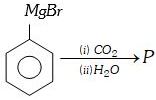
(B) The reaction of a Grignard reagent $(C_6H_5MgBr)$ with carbon dioxide $(CO_2)$ followed by acid hydrolysis $(H_3O^+)$ is a standard method for the preparation of carboxylic acids.
The reaction proceeds as follows:
$C_6H_5MgBr + CO_2 \rightarrow C_6H_5COOMgBr$
$C_6H_5COOMgBr + H_3O^+ \rightarrow C_6H_5COOH + Mg(OH)Br$
Thus,the product $P$ is benzoic acid $(C_6H_5COOH)$.
The reaction proceeds as follows:
$C_6H_5MgBr + CO_2 \rightarrow C_6H_5COOMgBr$
$C_6H_5COOMgBr + H_3O^+ \rightarrow C_6H_5COOH + Mg(OH)Br$
Thus,the product $P$ is benzoic acid $(C_6H_5COOH)$.
0 likesView Solution
57
ChemistryDifficultMCQAIPMT · 2002
An acyl halide is formed when $PCl_5$ reacts with an
A
Acid
B
Alcohol
C
Amide
D
Ester
Solution
(A) The reaction of a carboxylic acid with $PCl_5$ produces an acyl chloride (acid chloride).
The chemical equation is: $CH_3COOH + PCl_5 \to CH_3COCl + POCl_3 + HCl$
Therefore,the correct option is $A$.
The chemical equation is: $CH_3COOH + PCl_5 \to CH_3COCl + POCl_3 + HCl$
Therefore,the correct option is $A$.
0 likesView Solution
58
ChemistryEasyMCQAIPMT · 2002
Cellulose is a polymer of
A
Fructose
B
Ribose
C
Glucose
D
Sucrose
Solution
(C) Explanation: Cellulose is a structural component of the cell walls in plants.
It is a polysaccharide that consists of several $D-glucose$ units joined by glycosidic bonds.
Specifically,it is formed by the $\beta-1,4-glycosidic$ linkage of $\beta-D-glucose$ units.
Therefore,cellulose is a polymer of $\beta-D-glucose$.
It is a polysaccharide that consists of several $D-glucose$ units joined by glycosidic bonds.
Specifically,it is formed by the $\beta-1,4-glycosidic$ linkage of $\beta-D-glucose$ units.
Therefore,cellulose is a polymer of $\beta-D-glucose$.
0 likesView Solution
59
ChemistryEasyMCQAIPMT · 2002
Enzymes are made up of
A
Carbohydrates
B
Edible proteins
C
Nitrogen containing carbohydrates
D
Proteins with specific structure
Solution
(D) Enzymes are biological catalysts produced by living organisms that accelerate biochemical reactions.
Most enzymes are globular proteins that possess a unique $3D$ structure,which is essential for their catalytic activity.
Specifically,the tertiary structure of proteins forms the functional enzyme.
Therefore,enzymes are proteins with a specific structure.
Example: $Maltase$ catalyzes the hydrolysis of maltose into glucose.
Most enzymes are globular proteins that possess a unique $3D$ structure,which is essential for their catalytic activity.
Specifically,the tertiary structure of proteins forms the functional enzyme.
Therefore,enzymes are proteins with a specific structure.
Example: $Maltase$ catalyzes the hydrolysis of maltose into glucose.
0 likesView Solution
Vedclass Products
For Students
Vedclass Test Series
Mock tests in real AIPMT style covering Chemistry with performance analysis. 5-day free trial.
Start Free TrialFor Teachers
Exam Paper Generator
Generate Set A/B/C/D Chemistry papers from 7.5L+ questions in 2 minutes. 3 chapters free.
Try FreeFor Institutes
Online Exam Module
Run live AIPMT mock exams with unlimited students, 360° analytics & white-label branding.
See DemoFrequently Asked Questions
How many Chemistry questions are in AIPMT 2002?
There are 59 Chemistry questions from the AIPMT 2002 paper on Vedclass, each with a detailed step-by-step solution in English.
Are AIPMT 2002 Chemistry solutions available in English?
Yes. All solutions on this page are in English. You can also switch to English or Hindi using the language buttons above the questions.
Can I practice AIPMT 2002 Chemistry as a timed test?
Yes. Use the Vedclass Test Series to attempt a full AIPMT mock test covering Chemistry with time limits and instant score analysis.
Can teachers create Chemistry papers from AIPMT previous year questions?
Yes. The Vedclass Exam Paper Generator lets teachers mix AIPMT Chemistry questions and generate Set A/B/C/D papers in minutes.
For Teachers & Institutes
Build a Custom Chemistry Paper
Pick AIPMT 2002 Chemistry questions, set difficulty, and generate Set A/B/C/D in 2 minutes.