
PhysicsQ1–49 of 49 questions
Page 1 of 1 · English
1
PhysicsEasyMCQAIPMT · 2002
The unit of Stefan's constant $\sigma$ is
A
$W\,m^{-2}\,K^{-1}$
B
$W\,m^2\,K^{-4}$
C
$W\,m^{-2}\,K^{-4}$
D
$W\,m^{-2}\,K^4$
Solution
(C) Stefan's law is given by $E = \sigma T^4$,where $E$ is the power radiated per unit area.
Rearranging for $\sigma$,we get $\sigma = \frac{E}{T^4}$.
The unit of $E$ (power per unit area) is $\frac{\text{Watt}}{\text{m}^2} = W\,m^{-2}$.
The unit of temperature $T$ is Kelvin $(K)$.
Therefore,the unit of $\sigma$ is $\frac{W\,m^{-2}}{K^4} = W\,m^{-2}\,K^{-4}$.
Thus,the correct option is $C$.
Rearranging for $\sigma$,we get $\sigma = \frac{E}{T^4}$.
The unit of $E$ (power per unit area) is $\frac{\text{Watt}}{\text{m}^2} = W\,m^{-2}$.
The unit of temperature $T$ is Kelvin $(K)$.
Therefore,the unit of $\sigma$ is $\frac{W\,m^{-2}}{K^4} = W\,m^{-2}\,K^{-4}$.
Thus,the correct option is $C$.
0 likesView Solution
2
PhysicsEasyMCQAIPMT · 2002
$A$ particle $(A)$ is dropped from a height and another particle $(B)$ is thrown in a horizontal direction with a speed of $5 \; m/s$ from the same height. The correct statement is:
A
Both particles will reach the ground simultaneously.
B
Both particles will reach the ground with the same speed.
C
Particle $(A)$ will reach the ground first with respect to particle $(B)$.
D
Particle $(B)$ will reach the ground first with respect to particle $(A)$.
Solution
(A) For both particles,the vertical motion is governed by the equation of motion $h = ut + \frac{1}{2}gt^2$.
Since both particles are released from the same height $h$ and their initial vertical velocity component $u_y$ is $0$ in both cases,the time taken to reach the ground is given by $t = \sqrt{\frac{2h}{g}}$.
Since $h$ and $g$ are the same for both,the time taken $t$ is identical for both particles.
Therefore,both particles will reach the ground simultaneously.
Since both particles are released from the same height $h$ and their initial vertical velocity component $u_y$ is $0$ in both cases,the time taken to reach the ground is given by $t = \sqrt{\frac{2h}{g}}$.
Since $h$ and $g$ are the same for both,the time taken $t$ is identical for both particles.
Therefore,both particles will reach the ground simultaneously.
0 likesView Solution
3
PhysicsEasyMCQAIPMT · 2002
$A$ lift of mass $1000\,kg$ is moving with an acceleration of $1\,m/s^2$ in the upward direction. The tension developed in the cable connected to the lift is ........... $N$ $(g = 9.8\,m/s^2)$.
A
$9800$
B
$10000$
C
$10800$
D
$11000$
Solution
(C) The forces acting on the lift are the tension $T$ acting upwards and the weight $mg$ acting downwards.
Since the lift is accelerating upwards with acceleration $a$,the net force is given by Newton's second law: $F_{net} = T - mg = ma$.
Rearranging the equation to solve for tension: $T = m(g + a)$.
Given values: $m = 1000\,kg$,$g = 9.8\,m/s^2$,and $a = 1\,m/s^2$.
Substituting these values into the formula: $T = 1000(9.8 + 1) = 1000(10.8) = 10800\,N$.
Therefore,the tension in the cable is $10800\,N$.
Since the lift is accelerating upwards with acceleration $a$,the net force is given by Newton's second law: $F_{net} = T - mg = ma$.
Rearranging the equation to solve for tension: $T = m(g + a)$.
Given values: $m = 1000\,kg$,$g = 9.8\,m/s^2$,and $a = 1\,m/s^2$.
Substituting these values into the formula: $T = 1000(9.8 + 1) = 1000(10.8) = 10800\,N$.
Therefore,the tension in the cable is $10800\,N$.
0 likesView Solution
4
PhysicsMediumMCQAIPMT · 2002
$A$ block of mass $10 \, kg$ is placed on a rough horizontal surface having a coefficient of friction $\mu = 0.5$. If a horizontal force of $100 \, N$ is acting on it,then the acceleration of the block will be ....... $m/s^2$.
A
$0.5$
B
$5$
C
$10$
D
$15$
Solution
(B) Given: Mass $m = 10 \, kg$,coefficient of friction $\mu = 0.5$,applied force $F = 100 \, N$,and acceleration due to gravity $g = 10 \, m/s^2$.
First,calculate the limiting friction force: $f_k = \mu \cdot m \cdot g = 0.5 \times 10 \times 10 = 50 \, N$.
Since the applied force $F = 100 \, N$ is greater than the limiting friction $f_k = 50 \, N$,the block will move.
The net force acting on the block is $F_{net} = F - f_k = 100 - 50 = 50 \, N$.
Using Newton's second law,$F_{net} = m \cdot a$,the acceleration $a = \frac{F_{net}}{m} = \frac{50}{10} = 5 \, m/s^2$.
First,calculate the limiting friction force: $f_k = \mu \cdot m \cdot g = 0.5 \times 10 \times 10 = 50 \, N$.
Since the applied force $F = 100 \, N$ is greater than the limiting friction $f_k = 50 \, N$,the block will move.
The net force acting on the block is $F_{net} = F - f_k = 100 - 50 = 50 \, N$.
Using Newton's second law,$F_{net} = m \cdot a$,the acceleration $a = \frac{F_{net}}{m} = \frac{50}{10} = 5 \, m/s^2$.
0 likesView Solution
5
PhysicsMediumMCQAIPMT · 2002
If the kinetic energy of a body is increased by $300\%$,then the percentage change in momentum will be:
A
$100\%$
B
$150\%$
C
$\sqrt{300}\%$
D
$175\%$
Solution
(A) Let the initial kinetic energy be $E_1 = E$.
Final kinetic energy $E_2 = E + 300\% \text{ of } E = E + 3E = 4E$.
We know that the relationship between momentum $P$ and kinetic energy $E$ is $P = \sqrt{2mE}$,which implies $P \propto \sqrt{E}$.
Therefore,the ratio of final momentum $P_2$ to initial momentum $P_1$ is $\frac{P_2}{P_1} = \sqrt{\frac{E_2}{E_1}} = \sqrt{\frac{4E}{E}} = \sqrt{4} = 2$.
This means $P_2 = 2P_1$.
The percentage change in momentum is given by $\frac{P_2 - P_1}{P_1} \times 100\% = \frac{2P_1 - P_1}{P_1} \times 100\% = 100\%$.
Thus,the momentum increases by $100\%$.
Final kinetic energy $E_2 = E + 300\% \text{ of } E = E + 3E = 4E$.
We know that the relationship between momentum $P$ and kinetic energy $E$ is $P = \sqrt{2mE}$,which implies $P \propto \sqrt{E}$.
Therefore,the ratio of final momentum $P_2$ to initial momentum $P_1$ is $\frac{P_2}{P_1} = \sqrt{\frac{E_2}{E_1}} = \sqrt{\frac{4E}{E}} = \sqrt{4} = 2$.
This means $P_2 = 2P_1$.
The percentage change in momentum is given by $\frac{P_2 - P_1}{P_1} \times 100\% = \frac{2P_1 - P_1}{P_1} \times 100\% = 100\%$.
Thus,the momentum increases by $100\%$.
0 likesView Solution
6
PhysicsMediumMCQAIPMT · 2002
$A$ body of mass $m$ is placed on the earth's surface. It is taken from the earth's surface to a height $h = 3R$. The change in gravitational potential energy of the body is
A
$\frac{2}{3}mgR$
B
$\frac{3}{4}mgR$
C
$\frac{mgR}{2}$
D
$\frac{mgR}{4}$
Solution
(B) The gravitational potential energy $U$ at a distance $r$ from the center of the earth is given by $U = -\frac{GMm}{r}$.
At the earth's surface,$r_1 = R$,so $U_1 = -\frac{GMm}{R}$.
At a height $h = 3R$,the distance from the center is $r_2 = R + h = R + 3R = 4R$.
So,$U_2 = -\frac{GMm}{4R}$.
The change in gravitational potential energy is $\Delta U = U_2 - U_1 = -\frac{GMm}{4R} - (-\frac{GMm}{R}) = \frac{GMm}{R} - \frac{GMm}{4R} = \frac{3GMm}{4R}$.
Since the acceleration due to gravity at the surface is $g = \frac{GM}{R^2}$,we have $GM = gR^2$.
Substituting this into the expression,$\Delta U = \frac{3(gR^2)m}{4R} = \frac{3}{4}mgR$.
At the earth's surface,$r_1 = R$,so $U_1 = -\frac{GMm}{R}$.
At a height $h = 3R$,the distance from the center is $r_2 = R + h = R + 3R = 4R$.
So,$U_2 = -\frac{GMm}{4R}$.
The change in gravitational potential energy is $\Delta U = U_2 - U_1 = -\frac{GMm}{4R} - (-\frac{GMm}{R}) = \frac{GMm}{R} - \frac{GMm}{4R} = \frac{3GMm}{4R}$.
Since the acceleration due to gravity at the surface is $g = \frac{GM}{R^2}$,we have $GM = gR^2$.
Substituting this into the expression,$\Delta U = \frac{3(gR^2)m}{4R} = \frac{3}{4}mgR$.
0 likesView Solution
7
PhysicsMediumMCQAIPMT · 2002
The efficiency of a Carnot engine is $50\%$ and the temperature of the sink is $500 \ K$. If the temperature of the source is kept constant and its efficiency is raised to $60\%$,then the required temperature of the sink will be: (in $K$)
A
$100$
B
$400$
C
$600$
D
$500$
Solution
(B) The efficiency $\eta$ of a Carnot engine is given by $\eta = 1 - \frac{T_2}{T_1}$,where $T_1$ is the source temperature and $T_2$ is the sink temperature.
Initially,$\eta_1 = 0.5$ and $T_2 = 500 \ K$.
$0.5 = 1 - \frac{500}{T_1} \implies \frac{500}{T_1} = 0.5 \implies T_1 = 1000 \ K$.
Now,the efficiency is increased to $\eta_2 = 0.6$ while keeping $T_1$ constant at $1000 \ K$.
$0.6 = 1 - \frac{T_2'}{1000} \implies \frac{T_2'}{1000} = 1 - 0.6 = 0.4$.
$T_2' = 0.4 \times 1000 = 400 \ K$.
Therefore,the required temperature of the sink is $400 \ K$.
Initially,$\eta_1 = 0.5$ and $T_2 = 500 \ K$.
$0.5 = 1 - \frac{500}{T_1} \implies \frac{500}{T_1} = 0.5 \implies T_1 = 1000 \ K$.
Now,the efficiency is increased to $\eta_2 = 0.6$ while keeping $T_1$ constant at $1000 \ K$.
$0.6 = 1 - \frac{T_2'}{1000} \implies \frac{T_2'}{1000} = 1 - 0.6 = 0.4$.
$T_2' = 0.4 \times 1000 = 400 \ K$.
Therefore,the required temperature of the sink is $400 \ K$.
0 likesView Solution
8
PhysicsMediumMCQAIPMT · 2002
Consider two rods of same length and different specific heats $(S_{1}, S_{2})$,conductivities $(K_{1}, K_{2})$ and area of cross-sections $(A_{1}, A_{2})$ and both having temperatures $T_{1}$ and $T_{2}$ at their ends. If the rate of loss of heat due to conduction is equal,then:
A
$K_{1}A_{2} = K_{2}A_{1}$
B
$K_{1}A_{1} = K_{2}A_{2}$
C
$K_{1} = K_{2}$
D
$K_{1}A_{1}^{2} = K_{2}A_{2}^{2}$
Solution
(B) The rate of heat flow through a rod by conduction is given by the formula:
$\frac{dQ}{dt} = \frac{KA(T_{1} - T_{2})}{l}$
For the two rods,the rates of heat loss are:
$(\frac{dQ}{dt})_{1} = \frac{K_{1}A_{1}(T_{1} - T_{2})}{l}$
$(\frac{dQ}{dt})_{2} = \frac{K_{2}A_{2}(T_{1} - T_{2})}{l}$
Given that the rate of loss of heat is equal for both rods:
$(\frac{dQ}{dt})_{1} = (\frac{dQ}{dt})_{2}$
Substituting the expressions:
$\frac{K_{1}A_{1}(T_{1} - T_{2})}{l} = \frac{K_{2}A_{2}(T_{1} - T_{2})}{l}$
Since the lengths $l$ and the temperature differences $(T_{1} - T_{2})$ are the same for both rods,we can cancel these terms from both sides:
$K_{1}A_{1} = K_{2}A_{2}$
$\frac{dQ}{dt} = \frac{KA(T_{1} - T_{2})}{l}$
For the two rods,the rates of heat loss are:
$(\frac{dQ}{dt})_{1} = \frac{K_{1}A_{1}(T_{1} - T_{2})}{l}$
$(\frac{dQ}{dt})_{2} = \frac{K_{2}A_{2}(T_{1} - T_{2})}{l}$
Given that the rate of loss of heat is equal for both rods:
$(\frac{dQ}{dt})_{1} = (\frac{dQ}{dt})_{2}$
Substituting the expressions:
$\frac{K_{1}A_{1}(T_{1} - T_{2})}{l} = \frac{K_{2}A_{2}(T_{1} - T_{2})}{l}$
Since the lengths $l$ and the temperature differences $(T_{1} - T_{2})$ are the same for both rods,we can cancel these terms from both sides:
$K_{1}A_{1} = K_{2}A_{2}$
0 likesView Solution
9
PhysicsEasyMCQAIPMT · 2002
The displacement between the position of maximum potential energy and the position of maximum kinetic energy for a particle executing $S.H.M.$ is
A
$0$
B
$+a$
C
$\pm a$
D
$\pm \frac{a}{2}$
Solution
(C) In $S.H.M.$,the potential energy $U$ is given by $U = \frac{1}{2} k y^2$,where $y$ is the displacement.
Maximum potential energy occurs at the extreme positions,where $y = \pm a$.
Kinetic energy $K$ is given by $K = \frac{1}{2} k (a^2 - y^2)$.
Maximum kinetic energy occurs at the mean position,where $y = 0$.
The displacement between the position of maximum potential energy $(y = \pm a)$ and the position of maximum kinetic energy $(y = 0)$ is $| \pm a - 0 | = a$.
Maximum potential energy occurs at the extreme positions,where $y = \pm a$.
Kinetic energy $K$ is given by $K = \frac{1}{2} k (a^2 - y^2)$.
Maximum kinetic energy occurs at the mean position,where $y = 0$.
The displacement between the position of maximum potential energy $(y = \pm a)$ and the position of maximum kinetic energy $(y = 0)$ is $| \pm a - 0 | = a$.
0 likesView Solution
10
PhysicsMediumMCQAIPMT · 2002
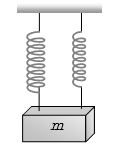
$A$ mass $m$ is suspended separately by two different springs of spring constant $K_1$ and $K_2$ giving the time periods $t_1$ and $t_2$ respectively. If the same mass $m$ is connected by both springs as shown in the figure,then the time period $t$ is given by the relation:
A
$t = t_1 + t_2$
B
$t = \frac{t_1 t_2}{t_1 + t_2}$
C
$t^2 = t_1^2 + t_2^2$
D
$t^{-2} = t_1^{-2} + t_2^{-2}$
Solution
(D) For a spring-mass system,the time period is given by $t = 2\pi \sqrt{\frac{m}{K}}$.
For the individual springs,we have $t_1 = 2\pi \sqrt{\frac{m}{K_1}}$ and $t_2 = 2\pi \sqrt{\frac{m}{K_2}}$.
Squaring these,we get $t_1^2 = 4\pi^2 \frac{m}{K_1} \implies K_1 = \frac{4\pi^2 m}{t_1^2}$ and $t_2^2 = 4\pi^2 \frac{m}{K_2} \implies K_2 = \frac{4\pi^2 m}{t_2^2}$.
In the given figure,the springs are in parallel. The equivalent spring constant is $K_{eq} = K_1 + K_2$.
The time period for the combined system is $t = 2\pi \sqrt{\frac{m}{K_1 + K_2}}$.
Squaring this,$t^2 = 4\pi^2 \frac{m}{K_1 + K_2} \implies \frac{1}{t^2} = \frac{K_1 + K_2}{4\pi^2 m} = \frac{K_1}{4\pi^2 m} + \frac{K_2}{4\pi^2 m}$.
Substituting the expressions for $K_1$ and $K_2$,we get $\frac{1}{t^2} = \frac{1}{t_1^2} + \frac{1}{t_2^2}$,which can be written as $t^{-2} = t_1^{-2} + t_2^{-2}$.
For the individual springs,we have $t_1 = 2\pi \sqrt{\frac{m}{K_1}}$ and $t_2 = 2\pi \sqrt{\frac{m}{K_2}}$.
Squaring these,we get $t_1^2 = 4\pi^2 \frac{m}{K_1} \implies K_1 = \frac{4\pi^2 m}{t_1^2}$ and $t_2^2 = 4\pi^2 \frac{m}{K_2} \implies K_2 = \frac{4\pi^2 m}{t_2^2}$.
In the given figure,the springs are in parallel. The equivalent spring constant is $K_{eq} = K_1 + K_2$.
The time period for the combined system is $t = 2\pi \sqrt{\frac{m}{K_1 + K_2}}$.
Squaring this,$t^2 = 4\pi^2 \frac{m}{K_1 + K_2} \implies \frac{1}{t^2} = \frac{K_1 + K_2}{4\pi^2 m} = \frac{K_1}{4\pi^2 m} + \frac{K_2}{4\pi^2 m}$.
Substituting the expressions for $K_1$ and $K_2$,we get $\frac{1}{t^2} = \frac{1}{t_1^2} + \frac{1}{t_2^2}$,which can be written as $t^{-2} = t_1^{-2} + t_2^{-2}$.
0 likesView Solution
11
PhysicsMediumMCQAIPMT · 2002
$A$ wave travelling in the positive $x-$direction with amplitude $A = 0.2\;m$ has a velocity of $v = 360\;m/s.$ If the wavelength $\lambda = 60\;m,$ then the correct expression for the wave is:
A
$y = 0.2\sin \left[ {2\pi \left( {6t + \frac{x}{{60}}} \right)} \right]$
B
$y = 0.2\sin \left[ {\pi \left( {6t + \frac{x}{{60}}} \right)} \right]$
C
$y = 0.2\sin \left[ {2\pi \left( {6t - \frac{x}{{60}}} \right)} \right]$
D
$y = 0.2\sin \left[ {\pi \left( {6t - \frac{x}{{60}}} \right)} \right]$
Solution
(C) wave travelling in the positive $x-$direction is represented by the equation:
$y = A \sin \left( \frac{2\pi}{\lambda} (vt - x) \right)$
Given values are $A = 0.2\;m,$ $v = 360\;m/s,$ and $\lambda = 60\;m.$
Substituting these values into the equation:
$y = 0.2 \sin \left( \frac{2\pi}{60} (360t - x) \right)$
$y = 0.2 \sin \left( 2\pi \left( \frac{360}{60}t - \frac{x}{60} \right) \right)$
$y = 0.2 \sin \left[ 2\pi \left( 6t - \frac{x}{60} \right) \right]$
Thus,the correct expression is $y = 0.2 \sin \left[ 2\pi \left( 6t - \frac{x}{60} \right) \right].$
$y = A \sin \left( \frac{2\pi}{\lambda} (vt - x) \right)$
Given values are $A = 0.2\;m,$ $v = 360\;m/s,$ and $\lambda = 60\;m.$
Substituting these values into the equation:
$y = 0.2 \sin \left( \frac{2\pi}{60} (360t - x) \right)$
$y = 0.2 \sin \left( 2\pi \left( \frac{360}{60}t - \frac{x}{60} \right) \right)$
$y = 0.2 \sin \left[ 2\pi \left( 6t - \frac{x}{60} \right) \right]$
Thus,the correct expression is $y = 0.2 \sin \left[ 2\pi \left( 6t - \frac{x}{60} \right) \right].$
0 likesView Solution
12
PhysicsMediumMCQAIPMT · 2002
$A$ whistle revolves in a circle with an angular speed of $20 \; rad/s$ using a string of length $50 \; cm.$ If the frequency of sound from the whistle is $385 \; Hz,$ then what is the minimum frequency heard by an observer,who is far away from the centre in the same plane? $(v = 340 \; m/s)$
A
$333$
B
$374$
C
$385$
D
$394$
Solution
(B) The linear speed of the whistle is given by $v_s = r\omega.$
Given $r = 50 \; cm = 0.5 \; m$ and $\omega = 20 \; rad/s.$
So,$v_s = 0.5 \times 20 = 10 \; m/s.$
The minimum frequency is heard when the source is moving directly away from the observer.
The formula for the observed frequency is $n_{\min} = n \left( \frac{v}{v + v_s} \right).$
Substituting the values: $n_{\min} = 385 \left( \frac{340}{340 + 10} \right) = 385 \left( \frac{340}{350} \right) = 385 \times \frac{34}{35} = 11 \times 34 = 374 \; Hz.$
Given $r = 50 \; cm = 0.5 \; m$ and $\omega = 20 \; rad/s.$
So,$v_s = 0.5 \times 20 = 10 \; m/s.$
The minimum frequency is heard when the source is moving directly away from the observer.
The formula for the observed frequency is $n_{\min} = n \left( \frac{v}{v + v_s} \right).$
Substituting the values: $n_{\min} = 385 \left( \frac{340}{340 + 10} \right) = 385 \left( \frac{340}{350} \right) = 385 \times \frac{34}{35} = 11 \times 34 = 374 \; Hz.$
0 likesView Solution
13
PhysicsMediumMCQAIPMT · 2002
$A$ circular disc is to be made by using iron and aluminium,so that it acquires maximum moment of inertia about its geometrical axis. This is possible with:
A
Iron and aluminium layers in alternate order
B
Aluminium at the interior and iron surrounding it
C
Iron at the interior and aluminium surrounding it
D
$A$ sheet of iron used at both external surfaces and an aluminium sheet as internal layers
Solution
(B) The moment of inertia $I$ of a body about an axis is given by $I = \int r^2 dm$,where $dm$ is the mass element at a distance $r$ from the axis.
To maximize the moment of inertia for a fixed total mass and radius,we need to place as much mass as possible at the largest possible distance $r$ from the axis.
Since iron has a higher density than aluminium,placing iron at the outer periphery (surrounding the interior) increases the mass distribution at larger radii.
Therefore,placing aluminium at the interior and iron at the exterior (surrounding it) results in a higher moment of inertia compared to other configurations.
Thus,option $B$ is correct.
To maximize the moment of inertia for a fixed total mass and radius,we need to place as much mass as possible at the largest possible distance $r$ from the axis.
Since iron has a higher density than aluminium,placing iron at the outer periphery (surrounding the interior) increases the mass distribution at larger radii.
Therefore,placing aluminium at the interior and iron at the exterior (surrounding it) results in a higher moment of inertia compared to other configurations.
Thus,option $B$ is correct.
1 likesView Solution
14
PhysicsEasyMCQAIPMT · 2002
$A$ disc is rotating with an angular speed of $\omega$. If a child sits on it,which of the following is conserved?
A
Kinetic energy
B
Potential energy
C
Linear momentum
D
Angular momentum
Solution
(D) According to the principle of conservation of angular momentum,if the net external torque acting on a system is zero,the total angular momentum of the system remains constant.
When a child sits on a rotating disc,the weight of the child acts vertically downwards,passing through the axis of rotation or creating no torque about the axis of rotation.
Since there is no external torque applied to the system (disc + child),the angular momentum of the system remains conserved.
When a child sits on a rotating disc,the weight of the child acts vertically downwards,passing through the axis of rotation or creating no torque about the axis of rotation.
Since there is no external torque applied to the system (disc + child),the angular momentum of the system remains conserved.
0 likesView Solution
15
PhysicsEasyMCQAIPMT · 2002
Which of the following is best close to an ideal black body?
A
black lamp
B
platinum black
C
a lump of charcoal heated to high temperature
D
cavity maintained at constant temperature
Solution
(D) An ideal black body is defined as a body that absorbs all incident radiation falling on it,regardless of the frequency or angle of incidence.
$A$ cavity maintained at a constant temperature,often called a Fery's black body,is the closest physical approximation to an ideal black body.
In this setup,any radiation entering the small hole of the cavity undergoes multiple internal reflections. At each reflection,a portion of the radiation is absorbed by the walls. After many such reflections,almost all of the incident radiation is absorbed,making it an excellent black body.
$A$ cavity maintained at a constant temperature,often called a Fery's black body,is the closest physical approximation to an ideal black body.
In this setup,any radiation entering the small hole of the cavity undergoes multiple internal reflections. At each reflection,a portion of the radiation is absorbed by the walls. After many such reflections,almost all of the incident radiation is absorbed,making it an excellent black body.
0 likesView Solution
16
PhysicsMediumMCQAIPMT · 2002
For a black body at temperature $727^{\circ} C$,its radiating power is $60\; W$ and the temperature of the surrounding is $227^{\circ} C$. If the temperature of the black body is changed to $1227^{\circ} C$,then its radiating power will be ..... $W$.
A
$304$
B
$320$
C
$240$
D
$120$
Solution
(B) According to Stefan-Boltzmann Law,the net power radiated by a black body is given by $P = \sigma A (T^4 - T_0^4)$,where $T$ is the temperature of the body and $T_0$ is the temperature of the surroundings.
Given:
$T_1 = 727^{\circ} C = 727 + 273 = 1000 \; K$
$T_0 = 227^{\circ} C = 227 + 273 = 500 \; K$
$P_1 = 60 \; W$
$P_1 = k(T_1^4 - T_0^4) \Rightarrow 60 = k(1000^4 - 500^4) \quad \dots(1)$
Now,$T_2 = 1227^{\circ} C = 1227 + 273 = 1500 \; K$
$P_2 = k(T_2^4 - T_0^4) \Rightarrow P_2 = k(1500^4 - 500^4) \quad \dots(2)$
Dividing equation $(2)$ by $(1)$:
$\frac{P_2}{60} = \frac{1500^4 - 500^4}{1000^4 - 500^4} = \frac{500^4 (3^4 - 1^4)}{500^4 (2^4 - 1^4)}$
$\frac{P_2}{60} = \frac{81 - 1}{16 - 1} = \frac{80}{15} = \frac{16}{3}$
$P_2 = 60 \times \frac{16}{3} = 20 \times 16 = 320 \; W$.
Given:
$T_1 = 727^{\circ} C = 727 + 273 = 1000 \; K$
$T_0 = 227^{\circ} C = 227 + 273 = 500 \; K$
$P_1 = 60 \; W$
$P_1 = k(T_1^4 - T_0^4) \Rightarrow 60 = k(1000^4 - 500^4) \quad \dots(1)$
Now,$T_2 = 1227^{\circ} C = 1227 + 273 = 1500 \; K$
$P_2 = k(T_2^4 - T_0^4) \Rightarrow P_2 = k(1500^4 - 500^4) \quad \dots(2)$
Dividing equation $(2)$ by $(1)$:
$\frac{P_2}{60} = \frac{1500^4 - 500^4}{1000^4 - 500^4} = \frac{500^4 (3^4 - 1^4)}{500^4 (2^4 - 1^4)}$
$\frac{P_2}{60} = \frac{81 - 1}{16 - 1} = \frac{80}{15} = \frac{16}{3}$
$P_2 = 60 \times \frac{16}{3} = 20 \times 16 = 320 \; W$.
0 likesView Solution
17
PhysicsMediumMCQAIPMT · 2002
Consider a point $P$ at the contact point of a wheel on the ground,which rolls on the ground without slipping. Find the displacement of point $P$ when the wheel completes half of a rotation (given the radius of the wheel is $1 \ m$).
A
$2 \ m$
B
$\sqrt{\pi^2 + 4} \ m$
C
$\pi \ m$
D
$\sqrt{\pi^2 + 2} \ m$
Solution
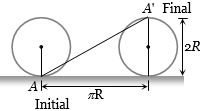
(B) When a wheel of radius $R$ rolls without slipping,the horizontal distance covered by the center of the wheel in half a revolution is equal to $\pi R$.
The vertical displacement of the point $P$ (which was initially at the contact point $A$ and moves to the topmost point $A'$) is equal to the diameter of the wheel,which is $2R$.
The total displacement is the vector sum of the horizontal and vertical displacements,which is the hypotenuse of a right-angled triangle with sides $\pi R$ and $2R$.
Displacement $= \sqrt{(\pi R)^2 + (2R)^2} = R\sqrt{\pi^2 + 4}$.
Given $R = 1 \ m$,the displacement $= 1 \times \sqrt{\pi^2 + 4} = \sqrt{\pi^2 + 4} \ m$.
The vertical displacement of the point $P$ (which was initially at the contact point $A$ and moves to the topmost point $A'$) is equal to the diameter of the wheel,which is $2R$.
The total displacement is the vector sum of the horizontal and vertical displacements,which is the hypotenuse of a right-angled triangle with sides $\pi R$ and $2R$.
Displacement $= \sqrt{(\pi R)^2 + (2R)^2} = R\sqrt{\pi^2 + 4}$.
Given $R = 1 \ m$,the displacement $= 1 \times \sqrt{\pi^2 + 4} = \sqrt{\pi^2 + 4} \ m$.
0 likesView Solution
18
PhysicsEasyMCQAIPMT · 2002
Wien's displacement law expresses the relation between:
A
colour of light and temperature
B
temperature and wavelength
C
radiation energy and wavelength
D
wavelength corresponding to maximum energy and temperature
Solution
(D) Wien's displacement law states that the product of the absolute temperature $(T)$ and the wavelength $(\lambda_{\max})$ at which the spectral emissive power of a black body is maximum is a constant.
The mathematical expression is given by:
$\lambda_{\max} T = b$
where $b$ is Wien's constant.
Therefore, the law expresses the relationship between the wavelength corresponding to maximum energy and the absolute temperature of the body.
The mathematical expression is given by:
$\lambda_{\max} T = b$
where $b$ is Wien's constant.
Therefore, the law expresses the relationship between the wavelength corresponding to maximum energy and the absolute temperature of the body.
0 likesView Solution
19
PhysicsMediumMCQAIPMT · 2002
When an oscillator completes $100$ oscillations,its amplitude is reduced to $\frac{1}{3}$ of its initial value. What will be its amplitude after it completes $200$ oscillations?
A
$\frac{1}{8}$
B
$\frac{1}{9}$
C
$\frac{2}{3}$
D
$\frac{1}{6}$
Solution
(B) In damped oscillations,the amplitude decays exponentially with time,given by $a = a_0 e^{-bt}$,where $b$ is the damping constant and $t$ is the time.
Let $T$ be the time period of one oscillation. After $n$ oscillations,the time elapsed is $t = nT$.
Initially,after $100$ oscillations,the amplitude is $a = \frac{a_0}{3}$.
So,$\frac{a_0}{3} = a_0 e^{-b(100T)}$,which implies $e^{-100bT} = \frac{1}{3}$.
After $200$ oscillations,the time elapsed is $t = 200T$.
The amplitude $a'$ will be $a' = a_0 e^{-b(200T)}$.
This can be written as $a' = a_0 (e^{-100bT})^2$.
Substituting the value from the first step: $a' = a_0 (\frac{1}{3})^2 = \frac{a_0}{9}$.
Thus,the amplitude becomes $\frac{1}{9}$ of the initial value.
Let $T$ be the time period of one oscillation. After $n$ oscillations,the time elapsed is $t = nT$.
Initially,after $100$ oscillations,the amplitude is $a = \frac{a_0}{3}$.
So,$\frac{a_0}{3} = a_0 e^{-b(100T)}$,which implies $e^{-100bT} = \frac{1}{3}$.
After $200$ oscillations,the time elapsed is $t = 200T$.
The amplitude $a'$ will be $a' = a_0 e^{-b(200T)}$.
This can be written as $a' = a_0 (e^{-100bT})^2$.
Substituting the value from the first step: $a' = a_0 (\frac{1}{3})^2 = \frac{a_0}{9}$.
Thus,the amplitude becomes $\frac{1}{9}$ of the initial value.
0 likesView Solution
20
PhysicsMediumMCQAIPMT · 2002
$A$ solid sphere of radius $R$ is placed on a smooth horizontal surface. $A$ horizontal force $F$ is applied at a height $h$ from the lowest point. For the maximum acceleration of the centre of mass,which is correct?
A
$h=R$
B
no relation between $h$ and $R$
C
$h=0$
D
$h=2 R$
Solution
(B) The surface is smooth,so there is no friction at the contact surface.
According to Newton's second law,the linear acceleration $a$ of the centre of mass is given by $a = \frac{F}{m}$,where $F$ is the applied force and $m$ is the mass of the sphere.
Since the force $F$ and the mass $m$ are constant,the acceleration $a$ is independent of the height $h$ at which the force is applied.
Therefore,there is no specific relation between $h$ and $R$ required to maximize the acceleration; it remains constant for any $h$.
According to Newton's second law,the linear acceleration $a$ of the centre of mass is given by $a = \frac{F}{m}$,where $F$ is the applied force and $m$ is the mass of the sphere.
Since the force $F$ and the mass $m$ are constant,the acceleration $a$ is independent of the height $h$ at which the force is applied.
Therefore,there is no specific relation between $h$ and $R$ required to maximize the acceleration; it remains constant for any $h$.
0 likesView Solution
21
PhysicsMediumMCQAIPMT · 2002
An object of mass $3\,kg$ is at rest. If a force $\vec{F} = (6t^2\hat{i} + 4t\hat{j})\,N$ is applied on the object,then the velocity of the object at $t = 3\,s$ will be
A
$18\hat{i} + 6\hat{j}$
B
$18\hat{i} + 18\hat{j}$
C
$18\hat{i} + 4\hat{j}$
D
$6\hat{i} + 18\hat{j}$
Solution
(A) Given mass $m = 3\,kg$ and force $\vec{F} = (6t^2\hat{i} + 4t\hat{j})\,N$.
Using Newton's second law,$\vec{a} = \frac{\vec{F}}{m} = \frac{6t^2\hat{i} + 4t\hat{j}}{3} = (2t^2\hat{i} + \frac{4}{3}t\hat{j})\,m/s^2$.
Since the object starts from rest,$\vec{v}(0) = 0$. The velocity $\vec{v}$ at time $t$ is given by $\vec{v} = \int_{0}^{t} \vec{a} dt$.
$\vec{v} = \int_{0}^{3} (2t^2\hat{i} + \frac{4}{3}t\hat{j}) dt$.
$\vec{v} = [\frac{2t^3}{3}\hat{i} + \frac{4t^2}{6}\hat{j}]_{0}^{3}$.
$\vec{v} = [\frac{2(3)^3}{3}\hat{i} + \frac{4(3)^2}{6}\hat{j}] = [\frac{54}{3}\hat{i} + \frac{36}{6}\hat{j}] = 18\hat{i} + 6\hat{j}\,m/s$.
Using Newton's second law,$\vec{a} = \frac{\vec{F}}{m} = \frac{6t^2\hat{i} + 4t\hat{j}}{3} = (2t^2\hat{i} + \frac{4}{3}t\hat{j})\,m/s^2$.
Since the object starts from rest,$\vec{v}(0) = 0$. The velocity $\vec{v}$ at time $t$ is given by $\vec{v} = \int_{0}^{t} \vec{a} dt$.
$\vec{v} = \int_{0}^{3} (2t^2\hat{i} + \frac{4}{3}t\hat{j}) dt$.
$\vec{v} = [\frac{2t^3}{3}\hat{i} + \frac{4t^2}{6}\hat{j}]_{0}^{3}$.
$\vec{v} = [\frac{2(3)^3}{3}\hat{i} + \frac{4(3)^2}{6}\hat{j}] = [\frac{54}{3}\hat{i} + \frac{36}{6}\hat{j}] = 18\hat{i} + 6\hat{j}\,m/s$.
0 likesView Solution
22
PhysicsDifficultMCQAIPMT · 2002
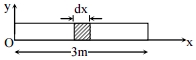
$A$ rod of length $3 \; m$ has a linear mass density that is directly proportional to the distance $x$ from one of its ends. Find the position of its centre of gravity from that end. (in $; m$)
A
$1.5$
B
$2.5$
C
$3$
D
$2$
Solution
(D) Let the linear mass density be $\rho = kx$,where $k$ is a constant.
The mass of a small element of length $dx$ is $dm = \rho \cdot dx = kx \cdot dx$.
The position of the centre of mass $x_{cm}$ is given by the formula:
$x_{cm} = \frac{\int x \cdot dm}{\int dm}$
Substituting the values:
$x_{cm} = \frac{\int_{0}^{3} x(kx \cdot dx)}{\int_{0}^{3} kx \cdot dx} = \frac{\int_{0}^{3} x^2 \cdot dx}{\int_{0}^{3} x \cdot dx}$
Evaluating the integrals:
$x_{cm} = \frac{[x^3/3]_{0}^{3}}{[x^2/2]_{0}^{3}} = \frac{27/3}{9/2} = \frac{9}{4.5} = 2 \; m$.
The mass of a small element of length $dx$ is $dm = \rho \cdot dx = kx \cdot dx$.
The position of the centre of mass $x_{cm}$ is given by the formula:
$x_{cm} = \frac{\int x \cdot dm}{\int dm}$
Substituting the values:
$x_{cm} = \frac{\int_{0}^{3} x(kx \cdot dx)}{\int_{0}^{3} kx \cdot dx} = \frac{\int_{0}^{3} x^2 \cdot dx}{\int_{0}^{3} x \cdot dx}$
Evaluating the integrals:
$x_{cm} = \frac{[x^3/3]_{0}^{3}}{[x^2/2]_{0}^{3}} = \frac{27/3}{9/2} = \frac{9}{4.5} = 2 \; m$.
0 likesView Solution
23
PhysicsMediumMCQAIPMT · 2002
If identical charges $(-q)$ are placed at each corner of a cube of side $b$,then the electric potential energy of charge $(+q)$ which is placed at the center of the cube will be:
A
$\frac{8\sqrt{2}q^2}{4\pi\varepsilon_0b}$
B
$\frac{-8\sqrt{2}q^2}{\pi\varepsilon_0b}$
C
$\frac{-4\sqrt{2}q^2}{\pi\varepsilon_0b}$
D
$\frac{-4q^2}{\sqrt{3}\pi\varepsilon_0b}$
Solution
(D) The length of the body diagonal of a cube with side $b$ is $\sqrt{3}b$.
The distance of the center of the cube from each vertex is $r = \frac{\sqrt{3}b}{2}$.
The electric potential energy $U$ of a charge $q$ at the center due to $8$ charges of $-q$ at the corners is given by the sum of individual potential energies:
$U = \sum_{i=1}^{8} \frac{1}{4\pi\varepsilon_0} \frac{(-q)(q)}{r}$
$U = 8 \times \left( \frac{1}{4\pi\varepsilon_0} \cdot \frac{-q^2}{\sqrt{3}b/2} \right)$
$U = 8 \times \left( \frac{-2q^2}{4\pi\varepsilon_0\sqrt{3}b} \right)$
$U = \frac{-16q^2}{4\pi\varepsilon_0\sqrt{3}b} = \frac{-4q^2}{\sqrt{3}\pi\varepsilon_0b}$
The distance of the center of the cube from each vertex is $r = \frac{\sqrt{3}b}{2}$.
The electric potential energy $U$ of a charge $q$ at the center due to $8$ charges of $-q$ at the corners is given by the sum of individual potential energies:
$U = \sum_{i=1}^{8} \frac{1}{4\pi\varepsilon_0} \frac{(-q)(q)}{r}$
$U = 8 \times \left( \frac{1}{4\pi\varepsilon_0} \cdot \frac{-q^2}{\sqrt{3}b/2} \right)$
$U = 8 \times \left( \frac{-2q^2}{4\pi\varepsilon_0\sqrt{3}b} \right)$
$U = \frac{-16q^2}{4\pi\varepsilon_0\sqrt{3}b} = \frac{-4q^2}{\sqrt{3}\pi\varepsilon_0b}$
0 likesView Solution
24
PhysicsMediumMCQAIPMT · 2002
$A$ capacitor of capacity $C_1$ is charged up to $V$ volt and then connected to an uncharged capacitor of capacity $C_2$. The final potential difference across each will be:
A
$\frac{C_2 V}{C_1 + C_2}$
B
$\left( 1 + \frac{C_2}{C_1} \right) V$
C
$\frac{C_1 V}{C_1 + C_2}$
D
$\left( 1 - \frac{C_2}{C_1} \right) V$
Solution
(C) When two capacitors are connected,charge flows from the higher potential to the lower potential until they reach a common potential $V'$.
By the principle of conservation of charge,the total charge before connection equals the total charge after connection.
Initial charge $Q_{total} = C_1 V + C_2 (0) = C_1 V$.
Total capacitance after connection $C_{total} = C_1 + C_2$.
Common potential $V' = \frac{Q_{total}}{C_{total}} = \frac{C_1 V}{C_1 + C_2}$.
By the principle of conservation of charge,the total charge before connection equals the total charge after connection.
Initial charge $Q_{total} = C_1 V + C_2 (0) = C_1 V$.
Total capacitance after connection $C_{total} = C_1 + C_2$.
Common potential $V' = \frac{Q_{total}}{C_{total}} = \frac{C_1 V}{C_1 + C_2}$.
0 likesView Solution
25
PhysicsEasyMCQAIPMT · 2002
$A$ galvanometer can be used as a voltmeter by connecting a
A
High resistance in series
B
Low resistance in series
C
High resistance in parallel
D
Low resistance in parallel
Solution
(A) galvanometer has a low internal resistance,but a voltmeter must have a very high resistance to ensure it draws minimal current from the circuit it is measuring.
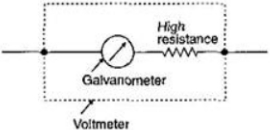
To convert a galvanometer into a voltmeter,we need to increase its effective resistance. This is achieved by connecting a high resistance in series with the galvanometer coil.
As shown in the diagram,the combination of the galvanometer and the series resistor acts as a voltmeter.
Note: The resistance of an ideal voltmeter should be infinite.
To convert a galvanometer into a voltmeter,we need to increase its effective resistance. This is achieved by connecting a high resistance in series with the galvanometer coil.
As shown in the diagram,the combination of the galvanometer and the series resistor acts as a voltmeter.
Note: The resistance of an ideal voltmeter should be infinite.
0 likesView Solution
26
PhysicsMediumMCQAIPMT · 2002
$A$ wire in the form of a circular loop of one turn carrying a current produces a magnetic field $B$ at the centre. If the same wire is looped into a coil of two turns and carries the same current,the new value of magnetic induction at the centre is
A
$B$
B
$2B$
C
$4B$
D
$8B$
Solution
(C) The magnetic field at the center of a circular coil of $n$ turns carrying current $I$ and having radius $r$ is given by $B = \frac{\mu_0 n I}{2r}$.
If the same wire of length $L$ is used,then for $n=1$,$L = 2\pi r_1$,so $r_1 = \frac{L}{2\pi}$. Thus,$B = \frac{\mu_0 I}{2(L/2\pi)} = \frac{\mu_0 I \pi}{L}$.
For $n=2$,the new radius $r_2$ is given by $L = 2(2\pi r_2)$,so $r_2 = \frac{L}{4\pi} = \frac{r_1}{2}$.
The new magnetic field $B'$ is $B' = \frac{\mu_0 (2) I}{2r_2} = \frac{\mu_0 I}{r_2} = \frac{\mu_0 I}{r_1/2} = 2 \left( \frac{\mu_0 I}{r_1} \right) = 4 \left( \frac{\mu_0 I}{2r_1} \right) = 4B$.
Therefore,the new magnetic field is $4B$.
If the same wire of length $L$ is used,then for $n=1$,$L = 2\pi r_1$,so $r_1 = \frac{L}{2\pi}$. Thus,$B = \frac{\mu_0 I}{2(L/2\pi)} = \frac{\mu_0 I \pi}{L}$.
For $n=2$,the new radius $r_2$ is given by $L = 2(2\pi r_2)$,so $r_2 = \frac{L}{4\pi} = \frac{r_1}{2}$.
The new magnetic field $B'$ is $B' = \frac{\mu_0 (2) I}{2r_2} = \frac{\mu_0 I}{r_2} = \frac{\mu_0 I}{r_1/2} = 2 \left( \frac{\mu_0 I}{r_1} \right) = 4 \left( \frac{\mu_0 I}{2r_1} \right) = 4B$.
Therefore,the new magnetic field is $4B$.
0 likesView Solution
27
PhysicsEasyMCQAIPMT · 2002
$A$ charge $q$ moves in a region where both an electric field and a magnetic field exist. The total force on it is:
A
$q \overrightarrow{E} + q (\overrightarrow{v} \times \overrightarrow{B})$
B
$q (\overrightarrow{v} \times \overrightarrow{B})$
C
$q \overrightarrow{E} + q (\overrightarrow{B} \times \overrightarrow{v})$
D
$q \overrightarrow{B} + q (\overrightarrow{E} \times \overrightarrow{v})$
Solution
(A) When a charge $q$ moves with velocity $\overrightarrow{v}$ in a region containing both an electric field $\overrightarrow{E}$ and a magnetic field $\overrightarrow{B}$,it experiences two forces:
$1$. The electric force: $\overrightarrow{F_e} = q\overrightarrow{E}$
$2$. The magnetic force (Lorentz force): $\overrightarrow{F_m} = q(\overrightarrow{v} \times \overrightarrow{B})$
The total force,known as the Lorentz force,is the vector sum of these two forces:
$\overrightarrow{F} = \overrightarrow{F_e} + \overrightarrow{F_m} = q\overrightarrow{E} + q(\overrightarrow{v} \times \overrightarrow{B})$
Therefore,the correct option is $A$.
$1$. The electric force: $\overrightarrow{F_e} = q\overrightarrow{E}$
$2$. The magnetic force (Lorentz force): $\overrightarrow{F_m} = q(\overrightarrow{v} \times \overrightarrow{B})$
The total force,known as the Lorentz force,is the vector sum of these two forces:
$\overrightarrow{F} = \overrightarrow{F_e} + \overrightarrow{F_m} = q\overrightarrow{E} + q(\overrightarrow{v} \times \overrightarrow{B})$
Therefore,the correct option is $A$.
0 likesView Solution
28
PhysicsEasyMCQAIPMT · 2002
Which of the following is not a property of cathode rays?
A
They cast shadows.
B
They produce a heating effect.
C
They produce fluorescence.
D
They do not deflect in an electric field.
Solution
(D) Cathode rays consist of a stream of negatively charged particles (electrons). Because they carry a charge,they are deflected by both electric and magnetic fields. Therefore,the statement that they do not deflect in an electric field is incorrect.
0 likesView Solution
29
PhysicsEasyMCQAIPMT · 2002
If particles are moving with the same velocity,then the maximum de-Broglie wavelength will be for
A
Neutron
B
Proton
C
$\beta$-particle
D
$\alpha$-particle
Solution
(C) The de-Broglie wavelength $\lambda$ is given by the formula $\lambda = \frac{h}{mv}$,where $h$ is Planck's constant,$m$ is the mass of the particle,and $v$ is its velocity.
Given that the velocity $v$ is the same for all particles,the relationship becomes $\lambda \propto \frac{1}{m}$.
This means that the particle with the smallest mass will have the maximum de-Broglie wavelength.
Comparing the masses: $m_{\beta} < m_{proton} \approx m_{neutron} < m_{\alpha}$.
Since the $\beta$-particle (an electron) has the smallest mass among the given options,it will have the maximum de-Broglie wavelength.
Given that the velocity $v$ is the same for all particles,the relationship becomes $\lambda \propto \frac{1}{m}$.
This means that the particle with the smallest mass will have the maximum de-Broglie wavelength.
Comparing the masses: $m_{\beta} < m_{proton} \approx m_{neutron} < m_{\alpha}$.
Since the $\beta$-particle (an electron) has the smallest mass among the given options,it will have the maximum de-Broglie wavelength.
0 likesView Solution
30
PhysicsEasyMCQAIPMT · 2002
When ultraviolet rays are incident on a metal plate, the photoelectric effect does not occur. It occurs by the incidence of:
A
$X$-rays
B
Radio waves
C
Infrared rays
D
Greenhouse effect
Solution
(A) The photoelectric effect occurs when the incident radiation has a frequency greater than the threshold frequency of the metal, or equivalently, a wavelength shorter than the threshold wavelength.
Since ultraviolet $(UV)$ rays do not cause the photoelectric effect, the incident radiation must have a higher energy (shorter wavelength) than $UV$ rays.
Among the given options, $X$-rays have a shorter wavelength $(\lambda_{X-ray} < \lambda_{UV-ray})$ and thus higher energy than $UV$ rays.
Therefore, $X$-rays will cause the photoelectric effect.
Since ultraviolet $(UV)$ rays do not cause the photoelectric effect, the incident radiation must have a higher energy (shorter wavelength) than $UV$ rays.
Among the given options, $X$-rays have a shorter wavelength $(\lambda_{X-ray} < \lambda_{UV-ray})$ and thus higher energy than $UV$ rays.
Therefore, $X$-rays will cause the photoelectric effect.
0 likesView Solution
31
PhysicsEasyMCQAIPMT · 2002
Which of the following are suitable for the fusion process?
A
Heavy nuclei
B
Light nuclei
C
Atom bomb
D
Radioactive decay
Solution
(B) The nuclei of light elements have a lower binding energy per nucleon than that for the elements of intermediate mass. They are therefore less stable. Consequently,the fusion of light elements results in a more stable nucleus with a higher binding energy per nucleon,releasing a large amount of energy.
0 likesView Solution
32
PhysicsEasyMCQAIPMT · 2002
$A$ deuteron is bombarded on an $_8O^{16}$ nucleus and an $\alpha$-particle is emitted. The product nucleus is
A
$_7N^{13}$
B
$_5B^{10}$
C
$_4Be^9$
D
$_7N^{14}$
Solution
(D) The nuclear reaction can be represented as: $_8O^{16} + _1H^2 \to _Z^AX + _2He^4$.
Applying the law of conservation of mass number: $16 + 2 = A + 4$,which gives $A = 14$.
Applying the law of conservation of atomic number: $8 + 1 = Z + 2$,which gives $Z = 7$.
Thus,the product nucleus is $_7N^{14}$.
Applying the law of conservation of mass number: $16 + 2 = A + 4$,which gives $A = 14$.
Applying the law of conservation of atomic number: $8 + 1 = Z + 2$,which gives $Z = 7$.
Thus,the product nucleus is $_7N^{14}$.
0 likesView Solution
33
PhysicsEasyMCQAIPMT · 2002
In an unbiased $PN$-junction,which of the following statements regarding the potential across the junction is correct?
A
$P$ and $N$ regions are at the same potential.
B
High potential at $N$ side and low potential at $P$ side.
C
High potential at $P$ side and low potential at $N$ side.
D
Low potential at $N$ side and zero potential at $P$ side.
Solution
(B) When a $P$-type semiconductor is joined with an $N$-type semiconductor to form a $PN$-junction,electrons diffuse from the $N$-region to the $P$-region,and holes diffuse from the $P$-region to the $N$-region.
This diffusion creates a depletion layer near the junction.
Due to the migration of charge carriers,the $N$-side becomes positively charged relative to the $P$-side,creating an electric field directed from the $N$-side to the $P$-side.
Consequently,the $P$-side is at a lower potential and the $N$-side is at a higher potential. This potential difference is known as the barrier potential.
This diffusion creates a depletion layer near the junction.
Due to the migration of charge carriers,the $N$-side becomes positively charged relative to the $P$-side,creating an electric field directed from the $N$-side to the $P$-side.
Consequently,the $P$-side is at a lower potential and the $N$-side is at a higher potential. This potential difference is known as the barrier potential.
0 likesView Solution
34
PhysicsEasyMCQAIPMT · 2002
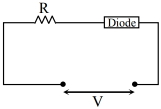
For the given circuit of a $PN-$ junction diode,which of the following statements is correct?
A
In forward biasing,the voltage across $R$ is $V$.
B
In forward biasing,the voltage across $R$ is $2V$.
C
In reverse biasing,the voltage across $R$ is $V$.
D
In reverse biasing,the voltage across $R$ is $2V$.
Solution
(A) In forward biasing,an ideal $PN$ junction diode acts as a closed switch with zero resistance. Therefore,the entire applied voltage $V$ appears across the resistor $R$.
In reverse biasing,an ideal $PN$ junction diode acts as an open switch with infinite resistance. Therefore,no current flows through the circuit,and the voltage across the resistor $R$ is $0$.
In reverse biasing,an ideal $PN$ junction diode acts as an open switch with infinite resistance. Therefore,no current flows through the circuit,and the voltage across the resistor $R$ is $0$.
0 likesView Solution
35
PhysicsMediumMCQAIPMT · 2002
For a common base configuration of a $PNP$ transistor,$\frac{I_C}{I_E} = 0.96$. Then,the maximum current gain in common emitter configuration will be:
A
$12$
B
$24$
C
$6$
D
$5$
Solution
(B) In a common base configuration,the current gain $\alpha$ is defined as the ratio of collector current $I_C$ to emitter current $I_E$.
Given: $\alpha = \frac{I_C}{I_E} = 0.96$.
The current gain in common emitter configuration,denoted by $\beta$,is related to $\alpha$ by the formula:
$\beta = \frac{\alpha}{1 - \alpha}$.
Substituting the given value:
$\beta = \frac{0.96}{1 - 0.96} = \frac{0.96}{0.04}$.
$\beta = 24$.
Therefore,the maximum current gain in common emitter configuration is $24$.
Given: $\alpha = \frac{I_C}{I_E} = 0.96$.
The current gain in common emitter configuration,denoted by $\beta$,is related to $\alpha$ by the formula:
$\beta = \frac{\alpha}{1 - \alpha}$.
Substituting the given value:
$\beta = \frac{0.96}{1 - 0.96} = \frac{0.96}{0.04}$.
$\beta = 24$.
Therefore,the maximum current gain in common emitter configuration is $24$.
0 likesView Solution
36
PhysicsMediumMCQAIPMT · 2002
The truth table given below is for which gate?
$A: 0, 0, 1, 1$
$B: 0, 1, 0, 1$
$C: 1, 1, 1, 0$
$A: 0, 0, 1, 1$
$B: 0, 1, 0, 1$
$C: 1, 1, 1, 0$
A
$XOR$
B
$OR$
C
$AND$
D
$NAND$
Solution
(D) For a $NAND$ gate,the output $C$ is given by the Boolean expression $C = \overline{A \cdot B}$.
Checking the values:
$1$. For $A = 0, B = 0$: $C = \overline{0 \cdot 0} = \overline{0} = 1$.
$2$. For $A = 0, B = 1$: $C = \overline{0 \cdot 1} = \overline{0} = 1$.
$3$. For $A = 1, B = 0$: $C = \overline{1 \cdot 0} = \overline{0} = 1$.
$4$. For $A = 1, B = 1$: $C = \overline{1 \cdot 1} = \overline{1} = 0$.
Comparing these results with the given table,the output matches the $NAND$ gate logic.
Checking the values:
$1$. For $A = 0, B = 0$: $C = \overline{0 \cdot 0} = \overline{0} = 1$.
$2$. For $A = 0, B = 1$: $C = \overline{0 \cdot 1} = \overline{0} = 1$.
$3$. For $A = 1, B = 0$: $C = \overline{1 \cdot 0} = \overline{0} = 1$.
$4$. For $A = 1, B = 1$: $C = \overline{1 \cdot 1} = \overline{1} = 0$.
Comparing these results with the given table,the output matches the $NAND$ gate logic.
0 likesView Solution
37
PhysicsEasyMCQAIPMT · 2002
What is the cause of the greenhouse effect?
A
Ultraviolet rays
B
Infrared rays
C
$X$-rays
D
Radio waves
Solution
(B) The greenhouse effect is primarily caused by infrared radiations.
Solar energy reaches the Earth's surface,which then re-emits this energy as infrared radiation.
Greenhouse gases in the atmosphere absorb these infrared rays and reflect them back towards the Earth's surface,thereby trapping heat and keeping the planet warm.
Solar energy reaches the Earth's surface,which then re-emits this energy as infrared radiation.
Greenhouse gases in the atmosphere absorb these infrared rays and reflect them back towards the Earth's surface,thereby trapping heat and keeping the planet warm.
0 likesView Solution
38
PhysicsEasyMCQAIPMT · 2002
If $\overrightarrow E$ and $\overrightarrow B$ are the electric and magnetic field vectors of electromagnetic waves,then the direction of propagation of the electromagnetic wave is along the direction of:
A
$\overrightarrow E$
B
$\overrightarrow B$
C
$\overrightarrow E \times \overrightarrow B$
D
None of these
Solution
(C) The electromagnetic wave propagates in a direction perpendicular to both the electric field vector $\overrightarrow E$ and the magnetic field vector $\overrightarrow B$.
According to the properties of electromagnetic waves,the direction of wave propagation is given by the direction of the Poynting vector $\vec S$,which is proportional to $\overrightarrow E \times \overrightarrow B$.
Therefore,the direction of propagation is along $\overrightarrow E \times \overrightarrow B$.
According to the properties of electromagnetic waves,the direction of wave propagation is given by the direction of the Poynting vector $\vec S$,which is proportional to $\overrightarrow E \times \overrightarrow B$.
Therefore,the direction of propagation is along $\overrightarrow E \times \overrightarrow B$.
0 likesView Solution
39
PhysicsEasyMCQAIPMT · 2002
Which one of the following has the minimum wavelength?
A
Ultraviolet rays
B
Cosmic rays
C
$X$-rays
D
$\gamma$-rays
Solution
(B) The electromagnetic spectrum is ordered by wavelength. The approximate wavelength ranges are as follows:
$1$. Cosmic rays: $10^{-14} \ m$ to $10^{-12} \ m$
$2$. $\gamma$-rays: $10^{-12} \ m$ to $10^{-10} \ m$
$3$. $X$-rays: $10^{-10} \ m$ to $10^{-8} \ m$
$4$. Ultraviolet rays: $10^{-8} \ m$ to $4 \times 10^{-7} \ m$
Comparing these values,cosmic rays have the shortest (minimum) wavelength. Therefore,the correct option is $B$.
$1$. Cosmic rays: $10^{-14} \ m$ to $10^{-12} \ m$
$2$. $\gamma$-rays: $10^{-12} \ m$ to $10^{-10} \ m$
$3$. $X$-rays: $10^{-10} \ m$ to $10^{-8} \ m$
$4$. Ultraviolet rays: $10^{-8} \ m$ to $4 \times 10^{-7} \ m$
Comparing these values,cosmic rays have the shortest (minimum) wavelength. Therefore,the correct option is $B$.
0 likesView Solution
40
PhysicsEasyMCQAIPMT · 2002
Some charge is being given to a conductor. Then its potential is
A
maximum at surface
B
maximum at centre
C
remain same throughout the conductor
D
maximum somewhere between surface and centre
Solution
(C) When a charge is given to a conductor,it resides entirely on its outer surface due to electrostatic repulsion between like charges.
Inside the conductor,the electric field $E$ is zero.
Since the electric field $E = -dV/dr$,if $E = 0$,then the potential $V$ must be constant throughout the volume of the conductor.
Therefore,the potential at every point inside and on the surface of the conductor is the same,making the conductor an equipotential volume.
Inside the conductor,the electric field $E$ is zero.
Since the electric field $E = -dV/dr$,if $E = 0$,then the potential $V$ must be constant throughout the volume of the conductor.
Therefore,the potential at every point inside and on the surface of the conductor is the same,making the conductor an equipotential volume.
0 likesView Solution
41
PhysicsEasyMCQAIPMT · 2002
Specific resistance of a conductor increases with
A
Increase in cross-sectional area
B
Increase in temperature
C
Increase in cross-sectional area and decrease in length
D
Decrease in cross-sectional area
Solution
(B) Specific resistance, also known as resistivity $(\rho)$, is an intrinsic property of a material.
It depends on the nature of the material and the temperature.
For metallic conductors, resistivity increases with an increase in temperature due to increased scattering of electrons by vibrating lattice ions.
Resistivity does not depend on the physical dimensions of the conductor, such as its length or cross-sectional area.
It depends on the nature of the material and the temperature.
For metallic conductors, resistivity increases with an increase in temperature due to increased scattering of electrons by vibrating lattice ions.
Resistivity does not depend on the physical dimensions of the conductor, such as its length or cross-sectional area.
0 likesView Solution
42
PhysicsMediumMCQAIPMT · 2002
For a cell,the terminal potential difference $(P.D.)$ is $2.2\;V$ when the circuit is open and reduces to $1.8\;V$ when the cell is connected to an external resistance of $R = 5\;\Omega$. Determine the internal resistance $(r)$ of the cell.
A
$\frac{10}{9}\;\Omega$
B
$\frac{9}{10}\;\Omega$
C
$\frac{11}{9}\;\Omega$
D
$\frac{5}{9}\;\Omega$
Solution
(A) Given: Electromotive force $(E)$ = $2.2\;V$,Terminal voltage $(V)$ = $1.8\;V$,External resistance $(R)$ = $5\;\Omega$.
The formula for internal resistance $(r)$ is given by:
$r = \left( \frac{E}{V} - 1 \right) R$
Substituting the given values:
$r = \left( \frac{2.2}{1.8} - 1 \right) \times 5$
$r = \left( \frac{22}{18} - 1 \right) \times 5$
$r = \left( \frac{11}{9} - 1 \right) \times 5$
$r = \left( \frac{11 - 9}{9} \right) \times 5$
$r = \left( \frac{2}{9} \right) \times 5$
$r = \frac{10}{9}\;\Omega$
The formula for internal resistance $(r)$ is given by:
$r = \left( \frac{E}{V} - 1 \right) R$
Substituting the given values:
$r = \left( \frac{2.2}{1.8} - 1 \right) \times 5$
$r = \left( \frac{22}{18} - 1 \right) \times 5$
$r = \left( \frac{11}{9} - 1 \right) \times 5$
$r = \left( \frac{11 - 9}{9} \right) \times 5$
$r = \left( \frac{2}{9} \right) \times 5$
$r = \frac{10}{9}\;\Omega$
0 likesView Solution
43
PhysicsMediumMCQAIPMT · 2002
For a series $LCR$ circuit,the power loss at resonance is
A
$\frac{V^{2}}{\left[\omega L-\frac{1}{\omega C}\right]}$
B
$I^{2} L \omega$
C
$I^{2} R$
D
$\frac{V^{2}}{C \omega}$
Solution
(C) The impedance $Z$ of a series $LCR$ circuit is given by $Z = \sqrt{R^{2} + (X_{L} - X_{C})^{2}}$.
At resonance,the inductive reactance $X_{L}$ is equal to the capacitive reactance $X_{C}$,i.e.,$X_{L} = X_{C}$.
Substituting this into the impedance formula,we get $Z = \sqrt{R^{2} + 0} = R$.
The power loss in an $AC$ circuit is given by $P = I^{2} R$,where $I$ is the $R.M.S.$ current.
Since $Z = R$ at resonance,the circuit behaves as a purely resistive circuit,and the power loss is $I^{2} R$.
At resonance,the inductive reactance $X_{L}$ is equal to the capacitive reactance $X_{C}$,i.e.,$X_{L} = X_{C}$.
Substituting this into the impedance formula,we get $Z = \sqrt{R^{2} + 0} = R$.
The power loss in an $AC$ circuit is given by $P = I^{2} R$,where $I$ is the $R.M.S.$ current.
Since $Z = R$ at resonance,the circuit behaves as a purely resistive circuit,and the power loss is $I^{2} R$.
0 likesView Solution
44
PhysicsDifficultMCQAIPMT · 2002
Two bar magnets having the same geometry with magnetic moments $M$ and $2M$ are first placed in such a way that their similar poles are on the same side,and their time period of oscillation is $T_{1}$. Now,the polarity of one of the magnets is reversed,and the time period of oscillation becomes $T_{2}$. Then:
A
$T_{1} < T_{2}$
B
$T_{1} = T_{2}$
C
$T_{1} > T_{2}$
D
$T_{2} = \infty$
Solution
(A) The time period of oscillation for a combination of two magnets in a magnetic field $B_{H}$ is given by $T = 2\pi \sqrt{\frac{I_{total}}{M_{total} B_{H}}}$.
Case $1$: When similar poles are on the same side,the effective magnetic moment is $M_{eff} = M + 2M = 3M$. The moment of inertia is $I = I_{1} + I_{2}$.
Thus,$T_{1} = 2\pi \sqrt{\frac{I_{1} + I_{2}}{3M B_{H}}}$.
Case $2$: When the polarity of one magnet is reversed,the effective magnetic moment is $M_{eff} = |2M - M| = M$. The moment of inertia remains $I = I_{1} + I_{2}$.
Thus,$T_{2} = 2\pi \sqrt{\frac{I_{1} + I_{2}}{M B_{H}}}$.
Comparing $T_{1}$ and $T_{2}$,since the denominator in $T_{2}$ is smaller than in $T_{1}$,we have $T_{1} < T_{2}$.
Case $1$: When similar poles are on the same side,the effective magnetic moment is $M_{eff} = M + 2M = 3M$. The moment of inertia is $I = I_{1} + I_{2}$.
Thus,$T_{1} = 2\pi \sqrt{\frac{I_{1} + I_{2}}{3M B_{H}}}$.
Case $2$: When the polarity of one magnet is reversed,the effective magnetic moment is $M_{eff} = |2M - M| = M$. The moment of inertia remains $I = I_{1} + I_{2}$.
Thus,$T_{2} = 2\pi \sqrt{\frac{I_{1} + I_{2}}{M B_{H}}}$.
Comparing $T_{1}$ and $T_{2}$,since the denominator in $T_{2}$ is smaller than in $T_{1}$,we have $T_{1} < T_{2}$.
0 likesView Solution
45
PhysicsMediumMCQAIPMT · 2002
$A$ sample of a radioactive element contains $4 \times 10^{16}$ active nuclei. If the half-life of the element is $10$ days,then the number of decayed nuclei after $30$ days is ........ $\times 10^{16}$.
A
$0.5$
B
$2$
C
$3.5$
D
$1$
Solution
(C) The number of active nuclei present in the original sample is $N_0 = 4 \times 10^{16}$.
The half-life of the element is $T_{1/2} = 10$ days.
The number of half-lives in $30$ days is $n = \frac{30}{10} = 3$.
The number of active nuclei remaining after $30$ days is $N = \frac{N_0}{2^n} = \frac{4 \times 10^{16}}{2^3} = \frac{4 \times 10^{16}}{8} = 0.5 \times 10^{16}$.
The number of decayed nuclei is given by $N_{decayed} = N_0 - N$.
$N_{decayed} = 4 \times 10^{16} - 0.5 \times 10^{16} = 3.5 \times 10^{16}$.
The half-life of the element is $T_{1/2} = 10$ days.
The number of half-lives in $30$ days is $n = \frac{30}{10} = 3$.
The number of active nuclei remaining after $30$ days is $N = \frac{N_0}{2^n} = \frac{4 \times 10^{16}}{2^3} = \frac{4 \times 10^{16}}{8} = 0.5 \times 10^{16}$.
The number of decayed nuclei is given by $N_{decayed} = N_0 - N$.
$N_{decayed} = 4 \times 10^{16} - 0.5 \times 10^{16} = 3.5 \times 10^{16}$.
0 likesView Solution
46
PhysicsMediumMCQAIPMT · 2002
The diameter of a human eye lens is $2\,mm$. What will be the minimum distance between two points to resolve them,if they are situated at a distance of $50\,m$ from the eye? The wavelength of light used is $5000\,\mathring{A}$.
A
$2.32\,m$
B
$4.28\,mm$
C
$1.25\,cm$
D
$12.48\,cm$
Solution
(C) The limit of resolution for an aperture is given by the formula $\theta = \frac{y}{D} = 1.22 \frac{\lambda}{d}$.
For small angles,we consider the Rayleigh criterion $\frac{y}{D} \approx \frac{\lambda}{d}$.
Given:
Diameter of lens $d = 2\,mm = 2 \times 10^{-3}\,m$.
Distance $D = 50\,m$.
Wavelength $\lambda = 5000\,\mathring{A} = 5 \times 10^{-7}\,m$.
Substituting the values:
$y = \frac{\lambda D}{d} = \frac{5 \times 10^{-7} \times 50}{2 \times 10^{-3}}$.
$y = \frac{250 \times 10^{-7}}{2 \times 10^{-3}} = 125 \times 10^{-4}\,m$.
$y = 1.25 \times 10^{-2}\,m = 1.25\,cm$.
For small angles,we consider the Rayleigh criterion $\frac{y}{D} \approx \frac{\lambda}{d}$.
Given:
Diameter of lens $d = 2\,mm = 2 \times 10^{-3}\,m$.
Distance $D = 50\,m$.
Wavelength $\lambda = 5000\,\mathring{A} = 5 \times 10^{-7}\,m$.
Substituting the values:
$y = \frac{\lambda D}{d} = \frac{5 \times 10^{-7} \times 50}{2 \times 10^{-3}}$.
$y = \frac{250 \times 10^{-7}}{2 \times 10^{-3}} = 125 \times 10^{-4}\,m$.
$y = 1.25 \times 10^{-2}\,m = 1.25\,cm$.
0 likesView Solution
47
PhysicsDifficultMCQAIPMT · 2002
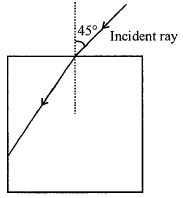
$A$ light ray falls on a square glass slab as shown in the diagram. The index of refraction of the glass,if total internal reflection is to occur at the vertical face,is equal to
A
$\frac{(\sqrt{2} + 1)}{2}$
B
$\sqrt{\frac{5}{2}}$
C
$\frac{3}{2}$
D
$\sqrt{\frac{3}{2}}$
Solution
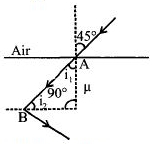
(D) At point $A$,by Snell's law:
$1 \cdot \sin 45^{\circ} = \mu \cdot \sin r$
$\sin r = \frac{1}{\mu \sqrt{2}}$ ..... $(i)$
At point $B$,for total internal reflection to occur at the vertical face,the angle of incidence $i_1$ must be greater than or equal to the critical angle $C$.
$\sin i_1 = \frac{1}{\mu}$
From the geometry of the triangle,$i_1 = 90^{\circ} - r$.
Therefore,$\sin(90^{\circ} - r) = \frac{1}{\mu} \Rightarrow \cos r = \frac{1}{\mu}$ ..... $(ii)$
Using the identity $\sin^2 r + \cos^2 r = 1$:
$\left(\frac{1}{\mu \sqrt{2}}\right)^2 + \left(\frac{1}{\mu}\right)^2 = 1$
$\frac{1}{2\mu^2} + \frac{1}{\mu^2} = 1$
$\frac{1 + 2}{2\mu^2} = 1$
$\frac{3}{2\mu^2} = 1 \Rightarrow \mu^2 = \frac{3}{2}$
$\mu = \sqrt{\frac{3}{2}}$
$1 \cdot \sin 45^{\circ} = \mu \cdot \sin r$
$\sin r = \frac{1}{\mu \sqrt{2}}$ ..... $(i)$
At point $B$,for total internal reflection to occur at the vertical face,the angle of incidence $i_1$ must be greater than or equal to the critical angle $C$.
$\sin i_1 = \frac{1}{\mu}$
From the geometry of the triangle,$i_1 = 90^{\circ} - r$.
Therefore,$\sin(90^{\circ} - r) = \frac{1}{\mu} \Rightarrow \cos r = \frac{1}{\mu}$ ..... $(ii)$
Using the identity $\sin^2 r + \cos^2 r = 1$:
$\left(\frac{1}{\mu \sqrt{2}}\right)^2 + \left(\frac{1}{\mu}\right)^2 = 1$
$\frac{1}{2\mu^2} + \frac{1}{\mu^2} = 1$
$\frac{1 + 2}{2\mu^2} = 1$
$\frac{3}{2\mu^2} = 1 \Rightarrow \mu^2 = \frac{3}{2}$
$\mu = \sqrt{\frac{3}{2}}$
0 likesView Solution
48
PhysicsMediumMCQAIPMT · 2002
$A$ bulb is located on a wall. Its image of equal size is to be obtained on a parallel wall with the help of a convex lens. The lens is placed at a distance $d$ ahead of the second wall. The required focal length will be:
A
$d/4$
B
less than $d/4$
C
only $d/2$
D
More than $d/4$ but less than $d/2$
Solution
(C) Let the distance between the two parallel walls be $D$. The bulb is on the first wall and the image is formed on the second wall.
For a convex lens to form a real image of equal size (magnification $m = -1$),the object distance $u$ and image distance $v$ must satisfy $u = v = 2f$.
The total distance between the object and the screen is $D = u + v = 2f + 2f = 4f$.
In this problem,the lens is placed at a distance $d$ from the second wall,which means the image distance $v = d$.
Since the image is of equal size,the object distance $u$ must also be equal to $d$ (because $u = v$ for $m = -1$).
Therefore,the total distance between the walls is $D = u + v = d + d = 2d$.
Using the relation $D = 4f$,we get $2d = 4f$.
Solving for $f$,we find $f = 2d / 4 = d / 2$.
For a convex lens to form a real image of equal size (magnification $m = -1$),the object distance $u$ and image distance $v$ must satisfy $u = v = 2f$.
The total distance between the object and the screen is $D = u + v = 2f + 2f = 4f$.
In this problem,the lens is placed at a distance $d$ from the second wall,which means the image distance $v = d$.
Since the image is of equal size,the object distance $u$ must also be equal to $d$ (because $u = v$ for $m = -1$).
Therefore,the total distance between the walls is $D = u + v = d + d = 2d$.
Using the relation $D = 4f$,we get $2d = 4f$.
Solving for $f$,we find $f = 2d / 4 = d / 2$.
0 likesView Solution
49
PhysicsEasyMCQAIPMT · 2002
The value of Planck's constant is
A
$6.63 \times 10^{-34} \; J \cdot s$
B
$6.63 \times 10^{-34} \; kg \cdot m^2 / s$
C
$6.63 \times 10^{-34} \; kg \cdot m^2$
D
$6.63 \times 10^{34} \; J \cdot s$
Solution
(B) Planck's constant $(h)$ relates the energy of a photon to its frequency according to the equation $E = h \nu$.
Since $E$ is measured in Joules $(J)$ and frequency $\nu$ is in $s^{-1}$,the unit of $h$ is $J \cdot s$.
Alternatively,since $E = \text{Force} \times \text{Distance} = (kg \cdot m/s^2) \times m = kg \cdot m^2/s^2$,then $h = E/\nu = (kg \cdot m^2/s^2) / (1/s) = kg \cdot m^2/s$.
The numerical value of Planck's constant is approximately $6.63 \times 10^{-34} \; J \cdot s$ or $6.63 \times 10^{-34} \; kg \cdot m^2/s$.
Comparing this with the given options,option $B$ represents the correct value and units.
Since $E$ is measured in Joules $(J)$ and frequency $\nu$ is in $s^{-1}$,the unit of $h$ is $J \cdot s$.
Alternatively,since $E = \text{Force} \times \text{Distance} = (kg \cdot m/s^2) \times m = kg \cdot m^2/s^2$,then $h = E/\nu = (kg \cdot m^2/s^2) / (1/s) = kg \cdot m^2/s$.
The numerical value of Planck's constant is approximately $6.63 \times 10^{-34} \; J \cdot s$ or $6.63 \times 10^{-34} \; kg \cdot m^2/s$.
Comparing this with the given options,option $B$ represents the correct value and units.
0 likesView Solution
Vedclass Products
For Students
Vedclass Test Series
Mock tests in real AIPMT style covering Physics with performance analysis. 5-day free trial.
Start Free TrialFor Teachers
Exam Paper Generator
Generate Set A/B/C/D Physics papers from 7.5L+ questions in 2 minutes. 3 chapters free.
Try FreeFor Institutes
Online Exam Module
Run live AIPMT mock exams with unlimited students, 360° analytics & white-label branding.
See DemoFrequently Asked Questions
How many Physics questions are in AIPMT 2002?
There are 49 Physics questions from the AIPMT 2002 paper on Vedclass, each with a detailed step-by-step solution in English.
Are AIPMT 2002 Physics solutions available in English?
Yes. All solutions on this page are in English. You can also switch to English or Hindi using the language buttons above the questions.
Can I practice AIPMT 2002 Physics as a timed test?
Yes. Use the Vedclass Test Series to attempt a full AIPMT mock test covering Physics with time limits and instant score analysis.
Can teachers create Physics papers from AIPMT previous year questions?
Yes. The Vedclass Exam Paper Generator lets teachers mix AIPMT Physics questions and generate Set A/B/C/D papers in minutes.
For Teachers & Institutes
Build a Custom Physics Paper
Pick AIPMT 2002 Physics questions, set difficulty, and generate Set A/B/C/D in 2 minutes.