
PhysicsQ1–46 of 46 questions
Page 1 of 1 · English
1
PhysicsMediumMCQAIPMT · 2000
The width of the river is $1 \; km$. The velocity of the boat is $5 \; km/hr$. The boat covers the width of the river along the shortest possible path in $15 \; min$. The velocity of the river stream is:
A
$\sqrt{29} \; km/hr$
B
$3 \; km/hr$
C
$4 \; km/hr$
D
$\sqrt{41} \; km/hr$
Solution
(B) The shortest path to cross a river is the straight line perpendicular to the river flow.
Let $v_b = 5 \; km/hr$ be the velocity of the boat and $u$ be the velocity of the river stream.
The resultant velocity $v_r$ of the boat relative to the ground,when crossing the river along the shortest path,is given by $v_r = \sqrt{v_b^2 - u^2}$.
Given width $d = 1 \; km$ and time $t = 15 \; min = 0.25 \; hr = \frac{1}{4} \; hr$.
The resultant velocity is $v_r = \frac{d}{t} = \frac{1}{1/4} = 4 \; km/hr$.
Substituting the values: $4 = \sqrt{5^2 - u^2}$.
Squaring both sides: $16 = 25 - u^2$.
$u^2 = 25 - 16 = 9$.
$u = 3 \; km/hr$.
Let $v_b = 5 \; km/hr$ be the velocity of the boat and $u$ be the velocity of the river stream.
The resultant velocity $v_r$ of the boat relative to the ground,when crossing the river along the shortest path,is given by $v_r = \sqrt{v_b^2 - u^2}$.
Given width $d = 1 \; km$ and time $t = 15 \; min = 0.25 \; hr = \frac{1}{4} \; hr$.
The resultant velocity is $v_r = \frac{d}{t} = \frac{1}{1/4} = 4 \; km/hr$.
Substituting the values: $4 = \sqrt{5^2 - u^2}$.
Squaring both sides: $16 = 25 - u^2$.
$u^2 = 25 - 16 = 9$.
$u = 3 \; km/hr$.
0 likesView Solution
2
PhysicsEasyMCQAIPMT · 2000
The displacement equation for a particle is $s = 3t^3 + 7t^2 + 14t + 8 \ m$. Its acceleration at time $t = 1 \ s$ is ....... $m/s^2$.
A
$10$
B
$16$
C
$25$
D
$32$
Solution
(D) The displacement is given by $s = 3t^3 + 7t^2 + 14t + 8$.
To find the velocity $v$,we differentiate $s$ with respect to time $t$:
$v = \frac{ds}{dt} = \frac{d}{dt}(3t^3 + 7t^2 + 14t + 8) = 9t^2 + 14t + 14$.
To find the acceleration $a$,we differentiate the velocity $v$ with respect to time $t$:
$a = \frac{dv}{dt} = \frac{d}{dt}(9t^2 + 14t + 14) = 18t + 14$.
At time $t = 1 \ s$,the acceleration is:
$a = 18(1) + 14 = 18 + 14 = 32 \ m/s^2$.
To find the velocity $v$,we differentiate $s$ with respect to time $t$:
$v = \frac{ds}{dt} = \frac{d}{dt}(3t^3 + 7t^2 + 14t + 8) = 9t^2 + 14t + 14$.
To find the acceleration $a$,we differentiate the velocity $v$ with respect to time $t$:
$a = \frac{dv}{dt} = \frac{d}{dt}(9t^2 + 14t + 14) = 18t + 14$.
At time $t = 1 \ s$,the acceleration is:
$a = 18(1) + 14 = 18 + 14 = 32 \ m/s^2$.
0 likesView Solution
3
PhysicsEasyMCQAIPMT · 2000
Two projectiles of same mass and with same velocity are thrown at an angle $60^o$ and $30^o$ with the horizontal,then which quantity will remain same?
A
Horizontal range of projectile
B
Maximum height acquired
C
Time of flight
D
All of them
Solution
(A) The horizontal range $R$ of a projectile is given by the formula $R = \frac{u^2 \sin(2\theta)}{g}$.
Given that the initial velocity $u$ is the same for both projectiles.
For the first projectile,$\theta_1 = 60^o$,so $R_1 = \frac{u^2 \sin(120^o)}{g} = \frac{u^2 \sin(60^o)}{g}$.
For the second projectile,$\theta_2 = 30^o$,so $R_2 = \frac{u^2 \sin(60^o)}{g}$.
Since $\sin(120^o) = \sin(60^o)$,the horizontal range $R$ is the same for both angles.
Angles $\theta$ and $(90^o - \theta)$ are complementary angles,and for any pair of complementary angles,the horizontal range is identical.
Given that the initial velocity $u$ is the same for both projectiles.
For the first projectile,$\theta_1 = 60^o$,so $R_1 = \frac{u^2 \sin(120^o)}{g} = \frac{u^2 \sin(60^o)}{g}$.
For the second projectile,$\theta_2 = 30^o$,so $R_2 = \frac{u^2 \sin(60^o)}{g}$.
Since $\sin(120^o) = \sin(60^o)$,the horizontal range $R$ is the same for both angles.
Angles $\theta$ and $(90^o - \theta)$ are complementary angles,and for any pair of complementary angles,the horizontal range is identical.
0 likesView Solution
4
PhysicsMediumMCQAIPMT · 2000
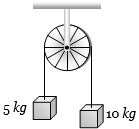
Two masses of $5 \ kg$ and $10 \ kg$ are suspended from a massless pulley as shown in the figure. Calculate the acceleration of the system when the masses are left free.
A
$g$
B
$\frac{g}{2}$
C
$\frac{g}{3}$
D
$\frac{g}{4}$
Solution
(C) Let the masses be $m_1 = 5 \ kg$ and $m_2 = 10 \ kg$.
The acceleration $a$ of the system is given by the formula:
$a = \frac{m_2 - m_1}{m_1 + m_2} g$
Substituting the given values:
$a = \frac{10 - 5}{10 + 5} g$
$a = \frac{5}{15} g$
$a = \frac{g}{3}$
The acceleration $a$ of the system is given by the formula:
$a = \frac{m_2 - m_1}{m_1 + m_2} g$
Substituting the given values:
$a = \frac{10 - 5}{10 + 5} g$
$a = \frac{5}{15} g$
$a = \frac{g}{3}$
0 likesView Solution
5
PhysicsMediumMCQAIPMT · 2000
$A$ body weighs $72 \ N$ on the surface of the earth. What is the gravitational force on it at a height equal to half the radius of the earth (in $N$)?
A
$32$
B
$30$
C
$24$
D
$48$
Solution
(A) The weight of a body at the surface of the earth is given by $W = mg = 72 \ N$.
At a height $h$ above the surface of the earth,the acceleration due to gravity $g'$ is given by the formula $g' = g \left( \frac{R}{R + h} \right)^2$,where $R$ is the radius of the earth.
Given $h = \frac{R}{2}$,we substitute this into the formula:
$g' = g \left( \frac{R}{R + \frac{R}{2}} \right)^2 = g \left( \frac{R}{\frac{3R}{2}} \right)^2 = g \left( \frac{2}{3} \right)^2 = \frac{4}{9}g$.
The weight of the body at height $h$ is $W' = mg' = m \left( \frac{4}{9}g \right) = \frac{4}{9} W$.
Substituting the value of $W = 72 \ N$:
$W' = \frac{4}{9} \times 72 = 4 \times 8 = 32 \ N$.
At a height $h$ above the surface of the earth,the acceleration due to gravity $g'$ is given by the formula $g' = g \left( \frac{R}{R + h} \right)^2$,where $R$ is the radius of the earth.
Given $h = \frac{R}{2}$,we substitute this into the formula:
$g' = g \left( \frac{R}{R + \frac{R}{2}} \right)^2 = g \left( \frac{R}{\frac{3R}{2}} \right)^2 = g \left( \frac{2}{3} \right)^2 = \frac{4}{9}g$.
The weight of the body at height $h$ is $W' = mg' = m \left( \frac{4}{9}g \right) = \frac{4}{9} W$.
Substituting the value of $W = 72 \ N$:
$W' = \frac{4}{9} \times 72 = 4 \times 8 = 32 \ N$.
1 likesView Solution
6
PhysicsEasyMCQAIPMT · 2000
For a planet having mass equal to the mass of the Earth but a radius that is one-fourth of the radius of the Earth,the escape velocity for this planet will be (in $km/s$): (in $km/s$)
A
$11.2$
B
$5.6$
C
$22.4$
D
$44.8$
Solution
(C) The formula for escape velocity is given by $v_e = \sqrt{\frac{2GM}{R}}$.
Given that the mass of the planet $M_p = M_e$ (mass of Earth) and the radius $R_p = \frac{R_e}{4}$ (where $R_e$ is the radius of Earth).
The escape velocity for the planet is $v_p = \sqrt{\frac{2GM_p}{R_p}} = \sqrt{\frac{2GM_e}{R_e/4}}$.
This simplifies to $v_p = \sqrt{4 \times \frac{2GM_e}{R_e}} = 2 \times \sqrt{\frac{2GM_e}{R_e}}$.
Since the escape velocity of Earth is $v_e = 11.2 \ km/s$,the escape velocity for the planet is $v_p = 2 \times 11.2 \ km/s = 22.4 \ km/s$.
Given that the mass of the planet $M_p = M_e$ (mass of Earth) and the radius $R_p = \frac{R_e}{4}$ (where $R_e$ is the radius of Earth).
The escape velocity for the planet is $v_p = \sqrt{\frac{2GM_p}{R_p}} = \sqrt{\frac{2GM_e}{R_e/4}}$.
This simplifies to $v_p = \sqrt{4 \times \frac{2GM_e}{R_e}} = 2 \times \sqrt{\frac{2GM_e}{R_e}}$.
Since the escape velocity of Earth is $v_e = 11.2 \ km/s$,the escape velocity for the planet is $v_p = 2 \times 11.2 \ km/s = 22.4 \ km/s$.
0 likesView Solution
7
PhysicsMediumMCQAIPMT · 2000
The correct relation between the degree of freedom $f$ and the ratio of specific heat $\gamma$ is
A
$f=\frac{1}{\gamma+1}$
B
$f=\frac{2}{\gamma-1}$
C
$f=\frac{\gamma+1}{2}$
D
$f=\frac{2}{\gamma+1}$
Solution
(B) The ratio of specific heats $\gamma$ is defined as the ratio of molar specific heat at constant pressure $C_p$ to molar specific heat at constant volume $C_v$,i.e.,$\gamma = \frac{C_p}{C_v}$.
According to the equipartition theorem,$C_v = \frac{f}{2}R$ and $C_p = C_v + R = (\frac{f}{2} + 1)R$.
Therefore,$\gamma = \frac{(\frac{f}{2} + 1)R}{\frac{f}{2}R} = \frac{\frac{f+2}{2}}{\frac{f}{2}} = 1 + \frac{2}{f}$.
Rearranging the equation: $\gamma - 1 = \frac{2}{f}$.
Solving for $f$,we get $f = \frac{2}{\gamma - 1}$.
According to the equipartition theorem,$C_v = \frac{f}{2}R$ and $C_p = C_v + R = (\frac{f}{2} + 1)R$.
Therefore,$\gamma = \frac{(\frac{f}{2} + 1)R}{\frac{f}{2}R} = \frac{\frac{f+2}{2}}{\frac{f}{2}} = 1 + \frac{2}{f}$.
Rearranging the equation: $\gamma - 1 = \frac{2}{f}$.
Solving for $f$,we get $f = \frac{2}{\gamma - 1}$.
0 likesView Solution
8
PhysicsDifficultMCQAIPMT · 2000
$A$ reversible engine converts one-sixth of the heat input into work. When the temperature of the sink is reduced by $62^\circ C$,the efficiency of the engine is doubled. The temperatures of the source and sink are:
A
$80^\circ C, 37^\circ C$
B
$95^\circ C, 28^\circ C$
C
$90^\circ C, 37^\circ C$
D
$99^\circ C, 37^\circ C$
Solution
(D) The efficiency of a reversible engine is given by $\eta = 1 - \frac{T_2}{T_1}$,where $T_1$ is the source temperature and $T_2$ is the sink temperature in Kelvin.
Initially,$\eta = \frac{1}{6}$,so $1 - \frac{T_2}{T_1} = \frac{1}{6} \implies \frac{T_2}{T_1} = \frac{5}{6} \implies T_2 = \frac{5}{6}T_1$ ...$(i)$
When the sink temperature is reduced by $62^\circ C$ (which is equivalent to $62 \ K$),the new efficiency $\eta' = 2\eta = 2 \times \frac{1}{6} = \frac{1}{3}$.
The new sink temperature is $T_2' = T_2 - 62$.
Thus,$\eta' = 1 - \frac{T_2 - 62}{T_1} = \frac{1}{3}$.
Substituting $T_2 = \frac{5}{6}T_1$ into the equation: $1 - \frac{\frac{5}{6}T_1 - 62}{T_1} = \frac{1}{3}$.
$1 - (\frac{5}{6} - \frac{62}{T_1}) = \frac{1}{3} \implies 1 - \frac{5}{6} + \frac{62}{T_1} = \frac{1}{3}$.
$\frac{1}{6} + \frac{62}{T_1} = \frac{1}{3} \implies \frac{62}{T_1} = \frac{1}{3} - \frac{1}{6} = \frac{1}{6}$.
$T_1 = 62 \times 6 = 372 \ K = (372 - 273)^\circ C = 99^\circ C$.
Now,$T_2 = \frac{5}{6} \times 372 = 310 \ K = (310 - 273)^\circ C = 37^\circ C$.
Initially,$\eta = \frac{1}{6}$,so $1 - \frac{T_2}{T_1} = \frac{1}{6} \implies \frac{T_2}{T_1} = \frac{5}{6} \implies T_2 = \frac{5}{6}T_1$ ...$(i)$
When the sink temperature is reduced by $62^\circ C$ (which is equivalent to $62 \ K$),the new efficiency $\eta' = 2\eta = 2 \times \frac{1}{6} = \frac{1}{3}$.
The new sink temperature is $T_2' = T_2 - 62$.
Thus,$\eta' = 1 - \frac{T_2 - 62}{T_1} = \frac{1}{3}$.
Substituting $T_2 = \frac{5}{6}T_1$ into the equation: $1 - \frac{\frac{5}{6}T_1 - 62}{T_1} = \frac{1}{3}$.
$1 - (\frac{5}{6} - \frac{62}{T_1}) = \frac{1}{3} \implies 1 - \frac{5}{6} + \frac{62}{T_1} = \frac{1}{3}$.
$\frac{1}{6} + \frac{62}{T_1} = \frac{1}{3} \implies \frac{62}{T_1} = \frac{1}{3} - \frac{1}{6} = \frac{1}{6}$.
$T_1 = 62 \times 6 = 372 \ K = (372 - 273)^\circ C = 99^\circ C$.
Now,$T_2 = \frac{5}{6} \times 372 = 310 \ K = (310 - 273)^\circ C = 37^\circ C$.
0 likesView Solution
9
PhysicsEasyMCQAIPMT · 2000
Gravitational force is required for
A
Convection
B
Conduction
C
Radiation
D
Stirring of liquids
Solution
(A) Natural convection occurs due to the difference in density between two regions of a fluid. When a fluid is heated,it expands and its density decreases,causing it to rise,while cooler,denser fluid sinks to take its place. This movement is driven by the gravitational force acting on the density gradient. Therefore,gravitational force is essential for natural convection.
0 likesView Solution
10
PhysicsMediumMCQAIPMT · 2000
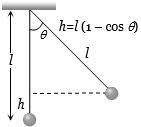
The bob of a simple pendulum having length $l$ is displaced from the mean position to an angular position $\theta$ with respect to the vertical. If it is released,then the velocity of the bob at the lowest position is:
A
$\sqrt{2 g l \cos \theta}$
B
$\sqrt{2gl(1 + \cos \theta)}$
C
$\sqrt{2gl(1 - \cos \theta)}$
D
$\sqrt{2 gl}$
Solution
(C) When the bob is displaced by an angle $\theta$,it rises to a vertical height $h$ above its mean position.
By the law of conservation of mechanical energy,the potential energy at the extreme position is converted into kinetic energy at the mean (lowest) position.
$mgh = \frac{1}{2}mv_{\max}^2$
$v_{\max} = \sqrt{2gh}$
From the geometry of the pendulum,the vertical distance from the point of suspension to the bob at the extreme position is $l \cos \theta$.
Therefore,the height $h$ is given by:
$h = l - l \cos \theta = l(1 - \cos \theta)$
Substituting the value of $h$ into the velocity equation:
$v_{\max} = \sqrt{2gl(1 - \cos \theta)}$
By the law of conservation of mechanical energy,the potential energy at the extreme position is converted into kinetic energy at the mean (lowest) position.
$mgh = \frac{1}{2}mv_{\max}^2$
$v_{\max} = \sqrt{2gh}$
From the geometry of the pendulum,the vertical distance from the point of suspension to the bob at the extreme position is $l \cos \theta$.
Therefore,the height $h$ is given by:
$h = l - l \cos \theta = l(1 - \cos \theta)$
Substituting the value of $h$ into the velocity equation:
$v_{\max} = \sqrt{2gl(1 - \cos \theta)}$
0 likesView Solution
11
PhysicsMediumMCQAIPMT · 2000
Three similar wires of frequencies $n_1, n_2$ and $n_3$ are joined to form a single wire. What will be its resulting frequency $n$?
A
$n = n_1 + n_2 + n_3$
B
$\frac{1}{n} = \frac{1}{n_1} + \frac{1}{n_2} + \frac{1}{n_3}$
C
$n = n_1 \times n_2 \times n_3$
D
$n = \frac{n_1 + n_2 + n_3}{3}$
Solution
(B) The fundamental frequency of a stretched wire is given by $n = \frac{1}{2l} \sqrt{\frac{T}{\mu}}$,where $l$ is the length,$T$ is the tension,and $\mu$ is the mass per unit length.
Since the wires are similar,the mass per unit length $\mu$ and tension $T$ are the same for all segments.
Thus,$n \propto \frac{1}{l}$,which implies $nl = k$ (a constant).
For the three wires,we have $n_1 l_1 = n_2 l_2 = n_3 l_3 = k$.
This gives $l_1 = \frac{k}{n_1}$,$l_2 = \frac{k}{n_2}$,and $l_3 = \frac{k}{n_3}$.
The total length of the combined wire is $l = l_1 + l_2 + l_3$.
Substituting the values,we get $\frac{k}{n} = \frac{k}{n_1} + \frac{k}{n_2} + \frac{k}{n_3}$.
Dividing by $k$,we obtain $\frac{1}{n} = \frac{1}{n_1} + \frac{1}{n_2} + \frac{1}{n_3}$.
Since the wires are similar,the mass per unit length $\mu$ and tension $T$ are the same for all segments.
Thus,$n \propto \frac{1}{l}$,which implies $nl = k$ (a constant).
For the three wires,we have $n_1 l_1 = n_2 l_2 = n_3 l_3 = k$.
This gives $l_1 = \frac{k}{n_1}$,$l_2 = \frac{k}{n_2}$,and $l_3 = \frac{k}{n_3}$.
The total length of the combined wire is $l = l_1 + l_2 + l_3$.
Substituting the values,we get $\frac{k}{n} = \frac{k}{n_1} + \frac{k}{n_2} + \frac{k}{n_3}$.
Dividing by $k$,we obtain $\frac{1}{n} = \frac{1}{n_1} + \frac{1}{n_2} + \frac{1}{n_3}$.
0 likesView Solution
12
PhysicsMediumMCQAIPMT · 2000
$A$ solid cylinder and a hollow cylinder,both of the same mass and same external diameter,are released from the same height at the same time on an inclined plane. Both roll down without slipping. Which one will reach the bottom first?
A
Solid cylinder
B
Hollow cylinder
C
Both together
D
Both together only when angle of inclination of plane is $45^o$
Solution
(A) The time $t$ taken by a body rolling down an inclined plane of length $l$ and inclination $\theta$ is given by $t = \sqrt{\frac{2l(1 + K^2/R^2)}{g \sin \theta}}$,where $K$ is the radius of gyration and $R$ is the radius of the body.
For a solid cylinder,the moment of inertia $I = \frac{1}{2}MR^2$,so $K^2 = \frac{1}{2}R^2$,which means $K^2/R^2 = 0.5$.
For a hollow cylinder,the moment of inertia $I = MR^2$,so $K^2 = R^2$,which means $K^2/R^2 = 1$.
Since the time $t$ is directly proportional to $\sqrt{1 + K^2/R^2}$,the body with the smaller $K^2/R^2$ ratio will take less time to reach the bottom.
Comparing the two,the solid cylinder has a smaller $K^2/R^2$ ratio $(0.5 < 1)$,therefore,the solid cylinder will reach the bottom first.
For a solid cylinder,the moment of inertia $I = \frac{1}{2}MR^2$,so $K^2 = \frac{1}{2}R^2$,which means $K^2/R^2 = 0.5$.
For a hollow cylinder,the moment of inertia $I = MR^2$,so $K^2 = R^2$,which means $K^2/R^2 = 1$.
Since the time $t$ is directly proportional to $\sqrt{1 + K^2/R^2}$,the body with the smaller $K^2/R^2$ ratio will take less time to reach the bottom.
Comparing the two,the solid cylinder has a smaller $K^2/R^2$ ratio $(0.5 < 1)$,therefore,the solid cylinder will reach the bottom first.
0 likesView Solution
13
PhysicsMediumMCQAIPMT · 2000
The equations of two waves acting in perpendicular directions are given as $x=a \cos (\omega t+\delta)$ and $y=a \cos (\omega t+\alpha)$,where $\delta=\alpha+\frac{\pi}{2}$. The resultant wave represents:
A
a circle $(c.w)$
B
a circle $(a.c.w)$
C
an ellipse $(c.w)$
D
an ellipse $(a.c.w)$
Solution
(A) Given equations are $x=a \cos (\omega t+\delta)$ and $y=a \cos (\omega t+\alpha)$.
Substituting $\delta=\alpha+\frac{\pi}{2}$ into the equation for $x$:
$x=a \cos (\omega t+\alpha+\frac{\pi}{2}) = -a \sin (\omega t+\alpha)$.
Now,squaring and adding both equations:
$x^2+y^2 = (-a \sin (\omega t+\alpha))^2 + (a \cos (\omega t+\alpha))^2 = a^2 (\sin^2 (\omega t+\alpha) + \cos^2 (\omega t+\alpha)) = a^2$.
This is the equation of a circle with radius $a$.
To determine the direction,at $t=0$,$x = -a \sin \alpha$ and $y = a \cos \alpha$. As $t$ increases,the point moves in the clockwise $(c.w)$ direction.
Substituting $\delta=\alpha+\frac{\pi}{2}$ into the equation for $x$:
$x=a \cos (\omega t+\alpha+\frac{\pi}{2}) = -a \sin (\omega t+\alpha)$.
Now,squaring and adding both equations:
$x^2+y^2 = (-a \sin (\omega t+\alpha))^2 + (a \cos (\omega t+\alpha))^2 = a^2 (\sin^2 (\omega t+\alpha) + \cos^2 (\omega t+\alpha)) = a^2$.
This is the equation of a circle with radius $a$.
To determine the direction,at $t=0$,$x = -a \sin \alpha$ and $y = a \cos \alpha$. As $t$ increases,the point moves in the clockwise $(c.w)$ direction.
0 likesView Solution
14
PhysicsDifficultMCQAIPMT · 2000
Two stationary sources each emit waves of wavelength $\lambda$. An observer moves from one source to the other with velocity $u$. The number of beats heard by the observer is:
A
$\frac{u}{2\lambda}$
B
$\frac{u}{\lambda}$
C
$\frac{2u}{\lambda}$
D
$\sqrt{u\lambda}$
Solution
(C) Let $v$ be the speed of sound and $n$ be the frequency of the sources. Since $\lambda = v/n$,we have $n = v/\lambda$.
For the $1^{st}$ source,the observer is moving away with velocity $u$. The apparent frequency is $n_1 = n \left( \frac{v - u}{v} \right) = n \left( 1 - \frac{u}{v} \right)$.
For the $2^{nd}$ source,the observer is moving towards it with velocity $u$. The apparent frequency is $n_2 = n \left( \frac{v + u}{v} \right) = n \left( 1 + \frac{u}{v} \right)$.
The beat frequency is the difference between the two apparent frequencies:
$|n_2 - n_1| = n \left( 1 + \frac{u}{v} \right) - n \left( 1 - \frac{u}{v} \right) = n \left( \frac{2u}{v} \right)$.
Substituting $n = v/\lambda$,we get:
Beat frequency $= \left( \frac{v}{\lambda} \right) \left( \frac{2u}{v} \right) = \frac{2u}{\lambda}$.
For the $1^{st}$ source,the observer is moving away with velocity $u$. The apparent frequency is $n_1 = n \left( \frac{v - u}{v} \right) = n \left( 1 - \frac{u}{v} \right)$.
For the $2^{nd}$ source,the observer is moving towards it with velocity $u$. The apparent frequency is $n_2 = n \left( \frac{v + u}{v} \right) = n \left( 1 + \frac{u}{v} \right)$.
The beat frequency is the difference between the two apparent frequencies:
$|n_2 - n_1| = n \left( 1 + \frac{u}{v} \right) - n \left( 1 - \frac{u}{v} \right) = n \left( \frac{2u}{v} \right)$.
Substituting $n = v/\lambda$,we get:
Beat frequency $= \left( \frac{v}{\lambda} \right) \left( \frac{2u}{v} \right) = \frac{2u}{\lambda}$.
0 likesView Solution
15
PhysicsMediumMCQAIPMT · 2000
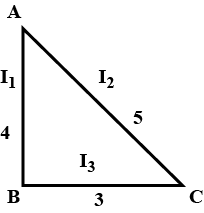
For the adjoining diagram,the incorrect relation between $I_{1}, I_{2}$ and $I_{3}$ is ($I$ = moment of inertia).
A
$I_{2} > I_{1}$
B
$I_{3} > I_{1}$
C
$I_{1} > I_{2}$
D
$I_{3} > I_{2}$
Solution
(C) The moment of inertia $(I)$ of a body depends on the distribution of its mass relative to the axis of rotation. The farther the mass is from the axis,the greater the moment of inertia.
In the given right-angled triangle $ABC$ with sides $AB=4$,$BC=3$,and $AC=5$,the moments of inertia about the axes passing through the sides are:
$I_{1}$ is the moment of inertia about side $AB$.
$I_{3}$ is the moment of inertia about side $BC$.
$I_{2}$ is the moment of inertia about side $AC$.
Comparing the distances of the mass distribution from these axes,we find that $I_{1} < I_{3} < I_{2}$.
Therefore,the relation $I_{1} > I_{2}$ is incorrect.
In the given right-angled triangle $ABC$ with sides $AB=4$,$BC=3$,and $AC=5$,the moments of inertia about the axes passing through the sides are:
$I_{1}$ is the moment of inertia about side $AB$.
$I_{3}$ is the moment of inertia about side $BC$.
$I_{2}$ is the moment of inertia about side $AC$.
Comparing the distances of the mass distribution from these axes,we find that $I_{1} < I_{3} < I_{2}$.
Therefore,the relation $I_{1} > I_{2}$ is incorrect.
0 likesView Solution
16
PhysicsMediumMCQAIPMT · 2000
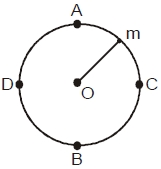
$A$ mass is performing vertical circular motion (see figure). If the average velocity of the particle is increased,then at which point will the string break?
A
$A$
B
$B$
C
$C$
D
$D$
Solution
(B) The tension $T$ at any point in a vertical circular motion is given by:
$T = \frac{mv^2}{l} + mg \cos \theta$
where $\theta$ is the angular displacement from the lowest point,$l$ is the length of the string,and $m$ is the mass of the particle.
At the lowest point $(B)$,$\theta = 0^\circ$,so $\cos \theta = 1$,and the tension is $T_B = \frac{mv_B^2}{l} + mg$.
At the highest point $(A)$,$\theta = 180^\circ$,so $\cos \theta = -1$,and the tension is $T_A = \frac{mv_A^2}{l} - mg$.
It is clear that the tension is maximum at the lowest point $(B)$ because the centripetal force and the component of gravity both contribute to the tension. If the average velocity of the particle is increased,the tension at the lowest point will increase the most. Therefore,the string has the maximum probability of breaking at point $B$.
$T = \frac{mv^2}{l} + mg \cos \theta$
where $\theta$ is the angular displacement from the lowest point,$l$ is the length of the string,and $m$ is the mass of the particle.
At the lowest point $(B)$,$\theta = 0^\circ$,so $\cos \theta = 1$,and the tension is $T_B = \frac{mv_B^2}{l} + mg$.
At the highest point $(A)$,$\theta = 180^\circ$,so $\cos \theta = -1$,and the tension is $T_A = \frac{mv_A^2}{l} - mg$.
It is clear that the tension is maximum at the lowest point $(B)$ because the centripetal force and the component of gravity both contribute to the tension. If the average velocity of the particle is increased,the tension at the lowest point will increase the most. Therefore,the string has the maximum probability of breaking at point $B$.
1 likesView Solution
17
PhysicsEasyMCQAIPMT · 2000
If $\overrightarrow{F} = (60 \hat{i} + 15 \hat{j} - 3 \hat{k}) \; N$ and $\overrightarrow{V} = (2 \hat{i} - 4 \hat{j} + 5 \hat{k}) \; m/s$,then the instantaneous power is: (in $; W$)
A
$45$
B
$195$
C
$75$
D
$100$
Solution
(A) The instantaneous power $P$ is given by the dot product of the force vector $\overrightarrow{F}$ and the velocity vector $\overrightarrow{V}$.
$P = \overrightarrow{F} \cdot \overrightarrow{V}$
Substituting the given vectors:
$P = (60 \hat{i} + 15 \hat{j} - 3 \hat{k}) \cdot (2 \hat{i} - 4 \hat{j} + 5 \hat{k})$
Using the property of the dot product ($\hat{i} \cdot \hat{i} = 1, \hat{j} \cdot \hat{j} = 1, \hat{k} \cdot \hat{k} = 1$ and cross terms are $0$):
$P = (60 \times 2) + (15 \times -4) + (-3 \times 5)$
$P = 120 - 60 - 15$
$P = 45 \; W$
$P = \overrightarrow{F} \cdot \overrightarrow{V}$
Substituting the given vectors:
$P = (60 \hat{i} + 15 \hat{j} - 3 \hat{k}) \cdot (2 \hat{i} - 4 \hat{j} + 5 \hat{k})$
Using the property of the dot product ($\hat{i} \cdot \hat{i} = 1, \hat{j} \cdot \hat{j} = 1, \hat{k} \cdot \hat{k} = 1$ and cross terms are $0$):
$P = (60 \times 2) + (15 \times -4) + (-3 \times 5)$
$P = 120 - 60 - 15$
$P = 45 \; W$
0 likesView Solution
18
PhysicsMediumMCQAIPMT · 2000
Which pair does not have equal dimensions?
A
Force and impulse
B
Angular momentum and Planck constant
C
Energy and torque
D
Elastic modulus and pressure
Solution
(A) We analyze the dimensions of each pair:
$1$. Force: $[MLT^{-2}]$; Impulse: $[MLT^{-1}]$. These are not equal.
$2$. Angular momentum: $[ML^2T^{-1}]$; Planck constant: $[ML^2T^{-1}]$. These are equal.
$3$. Energy: $[ML^2T^{-2}]$; Torque: $[ML^2T^{-2}]$. These are equal.
$4$. Elastic modulus: $[ML^{-1}T^{-2}]$; Pressure: $[ML^{-1}T^{-2}]$. These are equal.
Therefore,the pair that does not have equal dimensions is Force and Impulse.
$1$. Force: $[MLT^{-2}]$; Impulse: $[MLT^{-1}]$. These are not equal.
$2$. Angular momentum: $[ML^2T^{-1}]$; Planck constant: $[ML^2T^{-1}]$. These are equal.
$3$. Energy: $[ML^2T^{-2}]$; Torque: $[ML^2T^{-2}]$. These are equal.
$4$. Elastic modulus: $[ML^{-1}T^{-2}]$; Pressure: $[ML^{-1}T^{-2}]$. These are equal.
Therefore,the pair that does not have equal dimensions is Force and Impulse.
0 likesView Solution
19
PhysicsEasyMCQAIPMT · 2000
$A$ man is slipping on a frictionless inclined plane and a bag falls down from the same height. Then the velocity of both is related as
A
$v_{B} > v_{m}$
B
$v_{B} < v_{m}$
C
$v_{B} = v_{m}$
D
$v_{B}$ and $v_{m}$ cannot be related.
Solution
(C) According to the law of conservation of mechanical energy,the total mechanical energy remains constant in the absence of non-conservative forces like friction.
For both the man and the bag,the initial potential energy is $PE_i = mgh$ and the initial kinetic energy is $KE_i = 0$.
At the bottom,the potential energy is $PE_f = 0$ and the kinetic energy is $KE_f = \frac{1}{2}mv^2$.
Equating the energies: $mgh = \frac{1}{2}mv^2$.
Solving for velocity: $v = \sqrt{2gh}$.
Since both the man and the bag fall through the same vertical height $h$ and are subject to the same gravitational acceleration $g$,their final velocities at the bottom will be equal,regardless of the path taken (as long as the plane is frictionless).
For both the man and the bag,the initial potential energy is $PE_i = mgh$ and the initial kinetic energy is $KE_i = 0$.
At the bottom,the potential energy is $PE_f = 0$ and the kinetic energy is $KE_f = \frac{1}{2}mv^2$.
Equating the energies: $mgh = \frac{1}{2}mv^2$.
Solving for velocity: $v = \sqrt{2gh}$.
Since both the man and the bag fall through the same vertical height $h$ and are subject to the same gravitational acceleration $g$,their final velocities at the bottom will be equal,regardless of the path taken (as long as the plane is frictionless).
0 likesView Solution
20
PhysicsMediumMCQAIPMT · 2000
$A$ mass of $1 \; kg$ is thrown up with a velocity of $100 \; m/s$. After $5 \; s$,it explodes into two parts. One part of mass $400 \; g$ comes down with a velocity of $25 \; m/s$. Calculate the velocity of the other part.
A
$40 \; m/s$ upward
B
$40 \; m/s$ downward
C
$100 \; m/s$ upward
D
$60 \; m/s$ downward
Solution
(C) Initial velocity $u = 100 \; m/s$. Acceleration $g = -10 \; m/s^2$.
Velocity of the mass at $t = 5 \; s$ is $v = u + at = 100 - 10 \times 5 = 50 \; m/s$ (upward).
Let the total mass be $M = 1 \; kg$. The mass splits into $m_1 = 0.4 \; kg$ and $m_2 = 0.6 \; kg$.
According to the law of conservation of momentum,the momentum before the explosion equals the momentum after the explosion.
$Mv = m_1 v_1 + m_2 v_2$
Taking upward direction as positive:
$1 \times 50 = 0.4 \times (-25) + 0.6 \times v_2$
$50 = -10 + 0.6 \times v_2$
$60 = 0.6 \times v_2$
$v_2 = \frac{60}{0.6} = 100 \; m/s$.
Since the result is positive,the velocity is $100 \; m/s$ upward.
Velocity of the mass at $t = 5 \; s$ is $v = u + at = 100 - 10 \times 5 = 50 \; m/s$ (upward).
Let the total mass be $M = 1 \; kg$. The mass splits into $m_1 = 0.4 \; kg$ and $m_2 = 0.6 \; kg$.
According to the law of conservation of momentum,the momentum before the explosion equals the momentum after the explosion.
$Mv = m_1 v_1 + m_2 v_2$
Taking upward direction as positive:
$1 \times 50 = 0.4 \times (-25) + 0.6 \times v_2$
$50 = -10 + 0.6 \times v_2$
$60 = 0.6 \times v_2$
$v_2 = \frac{60}{0.6} = 100 \; m/s$.
Since the result is positive,the velocity is $100 \; m/s$ upward.
0 likesView Solution
21
PhysicsMediumMCQAIPMT · 2000
Two masses $M_{A}$ and $M_{B}$ are hung from two strings of length $l_{A}$ and $l_{B}$ respectively. They are executing $SHM$ with frequency relation $f_{A}=2 f_{B}$,then the relation is:
A
$l_{A}=4 l_{B},$ does not depend on mass
B
$l_{A}=\frac{l_{B}}{4},$ does not depend on mass
C
$l_A=2 l_B$ and $M_A=2M_B$
D
$l_{A}=\frac{l_{B}}{2}$ and $M_{A}=\frac{M_{B}}{2}$
Solution
(B) The frequency of a simple pendulum is given by $f = \frac{1}{2 \pi} \sqrt{\frac{g}{l}}$.
Given the frequency relation $f_{A}=2 f_{B}$.
Substituting the formula for frequency:
$\frac{1}{2 \pi} \sqrt{\frac{g}{l_{A}}} = 2 \times \frac{1}{2 \pi} \sqrt{\frac{g}{l_{B}}}$
Squaring both sides:
$\frac{g}{l_{A}} = 4 \times \frac{g}{l_{B}}$
$\frac{1}{l_{A}} = \frac{4}{l_{B}}$
Therefore,$l_{A} = \frac{l_{B}}{4}$.
Since the frequency of a simple pendulum depends only on the length $l$ and acceleration due to gravity $g$,it does not depend on the mass $M$ of the bob.
Given the frequency relation $f_{A}=2 f_{B}$.
Substituting the formula for frequency:
$\frac{1}{2 \pi} \sqrt{\frac{g}{l_{A}}} = 2 \times \frac{1}{2 \pi} \sqrt{\frac{g}{l_{B}}}$
Squaring both sides:
$\frac{g}{l_{A}} = 4 \times \frac{g}{l_{B}}$
$\frac{1}{l_{A}} = \frac{4}{l_{B}}$
Therefore,$l_{A} = \frac{l_{B}}{4}$.
Since the frequency of a simple pendulum depends only on the length $l$ and acceleration due to gravity $g$,it does not depend on the mass $M$ of the bob.
0 likesView Solution
22
PhysicsMediumMCQAIPMT · 2000
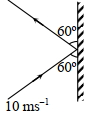
$A$ body of mass $3 \, kg$ hits a wall at an angle of $60^\circ$ with the wall and returns at the same angle. The speed of the body is $10 \, m/s$ and the impact time is $0.2 \, s$. Calculate the force exerted on the wall.
A
$100 \, N$
B
$50\sqrt{3} \, N$
C
$150\sqrt{3} \, N$
D
$75\sqrt{3} \, N$
Solution
(C) The change in momentum occurs only in the direction perpendicular to the wall.
Let the velocity be $v = 10 \, m/s$ and mass $m = 3 \, kg$.
The component of velocity perpendicular to the wall is $v_{\perp} = v \sin(60^\circ)$.
Initial momentum perpendicular to the wall: $p_i = mv \sin(60^\circ)$.
Final momentum perpendicular to the wall (after reflection): $p_f = -mv \sin(60^\circ)$.
Change in momentum: $\Delta p = p_f - p_i = -mv \sin(60^\circ) - mv \sin(60^\circ) = -2mv \sin(60^\circ)$.
The magnitude of the change in momentum is $|\Delta p| = 2mv \sin(60^\circ)$.
Force exerted on the wall $F = \frac{|\Delta p|}{\Delta t} = \frac{2mv \sin(60^\circ)}{\Delta t}$.
Substituting the values: $F = \frac{2 \times 3 \times 10 \times \sin(60^\circ)}{0.2} = \frac{60 \times (\sqrt{3}/2)}{0.2} = \frac{30\sqrt{3}}{0.2} = 150\sqrt{3} \, N$.
Let the velocity be $v = 10 \, m/s$ and mass $m = 3 \, kg$.
The component of velocity perpendicular to the wall is $v_{\perp} = v \sin(60^\circ)$.
Initial momentum perpendicular to the wall: $p_i = mv \sin(60^\circ)$.
Final momentum perpendicular to the wall (after reflection): $p_f = -mv \sin(60^\circ)$.
Change in momentum: $\Delta p = p_f - p_i = -mv \sin(60^\circ) - mv \sin(60^\circ) = -2mv \sin(60^\circ)$.
The magnitude of the change in momentum is $|\Delta p| = 2mv \sin(60^\circ)$.
Force exerted on the wall $F = \frac{|\Delta p|}{\Delta t} = \frac{2mv \sin(60^\circ)}{\Delta t}$.
Substituting the values: $F = \frac{2 \times 3 \times 10 \times \sin(60^\circ)}{0.2} = \frac{60 \times (\sqrt{3}/2)}{0.2} = \frac{30\sqrt{3}}{0.2} = 150\sqrt{3} \, N$.
0 likesView Solution
23
PhysicsMediumMCQAIPMT · 2000
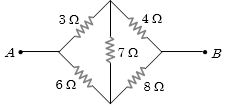
Calculate the net resistance of the circuit between $A$ and $B$.
A
$\frac{14}{3} \, \Omega$
B
$4 \, \Omega$
C
$6 \, \Omega$
D
$8 \, \Omega$
Solution
(A) The circuit is a Wheatstone bridge. Let the resistors be $P = 3 \, \Omega$,$Q = 4 \, \Omega$,$R = 6 \, \Omega$,and $S = 8 \, \Omega$. The central resistor is $G = 7 \, \Omega$.
Check the ratio of the arms: $\frac{P}{R} = \frac{3}{6} = 0.5$ and $\frac{Q}{S} = \frac{4}{8} = 0.5$.
Since $\frac{P}{R} = \frac{Q}{S}$,the Wheatstone bridge is balanced.
In a balanced Wheatstone bridge,no current flows through the central resistor $G$. Therefore,it can be removed from the circuit.
After removing the $7 \, \Omega$ resistor,the circuit consists of two parallel branches:
Branch $1$ (upper): $3 \, \Omega$ and $4 \, \Omega$ in series,so $R_1 = 3 + 4 = 7 \, \Omega$.
Branch $2$ (lower): $6 \, \Omega$ and $8 \, \Omega$ in series,so $R_2 = 6 + 8 = 14 \, \Omega$.
The equivalent resistance $R_{eq}$ between $A$ and $B$ is given by $\frac{1}{R_{eq}} = \frac{1}{R_1} + \frac{1}{R_2} = \frac{1}{7} + \frac{1}{14}$.
$\frac{1}{R_{eq}} = \frac{2 + 1}{14} = \frac{3}{14}$.
Thus,$R_{eq} = \frac{14}{3} \, \Omega$.
Check the ratio of the arms: $\frac{P}{R} = \frac{3}{6} = 0.5$ and $\frac{Q}{S} = \frac{4}{8} = 0.5$.
Since $\frac{P}{R} = \frac{Q}{S}$,the Wheatstone bridge is balanced.
In a balanced Wheatstone bridge,no current flows through the central resistor $G$. Therefore,it can be removed from the circuit.
After removing the $7 \, \Omega$ resistor,the circuit consists of two parallel branches:
Branch $1$ (upper): $3 \, \Omega$ and $4 \, \Omega$ in series,so $R_1 = 3 + 4 = 7 \, \Omega$.
Branch $2$ (lower): $6 \, \Omega$ and $8 \, \Omega$ in series,so $R_2 = 6 + 8 = 14 \, \Omega$.
The equivalent resistance $R_{eq}$ between $A$ and $B$ is given by $\frac{1}{R_{eq}} = \frac{1}{R_1} + \frac{1}{R_2} = \frac{1}{7} + \frac{1}{14}$.
$\frac{1}{R_{eq}} = \frac{2 + 1}{14} = \frac{3}{14}$.
Thus,$R_{eq} = \frac{14}{3} \, \Omega$.
0 likesView Solution
24
PhysicsEasyMCQAIPMT · 2000
$A$ car battery of $e.m.f.$ $12\,V$ and internal resistance $5 \times 10^{-2}\,\Omega$,receives a current of $60\,A$ from an external source. What is the terminal voltage of the battery (in $,V$)?
A
$9$
B
$12$
C
$15$
D
$20$
Solution
(C) When a battery is being charged,the terminal voltage $V$ is given by the formula $V = E + Ir$,where $E$ is the $e.m.f.$,$I$ is the charging current,and $r$ is the internal resistance.
Given:
$E = 12\,V$
$I = 60\,A$
$r = 5 \times 10^{-2}\,\Omega = 0.05\,\Omega$
Substituting the values:
$V = 12 + (60 \times 0.05)$
$V = 12 + 3$
$V = 15\,V$.
Given:
$E = 12\,V$
$I = 60\,A$
$r = 5 \times 10^{-2}\,\Omega = 0.05\,\Omega$
Substituting the values:
$V = 12 + (60 \times 0.05)$
$V = 12 + 3$
$V = 15\,V$.
0 likesView Solution
25
PhysicsMediumMCQAIPMT · 2000
Two bulbs are rated $(40 \; W, 200 \; V)$ and $(100 \; W, 200 \; V)$. What is the correct relation for their resistances?
A
$R_{40} < R_{100}$
B
$R_{40} = R_{100}$
C
$R_{40} > R_{100}$
D
No relation can be predicted
Solution
(C) The power rating of an electrical appliance is given by the formula $P = \frac{V^2}{R}$,where $V$ is the voltage and $R$ is the resistance.
For the first bulb $(40 \; W, 200 \; V)$:
$R_{40} = \frac{V^2}{P_1} = \frac{(200)^2}{40} = \frac{40000}{40} = 1000 \; \Omega$.
For the second bulb $(100 \; W, 200 \; V)$:
$R_{100} = \frac{V^2}{P_2} = \frac{(200)^2}{100} = \frac{40000}{100} = 400 \; \Omega$.
Comparing the two values,we find that $1000 \; \Omega > 400 \; \Omega$,which implies $R_{40} > R_{100}$.
For the first bulb $(40 \; W, 200 \; V)$:
$R_{40} = \frac{V^2}{P_1} = \frac{(200)^2}{40} = \frac{40000}{40} = 1000 \; \Omega$.
For the second bulb $(100 \; W, 200 \; V)$:
$R_{100} = \frac{V^2}{P_2} = \frac{(200)^2}{100} = \frac{40000}{100} = 400 \; \Omega$.
Comparing the two values,we find that $1000 \; \Omega > 400 \; \Omega$,which implies $R_{40} > R_{100}$.
0 likesView Solution
26
PhysicsMediumMCQAIPMT · 2000
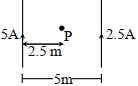
For the adjoining figure,the magnetic field at point $P$ will be:
A
$\frac{\mu_0}{4 \pi} \odot$
B
$\frac{\mu_0}{\pi} \otimes$
C
$\frac{\mu_0}{2 \pi} \odot$
D
$\frac{\mu_0}{2 \pi} \otimes$
Solution
(D) The magnetic field due to a long straight wire is given by $B = \frac{\mu_0 I}{2 \pi r}$.
For the wire carrying $5 \text{ A}$ current at a distance of $2.5 \text{ m}$ from $P$,the magnetic field is:
$B_1 = \frac{\mu_0 \times 5}{2 \pi \times 2.5} = \frac{2 \mu_0}{2 \pi} \otimes$ (directed into the page).
For the wire carrying $2.5 \text{ A}$ current,the distance from $P$ is $5 \text{ m} - 2.5 \text{ m} = 2.5 \text{ m}$. The magnetic field is:
$B_2 = \frac{\mu_0 \times 2.5}{2 \pi \times 2.5} = \frac{\mu_0}{2 \pi} \odot$ (directed out of the page).
The net magnetic field at $P$ is:
$B_{net} = B_1 - B_2 = \frac{2 \mu_0}{2 \pi} - \frac{\mu_0}{2 \pi} = \frac{\mu_0}{2 \pi} \otimes$.
For the wire carrying $5 \text{ A}$ current at a distance of $2.5 \text{ m}$ from $P$,the magnetic field is:
$B_1 = \frac{\mu_0 \times 5}{2 \pi \times 2.5} = \frac{2 \mu_0}{2 \pi} \otimes$ (directed into the page).
For the wire carrying $2.5 \text{ A}$ current,the distance from $P$ is $5 \text{ m} - 2.5 \text{ m} = 2.5 \text{ m}$. The magnetic field is:
$B_2 = \frac{\mu_0 \times 2.5}{2 \pi \times 2.5} = \frac{\mu_0}{2 \pi} \odot$ (directed out of the page).
The net magnetic field at $P$ is:
$B_{net} = B_1 - B_2 = \frac{2 \mu_0}{2 \pi} - \frac{\mu_0}{2 \pi} = \frac{\mu_0}{2 \pi} \otimes$.
0 likesView Solution
27
PhysicsEasyMCQAIPMT · 2000
The quality factor of an $LCR$ circuit having resistance $(R)$ and inductance $(L)$ at resonance frequency $(\omega)$ is given by:
A
$\frac{\omega L}{R}$
B
$\frac{R}{\omega L}$
C
$(\frac{\omega L}{R})^{1/2}$
D
$(\frac{\omega L}{R})^2$
Solution
(A) The quality factor $(Q)$ of an $LCR$ circuit is defined as the ratio of the voltage across the inductor $(V_L)$ or capacitor $(V_C)$ to the voltage across the resistor $(V_R)$ at resonance.
Mathematically,$Q = \frac{V_L}{V_R} = \frac{I \cdot X_L}{I \cdot R} = \frac{X_L}{R}$.
Since the inductive reactance is given by $X_L = \omega L$,we substitute this into the expression.
Therefore,the quality factor is $Q = \frac{\omega L}{R}$.
Mathematically,$Q = \frac{V_L}{V_R} = \frac{I \cdot X_L}{I \cdot R} = \frac{X_L}{R}$.
Since the inductive reactance is given by $X_L = \omega L$,we substitute this into the expression.
Therefore,the quality factor is $Q = \frac{\omega L}{R}$.
0 likesView Solution
28
PhysicsEasyMCQAIPMT · 2000
By the photoelectric effect,Einstein proved:
A
$E = h\nu$
B
$K.E. = \frac{1}{2}mv^2$
C
$E = mc^2$
D
$E = \frac{-Rhc^2}{n^2}$
Solution
(A) Einstein explained the photoelectric effect by proposing that light consists of discrete packets of energy called photons. The energy of each photon is given by the equation $E = h\nu$,where $h$ is Planck's constant and $\nu$ is the frequency of the radiation. This equation forms the basis of Einstein's photoelectric equation,$K_{max} = h\nu - \Phi_0$. Therefore,the correct option is $A$.
0 likesView Solution
29
PhysicsEasyMCQAIPMT · 2000
For the given reaction, the particle $X$ is $_6C^{11} \to _5B^{11} + \beta^+ + X$.
A
An anti-neutrino
B
$A$ proton
C
$A$ neutron
D
$A$ neutrino
Solution
(D) In $\beta^+$ decay (positron emission), a proton inside the nucleus is converted into a neutron, a positron $(\beta^+)$, and a neutrino $(\nu)$.
The reaction is given by: $_6C^{11} \to _5B^{11} + _1e^0 + \nu$.
According to the law of conservation of lepton number, the lepton number must be conserved. Since the positron $(\beta^+)$ has a lepton number of $-1$, a neutrino $(\nu)$ with a lepton number of $+1$ must be emitted to balance the equation.
Therefore, the particle $X$ is a neutrino.
The reaction is given by: $_6C^{11} \to _5B^{11} + _1e^0 + \nu$.
According to the law of conservation of lepton number, the lepton number must be conserved. Since the positron $(\beta^+)$ has a lepton number of $-1$, a neutrino $(\nu)$ with a lepton number of $+1$ must be emitted to balance the equation.
Therefore, the particle $X$ is a neutrino.
0 likesView Solution
30
PhysicsEasyMCQAIPMT · 2000
The relation between $\lambda$ and $T_{1/2}$ is ($T_{1/2} = \text{half-life}$,$\lambda = \text{decay constant}$)
A
$\left(\lambda + T_{1/2}\right) = \frac{\ln 2}{2}$
B
$T_{1/2} = \frac{\ln 2}{\lambda}$
C
$T_{1/2} \cdot \ln 2 = \lambda$
D
$T_{1/2} = \frac{1}{\lambda}$
Solution
(B) The radioactive decay law is given by $N(t) = N_0 e^{-\lambda t}$.
By definition,at half-life $T_{1/2}$,the number of radioactive nuclei remaining is half of the initial amount,i.e.,$N(T_{1/2}) = \frac{N_0}{2}$.
Substituting this into the decay law: $\frac{N_0}{2} = N_0 e^{-\lambda T_{1/2}}$.
$\frac{1}{2} = e^{-\lambda T_{1/2}}$.
Taking the natural logarithm on both sides: $\ln(1/2) = -\lambda T_{1/2}$.
$-\ln 2 = -\lambda T_{1/2}$.
Therefore,$T_{1/2} = \frac{\ln 2}{\lambda}$.
By definition,at half-life $T_{1/2}$,the number of radioactive nuclei remaining is half of the initial amount,i.e.,$N(T_{1/2}) = \frac{N_0}{2}$.
Substituting this into the decay law: $\frac{N_0}{2} = N_0 e^{-\lambda T_{1/2}}$.
$\frac{1}{2} = e^{-\lambda T_{1/2}}$.
Taking the natural logarithm on both sides: $\ln(1/2) = -\lambda T_{1/2}$.
$-\ln 2 = -\lambda T_{1/2}$.
Therefore,$T_{1/2} = \frac{\ln 2}{\lambda}$.
0 likesView Solution
31
PhysicsMediumMCQAIPMT · 2000
In the study of a transistor as an amplifier,if $\alpha = \frac{I_{C}}{I_{E}}$ and $\beta = \frac{I_{C}}{I_{B}}$,where $I_{C}$,$I_{B}$,and $I_{E}$ are the collector,base,and emitter currents respectively,then:
A
$\beta = \frac{1 - \alpha}{\alpha}$
B
$\beta = \frac{\alpha}{1 - \alpha}$
C
$\beta = \frac{\alpha}{1 + \alpha}$
D
$\beta = \frac{1 + \alpha}{\alpha}$
Solution
(B) We know that the emitter current is the sum of the collector current and the base current:
$I_{E} = I_{C} + I_{B}$
Dividing both sides by $I_{C}$:
$\frac{I_{E}}{I_{C}} = 1 + \frac{I_{B}}{I_{C}}$
Since $\alpha = \frac{I_{C}}{I_{E}}$,it follows that $\frac{1}{\alpha} = \frac{I_{E}}{I_{C}}$.
Since $\beta = \frac{I_{C}}{I_{B}}$,it follows that $\frac{1}{\beta} = \frac{I_{B}}{I_{C}}$.
Substituting these into the equation:
$\frac{1}{\alpha} = 1 + \frac{1}{\beta}$
Rearranging to solve for $\frac{1}{\beta}$:
$\frac{1}{\beta} = \frac{1}{\alpha} - 1 = \frac{1 - \alpha}{\alpha}$
Therefore,$\beta = \frac{\alpha}{1 - \alpha}$.
$I_{E} = I_{C} + I_{B}$
Dividing both sides by $I_{C}$:
$\frac{I_{E}}{I_{C}} = 1 + \frac{I_{B}}{I_{C}}$
Since $\alpha = \frac{I_{C}}{I_{E}}$,it follows that $\frac{1}{\alpha} = \frac{I_{E}}{I_{C}}$.
Since $\beta = \frac{I_{C}}{I_{B}}$,it follows that $\frac{1}{\beta} = \frac{I_{B}}{I_{C}}$.
Substituting these into the equation:
$\frac{1}{\alpha} = 1 + \frac{1}{\beta}$
Rearranging to solve for $\frac{1}{\beta}$:
$\frac{1}{\beta} = \frac{1}{\alpha} - 1 = \frac{1 - \alpha}{\alpha}$
Therefore,$\beta = \frac{\alpha}{1 - \alpha}$.
0 likesView Solution
32
PhysicsEasyMCQAIPMT · 2000
The given truth table is correct for:
$P: 1, 1, 0, 0$
$Q: 1, 0, 1, 0$
$R: 1, 0, 0, 0$
$P: 1, 1, 0, 0$
$Q: 1, 0, 1, 0$
$R: 1, 0, 0, 0$
A
$NOR$
B
$OR$
C
$NAND$
D
$AND$
Solution
(D) The Boolean expression for an $AND$ gate is $R = P \cdot Q$.
Checking the values from the truth table:
For $P=1, Q=1$,$R = 1 \cdot 1 = 1$.
For $P=1, Q=0$,$R = 1 \cdot 0 = 0$.
For $P=0, Q=1$,$R = 0 \cdot 1 = 0$.
For $P=0, Q=0$,$R = 0 \cdot 0 = 0$.
Since the calculated values match the given truth table,the gate is an $AND$ gate.
Checking the values from the truth table:
For $P=1, Q=1$,$R = 1 \cdot 1 = 1$.
For $P=1, Q=0$,$R = 1 \cdot 0 = 0$.
For $P=0, Q=1$,$R = 0 \cdot 1 = 0$.
For $P=0, Q=0$,$R = 0 \cdot 0 = 0$.
Since the calculated values match the given truth table,the gate is an $AND$ gate.
0 likesView Solution
33
PhysicsMediumMCQAIPMT · 2000
$A$ plano-convex lens $(\mu = 1.5)$ has a radius of curvature of $10 \; cm$. It is silvered on its plane surface. Find the focal length after silvering. (in $; cm$)
A
$15$
B
$10$
C
$20$
D
$25$
Solution
(B) The focal length of a silvered lens is given by the formula $\frac{1}{F} = \frac{2}{f_l} + \frac{1}{f_m}$,where $f_l$ is the focal length of the lens and $f_m$ is the focal length of the mirror.
For a plano-convex lens,the focal length $f_l$ is given by $\frac{1}{f_l} = (\mu - 1)(\frac{1}{R_1} - \frac{1}{R_2})$.
Here,$R_1 = 10 \; cm$ and $R_2 = \infty$,so $\frac{1}{f_l} = (1.5 - 1)(\frac{1}{10} - 0) = \frac{0.5}{10} = \frac{1}{20}$. Thus,$f_l = 20 \; cm$.
The silvered plane surface acts as a plane mirror,so its focal length $f_m = \infty$.
Therefore,$\frac{1}{F} = \frac{2}{20} + \frac{1}{\infty} = \frac{1}{10} + 0 = \frac{1}{10}$.
Hence,$F = 10 \; cm$.
For a plano-convex lens,the focal length $f_l$ is given by $\frac{1}{f_l} = (\mu - 1)(\frac{1}{R_1} - \frac{1}{R_2})$.
Here,$R_1 = 10 \; cm$ and $R_2 = \infty$,so $\frac{1}{f_l} = (1.5 - 1)(\frac{1}{10} - 0) = \frac{0.5}{10} = \frac{1}{20}$. Thus,$f_l = 20 \; cm$.
The silvered plane surface acts as a plane mirror,so its focal length $f_m = \infty$.
Therefore,$\frac{1}{F} = \frac{2}{20} + \frac{1}{\infty} = \frac{1}{10} + 0 = \frac{1}{10}$.
Hence,$F = 10 \; cm$.
0 likesView Solution
34
PhysicsEasyMCQAIPMT · 2000
$A$ rainbow is formed due to
A
Diffraction and dispersion
B
Reflection only
C
Total internal reflection and dispersion
D
Scattering and refraction
Solution
(C) The formation of a rainbow is a complex optical phenomenon involving multiple processes.
$1$. Sunlight enters a water droplet and undergoes refraction and dispersion,splitting into its constituent colors.
$2$. The light then undergoes total internal reflection $(TIR)$ at the back surface of the droplet.
$3$. Finally,the light refracts again as it exits the droplet.
Therefore,the primary processes involved are refraction,dispersion,and total internal reflection.
$1$. Sunlight enters a water droplet and undergoes refraction and dispersion,splitting into its constituent colors.
$2$. The light then undergoes total internal reflection $(TIR)$ at the back surface of the droplet.
$3$. Finally,the light refracts again as it exits the droplet.
Therefore,the primary processes involved are refraction,dispersion,and total internal reflection.
0 likesView Solution
35
PhysicsEasyMCQAIPMT · 2000
What is the correct order of frequency for $\gamma-$ rays $(b)$,$X-$ rays $(a)$,and $UV-$ rays $(c)$?
A
$b > a > c$
B
$a > b > c$
C
$c > b > a$
D
$a > c > b$
Solution
(A) The electromagnetic spectrum is ordered by increasing wavelength or decreasing frequency. The order of frequency for these electromagnetic waves is given by: $\nu_{\gamma-rays} > \nu_{X-rays} > \nu_{UV-rays}$.
Given that $\gamma-$ rays are $(b)$,$X-$ rays are $(a)$,and $UV-$ rays are $(c)$,the frequency order is $b > a > c$.
Given that $\gamma-$ rays are $(b)$,$X-$ rays are $(a)$,and $UV-$ rays are $(c)$,the frequency order is $b > a > c$.
0 likesView Solution
36
PhysicsMediumMCQAIPMT · 2000
Which of the following transitions in hydrogen atoms emit photons of highest frequency?
A
$n = 2$ to $n = 1$
B
$n = 1$ to $n = 2$
C
$n = 6$ to $n = 2$
D
$n = 2$ to $n = 6$
Solution
(A) The energy of a photon emitted during an electronic transition is given by $\Delta E = E_{initial} - E_{final} = h\nu$,where $\nu$ is the frequency.
For emission to occur,the electron must transition from a higher energy level to a lower energy level. Thus,options $(b)$ and $(d)$ are excluded as they represent absorption.
Comparing the energy differences for the remaining transitions:
For $n = 2$ to $n = 1$: $\Delta E_1 = 13.6 \left( \frac{1}{1^2} - \frac{1}{2^2} \right) = 13.6 \left( 1 - 0.25 \right) = 13.6 \times 0.75 = 10.2 \text{ eV}$.
For $n = 6$ to $n = 2$: $\Delta E_2 = 13.6 \left( \frac{1}{2^2} - \frac{1}{6^2} \right) = 13.6 \left( 0.25 - 0.0277 \right) = 13.6 \times 0.2223 \approx 3.02 \text{ eV}$.
Since $\nu = \frac{\Delta E}{h}$,the transition with the largest energy difference will emit the photon with the highest frequency.
Comparing $\Delta E_1$ and $\Delta E_2$,we see that $\Delta E_1 > \Delta E_2$.
Therefore,the transition from $n = 2$ to $n = 1$ emits the photon of the highest frequency.
For emission to occur,the electron must transition from a higher energy level to a lower energy level. Thus,options $(b)$ and $(d)$ are excluded as they represent absorption.
Comparing the energy differences for the remaining transitions:
For $n = 2$ to $n = 1$: $\Delta E_1 = 13.6 \left( \frac{1}{1^2} - \frac{1}{2^2} \right) = 13.6 \left( 1 - 0.25 \right) = 13.6 \times 0.75 = 10.2 \text{ eV}$.
For $n = 6$ to $n = 2$: $\Delta E_2 = 13.6 \left( \frac{1}{2^2} - \frac{1}{6^2} \right) = 13.6 \left( 0.25 - 0.0277 \right) = 13.6 \times 0.2223 \approx 3.02 \text{ eV}$.
Since $\nu = \frac{\Delta E}{h}$,the transition with the largest energy difference will emit the photon with the highest frequency.
Comparing $\Delta E_1$ and $\Delta E_2$,we see that $\Delta E_1 > \Delta E_2$.
Therefore,the transition from $n = 2$ to $n = 1$ emits the photon of the highest frequency.
0 likesView Solution
37
PhysicsMediumMCQAIPMT · 2000
In the following diode circuits,which diode is in a forward-biased condition?
A
B
C
D
Solution
(B) diode is in a forward-biased condition when the potential at the $p$-terminal (anode) is higher than the potential at the $n$-terminal (cathode).
Let $V_A$ be the potential at the anode and $V_K$ be the potential at the cathode.
For forward bias,the condition is $V_A > V_K$.
Checking the options:
$(A)$ $V_A = 0 \ V$,$V_K = 2 \ V$. Here $V_A < V_K$,so it is reverse-biased.
$(B)$ $V_A = 0 \ V$,$V_K = -2 \ V$. Here $V_A > V_K$ $(0 > -2)$,so it is forward-biased.
$(C)$ $V_A = -5 \ V$,$V_K = -2 \ V$. Here $V_A < V_K$ $(-5 < -2)$,so it is reverse-biased.
$(D)$ $V_A = 5 \ V$,$V_K = 12 \ V$. Here $V_A < V_K$,so it is reverse-biased.
Therefore,option $(B)$ is the correct answer.
Let $V_A$ be the potential at the anode and $V_K$ be the potential at the cathode.
For forward bias,the condition is $V_A > V_K$.
Checking the options:
$(A)$ $V_A = 0 \ V$,$V_K = 2 \ V$. Here $V_A < V_K$,so it is reverse-biased.
$(B)$ $V_A = 0 \ V$,$V_K = -2 \ V$. Here $V_A > V_K$ $(0 > -2)$,so it is forward-biased.
$(C)$ $V_A = -5 \ V$,$V_K = -2 \ V$. Here $V_A < V_K$ $(-5 < -2)$,so it is reverse-biased.
$(D)$ $V_A = 5 \ V$,$V_K = 12 \ V$. Here $V_A < V_K$,so it is reverse-biased.
Therefore,option $(B)$ is the correct answer.
0 likesView Solution
38
PhysicsMediumMCQAIPMT · 2000
$A$ bubble in a glass slab $(\mu = 1.5)$ when viewed from one side appears at $5 \ cm$ and from the other side appears at $2 \ cm$. The thickness of the slab is .... $cm$.
A
$3.75$
B
$3$
C
$10.5$
D
$2.5$
Solution
(C) Let the thickness of the glass slab be $x$.
When viewed from one side,the apparent depth is $d_1 = 5 \ cm$.
When viewed from the other side,the apparent depth is $d_2 = 2 \ cm$.
The relationship between real depth and apparent depth is given by $\mu = \frac{\text{real depth}}{\text{apparent depth}}$.
Let $x_1$ be the real distance of the bubble from the first side and $x_2$ be the real distance from the second side,such that $x_1 + x_2 = x$.
From the formula,$x_1 = \mu d_1 = 1.5 \times 5 = 7.5 \ cm$.
Similarly,$x_2 = \mu d_2 = 1.5 \times 2 = 3.0 \ cm$.
Therefore,the total thickness of the slab is $x = x_1 + x_2 = 7.5 + 3.0 = 10.5 \ cm$.
When viewed from one side,the apparent depth is $d_1 = 5 \ cm$.
When viewed from the other side,the apparent depth is $d_2 = 2 \ cm$.
The relationship between real depth and apparent depth is given by $\mu = \frac{\text{real depth}}{\text{apparent depth}}$.
Let $x_1$ be the real distance of the bubble from the first side and $x_2$ be the real distance from the second side,such that $x_1 + x_2 = x$.
From the formula,$x_1 = \mu d_1 = 1.5 \times 5 = 7.5 \ cm$.
Similarly,$x_2 = \mu d_2 = 1.5 \times 2 = 3.0 \ cm$.
Therefore,the total thickness of the slab is $x = x_1 + x_2 = 7.5 + 3.0 = 10.5 \ cm$.
0 likesView Solution
39
PhysicsMediumMCQAIPMT · 2000
The potentiometer is best for measuring voltage,as
A
it has a sensitive galvanometer
B
it has wire of high resistance
C
it measures p.d. in closed circuit
D
it measures p.d in open circuit.
Solution
(D) potentiometer is considered the best device for measuring the potential difference $(p.d.)$ or electromotive force $(EMF)$ of a cell because it operates on the principle of a null deflection method.
In this method,when the potentiometer is balanced,no current flows through the galvanometer connected to the cell being measured.
Since no current is drawn from the source,the terminal potential difference measured is equal to the actual $EMF$ of the cell.
Therefore,it measures the $p.d.$ in an open circuit condition,which avoids the error caused by the internal resistance of the source.
In this method,when the potentiometer is balanced,no current flows through the galvanometer connected to the cell being measured.
Since no current is drawn from the source,the terminal potential difference measured is equal to the actual $EMF$ of the cell.
Therefore,it measures the $p.d.$ in an open circuit condition,which avoids the error caused by the internal resistance of the source.
0 likesView Solution
40
PhysicsMediumMCQAIPMT · 2000
When an electron makes a transition from $n=4$ to $n=2$,the emitted line spectrum will be:
A
first line of Lyman series
B
first line of Paschen series
C
second line of Balmer series
D
second line of Paschen series
Solution
(C) The spectral series of a hydrogen atom is determined by the final energy level $(n_f)$ of the electron transition.
$1$. Transitions to $n_f = 1$ result in the Lyman series.
$2$. Transitions to $n_f = 2$ result in the Balmer series.
$3$. Transitions to $n_f = 3$ result in the Paschen series.
In this case,the electron transitions from $n_i = 4$ to $n_f = 2$. Since the final state is $n_f = 2$,the emission belongs to the Balmer series.
The lines of the Balmer series are defined by transitions from $n_i = 3, 4, 5, ...$ to $n_f = 2$:
- The first line corresponds to $n_i = 3$ to $n_f = 2$.
- The second line corresponds to $n_i = 4$ to $n_f = 2$.
Therefore,the transition from $n=4$ to $n=2$ represents the second line of the Balmer series.
$1$. Transitions to $n_f = 1$ result in the Lyman series.
$2$. Transitions to $n_f = 2$ result in the Balmer series.
$3$. Transitions to $n_f = 3$ result in the Paschen series.
In this case,the electron transitions from $n_i = 4$ to $n_f = 2$. Since the final state is $n_f = 2$,the emission belongs to the Balmer series.
The lines of the Balmer series are defined by transitions from $n_i = 3, 4, 5, ...$ to $n_f = 2$:
- The first line corresponds to $n_i = 3$ to $n_f = 2$.
- The second line corresponds to $n_i = 4$ to $n_f = 2$.
Therefore,the transition from $n=4$ to $n=2$ represents the second line of the Balmer series.
0 likesView Solution
41
PhysicsEasyMCQAIPMT · 2000
$A$ tall man of height $6$ feet wants to see his full image. The required minimum length of the mirror will be ......... feet.
A
$12$
B
$6$
C
$3$
D
any length
Solution
(C) To see the full image of an object of height $H$ in a plane mirror,the minimum length of the mirror required is $H/2$.
Given the height of the man is $H = 6$ feet.
Therefore,the minimum length of the mirror required is $6 / 2 = 3$ feet.
Given the height of the man is $H = 6$ feet.
Therefore,the minimum length of the mirror required is $6 / 2 = 3$ feet.
0 likesView Solution
42
PhysicsMediumMCQAIPMT · 2000
$A$ charge having $q/m$ equal to $10^8 \, C/kg$ and with velocity $3 \times 10^5 \, m/s$ enters into a uniform magnetic field $0.3 \, T$ at an angle $30^{\circ}$ with the direction of the field. The radius of curvature will be ...... $cm$.
A
$2$
B
$0.5$
C
$0.01$
D
$1$
Solution
(B) The radius of the helical path of a charged particle moving in a uniform magnetic field is given by the formula:
$r = \frac{mv_{\perp}}{qB} = \frac{mv \sin \theta}{qB}$
Given values:
$q/m = 10^8 \, C/kg \implies m/q = 10^{-8} \, kg/C$
$v = 3 \times 10^5 \, m/s$
$B = 0.3 \, T$
$\theta = 30^{\circ}$
Substituting the values into the formula:
$r = \left( \frac{m}{q} \right) \frac{v \sin 30^{\circ}}{B}$
$r = (10^{-8}) \times \frac{3 \times 10^5 \times 0.5}{0.3}$
$r = 10^{-8} \times \frac{1.5 \times 10^5}{0.3}$
$r = 10^{-8} \times 5 \times 10^5 = 5 \times 10^{-3} \, m$
Converting meters to centimeters:
$r = 5 \times 10^{-3} \times 10^2 \, cm = 0.5 \, cm$.
$r = \frac{mv_{\perp}}{qB} = \frac{mv \sin \theta}{qB}$
Given values:
$q/m = 10^8 \, C/kg \implies m/q = 10^{-8} \, kg/C$
$v = 3 \times 10^5 \, m/s$
$B = 0.3 \, T$
$\theta = 30^{\circ}$
Substituting the values into the formula:
$r = \left( \frac{m}{q} \right) \frac{v \sin 30^{\circ}}{B}$
$r = (10^{-8}) \times \frac{3 \times 10^5 \times 0.5}{0.3}$
$r = 10^{-8} \times \frac{1.5 \times 10^5}{0.3}$
$r = 10^{-8} \times 5 \times 10^5 = 5 \times 10^{-3} \, m$
Converting meters to centimeters:
$r = 5 \times 10^{-3} \times 10^2 \, cm = 0.5 \, cm$.
0 likesView Solution
43
PhysicsEasyMCQAIPMT · 2000
Who evaluated the mass of the electron indirectly with the help of its charge?
A
Rutherford
B
Thomson
C
Millikan
D
Newton
Solution
(B) $J$.$J$. Thomson determined the specific charge $(e/m)$ of an electron using his cathode ray tube experiment. Later,Robert $A$. Millikan determined the charge $(e)$ of an electron using his oil-drop experiment. By combining these two values,the mass $(m)$ of the electron was evaluated indirectly as $m = e / (e/m)$.
0 likesView Solution
44
PhysicsMediumMCQAIPMT · 2000
$A$ capacitor is charged with a battery and the energy stored is $U$. After disconnecting the battery,another capacitor of the same capacity is connected in parallel to the first capacitor. Then the energy stored in each capacitor is
A
$4U$
B
$\frac{U}{4}$
C
$2U$
D
$\frac{U}{2}$
Solution
(B) Initially,the capacitor of capacitance $C$ is charged to a potential $V$ by a battery. The energy stored is $U = \frac{1}{2} CV^2 = \frac{Q^2}{2C}$,where $Q$ is the initial charge.
When the battery is disconnected and an identical capacitor $C$ is connected in parallel,the total charge $Q$ is redistributed between the two capacitors.
Since the capacitors are in parallel,they will share the charge equally,so each capacitor now has a charge $Q' = \frac{Q}{2}$.
The new potential difference across each capacitor is $V' = \frac{Q'}{C} = \frac{Q}{2C} = \frac{V}{2}$.
The energy stored in each capacitor is $U' = \frac{1}{2} C(V')^2 = \frac{1}{2} C \left(\frac{V}{2}\right)^2 = \frac{1}{2} C \frac{V^2}{4} = \frac{1}{4} \left(\frac{1}{2} CV^2\right) = \frac{U}{4}$.
When the battery is disconnected and an identical capacitor $C$ is connected in parallel,the total charge $Q$ is redistributed between the two capacitors.
Since the capacitors are in parallel,they will share the charge equally,so each capacitor now has a charge $Q' = \frac{Q}{2}$.
The new potential difference across each capacitor is $V' = \frac{Q'}{C} = \frac{Q}{2C} = \frac{V}{2}$.
The energy stored in each capacitor is $U' = \frac{1}{2} C(V')^2 = \frac{1}{2} C \left(\frac{V}{2}\right)^2 = \frac{1}{2} C \frac{V^2}{4} = \frac{1}{4} \left(\frac{1}{2} CV^2\right) = \frac{U}{4}$.
0 likesView Solution
45
PhysicsMediumMCQAIPMT · 2000
$A$ charge $Q$ is situated at the corner of a cube. The electric flux passing through all the six faces of the cube is:
A
$\frac{Q}{2\varepsilon_0}$
B
$\frac{Q}{6\varepsilon_0}$
C
$\frac{Q}{8\varepsilon_0}$
D
$\frac{Q}{\varepsilon_0}$
Solution
(C) According to Gauss's Law,the total electric flux through a closed surface is $\frac{1}{\varepsilon_0}$ times the net charge enclosed by the surface.
When a charge $Q$ is placed at the corner of a cube,it is shared by $8$ such identical cubes to form a larger symmetric closed surface (a Gaussian surface).
Therefore,the total flux through the entire Gaussian surface is $\frac{Q}{\varepsilon_0}$.
Since the charge is symmetrically distributed among $8$ cubes,the flux passing through one cube is $\frac{1}{8}$ of the total flux.
Thus,the electric flux through the cube is $\Phi = \frac{Q}{8\varepsilon_0}$.
When a charge $Q$ is placed at the corner of a cube,it is shared by $8$ such identical cubes to form a larger symmetric closed surface (a Gaussian surface).
Therefore,the total flux through the entire Gaussian surface is $\frac{Q}{\varepsilon_0}$.
Since the charge is symmetrically distributed among $8$ cubes,the flux passing through one cube is $\frac{1}{8}$ of the total flux.
Thus,the electric flux through the cube is $\Phi = \frac{Q}{8\varepsilon_0}$.
0 likesView Solution
46
PhysicsDifficultMCQAIPMT · 2000
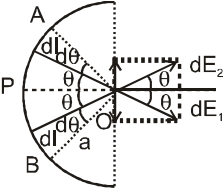
The electric field at the centre $O$ of a semicircle of radius $a$ having a linear charge density $\lambda$ is given by:

A
$\frac{\lambda}{2\pi \varepsilon_0 a}$
B
$\frac{\lambda}{2\pi \varepsilon_0 a^2}$
C
$\frac{\lambda}{4\pi^2 \varepsilon_0 a}$
D
$\frac{\lambda^2}{2\pi \varepsilon_0 a}$
Solution
(A) Consider a small element of length $dl = a d\theta$ at an angle $\theta$ with the axis of symmetry $PO$. The charge on this element is $dq = \lambda dl = \lambda a d\theta$.
The electric field $dE$ at the centre $O$ due to this element is $dE = \frac{1}{4\pi \varepsilon_0} \frac{dq}{a^2} = \frac{1}{4\pi \varepsilon_0} \frac{\lambda a d\theta}{a^2} = \frac{\lambda d\theta}{4\pi \varepsilon_0 a}$.
By symmetry,the components of the electric field perpendicular to the axis of symmetry $PO$ cancel out,while the components along $PO$ add up.
The component of $dE$ along $PO$ is $dE_{\parallel} = dE \cos \theta = \frac{\lambda}{4\pi \varepsilon_0 a} \cos \theta d\theta$.
Integrating from $\theta = -\pi/2$ to $\pi/2$:
$E = \int_{-\pi/2}^{\pi/2} \frac{\lambda}{4\pi \varepsilon_0 a} \cos \theta d\theta = \frac{\lambda}{4\pi \varepsilon_0 a} [\sin \theta]_{-\pi/2}^{\pi/2} = \frac{\lambda}{4\pi \varepsilon_0 a} (1 - (-1)) = \frac{2\lambda}{4\pi \varepsilon_0 a} = \frac{\lambda}{2\pi \varepsilon_0 a}$.
The electric field $dE$ at the centre $O$ due to this element is $dE = \frac{1}{4\pi \varepsilon_0} \frac{dq}{a^2} = \frac{1}{4\pi \varepsilon_0} \frac{\lambda a d\theta}{a^2} = \frac{\lambda d\theta}{4\pi \varepsilon_0 a}$.
By symmetry,the components of the electric field perpendicular to the axis of symmetry $PO$ cancel out,while the components along $PO$ add up.
The component of $dE$ along $PO$ is $dE_{\parallel} = dE \cos \theta = \frac{\lambda}{4\pi \varepsilon_0 a} \cos \theta d\theta$.
Integrating from $\theta = -\pi/2$ to $\pi/2$:
$E = \int_{-\pi/2}^{\pi/2} \frac{\lambda}{4\pi \varepsilon_0 a} \cos \theta d\theta = \frac{\lambda}{4\pi \varepsilon_0 a} [\sin \theta]_{-\pi/2}^{\pi/2} = \frac{\lambda}{4\pi \varepsilon_0 a} (1 - (-1)) = \frac{2\lambda}{4\pi \varepsilon_0 a} = \frac{\lambda}{2\pi \varepsilon_0 a}$.
0 likesView Solution
Vedclass Products
For Students
Vedclass Test Series
Mock tests in real AIPMT style covering Physics with performance analysis. 5-day free trial.
Start Free TrialFor Teachers
Exam Paper Generator
Generate Set A/B/C/D Physics papers from 7.5L+ questions in 2 minutes. 3 chapters free.
Try FreeFor Institutes
Online Exam Module
Run live AIPMT mock exams with unlimited students, 360° analytics & white-label branding.
See DemoFrequently Asked Questions
How many Physics questions are in AIPMT 2000?
There are 46 Physics questions from the AIPMT 2000 paper on Vedclass, each with a detailed step-by-step solution in English.
Are AIPMT 2000 Physics solutions available in English?
Yes. All solutions on this page are in English. You can also switch to English or Hindi using the language buttons above the questions.
Can I practice AIPMT 2000 Physics as a timed test?
Yes. Use the Vedclass Test Series to attempt a full AIPMT mock test covering Physics with time limits and instant score analysis.
Can teachers create Physics papers from AIPMT previous year questions?
Yes. The Vedclass Exam Paper Generator lets teachers mix AIPMT Physics questions and generate Set A/B/C/D papers in minutes.
For Teachers & Institutes
Build a Custom Physics Paper
Pick AIPMT 2000 Physics questions, set difficulty, and generate Set A/B/C/D in 2 minutes.