
PhysicsQ1–46 of 46 questions
Page 1 of 1 · English
1
PhysicsMediumMCQAIPMT · 1995
The position vector of a particle is $\vec{r} = (a \cos \omega t)\hat{i} + (a \sin \omega t)\hat{j}$. The velocity of the particle is
A
Parallel to the position vector
B
Perpendicular to the position vector
C
Directed towards the origin
D
Directed away from the origin
Solution
(B) Given the position vector: $\vec{r} = (a \cos \omega t)\hat{i} + (a \sin \omega t)\hat{j}$.
To find the velocity vector $\vec{v}$,we differentiate $\vec{r}$ with respect to time $t$:
$\vec{v} = \frac{d\vec{r}}{dt} = \frac{d}{dt}[(a \cos \omega t)\hat{i} + (a \sin \omega t)\hat{j}] = -a \omega \sin \omega t \hat{i} + a \omega \cos \omega t \hat{j}$.
Now,we calculate the dot product of $\vec{r}$ and $\vec{v}$ to check their orientation:
$\vec{r} \cdot \vec{v} = [(a \cos \omega t)\hat{i} + (a \sin \omega t)\hat{j}] \cdot [(-a \omega \sin \omega t)\hat{i} + (a \omega \cos \omega t)\hat{j}]$
$\vec{r} \cdot \vec{v} = (a \cos \omega t)(-a \omega \sin \omega t) + (a \sin \omega t)(a \omega \cos \omega t)$
$\vec{r} \cdot \vec{v} = -a^2 \omega \sin \omega t \cos \omega t + a^2 \omega \sin \omega t \cos \omega t = 0$.
Since the dot product is $0$,the velocity vector is perpendicular to the position vector.
To find the velocity vector $\vec{v}$,we differentiate $\vec{r}$ with respect to time $t$:
$\vec{v} = \frac{d\vec{r}}{dt} = \frac{d}{dt}[(a \cos \omega t)\hat{i} + (a \sin \omega t)\hat{j}] = -a \omega \sin \omega t \hat{i} + a \omega \cos \omega t \hat{j}$.
Now,we calculate the dot product of $\vec{r}$ and $\vec{v}$ to check their orientation:
$\vec{r} \cdot \vec{v} = [(a \cos \omega t)\hat{i} + (a \sin \omega t)\hat{j}] \cdot [(-a \omega \sin \omega t)\hat{i} + (a \omega \cos \omega t)\hat{j}]$
$\vec{r} \cdot \vec{v} = (a \cos \omega t)(-a \omega \sin \omega t) + (a \sin \omega t)(a \omega \cos \omega t)$
$\vec{r} \cdot \vec{v} = -a^2 \omega \sin \omega t \cos \omega t + a^2 \omega \sin \omega t \cos \omega t = 0$.
Since the dot product is $0$,the velocity vector is perpendicular to the position vector.
0 likesView Solution
2
PhysicsMediumMCQAIPMT · 1995
The percentage errors in the measurement of mass and speed are $2\%$ and $3\%$ respectively. What will be the maximum percentage error in the estimation of the kinetic energy obtained by measuring mass and speed?
A
$12$
B
$8$
C
$2$
D
$10$
Solution
(B) The formula for kinetic energy is $K.E. = \frac{1}{2}mv^2$.
The relative error in kinetic energy is given by $\frac{\Delta K.E.}{K.E.} = \frac{\Delta m}{m} + 2 \frac{\Delta v}{v}$.
To find the percentage error,we multiply by $100$:
$\text{Percentage error in } K.E. = (\% \text{ error in } m) + 2 \times (\% \text{ error in } v)$.
Given that the percentage error in mass is $2\%$ and the percentage error in speed is $3\%$,we substitute these values:
$\text{Percentage error in } K.E. = 2\% + 2 \times 3\% = 2\% + 6\% = 8\%$.
Therefore,the maximum error in the estimation of kinetic energy is $8\%$.
The relative error in kinetic energy is given by $\frac{\Delta K.E.}{K.E.} = \frac{\Delta m}{m} + 2 \frac{\Delta v}{v}$.
To find the percentage error,we multiply by $100$:
$\text{Percentage error in } K.E. = (\% \text{ error in } m) + 2 \times (\% \text{ error in } v)$.
Given that the percentage error in mass is $2\%$ and the percentage error in speed is $3\%$,we substitute these values:
$\text{Percentage error in } K.E. = 2\% + 2 \times 3\% = 2\% + 6\% = 8\%$.
Therefore,the maximum error in the estimation of kinetic energy is $8\%$.
0 likesView Solution
3
PhysicsDifficultMCQAIPMT · 1995
Water drops fall at regular intervals from a tap which is $5\,m$ above the ground. The third drop is leaving the tap at the instant the first drop touches the ground. How far above the ground is the second drop at that instant?
A
$2.50$
B
$3.75$
C
$4$
D
$1.25$
Solution
(B) Let the time interval between consecutive drops be $\Delta t$.
When the first drop reaches the ground,the total time elapsed is $t = 2\Delta t$ (since the third drop is just leaving,meaning two intervals have passed).
Using the equation of motion $h = \frac{1}{2}gt^2$,for the first drop: $5 = \frac{1}{2} \times 10 \times t^2$,which gives $t^2 = 1$,so $t = 1\,s$.
Since $t = 2\Delta t$,the interval $\Delta t = 0.5\,s$.
At the instant the first drop hits the ground,the second drop has been falling for $\Delta t = 0.5\,s$.
The distance covered by the second drop from the tap is $y = \frac{1}{2}g(\Delta t)^2 = \frac{1}{2} \times 10 \times (0.5)^2 = 5 \times 0.25 = 1.25\,m$.
The height of the second drop above the ground is $H = 5 - 1.25 = 3.75\,m$.
When the first drop reaches the ground,the total time elapsed is $t = 2\Delta t$ (since the third drop is just leaving,meaning two intervals have passed).
Using the equation of motion $h = \frac{1}{2}gt^2$,for the first drop: $5 = \frac{1}{2} \times 10 \times t^2$,which gives $t^2 = 1$,so $t = 1\,s$.
Since $t = 2\Delta t$,the interval $\Delta t = 0.5\,s$.
At the instant the first drop hits the ground,the second drop has been falling for $\Delta t = 0.5\,s$.
The distance covered by the second drop from the tap is $y = \frac{1}{2}g(\Delta t)^2 = \frac{1}{2} \times 10 \times (0.5)^2 = 5 \times 0.25 = 1.25\,m$.
The height of the second drop above the ground is $H = 5 - 1.25 = 3.75\,m$.
0 likesView Solution
4
PhysicsEasyMCQAIPMT · 1995
The angular speed of a flywheel making $120$ revolutions per minute is:
A
$2\pi \, \text{rad/s}$
B
$4\pi^2 \, \text{rad/s}$
C
$\pi \, \text{rad/s}$
D
$4\pi \, \text{rad/s}$
Solution
(D) The angular speed $\omega$ is given by the formula $\omega = 2\pi n$,where $n$ is the frequency in revolutions per second.
Given,$n = 120 \, \text{rev/min} = \frac{120}{60} \, \text{rev/s} = 2 \, \text{rev/s}$.
Substituting the value of $n$ into the formula:
$\omega = 2\pi \times 2 = 4\pi \, \text{rad/s}$.
Therefore,the correct option is $D$.
Given,$n = 120 \, \text{rev/min} = \frac{120}{60} \, \text{rev/s} = 2 \, \text{rev/s}$.
Substituting the value of $n$ into the formula:
$\omega = 2\pi \times 2 = 4\pi \, \text{rad/s}$.
Therefore,the correct option is $D$.
0 likesView Solution
5
PhysicsDifficultMCQAIPMT · 1995
The potential energy between two atoms in a molecule is given by $U(x) = \frac{a}{x^{12}} - \frac{b}{x^6}$,where $a$ and $b$ are positive constants and $x$ is the distance between the atoms. The atom is in stable equilibrium when:
A
$x = \sqrt[6]{\frac{11a}{5b}}$
B
$x = \sqrt[6]{\frac{a}{2b}}$
C
$x = 0$
D
$x = \sqrt[6]{\frac{2a}{b}}$
Solution
(D) The condition for stable equilibrium is that the net force $F$ acting on the system must be zero,where $F = -\frac{dU}{dx} = 0$.
Given $U(x) = ax^{-12} - bx^{-6}$.
Differentiating with respect to $x$:
$\frac{dU}{dx} = -12ax^{-13} - (-6bx^{-7}) = -12ax^{-13} + 6bx^{-7}$.
Setting the force to zero:
$F = -(-12ax^{-13} + 6bx^{-7}) = 0$
$12ax^{-13} - 6bx^{-7} = 0$
$\frac{12a}{x^{13}} = \frac{6b}{x^7}$
$\frac{12a}{6b} = \frac{x^{13}}{x^7}$
$\frac{2a}{b} = x^6$
$x = \sqrt[6]{\frac{2a}{b}}$.
Given $U(x) = ax^{-12} - bx^{-6}$.
Differentiating with respect to $x$:
$\frac{dU}{dx} = -12ax^{-13} - (-6bx^{-7}) = -12ax^{-13} + 6bx^{-7}$.
Setting the force to zero:
$F = -(-12ax^{-13} + 6bx^{-7}) = 0$
$12ax^{-13} - 6bx^{-7} = 0$
$\frac{12a}{x^{13}} = \frac{6b}{x^7}$
$\frac{12a}{6b} = \frac{x^{13}}{x^7}$
$\frac{2a}{b} = x^6$
$x = \sqrt[6]{\frac{2a}{b}}$.
1 likesView Solution
6
PhysicsMediumMCQAIPMT · 1995
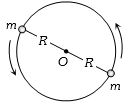
Two particles of equal mass $m$ move in a circle of radius $R$ under the action of their mutual gravitational attraction. The speed of each particle is
A
$v = \frac{1}{{2R}}\sqrt {\frac{1}{{Gm}}} $
B
$v = \sqrt {\frac{{Gm}}{{2R}}} $
C
$v = \frac{1}{2}\sqrt {\frac{{Gm}}{R}} $
D
$v = \sqrt {\frac{{4Gm}}{R}} $
Solution
(C) The centripetal force required for circular motion is provided by the gravitational force of attraction between the two particles.
The distance between the two particles is $2R$.
The gravitational force between them is $F_g = \frac{G \cdot m \cdot m}{(2R)^2} = \frac{Gm^2}{4R^2}$.
The centripetal force required for a particle of mass $m$ moving with speed $v$ in a circle of radius $R$ is $F_c = \frac{mv^2}{R}$.
Equating the two forces:
$\frac{mv^2}{R} = \frac{Gm^2}{4R^2}$
Solving for $v$:
$v^2 = \frac{Gm^2}{4R^2} \cdot \frac{R}{m}$
$v^2 = \frac{Gm}{4R}$
$v = \sqrt{\frac{Gm}{4R}} = \frac{1}{2}\sqrt{\frac{Gm}{R}}$
The distance between the two particles is $2R$.
The gravitational force between them is $F_g = \frac{G \cdot m \cdot m}{(2R)^2} = \frac{Gm^2}{4R^2}$.
The centripetal force required for a particle of mass $m$ moving with speed $v$ in a circle of radius $R$ is $F_c = \frac{mv^2}{R}$.
Equating the two forces:
$\frac{mv^2}{R} = \frac{Gm^2}{4R^2}$
Solving for $v$:
$v^2 = \frac{Gm^2}{4R^2} \cdot \frac{R}{m}$
$v^2 = \frac{Gm}{4R}$
$v = \sqrt{\frac{Gm}{4R}} = \frac{1}{2}\sqrt{\frac{Gm}{R}}$
0 likesView Solution
7
PhysicsMediumMCQAIPMT · 1995
The earth (mass $M = 6 \times 10^{24} \ kg$) revolves around the sun with an angular velocity $\omega = 2 \times 10^{-7} \ rad/s$ in a circular orbit of radius $R = 1.5 \times 10^8 \ km$. The force exerted by the sun on the earth in newtons is:
A
$18 \times 10^{25}$
B
Zero
C
$27 \times 10^{39}$
D
$36 \times 10^{21}$
Solution
(D) Given: Mass of the earth $m = 6 \times 10^{24} \ kg$,angular velocity $\omega = 2 \times 10^{-7} \ rad/s$,and radius of orbit $R = 1.5 \times 10^8 \ km = 1.5 \times 10^{11} \ m$.
The centripetal force required for the circular motion of the earth is provided by the gravitational force exerted by the sun.
The formula for centripetal force is $F = m \omega^2 R$.
Substituting the given values into the formula:
$F = (6 \times 10^{24}) \times (2 \times 10^{-7})^2 \times (1.5 \times 10^{11})$
$F = (6 \times 10^{24}) \times (4 \times 10^{-14}) \times (1.5 \times 10^{11})$
$F = (6 \times 4 \times 1.5) \times (10^{24} \times 10^{-14} \times 10^{11})$
$F = 36 \times 10^{21} \ N$.
The centripetal force required for the circular motion of the earth is provided by the gravitational force exerted by the sun.
The formula for centripetal force is $F = m \omega^2 R$.
Substituting the given values into the formula:
$F = (6 \times 10^{24}) \times (2 \times 10^{-7})^2 \times (1.5 \times 10^{11})$
$F = (6 \times 10^{24}) \times (4 \times 10^{-14}) \times (1.5 \times 10^{11})$
$F = (6 \times 4 \times 1.5) \times (10^{24} \times 10^{-14} \times 10^{11})$
$F = 36 \times 10^{21} \ N$.
0 likesView Solution
8
PhysicsMediumMCQAIPMT · 1995
The heat is flowing through two cylindrical rods of the same material. The diameters of the rods are in the ratio $1:2$ and their lengths are in the ratio $2:1$. If the temperature difference between their ends is the same,the ratio of the rate of flow of heat through them will be:
A
$1:1$
B
$2:1$
C
$1:4$
D
$1:8$
Solution
(D) The rate of heat flow $(H = Q/t)$ through a rod is given by the formula: $H = \frac{KA \Delta \theta}{l}$.
Since the material is the same,the thermal conductivity $K$ is constant. Given that the temperature difference $\Delta \theta$ is also the same,we have $H \propto \frac{A}{l}$.
Since $A = \pi r^2 = \pi (d/2)^2$,we have $A \propto d^2$. Therefore,$H \propto \frac{d^2}{l}$.
Given ratios: $\frac{d_1}{d_2} = \frac{1}{2}$ and $\frac{l_1}{l_2} = \frac{2}{1}$.
Calculating the ratio of heat flow rates: $\frac{H_1}{H_2} = \left( \frac{d_1}{d_2} \right)^2 \times \left( \frac{l_2}{l_1} \right) = \left( \frac{1}{2} \right)^2 \times \left( \frac{1}{2} \right) = \frac{1}{4} \times \frac{1}{2} = \frac{1}{8}$.
Thus,the ratio is $1:8$.
Since the material is the same,the thermal conductivity $K$ is constant. Given that the temperature difference $\Delta \theta$ is also the same,we have $H \propto \frac{A}{l}$.
Since $A = \pi r^2 = \pi (d/2)^2$,we have $A \propto d^2$. Therefore,$H \propto \frac{d^2}{l}$.
Given ratios: $\frac{d_1}{d_2} = \frac{1}{2}$ and $\frac{l_1}{l_2} = \frac{2}{1}$.
Calculating the ratio of heat flow rates: $\frac{H_1}{H_2} = \left( \frac{d_1}{d_2} \right)^2 \times \left( \frac{l_2}{l_1} \right) = \left( \frac{1}{2} \right)^2 \times \left( \frac{1}{2} \right) = \frac{1}{4} \times \frac{1}{2} = \frac{1}{8}$.
Thus,the ratio is $1:8$.
0 likesView Solution
9
PhysicsMediumMCQAIPMT · 1995
$A$ beaker full of hot water is kept in a room. If it cools from $80^{\circ} C$ to $75^{\circ} C$ in $t_1$ minutes,from $75^{\circ} C$ to $70^{\circ} C$ in $t_2$ minutes,and from $70^{\circ} C$ to $65^{\circ} C$ in $t_3$ minutes,then:
A
$t_1 = t_2 = t_3$
B
$t_1 < t_2 = t_3$
C
$t_1 < t_2 < t_3$
D
$t_1 > t_2 > t_3$
Solution
(C) According to Newton's law of cooling,the rate of cooling is directly proportional to the temperature difference between the body and its surroundings.
Mathematically,$\frac{d\theta}{dt} = k \left( \frac{\theta_1 + \theta_2}{2} - \theta_0 \right)$,where $\theta_0$ is the room temperature.
Since the temperature difference decreases as the water cools,the rate of cooling decreases.
Therefore,the time taken to cool by the same amount $(5^{\circ} C)$ increases as the temperature of the water approaches the room temperature.
Comparing the mean temperatures: $\left( \frac{80+75}{2} \right) > \left( \frac{75+70}{2} \right) > \left( \frac{70+65}{2} \right)$.
Thus,the rate of cooling is highest for the first interval and lowest for the third interval.
Consequently,$t_1 < t_2 < t_3$.
Mathematically,$\frac{d\theta}{dt} = k \left( \frac{\theta_1 + \theta_2}{2} - \theta_0 \right)$,where $\theta_0$ is the room temperature.
Since the temperature difference decreases as the water cools,the rate of cooling decreases.
Therefore,the time taken to cool by the same amount $(5^{\circ} C)$ increases as the temperature of the water approaches the room temperature.
Comparing the mean temperatures: $\left( \frac{80+75}{2} \right) > \left( \frac{75+70}{2} \right) > \left( \frac{70+65}{2} \right)$.
Thus,the rate of cooling is highest for the first interval and lowest for the third interval.
Consequently,$t_1 < t_2 < t_3$.
0 likesView Solution
10
PhysicsMediumMCQAIPMT · 1995
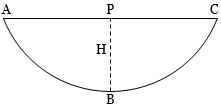
$A$ simple pendulum with a bob of mass $m$ oscillates from $A$ to $C$ and back to $A$ such that $PB$ is $H$. If the acceleration due to gravity is $g$,then the velocity of the bob as it passes through $B$ is
A
$mgH$
B
$\sqrt{2gH}$
C
$\sqrt{gH}$
D
Zero
Solution
(B) At point $A$ (or $C$),the bob is at its maximum height $H$ relative to point $B$,so its kinetic energy is zero and potential energy is $mgH$.
At point $B$,the bob is at its lowest position,so its potential energy is zero and all energy is converted into kinetic energy.
According to the law of conservation of mechanical energy:
$PE_{A} + KE_{A} = PE_{B} + KE_{B}$
$mgH + 0 = 0 + \frac{1}{2}mv^2$
$mgH = \frac{1}{2}mv^2$
$v^2 = 2gH$
$v = \sqrt{2gH}$
At point $B$,the bob is at its lowest position,so its potential energy is zero and all energy is converted into kinetic energy.
According to the law of conservation of mechanical energy:
$PE_{A} + KE_{A} = PE_{B} + KE_{B}$
$mgH + 0 = 0 + \frac{1}{2}mv^2$
$mgH = \frac{1}{2}mv^2$
$v^2 = 2gH$
$v = \sqrt{2gH}$
0 likesView Solution
11
PhysicsEasyMCQAIPMT · 1995
$A$ hospital uses an ultrasonic scanner to locate tumours in a tissue. The operating frequency of the scanner is $4.2 \, MHz$. The speed of sound in a tissue is $1.7 \, km/s$. The wavelength of sound in the tissue is close to:
A
$4 \times 10^{-4} \, m$
B
$8 \times 10^{-3} \, m$
C
$4 \times 10^{-3} \, m$
D
$8 \times 10^{-4} \, m$
Solution
(A) The relationship between wave speed $(v)$,frequency $(n)$,and wavelength $(\lambda)$ is given by the formula: $v = n \lambda$.
Rearranging for wavelength,we get: $\lambda = \frac{v}{n}$.
Given:
Frequency $(n)$ = $4.2 \, MHz = 4.2 \times 10^6 \, Hz$.
Speed of sound $(v)$ = $1.7 \, km/s = 1.7 \times 10^3 \, m/s$.
Substituting the values:
$\lambda = \frac{1.7 \times 10^3}{4.2 \times 10^6} = \frac{1.7}{4.2} \times 10^{-3} \approx 0.4047 \times 10^{-3} \, m = 4.047 \times 10^{-4} \, m$.
Rounding to the nearest value,we get $\lambda \approx 4 \times 10^{-4} \, m$.
Rearranging for wavelength,we get: $\lambda = \frac{v}{n}$.
Given:
Frequency $(n)$ = $4.2 \, MHz = 4.2 \times 10^6 \, Hz$.
Speed of sound $(v)$ = $1.7 \, km/s = 1.7 \times 10^3 \, m/s$.
Substituting the values:
$\lambda = \frac{1.7 \times 10^3}{4.2 \times 10^6} = \frac{1.7}{4.2} \times 10^{-3} \approx 0.4047 \times 10^{-3} \, m = 4.047 \times 10^{-4} \, m$.
Rounding to the nearest value,we get $\lambda \approx 4 \times 10^{-4} \, m$.
0 likesView Solution
12
PhysicsMediumMCQAIPMT · 1995
$A$ source of sound gives five beats per second when sounded with another source of frequency $100 \, s^{-1}$. The second harmonic of the source together with a source of frequency $205 \, s^{-1}$ gives five beats per second. What is the frequency of the source in $s^{-1}$?
A
$105$
B
$205$
C
$95$
D
$100$
Solution
(A) Let the frequency of the source be $f$.
Since it produces $5$ beats per second with a source of $100 \, s^{-1}$,the frequency $f$ can be $100 \pm 5$,which is $105 \, s^{-1}$ or $95 \, s^{-1}$.
The second harmonic of the source is $2f$.
If $f = 105 \, s^{-1}$,the second harmonic is $210 \, s^{-1}$.
If $f = 95 \, s^{-1}$,the second harmonic is $190 \, s^{-1}$.
We are given that the second harmonic produces $5$ beats per second with a source of $205 \, s^{-1}$.
Checking the cases:
For $210 \, s^{-1}$: $|210 - 205| = 5 \, s^{-1}$ (This matches the condition).
For $190 \, s^{-1}$: $|190 - 205| = 15 \, s^{-1}$ (This does not match).
Therefore,the frequency of the source is $105 \, s^{-1}$.
Since it produces $5$ beats per second with a source of $100 \, s^{-1}$,the frequency $f$ can be $100 \pm 5$,which is $105 \, s^{-1}$ or $95 \, s^{-1}$.
The second harmonic of the source is $2f$.
If $f = 105 \, s^{-1}$,the second harmonic is $210 \, s^{-1}$.
If $f = 95 \, s^{-1}$,the second harmonic is $190 \, s^{-1}$.
We are given that the second harmonic produces $5$ beats per second with a source of $205 \, s^{-1}$.
Checking the cases:
For $210 \, s^{-1}$: $|210 - 205| = 5 \, s^{-1}$ (This matches the condition).
For $190 \, s^{-1}$: $|190 - 205| = 15 \, s^{-1}$ (This does not match).
Therefore,the frequency of the source is $105 \, s^{-1}$.
0 likesView Solution
13
PhysicsMediumMCQAIPMT · 1995
What is the torque of the force $\vec{F} = (2\hat{i} - 3\hat{j} + 4\hat{k}) \text{ N}$ acting at the point $\vec{r} = (3\hat{i} + 2\hat{j} + 3\hat{k}) \text{ m}$ about the origin?
A
$-17\hat{i} + 6\hat{j} + 13\hat{k}$
B
$-6\hat{i} + 6\hat{j} - 12\hat{k}$
C
$17\hat{i} - 6\hat{j} - 13\hat{k}$
D
$6\hat{i} - 6\hat{j} + 12\hat{k}$
Solution
(C) The torque $\vec{\tau}$ of a force $\vec{F}$ acting at a position vector $\vec{r}$ relative to the origin is given by the cross product: $\vec{\tau} = \vec{r} \times \vec{F}$.
Given:
$\vec{r} = (3\hat{i} + 2\hat{j} + 3\hat{k}) \text{ m}$
$\vec{F} = (2\hat{i} - 3\hat{j} + 4\hat{k}) \text{ N}$
Calculating the cross product using the determinant method:
$\vec{\tau} = \begin{vmatrix} \hat{i} & \hat{j} & \hat{k} \\ 3 & 2 & 3 \\ 2 & -3 & 4 \end{vmatrix}$
Expanding the determinant:
$\vec{\tau} = \hat{i}((2)(4) - (-3)(3)) - \hat{j}((3)(4) - (2)(3)) + \hat{k}((3)(-3) - (2)(2))$
$\vec{\tau} = \hat{i}(8 + 9) - \hat{j}(12 - 6) + \hat{k}(-9 - 4)$
$\vec{\tau} = 17\hat{i} - 6\hat{j} - 13\hat{k} \text{ N m}$.
Given:
$\vec{r} = (3\hat{i} + 2\hat{j} + 3\hat{k}) \text{ m}$
$\vec{F} = (2\hat{i} - 3\hat{j} + 4\hat{k}) \text{ N}$
Calculating the cross product using the determinant method:
$\vec{\tau} = \begin{vmatrix} \hat{i} & \hat{j} & \hat{k} \\ 3 & 2 & 3 \\ 2 & -3 & 4 \end{vmatrix}$
Expanding the determinant:
$\vec{\tau} = \hat{i}((2)(4) - (-3)(3)) - \hat{j}((3)(4) - (2)(3)) + \hat{k}((3)(-3) - (2)(2))$
$\vec{\tau} = \hat{i}(8 + 9) - \hat{j}(12 - 6) + \hat{k}(-9 - 4)$
$\vec{\tau} = 17\hat{i} - 6\hat{j} - 13\hat{k} \text{ N m}$.
0 likesView Solution
14
PhysicsMediumMCQAIPMT · 1995
Assuming the sun to have a spherical outer surface of radius $r$,radiating like a black body at temperature $t^{\circ} C$,the power received by a unit surface (normal to the incident rays) at a distance $R$ from the centre of the sun is,where $\sigma$ is the Stefan's constant.
A
$\frac{r^2 \sigma (t + 273)^4}{4\pi R^2}$
B
$\frac{16\pi^2 r^2 \sigma t^4}{R^2}$
C
$\frac{r^2 \sigma (t + 273)^4}{R^2}$
D
$\frac{4\pi r^2 \sigma t^4}{R^2}$
Solution
(C) The total power $P$ radiated by the sun,acting as a black body with radius $r$ and absolute temperature $T = (t + 273) \ K$,is given by the Stefan-Boltzmann law: $P = \sigma A T^4 = \sigma (4\pi r^2) (t + 273)^4$.
At a distance $R$ from the center of the sun,this power is distributed over a spherical surface area of $4\pi R^2$.
The power received per unit area (intensity $S$) by a surface normal to the incident rays is given by: $S = \frac{P}{4\pi R^2}$.
Substituting the value of $P$: $S = \frac{\sigma (4\pi r^2) (t + 273)^4}{4\pi R^2} = \frac{r^2 \sigma (t + 273)^4}{R^2}$.
At a distance $R$ from the center of the sun,this power is distributed over a spherical surface area of $4\pi R^2$.
The power received per unit area (intensity $S$) by a surface normal to the incident rays is given by: $S = \frac{P}{4\pi R^2}$.
Substituting the value of $P$: $S = \frac{\sigma (4\pi r^2) (t + 273)^4}{4\pi R^2} = \frac{r^2 \sigma (t + 273)^4}{R^2}$.
0 likesView Solution
15
PhysicsMediumMCQAIPMT · 1995
The length of a sonometer wire $AB$ is $110\; cm$. Where should the two bridges be placed from $A$ to divide the wire into $3$ segments whose fundamental frequencies are in the ratio of $1:2:3$?
A
$40\; cm$ and $80\; cm$
B
$60\; cm$ and $90\; cm$
C
$30\; cm$ and $60\; cm$
D
$30\; cm$ and $90\; cm$
Solution
(B) The fundamental frequency of a stretched wire is given by $f = \frac{V}{2L}$,which implies $f \propto \frac{1}{L}$.
Given the ratio of frequencies $f_1 : f_2 : f_3 = 1 : 2 : 3$,the lengths of the segments must be in the ratio of the reciprocals of the frequencies:
$L_1 : L_2 : L_3 = \frac{1}{1} : \frac{1}{2} : \frac{1}{3} = 6 : 3 : 2$.
Let the lengths be $L_1 = 6x$,$L_2 = 3x$,and $L_3 = 2x$.
The total length is $L_1 + L_2 + L_3 = 110\; cm$.
$6x + 3x + 2x = 110 \Rightarrow 11x = 110 \Rightarrow x = 10\; cm$.
Thus,the lengths are $L_1 = 60\; cm$,$L_2 = 30\; cm$,and $L_3 = 20\; cm$.
The first bridge is placed at $L_1 = 60\; cm$ from $A$.
The second bridge is placed at $L_1 + L_2 = 60 + 30 = 90\; cm$ from $A$.
Given the ratio of frequencies $f_1 : f_2 : f_3 = 1 : 2 : 3$,the lengths of the segments must be in the ratio of the reciprocals of the frequencies:
$L_1 : L_2 : L_3 = \frac{1}{1} : \frac{1}{2} : \frac{1}{3} = 6 : 3 : 2$.
Let the lengths be $L_1 = 6x$,$L_2 = 3x$,and $L_3 = 2x$.
The total length is $L_1 + L_2 + L_3 = 110\; cm$.
$6x + 3x + 2x = 110 \Rightarrow 11x = 110 \Rightarrow x = 10\; cm$.
Thus,the lengths are $L_1 = 60\; cm$,$L_2 = 30\; cm$,and $L_3 = 20\; cm$.
The first bridge is placed at $L_1 = 60\; cm$ from $A$.
The second bridge is placed at $L_1 + L_2 = 60 + 30 = 90\; cm$ from $A$.

0 likesView Solution
16
PhysicsMediumMCQAIPMT · 1995
An ideal Carnot engine,whose efficiency is $40 \%$ receives heat at $500 \; K$. If its efficiency is $50 \%$ then the intake temperature for the same exhaust temperature is ......... $K$.
A
$800$
B
$900$
C
$600$
D
$700$
Solution
(C) The efficiency of a Carnot engine is given by $\eta = 1 - \frac{T_2}{T_1}$,where $T_1$ is the source temperature and $T_2$ is the sink temperature.
For the first case: $\eta_1 = 0.4$,$T_1 = 500 \; K$.
$0.4 = 1 - \frac{T_2}{500} \implies \frac{T_2}{500} = 0.6 \implies T_2 = 300 \; K$.
For the second case: $\eta_2 = 0.5$,$T_2 = 300 \; K$ (same exhaust temperature).
$0.5 = 1 - \frac{300}{T_1} \implies \frac{300}{T_1} = 0.5 \implies T_1 = \frac{300}{0.5} = 600 \; K$.
For the first case: $\eta_1 = 0.4$,$T_1 = 500 \; K$.
$0.4 = 1 - \frac{T_2}{500} \implies \frac{T_2}{500} = 0.6 \implies T_2 = 300 \; K$.
For the second case: $\eta_2 = 0.5$,$T_2 = 300 \; K$ (same exhaust temperature).
$0.5 = 1 - \frac{300}{T_1} \implies \frac{300}{T_1} = 0.5 \implies T_1 = \frac{300}{0.5} = 600 \; K$.
0 likesView Solution
17
PhysicsEasyMCQAIPMT · 1995
Which of the following is a dimensional constant?
A
Gravitational constant
B
Relative density
C
Refractive index
D
Poisson ratio
Solution
(A) dimensional constant is a physical quantity that has a constant value and possesses dimensions.
Gravitational constant $(G)$ is a universal constant with a value of $6.67 \times 10^{-11} \ N \ m^2 \ kg^{-2}$ and its dimensional formula is $[M^{-1} L^3 T^{-2}]$.
Relative density,refractive index,and Poisson ratio are ratios of similar physical quantities,which makes them dimensionless constants.
Gravitational constant $(G)$ is a universal constant with a value of $6.67 \times 10^{-11} \ N \ m^2 \ kg^{-2}$ and its dimensional formula is $[M^{-1} L^3 T^{-2}]$.
Relative density,refractive index,and Poisson ratio are ratios of similar physical quantities,which makes them dimensionless constants.
0 likesView Solution
18
PhysicsMediumMCQAIPMT · 1995
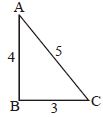
$ABC$ is a triangular plate of uniform thickness. The sides are in the ratio shown in the figure. $I_{AB}, I_{BC}, I_{CA}$ are the moments of inertia of the plate about axes $AB, BC,$ and $CA$ respectively. Which one of the following relations is correct?
A
$I_{CA}$ is maximum
B
$I_{AB} > I_{BC}$
C
$I_{BC} > I_{AB}$
D
$I_{AB} + I_{BC} = I_{CA}$
Solution
(C) The moment of inertia $I$ of a body depends on the distribution of its mass relative to the axis of rotation. The farther the mass is from the axis,the greater the moment of inertia.
For a triangular plate of mass $M$ and height $h$ relative to a base $b$,the moment of inertia about the base is $I = \frac{Mh^2}{6}$.
Let the sides be $AB = 4k$,$BC = 3k$,and $AC = 5k$. The area of the triangle is $A = \frac{1}{2} \times 4k \times 3k = 6k^2$.
$1$. For axis $AB$ (base $4k$,height $3k$): $I_{AB} = \frac{M(3k)^2}{6} = 1.5 Mk^2$.
$2$. For axis $BC$ (base $3k$,height $4k$): $I_{BC} = \frac{M(4k)^2}{6} = 2.67 Mk^2$.
$3$. For axis $AC$ (base $5k$,height $h'$): The height $h'$ is found by $A = \frac{1}{2} \times 5k \times h' = 6k^2$,so $h' = 2.4k$. Thus,$I_{AC} = \frac{M(2.4k)^2}{6} = 0.96 Mk^2$.
Comparing the values: $I_{BC} (2.67 Mk^2) > I_{AB} (1.5 Mk^2) > I_{AC} (0.96 Mk^2)$.
Therefore,$I_{BC} > I_{AB}$ is the correct relation.
For a triangular plate of mass $M$ and height $h$ relative to a base $b$,the moment of inertia about the base is $I = \frac{Mh^2}{6}$.
Let the sides be $AB = 4k$,$BC = 3k$,and $AC = 5k$. The area of the triangle is $A = \frac{1}{2} \times 4k \times 3k = 6k^2$.
$1$. For axis $AB$ (base $4k$,height $3k$): $I_{AB} = \frac{M(3k)^2}{6} = 1.5 Mk^2$.
$2$. For axis $BC$ (base $3k$,height $4k$): $I_{BC} = \frac{M(4k)^2}{6} = 2.67 Mk^2$.
$3$. For axis $AC$ (base $5k$,height $h'$): The height $h'$ is found by $A = \frac{1}{2} \times 5k \times h' = 6k^2$,so $h' = 2.4k$. Thus,$I_{AC} = \frac{M(2.4k)^2}{6} = 0.96 Mk^2$.
Comparing the values: $I_{BC} (2.67 Mk^2) > I_{AB} (1.5 Mk^2) > I_{AC} (0.96 Mk^2)$.
Therefore,$I_{BC} > I_{AB}$ is the correct relation.
1 likesView Solution
19
PhysicsMediumMCQAIPMT · 1995
In a simple harmonic motion,when the displacement is one-half the amplitude,what fraction of the total energy is kinetic?
A
$1/2$
B
$3/4$
C
$0$
D
$1/4$
Solution
(B) The total energy $(E)$ of a particle in simple harmonic motion is given by $E = \frac{1}{2} m \omega^2 a^2$,where $a$ is the amplitude.
The kinetic energy $(K)$ at any displacement $(x)$ is given by $K = \frac{1}{2} m \omega^2 (a^2 - x^2)$.
Given that the displacement $x = \frac{a}{2}$,we substitute this into the kinetic energy formula:
$K = \frac{1}{2} m \omega^2 (a^2 - (\frac{a}{2})^2)$
$K = \frac{1}{2} m \omega^2 (a^2 - \frac{a^2}{4})$
$K = \frac{1}{2} m \omega^2 (\frac{3a^2}{4})$
$K = \frac{3}{4} (\frac{1}{2} m \omega^2 a^2)$
Since $E = \frac{1}{2} m \omega^2 a^2$,we have $K = \frac{3}{4} E$.
Therefore,the fraction of the total energy that is kinetic is $3/4$.
The kinetic energy $(K)$ at any displacement $(x)$ is given by $K = \frac{1}{2} m \omega^2 (a^2 - x^2)$.
Given that the displacement $x = \frac{a}{2}$,we substitute this into the kinetic energy formula:
$K = \frac{1}{2} m \omega^2 (a^2 - (\frac{a}{2})^2)$
$K = \frac{1}{2} m \omega^2 (a^2 - \frac{a^2}{4})$
$K = \frac{1}{2} m \omega^2 (\frac{3a^2}{4})$
$K = \frac{3}{4} (\frac{1}{2} m \omega^2 a^2)$
Since $E = \frac{1}{2} m \omega^2 a^2$,we have $K = \frac{3}{4} E$.
Therefore,the fraction of the total energy that is kinetic is $3/4$.
0 likesView Solution
20
PhysicsMediumMCQAIPMT · 1995
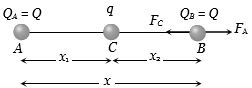
$A$ charge $q$ is placed at the centre of the line joining two equal charges $Q$. The system of the three charges will be in equilibrium if $q$ is equal to:
A
$ - \frac{Q}{2} $
B
$ - \frac{Q}{4} $
C
$ + \frac{Q}{4} $
D
$ + \frac{Q}{2} $
Solution
(B) For the system of three charges to be in equilibrium,the net force on each charge must be zero.
Let the two charges $Q$ be placed at points $A$ and $B$ separated by a distance $x$. The charge $q$ is placed at the midpoint $C$ (distance $x/2$ from both $A$ and $B$).
Consider the equilibrium of charge $Q$ at point $B$. The force exerted by charge $Q$ at $A$ on charge $Q$ at $B$ must be balanced by the force exerted by charge $q$ at $C$ on charge $Q$ at $B$.
$F_{AB} + F_{CB} = 0$
$\frac{1}{4\pi\varepsilon_0} \frac{Q^2}{x^2} + \frac{1}{4\pi\varepsilon_0} \frac{qQ}{(x/2)^2} = 0$
$\frac{Q^2}{x^2} + \frac{4qQ}{x^2} = 0$
$Q^2 + 4qQ = 0$
$4qQ = -Q^2$
$q = -\frac{Q}{4}$
Let the two charges $Q$ be placed at points $A$ and $B$ separated by a distance $x$. The charge $q$ is placed at the midpoint $C$ (distance $x/2$ from both $A$ and $B$).
Consider the equilibrium of charge $Q$ at point $B$. The force exerted by charge $Q$ at $A$ on charge $Q$ at $B$ must be balanced by the force exerted by charge $q$ at $C$ on charge $Q$ at $B$.
$F_{AB} + F_{CB} = 0$
$\frac{1}{4\pi\varepsilon_0} \frac{Q^2}{x^2} + \frac{1}{4\pi\varepsilon_0} \frac{qQ}{(x/2)^2} = 0$
$\frac{Q^2}{x^2} + \frac{4qQ}{x^2} = 0$
$Q^2 + 4qQ = 0$
$4qQ = -Q^2$
$q = -\frac{Q}{4}$
0 likesView Solution
21
PhysicsMediumMCQAIPMT · 1995
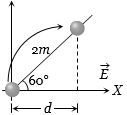
There is an electric field $E$ in the $X$-direction. If the work done on moving a charge $0.2\,C$ through a distance of $2\,m$ along a line making an angle $60^\circ$ with the $X$-axis is $4.0\,J$,what is the value of $E$ in $N/C$?
A
$\sqrt{3}$
B
$4$
C
$5$
D
$20$
Solution
(D) The work done $W$ in moving a charge $q$ in a uniform electric field $E$ is given by $W = \vec{F} \cdot \vec{d} = q\vec{E} \cdot \vec{d} = qEd \cos \theta$,where $\theta$ is the angle between the electric field and the displacement vector.
Here,$q = 0.2\,C$,$d = 2\,m$,$\theta = 60^\circ$,and $W = 4.0\,J$.
Substituting the values:
$4.0 = 0.2 \times E \times 2 \times \cos(60^\circ)$
$4.0 = 0.2 \times E \times 2 \times 0.5$
$4.0 = 0.2 \times E$
$E = \frac{4.0}{0.2} = 20\,N/C$.
Therefore,the correct option is $D$.
Here,$q = 0.2\,C$,$d = 2\,m$,$\theta = 60^\circ$,and $W = 4.0\,J$.
Substituting the values:
$4.0 = 0.2 \times E \times 2 \times \cos(60^\circ)$
$4.0 = 0.2 \times E \times 2 \times 0.5$
$4.0 = 0.2 \times E$
$E = \frac{4.0}{0.2} = 20\,N/C$.
Therefore,the correct option is $D$.
0 likesView Solution
22
PhysicsMediumMCQAIPMT · 1995
Two metallic spheres of radii $1\,cm$ and $2\,cm$ are given charges $10^{-2}\,C$ and $5 \times 10^{-2}\,C$ respectively. If they are connected by a conducting wire,the final charge on the smaller sphere is
A
$3 \times 10^{-2}\,C$
B
$1 \times 10^{-2}\,C$
C
$4 \times 10^{-2}\,C$
D
$2 \times 10^{-2}\,C$
Solution
(D) Given: $r_1 = 1\,cm$,$r_2 = 2\,cm$,$Q_1 = 10^{-2}\,C$,$Q_2 = 5 \times 10^{-2}\,C$.
When two spheres are connected by a conducting wire,charge flows until both reach the same potential.
The total charge $Q_{total} = Q_1 + Q_2 = 10^{-2} + 5 \times 10^{-2} = 6 \times 10^{-2}\,C$.
The final charge on the smaller sphere $(Q'_1)$ is given by the formula $Q'_1 = Q_{total} \times \frac{r_1}{r_1 + r_2}$.
Substituting the values: $Q'_1 = (6 \times 10^{-2}) \times \frac{1}{1 + 2} = (6 \times 10^{-2}) \times \frac{1}{3} = 2 \times 10^{-2}\,C$.
When two spheres are connected by a conducting wire,charge flows until both reach the same potential.
The total charge $Q_{total} = Q_1 + Q_2 = 10^{-2} + 5 \times 10^{-2} = 6 \times 10^{-2}\,C$.
The final charge on the smaller sphere $(Q'_1)$ is given by the formula $Q'_1 = Q_{total} \times \frac{r_1}{r_1 + r_2}$.
Substituting the values: $Q'_1 = (6 \times 10^{-2}) \times \frac{1}{1 + 2} = (6 \times 10^{-2}) \times \frac{1}{3} = 2 \times 10^{-2}\,C$.
0 likesView Solution
23
PhysicsMediumMCQAIPMT · 1995
Two wires of same metal have the same length but their cross-sections are in the ratio $3:1$. They are joined in series. The resistance of the thicker wire is $10\,\Omega$. The total resistance of the combination will be ............. $\Omega$.
A
$40$
B
$\frac{40}{3}$
C
$\frac{5}{2}$
D
$100$
Solution
(A) The resistance of a wire is given by $R = \rho \frac{L}{A}$.
Since the wires are of the same material and length,$R \propto \frac{1}{A}$.
Given the ratio of cross-sectional areas is $A_1 : A_2 = 3 : 1$,where $A_1$ is the thicker wire and $A_2$ is the thinner wire.
Therefore,the ratio of resistances is $\frac{R_1}{R_2} = \frac{A_2}{A_1} = \frac{1}{3}$,which implies $R_2 = 3R_1$.
Given the resistance of the thicker wire $R_1 = 10\,\Omega$.
Thus,the resistance of the thinner wire $R_2 = 3 \times 10 = 30\,\Omega$.
When joined in series,the total resistance $R_{eq} = R_1 + R_2 = 10 + 30 = 40\,\Omega$.
Since the wires are of the same material and length,$R \propto \frac{1}{A}$.
Given the ratio of cross-sectional areas is $A_1 : A_2 = 3 : 1$,where $A_1$ is the thicker wire and $A_2$ is the thinner wire.
Therefore,the ratio of resistances is $\frac{R_1}{R_2} = \frac{A_2}{A_1} = \frac{1}{3}$,which implies $R_2 = 3R_1$.
Given the resistance of the thicker wire $R_1 = 10\,\Omega$.
Thus,the resistance of the thinner wire $R_2 = 3 \times 10 = 30\,\Omega$.
When joined in series,the total resistance $R_{eq} = R_1 + R_2 = 10 + 30 = 40\,\Omega$.
0 likesView Solution
24
PhysicsEasyMCQAIPMT · 1995
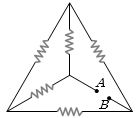
In the network shown in the figure,each of the resistance is equal to $2\,\Omega$. The resistance between the points $A$ and $B$ is .............. $\Omega$.
A
$1$
B
$4$
C
$3$
D
$2$
Solution
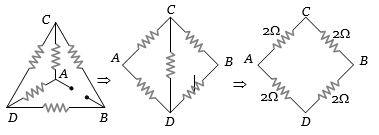
(D) The given circuit can be redrawn as a Wheatstone bridge. Let the central node be $O$. The resistors are connected between the nodes. By analyzing the symmetry,we can see that the potential at the nodes connected to $A$ and $B$ allows us to simplify the circuit.
Specifically,the circuit forms a balanced Wheatstone bridge structure between points $A$ and $B$.
In a balanced Wheatstone bridge,the resistance in the middle branch does not contribute to the current flow.
Thus,the effective resistance is calculated by considering the series and parallel combinations of the remaining resistors.
Each branch consists of two $2\,\Omega$ resistors in series,giving $4\,\Omega$ per branch.
These two branches are in parallel,so the equivalent resistance $R_{eq} = \frac{4 \times 4}{4 + 4} = 2\,\Omega$.
Specifically,the circuit forms a balanced Wheatstone bridge structure between points $A$ and $B$.
In a balanced Wheatstone bridge,the resistance in the middle branch does not contribute to the current flow.
Thus,the effective resistance is calculated by considering the series and parallel combinations of the remaining resistors.
Each branch consists of two $2\,\Omega$ resistors in series,giving $4\,\Omega$ per branch.
These two branches are in parallel,so the equivalent resistance $R_{eq} = \frac{4 \times 4}{4 + 4} = 2\,\Omega$.
0 likesView Solution
25
PhysicsMediumMCQAIPMT · 1995
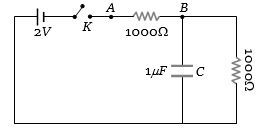
When the key $K$ is pressed at time $t = 0$, which of the following statements about the current $I$ in the resistor $AB$ of the given circuit is true?
A
$I = 2 \,mA$ at all $t$
B
$I$ oscillates between $1 \,mA$ and $2 \,mA$
C
$I = 1 \,mA$ at all $t$
D
At $t = 0$, $I = 2 \,mA$ and with time it goes to $1 \,mA$
Solution
(D) At time $t = 0$, the capacitor acts as a short circuit (zero resistance). The total resistance in the circuit is $1000 \, \Omega$. Thus, the current $I = \frac{2 \,V}{1000 \, \Omega} = 2 \,mA$.
As time passes, the capacitor charges up. When it is fully charged, it acts as an open circuit. The current then flows through the series combination of the $1000 \, \Omega$ resistor and the $1000 \, \Omega$ resistor. The total resistance becomes $2000 \, \Omega$. Thus, the steady-state current $I = \frac{2 \,V}{2000 \, \Omega} = 1 \,mA$. Therefore, the current decreases from $2 \,mA$ to $1 \,mA$ over time.
As time passes, the capacitor charges up. When it is fully charged, it acts as an open circuit. The current then flows through the series combination of the $1000 \, \Omega$ resistor and the $1000 \, \Omega$ resistor. The total resistance becomes $2000 \, \Omega$. Thus, the steady-state current $I = \frac{2 \,V}{2000 \, \Omega} = 1 \,mA$. Therefore, the current decreases from $2 \,mA$ to $1 \,mA$ over time.
0 likesView Solution
26
PhysicsMediumMCQAIPMT · 1995
$A$ heating coil is labelled $100\, W$,$220\, V$. The coil is cut in half and the two pieces are joined in parallel to the same source. The energy now liberated per second is .............. $J/s$.
A
$200$
B
$400$
C
$25$
D
$50$
Solution
(B) The power $P$ of a heating coil is given by $P = V^2 / R$,where $V$ is the voltage and $R$ is the resistance.
Initially,$P_1 = 100\, W$ and $V = 220\, V$. Thus,$R = V^2 / P_1$.
When the coil is cut into two equal halves,the resistance of each piece becomes $R' = R / 2$.
When these two pieces are connected in parallel,the equivalent resistance $R_{eq}$ is given by $1 / R_{eq} = 1 / R' + 1 / R' = 2 / R' = 2 / (R / 2) = 4 / R$.
Therefore,$R_{eq} = R / 4$.
The new power consumed is $P_2 = V^2 / R_{eq} = V^2 / (R / 4) = 4 \times (V^2 / R) = 4 \times P_1$.
Substituting the value,$P_2 = 4 \times 100\, W = 400\, W$.
Since $1\, W = 1\, J/s$,the energy liberated per second is $400\, J/s$.
Initially,$P_1 = 100\, W$ and $V = 220\, V$. Thus,$R = V^2 / P_1$.
When the coil is cut into two equal halves,the resistance of each piece becomes $R' = R / 2$.
When these two pieces are connected in parallel,the equivalent resistance $R_{eq}$ is given by $1 / R_{eq} = 1 / R' + 1 / R' = 2 / R' = 2 / (R / 2) = 4 / R$.
Therefore,$R_{eq} = R / 4$.
The new power consumed is $P_2 = V^2 / R_{eq} = V^2 / (R / 4) = 4 \times (V^2 / R) = 4 \times P_1$.
Substituting the value,$P_2 = 4 \times 100\, W = 400\, W$.
Since $1\, W = 1\, J/s$,the energy liberated per second is $400\, J/s$.
0 likesView Solution
27
PhysicsMediumMCQAIPMT · 1995
The work done in turning a magnet of magnetic moment $M$ by an angle of $90^{\circ}$ from the magnetic meridian is $n$ times the corresponding work done to turn it through an angle of $60^{\circ}$. The value of $n$ is:
A
$0.5$
B
$2$
C
$0.25$
D
$1$
Solution
(B) The work done in rotating a magnetic dipole in a uniform magnetic field $B$ from an angle $\theta_1$ to $\theta_2$ is given by $W = MB(\cos \theta_1 - \cos \theta_2)$.
For the first case,the magnet is turned from the meridian $(\theta_1 = 0^{\circ})$ to $\theta_2 = 90^{\circ}$:
$W_1 = MB(\cos 0^{\circ} - \cos 90^{\circ}) = MB(1 - 0) = MB$.
For the second case,the magnet is turned from the meridian $(\theta_1 = 0^{\circ})$ to $\theta_2 = 60^{\circ}$:
$W_2 = MB(\cos 0^{\circ} - \cos 60^{\circ}) = MB(1 - 0.5) = 0.5MB = \frac{MB}{2}$.
Given that $W_1 = n W_2$,we have:
$MB = n \times \frac{MB}{2}$.
Solving for $n$,we get $n = 2$.
For the first case,the magnet is turned from the meridian $(\theta_1 = 0^{\circ})$ to $\theta_2 = 90^{\circ}$:
$W_1 = MB(\cos 0^{\circ} - \cos 90^{\circ}) = MB(1 - 0) = MB$.
For the second case,the magnet is turned from the meridian $(\theta_1 = 0^{\circ})$ to $\theta_2 = 60^{\circ}$:
$W_2 = MB(\cos 0^{\circ} - \cos 60^{\circ}) = MB(1 - 0.5) = 0.5MB = \frac{MB}{2}$.
Given that $W_1 = n W_2$,we have:
$MB = n \times \frac{MB}{2}$.
Solving for $n$,we get $n = 2$.
0 likesView Solution
28
PhysicsEasyMCQAIPMT · 1995
$A$ straight conductor of length $0.4\;m$ is moved with a speed of $7\;m/s$ perpendicular to a magnetic field of intensity $0.9\;Wb/m^2$. The induced $e.m.f.$ across the conductor will be......$V$.
A
$5.04$
B
$25.2$
C
$1.26$
D
$2.52$
Solution
(D) The induced electromotive force $(e.m.f.)$ in a conductor moving through a magnetic field is given by the formula $e = Bvl$,where:
$B$ is the magnetic field intensity $(0.9\;Wb/m^2)$,
$v$ is the velocity of the conductor $(7\;m/s)$,
$l$ is the length of the conductor $(0.4\;m)$.
Substituting the given values into the formula:
$e = 0.9 \times 7 \times 0.4$
$e = 6.3 \times 0.4$
$e = 2.52\;V$.
Therefore,the induced $e.m.f.$ is $2.52\;V$.
$B$ is the magnetic field intensity $(0.9\;Wb/m^2)$,
$v$ is the velocity of the conductor $(7\;m/s)$,
$l$ is the length of the conductor $(0.4\;m)$.
Substituting the given values into the formula:
$e = 0.9 \times 7 \times 0.4$
$e = 6.3 \times 0.4$
$e = 2.52\;V$.
Therefore,the induced $e.m.f.$ is $2.52\;V$.
0 likesView Solution
29
PhysicsEasyMCQAIPMT · 1995
In an $ac$ circuit,the current is given by $i = 5 \sin \left( 100 t - \frac{\pi}{2} \right)$ and the $ac$ potential is $V = 200 \sin (100 t) \text{ volts}$. Then the power consumption is $....... \text{ watts}$.
A
$20$
B
$40$
C
$1000$
D
$0$
Solution
(D) The given current is $i = 5 \sin \left( 100 t - \frac{\pi}{2} \right)$ and the potential is $V = 200 \sin (100 t)$.
Comparing these with the standard forms $i = I_0 \sin(\omega t + \phi_1)$ and $V = V_0 \sin(\omega t + \phi_2)$,we get the phase of current $\phi_1 = -\frac{\pi}{2}$ and the phase of voltage $\phi_2 = 0$.
The phase difference $\phi$ between voltage and current is $\phi = \phi_2 - \phi_1 = 0 - \left( -\frac{\pi}{2} \right) = \frac{\pi}{2}$.
The average power consumption in an $ac$ circuit is given by $P = V_{rms} I_{rms} \cos \phi$.
Since $\phi = \frac{\pi}{2}$,the power factor $\cos \phi = \cos \left( \frac{\pi}{2} \right) = 0$.
Therefore,the power consumption $P = V_{rms} I_{rms} \times 0 = 0 \text{ watts}$.
Comparing these with the standard forms $i = I_0 \sin(\omega t + \phi_1)$ and $V = V_0 \sin(\omega t + \phi_2)$,we get the phase of current $\phi_1 = -\frac{\pi}{2}$ and the phase of voltage $\phi_2 = 0$.
The phase difference $\phi$ between voltage and current is $\phi = \phi_2 - \phi_1 = 0 - \left( -\frac{\pi}{2} \right) = \frac{\pi}{2}$.
The average power consumption in an $ac$ circuit is given by $P = V_{rms} I_{rms} \cos \phi$.
Since $\phi = \frac{\pi}{2}$,the power factor $\cos \phi = \cos \left( \frac{\pi}{2} \right) = 0$.
Therefore,the power consumption $P = V_{rms} I_{rms} \times 0 = 0 \text{ watts}$.
0 likesView Solution
30
PhysicsMediumMCQAIPMT · 1995
An electron of mass $m$ when accelerated through a potential difference $V$ has a de-Broglie wavelength $\lambda$. The de-Broglie wavelength associated with a proton of mass $M$ accelerated through the same potential difference will be:
A
$\lambda \frac{m}{M}$
B
$\lambda \sqrt{\frac{m}{M}}$
C
$\lambda \frac{M}{m}$
D
$\lambda \sqrt{\frac{M}{m}}$
Solution
(B) The de-Broglie wavelength $\lambda$ of a particle of mass $m$ accelerated through a potential difference $V$ is given by the formula: $\lambda = \frac{h}{\sqrt{2mqV}}$.
Since both the electron and the proton are accelerated through the same potential difference $V$ and both have the same magnitude of charge $q = e$,the wavelength is inversely proportional to the square root of the mass: $\lambda \propto \frac{1}{\sqrt{m}}$.
For the electron: $\lambda_e = \lambda = \frac{k}{\sqrt{m}}$,where $k$ is a constant.
For the proton: $\lambda_p = \frac{k}{\sqrt{M}}$.
Dividing the two equations: $\frac{\lambda_p}{\lambda_e} = \frac{\sqrt{m}}{\sqrt{M}} = \sqrt{\frac{m}{M}}$.
Therefore,$\lambda_p = \lambda \sqrt{\frac{m}{M}}$.
Since both the electron and the proton are accelerated through the same potential difference $V$ and both have the same magnitude of charge $q = e$,the wavelength is inversely proportional to the square root of the mass: $\lambda \propto \frac{1}{\sqrt{m}}$.
For the electron: $\lambda_e = \lambda = \frac{k}{\sqrt{m}}$,where $k$ is a constant.
For the proton: $\lambda_p = \frac{k}{\sqrt{M}}$.
Dividing the two equations: $\frac{\lambda_p}{\lambda_e} = \frac{\sqrt{m}}{\sqrt{M}} = \sqrt{\frac{m}{M}}$.
Therefore,$\lambda_p = \lambda \sqrt{\frac{m}{M}}$.
0 likesView Solution
31
PhysicsEasyMCQAIPMT · 1995
If an electron and a photon propagate in the form of waves having the same wavelength,it implies that they have the same
A
Energy
B
Momentum
C
Velocity
D
Angular momentum
Solution
(B) According to the de-Broglie hypothesis,the momentum $p$ of a particle is related to its wavelength $\lambda$ by the equation $p = \frac{h}{\lambda}$,where $h$ is Planck's constant.
Since both the electron and the photon have the same wavelength $\lambda$,and $h$ is a universal constant,their momenta must be equal.
Therefore,they have the same momentum.
Since both the electron and the photon have the same wavelength $\lambda$,and $h$ is a universal constant,their momenta must be equal.
Therefore,they have the same momentum.
0 likesView Solution
32
PhysicsEasyMCQAIPMT · 1995
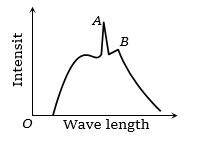
The figure represents the observed intensity of $X-$ rays emitted by an $X-$ ray tube as a function of wavelength. The sharp peaks $A$ and $B$ denote
A
Band spectrum
B
Continuous spectrum
C
Characteristic radiations
D
White radiations
Solution
(C) In $X-$ ray spectra,depending on the accelerating voltage and the target element,we may find sharp peaks superimposed on a continuous spectrum.
These sharp peaks occur at specific wavelengths that are unique to the target material used in the $X-$ ray tube.
These peaks arise due to electronic transitions within the atoms of the target material,where an electron from a higher energy shell drops into a vacancy in a lower energy shell,emitting a photon of specific energy.
Therefore,these peaks are known as characteristic radiations.
These sharp peaks occur at specific wavelengths that are unique to the target material used in the $X-$ ray tube.
These peaks arise due to electronic transitions within the atoms of the target material,where an electron from a higher energy shell drops into a vacancy in a lower energy shell,emitting a photon of specific energy.
Therefore,these peaks are known as characteristic radiations.
0 likesView Solution
33
PhysicsEasyMCQAIPMT · 1995
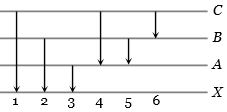
The figure indicates the energy level diagram of an atom and the origin of six spectral lines in emission (e.g.,line no. $5$ arises from the transition from level $B$ to $A$). Which of the following spectral lines will also occur in the absorption spectrum?
A
$1, 4, 6$
B
$4, 5, 6$
C
$1, 2, 3$
D
$1, 2, 3, 4, 5, 6$
Solution
(C) In an absorption spectrum,atoms absorb photons to transition from the ground state to higher energy levels.
In the given diagram,the ground state is represented by level $X$.
Therefore,only transitions starting from level $X$ will appear in the absorption spectrum.
Looking at the diagram,the transitions originating from level $X$ are lines $1, 2,$ and $3$.
Thus,lines $1, 2,$ and $3$ will occur in the absorption spectrum.
In the given diagram,the ground state is represented by level $X$.
Therefore,only transitions starting from level $X$ will appear in the absorption spectrum.
Looking at the diagram,the transitions originating from level $X$ are lines $1, 2,$ and $3$.
Thus,lines $1, 2,$ and $3$ will occur in the absorption spectrum.
0 likesView Solution
34
PhysicsEasyMCQAIPMT · 1995
When a hydrogen atom is raised from the ground state to an excited state,
A
$P.E.$ increases and $K.E.$ decreases
B
$P.E.$ decreases and $K.E.$ increases
C
Both kinetic energy and potential energy increase
D
Both $K.E.$ and $P.E.$ decrease
Solution
(A) For a hydrogen atom,the kinetic energy $(K.E.)$ and potential energy $(P.E.)$ of an electron in an orbit of radius $r$ are given by:
$K.E. = \frac{1}{4 \pi \epsilon_0} \frac{e^2}{2r}$
$P.E. = -\frac{1}{4 \pi \epsilon_0} \frac{e^2}{r}$
As the hydrogen atom is raised from the ground state to an excited state,the principal quantum number $n$ increases,which causes the orbital radius $r$ to increase $(r \propto n^2)$.
Since $K.E. \propto \frac{1}{r}$,as $r$ increases,$K.E.$ decreases.
Since $P.E. \propto -\frac{1}{r}$,as $r$ increases,the magnitude of $P.E.$ decreases,but because it is negative,the value of $P.E.$ increases (becomes less negative).
Therefore,$P.E.$ increases and $K.E.$ decreases.
$K.E. = \frac{1}{4 \pi \epsilon_0} \frac{e^2}{2r}$
$P.E. = -\frac{1}{4 \pi \epsilon_0} \frac{e^2}{r}$
As the hydrogen atom is raised from the ground state to an excited state,the principal quantum number $n$ increases,which causes the orbital radius $r$ to increase $(r \propto n^2)$.
Since $K.E. \propto \frac{1}{r}$,as $r$ increases,$K.E.$ decreases.
Since $P.E. \propto -\frac{1}{r}$,as $r$ increases,the magnitude of $P.E.$ decreases,but because it is negative,the value of $P.E.$ increases (becomes less negative).
Therefore,$P.E.$ increases and $K.E.$ decreases.
0 likesView Solution
35
PhysicsMediumMCQAIPMT · 1995
An electron makes a transition from orbit $n = 4$ to the orbit $n = 2$ of a hydrogen atom. The wave number of the emitted radiations ($R =$ Rydberg's constant) will be
A
$\frac{16}{3R}$
B
$\frac{2R}{16}$
C
$\frac{3R}{16}$
D
$\frac{4R}{16}$
Solution
(C) The wave number $\bar{\nu}$ is given by the Rydberg formula: $\frac{1}{\lambda} = R \left[ \frac{1}{n_1^2} - \frac{1}{n_2^2} \right]$.
Here,the transition is from $n_2 = 4$ to $n_1 = 2$.
Substituting the values: $\frac{1}{\lambda} = R \left[ \frac{1}{2^2} - \frac{1}{4^2} \right]$.
$\frac{1}{\lambda} = R \left[ \frac{1}{4} - \frac{1}{16} \right]$.
$\frac{1}{\lambda} = R \left[ \frac{4 - 1}{16} \right] = \frac{3R}{16}$.
Here,the transition is from $n_2 = 4$ to $n_1 = 2$.
Substituting the values: $\frac{1}{\lambda} = R \left[ \frac{1}{2^2} - \frac{1}{4^2} \right]$.
$\frac{1}{\lambda} = R \left[ \frac{1}{4} - \frac{1}{16} \right]$.
$\frac{1}{\lambda} = R \left[ \frac{4 - 1}{16} \right] = \frac{3R}{16}$.
0 likesView Solution
36
PhysicsEasyMCQAIPMT · 1995
The binding energies per nucleon for a deuteron $(_{1}H^{2})$ and an $\alpha$-particle $(_{2}He^{4})$ are $x_1$ and $x_2$ respectively. What will be the energy $Q$ released in the reaction $_{1}H^{2} + _{1}H^{2} \to _{2}He^{4} + Q$?
A
$4(x_1 + x_2)$
B
$4(x_2 - x_1)$
C
$2(x_1 + x_2)$
D
$2(x_2 - x_1)$
Solution
(B) The binding energy of a nucleus is given by the product of the number of nucleons and the binding energy per nucleon.
For the reactant side, we have two deuterons $(_{1}H^{2})$. Each deuteron has $2$ nucleons. The binding energy of one deuteron is $2x_1$. Since there are two deuterons, the total binding energy of the reactants is $2 \times (2x_1) = 4x_1$.
For the product side, we have one $\alpha$-particle $(_{2}He^{4})$. An $\alpha$-particle has $4$ nucleons. The binding energy of the $\alpha$-particle is $4x_2$.
The energy released $Q$ in a nuclear reaction is equal to the difference between the total binding energy of the products and the total binding energy of the reactants.
Therefore, $Q = (\text{Total Binding Energy of Products}) - (\text{Total Binding Energy of Reactants})$.
$Q = 4x_2 - 4x_1 = 4(x_2 - x_1)$.
For the reactant side, we have two deuterons $(_{1}H^{2})$. Each deuteron has $2$ nucleons. The binding energy of one deuteron is $2x_1$. Since there are two deuterons, the total binding energy of the reactants is $2 \times (2x_1) = 4x_1$.
For the product side, we have one $\alpha$-particle $(_{2}He^{4})$. An $\alpha$-particle has $4$ nucleons. The binding energy of the $\alpha$-particle is $4x_2$.
The energy released $Q$ in a nuclear reaction is equal to the difference between the total binding energy of the products and the total binding energy of the reactants.
Therefore, $Q = (\text{Total Binding Energy of Products}) - (\text{Total Binding Energy of Reactants})$.
$Q = 4x_2 - 4x_1 = 4(x_2 - x_1)$.
0 likesView Solution
37
PhysicsMediumMCQAIPMT · 1995
The mass number of $He$ is $4$ and that for sulphur is $32$. The radius of the sulphur nucleus is larger than that of the helium nucleus by a factor of:
A
$\sqrt{8}$
B
$4$
C
$2$
D
$8$
Solution
(C) The radius $R$ of a nucleus with mass number $A$ is given by the relation $R = R_0 A^{1/3}$,where $R_0$ is a constant.
Therefore,the ratio of the radii of two nuclei is given by $\frac{R_S}{R_{He}} = \left( \frac{A_S}{A_{He}} \right)^{1/3}$.
Given $A_S = 32$ and $A_{He} = 4$,we have:
$\frac{R_S}{R_{He}} = \left( \frac{32}{4} \right)^{1/3} = (8)^{1/3} = 2$.
Thus,the radius of the sulphur nucleus is $2$ times larger than that of the helium nucleus.
Therefore,the ratio of the radii of two nuclei is given by $\frac{R_S}{R_{He}} = \left( \frac{A_S}{A_{He}} \right)^{1/3}$.
Given $A_S = 32$ and $A_{He} = 4$,we have:
$\frac{R_S}{R_{He}} = \left( \frac{32}{4} \right)^{1/3} = (8)^{1/3} = 2$.
Thus,the radius of the sulphur nucleus is $2$ times larger than that of the helium nucleus.
0 likesView Solution
38
PhysicsMediumMCQAIPMT · 1995
The count rate of a Geiger-Muller counter for the radiation of a radioactive material with a half-life of $30\, minutes$ decreases to $5\, s^{-1}$ after $2\, hours$. The initial count rate was..........$s^{-1}$.
A
$25$
B
$80$
C
$625$
D
$20$
Solution
(B) The radioactive decay law is given by the formula: $A = A_0 \left( \frac{1}{2} \right)^{t/T_{1/2}}$
Given:
Initial time $t = 2\, hours = 120\, minutes$
Half-life $T_{1/2} = 30\, minutes$
Final count rate $A = 5\, s^{-1}$
Number of half-lives $n = \frac{t}{T_{1/2}} = \frac{120}{30} = 4$
Substituting the values into the formula:
$5 = A_0 \left( \frac{1}{2} \right)^4$
$5 = A_0 \left( \frac{1}{16} \right)$
$A_0 = 5 \times 16 = 80\, s^{-1}$
Therefore,the initial count rate was $80\, s^{-1}$.
Given:
Initial time $t = 2\, hours = 120\, minutes$
Half-life $T_{1/2} = 30\, minutes$
Final count rate $A = 5\, s^{-1}$
Number of half-lives $n = \frac{t}{T_{1/2}} = \frac{120}{30} = 4$
Substituting the values into the formula:
$5 = A_0 \left( \frac{1}{2} \right)^4$
$5 = A_0 \left( \frac{1}{16} \right)$
$A_0 = 5 \times 16 = 80\, s^{-1}$
Therefore,the initial count rate was $80\, s^{-1}$.
0 likesView Solution
39
PhysicsMediumMCQAIPMT · 1995
What is the respective number of $\alpha$ and $\beta$ particles emitted in the following radioactive decay: $_{90}X^{200} \to _{80}Y^{168}$?
A
$6$ and $8$
B
$8$ and $8$
C
$6$ and $6$
D
$8$ and $6$
Solution
(D) In an $\alpha$-decay,the mass number decreases by $4$ and the atomic number decreases by $2$. In a $\beta$-decay,the mass number remains unchanged and the atomic number increases by $1$.
Let $n_{\alpha}$ be the number of $\alpha$-particles and $n_{\beta}$ be the number of $\beta$-particles emitted.
The change in mass number is given by: $200 - 168 = 4 \times n_{\alpha}$.
Therefore,$n_{\alpha} = \frac{32}{4} = 8$.
The change in atomic number is given by: $90 - 80 = 2 \times n_{\alpha} - 1 \times n_{\beta}$.
Substituting $n_{\alpha} = 8$: $10 = 2(8) - n_{\beta}$.
$10 = 16 - n_{\beta}$,which gives $n_{\beta} = 6$.
Thus,the number of $\alpha$ and $\beta$ particles emitted are $8$ and $6$ respectively.
Let $n_{\alpha}$ be the number of $\alpha$-particles and $n_{\beta}$ be the number of $\beta$-particles emitted.
The change in mass number is given by: $200 - 168 = 4 \times n_{\alpha}$.
Therefore,$n_{\alpha} = \frac{32}{4} = 8$.
The change in atomic number is given by: $90 - 80 = 2 \times n_{\alpha} - 1 \times n_{\beta}$.
Substituting $n_{\alpha} = 8$: $10 = 2(8) - n_{\beta}$.
$10 = 16 - n_{\beta}$,which gives $n_{\beta} = 6$.
Thus,the number of $\alpha$ and $\beta$ particles emitted are $8$ and $6$ respectively.
0 likesView Solution
40
PhysicsEasyMCQAIPMT · 1995
In good conductors of electricity,the type of bonding that exists is
A
Ionic
B
Vander Waals
C
Covalent
D
Metallic
Solution
(D) In good conductors of electricity,such as metals,the atoms are held together by metallic bonding.
In this type of bonding,the valence electrons are not bound to any specific atom but are free to move throughout the crystal lattice,forming a 'sea of electrons'.
This mobility of electrons is the fundamental reason why metals are excellent conductors of electricity.
In this type of bonding,the valence electrons are not bound to any specific atom but are free to move throughout the crystal lattice,forming a 'sea of electrons'.
This mobility of electrons is the fundamental reason why metals are excellent conductors of electricity.
0 likesView Solution
41
PhysicsMediumMCQAIPMT · 1995
In the case of forward biasing of a $PN-$ junction,which one of the following figures correctly depicts the direction of flow of charge carriers?
A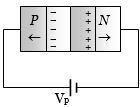
B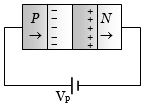
C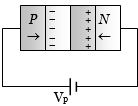
D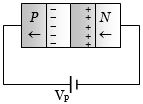
Solution
(C) In forward biasing,the positive terminal of the external battery is connected to the $P-$type semiconductor and the negative terminal is connected to the $N-$type semiconductor.
This configuration repels the majority charge carriers (holes in $P-$region and electrons in $N-$region) towards the junction.
Therefore,the holes in the $P-$region move towards the junction (to the right) and the electrons in the $N-$region move towards the junction (to the left).
Figure $C$ correctly depicts this movement of charge carriers towards the junction.
This configuration repels the majority charge carriers (holes in $P-$region and electrons in $N-$region) towards the junction.
Therefore,the holes in the $P-$region move towards the junction (to the right) and the electrons in the $N-$region move towards the junction (to the left).
Figure $C$ correctly depicts this movement of charge carriers towards the junction.
0 likesView Solution
42
PhysicsMediumMCQAIPMT · 1995
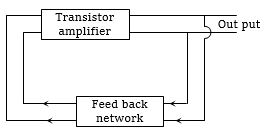
An oscillator is nothing but an amplifier with
A
Positive feedback
B
Large gain
C
No feedback
D
Negative feedback
Solution
(A) An oscillator is a circuit that produces a continuous,repeated,alternating waveform without any input signal.
It functions as an amplifier with positive feedback.
In this configuration,a portion of the output signal is fed back to the input in phase with the original signal.
This positive feedback reinforces the input,allowing the circuit to sustain oscillations indefinitely,provided the Barkhausen criterion (loop gain $A\beta = 1$ and phase shift of $360^{\circ}$ or $0^{\circ}$) is satisfied.
It functions as an amplifier with positive feedback.
In this configuration,a portion of the output signal is fed back to the input in phase with the original signal.
This positive feedback reinforces the input,allowing the circuit to sustain oscillations indefinitely,provided the Barkhausen criterion (loop gain $A\beta = 1$ and phase shift of $360^{\circ}$ or $0^{\circ}$) is satisfied.
0 likesView Solution
43
PhysicsMediumMCQAIPMT · 1995
$A$ lens is placed between a source of light and a wall. It forms images of area $A_1$ and $A_2$ on the wall for its two different positions. The area of the source of light is
A
$\frac{A_1 + A_2}{2}$
B
$\frac{1}{A_1} + \frac{1}{A_2}$
C
$\sqrt{A_1 A_2}$
D
$\frac{A_1 - A_2}{2}$
Solution
(C) Let the area of the source of light be $O$. For two different positions of the lens,the magnifications are $m_1$ and $m_2$.
The area of the image is given by $A = m^2 O$,so $m^2 = \frac{A}{O}$.
For the two positions,we have $m_1^2 = \frac{A_1}{O}$ and $m_2^2 = \frac{A_2}{O}$.
Multiplying these,we get $m_1^2 m_2^2 = \frac{A_1 A_2}{O^2}$.
For the displacement method,the product of magnifications is $m_1 m_2 = 1$,which implies $m_1^2 m_2^2 = 1$.
Therefore,$1 = \frac{A_1 A_2}{O^2}$,which gives $O^2 = A_1 A_2$.
Thus,the area of the source of light is $O = \sqrt{A_1 A_2}$.
The area of the image is given by $A = m^2 O$,so $m^2 = \frac{A}{O}$.
For the two positions,we have $m_1^2 = \frac{A_1}{O}$ and $m_2^2 = \frac{A_2}{O}$.
Multiplying these,we get $m_1^2 m_2^2 = \frac{A_1 A_2}{O^2}$.
For the displacement method,the product of magnifications is $m_1 m_2 = 1$,which implies $m_1^2 m_2^2 = 1$.
Therefore,$1 = \frac{A_1 A_2}{O^2}$,which gives $O^2 = A_1 A_2$.
Thus,the area of the source of light is $O = \sqrt{A_1 A_2}$.
0 likesView Solution
44
PhysicsMediumMCQAIPMT · 1995
$A$ star emitting radiation at a wavelength of $5000 \; \mathring{A}$ is approaching Earth with a velocity of $1.5 \times 10^6 \; m/s$. The change in wavelength of the radiation as received on Earth is ....... $\mathring{A}$.
A
$25$
B
$0$
C
$100$
D
$2.5$
Solution
(A) The Doppler effect for light when the source is approaching the observer is given by the formula for the observed wavelength $\lambda^{\prime} = \lambda \left(1 - \frac{v}{c}\right)$.
Here,$\lambda = 5000 \; \mathring{A}$ is the original wavelength,$v = 1.5 \times 10^6 \; m/s$ is the velocity of the star,and $c = 3 \times 10^8 \; m/s$ is the speed of light.
The change in wavelength $\Delta \lambda$ is given by $\Delta \lambda = \lambda - \lambda^{\prime}$.
Substituting $\lambda^{\prime} = \lambda - \lambda \frac{v}{c}$,we get $\Delta \lambda = \lambda \frac{v}{c}$.
Calculating the value: $\Delta \lambda = 5000 \; \mathring{A} \times \frac{1.5 \times 10^6 \; m/s}{3 \times 10^8 \; m/s}$.
$\Delta \lambda = 5000 \times 0.5 \times 10^{-2} = 5000 \times 0.005 = 25 \; \mathring{A}$.
Thus,the change in wavelength is $25 \; \mathring{A}$.
Here,$\lambda = 5000 \; \mathring{A}$ is the original wavelength,$v = 1.5 \times 10^6 \; m/s$ is the velocity of the star,and $c = 3 \times 10^8 \; m/s$ is the speed of light.
The change in wavelength $\Delta \lambda$ is given by $\Delta \lambda = \lambda - \lambda^{\prime}$.
Substituting $\lambda^{\prime} = \lambda - \lambda \frac{v}{c}$,we get $\Delta \lambda = \lambda \frac{v}{c}$.
Calculating the value: $\Delta \lambda = 5000 \; \mathring{A} \times \frac{1.5 \times 10^6 \; m/s}{3 \times 10^8 \; m/s}$.
$\Delta \lambda = 5000 \times 0.5 \times 10^{-2} = 5000 \times 0.005 = 25 \; \mathring{A}$.
Thus,the change in wavelength is $25 \; \mathring{A}$.
0 likesView Solution
45
PhysicsEasyMCQAIPMT · 1995
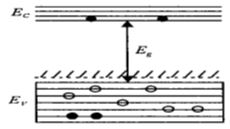
In the energy band diagram of a material shown below,the open circles and filled circles denote holes and electrons respectively. The material is
A
an insulator
B
a metal
C
an $n-$ type semiconductor
D
an $p-$ type semiconductor
Solution
(D) In the provided energy band diagram,the open circles represent holes in the valence band $(E_v)$,and the filled circles represent electrons in the conduction band $(E_c)$.
By observing the diagram,we can see that the number of holes in the valence band is significantly greater than the number of electrons in the conduction band.
In a semiconductor,if the majority charge carriers are holes,it is classified as a $p-$ type semiconductor.
Therefore,the material is a $p-$ type semiconductor.
By observing the diagram,we can see that the number of holes in the valence band is significantly greater than the number of electrons in the conduction band.
In a semiconductor,if the majority charge carriers are holes,it is classified as a $p-$ type semiconductor.
Therefore,the material is a $p-$ type semiconductor.
0 likesView Solution
46
PhysicsMediumMCQAIPMT · 1995
The dimensions of $RC$ are ($C$ and $R$ represent capacitance and resistance respectively).
A
square of time
B
time
C
square of inverse time
D
inverse time
Solution
(B) The time constant of an $RC$ circuit is given by the product of resistance $R$ and capacitance $C$.
From the definition of capacitance,$C = Q/V$,where $Q$ is charge and $V$ is potential difference.
From Ohm's law,$R = V/I$,where $I$ is current.
Multiplying these,$RC = (V/I) \times (Q/V) = Q/I$.
Since current $I = Q/t$,where $t$ is time,we have $Q/I = t$.
Therefore,the dimensions of $RC$ are equivalent to the dimensions of time $[T]$.
From the definition of capacitance,$C = Q/V$,where $Q$ is charge and $V$ is potential difference.
From Ohm's law,$R = V/I$,where $I$ is current.
Multiplying these,$RC = (V/I) \times (Q/V) = Q/I$.
Since current $I = Q/t$,where $t$ is time,we have $Q/I = t$.
Therefore,the dimensions of $RC$ are equivalent to the dimensions of time $[T]$.
0 likesView Solution
Vedclass Products
For Students
Vedclass Test Series
Mock tests in real AIPMT style covering Physics with performance analysis. 5-day free trial.
Start Free TrialFor Teachers
Exam Paper Generator
Generate Set A/B/C/D Physics papers from 7.5L+ questions in 2 minutes. 3 chapters free.
Try FreeFor Institutes
Online Exam Module
Run live AIPMT mock exams with unlimited students, 360° analytics & white-label branding.
See DemoFrequently Asked Questions
How many Physics questions are in AIPMT 1995?
There are 46 Physics questions from the AIPMT 1995 paper on Vedclass, each with a detailed step-by-step solution in English.
Are AIPMT 1995 Physics solutions available in English?
Yes. All solutions on this page are in English. You can also switch to English or Hindi using the language buttons above the questions.
Can I practice AIPMT 1995 Physics as a timed test?
Yes. Use the Vedclass Test Series to attempt a full AIPMT mock test covering Physics with time limits and instant score analysis.
Can teachers create Physics papers from AIPMT previous year questions?
Yes. The Vedclass Exam Paper Generator lets teachers mix AIPMT Physics questions and generate Set A/B/C/D papers in minutes.
For Teachers & Institutes
Build a Custom Physics Paper
Pick AIPMT 1995 Physics questions, set difficulty, and generate Set A/B/C/D in 2 minutes.