
ChemistryQ1–67 of 71 questions
Page 1 of 2 · English
1
ChemistryMediumMCQAIPMT · 1995
Dimensions of pressure are same as that of
A
Energy
B
Force
C
Energy per unit volume
D
Force per unit volume
Solution
(C) Pressure is defined as force per unit area: $P = \frac{F}{A} = \frac{[MLT^{-2}]}{[L^2]} = [ML^{-1}T^{-2}]$.
Energy per unit volume is defined as energy divided by volume: $\frac{E}{V} = \frac{[ML^2T^{-2}]}{[L^3]} = [ML^{-1}T^{-2}]$.
Since both have the same dimensional formula $[ML^{-1}T^{-2}]$,the dimensions of pressure are the same as that of energy per unit volume.
Energy per unit volume is defined as energy divided by volume: $\frac{E}{V} = \frac{[ML^2T^{-2}]}{[L^3]} = [ML^{-1}T^{-2}]$.
Since both have the same dimensional formula $[ML^{-1}T^{-2}]$,the dimensions of pressure are the same as that of energy per unit volume.
0 likesView Solution
2
ChemistryDifficultMCQAIPMT · 1995
The number of moles of oxygen in $1 \ L$ of air containing $21 \%$ oxygen by volume,at standard temperature and pressure $(STP)$,is (in $mol$)
A
$0.186$
B
$0.21$
C
$2.10$
D
$0.0093$
Solution
(D) Volume of air = $1 \ L = 1000 \ mL$.
Volume of $O_2$ in $1 \ L$ of air = $21 \%$ of $1000 \ mL = 210 \ mL$.
At $STP$,$1 \ mole$ of any gas occupies $22400 \ mL$.
Number of moles of $O_2 = \frac{\text{Volume of } O_2 \text{ in } mL}{22400 \ mL/mol} = \frac{210}{22400} \approx 0.009375 \ mol$.
Rounding to the given options,the correct answer is $0.0093 \ mol$.
Volume of $O_2$ in $1 \ L$ of air = $21 \%$ of $1000 \ mL = 210 \ mL$.
At $STP$,$1 \ mole$ of any gas occupies $22400 \ mL$.
Number of moles of $O_2 = \frac{\text{Volume of } O_2 \text{ in } mL}{22400 \ mL/mol} = \frac{210}{22400} \approx 0.009375 \ mol$.
Rounding to the given options,the correct answer is $0.0093 \ mol$.
2 likesView Solution
3
ChemistryDifficultMCQAIPMT · 1995
The correct order of the $O-O$ bond length in $O_2$,$H_2O_2$,and $O_3$ is:
A
$O_2 > O_3 > H_2O_2$
B
$O_3 > H_2O_2 > O_2$
C
$H_2O_2 > O_3 > O_2$
D
$O_2 > H_2O_2 > O_3$
Solution
(C) The bond length is inversely proportional to the bond order.
Bond orders for the given species are:
$O_2$: Bond order = $2.0$
$O_3$: Bond order = $1.5$
$H_2O_2$: Bond order = $1.0$
Since bond length increases as bond order decreases,the order of bond length is $H_2O_2$ $(1.48 \ \mathring{A})$ > $O_3$ $(1.28 \ \mathring{A})$ > $O_2$ $(1.21 \ \mathring{A})$.
Thus,the correct option is $C$.
Bond orders for the given species are:
$O_2$: Bond order = $2.0$
$O_3$: Bond order = $1.5$
$H_2O_2$: Bond order = $1.0$
Since bond length increases as bond order decreases,the order of bond length is $H_2O_2$ $(1.48 \ \mathring{A})$ > $O_3$ $(1.28 \ \mathring{A})$ > $O_2$ $(1.21 \ \mathring{A})$.
Thus,the correct option is $C$.
0 likesView Solution
4
ChemistryMediumMCQAIPMT · 1995
$BCl_3$ is a planar molecule while $NCl_3$ is pyramidal,because
A
$BCl_3$ has no lone pair of electrons but $NCl_3$ has a lone pair of electrons
B
$B-Cl$ bond is more polar than $N-Cl$ bond
C
Nitrogen atom is smaller than boron atom
D
$N-Cl$ bond is more covalent than $B-Cl$ bond
Solution
(A) According to $VSEPR$ theory,the shape of a molecule is determined by the number of bond pairs and lone pairs around the central atom.
$BCl_3$: The central Boron atom has $3$ bond pairs and $0$ lone pairs,resulting in $sp^2$ hybridization and a trigonal planar geometry.
$NCl_3$: The central Nitrogen atom has $3$ bond pairs and $1$ lone pair,resulting in $sp^3$ hybridization and a pyramidal geometry due to the repulsion between the lone pair and bond pairs.
$BCl_3$: The central Boron atom has $3$ bond pairs and $0$ lone pairs,resulting in $sp^2$ hybridization and a trigonal planar geometry.
$NCl_3$: The central Nitrogen atom has $3$ bond pairs and $1$ lone pair,resulting in $sp^3$ hybridization and a pyramidal geometry due to the repulsion between the lone pair and bond pairs.
0 likesView Solution
5
ChemistryMediumMCQAIPMT · 1995
Which of the following species is paramagnetic?
A
$O_2^-$
B
$NO$
C
Both $(a)$ and $(b)$
D
$CN^{-}$
Solution
(C) According to Molecular Orbital Theory $(MOT)$,a species is paramagnetic if it contains one or more unpaired electrons.
$1$. $O_2^-$ has $17$ electrons. Its electronic configuration is $\sigma 1s^2, \sigma^* 1s^2, \sigma 2s^2, \sigma^* 2s^2, \sigma 2p_z^2, \pi 2p_x^2 = \pi 2p_y^2, \pi^* 2p_x^2 = \pi^* 2p_y^1$. Since it has an unpaired electron,it is paramagnetic.
$2$. $NO$ has $15$ electrons. Its electronic configuration is $\sigma 1s^2, \sigma^* 1s^2, \sigma 2s^2, \sigma^* 2s^2, \sigma 2p_z^2, \pi 2p_x^2 = \pi 2p_y^2, \pi^* 2p_x^1$. Since it has an unpaired electron,it is paramagnetic.
$3$. $CN^-$ has $14$ electrons. All electrons are paired,so it is diamagnetic.
Therefore,both $(a)$ and $(b)$ are paramagnetic.
$1$. $O_2^-$ has $17$ electrons. Its electronic configuration is $\sigma 1s^2, \sigma^* 1s^2, \sigma 2s^2, \sigma^* 2s^2, \sigma 2p_z^2, \pi 2p_x^2 = \pi 2p_y^2, \pi^* 2p_x^2 = \pi^* 2p_y^1$. Since it has an unpaired electron,it is paramagnetic.
$2$. $NO$ has $15$ electrons. Its electronic configuration is $\sigma 1s^2, \sigma^* 1s^2, \sigma 2s^2, \sigma^* 2s^2, \sigma 2p_z^2, \pi 2p_x^2 = \pi 2p_y^2, \pi^* 2p_x^1$. Since it has an unpaired electron,it is paramagnetic.
$3$. $CN^-$ has $14$ electrons. All electrons are paired,so it is diamagnetic.
Therefore,both $(a)$ and $(b)$ are paramagnetic.
0 likesView Solution
6
ChemistryEasyMCQAIPMT · 1995
Dimensions of pressure are the same as that of
A
Energy
B
Force
C
Energy per unit volume
D
Force per unit volume
Solution
(C) The dimension of pressure $(P)$ is defined as force per unit area,which is $[M L^{-1} T^{-2}]$.
Energy $(E)$ has dimensions $[M L^2 T^{-2}]$.
Volume $(V)$ has dimensions $[L^3]$.
Therefore,the dimension of energy per unit volume is $\frac{[M L^2 T^{-2}]}{[L^3]} = [M L^{-1} T^{-2}]$.
Since the dimensions of pressure and energy per unit volume are identical,the correct option is $C$.
Energy $(E)$ has dimensions $[M L^2 T^{-2}]$.
Volume $(V)$ has dimensions $[L^3]$.
Therefore,the dimension of energy per unit volume is $\frac{[M L^2 T^{-2}]}{[L^3]} = [M L^{-1} T^{-2}]$.
Since the dimensions of pressure and energy per unit volume are identical,the correct option is $C$.
0 likesView Solution
7
ChemistryMediumMCQAIPMT · 1995
An ideal gas obeying the kinetic theory of gases can be liquefied if
A
Its temperature is more than critical temperature $T_c$
B
Its pressure is more than critical pressure $P_c$
C
Its pressure is more than $P_c$ at a temperature less than $T_c$
D
It cannot be liquefied at any value of $P$ and $T$
Solution
(D) The correct answer is $(D)$.
According to the kinetic theory of gases,an ideal gas is defined by the absence of inter-molecular forces of attraction.
Liquefaction of a gas requires the presence of inter-molecular forces to bring molecules together to form a liquid phase.
Since an ideal gas lacks these forces,it cannot be liquefied at any value of pressure $(P)$ and temperature $(T)$.
According to the kinetic theory of gases,an ideal gas is defined by the absence of inter-molecular forces of attraction.
Liquefaction of a gas requires the presence of inter-molecular forces to bring molecules together to form a liquid phase.
Since an ideal gas lacks these forces,it cannot be liquefied at any value of pressure $(P)$ and temperature $(T)$.
0 likesView Solution
8
ChemistryMediumMCQAIPMT · 1995
The standard state Gibbs free energy change for the given isomerization reaction $cis-2-pentene \rightleftharpoons trans-2-pentene$ is $-3.67 \ kJ/mol$ at $400 \ K$. If more $trans-2-pentene$ is added to the reaction vessel,then:
A
More $cis-2-pentene$ is formed
B
Equilibrium is shifted in the forward direction
C
Equilibrium remains unaffected
D
Additional $trans-2-pentene$ is formed
Solution
(A) According to Le Chatelier's principle,if the concentration of a product $(trans-2-pentene)$ is increased in a system at equilibrium,the system will shift in the direction that consumes the added substance to counteract the change.
Therefore,the equilibrium will shift in the backward direction to form more $cis-2-pentene$.
Therefore,the equilibrium will shift in the backward direction to form more $cis-2-pentene$.
0 likesView Solution
9
ChemistryEasyMCQAIPMT · 1995
Solubility of $AgCl$ will be minimum in
A
$0.001 \ M \ AgNO_3$
B
Pure water
C
$0.01 \ M \ CaCl_2$
D
$0.01 \ M \ NaCl$
Solution
(C) The solubility of a sparingly soluble salt like $AgCl$ decreases in the presence of a common ion due to the common ion effect.
$AgCl(s) \rightleftharpoons Ag^+(aq) + Cl^-(aq)$
$K_{sp} = [Ag^+][Cl^-]$
Comparing the concentration of common ions:
$(A)$ $0.001 \ M \ AgNO_3$ provides $0.001 \ M \ Ag^+$.
$(B)$ Pure water has no common ions.
$(C)$ $0.01 \ M \ CaCl_2$ provides $2 \times 0.01 = 0.02 \ M \ Cl^-$.
$(D)$ $0.01 \ M \ NaCl$ provides $0.01 \ M \ Cl^-$.
Since $0.01 \ M \ CaCl_2$ provides the highest concentration of common ion $(Cl^-)$,the equilibrium shifts furthest to the left,resulting in the minimum solubility of $AgCl$.
$AgCl(s) \rightleftharpoons Ag^+(aq) + Cl^-(aq)$
$K_{sp} = [Ag^+][Cl^-]$
Comparing the concentration of common ions:
$(A)$ $0.001 \ M \ AgNO_3$ provides $0.001 \ M \ Ag^+$.
$(B)$ Pure water has no common ions.
$(C)$ $0.01 \ M \ CaCl_2$ provides $2 \times 0.01 = 0.02 \ M \ Cl^-$.
$(D)$ $0.01 \ M \ NaCl$ provides $0.01 \ M \ Cl^-$.
Since $0.01 \ M \ CaCl_2$ provides the highest concentration of common ion $(Cl^-)$,the equilibrium shifts furthest to the left,resulting in the minimum solubility of $AgCl$.
0 likesView Solution
10
ChemistryMCQAIPMT · 1995
The $pH$ of blood does not appreciably change by a small addition of an acid or a base because blood
A
Contains serum protein which acts as buffer
B
Contains iron as a part of the molecule
C
Can be easily coagulated
D
It is body fluid
Solution
(A) The correct answer is $(A)$.
Blood acts as a buffer solution because it contains a mixture of weak acids and their conjugate bases (such as the bicarbonate buffer system and serum proteins).
Buffer solutions are resistant to changes in $pH$ upon the addition of small amounts of acid or base.
Blood acts as a buffer solution because it contains a mixture of weak acids and their conjugate bases (such as the bicarbonate buffer system and serum proteins).
Buffer solutions are resistant to changes in $pH$ upon the addition of small amounts of acid or base.
0 likesView Solution
11
ChemistryEasyMCQAIPMT · 1995
$pH$ of a $10 \ M$ solution of $HCl$ is
A
Less than $0$
B
$2$
C
$0$
D
$1$
Solution
(A) The $pH$ of a solution is defined as $pH = -\log[H^+]$.
For a strong acid like $HCl$,the concentration of $H^+$ ions is equal to the concentration of the acid.
Given $[H^+] = 10 \ M$.
$pH = -\log(10) = -1$.
Since the $pH$ scale is typically defined for dilute solutions,for highly concentrated solutions,the $pH$ can be negative.
Therefore,the $pH$ of a $10 \ M$ $HCl$ solution is $-1$,which is less than $0$.
For a strong acid like $HCl$,the concentration of $H^+$ ions is equal to the concentration of the acid.
Given $[H^+] = 10 \ M$.
$pH = -\log(10) = -1$.
Since the $pH$ scale is typically defined for dilute solutions,for highly concentrated solutions,the $pH$ can be negative.
Therefore,the $pH$ of a $10 \ M$ $HCl$ solution is $-1$,which is less than $0$.
0 likesView Solution
12
ChemistryMediumMCQAIPMT · 1995
If enthalpies of formation of $C_2H_{4(g)}$,$CO_{2(g)}$ and $H_2O_{(l)}$ at $25 \ ^\circ C$ and $1 \ atm$ pressure are $52$,$-394$ and $-286 \ kJ \ mol^{-1}$ respectively,the enthalpy of combustion of $C_2H_{4(g)}$ will be.....$kJ \ mol^{-1}$.
A
$+1412$
B
$-1412$
C
$+141.2$
D
$-141.2$
Solution
(B) The combustion reaction for $C_2H_{4(g)}$ is: $C_2H_{4(g)} + 3O_{2(g)} \to 2CO_{2(g)} + 2H_2O_{(l)}$
$\Delta H_{combustion} = \sum \Delta H_f^o(\text{products}) - \sum \Delta H_f^o(\text{reactants})$
$\Delta H_{combustion} = [2 \times \Delta H_f^o(CO_2) + 2 \times \Delta H_f^o(H_2O)] - [\Delta H_f^o(C_2H_4) + 3 \times \Delta H_f^o(O_2)]$
Given: $\Delta H_f^o(C_2H_4) = 52 \ kJ \ mol^{-1}$,$\Delta H_f^o(CO_2) = -394 \ kJ \ mol^{-1}$,$\Delta H_f^o(H_2O) = -286 \ kJ \ mol^{-1}$,and $\Delta H_f^o(O_2) = 0 \ kJ \ mol^{-1}$.
$\Delta H_{combustion} = [2(-394) + 2(-286)] - [52 + 3(0)]$
$\Delta H_{combustion} = [-788 - 572] - 52 = -1360 - 52 = -1412 \ kJ \ mol^{-1}$.
$\Delta H_{combustion} = \sum \Delta H_f^o(\text{products}) - \sum \Delta H_f^o(\text{reactants})$
$\Delta H_{combustion} = [2 \times \Delta H_f^o(CO_2) + 2 \times \Delta H_f^o(H_2O)] - [\Delta H_f^o(C_2H_4) + 3 \times \Delta H_f^o(O_2)]$
Given: $\Delta H_f^o(C_2H_4) = 52 \ kJ \ mol^{-1}$,$\Delta H_f^o(CO_2) = -394 \ kJ \ mol^{-1}$,$\Delta H_f^o(H_2O) = -286 \ kJ \ mol^{-1}$,and $\Delta H_f^o(O_2) = 0 \ kJ \ mol^{-1}$.
$\Delta H_{combustion} = [2(-394) + 2(-286)] - [52 + 3(0)]$
$\Delta H_{combustion} = [-788 - 572] - 52 = -1360 - 52 = -1412 \ kJ \ mol^{-1}$.
0 likesView Solution
13
ChemistryMediumMCQAIPMT · 1995
For a reaction to occur spontaneously,which of the following conditions must be met?
A
$(\Delta H - T\Delta S)$ must be negative
B
$(\Delta H + T\Delta S)$ must be negative
C
$\Delta H$ must be negative
D
$\Delta S$ must be negative
Solution
(A) For a reaction to be spontaneous,the change in Gibbs free energy,$\Delta G$,must be negative.
Since $\Delta G = \Delta H - T\Delta S$,the expression $(\Delta H - T\Delta S)$ must be negative.
Since $\Delta G = \Delta H - T\Delta S$,the expression $(\Delta H - T\Delta S)$ must be negative.
0 likesView Solution
14
ChemistryEasyMCQAIPMT · 1995
The electronic configuration of an element is $1s^2, 2s^2 2p^6, 3s^2 3p^3$. What is the atomic number of the element which is just below the above element in the periodic table?
A
$33$
B
$34$
C
$31$
D
$49$
Solution
(A) The given electronic configuration $1s^2, 2s^2 2p^6, 3s^2 3p^3$ corresponds to the element Phosphorus $(P)$ with an atomic number of $15$.
Phosphorus belongs to Group $15$ of the periodic table.
The element located immediately below Phosphorus in Group $15$ is Arsenic $(As)$.
To find the atomic number of the element below,we add the magic number $18$ to the atomic number of Phosphorus $(15 + 18 = 33)$.
Thus,the atomic number of Arsenic is $33$.
Phosphorus belongs to Group $15$ of the periodic table.
The element located immediately below Phosphorus in Group $15$ is Arsenic $(As)$.
To find the atomic number of the element below,we add the magic number $18$ to the atomic number of Phosphorus $(15 + 18 = 33)$.
Thus,the atomic number of Arsenic is $33$.
1 likesView Solution
15
ChemistryMediumMCQAIPMT · 1995
Identify the correct statement.
A
Gypsum contains a lower percentage of calcium than Plaster of Paris.
B
Gypsum is obtained by heating Plaster of Paris.
C
Plaster of Paris can be obtained by hydration of gypsum.
D
Plaster of Paris is obtained by partial oxidation of gypsum.
Solution
(A) Gypsum is $CaSO_4 \cdot 2H_2O$ and Plaster of Paris is $CaSO_4 \cdot \frac{1}{2}H_2O$.
When Plaster of Paris is mixed with water,it rehydrates to form gypsum: $CaSO_4 \cdot \frac{1}{2}H_2O + \frac{3}{2}H_2O \rightarrow CaSO_4 \cdot 2H_2O$.
When gypsum is heated at $373 \ K$,it loses water to form Plaster of Paris: $CaSO_4 \cdot 2H_2O \xrightarrow{373 \ K} CaSO_4 \cdot \frac{1}{2}H_2O + \frac{3}{2}H_2O$.
Comparing the molar masses,the percentage of $Ca$ in gypsum is lower than in Plaster of Paris because of the higher water content in gypsum.
When Plaster of Paris is mixed with water,it rehydrates to form gypsum: $CaSO_4 \cdot \frac{1}{2}H_2O + \frac{3}{2}H_2O \rightarrow CaSO_4 \cdot 2H_2O$.
When gypsum is heated at $373 \ K$,it loses water to form Plaster of Paris: $CaSO_4 \cdot 2H_2O \xrightarrow{373 \ K} CaSO_4 \cdot \frac{1}{2}H_2O + \frac{3}{2}H_2O$.
Comparing the molar masses,the percentage of $Ca$ in gypsum is lower than in Plaster of Paris because of the higher water content in gypsum.
0 likesView Solution
16
ChemistryEasyMCQAIPMT · 1995
Aluminium $(III)$ chloride forms a dimer because
A
Higher coordination number can be achieved by aluminium
B
Aluminium has high ionization energy
C
Aluminium belongs to $III$ group
D
It cannot form a trimer
Solution
(A) $AlCl_3$ forms a dimer and exists as $Al_2Cl_6$ to achieve a higher coordination number of $6$ for the aluminium atom.
In $AlCl_3$,the aluminium atom is electron-deficient with an incomplete octet.
By forming a dimer,each aluminium atom accepts a lone pair of electrons from a chlorine atom of another $AlCl_3$ molecule,thereby completing its octet and increasing its coordination number.
In $AlCl_3$,the aluminium atom is electron-deficient with an incomplete octet.
By forming a dimer,each aluminium atom accepts a lone pair of electrons from a chlorine atom of another $AlCl_3$ molecule,thereby completing its octet and increasing its coordination number.
0 likesView Solution
17
ChemistryMediumMCQAIPMT · 1995
The solubility in water of sulphates down the $Group \ 2$ ($Be$ group) is $Be > Mg > Ca > Sr > Ba$. This is due to
A
High heat of solvation for smaller ions like $Be^{2+}$
B
Increasing molecular weight
C
Decreasing lattice energy
D
Increase in melting points
Solution
(A) The hydration energy decreases from $Be^{2+}$ to $Ba^{2+}$.
Since the hydration energy of the smaller $Be^{2+}$ ion is significantly higher than the lattice energy of $BeSO_4$,it is highly soluble.
As the size of the cation increases down the group,the hydration energy decreases more rapidly than the lattice energy,leading to a decrease in solubility.
Since the hydration energy of the smaller $Be^{2+}$ ion is significantly higher than the lattice energy of $BeSO_4$,it is highly soluble.
As the size of the cation increases down the group,the hydration energy decreases more rapidly than the lattice energy,leading to a decrease in solubility.
0 likesView Solution
18
ChemistryMediumMCQAIPMT · 1995
The $IUPAC$ name for $CH_3-CH=CH-CH_2-CH(NH_2)-CH_2-COOH$ is
A
$5-$aminohex$-2-$enoic acid
B
$5-$amino$-2-$heptenoic acid
C
$3-$amino$-5-$heptenoic acid
D
$\beta-$amino$-\delta-$heptenoic acid
Solution
(C) The parent carbon chain is selected by including the principal functional group (carboxylic acid) and the double bond.
Numbering starts from the $COOH$ group as $C-1$.
The chain is $CH_3(7)-CH(6)=CH(5)-CH_2(4)-CH(NH_2)(3)-CH_2(2)-COOH(1)$.
There is an amino group at position $3$ and a double bond starting at position $5$.
Thus,the name is $3-$amino$-5-$heptenoic acid.
Numbering starts from the $COOH$ group as $C-1$.
The chain is $CH_3(7)-CH(6)=CH(5)-CH_2(4)-CH(NH_2)(3)-CH_2(2)-COOH(1)$.
There is an amino group at position $3$ and a double bond starting at position $5$.
Thus,the name is $3-$amino$-5-$heptenoic acid.
0 likesView Solution
19
ChemistryDifficultMCQAIPMT · 1995
In which of the compounds given below is there more than one kind of hybridisation $(sp, sp^2, sp^3)$ for carbon?
$(i)$ $CH_3CH_2CH_2CH_3$
$(ii)$ $CH_3-CH=CH-CH_3$
$(iii)$ $CH_2=CH-CH=CH_2$
$(iv)$ $HC\equiv CH$
$(i)$ $CH_3CH_2CH_2CH_3$
$(ii)$ $CH_3-CH=CH-CH_3$
$(iii)$ $CH_2=CH-CH=CH_2$
$(iv)$ $HC\equiv CH$
A
$(ii)$ and $(iv)$
B
$(i)$ and $(iv)$
C
$(ii)$ and $(iii)$
D
$(ii)$
Solution
(D) To determine the hybridization of carbon atoms,we count the number of sigma bonds and lone pairs (if any) attached to each carbon atom.
$(i)$ $CH_3-CH_2-CH_2-CH_3$: All carbon atoms are bonded to four other atoms via single bonds,so all are $sp^3$ hybridized.
$(ii)$ $CH_3-CH=CH-CH_3$: The terminal carbons are $sp^3$ hybridized,while the carbons involved in the double bond are $sp^2$ hybridized. Thus,it contains both $sp^2$ and $sp^3$ hybridized carbons.
$(iii)$ $CH_2=CH-CH=CH_2$: All carbon atoms are involved in double bonds,so all are $sp^2$ hybridized.
$(iv)$ $HC\equiv CH$: Both carbon atoms are involved in a triple bond,so both are $sp$ hybridized.
Therefore,only compound $(ii)$ has more than one kind of hybridization for carbon.
$(i)$ $CH_3-CH_2-CH_2-CH_3$: All carbon atoms are bonded to four other atoms via single bonds,so all are $sp^3$ hybridized.
$(ii)$ $CH_3-CH=CH-CH_3$: The terminal carbons are $sp^3$ hybridized,while the carbons involved in the double bond are $sp^2$ hybridized. Thus,it contains both $sp^2$ and $sp^3$ hybridized carbons.
$(iii)$ $CH_2=CH-CH=CH_2$: All carbon atoms are involved in double bonds,so all are $sp^2$ hybridized.
$(iv)$ $HC\equiv CH$: Both carbon atoms are involved in a triple bond,so both are $sp$ hybridized.
Therefore,only compound $(ii)$ has more than one kind of hybridization for carbon.
0 likesView Solution
20
ChemistryDifficultMCQAIPMT · 1995
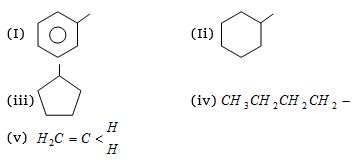
Examine the following common chemical structures to which simple functional groups are often attached. Which of these systems have essentially planar geometry?
A
$(i)$ and $(v)$
B
$(ii)$ and $(iii)$
C
$(ii)$,$(iii)$ and $(iv)$
D
$(iv)$
Solution
(A) To determine if a system is planar,we look at the hybridization of the atoms involved in the structure.
$(i)$ Phenyl group: The benzene ring is planar because all carbon atoms are $sp^2$ hybridized.
$(ii)$ Cyclohexyl group: This is a saturated ring where carbons are $sp^3$ hybridized,adopting a non-planar chair conformation.
$(iii)$ Cyclopentyl group: This is a saturated ring where carbons are $sp^3$ hybridized,adopting a non-planar envelope conformation.
$(iv)$ Butyl group: This is an open-chain alkyl group with $sp^3$ hybridized carbons,which is non-planar.
$(v)$ Ethenyl (vinyl) group: The two carbons are $sp^2$ hybridized,making the system planar.
Therefore,systems $(i)$ and $(v)$ have essentially planar geometry.
$(i)$ Phenyl group: The benzene ring is planar because all carbon atoms are $sp^2$ hybridized.
$(ii)$ Cyclohexyl group: This is a saturated ring where carbons are $sp^3$ hybridized,adopting a non-planar chair conformation.
$(iii)$ Cyclopentyl group: This is a saturated ring where carbons are $sp^3$ hybridized,adopting a non-planar envelope conformation.
$(iv)$ Butyl group: This is an open-chain alkyl group with $sp^3$ hybridized carbons,which is non-planar.
$(v)$ Ethenyl (vinyl) group: The two carbons are $sp^2$ hybridized,making the system planar.
Therefore,systems $(i)$ and $(v)$ have essentially planar geometry.
0 likesView Solution
21
ChemistryDifficultMCQAIPMT · 1995
Alkene $R-CH=CH_2$ reacts readily with $B_2H_6$ and the product on oxidation with alkaline hydrogen peroxide produces:
A
$R-CH_2-CHO$
B
$R-CH_2-CH_2-OH$
C
$R-CO-CH_3$
D
$R-CH(OH)-CH_2(OH)$
Solution
(B) The hydroboration-oxidation of alkenes follows anti-Markovnikov regioselectivity to yield primary alcohols.
The reaction proceeds as follows:
$3R-CH=CH_2 + 1/2 B_2H_6 \rightarrow (R-CH_2-CH_2)_3B$
$(R-CH_2-CH_2)_3B + 3H_2O_2 \xrightarrow{OH^-} 3R-CH_2-CH_2-OH + H_3BO_3$
Thus,the final product is a primary alcohol,$R-CH_2-CH_2-OH$.
The reaction proceeds as follows:
$3R-CH=CH_2 + 1/2 B_2H_6 \rightarrow (R-CH_2-CH_2)_3B$
$(R-CH_2-CH_2)_3B + 3H_2O_2 \xrightarrow{OH^-} 3R-CH_2-CH_2-OH + H_3BO_3$
Thus,the final product is a primary alcohol,$R-CH_2-CH_2-OH$.
0 likesView Solution
22
ChemistryMediumMCQAIPMT · 1995
Normal boiling point of water is $373 \ K$ (at $760 \ mm$). Vapour pressure of water at $298 \ K$ is $23 \ mm$. If the enthalpy of evaporation is $40.656 \ kJ/mole$,the boiling point of water at $23 \ mm$ pressure will be ............. $K$.
A
$250$
B
$294$
C
$51.6$
D
$12.5$
Solution
(B) Applying the Clausius-Clapeyron equation:
$\log \frac{P_2}{P_1} = \frac{\Delta H_{vap}}{2.303R} \left[ \frac{T_2 - T_1}{T_1 T_2} \right]$
Given: $P_2 = 760 \ mm$,$T_2 = 373 \ K$,$P_1 = 23 \ mm$,$\Delta H_{vap} = 40656 \ J/mol$,$R = 8.314 \ J/K \cdot mol$.
Substituting the values:
$\log \frac{760}{23} = \frac{40656}{2.303 \times 8.314} \left[ \frac{373 - T_1}{373 T_1} \right]$
$1.519 = 2123.5 \times \left[ \frac{373 - T_1}{373 T_1} \right]$
$0.000715 = \frac{373 - T_1}{373 T_1}$
$0.2667 T_1 = 373 - T_1$
$1.2667 T_1 = 373$
$T_1 \approx 294.4 \ K$.
$\log \frac{P_2}{P_1} = \frac{\Delta H_{vap}}{2.303R} \left[ \frac{T_2 - T_1}{T_1 T_2} \right]$
Given: $P_2 = 760 \ mm$,$T_2 = 373 \ K$,$P_1 = 23 \ mm$,$\Delta H_{vap} = 40656 \ J/mol$,$R = 8.314 \ J/K \cdot mol$.
Substituting the values:
$\log \frac{760}{23} = \frac{40656}{2.303 \times 8.314} \left[ \frac{373 - T_1}{373 T_1} \right]$
$1.519 = 2123.5 \times \left[ \frac{373 - T_1}{373 T_1} \right]$
$0.000715 = \frac{373 - T_1}{373 T_1}$
$0.2667 T_1 = 373 - T_1$
$1.2667 T_1 = 373$
$T_1 \approx 294.4 \ K$.
0 likesView Solution
23
ChemistryDifficultMCQAIPMT · 1995
Sodium is produced by the electrolysis of a molten mixture of about $40\%$ $NaCl$ and $60\%$ $CaCl_2$ because
A
$CaCl_2$ helps in the conduction of electricity
B
This mixture has a lower melting point than pure $NaCl$
C
$Ca^{2+}$ can displace $Na$ from $NaCl$
D
$Ca^{2+}$ can reduce $NaCl$ to $Na$
Solution
(B) Sodium is obtained by the electrolytic reduction of its chloride. The melting point of pure $NaCl$ is very high $(1074 \ K)$. To lower the melting point of the electrolyte to a manageable range (around $873 \ K$),$CaCl_2$ is added to the mixture.
0 likesView Solution
24
ChemistryMediumMCQAIPMT · 1995
If one end of a piece of a metal is heated,the other end becomes hot after some time. This is due to
A
Energised electrons moving to the other part of the metal
B
Resistance of the metal
C
Mobility of atoms in the metal
D
Minor perturbation in the energy of atoms
Solution
(A) Metals contain a large number of free electrons. When one end of the metal is heated,these electrons gain kinetic energy and move rapidly towards the cooler end,transferring thermal energy through collisions with other atoms and electrons. This process is known as thermal conduction.
0 likesView Solution
25
ChemistryMediumMCQAIPMT · 1995
Mercury is the only metal which is liquid at $0 \, ^oC$. This is due to its:
A
Very high ionisation energy and weak metallic bond
B
Low ionisation potential
C
High atomic weight
D
High vapour pressure
Solution
(A) The correct answer is $(A)$.
Mercury $(Hg)$ has a very high ionisation energy,which makes it difficult for its valence electrons to participate in metallic bonding.
Consequently,the metallic bonds between $Hg$ atoms are very weak,resulting in a low melting point that makes it liquid at room temperature ($0 \, ^oC$ is below its melting point of $-38.8 \, ^oC$).
Mercury $(Hg)$ has a very high ionisation energy,which makes it difficult for its valence electrons to participate in metallic bonding.
Consequently,the metallic bonds between $Hg$ atoms are very weak,resulting in a low melting point that makes it liquid at room temperature ($0 \, ^oC$ is below its melting point of $-38.8 \, ^oC$).
0 likesView Solution
26
ChemistryMCQAIPMT · 1995
The functional kidney of a frog tadpole is
A
Pronephros
B
Archinephros
C
Mesonephros
D
Metanephros
Solution
(A) The $Pronephros$ kidney is the functional kidney during the embryonic stage of cyclostomes,fishes,and amphibians.
$A$ frog tadpole is the larval stage of a frog,and during this stage,the $Pronephros$ serves as the functional excretory organ.
$A$ frog tadpole is the larval stage of a frog,and during this stage,the $Pronephros$ serves as the functional excretory organ.
0 likesView Solution
27
ChemistryMCQAIPMT · 1995
Which of the following radioactive isotopes is used in the detection of thyroid cancer?
A
Iodine-$131$
B
Carbon-$14$
C
Uranium-$238$
D
Phosphorus-$32$
Solution
(A) The thyroid gland specifically accumulates iodine for the synthesis of thyroid hormones ($T_3$ and $T_4$).
Because of this physiological property,the radioactive isotope Iodine-$131$ is used as a tracer to detect thyroid cancer and to treat hyperthyroidism.
Because of this physiological property,the radioactive isotope Iodine-$131$ is used as a tracer to detect thyroid cancer and to treat hyperthyroidism.
0 likesView Solution
28
ChemistryMCQAIPMT · 1995
Nicotine acts as a stimulant because it mimics the effect of
A
Thyroxine
B
Acetylcholine
C
Testosterone
D
Dopamine
Solution
(B) Nicotine acts as a stimulant because it mimics the effect of the neurotransmitter $Acetylcholine$.
It binds to nicotinic $Acetylcholine$ receptors at the autonomic ganglia and the neuromuscular junction.
Initially,it stimulates these receptors,leading to increased neural activity,but in high doses,it can cause inhibition of neural impulses.
It binds to nicotinic $Acetylcholine$ receptors at the autonomic ganglia and the neuromuscular junction.
Initially,it stimulates these receptors,leading to increased neural activity,but in high doses,it can cause inhibition of neural impulses.
0 likesView Solution
29
ChemistryMCQAIPMT · 1995
Which chemical is associated with flowering?
A
Gibberellin
B
Kinetin
C
Florigen
D
$IBA$
Solution
(C) The term $Florigen$ was proposed by the Russian scientist $M.K. Chailakhyan$ in $1936$ while studying photoperiodism.
He hypothesized that $Florigen$ is a hypothetical floral hormone synthesized in the leaves and transported to the shoot apices to induce flowering.
According to his theory,$Florigen$ consists of two groups of substances:
$(i)$ $Gibberellins$,which are required for stem elongation.
$(ii)$ $Anthesins$,which are required for the actual formation of flowers.
Together,these substances constitute the flowering hormone known as $Florigen$.
He hypothesized that $Florigen$ is a hypothetical floral hormone synthesized in the leaves and transported to the shoot apices to induce flowering.
According to his theory,$Florigen$ consists of two groups of substances:
$(i)$ $Gibberellins$,which are required for stem elongation.
$(ii)$ $Anthesins$,which are required for the actual formation of flowers.
Together,these substances constitute the flowering hormone known as $Florigen$.
0 likesView Solution
30
ChemistryMCQAIPMT · 1995
The potential energy between two atoms in a molecule is given by $U(x) = \frac{a}{x^{12}} - \frac{b}{x^6}$,where $a$ and $b$ are positive constants and $x$ is the distance between the atoms. The atoms are in stable equilibrium when:
A
$x = \sqrt[6]{\frac{11a}{5b}}$
B
$x = \sqrt[6]{\frac{a}{2b}}$
C
$x = 0$
D
$x = \sqrt[6]{\frac{2a}{b}}$
Solution
(D) For stable equilibrium,the net force on the system must be zero,which implies that the derivative of the potential energy with respect to distance must be zero.
$F = -\frac{dU}{dx} = 0$
Given $U(x) = ax^{-12} - bx^{-6}$,we differentiate with respect to $x$:
$\frac{dU}{dx} = -12ax^{-13} + 6bx^{-7} = 0$
Rearranging the terms:
$12ax^{-13} = 6bx^{-7}$
$\frac{12a}{x^{13}} = \frac{6b}{x^7}$
$\frac{2a}{b} = \frac{x^{13}}{x^7} = x^6$
$x = \sqrt[6]{\frac{2a}{b}}$
Thus,the atoms are in equilibrium at $x = \sqrt[6]{\frac{2a}{b}}$.
$F = -\frac{dU}{dx} = 0$
Given $U(x) = ax^{-12} - bx^{-6}$,we differentiate with respect to $x$:
$\frac{dU}{dx} = -12ax^{-13} + 6bx^{-7} = 0$
Rearranging the terms:
$12ax^{-13} = 6bx^{-7}$
$\frac{12a}{x^{13}} = \frac{6b}{x^7}$
$\frac{2a}{b} = \frac{x^{13}}{x^7} = x^6$
$x = \sqrt[6]{\frac{2a}{b}}$
Thus,the atoms are in equilibrium at $x = \sqrt[6]{\frac{2a}{b}}$.
0 likesView Solution
31
ChemistryMCQAIPMT · 1995
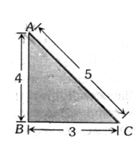
$ABC$ is a triangular plate of uniform thickness. Its sides are as shown in the figure. If $I_{AB}$,$I_{BC}$,and $I_{CA}$ are the moments of inertia of the plate about axes $AB$,$BC$,and $CA$ respectively,then which of the following relations is correct?
A
$I_{CA}$ is maximum.
B
$I_{AB} > I_{BC}$
C
$I_{BC} > I_{AB}$
D
$I_{AB} + I_{BC} = I_{CA}$
Solution
(C) The moment of inertia $I$ of a body about an axis is given by $I = Mk^2$,where $M$ is the mass and $k$ is the radius of gyration.
For a planar object,the moment of inertia about an axis is proportional to the square of the average distance of the mass from the axis.
In the given right-angled triangle $ABC$ with sides $AB=4$,$BC=3$,and $AC=5$:
$1$. The axis $BC$ is at a distance from the mass distributed along $AB$. The average distance of the mass from axis $BC$ is larger than the average distance of the mass from axis $AB$.
$2$. Specifically,the mass is more spread out relative to the axis $BC$ compared to axis $AB$.
$3$. Therefore,the radius of gyration $k_{BC} > k_{AB}$.
$4$. Consequently,$I_{BC} > I_{AB}$.
$5$. The axis $CA$ (the hypotenuse) is closest to the center of mass of the triangle,resulting in the smallest moment of inertia.
Thus,the correct relation is $I_{BC} > I_{AB} > I_{CA}$.
For a planar object,the moment of inertia about an axis is proportional to the square of the average distance of the mass from the axis.
In the given right-angled triangle $ABC$ with sides $AB=4$,$BC=3$,and $AC=5$:
$1$. The axis $BC$ is at a distance from the mass distributed along $AB$. The average distance of the mass from axis $BC$ is larger than the average distance of the mass from axis $AB$.
$2$. Specifically,the mass is more spread out relative to the axis $BC$ compared to axis $AB$.
$3$. Therefore,the radius of gyration $k_{BC} > k_{AB}$.
$4$. Consequently,$I_{BC} > I_{AB}$.
$5$. The axis $CA$ (the hypotenuse) is closest to the center of mass of the triangle,resulting in the smallest moment of inertia.
Thus,the correct relation is $I_{BC} > I_{AB} > I_{CA}$.
0 likesView Solution
32
ChemistryDifficultMCQAIPMT · 1995
The uncertainty in the position of an electron $(mass = 9.1 \times 10^{-28} \ g)$ moving with a velocity of $3.0 \times 10^4 \ cm \ s^{-1}$ accurate up to $0.001\%$ will be ................. $cm$ (Use $\frac{h}{4\pi}$ in the uncertainty expression,where $h = 6.626 \times 10^{-27} \ erg \ s$)
A
$1.92$
B
$7.68$
C
$5.76$
D
$3.84$
Solution
(A) According to Heisenberg's uncertainty principle: $\Delta x \cdot \Delta p \geq \frac{h}{4\pi}$.
Given: $m = 9.1 \times 10^{-28} \ g$,$v = 3.0 \times 10^4 \ cm \ s^{-1}$,and accuracy is $0.001\%$.
First,calculate the uncertainty in velocity $(\Delta v)$:
$\Delta v = v \times \frac{0.001}{100} = 3.0 \times 10^4 \times 10^{-5} = 0.3 \ cm \ s^{-1}$.
Now,calculate the uncertainty in momentum $(\Delta p)$:
$\Delta p = m \times \Delta v = 9.1 \times 10^{-28} \times 0.3 = 2.73 \times 10^{-28} \ g \ cm \ s^{-1}$.
Using the uncertainty principle formula:
$\Delta x = \frac{h}{4 \pi \cdot m \cdot \Delta v} = \frac{6.626 \times 10^{-27}}{4 \times 3.1416 \times 2.73 \times 10^{-28}}$.
$\Delta x = \frac{6.626 \times 10^{-27}}{34.287 \times 10^{-28}} = \frac{66.26}{34.287} \approx 1.93 \ cm$.
Rounding to the nearest provided option,the correct answer is $1.92 \ cm$.
Given: $m = 9.1 \times 10^{-28} \ g$,$v = 3.0 \times 10^4 \ cm \ s^{-1}$,and accuracy is $0.001\%$.
First,calculate the uncertainty in velocity $(\Delta v)$:
$\Delta v = v \times \frac{0.001}{100} = 3.0 \times 10^4 \times 10^{-5} = 0.3 \ cm \ s^{-1}$.
Now,calculate the uncertainty in momentum $(\Delta p)$:
$\Delta p = m \times \Delta v = 9.1 \times 10^{-28} \times 0.3 = 2.73 \times 10^{-28} \ g \ cm \ s^{-1}$.
Using the uncertainty principle formula:
$\Delta x = \frac{h}{4 \pi \cdot m \cdot \Delta v} = \frac{6.626 \times 10^{-27}}{4 \times 3.1416 \times 2.73 \times 10^{-28}}$.
$\Delta x = \frac{6.626 \times 10^{-27}}{34.287 \times 10^{-28}} = \frac{66.26}{34.287} \approx 1.93 \ cm$.
Rounding to the nearest provided option,the correct answer is $1.92 \ cm$.
0 likesView Solution
33
ChemistryEasyMCQAIPMT · 1995
The oxide which cannot act as a reducing agent is
A
$SO_2$
B
$NO_2$
C
$CO_2$
D
$ClO_2$
Solution
(C) reducing agent is a substance that can be oxidized to a higher oxidation state.
In $SO_2$,the oxidation state of $S$ is $+4$,which can be oxidized to $+6$.
In $NO_2$,the oxidation state of $N$ is $+4$,which can be oxidized to $+5$.
In $ClO_2$,the oxidation state of $Cl$ is $+4$,which can be oxidized to $+7$.
In $CO_2$,the oxidation state of $C$ is $+4$,which is its maximum oxidation state (group valence).
Therefore,$CO_2$ cannot be further oxidized and cannot act as a reducing agent.
In $SO_2$,the oxidation state of $S$ is $+4$,which can be oxidized to $+6$.
In $NO_2$,the oxidation state of $N$ is $+4$,which can be oxidized to $+5$.
In $ClO_2$,the oxidation state of $Cl$ is $+4$,which can be oxidized to $+7$.
In $CO_2$,the oxidation state of $C$ is $+4$,which is its maximum oxidation state (group valence).
Therefore,$CO_2$ cannot be further oxidized and cannot act as a reducing agent.
0 likesView Solution
34
ChemistryMCQAIPMT · 1995
If $\frac{1}{x(x^2 + 1)} = \frac{A}{x} + \frac{Bx + C}{x^2 + 1}$,then $(A, B, C) = $
A
$(1, -1, 0)$
B
$(-1, 0, -1)$
C
$(0, 1, 1)$
D
None of these
Solution
(A) Given the partial fraction decomposition: $\frac{1}{x(x^2 + 1)} = \frac{A}{x} + \frac{Bx + C}{x^2 + 1}$
Multiply both sides by $x(x^2 + 1)$: $1 = A(x^2 + 1) + (Bx + C)x$
$1 = Ax^2 + A + Bx^2 + Cx$
$1 = (A + B)x^2 + Cx + A$
Comparing the coefficients of $x^2$,$x$,and the constant term on both sides:
$A + B = 0$
$C = 0$
$A = 1$
Substituting $A = 1$ into $A + B = 0$,we get $1 + B = 0$,which implies $B = -1$.
Thus,$(A, B, C) = (1, -1, 0)$.
Multiply both sides by $x(x^2 + 1)$: $1 = A(x^2 + 1) + (Bx + C)x$
$1 = Ax^2 + A + Bx^2 + Cx$
$1 = (A + B)x^2 + Cx + A$
Comparing the coefficients of $x^2$,$x$,and the constant term on both sides:
$A + B = 0$
$C = 0$
$A = 1$
Substituting $A = 1$ into $A + B = 0$,we get $1 + B = 0$,which implies $B = -1$.
Thus,$(A, B, C) = (1, -1, 0)$.
0 likesView Solution
35
ChemistryMCQAIPMT · 1995
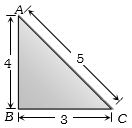
$ABC$ is a triangular plate of uniform thickness. Its sides are in the ratio as shown in the figure. Let $I_{AB}$,$I_{BC}$,and $I_{CA}$ be the moments of inertia of the plate about the sides $AB$,$BC$,and $CA$ respectively. Which of the following relations is true for this arrangement?
A
$I_{CA}$ is maximum
B
$I_{AB} > I_{BC}$
C
$I_{BC} > I_{AB}$
D
$I_{AB} + I_{BC} = I_{CA}$
Solution
(C) The moment of inertia of a body about an axis is given by $I = MK^2$,where $M$ is the mass and $K$ is the radius of gyration. The radius of gyration $K$ depends on the distribution of mass relative to the axis of rotation. The farther the mass is distributed from the axis,the larger the radius of gyration.
In the given right-angled triangle $ABC$ with sides $AB=4$,$BC=3$,and $AC=5$:
$1$. For axis $AB$,the mass is distributed within a distance of $3$ units.
$2$. For axis $BC$,the mass is distributed within a distance of $4$ units.
$3$. For axis $AC$,the mass is distributed within a smaller perpendicular distance compared to the other two axes.
Since the mass is spread further away from the axis $BC$ compared to axis $AB$,the radius of gyration $K_{BC} > K_{AB}$.
Consequently,$I_{BC} > I_{AB} > I_{CA}$.
Therefore,the correct relation is $I_{BC} > I_{AB}$.
In the given right-angled triangle $ABC$ with sides $AB=4$,$BC=3$,and $AC=5$:
$1$. For axis $AB$,the mass is distributed within a distance of $3$ units.
$2$. For axis $BC$,the mass is distributed within a distance of $4$ units.
$3$. For axis $AC$,the mass is distributed within a smaller perpendicular distance compared to the other two axes.
Since the mass is spread further away from the axis $BC$ compared to axis $AB$,the radius of gyration $K_{BC} > K_{AB}$.
Consequently,$I_{BC} > I_{AB} > I_{CA}$.
Therefore,the correct relation is $I_{BC} > I_{AB}$.
0 likesView Solution
36
ChemistryMCQAIPMT · 1995
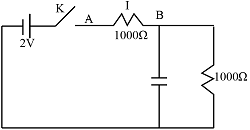
When the key $K$ is pressed at time $t = 0$,which of the following statements about the current $I$ in the resistor $AB$ of the given circuit is true?
A
$I = 2 \; mA$ at all $t$
B
$I$ oscillates between $1 \; mA$ and $2 \; mA$
C
At $t = 0, I = 2 \; mA$ and with time it decreases to $1 \; mA$
D
$I = 1 \; mA$ at all $t$
Solution
(C) When the key $K$ is pressed at $t = 0$,the capacitor acts as a short circuit (uncharged). Thus,the entire voltage $2 \; V$ appears across the $1000 \; \Omega$ resistor connected between $A$ and $B$.
At $t = 0$,the current $I = \frac{V}{R} = \frac{2 \; V}{1000 \; \Omega} = 2 \times 10^{-3} \; A = 2 \; mA$.
As time passes,the capacitor charges. Once the capacitor is fully charged,it acts as an open circuit. The current then flows through both $1000 \; \Omega$ resistors in series.
After a long time $(t \to \infty)$,the equivalent resistance is $R_{eq} = 1000 \; \Omega + 1000 \; \Omega = 2000 \; \Omega$.
The steady-state current is $I = \frac{V}{R_{eq}} = \frac{2 \; V}{2000 \; \Omega} = 1 \times 10^{-3} \; A = 1 \; mA$.
Therefore,at $t = 0, I = 2 \; mA$ and as time increases,it decreases to $1 \; mA$.
At $t = 0$,the current $I = \frac{V}{R} = \frac{2 \; V}{1000 \; \Omega} = 2 \times 10^{-3} \; A = 2 \; mA$.
As time passes,the capacitor charges. Once the capacitor is fully charged,it acts as an open circuit. The current then flows through both $1000 \; \Omega$ resistors in series.
After a long time $(t \to \infty)$,the equivalent resistance is $R_{eq} = 1000 \; \Omega + 1000 \; \Omega = 2000 \; \Omega$.
The steady-state current is $I = \frac{V}{R_{eq}} = \frac{2 \; V}{2000 \; \Omega} = 1 \times 10^{-3} \; A = 1 \; mA$.
Therefore,at $t = 0, I = 2 \; mA$ and as time increases,it decreases to $1 \; mA$.
0 likesView Solution
37
ChemistryMCQAIPMT · 1995
An electron of mass $m$ when accelerated through a potential difference $V$ has de-Broglie wavelength $\lambda$. The de-Broglie wavelength associated with a proton of mass $M$ accelerated through the same potential difference will be:
A
$\lambda \frac{m}{M}$
B
$\lambda \sqrt{\frac{m}{M}}$
C
$\lambda \frac{M}{m}$
D
$\lambda \sqrt{\frac{M}{m}}$
Solution
(B) The de-Broglie wavelength $\lambda$ of a particle of mass $m$ accelerated through a potential difference $V$ is given by the formula: $\lambda = \frac{h}{\sqrt{2mqV}}$.
Since both the electron and the proton have the same magnitude of charge $q = e$ and are accelerated through the same potential difference $V$,we have $\lambda \propto \frac{1}{\sqrt{m}}$.
For an electron: $\lambda_e = \lambda = \frac{h}{\sqrt{2meV}}$.
For a proton: $\lambda_p = \frac{h}{\sqrt{2MeV}}$.
Dividing the two equations: $\frac{\lambda_p}{\lambda_e} = \sqrt{\frac{m}{M}}$.
Therefore,$\lambda_p = \lambda \sqrt{\frac{m}{M}}$.
Since both the electron and the proton have the same magnitude of charge $q = e$ and are accelerated through the same potential difference $V$,we have $\lambda \propto \frac{1}{\sqrt{m}}$.
For an electron: $\lambda_e = \lambda = \frac{h}{\sqrt{2meV}}$.
For a proton: $\lambda_p = \frac{h}{\sqrt{2MeV}}$.
Dividing the two equations: $\frac{\lambda_p}{\lambda_e} = \sqrt{\frac{m}{M}}$.
Therefore,$\lambda_p = \lambda \sqrt{\frac{m}{M}}$.
0 likesView Solution
38
ChemistryMCQAIPMT · 1995
In green plants,cell elongation in the internodal regions is caused by which of the following?
A
Indole Acetic Acid
B
Cytokinin
C
Gibberellin
D
Ethylene
Solution
(C) Gibberellins are plant hormones that promote stem elongation by stimulating cell division and cell elongation in the internodal regions of plants. This is particularly evident in 'rosette' plants like cabbage and sugar beet,where they induce 'bolting' (internode elongation just prior to flowering). Therefore,the correct option is $C$.
0 likesView Solution
39
ChemistryMCQAIPMT · 1995
Which of the following is the most stable ecosystem?
A
Forest
B
Desert
C
Mountain
D
Ocean
Solution
(D) The stability of an ecosystem is often determined by its size,complexity,and the ability to maintain homeostasis despite environmental fluctuations.
Among the given options,the ocean is considered the most stable ecosystem.
This is because the ocean covers a vast area,has a high heat capacity (which regulates temperature),and possesses a complex food web that provides resilience against disturbances.
While forests are also stable,they are more susceptible to localized changes like fire or deforestation compared to the vast,interconnected marine environment.
Among the given options,the ocean is considered the most stable ecosystem.
This is because the ocean covers a vast area,has a high heat capacity (which regulates temperature),and possesses a complex food web that provides resilience against disturbances.
While forests are also stable,they are more susceptible to localized changes like fire or deforestation compared to the vast,interconnected marine environment.
0 likesView Solution
40
ChemistryMCQAIPMT · 1995
In good conductors of electricity,the type of bonding that exists is
A
vander Waals
B
ionic
C
metallic
D
covalent
Solution
(C) In good conductors of electricity,such as metals,the atoms are held together by metallic bonding.
In this type of bonding,the valence electrons are not bound to any specific atom but are free to move throughout the crystal lattice,forming a 'sea of electrons'.
This mobility of electrons is the fundamental reason why metals are excellent conductors of electricity.
In this type of bonding,the valence electrons are not bound to any specific atom but are free to move throughout the crystal lattice,forming a 'sea of electrons'.
This mobility of electrons is the fundamental reason why metals are excellent conductors of electricity.
0 likesView Solution
41
ChemistryMCQAIPMT · 1995
The heat is flowing through two cylindrical rods of the same material. The diameters of the rods are in the ratio $1 : 2$ and their lengths are in the ratio $2 : 1$. If the temperature difference between their ends is the same,the ratio of the rates of flow of heat through them will be
A
$1 : 1$
B
$2 : 1$
C
$1 : 4$
D
$1 : 8$
Solution
(D) The rate of heat flow through a rod is given by the formula $\frac{Q}{t} = \frac{KA \Delta T}{L}$,where $K$ is the thermal conductivity,$A$ is the cross-sectional area,$\Delta T$ is the temperature difference,and $L$ is the length.
Since the material is the same,$K_1 = K_2$. Given $\Delta T_1 = \Delta T_2$,the ratio of the rates of heat flow is $\frac{(Q/t)_1}{(Q/t)_2} = \frac{A_1}{A_2} \times \frac{L_2}{L_1}$.
The area $A = \pi r^2 = \pi (d/2)^2$,so the ratio of areas is $\frac{A_1}{A_2} = \left(\frac{d_1}{d_2}\right)^2 = \left(\frac{1}{2}\right)^2 = \frac{1}{4}$.
Given the ratio of lengths $\frac{L_1}{L_2} = \frac{2}{1}$,we have $\frac{L_2}{L_1} = \frac{1}{2}$.
Substituting these values: $\frac{(Q/t)_1}{(Q/t)_2} = \frac{1}{4} \times \frac{1}{2} = \frac{1}{8}$.
Since the material is the same,$K_1 = K_2$. Given $\Delta T_1 = \Delta T_2$,the ratio of the rates of heat flow is $\frac{(Q/t)_1}{(Q/t)_2} = \frac{A_1}{A_2} \times \frac{L_2}{L_1}$.
The area $A = \pi r^2 = \pi (d/2)^2$,so the ratio of areas is $\frac{A_1}{A_2} = \left(\frac{d_1}{d_2}\right)^2 = \left(\frac{1}{2}\right)^2 = \frac{1}{4}$.
Given the ratio of lengths $\frac{L_1}{L_2} = \frac{2}{1}$,we have $\frac{L_2}{L_1} = \frac{1}{2}$.
Substituting these values: $\frac{(Q/t)_1}{(Q/t)_2} = \frac{1}{4} \times \frac{1}{2} = \frac{1}{8}$.
0 likesView Solution
42
ChemistryMCQAIPMT · 1995
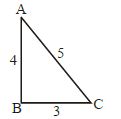
$ABC$ is a triangular plate of uniform thickness. The sides are in the ratio $3:4:5$ as shown in the figure. $I_{AB}, I_{BC}, I_{CA}$ are the moments of inertia of the plate about axes $AB, BC$ and $CA$ respectively. Which one of the following relations is correct?
A
$I_{CA}$ is maximum
B
$I_{AB} > I_{BC}$
C
$I_{BC} > I_{AB}$
D
$I_{AB} + I_{BC} = I_{CA}$
Solution
(C) The moment of inertia $(I)$ of a body depends on the distribution of mass relative to the axis of rotation. The farther the mass is from the axis,the greater the moment of inertia.
For a triangular plate,the moment of inertia about an axis is proportional to the square of the distance of the center of mass from that axis.
Let the height of the triangle with respect to base $BC$ be $h_A = AB = 4$ units.
Let the height of the triangle with respect to base $AB$ be $h_C = BC = 3$ units.
Let the height of the triangle with respect to hypotenuse $AC$ be $h_B$. Since the area is $\frac{1}{2} \times 3 \times 4 = 6$,we have $\frac{1}{2} \times 5 \times h_B = 6$,so $h_B = 2.4$ units.
The moment of inertia is proportional to the square of the perpendicular distance of the center of mass from the axis. The distance of the centroid from any side is $\frac{1}{3}$ of the altitude to that side.
Thus,$I \propto h^2$.
$I_{AB} \propto (BC)^2 = 3^2 = 9$
$I_{BC} \propto (AB)^2 = 4^2 = 16$
$I_{CA} \propto (h_B)^2 = (2.4)^2 = 5.76$
Comparing these values,we get $I_{BC} > I_{AB} > I_{CA}$.
Therefore,the relation $I_{BC} > I_{AB}$ is correct.
For a triangular plate,the moment of inertia about an axis is proportional to the square of the distance of the center of mass from that axis.
Let the height of the triangle with respect to base $BC$ be $h_A = AB = 4$ units.
Let the height of the triangle with respect to base $AB$ be $h_C = BC = 3$ units.
Let the height of the triangle with respect to hypotenuse $AC$ be $h_B$. Since the area is $\frac{1}{2} \times 3 \times 4 = 6$,we have $\frac{1}{2} \times 5 \times h_B = 6$,so $h_B = 2.4$ units.
The moment of inertia is proportional to the square of the perpendicular distance of the center of mass from the axis. The distance of the centroid from any side is $\frac{1}{3}$ of the altitude to that side.
Thus,$I \propto h^2$.
$I_{AB} \propto (BC)^2 = 3^2 = 9$
$I_{BC} \propto (AB)^2 = 4^2 = 16$
$I_{CA} \propto (h_B)^2 = (2.4)^2 = 5.76$
Comparing these values,we get $I_{BC} > I_{AB} > I_{CA}$.
Therefore,the relation $I_{BC} > I_{AB}$ is correct.
0 likesView Solution
43
ChemistryMCQAIPMT · 1995
The correct order of the $O-O$ bond length in $O_2, H_2O_2$,and $O_3$ is
A
$O_3 > H_2O_2 > O_2$
B
$O_2 > H_2O_2 > O_3$
C
$O_2 > O_3 > H_2O_2$
D
$H_2O_2 > O_3 > O_2$
Solution
(D) To determine the bond length,we look at the bond order of the $O-O$ bond in each species:
$1$. In $O_2$,the bond order is $2.0$ (double bond).
$2$. In $O_3$ (ozone),the resonance hybrid has a bond order of $1.5$ for the $O-O$ bond.
$3$. In $H_2O_2$,the $O-O$ bond is a single bond with a bond order of $1.0$.
Since bond length is inversely proportional to bond order,the order of bond length is $H_2O_2 (1.0) > O_3 (1.5) > O_2 (2.0)$.
$1$. In $O_2$,the bond order is $2.0$ (double bond).
$2$. In $O_3$ (ozone),the resonance hybrid has a bond order of $1.5$ for the $O-O$ bond.
$3$. In $H_2O_2$,the $O-O$ bond is a single bond with a bond order of $1.0$.
Since bond length is inversely proportional to bond order,the order of bond length is $H_2O_2 (1.0) > O_3 (1.5) > O_2 (2.0)$.
0 likesView Solution
44
ChemistryMCQAIPMT · 1995
What is the respective number of $\alpha$ and $\beta$ particles emitted in the following radioactive decay: ${}_{90}^{200}X \to {}_{80}^{168}Y$?
A
$6$ and $8$
B
$8$ and $8$
C
$6$ and $6$
D
$8$ and $6$
Solution
(D) The number of $\alpha$ particles emitted is given by the change in mass number divided by $4$:
$n_{\alpha} = \frac{A - A'}{4} = \frac{200 - 168}{4} = \frac{32}{4} = 8$.
The number of $\beta$ particles emitted is given by the formula:
$n_{\beta} = 2n_{\alpha} - (Z - Z')$.
Substituting the values:
$n_{\beta} = 2(8) - (90 - 80) = 16 - 10 = 6$.
Therefore,$8$ $\alpha$ particles and $6$ $\beta$ particles are emitted.
$n_{\alpha} = \frac{A - A'}{4} = \frac{200 - 168}{4} = \frac{32}{4} = 8$.
The number of $\beta$ particles emitted is given by the formula:
$n_{\beta} = 2n_{\alpha} - (Z - Z')$.
Substituting the values:
$n_{\beta} = 2(8) - (90 - 80) = 16 - 10 = 6$.
Therefore,$8$ $\alpha$ particles and $6$ $\beta$ particles are emitted.
0 likesView Solution
45
ChemistryMCQAIPMT · 1995
An electron makes a transition from orbit $n = 4$ to the orbit $n = 2$ of the hydrogen atom. The wave number of the emitted radiation ($R =$ Rydberg's constant) will be
A
$\frac{16}{3R}$
B
$\frac{2R}{16}$
C
$\frac{3R}{16}$
D
$\frac{4R}{16}$
Solution
(C) The wave number $\bar{\nu}$ is given by the Rydberg formula:
$\bar{\nu} = \frac{1}{\lambda} = R \left[ \frac{1}{n_{1}^{2}} - \frac{1}{n_{2}^{2}} \right]$
Here,the transition is from $n_{2} = 4$ to $n_{1} = 2$.
Substituting the values:
$\bar{\nu} = R \left[ \frac{1}{2^{2}} - \frac{1}{4^{2}} \right]$
$\bar{\nu} = R \left[ \frac{1}{4} - \frac{1}{16} \right]$
$\bar{\nu} = R \left[ \frac{4 - 1}{16} \right] = \frac{3R}{16}$
$\bar{\nu} = \frac{1}{\lambda} = R \left[ \frac{1}{n_{1}^{2}} - \frac{1}{n_{2}^{2}} \right]$
Here,the transition is from $n_{2} = 4$ to $n_{1} = 2$.
Substituting the values:
$\bar{\nu} = R \left[ \frac{1}{2^{2}} - \frac{1}{4^{2}} \right]$
$\bar{\nu} = R \left[ \frac{1}{4} - \frac{1}{16} \right]$
$\bar{\nu} = R \left[ \frac{4 - 1}{16} \right] = \frac{3R}{16}$
0 likesView Solution
46
ChemistryMCQAIPMT · 1995
$A$ beaker full of hot water is kept in a room. If it cools from $80\,^{\circ}C$ to $75\,^{\circ}C$ in $t_1$ minutes,from $75\,^{\circ}C$ to $70\,^{\circ}C$ in $t_2$ minutes,and from $70\,^{\circ}C$ to $65\,^{\circ}C$ in $t_3$ minutes,then:
A
$t_1 = t_2 = t_3$
B
$t_1 < t_2 < t_3$
C
$t_1 > t_2 > t_3$
D
$t_1 = t_2 < t_3$
Solution
(B) According to Newton's Law of Cooling,the rate of cooling $\frac{dT}{dt}$ is directly proportional to the temperature difference between the body and its surroundings: $\frac{dT}{dt} = -k(T - T_s)$.
As the temperature of the water decreases,the temperature difference $(T - T_s)$ between the water and the room decreases.
Since the rate of cooling decreases as the temperature difference decreases,the time taken to cool by the same amount $(5\,^{\circ}C)$ will increase.
Therefore,$t_1 < t_2 < t_3$.
As the temperature of the water decreases,the temperature difference $(T - T_s)$ between the water and the room decreases.
Since the rate of cooling decreases as the temperature difference decreases,the time taken to cool by the same amount $(5\,^{\circ}C)$ will increase.
Therefore,$t_1 < t_2 < t_3$.
0 likesView Solution
47
ChemistryMCQAIPMT · 1995
The correct order of the $O-O$ bond length in $O_2$,$H_2O_2$ and $O_3$ is
A
$O_2 > O_3 > H_2O_2$
B
$O_3 > H_2O_2 > O_2$
C
$O_2 > H_2O_2 > O_3$
D
$H_2O_2 > O_3 > O_2$
Solution
(D) The bond length is inversely proportional to the bond order.
$1$. In $O_2$,the bond order is $2.0$ (double bond).
$2$. In $O_3$,the bond order is $1.5$ (resonance hybrid).
$3$. In $H_2O_2$,the bond order is $1.0$ (single bond).
Since the bond order follows the order $O_2 > O_3 > H_2O_2$,the bond length follows the order $H_2O_2 > O_3 > O_2$.
$1$. In $O_2$,the bond order is $2.0$ (double bond).
$2$. In $O_3$,the bond order is $1.5$ (resonance hybrid).
$3$. In $H_2O_2$,the bond order is $1.0$ (single bond).
Since the bond order follows the order $O_2 > O_3 > H_2O_2$,the bond length follows the order $H_2O_2 > O_3 > O_2$.
0 likesView Solution
48
ChemistryMCQAIPMT · 1995
An oscillator is nothing but an amplifier with
A
positive feedback
B
large gain
C
no feedback
D
negative feedback
Solution
(A) An amplifier increases the magnitude of an externally applied $AC$ input voltage at the output.
An oscillator is a device that produces an output signal at a desired frequency without requiring any external $AC$ input voltage.
This self-sustaining oscillation is achieved by providing a positive feedback from a portion of the amplifier's output back to its input circuit in the correct phase.
Therefore,an oscillator is essentially an amplifier with positive feedback.
An oscillator is a device that produces an output signal at a desired frequency without requiring any external $AC$ input voltage.
This self-sustaining oscillation is achieved by providing a positive feedback from a portion of the amplifier's output back to its input circuit in the correct phase.
Therefore,an oscillator is essentially an amplifier with positive feedback.
0 likesView Solution
49
ChemistryMediumMCQAIPMT · 1995
The $pH$ of blood does not appreciably change by a small addition of acid or a base because blood
A
contains serum protein which acts as buffer
B
contains iron as a part of the molecule
C
can be easily coagulated
D
is body fluid
Solution
(A) Blood maintains a constant $pH$ because it contains serum proteins and bicarbonate ions which act as a buffer system.
This buffer system resists changes in $pH$ upon the addition of small amounts of acid or base.
This buffer system resists changes in $pH$ upon the addition of small amounts of acid or base.
0 likesView Solution
50
ChemistryMCQAIPMT · 1995
The enzyme enterokinase helps in the conversion of $............$.
A
Proteins into polypeptides
B
Trypsinogen into trypsin
C
Caseinogen into casein
D
Pepsinogen into pepsin
Solution
(B) Enterokinase (also known as enteropeptidase) is an enzyme secreted by the intestinal mucosa.
It acts on the inactive enzyme trypsinogen,which is secreted by the pancreas into the duodenum.
Enterokinase converts inactive trypsinogen into its active form,trypsin.
This activation is a critical step in the process of protein digestion,as trypsin then activates other pancreatic zymogens like chymotrypsinogen and procarboxypeptidase.
It acts on the inactive enzyme trypsinogen,which is secreted by the pancreas into the duodenum.
Enterokinase converts inactive trypsinogen into its active form,trypsin.
This activation is a critical step in the process of protein digestion,as trypsin then activates other pancreatic zymogens like chymotrypsinogen and procarboxypeptidase.
0 likesView Solution
51
ChemistryMediumMCQAIPMT · 1995
In the reaction $CH_3CHO + HCN \to CH_3CH(OH)CN$,a chiral centre is produced. This product would be
A
Laevo rotatory
B
Meso compound
C
Dextro rotatory
D
Racemic mixture
Solution
(D) The reaction $CH_3CHO + HCN \to CH_3CH(OH)CN$ involves the nucleophilic addition of cyanide to the carbonyl carbon of acetaldehyde.
Since the carbonyl carbon is planar,the cyanide ion can attack from either side with equal probability.
This leads to the formation of both $d$ (dextro) and $l$ (laevo) enantiomers in equal amounts.
Therefore,the resulting product is a racemic mixture.
Since the carbonyl carbon is planar,the cyanide ion can attack from either side with equal probability.
This leads to the formation of both $d$ (dextro) and $l$ (laevo) enantiomers in equal amounts.
Therefore,the resulting product is a racemic mixture.
0 likesView Solution
52
ChemistryDifficultMCQAIPMT · 1995
When $3, 3-$dimethyl$-2-$butanol is heated with ${H_2SO_4}$,the major product obtained is:
A
$cis$ and $trans$ isomers of $2, 3-$dimethyl$-2-$butene
B
$3, 3-$dimethyl$-1-$butene
C
$2, 3-$dimethyl$-2-$butene
D
$2, 3-$dimethyl$-1-$butene
Solution
(C) The dehydration of $3, 3-$dimethyl$-2-$butanol with ${H_2SO_4}$ proceeds via the formation of a carbocation.
$1.$ Protonation of the alcohol group leads to the formation of a $2^o$ carbocation: $CH_3-CH^+-C(CH_3)_2-CH_3$.
$2.$ This $2^o$ carbocation undergoes a $1, 2-$methyl shift to form a more stable $3^o$ carbocation: $CH_3-CH(CH_3)-C^+(CH_3)-CH_3$.
$3.$ Loss of a proton from the $3^o$ carbocation yields the most stable alkene,which is $2, 3-$dimethyl$-2-$butene,according to Saytzeff's rule.
$1.$ Protonation of the alcohol group leads to the formation of a $2^o$ carbocation: $CH_3-CH^+-C(CH_3)_2-CH_3$.
$2.$ This $2^o$ carbocation undergoes a $1, 2-$methyl shift to form a more stable $3^o$ carbocation: $CH_3-CH(CH_3)-C^+(CH_3)-CH_3$.
$3.$ Loss of a proton from the $3^o$ carbocation yields the most stable alkene,which is $2, 3-$dimethyl$-2-$butene,according to Saytzeff's rule.
0 likesView Solution
53
ChemistryEasyMCQAIPMT · 1995
Which of the following modes of expressing concentration is independent of temperature?
A
Molarity
B
Molality
C
Formality
D
Normality
Solution
(B) Molality is defined as the number of moles of solute per $1 \ kg$ of solvent.
Since mass does not change with temperature,molality is independent of temperature.
In contrast,molarity,formality,and normality involve volume,which changes with temperature.
Since mass does not change with temperature,molality is independent of temperature.
In contrast,molarity,formality,and normality involve volume,which changes with temperature.
0 likesView Solution
54
ChemistryEasyMCQAIPMT · 1995
According to Raoult's law,the relative lowering of vapour pressure of a solution of a non-volatile solute is equal to:
A
Mole fraction of the solvent
B
Mole fraction of the solute
C
Weight percentage of a solute
D
Weight percentage of a solvent
Solution
(B) According to Raoult's law,for a solution containing a non-volatile solute,the relative lowering of vapour pressure is given by the expression: $\frac{P^{\circ} - P_s}{P^{\circ}} = X_2$.
Here,$\frac{P^{\circ} - P_s}{P^{\circ}}$ represents the relative lowering of vapour pressure,and $X_2$ is the mole fraction of the solute.
Thus,the relative lowering of vapour pressure is equal to the mole fraction of the solute.
Here,$\frac{P^{\circ} - P_s}{P^{\circ}}$ represents the relative lowering of vapour pressure,and $X_2$ is the mole fraction of the solute.
Thus,the relative lowering of vapour pressure is equal to the mole fraction of the solute.
0 likesView Solution
55
ChemistryMediumMCQAIPMT · 1995
After the emission of one $\alpha$-particle followed by one $\beta$-particle from the atom of $_{92}X^{238}$,the number of neutrons in the atom will be
A
$142$
B
$146$
C
$144$
D
$143$
Solution
(D) The initial nucleus is $_{92}X^{238}$.
After the emission of one $\alpha$-particle $(_{2}He^{4})$,the nucleus becomes $_{90}Y^{234}$.
After the subsequent emission of one $\beta$-particle $(_{-1}e^{0})$,the nucleus becomes $_{91}Z^{234}$.
The number of neutrons is calculated as $A - Z = 234 - 91 = 143$.
After the emission of one $\alpha$-particle $(_{2}He^{4})$,the nucleus becomes $_{90}Y^{234}$.
After the subsequent emission of one $\beta$-particle $(_{-1}e^{0})$,the nucleus becomes $_{91}Z^{234}$.
The number of neutrons is calculated as $A - Z = 234 - 91 = 143$.
0 likesView Solution
56
ChemistryMediumMCQAIPMT · 1995
An electrochemical cell is set up as follows: $Pt(H_2, 1 \, atm) | 0.1 \, M \, HCl || 0.1 \, M \, CH_3COOH | (H_2, 1 \, atm) Pt$. The $E.M.F.$ of this cell will not be zero because:
A
The $pH$ of $0.1 \, M \, HCl$ and $0.1 \, M$ acetic acid is not the same.
B
Acids used in two compartments are different.
C
$E.M.F.$ of a cell depends on the molarities of acids used.
D
The temperature is constant.
Solution
(A) The $E.M.F.$ of a concentration cell is given by $E_{cell} = \frac{0.0591}{n} \log \frac{[H^+]_{cathode}}{[H^+]_{anode}}$.
Since $HCl$ is a strong acid,it dissociates completely,whereas $CH_3COOH$ is a weak acid and dissociates partially.
Therefore,the concentration of $H^+$ ions in both compartments is different,leading to different $pH$ values.
As a result,the $E.M.F.$ of the cell is not zero.
Since $HCl$ is a strong acid,it dissociates completely,whereas $CH_3COOH$ is a weak acid and dissociates partially.
Therefore,the concentration of $H^+$ ions in both compartments is different,leading to different $pH$ values.
As a result,the $E.M.F.$ of the cell is not zero.
0 likesView Solution
57
ChemistryDifficultMCQAIPMT · 1995
Amongst $TiF_6^{2-}$,$CoF_6^{3-}$,$Cu_2Cl_2$,and $NiCl_4^{2-}$ (Atomic numbers: $Ti=22, Co=27, Cu=29, Ni=28$),the colourless species are:
A
$CoF_6^{3-}$ and $NiCl_4^{2-}$
B
$TiF_6^{2-}$ and $CoF_6^{3-}$
C
$Cu_2Cl_2$ and $NiCl_4^{2-}$
D
$TiF_6^{2-}$ and $Cu_2Cl_2$
Solution
(D) To determine the colourless species,we check for the presence of unpaired electrons in the metal ions:
$1$. In $TiF_6^{2-}$,$Ti$ is in the $+4$ oxidation state. The electronic configuration of $Ti^{4+}$ is $[Ar] 3d^0$. Since there are no $d$-electrons,it is colourless.
$2$. In $CoF_6^{3-}$,$Co$ is in the $+3$ oxidation state. The configuration of $Co^{3+}$ is $[Ar] 3d^6$. It has unpaired electrons,so it is coloured.
$3$. In $Cu_2Cl_2$,$Cu$ is in the $+1$ oxidation state. The configuration of $Cu^+$ is $[Ar] 3d^{10}$. Since the $d$-subshell is completely filled,there are no unpaired electrons,making it colourless.
$4$. In $NiCl_4^{2-}$,$Ni$ is in the $+2$ oxidation state. The configuration of $Ni^{2+}$ is $[Ar] 3d^8$. It has unpaired electrons,so it is coloured.
Therefore,$TiF_6^{2-}$ and $Cu_2Cl_2$ are the colourless species.
$1$. In $TiF_6^{2-}$,$Ti$ is in the $+4$ oxidation state. The electronic configuration of $Ti^{4+}$ is $[Ar] 3d^0$. Since there are no $d$-electrons,it is colourless.
$2$. In $CoF_6^{3-}$,$Co$ is in the $+3$ oxidation state. The configuration of $Co^{3+}$ is $[Ar] 3d^6$. It has unpaired electrons,so it is coloured.
$3$. In $Cu_2Cl_2$,$Cu$ is in the $+1$ oxidation state. The configuration of $Cu^+$ is $[Ar] 3d^{10}$. Since the $d$-subshell is completely filled,there are no unpaired electrons,making it colourless.
$4$. In $NiCl_4^{2-}$,$Ni$ is in the $+2$ oxidation state. The configuration of $Ni^{2+}$ is $[Ar] 3d^8$. It has unpaired electrons,so it is coloured.
Therefore,$TiF_6^{2-}$ and $Cu_2Cl_2$ are the colourless species.
0 likesView Solution
58
ChemistryMediumMCQAIPMT · 1995
The number of geometrical isomers for $[Pt(NH_3)_2Cl_2]$ is
A
$2$
B
$1$
C
$3$
D
$4$
Solution
(A) The coordination complex $[Pt(NH_3)_2Cl_2]$ is a square planar complex of the type $[MA_2B_2]$.
It exhibits $2$ geometrical isomers:
$1$. $\text{Cis-isomer}$: Where similar ligands ($NH_3$ or $Cl$) are adjacent to each other.
$2$. $\text{Trans-isomer}$: Where similar ligands ($NH_3$ or $Cl$) are opposite to each other.
It exhibits $2$ geometrical isomers:
$1$. $\text{Cis-isomer}$: Where similar ligands ($NH_3$ or $Cl$) are adjacent to each other.
$2$. $\text{Trans-isomer}$: Where similar ligands ($NH_3$ or $Cl$) are opposite to each other.
0 likesView Solution
59
ChemistryMediumMCQAIPMT · 1995
The coordination number and oxidation state of $Cr$ in $K_3[Cr(C_2O_4)_3]$ are,respectively:
A
$4$ and $+2$
B
$6$ and $+3$
C
$3$ and $+3$
D
$3$ and $0$
Solution
(B) The complex is $K_3[Cr(C_2O_4)_3]$.
$1$. Coordination Number: The ligand oxalate $(C_2O_4)^{2-}$ is a bidentate ligand. Since there are $3$ such ligands,the coordination number is $3 \times 2 = 6$.
$2$. Oxidation State: Let the oxidation state of $Cr$ be $x$. The charge on the oxalate ion is $-2$ and the charge on the potassium ion is $+1$. The total charge of the complex is $0$.
$3(+1) + x + 3(-2) = 0$
$3 + x - 6 = 0$
$x - 3 = 0$
$x = +3$
Therefore,the coordination number is $6$ and the oxidation state is $+3$.
$1$. Coordination Number: The ligand oxalate $(C_2O_4)^{2-}$ is a bidentate ligand. Since there are $3$ such ligands,the coordination number is $3 \times 2 = 6$.
$2$. Oxidation State: Let the oxidation state of $Cr$ be $x$. The charge on the oxalate ion is $-2$ and the charge on the potassium ion is $+1$. The total charge of the complex is $0$.
$3(+1) + x + 3(-2) = 0$
$3 + x - 6 = 0$
$x - 3 = 0$
$x = +3$
Therefore,the coordination number is $6$ and the oxidation state is $+3$.
0 likesView Solution
60
ChemistryDifficultMCQAIPMT · 1995
The increasing order of acidity among phenol,$p-$methylphenol,$m-$nitrophenol and $p-$nitrophenol is
A
$m-$nitrophenol,$p-$nitrophenol,phenol,$p-$methylphenol
B
$p-$methylphenol,$m-$nitrophenol,phenol,$p-$nitrophenol
C
$p-$methylphenol,phenol,$m-$nitrophenol,$p-$nitrophenol
D
Phenol,$p-$methylphenol,$p-$nitrophenol,$m-$nitrophenol
Solution
(C) The acidity of phenols depends on the stability of the phenoxide ion formed after the loss of a proton. Electron-withdrawing groups $(EWG)$ like $-NO_2$ increase acidity by stabilizing the phenoxide ion through $-I$ and $-M$ effects,while electron-donating groups $(EDG)$ like $-CH_3$ decrease acidity through $+I$ and hyperconjugation effects.
$1$. $p-$methylphenol: The $-CH_3$ group is an $EDG$,which destabilizes the phenoxide ion,making it the least acidic.
$2$. Phenol: Acts as the reference compound.
$3$. $m-$nitrophenol: The $-NO_2$ group exerts only a $-I$ effect from the meta position,increasing acidity more than phenol.
$4$. $p-$nitrophenol: The $-NO_2$ group exerts both $-I$ and $-M$ effects from the para position,providing the strongest stabilization to the phenoxide ion,making it the most acidic.
Thus,the increasing order of acidity is: $p-$methylphenol < phenol < $m-$nitrophenol < $p-$nitrophenol.
$1$. $p-$methylphenol: The $-CH_3$ group is an $EDG$,which destabilizes the phenoxide ion,making it the least acidic.
$2$. Phenol: Acts as the reference compound.
$3$. $m-$nitrophenol: The $-NO_2$ group exerts only a $-I$ effect from the meta position,increasing acidity more than phenol.
$4$. $p-$nitrophenol: The $-NO_2$ group exerts both $-I$ and $-M$ effects from the para position,providing the strongest stabilization to the phenoxide ion,making it the most acidic.
Thus,the increasing order of acidity is: $p-$methylphenol < phenol < $m-$nitrophenol < $p-$nitrophenol.
0 likesView Solution
61
ChemistryDifficultMCQAIPMT · 1995
Oxidation of toluene with $CrO_3$ in the presence of $(CH_3CO)_2O$ gives a product '$A$' which on treatment with aqueous $NaOH$ produces
A
$C_6H_5CHO$
B
$(C_6H_5CO)_2O$
C
$C_6H_5COONa$
D
$2, 4-$diacetyl toluene
Solution
(C) The oxidation of toluene with $CrO_3$ in the presence of acetic anhydride $(CH_3CO)_2O$ forms a gem-diacetate intermediate,$C_6H_5CH(OCOCH_3)_2$,which is product '$A$'.
Upon hydrolysis with aqueous $NaOH$,this intermediate yields benzaldehyde $(C_6H_5CHO)$.
Benzaldehyde,lacking $\alpha$-hydrogens,undergoes the Cannizzaro reaction in the presence of concentrated aqueous $NaOH$ to produce sodium benzoate $(C_6H_5COONa)$ and benzyl alcohol $(C_6H_5CH_2OH)$.
Therefore,the final product obtained is $C_6H_5COONa$.
Upon hydrolysis with aqueous $NaOH$,this intermediate yields benzaldehyde $(C_6H_5CHO)$.
Benzaldehyde,lacking $\alpha$-hydrogens,undergoes the Cannizzaro reaction in the presence of concentrated aqueous $NaOH$ to produce sodium benzoate $(C_6H_5COONa)$ and benzyl alcohol $(C_6H_5CH_2OH)$.
Therefore,the final product obtained is $C_6H_5COONa$.
0 likesView Solution
62
ChemistryDifficultMCQAIPMT · 1995
$\alpha-D$-glucose and $\beta-D$-glucose differ from each other due to the difference in the configuration of one of the carbons.
A
Size of hemiacetal ring
B
Number of $OH$ groups
C
Configuration
D
Conformation
Solution
(C) $\alpha-D$-glucose and $\beta-D$-glucose are anomers of each other.
Anomers are a type of stereoisomer that differ in configuration only at the anomeric carbon (the $C-1$ carbon in glucose).
Since they differ in the spatial arrangement of the $-OH$ group at the $C-1$ position,they are said to differ in their configuration.
Anomers are a type of stereoisomer that differ in configuration only at the anomeric carbon (the $C-1$ carbon in glucose).
Since they differ in the spatial arrangement of the $-OH$ group at the $C-1$ position,they are said to differ in their configuration.
0 likesView Solution
63
ChemistryEasyMCQAIPMT · 1995
Oxidation of glucose is one of the most important reactions in a living cell. What is the number of $ATP$ molecules generated in cells from one molecule of glucose?
A
$38$
B
$12$
C
$18$
D
$28$
Solution
(A) The complete oxidation of one molecule of glucose $(C_6H_{12}O_6)$ in a living cell follows the overall reaction:
$C_6H_{12}O_6 + 6O_2 \to 6CO_2 + 6H_2O + 38 \, ATP$.
Thus,the total number of $ATP$ molecules generated is $38$.
$C_6H_{12}O_6 + 6O_2 \to 6CO_2 + 6H_2O + 38 \, ATP$.
Thus,the total number of $ATP$ molecules generated is $38$.
0 likesView Solution
64
ChemistryMediumMCQAIPMT · 1995
Secondary structure of a protein refers to
A
Mainly denatured proteins and structures of prosthetic groups
B
Three dimensional structure,specially the bond between amino acid residues that are distant from each other in the polypeptide chain
C
Linear sequence of amino acid residues in the polypeptide chain
D
Regular folding patterns of continuous portions of the polypeptide chain
Solution
(D) Secondary structure refers to the regular folding patterns of continuous portions of the polypeptide chain,such as $\alpha$-helices and $\beta$-pleated sheets.
These structures are stabilized by hydrogen bonds formed between the carbonyl oxygen $(C=O)$ of one amino acid residue and the amino hydrogen $(N-H)$ of another residue in the polypeptide backbone.
These structures are stabilized by hydrogen bonds formed between the carbonyl oxygen $(C=O)$ of one amino acid residue and the amino hydrogen $(N-H)$ of another residue in the polypeptide backbone.
0 likesView Solution
65
ChemistryMediumMCQAIPMT · 1995
Which of the following statements about enzymes are true?
$i$. Enzymes lack nucleophilic groups.
$ii$. Enzymes are highly specific both in binding chiral substrates and in catalyzing their reactions.
$iii$. Enzymes catalyze chemical reactions by lowering the activation energy.
$iv$. Pepsin is a proteolytic enzyme.
$i$. Enzymes lack nucleophilic groups.
$ii$. Enzymes are highly specific both in binding chiral substrates and in catalyzing their reactions.
$iii$. Enzymes catalyze chemical reactions by lowering the activation energy.
$iv$. Pepsin is a proteolytic enzyme.
A
$i$ and $iv$
B
$i$ and $iii$
C
$ii$,$iii$ and $iv$
D
$i$
Solution
(C) $i$. False: Enzymes contain various nucleophilic groups (e.g.,$-OH$,$-SH$,$-NH_2$) in their active sites that participate in catalysis.
$ii$. True: Enzymes exhibit high stereospecificity and substrate specificity.
$iii$. True: Enzymes function by providing an alternative pathway with a lower activation energy $(E_a)$.
$iv$. True: Pepsin is a digestive enzyme that breaks down proteins into peptides.
Therefore,statements $ii$,$iii$,and $iv$ are correct.
$ii$. True: Enzymes exhibit high stereospecificity and substrate specificity.
$iii$. True: Enzymes function by providing an alternative pathway with a lower activation energy $(E_a)$.
$iv$. True: Pepsin is a digestive enzyme that breaks down proteins into peptides.
Therefore,statements $ii$,$iii$,and $iv$ are correct.
0 likesView Solution
66
ChemistryMediumMCQAIPMT · 1995
$A$ catalyst:
A
Increases the average kinetic energy of reacting molecules
B
Increases the activation energy
C
Alters the reaction mechanism
D
Increases the frequency of collisions of reacting species
Solution
(C) catalyst provides an alternative pathway for the reaction with lower activation energy. By lowering the activation energy,a larger fraction of molecules can cross the energy barrier,which effectively increases the rate of the reaction. While the frequency of collisions is determined by temperature and concentration,the catalyst's primary role is to alter the reaction mechanism to a lower energy path. However,in the context of standard multiple-choice questions regarding the effect of catalysts on reaction rates,option $C$ is the most scientifically accurate description of how a catalyst functions.
0 likesView Solution
67
ChemistryDifficultMCQAIPMT · 1995
The general order of reactivity of carbonyl compounds for nucleophilic addition reactions is
A
$H_2C = O > RCHO > ArCHO > R_2C = O > Ar_2C = O$
B
$ArCHO > Ar_2C = O > RCHO > R_2C = O > H_2C = O$
C
$Ar_2C = O > R_2C = O > ArCHO > RCHO > H_2C = O$
D
$H_2C = O > R_2C = O > Ar_2C = O > RCHO > ArCHO$
Solution
(A) . The reactivity of carbonyl compounds towards nucleophilic addition is governed by two factors: steric hindrance and electronic effects.
$1$. Steric hindrance: As the number and size of alkyl or aryl groups attached to the carbonyl carbon increase,the approach of the nucleophile becomes more difficult.
$2$. Electronic effects: Alkyl groups are electron-donating ($+I$ effect),which decreases the electrophilicity of the carbonyl carbon.
Formaldehyde $(H_2C = O)$ has the least steric hindrance and no electron-donating groups,making it the most reactive.
Aldehydes $(RCHO)$ are more reactive than ketones $(R_2C = O)$ due to less steric hindrance.
Aryl groups $(Ar)$ provide resonance stabilization to the carbonyl carbon,further reducing its electrophilicity compared to alkyl groups.
Thus,the correct order is $H_2C = O > RCHO > ArCHO > R_2C = O > Ar_2C = O$.
$1$. Steric hindrance: As the number and size of alkyl or aryl groups attached to the carbonyl carbon increase,the approach of the nucleophile becomes more difficult.
$2$. Electronic effects: Alkyl groups are electron-donating ($+I$ effect),which decreases the electrophilicity of the carbonyl carbon.
Formaldehyde $(H_2C = O)$ has the least steric hindrance and no electron-donating groups,making it the most reactive.
Aldehydes $(RCHO)$ are more reactive than ketones $(R_2C = O)$ due to less steric hindrance.
Aryl groups $(Ar)$ provide resonance stabilization to the carbonyl carbon,further reducing its electrophilicity compared to alkyl groups.
Thus,the correct order is $H_2C = O > RCHO > ArCHO > R_2C = O > Ar_2C = O$.
0 likesView Solution
Vedclass Products
For Students
Vedclass Test Series
Mock tests in real AIPMT style covering Chemistry with performance analysis. 5-day free trial.
Start Free TrialFor Teachers
Exam Paper Generator
Generate Set A/B/C/D Chemistry papers from 7.5L+ questions in 2 minutes. 3 chapters free.
Try FreeFor Institutes
Online Exam Module
Run live AIPMT mock exams with unlimited students, 360° analytics & white-label branding.
See DemoFrequently Asked Questions
How many Chemistry questions are in AIPMT 1995?
There are 71 Chemistry questions from the AIPMT 1995 paper on Vedclass, each with a detailed step-by-step solution in English.
Are AIPMT 1995 Chemistry solutions available in English?
Yes. All solutions on this page are in English. You can also switch to English or Hindi using the language buttons above the questions.
Can I practice AIPMT 1995 Chemistry as a timed test?
Yes. Use the Vedclass Test Series to attempt a full AIPMT mock test covering Chemistry with time limits and instant score analysis.
Can teachers create Chemistry papers from AIPMT previous year questions?
Yes. The Vedclass Exam Paper Generator lets teachers mix AIPMT Chemistry questions and generate Set A/B/C/D papers in minutes.
For Teachers & Institutes
Build a Custom Chemistry Paper
Pick AIPMT 1995 Chemistry questions, set difficulty, and generate Set A/B/C/D in 2 minutes.