
PhysicsQ1–46 of 46 questions
Page 1 of 1 · English
1
PhysicsMediumMCQAIPMT · 1990
The frequency of vibration $f$ of a mass $m$ suspended from a spring of spring constant $K$ is given by a relation of the type $f = C\,{m^x}{K^y}$,where $C$ is a dimensionless quantity. The values of $x$ and $y$ are:
A
$x = \frac{1}{2}, y = \frac{1}{2}$
B
$x = -\frac{1}{2}, y = -\frac{1}{2}$
C
$x = \frac{1}{2}, y = -\frac{1}{2}$
D
$x = -\frac{1}{2}, y = \frac{1}{2}$
Solution
(D) The dimensional formula for frequency $f$ is $[M^0 L^0 T^{-1}]$.
The dimensional formula for mass $m$ is $[M^1 L^0 T^0]$.
The dimensional formula for spring constant $K$ is $[M^1 L^0 T^{-2}]$.
Given the relation $f = C m^x K^y$,substituting the dimensions on both sides:
$[M^0 L^0 T^{-1}] = [M^1]^x [M^1 T^{-2}]^y$
$[M^0 L^0 T^{-1}] = [M^{x+y} T^{-2y}]$
Comparing the powers of $M$ and $T$ on both sides:
For $M$: $x + y = 0$
For $T$: $-2y = -1 \implies y = \frac{1}{2}$
Substituting $y = \frac{1}{2}$ into $x + y = 0$,we get $x + \frac{1}{2} = 0 \implies x = -\frac{1}{2}$.
Thus,$x = -\frac{1}{2}$ and $y = \frac{1}{2}$.
The dimensional formula for mass $m$ is $[M^1 L^0 T^0]$.
The dimensional formula for spring constant $K$ is $[M^1 L^0 T^{-2}]$.
Given the relation $f = C m^x K^y$,substituting the dimensions on both sides:
$[M^0 L^0 T^{-1}] = [M^1]^x [M^1 T^{-2}]^y$
$[M^0 L^0 T^{-1}] = [M^{x+y} T^{-2y}]$
Comparing the powers of $M$ and $T$ on both sides:
For $M$: $x + y = 0$
For $T$: $-2y = -1 \implies y = \frac{1}{2}$
Substituting $y = \frac{1}{2}$ into $x + y = 0$,we get $x + \frac{1}{2} = 0 \implies x = -\frac{1}{2}$.
Thus,$x = -\frac{1}{2}$ and $y = \frac{1}{2}$.
0 likesView Solution
2
PhysicsEasyMCQAIPMT · 1990
The dimensions of pressure are
A
$MLT^{-2}$
B
$ML^{-2}T^{2}$
C
$ML^{-1}T^{-2}$
D
$M^{-1}L^{-1}$
Solution
(C) Pressure is defined as the force applied per unit area.
$P = \frac{F}{A}$
The dimensional formula for force $(F)$ is $[MLT^{-2}]$.
The dimensional formula for area $(A)$ is $[L^2]$.
Therefore,the dimensions of pressure are:
$[P] = \frac{[MLT^{-2}]}{[L^2]} = [ML^{-1}T^{-2}]$.
$P = \frac{F}{A}$
The dimensional formula for force $(F)$ is $[MLT^{-2}]$.
The dimensional formula for area $(A)$ is $[L^2]$.
Therefore,the dimensions of pressure are:
$[P] = \frac{[MLT^{-2}]}{[L^2]} = [ML^{-1}T^{-2}]$.
0 likesView Solution
3
PhysicsMediumMCQAIPMT · 1990
According to Newton,the viscous force acting between liquid layers of area $A$ and velocity gradient $\Delta v/\Delta z$ is given by $F = - \eta A \frac{\Delta v}{\Delta z}$,where $\eta$ is a constant called the coefficient of viscosity. The dimensions of $\eta$ are:
A
$[M L^2 T^{-2}]$
B
$[M L^{-1} T^{-1}]$
C
$[M L^{-2} T^{-2}]$
D
$[M^0 L^0 T^0]$
Solution
(B) The formula for viscous force is $F = - \eta A \frac{\Delta v}{\Delta z}$.
Rearranging for $\eta$,we get $\eta = \frac{F}{A (\Delta v / \Delta z)}$.
Substituting the dimensions of each quantity:
Force $F = [M L T^{-2}]$
Area $A = [L^2]$
Velocity gradient $\frac{\Delta v}{\Delta z} = \frac{[L T^{-1}]}{[L]} = [T^{-1}]$
Now,calculating the dimensions of $\eta$:
$[\eta] = \frac{[M L T^{-2}]}{[L^2] [T^{-1}]} = [M L^{1-2} T^{-2+1}] = [M L^{-1} T^{-1}]$.
Thus,the correct option is $B$.
Rearranging for $\eta$,we get $\eta = \frac{F}{A (\Delta v / \Delta z)}$.
Substituting the dimensions of each quantity:
Force $F = [M L T^{-2}]$
Area $A = [L^2]$
Velocity gradient $\frac{\Delta v}{\Delta z} = \frac{[L T^{-1}]}{[L]} = [T^{-1}]$
Now,calculating the dimensions of $\eta$:
$[\eta] = \frac{[M L T^{-2}]}{[L^2] [T^{-1}]} = [M L^{1-2} T^{-2+1}] = [M L^{-1} T^{-1}]$.
Thus,the correct option is $B$.
0 likesView Solution
4
PhysicsMediumMCQAIPMT · 1990
$A$ car travels half the distance with a constant velocity of $40 \, km/h$ and the remaining half with a constant velocity of $60 \, km/h$. The average velocity of the car in $km/h$ is
A
$40$
B
$60$
C
$48$
D
$50$
Solution
(C) Let the total distance be $2d$. The car travels the first half distance $d$ with velocity $v_1 = 40 \, km/h$ and the second half distance $d$ with velocity $v_2 = 60 \, km/h$.
Time taken for the first half is $t_1 = \frac{d}{v_1} = \frac{d}{40}$.
Time taken for the second half is $t_2 = \frac{d}{v_2} = \frac{d}{60}$.
Average velocity $v_{av} = \frac{\text{Total distance}}{\text{Total time}} = \frac{2d}{t_1 + t_2} = \frac{2d}{\frac{d}{40} + \frac{d}{60}}$.
$v_{av} = \frac{2}{\frac{1}{40} + \frac{1}{60}} = \frac{2}{\frac{3+2}{120}} = \frac{2 \times 120}{5} = \frac{240}{5} = 48 \, km/h$.
Time taken for the first half is $t_1 = \frac{d}{v_1} = \frac{d}{40}$.
Time taken for the second half is $t_2 = \frac{d}{v_2} = \frac{d}{60}$.
Average velocity $v_{av} = \frac{\text{Total distance}}{\text{Total time}} = \frac{2d}{t_1 + t_2} = \frac{2d}{\frac{d}{40} + \frac{d}{60}}$.
$v_{av} = \frac{2}{\frac{1}{40} + \frac{1}{60}} = \frac{2}{\frac{3+2}{120}} = \frac{2 \times 120}{5} = \frac{240}{5} = 48 \, km/h$.
0 likesView Solution
5
PhysicsEasyMCQAIPMT · 1990
An electric fan has blades of length $30 \, cm$ as measured from the axis of rotation. If the fan is rotating at $1200 \, r.p.m.$,the acceleration of a point on the tip of the blade is about .......... $m/s^2$.
A
$1600$
B
$4740$
C
$2370$
D
$5055$
Solution
(B) The acceleration of a point on the tip of the blade is the centripetal acceleration,given by $a = \omega^2 R$.
First,convert the angular velocity from $r.p.m.$ to $rad/s$:
$\omega = 2 \pi f = 2 \pi \times \frac{1200}{60} = 40 \pi \, rad/s$.
Given the radius $R = 30 \, cm = 0.3 \, m$.
Now,calculate the acceleration:
$a = (40 \pi)^2 \times 0.3$
$a = 1600 \times \pi^2 \times 0.3$
Using $\pi^2 \approx 9.87$:
$a = 1600 \times 9.87 \times 0.3 = 4737.6 \, m/s^2$.
Rounding to the nearest value,we get $a \approx 4740 \, m/s^2$.
First,convert the angular velocity from $r.p.m.$ to $rad/s$:
$\omega = 2 \pi f = 2 \pi \times \frac{1200}{60} = 40 \pi \, rad/s$.
Given the radius $R = 30 \, cm = 0.3 \, m$.
Now,calculate the acceleration:
$a = (40 \pi)^2 \times 0.3$
$a = 1600 \times \pi^2 \times 0.3$
Using $\pi^2 \approx 9.87$:
$a = 1600 \times 9.87 \times 0.3 = 4737.6 \, m/s^2$.
Rounding to the nearest value,we get $a \approx 4740 \, m/s^2$.
0 likesView Solution
6
PhysicsEasyMCQAIPMT · 1990
The maximum range of a gun on horizontal terrain is $16 \, km$. If $g = 10 \, m/s^2$,what must be the muzzle velocity of the shell in $m/s$?
A
$800$
B
$400$
C
$160$
D
$200\sqrt{2}$
Solution
(B) The maximum horizontal range $(R_{\max})$ of a projectile is given by the formula: $R_{\max} = \frac{u^2}{g}$,where $u$ is the muzzle velocity and $g$ is the acceleration due to gravity.
Given: $R_{\max} = 16 \, km = 16,000 \, m$ and $g = 10 \, m/s^2$.
Substituting the values into the formula:
$16,000 = \frac{u^2}{10}$
$u^2 = 16,000 \times 10 = 160,000$
$u = \sqrt{160,000} = 400 \, m/s$.
Therefore,the muzzle velocity of the shell is $400 \, m/s$.
Given: $R_{\max} = 16 \, km = 16,000 \, m$ and $g = 10 \, m/s^2$.
Substituting the values into the formula:
$16,000 = \frac{u^2}{10}$
$u^2 = 16,000 \times 10 = 160,000$
$u = \sqrt{160,000} = 400 \, m/s$.
Therefore,the muzzle velocity of the shell is $400 \, m/s$.
1 likesView Solution
7
PhysicsMediumMCQAIPMT · 1990
Power of a water pump is $2 \, kW$. If $g = 10 \, m/s^2$,the amount of water it can raise in one minute to a height of $10 \, m$ is .............. $liter$.
A
$2000$
B
$1000$
C
$100$
D
$1200$
Solution
(D) The power $P$ is given by the formula $P = \frac{W}{t} = \frac{mgh}{t}$.
Given: $P = 2 \, kW = 2000 \, W$,$g = 10 \, m/s^2$,$h = 10 \, m$,and $t = 1 \, \text{minute} = 60 \, s$.
Rearranging the formula to solve for mass $m$:
$m = \frac{P \times t}{g \times h} = \frac{2000 \times 60}{10 \times 10} = \frac{120000}{100} = 1200 \, kg$.
Since the density of water is $1000 \, kg/m^3$,the volume $V$ in cubic meters is $V = \frac{m}{\rho} = \frac{1200 \, kg}{1000 \, kg/m^3} = 1.2 \, m^3$.
Since $1 \, m^3 = 1000 \, liters$,the volume in liters is $1.2 \times 1000 = 1200 \, liters$.
Given: $P = 2 \, kW = 2000 \, W$,$g = 10 \, m/s^2$,$h = 10 \, m$,and $t = 1 \, \text{minute} = 60 \, s$.
Rearranging the formula to solve for mass $m$:
$m = \frac{P \times t}{g \times h} = \frac{2000 \times 60}{10 \times 10} = \frac{120000}{100} = 1200 \, kg$.
Since the density of water is $1000 \, kg/m^3$,the volume $V$ in cubic meters is $V = \frac{m}{\rho} = \frac{1200 \, kg}{1000 \, kg/m^3} = 1.2 \, m^3$.
Since $1 \, m^3 = 1000 \, liters$,the volume in liters is $1.2 \times 1000 = 1200 \, liters$.
0 likesView Solution
8
PhysicsEasyMCQAIPMT · 1990
When a bimetallic strip is heated, it
A
Does not bend at all
B
Gets twisted in the form of a helix
C
Bends in the form of an arc with the more expandable metal outside
D
Bends in the form of an arc with the more expandable metal inside
Solution
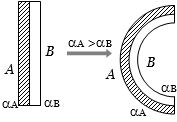
(C) bimetallic strip consists of two different metals with different coefficients of linear expansion ($\alpha_A$ and $\alpha_B$).
When the strip is heated, both metals expand, but the metal with the higher coefficient of linear expansion expands more than the other.
As shown in the figure, if $\alpha_A > \alpha_B$, metal $A$ will expand more than metal $B$.
To accommodate this difference in length while remaining bonded together, the strip must bend.
The metal with the higher expansion coefficient $(A)$ forms the outer side of the arc, while the metal with the lower expansion coefficient $(B)$ forms the inner side.
Therefore, the correct option is $C$.
When the strip is heated, both metals expand, but the metal with the higher coefficient of linear expansion expands more than the other.
As shown in the figure, if $\alpha_A > \alpha_B$, metal $A$ will expand more than metal $B$.
To accommodate this difference in length while remaining bonded together, the strip must bend.
The metal with the higher expansion coefficient $(A)$ forms the outer side of the arc, while the metal with the lower expansion coefficient $(B)$ forms the inner side.
Therefore, the correct option is $C$.
0 likesView Solution
9
PhysicsEasyMCQAIPMT · 1990
The thermal capacity of $40\, g$ of aluminium (specific heat $= 0.2\, cal/g/^{\circ}C$) is ........ $cal/^{\circ}C$.
A
$40$
B
$160$
C
$200$
D
$8$
Solution
(D) Thermal capacity is defined as the product of the mass of the substance $(m)$ and its specific heat capacity $(c)$.
Given:
Mass $(m)$ $= 40\, g$
Specific heat $(c)$ $= 0.2\, cal/g/^{\circ}C$
Thermal capacity $= m \times c$
Thermal capacity $= 40\, g \times 0.2\, cal/g/^{\circ}C = 8\, cal/^{\circ}C$.
Therefore, the correct option is $D$.
Given:
Mass $(m)$ $= 40\, g$
Specific heat $(c)$ $= 0.2\, cal/g/^{\circ}C$
Thermal capacity $= m \times c$
Thermal capacity $= 40\, g \times 0.2\, cal/g/^{\circ}C = 8\, cal/^{\circ}C$.
Therefore, the correct option is $D$.
0 likesView Solution
10
PhysicsEasyMCQAIPMT · 1990
The root mean square velocity of a gas molecule of mass $m$ at a given temperature is proportional to
A
$m^0$
B
$m$
C
$\sqrt{m}$
D
$\frac{1}{\sqrt{m}}$
Solution
(D) The root mean square velocity $(v_{rms})$ of a gas molecule is given by the formula:
$v_{rms} = \sqrt{\frac{3kT}{m}}$
where $k$ is the Boltzmann constant,$T$ is the absolute temperature,and $m$ is the mass of the molecule.
From this expression,it is clear that $v_{rms}$ is inversely proportional to the square root of the mass of the molecule.
Therefore,$v_{rms} \propto \frac{1}{\sqrt{m}}$.
$v_{rms} = \sqrt{\frac{3kT}{m}}$
where $k$ is the Boltzmann constant,$T$ is the absolute temperature,and $m$ is the mass of the molecule.
From this expression,it is clear that $v_{rms}$ is inversely proportional to the square root of the mass of the molecule.
Therefore,$v_{rms} \propto \frac{1}{\sqrt{m}}$.
0 likesView Solution
11
PhysicsEasyMCQAIPMT · 1990
According to the kinetic theory of gases,at absolute temperature
A
Water freezes
B
Liquid helium freezes
C
Molecular motion stops
D
Liquid hydrogen freezes
Solution
(C) According to the kinetic theory of gases,the root mean square velocity of gas molecules is given by the formula $v_{rms} = \sqrt{\frac{3RT}{M}}$.
At absolute temperature,$T = 0 \ K$.
Substituting this value into the formula,we get $v_{rms} = \sqrt{\frac{3R(0)}{M}} = 0$.
Since the root mean square velocity represents the average motion of the molecules,a velocity of $0$ implies that all molecular motion ceases at absolute zero.
At absolute temperature,$T = 0 \ K$.
Substituting this value into the formula,we get $v_{rms} = \sqrt{\frac{3R(0)}{M}} = 0$.
Since the root mean square velocity represents the average motion of the molecules,a velocity of $0$ implies that all molecular motion ceases at absolute zero.
0 likesView Solution
12
PhysicsMediumMCQAIPMT · 1990
For a certain gas,the ratio of specific heats is given to be $\gamma = 1.5$. For this gas,
A
${C_V} = \frac{3R}{J}$
B
${C_P} = \frac{3R}{J}$
C
${C_P} = \frac{5R}{J}$
D
${C_V} = \frac{5R}{J}$
Solution
(B) We know that the molar specific heat at constant volume is given by ${C_V} = \frac{R}{J(\gamma - 1)}$.
Substituting $\gamma = 1.5$,we get ${C_V} = \frac{R}{J(1.5 - 1)} = \frac{R}{J(0.5)} = \frac{2R}{J}$.
Using Mayer's relation,${C_P} - {C_V} = \frac{R}{J}$,we have ${C_P} = {C_V} + \frac{R}{J}$.
Substituting the value of ${C_V}$,we get ${C_P} = \frac{2R}{J} + \frac{R}{J} = \frac{3R}{J}$.
Thus,the correct option is ${C_P} = \frac{3R}{J}$.
Substituting $\gamma = 1.5$,we get ${C_V} = \frac{R}{J(1.5 - 1)} = \frac{R}{J(0.5)} = \frac{2R}{J}$.
Using Mayer's relation,${C_P} - {C_V} = \frac{R}{J}$,we have ${C_P} = {C_V} + \frac{R}{J}$.
Substituting the value of ${C_V}$,we get ${C_P} = \frac{2R}{J} + \frac{R}{J} = \frac{3R}{J}$.
Thus,the correct option is ${C_P} = \frac{3R}{J}$.
0 likesView Solution
13
PhysicsMediumMCQAIPMT · 1990
One mole of an ideal gas requires $207 \, J$ of heat to raise the temperature by $10 \, K$ when heated at constant pressure. If the same gas is heated at constant volume to raise the temperature by the same $10 \, K$,the heat required is ...... $J$ (Given the gas constant $R = 8.3 \, J/mol \cdot K$)
A
$198.7$
B
$29$
C
$215.3$
D
$124$
Solution
(D) The heat required at constant pressure is given by $(\Delta Q)_P = n C_P \Delta T$.
Given $n = 1 \, mol$,$(\Delta Q)_P = 207 \, J$,and $\Delta T = 10 \, K$.
$207 = 1 \times C_P \times 10 \implies C_P = 20.7 \, J/mol \cdot K$.
Using Mayer's relation,$C_P - C_V = R$,we find $C_V = C_P - R$.
$C_V = 20.7 - 8.3 = 12.4 \, J/mol \cdot K$.
The heat required at constant volume is $(\Delta Q)_V = n C_V \Delta T$.
$(\Delta Q)_V = 1 \times 12.4 \times 10 = 124 \, J$.
Given $n = 1 \, mol$,$(\Delta Q)_P = 207 \, J$,and $\Delta T = 10 \, K$.
$207 = 1 \times C_P \times 10 \implies C_P = 20.7 \, J/mol \cdot K$.
Using Mayer's relation,$C_P - C_V = R$,we find $C_V = C_P - R$.
$C_V = 20.7 - 8.3 = 12.4 \, J/mol \cdot K$.
The heat required at constant volume is $(\Delta Q)_V = n C_V \Delta T$.
$(\Delta Q)_V = 1 \times 12.4 \times 10 = 124 \, J$.
0 likesView Solution
14
PhysicsEasyMCQAIPMT · 1990
The first law of thermodynamics is concerned with the conservation of
A
Momentum
B
Energy
C
Mass
D
Temperature
Solution
(B) According to the first law of thermodynamics,
$Q = \Delta U + W$
where $Q$ is the heat supplied to the system,$\Delta U$ is the change in internal energy,and $W$ is the work done by the system.
This law is a statement of the law of conservation of energy,which states that energy can neither be created nor destroyed,only transformed from one form to another.
$Q = \Delta U + W$
where $Q$ is the heat supplied to the system,$\Delta U$ is the change in internal energy,and $W$ is the work done by the system.
This law is a statement of the law of conservation of energy,which states that energy can neither be created nor destroyed,only transformed from one form to another.
0 likesView Solution
15
PhysicsEasyMCQAIPMT · 1990
$A$ mass $m$ is suspended from two coupled springs connected in series. The force constants for the springs are $K_1$ and $K_2$. The time period of the suspended mass will be:
A
$T = 2\pi \sqrt{\frac{m}{K_1 + K_2}}$
B
$T = 2\pi \sqrt{\frac{m(K_1 + K_2)}{K_1 K_2}}$
C
$T = 2\pi \sqrt{\frac{m(K_1 + K_2)}{K_1 K_2}}$
D
$T = 2\pi \sqrt{\frac{m K_1 K_2}{K_1 + K_2}}$
Solution
(C) When two springs with force constants $K_1$ and $K_2$ are connected in series,the equivalent force constant $K_{eq}$ is given by the formula:
$\frac{1}{K_{eq}} = \frac{1}{K_1} + \frac{1}{K_2}$
$\frac{1}{K_{eq}} = \frac{K_1 + K_2}{K_1 K_2}$
$K_{eq} = \frac{K_1 K_2}{K_1 + K_2}$
The time period $T$ of a mass-spring system is given by $T = 2\pi \sqrt{\frac{m}{K_{eq}}}$.
Substituting the value of $K_{eq}$:
$T = 2\pi \sqrt{\frac{m}{\frac{K_1 K_2}{K_1 + K_2}}}$
$T = 2\pi \sqrt{\frac{m(K_1 + K_2)}{K_1 K_2}}$
$\frac{1}{K_{eq}} = \frac{1}{K_1} + \frac{1}{K_2}$
$\frac{1}{K_{eq}} = \frac{K_1 + K_2}{K_1 K_2}$
$K_{eq} = \frac{K_1 K_2}{K_1 + K_2}$
The time period $T$ of a mass-spring system is given by $T = 2\pi \sqrt{\frac{m}{K_{eq}}}$.
Substituting the value of $K_{eq}$:
$T = 2\pi \sqrt{\frac{m}{\frac{K_1 K_2}{K_1 + K_2}}}$
$T = 2\pi \sqrt{\frac{m(K_1 + K_2)}{K_1 K_2}}$
0 likesView Solution
16
PhysicsMediumMCQAIPMT · 1990
The composition of two simple harmonic motions of equal periods at right angles to each other and with a phase difference of $\pi$ results in the displacement of the particle along
A
Straight line
B
Circle
C
Ellipse
D
Figure of eight
Solution
(A) Let the two simple harmonic motions (SHMs) be represented as:
$x = a_1 \sin(\omega t)$
$y = a_2 \sin(\omega t + \pi)$
Since $\sin(\omega t + \pi) = -\sin(\omega t)$,we have:
$y = -a_2 \sin(\omega t)$
From the first equation,$\sin(\omega t) = \frac{x}{a_1}$.
Substituting this into the second equation:
$y = -a_2 \left(\frac{x}{a_1}\right)$
$y = -\left(\frac{a_2}{a_1}\right)x$
This is the equation of a straight line passing through the origin with a negative slope. Thus,the particle moves along a straight line.
$x = a_1 \sin(\omega t)$
$y = a_2 \sin(\omega t + \pi)$
Since $\sin(\omega t + \pi) = -\sin(\omega t)$,we have:
$y = -a_2 \sin(\omega t)$
From the first equation,$\sin(\omega t) = \frac{x}{a_1}$.
Substituting this into the second equation:
$y = -a_2 \left(\frac{x}{a_1}\right)$
$y = -\left(\frac{a_2}{a_1}\right)x$
This is the equation of a straight line passing through the origin with a negative slope. Thus,the particle moves along a straight line.
0 likesView Solution
17
PhysicsMediumMCQAIPMT · 1990
The velocity of sound waves in air is $330 \; m/s$. For a particular sound wave in air,a path difference of $40 \; cm$ is equivalent to a phase difference of $1.6 \pi$. The frequency of this wave is ... $Hz$.
A
$165$
B
$150$
C
$660$
D
$330$
Solution
(C) The relationship between phase difference $(\Delta \phi)$ and path difference $(\Delta x)$ is given by: $\Delta \phi = \frac{2\pi}{\lambda} \times \Delta x$.
Given $\Delta \phi = 1.6 \pi$ and $\Delta x = 40 \; cm = 0.4 \; m$.
Substituting these values: $1.6 \pi = \frac{2\pi}{\lambda} \times 0.4$.
Solving for wavelength $(\lambda)$: $\lambda = \frac{2 \times 0.4}{1.6} = \frac{0.8}{1.6} = 0.5 \; m$.
Using the wave equation $v = f \lambda$,where $v = 330 \; m/s$ and $\lambda = 0.5 \; m$:
$330 = f \times 0.5$.
Therefore,$f = \frac{330}{0.5} = 660 \; Hz$.
Given $\Delta \phi = 1.6 \pi$ and $\Delta x = 40 \; cm = 0.4 \; m$.
Substituting these values: $1.6 \pi = \frac{2\pi}{\lambda} \times 0.4$.
Solving for wavelength $(\lambda)$: $\lambda = \frac{2 \times 0.4}{1.6} = \frac{0.8}{1.6} = 0.5 \; m$.
Using the wave equation $v = f \lambda$,where $v = 330 \; m/s$ and $\lambda = 0.5 \; m$:
$330 = f \times 0.5$.
Therefore,$f = \frac{330}{0.5} = 660 \; Hz$.
0 likesView Solution
18
PhysicsMediumMCQAIPMT · 1990
The moment of inertia of a uniform circular disc about a diameter is $I$. What is its moment of inertia about an axis perpendicular to its plane and passing through a point on its rim (in $I$)?
A
$5$
B
$6$
C
$3$
D
$4$
Solution
(B) The moment of inertia of a uniform circular disc of mass $M$ and radius $R$ about its diameter is given by $I = \frac{1}{4}MR^2$.
Given that this value is $I$,we have $MR^2 = 4I$.
To find the moment of inertia about an axis perpendicular to the plane and passing through a point on the rim,we use the parallel axis theorem.
First,the moment of inertia about an axis perpendicular to the plane and passing through the center of mass is $I_{cm} = \frac{1}{2}MR^2$.
By the parallel axis theorem,$I_{rim} = I_{cm} + Md^2$,where $d = R$ is the distance between the axes.
$I_{rim} = \frac{1}{2}MR^2 + MR^2 = \frac{3}{2}MR^2$.
Substituting $MR^2 = 4I$ into the expression:
$I_{rim} = \frac{3}{2}(4I) = 6I$.
Given that this value is $I$,we have $MR^2 = 4I$.
To find the moment of inertia about an axis perpendicular to the plane and passing through a point on the rim,we use the parallel axis theorem.
First,the moment of inertia about an axis perpendicular to the plane and passing through the center of mass is $I_{cm} = \frac{1}{2}MR^2$.
By the parallel axis theorem,$I_{rim} = I_{cm} + Md^2$,where $d = R$ is the distance between the axes.
$I_{rim} = \frac{1}{2}MR^2 + MR^2 = \frac{3}{2}MR^2$.
Substituting $MR^2 = 4I$ into the expression:
$I_{rim} = \frac{3}{2}(4I) = 6I$.
0 likesView Solution
19
PhysicsMediumMCQAIPMT · 1990
The moment of inertia of a body about a given axis is $1.2 \; kg \cdot m^2$. Initially,the body is at rest. In order to produce a rotational kinetic energy of $1500 \; J$,an angular acceleration of $25 \; rad/s^2$ must be applied about that axis for a duration of: (in $; s$)
A
$4$
B
$2$
C
$8$
D
$10$
Solution
(B) Given: Moment of inertia $I = 1.2 \; kg \cdot m^2$,initial angular velocity $\omega_0 = 0$,rotational kinetic energy $K_r = 1500 \; J$,and angular acceleration $\alpha = 25 \; rad/s^2$.
The formula for rotational kinetic energy is $K_r = \frac{1}{2} I \omega^2$.
Substituting the values: $1500 = \frac{1}{2} \times 1.2 \times \omega^2$.
$1500 = 0.6 \times \omega^2 \Rightarrow \omega^2 = \frac{1500}{0.6} = 2500$.
Thus,the final angular velocity $\omega = \sqrt{2500} = 50 \; rad/s$.
Using the kinematic equation for rotation: $\omega = \omega_0 + \alpha t$.
$50 = 0 + 25 \times t$.
$t = \frac{50}{25} = 2 \; s$.
The formula for rotational kinetic energy is $K_r = \frac{1}{2} I \omega^2$.
Substituting the values: $1500 = \frac{1}{2} \times 1.2 \times \omega^2$.
$1500 = 0.6 \times \omega^2 \Rightarrow \omega^2 = \frac{1500}{0.6} = 2500$.
Thus,the final angular velocity $\omega = \sqrt{2500} = 50 \; rad/s$.
Using the kinematic equation for rotation: $\omega = \omega_0 + \alpha t$.
$50 = 0 + 25 \times t$.
$t = \frac{50}{25} = 2 \; s$.
0 likesView Solution
20
PhysicsEasyMCQAIPMT · 1990
$A$ flywheel rotating about a fixed axis has a kinetic energy of $360 \ J$ when its angular speed is $30 \ rad/s$. The moment of inertia of the wheel about the axis of rotation is ...... $kg \ m^2$.
A
$0.6$
B
$0.15$
C
$0.8$
D
$0.75$
Solution
(C) The rotational kinetic energy $(K)$ of a body rotating about a fixed axis is given by the formula: $K = \frac{1}{2} I \omega^2$,where $I$ is the moment of inertia and $\omega$ is the angular speed.
Given:
Kinetic energy $(K)$ = $360 \ J$
Angular speed $(\omega)$ = $30 \ rad/s$
Substituting the values into the formula:
$360 = \frac{1}{2} \times I \times (30)^2$
$360 = \frac{1}{2} \times I \times 900$
$360 = 450 \times I$
$I = \frac{360}{450}$
$I = 0.8 \ kg \ m^2$
Therefore,the moment of inertia of the wheel is $0.8 \ kg \ m^2$.
Given:
Kinetic energy $(K)$ = $360 \ J$
Angular speed $(\omega)$ = $30 \ rad/s$
Substituting the values into the formula:
$360 = \frac{1}{2} \times I \times (30)^2$
$360 = \frac{1}{2} \times I \times 900$
$360 = 450 \times I$
$I = \frac{360}{450}$
$I = 0.8 \ kg \ m^2$
Therefore,the moment of inertia of the wheel is $0.8 \ kg \ m^2$.
0 likesView Solution
21
PhysicsMediumMCQAIPMT · 1990
$A$ $600\; kg$ rocket is set for a vertical firing. If the exhaust speed is $1000\; m/s$,the mass of the gas ejected per second (in $kg/s$) to supply the thrust needed to overcome the weight of the rocket is
A
$117.6$
B
$6$
C
$58.6$
D
$76.4$
Solution
(B) The thrust force $F$ required to overcome the weight of the rocket is given by $F = mg$.
The thrust force produced by the rocket engine is given by $F = v \frac{dm}{dt}$,where $v$ is the exhaust speed and $\frac{dm}{dt}$ is the rate of mass ejection.
Equating the two forces: $mg = v \frac{dm}{dt}$.
Rearranging to solve for the rate of mass ejection: $\frac{dm}{dt} = \frac{mg}{v}$.
Given $m = 600\; kg$,$g = 10\; m/s^2$,and $v = 1000\; m/s$:
$\frac{dm}{dt} = \frac{600 \times 10}{1000} = \frac{6000}{1000} = 6\; kg/s$.
The thrust force produced by the rocket engine is given by $F = v \frac{dm}{dt}$,where $v$ is the exhaust speed and $\frac{dm}{dt}$ is the rate of mass ejection.
Equating the two forces: $mg = v \frac{dm}{dt}$.
Rearranging to solve for the rate of mass ejection: $\frac{dm}{dt} = \frac{mg}{v}$.
Given $m = 600\; kg$,$g = 10\; m/s^2$,and $v = 1000\; m/s$:
$\frac{dm}{dt} = \frac{600 \times 10}{1000} = \frac{6000}{1000} = 6\; kg/s$.
0 likesView Solution
22
PhysicsMediumMCQAIPMT · 1990
$A$ Centigrade and a Fahrenheit thermometer are dipped in boiling water. The water temperature is lowered until the Fahrenheit thermometer registers $140\,^{\circ}F$. What is the fall in temperature as registered by the centigrade thermometer?
A
$30$
B
$40$
C
$60$
D
$80$
Solution
(B) The initial temperature of boiling water is $100\,^{\circ}C$ or $212\,^{\circ}F$.
The final temperature in Fahrenheit is $F = 140\,^{\circ}F$.
Using the conversion formula $\frac{C}{100} = \frac{F-32}{180}$,we find the final temperature in Celsius:
$\frac{C}{100} = \frac{140-32}{180} = \frac{108}{180} = 0.6$
$C = 60\,^{\circ}C$.
The fall in temperature on the Centigrade scale is $\Delta C = 100\,^{\circ}C - 60\,^{\circ}C = 40\,^{\circ}C$.
The final temperature in Fahrenheit is $F = 140\,^{\circ}F$.
Using the conversion formula $\frac{C}{100} = \frac{F-32}{180}$,we find the final temperature in Celsius:
$\frac{C}{100} = \frac{140-32}{180} = \frac{108}{180} = 0.6$
$C = 60\,^{\circ}C$.
The fall in temperature on the Centigrade scale is $\Delta C = 100\,^{\circ}C - 60\,^{\circ}C = 40\,^{\circ}C$.
0 likesView Solution
23
PhysicsEasyMCQAIPMT · 1990
$A$ particle of mass $m$ is moving with a uniform velocity $v_1$. It is given an impulse such that its velocity becomes $v_2$. The impulse is equal to
A
$m(v_2 - v_1)$
B
$m(v_1 + v_2)$
C
$\frac{1}{2} m(|v_2^2| - |v_1^2|)$
D
$m(|v_2| - |v_1|)$
Solution
(A) Impulse is defined as the change in momentum of a body.
Mathematically,Impulse $J = \Delta p = p_f - p_i$.
Given the initial velocity is $v_1$ and the final velocity is $v_2$,the initial momentum is $p_i = m v_1$ and the final momentum is $p_f = m v_2$.
Therefore,Impulse $J = m v_2 - m v_1 = m(v_2 - v_1)$.
Mathematically,Impulse $J = \Delta p = p_f - p_i$.
Given the initial velocity is $v_1$ and the final velocity is $v_2$,the initial momentum is $p_i = m v_1$ and the final momentum is $p_f = m v_2$.
Therefore,Impulse $J = m v_2 - m v_1 = m(v_2 - v_1)$.
0 likesView Solution
24
PhysicsMediumMCQAIPMT · 1990
$A$ planet is moving in an elliptical orbit around the sun. If $T, V, E$,and $L$ stand respectively for its kinetic energy,gravitational potential energy,total energy,and magnitude of angular momentum about the centre of force,which of the following is correct?
A
$T$ is conserved
B
$V$ is always positive
C
$L$ is conserved but the direction of vector $L$ changes continuously
D
$E$ is always negative
Solution
(D) $1$. In an elliptical orbit,the planet's distance from the sun changes,causing the speed to vary. Therefore,kinetic energy $T$ is not conserved.
$2$. Gravitational potential energy $V$ is defined as $V = -GMm/r$,which is always negative for bound states.
$3$. Angular momentum $L$ is conserved in magnitude and direction because the gravitational force is a central force,meaning the torque $\tau = r \times F = 0$. Since the motion is confined to a plane,the direction of the angular momentum vector remains constant.
$4$. For a bound orbit (elliptical),the total mechanical energy $E = T + V$ is always negative,representing the energy required to escape the gravitational field.
$2$. Gravitational potential energy $V$ is defined as $V = -GMm/r$,which is always negative for bound states.
$3$. Angular momentum $L$ is conserved in magnitude and direction because the gravitational force is a central force,meaning the torque $\tau = r \times F = 0$. Since the motion is confined to a plane,the direction of the angular momentum vector remains constant.
$4$. For a bound orbit (elliptical),the total mechanical energy $E = T + V$ is always negative,representing the energy required to escape the gravitational field.
0 likesView Solution
25
PhysicsDifficultMCQAIPMT · 1990
There are two inclined surfaces of equal length $(L)$ and the same angle of inclination $45^{\circ}$ with the horizontal. One of them is rough and the other is perfectly smooth. $A$ given body takes $2$ times as much time to slide down the rough surface than on the smooth surface. The coefficient of kinetic friction $(\mu_k)$ between the object and the rough surface is close to:
A
$0.25$
B
$0.40$
C
$0.5$
D
$0.75$
Solution
(D) For a body sliding down an inclined plane of length $L$ starting from rest,the time taken is given by $L = \frac{1}{2} a t^2$,where $a$ is the acceleration.
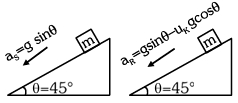
For the smooth surface,acceleration $a_S = g \sin \theta$. Thus,$L = \frac{1}{2} (g \sin \theta) t_S^2$.
For the rough surface,acceleration $a_R = g \sin \theta - \mu_k g \cos \theta$. Thus,$L = \frac{1}{2} (g \sin \theta - \mu_k g \cos \theta) t_R^2$.
Since $L$ is the same for both,$\frac{1}{2} a_S t_S^2 = \frac{1}{2} a_R t_R^2$,which implies $\frac{a_R}{a_S} = \left(\frac{t_S}{t_R}\right)^2$.
Given $t_R = 2 t_S$,we have $\frac{a_R}{a_S} = \left(\frac{t_S}{2 t_S}\right)^2 = \left(\frac{1}{2}\right)^2 = \frac{1}{4}$.
Substituting the expressions for acceleration: $\frac{g \sin \theta - \mu_k g \cos \theta}{g \sin \theta} = \frac{1}{4}$.
Since $\theta = 45^{\circ}$,$\sin 45^{\circ} = \cos 45^{\circ} = \frac{1}{\sqrt{2}}$.
Therefore,$\frac{\frac{1}{\sqrt{2}} - \mu_k \frac{1}{\sqrt{2}}}{\frac{1}{\sqrt{2}}} = \frac{1}{4}$.
$1 - \mu_k = \frac{1}{4} \Rightarrow \mu_k = 1 - 0.25 = 0.75$.
For the smooth surface,acceleration $a_S = g \sin \theta$. Thus,$L = \frac{1}{2} (g \sin \theta) t_S^2$.
For the rough surface,acceleration $a_R = g \sin \theta - \mu_k g \cos \theta$. Thus,$L = \frac{1}{2} (g \sin \theta - \mu_k g \cos \theta) t_R^2$.
Since $L$ is the same for both,$\frac{1}{2} a_S t_S^2 = \frac{1}{2} a_R t_R^2$,which implies $\frac{a_R}{a_S} = \left(\frac{t_S}{t_R}\right)^2$.
Given $t_R = 2 t_S$,we have $\frac{a_R}{a_S} = \left(\frac{t_S}{2 t_S}\right)^2 = \left(\frac{1}{2}\right)^2 = \frac{1}{4}$.
Substituting the expressions for acceleration: $\frac{g \sin \theta - \mu_k g \cos \theta}{g \sin \theta} = \frac{1}{4}$.
Since $\theta = 45^{\circ}$,$\sin 45^{\circ} = \cos 45^{\circ} = \frac{1}{\sqrt{2}}$.
Therefore,$\frac{\frac{1}{\sqrt{2}} - \mu_k \frac{1}{\sqrt{2}}}{\frac{1}{\sqrt{2}}} = \frac{1}{4}$.
$1 - \mu_k = \frac{1}{4} \Rightarrow \mu_k = 1 - 0.25 = 0.75$.
0 likesView Solution
26
PhysicsMediumMCQAIPMT · 1990
You are given several identical resistances each of value $R = 10\,\Omega$ and each capable of carrying a maximum current of $1\,A$. It is required to make a suitable combination of these resistances to produce a resistance of $5\,\Omega$ which can carry a current of $4\,A$. The minimum number of resistances of the type $R$ that will be required for this job is:
A
$4$
B
$10$
C
$8$
D
$20$
Solution
(C) Let $n$ be the total number of resistors used. Let the equivalent resistance be $R_{eq} = 5\,\Omega$ and the maximum current capacity be $I_{total} = 4\,A$.
Each resistor has $R = 10\,\Omega$ and $I_{max} = 1\,A$.
The power dissipated by the combination is $P = I_{total}^2 \times R_{eq} = 4^2 \times 5 = 16 \times 5 = 80\,W$.
The power dissipated by each individual resistor is $P_{res} = I_{max}^2 \times R = 1^2 \times 10 = 10\,W$.
Since the total power is the sum of power dissipated by each resistor,we have $n = P / P_{res} = 80 / 10 = 8$.
Thus,a minimum of $8$ resistors is required.
Each resistor has $R = 10\,\Omega$ and $I_{max} = 1\,A$.
The power dissipated by the combination is $P = I_{total}^2 \times R_{eq} = 4^2 \times 5 = 16 \times 5 = 80\,W$.
The power dissipated by each individual resistor is $P_{res} = I_{max}^2 \times R = 1^2 \times 10 = 10\,W$.
Since the total power is the sum of power dissipated by each resistor,we have $n = P / P_{res} = 80 / 10 = 8$.
Thus,a minimum of $8$ resistors is required.
0 likesView Solution
27
PhysicsMediumMCQAIPMT · 1990
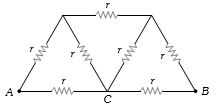
In the circuit shown,the value of each resistance is $r$. The equivalent resistance of the circuit between points $A$ and $B$ will be:
A
$(4/3) r$
B
$3r / 2$
C
$r / 3$
D
$8r / 7$
Solution
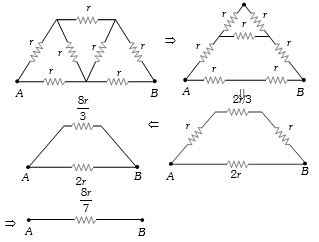
(D) The circuit can be simplified by identifying series and parallel combinations.
$1$. The two resistors connected to point $C$ form a delta-star or can be simplified by recognizing symmetry. Alternatively,observe the top triangle: the two resistors of resistance $r$ are in series,giving $2r$. This $2r$ is in parallel with the third resistor $r$ of the top triangle.
$2$. The equivalent resistance of the top part is $R_{top} = (2r \times r) / (2r + r) = (2/3)r$.
$3$. Now,this $R_{top}$ is in series with the two resistors connected to $A$ and $B$ respectively,but looking at the structure,we can simplify the network into a parallel combination of branches.
$4$. The total resistance between $A$ and $B$ is found by reducing the network step-by-step to a single equivalent resistor,which results in $R_{eq} = 8r / 7$.
$1$. The two resistors connected to point $C$ form a delta-star or can be simplified by recognizing symmetry. Alternatively,observe the top triangle: the two resistors of resistance $r$ are in series,giving $2r$. This $2r$ is in parallel with the third resistor $r$ of the top triangle.
$2$. The equivalent resistance of the top part is $R_{top} = (2r \times r) / (2r + r) = (2/3)r$.
$3$. Now,this $R_{top}$ is in series with the two resistors connected to $A$ and $B$ respectively,but looking at the structure,we can simplify the network into a parallel combination of branches.
$4$. The total resistance between $A$ and $B$ is found by reducing the network step-by-step to a single equivalent resistor,which results in $R_{eq} = 8r / 7$.
0 likesView Solution
28
PhysicsMediumMCQAIPMT · 1990
Two identical batteries, each of $e.m.f.$ $2\,V$ and internal resistance $1.0\,\Omega$, are available to produce heat in an external resistance $R = 0.5\,\Omega$ by passing a current through it. The maximum Joulean power that can be developed across $R$ using these batteries is ............. $W$.
A
$1.28$
B
$2$
C
$8/9$
D
$3.2$
Solution
(B) For two identical batteries of $e.m.f.$ $E = 2\,V$ and internal resistance $r = 1.0\,\Omega$, we can connect them in series or parallel.
Case $1$: Series connection.
Total $e.m.f.$ $E_{eq} = 2E = 4\,V$.
Total internal resistance $r_{eq} = 2r = 2.0\,\Omega$.
Current $I = E_{eq} / (R + r_{eq}) = 4 / (0.5 + 2.0) = 4 / 2.5 = 1.6\,A$.
Power $P = I^2 R = (1.6)^2 \times 0.5 = 2.56 \times 0.5 = 1.28\,W$.
Case $2$: Parallel connection.
Total $e.m.f.$ $E_{eq} = E = 2\,V$.
Total internal resistance $r_{eq} = r/2 = 0.5\,\Omega$.
Current $I = E_{eq} / (R + r_{eq}) = 2 / (0.5 + 0.5) = 2 / 1.0 = 2.0\,A$.
Power $P = I^2 R = (2.0)^2 \times 0.5 = 4.0 \times 0.5 = 2.0\,W$.
Comparing both cases, the maximum power is $2.0\,W$.
Case $1$: Series connection.
Total $e.m.f.$ $E_{eq} = 2E = 4\,V$.
Total internal resistance $r_{eq} = 2r = 2.0\,\Omega$.
Current $I = E_{eq} / (R + r_{eq}) = 4 / (0.5 + 2.0) = 4 / 2.5 = 1.6\,A$.
Power $P = I^2 R = (1.6)^2 \times 0.5 = 2.56 \times 0.5 = 1.28\,W$.
Case $2$: Parallel connection.
Total $e.m.f.$ $E_{eq} = E = 2\,V$.
Total internal resistance $r_{eq} = r/2 = 0.5\,\Omega$.
Current $I = E_{eq} / (R + r_{eq}) = 2 / (0.5 + 0.5) = 2 / 1.0 = 2.0\,A$.
Power $P = I^2 R = (2.0)^2 \times 0.5 = 4.0 \times 0.5 = 2.0\,W$.
Comparing both cases, the maximum power is $2.0\,W$.
0 likesView Solution
29
PhysicsEasyMCQAIPMT · 1990
The magnetic induction at a point $P$ which is distant $4 \, cm$ from a long current-carrying wire is $10^{-8} \, T$. The magnetic field induction at a distance $12 \, cm$ from the same current would be:
A
$3.33 \times 10^{-9} \, T$
B
$1.11 \times 10^{-4} \, T$
C
$3 \times 10^{-3} \, T$
D
$9 \times 10^{-2} \, T$
Solution
(A) The magnetic field $B$ due to a long straight current-carrying wire at a distance $r$ is given by the formula: $B = \frac{\mu_0}{4\pi} \cdot \frac{2i}{r}$.
Since the current $i$ is constant,the magnetic field is inversely proportional to the distance $r$,i.e.,$B \propto \frac{1}{r}$.
Therefore,we can write the ratio: $\frac{B_1}{B_2} = \frac{r_2}{r_1}$.
Given: $B_1 = 10^{-8} \, T$,$r_1 = 4 \, cm$,and $r_2 = 12 \, cm$.
Substituting the values: $\frac{10^{-8}}{B_2} = \frac{12}{4}$.
$\frac{10^{-8}}{B_2} = 3$.
$B_2 = \frac{10^{-8}}{3} = 3.33 \times 10^{-9} \, T$.
Since the current $i$ is constant,the magnetic field is inversely proportional to the distance $r$,i.e.,$B \propto \frac{1}{r}$.
Therefore,we can write the ratio: $\frac{B_1}{B_2} = \frac{r_2}{r_1}$.
Given: $B_1 = 10^{-8} \, T$,$r_1 = 4 \, cm$,and $r_2 = 12 \, cm$.
Substituting the values: $\frac{10^{-8}}{B_2} = \frac{12}{4}$.
$\frac{10^{-8}}{B_2} = 3$.
$B_2 = \frac{10^{-8}}{3} = 3.33 \times 10^{-9} \, T$.
0 likesView Solution
30
PhysicsEasyMCQAIPMT · 1990
In what form is the energy stored in an inductor?
A
Magnetic
B
Electrical
C
Both magnetic and electrical
D
Heat
Solution
(A) The energy stored in an inductor is given by the formula $U = \frac{1}{2} L i^2$,where $L$ is the self-inductance and $i$ is the current flowing through the inductor.
This energy is associated with the magnetic field produced by the current in the inductor.
Therefore,the energy is stored in the form of a magnetic field.
This energy is associated with the magnetic field produced by the current in the inductor.
Therefore,the energy is stored in the form of a magnetic field.
0 likesView Solution
31
PhysicsMediumMCQAIPMT · 1990
In a region of uniform magnetic induction $B = 10^{-2} \, T$,a circular coil of radius $r = 30 \, cm$ and resistance $R = \pi^2 \, \Omega$ is rotated about an axis which is perpendicular to the direction of $B$ and which forms a diameter of the coil. If the coil rotates at $200 \, rpm$,the amplitude of the alternating current induced in the coil is.....$mA$.
A
$4\pi^2$
B
$30$
C
$6$
D
$200$
Solution
(C) The magnetic flux through the coil at any time $t$ is given by $\phi = NBA \cos(\omega t)$,where $\omega$ is the angular frequency.
The induced electromotive force $(EMF)$ is $e = -\frac{d\phi}{dt} = NBA\omega \sin(\omega t)$.
The amplitude of the induced $EMF$ is $e_0 = NBA\omega$.
The amplitude of the induced current is $i_0 = \frac{e_0}{R} = \frac{NBA\omega}{R}$.
Given: $B = 10^{-2} \, T$,$r = 0.3 \, m$,$A = \pi r^2 = \pi(0.3)^2 = 0.09\pi \, m^2$,$R = \pi^2 \, \Omega$,and frequency $f = \frac{200}{60} = \frac{10}{3} \, Hz$.
Angular frequency $\omega = 2\pi f = 2\pi \times \frac{10}{3} = \frac{20\pi}{3} \, rad/s$.
Assuming $N=1$ (single turn coil):
$i_0 = \frac{1 \times 10^{-2} \times (0.09\pi) \times (20\pi/3)}{\pi^2} = \frac{10^{-2} \times 0.03 \times 20 \times \pi^2}{\pi^2} = 0.006 \, A = 6 \, mA$.
The induced electromotive force $(EMF)$ is $e = -\frac{d\phi}{dt} = NBA\omega \sin(\omega t)$.
The amplitude of the induced $EMF$ is $e_0 = NBA\omega$.
The amplitude of the induced current is $i_0 = \frac{e_0}{R} = \frac{NBA\omega}{R}$.
Given: $B = 10^{-2} \, T$,$r = 0.3 \, m$,$A = \pi r^2 = \pi(0.3)^2 = 0.09\pi \, m^2$,$R = \pi^2 \, \Omega$,and frequency $f = \frac{200}{60} = \frac{10}{3} \, Hz$.
Angular frequency $\omega = 2\pi f = 2\pi \times \frac{10}{3} = \frac{20\pi}{3} \, rad/s$.
Assuming $N=1$ (single turn coil):
$i_0 = \frac{1 \times 10^{-2} \times (0.09\pi) \times (20\pi/3)}{\pi^2} = \frac{10^{-2} \times 0.03 \times 20 \times \pi^2}{\pi^2} = 0.006 \, A = 6 \, mA$.
0 likesView Solution
32
PhysicsMediumMCQAIPMT · 1990
The momentum of a photon is $3.3 \times 10^{-29} \ kg \ m/s$. Its frequency will be
A
$3 \times 10^3 \ Hz$
B
$6 \times 10^3 \ Hz$
C
$7.5 \times 10^{12} \ Hz$
D
$1.5 \times 10^{13} \ Hz$
Solution
(D) The momentum $p$ of a photon is related to its frequency $\nu$ by the formula: $p = \frac{h\nu}{c}$.
Rearranging for frequency $\nu$,we get: $\nu = \frac{pc}{h}$.
Given: $p = 3.3 \times 10^{-29} \ kg \ m/s$,$c = 3 \times 10^8 \ m/s$,and Planck's constant $h = 6.6 \times 10^{-34} \ J \ s$.
Substituting the values: $\nu = \frac{3.3 \times 10^{-29} \times 3 \times 10^8}{6.6 \times 10^{-34}}$.
$\nu = \frac{9.9 \times 10^{-21}}{6.6 \times 10^{-34}} = 1.5 \times 10^{13} \ Hz$.
Rearranging for frequency $\nu$,we get: $\nu = \frac{pc}{h}$.
Given: $p = 3.3 \times 10^{-29} \ kg \ m/s$,$c = 3 \times 10^8 \ m/s$,and Planck's constant $h = 6.6 \times 10^{-34} \ J \ s$.
Substituting the values: $\nu = \frac{3.3 \times 10^{-29} \times 3 \times 10^8}{6.6 \times 10^{-34}}$.
$\nu = \frac{9.9 \times 10^{-21}}{6.6 \times 10^{-34}} = 1.5 \times 10^{13} \ Hz$.
0 likesView Solution
33
PhysicsEasyMCQAIPMT · 1990
$A$ radio transmitter operates at a frequency of $880 \, kHz$ and a power of $10 \, kW$. The number of photons emitted per second is:
A
$1.72 \times 10^{31}$
B
$1327 \times 10^{34}$
C
$13.27 \times 10^{34}$
D
$0.075 \times 10^{-34}$
Solution
(A) The power $P$ of the transmitter is the energy emitted per second. The energy of a single photon is given by $E = h\nu$,where $h = 6.6 \times 10^{-34} \, J \cdot s$ is Planck's constant and $\nu$ is the frequency.
If $n$ is the number of photons emitted per second,then the total power is $P = n \times E = n \times h\nu$.
Therefore,$n = \frac{P}{h\nu}$.
Given: $P = 10 \, kW = 10^4 \, W$ and $\nu = 880 \, kHz = 880 \times 10^3 \, Hz$.
Substituting the values:
$n = \frac{10^4}{(6.6 \times 10^{-34}) \times (880 \times 10^3)}$
$n = \frac{10^4}{5808 \times 10^{-31}}$
$n = \frac{10^4}{5.808 \times 10^{-28}}$
$n \approx 1.72 \times 10^{31}$ photons per second.
If $n$ is the number of photons emitted per second,then the total power is $P = n \times E = n \times h\nu$.
Therefore,$n = \frac{P}{h\nu}$.
Given: $P = 10 \, kW = 10^4 \, W$ and $\nu = 880 \, kHz = 880 \times 10^3 \, Hz$.
Substituting the values:
$n = \frac{10^4}{(6.6 \times 10^{-34}) \times (880 \times 10^3)}$
$n = \frac{10^4}{5808 \times 10^{-31}}$
$n = \frac{10^4}{5.808 \times 10^{-28}}$
$n \approx 1.72 \times 10^{31}$ photons per second.
0 likesView Solution
34
PhysicsMediumMCQAIPMT · 1990
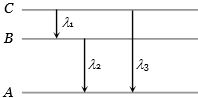
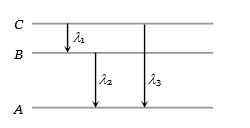
Energy levels $A, B, C$ of a certain atom correspond to increasing values of energy,i.e.,$E_A < E_B < E_C$. If $\lambda_1, \lambda_2, \lambda_3$ are the wavelengths of radiations corresponding to the transitions $C$ to $B$,$B$ to $A$,and $C$ to $A$ respectively,which of the following statements is correct?
A
$\lambda_3 = \lambda_1 + \lambda_2$
B
$\lambda_3 = \frac{\lambda_1 \lambda_2}{\lambda_1 + \lambda_2}$
C
$\lambda_1 + \lambda_2 + \lambda_3 = 0$
D
$\lambda_3^2 = \lambda_1^2 + \lambda_2^2$
Solution
(B) Let the energies of the states $A, B,$ and $C$ be $E_A, E_B,$ and $E_C$ respectively.
From the principle of conservation of energy,the energy of the transition from $C$ to $A$ is equal to the sum of the energies of the transitions from $C$ to $B$ and $B$ to $A$.
Thus,$(E_C - E_A) = (E_C - E_B) + (E_B - E_A)$.
Using the relation $E = \frac{hc}{\lambda}$,we can write:
$\frac{hc}{\lambda_3} = \frac{hc}{\lambda_1} + \frac{hc}{\lambda_2}$
Dividing both sides by $hc$,we get:
$\frac{1}{\lambda_3} = \frac{1}{\lambda_1} + \frac{1}{\lambda_2}$
$\frac{1}{\lambda_3} = \frac{\lambda_1 + \lambda_2}{\lambda_1 \lambda_2}$
Therefore,$\lambda_3 = \frac{\lambda_1 \lambda_2}{\lambda_1 + \lambda_2}$.
From the principle of conservation of energy,the energy of the transition from $C$ to $A$ is equal to the sum of the energies of the transitions from $C$ to $B$ and $B$ to $A$.
Thus,$(E_C - E_A) = (E_C - E_B) + (E_B - E_A)$.
Using the relation $E = \frac{hc}{\lambda}$,we can write:
$\frac{hc}{\lambda_3} = \frac{hc}{\lambda_1} + \frac{hc}{\lambda_2}$
Dividing both sides by $hc$,we get:
$\frac{1}{\lambda_3} = \frac{1}{\lambda_1} + \frac{1}{\lambda_2}$
$\frac{1}{\lambda_3} = \frac{\lambda_1 + \lambda_2}{\lambda_1 \lambda_2}$
Therefore,$\lambda_3 = \frac{\lambda_1 \lambda_2}{\lambda_1 + \lambda_2}$.
0 likesView Solution
35
PhysicsMediumMCQAIPMT · 1990
Consider an electron in the $n^{th}$ orbit of a hydrogen atom in the Bohr model. The circumference of the orbit can be expressed in terms of the de Broglie wavelength $\lambda$ of that electron as
A
$(0.259) n\lambda$
B
$\sqrt{n} \lambda$
C
$(13.6) \lambda$
D
$n\lambda$
Solution
(D) According to Bohr's postulate for the quantization of angular momentum,the angular momentum $L$ of an electron in the $n^{th}$ orbit is given by $mvr = n\frac{h}{2\pi}$.
Rearranging this equation,we get $2\pi r = n\left(\frac{h}{mv}\right)$.
Since the de Broglie wavelength $\lambda$ is defined as $\lambda = \frac{h}{p} = \frac{h}{mv}$,we can substitute this into the equation.
Therefore,the circumference of the orbit is $2\pi r = n\lambda$.
Rearranging this equation,we get $2\pi r = n\left(\frac{h}{mv}\right)$.
Since the de Broglie wavelength $\lambda$ is defined as $\lambda = \frac{h}{p} = \frac{h}{mv}$,we can substitute this into the equation.
Therefore,the circumference of the orbit is $2\pi r = n\lambda$.
0 likesView Solution
36
PhysicsEasyMCQAIPMT · 1990
Nuclear forces are
A
Short ranged,attractive,and charge independent
B
Short ranged,attractive,and charge dependent
C
Long ranged,repulsive,and charge independent
D
Long ranged,repulsive,and charge dependent
Solution
(A) Nuclear forces are the strong forces that hold nucleons (protons and neutrons) together inside the nucleus.
$1$. They are short-ranged,acting only over distances of the order of $10^{-15} \ m$ (femtometers).
$2$. They are primarily attractive in nature,which overcomes the electrostatic repulsion between protons.
$3$. They are charge independent,meaning the force between a proton-proton,neutron-neutron,or proton-neutron pair is approximately the same,provided the separation distance is the same.
Therefore,the correct option is $A$.
$1$. They are short-ranged,acting only over distances of the order of $10^{-15} \ m$ (femtometers).
$2$. They are primarily attractive in nature,which overcomes the electrostatic repulsion between protons.
$3$. They are charge independent,meaning the force between a proton-proton,neutron-neutron,or proton-neutron pair is approximately the same,provided the separation distance is the same.
Therefore,the correct option is $A$.
0 likesView Solution
37
PhysicsEasyMCQAIPMT · 1990
$_6^{12}C$ absorbs an energetic neutron and emits a beta particle. The resulting nucleus is
A
$_7^{14}N$
B
$_7^{13}N$
C
$_5^{13}B$
D
$_6^{13}C$
Solution
(B) The nuclear reaction is given by:
$_6^{12}C + _0^1n \rightarrow _6^{13}C + \gamma$ (capture of neutron)
Then,the unstable $_6^{13}C$ nucleus undergoes beta decay:
$_6^{13}C \rightarrow _7^{13}N + _{-1}^0\beta + \bar{\nu}$
Thus,the resulting nucleus is $_7^{13}N$.
$_6^{12}C + _0^1n \rightarrow _6^{13}C + \gamma$ (capture of neutron)
Then,the unstable $_6^{13}C$ nucleus undergoes beta decay:
$_6^{13}C \rightarrow _7^{13}N + _{-1}^0\beta + \bar{\nu}$
Thus,the resulting nucleus is $_7^{13}N$.
0 likesView Solution
38
PhysicsEasyMCQAIPMT · 1990
In a common base amplifier,the phase difference between the input signal voltage and the output voltage is
A
$0$
B
$\pi /4$
C
$\pi /2$
D
$\pi$
Solution
(A) In a common base $(CB)$ amplifier configuration,the input signal is applied between the emitter and the base,and the output is taken between the collector and the base.
Since the base is common to both the input and output circuits,the input voltage and output voltage signals are in the same phase.
Therefore,the phase difference between the input signal voltage and the output voltage is $0$.
Since the base is common to both the input and output circuits,the input voltage and output voltage signals are in the same phase.
Therefore,the phase difference between the input signal voltage and the output voltage is $0$.
0 likesView Solution
39
PhysicsEasyMCQAIPMT · 1990
$A$ double convex lens of focal length $20 \ cm$ is made of glass of refractive index $3/2$. When placed completely in water $(_{a}\mu_{w} = 4/3)$,its focal length will be.....$cm$.
A
$80$
B
$15$
C
$17.7$
D
$22.5$
Solution
(A) The lens maker's formula is given by $\frac{1}{f} = (\mu - 1) \left( \frac{1}{R_1} - \frac{1}{R_2} \right)$.
In air,$\frac{1}{f_a} = (_{a}\mu_{g} - 1) \left( \frac{1}{R_1} - \frac{1}{R_2} \right) = (1.5 - 1) \left( \frac{1}{R_1} - \frac{1}{R_2} \right) = 0.5 \left( \frac{1}{R_1} - \frac{1}{R_2} \right)$.
Given $f_a = 20 \ cm$,so $0.5 \left( \frac{1}{R_1} - \frac{1}{R_2} \right) = \frac{1}{20}$,which means $\left( \frac{1}{R_1} - \frac{1}{R_2} \right) = \frac{1}{10}$.
In water,$\frac{1}{f_w} = (_{w}\mu_{g} - 1) \left( \frac{1}{R_1} - \frac{1}{R_2} \right)$,where $_{w}\mu_{g} = \frac{_{a}\mu_{g}}{_{a}\mu_{w}} = \frac{1.5}{4/3} = \frac{1.5 \times 3}{4} = \frac{4.5}{4} = 1.125$.
So,$\frac{1}{f_w} = (1.125 - 1) \times \frac{1}{10} = 0.125 \times \frac{1}{10} = \frac{0.125}{10} = \frac{1}{80}$.
Therefore,$f_w = 80 \ cm$.
In air,$\frac{1}{f_a} = (_{a}\mu_{g} - 1) \left( \frac{1}{R_1} - \frac{1}{R_2} \right) = (1.5 - 1) \left( \frac{1}{R_1} - \frac{1}{R_2} \right) = 0.5 \left( \frac{1}{R_1} - \frac{1}{R_2} \right)$.
Given $f_a = 20 \ cm$,so $0.5 \left( \frac{1}{R_1} - \frac{1}{R_2} \right) = \frac{1}{20}$,which means $\left( \frac{1}{R_1} - \frac{1}{R_2} \right) = \frac{1}{10}$.
In water,$\frac{1}{f_w} = (_{w}\mu_{g} - 1) \left( \frac{1}{R_1} - \frac{1}{R_2} \right)$,where $_{w}\mu_{g} = \frac{_{a}\mu_{g}}{_{a}\mu_{w}} = \frac{1.5}{4/3} = \frac{1.5 \times 3}{4} = \frac{4.5}{4} = 1.125$.
So,$\frac{1}{f_w} = (1.125 - 1) \times \frac{1}{10} = 0.125 \times \frac{1}{10} = \frac{0.125}{10} = \frac{1}{80}$.
Therefore,$f_w = 80 \ cm$.
0 likesView Solution
40
PhysicsMediumMCQAIPMT · 1990
In a Young's double-slit experiment,the experiment is performed with blue light of wavelength $4360 \; \mathring{A}$ and green light of wavelength $5460 \; \mathring{A}$. If the distance of the $4^{th}$ bright fringe from the central maximum is $x$,then:
A
$x(\text{Blue}) = x(\text{Green})$
B
$x(\text{Blue}) > x(\text{Green})$
C
$x(\text{Blue}) < x(\text{Green})$
D
$\frac{x(\text{Blue})}{x(\text{Green})} = \frac{5460}{4360}$
Solution
(C) The distance of the $n^{th}$ bright fringe from the central maximum is given by the formula: $y_n = \frac{n \lambda D}{d}$.
Since $n$,$D$,and $d$ are constant for both cases,we have $y_n \propto \lambda$.
Therefore,the ratio of the distances for the $4^{th}$ fringe is: $\frac{x(\text{Blue})}{x(\text{Green})} = \frac{\lambda(\text{Blue})}{\lambda(\text{Green})} = \frac{4360}{5460}$.
Since $4360 < 5460$,it follows that $x(\text{Blue}) < x(\text{Green})$.
Since $n$,$D$,and $d$ are constant for both cases,we have $y_n \propto \lambda$.
Therefore,the ratio of the distances for the $4^{th}$ fringe is: $\frac{x(\text{Blue})}{x(\text{Green})} = \frac{\lambda(\text{Blue})}{\lambda(\text{Green})} = \frac{4360}{5460}$.
Since $4360 < 5460$,it follows that $x(\text{Blue}) < x(\text{Green})$.
0 likesView Solution
41
PhysicsMediumMCQAIPMT · 1990
In a Young's double slit experiment,the fringe width is found to be $0.4 \, mm$. If the whole apparatus is immersed in water of refractive index $4/3$ without disturbing the geometrical arrangement,the new fringe width will be
A
$0.30 \, mm$
B
$0.40 \, mm$
C
$0.53 \, mm$
D
$450 \, \mu m$
Solution
(A) The fringe width in a Young's double slit experiment is given by the formula $\beta = \frac{\lambda D}{d}$.
Here,$\lambda$ is the wavelength of light,$D$ is the distance between the slits and the screen,and $d$ is the distance between the two slits.
When the apparatus is immersed in a medium of refractive index $\mu$,the wavelength of light changes to $\lambda' = \frac{\lambda}{\mu}$.
Since $D$ and $d$ remain unchanged,the new fringe width $\beta'$ is given by $\beta' = \frac{\lambda' D}{d} = \frac{\lambda D}{\mu d} = \frac{\beta}{\mu}$.
Given $\beta = 0.4 \, mm$ and $\mu = 4/3$,we have $\beta' = \frac{0.4}{4/3} = 0.4 \times \frac{3}{4} = 0.3 \, mm$.
Here,$\lambda$ is the wavelength of light,$D$ is the distance between the slits and the screen,and $d$ is the distance between the two slits.
When the apparatus is immersed in a medium of refractive index $\mu$,the wavelength of light changes to $\lambda' = \frac{\lambda}{\mu}$.
Since $D$ and $d$ remain unchanged,the new fringe width $\beta'$ is given by $\beta' = \frac{\lambda' D}{d} = \frac{\lambda D}{\mu d} = \frac{\beta}{\mu}$.
Given $\beta = 0.4 \, mm$ and $\mu = 4/3$,we have $\beta' = \frac{0.4}{4/3} = 0.4 \times \frac{3}{4} = 0.3 \, mm$.
1 likesView Solution
42
PhysicsEasyMCQAIPMT · 1990
Pick out the longest wavelength from the following types of radiations.
A
Blue light
B
$\gamma$-rays
C
$X$-rays
D
Red light
Solution
(D) The electromagnetic spectrum is ordered by wavelength. The order of wavelengths for the given radiations is $\lambda_{\gamma} < \lambda_{X-ray} < \lambda_{Blue} < \lambda_{Red}$.
Among the given options,Red light has the longest wavelength,while $\gamma$-rays have the shortest wavelength.
Therefore,the correct option is $(d)$.
Among the given options,Red light has the longest wavelength,while $\gamma$-rays have the shortest wavelength.
Therefore,the correct option is $(d)$.
0 likesView Solution
43
PhysicsMediumMCQAIPMT · 1990
If the radius of the $^{27}_{13}Al$ nucleus is taken to be $R_{Al}$,then the radius of the $^{125}_{53}Te$ nucleus is nearly
A
$(\frac{53}{13})^{1/3} R_{Al}$
B
$\frac{5}{3} R_{Al}$
C
$\frac{3}{5} R_{Al}$
D
$(\frac{13}{53})^{1/3} R_{Al}$
Solution
(B) The radius of a nucleus is given by the formula $R = R_0 A^{1/3}$,where $A$ is the mass number and $R_0$ is a constant.
For the $^{27}_{13}Al$ nucleus,the mass number $A_{Al} = 27$. Thus,$R_{Al} = R_0 (27)^{1/3} = 3 R_0$.
For the $^{125}_{53}Te$ nucleus,the mass number $A_{Te} = 125$. Thus,$R_{Te} = R_0 (125)^{1/3} = 5 R_0$.
Taking the ratio of the two radii:
$\frac{R_{Te}}{R_{Al}} = \frac{5 R_0}{3 R_0} = \frac{5}{3}$.
Therefore,$R_{Te} = \frac{5}{3} R_{Al}$.
For the $^{27}_{13}Al$ nucleus,the mass number $A_{Al} = 27$. Thus,$R_{Al} = R_0 (27)^{1/3} = 3 R_0$.
For the $^{125}_{53}Te$ nucleus,the mass number $A_{Te} = 125$. Thus,$R_{Te} = R_0 (125)^{1/3} = 5 R_0$.
Taking the ratio of the two radii:
$\frac{R_{Te}}{R_{Al}} = \frac{5 R_0}{3 R_0} = \frac{5}{3}$.
Therefore,$R_{Te} = \frac{5}{3} R_{Al}$.
0 likesView Solution
44
PhysicsEasyMCQAIPMT · 1990
The nuclei ${ }_{6} C^{13}$ and ${ }_{7} N^{14}$ can be described as
A
isotopes of nitrogen
B
isotopes of carbon
C
isobars
D
isotones
Solution
(D) To determine the relationship between the nuclei ${ }_{6} C^{13}$ and ${ }_{7} N^{14}$,we calculate the number of neutrons $(N)$ in each.
For ${ }_{6} C^{13}$,the atomic number $Z = 6$ and the mass number $A = 13$. The number of neutrons is $N = A - Z = 13 - 6 = 7$.
For ${ }_{7} N^{14}$,the atomic number $Z = 7$ and the mass number $A = 14$. The number of neutrons is $N = A - Z = 14 - 7 = 7$.
Since both nuclei have the same number of neutrons $(N = 7)$,they are called isotones.
For ${ }_{6} C^{13}$,the atomic number $Z = 6$ and the mass number $A = 13$. The number of neutrons is $N = A - Z = 13 - 6 = 7$.
For ${ }_{7} N^{14}$,the atomic number $Z = 7$ and the mass number $A = 14$. The number of neutrons is $N = A - Z = 14 - 7 = 7$.
Since both nuclei have the same number of neutrons $(N = 7)$,they are called isotones.
0 likesView Solution
45
PhysicsEasyMCQAIPMT · 1990
In which of the following,emission of electrons does not take place?
A
Thermionic emission
B
$X$-rays emission
C
Photoelectric emission
D
Secondary emission
Solution
(B) $X$-rays emission: These are produced due to transitions in the inner energy levels of an atom,not by the emission of electrons from the surface.
Photoelectric emission: This is the emission of electrons from a metal surface upon irradiation with radiation of a suitable frequency.
Secondary emission: When an incident electron strikes the surface of a metallic plate,it causes the emission of other electrons from the surface.
Thermionic emission: When a metal is heated to a high temperature,the free electrons gain sufficient kinetic energy to escape from the surface of the metal.
Photoelectric emission: This is the emission of electrons from a metal surface upon irradiation with radiation of a suitable frequency.
Secondary emission: When an incident electron strikes the surface of a metallic plate,it causes the emission of other electrons from the surface.
Thermionic emission: When a metal is heated to a high temperature,the free electrons gain sufficient kinetic energy to escape from the surface of the metal.
0 likesView Solution
46
PhysicsMediumMCQAIPMT · 1990
The current in self-inductance $L=40\; mH$ is to be increased uniformly from $1\; A$ to $11\; A$ in $4\; ms$. The $e.m.f.$ induced in the inductor during this process is ..... $V$.
A
$0.4$
B
$4$
C
$440$
D
$100$
Solution
(D) The induced $e.m.f.$ in an inductor is given by the formula: $e.m.f. = L \frac{dI}{dt}$.
Here,$L = 40\; mH = 40 \times 10^{-3}\; H$.
The change in current is $dI = 11\; A - 1\; A = 10\; A$.
The time interval is $dt = 4\; ms = 4 \times 10^{-3}\; s$.
Substituting these values into the formula:
$e.m.f. = (40 \times 10^{-3}) \times \frac{10}{4 \times 10^{-3}}$.
$e.m.f. = 40 \times \frac{10}{4} = 10 \times 10 = 100\; V$.
Here,$L = 40\; mH = 40 \times 10^{-3}\; H$.
The change in current is $dI = 11\; A - 1\; A = 10\; A$.
The time interval is $dt = 4\; ms = 4 \times 10^{-3}\; s$.
Substituting these values into the formula:
$e.m.f. = (40 \times 10^{-3}) \times \frac{10}{4 \times 10^{-3}}$.
$e.m.f. = 40 \times \frac{10}{4} = 10 \times 10 = 100\; V$.
0 likesView Solution
Vedclass Products
For Students
Vedclass Test Series
Mock tests in real AIPMT style covering Physics with performance analysis. 5-day free trial.
Start Free TrialFor Teachers
Exam Paper Generator
Generate Set A/B/C/D Physics papers from 7.5L+ questions in 2 minutes. 3 chapters free.
Try FreeFor Institutes
Online Exam Module
Run live AIPMT mock exams with unlimited students, 360° analytics & white-label branding.
See DemoFrequently Asked Questions
How many Physics questions are in AIPMT 1990?
There are 46 Physics questions from the AIPMT 1990 paper on Vedclass, each with a detailed step-by-step solution in English.
Are AIPMT 1990 Physics solutions available in English?
Yes. All solutions on this page are in English. You can also switch to English or Hindi using the language buttons above the questions.
Can I practice AIPMT 1990 Physics as a timed test?
Yes. Use the Vedclass Test Series to attempt a full AIPMT mock test covering Physics with time limits and instant score analysis.
Can teachers create Physics papers from AIPMT previous year questions?
Yes. The Vedclass Exam Paper Generator lets teachers mix AIPMT Physics questions and generate Set A/B/C/D papers in minutes.
For Teachers & Institutes
Build a Custom Physics Paper
Pick AIPMT 1990 Physics questions, set difficulty, and generate Set A/B/C/D in 2 minutes.