
ChemistryQ1–87 of 103 questions
Page 1 of 2 · English
1
ChemistryMCQAIPMT · 1989
The ratio of $C_p$ and $C_v$ of a gas $X$ is $1.4$. The number of atoms of the gas $X$ present in $11.2 \ L$ of it at $NTP$ will be:
A
$6.02 \times 10^{23}$
B
$1.2 \times 10^{23}$
C
$3.01 \times 10^{23}$
D
$2.01 \times 10^{23}$
Solution
(A) The ratio of heat capacities $\frac{C_p}{C_v} = 1.4$ indicates that the gas $X$ is diatomic.
At $NTP$,$22.4 \ L$ of any gas contains $1 \ mol$ of molecules.
Therefore,$11.2 \ L$ of gas $X$ corresponds to $\frac{11.2}{22.4} = 0.5 \ mol$ of molecules.
Number of molecules $= 0.5 \times 6.022 \times 10^{23} = 3.011 \times 10^{23}$ molecules.
Since the gas is diatomic,each molecule contains $2$ atoms.
Number of atoms $= 2 \times 3.011 \times 10^{23} = 6.022 \times 10^{23}$ atoms.
At $NTP$,$22.4 \ L$ of any gas contains $1 \ mol$ of molecules.
Therefore,$11.2 \ L$ of gas $X$ corresponds to $\frac{11.2}{22.4} = 0.5 \ mol$ of molecules.
Number of molecules $= 0.5 \times 6.022 \times 10^{23} = 3.011 \times 10^{23}$ molecules.
Since the gas is diatomic,each molecule contains $2$ atoms.
Number of atoms $= 2 \times 3.011 \times 10^{23} = 6.022 \times 10^{23}$ atoms.
0 likesView Solution
2
ChemistryDifficultMCQAIPMT · 1989
What is the weight of oxygen required for the complete combustion of $2.8 \, kg$ of ethylene? (in $kg$)
A
$2.8$
B
$9.6$
C
$6.4$
D
$96$
Solution
(B) The balanced chemical equation for the combustion of ethylene $(C_2H_4)$ is:
$C_2H_4 + 3O_2 \to 2CO_2 + 2H_2O$
From the stoichiometry of the reaction:
$1 \, \text{mole}$ of $C_2H_4$ $(28 \, g)$ requires $3 \, \text{moles}$ of $O_2$ $(3 \times 32 = 96 \, g)$.
Therefore,$28 \, g$ of $C_2H_4$ requires $96 \, g$ of $O_2$.
For $2.8 \, kg$ $(2800 \, g)$ of $C_2H_4$,the mass of $O_2$ required is:
$\text{Mass of } O_2 = \frac{96 \, g}{28 \, g} \times 2800 \, g = 9600 \, g = 9.6 \, kg$.
$C_2H_4 + 3O_2 \to 2CO_2 + 2H_2O$
From the stoichiometry of the reaction:
$1 \, \text{mole}$ of $C_2H_4$ $(28 \, g)$ requires $3 \, \text{moles}$ of $O_2$ $(3 \times 32 = 96 \, g)$.
Therefore,$28 \, g$ of $C_2H_4$ requires $96 \, g$ of $O_2$.
For $2.8 \, kg$ $(2800 \, g)$ of $C_2H_4$,the mass of $O_2$ required is:
$\text{Mass of } O_2 = \frac{96 \, g}{28 \, g} \times 2800 \, g = 9600 \, g = 9.6 \, kg$.
1 likesView Solution
3
ChemistryMediumMCQAIPMT · 1989
Experimental evidence for the existence of the atomic nucleus comes from
A
Millikan's oil drop experiment
B
Atomic emission spectroscopy
C
The magnetic bending of cathode rays
D
Alpha scattering by a thin metal foil
Solution
(D) The experimental evidence for the existence of the atomic nucleus was provided by the Rutherford $\alpha$-particle scattering experiment.
In this experiment,a beam of $\alpha$-particles was directed at a thin gold foil.
The observation that some $\alpha$-particles were deflected at large angles and some even bounced back led to the conclusion that the positive charge and most of the mass of the atom are concentrated in a very small central region called the nucleus.
In this experiment,a beam of $\alpha$-particles was directed at a thin gold foil.
The observation that some $\alpha$-particles were deflected at large angles and some even bounced back led to the conclusion that the positive charge and most of the mass of the atom are concentrated in a very small central region called the nucleus.
0 likesView Solution
4
ChemistryMediumMCQAIPMT · 1989
Which of the following statements does not form part of Bohr's model of the hydrogen atom?
A
Energy of the electrons in the orbit is quantized
B
The electron in the orbit nearest the nucleus has the lowest energy
C
Electrons revolve in different orbits around the nucleus
D
The position and velocity of the electrons in the orbit cannot be determined simultaneously
Solution
(D) The correct answer is $(D)$.
Bohr's model assumes that electrons move in well-defined circular orbits with definite radii and velocities.
Statement $(D)$ describes Heisenberg's uncertainty principle,which states that it is impossible to determine simultaneously the exact position and exact momentum of an electron.
This principle contradicts the Bohr model's assumption of defined orbits.
Bohr's model assumes that electrons move in well-defined circular orbits with definite radii and velocities.
Statement $(D)$ describes Heisenberg's uncertainty principle,which states that it is impossible to determine simultaneously the exact position and exact momentum of an electron.
This principle contradicts the Bohr model's assumption of defined orbits.
0 likesView Solution
5
ChemistryMediumMCQAIPMT · 1989
Krypton $(_{36}Kr)$ has the electronic configuration $(_{18}Ar) \ 4s^2, 3d^{10}, 4p^6$. The $37^{th}$ electron will go into which one of the following sub-levels?
A
$4f$
B
$4d$
C
$3p$
D
$5s$
Solution
(D) The $37^{th}$ electron will enter the $5s$ sub-level.
According to the Aufbau principle,electrons fill orbitals in the order of increasing energy.
For the $4p$ orbital,$n=4$ and $l=1$,so $(n+l) = 4+1 = 5$.
For the $5s$ orbital,$n=5$ and $l=0$,so $(n+l) = 5+0 = 5$.
When $(n+l)$ values are equal,the orbital with the lower value of $n$ is filled first. Since $4p$ has $n=4$ and $5s$ has $n=5$,the $4p$ orbital is filled before the $5s$ orbital.
Therefore,after the $4p^6$ configuration is completed in Krypton,the next electron $(37^{th})$ enters the $5s$ orbital.
According to the Aufbau principle,electrons fill orbitals in the order of increasing energy.
For the $4p$ orbital,$n=4$ and $l=1$,so $(n+l) = 4+1 = 5$.
For the $5s$ orbital,$n=5$ and $l=0$,so $(n+l) = 5+0 = 5$.
When $(n+l)$ values are equal,the orbital with the lower value of $n$ is filled first. Since $4p$ has $n=4$ and $5s$ has $n=5$,the $4p$ orbital is filled before the $5s$ orbital.
Therefore,after the $4p^6$ configuration is completed in Krypton,the next electron $(37^{th})$ enters the $5s$ orbital.
0 likesView Solution
6
ChemistryMediumMCQAIPMT · 1989
If an electron has a spin quantum number of $+ \frac{1}{2}$ and a magnetic quantum number of $- 1$,it cannot be present in an
A
$d$-orbital
B
$f$-orbital
C
$p$-orbital
D
$s$-orbital
Solution
(D) The magnetic quantum number $m$ depends on the azimuthal quantum number $l$ such that $m$ ranges from $-l$ to $+l$.
For an $s$-orbital,$l = 0$,which implies $m = 0$.
Since the given magnetic quantum number is $m = - 1$,it is impossible for an electron to be in an $s$-orbital.
For an $s$-orbital,$l = 0$,which implies $m = 0$.
Since the given magnetic quantum number is $m = - 1$,it is impossible for an electron to be in an $s$-orbital.
0 likesView Solution
7
ChemistryEasyMCQAIPMT · 1989
What is the number of electrons in a neutral atom that has $20$ protons in its nucleus?
A
$20$
B
$10$
C
$30$
D
$40$
Solution
(A) For a neutral atom,the number of electrons is equal to the number of protons.
Since the atom has $20$ protons,it must also have $20$ electrons to maintain electrical neutrality.
Therefore,the correct option is $A$.
Since the atom has $20$ protons,it must also have $20$ electrons to maintain electrical neutrality.
Therefore,the correct option is $A$.
0 likesView Solution
8
ChemistryEasyMCQAIPMT · 1989
Which of the following principles/rules limits the maximum number of electrons in an orbital to two?
A
Aufbau principle
B
Pauli's exclusion principle
C
Hund's rule of maximum multiplicity
D
Heisenberg's uncertainty principle
Solution
(B) The correct answer is $(B)$.
According to Pauli's exclusion principle,no two electrons in an atom can have the same set of all four quantum numbers $(n, l, m_l, m_s)$.
Since an orbital is defined by the first three quantum numbers $(n, l, m_l)$,the only way to distinguish two electrons in the same orbital is by their spin quantum number $(m_s)$,which can only have values of $+1/2$ or $-1/2$.
Therefore,an orbital can accommodate a maximum of two electrons with opposite spins.
According to Pauli's exclusion principle,no two electrons in an atom can have the same set of all four quantum numbers $(n, l, m_l, m_s)$.
Since an orbital is defined by the first three quantum numbers $(n, l, m_l)$,the only way to distinguish two electrons in the same orbital is by their spin quantum number $(m_s)$,which can only have values of $+1/2$ or $-1/2$.
Therefore,an orbital can accommodate a maximum of two electrons with opposite spins.
0 likesView Solution
9
ChemistryEasyMCQAIPMT · 1989
The central atom in a molecule is in $sp^2$ hybrid state. The shape of the molecule will be
A
Pyramidal
B
Tetrahedral
C
Octahedral
D
Trigonal planar
Solution
(D) In $sp^2$ hybridization,the central atom forms three hybrid orbitals that are directed towards the corners of an equilateral triangle.
This arrangement results in a bond angle of $120^{\circ}$ between the orbitals.
Therefore,the geometry of a molecule with $sp^2$ hybridization and no lone pairs on the central atom is Trigonal planar.
This arrangement results in a bond angle of $120^{\circ}$ between the orbitals.
Therefore,the geometry of a molecule with $sp^2$ hybridization and no lone pairs on the central atom is Trigonal planar.
0 likesView Solution
10
ChemistryMediumMCQAIPMT · 1989
Which one amongst the following possesses an $sp$ hybridized carbon in its structure?
A
$CH_2 = CCl - CH = CH_2$
B
$CCl_2 = CCl_2$
C
$CH_2 = C = CH_2$
D
$CH_2 = CH - CH = CH_2$
Solution
(C) In the compound $CH_2 = C = CH_2$ (allene),the central carbon atom is bonded to two other carbon atoms by double bonds.
Since the central carbon atom forms two $\pi$ bonds and two $\sigma$ bonds,it undergoes $sp$ hybridization.
The other options contain only $sp^2$ hybridized carbon atoms.
Since the central carbon atom forms two $\pi$ bonds and two $\sigma$ bonds,it undergoes $sp$ hybridization.
The other options contain only $sp^2$ hybridized carbon atoms.
0 likesView Solution
11
ChemistryMediumMCQAIPMT · 1989
The structural formula of a compound is $CH_3 - CH = C = CH_2$. The type of hybridization at the four carbons from left to right are
A
$sp^3, sp^2, sp, sp^2$
B
$sp^2, sp^3, sp^2, sp$
C
$sp^3, sp^2, sp^2, sp^2$
D
$sp^3, sp, sp^2, sp^2$
Solution
(A) The hybridization of a carbon atom is determined by the number of $\pi$ bonds attached to it.
$1$. The first carbon $(CH_3-)$ is bonded to $3$ hydrogens and $1$ carbon via single bonds ($4$ $\sigma$ bonds),so it is $sp^3$ hybridized.
$2$. The second carbon $(-CH=)$ is bonded to $1$ hydrogen,$1$ single bond,and $1$ double bond ($1$ $\pi$ bond),so it is $sp^2$ hybridized.
$3$. The third carbon $(=C=)$ is bonded to two double bonds ($2$ $\pi$ bonds),so it is $sp$ hybridized.
$4$. The fourth carbon $(=CH_2)$ is bonded to $2$ hydrogens and $1$ double bond ($1$ $\pi$ bond),so it is $sp^2$ hybridized.
Therefore,the hybridization order from left to right is $sp^3, sp^2, sp, sp^2$.
$1$. The first carbon $(CH_3-)$ is bonded to $3$ hydrogens and $1$ carbon via single bonds ($4$ $\sigma$ bonds),so it is $sp^3$ hybridized.
$2$. The second carbon $(-CH=)$ is bonded to $1$ hydrogen,$1$ single bond,and $1$ double bond ($1$ $\pi$ bond),so it is $sp^2$ hybridized.
$3$. The third carbon $(=C=)$ is bonded to two double bonds ($2$ $\pi$ bonds),so it is $sp$ hybridized.
$4$. The fourth carbon $(=CH_2)$ is bonded to $2$ hydrogens and $1$ double bond ($1$ $\pi$ bond),so it is $sp^2$ hybridized.
Therefore,the hybridization order from left to right is $sp^3, sp^2, sp, sp^2$.
0 likesView Solution
12
ChemistryMediumMCQAIPMT · 1989
Which of the following molecules has a central atom that adopts $sp^2$ hybridization?
A
$BeF_2$
B
$BCl_3$
C
$C_2H_2$
D
$NH_3$
Solution
(B) The hybridization of the central atom can be determined using the formula: $\text{Steric Number} = (\text{Number of bonded atoms}) + (\text{Number of lone pairs})$.
For $BeF_2$: $\text{Steric Number} = 2 + 0 = 2$ ($sp$ hybridization).
For $BCl_3$: $\text{Steric Number} = 3 + 0 = 3$ ($sp^2$ hybridization).
For $C_2H_2$: The carbon atoms have a steric number of $2$ ($sp$ hybridization).
For $NH_3$: $\text{Steric Number} = 3 + 1 = 4$ ($sp^3$ hybridization).
Thus,the molecule with $sp^2$ hybridization is $BCl_3$.
For $BeF_2$: $\text{Steric Number} = 2 + 0 = 2$ ($sp$ hybridization).
For $BCl_3$: $\text{Steric Number} = 3 + 0 = 3$ ($sp^2$ hybridization).
For $C_2H_2$: The carbon atoms have a steric number of $2$ ($sp$ hybridization).
For $NH_3$: $\text{Steric Number} = 3 + 1 = 4$ ($sp^3$ hybridization).
Thus,the molecule with $sp^2$ hybridization is $BCl_3$.
0 likesView Solution
13
ChemistryEasyMCQAIPMT · 1989
Which of the following molecules does not have a linear arrangement of atoms?
A
$H_2S$
B
$C_2H_2$
C
$BeH_2$
D
$CO_2$
Solution
(A) In $H_2S$,the central sulfur atom is $sp^3$ hybridized and possesses two lone pairs of electrons,resulting in a bent (angular) molecular geometry.
In contrast,$C_2H_2$ ($sp$ hybridization),$BeH_2$ ($sp$ hybridization),and $CO_2$ ($sp$ hybridization) all possess a linear arrangement of atoms due to their $sp$ hybridization and lack of lone pairs on the central atom.
In contrast,$C_2H_2$ ($sp$ hybridization),$BeH_2$ ($sp$ hybridization),and $CO_2$ ($sp$ hybridization) all possess a linear arrangement of atoms due to their $sp$ hybridization and lack of lone pairs on the central atom.
0 likesView Solution
14
ChemistryMediumMCQAIPMT · 1989
$H_2O$ is dipolar,whereas $BeF_2$ is not. It is because
A
$H_2O$ is linear and $BeF_2$ is angular
B
$H_2O$ is angular and $BeF_2$ is linear
C
The electronegativity of $F$ is greater than that of $O$
D
$H_2O$ involves hydrogen bonding whereas $BeF_2$ is a discrete molecule
Solution
(B) The overall value of the dipole moment of a polar molecule depends on its geometry and shape,i.e.,the vectorial addition of the dipole moments of the constituent bonds.
Water $(H_2O)$ has an angular structure with a bond angle of $105^{\circ}$,which results in a net dipole moment.
However,$BeF_2$ is a linear molecule where the dipole moments of the two $Be-F$ bonds are equal in magnitude and opposite in direction,thus canceling each other out,resulting in a net dipole moment of zero.
Water $(H_2O)$ has an angular structure with a bond angle of $105^{\circ}$,which results in a net dipole moment.
However,$BeF_2$ is a linear molecule where the dipole moments of the two $Be-F$ bonds are equal in magnitude and opposite in direction,thus canceling each other out,resulting in a net dipole moment of zero.
1 likesView Solution
15
ChemistryMediumMCQAIPMT · 1989
In which of the following compounds does hydrogen bonding occur?
A
$SiH_4$
B
$LiH$
C
$HI$
D
$NH_3$
Solution
(D) Hydrogen bonding occurs when hydrogen is covalently bonded to a highly electronegative atom like $N$,$O$,or $F$.
In $NH_3$,the nitrogen atom is highly electronegative,allowing it to form hydrogen bonds.
Therefore,the correct option is $(d)$.
In $NH_3$,the nitrogen atom is highly electronegative,allowing it to form hydrogen bonds.
Therefore,the correct option is $(d)$.
0 likesView Solution
16
ChemistryMediumMCQAIPMT · 1989
Which of the following does not apply to metallic bond?
A
Overlapping valency orbitals
B
Mobile valency electrons
C
Delocalized electrons
D
Highly directed bonds
Solution
(D) In a metallic bond,metal cations are surrounded by a sea of mobile valence electrons.
Electrostatic attraction acts equally from all directions,meaning the bond is non-directional.
Therefore,metallic bonds do not possess highly directed characteristics,unlike covalent bonds.
Electrostatic attraction acts equally from all directions,meaning the bond is non-directional.
Therefore,metallic bonds do not possess highly directed characteristics,unlike covalent bonds.
0 likesView Solution
17
ChemistryMediumMCQAIPMT · 1989
Pressure remaining the same,the volume of a given mass of an ideal gas increases for every degree centigrade rise in temperature by a definite fraction of its volume at:
A
$0\,^{\circ}C$
B
Its critical temperature
C
Absolute zero
D
Its Boyle temperature
Solution
(A) According to Charles's Law,the relationship between volume and temperature at constant pressure is given by: $V_t = V_0(1 + \alpha_v t)$.
Here,$V_t$ is the volume at $t\,^{\circ}C$,$V_0$ is the volume at $0\,^{\circ}C$,and $\alpha_v$ is the coefficient of volume expansion,which is equal to $\frac{1}{273.15}\,^{\circ}C^{-1}$.
For every $1\,^{\circ}C$ rise in temperature,the change in volume $\Delta V$ is given by $\Delta V = V_0 \times \alpha_v \times 1 = \frac{V_0}{273.15}$.
Thus,the volume increases by a definite fraction $\frac{1}{273.15}$ of its volume at $0\,^{\circ}C$.
Here,$V_t$ is the volume at $t\,^{\circ}C$,$V_0$ is the volume at $0\,^{\circ}C$,and $\alpha_v$ is the coefficient of volume expansion,which is equal to $\frac{1}{273.15}\,^{\circ}C^{-1}$.
For every $1\,^{\circ}C$ rise in temperature,the change in volume $\Delta V$ is given by $\Delta V = V_0 \times \alpha_v \times 1 = \frac{V_0}{273.15}$.
Thus,the volume increases by a definite fraction $\frac{1}{273.15}$ of its volume at $0\,^{\circ}C$.
0 likesView Solution
18
ChemistryMediumMCQAIPMT · 1989
The correct gas equation is:
A
$\frac{V_1 T_2}{P_1} = \frac{V_2 T_1}{P_2}$
B
$\frac{P_1 V_1}{P_2 V_2} = \frac{T_1}{T_2}$
C
$\frac{P_1 T_2}{V_1} = \frac{P_2 V_2}{T_2}$
D
$\frac{V_1 V_2}{T_1 T_2} = P_1 P_2$
Solution
(B) According to the combined gas law,for a fixed amount of gas,the relationship between pressure $(P)$,volume $(V)$,and temperature $(T)$ is given by $\frac{P_1 V_1}{T_1} = \frac{P_2 V_2}{T_2}$.
Rearranging this equation,we get $\frac{P_1 V_1}{P_2 V_2} = \frac{T_1}{T_2}$.
Therefore,the correct option is $B$.
Rearranging this equation,we get $\frac{P_1 V_1}{P_2 V_2} = \frac{T_1}{T_2}$.
Therefore,the correct option is $B$.
0 likesView Solution
19
ChemistryEasyMCQAIPMT · 1989
If $P$,$V$,$M$,$T$ and $R$ are pressure,volume,molar mass,temperature and gas constant respectively,then for an ideal gas,the density is given by
A
$\frac{RT}{PM}$
B
$\frac{P}{RT}$
C
$\frac{M}{V}$
D
$\frac{PM}{RT}$
Solution
(D) The ideal gas equation is given by $PV = nRT$.
Since the number of moles $n = \frac{m}{M}$,where $m$ is the mass and $M$ is the molar mass,we can write $PV = \frac{m}{M}RT$.
Rearranging the terms to solve for density $(d = \frac{m}{V})$,we get $d = \frac{m}{V} = \frac{PM}{RT}$.
Thus,the correct option is $D$.
Since the number of moles $n = \frac{m}{M}$,where $m$ is the mass and $M$ is the molar mass,we can write $PV = \frac{m}{M}RT$.
Rearranging the terms to solve for density $(d = \frac{m}{V})$,we get $d = \frac{m}{V} = \frac{PM}{RT}$.
Thus,the correct option is $D$.
0 likesView Solution
20
ChemistryMediumMCQAIPMT · 1989
The ratio of $C_p$ and $C_v$ of a gas '$X$' is $1.4$. The number of atoms of the gas '$X$' present in $11.2 \ L$ of it at $N.T.P.$ is
A
$6.02 \times 10^{23}$
B
$1.2 \times 10^{24}$
C
$3.01 \times 10^{23}$
D
$2.01 \times 10^{23}$
Solution
(A) Given that the ratio $\frac{C_p}{C_v} = 1.4$,the gas '$X$' is diatomic.
At $N.T.P.$,the volume of $1 \text{ mole}$ of any ideal gas is $22.4 \ L$.
Number of moles of gas '$X$' in $11.2 \ L$ = $\frac{11.2 \ L}{22.4 \ L/mol} = 0.5 \ mol$.
Number of molecules = $\text{moles} \times N_A = 0.5 \times 6.022 \times 10^{23} = 3.011 \times 10^{23}$.
Since the gas is diatomic,each molecule contains $2$ atoms.
Number of atoms = $2 \times (3.011 \times 10^{23}) = 6.022 \times 10^{23}$.
At $N.T.P.$,the volume of $1 \text{ mole}$ of any ideal gas is $22.4 \ L$.
Number of moles of gas '$X$' in $11.2 \ L$ = $\frac{11.2 \ L}{22.4 \ L/mol} = 0.5 \ mol$.
Number of molecules = $\text{moles} \times N_A = 0.5 \times 6.022 \times 10^{23} = 3.011 \times 10^{23}$.
Since the gas is diatomic,each molecule contains $2$ atoms.
Number of atoms = $2 \times (3.011 \times 10^{23}) = 6.022 \times 10^{23}$.
0 likesView Solution
21
ChemistryMediumMCQAIPMT · 1989
At what temperature will the average speed of $CH_4$ molecules have the same value as $O_2$ has at $300 \ K$ ........... $K$
A
$1200$
B
$150$
C
$600$
D
$300$
Solution
(B) The formula for average speed is $V_{av} = \sqrt{\frac{8RT}{\pi M}}$.
For the average speeds of $CH_4$ and $O_2$ to be equal: $\sqrt{\frac{8RT_{CH_4}}{\pi M_{CH_4}}} = \sqrt{\frac{8RT_{O_2}}{\pi M_{O_2}}}$.
This simplifies to $\frac{T_{CH_4}}{M_{CH_4}} = \frac{T_{O_2}}{M_{O_2}}$.
Given $T_{O_2} = 300 \ K$,$M_{O_2} = 32 \ g/mol$,and $M_{CH_4} = 16 \ g/mol$.
Substituting the values: $\frac{T_{CH_4}}{16} = \frac{300}{32}$.
$T_{CH_4} = \frac{300 \times 16}{32} = 150 \ K$.
For the average speeds of $CH_4$ and $O_2$ to be equal: $\sqrt{\frac{8RT_{CH_4}}{\pi M_{CH_4}}} = \sqrt{\frac{8RT_{O_2}}{\pi M_{O_2}}}$.
This simplifies to $\frac{T_{CH_4}}{M_{CH_4}} = \frac{T_{O_2}}{M_{O_2}}$.
Given $T_{O_2} = 300 \ K$,$M_{O_2} = 32 \ g/mol$,and $M_{CH_4} = 16 \ g/mol$.
Substituting the values: $\frac{T_{CH_4}}{16} = \frac{300}{32}$.
$T_{CH_4} = \frac{300 \times 16}{32} = 150 \ K$.
0 likesView Solution
22
ChemistryMediumMCQAIPMT · 1989
In a chemical equilibrium $A + B \rightleftharpoons C + D$,when $1 \ mol$ each of the two reactants are mixed,$0.6 \ mol$ each of the products are formed. The equilibrium constant calculated is
A
$1$
B
$0.36$
C
$2.25$
D
$4/9$
Solution
(C) The chemical equation is $A + B \rightleftharpoons C + D$.
Initial moles: $A = 1, B = 1, C = 0, D = 0$.
Moles at equilibrium: $A = 1 - 0.6 = 0.4, B = 1 - 0.6 = 0.4, C = 0.6, D = 0.6$.
The equilibrium constant $K_c$ is given by the expression: $K_c = \frac{[C][D]}{[A][B]}$.
Substituting the equilibrium concentrations: $K_c = \frac{0.6 \times 0.6}{0.4 \times 0.4} = \frac{0.36}{0.16} = 2.25$.
Initial moles: $A = 1, B = 1, C = 0, D = 0$.
Moles at equilibrium: $A = 1 - 0.6 = 0.4, B = 1 - 0.6 = 0.4, C = 0.6, D = 0.6$.
The equilibrium constant $K_c$ is given by the expression: $K_c = \frac{[C][D]}{[A][B]}$.
Substituting the equilibrium concentrations: $K_c = \frac{0.6 \times 0.6}{0.4 \times 0.4} = \frac{0.36}{0.16} = 2.25$.
0 likesView Solution
23
ChemistryMediumMCQAIPMT · 1989
Two gaseous equilibria $SO_{2(g)} + \frac{1}{2}O_{2(g)} \rightleftharpoons SO_{3(g)}$ and $2SO_{3(g)} \rightleftharpoons 2SO_{2(g)} + O_{2(g)}$ have equilibrium constants $K_1$ and $K_2$ respectively at $298 \ K$. Which of the following relationships between $K_1$ and $K_2$ is correct?
A
$K_1 = K_2$
B
$K_2 = K_1^2$
C
$K_2 = \frac{1}{K_1^2}$
D
$K_2 = \frac{1}{K_1}$
Solution
(C) For the first equilibrium: $SO_{2(g)} + \frac{1}{2}O_{2(g)} \rightleftharpoons SO_{3(g)}$,the equilibrium constant is $K_1 = \frac{[SO_3]}{[SO_2][O_2]^{1/2}}$.
For the second equilibrium: $2SO_{3(g)} \rightleftharpoons 2SO_{2(g)} + O_{2(g)}$,the equilibrium constant is $K_2 = \frac{[SO_2]^2 [O_2]}{[SO_3]^2}$.
Comparing the two expressions,we see that $K_2 = \left( \frac{1}{K_1} \right)^2 = \frac{1}{K_1^2}$.
Therefore,the correct relationship is $K_2 = \frac{1}{K_1^2}$.
For the second equilibrium: $2SO_{3(g)} \rightleftharpoons 2SO_{2(g)} + O_{2(g)}$,the equilibrium constant is $K_2 = \frac{[SO_2]^2 [O_2]}{[SO_3]^2}$.
Comparing the two expressions,we see that $K_2 = \left( \frac{1}{K_1} \right)^2 = \frac{1}{K_1^2}$.
Therefore,the correct relationship is $K_2 = \frac{1}{K_1^2}$.
0 likesView Solution
24
ChemistryMediumMCQAIPMT · 1989
The hydrogen ion concentration in a weak acid of dissociation constant $K_a$ and concentration $c$ is nearly equal to:
A
$\sqrt{K_a c}$
B
$c/K_a$
C
$K_a c$
D
$\sqrt{K_a/c}$
Solution
(A) For a weak acid $HA$ dissociating as $HA \rightleftharpoons H^{+} + A^{-}$,the dissociation constant is given by $K_a = \frac{[H^{+}][A^{-}]}{[HA]}$.
Let the initial concentration be $c$ and the degree of dissociation be $\alpha$.
Then $[H^{+}] = c\alpha$,$[A^{-}] = c\alpha$,and $[HA] = c(1-\alpha)$.
$K_a = \frac{(c\alpha)(c\alpha)}{c(1-\alpha)} = \frac{c\alpha^2}{1-\alpha}$.
Since the acid is weak,$\alpha <<< 1$,so $1-\alpha \approx 1$.
Thus,$K_a \approx c\alpha^2$,which gives $\alpha = \sqrt{K_a/c}$.
Therefore,$[H^{+}] = c\alpha = c \times \sqrt{K_a/c} = \sqrt{K_a c}$.
Let the initial concentration be $c$ and the degree of dissociation be $\alpha$.
Then $[H^{+}] = c\alpha$,$[A^{-}] = c\alpha$,and $[HA] = c(1-\alpha)$.
$K_a = \frac{(c\alpha)(c\alpha)}{c(1-\alpha)} = \frac{c\alpha^2}{1-\alpha}$.
Since the acid is weak,$\alpha <<< 1$,so $1-\alpha \approx 1$.
Thus,$K_a \approx c\alpha^2$,which gives $\alpha = \sqrt{K_a/c}$.
Therefore,$[H^{+}] = c\alpha = c \times \sqrt{K_a/c} = \sqrt{K_a c}$.
0 likesView Solution
25
ChemistryEasyMCQAIPMT · 1989
The degree of dissociation in a weak electrolyte increases:
A
On increasing dilution
B
On increasing pressure
C
On decreasing dilution
D
None of these
Solution
(A) According to Ostwald's dilution law,for a weak electrolyte,the degree of dissociation $(\alpha)$ is related to the dilution $(V)$ by the expression $\alpha = \sqrt{K_a \times V}$.
As the dilution $(V)$ increases,the degree of dissociation $(\alpha)$ increases.
As the dilution $(V)$ increases,the degree of dissociation $(\alpha)$ increases.
0 likesView Solution
26
ChemistryMediumMCQAIPMT · 1989
On passing a current of $HCl$ gas in a saturated solution of $NaCl$,the solubility of $NaCl$
A
Increases
B
Decreases
C
Remains unchanged
D
$NaCl$ decomposes
Solution
(B) The correct option is $(b)$.
When $HCl$ gas is passed through a saturated solution of $NaCl$,it dissociates into $H^+$ and $Cl^-$ ions.
This increases the concentration of $Cl^-$ ions in the solution.
According to the common ion effect,the increased concentration of $Cl^-$ ions shifts the equilibrium $NaCl(s) \rightleftharpoons Na^+(aq) + Cl^-(aq)$ to the left.
Consequently,the solubility of $NaCl$ decreases,leading to the precipitation of $NaCl$.
When $HCl$ gas is passed through a saturated solution of $NaCl$,it dissociates into $H^+$ and $Cl^-$ ions.
This increases the concentration of $Cl^-$ ions in the solution.
According to the common ion effect,the increased concentration of $Cl^-$ ions shifts the equilibrium $NaCl(s) \rightleftharpoons Na^+(aq) + Cl^-(aq)$ to the left.
Consequently,the solubility of $NaCl$ decreases,leading to the precipitation of $NaCl$.
0 likesView Solution
27
ChemistryMediumMCQAIPMT · 1989
Which of the following salts when dissolved in water will get hydrolysed?
A
$NaCl$
B
$NH_4Cl$
C
$KCl$
D
$Na_2SO_4$
Solution
(B) $NH_4Cl$ is a salt of a weak base $(NH_4OH)$ and a strong acid $(HCl)$.
When dissolved in water,it undergoes hydrolysis to form an acidic solution.
$NH_4Cl + H_2O \rightleftharpoons NH_4OH + HCl$
$NH_4^+ + H_2O \rightleftharpoons NH_4OH + H^+$
$NaCl$,$KCl$,and $Na_2SO_4$ are salts of strong acids and strong bases,so they do not undergo hydrolysis.
When dissolved in water,it undergoes hydrolysis to form an acidic solution.
$NH_4Cl + H_2O \rightleftharpoons NH_4OH + HCl$
$NH_4^+ + H_2O \rightleftharpoons NH_4OH + H^+$
$NaCl$,$KCl$,and $Na_2SO_4$ are salts of strong acids and strong bases,so they do not undergo hydrolysis.
0 likesView Solution
28
ChemistryMediumMCQAIPMT · 1989
Which is the correct expression for the hydrolysis constant $(K_h)$ of $NH_4CN$?
A
$\sqrt{\frac{K_w}{K_a \times K_b}}$
B
$\frac{K_w}{K_a \times K_b}$
C
$\sqrt{\frac{K_b}{c}}$
D
$\frac{K_a}{K_b}$
Solution
(B) $NH_4CN$ is a salt formed from a weak acid $(HCN)$ and a weak base $(NH_4OH)$.
For a salt of a weak acid and a weak base,the hydrolysis constant $(K_h)$ is given by the formula:
$K_h = \frac{K_w}{K_a \times K_b}$
Where $K_w$ is the ionic product of water,$K_a$ is the dissociation constant of the weak acid,and $K_b$ is the dissociation constant of the weak base.
Therefore,the correct option is $(B)$.
For a salt of a weak acid and a weak base,the hydrolysis constant $(K_h)$ is given by the formula:
$K_h = \frac{K_w}{K_a \times K_b}$
Where $K_w$ is the ionic product of water,$K_a$ is the dissociation constant of the weak acid,and $K_b$ is the dissociation constant of the weak base.
Therefore,the correct option is $(B)$.
0 likesView Solution
29
ChemistryEasyMCQAIPMT · 1989
The $pH$ of water at $25\,^oC$ is nearly
A
$2$
B
$7$
C
$10$
D
$12$
Solution
(B) At $25\,^oC$,pure water is neutral,meaning the concentration of hydrogen ions is equal to the concentration of hydroxide ions: $[H^{+}] = [OH^{-}]$.
The ionic product of water $(K_w)$ is $1.0 \times 10^{-14}$.
Thus,$[H^{+}] \times [OH^{-}] = 10^{-14}$,which implies $[H^{+}]^2 = 10^{-14}$,so $[H^{+}] = 10^{-7} \, M$.
The $pH$ is calculated as $pH = -\log[H^{+}] = -\log(10^{-7}) = 7$.
The ionic product of water $(K_w)$ is $1.0 \times 10^{-14}$.
Thus,$[H^{+}] \times [OH^{-}] = 10^{-14}$,which implies $[H^{+}]^2 = 10^{-14}$,so $[H^{+}] = 10^{-7} \, M$.
The $pH$ is calculated as $pH = -\log[H^{+}] = -\log(10^{-7}) = 7$.
0 likesView Solution
30
ChemistryMediumMCQAIPMT · 1989
Which of the following mixtures forms an acidic buffer?
A
$NaOH + HCl$
B
$CH_3COOH + CH_3COONa$
C
$NH_4OH + NH_4Cl$
D
$H_2CO_3 + (NH_4)_2CO_3$
Solution
(B) An acidic buffer solution is prepared by mixing a weak acid and its salt with a strong base.
$CH_3COOH$ is a weak acid and $CH_3COONa$ is its salt with a strong base $(NaOH)$.
Therefore,the mixture of $CH_3COOH + CH_3COONa$ forms an acidic buffer.
$CH_3COOH$ is a weak acid and $CH_3COONa$ is its salt with a strong base $(NaOH)$.
Therefore,the mixture of $CH_3COOH + CH_3COONa$ forms an acidic buffer.
0 likesView Solution
31
ChemistryMediumMCQAIPMT · 1989
$A$ buffer solution has equal volumes of $0.2 \ M \ NH_4OH$ and $0.02 \ M \ NH_4Cl$. The $pK_b$ of the base is $5$. The $pH$ is
A
$10$
B
$9$
C
$4$
D
$7$
Solution
(A) For a basic buffer,the formula is $pOH = pK_b + \log \frac{[salt]}{[base]}$.
Given that the volumes are equal,the concentration ratio is equal to the mole ratio.
$pOH = 5 + \log \frac{0.02}{0.2} = 5 + \log(0.1) = 5 - 1 = 4$.
Since $pH + pOH = 14$,we have $pH = 14 - 4 = 10$.
Given that the volumes are equal,the concentration ratio is equal to the mole ratio.
$pOH = 5 + \log \frac{0.02}{0.2} = 5 + \log(0.1) = 5 - 1 = 4$.
Since $pH + pOH = 14$,we have $pH = 14 - 4 = 10$.
0 likesView Solution
32
ChemistryMediumMCQAIPMT · 1989
For a weak acid $HA$ with dissociation constant $10^{-9}$,the $pOH$ of its $0.1 \ M$ solution is:
A
$10$
B
$3$
C
$11$
D
$9$
Solution
(D) For a weak acid $HA$,the dissociation constant $K_a = 10^{-9}$ and concentration $C = 0.1 \ M$.
The concentration of hydrogen ions $[H^+]$ is given by the formula $[H^+] = \sqrt{K_a \times C}$.
$[H^+] = \sqrt{10^{-9} \times 0.1} = \sqrt{10^{-10}} = 10^{-5} \ M$.
$pH = -\log[H^+] = -\log(10^{-5}) = 5$.
Since $pH + pOH = 14$ at $25^{\circ}C$,we have $pOH = 14 - pH$.
$pOH = 14 - 5 = 9$.
The concentration of hydrogen ions $[H^+]$ is given by the formula $[H^+] = \sqrt{K_a \times C}$.
$[H^+] = \sqrt{10^{-9} \times 0.1} = \sqrt{10^{-10}} = 10^{-5} \ M$.
$pH = -\log[H^+] = -\log(10^{-5}) = 5$.
Since $pH + pOH = 14$ at $25^{\circ}C$,we have $pOH = 14 - pH$.
$pOH = 14 - 5 = 9$.
0 likesView Solution
33
ChemistryMediumMCQAIPMT · 1989
$C(\text{diamond}) + O_{2(g)} \to CO_{2(g)}; \Delta H = -395 \text{ kJ}$
$C(\text{graphite}) + O_{2(g)} \to CO_{2(g)}; \Delta H = -393.5 \text{ kJ}$
If graphite is converted into diamond,then the $\Delta H$ for the process is . . . . . . $\text{kJ}$.
$C(\text{graphite}) + O_{2(g)} \to CO_{2(g)}; \Delta H = -393.5 \text{ kJ}$
If graphite is converted into diamond,then the $\Delta H$ for the process is . . . . . . $\text{kJ}$.
A
$-1.5$
B
$+1.5$
C
$+3$
D
$-3$
Solution
(B) The goal is to find $\Delta H$ for the transition: $C(\text{graphite}) \to C(\text{diamond})$.
Using Hess's Law,we reverse the first equation and add it to the second:
$CO_{2(g)} \to C(\text{diamond}) + O_{2(g)}; \Delta H = +395 \text{ kJ}$
$C(\text{graphite}) + O_{2(g)} \to CO_{2(g)}; \Delta H = -393.5 \text{ kJ}$
Adding these two equations gives:
$C(\text{graphite}) \to C(\text{diamond}); \Delta H = 395 - 393.5 = +1.5 \text{ kJ}$.
Using Hess's Law,we reverse the first equation and add it to the second:
$CO_{2(g)} \to C(\text{diamond}) + O_{2(g)}; \Delta H = +395 \text{ kJ}$
$C(\text{graphite}) + O_{2(g)} \to CO_{2(g)}; \Delta H = -393.5 \text{ kJ}$
Adding these two equations gives:
$C(\text{graphite}) \to C(\text{diamond}); \Delta H = 395 - 393.5 = +1.5 \text{ kJ}$.
0 likesView Solution
34
ChemistryEasyMCQAIPMT · 1989
The gases respectively absorbed by alkaline pyrogallol and oil of cinnamon are:
A
$O_{3}, CH_{4}$
B
$O_{2}, O_{3}$
C
$SO_{2}, CH_{4}$
D
$N_{2}O, O_{3}$
Solution
(B) Alkaline pyrogallol is a well-known absorbent for $O_{2}$ gas in gas analysis.
Oil of cinnamon (which contains cinnamaldehyde) is used to absorb $O_{3}$ gas.
Therefore,the correct pair is $O_{2}$ and $O_{3}$.
Oil of cinnamon (which contains cinnamaldehyde) is used to absorb $O_{3}$ gas.
Therefore,the correct pair is $O_{2}$ and $O_{3}$.
0 likesView Solution
35
ChemistryMediumMCQAIPMT · 1989
Bromine is liberated when an aqueous solution of potassium bromide is treated with
A
$Cl_2$
B
$I_2$
C
Dilute $H_2SO_4$
D
$SO_2$
Solution
(A) The correct answer is $A$.
$Cl_2 + 2KBr \to 2KCl + Br_2$
$A$ more electronegative halogen can displace a less electronegative halogen from its salt solution. Since chlorine is more electronegative than bromine,it displaces bromine from $KBr$.
$Cl_2 + 2KBr \to 2KCl + Br_2$
$A$ more electronegative halogen can displace a less electronegative halogen from its salt solution. Since chlorine is more electronegative than bromine,it displaces bromine from $KBr$.
0 likesView Solution
36
ChemistryMediumMCQAIPMT · 1989
If we use phenolphthalein as an indicator in a titration of $Na_2CO_3$ with $HCl$,the usual result is:
A
No visible change will occur
B
The indicator reacts with the acid
C
The indicator reacts with the base
D
Sodium chloride and carbonic acid will be formed
Solution
(A) In the titration of $Na_2CO_3$ with $HCl$ using phenolphthalein,the reaction proceeds as: $Na_2CO_3 + HCl \rightarrow NaHCO_3 + NaCl$.
Phenolphthalein changes color in the $pH$ range of $8.2$ to $10.0$.
At the end point of this reaction,the solution contains $NaHCO_3$,which is weakly basic,but the phenolphthalein indicator becomes colourless as the $pH$ drops below $8.2$.
Therefore,the correct observation is that the solution becomes colourless.
Phenolphthalein changes color in the $pH$ range of $8.2$ to $10.0$.
At the end point of this reaction,the solution contains $NaHCO_3$,which is weakly basic,but the phenolphthalein indicator becomes colourless as the $pH$ drops below $8.2$.
Therefore,the correct observation is that the solution becomes colourless.
0 likesView Solution
37
ChemistryMediumMCQAIPMT · 1989
Which of the following can exhibit cis-trans isomerism?
A
$HC \equiv CH$
B
$ClCH=CHCl$
C
$CH_3-CHCl-COOH$
D
$ClCH_2-CH_2Cl$
Solution
(B) Cis-trans isomerism (geometrical isomerism) occurs in compounds containing a carbon-carbon double bond where each carbon atom is attached to two different groups.
In $ClCH=CHCl$ ($1$,$2$-dichloroethene),each carbon atom of the double bond is attached to one $H$ atom and one $Cl$ atom.
Since the groups attached to each carbon are different,it can exist in two forms: cis$-1,2-$dichloroethene and trans$-1,2-$dichloroethene.
Therefore,option $(B)$ is correct.
In $ClCH=CHCl$ ($1$,$2$-dichloroethene),each carbon atom of the double bond is attached to one $H$ atom and one $Cl$ atom.
Since the groups attached to each carbon are different,it can exist in two forms: cis$-1,2-$dichloroethene and trans$-1,2-$dichloroethene.
Therefore,option $(B)$ is correct.
0 likesView Solution
38
ChemistryMCQAIPMT · 1989
Cyclic hydrocarbon molecule $A$ has all the carbon and hydrogen atoms in a single plane. All the carbon-carbon bonds are of the same length,which is less than $1.54 \ \mathring{A}$ but more than $1.34 \ \mathring{A}$. The $C-C$ bond angle will be
A
$109^{\circ}28'$
B
$100^{\circ}$
C
$180^{\circ}$
D
$120^{\circ}$
Solution
(D) The molecule $A$ is benzene $(C_6H_6)$.
In benzene,all carbon atoms are $sp^2$ hybridized.
$sp^2$ hybridized carbon atoms have a trigonal planar geometry with a bond angle of $120^{\circ}$.
The carbon-carbon bond length in benzene is $1.39 \ \mathring{A}$,which is intermediate between a single bond $(1.54 \ \mathring{A})$ and a double bond $(1.34 \ \mathring{A})$.
Therefore,the $C-C$ bond angle is $120^{\circ}$.
In benzene,all carbon atoms are $sp^2$ hybridized.
$sp^2$ hybridized carbon atoms have a trigonal planar geometry with a bond angle of $120^{\circ}$.
The carbon-carbon bond length in benzene is $1.39 \ \mathring{A}$,which is intermediate between a single bond $(1.54 \ \mathring{A})$ and a double bond $(1.34 \ \mathring{A})$.
Therefore,the $C-C$ bond angle is $120^{\circ}$.
0 likesView Solution
39
ChemistryMCQAIPMT · 1989
The most important method of preparation of hydrocarbons of lower carbon number is
A
Pyrolysis of higher carbon number hydrocarbons
B
Electrolysis of salts of fatty acids
C
Sabatier and Senderen's reaction
D
Direct synthesis
Solution
(A) Pyrolysis (or cracking) is the process of breaking down higher molecular weight hydrocarbons into lower molecular weight hydrocarbons by heating in the presence or absence of a catalyst.
For example:
$C_6H_{14} \xrightarrow[\Delta]{\text{Pyrolysis}} C_2H_4 + C_4H_{10}$
Thus,option $A$ is the correct method for obtaining hydrocarbons with a lower carbon number.
For example:
$C_6H_{14} \xrightarrow[\Delta]{\text{Pyrolysis}} C_2H_4 + C_4H_{10}$
Thus,option $A$ is the correct method for obtaining hydrocarbons with a lower carbon number.
1 likesView Solution
40
ChemistryMediumMCQAIPMT · 1989
$A$ hydrocarbon reacts with hypochlorous acid to give $1-$chloro$-2-$hydroxyethane. The hydrocarbon is
A
Ethylene
B
Methane
C
Ethane
D
Acetylene
Solution
(A) The reaction of an alkene with hypochlorous acid $(HOCl)$ follows electrophilic addition.
$CH_2=CH_2 + HOCl \to CH_2(OH)-CH_2Cl$
This product is $1-$chloro$-2-$hydroxyethane.
Therefore,the hydrocarbon is ethylene $(CH_2=CH_2)$.
$CH_2=CH_2 + HOCl \to CH_2(OH)-CH_2Cl$
This product is $1-$chloro$-2-$hydroxyethane.
Therefore,the hydrocarbon is ethylene $(CH_2=CH_2)$.
0 likesView Solution
41
ChemistryMediumMCQAIPMT · 1989
Cyclic hydrocarbon molecule $A$ has all the carbon and hydrogen atoms in a single plane. All the carbon-carbon bonds are of the same length and are less than $1.54 \ \mathring{A}$ but more than $1.34 \ \mathring{A}$. The $C-C-C$ bond angle will be:
A
$120^{\circ}$
B
$180^{\circ}$
C
$100^{\circ}$
D
$109^{\circ}28'$
Solution
(A) The cyclic hydrocarbon $A$ described is benzene $(C_6H_6)$.
In benzene,all carbon atoms are $sp^2$ hybridized and lie in the same plane.
The carbon-carbon bond length in benzene is $1.39 \ \mathring{A}$,which satisfies the condition $1.34 \ \mathring{A} < 1.39 \ \mathring{A} < 1.54 \ \mathring{A}$.
For $sp^2$ hybridized carbon atoms in a planar ring,the $C-C-C$ bond angle is $120^{\circ}$.
In benzene,all carbon atoms are $sp^2$ hybridized and lie in the same plane.
The carbon-carbon bond length in benzene is $1.39 \ \mathring{A}$,which satisfies the condition $1.34 \ \mathring{A} < 1.39 \ \mathring{A} < 1.54 \ \mathring{A}$.
For $sp^2$ hybridized carbon atoms in a planar ring,the $C-C-C$ bond angle is $120^{\circ}$.
0 likesView Solution
42
ChemistryMediumMCQAIPMT · 1989
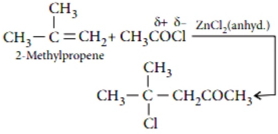
Indicate the organic structure for the product expected when $2-$methylpropene is heated with acetyl chloride in the presence of anhydrous zinc chloride.
A
$CH_3-C(Cl)(CH_3)-CH_2-COCH_3$
B
$CH_3-CH(CH_3)-CH_2-COCH_3$
C
$CH_3-COO-C(CH_3)_3$
D
$CH_3-CO-C(CH_3)=CH_2$
Solution
(A) The reaction is an electrophilic addition of acetyl chloride to the alkene catalyzed by a Lewis acid $(ZnCl_2)$.
The acetyl cation $(CH_3CO^+)$ attacks the terminal carbon of $2-$methylpropene to form a stable tertiary carbocation intermediate,$(CH_3)_2C^+-CH_2-COCH_3$.
This intermediate then reacts with the chloride ion $(Cl^-)$ to give $4-$chloro$-4-$methylpentan$-2-$one,$CH_3-C(Cl)(CH_3)-CH_2-COCH_3$.
The acetyl cation $(CH_3CO^+)$ attacks the terminal carbon of $2-$methylpropene to form a stable tertiary carbocation intermediate,$(CH_3)_2C^+-CH_2-COCH_3$.
This intermediate then reacts with the chloride ion $(Cl^-)$ to give $4-$chloro$-4-$methylpentan$-2-$one,$CH_3-C(Cl)(CH_3)-CH_2-COCH_3$.
0 likesView Solution
43
ChemistryMediumMCQAIPMT · 1989
The major product formed when propene reacts with $HBr$ in the presence of peroxides is
A
$n-$propyl bromide
B
Isopropyl bromide
C
$n-$propyl alcohol
D
$1, 3-$dibromopropane
Solution
(A) In the presence of peroxide,the addition of $HBr$ to an unsymmetrical alkene like propene follows the Anti-Markownikoff's rule.
According to this rule,the negative part of the reagent $(Br^-)$ attaches to the carbon atom with the greater number of hydrogen atoms.
Reaction: $CH_3-CH=CH_2 + HBr \xrightarrow{\text{peroxide}} CH_3-CH_2-CH_2-Br$ ($n-$propyl bromide).
Therefore,the major product is $n-$propyl bromide.
According to this rule,the negative part of the reagent $(Br^-)$ attaches to the carbon atom with the greater number of hydrogen atoms.
Reaction: $CH_3-CH=CH_2 + HBr \xrightarrow{\text{peroxide}} CH_3-CH_2-CH_2-Br$ ($n-$propyl bromide).
Therefore,the major product is $n-$propyl bromide.
0 likesView Solution
44
ChemistryMediumMCQAIPMT · 1989
Acetylenic hydrogens are acidic because
A
Sigma electron density of $C-H$ bond in acetylene is nearer to carbon,which has $50\%$ $s-$character
B
Acetylene has only one hydrogen on each carbon
C
Acetylene contains least number of hydrogens among the possible hydrocarbons having two carbons
D
Acetylene belongs to the class of alkynes with molecular formula $C_nH_{2n-2}$
Solution
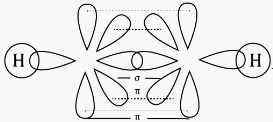
(A) The formation of $C-H$ bond in acetylene involves $sp-$hybridised carbon atom.
Since $s-$electrons are closer to the nucleus than $p$ electrons,$sp$ hybrid orbitals are more electronegative due to their smaller (in length) and thicker lobes,which increases the time spent by electrons near the nucleus compared to $sp^2$ and $sp^3$ orbitals.
Thus,the electrons present in a bond having more $s-$character will be closer to the nucleus.
In alkynes $(C \equiv C-H)$ bond,the $s-$character is $50\%$,so the electrons constituting this bond are more strongly attracted by the carbon nucleus.
Thus,the acetylenic carbon atom becomes more electronegative in comparison to $sp^2$ and $sp^3$ hybridized carbons,and hence the hydrogen atom present on the carbon atom $(C \equiv C-H)$ can be easily removed as a proton $(H^+)$.
Since $s-$electrons are closer to the nucleus than $p$ electrons,$sp$ hybrid orbitals are more electronegative due to their smaller (in length) and thicker lobes,which increases the time spent by electrons near the nucleus compared to $sp^2$ and $sp^3$ orbitals.
Thus,the electrons present in a bond having more $s-$character will be closer to the nucleus.
In alkynes $(C \equiv C-H)$ bond,the $s-$character is $50\%$,so the electrons constituting this bond are more strongly attracted by the carbon nucleus.
Thus,the acetylenic carbon atom becomes more electronegative in comparison to $sp^2$ and $sp^3$ hybridized carbons,and hence the hydrogen atom present on the carbon atom $(C \equiv C-H)$ can be easily removed as a proton $(H^+)$.
0 likesView Solution
45
ChemistryMediumMCQAIPMT · 1989
Which is the most suitable reagent among the following to distinguish compound $(iii)$ from the rest of the compounds?
$(i)$ $CH_3-C\equiv C-CH_3$
$(ii)$ $CH_3-CH_2-CH_2-CH_3$
$(iii)$ $CH_3-CH_2-C\equiv CH$
$(iv)$ $CH_3-CH=CH_2$
$(i)$ $CH_3-C\equiv C-CH_3$
$(ii)$ $CH_3-CH_2-CH_2-CH_3$
$(iii)$ $CH_3-CH_2-C\equiv CH$
$(iv)$ $CH_3-CH=CH_2$
A
Bromine in carbon tetrachloride
B
Bromine in acetic acid
C
Alkaline $KMnO_4$
D
Ammoniacal silver nitrate reagent
Solution
(D) Terminal alkynes,such as compound $(iii)$,contain an acidic hydrogen atom attached to the $sp$-hybridized carbon.
Ammoniacal silver nitrate (Tollens' reagent) reacts with terminal alkynes to form a white precipitate of silver acetylide.
$CH_3-CH_2-C\equiv CH + [Ag(NH_3)_2]^+ + OH^-$ $\rightarrow CH_3-CH_2-C\equiv C^- Ag^+ \text{ (white precipitate)} + 2NH_3 + H_2O$
Compounds $(i)$,$(ii)$,and $(iv)$ do not possess acidic terminal hydrogen atoms and therefore do not form a precipitate with this reagent.
Ammoniacal silver nitrate (Tollens' reagent) reacts with terminal alkynes to form a white precipitate of silver acetylide.
$CH_3-CH_2-C\equiv CH + [Ag(NH_3)_2]^+ + OH^-$ $\rightarrow CH_3-CH_2-C\equiv C^- Ag^+ \text{ (white precipitate)} + 2NH_3 + H_2O$
Compounds $(i)$,$(ii)$,and $(iv)$ do not possess acidic terminal hydrogen atoms and therefore do not form a precipitate with this reagent.
0 likesView Solution
46
ChemistryMediumMCQAIPMT · 1989
$R-CH_2-CCl_2-R \xrightarrow{\text{Reagent}} R-C \equiv C-R$
The reagent is
The reagent is
A
$Na$
B
$HCl \text{ and } H_2O$
C
$KOH \text{ in } C_2H_5OH$
D
$Zn$
Solution
(C) $(C) \, R-CH_2-CCl_2-R \xrightarrow{KOH \text{ (alc.)}} R-C \equiv C-R + 2HCl$
This reaction is an example of dehydrohalogenation,where two molecules of $HCl$ are removed from a gem-dihalide to form an alkyne.
Alcoholic $KOH$ acts as a strong base to facilitate this elimination reaction.
This reaction is an example of dehydrohalogenation,where two molecules of $HCl$ are removed from a gem-dihalide to form an alkyne.
Alcoholic $KOH$ acts as a strong base to facilitate this elimination reaction.
0 likesView Solution
47
ChemistryMediumMCQAIPMT · 1989
When treated with ammoniacal cuprous chloride,which one among the following forms a copper derivative?
A
$C_2H_6$
B
$C_2H_4$
C
$C_2H_2$
D
$C_6H_6$
Solution
(C) Ammoniacal cuprous chloride (Tollens' reagent for alkynes) reacts with terminal alkynes to form a red precipitate of copper acetylide.
$2NH_4OH + Cu_2Cl_2 \to 2CuOH + 2NH_4Cl$
$CuOH + 2NH_4OH \to [Cu(NH_3)_2]OH + 2H_2O$
$HC \equiv CH + 2[Cu(NH_3)_2]OH \to CuC \equiv CCu + 4NH_3 + 2H_2O$
Since $C_2H_2$ (acetylene) is a terminal alkyne,it forms the copper derivative (copper acetylide).
$2NH_4OH + Cu_2Cl_2 \to 2CuOH + 2NH_4Cl$
$CuOH + 2NH_4OH \to [Cu(NH_3)_2]OH + 2H_2O$
$HC \equiv CH + 2[Cu(NH_3)_2]OH \to CuC \equiv CCu + 4NH_3 + 2H_2O$
Since $C_2H_2$ (acetylene) is a terminal alkyne,it forms the copper derivative (copper acetylide).
0 likesView Solution
48
ChemistryMCQAIPMT · 1989
An example of a double salt is
A
Bleaching powder
B
Hypo
C
$K_4[Fe(CN)_6]$
D
Potash alum
Solution
(D) double salt is a crystalline compound that contains two different salts combined in a definite molar ratio.
These salts dissociate completely into their constituent ions in an aqueous solution.
Potash alum,with the formula $K_2SO_4 \cdot Al_2(SO_4)_3 \cdot 24H_2O$,is a classic example of a double salt.
In contrast,$K_4[Fe(CN)_6]$ is a coordination compound (complex salt) that does not dissociate completely into its constituent ions.
These salts dissociate completely into their constituent ions in an aqueous solution.
Potash alum,with the formula $K_2SO_4 \cdot Al_2(SO_4)_3 \cdot 24H_2O$,is a classic example of a double salt.
In contrast,$K_4[Fe(CN)_6]$ is a coordination compound (complex salt) that does not dissociate completely into its constituent ions.
0 likesView Solution
49
ChemistryDifficultMCQAIPMT · 1989
$Ortho$-nitrophenol is steam volatile whereas $para$-nitrophenol is not. This is due to
A
Intramolecular hydrogen bonding present in $ortho$-nitrophenol
B
Intermolecular hydrogen bonding
C
Intramolecular hydrogen bonding present in $para$-nitrophenol
D
None of these
Solution
(A) $Ortho$-nitrophenol and $para$-nitrophenol can be separated by steam distillation.
$o$-nitrophenol is steam volatile due to the presence of intramolecular hydrogen bonding,which reduces the intermolecular forces of attraction.
In contrast,$p$-nitrophenol exhibits intermolecular hydrogen bonding,leading to the association of molecules,which increases its boiling point and makes it less volatile.
Intramolecular hydrogen bonding occurs in $ortho$-nitrophenol because the $-NO_2$ and $-OH$ groups are in close proximity to each other.
$o$-nitrophenol is steam volatile due to the presence of intramolecular hydrogen bonding,which reduces the intermolecular forces of attraction.
In contrast,$p$-nitrophenol exhibits intermolecular hydrogen bonding,leading to the association of molecules,which increases its boiling point and makes it less volatile.
Intramolecular hydrogen bonding occurs in $ortho$-nitrophenol because the $-NO_2$ and $-OH$ groups are in close proximity to each other.
0 likesView Solution
50
ChemistryMCQAIPMT · 1989
The vector for sleeping sickness is
A
Housefly
B
Tsetse fly
C
Sandfly
D
Fruit fly
Solution
(B) Sleeping sickness, also known as African trypanosomiasis, is a parasitic disease caused by the protozoan $Trypanosoma$ $brucei$.
The disease is transmitted to humans through the bite of an infected $Tsetse$ $fly$ (genus $Glossina$).
Therefore, the $Tsetse$ $fly$ acts as the biological vector for this disease.
The disease is transmitted to humans through the bite of an infected $Tsetse$ $fly$ (genus $Glossina$).
Therefore, the $Tsetse$ $fly$ acts as the biological vector for this disease.
0 likesView Solution
51
ChemistryEasyMCQAIPMT · 1989
In the extraction of aluminium,the electrolyte used is:
A
Fused cryolite with felspar
B
Fused cryolite with fluorspar
C
Pure alumina in molten cryolite
D
Pure alumina with bauxite and molten cryolite
Solution
(C) In the Hall-$H$éroult process for the extraction of aluminium,pure alumina $(Al_2O_3)$ is dissolved in molten cryolite $(Na_3AlF_6)$.
This mixture is used as the electrolyte because it lowers the melting point of the mixture and increases its electrical conductivity.
This mixture is used as the electrolyte because it lowers the melting point of the mixture and increases its electrical conductivity.
0 likesView Solution
52
ChemistryEasyMCQAIPMT · 1989
Which of the following elements does not form stable diatomic molecules?
A
Iodine
B
Phosphorus
C
Nitrogen
D
Oxygen
Solution
(B) Elements like $I_2$,$N_2$,and $O_2$ exist as stable diatomic molecules.
Phosphorus,due to its smaller size and high repulsion between lone pairs,prefers to form a tetrahedral $P_4$ molecule rather than a diatomic $P_2$ molecule.
Phosphorus,due to its smaller size and high repulsion between lone pairs,prefers to form a tetrahedral $P_4$ molecule rather than a diatomic $P_2$ molecule.
0 likesView Solution
53
ChemistryEasyMCQAIPMT · 1989
Which of the following is the most suitable drying agent for ammonia gas?
A
Calcium oxide
B
Anhydrous calcium chloride
C
Phosphorus pentoxide
D
Conc. sulphuric acid
Solution
(A) Ammonia $(NH_3)$ is a basic gas.
To dry a basic gas,we must use a basic drying agent.
If an acidic drying agent is used,it will react with the ammonia to form a salt.
$CaCl_2$ forms an adduct with $NH_3$ $(CaCl_2 \cdot 8NH_3)$.
$P_2O_5$ and $H_2SO_4$ are acidic and will react with $NH_3$ to form ammonium salts.
Therefore,$CaO$ (quicklime) is the only suitable basic drying agent among the given options.
To dry a basic gas,we must use a basic drying agent.
If an acidic drying agent is used,it will react with the ammonia to form a salt.
$CaCl_2$ forms an adduct with $NH_3$ $(CaCl_2 \cdot 8NH_3)$.
$P_2O_5$ and $H_2SO_4$ are acidic and will react with $NH_3$ to form ammonium salts.
Therefore,$CaO$ (quicklime) is the only suitable basic drying agent among the given options.
0 likesView Solution
54
ChemistryMediumMCQAIPMT · 1989
Each of the following is true for white and red phosphorus except that they
A
Are both soluble in $CS_2$
B
Can be oxidised by heating in air
C
Consist of the same kind of atoms
D
Can be converted into one another
Solution
(A) The correct answer is $A$. White phosphorus is soluble in $CS_2$,whereas red phosphorus is insoluble in $CS_2$. Both forms consist of $P_4$ units (same kind of atoms),both can be oxidized by heating in air,and they can be interconverted under specific conditions.
0 likesView Solution
55
ChemistryMediumMCQAIPMT · 1989
Which of the following is not known?
A
$NCl_5$
B
$NI_3$
C
$SbCl_3$
D
$NCl_3$
Solution
(A) The correct answer is $A$.
$NCl_5$ is not known because nitrogen lacks $d$-orbitals in its valence shell,which prevents it from expanding its covalency beyond $4$.
$NCl_5$ is not known because nitrogen lacks $d$-orbitals in its valence shell,which prevents it from expanding its covalency beyond $4$.
0 likesView Solution
56
ChemistryEasyMCQAIPMT · 1989
Which of the following oxides of nitrogen is the anhydride of $HNO_3$?
A
$NO$
B
$N_2O_3$
C
$N_2O_4$
D
$N_2O_5$
Solution
(D) The anhydride of an acid is formed by the removal of water molecules from the acid.
For nitric acid $(HNO_3)$,the reaction is:
$2HNO_3 \rightarrow N_2O_5 + H_2O$
Thus,$N_2O_5$ is the anhydride of $HNO_3$.
For nitric acid $(HNO_3)$,the reaction is:
$2HNO_3 \rightarrow N_2O_5 + H_2O$
Thus,$N_2O_5$ is the anhydride of $HNO_3$.
0 likesView Solution
57
ChemistryMediumMCQAIPMT · 1989
Which of the following has the lowest boiling point?
A
$NH_3$
B
$PH_3$
C
$AsH_3$
D
$SbH_3$
Solution
(B) The boiling point of hydrides of Group $15$ elements depends on the molecular mass and the presence of hydrogen bonding.
$NH_3$ has the highest boiling point due to intermolecular hydrogen bonding.
For the remaining hydrides $(PH_3, AsH_3, SbH_3, BiH_3)$,the boiling point increases with an increase in molecular mass due to stronger van der Waals forces.
Thus,$PH_3$ has the lowest boiling point.
$NH_3$ has the highest boiling point due to intermolecular hydrogen bonding.
For the remaining hydrides $(PH_3, AsH_3, SbH_3, BiH_3)$,the boiling point increases with an increase in molecular mass due to stronger van der Waals forces.
| \text{Hydride} | \text{Boiling point } $(K)$ |
| $NH_3$ | $238.5$ |
| $PH_3$ | $185.5$ |
| $AsH_3$ | $210.6$ |
| $SbH_3$ | $254.6$ |
| $BiH_3$ | $290.0$ |
Thus,$PH_3$ has the lowest boiling point.
0 likesView Solution
58
ChemistryMediumMCQAIPMT · 1989
The ability of a substance to assume two or more crystalline structures is called
A
Isomerism
B
Polymorphism
C
Isomorphism
D
Amorphism
Solution
(B) Polymorphism is the ability of a substance to exist in two or more different crystalline forms or structures.
0 likesView Solution
59
ChemistryEasyMCQAIPMT · 1989
It is possible to obtain oxygen from air by fractional distillation because
A
Oxygen is in a different group of the periodic table from nitrogen
B
Oxygen is more reactive than nitrogen
C
Oxygen has higher $b.p.$ than nitrogen
D
Oxygen has a lower density than nitrogen
Solution
(C) Fractional distillation of liquid air is based on the difference in the boiling points $(b.p.)$ of its components.
Oxygen has a higher boiling point $(90 \ K)$ compared to Nitrogen $(77 \ K)$.
Therefore,Nitrogen boils off first,leaving behind liquid Oxygen.
Hence,Option $C$ is the correct answer.
Oxygen has a higher boiling point $(90 \ K)$ compared to Nitrogen $(77 \ K)$.
Therefore,Nitrogen boils off first,leaving behind liquid Oxygen.
Hence,Option $C$ is the correct answer.
0 likesView Solution
60
ChemistryEasyMCQAIPMT · 1989
Oxygen does not react with
A
$P$
B
$Na$
C
$S$
D
$Cl$
Solution
(D) Among the given elements,$P$,$Na$,and $S$ react directly with oxygen to form their respective oxides.
$P_4 + 5O_2 \longrightarrow P_4O_{10}$
$S + O_2 \longrightarrow SO_2$
$4Na + O_2 \longrightarrow 2Na_2O$
Chlorine $(Cl)$ does not react directly with oxygen under normal conditions. Therefore,the correct option is $D$.
$P_4 + 5O_2 \longrightarrow P_4O_{10}$
$S + O_2 \longrightarrow SO_2$
$4Na + O_2 \longrightarrow 2Na_2O$
Chlorine $(Cl)$ does not react directly with oxygen under normal conditions. Therefore,the correct option is $D$.
0 likesView Solution
61
ChemistryEasyMCQAIPMT · 1989
Solid methane is
A
Molecular solid
B
Ionic solid
C
Covalent solid
D
Not possible
Solution
(A) In $CH_4$ molecules,there exist strong covalent bonds between the atoms within each molecule.
However,in solid $CH_4$,the molecules are held together by weak van der Waals forces.
Since the constituent particles are molecules held by weak intermolecular forces,it is classified as a molecular solid.
Therefore,option $A$ is the correct answer.
However,in solid $CH_4$,the molecules are held together by weak van der Waals forces.
Since the constituent particles are molecules held by weak intermolecular forces,it is classified as a molecular solid.
Therefore,option $A$ is the correct answer.
0 likesView Solution
62
ChemistryMediumMCQAIPMT · 1989
Which among the following is the strongest $o, p-$directing group?
A
$OH$
B
$Cl$
C
$C_6H_5$
D
$Br$
Solution
(A) The strength of an $o, p-$directing group is determined by its ability to donate electron density to the benzene ring via the resonance effect ($+R$ or $+M$ effect).
Among the given options:
$1$. $-OH$ has a strong $+R$ effect due to the lone pair on oxygen,making it a powerful activating group.
$2$. $-Cl$ and $-Br$ are deactivating groups due to their strong $-I$ effect,although they are $o, p-$directing due to the $+R$ effect.
$3$. $-C_6H_5$ (phenyl group) is an activating group but is weaker than $-OH$ in terms of electron donation to the ring.
Therefore,$-OH$ is the strongest $o, p-$directing group among the choices provided.
Among the given options:
$1$. $-OH$ has a strong $+R$ effect due to the lone pair on oxygen,making it a powerful activating group.
$2$. $-Cl$ and $-Br$ are deactivating groups due to their strong $-I$ effect,although they are $o, p-$directing due to the $+R$ effect.
$3$. $-C_6H_5$ (phenyl group) is an activating group but is weaker than $-OH$ in terms of electron donation to the ring.
Therefore,$-OH$ is the strongest $o, p-$directing group among the choices provided.
0 likesView Solution
63
ChemistryMediumMCQAIPMT · 1989
The latent heat of vaporisation of water is $9700 \, Cal/mole$ and if the boiling point is $100 \, ^oC$,the ebullioscopic constant of water is .......... $^oC \, kg/mol$.
A
$0.51$
B
$1.03$
C
$10.26$
D
$1.83$
Solution
(A) The ebullioscopic constant $(K_b)$ is given by the formula: $K_b = \frac{R \times T_b^2 \times M}{1000 \times \Delta H_{vap}}$
Where:
$R = 1.987 \, cal \, K^{-1} \, mol^{-1} \approx 2 \, cal \, K^{-1} \, mol^{-1}$
$T_b = 100 + 273 = 373 \, K$
$\Delta H_{vap} = 9700 \, cal/mol$
$M = 18 \, g/mol$ (Molar mass of water)
Substituting the values:
$K_b = \frac{2 \times (373)^2 \times 18}{1000 \times 9700}$
$K_b = \frac{2 \times 139129 \times 18}{9700000}$
$K_b = \frac{5008644}{9700000} \approx 0.516 \, ^oC \, kg/mol$
Thus,the correct option is $A$.
Where:
$R = 1.987 \, cal \, K^{-1} \, mol^{-1} \approx 2 \, cal \, K^{-1} \, mol^{-1}$
$T_b = 100 + 273 = 373 \, K$
$\Delta H_{vap} = 9700 \, cal/mol$
$M = 18 \, g/mol$ (Molar mass of water)
Substituting the values:
$K_b = \frac{2 \times (373)^2 \times 18}{1000 \times 9700}$
$K_b = \frac{2 \times 139129 \times 18}{9700000}$
$K_b = \frac{5008644}{9700000} \approx 0.516 \, ^oC \, kg/mol$
Thus,the correct option is $A$.
0 likesView Solution
64
ChemistryEasyMCQAIPMT · 1989
The number of atoms contained in one face-centred cubic $(FCC)$ unit cell of a monoatomic substance is:
A
$1$
B
$2$
C
$4$
D
$6$
Solution
(C) In a face-centred cubic $(FCC)$ unit cell,atoms are present at the corners and at the centre of each face.
Number of atoms at corners = $8 \times \frac{1}{8} = 1$.
Number of atoms at face centres = $6 \times \frac{1}{2} = 3$.
Total number of atoms = $1 + 3 = 4$.
Number of atoms at corners = $8 \times \frac{1}{8} = 1$.
Number of atoms at face centres = $6 \times \frac{1}{2} = 3$.
Total number of atoms = $1 + 3 = 4$.
0 likesView Solution
65
ChemistryMediumMCQAIPMT · 1989
What happens when an $\alpha$-particle is emitted?
A
Mass number decreases by $12$ units,atomic number decreases by $4$ units
B
Mass number decreases by $4$ units,atomic number decreases by $2$ units
C
Only mass number decreases
D
Only atomic number decreases
Solution
(B) An $\alpha$-particle is a helium nucleus,represented as $_2^4He$.
When a radioactive nucleus emits an $\alpha$-particle,its mass number $(A)$ decreases by $4$ and its atomic number $(Z)$ decreases by $2$.
The nuclear reaction is represented as: $_Z^AX \rightarrow _{Z-2}^{A-4}Y + _2^4He$.
When a radioactive nucleus emits an $\alpha$-particle,its mass number $(A)$ decreases by $4$ and its atomic number $(Z)$ decreases by $2$.
The nuclear reaction is represented as: $_Z^AX \rightarrow _{Z-2}^{A-4}Y + _2^4He$.
0 likesView Solution
66
ChemistryMediumMCQAIPMT · 1989
Which of the following catalyses the conversion of glucose into ethanol?
A
Zymase
B
Invertase
C
Maltase
D
Diastase
Solution
(A) The enzyme $Zymase$ is responsible for the fermentation of glucose into ethanol and carbon dioxide.
The chemical reaction is as follows:
$C_6H_{12}O_6 \xrightarrow{\text{Zymase}} 2C_2H_5OH + 2CO_2$
The chemical reaction is as follows:
$C_6H_{12}O_6 \xrightarrow{\text{Zymase}} 2C_2H_5OH + 2CO_2$
0 likesView Solution
67
ChemistryDifficultMCQAIPMT · 1989
If the dispersed phase is a liquid and the dispersion medium is a solid,the colloid is known as
A
$A$. $A$ sol
B
$B$. An emulsion
C
$C$. $A$ gel
D
$D$. $A$ foam
Solution
(C) . $\text{Liquid (dispersed phase)} + \text{Solid (dispersion medium)} = \text{Gel (colloid)}$.
Examples include butter,cheese,and jelly.
Examples include butter,cheese,and jelly.
0 likesView Solution
68
ChemistryMediumMCQAIPMT · 1989
Gold number is a measure of the
A
Protective action by a lyophilic colloid on a lyophobic colloid
B
Protective action by a lyophobic colloid on a lyophilic colloid
C
Number of $mg$ of gold in a standard red gold sol
D
Stability of gold sol
Solution
(A) Lyophobic sols are more easily coagulated by the addition of suitable electrolytes.
To prevent the coagulation of a lyophobic sol by the addition of an electrolyte,a small amount of a lyophilic colloid is added to it.
This lyophilic colloid acts as a protective colloid,and its protective power is measured in terms of the Gold number.
Thus,the Gold number is a measure of the protective action of a lyophilic colloid on a lyophobic colloid.
To prevent the coagulation of a lyophobic sol by the addition of an electrolyte,a small amount of a lyophilic colloid is added to it.
This lyophilic colloid acts as a protective colloid,and its protective power is measured in terms of the Gold number.
Thus,the Gold number is a measure of the protective action of a lyophilic colloid on a lyophobic colloid.
0 likesView Solution
69
ChemistryMediumMCQAIPMT · 1989
When excess of electrolyte is added to a colloid,it
A
Coagulates
B
Precipitates
C
Gets diluted
D
Does not change
Solution
(A) When an excess of electrolyte is added to a colloid,the colloidal particles interact with ions carrying a charge opposite to that present on them.
This causes neutralization of the charge on the colloidal particles,which leads to their coagulation or precipitation.
This causes neutralization of the charge on the colloidal particles,which leads to their coagulation or precipitation.
0 likesView Solution
70
ChemistryMediumMCQAIPMT · 1989
Which of the following metals corrodes readily in moist air?
A
Gold
B
Silver
C
Nickel
D
Iron
Solution
(D) . Iron.
Iron undergoes oxidation in the presence of moisture and oxygen to form hydrated iron$(III)$ oxide,commonly known as rust.
The chemical reaction is: $4Fe(s) + 3O_2(g) + 2xH_2O(l) \to 2Fe_2O_3 \cdot xH_2O(s)$.
Iron undergoes oxidation in the presence of moisture and oxygen to form hydrated iron$(III)$ oxide,commonly known as rust.
The chemical reaction is: $4Fe(s) + 3O_2(g) + 2xH_2O(l) \to 2Fe_2O_3 \cdot xH_2O(s)$.
0 likesView Solution
71
ChemistryEasyMCQAIPMT · 1989
An example of a double salt is:
A
Bleaching powder
B
$K_4[Fe(CN)_6]$
C
Hypo
D
Potash alum
Solution
(D) . Potash alum is a double salt with the formula $K_2SO_4 \cdot Al_2(SO_4)_3 \cdot 24H_2O$.
Double salts dissociate completely into their constituent ions in aqueous solution,whereas coordination compounds like $K_4[Fe(CN)_6]$ do not.
Double salts dissociate completely into their constituent ions in aqueous solution,whereas coordination compounds like $K_4[Fe(CN)_6]$ do not.
0 likesView Solution
72
ChemistryDifficultMCQAIPMT · 1989
$A$ blue colouration is not obtained when:
A
Ammonium hydroxide dissolves in copper sulphate
B
Copper sulphate solution reacts with $K_4[Fe(CN)_6]$
C
Ferric chloride reacts with sodium ferrocyanide
D
Anhydrous $CuSO_4$ is dissolved in water
Solution
(B) The reaction between $CuSO_4$ and $K_4[Fe(CN)_6]$ produces a chocolate brown precipitate of $Cu_2[Fe(CN)_6]$,not a blue colouration.
$2CuSO_4 + K_4[Fe(CN)_6] \to Cu_2[Fe(CN)_6] + 2K_2SO_4$ (Chocolate brown).
In contrast,$4NH_4OH + CuSO_4 \to [Cu(NH_3)_4]SO_4 + 4H_2O$ produces a deep blue solution.
Anhydrous $CuSO_4 + 5H_2O \to CuSO_4 \cdot 5H_2O$ produces a blue colour.
$4FeCl_3 + 3Na_4[Fe(CN)_6] \to Fe_4[Fe(CN)_6]_3 + 12NaCl$ produces a Prussian blue precipitate.
$2CuSO_4 + K_4[Fe(CN)_6] \to Cu_2[Fe(CN)_6] + 2K_2SO_4$ (Chocolate brown).
In contrast,$4NH_4OH + CuSO_4 \to [Cu(NH_3)_4]SO_4 + 4H_2O$ produces a deep blue solution.
Anhydrous $CuSO_4 + 5H_2O \to CuSO_4 \cdot 5H_2O$ produces a blue colour.
$4FeCl_3 + 3Na_4[Fe(CN)_6] \to Fe_4[Fe(CN)_6]_3 + 12NaCl$ produces a Prussian blue precipitate.
0 likesView Solution
73
ChemistryEasyMCQAIPMT · 1989
Photographic films and plates have an essential ingredient of
A
Silver nitrate
B
Silver bromide
C
Sodium chloride
D
Oleic acid
Solution
(B) $AgBr$ is most sensitive to light and undergoes photochemical reduction.
$2AgBr \xrightarrow{\text{Light}} 2Ag + Br_2$
$2AgBr \xrightarrow{\text{Light}} 2Ag + Br_2$
0 likesView Solution
74
ChemistryMediumMCQAIPMT · 1989
Which of the following metals is obtained by the leaching process using a solution of $NaCN$ and then precipitating the metal by the addition of zinc dust?
A
Copper
B
Silver
C
Nickel
D
Iron
Solution
(B) The extraction of silver $(Ag)$ from its ore (like $Ag_2S$) involves leaching with a dilute solution of $NaCN$ in the presence of air $(O_2)$:
$Ag_2S + 4NaCN \to 2Na[Ag(CN)_2] + Na_2S$
$2Na_2S + 2O_2 + H_2O \to 2NaOH + Na_2S_2O_3$
Silver is then recovered from the complex by displacement using zinc dust:
$2Na[Ag(CN)_2] + Zn \to Na_2[Zn(CN)_4] + 2Ag$
$Ag_2S + 4NaCN \to 2Na[Ag(CN)_2] + Na_2S$
$2Na_2S + 2O_2 + H_2O \to 2NaOH + Na_2S_2O_3$
Silver is then recovered from the complex by displacement using zinc dust:
$2Na[Ag(CN)_2] + Zn \to Na_2[Zn(CN)_4] + 2Ag$
0 likesView Solution
75
ChemistryMediumMCQAIPMT · 1989
While extracting an element from its ore,the ore is ground and leached with dilute $KCN$ solution to form the soluble product potassium argentocyanide. The element is
A
Lead
B
Chromium
C
Manganese
D
Silver
Solution
(D) The extraction of $Ag$ (Silver) from its ore (like $Ag_2S$) involves leaching the finely powdered ore with a dilute solution of $KCN$ in the presence of air $(O_2)$.
The chemical reaction is: $4Ag(s) + 8CN^-(aq) + 2H_2O(aq) + O_2(g) \rightarrow 4[Ag(CN)_2]^-(aq) + 4OH^-(aq)$.
The soluble complex formed is potassium argentocyanide,$K[Ag(CN)_2]$.
Thus,the element being extracted is Silver $(Ag)$.
The chemical reaction is: $4Ag(s) + 8CN^-(aq) + 2H_2O(aq) + O_2(g) \rightarrow 4[Ag(CN)_2]^-(aq) + 4OH^-(aq)$.
The soluble complex formed is potassium argentocyanide,$K[Ag(CN)_2]$.
Thus,the element being extracted is Silver $(Ag)$.
0 likesView Solution
76
ChemistryDifficultMCQAIPMT · 1989
If we use pyrene $(CCl_4)$ in the Riemer-Tiemann reaction in place of chloroform,the product formed is
A
Salicylaldehyde
B
Phenolphthalein
C
Salicylic acid
D
Cyclohexanol
Solution
(C) When phenol reacts with $CCl_4$ in the presence of aqueous $NaOH$,the reaction is a variation of the Riemer-Tiemann reaction.
Instead of forming an aldehyde group (as with $CHCl_3$),the use of $CCl_4$ results in the introduction of a carboxylic acid group $(-COOH)$ at the ortho position of the phenol.
The reaction is:
$C_6H_5OH + CCl_4 + 4NaOH \rightarrow C_6H_4(OH)(COOH) + 4NaCl + 2H_2O$.
The product formed is Salicylic acid.
Instead of forming an aldehyde group (as with $CHCl_3$),the use of $CCl_4$ results in the introduction of a carboxylic acid group $(-COOH)$ at the ortho position of the phenol.
The reaction is:
$C_6H_5OH + CCl_4 + 4NaOH \rightarrow C_6H_4(OH)(COOH) + 4NaCl + 2H_2O$.
The product formed is Salicylic acid.
0 likesView Solution
77
ChemistryDifficultMCQAIPMT · 1989
The alcohol that produces turbidity immediately with $ZnCl_2 +$ conc. $HCl$ at room temperature is:
A
$1-$butanol
B
$2-$butanol
C
$2-$methylpropan$-2-$ol
D
$2-$methylpropan$-1-$ol
Solution
(C) The reaction of alcohols with $ZnCl_2 +$ conc. $HCl$ is known as the $Lucas$ test.
$3^o$ alcohols react immediately to form turbidity.
$2^o$ alcohols react after about $5$ minutes.
$1^o$ alcohols do not react at room temperature.
Among the given options,$(CH_3)_3C-OH$ ($2-$methylpropan$-2-$ol) is a $3^o$ alcohol,which reacts immediately to produce turbidity.
$3^o$ alcohols react immediately to form turbidity.
$2^o$ alcohols react after about $5$ minutes.
$1^o$ alcohols do not react at room temperature.
Among the given options,$(CH_3)_3C-OH$ ($2-$methylpropan$-2-$ol) is a $3^o$ alcohol,which reacts immediately to produce turbidity.
0 likesView Solution
78
ChemistryMediumMCQAIPMT · 1989
When ethyl alcohol $C_2H_5OH$ is mixed with ammonia and passed over heated alumina,the compound formed is
A
$C_2H_5NH_2$
B
$C_2H_4$
C
$C_2H_5OC_2H_5$
D
$CH_3OCH_3$
Solution
(A) When ethyl alcohol is passed over heated alumina $(Al_2O_3)$ in the presence of ammonia,it undergoes an ammonolysis reaction to form ethylamine.
The chemical reaction is:
$C_2H_5OH + NH_3 \xrightarrow{Al_2O_3, \Delta} C_2H_5NH_2 + H_2O$
Thus,the correct product is ethylamine $(C_2H_5NH_2)$.
The chemical reaction is:
$C_2H_5OH + NH_3 \xrightarrow{Al_2O_3, \Delta} C_2H_5NH_2 + H_2O$
Thus,the correct product is ethylamine $(C_2H_5NH_2)$.
0 likesView Solution
79
ChemistryDifficultMCQAIPMT · 1989
$3 CH_3COCH_3 \xrightarrow{HCl} (CH_3)_2C = CH - CO - CH = C(CH_3)_2$
This product $B$ is obtained when acetone is saturated with hydrogen chloride gas. $B$ can be:
This product $B$ is obtained when acetone is saturated with hydrogen chloride gas. $B$ can be:
A
Phorone
B
Formose
C
Diacetone alcohol
D
Mesityl oxide
Solution
(A) When acetone $(CH_3COCH_3)$ is saturated with dry hydrogen chloride gas,it undergoes an aldol condensation followed by dehydration to form Phorone.
The reaction is:
$3 CH_3COCH_3 \xrightarrow{HCl} (CH_3)_2C = CH - CO - CH = C(CH_3)_2 + 2 H_2O$
The product formed is Phorone.
The reaction is:
$3 CH_3COCH_3 \xrightarrow{HCl} (CH_3)_2C = CH - CO - CH = C(CH_3)_2 + 2 H_2O$
The product formed is Phorone.
0 likesView Solution
80
ChemistryMediumMCQAIPMT · 1989
Which one of the following reactions is a method for the conversion of a ketone into a hydrocarbon?
A
Aldol condensation
B
Reimer-Tiemann reaction
C
Cannizzaro reaction
D
Wolf-Kishner reduction
Solution
(D) The $Wolf-Kishner$ reduction is a method used to convert carbonyl compounds (aldehydes and ketones) into their corresponding alkanes (hydrocarbons).
In this reaction, the ketone is treated with hydrazine $(NH_2NH_2)$ followed by heating with a strong base like $KOH$ in a high-boiling solvent such as ethylene glycol.
The reaction for acetone is:
$CH_3COCH_3 \xrightarrow{NH_2NH_2 / KOH, \text{glycol}, \Delta} CH_3CH_2CH_3 + N_2 + H_2O$
In this reaction, the ketone is treated with hydrazine $(NH_2NH_2)$ followed by heating with a strong base like $KOH$ in a high-boiling solvent such as ethylene glycol.
The reaction for acetone is:
$CH_3COCH_3 \xrightarrow{NH_2NH_2 / KOH, \text{glycol}, \Delta} CH_3CH_2CH_3 + N_2 + H_2O$
0 likesView Solution
81
ChemistryMediumMCQAIPMT · 1989
Paraldehyde is used as a $ . . . . . . $.
A
Medicine
B
Poison
C
Polymer
D
Dye
Solution
(A) Paraldehyde is primarily used as a sedative and hypnotic medication.
It was historically used to treat conditions such as insomnia and epilepsy,although its use has decreased over time due to the development of safer and more effective alternatives.
Paraldehyde is known for its sedative effects,which can induce sleep and reduce anxiety.
Therefore,it is classified as a medicine.
It was historically used to treat conditions such as insomnia and epilepsy,although its use has decreased over time due to the development of safer and more effective alternatives.
Paraldehyde is known for its sedative effects,which can induce sleep and reduce anxiety.
Therefore,it is classified as a medicine.
0 likesView Solution
82
ChemistryMediumMCQAIPMT · 1989
The polymer shown in the image is obtained when a carbon compound is allowed to stand. It is a white solid. The polymer is:
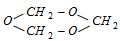
A
Trioxane
B
Formose
C
Paraformaldehyde
D
Metaldehyde
Solution
(A) The structure shown in the image is a cyclic trimer of formaldehyde $(HCHO)$,which is known as $1,3,5$-trioxane or simply trioxane.
It is formed by the trimerization of formaldehyde in the presence of an acid catalyst.
The reaction is: $3HCHO \rightleftharpoons (CH_2O)_3$ (Trioxane).
It is formed by the trimerization of formaldehyde in the presence of an acid catalyst.
The reaction is: $3HCHO \rightleftharpoons (CH_2O)_3$ (Trioxane).
0 likesView Solution
83
ChemistryMediumMCQAIPMT · 1989
$RCOOH \xrightarrow{ } RCH_2OH$. This mode of reduction of an acid to alcohol can be effected only by:
A
$Zn/HCl$
B
$Na/\text{alcohol}$
C
Aluminium isopropoxide and isopropyl alcohol
D
$LiAlH_4$
Solution
(D) The reduction of a carboxylic acid $(RCOOH)$ to a primary alcohol $(RCH_2OH)$ requires a strong reducing agent.
$LiAlH_4$ (Lithium aluminium hydride) is a powerful reducing agent capable of reducing carboxylic acids directly to primary alcohols.
Other reagents like $Zn/HCl$ (Clemmensen reduction) reduce carbonyl groups to methylene groups,and $Na/\text{alcohol}$ (Bouveault-Blanc reduction) is typically used for esters.
Therefore,the correct option is $(D)$.
$LiAlH_4$ (Lithium aluminium hydride) is a powerful reducing agent capable of reducing carboxylic acids directly to primary alcohols.
Other reagents like $Zn/HCl$ (Clemmensen reduction) reduce carbonyl groups to methylene groups,and $Na/\text{alcohol}$ (Bouveault-Blanc reduction) is typically used for esters.
Therefore,the correct option is $(D)$.
0 likesView Solution
84
ChemistryMediumMCQAIPMT · 1989
Indicate which nitrogen compound amongst the following would undergo Hofmann's reaction (i.e.,reaction with $Br_2$ and strong $KOH$) to furnish the primary amine $(R-NH_2)$.
A
$R-CO-NH-CH_3$
B
$R-CO-O-NH_4$
C
$R-CO-NH_2$
D
$R-CO-NHOH$
Solution
(C) The Hofmann bromamide degradation reaction is a characteristic reaction of primary amides.
In this reaction,a primary amide $(R-CONH_2)$ reacts with bromine $(Br_2)$ in the presence of a strong base like potassium hydroxide $(KOH)$ to form a primary amine $(R-NH_2)$ with one carbon atom less than the original amide.
The balanced chemical equation is:
$R-CONH_2 + Br_2 + 4KOH \xrightarrow{} R-NH_2 + 2KBr + K_2CO_3 + 2H_2O$
Therefore,the compound that undergoes this reaction is $R-CONH_2$.
In this reaction,a primary amide $(R-CONH_2)$ reacts with bromine $(Br_2)$ in the presence of a strong base like potassium hydroxide $(KOH)$ to form a primary amine $(R-NH_2)$ with one carbon atom less than the original amide.
The balanced chemical equation is:
$R-CONH_2 + Br_2 + 4KOH \xrightarrow{} R-NH_2 + 2KBr + K_2CO_3 + 2H_2O$
Therefore,the compound that undergoes this reaction is $R-CONH_2$.
0 likesView Solution
85
ChemistryMediumMCQAIPMT · 1989
Heating of rubber with sulphur is known as
A
Galvanisation
B
Vulcanisation
C
Bessemerisation
D
Sulphonation
Solution
(B) To improve physical properties such as water repellency,reduced water absorption,and resistance to oxidising agents,a process called vulcanisation is carried out.
This process consists of heating a mixture of raw rubber with sulphur and an appropriate additive at a temperature range between $373 \ K$ to $415 \ K$.
On vulcanisation,sulphur forms cross-links at the reactive sites of double bonds,which causes the rubber to become stiffened.
This process consists of heating a mixture of raw rubber with sulphur and an appropriate additive at a temperature range between $373 \ K$ to $415 \ K$.
On vulcanisation,sulphur forms cross-links at the reactive sites of double bonds,which causes the rubber to become stiffened.
0 likesView Solution
86
ChemistryMediumMCQAIPMT · 1989
When orthophosphoric acid is heated to $600\,^{\circ}C,$ the product formed is
A
Phosphine,$PH_3$
B
Phosphorus pentoxide,$P_2O_5$
C
Phosphorus acid,$H_3PO_3$
D
Metaphosphoric acid,$HPO_3$
Solution
(D) The thermal decomposition of orthophosphoric acid $(H_3PO_4)$ at $600\,^{\circ}C$ results in the formation of metaphosphoric acid $(HPO_3)$ and water vapor.
The chemical equation is: $H_3PO_4 \xrightarrow{600\,^{\circ}C} HPO_3 + H_2O$.
Therefore,the correct option is $(D)$.
The chemical equation is: $H_3PO_4 \xrightarrow{600\,^{\circ}C} HPO_3 + H_2O$.
Therefore,the correct option is $(D)$.
0 likesView Solution
87
ChemistryMediumMCQAIPMT · 1989
Which of the following fails to give the iodoform test?
A
Pentan-$1$-one
B
Pentan-$2$-one
C
Propan-$2$-one
D
Ethanol
Solution
(A) The iodoform test is given by compounds containing the $CH_3-C(=O)-$ group or the $CH_3-CH(OH)-$ group.
$A$. Pentan-$1$-one (which is actually $Pentanal$) does not contain the $CH_3-C(=O)-$ group,as the carbonyl group is at the terminal position.
$B$. Pentan-$2$-one contains the $CH_3-C(=O)-$ group and gives a positive iodoform test.
$C$. Propan-$2$-one (acetone) contains the $CH_3-C(=O)-$ group and gives a positive iodoform test.
$D$. Ethanol contains the $CH_3-CH(OH)-$ group and gives a positive iodoform test.
Therefore,the correct option is $A$.
$A$. Pentan-$1$-one (which is actually $Pentanal$) does not contain the $CH_3-C(=O)-$ group,as the carbonyl group is at the terminal position.
$B$. Pentan-$2$-one contains the $CH_3-C(=O)-$ group and gives a positive iodoform test.
$C$. Propan-$2$-one (acetone) contains the $CH_3-C(=O)-$ group and gives a positive iodoform test.
$D$. Ethanol contains the $CH_3-CH(OH)-$ group and gives a positive iodoform test.
Therefore,the correct option is $A$.
0 likesView Solution
Vedclass Products
For Students
Vedclass Test Series
Mock tests in real AIPMT style covering Chemistry with performance analysis. 5-day free trial.
Start Free TrialFor Teachers
Exam Paper Generator
Generate Set A/B/C/D Chemistry papers from 7.5L+ questions in 2 minutes. 3 chapters free.
Try FreeFor Institutes
Online Exam Module
Run live AIPMT mock exams with unlimited students, 360° analytics & white-label branding.
See DemoFrequently Asked Questions
How many Chemistry questions are in AIPMT 1989?
There are 103 Chemistry questions from the AIPMT 1989 paper on Vedclass, each with a detailed step-by-step solution in English.
Are AIPMT 1989 Chemistry solutions available in English?
Yes. All solutions on this page are in English. You can also switch to English or Hindi using the language buttons above the questions.
Can I practice AIPMT 1989 Chemistry as a timed test?
Yes. Use the Vedclass Test Series to attempt a full AIPMT mock test covering Chemistry with time limits and instant score analysis.
Can teachers create Chemistry papers from AIPMT previous year questions?
Yes. The Vedclass Exam Paper Generator lets teachers mix AIPMT Chemistry questions and generate Set A/B/C/D papers in minutes.
For Teachers & Institutes
Build a Custom Chemistry Paper
Pick AIPMT 1989 Chemistry questions, set difficulty, and generate Set A/B/C/D in 2 minutes.