
PhysicsQ1–33 of 33 questions
Page 1 of 1 · English
1
PhysicsMediumMCQAIPMT · 1989
If $x = at + bt^2$,where $x$ is the distance travelled by the body in kilometres while $t$ is the time in seconds,then the units of $b$ are
A
$km/s$
B
$km \cdot s$
C
$km/s^2$
D
$km \cdot s^2$
Solution
(C) According to the principle of homogeneity of dimensions,the dimensions of each term in a physical equation must be the same.
Given the equation $x = at + bt^2$,where $x$ is distance and $t$ is time.
Therefore,the dimensions of $bt^2$ must be equal to the dimensions of $x$.
$[bt^2] = [x]$
$[b] = [x] / [t^2]$
Since $x$ is in kilometres $(km)$ and $t$ is in seconds $(s)$,the unit of $b$ is $km/s^2$.
Given the equation $x = at + bt^2$,where $x$ is distance and $t$ is time.
Therefore,the dimensions of $bt^2$ must be equal to the dimensions of $x$.
$[bt^2] = [x]$
$[b] = [x] / [t^2]$
Since $x$ is in kilometres $(km)$ and $t$ is in seconds $(s)$,the unit of $b$ is $km/s^2$.
0 likesView Solution
2
PhysicsMediumMCQAIPMT · 1989
Of the following quantities,which one has dimensions different from the remaining three?
A
Energy per unit volume
B
Force per unit area
C
Product of voltage and charge per unit volume
D
Angular momentum per unit mass
Solution
(D) Energy per unit volume = $\frac{[ML^2T^{-2}]}{[L^3]} = [ML^{-1}T^{-2}]$.
Force per unit area = $\frac{[MLT^{-2}]}{[L^2]} = [ML^{-1}T^{-2}]$.
Product of voltage and charge per unit volume = $\frac{V \times Q}{\text{Volume}} = \frac{\text{Energy}}{\text{Volume}} = [ML^{-1}T^{-2}]$.
Angular momentum per unit mass = $\frac{[ML^2T^{-1}]}{[M]} = [L^2T^{-1}]$.
Thus,angular momentum per unit mass has dimensions different from the other three.
Force per unit area = $\frac{[MLT^{-2}]}{[L^2]} = [ML^{-1}T^{-2}]$.
Product of voltage and charge per unit volume = $\frac{V \times Q}{\text{Volume}} = \frac{\text{Energy}}{\text{Volume}} = [ML^{-1}T^{-2}]$.
Angular momentum per unit mass = $\frac{[ML^2T^{-1}]}{[M]} = [L^2T^{-1}]$.
Thus,angular momentum per unit mass has dimensions different from the other three.
0 likesView Solution
3
PhysicsMediumMCQAIPMT · 1989
Inductance $L$ can be dimensionally represented as
A
$M L^2 T^{-2} A^{-2}$
B
$M L^2 T^{-4} A^{-3}$
C
$M L^{-2} T^{-2} A^{-2}$
D
$M L^2 T^4 A^3$
Solution
(A) The energy $E$ stored in an inductor is given by the formula $E = \frac{1}{2} L i^2$.
Rearranging for $L$,we get $L = \frac{2E}{i^2}$.
The dimensional formula for energy $E$ is $[M L^2 T^{-2}]$.
The dimensional formula for current $i$ is $[A]$.
Substituting these into the expression for $L$:
$L = \frac{[M L^2 T^{-2}]}{[A]^2} = [M L^2 T^{-2} A^{-2}]$.
Thus,the correct option is $A$.
Rearranging for $L$,we get $L = \frac{2E}{i^2}$.
The dimensional formula for energy $E$ is $[M L^2 T^{-2}]$.
The dimensional formula for current $i$ is $[A]$.
Substituting these into the expression for $L$:
$L = \frac{[M L^2 T^{-2}]}{[A]^2} = [M L^2 T^{-2} A^{-2}]$.
Thus,the correct option is $A$.
0 likesView Solution
4
PhysicsEasyMCQAIPMT · 1989
Dimensional formula for torque is
A
$[M{L^2}{T^{ - 2}}]$
B
$[M{L^{ - 1}}{T^{ - 2}}]$
C
$[M{L^2}{T^{ - 3}}]$
D
$[ML{T^{ - 2}}]$
Solution
(A) Torque $( \tau)$ is defined as the product of force and the perpendicular distance from the axis of rotation.
Mathematically,$\tau = \text{Force} \times \text{Distance}$.
The dimensional formula for force is $[M L T^{-2}]$.
The dimensional formula for distance is $[L]$.
Therefore,the dimensional formula for torque is $[M L T^{-2}] \times [L] = [M L^2 T^{-2}]$.
Thus,the correct option is $A$.
Mathematically,$\tau = \text{Force} \times \text{Distance}$.
The dimensional formula for force is $[M L T^{-2}]$.
The dimensional formula for distance is $[L]$.
Therefore,the dimensional formula for torque is $[M L T^{-2}] \times [L] = [M L^2 T^{-2}]$.
Thus,the correct option is $A$.
0 likesView Solution
5
PhysicsMediumMCQAIPMT · 1989
Two masses of $1 \,g$ and $4 \,g$ are moving with equal kinetic energies. The ratio of the magnitudes of their linear momenta is
A
$4:1$
B
$\sqrt{2}:1$
C
$1:2$
D
$1:16$
Solution
(C) The relationship between linear momentum $P$,mass $m$,and kinetic energy $E$ is given by $P = \sqrt{2mE}$.
Since the kinetic energies $E$ are equal for both masses,we have $P \propto \sqrt{m}$.
Therefore,the ratio of their linear momenta is $\frac{P_1}{P_2} = \sqrt{\frac{m_1}{m_2}}$.
Substituting the given values $m_1 = 1 \,g$ and $m_2 = 4 \,g$,we get $\frac{P_1}{P_2} = \sqrt{\frac{1}{4}} = \frac{1}{2}$.
Thus,the ratio is $1:2$.
Since the kinetic energies $E$ are equal for both masses,we have $P \propto \sqrt{m}$.
Therefore,the ratio of their linear momenta is $\frac{P_1}{P_2} = \sqrt{\frac{m_1}{m_2}}$.
Substituting the given values $m_1 = 1 \,g$ and $m_2 = 4 \,g$,we get $\frac{P_1}{P_2} = \sqrt{\frac{1}{4}} = \frac{1}{2}$.
Thus,the ratio is $1:2$.
0 likesView Solution
6
PhysicsMediumMCQAIPMT · 1989
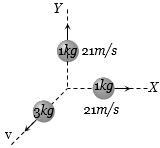
$A$ body of mass $5 \,kg$ explodes at rest into three fragments with masses in the ratio $1 : 1 : 3$. The fragments with equal masses fly in mutually perpendicular directions with speeds of $21 \,m/s$. The velocity of the heaviest fragment will be
A
$3\sqrt{2} \,m/s$
B
$5\sqrt{2} \,m/s$
C
$\sqrt{2} \,m/s$
D
$7\sqrt{2} \,m/s$
Solution
(D) Given total mass $M = 5 \,kg$. The masses of the fragments are in the ratio $1:1:3$,so the masses are $m_1 = 1 \,kg$,$m_2 = 1 \,kg$,and $m_3 = 3 \,kg$.
The two fragments of mass $1 \,kg$ move in mutually perpendicular directions with speed $v = 21 \,m/s$.
The momentum of the first fragment is $P_x = m_1 v = 1 \times 21 = 21 \,kg \cdot m/s$ along the $x$-axis.
The momentum of the second fragment is $P_y = m_2 v = 1 \times 21 = 21 \,kg \cdot m/s$ along the $y$-axis.
The resultant momentum of these two fragments is $P_{res} = \sqrt{P_x^2 + P_y^2} = \sqrt{21^2 + 21^2} = 21\sqrt{2} \,kg \cdot m/s$.
According to the law of conservation of linear momentum,the initial momentum of the body at rest is zero. Therefore,the momentum of the third (heaviest) fragment must be equal and opposite to the resultant momentum of the first two fragments.
$P_3 = P_{res} = 21\sqrt{2} \,kg \cdot m/s$.
Since $P_3 = m_3 v_3$,we have $3 \times v_3 = 21\sqrt{2}$.
$v_3 = \frac{21\sqrt{2}}{3} = 7\sqrt{2} \,m/s$.
The two fragments of mass $1 \,kg$ move in mutually perpendicular directions with speed $v = 21 \,m/s$.
The momentum of the first fragment is $P_x = m_1 v = 1 \times 21 = 21 \,kg \cdot m/s$ along the $x$-axis.
The momentum of the second fragment is $P_y = m_2 v = 1 \times 21 = 21 \,kg \cdot m/s$ along the $y$-axis.
The resultant momentum of these two fragments is $P_{res} = \sqrt{P_x^2 + P_y^2} = \sqrt{21^2 + 21^2} = 21\sqrt{2} \,kg \cdot m/s$.
According to the law of conservation of linear momentum,the initial momentum of the body at rest is zero. Therefore,the momentum of the third (heaviest) fragment must be equal and opposite to the resultant momentum of the first two fragments.
$P_3 = P_{res} = 21\sqrt{2} \,kg \cdot m/s$.
Since $P_3 = m_3 v_3$,we have $3 \times v_3 = 21\sqrt{2}$.
$v_3 = \frac{21\sqrt{2}}{3} = 7\sqrt{2} \,m/s$.
0 likesView Solution
7
PhysicsEasyMCQAIPMT · 1989
For a satellite,the escape velocity is $11 \ km/s$. If the satellite is launched at an angle of $60^\circ$ with the vertical,then the escape velocity will be ........... $km/s$.
A
$11$
B
$11\sqrt{3}$
C
$\frac{11}{\sqrt{3}}$
D
$33$
Solution
(A) The escape velocity of a body from the surface of a planet is given by the formula $v_e = \sqrt{\frac{2GM}{R}}$.
This expression depends only on the mass of the planet $(M)$ and the radius of the planet $(R)$.
It is independent of the mass of the object being launched and the angle of projection.
Therefore,regardless of the angle at which the satellite is launched,the escape velocity remains constant at $11 \ km/s$.
This expression depends only on the mass of the planet $(M)$ and the radius of the planet $(R)$.
It is independent of the mass of the object being launched and the angle of projection.
Therefore,regardless of the angle at which the satellite is launched,the escape velocity remains constant at $11 \ km/s$.
0 likesView Solution
8
PhysicsMediumMCQAIPMT · 1989
If the gravitational force between two objects were proportional to $\frac{1}{R}$ (and not as $\frac{1}{R^2}$) where $R$ is the separation between them,then a particle in a circular orbit under such a force would have its orbital speed $v$ proportional to
A
$\frac{1}{R^2}$
B
$R^0$
C
$R^1$
D
$\frac{1}{R}$
Solution
(B) The gravitational force provides the necessary centripetal force for the particle to move in a circular orbit.
For a circular orbit,the centripetal force is given by $F_c = \frac{mv^2}{R}$.
According to the problem,the gravitational force is $F_g \propto \frac{1}{R}$,which can be written as $F_g = \frac{K}{R}$ for some constant $K$.
Equating the two forces: $\frac{mv^2}{R} = \frac{K}{R}$.
Canceling $R$ from both sides,we get $mv^2 = K$.
Since $m$ and $K$ are constants,$v^2$ is constant,which means $v$ is constant.
Therefore,$v \propto R^0$.
For a circular orbit,the centripetal force is given by $F_c = \frac{mv^2}{R}$.
According to the problem,the gravitational force is $F_g \propto \frac{1}{R}$,which can be written as $F_g = \frac{K}{R}$ for some constant $K$.
Equating the two forces: $\frac{mv^2}{R} = \frac{K}{R}$.
Canceling $R$ from both sides,we get $mv^2 = K$.
Since $m$ and $K$ are constants,$v^2$ is constant,which means $v$ is constant.
Therefore,$v \propto R^0$.
0 likesView Solution
9
PhysicsMediumMCQAIPMT · 1989
$80\, g$ of water at $30^{\circ}C$ is poured on a large block of ice at $0^{\circ}C$. The mass of ice that melts is ........ $g$.
A
$30$
B
$80$
C
$1600$
D
$150$
Solution
(A) According to the principle of calorimetry,the heat lost by the hot water is equal to the heat gained by the ice to melt.
Let $m$ be the mass of ice that melts in grams.
The specific heat capacity of water is $c_w = 1\, cal/g^{\circ}C$.
The latent heat of fusion of ice is $L_f = 80\, cal/g$.
Heat lost by water = $m_w \times c_w \times \Delta T = 80\, g \times 1\, cal/g^{\circ}C \times (30^{\circ}C - 0^{\circ}C) = 2400\, cal$.
Heat gained by ice = $m \times L_f = m \times 80\, cal/g$.
Equating the two: $2400 = m \times 80$.
Therefore,$m = \frac{2400}{80} = 30\, g$.
Let $m$ be the mass of ice that melts in grams.
The specific heat capacity of water is $c_w = 1\, cal/g^{\circ}C$.
The latent heat of fusion of ice is $L_f = 80\, cal/g$.
Heat lost by water = $m_w \times c_w \times \Delta T = 80\, g \times 1\, cal/g^{\circ}C \times (30^{\circ}C - 0^{\circ}C) = 2400\, cal$.
Heat gained by ice = $m \times L_f = m \times 80\, cal/g$.
Equating the two: $2400 = m \times 80$.
Therefore,$m = \frac{2400}{80} = 30\, g$.
0 likesView Solution
10
PhysicsEasyMCQAIPMT · 1989
At constant volume,the temperature of a gas is increased. Then:
A
Collision on walls will be less
B
Number of collisions per unit time will increase
C
Collisions will be in straight lines
D
Collisions will not change
Solution
(B) According to the kinetic theory of gases,the average kinetic energy of gas molecules is directly proportional to the absolute temperature $(KE_{avg} \propto T)$.
As the temperature increases,the average velocity $(v_{rms} \propto \sqrt{T})$ of the gas molecules increases.
Since the molecules move faster,they strike the walls of the container more frequently per unit time.
Therefore,the number of collisions per unit time increases.
As the temperature increases,the average velocity $(v_{rms} \propto \sqrt{T})$ of the gas molecules increases.
Since the molecules move faster,they strike the walls of the container more frequently per unit time.
Therefore,the number of collisions per unit time increases.
0 likesView Solution
11
PhysicsEasyMCQAIPMT · 1989
$A$ polyatomic gas with $n$ degrees of freedom has a mean energy per molecule given by (where $k$ is Boltzmann's constant and $T$ is temperature).
A
$\frac{nkT}{N}$
B
$\frac{nkT}{2N}$
C
$\frac{nkT}{2}$
D
$\frac{3kT}{2}$
Solution
(C) According to the law of equipartition of energy,each degree of freedom contributes $\frac{1}{2}kT$ to the average kinetic energy of a molecule.
For a gas molecule with $n$ degrees of freedom,the total mean energy per molecule is the sum of the energies associated with each degree of freedom.
Therefore,the mean energy per molecule $E = n \times (\frac{1}{2}kT) = \frac{nkT}{2}$.
Thus,the correct option is $C$.
For a gas molecule with $n$ degrees of freedom,the total mean energy per molecule is the sum of the energies associated with each degree of freedom.
Therefore,the mean energy per molecule $E = n \times (\frac{1}{2}kT) = \frac{nkT}{2}$.
Thus,the correct option is $C$.
0 likesView Solution
12
PhysicsEasyMCQAIPMT · 1989
$A$ string of $7 \; m$ length has a mass of $0.035 \; kg$. If the tension in the string is $60.5 \; N$,then the speed of a wave on the string is .... $m/s$.
A
$77$
B
$102$
C
$110$
D
$165$
Solution
(C) The speed of a transverse wave on a stretched string is given by the formula $v = \sqrt{\frac{T}{\mu}}$,where $T$ is the tension and $\mu$ is the linear mass density.
Linear mass density $\mu = \frac{M}{L} = \frac{0.035 \; kg}{7 \; m} = 0.005 \; kg/m$.
Given tension $T = 60.5 \; N$.
Substituting the values into the formula:
$v = \sqrt{\frac{60.5}{0.005}}$
$v = \sqrt{12100}$
$v = 110 \; m/s$.
Linear mass density $\mu = \frac{M}{L} = \frac{0.035 \; kg}{7 \; m} = 0.005 \; kg/m$.
Given tension $T = 60.5 \; N$.
Substituting the values into the formula:
$v = \sqrt{\frac{60.5}{0.005}}$
$v = \sqrt{12100}$
$v = 110 \; m/s$.
0 likesView Solution
13
PhysicsMediumMCQAIPMT · 1989
If the amplitude of sound is doubled and the frequency is reduced to one-fourth,the intensity of sound at the same point will be
A
Increased by a factor of $2$
B
Decreased by a factor of $2$
C
Decreased by a factor of $4$
D
Unchanged
Solution
(C) The intensity of a sound wave is given by the formula $I = 2{\pi ^2}{a^2}{n^2}\rho v$,where $a$ is the amplitude and $n$ is the frequency.
From this,we see that $I \propto {a^2}{n^2}$.
Let the initial amplitude be $a_1$ and frequency be $n_1$. Let the final amplitude be $a_2 = 2a_1$ and frequency be $n_2 = n_1/4$.
The ratio of intensities is $\frac{I_2}{I_1} = \left( \frac{a_2}{a_1} \right)^2 \times \left( \frac{n_2}{n_1} \right)^2$.
Substituting the values: $\frac{I_2}{I_1} = (2)^2 \times (1/4)^2 = 4 \times (1/16) = 1/4$.
Therefore,$I_2 = I_1/4$,which means the intensity is decreased by a factor of $4$.
From this,we see that $I \propto {a^2}{n^2}$.
Let the initial amplitude be $a_1$ and frequency be $n_1$. Let the final amplitude be $a_2 = 2a_1$ and frequency be $n_2 = n_1/4$.
The ratio of intensities is $\frac{I_2}{I_1} = \left( \frac{a_2}{a_1} \right)^2 \times \left( \frac{n_2}{n_1} \right)^2$.
Substituting the values: $\frac{I_2}{I_1} = (2)^2 \times (1/4)^2 = 4 \times (1/16) = 1/4$.
Therefore,$I_2 = I_1/4$,which means the intensity is decreased by a factor of $4$.
0 likesView Solution
14
PhysicsMediumMCQAIPMT · 1989
$A$ bullet of mass $10 \; g$ leaves a rifle at an initial velocity of $1000 \; m/s$ and strikes the earth at the same level with a velocity of $500 \; m/s$. The work done in joule $(J)$ in overcoming the resistance of air will be:
A
$500$
B
$5000$
C
$375$
D
$3750$
Solution
(D) According to the work-energy theorem,the work done by all forces is equal to the change in kinetic energy of the body.
Here,the work done against air resistance $(W_{air})$ is equal to the loss in kinetic energy.
Mass of the bullet,$m = 10 \; g = 0.01 \; kg$.
Initial velocity,$u = 1000 \; m/s$.
Final velocity,$v = 500 \; m/s$.
Work done against air resistance $W = \Delta K = K_i - K_f = \frac{1}{2} m (u^2 - v^2)$.
$W = \frac{1}{2} \times 0.01 \times [(1000)^2 - (500)^2]$.
$W = 0.005 \times [1,000,000 - 250,000]$.
$W = 0.005 \times 750,000$.
$W = 3750 \; J$.
Here,the work done against air resistance $(W_{air})$ is equal to the loss in kinetic energy.
Mass of the bullet,$m = 10 \; g = 0.01 \; kg$.
Initial velocity,$u = 1000 \; m/s$.
Final velocity,$v = 500 \; m/s$.
Work done against air resistance $W = \Delta K = K_i - K_f = \frac{1}{2} m (u^2 - v^2)$.
$W = \frac{1}{2} \times 0.01 \times [(1000)^2 - (500)^2]$.
$W = 0.005 \times [1,000,000 - 250,000]$.
$W = 0.005 \times 750,000$.
$W = 3750 \; J$.
2 likesView Solution
15
PhysicsMediumMCQAIPMT · 1989
$A$ bus is moving on a straight road towards north with a uniform speed of $50 \; km/h$. Then it turns left through $90^{\circ}$. If the speed remains unchanged after turning,the increase in the velocity of the bus in the turning process is:
A
$50 \; km/h$ along west
B
$0$
C
$70.7 \; km/h$ along south-west direction
D
$70.7 \; km/h$ along north-west direction
Solution
(C) Let the initial velocity be $\vec{v}_1 = 50 \; \text{km/h}$ due north.
After turning left by $90^{\circ}$,the final velocity is $\vec{v}_2 = 50 \; \text{km/h}$ due west.
The change in velocity is given by $\Delta \vec{v} = \vec{v}_2 - \vec{v}_1 = \vec{v}_2 + (-\vec{v}_1)$.
Here,$-\vec{v}_1 = 50 \; \text{km/h}$ due south.
The magnitude of the change in velocity is $|\Delta \vec{v}| = \sqrt{v_2^2 + v_1^2} = \sqrt{50^2 + 50^2} = \sqrt{2500 + 2500} = \sqrt{5000} \approx 70.7 \; \text{km/h}$.
The direction of $\Delta \vec{v}$ is the resultant of a vector pointing west and a vector pointing south,which is in the south-west direction.
After turning left by $90^{\circ}$,the final velocity is $\vec{v}_2 = 50 \; \text{km/h}$ due west.
The change in velocity is given by $\Delta \vec{v} = \vec{v}_2 - \vec{v}_1 = \vec{v}_2 + (-\vec{v}_1)$.
Here,$-\vec{v}_1 = 50 \; \text{km/h}$ due south.
The magnitude of the change in velocity is $|\Delta \vec{v}| = \sqrt{v_2^2 + v_1^2} = \sqrt{50^2 + 50^2} = \sqrt{2500 + 2500} = \sqrt{5000} \approx 70.7 \; \text{km/h}$.
The direction of $\Delta \vec{v}$ is the resultant of a vector pointing west and a vector pointing south,which is in the south-west direction.
0 likesView Solution
16
PhysicsMediumMCQAIPMT · 1989
What will be the ratio of the distance moved by a freely falling body from rest in $4^{th}$ and $5^{th}$ seconds of journey?
A
$7 : 9$
B
$4 : 5$
C
$16 : 25$
D
$1 : 1$
Solution
(A) The distance covered by an object in the $n^{th}$ second is given by the formula:
$s_{n} = u + \frac{a}{2}(2n - 1)$
Given that the body is falling freely from rest,the initial velocity $u = 0$ and the acceleration $a = g$.
For the $4^{th}$ second $(n = 4)$:
$s_{4} = 0 + \frac{g}{2}(2 \times 4 - 1) = \frac{g}{2}(7) = \frac{7g}{2}$
For the $5^{th}$ second $(n = 5)$:
$s_{5} = 0 + \frac{g}{2}(2 \times 5 - 1) = \frac{g}{2}(9) = \frac{9g}{2}$
The ratio of the distance moved in the $4^{th}$ and $5^{th}$ seconds is:
$\frac{s_{4}}{s_{5}} = \frac{7g/2}{9g/2} = \frac{7}{9}$
$s_{n} = u + \frac{a}{2}(2n - 1)$
Given that the body is falling freely from rest,the initial velocity $u = 0$ and the acceleration $a = g$.
For the $4^{th}$ second $(n = 4)$:
$s_{4} = 0 + \frac{g}{2}(2 \times 4 - 1) = \frac{g}{2}(7) = \frac{7g}{2}$
For the $5^{th}$ second $(n = 5)$:
$s_{5} = 0 + \frac{g}{2}(2 \times 5 - 1) = \frac{g}{2}(9) = \frac{9g}{2}$
The ratio of the distance moved in the $4^{th}$ and $5^{th}$ seconds is:
$\frac{s_{4}}{s_{5}} = \frac{7g/2}{9g/2} = \frac{7}{9}$
0 likesView Solution
17
PhysicsEasyMCQAIPMT · 1989
Curie is a unit of
A
Energy of $\gamma - rays$
B
Half life
C
Radioactivity
D
Intensity of $\gamma - rays$
Solution
(C) The Curie $(Ci)$ is a non-$SI$ unit of radioactivity.
It is defined as the quantity of any radioactive nuclide in which the number of disintegrations per second is $3.7 \times 10^{10}$.
Therefore,Curie is a unit of radioactivity.
It is defined as the quantity of any radioactive nuclide in which the number of disintegrations per second is $3.7 \times 10^{10}$.
Therefore,Curie is a unit of radioactivity.
0 likesView Solution
18
PhysicsMediumMCQAIPMT · 1989
$n$ equal resistors are first connected in series and then connected in parallel. What is the ratio of the maximum to the minimum resistance?
A
$n$
B
$1/n^2$
C
$n^2$
D
$1/n$
Solution
(C) Let the resistance of each resistor be $R$.
When $n$ resistors are connected in series,the equivalent resistance is $R_{\max} = nR$.
When $n$ resistors are connected in parallel,the equivalent resistance is $R_{\min} = R/n$.
The ratio of the maximum resistance to the minimum resistance is given by:
$\frac{R_{\max}}{R_{\min}} = \frac{nR}{R/n} = n \times n = n^2$.
When $n$ resistors are connected in series,the equivalent resistance is $R_{\max} = nR$.
When $n$ resistors are connected in parallel,the equivalent resistance is $R_{\min} = R/n$.
The ratio of the maximum resistance to the minimum resistance is given by:
$\frac{R_{\max}}{R_{\min}} = \frac{nR}{R/n} = n \times n = n^2$.
0 likesView Solution
19
PhysicsEasyMCQAIPMT · 1989
Forty electric bulbs are connected in series across a $220\, V$ supply. After one bulb is fused,the remaining $39$ are connected again in series across the same supply. The illumination will be
A
More with $40$ bulbs than with $39$
B
More with $39$ bulbs than with $40$
C
Equal in both the cases
D
In the ratio of $40^2:39^2$
Solution
(B) Let the resistance of each bulb be $R$.
When $40$ bulbs are connected in series,the total resistance is $R_{eq1} = 40R$.
The current in the circuit is $I_1 = V / (40R)$.
The power consumed by each bulb is $P_1 = I_1^2 R = (V / 40R)^2 R = V^2 / (1600R)$.
When $39$ bulbs are connected in series,the total resistance is $R_{eq2} = 39R$.
The current in the circuit is $I_2 = V / (39R)$.
The power consumed by each bulb is $P_2 = I_2^2 R = (V / 39R)^2 R = V^2 / (1521R)$.
Since $1521R < 1600R$,it follows that $P_2 > P_1$.
Therefore,the illumination is more with $39$ bulbs than with $40$ bulbs.
When $40$ bulbs are connected in series,the total resistance is $R_{eq1} = 40R$.
The current in the circuit is $I_1 = V / (40R)$.
The power consumed by each bulb is $P_1 = I_1^2 R = (V / 40R)^2 R = V^2 / (1600R)$.
When $39$ bulbs are connected in series,the total resistance is $R_{eq2} = 39R$.
The current in the circuit is $I_2 = V / (39R)$.
The power consumed by each bulb is $P_2 = I_2^2 R = (V / 39R)^2 R = V^2 / (1521R)$.
Since $1521R < 1600R$,it follows that $P_2 > P_1$.
Therefore,the illumination is more with $39$ bulbs than with $40$ bulbs.
0 likesView Solution
20
PhysicsEasyMCQAIPMT · 1989
$A$ current of $2\, A$ passing through a conductor produces $80\, J$ of heat in $10$ seconds. The resistance of the conductor is ............ $\Omega$.
A
$0.5$
B
$2$
C
$4$
D
$20$
Solution
(B) The heat produced in a conductor is given by Joule's law of heating: $H = I^2Rt$.
Given:
$I = 2\, A$
$H = 80\, J$
$t = 10\, s$
Rearranging the formula to solve for resistance $R$:
$R = \frac{H}{I^2t}$
Substituting the values:
$R = \frac{80}{(2)^2 \times 10} = \frac{80}{4 \times 10} = \frac{80}{40} = 2\,\,\Omega$.
Therefore,the resistance of the conductor is $2\,\,\Omega$.
Given:
$I = 2\, A$
$H = 80\, J$
$t = 10\, s$
Rearranging the formula to solve for resistance $R$:
$R = \frac{H}{I^2t}$
Substituting the values:
$R = \frac{80}{(2)^2 \times 10} = \frac{80}{4 \times 10} = \frac{80}{40} = 2\,\,\Omega$.
Therefore,the resistance of the conductor is $2\,\,\Omega$.
0 likesView Solution
21
PhysicsEasyMCQAIPMT · 1989
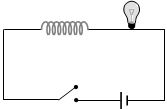
In the following circuit,the bulb will become suddenly bright if
A
Contact is made or broken
B
Contact is made
C
Contact is broken
D
Won't become bright at all
Solution
(C) When the contact is broken,the current in the circuit decreases rapidly.
According to Lenz's Law,the inductor opposes this change in current by inducing an electromotive force (emf) given by $\varepsilon = -L \frac{di}{dt}$.
Since the current drops to zero very quickly when the switch is opened,the rate of change of current $\frac{di}{dt}$ is very high.
This results in a large induced emf across the inductor,which causes a momentary surge of current through the bulb,making it glow suddenly bright.
According to Lenz's Law,the inductor opposes this change in current by inducing an electromotive force (emf) given by $\varepsilon = -L \frac{di}{dt}$.
Since the current drops to zero very quickly when the switch is opened,the rate of change of current $\frac{di}{dt}$ is very high.
This results in a large induced emf across the inductor,which causes a momentary surge of current through the bulb,making it glow suddenly bright.
0 likesView Solution
22
PhysicsEasyMCQAIPMT · 1989
The de-Broglie wavelength associated with a particle of mass $m$ moving with velocity $v$ is:
A
$h/mv$
B
$mv/h$
C
$mh/v$
D
$m/hv$
Solution
(A) According to the de-Broglie hypothesis,the wavelength $\lambda$ associated with a particle of momentum $p$ is given by the relation: $\lambda = \frac{h}{p}$.
Since the momentum $p$ of a particle of mass $m$ moving with velocity $v$ is defined as $p = mv$,we substitute this into the equation.
Therefore,the de-Broglie wavelength is $\lambda = \frac{h}{mv}$.
Since the momentum $p$ of a particle of mass $m$ moving with velocity $v$ is defined as $p = mv$,we substitute this into the equation.
Therefore,the de-Broglie wavelength is $\lambda = \frac{h}{mv}$.
0 likesView Solution
23
PhysicsMediumMCQAIPMT · 1989
Ultraviolet radiations of $6.2 \, eV$ fall on an aluminium surface (work function $4.2 \, eV$). The kinetic energy in joules of the fastest electron emitted is approximately:
A
$3.2 \times 10^{-21} \, J$
B
$3.2 \times 10^{-19} \, J$
C
$3.2 \times 10^{-17} \, J$
D
$3.2 \times 10^{-15} \, J$
Solution
(B) According to Einstein's photoelectric equation,the maximum kinetic energy $K_{\max}$ of the emitted electron is given by:
$K_{\max} = E - W_0$
Where $E$ is the energy of the incident photon and $W_0$ is the work function of the metal.
Given: $E = 6.2 \, eV$ and $W_0 = 4.2 \, eV$.
$K_{\max} = 6.2 \, eV - 4.2 \, eV = 2.0 \, eV$.
To convert this energy into Joules,we multiply by the charge of an electron $(1.6 \times 10^{-19} \, C)$:
$K_{\max} = 2.0 \times 1.6 \times 10^{-19} \, J = 3.2 \times 10^{-19} \, J$.
$K_{\max} = E - W_0$
Where $E$ is the energy of the incident photon and $W_0$ is the work function of the metal.
Given: $E = 6.2 \, eV$ and $W_0 = 4.2 \, eV$.
$K_{\max} = 6.2 \, eV - 4.2 \, eV = 2.0 \, eV$.
To convert this energy into Joules,we multiply by the charge of an electron $(1.6 \times 10^{-19} \, C)$:
$K_{\max} = 2.0 \times 1.6 \times 10^{-19} \, J = 3.2 \times 10^{-19} \, J$.
0 likesView Solution
24
PhysicsEasyMCQAIPMT · 1989
To explain his theory,Bohr used
A
Conservation of linear momentum
B
Conservation of angular momentum
C
Conservation of quantum frequency
D
Conservation of energy
Solution
(B) Bohr's model of the atom is based on several postulates. One of the fundamental postulates is the quantization of angular momentum. Bohr proposed that an electron can revolve only in those orbits for which its angular momentum is an integral multiple of $h / (2\pi)$,where $h$ is Planck's constant. This is expressed as $L = mvr = n(h / 2\pi)$,where $n = 1, 2, 3, ...$. Thus,Bohr used the principle of quantization of angular momentum to explain the stability of atoms and the observed spectral lines.
0 likesView Solution
25
PhysicsEasyMCQAIPMT · 1989
The average binding energy per nucleon in the nucleus of an atom is approximately
A
$8 \, eV$
B
$8 \, keV$
C
$8 \, MeV$
D
$8 \, J$
Solution
(C) The binding energy per nucleon of a nucleus is defined as the total binding energy of the nucleus divided by its mass number $(A)$,which represents the total number of nucleons.
Experimental observations of the binding energy per nucleon versus mass number graph show that for most nuclei (excluding very light nuclei),the value remains relatively constant.
The average binding energy per nucleon for stable nuclei is approximately $8 \, MeV$ per nucleon.
Experimental observations of the binding energy per nucleon versus mass number graph show that for most nuclei (excluding very light nuclei),the value remains relatively constant.
The average binding energy per nucleon for stable nuclei is approximately $8 \, MeV$ per nucleon.
0 likesView Solution
26
PhysicsMediumMCQAIPMT · 1989
An element $A$ decays into element $C$ by a two-step process:
$A \to B + {\;_2}He^4$
$B \to C + 2e^-$
Then:
$A \to B + {\;_2}He^4$
$B \to C + 2e^-$
Then:
A
$A$ and $C$ are isotopes
B
$A$ and $C$ are isobars
C
$A$ and $B$ are isotopes
D
$A$ and $B$ are isobars
Solution
(A) Let the atomic number of $A$ be $Z$ and the mass number be $A_{mass}$.
$1$. In the first step,$A \to B + {\;_2}He^4$ ($\alpha$ decay):
The atomic number of $B$ becomes $Z - 2$ and the mass number becomes $A_{mass} - 4$.
$2$. In the second step,$B \to C + 2e^-$ ($\beta$ decay):
Since one $\beta$ decay increases the atomic number by $1$,two $\beta$ decays increase the atomic number by $2$.
Therefore,the atomic number of $C$ becomes $(Z - 2) + 2 = Z$.
Since $A$ and $C$ have the same atomic number $Z$ but different mass numbers ($A_{mass}$ and $A_{mass} - 4$),they are isotopes.
$1$. In the first step,$A \to B + {\;_2}He^4$ ($\alpha$ decay):
The atomic number of $B$ becomes $Z - 2$ and the mass number becomes $A_{mass} - 4$.
$2$. In the second step,$B \to C + 2e^-$ ($\beta$ decay):
Since one $\beta$ decay increases the atomic number by $1$,two $\beta$ decays increase the atomic number by $2$.
Therefore,the atomic number of $C$ becomes $(Z - 2) + 2 = Z$.
Since $A$ and $C$ have the same atomic number $Z$ but different mass numbers ($A_{mass}$ and $A_{mass} - 4$),they are isotopes.
0 likesView Solution
27
PhysicsEasyMCQAIPMT · 1989
When an $N-$type semiconductor is heated,what happens to the charge carriers?
A
Number of electrons increases while that of holes decreases
B
Number of holes increases while that of electrons decreases
C
Number of electrons and holes remains the same
D
Number of electrons and holes increases equally
Solution
(D) In an $N-$type semiconductor,the majority charge carriers are electrons and the minority charge carriers are holes.
When the semiconductor is heated,thermal energy provides enough energy to break covalent bonds in the crystal lattice.
Each broken bond creates an electron-hole pair.
Therefore,the number of electrons and the number of holes both increase by the same amount due to thermal generation.
Thus,the correct option is $(d)$.
When the semiconductor is heated,thermal energy provides enough energy to break covalent bonds in the crystal lattice.
Each broken bond creates an electron-hole pair.
Therefore,the number of electrons and the number of holes both increase by the same amount due to thermal generation.
Thus,the correct option is $(d)$.
0 likesView Solution
28
PhysicsEasyMCQAIPMT · 1989
Ray optics is valid when characteristic dimensions are:
A
Of the same order as the wavelength of light
B
Much smaller than the wavelength of light
C
Of the order of one millimetre
D
Much larger than the wavelength of light
Solution
(D) Ray optics is based on the assumption that light travels in straight lines. This approximation holds true when the characteristic dimensions of the obstacles or apertures (such as the size of a slit or an object) are much larger than the wavelength of light $(\lambda)$. If the dimensions are comparable to or smaller than $\lambda$, wave effects like diffraction become significant, and ray optics is no longer valid. Therefore, the correct condition is that the dimensions must be much larger than the wavelength of light.
0 likesView Solution
29
PhysicsEasyMCQAIPMT · 1989
The diffraction effect can be observed in
A
Only sound waves
B
Only light waves
C
Only ultrasonic waves
D
Sound as well as light waves
Solution
(D) Diffraction is a general characteristic of all types of waves, including mechanical waves (like sound) and electromagnetic waves (like light).
For diffraction to be significant, the size of the obstacle or aperture must be comparable to the wavelength of the wave.
Since sound waves have wavelengths in the range of centimeters to meters, they easily diffract around common obstacles.
Light waves have very small wavelengths (in the range of $400 \, nm$ to $700 \, nm$), so they require very small apertures or obstacles to exhibit observable diffraction.
Therefore, the diffraction effect can be observed in both sound and light waves.
For diffraction to be significant, the size of the obstacle or aperture must be comparable to the wavelength of the wave.
Since sound waves have wavelengths in the range of centimeters to meters, they easily diffract around common obstacles.
Light waves have very small wavelengths (in the range of $400 \, nm$ to $700 \, nm$), so they require very small apertures or obstacles to exhibit observable diffraction.
Therefore, the diffraction effect can be observed in both sound and light waves.
0 likesView Solution
30
PhysicsEasyMCQAIPMT · 1989
Energy in a current carrying coil is stored in the form of
A
Electric field only
B
Electric field and Magnetic field both
C
Dielectric strength
D
Magnetic field only
Solution
(D) When a current flows through a coil,it generates a magnetic field around it.
According to the principles of electromagnetism,the energy associated with an inductor or a current-carrying coil is stored in the magnetic field created by the current.
Unlike a capacitor,which stores energy in an electric field,an inductor stores energy in the form of a magnetic field.
Therefore,the energy in a current-carrying coil is stored in the form of a magnetic field only.
According to the principles of electromagnetism,the energy associated with an inductor or a current-carrying coil is stored in the magnetic field created by the current.
Unlike a capacitor,which stores energy in an electric field,an inductor stores energy in the form of a magnetic field.
Therefore,the energy in a current-carrying coil is stored in the form of a magnetic field only.
0 likesView Solution
31
PhysicsEasyMCQAIPMT · 1989
The atomic number of silicon is $14$. Its ground state electron configuration is
A
$1 s^{2} 2 s^{2} 2 p^{6} 3 s^{1} 3 p^{3}$
B
$1 s^{2} 2 s^{2} 2 p^{2} 2 p^{8} 3 s^{2}$
C
$1 s^{2} 2 s^{2} 2 p^{6} 3 s^{2} 3 p^{2}$
D
$1 s^{2} 2 s^{2} 2 p^{2} 2 s^{4}$
Solution
(C) The atomic number of silicon is $Z = 14$,which means it has $14$ electrons.
According to the Aufbau principle,electrons fill orbitals in order of increasing energy: $1s, 2s, 2p, 3s, 3p, 4s, \dots$
Filling the orbitals with $14$ electrons:
$1s$ orbital takes $2$ electrons $(1s^2)$.
$2s$ orbital takes $2$ electrons $(2s^2)$.
$2p$ orbital takes $6$ electrons $(2p^6)$.
$3s$ orbital takes $2$ electrons $(3s^2)$.
Remaining electrons: $14 - (2 + 2 + 6 + 2) = 2$ electrons.
These $2$ electrons go into the $3p$ orbital $(3p^2)$.
Thus,the configuration is $1s^2 2s^2 2p^6 3s^2 3p^2$.
According to the Aufbau principle,electrons fill orbitals in order of increasing energy: $1s, 2s, 2p, 3s, 3p, 4s, \dots$
Filling the orbitals with $14$ electrons:
$1s$ orbital takes $2$ electrons $(1s^2)$.
$2s$ orbital takes $2$ electrons $(2s^2)$.
$2p$ orbital takes $6$ electrons $(2p^6)$.
$3s$ orbital takes $2$ electrons $(3s^2)$.
Remaining electrons: $14 - (2 + 2 + 6 + 2) = 2$ electrons.
These $2$ electrons go into the $3p$ orbital $(3p^2)$.
Thus,the configuration is $1s^2 2s^2 2p^6 3s^2 3p^2$.
0 likesView Solution
32
PhysicsMediumMCQAIPMT · 1989
$A$ radioactive element has a half-life period of $800$ years. After $6400$ years,what fraction of the initial amount will remain?
A
$1/4$
B
$1/16$
C
$1/8$
D
$1/256$
Solution
(D) The formula for the remaining fraction of a radioactive substance is given by $\frac{N}{N_{0}} = \left(\frac{1}{2}\right)^{n}$,where $n$ is the number of half-lives.
First,calculate the number of half-lives $n = \frac{t}{T_{1/2}} = \frac{6400}{800} = 8$.
Now,substitute the value of $n$ into the formula:
$\frac{N}{N_{0}} = \left(\frac{1}{2}\right)^{8} = \frac{1}{256}$.
Therefore,the fraction remaining after $6400$ years is $\frac{1}{256}$.
First,calculate the number of half-lives $n = \frac{t}{T_{1/2}} = \frac{6400}{800} = 8$.
Now,substitute the value of $n$ into the formula:
$\frac{N}{N_{0}} = \left(\frac{1}{2}\right)^{8} = \frac{1}{256}$.
Therefore,the fraction remaining after $6400$ years is $\frac{1}{256}$.
0 likesView Solution
33
PhysicsMediumMCQAIPMT · 1989
$A$ ray is incident at an angle of incidence $i$ on one surface of a small angle prism (with angle of prism $A$) and emerges normally from the opposite surface. If the refractive index of the material of the prism is $\mu$,then the angle of incidence is nearly equal to
A
$\frac{\mu A}{2}$
B
$\frac{A}{2\mu}$
C
$\frac{2A}{\mu}$
D
$\mu A$
Solution
(D) For a prism,the angle of the prism is given by $A = r_1 + r_2$.
Since the ray emerges normally from the opposite surface,the angle of emergence $e = 0$,which implies the angle of refraction at the second surface $r_2 = 0$.
Substituting $r_2 = 0$ into the prism equation,we get $r_1 = A$.
Applying Snell's law at the first surface: $\sin i = \mu \sin r_1$.
For small angles,$\sin i \approx i$ and $\sin r_1 \approx r_1$.
Therefore,$i = \mu r_1$.
Substituting $r_1 = A$,we get $i = \mu A$.
Since the ray emerges normally from the opposite surface,the angle of emergence $e = 0$,which implies the angle of refraction at the second surface $r_2 = 0$.
Substituting $r_2 = 0$ into the prism equation,we get $r_1 = A$.
Applying Snell's law at the first surface: $\sin i = \mu \sin r_1$.
For small angles,$\sin i \approx i$ and $\sin r_1 \approx r_1$.
Therefore,$i = \mu r_1$.
Substituting $r_1 = A$,we get $i = \mu A$.

0 likesView Solution
Vedclass Products
For Students
Vedclass Test Series
Mock tests in real AIPMT style covering Physics with performance analysis. 5-day free trial.
Start Free TrialFor Teachers
Exam Paper Generator
Generate Set A/B/C/D Physics papers from 7.5L+ questions in 2 minutes. 3 chapters free.
Try FreeFor Institutes
Online Exam Module
Run live AIPMT mock exams with unlimited students, 360° analytics & white-label branding.
See DemoFrequently Asked Questions
How many Physics questions are in AIPMT 1989?
There are 33 Physics questions from the AIPMT 1989 paper on Vedclass, each with a detailed step-by-step solution in English.
Are AIPMT 1989 Physics solutions available in English?
Yes. All solutions on this page are in English. You can also switch to English or Hindi using the language buttons above the questions.
Can I practice AIPMT 1989 Physics as a timed test?
Yes. Use the Vedclass Test Series to attempt a full AIPMT mock test covering Physics with time limits and instant score analysis.
Can teachers create Physics papers from AIPMT previous year questions?
Yes. The Vedclass Exam Paper Generator lets teachers mix AIPMT Physics questions and generate Set A/B/C/D papers in minutes.
For Teachers & Institutes
Build a Custom Physics Paper
Pick AIPMT 1989 Physics questions, set difficulty, and generate Set A/B/C/D in 2 minutes.