
BiologyQ1–40 of 40 questions
Page 1 of 1 · English
1
BiologyMediumMCQAIIMS · 2018
Which of the following biomolecules is common to respiration-mediated breakdown of fats,carbohydrates,and proteins?
A
Glucose$-6-$phosphate
B
Fructose $1,6-$bisphosphate
C
Pyruvic acid
D
Acetyl CoA
Solution
(D) The correct answer is $(d)$. Carbohydrates are usually first converted into glucose before they are used for respiration.
Fats are broken down into glycerol and fatty acids. Fatty acids are degraded to acetyl CoA to enter the respiratory pathway,while glycerol is converted to $3-$phosphoglyceraldehyde $(PGAL)$.
Proteins are degraded by proteases into individual amino acids. After deamination,these amino acids enter the respiratory pathway at different stages,such as pyruvate,acetyl CoA,or intermediates of the Krebs' cycle.
Thus,acetyl CoA acts as a common metabolic intermediate for the breakdown of all three major biomolecules (carbohydrates,proteins,and fats),making the respiratory pathway an amphibolic pathway.
Fats are broken down into glycerol and fatty acids. Fatty acids are degraded to acetyl CoA to enter the respiratory pathway,while glycerol is converted to $3-$phosphoglyceraldehyde $(PGAL)$.
Proteins are degraded by proteases into individual amino acids. After deamination,these amino acids enter the respiratory pathway at different stages,such as pyruvate,acetyl CoA,or intermediates of the Krebs' cycle.
Thus,acetyl CoA acts as a common metabolic intermediate for the breakdown of all three major biomolecules (carbohydrates,proteins,and fats),making the respiratory pathway an amphibolic pathway.
0 likesView Solution
2
BiologyMediumMCQAIIMS · 2018
Leaf tendrils are found in
A
Grapevine
B
Watermelon
C
Cucumber
D
Peas
Solution
(D) Leaf tendrils are specialized, thread-like, sensitive structures that are often modified parts of leaves. In the plant $Pisum \text{ } sativum$ (Pea), the terminal leaflets are modified into tendrils to help the plant climb. In contrast, in Grapevine, Watermelon, and Cucumber, the tendrils are stem modifications.
0 likesView Solution
3
BiologyEasyMCQAIIMS · 2018
The diagram of the large intestine is given below. Identify the parts $A, B, C, D, E$ and $F$.
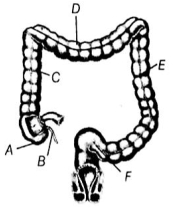
A
$A$ - Sigmoid colon,$B$ - Vermiform appendix,$C$ - Ascending colon,$D$ - Transverse colon,$E$ - Descending colon,$F$ - Caecum
B
$A$ - Caecum,$B$ - Vermiform appendix,$C$ - Sigmoid colon,$D$ - Ascending colon,$E$ - Transverse colon,$F$ - Descending colon
C
$A$ - Caecum,$B$ - Vermiform appendix,$C$ - Ascending colon,$D$ - Transverse colon,$E$ - Descending colon,$F$ - Sigmoid colon
D
$A$ - Sigmoid colon,$B$ - Vermiform appendix,$C$ - Descending colon,$D$ - Transverse colon,$E$ - Ascending colon,$F$ - Caecum
Solution
(C) In the given figure:
$A$ represents the caecum,which is a small blind sac that hosts some symbiotic microorganisms.
$B$ is the vermiform appendix,a narrow finger-like tubular projection arising from the caecum.
$C$ is the ascending colon,which is the first part of the colon moving upwards.
$D$ is the transverse colon,which runs across the abdomen.
$E$ is the descending colon,which moves downwards.
$F$ is the sigmoid colon,which is the $S$-shaped part leading to the rectum.
Therefore,the correct identification is $A$ - Caecum,$B$ - Vermiform appendix,$C$ - Ascending colon,$D$ - Transverse colon,$E$ - Descending colon,$F$ - Sigmoid colon.
$A$ represents the caecum,which is a small blind sac that hosts some symbiotic microorganisms.
$B$ is the vermiform appendix,a narrow finger-like tubular projection arising from the caecum.
$C$ is the ascending colon,which is the first part of the colon moving upwards.
$D$ is the transverse colon,which runs across the abdomen.
$E$ is the descending colon,which moves downwards.
$F$ is the sigmoid colon,which is the $S$-shaped part leading to the rectum.
Therefore,the correct identification is $A$ - Caecum,$B$ - Vermiform appendix,$C$ - Ascending colon,$D$ - Transverse colon,$E$ - Descending colon,$F$ - Sigmoid colon.
0 likesView Solution
4
BiologyDifficultMCQAIIMS · 2018
Match the stages of meiosis in Column $I$ to their characteristic features in Column $II$ and select the correct option using the codes given below.
Codes:
$A \quad B \quad C \quad D$
| Column $I$ | Column $II$ |
| $A$. Diakinesis | $1$. Crossing over takes place |
| $B$. Pachytene | $2$. Terminalisation of chiasmata |
| $C$. Zygotene | $3$. Chromosomes align at equatorial plate |
| $D$. Metaphase | $4$. Pairing of homologous chromosomes |
Codes:
$A \quad B \quad C \quad D$
A
$1 \quad 2 \quad 3 \quad 4$
B
$2 \quad 4 \quad 1 \quad 3$
C
$4 \quad 3 \quad 1 \quad 3$
D
$2 \quad 1 \quad 4 \quad 3$
Solution
(B) . Diakinesis: During this stage, the chiasmata undergo terminalisation.
$B$. Pachytene: This stage is characterized by the occurrence of crossing over between non-sister chromatids of homologous chromosomes.
$C$. Zygotene: During this stage, homologous chromosomes pair up, a process known as synapsis.
$D$. Metaphase: In this stage, the bivalent chromosomes align at the equatorial plate.
Therefore, the correct matching is $A-2, B-1, C-4, D-3$.
$B$. Pachytene: This stage is characterized by the occurrence of crossing over between non-sister chromatids of homologous chromosomes.
$C$. Zygotene: During this stage, homologous chromosomes pair up, a process known as synapsis.
$D$. Metaphase: In this stage, the bivalent chromosomes align at the equatorial plate.
Therefore, the correct matching is $A-2, B-1, C-4, D-3$.
0 likesView Solution
5
BiologyDifficultMCQAIIMS · 2018
Apical dominance is caused by
A
Auxin
B
Ethylene
C
Gibberellin
D
Cytokinin
Solution
(A) Apical dominance is a phenomenon where the main central stem of the plant grows more dominantly than the side stems.
This process is primarily caused by the hormone $Auxin$,which is synthesized at the shoot tips.
$Auxin$ inhibits the growth of lateral buds,thereby promoting the vertical growth of the plant.
This process is primarily caused by the hormone $Auxin$,which is synthesized at the shoot tips.
$Auxin$ inhibits the growth of lateral buds,thereby promoting the vertical growth of the plant.
0 likesView Solution
6
BiologyMediumMCQAIIMS · 2018
Match the organisms given in Column $I$ to their functions given in Column $II$ and choose the correct option.
Codes:
$A \quad B \quad C \quad D$
| Column $I$ | Column $II$ |
| $A$. Thiobacillus | $1$. Free-living nitrogen-fixing cyanobacteria |
| $B$. Nitrosomonas | $2$. Denitrification |
| $C$. Nostoc | $3$. Free-living aerobic nitrogen-fixing bacteria |
| $D$. Azotobacter | $4$. $NH_{3}$ to Nitrite |
Codes:
$A \quad B \quad C \quad D$
A
$2 \quad 4 \quad 1 \quad 3$
B
$4 \quad 1 \quad 3 \quad 2$
C
$2 \quad 4 \quad 1 \quad 3$ (Correction: $A-2, B-4, C-1, D-3$)
D
$3 \quad 2 \quad 4 \quad 1$
Solution
$(C)$. Thiobacillus performs denitrification, which is the process of converting nitrates back into nitrogen gas $(2)$.
$B$. Nitrosomonas is a nitrifying bacterium that oxidizes $NH_{3}$ to nitrite $(4)$.
$C$. Nostoc is a free-living nitrogen-fixing cyanobacterium $(1)$.
$D$. Azotobacter is a free-living aerobic nitrogen-fixing bacterium $(3)$.
Therefore, the correct matching is $A-2, B-4, C-1, D-3$.
$B$. Nitrosomonas is a nitrifying bacterium that oxidizes $NH_{3}$ to nitrite $(4)$.
$C$. Nostoc is a free-living nitrogen-fixing cyanobacterium $(1)$.
$D$. Azotobacter is a free-living aerobic nitrogen-fixing bacterium $(3)$.
Therefore, the correct matching is $A-2, B-4, C-1, D-3$.
0 likesView Solution
7
BiologyMediumMCQAIIMS · 2018
$A$ plant has a butterfly-shaped flower with one standard,two wing-like,and two keel petals. To which family does this plant belong?
A
Malvaceae
B
Papilionaceae
C
Rubiaceae
D
Compositae
Solution
(B) The given plant belongs to the family $Papilionaceae$ (a subfamily of $Fabaceae$).
This family is characterized by a papilionaceous corolla,which consists of $5$ petals.
The arrangement includes one large posterior petal called the standard (or vexillum),two lateral petals called wings (or alae),and two anterior petals fused to form a boat-shaped structure called the keel (or carina).
This family is characterized by a papilionaceous corolla,which consists of $5$ petals.
The arrangement includes one large posterior petal called the standard (or vexillum),two lateral petals called wings (or alae),and two anterior petals fused to form a boat-shaped structure called the keel (or carina).
0 likesView Solution
8
BiologyMediumMCQAIIMS · 2018
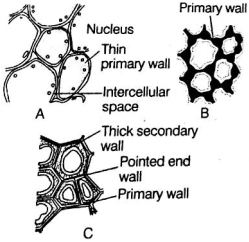
Identify the permanent tissues shown in the following figures.
A
$A$ - Collenchyma,$B$ - Parenchyma,$C$ - Sclerenchyma
B
$A$ - Sclerenchyma,$B$ - Collenchyma,$C$ - Parenchyma
C
$A$ - Collenchyma,$B$ - Sclerenchyma,$C$ - Parenchyma
D
$A$ - Parenchyma,$B$ - Collenchyma,$C$ - Sclerenchyma
Solution
(D) Based on the structural characteristics shown in the figures:
$1$. Figure $A$ shows cells with thin primary walls and intercellular spaces,which are characteristic of Parenchyma.
$2$. Figure $B$ shows cells with thickened corners (primary wall thickening),which is characteristic of Collenchyma.
$3$. Figure $C$ shows cells with very thick secondary walls and narrow lumens,which is characteristic of Sclerenchyma.
Therefore,the correct identification is $A$ - Parenchyma,$B$ - Collenchyma,$C$ - Sclerenchyma.
$1$. Figure $A$ shows cells with thin primary walls and intercellular spaces,which are characteristic of Parenchyma.
$2$. Figure $B$ shows cells with thickened corners (primary wall thickening),which is characteristic of Collenchyma.
$3$. Figure $C$ shows cells with very thick secondary walls and narrow lumens,which is characteristic of Sclerenchyma.
Therefore,the correct identification is $A$ - Parenchyma,$B$ - Collenchyma,$C$ - Sclerenchyma.
0 likesView Solution
9
BiologyMediumMCQAIIMS · 2018
$A$ mutant plant is unable to produce materials or precursors that form the Casparian strip. This plant would be:
A
Unable to transport water from roots to the leaves
B
Able to exert greater root pressure than the normal plant
C
Unable to transport food from leaves to roots
D
Unable to control the amount of water and solute it absorbs
Solution
(D) The Casparian strip is a band of cell wall material deposited in the radial and transverse walls of the endodermis.
It is composed of suberin and sometimes lignin.
Its primary function is to block the apoplastic pathway,forcing water and dissolved solutes to pass through the plasma membrane of the endodermal cells (symplastic pathway).
This allows the plant to selectively regulate the uptake of water and minerals.
Therefore,if a plant cannot produce the Casparian strip,it loses the ability to control the amount of water and solutes entering the vascular cylinder.
It is composed of suberin and sometimes lignin.
Its primary function is to block the apoplastic pathway,forcing water and dissolved solutes to pass through the plasma membrane of the endodermal cells (symplastic pathway).
This allows the plant to selectively regulate the uptake of water and minerals.
Therefore,if a plant cannot produce the Casparian strip,it loses the ability to control the amount of water and solutes entering the vascular cylinder.
0 likesView Solution
10
BiologyMediumMCQAIIMS · 2018
Cell $A$ has an osmotic pressure of $-20$ bars and a pressure potential of $5$ bars, whereas cell $B$ has an osmotic pressure of $-18$ bars and a pressure potential of $2$ bars. The direction of the flow of water will be:
A
From cell $A$ to cell $B$
B
From cell $B$ to cell $A$
C
No flow of water
D
In both the directions
Solution
(A) Water potential $\Psi_w$ is the sum of solute potential $\Psi_s$ and pressure potential $\Psi_p$, given by the formula: $\Psi_w = \Psi_s + \Psi_p$.
For cell $A$:
$\Psi_A = -20 + 5 = -15$ bars.
For cell $B$:
$\Psi_B = -18 + 2 = -16$ bars.
Water always moves from a region of higher water potential to a region of lower water potential. Since $-15$ bars is greater than $-16$ bars, the water will flow from cell $A$ to cell $B$.
For cell $A$:
$\Psi_A = -20 + 5 = -15$ bars.
For cell $B$:
$\Psi_B = -18 + 2 = -16$ bars.
Water always moves from a region of higher water potential to a region of lower water potential. Since $-15$ bars is greater than $-16$ bars, the water will flow from cell $A$ to cell $B$.
0 likesView Solution
11
BiologyEasyMCQAIIMS · 2018
Which of the following pathways occurs through the cell wall?
A
Apoplast pathway
B
Vascular pathway
C
Symplast pathway
D
Non-vacuolar pathway
Solution
(A) In the apoplast pathway,water moves from root hairs to the xylem exclusively through the cell wall and intercellular spaces,without crossing any plasma membranes.
The apoplast consists of the non-living parts of the plant,including cell walls and intercellular air spaces,providing a continuous path for water movement.
The apoplast consists of the non-living parts of the plant,including cell walls and intercellular air spaces,providing a continuous path for water movement.
0 likesView Solution
12
BiologyMediumMCQAIIMS · 2018
$C_{4}$ pathway is advantageous over $C_{3}$ pathway in plants because it
A
Occurs in relatively low $CO_{2}$ concentration
B
Uses more amount of water
C
Occurs in relatively low $O_{2}$ concentration
D
Is less efficient in energy utilisation
Solution
(A) $C_{4}$ plants are more advantageous than $C_{3}$ plants because they can efficiently fix carbon even in low $CO_{2}$ concentrations.
In hot and dry conditions,plants close their stomata to prevent water loss,which leads to a decrease in internal $CO_{2}$ levels.
$C_{3}$ plants suffer from photorespiration under these conditions because $RuBisCO$ acts as an oxygenase,leading to the loss of $RuBP$ and inhibition of the Calvin cycle.
$C_{4}$ plants possess a specialized anatomy called $Kranz$ anatomy and a $PEP$ carboxylase enzyme that has a high affinity for $CO_{2}$,allowing them to maintain photosynthesis even when $CO_{2}$ levels are low.
In hot and dry conditions,plants close their stomata to prevent water loss,which leads to a decrease in internal $CO_{2}$ levels.
$C_{3}$ plants suffer from photorespiration under these conditions because $RuBisCO$ acts as an oxygenase,leading to the loss of $RuBP$ and inhibition of the Calvin cycle.
$C_{4}$ plants possess a specialized anatomy called $Kranz$ anatomy and a $PEP$ carboxylase enzyme that has a high affinity for $CO_{2}$,allowing them to maintain photosynthesis even when $CO_{2}$ levels are low.
0 likesView Solution
13
BiologyMediumMCQAIIMS · 2018
Which one of the following organisms does not evolve oxygen during photosynthesis?
A
Blue-green algae
B
Red algae
C
Photosynthetic bacteria
D
$C_{4}$ plants
Solution
(C) Photosynthetic bacteria,such as purple and green sulphur bacteria,perform photosynthesis in anoxic (oxygen-free) environments.
These organisms use bacteriochlorophyll instead of chlorophyll $a$.
Instead of water $(H_{2}O)$,they use other hydrogen donors like hydrogen sulphide $(H_{2}S)$ or organic compounds.
Because water is not split during this process,oxygen is not evolved as a byproduct.
These organisms use bacteriochlorophyll instead of chlorophyll $a$.
Instead of water $(H_{2}O)$,they use other hydrogen donors like hydrogen sulphide $(H_{2}S)$ or organic compounds.
Because water is not split during this process,oxygen is not evolved as a byproduct.
0 likesView Solution
14
BiologyMediumMCQAIIMS · 2018
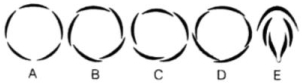
Arrange the given figures in the correct order of aestivation types.
A
$A$ - Imbricate,$B$ - Quincuncial,$C$ - Valvate,$D$ - Twisted,$E$ - Vexillary
B
$A$ - Vexillary,$B$ - Valvate,$C$ - Twisted,$D$ - Imbricate,$E$ - Quincuncial
C
$A$ - Quincuncial,$B$ - Twisted,$C$ - Vexillary,$D$ - Imbricate,$E$ - Valvate
D
$A$ - Valvate,$B$ - Twisted,$C$ - Imbricate,$D$ - Quincuncial,$E$ - Vexillary
Solution
(D) The figures represent different types of aestivation:
$A$ - Valvate: The margins of sepals or petals touch each other without overlapping.
$B$ - Twisted: One margin of the sepal or petal overlaps that of the next one.
$C$ - Imbricate: The margins of sepals or petals overlap one another but not in any particular direction.
$D$ - Quincuncial: Two petals are completely external,two are completely internal,and one is partially external and partially internal.
$E$ - Vexillary: The largest posterior petal (standard) overlaps the two lateral petals (wings),which in turn overlap the two smallest anterior petals (keel).
Therefore,the correct order is $A$ - Valvate,$B$ - Twisted,$C$ - Imbricate,$D$ - Quincuncial,$E$ - Vexillary.
$A$ - Valvate: The margins of sepals or petals touch each other without overlapping.
$B$ - Twisted: One margin of the sepal or petal overlaps that of the next one.
$C$ - Imbricate: The margins of sepals or petals overlap one another but not in any particular direction.
$D$ - Quincuncial: Two petals are completely external,two are completely internal,and one is partially external and partially internal.
$E$ - Vexillary: The largest posterior petal (standard) overlaps the two lateral petals (wings),which in turn overlap the two smallest anterior petals (keel).
Therefore,the correct order is $A$ - Valvate,$B$ - Twisted,$C$ - Imbricate,$D$ - Quincuncial,$E$ - Vexillary.
0 likesView Solution
15
BiologyMediumMCQAIIMS · 2018
Match the following columns.
Codes:
$A \quad B \quad C \quad D$
| Column $I$ | Column $II$ |
| $A$. Hinge joint | $1$. Atlas and axis |
| $B$. Saddle joint | $2$. Frontal and parietal |
| $C$. Pivot joint | $3$. Carpal and metacarpal of thumb |
| $D$. Ball and socket joint | $4$. Knee joint |
| $5$. Humerus and pectoral girdle |
Codes:
$A \quad B \quad C \quad D$
A
$2 \quad 5 \quad 3 \quad 1$
B
$3 \quad 2 \quad 5 \quad 4$
C
$4 \quad 3 \quad 1 \quad 5$
D
$1 \quad 4 \quad 2 \quad 3$
Solution
(C) The correct matches are as follows:
$A$. Hinge joint: Found in the knee joint $(4)$.
$B$. Saddle joint: Found between the carpal and metacarpal of the thumb $(3)$.
$C$. Pivot joint: Found between the atlas and axis vertebrae $(1)$.
$D$. Ball and socket joint: Found between the humerus and pectoral girdle $(5)$.
Thus, the correct sequence is $A-4, B-3, C-1, D-5$.
$A$. Hinge joint: Found in the knee joint $(4)$.
$B$. Saddle joint: Found between the carpal and metacarpal of the thumb $(3)$.
$C$. Pivot joint: Found between the atlas and axis vertebrae $(1)$.
$D$. Ball and socket joint: Found between the humerus and pectoral girdle $(5)$.
Thus, the correct sequence is $A-4, B-3, C-1, D-5$.
0 likesView Solution
16
BiologyMediumMCQAIIMS · 2018
Which one of the following conditions correctly describes the manner of determining the sex?
A
Homozygous sex chromosomes $(ZZ)$ determine female sex in birds.
B
$XO$ type of sex chromosomes determine male sex in grasshopper.
C
$XO$ condition in humans as found in Turner's syndrome,determines female sex.
D
Homozygous sex chromosomes $(XX)$ produce male in Drosophila.
Solution
(B) : $XO$ type of sex chromosomes determine male sex in grasshoppers. This type of sex determination comes under $XX-XO$ type. Its common examples are cockroaches,grasshoppers,and bugs. The female has two homomorphic sex chromosomes $(XX)$ and is homogametic. It produces similar eggs,each with $X$-chromosome. The male has one chromosome only and is heterogametic. It produces $2$ types of sperms: gynosperms with $X$ and androsperms without $X$. Fertilization of an egg by $X$-bearing sperm yields female offspring and by no-$X$ sperm yields male offspring. The chromosomal constitution is represented as $AA + XX$ (female) and $AA + XO$ (male).
0 likesView Solution
17
BiologyMediumMCQAIIMS · 2018
$A$ scion is grafted to a stock. The quality of fruits produced will be determined by the genotype of
A
stock
B
scion
C
both stock and scion
D
neither stock nor scion
Solution
(B) In grafting,the scion is the upper part of the plant that is selected for its desirable traits,such as fruit quality,yield,or disease resistance. The stock is the lower part that provides the root system. Since the scion contains the genetic information that dictates the development of branches,leaves,flowers,and fruits,the quality of the fruits produced is determined by the genotype of the scion.
0 likesView Solution
18
BiologyEasyMCQAIIMS · 2018
Biomagnification can be defined as
A
Decomposition of organic waste in water by the action of microbes
B
Breeding of crops that are rich in minerals and vitamins,good proteins and healthier fats
C
Increase in concentration of the toxicant at successive trophic levels
D
Exploring the products of economic importance at molecular,genetic and species level diversity
Solution
(C) Biomagnification is a phenomenon through which certain pollutants get accumulated in tissues in increasing concentrations at successive trophic levels along the food chain.
Many pesticides,such as $DDT$,have a long life.
Thus,they get incorporated into the food chain and get magnified at higher trophic levels.
Many pesticides,such as $DDT$,have a long life.
Thus,they get incorporated into the food chain and get magnified at higher trophic levels.
0 likesView Solution
19
BiologyMediumMCQAIIMS · 2018
Select the incorrect statement$(s)$ from the options given below with respect to dihybrid cross.
$I.$ Tightly linked genes on the same chromosome show higher recombinations.
$II.$ Genes far apart on the same chromosome show very few recombinations.
$III.$ Genes loosely linked on the same chromosome show similar recombinations.
$I.$ Tightly linked genes on the same chromosome show higher recombinations.
$II.$ Genes far apart on the same chromosome show very few recombinations.
$III.$ Genes loosely linked on the same chromosome show similar recombinations.
A
$I$ and $II$
B
$III$ and $II$
C
$I$ and $III$
D
All of these
Solution
(D) The frequency of recombination between two genes is inversely proportional to the distance between them on the chromosome.
Statement $I$ is incorrect because tightly linked genes show very few recombinations,not higher.
Statement $II$ is incorrect because genes that are far apart on the same chromosome show a higher frequency of recombinations due to more crossing-over events.
Statement $III$ is incorrect because loosely linked genes show higher recombination frequencies compared to tightly linked genes,and the term 'similar recombinations' is vague and scientifically inaccurate in this context.
Therefore,all three statements are incorrect.
Statement $I$ is incorrect because tightly linked genes show very few recombinations,not higher.
Statement $II$ is incorrect because genes that are far apart on the same chromosome show a higher frequency of recombinations due to more crossing-over events.
Statement $III$ is incorrect because loosely linked genes show higher recombination frequencies compared to tightly linked genes,and the term 'similar recombinations' is vague and scientifically inaccurate in this context.
Therefore,all three statements are incorrect.
0 likesView Solution
20
BiologyMediumMCQAIIMS · 2018
Read the following statements:
$I.$ Species diversity increases as we move away from the equator towards the poles.
$II.$ Stellar's sea cow and passenger pigeon got extinct due to overexploitation by man.
$III.$ Lantana and Eichhornia are invasive weed in India.
$IV.$ The historic convention on biological diversity was held in $1992.$
Choose the option containing correct statements.
$I.$ Species diversity increases as we move away from the equator towards the poles.
$II.$ Stellar's sea cow and passenger pigeon got extinct due to overexploitation by man.
$III.$ Lantana and Eichhornia are invasive weed in India.
$IV.$ The historic convention on biological diversity was held in $1992.$
Choose the option containing correct statements.
A
$I$ and $II$
B
$I, II$ and $IV$
C
$I, III$ and $IV$
D
$II, III$ and $IV$
Solution
(D) Statement $I$ is incorrect because species diversity decreases,not increases,as we move from the equator towards the poles.
Statement $II$ is correct; Stellar's sea cow and passenger pigeon are classic examples of extinction due to overexploitation by humans.
Statement $III$ is correct; Lantana camara and Eichhornia crassipes (water hyacinth) are well-known invasive alien species in India.
Statement $IV$ is correct; the historic Convention on Biological Diversity (The Earth Summit) was held in Rio de Janeiro in $1992.$
Statement $II$ is correct; Stellar's sea cow and passenger pigeon are classic examples of extinction due to overexploitation by humans.
Statement $III$ is correct; Lantana camara and Eichhornia crassipes (water hyacinth) are well-known invasive alien species in India.
Statement $IV$ is correct; the historic Convention on Biological Diversity (The Earth Summit) was held in Rio de Janeiro in $1992.$
0 likesView Solution
21
BiologyMediumMCQAIIMS · 2018
Characteristics of cancer are
A
All viruses are oncogenic
B
All tumours are cancers
C
Cancerous cells show property of contact inhibition
D
Cancer cells show metastasis
Solution
(D) Cancerous cells that break away from the original site and spread to other parts of the body through the bloodstream and lymphatic system constitute malignant tumours.
The spread of cancer to other sites or organs in the body is called metastasis.
Other statements are incorrect because:
$1$. Cancer cells lose the property of contact inhibition,which is why they continue to divide uncontrollably.
$2$. Not all tumours are cancerous; for example,benign tumours remain confined to their original location.
$3$. Not all viruses are oncogenic (cancer-causing).
The spread of cancer to other sites or organs in the body is called metastasis.
Other statements are incorrect because:
$1$. Cancer cells lose the property of contact inhibition,which is why they continue to divide uncontrollably.
$2$. Not all tumours are cancerous; for example,benign tumours remain confined to their original location.
$3$. Not all viruses are oncogenic (cancer-causing).
0 likesView Solution
22
BiologyMediumMCQAIIMS · 2018
Select the incorrect match.
$I.$ Sedimentary nutrient cycle-Nitrogen cycle
$II.$ Pioneer species-Lichens
$III.$ Secondary succession-Burned forests
$IV.$ Pyramid of biomass in sea-Upright
$I.$ Sedimentary nutrient cycle-Nitrogen cycle
$II.$ Pioneer species-Lichens
$III.$ Secondary succession-Burned forests
$IV.$ Pyramid of biomass in sea-Upright
A
$I$ and $IV$
B
$I$ and $III$
C
$II$ and $III$
D
$II$ and $IV$
Solution
(A) The Nitrogen cycle is a gaseous nutrient cycle because its reservoir pool is the atmosphere. Sedimentary cycles,such as the Phosphorus or Sulphur cycle,have the lithosphere as their reservoir pool.
The pyramid of biomass in an aquatic ecosystem like the sea is inverted because the biomass of phytoplankton is much lower than that of the zooplankton and fishes that feed on them.
Therefore,statements $I$ and $IV$ are incorrect.
The pyramid of biomass in an aquatic ecosystem like the sea is inverted because the biomass of phytoplankton is much lower than that of the zooplankton and fishes that feed on them.
Therefore,statements $I$ and $IV$ are incorrect.
0 likesView Solution
23
BiologyMediumMCQAIIMS · 2018
Consider the following four measures $(I-IV)$ that could be taken to successfully grow chickpea in an area where bacterial blight is common.
$I.$ Spray with Bordeaux mixture.
$II.$ Control of the insect vector of the disease pathogen.
$III.$ Use of disease-free seeds only.
$IV.$ Use of varieties resistant to the disease.
Which of the above measures can control the disease?
$I.$ Spray with Bordeaux mixture.
$II.$ Control of the insect vector of the disease pathogen.
$III.$ Use of disease-free seeds only.
$IV.$ Use of varieties resistant to the disease.
Which of the above measures can control the disease?
A
$I, II$ and $IV$
B
$I, III$ and $IV$
C
$II, III$ and $IV$
D
$I, II$ and $III$
Solution
(B) Bacterial blight of chickpea is caused by the bacterium $Xanthomonas$ $campestris$.
The stem and leaves of the infected plant give a blighted or burnt-up appearance.
Control measures for bacterial diseases in crops typically include:
$1.$ Using disease-free seeds to prevent primary infection $(III)$.
$2.$ Using disease-resistant varieties,which is the most effective and sustainable method $(IV)$.
$3.$ Spraying with copper-based fungicides like Bordeaux mixture to manage bacterial populations $(I)$.
While insect vectors are crucial for viral diseases,bacterial blight is primarily seed-borne or soil-borne,making $I, III,$ and $IV$ the most appropriate measures for control.
The stem and leaves of the infected plant give a blighted or burnt-up appearance.
Control measures for bacterial diseases in crops typically include:
$1.$ Using disease-free seeds to prevent primary infection $(III)$.
$2.$ Using disease-resistant varieties,which is the most effective and sustainable method $(IV)$.
$3.$ Spraying with copper-based fungicides like Bordeaux mixture to manage bacterial populations $(I)$.
While insect vectors are crucial for viral diseases,bacterial blight is primarily seed-borne or soil-borne,making $I, III,$ and $IV$ the most appropriate measures for control.
0 likesView Solution
24
BiologyDifficultMCQAIIMS · 2018
Find the correct statements from the following:
$I.$ Gene therapy is a genetic engineering technique used to treat diseases at the molecular level.
$II.$ Calcitonin is a medically useful recombinant product in the treatment of infertility.
$III.$ Bt toxin is a biodegradable insecticide obtained from $Bacillus \text{ } thuringiensis$.
$I.$ Gene therapy is a genetic engineering technique used to treat diseases at the molecular level.
$II.$ Calcitonin is a medically useful recombinant product in the treatment of infertility.
$III.$ Bt toxin is a biodegradable insecticide obtained from $Bacillus \text{ } thuringiensis$.
A
Only $I$
B
Only $II$
C
$I$ and $III$
D
$I$ and $II$
Solution
(C) Statement $I$ is correct: Gene therapy involves the introduction, removal, or alteration of genetic material within a patient's cells to treat a disease at the molecular level.
Statement $II$ is incorrect: Calcitonin is a hormone secreted by the thyroid gland ($C$-cells) that regulates calcium and phosphate levels in the blood. It is not used to treat infertility. Infertility treatments often involve hormones like $FSH$ or $LH$.
Statement $III$ is correct: $Bt$ toxin is produced by the bacterium $Bacillus \text{ } thuringiensis$ and acts as a natural, biodegradable insecticide.
Therefore, statements $I$ and $III$ are correct.
Statement $II$ is incorrect: Calcitonin is a hormone secreted by the thyroid gland ($C$-cells) that regulates calcium and phosphate levels in the blood. It is not used to treat infertility. Infertility treatments often involve hormones like $FSH$ or $LH$.
Statement $III$ is correct: $Bt$ toxin is produced by the bacterium $Bacillus \text{ } thuringiensis$ and acts as a natural, biodegradable insecticide.
Therefore, statements $I$ and $III$ are correct.
0 likesView Solution
25
BiologyMediumMCQAIIMS · 2018
If a recombinant $DNA$ bearing a gene for ampicillin resistance is transferred into $E. coli$ cells and the host cells are spread on agar plates containing ampicillin,then:
A
Both transformed and untransformed recipient cells will die
B
Both transformed and untransformed recipient cells will grow
C
Transformed recipient cells will grow and untransformed recipient cells will die
D
Transformed recipient cells will die and untransformed recipient cells will grow
Solution
(C) Transformation is the process of introducing foreign $DNA$ into a host cell.
If the introduced $DNA$ carries an ampicillin resistance gene,the cells that successfully take it up (transformed cells) will be able to survive and grow on agar medium containing ampicillin.
Cells that do not take up the $DNA$ (untransformed cells) lack this resistance and will die.
In this context,the ampicillin resistance gene acts as a selectable marker.
If the introduced $DNA$ carries an ampicillin resistance gene,the cells that successfully take it up (transformed cells) will be able to survive and grow on agar medium containing ampicillin.
Cells that do not take up the $DNA$ (untransformed cells) lack this resistance and will die.
In this context,the ampicillin resistance gene acts as a selectable marker.
0 likesView Solution
26
BiologyMediumMCQAIIMS · 2018
Adults of $Wuchereria$ $bancrofti$ attack
A
Excretory system
B
Digestive system
C
Lymphatic system
D
Nervous system
Solution
(C) $Wuchereria$ $bancrofti$ is a digenetic human parasite that completes its life cycle in two hosts.
The human is the final host that harbours the adult worms in the lymphatic vessels and lymph nodes.
This infection leads to a chronic inflammation of the organs in which they live for many years, usually the lymphatic vessels of the lower limbs, causing elephantiasis.
The human is the final host that harbours the adult worms in the lymphatic vessels and lymph nodes.
This infection leads to a chronic inflammation of the organs in which they live for many years, usually the lymphatic vessels of the lower limbs, causing elephantiasis.
0 likesView Solution
27
BiologyEasyMCQAIIMS · 2018
Which of the following plants is used to treat bone fractures?
A
Digitalis purpurea
B
Hevea brasiliensis
C
Cissus quadrangularis
D
Lawsonia inermis
Solution
(C) $Cissus$ $quadrangularis$ is an ancient medicinal plant of India.
It has specific bone-healing properties and helps in the faster increase of bone tensile strength.
It acts as a glucocorticoid antagonist.
Since anabolic compounds are known to act as antagonists to the glucocorticoid receptor as well as promote bone growth and fracture healing,it has been concluded that $Cissus$ possesses significant bone-healing properties.
It has specific bone-healing properties and helps in the faster increase of bone tensile strength.
It acts as a glucocorticoid antagonist.
Since anabolic compounds are known to act as antagonists to the glucocorticoid receptor as well as promote bone growth and fracture healing,it has been concluded that $Cissus$ possesses significant bone-healing properties.
0 likesView Solution
28
BiologyMediumMCQAIIMS · 2018
Production of human protein in bacteria by genetic engineering is possible because
A
The human chromosome can replicate in the bacterial cell
B
The mechanism of gene regulation is identical in humans and bacteria
C
Bacterial cells can carry out $RNA$ splicing reactions
D
The genetic code is universal
Solution
(D) Genetic code is defined as the sequence of nucleotides in a polynucleotide chain that determines the sequence of amino acids in a polypeptide chain.
Because the genetic code is universal,a specific codon codes for the same amino acid in all living organisms,ranging from bacteria to humans.
Therefore,when a human gene is inserted into a bacterial cell,the bacteria can read the genetic instructions and synthesize the corresponding human protein.
Because the genetic code is universal,a specific codon codes for the same amino acid in all living organisms,ranging from bacteria to humans.
Therefore,when a human gene is inserted into a bacterial cell,the bacteria can read the genetic instructions and synthesize the corresponding human protein.
0 likesView Solution
29
BiologyMediumMCQAIIMS · 2018
Choose the correct statements with reference to organic evolution.
$I.$ Flippers of whale and wings of bat exhibit analogy.
$II.$ Wings of butterfly and wings of bird exhibit homology.
$III.$ Organs with dissimilar structure are called analogous organs.
$IV.$ Organs with similar structure and origin are called homologous organs.
$I.$ Flippers of whale and wings of bat exhibit analogy.
$II.$ Wings of butterfly and wings of bird exhibit homology.
$III.$ Organs with dissimilar structure are called analogous organs.
$IV.$ Organs with similar structure and origin are called homologous organs.
A
$I$ and $IV$
B
$I$ and $III$
C
$III$ and $IV$
D
$II$ and $IV$
Solution
(C) Statement $I$ is incorrect because flippers of whales and wings of bats are homologous organs,as they share a common embryonic origin and basic skeletal structure.
Statement $II$ is incorrect because wings of butterflies and wings of birds are analogous organs; they perform the same function (flight) but have different developmental origins.
Statement $III$ is correct: Analogous organs are defined as structures that have different basic structures and developmental origins but perform similar functions.
Statement $IV$ is correct: Homologous organs are defined as structures that share a similar basic structure and embryonic origin,even if they perform different functions.
Therefore,statements $III$ and $IV$ are correct.
Statement $II$ is incorrect because wings of butterflies and wings of birds are analogous organs; they perform the same function (flight) but have different developmental origins.
Statement $III$ is correct: Analogous organs are defined as structures that have different basic structures and developmental origins but perform similar functions.
Statement $IV$ is correct: Homologous organs are defined as structures that share a similar basic structure and embryonic origin,even if they perform different functions.
Therefore,statements $III$ and $IV$ are correct.
0 likesView Solution
30
BiologyEasyMCQAIIMS · 2018
Triticale is the first man-made cereal crop. Mention the type of hybridisation through which it was produced.
A
Intervarietal hybridisation
B
Interspecific hybridisation
C
Intergeneric hybridisation
D
Intravarietal hybridisation
Solution
(C) Intergeneric hybridisation involves crossing plants that belong to different genera but the same family.
Triticale is the first man-made cereal crop,which was developed by crossing wheat ($Triticum$ species) and rye ($Secale$ species).
Since wheat and rye belong to two different genera,this process is known as intergeneric hybridisation.
Therefore,the correct option is $C$.
Triticale is the first man-made cereal crop,which was developed by crossing wheat ($Triticum$ species) and rye ($Secale$ species).
Since wheat and rye belong to two different genera,this process is known as intergeneric hybridisation.
Therefore,the correct option is $C$.
0 likesView Solution
31
BiologyMediumMCQAIIMS · 2018
Azolla is used as a biofertiliser because it
A
Has association of mycorrhiza
B
Multiplies at faster rate to produce massive biomass
C
Has association of nitrogen-fixing Rhizobium
D
Has association of nitrogen-fixing cyanobacteria
Solution
(D) $Azolla$ is a pteridophyte and it is used as a biofertiliser because it has a symbiotic association with nitrogen-fixing cyanobacteria called $Anabaena \ azollae$.
0 likesView Solution
32
BiologyMediumMCQAIIMS · 2018
Person '$A$' cannot step out of his house. He has to spend his entire life in sterile isolation; otherwise, he would quickly contract a fatal infection. This person has almost no effective immune system. This disease is also called '$baby$ $in$ $a$ $bubble$ $syndrome$'. Identify the disease this person '$A$' is suffering from.
A
Cystic fibrosis
B
Diabetes
C
$AIDS$
D
$SCID$
Solution
(D) Severe Combined Immunodeficiency $(SCID)$ is a rare genetic disorder that severely compromises the immune system. Individuals with $SCID$ lack functional $T$ and $B$ lymphocytes, making them extremely susceptible to infections. Because they cannot fight off common pathogens, they must live in a sterile, protective environment, often referred to as a 'bubble'. This condition is famously known as '$baby$ $in$ $a$ $bubble$ $syndrome$'. While treatments like bone-marrow transplants or enzyme replacement therapy exist, they are not always curative, leading to the use of gene therapy as a potential permanent solution.
0 likesView Solution
33
BiologyMediumMCQAIIMS · 2018
The peppered moth $(Biston \text{ } betularia)$, the black-coloured form became dominant over the light-coloured form of moth in England during the industrial revolution. This is an example of
A
Appearance of the darker-coloured individuals due to very poor sunlight
B
Protective mimicry
C
Inheritance of darker colour character acquired due to the darker environment
D
Natural selection whereby the darker forms were selected
Solution
(D) Industrial melanism is an adaptation where the moths living in industrial areas developed melanin pigments to match their body to the black soot (smoke) covered surroundings.
Before industrialisation, the light-coloured moths were well-camouflaged against the whitish lichens on tree barks, making them less visible to predatory birds.
After industrialisation, the tree barks became covered with black soot, making the light-coloured moths highly visible and easily preyed upon by birds.
Conversely, the dark-coloured (melanic) moths were better camouflaged against the soot-covered barks, allowing them to survive and reproduce.
This process, where the environment selects for the better-adapted phenotype, is a classic example of natural selection.
Before industrialisation, the light-coloured moths were well-camouflaged against the whitish lichens on tree barks, making them less visible to predatory birds.
After industrialisation, the tree barks became covered with black soot, making the light-coloured moths highly visible and easily preyed upon by birds.
Conversely, the dark-coloured (melanic) moths were better camouflaged against the soot-covered barks, allowing them to survive and reproduce.
This process, where the environment selects for the better-adapted phenotype, is a classic example of natural selection.
0 likesView Solution
34
BiologyMediumMCQAIIMS · 2018
$A$ normal woman,whose father was colourblind,marries a normal man. What kinds of children can be expected and in what proportion?
A
All daughters normal,$50 \%$ of sons colourblind
B
All daughters normal,all sons colourblind
C
$50 \%$ daughters colourblind,all sons normal
D
All daughters colourblind,all sons normal
Solution
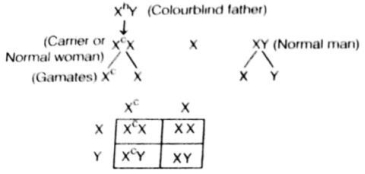
(A) The woman is a carrier for colourblindness because her father was colourblind $(X^{C}X)$. The man is normal $(XY)$.
The cross is as follows:
Parents: $X^{C}X \times XY$
Gametes: $X^{C}, X$ and $X, Y$
Offspring genotypes:
$X^{C}X$ (Carrier daughter,phenotypically normal)
$XX$ (Normal daughter)
$X^{C}Y$ (Colourblind son)
$XY$ (Normal son)
Thus,all daughters are phenotypically normal (though $50 \%$ are carriers),and $50 \%$ of the sons are colourblind.
The cross is as follows:
Parents: $X^{C}X \times XY$
Gametes: $X^{C}, X$ and $X, Y$
Offspring genotypes:
$X^{C}X$ (Carrier daughter,phenotypically normal)
$XX$ (Normal daughter)
$X^{C}Y$ (Colourblind son)
$XY$ (Normal son)
Thus,all daughters are phenotypically normal (though $50 \%$ are carriers),and $50 \%$ of the sons are colourblind.
0 likesView Solution
35
BiologyDifficultMCQAIIMS · 2018
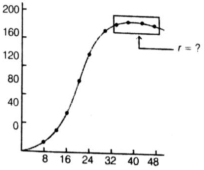
From the given graph of population growth,select the correct option that shows the correct value of '$r$' and the corresponding age pyramid.
A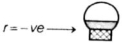
B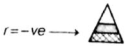
C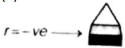
D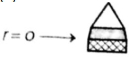
Solution
(D) The provided graph shows a logistic growth curve where the population size stabilizes as it reaches the carrying capacity. At this stage,the intrinsic rate of natural increase $(r)$ becomes zero $(r = 0)$.
When $r = 0$,the population is stable,meaning the number of individuals in the pre-reproductive and reproductive age groups is approximately equal,while the post-reproductive group is the smallest. This age structure is represented by a bell-shaped age pyramid.
When $r = 0$,the population is stable,meaning the number of individuals in the pre-reproductive and reproductive age groups is approximately equal,while the post-reproductive group is the smallest. This age structure is represented by a bell-shaped age pyramid.
0 likesView Solution
36
BiologyMediumMCQAIIMS · 2018
What is true about the isolated small tribal populations?
A
Wrestlers who develop strong body muscles in their lifetime pass this character on their progeny
B
There is no change in population size as they have a large gene pool
C
There is a decline in population as boys marry girls only from their own tribe
D
Hereditary diseases like colour blindness do not spread in the isolated population
Solution
(C) Change in population density provides insight into whether a population is increasing or declining.
Population density is influenced by natality,mortality,immigration,and emigration.
In an isolated small tribal population,if individuals marry only within their own tribe,it leads to a restricted gene pool.
Over time,this practice increases the frequency of homozygous recessive traits,including hereditary diseases.
Furthermore,such isolation often leads to a decline in population due to reduced genetic diversity and potential reproductive barriers,ultimately resulting in a decrease in the population size.
Population density is influenced by natality,mortality,immigration,and emigration.
In an isolated small tribal population,if individuals marry only within their own tribe,it leads to a restricted gene pool.
Over time,this practice increases the frequency of homozygous recessive traits,including hereditary diseases.
Furthermore,such isolation often leads to a decline in population due to reduced genetic diversity and potential reproductive barriers,ultimately resulting in a decrease in the population size.
0 likesView Solution
37
BiologyDifficultMCQAIIMS · 2018
Codons of glycine are
A
$CCU, CCC, CCA, CCG$
B
$CGU, CGC, CGA, CGG$
C
$GGU, GGC, GGA, GGG$
D
$ACU, ACC, ACA, ACG$
Solution
(C) The codons for the amino acid glycine are $GGU, GGC, GGA,$ and $GGG$.
In the genetic code,a codon is a sequence of three nucleotides (triplet) that specifies a particular amino acid.
Glycine is a non-essential amino acid,and its codons all start with the nucleotides $GG$ followed by any of the four bases $(U, C, A, G)$.
In the genetic code,a codon is a sequence of three nucleotides (triplet) that specifies a particular amino acid.
Glycine is a non-essential amino acid,and its codons all start with the nucleotides $GG$ followed by any of the four bases $(U, C, A, G)$.
0 likesView Solution
38
BiologyMediumMCQAIIMS · 2018
Match Column $I$ (Antibiotic) with Column $II$ (Source) and choose the correct option from the codes given below.
Codes:
$A \quad B \quad C \quad D \quad E$
| Column $I$ | Column $II$ |
| $A$. Fumagillin | $1$. Gliocladium virens |
| $B$. Bacitracin | $2$. Streptomyces griseus |
| $C$. Streptomycin | $3$. Bacillus polymyxa |
| $D$. Viridin | $4$. Aspergillus fumigatus |
| $E$. Polymixin | $5$. Bacillus licheniformis |
Codes:
$A \quad B \quad C \quad D \quad E$
A
$1 \quad 2 \quad 3 \quad 4 \quad 5$
B
$4 \quad 5 \quad 2 \quad 1 \quad 3$
C
$3 \quad 1 \quad 4 \quad 2 \quad 5$
D
$2 \quad 3 \quad 5 \quad 4 \quad 1$
Solution
(B) The correct matching is as follows:
Thus, the correct sequence is $A-4, B-5, C-2, D-1, E-3$. Therefore, option $B$ is correct.
| $A$. Fumagillin | $4$. Aspergillus fumigatus |
| $B$. Bacitracin | $5$. Bacillus licheniformis |
| $C$. Streptomycin | $2$. Streptomyces griseus |
| $D$. Viridin | $1$. Gliocladium virens |
| $E$. Polymixin | $3$. Bacillus polymyxa |
Thus, the correct sequence is $A-4, B-5, C-2, D-1, E-3$. Therefore, option $B$ is correct.
0 likesView Solution
39
BiologyMediumMCQAIIMS · 2018
cry $II$ Ab and cry $I$ Ab produce toxins that control
A
Cotton bollworms and corn borer, respectively
B
Corn borer and cotton bollworms, respectively
C
Tobacco budworms and nematodes, respectively
D
Nematodes and tobacco budworms, respectively
Solution
(A) The $Bt$ toxin genes are isolated from $Bacillus \text{ } thuringiensis$ and incorporated into several crop plants.
Specifically, the genes $cry \text{ } I \text{ } Ac$ and $cry \text{ } II \text{ } Ab$ are incorporated into cotton to provide resistance against cotton bollworms.
Similarly, the gene $cry \text{ } I \text{ } Ab$ is introduced into corn to protect it from the corn borer.
Therefore, $cry \text{ } II \text{ } Ab$ controls cotton bollworms and $cry \text{ } I \text{ } Ab$ controls corn borer.
Specifically, the genes $cry \text{ } I \text{ } Ac$ and $cry \text{ } II \text{ } Ab$ are incorporated into cotton to provide resistance against cotton bollworms.
Similarly, the gene $cry \text{ } I \text{ } Ab$ is introduced into corn to protect it from the corn borer.
Therefore, $cry \text{ } II \text{ } Ab$ controls cotton bollworms and $cry \text{ } I \text{ } Ab$ controls corn borer.
0 likesView Solution
40
BiologyMediumMCQAIIMS · 2018
Read the following statements:
$I.$ Colostrum is recommended for newborns because it is rich in antigens.
$II.$ Chikungunya is caused by a Gram-negative bacterium.
$III.$ Tissue culture has proved useful in obtaining virus-free plants.
$IV.$ Beer is manufactured by the distillation of fermented grapes.
How many of the statement$(s)$ is/are correct?
$I.$ Colostrum is recommended for newborns because it is rich in antigens.
$II.$ Chikungunya is caused by a Gram-negative bacterium.
$III.$ Tissue culture has proved useful in obtaining virus-free plants.
$IV.$ Beer is manufactured by the distillation of fermented grapes.
How many of the statement$(s)$ is/are correct?
A
Two
B
One
C
Three
D
Four
Solution
(B) Statement $I$ is incorrect because colostrum is rich in antibodies (specifically $IgA$),not antigens.
Statement $II$ is incorrect because Chikungunya is caused by the Chikungunya virus,which is an $RNA$ virus,not a bacterium.
Statement $III$ is correct because meristematic tissues are free from viral infection,allowing the production of virus-free plants through tissue culture.
Statement $IV$ is incorrect because beer is produced by the fermentation of malted cereals (like barley) without distillation. Distillation is used for spirits like whiskey or brandy.
Therefore,only one statement $(III)$ is correct.
Statement $II$ is incorrect because Chikungunya is caused by the Chikungunya virus,which is an $RNA$ virus,not a bacterium.
Statement $III$ is correct because meristematic tissues are free from viral infection,allowing the production of virus-free plants through tissue culture.
Statement $IV$ is incorrect because beer is produced by the fermentation of malted cereals (like barley) without distillation. Distillation is used for spirits like whiskey or brandy.
Therefore,only one statement $(III)$ is correct.
0 likesView Solution
Vedclass Products
For Students
Vedclass Test Series
Mock tests in real AIIMS style covering Biology with performance analysis. 5-day free trial.
Start Free TrialFor Teachers
Exam Paper Generator
Generate Set A/B/C/D Biology papers from 7.5L+ questions in 2 minutes. 3 chapters free.
Try FreeFor Institutes
Online Exam Module
Run live AIIMS mock exams with unlimited students, 360° analytics & white-label branding.
See DemoFrequently Asked Questions
How many Biology questions are in AIIMS 2018?
There are 40 Biology questions from the AIIMS 2018 paper on Vedclass, each with a detailed step-by-step solution in English.
Are AIIMS 2018 Biology solutions available in English?
Yes. All solutions on this page are in English. You can also switch to English or Hindi using the language buttons above the questions.
Can I practice AIIMS 2018 Biology as a timed test?
Yes. Use the Vedclass Test Series to attempt a full AIIMS mock test covering Biology with time limits and instant score analysis.
Can teachers create Biology papers from AIIMS previous year questions?
Yes. The Vedclass Exam Paper Generator lets teachers mix AIIMS Biology questions and generate Set A/B/C/D papers in minutes.
For Teachers & Institutes
Build a Custom Biology Paper
Pick AIIMS 2018 Biology questions, set difficulty, and generate Set A/B/C/D in 2 minutes.