
MathematicsQ51–95 of 145 questions
Page 2 of 2 · English
51
MathematicsDifficultMCQAIEEE · 2012
Suppose $\theta$ and $\phi \neq 0$ are such that $\sec(\theta + \phi)$,$\sec \theta$,and $\sec(\theta - \phi)$ are in $A.P.$ If $\cos \theta = k \cos(\frac{\phi}{2})$ for some $k$,then $k$ is equal to
A
$\pm \sqrt{2}$
B
$\pm 1$
C
$\pm \frac{1}{\sqrt{2}}$
D
$\pm 2$
Solution
(A) Since $\sec(\theta - \phi)$,$\sec \theta$,and $\sec(\theta + \phi)$ are in $A.P.$,we have:
$2 \sec \theta = \sec(\theta - \phi) + \sec(\theta + \phi)$
$\frac{2}{\cos \theta} = \frac{\cos(\theta + \phi) + \cos(\theta - \phi)}{\cos(\theta - \phi) \cos(\theta + \phi)}$
Using the identity $\cos(A+B) + \cos(A-B) = 2 \cos A \cos B$ and $\cos(A-B) \cos(A+B) = \cos^2 A - \sin^2 B$:
$\frac{2}{\cos \theta} = \frac{2 \cos \theta \cos \phi}{\cos^2 \theta - \sin^2 \phi}$
$\cos^2 \theta - \sin^2 \phi = \cos^2 \theta \cos \phi$
$\cos^2 \theta (1 - \cos \phi) = \sin^2 \phi$
$\cos^2 \theta (1 - \cos \phi) = 1 - \cos^2 \phi = (1 - \cos \phi)(1 + \cos \phi)$
Since $\phi \neq 0$,$1 - \cos \phi \neq 0$,so:
$\cos^2 \theta = 1 + \cos \phi = 2 \cos^2(\frac{\phi}{2})$
$\cos \theta = \pm \sqrt{2} \cos(\frac{\phi}{2})$
Given $\cos \theta = k \cos(\frac{\phi}{2})$,we find $k = \pm \sqrt{2}$.
$2 \sec \theta = \sec(\theta - \phi) + \sec(\theta + \phi)$
$\frac{2}{\cos \theta} = \frac{\cos(\theta + \phi) + \cos(\theta - \phi)}{\cos(\theta - \phi) \cos(\theta + \phi)}$
Using the identity $\cos(A+B) + \cos(A-B) = 2 \cos A \cos B$ and $\cos(A-B) \cos(A+B) = \cos^2 A - \sin^2 B$:
$\frac{2}{\cos \theta} = \frac{2 \cos \theta \cos \phi}{\cos^2 \theta - \sin^2 \phi}$
$\cos^2 \theta - \sin^2 \phi = \cos^2 \theta \cos \phi$
$\cos^2 \theta (1 - \cos \phi) = \sin^2 \phi$
$\cos^2 \theta (1 - \cos \phi) = 1 - \cos^2 \phi = (1 - \cos \phi)(1 + \cos \phi)$
Since $\phi \neq 0$,$1 - \cos \phi \neq 0$,so:
$\cos^2 \theta = 1 + \cos \phi = 2 \cos^2(\frac{\phi}{2})$
$\cos \theta = \pm \sqrt{2} \cos(\frac{\phi}{2})$
Given $\cos \theta = k \cos(\frac{\phi}{2})$,we find $k = \pm \sqrt{2}$.
0 likesView Solution
52
MathematicsDifficultMCQAIEEE · 2012
If $n = ^mC_2$,then the value of $^nC_2$ is given by
A
$3(^{m+1}C_4)$
B
$^{m-1}C_4$
C
$^{m+1}C_4$
D
$2(^{m+2}C_4)$
Solution
(A) Given $n = ^mC_2 = \frac{m(m-1)}{2}$.
We need to find $^nC_2 = \frac{n(n-1)}{2}$.
Substituting $n = \frac{m(m-1)}{2}$:
$^nC_2 = \frac{\frac{m(m-1)}{2} \left( \frac{m(m-1)}{2} - 1 \right)}{2}$
$= \frac{\frac{m(m-1)}{2} \left( \frac{m^2-m-2}{2} \right)}{2}$
$= \frac{m(m-1)(m^2-m-2)}{8}$
$= \frac{m(m-1)(m-2)(m+1)}{8}$
$= \frac{3 \times (m+1)m(m-1)(m-2)}{4 \times 3 \times 2 \times 1}$
$= 3(^{m+1}C_4)$.
We need to find $^nC_2 = \frac{n(n-1)}{2}$.
Substituting $n = \frac{m(m-1)}{2}$:
$^nC_2 = \frac{\frac{m(m-1)}{2} \left( \frac{m(m-1)}{2} - 1 \right)}{2}$
$= \frac{\frac{m(m-1)}{2} \left( \frac{m^2-m-2}{2} \right)}{2}$
$= \frac{m(m-1)(m^2-m-2)}{8}$
$= \frac{m(m-1)(m-2)(m+1)}{8}$
$= \frac{3 \times (m+1)m(m-1)(m-2)}{4 \times 3 \times 2 \times 1}$
$= 3(^{m+1}C_4)$.
0 likesView Solution
53
MathematicsDifficultMCQAIEEE · 2012
The number of arrangements that can be formed from the letters $a, b, c, d, e, f$ taken $3$ at a time without repetition,such that each arrangement contains at least one vowel,is
A
$96$
B
$128$
C
$24$
D
$72$
Solution
(A) The set of letters is $\{a, b, c, d, e, f\}$,which contains $2$ vowels $(\{a, e\})$ and $4$ consonants $(\{b, c, d, f\})$.
We need to form arrangements of $3$ letters containing at least one vowel.
Total arrangements with at least one vowel = (Total arrangements of $3$ letters) - (Arrangements with no vowels).
Total arrangements of $3$ letters from $6$ distinct letters = $^6P_3 = 6 \times 5 \times 4 = 120$.
Arrangements with no vowels (only consonants) = $^4P_3 = 4 \times 3 \times 2 = 24$.
Therefore,the number of arrangements with at least one vowel = $120 - 24 = 96$.
We need to form arrangements of $3$ letters containing at least one vowel.
Total arrangements with at least one vowel = (Total arrangements of $3$ letters) - (Arrangements with no vowels).
Total arrangements of $3$ letters from $6$ distinct letters = $^6P_3 = 6 \times 5 \times 4 = 120$.
Arrangements with no vowels (only consonants) = $^4P_3 = 4 \times 3 \times 2 = 24$.
Therefore,the number of arrangements with at least one vowel = $120 - 24 = 96$.
0 likesView Solution
54
MathematicsDifficultMCQAIEEE · 2012
Let $L$ be the line $y = 2x$ in the two-dimensional plane.
Statement $1$: The image of the point $(0, 1)$ in $L$ is the point $\left( \frac{4}{5}, \frac{3}{5} \right)$.
Statement $2$: The points $(0, 1)$ and $\left( \frac{4}{5}, \frac{3}{5} \right)$ lie on opposite sides of the line $L$ and are at equal distance from it.
Statement $1$: The image of the point $(0, 1)$ in $L$ is the point $\left( \frac{4}{5}, \frac{3}{5} \right)$.
Statement $2$: The points $(0, 1)$ and $\left( \frac{4}{5}, \frac{3}{5} \right)$ lie on opposite sides of the line $L$ and are at equal distance from it.
A
Statement $1$ is true,Statement $2$ is false.
B
Statement $1$ is true,Statement $2$ is true,Statement $2$ is not a correct explanation for Statement $1$.
C
Statement $1$ is true,Statement $2$ is true,Statement $2$ is a correct explanation for Statement $1$.
D
Statement $1$ is false,Statement $2$ is true.
Solution
(C) Let $P(0, 1)$ be the given point and $L: 2x - y = 0$ be the line.
The formula for the image $(x_1, y_1)$ of a point $(x_0, y_0)$ in the line $ax + by + c = 0$ is given by $\frac{x_1 - x_0}{a} = \frac{y_1 - y_0}{b} = -2 \frac{ax_0 + by_0 + c}{a^2 + b^2}$.
Substituting the values: $\frac{x_1 - 0}{2} = \frac{y_1 - 1}{-1} = -2 \frac{2(0) - 1(1)}{2^2 + (-1)^2} = -2 \frac{-1}{5} = \frac{2}{5}$.
Thus,$x_1 = 2 \times \frac{2}{5} = \frac{4}{5}$ and $y_1 = 1 - \frac{2}{5} = \frac{3}{5}$.
So,Statement $1$ is true.
By definition,the image of a point in a line is the point such that the line is the perpendicular bisector of the segment joining the point and its image. This implies the points lie on opposite sides and are equidistant from the line. Thus,Statement $2$ is true and is the correct explanation for Statement $1$.
The formula for the image $(x_1, y_1)$ of a point $(x_0, y_0)$ in the line $ax + by + c = 0$ is given by $\frac{x_1 - x_0}{a} = \frac{y_1 - y_0}{b} = -2 \frac{ax_0 + by_0 + c}{a^2 + b^2}$.
Substituting the values: $\frac{x_1 - 0}{2} = \frac{y_1 - 1}{-1} = -2 \frac{2(0) - 1(1)}{2^2 + (-1)^2} = -2 \frac{-1}{5} = \frac{2}{5}$.
Thus,$x_1 = 2 \times \frac{2}{5} = \frac{4}{5}$ and $y_1 = 1 - \frac{2}{5} = \frac{3}{5}$.
So,Statement $1$ is true.
By definition,the image of a point in a line is the point such that the line is the perpendicular bisector of the segment joining the point and its image. This implies the points lie on opposite sides and are equidistant from the line. Thus,Statement $2$ is true and is the correct explanation for Statement $1$.
0 likesView Solution
55
MathematicsDifficultMCQAIEEE · 2012
The median of $100$ observations grouped in classes of equal width is $25$. If the median class interval is $20-30$ and the number of observations less than $20$ is $45$,then the frequency of the median class is:
A
$10$
B
$20$
C
$15$
D
$12$
Solution
(A) The formula for the median of grouped data is:
$M = l + \left( \frac{\frac{N}{2} - F}{f} \right) \times C$
Where:
$l = 20$ (lower limit of the median class)
$N = 100$ (total number of observations)
$F = 45$ (cumulative frequency of the class preceding the median class)
$C = 30 - 20 = 10$ (width of the median class)
$M = 25$ (median)
$f$ is the frequency of the median class.
Substituting the values into the formula:
$25 = 20 + \left( \frac{\frac{100}{2} - 45}{f} \right) \times 10$
$25 - 20 = \left( \frac{50 - 45}{f} \right) \times 10$
$5 = \frac{5}{f} \times 10$
$5 = \frac{50}{f}$
$f = \frac{50}{5} = 10$
$M = l + \left( \frac{\frac{N}{2} - F}{f} \right) \times C$
Where:
$l = 20$ (lower limit of the median class)
$N = 100$ (total number of observations)
$F = 45$ (cumulative frequency of the class preceding the median class)
$C = 30 - 20 = 10$ (width of the median class)
$M = 25$ (median)
$f$ is the frequency of the median class.
Substituting the values into the formula:
$25 = 20 + \left( \frac{\frac{100}{2} - 45}{f} \right) \times 10$
$25 - 20 = \left( \frac{50 - 45}{f} \right) \times 10$
$5 = \frac{5}{f} \times 10$
$5 = \frac{50}{f}$
$f = \frac{50}{5} = 10$
0 likesView Solution
56
MathematicsDifficultMCQAIEEE · 2012
If the foci of the ellipse $\frac{x^2}{16} + \frac{y^2}{b^2} = 1$ coincide with the foci of the hyperbola $\frac{x^2}{144} - \frac{y^2}{81} = \frac{1}{25}$,then $b^2$ is equal to
A
$8$
B
$10$
C
$7$
D
$9$
Solution
(C) The equation of the ellipse is $\frac{x^2}{16} + \frac{y^2}{b^2} = 1$.
Here,$a^2 = 16$,so $a = 4$.
The foci of the ellipse are $(\pm ae, 0)$,where $e = \sqrt{1 - \frac{b^2}{16}}$.
Thus,the foci are $(\pm 4 \sqrt{1 - \frac{b^2}{16}}) = (\pm \sqrt{16 - b^2}, 0)$.
The equation of the hyperbola is $\frac{x^2}{144} - \frac{y^2}{81} = \frac{1}{25}$,which can be written as $\frac{x^2}{(12/5)^2} - \frac{y^2}{(9/5)^2} = 1$.
Here,$a^2 = \frac{144}{25}$ and $b^2 = \frac{81}{25}$.
The eccentricity $e_h$ of the hyperbola is $\sqrt{1 + \frac{b^2}{a^2}} = \sqrt{1 + \frac{81/25}{144/25}} = \sqrt{1 + \frac{81}{144}} = \sqrt{\frac{225}{144}} = \frac{15}{12} = \frac{5}{4}$.
The foci of the hyperbola are $(\pm a_h e_h, 0) = (\pm \frac{12}{5} \times \frac{5}{4}, 0) = (\pm 3, 0)$.
Since the foci coincide,$\sqrt{16 - b^2} = 3$.
Squaring both sides,$16 - b^2 = 9$,which gives $b^2 = 7$.
Here,$a^2 = 16$,so $a = 4$.
The foci of the ellipse are $(\pm ae, 0)$,where $e = \sqrt{1 - \frac{b^2}{16}}$.
Thus,the foci are $(\pm 4 \sqrt{1 - \frac{b^2}{16}}) = (\pm \sqrt{16 - b^2}, 0)$.
The equation of the hyperbola is $\frac{x^2}{144} - \frac{y^2}{81} = \frac{1}{25}$,which can be written as $\frac{x^2}{(12/5)^2} - \frac{y^2}{(9/5)^2} = 1$.
Here,$a^2 = \frac{144}{25}$ and $b^2 = \frac{81}{25}$.
The eccentricity $e_h$ of the hyperbola is $\sqrt{1 + \frac{b^2}{a^2}} = \sqrt{1 + \frac{81/25}{144/25}} = \sqrt{1 + \frac{81}{144}} = \sqrt{\frac{225}{144}} = \frac{15}{12} = \frac{5}{4}$.
The foci of the hyperbola are $(\pm a_h e_h, 0) = (\pm \frac{12}{5} \times \frac{5}{4}, 0) = (\pm 3, 0)$.
Since the foci coincide,$\sqrt{16 - b^2} = 3$.
Squaring both sides,$16 - b^2 = 9$,which gives $b^2 = 7$.
0 likesView Solution
57
MathematicsDifficultMCQAIEEE · 2012
If the $A.M.$ between $p^{th}$ and $q^{th}$ terms of an $A.P.$ is equal to the $A.M.$ between $r^{th}$ and $s^{th}$ terms of the same $A.P.$,then $p + q$ is equal to
A
$r + s - 1$
B
$r + s - 2$
C
$r + s + 1$
D
$r + s$
Solution
(D) Given that the $A.M.$ of the $p^{th}$ and $q^{th}$ terms is equal to the $A.M.$ of the $r^{th}$ and $s^{th}$ terms of an $A.P.$:
$\frac{a_p + a_q}{2} = \frac{a_r + a_s}{2}$
Using the formula for the $n^{th}$ term of an $A.P.$,$a_n = a + (n-1)d$:
$a + (p-1)d + a + (q-1)d = a + (r-1)d + a + (s-1)d$
Simplifying the equation:
$2a + (p + q - 2)d = 2a + (r + s - 2)d$
Subtracting $2a$ from both sides:
$(p + q - 2)d = (r + s - 2)d$
Assuming $d \neq 0$,we can divide by $d$:
$p + q - 2 = r + s - 2$
Therefore:
$p + q = r + s$
$\frac{a_p + a_q}{2} = \frac{a_r + a_s}{2}$
Using the formula for the $n^{th}$ term of an $A.P.$,$a_n = a + (n-1)d$:
$a + (p-1)d + a + (q-1)d = a + (r-1)d + a + (s-1)d$
Simplifying the equation:
$2a + (p + q - 2)d = 2a + (r + s - 2)d$
Subtracting $2a$ from both sides:
$(p + q - 2)d = (r + s - 2)d$
Assuming $d \neq 0$,we can divide by $d$:
$p + q - 2 = r + s - 2$
Therefore:
$p + q = r + s$
0 likesView Solution
58
MathematicsDifficultMCQAIEEE · 2012
The value of $\cos 255^o + \sin 195^o$ is
A
$\frac{\sqrt{3} - 1}{2\sqrt{2}}$
B
$\frac{\sqrt{3} - 1}{\sqrt{2}}$
C
$-\frac{\sqrt{3} - 1}{\sqrt{2}}$
D
$\frac{\sqrt{3} + 1}{\sqrt{2}}$
Solution
(C) Consider $\cos 255^o + \sin 195^o$.
Using the reduction formulas:
$\cos 255^o = \cos(270^o - 15^o) = -\sin 15^o$.
$\sin 195^o = \sin(180^o + 15^o) = -\sin 15^o$.
Therefore,the expression becomes:
$-\sin 15^o - \sin 15^o = -2 \sin 15^o$.
Using the value $\sin 15^o = \frac{\sqrt{6} - \sqrt{2}}{4} = \frac{\sqrt{3} - 1}{2\sqrt{2}}$:
$-2 \left( \frac{\sqrt{3} - 1}{2\sqrt{2}} \right) = -\frac{\sqrt{3} - 1}{\sqrt{2}}$.
Using the reduction formulas:
$\cos 255^o = \cos(270^o - 15^o) = -\sin 15^o$.
$\sin 195^o = \sin(180^o + 15^o) = -\sin 15^o$.
Therefore,the expression becomes:
$-\sin 15^o - \sin 15^o = -2 \sin 15^o$.
Using the value $\sin 15^o = \frac{\sqrt{6} - \sqrt{2}}{4} = \frac{\sqrt{3} - 1}{2\sqrt{2}}$:
$-2 \left( \frac{\sqrt{3} - 1}{2\sqrt{2}} \right) = -\frac{\sqrt{3} - 1}{\sqrt{2}}$.
0 likesView Solution
59
MathematicsDifficultMCQAIEEE · 2012
The middle term in the expansion of ${\left( {1 - \frac{1}{x}} \right)^n}{\left( {1 - x} \right)^n}$ in powers of $x$ is
A
$ - {}^{2n}{C_{n - 1}}$
B
$ - {}^{2n}{C_n}$
C
$ {}^{2n}{C_{n - 1}}$
D
$ {}^{2n}{C_n}$
Solution
(D) The given expression is ${\left( {1 - \frac{1}{x}} \right)^n}{\left( {1 - x} \right)^n}$.
This can be rewritten as ${\left( \frac{x-1}{x} \right)^n} {(1-x)^n} = {\left( \frac{-(1-x)}{x} \right)^n} {(1-x)^n} = {(-1)^n} {x^{-n}} {(1-x)^{2n}}$.
The expansion of ${(1-x)^{2n}}$ has $2n+1$ terms.
The middle term is the ${\left( \frac{2n+1+1}{2} \right)}^{\text{th}} = {(n+1)}^{\text{th}}$ term.
The general term $T_{r+1}$ in the expansion of ${(1-x)^{2n}}$ is given by ${}^{2n}C_r {(-x)^r} = {}^{2n}C_r {(-1)^r} {x^r}$.
For the $(n+1)^{\text{th}}$ term,we set $r=n$,which gives ${}^{2n}C_n {(-1)^n} {x^n}$.
Substituting this back into the expression: ${(-1)^n} {x^{-n}} \cdot {}^{2n}C_n {(-1)^n} {x^n} = {(-1)^{2n}} {}^{2n}C_n = {}^{2n}C_n$ (since $2n$ is even,${(-1)^{2n}} = 1$).
This can be rewritten as ${\left( \frac{x-1}{x} \right)^n} {(1-x)^n} = {\left( \frac{-(1-x)}{x} \right)^n} {(1-x)^n} = {(-1)^n} {x^{-n}} {(1-x)^{2n}}$.
The expansion of ${(1-x)^{2n}}$ has $2n+1$ terms.
The middle term is the ${\left( \frac{2n+1+1}{2} \right)}^{\text{th}} = {(n+1)}^{\text{th}}$ term.
The general term $T_{r+1}$ in the expansion of ${(1-x)^{2n}}$ is given by ${}^{2n}C_r {(-x)^r} = {}^{2n}C_r {(-1)^r} {x^r}$.
For the $(n+1)^{\text{th}}$ term,we set $r=n$,which gives ${}^{2n}C_n {(-1)^n} {x^n}$.
Substituting this back into the expression: ${(-1)^n} {x^{-n}} \cdot {}^{2n}C_n {(-1)^n} {x^n} = {(-1)^{2n}} {}^{2n}C_n = {}^{2n}C_n$ (since $2n$ is even,${(-1)^{2n}} = 1$).
0 likesView Solution
60
MathematicsDifficultMCQAIEEE · 2012
$\mathop {\lim }\limits_{x \to 0} \frac{{\sin \left( {\pi {{\cos }^2}x} \right)}}{{{x^2}}}$ equals
A
$-\pi$
B
$1$
C
$-1$
D
$\pi$
Solution
(D) We need to evaluate the limit: $\mathop {\lim }\limits_{x \to 0} \frac{{\sin \left( {\pi {{\cos }^2}x} \right)}}{{{x^2}}}$
Using the identity $\cos^2 x = 1 - \sin^2 x$,we rewrite the expression:
$= \mathop {\lim }\limits_{x \to 0} \frac{{\sin \left( {\pi (1 - \sin^2 x)} \right)}}{{{x^2}}}$
$= \mathop {\lim }\limits_{x \to 0} \frac{{\sin \left( {\pi - \pi \sin^2 x} \right)}}{{{x^2}}}$
Since $\sin(\pi - \theta) = \sin \theta$,we have:
$= \mathop {\lim }\limits_{x \to 0} \frac{{\sin \left( {\pi \sin^2 x} \right)}}{{{x^2}}}$
Multiply and divide by $\pi \sin^2 x$:
$= \mathop {\lim }\limits_{x \to 0} \left( \frac{{\sin \left( {\pi \sin^2 x} \right)}}{{\pi \sin^2 x}} \times \frac{{\pi \sin^2 x}}{{{x^2}}} \right)$
Using the standard limit $\mathop {\lim }\limits_{\theta \to 0} \frac{{\sin \theta}}{\theta} = 1$ and $\mathop {\lim }\limits_{x \to 0} \frac{{\sin x}}{x} = 1$:
$= 1 \times \pi \times (\mathop {\lim }\limits_{x \to 0} \frac{{\sin x}}{x})^2 = 1 \times \pi \times 1^2 = \pi$
Using the identity $\cos^2 x = 1 - \sin^2 x$,we rewrite the expression:
$= \mathop {\lim }\limits_{x \to 0} \frac{{\sin \left( {\pi (1 - \sin^2 x)} \right)}}{{{x^2}}}$
$= \mathop {\lim }\limits_{x \to 0} \frac{{\sin \left( {\pi - \pi \sin^2 x} \right)}}{{{x^2}}}$
Since $\sin(\pi - \theta) = \sin \theta$,we have:
$= \mathop {\lim }\limits_{x \to 0} \frac{{\sin \left( {\pi \sin^2 x} \right)}}{{{x^2}}}$
Multiply and divide by $\pi \sin^2 x$:
$= \mathop {\lim }\limits_{x \to 0} \left( \frac{{\sin \left( {\pi \sin^2 x} \right)}}{{\pi \sin^2 x}} \times \frac{{\pi \sin^2 x}}{{{x^2}}} \right)$
Using the standard limit $\mathop {\lim }\limits_{\theta \to 0} \frac{{\sin \theta}}{\theta} = 1$ and $\mathop {\lim }\limits_{x \to 0} \frac{{\sin x}}{x} = 1$:
$= 1 \times \pi \times (\mathop {\lim }\limits_{x \to 0} \frac{{\sin x}}{x})^2 = 1 \times \pi \times 1^2 = \pi$
0 likesView Solution
61
MathematicsDifficultMCQAIEEE · 2012
The line parallel to the $x-$ axis and passing through the point of intersection of the lines $ax + 2by + 3b = 0$ and $bx - 2ay - 3a = 0$,where $(a, b) \neq (0, 0)$,is:
A
above $x-$ axis at a distance $2/3$ from it
B
above $x-$ axis at a distance $3/2$ from it
C
below $x-$ axis at a distance $3/2$ from it
D
below $x-$ axis at a distance $2/3$ from it
Solution
(C) Given lines are:
$ax + 2by + 3b = 0$ $(1)$
$bx - 2ay - 3a = 0$ $(2)$
To find the intersection point,multiply $(1)$ by $a$ and $(2)$ by $b$:
$a^2x + 2aby + 3ab = 0$
$b^2x - 2aby - 3ab = 0$
Adding these equations: $(a^2 + b^2)x = 0$. Since $(a, b) \neq (0, 0)$,$a^2 + b^2 \neq 0$,so $x = 0$.
Substituting $x = 0$ into $(1)$: $2by = -3b$. Since $b$ cannot be $0$ (otherwise the lines would not intersect at a unique point or would be coincident),we get $y = -3/2$.
The point of intersection is $(0, -3/2)$.
$A$ line parallel to the $x-$ axis has the equation $y = k$. Since it passes through $(0, -3/2)$,the equation is $y = -3/2$.
This represents a line below the $x-$ axis at a distance of $3/2$ from it.
$ax + 2by + 3b = 0$ $(1)$
$bx - 2ay - 3a = 0$ $(2)$
To find the intersection point,multiply $(1)$ by $a$ and $(2)$ by $b$:
$a^2x + 2aby + 3ab = 0$
$b^2x - 2aby - 3ab = 0$
Adding these equations: $(a^2 + b^2)x = 0$. Since $(a, b) \neq (0, 0)$,$a^2 + b^2 \neq 0$,so $x = 0$.
Substituting $x = 0$ into $(1)$: $2by = -3b$. Since $b$ cannot be $0$ (otherwise the lines would not intersect at a unique point or would be coincident),we get $y = -3/2$.
The point of intersection is $(0, -3/2)$.
$A$ line parallel to the $x-$ axis has the equation $y = k$. Since it passes through $(0, -3/2)$,the equation is $y = -3/2$.
This represents a line below the $x-$ axis at a distance of $3/2$ from it.
0 likesView Solution
62
MathematicsDifficultMCQAIEEE · 2012
The chord $PQ$ of the parabola $y^2 = x$,where one end $P$ of the chord is at point $(4, -2)$,is perpendicular to the axis of the parabola. Then the slope of the normal at $Q$ is
A
$-4$
B
$-\frac{1}{4}$
C
$4$
D
$\frac{1}{4}$
Solution
(A) The equation of the parabola is $y^2 = x$.
Given that the chord $PQ$ is perpendicular to the axis of the parabola (the $x$-axis) and one end $P$ is $(4, -2)$,the $x$-coordinate of $Q$ must also be $4$.
Since $Q$ lies on the parabola $y^2 = x$,substituting $x = 4$ gives $y^2 = 4$,so $y = \pm 2$. Since $P$ is $(4, -2)$,$Q$ must be $(4, 2)$.
The derivative of the parabola $y^2 = x$ with respect to $x$ is $2y \frac{dy}{dx} = 1$,which gives $\frac{dy}{dx} = \frac{1}{2y}$.
The slope of the tangent at $Q(4, 2)$ is $\frac{dy}{dx} \Big|_{(4, 2)} = \frac{1}{2(2)} = \frac{1}{4}$.
The slope of the normal at $Q$ is the negative reciprocal of the slope of the tangent.
Therefore,the slope of the normal is $-\frac{1}{1/4} = -4$.
Given that the chord $PQ$ is perpendicular to the axis of the parabola (the $x$-axis) and one end $P$ is $(4, -2)$,the $x$-coordinate of $Q$ must also be $4$.
Since $Q$ lies on the parabola $y^2 = x$,substituting $x = 4$ gives $y^2 = 4$,so $y = \pm 2$. Since $P$ is $(4, -2)$,$Q$ must be $(4, 2)$.
The derivative of the parabola $y^2 = x$ with respect to $x$ is $2y \frac{dy}{dx} = 1$,which gives $\frac{dy}{dx} = \frac{1}{2y}$.
The slope of the tangent at $Q(4, 2)$ is $\frac{dy}{dx} \Big|_{(4, 2)} = \frac{1}{2(2)} = \frac{1}{4}$.
The slope of the normal at $Q$ is the negative reciprocal of the slope of the tangent.
Therefore,the slope of the normal is $-\frac{1}{1/4} = -4$.
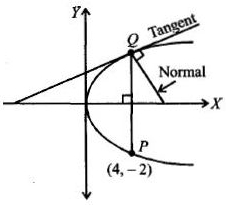
0 likesView Solution
63
MathematicsDifficultMCQAIEEE · 2012
Let $p$ and $q$ denote the following statements:
$p$: The sun is shining
$q$: $I$ shall play tennis in the afternoon
The negation of the statement "If the sun is shining then $I$ shall play tennis in the afternoon" is:
$p$: The sun is shining
$q$: $I$ shall play tennis in the afternoon
The negation of the statement "If the sun is shining then $I$ shall play tennis in the afternoon" is:
A
$q \Rightarrow \sim p$
B
$q \wedge \sim p$
C
$p \wedge \sim q$
D
$\sim q \Rightarrow \sim p$
Solution
(C) Let $p$: The sun is shining.
Let $q$: $I$ shall play tennis in the afternoon.
The given statement is of the form $p \to q$.
The negation of a conditional statement $p \to q$ is given by $\sim(p \to q) \equiv p \wedge \sim q$.
Therefore,the negation is "The sun is shining and $I$ shall not play tennis in the afternoon" which corresponds to $p \wedge \sim q$.
Let $q$: $I$ shall play tennis in the afternoon.
The given statement is of the form $p \to q$.
The negation of a conditional statement $p \to q$ is given by $\sim(p \to q) \equiv p \wedge \sim q$.
Therefore,the negation is "The sun is shining and $I$ shall not play tennis in the afternoon" which corresponds to $p \wedge \sim q$.
0 likesView Solution
64
MathematicsDifficultMCQAIEEE · 2012
If the sum of the series $1^2 + 2 \cdot 2^2 + 3^2 + 2 \cdot 4^2 + 5^2 + \dots + 2 \cdot (n-1)^2 + n^2$ (when $n$ is odd) is to be determined,given that for even $n$,the sum is $\frac{n(n+1)^2}{2}$,find the sum when $n$ is odd.
A
$n^2(n + 1)$
B
$\frac{n^2(n - 1)}{2}$
C
$\frac{n^2(n + 1)}{2}$
D
$n^2(n - 1)$
Solution
(C) For an odd $n$,the series consists of $n$ terms: $1^2 + 2 \cdot 2^2 + 3^2 + 2 \cdot 4^2 + \dots + 2 \cdot (n-1)^2 + n^2$.
This can be written as the sum of the first $(n-1)$ terms plus the $n$-th term.
Since $(n-1)$ is even,we use the given formula for even terms: $S_{n-1} = \frac{(n-1)(n-1+1)^2}{2} = \frac{(n-1)n^2}{2}$.
Now,adding the $n$-th term $(n^2)$: $S_n = \frac{(n-1)n^2}{2} + n^2$.
Factoring out $n^2$: $S_n = n^2 \left( \frac{n-1}{2} + 1 \right) = n^2 \left( \frac{n-1+2}{2} \right) = \frac{n^2(n+1)}{2}$.
This can be written as the sum of the first $(n-1)$ terms plus the $n$-th term.
Since $(n-1)$ is even,we use the given formula for even terms: $S_{n-1} = \frac{(n-1)(n-1+1)^2}{2} = \frac{(n-1)n^2}{2}$.
Now,adding the $n$-th term $(n^2)$: $S_n = \frac{(n-1)n^2}{2} + n^2$.
Factoring out $n^2$: $S_n = n^2 \left( \frac{n-1}{2} + 1 \right) = n^2 \left( \frac{n-1+2}{2} \right) = \frac{n^2(n+1)}{2}$.
0 likesView Solution
65
MathematicsDifficultMCQAIEEE · 2012
The number of common tangents of the circles given by $x^2 + y^2 - 8x - 2y + 1 = 0$ and $x^2 + y^2 + 6x + 8y = 0$ is
A
one
B
four
C
two
D
three
Solution
(C) The given circles are $C_1: x^2 + y^2 - 8x - 2y + 1 = 0$ and $C_2: x^2 + y^2 + 6x + 8y = 0$.
For $C_1$,the center is $(4, 1)$ and the radius $r_1 = \sqrt{4^2 + 1^2 - 1} = \sqrt{16} = 4$.
For $C_2$,the center is $(-3, -4)$ and the radius $r_2 = \sqrt{(-3)^2 + (-4)^2 - 0} = \sqrt{25} = 5$.
The distance between the centers $d = \sqrt{(4 - (-3))^2 + (1 - (-4))^2} = \sqrt{7^2 + 5^2} = \sqrt{49 + 25} = \sqrt{74}$.
Since $\sqrt{49} < \sqrt{74} < \sqrt{81}$,we have $7 < d < 9$.
Also,$r_1 + r_2 = 4 + 5 = 9$ and $|r_1 - r_2| = |4 - 5| = 1$.
Since $|r_1 - r_2| < d < r_1 + r_2$,the circles intersect at two distinct points.
Therefore,the number of common tangents is $2$.
For $C_1$,the center is $(4, 1)$ and the radius $r_1 = \sqrt{4^2 + 1^2 - 1} = \sqrt{16} = 4$.
For $C_2$,the center is $(-3, -4)$ and the radius $r_2 = \sqrt{(-3)^2 + (-4)^2 - 0} = \sqrt{25} = 5$.
The distance between the centers $d = \sqrt{(4 - (-3))^2 + (1 - (-4))^2} = \sqrt{7^2 + 5^2} = \sqrt{49 + 25} = \sqrt{74}$.
Since $\sqrt{49} < \sqrt{74} < \sqrt{81}$,we have $7 < d < 9$.
Also,$r_1 + r_2 = 4 + 5 = 9$ and $|r_1 - r_2| = |4 - 5| = 1$.
Since $|r_1 - r_2| < d < r_1 + r_2$,the circles intersect at two distinct points.
Therefore,the number of common tangents is $2$.
0 likesView Solution
66
MathematicsDifficultMCQAIEEE · 2012
${\left| {{z_1} + {z_2}} \right|^2} + {\left| {{z_1} - {z_2}} \right|^2}$ is equal to
A
$2(\left| {{z_1}} \right| + \left| {{z_2}} \right|)$
B
$2(\left| {{z_1}} \right|^2 + \left| {{z_2}} \right|^2)$
C
$\left| {{z_1}} \right|\left| {{z_2}} \right|$
D
$\left| {{z_1}} \right|^2 + \left| {{z_2}} \right|^2$
Solution
(B) We use the property of the modulus of complex numbers: $\left| z \right|^2 = z \bar{z}$.
Expanding the terms:
${\left| {{z_1} + {z_2}} \right|^2} = (z_1 + z_2)(\bar{z_1} + \bar{z_2}) = z_1\bar{z_1} + z_1\bar{z_2} + z_2\bar{z_1} + z_2\bar{z_2} = \left| {{z_1}} \right|^2 + \left| {{z_2}} \right|^2 + z_1\bar{z_2} + z_2\bar{z_1}$.
Similarly:
${\left| {{z_1} - {z_2}} \right|^2} = (z_1 - z_2)(\bar{z_1} - \bar{z_2}) = z_1\bar{z_1} - z_1\bar{z_2} - z_2\bar{z_1} + z_2\bar{z_2} = \left| {{z_1}} \right|^2 + \left| {{z_2}} \right|^2 - z_1\bar{z_2} - z_2\bar{z_1}$.
Adding these two expressions:
${\left| {{z_1} + {z_2}} \right|^2} + {\left| {{z_1} - {z_2}} \right|^2} = (\left| {{z_1}} \right|^2 + \left| {{z_2}} \right|^2 + z_1\bar{z_2} + z_2\bar{z_1}) + (\left| {{z_1}} \right|^2 + \left| {{z_2}} \right|^2 - z_1\bar{z_2} - z_2\bar{z_1})$
$= 2\left| {{z_1}} \right|^2 + 2\left| {{z_2}} \right|^2 = 2(\left| {{z_1}} \right|^2 + \left| {{z_2}} \right|^2)$.
Expanding the terms:
${\left| {{z_1} + {z_2}} \right|^2} = (z_1 + z_2)(\bar{z_1} + \bar{z_2}) = z_1\bar{z_1} + z_1\bar{z_2} + z_2\bar{z_1} + z_2\bar{z_2} = \left| {{z_1}} \right|^2 + \left| {{z_2}} \right|^2 + z_1\bar{z_2} + z_2\bar{z_1}$.
Similarly:
${\left| {{z_1} - {z_2}} \right|^2} = (z_1 - z_2)(\bar{z_1} - \bar{z_2}) = z_1\bar{z_1} - z_1\bar{z_2} - z_2\bar{z_1} + z_2\bar{z_2} = \left| {{z_1}} \right|^2 + \left| {{z_2}} \right|^2 - z_1\bar{z_2} - z_2\bar{z_1}$.
Adding these two expressions:
${\left| {{z_1} + {z_2}} \right|^2} + {\left| {{z_1} - {z_2}} \right|^2} = (\left| {{z_1}} \right|^2 + \left| {{z_2}} \right|^2 + z_1\bar{z_2} + z_2\bar{z_1}) + (\left| {{z_1}} \right|^2 + \left| {{z_2}} \right|^2 - z_1\bar{z_2} - z_2\bar{z_1})$
$= 2\left| {{z_1}} \right|^2 + 2\left| {{z_2}} \right|^2 = 2(\left| {{z_1}} \right|^2 + \left| {{z_2}} \right|^2)$.
0 likesView Solution
67
MathematicsDifficultMCQAIEEE · 2012
The normal at $\left( 2, \frac{3}{2} \right)$ to the ellipse $\frac{x^2}{16} + \frac{y^2}{3} = 1$ touches a parabola,whose equation is
A
$y^2 = -104x$
B
$y^2 = 14x$
C
$y^2 = 26x$
D
$y^2 = -14x$
Solution
(A) The given ellipse is $\frac{x^2}{16} + \frac{y^2}{3} = 1$.
Comparing with $\frac{x^2}{a^2} + \frac{y^2}{b^2} = 1$,we have $a^2 = 16$ and $b^2 = 3$.
The equation of the normal at $(x_1, y_1)$ to the ellipse $\frac{x^2}{a^2} + \frac{y^2}{b^2} = 1$ is $\frac{a^2x}{x_1} - \frac{b^2y}{y_1} = a^2 - b^2$.
Substituting $(x_1, y_1) = \left( 2, \frac{3}{2} \right)$,$a^2 = 16$,and $b^2 = 3$:
$\frac{16x}{2} - \frac{3y}{3/2} = 16 - 3$
$8x - 2y = 13$
$2y = 8x - 13 \Rightarrow y = 4x - \frac{13}{2}$.
$A$ line $y = mx + c$ touches the parabola $y^2 = 4Ax$ if $c = \frac{A}{m}$.
Here $m = 4$ and $c = -\frac{13}{2}$.
$-\frac{13}{2} = \frac{A}{4} \Rightarrow A = -26$.
Thus,the equation of the parabola is $y^2 = 4(-26)x = -104x$.
Comparing with $\frac{x^2}{a^2} + \frac{y^2}{b^2} = 1$,we have $a^2 = 16$ and $b^2 = 3$.
The equation of the normal at $(x_1, y_1)$ to the ellipse $\frac{x^2}{a^2} + \frac{y^2}{b^2} = 1$ is $\frac{a^2x}{x_1} - \frac{b^2y}{y_1} = a^2 - b^2$.
Substituting $(x_1, y_1) = \left( 2, \frac{3}{2} \right)$,$a^2 = 16$,and $b^2 = 3$:
$\frac{16x}{2} - \frac{3y}{3/2} = 16 - 3$
$8x - 2y = 13$
$2y = 8x - 13 \Rightarrow y = 4x - \frac{13}{2}$.
$A$ line $y = mx + c$ touches the parabola $y^2 = 4Ax$ if $c = \frac{A}{m}$.
Here $m = 4$ and $c = -\frac{13}{2}$.
$-\frac{13}{2} = \frac{A}{4} \Rightarrow A = -26$.
Thus,the equation of the parabola is $y^2 = 4(-26)x = -104x$.
0 likesView Solution
68
MathematicsDifficultMCQAIEEE · 2012
If $a, b, c \in \mathbb{R}$ and $1$ is a root of the equation $ax^2 + bx + c = 0$,then the curve $y = 4ax^2 + 3bx + 2c$ $(a \neq 0)$ intersects the $x$-axis at
A
two distinct points whose coordinates are always rational numbers
B
no point
C
exactly two distinct points
D
exactly one point
Solution
(C) Given that $1$ is a root of $ax^2 + bx + c = 0$,we have $a(1)^2 + b(1) + c = 0$,which implies $a + b + c = 0$,or $c = -a - b$.
We want to find the intersection of $y = 4ax^2 + 3bx + 2c$ with the $x$-axis,so we set $y = 0$:
$4ax^2 + 3bx + 2c = 0$.
Substitute $c = -a - b$ into the equation:
$4ax^2 + 3bx + 2(-a - b) = 0$
$4ax^2 + 3bx - 2a - 2b = 0$
Rearranging the terms:
$4ax^2 - 2a + 3bx - 2b = 0$
$2a(2x^2 - 1) + b(3x - 2) = 0$.
Alternatively,using the condition $a+b+c=0$,we can write $c = -(a+b)$.
$y = 4ax^2 + 3bx + 2(-a-b) = 4ax^2 + 3bx - 2a - 2b$.
At $x=1$,$y = 4a + 3b - 2a - 2b = 2a + b$. This is not necessarily zero.
Let us re-evaluate the intersection $4ax^2 + 3bx + 2c = 0$ with $c = -a-b$:
$4ax^2 + 3bx - 2a - 2b = 0$.
For this to be a quadratic equation in $x$,the discriminant $D = (3b)^2 - 4(4a)(-2a-2b) = 9b^2 + 16a(2a+2b) = 9b^2 + 32a^2 + 32ab$.
This discriminant is not necessarily positive,zero,or negative without further constraints on $a$ and $b$. However,if we test specific values,e.g.,$a=1, b=-2, c=1$ (where $1-2+1=0$),then $y = 4x^2 - 6x + 2 = 2(2x^2 - 3x + 1) = 2(2x-1)(x-1)$. This intersects at $x=1$ and $x=1/2$ (two points).
If $a=1, b=-1, c=0$,then $y = 4x^2 - 3x = x(4x-3)$. This intersects at $x=0$ and $x=3/4$ (two points).
Thus,the curve intersects the $x$-axis at exactly two distinct points.
We want to find the intersection of $y = 4ax^2 + 3bx + 2c$ with the $x$-axis,so we set $y = 0$:
$4ax^2 + 3bx + 2c = 0$.
Substitute $c = -a - b$ into the equation:
$4ax^2 + 3bx + 2(-a - b) = 0$
$4ax^2 + 3bx - 2a - 2b = 0$
Rearranging the terms:
$4ax^2 - 2a + 3bx - 2b = 0$
$2a(2x^2 - 1) + b(3x - 2) = 0$.
Alternatively,using the condition $a+b+c=0$,we can write $c = -(a+b)$.
$y = 4ax^2 + 3bx + 2(-a-b) = 4ax^2 + 3bx - 2a - 2b$.
At $x=1$,$y = 4a + 3b - 2a - 2b = 2a + b$. This is not necessarily zero.
Let us re-evaluate the intersection $4ax^2 + 3bx + 2c = 0$ with $c = -a-b$:
$4ax^2 + 3bx - 2a - 2b = 0$.
For this to be a quadratic equation in $x$,the discriminant $D = (3b)^2 - 4(4a)(-2a-2b) = 9b^2 + 16a(2a+2b) = 9b^2 + 32a^2 + 32ab$.
This discriminant is not necessarily positive,zero,or negative without further constraints on $a$ and $b$. However,if we test specific values,e.g.,$a=1, b=-2, c=1$ (where $1-2+1=0$),then $y = 4x^2 - 6x + 2 = 2(2x^2 - 3x + 1) = 2(2x-1)(x-1)$. This intersects at $x=1$ and $x=1/2$ (two points).
If $a=1, b=-1, c=0$,then $y = 4x^2 - 3x = x(4x-3)$. This intersects at $x=0$ and $x=3/4$ (two points).
Thus,the curve intersects the $x$-axis at exactly two distinct points.
0 likesView Solution
69
MathematicsMediumMCQAIEEE · 2012
Consider the straight lines:
$L_1 : x - y = 1$
$L_2 : x + y = 1$
$L_3 : 2x + 2y = 5$
$L_4 : 2x - 2y = 7$
The correct statement is:
$L_1 : x - y = 1$
$L_2 : x + y = 1$
$L_3 : 2x + 2y = 5$
$L_4 : 2x - 2y = 7$
The correct statement is:
A
$L_1 || L_4, L_2 || L_3, L_1$ intersects $L_4$
B
$L_1 \perp L_2, L_1 || L_3, L_1$ intersects $L_2$
C
$L_1 \perp L_2, L_2 || L_3, L_1$ intersects $L_4$
D
$L_1 \perp L_2, L_1 \perp L_3, L_2$ intersects $L_4$
Solution
(D) The slopes of the lines are:
$m_1 = 1$ (for $L_1$)
$m_2 = -1$ (for $L_2$)
$m_3 = -1$ (for $L_3$)
$m_4 = 1$ (for $L_4$)
$1$. Check perpendicularity:
$m_1 \times m_2 = 1 \times (-1) = -1$,so $L_1 \perp L_2$.
$m_1 \times m_3 = 1 \times (-1) = -1$,so $L_1 \perp L_3$.
$2$. Check parallelism:
$m_2 = m_3 = -1$,so $L_2 || L_3$.
$3$. Check intersection:
Since $m_2 \neq m_4$ $(-1 \neq 1)$,$L_2$ and $L_4$ are not parallel and therefore intersect.
Comparing with the options,$L_1 \perp L_2$,$L_1 \perp L_3$,and $L_2$ intersects $L_4$ is the correct set of statements.
$m_1 = 1$ (for $L_1$)
$m_2 = -1$ (for $L_2$)
$m_3 = -1$ (for $L_3$)
$m_4 = 1$ (for $L_4$)
$1$. Check perpendicularity:
$m_1 \times m_2 = 1 \times (-1) = -1$,so $L_1 \perp L_2$.
$m_1 \times m_3 = 1 \times (-1) = -1$,so $L_1 \perp L_3$.
$2$. Check parallelism:
$m_2 = m_3 = -1$,so $L_2 || L_3$.
$3$. Check intersection:
Since $m_2 \neq m_4$ $(-1 \neq 1)$,$L_2$ and $L_4$ are not parallel and therefore intersect.
Comparing with the options,$L_1 \perp L_2$,$L_1 \perp L_3$,and $L_2$ intersects $L_4$ is the correct set of statements.
0 likesView Solution
70
MathematicsDifficultMCQAIEEE · 2012
Statement $1$: The variance of the first $n$ odd natural numbers is $\frac{n^2 - 1}{3}$.
Statement $2$: The sum of the first $n$ odd natural numbers is $n^2$ and the sum of the squares of the first $n$ odd natural numbers is $\frac{n(4n^2 - 1)}{3}$.
Statement $2$: The sum of the first $n$ odd natural numbers is $n^2$ and the sum of the squares of the first $n$ odd natural numbers is $\frac{n(4n^2 - 1)}{3}$.
A
Statement $1$ is true,Statement $2$ is false.
B
Statement $1$ is true,Statement $2$ is true; Statement $2$ is not a correct explanation for Statement $1$.
C
Statement $1$ is false,Statement $2$ is true.
D
Statement $1$ is true,Statement $2$ is true; Statement $2$ is a correct explanation for Statement $1$.
Solution
(D) The first $n$ odd natural numbers are $1, 3, 5, \dots, (2n-1)$.
The mean $\bar{x} = \frac{1}{n} \sum_{i=1}^{n} (2i-1) = \frac{1}{n} \cdot n^2 = n$.
The sum of squares is $\sum_{i=1}^{n} (2i-1)^2 = \sum (4i^2 - 4i + 1) = 4 \frac{n(n+1)(2n+1)}{6} - 4 \frac{n(n+1)}{2} + n = \frac{n(4n^2-1)}{3}$.
Variance $\sigma^2 = \frac{1}{n} \sum x_i^2 - (\bar{x})^2 = \frac{4n^2-1}{3} - n^2 = \frac{4n^2-1-3n^2}{3} = \frac{n^2-1}{3}$.
Thus,Statement $1$ is true and Statement $2$ is true. Statement $2$ provides the correct formulas used to derive Statement $1$.
The mean $\bar{x} = \frac{1}{n} \sum_{i=1}^{n} (2i-1) = \frac{1}{n} \cdot n^2 = n$.
The sum of squares is $\sum_{i=1}^{n} (2i-1)^2 = \sum (4i^2 - 4i + 1) = 4 \frac{n(n+1)(2n+1)}{6} - 4 \frac{n(n+1)}{2} + n = \frac{n(4n^2-1)}{3}$.
Variance $\sigma^2 = \frac{1}{n} \sum x_i^2 - (\bar{x})^2 = \frac{4n^2-1}{3} - n^2 = \frac{4n^2-1-3n^2}{3} = \frac{n^2-1}{3}$.
Thus,Statement $1$ is true and Statement $2$ is true. Statement $2$ provides the correct formulas used to derive Statement $1$.
0 likesView Solution
71
MathematicsDifficultMCQAIEEE · 2012
If seven women and seven men are to be seated around a circular table such that there is a man on either side of every woman,then the number of seating arrangements is
A
$6!7!$
B
$(6!)^2$
C
$(7!)^2$
D
$7!$
Solution
(A) To ensure that there is a man on either side of every woman,the men and women must alternate around the circular table.
First,arrange the $7$ men around the circular table. The number of ways to arrange $n$ items in a circle is $(n-1)!$. Thus,$7$ men can be arranged in $(7-1)! = 6!$ ways.
Once the men are seated,there are $7$ distinct gaps created between them.
Since there are $7$ women to be seated in these $7$ gaps,they can be arranged in $7!$ ways.
Therefore,the total number of seating arrangements is $6! \times 7!$.
First,arrange the $7$ men around the circular table. The number of ways to arrange $n$ items in a circle is $(n-1)!$. Thus,$7$ men can be arranged in $(7-1)! = 6!$ ways.
Once the men are seated,there are $7$ distinct gaps created between them.
Since there are $7$ women to be seated in these $7$ gaps,they can be arranged in $7!$ ways.
Therefore,the total number of seating arrangements is $6! \times 7!$.
0 likesView Solution
72
MathematicsDifficultMCQAIEEE · 2012
If the three planes $x = 5, 2x - 5ay + 3z - 2 = 0$ and $3bx + y - 3z = 0$ contain a common line,then $(a, b)$ is equal to
A
$\left( \frac{8}{15}, -\frac{1}{5} \right)$
B
$\left( \frac{1}{5}, -\frac{8}{15} \right)$
C
$\left( -\frac{8}{15}, \frac{1}{5} \right)$
D
$\left( -\frac{1}{5}, \frac{8}{15} \right)$
Solution
(B) Let the direction ratios of the common line be $\ell, m, n$.
Since the line lies on the plane $x = 5$,its direction vector must be perpendicular to the normal $(1, 0, 0)$. Thus,$\ell = 0$.
Since the line lies on the other two planes,its direction vector must be perpendicular to their normals $(2, -5a, 3)$ and $(3b, 1, -3)$.
For the plane $2x - 5ay + 3z - 2 = 0$,we have $2\ell - 5am + 3n = 0$. Since $\ell = 0$,we get $-5am + 3n = 0$,or $3n = 5am$.
For the plane $3bx + y - 3z = 0$,we have $3b\ell + m - 3n = 0$. Since $\ell = 0$,we get $m - 3n = 0$,or $m = 3n$.
Substituting $m = 3n$ into $3n = 5am$,we get $3n = 5a(3n)$.
Assuming $n \neq 0$,we have $3 = 15a$,which gives $a = \frac{1}{5}$.
Now,the common line must also satisfy the equations of the planes. Since $x = 5$,the other two equations become $-5ay + 3z = 2 - 2(5) = -8$ and $y - 3z = -3b(5) = -15b$.
Substituting $a = \frac{1}{5}$,the first equation becomes $-y + 3z = -8$,or $y - 3z = 8$.
Comparing $y - 3z = 8$ and $y - 3z = -15b$,we get $-15b = 8$,so $b = -\frac{8}{15}$.
Thus,$(a, b) = \left( \frac{1}{5}, -\frac{8}{15} \right)$.
Since the line lies on the plane $x = 5$,its direction vector must be perpendicular to the normal $(1, 0, 0)$. Thus,$\ell = 0$.
Since the line lies on the other two planes,its direction vector must be perpendicular to their normals $(2, -5a, 3)$ and $(3b, 1, -3)$.
For the plane $2x - 5ay + 3z - 2 = 0$,we have $2\ell - 5am + 3n = 0$. Since $\ell = 0$,we get $-5am + 3n = 0$,or $3n = 5am$.
For the plane $3bx + y - 3z = 0$,we have $3b\ell + m - 3n = 0$. Since $\ell = 0$,we get $m - 3n = 0$,or $m = 3n$.
Substituting $m = 3n$ into $3n = 5am$,we get $3n = 5a(3n)$.
Assuming $n \neq 0$,we have $3 = 15a$,which gives $a = \frac{1}{5}$.
Now,the common line must also satisfy the equations of the planes. Since $x = 5$,the other two equations become $-5ay + 3z = 2 - 2(5) = -8$ and $y - 3z = -3b(5) = -15b$.
Substituting $a = \frac{1}{5}$,the first equation becomes $-y + 3z = -8$,or $y - 3z = 8$.
Comparing $y - 3z = 8$ and $y - 3z = -15b$,we get $-15b = 8$,so $b = -\frac{8}{15}$.
Thus,$(a, b) = \left( \frac{1}{5}, -\frac{8}{15} \right)$.
0 likesView Solution
73
MathematicsDifficultMCQAIEEE · 2012
Consider a quadratic equation $ax^2 + bx + c = 0,$ where $2a + 3b + 6c = 0$ and let $g(x) = a\frac{x^3}{3} + b\frac{x^2}{2} + cx.$
Statement $1:$ The quadratic equation has at least one root in the interval $(0, 1).$
Statement $2:$ The Rolle's theorem is applicable to function $g(x)$ on the interval $[0, 1].$
Statement $1:$ The quadratic equation has at least one root in the interval $(0, 1).$
Statement $2:$ The Rolle's theorem is applicable to function $g(x)$ on the interval $[0, 1].$
A
Statement $1$ is false,Statement $2$ is true.
B
Statement $1$ is true,Statement $2$ is false.
C
Statement $1$ is true,Statement $2$ is true,Statement $2$ is not a correct explanation for Statement $1.$
D
Statement $1$ is true,Statement $2$ is true,Statement $2$ is a correct explanation for Statement $1.$
Solution
(D) Let $g(x) = \frac{ax^3}{3} + \frac{bx^2}{2} + cx.$
Then $g'(x) = ax^2 + bx + c.$
We are given $2a + 3b + 6c = 0.$
Statement $2:$
$g(0) = 0.$
$g(1) = \frac{a}{3} + \frac{b}{2} + c = \frac{2a + 3b + 6c}{6} = \frac{0}{6} = 0.$
Since $g(0) = g(1) = 0$ and $g(x)$ is a polynomial,it is continuous on $[0, 1]$ and differentiable on $(0, 1).$
By Rolle's theorem,there exists at least one $k \in (0, 1)$ such that $g'(k) = 0.$
Thus,Statement $2$ is true.
Statement $1:$
Since $g'(k) = ak^2 + bk + c = 0$ for some $k \in (0, 1),$ the quadratic equation $ax^2 + bx + c = 0$ has at least one root in $(0, 1).$
Thus,Statement $1$ is true and Statement $2$ is the correct explanation for Statement $1.$
Then $g'(x) = ax^2 + bx + c.$
We are given $2a + 3b + 6c = 0.$
Statement $2:$
$g(0) = 0.$
$g(1) = \frac{a}{3} + \frac{b}{2} + c = \frac{2a + 3b + 6c}{6} = \frac{0}{6} = 0.$
Since $g(0) = g(1) = 0$ and $g(x)$ is a polynomial,it is continuous on $[0, 1]$ and differentiable on $(0, 1).$
By Rolle's theorem,there exists at least one $k \in (0, 1)$ such that $g'(k) = 0.$
Thus,Statement $2$ is true.
Statement $1:$
Since $g'(k) = ak^2 + bk + c = 0$ for some $k \in (0, 1),$ the quadratic equation $ax^2 + bx + c = 0$ has at least one root in $(0, 1).$
Thus,Statement $1$ is true and Statement $2$ is the correct explanation for Statement $1.$
0 likesView Solution
74
MathematicsDifficultMCQAIEEE · 2012
Statement $1:$ The shortest distance between the lines $\frac{x}{2} = \frac{y}{-1} = \frac{z}{2}$ and $\frac{x-1}{4} = \frac{y-1}{-2} = \frac{z-1}{4}$ is $\sqrt{2}$.
Statement $2:$ The shortest distance between two parallel lines is the perpendicular distance from any point on one of the lines to the other line.
Statement $2:$ The shortest distance between two parallel lines is the perpendicular distance from any point on one of the lines to the other line.
A
Statement $1$ is true,Statement $2$ is false.
B
Statement $1$ is true,Statement $2$ is true,Statement $2$ is a correct explanation for Statement $1$.
C
Statement $1$ is false,Statement $2$ is true.
D
Statement $1$ is true,Statement $2$ is true,Statement $2$ is not a correct explanation for Statement $1$.
Solution
(B) The given lines are $L_1: \frac{x}{2} = \frac{y}{-1} = \frac{z}{2}$ and $L_2: \frac{x-1}{4} = \frac{y-1}{-2} = \frac{z-1}{4}$.
Both lines have the same direction vector $\vec{b} = 2\hat{i} - \hat{j} + 2\hat{k}$,so they are parallel.
The formula for the shortest distance between two parallel lines $\vec{r} = \vec{a}_1 + \lambda\vec{b}$ and $\vec{r} = \vec{a}_2 + \mu\vec{b}$ is $d = \frac{|(\vec{a}_2 - \vec{a}_1) \times \vec{b}|}{|\vec{b}|}$.
Here,$\vec{a}_1 = 0\hat{i} + 0\hat{j} + 0\hat{k}$ and $\vec{a}_2 = 1\hat{i} + 1\hat{j} + 1\hat{k}$.
Thus,$\vec{a}_2 - \vec{a}_1 = \hat{i} + \hat{j} + \hat{k}$.
$(\vec{a}_2 - \vec{a}_1) \times \vec{b} = \begin{vmatrix} \hat{i} & \hat{j} & \hat{k} \\ 1 & 1 & 1 \\ 2 & -1 & 2 \end{vmatrix} = \hat{i}(2 - (-1)) - \hat{j}(2 - 2) + \hat{k}(-1 - 2) = 3\hat{i} + 0\hat{j} - 3\hat{k}$.
The magnitude is $|3\hat{i} - 3\hat{k}| = \sqrt{3^2 + (-3)^2} = \sqrt{18} = 3\sqrt{2}$.
The magnitude of $\vec{b}$ is $|2\hat{i} - \hat{j} + 2\hat{k}| = \sqrt{2^2 + (-1)^2 + 2^2} = \sqrt{9} = 3$.
Therefore,$d = \frac{3\sqrt{2}}{3} = \sqrt{2}$.
Since the calculated distance is $\sqrt{2}$,Statement $1$ is true.
Statement $2$ is the standard definition of the shortest distance between parallel lines,which is also true.
Since Statement $2$ provides the method used to calculate the distance in Statement $1$,it is the correct explanation.
Both lines have the same direction vector $\vec{b} = 2\hat{i} - \hat{j} + 2\hat{k}$,so they are parallel.
The formula for the shortest distance between two parallel lines $\vec{r} = \vec{a}_1 + \lambda\vec{b}$ and $\vec{r} = \vec{a}_2 + \mu\vec{b}$ is $d = \frac{|(\vec{a}_2 - \vec{a}_1) \times \vec{b}|}{|\vec{b}|}$.
Here,$\vec{a}_1 = 0\hat{i} + 0\hat{j} + 0\hat{k}$ and $\vec{a}_2 = 1\hat{i} + 1\hat{j} + 1\hat{k}$.
Thus,$\vec{a}_2 - \vec{a}_1 = \hat{i} + \hat{j} + \hat{k}$.
$(\vec{a}_2 - \vec{a}_1) \times \vec{b} = \begin{vmatrix} \hat{i} & \hat{j} & \hat{k} \\ 1 & 1 & 1 \\ 2 & -1 & 2 \end{vmatrix} = \hat{i}(2 - (-1)) - \hat{j}(2 - 2) + \hat{k}(-1 - 2) = 3\hat{i} + 0\hat{j} - 3\hat{k}$.
The magnitude is $|3\hat{i} - 3\hat{k}| = \sqrt{3^2 + (-3)^2} = \sqrt{18} = 3\sqrt{2}$.
The magnitude of $\vec{b}$ is $|2\hat{i} - \hat{j} + 2\hat{k}| = \sqrt{2^2 + (-1)^2 + 2^2} = \sqrt{9} = 3$.
Therefore,$d = \frac{3\sqrt{2}}{3} = \sqrt{2}$.
Since the calculated distance is $\sqrt{2}$,Statement $1$ is true.
Statement $2$ is the standard definition of the shortest distance between parallel lines,which is also true.
Since Statement $2$ provides the method used to calculate the distance in Statement $1$,it is the correct explanation.
0 likesView Solution
75
MathematicsMediumMCQAIEEE · 2012
If $P(S)$ denotes the set of all subsets of a given set $S$,then the number of one-to-one functions from the set $S = \{ 1, 2, 3 \}$ to the set $P(S)$ is
A
$24$
B
$8$
C
$336$
D
$320$
Solution
(C) Given the set $S = \{ 1, 2, 3 \}$.
The number of elements in $S$ is $n(S) = 3$.
$P(S)$ is the power set of $S$,which is the set of all subsets of $S$.
The number of elements in the power set is $n(P(S)) = 2^{n(S)} = 2^3 = 8$.
$A$ function $f: S \to P(S)$ is one-to-one (injective) if each element in $S$ maps to a unique element in $P(S)$.
The number of one-to-one functions from a set with $m$ elements to a set with $n$ elements is given by the permutation formula $^nP_m = \frac{n!}{(n-m)!}$.
Here,$m = n(S) = 3$ and $n = n(P(S)) = 8$.
Therefore,the number of one-to-one functions is $^8P_3 = \frac{8!}{(8-3)!} = \frac{8!}{5!} = 8 \times 7 \times 6 = 336$.
The number of elements in $S$ is $n(S) = 3$.
$P(S)$ is the power set of $S$,which is the set of all subsets of $S$.
The number of elements in the power set is $n(P(S)) = 2^{n(S)} = 2^3 = 8$.
$A$ function $f: S \to P(S)$ is one-to-one (injective) if each element in $S$ maps to a unique element in $P(S)$.
The number of one-to-one functions from a set with $m$ elements to a set with $n$ elements is given by the permutation formula $^nP_m = \frac{n!}{(n-m)!}$.
Here,$m = n(S) = 3$ and $n = n(P(S)) = 8$.
Therefore,the number of one-to-one functions is $^8P_3 = \frac{8!}{(8-3)!} = \frac{8!}{5!} = 8 \times 7 \times 6 = 336$.
0 likesView Solution
76
MathematicsDifficultMCQAIEEE · 2012
The weight $W$ of a certain stock of fish is given by $W = nw,$ where $n$ is the size of the stock and $w$ is the average weight of a fish. If $n$ and $w$ change with time $t$ as $n = 2t^2 + 3$ and $w = t^2 - t + 2,$ then the rate of change of $W$ with respect to $t$ at $t = 1$ is
A
$1$
B
$8$
C
$13$
D
$5$
Solution
(C) Given $W = nw$.
Using the product rule for differentiation,we have:
$\frac{dW}{dt} = n \frac{dw}{dt} + w \frac{dn}{dt}$
Given $n = 2t^2 + 3$ and $w = t^2 - t + 2$.
Calculating the derivatives with respect to $t$:
$\frac{dn}{dt} = 4t$
$\frac{dw}{dt} = 2t - 1$
At $t = 1$:
$n = 2(1)^2 + 3 = 5$
$w = (1)^2 - 1 + 2 = 2$
$\frac{dn}{dt} = 4(1) = 4$
$\frac{dw}{dt} = 2(1) - 1 = 1$
Substituting these values into the derivative formula:
$\frac{dW}{dt} = (5)(1) + (2)(4)$
$\frac{dW}{dt} = 5 + 8 = 13$
Using the product rule for differentiation,we have:
$\frac{dW}{dt} = n \frac{dw}{dt} + w \frac{dn}{dt}$
Given $n = 2t^2 + 3$ and $w = t^2 - t + 2$.
Calculating the derivatives with respect to $t$:
$\frac{dn}{dt} = 4t$
$\frac{dw}{dt} = 2t - 1$
At $t = 1$:
$n = 2(1)^2 + 3 = 5$
$w = (1)^2 - 1 + 2 = 2$
$\frac{dn}{dt} = 4(1) = 4$
$\frac{dw}{dt} = 2(1) - 1 = 1$
Substituting these values into the derivative formula:
$\frac{dW}{dt} = (5)(1) + (2)(4)$
$\frac{dW}{dt} = 5 + 8 = 13$
0 likesView Solution
77
MathematicsDifficultMCQAIEEE · 2012
The area of the region bounded by the curve $y = x^3$,and the lines $y = 8$ and $x = 0$ is
A
$8$
B
$12$
C
$10$
D
$16$
Solution
(B) The region is bounded by the curve $y = x^3$,the line $y = 8$,and the $y$-axis $(x = 0)$.
To find the area with respect to the $y$-axis,we express $x$ in terms of $y$: $x = y^{1/3}$.
The limits for $y$ are from $0$ to $8$.
Required Area $= \int\limits_{0}^{8} x \, dy = \int\limits_{0}^{8} y^{1/3} \, dy$
$= \left[ \frac{y^{1/3 + 1}}{1/3 + 1} \right]_{0}^{8} = \left[ \frac{y^{4/3}}{4/3} \right]_{0}^{8} = \left[ \frac{3}{4} y^{4/3} \right]_{0}^{8}$
$= \frac{3}{4} (8^{4/3} - 0^{4/3}) = \frac{3}{4} ((2^3)^{4/3}) = \frac{3}{4} (2^4) = \frac{3}{4} \times 16 = 12 \text{ sq. units.}$
To find the area with respect to the $y$-axis,we express $x$ in terms of $y$: $x = y^{1/3}$.
The limits for $y$ are from $0$ to $8$.
Required Area $= \int\limits_{0}^{8} x \, dy = \int\limits_{0}^{8} y^{1/3} \, dy$
$= \left[ \frac{y^{1/3 + 1}}{1/3 + 1} \right]_{0}^{8} = \left[ \frac{y^{4/3}}{4/3} \right]_{0}^{8} = \left[ \frac{3}{4} y^{4/3} \right]_{0}^{8}$
$= \frac{3}{4} (8^{4/3} - 0^{4/3}) = \frac{3}{4} ((2^3)^{4/3}) = \frac{3}{4} (2^4) = \frac{3}{4} \times 16 = 12 \text{ sq. units.}$
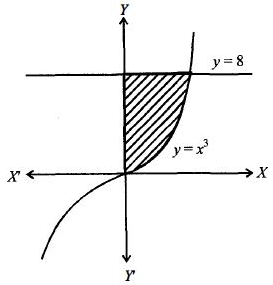
0 likesView Solution
78
MathematicsDifficultMCQAIEEE · 2012
If $\vec{a} = \hat{i} - 2\hat{j} + 3\hat{k}$,$\vec{b} = 2\hat{i} + 3\hat{j} - \hat{k}$ and $\vec{c} = r\hat{i} + \hat{j} + (2r - 1)\hat{k}$ are three vectors such that $\vec{c}$ is parallel to the plane of $\vec{a}$ and $\vec{b}$,then $r$ is equal to
A
$1$
B
$-1$
C
$0$
D
$2$
Solution
(C) Given vectors are $\vec{a} = \hat{i} - 2\hat{j} + 3\hat{k}$,$\vec{b} = 2\hat{i} + 3\hat{j} - \hat{k}$,and $\vec{c} = r\hat{i} + \hat{j} + (2r - 1)\hat{k}$.
Since $\vec{c}$ is parallel to the plane of $\vec{a}$ and $\vec{b}$,the vectors $\vec{a}, \vec{b}$,and $\vec{c}$ are coplanar.
For three vectors to be coplanar,their scalar triple product must be zero,i.e.,$[\vec{a} \, \vec{b} \, \vec{c}] = 0$.
This is equivalent to the determinant of their components being zero:
$\begin{vmatrix} 1 & -2 & 3 \\ 2 & 3 & -1 \\ r & 1 & 2r - 1 \end{vmatrix} = 0$
Expanding the determinant along the first row:
$1((3)(2r - 1) - (-1)(1)) - (-2)((2)(2r - 1) - (-1)(r)) + 3((2)(1) - (3)(r)) = 0$
$1(6r - 3 + 1) + 2(4r - 2 + r) + 3(2 - 3r) = 0$
$(6r - 2) + 2(5r - 2) + (6 - 9r) = 0$
$6r - 2 + 10r - 4 + 6 - 9r = 0$
$7r = 0$
$r = 0$
Since $\vec{c}$ is parallel to the plane of $\vec{a}$ and $\vec{b}$,the vectors $\vec{a}, \vec{b}$,and $\vec{c}$ are coplanar.
For three vectors to be coplanar,their scalar triple product must be zero,i.e.,$[\vec{a} \, \vec{b} \, \vec{c}] = 0$.
This is equivalent to the determinant of their components being zero:
$\begin{vmatrix} 1 & -2 & 3 \\ 2 & 3 & -1 \\ r & 1 & 2r - 1 \end{vmatrix} = 0$
Expanding the determinant along the first row:
$1((3)(2r - 1) - (-1)(1)) - (-2)((2)(2r - 1) - (-1)(r)) + 3((2)(1) - (3)(r)) = 0$
$1(6r - 3 + 1) + 2(4r - 2 + r) + 3(2 - 3r) = 0$
$(6r - 2) + 2(5r - 2) + (6 - 9r) = 0$
$6r - 2 + 10r - 4 + 6 - 9r = 0$
$7r = 0$
$r = 0$
0 likesView Solution
79
MathematicsDifficultMCQAIEEE · 2012
If $A^T$ denotes the transpose of the matrix $A = \begin{bmatrix} 0 & 0 & a \\ 0 & b & c \\ d & e & f \end{bmatrix}$,where $a, b, c, d, e$ and $f$ are integers such that $abd \neq 0$,then the number of such matrices for which $A^{-1} = A^T$ is
A
$2(3!)$
B
$3(2!)$
C
$2^3$
D
$3^2$
Solution
(C) Given $A = \begin{bmatrix} 0 & 0 & a \\ 0 & b & c \\ d & e & f \end{bmatrix}$. The determinant $|A| = 0(bf - ce) - 0(0 - cd) + a(0 - bd) = -abd$.
Since $abd \neq 0$,the matrix is invertible.
The cofactor matrix is calculated as:
$C_{11} = bf - ce, C_{12} = -(-cd) = cd, C_{13} = -bd$
$C_{21} = -(-ae) = ae, C_{22} = -ad, C_{23} = 0$
$C_{31} = -ab, C_{32} = 0, C_{33} = 0$
Thus,$\text{adj}(A) = \begin{bmatrix} bf-ce & ae & -ab \\ cd & -ad & 0 \\ -bd & 0 & 0 \end{bmatrix}$.
$A^{-1} = \frac{1}{|A|} \text{adj}(A) = \frac{1}{-abd} \begin{bmatrix} bf-ce & ae & -ab \\ cd & -ad & 0 \\ -bd & 0 & 0 \end{bmatrix}$.
Given $A^{-1} = A^T$,where $A^T = \begin{bmatrix} 0 & 0 & d \\ 0 & b & e \\ a & c & f \end{bmatrix}$.
Equating $A^{-1} = A^T$ leads to the condition $A A^T = I$ (since $A^{-1} = A^T \implies A A^T = I$).
Calculating $A A^T = \begin{bmatrix} 0 & 0 & a \\ 0 & b & c \\ d & e & f \end{bmatrix} \begin{bmatrix} 0 & 0 & d \\ 0 & b & e \\ a & c & f \end{bmatrix} = \begin{bmatrix} a^2 & ac & af \\ ac & b^2+c^2 & be+cf \\ ad & ae+cf & d^2+e^2+f^2 \end{bmatrix} = \begin{bmatrix} 1 & 0 & 0 \\ 0 & 1 & 0 \\ 0 & 0 & 1 \end{bmatrix}$.
From $a^2 = 1$,$a = \pm 1$.
From $ac = 0$,$c = 0$.
From $af = 0$,$f = 0$.
From $b^2+c^2 = 1$,$b^2 = 1 \implies b = \pm 1$.
From $be+cf = 0$,$be = 0 \implies e = 0$.
From $d^2+e^2+f^2 = 1$,$d^2 = 1 \implies d = \pm 1$.
Thus,$a, b, d \in \{1, -1\}$ and $c=e=f=0$.
The number of such matrices is $2 \times 2 \times 2 = 2^3 = 8$.
Since $abd \neq 0$,the matrix is invertible.
The cofactor matrix is calculated as:
$C_{11} = bf - ce, C_{12} = -(-cd) = cd, C_{13} = -bd$
$C_{21} = -(-ae) = ae, C_{22} = -ad, C_{23} = 0$
$C_{31} = -ab, C_{32} = 0, C_{33} = 0$
Thus,$\text{adj}(A) = \begin{bmatrix} bf-ce & ae & -ab \\ cd & -ad & 0 \\ -bd & 0 & 0 \end{bmatrix}$.
$A^{-1} = \frac{1}{|A|} \text{adj}(A) = \frac{1}{-abd} \begin{bmatrix} bf-ce & ae & -ab \\ cd & -ad & 0 \\ -bd & 0 & 0 \end{bmatrix}$.
Given $A^{-1} = A^T$,where $A^T = \begin{bmatrix} 0 & 0 & d \\ 0 & b & e \\ a & c & f \end{bmatrix}$.
Equating $A^{-1} = A^T$ leads to the condition $A A^T = I$ (since $A^{-1} = A^T \implies A A^T = I$).
Calculating $A A^T = \begin{bmatrix} 0 & 0 & a \\ 0 & b & c \\ d & e & f \end{bmatrix} \begin{bmatrix} 0 & 0 & d \\ 0 & b & e \\ a & c & f \end{bmatrix} = \begin{bmatrix} a^2 & ac & af \\ ac & b^2+c^2 & be+cf \\ ad & ae+cf & d^2+e^2+f^2 \end{bmatrix} = \begin{bmatrix} 1 & 0 & 0 \\ 0 & 1 & 0 \\ 0 & 0 & 1 \end{bmatrix}$.
From $a^2 = 1$,$a = \pm 1$.
From $ac = 0$,$c = 0$.
From $af = 0$,$f = 0$.
From $b^2+c^2 = 1$,$b^2 = 1 \implies b = \pm 1$.
From $be+cf = 0$,$be = 0 \implies e = 0$.
From $d^2+e^2+f^2 = 1$,$d^2 = 1 \implies d = \pm 1$.
Thus,$a, b, d \in \{1, -1\}$ and $c=e=f=0$.
The number of such matrices is $2 \times 2 \times 2 = 2^3 = 8$.
0 likesView Solution
80
MathematicsDifficultMCQAIEEE · 2012
The distance of the point $-\hat{i} + 2\hat{j} + 6\hat{k}$ from the straight line that passes through the point $2\hat{i} + 3\hat{j} - 4\hat{k}$ and is parallel to the vector $6\hat{i} + 3\hat{j} - 4\hat{k}$ is
A
$9$
B
$8$
C
$7$
D
$10$
Solution
(C) Let the given point be $P(-1, 2, 6)$ and the line $L$ pass through $A(2, 3, -4)$ with direction vector $\vec{v} = 6\hat{i} + 3\hat{j} - 4\hat{k}$.
The vector $\vec{AP} = (-1-2)\hat{i} + (2-3)\hat{j} + (6-(-4))\hat{k} = -3\hat{i} - \hat{j} + 10\hat{k}$.
The distance $d$ of point $P$ from the line is given by $d = \frac{|\vec{AP} \times \vec{v}|}{|\vec{v}|}$.
First,calculate the cross product $\vec{AP} \times \vec{v}$:
$\vec{AP} \times \vec{v} = \begin{vmatrix} \hat{i} & \hat{j} & \hat{k} \\ -3 & -1 & 10 \\ 6 & 3 & -4 \end{vmatrix} = \hat{i}(4 - 30) - \hat{j}(12 - 60) + \hat{k}(-9 + 6) = -26\hat{i} + 48\hat{j} - 3\hat{k}$.
The magnitude $|\vec{AP} \times \vec{v}| = \sqrt{(-26)^2 + 48^2 + (-3)^2} = \sqrt{676 + 2304 + 9} = \sqrt{2989}$.
The magnitude $|\vec{v}| = \sqrt{6^2 + 3^2 + (-4)^2} = \sqrt{36 + 9 + 16} = \sqrt{61}$.
Thus,$d = \sqrt{\frac{2989}{61}} = \sqrt{49} = 7$.
The vector $\vec{AP} = (-1-2)\hat{i} + (2-3)\hat{j} + (6-(-4))\hat{k} = -3\hat{i} - \hat{j} + 10\hat{k}$.
The distance $d$ of point $P$ from the line is given by $d = \frac{|\vec{AP} \times \vec{v}|}{|\vec{v}|}$.
First,calculate the cross product $\vec{AP} \times \vec{v}$:
$\vec{AP} \times \vec{v} = \begin{vmatrix} \hat{i} & \hat{j} & \hat{k} \\ -3 & -1 & 10 \\ 6 & 3 & -4 \end{vmatrix} = \hat{i}(4 - 30) - \hat{j}(12 - 60) + \hat{k}(-9 + 6) = -26\hat{i} + 48\hat{j} - 3\hat{k}$.
The magnitude $|\vec{AP} \times \vec{v}| = \sqrt{(-26)^2 + 48^2 + (-3)^2} = \sqrt{676 + 2304 + 9} = \sqrt{2989}$.
The magnitude $|\vec{v}| = \sqrt{6^2 + 3^2 + (-4)^2} = \sqrt{36 + 9 + 16} = \sqrt{61}$.
Thus,$d = \sqrt{\frac{2989}{61}} = \sqrt{49} = 7$.
0 likesView Solution
81
MathematicsDifficultMCQAIEEE · 2012
Consider the following planes: $P: x + y - 2z + 7 = 0$; $Q: x + y + 2z + 2 = 0$; $R: 3x + 3y - 6z - 11 = 0$.
A
$P$ and $R$ are perpendicular
B
$Q$ and $R$ are perpendicular
C
$P$ and $Q$ are parallel
D
$P$ and $R$ are parallel
Solution
(D) The given planes are:
$P: x + y - 2z + 7 = 0$
$Q: x + y + 2z + 2 = 0$
$R: 3x + 3y - 6z - 11 = 0$
To check if planes are parallel,we compare the ratios of the coefficients of $x, y,$ and $z$.
For plane $P$,the normal vector is $\vec{n_1} = (1, 1, -2)$.
For plane $R$,the normal vector is $\vec{n_2} = (3, 3, -6)$.
We observe that $\vec{n_2} = 3(1, 1, -2) = 3\vec{n_1}$.
Since the normal vectors are proportional,the planes $P$ and $R$ are parallel.
Thus,the correct option is $D$.
$P: x + y - 2z + 7 = 0$
$Q: x + y + 2z + 2 = 0$
$R: 3x + 3y - 6z - 11 = 0$
To check if planes are parallel,we compare the ratios of the coefficients of $x, y,$ and $z$.
For plane $P$,the normal vector is $\vec{n_1} = (1, 1, -2)$.
For plane $R$,the normal vector is $\vec{n_2} = (3, 3, -6)$.
We observe that $\vec{n_2} = 3(1, 1, -2) = 3\vec{n_1}$.
Since the normal vectors are proportional,the planes $P$ and $R$ are parallel.
Thus,the correct option is $D$.
0 likesView Solution
82
MathematicsDifficultMCQAIEEE · 2012
If $A = \begin{bmatrix} 1 & 0 & 0 \\ 2 & 1 & 0 \\ -3 & 2 & 1 \end{bmatrix}$ and $B = \begin{bmatrix} 1 & 0 & 0 \\ -2 & 1 & 0 \\ 7 & -2 & 1 \end{bmatrix}$,then $AB$ equals
A
$I$
B
$A$
C
$B$
D
$0$
Solution
(A) Given matrices are $A = \begin{bmatrix} 1 & 0 & 0 \\ 2 & 1 & 0 \\ -3 & 2 & 1 \end{bmatrix}$ and $B = \begin{bmatrix} 1 & 0 & 0 \\ -2 & 1 & 0 \\ 7 & -2 & 1 \end{bmatrix}$.
To find $AB$,we perform matrix multiplication:
$AB = \begin{bmatrix} 1 & 0 & 0 \\ 2 & 1 & 0 \\ -3 & 2 & 1 \end{bmatrix} \begin{bmatrix} 1 & 0 & 0 \\ -2 & 1 & 0 \\ 7 & -2 & 1 \end{bmatrix}$
Calculating each element:
Row $1$: $(1)(1) + (0)(-2) + (0)(7) = 1$,$(1)(0) + (0)(1) + (0)(-2) = 0$,$(1)(0) + (0)(0) + (0)(1) = 0$
Row $2$: $(2)(1) + (1)(-2) + (0)(7) = 2 - 2 = 0$,$(2)(0) + (1)(1) + (0)(-2) = 1$,$(2)(0) + (1)(0) + (0)(1) = 0$
Row $3$: $(-3)(1) + (2)(-2) + (1)(7) = -3 - 4 + 7 = 0$,$(-3)(0) + (2)(1) + (1)(-2) = 2 - 2 = 0$,$(-3)(0) + (2)(0) + (1)(1) = 1$
Thus,$AB = \begin{bmatrix} 1 & 0 & 0 \\ 0 & 1 & 0 \\ 0 & 0 & 1 \end{bmatrix} = I$.
To find $AB$,we perform matrix multiplication:
$AB = \begin{bmatrix} 1 & 0 & 0 \\ 2 & 1 & 0 \\ -3 & 2 & 1 \end{bmatrix} \begin{bmatrix} 1 & 0 & 0 \\ -2 & 1 & 0 \\ 7 & -2 & 1 \end{bmatrix}$
Calculating each element:
Row $1$: $(1)(1) + (0)(-2) + (0)(7) = 1$,$(1)(0) + (0)(1) + (0)(-2) = 0$,$(1)(0) + (0)(0) + (0)(1) = 0$
Row $2$: $(2)(1) + (1)(-2) + (0)(7) = 2 - 2 = 0$,$(2)(0) + (1)(1) + (0)(-2) = 1$,$(2)(0) + (1)(0) + (0)(1) = 0$
Row $3$: $(-3)(1) + (2)(-2) + (1)(7) = -3 - 4 + 7 = 0$,$(-3)(0) + (2)(1) + (1)(-2) = 2 - 2 = 0$,$(-3)(0) + (2)(0) + (1)(1) = 1$
Thus,$AB = \begin{bmatrix} 1 & 0 & 0 \\ 0 & 1 & 0 \\ 0 & 0 & 1 \end{bmatrix} = I$.
0 likesView Solution
83
MathematicsDifficultMCQAIEEE · 2012
The area bounded by the parabola $y^2 = 4x$ and the line $2x - 3y + 4 = 0$,in square units,is
A
$\frac{2}{5}$
B
$\frac{1}{3}$
C
$1$
D
$\frac{1}{2}$
Solution
(B) Given equations are $y^2 = 4x$ and $2x - 3y + 4 = 0$.
From the line equation,$x = \frac{3y - 4}{2}$.
Substituting this into the parabola equation: $y^2 = 4 \left( \frac{3y - 4}{2} \right) = 2(3y - 4) = 6y - 8$.
$y^2 - 6y + 8 = 0 \implies (y - 2)(y - 4) = 0$.
So,$y = 2$ and $y = 4$.
When $y = 2$,$x = \frac{3(2) - 4}{2} = 1$. When $y = 4$,$x = \frac{3(4) - 4}{2} = 4$.
The area is given by $\int_{2}^{4} (x_{line} - x_{parabola}) dy = \int_{2}^{4} \left( \frac{3y - 4}{2} - \frac{y^2}{4} \right) dy$.
$= \left[ \frac{3y^2}{4} - 2y - \frac{y^3}{12} \right]_{2}^{4}$.
$= \left( \frac{3(16)}{4} - 2(4) - \frac{64}{12} \right) - \left( \frac{3(4)}{4} - 2(2) - \frac{8}{12} \right)$.
$= \left( 12 - 8 - \frac{16}{3} \right) - \left( 3 - 4 - \frac{2}{3} \right) = \left( 4 - \frac{16}{3} \right) - \left( -1 - \frac{2}{3} \right) = -\frac{4}{3} + \frac{5}{3} = \frac{1}{3}$ square units.
From the line equation,$x = \frac{3y - 4}{2}$.
Substituting this into the parabola equation: $y^2 = 4 \left( \frac{3y - 4}{2} \right) = 2(3y - 4) = 6y - 8$.
$y^2 - 6y + 8 = 0 \implies (y - 2)(y - 4) = 0$.
So,$y = 2$ and $y = 4$.
When $y = 2$,$x = \frac{3(2) - 4}{2} = 1$. When $y = 4$,$x = \frac{3(4) - 4}{2} = 4$.
The area is given by $\int_{2}^{4} (x_{line} - x_{parabola}) dy = \int_{2}^{4} \left( \frac{3y - 4}{2} - \frac{y^2}{4} \right) dy$.
$= \left[ \frac{3y^2}{4} - 2y - \frac{y^3}{12} \right]_{2}^{4}$.
$= \left( \frac{3(16)}{4} - 2(4) - \frac{64}{12} \right) - \left( \frac{3(4)}{4} - 2(2) - \frac{8}{12} \right)$.
$= \left( 12 - 8 - \frac{16}{3} \right) - \left( 3 - 4 - \frac{2}{3} \right) = \left( 4 - \frac{16}{3} \right) - \left( -1 - \frac{2}{3} \right) = -\frac{4}{3} + \frac{5}{3} = \frac{1}{3}$ square units.
0 likesView Solution
84
MathematicsDifficultMCQAIEEE · 2012
Let $f: ( -\infty, \infty ) \to ( -\infty, \infty )$ be defined by $f(x) = x^3 + 1$.
Statement $1$: The function $f$ has a local extremum at $x = 0$.
Statement $2$: The function $f$ is continuous and differentiable on $( -\infty, \infty )$ and $f'(0) = 0$.
Statement $1$: The function $f$ has a local extremum at $x = 0$.
Statement $2$: The function $f$ is continuous and differentiable on $( -\infty, \infty )$ and $f'(0) = 0$.
A
Statement $1$ is true,Statement $2$ is false.
B
Statement $1$ is true,Statement $2$ is true,Statement $2$ is a correct explanation for Statement $1$.
C
Statement $1$ is true,Statement $2$ is true,Statement $2$ is not the correct explanation for Statement $1$.
D
Statement $1$ is false,Statement $2$ is true.
Solution
(D) Given the function $f(x) = x^3 + 1$.
To check for local extrema,we find the derivative: $f'(x) = 3x^2$.
Setting $f'(x) = 0$,we get $3x^2 = 0$,which implies $x = 0$.
Now,we check the sign of $f'(x)$ around $x = 0$:
For $x < 0$,$f'(x) = 3x^2 > 0$.
For $x > 0$,$f'(x) = 3x^2 > 0$.
Since the derivative $f'(x)$ does not change sign as $x$ passes through $0$,the function $f(x)$ does not have a local extremum at $x = 0$. Thus,Statement $1$ is false.
For Statement $2$: The function $f(x) = x^3 + 1$ is a polynomial function,which is continuous and differentiable everywhere on $( -\infty, \infty )$.
Also,$f'(x) = 3x^2$,so $f'(0) = 3(0)^2 = 0$. Thus,Statement $2$ is true.
Therefore,Statement $1$ is false and Statement $2$ is true.
To check for local extrema,we find the derivative: $f'(x) = 3x^2$.
Setting $f'(x) = 0$,we get $3x^2 = 0$,which implies $x = 0$.
Now,we check the sign of $f'(x)$ around $x = 0$:
For $x < 0$,$f'(x) = 3x^2 > 0$.
For $x > 0$,$f'(x) = 3x^2 > 0$.
Since the derivative $f'(x)$ does not change sign as $x$ passes through $0$,the function $f(x)$ does not have a local extremum at $x = 0$. Thus,Statement $1$ is false.
For Statement $2$: The function $f(x) = x^3 + 1$ is a polynomial function,which is continuous and differentiable everywhere on $( -\infty, \infty )$.
Also,$f'(x) = 3x^2$,so $f'(0) = 3(0)^2 = 0$. Thus,Statement $2$ is true.
Therefore,Statement $1$ is false and Statement $2$ is true.
0 likesView Solution
85
MathematicsDifficultMCQAIEEE · 2012
Let $A$ and $B$ be non-empty sets in $\mathbb{R}$ and $f : A \to B$ be a bijective function.
Statement $1$ : $f$ is an onto function.
Statement $2$ : There exists a function $g : B \to A$ such that $f \circ g = I_B$.
Statement $1$ : $f$ is an onto function.
Statement $2$ : There exists a function $g : B \to A$ such that $f \circ g = I_B$.
A
Statement $1$ is true,Statement $2$ is false.
B
Statement $1$ is true,Statement $2$ is true; Statement $2$ is a correct explanation for Statement $1$.
C
Statement $1$ is false,Statement $2$ is true.
D
Statement $1$ is true,Statement $2$ is true; Statement $2$ is not the correct explanation for Statement $1$.
Solution
(D) function $f : A \to B$ is bijective if it is both one-to-one (injective) and onto (surjective).
Statement $1$ states that $f$ is an onto function,which is true by the definition of a bijective function.
Statement $2$ states that there exists a function $g : B \to A$ such that $f \circ g = I_B$. Since $f$ is bijective,it is invertible,meaning there exists an inverse function $f^{-1} : B \to A$ such that $f \circ f^{-1} = I_B$. Thus,$g = f^{-1}$ satisfies the condition. Therefore,Statement $2$ is also true.
However,Statement $2$ describes the property of invertibility resulting from bijectivity,while Statement $1$ is simply the definition of one part of bijectivity. Statement $2$ is not the reason why $f$ is onto; rather,both are consequences of $f$ being bijective. Thus,Statement $2$ is not the correct explanation for Statement $1$.
Statement $1$ states that $f$ is an onto function,which is true by the definition of a bijective function.
Statement $2$ states that there exists a function $g : B \to A$ such that $f \circ g = I_B$. Since $f$ is bijective,it is invertible,meaning there exists an inverse function $f^{-1} : B \to A$ such that $f \circ f^{-1} = I_B$. Thus,$g = f^{-1}$ satisfies the condition. Therefore,Statement $2$ is also true.
However,Statement $2$ describes the property of invertibility resulting from bijectivity,while Statement $1$ is simply the definition of one part of bijectivity. Statement $2$ is not the reason why $f$ is onto; rather,both are consequences of $f$ being bijective. Thus,Statement $2$ is not the correct explanation for Statement $1$.
0 likesView Solution
86
MathematicsDifficultMCQAIEEE · 2012
$f(x) = \int \frac{dx}{\sin^6 x}$ is a polynomial of degree
A
$5$ in $\cot x$
B
$5$ in $\tan x$
C
$3$ in $\tan x$
D
$3$ in $\cot x$
Solution
(A) We have $f(x) = \int \csc^6 x \, dx$.
Using the identity $\csc^2 x = 1 + \cot^2 x$,we can write:
$f(x) = \int \csc^4 x \cdot \csc^2 x \, dx = \int (1 + \cot^2 x)^2 \csc^2 x \, dx$.
Let $u = \cot x$,then $du = -\csc^2 x \, dx$,which implies $\csc^2 x \, dx = -du$.
Substituting these into the integral:
$f(x) = \int (1 + u^2)^2 (-du) = -\int (1 + 2u^2 + u^4) \, du$.
Integrating with respect to $u$:
$f(x) = -(u + \frac{2u^3}{3} + \frac{u^5}{5}) + C$.
Substituting $u = \cot x$ back:
$f(x) = -\cot x - \frac{2}{3} \cot^3 x - \frac{1}{5} \cot^5 x + C$.
This is a polynomial in $\cot x$ of degree $5$.
Using the identity $\csc^2 x = 1 + \cot^2 x$,we can write:
$f(x) = \int \csc^4 x \cdot \csc^2 x \, dx = \int (1 + \cot^2 x)^2 \csc^2 x \, dx$.
Let $u = \cot x$,then $du = -\csc^2 x \, dx$,which implies $\csc^2 x \, dx = -du$.
Substituting these into the integral:
$f(x) = \int (1 + u^2)^2 (-du) = -\int (1 + 2u^2 + u^4) \, du$.
Integrating with respect to $u$:
$f(x) = -(u + \frac{2u^3}{3} + \frac{u^5}{5}) + C$.
Substituting $u = \cot x$ back:
$f(x) = -\cot x - \frac{2}{3} \cot^3 x - \frac{1}{5} \cot^5 x + C$.
This is a polynomial in $\cot x$ of degree $5$.
0 likesView Solution
87
MathematicsDifficultMCQAIEEE · 2012
The equation of a plane containing the line $\frac{x + 1}{-3} = \frac{y - 3}{2} = \frac{z + 2}{1}$ and the point $(0, 7, -7)$ is
A
$x + y + z = 0$
B
$x + 2y + z = 21$
C
$3x - 2y + 5z + 35 = 0$
D
$3x + 2y + 5z + 21 = 0$
Solution
(A) The equation of a plane passing through the line $\frac{x + 1}{-3} = \frac{y - 3}{2} = \frac{z + 2}{1}$ is given by $a(x + 1) + b(y - 3) + c(z + 2) = 0$,where the normal vector $(a, b, c)$ is perpendicular to the line's direction vector $(-3, 2, 1)$.
Thus,$-3a + 2b + c = 0$ --- $(1)$
Since the plane passes through the point $(0, 7, -7)$,we substitute these coordinates into the plane equation:
$a(0 + 1) + b(7 - 3) + c(-7 + 2) = 0$
$a + 4b - 5c = 0$ --- $(2)$
Solving equations $(1)$ and $(2)$ using cross-multiplication:
$\frac{a}{2(-5) - 1(4)} = \frac{-b}{-3(-5) - 1(1)} = \frac{c}{-3(4) - 2(1)}$
$\frac{a}{-10 - 4} = \frac{-b}{15 - 1} = \frac{c}{-12 - 2}$
$\frac{a}{-14} = \frac{-b}{14} = \frac{c}{-14}$
Dividing by $-14$,we get $a = 1, b = 1, c = 1$.
Substituting these values into the plane equation:
$1(x + 1) + 1(y - 3) + 1(z + 2) = 0$
$x + y + z = 0$.
Thus,$-3a + 2b + c = 0$ --- $(1)$
Since the plane passes through the point $(0, 7, -7)$,we substitute these coordinates into the plane equation:
$a(0 + 1) + b(7 - 3) + c(-7 + 2) = 0$
$a + 4b - 5c = 0$ --- $(2)$
Solving equations $(1)$ and $(2)$ using cross-multiplication:
$\frac{a}{2(-5) - 1(4)} = \frac{-b}{-3(-5) - 1(1)} = \frac{c}{-3(4) - 2(1)}$
$\frac{a}{-10 - 4} = \frac{-b}{15 - 1} = \frac{c}{-12 - 2}$
$\frac{a}{-14} = \frac{-b}{14} = \frac{c}{-14}$
Dividing by $-14$,we get $a = 1, b = 1, c = 1$.
Substituting these values into the plane equation:
$1(x + 1) + 1(y - 3) + 1(z + 2) = 0$
$x + y + z = 0$.
0 likesView Solution
88
MathematicsDifficultMCQAIEEE · 2012
Statement $1$: The vectors $\vec{a}, \vec{b}$ and $\vec{c}$ lie in the same plane if and only if $\vec{a} \cdot (\vec{b} \times \vec{c}) = 0$.
Statement $2$: The vectors $\vec{u}$ and $\vec{v}$ are perpendicular if and only if $\vec{u} \cdot \vec{v} = 0$,where $\vec{u} \times \vec{v}$ is a vector perpendicular to the plane of $\vec{u}$ and $\vec{v}$.
Statement $2$: The vectors $\vec{u}$ and $\vec{v}$ are perpendicular if and only if $\vec{u} \cdot \vec{v} = 0$,where $\vec{u} \times \vec{v}$ is a vector perpendicular to the plane of $\vec{u}$ and $\vec{v}$.
A
Statement $1$ is false,Statement $2$ is true.
B
Statement $1$ is true,Statement $2$ is true,Statement $2$ is the correct explanation for Statement $1$.
C
Statement $1$ is true,Statement $2$ is false.
D
Statement $1$ is true,Statement $2$ is true,Statement $2$ is not the correct explanation for Statement $1$.
Solution
(D) Statement $1$: The condition for three vectors $\vec{a}, \vec{b}, \vec{c}$ to be coplanar is that their scalar triple product is zero,i.e.,$[\vec{a} \vec{b} \vec{c}] = \vec{a} \cdot (\vec{b} \times \vec{c}) = 0$. Thus,Statement $1$ is true.
Statement $2$: Two non-zero vectors $\vec{u}$ and $\vec{v}$ are perpendicular if and only if their dot product is zero,i.e.,$\vec{u} \cdot \vec{v} = 0$. The cross product $\vec{u} \times \vec{v}$ is indeed a vector perpendicular to the plane containing $\vec{u}$ and $\vec{v}$. Thus,Statement $2$ is true.
However,Statement $2$ provides a general property of perpendicular vectors and cross products,which is not the logical explanation for the coplanarity condition in Statement $1$. Therefore,Statement $2$ is not the correct explanation for Statement $1$.
Statement $2$: Two non-zero vectors $\vec{u}$ and $\vec{v}$ are perpendicular if and only if their dot product is zero,i.e.,$\vec{u} \cdot \vec{v} = 0$. The cross product $\vec{u} \times \vec{v}$ is indeed a vector perpendicular to the plane containing $\vec{u}$ and $\vec{v}$. Thus,Statement $2$ is true.
However,Statement $2$ provides a general property of perpendicular vectors and cross products,which is not the logical explanation for the coplanarity condition in Statement $1$. Therefore,Statement $2$ is not the correct explanation for Statement $1$.
0 likesView Solution
89
MathematicsDifficultMCQAIEEE · 2012
Statement $1$: If the system of equations $x + ky + 3z = 0, 3x + ky - 2z = 0, 2x + 3y - 4z = 0$ has a nontrivial solution,then the value of $k$ is $\frac{31}{2}$.
Statement $2$: $A$ system of three homogeneous equations in three variables has a nontrivial solution if the determinant of the coefficient matrix is zero.
Statement $2$: $A$ system of three homogeneous equations in three variables has a nontrivial solution if the determinant of the coefficient matrix is zero.
A
Statement $1$ is false,Statement $2$ is true.
B
Statement $1$ is true,Statement $2$ is true,Statement $2$ is a correct explanation for Statement $1$.
C
Statement $1$ is true,Statement $2$ is true,Statement $2$ is not a correct explanation for Statement $1$.
D
Statement $1$ is true,Statement $2$ is false.
Solution
(A) For a system of homogeneous linear equations to have a nontrivial solution,the determinant of the coefficient matrix must be zero.
The coefficient matrix is $A = \begin{bmatrix} 1 & k & 3 \\ 3 & k & -2 \\ 2 & 3 & -4 \end{bmatrix}$.
Setting the determinant to zero: $\left| \begin{matrix} 1 & k & 3 \\ 3 & k & -2 \\ 2 & 3 & -4 \end{matrix} \right| = 0$.
Expanding along the first row:
$1(-4k - (-6)) - k(-12 - (-4)) + 3(9 - 2k) = 0$
$1(-4k + 6) - k(-8) + 27 - 6k = 0$
$-4k + 6 + 8k + 27 - 6k = 0$
$-2k + 33 = 0$
$2k = 33 \Rightarrow k = \frac{33}{2}$.
Since the calculated value of $k$ is $\frac{33}{2}$ and not $\frac{31}{2}$,Statement $1$ is false.
Statement $2$ is a standard theorem in linear algebra regarding homogeneous systems,so it is true.
The coefficient matrix is $A = \begin{bmatrix} 1 & k & 3 \\ 3 & k & -2 \\ 2 & 3 & -4 \end{bmatrix}$.
Setting the determinant to zero: $\left| \begin{matrix} 1 & k & 3 \\ 3 & k & -2 \\ 2 & 3 & -4 \end{matrix} \right| = 0$.
Expanding along the first row:
$1(-4k - (-6)) - k(-12 - (-4)) + 3(9 - 2k) = 0$
$1(-4k + 6) - k(-8) + 27 - 6k = 0$
$-4k + 6 + 8k + 27 - 6k = 0$
$-2k + 33 = 0$
$2k = 33 \Rightarrow k = \frac{33}{2}$.
Since the calculated value of $k$ is $\frac{33}{2}$ and not $\frac{31}{2}$,Statement $1$ is false.
Statement $2$ is a standard theorem in linear algebra regarding homogeneous systems,so it is true.
0 likesView Solution
90
MathematicsDifficultMCQAIEEE · 2012
If $[x]$ is the greatest integer $\leq x$,then the value of the integral $\int_{-0.9}^{0.9} \left( [x^2] + \log \left( \frac{2-x}{2+x} \right) \right) dx$ is
A
$0.486$
B
$0.243$
C
$1.8$
D
$0$
Solution
(D) Let $I = \int_{-0.9}^{0.9} \left( [x^2] + \log \left( \frac{2-x}{2+x} \right) \right) dx$.
We can split this into two integrals: $I = \int_{-0.9}^{0.9} [x^2] dx + \int_{-0.9}^{0.9} \log \left( \frac{2-x}{2+x} \right) dx$.
For the first part,since $-0.9 < x < 0.9$,we have $0 \leq x^2 < 0.81$. Thus,$[x^2] = 0$ for all $x \in (-0.9, 0.9)$. Therefore,$\int_{-0.9}^{0.9} [x^2] dx = 0$.
For the second part,let $f(x) = \log \left( \frac{2-x}{2+x} \right)$.
Then $f(-x) = \log \left( \frac{2-(-x)}{2+(-x)} \right) = \log \left( \frac{2+x}{2-x} \right) = \log \left( \left( \frac{2-x}{2+x} \right)^{-1} \right) = -\log \left( \frac{2-x}{2+x} \right) = -f(x)$.
Since $f(x)$ is an odd function and the interval $[-0.9, 0.9]$ is symmetric about the origin,$\int_{-0.9}^{0.9} f(x) dx = 0$.
Thus,$I = 0 + 0 = 0$.
We can split this into two integrals: $I = \int_{-0.9}^{0.9} [x^2] dx + \int_{-0.9}^{0.9} \log \left( \frac{2-x}{2+x} \right) dx$.
For the first part,since $-0.9 < x < 0.9$,we have $0 \leq x^2 < 0.81$. Thus,$[x^2] = 0$ for all $x \in (-0.9, 0.9)$. Therefore,$\int_{-0.9}^{0.9} [x^2] dx = 0$.
For the second part,let $f(x) = \log \left( \frac{2-x}{2+x} \right)$.
Then $f(-x) = \log \left( \frac{2-(-x)}{2+(-x)} \right) = \log \left( \frac{2+x}{2-x} \right) = \log \left( \left( \frac{2-x}{2+x} \right)^{-1} \right) = -\log \left( \frac{2-x}{2+x} \right) = -f(x)$.
Since $f(x)$ is an odd function and the interval $[-0.9, 0.9]$ is symmetric about the origin,$\int_{-0.9}^{0.9} f(x) dx = 0$.
Thus,$I = 0 + 0 = 0$.
0 likesView Solution
91
MathematicsDifficultMCQAIEEE · 2012
If $f(x) = a|\sin x| + be^{|x|} + c|x|^3$,where $a, b, c \in \mathbb{R}$,is differentiable at $x = 0$,then:
A
$a = 0, b$ and $c$ are any real numbers
B
$c = 0, a = 0, b$ is any real number
C
$b = 0, c = 0, a$ is any real number
D
$a = 0, b = 0, c$ is any real number
Solution
(D) The function $f(x) = a|\sin x| + be^{|x|} + c|x|^3$ is differentiable at $x = 0$ if and only if each component is differentiable or their non-differentiable parts cancel out.
First,consider $|\sin x|$. The left-hand derivative at $x = 0$ is $\lim_{h \to 0^-} \frac{|\sin h| - 0}{h} = \lim_{h \to 0^-} \frac{-\sin h}{h} = -1$. The right-hand derivative is $\lim_{h \to 0^+} \frac{\sin h}{h} = 1$. Since $-1 \neq 1$,$|\sin x|$ is not differentiable at $x = 0$.
Second,consider $e^{|x|}$. The left-hand derivative at $x = 0$ is $\lim_{h \to 0^-} \frac{e^{-h} - 1}{h} = -1$. The right-hand derivative is $\lim_{h \to 0^+} \frac{e^h - 1}{h} = 1$. Since $-1 \neq 1$,$e^{|x|}$ is not differentiable at $x = 0$.
Third,consider $|x|^3$. Since $|x|^3 = x^3$ for $x \ge 0$ and $-x^3$ for $x < 0$,the derivative at $x = 0$ is $\lim_{h \to 0} \frac{|h|^3 - 0}{h} = 0$. Thus,$|x|^3$ is differentiable at $x = 0$.
For $f(x)$ to be differentiable at $x = 0$,the non-differentiable parts must vanish. This requires $a = 0$ and $b = 0$. The constant $c$ can be any real number because $|x|^3$ is already differentiable.
Therefore,the correct option is $D$.
First,consider $|\sin x|$. The left-hand derivative at $x = 0$ is $\lim_{h \to 0^-} \frac{|\sin h| - 0}{h} = \lim_{h \to 0^-} \frac{-\sin h}{h} = -1$. The right-hand derivative is $\lim_{h \to 0^+} \frac{\sin h}{h} = 1$. Since $-1 \neq 1$,$|\sin x|$ is not differentiable at $x = 0$.
Second,consider $e^{|x|}$. The left-hand derivative at $x = 0$ is $\lim_{h \to 0^-} \frac{e^{-h} - 1}{h} = -1$. The right-hand derivative is $\lim_{h \to 0^+} \frac{e^h - 1}{h} = 1$. Since $-1 \neq 1$,$e^{|x|}$ is not differentiable at $x = 0$.
Third,consider $|x|^3$. Since $|x|^3 = x^3$ for $x \ge 0$ and $-x^3$ for $x < 0$,the derivative at $x = 0$ is $\lim_{h \to 0} \frac{|h|^3 - 0}{h} = 0$. Thus,$|x|^3$ is differentiable at $x = 0$.
For $f(x)$ to be differentiable at $x = 0$,the non-differentiable parts must vanish. This requires $a = 0$ and $b = 0$. The constant $c$ can be any real number because $|x|^3$ is already differentiable.
Therefore,the correct option is $D$.
0 likesView Solution
92
MathematicsDifficultMCQAIEEE · 2012
The integrating factor of the differential equation $(x^2 - 1)\frac{dy}{dx} + 2xy = x$ is
A
$\frac{1}{x^2 - 1}$
B
$x^2 - 1$
C
$\frac{x^2 - 1}{x}$
D
$\frac{x}{x^2 - 1}$
Solution
(B) The given differential equation is $(x^2 - 1)\frac{dy}{dx} + 2xy = x$.
Dividing both sides by $(x^2 - 1)$,we get $\frac{dy}{dx} + \frac{2x}{x^2 - 1}y = \frac{x}{x^2 - 1}$.
This is a linear differential equation of the form $\frac{dy}{dx} + Py = Q$,where $P = \frac{2x}{x^2 - 1}$ and $Q = \frac{x}{x^2 - 1}$.
The integrating factor $(IF)$ is given by $e^{\int P dx} = e^{\int \frac{2x}{x^2 - 1} dx}$.
Let $t = x^2 - 1$,then $dt = 2x dx$.
Thus,$IF = e^{\int \frac{dt}{t}} = e^{\ln|t|} = t = x^2 - 1$.
Therefore,the integrating factor is $x^2 - 1$.
Dividing both sides by $(x^2 - 1)$,we get $\frac{dy}{dx} + \frac{2x}{x^2 - 1}y = \frac{x}{x^2 - 1}$.
This is a linear differential equation of the form $\frac{dy}{dx} + Py = Q$,where $P = \frac{2x}{x^2 - 1}$ and $Q = \frac{x}{x^2 - 1}$.
The integrating factor $(IF)$ is given by $e^{\int P dx} = e^{\int \frac{2x}{x^2 - 1} dx}$.
Let $t = x^2 - 1$,then $dt = 2x dx$.
Thus,$IF = e^{\int \frac{dt}{t}} = e^{\ln|t|} = t = x^2 - 1$.
Therefore,the integrating factor is $x^2 - 1$.
0 likesView Solution
93
MathematicsDifficultMCQAIEEE · 2012
If a metallic circular plate of radius $50 \, cm$ is heated so that its radius increases at the rate of $1 \, mm$ per hour,then the rate at which the area of the plate increases (in $cm^2/hour$) is (in $\pi$)
A
$5$
B
$10$
C
$100$
D
$50$
Solution
(B) Let $A$ be the area of the circular plate and $r$ be its radius. The area is given by $A = \pi r^2$.
Given that the radius $r = 50 \, cm$ and the rate of change of the radius is $\frac{dr}{dt} = 1 \, mm/hour = 0.1 \, cm/hour = \frac{1}{10} \, cm/hour$.
Differentiating the area formula with respect to time $t$,we get $\frac{dA}{dt} = 2\pi r \frac{dr}{dt}$.
Substituting the given values,$\frac{dA}{dt} = 2 \times \pi \times 50 \times \frac{1}{10} = 10\pi \, cm^2/hour$.
Thus,the rate at which the area of the plate increases is $10\pi \, cm^2/hour$.
Given that the radius $r = 50 \, cm$ and the rate of change of the radius is $\frac{dr}{dt} = 1 \, mm/hour = 0.1 \, cm/hour = \frac{1}{10} \, cm/hour$.
Differentiating the area formula with respect to time $t$,we get $\frac{dA}{dt} = 2\pi r \frac{dr}{dt}$.
Substituting the given values,$\frac{dA}{dt} = 2 \times \pi \times 50 \times \frac{1}{10} = 10\pi \, cm^2/hour$.
Thus,the rate at which the area of the plate increases is $10\pi \, cm^2/hour$.
0 likesView Solution
94
MathematicsDifficultMCQAIEEE · 2012
There are two balls in an urn. Each ball can be either white or black. If a white ball is put into the urn and thereafter a ball is drawn at random from the urn,then the probability that it is white is
A
$\frac{1}{4}$
B
$\frac{2}{3}$
C
$\frac{1}{5}$
D
$\frac{1}{3}$
Solution
(B) Let the initial composition of the two balls in the urn be represented by the number of white balls $W$. Since each ball can be white or black,the possible initial states are $0$ white balls $(BB)$,$1$ white ball $(BW)$,or $2$ white balls $(WW)$. Assuming each state is equally likely,the prior probability for each is $P(S_i) = \frac{1}{3}$.
After adding one white ball,the new compositions are:
$1) BB \to BBW$ (Number of white balls = $1$,Total = $3$)
$2) BW \to BWW$ (Number of white balls = $2$,Total = $3$)
$3) WW \to WWW$ (Number of white balls = $3$,Total = $3$)
The probability of drawing a white ball given the state $S_i$ is $P(W|S_i) = \frac{\text{white balls}}{3}$.
$P(W|S_1) = \frac{1}{3}$,$P(W|S_2) = \frac{2}{3}$,$P(W|S_3) = \frac{3}{3} = 1$.
Using the law of total probability: $P(W) = \sum P(W|S_i)P(S_i) = \frac{1}{3} \times (\frac{1}{3} + \frac{2}{3} + 1) = \frac{1}{3} \times (\frac{6}{3}) = \frac{2}{3}$.
After adding one white ball,the new compositions are:
$1) BB \to BBW$ (Number of white balls = $1$,Total = $3$)
$2) BW \to BWW$ (Number of white balls = $2$,Total = $3$)
$3) WW \to WWW$ (Number of white balls = $3$,Total = $3$)
The probability of drawing a white ball given the state $S_i$ is $P(W|S_i) = \frac{\text{white balls}}{3}$.
$P(W|S_1) = \frac{1}{3}$,$P(W|S_2) = \frac{2}{3}$,$P(W|S_3) = \frac{3}{3} = 1$.
Using the law of total probability: $P(W) = \sum P(W|S_i)P(S_i) = \frac{1}{3} \times (\frac{1}{3} + \frac{2}{3} + 1) = \frac{1}{3} \times (\frac{6}{3}) = \frac{2}{3}$.
0 likesView Solution
95
MathematicsEasyMCQAIEEE · 2012
If $\vec{a}+\vec{b}+\vec{c}=\overrightarrow{0}$,$|\vec{a}|=3$,$|\vec{b}|=5$,and $|\vec{c}|=7$,then the angle between $\vec{a}$ and $\vec{b}$ is
A
$\frac{\pi}{6}$
B
$\frac{\pi}{4}$
C
$\frac{\pi}{3}$
D
$\frac{\pi}{2}$
Solution
(C) Given $\vec{a}+\vec{b}+\vec{c}=\overrightarrow{0}$.
This implies $\vec{a}+\vec{b}=-\vec{c}$.
Squaring both sides,we get $|\vec{a}+\vec{b}|^2 = |-\vec{c}|^2$.
$|\vec{a}|^2 + |\vec{b}|^2 + 2(\vec{a} \cdot \vec{b}) = |\vec{c}|^2$.
Substituting the given values: $3^2 + 5^2 + 2(\vec{a} \cdot \vec{b}) = 7^2$.
$9 + 25 + 2(\vec{a} \cdot \vec{b}) = 49$.
$34 + 2(\vec{a} \cdot \vec{b}) = 49$.
$2(\vec{a} \cdot \vec{b}) = 49 - 34 = 15$.
$\vec{a} \cdot \vec{b} = \frac{15}{2}$.
We know that $\vec{a} \cdot \vec{b} = |\vec{a}| |\vec{b}| \cos \theta$,where $\theta$ is the angle between $\vec{a}$ and $\vec{b}$.
$\frac{15}{2} = (3)(5) \cos \theta$.
$\frac{15}{2} = 15 \cos \theta$.
$\cos \theta = \frac{1}{2}$.
Therefore,$\theta = \frac{\pi}{3}$.
This implies $\vec{a}+\vec{b}=-\vec{c}$.
Squaring both sides,we get $|\vec{a}+\vec{b}|^2 = |-\vec{c}|^2$.
$|\vec{a}|^2 + |\vec{b}|^2 + 2(\vec{a} \cdot \vec{b}) = |\vec{c}|^2$.
Substituting the given values: $3^2 + 5^2 + 2(\vec{a} \cdot \vec{b}) = 7^2$.
$9 + 25 + 2(\vec{a} \cdot \vec{b}) = 49$.
$34 + 2(\vec{a} \cdot \vec{b}) = 49$.
$2(\vec{a} \cdot \vec{b}) = 49 - 34 = 15$.
$\vec{a} \cdot \vec{b} = \frac{15}{2}$.
We know that $\vec{a} \cdot \vec{b} = |\vec{a}| |\vec{b}| \cos \theta$,where $\theta$ is the angle between $\vec{a}$ and $\vec{b}$.
$\frac{15}{2} = (3)(5) \cos \theta$.
$\frac{15}{2} = 15 \cos \theta$.
$\cos \theta = \frac{1}{2}$.
Therefore,$\theta = \frac{\pi}{3}$.
0 likesView Solution
Vedclass Products
For Students
Vedclass Test Series
Mock tests in real AIEEE style covering Mathematics with performance analysis. 5-day free trial.
Start Free TrialFor Teachers
Exam Paper Generator
Generate Set A/B/C/D Mathematics papers from 7.5L+ questions in 2 minutes. 3 chapters free.
Try FreeFor Institutes
Online Exam Module
Run live AIEEE mock exams with unlimited students, 360° analytics & white-label branding.
See DemoFrequently Asked Questions
How many Mathematics questions are in AIEEE 2012?
There are 145 Mathematics questions from the AIEEE 2012 paper on Vedclass, each with a detailed step-by-step solution in English.
Are AIEEE 2012 Mathematics solutions available in English?
Yes. All solutions on this page are in English. You can also switch to English or Hindi using the language buttons above the questions.
Can I practice AIEEE 2012 Mathematics as a timed test?
Yes. Use the Vedclass Test Series to attempt a full AIEEE mock test covering Mathematics with time limits and instant score analysis.
Can teachers create Mathematics papers from AIEEE previous year questions?
Yes. The Vedclass Exam Paper Generator lets teachers mix AIEEE Mathematics questions and generate Set A/B/C/D papers in minutes.
For Teachers & Institutes
Build a Custom Mathematics Paper
Pick AIEEE 2012 Mathematics questions, set difficulty, and generate Set A/B/C/D in 2 minutes.