
A English
Refraction Through Prism Questions in English
Class 12 Physics · Ray Optics and Optical Instruments · Refraction Through Prism
354+
Questions
English
Language
100%
With Solutions
Showing 49 of 354 questions in English
251
AdvancedMCQ
For an isosceles prism of angle $A$ and refractive index $\mu$,it is found that the angle of minimum deviation $\delta_m=A$. Which of the following options is/are correct?
[$A$] At minimum deviation,the incident angle $i_1$ and the refracting angle $r_1$ at the first refracting surface are related by $r_1=\left(i_1 / 2\right)$.
[$B$] For this prism the refractive index $\mu$ and the angle of prism $A$ are related as $A=\frac{1}{2} \cos ^{-1}(\mu / 2)$.
[$C$] For this prism,the emergent ray at the second surface will be tangential to the surface when the angle of incidence at the first surface is $i_1=\sin ^{-1}\left[\sin A \sqrt{4 \cos ^2 \frac{A}{2}-1}-\cos A\right]$.
[$D$] For the angle of incidence $i_1=A$,the ray inside the prism is parallel to the base of the prism.
[$A$] At minimum deviation,the incident angle $i_1$ and the refracting angle $r_1$ at the first refracting surface are related by $r_1=\left(i_1 / 2\right)$.
[$B$] For this prism the refractive index $\mu$ and the angle of prism $A$ are related as $A=\frac{1}{2} \cos ^{-1}(\mu / 2)$.
[$C$] For this prism,the emergent ray at the second surface will be tangential to the surface when the angle of incidence at the first surface is $i_1=\sin ^{-1}\left[\sin A \sqrt{4 \cos ^2 \frac{A}{2}-1}-\cos A\right]$.
[$D$] For the angle of incidence $i_1=A$,the ray inside the prism is parallel to the base of the prism.
A
$B, C, D$
B
$C, D$
C
$A, C, D$
D
$B, D$
Solution
(C) At minimum deviation,$\delta_m = 2i - A = A$,which implies $i = A$. Since $i_1 = i_2 = i$ and $r_1 = r_2 = r$,we have $2r = A$,so $r = A/2$.
Thus,$r_1 = i_1/2$,making option [$A$] correct.
Using Snell's law,$\sin i = \mu \sin r \implies \sin A = \mu \sin(A/2) \implies 2 \sin(A/2) \cos(A/2) = \mu \sin(A/2) \implies \mu = 2 \cos(A/2)$.
Rearranging gives $\cos(A/2) = \mu/2$,so $A = 2 \cos^{-1}(\mu/2)$. Option [$B$] is incorrect.
For the emergent ray to be tangential,$i_2 = 90^\circ$,so $r_2 = \theta_c = \sin^{-1}(1/\mu)$. Then $r_1 = A - r_2 = A - \sin^{-1}(1/\mu)$.
Using $\sin i_1 = \mu \sin r_1 = \mu \sin(A - \sin^{-1}(1/\mu)) = \mu [\sin A \cos(\sin^{-1}(1/\mu)) - \cos A \sin(\sin^{-1}(1/\mu))] = \mu [\sin A \sqrt{1 - 1/\mu^2} - \cos A (1/\mu)] = \sin A \sqrt{\mu^2 - 1} - \cos A$.
Substituting $\mu = 2 \cos(A/2)$,$\mu^2 - 1 = 4 \cos^2(A/2) - 1$. Thus,$i_1 = \sin^{-1}[\sin A \sqrt{4 \cos^2(A/2) - 1} - \cos A]$. Option [$C$] is correct.
At minimum deviation,the ray inside the prism is parallel to the base,which occurs when $i_1 = i_2 = A$. Option [$D$] is correct.
Thus,$r_1 = i_1/2$,making option [$A$] correct.
Using Snell's law,$\sin i = \mu \sin r \implies \sin A = \mu \sin(A/2) \implies 2 \sin(A/2) \cos(A/2) = \mu \sin(A/2) \implies \mu = 2 \cos(A/2)$.
Rearranging gives $\cos(A/2) = \mu/2$,so $A = 2 \cos^{-1}(\mu/2)$. Option [$B$] is incorrect.
For the emergent ray to be tangential,$i_2 = 90^\circ$,so $r_2 = \theta_c = \sin^{-1}(1/\mu)$. Then $r_1 = A - r_2 = A - \sin^{-1}(1/\mu)$.
Using $\sin i_1 = \mu \sin r_1 = \mu \sin(A - \sin^{-1}(1/\mu)) = \mu [\sin A \cos(\sin^{-1}(1/\mu)) - \cos A \sin(\sin^{-1}(1/\mu))] = \mu [\sin A \sqrt{1 - 1/\mu^2} - \cos A (1/\mu)] = \sin A \sqrt{\mu^2 - 1} - \cos A$.
Substituting $\mu = 2 \cos(A/2)$,$\mu^2 - 1 = 4 \cos^2(A/2) - 1$. Thus,$i_1 = \sin^{-1}[\sin A \sqrt{4 \cos^2(A/2) - 1} - \cos A]$. Option [$C$] is correct.
At minimum deviation,the ray inside the prism is parallel to the base,which occurs when $i_1 = i_2 = A$. Option [$D$] is correct.
0 likes
View Solution252
AdvancedMCQ
$A$ ray $OP$ of monochromatic light is incident on the face $AB$ of prism $ABCD$ near vertex $B$ at an incident angle of $60^{\circ}$ (see figure). If the refractive index of the material of the prism is $\sqrt{3}$,which of the following is (are) correct?
$(A)$ The ray gets totally internally reflected at face $CD$
$(B)$ The ray comes out through face $AD$
$(C)$ The angle between the incident ray and the emergent ray is $90^{\circ}$
$(D)$ The angle between the incident ray and the emergent ray is $120^{\circ}$
$(A)$ The ray gets totally internally reflected at face $CD$
$(B)$ The ray comes out through face $AD$
$(C)$ The angle between the incident ray and the emergent ray is $90^{\circ}$
$(D)$ The angle between the incident ray and the emergent ray is $120^{\circ}$
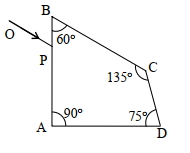
A
$(A, B, C)$
B
$(A, B, D)$
C
$(A, C, D)$
D
$(B, C, D)$
Solution
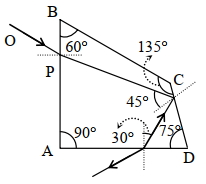
(A) $1$. At face $AB$: Using Snell's law,$1 \cdot \sin(60^{\circ}) = \sqrt{3} \cdot \sin(r_1)$.
$\sin(r_1) = \frac{\sqrt{3}/2}{\sqrt{3}} = 1/2$,so $r_1 = 30^{\circ}$.
$2$. In the triangle formed inside the prism,the angle of incidence at face $CD$ is $r_2 = 180^{\circ} - 60^{\circ} - (90^{\circ} - 30^{\circ}) - 45^{\circ} = 45^{\circ}$.
$3$. Critical angle $C = \sin^{-1}(1/\sqrt{3}) \approx 35.26^{\circ}$. Since $r_2 = 45^{\circ} > C$,the ray undergoes total internal reflection at face $CD$.
$4$. After reflection,the ray strikes face $AD$ at an angle of incidence $i' = 30^{\circ}$.
$5$. Using Snell's law at face $AD$: $\sqrt{3} \cdot \sin(30^{\circ}) = 1 \cdot \sin(e)$.
$\sin(e) = \sqrt{3}/2$,so $e = 60^{\circ}$.
$6$. The total deviation $\delta = 90^{\circ}$. Thus,$(A)$ and $(B)$ are correct,and the angle between incident and emergent ray is $90^{\circ}$,so $(C)$ is correct.
$\sin(r_1) = \frac{\sqrt{3}/2}{\sqrt{3}} = 1/2$,so $r_1 = 30^{\circ}$.
$2$. In the triangle formed inside the prism,the angle of incidence at face $CD$ is $r_2 = 180^{\circ} - 60^{\circ} - (90^{\circ} - 30^{\circ}) - 45^{\circ} = 45^{\circ}$.
$3$. Critical angle $C = \sin^{-1}(1/\sqrt{3}) \approx 35.26^{\circ}$. Since $r_2 = 45^{\circ} > C$,the ray undergoes total internal reflection at face $CD$.
$4$. After reflection,the ray strikes face $AD$ at an angle of incidence $i' = 30^{\circ}$.
$5$. Using Snell's law at face $AD$: $\sqrt{3} \cdot \sin(30^{\circ}) = 1 \cdot \sin(e)$.
$\sin(e) = \sqrt{3}/2$,so $e = 60^{\circ}$.
$6$. The total deviation $\delta = 90^{\circ}$. Thus,$(A)$ and $(B)$ are correct,and the angle between incident and emergent ray is $90^{\circ}$,so $(C)$ is correct.
0 likes
View Solution253
MediumMCQ
$A$ monochromatic light is incident from air on a refracting surface of a prism of angle $A = 75^{\circ}$ and refractive index $n_0 = \sqrt{3}$. The other refracting surface of the prism is coated by a thin film of material of refractive index $n$ as shown in the figure. The light suffers total internal reflection at the coated prism surface for an incidence angle of $\theta \leq 60^{\circ}$. The value of $n^2$ is:
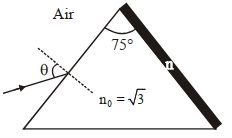
A
$1.30$
B
$1.40$
C
$1.50$
D
$1.60$
Solution
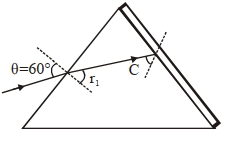
(C) For total internal reflection $(TIR)$ to occur at the second surface for all $\theta \leq 60^{\circ}$,the condition must be satisfied at the minimum angle of incidence within the prism.
Let $r_1$ be the angle of refraction at the first surface and $r_2$ be the angle of incidence at the second surface.
From the geometry of the prism,$r_1 + r_2 = A = 75^{\circ}$.
For $TIR$ at the second surface,the angle of incidence $r_2$ must be greater than or equal to the critical angle $C$,where $\sin C = \frac{n}{n_0}$.
As $\theta$ decreases,$r_1$ decreases,and consequently $r_2 = 75^{\circ} - r_1$ increases.
The condition for $TIR$ is most easily satisfied at the maximum value of $r_2$,which occurs at the minimum value of $r_1$. However,the problem states $TIR$ occurs for $\theta \leq 60^{\circ}$. The boundary condition is at $\theta = 60^{\circ}$.
At $\theta = 60^{\circ}$,by Snell's law at the first surface: $1 \cdot \sin 60^{\circ} = \sqrt{3} \cdot \sin r_1 \Rightarrow \frac{\sqrt{3}}{2} = \sqrt{3} \sin r_1 \Rightarrow r_1 = 30^{\circ}$.
Then,$r_2 = 75^{\circ} - 30^{\circ} = 45^{\circ}$.
For $TIR$ at this surface,$r_2 \geq C$,so $45^{\circ} \geq C$,which means $\sin 45^{\circ} \geq \sin C = \frac{n}{\sqrt{3}}$.
$\frac{1}{\sqrt{2}} \geq \frac{n}{\sqrt{3}} \Rightarrow n \leq \sqrt{\frac{3}{2}}$.
The limiting value is $n = \sqrt{1.5}$,so $n^2 = 1.5$.
Let $r_1$ be the angle of refraction at the first surface and $r_2$ be the angle of incidence at the second surface.
From the geometry of the prism,$r_1 + r_2 = A = 75^{\circ}$.
For $TIR$ at the second surface,the angle of incidence $r_2$ must be greater than or equal to the critical angle $C$,where $\sin C = \frac{n}{n_0}$.
As $\theta$ decreases,$r_1$ decreases,and consequently $r_2 = 75^{\circ} - r_1$ increases.
The condition for $TIR$ is most easily satisfied at the maximum value of $r_2$,which occurs at the minimum value of $r_1$. However,the problem states $TIR$ occurs for $\theta \leq 60^{\circ}$. The boundary condition is at $\theta = 60^{\circ}$.
At $\theta = 60^{\circ}$,by Snell's law at the first surface: $1 \cdot \sin 60^{\circ} = \sqrt{3} \cdot \sin r_1 \Rightarrow \frac{\sqrt{3}}{2} = \sqrt{3} \sin r_1 \Rightarrow r_1 = 30^{\circ}$.
Then,$r_2 = 75^{\circ} - 30^{\circ} = 45^{\circ}$.
For $TIR$ at this surface,$r_2 \geq C$,so $45^{\circ} \geq C$,which means $\sin 45^{\circ} \geq \sin C = \frac{n}{\sqrt{3}}$.
$\frac{1}{\sqrt{2}} \geq \frac{n}{\sqrt{3}} \Rightarrow n \leq \sqrt{\frac{3}{2}}$.
The limiting value is $n = \sqrt{1.5}$,so $n^2 = 1.5$.
0 likes
View Solution254
AdvancedMCQ
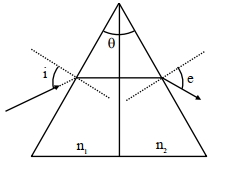
For a prism of prism angle $\theta=60^{\circ}$,the refractive indices of the left half and the right half are,respectively,$n_1$ and $n_2$ $(n_2 \geq n_1)$ as shown in the figure. The angle of incidence $i$ is chosen such that the incident light rays will have minimum deviation if $n_1=n_2=n=1.5$. For the case of unequal refractive indices,$n_1=n$ and $n_2=n+\Delta n$ (where $\Delta n \ll n$),the angle of emergence $e=i+\Delta e$. Which of the following statement$(s)$ is (are) correct?
$(A)$ The value of $\Delta e$ (in radians) is greater than that of $\Delta n$
$(B)$ $\Delta e$ is proportional to $\Delta n$
$(C)$ $\Delta e$ lies between $2.0$ and $3.0$ milliradians,if $\Delta n=2.8 \times 10^{-3}$
$(D)$ $\Delta e$ lies between $1.0$ and $1.6$ milliradians,if $\Delta n=2.8 \times 10^{-3}$
$(A)$ The value of $\Delta e$ (in radians) is greater than that of $\Delta n$
$(B)$ $\Delta e$ is proportional to $\Delta n$
$(C)$ $\Delta e$ lies between $2.0$ and $3.0$ milliradians,if $\Delta n=2.8 \times 10^{-3}$
$(D)$ $\Delta e$ lies between $1.0$ and $1.6$ milliradians,if $\Delta n=2.8 \times 10^{-3}$
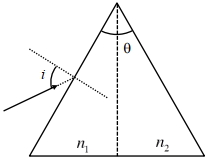
A
$A, B, C$
B
$A, B, D$
C
$B, C$
D
$A, C$
Solution
(C) For minimum deviation in a symmetric prism $(n_1=n_2=n)$,the angle of incidence $i$ is given by $\sin i = n \sin(\theta/2)$.
Given $\theta=60^{\circ}$,$\sin i = 1.5 \times \sin 30^{\circ} = 1.5 \times 0.5 = 0.75 = 3/4$.
At the second surface,the angle of incidence is $r_2 = 30^{\circ}$. The refraction at the second surface is $n_2 \sin r_2 = 1 \sin e$.
For $n_1=n$ and $n_2=n+\Delta n$,the light enters the first surface at angle $i$ and refracts at $r_1=30^{\circ}$. It then travels to the second surface. Since the prism is symmetric,the ray hits the second surface at $r_2=30^{\circ}$.
Thus,$(n+\Delta n) \sin 30^{\circ} = \sin e$.
Since $e = i + \Delta e$,we have $\sin(i + \Delta e) = (n+\Delta n) \sin 30^{\circ} = n \sin 30^{\circ} + \Delta n \sin 30^{\circ} = \sin i + \Delta n \sin 30^{\circ}$.
Using $\sin(i + \Delta e) \approx \sin i + \Delta e \cos i$,we get $\Delta e \cos i = \Delta n \sin 30^{\circ}$.
Since $\sin i = 3/4$,$\cos i = \sqrt{1 - (3/4)^2} = \sqrt{7}/4$.
$\Delta e = \Delta n \frac{\sin 30^{\circ}}{\cos i} = \Delta n \frac{0.5}{\sqrt{7}/4} = \Delta n \frac{2}{\sqrt{7}} \approx 0.756 \Delta n$.
Since $0.756 < 1$,$\Delta e < \Delta n$. Thus,$(A)$ is incorrect.
Since $\Delta e = (2/\sqrt{7}) \Delta n$,$\Delta e$ is proportional to $\Delta n$. Thus,$(B)$ is correct.
For $\Delta n = 2.8 \times 10^{-3}$,$\Delta e = (2/\sqrt{7}) \times 2.8 \times 10^{-3} \approx 0.756 \times 2.8 \times 10^{-3} \approx 2.11 \times 10^{-3} \text{ rad} = 2.11 \text{ mrad}$.
This value lies between $2.0$ and $3.0$ mrad. Thus,$(C)$ is correct.
Given $\theta=60^{\circ}$,$\sin i = 1.5 \times \sin 30^{\circ} = 1.5 \times 0.5 = 0.75 = 3/4$.
At the second surface,the angle of incidence is $r_2 = 30^{\circ}$. The refraction at the second surface is $n_2 \sin r_2 = 1 \sin e$.
For $n_1=n$ and $n_2=n+\Delta n$,the light enters the first surface at angle $i$ and refracts at $r_1=30^{\circ}$. It then travels to the second surface. Since the prism is symmetric,the ray hits the second surface at $r_2=30^{\circ}$.
Thus,$(n+\Delta n) \sin 30^{\circ} = \sin e$.
Since $e = i + \Delta e$,we have $\sin(i + \Delta e) = (n+\Delta n) \sin 30^{\circ} = n \sin 30^{\circ} + \Delta n \sin 30^{\circ} = \sin i + \Delta n \sin 30^{\circ}$.
Using $\sin(i + \Delta e) \approx \sin i + \Delta e \cos i$,we get $\Delta e \cos i = \Delta n \sin 30^{\circ}$.
Since $\sin i = 3/4$,$\cos i = \sqrt{1 - (3/4)^2} = \sqrt{7}/4$.
$\Delta e = \Delta n \frac{\sin 30^{\circ}}{\cos i} = \Delta n \frac{0.5}{\sqrt{7}/4} = \Delta n \frac{2}{\sqrt{7}} \approx 0.756 \Delta n$.
Since $0.756 < 1$,$\Delta e < \Delta n$. Thus,$(A)$ is incorrect.
Since $\Delta e = (2/\sqrt{7}) \Delta n$,$\Delta e$ is proportional to $\Delta n$. Thus,$(B)$ is correct.
For $\Delta n = 2.8 \times 10^{-3}$,$\Delta e = (2/\sqrt{7}) \times 2.8 \times 10^{-3} \approx 0.756 \times 2.8 \times 10^{-3} \approx 2.11 \times 10^{-3} \text{ rad} = 2.11 \text{ mrad}$.
This value lies between $2.0$ and $3.0$ mrad. Thus,$(C)$ is correct.
0 likes
View Solution255
MediumMCQ
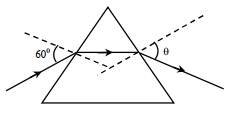
$A$ monochromatic beam of light is incident at $60^{\circ}$ on one face of an equilateral prism of refractive index $n$ and emerges from the opposite face making an angle $\theta(n)$ with the normal (see the figure). For $n=\sqrt{3}$ the value of $\theta$ is $60^{\circ}$ and $\frac{d \theta}{d n}=m$. The value of $m$ is
A
$1$
B
$2$
C
$3$
D
$4$
Solution
(B) Applying Snell's Law on the $1^{\text{st}}$ surface: $\sin(60^{\circ}) = n \sin(r_1) \Rightarrow \sin(r_1) = \frac{\sqrt{3}}{2n}$.
For an equilateral prism,the prism angle $A = 60^{\circ}$,so $r_1 + r_2 = 60^{\circ}$,which implies $r_2 = 60^{\circ} - r_1$.
Applying Snell's Law on the $2^{\text{nd}}$ surface: $n \sin(r_2) = \sin(\theta)$.
Substituting $r_2$: $\sin(\theta) = n \sin(60^{\circ} - r_1) = n [\sin(60^{\circ}) \cos(r_1) - \cos(60^{\circ}) \sin(r_1)]$.
Since $\sin(r_1) = \frac{\sqrt{3}}{2n}$,then $\cos(r_1) = \sqrt{1 - \frac{3}{4n^2}} = \frac{\sqrt{4n^2 - 3}}{2n}$.
Substituting these into the equation for $\sin(\theta)$:
$\sin(\theta) = n [\frac{\sqrt{3}}{2} \cdot \frac{\sqrt{4n^2 - 3}}{2n} - \frac{1}{2} \cdot \frac{\sqrt{3}}{2n}] = \frac{\sqrt{3}}{4} (\sqrt{4n^2 - 3} - 1)$.
Differentiating with respect to $n$: $\cos(\theta) \frac{d\theta}{dn} = \frac{\sqrt{3}}{4} \cdot \frac{1}{2\sqrt{4n^2 - 3}} \cdot 8n = \frac{\sqrt{3} n}{\sqrt{4n^2 - 3}}$.
At $n = \sqrt{3}$,$\theta = 60^{\circ}$,so $\cos(60^{\circ}) \frac{d\theta}{dn} = \frac{\sqrt{3} \cdot \sqrt{3}}{\sqrt{4(3) - 3}} = \frac{3}{\sqrt{9}} = 1$.
$\frac{1}{2} \cdot \frac{d\theta}{dn} = 1 \Rightarrow \frac{d\theta}{dn} = 2$. Thus,$m = 2$.
For an equilateral prism,the prism angle $A = 60^{\circ}$,so $r_1 + r_2 = 60^{\circ}$,which implies $r_2 = 60^{\circ} - r_1$.
Applying Snell's Law on the $2^{\text{nd}}$ surface: $n \sin(r_2) = \sin(\theta)$.
Substituting $r_2$: $\sin(\theta) = n \sin(60^{\circ} - r_1) = n [\sin(60^{\circ}) \cos(r_1) - \cos(60^{\circ}) \sin(r_1)]$.
Since $\sin(r_1) = \frac{\sqrt{3}}{2n}$,then $\cos(r_1) = \sqrt{1 - \frac{3}{4n^2}} = \frac{\sqrt{4n^2 - 3}}{2n}$.
Substituting these into the equation for $\sin(\theta)$:
$\sin(\theta) = n [\frac{\sqrt{3}}{2} \cdot \frac{\sqrt{4n^2 - 3}}{2n} - \frac{1}{2} \cdot \frac{\sqrt{3}}{2n}] = \frac{\sqrt{3}}{4} (\sqrt{4n^2 - 3} - 1)$.
Differentiating with respect to $n$: $\cos(\theta) \frac{d\theta}{dn} = \frac{\sqrt{3}}{4} \cdot \frac{1}{2\sqrt{4n^2 - 3}} \cdot 8n = \frac{\sqrt{3} n}{\sqrt{4n^2 - 3}}$.
At $n = \sqrt{3}$,$\theta = 60^{\circ}$,so $\cos(60^{\circ}) \frac{d\theta}{dn} = \frac{\sqrt{3} \cdot \sqrt{3}}{\sqrt{4(3) - 3}} = \frac{3}{\sqrt{9}} = 1$.
$\frac{1}{2} \cdot \frac{d\theta}{dn} = 1 \Rightarrow \frac{d\theta}{dn} = 2$. Thus,$m = 2$.
0 likes
View Solution256
MediumMCQ
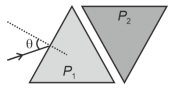
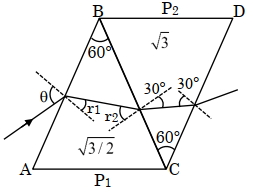
Two equilateral-triangular prisms $P_1$ and $P_2$ are kept with their sides parallel to each other,in vacuum,as shown in the figure. $A$ light ray enters prism $P_1$ at an angle of incidence $\theta$ such that the outgoing ray undergoes minimum deviation in prism $P_2$. If the respective refractive indices of $P_1$ and $P_2$ are $\sqrt{\frac{3}{2}}$ and $\sqrt{3}$,then $\theta = \sin^{-1}\left[\sqrt{\frac{3}{2}} \sin \left(\frac{\pi}{\beta}\right)\right]$,where the value of $\beta$ is:
A
$12$
B
$15$
C
$20$
D
$25$
Solution
(A) For minimum deviation in prism $P_2$,the angle of incidence at the second surface of $P_2$ must be equal to the angle of emergence,and the ray inside $P_2$ must be parallel to the base. For an equilateral prism,this implies the angle of refraction $r_2$ at the first surface of $P_2$ is $30^{\circ}$.
Applying Snell's law at the interface between $P_1$ and $P_2$ (refractive index of $P_1$ is $\mu_1 = \sqrt{3/2}$ and $P_2$ is $\mu_2 = \sqrt{3}$):
$\mu_1 \sin r_2' = \mu_2 \sin r_2$
$\sqrt{\frac{3}{2}} \sin r_2' = \sqrt{3} \sin 30^{\circ}$
$\sqrt{\frac{3}{2}} \sin r_2' = \sqrt{3} \times \frac{1}{2} = \frac{\sqrt{3}}{2}$
$\sin r_2' = \frac{\sqrt{3}}{2} \times \sqrt{\frac{2}{3}} = \frac{1}{\sqrt{2}}$
$r_2' = 45^{\circ}$
Since the prism $P_1$ is equilateral,the sum of refraction angles $r_1 + r_2' = A = 60^{\circ}$.
$r_1 = 60^{\circ} - 45^{\circ} = 15^{\circ}$.
Applying Snell's law at the first surface of $P_1$ (refractive index of vacuum is $1$):
$1 \sin \theta = \sqrt{\frac{3}{2}} \sin 15^{\circ}$
$\theta = \sin^{-1}\left[\sqrt{\frac{3}{2}} \sin \left(\frac{\pi}{12}\right)\right]$
Comparing this with the given expression,we find $\beta = 12$.
Applying Snell's law at the interface between $P_1$ and $P_2$ (refractive index of $P_1$ is $\mu_1 = \sqrt{3/2}$ and $P_2$ is $\mu_2 = \sqrt{3}$):
$\mu_1 \sin r_2' = \mu_2 \sin r_2$
$\sqrt{\frac{3}{2}} \sin r_2' = \sqrt{3} \sin 30^{\circ}$
$\sqrt{\frac{3}{2}} \sin r_2' = \sqrt{3} \times \frac{1}{2} = \frac{\sqrt{3}}{2}$
$\sin r_2' = \frac{\sqrt{3}}{2} \times \sqrt{\frac{2}{3}} = \frac{1}{\sqrt{2}}$
$r_2' = 45^{\circ}$
Since the prism $P_1$ is equilateral,the sum of refraction angles $r_1 + r_2' = A = 60^{\circ}$.
$r_1 = 60^{\circ} - 45^{\circ} = 15^{\circ}$.
Applying Snell's law at the first surface of $P_1$ (refractive index of vacuum is $1$):
$1 \sin \theta = \sqrt{\frac{3}{2}} \sin 15^{\circ}$
$\theta = \sin^{-1}\left[\sqrt{\frac{3}{2}} \sin \left(\frac{\pi}{12}\right)\right]$
Comparing this with the given expression,we find $\beta = 12$.
0 likes
View Solution257
MediumMCQ
The refractive index of the material of a glass prism is $\sqrt{3}$. The angle of minimum deviation is equal to the angle of the prism. What is the angle of the prism (in $^{\circ}$)?
A
$50$
B
$60$
C
$58$
D
$48$
Solution
(B) The formula for the refractive index $\mu$ of a prism is given by $\mu = \frac{\sin \left(\frac{A + \delta_{min}}{2}\right)}{\sin \frac{A}{2}}$.
Given that the angle of minimum deviation $\delta_{min}$ is equal to the angle of the prism $A$,we substitute $\delta_{min} = A$ into the formula.
$\mu = \frac{\sin \left(\frac{A + A}{2}\right)}{\sin \frac{A}{2}} = \frac{\sin A}{\sin \frac{A}{2}}$.
Using the trigonometric identity $\sin A = 2 \sin \frac{A}{2} \cos \frac{A}{2}$,we get $\mu = \frac{2 \sin \frac{A}{2} \cos \frac{A}{2}}{\sin \frac{A}{2}} = 2 \cos \frac{A}{2}$.
Given $\mu = \sqrt{3}$,we have $\sqrt{3} = 2 \cos \frac{A}{2}$,which implies $\cos \frac{A}{2} = \frac{\sqrt{3}}{2}$.
Since $\cos 30^{\circ} = \frac{\sqrt{3}}{2}$,we have $\frac{A}{2} = 30^{\circ}$,so $A = 60^{\circ}$.
Given that the angle of minimum deviation $\delta_{min}$ is equal to the angle of the prism $A$,we substitute $\delta_{min} = A$ into the formula.
$\mu = \frac{\sin \left(\frac{A + A}{2}\right)}{\sin \frac{A}{2}} = \frac{\sin A}{\sin \frac{A}{2}}$.
Using the trigonometric identity $\sin A = 2 \sin \frac{A}{2} \cos \frac{A}{2}$,we get $\mu = \frac{2 \sin \frac{A}{2} \cos \frac{A}{2}}{\sin \frac{A}{2}} = 2 \cos \frac{A}{2}$.
Given $\mu = \sqrt{3}$,we have $\sqrt{3} = 2 \cos \frac{A}{2}$,which implies $\cos \frac{A}{2} = \frac{\sqrt{3}}{2}$.
Since $\cos 30^{\circ} = \frac{\sqrt{3}}{2}$,we have $\frac{A}{2} = 30^{\circ}$,so $A = 60^{\circ}$.
0 likes
View Solution258
MediumMCQ
$A$ thin prism $P_1$ with angle $4^{\circ}$ made of glass having refractive index $1.54$ is combined with another thin prism $P_2$ made of glass having refractive index $1.72$ to produce dispersion without deviation. The angle of the prism $P_2$ in degrees is:
A
$4$
B
$3$
C
$16/3$
D
$1.5$
Solution
(B) For dispersion without deviation,the net deviation produced by the combination of two thin prisms must be zero.
The net deviation $\delta_{\text{net}}$ is given by $\delta_{\text{net}} = \delta_1 - \delta_2 = 0$.
For a thin prism,the deviation is $\delta = (\mu - 1)A$.
Thus,$(\mu_1 - 1)A_1 - (\mu_2 - 1)A_2 = 0$.
Given $\mu_1 = 1.54$,$A_1 = 4^{\circ}$,and $\mu_2 = 1.72$.
Substituting the values: $(1.54 - 1) \times 4^{\circ} - (1.72 - 1) \times A_2 = 0$.
$0.54 \times 4 = 0.72 \times A_2$.
$2.16 = 0.72 \times A_2$.
$A_2 = \frac{2.16}{0.72} = 3^{\circ}$.
The net deviation $\delta_{\text{net}}$ is given by $\delta_{\text{net}} = \delta_1 - \delta_2 = 0$.
For a thin prism,the deviation is $\delta = (\mu - 1)A$.
Thus,$(\mu_1 - 1)A_1 - (\mu_2 - 1)A_2 = 0$.
Given $\mu_1 = 1.54$,$A_1 = 4^{\circ}$,and $\mu_2 = 1.72$.
Substituting the values: $(1.54 - 1) \times 4^{\circ} - (1.72 - 1) \times A_2 = 0$.
$0.54 \times 4 = 0.72 \times A_2$.
$2.16 = 0.72 \times A_2$.
$A_2 = \frac{2.16}{0.72} = 3^{\circ}$.
0 likes
View Solution259
DifficultMCQ
$A$ ray of light suffers minimum deviation when incident on a prism having an angle of the prism equal to $60^{\circ}$. The refractive index of the prism material is $\sqrt{2}$. The angle of incidence (in degrees) is . . . . . . .
A
$46$
B
$44$
C
$45$
D
$49$
Solution
(C) For a prism,the refractive index $\mu$ is given by the formula: $\mu = \frac{\sin((A + \delta_m)/2)}{\sin(A/2)}$.
Given $A = 60^{\circ}$ and $\mu = \sqrt{2}$,we substitute these values: $\sqrt{2} = \frac{\sin((60^{\circ} + \delta_m)/2)}{\sin(30^{\circ})}$.
Since $\sin(30^{\circ}) = 0.5$,we have $\sqrt{2} \times 0.5 = \sin((60^{\circ} + \delta_m)/2)$,which simplifies to $\sin(45^{\circ}) = \sin((60^{\circ} + \delta_m)/2)$.
Thus,$45^{\circ} = (60^{\circ} + \delta_m)/2$,which gives $90^{\circ} = 60^{\circ} + \delta_m$,so $\delta_m = 30^{\circ}$.
At the condition of minimum deviation,the angle of incidence $i$ is related to the angle of the prism $A$ and the angle of minimum deviation $\delta_m$ by the formula: $i = (A + \delta_m)/2$.
Substituting the values: $i = (60^{\circ} + 30^{\circ})/2 = 90^{\circ}/2 = 45^{\circ}$.
Given $A = 60^{\circ}$ and $\mu = \sqrt{2}$,we substitute these values: $\sqrt{2} = \frac{\sin((60^{\circ} + \delta_m)/2)}{\sin(30^{\circ})}$.
Since $\sin(30^{\circ}) = 0.5$,we have $\sqrt{2} \times 0.5 = \sin((60^{\circ} + \delta_m)/2)$,which simplifies to $\sin(45^{\circ}) = \sin((60^{\circ} + \delta_m)/2)$.
Thus,$45^{\circ} = (60^{\circ} + \delta_m)/2$,which gives $90^{\circ} = 60^{\circ} + \delta_m$,so $\delta_m = 30^{\circ}$.
At the condition of minimum deviation,the angle of incidence $i$ is related to the angle of the prism $A$ and the angle of minimum deviation $\delta_m$ by the formula: $i = (A + \delta_m)/2$.
Substituting the values: $i = (60^{\circ} + 30^{\circ})/2 = 90^{\circ}/2 = 45^{\circ}$.
0 likes
View Solution260
MediumMCQ
Consider the following statements for the refraction of light through a prism,when the angle of deviation is minimum.
$(A)$ The refracted ray inside the prism becomes parallel to the base.
$(B)$ Larger angle prisms provide smaller angle of minimum deviation.
$(C)$ The angle of incidence and the angle of emergence become equal.
$(D)$ There are always two sets of angles of incidence for which the deviation will be the same,except at the minimum deviation setting.
$(E)$ The angle of refraction becomes double the prism angle.
Choose the correct answer from the options given below.
$(A)$ The refracted ray inside the prism becomes parallel to the base.
$(B)$ Larger angle prisms provide smaller angle of minimum deviation.
$(C)$ The angle of incidence and the angle of emergence become equal.
$(D)$ There are always two sets of angles of incidence for which the deviation will be the same,except at the minimum deviation setting.
$(E)$ The angle of refraction becomes double the prism angle.
Choose the correct answer from the options given below.
A
$A, C$ and $D$ Only
B
$B, C$ and $D$ Only
C
$A, B$ and $E$ Only
D
$B, D$ and $E$ Only
Solution
(A) The deviation produced by a prism is given by $\delta = i + e - A$.
At the condition of minimum deviation $(\delta_{\text{min}})$,the angle of incidence equals the angle of emergence $(i = e)$.
Under this condition,the refracted ray inside the prism is parallel to the base of the prism.
Statement $(A)$ is correct because the ray inside is parallel to the base.
Statement $(C)$ is correct because $i = e$ at minimum deviation.
Statement $(D)$ is correct because for any deviation $\delta > \delta_{\text{min}}$,there exist two angles of incidence $i_1$ and $i_2$ such that $i_1 = e$ and $i_2 = i$,resulting in the same deviation.
Statement $(B)$ is incorrect because a larger prism angle $A$ generally leads to a larger angle of minimum deviation.
Statement $(E)$ is incorrect because at minimum deviation,$r_1 = r_2 = A/2$,so the angle of refraction is half the prism angle,not double.
Therefore,the correct statements are $(A), (C),$ and $(D)$.
At the condition of minimum deviation $(\delta_{\text{min}})$,the angle of incidence equals the angle of emergence $(i = e)$.
Under this condition,the refracted ray inside the prism is parallel to the base of the prism.
Statement $(A)$ is correct because the ray inside is parallel to the base.
Statement $(C)$ is correct because $i = e$ at minimum deviation.
Statement $(D)$ is correct because for any deviation $\delta > \delta_{\text{min}}$,there exist two angles of incidence $i_1$ and $i_2$ such that $i_1 = e$ and $i_2 = i$,resulting in the same deviation.
Statement $(B)$ is incorrect because a larger prism angle $A$ generally leads to a larger angle of minimum deviation.
Statement $(E)$ is incorrect because at minimum deviation,$r_1 = r_2 = A/2$,so the angle of refraction is half the prism angle,not double.
Therefore,the correct statements are $(A), (C),$ and $(D)$.
0 likes
View Solution261
DifficultMCQ
Angle of minimum deviation for a prism of refractive index $1.5$ is equal to the angle of prism. The angle of prism is $......^{\circ}$ $\left(\cos 41^{\circ}=0.75\right)$
A
$62$
B
$41$
C
$82$
D
$31$
Solution
(C) The formula for the refractive index of a prism is $\mu = \frac{\sin \left(\frac{\delta_{\min} + A}{2}\right)}{\sin(A/2)}$.
Given that the angle of minimum deviation $\delta_{\min} = A$,we substitute this into the formula:
$\mu = \frac{\sin \left(\frac{A + A}{2}\right)}{\sin(A/2)} = \frac{\sin A}{\sin(A/2)}$.
Using the trigonometric identity $\sin A = 2 \sin(A/2) \cos(A/2)$,we get:
$\mu = \frac{2 \sin(A/2) \cos(A/2)}{\sin(A/2)} = 2 \cos(A/2)$.
Given $\mu = 1.5 = \frac{3}{2}$,we have:
$\frac{3}{2} = 2 \cos(A/2) \Rightarrow \cos(A/2) = \frac{3}{4} = 0.75$.
Since $\cos 41^{\circ} = 0.75$,it follows that $A/2 = 41^{\circ}$.
Therefore,$A = 82^{\circ}$.
Given that the angle of minimum deviation $\delta_{\min} = A$,we substitute this into the formula:
$\mu = \frac{\sin \left(\frac{A + A}{2}\right)}{\sin(A/2)} = \frac{\sin A}{\sin(A/2)}$.
Using the trigonometric identity $\sin A = 2 \sin(A/2) \cos(A/2)$,we get:
$\mu = \frac{2 \sin(A/2) \cos(A/2)}{\sin(A/2)} = 2 \cos(A/2)$.
Given $\mu = 1.5 = \frac{3}{2}$,we have:
$\frac{3}{2} = 2 \cos(A/2) \Rightarrow \cos(A/2) = \frac{3}{4} = 0.75$.
Since $\cos 41^{\circ} = 0.75$,it follows that $A/2 = 41^{\circ}$.
Therefore,$A = 82^{\circ}$.
0 likes
View Solution262
DifficultMCQ
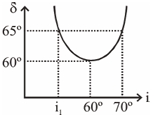
The angle of deviation $(\delta)$ vs angle of incidence $(i)$ is plotted for a prism. Pick the correct statement:-
A
The angle of prism is $60^{\circ}$
B
Refractive index of prism is $\sqrt{3}$
C
For deviation to be $65^{\circ}$,the angle of incidence $i_1 = 55^{\circ}$
D
All the above
Solution
(D) From the graph,at minimum deviation,$\delta_m = 60^{\circ}$ and the corresponding angle of incidence $i = 60^{\circ}$.
For minimum deviation,$i = e$,so $\delta_m = 2i - A$.
$60^{\circ} = 2(60^{\circ}) - A \Rightarrow A = 60^{\circ}$. Thus,option $(A)$ is correct.
The refractive index $\mu$ is given by $\mu = \frac{\sin((A + \delta_m)/2)}{\sin(A/2)} = \frac{\sin((60^{\circ} + 60^{\circ})/2)}{\sin(60^{\circ}/2)} = \frac{\sin(60^{\circ})}{\sin(30^{\circ})} = \frac{\sqrt{3}/2}{1/2} = \sqrt{3}$. Thus,option $(B)$ is correct.
For a deviation $\delta = 65^{\circ}$,the graph shows two possible angles of incidence,$i_1$ and $70^{\circ}$. Since $\delta = i + e - A$,for $i = 70^{\circ}$,$65^{\circ} = 70^{\circ} + e - 60^{\circ} \Rightarrow e = 55^{\circ}$. By the principle of reversibility,if $i = 70^{\circ}$ gives $e = 55^{\circ}$,then $i = 55^{\circ}$ gives $e = 70^{\circ}$. Thus,$i_1 = 55^{\circ}$. Option $(C)$ is correct.
Therefore,all the statements are correct.
For minimum deviation,$i = e$,so $\delta_m = 2i - A$.
$60^{\circ} = 2(60^{\circ}) - A \Rightarrow A = 60^{\circ}$. Thus,option $(A)$ is correct.
The refractive index $\mu$ is given by $\mu = \frac{\sin((A + \delta_m)/2)}{\sin(A/2)} = \frac{\sin((60^{\circ} + 60^{\circ})/2)}{\sin(60^{\circ}/2)} = \frac{\sin(60^{\circ})}{\sin(30^{\circ})} = \frac{\sqrt{3}/2}{1/2} = \sqrt{3}$. Thus,option $(B)$ is correct.
For a deviation $\delta = 65^{\circ}$,the graph shows two possible angles of incidence,$i_1$ and $70^{\circ}$. Since $\delta = i + e - A$,for $i = 70^{\circ}$,$65^{\circ} = 70^{\circ} + e - 60^{\circ} \Rightarrow e = 55^{\circ}$. By the principle of reversibility,if $i = 70^{\circ}$ gives $e = 55^{\circ}$,then $i = 55^{\circ}$ gives $e = 70^{\circ}$. Thus,$i_1 = 55^{\circ}$. Option $(C)$ is correct.
Therefore,all the statements are correct.
0 likes
View Solution263
MediumMCQ
$A$ light ray is incident on a prism of angle $A = 30^{\circ}$ at an angle of incidence of $60^{\circ}$. If the emergent ray makes an angle of $30^{\circ}$ with the incident ray,then find the refractive index of the prism $:-$
A
$\sqrt{2}$
B
$\sqrt{3} / 2$
C
$\sqrt{3}$
D
$\sqrt{2} / 3$
Solution
(C) Given: Angle of incidence $i = 60^{\circ}$,Prism angle $A = 30^{\circ}$,and Angle of deviation $\delta = 30^{\circ}$.
Using the prism formula for deviation: $\delta = i + e - A$.
Substituting the values: $30^{\circ} = 60^{\circ} + e - 30^{\circ}$.
Solving for the angle of emergence: $e = 30^{\circ} - 60^{\circ} + 30^{\circ} = 0^{\circ}$.
Since the angle of emergence $e = 0^{\circ}$,the ray emerges normally from the second surface,which implies $r_2 = 0^{\circ}$.
Using the relation $r_1 + r_2 = A$,we get $r_1 + 0^{\circ} = 30^{\circ}$,so $r_1 = 30^{\circ}$.
Applying Snell's Law at the first surface: $\mu = \frac{\sin i}{\sin r_1}$.
$\mu = \frac{\sin 60^{\circ}}{\sin 30^{\circ}} = \frac{\sqrt{3}/2}{1/2} = \sqrt{3}$.
Using the prism formula for deviation: $\delta = i + e - A$.
Substituting the values: $30^{\circ} = 60^{\circ} + e - 30^{\circ}$.
Solving for the angle of emergence: $e = 30^{\circ} - 60^{\circ} + 30^{\circ} = 0^{\circ}$.
Since the angle of emergence $e = 0^{\circ}$,the ray emerges normally from the second surface,which implies $r_2 = 0^{\circ}$.
Using the relation $r_1 + r_2 = A$,we get $r_1 + 0^{\circ} = 30^{\circ}$,so $r_1 = 30^{\circ}$.
Applying Snell's Law at the first surface: $\mu = \frac{\sin i}{\sin r_1}$.
$\mu = \frac{\sin 60^{\circ}}{\sin 30^{\circ}} = \frac{\sqrt{3}/2}{1/2} = \sqrt{3}$.
0 likes
View Solution264
MediumMCQ
The angle of deviation produced by a thin prism when placed in air is $\delta_1$ and that when immersed in water is $\delta_2$. The refractive indices of glass and water are $\frac{3}{2}$ and $\frac{4}{3}$ respectively. The ratio $\delta_1 : \delta_2$ is
A
$1 : 2$
B
$2 : 1$
C
$1 : 4$
D
$4 : 1$
Solution
(D) For a thin prism,the angle of deviation is given by $\delta = (\mu - 1)A$,where $\mu$ is the relative refractive index of the prism material with respect to the surrounding medium.
$1$. When the prism is in air:
$\mu_1 = \frac{\mu_{\text{glass}}}{\mu_{\text{air}}} = \frac{3/2}{1} = \frac{3}{2}$
$\delta_1 = (\frac{3}{2} - 1)A = \frac{1}{2}A$
$2$. When the prism is in water:
$\mu_2 = \frac{\mu_{\text{glass}}}{\mu_{\text{water}}} = \frac{3/2}{4/3} = \frac{9}{8}$
$\delta_2 = (\frac{9}{8} - 1)A = \frac{1}{8}A$
$3$. Calculating the ratio:
$\frac{\delta_1}{\delta_2} = \frac{\frac{1}{2}A}{\frac{1}{8}A} = \frac{1}{2} \times 8 = 4$
Therefore,the ratio $\delta_1 : \delta_2$ is $4 : 1$.
$1$. When the prism is in air:
$\mu_1 = \frac{\mu_{\text{glass}}}{\mu_{\text{air}}} = \frac{3/2}{1} = \frac{3}{2}$
$\delta_1 = (\frac{3}{2} - 1)A = \frac{1}{2}A$
$2$. When the prism is in water:
$\mu_2 = \frac{\mu_{\text{glass}}}{\mu_{\text{water}}} = \frac{3/2}{4/3} = \frac{9}{8}$
$\delta_2 = (\frac{9}{8} - 1)A = \frac{1}{8}A$
$3$. Calculating the ratio:
$\frac{\delta_1}{\delta_2} = \frac{\frac{1}{2}A}{\frac{1}{8}A} = \frac{1}{2} \times 8 = 4$
Therefore,the ratio $\delta_1 : \delta_2$ is $4 : 1$.
0 likes
View Solution265
MediumMCQ
For a thin prism,$\delta_1$ is the angle of deviation produced when the prism is placed in air. When the prism is immersed in water,the angle of deviation produced is $\delta_2$. Given ${ }_{a} \mu_{g}=\frac{3}{2}$ and ${ }_{a} \mu_{w}=\frac{4}{3}$. The ratio $\delta_2: \delta_1$ is
A
$1: 2$
B
$1: 4$
C
$1: 8$
D
$4: 1$
Solution
(B) The angle of deviation $\delta$ for a thin prism is given by the formula $\delta = (\mu - 1)A$,where $\mu$ is the refractive index of the prism material relative to the surrounding medium and $A$ is the prism angle.
When the prism is in air,the refractive index is ${ }_{a} \mu_{g} = \frac{3}{2}$. Thus,$\delta_1 = (\frac{3}{2} - 1)A = \frac{1}{2}A$.
When the prism is immersed in water,the refractive index of the prism relative to water is ${ }_{w} \mu_{g} = \frac{{ }_{a} \mu_{g}}{{ }_{a} \mu_{w}} = \frac{3/2}{4/3} = \frac{9}{8}$.
Thus,$\delta_2 = (\frac{9}{8} - 1)A = \frac{1}{8}A$.
The ratio $\delta_2 : \delta_1 = \frac{\frac{1}{8}A}{\frac{1}{2}A} = \frac{1}{8} \times 2 = \frac{1}{4}$.
Therefore,the ratio is $1: 4$.
When the prism is in air,the refractive index is ${ }_{a} \mu_{g} = \frac{3}{2}$. Thus,$\delta_1 = (\frac{3}{2} - 1)A = \frac{1}{2}A$.
When the prism is immersed in water,the refractive index of the prism relative to water is ${ }_{w} \mu_{g} = \frac{{ }_{a} \mu_{g}}{{ }_{a} \mu_{w}} = \frac{3/2}{4/3} = \frac{9}{8}$.
Thus,$\delta_2 = (\frac{9}{8} - 1)A = \frac{1}{8}A$.
The ratio $\delta_2 : \delta_1 = \frac{\frac{1}{8}A}{\frac{1}{2}A} = \frac{1}{8} \times 2 = \frac{1}{4}$.
Therefore,the ratio is $1: 4$.
0 likes
View Solution266
EasyMCQ
$A$ ray of light is incident at $60^{\circ}$ on one face of a prism of angle $30^{\circ}$ and the emergent ray makes $30^{\circ}$ with the incident ray. The refractive index of the prism is $(\sin 30^{\circ}=0.5, \sin 60^{\circ}=\sqrt{3}/2)$.
A
$1.732$
B
$1.414$
C
$1.5$
D
$1.33$
Solution
(A) Given: Prism angle $A = 30^{\circ}$,angle of incidence $i_1 = 60^{\circ}$,and angle of deviation $\delta = 30^{\circ}$.
For a prism,the deviation formula is $\delta = (i_1 + i_2) - A$.
Substituting the values: $30^{\circ} = (60^{\circ} + i_2) - 30^{\circ}$.
$30^{\circ} = 30^{\circ} + i_2$,which gives $i_2 = 0^{\circ}$.
Since the emergent angle $i_2 = 0^{\circ}$,the emergent ray is normal to the second face,implying the angle of refraction at the second face $r_2 = 0^{\circ}$.
Using the relation $r_1 + r_2 = A$,we get $r_1 + 0^{\circ} = 30^{\circ}$,so $r_1 = 30^{\circ}$.
Applying Snell's law at the first face: $\mu_1 \sin i_1 = \mu_2 \sin r_1$.
Assuming the surrounding medium is air $(\mu_1 = 1)$: $1 \cdot \sin 60^{\circ} = \mu_2 \sin 30^{\circ}$.
$\frac{\sqrt{3}}{2} = \mu_2 \cdot \frac{1}{2}$.
Therefore,$\mu_2 = \sqrt{3} \approx 1.732$.
For a prism,the deviation formula is $\delta = (i_1 + i_2) - A$.
Substituting the values: $30^{\circ} = (60^{\circ} + i_2) - 30^{\circ}$.
$30^{\circ} = 30^{\circ} + i_2$,which gives $i_2 = 0^{\circ}$.
Since the emergent angle $i_2 = 0^{\circ}$,the emergent ray is normal to the second face,implying the angle of refraction at the second face $r_2 = 0^{\circ}$.
Using the relation $r_1 + r_2 = A$,we get $r_1 + 0^{\circ} = 30^{\circ}$,so $r_1 = 30^{\circ}$.
Applying Snell's law at the first face: $\mu_1 \sin i_1 = \mu_2 \sin r_1$.
Assuming the surrounding medium is air $(\mu_1 = 1)$: $1 \cdot \sin 60^{\circ} = \mu_2 \sin 30^{\circ}$.
$\frac{\sqrt{3}}{2} = \mu_2 \cdot \frac{1}{2}$.
Therefore,$\mu_2 = \sqrt{3} \approx 1.732$.
0 likes
View Solution267
EasyMCQ
In an equilateral prism,the ray undergoes minimum deviation when it is incident at an angle of $50^{\circ}$. The angle of minimum deviation is (in $^{\circ}$)
A
$50$
B
$40$
C
$25$
D
$20$
Solution
(B) For a prism,the condition for minimum deviation is given by the formula $i = \frac{A + \delta_m}{2}$.
In an equilateral prism,the angle of the prism $A = 60^{\circ}$.
Given that the angle of incidence $i = 50^{\circ}$.
Substituting these values into the formula:
$50^{\circ} = \frac{60^{\circ} + \delta_m}{2}$
$100^{\circ} = 60^{\circ} + \delta_m$
$\delta_m = 100^{\circ} - 60^{\circ} = 40^{\circ}$.
Thus,the angle of minimum deviation is $40^{\circ}$.
In an equilateral prism,the angle of the prism $A = 60^{\circ}$.
Given that the angle of incidence $i = 50^{\circ}$.
Substituting these values into the formula:
$50^{\circ} = \frac{60^{\circ} + \delta_m}{2}$
$100^{\circ} = 60^{\circ} + \delta_m$
$\delta_m = 100^{\circ} - 60^{\circ} = 40^{\circ}$.
Thus,the angle of minimum deviation is $40^{\circ}$.
0 likes
View Solution268
EasyMCQ
For a symmetric (equilateral) prism,the prism formula can be written as
A
$2 \sin \left(30^{\circ}+\frac{\delta_m}{2}\right)$
B
$\frac{2}{\sqrt{3}} \sin \left(30^{\circ}+\frac{\delta_m}{2}\right)$
C
$2 \sin \left(60^{\circ}+\frac{\delta_m}{2}\right)$
D
$\frac{2}{\sqrt{3}} \sin \left(60^{\circ}+\frac{\delta_m}{2}\right)$
Solution
(A) The general prism formula is given by $\mu = \frac{\sin \left(\frac{A+\delta_m}{2}\right)}{\sin \left(\frac{A}{2}\right)}$.
For a symmetric (equilateral) prism,the prism angle $A = 60^{\circ}$.
Substituting $A = 60^{\circ}$ into the formula:
$\mu = \frac{\sin \left(\frac{60^{\circ}+\delta_m}{2}\right)}{\sin \left(\frac{60^{\circ}}{2}\right)}$
$\mu = \frac{\sin \left(30^{\circ}+\frac{\delta_m}{2}\right)}{\sin 30^{\circ}}$
Since $\sin 30^{\circ} = \frac{1}{2}$,we have:
$\mu = \frac{\sin \left(30^{\circ}+\frac{\delta_m}{2}\right)}{1/2}$
$\mu = 2 \sin \left(30^{\circ}+\frac{\delta_m}{2}\right)$.
For a symmetric (equilateral) prism,the prism angle $A = 60^{\circ}$.
Substituting $A = 60^{\circ}$ into the formula:
$\mu = \frac{\sin \left(\frac{60^{\circ}+\delta_m}{2}\right)}{\sin \left(\frac{60^{\circ}}{2}\right)}$
$\mu = \frac{\sin \left(30^{\circ}+\frac{\delta_m}{2}\right)}{\sin 30^{\circ}}$
Since $\sin 30^{\circ} = \frac{1}{2}$,we have:
$\mu = \frac{\sin \left(30^{\circ}+\frac{\delta_m}{2}\right)}{1/2}$
$\mu = 2 \sin \left(30^{\circ}+\frac{\delta_m}{2}\right)$.
0 likes
View Solution269
EasyMCQ
The angle of minimum deviation produced by a thin prism in air is $\delta_1$. If it is immersed in water,the angle of minimum deviation is $\left[_{a}\mu_{g}=\frac{3}{2}, _{a}\mu_{w}=\frac{4}{3}\right]$.
A
$2 \delta_1$
B
$\frac{\delta_1}{2}$
C
$\frac{\delta_1}{3}$
D
$\frac{\delta_1}{4}$
Solution
(D) For a thin prism,the angle of minimum deviation is given by $\delta = (\mu - 1)A$,where $\mu$ is the refractive index of the prism material relative to the surrounding medium and $A$ is the prism angle.
In air,the refractive index of glass relative to air is $_{a}\mu_{g} = \frac{3}{2}$. Thus,$\delta_1 = (_{a}\mu_{g} - 1)A = (\frac{3}{2} - 1)A = \frac{1}{2}A$.
When immersed in water,the refractive index of glass relative to water is $_{w}\mu_{g} = \frac{_{a}\mu_{g}}{_{a}\mu_{w}} = \frac{3/2}{4/3} = \frac{9}{8}$.
The new angle of minimum deviation is $\delta_2 = (_{w}\mu_{g} - 1)A = (\frac{9}{8} - 1)A = \frac{1}{8}A$.
Comparing $\delta_2$ with $\delta_1$: $\frac{\delta_2}{\delta_1} = \frac{\frac{1}{8}A}{\frac{1}{2}A} = \frac{2}{8} = \frac{1}{4}$.
Therefore,$\delta_2 = \frac{\delta_1}{4}$.
In air,the refractive index of glass relative to air is $_{a}\mu_{g} = \frac{3}{2}$. Thus,$\delta_1 = (_{a}\mu_{g} - 1)A = (\frac{3}{2} - 1)A = \frac{1}{2}A$.
When immersed in water,the refractive index of glass relative to water is $_{w}\mu_{g} = \frac{_{a}\mu_{g}}{_{a}\mu_{w}} = \frac{3/2}{4/3} = \frac{9}{8}$.
The new angle of minimum deviation is $\delta_2 = (_{w}\mu_{g} - 1)A = (\frac{9}{8} - 1)A = \frac{1}{8}A$.
Comparing $\delta_2$ with $\delta_1$: $\frac{\delta_2}{\delta_1} = \frac{\frac{1}{8}A}{\frac{1}{2}A} = \frac{2}{8} = \frac{1}{4}$.
Therefore,$\delta_2 = \frac{\delta_1}{4}$.
0 likes
View Solution270
DifficultMCQ
$A$ glass prism $A$ deviates the red and blue rays through $10^{\circ}$ and $12^{\circ}$ respectively. $A$ second prism $B$ deviates them through $8^{\circ}$ and $10^{\circ}$ respectively. The ratio of their dispersive powers is ($A$ to $B$):
A
$9:13$
B
$4:5$
C
$9:11$
D
$8:9$
Solution
(C) The dispersive power $\omega$ is given by the formula $\omega = \frac{\delta_v - \delta_R}{\delta_y}$,where $\delta_y = \frac{\delta_v + \delta_R}{2}$ is the mean deviation.
For prism $A$:
$\delta_y = \frac{12^{\circ} + 10^{\circ}}{2} = 11^{\circ}$.
$\omega_A = \frac{12^{\circ} - 10^{\circ}}{11^{\circ}} = \frac{2}{11}$.
For prism $B$:
$\delta_y = \frac{10^{\circ} + 8^{\circ}}{2} = 9^{\circ}$.
$\omega_B = \frac{10^{\circ} - 8^{\circ}}{9^{\circ}} = \frac{2}{9}$.
The ratio of their dispersive powers is $\frac{\omega_A}{\omega_B} = \frac{2/11}{2/9} = \frac{9}{11}$.
For prism $A$:
$\delta_y = \frac{12^{\circ} + 10^{\circ}}{2} = 11^{\circ}$.
$\omega_A = \frac{12^{\circ} - 10^{\circ}}{11^{\circ}} = \frac{2}{11}$.
For prism $B$:
$\delta_y = \frac{10^{\circ} + 8^{\circ}}{2} = 9^{\circ}$.
$\omega_B = \frac{10^{\circ} - 8^{\circ}}{9^{\circ}} = \frac{2}{9}$.
The ratio of their dispersive powers is $\frac{\omega_A}{\omega_B} = \frac{2/11}{2/9} = \frac{9}{11}$.
0 likes
View Solution271
MediumMCQ
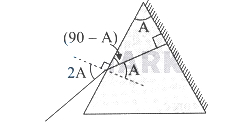
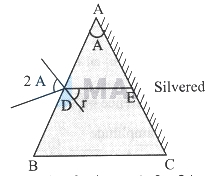
$A$ prism has a refracting angle '$A$'. The second refracting surface of the prism is silvered. $A$ light ray falling on the first refracting surface with an angle of incidence '$2A$' reaches the second surface and returns back through the same path due to reflection at the silvered surface. The refractive index of the material of the prism is:
A
$\frac{1}{2} \sin A$
B
$\frac{1}{2} \cos A$
C
$2 \sin A$
D
$2 \cos A$
Solution
(D) For the light ray to retrace its path after reflection from the silvered surface,it must strike the silvered surface normally.
In the prism,the angle of refraction at the first surface is '$r_1$'. From the geometry of the prism,the angle of incidence at the second surface is '$r_2$'. Since the ray strikes normally,'$r_2 = 0$'.
Using the relation '$A = r_1 + r_2$',we get '$A = r_1 + 0$',so '$r_1 = A$'.
Applying Snell's law at the first surface: '$\mu = \frac{\sin i}{\sin r_1}$'.
Given the angle of incidence '$i = 2A$',we have '$\mu = \frac{\sin 2A}{\sin A}$'.
Using the trigonometric identity '$\sin 2A = 2 \sin A \cos A$',we get '$\mu = \frac{2 \sin A \cos A}{\sin A} = 2 \cos A$'.
Thus,the refractive index of the material of the prism is '$2 \cos A$'.
In the prism,the angle of refraction at the first surface is '$r_1$'. From the geometry of the prism,the angle of incidence at the second surface is '$r_2$'. Since the ray strikes normally,'$r_2 = 0$'.
Using the relation '$A = r_1 + r_2$',we get '$A = r_1 + 0$',so '$r_1 = A$'.
Applying Snell's law at the first surface: '$\mu = \frac{\sin i}{\sin r_1}$'.
Given the angle of incidence '$i = 2A$',we have '$\mu = \frac{\sin 2A}{\sin A}$'.
Using the trigonometric identity '$\sin 2A = 2 \sin A \cos A$',we get '$\mu = \frac{2 \sin A \cos A}{\sin A} = 2 \cos A$'.
Thus,the refractive index of the material of the prism is '$2 \cos A$'.
0 likes
View Solution272
MediumMCQ
$A$ glass prism deviates the red and violet rays through $9^{\circ}$ and $11^{\circ}$ respectively. $A$ second prism of equal angle deviates them through $11^{\circ}$ and $13^{\circ}$ respectively. The ratio of dispersive power of the second prism to the first prism is
A
$5: 6$
B
$6: 5$
C
$9: 13$
D
$13: 9$
Solution
(A) The dispersive power $\omega$ of a prism is given by the formula $\omega = \frac{\delta_v - \delta_r}{\delta_y}$,where $\delta_v$ is the deviation for violet light,$\delta_r$ is the deviation for red light,and $\delta_y$ is the mean deviation,calculated as $\delta_y = \frac{\delta_v + \delta_r}{2}$.
For the first prism:
$\delta_v = 11^{\circ}$,$\delta_r = 9^{\circ}$.
$\delta_{y1} = \frac{11 + 9}{2} = 10^{\circ}$.
$\omega_1 = \frac{11 - 9}{10} = \frac{2}{10} = \frac{1}{5}$.
For the second prism:
$\delta_v = 13^{\circ}$,$\delta_r = 11^{\circ}$.
$\delta_{y2} = \frac{13 + 11}{2} = 12^{\circ}$.
$\omega_2 = \frac{13 - 11}{12} = \frac{2}{12} = \frac{1}{6}$.
The ratio of the dispersive power of the second prism to the first prism is $\frac{\omega_2}{\omega_1} = \frac{1/6}{1/5} = \frac{5}{6}$.
Thus,the ratio is $5: 6$.
For the first prism:
$\delta_v = 11^{\circ}$,$\delta_r = 9^{\circ}$.
$\delta_{y1} = \frac{11 + 9}{2} = 10^{\circ}$.
$\omega_1 = \frac{11 - 9}{10} = \frac{2}{10} = \frac{1}{5}$.
For the second prism:
$\delta_v = 13^{\circ}$,$\delta_r = 11^{\circ}$.
$\delta_{y2} = \frac{13 + 11}{2} = 12^{\circ}$.
$\omega_2 = \frac{13 - 11}{12} = \frac{2}{12} = \frac{1}{6}$.
The ratio of the dispersive power of the second prism to the first prism is $\frac{\omega_2}{\omega_1} = \frac{1/6}{1/5} = \frac{5}{6}$.
Thus,the ratio is $5: 6$.
0 likes
View Solution273
MediumMCQ
$A$ ray of light is incident at an angle of incidence '$i$' on one surface of a prism of small angle '$A$' and emerges normally from the other surface. If the refractive index of the material of the prism is '$\mu$',then the angle of incidence is equal to
A
$\frac{A}{2 \mu}$
B
$\frac{A \mu}{2}$
C
$A \mu$
D
$\frac{A}{\mu}$
Solution
(C) Given: The ray emerges normally from the second surface,so the angle of emergence $e = 0$.
Since $e = 0$,the angle of refraction at the second surface $r_2 = 0$.
For a prism,the angle of the prism $A = r_1 + r_2$. Substituting $r_2 = 0$,we get $A = r_1$.
According to Snell's law at the first surface,$\mu = \frac{\sin i}{\sin r_1}$.
Since the prism angle $A$ is small,$i$ and $r_1$ are also small,so $\sin i \approx i$ and $\sin r_1 \approx r_1$.
Thus,$\mu = \frac{i}{r_1}$.
Substituting $r_1 = A$,we get $\mu = \frac{i}{A}$,which implies $i = \mu A$.
Since $e = 0$,the angle of refraction at the second surface $r_2 = 0$.
For a prism,the angle of the prism $A = r_1 + r_2$. Substituting $r_2 = 0$,we get $A = r_1$.
According to Snell's law at the first surface,$\mu = \frac{\sin i}{\sin r_1}$.
Since the prism angle $A$ is small,$i$ and $r_1$ are also small,so $\sin i \approx i$ and $\sin r_1 \approx r_1$.
Thus,$\mu = \frac{i}{r_1}$.
Substituting $r_1 = A$,we get $\mu = \frac{i}{A}$,which implies $i = \mu A$.
0 likes
View Solution274
MediumMCQ
$A$ ray of light passes through an equilateral prism such that the angle of incidence $(i)$ is equal to the angle of emergence $(e)$. The angle of emergence is equal to $\left(\frac{3}{4}\right)$ of the angle of the prism. The angle of deviation is: (in $^{\circ}$)
A
$20$
B
$30$
C
$39$
D
$45$
Solution
(B) For an equilateral prism,the angle of the prism is $A = 60^{\circ}$.
Given that the angle of incidence $(i)$ is equal to the angle of emergence $(e)$,and $e = \frac{3}{4} A$.
Substituting the value of $A$:
$e = \frac{3}{4} \times 60^{\circ} = 45^{\circ}$.
Since $i = e$,we have $i = 45^{\circ}$.
The formula for the angle of deviation $(\delta)$ is $\delta = i + e - A$.
Substituting the values:
$\delta = 45^{\circ} + 45^{\circ} - 60^{\circ} = 90^{\circ} - 60^{\circ} = 30^{\circ}$.
Therefore,the angle of deviation is $30^{\circ}$.
Given that the angle of incidence $(i)$ is equal to the angle of emergence $(e)$,and $e = \frac{3}{4} A$.
Substituting the value of $A$:
$e = \frac{3}{4} \times 60^{\circ} = 45^{\circ}$.
Since $i = e$,we have $i = 45^{\circ}$.
The formula for the angle of deviation $(\delta)$ is $\delta = i + e - A$.
Substituting the values:
$\delta = 45^{\circ} + 45^{\circ} - 60^{\circ} = 90^{\circ} - 60^{\circ} = 30^{\circ}$.
Therefore,the angle of deviation is $30^{\circ}$.
0 likes
View Solution275
DifficultMCQ
The refractive index of the material of a glass prism is $\sqrt{3}$. If the angle of minimum deviation is equal to the angle of the prism,then the angle of the prism is:
$\left(\cos 30^{\circ} = \frac{\sqrt{3}}{2} = \sin 60^{\circ}, \sin 30^{\circ} = \frac{1}{2} = \cos 60^{\circ}\right)$ (in $^{\circ}$)
$\left(\cos 30^{\circ} = \frac{\sqrt{3}}{2} = \sin 60^{\circ}, \sin 30^{\circ} = \frac{1}{2} = \cos 60^{\circ}\right)$ (in $^{\circ}$)
A
$45$
B
$60$
C
$30$
D
$50$
Solution
(B) Given,refractive index $\mu = \sqrt{3}$.
The condition for minimum deviation is $\delta = A$,where $A$ is the angle of the prism.
The formula for the refractive index of a prism is $\mu = \frac{\sin \left(\frac{A+\delta}{2}\right)}{\sin \left(\frac{A}{2}\right)}$.
Substituting $\delta = A$ into the formula:
$\mu = \frac{\sin \left(\frac{A+A}{2}\right)}{\sin \left(\frac{A}{2}\right)} = \frac{\sin A}{\sin (A/2)}$.
Using the trigonometric identity $\sin A = 2 \sin (A/2) \cos (A/2)$:
$\mu = \frac{2 \sin (A/2) \cos (A/2)}{\sin (A/2)} = 2 \cos (A/2)$.
Given $\mu = \sqrt{3}$,we have $\sqrt{3} = 2 \cos (A/2) \Rightarrow \cos (A/2) = \frac{\sqrt{3}}{2}$.
Since $\cos 30^{\circ} = \frac{\sqrt{3}}{2}$,we get $A/2 = 30^{\circ}$.
Therefore,$A = 60^{\circ}$.
The condition for minimum deviation is $\delta = A$,where $A$ is the angle of the prism.
The formula for the refractive index of a prism is $\mu = \frac{\sin \left(\frac{A+\delta}{2}\right)}{\sin \left(\frac{A}{2}\right)}$.
Substituting $\delta = A$ into the formula:
$\mu = \frac{\sin \left(\frac{A+A}{2}\right)}{\sin \left(\frac{A}{2}\right)} = \frac{\sin A}{\sin (A/2)}$.
Using the trigonometric identity $\sin A = 2 \sin (A/2) \cos (A/2)$:
$\mu = \frac{2 \sin (A/2) \cos (A/2)}{\sin (A/2)} = 2 \cos (A/2)$.
Given $\mu = \sqrt{3}$,we have $\sqrt{3} = 2 \cos (A/2) \Rightarrow \cos (A/2) = \frac{\sqrt{3}}{2}$.
Since $\cos 30^{\circ} = \frac{\sqrt{3}}{2}$,we get $A/2 = 30^{\circ}$.
Therefore,$A = 60^{\circ}$.
0 likes
View Solution276
MediumMCQ
The refracting angle of a glass prism is $30^{\circ}$. $A$ ray is incident on one of the faces and is perpendicular to it. The angle of deviation $\delta$ between the incident ray and the ray that leaves the prism is (Refractive index of glass $= 1.5$) (Given: $\sin(30^{\circ}) = 0.5, \sin(48.6^{\circ}) = 0.75$). (in $^{\circ}$)
A
$17$
B
$12.6$
C
$16$
D
$18.6$
Solution
(D) Given: Refracting angle $A = 30^{\circ}$,Refractive index $\mu = 1.5$,and angle of incidence $i_1 = 0^{\circ}$ (since the ray is perpendicular to the face).
Since $i_1 = 0^{\circ}$,the angle of refraction $r_1$ is also $0^{\circ}$.
Using the relation $r_1 + r_2 = A$,we get $0^{\circ} + r_2 = 30^{\circ}$,so $r_2 = 30^{\circ}$.
Applying Snell's Law at the second face: $\mu \sin(r_2) = 1 \cdot \sin(i_2)$.
$1.5 \cdot \sin(30^{\circ}) = \sin(i_2)$.
$1.5 \cdot 0.5 = \sin(i_2) \Rightarrow \sin(i_2) = 0.75$.
Given $\sin(48.6^{\circ}) = 0.75$,therefore $i_2 = 48.6^{\circ}$.
The angle of deviation $\delta$ is given by $\delta = (i_1 + i_2) - A$.
$\delta = (0^{\circ} + 48.6^{\circ}) - 30^{\circ} = 18.6^{\circ}$.
Since $i_1 = 0^{\circ}$,the angle of refraction $r_1$ is also $0^{\circ}$.
Using the relation $r_1 + r_2 = A$,we get $0^{\circ} + r_2 = 30^{\circ}$,so $r_2 = 30^{\circ}$.
Applying Snell's Law at the second face: $\mu \sin(r_2) = 1 \cdot \sin(i_2)$.
$1.5 \cdot \sin(30^{\circ}) = \sin(i_2)$.
$1.5 \cdot 0.5 = \sin(i_2) \Rightarrow \sin(i_2) = 0.75$.
Given $\sin(48.6^{\circ}) = 0.75$,therefore $i_2 = 48.6^{\circ}$.
The angle of deviation $\delta$ is given by $\delta = (i_1 + i_2) - A$.
$\delta = (0^{\circ} + 48.6^{\circ}) - 30^{\circ} = 18.6^{\circ}$.
0 likes
View Solution277
EasyMCQ
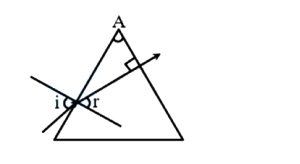
$A$ ray of light is incident at an angle '$i$' on one face of a thin prism. The ray emerges normally from the other face. If the refractive index of the glass prism is '$n$' and the angle of the prism is '$A$',then the value of '$i$' is:
A
$An$
B
$An^2$
C
$\frac{A}{n}$
D
$\frac{A}{n^2}$
Solution
(A) For a prism,the angle of the prism is given by $A = r_1 + r_2$.
Since the ray emerges normally from the second face,the angle of emergence $e = 0$,which implies $r_2 = 0$.
Therefore,$A = r_1$.
Using Snell's law at the first surface: $n = \frac{\sin i}{\sin r_1}$.
Substituting $r_1 = A$,we get $n = \frac{\sin i}{\sin A}$.
For a thin prism,the angles $i$ and $A$ are very small,so $\sin i \approx i$ and $\sin A \approx A$.
Thus,$n = \frac{i}{A}$,which gives $i = An$.
Since the ray emerges normally from the second face,the angle of emergence $e = 0$,which implies $r_2 = 0$.
Therefore,$A = r_1$.
Using Snell's law at the first surface: $n = \frac{\sin i}{\sin r_1}$.
Substituting $r_1 = A$,we get $n = \frac{\sin i}{\sin A}$.
For a thin prism,the angles $i$ and $A$ are very small,so $\sin i \approx i$ and $\sin A \approx A$.
Thus,$n = \frac{i}{A}$,which gives $i = An$.
0 likes
View Solution278
DifficultMCQ
$A$ ray of light is incident on one face of an equilateral glass prism having refractive index $\sqrt{2}$. It produces the emergent ray which just grazes along the adjacent face. The value of angle of incidence is
A
$\sin ^{-1}\left(\frac{1}{\sqrt{2}} \sin 15^{\circ}\right)$
B
$\sin ^{-1}\left(\sqrt{2} \sin 30^{\circ}\right)$
C
$\sin ^{-1}\left(\frac{1}{\sqrt{2}} \sin 45^{\circ}\right)$
D
$\sin ^{-1}\left(\sqrt{2} \sin 15^{\circ}\right)$
Solution
(D) The emergent ray just grazes the second face,so the angle of emergence $e = 90^{\circ}$.
Using Snell's law at the second face: $\mu = \frac{\sin e}{\sin r_2} = \frac{\sin 90^{\circ}}{\sin r_2} = \frac{1}{\sin r_2}$.
Given $\mu = \sqrt{2}$,we have $\sin r_2 = \frac{1}{\sqrt{2}}$,which gives $r_2 = 45^{\circ}$.
For an equilateral prism,the prism angle $A = 60^{\circ}$.
Using the relation $A = r_1 + r_2$,we find $r_1 = A - r_2 = 60^{\circ} - 45^{\circ} = 15^{\circ}$.
Applying Snell's law at the first face: $\frac{\sin i}{\sin r_1} = \mu$.
Therefore,$\sin i = \mu \sin r_1 = \sqrt{2} \sin 15^{\circ}$.
Thus,$i = \sin ^{-1}(\sqrt{2} \sin 15^{\circ})$.
Using Snell's law at the second face: $\mu = \frac{\sin e}{\sin r_2} = \frac{\sin 90^{\circ}}{\sin r_2} = \frac{1}{\sin r_2}$.
Given $\mu = \sqrt{2}$,we have $\sin r_2 = \frac{1}{\sqrt{2}}$,which gives $r_2 = 45^{\circ}$.
For an equilateral prism,the prism angle $A = 60^{\circ}$.
Using the relation $A = r_1 + r_2$,we find $r_1 = A - r_2 = 60^{\circ} - 45^{\circ} = 15^{\circ}$.
Applying Snell's law at the first face: $\frac{\sin i}{\sin r_1} = \mu$.
Therefore,$\sin i = \mu \sin r_1 = \sqrt{2} \sin 15^{\circ}$.
Thus,$i = \sin ^{-1}(\sqrt{2} \sin 15^{\circ})$.
0 likes
View Solution279
MediumMCQ
$A$ thin prism $P_{1}$ with angle $4^{\circ}$ and made from glass of refractive index $1.54$ is combined with another thin prism $P_{2}$ made from glass of refractive index $1.72$ to produce dispersion without deviation. The angle of prism for $P_{2}$ is (in $^{\circ}$)
A
$4$
B
$5.33$
C
$2.6$
D
$3$
Solution
(D) For a thin prism,the angle of deviation is given by $\delta = A(n - 1)$.
For dispersion without deviation,the net deviation must be zero,which means the deviation produced by the first prism must be equal to the deviation produced by the second prism in the opposite direction.
Therefore,$\delta_{1} = \delta_{2}$.
Substituting the formula,we get $A_{1}(n_{1} - 1) = A_{2}(n_{2} - 1)$.
Given $A_{1} = 4^{\circ}$,$n_{1} = 1.54$,and $n_{2} = 1.72$.
$4(1.54 - 1) = A_{2}(1.72 - 1)$.
$4 \times 0.54 = A_{2} \times 0.72$.
$A_{2} = \frac{4 \times 0.54}{0.72} = \frac{2.16}{0.72} = 3^{\circ}$.
For dispersion without deviation,the net deviation must be zero,which means the deviation produced by the first prism must be equal to the deviation produced by the second prism in the opposite direction.
Therefore,$\delta_{1} = \delta_{2}$.
Substituting the formula,we get $A_{1}(n_{1} - 1) = A_{2}(n_{2} - 1)$.
Given $A_{1} = 4^{\circ}$,$n_{1} = 1.54$,and $n_{2} = 1.72$.
$4(1.54 - 1) = A_{2}(1.72 - 1)$.
$4 \times 0.54 = A_{2} \times 0.72$.
$A_{2} = \frac{4 \times 0.54}{0.72} = \frac{2.16}{0.72} = 3^{\circ}$.
0 likes
View Solution280
EasyMCQ
$A$ ray of light is incident at an angle of incidence '$i$' on one surface of a thin prism of small angle '$A$'. The ray emerges normally from the opposite surface. If the refractive index of the material of the prism is '$\mu$',the angle of incidence '$i$' is nearly equal to
A
$A$
B
$\frac{\mu A}{2}$
C
$\mu A$
D
$\frac{A}{2 \mu}$
Solution
(C) For a thin prism with a small angle '$A$',the relationship between the angle of incidence '$i$',the angle of refraction '$r_1$',and the angle of emergence '$r_2$' is given by $A = r_1 + r_2$.
Since the ray emerges normally from the opposite surface,the angle of emergence is $0$,which implies $r_2 = 0$.
Therefore,$A = r_1 + 0$,so $r_1 = A$.
According to Snell's Law,$\mu = \frac{\sin i}{\sin r_1}$. For small angles,$\sin i \approx i$ and $\sin r_1 \approx r_1$.
Thus,$\mu = \frac{i}{r_1}$.
Substituting $r_1 = A$,we get $\mu = \frac{i}{A}$,which simplifies to $i = \mu A$.
Since the ray emerges normally from the opposite surface,the angle of emergence is $0$,which implies $r_2 = 0$.
Therefore,$A = r_1 + 0$,so $r_1 = A$.
According to Snell's Law,$\mu = \frac{\sin i}{\sin r_1}$. For small angles,$\sin i \approx i$ and $\sin r_1 \approx r_1$.
Thus,$\mu = \frac{i}{r_1}$.
Substituting $r_1 = A$,we get $\mu = \frac{i}{A}$,which simplifies to $i = \mu A$.
0 likes
View Solution281
EasyMCQ
$A$ ray of light passes through an equilateral prism such that the angle of incidence is equal to the angle of emergence,and each of these angles is equal to $\left(\frac{3}{4}\right)^{th}$ of the angle of the prism. The angle of deviation is: (in $^{\circ}$)
A
$35$
B
$40$
C
$20$
D
$30$
Solution
(D) For an equilateral prism,the angle of the prism $A = 60^{\circ}$.
Given that the angle of incidence $i$ is equal to the angle of emergence $e$,and $i = e = \frac{3}{4}A$.
Substituting the value of $A$:
$i = e = \frac{3}{4} \times 60^{\circ} = 45^{\circ}$.
The formula for the angle of deviation $\delta$ is given by $\delta = i + e - A$.
Substituting the values:
$\delta = 45^{\circ} + 45^{\circ} - 60^{\circ}$.
$\delta = 90^{\circ} - 60^{\circ} = 30^{\circ}$.
Therefore,the angle of deviation is $30^{\circ}$.
Given that the angle of incidence $i$ is equal to the angle of emergence $e$,and $i = e = \frac{3}{4}A$.
Substituting the value of $A$:
$i = e = \frac{3}{4} \times 60^{\circ} = 45^{\circ}$.
The formula for the angle of deviation $\delta$ is given by $\delta = i + e - A$.
Substituting the values:
$\delta = 45^{\circ} + 45^{\circ} - 60^{\circ}$.
$\delta = 90^{\circ} - 60^{\circ} = 30^{\circ}$.
Therefore,the angle of deviation is $30^{\circ}$.
0 likes
View Solution282
EasyMCQ
$A$ ray of light is incident at an angle '$i$' on one face of a prism of small angle '$A$' and emerges normally from the other surface. If '$\mu$' is the refractive index of the material of the prism,then the angle of incidence is:
A
$A \mu$
B
$\frac{A}{2 \mu}$
C
$\frac{A \mu}{2}$
D
$\mu$
Solution
(A) For a prism with a small angle '$A$',the angle of deviation '$\delta$' is given by $\delta = (\mu - 1)A$.
We know the relation for a prism: $i + e = A + \delta$.
Given that the ray emerges normally from the other surface,the angle of emergence '$e$' is $0$.
Substituting $e = 0$ and $\delta = (\mu - 1)A$ into the relation:
$i + 0 = A + (\mu - 1)A$
$i = A + \mu A - A$
$i = \mu A$.
Therefore,the angle of incidence is $\mu A$.
We know the relation for a prism: $i + e = A + \delta$.
Given that the ray emerges normally from the other surface,the angle of emergence '$e$' is $0$.
Substituting $e = 0$ and $\delta = (\mu - 1)A$ into the relation:
$i + 0 = A + (\mu - 1)A$
$i = A + \mu A - A$
$i = \mu A$.
Therefore,the angle of incidence is $\mu A$.
0 likes
View Solution283
MediumMCQ
$A$ prism having refractive index $\sqrt{2}$ and refracting angle $30^{\circ}$ has one of the refracting surfaces silvered. The beam of light incident on the other refracting surface will retrace its path,if the angle of incidence is $\left[\sin \frac{\pi}{6}=0.5\right]$
A
$\sin ^{-1}\left(\frac{3}{4}\right)$
B
$\sin ^{-1}\left(\frac{1}{2}\right)$
C
$\sin ^{-1}\left(\frac{\sqrt{3}}{2}\right)$
D
$\sin ^{-1}\left(\frac{1}{\sqrt{2}}\right)$
Solution
(D) For the light to retrace its path,it must strike the silvered surface normally.
Since the second surface is silvered,the angle of refraction at the second surface $r_2$ must be $0^{\circ}$.
Using the prism formula $A = r_1 + r_2$,where $A = 30^{\circ}$ is the refracting angle and $r_2 = 0^{\circ}$,we get $r_1 = 30^{\circ}$.
Applying Snell's Law at the first surface: $n = \frac{\sin i}{\sin r_1}$.
Given $n = \sqrt{2}$ and $r_1 = 30^{\circ}$,we have $\sqrt{2} = \frac{\sin i}{\sin 30^{\circ}}$.
$\sin i = \sqrt{2} \times \sin 30^{\circ} = \sqrt{2} \times \frac{1}{2} = \frac{1}{\sqrt{2}}$.
Therefore,$i = \sin^{-1}\left(\frac{1}{\sqrt{2}}\right)$.
Since the second surface is silvered,the angle of refraction at the second surface $r_2$ must be $0^{\circ}$.
Using the prism formula $A = r_1 + r_2$,where $A = 30^{\circ}$ is the refracting angle and $r_2 = 0^{\circ}$,we get $r_1 = 30^{\circ}$.
Applying Snell's Law at the first surface: $n = \frac{\sin i}{\sin r_1}$.
Given $n = \sqrt{2}$ and $r_1 = 30^{\circ}$,we have $\sqrt{2} = \frac{\sin i}{\sin 30^{\circ}}$.
$\sin i = \sqrt{2} \times \sin 30^{\circ} = \sqrt{2} \times \frac{1}{2} = \frac{1}{\sqrt{2}}$.
Therefore,$i = \sin^{-1}\left(\frac{1}{\sqrt{2}}\right)$.
0 likes
View Solution284
MediumMCQ
$A$ ray of light is incident at an angle '$i$' on one face of a thin angled prism. The ray emerges normally from the other face. If the refractive index of the glass prism is '$n$' and the angle of the prism is '$A$',then the value of '$i$' is:
A
$An$
B
$A^{2}n$
C
$\frac{n}{A}$
D
$\frac{1}{An}$
Solution
(A) For a thin prism,the relationship between the prism angle '$A$' and the angles of refraction '$r_1$' and '$r_2$' is given by: $A = r_1 + r_2$.
Since the ray emerges normally from the other face,the angle of emergence '$e = 0$',which implies that the second angle of refraction '$r_2 = 0$'.
Therefore,$A = r_1$.
According to Snell's Law at the first surface,$n = \frac{\sin i}{\sin r_1}$.
For a thin prism,the angles '$i$' and '$r_1$' are very small,so we can approximate $\sin i \approx i$ and $\sin r_1 \approx r_1$.
Thus,$n = \frac{i}{r_1}$.
Substituting $r_1 = A$,we get $n = \frac{i}{A}$,which implies $i = An$.
Since the ray emerges normally from the other face,the angle of emergence '$e = 0$',which implies that the second angle of refraction '$r_2 = 0$'.
Therefore,$A = r_1$.
According to Snell's Law at the first surface,$n = \frac{\sin i}{\sin r_1}$.
For a thin prism,the angles '$i$' and '$r_1$' are very small,so we can approximate $\sin i \approx i$ and $\sin r_1 \approx r_1$.
Thus,$n = \frac{i}{r_1}$.
Substituting $r_1 = A$,we get $n = \frac{i}{A}$,which implies $i = An$.
0 likes
View Solution285
MediumMCQ
$A$ ray of light is incident on the first face of an equilateral glass prism at an angle of incidence '$i$'. The emergent ray just grazes along the adjacent face. The refractive index of the prism is $\sqrt{2}$. The value of the angle of incidence at the first face is $(\sin 45^{\circ} = 1/\sqrt{2}, \sin 90^{\circ} = 1)$.
A
$\sin^{-1}(\sqrt{2} \sin 15^{\circ})$
B
$\sin^{-1}(\frac{\sin 30^{\circ}}{\sqrt{2}})$
C
$\cos^{-1}(\sqrt{2} \sin 20^{\circ})$
D
$\tan^{-1} \sqrt{2 \sin 15^{\circ}}$
Solution
(A) For an equilateral prism,the angle of the prism $A = 60^{\circ}$.
Given that the emergent ray grazes the adjacent face,the angle of emergence $e = 90^{\circ}$.
From the condition of refraction at the second surface,$r_2 = C$,where $C$ is the critical angle.
Using Snell's law at the second surface: $\mu \sin r_2 = 1 \sin e \implies \sqrt{2} \sin r_2 = \sin 90^{\circ} = 1$.
Thus,$\sin r_2 = 1/\sqrt{2}$,which means $r_2 = 45^{\circ}$.
Since $A = r_1 + r_2$,we have $60^{\circ} = r_1 + 45^{\circ}$,so $r_1 = 15^{\circ}$.
Applying Snell's law at the first surface: $1 \sin i = \mu \sin r_1$.
$\sin i = \sqrt{2} \sin 15^{\circ}$.
Therefore,$i = \sin^{-1}(\sqrt{2} \sin 15^{\circ})$.
Given that the emergent ray grazes the adjacent face,the angle of emergence $e = 90^{\circ}$.
From the condition of refraction at the second surface,$r_2 = C$,where $C$ is the critical angle.
Using Snell's law at the second surface: $\mu \sin r_2 = 1 \sin e \implies \sqrt{2} \sin r_2 = \sin 90^{\circ} = 1$.
Thus,$\sin r_2 = 1/\sqrt{2}$,which means $r_2 = 45^{\circ}$.
Since $A = r_1 + r_2$,we have $60^{\circ} = r_1 + 45^{\circ}$,so $r_1 = 15^{\circ}$.
Applying Snell's law at the first surface: $1 \sin i = \mu \sin r_1$.
$\sin i = \sqrt{2} \sin 15^{\circ}$.
Therefore,$i = \sin^{-1}(\sqrt{2} \sin 15^{\circ})$.
0 likes
View Solution286
DifficultMCQ
$A$ monochromatic ray of light is incident normally on a thin prism of refracting angle $A$. The ray is deviated through an angle $(1.15)^{\circ}$ in passing through the prism. The ray reflected internally from the second face emerges from the first face making an angle of $(6.3)^{\circ}$ with the incident ray. The refractive index of the prism is
A
$1.625$
B
$1.575$
C
$1.525$
D
$1.515$
Solution
(B) For a thin prism,the angle of deviation $\delta$ is given by $\delta = (\mu - 1)A$. Given $\delta = 1.15^{\circ}$,we have $(\mu - 1)A = 1.15^{\circ}$ (Equation $1$).
When the ray is incident normally on the first face,it strikes the second face at an angle of incidence equal to the prism angle $A$. The ray is reflected internally at the second face,so the angle of reflection is $A$. This reflected ray then strikes the first face at an angle $2A$ with the normal. Upon emerging from the first face,the angle of refraction $r'$ is given by $\sin(r') = \mu \sin(2A)$. For small angles,$r' \approx \mu(2A)$.
The angle between the emerging ray and the incident ray is given as $6.3^{\circ}$. The emerging ray makes an angle $r'$ with the normal,and the incident ray is normal to the surface,so the angle between them is $r' = 6.3^{\circ}$.
Thus,$2\mu A = 6.3^{\circ}$ (Equation $2$).
Dividing Equation $2$ by Equation $1$: $\frac{2\mu A}{(\mu - 1)A} = \frac{6.3}{1.15} \implies \frac{2\mu}{\mu - 1} = 5.478$.
$2\mu = 5.478\mu - 5.478 \implies 3.478\mu = 5.478 \implies \mu \approx 1.575$.
When the ray is incident normally on the first face,it strikes the second face at an angle of incidence equal to the prism angle $A$. The ray is reflected internally at the second face,so the angle of reflection is $A$. This reflected ray then strikes the first face at an angle $2A$ with the normal. Upon emerging from the first face,the angle of refraction $r'$ is given by $\sin(r') = \mu \sin(2A)$. For small angles,$r' \approx \mu(2A)$.
The angle between the emerging ray and the incident ray is given as $6.3^{\circ}$. The emerging ray makes an angle $r'$ with the normal,and the incident ray is normal to the surface,so the angle between them is $r' = 6.3^{\circ}$.
Thus,$2\mu A = 6.3^{\circ}$ (Equation $2$).
Dividing Equation $2$ by Equation $1$: $\frac{2\mu A}{(\mu - 1)A} = \frac{6.3}{1.15} \implies \frac{2\mu}{\mu - 1} = 5.478$.
$2\mu = 5.478\mu - 5.478 \implies 3.478\mu = 5.478 \implies \mu \approx 1.575$.
0 likes
View Solution287
EasyMCQ
When a monochromatic ray of light is passed through an equilateral glass prism,it is found that the refracted ray in glass is parallel to the base of the prism. If '$i$' and '$e$' denote the angles of incidence and emergence respectively,then
A
$i > e$
B
$i < e$
C
$i = e$
D
$i + e = 90^{\circ}$
Solution
(C) For a prism,the angle of deviation is given by $\delta = i + e - A$. When the refracted ray inside the prism is parallel to the base,the prism is in the position of minimum deviation. In the position of minimum deviation,the angle of incidence is equal to the angle of emergence,i.e.,$i = e$. Therefore,the correct option is $C$.
0 likes
View Solution288
EasyMCQ
$A$ thin hollow prism of refracting angle $3^{\circ}$,filled with water,gives a deviation of $1^{\circ}$. The refractive index of water is
A
$1.59$
B
$1.33$
C
$1.46$
D
$1.51$
Solution
(B) For a thin prism,the angle of deviation $\delta$ is given by the formula: $\delta = (n - 1)A$,where $n$ is the refractive index of the material of the prism and $A$ is the refracting angle of the prism.
Given:
Refracting angle $A = 3^{\circ}$
Angle of deviation $\delta = 1^{\circ}$
Substituting these values into the formula:
$1^{\circ} = (n - 1) \cdot 3^{\circ}$
$n - 1 = \frac{1}{3}$
$n = 1 + \frac{1}{3} = \frac{4}{3}$
$n = 1.33$
Therefore,the refractive index of water is $1.33$.
Given:
Refracting angle $A = 3^{\circ}$
Angle of deviation $\delta = 1^{\circ}$
Substituting these values into the formula:
$1^{\circ} = (n - 1) \cdot 3^{\circ}$
$n - 1 = \frac{1}{3}$
$n = 1 + \frac{1}{3} = \frac{4}{3}$
$n = 1.33$
Therefore,the refractive index of water is $1.33$.
0 likes
View Solution289
MediumMCQ
The angle of a prism is $A$ and one of its refracting surfaces is silvered. Light rays falling at an angle of incidence '$2A$' on the first surface return back through the same path after suffering reflection at the silvered surface. The refractive index of the material of the prism is
A
$2 \sin \left(\frac{A}{2}\right)$
B
$2 \tan A$
C
$2 \cos A$
D
$2 \sin A$
Solution
(C) Given: Angle of prism $= A$,Angle of incidence $i = 2A$.
For the light ray to retrace its path after reflection from the silvered surface,it must strike the silvered surface normally.
Let $r$ be the angle of refraction at the first surface. In the triangle formed by the ray inside the prism,the angle at the silvered surface is $90^{\circ}$. Thus,the angle of refraction $r$ is related to the prism angle $A$ by $r + A = 90^{\circ}$ is incorrect here; rather,from the geometry,$r = A$.
Using Snell's law at the first surface:
$\mu = \frac{\sin i}{\sin r} = \frac{\sin 2A}{\sin A}$
Using the trigonometric identity $\sin 2A = 2 \sin A \cos A$:
$\mu = \frac{2 \sin A \cos A}{\sin A} = 2 \cos A$
For the light ray to retrace its path after reflection from the silvered surface,it must strike the silvered surface normally.
Let $r$ be the angle of refraction at the first surface. In the triangle formed by the ray inside the prism,the angle at the silvered surface is $90^{\circ}$. Thus,the angle of refraction $r$ is related to the prism angle $A$ by $r + A = 90^{\circ}$ is incorrect here; rather,from the geometry,$r = A$.
Using Snell's law at the first surface:
$\mu = \frac{\sin i}{\sin r} = \frac{\sin 2A}{\sin A}$
Using the trigonometric identity $\sin 2A = 2 \sin A \cos A$:
$\mu = \frac{2 \sin A \cos A}{\sin A} = 2 \cos A$
0 likes
View Solution290
EasyMCQ
For a thin prism,if the angle of prism is $4^{\circ}$ and the refractive index is $1.6$,then the angle of minimum deviation will be . . . . . . . (in $^{\circ}$)
A
$1.6$
B
$2.0$
C
$2.4$
D
$0.4$
Solution
(C) For a thin prism,the angle of minimum deviation $(D_{m})$ is given by the formula:
$D_{m} = A(n - 1)$
where $A$ is the angle of the prism and $n$ is the refractive index.
Given:
$A = 4^{\circ}$
$n = 1.6$
Substituting the values into the formula:
$D_{m} = 4^{\circ}(1.6 - 1)$
$D_{m} = 4^{\circ}(0.6)$
$D_{m} = 2.4^{\circ}$
Therefore,the angle of minimum deviation is $2.4^{\circ}$.
$D_{m} = A(n - 1)$
where $A$ is the angle of the prism and $n$ is the refractive index.
Given:
$A = 4^{\circ}$
$n = 1.6$
Substituting the values into the formula:
$D_{m} = 4^{\circ}(1.6 - 1)$
$D_{m} = 4^{\circ}(0.6)$
$D_{m} = 2.4^{\circ}$
Therefore,the angle of minimum deviation is $2.4^{\circ}$.
0 likes
View Solution291
EasyMCQ
$A$ glass prism having a refractive index $\mu$ is placed in air. If the angle of minimum deviation of the prism is equal to the angle of the prism,what is the value of the angle of the prism?
A
$\cos ^{-1}(\mu)$
B
$\cos ^{-1}\left(\frac{\mu}{2}\right)$
C
$2 \cos ^{-1}(\mu)$
D
$2 \cos ^{-1}\left(\frac{\mu}{2}\right)$
Solution
(D) The formula for the refractive index of a prism is given by $\mu = \frac{\sin \left(\frac{A+D_m}{2}\right)}{\sin \frac{A}{2}}$,where $A$ is the angle of the prism and $D_m$ is the angle of minimum deviation.
Given that $D_m = A$,we substitute this into the formula:
$\mu = \frac{\sin \left(\frac{A+A}{2}\right)}{\sin \frac{A}{2}}$
$\mu = \frac{\sin A}{\sin \frac{A}{2}}$
Using the trigonometric identity $\sin A = 2 \sin \frac{A}{2} \cos \frac{A}{2}$,we get:
$\mu = \frac{2 \sin \frac{A}{2} \cos \frac{A}{2}}{\sin \frac{A}{2}}$
$\mu = 2 \cos \frac{A}{2}$
$\frac{\mu}{2} = \cos \frac{A}{2}$
$\frac{A}{2} = \cos ^{-1}\left(\frac{\mu}{2}\right)$
$A = 2 \cos ^{-1}\left(\frac{\mu}{2}\right)$
Given that $D_m = A$,we substitute this into the formula:
$\mu = \frac{\sin \left(\frac{A+A}{2}\right)}{\sin \frac{A}{2}}$
$\mu = \frac{\sin A}{\sin \frac{A}{2}}$
Using the trigonometric identity $\sin A = 2 \sin \frac{A}{2} \cos \frac{A}{2}$,we get:
$\mu = \frac{2 \sin \frac{A}{2} \cos \frac{A}{2}}{\sin \frac{A}{2}}$
$\mu = 2 \cos \frac{A}{2}$
$\frac{\mu}{2} = \cos \frac{A}{2}$
$\frac{A}{2} = \cos ^{-1}\left(\frac{\mu}{2}\right)$
$A = 2 \cos ^{-1}\left(\frac{\mu}{2}\right)$
0 likes
View Solution292
EasyMCQ
$A$ small angled prism of refractive index $1.6$ gives a deviation of $3.6^{\circ}$. The angle of prism is . . . . . . . (in $^{\circ}$)
A
$7$
B
$6$
C
$5$
D
$8$
Solution
(B) For a small angled prism,the angle of deviation $\delta$ is given by the formula: $\delta = A(n - 1)$,where $A$ is the angle of the prism and $n$ is the refractive index of the material of the prism.
Given:
Refractive index $n = 1.6$
Angle of deviation $\delta = 3.6^{\circ}$
Substituting the values in the formula:
$3.6^{\circ} = A(1.6 - 1)$
$3.6^{\circ} = A(0.6)$
$A = \frac{3.6^{\circ}}{0.6}$
$A = 6^{\circ}$
Therefore,the angle of the prism is $6^{\circ}$.
Given:
Refractive index $n = 1.6$
Angle of deviation $\delta = 3.6^{\circ}$
Substituting the values in the formula:
$3.6^{\circ} = A(1.6 - 1)$
$3.6^{\circ} = A(0.6)$
$A = \frac{3.6^{\circ}}{0.6}$
$A = 6^{\circ}$
Therefore,the angle of the prism is $6^{\circ}$.
0 likes
View Solution293
EasyMCQ
The angle of minimum deviation for a prism of refractive index $1.5$ is equal to the angle of the prism. The angle of the prism is . . . . . . . $(\sin 48^{\circ} 36^{\prime} = 0.75)$
A
$80^{\circ}$
B
$41^{\circ} 24^{\prime}$
C
$60^{\circ}$
D
$82.8^{\circ}$
Solution
(D) The refractive index $n$ of a prism is given by the formula: $n = \frac{\sin((A + D_m)/2)}{\sin(A/2)}$.
Given that the angle of minimum deviation $D_m$ is equal to the angle of the prism $A$,we substitute $D_m = A$ into the formula:
$1.5 = \frac{\sin((A + A)/2)}{\sin(A/2)}$
$1.5 = \frac{\sin(A)}{\sin(A/2)}$
Using the trigonometric identity $\sin(A) = 2 \sin(A/2) \cos(A/2)$,we get:
$1.5 = \frac{2 \sin(A/2) \cos(A/2)}{\sin(A/2)}$
$1.5 = 2 \cos(A/2)$
$\cos(A/2) = 1.5 / 2 = 0.75$
Since $\sin(48^{\circ} 36^{\prime}) = 0.75$,we know that $\cos(90^{\circ} - 48^{\circ} 36^{\prime}) = 0.75$,which is $\cos(41^{\circ} 24^{\prime}) = 0.75$.
Therefore,$A/2 = 41^{\circ} 24^{\prime} = 41.4^{\circ}$.
Thus,$A = 2 \times 41.4^{\circ} = 82.8^{\circ}$.
Given that the angle of minimum deviation $D_m$ is equal to the angle of the prism $A$,we substitute $D_m = A$ into the formula:
$1.5 = \frac{\sin((A + A)/2)}{\sin(A/2)}$
$1.5 = \frac{\sin(A)}{\sin(A/2)}$
Using the trigonometric identity $\sin(A) = 2 \sin(A/2) \cos(A/2)$,we get:
$1.5 = \frac{2 \sin(A/2) \cos(A/2)}{\sin(A/2)}$
$1.5 = 2 \cos(A/2)$
$\cos(A/2) = 1.5 / 2 = 0.75$
Since $\sin(48^{\circ} 36^{\prime}) = 0.75$,we know that $\cos(90^{\circ} - 48^{\circ} 36^{\prime}) = 0.75$,which is $\cos(41^{\circ} 24^{\prime}) = 0.75$.
Therefore,$A/2 = 41^{\circ} 24^{\prime} = 41.4^{\circ}$.
Thus,$A = 2 \times 41.4^{\circ} = 82.8^{\circ}$.
0 likes
View Solution294
MediumMCQ
If $r$ and $r^1$ denote the angles of refraction at the two faces of a prism with a prism angle of $50^{\circ}$,and $r$ varies with time $t$ as $r = 10^{\circ} + t^2$,how will $r^1$ vary with time?
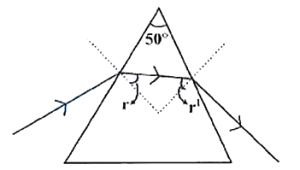
A
$40^{\circ} + t^2$
B
$50^{\circ} - t^2$
C
$50^{\circ} + t^2$
D
$40^{\circ} - t^2$
Solution
(D) For a prism,the sum of the angles of refraction at the two faces is equal to the angle of the prism $(A)$:
$r + r^1 = A$
Given that the angle of the prism $A = 50^{\circ}$ and $r = 10^{\circ} + t^2$,we can substitute these values into the equation:
$10^{\circ} + t^2 + r^1 = 50^{\circ}$
Solving for $r^1$:
$r^1 = 50^{\circ} - 10^{\circ} - t^2$
$r^1 = 40^{\circ} - t^2$
$r + r^1 = A$
Given that the angle of the prism $A = 50^{\circ}$ and $r = 10^{\circ} + t^2$,we can substitute these values into the equation:
$10^{\circ} + t^2 + r^1 = 50^{\circ}$
Solving for $r^1$:
$r^1 = 50^{\circ} - 10^{\circ} - t^2$
$r^1 = 40^{\circ} - t^2$
0 likes
View Solution295
MediumMCQ
If the angle of minimum deviation is equal to the angle of an equilateral prism,then the speed of light inside the prism is .....
A
$3 \times 10^8 \ m/s$
B
$2 \sqrt{3} \times 10^8 \ m/s$
C
$\sqrt{3} \times 10^8 \ m/s$
D
$\frac{\sqrt{3}}{2} \times 10^8 \ m/s$
Solution
(C) Given,the prism is equilateral,so the angle of the prism $A = 60^{\circ}$.
Given that the angle of minimum deviation $\delta_m = A = 60^{\circ}$.
The refractive index $\mu$ of the prism is given by the formula:
$\mu = \frac{\sin \left(\frac{A + \delta_m}{2}\right)}{\sin \left(\frac{A}{2}\right)}$
Substituting the values:
$\mu = \frac{\sin \left(\frac{60^{\circ} + 60^{\circ}}{2}\right)}{\sin \left(\frac{60^{\circ}}{2}\right)} = \frac{\sin 60^{\circ}}{\sin 30^{\circ}} = \frac{\sqrt{3}/2}{1/2} = \sqrt{3}$.
We know that the refractive index $\mu$ is related to the speed of light in vacuum $c$ and the speed of light in the medium $v$ as $\mu = \frac{c}{v}$.
Therefore,$v = \frac{c}{\mu} = \frac{3 \times 10^8 \ m/s}{\sqrt{3}} = \sqrt{3} \times 10^8 \ m/s$.
Given that the angle of minimum deviation $\delta_m = A = 60^{\circ}$.
The refractive index $\mu$ of the prism is given by the formula:
$\mu = \frac{\sin \left(\frac{A + \delta_m}{2}\right)}{\sin \left(\frac{A}{2}\right)}$
Substituting the values:
$\mu = \frac{\sin \left(\frac{60^{\circ} + 60^{\circ}}{2}\right)}{\sin \left(\frac{60^{\circ}}{2}\right)} = \frac{\sin 60^{\circ}}{\sin 30^{\circ}} = \frac{\sqrt{3}/2}{1/2} = \sqrt{3}$.
We know that the refractive index $\mu$ is related to the speed of light in vacuum $c$ and the speed of light in the medium $v$ as $\mu = \frac{c}{v}$.
Therefore,$v = \frac{c}{\mu} = \frac{3 \times 10^8 \ m/s}{\sqrt{3}} = \sqrt{3} \times 10^8 \ m/s$.
0 likes
View Solution296
MediumMCQ
$A$ ray of light passes through an equilateral glass prism in such a manner that the angle of incidence is equal to the angle of emergence and each of these angles is equal to $\frac{3}{4}$ of the angle of the prism. The angle of deviation is (in $^{\circ}$)
A
$39$
B
$20$
C
$30$
D
$45$
Solution
(C) For an equilateral glass prism,the angle of the prism is $A = 60^{\circ}$.
Given that the angle of incidence $i$ is equal to the angle of emergence $e$,and each is $\frac{3}{4}$ of the angle of the prism:
$i = e = \frac{3}{4} A = \frac{3}{4} \times 60^{\circ} = 45^{\circ}$.
The formula for the angle of deviation $\delta$ is given by:
$\delta = i + e - A$.
Substituting the values:
$\delta = 45^{\circ} + 45^{\circ} - 60^{\circ} = 90^{\circ} - 60^{\circ} = 30^{\circ}$.
Thus,the angle of deviation is $30^{\circ}$.
Given that the angle of incidence $i$ is equal to the angle of emergence $e$,and each is $\frac{3}{4}$ of the angle of the prism:
$i = e = \frac{3}{4} A = \frac{3}{4} \times 60^{\circ} = 45^{\circ}$.
The formula for the angle of deviation $\delta$ is given by:
$\delta = i + e - A$.
Substituting the values:
$\delta = 45^{\circ} + 45^{\circ} - 60^{\circ} = 90^{\circ} - 60^{\circ} = 30^{\circ}$.
Thus,the angle of deviation is $30^{\circ}$.
0 likes
View Solution297
MediumMCQ
The refracting angle of a prism is $A$ and the refractive index of the material of the prism is $\cot \frac{A}{2}$. The angle of minimum deviation is:
A
$180^{\circ}-3 A$
B
$180^{\circ}+2 A$
C
$90^{\circ}-A$
D
$180^{\circ}-2 A$
Solution
(D) Given,angle of prism $= A$.
Refractive index of prism,$\mu = \cot \frac{A}{2}$.
We know the formula for refractive index in terms of minimum deviation $\delta_m$ is:
$\mu = \frac{\sin \left(\frac{A+\delta_m}{2}\right)}{\sin \left(\frac{A}{2}\right)}$
Substituting the given value of $\mu$:
$\cot \left(\frac{A}{2}\right) = \frac{\sin \left(\frac{A+\delta_m}{2}\right)}{\sin \left(\frac{A}{2}\right)}$
Using $\cot \theta = \frac{\cos \theta}{\sin \theta}$:
$\frac{\cos (A/2)}{\sin (A/2)} = \frac{\sin \left(\frac{A+\delta_m}{2}\right)}{\sin (A/2)}$
$\cos (A/2) = \sin \left(\frac{A+\delta_m}{2}\right)$
Since $\cos \theta = \sin (90^{\circ} - \theta)$,we have:
$\sin (90^{\circ} - A/2) = \sin \left(\frac{A+\delta_m}{2}\right)$
Equating the angles:
$90^{\circ} - \frac{A}{2} = \frac{A+\delta_m}{2}$
$180^{\circ} - A = A + \delta_m$
$\delta_m = 180^{\circ} - 2A$.
Refractive index of prism,$\mu = \cot \frac{A}{2}$.
We know the formula for refractive index in terms of minimum deviation $\delta_m$ is:
$\mu = \frac{\sin \left(\frac{A+\delta_m}{2}\right)}{\sin \left(\frac{A}{2}\right)}$
Substituting the given value of $\mu$:
$\cot \left(\frac{A}{2}\right) = \frac{\sin \left(\frac{A+\delta_m}{2}\right)}{\sin \left(\frac{A}{2}\right)}$
Using $\cot \theta = \frac{\cos \theta}{\sin \theta}$:
$\frac{\cos (A/2)}{\sin (A/2)} = \frac{\sin \left(\frac{A+\delta_m}{2}\right)}{\sin (A/2)}$
$\cos (A/2) = \sin \left(\frac{A+\delta_m}{2}\right)$
Since $\cos \theta = \sin (90^{\circ} - \theta)$,we have:
$\sin (90^{\circ} - A/2) = \sin \left(\frac{A+\delta_m}{2}\right)$
Equating the angles:
$90^{\circ} - \frac{A}{2} = \frac{A+\delta_m}{2}$
$180^{\circ} - A = A + \delta_m$
$\delta_m = 180^{\circ} - 2A$.
0 likes
View Solution298
EasyMCQ
$A$ certain prism is found to produce a minimum deviation of $38^{\circ}$. It produces a deviation of $44^{\circ}$ when the angle of incidence is either $42^{\circ}$ or $62^{\circ}$. What is the angle of incidence when it is undergoing minimum deviation (in $^{\circ}$)?
A
$49$
B
$30$
C
$60$
D
$40$
Solution
(A) For a prism,the deviation $D$ is given by $D = (i_1 + i_2) - A$,where $i_1$ and $i_2$ are the angles of incidence and emergence,and $A$ is the prism angle.
Given $D = 44^{\circ}$ for $i_1 = 42^{\circ}$ and $i_2 = 62^{\circ}$ (or vice versa),we have:
$44^{\circ} = (42^{\circ} + 62^{\circ}) - A$
$44^{\circ} = 104^{\circ} - A$
$A = 104^{\circ} - 44^{\circ} = 60^{\circ}$.
At minimum deviation $(D_m = 38^{\circ})$,the angle of incidence $i$ is given by $i = \frac{A + D_m}{2}$.
$i = \frac{60^{\circ} + 38^{\circ}}{2} = \frac{98^{\circ}}{2} = 49^{\circ}$.
Given $D = 44^{\circ}$ for $i_1 = 42^{\circ}$ and $i_2 = 62^{\circ}$ (or vice versa),we have:
$44^{\circ} = (42^{\circ} + 62^{\circ}) - A$
$44^{\circ} = 104^{\circ} - A$
$A = 104^{\circ} - 44^{\circ} = 60^{\circ}$.
At minimum deviation $(D_m = 38^{\circ})$,the angle of incidence $i$ is given by $i = \frac{A + D_m}{2}$.
$i = \frac{60^{\circ} + 38^{\circ}}{2} = \frac{98^{\circ}}{2} = 49^{\circ}$.
0 likes
View Solution299
EasyMCQ
$A$ ray of light suffers a minimum deviation when incident on an equilateral prism of refractive index $ \sqrt{2} $. The angle of incidence is (in $^{\circ}$)
A
$30$
B
$45$
C
$60$
D
$50$
Solution
(B) For an equilateral prism,the angle of the prism $A = 60^{\circ}$.
At the condition of minimum deviation,the angle of incidence $i$ is equal to the angle of emergence $e$,and the angle of refraction $r_1$ is equal to $r_2 = r$.
From the relation $A = r_1 + r_2$,we have $A = 2r$,so $r = A/2 = 60^{\circ}/2 = 30^{\circ}$.
According to Snell's law,$\mu = \frac{\sin i}{\sin r}$.
Given $\mu = \sqrt{2}$ and $r = 30^{\circ}$,we have $\sqrt{2} = \frac{\sin i}{\sin 30^{\circ}}$.
$\sin i = \sqrt{2} \times \sin 30^{\circ} = \sqrt{2} \times \frac{1}{2} = \frac{1}{\sqrt{2}}$.
Therefore,$i = \sin^{-1}\left(\frac{1}{\sqrt{2}}\right) = 45^{\circ}$.
At the condition of minimum deviation,the angle of incidence $i$ is equal to the angle of emergence $e$,and the angle of refraction $r_1$ is equal to $r_2 = r$.
From the relation $A = r_1 + r_2$,we have $A = 2r$,so $r = A/2 = 60^{\circ}/2 = 30^{\circ}$.
According to Snell's law,$\mu = \frac{\sin i}{\sin r}$.
Given $\mu = \sqrt{2}$ and $r = 30^{\circ}$,we have $\sqrt{2} = \frac{\sin i}{\sin 30^{\circ}}$.
$\sin i = \sqrt{2} \times \sin 30^{\circ} = \sqrt{2} \times \frac{1}{2} = \frac{1}{\sqrt{2}}$.
Therefore,$i = \sin^{-1}\left(\frac{1}{\sqrt{2}}\right) = 45^{\circ}$.
0 likes
View SolutionRay Optics and Optical Instruments — Refraction Through Prism · Frequently Asked Questions
1Are these Ray Optics and Optical Instruments questions useful for JEE and NEET?
Yes. All questions in this section are mapped to JEE Main and NEET exam patterns. Previous year questions from JEE Main, NEET, GUJCET and state-level exams are included with full solutions.
2Can I switch to Hindi or Gujarati for these questions?
Yes. Use the language tabs in the hero section or the sidebar to view the same questions and solutions in English, Hindi or Gujarati.
3How do I generate a question paper from this subtopic?
Use the Vedclass Exam Paper Generator — select the chapter and subtopic, set difficulty, and generate Sets A, B, C, D automatically. First 3 chapters of every subject are free.
Vedclass Products
For Students
Vedclass Test Series
Mock tests in real JEE/NEET style with performance analysis. 5-day free trial.
Start Free TrialFor Teachers
Exam Paper Generator
Generate Set A/B/C/D papers from this chapter in 2 minutes. 3 chapters free.
Try FreeFor Institutes
Online Exam Module
Live online exams with unlimited students, 360° analytics & white-label branding.
See DemoFor Teachers & Institutes
Generate a Ray Optics and Optical Instruments Exam Paper in 2 Minutes
Select subtopic & difficulty — Sets A, B, C, D auto-generated with No Repeat logic.
First 3 chapters of every subject are free — no payment required.