
A English
Refraction Through Prism Questions in English
Class 12 Physics · Ray Optics and Optical Instruments · Refraction Through Prism
354+
Questions
English
Language
100%
With Solutions
Showing 48 of 354 questions in English
201
Easy
Obtain the relation between incidence angle,emergence angle,prism angle,and deviation angle for refraction through a prism.
Solution
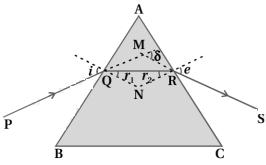
(N/A) Consider a prism $ABC$ with prism angle $A$. $A$ monochromatic light ray $PQ$ is incident on the face $AB$ at an angle of incidence $i$. It refracts along $QR$ with an angle of refraction $r_1$. At face $AC$,it is incident at an angle $r_2$ and emerges as $RS$ at an angle of emergence $e$.
$1$. In the quadrilateral $AQNR$ (where $N$ is the intersection of normals at $Q$ and $R$),the sum of opposite angles is $180^{\circ}$:
$\angle A + \angle QNR = 180^{\circ}$ --- $(1)$
$2$. In $\triangle QNR$,the sum of angles is $180^{\circ}$:
$r_1 + r_2 + \angle QNR = 180^{\circ}$ --- $(2)$
Comparing $(1)$ and $(2)$,we get:
$A = r_1 + r_2$ --- $(3)$
$3$. The total deviation $\delta$ is the angle between the incident ray $PQ$ extended and the emergent ray $RS$ extended. In $\triangle DQR$ (where $D$ is the intersection of extended rays):
$\delta = (i - r_1) + (e - r_2)$
$\delta = (i + e) - (r_1 + r_2)$
Substituting $(3)$ into this equation:
$\delta = i + e - A$
Thus,the final relation is:
$i + e = A + \delta$
$1$. In the quadrilateral $AQNR$ (where $N$ is the intersection of normals at $Q$ and $R$),the sum of opposite angles is $180^{\circ}$:
$\angle A + \angle QNR = 180^{\circ}$ --- $(1)$
$2$. In $\triangle QNR$,the sum of angles is $180^{\circ}$:
$r_1 + r_2 + \angle QNR = 180^{\circ}$ --- $(2)$
Comparing $(1)$ and $(2)$,we get:
$A = r_1 + r_2$ --- $(3)$
$3$. The total deviation $\delta$ is the angle between the incident ray $PQ$ extended and the emergent ray $RS$ extended. In $\triangle DQR$ (where $D$ is the intersection of extended rays):
$\delta = (i - r_1) + (e - r_2)$
$\delta = (i + e) - (r_1 + r_2)$
Substituting $(3)$ into this equation:
$\delta = i + e - A$
Thus,the final relation is:
$i + e = A + \delta$
0 likes
View Solution202
Medium
Derive the expression $\delta = i + e - A$ for a prism.
Solution
(N/A) Consider a prism $ABC$ with angle $A$. A monochromatic light ray $PQ$ is incident on the face $AB$ at an angle of incidence $i$.
At point $Q$, the ray refracts and travels along $QR$ inside the prism, making angles of refraction $r_1$ and $r_2$ at faces $AB$ and $AC$ respectively.
The ray emerges from face $AC$ at point $R$ at an angle of emergence $e$.
Let the incident ray $PQ$ be extended forward and the emergent ray $RS$ be extended backward to meet at point $M$. The angle between these two rays is the angle of deviation $\delta$.
In $\triangle MQR$, the exterior angle $\delta = \angle MQR + \angle MRQ$.
Since $\angle MQR = i - r_1$ and $\angle MRQ = e - r_2$, we have $\delta = (i - r_1) + (e - r_2) = (i + e) - (r_1 + r_2)$.
In the quadrilateral $AQNR$ (where $N$ is the intersection of normals at $Q$ and $R$), $\angle A + \angle QNR = 180^{\circ}$. Also, in $\triangle QNR$, $r_1 + r_2 + \angle QNR = 180^{\circ}$.
Comparing these, we get $A = r_1 + r_2$.
Substituting this into the deviation equation, we get $\delta = i + e - A$.
At point $Q$, the ray refracts and travels along $QR$ inside the prism, making angles of refraction $r_1$ and $r_2$ at faces $AB$ and $AC$ respectively.
The ray emerges from face $AC$ at point $R$ at an angle of emergence $e$.
Let the incident ray $PQ$ be extended forward and the emergent ray $RS$ be extended backward to meet at point $M$. The angle between these two rays is the angle of deviation $\delta$.
In $\triangle MQR$, the exterior angle $\delta = \angle MQR + \angle MRQ$.
Since $\angle MQR = i - r_1$ and $\angle MRQ = e - r_2$, we have $\delta = (i - r_1) + (e - r_2) = (i + e) - (r_1 + r_2)$.
In the quadrilateral $AQNR$ (where $N$ is the intersection of normals at $Q$ and $R$), $\angle A + \angle QNR = 180^{\circ}$. Also, in $\triangle QNR$, $r_1 + r_2 + \angle QNR = 180^{\circ}$.
Comparing these, we get $A = r_1 + r_2$.
Substituting this into the deviation equation, we get $\delta = i + e - A$.
0 likes
View Solution203
Difficult
Explain the minimum deviation angle for a prism using the graph of deviation angle versus incidence angle.
Solution
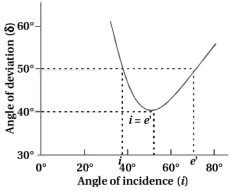
(N/A) The graph of experimentally measured values of the angle of deviation $\delta$ against the values of the angle of incidence $i$ is shown in the figure.
From the graph,it is clear that the value of the angle of deviation becomes minimum for only one particular value of the angle of incidence $i$.
Also,we can see that for two values of the angle of incidence,the angle of deviation is the same.
It has been experimentally established that for any given prism,the ray for which the angle of incidence $i$ and the angle of emergence $e$ are equal,the angle of deviation is minimum for that ray.
This angle is called the angle of minimum deviation $\delta_{m}$ of the given prism for the incident monochromatic light.
Note that,
when $i=e \Rightarrow \delta=\delta_{m}$
For a prism,
$i+e=A+\delta$
where $A$ is the prism angle.
Applying the condition for minimum deviation angle,
$i=e$ then $\delta=\delta_{m}$
$\therefore i+i=A+\delta_{m}$
$\therefore 2i=A+\delta_{m}$
$\therefore i=\frac{A+\delta_{m}}{2}$
From the graph,it is clear that the value of the angle of deviation becomes minimum for only one particular value of the angle of incidence $i$.
Also,we can see that for two values of the angle of incidence,the angle of deviation is the same.
It has been experimentally established that for any given prism,the ray for which the angle of incidence $i$ and the angle of emergence $e$ are equal,the angle of deviation is minimum for that ray.
This angle is called the angle of minimum deviation $\delta_{m}$ of the given prism for the incident monochromatic light.
Note that,
when $i=e \Rightarrow \delta=\delta_{m}$
For a prism,
$i+e=A+\delta$
where $A$ is the prism angle.
Applying the condition for minimum deviation angle,
$i=e$ then $\delta=\delta_{m}$
$\therefore i+i=A+\delta_{m}$
$\therefore 2i=A+\delta_{m}$
$\therefore i=\frac{A+\delta_{m}}{2}$
0 likes
View Solution204
Difficult
Derive ${D_m} = A({n_{21}} - 1)$ for a thin prism.
Solution
(N/A) thin prism is defined as a prism with a very small prism angle $A$.
For a prism,the refractive index $n$ is given by the formula:
$n = \frac{\sin((A + D_m)/2)}{\sin(A/2)}$ ... $(1)$
Since the prism is thin,$A$ is small,and consequently,the angle of minimum deviation $D_m$ is also small.
For small angles,we can use the approximation $\sin(\theta) \approx \theta$ (in radians).
Applying this to equation $(1)$:
$n \approx \frac{(A + D_m)/2}{A/2}$
$n = \frac{A + D_m}{A}$
Multiplying both sides by $A$:
$nA = A + D_m$
$D_m = nA - A$
$D_m = A(n - 1)$
If the prism is in a medium with refractive index $n_1$ and the prism material has refractive index $n_2$,then $n = n_2/n_1 = n_{21}$.
Therefore,$D_m = A(n_{21} - 1)$.
For a prism,the refractive index $n$ is given by the formula:
$n = \frac{\sin((A + D_m)/2)}{\sin(A/2)}$ ... $(1)$
Since the prism is thin,$A$ is small,and consequently,the angle of minimum deviation $D_m$ is also small.
For small angles,we can use the approximation $\sin(\theta) \approx \theta$ (in radians).
Applying this to equation $(1)$:
$n \approx \frac{(A + D_m)/2}{A/2}$
$n = \frac{A + D_m}{A}$
Multiplying both sides by $A$:
$nA = A + D_m$
$D_m = nA - A$
$D_m = A(n - 1)$
If the prism is in a medium with refractive index $n_1$ and the prism material has refractive index $n_2$,then $n = n_2/n_1 = n_{21}$.
Therefore,$D_m = A(n_{21} - 1)$.
0 likes
View Solution205
Medium
Define incidence angle,emergence angle,and deviation angle in the context of a prism.
Solution
(N/A) $1$. Incidence angle $(i)$: The angle between the incident ray and the normal at the point of incidence on the first surface of the prism.
$2$. Emergence angle $(e)$: The angle between the emergent ray and the normal at the point of emergence on the second surface of the prism.
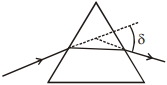
$3$. Deviation angle $(\delta)$: The angle between the direction of the incident ray and the direction of the emergent ray. It represents the total change in the path of the light ray due to the prism.
$2$. Emergence angle $(e)$: The angle between the emergent ray and the normal at the point of emergence on the second surface of the prism.
$3$. Deviation angle $(\delta)$: The angle between the direction of the incident ray and the direction of the emergent ray. It represents the total change in the path of the light ray due to the prism.
0 likes
View Solution206
EasyMCQ
On which factors does the angle of deviation produced by a prism depend?
A
Angle of incidence
B
Refractive index of the prism material
C
Angle of the prism
D
All of the above
Solution
(D) The angle of deviation $\delta$ produced by a prism is given by the formula: $\delta = (\mu - 1)A$ for small angles,or more generally,$\delta = i + e - A$.
$1$. It depends on the angle of incidence $(i)$.
$2$. It depends on the refractive index $(\mu)$ of the material of the prism,which varies with the wavelength of light.
$3$. It depends on the angle of the prism $(A)$.
Therefore,the angle of deviation depends on all these factors.
$1$. It depends on the angle of incidence $(i)$.
$2$. It depends on the refractive index $(\mu)$ of the material of the prism,which varies with the wavelength of light.
$3$. It depends on the angle of the prism $(A)$.
Therefore,the angle of deviation depends on all these factors.
0 likes
View Solution207
Easy
Write the equation for the refractive index of a prism in terms of the angle of minimum deviation $(\delta_m)$ and the angle of the prism $(A)$.
Solution
(N/A) For a prism with refractive index $n$, angle of prism $A$, and angle of minimum deviation $\delta_m$, the relationship is given by Snell's Law applied at the minimum deviation condition.
At minimum deviation, the angle of incidence $i$ is equal to the angle of emergence $e$, and the angle of refraction $r_1$ is equal to $r_2 = r = A/2$.
The angle of incidence is given by $i = (A + \delta_m) / 2$.
Using Snell's Law, $n = \frac{\sin(i)}{\sin(r)}$.
Substituting the values, we get the refractive index equation: $n = \frac{\sin((A + \delta_m) / 2)}{\sin(A / 2)}$.
At minimum deviation, the angle of incidence $i$ is equal to the angle of emergence $e$, and the angle of refraction $r_1$ is equal to $r_2 = r = A/2$.
The angle of incidence is given by $i = (A + \delta_m) / 2$.
Using Snell's Law, $n = \frac{\sin(i)}{\sin(r)}$.
Substituting the values, we get the refractive index equation: $n = \frac{\sin((A + \delta_m) / 2)}{\sin(A / 2)}$.
0 likes
View Solution208
Medium
For a small-angled prism,derive the expression for the angle of minimum deviation,${D_m} = A({n_{21}} - 1)$.
Solution
(N/A) For a prism,the angle of deviation $D$ is given by $D = i + e - A$,where $A$ is the prism angle,$i$ is the angle of incidence,and $e$ is the angle of emergence.
At the position of minimum deviation,$i = e$ and $r_1 = r_2 = r = A/2$.
Using Snell's law at the first surface,$n_1 \sin i = n_2 \sin r_1$.
For a small-angled prism,$i$ and $r_1$ are small,so $\sin i \approx i$ and $\sin r_1 \approx r_1$.
Thus,$n_1 i = n_2 r_1$,which implies $i = (n_2/n_1) r_1 = n_{21} (A/2)$.
Substituting $i = e$ into the deviation formula: $D_m = i + i - A = 2i - A$.
Substituting $i = n_{21} (A/2)$ into the equation: $D_m = 2(n_{21} \cdot A/2) - A$.
Simplifying,we get $D_m = n_{21} A - A = A(n_{21} - 1)$.
At the position of minimum deviation,$i = e$ and $r_1 = r_2 = r = A/2$.
Using Snell's law at the first surface,$n_1 \sin i = n_2 \sin r_1$.
For a small-angled prism,$i$ and $r_1$ are small,so $\sin i \approx i$ and $\sin r_1 \approx r_1$.
Thus,$n_1 i = n_2 r_1$,which implies $i = (n_2/n_1) r_1 = n_{21} (A/2)$.
Substituting $i = e$ into the deviation formula: $D_m = i + i - A = 2i - A$.
Substituting $i = n_{21} (A/2)$ into the equation: $D_m = 2(n_{21} \cdot A/2) - A$.
Simplifying,we get $D_m = n_{21} A - A = A(n_{21} - 1)$.
0 likes
View Solution209
Easy
Define the angle of minimum deviation.
Solution
(N/A) The angle of minimum deviation is defined as the smallest angle of deviation produced by a prism when a light ray passes through it.
It occurs when the angle of incidence is equal to the angle of emergence $(i = e)$,which implies that the light ray inside the prism travels parallel to the base of the prism.
At this condition,the angle of refraction at both faces is equal $(r_1 = r_2 = r = A/2)$,where $A$ is the angle of the prism.
It occurs when the angle of incidence is equal to the angle of emergence $(i = e)$,which implies that the light ray inside the prism travels parallel to the base of the prism.
At this condition,the angle of refraction at both faces is equal $(r_1 = r_2 = r = A/2)$,where $A$ is the angle of the prism.
0 likes
View Solution210
MediumMCQ
Which colour has more speed in a glass prism? Blue or yellow?
A
Blue
B
Yellow
C
Both have the same speed
D
None of these
Solution
(B) The speed of light in a medium is given by $v = c/n$,where $c$ is the speed of light in vacuum and $n$ is the refractive index of the medium.
According to Cauchy's dispersion formula,the refractive index $n$ of a material depends on the wavelength $\lambda$ of light as $n \approx A + B/\lambda^2$.
Since the wavelength of yellow light $(\lambda_y)$ is greater than the wavelength of blue light $(\lambda_b)$,the refractive index for yellow light $(n_y)$ is less than the refractive index for blue light $(n_b)$.
Since $v = c/n$,a smaller refractive index results in a higher speed.
Therefore,yellow light travels faster than blue light in a glass prism.
According to Cauchy's dispersion formula,the refractive index $n$ of a material depends on the wavelength $\lambda$ of light as $n \approx A + B/\lambda^2$.
Since the wavelength of yellow light $(\lambda_y)$ is greater than the wavelength of blue light $(\lambda_b)$,the refractive index for yellow light $(n_y)$ is less than the refractive index for blue light $(n_b)$.
Since $v = c/n$,a smaller refractive index results in a higher speed.
Therefore,yellow light travels faster than blue light in a glass prism.
0 likes
View Solution211
MediumMCQ
For a glass prism $(\mu = \sqrt{3})$,the angle of minimum deviation is equal to the angle of the prism. Find the angle of the prism. (in $^{\circ}$)
A
$30$
B
$45$
C
$60$
D
$90$
Solution
(C) The refractive index of the material of the prism is given by the formula:
$\mu = \frac{\sin \left(\frac{A+D_{m}}{2}\right)}{\sin \left(\frac{A}{2}\right)}$
Given that the angle of minimum deviation $D_{m}$ is equal to the angle of the prism $A$,i.e.,$D_{m} = A$.
Substituting this into the formula:
$\mu = \frac{\sin \left(\frac{A+A}{2}\right)}{\sin \left(\frac{A}{2}\right)} = \frac{\sin A}{\sin \frac{A}{2}}$
Using the trigonometric identity $\sin A = 2 \sin \frac{A}{2} \cos \frac{A}{2}$:
$\mu = \frac{2 \sin \frac{A}{2} \cos \frac{A}{2}}{\sin \frac{A}{2}} = 2 \cos \frac{A}{2}$
Given $\mu = \sqrt{3}$,we have:
$\sqrt{3} = 2 \cos \frac{A}{2}$
$\cos \frac{A}{2} = \frac{\sqrt{3}}{2}$
Since $\cos 30^{\circ} = \frac{\sqrt{3}}{2}$,we get:
$\frac{A}{2} = 30^{\circ}$
$A = 60^{\circ}$
$\mu = \frac{\sin \left(\frac{A+D_{m}}{2}\right)}{\sin \left(\frac{A}{2}\right)}$
Given that the angle of minimum deviation $D_{m}$ is equal to the angle of the prism $A$,i.e.,$D_{m} = A$.
Substituting this into the formula:
$\mu = \frac{\sin \left(\frac{A+A}{2}\right)}{\sin \left(\frac{A}{2}\right)} = \frac{\sin A}{\sin \frac{A}{2}}$
Using the trigonometric identity $\sin A = 2 \sin \frac{A}{2} \cos \frac{A}{2}$:
$\mu = \frac{2 \sin \frac{A}{2} \cos \frac{A}{2}}{\sin \frac{A}{2}} = 2 \cos \frac{A}{2}$
Given $\mu = \sqrt{3}$,we have:
$\sqrt{3} = 2 \cos \frac{A}{2}$
$\cos \frac{A}{2} = \frac{\sqrt{3}}{2}$
Since $\cos 30^{\circ} = \frac{\sqrt{3}}{2}$,we get:
$\frac{A}{2} = 30^{\circ}$
$A = 60^{\circ}$
0 likes
View Solution212
MediumMCQ
$A$ prism of angle $A=1^{\circ}$ has a refractive index $\mu=1.5$. $A$ good estimate for the minimum angle of deviation (in degrees) is close to $N/10$. The value of $N$ is......
A
$5$
B
$8$
C
$10$
D
$15$
Solution
(A) For a thin prism,the angle of minimum deviation $\delta_{\min}$ is given by the formula:
$\delta_{\min} = (\mu - 1)A$
Given:
Prism angle $A = 1^{\circ}$
Refractive index $\mu = 1.5$
Substituting the values:
$\delta_{\min} = (1.5 - 1) \times 1^{\circ}$
$\delta_{\min} = 0.5^{\circ}$
We are given that $\delta_{\min} = N/10$.
So,$0.5 = N/10$
$N = 0.5 \times 10 = 5$
Thus,the value of $N$ is $5$.
$\delta_{\min} = (\mu - 1)A$
Given:
Prism angle $A = 1^{\circ}$
Refractive index $\mu = 1.5$
Substituting the values:
$\delta_{\min} = (1.5 - 1) \times 1^{\circ}$
$\delta_{\min} = 0.5^{\circ}$
We are given that $\delta_{\min} = N/10$.
So,$0.5 = N/10$
$N = 0.5 \times 10 = 5$
Thus,the value of $N$ is $5$.
0 likes
View Solution213
MediumMCQ
$A$ ray is incident at an angle of incidence $i$ on one surface of a small angle prism (with angle of prism $A$) and emerges normally from the opposite surface. If the refractive index of the material of the prism is $\mu$,then the angle of incidence is nearly equal to
A
$\frac{\mu A}{2}$
B
$\frac{A}{2\mu}$
C
$\frac{2A}{\mu}$
D
$\mu A$
Solution
(D) For a prism,the angle of the prism is given by $A = r_1 + r_2$.
Since the ray emerges normally from the opposite surface,the angle of emergence $e = 0$,which implies the angle of refraction at the second surface $r_2 = 0$.
Substituting $r_2 = 0$ into the prism equation,we get $r_1 = A$.
Applying Snell's law at the first surface: $\sin i = \mu \sin r_1$.
For small angles,$\sin i \approx i$ and $\sin r_1 \approx r_1$.
Therefore,$i = \mu r_1$.
Substituting $r_1 = A$,we get $i = \mu A$.
Since the ray emerges normally from the opposite surface,the angle of emergence $e = 0$,which implies the angle of refraction at the second surface $r_2 = 0$.
Substituting $r_2 = 0$ into the prism equation,we get $r_1 = A$.
Applying Snell's law at the first surface: $\sin i = \mu \sin r_1$.
For small angles,$\sin i \approx i$ and $\sin r_1 \approx r_1$.
Therefore,$i = \mu r_1$.
Substituting $r_1 = A$,we get $i = \mu A$.

0 likes
View Solution214
MediumMCQ
The angle of deviation through a prism is minimum when
$(A)$ Incident ray and emergent ray are symmetric to the prism
$(B)$ The refracted ray inside the prism becomes parallel to its base
$(C)$ Angle of incidence is equal to that of the angle of emergence
$(D)$ When angle of emergence is double the angle of incidence
Choose the correct answer from the options given below
$(A)$ Incident ray and emergent ray are symmetric to the prism
$(B)$ The refracted ray inside the prism becomes parallel to its base
$(C)$ Angle of incidence is equal to that of the angle of emergence
$(D)$ When angle of emergence is double the angle of incidence
Choose the correct answer from the options given below
A
Statements $(A), (B)$ and $(C)$ are true
B
Only statement $(D)$ is true
C
Only statements $(A)$ and $(B)$ are true
D
Statements $(B)$ and $(C)$ are true
Solution
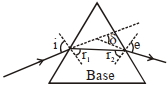
$(A)$ For a prism, the angle of deviation $\delta$ is given by $\delta = i + e - A$, where $i$ is the angle of incidence, $e$ is the angle of emergence, and $A$ is the prism angle.
At the angle of minimum deviation:
$1$. The angle of incidence is equal to the angle of emergence, i.e., $i = e$. This implies that the incident ray and emergent ray are symmetric with respect to the prism, making statement $(A)$ and $(C)$ true.
$2$. The refracted ray inside the prism becomes parallel to its base, which implies $r_1 = r_2$. This makes statement $(B)$ true.
Since statements $(A)$, $(B)$, and $(C)$ are all correct conditions for minimum deviation, the correct option is $(A)$.
At the angle of minimum deviation:
$1$. The angle of incidence is equal to the angle of emergence, i.e., $i = e$. This implies that the incident ray and emergent ray are symmetric with respect to the prism, making statement $(A)$ and $(C)$ true.
$2$. The refracted ray inside the prism becomes parallel to its base, which implies $r_1 = r_2$. This makes statement $(B)$ true.
Since statements $(A)$, $(B)$, and $(C)$ are all correct conditions for minimum deviation, the correct option is $(A)$.
0 likes
View Solution215
DifficultMCQ
$A$ deviation of $2^{\circ}$ is produced in the yellow ray when prisms of crown and flint glass are achromatically combined. Taking dispersive powers of crown and flint glass as $0.02$ and $0.03$ respectively and refractive indices for yellow light for these glasses as $1.5$ and $1.6$ respectively,the refracting angle for the crown glass prism will be $........\,^{\circ}$ (in degrees) (Round off to the nearest integer).
A
$15$
B
$10$
C
$18$
D
$12$
Solution
(D) Given: $\omega_{1} = 0.02, \mu_{1} = 1.5$ (Crown glass) and $\omega_{2} = 0.03, \mu_{2} = 1.6$ (Flint glass).
For an achromatic combination,the net dispersion is zero,so $\theta_{1} = \theta_{2}$.
This implies $\omega_{1} \delta_{1} = \omega_{2} \delta_{2}$,where $\delta$ is the deviation.
The net deviation is given as $\delta_{\text{net}} = \delta_{1} - \delta_{2} = 2^{\circ}$.
From the dispersion equation,$\delta_{2} = \frac{\omega_{1}}{\omega_{2}} \delta_{1} = \frac{0.02}{0.03} \delta_{1} = \frac{2}{3} \delta_{1}$.
Substituting this into the net deviation equation: $\delta_{1} - \frac{2}{3} \delta_{1} = 2^{\circ}$.
$\frac{1}{3} \delta_{1} = 2^{\circ} \implies \delta_{1} = 6^{\circ}$.
The deviation produced by a prism is $\delta = (\mu - 1)A$.
For the crown glass prism: $6^{\circ} = (1.5 - 1) A_{1}$.
$6^{\circ} = 0.5 A_{1} \implies A_{1} = 12^{\circ}$.
For an achromatic combination,the net dispersion is zero,so $\theta_{1} = \theta_{2}$.
This implies $\omega_{1} \delta_{1} = \omega_{2} \delta_{2}$,where $\delta$ is the deviation.
The net deviation is given as $\delta_{\text{net}} = \delta_{1} - \delta_{2} = 2^{\circ}$.
From the dispersion equation,$\delta_{2} = \frac{\omega_{1}}{\omega_{2}} \delta_{1} = \frac{0.02}{0.03} \delta_{1} = \frac{2}{3} \delta_{1}$.
Substituting this into the net deviation equation: $\delta_{1} - \frac{2}{3} \delta_{1} = 2^{\circ}$.
$\frac{1}{3} \delta_{1} = 2^{\circ} \implies \delta_{1} = 6^{\circ}$.
The deviation produced by a prism is $\delta = (\mu - 1)A$.
For the crown glass prism: $6^{\circ} = (1.5 - 1) A_{1}$.
$6^{\circ} = 0.5 A_{1} \implies A_{1} = 12^{\circ}$.
0 likes
View Solution216
DifficultMCQ
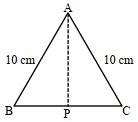
The cross-section of a prism is an equilateral triangle $ABC$ as shown in the figure. The minimum deviation is observed when the angle of incidence is equal to the prism angle. The time taken by light to travel from the midpoint $P$ of $BC$ to $A$ is $..... \times 10^{-10} \, s$. (Given: speed of light in vacuum $= 3 \times 10^8 \, m/s$ and $\cos 30^{\circ} = \frac{\sqrt{3}}{2}$)
A
$0.005$
B
$500$
C
$5.173$
D
$5$
Solution
(D) For an equilateral prism,the prism angle $A = 60^{\circ}$.
Given that minimum deviation occurs when the angle of incidence $i = A = 60^{\circ}$.
The refractive index $\mu$ of the prism is given by $\mu = \frac{\sin(\frac{\delta_{min} + A}{2})}{\sin(\frac{A}{2})}$.
At minimum deviation,$i = e = 60^{\circ}$,so $\delta_{min} = 2i - A = 2(60^{\circ}) - 60^{\circ} = 60^{\circ}$.
Thus,$\mu = \frac{\sin(60^{\circ})}{\sin(30^{\circ})} = \frac{\sqrt{3}/2}{1/2} = \sqrt{3}$.
The speed of light in the prism is $v = \frac{c}{\mu} = \frac{3 \times 10^8}{\sqrt{3}} \, m/s$.
The distance $AP$ is the height of the equilateral triangle with side $a = 10 \, cm = 0.1 \, m$.
$AP = a \sin 60^{\circ} = 0.1 \times \frac{\sqrt{3}}{2} = 0.05\sqrt{3} \, m$.
The time taken $t = \frac{AP}{v} = \frac{0.05\sqrt{3}}{3 \times 10^8 / \sqrt{3}} = \frac{0.05 \times 3}{3 \times 10^8} = 0.05 \times 10^{-8} = 5 \times 10^{-10} \, s$.
Therefore,the value is $5$.
Given that minimum deviation occurs when the angle of incidence $i = A = 60^{\circ}$.
The refractive index $\mu$ of the prism is given by $\mu = \frac{\sin(\frac{\delta_{min} + A}{2})}{\sin(\frac{A}{2})}$.
At minimum deviation,$i = e = 60^{\circ}$,so $\delta_{min} = 2i - A = 2(60^{\circ}) - 60^{\circ} = 60^{\circ}$.
Thus,$\mu = \frac{\sin(60^{\circ})}{\sin(30^{\circ})} = \frac{\sqrt{3}/2}{1/2} = \sqrt{3}$.
The speed of light in the prism is $v = \frac{c}{\mu} = \frac{3 \times 10^8}{\sqrt{3}} \, m/s$.
The distance $AP$ is the height of the equilateral triangle with side $a = 10 \, cm = 0.1 \, m$.
$AP = a \sin 60^{\circ} = 0.1 \times \frac{\sqrt{3}}{2} = 0.05\sqrt{3} \, m$.
The time taken $t = \frac{AP}{v} = \frac{0.05\sqrt{3}}{3 \times 10^8 / \sqrt{3}} = \frac{0.05 \times 3}{3 \times 10^8} = 0.05 \times 10^{-8} = 5 \times 10^{-10} \, s$.
Therefore,the value is $5$.
0 likes
View Solution217
MediumMCQ
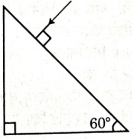
Find the value of the angle of emergence from the prism. The refractive index of the glass is $\sqrt{3}$. (in $^{\circ}$)
A
$60$
B
$30$
C
$45$
D
$90$
Solution
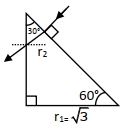
(A) From the geometry of the prism,the light ray enters the prism normally to the hypotenuse face. Thus,the angle of incidence at the first surface is $i_1 = 0^{\circ}$,which implies the angle of refraction $r_1 = 0^{\circ}$.
Given the prism angle $A = 30^{\circ}$,we use the relation $r_1 + r_2 = A$. Substituting $r_1 = 0^{\circ}$,we get $r_2 = 30^{\circ}$.
Applying Snell's law at the second surface (the vertical face): $\mu \sin r_2 = 1 \times \sin e$,where $\mu = \sqrt{3}$ and $e$ is the angle of emergence.
$\sqrt{3} \sin 30^{\circ} = \sin e$
$\sqrt{3} \times \frac{1}{2} = \sin e$
$\sin e = \frac{\sqrt{3}}{2}$
Therefore,$e = 60^{\circ}$.
Given the prism angle $A = 30^{\circ}$,we use the relation $r_1 + r_2 = A$. Substituting $r_1 = 0^{\circ}$,we get $r_2 = 30^{\circ}$.
Applying Snell's law at the second surface (the vertical face): $\mu \sin r_2 = 1 \times \sin e$,where $\mu = \sqrt{3}$ and $e$ is the angle of emergence.
$\sqrt{3} \sin 30^{\circ} = \sin e$
$\sqrt{3} \times \frac{1}{2} = \sin e$
$\sin e = \frac{\sqrt{3}}{2}$
Therefore,$e = 60^{\circ}$.
0 likes
View Solution218
DifficultMCQ
$A$ ray of light passing through a prism $(\mu = \sqrt{3})$ suffers minimum deviation. It is found that the angle of incidence is double the angle of refraction within the prism. Then,the angle of prism is ..... (in degrees).
A
$50$
B
$80$
C
$30$
D
$60$
Solution
(D) At minimum deviation,the angle of refraction $r_1 = r_2 = r = \frac{A}{2}$.
Given that the angle of incidence $i$ is double the angle of refraction $r$,so $i = 2r = A$.
According to Snell's Law,$1 \cdot \sin i = \mu \cdot \sin r$.
Substituting the values,$\sin A = \sqrt{3} \sin \frac{A}{2}$.
Using the trigonometric identity $\sin A = 2 \sin \frac{A}{2} \cos \frac{A}{2}$,we get $2 \sin \frac{A}{2} \cos \frac{A}{2} = \sqrt{3} \sin \frac{A}{2}$.
Since $\sin \frac{A}{2} \neq 0$,we have $\cos \frac{A}{2} = \frac{\sqrt{3}}{2}$.
This implies $\frac{A}{2} = 30^{\circ}$,so $A = 60^{\circ}$.
Given that the angle of incidence $i$ is double the angle of refraction $r$,so $i = 2r = A$.
According to Snell's Law,$1 \cdot \sin i = \mu \cdot \sin r$.
Substituting the values,$\sin A = \sqrt{3} \sin \frac{A}{2}$.
Using the trigonometric identity $\sin A = 2 \sin \frac{A}{2} \cos \frac{A}{2}$,we get $2 \sin \frac{A}{2} \cos \frac{A}{2} = \sqrt{3} \sin \frac{A}{2}$.
Since $\sin \frac{A}{2} \neq 0$,we have $\cos \frac{A}{2} = \frac{\sqrt{3}}{2}$.
This implies $\frac{A}{2} = 30^{\circ}$,so $A = 60^{\circ}$.
0 likes
View Solution219
DifficultMCQ
$A$ prism of refractive index $\mu$ and angle of prism $A$ is placed in the position of minimum angle of deviation. If the minimum angle of deviation is also $A$, then the value of $A$ in terms of refractive index $\mu$ is ..... .
A
$\sin^{-1}\left(\frac{\mu}{2}\right)$
B
$2 \cos^{-1}\left(\frac{\mu}{2}\right)$
C
$\sin^{-1}\left(\sqrt{\frac{\mu-1}{2}}\right)$
D
$\cos^{-1}\left(\frac{\mu}{2}\right)$
Solution
(B) The formula for the refractive index of a prism is given by $\mu = \frac{\sin((A+D)/2)}{\sin(A/2)}$, where $D$ is the angle of minimum deviation and $A$ is the angle of the prism.
Given the condition that the minimum angle of deviation $D = A$, we substitute this into the formula:
$\mu = \frac{\sin((A+A)/2)}{\sin(A/2)}$
$\mu = \frac{\sin(A)}{\sin(A/2)}$
Using the trigonometric identity $\sin(A) = 2 \sin(A/2) \cos(A/2)$, we get:
$\mu = \frac{2 \sin(A/2) \cos(A/2)}{\sin(A/2)}$
$\mu = 2 \cos(A/2)$
Rearranging to solve for $A$:
$\cos(A/2) = \frac{\mu}{2}$
$A/2 = \cos^{-1}(\mu/2)$
$A = 2 \cos^{-1}(\mu/2)$
Given the condition that the minimum angle of deviation $D = A$, we substitute this into the formula:
$\mu = \frac{\sin((A+A)/2)}{\sin(A/2)}$
$\mu = \frac{\sin(A)}{\sin(A/2)}$
Using the trigonometric identity $\sin(A) = 2 \sin(A/2) \cos(A/2)$, we get:
$\mu = \frac{2 \sin(A/2) \cos(A/2)}{\sin(A/2)}$
$\mu = 2 \cos(A/2)$
Rearranging to solve for $A$:
$\cos(A/2) = \frac{\mu}{2}$
$A/2 = \cos^{-1}(\mu/2)$
$A = 2 \cos^{-1}(\mu/2)$
0 likes
View Solution220
DifficultMCQ
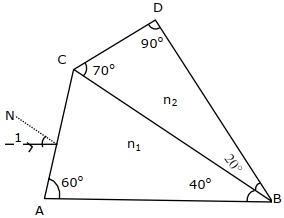
$A$ prism of refractive index $n_{1}$ and another prism of refractive index $n_{2}$ are stuck together (as shown in the figure). $n_{1}$ and $n_{2}$ depend on $\lambda$, the wavelength of light, according to the relation:
${n}_{1}=1.2+\frac{10.8 \times 10^{-14}}{\lambda^{2}} \text{ and } {n}_{2}=1.45+\frac{1.8 \times 10^{-14}}{\lambda^{2}}$
The wavelength for which rays incident at any angle on the interface $BC$ pass through without bending at that interface will be $....\,nm.$
${n}_{1}=1.2+\frac{10.8 \times 10^{-14}}{\lambda^{2}} \text{ and } {n}_{2}=1.45+\frac{1.8 \times 10^{-14}}{\lambda^{2}}$
The wavelength for which rays incident at any angle on the interface $BC$ pass through without bending at that interface will be $....\,nm.$
A
$500$
B
$600$
C
$700$
D
$800$
Solution
(B) For the light rays to pass through the interface $BC$ without bending (i.e., without refraction), the refractive indices of the two prisms must be equal at that specific wavelength.
Therefore, we set $n_{1} = n_{2}$:
$1.2 + \frac{10.8 \times 10^{-14}}{\lambda^{2}} = 1.45 + \frac{1.8 \times 10^{-14}}{\lambda^{2}}$
Rearranging the terms to solve for $\lambda$:
$\frac{10.8 \times 10^{-14}}{\lambda^{2}} - \frac{1.8 \times 10^{-14}}{\lambda^{2}} = 1.45 - 1.2$
$\frac{9 \times 10^{-14}}{\lambda^{2}} = 0.25$
$\lambda^{2} = \frac{9 \times 10^{-14}}{0.25}$
$\lambda^{2} = 36 \times 10^{-14}$
Taking the square root of both sides:
$\lambda = 6 \times 10^{-7} \text{ m}$
Converting meters to nanometers $(1 \text{ m} = 10^{9} \text{ nm})$:
$\lambda = 6 \times 10^{-7} \times 10^{9} \text{ nm} = 600 \text{ nm}$
Therefore, we set $n_{1} = n_{2}$:
$1.2 + \frac{10.8 \times 10^{-14}}{\lambda^{2}} = 1.45 + \frac{1.8 \times 10^{-14}}{\lambda^{2}}$
Rearranging the terms to solve for $\lambda$:
$\frac{10.8 \times 10^{-14}}{\lambda^{2}} - \frac{1.8 \times 10^{-14}}{\lambda^{2}} = 1.45 - 1.2$
$\frac{9 \times 10^{-14}}{\lambda^{2}} = 0.25$
$\lambda^{2} = \frac{9 \times 10^{-14}}{0.25}$
$\lambda^{2} = 36 \times 10^{-14}$
Taking the square root of both sides:
$\lambda = 6 \times 10^{-7} \text{ m}$
Converting meters to nanometers $(1 \text{ m} = 10^{9} \text{ nm})$:
$\lambda = 6 \times 10^{-7} \times 10^{9} \text{ nm} = 600 \text{ nm}$
0 likes
View Solution221
MediumMCQ
The expected graphical representation of the variation of angle of deviation $\delta$ with angle of incidence $i$ in a prism is:
A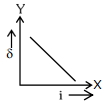
B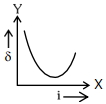
C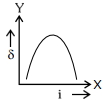
D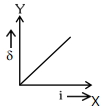
Solution
(B) In a prism,the angle of deviation $\delta$ is related to the angle of incidence $i$ by the formula $\delta = (i + e) - A$,where $e$ is the angle of emergence and $A$ is the prism angle.
As the angle of incidence $i$ increases,the angle of deviation $\delta$ first decreases,reaches a minimum value known as the angle of minimum deviation $(\delta_m)$,and then increases.
This relationship is represented by a parabolic-like curve that is concave upwards,which is shown in option $B$.
As the angle of incidence $i$ increases,the angle of deviation $\delta$ first decreases,reaches a minimum value known as the angle of minimum deviation $(\delta_m)$,and then increases.
This relationship is represented by a parabolic-like curve that is concave upwards,which is shown in option $B$.
0 likes
View Solution222
MediumMCQ
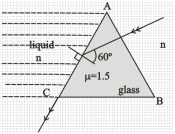
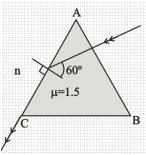
In the given figure,the face $AC$ of the equilateral prism is immersed in a liquid of refractive index $n$. For an incident angle of $60^{\circ}$ at the side $AC$,the refracted light beam just grazes along the face $AC$. The refractive index of the liquid is $n = \frac{\sqrt{x}}{4}$. The value of $x$ is (Given refractive index of glass $= 1.5$)
A
$27$
B
$270$
C
$22$
D
$30$
Solution
(A) According to Snell's law at the interface of the glass prism and the liquid at face $AC$:
$\mu_{glass} \sin(i) = n \sin(r)$
Given that the incident angle $i = 60^{\circ}$ and the refracted light grazes along the face $AC$,the angle of refraction $r = 90^{\circ}$.
Substituting the values:
$1.5 \times \sin(60^{\circ}) = n \times \sin(90^{\circ})$
$1.5 \times \frac{\sqrt{3}}{2} = n \times 1$
$n = \frac{1.5 \sqrt{3}}{2} = \frac{3 \sqrt{3}}{4}$
We are given $n = \frac{\sqrt{x}}{4}$.
Equating the two expressions for $n$:
$\frac{\sqrt{x}}{4} = \frac{3 \sqrt{3}}{4}$
$\sqrt{x} = 3 \sqrt{3} = \sqrt{9 \times 3} = \sqrt{27}$
Therefore,$x = 27$.
$\mu_{glass} \sin(i) = n \sin(r)$
Given that the incident angle $i = 60^{\circ}$ and the refracted light grazes along the face $AC$,the angle of refraction $r = 90^{\circ}$.
Substituting the values:
$1.5 \times \sin(60^{\circ}) = n \times \sin(90^{\circ})$
$1.5 \times \frac{\sqrt{3}}{2} = n \times 1$
$n = \frac{1.5 \sqrt{3}}{2} = \frac{3 \sqrt{3}}{4}$
We are given $n = \frac{\sqrt{x}}{4}$.
Equating the two expressions for $n$:
$\frac{\sqrt{x}}{4} = \frac{3 \sqrt{3}}{4}$
$\sqrt{x} = 3 \sqrt{3} = \sqrt{9 \times 3} = \sqrt{27}$
Therefore,$x = 27$.
0 likes
View Solution223
MediumMCQ
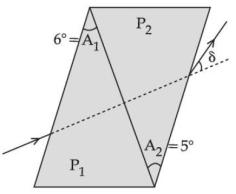
$A$ thin prism of angle $6^{\circ}$ and refractive index for yellow light $(n_{Y}) = 1.5$ is combined with another prism of angle $5^{\circ}$ and $n_{Y} = 1.55$. The combination produces no dispersion. The net average deviation $(\delta)$ produced by the combination is $(\frac{1}{x})^{\circ}$. The value of $x$ is.......
A
$0.4$
B
$4$
C
$40$
D
$8$
Solution
(B) For a thin prism,the average deviation is given by $\delta = A(n_{Y} - 1)$.
Since the two prisms are combined to produce no dispersion,they are placed in opposition to each other.
The net average deviation $\delta$ is given by the difference in deviations produced by the two prisms:
$\delta = A_{1}(n_{Y1} - 1) - A_{2}(n_{Y2} - 1)$
Given $A_{1} = 6^{\circ}$,$n_{Y1} = 1.5$ and $A_{2} = 5^{\circ}$,$n_{Y2} = 1.55$.
$\delta = 6(1.5 - 1) - 5(1.55 - 1)$
$\delta = 6(0.5) - 5(0.55)$
$\delta = 3.0 - 2.75 = 0.25^{\circ}$
We are given $\delta = (\frac{1}{x})^{\circ}$,so $\frac{1}{x} = 0.25 = \frac{1}{4}$.
Therefore,$x = 4$.
Since the two prisms are combined to produce no dispersion,they are placed in opposition to each other.
The net average deviation $\delta$ is given by the difference in deviations produced by the two prisms:
$\delta = A_{1}(n_{Y1} - 1) - A_{2}(n_{Y2} - 1)$
Given $A_{1} = 6^{\circ}$,$n_{Y1} = 1.5$ and $A_{2} = 5^{\circ}$,$n_{Y2} = 1.55$.
$\delta = 6(1.5 - 1) - 5(1.55 - 1)$
$\delta = 6(0.5) - 5(0.55)$
$\delta = 3.0 - 2.75 = 0.25^{\circ}$
We are given $\delta = (\frac{1}{x})^{\circ}$,so $\frac{1}{x} = 0.25 = \frac{1}{4}$.
Therefore,$x = 4$.
0 likes
View Solution224
AdvancedMCQ
It was found that the refractive index of the material of a certain prism varied as $\mu = 1.5 + 0.004 / \lambda^{2}$,where $\lambda$ is the wavelength of light used to measure the refractive index. The same material was then used to construct a thin prism of apex angle $10^{\circ}$. Angles of minimum deviation $\delta_{m}$ of the prism were recorded for the sources with wavelengths $\lambda_{1}$ and $\lambda_{2}$,respectively. Then,
A
$\delta_{m}(\lambda_{1}) < \delta_{m}(\lambda_{2})$ if $\lambda_{1} < \lambda_{2}$
B
$\delta_{m}(\lambda_{1}) > \delta_{m}(\lambda_{2})$ if $\lambda_{1} > \lambda_{2}$
C
$\delta_{m}(\lambda_{1}) > \delta_{m}(\lambda_{2})$ if $\lambda_{1} < \lambda_{2}$
D
$\delta_{m}$ is the same in both cases
Solution
(C) For a thin prism,the angle of minimum deviation $\delta_{m}$ is given by the formula: $\delta_{m} = (\mu - 1)A$,where $A$ is the apex angle.
Given $\mu = 1.5 + \frac{0.004}{\lambda^{2}}$,we substitute this into the formula:
$\delta_{m} = \left(1.5 + \frac{0.004}{\lambda^{2}} - 1\right)A = \left(0.5 + \frac{0.004}{\lambda^{2}}\right)A$.
From this expression,it is clear that $\delta_{m}$ is inversely proportional to $\lambda^{2}$.
Therefore,as the wavelength $\lambda$ increases,the refractive index $\mu$ decreases,which in turn causes the angle of minimum deviation $\delta_{m}$ to decrease.
If $\lambda_{1} < \lambda_{2}$,then $\mu(\lambda_{1}) > \mu(\lambda_{2})$.
Consequently,$\delta_{m}(\lambda_{1}) > \delta_{m}(\lambda_{2})$.
Given $\mu = 1.5 + \frac{0.004}{\lambda^{2}}$,we substitute this into the formula:
$\delta_{m} = \left(1.5 + \frac{0.004}{\lambda^{2}} - 1\right)A = \left(0.5 + \frac{0.004}{\lambda^{2}}\right)A$.
From this expression,it is clear that $\delta_{m}$ is inversely proportional to $\lambda^{2}$.
Therefore,as the wavelength $\lambda$ increases,the refractive index $\mu$ decreases,which in turn causes the angle of minimum deviation $\delta_{m}$ to decrease.
If $\lambda_{1} < \lambda_{2}$,then $\mu(\lambda_{1}) > \mu(\lambda_{2})$.
Consequently,$\delta_{m}(\lambda_{1}) > \delta_{m}(\lambda_{2})$.
0 likes
View Solution225
AdvancedMCQ
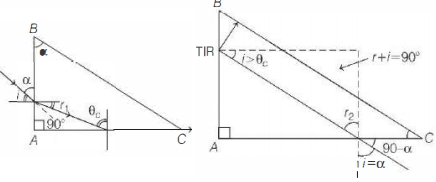
$A$ glass prism has a right-triangular cross-section $ABC$,with $\angle A=90^{\circ}$. $A$ ray of light parallel to the hypotenuse $BC$ and incident on the side $AB$ emerges grazing the side $AC$. Another ray,again parallel to the hypotenuse $BC$,incident on the side $AC$ suffers total internal reflection at the side $AB$. Which one of the following must be true about the refractive index $\mu$ of the material of the prism?
A
$\sqrt{\frac{3}{2}} < \mu < \sqrt{2}$
B
$\mu > \sqrt{3}$
C
$\mu < \sqrt{\frac{3}{2}}$
D
$\sqrt{2} < \mu < \sqrt{3}$
Solution
(D) Let the angles of the prism be $\angle B = \alpha$ and $\angle C = 90^{\circ} - \alpha$.
For the first ray incident on $AB$ parallel to $BC$,the angle of incidence $i = \alpha$. The ray emerges grazing $AC$,so the angle of refraction at the second surface is $90^{\circ}$. The angle of refraction at the first surface is $r_1 = 90^{\circ} - \alpha$. Using Snell's law at the first surface: $\sin \alpha = \mu \sin(90^{\circ} - \alpha) = \mu \cos \alpha$. Thus,$\tan \alpha = \mu$.
Since the ray grazes the surface $AC$,the angle of incidence at $AC$ is the critical angle $\theta_c$. Thus,$\sin \theta_c = \frac{1}{\mu}$.
From the geometry,$r_1 = 90^{\circ} - \theta_c$. Since $r_1 = 90^{\circ} - \alpha$,we have $\alpha = \theta_c$. Therefore,$\tan \alpha = \mu \Rightarrow \sin \alpha = \frac{\mu}{\sqrt{1+\mu^2}}$.
Since $\sin \alpha = \sin \theta_c = \frac{1}{\mu}$,we get $\frac{1}{\mu} = \frac{\mu}{\sqrt{1+\mu^2}} \Rightarrow 1+\mu^2 = \mu^4 \Rightarrow \mu^4 - \mu^2 - 1 = 0$. Solving for $\mu^2$,we get $\mu^2 = \frac{1+\sqrt{5}}{2} \approx 1.618$.
For the second ray incident on $AC$ parallel to $BC$,the angle of incidence is $i' = 90^{\circ} - \alpha$. For total internal reflection at $AB$,$i' > \theta_c \Rightarrow 90^{\circ} - \alpha > \theta_c \Rightarrow \cos \alpha > \sin \theta_c = \frac{1}{\mu}$.
Since $\tan \alpha = \mu$,$\cos \alpha = \frac{1}{\sqrt{1+\mu^2}}$. Thus,$\frac{1}{\sqrt{1+\mu^2}} > \frac{1}{\mu} \Rightarrow \mu^2 > 1+\mu^2$,which is impossible.
Re-evaluating the geometry: The condition for the first ray is $\mu = \frac{\sin i}{\sin r_1}$. With $i=\alpha$ and $r_1=90-\theta_c$,$\mu = \frac{\sin \alpha}{\cos \theta_c}$. For the second ray,$TIR$ at $AB$ requires $i > \theta_c$. The angle of incidence at $AB$ is $90-\alpha$. So $90-\alpha > \theta_c \Rightarrow \cos \alpha > \sin \theta_c = 1/\mu$.
Combining these,we find $\sqrt{2} < \mu < \sqrt{3}$.
For the first ray incident on $AB$ parallel to $BC$,the angle of incidence $i = \alpha$. The ray emerges grazing $AC$,so the angle of refraction at the second surface is $90^{\circ}$. The angle of refraction at the first surface is $r_1 = 90^{\circ} - \alpha$. Using Snell's law at the first surface: $\sin \alpha = \mu \sin(90^{\circ} - \alpha) = \mu \cos \alpha$. Thus,$\tan \alpha = \mu$.
Since the ray grazes the surface $AC$,the angle of incidence at $AC$ is the critical angle $\theta_c$. Thus,$\sin \theta_c = \frac{1}{\mu}$.
From the geometry,$r_1 = 90^{\circ} - \theta_c$. Since $r_1 = 90^{\circ} - \alpha$,we have $\alpha = \theta_c$. Therefore,$\tan \alpha = \mu \Rightarrow \sin \alpha = \frac{\mu}{\sqrt{1+\mu^2}}$.
Since $\sin \alpha = \sin \theta_c = \frac{1}{\mu}$,we get $\frac{1}{\mu} = \frac{\mu}{\sqrt{1+\mu^2}} \Rightarrow 1+\mu^2 = \mu^4 \Rightarrow \mu^4 - \mu^2 - 1 = 0$. Solving for $\mu^2$,we get $\mu^2 = \frac{1+\sqrt{5}}{2} \approx 1.618$.
For the second ray incident on $AC$ parallel to $BC$,the angle of incidence is $i' = 90^{\circ} - \alpha$. For total internal reflection at $AB$,$i' > \theta_c \Rightarrow 90^{\circ} - \alpha > \theta_c \Rightarrow \cos \alpha > \sin \theta_c = \frac{1}{\mu}$.
Since $\tan \alpha = \mu$,$\cos \alpha = \frac{1}{\sqrt{1+\mu^2}}$. Thus,$\frac{1}{\sqrt{1+\mu^2}} > \frac{1}{\mu} \Rightarrow \mu^2 > 1+\mu^2$,which is impossible.
Re-evaluating the geometry: The condition for the first ray is $\mu = \frac{\sin i}{\sin r_1}$. With $i=\alpha$ and $r_1=90-\theta_c$,$\mu = \frac{\sin \alpha}{\cos \theta_c}$. For the second ray,$TIR$ at $AB$ requires $i > \theta_c$. The angle of incidence at $AB$ is $90-\alpha$. So $90-\alpha > \theta_c \Rightarrow \cos \alpha > \sin \theta_c = 1/\mu$.
Combining these,we find $\sqrt{2} < \mu < \sqrt{3}$.
0 likes
View Solution226
MediumMCQ
Monochromatic light passes through a prism. Compared to that in air, inside the prism the light's
A
speed and wavelength are different, but frequency remains same
B
speed and frequency are different, but wavelength remains same
C
wavelength and frequency are different, but speed remains same
D
speed, wavelength and frequency are all different
Solution
(A) When light travels from one medium to another, its frequency $(f)$ remains constant because it is determined by the source of light.
The speed of light $(v)$ in a medium is given by $v = c/n$, where $c$ is the speed of light in vacuum and $n$ is the refractive index of the medium. Since the refractive index of the prism is greater than that of air $(n > 1)$, the speed of light decreases inside the prism.
The relationship between speed, frequency, and wavelength $(\lambda)$ is $v = f \lambda$. Since $v$ decreases and $f$ remains constant, the wavelength $\lambda$ must also decrease inside the prism.
Therefore, the speed and wavelength change, while the frequency remains the same.
The speed of light $(v)$ in a medium is given by $v = c/n$, where $c$ is the speed of light in vacuum and $n$ is the refractive index of the medium. Since the refractive index of the prism is greater than that of air $(n > 1)$, the speed of light decreases inside the prism.
The relationship between speed, frequency, and wavelength $(\lambda)$ is $v = f \lambda$. Since $v$ decreases and $f$ remains constant, the wavelength $\lambda$ must also decrease inside the prism.
Therefore, the speed and wavelength change, while the frequency remains the same.
0 likes
View Solution227
AdvancedMCQ
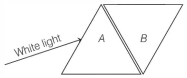
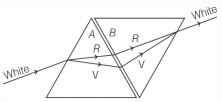
Consider two equivalent,triangular hollow prisms $A$ and $B$ made of thin glass plates and arranged with negligible spacing as shown in the figure. $A$ beam of white light is incident on prism $A$ from the left. Given that the refractive index of water is inversely related to temperature,the beam to the right of prism $B$ would not appear white,if
A
both prisms are filled with hot water $(70^{\circ} C)$
B
both prisms are filled with cold water $(7^{\circ} C)$
C
both prisms are empty
D
prism $A$ is filled with hot water $(70^{\circ} C)$ and prism $B$ with cold water $(7^{\circ} C)$
Solution
(D) Prism $B$ is inverted relative to prism $A$. Thus,the dispersion of light caused by prism $A$ and $B$ occurs in opposite directions.
For the emergent beam to be white,the net deviation and net dispersion produced by the combination must be zero. This requires the refractive indices of the liquids in both prisms to be identical,which happens if both prisms are at the same temperature.
If the prisms are at different temperatures,their refractive indices will differ because the refractive index of water is temperature-dependent. Consequently,the dispersion produced by prism $A$ will not be perfectly cancelled by prism $B$.
In option $(d)$,prism $A$ is at $70^{\circ} C$ and prism $B$ is at $7^{\circ} C$. Since their refractive indices are different,the dispersion produced by $A$ and $B$ are not equal and opposite. Hence,the beam to the right of prism $B$ will remain dispersed and appear coloured.
For the emergent beam to be white,the net deviation and net dispersion produced by the combination must be zero. This requires the refractive indices of the liquids in both prisms to be identical,which happens if both prisms are at the same temperature.
If the prisms are at different temperatures,their refractive indices will differ because the refractive index of water is temperature-dependent. Consequently,the dispersion produced by prism $A$ will not be perfectly cancelled by prism $B$.
In option $(d)$,prism $A$ is at $70^{\circ} C$ and prism $B$ is at $7^{\circ} C$. Since their refractive indices are different,the dispersion produced by $A$ and $B$ are not equal and opposite. Hence,the beam to the right of prism $B$ will remain dispersed and appear coloured.
0 likes
View Solution228
DifficultMCQ
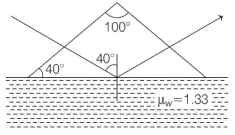
An isosceles glass prism with base angles $40^{\circ}$ is clamped over a tray of water in a position such that the base is just dipped in water. $A$ ray of light incident normally on the inclined face suffers total internal reflection at the base. If the refractive index of water is $1.33$,then the condition imposed on the refractive index $\mu$ of the glass is
A
$\mu < 2.07$
B
$\mu > 2.07$
C
$\mu < 1.74$
D
$\mu > 1.74$
Solution
(B) The base angles of the isosceles prism are $40^{\circ}$. The angle of incidence at the base is determined by the geometry of the prism. Since the light is incident normally on the inclined face,it enters the prism without deviation and strikes the base at an angle of $40^{\circ}$ with respect to the normal.
For total internal reflection $(TIR)$ to occur at the base,the angle of incidence $i$ must be greater than the critical angle $\theta_c$ between the glass and water.
Given $i = 40^{\circ}$,the condition for $TIR$ is $i > \theta_c$,which implies $\sin i > \sin \theta_c$.
We know that $\sin \theta_c = \frac{\mu_w}{\mu_g}$,where $\mu_w = 1.33$ is the refractive index of water and $\mu_g = \mu$ is the refractive index of the glass.
Therefore,$\sin 40^{\circ} > \frac{1.33}{\mu}$.
Rearranging for $\mu$,we get $\mu > \frac{1.33}{\sin 40^{\circ}}$.
Using $\sin 40^{\circ} \approx 0.6428$,we calculate $\mu > \frac{1.33}{0.6428} \approx 2.069$.
Rounding to two decimal places,the condition is $\mu > 2.07$.
For total internal reflection $(TIR)$ to occur at the base,the angle of incidence $i$ must be greater than the critical angle $\theta_c$ between the glass and water.
Given $i = 40^{\circ}$,the condition for $TIR$ is $i > \theta_c$,which implies $\sin i > \sin \theta_c$.
We know that $\sin \theta_c = \frac{\mu_w}{\mu_g}$,where $\mu_w = 1.33$ is the refractive index of water and $\mu_g = \mu$ is the refractive index of the glass.
Therefore,$\sin 40^{\circ} > \frac{1.33}{\mu}$.
Rearranging for $\mu$,we get $\mu > \frac{1.33}{\sin 40^{\circ}}$.
Using $\sin 40^{\circ} \approx 0.6428$,we calculate $\mu > \frac{1.33}{0.6428} \approx 2.069$.
Rounding to two decimal places,the condition is $\mu > 2.07$.
0 likes
View Solution229
DifficultMCQ
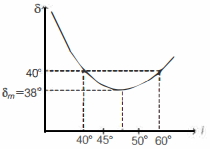
The angle of a prism is $60^{\circ}$. When light is incident at an angle of $60^{\circ}$ on the prism,the angle of emergence is $40^{\circ}$. The angle of incidence $i$ for which the light ray will deviate the least is such that
A
$i < 40^{\circ}$
B
$40^{\circ} < i < 50^{\circ}$
C
$50^{\circ} < i < 60^{\circ}$
D
$i > 60^{\circ}$
Solution
(B) For a prism,the deviation $\delta$ is given by $\delta = i + e - A$,where $i$ is the angle of incidence,$e$ is the angle of emergence,and $A$ is the prism angle.
Given $A = 60^{\circ}$,$i = 60^{\circ}$,and $e = 40^{\circ}$.
Thus,the deviation $\delta = 60^{\circ} + 40^{\circ} - 60^{\circ} = 40^{\circ}$.
According to the principle of reversibility of light,if $i = 60^{\circ}$ gives $e = 40^{\circ}$,then $i = 40^{\circ}$ will give $e = 60^{\circ}$,resulting in the same deviation $\delta = 40^{\circ}$.
The graph of deviation $\delta$ versus angle of incidence $i$ is a $U$-shaped curve where the minimum deviation $\delta_m$ occurs at the angle of incidence $i = i_m$.
Since the deviation is the same $(40^{\circ})$ at $i = 40^{\circ}$ and $i = 60^{\circ}$,the minimum deviation must occur at an angle of incidence between these two values.
Therefore,the angle of incidence for minimum deviation lies in the range $40^{\circ} < i < 60^{\circ}$. Looking at the provided graph,the minimum occurs at $i \approx 48^{\circ}$,which falls in the range $40^{\circ} < i < 50^{\circ}$.
Given $A = 60^{\circ}$,$i = 60^{\circ}$,and $e = 40^{\circ}$.
Thus,the deviation $\delta = 60^{\circ} + 40^{\circ} - 60^{\circ} = 40^{\circ}$.
According to the principle of reversibility of light,if $i = 60^{\circ}$ gives $e = 40^{\circ}$,then $i = 40^{\circ}$ will give $e = 60^{\circ}$,resulting in the same deviation $\delta = 40^{\circ}$.
The graph of deviation $\delta$ versus angle of incidence $i$ is a $U$-shaped curve where the minimum deviation $\delta_m$ occurs at the angle of incidence $i = i_m$.
Since the deviation is the same $(40^{\circ})$ at $i = 40^{\circ}$ and $i = 60^{\circ}$,the minimum deviation must occur at an angle of incidence between these two values.
Therefore,the angle of incidence for minimum deviation lies in the range $40^{\circ} < i < 60^{\circ}$. Looking at the provided graph,the minimum occurs at $i \approx 48^{\circ}$,which falls in the range $40^{\circ} < i < 50^{\circ}$.
0 likes
View Solution230
MediumMCQ
The refractive index of a prism is measured using three lines of a mercury vapour lamp. If $\mu_1, \mu_2$ and $\mu_3$ are the measured refractive indices for these green,blue and yellow lines respectively,then
A
$\mu_2 > \mu_3 > \mu_1$
B
$\mu_2 > \mu_1 > \mu_3$
C
$\mu_3 > \mu_2 > \mu_1$
D
$\mu_1 > \mu_2 > \mu_3$
Solution
(B) The refractive index of a material is inversely proportional to the wavelength of light according to Cauchy's dispersion formula,$\mu \propto \frac{1}{\lambda}$.
The wavelengths of the given colors are in the order: $\lambda_{\text{yellow}} > \lambda_{\text{green}} > \lambda_{\text{blue}}$.
Since $\mu$ is inversely proportional to $\lambda$,the refractive indices will follow the order: $\mu_{\text{yellow}} < \mu_{\text{green}} < \mu_{\text{blue}}$.
Given that $\mu_1$ is for green,$\mu_2$ is for blue,and $\mu_3$ is for yellow,we have $\mu_3 < \mu_1 < \mu_2$,which can be written as $\mu_2 > \mu_1 > \mu_3$.
The wavelengths of the given colors are in the order: $\lambda_{\text{yellow}} > \lambda_{\text{green}} > \lambda_{\text{blue}}$.
Since $\mu$ is inversely proportional to $\lambda$,the refractive indices will follow the order: $\mu_{\text{yellow}} < \mu_{\text{green}} < \mu_{\text{blue}}$.
Given that $\mu_1$ is for green,$\mu_2$ is for blue,and $\mu_3$ is for yellow,we have $\mu_3 < \mu_1 < \mu_2$,which can be written as $\mu_2 > \mu_1 > \mu_3$.
0 likes
View Solution231
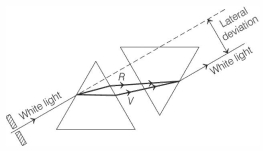
MediumMCQ
White light is split into a spectrum by a prism and it is seen on a screen. If we put another identical inverted prism behind it in contact,what will be seen on the screen?
A
Violet will appear where red was
B
The spectrum will remain the same
C
There will be no spectrum,but only the original light with no deviation
D
There will be no spectrum,but the original light will be laterally displaced
Solution
(C) The correct answer is $C$.
When a beam of white light passes through the first prism,it undergoes dispersion and splits into its constituent colors (spectrum).
When a second identical prism is placed in an inverted position in contact with the first,it acts as a recombination prism. The dispersion caused by the first prism is exactly cancelled by the second prism,resulting in the recombination of the colors back into a single beam of white light.
Since the two prisms together form a structure equivalent to a glass slab with parallel faces,the emergent white light beam is parallel to the incident beam,meaning there is no angular deviation. Therefore,no spectrum is observed on the screen,only the original white light.
When a beam of white light passes through the first prism,it undergoes dispersion and splits into its constituent colors (spectrum).
When a second identical prism is placed in an inverted position in contact with the first,it acts as a recombination prism. The dispersion caused by the first prism is exactly cancelled by the second prism,resulting in the recombination of the colors back into a single beam of white light.
Since the two prisms together form a structure equivalent to a glass slab with parallel faces,the emergent white light beam is parallel to the incident beam,meaning there is no angular deviation. Therefore,no spectrum is observed on the screen,only the original white light.
0 likes
View Solution232
EasyMCQ
Yellow light is refracted through a prism producing minimum deviation. If $i_1$ and $i_2$ denote the angle of incidence and emergence for the prism,then ..........
A
$i_1 = i_2$
B
$i_1 > i_2$
C
$i_1 < i_2$
D
$i_1 + i_2 = 90^{\circ}$
Solution
(A) For a prism,the deviation $\delta$ is given by $\delta = (i_1 + i_2) - A$,where $A$ is the prism angle.
At the condition of minimum deviation,the light ray passes symmetrically through the prism.
This symmetry implies that the angle of incidence $i_1$ is equal to the angle of emergence $i_2$,i.e.,$i_1 = i_2$.
Therefore,the correct option is $A$.
At the condition of minimum deviation,the light ray passes symmetrically through the prism.
This symmetry implies that the angle of incidence $i_1$ is equal to the angle of emergence $i_2$,i.e.,$i_1 = i_2$.
Therefore,the correct option is $A$.
0 likes
View Solution233
MediumMCQ
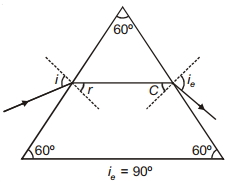
At what angle will a ray of light be incident on one face of an equilateral prism,so that the emergent ray may graze the second surface of the prism $(\mu=2)$ (in $^{\circ}$)?
A
$30$
B
$90$
C
$45$
D
$60$
Solution
(B) For an equilateral prism,the prism angle $A = 60^{\circ}$.
When the emergent ray grazes the second surface,the angle of emergence $i_e = 90^{\circ}$.
At the second surface,the angle of refraction is equal to the critical angle $C$. Thus,$r_2 = C$.
Using Snell's law at the second surface: $\mu \sin r_2 = 1 \cdot \sin i_e$.
Given $\mu = 2$ and $i_e = 90^{\circ}$,we have $2 \sin C = \sin 90^{\circ} = 1$,so $\sin C = 0.5$,which gives $C = 30^{\circ}$.
Therefore,$r_2 = 30^{\circ}$.
From the geometry of the prism,$A = r_1 + r_2$. Substituting the values,$60^{\circ} = r_1 + 30^{\circ}$,which gives $r_1 = 30^{\circ}$.
Now,applying Snell's law at the first surface: $\sin i = \mu \sin r_1$.
$\sin i = 2 \cdot \sin 30^{\circ} = 2 \cdot 0.5 = 1$.
Thus,$i = 90^{\circ}$.
When the emergent ray grazes the second surface,the angle of emergence $i_e = 90^{\circ}$.
At the second surface,the angle of refraction is equal to the critical angle $C$. Thus,$r_2 = C$.
Using Snell's law at the second surface: $\mu \sin r_2 = 1 \cdot \sin i_e$.
Given $\mu = 2$ and $i_e = 90^{\circ}$,we have $2 \sin C = \sin 90^{\circ} = 1$,so $\sin C = 0.5$,which gives $C = 30^{\circ}$.
Therefore,$r_2 = 30^{\circ}$.
From the geometry of the prism,$A = r_1 + r_2$. Substituting the values,$60^{\circ} = r_1 + 30^{\circ}$,which gives $r_1 = 30^{\circ}$.
Now,applying Snell's law at the first surface: $\sin i = \mu \sin r_1$.
$\sin i = 2 \cdot \sin 30^{\circ} = 2 \cdot 0.5 = 1$.
Thus,$i = 90^{\circ}$.
0 likes
View Solution234
MediumMCQ
An isosceles prism of angle $A=30^{\circ}$ has one of its surfaces silvered. Light rays falling at an angle of incidence $60^{\circ}$ on the other surface retrace their path after reflection from the silvered surface. The refractive index of the prism material is

A
$1.414$
B
$1.5$
C
$1.732$
D
$1.866$
Solution
(C) For a light ray to retrace its path after reflection from the silvered surface,it must strike the silvered surface normally (at an angle of incidence of $0^{\circ}$).
Let $i$ be the angle of incidence on the first surface and $r$ be the angle of refraction.
Given,$i = 60^{\circ}$ and the prism angle $A = 30^{\circ}$.
From the geometry of the prism,the angle of refraction $r$ at the first surface is related to the prism angle $A$ and the angle of incidence at the second surface $r'$ by $A = r + r'$.
Since the ray strikes the second surface normally,$r' = 0^{\circ}$.
Therefore,$r = A = 30^{\circ}$.
Using Snell's Law at the first surface:
$\mu = \frac{\sin i}{\sin r} = \frac{\sin 60^{\circ}}{\sin 30^{\circ}}$
$\mu = \frac{\sqrt{3}/2}{1/2} = \sqrt{3} \approx 1.732$.
Thus,the refractive index of the prism material is $1.732$.
Let $i$ be the angle of incidence on the first surface and $r$ be the angle of refraction.
Given,$i = 60^{\circ}$ and the prism angle $A = 30^{\circ}$.
From the geometry of the prism,the angle of refraction $r$ at the first surface is related to the prism angle $A$ and the angle of incidence at the second surface $r'$ by $A = r + r'$.
Since the ray strikes the second surface normally,$r' = 0^{\circ}$.
Therefore,$r = A = 30^{\circ}$.
Using Snell's Law at the first surface:
$\mu = \frac{\sin i}{\sin r} = \frac{\sin 60^{\circ}}{\sin 30^{\circ}}$
$\mu = \frac{\sqrt{3}/2}{1/2} = \sqrt{3} \approx 1.732$.
Thus,the refractive index of the prism material is $1.732$.

0 likes
View Solution235
EasyMCQ
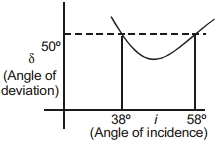
$A$ plot between the angle of deviation and angle of incidence is shown in the figure. From the graph,one can say that the prism angle is ....... (in $^{\circ}$)
A
$47$
B
$46$
C
$45$
D
$60$
Solution
(B) For a prism,the relation between the angle of incidence $(i)$,angle of emergence $(e)$,prism angle $(A)$,and angle of deviation $(\delta)$ is given by:
$i + e = A + \delta$
From the given graph,for a specific angle of deviation $\delta = 50^{\circ}$,there are two corresponding angles of incidence,$i_1 = 38^{\circ}$ and $i_2 = 58^{\circ}$.
In the case of a prism,for a given angle of deviation (other than the minimum deviation),the two values of the angle of incidence correspond to $i$ and $e$ respectively.
Substituting these values into the formula:
$38^{\circ} + 58^{\circ} = A + 50^{\circ}$
$96^{\circ} = A + 50^{\circ}$
$A = 96^{\circ} - 50^{\circ}$
$A = 46^{\circ}$
Thus,the prism angle is $46^{\circ}$.
$i + e = A + \delta$
From the given graph,for a specific angle of deviation $\delta = 50^{\circ}$,there are two corresponding angles of incidence,$i_1 = 38^{\circ}$ and $i_2 = 58^{\circ}$.
In the case of a prism,for a given angle of deviation (other than the minimum deviation),the two values of the angle of incidence correspond to $i$ and $e$ respectively.
Substituting these values into the formula:
$38^{\circ} + 58^{\circ} = A + 50^{\circ}$
$96^{\circ} = A + 50^{\circ}$
$A = 96^{\circ} - 50^{\circ}$
$A = 46^{\circ}$
Thus,the prism angle is $46^{\circ}$.
0 likes
View Solution236
MediumMCQ
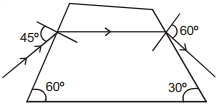
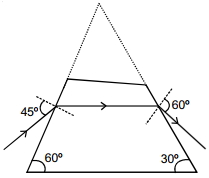
In the diagram,a ray is passing through a broken prism. Find the angular deviation for the ray. (in $^{\circ}$)
A
$105$
B
$30$
C
$60$
D
$15$
Solution
(D) The prism is a triangle with base angles $60^{\circ}$ and $30^{\circ}$.
The third angle $A$ of the prism is given by:
$A = 180^{\circ} - (60^{\circ} + 30^{\circ}) = 180^{\circ} - 90^{\circ} = 90^{\circ}$.
For a prism,the relation between the angle of incidence $i$,angle of emergence $e$,prism angle $A$,and angle of deviation $\delta$ is:
$i + e = A + \delta$.
From the diagram,the angle of incidence $i = 45^{\circ}$ and the angle of emergence $e = 60^{\circ}$.
Substituting these values into the formula:
$45^{\circ} + 60^{\circ} = 90^{\circ} + \delta$
$105^{\circ} = 90^{\circ} + \delta$
$\delta = 105^{\circ} - 90^{\circ} = 15^{\circ}$.
Thus,the angular deviation is $15^{\circ}$.
The third angle $A$ of the prism is given by:
$A = 180^{\circ} - (60^{\circ} + 30^{\circ}) = 180^{\circ} - 90^{\circ} = 90^{\circ}$.
For a prism,the relation between the angle of incidence $i$,angle of emergence $e$,prism angle $A$,and angle of deviation $\delta$ is:
$i + e = A + \delta$.
From the diagram,the angle of incidence $i = 45^{\circ}$ and the angle of emergence $e = 60^{\circ}$.
Substituting these values into the formula:
$45^{\circ} + 60^{\circ} = 90^{\circ} + \delta$
$105^{\circ} = 90^{\circ} + \delta$
$\delta = 105^{\circ} - 90^{\circ} = 15^{\circ}$.
Thus,the angular deviation is $15^{\circ}$.
0 likes
View Solution237
MediumMCQ
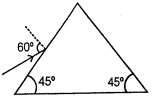
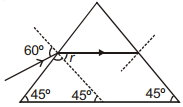
In the diagram,the ray passing through the prism is parallel to the base. The refractive index of the material of the prism is:
A
$\frac{\sqrt{3}}{2}$
B
$\sqrt{3}$
C
$\sqrt{2}$
D
$\sqrt{\frac{3}{2}}$
Solution
(D) Given that the ray inside the prism is parallel to the base,the angle of refraction $r$ at the first surface must be equal to the base angle of the prism.
From the geometry of the triangle,the base angle is $45^{\circ}$,so $r = 45^{\circ}$.
The angle of incidence $i$ is given as $60^{\circ}$.
According to Snell's Law,$\mu = \frac{\sin i}{\sin r}$.
Substituting the values,$\mu = \frac{\sin 60^{\circ}}{\sin 45^{\circ}} = \frac{\frac{\sqrt{3}}{2}}{\frac{1}{\sqrt{2}}} = \frac{\sqrt{3}}{2} \times \sqrt{2} = \sqrt{\frac{3}{2}}$.
Thus,the refractive index is $\sqrt{\frac{3}{2}}$.
From the geometry of the triangle,the base angle is $45^{\circ}$,so $r = 45^{\circ}$.
The angle of incidence $i$ is given as $60^{\circ}$.
According to Snell's Law,$\mu = \frac{\sin i}{\sin r}$.
Substituting the values,$\mu = \frac{\sin 60^{\circ}}{\sin 45^{\circ}} = \frac{\frac{\sqrt{3}}{2}}{\frac{1}{\sqrt{2}}} = \frac{\sqrt{3}}{2} \times \sqrt{2} = \sqrt{\frac{3}{2}}$.
Thus,the refractive index is $\sqrt{\frac{3}{2}}$.
0 likes
View Solution238
EasyMCQ
$A$ thin prism of angle $6^{\circ}$ made of glass of refractive index $1.5$ is combined with another prism made of glass of refractive index $1.75$ to produce dispersion without deviation. Then the angle of the second prism is ...... (in $^{\circ}$)
A
$7$
B
$4$
C
$9$
D
$5$
Solution
(B) For dispersion without deviation,the net deviation produced by the combination must be zero.
The condition for deviation without dispersion is given by:
$\delta_1 + \delta_2 = 0$
Since the prisms are combined to produce dispersion without deviation,the net deviation is:
$A_1(\mu_1 - 1) + A_2(\mu_2 - 1) = 0$
Given:
$A_1 = 6^{\circ}$,$\mu_1 = 1.5$,$\mu_2 = 1.75$
Substituting the values:
$6(1.5 - 1) + A_2(1.75 - 1) = 0$
$6(0.5) + A_2(0.75) = 0$
$3 + 0.75 A_2 = 0$
Since the prisms must be placed in opposite orientations to cancel the deviation,the formula is $A_1(\mu_1 - 1) - A_2(\mu_2 - 1) = 0$.
$3 - 0.75 A_2 = 0$
$0.75 A_2 = 3$
$A_2 = \frac{3}{0.75} = 4^{\circ}$
The condition for deviation without dispersion is given by:
$\delta_1 + \delta_2 = 0$
Since the prisms are combined to produce dispersion without deviation,the net deviation is:
$A_1(\mu_1 - 1) + A_2(\mu_2 - 1) = 0$
Given:
$A_1 = 6^{\circ}$,$\mu_1 = 1.5$,$\mu_2 = 1.75$
Substituting the values:
$6(1.5 - 1) + A_2(1.75 - 1) = 0$
$6(0.5) + A_2(0.75) = 0$
$3 + 0.75 A_2 = 0$
Since the prisms must be placed in opposite orientations to cancel the deviation,the formula is $A_1(\mu_1 - 1) - A_2(\mu_2 - 1) = 0$.
$3 - 0.75 A_2 = 0$
$0.75 A_2 = 3$
$A_2 = \frac{3}{0.75} = 4^{\circ}$
0 likes
View Solution239
MediumMCQ
$A$ thin prism $P_1$ with an angle $6^{\circ}$ and made of glass of refractive index $1.54$ is combined with another prism $P_2$ made from glass of refractive index $1.72$ to produce dispersion without average deviation. The angle of prism $P_2$ is $........{}^{\circ}$
A
$6$
B
$1.3$
C
$7.8$
D
$4.5$
Solution
(D) For dispersion without average deviation,the net deviation produced by the combination must be zero.
The condition for no average deviation is given by $\delta_1 + \delta_2 = 0$,which implies $|\delta_1| = |\delta_2|$.
The deviation produced by a thin prism is $\delta = A(\mu - 1)$.
For prism $P_1$: $A_1 = 6^{\circ}$,$\mu_1 = 1.54$.
For prism $P_2$: $A_2 = A$,$\mu_2 = 1.72$.
Equating the deviations: $A_1(\mu_1 - 1) = A_2(\mu_2 - 1)$.
$6^{\circ}(1.54 - 1) = A(1.72 - 1)$.
$6^{\circ}(0.54) = A(0.72)$.
$A = \frac{6^{\circ} \times 0.54}{0.72} = \frac{6 \times 54}{72} = \frac{324}{72} = 4.5^{\circ}$.
The condition for no average deviation is given by $\delta_1 + \delta_2 = 0$,which implies $|\delta_1| = |\delta_2|$.
The deviation produced by a thin prism is $\delta = A(\mu - 1)$.
For prism $P_1$: $A_1 = 6^{\circ}$,$\mu_1 = 1.54$.
For prism $P_2$: $A_2 = A$,$\mu_2 = 1.72$.
Equating the deviations: $A_1(\mu_1 - 1) = A_2(\mu_2 - 1)$.
$6^{\circ}(1.54 - 1) = A(1.72 - 1)$.
$6^{\circ}(0.54) = A(0.72)$.
$A = \frac{6^{\circ} \times 0.54}{0.72} = \frac{6 \times 54}{72} = \frac{324}{72} = 4.5^{\circ}$.
0 likes
View Solution240
MediumMCQ
The refractive index of a transparent liquid filled in an equilateral hollow prism is $\sqrt{2}$. The angle of minimum deviation for the liquid will be (in $^{\circ}$)
A
$30$
B
$20$
C
$40$
D
$50$
Solution
(A) The formula for the refractive index $\mu$ of a prism is given by $\mu = \frac{\sin((D_{\min} + A)/2)}{\sin(A/2)}$.
Given that the prism is equilateral,the angle of the prism $A = 60^{\circ}$.
The refractive index $\mu = \sqrt{2}$.
Substituting these values into the formula:
$\sqrt{2} = \frac{\sin((D_{\min} + 60^{\circ})/2)}{\sin(60^{\circ}/2)}$
$\sqrt{2} = \frac{\sin((D_{\min} + 60^{\circ})/2)}{\sin(30^{\circ})}$
Since $\sin(30^{\circ}) = 1/2$,we have:
$\sqrt{2} = \frac{\sin((D_{\min} + 60^{\circ})/2)}{1/2}$
$\frac{\sqrt{2}}{2} = \sin((D_{\min} + 60^{\circ})/2)$
$\frac{1}{\sqrt{2}} = \sin((D_{\min} + 60^{\circ})/2)$
Since $\sin(45^{\circ}) = 1/\sqrt{2}$,we get:
$(D_{\min} + 60^{\circ})/2 = 45^{\circ}$
$D_{\min} + 60^{\circ} = 90^{\circ}$
$D_{\min} = 30^{\circ}$.
Given that the prism is equilateral,the angle of the prism $A = 60^{\circ}$.
The refractive index $\mu = \sqrt{2}$.
Substituting these values into the formula:
$\sqrt{2} = \frac{\sin((D_{\min} + 60^{\circ})/2)}{\sin(60^{\circ}/2)}$
$\sqrt{2} = \frac{\sin((D_{\min} + 60^{\circ})/2)}{\sin(30^{\circ})}$
Since $\sin(30^{\circ}) = 1/2$,we have:
$\sqrt{2} = \frac{\sin((D_{\min} + 60^{\circ})/2)}{1/2}$
$\frac{\sqrt{2}}{2} = \sin((D_{\min} + 60^{\circ})/2)$
$\frac{1}{\sqrt{2}} = \sin((D_{\min} + 60^{\circ})/2)$
Since $\sin(45^{\circ}) = 1/\sqrt{2}$,we get:
$(D_{\min} + 60^{\circ})/2 = 45^{\circ}$
$D_{\min} + 60^{\circ} = 90^{\circ}$
$D_{\min} = 30^{\circ}$.
0 likes
View Solution241
DifficultMCQ
If the refractive index of the material of a prism is $\cot(A/2)$,where $A$ is the angle of the prism,then the angle of minimum deviation will be:
A
$\pi - 2A$
B
$\frac{\pi}{2} - 2A$
C
$\pi - A$
D
$\frac{\pi}{2} - A$
Solution
(A) The formula for the refractive index $\mu$ of a prism is given by $\mu = \frac{\sin((A + \delta_{\min})/2)}{\sin(A/2)}$.
Given $\mu = \cot(A/2) = \frac{\cos(A/2)}{\sin(A/2)}$.
Equating the two expressions: $\frac{\cos(A/2)}{\sin(A/2)} = \frac{\sin((A + \delta_{\min})/2)}{\sin(A/2)}$.
This simplifies to $\cos(A/2) = \sin((A + \delta_{\min})/2)$.
Using the identity $\cos \theta = \sin(\frac{\pi}{2} - \theta)$,we get $\sin(\frac{\pi}{2} - A/2) = \sin((A + \delta_{\min})/2)$.
Comparing the angles: $\frac{\pi}{2} - \frac{A}{2} = \frac{A + \delta_{\min}}{2}$.
Multiplying by $2$: $\pi - A = A + \delta_{\min}$.
Therefore,$\delta_{\min} = \pi - 2A$.
Given $\mu = \cot(A/2) = \frac{\cos(A/2)}{\sin(A/2)}$.
Equating the two expressions: $\frac{\cos(A/2)}{\sin(A/2)} = \frac{\sin((A + \delta_{\min})/2)}{\sin(A/2)}$.
This simplifies to $\cos(A/2) = \sin((A + \delta_{\min})/2)$.
Using the identity $\cos \theta = \sin(\frac{\pi}{2} - \theta)$,we get $\sin(\frac{\pi}{2} - A/2) = \sin((A + \delta_{\min})/2)$.
Comparing the angles: $\frac{\pi}{2} - \frac{A}{2} = \frac{A + \delta_{\min}}{2}$.
Multiplying by $2$: $\pi - A = A + \delta_{\min}$.
Therefore,$\delta_{\min} = \pi - 2A$.
0 likes
View Solution242
DifficultMCQ
The refractive index of a prism with apex angle $A$ is $\cot(A/2)$. The angle of minimum deviation is:
A
$\delta_{m}=180^{\circ}-A$
B
$\delta_m=180^{\circ}-3A$
C
$\delta_m=180^{\circ}-4A$
D
$\delta_{m}=180^{\circ}-2A$
Solution
(D) The formula for the refractive index $\mu$ of a prism in terms of the apex angle $A$ and the angle of minimum deviation $\delta_m$ is given by:
$\mu = \frac{\sin((A + \delta_m)/2)}{\sin(A/2)}$
Given $\mu = \cot(A/2) = \frac{\cos(A/2)}{\sin(A/2)}$,we equate the two expressions:
$\frac{\cos(A/2)}{\sin(A/2)} = \frac{\sin((A + \delta_m)/2)}{\sin(A/2)}$
Canceling $\sin(A/2)$ from both sides,we get:
$\cos(A/2) = \sin((A + \delta_m)/2)$
Using the trigonometric identity $\cos(\theta) = \sin(90^{\circ} - \theta)$,we write:
$\sin(90^{\circ} - A/2) = \sin((A + \delta_m)/2)$
Equating the angles:
$90^{\circ} - A/2 = (A + \delta_m)/2$
$180^{\circ} - A = A + \delta_m$
$\delta_m = 180^{\circ} - 2A$
$\mu = \frac{\sin((A + \delta_m)/2)}{\sin(A/2)}$
Given $\mu = \cot(A/2) = \frac{\cos(A/2)}{\sin(A/2)}$,we equate the two expressions:
$\frac{\cos(A/2)}{\sin(A/2)} = \frac{\sin((A + \delta_m)/2)}{\sin(A/2)}$
Canceling $\sin(A/2)$ from both sides,we get:
$\cos(A/2) = \sin((A + \delta_m)/2)$
Using the trigonometric identity $\cos(\theta) = \sin(90^{\circ} - \theta)$,we write:
$\sin(90^{\circ} - A/2) = \sin((A + \delta_m)/2)$
Equating the angles:
$90^{\circ} - A/2 = (A + \delta_m)/2$
$180^{\circ} - A = A + \delta_m$
$\delta_m = 180^{\circ} - 2A$
0 likes
View Solution243
DifficultMCQ
Given below are two statements :
Statement $I$ : When white light is passed through a prism,the red light bends less than yellow and violet light.
Statement $II$ : The refractive indices are different for different wavelengths in a dispersive medium.
In the light of the above statements,choose the correct answer from the options given below :
Statement $I$ : When white light is passed through a prism,the red light bends less than yellow and violet light.
Statement $II$ : The refractive indices are different for different wavelengths in a dispersive medium.
In the light of the above statements,choose the correct answer from the options given below :
A
Both Statement $I$ and Statement $II$ are true.
B
Statement $I$ is true but Statement $II$ is false.
C
Both Statement $I$ and Statement $II$ are false.
D
Statement $I$ is false but Statement $II$ is true.
Solution
(A) According to Cauchy's equation,the refractive index $\mu$ of a medium depends on the wavelength $\lambda$ as $\mu(\lambda) = A + B/\lambda^2 + ...$.
Since $\lambda_{\text{red}} > \lambda_{\text{yellow}} > \lambda_{\text{violet}}$,the refractive index for red light is the smallest,and for violet light,it is the largest.
For a thin prism,the angle of deviation $\delta = (\mu - 1)A$.
Since $\mu_{\text{red}} < \mu_{\text{yellow}} < \mu_{\text{violet}}$,the deviation for red light is the least,and for violet light,it is the most.
Thus,Statement $I$ is true.
Statement $II$ is also true because the refractive index of a dispersive medium varies with wavelength,which is the fundamental cause of dispersion.
Since $\lambda_{\text{red}} > \lambda_{\text{yellow}} > \lambda_{\text{violet}}$,the refractive index for red light is the smallest,and for violet light,it is the largest.
For a thin prism,the angle of deviation $\delta = (\mu - 1)A$.
Since $\mu_{\text{red}} < \mu_{\text{yellow}} < \mu_{\text{violet}}$,the deviation for red light is the least,and for violet light,it is the most.
Thus,Statement $I$ is true.
Statement $II$ is also true because the refractive index of a dispersive medium varies with wavelength,which is the fundamental cause of dispersion.
1 likes
View Solution244
DifficultMCQ
The refractive index of a prism is $\mu = \sqrt{3}$ and the ratio of the angle of minimum deviation to the angle of the prism is $1$. The value of the angle of the prism is $......^{\circ}$.
A
$60$
B
$70$
C
$75$
D
$80$
Solution
(A) For minimum deviation $\delta_{\min}$,we have $i = e$ and $r_1 = r_2 = \frac{A}{2}$.
Given that the ratio of the angle of minimum deviation $\delta_{\min}$ to the angle of the prism $A$ is $1$,so $\frac{\delta_{\min}}{A} = 1$,which implies $\delta_{\min} = A$.
We know that $\delta_{\min} = 2i - A$. Substituting $\delta_{\min} = A$,we get $A = 2i - A$,which simplifies to $2A = 2i$,or $i = A$.
Using Snell's law at the first surface: $1 \times \sin i = \mu \sin r_1$.
Substituting $i = A$ and $r_1 = \frac{A}{2}$,we get $\sin A = \mu \sin \left(\frac{A}{2}\right)$.
Using the trigonometric identity $\sin A = 2 \sin \frac{A}{2} \cos \frac{A}{2}$,we have $2 \sin \frac{A}{2} \cos \frac{A}{2} = \sqrt{3} \sin \left(\frac{A}{2}\right)$.
Dividing both sides by $\sin \left(\frac{A}{2}\right)$ (since $A \neq 0$),we get $2 \cos \left(\frac{A}{2}\right) = \sqrt{3}$,or $\cos \left(\frac{A}{2}\right) = \frac{\sqrt{3}}{2}$.
This implies $\frac{A}{2} = 30^{\circ}$,so $A = 60^{\circ}$.
Given that the ratio of the angle of minimum deviation $\delta_{\min}$ to the angle of the prism $A$ is $1$,so $\frac{\delta_{\min}}{A} = 1$,which implies $\delta_{\min} = A$.
We know that $\delta_{\min} = 2i - A$. Substituting $\delta_{\min} = A$,we get $A = 2i - A$,which simplifies to $2A = 2i$,or $i = A$.
Using Snell's law at the first surface: $1 \times \sin i = \mu \sin r_1$.
Substituting $i = A$ and $r_1 = \frac{A}{2}$,we get $\sin A = \mu \sin \left(\frac{A}{2}\right)$.
Using the trigonometric identity $\sin A = 2 \sin \frac{A}{2} \cos \frac{A}{2}$,we have $2 \sin \frac{A}{2} \cos \frac{A}{2} = \sqrt{3} \sin \left(\frac{A}{2}\right)$.
Dividing both sides by $\sin \left(\frac{A}{2}\right)$ (since $A \neq 0$),we get $2 \cos \left(\frac{A}{2}\right) = \sqrt{3}$,or $\cos \left(\frac{A}{2}\right) = \frac{\sqrt{3}}{2}$.
This implies $\frac{A}{2} = 30^{\circ}$,so $A = 60^{\circ}$.
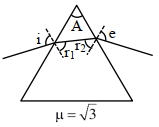
0 likes
View Solution245
MediumMCQ
$A$ light ray enters through a right-angled prism at point $P$ with an angle of incidence of $30^{\circ}$ as shown in the figure. It travels through the prism parallel to its base $BC$ and emerges along the face $AC$. The refractive index of the prism is:
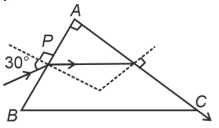
A
$\frac{\sqrt{5}}{2}$
B
$\frac{\sqrt{3}}{4}$
C
$\frac{\sqrt{3}}{2}$
D
$\frac{\sqrt{5}}{4}$
Solution
(A) Let the prism angle at the top be $A = 90^{\circ}$.
In the prism,the sum of the angles of refraction at the two faces is equal to the prism angle,so $r_1 + r_2 = A = 90^{\circ}$.
Since the ray travels parallel to the base $BC$,the angle of refraction at the second face is the critical angle $c$,so $r_2 = c$.
Thus,$r_1 = 90^{\circ} - c$.
Applying Snell's law at the first surface:
$1 \cdot \sin 30^{\circ} = \mu \cdot \sin r_1$
$1 \cdot \frac{1}{2} = \mu \cdot \sin(90^{\circ} - c)$
$\frac{1}{2} = \mu \cdot \cos c$.
We know that $\sin c = \frac{1}{\mu}$,so $\cos c = \sqrt{1 - \sin^2 c} = \sqrt{1 - \frac{1}{\mu^2}} = \frac{\sqrt{\mu^2 - 1}}{\mu}$.
Substituting this into the equation:
$\frac{1}{2} = \mu \cdot \frac{\sqrt{\mu^2 - 1}}{\mu}$
$\frac{1}{2} = \sqrt{\mu^2 - 1}$.
Squaring both sides:
$\frac{1}{4} = \mu^2 - 1$
$\mu^2 = 1 + \frac{1}{4} = \frac{5}{4}$
$\mu = \frac{\sqrt{5}}{2}$.
In the prism,the sum of the angles of refraction at the two faces is equal to the prism angle,so $r_1 + r_2 = A = 90^{\circ}$.
Since the ray travels parallel to the base $BC$,the angle of refraction at the second face is the critical angle $c$,so $r_2 = c$.
Thus,$r_1 = 90^{\circ} - c$.
Applying Snell's law at the first surface:
$1 \cdot \sin 30^{\circ} = \mu \cdot \sin r_1$
$1 \cdot \frac{1}{2} = \mu \cdot \sin(90^{\circ} - c)$
$\frac{1}{2} = \mu \cdot \cos c$.
We know that $\sin c = \frac{1}{\mu}$,so $\cos c = \sqrt{1 - \sin^2 c} = \sqrt{1 - \frac{1}{\mu^2}} = \frac{\sqrt{\mu^2 - 1}}{\mu}$.
Substituting this into the equation:
$\frac{1}{2} = \mu \cdot \frac{\sqrt{\mu^2 - 1}}{\mu}$
$\frac{1}{2} = \sqrt{\mu^2 - 1}$.
Squaring both sides:
$\frac{1}{4} = \mu^2 - 1$
$\mu^2 = 1 + \frac{1}{4} = \frac{5}{4}$
$\mu = \frac{\sqrt{5}}{2}$.
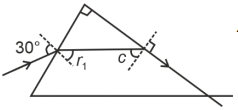
0 likes
View Solution246
MediumMCQ
Two beams of red and violet colours are made to pass separately through a prism (angle of the prism is $60^{\circ}$). In the position of minimum deviation,the angle of refraction will be
A
$30^{\circ}$ for both the colours
B
greater for the violet colour
C
greater for the red colour
D
equal but not $30^{\circ}$ for both the colours
Solution
(A) In a prism,the angle of the prism $A$ is given by the sum of the angles of refraction at the two faces: $A = r_1 + r_2$.
At the position of minimum deviation,the light ray passes symmetrically through the prism,which implies that the angle of incidence equals the angle of emergence $(i = e)$.
Consequently,the angles of refraction at both faces are equal: $r_1 = r_2 = r$.
Substituting this into the prism formula: $A = r + r = 2r$.
Therefore,$r = A / 2$.
Given the prism angle $A = 60^{\circ}$,the angle of refraction for both colours is $r = 60^{\circ} / 2 = 30^{\circ}$.
Thus,the angle of refraction is $30^{\circ}$ for both the red and violet colours.
At the position of minimum deviation,the light ray passes symmetrically through the prism,which implies that the angle of incidence equals the angle of emergence $(i = e)$.
Consequently,the angles of refraction at both faces are equal: $r_1 = r_2 = r$.
Substituting this into the prism formula: $A = r + r = 2r$.
Therefore,$r = A / 2$.
Given the prism angle $A = 60^{\circ}$,the angle of refraction for both colours is $r = 60^{\circ} / 2 = 30^{\circ}$.
Thus,the angle of refraction is $30^{\circ}$ for both the red and violet colours.
0 likes
View Solution247
AdvancedMCQ
$A$ parallel beam of light is incident from air at an angle $\alpha$ on the side $PQ$ of a right-angled triangular prism of refractive index $n=\sqrt{2}$. Light undergoes total internal reflection in the prism at the face $PR$ when $\alpha$ has a minimum value of $45^{\circ}$. The angle $\theta$ of the prism is (in $^{\circ}$)
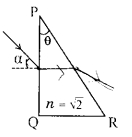
A
$15$
B
$22.5$
C
$30$
D
$45$
Solution
(A) Applying Snell's law at surface $PQ$:
$1 \times \sin \alpha = n \times \sin \beta$
Given $\alpha = 45^{\circ}$ and $n = \sqrt{2}$,we have:
$\sin 45^{\circ} = \sqrt{2} \sin \beta$
$\frac{1}{\sqrt{2}} = \sqrt{2} \sin \beta \implies \sin \beta = \frac{1}{2} \implies \beta = 30^{\circ}$.
In the triangle formed by the light path,the angle of incidence at face $PR$ is $\gamma = 90^{\circ} - (\theta + \beta)$.
For total internal reflection at face $PR$,the angle of incidence $\gamma$ must be equal to the critical angle $C$ for the minimum $\alpha$.
The critical angle $C$ is given by $\sin C = \frac{1}{n} = \frac{1}{\sqrt{2}}$,so $C = 45^{\circ}$.
Thus,$\gamma = 45^{\circ}$.
Substituting $\gamma = 90^{\circ} - (\theta + \beta)$:
$45^{\circ} = 90^{\circ} - (\theta + 30^{\circ})$
$45^{\circ} = 60^{\circ} - \theta$
$\theta = 60^{\circ} - 45^{\circ} = 15^{\circ}$.
Therefore,the correct option is $A$.
$1 \times \sin \alpha = n \times \sin \beta$
Given $\alpha = 45^{\circ}$ and $n = \sqrt{2}$,we have:
$\sin 45^{\circ} = \sqrt{2} \sin \beta$
$\frac{1}{\sqrt{2}} = \sqrt{2} \sin \beta \implies \sin \beta = \frac{1}{2} \implies \beta = 30^{\circ}$.
In the triangle formed by the light path,the angle of incidence at face $PR$ is $\gamma = 90^{\circ} - (\theta + \beta)$.
For total internal reflection at face $PR$,the angle of incidence $\gamma$ must be equal to the critical angle $C$ for the minimum $\alpha$.
The critical angle $C$ is given by $\sin C = \frac{1}{n} = \frac{1}{\sqrt{2}}$,so $C = 45^{\circ}$.
Thus,$\gamma = 45^{\circ}$.
Substituting $\gamma = 90^{\circ} - (\theta + \beta)$:
$45^{\circ} = 90^{\circ} - (\theta + 30^{\circ})$
$45^{\circ} = 60^{\circ} - \theta$
$\theta = 60^{\circ} - 45^{\circ} = 15^{\circ}$.
Therefore,the correct option is $A$.
0 likes
View Solution248
MediumMCQ
$A$ plane polarized blue light ray is incident on a prism such that there is no reflection from the surface of the prism. The angle of deviation of the emergent ray is $\delta=60^{\circ}$ (see Figure-$1$). The angle of minimum deviation for red light from the same prism is $\delta_{\text{min}}=30^{\circ}$ (see Figure-$2$). The refractive index of the prism material for blue light is $\sqrt{3}$. Which of the following statement$(s)$ is(are) correct?
$(A)$ The blue light is polarized in the plane of incidence.
$(B)$ The angle of the prism is $60^{\circ}$.
$(C)$ The refractive index of the material of the prism for red light is $\sqrt{2}$.
$(D)$ The angle of refraction for blue light in air at the exit plane of the prism is $60^{\circ}$.
$(A)$ The blue light is polarized in the plane of incidence.
$(B)$ The angle of the prism is $60^{\circ}$.
$(C)$ The refractive index of the material of the prism for red light is $\sqrt{2}$.
$(D)$ The angle of refraction for blue light in air at the exit plane of the prism is $60^{\circ}$.
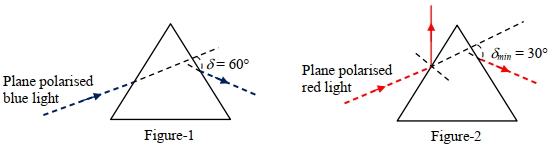
A
$A, B, C$
B
$A, C, D$
C
$A, B, D$
D
$B, C, D$
Solution
(C) $1$. Since there is no reflection,the light must be incident at the Brewster's angle $\theta_B$. Thus,$i = \theta_B$,where $\tan \theta_B = \mu_B = \sqrt{3}$. This gives $i = 60^{\circ}$.
$2$. The light is polarized in the plane of incidence (parallel to the plane of incidence) for Brewster's angle reflection condition to be satisfied. Thus,statement $(A)$ is correct.
$3$. Using Snell's law at the first surface: $1 \cdot \sin 60^{\circ} = \sqrt{3} \cdot \sin r_1 \implies \sin r_1 = 1/2 \implies r_1 = 30^{\circ}$.
$4$. Given $\delta = 60^{\circ}$ and $\delta = i + e - A$,we have $60^{\circ} = 60^{\circ} + e - A \implies e = A$.
$5$. At the second surface,$\sqrt{3} \sin r_2 = 1 \sin e = \sin A$. Since $r_1 + r_2 = A$,$r_2 = A - 30^{\circ}$.
$6$. Substituting: $\sqrt{3} \sin(A - 30^{\circ}) = \sin A$. Expanding: $\sqrt{3}(\sin A \cos 30^{\circ} - \cos A \sin 30^{\circ}) = \sin A \implies \sqrt{3}(\sin A \cdot \frac{\sqrt{3}}{2} - \cos A \cdot \frac{1}{2}) = \sin A \implies \frac{3}{2} \sin A - \frac{\sqrt{3}}{2} \cos A = \sin A \implies \frac{1}{2} \sin A = \frac{\sqrt{3}}{2} \cos A \implies \tan A = \sqrt{3} \implies A = 60^{\circ}$. Thus,statement $(B)$ is correct.
$7$. Since $e = A = 60^{\circ}$,statement $(D)$ is correct.
$8$. For red light,$\mu_R = \frac{\sin((A + \delta_{\text{min}})/2)}{\sin(A/2)} = \frac{\sin((60^{\circ} + 30^{\circ})/2)}{\sin(60^{\circ}/2)} = \frac{\sin 45^{\circ}}{\sin 30^{\circ}} = \frac{1/\sqrt{2}}{1/2} = \sqrt{2}$. Thus,statement $(C)$ is correct.
$2$. The light is polarized in the plane of incidence (parallel to the plane of incidence) for Brewster's angle reflection condition to be satisfied. Thus,statement $(A)$ is correct.
$3$. Using Snell's law at the first surface: $1 \cdot \sin 60^{\circ} = \sqrt{3} \cdot \sin r_1 \implies \sin r_1 = 1/2 \implies r_1 = 30^{\circ}$.
$4$. Given $\delta = 60^{\circ}$ and $\delta = i + e - A$,we have $60^{\circ} = 60^{\circ} + e - A \implies e = A$.
$5$. At the second surface,$\sqrt{3} \sin r_2 = 1 \sin e = \sin A$. Since $r_1 + r_2 = A$,$r_2 = A - 30^{\circ}$.
$6$. Substituting: $\sqrt{3} \sin(A - 30^{\circ}) = \sin A$. Expanding: $\sqrt{3}(\sin A \cos 30^{\circ} - \cos A \sin 30^{\circ}) = \sin A \implies \sqrt{3}(\sin A \cdot \frac{\sqrt{3}}{2} - \cos A \cdot \frac{1}{2}) = \sin A \implies \frac{3}{2} \sin A - \frac{\sqrt{3}}{2} \cos A = \sin A \implies \frac{1}{2} \sin A = \frac{\sqrt{3}}{2} \cos A \implies \tan A = \sqrt{3} \implies A = 60^{\circ}$. Thus,statement $(B)$ is correct.
$7$. Since $e = A = 60^{\circ}$,statement $(D)$ is correct.
$8$. For red light,$\mu_R = \frac{\sin((A + \delta_{\text{min}})/2)}{\sin(A/2)} = \frac{\sin((60^{\circ} + 30^{\circ})/2)}{\sin(60^{\circ}/2)} = \frac{\sin 45^{\circ}}{\sin 30^{\circ}} = \frac{1/\sqrt{2}}{1/2} = \sqrt{2}$. Thus,statement $(C)$ is correct.
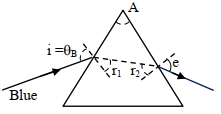
0 likes
View SolutionRay Optics and Optical Instruments — Refraction Through Prism · Frequently Asked Questions
1Are these Ray Optics and Optical Instruments questions useful for JEE and NEET?
Yes. All questions in this section are mapped to JEE Main and NEET exam patterns. Previous year questions from JEE Main, NEET, GUJCET and state-level exams are included with full solutions.
2Can I switch to Hindi or Gujarati for these questions?
Yes. Use the language tabs in the hero section or the sidebar to view the same questions and solutions in English, Hindi or Gujarati.
3How do I generate a question paper from this subtopic?
Use the Vedclass Exam Paper Generator — select the chapter and subtopic, set difficulty, and generate Sets A, B, C, D automatically. First 3 chapters of every subject are free.
Vedclass Products
For Students
Vedclass Test Series
Mock tests in real JEE/NEET style with performance analysis. 5-day free trial.
Start Free TrialFor Teachers
Exam Paper Generator
Generate Set A/B/C/D papers from this chapter in 2 minutes. 3 chapters free.
Try FreeFor Institutes
Online Exam Module
Live online exams with unlimited students, 360° analytics & white-label branding.
See DemoFor Teachers & Institutes
Generate a Ray Optics and Optical Instruments Exam Paper in 2 Minutes
Select subtopic & difficulty — Sets A, B, C, D auto-generated with No Repeat logic.
First 3 chapters of every subject are free — no payment required.