
A English
Refraction Through Prism Questions in English
Class 12 Physics · Ray Optics and Optical Instruments · Refraction Through Prism
354+
Questions
English
Language
100%
With Solutions
Showing 42 of 354 questions in English
301
EasyMCQ
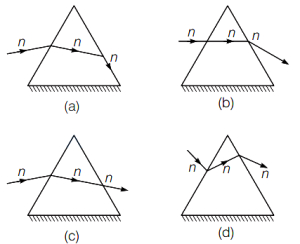
The refraction through the prisms is as shown. Pick out the wrong statement from the following. Path of the light ray in
A
$a$ is correct if $n_{2} > n_{1}$ and $n_{2} > n_{3}$
B
$b$ is correct if $n_{1} = n_{2}$ and $n_{2} > n_{3}$
C
$c$ is correct if $n_{2} < n_{1}$ and $n_{2} = n_{3}$
D
$d$ is correct if $n_{1} > n_{2}$ and $n_{2} < n_{3}$
Solution
(C) Let $n_1$ be the refractive index of the medium outside the first surface, $n_2$ be the refractive index of the prism, and $n_3$ be the refractive index of the medium outside the second surface.
For a ray to bend towards the normal, it must travel from a rarer to a denser medium $(n_{incident} < n_{refracted})$.
For a ray to bend away from the normal, it must travel from a denser to a rarer medium $(n_{incident} > n_{refracted})$.
In case $(a)$, the ray bends towards the normal at the first surface $(n_1 < n_2)$ and grazes the second surface, implying total internal reflection or critical angle condition $(n_2 > n_3)$. Thus, $n_2 > n_1$ and $n_2 > n_3$ is correct.
In case $(b)$, the ray enters undeviated at the first surface $(n_1 = n_2)$ and bends away from the normal at the second surface $(n_2 > n_3)$. This is correct.
In case $(c)$, the ray bends towards the normal at the first surface $(n_1 < n_2)$ and bends away from the normal at the second surface $(n_2 > n_3)$. The statement says $n_2 < n_1$ and $n_2 = n_3$, which contradicts the observed bending. Thus, $(c)$ is the wrong statement.
For a ray to bend towards the normal, it must travel from a rarer to a denser medium $(n_{incident} < n_{refracted})$.
For a ray to bend away from the normal, it must travel from a denser to a rarer medium $(n_{incident} > n_{refracted})$.
In case $(a)$, the ray bends towards the normal at the first surface $(n_1 < n_2)$ and grazes the second surface, implying total internal reflection or critical angle condition $(n_2 > n_3)$. Thus, $n_2 > n_1$ and $n_2 > n_3$ is correct.
In case $(b)$, the ray enters undeviated at the first surface $(n_1 = n_2)$ and bends away from the normal at the second surface $(n_2 > n_3)$. This is correct.
In case $(c)$, the ray bends towards the normal at the first surface $(n_1 < n_2)$ and bends away from the normal at the second surface $(n_2 > n_3)$. The statement says $n_2 < n_1$ and $n_2 = n_3$, which contradicts the observed bending. Thus, $(c)$ is the wrong statement.
0 likes
View Solution302
EasyMCQ
Two beams of red and violet colours are made to pass separately through a prism of $A=60^{\circ}$. In the minimum deviation position,the angle of refraction inside the prism will be
A
greater for red colour
B
equal but not $30^{\circ}$ for both the colours
C
greater for violet colour
D
$30^{\circ}$ for both the colours
Solution
(D) For a prism,the angle of deviation is given by $\delta = (i + e) - A$.
In the position of minimum deviation,the angle of incidence is equal to the angle of emergence,i.e.,$i = e$.
Under this condition,the light ray inside the prism travels parallel to the base,and the angle of refraction $r$ is given by $r_1 = r_2 = r$.
Since $A = r_1 + r_2$,we have $A = 2r$.
Given the prism angle $A = 60^{\circ}$,the angle of refraction is $r = \frac{A}{2} = \frac{60^{\circ}}{2} = 30^{\circ}$.
This condition is independent of the wavelength or colour of the light.
Therefore,the angle of refraction is $30^{\circ}$ for both red and violet colours.
In the position of minimum deviation,the angle of incidence is equal to the angle of emergence,i.e.,$i = e$.
Under this condition,the light ray inside the prism travels parallel to the base,and the angle of refraction $r$ is given by $r_1 = r_2 = r$.
Since $A = r_1 + r_2$,we have $A = 2r$.
Given the prism angle $A = 60^{\circ}$,the angle of refraction is $r = \frac{A}{2} = \frac{60^{\circ}}{2} = 30^{\circ}$.
This condition is independent of the wavelength or colour of the light.
Therefore,the angle of refraction is $30^{\circ}$ for both red and violet colours.
0 likes
View Solution303
MediumMCQ
The angle of minimum deviation for an incident light ray on an equilateral prism is equal to its refracting angle. The refractive index of its material is
A
$\frac{1}{\sqrt{2}}$
B
$\sqrt{3}$
C
$\frac{\sqrt{3}}{2}$
D
$\frac{3}{2}$
Solution
(B) For an equilateral prism,the angle of prism or refracting angle is $A = 60^{\circ}$.
Given that the angle of minimum deviation $\delta_{m}$ is equal to the refracting angle $A$,so $\delta_{m} = A = 60^{\circ}$.
The formula for the refractive index $\mu$ of a prism is given by $\mu = \frac{\sin((A + \delta_{m})/2)}{\sin(A/2)}$.
Substituting the values,we get $\mu = \frac{\sin((60^{\circ} + 60^{\circ})/2)}{\sin(60^{\circ}/2)}$.
$\mu = \frac{\sin(60^{\circ})}{\sin(30^{\circ})}$.
Since $\sin(60^{\circ}) = \frac{\sqrt{3}}{2}$ and $\sin(30^{\circ}) = \frac{1}{2}$,we have $\mu = \frac{\sqrt{3}/2}{1/2} = \sqrt{3}$.
Given that the angle of minimum deviation $\delta_{m}$ is equal to the refracting angle $A$,so $\delta_{m} = A = 60^{\circ}$.
The formula for the refractive index $\mu$ of a prism is given by $\mu = \frac{\sin((A + \delta_{m})/2)}{\sin(A/2)}$.
Substituting the values,we get $\mu = \frac{\sin((60^{\circ} + 60^{\circ})/2)}{\sin(60^{\circ}/2)}$.
$\mu = \frac{\sin(60^{\circ})}{\sin(30^{\circ})}$.
Since $\sin(60^{\circ}) = \frac{\sqrt{3}}{2}$ and $\sin(30^{\circ}) = \frac{1}{2}$,we have $\mu = \frac{\sqrt{3}/2}{1/2} = \sqrt{3}$.
0 likes
View Solution304
DifficultMCQ
$A$ prism of a certain angle deviates the red and blue rays by $8^{\circ}$ and $12^{\circ}$ respectively. Another prism of the same angle deviates the red and blue rays by $10^{\circ}$ and $14^{\circ}$ respectively. The prisms are small-angled and made of different materials. The dispersive powers of the materials of the prisms are in the ratio:
A
$5: 6$
B
$9: 11$
C
$6: 5$
D
$11: 9$
Solution
(C) The dispersive power $\omega$ of a prism is given by $\omega = \frac{\delta_{B} - \delta_{R}}{\delta_{y}}$,where $\delta_{B}$ and $\delta_{R}$ are the deviations for blue and red rays,and $\delta_{y}$ is the mean deviation,calculated as $\delta_{y} = \frac{\delta_{B} + \delta_{R}}{2}$.
For the first prism:
$\delta_{B1} = 12^{\circ}$,$\delta_{R1} = 8^{\circ}$.
$\delta_{y1} = \frac{12^{\circ} + 8^{\circ}}{2} = 10^{\circ}$.
$\omega_{1} = \frac{12^{\circ} - 8^{\circ}}{10^{\circ}} = \frac{4}{10} = \frac{2}{5}$.
For the second prism:
$\delta_{B2} = 14^{\circ}$,$\delta_{R2} = 10^{\circ}$.
$\delta_{y2} = \frac{14^{\circ} + 10^{\circ}}{2} = 12^{\circ}$.
$\omega_{2} = \frac{14^{\circ} - 10^{\circ}}{12^{\circ}} = \frac{4}{12} = \frac{1}{3}$.
The ratio of dispersive powers is $\frac{\omega_{1}}{\omega_{2}} = \frac{2/5}{1/3} = \frac{2}{5} \times 3 = \frac{6}{5}$.
For the first prism:
$\delta_{B1} = 12^{\circ}$,$\delta_{R1} = 8^{\circ}$.
$\delta_{y1} = \frac{12^{\circ} + 8^{\circ}}{2} = 10^{\circ}$.
$\omega_{1} = \frac{12^{\circ} - 8^{\circ}}{10^{\circ}} = \frac{4}{10} = \frac{2}{5}$.
For the second prism:
$\delta_{B2} = 14^{\circ}$,$\delta_{R2} = 10^{\circ}$.
$\delta_{y2} = \frac{14^{\circ} + 10^{\circ}}{2} = 12^{\circ}$.
$\omega_{2} = \frac{14^{\circ} - 10^{\circ}}{12^{\circ}} = \frac{4}{12} = \frac{1}{3}$.
The ratio of dispersive powers is $\frac{\omega_{1}}{\omega_{2}} = \frac{2/5}{1/3} = \frac{2}{5} \times 3 = \frac{6}{5}$.
0 likes
View Solution305
EasyMCQ
$A$ glass prism of refracting angle $60^{\circ}$ is immersed in a liquid in which the angle of minimum deviation is $30^{\circ}$. The critical angle of glass with respect to the liquid medium is (in $^{\circ}$)
A
$30$
B
$45$
C
$60$
D
$90$
Solution
(B) The formula for the refractive index of the prism material $(\mu)$ with respect to the surrounding liquid is given by: $\mu = \frac{\sin((A + \delta_m)/2)}{\sin(A/2)}$, where $A$ is the refracting angle and $\delta_m$ is the angle of minimum deviation.
Given $A = 60^{\circ}$ and $\delta_m = 30^{\circ}$, we have:
$\mu = \frac{\sin((60^{\circ} + 30^{\circ})/2)}{\sin(60^{\circ}/2)} = \frac{\sin(45^{\circ})}{\sin(30^{\circ})} = \frac{1/\sqrt{2}}{1/2} = \sqrt{2}$.
The critical angle $(C)$ is related to the refractive index by the formula: $\sin(C) = 1/\mu$.
Substituting the value of $\mu$: $\sin(C) = 1/\sqrt{2}$.
Therefore, $C = 45^{\circ}$.
Given $A = 60^{\circ}$ and $\delta_m = 30^{\circ}$, we have:
$\mu = \frac{\sin((60^{\circ} + 30^{\circ})/2)}{\sin(60^{\circ}/2)} = \frac{\sin(45^{\circ})}{\sin(30^{\circ})} = \frac{1/\sqrt{2}}{1/2} = \sqrt{2}$.
The critical angle $(C)$ is related to the refractive index by the formula: $\sin(C) = 1/\mu$.
Substituting the value of $\mu$: $\sin(C) = 1/\sqrt{2}$.
Therefore, $C = 45^{\circ}$.
0 likes
View Solution306
MediumMCQ
$A$ light ray is incident on an equilateral prism made of a material with a refractive index of $\sqrt{3}$. Inside the prism,if the light ray moves parallel to the base of the prism,then the angle of incidence of the light ray is: (in $^{\circ}$)
A
$30$
B
$45$
C
$75$
D
$60$
Solution
(D) For an equilateral prism,the angle of the prism is $A = 60^{\circ}$.
When the light ray inside the prism moves parallel to the base,the ray undergoes minimum deviation,which implies that the angle of incidence $i$ is equal to the angle of emergence $e$,and the angle of refraction $r_1$ is equal to $r_2$.
Since $r_1 + r_2 = A$,we have $2r = 60^{\circ}$,which gives $r = 30^{\circ}$.
Using Snell's Law at the first surface: $\mu = \frac{\sin i}{\sin r}$.
Given $\mu = \sqrt{3}$ and $r = 30^{\circ}$,we have $\sqrt{3} = \frac{\sin i}{\sin 30^{\circ}}$.
Since $\sin 30^{\circ} = 0.5$,we get $\sin i = \sqrt{3} \times 0.5 = \frac{\sqrt{3}}{2}$.
Therefore,$i = 60^{\circ}$.
When the light ray inside the prism moves parallel to the base,the ray undergoes minimum deviation,which implies that the angle of incidence $i$ is equal to the angle of emergence $e$,and the angle of refraction $r_1$ is equal to $r_2$.
Since $r_1 + r_2 = A$,we have $2r = 60^{\circ}$,which gives $r = 30^{\circ}$.
Using Snell's Law at the first surface: $\mu = \frac{\sin i}{\sin r}$.
Given $\mu = \sqrt{3}$ and $r = 30^{\circ}$,we have $\sqrt{3} = \frac{\sin i}{\sin 30^{\circ}}$.
Since $\sin 30^{\circ} = 0.5$,we get $\sin i = \sqrt{3} \times 0.5 = \frac{\sqrt{3}}{2}$.
Therefore,$i = 60^{\circ}$.
0 likes
View Solution307
MediumMCQ
$A$ ray of light is incident at an angle of $60^{\circ}$ on the first face of a prism. The angle of the prism is $30^{\circ}$ and its second face is silvered. If the light ray inside the prism retraces its path after reflection from the second face, then the refractive index of the material of the prism is
A
$\frac{2}{\sqrt{3}}$
B
$\frac{3}{2}$
C
$\sqrt{2}$
D
$\sqrt{3}$
Solution
(D) For a light ray to retrace its path after reflection from the silvered second face, it must strike the second face normally (at an angle of $90^{\circ}$ to the surface).
Let $i = 60^{\circ}$ be the angle of incidence on the first face, $r_1$ be the angle of refraction at the first face, and $A = 30^{\circ}$ be the prism angle.
Since the ray strikes the second face normally, the angle of refraction at the second face is $r_2 = 0^{\circ}$.
From the geometry of the prism, we know that $A = r_1 + r_2$.
Substituting the values, $30^{\circ} = r_1 + 0^{\circ}$, so $r_1 = 30^{\circ}$.
Using Snell's Law at the first face: $\mu = \frac{\sin(i)}{\sin(r_1)}$.
Substituting the values: $\mu = \frac{\sin(60^{\circ})}{\sin(30^{\circ})}$.
$\mu = \frac{\sqrt{3}/2}{1/2} = \sqrt{3}$.
Thus, the refractive index of the material of the prism is $\sqrt{3}$.
Let $i = 60^{\circ}$ be the angle of incidence on the first face, $r_1$ be the angle of refraction at the first face, and $A = 30^{\circ}$ be the prism angle.
Since the ray strikes the second face normally, the angle of refraction at the second face is $r_2 = 0^{\circ}$.
From the geometry of the prism, we know that $A = r_1 + r_2$.
Substituting the values, $30^{\circ} = r_1 + 0^{\circ}$, so $r_1 = 30^{\circ}$.
Using Snell's Law at the first face: $\mu = \frac{\sin(i)}{\sin(r_1)}$.
Substituting the values: $\mu = \frac{\sin(60^{\circ})}{\sin(30^{\circ})}$.
$\mu = \frac{\sqrt{3}/2}{1/2} = \sqrt{3}$.
Thus, the refractive index of the material of the prism is $\sqrt{3}$.
0 likes
View Solution308
EasyMCQ
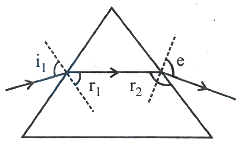
If $r_1$ and $r_2$ are the angles of refraction at the first and second faces of a prism,respectively,then the angle of the prism is:
A
$r_1-r_2$
B
$\frac{(r_1-r_2)}{2}$
C
$\frac{(r_1+r_2)}{2}$
D
$r_1+r_2$
Solution
(D) In a prism,let the angle of the prism be $A$.
When a light ray enters the first face,it refracts at an angle $r_1$.
When it reaches the second face,it strikes at an angle $r_2$ with respect to the normal.
From the geometry of the quadrilateral formed by the two normals and the two refracting faces of the prism,the sum of the angle of the prism $A$ and the angle between the two normals is $180^{\circ}$.
Also,in the triangle formed by the refracted ray inside the prism and the two refracting faces,the sum of the angles is $180^{\circ}$,which gives $A + r_1 + r_2 = 180^{\circ}$ (considering the interior angles of the triangle).
Thus,the relationship between the angle of the prism and the angles of refraction is $A = r_1 + r_2$.
When a light ray enters the first face,it refracts at an angle $r_1$.
When it reaches the second face,it strikes at an angle $r_2$ with respect to the normal.
From the geometry of the quadrilateral formed by the two normals and the two refracting faces of the prism,the sum of the angle of the prism $A$ and the angle between the two normals is $180^{\circ}$.
Also,in the triangle formed by the refracted ray inside the prism and the two refracting faces,the sum of the angles is $180^{\circ}$,which gives $A + r_1 + r_2 = 180^{\circ}$ (considering the interior angles of the triangle).
Thus,the relationship between the angle of the prism and the angles of refraction is $A = r_1 + r_2$.
0 likes
View Solution309
MediumMCQ
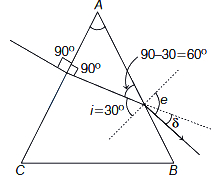
$A$ prism $(\mu=1.5)$ has a refracting angle of $30^{\circ}$. The deviation of a monochromatic ray incident normally on one of its surfaces will be (given,$\sin 48^{\circ} 36^{\prime}=0.75$):
A
$18^{\circ} 36^{\prime}$
B
$22^{\circ} 38^{\prime}$
C
$18^{\circ}$
D
$22^{\circ} 1^{\prime}$
Solution
(A) When a ray is incident normally on one surface of the prism,it passes undeviated into the prism. Let the prism be $ABC$ with refracting angle $A = 30^{\circ}$.
At the second surface $AB$,the angle of incidence $i$ is equal to the refracting angle of the prism,so $i = 30^{\circ}$.
Using Snell's law at the second surface: $\mu \sin i = 1 \sin e$,where $e$ is the angle of emergence.
$1.5 \times \sin 30^{\circ} = \sin e$
$1.5 \times 0.5 = \sin e$
$\sin e = 0.75$
Given $\sin 48^{\circ} 36^{\prime} = 0.75$,therefore $e = 48^{\circ} 36^{\prime}$.
The angle of deviation $\delta$ for a ray incident normally is given by $\delta = e - i$.
$\delta = 48^{\circ} 36^{\prime} - 30^{\circ} = 18^{\circ} 36^{\prime}$.
At the second surface $AB$,the angle of incidence $i$ is equal to the refracting angle of the prism,so $i = 30^{\circ}$.
Using Snell's law at the second surface: $\mu \sin i = 1 \sin e$,where $e$ is the angle of emergence.
$1.5 \times \sin 30^{\circ} = \sin e$
$1.5 \times 0.5 = \sin e$
$\sin e = 0.75$
Given $\sin 48^{\circ} 36^{\prime} = 0.75$,therefore $e = 48^{\circ} 36^{\prime}$.
The angle of deviation $\delta$ for a ray incident normally is given by $\delta = e - i$.
$\delta = 48^{\circ} 36^{\prime} - 30^{\circ} = 18^{\circ} 36^{\prime}$.
0 likes
View Solution310
EasyMCQ
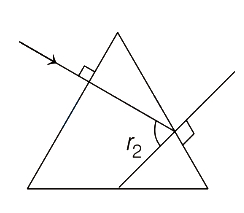
$A$ light ray is incident normally on one surface of an equilateral prism. The angle of deviation of the light ray is (refractive index of the material of the prism $=\sqrt{2}$) (in $^{\circ}$)
A
$60$
B
$30$
C
$0$
D
$120$
Solution
(D) Given,the angle of incidence $i = 0^{\circ}$.
For an equilateral prism,the prism angle $A = 60^{\circ}$.
At the first surface,since the ray is incident normally,the angle of refraction $r_1 = 0^{\circ}$.
Using the relation $r_1 + r_2 = A$,we get $0^{\circ} + r_2 = 60^{\circ}$,so $r_2 = 60^{\circ}$.
The critical angle $C$ for the prism is given by $\sin C = \frac{1}{\mu} = \frac{1}{\sqrt{2}}$,which means $C = 45^{\circ}$.
Since the angle of incidence at the second surface $r_2 = 60^{\circ}$ is greater than the critical angle $C = 45^{\circ}$,the light ray undergoes total internal reflection at the second surface.
After reflection,the ray strikes the third surface. The angle of incidence at the third surface is $r_3 = 180^{\circ} - (60^{\circ} + 60^{\circ}) = 60^{\circ}$ (from the geometry of the triangle). Since $60^{\circ} > 45^{\circ}$,it undergoes another total internal reflection.
Finally,the ray emerges from the first surface normally. The total deviation $\delta$ is the angle between the incident ray and the emergent ray. Since the ray emerges parallel to the incident ray but in the opposite direction,the deviation is $180^{\circ} - 60^{\circ} = 120^{\circ}$.
For an equilateral prism,the prism angle $A = 60^{\circ}$.
At the first surface,since the ray is incident normally,the angle of refraction $r_1 = 0^{\circ}$.
Using the relation $r_1 + r_2 = A$,we get $0^{\circ} + r_2 = 60^{\circ}$,so $r_2 = 60^{\circ}$.
The critical angle $C$ for the prism is given by $\sin C = \frac{1}{\mu} = \frac{1}{\sqrt{2}}$,which means $C = 45^{\circ}$.
Since the angle of incidence at the second surface $r_2 = 60^{\circ}$ is greater than the critical angle $C = 45^{\circ}$,the light ray undergoes total internal reflection at the second surface.
After reflection,the ray strikes the third surface. The angle of incidence at the third surface is $r_3 = 180^{\circ} - (60^{\circ} + 60^{\circ}) = 60^{\circ}$ (from the geometry of the triangle). Since $60^{\circ} > 45^{\circ}$,it undergoes another total internal reflection.
Finally,the ray emerges from the first surface normally. The total deviation $\delta$ is the angle between the incident ray and the emergent ray. Since the ray emerges parallel to the incident ray but in the opposite direction,the deviation is $180^{\circ} - 60^{\circ} = 120^{\circ}$.
0 likes
View Solution311
EasyMCQ
For a prism,the angle of the prism is $60^{\circ}$ and the refractive index is $\sqrt{7/3}$. The minimum possible angle of incidence so that the light ray is refracted from the second surface is (in $^{\circ}$)
A
$15$
B
$25$
C
$30$
D
$35$
Solution
(C) For a light ray to be refracted from the second surface,the angle of incidence at the second surface $(r_2)$ must be less than the critical angle $(C)$.
The condition for refraction at the second surface is $r_2 < C$.
The critical angle $C$ is given by $\sin C = 1/\mu = 1/\sqrt{7/3} = \sqrt{3/7}$.
Thus,$\sin r_2 < \sqrt{3/7}$.
For a prism,$r_1 + r_2 = A = 60^{\circ}$,so $r_2 = 60^{\circ} - r_1$.
Substituting this,$\sin(60^{\circ} - r_1) < \sqrt{3/7}$.
To find the minimum angle of incidence $(i)$,we need the maximum value of $r_1$. Since $r_2$ must be less than $C$,$r_1$ must be greater than $60^{\circ} - C$.
Using $\sin C = \sqrt{3/7} \approx 0.6546$,we find $C \approx 40.89^{\circ}$.
So,$r_1 > 60^{\circ} - 40.89^{\circ} = 19.11^{\circ}$.
Using Snell's law at the first surface: $\sin i = \mu \sin r_1 = \sqrt{7/3} \sin(19.11^{\circ}) \approx 1.5275 \times 0.3274 \approx 0.5$.
Thus,$i > 30^{\circ}$. The minimum angle is $30^{\circ}$.
The condition for refraction at the second surface is $r_2 < C$.
The critical angle $C$ is given by $\sin C = 1/\mu = 1/\sqrt{7/3} = \sqrt{3/7}$.
Thus,$\sin r_2 < \sqrt{3/7}$.
For a prism,$r_1 + r_2 = A = 60^{\circ}$,so $r_2 = 60^{\circ} - r_1$.
Substituting this,$\sin(60^{\circ} - r_1) < \sqrt{3/7}$.
To find the minimum angle of incidence $(i)$,we need the maximum value of $r_1$. Since $r_2$ must be less than $C$,$r_1$ must be greater than $60^{\circ} - C$.
Using $\sin C = \sqrt{3/7} \approx 0.6546$,we find $C \approx 40.89^{\circ}$.
So,$r_1 > 60^{\circ} - 40.89^{\circ} = 19.11^{\circ}$.
Using Snell's law at the first surface: $\sin i = \mu \sin r_1 = \sqrt{7/3} \sin(19.11^{\circ}) \approx 1.5275 \times 0.3274 \approx 0.5$.
Thus,$i > 30^{\circ}$. The minimum angle is $30^{\circ}$.
0 likes
View Solution312
MediumMCQ
$A$ prism is made up of material of refractive index $\sqrt{3}$. The angle of the prism is $A$. If the angle of minimum deviation is equal to the angle of the prism,then the value of $A$ is: (in $^{\circ}$)
A
$30$
B
$45$
C
$60$
D
$75$
Solution
(C) Given: Refractive index $\mu = \sqrt{3}$ and angle of minimum deviation $\delta_m = A$.
For a prism,the refractive index is given by the formula: $\mu = \frac{\sin \frac{A+\delta_m}{2}}{\sin \frac{A}{2}}$.
Substituting the given values: $\sqrt{3} = \frac{\sin \frac{A+A}{2}}{\sin \frac{A}{2}}$.
$\sqrt{3} = \frac{\sin A}{\sin \frac{A}{2}}$.
Using the trigonometric identity $\sin A = 2 \sin \frac{A}{2} \cos \frac{A}{2}$,we get: $\sqrt{3} = \frac{2 \sin \frac{A}{2} \cos \frac{A}{2}}{\sin \frac{A}{2}}$.
$\sqrt{3} = 2 \cos \frac{A}{2}$.
$\cos \frac{A}{2} = \frac{\sqrt{3}}{2}$.
Since $\cos 30^{\circ} = \frac{\sqrt{3}}{2}$,we have $\frac{A}{2} = 30^{\circ}$.
Therefore,$A = 60^{\circ}$.
For a prism,the refractive index is given by the formula: $\mu = \frac{\sin \frac{A+\delta_m}{2}}{\sin \frac{A}{2}}$.
Substituting the given values: $\sqrt{3} = \frac{\sin \frac{A+A}{2}}{\sin \frac{A}{2}}$.
$\sqrt{3} = \frac{\sin A}{\sin \frac{A}{2}}$.
Using the trigonometric identity $\sin A = 2 \sin \frac{A}{2} \cos \frac{A}{2}$,we get: $\sqrt{3} = \frac{2 \sin \frac{A}{2} \cos \frac{A}{2}}{\sin \frac{A}{2}}$.
$\sqrt{3} = 2 \cos \frac{A}{2}$.
$\cos \frac{A}{2} = \frac{\sqrt{3}}{2}$.
Since $\cos 30^{\circ} = \frac{\sqrt{3}}{2}$,we have $\frac{A}{2} = 30^{\circ}$.
Therefore,$A = 60^{\circ}$.
0 likes
View Solution313
MediumMCQ
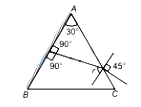
One face of the glass prism is silver polished. $A$ light ray falls at an angle of $45^{\circ}$ on the other face. After refraction,it is subsequently reflected from the silvered face and then retraces its path. The refracting angle of the prism is $30^{\circ}$. The refractive index of the prism is
A
$\frac{3}{2}$
B
$\sqrt{2}$
C
$\frac{\sqrt{3}}{2}$
D
$\sqrt{3}$
Solution
(B) Given: Angle of incidence $i = 45^{\circ}$,Prism angle $A = 30^{\circ}$.
Since the ray retraces its path after reflection from the silvered face,it must strike the silvered face normally (at $90^{\circ}$).
In the triangle formed by the ray and the prism sides,the angle at the silvered face is $90^{\circ}$ and the prism angle is $30^{\circ}$.
Therefore,the angle of refraction $r$ at the first face is $r = 180^{\circ} - 90^{\circ} - 30^{\circ} = 60^{\circ}$ is incorrect based on the geometry shown. Looking at the triangle,the angle of refraction $r$ is $r = 90^{\circ} - 60^{\circ} = 30^{\circ}$.
Using Snell's Law: $\mu = \frac{\sin i}{\sin r} = \frac{\sin 45^{\circ}}{\sin 30^{\circ}}$.
$\mu = \frac{1/\sqrt{2}}{1/2} = \frac{2}{\sqrt{2}} = \sqrt{2}$.
Since the ray retraces its path after reflection from the silvered face,it must strike the silvered face normally (at $90^{\circ}$).
In the triangle formed by the ray and the prism sides,the angle at the silvered face is $90^{\circ}$ and the prism angle is $30^{\circ}$.
Therefore,the angle of refraction $r$ at the first face is $r = 180^{\circ} - 90^{\circ} - 30^{\circ} = 60^{\circ}$ is incorrect based on the geometry shown. Looking at the triangle,the angle of refraction $r$ is $r = 90^{\circ} - 60^{\circ} = 30^{\circ}$.
Using Snell's Law: $\mu = \frac{\sin i}{\sin r} = \frac{\sin 45^{\circ}}{\sin 30^{\circ}}$.
$\mu = \frac{1/\sqrt{2}}{1/2} = \frac{2}{\sqrt{2}} = \sqrt{2}$.
0 likes
View Solution314
MediumMCQ
The minimum deviation produced by a hollow prism filled with a certain liquid is found to be $30^{\circ}$. The light ray is also found to be refracted at an angle of $30^{\circ}$. Then the refractive index of the liquid is
A
$\sqrt{2}$
B
$\sqrt{3}$
C
$\sqrt{\frac{3}{2}}$
D
$\frac{3}{2}$
Solution
(A) For a prism,at the condition of minimum deviation,the angle of refraction $r$ is related to the prism angle $A$ by $A = 2r$.
Given $r = 30^{\circ}$,we have $A = 2 \times 30^{\circ} = 60^{\circ}$.
The formula for the refractive index $\mu$ of the prism material is $\mu = \frac{\sin((A + \delta_m)/2)}{\sin(A/2)}$.
Substituting the given values $\delta_m = 30^{\circ}$ and $A = 60^{\circ}$:
$\mu = \frac{\sin((60^{\circ} + 30^{\circ})/2)}{\sin(60^{\circ}/2)} = \frac{\sin(45^{\circ})}{\sin(30^{\circ})}$.
Since $\sin(45^{\circ}) = \frac{1}{\sqrt{2}}$ and $\sin(30^{\circ}) = \frac{1}{2}$,we get $\mu = \frac{1/\sqrt{2}}{1/2} = \frac{2}{\sqrt{2}} = \sqrt{2}$.
Given $r = 30^{\circ}$,we have $A = 2 \times 30^{\circ} = 60^{\circ}$.
The formula for the refractive index $\mu$ of the prism material is $\mu = \frac{\sin((A + \delta_m)/2)}{\sin(A/2)}$.
Substituting the given values $\delta_m = 30^{\circ}$ and $A = 60^{\circ}$:
$\mu = \frac{\sin((60^{\circ} + 30^{\circ})/2)}{\sin(60^{\circ}/2)} = \frac{\sin(45^{\circ})}{\sin(30^{\circ})}$.
Since $\sin(45^{\circ}) = \frac{1}{\sqrt{2}}$ and $\sin(30^{\circ}) = \frac{1}{2}$,we get $\mu = \frac{1/\sqrt{2}}{1/2} = \frac{2}{\sqrt{2}} = \sqrt{2}$.
0 likes
View Solution315
MediumMCQ
The angle of a prism made of a material of refractive index $\sqrt{2}$ is $90^{\circ}$. The angle of incidence for a light ray on the first face of the prism such that the light ray suffers total internal reflection at the second face is (in $^{\circ}$)
A
$0$
B
$90$
C
$60$
D
$45$
Solution
(B) Let the prism angle be $A = 90^{\circ}$ and refractive index be $\mu = \sqrt{2}$.
For total internal reflection $(TIR)$ at the second face, the angle of incidence at the second face $r_2$ must be greater than or equal to the critical angle $C$.
The critical angle $C$ is given by $\sin C = \frac{1}{\mu} = \frac{1}{\sqrt{2}}$, which gives $C = 45^{\circ}$.
Thus, for $TIR$, $r_2 > 45^{\circ}$.
From the geometry of the prism, $r_1 + r_2 = A = 90^{\circ}$.
Substituting $r_2 > 45^{\circ}$, we get $r_1 < 90^{\circ} - 45^{\circ} = 45^{\circ}$.
Using Snell's law at the first face: $\sin i = \mu \sin r_1$.
Since $r_1 < 45^{\circ}$, $\sin r_1 < \sin 45^{\circ} = \frac{1}{\sqrt{2}}$.
Therefore, $\sin i < \sqrt{2} \times \frac{1}{\sqrt{2}} = 1$, which implies $i < 90^{\circ}$.
However, for the light to enter the prism and satisfy the condition, we look for the boundary condition where $r_2 = 45^{\circ}$, which implies $r_1 = 45^{\circ}$.
Then $\sin i = \sqrt{2} \sin 45^{\circ} = \sqrt{2} \times \frac{1}{\sqrt{2}} = 1$, so $i = 90^{\circ}$.
Since the question asks for the condition for $TIR$, any angle of incidence $i < 90^{\circ}$ will result in $r_1 > 45^{\circ}$ which leads to $r_2 < 45^{\circ}$ (no $TIR$). Thus, the boundary is at $i = 90^{\circ}$.
For total internal reflection $(TIR)$ at the second face, the angle of incidence at the second face $r_2$ must be greater than or equal to the critical angle $C$.
The critical angle $C$ is given by $\sin C = \frac{1}{\mu} = \frac{1}{\sqrt{2}}$, which gives $C = 45^{\circ}$.
Thus, for $TIR$, $r_2 > 45^{\circ}$.
From the geometry of the prism, $r_1 + r_2 = A = 90^{\circ}$.
Substituting $r_2 > 45^{\circ}$, we get $r_1 < 90^{\circ} - 45^{\circ} = 45^{\circ}$.
Using Snell's law at the first face: $\sin i = \mu \sin r_1$.
Since $r_1 < 45^{\circ}$, $\sin r_1 < \sin 45^{\circ} = \frac{1}{\sqrt{2}}$.
Therefore, $\sin i < \sqrt{2} \times \frac{1}{\sqrt{2}} = 1$, which implies $i < 90^{\circ}$.
However, for the light to enter the prism and satisfy the condition, we look for the boundary condition where $r_2 = 45^{\circ}$, which implies $r_1 = 45^{\circ}$.
Then $\sin i = \sqrt{2} \sin 45^{\circ} = \sqrt{2} \times \frac{1}{\sqrt{2}} = 1$, so $i = 90^{\circ}$.
Since the question asks for the condition for $TIR$, any angle of incidence $i < 90^{\circ}$ will result in $r_1 > 45^{\circ}$ which leads to $r_2 < 45^{\circ}$ (no $TIR$). Thus, the boundary is at $i = 90^{\circ}$.
0 likes
View Solution316
MediumMCQ
Monochromatic light of wavelength $6000 Å$ is incident on a small-angled prism. If the angle of the prism is $6^{\circ}$ and the refractive indices of the material of the prism for violet and red lights are $1.52$ and $1.48$ respectively,then the angle of dispersion produced for this incident light is: (in $^{\circ}$)
A
$0.24$
B
$0.36$
C
$0.12$
D
$0.48$
Solution
(A) For a small-angled prism,the angle of deviation $\delta$ is given by the formula: $\delta = (\mu - 1)A$,where $\mu$ is the refractive index and $A$ is the angle of the prism.
The angle of dispersion (angular dispersion) $\theta$ is the difference between the angles of deviation for violet and red light: $\theta = \delta_v - \delta_r$.
Substituting the formula for deviation: $\theta = (\mu_v - 1)A - (\mu_r - 1)A = (\mu_v - \mu_r)A$.
Given values: $\mu_v = 1.52$,$\mu_r = 1.48$,and $A = 6^{\circ}$.
Calculation: $\theta = (1.52 - 1.48) \times 6^{\circ} = 0.04 \times 6^{\circ} = 0.24^{\circ}$.
Therefore,the angle of dispersion is $0.24^{\circ}$.
The angle of dispersion (angular dispersion) $\theta$ is the difference between the angles of deviation for violet and red light: $\theta = \delta_v - \delta_r$.
Substituting the formula for deviation: $\theta = (\mu_v - 1)A - (\mu_r - 1)A = (\mu_v - \mu_r)A$.
Given values: $\mu_v = 1.52$,$\mu_r = 1.48$,and $A = 6^{\circ}$.
Calculation: $\theta = (1.52 - 1.48) \times 6^{\circ} = 0.04 \times 6^{\circ} = 0.24^{\circ}$.
Therefore,the angle of dispersion is $0.24^{\circ}$.
0 likes
View Solution317
MediumMCQ
If the angle of minimum deviation produced by an equilateral prism is equal to the angle of the prism,then the refractive index of the material of the prism is nearly
A
$1.515$
B
$1.414$
C
$1.732$
D
$1.625$
Solution
(C) For an equilateral prism,the angle of the prism $A = 60^{\circ}$.
Given that the angle of minimum deviation $\delta_m = A = 60^{\circ}$.
The formula for the refractive index $n$ of a prism is given by $n = \frac{\sin((A + \delta_m) / 2)}{\sin(A / 2)}$.
Substituting the values,we get $n = \frac{\sin((60^{\circ} + 60^{\circ}) / 2)}{\sin(60^{\circ} / 2)}$.
$n = \frac{\sin(120^{\circ} / 2)}{\sin(30^{\circ})} = \frac{\sin(60^{\circ})}{\sin(30^{\circ})}$.
Since $\sin(60^{\circ}) = \frac{\sqrt{3}}{2}$ and $\sin(30^{\circ}) = \frac{1}{2}$,we have $n = \frac{\sqrt{3} / 2}{1 / 2} = \sqrt{3}$.
The value of $\sqrt{3}$ is approximately $1.732$.
Given that the angle of minimum deviation $\delta_m = A = 60^{\circ}$.
The formula for the refractive index $n$ of a prism is given by $n = \frac{\sin((A + \delta_m) / 2)}{\sin(A / 2)}$.
Substituting the values,we get $n = \frac{\sin((60^{\circ} + 60^{\circ}) / 2)}{\sin(60^{\circ} / 2)}$.
$n = \frac{\sin(120^{\circ} / 2)}{\sin(30^{\circ})} = \frac{\sin(60^{\circ})}{\sin(30^{\circ})}$.
Since $\sin(60^{\circ}) = \frac{\sqrt{3}}{2}$ and $\sin(30^{\circ}) = \frac{1}{2}$,we have $n = \frac{\sqrt{3} / 2}{1 / 2} = \sqrt{3}$.
The value of $\sqrt{3}$ is approximately $1.732$.
0 likes
View Solution318
MediumMCQ
$A$ ray of light is incident at an angle of $9.3^{\circ}$ on one face of a small-angle prism with a refracting angle of $6^{\circ}$. If the ray of light emerges normally from the second face,the refractive index of the material of the prism is:
A
$1.40$
B
$1.45$
C
$1.55$
D
$1.50$
Solution
(C) For a small-angle prism,the relationship between the angle of incidence $i$,the angle of refraction $r_1$ at the first face,the angle of refraction $r_2$ at the second face,and the angle of emergence $e$ is given by:
$A = r_1 + r_2$
Given that the ray emerges normally from the second face,the angle of emergence $e = 0^{\circ}$,which implies that $r_2 = 0^{\circ}$.
Since the refracting angle $A = 6^{\circ}$,we have $r_1 = A - r_2 = 6^{\circ} - 0^{\circ} = 6^{\circ}$.
According to Snell's Law at the first face,$n_1 \sin(i) = n_2 \sin(r_1)$,where $n_1 = 1$ (air) and $n_2 = n$ (prism material).
$1 \cdot \sin(9.3^{\circ}) = n \cdot \sin(6^{\circ})$.
Using the small-angle approximation $\sin(\theta) \approx \theta$ (in radians) or simply the ratio of angles for small values:
$n = \frac{\sin(9.3^{\circ})}{\sin(6^{\circ})} \approx \frac{9.3}{6} = 1.55$.
Thus,the refractive index of the material of the prism is $1.55$.
$A = r_1 + r_2$
Given that the ray emerges normally from the second face,the angle of emergence $e = 0^{\circ}$,which implies that $r_2 = 0^{\circ}$.
Since the refracting angle $A = 6^{\circ}$,we have $r_1 = A - r_2 = 6^{\circ} - 0^{\circ} = 6^{\circ}$.
According to Snell's Law at the first face,$n_1 \sin(i) = n_2 \sin(r_1)$,where $n_1 = 1$ (air) and $n_2 = n$ (prism material).
$1 \cdot \sin(9.3^{\circ}) = n \cdot \sin(6^{\circ})$.
Using the small-angle approximation $\sin(\theta) \approx \theta$ (in radians) or simply the ratio of angles for small values:
$n = \frac{\sin(9.3^{\circ})}{\sin(6^{\circ})} \approx \frac{9.3}{6} = 1.55$.
Thus,the refractive index of the material of the prism is $1.55$.
0 likes
View Solution319
EasyMCQ
If a ray of light passes through an equilateral prism such that the angle of incidence and the angle of emergence are both equal to $70 \%$ of the angle of the prism,then the angle of deviation is (in $^{\circ}$)
A
$36$
B
$18$
C
$42$
D
$24$
Solution
(D) For a prism,the relationship between the angles is given by $A + \delta = i + e$,where $A$ is the angle of the prism,$\delta$ is the angle of deviation,$i$ is the angle of incidence,and $e$ is the angle of emergence.
Given that the prism is equilateral,the angle of the prism $A = 60^{\circ}$.
The angle of incidence $i$ and the angle of emergence $e$ are both equal to $70 \%$ of the angle of the prism.
Therefore,$i = e = 0.70 \times 60^{\circ} = 42^{\circ}$.
Substituting these values into the formula $A + \delta = i + e$:
$60^{\circ} + \delta = 42^{\circ} + 42^{\circ}$
$60^{\circ} + \delta = 84^{\circ}$
$\delta = 84^{\circ} - 60^{\circ} = 24^{\circ}$.
Thus,the angle of deviation is $24^{\circ}$.
Given that the prism is equilateral,the angle of the prism $A = 60^{\circ}$.
The angle of incidence $i$ and the angle of emergence $e$ are both equal to $70 \%$ of the angle of the prism.
Therefore,$i = e = 0.70 \times 60^{\circ} = 42^{\circ}$.
Substituting these values into the formula $A + \delta = i + e$:
$60^{\circ} + \delta = 42^{\circ} + 42^{\circ}$
$60^{\circ} + \delta = 84^{\circ}$
$\delta = 84^{\circ} - 60^{\circ} = 24^{\circ}$.
Thus,the angle of deviation is $24^{\circ}$.
0 likes
View Solution320
EasyMCQ
$A$ small-angled prism is made of a material of refractive index $\frac{3}{2}$. The ratio of the angles of minimum deviation when the prism is placed in air and in water of refractive index $\frac{4}{3}$ is:
A
$4: 1$
B
$3: 4$
C
$2: 3$
D
$1: 3$
Solution
(A) For a thin prism,the angle of minimum deviation $\delta$ is given by the formula $\delta = A(\mu - 1)$,where $A$ is the prism angle and $\mu$ is the refractive index of the prism material relative to the surrounding medium.
$1$. When the prism is in air:
The refractive index of the prism with respect to air is $\mu_1 = \frac{3}{2}$.
Therefore,the angle of minimum deviation is $\delta_1 = A(\frac{3}{2} - 1) = A(\frac{1}{2}) = \frac{A}{2}$.
$2$. When the prism is in water:
The refractive index of water is $\mu_w = \frac{4}{3}$. The refractive index of the prism with respect to water is $\mu_2 = \frac{\mu_g}{\mu_w} = \frac{3/2}{4/3} = \frac{9}{8}$.
Therefore,the angle of minimum deviation is $\delta_2 = A(\frac{9}{8} - 1) = A(\frac{1}{8}) = \frac{A}{8}$.
$3$. The ratio of the angles of minimum deviation is:
$\frac{\delta_1}{\delta_2} = \frac{A/2}{A/8} = \frac{8}{2} = \frac{4}{1}$.
Thus,the ratio is $4: 1$.
$1$. When the prism is in air:
The refractive index of the prism with respect to air is $\mu_1 = \frac{3}{2}$.
Therefore,the angle of minimum deviation is $\delta_1 = A(\frac{3}{2} - 1) = A(\frac{1}{2}) = \frac{A}{2}$.
$2$. When the prism is in water:
The refractive index of water is $\mu_w = \frac{4}{3}$. The refractive index of the prism with respect to water is $\mu_2 = \frac{\mu_g}{\mu_w} = \frac{3/2}{4/3} = \frac{9}{8}$.
Therefore,the angle of minimum deviation is $\delta_2 = A(\frac{9}{8} - 1) = A(\frac{1}{8}) = \frac{A}{8}$.
$3$. The ratio of the angles of minimum deviation is:
$\frac{\delta_1}{\delta_2} = \frac{A/2}{A/8} = \frac{8}{2} = \frac{4}{1}$.
Thus,the ratio is $4: 1$.
0 likes
View Solution321
EasyMCQ
The refractive index of the material of a small-angled prism is $1.6$. If the angle of minimum deviation is $4.2^{\circ}$,the angle of the prism is: (in $^{\circ}$)
A
$4.2$
B
$7$
C
$4.8$
D
$9$
Solution
(B) Given: Refractive index $\mu = 1.6$,Angle of minimum deviation $\delta_m = 4.2^{\circ}$.
For a small-angled prism,the relationship between the angle of deviation $\delta$,refractive index $\mu$,and prism angle $A$ is given by the formula: $\delta = (\mu - 1)A$.
Substituting the given values into the formula:
$4.2^{\circ} = (1.6 - 1)A$
$4.2^{\circ} = (0.6)A$
$A = \frac{4.2^{\circ}}{0.6} = 7^{\circ}$.
Therefore,the angle of the prism is $7^{\circ}$.
For a small-angled prism,the relationship between the angle of deviation $\delta$,refractive index $\mu$,and prism angle $A$ is given by the formula: $\delta = (\mu - 1)A$.
Substituting the given values into the formula:
$4.2^{\circ} = (1.6 - 1)A$
$4.2^{\circ} = (0.6)A$
$A = \frac{4.2^{\circ}}{0.6} = 7^{\circ}$.
Therefore,the angle of the prism is $7^{\circ}$.
0 likes
View Solution322
MediumMCQ
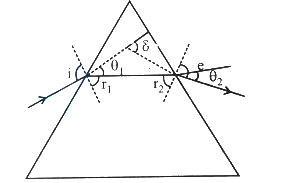
The angles of incidence and emergence of a light ray passing through a prism of angle $A$ are $i$ and $e$ respectively. The total deviation produced by the prism is
A
$i+e+A$
B
$i+e-A$
C
$i+e-2A$
D
$i+e+2A$
Solution
(B) For a light ray passing through a prism,the angle of deviation $\delta$ at the first surface is $\theta_1 = i - r_1$ and at the second surface is $\theta_2 = e - r_2$.
The total deviation $\delta$ is the sum of deviations at both surfaces:
$\delta = \theta_1 + \theta_2$
$\delta = (i - r_1) + (e - r_2)$
$\delta = (i + e) - (r_1 + r_2)$
Since the prism angle $A = r_1 + r_2$,we substitute this into the equation:
$\delta = i + e - A$
The total deviation $\delta$ is the sum of deviations at both surfaces:
$\delta = \theta_1 + \theta_2$
$\delta = (i - r_1) + (e - r_2)$
$\delta = (i + e) - (r_1 + r_2)$
Since the prism angle $A = r_1 + r_2$,we substitute this into the equation:
$\delta = i + e - A$
0 likes
View Solution323
MediumMCQ
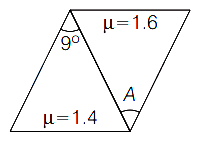
$A$ thin glass prism of angle $9^{\circ}$ with refractive index $1.4$ is combined with another glass prism of refractive index $1.6$ as shown in the figure. The combination of the prisms provides dispersion without deviation. Determine the angle $(A)$ of the second prism. (in $^{\circ}$)
A
$9$
B
$12$
C
$6$
D
$4$
Solution
(C) For dispersion without deviation through a prism combination,the net deviation must be zero.
$\delta_{net} = \delta_1 - \delta_2 = 0$
$\Rightarrow \delta_1 = \delta_2$
For thin prisms,the deviation is given by $\delta = A(\mu - 1)$.
Therefore,$A_1(\mu_1 - 1) = A_2(\mu_2 - 1)$.
Given: $A_1 = 9^{\circ}$,$\mu_1 = 1.4$,and $\mu_2 = 1.6$.
Substituting the values:
$9^{\circ} \times (1.4 - 1) = A \times (1.6 - 1)$
$9^{\circ} \times 0.4 = A \times 0.6$
$A = \frac{9 \times 0.4}{0.6} = \frac{3.6}{0.6} = 6^{\circ}$.
$\delta_{net} = \delta_1 - \delta_2 = 0$
$\Rightarrow \delta_1 = \delta_2$
For thin prisms,the deviation is given by $\delta = A(\mu - 1)$.
Therefore,$A_1(\mu_1 - 1) = A_2(\mu_2 - 1)$.
Given: $A_1 = 9^{\circ}$,$\mu_1 = 1.4$,and $\mu_2 = 1.6$.
Substituting the values:
$9^{\circ} \times (1.4 - 1) = A \times (1.6 - 1)$
$9^{\circ} \times 0.4 = A \times 0.6$
$A = \frac{9 \times 0.4}{0.6} = \frac{3.6}{0.6} = 6^{\circ}$.
0 likes
View Solution324
EasyMCQ
$A$ prism is made of glass having a refractive index of $\sqrt{2}$. If the angle of minimum deviation is equal to the angle of the prism,then the angle of the prism is: (in $^{\circ}$)
A
$45$
B
$90$
C
$60$
D
$30$
Solution
(B) Let $\delta_m$ be the angle of minimum deviation and $A$ be the angle of the prism.
We know the formula for the refractive index $\mu$ of a prism is given by:
$\mu = \frac{\sin \left(\frac{A+\delta_m}{2}\right)}{\sin \left(\frac{A}{2}\right)}$
Given that $\mu = \sqrt{2}$ and $\delta_m = A$,we substitute these values into the formula:
$\sqrt{2} = \frac{\sin \left(\frac{A+A}{2}\right)}{\sin \left(\frac{A}{2}\right)}$
$\sqrt{2} = \frac{\sin A}{\sin \left(\frac{A}{2}\right)}$
Using the trigonometric identity $\sin A = 2 \sin \left(\frac{A}{2}\right) \cos \left(\frac{A}{2}\right)$,we get:
$\sqrt{2} = \frac{2 \sin \left(\frac{A}{2}\right) \cos \left(\frac{A}{2}\right)}{\sin \left(\frac{A}{2}\right)}$
$\sqrt{2} = 2 \cos \left(\frac{A}{2}\right)$
$\cos \left(\frac{A}{2}\right) = \frac{\sqrt{2}}{2} = \frac{1}{\sqrt{2}}$
Since $\cos(45^{\circ}) = \frac{1}{\sqrt{2}}$,we have:
$\frac{A}{2} = 45^{\circ}$
$A = 90^{\circ}$
We know the formula for the refractive index $\mu$ of a prism is given by:
$\mu = \frac{\sin \left(\frac{A+\delta_m}{2}\right)}{\sin \left(\frac{A}{2}\right)}$
Given that $\mu = \sqrt{2}$ and $\delta_m = A$,we substitute these values into the formula:
$\sqrt{2} = \frac{\sin \left(\frac{A+A}{2}\right)}{\sin \left(\frac{A}{2}\right)}$
$\sqrt{2} = \frac{\sin A}{\sin \left(\frac{A}{2}\right)}$
Using the trigonometric identity $\sin A = 2 \sin \left(\frac{A}{2}\right) \cos \left(\frac{A}{2}\right)$,we get:
$\sqrt{2} = \frac{2 \sin \left(\frac{A}{2}\right) \cos \left(\frac{A}{2}\right)}{\sin \left(\frac{A}{2}\right)}$
$\sqrt{2} = 2 \cos \left(\frac{A}{2}\right)$
$\cos \left(\frac{A}{2}\right) = \frac{\sqrt{2}}{2} = \frac{1}{\sqrt{2}}$
Since $\cos(45^{\circ}) = \frac{1}{\sqrt{2}}$,we have:
$\frac{A}{2} = 45^{\circ}$
$A = 90^{\circ}$
0 likes
View Solution325
EasyMCQ
$A$ thin prism of angle $6^{\circ}$ made of glass of refractive index $1.5$ is combined with another prism made of glass of refractive index $1.75$ to produce dispersion without deviation. Then,the angle of the second prism is (in $^{\circ}$)
A
$5$
B
$8$
C
$4$
D
$6$
Solution
(C) For dispersion without deviation,the net deviation produced by the combination must be zero.
$\delta - \delta^{\prime} = 0 \Rightarrow A(\mu - 1) - A^{\prime}(\mu^{\prime} - 1) = 0$
Where:
$A = 6^{\circ}$ (angle of the first prism)
$\mu = 1.5$ (refractive index of the first prism)
$A^{\prime} = ?$ (angle of the second prism)
$\mu^{\prime} = 1.75$ (refractive index of the second prism)
Substituting the values into the equation:
$A^{\prime}(\mu^{\prime} - 1) = A(\mu - 1)$
$A^{\prime}(1.75 - 1) = 6(1.5 - 1)$
$A^{\prime}(0.75) = 6(0.5)$
$A^{\prime} = \frac{6 \times 0.5}{0.75} = \frac{3}{0.75} = 4^{\circ}$
Thus,the angle of the second prism is $4^{\circ}$.
$\delta - \delta^{\prime} = 0 \Rightarrow A(\mu - 1) - A^{\prime}(\mu^{\prime} - 1) = 0$
Where:
$A = 6^{\circ}$ (angle of the first prism)
$\mu = 1.5$ (refractive index of the first prism)
$A^{\prime} = ?$ (angle of the second prism)
$\mu^{\prime} = 1.75$ (refractive index of the second prism)
Substituting the values into the equation:
$A^{\prime}(\mu^{\prime} - 1) = A(\mu - 1)$
$A^{\prime}(1.75 - 1) = 6(1.5 - 1)$
$A^{\prime}(0.75) = 6(0.5)$
$A^{\prime} = \frac{6 \times 0.5}{0.75} = \frac{3}{0.75} = 4^{\circ}$
Thus,the angle of the second prism is $4^{\circ}$.
0 likes
View Solution326
DifficultMCQ
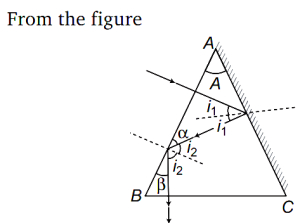
The principal section of a glass prism is an isosceles triangle $ABC$ with $AB = AC$. The face $AC$ is silvered. $A$ ray of light is incident normally on the face $AB$ and after two reflections,it emerges from the base $BC$ perpendicular to the base. The angle $BAC$ of the prism is: (in $^{\circ}$)
A
$30$
B
$36$
C
$60$
D
$72$
Solution
(B) Let the angle of the prism be $A$. Since the ray is incident normally on face $AB$,it enters the prism without deviation.
At the silvered face $AC$,the angle of incidence $i_1$ is equal to the prism angle $A$ (as the normal to $AC$ makes an angle $A$ with the normal to $AB$).
By the law of reflection,the angle of reflection is also $i_1 = A$.
In the triangle formed by the ray and the faces,the angle at the base $AB$ is $90^{\circ} - A$. Thus,the angle of incidence at the second reflection on face $AB$ is $i_2 = 90^{\circ} - (90^{\circ} - 2A) = 2A$.
Finally,the ray emerges from the base $BC$ normally. In the triangle near vertex $B$,the angles are $B$,$90^{\circ} - i_2$,and $90^{\circ}$. Since $AB = AC$,the base angles are $B = C = (180^{\circ} - A) / 2 = 90^{\circ} - A/2$.
From the geometry of the path,the sum of angles in the triangle formed by the ray inside the prism is $A + 2A + 2A = 180^{\circ}$.
$5A = 180^{\circ} \implies A = 36^{\circ}$.
At the silvered face $AC$,the angle of incidence $i_1$ is equal to the prism angle $A$ (as the normal to $AC$ makes an angle $A$ with the normal to $AB$).
By the law of reflection,the angle of reflection is also $i_1 = A$.
In the triangle formed by the ray and the faces,the angle at the base $AB$ is $90^{\circ} - A$. Thus,the angle of incidence at the second reflection on face $AB$ is $i_2 = 90^{\circ} - (90^{\circ} - 2A) = 2A$.
Finally,the ray emerges from the base $BC$ normally. In the triangle near vertex $B$,the angles are $B$,$90^{\circ} - i_2$,and $90^{\circ}$. Since $AB = AC$,the base angles are $B = C = (180^{\circ} - A) / 2 = 90^{\circ} - A/2$.
From the geometry of the path,the sum of angles in the triangle formed by the ray inside the prism is $A + 2A + 2A = 180^{\circ}$.
$5A = 180^{\circ} \implies A = 36^{\circ}$.
0 likes
View Solution327
DifficultMCQ
The refracting angle of a prism is $A$ and the refractive index of the material of the prism is $\cot (A / 2)$. The angle of minimum deviation of the prism is
A
$\pi+2 A$
B
$\pi-2 A$
C
$\frac{\pi}{2}+A$
D
$\frac{\pi}{2}-A$
Solution
(B) The formula for the refractive index $\mu$ of a prism in terms of the refracting angle $A$ and the angle of minimum deviation $\delta_m$ is given by:
$\mu = \frac{\sin((A + \delta_m) / 2)}{\sin(A / 2)}$
Given $\mu = \cot(A / 2) = \frac{\cos(A / 2)}{\sin(A / 2)}$,we substitute this into the formula:
$\frac{\cos(A / 2)}{\sin(A / 2)} = \frac{\sin((A + \delta_m) / 2)}{\sin(A / 2)}$
Canceling $\sin(A / 2)$ from both sides,we get:
$\cos(A / 2) = \sin((A + \delta_m) / 2)$
Using the trigonometric identity $\cos \theta = \sin(90^{\circ} - \theta)$ or $\sin(\pi/2 - \theta)$:
$\sin(\pi/2 - A/2) = \sin((A + \delta_m) / 2)$
Equating the angles:
$\pi/2 - A/2 = (A + \delta_m) / 2$
Multiplying by $2$:
$\pi - A = A + \delta_m$
$\delta_m = \pi - 2A$
$\mu = \frac{\sin((A + \delta_m) / 2)}{\sin(A / 2)}$
Given $\mu = \cot(A / 2) = \frac{\cos(A / 2)}{\sin(A / 2)}$,we substitute this into the formula:
$\frac{\cos(A / 2)}{\sin(A / 2)} = \frac{\sin((A + \delta_m) / 2)}{\sin(A / 2)}$
Canceling $\sin(A / 2)$ from both sides,we get:
$\cos(A / 2) = \sin((A + \delta_m) / 2)$
Using the trigonometric identity $\cos \theta = \sin(90^{\circ} - \theta)$ or $\sin(\pi/2 - \theta)$:
$\sin(\pi/2 - A/2) = \sin((A + \delta_m) / 2)$
Equating the angles:
$\pi/2 - A/2 = (A + \delta_m) / 2$
Multiplying by $2$:
$\pi - A = A + \delta_m$
$\delta_m = \pi - 2A$
0 likes
View Solution328
DifficultMCQ
$A$ prism is made up of a material with a refractive index of $\sqrt{3}$. The angle of the prism is $A$. If the angle of minimum deviation is equal to the angle of the prism,then the value of $A$ is: (in $^{\circ}$)
A
$30$
B
$45$
C
$60$
D
$75$
Solution
(C) Given: Refractive index $\mu = \sqrt{3}$ and angle of minimum deviation $\delta_m = A$.
The formula for the refractive index of a prism is given by:
$\mu = \frac{\sin(\frac{A + \delta_m}{2})}{\sin(\frac{A}{2})}$
Substituting the given values:
$\sqrt{3} = \frac{\sin(\frac{A + A}{2})}{\sin(\frac{A}{2})}$
$\sqrt{3} = \frac{\sin(A)}{\sin(\frac{A}{2})}$
Using the trigonometric identity $\sin(A) = 2 \sin(\frac{A}{2}) \cos(\frac{A}{2})$:
$\sqrt{3} = \frac{2 \sin(\frac{A}{2}) \cos(\frac{A}{2})}{\sin(\frac{A}{2})}$
$\sqrt{3} = 2 \cos(\frac{A}{2})$
$\cos(\frac{A}{2}) = \frac{\sqrt{3}}{2}$
Since $\cos(30^{\circ}) = \frac{\sqrt{3}}{2}$,we have:
$\frac{A}{2} = 30^{\circ}$
$A = 60^{\circ}$
The formula for the refractive index of a prism is given by:
$\mu = \frac{\sin(\frac{A + \delta_m}{2})}{\sin(\frac{A}{2})}$
Substituting the given values:
$\sqrt{3} = \frac{\sin(\frac{A + A}{2})}{\sin(\frac{A}{2})}$
$\sqrt{3} = \frac{\sin(A)}{\sin(\frac{A}{2})}$
Using the trigonometric identity $\sin(A) = 2 \sin(\frac{A}{2}) \cos(\frac{A}{2})$:
$\sqrt{3} = \frac{2 \sin(\frac{A}{2}) \cos(\frac{A}{2})}{\sin(\frac{A}{2})}$
$\sqrt{3} = 2 \cos(\frac{A}{2})$
$\cos(\frac{A}{2}) = \frac{\sqrt{3}}{2}$
Since $\cos(30^{\circ}) = \frac{\sqrt{3}}{2}$,we have:
$\frac{A}{2} = 30^{\circ}$
$A = 60^{\circ}$
0 likes
View Solution329
DifficultMCQ
In the visible region,the dispersive powers and the mean angular deviations for crown and flint glass prisms are $\omega, \omega^{\prime}$ and $d, d^{\prime}$ respectively. The condition for obtaining dispersion without deviation,when the two prisms are combined,is:
A
$d + d^{\prime} = 0$
B
$\omega^{\prime} d + \omega d^{\prime} = 0$
C
$\omega d + \omega^{\prime} d^{\prime} = 0$
D
$\omega d^2 + \omega^{\prime} d^{\prime 2} = 0$
Solution
(A) For two prisms combined to produce dispersion without deviation (achromatic combination),the net deviation must be zero.
Let the mean deviations produced by the two prisms be $d$ and $d^{\prime}$.
The condition for zero net deviation is given by $d + d^{\prime} = 0$.
However,the question asks for the condition of dispersion without deviation. The dispersive power $\omega$ is defined as $\omega = \frac{\delta_v - \delta_r}{\delta_y}$,where $\delta_y$ is the mean deviation $(d)$.
Thus,the angular dispersion is $\theta = \omega d$.
For the net dispersion to be non-zero while the net deviation is zero,we require $d + d^{\prime} = 0$.
Given the standard form for such problems,the condition for zero deviation is $d + d^{\prime} = 0$. If the options provided are meant to represent the relationship between dispersive powers and deviations,the correct physical condition is $d + d^{\prime} = 0$. Since the provided options seem to contain typos,the most physically relevant form for zero deviation is $d + d^{\prime} = 0$.
Let the mean deviations produced by the two prisms be $d$ and $d^{\prime}$.
The condition for zero net deviation is given by $d + d^{\prime} = 0$.
However,the question asks for the condition of dispersion without deviation. The dispersive power $\omega$ is defined as $\omega = \frac{\delta_v - \delta_r}{\delta_y}$,where $\delta_y$ is the mean deviation $(d)$.
Thus,the angular dispersion is $\theta = \omega d$.
For the net dispersion to be non-zero while the net deviation is zero,we require $d + d^{\prime} = 0$.
Given the standard form for such problems,the condition for zero deviation is $d + d^{\prime} = 0$. If the options provided are meant to represent the relationship between dispersive powers and deviations,the correct physical condition is $d + d^{\prime} = 0$. Since the provided options seem to contain typos,the most physically relevant form for zero deviation is $d + d^{\prime} = 0$.
0 likes
View Solution330
DifficultMCQ
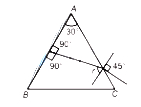
One face of a glass prism is silver-polished. $A$ light ray falls at an angle of $45^{\circ}$ on the other face. After refraction,it is subsequently reflected from the silvered face and then retraces its path. The refracting angle of the prism is $30^{\circ}$. The refractive index of the prism is:
A
$\frac{3}{2}$
B
$\sqrt{2}$
C
$\frac{\sqrt{3}}{2}$
D
$\sqrt{3}$
Solution
(B) Given: Angle of incidence $i = 45^{\circ}$,Prism angle $A = 30^{\circ}$.
Since the ray retraces its path after reflection from the silvered face,it must strike the silvered face normally (at $90^{\circ}$).
In the triangle formed by the ray inside the prism,the angles are $A = 30^{\circ}$,the angle at the silvered face is $90^{\circ}$,and the angle of refraction $r$ at the first face.
The sum of angles in a triangle is $180^{\circ}$,so $r + 90^{\circ} + 30^{\circ} = 180^{\circ}$.
$r = 180^{\circ} - 120^{\circ} = 60^{\circ}$.
Wait,looking at the geometry: the angle of refraction $r$ is the angle with the normal. The angle inside the prism at the first face is $90^{\circ} - r$.
Thus,$(90^{\circ} - r) + 90^{\circ} + 30^{\circ} = 180^{\circ}$.
$210^{\circ} - r = 180^{\circ} \implies r = 30^{\circ}$.
Using Snell's Law: $\mu = \frac{\sin i}{\sin r} = \frac{\sin 45^{\circ}}{\sin 30^{\circ}}$.
$\mu = \frac{1/\sqrt{2}}{1/2} = \frac{2}{\sqrt{2}} = \sqrt{2}$.
Since the ray retraces its path after reflection from the silvered face,it must strike the silvered face normally (at $90^{\circ}$).
In the triangle formed by the ray inside the prism,the angles are $A = 30^{\circ}$,the angle at the silvered face is $90^{\circ}$,and the angle of refraction $r$ at the first face.
The sum of angles in a triangle is $180^{\circ}$,so $r + 90^{\circ} + 30^{\circ} = 180^{\circ}$.
$r = 180^{\circ} - 120^{\circ} = 60^{\circ}$.
Wait,looking at the geometry: the angle of refraction $r$ is the angle with the normal. The angle inside the prism at the first face is $90^{\circ} - r$.
Thus,$(90^{\circ} - r) + 90^{\circ} + 30^{\circ} = 180^{\circ}$.
$210^{\circ} - r = 180^{\circ} \implies r = 30^{\circ}$.
Using Snell's Law: $\mu = \frac{\sin i}{\sin r} = \frac{\sin 45^{\circ}}{\sin 30^{\circ}}$.
$\mu = \frac{1/\sqrt{2}}{1/2} = \frac{2}{\sqrt{2}} = \sqrt{2}$.
0 likes
View Solution331
DifficultMCQ
When a glass prism of refracting angle $60^{\circ}$ is immersed in a liquid,its angle of minimum deviation is $30^{\circ}$. The critical angle of glass with respect to the liquid medium is (in $^{\circ}$)
A
$42$
B
$45$
C
$50$
D
$52$
Solution
(B) Given: Refracting angle $A = 60^{\circ}$,Angle of minimum deviation $\delta_m = 30^{\circ}$.
Using the formula for the refractive index of a prism immersed in a liquid:
$\mu = \frac{\sin \left( \frac{A + \delta_m}{2} \right)}{\sin \left( \frac{A}{2} \right)}$
$\mu = \frac{\sin \left( \frac{60^{\circ} + 30^{\circ}}{2} \right)}{\sin \left( \frac{60^{\circ}}{2} \right)} = \frac{\sin 45^{\circ}}{\sin 30^{\circ}}$
$\mu = \frac{1/\sqrt{2}}{1/2} = \frac{2}{\sqrt{2}} = \sqrt{2}$
The critical angle $C$ is given by $\sin C = \frac{1}{\mu}$.
$\sin C = \frac{1}{\sqrt{2}}$
$C = \sin^{-1} \left( \frac{1}{\sqrt{2}} \right) = 45^{\circ}$.
Using the formula for the refractive index of a prism immersed in a liquid:
$\mu = \frac{\sin \left( \frac{A + \delta_m}{2} \right)}{\sin \left( \frac{A}{2} \right)}$
$\mu = \frac{\sin \left( \frac{60^{\circ} + 30^{\circ}}{2} \right)}{\sin \left( \frac{60^{\circ}}{2} \right)} = \frac{\sin 45^{\circ}}{\sin 30^{\circ}}$
$\mu = \frac{1/\sqrt{2}}{1/2} = \frac{2}{\sqrt{2}} = \sqrt{2}$
The critical angle $C$ is given by $\sin C = \frac{1}{\mu}$.
$\sin C = \frac{1}{\sqrt{2}}$
$C = \sin^{-1} \left( \frac{1}{\sqrt{2}} \right) = 45^{\circ}$.
0 likes
View Solution332
MediumMCQ
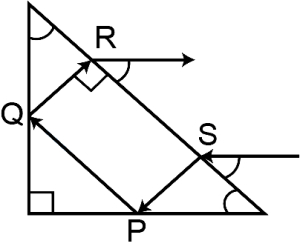
$A$ ray of light is incident on a right-angled isosceles prism parallel to its base as shown in the figure. The refractive index of the material of the prism is $\sqrt{2}$. Which of the following statement$(s)$ is/are true?
A
The reflection at $P$ is total internal.
B
The reflection at $Q$ is total internal.
C
The ray emerging at $R$ is parallel to the ray incident at $S$.
D
Total deviation of the ray is $150^{\circ}$.
Solution
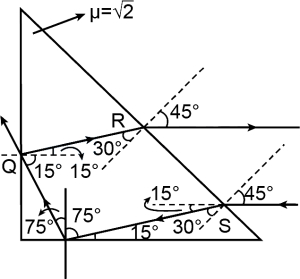
(A, C) The critical angle $\theta_{C} = \sin^{-1}\left(\frac{1}{\sqrt{2}}\right) = 45^{\circ}$.
Applying Snell's law at the incident surface $S$ $(n_{1} \sin \theta_{1} = n_{2} \sin \theta_{2})$:
$1 \cdot \sin 45^{\circ} = \sqrt{2} \cdot \sin \theta \implies \sin \theta = \frac{1}{2} \implies \theta = 30^{\circ}$.
At point $P$,the angle of incidence is $90^{\circ} - 15^{\circ} = 75^{\circ}$. Since $75^{\circ} > 45^{\circ}$,total internal reflection $(TIR)$ occurs at $P$.
At point $Q$,the angle of incidence is $15^{\circ}$. Since $15^{\circ} < 45^{\circ}$,partial reflection and refraction occur at $Q$.
The ray emerging at $R$ is parallel to the incident ray at $S$ because the geometry of the prism and the path of the ray result in a net deviation of $0^{\circ}$ (or $360^{\circ}$),meaning they are parallel. Thus,statement $A$ and $C$ are correct.
Applying Snell's law at the incident surface $S$ $(n_{1} \sin \theta_{1} = n_{2} \sin \theta_{2})$:
$1 \cdot \sin 45^{\circ} = \sqrt{2} \cdot \sin \theta \implies \sin \theta = \frac{1}{2} \implies \theta = 30^{\circ}$.
At point $P$,the angle of incidence is $90^{\circ} - 15^{\circ} = 75^{\circ}$. Since $75^{\circ} > 45^{\circ}$,total internal reflection $(TIR)$ occurs at $P$.
At point $Q$,the angle of incidence is $15^{\circ}$. Since $15^{\circ} < 45^{\circ}$,partial reflection and refraction occur at $Q$.
The ray emerging at $R$ is parallel to the incident ray at $S$ because the geometry of the prism and the path of the ray result in a net deviation of $0^{\circ}$ (or $360^{\circ}$),meaning they are parallel. Thus,statement $A$ and $C$ are correct.
0 likes
View Solution333
MediumMCQ
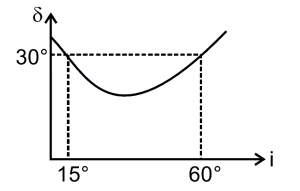
The figure shows the graph of the angle of deviation $\delta$ versus the angle of incidence $i$ for a light ray striking a prism. The prism angle $A$ is: (in $^{\circ}$)
A
$30$
B
$45$
C
$60$
D
$75$
Solution
(B) For a prism,the angle of deviation $\delta$ is given by the formula: $\delta = i + e - A$,where $i$ is the angle of incidence,$e$ is the angle of emergence,and $A$ is the prism angle.
From the graph,we observe that for a deviation $\delta = 30^{\circ}$,there are two possible angles of incidence: $i_1 = 15^{\circ}$ and $i_2 = 60^{\circ}$.
By the principle of reversibility of light,if $i = 15^{\circ}$,then $e = 60^{\circ}$,and if $i = 60^{\circ}$,then $e = 15^{\circ}$.
Substituting these values into the formula: $A = i + e - \delta$.
$A = 15^{\circ} + 60^{\circ} - 30^{\circ}$.
$A = 75^{\circ} - 30^{\circ} = 45^{\circ}$.
Therefore,the prism angle is $45^{\circ}$.
From the graph,we observe that for a deviation $\delta = 30^{\circ}$,there are two possible angles of incidence: $i_1 = 15^{\circ}$ and $i_2 = 60^{\circ}$.
By the principle of reversibility of light,if $i = 15^{\circ}$,then $e = 60^{\circ}$,and if $i = 60^{\circ}$,then $e = 15^{\circ}$.
Substituting these values into the formula: $A = i + e - \delta$.
$A = 15^{\circ} + 60^{\circ} - 30^{\circ}$.
$A = 75^{\circ} - 30^{\circ} = 45^{\circ}$.
Therefore,the prism angle is $45^{\circ}$.
0 likes
View Solution334
DifficultMCQ
The glass prisms $P_{1}$ and $P_{2}$ are to be combined together to produce dispersion without deviation. The angles of the prisms $P_{1}$ and $P_{2}$ are selected as $4^{\circ}$ and $3^{\circ}$ respectively. If the refractive index of prism $P_{1}$ is $1.54,$ then that of $P_{2}$ will be
A
$1.48$
B
$1.58$
C
$1.62$
D
$1.72$
Solution
(D) For dispersion without deviation,the net deviation produced by the combination of two prisms must be zero.
Let the refractive indices of prisms $P_{1}$ and $P_{2}$ be $\mu$ and $\mu^{\prime}$ and their refracting angles be $A$ and $A^{\prime}$ respectively.
The condition for no deviation is given by $\delta + \delta^{\prime} = 0$,which implies $(\mu - 1)A = (\mu^{\prime} - 1)A^{\prime}$.
Given values are $\mu = 1.54$,$A = 4^{\circ}$,and $A^{\prime} = 3^{\circ}$.
Substituting these values into the equation: $(1.54 - 1) \times 4^{\circ} = (\mu^{\prime} - 1) \times 3^{\circ}$.
$0.54 \times 4 = (\mu^{\prime} - 1) \times 3$.
$2.16 = (\mu^{\prime} - 1) \times 3$.
$\mu^{\prime} - 1 = \frac{2.16}{3} = 0.72$.
$\mu^{\prime} = 0.72 + 1 = 1.72$.
Let the refractive indices of prisms $P_{1}$ and $P_{2}$ be $\mu$ and $\mu^{\prime}$ and their refracting angles be $A$ and $A^{\prime}$ respectively.
The condition for no deviation is given by $\delta + \delta^{\prime} = 0$,which implies $(\mu - 1)A = (\mu^{\prime} - 1)A^{\prime}$.
Given values are $\mu = 1.54$,$A = 4^{\circ}$,and $A^{\prime} = 3^{\circ}$.
Substituting these values into the equation: $(1.54 - 1) \times 4^{\circ} = (\mu^{\prime} - 1) \times 3^{\circ}$.
$0.54 \times 4 = (\mu^{\prime} - 1) \times 3$.
$2.16 = (\mu^{\prime} - 1) \times 3$.
$\mu^{\prime} - 1 = \frac{2.16}{3} = 0.72$.
$\mu^{\prime} = 0.72 + 1 = 1.72$.
0 likes
View Solution335
DifficultMCQ
For a transparent prism,if the angle of minimum deviation is equal to its refracting angle,the refractive index $n$ of the prism satisfies.
A
$n < 2$
B
$1 < n < 2$
C
$n > 2$
D
$n = 2$
Solution
(B) The formula for the refractive index $n$ of a prism is given by $n = \frac{\sin((A + \delta_{\min})/2)}{\sin(A/2)}$.
Given that the angle of minimum deviation $\delta_{\min}$ is equal to the refracting angle $A$,we substitute $\delta_{\min} = A$ into the formula.
$n = \frac{\sin((A + A)/2)}{\sin(A/2)} = \frac{\sin(A)}{\sin(A/2)}$.
Using the trigonometric identity $\sin(A) = 2 \sin(A/2) \cos(A/2)$,we get $n = \frac{2 \sin(A/2) \cos(A/2)}{\sin(A/2)} = 2 \cos(A/2)$.
Since the refracting angle $A$ of a prism must satisfy $0 < A < 180^{\circ}$,the value of $\cos(A/2)$ lies between $\cos(90^{\circ}) = 0$ and $\cos(0^{\circ}) = 1$.
Therefore,$0 < \cos(A/2) < 1$.
Multiplying by $2$,we get $0 < 2 \cos(A/2) < 2$,which implies $0 < n < 2$.
However,for a physical prism,$A$ is typically small or less than $180^{\circ}$,and $n > 1$. Thus,$1 < n < 2$.
Given that the angle of minimum deviation $\delta_{\min}$ is equal to the refracting angle $A$,we substitute $\delta_{\min} = A$ into the formula.
$n = \frac{\sin((A + A)/2)}{\sin(A/2)} = \frac{\sin(A)}{\sin(A/2)}$.
Using the trigonometric identity $\sin(A) = 2 \sin(A/2) \cos(A/2)$,we get $n = \frac{2 \sin(A/2) \cos(A/2)}{\sin(A/2)} = 2 \cos(A/2)$.
Since the refracting angle $A$ of a prism must satisfy $0 < A < 180^{\circ}$,the value of $\cos(A/2)$ lies between $\cos(90^{\circ}) = 0$ and $\cos(0^{\circ}) = 1$.
Therefore,$0 < \cos(A/2) < 1$.
Multiplying by $2$,we get $0 < 2 \cos(A/2) < 2$,which implies $0 < n < 2$.
However,for a physical prism,$A$ is typically small or less than $180^{\circ}$,and $n > 1$. Thus,$1 < n < 2$.
0 likes
View Solution336
DifficultMCQ
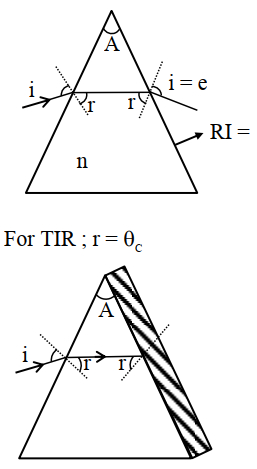
The exit surface of a prism with refractive index $n$ is coated with a material having refractive index $\frac{n}{2}$. When this prism is set for minimum angle of deviation,it exactly meets the condition of the critical angle. The prism angle is . . . . . . (in $^{\circ}$)
A
$60$
B
$15$
C
$30$
D
$45$
Solution
(A) For the condition of minimum deviation,the angle of incidence $i$ is equal to the angle of emergence $e$,and the angle of refraction $r$ is given by $r = \frac{A}{2}$,where $A$ is the prism angle.
At the exit surface,the light ray strikes the interface between the prism (refractive index $n$) and the coating (refractive index $n/2$).
For the condition of the critical angle $\theta_{c}$,the angle of refraction $r$ must be equal to $\theta_{c}$.
According to Snell's law at the exit surface: $n \sin(r) = (n/2) \sin(90^{\circ})$.
Since $\sin(90^{\circ}) = 1$,we have $n \sin(r) = n/2$.
Dividing both sides by $n$,we get $\sin(r) = 1/2$.
Since $r = A/2$,we have $\sin(A/2) = 1/2$.
Therefore,$A/2 = 30^{\circ}$,which gives $A = 60^{\circ}$.
At the exit surface,the light ray strikes the interface between the prism (refractive index $n$) and the coating (refractive index $n/2$).
For the condition of the critical angle $\theta_{c}$,the angle of refraction $r$ must be equal to $\theta_{c}$.
According to Snell's law at the exit surface: $n \sin(r) = (n/2) \sin(90^{\circ})$.
Since $\sin(90^{\circ}) = 1$,we have $n \sin(r) = n/2$.
Dividing both sides by $n$,we get $\sin(r) = 1/2$.
Since $r = A/2$,we have $\sin(A/2) = 1/2$.
Therefore,$A/2 = 30^{\circ}$,which gives $A = 60^{\circ}$.
0 likes
View Solution337
DifficultMCQ
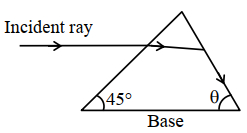
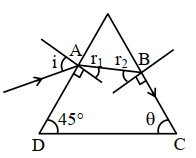
As shown in the diagram,when the incident ray is parallel to the base of the prism,the emergent ray grazes along the second surface. If the refractive index of the material of the prism is $\sqrt{2}$,the angle $\theta$ of the prism is: (in $^{\circ}$)
A
$60$
B
$75$
C
$90$
D
$45$
Solution
(A) Let the prism be $PDC$ with base $DC$. The incident ray is parallel to the base $DC$.
For grazing emergence at the second surface,the angle of refraction $r_2$ is equal to the critical angle $C$.
Given $\mu = \sqrt{2}$,we have $\sin r_2 = \frac{1}{\mu} = \frac{1}{\sqrt{2}}$,which gives $r_2 = 45^{\circ}$.
Since the incident ray is parallel to the base,the angle of incidence $i$ at the first surface is equal to the base angle $45^{\circ}$.
Applying Snell's Law at the first surface: $1 \times \sin(45^{\circ}) = \sqrt{2} \times \sin(r_1)$.
$\frac{1}{\sqrt{2}} = \sqrt{2} \sin(r_1) \implies \sin(r_1) = \frac{1}{2} \implies r_1 = 30^{\circ}$.
The angle of the prism $A$ at the top vertex is $A = r_1 + r_2 = 30^{\circ} + 45^{\circ} = 75^{\circ}$.
In the triangle formed by the prism,the sum of angles is $180^{\circ}$. Thus,$45^{\circ} + \theta + A = 180^{\circ}$.
$45^{\circ} + \theta + 75^{\circ} = 180^{\circ} \implies \theta + 120^{\circ} = 180^{\circ} \implies \theta = 60^{\circ}$.
For grazing emergence at the second surface,the angle of refraction $r_2$ is equal to the critical angle $C$.
Given $\mu = \sqrt{2}$,we have $\sin r_2 = \frac{1}{\mu} = \frac{1}{\sqrt{2}}$,which gives $r_2 = 45^{\circ}$.
Since the incident ray is parallel to the base,the angle of incidence $i$ at the first surface is equal to the base angle $45^{\circ}$.
Applying Snell's Law at the first surface: $1 \times \sin(45^{\circ}) = \sqrt{2} \times \sin(r_1)$.
$\frac{1}{\sqrt{2}} = \sqrt{2} \sin(r_1) \implies \sin(r_1) = \frac{1}{2} \implies r_1 = 30^{\circ}$.
The angle of the prism $A$ at the top vertex is $A = r_1 + r_2 = 30^{\circ} + 45^{\circ} = 75^{\circ}$.
In the triangle formed by the prism,the sum of angles is $180^{\circ}$. Thus,$45^{\circ} + \theta + A = 180^{\circ}$.
$45^{\circ} + \theta + 75^{\circ} = 180^{\circ} \implies \theta + 120^{\circ} = 180^{\circ} \implies \theta = 60^{\circ}$.
0 likes
View Solution338
MediumMCQ
$A$ thin prism with angle $5^{\circ}$ and refractive index $1.72$ is combined with another prism of refractive index $1.9$ to produce dispersion without deviation. The angle of the second prism is . . . . . . . (in $^{\circ}$)
A
$4.5$
B
$6$
C
$4$
D
$5$
Solution
(C) For a thin prism,the deviation produced is given by $\delta = (\mu - 1)A$.
For dispersion without deviation,the net deviation must be zero,i.e.,$\delta_{net} = \delta_{1} + \delta_{2} = 0$.
Since the prisms are combined to produce dispersion without deviation,they must be placed in opposite orientations,so $(\mu_{1} - 1)A_{1} + (\mu_{2} - 1)A_{2} = 0$.
Taking the magnitude,we have $(\mu_{1} - 1)A_{1} = -(\mu_{2} - 1)A_{2}$.
Substituting the given values: $(1.72 - 1) \times 5^{\circ} = -(1.9 - 1) \times A_{2}$.
$0.72 \times 5^{\circ} = -0.9 \times A_{2}$.
The negative sign indicates the orientation of the second prism. The magnitude of the angle $A_{2}$ is:
$A_{2} = \frac{0.72 \times 5^{\circ}}{0.9} = \frac{3.6^{\circ}}{0.9} = 4^{\circ}$.
For dispersion without deviation,the net deviation must be zero,i.e.,$\delta_{net} = \delta_{1} + \delta_{2} = 0$.
Since the prisms are combined to produce dispersion without deviation,they must be placed in opposite orientations,so $(\mu_{1} - 1)A_{1} + (\mu_{2} - 1)A_{2} = 0$.
Taking the magnitude,we have $(\mu_{1} - 1)A_{1} = -(\mu_{2} - 1)A_{2}$.
Substituting the given values: $(1.72 - 1) \times 5^{\circ} = -(1.9 - 1) \times A_{2}$.
$0.72 \times 5^{\circ} = -0.9 \times A_{2}$.
The negative sign indicates the orientation of the second prism. The magnitude of the angle $A_{2}$ is:
$A_{2} = \frac{0.72 \times 5^{\circ}}{0.9} = \frac{3.6^{\circ}}{0.9} = 4^{\circ}$.
0 likes
View Solution339
MediumMCQ
Consider an equilateral prism (refractive index $ \sqrt{2} $). $A$ ray of light is incident on its one surface at a certain angle $ i $. If the emergent ray is found to graze along the other surface,then the angle of refraction at the incident surface is close to . . . . . . . (in $^{\circ}$)
A
$15$
B
$20$
C
$40$
D
$30$
Solution
(A) For an equilateral prism,the angle of the prism $ A = 60^{\circ} $.
When the emergent ray grazes the surface,the angle of emergence $ e = 90^{\circ} $.
According to Snell's law at the second surface: $ \mu \sin(r_2) = 1 \cdot \sin(e) $.
Substituting the values: $ \sqrt{2} \cdot \sin(r_2) = 1 \cdot \sin(90^{\circ}) = 1 $.
$ \sin(r_2) = \frac{1}{\sqrt{2}} $.
Therefore,$ r_2 = 45^{\circ} $.
Using the relation $ A = r_1 + r_2 $,we find the angle of refraction at the first surface:
$ r_1 = A - r_2 = 60^{\circ} - 45^{\circ} = 15^{\circ} $.
When the emergent ray grazes the surface,the angle of emergence $ e = 90^{\circ} $.
According to Snell's law at the second surface: $ \mu \sin(r_2) = 1 \cdot \sin(e) $.
Substituting the values: $ \sqrt{2} \cdot \sin(r_2) = 1 \cdot \sin(90^{\circ}) = 1 $.
$ \sin(r_2) = \frac{1}{\sqrt{2}} $.
Therefore,$ r_2 = 45^{\circ} $.
Using the relation $ A = r_1 + r_2 $,we find the angle of refraction at the first surface:
$ r_1 = A - r_2 = 60^{\circ} - 45^{\circ} = 15^{\circ} $.
0 likes
View Solution340
MediumMCQ
At what angle of incidence should a ray of light be incident on a face of an equilateral prism if the angle of minimum deviation is $46^{\circ}$ (in $^{\circ}$)?
A
$35$
B
$38$
C
$40$
D
$53$
Solution
(D) For the condition of minimum deviation in an equilateral prism,the angle of incidence $i$ is equal to the angle of emergence $e$.
The relationship is given by $i = e = \frac{A + \delta_m}{2}$.
For an equilateral prism,the angle of the prism $A = 60^{\circ}$.
Given the angle of minimum deviation $\delta_m = 46^{\circ}$.
Substituting these values into the formula:
$i = \frac{60^{\circ} + 46^{\circ}}{2} = \frac{106^{\circ}}{2} = 53^{\circ}$.
Therefore,the angle of incidence is $53^{\circ}$.
The relationship is given by $i = e = \frac{A + \delta_m}{2}$.
For an equilateral prism,the angle of the prism $A = 60^{\circ}$.
Given the angle of minimum deviation $\delta_m = 46^{\circ}$.
Substituting these values into the formula:
$i = \frac{60^{\circ} + 46^{\circ}}{2} = \frac{106^{\circ}}{2} = 53^{\circ}$.
Therefore,the angle of incidence is $53^{\circ}$.
0 likes
View Solution341
DifficultMCQ
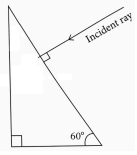
Find the value of the angle of emergence for an emergent ray from the prism in the figure given below. (Refractive index of the material of the prism is $\sqrt{3}$ and the refractive index of air is $1$) (in $^\circ$)
A
$60$
B
$45$
C
$30$
D
$90$
Solution
(A) $1$. From the figure,the incident ray strikes the first surface of the prism normally. Therefore,the angle of incidence $i = 0^\circ$,and the ray passes undeviated into the prism.
$2$. The prism is a right-angled triangle with one angle $60^\circ$. The angle at the top vertex is $180^\circ - 90^\circ - 60^\circ = 30^\circ$.
$3$. Inside the prism,the ray hits the second surface (the hypotenuse). The angle of incidence at this surface $(r_2)$ is the angle between the normal and the ray. Since the ray is perpendicular to the first surface,the angle of incidence at the second surface is $r_2 = 30^\circ$.
$4$. Applying Snell's law at the second surface: $n_1 \sin(r_2) = n_2 \sin(e)$,where $n_1 = \sqrt{3}$,$n_2 = 1$,and $r_2 = 30^\circ$.
$5$. $\sqrt{3} \sin(30^\circ) = 1 \times \sin(e)$.
$6$. $\sqrt{3} \times \frac{1}{2} = \sin(e) \implies \sin(e) = \frac{\sqrt{3}}{2}$.
$7$. Therefore,$e = 60^\circ$.
$2$. The prism is a right-angled triangle with one angle $60^\circ$. The angle at the top vertex is $180^\circ - 90^\circ - 60^\circ = 30^\circ$.
$3$. Inside the prism,the ray hits the second surface (the hypotenuse). The angle of incidence at this surface $(r_2)$ is the angle between the normal and the ray. Since the ray is perpendicular to the first surface,the angle of incidence at the second surface is $r_2 = 30^\circ$.
$4$. Applying Snell's law at the second surface: $n_1 \sin(r_2) = n_2 \sin(e)$,where $n_1 = \sqrt{3}$,$n_2 = 1$,and $r_2 = 30^\circ$.
$5$. $\sqrt{3} \sin(30^\circ) = 1 \times \sin(e)$.
$6$. $\sqrt{3} \times \frac{1}{2} = \sin(e) \implies \sin(e) = \frac{\sqrt{3}}{2}$.
$7$. Therefore,$e = 60^\circ$.
0 likes
View Solution342
DifficultMCQ
For a thin symmetric prism made of glass (refractive index $1.5$),the ratio of the angle of incidence to the angle of minimum deviation is . . . . . . .
A
$3$ : $4$
B
$3$ : $2$
C
$2$ : $1$
D
$1$ : $2$
Solution
(B) For a thin prism,the angle of minimum deviation is given by $\delta_m = (\mu - 1)A$,where $\mu$ is the refractive index and $A$ is the prism angle.
For a symmetric prism,the angle of incidence $i$ at minimum deviation is given by $i = \frac{A + \delta_m}{2}$.
Substituting $\delta_m = (\mu - 1)A$ into the expression for $i$:
$i = \frac{A + (\mu - 1)A}{2} = \frac{A + \mu A - A}{2} = \frac{\mu A}{2}$.
Now,the ratio of the angle of incidence $i$ to the angle of minimum deviation $\delta_m$ is:
$\frac{i}{\delta_m} = \frac{\mu A / 2}{(\mu - 1)A} = \frac{\mu}{2(\mu - 1)}$.
Given $\mu = 1.5$,we have:
$\frac{i}{\delta_m} = \frac{1.5}{2(1.5 - 1)} = \frac{1.5}{2(0.5)} = \frac{1.5}{1} = \frac{3}{2}$.
Thus,the ratio is $3 : 2$.
For a symmetric prism,the angle of incidence $i$ at minimum deviation is given by $i = \frac{A + \delta_m}{2}$.
Substituting $\delta_m = (\mu - 1)A$ into the expression for $i$:
$i = \frac{A + (\mu - 1)A}{2} = \frac{A + \mu A - A}{2} = \frac{\mu A}{2}$.
Now,the ratio of the angle of incidence $i$ to the angle of minimum deviation $\delta_m$ is:
$\frac{i}{\delta_m} = \frac{\mu A / 2}{(\mu - 1)A} = \frac{\mu}{2(\mu - 1)}$.
Given $\mu = 1.5$,we have:
$\frac{i}{\delta_m} = \frac{1.5}{2(1.5 - 1)} = \frac{1.5}{2(0.5)} = \frac{1.5}{1} = \frac{3}{2}$.
Thus,the ratio is $3 : 2$.
0 likes
View SolutionRay Optics and Optical Instruments — Refraction Through Prism · Frequently Asked Questions
1Are these Ray Optics and Optical Instruments questions useful for JEE and NEET?
Yes. All questions in this section are mapped to JEE Main and NEET exam patterns. Previous year questions from JEE Main, NEET, GUJCET and state-level exams are included with full solutions.
2Can I switch to Hindi or Gujarati for these questions?
Yes. Use the language tabs in the hero section or the sidebar to view the same questions and solutions in English, Hindi or Gujarati.
3How do I generate a question paper from this subtopic?
Use the Vedclass Exam Paper Generator — select the chapter and subtopic, set difficulty, and generate Sets A, B, C, D automatically. First 3 chapters of every subject are free.
Vedclass Products
For Students
Vedclass Test Series
Mock tests in real JEE/NEET style with performance analysis. 5-day free trial.
Start Free TrialFor Teachers
Exam Paper Generator
Generate Set A/B/C/D papers from this chapter in 2 minutes. 3 chapters free.
Try FreeFor Institutes
Online Exam Module
Live online exams with unlimited students, 360° analytics & white-label branding.
See DemoFor Teachers & Institutes
Generate a Ray Optics and Optical Instruments Exam Paper in 2 Minutes
Select subtopic & difficulty — Sets A, B, C, D auto-generated with No Repeat logic.
First 3 chapters of every subject are free — no payment required.