
A English
Plane Mirror Questions in English
Class 12 Physics · Ray Optics and Optical Instruments · Plane Mirror
163+
Questions
English
Language
100%
With Solutions
Showing 49 of 163 questions in English
101
EasyMCQ
Light rays fall on a plane mirror and form a real image. Therefore,the incident rays are:
A
Parallel
B
Diverging
C
Converging
D
The statement is false
Solution
(C) For a plane mirror,a real object always forms a virtual image.
Conversely,a virtual object forms a real image.
$A$ virtual object is formed when incident light rays are converging towards a point behind the mirror.
Since the problem states that a real image is formed by a plane mirror,the incident rays must be converging.
Conversely,a virtual object forms a real image.
$A$ virtual object is formed when incident light rays are converging towards a point behind the mirror.
Since the problem states that a real image is formed by a plane mirror,the incident rays must be converging.
0 likes
View Solution102
MediumMCQ
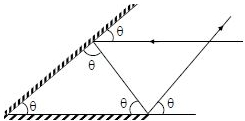
Two plane mirrors are inclined to each other such that a ray of light incident to the first mirror $(M_1)$ and parallel to the second mirror $(M_2)$ is finally reflected from the second mirror $(M_2)$ parallel to the first mirror $(M_1).$ The angle between the two mirrors will be......$^o$
A
$45$
B
$60$
C
$75$
D
$90$
Solution
(B) Let the angle between the two mirrors be $\theta.$
According to the problem,the incident ray is parallel to the mirror $(M_2).$ Therefore,the angle of incidence on the first mirror $(M_1)$ is $\theta.$
By the law of reflection,the angle of reflection from $(M_1)$ is also $\theta.$
This reflected ray strikes the second mirror $(M_2).$
In the triangle formed by the two mirrors and the light ray,the angle at the second mirror is $\theta$ (since the reflected ray is parallel to the first mirror $(M_1)$).
Thus,the sum of angles in the triangle is $\theta + \theta + \theta = 180^o.$
$3\theta = 180^o$
$\theta = 60^o.$
According to the problem,the incident ray is parallel to the mirror $(M_2).$ Therefore,the angle of incidence on the first mirror $(M_1)$ is $\theta.$
By the law of reflection,the angle of reflection from $(M_1)$ is also $\theta.$
This reflected ray strikes the second mirror $(M_2).$
In the triangle formed by the two mirrors and the light ray,the angle at the second mirror is $\theta$ (since the reflected ray is parallel to the first mirror $(M_1)$).
Thus,the sum of angles in the triangle is $\theta + \theta + \theta = 180^o.$
$3\theta = 180^o$
$\theta = 60^o.$
0 likes
View Solution103
DifficultMCQ
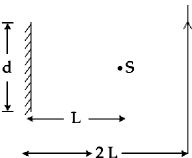
$A$ point source of light,$S$,is placed at a distance $L$ in front of the centre of a plane mirror of width $d$ which is hanging vertically on a wall. $A$ man walks in front of the mirror along a line parallel to the mirror,at a distance $2L$ as shown below. The distance over which the man can see the image of the light source in the mirror is:
A
$d$
B
$2d$
C
$3d$
D
$\frac{d}{2}$
Solution
(C) Let the mirror be placed along the $y$-axis from $y = -d/2$ to $y = d/2$. The source $S$ is at $(L, 0)$. The image $S'$ of the source $S$ is formed at $(-L, 0)$.
The man walks along the line $x = 2L$. The rays from the image $S'$ that reach the man must pass through the edges of the mirror.
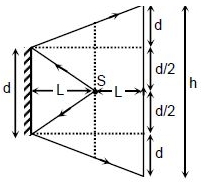
The rays from $S'$ passing through the top edge $(0, d/2)$ and bottom edge $(0, -d/2)$ of the mirror define the field of view.
Using similar triangles,the height $h$ of the field of view at a distance $x = 2L$ from the mirror is given by the ratio of distances.
The distance from the image $S'$ to the mirror is $L$,and the distance from the image $S'$ to the man is $L + 2L = 3L$.
By similar triangles,the width of the field of view $h$ is given by $\frac{h}{d} = \frac{3L}{L} = 3$.
Therefore,$h = 3d$.
The man walks along the line $x = 2L$. The rays from the image $S'$ that reach the man must pass through the edges of the mirror.
The rays from $S'$ passing through the top edge $(0, d/2)$ and bottom edge $(0, -d/2)$ of the mirror define the field of view.
Using similar triangles,the height $h$ of the field of view at a distance $x = 2L$ from the mirror is given by the ratio of distances.
The distance from the image $S'$ to the mirror is $L$,and the distance from the image $S'$ to the man is $L + 2L = 3L$.
By similar triangles,the width of the field of view $h$ is given by $\frac{h}{d} = \frac{3L}{L} = 3$.
Therefore,$h = 3d$.
0 likes
View Solution104
DifficultMCQ
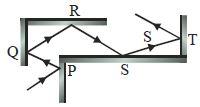
The following figure shows the multiple reflection of a light ray along a glass corridor where the walls are either parallel or perpendicular to one another. If the angle of incidence at point $P$ is $30^o$,what are the angles of reflection of the light ray at points $Q, R, S$ and $T$ respectively?
A
$30^o, 30^o, 30^o, 30^o$
B
$30^o, 60^o, 30^o, 60^o$
C
$30^o, 60^o, 60^o, 30^o$
D
$60^o, 30^o, 60^o, 30^o$
Solution
(D) According to the law of reflection,the angle of incidence is equal to the angle of reflection.
At point $P$,the angle of incidence is $30^o$,so the angle of reflection is $30^o$.
Since the walls are perpendicular,the angle of incidence at point $Q$ is $90^o - 30^o = 60^o$. Thus,the angle of reflection at $Q$ is $60^o$.
At point $R$,the angle of incidence is $90^o - 60^o = 30^o$. Thus,the angle of reflection at $R$ is $30^o$.
At point $S$,the angle of incidence is $90^o - 30^o = 60^o$. Thus,the angle of reflection at $S$ is $60^o$.
At point $T$,the angle of incidence is $90^o - 60^o = 30^o$. Thus,the angle of reflection at $T$ is $30^o$.
Therefore,the angles of reflection at $Q, R, S$ and $T$ are $60^o, 30^o, 60^o, 30^o$ respectively.
At point $P$,the angle of incidence is $30^o$,so the angle of reflection is $30^o$.
Since the walls are perpendicular,the angle of incidence at point $Q$ is $90^o - 30^o = 60^o$. Thus,the angle of reflection at $Q$ is $60^o$.
At point $R$,the angle of incidence is $90^o - 60^o = 30^o$. Thus,the angle of reflection at $R$ is $30^o$.
At point $S$,the angle of incidence is $90^o - 30^o = 60^o$. Thus,the angle of reflection at $S$ is $60^o$.
At point $T$,the angle of incidence is $90^o - 60^o = 30^o$. Thus,the angle of reflection at $T$ is $30^o$.
Therefore,the angles of reflection at $Q, R, S$ and $T$ are $60^o, 30^o, 60^o, 30^o$ respectively.
0 likes
View Solution105
DifficultMCQ
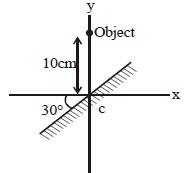
The coordinates of the image with respect to the origin $c$ will be
A
$\left( -5, 5\sqrt{3} \right)$
B
$\left( 5, -5\sqrt{3} \right)$
C
$\left( 5\sqrt{3}, -5 \right)$
D
None of these
Solution
(B) The object is located on the $y$-axis at a distance of $10 \text{ cm}$ from the origin $c$. Its coordinates are $(0, 10)$.
The mirror makes an angle of $30^{\circ}$ with the negative $x$-axis,which means it makes an angle of $150^{\circ}$ with the positive $x$-axis.
The angle of the normal to the mirror with the $y$-axis is $30^{\circ}$.
The image of an object at distance $d$ from the mirror along a line making angle $\theta$ with the mirror surface will be at distance $d$ on the other side.
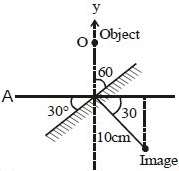
Using the geometry of reflection,the image $I$ is at a distance of $10 \text{ cm}$ from the origin $c$.
The angle the line joining the origin to the image makes with the positive $x$-axis is $-60^{\circ}$ (or $300^{\circ}$).
Thus,the coordinates of the image are $(10 \cos(-60^{\circ}), 10 \sin(-60^{\circ})) = (10 \times 0.5, 10 \times -\frac{\sqrt{3}}{2}) = (5, -5\sqrt{3})$.
Therefore,the correct option is $B$.
The mirror makes an angle of $30^{\circ}$ with the negative $x$-axis,which means it makes an angle of $150^{\circ}$ with the positive $x$-axis.
The angle of the normal to the mirror with the $y$-axis is $30^{\circ}$.
The image of an object at distance $d$ from the mirror along a line making angle $\theta$ with the mirror surface will be at distance $d$ on the other side.
Using the geometry of reflection,the image $I$ is at a distance of $10 \text{ cm}$ from the origin $c$.
The angle the line joining the origin to the image makes with the positive $x$-axis is $-60^{\circ}$ (or $300^{\circ}$).
Thus,the coordinates of the image are $(10 \cos(-60^{\circ}), 10 \sin(-60^{\circ})) = (10 \times 0.5, 10 \times -\frac{\sqrt{3}}{2}) = (5, -5\sqrt{3})$.
Therefore,the correct option is $B$.
0 likes
View Solution106
MediumMCQ
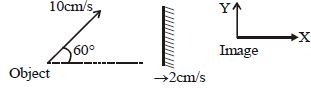
Find the velocity of the image with respect to the mirror.
A
$ - i + 5\sqrt 3 \hat j$
B
$ - 3i + 5\sqrt 3 \hat j$
C
$ - i + 5 \hat j$
D
$ - 3i + 5 \hat j$
Solution
(B) Given: Velocity of object $\vec{v}_o = 10 \cos(60^\circ) \hat{i} + 10 \sin(60^\circ) \hat{j} = 5 \hat{i} + 5\sqrt{3} \hat{j} \text{ cm/s}$.
Velocity of mirror $\vec{v}_m = 2 \hat{i} \text{ cm/s}$.
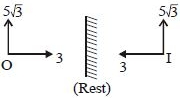
The velocity of the image $\vec{v}_i$ is given by the formula: $\vec{v}_{i,x} = 2\vec{v}_{m,x} - \vec{v}_{o,x}$ and $\vec{v}_{i,y} = \vec{v}_{o,y}$.
Calculating the x-component: $\vec{v}_{i,x} = 2(2) - 5 = 4 - 5 = -1 \text{ cm/s}$.
Calculating the y-component: $\vec{v}_{i,y} = 5\sqrt{3} \text{ cm/s}$.
Thus,the velocity of the image with respect to the ground is $\vec{v}_i = -1 \hat{i} + 5\sqrt{3} \hat{j} \text{ cm/s}$.
The velocity of the image with respect to the mirror is $\vec{v}_{im} = \vec{v}_i - \vec{v}_m = (-1 \hat{i} + 5\sqrt{3} \hat{j}) - (2 \hat{i}) = -3 \hat{i} + 5\sqrt{3} \hat{j} \text{ cm/s}$.
Velocity of mirror $\vec{v}_m = 2 \hat{i} \text{ cm/s}$.
The velocity of the image $\vec{v}_i$ is given by the formula: $\vec{v}_{i,x} = 2\vec{v}_{m,x} - \vec{v}_{o,x}$ and $\vec{v}_{i,y} = \vec{v}_{o,y}$.
Calculating the x-component: $\vec{v}_{i,x} = 2(2) - 5 = 4 - 5 = -1 \text{ cm/s}$.
Calculating the y-component: $\vec{v}_{i,y} = 5\sqrt{3} \text{ cm/s}$.
Thus,the velocity of the image with respect to the ground is $\vec{v}_i = -1 \hat{i} + 5\sqrt{3} \hat{j} \text{ cm/s}$.
The velocity of the image with respect to the mirror is $\vec{v}_{im} = \vec{v}_i - \vec{v}_m = (-1 \hat{i} + 5\sqrt{3} \hat{j}) - (2 \hat{i}) = -3 \hat{i} + 5\sqrt{3} \hat{j} \text{ cm/s}$.
0 likes
View Solution107
MediumMCQ
$A$ ray reflected successively from two plane mirrors inclined at a certain angle undergoes a deviation of $270^o$ after two reflections. The number of images observable is:
A
$10$
B
$11$
C
$7$
D
$8$
Solution
(C) The total deviation $\delta$ produced by two plane mirrors inclined at an angle $\theta$ is given by $\delta = 360^o - 2\theta$.
Given $\delta = 270^o$,we have $270^o = 360^o - 2\theta$.
$2\theta = 360^o - 270^o = 90^o$,so $\theta = 45^o$.
The number of images $n$ formed by two mirrors inclined at an angle $\theta$ is given by $n = \frac{360^o}{\theta} - 1$.
Substituting $\theta = 45^o$,we get $n = \frac{360^o}{45^o} - 1 = 8 - 1 = 7$.
Therefore,the number of observable images is $7$.
Given $\delta = 270^o$,we have $270^o = 360^o - 2\theta$.
$2\theta = 360^o - 270^o = 90^o$,so $\theta = 45^o$.
The number of images $n$ formed by two mirrors inclined at an angle $\theta$ is given by $n = \frac{360^o}{\theta} - 1$.
Substituting $\theta = 45^o$,we get $n = \frac{360^o}{45^o} - 1 = 8 - 1 = 7$.
Therefore,the number of observable images is $7$.
0 likes
View Solution108
MediumMCQ
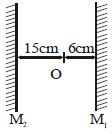
An object $O$ is placed between two parallel plane mirrors $M_1$ and $M_2$. The distance of the object from $M_1$ is $6\,cm$ and from $M_2$ is $15\,cm$. The position of the $4^{th}$ image formed by mirror $M_1$ is:
A
$69\,cm$ from $M_1$
B
$48\,cm$ from $M_1$
C
$78\,cm$ from $M_1$
D
$57\,cm$ from $M_1$
Solution
(C) The distance between the two mirrors is $d = 6\,cm + 15\,cm = 21\,cm$. Let $x_1 = 6\,cm$ (distance from $M_1$) and $x_2 = 15\,cm$ (distance from $M_2$).
Images formed by $M_1$ are at distances:
$I_1 = x_1 = 6\,cm$
$I_3 = x_1 + 2d = 6 + 42 = 48\,cm$
$I_5 = x_1 + 4d = 6 + 84 = 90\,cm$
Images formed by $M_2$ are at distances from $M_2$:
$I_2 = x_2 = 15\,cm$
$I_4 = x_2 + 2d = 15 + 42 = 57\,cm$
To find the position of the $4^{th}$ image formed by $M_1$,we look at the sequence of images. The images formed by $M_1$ are at $6\,cm, 48\,cm, 90\,cm, \dots$ from $M_1$. The images formed by $M_2$ are at $15\,cm, 57\,cm, 99\,cm, \dots$ from $M_2$.
Converting the $M_2$ image distances to be relative to $M_1$:
$I_2$ is at $15 + 21 = 36\,cm$ from $M_1$.
$I_4$ is at $57 + 21 = 78\,cm$ from $M_1$.
Ordering the images by distance from $M_1$: $6\,cm (M_1), 36\,cm (M_2), 48\,cm (M_1), 78\,cm (M_2), 90\,cm (M_1), \dots$
The $4^{th}$ image is at $78\,cm$ from $M_1$.
Images formed by $M_1$ are at distances:
$I_1 = x_1 = 6\,cm$
$I_3 = x_1 + 2d = 6 + 42 = 48\,cm$
$I_5 = x_1 + 4d = 6 + 84 = 90\,cm$
Images formed by $M_2$ are at distances from $M_2$:
$I_2 = x_2 = 15\,cm$
$I_4 = x_2 + 2d = 15 + 42 = 57\,cm$
To find the position of the $4^{th}$ image formed by $M_1$,we look at the sequence of images. The images formed by $M_1$ are at $6\,cm, 48\,cm, 90\,cm, \dots$ from $M_1$. The images formed by $M_2$ are at $15\,cm, 57\,cm, 99\,cm, \dots$ from $M_2$.
Converting the $M_2$ image distances to be relative to $M_1$:
$I_2$ is at $15 + 21 = 36\,cm$ from $M_1$.
$I_4$ is at $57 + 21 = 78\,cm$ from $M_1$.
Ordering the images by distance from $M_1$: $6\,cm (M_1), 36\,cm (M_2), 48\,cm (M_1), 78\,cm (M_2), 90\,cm (M_1), \dots$
The $4^{th}$ image is at $78\,cm$ from $M_1$.
0 likes
View Solution109
DifficultMCQ
$A$ ray of light is incident on a plane mirror at rest. The mirror starts turning at a uniform angular acceleration of $4\pi \, rad/s^2$. The reflected ray at the end of $\frac{1}{4} \, s$ must have turned through......$^o$
A
$90$
B
$45$
C
$22.5$
D
$11.25$
Solution
(B) When a plane mirror rotates by an angle $\theta$, the reflected ray rotates by an angle $2\theta$.
Given angular acceleration $\alpha = 4\pi \, rad/s^2$ and time $t = \frac{1}{4} \, s$.
The angle of rotation of the mirror is $\theta = \omega_0 t + \frac{1}{2} \alpha t^2$.
Since the mirror starts from rest, $\omega_0 = 0$.
$\theta = \frac{1}{2} \times (4\pi) \times (\frac{1}{4})^2 = 2\pi \times \frac{1}{16} = \frac{\pi}{8} \, radians$.
Converting radians to degrees: $\theta = \frac{\pi}{8} \times \frac{180^\circ}{\pi} = 22.5^\circ$.
The reflected ray rotates by $2\theta = 2 \times 22.5^\circ = 45^\circ$.
Given angular acceleration $\alpha = 4\pi \, rad/s^2$ and time $t = \frac{1}{4} \, s$.
The angle of rotation of the mirror is $\theta = \omega_0 t + \frac{1}{2} \alpha t^2$.
Since the mirror starts from rest, $\omega_0 = 0$.
$\theta = \frac{1}{2} \times (4\pi) \times (\frac{1}{4})^2 = 2\pi \times \frac{1}{16} = \frac{\pi}{8} \, radians$.
Converting radians to degrees: $\theta = \frac{\pi}{8} \times \frac{180^\circ}{\pi} = 22.5^\circ$.
The reflected ray rotates by $2\theta = 2 \times 22.5^\circ = 45^\circ$.
0 likes
View Solution110
MediumMCQ
$A$ boy of height $1.5\,m$ with his eye level at $1.4\,m$ stands before a plane mirror of length $0.75\,m$ fixed on the wall. The height of the lower edge of the mirror above the floor is $0.8\,m$. Which of the following is true?
A
The boy will see his full image
B
The boy cannot see his head
C
The boy cannot see his feet
D
The boy cannot see neither his head nor his feet
Solution
(C) The boy's height is $H = 1.5\,m$ and his eye level is $h_e = 1.4\,m$. The distance from his eyes to the top of his head is $1.5 - 1.4 = 0.1\,m$. The distance from his eyes to his feet is $1.4\,m$.
For a person to see their full image,the mirror must cover the range from half the distance to the head to half the distance to the feet relative to the eye level.
Required mirror height above eye level: $0.1 / 2 = 0.05\,m$.
Required mirror height below eye level: $1.4 / 2 = 0.7\,m$.
The mirror's lower edge is at $0.8\,m$ from the floor. Since the eye level is at $1.4\,m$,the lower edge of the mirror is $1.4 - 0.8 = 0.6\,m$ below the eye level.
Since the required distance below the eye level is $0.7\,m$ and the mirror only extends $0.6\,m$ below the eye level,the boy cannot see his feet.
For a person to see their full image,the mirror must cover the range from half the distance to the head to half the distance to the feet relative to the eye level.
Required mirror height above eye level: $0.1 / 2 = 0.05\,m$.
Required mirror height below eye level: $1.4 / 2 = 0.7\,m$.
The mirror's lower edge is at $0.8\,m$ from the floor. Since the eye level is at $1.4\,m$,the lower edge of the mirror is $1.4 - 0.8 = 0.6\,m$ below the eye level.
Since the required distance below the eye level is $0.7\,m$ and the mirror only extends $0.6\,m$ below the eye level,the boy cannot see his feet.
0 likes
View Solution111
MediumMCQ
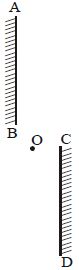
Two mirrors $AB$ and $CD$ are arranged along two parallel lines as shown in the figure. The maximum number of images of object $O$ that can be seen by any observer is
A
One
B
Two
C
Four
D
Infinite
Solution
(B) The object $O$ is placed between two parallel mirrors $AB$ and $CD$.
Each mirror forms an image of the object $O$ behind it.
Since the mirrors are not facing each other (they are arranged along parallel lines but are offset),light rays from the object $O$ can reflect off mirror $AB$ to form an image $I_1$,and light rays can reflect off mirror $CD$ to form an image $I_2$.
Because the mirrors do not overlap in the field of view of the reflected rays from the other mirror,no further multiple reflections occur.
Therefore,only two images are formed,one by each mirror.
Each mirror forms an image of the object $O$ behind it.
Since the mirrors are not facing each other (they are arranged along parallel lines but are offset),light rays from the object $O$ can reflect off mirror $AB$ to form an image $I_1$,and light rays can reflect off mirror $CD$ to form an image $I_2$.
Because the mirrors do not overlap in the field of view of the reflected rays from the other mirror,no further multiple reflections occur.
Therefore,only two images are formed,one by each mirror.
0 likes
View Solution112
MediumMCQ
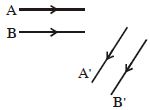
The figure shows two rays $A$ and $B$ being reflected by a mirror and emerging as $A'$ and $B'$. The mirror
A
is plane
B
is convex
C
is concave
D
may be any spherical mirror
Solution
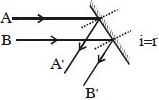
(A) In the given figure,the incident rays $A$ and $B$ are parallel to each other. After reflection from the mirror,the reflected rays $A'$ and $B'$ also remain parallel to each other.
For a spherical mirror (concave or convex),parallel incident rays will either converge to a focus or appear to diverge from a focus,meaning they will not remain parallel after reflection.
Only a plane mirror can reflect a set of parallel incident rays as a set of parallel reflected rays,regardless of the angle of incidence,provided the surface is flat.
Therefore,the mirror must be a plane mirror.
For a spherical mirror (concave or convex),parallel incident rays will either converge to a focus or appear to diverge from a focus,meaning they will not remain parallel after reflection.
Only a plane mirror can reflect a set of parallel incident rays as a set of parallel reflected rays,regardless of the angle of incidence,provided the surface is flat.
Therefore,the mirror must be a plane mirror.
0 likes
View Solution113
MediumMCQ
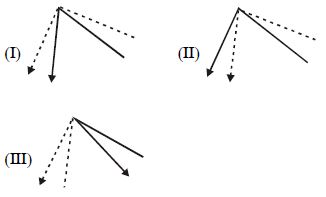
Each of these diagrams is supposed to show two different rays being reflected from the same point on the same plane mirror. Which one of the following is correct?
A
Only $I$
B
Only $II$
C
Only $III$
D
All
Solution
(A) According to the law of reflection,the angle of incidence $(i)$ is equal to the angle of reflection $(r)$.
For a plane mirror,if two incident rays strike the same point,their corresponding reflected rays must maintain the same angular relationship with the normal.
Specifically,if an incident ray makes an angle $i$ with the normal,its reflected ray must make an angle $r = i$ with the normal on the opposite side.
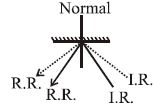
In diagram $(I)$,the reflected rays maintain the same relative angular separation from the normal as the incident rays,satisfying the law of reflection for both rays.
Diagrams $(II)$ and $(III)$ do not correctly show the symmetry required by the law of reflection relative to the normal for both rays simultaneously.
Therefore,only diagram $(I)$ correctly represents the reflection of two rays from the same point on a plane mirror.
For a plane mirror,if two incident rays strike the same point,their corresponding reflected rays must maintain the same angular relationship with the normal.
Specifically,if an incident ray makes an angle $i$ with the normal,its reflected ray must make an angle $r = i$ with the normal on the opposite side.
In diagram $(I)$,the reflected rays maintain the same relative angular separation from the normal as the incident rays,satisfying the law of reflection for both rays.
Diagrams $(II)$ and $(III)$ do not correctly show the symmetry required by the law of reflection relative to the normal for both rays simultaneously.
Therefore,only diagram $(I)$ correctly represents the reflection of two rays from the same point on a plane mirror.
0 likes
View Solution114
MediumMCQ
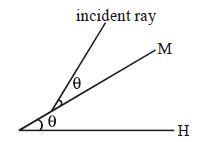
$A$ mirror is inclined at an angle of $\theta$ with the horizontal. If a ray of light is incident at an angle $\theta$ with the mirror,then the reflected ray makes the following angle with the horizontal:
A
$0^{\circ}$
B
$2\theta$
C
$3\theta$
D
None of these
Solution
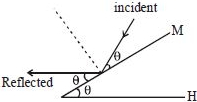
(B) Let the mirror $M$ be inclined at an angle $\theta$ with the horizontal $H$. The incident ray makes an angle $\theta$ with the mirror surface. According to the law of reflection,the angle of reflection is equal to the angle of incidence. Therefore,the reflected ray also makes an angle $\theta$ with the mirror surface. From the geometry of the setup,the angle between the reflected ray and the horizontal is the sum of the angle the reflected ray makes with the mirror and the angle the mirror makes with the horizontal. Thus,the angle with the horizontal is $\theta + \theta = 2\theta$.
0 likes
View Solution115
MediumMCQ
Images formed by an object placed between two plane mirrors whose reflecting surfaces make an angle of $90^o$ with one another lie on
A
Straight line
B
Circle
C
Zig-Zag curve
D
Ellipse
Solution
(B) When two plane mirrors are placed at an angle $\theta$ to each other,the images formed by an object placed between them lie on a circle.
The center of this circle is the point of intersection of the two mirrors.
For $\theta = 90^o$,the number of images formed is $n = (360^o / 90^o) - 1 = 4 - 1 = 3$.
These $3$ images are located at the vertices of a square (with the object and the intersection point forming the other vertices),all lying on a circle centered at the intersection point of the mirrors.
The center of this circle is the point of intersection of the two mirrors.
For $\theta = 90^o$,the number of images formed is $n = (360^o / 90^o) - 1 = 4 - 1 = 3$.
These $3$ images are located at the vertices of a square (with the object and the intersection point forming the other vertices),all lying on a circle centered at the intersection point of the mirrors.
0 likes
View Solution116
DifficultMCQ
$A$ man of height $170 \, cm$ wants to see his complete image in a plane mirror (while standing). His eyes are at a height of $160 \, cm$ from the ground. Which of the following statements are correct?
$(a)$ Minimum length of mirror is $80 \, cm$
$(b)$ Minimum length of mirror is $85 \, cm$
$(c)$ Bottom of the mirror should be at a height $80 \, cm$
$(d)$ Bottom of the mirror should be at a height $85 \, cm$
$(a)$ Minimum length of mirror is $80 \, cm$
$(b)$ Minimum length of mirror is $85 \, cm$
$(c)$ Bottom of the mirror should be at a height $80 \, cm$
$(d)$ Bottom of the mirror should be at a height $85 \, cm$
A
$a, c$
B
$a, d$
C
$b, c$
D
$b, d$
Solution
(C) For a person of height $H$ to see their complete image in a plane mirror,the minimum length of the mirror required is $L = H/2$.
Given $H = 170 \, cm$,the minimum length of the mirror is $L = 170/2 = 85 \, cm$. Thus,statement $(b)$ is correct.
The bottom edge of the mirror should be placed at a height equal to half the distance from the ground to the eyes. Let $h$ be the height of the eyes from the ground.
Given $h = 160 \, cm$,the height of the bottom of the mirror from the ground is $h/2 = 160/2 = 80 \, cm$. Thus,statement $(c)$ is correct.
Therefore,the correct statements are $(b)$ and $(c)$.
Given $H = 170 \, cm$,the minimum length of the mirror is $L = 170/2 = 85 \, cm$. Thus,statement $(b)$ is correct.
The bottom edge of the mirror should be placed at a height equal to half the distance from the ground to the eyes. Let $h$ be the height of the eyes from the ground.
Given $h = 160 \, cm$,the height of the bottom of the mirror from the ground is $h/2 = 160/2 = 80 \, cm$. Thus,statement $(c)$ is correct.
Therefore,the correct statements are $(b)$ and $(c)$.
0 likes
View Solution117
MediumMCQ
Two long plane mirrors $M_1$ and $M_2$ are kept inclined to each other. The angle between reflecting surfaces is $40^o$. $A$ light ray strikes mirror $M_1$ at an angle of $30^o$ with the normal. The maximum number of reflections the ray will undergo is:
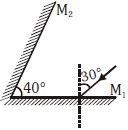
A
$2$
B
$3$
C
$4$
D
$\infty $
Solution
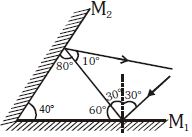
(C) Let the angle of incidence on mirror $M_1$ be $i_1 = 30^o$. The angle of reflection is also $30^o$. The angle the reflected ray makes with the surface of $M_1$ is $90^o - 30^o = 60^o$.
In the triangle formed by the two mirrors and the ray,the angle at the vertex is $40^o$. The angle at the base on $M_1$ is $60^o$. Thus,the angle at the base on $M_2$ is $180^o - (40^o + 60^o) = 80^o$.
The angle of incidence on $M_2$ is $90^o - 80^o = 10^o$. Since $10^o < 90^o$,the ray reflects from $M_2$.
The angle of reflection from $M_2$ is $10^o$. The angle this ray makes with the surface of $M_2$ is $90^o - 10^o = 80^o$.
Now,consider the triangle formed by the ray and the mirrors. The angle at the vertex is $40^o$. The angle at the base on $M_2$ is $80^o$. The angle at the base on $M_1$ is $180^o - (40^o + 80^o) = 60^o$.
Since the angle with the surface of $M_1$ is $60^o$,the angle of incidence is $90^o - 60^o = 30^o$. This is the same as the initial angle of incidence,meaning the ray will continue to reflect between the mirrors.
However,the question asks for the number of reflections. Based on the geometry,the ray will strike $M_1$ again,then $M_2$,and so on. Given the mirrors are long,the ray will undergo a finite number of reflections until it exits the system. For an angle of $40^o$,the total number of reflections is calculated as $N = \frac{180^o}{\theta} = \frac{180^o}{40^o} = 4.5$. The ray will undergo $4$ reflections.
In the triangle formed by the two mirrors and the ray,the angle at the vertex is $40^o$. The angle at the base on $M_1$ is $60^o$. Thus,the angle at the base on $M_2$ is $180^o - (40^o + 60^o) = 80^o$.
The angle of incidence on $M_2$ is $90^o - 80^o = 10^o$. Since $10^o < 90^o$,the ray reflects from $M_2$.
The angle of reflection from $M_2$ is $10^o$. The angle this ray makes with the surface of $M_2$ is $90^o - 10^o = 80^o$.
Now,consider the triangle formed by the ray and the mirrors. The angle at the vertex is $40^o$. The angle at the base on $M_2$ is $80^o$. The angle at the base on $M_1$ is $180^o - (40^o + 80^o) = 60^o$.
Since the angle with the surface of $M_1$ is $60^o$,the angle of incidence is $90^o - 60^o = 30^o$. This is the same as the initial angle of incidence,meaning the ray will continue to reflect between the mirrors.
However,the question asks for the number of reflections. Based on the geometry,the ray will strike $M_1$ again,then $M_2$,and so on. Given the mirrors are long,the ray will undergo a finite number of reflections until it exits the system. For an angle of $40^o$,the total number of reflections is calculated as $N = \frac{180^o}{\theta} = \frac{180^o}{40^o} = 4.5$. The ray will undergo $4$ reflections.
0 likes
View Solution118
DifficultMCQ
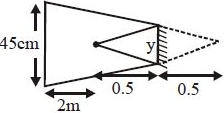
The rear window of a car has a size of $120 \, cm \times 45 \, cm$. The driver sits at a distance $L = 2 \, m$ from the rear window. What should be the minimum size of a flat mirror,hanging at a distance of $0.5 \, m$ in front of the driver,so that he has the best view of the road situation behind the car?
A
$(24 \, cm \times 9 \, cm)$
B
$(30 \, cm \times 11.25 \, cm)$
C
$(40 \, cm \times 15 \, cm)$
D
$(20 \, cm \times 7.5 \, cm)$
Solution
(D) Let the width of the rear window be $W = 120 \, cm$ and the height be $H = 45 \, cm$. The distance from the driver to the rear window is $d_1 = 2 \, m$. The mirror is placed at a distance $d_2 = 0.5 \, m$ in front of the driver. The image of the rear window is formed at a distance $d_2 = 0.5 \, m$ behind the mirror. Thus,the total distance from the driver to the image of the rear window is $D = d_1 + d_2 + d_2 = 2 + 0.5 + 0.5 = 3 \, m$.
Using similar triangles,the ratio of the mirror size $(w, h)$ to the window size $(W, H)$ is equal to the ratio of the distance of the mirror from the driver to the total distance of the image from the driver:
$\frac{w}{W} = \frac{d_2}{D} \Rightarrow w = W \times \frac{0.5}{3} = 120 \times \frac{1}{6} = 20 \, cm$
$\frac{h}{H} = \frac{d_2}{D} \Rightarrow h = H \times \frac{0.5}{3} = 45 \times \frac{1}{6} = 7.5 \, cm$
Therefore,the minimum size of the mirror is $(20 \, cm \times 7.5 \, cm)$.
Using similar triangles,the ratio of the mirror size $(w, h)$ to the window size $(W, H)$ is equal to the ratio of the distance of the mirror from the driver to the total distance of the image from the driver:
$\frac{w}{W} = \frac{d_2}{D} \Rightarrow w = W \times \frac{0.5}{3} = 120 \times \frac{1}{6} = 20 \, cm$
$\frac{h}{H} = \frac{d_2}{D} \Rightarrow h = H \times \frac{0.5}{3} = 45 \times \frac{1}{6} = 7.5 \, cm$
Therefore,the minimum size of the mirror is $(20 \, cm \times 7.5 \, cm)$.
0 likes
View Solution119
DifficultMCQ
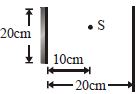
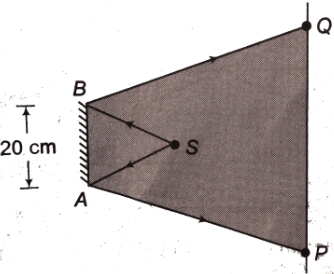
$A$ point source of light $S$ is placed at a distance $10\,cm$ in front of the centre of a mirror of width $20\,cm$ suspended vertically on a wall. $A$ man walks with a speed $10\,cm/s$ in front of the mirror along a line parallel to the mirror at a distance $20\,cm$ from it as shown in the figure. Find the maximum time during which he can see the image of the source $S$ in the mirror. (in $,s$)
A
$6$
B
$3$
C
$2$
D
$1$
Solution
(A) The man can see the image of the source $S$ in the mirror as long as he remains within the field of view of the image.
Let the mirror be $AB$ with length $L = 20\,cm$. The source $S$ is at a distance $d_1 = 10\,cm$ from the mirror.
The man walks along a line at a distance $d_2 = 20\,cm$ from the mirror. The total distance of the man from the source $S$ is $d_1 + d_2 = 10\,cm + 20\,cm = 30\,cm$.
By using similar triangles,the width of the field of view $PQ$ at a distance $d_1 + d_2$ from the mirror is given by:
$\frac{PQ}{L} = \frac{d_1 + d_2}{d_1} = \frac{30\,cm}{10\,cm} = 3$
$PQ = 3 \times L = 3 \times 20\,cm = 60\,cm$.
The man walks at a speed $v = 10\,cm/s$.
The time $t$ for which he can see the image is $t = \frac{PQ}{v} = \frac{60\,cm}{10\,cm/s} = 6\,s$.
Let the mirror be $AB$ with length $L = 20\,cm$. The source $S$ is at a distance $d_1 = 10\,cm$ from the mirror.
The man walks along a line at a distance $d_2 = 20\,cm$ from the mirror. The total distance of the man from the source $S$ is $d_1 + d_2 = 10\,cm + 20\,cm = 30\,cm$.
By using similar triangles,the width of the field of view $PQ$ at a distance $d_1 + d_2$ from the mirror is given by:
$\frac{PQ}{L} = \frac{d_1 + d_2}{d_1} = \frac{30\,cm}{10\,cm} = 3$
$PQ = 3 \times L = 3 \times 20\,cm = 60\,cm$.
The man walks at a speed $v = 10\,cm/s$.
The time $t$ for which he can see the image is $t = \frac{PQ}{v} = \frac{60\,cm}{10\,cm/s} = 6\,s$.
0 likes
View Solution120
MediumMCQ
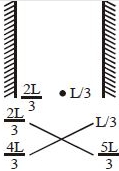
Two plane mirrors are placed parallel to each other at a distance $L$ apart. $A$ point object $O$ is placed between them at a distance $L/3$ from one mirror. Both mirrors form multiple images. The distance between any two images cannot be:
A
$\frac{3L}{2}$
B
$\frac{2L}{3}$
C
$2L$
D
None
Solution
(A) Let the two mirrors be $M_1$ and $M_2$ separated by distance $L$. The object $O$ is at distance $x = L/3$ from $M_1$ and $y = 2L/3$ from $M_2$.
Images formed by $M_1$ are at distances $x, 2L+x, 4L+x, \dots$ from $M_1$,i.e.,$L/3, 7L/3, 13L/3, \dots$
Images formed by $M_2$ are at distances $y, 2L+y, 4L+y, \dots$ from $M_2$,i.e.,$2L/3, 8L/3, 14L/3, \dots$
Converting all positions relative to $M_1$:
Positions from $M_1$: $L/3, 7L/3, 13L/3, \dots$ and $(L - 2L/3) = L/3$ (reflected),$(L + 2L/3) = 5L/3, (3L + 2L/3) = 11L/3, \dots$
Sorted positions from $M_1$: $L/3, 5L/3, 7L/3, 11L/3, 13L/3, 17L/3, \dots$
The gaps between consecutive images are: $4L/3, 2L/3, 4L/3, 2L/3, 4L/3, \dots$
Since the possible distances between any two images are multiples of $2L/3$ (specifically $2L/3, 4L/3, 6L/3=2L, 8L/3, \dots$),the value $\frac{3L}{2}$ is not possible.
Images formed by $M_1$ are at distances $x, 2L+x, 4L+x, \dots$ from $M_1$,i.e.,$L/3, 7L/3, 13L/3, \dots$
Images formed by $M_2$ are at distances $y, 2L+y, 4L+y, \dots$ from $M_2$,i.e.,$2L/3, 8L/3, 14L/3, \dots$
Converting all positions relative to $M_1$:
Positions from $M_1$: $L/3, 7L/3, 13L/3, \dots$ and $(L - 2L/3) = L/3$ (reflected),$(L + 2L/3) = 5L/3, (3L + 2L/3) = 11L/3, \dots$
Sorted positions from $M_1$: $L/3, 5L/3, 7L/3, 11L/3, 13L/3, 17L/3, \dots$
The gaps between consecutive images are: $4L/3, 2L/3, 4L/3, 2L/3, 4L/3, \dots$
Since the possible distances between any two images are multiples of $2L/3$ (specifically $2L/3, 4L/3, 6L/3=2L, 8L/3, \dots$),the value $\frac{3L}{2}$ is not possible.
0 likes
View Solution121
MediumMCQ
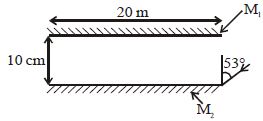
Two plane mirrors $M_1$ and $M_2$ have a length of $20 \, m$ each and are $10 \, cm$ apart. $A$ ray of light is incident on one end of mirror $M_2$ at an angle of $53^{\circ}$. The number of reflections the light undergoes before reaching the other end is
A
$170$
B
$100$
C
$150$
D
$200$
Solution
(C) Let $d = 10 \, cm = 0.1 \, m$ be the distance between the mirrors and $L = 20 \, m$ be the length of the mirrors.
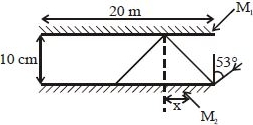
After each reflection,the ray covers a horizontal distance $x$ along the mirror.
From the geometry of the path,we have $\tan 53^{\circ} = \frac{x}{d}$.
Given $\tan 53^{\circ} = \frac{4}{3}$,we get $x = d \tan 53^{\circ} = 0.1 \times \frac{4}{3} \, m = \frac{0.4}{3} \, m$.
The total number of reflections $n$ is given by the ratio of the total length $L$ to the horizontal distance covered per reflection $x$.
$n = \frac{L}{x} = \frac{20}{0.4 / 3} = \frac{20 \times 3}{0.4} = \frac{60}{0.4} = 150$.
Thus,the light undergoes $150$ reflections.
After each reflection,the ray covers a horizontal distance $x$ along the mirror.
From the geometry of the path,we have $\tan 53^{\circ} = \frac{x}{d}$.
Given $\tan 53^{\circ} = \frac{4}{3}$,we get $x = d \tan 53^{\circ} = 0.1 \times \frac{4}{3} \, m = \frac{0.4}{3} \, m$.
The total number of reflections $n$ is given by the ratio of the total length $L$ to the horizontal distance covered per reflection $x$.
$n = \frac{L}{x} = \frac{20}{0.4 / 3} = \frac{20 \times 3}{0.4} = \frac{60}{0.4} = 150$.
Thus,the light undergoes $150$ reflections.
0 likes
View Solution122
MediumMCQ
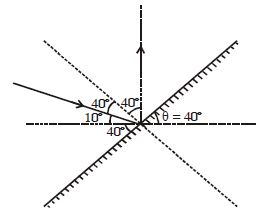
$A$ ray of light making an angle $10^o$ with the horizontal is incident on a plane mirror making an angle $\theta$ with the horizontal. What should be the value of $\theta$ so that the reflected ray goes vertically upwards?
A
$20$
B
$30$
C
$40$
D
$45$
Solution
(C) Let the incident ray make an angle of $10^o$ with the horizontal. The reflected ray is vertical, meaning it makes an angle of $90^o$ with the horizontal.
The angle between the incident ray and the reflected ray is the total deviation $\delta$.
Since the incident ray is $10^o$ below the horizontal and the reflected ray is $90^o$ above the horizontal, the angle between them is $\delta = 90^o + 10^o = 100^o$.
The law of reflection states that the angle of deviation $\delta$ is related to the angle of incidence $i$ by $\delta = 180^o - 2i$.
Therefore, $100^o = 180^o - 2i$, which gives $2i = 80^o$, or $i = 40^o$.
The angle of incidence $i$ is the angle between the incident ray and the normal to the mirror.
Let $\theta$ be the angle the mirror makes with the horizontal. The angle between the incident ray and the mirror surface is $i = 90^o - (\text{angle between incident ray and mirror surface})$.
From the geometry, the angle between the incident ray and the mirror surface is $\theta + 10^o$.
Thus, the angle of incidence $i = 90^o - (\theta + 10^o)$.
Substituting $i = 40^o$, we get $40^o = 90^o - \theta - 10^o$.
$40^o = 80^o - \theta$, which implies $\theta = 40^o$.
The angle between the incident ray and the reflected ray is the total deviation $\delta$.
Since the incident ray is $10^o$ below the horizontal and the reflected ray is $90^o$ above the horizontal, the angle between them is $\delta = 90^o + 10^o = 100^o$.
The law of reflection states that the angle of deviation $\delta$ is related to the angle of incidence $i$ by $\delta = 180^o - 2i$.
Therefore, $100^o = 180^o - 2i$, which gives $2i = 80^o$, or $i = 40^o$.
The angle of incidence $i$ is the angle between the incident ray and the normal to the mirror.
Let $\theta$ be the angle the mirror makes with the horizontal. The angle between the incident ray and the mirror surface is $i = 90^o - (\text{angle between incident ray and mirror surface})$.
From the geometry, the angle between the incident ray and the mirror surface is $\theta + 10^o$.
Thus, the angle of incidence $i = 90^o - (\theta + 10^o)$.
Substituting $i = 40^o$, we get $40^o = 90^o - \theta - 10^o$.
$40^o = 80^o - \theta$, which implies $\theta = 40^o$.
0 likes
View Solution123
MediumMCQ
$A$ man $160\,cm$ high stands in front of a plane mirror. His eyes are at a height of $150\,cm$ from the floor. The minimum length of the plane mirror required for him to see his full-length image is......$cm$.
A
$85$
B
$170$
C
$80$
D
$340$
Solution
(C) To see the full-length image of an object of height $H$ in a plane mirror,the minimum length of the mirror required is $H/2$.
This is because the light rays from the top of the head and the feet must reflect off the mirror to reach the eyes.
Given the height of the man $H = 160\,cm$.
The minimum length of the mirror $L = H/2 = 160/2 = 80\,cm$.
The height of the eyes does not affect the minimum length of the mirror required to see the full image,provided the mirror is positioned correctly.
This is because the light rays from the top of the head and the feet must reflect off the mirror to reach the eyes.
Given the height of the man $H = 160\,cm$.
The minimum length of the mirror $L = H/2 = 160/2 = 80\,cm$.
The height of the eyes does not affect the minimum length of the mirror required to see the full image,provided the mirror is positioned correctly.
0 likes
View Solution124
EasyMCQ
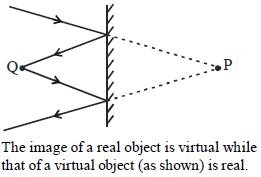
Assertion : The image of a virtual object due to a plane mirror is real.
Reason : If the rays seem to be converging at a point behind a plane mirror,they are reflected and they actually meet in front of the mirror.
Reason : If the rays seem to be converging at a point behind a plane mirror,they are reflected and they actually meet in front of the mirror.
A
If both Assertion and Reason are correct and the Reason is a correct explanation of the Assertion.
B
If both Assertion and Reason are correct but Reason is not a correct explanation of the Assertion.
C
If the Assertion is correct but Reason is incorrect.
D
If both the Assertion and Reason are incorrect.
Solution
(A) virtual object is formed when incident rays are converging towards a point behind the mirror. In this case,the point $P$ behind the mirror acts as a virtual object.
When these rays strike the plane mirror,they are reflected and actually meet at a point $Q$ in front of the mirror.
Since the reflected rays actually meet at point $Q$,the image formed at $Q$ is a real image.
Therefore,the image of a virtual object due to a plane mirror is indeed real.
Both the Assertion and the Reason are correct,and the Reason correctly explains why the image is real.
When these rays strike the plane mirror,they are reflected and actually meet at a point $Q$ in front of the mirror.
Since the reflected rays actually meet at point $Q$,the image formed at $Q$ is a real image.
Therefore,the image of a virtual object due to a plane mirror is indeed real.
Both the Assertion and the Reason are correct,and the Reason correctly explains why the image is real.
0 likes
View Solution125
DifficultMCQ
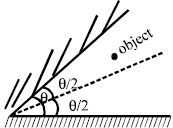
Assertion : If the angle between the two plane mirrors is $72^o$ and the object is asymmetrically placed between the two mirrors,then $5$ images of the object will be formed.
Reason : For a given system of mirrors,the total number of images formed due to successive reflection is equal to either $\frac{360^o}{\theta}$ or $\frac{360^o}{\theta} - 1$ accordingly as $\frac{360^o}{\theta}$ is odd or even respectively.
Reason : For a given system of mirrors,the total number of images formed due to successive reflection is equal to either $\frac{360^o}{\theta}$ or $\frac{360^o}{\theta} - 1$ accordingly as $\frac{360^o}{\theta}$ is odd or even respectively.
A
If both Assertion and Reason are correct and the Reason is a correct explanation of the Assertion.
B
If both Assertion and Reason are correct but Reason is not a correct explanation of the Assertion.
C
If the Assertion is correct but Reason is incorrect.
D
If both the Assertion and Reason are incorrect.
Solution
(A) The number of images $n$ formed by two plane mirrors inclined at an angle $\theta$ is given by $n = \frac{360^o}{\theta} - 1$ if $\frac{360^o}{\theta}$ is an even integer.
If $\frac{360^o}{\theta}$ is an odd integer,then $n = \frac{360^o}{\theta} - 1$ if the object is placed symmetrically,and $n = \frac{360^o}{\theta}$ if the object is placed asymmetrically.
Given $\theta = 72^o$,so $\frac{360^o}{72^o} = 5$,which is an odd integer.
Since the object is placed asymmetrically,the number of images formed is $n = 5$.
Thus,the Assertion is correct.
The Reason states the general rule for the number of images formed by two inclined plane mirrors,which is correct.
Since the Assertion is a direct application of the rule stated in the Reason,the Reason is the correct explanation of the Assertion.
If $\frac{360^o}{\theta}$ is an odd integer,then $n = \frac{360^o}{\theta} - 1$ if the object is placed symmetrically,and $n = \frac{360^o}{\theta}$ if the object is placed asymmetrically.
Given $\theta = 72^o$,so $\frac{360^o}{72^o} = 5$,which is an odd integer.
Since the object is placed asymmetrically,the number of images formed is $n = 5$.
Thus,the Assertion is correct.
The Reason states the general rule for the number of images formed by two inclined plane mirrors,which is correct.
Since the Assertion is a direct application of the rule stated in the Reason,the Reason is the correct explanation of the Assertion.
0 likes
View Solution126
EasyMCQ
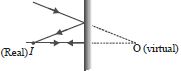
Assertion : Plane mirror may form real image.
Reason : Plane mirror forms virtual image,if object is real.
Reason : Plane mirror forms virtual image,if object is real.
A
If both Assertion and Reason are correct and the Reason is a correct explanation of the Assertion.
B
If both Assertion and Reason are correct but Reason is not a correct explanation of the Assertion.
C
If the Assertion is correct but Reason is incorrect.
D
If both the Assertion and Reason are incorrect.
Solution
(B) plane mirror forms a real image when the object is virtual. $A$ virtual object is formed when converging light rays are incident on the mirror. The reflected rays then converge at a point in front of the mirror,forming a real image.
Conversely,if the object is real (diverging rays from a point source),the plane mirror forms a virtual image behind the mirror.
Therefore,the Assertion is correct because a plane mirror can form a real image if the incident rays are converging (virtual object).
The Reason is also correct because a plane mirror forms a virtual image for a real object.
However,the Reason does not explain why the Assertion is true; it describes a different case (real object vs. virtual object). Thus,both are correct,but the Reason is not the correct explanation of the Assertion.
Conversely,if the object is real (diverging rays from a point source),the plane mirror forms a virtual image behind the mirror.
Therefore,the Assertion is correct because a plane mirror can form a real image if the incident rays are converging (virtual object).
The Reason is also correct because a plane mirror forms a virtual image for a real object.
However,the Reason does not explain why the Assertion is true; it describes a different case (real object vs. virtual object). Thus,both are correct,but the Reason is not the correct explanation of the Assertion.
0 likes
View Solution127
MediumMCQ
Light incident normally on a plane mirror attached to a galvanometer coil retraces its path as shown in the figure. $A$ current in the coil produces a deflection of $3.5^{\circ}$ of the mirror. What is the displacement (in $cm$) of the reflected spot of light on a screen placed $1.5\; m$ away?
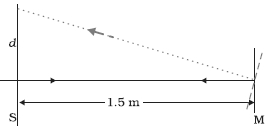
A
$30.6$
B
$14.9$
C
$24.3$
D
$18.4$
Solution
(D) Given:
Angle of deflection of the mirror,$\theta = 3.5^{\circ}$.
Distance of the screen from the mirror,$D = 1.5\; m$.
When a plane mirror is rotated by an angle $\theta$,the reflected ray rotates by an angle $2\theta$.
Therefore,the angle of deflection of the reflected ray is $2\theta = 2 \times 3.5^{\circ} = 7.0^{\circ}$.
The displacement $(d)$ of the reflected spot of light on the screen is given by the relation:
$\tan(2\theta) = \frac{d}{D}$
Substituting the values:
$d = D \times \tan(7.0^{\circ})$
$d = 1.5\; m \times \tan(7.0^{\circ})$
Using $\tan(7.0^{\circ}) \approx 0.12278$
$d = 1.5 \times 0.12278 = 0.18417\; m$
Converting the displacement into centimeters:
$d = 0.18417 \times 100\; cm = 18.417\; cm \approx 18.4\; cm$.
Thus,the displacement of the reflected spot of light is $18.4\; cm$.
Angle of deflection of the mirror,$\theta = 3.5^{\circ}$.
Distance of the screen from the mirror,$D = 1.5\; m$.
When a plane mirror is rotated by an angle $\theta$,the reflected ray rotates by an angle $2\theta$.
Therefore,the angle of deflection of the reflected ray is $2\theta = 2 \times 3.5^{\circ} = 7.0^{\circ}$.
The displacement $(d)$ of the reflected spot of light on the screen is given by the relation:
$\tan(2\theta) = \frac{d}{D}$
Substituting the values:
$d = D \times \tan(7.0^{\circ})$
$d = 1.5\; m \times \tan(7.0^{\circ})$
Using $\tan(7.0^{\circ}) \approx 0.12278$
$d = 1.5 \times 0.12278 = 0.18417\; m$
Converting the displacement into centimeters:
$d = 0.18417 \times 100\; cm = 18.417\; cm \approx 18.4\; cm$.
Thus,the displacement of the reflected spot of light is $18.4\; cm$.
0 likes
View Solution128
Medium
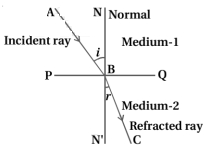
What is reflection of light? Explain the laws of reflection.
Solution
Reflection of light is the phenomenon of bouncing back of light rays into the same medium when they strike a polished surface.
Laws of reflection:
$(i)$ The incident ray,the reflected ray,and the normal to the surface at the point of incidence all lie in the same plane.
$(ii)$ The angle of incidence $(i)$ is equal to the angle of reflection $(r)$,i.e.,$\angle i = \angle r$.
Laws of reflection:
$(i)$ The incident ray,the reflected ray,and the normal to the surface at the point of incidence all lie in the same plane.
$(ii)$ The angle of incidence $(i)$ is equal to the angle of reflection $(r)$,i.e.,$\angle i = \angle r$.
0 likes
View Solution129
EasyMCQ
What are the types of mirrors?
A
Plane mirror and Spherical mirror
B
Concave mirror and Convex mirror
C
Only Plane mirror
D
Only Spherical mirror
Solution
(A) Mirrors are mainly classified into two types:
$(1)$ Plane mirror
$(2)$ Spherical mirror
Spherical mirrors are further divided into two types:
$(1)$ Concave mirror: If the inner (curved) surface of a spherical mirror is made reflecting,it is called a concave mirror.
$(2)$ Convex mirror: If the outer (bulging) surface of a spherical mirror is made reflecting,it is called a convex mirror.
$(1)$ Plane mirror
$(2)$ Spherical mirror
Spherical mirrors are further divided into two types:
$(1)$ Concave mirror: If the inner (curved) surface of a spherical mirror is made reflecting,it is called a concave mirror.
$(2)$ Convex mirror: If the outer (bulging) surface of a spherical mirror is made reflecting,it is called a convex mirror.
0 likes
View Solution130
Medium
Light of wavelength $5000 \,\mathring{A}$ falls on a plane reflecting surface. What are the wavelength and frequency of the reflected light? For what angle of incidence is the reflected ray normal to the incident ray?
Solution
(N/A) Wavelength of incident light,$\lambda = 5000 \,\mathring{A} = 5000 \times 10^{-10} \,m$.
Speed of light,$c = 3 \times 10^{8} \,m/s$.
Frequency of incident light is given by the relation,$v = \frac{c}{\lambda}$.
$v = \frac{3 \times 10^{8}}{5000 \times 10^{-10}} = 6 \times 10^{14} \,Hz$.
The wavelength and frequency of reflected light remain the same as that of the incident light.
Hence,the wavelength of reflected light is $5000 \,\mathring{A}$ and its frequency is $6 \times 10^{14} \,Hz$.
When the reflected ray is normal to the incident ray,the sum of the angle of incidence,$\angle i$,and the angle of reflection,$\angle r$,is $90^{\circ}$.
According to the law of reflection,the angle of incidence is always equal to the angle of reflection,i.e.,$\angle i = \angle r$.
Therefore,$\angle i + \angle i = 90^{\circ} \implies 2\angle i = 90^{\circ} \implies \angle i = 45^{\circ}$.
The angle of incidence for the given condition is $45^{\circ}$.
Speed of light,$c = 3 \times 10^{8} \,m/s$.
Frequency of incident light is given by the relation,$v = \frac{c}{\lambda}$.
$v = \frac{3 \times 10^{8}}{5000 \times 10^{-10}} = 6 \times 10^{14} \,Hz$.
The wavelength and frequency of reflected light remain the same as that of the incident light.
Hence,the wavelength of reflected light is $5000 \,\mathring{A}$ and its frequency is $6 \times 10^{14} \,Hz$.
When the reflected ray is normal to the incident ray,the sum of the angle of incidence,$\angle i$,and the angle of reflection,$\angle r$,is $90^{\circ}$.
According to the law of reflection,the angle of incidence is always equal to the angle of reflection,i.e.,$\angle i = \angle r$.
Therefore,$\angle i + \angle i = 90^{\circ} \implies 2\angle i = 90^{\circ} \implies \angle i = 45^{\circ}$.
The angle of incidence for the given condition is $45^{\circ}$.
0 likes
View Solution131
DifficultMCQ
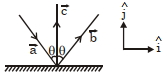
The incident ray,reflected ray,and the outward drawn normal are denoted by the unit vectors $\overrightarrow{ a }, \overrightarrow{ b }$ and $\overrightarrow{ c }$ respectively. Choose the correct relation for these vectors.
A
$\overrightarrow{ b }=\overrightarrow{ a }+2 \overrightarrow{ c }$
B
$\overrightarrow{ b }=2 \overrightarrow{ a }+\overrightarrow{ c }$
C
$\overrightarrow{ b }=\overrightarrow{ a }-2(\overrightarrow{ a } \cdot \overrightarrow{ c }) \overrightarrow{ c }$
D
$\overrightarrow{ b }=\overrightarrow{ a }-\overrightarrow{ c }$
Solution
(C) According to the law of reflection,the angle of incidence equals the angle of reflection,and the incident ray,reflected ray,and normal lie in the same plane.
Let the normal vector be $\overrightarrow{ c }$. The component of the incident ray $\overrightarrow{ a }$ along the normal is $(\overrightarrow{ a } \cdot \overrightarrow{ c }) \overrightarrow{ c }$.
The component of $\overrightarrow{ a }$ perpendicular to the normal is $\overrightarrow{ a } - (\overrightarrow{ a } \cdot \overrightarrow{ c }) \overrightarrow{ c }$.
Since the reflected ray $\overrightarrow{ b }$ has the same component perpendicular to the normal but the opposite component along the normal,we have:
$\overrightarrow{ b } = (\overrightarrow{ a } - (\overrightarrow{ a } \cdot \overrightarrow{ c }) \overrightarrow{ c }) - (\overrightarrow{ a } \cdot \overrightarrow{ c }) \overrightarrow{ c }$
$\overrightarrow{ b } = \overrightarrow{ a } - 2(\overrightarrow{ a } \cdot \overrightarrow{ c }) \overrightarrow{ c }$
Let the normal vector be $\overrightarrow{ c }$. The component of the incident ray $\overrightarrow{ a }$ along the normal is $(\overrightarrow{ a } \cdot \overrightarrow{ c }) \overrightarrow{ c }$.
The component of $\overrightarrow{ a }$ perpendicular to the normal is $\overrightarrow{ a } - (\overrightarrow{ a } \cdot \overrightarrow{ c }) \overrightarrow{ c }$.
Since the reflected ray $\overrightarrow{ b }$ has the same component perpendicular to the normal but the opposite component along the normal,we have:
$\overrightarrow{ b } = (\overrightarrow{ a } - (\overrightarrow{ a } \cdot \overrightarrow{ c }) \overrightarrow{ c }) - (\overrightarrow{ a } \cdot \overrightarrow{ c }) \overrightarrow{ c }$
$\overrightarrow{ b } = \overrightarrow{ a } - 2(\overrightarrow{ a } \cdot \overrightarrow{ c }) \overrightarrow{ c }$
0 likes
View Solution132
DifficultMCQ
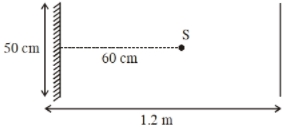
$A$ point source of light $S$,placed at a distance $60 \,cm$ in front of the centre of a plane mirror of width $50 \,cm$,hangs vertically on a wall. $A$ man walks in front of the mirror along a line parallel to the mirror at a distance $1.2 \,m$ from it (see in the figure). The distance between the extreme points where he can see the image of the light source in the mirror is $\ldots \ldots \ldots \,cm.$
A
$75$
B
$135$
C
$150$
D
$210$
Solution
(C) Let the mirror be placed along the $y$-axis with its centre at the origin $(0,0)$. The mirror extends from $y = -25 \,cm$ to $y = +25 \,cm$.
The light source $S$ is at $(60 \,cm, 0)$.
The image $S'$ of the source $S$ in the plane mirror is formed at $(-60 \,cm, 0)$.
The man walks along the line $x = 120 \,cm - 60 \,cm = 60 \,cm$ relative to the mirror plane,or more simply,the man is at a distance of $1.2 \,m = 120 \,cm$ from the mirror.
The rays from the image $S'$ that define the field of view pass through the edges of the mirror at $y = 25 \,cm$ and $y = -25 \,cm$.
Using similar triangles,the ratio of the height to the distance from the image $S'$ is constant:
$\frac{y_{edge}}{distance_{S'}} = \frac{x}{distance_{S'} + distance_{man}}$
Here,the distance of the image $S'$ from the mirror is $60 \,cm$. The distance of the man from the mirror is $120 \,cm$.
So,the total distance of the man from the image $S'$ is $60 \,cm + 120 \,cm = 180 \,cm$.
Using the property of similar triangles:
$\frac{25 \,cm}{60 \,cm} = \frac{x}{180 \,cm}$
$x = \frac{25 \times 180}{60} = 25 \times 3 = 75 \,cm$.
This $x$ is the distance from the central axis to the extreme point on one side.
The total distance between the two extreme points is $2x = 2 \times 75 \,cm = 150 \,cm$.
The light source $S$ is at $(60 \,cm, 0)$.
The image $S'$ of the source $S$ in the plane mirror is formed at $(-60 \,cm, 0)$.
The man walks along the line $x = 120 \,cm - 60 \,cm = 60 \,cm$ relative to the mirror plane,or more simply,the man is at a distance of $1.2 \,m = 120 \,cm$ from the mirror.
The rays from the image $S'$ that define the field of view pass through the edges of the mirror at $y = 25 \,cm$ and $y = -25 \,cm$.
Using similar triangles,the ratio of the height to the distance from the image $S'$ is constant:
$\frac{y_{edge}}{distance_{S'}} = \frac{x}{distance_{S'} + distance_{man}}$
Here,the distance of the image $S'$ from the mirror is $60 \,cm$. The distance of the man from the mirror is $120 \,cm$.
So,the total distance of the man from the image $S'$ is $60 \,cm + 120 \,cm = 180 \,cm$.
Using the property of similar triangles:
$\frac{25 \,cm}{60 \,cm} = \frac{x}{180 \,cm}$
$x = \frac{25 \times 180}{60} = 25 \times 3 = 75 \,cm$.
This $x$ is the distance from the central axis to the extreme point on one side.
The total distance between the two extreme points is $2x = 2 \times 75 \,cm = 150 \,cm$.
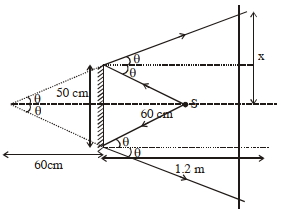
0 likes
View Solution133
DifficultMCQ
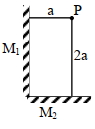
Two plane mirrors ${M}_{1}$ and ${M}_{2}$ are at a right angle to each other as shown. $A$ point source $P$ is placed at distances of $a$ and $2a$ meters from ${M}_{1}$ and ${M}_{2}$ respectively. The longest distance between the images thus formed is: (Take $\sqrt{5} = 2.3$)
A
$3a$
B
$4.6a$
C
$2.3a$
D
$2\sqrt{10}a$
Solution
(B) Let the corner where the mirrors meet be the origin $(0,0)$. The position of the point source $P$ is $(a, 2a)$.
The image formed by mirror ${M}_{1}$ (at $x=0$) is ${I}_{1} = (-a, 2a)$.
The image formed by mirror ${M}_{2}$ (at $y=0$) is ${I}_{2} = (a, -2a)$.
The image formed by both mirrors (the intersection of the reflections) is ${I}_{3} = (-a, -2a)$.
We need to find the distances between all pairs of images:
$1$. Distance between ${I}_{1}$ and ${I}_{2}$: $\sqrt{(a - (-a))^2 + (-2a - 2a)^2} = \sqrt{(2a)^2 + (-4a)^2} = \sqrt{4a^2 + 16a^2} = \sqrt{20a^2} = 2\sqrt{5}a = 2 \times 2.3a = 4.6a$.
$2$. Distance between ${I}_{1}$ and ${I}_{3}$: $\sqrt{(-a - (-a))^2 + (-2a - 2a)^2} = \sqrt{0 + (-4a)^2} = 4a$.
$3$. Distance between ${I}_{2}$ and ${I}_{3}$: $\sqrt{(-a - a)^2 + (-2a - (-2a))^2} = \sqrt{(-2a)^2 + 0} = 2a$.
The longest distance is $4.6a$. Thus,the correct option is $B$.
The image formed by mirror ${M}_{1}$ (at $x=0$) is ${I}_{1} = (-a, 2a)$.
The image formed by mirror ${M}_{2}$ (at $y=0$) is ${I}_{2} = (a, -2a)$.
The image formed by both mirrors (the intersection of the reflections) is ${I}_{3} = (-a, -2a)$.
We need to find the distances between all pairs of images:
$1$. Distance between ${I}_{1}$ and ${I}_{2}$: $\sqrt{(a - (-a))^2 + (-2a - 2a)^2} = \sqrt{(2a)^2 + (-4a)^2} = \sqrt{4a^2 + 16a^2} = \sqrt{20a^2} = 2\sqrt{5}a = 2 \times 2.3a = 4.6a$.
$2$. Distance between ${I}_{1}$ and ${I}_{3}$: $\sqrt{(-a - (-a))^2 + (-2a - 2a)^2} = \sqrt{0 + (-4a)^2} = 4a$.
$3$. Distance between ${I}_{2}$ and ${I}_{3}$: $\sqrt{(-a - a)^2 + (-2a - (-2a))^2} = \sqrt{(-2a)^2 + 0} = 2a$.
The longest distance is $4.6a$. Thus,the correct option is $B$.
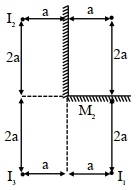
0 likes
View Solution134
AdvancedMCQ
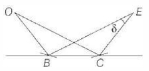
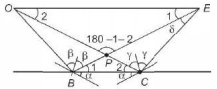
The image of an object $O$ due to reflection from the surface of a lake is elongated due to the ripples on the water surface caused by a light breeze. This is because the ripples act as tilted mirrors as shown below. Consider the case,where $O$ and the observer $E$ are at the same height above the surface of the lake. If the maximum angle that the ripples make with the horizontal is $\alpha$,then the angular extent $\delta$ of the image will be
A
$\frac{\alpha}{2}$
B
$\alpha$
C
$2 \alpha$
D
$4 \alpha$
Solution
(C) The ripples act as plane mirrors reflecting light to form an image with an angular extent $\delta$.
Given that $O$ and $E$ are at the same height,$O E B C$ forms a trapezium with $O E \parallel B C$.
Let $\beta$ be the angle of incidence at point $B$ and $\gamma$ be the angle of incidence at point $C$.
From the geometry of the reflection,the angle of the reflected ray with the horizontal is affected by the tilt $\alpha$ of the mirror surface.
Using the law of reflection and the geometric properties of the angles shown in the diagram:
$\angle 1 = 90^{\circ} - \beta - \alpha$
$\angle 2 = 90^{\circ} - \gamma - \alpha$
Since $O$ and $E$ are at the same height,the symmetry implies $\beta = \gamma$.
The angular extent $\delta$ is the angle subtended by the reflected rays at the observer $E$.
From the triangle geometry,the total deviation caused by the tilted mirrors results in $\delta = 2 \alpha$.
Given that $O$ and $E$ are at the same height,$O E B C$ forms a trapezium with $O E \parallel B C$.
Let $\beta$ be the angle of incidence at point $B$ and $\gamma$ be the angle of incidence at point $C$.
From the geometry of the reflection,the angle of the reflected ray with the horizontal is affected by the tilt $\alpha$ of the mirror surface.
Using the law of reflection and the geometric properties of the angles shown in the diagram:
$\angle 1 = 90^{\circ} - \beta - \alpha$
$\angle 2 = 90^{\circ} - \gamma - \alpha$
Since $O$ and $E$ are at the same height,the symmetry implies $\beta = \gamma$.
The angular extent $\delta$ is the angle subtended by the reflected rays at the observer $E$.
From the triangle geometry,the total deviation caused by the tilted mirrors results in $\delta = 2 \alpha$.
0 likes
View Solution135
AdvancedMCQ
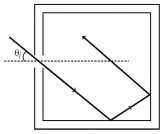
$A$ monochromatic beam of light enters a square enclosure with mirrored interior surfaces at an angle of incidence $\theta_i(\neq 0)$ (see figure). For some value$(s)$ of $\theta_i$,the beam is reflected by every mirrored wall (other than the one with the opening) exactly once and exits the enclosure through the same hole. Which of the following statements about this beam is correct?
A
The beam will not come out of the enclosure for any value of $\theta_i$.
B
The beam will come out for more than two values of $\theta_i$.
C
The beam will come out only at $\theta_i=45^{\circ}$.
D
The beam will come out for exactly two values of $\theta_i$.
Solution
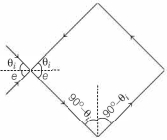
(C) For the light beam to exit through the same hole after reflecting off every other wall exactly once,the path must be symmetric with respect to the diagonal of the square.
Let the angle of incidence be $\theta_i$. The angle of reflection at the first wall will also be $\theta_i$.
By tracing the path through the square,the geometry requires that the angle of incidence at the subsequent walls leads to a path that returns to the opening at an angle of exit $e = \theta_i$.
For the beam to exit through the same hole after hitting all three other walls,the total deviation must be such that the beam is parallel to its original path but reversed,or follows a symmetric path.
In a square enclosure,for the light to hit all three walls and return to the opening,the geometry dictates that the angle $\theta_i$ must satisfy the condition $2\theta_i = 90^{\circ}$,which gives $\theta_i = 45^{\circ}$.
Thus,the beam will come out only at $\theta_i = 45^{\circ}$.
Let the angle of incidence be $\theta_i$. The angle of reflection at the first wall will also be $\theta_i$.
By tracing the path through the square,the geometry requires that the angle of incidence at the subsequent walls leads to a path that returns to the opening at an angle of exit $e = \theta_i$.
For the beam to exit through the same hole after hitting all three other walls,the total deviation must be such that the beam is parallel to its original path but reversed,or follows a symmetric path.
In a square enclosure,for the light to hit all three walls and return to the opening,the geometry dictates that the angle $\theta_i$ must satisfy the condition $2\theta_i = 90^{\circ}$,which gives $\theta_i = 45^{\circ}$.
Thus,the beam will come out only at $\theta_i = 45^{\circ}$.
0 likes
View Solution136
MediumMCQ
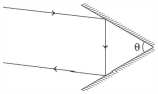
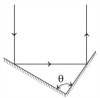
Two plane mirrors are kept on a horizontal table making an angle $\theta$ with each other as shown schematically in the figure. The angle $\theta$ is such that any ray of light reflected after striking both the mirrors returns parallel to its incident path. For this to happen,the value of $\theta$ should be (in $^{\circ}$)
A
$30$
B
$45$
C
$60$
D
$90$
Solution
(D) When a light ray undergoes two successive reflections from two plane mirrors inclined at an angle $\theta$,the total deviation $\delta$ produced is given by the formula $\delta = 360^{\circ} - 2\theta$.
In this problem,the emergent ray is parallel to the incident ray,which means the total deviation $\delta$ is $180^{\circ}$.
Substituting this value into the formula:
$180^{\circ} = 360^{\circ} - 2\theta$
Rearranging the terms to solve for $\theta$:
$2\theta = 360^{\circ} - 180^{\circ}$
$2\theta = 180^{\circ}$
$\theta = 90^{\circ}$
Therefore,the angle between the mirrors must be $90^{\circ}$ for the reflected ray to be parallel to the incident ray.
In this problem,the emergent ray is parallel to the incident ray,which means the total deviation $\delta$ is $180^{\circ}$.
Substituting this value into the formula:
$180^{\circ} = 360^{\circ} - 2\theta$
Rearranging the terms to solve for $\theta$:
$2\theta = 360^{\circ} - 180^{\circ}$
$2\theta = 180^{\circ}$
$\theta = 90^{\circ}$
Therefore,the angle between the mirrors must be $90^{\circ}$ for the reflected ray to be parallel to the incident ray.
0 likes
View Solution137
DifficultMCQ
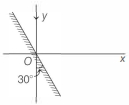
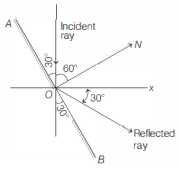
$A$ mirror is placed at an angle of $30^{\circ}$ with respect to the $Y$-axis (see figure). $A$ light ray travelling in the negative $y$-direction strikes the mirror. The direction of the reflected ray is given by the vector
A
$\hat{i}$
B
$\hat{i}-\sqrt{3}\hat{j}$
C
$\sqrt{3}\hat{i}-\hat{j}$
D
$\hat{i}-2\hat{j}$
Solution
(C) The incident ray travels in the negative $y$-direction,so its direction vector is $-\hat{j}$.
The mirror makes an angle of $30^{\circ}$ with the $Y$-axis. The normal to the mirror makes an angle of $30^{\circ}$ with the $X$-axis (or $60^{\circ}$ with the $Y$-axis).
According to the law of reflection,the angle of incidence equals the angle of reflection.
The incident ray makes an angle of $30^{\circ}$ with the mirror surface. Thus,the reflected ray also makes an angle of $30^{\circ}$ with the mirror surface.
Looking at the geometry,the reflected ray makes an angle of $30^{\circ}$ with the $X$-axis in the fourth quadrant.
The direction vector of the reflected ray can be written as $\vec{v} = v_x \hat{i} + v_y \hat{j}$.
Since it is in the fourth quadrant,$v_x > 0$ and $v_y < 0$.
The angle with the positive $X$-axis is $-30^{\circ}$.
Thus,the direction is proportional to $(\cos(-30^{\circ})\hat{i} + \sin(-30^{\circ})\hat{j}) = (\frac{\sqrt{3}}{2}\hat{i} - \frac{1}{2}\hat{j})$.
Multiplying by $2$,we get the vector $\sqrt{3}\hat{i} - \hat{j}$.
Therefore,the correct option is $(c)$.
The mirror makes an angle of $30^{\circ}$ with the $Y$-axis. The normal to the mirror makes an angle of $30^{\circ}$ with the $X$-axis (or $60^{\circ}$ with the $Y$-axis).
According to the law of reflection,the angle of incidence equals the angle of reflection.
The incident ray makes an angle of $30^{\circ}$ with the mirror surface. Thus,the reflected ray also makes an angle of $30^{\circ}$ with the mirror surface.
Looking at the geometry,the reflected ray makes an angle of $30^{\circ}$ with the $X$-axis in the fourth quadrant.
The direction vector of the reflected ray can be written as $\vec{v} = v_x \hat{i} + v_y \hat{j}$.
Since it is in the fourth quadrant,$v_x > 0$ and $v_y < 0$.
The angle with the positive $X$-axis is $-30^{\circ}$.
Thus,the direction is proportional to $(\cos(-30^{\circ})\hat{i} + \sin(-30^{\circ})\hat{j}) = (\frac{\sqrt{3}}{2}\hat{i} - \frac{1}{2}\hat{j})$.
Multiplying by $2$,we get the vector $\sqrt{3}\hat{i} - \hat{j}$.
Therefore,the correct option is $(c)$.
0 likes
View Solution138
AdvancedMCQ
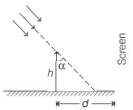
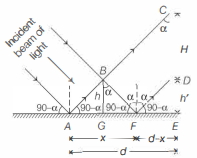
$A$ long horizontal mirror is next to a vertical screen (see figure). Parallel light rays are falling on the mirror at an angle $\alpha$ from the vertical. If a vertical object of height $h$ is kept on the mirror at a distance $d$ from the screen,where $d > h \tan \alpha$,the length of the shadow of the object on the screen would be
A
$\frac{h}{2}$
B
$h \tan \alpha$
C
$2 \,h$
D
$4 \,h$
Solution
(C) From the geometry of the figure,the shadow length on the screen is $CD = H$.
From similar triangles $\triangle BGF$ and $\triangle DEF$,we have:
$\frac{DE}{BG} = \frac{FE}{GF} \Rightarrow \frac{h'}{h} = \frac{d-x}{x} \Rightarrow \frac{d}{x} = \frac{h' + h}{h} \quad \dots(i)$
Now,from similar triangles $\triangle ABG$ and $\triangle ACE$,we have:
$\frac{CE}{AE} = \frac{BG}{AG} \Rightarrow \frac{H + h'}{d + x} = \frac{h}{x} \Rightarrow \frac{d+x}{x} = \frac{H + h'}{h} \Rightarrow \frac{d}{x} + 1 = \frac{H + h'}{h} \Rightarrow \frac{d}{x} = \frac{H + h' - h}{h} \quad \dots(ii)$
Equating equations $(i)$ and $(ii)$:
$\frac{h' + h}{h} = \frac{H + h' - h}{h}$
$h' + h = H + h' - h$
$H = 2h$
Thus,the height of the shadow on the wall is $2h$.
From similar triangles $\triangle BGF$ and $\triangle DEF$,we have:
$\frac{DE}{BG} = \frac{FE}{GF} \Rightarrow \frac{h'}{h} = \frac{d-x}{x} \Rightarrow \frac{d}{x} = \frac{h' + h}{h} \quad \dots(i)$
Now,from similar triangles $\triangle ABG$ and $\triangle ACE$,we have:
$\frac{CE}{AE} = \frac{BG}{AG} \Rightarrow \frac{H + h'}{d + x} = \frac{h}{x} \Rightarrow \frac{d+x}{x} = \frac{H + h'}{h} \Rightarrow \frac{d}{x} + 1 = \frac{H + h'}{h} \Rightarrow \frac{d}{x} = \frac{H + h' - h}{h} \quad \dots(ii)$
Equating equations $(i)$ and $(ii)$:
$\frac{h' + h}{h} = \frac{H + h' - h}{h}$
$h' + h = H + h' - h$
$H = 2h$
Thus,the height of the shadow on the wall is $2h$.
0 likes
View Solution139
MediumMCQ
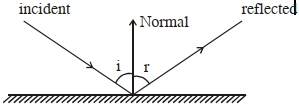
$A$ laser beam is incident on a plane mirror at some angle and results in a reflected beam. The mirror is now rotated by an angle $\delta$ while the direction of the incident laser beam is kept the same. The angle between the new reflected beam and the reflected beam before the mirror was rotated is
A
$2 \delta$
B
$0$
C
$\delta$
D
$\delta / 2$
Solution
(A) When a plane mirror is rotated by an angle $\delta$ about an axis in its plane,the normal to the mirror also rotates by the same angle $\delta$.
Let the angle of incidence be $i$. The angle of reflection is also $i$.
When the mirror rotates by $\delta$,the new angle of incidence becomes $i \pm \delta$ (depending on the direction of rotation).
The new angle of reflection will also be $i \pm \delta$.
The change in the direction of the reflected ray is the difference between the new angle of reflection and the original angle of reflection relative to the incident ray.
Mathematically,it is a standard result in optics that if a plane mirror is rotated by an angle $\delta$,the reflected ray rotates by an angle $2 \delta$ in the same direction.
Let the angle of incidence be $i$. The angle of reflection is also $i$.
When the mirror rotates by $\delta$,the new angle of incidence becomes $i \pm \delta$ (depending on the direction of rotation).
The new angle of reflection will also be $i \pm \delta$.
The change in the direction of the reflected ray is the difference between the new angle of reflection and the original angle of reflection relative to the incident ray.
Mathematically,it is a standard result in optics that if a plane mirror is rotated by an angle $\delta$,the reflected ray rotates by an angle $2 \delta$ in the same direction.
0 likes
View Solution140
EasyMCQ
Digital movie projectors work on the principle of
A
Reflection from micromirrors
B
Refraction from thin lenses
C
Dispersion from thin prisms
D
Total internal reflection from optical fibres
Solution
(A) Digital movie projectors,specifically those using Digital Light Processing $(DLP)$ technology,utilize a Digital Micromirror Device $(DMD)$.
This device consists of millions of microscopic mirrors arranged on a semiconductor chip.
Each mirror corresponds to a single pixel in the projected image.
By tilting these micromirrors,the projector reflects light either towards the lens (to create a bright pixel) or away from it (to create a dark pixel).
Therefore,the fundamental principle is the reflection of light from micromirrors.
This device consists of millions of microscopic mirrors arranged on a semiconductor chip.
Each mirror corresponds to a single pixel in the projected image.
By tilting these micromirrors,the projector reflects light either towards the lens (to create a bright pixel) or away from it (to create a dark pixel).
Therefore,the fundamental principle is the reflection of light from micromirrors.
0 likes
View Solution141
EasyMCQ
Day and night settings for rearview mirrors use:
A
Thin mirrors
B
Thick wedge-shaped mirrors
C
Convex mirrors
D
Concave mirrors
Solution
(B) The day and night setting in a rearview mirror uses a thick wedge-shaped mirror.
In the 'day' position,the front surface of the glass reflects the light,providing a bright image.
In the 'night' position,the mirror is tilted so that the light reflects from the silvered back surface of the wedge,which is much dimmer,thereby reducing glare from the headlights of vehicles behind.
In the 'day' position,the front surface of the glass reflects the light,providing a bright image.
In the 'night' position,the mirror is tilted so that the light reflects from the silvered back surface of the wedge,which is much dimmer,thereby reducing glare from the headlights of vehicles behind.
0 likes
View Solution142
EasyMCQ
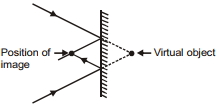
When a beam of light is incident on a plane mirror,it is found that a real image is formed. The incident beam must be
A
Converging
B
Diverging
C
Parallel
D
Formation of real image by a plane mirror is impossible
Solution
(A) real image is formed when light rays actually intersect after reflection.
For a plane mirror,a real image is formed only when the incident beam of light is converging towards a point behind the mirror.
In this case,the point behind the mirror acts as a virtual object for the plane mirror.
The reflected rays then converge at a point in front of the mirror,forming a real image.
Therefore,the incident beam must be converging.
For a plane mirror,a real image is formed only when the incident beam of light is converging towards a point behind the mirror.
In this case,the point behind the mirror acts as a virtual object for the plane mirror.
The reflected rays then converge at a point in front of the mirror,forming a real image.
Therefore,the incident beam must be converging.
0 likes
View Solution143
MediumMCQ
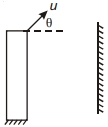
$A$ ball is projected from the top of a table with an initial speed $u$ at an angle of inclination $\theta$ with the horizontal. What is the motion of the image of the ball with respect to the ball?
A
Must be projectile
B
Must be a straight line and vertical
C
Must be a straight line and horizontal
D
May be a straight line,depends upon the value of $\theta$
Solution
(C) Let the velocity of the ball be $\vec{v}_b = u \cos \theta \hat{i} + u \sin \theta \hat{j}$.
Assuming the mirror is placed vertically in the $yz$-plane,the velocity of the image of the ball $\vec{v}_i$ will be $\vec{v}_i = -u \cos \theta \hat{i} + u \sin \theta \hat{j}$.
The velocity of the image with respect to the ball is given by $\vec{v}_{ib} = \vec{v}_i - \vec{v}_b$.
Substituting the values: $\vec{v}_{ib} = (-u \cos \theta \hat{i} + u \sin \theta \hat{j}) - (u \cos \theta \hat{i} + u \sin \theta \hat{j})$.
$\vec{v}_{ib} = -2u \cos \theta \hat{i}$.
Since the velocity is constant and directed along the negative $x$-axis,the motion is a straight line and horizontal.
Assuming the mirror is placed vertically in the $yz$-plane,the velocity of the image of the ball $\vec{v}_i$ will be $\vec{v}_i = -u \cos \theta \hat{i} + u \sin \theta \hat{j}$.
The velocity of the image with respect to the ball is given by $\vec{v}_{ib} = \vec{v}_i - \vec{v}_b$.
Substituting the values: $\vec{v}_{ib} = (-u \cos \theta \hat{i} + u \sin \theta \hat{j}) - (u \cos \theta \hat{i} + u \sin \theta \hat{j})$.
$\vec{v}_{ib} = -2u \cos \theta \hat{i}$.
Since the velocity is constant and directed along the negative $x$-axis,the motion is a straight line and horizontal.
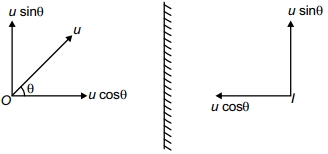
0 likes
View Solution144
MediumMCQ
The light rays from an object have been reflected towards an observer from a standard flat mirror. The image observed by the observer is:
A
$B$ and $D$ only
B
$B$ and $C$ only
C
$A$ and $D$ only
D
$A, C$ and $D$ only
Solution
(A) plane mirror always forms an image that is virtual,erect,of the same size as the object,and laterally inverted.
Since the image is virtual,it is not real.
Since the image is erect,it satisfies condition $B$.
Since the image is of the same size,it does not satisfy condition $C$.
Since the image is laterally inverted,it satisfies condition $D$.
Therefore,the correct characteristics are $B$ (Erect) and $D$ (Laterally inverted).
Since the image is virtual,it is not real.
Since the image is erect,it satisfies condition $B$.
Since the image is of the same size,it does not satisfy condition $C$.
Since the image is laterally inverted,it satisfies condition $D$.
Therefore,the correct characteristics are $B$ (Erect) and $D$ (Laterally inverted).
0 likes
View Solution145
MediumMCQ
Two vertical parallel mirrors $A$ and $B$ are separated by $10\,cm$. $A$ point object $O$ is placed at a distance of $2\,cm$ from mirror $A$. The distance of the second nearest image behind mirror $A$ from the mirror $A$ is $.........\,cm$.
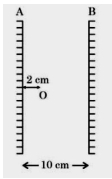
A
$16$
B
$18$
C
$15$
D
$14$
Solution
(B) Let the distance between the mirrors be $d = 10\,cm$. The object $O$ is at $x_A = 2\,cm$ from mirror $A$ and $x_B = 8\,cm$ from mirror $B$.
$1$. The first image $I_1$ formed by mirror $A$ is at a distance of $2\,cm$ behind mirror $A$.
$2$. The first image $I_2$ formed by mirror $B$ is at a distance of $8\,cm$ behind mirror $B$.
$3$. The second image formed by mirror $A$ $(I_3)$ is the image of $I_2$ formed by mirror $A$. The distance of $I_2$ from mirror $A$ is $10\,cm + 8\,cm = 18\,cm$. Therefore,$I_3$ is formed at $18\,cm$ behind mirror $A$.
The images behind mirror $A$ are at distances $2\,cm$ $(I_1)$ and $18\,cm$ $(I_3)$. The second nearest image behind mirror $A$ is at a distance of $18\,cm$ from mirror $A$.
$1$. The first image $I_1$ formed by mirror $A$ is at a distance of $2\,cm$ behind mirror $A$.
$2$. The first image $I_2$ formed by mirror $B$ is at a distance of $8\,cm$ behind mirror $B$.
$3$. The second image formed by mirror $A$ $(I_3)$ is the image of $I_2$ formed by mirror $A$. The distance of $I_2$ from mirror $A$ is $10\,cm + 8\,cm = 18\,cm$. Therefore,$I_3$ is formed at $18\,cm$ behind mirror $A$.
The images behind mirror $A$ are at distances $2\,cm$ $(I_1)$ and $18\,cm$ $(I_3)$. The second nearest image behind mirror $A$ is at a distance of $18\,cm$ from mirror $A$.
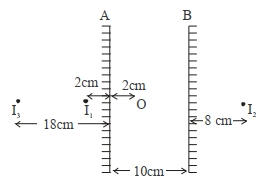
0 likes
View Solution146
MediumMCQ
An object is placed at a distance of $12\,cm$ in front of a plane mirror. $A$ virtual and erect image is formed by the mirror. Now,the mirror is moved by $4\,cm$ towards the stationary object. The distance by which the position of the image would be shifted is:
A
$4\,cm$ towards the mirror
B
$8\,cm$ towards the mirror
C
$8\,cm$ away from the mirror
D
$2\,cm$ towards the mirror
Solution
(B) Initially,the object is at $x = -12\,cm$ and the mirror is at $x = 0$. The image is formed at $x = +12\,cm$.
When the mirror is moved $4\,cm$ towards the object,the new position of the mirror is $x = -4\,cm$.
The distance of the object from the new mirror position is $u = |-12 - (-4)| = 8\,cm$.
Since the image is formed at the same distance behind the mirror,the new image position $x_i$ satisfies $|x_i - (-4)| = 8\,cm$,so $x_i = 4\,cm$.
The initial position of the image was $12\,cm$ and the final position is $4\,cm$.
Therefore,the shift in the position of the image is $12\,cm - 4\,cm = 8\,cm$ towards the mirror.
When the mirror is moved $4\,cm$ towards the object,the new position of the mirror is $x = -4\,cm$.
The distance of the object from the new mirror position is $u = |-12 - (-4)| = 8\,cm$.
Since the image is formed at the same distance behind the mirror,the new image position $x_i$ satisfies $|x_i - (-4)| = 8\,cm$,so $x_i = 4\,cm$.
The initial position of the image was $12\,cm$ and the final position is $4\,cm$.
Therefore,the shift in the position of the image is $12\,cm - 4\,cm = 8\,cm$ towards the mirror.
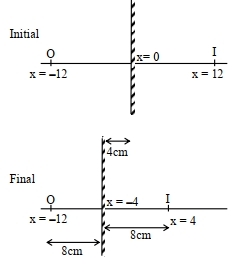
0 likes
View Solution147
EasyMCQ
When one light ray is reflected from a plane mirror with $30^{\circ}$ angle of reflection,the angle of deviation of the ray after reflection is $.....^{\circ}$
A
$140$
B
$120$
C
$110$
D
$130$
Solution
(B) According to the law of reflection,the angle of incidence $i$ is equal to the angle of reflection $r$. Given $r = 30^{\circ}$,therefore $i = 30^{\circ}$.
The angle of deviation $\delta$ for a plane mirror is given by the formula $\delta = 180^{\circ} - (i + r)$.
Substituting the values: $\delta = 180^{\circ} - (30^{\circ} + 30^{\circ}) = 180^{\circ} - 60^{\circ} = 120^{\circ}$.
Thus,the angle of deviation is $120^{\circ}$.
The angle of deviation $\delta$ for a plane mirror is given by the formula $\delta = 180^{\circ} - (i + r)$.
Substituting the values: $\delta = 180^{\circ} - (30^{\circ} + 30^{\circ}) = 180^{\circ} - 60^{\circ} = 120^{\circ}$.
Thus,the angle of deviation is $120^{\circ}$.
0 likes
View Solution148
MediumMCQ
$A$ ray of light travelling in the direction $\frac{1}{2}(\hat{i}+\sqrt{3} \hat{j})$ is incident on a plane mirror. After reflection,it travels along the direction $\frac{1}{2}(\hat{i}-\sqrt{3} \hat{j})$. The angle of incidence is: (in $^{\circ}$)
A
$30$
B
$45$
C
$60$
D
$75$
Solution
(C) Let the incident unit vector be $\vec{a} = \frac{1}{2}\hat{i} + \frac{\sqrt{3}}{2}\hat{j}$ and the reflected unit vector be $\vec{b} = \frac{1}{2}\hat{i} - \frac{\sqrt{3}}{2}\hat{j}$.
The angle $\theta$ between these two vectors is given by the dot product formula: $\vec{a} \cdot \vec{b} = |\vec{a}| |\vec{b}| \cos \theta$.
Since these are unit vectors,$|\vec{a}| = 1$ and $|\vec{b}| = 1$.
$\vec{a} \cdot \vec{b} = (\frac{1}{2})(\frac{1}{2}) + (\frac{\sqrt{3}}{2})(-\frac{\sqrt{3}}{2}) = \frac{1}{4} - \frac{3}{4} = -\frac{2}{4} = -\frac{1}{2}$.
Therefore,$\cos \theta = -\frac{1}{2}$,which implies $\theta = 120^{\circ}$.
The angle between the incident ray and the reflected ray is $120^{\circ}$.
The angle of deviation $\delta = 180^{\circ} - 120^{\circ} = 60^{\circ}$.
The angle of deviation is also given by $\delta = 180^{\circ} - 2i$,where $i$ is the angle of incidence.
$60^{\circ} = 180^{\circ} - 2i \implies 2i = 120^{\circ} \implies i = 60^{\circ}$.
Alternatively,looking at the vectors,the angle with the $y$-axis (normal) is $\cos^{-1}(\frac{\sqrt{3}}{2}) = 30^{\circ}$ if the mirror is along the $x$-axis,but the vectors indicate the normal is the $y$-axis. The angle with the normal is $60^{\circ}$.
The angle $\theta$ between these two vectors is given by the dot product formula: $\vec{a} \cdot \vec{b} = |\vec{a}| |\vec{b}| \cos \theta$.
Since these are unit vectors,$|\vec{a}| = 1$ and $|\vec{b}| = 1$.
$\vec{a} \cdot \vec{b} = (\frac{1}{2})(\frac{1}{2}) + (\frac{\sqrt{3}}{2})(-\frac{\sqrt{3}}{2}) = \frac{1}{4} - \frac{3}{4} = -\frac{2}{4} = -\frac{1}{2}$.
Therefore,$\cos \theta = -\frac{1}{2}$,which implies $\theta = 120^{\circ}$.
The angle between the incident ray and the reflected ray is $120^{\circ}$.
The angle of deviation $\delta = 180^{\circ} - 120^{\circ} = 60^{\circ}$.
The angle of deviation is also given by $\delta = 180^{\circ} - 2i$,where $i$ is the angle of incidence.
$60^{\circ} = 180^{\circ} - 2i \implies 2i = 120^{\circ} \implies i = 60^{\circ}$.
Alternatively,looking at the vectors,the angle with the $y$-axis (normal) is $\cos^{-1}(\frac{\sqrt{3}}{2}) = 30^{\circ}$ if the mirror is along the $x$-axis,but the vectors indicate the normal is the $y$-axis. The angle with the normal is $60^{\circ}$.
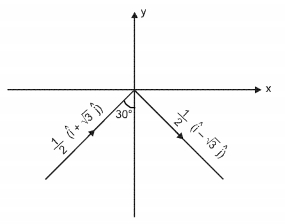
0 likes
View Solution149
EasyMCQ
$A$ plane mirror produces a magnification of
A
-$1$
B
$1$
C
zero
D
$2$
Solution
(B) The magnification $(m)$ of a plane mirror is $+1$.
This is because a plane mirror creates an image that is the same size as the object $(h_i = h_o)$.
The image formed by a plane mirror is virtual and erect,which means the magnification must be positive.
Since the height of the image is equal to the height of the object,the ratio is $1$.
Therefore,the magnification is calculated as:
$m = \frac{h_i}{h_o} = 1$.
This is because a plane mirror creates an image that is the same size as the object $(h_i = h_o)$.
The image formed by a plane mirror is virtual and erect,which means the magnification must be positive.
Since the height of the image is equal to the height of the object,the ratio is $1$.
Therefore,the magnification is calculated as:
$m = \frac{h_i}{h_o} = 1$.
0 likes
View SolutionRay Optics and Optical Instruments — Plane Mirror · Frequently Asked Questions
1Are these Ray Optics and Optical Instruments questions useful for JEE and NEET?
Yes. All questions in this section are mapped to JEE Main and NEET exam patterns. Previous year questions from JEE Main, NEET, GUJCET and state-level exams are included with full solutions.
2Can I switch to Hindi or Gujarati for these questions?
Yes. Use the language tabs in the hero section or the sidebar to view the same questions and solutions in English, Hindi or Gujarati.
3How do I generate a question paper from this subtopic?
Use the Vedclass Exam Paper Generator — select the chapter and subtopic, set difficulty, and generate Sets A, B, C, D automatically. First 3 chapters of every subject are free.
Vedclass Products
For Students
Vedclass Test Series
Mock tests in real JEE/NEET style with performance analysis. 5-day free trial.
Start Free TrialFor Teachers
Exam Paper Generator
Generate Set A/B/C/D papers from this chapter in 2 minutes. 3 chapters free.
Try FreeFor Institutes
Online Exam Module
Live online exams with unlimited students, 360° analytics & white-label branding.
See DemoFor Teachers & Institutes
Generate a Ray Optics and Optical Instruments Exam Paper in 2 Minutes
Select subtopic & difficulty — Sets A, B, C, D auto-generated with No Repeat logic.
First 3 chapters of every subject are free — no payment required.