
A English
Plane Mirror Questions in English
Class 12 Physics · Ray Optics and Optical Instruments · Plane Mirror
163+
Questions
English
Language
100%
With Solutions
Showing 13 of 163 questions in English
151
MediumMCQ
To get three images of a single object, the angle between the two plane mirrors should be (in $^{\circ}$)
A
$50$
B
$60$
C
$72$
D
$90$
Solution
(D) The number of images $n$ formed by two plane mirrors inclined at an angle $\theta$ is given by the formula $n = \left( \frac{360^{\circ}}{\theta} - 1 \right)$ if $\frac{360^{\circ}}{\theta}$ is an even integer.
Given that the number of images $n = 3$, we substitute this into the formula:
$3 = \frac{360^{\circ}}{\theta} - 1$
$4 = \frac{360^{\circ}}{\theta}$
$\theta = \frac{360^{\circ}}{4} = 90^{\circ}$
Thus, the angle between the two plane mirrors should be $90^{\circ}$.
Given that the number of images $n = 3$, we substitute this into the formula:
$3 = \frac{360^{\circ}}{\theta} - 1$
$4 = \frac{360^{\circ}}{\theta}$
$\theta = \frac{360^{\circ}}{4} = 90^{\circ}$
Thus, the angle between the two plane mirrors should be $90^{\circ}$.
0 likes
View Solution152
EasyMCQ
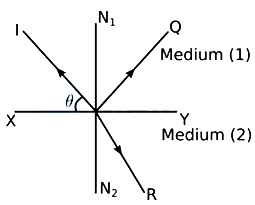
The angle made by the incident ray of light with the reflecting surface is called:
A
Glancing angle
B
Angle of incidence
C
Angle of deviation
D
Angle of refraction
Solution
(A) The angle of incidence is defined as the angle between the incident ray and the normal to the surface at the point of incidence.
However,the angle between the incident ray and the reflecting surface itself is known as the glancing angle.
In the provided diagram,the angle $\theta$ represents the angle between the incident ray $I$ and the surface $XY$,which is the glancing angle.
Therefore,the correct option is $A$.
However,the angle between the incident ray and the reflecting surface itself is known as the glancing angle.
In the provided diagram,the angle $\theta$ represents the angle between the incident ray $I$ and the surface $XY$,which is the glancing angle.
Therefore,the correct option is $A$.
0 likes
View Solution153
MediumMCQ
Two plane mirrors are perpendicular to each other. $A$ ray after suffering reflection from the two mirrors will be
A
perpendicular to the original ray
B
parallel to the original ray
C
parallel to the first mirror
D
at $45^{\circ}$ to the original ray
Solution
(B) When two plane mirrors are placed at an angle $\theta$,the total deviation $\delta$ produced by two successive reflections is given by $\delta = 360^{\circ} - 2\theta$.
Given that the mirrors are perpendicular,$\theta = 90^{\circ}$.
Substituting the value of $\theta$ in the formula:
$\delta = 360^{\circ} - 2(90^{\circ}) = 360^{\circ} - 180^{\circ} = 180^{\circ}$.
$A$ deviation of $180^{\circ}$ means the final ray is directed exactly opposite to the incident ray,which implies the emergent ray is parallel to the incident ray.
Given that the mirrors are perpendicular,$\theta = 90^{\circ}$.
Substituting the value of $\theta$ in the formula:
$\delta = 360^{\circ} - 2(90^{\circ}) = 360^{\circ} - 180^{\circ} = 180^{\circ}$.
$A$ deviation of $180^{\circ}$ means the final ray is directed exactly opposite to the incident ray,which implies the emergent ray is parallel to the incident ray.
0 likes
View Solution154
EasyMCQ
For a plane mirror,the focal length is . . . . . . $m$.
A
$0$
B
$1$
C
$-1$
D
$\infty$
Solution
(D) The focal length $f$ of a spherical mirror is related to its radius of curvature $R$ by the formula $f = R/2$. $A$ plane mirror can be considered as a spherical mirror with an infinite radius of curvature $(R = \infty)$. Therefore,the focal length of a plane mirror is $f = \infty/2 = \infty$. Thus,the correct option is $D$.
0 likes
View Solution155
EasyMCQ
Power of a plane mirror is . . . . . .
A
$\infty$
B
$0$
C
$1$
D
$-1$
Solution
(B) The focal length of a plane mirror is $f = \infty$.
The power $P$ of a mirror is defined as the reciprocal of its focal length in meters,given by $P = \frac{1}{f}$.
Substituting the value of $f$:
$P = \frac{1}{\infty} = 0 \text{ dioptre}$.
Therefore,the power of a plane mirror is $0$.
The power $P$ of a mirror is defined as the reciprocal of its focal length in meters,given by $P = \frac{1}{f}$.
Substituting the value of $f$:
$P = \frac{1}{\infty} = 0 \text{ dioptre}$.
Therefore,the power of a plane mirror is $0$.
0 likes
View Solution156
EasyMCQ
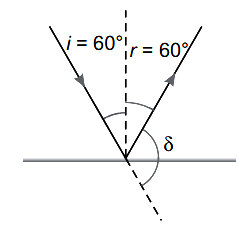
$A$ ray of light is incident on a plane mirror at an angle of $60^{\circ}$. The angle of deviation produced by the mirror is (in $^{\circ}$)
A
$120$
B
$30$
C
$60$
D
$90$
Solution
(C) Given,the angle of incidence,$i = 60^{\circ}$.
According to the law of reflection,the angle of reflection $r$ is equal to the angle of incidence $i$,so $r = 60^{\circ}$.
The angle of deviation $\delta$ produced by a plane mirror is given by the formula:
$\delta = 180^{\circ} - (i + r)$
Since $i = r = 60^{\circ}$,we have:
$\delta = 180^{\circ} - (60^{\circ} + 60^{\circ})$
$\delta = 180^{\circ} - 120^{\circ} = 60^{\circ}$.
According to the law of reflection,the angle of reflection $r$ is equal to the angle of incidence $i$,so $r = 60^{\circ}$.
The angle of deviation $\delta$ produced by a plane mirror is given by the formula:
$\delta = 180^{\circ} - (i + r)$
Since $i = r = 60^{\circ}$,we have:
$\delta = 180^{\circ} - (60^{\circ} + 60^{\circ})$
$\delta = 180^{\circ} - 120^{\circ} = 60^{\circ}$.
0 likes
View Solution157
EasyMCQ
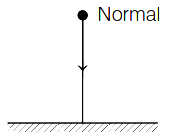
$A$ ray of light is incident normally on a plane mirror. The angle of reflection will be
A
$0^{\circ}$
B
$90^{\circ}$
C
will not be reflected
D
$60^{\circ}$
Solution
(A) When a ray of light is incident normally on a plane mirror,it means the ray travels along the normal to the mirror surface.
Therefore,the angle of incidence,$i$,which is the angle between the incident ray and the normal,is $0^{\circ}$.
According to the laws of reflection,the angle of incidence is equal to the angle of reflection $(i = r)$.
Thus,the angle of reflection,$r = 0^{\circ}$.
Therefore,the angle of incidence,$i$,which is the angle between the incident ray and the normal,is $0^{\circ}$.
According to the laws of reflection,the angle of incidence is equal to the angle of reflection $(i = r)$.
Thus,the angle of reflection,$r = 0^{\circ}$.
0 likes
View Solution158
MediumMCQ
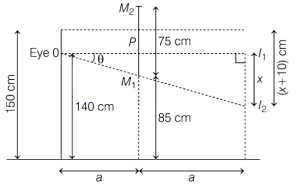
$A$ girl of height $150 \,cm$ with her eye level at $140 \,cm$ stands in front of a plane mirror of height $75 \,cm$ fixed to a wall. The lower edge of the mirror is at a height of $85 \,cm$ above her feet level. The height of her image the girl can see in the mirror is (in $cm$)
A
$130$
B
$140$
C
$120$
D
$150$
Solution
(C) Let the girl's eye be at point $O$ at a height of $140 \,cm$ from the ground. The mirror extends from $85 \,cm$ to $160 \,cm$ $(85 + 75 = 160 \,cm)$ above the ground.
$1$. The girl can see the portion of her body below her eye level by looking at the lower part of the mirror. The distance from her eye to the lower edge of the mirror is $140 - 85 = 55 \,cm$. By the property of reflection,the lowest point she can see on her body is $55 \,cm$ below the level of the lower edge of the mirror,which is $85 - 55 = 30 \,cm$ from the ground.
$2$. The girl can see the portion of her body above her eye level by looking at the upper part of the mirror. The distance from her eye to the top edge of the mirror is $160 - 140 = 20 \,cm$. By the property of reflection,the highest point she can see on her body is $20 \,cm$ above the level of the top edge of the mirror,which is $160 + 20 = 180 \,cm$. However,the girl's height is only $150 \,cm$. Thus,she can see up to the top of her head $(150 \,cm)$.
$3$. The total height of the image visible to the girl is the distance from the lowest point she can see $(30 \,cm)$ to the highest point she can see $(150 \,cm)$.
Height visible = $150 \,cm - 30 \,cm = 120 \,cm$.
Therefore,the correct option is $(c)$.
$1$. The girl can see the portion of her body below her eye level by looking at the lower part of the mirror. The distance from her eye to the lower edge of the mirror is $140 - 85 = 55 \,cm$. By the property of reflection,the lowest point she can see on her body is $55 \,cm$ below the level of the lower edge of the mirror,which is $85 - 55 = 30 \,cm$ from the ground.
$2$. The girl can see the portion of her body above her eye level by looking at the upper part of the mirror. The distance from her eye to the top edge of the mirror is $160 - 140 = 20 \,cm$. By the property of reflection,the highest point she can see on her body is $20 \,cm$ above the level of the top edge of the mirror,which is $160 + 20 = 180 \,cm$. However,the girl's height is only $150 \,cm$. Thus,she can see up to the top of her head $(150 \,cm)$.
$3$. The total height of the image visible to the girl is the distance from the lowest point she can see $(30 \,cm)$ to the highest point she can see $(150 \,cm)$.
Height visible = $150 \,cm - 30 \,cm = 120 \,cm$.
Therefore,the correct option is $(c)$.
0 likes
View Solution159
DifficultMCQ
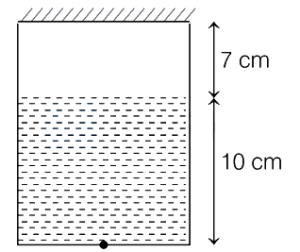
An object is fixed at the bottom of a vessel and water is filled in the vessel up to a height of $10 \,cm$. $A$ plane mirror is placed at a height of $7 \,cm$ from the surface of water in such a way that its reflecting surface faces the water. The distance of the image from the mirror is (Refractive index of water,$n=1.33$). (in $\,cm$)
A
$7.5$
B
$7$
C
$14.5$
D
$21.8$
Solution
(C) The object is at the bottom of the vessel,which is filled with water to a height of $10 \,cm$. The plane mirror is placed $7 \,cm$ above the water surface.
Due to refraction at the water-air interface,the object at the bottom appears to be at a shallower depth.
The apparent depth $d'$ is given by the formula:
$d' = \frac{\text{Real depth}}{n} = \frac{10 \,cm}{1.33} \approx 7.52 \,cm$.
The total distance of the apparent position of the object from the mirror is the sum of the distance of the mirror from the water surface and the apparent depth of the object:
$D = 7 \,cm + 7.52 \,cm = 14.52 \,cm$.
Since a plane mirror forms an image at the same distance behind it as the object is in front of it,the distance of the image from the mirror is $14.52 \,cm$,which is approximately $14.5 \,cm$.
Due to refraction at the water-air interface,the object at the bottom appears to be at a shallower depth.
The apparent depth $d'$ is given by the formula:
$d' = \frac{\text{Real depth}}{n} = \frac{10 \,cm}{1.33} \approx 7.52 \,cm$.
The total distance of the apparent position of the object from the mirror is the sum of the distance of the mirror from the water surface and the apparent depth of the object:
$D = 7 \,cm + 7.52 \,cm = 14.52 \,cm$.
Since a plane mirror forms an image at the same distance behind it as the object is in front of it,the distance of the image from the mirror is $14.52 \,cm$,which is approximately $14.5 \,cm$.
0 likes
View Solution160
EasyMCQ
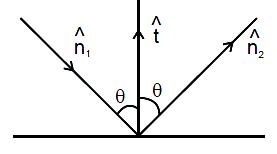
If $\hat{n}_1, \hat{n}_2$ and $\hat{t}$ represent unit vectors along the incident ray,reflected ray,and normal to the surface respectively,then:
A
$\hat{n}_2=\hat{n}_1-2(\hat{n}_1 \cdot \hat{t}) \hat{t}$
B
$\hat{n}_2=\hat{n}_1+2(\hat{n}_1 \cdot \hat{t}) \hat{t}$
C
$\hat{n}_2=-\hat{n}_1$
D
$\hat{n}_2=2 \hat{n}_1-(\hat{n}_1 \times \hat{t}) \cdot \hat{n}_1$
Solution
(A) Let $\hat{t}$ be the unit vector along the normal to the surface.
Let $\hat{n}_1$ be the unit vector along the incident ray and $\hat{n}_2$ be the unit vector along the reflected ray.
From the geometry of reflection,the angle of incidence equals the angle of reflection,$\theta$.
We can resolve $\hat{n}_1$ and $\hat{n}_2$ into components parallel and perpendicular to the normal $\hat{t}$.
$\hat{n}_1 = -\cos \theta \hat{t} + \sin \theta \hat{u}$,where $\hat{u}$ is a unit vector parallel to the surface.
$\hat{n}_2 = \cos \theta \hat{t} + \sin \theta \hat{u}$.
Subtracting the two equations: $\hat{n}_2 - \hat{n}_1 = 2 \cos \theta \hat{t}$.
Since $\hat{n}_1 \cdot \hat{t} = \cos(180^\circ - \theta) = -\cos \theta$,we have $\cos \theta = -(\hat{n}_1 \cdot \hat{t})$.
Substituting this into the subtraction equation: $\hat{n}_2 - \hat{n}_1 = -2(\hat{n}_1 \cdot \hat{t}) \hat{t}$.
Therefore,$\hat{n}_2 = \hat{n}_1 - 2(\hat{n}_1 \cdot \hat{t}) \hat{t}$.
Let $\hat{n}_1$ be the unit vector along the incident ray and $\hat{n}_2$ be the unit vector along the reflected ray.
From the geometry of reflection,the angle of incidence equals the angle of reflection,$\theta$.
We can resolve $\hat{n}_1$ and $\hat{n}_2$ into components parallel and perpendicular to the normal $\hat{t}$.
$\hat{n}_1 = -\cos \theta \hat{t} + \sin \theta \hat{u}$,where $\hat{u}$ is a unit vector parallel to the surface.
$\hat{n}_2 = \cos \theta \hat{t} + \sin \theta \hat{u}$.
Subtracting the two equations: $\hat{n}_2 - \hat{n}_1 = 2 \cos \theta \hat{t}$.
Since $\hat{n}_1 \cdot \hat{t} = \cos(180^\circ - \theta) = -\cos \theta$,we have $\cos \theta = -(\hat{n}_1 \cdot \hat{t})$.
Substituting this into the subtraction equation: $\hat{n}_2 - \hat{n}_1 = -2(\hat{n}_1 \cdot \hat{t}) \hat{t}$.
Therefore,$\hat{n}_2 = \hat{n}_1 - 2(\hat{n}_1 \cdot \hat{t}) \hat{t}$.
0 likes
View Solution161
MediumMCQ
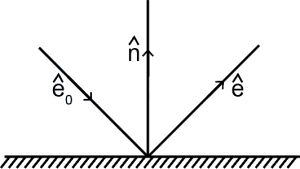
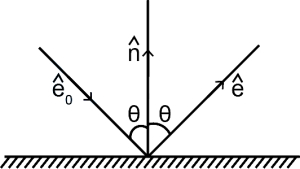
$A$ ray of light is reflected by a plane mirror. $\hat{e}_0$,$\hat{e}$ and $\hat{n}$ be the unit vectors along the incident ray,reflected ray and the normal to the reflecting surface respectively. Which of the following gives an expression for $\hat{e}$?
A
$\hat{e}_0 + 2 ( \hat{e}_0 \cdot \hat{n} ) \hat{n}$
B
$\hat{e}_0 - 2 ( \hat{e}_0 \cdot \hat{n} ) \hat{n}$
C
$\hat{e}_0 - ( \hat{e}_0 \cdot \hat{n} ) \hat{n}$
D
$\hat{e}_0 + ( \hat{e}_0 \cdot \hat{n} ) \hat{n}$
Solution
(B) The incident ray vector is $\hat{e}_0$ and the reflected ray vector is $\hat{e}$. The normal vector is $\hat{n}$.
From the law of reflection,the angle of incidence equals the angle of reflection,and all three vectors lie in the same plane.
Let $\theta$ be the angle between the incident ray and the normal. Since $\hat{e}_0$ is directed towards the mirror,the angle between $\hat{e}_0$ and $\hat{n}$ is $(180^\circ - \theta)$.
Thus,$\hat{e}_0 \cdot \hat{n} = |\hat{e}_0| |\hat{n}| \cos(180^\circ - \theta) = -\cos \theta$.
We can resolve the incident ray $\hat{e}_0$ into components parallel and perpendicular to the normal $\hat{n}$:
$\hat{e}_0 = \hat{e}_{0\perp} + \hat{e}_{0\parallel} = (\hat{e}_0 \cdot \hat{n}) \hat{n} + (\hat{e}_0 - (\hat{e}_0 \cdot \hat{n}) \hat{n})$.
The reflected ray $\hat{e}$ has the same component parallel to the mirror surface but the component along the normal is reversed:
$\hat{e} = -(\hat{e}_0 \cdot \hat{n}) \hat{n} + (\hat{e}_0 - (\hat{e}_0 \cdot \hat{n}) \hat{n})$.
$\hat{e} = \hat{e}_0 - 2(\hat{e}_0 \cdot \hat{n}) \hat{n}$.
Therefore,the correct option is $(B)$.
From the law of reflection,the angle of incidence equals the angle of reflection,and all three vectors lie in the same plane.
Let $\theta$ be the angle between the incident ray and the normal. Since $\hat{e}_0$ is directed towards the mirror,the angle between $\hat{e}_0$ and $\hat{n}$ is $(180^\circ - \theta)$.
Thus,$\hat{e}_0 \cdot \hat{n} = |\hat{e}_0| |\hat{n}| \cos(180^\circ - \theta) = -\cos \theta$.
We can resolve the incident ray $\hat{e}_0$ into components parallel and perpendicular to the normal $\hat{n}$:
$\hat{e}_0 = \hat{e}_{0\perp} + \hat{e}_{0\parallel} = (\hat{e}_0 \cdot \hat{n}) \hat{n} + (\hat{e}_0 - (\hat{e}_0 \cdot \hat{n}) \hat{n})$.
The reflected ray $\hat{e}$ has the same component parallel to the mirror surface but the component along the normal is reversed:
$\hat{e} = -(\hat{e}_0 \cdot \hat{n}) \hat{n} + (\hat{e}_0 - (\hat{e}_0 \cdot \hat{n}) \hat{n})$.
$\hat{e} = \hat{e}_0 - 2(\hat{e}_0 \cdot \hat{n}) \hat{n}$.
Therefore,the correct option is $(B)$.
0 likes
View Solution162
EasyMCQ
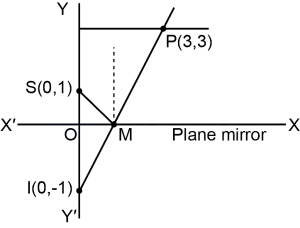
$A$ point source is placed at coordinates $(0,1)$ in the $xy$-plane. $A$ ray of light from the source is reflected on a plane mirror placed along the $X$-axis and perpendicular to the $xy$-plane. The reflected ray passes through the point $(3,3)$. What is the path length of the ray from $(0,1)$ to $(3,3)$?
A
$5$
B
$\sqrt{13}$
C
$2\sqrt{3}$
D
$1+2\sqrt{3}$
Solution
(A) Let the source be at $S(0,1)$ and the point on the mirror be $M$. The reflected ray passes through $P(3,3)$.
Since the mirror is along the $X$-axis,the image of the source $S(0,1)$ formed by the mirror is $I(0,-1)$.
The path length of the reflected ray is $SM + MP$.
By the law of reflection,$SM = IM$.
Therefore,the total path length is $IM + MP = IP$.
The distance $IP$ is the distance between points $I(0,-1)$ and $P(3,3)$.
Using the distance formula: $IP = \sqrt{(3-0)^2 + (3 - (-1))^2} = \sqrt{3^2 + 4^2} = \sqrt{9 + 16} = \sqrt{25} = 5$.
Since the mirror is along the $X$-axis,the image of the source $S(0,1)$ formed by the mirror is $I(0,-1)$.
The path length of the reflected ray is $SM + MP$.
By the law of reflection,$SM = IM$.
Therefore,the total path length is $IM + MP = IP$.
The distance $IP$ is the distance between points $I(0,-1)$ and $P(3,3)$.
Using the distance formula: $IP = \sqrt{(3-0)^2 + (3 - (-1))^2} = \sqrt{3^2 + 4^2} = \sqrt{9 + 16} = \sqrt{25} = 5$.
0 likes
View Solution163
MediumMCQ
Two mirrors at an angle $\theta^{\circ}$ produce $5$ images of a point. The number of images produced when $\theta$ is decreased to $\theta^{\circ}-30^{\circ}$ is
A
$9$
B
$10$
C
$11$
D
$12$
Solution
(C) The number of images $n$ formed by two plane mirrors inclined at an angle $\theta$ is given by $n = \frac{360^{\circ}}{\theta} - 1$ if $\frac{360^{\circ}}{\theta}$ is an even integer,or if it is an odd integer and the object is placed symmetrically.
Given $n = 5$,we have $5 = \frac{360^{\circ}}{\theta} - 1$,which implies $\frac{360^{\circ}}{\theta} = 6$.
Thus,$\theta = \frac{360^{\circ}}{6} = 60^{\circ}$.
When the angle is decreased by $30^{\circ}$,the new angle $\theta' = 60^{\circ} - 30^{\circ} = 30^{\circ}$.
The new number of images $n'$ is given by $n' = \frac{360^{\circ}}{30^{\circ}} - 1 = 12 - 1 = 11$.
Given $n = 5$,we have $5 = \frac{360^{\circ}}{\theta} - 1$,which implies $\frac{360^{\circ}}{\theta} = 6$.
Thus,$\theta = \frac{360^{\circ}}{6} = 60^{\circ}$.
When the angle is decreased by $30^{\circ}$,the new angle $\theta' = 60^{\circ} - 30^{\circ} = 30^{\circ}$.
The new number of images $n'$ is given by $n' = \frac{360^{\circ}}{30^{\circ}} - 1 = 12 - 1 = 11$.
0 likes
View SolutionRay Optics and Optical Instruments — Plane Mirror · Frequently Asked Questions
1Are these Ray Optics and Optical Instruments questions useful for JEE and NEET?
Yes. All questions in this section are mapped to JEE Main and NEET exam patterns. Previous year questions from JEE Main, NEET, GUJCET and state-level exams are included with full solutions.
2Can I switch to Hindi or Gujarati for these questions?
Yes. Use the language tabs in the hero section or the sidebar to view the same questions and solutions in English, Hindi or Gujarati.
3How do I generate a question paper from this subtopic?
Use the Vedclass Exam Paper Generator — select the chapter and subtopic, set difficulty, and generate Sets A, B, C, D automatically. First 3 chapters of every subject are free.
Vedclass Products
For Students
Vedclass Test Series
Mock tests in real JEE/NEET style with performance analysis. 5-day free trial.
Start Free TrialFor Teachers
Exam Paper Generator
Generate Set A/B/C/D papers from this chapter in 2 minutes. 3 chapters free.
Try FreeFor Institutes
Online Exam Module
Live online exams with unlimited students, 360° analytics & white-label branding.
See DemoFor Teachers & Institutes
Generate a Ray Optics and Optical Instruments Exam Paper in 2 Minutes
Select subtopic & difficulty — Sets A, B, C, D auto-generated with No Repeat logic.
First 3 chapters of every subject are free — no payment required.