
A English
Properties of Electromagnetic Waves Questions in English
Class 12 Physics · Electromagnetic waves · Properties of Electromagnetic Waves
494+
Questions
English
Language
100%
With Solutions
Showing 50 of 494 questions in English
201
DifficultMCQ
$A$ plane electromagnetic wave travelling along the $X-$ direction has a wavelength of $3\, mm$. The variation in the electric field occurs in the $Y-$ direction with an amplitude of $66\, Vm^{-1}$. The equations for the electric and magnetic fields as a function of $x$ and $t$ are respectively:
A
$E_y = 33\cos(\pi \times 10^{11}(t - x/c))$,$B_z = 1.1 \times 10^{-7}\cos(\pi \times 10^{11}(t - x/c))$
B
$E_y = 11\cos(2\pi \times 10^{11}(t - x/c))$,$B_z = 11 \times 10^{-7}\cos(2\pi \times 10^{11}(t - x/c))$
C
$E_x = 33\cos(\pi \times 10^{11}(t - x/c))$,$B_z = 11 \times 10^{-7}\cos(\pi \times 10^{11}(t - x/c))$
D
$E_y = 66\cos(2\pi \times 10^{11}(t - x/c))$,$B_z = 2.2 \times 10^{-7}\cos(2\pi \times 10^{11}(t - x/c))$
Solution
(D) Given: Amplitude of electric field $E_0 = 66\, Vm^{-1}$,Wavelength $\lambda = 3\, mm = 3 \times 10^{-3}\, m$,Wave speed $c = 3 \times 10^8\, ms^{-1}$.
$1$. Calculate the amplitude of the magnetic field $B_0$:
$B_0 = E_0 / c = 66 / (3 \times 10^8) = 22 \times 10^{-8} = 2.2 \times 10^{-7}\, T$.
$2$. Calculate the angular frequency $\omega$:
$\omega = 2\pi f = 2\pi (c / \lambda) = 2\pi (3 \times 10^8 / 3 \times 10^{-3}) = 2\pi \times 10^{11}\, rad/s$.
$3$. Determine the directions:
The wave travels along $X$,and $E$ is along $Y$. Since the direction of propagation is given by $\vec{E} \times \vec{B}$,the magnetic field $B$ must be along the $Z-$ direction.
$4$. Write the equations:
$E_y = E_0 \cos(\omega(t - x/c)) = 66 \cos(2\pi \times 10^{11}(t - x/c))$.
$B_z = B_0 \cos(\omega(t - x/c)) = 2.2 \times 10^{-7} \cos(2\pi \times 10^{11}(t - x/c))$.
Comparing with the options,option $D$ matches these values.
$1$. Calculate the amplitude of the magnetic field $B_0$:
$B_0 = E_0 / c = 66 / (3 \times 10^8) = 22 \times 10^{-8} = 2.2 \times 10^{-7}\, T$.
$2$. Calculate the angular frequency $\omega$:
$\omega = 2\pi f = 2\pi (c / \lambda) = 2\pi (3 \times 10^8 / 3 \times 10^{-3}) = 2\pi \times 10^{11}\, rad/s$.
$3$. Determine the directions:
The wave travels along $X$,and $E$ is along $Y$. Since the direction of propagation is given by $\vec{E} \times \vec{B}$,the magnetic field $B$ must be along the $Z-$ direction.
$4$. Write the equations:
$E_y = E_0 \cos(\omega(t - x/c)) = 66 \cos(2\pi \times 10^{11}(t - x/c))$.
$B_z = B_0 \cos(\omega(t - x/c)) = 2.2 \times 10^{-7} \cos(2\pi \times 10^{11}(t - x/c))$.
Comparing with the options,option $D$ matches these values.
0 likes
View Solution202
MediumMCQ
$A$ flood light is covered with a filter that transmits red light. The electric field of the emerging beam is represented by a sinusoidal plane wave
$E_x=36\,sin\,(1.20 \times 10^7z -3.6 \times 10^{15}\,t)\,V/m$
The average intensity of the beam will be.....$W/m^2$
$E_x=36\,sin\,(1.20 \times 10^7z -3.6 \times 10^{15}\,t)\,V/m$
The average intensity of the beam will be.....$W/m^2$
A
$0.86$
B
$1.72$
C
$3.44$
D
$6.88$
Solution
(B) The average intensity $I_{av}$ of an electromagnetic wave is given by the formula:
$I_{av} = \frac{1}{2} c \epsilon_0 E_0^2$
Given:
$E_0 = 36 \, V/m$
$c = 3 \times 10^8 \, m/s$
$\epsilon_0 = 8.85 \times 10^{-12} \, C^2/(N \cdot m^2)$
Substituting the values:
$I_{av} = \frac{1}{2} \times (3 \times 10^8) \times (8.85 \times 10^{-12}) \times (36)^2$
$I_{av} = 0.5 \times 3 \times 10^8 \times 8.85 \times 10^{-12} \times 1296$
$I_{av} = 1.5 \times 8.85 \times 1296 \times 10^{-4}$
$I_{av} = 17208.6 \times 10^{-4} \approx 1.72 \, W/m^2$
$I_{av} = \frac{1}{2} c \epsilon_0 E_0^2$
Given:
$E_0 = 36 \, V/m$
$c = 3 \times 10^8 \, m/s$
$\epsilon_0 = 8.85 \times 10^{-12} \, C^2/(N \cdot m^2)$
Substituting the values:
$I_{av} = \frac{1}{2} \times (3 \times 10^8) \times (8.85 \times 10^{-12}) \times (36)^2$
$I_{av} = 0.5 \times 3 \times 10^8 \times 8.85 \times 10^{-12} \times 1296$
$I_{av} = 1.5 \times 8.85 \times 1296 \times 10^{-4}$
$I_{av} = 17208.6 \times 10^{-4} \approx 1.72 \, W/m^2$
0 likes
View Solution203
MediumMCQ
$A$ point source of electromagnetic radiation has an average power output of $800\,W$. The maximum value of the electric field at a distance of $3.5\,m$ from the source will be.....$V/m$.
A
$56.7$
B
$62.6$
C
$39.3$
D
$47.5$
Solution
(B) The intensity $I$ of an electromagnetic wave from a point source is given by $I = \frac{P_{av}}{4 \pi r^2}$.
Also,the intensity in terms of the maximum electric field $E_0$ is $I = \frac{E_0^2}{2 \mu_0 c}$.
Equating the two expressions: $\frac{P_{av}}{4 \pi r^2} = \frac{E_0^2}{2 \mu_0 c}$.
Solving for $E_0$: $E_0 = \sqrt{\frac{2 \mu_0 c P_{av}}{4 \pi r^2}} = \sqrt{\frac{\mu_0 c P_{av}}{2 \pi r^2}}$.
Substituting the given values: $P_{av} = 800\,W$,$r = 3.5\,m$,$\mu_0 = 4 \pi \times 10^{-7}\,T\cdot m/A$,and $c = 3 \times 10^8\,m/s$.
$E_0 = \sqrt{\frac{(4 \pi \times 10^{-7}) \times (3 \times 10^8) \times 800}{2 \pi \times (3.5)^2}}$.
$E_0 = \sqrt{\frac{2 \times 10^{-7} \times 3 \times 10^8 \times 800}{12.25}} = \sqrt{\frac{48000}{12.25}} \approx \sqrt{3918.36} \approx 62.6\,V/m$.
Also,the intensity in terms of the maximum electric field $E_0$ is $I = \frac{E_0^2}{2 \mu_0 c}$.
Equating the two expressions: $\frac{P_{av}}{4 \pi r^2} = \frac{E_0^2}{2 \mu_0 c}$.
Solving for $E_0$: $E_0 = \sqrt{\frac{2 \mu_0 c P_{av}}{4 \pi r^2}} = \sqrt{\frac{\mu_0 c P_{av}}{2 \pi r^2}}$.
Substituting the given values: $P_{av} = 800\,W$,$r = 3.5\,m$,$\mu_0 = 4 \pi \times 10^{-7}\,T\cdot m/A$,and $c = 3 \times 10^8\,m/s$.
$E_0 = \sqrt{\frac{(4 \pi \times 10^{-7}) \times (3 \times 10^8) \times 800}{2 \pi \times (3.5)^2}}$.
$E_0 = \sqrt{\frac{2 \times 10^{-7} \times 3 \times 10^8 \times 800}{12.25}} = \sqrt{\frac{48000}{12.25}} \approx \sqrt{3918.36} \approx 62.6\,V/m$.
0 likes
View Solution204
EasyMCQ
In an electromagnetic wave,the energy density associated with the magnetic field will be:
A
$\frac{1}{2} L I^2$
B
$\frac{B^2}{2 \mu_0}$
C
$\frac{1}{2} \mu_0 B^2$
D
$\frac{1}{2} \frac{\mu_0}{B^2}$
Solution
(B) The energy density $u_E$ associated with the electric field in an electromagnetic wave is given by $u_E = \frac{1}{2} \epsilon_0 E^2$.
The energy density $u_B$ associated with the magnetic field in an electromagnetic wave is given by $u_B = \frac{B^2}{2 \mu_0}$.
In an electromagnetic wave,the total energy is shared equally between the electric and magnetic fields,such that $u_E = u_B$.
The energy density $u_B$ associated with the magnetic field in an electromagnetic wave is given by $u_B = \frac{B^2}{2 \mu_0}$.
In an electromagnetic wave,the total energy is shared equally between the electric and magnetic fields,such that $u_E = u_B$.
0 likes
View Solution205
EasyMCQ
The ratio of contributions made by the electric field and magnetic field components to the intensity of an electromagnetic wave is
A
$c : 1$
B
$c^2 : 1$
C
$1 : 1$
D
$\sqrt{c} : 1$
Solution
(C) The intensity of an electromagnetic wave is given by $I = U_{av} c$.
In terms of the electric field, the average energy density is $U_{av} = \frac{1}{2} \varepsilon_{0} E_{0}^{2}$.
In terms of the magnetic field, the average energy density is $U_{av} = \frac{1}{2} \frac{B_{0}^{2}}{\mu_{0}}$.
Since the relationship between the electric field amplitude $E_{0}$ and magnetic field amplitude $B_{0}$ is $E_{0} = c B_{0}$, we can substitute this into the electric field energy density expression:
$U_{av} (\text{electric}) = \frac{1}{2} \varepsilon_{0} (c B_{0})^{2} = \frac{1}{2} \varepsilon_{0} c^{2} B_{0}^{2}$.
Using the relation $c^{2} = \frac{1}{\mu_{0} \varepsilon_{0}}$, we get:
$U_{av} (\text{electric}) = \frac{1}{2} \varepsilon_{0} \left( \frac{1}{\mu_{0} \varepsilon_{0}} \right) B_{0}^{2} = \frac{1}{2} \frac{B_{0}^{2}}{\mu_{0}} = U_{av} (\text{magnetic})$.
Thus, the contributions from both fields are equal, and the ratio is $1 : 1$.
In terms of the electric field, the average energy density is $U_{av} = \frac{1}{2} \varepsilon_{0} E_{0}^{2}$.
In terms of the magnetic field, the average energy density is $U_{av} = \frac{1}{2} \frac{B_{0}^{2}}{\mu_{0}}$.
Since the relationship between the electric field amplitude $E_{0}$ and magnetic field amplitude $B_{0}$ is $E_{0} = c B_{0}$, we can substitute this into the electric field energy density expression:
$U_{av} (\text{electric}) = \frac{1}{2} \varepsilon_{0} (c B_{0})^{2} = \frac{1}{2} \varepsilon_{0} c^{2} B_{0}^{2}$.
Using the relation $c^{2} = \frac{1}{\mu_{0} \varepsilon_{0}}$, we get:
$U_{av} (\text{electric}) = \frac{1}{2} \varepsilon_{0} \left( \frac{1}{\mu_{0} \varepsilon_{0}} \right) B_{0}^{2} = \frac{1}{2} \frac{B_{0}^{2}}{\mu_{0}} = U_{av} (\text{magnetic})$.
Thus, the contributions from both fields are equal, and the ratio is $1 : 1$.
0 likes
View Solution206
EasyMCQ
The electric field part of an electromagnetic wave in vacuum is
$E = 3.1 \, N C^{-1} \cos [ (1.8 \, rad \, m^{-1}) y + (5.4 \times 10^8 \, rad \, s^{-1}) t ] \hat{i}$
The wavelength of this part of the electromagnetic wave is ...... $m$.
$E = 3.1 \, N C^{-1} \cos [ (1.8 \, rad \, m^{-1}) y + (5.4 \times 10^8 \, rad \, s^{-1}) t ] \hat{i}$
The wavelength of this part of the electromagnetic wave is ...... $m$.
A
$1.5$
B
$2$
C
$2.5$
D
$3.5$
Solution
(D) The given equation for the electric field is:
$E = 3.1 \cos [ (1.8) y + (5.4 \times 10^8) t ] \hat{i}$ .......... $(i)$
Comparing this with the standard wave equation:
$E = E_0 \cos (ky + \omega t)$ .......... $(ii)$
We identify the wave number $k$ as:
$k = 1.8 \, rad \, m^{-1}$
The relationship between wavelength $\lambda$ and wave number $k$ is given by:
$\lambda = \frac{2 \pi}{k}$
Substituting the value of $k$ and using $\pi \approx 3.14159$:
$\lambda = \frac{2 \times 3.14159}{1.8} \approx 3.49 \, m$
Rounding to the nearest provided option,we get:
$\lambda \approx 3.5 \, m$
$E = 3.1 \cos [ (1.8) y + (5.4 \times 10^8) t ] \hat{i}$ .......... $(i)$
Comparing this with the standard wave equation:
$E = E_0 \cos (ky + \omega t)$ .......... $(ii)$
We identify the wave number $k$ as:
$k = 1.8 \, rad \, m^{-1}$
The relationship between wavelength $\lambda$ and wave number $k$ is given by:
$\lambda = \frac{2 \pi}{k}$
Substituting the value of $k$ and using $\pi \approx 3.14159$:
$\lambda = \frac{2 \times 3.14159}{1.8} \approx 3.49 \, m$
Rounding to the nearest provided option,we get:
$\lambda \approx 3.5 \, m$
0 likes
View Solution207
EasyMCQ
If $E$ and $B$ denote electric and magnetic fields respectively,which of the following is dimensionless?
A
$\sqrt {{\mu _0}{\varepsilon _0}} \frac{E}{B}$
B
${\mu _0}{\varepsilon _0} \frac{E}{B}$
C
${\mu _0}{\varepsilon _0}{\left( {\frac{B}{E}} \right)^2}$
D
$\frac{E}{{{\varepsilon _0}}}\frac{{{\mu _0}}}{B}$
Solution
(A) The speed of light in vacuum is given by $c = \frac{1}{\sqrt{\mu_0 \varepsilon_0}}$.
For an electromagnetic wave,the ratio of the magnitude of the electric field to the magnetic field is equal to the speed of light,i.e.,$\frac{E}{B} = c$.
Substituting this into the expression in option $A$:
$\sqrt{\mu_0 \varepsilon_0} \cdot \frac{E}{B} = \sqrt{\mu_0 \varepsilon_0} \cdot c = \sqrt{\mu_0 \varepsilon_0} \cdot \frac{1}{\sqrt{\mu_0 \varepsilon_0}} = 1$.
Since $1$ is a dimensionless constant,the expression $\sqrt{\mu_0 \varepsilon_0} \frac{E}{B}$ is dimensionless.
For an electromagnetic wave,the ratio of the magnitude of the electric field to the magnetic field is equal to the speed of light,i.e.,$\frac{E}{B} = c$.
Substituting this into the expression in option $A$:
$\sqrt{\mu_0 \varepsilon_0} \cdot \frac{E}{B} = \sqrt{\mu_0 \varepsilon_0} \cdot c = \sqrt{\mu_0 \varepsilon_0} \cdot \frac{1}{\sqrt{\mu_0 \varepsilon_0}} = 1$.
Since $1$ is a dimensionless constant,the expression $\sqrt{\mu_0 \varepsilon_0} \frac{E}{B}$ is dimensionless.
0 likes
View Solution208
MediumMCQ
The velocity of an electromagnetic wave is in the direction of
A
$\vec{B} \times \vec{E}$
B
$\vec{E} \times \vec{B}$
C
$\vec{E}$
D
$\vec{B}$
Solution
(B) The direction of propagation of an electromagnetic wave is given by the direction of the Poynting vector,$\vec{S} = \frac{1}{\mu_0} (\vec{E} \times \vec{B})$.
Since the velocity vector $\vec{v}$ of the electromagnetic wave is in the same direction as the energy flow (Poynting vector),the velocity is in the direction of $\vec{E} \times \vec{B}$.
Therefore,the correct option is $B$.
Since the velocity vector $\vec{v}$ of the electromagnetic wave is in the same direction as the energy flow (Poynting vector),the velocity is in the direction of $\vec{E} \times \vec{B}$.
Therefore,the correct option is $B$.
0 likes
View Solution209
MediumMCQ
The electric field part of an electromagnetic wave in a medium is represented by $E_x = 0$; $E_y = 2.5 \frac{N}{C} \cos \left[ (2\pi \times 10^6 \frac{rad}{s})t - (\pi \times 10^{-2} \frac{rad}{m})x \right]$; $E_z = 0$. The wave is:
A
Moving along $-x$ direction with frequency $10^6 \, Hz$ and wavelength $200 \, m$.
B
Moving along $y$ direction with frequency $2\pi \times 10^6 \, Hz$ and wavelength $200 \, m$.
C
Moving along $x$ direction with frequency $10^6 \, Hz$ and wavelength $100 \, m$.
D
Moving along $x$ direction with frequency $10^6 \, Hz$ and wavelength $200 \, m$.
Solution
(D) The general equation for a wave is $E = E_0 \cos(\omega t - kx)$.
Comparing this with the given equation $E_y = 2.5 \cos[(2\pi \times 10^6)t - (\pi \times 10^{-2})x]$,we identify the angular frequency $\omega = 2\pi \times 10^6 \, rad/s$ and the wave number $k = \pi \times 10^{-2} \, rad/m$.
The wave propagates in the $+x$ direction because the term is $(\omega t - kx)$.
The frequency $f$ is given by $f = \frac{\omega}{2\pi} = \frac{2\pi \times 10^6}{2\pi} = 10^6 \, Hz$.
The wavelength $\lambda$ is given by $\lambda = \frac{2\pi}{k} = \frac{2\pi}{\pi \times 10^{-2}} = 200 \, m$.
Comparing this with the given equation $E_y = 2.5 \cos[(2\pi \times 10^6)t - (\pi \times 10^{-2})x]$,we identify the angular frequency $\omega = 2\pi \times 10^6 \, rad/s$ and the wave number $k = \pi \times 10^{-2} \, rad/m$.
The wave propagates in the $+x$ direction because the term is $(\omega t - kx)$.
The frequency $f$ is given by $f = \frac{\omega}{2\pi} = \frac{2\pi \times 10^6}{2\pi} = 10^6 \, Hz$.
The wavelength $\lambda$ is given by $\lambda = \frac{2\pi}{k} = \frac{2\pi}{\pi \times 10^{-2}} = 200 \, m$.
0 likes
View Solution210
DifficultMCQ
The electric field part of an electromagnetic wave in a medium is represented by:
$E_x = 0;$
$E_y = 2.5 \, \text{N/C} \cos \left[ \left( 2\pi \times 10^6 \, \text{rad/s} \right) t - \left( \pi \times 10^{-2} \, \text{rad/m} \right) x \right];$
$E_z = 0.$
The wave is:
$E_x = 0;$
$E_y = 2.5 \, \text{N/C} \cos \left[ \left( 2\pi \times 10^6 \, \text{rad/s} \right) t - \left( \pi \times 10^{-2} \, \text{rad/m} \right) x \right];$
$E_z = 0.$
The wave is:
A
moving along $X$-direction with frequency $10^6 \, \text{Hz}$ and wavelength $100 \, \text{m}$
B
moving along $X$-direction with frequency $10^6 \, \text{Hz}$ and wavelength $200 \, \text{m}$
C
moving along $-X$-direction with frequency $10^6 \, \text{Hz}$ and wavelength $200 \, \text{m}$
D
moving along $Y$-direction with frequency $2\pi \times 10^6 \, \text{Hz}$ and wavelength $200 \, \text{m}$
Solution
(B) The given electric field is of the form $E_y = E_0 \cos(\omega t - kx)$.
Comparing this with the standard wave equation, the wave is moving in the positive $X$-direction.
From the equation, the angular frequency is $\omega = 2\pi \times 10^6 \, \text{rad/s}$.
Since $\omega = 2\pi f$, we have $2\pi f = 2\pi \times 10^6 \, \text{Hz}$, which gives $f = 10^6 \, \text{Hz}$.
The wave number is $k = \pi \times 10^{-2} \, \text{rad/m}$.
Since $k = \frac{2\pi}{\lambda}$, we have $\frac{2\pi}{\lambda} = \pi \times 10^{-2}$.
Solving for wavelength, $\lambda = \frac{2\pi}{\pi \times 10^{-2}} = 2 \times 10^2 = 200 \, \text{m}$.
Thus, the wave is moving along the $X$-direction with a frequency of $10^6 \, \text{Hz}$ and a wavelength of $200 \, \text{m}$.
Comparing this with the standard wave equation, the wave is moving in the positive $X$-direction.
From the equation, the angular frequency is $\omega = 2\pi \times 10^6 \, \text{rad/s}$.
Since $\omega = 2\pi f$, we have $2\pi f = 2\pi \times 10^6 \, \text{Hz}$, which gives $f = 10^6 \, \text{Hz}$.
The wave number is $k = \pi \times 10^{-2} \, \text{rad/m}$.
Since $k = \frac{2\pi}{\lambda}$, we have $\frac{2\pi}{\lambda} = \pi \times 10^{-2}$.
Solving for wavelength, $\lambda = \frac{2\pi}{\pi \times 10^{-2}} = 2 \times 10^2 = 200 \, \text{m}$.
Thus, the wave is moving along the $X$-direction with a frequency of $10^6 \, \text{Hz}$ and a wavelength of $200 \, \text{m}$.
0 likes
View Solution211
MediumMCQ
In an $EM$ wave,the amplitude of the magnetic field $H_0$ and the amplitude of the electric field $E_0$ at any place are related as:
A
$H_0 = E_0$
B
$H_0 = \frac{E_0}{c}$
C
$H_0 = E_0 \sqrt{\frac{\mu_0}{\varepsilon_0}}$
D
$H_0 = E_0 \sqrt{\frac{\varepsilon_0}{\mu_0}}$
Solution
(D) In an electromagnetic wave,the relationship between the amplitude of the electric field $E_0$ and the amplitude of the magnetic field $B_0$ is given by $E_0 = c B_0$,where $c$ is the speed of light in vacuum.
Since $B_0 = \mu_0 H_0$,we can substitute this into the equation: $E_0 = c \mu_0 H_0$.
We know that $c = \frac{1}{\sqrt{\mu_0 \varepsilon_0}}$.
Substituting $c$ into the equation: $E_0 = \frac{1}{\sqrt{\mu_0 \varepsilon_0}} \cdot \mu_0 H_0 = \sqrt{\frac{\mu_0}{\varepsilon_0}} H_0$.
Rearranging for $H_0$,we get: $H_0 = E_0 \sqrt{\frac{\varepsilon_0}{\mu_0}}$.
Since $B_0 = \mu_0 H_0$,we can substitute this into the equation: $E_0 = c \mu_0 H_0$.
We know that $c = \frac{1}{\sqrt{\mu_0 \varepsilon_0}}$.
Substituting $c$ into the equation: $E_0 = \frac{1}{\sqrt{\mu_0 \varepsilon_0}} \cdot \mu_0 H_0 = \sqrt{\frac{\mu_0}{\varepsilon_0}} H_0$.
Rearranging for $H_0$,we get: $H_0 = E_0 \sqrt{\frac{\varepsilon_0}{\mu_0}}$.
0 likes
View Solution212
MediumMCQ
The electric field strength in an $EM$ wave is $10^4 \, V/m$. The magnitude of the magnetic field strength (in tesla) will be:
A
$10^4$
B
$3 \times 10^{12}$
C
$3.3 \times 10^{-4}$
D
$3.3 \times 10^{-5}$
Solution
(D) The relationship between the electric field magnitude $E$ and the magnetic field magnitude $B$ in an electromagnetic wave is given by the equation $E = B \cdot c$,where $c$ is the speed of light in vacuum.
Given: $E = 10^4 \, V/m$ and $c = 3 \times 10^8 \, m/s$.
Rearranging the formula to solve for $B$: $B = \frac{E}{c}$.
Substituting the values: $B = \frac{10^4}{3 \times 10^8} \, T$.
$B = \frac{1}{3} \times 10^{4-8} \, T = 0.333 \times 10^{-4} \, T = 3.33 \times 10^{-5} \, T$.
Therefore,the magnitude of the magnetic field strength is $3.3 \times 10^{-5} \, T$.
Given: $E = 10^4 \, V/m$ and $c = 3 \times 10^8 \, m/s$.
Rearranging the formula to solve for $B$: $B = \frac{E}{c}$.
Substituting the values: $B = \frac{10^4}{3 \times 10^8} \, T$.
$B = \frac{1}{3} \times 10^{4-8} \, T = 0.333 \times 10^{-4} \, T = 3.33 \times 10^{-5} \, T$.
Therefore,the magnitude of the magnetic field strength is $3.3 \times 10^{-5} \, T$.
0 likes
View Solution213
EasyMCQ
When an $EM$ wave propagates through a vacuum,then:
A
$E$-field leads $B$-field
B
$E$-field lags $B$-field
C
$E$-field and $B$-field are in the same phase
D
Energy is stored only in $E$-field
Solution
(C) In an electromagnetic $(EM)$ wave propagating through a vacuum,the electric field $(E)$ and the magnetic field $(B)$ oscillate in the same phase.
This means that both fields reach their maximum and minimum values at the same time and at the same position in space.
The relationship between the magnitudes is given by $E = cB$,where $c$ is the speed of light in a vacuum.
This means that both fields reach their maximum and minimum values at the same time and at the same position in space.
The relationship between the magnitudes is given by $E = cB$,where $c$ is the speed of light in a vacuum.
0 likes
View Solution214
EasyMCQ
The ratio of the amplitude of the magnetic field to the amplitude of the electric field for an electromagnetic wave propagating in vacuum is equal to:
A
The ratio of magnetic permeability to the electric susceptibility of vacuum
B
Unity
C
The speed of light in vacuum
D
Reciprocal of the speed of light in vacuum
Solution
(D) For an electromagnetic wave propagating in vacuum,the relationship between the amplitude of the electric field $(E_0)$ and the amplitude of the magnetic field $(B_0)$ is given by the equation $E_0 = cB_0$,where $c$ is the speed of light in vacuum.
Therefore,the ratio of the amplitude of the magnetic field to the amplitude of the electric field is $\frac{B_0}{E_0} = \frac{1}{c}$.
This is equal to the reciprocal of the speed of light in vacuum.
Therefore,the ratio of the amplitude of the magnetic field to the amplitude of the electric field is $\frac{B_0}{E_0} = \frac{1}{c}$.
This is equal to the reciprocal of the speed of light in vacuum.
0 likes
View Solution215
EasyMCQ
In an $E.M.$ wave,the average energy density is associated with
A
electric field only
B
magnetic field only
C
electric and magnetic fields equally
D
average energy density is zero
Solution
(C) The energy density due to the electric field is given by $u_E = \frac{1}{2} \epsilon_0 E^2$.
The energy density due to the magnetic field is given by $u_B = \frac{1}{2} \frac{B^2}{\mu_0}$.
In an electromagnetic wave,the relationship between the electric field $E$ and magnetic field $B$ is $E = cB$,where $c = \frac{1}{\sqrt{\mu_0 \epsilon_0}}$.
Substituting $B = \frac{E}{c}$ into the magnetic energy density formula,we get $u_B = \frac{1}{2} \frac{(E/c)^2}{\mu_0} = \frac{1}{2} \frac{E^2}{c^2 \mu_0} = \frac{1}{2} \epsilon_0 E^2 = u_E$.
Thus,the average energy density is equally contributed to by both the electric and magnetic fields.
The energy density due to the magnetic field is given by $u_B = \frac{1}{2} \frac{B^2}{\mu_0}$.
In an electromagnetic wave,the relationship between the electric field $E$ and magnetic field $B$ is $E = cB$,where $c = \frac{1}{\sqrt{\mu_0 \epsilon_0}}$.
Substituting $B = \frac{E}{c}$ into the magnetic energy density formula,we get $u_B = \frac{1}{2} \frac{(E/c)^2}{\mu_0} = \frac{1}{2} \frac{E^2}{c^2 \mu_0} = \frac{1}{2} \epsilon_0 E^2 = u_E$.
Thus,the average energy density is equally contributed to by both the electric and magnetic fields.
0 likes
View Solution216
EasyMCQ
The nature of electromagnetic wave is
A
longitudinal
B
longitudinal stationary
C
transverse
D
transverse stationary
Solution
(C) Electromagnetic waves are waves that are created as a result of vibrations between an electric field and a magnetic field.
In these waves,the electric field vector and the magnetic field vector oscillate perpendicular to each other and also perpendicular to the direction of wave propagation.
Since the oscillations of the fields are perpendicular to the direction of propagation,electromagnetic waves are classified as transverse waves.
Therefore,the correct option is $C$.
In these waves,the electric field vector and the magnetic field vector oscillate perpendicular to each other and also perpendicular to the direction of wave propagation.
Since the oscillations of the fields are perpendicular to the direction of propagation,electromagnetic waves are classified as transverse waves.
Therefore,the correct option is $C$.
0 likes
View Solution217
MediumMCQ
In an $EM$ wave propagating along the $X-$ direction,the magnetic field oscillates at a frequency of $3 \times 10^{10} \, Hz$ along the $Y-$ direction and has an amplitude of $10^{-7} \, T$. The expression for the electric field will be:
A
$E_z = 30 \sin 2\pi (100x - 3 \times 10^{10} t) \, V/m$
B
$E_z = 300 \sin 2\pi (100x - 3 \times 10^{10} t) \, V/m$
C
$E_y = 30 \sin 2\pi (100x - 3 \times 10^{10} t) \, V/m$
D
$E_z = 300 \sin 2\pi (100x - 3 \times 10^{10} t) \, V/m$
Solution
(A) Given: Frequency $f = 3 \times 10^{10} \, Hz$,Magnetic field amplitude $B_0 = 10^{-7} \, T$.
The amplitude of the electric field is $E_0 = c B_0 = (3 \times 10^8 \, m/s) \times (10^{-7} \, T) = 30 \, V/m$.
The wave propagates along the $X-$ direction and the magnetic field is along the $Y-$ direction,so the electric field must be along the $Z-$ direction $(E_z)$.
The wave number $k = \frac{2\pi}{\lambda} = \frac{2\pi f}{c} = \frac{2\pi (3 \times 10^{10})}{3 \times 10^8} = 2\pi (100) \, rad/m$.
The angular frequency $\omega = 2\pi f = 2\pi (3 \times 10^{10}) \, rad/s$.
The expression for the electric field is $E_z = E_0 \sin(kx - \omega t) = 30 \sin(2\pi(100x - 3 \times 10^{10}t)) \, V/m$.
The amplitude of the electric field is $E_0 = c B_0 = (3 \times 10^8 \, m/s) \times (10^{-7} \, T) = 30 \, V/m$.
The wave propagates along the $X-$ direction and the magnetic field is along the $Y-$ direction,so the electric field must be along the $Z-$ direction $(E_z)$.
The wave number $k = \frac{2\pi}{\lambda} = \frac{2\pi f}{c} = \frac{2\pi (3 \times 10^{10})}{3 \times 10^8} = 2\pi (100) \, rad/m$.
The angular frequency $\omega = 2\pi f = 2\pi (3 \times 10^{10}) \, rad/s$.
The expression for the electric field is $E_z = E_0 \sin(kx - \omega t) = 30 \sin(2\pi(100x - 3 \times 10^{10}t)) \, V/m$.
0 likes
View Solution218
MediumMCQ
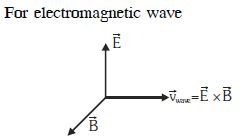
The velocity of an electromagnetic wave is parallel to:
A
$\vec B \times \vec E$
B
$\vec E \times \vec B$
C
$\vec E$
D
$\vec B$
Solution
(B) In an electromagnetic wave,the electric field vector $\vec E$ and the magnetic field vector $\vec B$ oscillate in phase and are perpendicular to each other.
According to the properties of electromagnetic waves,the direction of propagation of the wave (which is the direction of the velocity vector $\vec v$) is given by the cross product of the electric field vector and the magnetic field vector.
Therefore,the velocity vector $\vec v$ is parallel to $\vec E \times \vec B$.
This is also related to the Poynting vector $\vec S = \frac{1}{\mu_0} (\vec E \times \vec B)$,which represents the directional energy flux (the energy transfer per unit area per unit time) of an electromagnetic field.
According to the properties of electromagnetic waves,the direction of propagation of the wave (which is the direction of the velocity vector $\vec v$) is given by the cross product of the electric field vector and the magnetic field vector.
Therefore,the velocity vector $\vec v$ is parallel to $\vec E \times \vec B$.
This is also related to the Poynting vector $\vec S = \frac{1}{\mu_0} (\vec E \times \vec B)$,which represents the directional energy flux (the energy transfer per unit area per unit time) of an electromagnetic field.
0 likes
View Solution219
EasyMCQ
If the magnetic field of a light wave oscillates parallel to the $y-$ axis and is given by $B_y = B_m \sin(kz - \omega t)$,the direction of wave travel and the axis along which the electric vector oscillates are:
A
$+z-$ axis,$x-$ axis
B
$+z-$ axis,$z-$ axis
C
$-z-$ axis,$y-$ axis
D
$-z-$ axis,$x-$ axis
Solution
(A) The given equation for the magnetic field is $B_y = B_m \sin(kz - \omega t)$.
In the wave equation $f(kz - \omega t)$,the term $(kz - \omega t)$ indicates that the wave is propagating in the positive $z-$ direction.
Electromagnetic waves are transverse in nature,meaning the electric field vector $\vec{E}$,the magnetic field vector $\vec{B}$,and the direction of propagation $\vec{k}$ are mutually perpendicular.
Since the magnetic field oscillates along the $y-$ axis and the wave propagates along the $z-$ axis,the electric field must oscillate along the $x-$ axis (as $\vec{E} \propto \vec{B} \times \vec{k}$).
Therefore,the direction of wave travel is the $+z-$ axis and the electric vector oscillates along the $x-$ axis.
In the wave equation $f(kz - \omega t)$,the term $(kz - \omega t)$ indicates that the wave is propagating in the positive $z-$ direction.
Electromagnetic waves are transverse in nature,meaning the electric field vector $\vec{E}$,the magnetic field vector $\vec{B}$,and the direction of propagation $\vec{k}$ are mutually perpendicular.
Since the magnetic field oscillates along the $y-$ axis and the wave propagates along the $z-$ axis,the electric field must oscillate along the $x-$ axis (as $\vec{E} \propto \vec{B} \times \vec{k}$).
Therefore,the direction of wave travel is the $+z-$ axis and the electric vector oscillates along the $x-$ axis.
0 likes
View Solution220
EasyMCQ
The energy density of an electromagnetic wave in a vacuum is given by the relation:
A
$\frac{E^2}{2\varepsilon_0} + \frac{B^2}{2\mu_0}$
B
$\frac{1}{2}\varepsilon_0 E^2 + \frac{1}{2}\mu_0 B^2$
C
$\frac{E^2 + B^2}{c}$
D
$\frac{1}{2}\varepsilon_0 E^2 + \frac{B^2}{2\mu_0}$
Solution
(D) The total energy density $u$ of an electromagnetic wave is the sum of the electric energy density $u_E$ and the magnetic energy density $u_B$.
Electric energy density is given by $u_E = \frac{1}{2}\varepsilon_0 E^2$.
Magnetic energy density is given by $u_B = \frac{B^2}{2\mu_0}$.
Therefore,the total energy density is $u = u_E + u_B = \frac{1}{2}\varepsilon_0 E^2 + \frac{B^2}{2\mu_0}$.
Electric energy density is given by $u_E = \frac{1}{2}\varepsilon_0 E^2$.
Magnetic energy density is given by $u_B = \frac{B^2}{2\mu_0}$.
Therefore,the total energy density is $u = u_E + u_B = \frac{1}{2}\varepsilon_0 E^2 + \frac{B^2}{2\mu_0}$.
0 likes
View Solution221
EasyMCQ
Electromagnetic waves consist of periodically oscillating electric and magnetic vectors:
A
in mutually perpendicular planes but vibrating with a phase difference of $\pi$.
B
in mutually perpendicular planes but vibrating with a phase difference of $\frac{\pi}{2}$.
C
in randomly oriented planes but vibrating in phase.
D
in mutually perpendicular planes but vibrating in phase.
Solution
(D) An electromagnetic wave consists of an oscillating electric field vector $\vec{E}$ and a magnetic field vector $\vec{B}$.
These vectors oscillate in mutually perpendicular planes,meaning the electric field is perpendicular to the magnetic field.
Furthermore,these fields oscillate in phase,which means they reach their maximum and minimum values at the same time and at the same position in space.
Therefore,the correct description is that they vibrate in mutually perpendicular planes but in phase.
These vectors oscillate in mutually perpendicular planes,meaning the electric field is perpendicular to the magnetic field.
Furthermore,these fields oscillate in phase,which means they reach their maximum and minimum values at the same time and at the same position in space.
Therefore,the correct description is that they vibrate in mutually perpendicular planes but in phase.
0 likes
View Solution222
EasyMCQ
Assertion : Radio waves can be polarised.
Reason : Sound waves in air are longitudinal in nature.
Reason : Sound waves in air are longitudinal in nature.
A
If both Assertion and Reason are correct and the Reason is a correct explanation of the Assertion.
B
If both Assertion and Reason are correct but Reason is not a correct explanation of the Assertion.
C
If the Assertion is correct but Reason is incorrect.
D
If both the Assertion and Reason are incorrect.
Solution
(B) Radio waves are electromagnetic waves,which are transverse in nature. Only transverse waves can be polarized. Therefore,the Assertion is correct.
Sound waves in air are longitudinal waves,which cannot be polarized. Therefore,the Reason is also correct.
However,the fact that sound waves are longitudinal does not explain why radio waves can be polarized. Thus,the Reason is not the correct explanation of the Assertion.
Sound waves in air are longitudinal waves,which cannot be polarized. Therefore,the Reason is also correct.
However,the fact that sound waves are longitudinal does not explain why radio waves can be polarized. Thus,the Reason is not the correct explanation of the Assertion.
0 likes
View Solution223
MediumMCQ
For a transparent medium,the relative permeability $\mu_{r}$ and relative permittivity $\epsilon_{r}$ are $1.0$ and $1.44$ respectively. The velocity of light in this medium would be,
A
$2.5 \times 10^{8} \;m/s$
B
$3 \times 10^{8} \;m/s$
C
$2.08 \times 10^{8} \;m/s$
D
$4.32 \times 10^{8} \;m/s$
Solution
(A) The velocity of light in a medium is given by the formula $v = \frac{1}{\sqrt{\mu \epsilon}}$.
Substituting $\mu = \mu_{r} \mu_{0}$ and $\epsilon = \epsilon_{r} \epsilon_{0}$,we get $v = \frac{1}{\sqrt{\mu_{r} \epsilon_{r} \mu_{0} \epsilon_{0}}}$.
Since the speed of light in vacuum is $c = \frac{1}{\sqrt{\mu_{0} \epsilon_{0}}} = 3 \times 10^{8} \;m/s$,the formula becomes $v = \frac{c}{\sqrt{\mu_{r} \epsilon_{r}}}$.
Given $\mu_{r} = 1.0$ and $\epsilon_{r} = 1.44$,we have $v = \frac{3 \times 10^{8}}{\sqrt{1.0 \times 1.44}}$.
$v = \frac{3 \times 10^{8}}{\sqrt{1.44}} = \frac{3 \times 10^{8}}{1.2}$.
$v = 2.5 \times 10^{8} \;m/s$.
Substituting $\mu = \mu_{r} \mu_{0}$ and $\epsilon = \epsilon_{r} \epsilon_{0}$,we get $v = \frac{1}{\sqrt{\mu_{r} \epsilon_{r} \mu_{0} \epsilon_{0}}}$.
Since the speed of light in vacuum is $c = \frac{1}{\sqrt{\mu_{0} \epsilon_{0}}} = 3 \times 10^{8} \;m/s$,the formula becomes $v = \frac{c}{\sqrt{\mu_{r} \epsilon_{r}}}$.
Given $\mu_{r} = 1.0$ and $\epsilon_{r} = 1.44$,we have $v = \frac{3 \times 10^{8}}{\sqrt{1.0 \times 1.44}}$.
$v = \frac{3 \times 10^{8}}{\sqrt{1.44}} = \frac{3 \times 10^{8}}{1.2}$.
$v = 2.5 \times 10^{8} \;m/s$.
0 likes
View Solution224
EasyMCQ
If the magnetic field in a plane electromagnetic wave is given by $\overrightarrow{B} = 3 \times 10^{-8} \sin (1.6 \times 10^{3} x + 48 \times 10^{10} t) \hat{j} \; T$,then what will be the expression for the electric field?
A
$\overrightarrow{E} = 9 \sin (1.6 \times 10^{3} x + 48 \times 10^{10} t) \hat{k} \; V/m$
B
$\overrightarrow{E} = 3 \times 10^{-8} \sin (1.6 \times 10^{3} x + 48 \times 10^{10} t) \hat{i} \; V/m$
C
$\overrightarrow{E} = 60 \sin (1.6 \times 10^{3} x + 48 \times 10^{10} t) \hat{k} \; V/m$
D
$\overrightarrow{E} = 3 \times 10^{-8} \sin (1.6 \times 10^{3} x + 48 \times 10^{10} t) \hat{j} \; V/m$
Solution
(A) The given magnetic field is $\overrightarrow{B} = B_0 \sin (kx + \omega t) \hat{j}$,where $B_0 = 3 \times 10^{-8} \; T$.
Since the wave propagates in the negative $x$-direction (as indicated by $+kx$),the direction of propagation is $-\hat{i}$.
The relationship between the amplitudes of electric and magnetic fields is $E_0 = c B_0$,where $c = 3 \times 10^{8} \; m/s$.
$E_0 = (3 \times 10^{8} \; m/s) \times (3 \times 10^{-8} \; T) = 9 \; V/m$.
In an electromagnetic wave,the direction of propagation is given by the direction of $\overrightarrow{E} \times \overrightarrow{B}$.
Here,$(-\hat{i}) = \hat{E} \times \hat{j}$.
Since $\hat{k} \times \hat{j} = -\hat{i}$,the electric field must be in the $\hat{k}$ direction.
Thus,$\overrightarrow{E} = 9 \sin (1.6 \times 10^{3} x + 48 \times 10^{10} t) \hat{k} \; V/m$.
Since the wave propagates in the negative $x$-direction (as indicated by $+kx$),the direction of propagation is $-\hat{i}$.
The relationship between the amplitudes of electric and magnetic fields is $E_0 = c B_0$,where $c = 3 \times 10^{8} \; m/s$.
$E_0 = (3 \times 10^{8} \; m/s) \times (3 \times 10^{-8} \; T) = 9 \; V/m$.
In an electromagnetic wave,the direction of propagation is given by the direction of $\overrightarrow{E} \times \overrightarrow{B}$.
Here,$(-\hat{i}) = \hat{E} \times \hat{j}$.
Since $\hat{k} \times \hat{j} = -\hat{i}$,the electric field must be in the $\hat{k}$ direction.
Thus,$\overrightarrow{E} = 9 \sin (1.6 \times 10^{3} x + 48 \times 10^{10} t) \hat{k} \; V/m$.
0 likes
View Solution225
EasyMCQ
$A$ plane electromagnetic wave of frequency $25\; GHz$ is propagating in vacuum along the $z$-direction. At a particular point in space and time,the magnetic field is given by $\overrightarrow{B} = 5 \times 10^{-8} \hat{j}\; T$. The corresponding electric field $\overrightarrow{E}$ is (speed of light $c = 3 \times 10^{8}\; m/s$):
A
$1.66 \times 10^{-16} \hat{i}\; V/m$
B
$15 \hat{i}\; V/m$
C
$-1.66 \times 10^{-16} \hat{i}\; V/m$
D
$-15 \hat{i}\; V/m$
Solution
(D) For an electromagnetic wave propagating in vacuum,the relationship between the electric field $\overrightarrow{E}$,the magnetic field $\overrightarrow{B}$,and the velocity vector $\overrightarrow{c}$ is given by $\overrightarrow{E} = \overrightarrow{c} \times \overrightarrow{B}$.
The wave propagates along the $z$-direction,so the velocity vector is $\overrightarrow{c} = c \hat{k} = (3 \times 10^{8}) \hat{k}\; m/s$.
The magnetic field is given as $\overrightarrow{B} = 5 \times 10^{-8} \hat{j}\; T$.
Substituting these values into the formula:
$\overrightarrow{E} = (3 \times 10^{8} \hat{k}) \times (5 \times 10^{-8} \hat{j})$
Using the cross product rules for unit vectors $(\hat{k} \times \hat{j} = -\hat{i})$:
$\overrightarrow{E} = (3 \times 5) \times (10^{8} \times 10^{-8}) \times (\hat{k} \times \hat{j})$
$\overrightarrow{E} = 15 \times 1 \times (-\hat{i})$
$\overrightarrow{E} = -15 \hat{i}\; V/m$.
The wave propagates along the $z$-direction,so the velocity vector is $\overrightarrow{c} = c \hat{k} = (3 \times 10^{8}) \hat{k}\; m/s$.
The magnetic field is given as $\overrightarrow{B} = 5 \times 10^{-8} \hat{j}\; T$.
Substituting these values into the formula:
$\overrightarrow{E} = (3 \times 10^{8} \hat{k}) \times (5 \times 10^{-8} \hat{j})$
Using the cross product rules for unit vectors $(\hat{k} \times \hat{j} = -\hat{i})$:
$\overrightarrow{E} = (3 \times 5) \times (10^{8} \times 10^{-8}) \times (\hat{k} \times \hat{j})$
$\overrightarrow{E} = 15 \times 1 \times (-\hat{i})$
$\overrightarrow{E} = -15 \hat{i}\; V/m$.
0 likes
View Solution226
MediumMCQ
$A$ plane electromagnetic wave is propagating along the direction $\frac{\hat{i}+\hat{j}}{\sqrt{2}},$ with its polarization along the direction $\hat{k}$. The correct form of the magnetic field of the wave would be (here $B_{0}$ is an appropriate constant)
A
$B_{0} \frac{\hat{i}-\hat{j}}{\sqrt{2}} \cos \left(\omega t - k \frac{\hat{i}+\hat{j}}{\sqrt{2}} \cdot \vec{r}\right)$
B
$B_{0} \frac{\hat{i}+\hat{j}}{\sqrt{2}} \cos \left(\omega t - k \frac{\hat{i}+\hat{j}}{\sqrt{2}} \cdot \vec{r}\right)$
C
$B_{0} \hat{k} \cos \left(\omega t - k \frac{\hat{i}+\hat{j}}{\sqrt{2}} \cdot \vec{r}\right)$
D
$B_{0} \frac{\hat{j}-\hat{i}}{\sqrt{2}} \cos \left(\omega t + k \frac{\hat{i}+\hat{j}}{\sqrt{2}} \cdot \vec{r}\right)$
Solution
(A) The direction of propagation is given by $\hat{n} = \frac{\hat{i}+\hat{j}}{\sqrt{2}}$.
The electric field polarization is given by $\hat{E} = \hat{k}$.
In an electromagnetic wave,the direction of propagation $\hat{n}$ is given by the cross product of the electric field direction $\hat{E}$ and the magnetic field direction $\hat{B}$,i.e.,$\hat{n} = \hat{E} \times \hat{B}$.
Substituting the known values: $\frac{\hat{i}+\hat{j}}{\sqrt{2}} = \hat{k} \times \hat{B}$.
We know that $\hat{k} \times \hat{i} = \hat{j}$ and $\hat{k} \times \hat{j} = -\hat{i}$.
Therefore,$\hat{k} \times \left( \frac{\hat{i}-\hat{j}}{\sqrt{2}} \right) = \frac{\hat{j} - (-\hat{i})}{\sqrt{2}} = \frac{\hat{i}+\hat{j}}{\sqrt{2}}$.
Thus,the direction of the magnetic field is $\hat{B} = \frac{\hat{i}-\hat{j}}{\sqrt{2}}$.
Hence,the magnetic field vector is $\vec{B} = B_{0} \frac{\hat{i}-\hat{j}}{\sqrt{2}} \cos \left(\omega t - \vec{k} \cdot \vec{r}\right)$.
The electric field polarization is given by $\hat{E} = \hat{k}$.
In an electromagnetic wave,the direction of propagation $\hat{n}$ is given by the cross product of the electric field direction $\hat{E}$ and the magnetic field direction $\hat{B}$,i.e.,$\hat{n} = \hat{E} \times \hat{B}$.
Substituting the known values: $\frac{\hat{i}+\hat{j}}{\sqrt{2}} = \hat{k} \times \hat{B}$.
We know that $\hat{k} \times \hat{i} = \hat{j}$ and $\hat{k} \times \hat{j} = -\hat{i}$.
Therefore,$\hat{k} \times \left( \frac{\hat{i}-\hat{j}}{\sqrt{2}} \right) = \frac{\hat{j} - (-\hat{i})}{\sqrt{2}} = \frac{\hat{i}+\hat{j}}{\sqrt{2}}$.
Thus,the direction of the magnetic field is $\hat{B} = \frac{\hat{i}-\hat{j}}{\sqrt{2}}$.
Hence,the magnetic field vector is $\vec{B} = B_{0} \frac{\hat{i}-\hat{j}}{\sqrt{2}} \cos \left(\omega t - \vec{k} \cdot \vec{r}\right)$.
0 likes
View Solution227
DifficultMCQ
The electric fields of two plane electromagnetic waves in vacuum are given by $\overrightarrow{E}_{1}=E_{0} \hat{j} \cos (\omega t-kx)$ and $\overrightarrow{E}_{2}=E_{0} \hat{k} \cos (\omega t-ky)$. At $t=0$,a particle of charge $q$ is at the origin with a velocity $\overrightarrow{v}=0.8 c \hat{j}$ ($c$ is the speed of light in vacuum). The instantaneous force experienced by the particle is:
A
$E_{0} q(-0.8 \hat{i}+\hat{j}+\hat{k})$
B
$E_{0} q(0.8 \hat{i}-\hat{j}+0.4 \hat{k})$
C
$E_{0} q(0.8 \hat{i}+\hat{j}+0.2 \hat{k})$
D
$E_{0} q(0.4 \hat{i}-3 \hat{j}+0.8 \hat{k})$
Solution
(C) The electric fields are $\overrightarrow{E}_{1}=E_{0} \hat{j} \cos (\omega t-kx)$ and $\overrightarrow{E}_{2}=E_{0} \hat{k} \cos (\omega t-ky)$.
At $t=0$ and origin $(0,0,0)$,$\overrightarrow{E}_{1} = E_{0} \hat{j}$ and $\overrightarrow{E}_{2} = E_{0} \hat{k}$.
The corresponding magnetic fields are given by $\overrightarrow{B} = \frac{1}{c} (\hat{n} \times \overrightarrow{E})$,where $\hat{n}$ is the direction of propagation.
For $\overrightarrow{E}_{1}$,$\hat{n} = \hat{i}$,so $\overrightarrow{B}_{1} = \frac{1}{c} (\hat{i} \times E_{0} \hat{j}) = \frac{E_{0}}{c} \hat{k}$.
For $\overrightarrow{E}_{2}$,$\hat{n} = \hat{j}$,so $\overrightarrow{B}_{2} = \frac{1}{c} (\hat{j} \times E_{0} \hat{k}) = \frac{E_{0}}{c} \hat{i}$.
The Lorentz force is $\overrightarrow{F} = q(\overrightarrow{E}_{1} + \overrightarrow{E}_{2}) + q(\overrightarrow{v} \times (\overrightarrow{B}_{1} + \overrightarrow{B}_{2}))$.
Substituting values: $\overrightarrow{F} = q(E_{0} \hat{j} + E_{0} \hat{k}) + q(0.8 c \hat{j} \times (\frac{E_{0}}{c} \hat{k} + \frac{E_{0}}{c} \hat{i}))$.
$\overrightarrow{F} = q E_{0} \hat{j} + q E_{0} \hat{k} + 0.8 q E_{0} (\hat{j} \times \hat{k}) + 0.8 q E_{0} (\hat{j} \times \hat{i})$.
Using cross products $\hat{j} \times \hat{k} = \hat{i}$ and $\hat{j} \times \hat{i} = -\hat{k}$:
$\overrightarrow{F} = q E_{0} \hat{j} + q E_{0} \hat{k} + 0.8 q E_{0} \hat{i} - 0.8 q E_{0} \hat{k} = q E_{0} (0.8 \hat{i} + \hat{j} + 0.2 \hat{k})$.
At $t=0$ and origin $(0,0,0)$,$\overrightarrow{E}_{1} = E_{0} \hat{j}$ and $\overrightarrow{E}_{2} = E_{0} \hat{k}$.
The corresponding magnetic fields are given by $\overrightarrow{B} = \frac{1}{c} (\hat{n} \times \overrightarrow{E})$,where $\hat{n}$ is the direction of propagation.
For $\overrightarrow{E}_{1}$,$\hat{n} = \hat{i}$,so $\overrightarrow{B}_{1} = \frac{1}{c} (\hat{i} \times E_{0} \hat{j}) = \frac{E_{0}}{c} \hat{k}$.
For $\overrightarrow{E}_{2}$,$\hat{n} = \hat{j}$,so $\overrightarrow{B}_{2} = \frac{1}{c} (\hat{j} \times E_{0} \hat{k}) = \frac{E_{0}}{c} \hat{i}$.
The Lorentz force is $\overrightarrow{F} = q(\overrightarrow{E}_{1} + \overrightarrow{E}_{2}) + q(\overrightarrow{v} \times (\overrightarrow{B}_{1} + \overrightarrow{B}_{2}))$.
Substituting values: $\overrightarrow{F} = q(E_{0} \hat{j} + E_{0} \hat{k}) + q(0.8 c \hat{j} \times (\frac{E_{0}}{c} \hat{k} + \frac{E_{0}}{c} \hat{i}))$.
$\overrightarrow{F} = q E_{0} \hat{j} + q E_{0} \hat{k} + 0.8 q E_{0} (\hat{j} \times \hat{k}) + 0.8 q E_{0} (\hat{j} \times \hat{i})$.
Using cross products $\hat{j} \times \hat{k} = \hat{i}$ and $\hat{j} \times \hat{i} = -\hat{k}$:
$\overrightarrow{F} = q E_{0} \hat{j} + q E_{0} \hat{k} + 0.8 q E_{0} \hat{i} - 0.8 q E_{0} \hat{k} = q E_{0} (0.8 \hat{i} + \hat{j} + 0.2 \hat{k})$.
0 likes
View Solution228
Easy
What are called non-mechanical waves? Give its examples.
Solution
(N/A) Non-mechanical waves are waves that do not require a material medium for their propagation. These waves can travel through a vacuum.
They are also known as electromagnetic waves.
Examples of non-mechanical waves include:
$1$. Light waves
$2$. Radio waves
$3$. $X$-rays
$4$. Gamma rays
$5$. Microwaves
They are also known as electromagnetic waves.
Examples of non-mechanical waves include:
$1$. Light waves
$2$. Radio waves
$3$. $X$-rays
$4$. Gamma rays
$5$. Microwaves
0 likes
View Solution229
MediumMCQ
$A$ plane electromagnetic wave of frequency $25 \; MHz$ travels in free space along the $x$-direction. At a particular point in space and time,$\vec{E} = 6.3 \hat{j} \; V/m$. What is $\vec{B}$ at this point?
A
$1.9 \times 10^{-8} \hat{i} \; T$
B
$2.1 \times 10^{-8} \hat{k} \; T$
C
$2.1 \times 10^{-8} \hat{j} \; T$
D
$8.2 \times 10^{-8} \hat{k} \; T$
Solution
(B) The magnitude of the magnetic field $B$ is related to the electric field $E$ by the relation $B = \frac{E}{c}$,where $c = 3 \times 10^8 \; m/s$ is the speed of light in free space.
Substituting the given values: $B = \frac{6.3 \; V/m}{3 \times 10^8 \; m/s} = 2.1 \times 10^{-8} \; T$.
To find the direction,we know that the electromagnetic wave propagates in the direction of the vector $\vec{E} \times \vec{B}$.
Given that the wave propagates along the $x$-direction $(\hat{i})$ and the electric field is along the $y$-direction $(\hat{j})$,we have $\hat{j} \times \hat{B} = \hat{i}$.
Since $\hat{j} \times \hat{k} = \hat{i}$,the magnetic field must be in the $z$-direction $(\hat{k})$.
Therefore,$\vec{B} = 2.1 \times 10^{-8} \hat{k} \; T$.
Substituting the given values: $B = \frac{6.3 \; V/m}{3 \times 10^8 \; m/s} = 2.1 \times 10^{-8} \; T$.
To find the direction,we know that the electromagnetic wave propagates in the direction of the vector $\vec{E} \times \vec{B}$.
Given that the wave propagates along the $x$-direction $(\hat{i})$ and the electric field is along the $y$-direction $(\hat{j})$,we have $\hat{j} \times \hat{B} = \hat{i}$.
Since $\hat{j} \times \hat{k} = \hat{i}$,the magnetic field must be in the $z$-direction $(\hat{k})$.
Therefore,$\vec{B} = 2.1 \times 10^{-8} \hat{k} \; T$.
0 likes
View Solution230
Medium
The magnetic field in a plane electromagnetic wave is given by
$B_y = (2 \times 10^{-7}) \sin (0.5 \times 10^3 x + 1.5 \times 10^{11} t) \, T$
$(a)$ What is the wavelength and frequency of the wave?
$(b)$ Write an expression for the electric field.
$B_y = (2 \times 10^{-7}) \sin (0.5 \times 10^3 x + 1.5 \times 10^{11} t) \, T$
$(a)$ What is the wavelength and frequency of the wave?
$(b)$ Write an expression for the electric field.
Solution
(A) Comparing the given equation with the standard form $B_y = B_0 \sin(kx + \omega t)$:
Here,$k = 0.5 \times 10^3 \, rad/m$ and $\omega = 1.5 \times 10^{11} \, rad/s$.
Wavelength $\lambda = \frac{2\pi}{k} = \frac{2 \times 3.14}{0.5 \times 10^3} \approx 1.26 \, m$.
Frequency $\nu = \frac{\omega}{2\pi} = \frac{1.5 \times 10^{11}}{2 \times 3.14} \approx 2.39 \times 10^{10} \, Hz = 23.9 \, GHz$.
$(b)$ The amplitude of the electric field is $E_0 = B_0 c = (2 \times 10^{-7} \, T) \times (3 \times 10^8 \, m/s) = 60 \, V/m$.
Since the wave propagates in the negative $x$-direction and the magnetic field is along the $y$-axis,the electric field must be along the $z$-axis. Thus,the expression is:
$E_z = 60 \sin (0.5 \times 10^3 x + 1.5 \times 10^{11} t) \, V/m$.
Here,$k = 0.5 \times 10^3 \, rad/m$ and $\omega = 1.5 \times 10^{11} \, rad/s$.
Wavelength $\lambda = \frac{2\pi}{k} = \frac{2 \times 3.14}{0.5 \times 10^3} \approx 1.26 \, m$.
Frequency $\nu = \frac{\omega}{2\pi} = \frac{1.5 \times 10^{11}}{2 \times 3.14} \approx 2.39 \times 10^{10} \, Hz = 23.9 \, GHz$.
$(b)$ The amplitude of the electric field is $E_0 = B_0 c = (2 \times 10^{-7} \, T) \times (3 \times 10^8 \, m/s) = 60 \, V/m$.
Since the wave propagates in the negative $x$-direction and the magnetic field is along the $y$-axis,the electric field must be along the $z$-axis. Thus,the expression is:
$E_z = 60 \sin (0.5 \times 10^3 x + 1.5 \times 10^{11} t) \, V/m$.
0 likes
View Solution231
Medium
Calculate the electric and magnetic fields produced by the radiation coming from a $100\; W$ bulb at a distance of $3\; m$. Assume that the efficiency of the bulb is $2.5\%$ and it is a point source.
Solution
(A) The bulb,as a point source,radiates light in all directions uniformly. At a distance of $r = 3\; m$,the surface area of the surrounding sphere is $A = 4\pi r^2 = 4\pi(3)^2 = 113\; m^2$.
The power radiated by the bulb is $P = 100\; W \times 2.5\% = 2.5\; W$.
The intensity $I$ at this distance is $I = \frac{P}{A} = \frac{2.5\; W}{113\; m^2} \approx 0.022\; W/m^2$.
The average energy density is related to the electric field by $I = \varepsilon_0 E_{rms}^2 c$. Thus,$E_{rms} = \sqrt{\frac{I}{\varepsilon_0 c}}$.
Substituting the values: $E_{rms} = \sqrt{\frac{0.022}{(8.85 \times 10^{-12})(3 \times 10^8)}} \approx 2.87\; V/m \approx 2.9\; V/m$.
The peak electric field $E_0 = \sqrt{2} E_{rms} = \sqrt{2} \times 2.9 \approx 4.1\; V/m$.
The root mean square magnetic field is $B_{rms} = \frac{E_{rms}}{c} = \frac{2.9}{3 \times 10^8} \approx 9.7 \times 10^{-9}\; T$.
The peak magnetic field $B_0 = \sqrt{2} B_{rms} = \sqrt{2} \times 9.7 \times 10^{-9} \approx 1.37 \times 10^{-8}\; T$.
The power radiated by the bulb is $P = 100\; W \times 2.5\% = 2.5\; W$.
The intensity $I$ at this distance is $I = \frac{P}{A} = \frac{2.5\; W}{113\; m^2} \approx 0.022\; W/m^2$.
The average energy density is related to the electric field by $I = \varepsilon_0 E_{rms}^2 c$. Thus,$E_{rms} = \sqrt{\frac{I}{\varepsilon_0 c}}$.
Substituting the values: $E_{rms} = \sqrt{\frac{0.022}{(8.85 \times 10^{-12})(3 \times 10^8)}} \approx 2.87\; V/m \approx 2.9\; V/m$.
The peak electric field $E_0 = \sqrt{2} E_{rms} = \sqrt{2} \times 2.9 \approx 4.1\; V/m$.
The root mean square magnetic field is $B_{rms} = \frac{E_{rms}}{c} = \frac{2.9}{3 \times 10^8} \approx 9.7 \times 10^{-9}\; T$.
The peak magnetic field $B_0 = \sqrt{2} B_{rms} = \sqrt{2} \times 9.7 \times 10^{-9} \approx 1.37 \times 10^{-8}\; T$.
0 likes
View Solution232
EasyMCQ
What physical quantity is the same for $X$-rays of wavelength $10^{-10} \; m$,red light of wavelength $6800 \; \mathring{A}$,and radio waves of wavelength $500 \; m$?
A
Frequency
B
Energy
C
Speed in vacuum
D
Intensity
Solution
(C) All electromagnetic waves,regardless of their wavelength or frequency,travel at the same speed in a vacuum.
This speed is denoted by $c$ and is approximately $3 \times 10^{8} \; m/s$.
Since $X$-rays,red light,and radio waves are all parts of the electromagnetic spectrum,they share this fundamental property in a vacuum.
This speed is denoted by $c$ and is approximately $3 \times 10^{8} \; m/s$.
Since $X$-rays,red light,and radio waves are all parts of the electromagnetic spectrum,they share this fundamental property in a vacuum.
0 likes
View Solution233
EasyMCQ
$A$ plane electromagnetic wave travels in vacuum along the $z$-direction. What can you say about the directions of its electric and magnetic field vectors? If the frequency of the wave is $30 \; MHz$,what is its wavelength in $m$?
A
$10$
B
$25$
C
$15$
D
$2$
Solution
(A) The electromagnetic wave travels in a vacuum along the $z$-direction. The electric field vector $\vec{E}$ and the magnetic field vector $\vec{B}$ are in the $x-y$ plane and are mutually perpendicular to each other and to the direction of propagation ($z$-direction).
Given frequency of the wave,$\nu = 30 \; MHz = 30 \times 10^{6} \; s^{-1}$.
Speed of light in a vacuum,$c = 3 \times 10^{8} \; m/s$.
The wavelength $\lambda$ is given by the formula $\lambda = \frac{c}{\nu}$.
Substituting the values: $\lambda = \frac{3 \times 10^{8}}{30 \times 10^{6}} = \frac{300 \times 10^{6}}{30 \times 10^{6}} = 10 \; m$.
Given frequency of the wave,$\nu = 30 \; MHz = 30 \times 10^{6} \; s^{-1}$.
Speed of light in a vacuum,$c = 3 \times 10^{8} \; m/s$.
The wavelength $\lambda$ is given by the formula $\lambda = \frac{c}{\nu}$.
Substituting the values: $\lambda = \frac{3 \times 10^{8}}{30 \times 10^{6}} = \frac{300 \times 10^{6}}{30 \times 10^{6}} = 10 \; m$.
0 likes
View Solution234
Easy
$A$ radio can tune in to any station in the $7.5\; MHz$ to $12\; MHz$ band. What is the corresponding wavelength band?
Solution
(N/A) The radio tunes to a minimum frequency of $v_{1} = 7.5\; MHz = 7.5 \times 10^{6}\; Hz$.
The maximum frequency is $v_{2} = 12\; MHz = 12 \times 10^{6}\; Hz$.
The speed of light is $c = 3 \times 10^{8}\; m/s$.
The wavelength $\lambda$ is related to frequency $v$ by the formula $\lambda = \frac{c}{v}$.
For the minimum frequency $v_{1}$,the maximum wavelength $\lambda_{1}$ is:
$\lambda_{1} = \frac{c}{v_{1}} = \frac{3 \times 10^{8}}{7.5 \times 10^{6}} = 40\; m$.
For the maximum frequency $v_{2}$,the minimum wavelength $\lambda_{2}$ is:
$\lambda_{2} = \frac{c}{v_{2}} = \frac{3 \times 10^{8}}{12 \times 10^{6}} = 25\; m$.
Thus,the corresponding wavelength band is $25\; m$ to $40\; m$.
The maximum frequency is $v_{2} = 12\; MHz = 12 \times 10^{6}\; Hz$.
The speed of light is $c = 3 \times 10^{8}\; m/s$.
The wavelength $\lambda$ is related to frequency $v$ by the formula $\lambda = \frac{c}{v}$.
For the minimum frequency $v_{1}$,the maximum wavelength $\lambda_{1}$ is:
$\lambda_{1} = \frac{c}{v_{1}} = \frac{3 \times 10^{8}}{7.5 \times 10^{6}} = 40\; m$.
For the maximum frequency $v_{2}$,the minimum wavelength $\lambda_{2}$ is:
$\lambda_{2} = \frac{c}{v_{2}} = \frac{3 \times 10^{8}}{12 \times 10^{6}} = 25\; m$.
Thus,the corresponding wavelength band is $25\; m$ to $40\; m$.
0 likes
View Solution235
EasyMCQ
$A$ charged particle oscillates about its mean equilibrium position with a frequency of $10^9 \; Hz$. What is the frequency of the electromagnetic waves produced by the oscillator?
A
$10^9 \; Hz$
B
$10^{18} \; Hz$
C
$10^0 \; Hz$
D
$10^{-9} \; Hz$
Solution
(A) According to the theory of electromagnetic waves,an oscillating charge is a source of electromagnetic radiation. The frequency of the electromagnetic waves produced by an oscillating charge is equal to the frequency of oscillation of the charge itself. Therefore,the frequency of the electromagnetic waves is $10^9 \; Hz$.
0 likes
View Solution236
MediumMCQ
The amplitude of the magnetic field part of a harmonic electromagnetic wave in vacuum is $B_0 = 510 \; nT$. What is the amplitude of the electric field (in $N/C$) part of the wave?
A
$205$
B
$114$
C
$186$
D
$153$
Solution
(D) The amplitude of the magnetic field of an electromagnetic wave in a vacuum is given as $B_0 = 510 \; nT = 510 \times 10^{-9} \; T$.
The speed of light in a vacuum is $c = 3 \times 10^8 \; m/s$.
The amplitude of the electric field $(E_0)$ of an electromagnetic wave is related to the amplitude of the magnetic field $(B_0)$ by the relation $E_0 = c B_0$.
Substituting the given values:
$E_0 = (3 \times 10^8 \; m/s) \times (510 \times 10^{-9} \; T)$
$E_0 = 3 \times 510 \times 10^{-1} \; N/C$
$E_0 = 1530 \times 10^{-1} \; N/C = 153 \; N/C$.
Therefore,the amplitude of the electric field part of the wave is $153 \; N/C$.
The speed of light in a vacuum is $c = 3 \times 10^8 \; m/s$.
The amplitude of the electric field $(E_0)$ of an electromagnetic wave is related to the amplitude of the magnetic field $(B_0)$ by the relation $E_0 = c B_0$.
Substituting the given values:
$E_0 = (3 \times 10^8 \; m/s) \times (510 \times 10^{-9} \; T)$
$E_0 = 3 \times 510 \times 10^{-1} \; N/C$
$E_0 = 1530 \times 10^{-1} \; N/C = 153 \; N/C$.
Therefore,the amplitude of the electric field part of the wave is $153 \; N/C$.
0 likes
View Solution237
Medium
Suppose that the electric field amplitude of an electromagnetic wave is $E_{0} = 120 \; N/C$ and that its frequency is $\nu = 50.0 \; MHz$.
$(a)$ Determine $B_{0}, \omega, k,$ and $\lambda$.
$(b)$ Find expressions for $E$ and $B$.
$(a)$ Determine $B_{0}, \omega, k,$ and $\lambda$.
$(b)$ Find expressions for $E$ and $B$.
Solution
(N/A) Electric field amplitude,$E_{0} = 120 \; N/C$.
Frequency of source,$\nu = 50.0 \; MHz = 50 \times 10^{6} \; Hz$.
Speed of light,$c = 3 \times 10^{8} \; m/s$.
$(a)$ Magnitude of magnetic field strength is given as:
$B_{0} = \frac{E_{0}}{c} = \frac{120}{3 \times 10^{8}} = 4 \times 10^{-7} \; T = 400 \; nT$.
Angular frequency of source is given as:
$\omega = 2 \pi \nu = 2 \pi \times 50 \times 10^{6} = 3.14 \times 10^{8} \; rad/s$.
Propagation constant is given as:
$k = \frac{\omega}{c} = \frac{3.14 \times 10^{8}}{3 \times 10^{8}} = 1.05 \; rad/m$.
Wavelength of wave is given as:
$\lambda = \frac{c}{\nu} = \frac{3 \times 10^{8}}{50 \times 10^{6}} = 6.0 \; m$.
$(b)$ Suppose the wave is propagating in the positive $x$-direction. Then,the electric field vector will be in the positive $y$-direction and the magnetic field vector will be in the positive $z$-direction. This is because all three vectors are mutually perpendicular. Equation of electric field vector is given as:
$\vec{E} = E_{0} \sin(kx - \omega t) \hat{j} = 120 \sin(1.05x - 3.14 \times 10^{8}t) \hat{j} \; V/m$.
And,magnetic field vector is given as:
$\vec{B} = B_{0} \sin(kx - \omega t) \hat{k} = (4 \times 10^{-7}) \sin(1.05x - 3.14 \times 10^{8}t) \hat{k} \; T$.
Frequency of source,$\nu = 50.0 \; MHz = 50 \times 10^{6} \; Hz$.
Speed of light,$c = 3 \times 10^{8} \; m/s$.
$(a)$ Magnitude of magnetic field strength is given as:
$B_{0} = \frac{E_{0}}{c} = \frac{120}{3 \times 10^{8}} = 4 \times 10^{-7} \; T = 400 \; nT$.
Angular frequency of source is given as:
$\omega = 2 \pi \nu = 2 \pi \times 50 \times 10^{6} = 3.14 \times 10^{8} \; rad/s$.
Propagation constant is given as:
$k = \frac{\omega}{c} = \frac{3.14 \times 10^{8}}{3 \times 10^{8}} = 1.05 \; rad/m$.
Wavelength of wave is given as:
$\lambda = \frac{c}{\nu} = \frac{3 \times 10^{8}}{50 \times 10^{6}} = 6.0 \; m$.
$(b)$ Suppose the wave is propagating in the positive $x$-direction. Then,the electric field vector will be in the positive $y$-direction and the magnetic field vector will be in the positive $z$-direction. This is because all three vectors are mutually perpendicular. Equation of electric field vector is given as:
$\vec{E} = E_{0} \sin(kx - \omega t) \hat{j} = 120 \sin(1.05x - 3.14 \times 10^{8}t) \hat{j} \; V/m$.
And,magnetic field vector is given as:
$\vec{B} = B_{0} \sin(kx - \omega t) \hat{k} = (4 \times 10^{-7}) \sin(1.05x - 3.14 \times 10^{8}t) \hat{k} \; T$.
0 likes
View Solution238
Medium
In a plane electromagnetic wave,the electric field oscillates sinusoidally at a frequency of $2.0 \times 10^{10} \; Hz$ and amplitude $48 \; V m^{-1}$.
$(a)$ What is the wavelength of the wave?
$(b)$ What is the amplitude of the oscillating magnetic field?
$(c)$ Show that the average energy density of the $E$ field equals the average energy density of the $B$ field. $[c = 3 \times 10^{8} \; m s^{-1}]$.
$(a)$ What is the wavelength of the wave?
$(b)$ What is the amplitude of the oscillating magnetic field?
$(c)$ Show that the average energy density of the $E$ field equals the average energy density of the $B$ field. $[c = 3 \times 10^{8} \; m s^{-1}]$.
Solution
(A) Given:
Frequency $v = 2.0 \times 10^{10} \; Hz$
Electric field amplitude $E_{0} = 48 \; V m^{-1}$
Speed of light $c = 3 \times 10^{8} \; m s^{-1}$
$(a)$ Wavelength $\lambda = \frac{c}{v} = \frac{3 \times 10^{8}}{2.0 \times 10^{10}} = 0.015 \; m$.
$(b)$ Magnetic field amplitude $B_{0} = \frac{E_{0}}{c} = \frac{48}{3 \times 10^{8}} = 1.6 \times 10^{-7} \; T$.
$(c)$ Energy density of the electric field is $U_{E} = \frac{1}{2} \epsilon_{0} E^{2}$ and for the magnetic field is $U_{B} = \frac{B^{2}}{2 \mu_{0}}$.
Using $E = cB$ and $c = \frac{1}{\sqrt{\epsilon_{0} \mu_{0}}}$,we have $E^{2} = c^{2} B^{2} = \frac{B^{2}}{\epsilon_{0} \mu_{0}}$.
Thus,$\epsilon_{0} E^{2} = \frac{B^{2}}{\mu_{0}}$.
Dividing by $2$,we get $\frac{1}{2} \epsilon_{0} E^{2} = \frac{B^{2}}{2 \mu_{0}}$,which implies $U_{E} = U_{B}$.
Frequency $v = 2.0 \times 10^{10} \; Hz$
Electric field amplitude $E_{0} = 48 \; V m^{-1}$
Speed of light $c = 3 \times 10^{8} \; m s^{-1}$
$(a)$ Wavelength $\lambda = \frac{c}{v} = \frac{3 \times 10^{8}}{2.0 \times 10^{10}} = 0.015 \; m$.
$(b)$ Magnetic field amplitude $B_{0} = \frac{E_{0}}{c} = \frac{48}{3 \times 10^{8}} = 1.6 \times 10^{-7} \; T$.
$(c)$ Energy density of the electric field is $U_{E} = \frac{1}{2} \epsilon_{0} E^{2}$ and for the magnetic field is $U_{B} = \frac{B^{2}}{2 \mu_{0}}$.
Using $E = cB$ and $c = \frac{1}{\sqrt{\epsilon_{0} \mu_{0}}}$,we have $E^{2} = c^{2} B^{2} = \frac{B^{2}}{\epsilon_{0} \mu_{0}}$.
Thus,$\epsilon_{0} E^{2} = \frac{B^{2}}{\mu_{0}}$.
Dividing by $2$,we get $\frac{1}{2} \epsilon_{0} E^{2} = \frac{B^{2}}{2 \mu_{0}}$,which implies $U_{E} = U_{B}$.
0 likes
View Solution239
Medium
Suppose that the electric field part of an electromagnetic wave in vacuum is $E = \{(3.1 \; N/C) \cos [(1.8 \; rad/m) y + (5.4 \times 10^{6} \; rad/s) t] \} \hat{i}$.
$(a)$ What is the direction of propagation?
$(b)$ What is the wavelength $\lambda$?
$(c)$ What is the frequency $\nu$?
$(d)$ What is the amplitude of the magnetic field part of the wave?
$(e)$ Write an expression for the magnetic field part of the wave.
$(a)$ What is the direction of propagation?
$(b)$ What is the wavelength $\lambda$?
$(c)$ What is the frequency $\nu$?
$(d)$ What is the amplitude of the magnetic field part of the wave?
$(e)$ Write an expression for the magnetic field part of the wave.
Solution
(A) The electric field is oscillating along the $x$-axis and varies with $y$ and $t$. Since the argument of the cosine function is $(ky + \omega t)$,the wave propagates in the negative $y$-direction,i.e.,$-\hat{j}$.
$(b)$ Comparing the given equation with the standard form $E = E_0 \cos(ky + \omega t)$,we have $k = 1.8 \; rad/m$. The wavelength $\lambda = \frac{2\pi}{k} = \frac{2 \times 3.14}{1.8} \approx 3.49 \; m$.
$(c)$ The angular frequency $\omega = 5.4 \times 10^{6} \; rad/s$. The frequency $\nu = \frac{\omega}{2\pi} = \frac{5.4 \times 10^{6}}{2 \times 3.14} \approx 8.6 \times 10^{5} \; Hz$.
$(d)$ The amplitude of the magnetic field $B_0 = \frac{E_0}{c}$,where $E_0 = 3.1 \; N/C$ and $c = 3 \times 10^{8} \; m/s$. Thus,$B_0 = \frac{3.1}{3 \times 10^{8}} \approx 1.03 \times 10^{-8} \; T$.
$(e)$ Since $\vec{E}$ is along $\hat{i}$ and propagation is along $-\hat{j}$,the magnetic field $\vec{B}$ must be along $\hat{k}$ (as $\vec{E} \times \vec{B}$ gives the direction of propagation). The expression is $\vec{B} = \{(1.03 \times 10^{-8} \; T) \cos [(1.8 \; rad/m) y + (5.4 \times 10^{6} \; rad/s) t] \} \hat{k}$.
$(b)$ Comparing the given equation with the standard form $E = E_0 \cos(ky + \omega t)$,we have $k = 1.8 \; rad/m$. The wavelength $\lambda = \frac{2\pi}{k} = \frac{2 \times 3.14}{1.8} \approx 3.49 \; m$.
$(c)$ The angular frequency $\omega = 5.4 \times 10^{6} \; rad/s$. The frequency $\nu = \frac{\omega}{2\pi} = \frac{5.4 \times 10^{6}}{2 \times 3.14} \approx 8.6 \times 10^{5} \; Hz$.
$(d)$ The amplitude of the magnetic field $B_0 = \frac{E_0}{c}$,where $E_0 = 3.1 \; N/C$ and $c = 3 \times 10^{8} \; m/s$. Thus,$B_0 = \frac{3.1}{3 \times 10^{8}} \approx 1.03 \times 10^{-8} \; T$.
$(e)$ Since $\vec{E}$ is along $\hat{i}$ and propagation is along $-\hat{j}$,the magnetic field $\vec{B}$ must be along $\hat{k}$ (as $\vec{E} \times \vec{B}$ gives the direction of propagation). The expression is $\vec{B} = \{(1.03 \times 10^{-8} \; T) \cos [(1.8 \; rad/m) y + (5.4 \times 10^{6} \; rad/s) t] \} \hat{k}$.
0 likes
View Solution240
Medium
About $5 \%$ of the power of a $100 \; W$ light bulb is converted to visible radiation. What is the average intensity of visible radiation
$(a)$ at a distance of $1 \; m$ from the bulb?
$(b)$ at a distance of $10 \; m$? Assume that the radiation is emitted isotropically and neglect reflection.
$(a)$ at a distance of $1 \; m$ from the bulb?
$(b)$ at a distance of $10 \; m$? Assume that the radiation is emitted isotropically and neglect reflection.
Solution
(A) Power rating of the bulb,$P = 100 \; W$.
It is given that about $5 \%$ of its power is converted into visible radiation.
$\therefore$ Power of visible radiation,$P' = \frac{5}{100} \times 100 = 5 \; W$.
$(a)$ At a distance of $d = 1 \; m$ from the bulb,the intensity $I$ is given by the formula $I = \frac{P'}{4 \pi d^2}$.
$I = \frac{5}{4 \times 3.14 \times (1)^2} \approx 0.398 \; W/m^2$.
$(b)$ At a distance of $d = 10 \; m$ from the bulb,the intensity $I$ is given by $I = \frac{P'}{4 \pi d^2}$.
$I = \frac{5}{4 \times 3.14 \times (10)^2} = \frac{5}{1256} \approx 0.00398 \; W/m^2$.
It is given that about $5 \%$ of its power is converted into visible radiation.
$\therefore$ Power of visible radiation,$P' = \frac{5}{100} \times 100 = 5 \; W$.
$(a)$ At a distance of $d = 1 \; m$ from the bulb,the intensity $I$ is given by the formula $I = \frac{P'}{4 \pi d^2}$.
$I = \frac{5}{4 \times 3.14 \times (1)^2} \approx 0.398 \; W/m^2$.
$(b)$ At a distance of $d = 10 \; m$ from the bulb,the intensity $I$ is given by $I = \frac{P'}{4 \pi d^2}$.
$I = \frac{5}{4 \times 3.14 \times (10)^2} = \frac{5}{1256} \approx 0.00398 \; W/m^2$.
0 likes
View Solution241
Medium
Answer the following questions:
$(a)$ Long distance radio broadcasts use short-wave bands. Why?
$(b)$ It is necessary to use satellites for long distance $TV$ transmission. Why?
$(c)$ Optical and radio telescopes are built on the ground but $X$-ray astronomy is possible only from satellites orbiting the earth. Why?
$(d)$ The small ozone layer on top of the stratosphere is crucial for human survival. Why?
$(e)$ If the earth did not have an atmosphere,would its average surface temperature be higher or lower than what it is now?
$(f)$ Some scientists have predicted that a global nuclear war on the earth would be followed by a severe 'nuclear winter' with a devastating effect on life on earth. What might be the basis of this prediction?
$(a)$ Long distance radio broadcasts use short-wave bands. Why?
$(b)$ It is necessary to use satellites for long distance $TV$ transmission. Why?
$(c)$ Optical and radio telescopes are built on the ground but $X$-ray astronomy is possible only from satellites orbiting the earth. Why?
$(d)$ The small ozone layer on top of the stratosphere is crucial for human survival. Why?
$(e)$ If the earth did not have an atmosphere,would its average surface temperature be higher or lower than what it is now?
$(f)$ Some scientists have predicted that a global nuclear war on the earth would be followed by a severe 'nuclear winter' with a devastating effect on life on earth. What might be the basis of this prediction?
Solution
(N/A) Long distance radio broadcasts use short-wave bands because these waves are refracted by the ionosphere,allowing them to travel long distances around the curvature of the Earth.
$(b)$ $TV$ signals have very high frequencies and high energies. They are not reflected by the ionosphere; therefore,satellites are required to receive and retransmit these signals for long-distance communication.
$(c)$ The Earth's atmosphere absorbs $X$-rays,preventing them from reaching the ground. However,visible light and radio waves can penetrate the atmosphere,allowing optical and radio telescopes to operate on the ground.
$(d)$ The ozone layer absorbs harmful ultraviolet $(UV)$ radiation from the Sun,which would otherwise cause severe damage to living organisms,including skin cancer and genetic mutations.
$(e)$ Without an atmosphere,there would be no greenhouse effect. The Earth's average surface temperature would be significantly lower than it is now because the atmosphere traps heat radiated from the surface.
$(f)$ $A$ global nuclear war would release massive amounts of smoke and dust into the atmosphere. These particles would block sunlight from reaching the Earth's surface,leading to a drastic drop in temperature,known as a 'nuclear winter',and the depletion of the ozone layer.
$(b)$ $TV$ signals have very high frequencies and high energies. They are not reflected by the ionosphere; therefore,satellites are required to receive and retransmit these signals for long-distance communication.
$(c)$ The Earth's atmosphere absorbs $X$-rays,preventing them from reaching the ground. However,visible light and radio waves can penetrate the atmosphere,allowing optical and radio telescopes to operate on the ground.
$(d)$ The ozone layer absorbs harmful ultraviolet $(UV)$ radiation from the Sun,which would otherwise cause severe damage to living organisms,including skin cancer and genetic mutations.
$(e)$ Without an atmosphere,there would be no greenhouse effect. The Earth's average surface temperature would be significantly lower than it is now because the atmosphere traps heat radiated from the surface.
$(f)$ $A$ global nuclear war would release massive amounts of smoke and dust into the atmosphere. These particles would block sunlight from reaching the Earth's surface,leading to a drastic drop in temperature,known as a 'nuclear winter',and the depletion of the ozone layer.
0 likes
View Solution242
Easy
What are electromagnetic waves?
Solution
(N/A) Electromagnetic waves are waves that are created as a result of vibrations between an electric field and a magnetic field.
In other words,electromagnetic waves are composed of oscillating electric and magnetic fields that are perpendicular to each other and to the direction of wave propagation.
These waves do not require a material medium for their propagation and can travel through a vacuum at the speed of light,$c \approx 3 \times 10^8 \ m/s$.
In other words,electromagnetic waves are composed of oscillating electric and magnetic fields that are perpendicular to each other and to the direction of wave propagation.
These waves do not require a material medium for their propagation and can travel through a vacuum at the speed of light,$c \approx 3 \times 10^8 \ m/s$.
0 likes
View Solution243
Medium
Write the characteristics of electromagnetic waves.
Solution
(N/A) The characteristics of electromagnetic waves are as follows:
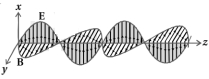
$(1)$ In electromagnetic waves,the electric field and magnetic field are perpendicular to each other as well as perpendicular to the direction of wave propagation.
$(2)$ Electromagnetic waves are transverse in nature. If a plane electromagnetic wave propagates in the $z$-direction,the electric field $E_{x}$ oscillates in the $x$-direction and the magnetic field $B_{y}$ oscillates in the $y$-direction. They vary according to a sine function.
$(3)$ The mathematical representation is:
$E_{x} = E_{0} \sin(kz - \omega t)$
$B_{y} = B_{0} \sin(kz - \omega t)$
Thus,$\vec{E} = E_{0} \sin(kz - \omega t) \hat{i}$ and $\vec{B} = B_{0} \sin(kz - \omega t) \hat{j}$.
$(4)$ The speed of electromagnetic waves in vacuum is given by $c = \frac{1}{\sqrt{\mu_{0} \epsilon_{0}}}$,where $c = \frac{\omega}{k}$.
$(5)$ Electromagnetic waves do not require any material medium for propagation; they can travel through a vacuum.
$(1)$ In electromagnetic waves,the electric field and magnetic field are perpendicular to each other as well as perpendicular to the direction of wave propagation.
$(2)$ Electromagnetic waves are transverse in nature. If a plane electromagnetic wave propagates in the $z$-direction,the electric field $E_{x}$ oscillates in the $x$-direction and the magnetic field $B_{y}$ oscillates in the $y$-direction. They vary according to a sine function.
$(3)$ The mathematical representation is:
$E_{x} = E_{0} \sin(kz - \omega t)$
$B_{y} = B_{0} \sin(kz - \omega t)$
Thus,$\vec{E} = E_{0} \sin(kz - \omega t) \hat{i}$ and $\vec{B} = B_{0} \sin(kz - \omega t) \hat{j}$.
$(4)$ The speed of electromagnetic waves in vacuum is given by $c = \frac{1}{\sqrt{\mu_{0} \epsilon_{0}}}$,where $c = \frac{\omega}{k}$.
$(5)$ Electromagnetic waves do not require any material medium for propagation; they can travel through a vacuum.
0 likes
View Solution244
EasyMCQ
Jagdish Chandra Bose produced electromagnetic waves of which range?
A
$5$ mm to $25$ mm
B
$100$ mm to $500$ mm
C
$1$ m to $10$ m
D
$10$ m to $100$ m
Solution
(A) Jagdish Chandra Bose was a pioneer in the study of radio waves. In $1895$,he successfully produced and detected electromagnetic waves in the millimeter range,specifically between $5 \ mm$ and $25 \ mm$. This work was a significant contribution to the development of modern wireless communication.
0 likes
View Solution245
EasyMCQ
If an electromagnetic wave is propagating in the $x$-direction and the electric and magnetic fields are in the $y$ and $z$-directions respectively,then write the equations for $E_y$ and $B_z$.
A
$E_y = E_0 \sin(kx - \omega t)$,$B_z = B_0 \sin(kx - \omega t)$
B
$E_y = E_0 \sin(kx + \omega t)$,$B_z = B_0 \sin(kx + \omega t)$
C
$E_y = E_0 \sin(\omega t - kx)$,$B_z = B_0 \sin(\omega t - kx)$
D
$E_y = E_0 \cos(kx - \omega t)$,$B_z = B_0 \cos(kx - \omega t)$
Solution
(A) For an electromagnetic wave propagating in the $+x$ direction,the electric field vector $\vec{E}$ oscillates in the $y$-direction and the magnetic field vector $\vec{B}$ oscillates in the $z$-direction.
The general form of a plane electromagnetic wave traveling in the $+x$ direction is given by the wave functions:
$E_y = E_0 \sin(kx - \omega t)$
$B_z = B_0 \sin(kx - \omega t)$
Here,$E_0$ and $B_0$ are the amplitudes of the electric and magnetic fields,$k$ is the wave number,and $\omega$ is the angular frequency. These fields are in phase and satisfy the relation $E_0 = cB_0$,where $c$ is the speed of light.
The general form of a plane electromagnetic wave traveling in the $+x$ direction is given by the wave functions:
$E_y = E_0 \sin(kx - \omega t)$
$B_z = B_0 \sin(kx - \omega t)$
Here,$E_0$ and $B_0$ are the amplitudes of the electric and magnetic fields,$k$ is the wave number,and $\omega$ is the angular frequency. These fields are in phase and satisfy the relation $E_0 = cB_0$,where $c$ is the speed of light.
0 likes
View Solution246
MediumMCQ
The ratio of the electric field $(E)$ to the magnetic field $(B)$ in an electromagnetic wave gives which physical quantity?
A
Frequency
B
Wavelength
C
Speed of light
D
Permittivity
Solution
(C) In an electromagnetic wave,the relationship between the electric field $(E)$ and the magnetic field $(B)$ is given by the equation $E = cB$,where $c$ is the speed of light in vacuum.
Therefore,the ratio of the electric field to the magnetic field is $\frac{E}{B} = c$.
This ratio represents the speed of light in the medium (or vacuum).
Therefore,the ratio of the electric field to the magnetic field is $\frac{E}{B} = c$.
This ratio represents the speed of light in the medium (or vacuum).
0 likes
View Solution247
EasyMCQ
Write the standard equation for a plane electromagnetic wave traveling in the $x$-direction.
A
Electric field: $E_y = E_0 \sin(kx - \omega t)$
B
Magnetic field: $B_z = B_0 \sin(kx - \omega t)$
C
Both $A$ and $B$
D
None of the above
Solution
(C) plane electromagnetic wave traveling in the positive $x$-direction consists of oscillating electric and magnetic fields.
The electric field vector oscillates along the $y$-axis and is given by $E_y = E_0 \sin(kx - \omega t)$.
The magnetic field vector oscillates along the $z$-axis and is given by $B_z = B_0 \sin(kx - \omega t)$.
Here,$E_0$ and $B_0$ are the amplitudes of the electric and magnetic fields,$k$ is the wave number,and $\omega$ is the angular frequency.
Therefore,both equations represent the standard form of a plane electromagnetic wave.
The electric field vector oscillates along the $y$-axis and is given by $E_y = E_0 \sin(kx - \omega t)$.
The magnetic field vector oscillates along the $z$-axis and is given by $B_z = B_0 \sin(kx - \omega t)$.
Here,$E_0$ and $B_0$ are the amplitudes of the electric and magnetic fields,$k$ is the wave number,and $\omega$ is the angular frequency.
Therefore,both equations represent the standard form of a plane electromagnetic wave.
0 likes
View Solution248
MediumMCQ
What is the value of the speed of light in free space?
A
$3 \times 10^8 \ m/s$
B
$3 \times 10^7 \ m/s$
C
$3 \times 10^6 \ m/s$
D
$3 \times 10^5 \ m/s$
Solution
(A) The speed of light in free space (vacuum) is a universal physical constant denoted by $c$.
Its value is approximately $3 \times 10^8 \ m/s$ (more precisely $299,792,458 \ m/s$).
Therefore,the correct option is $A$.
Its value is approximately $3 \times 10^8 \ m/s$ (more precisely $299,792,458 \ m/s$).
Therefore,the correct option is $A$.
0 likes
View Solution249
MediumMCQ
What is the displacement variable in a simple pendulum and the propagation of light?
A
Angular displacement and electric field vector
B
Linear displacement and magnetic field vector
C
Angular displacement and magnetic field vector
D
Linear displacement and electric field vector
Solution
(A) In a simple pendulum,the displacement is represented by the angular displacement $\theta$,which is the angle the string makes with the vertical axis.
In the propagation of light (an electromagnetic wave),the displacement variable is the oscillating electric field vector $\vec{E}$ (and the magnetic field vector $\vec{B}$),which varies periodically in space and time.
In the propagation of light (an electromagnetic wave),the displacement variable is the oscillating electric field vector $\vec{E}$ (and the magnetic field vector $\vec{B}$),which varies periodically in space and time.
0 likes
View Solution250
Easy
Give the relation between vacuum permittivity $(\epsilon_{0})$, vacuum permeability $(\mu_{0})$, and the speed of light $(c)$.
Solution
We know that the electrostatic constant is $\frac{1}{4 \pi \epsilon_{0}} = 9 \times 10^{9} \text{ Nm}^{2}/\text{C}^{2}$ and the magnetic constant is $\frac{\mu_{0}}{4 \pi} = 10^{-7} \text{ Tm/A}$.
Multiplying these two constants:
$\mu_{0} \epsilon_{0} = \left( \frac{\mu_{0}}{4 \pi} \right) \left( 4 \pi \epsilon_{0} \right) = (10^{-7}) \left( \frac{1}{9 \times 10^{9}} \right) = \frac{1}{9 \times 10^{16}}$.
Since the speed of light in vacuum is $c = 3 \times 10^{8} \text{ m/s}$, we can write:
$\mu_{0} \epsilon_{0} = \frac{1}{(3 \times 10^{8})^{2}} = \frac{1}{c^{2}}$.
Therefore, the relation is $c = \frac{1}{\sqrt{\mu_{0} \epsilon_{0}}}$.
Multiplying these two constants:
$\mu_{0} \epsilon_{0} = \left( \frac{\mu_{0}}{4 \pi} \right) \left( 4 \pi \epsilon_{0} \right) = (10^{-7}) \left( \frac{1}{9 \times 10^{9}} \right) = \frac{1}{9 \times 10^{16}}$.
Since the speed of light in vacuum is $c = 3 \times 10^{8} \text{ m/s}$, we can write:
$\mu_{0} \epsilon_{0} = \frac{1}{(3 \times 10^{8})^{2}} = \frac{1}{c^{2}}$.
Therefore, the relation is $c = \frac{1}{\sqrt{\mu_{0} \epsilon_{0}}}$.
0 likes
View SolutionElectromagnetic waves — Properties of Electromagnetic Waves · Frequently Asked Questions
1Are these Electromagnetic waves questions useful for JEE and NEET?
Yes. All questions in this section are mapped to JEE Main and NEET exam patterns. Previous year questions from JEE Main, NEET, GUJCET and state-level exams are included with full solutions.
2Can I switch to Hindi or Gujarati for these questions?
Yes. Use the language tabs in the hero section or the sidebar to view the same questions and solutions in English, Hindi or Gujarati.
3How do I generate a question paper from this subtopic?
Use the Vedclass Exam Paper Generator — select the chapter and subtopic, set difficulty, and generate Sets A, B, C, D automatically. First 3 chapters of every subject are free.
Vedclass Products
For Students
Vedclass Test Series
Mock tests in real JEE/NEET style with performance analysis. 5-day free trial.
Start Free TrialFor Teachers
Exam Paper Generator
Generate Set A/B/C/D papers from this chapter in 2 minutes. 3 chapters free.
Try FreeFor Institutes
Online Exam Module
Live online exams with unlimited students, 360° analytics & white-label branding.
See DemoFor Teachers & Institutes
Generate a Electromagnetic waves Exam Paper in 2 Minutes
Select subtopic & difficulty — Sets A, B, C, D auto-generated with No Repeat logic.
First 3 chapters of every subject are free — no payment required.