
A English
Properties of Electromagnetic Waves Questions in English
Class 12 Physics · Electromagnetic waves · Properties of Electromagnetic Waves
494+
Questions
English
Language
100%
With Solutions
Showing 46 of 494 questions in English
1
EasyMCQ
Pick out the statement which is not true.
A
$IR$ radiations are used for long distance photography.
B
$IR$ radiations arise due to inner electron transitions in atoms.
C
$IR$ radiations are detected by using a bolometer.
D
Sun is the natural source of $IR$ radiation.
Solution
(B) Infrared $(IR)$ radiations are electromagnetic waves with wavelengths longer than visible light.
They are primarily produced by the thermal agitation of atoms and molecules in a substance,which is why they are often called heat rays.
Option $A$ is true because $IR$ rays have longer wavelengths and can penetrate through haze and fog,making them useful for long-distance photography.
Option $B$ is false because $IR$ radiations arise due to the vibration and rotation of molecules,not due to inner electron transitions (which typically produce $X$-rays).
Option $C$ is true as a bolometer is a device used to detect and measure the intensity of incident electromagnetic radiation.
Option $D$ is true as the Sun emits a significant portion of its energy in the infrared spectrum.
They are primarily produced by the thermal agitation of atoms and molecules in a substance,which is why they are often called heat rays.
Option $A$ is true because $IR$ rays have longer wavelengths and can penetrate through haze and fog,making them useful for long-distance photography.
Option $B$ is false because $IR$ radiations arise due to the vibration and rotation of molecules,not due to inner electron transitions (which typically produce $X$-rays).
Option $C$ is true as a bolometer is a device used to detect and measure the intensity of incident electromagnetic radiation.
Option $D$ is true as the Sun emits a significant portion of its energy in the infrared spectrum.
0 likes
View Solution2
EasyMCQ
Which of the following do not require a medium for transmission?
A
Cathode ray
B
Electromagnetic wave
C
Sound wave
D
None of the above
Solution
(B) The correct answer is $B$. Electromagnetic $(EM)$ waves are transverse waves that consist of oscillating electric and magnetic fields. Unlike mechanical waves (such as sound waves),$EM$ waves do not require a material medium for their propagation and can travel through a vacuum.
0 likes
View Solution3
EasyMCQ
Consider the following:
$I.$ Waves created on the surfaces of a water pond by a vibrating source.
$II.$ Wave created by an oscillating electric field in air.
$III.$ Sound waves travelling under water.
Which of these can be polarized?
$I.$ Waves created on the surfaces of a water pond by a vibrating source.
$II.$ Wave created by an oscillating electric field in air.
$III.$ Sound waves travelling under water.
Which of these can be polarized?
A
$I$ and $II$
B
$II$ only
C
$II$ and $III$
D
$I, II$ and $III$
Solution
(B) Polarization is a property exclusively associated with transverse waves.
$I.$ Water waves are surface waves which are a combination of transverse and longitudinal motions,but they are not strictly transverse in the sense required for polarization.
$II.$ Electromagnetic waves (created by an oscillating electric field) are transverse waves and can be polarized.
$III.$ Sound waves are longitudinal waves,whether in air or under water,and longitudinal waves cannot be polarized.
Therefore,only the wave mentioned in $II$ can be polarized.
The correct option is $B$.
$I.$ Water waves are surface waves which are a combination of transverse and longitudinal motions,but they are not strictly transverse in the sense required for polarization.
$II.$ Electromagnetic waves (created by an oscillating electric field) are transverse waves and can be polarized.
$III.$ Sound waves are longitudinal waves,whether in air or under water,and longitudinal waves cannot be polarized.
Therefore,only the wave mentioned in $II$ can be polarized.
The correct option is $B$.
0 likes
View Solution4
MediumMCQ
The velocity factor of a transmission line is $x$. If the dielectric constant of the medium is $2.6$,the value of $x$ is:
A
$0.26$
B
$0.62$
C
$2.6$
D
$6.2$
Solution
(B) The velocity factor $(v.f.)$ of a transmission line is defined as the ratio of the velocity of the signal in the line to the velocity of light in a vacuum.
It is given by the formula: $v.f. = \frac{1}{\sqrt{k}}$,where $k$ is the dielectric constant of the medium.
Given that $k = 2.6$,we substitute this value into the formula:
$v.f. = \frac{1}{\sqrt{2.6}}$
$v.f. \approx \frac{1}{1.6124}$
$v.f. \approx 0.62$
Therefore,the value of $x$ is $0.62$.
It is given by the formula: $v.f. = \frac{1}{\sqrt{k}}$,where $k$ is the dielectric constant of the medium.
Given that $k = 2.6$,we substitute this value into the formula:
$v.f. = \frac{1}{\sqrt{2.6}}$
$v.f. \approx \frac{1}{1.6124}$
$v.f. \approx 0.62$
Therefore,the value of $x$ is $0.62$.
0 likes
View Solution5
EasyMCQ
Long distance short-wave radio broadcasting uses
A
Ground wave
B
Ionospheric wave
C
Direct wave
D
Sky wave
Solution
(D) Short-wave radio broadcasting involves frequencies in the range of $3 \ MHz$ to $30 \ MHz$.
These waves are reflected back to the Earth by the ionosphere,which allows them to travel over long distances beyond the horizon.
This mode of propagation is known as sky wave propagation.
Therefore,the correct option is $D$.
These waves are reflected back to the Earth by the ionosphere,which allows them to travel over long distances beyond the horizon.
This mode of propagation is known as sky wave propagation.
Therefore,the correct option is $D$.
0 likes
View Solution6
MediumMCQ
$A$ laser beam of pulse power $10^{12} \ W$ is focused on an object area of $10^{-4} \ cm^2$. The energy flux in $W/cm^2$ at the point of focus is:
A
$10^{20}$
B
$10^{16}$
C
$10^8$
D
$10^4$
Solution
(B) The energy flux $\varphi$ is defined as the power per unit area.
Given:
Pulse power $P = 10^{12} \ W$
Area $A = 10^{-4} \ cm^2$
Formula:
$\varphi = \frac{P}{A}$
Calculation:
$\varphi = \frac{10^{12}}{10^{-4}} = 10^{12 - (-4)} = 10^{16} \ W/cm^2$
Therefore,the correct option is $B$.
Given:
Pulse power $P = 10^{12} \ W$
Area $A = 10^{-4} \ cm^2$
Formula:
$\varphi = \frac{P}{A}$
Calculation:
$\varphi = \frac{10^{12}}{10^{-4}} = 10^{12 - (-4)} = 10^{16} \ W/cm^2$
Therefore,the correct option is $B$.
0 likes
View Solution7
DifficultMCQ
$A$ sky wave with a frequency $55 \, MHz$ is incident on the $D$-region of the Earth's atmosphere at $45^\circ$. The angle of refraction is ......... $^\circ$ (electron density for the $D$-region is $400 \, \text{electrons}/cm^3$).
A
$60$
B
$45$
C
$30$
D
$15$
Solution
(B) The refractive index $n$ of the ionosphere is given by $n = \sqrt{1 - \frac{81N}{f^2}}$,where $N$ is the electron density in $m^{-3}$ and $f$ is the frequency in $Hz$.
Given $N = 400 \, \text{electrons}/cm^3 = 400 \times 10^6 \, \text{electrons}/m^3$ and $f = 55 \times 10^6 \, Hz$.
Calculating the term $\frac{81N}{f^2} = \frac{81 \times 400 \times 10^6}{(55 \times 10^6)^2} = \frac{32400 \times 10^6}{3025 \times 10^{12}} \approx 1.07 \times 10^{-8}$.
Since this value is extremely small,$n = \sqrt{1 - 1.07 \times 10^{-8}} \approx 1$.
According to Snell's Law,$n_1 \sin i = n_2 \sin r$. Assuming the wave travels from vacuum $(n_1 \approx 1)$ into the $D$-region $(n_2 \approx 1)$,
$1 \cdot \sin(45^\circ) = 1 \cdot \sin r$.
Therefore,$\sin r = \sin(45^\circ)$,which implies $r = 45^\circ$.
Given $N = 400 \, \text{electrons}/cm^3 = 400 \times 10^6 \, \text{electrons}/m^3$ and $f = 55 \times 10^6 \, Hz$.
Calculating the term $\frac{81N}{f^2} = \frac{81 \times 400 \times 10^6}{(55 \times 10^6)^2} = \frac{32400 \times 10^6}{3025 \times 10^{12}} \approx 1.07 \times 10^{-8}$.
Since this value is extremely small,$n = \sqrt{1 - 1.07 \times 10^{-8}} \approx 1$.
According to Snell's Law,$n_1 \sin i = n_2 \sin r$. Assuming the wave travels from vacuum $(n_1 \approx 1)$ into the $D$-region $(n_2 \approx 1)$,
$1 \cdot \sin(45^\circ) = 1 \cdot \sin r$.
Therefore,$\sin r = \sin(45^\circ)$,which implies $r = 45^\circ$.
0 likes
View Solution8
EasyMCQ
If ${\varepsilon _0}$ and ${\mu _0}$ are respectively the electric permittivity and the magnetic permeability of free space,and ${\varepsilon}$ and ${\mu}$ are the corresponding quantities in a medium,the refractive index of the medium is:
A
$\sqrt {\frac{{\mu \varepsilon }}{{{\mu _0}{\varepsilon _0}}}} $
B
$\frac{{\mu \varepsilon }}{{{\mu _0}{\varepsilon _0}}}$
C
$\sqrt {\frac{{{\mu _0}{\varepsilon _0}}}{{\mu \varepsilon }}} $
D
$\sqrt {\frac{{\mu {\mu _0}}}{{\varepsilon \,{\varepsilon _0}}}} $
Solution
(A) The speed of light in free space is given by $c = \frac{1}{\sqrt{\mu_0 \varepsilon_0}}$.
The speed of light in a medium is given by $v = \frac{1}{\sqrt{\mu \varepsilon}}$.
The refractive index $n$ of a medium is defined as the ratio of the speed of light in vacuum to the speed of light in the medium:
$n = \frac{c}{v} = \frac{1/\sqrt{\mu_0 \varepsilon_0}}{1/\sqrt{\mu \varepsilon}} = \sqrt{\frac{\mu \varepsilon}{\mu_0 \varepsilon_0}}$.
The speed of light in a medium is given by $v = \frac{1}{\sqrt{\mu \varepsilon}}$.
The refractive index $n$ of a medium is defined as the ratio of the speed of light in vacuum to the speed of light in the medium:
$n = \frac{c}{v} = \frac{1/\sqrt{\mu_0 \varepsilon_0}}{1/\sqrt{\mu \varepsilon}} = \sqrt{\frac{\mu \varepsilon}{\mu_0 \varepsilon_0}}$.
0 likes
View Solution9
EasyMCQ
If ${\mu_r}$ is the relative permeability and $K$ is the dielectric constant of a medium,its refractive index $n$ is given by:
A
$\frac{1}{\sqrt{\mu_r K}}$
B
$\frac{1}{\mu_r K}$
C
$\sqrt{\mu_r K}$
D
$\mu_r K$
Solution
(C) The speed of light in a vacuum is given by $c = \frac{1}{\sqrt{\mu_0 \varepsilon_0}}$.
The speed of light in a medium is given by $v = \frac{1}{\sqrt{\mu \varepsilon}}$,where $\mu = \mu_0 \mu_r$ and $\varepsilon = \varepsilon_0 \varepsilon_r = \varepsilon_0 K$.
Here,$\mu_r$ is the relative permeability and $K$ is the dielectric constant (relative permittivity).
The refractive index $n$ is defined as the ratio of the speed of light in a vacuum to the speed of light in the medium:
$n = \frac{c}{v} = \frac{\frac{1}{\sqrt{\mu_0 \varepsilon_0}}}{\frac{1}{\sqrt{\mu \varepsilon}}} = \sqrt{\frac{\mu \varepsilon}{\mu_0 \varepsilon_0}} = \sqrt{\frac{\mu_0 \mu_r \varepsilon_0 K}{\mu_0 \varepsilon_0}} = \sqrt{\mu_r K}$.
Therefore,the correct option is $C$.
The speed of light in a medium is given by $v = \frac{1}{\sqrt{\mu \varepsilon}}$,where $\mu = \mu_0 \mu_r$ and $\varepsilon = \varepsilon_0 \varepsilon_r = \varepsilon_0 K$.
Here,$\mu_r$ is the relative permeability and $K$ is the dielectric constant (relative permittivity).
The refractive index $n$ is defined as the ratio of the speed of light in a vacuum to the speed of light in the medium:
$n = \frac{c}{v} = \frac{\frac{1}{\sqrt{\mu_0 \varepsilon_0}}}{\frac{1}{\sqrt{\mu \varepsilon}}} = \sqrt{\frac{\mu \varepsilon}{\mu_0 \varepsilon_0}} = \sqrt{\frac{\mu_0 \mu_r \varepsilon_0 K}{\mu_0 \varepsilon_0}} = \sqrt{\mu_r K}$.
Therefore,the correct option is $C$.
0 likes
View Solution10
EasyMCQ
Which one of the following statements is correct?
A
In vacuum,the speed of light depends upon frequency.
B
In vacuum,the speed of light does not depend upon frequency.
C
In vacuum,the speed of light is independent of frequency and wavelength.
D
In vacuum,the speed of light depends upon wavelength.
Solution
(C) In vacuum,the speed of light is a universal constant,denoted by $c$.
It is given by the relation $c = f \lambda$,where $f$ is the frequency and $\lambda$ is the wavelength.
Since $c$ is constant $(3 \times 10^8 \ m/s)$,it does not depend on the frequency or the wavelength of the electromagnetic wave.
Therefore,the speed of light in a vacuum is independent of both frequency and wavelength.
Thus,option $C$ is the correct statement.
It is given by the relation $c = f \lambda$,where $f$ is the frequency and $\lambda$ is the wavelength.
Since $c$ is constant $(3 \times 10^8 \ m/s)$,it does not depend on the frequency or the wavelength of the electromagnetic wave.
Therefore,the speed of light in a vacuum is independent of both frequency and wavelength.
Thus,option $C$ is the correct statement.
0 likes
View Solution11
EasyMCQ
In vacuum,the speed of light depends upon
A
Frequency
B
Wavelength
C
Velocity of the source of light
D
None of these
Solution
(D) In vacuum,the speed of light is a universal constant,denoted by $c$.
Its value is approximately $3 \times 10^8 \ m/s$.
It does not depend on the frequency,wavelength,or the velocity of the source of light.
Therefore,the correct option is $D$.
Its value is approximately $3 \times 10^8 \ m/s$.
It does not depend on the frequency,wavelength,or the velocity of the source of light.
Therefore,the correct option is $D$.
0 likes
View Solution12
EasyMCQ
What is the wavelength of light with a frequency of $100\;Hz$?
A
$2 \times 10^6\;m$
B
$3 \times 10^6\;m$
C
$4 \times 10^6\;m$
D
$5 \times 10^6\;m$
Solution
(B) The relationship between the speed of light $(c)$,frequency $(\nu)$,and wavelength $(\lambda)$ is given by the formula: $c = \nu \lambda$.
Rearranging for wavelength,we get: $\lambda = \frac{c}{\nu}$.
Given that the speed of light $c = 3 \times 10^8\;m/s$ and the frequency $\nu = 100\;Hz$,we substitute these values into the equation:
$\lambda = \frac{3 \times 10^8}{100} = 3 \times 10^6\;m$.
Therefore,the correct option is $B$.
Rearranging for wavelength,we get: $\lambda = \frac{c}{\nu}$.
Given that the speed of light $c = 3 \times 10^8\;m/s$ and the frequency $\nu = 100\;Hz$,we substitute these values into the equation:
$\lambda = \frac{3 \times 10^8}{100} = 3 \times 10^6\;m$.
Therefore,the correct option is $B$.
0 likes
View Solution13
EasyMCQ
Which of the following is not a property of light?
A
It requires a material medium for propagation.
B
It can travel through vacuum.
C
It involves transportation of energy.
D
It has finite speed.
Solution
(A) Light is an electromagnetic wave in nature.
Electromagnetic waves do not require any material medium for their propagation.
Therefore,the statement that light requires a material medium for propagation is incorrect.
Thus,option $A$ is the correct answer.
Electromagnetic waves do not require any material medium for their propagation.
Therefore,the statement that light requires a material medium for propagation is incorrect.
Thus,option $A$ is the correct answer.
0 likes
View Solution14
EasyMCQ
Three observers $A, B$ and $C$ measure the speed of light coming from a source. Observer $A$ moves towards the source,observer $C$ moves away from the source with the same speed,and observer $B$ remains stationary. The surrounding space is a vacuum everywhere. Which of the following is true regarding the measured speeds ${v_A}, {v_B}$ and ${v_C}$?
A
${v_A} > {v_B} > {v_C}$
B
${v_A} < {v_B} < {v_C}$
C
${v_A} = {v_B} = {v_C}$
D
${v_A} = {v_B} > {v_C}$
Solution
(C) According to the postulates of the Special Theory of Relativity,the speed of light in a vacuum is an absolute constant,denoted by $c$.
This speed is independent of the motion of the source or the motion of the observer.
Since all three observers $A, B$ and $C$ are measuring the speed of light in a vacuum,they will all measure the same value,regardless of their relative velocities.
Therefore,${v_A} = {v_B} = {v_C} = c$.
This speed is independent of the motion of the source or the motion of the observer.
Since all three observers $A, B$ and $C$ are measuring the speed of light in a vacuum,they will all measure the same value,regardless of their relative velocities.
Therefore,${v_A} = {v_B} = {v_C} = c$.
0 likes
View Solution15
EasyMCQ
In the propagation of electromagnetic waves,the angle between the direction of propagation and the plane of polarisation is......$^o$.
A
$0$
B
$45$
C
$90$
D
$180$
Solution
(A) The plane of polarisation is defined as the plane that contains the direction of propagation of the electromagnetic wave and the electric field vector $\overrightarrow{E}$.
Since the plane of polarisation contains the direction of propagation,the angle between the direction of propagation and the plane of polarisation is $0^o$.
Since the plane of polarisation contains the direction of propagation,the angle between the direction of propagation and the plane of polarisation is $0^o$.
0 likes
View Solution16
EasyMCQ
Light is an electromagnetic wave. Its speed in vacuum is given by the expression
A
$\sqrt {{\mu _0}{\varepsilon _0}} $
B
$\sqrt {\frac{{{\mu _0}}}{{{\varepsilon _0}}}} $
C
$\sqrt {\frac{{{\varepsilon _0}}}{{{\mu _0}}}} $
D
$\frac{1}{{\sqrt {{\mu _0}{\varepsilon _0}} }}$
Solution
(D) The speed of an electromagnetic wave in vacuum is related to the permeability of free space $(\mu_0)$ and the permittivity of free space $(\varepsilon_0)$ by the Maxwell's relation:
The speed of light $c = \frac{1}{\sqrt{\mu_0 \varepsilon_0}}$.
Given values are $\mu_0 = 4\pi \times 10^{-7} \text{ T m/A}$ and $\varepsilon_0 \approx 8.85 \times 10^{-12} \text{ C}^2/(\text{N m}^2)$.
Substituting these values,we get $c \approx 3 \times 10^8 \text{ m/s}$.
The speed of light $c = \frac{1}{\sqrt{\mu_0 \varepsilon_0}}$.
Given values are $\mu_0 = 4\pi \times 10^{-7} \text{ T m/A}$ and $\varepsilon_0 \approx 8.85 \times 10^{-12} \text{ C}^2/(\text{N m}^2)$.
Substituting these values,we get $c \approx 3 \times 10^8 \text{ m/s}$.
0 likes
View Solution17
EasyMCQ
The speed of an electromagnetic wave in a vacuum depends upon the source of radiation.
A
Increases as we move from $\gamma$-rays to radio waves.
B
Decreases as we move from $\gamma$-rays to radio waves.
C
Is the same for all of them.
D
None of these.
Solution
(C) The speed of electromagnetic $(EM)$ waves in a vacuum is given by the formula $c = \frac{1}{\sqrt{\mu_0 \epsilon_0}}$.
Here,$\mu_0$ is the permeability of free space and $\epsilon_0$ is the permittivity of free space.
Since both $\mu_0$ and $\epsilon_0$ are universal constants,the speed of $EM$ waves in a vacuum is a constant value $(c \approx 3 \times 10^8 \ m/s)$ for all frequencies and wavelengths,regardless of the source of radiation.
Therefore,the speed is the same for all electromagnetic waves.
Here,$\mu_0$ is the permeability of free space and $\epsilon_0$ is the permittivity of free space.
Since both $\mu_0$ and $\epsilon_0$ are universal constants,the speed of $EM$ waves in a vacuum is a constant value $(c \approx 3 \times 10^8 \ m/s)$ for all frequencies and wavelengths,regardless of the source of radiation.
Therefore,the speed is the same for all electromagnetic waves.
0 likes
View Solution18
EasyMCQ
The electromagnetic waves travel with a velocity
A
Equal to velocity of sound
B
Equal to velocity of light
C
Less than velocity of light
D
None of these
Solution
(B) The velocity of electromagnetic $(EM)$ waves in a vacuum is given by the formula $v = \frac{1}{\sqrt{\mu_0 \epsilon_0}}$.
Substituting the values of permeability of free space $(\mu_0 = 4\pi \times 10^{-7} \ T \cdot m/A)$ and permittivity of free space $(\epsilon_0 = 8.854 \times 10^{-12} \ C^2/N \cdot m^2)$,we get $v \approx 3 \times 10^8 \ m/s$.
This value is exactly equal to the speed of light in a vacuum.
Therefore,electromagnetic waves travel with a velocity equal to the velocity of light.
Substituting the values of permeability of free space $(\mu_0 = 4\pi \times 10^{-7} \ T \cdot m/A)$ and permittivity of free space $(\epsilon_0 = 8.854 \times 10^{-12} \ C^2/N \cdot m^2)$,we get $v \approx 3 \times 10^8 \ m/s$.
This value is exactly equal to the speed of light in a vacuum.
Therefore,electromagnetic waves travel with a velocity equal to the velocity of light.
0 likes
View Solution19
EasyMCQ
What is the cause of the greenhouse effect?
A
Ultraviolet rays
B
Infrared rays
C
$X$-rays
D
Radio waves
Solution
(B) The greenhouse effect is primarily caused by infrared radiations.
Solar energy reaches the Earth's surface,which then re-emits this energy as infrared radiation.
Greenhouse gases in the atmosphere absorb these infrared rays and reflect them back towards the Earth's surface,thereby trapping heat and keeping the planet warm.
Solar energy reaches the Earth's surface,which then re-emits this energy as infrared radiation.
Greenhouse gases in the atmosphere absorb these infrared rays and reflect them back towards the Earth's surface,thereby trapping heat and keeping the planet warm.
0 likes
View Solution20
EasyMCQ
Electromagnetic waves are transverse in nature is evident by
A
Polarization
B
Interference
C
Reflection
D
Diffraction
Solution
(A) The transverse nature of electromagnetic waves is confirmed by the phenomenon of polarization.
Polarization is a property that is exclusive to transverse waves,as it involves the restriction of the oscillation of the electric field vector to a specific plane perpendicular to the direction of wave propagation.
Longitudinal waves,such as sound waves,cannot be polarized because their oscillations occur along the direction of propagation.
Therefore,the correct option is $A$.
Polarization is a property that is exclusive to transverse waves,as it involves the restriction of the oscillation of the electric field vector to a specific plane perpendicular to the direction of wave propagation.
Longitudinal waves,such as sound waves,cannot be polarized because their oscillations occur along the direction of propagation.
Therefore,the correct option is $A$.
0 likes
View Solution21
EasyMCQ
If $\overrightarrow E$ and $\overrightarrow B$ are the electric and magnetic field vectors of electromagnetic waves,then the direction of propagation of the electromagnetic wave is along the direction of:
A
$\overrightarrow E$
B
$\overrightarrow B$
C
$\overrightarrow E \times \overrightarrow B$
D
None of these
Solution
(C) The electromagnetic wave propagates in a direction perpendicular to both the electric field vector $\overrightarrow E$ and the magnetic field vector $\overrightarrow B$.
According to the properties of electromagnetic waves,the direction of wave propagation is given by the direction of the Poynting vector $\vec S$,which is proportional to $\overrightarrow E \times \overrightarrow B$.
Therefore,the direction of propagation is along $\overrightarrow E \times \overrightarrow B$.
According to the properties of electromagnetic waves,the direction of wave propagation is given by the direction of the Poynting vector $\vec S$,which is proportional to $\overrightarrow E \times \overrightarrow B$.
Therefore,the direction of propagation is along $\overrightarrow E \times \overrightarrow B$.
0 likes
View Solution22
EasyMCQ
The biological importance of the ozone layer is that:
A
It absorbs harmful ultraviolet rays.
B
Ozone rays reduce the greenhouse effect.
C
The ozone layer reflects radio waves.
D
The ozone layer controls the $O_2/H_2$ ratio in the atmosphere.
Solution
(A) Ozone $(O_3)$ is present in the stratosphere region of the atmosphere.
It protects life on Earth by absorbing harmful ultraviolet $(UV)$ radiation emitted by the sun.
Exposure to high levels of $UV$ radiation causes various health problems in humans,such as skin cancer and cataracts,and damages plants and other animals,leading to ecosystem disruption.
Plants cannot grow effectively under intense ultraviolet radiation.
Therefore,the primary biological importance of the ozone layer is the absorption of these harmful rays.
Hence,option $A$ is correct.
It protects life on Earth by absorbing harmful ultraviolet $(UV)$ radiation emitted by the sun.
Exposure to high levels of $UV$ radiation causes various health problems in humans,such as skin cancer and cataracts,and damages plants and other animals,leading to ecosystem disruption.
Plants cannot grow effectively under intense ultraviolet radiation.
Therefore,the primary biological importance of the ozone layer is the absorption of these harmful rays.
Hence,option $A$ is correct.
0 likes
View Solution23
EasyMCQ
Radio waves and visible light in vacuum have
A
Same velocity but different wavelength
B
Continuous emission spectrum
C
Band absorption spectrum
D
Line emission spectrum
Solution
(A) In vacuum, all electromagnetic $(EM)$ waves travel with the same speed, which is the speed of light, $c \approx 3 \times 10^8 \ m/s$.
Since the frequency $(f)$ and wavelength $(\lambda)$ are related by the equation $c = f \lambda$, and different types of electromagnetic waves have different frequencies, they must have different wavelengths.
Therefore, radio waves and visible light have the same velocity but different wavelengths.
Since the frequency $(f)$ and wavelength $(\lambda)$ are related by the equation $c = f \lambda$, and different types of electromagnetic waves have different frequencies, they must have different wavelengths.
Therefore, radio waves and visible light have the same velocity but different wavelengths.
0 likes
View Solution24
EasyMCQ
Energy stored in electromagnetic oscillations is in the form of
A
Electrical energy
B
Magnetic energy
C
Both $(a)$ and $(b)$
D
None of these
Solution
(C) In an electromagnetic wave,energy is carried by both the oscillating electric field and the oscillating magnetic field.
The energy density associated with the electric field is given by $u_E = \frac{1}{2} \varepsilon_0 E^2$.
The energy density associated with the magnetic field is given by $u_B = \frac{1}{2} \frac{B^2}{\mu_0}$.
The total energy density $u$ is the sum of these two: $u = u_E + u_B = \frac{1}{2} \varepsilon_0 E^2 + \frac{1}{2} \frac{B^2}{\mu_0}$.
Therefore,the energy stored in electromagnetic oscillations is in the form of both electrical and magnetic energy.
The energy density associated with the electric field is given by $u_E = \frac{1}{2} \varepsilon_0 E^2$.
The energy density associated with the magnetic field is given by $u_B = \frac{1}{2} \frac{B^2}{\mu_0}$.
The total energy density $u$ is the sum of these two: $u = u_E + u_B = \frac{1}{2} \varepsilon_0 E^2 + \frac{1}{2} \frac{B^2}{\mu_0}$.
Therefore,the energy stored in electromagnetic oscillations is in the form of both electrical and magnetic energy.
0 likes
View Solution25
EasyMCQ
If a source is transmitting electromagnetic waves of frequency $8.2 \times 10^6 \ Hz$,then the wavelength of the electromagnetic waves transmitted from the source will be.....$m$.
A
$36.6$
B
$40.5$
C
$42.3$
D
$50.9$
Solution
(A) The relationship between the speed of light $(c)$,frequency $(\nu)$,and wavelength $(\lambda)$ is given by the formula: $c = \nu \lambda$.
Rearranging for wavelength,we get: $\lambda = \frac{c}{\nu}$.
Given: $c = 3 \times 10^8 \ m/s$ and $\nu = 8.2 \times 10^6 \ Hz$.
Substituting the values: $\lambda = \frac{3 \times 10^8}{8.2 \times 10^6} = \frac{300}{8.2} \approx 36.58 \ m$.
Rounding to the nearest provided option,we get $36.6 \ m$.
Rearranging for wavelength,we get: $\lambda = \frac{c}{\nu}$.
Given: $c = 3 \times 10^8 \ m/s$ and $\nu = 8.2 \times 10^6 \ Hz$.
Substituting the values: $\lambda = \frac{3 \times 10^8}{8.2 \times 10^6} = \frac{300}{8.2} \approx 36.58 \ m$.
Rounding to the nearest provided option,we get $36.6 \ m$.
0 likes
View Solution26
EasyMCQ
In an apparatus, the electric field was found to oscillate with an amplitude of $18 \text{ V/m}$. The magnitude of the oscillating magnetic field will be:
A
$4 \times 10^{-6} \text{ T}$
B
$6 \times 10^{-8} \text{ T}$
C
$9 \times 10^{-9} \text{ T}$
D
$11 \times 10^{-11} \text{ T}$
Solution
(B) The relationship between the amplitude of the electric field $(E_0)$ and the amplitude of the magnetic field $(B_0)$ in an electromagnetic wave is given by the equation: $c = \frac{E_0}{B_0}$, where $c$ is the speed of light in vacuum $(c \approx 3 \times 10^8 \text{ m/s})$.
Rearranging the formula to solve for $B_0$, we get: $B_0 = \frac{E_0}{c}$.
Given $E_0 = 18 \text{ V/m}$ and $c = 3 \times 10^8 \text{ m/s}$, we substitute these values:
$B_0 = \frac{18}{3 \times 10^8} = 6 \times 10^{-8} \text{ T}$.
Thus, the magnitude of the oscillating magnetic field is $6 \times 10^{-8} \text{ T}$.
Rearranging the formula to solve for $B_0$, we get: $B_0 = \frac{E_0}{c}$.
Given $E_0 = 18 \text{ V/m}$ and $c = 3 \times 10^8 \text{ m/s}$, we substitute these values:
$B_0 = \frac{18}{3 \times 10^8} = 6 \times 10^{-8} \text{ T}$.
Thus, the magnitude of the oscillating magnetic field is $6 \times 10^{-8} \text{ T}$.
0 likes
View Solution27
EasyMCQ
The oscillating electric and magnetic vectors of an electromagnetic wave are oriented along
A
The same direction but differ in phase by $90^{\circ}$
B
The same direction and are in phase
C
Mutually perpendicular directions and are in phase
D
Mutually perpendicular directions and differ in phase by $90^{\circ}$
Solution
(C) In an electromagnetic wave,the oscillating electric field vector $\vec{E}$ and the magnetic field vector $\vec{B}$ are always mutually perpendicular to each other and also perpendicular to the direction of wave propagation.
Furthermore,these fields are in phase,which means they reach their maximum and minimum values at the same time and at the same spatial location.
Therefore,the correct option is $C$.
Furthermore,these fields are in phase,which means they reach their maximum and minimum values at the same time and at the same spatial location.
Therefore,the correct option is $C$.
0 likes
View Solution28
MediumMCQ
An electromagnetic wave travels along the $z$-axis. Which of the following pairs of space and time-varying fields would generate such a wave?
A
$E_x, B_y$
B
$E_y, B_x$
C
$E_z, B_x$
D
$E_y, B_z$
Solution
(A) An electromagnetic wave travels in the direction of the Poynting vector $\vec{S} = \frac{1}{\mu_0} (\vec{E} \times \vec{B})$.
Given that the wave travels along the $z$-axis,the direction of propagation is $\hat{k}$.
We know that $\vec{E} \times \vec{B}$ must be in the direction of $\hat{k}$.
For option $A$,$\vec{E} = E_x \hat{i}$ and $\vec{B} = B_y \hat{j}$.
Calculating the cross product: $\hat{i} \times \hat{j} = \hat{k}$.
Thus,$E_x \hat{i} \times B_y \hat{j} = (E_x B_y) \hat{k}$,which is along the $z$-axis.
Therefore,the pair $(E_x, B_y)$ generates an electromagnetic wave traveling along the $z$-axis.
Given that the wave travels along the $z$-axis,the direction of propagation is $\hat{k}$.
We know that $\vec{E} \times \vec{B}$ must be in the direction of $\hat{k}$.
For option $A$,$\vec{E} = E_x \hat{i}$ and $\vec{B} = B_y \hat{j}$.
Calculating the cross product: $\hat{i} \times \hat{j} = \hat{k}$.
Thus,$E_x \hat{i} \times B_y \hat{j} = (E_x B_y) \hat{k}$,which is along the $z$-axis.
Therefore,the pair $(E_x, B_y)$ generates an electromagnetic wave traveling along the $z$-axis.
0 likes
View Solution29
EasyMCQ
The electromagnetic waves do not transport
A
Energy
B
Charge
C
Momentum
D
Information
Solution
(B) Electromagnetic $(EM)$ waves are oscillations of electric and magnetic fields. They carry energy,momentum,and information through space. However,since electromagnetic waves consist of oscillating fields and not particles with net charge,they do not transport charge. Therefore,the correct option is $(B)$.
0 likes
View Solution30
EasyMCQ
$A$ plane electromagnetic wave is incident on a material surface. If the wave delivers momentum $p$ and energy $E$,then
A
$p = 0, E = 0$
B
$p \neq 0, E \neq 0$
C
$p \neq 0, E = 0$
D
$p = 0, E \neq 0$
Solution
(B) Electromagnetic $(EM)$ waves consist of oscillating electric and magnetic fields that propagate through space.
These waves carry both energy and momentum.
When an $EM$ wave is incident on a material surface,it transfers energy to the surface and exerts radiation pressure due to the momentum it carries.
Therefore,for an incident $EM$ wave,both the delivered momentum $p$ and the delivered energy $E$ are non-zero.
Thus,$p \neq 0$ and $E \neq 0$.
These waves carry both energy and momentum.
When an $EM$ wave is incident on a material surface,it transfers energy to the surface and exerts radiation pressure due to the momentum it carries.
Therefore,for an incident $EM$ wave,both the delivered momentum $p$ and the delivered energy $E$ are non-zero.
Thus,$p \neq 0$ and $E \neq 0$.
0 likes
View Solution31
MediumMCQ
An electromagnetic wave,going through vacuum,is described by $E = E_0 \sin(kx - \omega t)$. Which of the following is independent of wavelength?
A
$k$
B
$\omega$
C
$k/\omega$
D
$k\omega$
Solution
(C) The angular wave number is given by $k = \frac{2\pi}{\lambda}$,where $\lambda$ is the wavelength.
The angular frequency is given by $\omega = 2\pi\nu$,where $\nu$ is the frequency.
The ratio $\frac{k}{\omega} = \frac{2\pi/\lambda}{2\pi\nu} = \frac{1}{\lambda\nu}$.
Since the speed of light in vacuum is $c = \lambda\nu$,we have $\frac{k}{\omega} = \frac{1}{c}$.
Since $c$ is a constant,the ratio $\frac{k}{\omega}$ is independent of the wavelength $\lambda$.
The angular frequency is given by $\omega = 2\pi\nu$,where $\nu$ is the frequency.
The ratio $\frac{k}{\omega} = \frac{2\pi/\lambda}{2\pi\nu} = \frac{1}{\lambda\nu}$.
Since the speed of light in vacuum is $c = \lambda\nu$,we have $\frac{k}{\omega} = \frac{1}{c}$.
Since $c$ is a constant,the ratio $\frac{k}{\omega}$ is independent of the wavelength $\lambda$.
0 likes
View Solution32
MediumMCQ
An electromagnetic wave propagating through a vacuum is described by $E = E_0 \sin(kx - \omega t)$ and $B = B_0 \sin(kx - \omega t)$. Which of the following equations is true?
A
$E_0 k = B_0 \omega$
B
$E_0 \omega = B_0 k$
C
$E_0 B_0 = \omega k$
D
None of these
Solution
(A) For an electromagnetic wave in a vacuum,the relationship between the amplitudes of the electric field $(E_0)$ and the magnetic field $(B_0)$ is given by $E_0 = c B_0$,where $c$ is the speed of light in a vacuum.
We know that the speed of light $c$ is related to the angular frequency $\omega$ and the wave number $k$ by the equation $c = \frac{\omega}{k}$.
Substituting this into the first relation,we get $E_0 = \left( \frac{\omega}{k} \right) B_0$.
Rearranging this equation,we obtain $E_0 k = B_0 \omega$.
Therefore,the correct option is $A$.
We know that the speed of light $c$ is related to the angular frequency $\omega$ and the wave number $k$ by the equation $c = \frac{\omega}{k}$.
Substituting this into the first relation,we get $E_0 = \left( \frac{\omega}{k} \right) B_0$.
Rearranging this equation,we obtain $E_0 k = B_0 \omega$.
Therefore,the correct option is $A$.
0 likes
View Solution33
MediumMCQ
$A$ radio receiver antenna that is $2 \, m$ long is oriented along the direction of the electromagnetic wave and receives a signal of intensity $5 \times 10^{-16} \, W/m^2$. The maximum instantaneous potential difference across the two ends of the antenna is
A
$1.23 \, \mu V$
B
$12.3 \, \mu V$
C
$1.23 \, V$
D
$12.3 \, mV$
Solution
(A) The intensity $I$ of an electromagnetic wave is given by $I = \frac{1}{2} \epsilon_0 c E_0^2$,where $E_0$ is the amplitude of the electric field.
Rearranging for $E_0$: $E_0 = \sqrt{\frac{2I}{\epsilon_0 c}}$.
Given $I = 5 \times 10^{-16} \, W/m^2$,$\epsilon_0 = 8.854 \times 10^{-12} \, F/m$,and $c = 3 \times 10^8 \, m/s$:
$E_0 = \sqrt{\frac{2 \times 5 \times 10^{-16}}{8.854 \times 10^{-12} \times 3 \times 10^8}} = \sqrt{\frac{10 \times 10^{-16}}{26.562 \times 10^{-4}}} = \sqrt{0.376 \times 10^{-12}} \approx 0.613 \times 10^{-6} \, V/m$.
The maximum potential difference $V_0$ across an antenna of length $L = 2 \, m$ is $V_0 = E_0 \times L$.
$V_0 = 0.613 \times 10^{-6} \times 2 = 1.226 \times 10^{-6} \, V \approx 1.23 \, \mu V$.
Rearranging for $E_0$: $E_0 = \sqrt{\frac{2I}{\epsilon_0 c}}$.
Given $I = 5 \times 10^{-16} \, W/m^2$,$\epsilon_0 = 8.854 \times 10^{-12} \, F/m$,and $c = 3 \times 10^8 \, m/s$:
$E_0 = \sqrt{\frac{2 \times 5 \times 10^{-16}}{8.854 \times 10^{-12} \times 3 \times 10^8}} = \sqrt{\frac{10 \times 10^{-16}}{26.562 \times 10^{-4}}} = \sqrt{0.376 \times 10^{-12}} \approx 0.613 \times 10^{-6} \, V/m$.
The maximum potential difference $V_0$ across an antenna of length $L = 2 \, m$ is $V_0 = E_0 \times L$.
$V_0 = 0.613 \times 10^{-6} \times 2 = 1.226 \times 10^{-6} \, V \approx 1.23 \, \mu V$.
0 likes
View Solution34
EasyMCQ
An electromagnetic wave of frequency $\nu = 3.0\,MHz$ passes from vacuum into a dielectric medium with permittivity $\varepsilon = 4.0\varepsilon_0$. Then
A
Wavelength is doubled and the frequency remains unchanged
B
Wavelength is doubled and frequency becomes half
C
Wavelength is halved and frequency remains unchanged
D
Wavelength and frequency both remain unchanged
Solution
(C) The refractive index $n$ of a medium is given by $n = \sqrt{\frac{\mu\varepsilon}{\mu_0\varepsilon_0}}$.
Assuming the medium is non-magnetic,$\mu = \mu_0$,so $n = \sqrt{\frac{\varepsilon}{\varepsilon_0}}$.
Given the relative permittivity (dielectric constant) $K = \frac{\varepsilon}{\varepsilon_0} = 4.0$,we have $n = \sqrt{4.0} = 2$.
The frequency $\nu$ of an electromagnetic wave depends only on the source and remains unchanged when passing through different media.
The speed of the wave in the medium is $v = \frac{c}{n} = \frac{c}{2}$.
Since $v = \nu\lambda$,the new wavelength $\lambda' = \frac{v}{\nu} = \frac{c/2}{\nu} = \frac{\lambda}{2}$.
Thus,the wavelength is halved and the frequency remains unchanged.
Assuming the medium is non-magnetic,$\mu = \mu_0$,so $n = \sqrt{\frac{\varepsilon}{\varepsilon_0}}$.
Given the relative permittivity (dielectric constant) $K = \frac{\varepsilon}{\varepsilon_0} = 4.0$,we have $n = \sqrt{4.0} = 2$.
The frequency $\nu$ of an electromagnetic wave depends only on the source and remains unchanged when passing through different media.
The speed of the wave in the medium is $v = \frac{c}{n} = \frac{c}{2}$.
Since $v = \nu\lambda$,the new wavelength $\lambda' = \frac{v}{\nu} = \frac{c/2}{\nu} = \frac{\lambda}{2}$.
Thus,the wavelength is halved and the frequency remains unchanged.
0 likes
View Solution35
EasyMCQ
Electromagnetic waves travel in a medium which has relative permeability $1.3$ and relative permittivity $2.14$. Then the speed of the electromagnetic wave in the medium will be
A
$13.6 \times 10^6 \ m/s$
B
$1.8 \times 10^2 \ m/s$
C
$3.6 \times 10^8 \ m/s$
D
$1.8 \times 10^8 \ m/s$
Solution
(D) The speed of an electromagnetic wave in a medium is given by the formula $v = \frac{c}{\sqrt{\mu_r \varepsilon_r}}$,where $c$ is the speed of light in vacuum $(3 \times 10^8 \ m/s)$,$\mu_r$ is the relative permeability,and $\varepsilon_r$ is the relative permittivity.
Given: $\mu_r = 1.3$ and $\varepsilon_r = 2.14$.
Substituting the values:
$v = \frac{3 \times 10^8}{\sqrt{1.3 \times 2.14}}$
$v = \frac{3 \times 10^8}{\sqrt{2.782}}$
$v \approx \frac{3 \times 10^8}{1.668}$
$v \approx 1.8 \times 10^8 \ m/s$.
Therefore,the correct option is $D$.
Given: $\mu_r = 1.3$ and $\varepsilon_r = 2.14$.
Substituting the values:
$v = \frac{3 \times 10^8}{\sqrt{1.3 \times 2.14}}$
$v = \frac{3 \times 10^8}{\sqrt{2.782}}$
$v \approx \frac{3 \times 10^8}{1.668}$
$v \approx 1.8 \times 10^8 \ m/s$.
Therefore,the correct option is $D$.
0 likes
View Solution36
MediumMCQ
The pressure exerted by an electromagnetic wave of intensity $I \ (W/m^2)$ on a non-reflecting surface is [$c$ is the velocity of light].
A
$Ic$
B
$Ic^2$
C
$I/c$
D
$I/c^2$
Solution
(C) The momentum of a photon is given by $p = E/c$.
The intensity $I$ is defined as the energy incident per unit area per unit time,$I = E/(At)$.
For a non-reflecting (perfectly absorbing) surface,the momentum transferred per unit area per unit time is equal to the radiation pressure $P$.
Since the photon is absorbed,the change in momentum per unit area per unit time is $\Delta p / (At) = (E/c) / (At) = I/c$.
Therefore,the radiation pressure exerted on a non-reflecting surface is $P = I/c$.
The intensity $I$ is defined as the energy incident per unit area per unit time,$I = E/(At)$.
For a non-reflecting (perfectly absorbing) surface,the momentum transferred per unit area per unit time is equal to the radiation pressure $P$.
Since the photon is absorbed,the change in momentum per unit area per unit time is $\Delta p / (At) = (E/c) / (At) = I/c$.
Therefore,the radiation pressure exerted on a non-reflecting surface is $P = I/c$.
0 likes
View Solution37
EasyMCQ
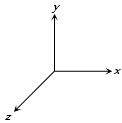
$A$ light wave is travelling along the $y$-direction. If the corresponding $\vec E$ vector at any time is along the $x$-axis,the direction of the $\vec B$ vector at that time is along:
A
$y$-axis
B
$x$-axis
C
$+z$-axis
D
$+z$-axis or $-z$-axis (based on the cross product,specifically $+z$-axis)
Solution
(C) The direction of propagation of an electromagnetic wave is given by the direction of the vector $\vec E \times \vec B$.
Given that the wave travels along the $y$-direction (unit vector $\hat j$) and the electric field $\vec E$ is along the $x$-axis (unit vector $\hat i$).
Let the direction of the magnetic field $\vec B$ be $\hat n$.
Then,$\hat i \times \hat n = \hat j$.
We know that $\hat i \times \hat k = -\hat j$ and $\hat i \times (-\hat k) = \hat j$.
Therefore,the direction of the $\vec B$ vector must be along the $+z$-axis. Note: The original option $(d)$ was $-z$-axis,but mathematically $\hat i \times \hat k = \hat j$ is incorrect; $\hat i \times \hat k = -\hat j$. Thus,for $\hat i \times \hat n = \hat j$,$\hat n$ must be $-\hat k$. Let us re-evaluate: $\hat i \times \hat k = \hat j$ is false,$\hat i \times \hat j = \hat k$,$\hat j \times \hat k = \hat i$,$\hat k \times \hat i = \hat j$. So,$\hat k \times \hat i = \hat j$. If $\vec E$ is along $x$ $(\hat i)$ and propagation is along $y$ $(\hat j)$,then $\vec E \times \vec B = \hat i \times \vec B = \hat j$. Since $\hat k \times \hat i = \hat j$,$\vec B$ must be along the $+z$-axis.
Given that the wave travels along the $y$-direction (unit vector $\hat j$) and the electric field $\vec E$ is along the $x$-axis (unit vector $\hat i$).
Let the direction of the magnetic field $\vec B$ be $\hat n$.
Then,$\hat i \times \hat n = \hat j$.
We know that $\hat i \times \hat k = -\hat j$ and $\hat i \times (-\hat k) = \hat j$.
Therefore,the direction of the $\vec B$ vector must be along the $+z$-axis. Note: The original option $(d)$ was $-z$-axis,but mathematically $\hat i \times \hat k = \hat j$ is incorrect; $\hat i \times \hat k = -\hat j$. Thus,for $\hat i \times \hat n = \hat j$,$\hat n$ must be $-\hat k$. Let us re-evaluate: $\hat i \times \hat k = \hat j$ is false,$\hat i \times \hat j = \hat k$,$\hat j \times \hat k = \hat i$,$\hat k \times \hat i = \hat j$. So,$\hat k \times \hat i = \hat j$. If $\vec E$ is along $x$ $(\hat i)$ and propagation is along $y$ $(\hat j)$,then $\vec E \times \vec B = \hat i \times \vec B = \hat j$. Since $\hat k \times \hat i = \hat j$,$\vec B$ must be along the $+z$-axis.
0 likes
View Solution38
MediumMCQ
If $c$ is the speed of electromagnetic waves in vacuum,its speed in a medium of dielectric constant $K$ and relative permeability $\mu_r$ is
A
$v = \frac{1}{\sqrt{\mu_r K}}$
B
$v = c\sqrt{\mu_r K}$
C
$v = \frac{c}{\sqrt{\mu_r K}}$
D
$v = \frac{K}{\sqrt{\mu_r c}}$
Solution
(C) The speed of electromagnetic waves in a vacuum is given by $c = \frac{1}{\sqrt{\mu_0 \varepsilon_0}}$.
In a medium with absolute permeability $\mu$ and absolute permittivity $\varepsilon$,the speed is $v = \frac{1}{\sqrt{\mu \varepsilon}}$.
We know that $\mu = \mu_0 \mu_r$ and $\varepsilon = \varepsilon_0 K$,where $\mu_r$ is the relative permeability and $K$ is the dielectric constant (relative permittivity).
Substituting these into the expression for $v$,we get $v = \frac{1}{\sqrt{(\mu_0 \mu_r)(\varepsilon_0 K)}} = \frac{1}{\sqrt{\mu_0 \varepsilon_0} \sqrt{\mu_r K}}$.
Since $c = \frac{1}{\sqrt{\mu_0 \varepsilon_0}}$,we can write $v = \frac{c}{\sqrt{\mu_r K}}$.
In a medium with absolute permeability $\mu$ and absolute permittivity $\varepsilon$,the speed is $v = \frac{1}{\sqrt{\mu \varepsilon}}$.
We know that $\mu = \mu_0 \mu_r$ and $\varepsilon = \varepsilon_0 K$,where $\mu_r$ is the relative permeability and $K$ is the dielectric constant (relative permittivity).
Substituting these into the expression for $v$,we get $v = \frac{1}{\sqrt{(\mu_0 \mu_r)(\varepsilon_0 K)}} = \frac{1}{\sqrt{\mu_0 \varepsilon_0} \sqrt{\mu_r K}}$.
Since $c = \frac{1}{\sqrt{\mu_0 \varepsilon_0}}$,we can write $v = \frac{c}{\sqrt{\mu_r K}}$.
0 likes
View Solution39
MediumMCQ
In an electromagnetic wave,the amplitude of the electric field is $1 \ V/m$. The frequency of the wave is $5 \times 10^{14} \ Hz$. The wave is propagating along the $z$-axis. The average energy density of the electric field,in $J/m^3$,will be:
A
$1.1 \times 10^{-11}$
B
$2.2 \times 10^{-12}$
C
$3.3 \times 10^{-13}$
D
$4.4 \times 10^{-14}$
Solution
(B) The average energy density of the electric field $(u_e)$ in an electromagnetic wave is given by the formula:
$u_e = \frac{1}{4} \varepsilon_0 E_0^2$
Where $\varepsilon_0$ is the permittivity of free space $(8.85 \times 10^{-12} \ F/m)$ and $E_0$ is the amplitude of the electric field.
Given $E_0 = 1 \ V/m$:
$u_e = \frac{1}{4} \times 8.85 \times 10^{-12} \times (1)^2$
$u_e = 2.2125 \times 10^{-12} \ J/m^3$
Rounding to the nearest option,we get $2.2 \times 10^{-12} \ J/m^3$.
$u_e = \frac{1}{4} \varepsilon_0 E_0^2$
Where $\varepsilon_0$ is the permittivity of free space $(8.85 \times 10^{-12} \ F/m)$ and $E_0$ is the amplitude of the electric field.
Given $E_0 = 1 \ V/m$:
$u_e = \frac{1}{4} \times 8.85 \times 10^{-12} \times (1)^2$
$u_e = 2.2125 \times 10^{-12} \ J/m^3$
Rounding to the nearest option,we get $2.2 \times 10^{-12} \ J/m^3$.
0 likes
View Solution40
MediumMCQ
$A$ lamp emits monochromatic green light uniformly in all directions. The lamp is $3\%$ efficient in converting electrical power to electromagnetic waves and consumes $100\,W$ of power. The amplitude of the electric field associated with the electromagnetic radiation at a distance of $10\,m$ from the lamp will be........$V/m$
A
$1.34$
B
$2.68$
C
$5.36$
D
$9.37$
Solution
(A) The power radiated as electromagnetic waves is $P = 3\% \text{ of } 100\,W = 3\,W$.
The intensity $S_{av}$ at a distance $R = 10\,m$ is given by $S_{av} = \frac{P}{4\pi R^2}$.
Also,the intensity of an electromagnetic wave is related to the electric field amplitude $E_0$ by $S_{av} = \frac{1}{2} \varepsilon_0 c E_0^2$.
Equating the two expressions: $\frac{1}{2} \varepsilon_0 c E_0^2 = \frac{P}{4\pi R^2}$.
Solving for $E_0$: $E_0 = \sqrt{\frac{P}{2\pi R^2 \varepsilon_0 c}}$.
Substituting the values: $E_0 = \sqrt{\frac{3}{2 \times 3.14 \times (10)^2 \times 8.85 \times 10^{-12} \times 3 \times 10^8}}$.
$E_0 = \sqrt{\frac{3}{1665.72 \times 10^{-4}}} \approx \sqrt{1.8} \approx 1.34\,V/m$.
The intensity $S_{av}$ at a distance $R = 10\,m$ is given by $S_{av} = \frac{P}{4\pi R^2}$.
Also,the intensity of an electromagnetic wave is related to the electric field amplitude $E_0$ by $S_{av} = \frac{1}{2} \varepsilon_0 c E_0^2$.
Equating the two expressions: $\frac{1}{2} \varepsilon_0 c E_0^2 = \frac{P}{4\pi R^2}$.
Solving for $E_0$: $E_0 = \sqrt{\frac{P}{2\pi R^2 \varepsilon_0 c}}$.
Substituting the values: $E_0 = \sqrt{\frac{3}{2 \times 3.14 \times (10)^2 \times 8.85 \times 10^{-12} \times 3 \times 10^8}}$.
$E_0 = \sqrt{\frac{3}{1665.72 \times 10^{-4}}} \approx \sqrt{1.8} \approx 1.34\,V/m$.
0 likes
View Solution41
MediumMCQ
$A$ point source of electromagnetic radiation has an average power output of $800 \, W$. The maximum value of the electric field at a distance $4.0 \, m$ from the source is .... $V/m$.
A
$64.7$
B
$57.8$
C
$56.72$
D
$54.77$
Solution
(D) The intensity $I$ of an electromagnetic wave at a distance $R$ from a point source is given by $I = \frac{P}{4\pi R^2}$.
Also,the intensity in terms of the maximum electric field $E_0$ is $I = \frac{1}{2} \varepsilon_0 E_0^2 c$.
Equating the two expressions: $\frac{P}{4\pi R^2} = \frac{1}{2} \varepsilon_0 E_0^2 c$.
Solving for $E_0$: $E_0 = \sqrt{\frac{P}{2\pi R^2 \varepsilon_0 c}}$.
Substituting the given values: $P = 800 \, W$,$R = 4.0 \, m$,$\varepsilon_0 = 8.85 \times 10^{-12} \, F/m$,and $c = 3 \times 10^8 \, m/s$.
$E_0 = \sqrt{\frac{800}{2 \times 3.14 \times (4)^2 \times 8.85 \times 10^{-12} \times 3 \times 10^8}}$.
$E_0 = \sqrt{\frac{800}{1331.328 \times 10^{-4}}} = \sqrt{6008.9} \approx 54.77 \, V/m$.
Also,the intensity in terms of the maximum electric field $E_0$ is $I = \frac{1}{2} \varepsilon_0 E_0^2 c$.
Equating the two expressions: $\frac{P}{4\pi R^2} = \frac{1}{2} \varepsilon_0 E_0^2 c$.
Solving for $E_0$: $E_0 = \sqrt{\frac{P}{2\pi R^2 \varepsilon_0 c}}$.
Substituting the given values: $P = 800 \, W$,$R = 4.0 \, m$,$\varepsilon_0 = 8.85 \times 10^{-12} \, F/m$,and $c = 3 \times 10^8 \, m/s$.
$E_0 = \sqrt{\frac{800}{2 \times 3.14 \times (4)^2 \times 8.85 \times 10^{-12} \times 3 \times 10^8}}$.
$E_0 = \sqrt{\frac{800}{1331.328 \times 10^{-4}}} = \sqrt{6008.9} \approx 54.77 \, V/m$.
0 likes
View Solution42
MediumMCQ
$A$ wave is propagating in a medium of electric dielectric constant $2$ and relative magnetic permeability $50$. The wave impedance of such a medium is.....$ \Omega$
A
$5$
B
$376.6$
C
$1883$
D
$3776$
Solution
(C) The wave impedance $Z$ of a medium is given by the formula $Z = \sqrt{\frac{\mu}{\varepsilon}} = \sqrt{\frac{\mu_r \mu_0}{\varepsilon_r \varepsilon_0}}$.
Given relative permittivity $\varepsilon_r = 2$ and relative permeability $\mu_r = 50$.
The impedance of free space is $Z_0 = \sqrt{\frac{\mu_0}{\varepsilon_0}} \approx 376.6 \, \Omega$.
Substituting the values:
$Z = \sqrt{\frac{50}{2}} \times 376.6$
$Z = \sqrt{25} \times 376.6$
$Z = 5 \times 376.6 = 1883 \, \Omega$.
Given relative permittivity $\varepsilon_r = 2$ and relative permeability $\mu_r = 50$.
The impedance of free space is $Z_0 = \sqrt{\frac{\mu_0}{\varepsilon_0}} \approx 376.6 \, \Omega$.
Substituting the values:
$Z = \sqrt{\frac{50}{2}} \times 376.6$
$Z = \sqrt{25} \times 376.6$
$Z = 5 \times 376.6 = 1883 \, \Omega$.
1 likes
View Solution43
MediumMCQ
$A$ plane electromagnetic wave of wave intensity $6 \ W/m^2$ strikes a small mirror of area $40 \ cm^2$,held perpendicular to the approaching wave. The momentum transferred by the wave to the mirror each second will be:
A
$6.4 \times 10^{-7} \ kg \cdot m/s$
B
$4.8 \times 10^{-8} \ kg \cdot m/s$
C
$3.2 \times 10^{-9} \ kg \cdot m/s$
D
$1.6 \times 10^{-10} \ kg \cdot m/s$
Solution
(D) The intensity of the wave is $I = 6 \ W/m^2$ and the area of the mirror is $A = 40 \ cm^2 = 40 \times 10^{-4} \ m^2$.
For a perfectly reflecting surface (mirror) held perpendicular to the wave,the radiation pressure exerts a force,and the momentum transferred per second is equal to the force exerted.
The momentum transferred per second is given by $p = \frac{2U}{c}$,where $U$ is the energy incident per second $(U = I \times A)$ and $c$ is the speed of light $(3 \times 10^8 \ m/s)$.
Substituting the values:
$p = \frac{2 \times I \times A}{c} = \frac{2 \times 6 \times 40 \times 10^{-4}}{3 \times 10^8}$
$p = \frac{480 \times 10^{-4}}{3 \times 10^8} = 160 \times 10^{-12} = 1.6 \times 10^{-10} \ kg \cdot m/s$.
For a perfectly reflecting surface (mirror) held perpendicular to the wave,the radiation pressure exerts a force,and the momentum transferred per second is equal to the force exerted.
The momentum transferred per second is given by $p = \frac{2U}{c}$,where $U$ is the energy incident per second $(U = I \times A)$ and $c$ is the speed of light $(3 \times 10^8 \ m/s)$.
Substituting the values:
$p = \frac{2 \times I \times A}{c} = \frac{2 \times 6 \times 40 \times 10^{-4}}{3 \times 10^8}$
$p = \frac{480 \times 10^{-4}}{3 \times 10^8} = 160 \times 10^{-12} = 1.6 \times 10^{-10} \ kg \cdot m/s$.
0 likes
View Solution44
EasyMCQ
The maximum electron density of the ionosphere layer in the morning is $10^{10} \ m^{-3}$. At noon,the maximum electron density increases to $2 \times 10^{10} \ m^{-3}$. What is the ratio of the critical frequency at noon to the critical frequency in the morning?
A
$2.82$
B
$1.414$
C
$2$
D
$4$
Solution
(B) The critical frequency $f_c$ of the ionosphere is given by the formula $f_c = 9 \sqrt{N_{\max}}$,where $N_{\max}$ is the maximum electron density.
Let $N_1 = 10^{10} \ m^{-3}$ be the density in the morning and $N_2 = 2 \times 10^{10} \ m^{-3}$ be the density at noon.
The critical frequency in the morning is $f_{c1} = 9 \sqrt{N_1}$.
The critical frequency at noon is $f_{c2} = 9 \sqrt{N_2}$.
The ratio of the critical frequency at noon to the critical frequency in the morning is $\frac{f_{c2}}{f_{c1}} = \frac{9 \sqrt{N_2}}{9 \sqrt{N_1}} = \sqrt{\frac{N_2}{N_1}}$.
Substituting the values: $\frac{f_{c2}}{f_{c1}} = \sqrt{\frac{2 \times 10^{10}}{10^{10}}} = \sqrt{2} \approx 1.414$.
Let $N_1 = 10^{10} \ m^{-3}$ be the density in the morning and $N_2 = 2 \times 10^{10} \ m^{-3}$ be the density at noon.
The critical frequency in the morning is $f_{c1} = 9 \sqrt{N_1}$.
The critical frequency at noon is $f_{c2} = 9 \sqrt{N_2}$.
The ratio of the critical frequency at noon to the critical frequency in the morning is $\frac{f_{c2}}{f_{c1}} = \frac{9 \sqrt{N_2}}{9 \sqrt{N_1}} = \sqrt{\frac{N_2}{N_1}}$.
Substituting the values: $\frac{f_{c2}}{f_{c1}} = \sqrt{\frac{2 \times 10^{10}}{10^{10}}} = \sqrt{2} \approx 1.414$.
0 likes
View Solution45
EasyMCQ
The velocity of radio waves in free space is $3 \times 10^{8} \ m/s$. If the wavelength of the radio waves is $150 \ m$,what is their frequency?
A
$20 \ kHz$
B
$2 \ kHz$
C
$2 \ MHz$
D
$1 \ MHz$
Solution
(C) The relationship between velocity $(c)$,frequency $(f)$,and wavelength $(\lambda)$ is given by the formula: $c = f \lambda$.
Rearranging to solve for frequency: $f = \frac{c}{\lambda}$.
Given: $c = 3 \times 10^{8} \ m/s$ and $\lambda = 150 \ m$.
Substituting the values: $f = \frac{3 \times 10^{8}}{150} = \frac{300 \times 10^{6}}{150} = 2 \times 10^{6} \ Hz$.
Since $10^{6} \ Hz = 1 \ MHz$,the frequency is $2 \ MHz$.
Rearranging to solve for frequency: $f = \frac{c}{\lambda}$.
Given: $c = 3 \times 10^{8} \ m/s$ and $\lambda = 150 \ m$.
Substituting the values: $f = \frac{3 \times 10^{8}}{150} = \frac{300 \times 10^{6}}{150} = 2 \times 10^{6} \ Hz$.
Since $10^{6} \ Hz = 1 \ MHz$,the frequency is $2 \ MHz$.
0 likes
View Solution46
MediumMCQ
$A$ sky wave with a frequency of $55 \text{ MHz}$ is incident on the $D$-region of the ionosphere at an angle of $45^\circ$. What is the angle of refraction? (The electron density in the $D$-region is $400 \text{ electrons/cm}^3$).
A
$60$
B
$45$
C
$30$
D
$15$
Solution
(B) The refractive index $n$ of the ionosphere is given by $n = \sqrt{1 - \frac{80.5 N}{f^2}}$, where $N$ is the electron density in $\text{m}^{-3}$ and $f$ is the frequency in $\text{Hz}$.
Given: $f = 55 \times 10^6 \text{ Hz}$, $N = 400 \text{ electrons/cm}^3 = 400 \times 10^6 \text{ electrons/m}^3$.
Calculating the term inside the square root: $\frac{80.5 \times 400 \times 10^6}{(55 \times 10^6)^2} = \frac{32200 \times 10^6}{3025 \times 10^{12}} \approx 1.06 \times 10^{-8}$.
Since this value is extremely small compared to $1$, $n \approx \sqrt{1 - 0} = 1$.
Using Snell's Law: $n_1 \sin i = n_2 \sin r$. Assuming the wave travels from vacuum $(n_1 \approx 1)$ into the ionosphere $(n_2 \approx 1)$:
$1 \cdot \sin(45^\circ) = 1 \cdot \sin r$.
Therefore, $r = 45^\circ$.
Given: $f = 55 \times 10^6 \text{ Hz}$, $N = 400 \text{ electrons/cm}^3 = 400 \times 10^6 \text{ electrons/m}^3$.
Calculating the term inside the square root: $\frac{80.5 \times 400 \times 10^6}{(55 \times 10^6)^2} = \frac{32200 \times 10^6}{3025 \times 10^{12}} \approx 1.06 \times 10^{-8}$.
Since this value is extremely small compared to $1$, $n \approx \sqrt{1 - 0} = 1$.
Using Snell's Law: $n_1 \sin i = n_2 \sin r$. Assuming the wave travels from vacuum $(n_1 \approx 1)$ into the ionosphere $(n_2 \approx 1)$:
$1 \cdot \sin(45^\circ) = 1 \cdot \sin r$.
Therefore, $r = 45^\circ$.
0 likes
View SolutionElectromagnetic waves — Properties of Electromagnetic Waves · Frequently Asked Questions
1Are these Electromagnetic waves questions useful for JEE and NEET?
Yes. All questions in this section are mapped to JEE Main and NEET exam patterns. Previous year questions from JEE Main, NEET, GUJCET and state-level exams are included with full solutions.
2Can I switch to Hindi or Gujarati for these questions?
Yes. Use the language tabs in the hero section or the sidebar to view the same questions and solutions in English, Hindi or Gujarati.
3How do I generate a question paper from this subtopic?
Use the Vedclass Exam Paper Generator — select the chapter and subtopic, set difficulty, and generate Sets A, B, C, D automatically. First 3 chapters of every subject are free.
Vedclass Products
For Students
Vedclass Test Series
Mock tests in real JEE/NEET style with performance analysis. 5-day free trial.
Start Free TrialFor Teachers
Exam Paper Generator
Generate Set A/B/C/D papers from this chapter in 2 minutes. 3 chapters free.
Try FreeFor Institutes
Online Exam Module
Live online exams with unlimited students, 360° analytics & white-label branding.
See DemoFor Teachers & Institutes
Generate a Electromagnetic waves Exam Paper in 2 Minutes
Select subtopic & difficulty — Sets A, B, C, D auto-generated with No Repeat logic.
First 3 chapters of every subject are free — no payment required.