
A English
Properties of Electromagnetic Waves Questions in English
Class 12 Physics · Electromagnetic waves · Properties of Electromagnetic Waves
494+
Questions
English
Language
100%
With Solutions
Showing 50 of 494 questions in English
251
Medium
Write the equation for the energy density of electromagnetic waves.
Solution
(N/A) The total energy density $u$ of an electromagnetic wave is the sum of the energy density due to the electric field $(u_E)$ and the energy density due to the magnetic field $(u_B)$.
The energy density due to the electric field is given by $u_E = \frac{1}{2} \epsilon_0 E^2$.
The energy density due to the magnetic field is given by $u_B = \frac{1}{2} \frac{B^2}{\mu_0}$.
Since in an electromagnetic wave,the energy is equally divided between the electric and magnetic fields $(u_E = u_B)$,the total energy density is:
$u = u_E + u_B = \frac{1}{2} \epsilon_0 E^2 + \frac{1}{2} \frac{B^2}{\mu_0}$.
Alternatively,it can be expressed as $u = \epsilon_0 E^2 = \frac{B^2}{\mu_0}$.
The energy density due to the electric field is given by $u_E = \frac{1}{2} \epsilon_0 E^2$.
The energy density due to the magnetic field is given by $u_B = \frac{1}{2} \frac{B^2}{\mu_0}$.
Since in an electromagnetic wave,the energy is equally divided between the electric and magnetic fields $(u_E = u_B)$,the total energy density is:
$u = u_E + u_B = \frac{1}{2} \epsilon_0 E^2 + \frac{1}{2} \frac{B^2}{\mu_0}$.
Alternatively,it can be expressed as $u = \epsilon_0 E^2 = \frac{B^2}{\mu_0}$.
0 likes
View Solution252
EasyMCQ
How are microwaves produced?
A
By the oscillation of electrons in special vacuum tubes like klystrons, magnetrons, and Gunn diodes.
B
By the vibration of atoms and molecules.
C
By the transition of electrons between energy levels in atoms.
D
By the deceleration of high-speed electrons hitting a metal target.
Solution
$(A)$ Microwaves are a part of the electromagnetic spectrum with frequencies ranging from $1 \text{ GHz}$ to $300 \text{ GHz}$.
They are produced by the oscillation of electrons in special vacuum tubes, such as klystrons, magnetrons, and Gunn diodes.
These devices facilitate the rapid oscillation of electrons, which in turn generates electromagnetic waves in the microwave frequency range.
They are produced by the oscillation of electrons in special vacuum tubes, such as klystrons, magnetrons, and Gunn diodes.
These devices facilitate the rapid oscillation of electrons, which in turn generates electromagnetic waves in the microwave frequency range.
0 likes
View Solution253
MediumMCQ
Why is the orientation of the portable radio with respect to the broadcasting station important?
A
To ensure the signal is not blocked by obstacles.
B
Because electromagnetic waves are plane-polarized,and the antenna must be parallel to the electric or magnetic field vector.
C
To increase the battery life of the radio.
D
To prevent interference from other radio stations.
Solution
(B) Electromagnetic waves emitted by a broadcasting station are plane-polarized.
This means the electric field vector of the wave oscillates in a specific plane.
For maximum reception,the antenna of the portable radio must be oriented parallel to the direction of the electric field vector of the incoming electromagnetic wave.
If the antenna is perpendicular to the electric field,the induced electromotive force $(EMF)$ will be minimal,resulting in poor or no signal reception.
This means the electric field vector of the wave oscillates in a specific plane.
For maximum reception,the antenna of the portable radio must be oriented parallel to the direction of the electric field vector of the incoming electromagnetic wave.
If the antenna is perpendicular to the electric field,the induced electromotive force $(EMF)$ will be minimal,resulting in poor or no signal reception.
0 likes
View Solution254
Medium
Why does a microwave oven heat up a food item containing water molecules most efficiently?
Solution
(N/A) microwave oven heats food items containing water molecules most efficiently because the frequency of the microwaves produced by the oven matches the resonant frequency of the water molecules.
When these microwaves interact with the water molecules,they cause the molecules to oscillate and rotate rapidly due to resonance.
This rapid motion leads to internal friction between the molecules,which generates thermal energy (heat) throughout the food item,resulting in efficient heating.
When these microwaves interact with the water molecules,they cause the molecules to oscillate and rotate rapidly due to resonance.
This rapid motion leads to internal friction between the molecules,which generates thermal energy (heat) throughout the food item,resulting in efficient heating.
0 likes
View Solution255
Easy
The magnetic field of a beam emerging from a filter facing a floodlight is given by $B = 12 \times 10^{-8} \sin(1.20 \times 10^7 z - 3.60 \times 10^{15} t) \text{ T}$. What is the average intensity of the beam?
Solution
(A) Comparing the given equation $B = 12 \times 10^{-8} \sin(1.20 \times 10^7 z - 3.60 \times 10^{15} t) \text{ T}$ with the standard wave equation,the amplitude of the magnetic field is $B_0 = 12 \times 10^{-8} \text{ T}$.
The average intensity $I_{\text{avg}}$ of an electromagnetic wave is given by the formula:
$I_{\text{avg}} = \frac{B_0^2}{2\mu_0} c$
Substituting the values $B_0 = 12 \times 10^{-8} \text{ T}$,$c = 3 \times 10^8 \text{ m/s}$,and $\mu_0 = 4\pi \times 10^{-7} \text{ T m/A}$:
$I_{\text{avg}} = \frac{(12 \times 10^{-8})^2 \times 3 \times 10^8}{2 \times 4\pi \times 10^{-7}}$
$I_{\text{avg}} = \frac{144 \times 10^{-16} \times 3 \times 10^8}{8\pi \times 10^{-7}}$
$I_{\text{avg}} = \frac{432 \times 10^{-8}}{25.12 \times 10^{-7}} \approx 1.72 \text{ W/m}^2$.
The average intensity $I_{\text{avg}}$ of an electromagnetic wave is given by the formula:
$I_{\text{avg}} = \frac{B_0^2}{2\mu_0} c$
Substituting the values $B_0 = 12 \times 10^{-8} \text{ T}$,$c = 3 \times 10^8 \text{ m/s}$,and $\mu_0 = 4\pi \times 10^{-7} \text{ T m/A}$:
$I_{\text{avg}} = \frac{(12 \times 10^{-8})^2 \times 3 \times 10^8}{2 \times 4\pi \times 10^{-7}}$
$I_{\text{avg}} = \frac{144 \times 10^{-16} \times 3 \times 10^8}{8\pi \times 10^{-7}}$
$I_{\text{avg}} = \frac{432 \times 10^{-8}}{25.12 \times 10^{-7}} \approx 1.72 \text{ W/m}^2$.
0 likes
View Solution256
Medium
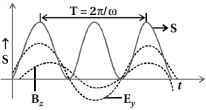
The Poynting vector $\vec S$ is defined as a vector whose magnitude is equal to the wave intensity and whose direction is along the direction of wave propagation. Mathematically,it is given by $\vec S = \frac{1}{{\mu _0}}(\vec E \times \vec B)$. Show the nature of the $\vec S$ vs $t$ graph.
Solution
(N/A) In an electromagnetic wave,let $\vec E$ be in the $y$-direction,$\vec B$ be in the $z$-direction,and the electromagnetic wave propagate in the $x$-direction. The energy propagation will be in the direction of $\vec E \times \vec B$ (in the $x$-direction).
$\vec E = E_0 \sin(\omega t - kx) \hat j$
$\vec B = B_0 \sin(\omega t - kx) \hat k$
$\therefore \vec S = \frac{1}{\mu_0}(\vec E \times \vec B) = \frac{1}{\mu_0} E_0 B_0 \sin^2(\omega t - kx) (\hat j \times \hat k)$
$\therefore \vec S = \frac{E_0 B_0}{\mu_0} \sin^2(\omega t - kx) \hat i$ [since $\hat j \times \hat k = \hat i$]
The variation in the magnitude of $|\vec S|$ with time is shown in the graph below. The magnitude $|\vec S|$ varies as $\sin^2(\omega t - kx)$,meaning it is always non-negative and oscillates with a frequency double that of the electric or magnetic field,with a period of $T = \frac{\pi}{\omega}$.
$\vec E = E_0 \sin(\omega t - kx) \hat j$
$\vec B = B_0 \sin(\omega t - kx) \hat k$
$\therefore \vec S = \frac{1}{\mu_0}(\vec E \times \vec B) = \frac{1}{\mu_0} E_0 B_0 \sin^2(\omega t - kx) (\hat j \times \hat k)$
$\therefore \vec S = \frac{E_0 B_0}{\mu_0} \sin^2(\omega t - kx) \hat i$ [since $\hat j \times \hat k = \hat i$]
The variation in the magnitude of $|\vec S|$ with time is shown in the graph below. The magnitude $|\vec S|$ varies as $\sin^2(\omega t - kx)$,meaning it is always non-negative and oscillates with a frequency double that of the electric or magnetic field,with a period of $T = \frac{\pi}{\omega}$.
0 likes
View Solution257
Medium
Show that the average value of radiant flux density $S$ over a single period $T$ is given by $S = \frac{1}{2c\mu_0}E_0^2$.
Solution
(N/A) The radiant flux density (Poynting vector) is given by $S = \frac{1}{\mu_0}(\vec{E} \times \vec{B})$.
Since $B = \frac{E}{c}$,the magnitude is $S = \frac{EB}{\mu_0} = \frac{E^2}{c\mu_0}$.
For an electromagnetic wave,$E = E_0 \cos(kx - \omega t)$.
Substituting this into the expression for $S$,we get $S = \frac{E_0^2 \cos^2(kx - \omega t)}{c\mu_0}$.
The average value of $\cos^2(\theta)$ over a full period $T$ is $\frac{1}{T} \int_0^T \cos^2(\omega t) dt = \frac{1}{2}$.
Therefore,the average radiant flux density $\langle S \rangle$ is $\langle S \rangle = \frac{E_0^2}{c\mu_0} \times \frac{1}{2} = \frac{E_0^2}{2c\mu_0}$.
Since $B = \frac{E}{c}$,the magnitude is $S = \frac{EB}{\mu_0} = \frac{E^2}{c\mu_0}$.
For an electromagnetic wave,$E = E_0 \cos(kx - \omega t)$.
Substituting this into the expression for $S$,we get $S = \frac{E_0^2 \cos^2(kx - \omega t)}{c\mu_0}$.
The average value of $\cos^2(\theta)$ over a full period $T$ is $\frac{1}{T} \int_0^T \cos^2(\omega t) dt = \frac{1}{2}$.
Therefore,the average radiant flux density $\langle S \rangle$ is $\langle S \rangle = \frac{E_0^2}{c\mu_0} \times \frac{1}{2} = \frac{E_0^2}{2c\mu_0}$.
0 likes
View Solution258
Medium
Show that the radiation pressure exerted by an $EM$ wave of intensity $I$ on a surface kept in vacuum is $\frac{I}{c}$.
Solution
(N/A) The radiation pressure $P$ is defined as the force per unit area,$P = \frac{F}{A}$.
According to Newton's second law,force is the rate of change of momentum,$F = \frac{dp}{dt}$.
For an electromagnetic wave,the relationship between energy $U$ and momentum $p$ is given by $p = \frac{U}{c}$.
Substituting this into the force equation,we get $F = \frac{d}{dt} \left( \frac{U}{c} \right) = \frac{1}{c} \frac{dU}{dt}$.
Intensity $I$ is defined as the energy incident per unit area per unit time,$I = \frac{1}{A} \frac{dU}{dt}$,which implies $\frac{dU}{dt} = I \cdot A$.
Substituting this into the expression for force,$F = \frac{1}{c} (I \cdot A)$.
Finally,the pressure $P = \frac{F}{A} = \frac{I \cdot A}{A \cdot c} = \frac{I}{c}$.
According to Newton's second law,force is the rate of change of momentum,$F = \frac{dp}{dt}$.
For an electromagnetic wave,the relationship between energy $U$ and momentum $p$ is given by $p = \frac{U}{c}$.
Substituting this into the force equation,we get $F = \frac{d}{dt} \left( \frac{U}{c} \right) = \frac{1}{c} \frac{dU}{dt}$.
Intensity $I$ is defined as the energy incident per unit area per unit time,$I = \frac{1}{A} \frac{dU}{dt}$,which implies $\frac{dU}{dt} = I \cdot A$.
Substituting this into the expression for force,$F = \frac{1}{c} (I \cdot A)$.
Finally,the pressure $P = \frac{F}{A} = \frac{I \cdot A}{A \cdot c} = \frac{I}{c}$.
0 likes
View Solution259
Easy
Even though an electric field $E$ exerts a force $qE$ on a charged particle, the electric field of an $EM$ wave does not contribute to the radiation pressure (but transfers energy). Explain.
Solution
(N/A) The electric field of an electromagnetic wave is an oscillating field, and so is the electric force it exerts on a charged particle. The force is given by $F = qE_0 \sin(\omega t - kx)$. When averaged over an integral number of cycles, the net force is zero because the direction of the force reverses every half cycle. Since radiation pressure is defined as the time-averaged force per unit area, the oscillating electric field does not contribute to it. However, the electric field does perform work on the charge, thereby transferring energy.
0 likes
View Solution260
Difficult
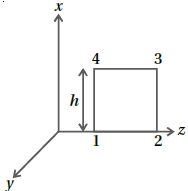
$A$ plane $EM$ wave travelling in vacuum along $z$-direction is given by $\vec E = E_0 \sin(kz - \omega t) \hat i$ and $\vec B = B_0 \sin(kz - \omega t) \hat j$.
$(i)$ Evaluate $\int \vec E \cdot d\vec l$ over the rectangular loop $1234$ shown in the figure.
$(ii)$ Evaluate $\int \vec B \cdot d\vec s$ over the surface bounded by loop $1234$.
$(iii)$ Use $\int \vec E \cdot d\vec l = -\frac{d\phi_E}{dt}$ to prove $\frac{E_0}{B_0} = c$.
$(iv)$ By using a similar process and the equation $\int \vec B \cdot d\vec l = \mu_0 I + \mu_0 \epsilon_0 \frac{d\phi_E}{dt}$,prove that $c = \frac{1}{\sqrt{\mu_0 \epsilon_0}}$.
$(i)$ Evaluate $\int \vec E \cdot d\vec l$ over the rectangular loop $1234$ shown in the figure.
$(ii)$ Evaluate $\int \vec B \cdot d\vec s$ over the surface bounded by loop $1234$.
$(iii)$ Use $\int \vec E \cdot d\vec l = -\frac{d\phi_E}{dt}$ to prove $\frac{E_0}{B_0} = c$.
$(iv)$ By using a similar process and the equation $\int \vec B \cdot d\vec l = \mu_0 I + \mu_0 \epsilon_0 \frac{d\phi_E}{dt}$,prove that $c = \frac{1}{\sqrt{\mu_0 \epsilon_0}}$.
Solution
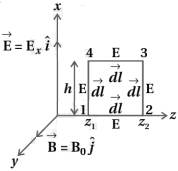
(N/A) $(i)$ The line integral $\oint \vec E \cdot d\vec l$ over the loop $1234$ is $\int_1^2 \vec E \cdot d\vec l + \int_2^3 \vec E \cdot d\vec l + \int_3^4 \vec E \cdot d\vec l + \int_4^1 \vec E \cdot d\vec l$. Since $\vec E$ is along $\hat i$ and the segments $1-2$ and $3-4$ are along $\hat z$,the dot product is zero. For segments $2-3$ and $4-1$,$\vec E$ is parallel/anti-parallel to $d\vec l$. Thus,$\oint \vec E \cdot d\vec l = E(z_2, t)h - E(z_1, t)h = h E_0 [\sin(kz_2 - \omega t) - \sin(kz_1 - \omega t)]$.
$(ii)$ The magnetic flux $\phi_B = \int \vec B \cdot d\vec s$. With $d\vec s = h dz \hat j$,$\phi_B = \int_{z_1}^{z_2} B_0 \sin(kz - \omega t) h dz = \frac{B_0 h}{k} [\cos(kz_1 - \omega t) - \cos(kz_2 - \omega t)]$.
$(iii)$ Using Faraday's Law $\oint \vec E \cdot d\vec l = -\frac{d\phi_B}{dt}$,we differentiate the flux with respect to $t$ and equate it to the line integral. Comparing the amplitudes,we get $E_0 = c B_0$,hence $\frac{E_0}{B_0} = c$.
$(iv)$ Using Ampere-Maxwell Law $\oint \vec B \cdot d\vec l = \mu_0 \epsilon_0 \frac{d\phi_E}{dt}$,where $\phi_E = \int E dA$. Following the same derivation steps as Faraday's law,we obtain $B_0 = \mu_0 \epsilon_0 c E_0$. Substituting $E_0 = c B_0$,we get $B_0 = \mu_0 \epsilon_0 c^2 B_0$,which simplifies to $c^2 = \frac{1}{\mu_0 \epsilon_0}$ or $c = \frac{1}{\sqrt{\mu_0 \epsilon_0}}$.
$(ii)$ The magnetic flux $\phi_B = \int \vec B \cdot d\vec s$. With $d\vec s = h dz \hat j$,$\phi_B = \int_{z_1}^{z_2} B_0 \sin(kz - \omega t) h dz = \frac{B_0 h}{k} [\cos(kz_1 - \omega t) - \cos(kz_2 - \omega t)]$.
$(iii)$ Using Faraday's Law $\oint \vec E \cdot d\vec l = -\frac{d\phi_B}{dt}$,we differentiate the flux with respect to $t$ and equate it to the line integral. Comparing the amplitudes,we get $E_0 = c B_0$,hence $\frac{E_0}{B_0} = c$.
$(iv)$ Using Ampere-Maxwell Law $\oint \vec B \cdot d\vec l = \mu_0 \epsilon_0 \frac{d\phi_E}{dt}$,where $\phi_E = \int E dA$. Following the same derivation steps as Faraday's law,we obtain $B_0 = \mu_0 \epsilon_0 c E_0$. Substituting $E_0 = c B_0$,we get $B_0 = \mu_0 \epsilon_0 c^2 B_0$,which simplifies to $c^2 = \frac{1}{\mu_0 \epsilon_0}$ or $c = \frac{1}{\sqrt{\mu_0 \epsilon_0}}$.
0 likes
View Solution261
Medium
$A$ plane $EM$ wave travelling along $z-$ direction is described by $\vec E = E_0 \sin(kz - \omega t)\hat i$ and $\vec B = B_0 \sin(kz - \omega t)\hat j$. Show that:
$(i)$ The average energy density of the wave is given by $U_{av} = \frac{1}{4} \epsilon_0 E_0^2 + \frac{1}{4} \frac{B_0^2}{\mu_0}$.
$(ii)$ The time-averaged intensity of the wave is given by $I_{av} = \frac{1}{2} c \epsilon_0 E_0^2$.
$(i)$ The average energy density of the wave is given by $U_{av} = \frac{1}{4} \epsilon_0 E_0^2 + \frac{1}{4} \frac{B_0^2}{\mu_0}$.
$(ii)$ The time-averaged intensity of the wave is given by $I_{av} = \frac{1}{2} c \epsilon_0 E_0^2$.
Solution
(N/A) $(i)$ The energy density associated with an electric field $E$ is $u_E = \frac{1}{2} \epsilon_0 E^2$ and with a magnetic field $B$ is $u_B = \frac{1}{2} \frac{B^2}{\mu_0}$.
The total instantaneous energy density is $u = u_E + u_B = \frac{1}{2} \epsilon_0 E^2 + \frac{1}{2} \frac{B^2}{\mu_0}$.
For a plane wave,$E = E_0 \sin(kz - \omega t)$ and $B = B_0 \sin(kz - \omega t)$.
The time average of $\sin^2(kz - \omega t)$ over one cycle is $\frac{1}{2}$.
Thus,$\langle E^2 \rangle = \frac{E_0^2}{2}$ and $\langle B^2 \rangle = \frac{B_0^2}{2}$.
Substituting these into the average energy density expression:
$U_{av} = \langle u_E \rangle + \langle u_B \rangle = \frac{1}{2} \epsilon_0 \left( \frac{E_0^2}{2} \right) + \frac{1}{2 \mu_0} \left( \frac{B_0^2}{2} \right) = \frac{1}{4} \epsilon_0 E_0^2 + \frac{1}{4} \frac{B_0^2}{\mu_0}$.
$(ii)$ Since $E_0 = c B_0$,we have $B_0 = \frac{E_0}{c}$. Also,$c^2 = \frac{1}{\mu_0 \epsilon_0}$,so $\frac{1}{\mu_0} = c^2 \epsilon_0$.
Substituting $B_0$ and $\frac{1}{\mu_0}$ into the energy density formula:
$U_{av} = \frac{1}{4} \epsilon_0 E_0^2 + \frac{1}{4} (c^2 \epsilon_0) \left( \frac{E_0}{c} \right)^2 = \frac{1}{4} \epsilon_0 E_0^2 + \frac{1}{4} \epsilon_0 E_0^2 = \frac{1}{2} \epsilon_0 E_0^2$.
The intensity $I_{av}$ is the energy crossing unit area per unit time,given by $I_{av} = U_{av} \cdot c$.
Therefore,$I_{av} = \left( \frac{1}{2} \epsilon_0 E_0^2 \right) c = \frac{1}{2} c \epsilon_0 E_0^2$.
The total instantaneous energy density is $u = u_E + u_B = \frac{1}{2} \epsilon_0 E^2 + \frac{1}{2} \frac{B^2}{\mu_0}$.
For a plane wave,$E = E_0 \sin(kz - \omega t)$ and $B = B_0 \sin(kz - \omega t)$.
The time average of $\sin^2(kz - \omega t)$ over one cycle is $\frac{1}{2}$.
Thus,$\langle E^2 \rangle = \frac{E_0^2}{2}$ and $\langle B^2 \rangle = \frac{B_0^2}{2}$.
Substituting these into the average energy density expression:
$U_{av} = \langle u_E \rangle + \langle u_B \rangle = \frac{1}{2} \epsilon_0 \left( \frac{E_0^2}{2} \right) + \frac{1}{2 \mu_0} \left( \frac{B_0^2}{2} \right) = \frac{1}{4} \epsilon_0 E_0^2 + \frac{1}{4} \frac{B_0^2}{\mu_0}$.
$(ii)$ Since $E_0 = c B_0$,we have $B_0 = \frac{E_0}{c}$. Also,$c^2 = \frac{1}{\mu_0 \epsilon_0}$,so $\frac{1}{\mu_0} = c^2 \epsilon_0$.
Substituting $B_0$ and $\frac{1}{\mu_0}$ into the energy density formula:
$U_{av} = \frac{1}{4} \epsilon_0 E_0^2 + \frac{1}{4} (c^2 \epsilon_0) \left( \frac{E_0}{c} \right)^2 = \frac{1}{4} \epsilon_0 E_0^2 + \frac{1}{4} \epsilon_0 E_0^2 = \frac{1}{2} \epsilon_0 E_0^2$.
The intensity $I_{av}$ is the energy crossing unit area per unit time,given by $I_{av} = U_{av} \cdot c$.
Therefore,$I_{av} = \left( \frac{1}{2} \epsilon_0 E_0^2 \right) c = \frac{1}{2} c \epsilon_0 E_0^2$.
0 likes
View Solution262
EasyMCQ
Light waves are which type of waves?
A
Longitudinal mechanical waves
B
Transverse mechanical waves
C
Transverse electromagnetic waves
D
Longitudinal electromagnetic waves
Solution
(C) Light waves are electromagnetic waves because they do not require a material medium for propagation.
They are transverse in nature because the oscillating electric and magnetic field vectors are perpendicular to the direction of wave propagation.
They are transverse in nature because the oscillating electric and magnetic field vectors are perpendicular to the direction of wave propagation.
0 likes
View Solution263
MediumMCQ
Newton's laws can be applied to mechanical waves propagating in elastic media. Can they be applied to electromagnetic waves also?
A
Yes,they are directly applicable.
B
No,they are not applicable.
C
Yes,but only in a vacuum.
D
Yes,but only in a medium.
Solution
(B) No. Newton's laws of motion are based on the mechanics of particles and continuous media (matter). Electromagnetic waves consist of oscillating electric and magnetic fields and do not require a material medium for propagation. Therefore,Newton's laws cannot be applied to electromagnetic waves in the same way they are applied to mechanical waves.
0 likes
View Solution264
MediumMCQ
In a plane electromagnetic wave,the directions of the electric field and magnetic field are represented by $\hat{k}$ and $2\hat{i}-2\hat{j}$,respectively. What is the unit vector along the direction of propagation of the wave?
A
$\frac{1}{\sqrt{2}}(\hat{i}+\hat{j})$
B
$\frac{1}{\sqrt{5}}(\hat{i}+2\hat{j})$
C
$\frac{1}{\sqrt{5}}(2\hat{i}+\hat{j})$
D
$\frac{1}{\sqrt{2}}(\hat{j}+\hat{k})$
Solution
(A) The direction of propagation of an electromagnetic wave is given by the direction of the Poynting vector,which is $\hat{E} \times \hat{B}$.
Given,the direction of the electric field is $\hat{E} = \hat{k}$.
The direction of the magnetic field is given by the vector $\vec{B} = 2\hat{i} - 2\hat{j}$.
The unit vector for the magnetic field is $\hat{B} = \frac{\vec{B}}{|B|} = \frac{2\hat{i} - 2\hat{j}}{\sqrt{2^2 + (-2)^2}} = \frac{2\hat{i} - 2\hat{j}}{\sqrt{8}} = \frac{2\hat{i} - 2\hat{j}}{2\sqrt{2}} = \frac{1}{\sqrt{2}}(\hat{i} - \hat{j})$.
The direction of propagation $\hat{C}$ is $\hat{E} \times \hat{B} = \hat{k} \times [\frac{1}{\sqrt{2}}(\hat{i} - \hat{j})]$.
Using the cross product rules $\hat{k} \times \hat{i} = \hat{j}$ and $\hat{k} \times \hat{j} = -\hat{i}$,we get:
$\hat{C} = \frac{1}{\sqrt{2}}(\hat{k} \times \hat{i} - \hat{k} \times \hat{j}) = \frac{1}{\sqrt{2}}(\hat{j} - (-\hat{i})) = \frac{1}{\sqrt{2}}(\hat{i} + \hat{j})$.
Given,the direction of the electric field is $\hat{E} = \hat{k}$.
The direction of the magnetic field is given by the vector $\vec{B} = 2\hat{i} - 2\hat{j}$.
The unit vector for the magnetic field is $\hat{B} = \frac{\vec{B}}{|B|} = \frac{2\hat{i} - 2\hat{j}}{\sqrt{2^2 + (-2)^2}} = \frac{2\hat{i} - 2\hat{j}}{\sqrt{8}} = \frac{2\hat{i} - 2\hat{j}}{2\sqrt{2}} = \frac{1}{\sqrt{2}}(\hat{i} - \hat{j})$.
The direction of propagation $\hat{C}$ is $\hat{E} \times \hat{B} = \hat{k} \times [\frac{1}{\sqrt{2}}(\hat{i} - \hat{j})]$.
Using the cross product rules $\hat{k} \times \hat{i} = \hat{j}$ and $\hat{k} \times \hat{j} = -\hat{i}$,we get:
$\hat{C} = \frac{1}{\sqrt{2}}(\hat{k} \times \hat{i} - \hat{k} \times \hat{j}) = \frac{1}{\sqrt{2}}(\hat{j} - (-\hat{i})) = \frac{1}{\sqrt{2}}(\hat{i} + \hat{j})$.
0 likes
View Solution265
DifficultMCQ
$A$ plane electromagnetic wave has a frequency of $2.0 \times 10^{10} \ Hz$ and its energy density is $1.02 \times 10^{-8} \ J/m^3$ in vacuum. The amplitude of the magnetic field of the wave is close to $....nT$. (Given: $\frac{1}{4 \pi \varepsilon_0} = 9 \times 10^9 \ Nm^2/C^2$ and speed of light $c = 3 \times 10^8 \ m/s$)
A
$180$
B
$160$
C
$150$
D
$190$
Solution
(B) The total energy density $u$ of an electromagnetic wave is given by $u = \frac{B_0^2}{2 \mu_0}$.
Given $u = 1.02 \times 10^{-8} \ J/m^3$ and $\mu_0 = 4 \pi \times 10^{-7} \ T \cdot m/A$.
Rearranging the formula for the magnetic field amplitude $B_0$:
$B_0^2 = 2 \mu_0 u$
$B_0^2 = 2 \times (4 \pi \times 10^{-7}) \times (1.02 \times 10^{-8})$
$B_0^2 = 8 \pi \times 1.02 \times 10^{-15}$
$B_0^2 \approx 25.13 \times 1.02 \times 10^{-15} \approx 25.63 \times 10^{-15} \approx 256.3 \times 10^{-16}$
Taking the square root:
$B_0 \approx 16 \times 10^{-8} \ T$
Since $1 \ nT = 10^{-9} \ T$,we have $B_0 = 160 \times 10^{-9} \ T = 160 \ nT$.
Given $u = 1.02 \times 10^{-8} \ J/m^3$ and $\mu_0 = 4 \pi \times 10^{-7} \ T \cdot m/A$.
Rearranging the formula for the magnetic field amplitude $B_0$:
$B_0^2 = 2 \mu_0 u$
$B_0^2 = 2 \times (4 \pi \times 10^{-7}) \times (1.02 \times 10^{-8})$
$B_0^2 = 8 \pi \times 1.02 \times 10^{-15}$
$B_0^2 \approx 25.13 \times 1.02 \times 10^{-15} \approx 25.63 \times 10^{-15} \approx 256.3 \times 10^{-16}$
Taking the square root:
$B_0 \approx 16 \times 10^{-8} \ T$
Since $1 \ nT = 10^{-9} \ T$,we have $B_0 = 160 \times 10^{-9} \ T = 160 \ nT$.
0 likes
View Solution266
DifficultMCQ
The electric field of a plane electromagnetic wave propagating along the $x$-direction in vacuum is $\overrightarrow{E} = E_{0} \hat{j} \cos(\omega t - kx)$. The magnetic field $\overrightarrow{B}$ at the moment $t = 0$ is:
A
$\overrightarrow{B} = E_{0} \sqrt{\mu_{0} \epsilon_{0}} \cos(kx) \hat{j}$
B
$\overrightarrow{B} = \frac{E_{0}}{\sqrt{\mu_{0} \epsilon_{0}}} \cos(kx) \hat{k}$
C
$\overrightarrow{B} = E_{0} \sqrt{\mu_{0} \epsilon_{0}} \cos(kx) \hat{k}$
D
$\overrightarrow{B} = \frac{E_{0}}{\sqrt{\mu_{0} \epsilon_{0}}} \cos(kx) \hat{j}$
Solution
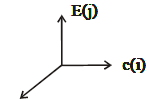
(C) For an electromagnetic wave propagating in the $x$-direction,the electric field is in the $y$-direction $(\hat{j})$,so the magnetic field must be in the $z$-direction $(\hat{k})$ because the direction of propagation is given by $\overrightarrow{E} \times \overrightarrow{B}$.
Given $\overrightarrow{E} = E_{0} \cos(\omega t - kx) \hat{j}$.
The amplitude of the magnetic field is $B_{0} = \frac{E_{0}}{c}$,where $c = \frac{1}{\sqrt{\mu_{0} \epsilon_{0}}}$.
Thus,$B_{0} = E_{0} \sqrt{\mu_{0} \epsilon_{0}}$.
The magnetic field wave equation is $\overrightarrow{B} = B_{0} \cos(\omega t - kx) \hat{k}$.
At $t = 0$,$\overrightarrow{B} = B_{0} \cos(-kx) \hat{k} = B_{0} \cos(kx) \hat{k}$.
Substituting $B_{0}$,we get $\overrightarrow{B} = E_{0} \sqrt{\mu_{0} \epsilon_{0}} \cos(kx) \hat{k}$.
Given $\overrightarrow{E} = E_{0} \cos(\omega t - kx) \hat{j}$.
The amplitude of the magnetic field is $B_{0} = \frac{E_{0}}{c}$,where $c = \frac{1}{\sqrt{\mu_{0} \epsilon_{0}}}$.
Thus,$B_{0} = E_{0} \sqrt{\mu_{0} \epsilon_{0}}$.
The magnetic field wave equation is $\overrightarrow{B} = B_{0} \cos(\omega t - kx) \hat{k}$.
At $t = 0$,$\overrightarrow{B} = B_{0} \cos(-kx) \hat{k} = B_{0} \cos(kx) \hat{k}$.
Substituting $B_{0}$,we get $\overrightarrow{B} = E_{0} \sqrt{\mu_{0} \epsilon_{0}} \cos(kx) \hat{k}$.
0 likes
View Solution267
DifficultMCQ
The magnetic field of a plane electromagnetic wave is $\overrightarrow{B} = 3 \times 10^{-8} \sin [200 \pi(y + ct)] \hat{i} \, T$,where $c = 3 \times 10^{8} \, m/s$ is the speed of light. The corresponding electric field is:
A
$\overrightarrow{E} = -10^{-6} \sin [200 \pi(y + ct)] \hat{k} \, V/m$
B
$\overrightarrow{E} = -9 \sin [200 \pi(y + ct)] \hat{k} \, V/m$
C
$\overrightarrow{E} = 9 \sin [200 \pi(y + ct)] \hat{k} \, V/m$
D
$\overrightarrow{E} = 3 \times 10^{-8} \sin [200 \pi(y + ct)] \hat{k} \, V/m$
Solution
(B) Given the magnetic field: $\overrightarrow{B} = 3 \times 10^{-8} \sin [200 \pi(y + ct)] \hat{i} \, T$.
The amplitude of the electric field $E_0$ is related to the amplitude of the magnetic field $B_0$ by the relation $E_0 = c B_0$.
Substituting the values: $E_0 = (3 \times 10^{8} \, m/s) \times (3 \times 10^{-8} \, T) = 9 \, V/m$.
The direction of wave propagation is given by the vector $\overrightarrow{k}$. Since the argument is $(y + ct)$,the wave is propagating in the negative $y$-direction,so $\hat{k}_{prop} = -\hat{j}$.
The direction of the electric field is given by the cross product relation $\hat{E} = \hat{k}_{prop} \times \hat{B}$.
Here,$\hat{B} = \hat{i}$ and $\hat{k}_{prop} = -\hat{j}$.
Therefore,$\hat{E} = (-\hat{j}) \times \hat{i} = -(-\hat{k}) = \hat{k}$.
Wait,checking the cross product: $(-\hat{j}) \times \hat{i} = -(\hat{j} \times \hat{i}) = -(-\hat{k}) = \hat{k}$.
However,standard convention for electromagnetic waves is $\vec{E} \times \vec{B} = \vec{S}$ (direction of propagation).
Given $\vec{B} = B_0 \hat{i}$ and propagation is $-\hat{j}$,then $\vec{E} \times \hat{i} = -\hat{j}$. This implies $\vec{E} = -9 \sin [200 \pi(y + ct)] \hat{k} \, V/m$.
The amplitude of the electric field $E_0$ is related to the amplitude of the magnetic field $B_0$ by the relation $E_0 = c B_0$.
Substituting the values: $E_0 = (3 \times 10^{8} \, m/s) \times (3 \times 10^{-8} \, T) = 9 \, V/m$.
The direction of wave propagation is given by the vector $\overrightarrow{k}$. Since the argument is $(y + ct)$,the wave is propagating in the negative $y$-direction,so $\hat{k}_{prop} = -\hat{j}$.
The direction of the electric field is given by the cross product relation $\hat{E} = \hat{k}_{prop} \times \hat{B}$.
Here,$\hat{B} = \hat{i}$ and $\hat{k}_{prop} = -\hat{j}$.
Therefore,$\hat{E} = (-\hat{j}) \times \hat{i} = -(-\hat{k}) = \hat{k}$.
Wait,checking the cross product: $(-\hat{j}) \times \hat{i} = -(\hat{j} \times \hat{i}) = -(-\hat{k}) = \hat{k}$.
However,standard convention for electromagnetic waves is $\vec{E} \times \vec{B} = \vec{S}$ (direction of propagation).
Given $\vec{B} = B_0 \hat{i}$ and propagation is $-\hat{j}$,then $\vec{E} \times \hat{i} = -\hat{j}$. This implies $\vec{E} = -9 \sin [200 \pi(y + ct)] \hat{k} \, V/m$.
0 likes
View Solution268
MediumMCQ
The electric field of a plane electromagnetic wave is given by $\overrightarrow{E} = E_{0}(\hat{x} + \hat{y}) \sin(kz - \omega t)$. Its magnetic field will be given by
A
$\frac{E_{0}}{c}(\hat{x} - \hat{y}) \cos(kz - \omega t)$
B
$\frac{E_{0}}{c}(-\hat{x} + \hat{y}) \sin(kz - \omega t)$
C
$\frac{E_{0}}{c}(\hat{x} - \hat{y}) \sin(kz - \omega t)$
D
$\frac{E_{0}}{c}(\hat{x} + \hat{y}) \sin(kz - \omega t)$
Solution
(B) The given electric field is $\overrightarrow{E} = E_{0}(\hat{x} + \hat{y}) \sin(kz - \omega t)$.
The direction of propagation of the wave is along the $+z$-axis,so $\hat{k} = \hat{z}$.
The relation between the direction of propagation,electric field,and magnetic field is given by $\hat{k} = \hat{E} \times \hat{B}$.
The unit vector for the electric field is $\hat{E} = \frac{\hat{x} + \hat{y}}{\sqrt{2}}$.
Substituting the values: $\hat{z} = \left(\frac{\hat{x} + \hat{y}}{\sqrt{2}}\right) \times \hat{B}$.
Solving for $\hat{B}$,we find $\hat{B} = \frac{-\hat{x} + \hat{y}}{\sqrt{2}}$.
Since the magnitude of the magnetic field is $B_{0} = \frac{E_{0}}{c}$,the magnetic field is $\overrightarrow{B} = \frac{E_{0}}{c}(-\hat{x} + \hat{y}) \sin(kz - \omega t)$.
The direction of propagation of the wave is along the $+z$-axis,so $\hat{k} = \hat{z}$.
The relation between the direction of propagation,electric field,and magnetic field is given by $\hat{k} = \hat{E} \times \hat{B}$.
The unit vector for the electric field is $\hat{E} = \frac{\hat{x} + \hat{y}}{\sqrt{2}}$.
Substituting the values: $\hat{z} = \left(\frac{\hat{x} + \hat{y}}{\sqrt{2}}\right) \times \hat{B}$.
Solving for $\hat{B}$,we find $\hat{B} = \frac{-\hat{x} + \hat{y}}{\sqrt{2}}$.
Since the magnitude of the magnetic field is $B_{0} = \frac{E_{0}}{c}$,the magnetic field is $\overrightarrow{B} = \frac{E_{0}}{c}(-\hat{x} + \hat{y}) \sin(kz - \omega t)$.
0 likes
View Solution269
DifficultMCQ
The quantities $x = \frac{1}{\sqrt{\mu_{0} \varepsilon_{0}}}$,$y = \frac{E}{B}$,and $z = \frac{l}{CR}$ are defined,where $C$ is capacitance,$R$ is resistance,$l$ is length,$E$ is electric field,$B$ is magnetic field,and $\varepsilon_{0}, \mu_{0}$ are free space permittivity and permeability respectively. Then:
A
Only $x$ and $y$ have the same dimension
B
$x, y$ and $z$ have the same dimension
C
Only $x$ and $z$ have the same dimension
D
Only $y$ and $z$ have the same dimension
Solution
(B) $x = \frac{1}{\sqrt{\mu_{0} \varepsilon_{0}}}$ represents the speed of light in vacuum,so its dimension is $[x] = [L^{1}T^{-1}]$.
$y = \frac{E}{B}$ represents the speed of an electromagnetic wave,so its dimension is $[y] = [L^{1}T^{-1}]$.
$z = \frac{l}{CR}$ where $RC$ is the time constant $(\tau)$,so $z = \frac{l}{\tau}$. The dimension is $[z] = \frac{[L]}{[T]} = [L^{1}T^{-1}]$.
Since all three quantities have the same dimension $[L^{1}T^{-1}]$,the correct option is $B$.
$y = \frac{E}{B}$ represents the speed of an electromagnetic wave,so its dimension is $[y] = [L^{1}T^{-1}]$.
$z = \frac{l}{CR}$ where $RC$ is the time constant $(\tau)$,so $z = \frac{l}{\tau}$. The dimension is $[z] = \frac{[L]}{[T]} = [L^{1}T^{-1}]$.
Since all three quantities have the same dimension $[L^{1}T^{-1}]$,the correct option is $B$.
0 likes
View Solution270
MediumMCQ
An electron is constrained to move along the $y$-axis with a speed of $0.1 c$ ($c$ is the speed of light) in the presence of an electromagnetic wave,whose electric field is $\overrightarrow{E} = 30 \hat{j} \sin(1.5 \times 10^7 t - 5 \times 10^{-2} x) \, V/m$. The maximum magnetic force experienced by the electron will be: (given $c = 3 \times 10^8 \, m/s$ and electron charge $q = 1.6 \times 10^{-19} \, C$)
A
$1.6 \times 10^{-19} \, N$
B
$4.8 \times 10^{-19} \, N$
C
$3.2 \times 10^{-18} \, N$
D
$2.4 \times 10^{-18} \, N$
Solution
(B) The electric field is given by $\overrightarrow{E} = E_0 \sin(kx - \omega t) \hat{j}$,where $E_0 = 30 \, V/m$,$\omega = 1.5 \times 10^7 \, rad/s$,and $k = 5 \times 10^{-2} \, rad/m$.
The amplitude of the magnetic field $B_0$ is related to the electric field amplitude $E_0$ by $B_0 = \frac{E_0}{c}$.
$B_0 = \frac{30}{3 \times 10^8} = 10^{-7} \, T$.
The electron moves along the $y$-axis with velocity $\overrightarrow{v} = 0.1 c \hat{j} = 0.1 \times 3 \times 10^8 \hat{j} = 3 \times 10^7 \hat{j} \, m/s$.
The magnetic force is given by $\overrightarrow{F}_{mag} = q(\overrightarrow{v} \times \overrightarrow{B})$. Since $\overrightarrow{v}$ is along the $y$-axis and $\overrightarrow{E}$ is along the $y$-axis,the wave propagates along the $x$-axis. The magnetic field $\overrightarrow{B}$ must be perpendicular to both the direction of propagation ($x$-axis) and the electric field ($y$-axis),so $\overrightarrow{B}$ is along the $z$-axis.
$F_{max} = q v B_0 = (1.6 \times 10^{-19} \, C) \times (3 \times 10^7 \, m/s) \times (10^{-7} \, T)$.
$F_{max} = 1.6 \times 3 \times 10^{-19} = 4.8 \times 10^{-19} \, N$.
The amplitude of the magnetic field $B_0$ is related to the electric field amplitude $E_0$ by $B_0 = \frac{E_0}{c}$.
$B_0 = \frac{30}{3 \times 10^8} = 10^{-7} \, T$.
The electron moves along the $y$-axis with velocity $\overrightarrow{v} = 0.1 c \hat{j} = 0.1 \times 3 \times 10^8 \hat{j} = 3 \times 10^7 \hat{j} \, m/s$.
The magnetic force is given by $\overrightarrow{F}_{mag} = q(\overrightarrow{v} \times \overrightarrow{B})$. Since $\overrightarrow{v}$ is along the $y$-axis and $\overrightarrow{E}$ is along the $y$-axis,the wave propagates along the $x$-axis. The magnetic field $\overrightarrow{B}$ must be perpendicular to both the direction of propagation ($x$-axis) and the electric field ($y$-axis),so $\overrightarrow{B}$ is along the $z$-axis.
$F_{max} = q v B_0 = (1.6 \times 10^{-19} \, C) \times (3 \times 10^7 \, m/s) \times (10^{-7} \, T)$.
$F_{max} = 1.6 \times 3 \times 10^{-19} = 4.8 \times 10^{-19} \, N$.
0 likes
View Solution271
MediumMCQ
For a plane electromagnetic wave,the magnetic field at a point $x$ and time $t$ is $\overrightarrow{ B }( x , t ) = [1.2 \times 10^{-7} \sin (0.5 \times 10^{3} x + 1.5 \times 10^{11} t) \hat{ k }] \text{ T}$. The instantaneous electric field $\overrightarrow{ E }$ corresponding to $\overrightarrow{ B }$ is: (speed of light $c = 3 \times 10^{8} \text{ m/s}$)
A
$\overrightarrow{ E }( x , t ) = [36 \sin (0.5 \times 10^{3} x + 1.5 \times 10^{11} t) \hat{ k }] \text{ V/m}$
B
$\overrightarrow{ E }( x , t ) = [-36 \sin (0.5 \times 10^{3} x + 1.5 \times 10^{11} t) \hat{ j }] \text{ V/m}$
C
$\overrightarrow{ E }( x , t ) = [-36 \sin (1 \times 10^{3} x + 1.5 \times 10^{11} t) \hat{ j }] \text{ V/m}$
D
$\overrightarrow{ E }( x , t ) = [36 \sin (1 \times 10^{3} x + 1.5 \times 10^{11} t) \hat{ j }] \text{ V/m}$
Solution
(B) For an electromagnetic wave,the magnitude of the electric field $E_0$ is related to the magnetic field $B_0$ by $E_0 = c B_0$.
Given $c = 3 \times 10^{8} \text{ m/s}$ and $B_0 = 1.2 \times 10^{-7} \text{ T}$,we have $E_0 = 3 \times 10^{8} \times 1.2 \times 10^{-7} = 36 \text{ V/m}$.
The wave propagates in the direction of $-x$ because the argument of the sine function is $(kx + \omega t)$.
The magnetic field is along the $\hat{k}$ direction ($z$-axis).
Since the direction of propagation is $\vec{E} \times \vec{B}$,and the propagation is along $-\hat{i}$,we have $\hat{j} \times \hat{k} = \hat{i}$. To get $-\hat{i}$,we need $(-\hat{j}) \times \hat{k} = -\hat{i}$.
Thus,the electric field is $\overrightarrow{ E }( x , t ) = [-36 \sin (0.5 \times 10^{3} x + 1.5 \times 10^{11} t) \hat{ j }] \text{ V/m}$.
Given $c = 3 \times 10^{8} \text{ m/s}$ and $B_0 = 1.2 \times 10^{-7} \text{ T}$,we have $E_0 = 3 \times 10^{8} \times 1.2 \times 10^{-7} = 36 \text{ V/m}$.
The wave propagates in the direction of $-x$ because the argument of the sine function is $(kx + \omega t)$.
The magnetic field is along the $\hat{k}$ direction ($z$-axis).
Since the direction of propagation is $\vec{E} \times \vec{B}$,and the propagation is along $-\hat{i}$,we have $\hat{j} \times \hat{k} = \hat{i}$. To get $-\hat{i}$,we need $(-\hat{j}) \times \hat{k} = -\hat{i}$.
Thus,the electric field is $\overrightarrow{ E }( x , t ) = [-36 \sin (0.5 \times 10^{3} x + 1.5 \times 10^{11} t) \hat{ j }] \text{ V/m}$.
0 likes
View Solution272
MediumMCQ
Suppose that the intensity of a laser is $\left(\frac{315}{\pi}\right) \ W/m^2$. The $rms$ electric field,in units of $V/m$,associated with this source is close to the nearest integer. Given: $\epsilon_0 = 8.86 \times 10^{-12} \ C^2 N^{-1} m^{-2}$ and $c = 3 \times 10^8 \ m/s$.
A
$176$
B
$186$
C
$194$
D
$200$
Solution
(C) The intensity $I$ of an electromagnetic wave is related to the $rms$ electric field $E_{rms}$ by the formula: $I = \epsilon_0 E_{rms}^2 c$.
Rearranging for $E_{rms}^2$,we get: $E_{rms}^2 = \frac{I}{\epsilon_0 c}$.
Given $I = \frac{315}{\pi} \ W/m^2$,$\epsilon_0 = 8.86 \times 10^{-12} \ C^2 N^{-1} m^{-2}$,and $c = 3 \times 10^8 \ m/s$.
We know that $\frac{1}{4\pi\epsilon_0} = 9 \times 10^9 \ N m^2 C^{-2}$,so $\frac{1}{\epsilon_0} = 4\pi \times 9 \times 10^9 = 36\pi \times 10^9$.
Substituting these values into the equation:
$E_{rms}^2 = \frac{315}{\pi} \times (36\pi \times 10^9) \times \frac{1}{3 \times 10^8}$
$E_{rms}^2 = 315 \times 36 \times 10^9 \times \frac{1}{3 \times 10^8}$
$E_{rms}^2 = 315 \times 12 \times 10 = 37800$.
Taking the square root: $E_{rms} = \sqrt{37800} \approx 194.42 \ V/m$.
The nearest integer is $194$.
Rearranging for $E_{rms}^2$,we get: $E_{rms}^2 = \frac{I}{\epsilon_0 c}$.
Given $I = \frac{315}{\pi} \ W/m^2$,$\epsilon_0 = 8.86 \times 10^{-12} \ C^2 N^{-1} m^{-2}$,and $c = 3 \times 10^8 \ m/s$.
We know that $\frac{1}{4\pi\epsilon_0} = 9 \times 10^9 \ N m^2 C^{-2}$,so $\frac{1}{\epsilon_0} = 4\pi \times 9 \times 10^9 = 36\pi \times 10^9$.
Substituting these values into the equation:
$E_{rms}^2 = \frac{315}{\pi} \times (36\pi \times 10^9) \times \frac{1}{3 \times 10^8}$
$E_{rms}^2 = 315 \times 36 \times 10^9 \times \frac{1}{3 \times 10^8}$
$E_{rms}^2 = 315 \times 12 \times 10 = 37800$.
Taking the square root: $E_{rms} = \sqrt{37800} \approx 194.42 \ V/m$.
The nearest integer is $194$.
0 likes
View Solution273
EasyMCQ
The ratio of contributions made by the electric field and magnetic field components to the intensity of an electromagnetic wave is:
A
$1: c^2$
B
$c: 1$
C
$1: 1$
D
$1: c$
Solution
(C) In an electromagnetic wave $(EMW)$,the energy density associated with the electric field is $u_E = \frac{1}{2} \epsilon_0 E^2$ and the energy density associated with the magnetic field is $u_B = \frac{1}{2} \frac{B^2}{\mu_0}$.
Since $E = cB$ and $c = \frac{1}{\sqrt{\mu_0 \epsilon_0}}$,we have $u_E = u_B$.
Because the intensity of the wave is proportional to the energy density,the contributions of the electric field and magnetic field components to the total intensity are equal.
Therefore,the ratio is $1:1$.
Since $E = cB$ and $c = \frac{1}{\sqrt{\mu_0 \epsilon_0}}$,we have $u_E = u_B$.
Because the intensity of the wave is proportional to the energy density,the contributions of the electric field and magnetic field components to the total intensity are equal.
Therefore,the ratio is $1:1$.
0 likes
View Solution274
MediumMCQ
The magnetic field in a plane electromagnetic wave is given by, $B_{y} = 2 \times 10^{-7} \sin (\pi \times 10^{3} x + 3 \pi \times 10^{11} t) \; T$. Calculate the wavelength.
A
$2 \times 10^{-3} \; m$
B
$2 \times 10^{3} \; m$
C
$\pi \times 10^{-3} \; m$
D
$\pi \times 10^{3} \; m$
Solution
(A) The general equation for a plane electromagnetic wave is given by $B = B_{0} \sin (kx + \omega t)$.
Comparing this with the given equation $B_{y} = 2 \times 10^{-7} \sin (\pi \times 10^{3} x + 3 \pi \times 10^{11} t) \; T$, we identify the wave number $k$ as:
$k = \pi \times 10^{3} \; \text{rad/m}$.
The relationship between the wave number $k$ and the wavelength $\lambda$ is given by $k = \frac{2\pi}{\lambda}$.
Substituting the value of $k$:
$\pi \times 10^{3} = \frac{2\pi}{\lambda}$.
Solving for $\lambda$:
$\lambda = \frac{2\pi}{\pi \times 10^{3}} = 2 \times 10^{-3} \; m$.
Comparing this with the given equation $B_{y} = 2 \times 10^{-7} \sin (\pi \times 10^{3} x + 3 \pi \times 10^{11} t) \; T$, we identify the wave number $k$ as:
$k = \pi \times 10^{3} \; \text{rad/m}$.
The relationship between the wave number $k$ and the wavelength $\lambda$ is given by $k = \frac{2\pi}{\lambda}$.
Substituting the value of $k$:
$\pi \times 10^{3} = \frac{2\pi}{\lambda}$.
Solving for $\lambda$:
$\lambda = \frac{2\pi}{\pi \times 10^{3}} = 2 \times 10^{-3} \; m$.
0 likes
View Solution275
MediumMCQ
$A$ plane electromagnetic wave of frequency $500\, MHz$ is travelling in vacuum along $y$-direction. At a particular point in space and time,$\overrightarrow{B} = 8.0 \times 10^{-8} \hat{z}\, T$. The value of electric field at this point is (speed of light $c = 3 \times 10^{8}\, m/s$). $\hat{x}, \hat{y}, \hat{z}$ are unit vectors along $x, y$ and $z$ directions.
A
$-24 \hat{x}\, V/m$
B
$2.6 \hat{x}\, V/m$
C
$24 \hat{x}\, V/m$
D
$-2.6 \hat{y}\, V/m$
Solution
(A) The relationship between the electric field $\overrightarrow{E}$ and the magnetic field $\overrightarrow{B}$ in an electromagnetic wave is given by $\overrightarrow{E} = c(\overrightarrow{B} \times \hat{n})$,where $\hat{n}$ is the direction of propagation.
Given,the wave travels along the $y$-direction,so $\hat{n} = \hat{y}$.
The magnetic field is $\overrightarrow{B} = 8.0 \times 10^{-8} \hat{z}\, T$.
Substituting the values:
$\overrightarrow{E} = (3 \times 10^{8}\, m/s) \times (8.0 \times 10^{-8} \hat{z} \times \hat{y})$
Since $\hat{z} \times \hat{y} = -\hat{x}$,we get:
$\overrightarrow{E} = (3 \times 8.0) \times (-\hat{x}) = -24 \hat{x}\, V/m$.
Given,the wave travels along the $y$-direction,so $\hat{n} = \hat{y}$.
The magnetic field is $\overrightarrow{B} = 8.0 \times 10^{-8} \hat{z}\, T$.
Substituting the values:
$\overrightarrow{E} = (3 \times 10^{8}\, m/s) \times (8.0 \times 10^{-8} \hat{z} \times \hat{y})$
Since $\hat{z} \times \hat{y} = -\hat{x}$,we get:
$\overrightarrow{E} = (3 \times 8.0) \times (-\hat{x}) = -24 \hat{x}\, V/m$.
0 likes
View Solution276
MediumMCQ
For an electromagnetic wave travelling in free space,the relation between average energy densities due to electric $(U_{e})$ and magnetic $(U_{m})$ fields is
A
$U_{e} = U_{m}$
B
$U_{e} > U_{m}$
C
$U_{e} < U_{m}$
D
$U_{e} \neq U_{m}$
Solution
(A) In an electromagnetic wave $(EMW)$,the average energy density associated with the electric field is given by $U_{e} = \frac{1}{4} \epsilon_{0} E_{0}^{2}$.
The average energy density associated with the magnetic field is given by $U_{m} = \frac{1}{4} \frac{B_{0}^{2}}{\mu_{0}}$.
Since $E_{0} = c B_{0}$ and $c = \frac{1}{\sqrt{\mu_{0} \epsilon_{0}}}$,we have $E_{0}^{2} = c^{2} B_{0}^{2} = \frac{B_{0}^{2}}{\mu_{0} \epsilon_{0}}$.
Substituting this into the expression for $U_{e}$,we get $U_{e} = \frac{1}{4} \epsilon_{0} \left( \frac{B_{0}^{2}}{\mu_{0} \epsilon_{0}} \right) = \frac{1}{4} \frac{B_{0}^{2}}{\mu_{0}} = U_{m}$.
Thus,the average energy densities due to electric and magnetic fields are equal.
The average energy density associated with the magnetic field is given by $U_{m} = \frac{1}{4} \frac{B_{0}^{2}}{\mu_{0}}$.
Since $E_{0} = c B_{0}$ and $c = \frac{1}{\sqrt{\mu_{0} \epsilon_{0}}}$,we have $E_{0}^{2} = c^{2} B_{0}^{2} = \frac{B_{0}^{2}}{\mu_{0} \epsilon_{0}}$.
Substituting this into the expression for $U_{e}$,we get $U_{e} = \frac{1}{4} \epsilon_{0} \left( \frac{B_{0}^{2}}{\mu_{0} \epsilon_{0}} \right) = \frac{1}{4} \frac{B_{0}^{2}}{\mu_{0}} = U_{m}$.
Thus,the average energy densities due to electric and magnetic fields are equal.
0 likes
View Solution277
MediumMCQ
$A$ plane electromagnetic wave of frequency $100 \, MHz$ is travelling in vacuum along the $x$-direction. At a particular point in space and time,$\overrightarrow{B} = 2.0 \times 10^{-8} \hat{k} \, T$ (where $\hat{k}$ is the unit vector along the $z$-direction). What is $\overrightarrow{E}$ at this point?
A
$0.6 \hat{j} \, V/m$
B
$6.0 \hat{k} \, V/m$
C
$6.0 \hat{j} \, V/m$
D
$0.6 \hat{k} \, V/m$
Solution
(C) The magnitude of the electric field $E$ is related to the magnetic field $B$ by the relation $E = B \cdot c$,where $c$ is the speed of light in vacuum $(c = 3 \times 10^8 \, m/s)$.
Given $B = 2.0 \times 10^{-8} \, T$,we have $E = (2.0 \times 10^{-8} \, T) \times (3 \times 10^8 \, m/s) = 6.0 \, V/m$.
The direction of propagation of an electromagnetic wave is given by the direction of the vector $\overrightarrow{E} \times \overrightarrow{B}$.
Here,the wave travels along the $x$-direction $(\hat{i})$,and $\overrightarrow{B}$ is along the $z$-direction $(\hat{k})$.
Since $\hat{i} = \hat{j} \times \hat{k}$,the electric field $\overrightarrow{E}$ must be along the $y$-direction $(\hat{j})$.
Therefore,$\overrightarrow{E} = 6.0 \hat{j} \, V/m$.
Given $B = 2.0 \times 10^{-8} \, T$,we have $E = (2.0 \times 10^{-8} \, T) \times (3 \times 10^8 \, m/s) = 6.0 \, V/m$.
The direction of propagation of an electromagnetic wave is given by the direction of the vector $\overrightarrow{E} \times \overrightarrow{B}$.
Here,the wave travels along the $x$-direction $(\hat{i})$,and $\overrightarrow{B}$ is along the $z$-direction $(\hat{k})$.
Since $\hat{i} = \hat{j} \times \hat{k}$,the electric field $\overrightarrow{E}$ must be along the $y$-direction $(\hat{j})$.
Therefore,$\overrightarrow{E} = 6.0 \hat{j} \, V/m$.
0 likes
View Solution278
MediumMCQ
$A$ plane electromagnetic wave propagating along the y-direction can have the following pair of electric field $(\vec{E})$ and magnetic field $(\vec{B})$ components.
A
$E_{y}, B_{y}$ or $E_{z}, B_{z}$
B
$E_{y}, B_{x}$ or $E_{x}, B_{y}$
C
$E_{x}, B_{z}$ or $E_{z}, B_{x}$
D
$E_{x}, B_{y}$ or $E_{y}, B_{x}$
Solution
(C) For a plane electromagnetic wave propagating in the direction of the wave vector $\vec{k}$,the electric field $\vec{E}$ and magnetic field $\vec{B}$ are mutually perpendicular to each other and both are perpendicular to the direction of propagation $\vec{k}$.
Given that the wave propagates along the y-direction,the direction of propagation is $\hat{j}$.
Therefore,both $\vec{E}$ and $\vec{B}$ must lie in the xz-plane. This means their components can only be in the x or z directions.
Specifically,if $\vec{E}$ is along the x-axis $(E_{x})$,then $\vec{B}$ must be along the z-axis $(B_{z})$ because $\vec{E} \times \vec{B}$ must be in the direction of propagation ($\hat{i} \times \hat{k} = -\hat{j}$,which is opposite to propagation,so we consider the cross product relation $\vec{E} \times \vec{B} \propto \vec{k}$).
Checking the options: $\vec{E}$ and $\vec{B}$ must have components in the x and z directions. Option $(C)$ provides $E_{x}, B_{z}$ or $E_{z}, B_{x}$,which satisfy the condition that both fields are perpendicular to the y-direction of propagation.
Given that the wave propagates along the y-direction,the direction of propagation is $\hat{j}$.
Therefore,both $\vec{E}$ and $\vec{B}$ must lie in the xz-plane. This means their components can only be in the x or z directions.
Specifically,if $\vec{E}$ is along the x-axis $(E_{x})$,then $\vec{B}$ must be along the z-axis $(B_{z})$ because $\vec{E} \times \vec{B}$ must be in the direction of propagation ($\hat{i} \times \hat{k} = -\hat{j}$,which is opposite to propagation,so we consider the cross product relation $\vec{E} \times \vec{B} \propto \vec{k}$).
Checking the options: $\vec{E}$ and $\vec{B}$ must have components in the x and z directions. Option $(C)$ provides $E_{x}, B_{z}$ or $E_{z}, B_{x}$,which satisfy the condition that both fields are perpendicular to the y-direction of propagation.
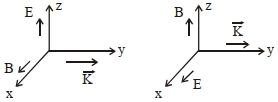
0 likes
View Solution279
DifficultMCQ
An electromagnetic wave of frequency $5\, GHz$ is travelling in a medium whose relative electric permittivity and relative magnetic permeability both are $2$. Its velocity in this medium is $\times 10^{7}\, m/s$.
A
$12$
B
$18$
C
$15$
D
$20$
Solution
(C) Given: Frequency of wave $f = 5\, GHz = 5 \times 10^{9}\, Hz$.
Relative permittivity,$\epsilon_{r} = 2$.
Relative permeability,$\mu_{r} = 2$.
The speed of an electromagnetic wave in a medium is given by the formula:
$v = \frac{1}{\sqrt{\mu \epsilon}} = \frac{1}{\sqrt{\mu_{r} \mu_{0} \cdot \epsilon_{r} \epsilon_{0}}}$
$v = \frac{1}{\sqrt{\mu_{r} \epsilon_{r}}} \cdot \frac{1}{\sqrt{\mu_{0} \epsilon_{0}}} = \frac{c}{\sqrt{\mu_{r} \epsilon_{r}}}$
Where $c$ is the speed of light in a vacuum $(c \approx 3 \times 10^{8}\, m/s)$.
Substituting the values:
$v = \frac{3 \times 10^{8}}{\sqrt{2 \times 2}} = \frac{3 \times 10^{8}}{\sqrt{4}} = \frac{3 \times 10^{8}}{2} = 1.5 \times 10^{8}\, m/s$.
$v = 15 \times 10^{7}\, m/s$.
Therefore,the velocity is $15 \times 10^{7}\, m/s$.
Relative permittivity,$\epsilon_{r} = 2$.
Relative permeability,$\mu_{r} = 2$.
The speed of an electromagnetic wave in a medium is given by the formula:
$v = \frac{1}{\sqrt{\mu \epsilon}} = \frac{1}{\sqrt{\mu_{r} \mu_{0} \cdot \epsilon_{r} \epsilon_{0}}}$
$v = \frac{1}{\sqrt{\mu_{r} \epsilon_{r}}} \cdot \frac{1}{\sqrt{\mu_{0} \epsilon_{0}}} = \frac{c}{\sqrt{\mu_{r} \epsilon_{r}}}$
Where $c$ is the speed of light in a vacuum $(c \approx 3 \times 10^{8}\, m/s)$.
Substituting the values:
$v = \frac{3 \times 10^{8}}{\sqrt{2 \times 2}} = \frac{3 \times 10^{8}}{\sqrt{4}} = \frac{3 \times 10^{8}}{2} = 1.5 \times 10^{8}\, m/s$.
$v = 15 \times 10^{7}\, m/s$.
Therefore,the velocity is $15 \times 10^{7}\, m/s$.
0 likes
View Solution280
DifficultMCQ
$A$ radiation is emitted by a $1000 \, W$ bulb and it generates an electric field and magnetic field at point $P$, placed at a distance of $2 \, m$. The efficiency of the bulb is $1.25 \%$. The value of the peak electric field at $P$ is $x \times 10^{-1} \, V/m$. The value of $x$ is (rounded off to the nearest integer).
[Take $\varepsilon_{0} = 8.85 \times 10^{-12} \, C^2 N^{-1} m^{-2}, c = 3 \times 10^8 \, m/s$]
[Take $\varepsilon_{0} = 8.85 \times 10^{-12} \, C^2 N^{-1} m^{-2}, c = 3 \times 10^8 \, m/s$]
A
$137$
B
$149$
C
$164$
D
$121$
Solution
(A) The power radiated by the bulb is $P_{rad} = \text{Efficiency} \times P_{total} = \frac{1.25}{100} \times 1000 \, W = 12.5 \, W$.
The intensity $I$ at a distance $r = 2 \, m$ is given by $I = \frac{P_{rad}}{4 \pi r^2} = \frac{12.5}{4 \pi (2)^2} = \frac{12.5}{16 \pi} \, W/m^2$.
The relationship between intensity and peak electric field $E_0$ is $I = \frac{1}{2} \varepsilon_0 E_0^2 c$.
Equating the two expressions for intensity:
$\frac{12.5}{16 \pi} = \frac{1}{2} \times 8.85 \times 10^{-12} \times 3 \times 10^8 \times E_0^2$.
$E_0^2 = \frac{12.5 \times 2}{16 \times 3.14159 \times 8.85 \times 10^{-12} \times 3 \times 10^8} \approx \frac{25}{132.73} \times 10^4 \approx 188.35$.
$E_0 = \sqrt{188.35} \approx 13.724 \, V/m$.
Expressing this as $x \times 10^{-1} \, V/m$, we get $E_0 = 137.24 \times 10^{-1} \, V/m$.
Rounding to the nearest integer, $x = 137$.
The intensity $I$ at a distance $r = 2 \, m$ is given by $I = \frac{P_{rad}}{4 \pi r^2} = \frac{12.5}{4 \pi (2)^2} = \frac{12.5}{16 \pi} \, W/m^2$.
The relationship between intensity and peak electric field $E_0$ is $I = \frac{1}{2} \varepsilon_0 E_0^2 c$.
Equating the two expressions for intensity:
$\frac{12.5}{16 \pi} = \frac{1}{2} \times 8.85 \times 10^{-12} \times 3 \times 10^8 \times E_0^2$.
$E_0^2 = \frac{12.5 \times 2}{16 \times 3.14159 \times 8.85 \times 10^{-12} \times 3 \times 10^8} \approx \frac{25}{132.73} \times 10^4 \approx 188.35$.
$E_0 = \sqrt{188.35} \approx 13.724 \, V/m$.
Expressing this as $x \times 10^{-1} \, V/m$, we get $E_0 = 137.24 \times 10^{-1} \, V/m$.
Rounding to the nearest integer, $x = 137$.
1 likes
View Solution281
DifficultMCQ
An electromagnetic wave of frequency $3 \, GHz$ enters a dielectric medium of relative electric permittivity $2.25$ from vacuum. The wavelength of this wave in that medium will be $....... \times 10^{-2} \, cm$.
A
$667$
B
$577$
C
$627$
D
$747$
Solution
(A) The frequency of the wave is $f = 3 \, GHz = 3 \times 10^9 \, Hz$.
In vacuum,the wavelength is $\lambda_0 = \frac{c}{f} = \frac{3 \times 10^8 \, m/s}{3 \times 10^9 \, Hz} = 0.1 \, m = 10 \, cm$.
The refractive index of the medium is given by $n = \sqrt{\epsilon_r \mu_r}$. Assuming the medium is non-magnetic,$\mu_r = 1$.
Thus,$n = \sqrt{2.25} = 1.5$.
The wavelength in the medium is $\lambda_m = \frac{\lambda_0}{n} = \frac{10 \, cm}{1.5} = \frac{100}{15} \, cm = 6.666... \, cm \approx 6.67 \, cm$.
Expressing this in the form $x \times 10^{-2} \, cm$,we get $6.67 \, cm = 667 \times 10^{-2} \, cm$.
In vacuum,the wavelength is $\lambda_0 = \frac{c}{f} = \frac{3 \times 10^8 \, m/s}{3 \times 10^9 \, Hz} = 0.1 \, m = 10 \, cm$.
The refractive index of the medium is given by $n = \sqrt{\epsilon_r \mu_r}$. Assuming the medium is non-magnetic,$\mu_r = 1$.
Thus,$n = \sqrt{2.25} = 1.5$.
The wavelength in the medium is $\lambda_m = \frac{\lambda_0}{n} = \frac{10 \, cm}{1.5} = \frac{100}{15} \, cm = 6.666... \, cm \approx 6.67 \, cm$.
Expressing this in the form $x \times 10^{-2} \, cm$,we get $6.67 \, cm = 667 \times 10^{-2} \, cm$.
0 likes
View Solution282
DifficultMCQ
The peak electric field produced by the radiation coming from the $80\, W$ bulb at a distance of $10\, m$ is $\frac{x}{10} \sqrt{\frac{\mu_{0} c }{\pi}} \,\frac{ V }{ m }$. The efficiency of the bulb is $10\, \%$ and it is a point source. The value of $x$ is ...... .
A
$1$
B
$3$
C
$4$
D
$2$
Solution
(D) The power of the bulb is $P = 80\, W$. The efficiency is $10\, \%$,so the radiated power is $P_{rad} = 80 \times 0.10 = 8\, W$.
Since it is a point source,the intensity $I$ at a distance $r = 10\, m$ is given by $I = \frac{P_{rad}}{4 \pi r^{2}} = \frac{8}{4 \pi (10)^{2}} = \frac{8}{400 \pi} = \frac{1}{50 \pi} \, W/m^{2}$.
The intensity of an electromagnetic wave is related to the peak electric field $E_{0}$ by $I = \frac{1}{2} c \epsilon_{0} E_{0}^{2}$.
Using $\epsilon_{0} = \frac{1}{\mu_{0} c^{2}}$,we get $I = \frac{1}{2} c \left( \frac{1}{\mu_{0} c^{2}} \right) E_{0}^{2} = \frac{E_{0}^{2}}{2 \mu_{0} c}$.
Equating the two expressions for $I$: $\frac{E_{0}^{2}}{2 \mu_{0} c} = \frac{1}{50 \pi}$.
$E_{0}^{2} = \frac{2 \mu_{0} c}{50 \pi} = \frac{\mu_{0} c}{25 \pi}$.
$E_{0} = \sqrt{\frac{\mu_{0} c}{25 \pi}} = \frac{1}{5} \sqrt{\frac{\mu_{0} c}{\pi}} = \frac{2}{10} \sqrt{\frac{\mu_{0} c}{\pi}}$.
Comparing this with $\frac{x}{10} \sqrt{\frac{\mu_{0} c}{\pi}}$,we find $x = 2$.
Since it is a point source,the intensity $I$ at a distance $r = 10\, m$ is given by $I = \frac{P_{rad}}{4 \pi r^{2}} = \frac{8}{4 \pi (10)^{2}} = \frac{8}{400 \pi} = \frac{1}{50 \pi} \, W/m^{2}$.
The intensity of an electromagnetic wave is related to the peak electric field $E_{0}$ by $I = \frac{1}{2} c \epsilon_{0} E_{0}^{2}$.
Using $\epsilon_{0} = \frac{1}{\mu_{0} c^{2}}$,we get $I = \frac{1}{2} c \left( \frac{1}{\mu_{0} c^{2}} \right) E_{0}^{2} = \frac{E_{0}^{2}}{2 \mu_{0} c}$.
Equating the two expressions for $I$: $\frac{E_{0}^{2}}{2 \mu_{0} c} = \frac{1}{50 \pi}$.
$E_{0}^{2} = \frac{2 \mu_{0} c}{50 \pi} = \frac{\mu_{0} c}{25 \pi}$.
$E_{0} = \sqrt{\frac{\mu_{0} c}{25 \pi}} = \frac{1}{5} \sqrt{\frac{\mu_{0} c}{\pi}} = \frac{2}{10} \sqrt{\frac{\mu_{0} c}{\pi}}$.
Comparing this with $\frac{x}{10} \sqrt{\frac{\mu_{0} c}{\pi}}$,we find $x = 2$.
0 likes
View Solution283
DifficultMCQ
The electric field in a plane electromagnetic wave is given by $\overrightarrow{E} = 200 \cos \left[ (0.5 \times 10^{3} \text{ m}^{-1}) x - (1.5 \times 10^{11} \text{ rad/s}) t \right] \hat{j} \text{ V/m}$. If this wave falls normally on a perfectly reflecting surface having an area of $100 \text{ cm}^{2}$,and the radiation pressure exerted by the electromagnetic wave on the surface is $\frac{x}{10^{9}} \text{ N/m}^{2}$,find the value of $x$.
A
$254$
B
$354$
C
$154$
D
$54$
Solution
(B) The amplitude of the electric field is $E_{0} = 200 \text{ V/m}$.
The intensity $I$ of the electromagnetic wave is given by $I = \frac{1}{2} \varepsilon_{0} E_{0}^{2} c$.
For a perfectly reflecting surface,the radiation pressure $P$ is given by $P = \frac{2I}{c}$.
Substituting the expression for $I$ into the pressure formula: $P = \frac{2}{c} \left( \frac{1}{2} \varepsilon_{0} E_{0}^{2} c \right) = \varepsilon_{0} E_{0}^{2}$.
Using $\varepsilon_{0} = 8.85 \times 10^{-12} \text{ F/m}$,we calculate $P = 8.85 \times 10^{-12} \times (200)^{2}$.
$P = 8.85 \times 10^{-12} \times 40000 = 8.85 \times 4 \times 10^{-8} = 35.4 \times 10^{-8} = \frac{354}{10^{9}} \text{ N/m}^{2}$.
Comparing this with $\frac{x}{10^{9}} \text{ N/m}^{2}$,we get $x = 354$.
The intensity $I$ of the electromagnetic wave is given by $I = \frac{1}{2} \varepsilon_{0} E_{0}^{2} c$.
For a perfectly reflecting surface,the radiation pressure $P$ is given by $P = \frac{2I}{c}$.
Substituting the expression for $I$ into the pressure formula: $P = \frac{2}{c} \left( \frac{1}{2} \varepsilon_{0} E_{0}^{2} c \right) = \varepsilon_{0} E_{0}^{2}$.
Using $\varepsilon_{0} = 8.85 \times 10^{-12} \text{ F/m}$,we calculate $P = 8.85 \times 10^{-12} \times (200)^{2}$.
$P = 8.85 \times 10^{-12} \times 40000 = 8.85 \times 4 \times 10^{-8} = 35.4 \times 10^{-8} = \frac{354}{10^{9}} \text{ N/m}^{2}$.
Comparing this with $\frac{x}{10^{9}} \text{ N/m}^{2}$,we get $x = 354$.
0 likes
View Solution284
MediumMCQ
$A$ light beam is described by $E = 800 \sin \omega (t - x/c)$. An electron is allowed to move normal to the propagation of the light beam with a speed of $3 \times 10^{7} \text{ m/s}$. What is the maximum magnetic force exerted on the electron?
A
$1.28 \times 10^{-18} \text{ N}$
B
$1.28 \times 10^{-21} \text{ N}$
C
$12.8 \times 10^{-17} \text{ N}$
D
$12.8 \times 10^{-18} \text{ N}$
Solution
(D) The electric field amplitude is given by $E_0 = 800 \text{ V/m}$.
The relationship between the electric field amplitude $E_0$ and magnetic field amplitude $B_0$ is $B_0 = E_0 / c$,where $c = 3 \times 10^8 \text{ m/s}$ is the speed of light.
$B_0 = \frac{800}{3 \times 10^8} \text{ T}$.
The magnetic force on a moving charge is $F = qvB \sin \theta$. For maximum force,the electron moves normal to the magnetic field,so $\theta = 90^\circ$ and $\sin 90^\circ = 1$.
$F_{\max} = e v B_0 = (1.6 \times 10^{-19} \text{ C}) \times (3 \times 10^7 \text{ m/s}) \times \left( \frac{800}{3 \times 10^8} \text{ T} \right)$.
$F_{\max} = 1.6 \times 10^{-19} \times 800 \times 10^{-1} = 1.6 \times 8 \times 10^{-18} = 12.8 \times 10^{-18} \text{ N}$.
The relationship between the electric field amplitude $E_0$ and magnetic field amplitude $B_0$ is $B_0 = E_0 / c$,where $c = 3 \times 10^8 \text{ m/s}$ is the speed of light.
$B_0 = \frac{800}{3 \times 10^8} \text{ T}$.
The magnetic force on a moving charge is $F = qvB \sin \theta$. For maximum force,the electron moves normal to the magnetic field,so $\theta = 90^\circ$ and $\sin 90^\circ = 1$.
$F_{\max} = e v B_0 = (1.6 \times 10^{-19} \text{ C}) \times (3 \times 10^7 \text{ m/s}) \times \left( \frac{800}{3 \times 10^8} \text{ T} \right)$.
$F_{\max} = 1.6 \times 10^{-19} \times 800 \times 10^{-1} = 1.6 \times 8 \times 10^{-18} = 12.8 \times 10^{-18} \text{ N}$.
0 likes
View Solution285
DifficultMCQ
If $E$ and $H$ represent the intensity of the electric field and the magnetising field respectively,then the unit of $E/H$ will be:
A
$ohm$
B
$mho$
C
$joule$
D
$newton$
Solution
(A) The unit of electric field intensity $E$ is $\text{volt/metre}$ $(V/m)$.
The unit of magnetising field intensity $H$ is $\text{Ampere/metre}$ $(A/m)$.
Therefore,the unit of the ratio $E/H$ is given by:
$\frac{E}{H} = \frac{\text{volt/metre}}{\text{Ampere/metre}} = \frac{\text{volt}}{\text{Ampere}}$.
Since,by Ohm's law,$R = V/I$,the unit of $V/I$ is the $ohm$ $(\Omega)$.
Thus,the unit of $E/H$ is $ohm$.
The unit of magnetising field intensity $H$ is $\text{Ampere/metre}$ $(A/m)$.
Therefore,the unit of the ratio $E/H$ is given by:
$\frac{E}{H} = \frac{\text{volt/metre}}{\text{Ampere/metre}} = \frac{\text{volt}}{\text{Ampere}}$.
Since,by Ohm's law,$R = V/I$,the unit of $V/I$ is the $ohm$ $(\Omega)$.
Thus,the unit of $E/H$ is $ohm$.
0 likes
View Solution286
MediumMCQ
The electric field in a plane electromagnetic wave is given by $E = 50 \sin(500x - 10 \times 10^{10}t) \, V/m$. The velocity of the electromagnetic wave in this medium is: (Given $C = \text{speed of light in vacuum}$)
A
$\frac{3}{2} C$
B
$C$
C
$\frac{2}{3} C$
D
$\frac{C}{2}$
Solution
(C) The general equation for a plane electromagnetic wave is $E = E_0 \sin(kx - \omega t)$.
Comparing this with the given equation $E = 50 \sin(500x - 10 \times 10^{10}t)$,we get:
Wave number $k = 500 \, \text{rad/m}$
Angular frequency $\omega = 10 \times 10^{10} \, \text{rad/s}$
The velocity of the wave $v$ is given by $v = \frac{\omega}{k}$.
Substituting the values: $v = \frac{10 \times 10^{10}}{500} = \frac{10^{11}}{5 \times 10^2} = 2 \times 10^8 \, \text{m/s}$.
Since the speed of light in vacuum is $C = 3 \times 10^8 \, \text{m/s}$,we can write $v = \frac{2}{3} \times 3 \times 10^8 = \frac{2}{3} C$.
Comparing this with the given equation $E = 50 \sin(500x - 10 \times 10^{10}t)$,we get:
Wave number $k = 500 \, \text{rad/m}$
Angular frequency $\omega = 10 \times 10^{10} \, \text{rad/s}$
The velocity of the wave $v$ is given by $v = \frac{\omega}{k}$.
Substituting the values: $v = \frac{10 \times 10^{10}}{500} = \frac{10^{11}}{5 \times 10^2} = 2 \times 10^8 \, \text{m/s}$.
Since the speed of light in vacuum is $C = 3 \times 10^8 \, \text{m/s}$,we can write $v = \frac{2}{3} \times 3 \times 10^8 = \frac{2}{3} C$.
0 likes
View Solution287
MediumMCQ
$A$ plane electromagnetic wave with a frequency of $30 \text{ MHz}$ travels in free space. At a particular point in space and time,the electric field is $6 \text{ V/m}$. The magnetic field at this point will be $x \times 10^{-8} \text{ T}$. The value of $x$ is ..... .
A
$1$
B
$2$
C
$4$
D
$20$
Solution
(B) The relationship between the magnitude of the electric field $E$ and the magnetic field $B$ in an electromagnetic wave traveling in free space is given by the equation $B = \frac{E}{c}$,where $c$ is the speed of light in vacuum.
Given that $E = 6 \text{ V/m}$ and $c = 3 \times 10^{8} \text{ m/s}$.
Substituting these values into the formula:
$B = \frac{6}{3 \times 10^{8}} \text{ T}$
$B = 2 \times 10^{-8} \text{ T}$
Comparing this with the given expression $x \times 10^{-8} \text{ T}$,we find that $x = 2$.
Given that $E = 6 \text{ V/m}$ and $c = 3 \times 10^{8} \text{ m/s}$.
Substituting these values into the formula:
$B = \frac{6}{3 \times 10^{8}} \text{ T}$
$B = 2 \times 10^{-8} \text{ T}$
Comparing this with the given expression $x \times 10^{-8} \text{ T}$,we find that $x = 2$.
0 likes
View Solution288
DifficultMCQ
The electric field in an electromagnetic wave is given by $E = (50 \, NC^{-1}) \sin \omega(t - x/c)$. The energy contained in a cylinder of volume $V$ is $5.5 \times 10^{-12} \, J$. The value of $V$ is $...... \, cm^3$ (given $\epsilon_0 = 8.8 \times 10^{-12} \, C^2 N^{-1} m^{-2}$).
A
$5000$
B
$1500$
C
$500$
D
$100$
Solution
(C) The electric field is given by $E = E_0 \sin \omega(t - x/c)$,where $E_0 = 50 \, NC^{-1}$.
The energy density $u$ of an electromagnetic wave is given by $u = \frac{1}{2} \epsilon_0 E_0^2$.
The total energy $U$ in a volume $V$ is $U = u \cdot V = \frac{1}{2} \epsilon_0 E_0^2 V$.
Given $U = 5.5 \times 10^{-12} \, J$ and $\epsilon_0 = 8.8 \times 10^{-12} \, C^2 N^{-1} m^{-2}$,we have:
$5.5 \times 10^{-12} = \frac{1}{2} \times (8.8 \times 10^{-12}) \times (50)^2 \times V$.
$5.5 = 0.5 \times 8.8 \times 2500 \times V$.
$5.5 = 4.4 \times 2500 \times V$.
$5.5 = 11000 \times V$.
$V = \frac{5.5}{11000} = 0.0005 \, m^3$.
Converting $m^3$ to $cm^3$:
$V = 0.0005 \times (100 \, cm)^3 = 0.0005 \times 10^6 \, cm^3 = 500 \, cm^3$.
The energy density $u$ of an electromagnetic wave is given by $u = \frac{1}{2} \epsilon_0 E_0^2$.
The total energy $U$ in a volume $V$ is $U = u \cdot V = \frac{1}{2} \epsilon_0 E_0^2 V$.
Given $U = 5.5 \times 10^{-12} \, J$ and $\epsilon_0 = 8.8 \times 10^{-12} \, C^2 N^{-1} m^{-2}$,we have:
$5.5 \times 10^{-12} = \frac{1}{2} \times (8.8 \times 10^{-12}) \times (50)^2 \times V$.
$5.5 = 0.5 \times 8.8 \times 2500 \times V$.
$5.5 = 4.4 \times 2500 \times V$.
$5.5 = 11000 \times V$.
$V = \frac{5.5}{11000} = 0.0005 \, m^3$.
Converting $m^3$ to $cm^3$:
$V = 0.0005 \times (100 \, cm)^3 = 0.0005 \times 10^6 \, cm^3 = 500 \, cm^3$.
0 likes
View Solution289
DifficultMCQ
The electric field of a plane electromagnetic wave propagating through a non-magnetic medium is given by $E = 20 \cos (2 \times 10^{10} t - 200 x) \, V/m$. The dielectric constant of the medium is equal to: (Take $\mu_r = 1$)
A
$9$
B
$2$
C
$1/3$
D
$3$
Solution
(A) The general equation for a plane electromagnetic wave is $E = E_0 \cos(\omega t - kx)$.
Comparing this with the given equation $E = 20 \cos(2 \times 10^{10} t - 200 x)$,we get angular frequency $\omega = 2 \times 10^{10} \, rad/s$ and wave number $k = 200 \, rad/m$.
The speed of the wave in the medium is $v = \omega / k = (2 \times 10^{10}) / 200 = 10^8 \, m/s$.
The refractive index of the medium is $n = c / v$,where $c = 3 \times 10^8 \, m/s$ is the speed of light in vacuum.
Thus,$n = (3 \times 10^8) / 10^8 = 3$.
For a non-magnetic medium,the refractive index is given by $n = \sqrt{\epsilon_r \mu_r}$.
Given $\mu_r = 1$,we have $n = \sqrt{\epsilon_r}$.
Substituting the value of $n$,we get $3 = \sqrt{\epsilon_r}$,which implies $\epsilon_r = 3^2 = 9$.
Comparing this with the given equation $E = 20 \cos(2 \times 10^{10} t - 200 x)$,we get angular frequency $\omega = 2 \times 10^{10} \, rad/s$ and wave number $k = 200 \, rad/m$.
The speed of the wave in the medium is $v = \omega / k = (2 \times 10^{10}) / 200 = 10^8 \, m/s$.
The refractive index of the medium is $n = c / v$,where $c = 3 \times 10^8 \, m/s$ is the speed of light in vacuum.
Thus,$n = (3 \times 10^8) / 10^8 = 3$.
For a non-magnetic medium,the refractive index is given by $n = \sqrt{\epsilon_r \mu_r}$.
Given $\mu_r = 1$,we have $n = \sqrt{\epsilon_r}$.
Substituting the value of $n$,we get $3 = \sqrt{\epsilon_r}$,which implies $\epsilon_r = 3^2 = 9$.
0 likes
View Solution290
MediumMCQ
For a plane electromagnetic wave propagating in the $x$-direction,which one of the following combinations gives the correct possible directions for the electric field $(E)$ and magnetic field $(B)$ respectively?
A
$\hat{j}+\hat{k}, \hat{j}+\hat{k}$
B
$-\hat{j}+\hat{k}, -\hat{j}-\hat{k}$
C
$\hat{j}+\hat{k}, -\hat{j}-\hat{k}$
D
$-\hat{j}+\hat{k}, -\hat{j}+\hat{k}$
Solution
(B) The direction of propagation of an electromagnetic wave is given by the direction of the Poynting vector,which is $\vec{E} \times \vec{B}$.
Given the wave propagates in the $x$-direction,we must have $\vec{E} \times \vec{B} = \hat{i}$.
Let us check option $B$: $\vec{E} = -\hat{j} + \hat{k}$ and $\vec{B} = -\hat{j} - \hat{k}$.
Calculating the cross product: $(-\hat{j} + \hat{k}) \times (-\hat{j} - \hat{k}) = (-\hat{j} \times -\hat{j}) - (\hat{j} \times -\hat{k}) + (\hat{k} \times -\hat{j}) - (\hat{k} \times -\hat{k})$.
$= 0 + (\hat{j} \times \hat{k}) - (\hat{k} \times \hat{j}) - 0 = \hat{i} - (-\hat{i}) = 2\hat{i}$.
Since the resulting vector is in the $x$-direction,option $B$ is correct.
Given the wave propagates in the $x$-direction,we must have $\vec{E} \times \vec{B} = \hat{i}$.
Let us check option $B$: $\vec{E} = -\hat{j} + \hat{k}$ and $\vec{B} = -\hat{j} - \hat{k}$.
Calculating the cross product: $(-\hat{j} + \hat{k}) \times (-\hat{j} - \hat{k}) = (-\hat{j} \times -\hat{j}) - (\hat{j} \times -\hat{k}) + (\hat{k} \times -\hat{j}) - (\hat{k} \times -\hat{k})$.
$= 0 + (\hat{j} \times \hat{k}) - (\hat{k} \times \hat{j}) - 0 = \hat{i} - (-\hat{i}) = 2\hat{i}$.
Since the resulting vector is in the $x$-direction,option $B$ is correct.
0 likes
View Solution291
MediumMCQ
In an electromagnetic wave,the electric field vector and magnetic field vector are given as $\vec{E} = E_{0} \hat{i}$ and $\vec{B} = B_{0} \hat{k}$ respectively. The direction of propagation of the electromagnetic wave is along:
A
$\hat{j}$
B
$\hat{k}$
C
$-\hat{k}$
D
$-\hat{j}$
Solution
(D) The direction of propagation of an electromagnetic wave is given by the direction of the Poynting vector,which is parallel to $\vec{E} \times \vec{B}$.
Given $\vec{E} = E_{0} \hat{i}$ and $\vec{B} = B_{0} \hat{k}$.
The direction of propagation is $\hat{i} \times \hat{k}$.
Using the cross product rules for unit vectors: $\hat{i} \times \hat{j} = \hat{k}$,$\hat{j} \times \hat{k} = \hat{i}$,and $\hat{k} \times \hat{i} = \hat{j}$.
Since the order is reversed,$\hat{i} \times \hat{k} = -\hat{j}$.
Therefore,the direction of propagation is along $-\hat{j}$.
Given $\vec{E} = E_{0} \hat{i}$ and $\vec{B} = B_{0} \hat{k}$.
The direction of propagation is $\hat{i} \times \hat{k}$.
Using the cross product rules for unit vectors: $\hat{i} \times \hat{j} = \hat{k}$,$\hat{j} \times \hat{k} = \hat{i}$,and $\hat{k} \times \hat{i} = \hat{j}$.
Since the order is reversed,$\hat{i} \times \hat{k} = -\hat{j}$.
Therefore,the direction of propagation is along $-\hat{j}$.
0 likes
View Solution292
MediumMCQ
Intensity of sunlight is observed as $0.092 \, W/m^2$ at a point in free space. What will be the peak value of the magnetic field at that point? (Given: $\epsilon_0 = 8.85 \times 10^{-12} \, C^2 N^{-1} m^{-2}$,$c = 3 \times 10^8 \, m/s$)
A
$8.31 \, T$
B
$5.88 \, T$
C
$1.96 \times 10^{-8} \, T$
D
$2.77 \times 10^{-8} \, T$
Solution
(D) The intensity $I$ of an electromagnetic wave is related to the peak magnetic field $B_0$ by the formula: $I = \frac{B_0^2 c}{2 \mu_0}$.
Since $c = \frac{1}{\sqrt{\mu_0 \epsilon_0}}$,we have $\frac{1}{\mu_0} = \epsilon_0 c^2$.
Substituting this into the intensity formula: $I = \frac{B_0^2 c}{2} (\epsilon_0 c^2) = \frac{1}{2} \epsilon_0 c^3 B_0^2$.
Rearranging for $B_0$: $B_0 = \sqrt{\frac{2I}{\epsilon_0 c^3}}$.
Given $I = 0.092 \, W/m^2$,$\epsilon_0 = 8.85 \times 10^{-12} \, F/m$,and $c = 3 \times 10^8 \, m/s$:
$B_0 = \sqrt{\frac{2 \times 0.092}{8.85 \times 10^{-12} \times (3 \times 10^8)^3}}$.
$B_0 = \sqrt{\frac{0.184}{8.85 \times 10^{-12} \times 27 \times 10^{24}}} = \sqrt{\frac{0.184}{238.95 \times 10^{12}}} = \sqrt{0.00077 \times 10^{-12}} = \sqrt{7.7 \times 10^{-16}} \approx 2.77 \times 10^{-8} \, T$.
Since $c = \frac{1}{\sqrt{\mu_0 \epsilon_0}}$,we have $\frac{1}{\mu_0} = \epsilon_0 c^2$.
Substituting this into the intensity formula: $I = \frac{B_0^2 c}{2} (\epsilon_0 c^2) = \frac{1}{2} \epsilon_0 c^3 B_0^2$.
Rearranging for $B_0$: $B_0 = \sqrt{\frac{2I}{\epsilon_0 c^3}}$.
Given $I = 0.092 \, W/m^2$,$\epsilon_0 = 8.85 \times 10^{-12} \, F/m$,and $c = 3 \times 10^8 \, m/s$:
$B_0 = \sqrt{\frac{2 \times 0.092}{8.85 \times 10^{-12} \times (3 \times 10^8)^3}}$.
$B_0 = \sqrt{\frac{0.184}{8.85 \times 10^{-12} \times 27 \times 10^{24}}} = \sqrt{\frac{0.184}{238.95 \times 10^{12}}} = \sqrt{0.00077 \times 10^{-12}} = \sqrt{7.7 \times 10^{-16}} \approx 2.77 \times 10^{-8} \, T$.
0 likes
View Solution293
MediumMCQ
$A$ linearly polarized electromagnetic wave in vacuum is given by $E = 3.1 \cos \left[(1.8)z - (5.4 \times 10^6)t\right] \hat{i} \text{ N/C}$. It is incident normally on a perfectly reflecting wall at $z = a$. Choose the correct option.
A
The wavelength is $5.4 \text{ m}$.
B
The frequency of the electromagnetic wave is $54 \times 10^4 \text{ Hz}$.
C
The transmitted wave will be $3.1 \cos \left[(1.8)z - (5.4 \times 10^6)t\right] \hat{i} \text{ N/C}$.
D
The reflected wave will be $3.1 \cos \left[(1.8)z + (5.4 \times 10^6)t\right] \hat{i} \text{ N/C}$.
Solution
(D) The incident wave is traveling in the $+z$ direction,given by the form $\cos(kz - \omega t)$.
When an electromagnetic wave is incident normally on a perfectly reflecting wall,the reflected wave travels in the opposite direction ($-z$ direction).
The reflected wave will have the form $\cos(kz + \omega t)$.
Given the incident wave $E_i = 3.1 \cos \left[(1.8)z - (5.4 \times 10^6)t\right] \hat{i}$,the reflected wave $E_r$ must have the same amplitude and frequency but a reversed propagation direction.
Thus,$E_r = 3.1 \cos \left[(1.8)z + (5.4 \times 10^6)t\right] \hat{i} \text{ N/C}$.
Therefore,option $D$ is correct.
When an electromagnetic wave is incident normally on a perfectly reflecting wall,the reflected wave travels in the opposite direction ($-z$ direction).
The reflected wave will have the form $\cos(kz + \omega t)$.
Given the incident wave $E_i = 3.1 \cos \left[(1.8)z - (5.4 \times 10^6)t\right] \hat{i}$,the reflected wave $E_r$ must have the same amplitude and frequency but a reversed propagation direction.
Thus,$E_r = 3.1 \cos \left[(1.8)z + (5.4 \times 10^6)t\right] \hat{i} \text{ N/C}$.
Therefore,option $D$ is correct.
0 likes
View Solution294
MediumMCQ
The relative permittivity of distilled water is $81$. The velocity of light in it will be $....\times 10^{7} \text{ m/s}$. (Given $\mu_{r} = 1$) (in $.33$)
A
$5$
B
$4$
C
$3$
D
$2$
Solution
(C) The velocity of light in a medium is given by the formula $v = \frac{c}{\sqrt{\mu_{r} \varepsilon_{r}}}$,where $c$ is the speed of light in vacuum $(3 \times 10^{8} \text{ m/s})$,$\mu_{r}$ is the relative permeability,and $\varepsilon_{r}$ is the relative permittivity.
Given $\mu_{r} = 1$ and $\varepsilon_{r} = 81$.
Substituting these values into the formula:
$v = \frac{3 \times 10^{8}}{\sqrt{1 \times 81}}$
$v = \frac{3 \times 10^{8}}{9}$
$v = 0.333 \times 10^{8} \text{ m/s}$
$v = 3.33 \times 10^{7} \text{ m/s}$.
Given $\mu_{r} = 1$ and $\varepsilon_{r} = 81$.
Substituting these values into the formula:
$v = \frac{3 \times 10^{8}}{\sqrt{1 \times 81}}$
$v = \frac{3 \times 10^{8}}{9}$
$v = 0.333 \times 10^{8} \text{ m/s}$
$v = 3.33 \times 10^{7} \text{ m/s}$.
0 likes
View Solution295
MediumMCQ
When light propagates through a material medium of relative permittivity $\varepsilon_{r}$ and relative permeability $\mu_{r}$,the velocity of light,$v$,is given by: ($c$ = velocity of light in vacuum)
A
$v=\sqrt{\frac{\mu_{r}}{\varepsilon_{r}}}$
B
$v=\sqrt{\frac{\varepsilon_{r}}{\mu_{r}}}$
C
$v=\frac{c}{\sqrt{\varepsilon_{r}\mu_{r}}}$
D
$v=c$
Solution
(C) The refractive index $n$ of a medium is related to its relative permittivity $\varepsilon_{r}$ and relative permeability $\mu_{r}$ by the formula: $n = \sqrt{\varepsilon_{r}\mu_{r}}$.
Since the refractive index is defined as the ratio of the speed of light in vacuum $c$ to the speed of light in the medium $v$,we have $n = \frac{c}{v}$.
Rearranging this for $v$,we get $v = \frac{c}{n}$.
Substituting the expression for $n$,we obtain the velocity of light in the medium as $v = \frac{c}{\sqrt{\varepsilon_{r}\mu_{r}}}$.
Since the refractive index is defined as the ratio of the speed of light in vacuum $c$ to the speed of light in the medium $v$,we have $n = \frac{c}{v}$.
Rearranging this for $v$,we get $v = \frac{c}{n}$.
Substituting the expression for $n$,we obtain the velocity of light in the medium as $v = \frac{c}{\sqrt{\varepsilon_{r}\mu_{r}}}$.
0 likes
View Solution296
DifficultMCQ
An electric bulb is rated as $200 \, W$. What will be the peak magnetic field $(\times 10^{-8} \, T)$ at $4 \, m$ distance produced by the radiations coming from this bulb? Consider this bulb as a point source with $3.5 \%$ efficiency.
A
$1.19$
B
$1.71$
C
$0.84$
D
$3.36$
Solution
(B) The intensity $I$ of the electromagnetic wave at a distance $r$ from a point source is given by $I = \frac{\eta P}{4 \pi r^2}$,where $\eta = 0.035$ is the efficiency and $P = 200 \, W$ is the power.
Also,the intensity is related to the peak magnetic field $B_0$ by $I = \frac{c B_0^2}{2 \mu_0}$.
Equating the two expressions: $\frac{\eta P}{4 \pi r^2} = \frac{c B_0^2}{2 \mu_0}$.
Rearranging for $B_0$: $B_0 = \sqrt{\frac{\mu_0 \eta P}{2 \pi c r^2}} = \frac{1}{r} \sqrt{\frac{\mu_0 \eta P}{2 \pi c}}$.
Given $\frac{\mu_0}{4 \pi} = 10^{-7} \, T \cdot m/A$,$c = 3 \times 10^8 \, m/s$,$r = 4 \, m$,$\eta = 0.035$,and $P = 200 \, W$.
$B_0 = \frac{1}{4} \sqrt{\frac{2 \times 10^{-7} \times 0.035 \times 200}{3 \times 10^8}} = \frac{1}{4} \sqrt{\frac{14 \times 10^{-7}}{3 \times 10^8}} = \frac{1}{4} \sqrt{4.66 \times 10^{-16}} = \frac{2.16 \times 10^{-8}}{4} \approx 0.54 \times 10^{-8} \, T$.
Re-evaluating the provided formula in the prompt: $B_0 = \frac{1}{r} \sqrt{\frac{\mu_0 \eta P}{2 \pi c}} = \frac{1}{4} \sqrt{\frac{2 \times 10^{-7} \times 0.035 \times 200}{3 \times 10^8}} = 1.71 \times 10^{-8} \, T$ is obtained if the formula used is $B_0 = \sqrt{\frac{\mu_0 \eta P}{2 \pi c r^2}}$. The calculation yields $1.71 \times 10^{-8} \, T$.
Also,the intensity is related to the peak magnetic field $B_0$ by $I = \frac{c B_0^2}{2 \mu_0}$.
Equating the two expressions: $\frac{\eta P}{4 \pi r^2} = \frac{c B_0^2}{2 \mu_0}$.
Rearranging for $B_0$: $B_0 = \sqrt{\frac{\mu_0 \eta P}{2 \pi c r^2}} = \frac{1}{r} \sqrt{\frac{\mu_0 \eta P}{2 \pi c}}$.
Given $\frac{\mu_0}{4 \pi} = 10^{-7} \, T \cdot m/A$,$c = 3 \times 10^8 \, m/s$,$r = 4 \, m$,$\eta = 0.035$,and $P = 200 \, W$.
$B_0 = \frac{1}{4} \sqrt{\frac{2 \times 10^{-7} \times 0.035 \times 200}{3 \times 10^8}} = \frac{1}{4} \sqrt{\frac{14 \times 10^{-7}}{3 \times 10^8}} = \frac{1}{4} \sqrt{4.66 \times 10^{-16}} = \frac{2.16 \times 10^{-8}}{4} \approx 0.54 \times 10^{-8} \, T$.
Re-evaluating the provided formula in the prompt: $B_0 = \frac{1}{r} \sqrt{\frac{\mu_0 \eta P}{2 \pi c}} = \frac{1}{4} \sqrt{\frac{2 \times 10^{-7} \times 0.035 \times 200}{3 \times 10^8}} = 1.71 \times 10^{-8} \, T$ is obtained if the formula used is $B_0 = \sqrt{\frac{\mu_0 \eta P}{2 \pi c r^2}}$. The calculation yields $1.71 \times 10^{-8} \, T$.
0 likes
View Solution297
MediumMCQ
$A$ plane electromagnetic wave travels in a medium of relative permeability $\mu_{r} = 1.61$ and relative permittivity $\epsilon_{r} = 6.44$. If the magnitude of the magnetic intensity $H$ is $4.5 \times 10^{-2} \; A m^{-1}$ at a point,what will be the approximate magnitude of the electric field intensity $E$ at that point? (Given: $\mu_{0} = 4 \pi \times 10^{-7} \; N A^{-2}$,$c = 3 \times 10^{8} \; m s^{-1}$)
A
$16.96 \; V m^{-1}$
B
$2.25 \times 10^{-2} \; V m^{-1}$
C
$8.48 \; V m^{-1}$
D
$6.75 \; V m^{-1}$
Solution
(C) The speed of an electromagnetic wave in a medium is given by $v = \frac{c}{\sqrt{\mu_{r} \epsilon_{r}}}$.
Given $\mu_{r} = 1.61$ and $\epsilon_{r} = 6.44$,the speed $v = \frac{3 \times 10^{8}}{\sqrt{1.61 \times 6.44}} = \frac{3 \times 10^{8}}{\sqrt{10.3684}} = \frac{3 \times 10^{8}}{3.22} \approx 9.317 \times 10^{7} \; m s^{-1}$.
The relationship between electric field $E$ and magnetic field $B$ is $E = vB$.
Since $B = \mu_{0} \mu_{r} H$,we have $E = v \mu_{0} \mu_{r} H$.
$E = (9.317 \times 10^{7}) \times (4 \pi \times 10^{-7}) \times (1.61) \times (4.5 \times 10^{-2})$.
$E = 9.317 \times 4 \times 3.1416 \times 1.61 \times 4.5 \times 10^{-2} \approx 8.48 \; V m^{-1}$.
Given $\mu_{r} = 1.61$ and $\epsilon_{r} = 6.44$,the speed $v = \frac{3 \times 10^{8}}{\sqrt{1.61 \times 6.44}} = \frac{3 \times 10^{8}}{\sqrt{10.3684}} = \frac{3 \times 10^{8}}{3.22} \approx 9.317 \times 10^{7} \; m s^{-1}$.
The relationship between electric field $E$ and magnetic field $B$ is $E = vB$.
Since $B = \mu_{0} \mu_{r} H$,we have $E = v \mu_{0} \mu_{r} H$.
$E = (9.317 \times 10^{7}) \times (4 \pi \times 10^{-7}) \times (1.61) \times (4.5 \times 10^{-2})$.
$E = 9.317 \times 4 \times 3.1416 \times 1.61 \times 4.5 \times 10^{-2} \approx 8.48 \; V m^{-1}$.
0 likes
View Solution298
MediumMCQ
The electromagnetic waves travel in a medium at a speed of $2.0 \times 10^{8} \ m/s$. The relative permeability of the medium is $1.0$. The relative permittivity of the medium will be (in $.25$)
A
$2$
B
$4$
C
$6$
D
$8$
Solution
(A) The speed of electromagnetic waves in a medium is given by $v = \frac{1}{\sqrt{\mu \epsilon}}$.
Since $\mu = \mu_0 \mu_r$ and $\epsilon = \epsilon_0 \epsilon_r$,we have $v = \frac{1}{\sqrt{\mu_0 \mu_r \epsilon_0 \epsilon_r}} = \frac{c}{\sqrt{\mu_r \epsilon_r}}$,where $c = \frac{1}{\sqrt{\mu_0 \epsilon_0}} = 3.0 \times 10^8 \ m/s$.
Given $v = 2.0 \times 10^8 \ m/s$ and $\mu_r = 1.0$.
Substituting these values: $\frac{c}{v} = \sqrt{\mu_r \epsilon_r}$.
$\frac{3.0 \times 10^8}{2.0 \times 10^8} = \sqrt{1.0 \times \epsilon_r}$.
$1.5 = \sqrt{\epsilon_r}$.
Squaring both sides: $\epsilon_r = (1.5)^2 = 2.25$.
Since $\mu = \mu_0 \mu_r$ and $\epsilon = \epsilon_0 \epsilon_r$,we have $v = \frac{1}{\sqrt{\mu_0 \mu_r \epsilon_0 \epsilon_r}} = \frac{c}{\sqrt{\mu_r \epsilon_r}}$,where $c = \frac{1}{\sqrt{\mu_0 \epsilon_0}} = 3.0 \times 10^8 \ m/s$.
Given $v = 2.0 \times 10^8 \ m/s$ and $\mu_r = 1.0$.
Substituting these values: $\frac{c}{v} = \sqrt{\mu_r \epsilon_r}$.
$\frac{3.0 \times 10^8}{2.0 \times 10^8} = \sqrt{1.0 \times \epsilon_r}$.
$1.5 = \sqrt{\epsilon_r}$.
Squaring both sides: $\epsilon_r = (1.5)^2 = 2.25$.
0 likes
View Solution299
MediumMCQ
The electric field in an electromagnetic wave is given by $E = 56.5 \sin \omega(t - x/c) \; NC^{-1}$. Find the intensity of the wave if it is propagating along the $x$-axis in free space. (Given $\varepsilon_{0} = 8.85 \times 10^{-12} \; C^{2} N^{-1} m^{-2}$ and $c = 3 \times 10^{8} \; m/s$)
A
$5.65 \; W m^{-2}$
B
$4.24 \; W m^{-2}$
C
$1.9 \times 10^{-7} \; W m^{-2}$
D
$56.5 \; W m^{-2}$
Solution
(B) The intensity $I$ of an electromagnetic wave is given by the formula: $I = \frac{1}{2} \varepsilon_{0} E_{0}^{2} c$.
Here,the peak electric field $E_{0} = 56.5 \; V/m$,$\varepsilon_{0} = 8.85 \times 10^{-12} \; C^{2} N^{-1} m^{-2}$,and $c = 3 \times 10^{8} \; m/s$.
Substituting these values into the formula:
$I = \frac{1}{2} \times (8.85 \times 10^{-12}) \times (56.5)^{2} \times (3 \times 10^{8})$.
$I = 0.5 \times 8.85 \times 10^{-12} \times 3192.25 \times 3 \times 10^{8}$.
$I = 4.24 \; W m^{-2}$.
Here,the peak electric field $E_{0} = 56.5 \; V/m$,$\varepsilon_{0} = 8.85 \times 10^{-12} \; C^{2} N^{-1} m^{-2}$,and $c = 3 \times 10^{8} \; m/s$.
Substituting these values into the formula:
$I = \frac{1}{2} \times (8.85 \times 10^{-12}) \times (56.5)^{2} \times (3 \times 10^{8})$.
$I = 0.5 \times 8.85 \times 10^{-12} \times 3192.25 \times 3 \times 10^{8}$.
$I = 4.24 \; W m^{-2}$.
0 likes
View Solution300
MediumMCQ
If the electric field intensity of a uniform plane electromagnetic wave is given as $E = -301.6 \sin (kz - \omega t) \hat{a}_{x} + 452.4 \sin (kz - \omega t) \hat{a}_{y} \text{ V/m}$. Then,the magnetic intensity $H$ of this wave in $\text{A/m}$ will be (Given: Speed of light in vacuum $c = 3 \times 10^{8} \text{ m/s}$,permeability of vacuum $\mu_{0} = 4\pi \times 10^{-7} \text{ N/A}^{2}$)
A
$+0.8 \sin (kz - \omega t) \hat{a}_{y} + 0.8 \sin (kz - \omega t) \hat{a}_{x}$
B
$+1.0 \times 10^{-6} \sin (kz - \omega t) \hat{a}_{y} + 1.5 \times 10^{-6} \sin (kz - \omega t) \hat{a}_{x}$
C
$-0.8 \sin (kz - \omega t) \hat{a}_{y} - 1.2 \sin (kz - \omega t) \hat{a}_{x}$
D
$-1.0 \times 10^{-6} \sin (kz - \omega t) \hat{a}_{y} - 1.5 \times 10^{-6} \sin (kz - \omega t) \hat{a}_{x}$
Solution
(C) The electric field is $\vec{E} = -301.6 \sin (kz - \omega t) \hat{a}_{x} + 452.4 \sin (kz - \omega t) \hat{a}_{y}$.
For an electromagnetic wave,the relationship between the amplitudes is $B_{0} = E_{0} / c$ and $H_{0} = B_{0} / \mu_{0} = E_{0} / (c \mu_{0})$.
Given $c = 3 \times 10^{8} \text{ m/s}$ and $\mu_{0} = 4\pi \times 10^{-7} \text{ T m/A}$,the impedance of free space is $Z_{0} = \mu_{0} c = 4\pi \times 10^{-7} \times 3 \times 10^{8} \approx 377 \text{ } \Omega$.
The magnetic field components are $H_{x} = -E_{y} / Z_{0}$ and $H_{y} = E_{x} / Z_{0}$.
Calculating the coefficients: $301.6 / 377 = 0.8$ and $452.4 / 377 = 1.2$.
Using the direction property $\hat{k} = \hat{E} \times \hat{H}$,for $\vec{E} = E_{x} \hat{i} + E_{y} \hat{j}$,the magnetic field is $\vec{H} = \frac{1}{Z_{0}} (E_{y} \hat{i} - E_{x} \hat{j})$.
Substituting the values: $\vec{H} = \frac{1}{377} [452.4 \sin (kz - \omega t) \hat{i} - (-301.6 \sin (kz - \omega t)) \hat{j}] = 1.2 \sin (kz - \omega t) \hat{i} + 0.8 \sin (kz - \omega t) \hat{j}$.
Re-evaluating the vector directions based on the wave propagation in $+z$ direction: $\vec{H} = -0.8 \sin (kz - \omega t) \hat{a}_{y} - 1.2 \sin (kz - \omega t) \hat{a}_{x}$.
For an electromagnetic wave,the relationship between the amplitudes is $B_{0} = E_{0} / c$ and $H_{0} = B_{0} / \mu_{0} = E_{0} / (c \mu_{0})$.
Given $c = 3 \times 10^{8} \text{ m/s}$ and $\mu_{0} = 4\pi \times 10^{-7} \text{ T m/A}$,the impedance of free space is $Z_{0} = \mu_{0} c = 4\pi \times 10^{-7} \times 3 \times 10^{8} \approx 377 \text{ } \Omega$.
The magnetic field components are $H_{x} = -E_{y} / Z_{0}$ and $H_{y} = E_{x} / Z_{0}$.
Calculating the coefficients: $301.6 / 377 = 0.8$ and $452.4 / 377 = 1.2$.
Using the direction property $\hat{k} = \hat{E} \times \hat{H}$,for $\vec{E} = E_{x} \hat{i} + E_{y} \hat{j}$,the magnetic field is $\vec{H} = \frac{1}{Z_{0}} (E_{y} \hat{i} - E_{x} \hat{j})$.
Substituting the values: $\vec{H} = \frac{1}{377} [452.4 \sin (kz - \omega t) \hat{i} - (-301.6 \sin (kz - \omega t)) \hat{j}] = 1.2 \sin (kz - \omega t) \hat{i} + 0.8 \sin (kz - \omega t) \hat{j}$.
Re-evaluating the vector directions based on the wave propagation in $+z$ direction: $\vec{H} = -0.8 \sin (kz - \omega t) \hat{a}_{y} - 1.2 \sin (kz - \omega t) \hat{a}_{x}$.
0 likes
View SolutionElectromagnetic waves — Properties of Electromagnetic Waves · Frequently Asked Questions
1Are these Electromagnetic waves questions useful for JEE and NEET?
Yes. All questions in this section are mapped to JEE Main and NEET exam patterns. Previous year questions from JEE Main, NEET, GUJCET and state-level exams are included with full solutions.
2Can I switch to Hindi or Gujarati for these questions?
Yes. Use the language tabs in the hero section or the sidebar to view the same questions and solutions in English, Hindi or Gujarati.
3How do I generate a question paper from this subtopic?
Use the Vedclass Exam Paper Generator — select the chapter and subtopic, set difficulty, and generate Sets A, B, C, D automatically. First 3 chapters of every subject are free.
Vedclass Products
For Students
Vedclass Test Series
Mock tests in real JEE/NEET style with performance analysis. 5-day free trial.
Start Free TrialFor Teachers
Exam Paper Generator
Generate Set A/B/C/D papers from this chapter in 2 minutes. 3 chapters free.
Try FreeFor Institutes
Online Exam Module
Live online exams with unlimited students, 360° analytics & white-label branding.
See DemoFor Teachers & Institutes
Generate a Electromagnetic waves Exam Paper in 2 Minutes
Select subtopic & difficulty — Sets A, B, C, D auto-generated with No Repeat logic.
First 3 chapters of every subject are free — no payment required.