
A English
Mix Examples- Electromagnetic waves Questions in English
Class 12 Physics · Electromagnetic waves · Mix Examples- Electromagnetic waves
32+
Questions
English
Language
100%
With Solutions
Showing 32 of 32 questions in English
1
EasyMCQ
$A$ microwave and an ultrasonic sound wave have the same wavelength. Their frequencies are in the ratio (approximately):
A
$10^6:1$
B
$10^4:1$
C
$10^2:1$
D
$10:1$
Solution
(A) The relationship between frequency $(n)$,velocity $(v)$,and wavelength $(\lambda)$ is given by $n = \frac{v}{\lambda}$.
Since the wavelengths $(\lambda)$ are the same,the ratio of frequencies is equal to the ratio of their velocities: $\frac{n_{MW}}{n_{US}} = \frac{v_{MW}}{v_{US}}$.
The speed of a microwave (electromagnetic wave) is $v_{MW} \approx 3 \times 10^8 \ m/s$.
The speed of an ultrasonic sound wave (mechanical wave) in air is $v_{US} \approx 330 \ m/s \approx 3 \times 10^2 \ m/s$.
Therefore,the ratio of frequencies is $\frac{n_{MW}}{n_{US}} \approx \frac{3 \times 10^8}{3 \times 10^2} = 10^6:1$.
Since the wavelengths $(\lambda)$ are the same,the ratio of frequencies is equal to the ratio of their velocities: $\frac{n_{MW}}{n_{US}} = \frac{v_{MW}}{v_{US}}$.
The speed of a microwave (electromagnetic wave) is $v_{MW} \approx 3 \times 10^8 \ m/s$.
The speed of an ultrasonic sound wave (mechanical wave) in air is $v_{US} \approx 330 \ m/s \approx 3 \times 10^2 \ m/s$.
Therefore,the ratio of frequencies is $\frac{n_{MW}}{n_{US}} \approx \frac{3 \times 10^8}{3 \times 10^2} = 10^6:1$.
0 likes
View Solution2
MediumMCQ
In an electromagnetic wave,the electric field and magnetising field are $100\,V\,m^{-1}$ and $0.265\,A\,m^{-1}$ respectively. The maximum energy flow is.......$W\,m^{-2}$.
A
$26.5$
B
$36.5$
C
$46.7$
D
$765$
Solution
(A) Given: Electric field amplitude $E_0 = 100\,V\,m^{-1}$ and magnetising field amplitude $H_0 = 0.265\,A\,m^{-1}$.
The instantaneous energy flow per unit area is given by the Poynting vector $S = E \times H$.
The maximum rate of energy flow (maximum intensity) is given by $S_{max} = E_0 \times H_0$.
Substituting the values: $S_{max} = 100\,V\,m^{-1} \times 0.265\,A\,m^{-1} = 26.5\,W\,m^{-2}$.
The instantaneous energy flow per unit area is given by the Poynting vector $S = E \times H$.
The maximum rate of energy flow (maximum intensity) is given by $S_{max} = E_0 \times H_0$.
Substituting the values: $S_{max} = 100\,V\,m^{-1} \times 0.265\,A\,m^{-1} = 26.5\,W\,m^{-2}$.
0 likes
View Solution3
DifficultMCQ
$A$ long straight wire of resistance $R$,radius $a$,and length $l$ carries a constant current $I$. The Poynting vector for the wire will be
A
$\frac{IR}{2\pi al}$
B
$\frac{IR^2}{al}$
C
$\frac{I^2R}{al}$
D
$\frac{I^2R}{2\pi al}$
Solution
(D) The electric field $E$ inside the wire is given by $E = \frac{V}{l} = \frac{IR}{l}$,where $V$ is the potential difference across the wire.
The magnetic field $B$ at the surface of the wire is given by Ampere's Law as $B = \frac{\mu_0 I}{2\pi a}$,where $a$ is the radius of the wire.
The Poynting vector $S$ is defined as $S = \frac{1}{\mu_0} (E \times B)$. Since $E$ is parallel to the wire and $B$ is tangential,the magnitude of the Poynting vector is $S = \frac{EB}{\mu_0}$.
Substituting the values of $E$ and $B$:
$S = \frac{1}{\mu_0} \left( \frac{IR}{l} \right) \left( \frac{\mu_0 I}{2\pi a} \right) = \frac{I^2R}{2\pi al}$.
This vector is directed radially inward,representing the energy flow into the wire to account for Joule heating.
The magnetic field $B$ at the surface of the wire is given by Ampere's Law as $B = \frac{\mu_0 I}{2\pi a}$,where $a$ is the radius of the wire.
The Poynting vector $S$ is defined as $S = \frac{1}{\mu_0} (E \times B)$. Since $E$ is parallel to the wire and $B$ is tangential,the magnitude of the Poynting vector is $S = \frac{EB}{\mu_0}$.
Substituting the values of $E$ and $B$:
$S = \frac{1}{\mu_0} \left( \frac{IR}{l} \right) \left( \frac{\mu_0 I}{2\pi a} \right) = \frac{I^2R}{2\pi al}$.
This vector is directed radially inward,representing the energy flow into the wire to account for Joule heating.
0 likes
View Solution4
EasyMCQ
When an airplane flies over a television antenna,the picture on the $TV$ screen appears to flicker or shake slightly. This is due to:
A
Interference in the signal received by the antenna.
B
Reflection of the signal by the airplane,causing interference with the direct signal.
C
Change in magnetic flux due to the parts of the airplane.
D
Vibrations produced by the parts of the airplane.
Solution
(B) When an airplane flies over a $TV$ antenna,it acts as a moving reflector for the electromagnetic waves.
The $TV$ antenna receives two signals: one directly from the transmitter and another reflected from the airplane.
Since the airplane is moving,the path length of the reflected signal changes continuously,leading to a time-varying phase difference between the direct and reflected signals.
This results in interference,which causes the flickering or shaking effect on the $TV$ screen.
The $TV$ antenna receives two signals: one directly from the transmitter and another reflected from the airplane.
Since the airplane is moving,the path length of the reflected signal changes continuously,leading to a time-varying phase difference between the direct and reflected signals.
This results in interference,which causes the flickering or shaking effect on the $TV$ screen.
0 likes
View Solution5
EasyMCQ
The electromagnetic flux from the Sun reaching the Earth is $10^3 \ W m^{-2}$. What is the power incident on a roof of dimensions $6 \ m \times 30 \ m$?
A
$7.2 \times 10^5 \ W$
B
$4.5 \times 10^5 \ W$
C
$1.8 \times 10^5 \ W$
D
$0.9 \times 10^5 \ W$
Solution
(C) The intensity of the electromagnetic radiation is given as $I = 10^3 \ W m^{-2}$.
The area of the roof is $A = \text{length} \times \text{width} = 6 \ m \times 30 \ m = 180 \ m^2$.
The power $P$ incident on the surface is given by the product of intensity and area:
$P = I \times A$
$P = 10^3 \ W m^{-2} \times 180 \ m^2$
$P = 1.8 \times 10^5 \ W$.
The area of the roof is $A = \text{length} \times \text{width} = 6 \ m \times 30 \ m = 180 \ m^2$.
The power $P$ incident on the surface is given by the product of intensity and area:
$P = I \times A$
$P = 10^3 \ W m^{-2} \times 180 \ m^2$
$P = 1.8 \times 10^5 \ W$.
0 likes
View Solution6
EasyMCQ
Due to the tilting of the Earth,which waves finally disappear?
A
Microwaves
B
Surface waves
C
Sky waves
D
Space waves
Solution
(B) Surface waves travel along the surface of the Earth. As the distance increases,these waves are absorbed by the Earth's surface and are also affected by the curvature of the Earth. Due to the tilting and curvature of the Earth,the signal strength of surface waves decreases rapidly with distance,causing them to eventually disappear.
0 likes
View Solution7
MediumMCQ
The dimensional formula for the physical quantity $\frac{E^2 \mu_0 \varepsilon_0}{B^2}$ is ($E =$ electric field and $B =$ magnetic field).
A
$L^0M^0T^0$
B
$L^1M^0T^{-1}$
C
$L^{-1}M^0T^1$
D
$L^{1/2}M^0T^{-1/2}$
Solution
(A) We know that the speed of light $c$ is related to the permeability of free space $\mu_0$ and permittivity of free space $\varepsilon_0$ by the relation: $\mu_0 \varepsilon_0 = \frac{1}{c^2}$.
Also,the ratio of the magnitude of the electric field $E$ to the magnetic field $B$ in an electromagnetic wave is equal to the speed of light: $\frac{E}{B} = c$.
Substituting these into the given expression:
$\frac{E^2 \mu_0 \varepsilon_0}{B^2} = \left( \frac{E}{B} \right)^2 (\mu_0 \varepsilon_0) = (c)^2 \left( \frac{1}{c^2} \right) = 1$.
The quantity is dimensionless.
Therefore,the dimensional formula is $[M^0 L^0 T^0]$.
Also,the ratio of the magnitude of the electric field $E$ to the magnetic field $B$ in an electromagnetic wave is equal to the speed of light: $\frac{E}{B} = c$.
Substituting these into the given expression:
$\frac{E^2 \mu_0 \varepsilon_0}{B^2} = \left( \frac{E}{B} \right)^2 (\mu_0 \varepsilon_0) = (c)^2 \left( \frac{1}{c^2} \right) = 1$.
The quantity is dimensionless.
Therefore,the dimensional formula is $[M^0 L^0 T^0]$.
0 likes
View Solution8
MediumMCQ
Consider three quantities $x = E/B$,$y = \sqrt{1/(\mu_0 \varepsilon_0)}$ and $z = l/RC$. Here,$l$ is the length of a wire,$C$ is capacitance,and $R$ is resistance. All other symbols have standard meanings. Which of the following statements is correct?
A
$x$ and $y$ have the same dimensions.
B
$y$ and $z$ have the same dimensions.
C
$z$ and $x$ have the same dimensions.
D
All of the above.
Solution
(D) $1$. The quantity $x = E/B$ represents the speed of an electromagnetic wave,which has dimensions $[LT^{-1}]$.
$2$. The quantity $y = \sqrt{1/(\mu_0 \varepsilon_0)}$ is the speed of light in vacuum,which also has dimensions $[LT^{-1}]$.
$3$. The quantity $z = l/(RC)$. Since the time constant $\tau = RC$ has dimensions of time $[T]$,and $l$ is length $[L]$,the dimensions of $z$ are $[L/T] = [LT^{-1}]$.
$4$. Since $x$,$y$,and $z$ all have dimensions of speed $[LT^{-1}]$,they all have the same dimensions.
$2$. The quantity $y = \sqrt{1/(\mu_0 \varepsilon_0)}$ is the speed of light in vacuum,which also has dimensions $[LT^{-1}]$.
$3$. The quantity $z = l/(RC)$. Since the time constant $\tau = RC$ has dimensions of time $[T]$,and $l$ is length $[L]$,the dimensions of $z$ are $[L/T] = [LT^{-1}]$.
$4$. Since $x$,$y$,and $z$ all have dimensions of speed $[LT^{-1}]$,they all have the same dimensions.
0 likes
View Solution9
MediumMCQ
For a $GPS$ navigation to track a mobile device,we use :-
A
$3$ satellites: one for latitude,one for longitude,and one for altitude.
B
$4$ satellites: one for altitude and $3$ for position on the ground.
C
$2$ satellites: one for position on the ground and one for altitude.
D
$1$ satellite only.
Solution
(B) To determine the position of a device in $3D$ space (latitude,longitude,and altitude),we need $3$ satellites to solve for these $3$ variables. However,because the receiver's clock is not perfectly synchronized with the satellite clocks,a $4^{th}$ satellite is required to calculate the time offset (clock bias). Therefore,a minimum of $4$ satellites is necessary for accurate $GPS$ positioning.
0 likes
View Solution10
DifficultMCQ
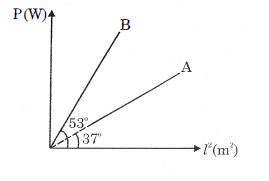
The graph between radiation power $P$ from a linear antenna and the square of the length of the antenna $l^2$ is shown in the figure for two antennas $A$ and $B$. If all other parameters are the same,find the ratio of the wavelengths of $A$ and $B$,i.e.,$\frac{\lambda_A}{\lambda_B}$.
A
$\frac{\lambda_A}{\lambda_B} = 1$
B
$\frac{\lambda_A}{\lambda_B} = \frac{2}{3}$
C
$\frac{\lambda_A}{\lambda_B} = \frac{3}{2}$
D
$\frac{\lambda_A}{\lambda_B} = \frac{4}{3}$
Solution
(D) The radiation power $P$ of a linear antenna is given by $P \propto \frac{l^2}{\lambda^2}$.
From the graph,the slope of the line is $\frac{P}{l^2} \propto \frac{1}{\lambda^2}$.
Therefore,$\text{Slope} \propto \frac{1}{\lambda^2}$,which implies $\lambda \propto \frac{1}{\sqrt{\text{Slope}}}$.
Thus,$\frac{\lambda_A}{\lambda_B} = \sqrt{\frac{\text{Slope}_B}{\text{Slope}_A}} = \sqrt{\frac{\tan(53^\circ)}{\tan(37^\circ)}}$.
Using $\tan(53^\circ) \approx \frac{4}{3}$ and $\tan(37^\circ) \approx \frac{3}{4}$,we get:
$\frac{\lambda_A}{\lambda_B} = \sqrt{\frac{4/3}{3/4}} = \sqrt{\frac{16}{9}} = \frac{4}{3}$.
From the graph,the slope of the line is $\frac{P}{l^2} \propto \frac{1}{\lambda^2}$.
Therefore,$\text{Slope} \propto \frac{1}{\lambda^2}$,which implies $\lambda \propto \frac{1}{\sqrt{\text{Slope}}}$.
Thus,$\frac{\lambda_A}{\lambda_B} = \sqrt{\frac{\text{Slope}_B}{\text{Slope}_A}} = \sqrt{\frac{\tan(53^\circ)}{\tan(37^\circ)}}$.
Using $\tan(53^\circ) \approx \frac{4}{3}$ and $\tan(37^\circ) \approx \frac{3}{4}$,we get:
$\frac{\lambda_A}{\lambda_B} = \sqrt{\frac{4/3}{3/4}} = \sqrt{\frac{16}{9}} = \frac{4}{3}$.
0 likes
View Solution11
DifficultMCQ
This question has Statement $-1$ and Statement $-2.$ Of the four choices given after the Statements,choose the one that best describes the two Statements.
Statement $-1:$ Short wave transmission is achieved due to the total internal reflection of the $e-m$ wave from an appropriate height in the ionosphere.
Statement $-2:$ Refractive index of the ionosphere is independent of the frequency of $e-m$ waves.
Statement $-1:$ Short wave transmission is achieved due to the total internal reflection of the $e-m$ wave from an appropriate height in the ionosphere.
Statement $-2:$ Refractive index of the ionosphere is independent of the frequency of $e-m$ waves.
A
Statement $-1$ is true,Statement $-2$ is false.
B
Statement $-1$ is false,Statement $-2$ is true.
C
Statement $-1$ is true,Statement $-2$ is true but Statement $-2$ is not the correct explanation of Statement $-1$.
D
Statement $-1$ is true,Statement $-2$ is true and Statement $-2$ is the correct explanation of Statement $-1$.
Solution
(A) The effective refractive index of the ionosphere is given by the formula:
$n_{eff} = \sqrt{1 - \frac{80.5N}{f^2}}$
where $N$ is the electron density and $f$ is the frequency of the $e-m$ wave.
From this formula,it is clear that the refractive index of the ionosphere depends on the frequency $f$ of the $e-m$ waves. Therefore,Statement $-2$ is false.
Short wave communication (sky wave propagation) relies on the refraction of $e-m$ waves by the ionosphere,which acts like a medium with a variable refractive index. When the frequency is appropriate,the waves are bent back towards the Earth,which is often described as total internal reflection. Thus,Statement $-1$ is true.
$n_{eff} = \sqrt{1 - \frac{80.5N}{f^2}}$
where $N$ is the electron density and $f$ is the frequency of the $e-m$ wave.
From this formula,it is clear that the refractive index of the ionosphere depends on the frequency $f$ of the $e-m$ waves. Therefore,Statement $-2$ is false.
Short wave communication (sky wave propagation) relies on the refraction of $e-m$ waves by the ionosphere,which acts like a medium with a variable refractive index. When the frequency is appropriate,the waves are bent back towards the Earth,which is often described as total internal reflection. Thus,Statement $-1$ is true.
0 likes
View Solution12
EasyMCQ
Assertion : Environmental damage has increased the amount of ozone in the atmosphere.
Reason : Increase of ozone increases the amount of ultraviolet radiation on earth.
Reason : Increase of ozone increases the amount of ultraviolet radiation on earth.
A
If both Assertion and Reason are correct and the Reason is a correct explanation of the Assertion.
B
If both Assertion and Reason are correct but Reason is not a correct explanation of the Assertion.
C
If the Assertion is correct but Reason is incorrect.
D
If both the Assertion and Reason are incorrect.
Solution
(D) The Assertion is incorrect because environmental damage,specifically the release of chlorofluorocarbons $(CFCs)$,leads to the depletion of the ozone layer in the stratosphere,not an increase.
The Reason is also incorrect because the ozone layer acts as a shield that absorbs harmful ultraviolet $(UV)$ radiation. Therefore,a decrease (depletion) of ozone leads to an increase in $UV$ radiation reaching the earth,not the other way around.
Since both the Assertion and the Reason are false,the correct option is $D$.
The Reason is also incorrect because the ozone layer acts as a shield that absorbs harmful ultraviolet $(UV)$ radiation. Therefore,a decrease (depletion) of ozone leads to an increase in $UV$ radiation reaching the earth,not the other way around.
Since both the Assertion and the Reason are false,the correct option is $D$.
0 likes
View Solution13
EasyMCQ
Assertion : Microwaves are better carrier of signals than optical waves.
Reason : Microwaves move faster than optical waves.
Reason : Microwaves move faster than optical waves.
A
If both Assertion and Reason are correct and the Reason is a correct explanation of the Assertion.
B
If both Assertion and Reason are correct but Reason is not a correct explanation of the Assertion.
C
If the Assertion is correct but Reason is incorrect.
D
If both the Assertion and Reason are incorrect.
Solution
(D) The Assertion is incorrect because optical waves (like those used in optical fibres) have a much higher frequency and bandwidth compared to microwaves,making them superior for signal transmission.
The Reason is also incorrect because all electromagnetic waves,including microwaves and optical waves,travel at the same speed $(c = 3 \times 10^8 \ m/s)$ in a vacuum.
Therefore,both the Assertion and the Reason are incorrect.
The Reason is also incorrect because all electromagnetic waves,including microwaves and optical waves,travel at the same speed $(c = 3 \times 10^8 \ m/s)$ in a vacuum.
Therefore,both the Assertion and the Reason are incorrect.
0 likes
View Solution14
DifficultMCQ
The electric field of a plane electromagnetic wave is given by $\overrightarrow{E} = E_{0} \frac{\hat{i}+\hat{j}}{\sqrt{2}} \cos (kz+\omega t)$. At $t=0$,a positively charged particle is at the point $(x, y, z) = (0, 0, \frac{\pi}{k})$. If its instantaneous velocity at $t=0$ is $v_{0} \hat{k}$,the force acting on it due to the wave is
A
$0$
B
parallel to $\frac{\hat{i}+\hat{j}}{\sqrt{2}}$
C
antiparallel to $\frac{\hat{i}+\hat{j}}{\sqrt{2}}$
D
parallel to $\hat{k}$
Solution
(C) The Lorentz force on a charged particle is given by $\overrightarrow{F} = q(\overrightarrow{E} + \overrightarrow{v} \times \overrightarrow{B})$.
At $t=0$ and $z = \frac{\pi}{k}$,the electric field is $\overrightarrow{E} = E_{0} \left(\frac{\hat{i}+\hat{j}}{\sqrt{2}}\right) \cos(\pi) = -E_{0} \left(\frac{\hat{i}+\hat{j}}{\sqrt{2}}\right)$.
For an electromagnetic wave,the direction of propagation is $\hat{k}_{prop} = \frac{\overrightarrow{E} \times \overrightarrow{B}}{|E||B|}$. Here,the wave propagates in the $-z$ direction (since the argument is $kz + \omega t$),so $\hat{k}_{prop} = -\hat{k}$.
Thus,$\left(\frac{\hat{i}+\hat{j}}{\sqrt{2}}\right) \times \overrightarrow{B} = -\hat{k} \cdot \frac{E_{0}}{c}$. Solving this,we get $\overrightarrow{B} = -\frac{E_{0}}{c} \left(\frac{\hat{i}-\hat{j}}{\sqrt{2}}\right)$.
The magnetic force is $\overrightarrow{F}_{m} = q(\overrightarrow{v} \times \overrightarrow{B}) = q(v_{0}\hat{k} \times [-\frac{E_{0}}{c} \frac{\hat{i}-\hat{j}}{\sqrt{2}}]) = -q \frac{v_{0}E_{0}}{c} \left(\frac{\hat{j}+\hat{i}}{\sqrt{2}}\right)$.
Since $\frac{v_{0}}{c} \ll 1$,the magnetic force is negligible compared to the electric force.
Therefore,$\overrightarrow{F} \approx q\overrightarrow{E} = -q E_{0} \left(\frac{\hat{i}+\hat{j}}{\sqrt{2}}\right)$,which is antiparallel to $\frac{\hat{i}+\hat{j}}{\sqrt{2}}$.
At $t=0$ and $z = \frac{\pi}{k}$,the electric field is $\overrightarrow{E} = E_{0} \left(\frac{\hat{i}+\hat{j}}{\sqrt{2}}\right) \cos(\pi) = -E_{0} \left(\frac{\hat{i}+\hat{j}}{\sqrt{2}}\right)$.
For an electromagnetic wave,the direction of propagation is $\hat{k}_{prop} = \frac{\overrightarrow{E} \times \overrightarrow{B}}{|E||B|}$. Here,the wave propagates in the $-z$ direction (since the argument is $kz + \omega t$),so $\hat{k}_{prop} = -\hat{k}$.
Thus,$\left(\frac{\hat{i}+\hat{j}}{\sqrt{2}}\right) \times \overrightarrow{B} = -\hat{k} \cdot \frac{E_{0}}{c}$. Solving this,we get $\overrightarrow{B} = -\frac{E_{0}}{c} \left(\frac{\hat{i}-\hat{j}}{\sqrt{2}}\right)$.
The magnetic force is $\overrightarrow{F}_{m} = q(\overrightarrow{v} \times \overrightarrow{B}) = q(v_{0}\hat{k} \times [-\frac{E_{0}}{c} \frac{\hat{i}-\hat{j}}{\sqrt{2}}]) = -q \frac{v_{0}E_{0}}{c} \left(\frac{\hat{j}+\hat{i}}{\sqrt{2}}\right)$.
Since $\frac{v_{0}}{c} \ll 1$,the magnetic force is negligible compared to the electric force.
Therefore,$\overrightarrow{F} \approx q\overrightarrow{E} = -q E_{0} \left(\frac{\hat{i}+\hat{j}}{\sqrt{2}}\right)$,which is antiparallel to $\frac{\hat{i}+\hat{j}}{\sqrt{2}}$.
0 likes
View Solution15
DifficultMCQ
The electric field intensity produced by the radiation coming from a $100 \, W$ bulb at a distance of $3 \, m$ is $E$. The electric field intensity produced by the radiation coming from a $60 \, W$ bulb at the same distance is $\sqrt{\frac{x}{5}} E$. The value of $x$ is ......... .
A
$1$
B
$3$
C
$6$
D
$9$
Solution
(B) The intensity of radiation $I$ at a distance $r$ from a source of power $P$ is given by $I = \frac{P}{4 \pi r^2}$.
Also,the intensity is related to the electric field amplitude $E$ by the relation $I = \frac{1}{2} c \epsilon_0 E^2$.
For the $100 \, W$ bulb: $\frac{1}{2} c \epsilon_0 E^2 = \frac{100}{4 \pi (3)^2}$.
For the $60 \, W$ bulb: $\frac{1}{2} c \epsilon_0 (\sqrt{\frac{x}{5}} E)^2 = \frac{60}{4 \pi (3)^2}$.
Dividing the second equation by the first,we get: $(\sqrt{\frac{x}{5}})^2 = \frac{60}{100}$.
$\frac{x}{5} = \frac{6}{10} = \frac{3}{5}$.
Therefore,$x = 3$.
Also,the intensity is related to the electric field amplitude $E$ by the relation $I = \frac{1}{2} c \epsilon_0 E^2$.
For the $100 \, W$ bulb: $\frac{1}{2} c \epsilon_0 E^2 = \frac{100}{4 \pi (3)^2}$.
For the $60 \, W$ bulb: $\frac{1}{2} c \epsilon_0 (\sqrt{\frac{x}{5}} E)^2 = \frac{60}{4 \pi (3)^2}$.
Dividing the second equation by the first,we get: $(\sqrt{\frac{x}{5}})^2 = \frac{60}{100}$.
$\frac{x}{5} = \frac{6}{10} = \frac{3}{5}$.
Therefore,$x = 3$.
0 likes
View Solution16
EasyMCQ
The energy that will be ideally radiated by a $100\,kW$ transmitter in $1$ hour is:
A
$36 \times 10^{4}\,J$
B
$36 \times 10^{5}\,J$
C
$1 \times 10^{5}\,J$
D
$36 \times 10^{7}\,J$
Solution
(D) The power $P$ of the transmitter is $100\,kW = 100 \times 10^{3}\,W = 10^{5}\,W$.
The time $t$ is $1\,hour = 3600\,s$.
The energy $E$ radiated is given by the formula $E = P \times t$.
Substituting the values, we get $E = 10^{5}\,W \times 3600\,s$.
$E = 3600 \times 10^{5}\,J = 36 \times 10^{7}\,J$.
The time $t$ is $1\,hour = 3600\,s$.
The energy $E$ radiated is given by the formula $E = P \times t$.
Substituting the values, we get $E = 10^{5}\,W \times 3600\,s$.
$E = 3600 \times 10^{5}\,J = 36 \times 10^{7}\,J$.
0 likes
View Solution17
MediumMCQ
$A$ radar sends an electromagnetic signal with an electric field $E_{0} = 2.25\,V/m$ and a magnetic field $B_{0} = 1.5 \times 10^{-8}\,T$,which strikes a target on the line of sight at a distance of $3\,km$ in a medium. After that,a part of the signal (echo) reflects back towards the radar with the same velocity and along the same path. If the signal was transmitted at time $t_{0}$ from the radar,then after how much time (in $\times 10^{-5}\,s$) will the echo reach the radar?
A
$2$
B
$4$
C
$1$
D
$8$
Solution
(B) The velocity of the electromagnetic wave in the medium is given by $v = \frac{E_{0}}{B_{0}}$.
Substituting the given values: $v = \frac{2.25}{1.5 \times 10^{-8}} = 1.5 \times 10^{8}\,m/s$.
The total distance traveled by the signal (to the target and back) is $d_{total} = 2 \times 3\,km = 6 \times 10^{3}\,m$.
The time taken for the echo to reach the radar is $t = \frac{d_{total}}{v}$.
$t = \frac{6 \times 10^{3}}{1.5 \times 10^{8}} = 4 \times 10^{-5}\,s$.
Thus,the time is $4 \times 10^{-5}\,s$.
Substituting the given values: $v = \frac{2.25}{1.5 \times 10^{-8}} = 1.5 \times 10^{8}\,m/s$.
The total distance traveled by the signal (to the target and back) is $d_{total} = 2 \times 3\,km = 6 \times 10^{3}\,m$.
The time taken for the echo to reach the radar is $t = \frac{d_{total}}{v}$.
$t = \frac{6 \times 10^{3}}{1.5 \times 10^{8}} = 4 \times 10^{-5}\,s$.
Thus,the time is $4 \times 10^{-5}\,s$.
0 likes
View Solution18
EasyMCQ
$5 \%$ of the power of a $100 \, W$ bulb is converted to visible radiation. The average intensity of visible radiation at a distance of $10 \, m$ from the bulb is .......... $W/m^2$.
A
$\frac{5}{2 \pi (10)^2}$
B
$\frac{5}{4 \pi (10)^2}$
C
$\frac{5}{\pi (10)^2}$
D
$\frac{5}{8 \pi (10)^2}$
Solution
(B) The total power of the bulb is $P_{total} = 100 \, W$.
Only $5 \%$ of this power is converted into visible radiation.
Therefore,the power of visible radiation is $P_{vis} = \frac{5}{100} \times 100 \, W = 5 \, W$.
The intensity $I$ at a distance $r$ from a point source is given by $I = \frac{P_{vis}}{A}$,where $A = 4 \pi r^2$ is the surface area of a sphere.
Given $r = 10 \, m$,the area is $A = 4 \pi (10)^2 \, m^2$.
Thus,the intensity is $I = \frac{5}{4 \pi (10)^2} \, W/m^2$.
Only $5 \%$ of this power is converted into visible radiation.
Therefore,the power of visible radiation is $P_{vis} = \frac{5}{100} \times 100 \, W = 5 \, W$.
The intensity $I$ at a distance $r$ from a point source is given by $I = \frac{P_{vis}}{A}$,where $A = 4 \pi r^2$ is the surface area of a sphere.
Given $r = 10 \, m$,the area is $A = 4 \pi (10)^2 \, m^2$.
Thus,the intensity is $I = \frac{5}{4 \pi (10)^2} \, W/m^2$.
0 likes
View Solution19
EasyMCQ
The power radiated from a linear antenna of length $l$ is proportional to (Given,$\lambda =$ wavelength of the wave):
A
$\frac{l}{\lambda}$
B
$\frac{l}{\lambda^2}$
C
$\frac{l^2}{\lambda}$
D
$\left(\frac{l}{\lambda}\right)^2$
Solution
(D) The power radiated $P$ by a short linear antenna of length $l$ is given by the relation $P \propto \left(\frac{l}{\lambda}\right)^2$.
This indicates that the radiated power is directly proportional to the square of the ratio of the antenna length to the wavelength of the electromagnetic wave.
This indicates that the radiated power is directly proportional to the square of the ratio of the antenna length to the wavelength of the electromagnetic wave.
0 likes
View Solution20
DifficultMCQ
$A$ parallel plate capacitor has a capacitance $C = 200 \ pF$. It is connected to a $230 \ V$ $AC$ supply with an angular frequency $\omega = 300 \ rad/s$. The $rms$ value of the conduction current in the circuit and the displacement current in the capacitor,respectively,are:
A
$1.38 \ \mu A$ and $1.38 \ \mu A$
B
$14.3 \ \mu A$ and $143 \ \mu A$
C
$13.8 \ \mu A$ and $138 \ \mu A$
D
$13.8 \ \mu A$ and $13.8 \ \mu A$
Solution
(D) Given: Capacitance $C = 200 \ pF = 200 \times 10^{-12} \ F$,Voltage $V_{rms} = 230 \ V$,Angular frequency $\omega = 300 \ rad/s$.
The capacitive reactance is given by $X_C = \frac{1}{\omega C} = \frac{1}{300 \times 200 \times 10^{-12}} = \frac{1}{6 \times 10^{-8}} = \frac{10^8}{6} \ \Omega$.
The $rms$ conduction current $I_c$ is $I_c = \frac{V_{rms}}{X_C} = 230 \times 300 \times 200 \times 10^{-12} \ A$.
$I_c = 230 \times 6 \times 10^{-8} \ A = 1380 \times 10^{-8} \ A = 13.8 \times 10^{-6} \ A = 13.8 \ \mu A$.
According to the Maxwell-Ampere law,the displacement current $I_d$ in a capacitor is equal to the conduction current $I_c$ in the connecting wires. Therefore,$I_d = I_c = 13.8 \ \mu A$.
The capacitive reactance is given by $X_C = \frac{1}{\omega C} = \frac{1}{300 \times 200 \times 10^{-12}} = \frac{1}{6 \times 10^{-8}} = \frac{10^8}{6} \ \Omega$.
The $rms$ conduction current $I_c$ is $I_c = \frac{V_{rms}}{X_C} = 230 \times 300 \times 200 \times 10^{-12} \ A$.
$I_c = 230 \times 6 \times 10^{-8} \ A = 1380 \times 10^{-8} \ A = 13.8 \times 10^{-6} \ A = 13.8 \ \mu A$.
According to the Maxwell-Ampere law,the displacement current $I_d$ in a capacitor is equal to the conduction current $I_c$ in the connecting wires. Therefore,$I_d = I_c = 13.8 \ \mu A$.
0 likes
View Solution21
EasyMCQ
$A$ physical quantity $\vec{S}$ is defined as $\vec{S}=(\vec{E} \times \vec{B}) / \mu_0$,where $\vec{E}$ is the electric field,$\vec{B}$ is the magnetic field,and $\mu_0$ is the permeability of free space. The dimensions of $\vec{S}$ are the same as the dimensions of which of the following quantity(ies)?
$(A)$ $\frac{\text{Energy}}{\text{charge} \times \text{current}}$
$(B)$ $\frac{\text{Force}}{\text{Length} \times \text{Time}}$
$(C)$ $\frac{\text{Energy}}{\text{Volume}}$
$(D)$ $\frac{\text{Power}}{\text{Area}}$
$(A)$ $\frac{\text{Energy}}{\text{charge} \times \text{current}}$
$(B)$ $\frac{\text{Force}}{\text{Length} \times \text{Time}}$
$(C)$ $\frac{\text{Energy}}{\text{Volume}}$
$(D)$ $\frac{\text{Power}}{\text{Area}}$
A
$A, B, C$
B
$A, B, D$
C
$A, B$
D
$B, D$
Solution
(D) The vector $\vec{S}$ is known as the Poynting vector,which represents the directional energy flux (the rate of energy transfer per unit area) of an electromagnetic field.
The $SI$ unit of $\vec{S}$ is $\text{W/m}^2$ (Watts per square meter).
Dimensional analysis:
$1$. $\text{Power} = \text{Energy} / \text{Time}$,so $\text{Power} / \text{Area} = \text{Energy} / (\text{Area} \times \text{Time})$. This matches the definition of $\vec{S}$. Thus,$(D)$ is correct.
$2$. $\text{Force} / (\text{Length} \times \text{Time}) = (\text{Force} \times \text{Length}) / (\text{Length}^2 \times \text{Time}) = \text{Energy} / (\text{Area} \times \text{Time})$. This also matches the dimensions of $\vec{S}$. Thus,$(B)$ is correct.
$3$. $\text{Energy} / (\text{charge} \times \text{current}) = \text{Energy} / (\text{charge} \times \text{charge} / \text{time}) = \text{Energy} \times \text{time} / \text{charge}^2$. This does not match.
$4$. $\text{Energy} / \text{Volume}$ has dimensions of $\text{Pressure}$ or $\text{Energy density}$,which is $\text{J/m}^3$. This does not match.
Therefore,the correct options are $(B)$ and $(D)$.
The $SI$ unit of $\vec{S}$ is $\text{W/m}^2$ (Watts per square meter).
Dimensional analysis:
$1$. $\text{Power} = \text{Energy} / \text{Time}$,so $\text{Power} / \text{Area} = \text{Energy} / (\text{Area} \times \text{Time})$. This matches the definition of $\vec{S}$. Thus,$(D)$ is correct.
$2$. $\text{Force} / (\text{Length} \times \text{Time}) = (\text{Force} \times \text{Length}) / (\text{Length}^2 \times \text{Time}) = \text{Energy} / (\text{Area} \times \text{Time})$. This also matches the dimensions of $\vec{S}$. Thus,$(B)$ is correct.
$3$. $\text{Energy} / (\text{charge} \times \text{current}) = \text{Energy} / (\text{charge} \times \text{charge} / \text{time}) = \text{Energy} \times \text{time} / \text{charge}^2$. This does not match.
$4$. $\text{Energy} / \text{Volume}$ has dimensions of $\text{Pressure}$ or $\text{Energy density}$,which is $\text{J/m}^3$. This does not match.
Therefore,the correct options are $(B)$ and $(D)$.
0 likes
View Solution22
EasyMCQ
According to the theoretical study of radiation from a linear antenna,the power radiated is proportional to $[\lambda = \text{wavelength}]$
A
$\lambda^{-2}$
B
$\lambda^{-1}$
C
$\lambda^{2}$
D
$\lambda$
Solution
(A) For a linear antenna of length $l$ (where $l \ll \lambda$),the power radiated $P$ is given by the relation $P \propto \frac{1}{\lambda^2}$.
This implies that the power radiated is inversely proportional to the square of the wavelength.
Therefore,as the wavelength $\lambda$ increases,the power radiated decreases.
Thus,the correct proportionality is $\lambda^{-2}$.
This implies that the power radiated is inversely proportional to the square of the wavelength.
Therefore,as the wavelength $\lambda$ increases,the power radiated decreases.
Thus,the correct proportionality is $\lambda^{-2}$.
0 likes
View Solution23
EasyMCQ
If two linear antennas having lengths in the ratio $2: 3$ are emitting radiation of wavelengths in the ratio $8: 9$, then the ratio of effective powers radiated by them are in the ratio
A
$32: 27$
B
$27: 32$
C
$16: 27$
D
$9: 16$
Solution
(D) The power radiated by a linear antenna is given by the formula $P \propto (L/\lambda)^2$, where $L$ is the length of the antenna and $\lambda$ is the wavelength of the radiation.
Given the ratio of lengths $L_1 : L_2 = 2 : 3$ and the ratio of wavelengths $\lambda_1 : \lambda_2 = 8 : 9$.
The ratio of powers is given by:
$\frac{P_1}{P_2} = \left( \frac{L_1}{L_2} \right)^2 \times \left( \frac{\lambda_2}{\lambda_1} \right)^2$
Substituting the given values:
$\frac{P_1}{P_2} = \left( \frac{2}{3} \right)^2 \times \left( \frac{9}{8} \right)^2$
$\frac{P_1}{P_2} = \frac{4}{9} \times \frac{81}{64}$
$\frac{P_1}{P_2} = \frac{1}{1} \times \frac{9}{16} = \frac{9}{16}$
Therefore, the ratio of effective powers radiated is $9: 16$.
Given the ratio of lengths $L_1 : L_2 = 2 : 3$ and the ratio of wavelengths $\lambda_1 : \lambda_2 = 8 : 9$.
The ratio of powers is given by:
$\frac{P_1}{P_2} = \left( \frac{L_1}{L_2} \right)^2 \times \left( \frac{\lambda_2}{\lambda_1} \right)^2$
Substituting the given values:
$\frac{P_1}{P_2} = \left( \frac{2}{3} \right)^2 \times \left( \frac{9}{8} \right)^2$
$\frac{P_1}{P_2} = \frac{4}{9} \times \frac{81}{64}$
$\frac{P_1}{P_2} = \frac{1}{1} \times \frac{9}{16} = \frac{9}{16}$
Therefore, the ratio of effective powers radiated is $9: 16$.
0 likes
View Solution24
DifficultMCQ
The energies required to set up in a cube of side $10 \ cm$,$(a)$ a uniform electric field of $10^7 \ V \ m^{-1}$ and $(b)$ a uniform magnetic field of $0.25 \ Wb \ m^{-2}$,are respectively about $(\mu_0 = 4\pi \times 10^{-7} \ H \ m^{-1}, \epsilon_0 = 8.9 \times 10^{-12} \ F \ m^{-1})$.
A
$0.445 \ J, 25 \ J$
B
$4.45 \ J, 2.5 \ J$
C
$44.5 \ J, 25 \ J$
D
$0.44 \ J, 2.5 \ J$
Solution
(A) The energy density of an electric field is $u_E = \frac{1}{2} \epsilon_0 E^2$. The total energy is $E_E = u_E \times V$. Given $V = (10 \ cm)^3 = (0.1 \ m)^3 = 10^{-3} \ m^3$.
$E_E = \frac{1}{2} \times 8.9 \times 10^{-12} \times (10^7)^2 \times 10^{-3} = 0.445 \ J$.
The energy density of a magnetic field is $u_B = \frac{B^2}{2\mu_0}$. The total energy is $E_B = u_B \times V$.
$E_B = \frac{(0.25)^2}{2 \times 4\pi \times 10^{-7}} \times 10^{-3} = \frac{0.0625 \times 10^{-3}}{25.12 \times 10^{-7}} \approx 24.88 \ J \approx 25 \ J$.
Thus,the energies are $0.445 \ J$ and $25 \ J$.
$E_E = \frac{1}{2} \times 8.9 \times 10^{-12} \times (10^7)^2 \times 10^{-3} = 0.445 \ J$.
The energy density of a magnetic field is $u_B = \frac{B^2}{2\mu_0}$. The total energy is $E_B = u_B \times V$.
$E_B = \frac{(0.25)^2}{2 \times 4\pi \times 10^{-7}} \times 10^{-3} = \frac{0.0625 \times 10^{-3}}{25.12 \times 10^{-7}} \approx 24.88 \ J \approx 25 \ J$.
Thus,the energies are $0.445 \ J$ and $25 \ J$.
0 likes
View Solution25
EasyMCQ
Match the following List-$I$ with the List-$II$:
| List-$I$ | List-$II$ |
|---|---|
| $(A)$ Gauss's law | $(I)$ Surface charge density |
| $(B)$ Faraday's law | $(II)$ Electric charge and energy conservation |
| $(C)$ Ampere's law | $(III)$ Change in magnetic flux |
| $(D)$ Kirchhoff's law | $(IV)$ Change in electric flux |
| $(V)$ Total electric flux |
A
$A-II, B-III, C-I, D-IV$
B
$A-IV, B-III, C-II, D-I$
C
$A-V, B-III, C-IV, D-II$
D
$A-V, B-I, C-IV, D-III$
Solution
$(C)$ Gauss's law relates the total electric flux through a closed surface to the enclosed charge, which is $(V)$ Total electric flux.
$(B)$ Faraday's law states that an induced electromotive force is proportional to the $(III)$ Change in magnetic flux.
$(C)$ Ampere's law relates the magnetic field around a closed loop to the electric current passing through the loop. In the context of Maxwell's modification, it involves the $(IV)$ Change in electric flux (displacement current).
$(D)$ Kirchhoff's laws are based on $(II)$ Electric charge conservation (Junction rule) and energy conservation (Loop rule).
Therefore, the correct matching is $A-V, B-III, C-IV, D-II$.
$(B)$ Faraday's law states that an induced electromotive force is proportional to the $(III)$ Change in magnetic flux.
$(C)$ Ampere's law relates the magnetic field around a closed loop to the electric current passing through the loop. In the context of Maxwell's modification, it involves the $(IV)$ Change in electric flux (displacement current).
$(D)$ Kirchhoff's laws are based on $(II)$ Electric charge conservation (Junction rule) and energy conservation (Loop rule).
Therefore, the correct matching is $A-V, B-III, C-IV, D-II$.
0 likes
View Solution26
EasyMCQ
Generation,propagation,and detection of electromagnetic waves is the basis of:
A
$LASER$
B
reactors
C
radio and television
D
computer
Solution
(C) The generation,propagation,and detection of electromagnetic waves are the fundamental principles behind wireless communication systems. Radio and television broadcasting rely entirely on the transmission of electromagnetic waves through space,which are then detected by receivers to convert them back into audio and visual signals. Therefore,radio and television are based on these principles.
0 likes
View Solution27
EasyMCQ
Which of the following is a wrongly matched pair?
A
Galileo Galilei - Law of inertia
B
Michael Faraday - Law of electromagnetic induction
C
Rudolf Hertz - Generation of electromagnetic waves
D
$C. V. Raman - Wave theory of light$
Solution
(D) The wave theory of light was proposed by Christian Huygens, not $C. V. Raman$. $C. V. Raman$ is famous for the discovery of the Raman effect (inelastic scattering of light). Therefore, the pair $C. V. Raman - \text{Wave theory of light}$ is incorrectly matched.
0 likes
View Solution28
MediumMCQ
If $11 \%$ of the power of a $200 \ W$ bulb is converted to visible radiation,then the intensity of the light at a distance of $100 \ cm$ from the bulb is (in $W \ m^{-2}$)
A
$1.75$
B
$3.5$
C
$10.5$
D
$5.25$
Solution
(A) Given: Power of the bulb $P = 200 \ W$,distance $r = 100 \ cm = 1 \ m$,and efficiency $\eta = 11 \% = 0.11$.
The power converted into visible radiation is $P_{vis} = \eta \times P = 0.11 \times 200 \ W = 22 \ W$.
Assuming the bulb acts as a point source,the light spreads uniformly over a sphere of radius $r$.
The intensity $I$ at a distance $r$ is given by $I = \frac{P_{vis}}{4 \pi r^2}$.
Substituting the values: $I = \frac{22}{4 \times 3.14 \times (1)^2} = \frac{22}{12.56} \approx 1.75 \ W \ m^{-2}$.
The power converted into visible radiation is $P_{vis} = \eta \times P = 0.11 \times 200 \ W = 22 \ W$.
Assuming the bulb acts as a point source,the light spreads uniformly over a sphere of radius $r$.
The intensity $I$ at a distance $r$ is given by $I = \frac{P_{vis}}{4 \pi r^2}$.
Substituting the values: $I = \frac{22}{4 \times 3.14 \times (1)^2} = \frac{22}{12.56} \approx 1.75 \ W \ m^{-2}$.
0 likes
View Solution29
MediumMCQ
For an $EM$ wave,the electric and magnetic fields are $300 \ V m^{-1}$ and $7.9 \ A m^{-1}$ respectively. The maximum rate of energy flow is, (in $W m^{-2}$)
A
$2730$
B
$2790$
C
$2370$
D
$2390$
Solution
(C) The maximum rate of energy flow per unit area is given by the magnitude of the Poynting vector,$S = E \times H$.
Given the amplitudes of the electric field $E_0 = 300 \ V m^{-1}$ and the magnetic field $H_0 = 7.9 \ A m^{-1}$.
The maximum rate of energy flow is $S = E_0 \times H_0$.
Substituting the values,we get $S = 300 \times 7.9 = 2370 \ W m^{-2}$.
Given the amplitudes of the electric field $E_0 = 300 \ V m^{-1}$ and the magnetic field $H_0 = 7.9 \ A m^{-1}$.
The maximum rate of energy flow is $S = E_0 \times H_0$.
Substituting the values,we get $S = 300 \times 7.9 = 2370 \ W m^{-2}$.
0 likes
View Solution30
MediumMCQ
$A$ $100 \ W$ electric bulb produces electromagnetic radiation with an electric field amplitude of $2 \ V \ m^{-1}$ at a distance of $10 \ m$. Assuming it as a point source, estimate the efficiency of the bulb. (in $\%$)
A
$4.9$
B
$2.5$
C
$13.3$
D
$19.7$
Solution
(C) The intensity $I$ of electromagnetic radiation at a distance $r$ from a point source is given by $I = \frac{P_{out}}{4 \pi r^2}$, where $P_{out} = P_{in} \times \eta$ and $\eta$ is the efficiency.
Also, the intensity in terms of the electric field amplitude $E_0$ is $I = \frac{1}{2} \epsilon_0 E_0^2 c$.
Given: $P_{in} = 100 \ W$, $E_0 = 2 \ V \ m^{-1}$, $r = 10 \ m$, $\epsilon_0 = 8.854 \times 10^{-12} \ F \ m^{-1}$, $c = 3 \times 10^8 \ m \ s^{-1}$.
Calculating intensity: $I = \frac{1}{2} \times (8.854 \times 10^{-12}) \times (2)^2 \times (3 \times 10^8) = 0.0106 \ W \ m^{-2}$.
Now, equating the two expressions for intensity: $0.0106 = \frac{100 \times \eta}{4 \times \pi \times (10)^2}$.
$0.0106 = \frac{100 \times \eta}{4 \times 3.1416 \times 100} = \frac{\eta}{12.566}$.
$\eta = 0.0106 \times 12.566 \approx 0.133$.
Thus, the efficiency is $13.3 \%$.
Also, the intensity in terms of the electric field amplitude $E_0$ is $I = \frac{1}{2} \epsilon_0 E_0^2 c$.
Given: $P_{in} = 100 \ W$, $E_0 = 2 \ V \ m^{-1}$, $r = 10 \ m$, $\epsilon_0 = 8.854 \times 10^{-12} \ F \ m^{-1}$, $c = 3 \times 10^8 \ m \ s^{-1}$.
Calculating intensity: $I = \frac{1}{2} \times (8.854 \times 10^{-12}) \times (2)^2 \times (3 \times 10^8) = 0.0106 \ W \ m^{-2}$.
Now, equating the two expressions for intensity: $0.0106 = \frac{100 \times \eta}{4 \times \pi \times (10)^2}$.
$0.0106 = \frac{100 \times \eta}{4 \times 3.1416 \times 100} = \frac{\eta}{12.566}$.
$\eta = 0.0106 \times 12.566 \approx 0.133$.
Thus, the efficiency is $13.3 \%$.
0 likes
View Solution31
EasyMCQ
$A$ laser beam is operating at $100 \,mW$. The amount of energy stored by $90 \,cm$ length of this laser beam will be
A
$2 \times 10^{-10} \,J$
B
$3 \times 10^{-10} \,J$
C
$8 \times 10^{-11} \,J$
D
$6 \times 10^{-11} \,J$
Solution
(B) The power of the laser beam is $P = 100 \,mW = 100 \times 10^{-3} \,W = 0.1 \,W$.
The length of the beam segment is $l = 90 \,cm = 0.9 \,m$.
The speed of light is $c = 3 \times 10^8 \,m/s$.
The time taken for this length of the beam to pass a point is $t = \frac{l}{c} = \frac{0.9}{3 \times 10^8} = 0.3 \times 10^{-8} \,s = 3 \times 10^{-9} \,s$.
The energy stored in this length is $E = P \times t$.
$E = (0.1 \,W) \times (3 \times 10^{-9} \,s) = 3 \times 10^{-10} \,J$.
The length of the beam segment is $l = 90 \,cm = 0.9 \,m$.
The speed of light is $c = 3 \times 10^8 \,m/s$.
The time taken for this length of the beam to pass a point is $t = \frac{l}{c} = \frac{0.9}{3 \times 10^8} = 0.3 \times 10^{-8} \,s = 3 \times 10^{-9} \,s$.
The energy stored in this length is $E = P \times t$.
$E = (0.1 \,W) \times (3 \times 10^{-9} \,s) = 3 \times 10^{-10} \,J$.
0 likes
View Solution32
MediumMCQ
The equation of the electric field of an electromagnetic wave propagating through free space is given by:
$E = \sqrt{377} \sin(6.27 \times 10^3 t - 2.09 \times 10^{-5} x) \text{ N/C}$.
The average power (intensity) of the electromagnetic wave is $\left(\frac{1}{\alpha}\right) \text{ W/m}^2$. The value of $\alpha$ is . . . . . . .
(Take $\sqrt{\frac{\mu_0}{\varepsilon_0}} = 377$ in $SI$ units)
$E = \sqrt{377} \sin(6.27 \times 10^3 t - 2.09 \times 10^{-5} x) \text{ N/C}$.
The average power (intensity) of the electromagnetic wave is $\left(\frac{1}{\alpha}\right) \text{ W/m}^2$. The value of $\alpha$ is . . . . . . .
(Take $\sqrt{\frac{\mu_0}{\varepsilon_0}} = 377$ in $SI$ units)
A
$1$
B
$2$
C
$3$
D
$4$
Solution
(B) The given electric field equation is $E = E_0 \sin(\omega t - kx)$,where $E_0 = \sqrt{377} \text{ V/m}$.
The intensity (average power per unit area) of an electromagnetic wave is given by $I = \frac{1}{2} c \varepsilon_0 E_0^2$.
Since $c = \frac{1}{\sqrt{\mu_0 \varepsilon_0}}$,we can write $I = \frac{1}{2} \frac{1}{\sqrt{\mu_0 \varepsilon_0}} \varepsilon_0 E_0^2 = \frac{1}{2} \sqrt{\frac{\varepsilon_0}{\mu_0}} E_0^2$.
Given $\sqrt{\frac{\mu_0}{\varepsilon_0}} = 377$,then $\sqrt{\frac{\varepsilon_0}{\mu_0}} = \frac{1}{377}$.
Substituting the values: $I = \frac{1}{2} \times \frac{1}{377} \times (\sqrt{377})^2 = \frac{1}{2} \times \frac{1}{377} \times 377 = \frac{1}{2} \text{ W/m}^2$.
Comparing this with $\frac{1}{\alpha} \text{ W/m}^2$,we get $\alpha = 2$.
The intensity (average power per unit area) of an electromagnetic wave is given by $I = \frac{1}{2} c \varepsilon_0 E_0^2$.
Since $c = \frac{1}{\sqrt{\mu_0 \varepsilon_0}}$,we can write $I = \frac{1}{2} \frac{1}{\sqrt{\mu_0 \varepsilon_0}} \varepsilon_0 E_0^2 = \frac{1}{2} \sqrt{\frac{\varepsilon_0}{\mu_0}} E_0^2$.
Given $\sqrt{\frac{\mu_0}{\varepsilon_0}} = 377$,then $\sqrt{\frac{\varepsilon_0}{\mu_0}} = \frac{1}{377}$.
Substituting the values: $I = \frac{1}{2} \times \frac{1}{377} \times (\sqrt{377})^2 = \frac{1}{2} \times \frac{1}{377} \times 377 = \frac{1}{2} \text{ W/m}^2$.
Comparing this with $\frac{1}{\alpha} \text{ W/m}^2$,we get $\alpha = 2$.
0 likes
View SolutionElectromagnetic waves — Mix Examples- Electromagnetic waves · Frequently Asked Questions
1Are these Electromagnetic waves questions useful for JEE and NEET?
Yes. All questions in this section are mapped to JEE Main and NEET exam patterns. Previous year questions from JEE Main, NEET, GUJCET and state-level exams are included with full solutions.
2Can I switch to Hindi or Gujarati for these questions?
Yes. Use the language tabs in the hero section or the sidebar to view the same questions and solutions in English, Hindi or Gujarati.
3How do I generate a question paper from this subtopic?
Use the Vedclass Exam Paper Generator — select the chapter and subtopic, set difficulty, and generate Sets A, B, C, D automatically. First 3 chapters of every subject are free.
Vedclass Products
For Students
Vedclass Test Series
Mock tests in real JEE/NEET style with performance analysis. 5-day free trial.
Start Free TrialFor Teachers
Exam Paper Generator
Generate Set A/B/C/D papers from this chapter in 2 minutes. 3 chapters free.
Try FreeFor Institutes
Online Exam Module
Live online exams with unlimited students, 360° analytics & white-label branding.
See DemoFor Teachers & Institutes
Generate a Electromagnetic waves Exam Paper in 2 Minutes
Select subtopic & difficulty — Sets A, B, C, D auto-generated with No Repeat logic.
First 3 chapters of every subject are free — no payment required.