
A English
Properties of Electromagnetic Waves Questions in English
Class 12 Physics · Electromagnetic waves · Properties of Electromagnetic Waves
494+
Questions
English
Language
100%
With Solutions
Showing 50 of 494 questions in English
101
DifficultMCQ
For a plane electromagnetic wave,$E_x = 0$,$E_y = 2.5 \frac{N}{C} \cos \left[ (2\pi \times 10^6 \frac{rad}{s})t - (\pi \times 10^{-2} \frac{rad}{m})x \right]$,and $E_z = 0$. Which of the following is true?
A
The wave propagates in the positive $X$ direction with a wavelength of $100 \ m$ and a frequency of $10^6 \ Hz$.
B
The wave propagates in the positive $X$ direction with a wavelength of $200 \ m$ and a frequency of $10^6 \ Hz$.
C
The wave propagates in the negative $X$ direction with a wavelength of $200 \ m$ and a frequency of $10^6 \ Hz$.
D
The wave propagates in the positive $Y$ direction with a wavelength of $200 \ m$ and a frequency of $10^6 \ Hz$.
Solution
(B) The given equation for the electric field is $E_y = E_0 \cos(\omega t - kx)$.
Comparing this with the standard form of a wave traveling in the positive $X$ direction,we identify the angular frequency $\omega = 2\pi \times 10^6 \ rad/s$ and the wave number $k = \pi \times 10^{-2} \ rad/m$.
The frequency $f$ is given by $\omega = 2\pi f$,so $2\pi f = 2\pi \times 10^6 \implies f = 10^6 \ Hz$.
The wavelength $\lambda$ is given by $k = \frac{2\pi}{\lambda}$,so $\frac{2\pi}{\lambda} = \pi \times 10^{-2} \implies \lambda = \frac{2}{\pi \times 10^{-2}} \times \pi = 200 \ m$.
Since the phase is $(\omega t - kx)$,the wave propagates in the positive $X$ direction.
Comparing this with the standard form of a wave traveling in the positive $X$ direction,we identify the angular frequency $\omega = 2\pi \times 10^6 \ rad/s$ and the wave number $k = \pi \times 10^{-2} \ rad/m$.
The frequency $f$ is given by $\omega = 2\pi f$,so $2\pi f = 2\pi \times 10^6 \implies f = 10^6 \ Hz$.
The wavelength $\lambda$ is given by $k = \frac{2\pi}{\lambda}$,so $\frac{2\pi}{\lambda} = \pi \times 10^{-2} \implies \lambda = \frac{2}{\pi \times 10^{-2}} \times \pi = 200 \ m$.
Since the phase is $(\omega t - kx)$,the wave propagates in the positive $X$ direction.
0 likes
View Solution102
MediumMCQ
The frequency of an electromagnetic wave is $25 \ MHz$. If the magnitude of the electric field at a point at any instant is $6.3 \ V/m$,then the magnitude of the magnetic field at that point is ..... $Wb/m^2$.
A
$3.9 \times 10^{-2}$
B
$2.5 \times 10^{-7}$
C
$2.1 \times 10^{-8}$
D
$7.5 \times 10^{-3}$
Solution
(C) The relationship between the electric field $E$ and the magnetic field $B$ in an electromagnetic wave is given by the equation $c = E/B$,where $c$ is the speed of light in vacuum.
Given:
$E = 6.3 \ V/m$
$c = 3 \times 10^8 \ m/s$
Rearranging the formula to solve for $B$:
$B = E/c$
$B = 6.3 / (3 \times 10^8)$
$B = 2.1 \times 10^{-8} \ T$ (or $Wb/m^2$)
Therefore,the magnitude of the magnetic field is $2.1 \times 10^{-8} \ Wb/m^2$.
Given:
$E = 6.3 \ V/m$
$c = 3 \times 10^8 \ m/s$
Rearranging the formula to solve for $B$:
$B = E/c$
$B = 6.3 / (3 \times 10^8)$
$B = 2.1 \times 10^{-8} \ T$ (or $Wb/m^2$)
Therefore,the magnitude of the magnetic field is $2.1 \times 10^{-8} \ Wb/m^2$.
0 likes
View Solution103
MediumMCQ
The $rms$ value of the electric field of the light coming from the sun is $720 \ N \ C^{-1}$. The average energy density of the electromagnetic wave is $...... \ J \ m^{-3}$.
A
$4.58 \times 10^{-6}$
B
$8.45 \times 10^{-6}$
C
$4.58 \times 10^{-4}$
D
$8.45 \times 10^{-4}$
Solution
(A) The average energy density $u$ of an electromagnetic wave is given by the sum of the electric and magnetic energy densities.
$u = u_E + u_B = \frac{1}{2} \varepsilon_0 E_0^2 = \varepsilon_0 E_{rms}^2$.
Given $E_{rms} = 720 \ N \ C^{-1}$ and $\varepsilon_0 = 8.854 \times 10^{-12} \ C^2 \ N^{-1} \ m^{-2}$.
Substituting the values:
$u = 8.854 \times 10^{-12} \times (720)^2$
$u = 8.854 \times 10^{-12} \times 518400$
$u \approx 4.589 \times 10^{-6} \ J \ m^{-3}$.
Thus,the correct option is $A$.
$u = u_E + u_B = \frac{1}{2} \varepsilon_0 E_0^2 = \varepsilon_0 E_{rms}^2$.
Given $E_{rms} = 720 \ N \ C^{-1}$ and $\varepsilon_0 = 8.854 \times 10^{-12} \ C^2 \ N^{-1} \ m^{-2}$.
Substituting the values:
$u = 8.854 \times 10^{-12} \times (720)^2$
$u = 8.854 \times 10^{-12} \times 518400$
$u \approx 4.589 \times 10^{-6} \ J \ m^{-3}$.
Thus,the correct option is $A$.
0 likes
View Solution104
EasyMCQ
$A$ source emits electromagnetic waves of frequency $8.2 \times 10^6 \text{ Hz}$. What is the wavelength of these waves in meters?
A
$36.6$
B
$40.5$
C
$42.3$
D
$50.9$
Solution
(A) The speed of electromagnetic waves in vacuum is given by $c = 3 \times 10^8 \text{ m/s}$.
The frequency of the wave is given as $f = 8.2 \times 10^6 \text{ Hz}$.
The relationship between wavelength $\lambda$,speed $c$,and frequency $f$ is $\lambda = \frac{c}{f}$.
Substituting the values: $\lambda = \frac{3 \times 10^8}{8.2 \times 10^6}$.
$\lambda = \frac{300}{8.2} \approx 36.585 \text{ m}$.
Rounding to one decimal place,we get $\lambda = 36.6 \text{ m}$.
The frequency of the wave is given as $f = 8.2 \times 10^6 \text{ Hz}$.
The relationship between wavelength $\lambda$,speed $c$,and frequency $f$ is $\lambda = \frac{c}{f}$.
Substituting the values: $\lambda = \frac{3 \times 10^8}{8.2 \times 10^6}$.
$\lambda = \frac{300}{8.2} \approx 36.585 \text{ m}$.
Rounding to one decimal place,we get $\lambda = 36.6 \text{ m}$.
0 likes
View Solution105
MediumMCQ
In an electromagnetic wave,the electric field intensity is $100 \ Vm^{-1}$ and the magnetic intensity is $H_0 = 0.265 \ Am^{-1}$. The maximum intensity of radiation is ..... $Wm^{-2}$.
A
$26.5$
B
$36.5$
C
$46.7$
D
$76.5$
Solution
(A) The intensity of an electromagnetic wave is given by the product of the electric field amplitude $(E_0)$ and the magnetic field amplitude $(H_0)$ in terms of the Poynting vector magnitude.
The intensity $I$ is given by $I = E_0 \times H_0$.
Given:
$E_0 = 100 \ Vm^{-1}$
$H_0 = 0.265 \ Am^{-1}$
Substituting the values:
$I = 100 \times 0.265$
$I = 26.5 \ Wm^{-2}$
Thus,the maximum intensity of radiation is $26.5 \ Wm^{-2}$.
The intensity $I$ is given by $I = E_0 \times H_0$.
Given:
$E_0 = 100 \ Vm^{-1}$
$H_0 = 0.265 \ Am^{-1}$
Substituting the values:
$I = 100 \times 0.265$
$I = 26.5 \ Wm^{-2}$
Thus,the maximum intensity of radiation is $26.5 \ Wm^{-2}$.
0 likes
View Solution106
EasyMCQ
Electromagnetic waves of frequency $8.196 \times 10^6 \ Hz$ are propagating from a source. What is the wavelength of these electromagnetic waves in $cm$?
A
$4230$
B
$3660$
C
$5090$
D
$4050$
Solution
(B) The relationship between the speed of light $(c)$,frequency $(f)$,and wavelength $(\lambda)$ is given by the formula: $\lambda = \frac{c}{f}$.
Given: $c = 3 \times 10^8 \ m/s = 3 \times 10^{10} \ cm/s$ and $f = 8.196 \times 10^6 \ Hz$.
Substituting the values into the formula:
$\lambda = \frac{3 \times 10^{10}}{8.196 \times 10^6} \ cm$.
$\lambda = \frac{3}{8.196} \times 10^4 \ cm$.
$\lambda \approx 0.36603 \times 10^4 \ cm$.
$\lambda \approx 3660 \ cm$.
Thus,the wavelength is $3660 \ cm$.
Given: $c = 3 \times 10^8 \ m/s = 3 \times 10^{10} \ cm/s$ and $f = 8.196 \times 10^6 \ Hz$.
Substituting the values into the formula:
$\lambda = \frac{3 \times 10^{10}}{8.196 \times 10^6} \ cm$.
$\lambda = \frac{3}{8.196} \times 10^4 \ cm$.
$\lambda \approx 0.36603 \times 10^4 \ cm$.
$\lambda \approx 3660 \ cm$.
Thus,the wavelength is $3660 \ cm$.
0 likes
View Solution107
EasyMCQ
The electromagnetic flux from the sun reaching the earth is $10^3 \, W/m^2$. The power incident on a roof of dimensions $8 \, m \times 20 \, m$ is ..... $W$.
A
$2.56 \times 10^4$
B
$6.4 \times 10^5$
C
$4.0 \times 10^5$
D
$1.6 \times 10^5$
Solution
(D) The intensity (flux) of electromagnetic radiation from the sun is given as $I = 10^3 \, W/m^2$.
The area of the roof is $A = \text{length} \times \text{width} = 8 \, m \times 20 \, m = 160 \, m^2$.
The power $P$ incident on the surface is given by the formula $P = I \times A$.
Substituting the values, we get $P = 10^3 \, W/m^2 \times 160 \, m^2 = 1.6 \times 10^5 \, W$.
The area of the roof is $A = \text{length} \times \text{width} = 8 \, m \times 20 \, m = 160 \, m^2$.
The power $P$ incident on the surface is given by the formula $P = I \times A$.
Substituting the values, we get $P = 10^3 \, W/m^2 \times 160 \, m^2 = 1.6 \times 10^5 \, W$.
0 likes
View Solution108
MediumMCQ
In an electromagnetic wave,the amplitude of the electric field is $1 \ V/m$ and the frequency of the wave is $5 \times 10^{14} \ Hz$. The wave propagates in the positive $Z$-direction. The average energy density of the electric field in this wave is ........ $J \ m^{-3}$.
A
$1.1 \times 10^{-11}$
B
$2.2 \times 10^{-12}$
C
$3.3 \times 10^{-13}$
D
$4.4 \times 10^{-14}$
Solution
(B) The average energy density of the electric field in an electromagnetic wave is given by the formula:
$\rho_E = \frac{1}{2} \epsilon_0 E_{rms}^2$
Since the root-mean-square electric field $E_{rms} = \frac{E_0}{\sqrt{2}}$,where $E_0$ is the amplitude of the electric field:
$\rho_E = \frac{1}{2} \epsilon_0 \left( \frac{E_0}{\sqrt{2}} \right)^2 = \frac{1}{4} \epsilon_0 E_0^2$
Given $E_0 = 1 \ V/m$ and $\epsilon_0 = 8.85 \times 10^{-12} \ F/m$:
$\rho_E = \frac{1}{4} \times 8.85 \times 10^{-12} \times (1)^2$
$\rho_E = 2.2125 \times 10^{-12} \approx 2.2 \times 10^{-12} \ J \ m^{-3}$.
$\rho_E = \frac{1}{2} \epsilon_0 E_{rms}^2$
Since the root-mean-square electric field $E_{rms} = \frac{E_0}{\sqrt{2}}$,where $E_0$ is the amplitude of the electric field:
$\rho_E = \frac{1}{2} \epsilon_0 \left( \frac{E_0}{\sqrt{2}} \right)^2 = \frac{1}{4} \epsilon_0 E_0^2$
Given $E_0 = 1 \ V/m$ and $\epsilon_0 = 8.85 \times 10^{-12} \ F/m$:
$\rho_E = \frac{1}{4} \times 8.85 \times 10^{-12} \times (1)^2$
$\rho_E = 2.2125 \times 10^{-12} \approx 2.2 \times 10^{-12} \ J \ m^{-3}$.
0 likes
View Solution109
EasyMCQ
In a plane electromagnetic wave,the electric field oscillates sinusoidally at a frequency of $2 \times 10^{10} \, Hz$ and an amplitude of $48 \, V/m$. Find the amplitude of the magnetic field.
A
$16 \times 10^{-8} \, Wb/m^2$
B
$14 \times 10^{-8} \, Wb/m^2$
C
$10 \times 10^{-8} \, Wb/m^2$
D
$12 \times 10^{-8} \, Wb/m^2$
Solution
(A) The relationship between the amplitude of the electric field $(E_0)$ and the amplitude of the magnetic field $(B_0)$ in an electromagnetic wave is given by $B_0 = \frac{E_0}{c}$,where $c$ is the speed of light in vacuum $(c \approx 3 \times 10^8 \, m/s)$.
Given: $E_0 = 48 \, V/m$.
Substituting the values: $B_0 = \frac{48}{3 \times 10^8} = 16 \times 10^{-8} \, T$ (or $Wb/m^2$).
Thus,the amplitude of the magnetic field is $16 \times 10^{-8} \, Wb/m^2$.
Given: $E_0 = 48 \, V/m$.
Substituting the values: $B_0 = \frac{48}{3 \times 10^8} = 16 \times 10^{-8} \, T$ (or $Wb/m^2$).
Thus,the amplitude of the magnetic field is $16 \times 10^{-8} \, Wb/m^2$.
0 likes
View Solution110
MediumMCQ
The amplitude of the electric field in an electromagnetic wave is $1 \ V/m$. The frequency of the wave is $5 \times 10^{14} \ Hz$. The wave propagates along the $z$-axis. What is the average energy density of the electric field in $J/m^3$?
A
$3.1 \times 10^{-12} \ J/m^3$
B
$1.41 \times 10^{-12} \ J/m^3$
C
$2.2 \times 10^{-12} \ J/m^3$
D
$3.4 \times 10^{-12} \ J/m^3$
Solution
(C) The average energy density of the electric field is given by the formula: $u_E = \frac{1}{4} \varepsilon_0 E_0^2$.
Here,the amplitude of the electric field $E_0 = 1 \ V/m$.
The permittivity of free space $\varepsilon_0 = 8.85 \times 10^{-12} \ C^2/(N \cdot m^2)$.
Substituting the values:
$u_E = \frac{1}{4} \times (8.85 \times 10^{-12}) \times (1)^2$
$u_E = 2.2125 \times 10^{-12} \ J/m^3$.
Rounding to one decimal place,we get $u_E \approx 2.2 \times 10^{-12} \ J/m^3$.
Here,the amplitude of the electric field $E_0 = 1 \ V/m$.
The permittivity of free space $\varepsilon_0 = 8.85 \times 10^{-12} \ C^2/(N \cdot m^2)$.
Substituting the values:
$u_E = \frac{1}{4} \times (8.85 \times 10^{-12}) \times (1)^2$
$u_E = 2.2125 \times 10^{-12} \ J/m^3$.
Rounding to one decimal place,we get $u_E \approx 2.2 \times 10^{-12} \ J/m^3$.
0 likes
View Solution111
MediumMCQ
Electromagnetic waves are emitted from a point source. The output power of the source is $1500 \, W$. The maximum value of the electric field at a point $3 \, m$ away from the source is ........ $V \, m^{-1}$.
A
$500$
B
$100$
C
$500/3$
D
$250/3$
Solution
(B) The intensity of the electromagnetic wave at a distance $r$ is given by $I = \frac{P}{4\pi r^2}$.
Also,the intensity is related to the electric field by $I = \frac{1}{2} c \epsilon_0 E_0^2$,where $E_0$ is the maximum (peak) electric field.
Equating the two expressions: $\frac{1}{2} c \epsilon_0 E_0^2 = \frac{P}{4\pi r^2}$.
Solving for $E_0$: $E_0 = \sqrt{\frac{2P}{4\pi r^2 c \epsilon_0}} = \sqrt{\frac{P}{2\pi r^2 c \epsilon_0}}$.
Given $P = 1500 \, W$,$r = 3 \, m$,$c = 3 \times 10^8 \, m/s$,and $\epsilon_0 = 8.854 \times 10^{-12} \, C^2 N^{-1} m^{-2}$.
$E_0 = \sqrt{\frac{1500}{2 \times 3.14 \times (3)^2 \times 3 \times 10^8 \times 8.854 \times 10^{-12}}}$.
$E_0 = \sqrt{\frac{1500}{50.24 \times 10^{-4}}} \approx \sqrt{298567} \approx 546 \, V/m$.
However,using the approximation $c \epsilon_0 = \frac{1}{120\pi}$:
$E_0 = \sqrt{\frac{2P}{4\pi r^2} \cdot 120\pi} = \sqrt{\frac{2P \cdot 30}{r^2}} = \frac{1}{r} \sqrt{60P} = \frac{1}{3} \sqrt{60 \times 1500} = \frac{1}{3} \sqrt{90000} = \frac{300}{3} = 100 \, V/m$.
Also,the intensity is related to the electric field by $I = \frac{1}{2} c \epsilon_0 E_0^2$,where $E_0$ is the maximum (peak) electric field.
Equating the two expressions: $\frac{1}{2} c \epsilon_0 E_0^2 = \frac{P}{4\pi r^2}$.
Solving for $E_0$: $E_0 = \sqrt{\frac{2P}{4\pi r^2 c \epsilon_0}} = \sqrt{\frac{P}{2\pi r^2 c \epsilon_0}}$.
Given $P = 1500 \, W$,$r = 3 \, m$,$c = 3 \times 10^8 \, m/s$,and $\epsilon_0 = 8.854 \times 10^{-12} \, C^2 N^{-1} m^{-2}$.
$E_0 = \sqrt{\frac{1500}{2 \times 3.14 \times (3)^2 \times 3 \times 10^8 \times 8.854 \times 10^{-12}}}$.
$E_0 = \sqrt{\frac{1500}{50.24 \times 10^{-4}}} \approx \sqrt{298567} \approx 546 \, V/m$.
However,using the approximation $c \epsilon_0 = \frac{1}{120\pi}$:
$E_0 = \sqrt{\frac{2P}{4\pi r^2} \cdot 120\pi} = \sqrt{\frac{2P \cdot 30}{r^2}} = \frac{1}{r} \sqrt{60P} = \frac{1}{3} \sqrt{60 \times 1500} = \frac{1}{3} \sqrt{90000} = \frac{300}{3} = 100 \, V/m$.
0 likes
View Solution112
DifficultMCQ
For a plane electromagnetic wave,the electric field is given by $\vec{E} = 10 \cos(10^7t + kx) \hat{j} \text{ V/m}$. Where $t$ is in seconds and $x$ is in meters,then: $(i)$ The wavelength of this wave is $188.4 \text{ m}$. $(ii)$ The wave vector of this wave is $0.33 \text{ rad/m}$. $(iii)$ The amplitude of the electric field of this wave is $10 \text{ V/m}$. $(iv)$ This wave is propagating in the positive $X$-direction.
A
$(iii)$ and $(iv)$
B
$(i)$ and $(ii)$
C
$(ii)$ and $(iii)$
D
$(i)$ and $(iii)$
Solution
(D) Comparing the given equation $\vec{E} = 10 \cos(10^7t + kx) \hat{j} \text{ V/m}$ with the standard form $\vec{E} = E_0 \cos(\omega t + kx) \hat{j}$,we get:
$E_0 = 10 \text{ V/m}$ and $\omega = 10^7 \text{ rad/s}$.
$(i)$ Wavelength $\lambda = \frac{2\pi c}{\omega} = \frac{2 \times 3.14 \times 3 \times 10^8}{10^7} = 188.4 \text{ m}$. This is correct.
$(ii)$ Wave vector $k = \frac{\omega}{c} = \frac{10^7}{3 \times 10^8} = 0.033 \text{ rad/m}$. This is incorrect (given $0.33 \text{ rad/m}$).
$(iii)$ Amplitude $E_0 = 10 \text{ V/m}$. This is correct.
$(iv)$ Since the argument is $(\omega t + kx)$,the wave propagates in the negative $X$-direction. This is incorrect.
Thus,statements $(i)$ and $(iii)$ are correct.
$E_0 = 10 \text{ V/m}$ and $\omega = 10^7 \text{ rad/s}$.
$(i)$ Wavelength $\lambda = \frac{2\pi c}{\omega} = \frac{2 \times 3.14 \times 3 \times 10^8}{10^7} = 188.4 \text{ m}$. This is correct.
$(ii)$ Wave vector $k = \frac{\omega}{c} = \frac{10^7}{3 \times 10^8} = 0.033 \text{ rad/m}$. This is incorrect (given $0.33 \text{ rad/m}$).
$(iii)$ Amplitude $E_0 = 10 \text{ V/m}$. This is correct.
$(iv)$ Since the argument is $(\omega t + kx)$,the wave propagates in the negative $X$-direction. This is incorrect.
Thus,statements $(i)$ and $(iii)$ are correct.
0 likes
View Solution113
EasyMCQ
If the intensity of an electromagnetic wave is $0.02 \ W/m^2$ and its velocity in free space is $3 \times 10^8 \ m/s$,then the energy density of the radiation is ..... $J/m^3$.
A
$6.67 \times 10^{11}$
B
$6.67 \times 10^{-11}$
C
$1.5 \times 10^{10}$
D
$1.5 \times 10^{-10}$
Solution
(B) The intensity $I$ of an electromagnetic wave is related to the energy density $u$ by the formula: $I = u \times c$,where $c$ is the speed of light.
Therefore,the energy density $u$ is given by: $u = \frac{I}{c}$.
Given: $I = 0.02 \ W/m^2$ and $c = 3 \times 10^8 \ m/s$.
Substituting the values: $u = \frac{0.02}{3 \times 10^8} = \frac{2 \times 10^{-2}}{3 \times 10^8} = 0.667 \times 10^{-10} = 6.67 \times 10^{-11} \ J/m^3$.
Therefore,the energy density $u$ is given by: $u = \frac{I}{c}$.
Given: $I = 0.02 \ W/m^2$ and $c = 3 \times 10^8 \ m/s$.
Substituting the values: $u = \frac{0.02}{3 \times 10^8} = \frac{2 \times 10^{-2}}{3 \times 10^8} = 0.667 \times 10^{-10} = 6.67 \times 10^{-11} \ J/m^3$.
0 likes
View Solution114
EasyMCQ
In a plane electromagnetic wave,the electric field oscillates sinusoidally at a frequency of $2 \times 10^{10} \, Hz$ and an amplitude of $48 \, V/m$. What is the wavelength of the wave in $cm$?
A
$1$
B
$1.5$
C
$2$
D
$2.5$
Solution
(B) The wavelength $\lambda$ of an electromagnetic wave is given by the formula $\lambda = \frac{c}{f}$,where $c$ is the speed of light in vacuum $(3 \times 10^8 \, m/s)$ and $f$ is the frequency.
Given: $f = 2 \times 10^{10} \, Hz$.
Substituting the values: $\lambda = \frac{3 \times 10^8}{2 \times 10^{10}} = 1.5 \times 10^{-2} \, m$.
Since $1 \, m = 100 \, cm$,we have $\lambda = 1.5 \times 10^{-2} \times 100 \, cm = 1.5 \, cm$.
Given: $f = 2 \times 10^{10} \, Hz$.
Substituting the values: $\lambda = \frac{3 \times 10^8}{2 \times 10^{10}} = 1.5 \times 10^{-2} \, m$.
Since $1 \, m = 100 \, cm$,we have $\lambda = 1.5 \times 10^{-2} \times 100 \, cm = 1.5 \, cm$.
0 likes
View Solution115
MediumMCQ
$A$ point source of electromagnetic radiation has an average output power of $800 \, W$. What is the maximum value of the electric field at a distance of $3.5 \, m$ from the source in $V/m$?
A
$70.20$
B
$65.21$
C
$60.5$
D
$62.6$
Solution
(D) The intensity $I$ of an electromagnetic wave is given by the average power $P_{av}$ distributed over a spherical surface area $4\pi r^2$:
$I = \frac{P_{av}}{4\pi r^2}$
Also,the intensity in terms of the maximum electric field $E_m$ is:
$I = \frac{1}{2} c \epsilon_0 E_m^2 = \frac{E_m^2}{2 \mu_0 c}$
Equating the two expressions:
$\frac{P_{av}}{4\pi r^2} = \frac{E_m^2}{2 \mu_0 c}$
$E_m = \sqrt{\frac{2 \mu_0 c P_{av}}{4\pi r^2}} = \sqrt{\frac{\mu_0 c P_{av}}{2\pi r^2}}$
Substituting the given values ($P_{av} = 800 \, W$,$r = 3.5 \, m$,$\mu_0 = 4\pi \times 10^{-7} \, T \cdot m/A$,$c = 3 \times 10^8 \, m/s$):
$E_m = \sqrt{\frac{(4\pi \times 10^{-7}) \times (3 \times 10^8) \times 800}{2\pi \times (3.5)^2}}$
$E_m = \sqrt{\frac{2 \times 10^{-7} \times 3 \times 10^8 \times 800}{12.25}} = \sqrt{\frac{48000}{12.25}} \approx \sqrt{3918.36} \approx 62.6 \, V/m$
$I = \frac{P_{av}}{4\pi r^2}$
Also,the intensity in terms of the maximum electric field $E_m$ is:
$I = \frac{1}{2} c \epsilon_0 E_m^2 = \frac{E_m^2}{2 \mu_0 c}$
Equating the two expressions:
$\frac{P_{av}}{4\pi r^2} = \frac{E_m^2}{2 \mu_0 c}$
$E_m = \sqrt{\frac{2 \mu_0 c P_{av}}{4\pi r^2}} = \sqrt{\frac{\mu_0 c P_{av}}{2\pi r^2}}$
Substituting the given values ($P_{av} = 800 \, W$,$r = 3.5 \, m$,$\mu_0 = 4\pi \times 10^{-7} \, T \cdot m/A$,$c = 3 \times 10^8 \, m/s$):
$E_m = \sqrt{\frac{(4\pi \times 10^{-7}) \times (3 \times 10^8) \times 800}{2\pi \times (3.5)^2}}$
$E_m = \sqrt{\frac{2 \times 10^{-7} \times 3 \times 10^8 \times 800}{12.25}} = \sqrt{\frac{48000}{12.25}} \approx \sqrt{3918.36} \approx 62.6 \, V/m$
0 likes
View Solution116
MediumMCQ
For an electromagnetic wave,the electric field is given by $E_x = 36 \sin(1.20 \times 10^7 z - 3.6 \times 10^{15} t) \ V/m$. What is the intensity of the electric field in $W/m^2$?
A
$0.86$
B
$1.72$
C
$3.44$
D
$6.88$
Solution
(B) The intensity of an electromagnetic wave is given by the formula $I_{av} = \frac{1}{2} c \epsilon_0 E_0^2$.
Given,$E_0 = 36 \ V/m$,$c = 3 \times 10^8 \ m/s$,and $\epsilon_0 = 8.854 \times 10^{-12} \ F/m$.
Substituting the values:
$I_{av} = \frac{1}{2} \times (3 \times 10^8) \times (8.854 \times 10^{-12}) \times (36)^2$
$I_{av} = 0.5 \times 3 \times 8.854 \times 10^{-4} \times 1296$
$I_{av} = 1.5 \times 8.854 \times 1296 \times 10^{-4}$
$I_{av} \approx 1.72 \ W/m^2$.
Given,$E_0 = 36 \ V/m$,$c = 3 \times 10^8 \ m/s$,and $\epsilon_0 = 8.854 \times 10^{-12} \ F/m$.
Substituting the values:
$I_{av} = \frac{1}{2} \times (3 \times 10^8) \times (8.854 \times 10^{-12}) \times (36)^2$
$I_{av} = 0.5 \times 3 \times 8.854 \times 10^{-4} \times 1296$
$I_{av} = 1.5 \times 8.854 \times 1296 \times 10^{-4}$
$I_{av} \approx 1.72 \ W/m^2$.
0 likes
View Solution117
MediumMCQ
$A$ light bulb emits power of $800 \, W$. What is the maximum value of the electric field at a distance of $3.5 \, m$ from the bulb in $V/m$?
A
$56.7$
B
$62.6$
C
$39.3$
D
$47.5$
Solution
(B) The average intensity $I$ of an electromagnetic wave at a distance $r$ from a point source is given by $I = \frac{P_{av}}{4\pi r^2}$.
Also, the intensity in terms of the maximum electric field $E_m$ is $I = \frac{E_m^2}{2\mu_0 c}$.
Equating the two expressions: $\frac{P_{av}}{4\pi r^2} = \frac{E_m^2}{2\mu_0 c}$.
Solving for $E_m$: $E_m = \sqrt{\frac{\mu_0 c P_{av}}{2\pi r^2}}$.
Substituting the given values: $P_{av} = 800 \, W$, $r = 3.5 \, m$, $\mu_0 = 4\pi \times 10^{-7} \, T \cdot m/A$, and $c = 3 \times 10^8 \, m/s$.
$E_m = \sqrt{\frac{(4\pi \times 10^{-7}) \times (3 \times 10^8) \times 800}{2\pi \times (3.5)^2}} = \sqrt{\frac{2 \times 3 \times 10 \times 800}{12.25}} = \sqrt{\frac{48000}{12.25}} \approx 62.6 \, V/m$.
Also, the intensity in terms of the maximum electric field $E_m$ is $I = \frac{E_m^2}{2\mu_0 c}$.
Equating the two expressions: $\frac{P_{av}}{4\pi r^2} = \frac{E_m^2}{2\mu_0 c}$.
Solving for $E_m$: $E_m = \sqrt{\frac{\mu_0 c P_{av}}{2\pi r^2}}$.
Substituting the given values: $P_{av} = 800 \, W$, $r = 3.5 \, m$, $\mu_0 = 4\pi \times 10^{-7} \, T \cdot m/A$, and $c = 3 \times 10^8 \, m/s$.
$E_m = \sqrt{\frac{(4\pi \times 10^{-7}) \times (3 \times 10^8) \times 800}{2\pi \times (3.5)^2}} = \sqrt{\frac{2 \times 3 \times 10 \times 800}{12.25}} = \sqrt{\frac{48000}{12.25}} \approx 62.6 \, V/m$.
0 likes
View Solution118
EasyMCQ
$A$ light bulb emits power of $800 \, W$. What is the maximum value of the magnetic field at a distance of $3.5 \, m$ from the bulb?
A
$2.09 \times 10^{-5} \, T$
B
$2.09 \times 10^{-6} \, T$
C
$2.09 \times 10^{-7} \, T$
D
$2.09 \times 10^{-8} \, T$
Solution
(C) The intensity $I$ at a distance $r$ from a point source is given by $I = \frac{P}{4\pi r^2}$.
Substituting the values: $I = \frac{800}{4 \times 3.14 \times (3.5)^2} = \frac{800}{153.86} \approx 5.2 \, W/m^2$.
The relation between intensity and electric field amplitude $E_m$ is $I = \frac{1}{2} \epsilon_0 c E_m^2$.
$E_m = \sqrt{\frac{2I}{\epsilon_0 c}} = \sqrt{\frac{2 \times 5.2}{8.854 \times 10^{-12} \times 3 \times 10^8}} \approx \sqrt{3912} \approx 62.55 \, V/m$.
The maximum magnetic field $B_m$ is given by $B_m = \frac{E_m}{c}$.
$B_m = \frac{62.55}{3 \times 10^8} \approx 2.085 \times 10^{-7} \, T \approx 2.09 \times 10^{-7} \, T$.
Substituting the values: $I = \frac{800}{4 \times 3.14 \times (3.5)^2} = \frac{800}{153.86} \approx 5.2 \, W/m^2$.
The relation between intensity and electric field amplitude $E_m$ is $I = \frac{1}{2} \epsilon_0 c E_m^2$.
$E_m = \sqrt{\frac{2I}{\epsilon_0 c}} = \sqrt{\frac{2 \times 5.2}{8.854 \times 10^{-12} \times 3 \times 10^8}} \approx \sqrt{3912} \approx 62.55 \, V/m$.
The maximum magnetic field $B_m$ is given by $B_m = \frac{E_m}{c}$.
$B_m = \frac{62.55}{3 \times 10^8} \approx 2.085 \times 10^{-7} \, T \approx 2.09 \times 10^{-7} \, T$.
0 likes
View Solution119
MediumMCQ
In an electromagnetic wave,the maximum value of the electric field is $18 \, V/m$. What is the maximum value of the magnetic field?
A
$4 \times 10^{-6} \, T$
B
$6 \times 10^{-8} \, T$
C
$9 \times 10^{-9} \, T$
D
$11 \times 10^{-11} \, T$
Solution
(B) The relationship between the maximum electric field $(E_0)$ and the maximum magnetic field $(B_0)$ in an electromagnetic wave is given by the equation:
$c = \frac{E_0}{B_0}$
where $c$ is the speed of light in vacuum,approximately $3 \times 10^8 \, m/s$.
Rearranging the formula to solve for $B_0$:
$B_0 = \frac{E_0}{c}$
Substituting the given values:
$B_0 = \frac{18 \, V/m}{3 \times 10^8 \, m/s} = 6 \times 10^{-8} \, T$.
Thus,the maximum value of the magnetic field is $6 \times 10^{-8} \, T$.
$c = \frac{E_0}{B_0}$
where $c$ is the speed of light in vacuum,approximately $3 \times 10^8 \, m/s$.
Rearranging the formula to solve for $B_0$:
$B_0 = \frac{E_0}{c}$
Substituting the given values:
$B_0 = \frac{18 \, V/m}{3 \times 10^8 \, m/s} = 6 \times 10^{-8} \, T$.
Thus,the maximum value of the magnetic field is $6 \times 10^{-8} \, T$.
0 likes
View Solution120
MediumMCQ
In an electromagnetic wave,if $\overrightarrow{E}$ is the electric field and $\overrightarrow{B}$ is the magnetic field,then the direction of propagation of the wave is given by:
A
$\overrightarrow{E}$
B
$\overrightarrow{B}$
C
$\overrightarrow{E} \times \overrightarrow{B}$
D
None of these
Solution
(C) In an electromagnetic wave,the electric field vector $\overrightarrow{E}$ and the magnetic field vector $\overrightarrow{B}$ oscillate in phase and are perpendicular to each other.
According to Maxwell's equations and the properties of electromagnetic waves,the direction of energy propagation (the direction of the wave) is given by the direction of the Poynting vector $\overrightarrow{S}$.
The Poynting vector is defined as $\overrightarrow{S} = \frac{1}{\mu_0} (\overrightarrow{E} \times \overrightarrow{B})$.
Therefore,the direction of propagation of the electromagnetic wave is in the direction of the cross product $\overrightarrow{E} \times \overrightarrow{B}$.
According to Maxwell's equations and the properties of electromagnetic waves,the direction of energy propagation (the direction of the wave) is given by the direction of the Poynting vector $\overrightarrow{S}$.
The Poynting vector is defined as $\overrightarrow{S} = \frac{1}{\mu_0} (\overrightarrow{E} \times \overrightarrow{B})$.
Therefore,the direction of propagation of the electromagnetic wave is in the direction of the cross product $\overrightarrow{E} \times \overrightarrow{B}$.
0 likes
View Solution121
MediumMCQ
If the direction of propagation of an electromagnetic wave is along the $z$-axis,then the directions of the electric field $(E)$ and magnetic field $(B)$ are:
A
$E_x, B_y$
B
$E_y, B_x$
C
$E_z, B_x$
D
$E_y, B_z$
Solution
(A) An electromagnetic wave propagates in the direction of the cross product of the electric field vector and the magnetic field vector,i.e.,$\vec{E} \times \vec{B}$.
Given that the direction of propagation is along the $z$-axis,the electric field and magnetic field must lie in the $xy$-plane.
Therefore,the electric field vector $\vec{E}$ must have components in the $x$ or $y$ direction,and the magnetic field vector $\vec{B}$ must have components in the $x$ or $y$ direction such that their cross product points in the $z$ direction.
Specifically,if $\vec{E}$ is along the $x$-axis $(E_x)$ and $\vec{B}$ is along the $y$-axis $(B_y)$,then $\hat{i} \times \hat{j} = \hat{k}$,which corresponds to the $z$-axis.
Thus,the pair $(E_x, B_y)$ is a valid configuration.
Given that the direction of propagation is along the $z$-axis,the electric field and magnetic field must lie in the $xy$-plane.
Therefore,the electric field vector $\vec{E}$ must have components in the $x$ or $y$ direction,and the magnetic field vector $\vec{B}$ must have components in the $x$ or $y$ direction such that their cross product points in the $z$ direction.
Specifically,if $\vec{E}$ is along the $x$-axis $(E_x)$ and $\vec{B}$ is along the $y$-axis $(B_y)$,then $\hat{i} \times \hat{j} = \hat{k}$,which corresponds to the $z$-axis.
Thus,the pair $(E_x, B_y)$ is a valid configuration.
0 likes
View Solution122
MediumMCQ
In an electromagnetic wave,what has an average value of zero?
A
Kinetic energy
B
Magnetic field
C
Electric field
D
Both $(B)$ and $(C)$
Solution
(D) In an electromagnetic wave,both the electric field $(E)$ and the magnetic field $(B)$ oscillate sinusoidally with time and space.
Mathematically,these fields are represented as $E = E_0 \sin(kx - \omega t)$ and $B = B_0 \sin(kx - \omega t)$.
The average value of a sinusoidal function over a complete cycle is zero.
Therefore,the average value of both the electric field and the magnetic field over a complete cycle is zero.
Mathematically,these fields are represented as $E = E_0 \sin(kx - \omega t)$ and $B = B_0 \sin(kx - \omega t)$.
The average value of a sinusoidal function over a complete cycle is zero.
Therefore,the average value of both the electric field and the magnetic field over a complete cycle is zero.
0 likes
View Solution123
EasyMCQ
The velocity of electromagnetic radiation in a medium of permittivity $\varepsilon_0$ and permeability $\mu_0$ is given by:
A
$\sqrt{\frac{1}{\mu_0 \varepsilon_0}}$
B
$\sqrt{\frac{\mu_0}{\varepsilon_0}}$
C
$\sqrt{\frac{\varepsilon_0}{\mu_0}}$
D
$\sqrt{\mu_0 \varepsilon_0}$
Solution
(A) The velocity $v$ of electromagnetic radiation in a medium is given by the relation $v = \frac{1}{\sqrt{\mu \varepsilon}}$,where $\mu$ is the permeability and $\varepsilon$ is the permittivity of the medium.
For vacuum (or free space),the permeability is $\mu_0$ and the permittivity is $\varepsilon_0$.
Therefore,the velocity of electromagnetic radiation in vacuum is $c = \frac{1}{\sqrt{\mu_0 \varepsilon_0}}$.
For vacuum (or free space),the permeability is $\mu_0$ and the permittivity is $\varepsilon_0$.
Therefore,the velocity of electromagnetic radiation in vacuum is $c = \frac{1}{\sqrt{\mu_0 \varepsilon_0}}$.
0 likes
View Solution124
MediumMCQ
The electric field part of an electromagnetic wave in a medium is represented by $E_x=0, E_y=2.5 \frac{N}{C} \cos \left[ (2\pi \times 10^6 \frac{rad}{s})t - (\pi \times 10^{-2} \frac{rad}{m})x \right]$,and $E_z=0$. The wave is
A
moving along $x$ direction with frequency $10^6 \text{ Hz}$ and wavelength $100 \text{ m}$
B
moving along $x$ direction with frequency $10^6 \text{ Hz}$ and wavelength $200 \text{ m}$
C
moving along $-x$ direction with frequency $10^6 \text{ Hz}$ and wavelength $200 \text{ m}$
D
moving along $y$ direction with frequency $2\pi \times 10^6 \text{ Hz}$ and wavelength $200 \text{ m}$
Solution
(B) The given electric field is $E_y = E_0 \cos(\omega t - kx)$.
Comparing this with the given equation $E_y = 2.5 \cos[(2\pi \times 10^6)t - (\pi \times 10^{-2})x]$,we identify the angular frequency $\omega = 2\pi \times 10^6 \text{ rad/s}$ and the wave number $k = \pi \times 10^{-2} \text{ rad/m}$.
Since the term inside the cosine is $(\omega t - kx)$,the wave is propagating in the positive $x$-direction.
The frequency $f$ is given by $\omega = 2\pi f$,so $f = \frac{2\pi \times 10^6}{2\pi} = 10^6 \text{ Hz}$.
The wavelength $\lambda$ is given by $k = \frac{2\pi}{\lambda}$,so $\lambda = \frac{2\pi}{k} = \frac{2\pi}{\pi \times 10^{-2}} = 2 \times 10^2 = 200 \text{ m}$.
Thus,the wave is moving along the $x$-direction with a frequency of $10^6 \text{ Hz}$ and a wavelength of $200 \text{ m}$.
Comparing this with the given equation $E_y = 2.5 \cos[(2\pi \times 10^6)t - (\pi \times 10^{-2})x]$,we identify the angular frequency $\omega = 2\pi \times 10^6 \text{ rad/s}$ and the wave number $k = \pi \times 10^{-2} \text{ rad/m}$.
Since the term inside the cosine is $(\omega t - kx)$,the wave is propagating in the positive $x$-direction.
The frequency $f$ is given by $\omega = 2\pi f$,so $f = \frac{2\pi \times 10^6}{2\pi} = 10^6 \text{ Hz}$.
The wavelength $\lambda$ is given by $k = \frac{2\pi}{\lambda}$,so $\lambda = \frac{2\pi}{k} = \frac{2\pi}{\pi \times 10^{-2}} = 2 \times 10^2 = 200 \text{ m}$.
Thus,the wave is moving along the $x$-direction with a frequency of $10^6 \text{ Hz}$ and a wavelength of $200 \text{ m}$.
0 likes
View Solution125
MediumMCQ
The electric field of an electromagnetic wave in free space is given by $\vec E = 10 \cos (10^7 t + kx) \hat j \, V/m$,where $t$ and $x$ are in seconds and metres respectively. It can be inferred that:
$(1)$ The wavelength $\lambda$ is $188.4 \, m$.
$(2)$ The wave number $k$ is $0.33 \, rad/m$.
$(3)$ The wave amplitude is $10 \, V/m$.
$(4)$ The wave is propagating along $+x$ direction.
Which one of the following pairs of statements is correct?
$(1)$ The wavelength $\lambda$ is $188.4 \, m$.
$(2)$ The wave number $k$ is $0.33 \, rad/m$.
$(3)$ The wave amplitude is $10 \, V/m$.
$(4)$ The wave is propagating along $+x$ direction.
Which one of the following pairs of statements is correct?
A
$(3)$ and $(4)$
B
$(1)$ and $(2)$
C
$(2)$ and $(3)$
D
$(1)$ and $(3)$
Solution
(D) Given equation: $\vec E = 10 \cos (10^7 t + kx) \hat j \, V/m$.
Comparing with the standard wave equation $\vec E = E_0 \cos (\omega t + kx) \hat j$,we get:
Amplitude $E_0 = 10 \, V/m$ (Statement $(3)$ is correct).
Angular frequency $\omega = 10^7 \, rad/s$.
Since the phase is $(\omega t + kx)$,the wave propagates in the $-x$ direction (Statement $(4)$ is incorrect).
For electromagnetic waves in free space,$c = \frac{\omega}{k} = 3 \times 10^8 \, m/s$.
Thus,$k = \frac{\omega}{c} = \frac{10^7}{3 \times 10^8} = 0.033 \, rad/m$ (Statement $(2)$ is incorrect).
Wavelength $\lambda = \frac{2\pi}{k} = \frac{2 \times 3.1416}{0.033} \approx 188.4 \, m$ (Statement $(1)$ is correct).
Therefore,statements $(1)$ and $(3)$ are correct.
Comparing with the standard wave equation $\vec E = E_0 \cos (\omega t + kx) \hat j$,we get:
Amplitude $E_0 = 10 \, V/m$ (Statement $(3)$ is correct).
Angular frequency $\omega = 10^7 \, rad/s$.
Since the phase is $(\omega t + kx)$,the wave propagates in the $-x$ direction (Statement $(4)$ is incorrect).
For electromagnetic waves in free space,$c = \frac{\omega}{k} = 3 \times 10^8 \, m/s$.
Thus,$k = \frac{\omega}{c} = \frac{10^7}{3 \times 10^8} = 0.033 \, rad/m$ (Statement $(2)$ is incorrect).
Wavelength $\lambda = \frac{2\pi}{k} = \frac{2 \times 3.1416}{0.033} \approx 188.4 \, m$ (Statement $(1)$ is correct).
Therefore,statements $(1)$ and $(3)$ are correct.
0 likes
View Solution126
EasyMCQ
Which of the following statements is false regarding the properties of electromagnetic waves?
A
Both electric and magnetic field vectors attain their maxima and minima at the same place and at the same time.
B
The energy in an electromagnetic wave is divided equally between the electric and magnetic field vectors.
C
Both electric and magnetic field vectors are parallel to each other and perpendicular to the direction of propagation of the wave.
D
These waves do not require any material medium for propagation.
Solution
(C) In an electromagnetic wave,the electric field vector $\vec{E}$ and the magnetic field vector $\vec{B}$ are mutually perpendicular to each other and are also perpendicular to the direction of propagation of the wave. Therefore,the statement that they are parallel to each other is false.
0 likes
View Solution127
EasyMCQ
The electric and the magnetic field,associated with an electromagnetic wave propagating along the $+z$-axis,can be represented by
A
$\vec{E} = E_0 \hat{i}, \vec{B} = B_0 \hat{j}$
B
$\vec{E} = E_0 \hat{k}, \vec{B} = B_0 \hat{i}$
C
$\vec{E} = E_0 \hat{j}, \vec{B} = B_0 \hat{i}$
D
$\vec{E} = E_0 \hat{j}, \vec{B} = B_0 \hat{k}$
Solution
(A) An electromagnetic wave propagates in the direction of the vector product $\vec{E} \times \vec{B}$.
Given that the wave propagates along the $+z$-axis,the direction of propagation is $\hat{k}$.
We need to check which pair of fields satisfies $\hat{E} \times \hat{B} = \hat{k}$.
For option $A$: $\hat{i} \times \hat{j} = \hat{k}$. This matches the direction of propagation.
Therefore,the electric field is along the $x$-axis and the magnetic field is along the $y$-axis.
Given that the wave propagates along the $+z$-axis,the direction of propagation is $\hat{k}$.
We need to check which pair of fields satisfies $\hat{E} \times \hat{B} = \hat{k}$.
For option $A$: $\hat{i} \times \hat{j} = \hat{k}$. This matches the direction of propagation.
Therefore,the electric field is along the $x$-axis and the magnetic field is along the $y$-axis.
0 likes
View Solution128
EasyMCQ
The ratio of the amplitude of the magnetic field to the amplitude of the electric field for an electromagnetic wave propagating in vacuum is equal to:
A
$c$
B
$\frac{1}{c}$
C
$1$
D
None of these
Solution
(B) For an electromagnetic wave propagating in a vacuum,the relationship between the amplitude of the electric field $(E_{0})$ and the amplitude of the magnetic field $(B_{0})$ is given by the equation:
$E_{0} = B_{0} c$
where $c$ represents the speed of light in a vacuum.
To find the ratio of the amplitude of the magnetic field to the amplitude of the electric field,we rearrange the equation:
$\frac{B_{0}}{E_{0}} = \frac{1}{c}$
Thus,the ratio is equal to $\frac{1}{c}$.
$E_{0} = B_{0} c$
where $c$ represents the speed of light in a vacuum.
To find the ratio of the amplitude of the magnetic field to the amplitude of the electric field,we rearrange the equation:
$\frac{B_{0}}{E_{0}} = \frac{1}{c}$
Thus,the ratio is equal to $\frac{1}{c}$.
0 likes
View Solution129
MediumMCQ
The electric field associated with an electromagnetic $(EM)$ wave in vacuum is given by $\vec{E} = \hat{i} 40 \cos (kz - 6 \times 10^{8} t)$,where $E$,$z$,and $t$ are in $V/m$,$m$,and $s$ respectively. The value of the wave vector $k$ is .... $m^{-1}$.
A
$2$
B
$0.5$
C
$6$
D
$3$
Solution
(A) The standard equation for an electromagnetic wave traveling in the $z$-direction is given by $\vec{E} = E_{0} \cos (kz - \omega t) \hat{i}$.
Comparing the given equation $\vec{E} = \hat{i} 40 \cos (kz - 6 \times 10^{8} t)$ with the standard form,we identify the angular frequency $\omega = 6 \times 10^{8} \, rad/s$.
In vacuum,the relationship between the wave vector $k$,angular frequency $\omega$,and the speed of light $c$ is given by $k = \frac{\omega}{c}$.
Given $c = 3 \times 10^{8} \, m/s$,we calculate $k = \frac{6 \times 10^{8}}{3 \times 10^{8}} = 2 \, m^{-1}$.
Comparing the given equation $\vec{E} = \hat{i} 40 \cos (kz - 6 \times 10^{8} t)$ with the standard form,we identify the angular frequency $\omega = 6 \times 10^{8} \, rad/s$.
In vacuum,the relationship between the wave vector $k$,angular frequency $\omega$,and the speed of light $c$ is given by $k = \frac{\omega}{c}$.
Given $c = 3 \times 10^{8} \, m/s$,we calculate $k = \frac{6 \times 10^{8}}{3 \times 10^{8}} = 2 \, m^{-1}$.
0 likes
View Solution130
EasyMCQ
The condition under which a microwave oven heats up a food item containing water molecules most efficiently is
A
The frequency of the microwaves has no relation with the natural frequency of water molecules.
B
Microwaves are heat waves,so they always produce heating.
C
Infra-red waves produce heating in a microwave oven.
D
The frequency of the microwaves must match the resonant frequency of the water molecules.
Solution
(D) In a microwave oven,the frequency of the microwaves is tuned to match the resonant frequency of water molecules.
When these frequencies match,the water molecules absorb the energy from the electromagnetic waves through the process of resonance.
This energy absorption increases the rotational kinetic energy of the water molecules,which manifests as an increase in temperature,thereby heating the food efficiently.
When these frequencies match,the water molecules absorb the energy from the electromagnetic waves through the process of resonance.
This energy absorption increases the rotational kinetic energy of the water molecules,which manifests as an increase in temperature,thereby heating the food efficiently.
0 likes
View Solution131
EasyMCQ
Out of the following options,which one can be used to produce a propagating electromagnetic wave?
A
$A$ stationary charge
B
$A$ chargeless particle
C
An accelerating charge
D
$A$ charge moving at constant velocity
Solution
(C) According to Maxwell's theory,an accelerating charge produces time-varying electric and magnetic fields. These oscillating fields propagate through space as an electromagnetic wave. $A$ stationary charge produces only a static electric field,and a charge moving at a constant velocity produces a steady magnetic field along with an electric field,but neither generates a propagating electromagnetic wave.
0 likes
View Solution132
MediumMCQ
In an electromagnetic wave in free space,the root mean square value of the electric field is $E_{rms} = 6 \, V m^{-1}$. The peak value of the magnetic field is:
A
$2.83 \times 10^{-9} \, T$
B
$4.83 \times 10^{-8} \, T$
C
$8.83 \times 10^{-8} \, T$
D
$2.83 \times 10^{-8} \, T$
Solution
(D) Given: $E_{rms} = 6 \, V m^{-1}$.
The relationship between the root mean square values of electric and magnetic fields in free space is given by $\frac{E_{rms}}{B_{rms}} = c$,where $c = 3 \times 10^8 \, m/s$ is the speed of light.
Calculating $B_{rms}$:
$B_{rms} = \frac{E_{rms}}{c} = \frac{6}{3 \times 10^8} = 2 \times 10^{-8} \, T$.
The peak value of the magnetic field $B_0$ is related to $B_{rms}$ by the formula $B_{rms} = \frac{B_0}{\sqrt{2}}$.
Therefore,$B_0 = B_{rms} \times \sqrt{2}$.
Substituting the value of $B_{rms}$:
$B_0 = 2 \times 10^{-8} \times 1.414 = 2.828 \times 10^{-8} \, T \approx 2.83 \times 10^{-8} \, T$.
The relationship between the root mean square values of electric and magnetic fields in free space is given by $\frac{E_{rms}}{B_{rms}} = c$,where $c = 3 \times 10^8 \, m/s$ is the speed of light.
Calculating $B_{rms}$:
$B_{rms} = \frac{E_{rms}}{c} = \frac{6}{3 \times 10^8} = 2 \times 10^{-8} \, T$.
The peak value of the magnetic field $B_0$ is related to $B_{rms}$ by the formula $B_{rms} = \frac{B_0}{\sqrt{2}}$.
Therefore,$B_0 = B_{rms} \times \sqrt{2}$.
Substituting the value of $B_{rms}$:
$B_0 = 2 \times 10^{-8} \times 1.414 = 2.828 \times 10^{-8} \, T \approx 2.83 \times 10^{-8} \, T$.
0 likes
View Solution133
EasyMCQ
An electromagnetic $(EM)$ wave is propagating in a medium with a velocity $\vec{v} = v\hat{i}$. The instantaneous oscillating electric field of this $EM$ wave is along the $+y$ axis. Then the direction of the oscillating magnetic field of the $EM$ wave will be along:
A
$-z$ direction
B
$+z$ direction
C
$-x$ direction
D
$-y$ direction
Solution
(B) The direction of propagation of an electromagnetic wave is given by the direction of the Poynting vector,which is $\vec{S} \propto \vec{E} \times \vec{B}$.
Given that the velocity $\vec{v}$ is along the $+x$ axis $(\hat{i})$ and the electric field $\vec{E}$ is along the $+y$ axis $(\hat{j})$.
We know that $\vec{v} \parallel (\vec{E} \times \vec{B})$.
Substituting the known directions: $\hat{i} = \hat{j} \times \vec{B}_{dir}$.
Using the properties of unit vectors in a Cartesian coordinate system,we know that $\hat{j} \times \hat{k} = \hat{i}$.
Therefore,the direction of the magnetic field $\vec{B}$ must be along the $+z$ axis $(\hat{k})$.
Thus,the oscillating magnetic field is along the $+z$ direction.
Given that the velocity $\vec{v}$ is along the $+x$ axis $(\hat{i})$ and the electric field $\vec{E}$ is along the $+y$ axis $(\hat{j})$.
We know that $\vec{v} \parallel (\vec{E} \times \vec{B})$.
Substituting the known directions: $\hat{i} = \hat{j} \times \vec{B}_{dir}$.
Using the properties of unit vectors in a Cartesian coordinate system,we know that $\hat{j} \times \hat{k} = \hat{i}$.
Therefore,the direction of the magnetic field $\vec{B}$ must be along the $+z$ axis $(\hat{k})$.
Thus,the oscillating magnetic field is along the $+z$ direction.
0 likes
View Solution134
EasyMCQ
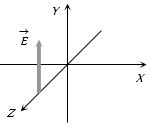
The figure shows the electric field $\overrightarrow{E}$ of an $EM$ wave at a certain point and a certain instant. The wave is transporting energy in the negative $z$ direction ($-z$ direction). What is the direction of the magnetic field $\overrightarrow{B}$ of the wave at that point and instant?
A
Towards $+x$ direction
B
Towards $-x$ direction
C
Towards $+z$ direction
D
Towards $-z$ direction
Solution
(A) The direction of propagation of an $EM$ wave is given by the direction of the Poynting vector $\overrightarrow{S}$,which is in the direction of $\overrightarrow{E} \times \overrightarrow{B}$.
Given,the direction of propagation is $-z$ direction,so $\overrightarrow{E} \times \overrightarrow{B} = -\widehat{k}$.
From the figure,the electric field $\overrightarrow{E}$ is in the $+y$ direction,so $\overrightarrow{E} = E_0 \widehat{j}$.
Substituting these into the relation: $(E_0 \widehat{j}) \times \overrightarrow{B} = -\widehat{k}$.
Let $\overrightarrow{B} = B_x \widehat{i} + B_y \widehat{j} + B_z \widehat{k}$.
Since $\overrightarrow{E} \perp \overrightarrow{B}$ and $\overrightarrow{B} \perp \text{propagation direction}$,$\overrightarrow{B}$ must be along the $x$-axis.
So,$\widehat{j} \times (B_x \widehat{i}) = -B_x \widehat{k}$.
Comparing this with $-\widehat{k}$,we get $-B_x = -1$,which means $B_x = 1$.
Therefore,the magnetic field $\overrightarrow{B}$ is in the $+x$ direction.
Given,the direction of propagation is $-z$ direction,so $\overrightarrow{E} \times \overrightarrow{B} = -\widehat{k}$.
From the figure,the electric field $\overrightarrow{E}$ is in the $+y$ direction,so $\overrightarrow{E} = E_0 \widehat{j}$.
Substituting these into the relation: $(E_0 \widehat{j}) \times \overrightarrow{B} = -\widehat{k}$.
Let $\overrightarrow{B} = B_x \widehat{i} + B_y \widehat{j} + B_z \widehat{k}$.
Since $\overrightarrow{E} \perp \overrightarrow{B}$ and $\overrightarrow{B} \perp \text{propagation direction}$,$\overrightarrow{B}$ must be along the $x$-axis.
So,$\widehat{j} \times (B_x \widehat{i}) = -B_x \widehat{k}$.
Comparing this with $-\widehat{k}$,we get $-B_x = -1$,which means $B_x = 1$.
Therefore,the magnetic field $\overrightarrow{B}$ is in the $+x$ direction.
0 likes
View Solution135
MediumMCQ
The $rms$ value of the electric field of the light coming from the Sun is $720 \; N/C$. The average total energy density of the electromagnetic wave is
A
$4.58 \times 10^{-6} \; J/m^3$
B
$6.37 \times 10^{-9} \; J/m^3$
C
$81.35 \times 10^{-12} \; J/m^3$
D
$3.3 \times 10^{-3} \; J/m^3$
Solution
(A) The average total energy density $u$ of an electromagnetic wave is the sum of the electric energy density and the magnetic energy density.
$u = u_E + u_B = \frac{1}{2} \varepsilon_0 E_{rms}^2 + \frac{1}{2\mu_0} B_{rms}^2$
Since $B_{rms} = \frac{E_{rms}}{c}$,we have $u_B = \frac{1}{2\mu_0} \left(\frac{E_{rms}}{c}\right)^2 = \frac{1}{2\mu_0} (E_{rms}^2 \varepsilon_0 \mu_0) = \frac{1}{2} \varepsilon_0 E_{rms}^2$.
Thus,the total energy density is $u = \frac{1}{2} \varepsilon_0 E_{rms}^2 + \frac{1}{2} \varepsilon_0 E_{rms}^2 = \varepsilon_0 E_{rms}^2$.
Given $\varepsilon_0 = 8.85 \times 10^{-12} \; F/m$ and $E_{rms} = 720 \; N/C$:
$u = (8.85 \times 10^{-12}) \times (720)^2$
$u = 8.85 \times 10^{-12} \times 518400$
$u = 4.58784 \times 10^{-6} \; J/m^3 \approx 4.58 \times 10^{-6} \; J/m^3$.
$u = u_E + u_B = \frac{1}{2} \varepsilon_0 E_{rms}^2 + \frac{1}{2\mu_0} B_{rms}^2$
Since $B_{rms} = \frac{E_{rms}}{c}$,we have $u_B = \frac{1}{2\mu_0} \left(\frac{E_{rms}}{c}\right)^2 = \frac{1}{2\mu_0} (E_{rms}^2 \varepsilon_0 \mu_0) = \frac{1}{2} \varepsilon_0 E_{rms}^2$.
Thus,the total energy density is $u = \frac{1}{2} \varepsilon_0 E_{rms}^2 + \frac{1}{2} \varepsilon_0 E_{rms}^2 = \varepsilon_0 E_{rms}^2$.
Given $\varepsilon_0 = 8.85 \times 10^{-12} \; F/m$ and $E_{rms} = 720 \; N/C$:
$u = (8.85 \times 10^{-12}) \times (720)^2$
$u = 8.85 \times 10^{-12} \times 518400$
$u = 4.58784 \times 10^{-6} \; J/m^3 \approx 4.58 \times 10^{-6} \; J/m^3$.
0 likes
View Solution136
MediumMCQ
An electromagnetic wave in vacuum has the electric and magnetic field $\vec{E}$ and $\vec{B}$,which are always perpendicular to each other. The direction of polarization is given by $\vec{X}$ and that of wave propagation by $\vec{k}$. Then:
A
$\vec{X} \parallel \vec{B}$ and $\vec{k} \parallel \vec{B} \times \vec{E}$
B
$\vec{X} \parallel \vec{E}$ and $\vec{k} \parallel \vec{E} \times \vec{B}$
C
$\vec{X} \parallel \vec{B}$ and $\vec{k} \parallel \vec{E} \times \vec{B}$
D
$\vec{X} \parallel \vec{E}$ and $\vec{k} \parallel \vec{B} \times \vec{E}$
Solution
(B) The direction of polarization of an electromagnetic wave is defined by the direction of the oscillating electric field vector $\vec{E}$. Therefore,$\vec{X} \parallel \vec{E}$.
The direction of wave propagation $\vec{k}$ is given by the direction of the Poynting vector $\vec{S} = \frac{1}{\mu_0} (\vec{E} \times \vec{B})$.
Thus,the direction of wave propagation is parallel to $\vec{E} \times \vec{B}$.
The direction of wave propagation $\vec{k}$ is given by the direction of the Poynting vector $\vec{S} = \frac{1}{\mu_0} (\vec{E} \times \vec{B})$.
Thus,the direction of wave propagation is parallel to $\vec{E} \times \vec{B}$.
0 likes
View Solution137
EasyMCQ
The magnetic field in a travelling electromagnetic wave has a peak value of $20 \ nT$. The peak value of electric field strength is ...... $Vm^{-1}$.
A
$3$
B
$6$
C
$9$
D
$12$
Solution
(B) Given,the peak value of the magnetic field is $B_{0} = 20 \ nT = 20 \times 10^{-9} \ T$.
The speed of light in vacuum is $c = 3 \times 10^{8} \ ms^{-1}$.
The relationship between the peak electric field $E_{0}$ and the peak magnetic field $B_{0}$ in an electromagnetic wave is given by $E_{0} = B_{0} \times c$.
Substituting the values:
$E_{0} = (20 \times 10^{-9} \ T) \times (3 \times 10^{8} \ ms^{-1})$
$E_{0} = 60 \times 10^{-1} \ Vm^{-1}$
$E_{0} = 6 \ Vm^{-1}$.
Therefore,the peak value of the electric field strength is $6 \ Vm^{-1}$.
The speed of light in vacuum is $c = 3 \times 10^{8} \ ms^{-1}$.
The relationship between the peak electric field $E_{0}$ and the peak magnetic field $B_{0}$ in an electromagnetic wave is given by $E_{0} = B_{0} \times c$.
Substituting the values:
$E_{0} = (20 \times 10^{-9} \ T) \times (3 \times 10^{8} \ ms^{-1})$
$E_{0} = 60 \times 10^{-1} \ Vm^{-1}$
$E_{0} = 6 \ Vm^{-1}$.
Therefore,the peak value of the electric field strength is $6 \ Vm^{-1}$.
0 likes
View Solution138
EasyMCQ
During the propagation of electromagnetic waves in a medium,
A
Electric energy density is half of the magnetic energy density
B
Electric energy density is equal to the magnetic energy density
C
Both electric and magnetic energy densities are zero
D
Electric energy density is double of the magnetic energy density
Solution
(B) For an electromagnetic wave,the relationship between the amplitudes of the electric field $(E_0)$ and magnetic field $(B_0)$ is given by $E_0 = cB_0$,where $c = \frac{1}{\sqrt{\mu_0 \varepsilon_0}}$.
The electric energy density is given by $u_E = \frac{1}{2} \varepsilon_0 E_0^2$.
The magnetic energy density is given by $u_B = \frac{1}{2} \frac{B_0^2}{\mu_0}$.
Substituting $E_0 = cB_0$ into the electric energy density formula:
$u_E = \frac{1}{2} \varepsilon_0 (cB_0)^2 = \frac{1}{2} \varepsilon_0 \left(\frac{1}{\mu_0 \varepsilon_0}\right) B_0^2 = \frac{1}{2} \frac{B_0^2}{\mu_0}$.
Therefore,$u_E = u_B$. The energy is equally divided between the electric and magnetic fields.
The electric energy density is given by $u_E = \frac{1}{2} \varepsilon_0 E_0^2$.
The magnetic energy density is given by $u_B = \frac{1}{2} \frac{B_0^2}{\mu_0}$.
Substituting $E_0 = cB_0$ into the electric energy density formula:
$u_E = \frac{1}{2} \varepsilon_0 (cB_0)^2 = \frac{1}{2} \varepsilon_0 \left(\frac{1}{\mu_0 \varepsilon_0}\right) B_0^2 = \frac{1}{2} \frac{B_0^2}{\mu_0}$.
Therefore,$u_E = u_B$. The energy is equally divided between the electric and magnetic fields.
0 likes
View Solution139
MediumMCQ
An $EM$ wave from air enters a medium. The electric fields are $\overrightarrow {{E_1}} = {E_{01}}\hat x\cos[2\pi v(\frac{z}{c} - t)]$ in air and $\overrightarrow {{E_2}} = {E_{02}}\hat x\cos[k(2z - ct)]$ in medium,where the wave number $k$ and frequency $v$ refer to their values in air. The medium is nonmagnetic. If $\varepsilon_{r_1}$ and $\varepsilon_{r_2}$ refer to relative permittivities of air and medium respectively,which of the following options is correct?
A
$\frac{\varepsilon_{r_1}}{\varepsilon_{r_2}} = 2$
B
$\frac{\varepsilon_{r_1}}{\varepsilon_{r_2}} = \frac{1}{4}$
C
$\frac{\varepsilon_{r_1}}{\varepsilon_{r_2}} = \frac{1}{2}$
D
$\frac{\varepsilon_{r_1}}{\varepsilon_{r_2}} = 4$
Solution
(B) The velocity of an $EM$ wave is given by $v = \frac{1}{\sqrt{\mu \varepsilon}} = \frac{c}{\sqrt{\mu_r \varepsilon_r}}$.
In air,the wave equation is $\cos[2\pi v(\frac{z}{c} - t)] = \cos[\frac{2\pi v}{c}z - 2\pi vt]$. The phase velocity is $v_1 = c$.
In the medium,the wave equation is $\cos[k(2z - ct)] = \cos[2kz - kct]$. The phase velocity is $v_2 = \frac{kct}{2kz} = \frac{c}{2}$.
Since the medium is nonmagnetic,$\mu_{r_1} = \mu_{r_2} = 1$.
The ratio of velocities is $\frac{v_1}{v_2} = \frac{c}{c/2} = 2$.
Since $v = \frac{c}{\sqrt{\varepsilon_r}}$,we have $\frac{v_1}{v_2} = \sqrt{\frac{\varepsilon_{r_2}}{\varepsilon_{r_1}}} = 2$.
Squaring both sides,$\frac{\varepsilon_{r_2}}{\varepsilon_{r_1}} = 4$,which implies $\frac{\varepsilon_{r_1}}{\varepsilon_{r_2}} = \frac{1}{4}$.
In air,the wave equation is $\cos[2\pi v(\frac{z}{c} - t)] = \cos[\frac{2\pi v}{c}z - 2\pi vt]$. The phase velocity is $v_1 = c$.
In the medium,the wave equation is $\cos[k(2z - ct)] = \cos[2kz - kct]$. The phase velocity is $v_2 = \frac{kct}{2kz} = \frac{c}{2}$.
Since the medium is nonmagnetic,$\mu_{r_1} = \mu_{r_2} = 1$.
The ratio of velocities is $\frac{v_1}{v_2} = \frac{c}{c/2} = 2$.
Since $v = \frac{c}{\sqrt{\varepsilon_r}}$,we have $\frac{v_1}{v_2} = \sqrt{\frac{\varepsilon_{r_2}}{\varepsilon_{r_1}}} = 2$.
Squaring both sides,$\frac{\varepsilon_{r_2}}{\varepsilon_{r_1}} = 4$,which implies $\frac{\varepsilon_{r_1}}{\varepsilon_{r_2}} = \frac{1}{4}$.
0 likes
View Solution140
MediumMCQ
$A$ mathematical representation of an electromagnetic wave is given by the two equations $E = E_{max} \cos(kx - \omega t)$ and $B = B_{max} \cos(kx - \omega t)$,where $E_{max}$ is the amplitude of the electric field and $B_{max}$ is the amplitude of the magnetic field. What is the intensity $I$ in terms of $E_{max}$ and universal constants $\mu_0, \epsilon_0$?
A
$I = \frac{1}{2} \sqrt{\frac{\mu_0}{\epsilon_0}} E_{max}^2$
B
$I = \frac{1}{2} \epsilon_0 c E_{max}^2$
C
$I = \frac{1}{2} \sqrt{\frac{\epsilon_0}{\mu_0}} E_{max}^2$
D
$I = \frac{1}{2} \sqrt{\frac{\mu_0}{\epsilon_0}} E_{max}$
Solution
(C) The intensity $I$ of an electromagnetic wave is defined as the average energy per unit area per unit time,which is given by $I = \langle u \rangle c$,where $\langle u \rangle$ is the average energy density and $c$ is the speed of light.
The total energy density $u$ is the sum of electric and magnetic energy densities: $u = u_E + u_B = \frac{1}{2} \epsilon_0 E^2 + \frac{1}{2\mu_0} B^2$.
Since $E = cB$ and $c = \frac{1}{\sqrt{\mu_0 \epsilon_0}}$,the average energy density is $\langle u \rangle = \frac{1}{2} \epsilon_0 E_{rms}^2 + \frac{1}{2\mu_0} B_{rms}^2 = \frac{1}{2} \epsilon_0 E_{rms}^2 + \frac{1}{2\mu_0} (\frac{E_{rms}}{c})^2 = \epsilon_0 E_{rms}^2$.
Given $E_{rms} = \frac{E_{max}}{\sqrt{2}}$,we have $\langle u \rangle = \epsilon_0 \frac{E_{max}^2}{2}$.
Thus,$I = \langle u \rangle c = \frac{1}{2} \epsilon_0 c E_{max}^2$.
Substituting $c = \frac{1}{\sqrt{\mu_0 \epsilon_0}}$,we get $I = \frac{1}{2} \epsilon_0 \frac{1}{\sqrt{\mu_0 \epsilon_0}} E_{max}^2 = \frac{1}{2} \sqrt{\frac{\epsilon_0}{\mu_0}} E_{max}^2$.
The total energy density $u$ is the sum of electric and magnetic energy densities: $u = u_E + u_B = \frac{1}{2} \epsilon_0 E^2 + \frac{1}{2\mu_0} B^2$.
Since $E = cB$ and $c = \frac{1}{\sqrt{\mu_0 \epsilon_0}}$,the average energy density is $\langle u \rangle = \frac{1}{2} \epsilon_0 E_{rms}^2 + \frac{1}{2\mu_0} B_{rms}^2 = \frac{1}{2} \epsilon_0 E_{rms}^2 + \frac{1}{2\mu_0} (\frac{E_{rms}}{c})^2 = \epsilon_0 E_{rms}^2$.
Given $E_{rms} = \frac{E_{max}}{\sqrt{2}}$,we have $\langle u \rangle = \epsilon_0 \frac{E_{max}^2}{2}$.
Thus,$I = \langle u \rangle c = \frac{1}{2} \epsilon_0 c E_{max}^2$.
Substituting $c = \frac{1}{\sqrt{\mu_0 \epsilon_0}}$,we get $I = \frac{1}{2} \epsilon_0 \frac{1}{\sqrt{\mu_0 \epsilon_0}} E_{max}^2 = \frac{1}{2} \sqrt{\frac{\epsilon_0}{\mu_0}} E_{max}^2$.
0 likes
View Solution141
MediumMCQ
You are driving in your car listening to music on the radio. Your car is equipped with a radio that can receive radio signals of frequency $(f_1 \approx 3 \, MHz)$,$(f_2 \approx 30 \, MHz)$,and $(f_3 = 3 \, GHz)$. You enter a tunnel with a circular opening of diameter $10 \, m$. Which kind of radio signal will you be able to receive for the longest distance as you continue to travel in the tunnel?
A
Radio signal of frequency $f_1$
B
Radio signal of frequency $f_2$
C
Radio signal of frequency $f_3$
D
Distance up to which the signal can penetrate in the tunnel is independent of frequency
Solution
(B) The propagation of radio waves into a tunnel depends on the phenomenon of diffraction. Diffraction is significant when the wavelength $(\lambda)$ of the wave is comparable to the size of the aperture (diameter $D = 10 \, m$).
The wavelength is given by $\lambda = c/f$,where $c \approx 3 \times 10^8 \, m/s$.
For $f_1 = 3 \times 10^6 \, Hz$,$\lambda_1 = (3 \times 10^8) / (3 \times 10^6) = 100 \, m$.
For $f_2 = 30 \times 10^6 \, Hz$,$\lambda_2 = (3 \times 10^8) / (30 \times 10^6) = 10 \, m$.
For $f_3 = 3 \times 10^9 \, Hz$,$\lambda_3 = (3 \times 10^8) / (3 \times 10^9) = 0.1 \, m$.
Since the diameter of the tunnel is $10 \, m$,the signal with $\lambda_2 = 10 \, m$ matches the aperture size,leading to effective diffraction and better penetration into the tunnel compared to the others.
The wavelength is given by $\lambda = c/f$,where $c \approx 3 \times 10^8 \, m/s$.
For $f_1 = 3 \times 10^6 \, Hz$,$\lambda_1 = (3 \times 10^8) / (3 \times 10^6) = 100 \, m$.
For $f_2 = 30 \times 10^6 \, Hz$,$\lambda_2 = (3 \times 10^8) / (30 \times 10^6) = 10 \, m$.
For $f_3 = 3 \times 10^9 \, Hz$,$\lambda_3 = (3 \times 10^8) / (3 \times 10^9) = 0.1 \, m$.
Since the diameter of the tunnel is $10 \, m$,the signal with $\lambda_2 = 10 \, m$ matches the aperture size,leading to effective diffraction and better penetration into the tunnel compared to the others.
0 likes
View Solution142
EasyMCQ
What is the range of frequency of $EM$ waves that are reflected back by the ionosphere?
A
$100$ to $200\ MHz$
B
$500$ to $1000\ MHz$
C
$2$ to $10\ MHz$
D
All range of frequencies
Solution
(C) The ionosphere acts as a reflecting medium for radio waves within a specific frequency range.
This phenomenon is known as sky wave propagation.
The ionosphere reflects electromagnetic waves having frequencies roughly between $2\ MHz$ and $30\ MHz$.
Frequencies higher than this range typically penetrate the ionosphere and escape into space.
Therefore,among the given options,the range $2\ MHz$ to $10\ MHz$ is the correct range that is reflected back by the ionosphere.
This phenomenon is known as sky wave propagation.
The ionosphere reflects electromagnetic waves having frequencies roughly between $2\ MHz$ and $30\ MHz$.
Frequencies higher than this range typically penetrate the ionosphere and escape into space.
Therefore,among the given options,the range $2\ MHz$ to $10\ MHz$ is the correct range that is reflected back by the ionosphere.
0 likes
View Solution143
EasyMCQ
The average value of electric energy density in an electromagnetic wave is:
A
$\frac{1}{2}\varepsilon_0 E_{rms}^2$
B
$\frac{1}{4}\varepsilon_0 E_0^2$
C
$\varepsilon_0 E_0^2$
D
$\frac{1}{2}\varepsilon_0 E_0^2$
Solution
(B) The instantaneous electric energy density is given by $u_E = \frac{1}{2} \varepsilon_0 E^2$.
For an electromagnetic wave,the electric field varies sinusoidally as $E = E_0 \sin(kx - \omega t)$.
The average value of $\sin^2(kx - \omega t)$ over a complete cycle is $\frac{1}{2}$.
Therefore,the average electric energy density is $\langle u_E \rangle = \frac{1}{2} \varepsilon_0 \langle E^2 \rangle = \frac{1}{2} \varepsilon_0 (E_0^2 \cdot \frac{1}{2}) = \frac{1}{4} \varepsilon_0 E_0^2$.
For an electromagnetic wave,the electric field varies sinusoidally as $E = E_0 \sin(kx - \omega t)$.
The average value of $\sin^2(kx - \omega t)$ over a complete cycle is $\frac{1}{2}$.
Therefore,the average electric energy density is $\langle u_E \rangle = \frac{1}{2} \varepsilon_0 \langle E^2 \rangle = \frac{1}{2} \varepsilon_0 (E_0^2 \cdot \frac{1}{2}) = \frac{1}{4} \varepsilon_0 E_0^2$.
0 likes
View Solution144
MediumMCQ
The electron density of $E, F_1,$ and $F_2$ layers of the ionosphere is $4 \times 10^{11} \, m^{-3}, 9 \times 10^{11} \, m^{-3},$ and $16 \times 10^{11} \, m^{-3}$ respectively. What is the ratio of the critical frequencies for the reflection of radio waves?
A
$2 : 4 : 3$
B
$4 : 3 : 2$
C
$2 : 3 : 4$
D
None of these
Solution
(C) The critical frequency $f_c$ for the reflection of radio waves from an ionospheric layer is given by the relation $f_c = 9 \sqrt{N_{max}}$,where $N_{max}$ is the maximum electron density.
This implies that $f_c \propto \sqrt{N}$.
Given the electron densities $N_E = 4 \times 10^{11} \, m^{-3}$,$N_{F_1} = 9 \times 10^{11} \, m^{-3}$,and $N_{F_2} = 16 \times 10^{11} \, m^{-3}$.
The ratio of critical frequencies is:
$(f_c)_E : (f_c)_{F_1} : (f_c)_{F_2} = \sqrt{4 \times 10^{11}} : \sqrt{9 \times 10^{11}} : \sqrt{16 \times 10^{11}}$
$= \sqrt{4} : \sqrt{9} : \sqrt{16}$
$= 2 : 3 : 4$.
This implies that $f_c \propto \sqrt{N}$.
Given the electron densities $N_E = 4 \times 10^{11} \, m^{-3}$,$N_{F_1} = 9 \times 10^{11} \, m^{-3}$,and $N_{F_2} = 16 \times 10^{11} \, m^{-3}$.
The ratio of critical frequencies is:
$(f_c)_E : (f_c)_{F_1} : (f_c)_{F_2} = \sqrt{4 \times 10^{11}} : \sqrt{9 \times 10^{11}} : \sqrt{16 \times 10^{11}}$
$= \sqrt{4} : \sqrt{9} : \sqrt{16}$
$= 2 : 3 : 4$.
0 likes
View Solution145
MediumMCQ
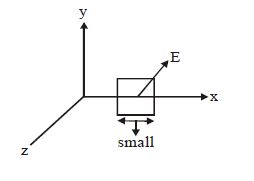
$A$ plane electromagnetic wave is travelling in the positive $X$-axis. At the instant shown,the electric field at the extremely narrow dashed rectangle is in the $-ve$ $Z$-direction and its magnitude is increasing. Which diagram correctly shows the direction and relative magnitudes of the magnetic field at the edges of the rectangle?
A
B
C
D
Solution
(B) The electromagnetic wave propagates along the $+ve$ $X$-axis. The electric field $\vec{E}$ is in the $-ve$ $Z$-direction $(\vec{E} = -E_z \hat{k})$. According to Maxwell-Ampere's law,$\oint \vec{B} \cdot d\vec{l} = \mu_0 \epsilon_0 \frac{d\phi_E}{dt}$.
Since the magnitude of the electric field is increasing,the electric flux $\phi_E$ through the rectangle is increasing in the $-ve$ $Z$-direction. By Lenz's law,the induced magnetic field will oppose this change.
Using the right-hand rule,the magnetic field $\vec{B}$ must circulate in a way that creates a flux in the $+ve$ $Z$-direction to oppose the increasing $-ve$ $Z$-flux. This corresponds to a counter-clockwise circulation of the magnetic field around the rectangle.
Furthermore,since the wave is travelling in the $+X$ direction,the field values are higher at positions closer to the wave front. Thus,the magnetic field magnitude will be relatively larger at the edge further along the $X$-axis compared to the edge closer to the origin. Diagram $B$ correctly depicts this counter-clockwise circulation with a larger magnitude on the right edge.
Since the magnitude of the electric field is increasing,the electric flux $\phi_E$ through the rectangle is increasing in the $-ve$ $Z$-direction. By Lenz's law,the induced magnetic field will oppose this change.
Using the right-hand rule,the magnetic field $\vec{B}$ must circulate in a way that creates a flux in the $+ve$ $Z$-direction to oppose the increasing $-ve$ $Z$-flux. This corresponds to a counter-clockwise circulation of the magnetic field around the rectangle.
Furthermore,since the wave is travelling in the $+X$ direction,the field values are higher at positions closer to the wave front. Thus,the magnetic field magnitude will be relatively larger at the edge further along the $X$-axis compared to the edge closer to the origin. Diagram $B$ correctly depicts this counter-clockwise circulation with a larger magnitude on the right edge.
0 likes
View Solution146
MediumMCQ
If $c$ is the speed of electromagnetic waves in vacuum,its speed in a medium of dielectric constant $K$ and relative permeability $\mu_r$ is:
A
$v = \frac{1}{\sqrt{\mu_r K}}$
B
$v = \frac{c}{\sqrt{\mu_r K}}$
C
$v = \frac{K}{\sqrt{\mu_r c}}$
D
$v = \frac{\mu_r}{\sqrt{c K}}$
Solution
(B) The speed of light in vacuum is given by $c = \frac{1}{\sqrt{\mu_0 \varepsilon_0}}$.
In a medium with permeability $\mu$ and permittivity $\varepsilon$,the speed is $v = \frac{1}{\sqrt{\mu \varepsilon}}$.
We know that $\mu = \mu_0 \mu_r$ and $\varepsilon = \varepsilon_0 K$,where $\mu_r$ is the relative permeability and $K$ is the dielectric constant (relative permittivity).
Substituting these into the expression for $v$,we get $v = \frac{1}{\sqrt{(\mu_0 \mu_r)(\varepsilon_0 K)}} = \frac{1}{\sqrt{\mu_0 \varepsilon_0}} \cdot \frac{1}{\sqrt{\mu_r K}}$.
Since $c = \frac{1}{\sqrt{\mu_0 \varepsilon_0}}$,we have $v = \frac{c}{\sqrt{\mu_r K}}$.
In a medium with permeability $\mu$ and permittivity $\varepsilon$,the speed is $v = \frac{1}{\sqrt{\mu \varepsilon}}$.
We know that $\mu = \mu_0 \mu_r$ and $\varepsilon = \varepsilon_0 K$,where $\mu_r$ is the relative permeability and $K$ is the dielectric constant (relative permittivity).
Substituting these into the expression for $v$,we get $v = \frac{1}{\sqrt{(\mu_0 \mu_r)(\varepsilon_0 K)}} = \frac{1}{\sqrt{\mu_0 \varepsilon_0}} \cdot \frac{1}{\sqrt{\mu_r K}}$.
Since $c = \frac{1}{\sqrt{\mu_0 \varepsilon_0}}$,we have $v = \frac{c}{\sqrt{\mu_r K}}$.
0 likes
View Solution147
MediumMCQ
$A$ plane electromagnetic wave travelling along the $X$-direction has a wavelength of $3 \ mm$. The variation in the electric field occurs in the $Y$-direction with an amplitude of $66 \ Vm^{-1}$. The equations for the electric and magnetic fields as a function of $x$ and $t$ are respectively:
A
$E_y = 33 \cos \pi \times 10^{11} (t - x/c), B_z = 1.1 \times 10^{-7} \cos \pi \times 10^{11} (t - x/c)$
B
$E_y = 11 \cos 2\pi \times 10^{11} (t - x/c), B_z = 11 \times 10^{-7} \cos 2\pi \times 10^{11} (t - x/c)$
C
$E_y = 33 \cos \pi \times 10^{11} (t - x/c), B_z = 11 \times 10^{-7} \cos \pi \times 10^{11} (t - x/c)$
D
$E_y = 66 \cos 2\pi \times 10^{11} (t - x/c), B_z = 2.2 \times 10^{-7} \cos 2\pi \times 10^{11} (t - x/c)$
Solution
(D) Given: Wavelength $\lambda = 3 \ mm = 3 \times 10^{-3} \ m$. Amplitude of electric field $E_0 = 66 \ Vm^{-1}$.
Frequency $f = c / \lambda = (3 \times 10^8) / (3 \times 10^{-3}) = 10^{11} \ Hz$.
Angular frequency $\omega = 2\pi f = 2\pi \times 10^{11} \ rad/s$.
The electric field equation is $E_y = E_0 \cos(\omega(t - x/c)) = 66 \cos(2\pi \times 10^{11}(t - x/c))$.
The amplitude of the magnetic field is $B_0 = E_0 / c = 66 / (3 \times 10^8) = 22 \times 10^{-8} = 2.2 \times 10^{-7} \ T$.
Since the wave travels in the $X$-direction and $E$ is in the $Y$-direction,$B$ must be in the $Z$-direction.
Thus,$B_z = B_0 \cos(\omega(t - x/c)) = 2.2 \times 10^{-7} \cos(2\pi \times 10^{11}(t - x/c))$.
Frequency $f = c / \lambda = (3 \times 10^8) / (3 \times 10^{-3}) = 10^{11} \ Hz$.
Angular frequency $\omega = 2\pi f = 2\pi \times 10^{11} \ rad/s$.
The electric field equation is $E_y = E_0 \cos(\omega(t - x/c)) = 66 \cos(2\pi \times 10^{11}(t - x/c))$.
The amplitude of the magnetic field is $B_0 = E_0 / c = 66 / (3 \times 10^8) = 22 \times 10^{-8} = 2.2 \times 10^{-7} \ T$.
Since the wave travels in the $X$-direction and $E$ is in the $Y$-direction,$B$ must be in the $Z$-direction.
Thus,$B_z = B_0 \cos(\omega(t - x/c)) = 2.2 \times 10^{-7} \cos(2\pi \times 10^{11}(t - x/c))$.
0 likes
View Solution148
MediumMCQ
$A$ radio station has two channels. One is $AM$ at $1020 \ kHz$ and the other is $FM$ at $89.5 \ MHz$. For good results,you will use:
A
longer antenna for the $AM$ channel and shorter for the $FM$
B
shorter antenna for the $AM$ channel and longer for the $FM$
C
Same length antenna will work for both
D
Information given is not enough to say which one to use for which
Solution
(A) The wavelength $\lambda$ of a signal is given by $\lambda = c/f$,where $c$ is the speed of light $(3 \times 10^8 \ m/s)$ and $f$ is the frequency.
For $AM$ at $1020 \ kHz$ $(1.02 \times 10^6 \ Hz)$,the wavelength is $\lambda_{AM} = (3 \times 10^8) / (1.02 \times 10^6) \approx 294 \ m$.
For $FM$ at $89.5 \ MHz$ $(89.5 \times 10^6 \ Hz)$,the wavelength is $\lambda_{FM} = (3 \times 10^8) / (89.5 \times 10^6) \approx 3.35 \ m$.
For efficient radiation and reception,the height of the antenna should be comparable to a quarter wavelength $(\lambda/4)$ of the signal.
Since $\lambda_{AM} > \lambda_{FM}$,the $AM$ channel requires a much longer antenna than the $FM$ channel.
For $AM$ at $1020 \ kHz$ $(1.02 \times 10^6 \ Hz)$,the wavelength is $\lambda_{AM} = (3 \times 10^8) / (1.02 \times 10^6) \approx 294 \ m$.
For $FM$ at $89.5 \ MHz$ $(89.5 \times 10^6 \ Hz)$,the wavelength is $\lambda_{FM} = (3 \times 10^8) / (89.5 \times 10^6) \approx 3.35 \ m$.
For efficient radiation and reception,the height of the antenna should be comparable to a quarter wavelength $(\lambda/4)$ of the signal.
Since $\lambda_{AM} > \lambda_{FM}$,the $AM$ channel requires a much longer antenna than the $FM$ channel.
0 likes
View Solution149
MediumMCQ
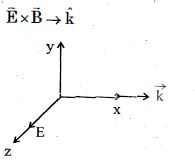
An electromagnetic wave has an electric field given by the expression (in Cartesian coordinates) $\vec E(x,t) = 6.0\,\cos(1 \times 10^7x - 3 \times 10^{15}t)\hat z$. What is the direction of the magnetic field at time $t = 0$ and position $x = 0$?
A
$-x$
B
$+x$
C
$-y$
D
$+y$
Solution
(D) The given electric field is $\vec E = E_z \hat z = 6.0\,\cos(kx - \omega t)\hat z$.
Comparing this with the standard form $\vec E = E_0 \cos(kx - \omega t)\hat z$,we see that the wave is propagating in the $+x$ direction (since the argument is $kx - \omega t$).
Thus,the direction of propagation $\hat k$ is $+x$ (or $\hat i$).
The relationship between the direction of the electric field $\vec E$,magnetic field $\vec B$,and the direction of propagation $\hat k$ is given by $\hat k = \hat E \times \hat B$.
Here,$\hat E = \hat z$ (or $\hat k_{unit}$) and $\hat k = \hat i$.
Substituting these,we get $\hat i = \hat k_{unit} \times \hat B$.
Using the cross product rules ($\hat k \times \hat i = \hat j$,$\hat k \times \hat j = -\hat i$,etc.),we find that $\hat B = \hat j$ (or $+y$).
Therefore,the direction of the magnetic field is $+y$.
Comparing this with the standard form $\vec E = E_0 \cos(kx - \omega t)\hat z$,we see that the wave is propagating in the $+x$ direction (since the argument is $kx - \omega t$).
Thus,the direction of propagation $\hat k$ is $+x$ (or $\hat i$).
The relationship between the direction of the electric field $\vec E$,magnetic field $\vec B$,and the direction of propagation $\hat k$ is given by $\hat k = \hat E \times \hat B$.
Here,$\hat E = \hat z$ (or $\hat k_{unit}$) and $\hat k = \hat i$.
Substituting these,we get $\hat i = \hat k_{unit} \times \hat B$.
Using the cross product rules ($\hat k \times \hat i = \hat j$,$\hat k \times \hat j = -\hat i$,etc.),we find that $\hat B = \hat j$ (or $+y$).
Therefore,the direction of the magnetic field is $+y$.
0 likes
View Solution150
MediumMCQ
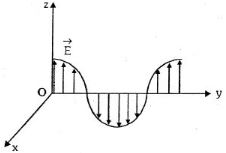
The electric field for a plane electromagnetic wave travelling in the $+y$ direction is shown in the figure. Consider a point where the electric field is in the $+z$ direction. The magnetic field $\vec B$ is
A
in the $+x$ direction and in phase with the electric field $\vec E$
B
in the $-x$ direction and in phase with the electric field $\vec E$
C
in the $+z$ direction and in phase with the electric field $\vec E$
D
in the $-z$ direction and in phase with the electric field $\vec E$
Solution
(A) For an electromagnetic wave,the direction of propagation is given by the direction of the vector $\vec E \times \vec B$.
Given that the wave travels in the $+y$ direction,we have the direction of propagation $\hat{v} = \hat{j}$.
The electric field $\vec E$ is in the $+z$ direction,so $\vec E = E_0 \hat{k}$.
Using the relation $\vec E \times \vec B = \text{direction of propagation}$,we have $\hat{k} \times \vec B = \hat{j}$.
We know that $\hat{k} \times \hat{i} = \hat{j}$. Therefore,$\vec B$ must be in the $+x$ direction.
Also,in an electromagnetic wave,the electric and magnetic fields are always in phase.
Thus,the magnetic field $\vec B$ is in the $+x$ direction and in phase with the electric field $\vec E$.
Given that the wave travels in the $+y$ direction,we have the direction of propagation $\hat{v} = \hat{j}$.
The electric field $\vec E$ is in the $+z$ direction,so $\vec E = E_0 \hat{k}$.
Using the relation $\vec E \times \vec B = \text{direction of propagation}$,we have $\hat{k} \times \vec B = \hat{j}$.
We know that $\hat{k} \times \hat{i} = \hat{j}$. Therefore,$\vec B$ must be in the $+x$ direction.
Also,in an electromagnetic wave,the electric and magnetic fields are always in phase.
Thus,the magnetic field $\vec B$ is in the $+x$ direction and in phase with the electric field $\vec E$.
0 likes
View SolutionElectromagnetic waves — Properties of Electromagnetic Waves · Frequently Asked Questions
1Are these Electromagnetic waves questions useful for JEE and NEET?
Yes. All questions in this section are mapped to JEE Main and NEET exam patterns. Previous year questions from JEE Main, NEET, GUJCET and state-level exams are included with full solutions.
2Can I switch to Hindi or Gujarati for these questions?
Yes. Use the language tabs in the hero section or the sidebar to view the same questions and solutions in English, Hindi or Gujarati.
3How do I generate a question paper from this subtopic?
Use the Vedclass Exam Paper Generator — select the chapter and subtopic, set difficulty, and generate Sets A, B, C, D automatically. First 3 chapters of every subject are free.
Vedclass Products
For Students
Vedclass Test Series
Mock tests in real JEE/NEET style with performance analysis. 5-day free trial.
Start Free TrialFor Teachers
Exam Paper Generator
Generate Set A/B/C/D papers from this chapter in 2 minutes. 3 chapters free.
Try FreeFor Institutes
Online Exam Module
Live online exams with unlimited students, 360° analytics & white-label branding.
See DemoFor Teachers & Institutes
Generate a Electromagnetic waves Exam Paper in 2 Minutes
Select subtopic & difficulty — Sets A, B, C, D auto-generated with No Repeat logic.
First 3 chapters of every subject are free — no payment required.