
A English
Self Induction Questions in English
Class 12 Physics · Electromagnetic Induction · Self Induction
226+
Questions
English
Language
100%
With Solutions
Showing 49 of 226 questions in English
151
EasyMCQ
$A$ coil is wound on a core of rectangular cross-section. If all the linear dimensions of the core are increased by a factor of $2$ and the number of turns per unit length of the coil remains the same, the self-inductance increases by a factor of (Assume, permeability is same).
A
$16$
B
$8$
C
$4$
D
$2$
Solution
(B) The self-inductance $L$ of a solenoid is given by the formula $L = \mu_0 n^2 A l$, where $n$ is the number of turns per unit length, $A$ is the cross-sectional area, and $l$ is the length of the coil.
Given that the linear dimensions are increased by a factor of $2$, the new length $l' = 2l$ and the new area $A' = (2)^2 A = 4A$.
The number of turns per unit length $n$ remains constant.
Substituting these values into the formula for the new inductance $L'$:
$L' = \mu_0 n^2 (4A) (2l) = 8 (\mu_0 n^2 A l) = 8L$.
Therefore, the self-inductance increases by a factor of $8$.
Given that the linear dimensions are increased by a factor of $2$, the new length $l' = 2l$ and the new area $A' = (2)^2 A = 4A$.
The number of turns per unit length $n$ remains constant.
Substituting these values into the formula for the new inductance $L'$:
$L' = \mu_0 n^2 (4A) (2l) = 8 (\mu_0 n^2 A l) = 8L$.
Therefore, the self-inductance increases by a factor of $8$.
0 likes
View Solution152
EasyMCQ
The self-inductance of a solenoid is:
A
directly proportional to the current flowing through the coil
B
directly proportional to the length
C
directly proportional to its area of cross-section
D
inversely proportional to its area of cross-section
Solution
(C) The self-inductance $L$ of a long solenoid is given by the formula: $L = \frac{\mu_0 N^2 A}{l}$,where $\mu_0$ is the permeability of free space,$N$ is the total number of turns,$A$ is the area of cross-section,and $l$ is the length of the solenoid.
From this formula,it is clear that $L \propto A$.
Therefore,the self-inductance is directly proportional to its area of cross-section.
From this formula,it is clear that $L \propto A$.
Therefore,the self-inductance is directly proportional to its area of cross-section.
0 likes
View Solution153
EasyMCQ
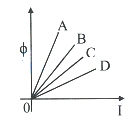
$A$ graph of magnetic flux $(\phi)$ versus current $(I)$ is plotted for four inductors $A, B, C, D$. Which inductor has the largest value of self-inductance?
A
$A$
B
$B$
C
$C$
D
$D$
Solution
(A) The relationship between magnetic flux $(\phi)$ and current $(I)$ for an inductor is given by $\phi = LI$,where $L$ is the self-inductance.
Comparing this equation with the equation of a straight line passing through the origin,$y = mx$,we get $L = \phi / I$.
This implies that the self-inductance $L$ is equal to the slope of the $\phi$ versus $I$ graph.
Since the line $A$ has the steepest slope among the four lines,it indicates the largest value of self-inductance.
Comparing this equation with the equation of a straight line passing through the origin,$y = mx$,we get $L = \phi / I$.
This implies that the self-inductance $L$ is equal to the slope of the $\phi$ versus $I$ graph.
Since the line $A$ has the steepest slope among the four lines,it indicates the largest value of self-inductance.
0 likes
View Solution154
MediumMCQ
When a current of $1 \,A$ is passed through a coil of $100$ turns, the flux associated with it is $2.5 \times 10^{-5} \,Wb/\text{turn}$. The self-inductance of the coil in millihenry is:
A
$40$
B
$25$
C
$4$
D
$2.5$
Solution
(D) Given: Number of turns $N = 100$, Current $I = 1 \,A$, Flux per turn $\phi = 2.5 \times 10^{-5} \,Wb/\text{turn}$.
The total flux linkage is given by $N\phi$.
The formula for self-inductance $L$ is $L = \frac{N\phi}{I}$.
Substituting the given values:
$L = \frac{100 \times 2.5 \times 10^{-5}}{1} \,H$.
$L = 2.5 \times 10^{-3} \,H$.
Since $1 \,mH = 10^{-3} \,H$, we have $L = 2.5 \,mH$.
The total flux linkage is given by $N\phi$.
The formula for self-inductance $L$ is $L = \frac{N\phi}{I}$.
Substituting the given values:
$L = \frac{100 \times 2.5 \times 10^{-5}}{1} \,H$.
$L = 2.5 \times 10^{-3} \,H$.
Since $1 \,mH = 10^{-3} \,H$, we have $L = 2.5 \,mH$.
0 likes
View Solution155
EasyMCQ
The self-inductance $L$ of a solenoid of length $l$ and area of cross-section $A$,with a fixed number of turns $N$,increases as:
A
both $l$ and $A$ increase
B
$l$ decreases and $A$ increases
C
$l$ increases and $A$ decreases
D
both $l$ and $A$ decrease
Solution
(B) The formula for the self-inductance of a solenoid is given by:
$L = \frac{\mu_0 N^2 A}{l}$
where $\mu_0$ is the permeability of free space,$N$ is the number of turns,$A$ is the cross-sectional area,and $l$ is the length of the solenoid.
From the formula,it is clear that $L \propto A$ and $L \propto \frac{1}{l}$.
Therefore,for the self-inductance $L$ to increase,the area $A$ must increase and the length $l$ must decrease.
Thus,the correct option is $B$.
$L = \frac{\mu_0 N^2 A}{l}$
where $\mu_0$ is the permeability of free space,$N$ is the number of turns,$A$ is the cross-sectional area,and $l$ is the length of the solenoid.
From the formula,it is clear that $L \propto A$ and $L \propto \frac{1}{l}$.
Therefore,for the self-inductance $L$ to increase,the area $A$ must increase and the length $l$ must decrease.
Thus,the correct option is $B$.
0 likes
View Solution156
MediumMCQ
The self-inductance $(L)$ produced by a solenoid of length '$l$' having '$N$' number of turns and cross-sectional area '$A$' is given by the formula (where $\phi$ = magnetic flux,$\mu_0$ = permeability of vacuum).
A
$L=N \phi$
B
$L=\mu_0 NA l$
C
$L=\frac{\mu_0 N^2 A}{l}$
D
$L=\frac{\mu_0 NA}{l}$
Solution
(C) The magnetic field inside the solenoid is given by $B = \frac{\mu_0 NI}{l}$.
The total magnetic flux linkage through the solenoid is $\phi_{total} = N(BA)$.
Substituting the value of $B$,we get $\phi_{total} = N \left( \frac{\mu_0 NI}{l} \right) A = \frac{\mu_0 N^2 IA}{l}$.
By definition,self-inductance $L$ is given by $L = \frac{\phi_{total}}{I}$.
Therefore,$L = \frac{\frac{\mu_0 N^2 IA}{l}}{I} = \frac{\mu_0 N^2 A}{l}$.
The total magnetic flux linkage through the solenoid is $\phi_{total} = N(BA)$.
Substituting the value of $B$,we get $\phi_{total} = N \left( \frac{\mu_0 NI}{l} \right) A = \frac{\mu_0 N^2 IA}{l}$.
By definition,self-inductance $L$ is given by $L = \frac{\phi_{total}}{I}$.
Therefore,$L = \frac{\frac{\mu_0 N^2 IA}{l}}{I} = \frac{\mu_0 N^2 A}{l}$.
0 likes
View Solution157
MediumMCQ
$A$ long solenoid has $1500$ turns. When a current of $3.5 \, A$ flows through it, the magnetic flux linked with each turn of the solenoid is $2.8 \times 10^{-3} \, Wb$. The self-inductance of the solenoid is (in $ \, H$)
A
$1.2$
B
$2.4$
C
$3.6$
D
$6$
Solution
(A) The flux linked with each turn of the solenoid is given as $\phi = 2.8 \times 10^{-3} \, Wb$.
The total magnetic flux $(\Phi_{net})$ linked with the solenoid having $N = 1500$ turns is calculated as:
$\Phi_{net} = N \times \phi = 1500 \times 2.8 \times 10^{-3} = 4.2 \, Wb$.
The relationship between total flux, self-inductance $(L)$, and current $(I)$ is given by $\Phi_{net} = L \times I$.
Therefore, the self-inductance $L$ is:
$L = \frac{\Phi_{net}}{I} = \frac{4.2}{3.5} = 1.2 \, H$.
The total magnetic flux $(\Phi_{net})$ linked with the solenoid having $N = 1500$ turns is calculated as:
$\Phi_{net} = N \times \phi = 1500 \times 2.8 \times 10^{-3} = 4.2 \, Wb$.
The relationship between total flux, self-inductance $(L)$, and current $(I)$ is given by $\Phi_{net} = L \times I$.
Therefore, the self-inductance $L$ is:
$L = \frac{\Phi_{net}}{I} = \frac{4.2}{3.5} = 1.2 \, H$.
0 likes
View Solution158
EasyMCQ
If '$N$' is the number of turns in a circular coil,the value of its self-inductance varies as
A
$N^1$
B
$N^3$
C
$N^2$
D
$N^0$
Solution
(C) The correct option is $C$.
Concept: The magnetic flux $\phi$ associated with a coil is given by $\phi = B A$,and the coefficient of self-inductance $L$ is defined as $L = \frac{N\phi}{I}$,where $I$ is the current flowing through the coil.
The magnetic field $B$ at the center of a circular coil with radius $r$ carrying current $I$ is given by $B = \frac{\mu_0 I}{2r}$.
For a coil with $N$ turns,the total magnetic field is $B_N = N \left( \frac{\mu_0 I}{2r} \right)$.
The magnetic flux linked with each turn is $\phi_1 = B_N A = N \left( \frac{\mu_0 I}{2r} \right) A$.
The total flux linkage for $N$ turns is $\Phi = N \phi_1 = N^2 \left( \frac{\mu_0 I A}{2r} \right)$.
Using the definition $L = \frac{\Phi}{I}$,we get $L = N^2 \left( \frac{\mu_0 A}{2r} \right)$.
Therefore,the self-inductance $L$ is proportional to the square of the number of turns,i.e.,$L \propto N^2$.
Concept: The magnetic flux $\phi$ associated with a coil is given by $\phi = B A$,and the coefficient of self-inductance $L$ is defined as $L = \frac{N\phi}{I}$,where $I$ is the current flowing through the coil.
The magnetic field $B$ at the center of a circular coil with radius $r$ carrying current $I$ is given by $B = \frac{\mu_0 I}{2r}$.
For a coil with $N$ turns,the total magnetic field is $B_N = N \left( \frac{\mu_0 I}{2r} \right)$.
The magnetic flux linked with each turn is $\phi_1 = B_N A = N \left( \frac{\mu_0 I}{2r} \right) A$.
The total flux linkage for $N$ turns is $\Phi = N \phi_1 = N^2 \left( \frac{\mu_0 I A}{2r} \right)$.
Using the definition $L = \frac{\Phi}{I}$,we get $L = N^2 \left( \frac{\mu_0 A}{2r} \right)$.
Therefore,the self-inductance $L$ is proportional to the square of the number of turns,i.e.,$L \propto N^2$.
0 likes
View Solution159
DifficultMCQ
Inductance of a solenoid '$L$' having diameter '$d$'. Let '$n$' be the number of turns per unit length. The inductance per unit length near the middle of a solenoid is (Assume that current '$i$' passes through the turns,$\mu_0=$ permeability of vacuum).
A
$\frac{\mu_0 \pi n d^2}{4}$
B
$\frac{\mu_0 \pi n^2 d}{2}$
C
$\frac{\mu_0 \pi n^2 d^2}{2}$
D
$\frac{\mu_0 \pi n^2 d^2}{4}$
Solution
(D) The magnetic field '$B$' inside a long solenoid is given by $B = \mu_0 n i$,where '$n$' is the number of turns per unit length and '$i$' is the current.
The cross-sectional area '$A$' of the solenoid with diameter '$d$' is $A = \pi r^2 = \pi (d/2)^2 = \frac{\pi d^2}{4}$.
The magnetic flux '$\phi$' through a single turn is $\phi = B \cdot A = (\mu_0 n i) \left( \frac{\pi d^2}{4} \right)$.
For a length '$l$' of the solenoid,the total number of turns is $N = n \cdot l$.
The total flux '$\Phi$' linked with length '$l$' is $\Phi = N \cdot \phi = (n l) \left( \mu_0 n i \frac{\pi d^2}{4} \right) = \mu_0 n^2 i l \frac{\pi d^2}{4}$.
Since $\Phi = L \cdot i$,the total inductance '$L$' for length '$l$' is $L = \frac{\mu_0 n^2 i l \pi d^2}{4 i} = \frac{\mu_0 n^2 l \pi d^2}{4}$.
Therefore,the inductance per unit length is $\frac{L}{l} = \frac{\mu_0 \pi n^2 d^2}{4}$.
The cross-sectional area '$A$' of the solenoid with diameter '$d$' is $A = \pi r^2 = \pi (d/2)^2 = \frac{\pi d^2}{4}$.
The magnetic flux '$\phi$' through a single turn is $\phi = B \cdot A = (\mu_0 n i) \left( \frac{\pi d^2}{4} \right)$.
For a length '$l$' of the solenoid,the total number of turns is $N = n \cdot l$.
The total flux '$\Phi$' linked with length '$l$' is $\Phi = N \cdot \phi = (n l) \left( \mu_0 n i \frac{\pi d^2}{4} \right) = \mu_0 n^2 i l \frac{\pi d^2}{4}$.
Since $\Phi = L \cdot i$,the total inductance '$L$' for length '$l$' is $L = \frac{\mu_0 n^2 i l \pi d^2}{4 i} = \frac{\mu_0 n^2 l \pi d^2}{4}$.
Therefore,the inductance per unit length is $\frac{L}{l} = \frac{\mu_0 \pi n^2 d^2}{4}$.
0 likes
View Solution160
EasyMCQ
The self-inductance $L$ of a solenoid of length $\lambda$ and area of cross-section $A$ with a fixed number of turns $N$ increases as
A
$\lambda$ increases and $A$ decreases
B
$\lambda$ decreases and $A$ increases
C
both $\lambda$ and $A$ increase
D
both $\lambda$ and $A$ decrease
Solution
(B) The self-inductance $L$ of a solenoid of length $\lambda$ and area of cross-section $A$ with a fixed number of turns $N$ is given by the formula:
$L = \frac{\mu_0 N^2 A}{\lambda}$
From this expression,we can see that $L$ is directly proportional to the area $A$ and inversely proportional to the length $\lambda$.
Therefore,for $L$ to increase,the area $A$ must increase and the length $\lambda$ must decrease.
$L = \frac{\mu_0 N^2 A}{\lambda}$
From this expression,we can see that $L$ is directly proportional to the area $A$ and inversely proportional to the length $\lambda$.
Therefore,for $L$ to increase,the area $A$ must increase and the length $\lambda$ must decrease.
0 likes
View Solution161
EasyMCQ
An average induced emf of $0.5 \,V$ appears in a coil when the current in it is changed from $10 \,A$ in one direction to $10 \,A$ in the opposite direction in $0.8 \,s$. The self-inductance of the coil is: (in $\,mH$)
A
$50$
B
$20$
C
$25$
D
$40$
Solution
(B) The formula for induced emf in a coil due to self-inductance is given by $e = L \left| \frac{dI}{dt} \right|$.
Given:
Induced emf $e = 0.5 \,V$
Initial current $I_1 = 10 \,A$
Final current $I_2 = -10 \,A$ (opposite direction)
Change in current $\Delta I = I_2 - I_1 = -10 \,A - 10 \,A = -20 \,A$
Time interval $\Delta t = 0.8 \,s$
Magnitude of rate of change of current $|\frac{\Delta I}{\Delta t}| = \frac{|-20 \,A|}{0.8 \,s} = \frac{20}{0.8} \,A/s = 25 \,A/s$.
Substituting these values into the formula:
$0.5 = L \times 25$
$L = \frac{0.5}{25} \,H = \frac{1}{50} \,H = 0.02 \,H$.
Converting to millihenry: $0.02 \,H = 0.02 \times 1000 \,mH = 20 \,mH$.
Given:
Induced emf $e = 0.5 \,V$
Initial current $I_1 = 10 \,A$
Final current $I_2 = -10 \,A$ (opposite direction)
Change in current $\Delta I = I_2 - I_1 = -10 \,A - 10 \,A = -20 \,A$
Time interval $\Delta t = 0.8 \,s$
Magnitude of rate of change of current $|\frac{\Delta I}{\Delta t}| = \frac{|-20 \,A|}{0.8 \,s} = \frac{20}{0.8} \,A/s = 25 \,A/s$.
Substituting these values into the formula:
$0.5 = L \times 25$
$L = \frac{0.5}{25} \,H = \frac{1}{50} \,H = 0.02 \,H$.
Converting to millihenry: $0.02 \,H = 0.02 \times 1000 \,mH = 20 \,mH$.
0 likes
View Solution162
DifficultMCQ
$A$ toroid is a long coil of wire ($N$ turns) wound over a circular core. The coefficient of self-induction of the toroid is [The magnetic field in it is uniform and $R >> r$,where $r=$ radius of wire,$R=$ radius of coil] ($\mu_0=$ permeability of free space).
A
$\frac{\mu_0 N^2 R^2}{2 r}$
B
$\frac{\mu_0 N r}{2 R}$
C
$\frac{\mu_0 N^2 r^2}{R}$
D
$\frac{\mu_0 N^2 r^2}{2 R}$
Solution
(D) The coefficient of self-induction $L$ is defined as $L = \frac{\phi}{I}$,where $\phi$ is the total magnetic flux linked with the coil and $I$ is the current flowing through it.
For a toroid with $N$ turns,the total flux $\phi$ is given by $\phi = N \cdot A \cdot B$,where $A$ is the cross-sectional area of the toroid and $B$ is the magnetic field inside it.
The cross-sectional area $A = \pi r^2$.
The magnetic field inside a toroid is $B = \mu_0 n I$,where $n = \frac{N}{2 \pi R}$ is the number of turns per unit length.
Substituting these into the flux equation:
$\phi = N (\pi r^2) (\mu_0 \frac{N}{2 \pi R} I) = \frac{\mu_0 N^2 r^2 I}{2 R}$.
Finally,the self-induction $L = \frac{\phi}{I} = \frac{\mu_0 N^2 r^2}{2 R}$.
For a toroid with $N$ turns,the total flux $\phi$ is given by $\phi = N \cdot A \cdot B$,where $A$ is the cross-sectional area of the toroid and $B$ is the magnetic field inside it.
The cross-sectional area $A = \pi r^2$.
The magnetic field inside a toroid is $B = \mu_0 n I$,where $n = \frac{N}{2 \pi R}$ is the number of turns per unit length.
Substituting these into the flux equation:
$\phi = N (\pi r^2) (\mu_0 \frac{N}{2 \pi R} I) = \frac{\mu_0 N^2 r^2 I}{2 R}$.
Finally,the self-induction $L = \frac{\phi}{I} = \frac{\mu_0 N^2 r^2}{2 R}$.
0 likes
View Solution163
EasyMCQ
Self-induction of a solenoid cannot be increased by
A
decreasing its length
B
increasing its area of cross-section
C
increasing the current through it
D
increasing the number of turns in it
Solution
(C) The magnetic field $B$ at the center of a solenoid is given by $B = \mu_0 (N/l) I$,where $N$ is the number of turns,$l$ is the length,and $I$ is the current.
Total magnetic flux $\phi$ linked with the solenoid is $\phi = B A N = \mu_0 (N^2/l) A I$,where $A$ is the cross-sectional area.
By the definition of self-induction,$\phi = L I$.
Comparing the two expressions,the self-inductance $L$ is given by $L = \frac{\mu_0 N^2 A}{l}$.
From this formula,it is clear that $L$ depends on the number of turns $N$,cross-sectional area $A$,and length $l$,but it is independent of the current $I$ flowing through the solenoid.
Total magnetic flux $\phi$ linked with the solenoid is $\phi = B A N = \mu_0 (N^2/l) A I$,where $A$ is the cross-sectional area.
By the definition of self-induction,$\phi = L I$.
Comparing the two expressions,the self-inductance $L$ is given by $L = \frac{\mu_0 N^2 A}{l}$.
From this formula,it is clear that $L$ depends on the number of turns $N$,cross-sectional area $A$,and length $l$,but it is independent of the current $I$ flowing through the solenoid.
0 likes
View Solution164
DifficultMCQ
An air-cored solenoid with length $30 \ cm$,area of cross-section $25 \ cm^2$ and number of turns $500$ carries a current of $2.5 \ A$. The current is suddenly switched off for a brief time of $10^{-3} \ s$. How much is the (nearly) average back e.m.f. induced across the ends of the open switch in the circuit (in $V$)? (Ignore the variation of magnetic field near the ends of solenoid)
A
$4.2$
B
$6.5$
C
$7.3$
D
$9$
Solution
(B) The magnetic field $B$ at the center of the solenoid is given by $B = \mu_0 (N/l) i$.
The magnetic flux $\Phi$ linked with the solenoid is $\Phi = N B A = N (\mu_0 N i A / l) = (\mu_0 N^2 A / l) i$.
The self-inductance $L$ is defined as $L = \Phi / i = \mu_0 N^2 A / l$.
Substituting the given values: $N = 500$,$l = 0.3 \ m$,$A = 25 \times 10^{-4} \ m^2$,$\mu_0 = 4\pi \times 10^{-7} \ T \cdot m/A$.
$L = \frac{4\pi \times 10^{-7} \times (500)^2 \times 25 \times 10^{-4}}{0.3} \approx 2.618 \times 10^{-3} \ H$.
The average back e.m.f. is $e = L (\Delta i / \Delta t)$.
Given $\Delta i = 2.5 \ A$ and $\Delta t = 10^{-3} \ s$.
$e = (2.618 \times 10^{-3}) \times (2.5 / 10^{-3}) = 2.618 \times 2.5 \approx 6.545 \ V$.
Rounding to the nearest value,$e \approx 6.5 \ V$.
The magnetic flux $\Phi$ linked with the solenoid is $\Phi = N B A = N (\mu_0 N i A / l) = (\mu_0 N^2 A / l) i$.
The self-inductance $L$ is defined as $L = \Phi / i = \mu_0 N^2 A / l$.
Substituting the given values: $N = 500$,$l = 0.3 \ m$,$A = 25 \times 10^{-4} \ m^2$,$\mu_0 = 4\pi \times 10^{-7} \ T \cdot m/A$.
$L = \frac{4\pi \times 10^{-7} \times (500)^2 \times 25 \times 10^{-4}}{0.3} \approx 2.618 \times 10^{-3} \ H$.
The average back e.m.f. is $e = L (\Delta i / \Delta t)$.
Given $\Delta i = 2.5 \ A$ and $\Delta t = 10^{-3} \ s$.
$e = (2.618 \times 10^{-3}) \times (2.5 / 10^{-3}) = 2.618 \times 2.5 \approx 6.545 \ V$.
Rounding to the nearest value,$e \approx 6.5 \ V$.
0 likes
View Solution165
MediumMCQ
$A$ circular coil of radius $R$ has $N$ turns of a wire. The coefficient of self-induction of the coil will be $(\mu_0 = \text{permeability of free space})$
A
$\frac{\mu_0 N \pi R^2}{2}$
B
$\frac{\mu_0 N \pi R}{4}$
C
$\frac{\mu_0 N^2 \pi R}{2}$
D
$\frac{\mu_0 N \pi R}{2}$
Solution
(C) The magnetic field at the center of a circular coil carrying current $I$ is given by $B = \frac{\mu_0 NI}{2R}$.
The total magnetic flux $\phi$ linked with the coil is the product of the number of turns $N$, the magnetic field $B$, and the area of the coil $A = \pi R^2$.
$\phi = N \cdot B \cdot A = N \cdot \left( \frac{\mu_0 NI}{2R} \right) \cdot \pi R^2 = \frac{\mu_0 N^2 \pi R I}{2}$.
The coefficient of self-induction $L$ is defined as $L = \frac{\phi}{I}$.
Substituting the value of $\phi$, we get $L = \frac{\mu_0 N^2 \pi R}{2}$.
The total magnetic flux $\phi$ linked with the coil is the product of the number of turns $N$, the magnetic field $B$, and the area of the coil $A = \pi R^2$.
$\phi = N \cdot B \cdot A = N \cdot \left( \frac{\mu_0 NI}{2R} \right) \cdot \pi R^2 = \frac{\mu_0 N^2 \pi R I}{2}$.
The coefficient of self-induction $L$ is defined as $L = \frac{\phi}{I}$.
Substituting the value of $\phi$, we get $L = \frac{\mu_0 N^2 \pi R}{2}$.
0 likes
View Solution166
DifficultMCQ
The self-inductance of a solenoid of length $31.4 \ cm$,area of cross-section $10^{-3} \ m^2$ having a total number of turns $500$ will be nearly $\left[\mu_0 = 4 \pi \times 10^{-7} \ SI \ unit\right]$.
A
$3 \times 10^{-3} \ H$
B
$1 \times 10^{-3} \ H$
C
$2 \times 10^{-3} \ H$
D
$4 \times 10^{-3} \ H$
Solution
(B) Given:
Length of solenoid,$\ell = 31.4 \ cm = 0.314 \ m$
Area of cross-section,$A = 10^{-3} \ m^2$
Total number of turns,$N = 500$
Permeability of free space,$\mu_0 = 4 \pi \times 10^{-7} \ T \cdot m/A$
The formula for self-inductance of a solenoid is given by:
$L = \frac{\mu_0 N^2 A}{\ell}$
Substituting the values:
$L = \frac{(4 \times 3.14 \times 10^{-7}) \times (500)^2 \times 10^{-3}}{0.314}$
$L = \frac{4 \times 3.14 \times 10^{-7} \times 250000 \times 10^{-3}}{0.314}$
$L = \frac{4 \times 3.14 \times 10^{-7} \times 2.5 \times 10^5 \times 10^{-3}}{0.314}$
$L = \frac{4 \times 3.14 \times 2.5 \times 10^{-5}}{0.314}$
$L = 4 \times 10 \times 2.5 \times 10^{-5} = 10 \times 10^{-4} = 10^{-3} \ H$
Length of solenoid,$\ell = 31.4 \ cm = 0.314 \ m$
Area of cross-section,$A = 10^{-3} \ m^2$
Total number of turns,$N = 500$
Permeability of free space,$\mu_0 = 4 \pi \times 10^{-7} \ T \cdot m/A$
The formula for self-inductance of a solenoid is given by:
$L = \frac{\mu_0 N^2 A}{\ell}$
Substituting the values:
$L = \frac{(4 \times 3.14 \times 10^{-7}) \times (500)^2 \times 10^{-3}}{0.314}$
$L = \frac{4 \times 3.14 \times 10^{-7} \times 250000 \times 10^{-3}}{0.314}$
$L = \frac{4 \times 3.14 \times 10^{-7} \times 2.5 \times 10^5 \times 10^{-3}}{0.314}$
$L = \frac{4 \times 3.14 \times 2.5 \times 10^{-5}}{0.314}$
$L = 4 \times 10 \times 2.5 \times 10^{-5} = 10 \times 10^{-4} = 10^{-3} \ H$
0 likes
View Solution167
EasyMCQ
$A$ current $I$ produces a magnetic flux $\phi$ per turn in a coil of $n$ turns. The self-inductance of the coil is $L$. The relation between them is:
A
$nLI = \phi$
B
$\frac{nL}{I} = \phi$
C
$\frac{LI}{n^2} = \phi$
D
$\frac{LI}{n} = \phi$
Solution
(D) The total magnetic flux linkage in a coil with $n$ turns is given by $N\phi_{total} = L I$,where $N$ is the number of turns,$\phi_{total}$ is the flux per turn,$L$ is the self-inductance,and $I$ is the current.
Given that the flux per turn is $\phi$ and the number of turns is $n$,the total flux linkage is $n\phi$.
Therefore,the relation is $n\phi = LI$.
Rearranging for $\phi$,we get $\phi = \frac{LI}{n}$.
Given that the flux per turn is $\phi$ and the number of turns is $n$,the total flux linkage is $n\phi$.
Therefore,the relation is $n\phi = LI$.
Rearranging for $\phi$,we get $\phi = \frac{LI}{n}$.
0 likes
View Solution168
EasyMCQ
If $N$ is the number of turns in a circular coil,the value of its self-inductance varies as:
A
$N^{3}$
B
$N^{2}$
C
$N^{0}$
D
$N^{1}$
Solution
(B) The self-inductance $L$ of a coil is given by the formula $L = \frac{N \phi}{I}$.
For a circular coil or solenoid,the magnetic flux $\phi$ through each turn is proportional to the number of turns $N$ (since $B \propto N$).
Therefore,the total flux linkage $N \phi$ is proportional to $N^2$.
Thus,the self-inductance $L$ is directly proportional to the square of the number of turns,i.e.,$L \propto N^{2}$.
For a circular coil or solenoid,the magnetic flux $\phi$ through each turn is proportional to the number of turns $N$ (since $B \propto N$).
Therefore,the total flux linkage $N \phi$ is proportional to $N^2$.
Thus,the self-inductance $L$ is directly proportional to the square of the number of turns,i.e.,$L \propto N^{2}$.
0 likes
View Solution169
MediumMCQ
What is the self-inductance of a coil in which an induced emf of $2 \,V$ is set up, when the current is changing at the rate of $4 \,A s^{-1}$?
A
$0.5 \,mH$
B
$0.05 \,H$
C
$2 \,H$
D
$0.5 \,H$
Solution
(D) The induced emf $(e)$ in a coil due to self-induction is given by the formula: $e = L \frac{di}{dt}$.
Here, the induced emf $e = 2 \,V$ and the rate of change of current $\frac{di}{dt} = 4 \,A s^{-1}$.
Substituting these values into the formula:
$2 = L \times 4$
$L = \frac{2}{4} \,H$
$L = 0.5 \,H$.
Therefore, the self-inductance of the coil is $0.5 \,H$.
Here, the induced emf $e = 2 \,V$ and the rate of change of current $\frac{di}{dt} = 4 \,A s^{-1}$.
Substituting these values into the formula:
$2 = L \times 4$
$L = \frac{2}{4} \,H$
$L = 0.5 \,H$.
Therefore, the self-inductance of the coil is $0.5 \,H$.
0 likes
View Solution170
DifficultMCQ
Two different coils have self-inductance $8 \ mH$ and $2 \ mH$. The current in both coils is increased at the same constant rate. The ratio of the induced $emf$s in the coils is
A
$4: 1$
B
$1: 4$
C
$1: 2$
D
$2: 1$
Solution
(A) The induced $emf$ $(e)$ in a coil is given by the formula: $e = L \frac{di}{dt}$.
Here,$L_1 = 8 \ mH$ and $L_2 = 2 \ mH$.
The rate of change of current,$\frac{di}{dt}$,is the same for both coils.
Therefore,the ratio of the induced $emf$s is:
$\frac{e_1}{e_2} = \frac{L_1 (di/dt)}{L_2 (di/dt)} = \frac{L_1}{L_2}$.
Substituting the given values:
$\frac{e_1}{e_2} = \frac{8 \ mH}{2 \ mH} = \frac{4}{1}$.
Thus,the ratio is $4: 1$.
Here,$L_1 = 8 \ mH$ and $L_2 = 2 \ mH$.
The rate of change of current,$\frac{di}{dt}$,is the same for both coils.
Therefore,the ratio of the induced $emf$s is:
$\frac{e_1}{e_2} = \frac{L_1 (di/dt)}{L_2 (di/dt)} = \frac{L_1}{L_2}$.
Substituting the given values:
$\frac{e_1}{e_2} = \frac{8 \ mH}{2 \ mH} = \frac{4}{1}$.
Thus,the ratio is $4: 1$.
0 likes
View Solution171
EasyMCQ
What will be the self-inductance of a coil of $100$ turns if a current of $5 \ A$ produces a magnetic flux of $5 \times 10^{-5} \ Wb$?
A
$1 \ mH$
B
$10 \ mH$
C
$1 \ \mu H$
D
$10 \ \mu H$
Solution
(A) The formula for self-inductance $L$ is given by $L = \frac{N \phi}{I}$.
Given:
Number of turns $N = 100$
Current $I = 5 \ A$
Magnetic flux $\phi = 5 \times 10^{-5} \ Wb$
Substituting the values into the formula:
$L = \frac{100 \times 5 \times 10^{-5}}{5}$
$L = 100 \times 10^{-5} \ H$
$L = 10^{-3} \ H = 1 \ mH$.
Given:
Number of turns $N = 100$
Current $I = 5 \ A$
Magnetic flux $\phi = 5 \times 10^{-5} \ Wb$
Substituting the values into the formula:
$L = \frac{100 \times 5 \times 10^{-5}}{5}$
$L = 100 \times 10^{-5} \ H$
$L = 10^{-3} \ H = 1 \ mH$.
0 likes
View Solution172
MediumMCQ
When a current of $2 \ A$ is passed through a coil of $100$ turns,the magnetic flux associated with it is $5 \times 10^{-5} \ Wb$. Find the self-inductance of the coil.
A
$4 \times 10^{-3} \ H$
B
$4 \times 10^{-2} \ H$
C
$2.5 \times 10^{-3} \ H$
D
$10^{-3} \ H$
Solution
(C) The formula for self-inductance $L$ is given by $L = \frac{N\phi}{i}$,where $N$ is the number of turns,$\phi$ is the magnetic flux,and $i$ is the current.
Given values are $N = 100$,$\phi = 5 \times 10^{-5} \ Wb$,and $i = 2 \ A$.
Substituting these values into the formula:
$L = \frac{100 \times 5 \times 10^{-5}}{2}$
$L = \frac{500 \times 10^{-5}}{2}$
$L = 250 \times 10^{-5} \ H$
$L = 2.5 \times 10^{-3} \ H$
Given values are $N = 100$,$\phi = 5 \times 10^{-5} \ Wb$,and $i = 2 \ A$.
Substituting these values into the formula:
$L = \frac{100 \times 5 \times 10^{-5}}{2}$
$L = \frac{500 \times 10^{-5}}{2}$
$L = 250 \times 10^{-5} \ H$
$L = 2.5 \times 10^{-3} \ H$
0 likes
View Solution173
MediumMCQ
To manufacture a solenoid of length $1 \,m$ and inductance $1 \,mH$, the length of thin wire required is (cross-sectional diameter of a solenoid is considerably less than the length).
A
$0.10 \,m$
B
$0.10 \,km$
C
$1 \,km$
D
$10 \,km$
Solution
(B) The inductance of a solenoid is given by $L = \frac{\mu_0 N^2 A}{l}$, where $l$ is the length of the solenoid and $A = \pi r^2$ is the cross-sectional area.
Let $x$ be the total length of the wire required. The wire is wound into $N$ turns, so $x = (2 \pi r) N$, which implies $N = \frac{x}{2 \pi r}$.
Substituting $N$ into the inductance formula:
$L = \frac{\mu_0 (x / 2 \pi r)^2 \times \pi r^2}{l} = \frac{\mu_0 x^2}{4 \pi l}$.
Rearranging for $x$:
$x^2 = \frac{4 \pi L l}{\mu_0} \implies x = \sqrt{\frac{4 \pi L l}{\mu_0}}$.
Given $L = 1 \,mH = 10^{-3} \,H$, $l = 1 \,m$, and $\mu_0 = 4 \pi \times 10^{-7} \,T \cdot m/A$:
$x = \sqrt{\frac{4 \pi \times 10^{-3} \times 1}{4 \pi \times 10^{-7}}} = \sqrt{10^4} = 100 \,m$.
Converting to kilometers: $100 \,m = 0.10 \,km$.
Let $x$ be the total length of the wire required. The wire is wound into $N$ turns, so $x = (2 \pi r) N$, which implies $N = \frac{x}{2 \pi r}$.
Substituting $N$ into the inductance formula:
$L = \frac{\mu_0 (x / 2 \pi r)^2 \times \pi r^2}{l} = \frac{\mu_0 x^2}{4 \pi l}$.
Rearranging for $x$:
$x^2 = \frac{4 \pi L l}{\mu_0} \implies x = \sqrt{\frac{4 \pi L l}{\mu_0}}$.
Given $L = 1 \,mH = 10^{-3} \,H$, $l = 1 \,m$, and $\mu_0 = 4 \pi \times 10^{-7} \,T \cdot m/A$:
$x = \sqrt{\frac{4 \pi \times 10^{-3} \times 1}{4 \pi \times 10^{-7}}} = \sqrt{10^4} = 100 \,m$.
Converting to kilometers: $100 \,m = 0.10 \,km$.
0 likes
View Solution174
MediumMCQ
The length of a solenoid is $\ell$,whose windings are made of a material of density $D$ and resistivity $\rho$. The winding resistance is $R$. The inductance of the solenoid is (where $m$ = mass of winding wire,$\mu_{0}$ = permeability of free space).
A
$\frac{\mu_{0}}{2 \pi \ell} \left( \frac{R m}{\rho D} \right)$
B
$\frac{\mu_{0}}{4 \pi \ell} \left( \frac{R m}{\rho D} \right)$
C
$\frac{\mu_{0}}{2 \pi \ell} \left( \frac{\rho D}{R m} \right)$
D
$\frac{\mu_{0}}{4 \pi \ell} \left( \frac{\rho D}{R m} \right)$
Solution
(B) The inductance of a solenoid is given by $L = \mu_{0} N^{2} \frac{A_{s}}{\ell}$,where $A_{s}$ is the cross-sectional area of the solenoid and $N$ is the number of turns.
Let $x$ be the total length of the wire used for windings and $a$ be the cross-sectional area of the wire.
The resistance $R$ is given by $R = \frac{\rho x}{a}$.
The mass $m$ of the wire is $m = a x D$.
Multiplying these,we get $R m = \left( \frac{\rho x}{a} \right) (a x D) = \rho x^{2} D$.
Thus,$x^{2} = \frac{R m}{\rho D}$.
The total length of the wire $x$ is also equal to $N \times (2 \pi r)$,where $r$ is the radius of the solenoid.
Therefore,$N = \frac{x}{2 \pi r}$.
Substituting $N$ into the inductance formula: $L = \mu_{0} \left( \frac{x}{2 \pi r} \right)^{2} \frac{\pi r^{2}}{\ell} = \mu_{0} \frac{x^{2}}{4 \pi^{2} r^{2}} \frac{\pi r^{2}}{\ell} = \frac{\mu_{0} x^{2}}{4 \pi \ell}$.
Substituting $x^{2} = \frac{R m}{\rho D}$,we get $L = \frac{\mu_{0}}{4 \pi \ell} \left( \frac{R m}{\rho D} \right)$.
Let $x$ be the total length of the wire used for windings and $a$ be the cross-sectional area of the wire.
The resistance $R$ is given by $R = \frac{\rho x}{a}$.
The mass $m$ of the wire is $m = a x D$.
Multiplying these,we get $R m = \left( \frac{\rho x}{a} \right) (a x D) = \rho x^{2} D$.
Thus,$x^{2} = \frac{R m}{\rho D}$.
The total length of the wire $x$ is also equal to $N \times (2 \pi r)$,where $r$ is the radius of the solenoid.
Therefore,$N = \frac{x}{2 \pi r}$.
Substituting $N$ into the inductance formula: $L = \mu_{0} \left( \frac{x}{2 \pi r} \right)^{2} \frac{\pi r^{2}}{\ell} = \mu_{0} \frac{x^{2}}{4 \pi^{2} r^{2}} \frac{\pi r^{2}}{\ell} = \frac{\mu_{0} x^{2}}{4 \pi \ell}$.
Substituting $x^{2} = \frac{R m}{\rho D}$,we get $L = \frac{\mu_{0}}{4 \pi \ell} \left( \frac{R m}{\rho D} \right)$.
0 likes
View Solution175
EasyMCQ
The dimensions of self or mutual inductance are given as
A
$[L^{-2} M^1 T^{-2} I^{-2}]$
B
$[L^2 M^{-2} T^{-2} I^{-2}]$
C
$[L^2 M^1 T^{-2} I^{-2}]$
D
$[L^2 M^2 T^{-2} I^{-2}]$
Solution
(C) The self or mutual inductance of a coil is defined by the flux linkage per unit current,given by the relation:
$L \text{ or } M = \frac{\phi}{I}$
Where $\phi$ is the magnetic flux and $I$ is the current.
The dimensional formula for magnetic flux $\phi$ is $[M L^2 T^{-2} I^{-1}]$.
The dimensional formula for current $I$ is $[I^1]$.
Therefore,the dimension of inductance is:
$[L] = \frac{[\phi]}{[I]} = \frac{[M L^2 T^{-2} I^{-1}]}{[I^1]} = [M L^2 T^{-2} I^{-2}]$
$L \text{ or } M = \frac{\phi}{I}$
Where $\phi$ is the magnetic flux and $I$ is the current.
The dimensional formula for magnetic flux $\phi$ is $[M L^2 T^{-2} I^{-1}]$.
The dimensional formula for current $I$ is $[I^1]$.
Therefore,the dimension of inductance is:
$[L] = \frac{[\phi]}{[I]} = \frac{[M L^2 T^{-2} I^{-1}]}{[I^1]} = [M L^2 T^{-2} I^{-2}]$
0 likes
View Solution176
EasyMCQ
The equivalent quantity of mass in electricity is . . . . . . .
A
Electric potential
B
Electric charge
C
Electric current
D
Self inductance
Solution
(D) In mechanics,mass $(m)$ represents the inertia of an object,which is the resistance to a change in its state of motion. In an $LC$ circuit,the self-inductance $(L)$ represents the inertia of the electrical system,as it opposes any change in the electric current $(I)$. The energy stored in a mechanical system is $\frac{1}{2}mv^2$,while the energy stored in an inductor is $\frac{1}{2}LI^2$. Thus,self-inductance is the electrical equivalent of mass.
0 likes
View Solution177
EasyMCQ
$A$ coil has $N$ turns and the current passing through it is $I$ ampere,resulting in a self-inductance of $L$ Henry. If the current changes to $5I$ $A$,the new self-inductance will be . . . . . . $H$.
A
$5L$
B
$\frac{1}{5}L$
C
$25L$
D
$L$
Solution
(D) The self-inductance $L$ of a coil is given by the formula $L = \frac{\mu_0 N^2 A}{l}$,where $\mu_0$ is the permeability of free space,$N$ is the number of turns,$A$ is the cross-sectional area,and $l$ is the length of the coil.
From this formula,it is evident that the self-inductance $L$ depends only on the geometric parameters of the coil (number of turns,area,and length) and the core material.
It is independent of the current $I$ flowing through the coil.
Therefore,if the current changes from $I$ to $5I$,the self-inductance remains unchanged.
Thus,the new self-inductance is $L$ $H$.
From this formula,it is evident that the self-inductance $L$ depends only on the geometric parameters of the coil (number of turns,area,and length) and the core material.
It is independent of the current $I$ flowing through the coil.
Therefore,if the current changes from $I$ to $5I$,the self-inductance remains unchanged.
Thus,the new self-inductance is $L$ $H$.
0 likes
View Solution178
EasyMCQ
An air-cored solenoid with $30 \ cm$ length,area of cross-section $25 \ cm^2$,and $500$ turns carries a current of $2.5 \ A$. The current is suddenly switched off in a brief time of $10^{-3} \ s$. How much is the average back emf induced across the ends of the open switch in the circuit (in $V$)? (Ignore the variation in magnetic field near the ends of the solenoid.)
A
$6.54$
B
$65.4$
C
$654$
D
$0.654$
Solution
(A) The magnetic field inside an air-cored solenoid is given by $B = \frac{\mu_0 NI}{l}$.
Initial magnetic flux linkage $\phi_1 = N B A = N \left( \frac{\mu_0 NI}{l} \right) A = \frac{\mu_0 N^2 AI}{l}$.
Given values: $N = 500$,$I = 2.5 \ A$,$l = 0.3 \ m$,$A = 25 \times 10^{-4} \ m^2$,$\Delta t = 10^{-3} \ s$,and $\mu_0 = 4\pi \times 10^{-7} \ T \cdot m/A$.
When the current is switched off,the final flux $\phi_2 = 0$.
The magnitude of induced emf is $|\varepsilon| = \frac{|\Delta \phi|}{\Delta t} = \frac{|\phi_2 - \phi_1|}{\Delta t} = \frac{\mu_0 N^2 AI}{l \Delta t}$.
Substituting the values:
$|\varepsilon| = \frac{4\pi \times 10^{-7} \times (500)^2 \times 25 \times 10^{-4} \times 2.5}{0.3 \times 10^{-3}}$.
$|\varepsilon| = \frac{4 \times 3.1416 \times 10^{-7} \times 250000 \times 25 \times 10^{-4} \times 2.5}{3 \times 10^{-4}}$.
$|\varepsilon| = \frac{1.9635 \times 10^{-3}}{3 \times 10^{-4}} \approx 6.54 \ V$.
Initial magnetic flux linkage $\phi_1 = N B A = N \left( \frac{\mu_0 NI}{l} \right) A = \frac{\mu_0 N^2 AI}{l}$.
Given values: $N = 500$,$I = 2.5 \ A$,$l = 0.3 \ m$,$A = 25 \times 10^{-4} \ m^2$,$\Delta t = 10^{-3} \ s$,and $\mu_0 = 4\pi \times 10^{-7} \ T \cdot m/A$.
When the current is switched off,the final flux $\phi_2 = 0$.
The magnitude of induced emf is $|\varepsilon| = \frac{|\Delta \phi|}{\Delta t} = \frac{|\phi_2 - \phi_1|}{\Delta t} = \frac{\mu_0 N^2 AI}{l \Delta t}$.
Substituting the values:
$|\varepsilon| = \frac{4\pi \times 10^{-7} \times (500)^2 \times 25 \times 10^{-4} \times 2.5}{0.3 \times 10^{-3}}$.
$|\varepsilon| = \frac{4 \times 3.1416 \times 10^{-7} \times 250000 \times 25 \times 10^{-4} \times 2.5}{3 \times 10^{-4}}$.
$|\varepsilon| = \frac{1.9635 \times 10^{-3}}{3 \times 10^{-4}} \approx 6.54 \ V$.
0 likes
View Solution179
EasyMCQ
The self-inductance $L$ of a solenoid of length $l$ and area of cross-section $A$ increases . . . . . . (Here with a fixed number of turns $N$).
A
$l$ increases and $A$ decreases.
B
$l$ decreases and $A$ increases.
C
$l$ and $A$ increase.
D
Both $l$ and $A$ decrease.
Solution
(B) The formula for the self-inductance $L$ of a solenoid is given by $L = \frac{\mu_0 N^2 A}{l}$.
From this expression,we can see that $L \propto \frac{A}{l}$.
To increase the self-inductance $L$,the numerator $A$ (area of cross-section) must increase and the denominator $l$ (length of the solenoid) must decrease.
Therefore,the correct option is $B$.
From this expression,we can see that $L \propto \frac{A}{l}$.
To increase the self-inductance $L$,the numerator $A$ (area of cross-section) must increase and the denominator $l$ (length of the solenoid) must decrease.
Therefore,the correct option is $B$.
0 likes
View Solution180
EasyMCQ
Which of the following is not a unit of inductance?
A
$Wb \cdot s \cdot A^{-1}$
B
$V \cdot s \cdot A^{-1}$
C
$H$
D
$Wb \cdot A^{-1}$
Solution
(A) The formula for inductance $L$ is given by $\phi = L \cdot I$,where $\phi$ is magnetic flux and $I$ is current.
Thus,$L = \frac{\phi}{I}$.
The unit of magnetic flux $\phi$ is Weber $(Wb)$ and the unit of current $I$ is Ampere $(A)$.
Therefore,the $SI$ unit of inductance is $\frac{Wb}{A} = Wb \cdot A^{-1}$,which is also known as Henry $(H)$.
Since $V = \frac{d\phi}{dt}$,the unit of flux can also be expressed as $V \cdot s$.
Substituting this,$L = \frac{V \cdot s}{A} = V \cdot s \cdot A^{-1}$.
Comparing these with the given options,$Wb \cdot A^{-1}$ $(D)$,$H$ $(C)$,and $V \cdot s \cdot A^{-1}$ $(B)$ are all valid units of inductance.
Option $A$ $(Wb \cdot s \cdot A^{-1})$ is not a valid unit of inductance.
Thus,$L = \frac{\phi}{I}$.
The unit of magnetic flux $\phi$ is Weber $(Wb)$ and the unit of current $I$ is Ampere $(A)$.
Therefore,the $SI$ unit of inductance is $\frac{Wb}{A} = Wb \cdot A^{-1}$,which is also known as Henry $(H)$.
Since $V = \frac{d\phi}{dt}$,the unit of flux can also be expressed as $V \cdot s$.
Substituting this,$L = \frac{V \cdot s}{A} = V \cdot s \cdot A^{-1}$.
Comparing these with the given options,$Wb \cdot A^{-1}$ $(D)$,$H$ $(C)$,and $V \cdot s \cdot A^{-1}$ $(B)$ are all valid units of inductance.
Option $A$ $(Wb \cdot s \cdot A^{-1})$ is not a valid unit of inductance.
0 likes
View Solution181
EasyMCQ
Select the incorrect unit of self inductance.
A
mho-second
B
$\frac{\text{weber}}{\text{ampere}}$
C
$\frac{\text{volt} \cdot \text{second}}{\text{ampere}}$
D
ohm-second
Solution
(A) The self-inductance $L$ is defined by the relation $\phi = LI$,where $\phi$ is magnetic flux and $I$ is current. Thus,$L = \frac{\phi}{I}$.
Units of $L$ are $\frac{\text{weber}}{\text{ampere}}$ (Henry).
Since $\text{weber} = \text{volt} \cdot \text{second}$,the unit is also $\frac{\text{volt} \cdot \text{second}}{\text{ampere}}$.
Since $\text{volt} = \text{ampere} \cdot \text{ohm}$,the unit is $\frac{(\text{ampere} \cdot \text{ohm}) \cdot \text{second}}{\text{ampere}} = \text{ohm} \cdot \text{second}$.
'mho-second' is not a unit of self-inductance,as 'mho' is the unit of conductance $(1/\text{ohm})$.
Units of $L$ are $\frac{\text{weber}}{\text{ampere}}$ (Henry).
Since $\text{weber} = \text{volt} \cdot \text{second}$,the unit is also $\frac{\text{volt} \cdot \text{second}}{\text{ampere}}$.
Since $\text{volt} = \text{ampere} \cdot \text{ohm}$,the unit is $\frac{(\text{ampere} \cdot \text{ohm}) \cdot \text{second}}{\text{ampere}} = \text{ohm} \cdot \text{second}$.
'mho-second' is not a unit of self-inductance,as 'mho' is the unit of conductance $(1/\text{ohm})$.
0 likes
View Solution182
EasyMCQ
The network shown in the figure is a part of a circuit. (The battery has negligible internal resistance). At a certain instant,the current is $2 \ A$ and it is decreasing at the rate of $10^2 \ A \ s^{-1}$. What is the potential difference between the points $B$ and $A$ (in $V$)?

A
$8.0$
B
$8.5$
C
$10$
D
$15$
Solution
(B) Given: Current $I = 2 \ A$,rate of change of current $\frac{dI}{dt} = -10^2 \ A \ s^{-1}$ (since it is decreasing),resistance $R = 2 \ \Omega$,$EMF$ $\varepsilon = 12 \ V$,and inductance $L = 5 \ mH = 5 \times 10^{-3} \ H$.
Applying Kirchhoff's voltage law from point $A$ to $B$:
$V_A - IR + \varepsilon - L \frac{dI}{dt} = V_B$
$V_B - V_A = -IR + \varepsilon - L \frac{dI}{dt}$
Substituting the values:
$V_B - V_A = -(2 \times 2) + 12 - (5 \times 10^{-3} \times (-10^2))$
$V_B - V_A = -4 + 12 + 0.5$
$V_B - V_A = 8.5 \ V$
Applying Kirchhoff's voltage law from point $A$ to $B$:
$V_A - IR + \varepsilon - L \frac{dI}{dt} = V_B$
$V_B - V_A = -IR + \varepsilon - L \frac{dI}{dt}$
Substituting the values:
$V_B - V_A = -(2 \times 2) + 12 - (5 \times 10^{-3} \times (-10^2))$
$V_B - V_A = -4 + 12 + 0.5$
$V_B - V_A = 8.5 \ V$
0 likes
View Solution183
EasyMCQ
$A$ magnetic flux of $5 \mu Wb$ is linked with a coil when a current of $1 \ mA$ flows through it. Calculate the self inductance of the coil.
A
$5 \times 10^{-3} \ H$
B
$5 \times 10^3 \ H$
C
$2 \times 10^{-2} \ H$
D
$2 \times 10^2 \ H$
Solution
(A) The self-inductance $L$ of a coil is defined by the relation $\phi = L I$,where $\phi$ is the magnetic flux and $I$ is the current flowing through the coil.
Rearranging for $L$,we get $L = \frac{\phi}{I}$.
Given values are:
$\phi = 5 \ \mu Wb = 5 \times 10^{-6} \ Wb$
$I = 1 \ mA = 1 \times 10^{-3} \ A$
Substituting these values into the formula:
$L = \frac{5 \times 10^{-6} \ Wb}{1 \times 10^{-3} \ A} = 5 \times 10^{-3} \ H$.
Therefore,the self-inductance of the coil is $5 \times 10^{-3} \ H$.
Rearranging for $L$,we get $L = \frac{\phi}{I}$.
Given values are:
$\phi = 5 \ \mu Wb = 5 \times 10^{-6} \ Wb$
$I = 1 \ mA = 1 \times 10^{-3} \ A$
Substituting these values into the formula:
$L = \frac{5 \times 10^{-6} \ Wb}{1 \times 10^{-3} \ A} = 5 \times 10^{-3} \ H$.
Therefore,the self-inductance of the coil is $5 \times 10^{-3} \ H$.
0 likes
View Solution184
EasyMCQ
What is the self-inductance of a solenoid of length $31.4 \ cm$,area of cross-section $10^{-3} \ m^2$,and total number of turns $10^3$?
A
$4$ mH
B
$4$ $H$
C
$40$ $H$
D
$0.4$ $H$
Solution
(A) The formula for the self-inductance $(L)$ of a solenoid is given by:
$L = \frac{\mu_0 N^2 A}{l}$
Given:
Permeability of free space $\mu_0 = 4 \pi \times 10^{-7} \ T \cdot m/A$
Number of turns $N = 10^3$
Area of cross-section $A = 10^{-3} \ m^2$
Length $l = 31.4 \ cm = 31.4 \times 10^{-2} \ m$
Substituting the values:
$L = \frac{4 \times 3.14 \times 10^{-7} \times (10^3)^2 \times 10^{-3}}{31.4 \times 10^{-2}}$
$L = \frac{4 \times 3.14 \times 10^{-7} \times 10^6 \times 10^{-3}}{31.4 \times 10^{-2}}$
$L = \frac{12.56 \times 10^{-4}}{31.4 \times 10^{-2}} = \frac{12.56}{31.4} \times 10^{-2} = 0.4 \times 10^{-2} \ H$
$L = 4 \times 10^{-3} \ H = 4 \ mH$
$L = \frac{\mu_0 N^2 A}{l}$
Given:
Permeability of free space $\mu_0 = 4 \pi \times 10^{-7} \ T \cdot m/A$
Number of turns $N = 10^3$
Area of cross-section $A = 10^{-3} \ m^2$
Length $l = 31.4 \ cm = 31.4 \times 10^{-2} \ m$
Substituting the values:
$L = \frac{4 \times 3.14 \times 10^{-7} \times (10^3)^2 \times 10^{-3}}{31.4 \times 10^{-2}}$
$L = \frac{4 \times 3.14 \times 10^{-7} \times 10^6 \times 10^{-3}}{31.4 \times 10^{-2}}$
$L = \frac{12.56 \times 10^{-4}}{31.4 \times 10^{-2}} = \frac{12.56}{31.4} \times 10^{-2} = 0.4 \times 10^{-2} \ H$
$L = 4 \times 10^{-3} \ H = 4 \ mH$
0 likes
View Solution185
EasyMCQ
Magnetic flux of $10 \mu Wb$ is linked with a coil,when a current of $2 \ mA$ flows through it. What is the self-inductance of the coil (in $mH$)?
A
$10$
B
$5$
C
$15$
D
$20$
Solution
(B) The magnetic flux $\phi$ linked with a coil is given by the relation $\phi = L \cdot I$,where $L$ is the self-inductance and $I$ is the current flowing through the coil.
Given:
$\phi = 10 \ \mu Wb = 10 \times 10^{-6} \ Wb$
$I = 2 \ mA = 2 \times 10^{-3} \ A$
Rearranging the formula for self-inductance $L$:
$L = \frac{\phi}{I}$
Substituting the values:
$L = \frac{10 \times 10^{-6}}{2 \times 10^{-3}}$
$L = 5 \times 10^{-3} \ H$
$L = 5 \ mH$
Therefore,the self-inductance of the coil is $5 \ mH$.
Given:
$\phi = 10 \ \mu Wb = 10 \times 10^{-6} \ Wb$
$I = 2 \ mA = 2 \times 10^{-3} \ A$
Rearranging the formula for self-inductance $L$:
$L = \frac{\phi}{I}$
Substituting the values:
$L = \frac{10 \times 10^{-6}}{2 \times 10^{-3}}$
$L = 5 \times 10^{-3} \ H$
$L = 5 \ mH$
Therefore,the self-inductance of the coil is $5 \ mH$.
0 likes
View Solution186
EasyMCQ
What is the self-inductance of a coil which produces a self-induced $EMF$ of $5 \ V$ when the current changes from $3 \ A$ to $2 \ A$ in $1 \ ms$?
A
$5 \ mH$
B
$5 \ H$
C
$50 \ H$
D
$5000 \ H$
Solution
(A) The formula for self-induced $EMF$ is given by $\varepsilon = -L \frac{dI}{dt}$.
Given:
$\varepsilon = 5 \ V$
$dI = I_2 - I_1 = 2 \ A - 3 \ A = -1 \ A$
$dt = 1 \ ms = 1 \times 10^{-3} \ s$
Substituting the values into the formula:
$5 = -L \left( \frac{-1 \ A}{1 \times 10^{-3} \ s} \right)$
$5 = L \times 10^3$
$L = \frac{5}{1000} \ H = 5 \times 10^{-3} \ H = 5 \ mH$.
Given:
$\varepsilon = 5 \ V$
$dI = I_2 - I_1 = 2 \ A - 3 \ A = -1 \ A$
$dt = 1 \ ms = 1 \times 10^{-3} \ s$
Substituting the values into the formula:
$5 = -L \left( \frac{-1 \ A}{1 \times 10^{-3} \ s} \right)$
$5 = L \times 10^3$
$L = \frac{5}{1000} \ H = 5 \times 10^{-3} \ H = 5 \ mH$.
0 likes
View Solution187
EasyMCQ
The dimensional formula of self-inductance is . . . . . . .
A
$M^1 L^2 T^{-2} A^{-2}$
B
$M^1 L^{-2} T^{-2} A^2$
C
$M^{-1} L^{-2} T^{-2} A^{-2}$
D
$M^1 L^2 T^{-2} A^2$
Solution
(A) The formula for self-inductance $L$ is given by $L = \frac{\varepsilon dt}{dI}$.
Here,$\varepsilon$ is the induced electromotive force $(EMF)$,which has dimensions $[M^1 L^2 T^{-3} A^{-1}]$.
$dt$ is the time interval with dimensions $[T^1]$.
$dI$ is the change in current with dimensions $[A^1]$.
Substituting these dimensions into the formula:
$L = \frac{[M^1 L^2 T^{-3} A^{-1}] \cdot [T^1]}{[A^1]}$
$L = [M^1 L^2 T^{-2} A^{-2}]$.
Therefore,the correct option is $A$.
Here,$\varepsilon$ is the induced electromotive force $(EMF)$,which has dimensions $[M^1 L^2 T^{-3} A^{-1}]$.
$dt$ is the time interval with dimensions $[T^1]$.
$dI$ is the change in current with dimensions $[A^1]$.
Substituting these dimensions into the formula:
$L = \frac{[M^1 L^2 T^{-3} A^{-1}] \cdot [T^1]}{[A^1]}$
$L = [M^1 L^2 T^{-2} A^{-2}]$.
Therefore,the correct option is $A$.
0 likes
View Solution188
EasyMCQ
Current in a circuit falls from $5.0 \ A$ to $0.00 \ A$ in $0.1 \ s$. If an average emf of $200 \ V$ is induced,then the self-inductance of the circuit is . . . . . . $H$.
A
$0.4$
B
$4.0$
C
$40$
D
$0.004$
Solution
(B) Given:
Initial current $I_1 = 5.0 \ A$
Final current $I_2 = 0.0 \ A$
Time interval $dt = 0.1 \ s$
Induced emf $\varepsilon = 200 \ V$
The formula for induced emf in an inductor is given by:
$\varepsilon = -L \frac{dI}{dt}$
Rearranging the formula to solve for self-inductance $L$:
$L = -\frac{\varepsilon \cdot dt}{dI}$
Where $dI = I_2 - I_1 = 0.0 - 5.0 = -5.0 \ A$.
Substituting the values:
$L = -\frac{200 \times 0.1}{-5.0}$
$L = \frac{20}{5} = 4 \ H$
Therefore,the self-inductance of the circuit is $4.0 \ H$.
Initial current $I_1 = 5.0 \ A$
Final current $I_2 = 0.0 \ A$
Time interval $dt = 0.1 \ s$
Induced emf $\varepsilon = 200 \ V$
The formula for induced emf in an inductor is given by:
$\varepsilon = -L \frac{dI}{dt}$
Rearranging the formula to solve for self-inductance $L$:
$L = -\frac{\varepsilon \cdot dt}{dI}$
Where $dI = I_2 - I_1 = 0.0 - 5.0 = -5.0 \ A$.
Substituting the values:
$L = -\frac{200 \times 0.1}{-5.0}$
$L = \frac{20}{5} = 4 \ H$
Therefore,the self-inductance of the circuit is $4.0 \ H$.
0 likes
View Solution189
EasyMCQ
Current in a circuit falls from $5.0 \ A$ to $0.0 \ A$ in $0.1 \ s$. If an average emf of $100 \ V$ is induced,then the value of self-inductance of the circuit is . . . . . . . (in $H$)
A
$0.5$
B
$2$
C
$1$
D
$4$
Solution
(B) Given:
Initial current $I_1 = 5.0 \ A$
Final current $I_2 = 0.0 \ A$
Change in current $dI = I_2 - I_1 = 0.0 - 5.0 = -5.0 \ A$
Time interval $dt = 0.1 \ s$
Induced emf $\varepsilon = 100 \ V$
The formula for induced emf due to self-inductance is given by:
$\varepsilon = -L \frac{dI}{dt}$
Substituting the values:
$100 = -L \left( \frac{-5.0}{0.1} \right)$
$100 = L \times 50$
$L = \frac{100}{50} = 2 \ H$
Therefore,the self-inductance of the circuit is $2 \ H$.
Initial current $I_1 = 5.0 \ A$
Final current $I_2 = 0.0 \ A$
Change in current $dI = I_2 - I_1 = 0.0 - 5.0 = -5.0 \ A$
Time interval $dt = 0.1 \ s$
Induced emf $\varepsilon = 100 \ V$
The formula for induced emf due to self-inductance is given by:
$\varepsilon = -L \frac{dI}{dt}$
Substituting the values:
$100 = -L \left( \frac{-5.0}{0.1} \right)$
$100 = L \times 50$
$L = \frac{100}{50} = 2 \ H$
Therefore,the self-inductance of the circuit is $2 \ H$.
0 likes
View Solution190
EasyMCQ
When current $I$ passes through an inductor having self-inductance of $4 \ H$. If the current is made double,what will be the new self-inductance of the inductor?
A
$4 \ H$
B
$2 \ H$
C
zero
D
$8 \ H$
Solution
(A) The self-inductance $L$ of an inductor is given by the formula $L = \frac{\mu_0 N^2 A}{l}$,where $\mu_0$ is the permeability of free space,$N$ is the number of turns,$A$ is the cross-sectional area,and $l$ is the length of the inductor.
This formula shows that the self-inductance $L$ depends only on the geometric properties and the core material of the inductor.
It is independent of the current $I$ flowing through it.
Therefore,if the current is doubled,the self-inductance remains unchanged at $4 \ H$.
This formula shows that the self-inductance $L$ depends only on the geometric properties and the core material of the inductor.
It is independent of the current $I$ flowing through it.
Therefore,if the current is doubled,the self-inductance remains unchanged at $4 \ H$.
0 likes
View Solution191
DifficultMCQ
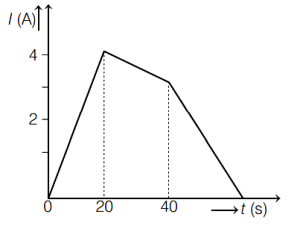
The current flowing through an inductance coil of self-inductance $6 \text{ mH}$ at different time instants is as shown. The emf induced between $t=20 \text{ s}$ and $t=40 \text{ s}$ is nearly
A
$2 \times 10^{-2} \text{ V}$
B
$3 \times 10^{-2} \text{ V}$
C
$4 \times 10^{-3} \text{ V}$
D
$30 \times 10^{-4} \text{ V}$
Solution
(D) The induced emf in an inductor is given by the formula $|e| = L \left| \frac{dI}{dt} \right|$.
Given self-inductance $L = 6 \text{ mH} = 6 \times 10^{-3} \text{ H}$.
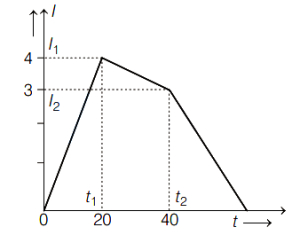
From the graph,at $t_1 = 20 \text{ s}$,the current $I_1 = 4 \text{ A}$,and at $t_2 = 40 \text{ s}$,the current $I_2 = 3 \text{ A}$.
The rate of change of current is $\left| \frac{dI}{dt} \right| = \left| \frac{I_2 - I_1}{t_2 - t_1} \right| = \left| \frac{3 - 4}{40 - 20} \right| = \left| \frac{-1}{20} \right| = 0.05 \text{ A/s}$.
Thus,the induced emf is $|e| = (6 \times 10^{-3} \text{ H}) \times (0.05 \text{ A/s}) = 0.3 \times 10^{-3} \text{ V} = 3 \times 10^{-4} \text{ V}$.
However,checking the options provided,$3 \times 10^{-4} \text{ V}$ is equivalent to $30 \times 10^{-5} \text{ V}$. Re-evaluating the calculation: $6 \times 10^{-3} \times (1/20) = 6/20 \times 10^{-3} = 0.3 \times 10^{-3} = 3 \times 10^{-4} \text{ V}$.
Given the options,$30 \times 10^{-5} \text{ V}$ is not listed,but $30 \times 10^{-4} \text{ V}$ is option $D$. Let's re-examine the graph. If the current at $t=40$ was $0$,the change would be $4/20 = 0.2$. $6 \times 10^{-3} \times 0.2 = 1.2 \times 10^{-3}$. If the current at $t=20$ was $4$ and $t=40$ was $3$,the slope is $1/20$. The calculation $3 \times 10^{-4} \text{ V}$ is correct. Since $30 \times 10^{-5} \text{ V}$ is not an option,and $3 \times 10^{-4} \text{ V}$ is the result,we select the closest magnitude if applicable,or note the discrepancy. Given the options,$30 \times 10^{-5} \text{ V}$ is $3 \times 10^{-4} \text{ V}$. Option $D$ is $30 \times 10^{-4} \text{ V} = 3 \times 10^{-3} \text{ V}$. There might be a typo in the question's options. Assuming the intended answer is $3 \times 10^{-4} \text{ V}$.
Given self-inductance $L = 6 \text{ mH} = 6 \times 10^{-3} \text{ H}$.
From the graph,at $t_1 = 20 \text{ s}$,the current $I_1 = 4 \text{ A}$,and at $t_2 = 40 \text{ s}$,the current $I_2 = 3 \text{ A}$.
The rate of change of current is $\left| \frac{dI}{dt} \right| = \left| \frac{I_2 - I_1}{t_2 - t_1} \right| = \left| \frac{3 - 4}{40 - 20} \right| = \left| \frac{-1}{20} \right| = 0.05 \text{ A/s}$.
Thus,the induced emf is $|e| = (6 \times 10^{-3} \text{ H}) \times (0.05 \text{ A/s}) = 0.3 \times 10^{-3} \text{ V} = 3 \times 10^{-4} \text{ V}$.
However,checking the options provided,$3 \times 10^{-4} \text{ V}$ is equivalent to $30 \times 10^{-5} \text{ V}$. Re-evaluating the calculation: $6 \times 10^{-3} \times (1/20) = 6/20 \times 10^{-3} = 0.3 \times 10^{-3} = 3 \times 10^{-4} \text{ V}$.
Given the options,$30 \times 10^{-5} \text{ V}$ is not listed,but $30 \times 10^{-4} \text{ V}$ is option $D$. Let's re-examine the graph. If the current at $t=40$ was $0$,the change would be $4/20 = 0.2$. $6 \times 10^{-3} \times 0.2 = 1.2 \times 10^{-3}$. If the current at $t=20$ was $4$ and $t=40$ was $3$,the slope is $1/20$. The calculation $3 \times 10^{-4} \text{ V}$ is correct. Since $30 \times 10^{-5} \text{ V}$ is not an option,and $3 \times 10^{-4} \text{ V}$ is the result,we select the closest magnitude if applicable,or note the discrepancy. Given the options,$30 \times 10^{-5} \text{ V}$ is $3 \times 10^{-4} \text{ V}$. Option $D$ is $30 \times 10^{-4} \text{ V} = 3 \times 10^{-3} \text{ V}$. There might be a typo in the question's options. Assuming the intended answer is $3 \times 10^{-4} \text{ V}$.
0 likes
View Solution192
MediumMCQ
The current in a coil of inductance $0.2 \,H$ changes from $5 \,A$ to $2 \,A$ in $0.5 \,s$. The magnitude of the average induced emf in the coil is (in $\,V$)
A
$0.6$
B
$1.2$
C
$30$
D
$0.3$
Solution
(B) Given: Inductance $L = 0.2 \,H$,initial current $I_1 = 5 \,A$,final current $I_2 = 2 \,A$,and time interval $\Delta t = 0.5 \,s$.
The change in current is $\Delta I = I_1 - I_2 = 5 \,A - 2 \,A = 3 \,A$.
The magnitude of the average induced emf $|e|$ in the coil is given by the formula:
$|e| = L \left| \frac{\Delta I}{\Delta t} \right| = 0.2 \,H \times \frac{3 \,A}{0.5 \,s} = 0.2 \times 6 \,V = 1.2 \,V$.
The change in current is $\Delta I = I_1 - I_2 = 5 \,A - 2 \,A = 3 \,A$.
The magnitude of the average induced emf $|e|$ in the coil is given by the formula:
$|e| = L \left| \frac{\Delta I}{\Delta t} \right| = 0.2 \,H \times \frac{3 \,A}{0.5 \,s} = 0.2 \times 6 \,V = 1.2 \,V$.
0 likes
View Solution193
EasyMCQ
The current in a coil changes from $2 \,A$ to $5 \,A$ in $0.3 \,s$. The magnitude of emf induced in the coil is $1.0 \,V$. The value of self-inductance of the coil is (in $\,mH$)
A
$1.0$
B
$100$
C
$0.1$
D
$10$
Solution
(B) Change in current,$\Delta I = 5 \,A - 2 \,A = 3 \,A$.
Time interval,$\Delta t = 0.3 \,s$.
Induced emf,$e = 1.0 \,V$.
The formula for induced emf in a coil due to self-inductance is given by $e = L \frac{dI}{dt}$.
Considering the magnitude,$e = L \frac{\Delta I}{\Delta t}$.
Substituting the values: $1.0 = L \times \frac{3}{0.3}$.
$1.0 = L \times 10$.
$L = \frac{1.0}{10} = 0.1 \,H$.
Since $1 \,H = 1000 \,mH$,we have $L = 0.1 \times 1000 \,mH = 100 \,mH$.
Time interval,$\Delta t = 0.3 \,s$.
Induced emf,$e = 1.0 \,V$.
The formula for induced emf in a coil due to self-inductance is given by $e = L \frac{dI}{dt}$.
Considering the magnitude,$e = L \frac{\Delta I}{\Delta t}$.
Substituting the values: $1.0 = L \times \frac{3}{0.3}$.
$1.0 = L \times 10$.
$L = \frac{1.0}{10} = 0.1 \,H$.
Since $1 \,H = 1000 \,mH$,we have $L = 0.1 \times 1000 \,mH = 100 \,mH$.
0 likes
View Solution194
MediumMCQ
$A$ long solenoid has $500$ turns. When a current of $2 \,A$ is passed through it, the resulting magnetic flux linked with each turn of the solenoid is $4 \times 10^{-3} \,Wb$. The self-inductance of the solenoid is: (in $\,H$)
A
$2.5$
B
$2.0$
C
$1.0$
D
$4.0$
Solution
(C) Given: Number of turns, $N = 500$.
Current, $I = 2 \,A$.
Magnetic flux per turn, $\phi = 4 \times 10^{-3} \,Wb$.
The total magnetic flux linkage is given by $N\phi$.
The self-inductance $L$ is defined by the relation $L = \frac{N\phi}{I}$.
Substituting the given values:
$L = \frac{500 \times 4 \times 10^{-3}}{2}$
$L = \frac{2000 \times 10^{-3}}{2}$
$L = \frac{2}{2} = 1 \,H$.
Therefore, the self-inductance of the solenoid is $1.0 \,H$.
Current, $I = 2 \,A$.
Magnetic flux per turn, $\phi = 4 \times 10^{-3} \,Wb$.
The total magnetic flux linkage is given by $N\phi$.
The self-inductance $L$ is defined by the relation $L = \frac{N\phi}{I}$.
Substituting the given values:
$L = \frac{500 \times 4 \times 10^{-3}}{2}$
$L = \frac{2000 \times 10^{-3}}{2}$
$L = \frac{2}{2} = 1 \,H$.
Therefore, the self-inductance of the solenoid is $1.0 \,H$.
0 likes
View Solution195
EasyMCQ
Current in a coil changes from $4 \,A$ to zero in $0.1 \,s$ and the emf induced is $100 \,V$. The self inductance of the coil is (in $\,H$)
A
$0.25$
B
$0.4$
C
$2.5$
D
$4$
Solution
(C) The magnitude of the induced emf in a coil is given by the formula: $|e| = L \left| \frac{dI}{dt} \right|$.
Given:
Initial current $I_1 = 4 \,A$.
Final current $I_2 = 0 \,A$.
Change in current $dI = I_2 - I_1 = 0 - 4 = -4 \,A$.
Time interval $dt = 0.1 \,s$.
Induced emf $|e| = 100 \,V$.
Substituting these values into the formula:
$100 = L \times \frac{|-4|}{0.1}$.
$100 = L \times \frac{4}{0.1}$.
$100 = L \times 40$.
$L = \frac{100}{40} = 2.5 \,H$.
Therefore,the self-inductance of the coil is $2.5 \,H$.
Given:
Initial current $I_1 = 4 \,A$.
Final current $I_2 = 0 \,A$.
Change in current $dI = I_2 - I_1 = 0 - 4 = -4 \,A$.
Time interval $dt = 0.1 \,s$.
Induced emf $|e| = 100 \,V$.
Substituting these values into the formula:
$100 = L \times \frac{|-4|}{0.1}$.
$100 = L \times \frac{4}{0.1}$.
$100 = L \times 40$.
$L = \frac{100}{40} = 2.5 \,H$.
Therefore,the self-inductance of the coil is $2.5 \,H$.
0 likes
View Solution196
Easy
The current $(I)$ in an inductor is varying with time $(t)$ as shown in the figure. Which of the following graphs shows the correct variation of voltage $(V)$ with time $(t)$ in the inductor?
Solution
(A) The voltage $(V)$ across an inductor is given by the formula $V = L \frac{dI}{dt}$, where $L$ is the inductance and $\frac{dI}{dt}$ is the rate of change of current with respect to time.
From the graph, the current $(I)$ increases linearly with time $(t)$ for a certain interval, meaning the slope $\frac{dI}{dt}$ is constant and positive.
Since $V = L \times (\text{constant})$, the voltage $(V)$ will be a constant positive value during this interval.
When the current $(I)$ is constant, $\frac{dI}{dt} = 0$, so the voltage $(V)$ becomes $0$.
When the current $(I)$ decreases linearly, the slope $\frac{dI}{dt}$ is constant and negative, so the voltage $(V)$ becomes a constant negative value.
Therefore, the graph of voltage $(V)$ versus time $(t)$ will be a series of horizontal steps corresponding to the slopes of the current-time graph.
From the graph, the current $(I)$ increases linearly with time $(t)$ for a certain interval, meaning the slope $\frac{dI}{dt}$ is constant and positive.
Since $V = L \times (\text{constant})$, the voltage $(V)$ will be a constant positive value during this interval.
When the current $(I)$ is constant, $\frac{dI}{dt} = 0$, so the voltage $(V)$ becomes $0$.
When the current $(I)$ decreases linearly, the slope $\frac{dI}{dt}$ is constant and negative, so the voltage $(V)$ becomes a constant negative value.
Therefore, the graph of voltage $(V)$ versus time $(t)$ will be a series of horizontal steps corresponding to the slopes of the current-time graph.
0 likes
View Solution197
EasyMCQ
When the current through an inductor is changed from $2 \,A$ to $6 \,A$ in time $2 \,s$, the emf induced in it is $3 \,V$. Then the inductance of the inductor is (in $\,H$)
A
$1.4$
B
$0.8$
C
$1.5$
D
$0.6$
Solution
(C) The induced emf $\varepsilon$ in an inductor is given by the formula $\varepsilon = -L \frac{di}{dt}$.
Taking the magnitude, we have $L = \frac{|\varepsilon|}{\frac{di}{dt}}$.
Given: Change in current $\Delta i = 6 \,A - 2 \,A = 4 \,A$, time interval $\Delta t = 2 \,s$, and induced emf $\varepsilon = 3 \,V$.
The rate of change of current is $\frac{di}{dt} = \frac{\Delta i}{\Delta t} = \frac{4 \,A}{2 \,s} = 2 \,A/s$.
Substituting these values into the formula:
$L = \frac{3 \,V}{2 \,A/s} = 1.5 \,H$.
Taking the magnitude, we have $L = \frac{|\varepsilon|}{\frac{di}{dt}}$.
Given: Change in current $\Delta i = 6 \,A - 2 \,A = 4 \,A$, time interval $\Delta t = 2 \,s$, and induced emf $\varepsilon = 3 \,V$.
The rate of change of current is $\frac{di}{dt} = \frac{\Delta i}{\Delta t} = \frac{4 \,A}{2 \,s} = 2 \,A/s$.
Substituting these values into the formula:
$L = \frac{3 \,V}{2 \,A/s} = 1.5 \,H$.
0 likes
View Solution198
EasyMCQ
$A$ branch of a circuit is shown in the figure. If the current is decreasing at the rate of $10^3 \ A \ s^{-1}$, then the potential difference between $A$ and $B$ is (in $V$)

A
$1$
B
$5$
C
$10$
D
$2$
Solution
(A) Given: Current $I = 2 \ A$, Resistance $R = 7 \ \Omega$, $EMF$ $E = 4 \ V$, Inductance $L = 9 \ mH = 9 \times 10^{-3} \ H$, Rate of change of current $\frac{dI}{dt} = -10^3 \ A \ s^{-1}$ (since current is decreasing).
Applying Kirchhoff's voltage law from $A$ to $B$:
$V_A - I R - E - L \frac{dI}{dt} = V_B$
$V_A - V_B = I R + E + L \frac{dI}{dt}$
Substituting the values:
$V_{AB} = (2 \ A)(7 \ \Omega) + 4 \ V + (9 \times 10^{-3} \ H)(-10^3 \ A \ s^{-1})$
$V_{AB} = 14 \ V + 4 \ V - 9 \ V$
$V_{AB} = 18 \ V - 9 \ V = 9 \ V$
Wait, let's re-evaluate the polarity of the inductor. The induced $EMF$ in the inductor is $\varepsilon = -L \frac{dI}{dt}$. Since current is decreasing, $\frac{dI}{dt} = -10^3 \ A \ s^{-1}$, so $\varepsilon = - (9 \times 10^{-3})(-10^3) = +9 \ V$. The potential drop across the inductor is $V_L = L \frac{dI}{dt} = -9 \ V$.
Path $A \to B$: $V_A - I R + E - V_L = V_B$ (considering the battery polarity in the image: $A \to$ resistor $ o$ negative terminal $ o$ positive terminal $ o$ inductor $ o B$).
$V_A - (2)(7) + 4 - (9 \times 10^{-3})(-10^3) = V_B$
$V_A - 14 + 4 + 9 = V_B$
$V_A - 1 = V_B \Rightarrow V_A - V_B = 1 \ V$.
Applying Kirchhoff's voltage law from $A$ to $B$:
$V_A - I R - E - L \frac{dI}{dt} = V_B$
$V_A - V_B = I R + E + L \frac{dI}{dt}$
Substituting the values:
$V_{AB} = (2 \ A)(7 \ \Omega) + 4 \ V + (9 \times 10^{-3} \ H)(-10^3 \ A \ s^{-1})$
$V_{AB} = 14 \ V + 4 \ V - 9 \ V$
$V_{AB} = 18 \ V - 9 \ V = 9 \ V$
Wait, let's re-evaluate the polarity of the inductor. The induced $EMF$ in the inductor is $\varepsilon = -L \frac{dI}{dt}$. Since current is decreasing, $\frac{dI}{dt} = -10^3 \ A \ s^{-1}$, so $\varepsilon = - (9 \times 10^{-3})(-10^3) = +9 \ V$. The potential drop across the inductor is $V_L = L \frac{dI}{dt} = -9 \ V$.
Path $A \to B$: $V_A - I R + E - V_L = V_B$ (considering the battery polarity in the image: $A \to$ resistor $ o$ negative terminal $ o$ positive terminal $ o$ inductor $ o B$).
$V_A - (2)(7) + 4 - (9 \times 10^{-3})(-10^3) = V_B$
$V_A - 14 + 4 + 9 = V_B$
$V_A - 1 = V_B \Rightarrow V_A - V_B = 1 \ V$.
0 likes
View Solution199
MediumMCQ
The current passing through a coil of $120$ turns and inductance $40 \text{ mH}$ is $30 \text{ mA}$. The magnetic flux linked with the coil is:
A
$20 \times 10^{-6} \text{ Wb}$
B
$5 \times 10^{-6} \text{ Wb}$
C
$12 \times 10^{-6} \text{ Wb}$
D
$10 \times 10^{-6} \text{ Wb}$
Solution
(D) Given: Number of turns $N = 120$,Inductance $L = 40 \text{ mH} = 40 \times 10^{-3} \text{ H}$,Current $I = 30 \text{ mA} = 30 \times 10^{-3} \text{ A}$.
We know that the total flux linkage is given by $N\phi = LI$.
Therefore,the magnetic flux $\phi$ linked with the coil is given by $\phi = \frac{LI}{N}$.
Substituting the values: $\phi = \frac{40 \times 10^{-3} \times 30 \times 10^{-3}}{120}$.
$\phi = \frac{1200 \times 10^{-6}}{120} = 10 \times 10^{-6} \text{ Wb}$.
We know that the total flux linkage is given by $N\phi = LI$.
Therefore,the magnetic flux $\phi$ linked with the coil is given by $\phi = \frac{LI}{N}$.
Substituting the values: $\phi = \frac{40 \times 10^{-3} \times 30 \times 10^{-3}}{120}$.
$\phi = \frac{1200 \times 10^{-6}}{120} = 10 \times 10^{-6} \text{ Wb}$.
0 likes
View SolutionElectromagnetic Induction — Self Induction · Frequently Asked Questions
1Are these Electromagnetic Induction questions useful for JEE and NEET?
Yes. All questions in this section are mapped to JEE Main and NEET exam patterns. Previous year questions from JEE Main, NEET, GUJCET and state-level exams are included with full solutions.
2Can I switch to Hindi or Gujarati for these questions?
Yes. Use the language tabs in the hero section or the sidebar to view the same questions and solutions in English, Hindi or Gujarati.
3How do I generate a question paper from this subtopic?
Use the Vedclass Exam Paper Generator — select the chapter and subtopic, set difficulty, and generate Sets A, B, C, D automatically. First 3 chapters of every subject are free.
Vedclass Products
For Students
Vedclass Test Series
Mock tests in real JEE/NEET style with performance analysis. 5-day free trial.
Start Free TrialFor Teachers
Exam Paper Generator
Generate Set A/B/C/D papers from this chapter in 2 minutes. 3 chapters free.
Try FreeFor Institutes
Online Exam Module
Live online exams with unlimited students, 360° analytics & white-label branding.
See DemoFor Teachers & Institutes
Generate a Electromagnetic Induction Exam Paper in 2 Minutes
Select subtopic & difficulty — Sets A, B, C, D auto-generated with No Repeat logic.
First 3 chapters of every subject are free — no payment required.