
A English
Electric Field Lines, Electric Flux and Gauss's Law Questions in English
Class 12 Physics · Electric Charges and Fields · Electric Field Lines, Electric Flux and Gauss's Law
312+
Questions
English
Language
100%
With Solutions
Showing 11 of 312 questions in English
301
EasyMCQ
Two equations are given below:
$A. \oint E \cdot dA = \frac{Q}{\varepsilon_0}$
$B. \oint B \cdot dA = 0$
They are:
$A. \oint E \cdot dA = \frac{Q}{\varepsilon_0}$
$B. \oint B \cdot dA = 0$
They are:
A
$A$. Ampere's law,$B$. Gauss law for electricity
B
$A$. Gauss law for electric fields,$B$. Gauss law for magnetic fields
C
$A$. Faraday's law,$B$. Gauss law for electric fields
D
Both $A$ and $B$ represent Faraday's law
Solution
(B) Equation $A$ is $\oint E \cdot dA = \frac{Q}{\varepsilon_0}$,which is the Gauss law for electrostatics. It states that the total electric flux through a closed surface is equal to the enclosed charge divided by the permittivity of free space.
Equation $B$ is $\oint B \cdot dA = 0$,which is the Gauss law for magnetism. It implies that magnetic monopoles do not exist,meaning the net magnetic flux through any closed surface is always zero.
Equation $B$ is $\oint B \cdot dA = 0$,which is the Gauss law for magnetism. It implies that magnetic monopoles do not exist,meaning the net magnetic flux through any closed surface is always zero.
0 likes
View Solution302
EasyMCQ
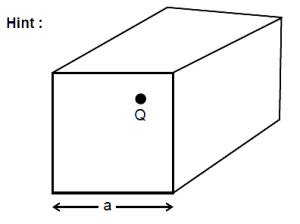
$A$ charge $Q$ is placed at the centre of a cube of side $a$. The total flux of electric field through the six surfaces of the cube is
A
$\frac{6 Q a^2}{\epsilon_0}$
B
$\frac{Q a^2}{6 \epsilon_0}$
C
$Q / \epsilon_0$
D
$Q a^2 / \epsilon_0$
Solution
(C) According to Gauss's Law,the total electric flux $\phi$ through any closed surface is equal to the net charge $Q_{\text{enclosed}}$ inside the surface divided by the permittivity of free space $\epsilon_0$.
Mathematically,$\phi = \frac{Q_{\text{enclosed}}}{\epsilon_0}$.
Since the charge $Q$ is placed at the centre of the cube,the entire charge is enclosed by the cube.
Therefore,the total flux through the six surfaces of the cube is $\phi = \frac{Q}{\epsilon_0}$.
Mathematically,$\phi = \frac{Q_{\text{enclosed}}}{\epsilon_0}$.
Since the charge $Q$ is placed at the centre of the cube,the entire charge is enclosed by the cube.
Therefore,the total flux through the six surfaces of the cube is $\phi = \frac{Q}{\epsilon_0}$.
0 likes
View Solution303
MediumMCQ
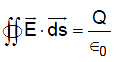
Consider the integral form of the Gaussian law in electrostatics: $\oint \vec{E} \cdot d\vec{s} = \frac{Q}{\epsilon_0}$. Which of the following statements are correct?
A
It contains the law of Coulomb.
B
It contains the superposition principle.
C
An elementary patch on the enclosing surface is a polar vector.
D
An elementary patch on the enclosing surface is a pseudo-vector.
Solution
(A, B, D) $1$. Gauss's Law is derived from Coulomb's Law and the superposition principle. Therefore,it inherently contains both of these fundamental principles of electrostatics.
$2$. The area element $d\vec{s}$ (or $d\vec{A}$) is defined as a vector pointing outward,normal to the surface. Since it is defined as the cross product of two displacement vectors (e.g.,$d\vec{l}_1 \times d\vec{l}_2$),it behaves as a pseudo-vector (or axial vector) because its direction depends on the orientation of the surface coordinate system,not just the position.
$2$. The area element $d\vec{s}$ (or $d\vec{A}$) is defined as a vector pointing outward,normal to the surface. Since it is defined as the cross product of two displacement vectors (e.g.,$d\vec{l}_1 \times d\vec{l}_2$),it behaves as a pseudo-vector (or axial vector) because its direction depends on the orientation of the surface coordinate system,not just the position.
0 likes
View Solution304
DifficultMCQ
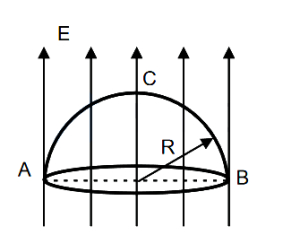
$A$ hemisphere of radius $R$ is placed in a uniform electric field $E$ so that its axis is parallel to the field. Which of the following statement$(s)$ is/are true?
A
Flux through the curved surface of hemisphere is $\pi R^2 E$.
B
Flux through the circular surface of hemisphere is $\pi R^2 E$.
C
Total flux enclosed is zero.
D
Work done in moving a point charge $q$ from $A$ to $B$ via the path $ACB$ depends upon $R$.
Solution
(A, C) According to Gauss's Law,the total electric flux $\phi_{\text{total}}$ through any closed surface in a region with no enclosed charge is zero,i.e.,$\phi_{\text{total}} = 0$.
For the hemisphere,$\phi_{\text{total}} = \phi_{\text{curved}} + \phi_{\text{flat}} = 0$.
The flux through the flat circular surface is $\phi_{\text{flat}} = -E \cdot A = -E(\pi R^2)$ (since the field lines enter the surface).
Therefore,$\phi_{\text{curved}} = -\phi_{\text{flat}} = E \pi R^2$.
Thus,statement $(A)$ is correct and $(C)$ is correct.
Regarding the work done,for a uniform electric field,the potential difference $\Delta V = -\vec{E} \cdot \Delta \vec{r}$.
Since points $A$ and $B$ lie on the same equipotential plane perpendicular to the electric field $\vec{E}$,the potential difference between $A$ and $B$ is $\Delta V = 0$.
Therefore,the work done $W = q \Delta V = 0$,which is independent of the path and the radius $R$.
For the hemisphere,$\phi_{\text{total}} = \phi_{\text{curved}} + \phi_{\text{flat}} = 0$.
The flux through the flat circular surface is $\phi_{\text{flat}} = -E \cdot A = -E(\pi R^2)$ (since the field lines enter the surface).
Therefore,$\phi_{\text{curved}} = -\phi_{\text{flat}} = E \pi R^2$.
Thus,statement $(A)$ is correct and $(C)$ is correct.
Regarding the work done,for a uniform electric field,the potential difference $\Delta V = -\vec{E} \cdot \Delta \vec{r}$.
Since points $A$ and $B$ lie on the same equipotential plane perpendicular to the electric field $\vec{E}$,the potential difference between $A$ and $B$ is $\Delta V = 0$.
Therefore,the work done $W = q \Delta V = 0$,which is independent of the path and the radius $R$.
0 likes
View Solution305
EasyMCQ
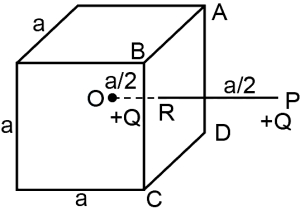
Consider a region in free space bounded by the surfaces of an imaginary cube having sides of length $a$ as shown in the figure. $A$ charge $+Q$ is placed at the centre $O$ of the cube. $P$ is a point outside the cube such that the line $OP$ perpendicularly intersects the surface $ABCD$ at $R$,and $OR = RP = a/2$. $A$ charge $+Q$ is also placed at point $P$. What is the total electric flux through the five faces of the cube other than $ABCD$?
A
$\frac{Q}{\varepsilon_{0}}$
B
$\frac{5Q}{6\varepsilon_{0}}$
C
$\frac{10Q}{6\varepsilon_{0}}$
D
zero
Solution
(C) $1$. The charge $+Q$ at the center $O$ contributes a total flux of $\frac{Q}{\varepsilon_{0}}$ through the entire cube. By symmetry,the flux through each of the $6$ faces is $\frac{Q}{6\varepsilon_{0}}$.
$2$. The charge $+Q$ at point $P$ is located at a distance $a/2$ from the center of the face $ABCD$. This charge creates an electric field. The flux due to charge $+Q$ at $P$ through the face $ABCD$ is $\frac{Q}{2\varepsilon_{0}}$ (since the charge is at a distance $a/2$ from the center of the face,it subtends a solid angle of $2\pi$ steradians at the face,or by considering an identical cube placed adjacent to the first one).
$3$. The net flux through face $ABCD$ due to both charges is $\phi_{ABCD} = \phi_{O, ABCD} + \phi_{P, ABCD} = \frac{Q}{6\varepsilon_{0}} - \frac{Q}{2\varepsilon_{0}} = -\frac{Q}{3\varepsilon_{0}}$ (the flux from $P$ enters the cube,hence negative).
$4$. Total flux through the cube due to both charges is $\phi_{total} = \frac{Q_{enclosed}}{\varepsilon_{0}} = \frac{Q}{\varepsilon_{0}}$.
$5$. The flux through the remaining $5$ faces is $\phi_{5} = \phi_{total} - \phi_{ABCD} = \frac{Q}{\varepsilon_{0}} - (-\frac{Q}{3\varepsilon_{0}}) = \frac{4Q}{3\varepsilon_{0}} = \frac{8Q}{6\varepsilon_{0}}$.
$2$. The charge $+Q$ at point $P$ is located at a distance $a/2$ from the center of the face $ABCD$. This charge creates an electric field. The flux due to charge $+Q$ at $P$ through the face $ABCD$ is $\frac{Q}{2\varepsilon_{0}}$ (since the charge is at a distance $a/2$ from the center of the face,it subtends a solid angle of $2\pi$ steradians at the face,or by considering an identical cube placed adjacent to the first one).
$3$. The net flux through face $ABCD$ due to both charges is $\phi_{ABCD} = \phi_{O, ABCD} + \phi_{P, ABCD} = \frac{Q}{6\varepsilon_{0}} - \frac{Q}{2\varepsilon_{0}} = -\frac{Q}{3\varepsilon_{0}}$ (the flux from $P$ enters the cube,hence negative).
$4$. Total flux through the cube due to both charges is $\phi_{total} = \frac{Q_{enclosed}}{\varepsilon_{0}} = \frac{Q}{\varepsilon_{0}}$.
$5$. The flux through the remaining $5$ faces is $\phi_{5} = \phi_{total} - \phi_{ABCD} = \frac{Q}{\varepsilon_{0}} - (-\frac{Q}{3\varepsilon_{0}}) = \frac{4Q}{3\varepsilon_{0}} = \frac{8Q}{6\varepsilon_{0}}$.
0 likes
View Solution306
EasyMCQ
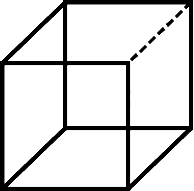
$A$ positive charge $Q$ is situated at the centre of a cube. The electric flux through any face of the cube is (in $SI$ units)
A
$\frac{Q}{6 \varepsilon_{0}}$
B
$4 \pi Q$
C
$\frac{Q}{4 \pi \varepsilon_{0}}$
D
$\frac{Q}{6 \pi \varepsilon_{0}}$
Solution
(A) According to Gauss's law,the total electric flux $\phi_{total}$ through any closed surface is given by $\phi_{total} = \frac{Q}{\varepsilon_{0}}$,where $Q$ is the net charge enclosed by the surface.
Since the charge $Q$ is placed at the centre of the cube,the electric flux is symmetrically distributed through all $6$ faces of the cube.
Therefore,the electric flux $\phi_{face}$ through any one face of the cube is $\phi_{face} = \frac{\phi_{total}}{6} = \frac{Q}{6 \varepsilon_{0}}$.
Since the charge $Q$ is placed at the centre of the cube,the electric flux is symmetrically distributed through all $6$ faces of the cube.
Therefore,the electric flux $\phi_{face}$ through any one face of the cube is $\phi_{face} = \frac{\phi_{total}}{6} = \frac{Q}{6 \varepsilon_{0}}$.
0 likes
View Solution307
EasyMCQ
In a region,the intensity of an electric field is given by $E = 2i + 3j + k$ in $NC^{-1}$. The electric flux through a surface $S = 10i \ m^2$ in the region is
A
$5 \ Nm^2 C^{-1}$
B
$10 \ Nm^2 C^{-1}$
C
$15 \ Nm^2 C^{-1}$
D
$20 \ Nm^2 C^{-1}$
Solution
(D) Given,electric field intensity $E = (2i + 3j + k) \ NC^{-1}$.
Area vector $S = 10i \ m^2$.
The electric flux $\phi$ through a surface is defined by the dot product of the electric field vector and the area vector:
$\phi = E \cdot S$
Substituting the given values:
$\phi = (2i + 3j + k) \cdot (10i)$
Since $i \cdot i = 1$,$j \cdot i = 0$,and $k \cdot i = 0$:
$\phi = (2 \times 10) + (3 \times 0) + (1 \times 0)$
$\phi = 20 \ Nm^2 C^{-1}$.
Area vector $S = 10i \ m^2$.
The electric flux $\phi$ through a surface is defined by the dot product of the electric field vector and the area vector:
$\phi = E \cdot S$
Substituting the given values:
$\phi = (2i + 3j + k) \cdot (10i)$
Since $i \cdot i = 1$,$j \cdot i = 0$,and $k \cdot i = 0$:
$\phi = (2 \times 10) + (3 \times 0) + (1 \times 0)$
$\phi = 20 \ Nm^2 C^{-1}$.
0 likes
View Solution308
EasyMCQ
$A$ point charge $+q$ is placed at the centre of a cube of side $L$. The electric flux emerging from the cube is
A
$\frac{q}{\varepsilon_0}$
B
Zero
C
$\frac{6 q L^2}{\varepsilon_0}$
D
$\frac{q}{6 L^2 \varepsilon_0}$
Solution
(A) According to Gauss's Law,the total electric flux $\phi$ through any closed surface is equal to the net charge enclosed by the surface divided by the permittivity of free space $\varepsilon_0$.
Mathematically,$\phi = \frac{q_{\text{enclosed}}}{\varepsilon_0}$.
In this problem,the point charge $+q$ is placed at the centre of the cube,which is a closed surface.
Therefore,the total electric flux emerging from the cube is $\phi = \frac{q}{\varepsilon_0}$.
Mathematically,$\phi = \frac{q_{\text{enclosed}}}{\varepsilon_0}$.
In this problem,the point charge $+q$ is placed at the centre of the cube,which is a closed surface.
Therefore,the total electric flux emerging from the cube is $\phi = \frac{q}{\varepsilon_0}$.
0 likes
View Solution309
DifficultMCQ
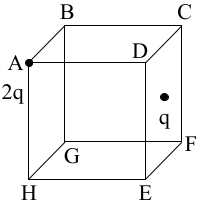
Two point charges $2q$ and $q$ are placed at vertex $A$ and the centre of face $CDEF$ of the cube,respectively,as shown in the figure. The electric flux passing through the cube is:
A
$\frac{3q}{\varepsilon_0}$
B
$\frac{q}{\varepsilon_0}$
C
$\frac{3q}{2\varepsilon_0}$
D
$\frac{3q}{4\varepsilon_0}$
Solution
(D) According to Gauss's Law,the total electric flux $\phi$ through a closed surface is $\phi = \frac{Q_{\text{in}}}{\varepsilon_0}$,where $Q_{\text{in}}$ is the net charge enclosed by the surface.
$1$. The charge $2q$ is placed at vertex $A$. $A$ vertex of a cube is shared by $8$ adjacent cubes. Therefore,the fraction of charge $2q$ enclosed within the cube is $\frac{2q}{8} = \frac{q}{4}$.
$2$. The charge $q$ is placed at the centre of the face $CDEF$. $A$ face of a cube is shared by $2$ adjacent cubes. Therefore,the fraction of charge $q$ enclosed within the cube is $\frac{q}{2}$.
$3$. The total enclosed charge $Q_{\text{in}}$ is the sum of these contributions: $Q_{\text{in}} = \frac{q}{4} + \frac{q}{2} = \frac{q + 2q}{4} = \frac{3q}{4}$.
$4$. Thus,the total electric flux passing through the cube is $\phi = \frac{Q_{\text{in}}}{\varepsilon_0} = \frac{3q}{4\varepsilon_0}$.
$1$. The charge $2q$ is placed at vertex $A$. $A$ vertex of a cube is shared by $8$ adjacent cubes. Therefore,the fraction of charge $2q$ enclosed within the cube is $\frac{2q}{8} = \frac{q}{4}$.
$2$. The charge $q$ is placed at the centre of the face $CDEF$. $A$ face of a cube is shared by $2$ adjacent cubes. Therefore,the fraction of charge $q$ enclosed within the cube is $\frac{q}{2}$.
$3$. The total enclosed charge $Q_{\text{in}}$ is the sum of these contributions: $Q_{\text{in}} = \frac{q}{4} + \frac{q}{2} = \frac{q + 2q}{4} = \frac{3q}{4}$.
$4$. Thus,the total electric flux passing through the cube is $\phi = \frac{Q_{\text{in}}}{\varepsilon_0} = \frac{3q}{4\varepsilon_0}$.
0 likes
View Solution310
MediumMCQ
If charge $q$ is placed on one of the vertex of a cube,then total electric flux passing through the cube is . . . . . . .
A
$\frac{q}{\varepsilon_0}$
B
$\frac{q}{8\varepsilon_0}$
C
$\frac{q}{4\varepsilon_0}$
D
$\frac{q}{24\varepsilon_0}$
Solution
(B) According to Gauss's law,the total electric flux through a closed surface is $\frac{q_{enclosed}}{\varepsilon_0}$.
When a charge $q$ is placed at a vertex of a cube,the cube occupies only $\frac{1}{8}$ of the total space surrounding the charge because $8$ identical cubes are required to enclose the charge completely at the center of a larger cube.
Therefore,the electric flux passing through the cube is $\Phi = \frac{1}{8} \times \frac{q}{\varepsilon_0} = \frac{q}{8\varepsilon_0}$.
When a charge $q$ is placed at a vertex of a cube,the cube occupies only $\frac{1}{8}$ of the total space surrounding the charge because $8$ identical cubes are required to enclose the charge completely at the center of a larger cube.
Therefore,the electric flux passing through the cube is $\Phi = \frac{1}{8} \times \frac{q}{\varepsilon_0} = \frac{q}{8\varepsilon_0}$.
0 likes
View Solution311
MediumMCQ
Two point charges $8 \mu \text{C}$ and $-2 \mu \text{C}$ are located at $x = 2 \text{ cm}$ and $x = 4 \text{ cm}$,respectively on the $x$-axis. The ratio of electric flux due to these charges through two spheres of radii $3 \text{ cm}$ and $5 \text{ cm}$ with their centers at the origin is . . . . . . .
A
$4 : 1$
B
$3 : 4$
C
$4 : 3$
D
$4 : 5$
Solution
(C) According to Gauss's Law,the electric flux $\phi$ through a closed surface is given by $\phi = \frac{q_{\text{enclosed}}}{\epsilon_0}$.
For the first sphere with radius $r_1 = 3 \text{ cm}$,only the charge at $x = 2 \text{ cm}$ $(q_1 = 8 \mu \text{C})$ is enclosed within the sphere.
Therefore,the flux through the first sphere is $\phi_1 = \frac{8 \mu \text{C}}{\epsilon_0}$.
For the second sphere with radius $r_2 = 5 \text{ cm}$,both charges at $x = 2 \text{ cm}$ $(8 \mu \text{C})$ and $x = 4 \text{ cm}$ $(-2 \mu \text{C})$ are enclosed within the sphere.
Therefore,the total enclosed charge is $q_{\text{total}} = 8 \mu \text{C} - 2 \mu \text{C} = 6 \mu \text{C}$.
The flux through the second sphere is $\phi_2 = \frac{6 \mu \text{C}}{\epsilon_0}$.
The ratio of the electric flux is $\frac{\phi_1}{\phi_2} = \frac{8 \mu \text{C} / \epsilon_0}{6 \mu \text{C} / \epsilon_0} = \frac{8}{6} = \frac{4}{3}$.
For the first sphere with radius $r_1 = 3 \text{ cm}$,only the charge at $x = 2 \text{ cm}$ $(q_1 = 8 \mu \text{C})$ is enclosed within the sphere.
Therefore,the flux through the first sphere is $\phi_1 = \frac{8 \mu \text{C}}{\epsilon_0}$.
For the second sphere with radius $r_2 = 5 \text{ cm}$,both charges at $x = 2 \text{ cm}$ $(8 \mu \text{C})$ and $x = 4 \text{ cm}$ $(-2 \mu \text{C})$ are enclosed within the sphere.
Therefore,the total enclosed charge is $q_{\text{total}} = 8 \mu \text{C} - 2 \mu \text{C} = 6 \mu \text{C}$.
The flux through the second sphere is $\phi_2 = \frac{6 \mu \text{C}}{\epsilon_0}$.
The ratio of the electric flux is $\frac{\phi_1}{\phi_2} = \frac{8 \mu \text{C} / \epsilon_0}{6 \mu \text{C} / \epsilon_0} = \frac{8}{6} = \frac{4}{3}$.
0 likes
View SolutionElectric Charges and Fields — Electric Field Lines, Electric Flux and Gauss's Law · Frequently Asked Questions
1Are these Electric Charges and Fields questions useful for JEE and NEET?
Yes. All questions in this section are mapped to JEE Main and NEET exam patterns. Previous year questions from JEE Main, NEET, GUJCET and state-level exams are included with full solutions.
2Can I switch to Hindi or Gujarati for these questions?
Yes. Use the language tabs in the hero section or the sidebar to view the same questions and solutions in English, Hindi or Gujarati.
3How do I generate a question paper from this subtopic?
Use the Vedclass Exam Paper Generator — select the chapter and subtopic, set difficulty, and generate Sets A, B, C, D automatically. First 3 chapters of every subject are free.
Vedclass Products
For Students
Vedclass Test Series
Mock tests in real JEE/NEET style with performance analysis. 5-day free trial.
Start Free TrialFor Teachers
Exam Paper Generator
Generate Set A/B/C/D papers from this chapter in 2 minutes. 3 chapters free.
Try FreeFor Institutes
Online Exam Module
Live online exams with unlimited students, 360° analytics & white-label branding.
See DemoFor Teachers & Institutes
Generate a Electric Charges and Fields Exam Paper in 2 Minutes
Select subtopic & difficulty — Sets A, B, C, D auto-generated with No Repeat logic.
First 3 chapters of every subject are free — no payment required.