
અ Gujarati
Fundamental definite integration Questions in Gujarati
Class 12 Mathematics · 7-2.Definite Integral · Fundamental definite integration
682+
Questions
Gujarati
Language
100%
With Solutions
Showing 49 of 682 questions in Gujarati
251
EasyMCQ
નિશ્ચિત સંકલન $\int_{0}^{\frac{\pi}{2}} \cos 2x \, dx$ ની કિંમત શોધો.
A
$0$
B
$1$
C
$-1$
D
$\frac{1}{2}$
Solution
(A) ધારો કે $I = \int_{0}^{\frac{\pi}{2}} \cos 2x \, dx$.
આપણે જાણીએ છીએ કે $\cos 2x$ નું પ્રતિવિકલિત $\frac{\sin 2x}{2}$ છે.
કલનશાસ્ત્રના દ્વિતીય મૂળભૂત પ્રમેય મુજબ,આપણને મળે છે:
$I = \left[ \frac{\sin 2x}{2} \right]_{0}^{\frac{\pi}{2}}$
$I = \frac{1}{2} \left[ \sin(2 \cdot \frac{\pi}{2}) - \sin(2 \cdot 0) \right]$
$I = \frac{1}{2} [\sin \pi - \sin 0]$
કારણ કે $\sin \pi = 0$ અને $\sin 0 = 0$ છે,તેથી:
$I = \frac{1}{2} [0 - 0] = 0$.
આપણે જાણીએ છીએ કે $\cos 2x$ નું પ્રતિવિકલિત $\frac{\sin 2x}{2}$ છે.
કલનશાસ્ત્રના દ્વિતીય મૂળભૂત પ્રમેય મુજબ,આપણને મળે છે:
$I = \left[ \frac{\sin 2x}{2} \right]_{0}^{\frac{\pi}{2}}$
$I = \frac{1}{2} \left[ \sin(2 \cdot \frac{\pi}{2}) - \sin(2 \cdot 0) \right]$
$I = \frac{1}{2} [\sin \pi - \sin 0]$
કારણ કે $\sin \pi = 0$ અને $\sin 0 = 0$ છે,તેથી:
$I = \frac{1}{2} [0 - 0] = 0$.
0 likes
View Solution252
EasyMCQ
નિશ્ચિત સંકલન $\int_{4}^{5} e^{x} \, dx$ ની કિંમત શોધો.
A
$e^{5} - e^{4}$
B
$e^{4}(e - 1)$
C
$e^{5} + e^{4}$
D
$e(e^{5} - e^{4})$
Solution
(B) ધારો કે $I = \int_{4}^{5} e^{x} \, dx$.
આપણે જાણીએ છીએ કે $e^{x}$ નું પ્રતિવિકલિત $e^{x}$ છે.
કલનશાસ્ત્રના બીજા મૂળભૂત પ્રમેય મુજબ,$\int_{a}^{b} f(x) \, dx = F(b) - F(a)$,જ્યાં $F'(x) = f(x)$ છે.
અહીં,$F(x) = e^{x}$ છે.
તેથી,$I = F(5) - F(4) = e^{5} - e^{4}$.
$e^{4}$ સામાન્ય લેતા,આપણને $I = e^{4}(e - 1)$ મળે છે.
આપણે જાણીએ છીએ કે $e^{x}$ નું પ્રતિવિકલિત $e^{x}$ છે.
કલનશાસ્ત્રના બીજા મૂળભૂત પ્રમેય મુજબ,$\int_{a}^{b} f(x) \, dx = F(b) - F(a)$,જ્યાં $F'(x) = f(x)$ છે.
અહીં,$F(x) = e^{x}$ છે.
તેથી,$I = F(5) - F(4) = e^{5} - e^{4}$.
$e^{4}$ સામાન્ય લેતા,આપણને $I = e^{4}(e - 1)$ મળે છે.
0 likes
View Solution253
EasyMCQ
નિશ્ચિત સંકલન $\int_{0}^{\frac{\pi}{4}} \tan x \,dx$ ની કિંમત શોધો.
A
$\frac{1}{2} \log 2$
B
$\log 2$
C
$\frac{1}{4} \log 2$
D
$0$
Solution
(A) ધારો કે $I = \int_{0}^{\frac{\pi}{4}} \tan x \,dx$.
આપણે જાણીએ છીએ કે $\int \tan x \,dx = \log |\sec x| = -\log |\cos x|$.
ધારો કે $F(x) = -\log |\cos x|$.
કલનશાસ્ત્રના બીજા મૂળભૂત પ્રમેય મુજબ,$I = F\left(\frac{\pi}{4}\right) - F(0)$.
$I = [-\log |\cos x|]_{0}^{\frac{\pi}{4}}$.
$I = -\log |\cos \frac{\pi}{4}| - (-\log |\cos 0|)$.
$I = -\log |\frac{1}{\sqrt{2}}| + \log |1|$.
કારણ કે $\log 1 = 0$,તેથી $I = -\log (2^{-\frac{1}{2}}) = -(-\frac{1}{2}) \log 2 = \frac{1}{2} \log 2$.
આપણે જાણીએ છીએ કે $\int \tan x \,dx = \log |\sec x| = -\log |\cos x|$.
ધારો કે $F(x) = -\log |\cos x|$.
કલનશાસ્ત્રના બીજા મૂળભૂત પ્રમેય મુજબ,$I = F\left(\frac{\pi}{4}\right) - F(0)$.
$I = [-\log |\cos x|]_{0}^{\frac{\pi}{4}}$.
$I = -\log |\cos \frac{\pi}{4}| - (-\log |\cos 0|)$.
$I = -\log |\frac{1}{\sqrt{2}}| + \log |1|$.
કારણ કે $\log 1 = 0$,તેથી $I = -\log (2^{-\frac{1}{2}}) = -(-\frac{1}{2}) \log 2 = \frac{1}{2} \log 2$.
0 likes
View Solution254
Medium
નિશ્ચિત સંકલન $\int_{\frac{\pi}{6}}^{\frac{\pi}{4}} \operatorname{cosec} x \, dx$ ની કિંમત શોધો.
Solution
ધારો કે $I = \int_{\frac{\pi}{6}}^{\frac{\pi}{4}} \operatorname{cosec} x \, dx$.
આપણે જાણીએ છીએ કે $\int \operatorname{cosec} x \, dx = \log |\operatorname{cosec} x - \cot x| + C$.
ધારો કે $F(x) = \log |\operatorname{cosec} x - \cot x|$.
કલનશાસ્ત્રના બીજા મૂળભૂત પ્રમેય મુજબ,$I = F\left(\frac{\pi}{4}\right) - F\left(\frac{\pi}{6}\right)$.
$I = \log |\operatorname{cosec} \frac{\pi}{4} - \cot \frac{\pi}{4}| - \log |\operatorname{cosec} \frac{\pi}{6} - \cot \frac{\pi}{6}|$.
કારણ કે $\operatorname{cosec} \frac{\pi}{4} = \sqrt{2}$,$\cot \frac{\pi}{4} = 1$,$\operatorname{cosec} \frac{\pi}{6} = 2$,અને $\cot \frac{\pi}{6} = \sqrt{3}$,તેથી:
$I = \log |\sqrt{2} - 1| - \log |2 - \sqrt{3}|$.
$\log a - \log b = \log \left(\frac{a}{b}\right)$ ગુણધર્મનો ઉપયોગ કરતા,આપણને મળે છે:
$I = \log \left( \frac{\sqrt{2} - 1}{2 - \sqrt{3}} \right)$.
આપણે જાણીએ છીએ કે $\int \operatorname{cosec} x \, dx = \log |\operatorname{cosec} x - \cot x| + C$.
ધારો કે $F(x) = \log |\operatorname{cosec} x - \cot x|$.
કલનશાસ્ત્રના બીજા મૂળભૂત પ્રમેય મુજબ,$I = F\left(\frac{\pi}{4}\right) - F\left(\frac{\pi}{6}\right)$.
$I = \log |\operatorname{cosec} \frac{\pi}{4} - \cot \frac{\pi}{4}| - \log |\operatorname{cosec} \frac{\pi}{6} - \cot \frac{\pi}{6}|$.
કારણ કે $\operatorname{cosec} \frac{\pi}{4} = \sqrt{2}$,$\cot \frac{\pi}{4} = 1$,$\operatorname{cosec} \frac{\pi}{6} = 2$,અને $\cot \frac{\pi}{6} = \sqrt{3}$,તેથી:
$I = \log |\sqrt{2} - 1| - \log |2 - \sqrt{3}|$.
$\log a - \log b = \log \left(\frac{a}{b}\right)$ ગુણધર્મનો ઉપયોગ કરતા,આપણને મળે છે:
$I = \log \left( \frac{\sqrt{2} - 1}{2 - \sqrt{3}} \right)$.
0 likes
View Solution255
EasyMCQ
નિશ્ચિત સંકલન $\int_{0}^{1} \frac{d x}{\sqrt{1-x^{2}}}$ ની કિંમત શોધો.
A
$\frac{\pi}{4}$
B
$\frac{\pi}{2}$
C
$\pi$
D
$0$
Solution
(B) ધારો કે $I = \int_{0}^{1} \frac{d x}{\sqrt{1-x^{2}}}$.
આપણે જાણીએ છીએ કે $\frac{1}{\sqrt{1-x^{2}}}$ નું પ્રતિવિકલિત $\sin^{-1} x$ છે.
ધારો કે $F(x) = \sin^{-1} x$.
કલનશાસ્ત્રના બીજા મૂળભૂત પ્રમેય મુજબ,$I = F(1) - F(0)$ થાય.
સીમાઓ મૂકતા,આપણને $I = \sin^{-1}(1) - \sin^{-1}(0)$ મળે છે.
કારણ કે $\sin^{-1}(1) = \frac{\pi}{2}$ અને $\sin^{-1}(0) = 0$,તેથી $I = \frac{\pi}{2} - 0$.
આમ,$I = \frac{\pi}{2}$.
આપણે જાણીએ છીએ કે $\frac{1}{\sqrt{1-x^{2}}}$ નું પ્રતિવિકલિત $\sin^{-1} x$ છે.
ધારો કે $F(x) = \sin^{-1} x$.
કલનશાસ્ત્રના બીજા મૂળભૂત પ્રમેય મુજબ,$I = F(1) - F(0)$ થાય.
સીમાઓ મૂકતા,આપણને $I = \sin^{-1}(1) - \sin^{-1}(0)$ મળે છે.
કારણ કે $\sin^{-1}(1) = \frac{\pi}{2}$ અને $\sin^{-1}(0) = 0$,તેથી $I = \frac{\pi}{2} - 0$.
આમ,$I = \frac{\pi}{2}$.
0 likes
View Solution256
EasyMCQ
નિશ્ચિત સંકલન $\int_{0}^{1} \frac{d x}{1+x^{2}}$ ની કિંમત શોધો.
A
$\frac{\pi}{4}$
B
$\frac{\pi}{2}$
C
$\frac{\pi}{6}$
D
$\pi$
Solution
(A) ધારો કે $I = \int_{0}^{1} \frac{d x}{1+x^{2}}$.
આપણે જાણીએ છીએ કે $\frac{1}{1+x^{2}}$ નું પ્રતિવિકલિત $\tan^{-1}(x)$ છે.
ધારો કે $F(x) = \tan^{-1}(x)$.
કલનશાસ્ત્રના દ્વિતીય મૂળભૂત પ્રમેય મુજબ,આપણને મળે છે:
$I = F(1) - F(0)$
$I = \tan^{-1}(1) - \tan^{-1}(0)$
કારણ કે $\tan^{-1}(1) = \frac{\pi}{4}$ અને $\tan^{-1}(0) = 0$,તેથી:
$I = \frac{\pi}{4} - 0 = \frac{\pi}{4}$.
આપણે જાણીએ છીએ કે $\frac{1}{1+x^{2}}$ નું પ્રતિવિકલિત $\tan^{-1}(x)$ છે.
ધારો કે $F(x) = \tan^{-1}(x)$.
કલનશાસ્ત્રના દ્વિતીય મૂળભૂત પ્રમેય મુજબ,આપણને મળે છે:
$I = F(1) - F(0)$
$I = \tan^{-1}(1) - \tan^{-1}(0)$
કારણ કે $\tan^{-1}(1) = \frac{\pi}{4}$ અને $\tan^{-1}(0) = 0$,તેથી:
$I = \frac{\pi}{4} - 0 = \frac{\pi}{4}$.
0 likes
View Solution257
Easy
નિશ્ચિત સંકલન $\int_{2}^{3} \frac{d x}{x^{2}-1}$ ની કિંમત શોધો.
Solution
ધારો કે $I = \int_{2}^{3} \frac{d x}{x^{2}-1}$.
પ્રમાણિત સંકલન સૂત્ર $\int \frac{d x}{x^{2}-a^{2}} = \frac{1}{2a} \log \left| \frac{x-a}{x+a} \right| + C$ નો ઉપયોગ કરતા,જ્યાં $a = 1$ છે,આપણને મળે છે:
$F(x) = \int \frac{d x}{x^{2}-1} = \frac{1}{2} \log \left| \frac{x-1}{x+1} \right|$.
કલનશાસ્ત્રના બીજા મૂળભૂત પ્રમેય મુજબ,$I = F(3) - F(2)$.
$I = \frac{1}{2} \left[ \log \left| \frac{3-1}{3+1} \right| - \log \left| \frac{2-1}{2+1} \right| \right]$.
$I = \frac{1}{2} \left[ \log \left| \frac{2}{4} \right| - \log \left| \frac{1}{3} \right| \right]$.
$I = \frac{1}{2} \left[ \log \left( \frac{1}{2} \right) - \log \left( \frac{1}{3} \right) \right]$.
ગુણધર્મ $\log a - \log b = \log \left( \frac{a}{b} \right)$ નો ઉપયોગ કરતા:
$I = \frac{1}{2} \log \left( \frac{1/2}{1/3} \right) = \frac{1}{2} \log \left( \frac{3}{2} \right)$.
પ્રમાણિત સંકલન સૂત્ર $\int \frac{d x}{x^{2}-a^{2}} = \frac{1}{2a} \log \left| \frac{x-a}{x+a} \right| + C$ નો ઉપયોગ કરતા,જ્યાં $a = 1$ છે,આપણને મળે છે:
$F(x) = \int \frac{d x}{x^{2}-1} = \frac{1}{2} \log \left| \frac{x-1}{x+1} \right|$.
કલનશાસ્ત્રના બીજા મૂળભૂત પ્રમેય મુજબ,$I = F(3) - F(2)$.
$I = \frac{1}{2} \left[ \log \left| \frac{3-1}{3+1} \right| - \log \left| \frac{2-1}{2+1} \right| \right]$.
$I = \frac{1}{2} \left[ \log \left| \frac{2}{4} \right| - \log \left| \frac{1}{3} \right| \right]$.
$I = \frac{1}{2} \left[ \log \left( \frac{1}{2} \right) - \log \left( \frac{1}{3} \right) \right]$.
ગુણધર્મ $\log a - \log b = \log \left( \frac{a}{b} \right)$ નો ઉપયોગ કરતા:
$I = \frac{1}{2} \log \left( \frac{1/2}{1/3} \right) = \frac{1}{2} \log \left( \frac{3}{2} \right)$.
0 likes
View Solution258
MediumMCQ
નિશ્ચિત સંકલન $\int_{0}^{\frac{\pi}{2}} \cos ^{2} x \,d x$ ની કિંમત શોધો.
A
$\frac{\pi}{2}$
B
$\frac{\pi}{4}$
C
$\frac{\pi}{8}$
D
$\frac{\pi}{6}$
Solution
(B) ધારો કે $I = \int_{0}^{\frac{\pi}{2}} \cos ^{2} x \,d x$.
ત્રિકોણમિતીય નિત્યસમ $\cos ^{2} x = \frac{1 + \cos 2x}{2}$ નો ઉપયોગ કરતા:
$I = \int_{0}^{\frac{\pi}{2}} \frac{1 + \cos 2x}{2} \,d x$
$I = \frac{1}{2} \int_{0}^{\frac{\pi}{2}} (1 + \cos 2x) \,d x$
$I = \frac{1}{2} \left[ x + \frac{\sin 2x}{2} \right]_{0}^{\frac{\pi}{2}}$
હવે,સીમાઓ લાગુ કરતા:
$I = \frac{1}{2} \left[ \left( \frac{\pi}{2} + \frac{\sin \pi}{2} \right) - \left( 0 + \frac{\sin 0}{2} \right) \right]$
કારણ કે $\sin \pi = 0$ અને $\sin 0 = 0$ છે:
$I = \frac{1}{2} \left[ \frac{\pi}{2} + 0 - 0 - 0 \right] = \frac{\pi}{4}$.
ત્રિકોણમિતીય નિત્યસમ $\cos ^{2} x = \frac{1 + \cos 2x}{2}$ નો ઉપયોગ કરતા:
$I = \int_{0}^{\frac{\pi}{2}} \frac{1 + \cos 2x}{2} \,d x$
$I = \frac{1}{2} \int_{0}^{\frac{\pi}{2}} (1 + \cos 2x) \,d x$
$I = \frac{1}{2} \left[ x + \frac{\sin 2x}{2} \right]_{0}^{\frac{\pi}{2}}$
હવે,સીમાઓ લાગુ કરતા:
$I = \frac{1}{2} \left[ \left( \frac{\pi}{2} + \frac{\sin \pi}{2} \right) - \left( 0 + \frac{\sin 0}{2} \right) \right]$
કારણ કે $\sin \pi = 0$ અને $\sin 0 = 0$ છે:
$I = \frac{1}{2} \left[ \frac{\pi}{2} + 0 - 0 - 0 \right] = \frac{\pi}{4}$.
0 likes
View Solution259
Medium
નિશ્ચિત સંકલન $\int_{0}^{1} \frac{2 x+3}{5 x^{2}+1} d x$ ની કિંમત શોધો.
Solution
ધારો કે $I = \int_{0}^{1} \frac{2 x+3}{5 x^{2}+1} d x$.
આપણે સંકલનને આ રીતે વિભાજિત કરી શકીએ:
$I = \int_{0}^{1} \frac{2 x}{5 x^{2}+1} d x + \int_{0}^{1} \frac{3}{5 x^{2}+1} d x$.
પ્રથમ ભાગ માટે,ધારો કે $u = 5 x^{2}+1$,તો $du = 10 x d x$,તેથી $2 x d x = \frac{1}{5} du$.
$\int \frac{2 x}{5 x^{2}+1} d x = \frac{1}{5} \ln(5 x^{2}+1)$.
બીજા ભાગ માટે,$\int \frac{3}{5 x^{2}+1} d x = 3 \int \frac{1}{5(x^{2}+\frac{1}{5})} d x = \frac{3}{5} \int \frac{1}{x^{2}+(\frac{1}{\sqrt{5}})^{2}} d x$.
સૂત્ર $\int \frac{1}{x^{2}+a^{2}} d x = \frac{1}{a} \tan^{-1}(\frac{x}{a})$ નો ઉપયોગ કરતા,આપણને મળે છે:
$\frac{3}{5} \cdot \sqrt{5} \tan^{-1}(\sqrt{5} x) = \frac{3}{\sqrt{5}} \tan^{-1}(\sqrt{5} x)$.
આમ,પ્રતિ-વિકલિત $F(x) = \frac{1}{5} \ln(5 x^{2}+1) + \frac{3}{\sqrt{5}} \tan^{-1}(\sqrt{5} x)$ છે.
$0$ થી $1$ સુધી મૂલ્યાંકન કરતા:
$I = F(1) - F(0) = [\frac{1}{5} \ln(6) + \frac{3}{\sqrt{5}} \tan^{-1}(\sqrt{5})] - [\frac{1}{5} \ln(1) + \frac{3}{\sqrt{5}} \tan^{-1}(0)]$.
કારણ કે $\ln(1) = 0$ અને $\tan^{-1}(0) = 0$,આપણને મળે છે:
$I = \frac{1}{5} \ln(6) + \frac{3}{\sqrt{5}} \tan^{-1}(\sqrt{5})$.
આપણે સંકલનને આ રીતે વિભાજિત કરી શકીએ:
$I = \int_{0}^{1} \frac{2 x}{5 x^{2}+1} d x + \int_{0}^{1} \frac{3}{5 x^{2}+1} d x$.
પ્રથમ ભાગ માટે,ધારો કે $u = 5 x^{2}+1$,તો $du = 10 x d x$,તેથી $2 x d x = \frac{1}{5} du$.
$\int \frac{2 x}{5 x^{2}+1} d x = \frac{1}{5} \ln(5 x^{2}+1)$.
બીજા ભાગ માટે,$\int \frac{3}{5 x^{2}+1} d x = 3 \int \frac{1}{5(x^{2}+\frac{1}{5})} d x = \frac{3}{5} \int \frac{1}{x^{2}+(\frac{1}{\sqrt{5}})^{2}} d x$.
સૂત્ર $\int \frac{1}{x^{2}+a^{2}} d x = \frac{1}{a} \tan^{-1}(\frac{x}{a})$ નો ઉપયોગ કરતા,આપણને મળે છે:
$\frac{3}{5} \cdot \sqrt{5} \tan^{-1}(\sqrt{5} x) = \frac{3}{\sqrt{5}} \tan^{-1}(\sqrt{5} x)$.
આમ,પ્રતિ-વિકલિત $F(x) = \frac{1}{5} \ln(5 x^{2}+1) + \frac{3}{\sqrt{5}} \tan^{-1}(\sqrt{5} x)$ છે.
$0$ થી $1$ સુધી મૂલ્યાંકન કરતા:
$I = F(1) - F(0) = [\frac{1}{5} \ln(6) + \frac{3}{\sqrt{5}} \tan^{-1}(\sqrt{5})] - [\frac{1}{5} \ln(1) + \frac{3}{\sqrt{5}} \tan^{-1}(0)]$.
કારણ કે $\ln(1) = 0$ અને $\tan^{-1}(0) = 0$,આપણને મળે છે:
$I = \frac{1}{5} \ln(6) + \frac{3}{\sqrt{5}} \tan^{-1}(\sqrt{5})$.
0 likes
View Solution260
Difficult
નિશ્ચિત સંકલન $\int_{1}^{2} \frac{5 x^{2}}{x^{2}+4 x+3} dx$ ની કિંમત શોધો.
Solution
(A) ધારો કે $I = \int_{1}^{2} \frac{5 x^{2}}{x^{2}+4 x+3} dx$.
$5x^2$ ને $x^2+4x+3$ વડે ભાગતા,આપણને $5 - \frac{20x+15}{x^2+4x+3}$ મળે છે.
તેથી,$I = \int_{1}^{2} 5 dx - \int_{1}^{2} \frac{20x+15}{x^2+4x+3} dx = [5x]_{1}^{2} - I_1 = 5 - I_1$,જ્યાં $I_1 = \int_{1}^{2} \frac{20x+15}{x^2+4x+3} dx$.
$I_1$ ઉકેલવા માટે,ધારો કે $20x+15 = A(2x+4) + B$. સહગુણકોની સરખામણી કરતા,$2A = 20 \Rightarrow A = 10$ અને $4A+B = 15 \Rightarrow 40+B = 15 \Rightarrow B = -25$.
તેથી,$I_1 = \int_{1}^{2} \frac{10(2x+4) - 25}{x^2+4x+3} dx = 10 \int_{1}^{2} \frac{2x+4}{x^2+4x+3} dx - 25 \int_{1}^{2} \frac{dx}{(x+2)^2 - 1^2}$.
$I_1 = [10 \ln|x^2+4x+3|]_{1}^{2} - 25 [\frac{1}{2} \ln|\frac{x+2-1}{x+2+1}|]_{1}^{2} = [10 \ln|x^2+4x+3|]_{1}^{2} - \frac{25}{2} [\ln|\frac{x+1}{x+3}|]_{1}^{2}$.
સીમાઓ મૂકતા: $I_1 = (10 \ln 15 - 10 \ln 8) - \frac{25}{2} (\ln \frac{3}{5} - \ln \frac{2}{4}) = 10 \ln \frac{15}{8} - \frac{25}{2} \ln \frac{6}{5}$.
અંતે,$I = 5 - (10 \ln \frac{15}{8} - \frac{25}{2} \ln \frac{6}{5}) = 5 - 10 \ln \frac{15}{8} + \frac{25}{2} \ln \frac{6}{5}$.
$5x^2$ ને $x^2+4x+3$ વડે ભાગતા,આપણને $5 - \frac{20x+15}{x^2+4x+3}$ મળે છે.
તેથી,$I = \int_{1}^{2} 5 dx - \int_{1}^{2} \frac{20x+15}{x^2+4x+3} dx = [5x]_{1}^{2} - I_1 = 5 - I_1$,જ્યાં $I_1 = \int_{1}^{2} \frac{20x+15}{x^2+4x+3} dx$.
$I_1$ ઉકેલવા માટે,ધારો કે $20x+15 = A(2x+4) + B$. સહગુણકોની સરખામણી કરતા,$2A = 20 \Rightarrow A = 10$ અને $4A+B = 15 \Rightarrow 40+B = 15 \Rightarrow B = -25$.
તેથી,$I_1 = \int_{1}^{2} \frac{10(2x+4) - 25}{x^2+4x+3} dx = 10 \int_{1}^{2} \frac{2x+4}{x^2+4x+3} dx - 25 \int_{1}^{2} \frac{dx}{(x+2)^2 - 1^2}$.
$I_1 = [10 \ln|x^2+4x+3|]_{1}^{2} - 25 [\frac{1}{2} \ln|\frac{x+2-1}{x+2+1}|]_{1}^{2} = [10 \ln|x^2+4x+3|]_{1}^{2} - \frac{25}{2} [\ln|\frac{x+1}{x+3}|]_{1}^{2}$.
સીમાઓ મૂકતા: $I_1 = (10 \ln 15 - 10 \ln 8) - \frac{25}{2} (\ln \frac{3}{5} - \ln \frac{2}{4}) = 10 \ln \frac{15}{8} - \frac{25}{2} \ln \frac{6}{5}$.
અંતે,$I = 5 - (10 \ln \frac{15}{8} - \frac{25}{2} \ln \frac{6}{5}) = 5 - 10 \ln \frac{15}{8} + \frac{25}{2} \ln \frac{6}{5}$.
0 likes
View Solution261
Medium
નિશ્ચિત સંકલનનું મૂલ્ય શોધો: $\int_{0}^{\frac{\pi}{4}}\left(2 \sec ^{2} x+x^{3}+2\right) d x$
Solution
ધારો કે $I = \int_{0}^{\frac{\pi}{4}} (2 \sec^2 x + x^3 + 2) dx$.
પ્રથમ,અનિશ્ચિત સંકલન શોધો:
$\int (2 \sec^2 x + x^3 + 2) dx = 2 \tan x + \frac{x^4}{4} + 2x = F(x)$.
કલનશાસ્ત્રના દ્વિતીય મૂળભૂત પ્રમેય મુજબ,$I = F\left(\frac{\pi}{4}\right) - F(0)$.
$F\left(\frac{\pi}{4}\right) = 2 \tan\left(\frac{\pi}{4}\right) + \frac{1}{4}\left(\frac{\pi}{4}\right)^4 + 2\left(\frac{\pi}{4}\right) = 2(1) + \frac{\pi^4}{4 \times 256} + \frac{\pi}{2} = 2 + \frac{\pi^4}{1024} + \frac{\pi}{2}$.
$F(0) = 2 \tan(0) + \frac{0^4}{4} + 2(0) = 0 + 0 + 0 = 0$.
તેથી,$I = 2 + \frac{\pi}{2} + \frac{\pi^4}{1024}$.
પ્રથમ,અનિશ્ચિત સંકલન શોધો:
$\int (2 \sec^2 x + x^3 + 2) dx = 2 \tan x + \frac{x^4}{4} + 2x = F(x)$.
કલનશાસ્ત્રના દ્વિતીય મૂળભૂત પ્રમેય મુજબ,$I = F\left(\frac{\pi}{4}\right) - F(0)$.
$F\left(\frac{\pi}{4}\right) = 2 \tan\left(\frac{\pi}{4}\right) + \frac{1}{4}\left(\frac{\pi}{4}\right)^4 + 2\left(\frac{\pi}{4}\right) = 2(1) + \frac{\pi^4}{4 \times 256} + \frac{\pi}{2} = 2 + \frac{\pi^4}{1024} + \frac{\pi}{2}$.
$F(0) = 2 \tan(0) + \frac{0^4}{4} + 2(0) = 0 + 0 + 0 = 0$.
તેથી,$I = 2 + \frac{\pi}{2} + \frac{\pi^4}{1024}$.
0 likes
View Solution262
Medium
નિશ્ચિત સંકલન $\int_{0}^{\pi}\left(\sin ^{2} \frac{x}{2}-\cos ^{2} \frac{x}{2}\right) d x$ ની કિંમત શોધો.
Solution
(C) ધારો કે $I = \int_{0}^{\pi} \left(\sin ^{2} \frac{x}{2} - \cos ^{2} \frac{x}{2}\right) d x$.
આપણે જાણીએ છીએ કે ત્રિકોણમિતીય નિત્યસમ $\cos 2\theta = \cos^2 \theta - \sin^2 \theta$ છે.
તેથી,$\cos x = \cos^2 \frac{x}{2} - \sin^2 \frac{x}{2}$.
આ કિંમત સંકલનમાં મૂકતા,આપણને મળે છે:
$I = \int_{0}^{\pi} -(\cos^2 \frac{x}{2} - \sin^2 \frac{x}{2}) d x$
$I = -\int_{0}^{\pi} \cos x d x$.
$\cos x$ નું સંકલન $\sin x$ થાય છે.
$I = -[\sin x]_{0}^{\pi}$
$I = -(\sin \pi - \sin 0)$
કારણ કે $\sin \pi = 0$ અને $\sin 0 = 0$ હોવાથી,
$I = -(0 - 0) = 0$.
આપણે જાણીએ છીએ કે ત્રિકોણમિતીય નિત્યસમ $\cos 2\theta = \cos^2 \theta - \sin^2 \theta$ છે.
તેથી,$\cos x = \cos^2 \frac{x}{2} - \sin^2 \frac{x}{2}$.
આ કિંમત સંકલનમાં મૂકતા,આપણને મળે છે:
$I = \int_{0}^{\pi} -(\cos^2 \frac{x}{2} - \sin^2 \frac{x}{2}) d x$
$I = -\int_{0}^{\pi} \cos x d x$.
$\cos x$ નું સંકલન $\sin x$ થાય છે.
$I = -[\sin x]_{0}^{\pi}$
$I = -(\sin \pi - \sin 0)$
કારણ કે $\sin \pi = 0$ અને $\sin 0 = 0$ હોવાથી,
$I = -(0 - 0) = 0$.
0 likes
View Solution263
Medium
નિશ્ચિત સંકલન $\int_{0}^{2} \frac{6 x+3}{x^{2}+4} d x$ ની કિંમત શોધો.
Solution
(N/A) ધારો કે $I = \int_{0}^{2} \frac{6 x+3}{x^{2}+4} d x$.
આપણે સંકલનને આ રીતે વિભાજિત કરી શકીએ:
$I = 3 \int_{0}^{2} \frac{2 x}{x^{2}+4} d x + 3 \int_{0}^{2} \frac{1}{x^{2}+4} d x$.
સૂત્રો $\int \frac{f'(x)}{f(x)} d x = \log|f(x)|$ અને $\int \frac{1}{x^2+a^2} d x = \frac{1}{a} \tan^{-1}(\frac{x}{a})$ નો ઉપયોગ કરતા:
$I = \left[ 3 \log(x^2+4) + \frac{3}{2} \tan^{-1}(\frac{x}{2}) \right]_{0}^{2}$.
સીમાઓ લાગુ કરતા:
$I = \left( 3 \log(2^2+4) + \frac{3}{2} \tan^{-1}(\frac{2}{2}) \right) - \left( 3 \log(0^2+4) + \frac{3}{2} \tan^{-1}(\frac{0}{2}) \right)$.
$I = (3 \log 8 + \frac{3}{2} \tan^{-1}(1)) - (3 \log 4 + \frac{3}{2} \tan^{-1}(0))$.
કારણ કે $\tan^{-1}(1) = \frac{\pi}{4}$ અને $\tan^{-1}(0) = 0$:
$I = 3 \log 8 + \frac{3}{2}(\frac{\pi}{4}) - 3 \log 4 - 0$.
$I = 3(\log 8 - \log 4) + \frac{3\pi}{8}$.
$I = 3 \log(\frac{8}{4}) + \frac{3\pi}{8} = 3 \log 2 + \frac{3\pi}{8}$.
આપણે સંકલનને આ રીતે વિભાજિત કરી શકીએ:
$I = 3 \int_{0}^{2} \frac{2 x}{x^{2}+4} d x + 3 \int_{0}^{2} \frac{1}{x^{2}+4} d x$.
સૂત્રો $\int \frac{f'(x)}{f(x)} d x = \log|f(x)|$ અને $\int \frac{1}{x^2+a^2} d x = \frac{1}{a} \tan^{-1}(\frac{x}{a})$ નો ઉપયોગ કરતા:
$I = \left[ 3 \log(x^2+4) + \frac{3}{2} \tan^{-1}(\frac{x}{2}) \right]_{0}^{2}$.
સીમાઓ લાગુ કરતા:
$I = \left( 3 \log(2^2+4) + \frac{3}{2} \tan^{-1}(\frac{2}{2}) \right) - \left( 3 \log(0^2+4) + \frac{3}{2} \tan^{-1}(\frac{0}{2}) \right)$.
$I = (3 \log 8 + \frac{3}{2} \tan^{-1}(1)) - (3 \log 4 + \frac{3}{2} \tan^{-1}(0))$.
કારણ કે $\tan^{-1}(1) = \frac{\pi}{4}$ અને $\tan^{-1}(0) = 0$:
$I = 3 \log 8 + \frac{3}{2}(\frac{\pi}{4}) - 3 \log 4 - 0$.
$I = 3(\log 8 - \log 4) + \frac{3\pi}{8}$.
$I = 3 \log(\frac{8}{4}) + \frac{3\pi}{8} = 3 \log 2 + \frac{3\pi}{8}$.
0 likes
View Solution264
Medium
નિશ્ચિત સંકલન $\int_{0}^{1} \left(x e^{x} + \sin \frac{\pi x}{4}\right) dx$ ની કિંમત શોધો.
Solution
(D) ધારો કે $I = \int_{0}^{1} \left(x e^{x} + \sin \frac{\pi x}{4}\right) dx$.
સંકલનના સરખાપણાના ગુણધર્મનો ઉપયોગ કરતા:
$I = \int_{0}^{1} x e^{x} dx + \int_{0}^{1} \sin \frac{\pi x}{4} dx$.
પ્રથમ ભાગ માટે,આપણે ખંડશઃ સંકલનનો ઉપયોગ કરીએ છીએ: $\int u dv = uv - \int v du$.
ધારો કે $u = x$ અને $dv = e^{x} dx$. તેથી $du = dx$ અને $v = e^{x}$.
$\int x e^{x} dx = x e^{x} - \int e^{x} dx = x e^{x} - e^{x}$.
બીજા ભાગ માટે:
$\int \sin \frac{\pi x}{4} dx = -\frac{4}{\pi} \cos \frac{\pi x}{4}$.
આ બંનેને જોડતા,પ્રતિ-વિકલિત $F(x)$ મળે છે:
$F(x) = x e^{x} - e^{x} - \frac{4}{\pi} \cos \frac{\pi x}{4}$.
$0$ થી $1$ ની સીમાઓ લાગુ કરતા:
$I = F(1) - F(0) = \left(1 \cdot e^{1} - e^{1} - \frac{4}{\pi} \cos \frac{\pi}{4}\right) - \left(0 \cdot e^{0} - e^{0} - \frac{4}{\pi} \cos 0\right)$.
$I = \left(e - e - \frac{4}{\pi} \cdot \frac{1}{\sqrt{2}}\right) - \left(0 - 1 - \frac{4}{\pi} \cdot 1\right)$.
$I = -\frac{2\sqrt{2}}{\pi} + 1 + \frac{4}{\pi} = 1 + \frac{4 - 2\sqrt{2}}{\pi}$.
સંકલનના સરખાપણાના ગુણધર્મનો ઉપયોગ કરતા:
$I = \int_{0}^{1} x e^{x} dx + \int_{0}^{1} \sin \frac{\pi x}{4} dx$.
પ્રથમ ભાગ માટે,આપણે ખંડશઃ સંકલનનો ઉપયોગ કરીએ છીએ: $\int u dv = uv - \int v du$.
ધારો કે $u = x$ અને $dv = e^{x} dx$. તેથી $du = dx$ અને $v = e^{x}$.
$\int x e^{x} dx = x e^{x} - \int e^{x} dx = x e^{x} - e^{x}$.
બીજા ભાગ માટે:
$\int \sin \frac{\pi x}{4} dx = -\frac{4}{\pi} \cos \frac{\pi x}{4}$.
આ બંનેને જોડતા,પ્રતિ-વિકલિત $F(x)$ મળે છે:
$F(x) = x e^{x} - e^{x} - \frac{4}{\pi} \cos \frac{\pi x}{4}$.
$0$ થી $1$ ની સીમાઓ લાગુ કરતા:
$I = F(1) - F(0) = \left(1 \cdot e^{1} - e^{1} - \frac{4}{\pi} \cos \frac{\pi}{4}\right) - \left(0 \cdot e^{0} - e^{0} - \frac{4}{\pi} \cos 0\right)$.
$I = \left(e - e - \frac{4}{\pi} \cdot \frac{1}{\sqrt{2}}\right) - \left(0 - 1 - \frac{4}{\pi} \cdot 1\right)$.
$I = -\frac{2\sqrt{2}}{\pi} + 1 + \frac{4}{\pi} = 1 + \frac{4 - 2\sqrt{2}}{\pi}$.
0 likes
View Solution265
EasyMCQ
નિશ્ચિત સંકલન $\int_{1}^{\sqrt{3}} \frac{d x}{1+x^{2}}$ ની કિંમત શોધો.
A
$\frac{\pi}{12}$
B
$\frac{\pi}{3}$
C
$\frac{\pi}{6}$
D
$\frac{2\pi}{3}$
Solution
(A) આપણે જાણીએ છીએ કે $\frac{1}{1+x^2}$ નું પ્રતિવિકલિત $\tan^{-1} x$ છે.
કલનશાસ્ત્રના દ્વિતીય મૂળભૂત પ્રમેય મુજબ,આપણને મળે છે:
$\int_{1}^{\sqrt{3}} \frac{d x}{1+x^{2}} = [\tan^{-1} x]_{1}^{\sqrt{3}}$
ઉપરની અને નીચેની સીમાઓ મૂકતા:
$= \tan^{-1}(\sqrt{3}) - \tan^{-1}(1)$
આપણે જાણીએ છીએ કે $\tan^{-1}(\sqrt{3}) = \frac{\pi}{3}$ અને $\tan^{-1}(1) = \frac{\pi}{4}$ થાય છે.
$= \frac{\pi}{3} - \frac{\pi}{4}$
$= \frac{4\pi - 3\pi}{12} = \frac{\pi}{12}$
આમ,સાચો વિકલ્પ $A$ છે.
કલનશાસ્ત્રના દ્વિતીય મૂળભૂત પ્રમેય મુજબ,આપણને મળે છે:
$\int_{1}^{\sqrt{3}} \frac{d x}{1+x^{2}} = [\tan^{-1} x]_{1}^{\sqrt{3}}$
ઉપરની અને નીચેની સીમાઓ મૂકતા:
$= \tan^{-1}(\sqrt{3}) - \tan^{-1}(1)$
આપણે જાણીએ છીએ કે $\tan^{-1}(\sqrt{3}) = \frac{\pi}{3}$ અને $\tan^{-1}(1) = \frac{\pi}{4}$ થાય છે.
$= \frac{\pi}{3} - \frac{\pi}{4}$
$= \frac{4\pi - 3\pi}{12} = \frac{\pi}{12}$
આમ,સાચો વિકલ્પ $A$ છે.
0 likes
View Solution266
DifficultMCQ
નિશ્ચિત સંકલન $\int_{0}^{\frac{2}{3}} \frac{d x}{4+9 x^{2}}$ ની કિંમત શોધો.
A
$\frac{\pi}{6}$
B
$\frac{\pi}{24}$
C
$\frac{\pi}{12}$
D
$\frac{\pi}{4}$
Solution
(B) આપણે સંકલન $I = \int_{0}^{\frac{2}{3}} \frac{d x}{4+9 x^{2}}$ ની કિંમત શોધવાની છે.
પ્રથમ,સંકલ્યને $\int \frac{d x}{(2)^{2}+(3 x)^{2}}$ તરીકે લખો.
ધારો કે $3x = t$,તો $3 dx = dt$,જેનો અર્થ છે કે $dx = \frac{1}{3} dt$.
અનિશ્ચિત સંકલન $\int \frac{1}{3} \frac{dt}{(2)^{2}+t^{2}} = \frac{1}{3} \cdot \frac{1}{2} \tan^{-1}(\frac{t}{2}) = \frac{1}{6} \tan^{-1}(\frac{3x}{2})$ થાય છે.
સીમાઓ $0$ થી $\frac{2}{3}$ લાગુ પાડતા:
$I = \left[ \frac{1}{6} \tan^{-1}(\frac{3x}{2}) \right]_{0}^{\frac{2}{3}}$
$I = \frac{1}{6} \tan^{-1}(\frac{3}{2} \cdot \frac{2}{3}) - \frac{1}{6} \tan^{-1}(0)$
$I = \frac{1}{6} \tan^{-1}(1) - 0$
કારણ કે $\tan^{-1}(1) = \frac{\pi}{4}$,તેથી $I = \frac{1}{6} \cdot \frac{\pi}{4} = \frac{\pi}{24}$.
આમ,સાચો વિકલ્પ $B$ છે.
પ્રથમ,સંકલ્યને $\int \frac{d x}{(2)^{2}+(3 x)^{2}}$ તરીકે લખો.
ધારો કે $3x = t$,તો $3 dx = dt$,જેનો અર્થ છે કે $dx = \frac{1}{3} dt$.
અનિશ્ચિત સંકલન $\int \frac{1}{3} \frac{dt}{(2)^{2}+t^{2}} = \frac{1}{3} \cdot \frac{1}{2} \tan^{-1}(\frac{t}{2}) = \frac{1}{6} \tan^{-1}(\frac{3x}{2})$ થાય છે.
સીમાઓ $0$ થી $\frac{2}{3}$ લાગુ પાડતા:
$I = \left[ \frac{1}{6} \tan^{-1}(\frac{3x}{2}) \right]_{0}^{\frac{2}{3}}$
$I = \frac{1}{6} \tan^{-1}(\frac{3}{2} \cdot \frac{2}{3}) - \frac{1}{6} \tan^{-1}(0)$
$I = \frac{1}{6} \tan^{-1}(1) - 0$
કારણ કે $\tan^{-1}(1) = \frac{\pi}{4}$,તેથી $I = \frac{1}{6} \cdot \frac{\pi}{4} = \frac{\pi}{24}$.
આમ,સાચો વિકલ્પ $B$ છે.
0 likes
View Solution267
Medium
સંકલન $\int_{0}^{\frac{\pi}{2}} \sqrt{\sin \phi} \cos ^{5} \phi \,d \phi$ ની કિંમત શોધો.
Solution
ધારો કે $I = \int_{0}^{\frac{\pi}{2}} \sqrt{\sin \phi} \cos ^{5} \phi \,d \phi$.
$\sin \phi = t$ આદેશ લેતા,$\cos \phi \,d \phi = dt$ મળે.
જ્યારે $\phi = 0$,ત્યારે $t = 0$ અને જ્યારે $\phi = \frac{\pi}{2}$,ત્યારે $t = 1$.
$\cos^4 \phi = (1 - \sin^2 \phi)^2 = (1 - t^2)^2$ હોવાથી,સંકલન નીચે મુજબ થશે:
$I = \int_{0}^{1} \sqrt{t} (1 - t^2)^2 \,dt$
$I = \int_{0}^{1} t^{\frac{1}{2}} (1 + t^4 - 2t^2) \,dt$
$I = \int_{0}^{1} (t^{\frac{1}{2}} + t^{\frac{9}{2}} - 2t^{\frac{5}{2}}) \,dt$
દરેક પદનું સંકલન કરતા:
$I = \left[ \frac{t^{\frac{3}{2}}}{\frac{3}{2}} + \frac{t^{\frac{11}{2}}}{\frac{11}{2}} - 2 \frac{t^{\frac{7}{2}}}{\frac{7}{2}} \right]_{0}^{1}$
$I = \left[ \frac{2}{3} t^{\frac{3}{2}} + \frac{2}{11} t^{\frac{11}{2}} - \frac{4}{7} t^{\frac{7}{2}} \right]_{0}^{1}$
$I = \frac{2}{3} + \frac{2}{11} - \frac{4}{7}$
લઘુત્તમ સામાન્ય અવયવી $(231)$ લેતા:
$I = \frac{2(77) + 2(21) - 4(33)}{231} = \frac{154 + 42 - 132}{231} = \frac{64}{231}$.
$\sin \phi = t$ આદેશ લેતા,$\cos \phi \,d \phi = dt$ મળે.
જ્યારે $\phi = 0$,ત્યારે $t = 0$ અને જ્યારે $\phi = \frac{\pi}{2}$,ત્યારે $t = 1$.
$\cos^4 \phi = (1 - \sin^2 \phi)^2 = (1 - t^2)^2$ હોવાથી,સંકલન નીચે મુજબ થશે:
$I = \int_{0}^{1} \sqrt{t} (1 - t^2)^2 \,dt$
$I = \int_{0}^{1} t^{\frac{1}{2}} (1 + t^4 - 2t^2) \,dt$
$I = \int_{0}^{1} (t^{\frac{1}{2}} + t^{\frac{9}{2}} - 2t^{\frac{5}{2}}) \,dt$
દરેક પદનું સંકલન કરતા:
$I = \left[ \frac{t^{\frac{3}{2}}}{\frac{3}{2}} + \frac{t^{\frac{11}{2}}}{\frac{11}{2}} - 2 \frac{t^{\frac{7}{2}}}{\frac{7}{2}} \right]_{0}^{1}$
$I = \left[ \frac{2}{3} t^{\frac{3}{2}} + \frac{2}{11} t^{\frac{11}{2}} - \frac{4}{7} t^{\frac{7}{2}} \right]_{0}^{1}$
$I = \frac{2}{3} + \frac{2}{11} - \frac{4}{7}$
લઘુત્તમ સામાન્ય અવયવી $(231)$ લેતા:
$I = \frac{2(77) + 2(21) - 4(33)}{231} = \frac{154 + 42 - 132}{231} = \frac{64}{231}$.
0 likes
View Solution268
Medium
સંકલન $\int_{0}^{2} \frac{d x}{x+4-x^{2}}$ ની કિંમત શોધો.
Solution
આપણી પાસે સંકલન $I = \int_{0}^{2} \frac{d x}{x+4-x^{2}}$ છે.
પ્રથમ,છેદમાં પૂર્ણવર્ગ બનાવો: $x+4-x^{2} = -(x^{2}-x-4) = -\left(x^{2}-x+\frac{1}{4}-\frac{1}{4}-4\right) = -\left(\left(x-\frac{1}{2}\right)^{2}-\frac{17}{4}\right) = \left(\frac{\sqrt{17}}{2}\right)^{2}-\left(x-\frac{1}{2}\right)^{2}$.
હવે,સંકલન $I = \int_{0}^{2} \frac{d x}{\left(\frac{\sqrt{17}}{2}\right)^{2}-\left(x-\frac{1}{2}\right)^{2}}$ બને છે.
ધારો કે $t = x-\frac{1}{2}$,તો $dt = dx$. જ્યારે $x=0, t=-\frac{1}{2}$ અને જ્યારે $x=2, t=\frac{3}{2}$.
સૂત્ર $\int \frac{dx}{a^{2}-x^{2}} = \frac{1}{2a} \log \left| \frac{a+x}{a-x} \right| + C$ નો ઉપયોગ કરતા:
$I = \left[ \frac{1}{2(\frac{\sqrt{17}}{2})} \log \left| \frac{\frac{\sqrt{17}}{2}+t}{\frac{\sqrt{17}}{2}-t} \right| \right]_{-\frac{1}{2}}^{\frac{3}{2}} = \frac{1}{\sqrt{17}} \left[ \log \left| \frac{\sqrt{17}+2t}{\sqrt{17}-2t} \right| \right]_{-\frac{1}{2}}^{\frac{3}{2}}$.
સીમાઓ મૂકતા: $I = \frac{1}{\sqrt{17}} \left( \log \left| \frac{\sqrt{17}+3}{\sqrt{17}-3} \right| - \log \left| \frac{\sqrt{17}-1}{\sqrt{17}+1} \right| \right) = \frac{1}{\sqrt{17}} \log \left( \frac{\sqrt{17}+3}{\sqrt{17}-3} \times \frac{\sqrt{17}+1}{\sqrt{17}-1} \right)$.
તર્કનું સાદું રૂપ આપતા: $\frac{(\sqrt{17}+3)(\sqrt{17}+1)}{(\sqrt{17}-3)(\sqrt{17}-1)} = \frac{17+\sqrt{17}+3\sqrt{17}+3}{17-\sqrt{17}-3\sqrt{17}+3} = \frac{20+4\sqrt{17}}{20-4\sqrt{17}} = \frac{5+\sqrt{17}}{5-\sqrt{17}}$.
સંમેયીકરણ કરતા: $\frac{(5+\sqrt{17})^{2}}{25-17} = \frac{25+17+10\sqrt{17}}{8} = \frac{42+10\sqrt{17}}{8} = \frac{21+5\sqrt{17}}{4}$.
આમ,$I = \frac{1}{\sqrt{17}} \log \left( \frac{21+5\sqrt{17}}{4} \right)$.
પ્રથમ,છેદમાં પૂર્ણવર્ગ બનાવો: $x+4-x^{2} = -(x^{2}-x-4) = -\left(x^{2}-x+\frac{1}{4}-\frac{1}{4}-4\right) = -\left(\left(x-\frac{1}{2}\right)^{2}-\frac{17}{4}\right) = \left(\frac{\sqrt{17}}{2}\right)^{2}-\left(x-\frac{1}{2}\right)^{2}$.
હવે,સંકલન $I = \int_{0}^{2} \frac{d x}{\left(\frac{\sqrt{17}}{2}\right)^{2}-\left(x-\frac{1}{2}\right)^{2}}$ બને છે.
ધારો કે $t = x-\frac{1}{2}$,તો $dt = dx$. જ્યારે $x=0, t=-\frac{1}{2}$ અને જ્યારે $x=2, t=\frac{3}{2}$.
સૂત્ર $\int \frac{dx}{a^{2}-x^{2}} = \frac{1}{2a} \log \left| \frac{a+x}{a-x} \right| + C$ નો ઉપયોગ કરતા:
$I = \left[ \frac{1}{2(\frac{\sqrt{17}}{2})} \log \left| \frac{\frac{\sqrt{17}}{2}+t}{\frac{\sqrt{17}}{2}-t} \right| \right]_{-\frac{1}{2}}^{\frac{3}{2}} = \frac{1}{\sqrt{17}} \left[ \log \left| \frac{\sqrt{17}+2t}{\sqrt{17}-2t} \right| \right]_{-\frac{1}{2}}^{\frac{3}{2}}$.
સીમાઓ મૂકતા: $I = \frac{1}{\sqrt{17}} \left( \log \left| \frac{\sqrt{17}+3}{\sqrt{17}-3} \right| - \log \left| \frac{\sqrt{17}-1}{\sqrt{17}+1} \right| \right) = \frac{1}{\sqrt{17}} \log \left( \frac{\sqrt{17}+3}{\sqrt{17}-3} \times \frac{\sqrt{17}+1}{\sqrt{17}-1} \right)$.
તર્કનું સાદું રૂપ આપતા: $\frac{(\sqrt{17}+3)(\sqrt{17}+1)}{(\sqrt{17}-3)(\sqrt{17}-1)} = \frac{17+\sqrt{17}+3\sqrt{17}+3}{17-\sqrt{17}-3\sqrt{17}+3} = \frac{20+4\sqrt{17}}{20-4\sqrt{17}} = \frac{5+\sqrt{17}}{5-\sqrt{17}}$.
સંમેયીકરણ કરતા: $\frac{(5+\sqrt{17})^{2}}{25-17} = \frac{25+17+10\sqrt{17}}{8} = \frac{42+10\sqrt{17}}{8} = \frac{21+5\sqrt{17}}{4}$.
આમ,$I = \frac{1}{\sqrt{17}} \log \left( \frac{21+5\sqrt{17}}{4} \right)$.
0 likes
View Solution269
Medium
સંકલન $\int_{-1}^{1} \frac{dx}{x^{2}+2x+5}$ ની કિંમત શોધો.
Solution
(D) આપણને સંકલન $I = \int_{-1}^{1} \frac{dx}{x^{2}+2x+5}$ આપેલ છે.
પ્રથમ,છેદમાં પૂર્ણવર્ગની રીતનો ઉપયોગ કરતા: $x^{2}+2x+5 = (x^{2}+2x+1) + 4 = (x+1)^{2} + 2^{2}$.
તેથી,$I = \int_{-1}^{1} \frac{dx}{(x+1)^{2} + 2^{2}}$.
ધારો કે $u = x+1$,તો $du = dx$.
સંકલનની સીમાઓ બદલતા:
જ્યારે $x = -1$,ત્યારે $u = -1+1 = 0$.
જ્યારે $x = 1$,ત્યારે $u = 1+1 = 2$.
હવે,સંકલન $I = \int_{0}^{2} \frac{du}{u^{2} + 2^{2}}$ બને છે.
પ્રમાણિત સૂત્ર $\int \frac{dx}{x^{2}+a^{2}} = \frac{1}{a} \tan^{-1}(\frac{x}{a}) + C$ નો ઉપયોગ કરતા:
$I = \left[ \frac{1}{2} \tan^{-1}(\frac{u}{2}) \right]_{0}^{2}$.
સીમાઓ મૂકતા:
$I = \frac{1}{2} \tan^{-1}(\frac{2}{2}) - \frac{1}{2} \tan^{-1}(\frac{0}{2})$
$I = \frac{1}{2} \tan^{-1}(1) - \frac{1}{2} \tan^{-1}(0)$
$I = \frac{1}{2} (\frac{\pi}{4}) - \frac{1}{2} (0) = \frac{\pi}{8}$.
પ્રથમ,છેદમાં પૂર્ણવર્ગની રીતનો ઉપયોગ કરતા: $x^{2}+2x+5 = (x^{2}+2x+1) + 4 = (x+1)^{2} + 2^{2}$.
તેથી,$I = \int_{-1}^{1} \frac{dx}{(x+1)^{2} + 2^{2}}$.
ધારો કે $u = x+1$,તો $du = dx$.
સંકલનની સીમાઓ બદલતા:
જ્યારે $x = -1$,ત્યારે $u = -1+1 = 0$.
જ્યારે $x = 1$,ત્યારે $u = 1+1 = 2$.
હવે,સંકલન $I = \int_{0}^{2} \frac{du}{u^{2} + 2^{2}}$ બને છે.
પ્રમાણિત સૂત્ર $\int \frac{dx}{x^{2}+a^{2}} = \frac{1}{a} \tan^{-1}(\frac{x}{a}) + C$ નો ઉપયોગ કરતા:
$I = \left[ \frac{1}{2} \tan^{-1}(\frac{u}{2}) \right]_{0}^{2}$.
સીમાઓ મૂકતા:
$I = \frac{1}{2} \tan^{-1}(\frac{2}{2}) - \frac{1}{2} \tan^{-1}(\frac{0}{2})$
$I = \frac{1}{2} \tan^{-1}(1) - \frac{1}{2} \tan^{-1}(0)$
$I = \frac{1}{2} (\frac{\pi}{4}) - \frac{1}{2} (0) = \frac{\pi}{8}$.
0 likes
View Solution270
DifficultMCQ
સંકલન $\int_{\frac{1}{3}}^{1} \frac{\left(x-x^{3}\right)^{\frac{1}{3}}}{x^{4}} d x$ નું મૂલ્ય છે
A
$6$
B
$0$
C
$3$
D
$4$
Solution
(A) ધારો કે $I = \int_{\frac{1}{3}}^{1} \frac{(x-x^3)^{\frac{1}{3}}}{x^4} dx$.
આપણે સંકલનને આ રીતે ફરીથી લખી શકીએ:
$I = \int_{\frac{1}{3}}^{1} \frac{x(1-x^2)^{\frac{1}{3}}}{x^4 \cdot x^{\frac{1}{3}}} dx = \int_{\frac{1}{3}}^{1} \frac{(1-x^2)^{\frac{1}{3}}}{x^3 \cdot x^{\frac{1}{3}}} dx = \int_{\frac{1}{3}}^{1} \frac{(1-x^2)^{\frac{1}{3}}}{x^{\frac{10}{3}}} dx$.
ધારો કે $x = \frac{1}{u}$,તેથી $dx = -\frac{1}{u^2} du$.
જ્યારે $x = \frac{1}{3}$,ત્યારે $u = 3$ અને જ્યારે $x = 1$,ત્યારે $u = 1$.
$I = \int_{3}^{1} \frac{(\frac{1}{u} - \frac{1}{u^3})^{\frac{1}{3}}}{1/u^4} (-\frac{1}{u^2}) du = \int_{1}^{3} u^4 \frac{(\frac{u^2-1}{u^3})^{\frac{1}{3}}}{u^2} du = \int_{1}^{3} u^2 \frac{(u^2-1)^{\frac{1}{3}}}{u} du = \int_{1}^{3} u (u^2-1)^{\frac{1}{3}} du$.
ધારો કે $u^2-1 = v$,તેથી $2u du = dv$.
$I = \frac{1}{2} \int_{0}^{8} v^{\frac{1}{3}} dv = \frac{1}{2} [\frac{3}{4} v^{\frac{4}{3}}]_{0}^{8} = \frac{3}{8} (8^{\frac{4}{3}}) = \frac{3}{8} (16) = 6$.
આમ,સાચો વિકલ્પ $A$ છે.
આપણે સંકલનને આ રીતે ફરીથી લખી શકીએ:
$I = \int_{\frac{1}{3}}^{1} \frac{x(1-x^2)^{\frac{1}{3}}}{x^4 \cdot x^{\frac{1}{3}}} dx = \int_{\frac{1}{3}}^{1} \frac{(1-x^2)^{\frac{1}{3}}}{x^3 \cdot x^{\frac{1}{3}}} dx = \int_{\frac{1}{3}}^{1} \frac{(1-x^2)^{\frac{1}{3}}}{x^{\frac{10}{3}}} dx$.
ધારો કે $x = \frac{1}{u}$,તેથી $dx = -\frac{1}{u^2} du$.
જ્યારે $x = \frac{1}{3}$,ત્યારે $u = 3$ અને જ્યારે $x = 1$,ત્યારે $u = 1$.
$I = \int_{3}^{1} \frac{(\frac{1}{u} - \frac{1}{u^3})^{\frac{1}{3}}}{1/u^4} (-\frac{1}{u^2}) du = \int_{1}^{3} u^4 \frac{(\frac{u^2-1}{u^3})^{\frac{1}{3}}}{u^2} du = \int_{1}^{3} u^2 \frac{(u^2-1)^{\frac{1}{3}}}{u} du = \int_{1}^{3} u (u^2-1)^{\frac{1}{3}} du$.
ધારો કે $u^2-1 = v$,તેથી $2u du = dv$.
$I = \frac{1}{2} \int_{0}^{8} v^{\frac{1}{3}} dv = \frac{1}{2} [\frac{3}{4} v^{\frac{4}{3}}]_{0}^{8} = \frac{3}{8} (8^{\frac{4}{3}}) = \frac{3}{8} (16) = 6$.
આમ,સાચો વિકલ્પ $A$ છે.
0 likes
View Solution271
Medium
$\int_{-1}^{2}\left|x^{3}-x\right| d x$ ની કિંમત શોધો.
Solution
(D) આપણે જાણીએ છીએ કે $[-1,0]$ પર $x^{3}-x \geq 0$,$[0,1]$ પર $x^{3}-x \leq 0$ અને $[1,2]$ પર $x^{3}-x \geq 0$ છે.
નિશ્ચિત સંકલનના ગુણધર્મનો ઉપયોગ કરીને,આપણે અંતરાલને વિભાજિત કરીએ છીએ:
$\int_{-1}^{2} |x^{3}-x| dx = \int_{-1}^{0} (x^{3}-x) dx + \int_{0}^{1} -(x^{3}-x) dx + \int_{1}^{2} (x^{3}-x) dx$
$= \int_{-1}^{0} (x^{3}-x) dx + \int_{0}^{1} (x-x^{3}) dx + \int_{1}^{2} (x^{3}-x) dx$
$= \left[ \frac{x^{4}}{4} - \frac{x^{2}}{2} \right]_{-1}^{0} + \left[ \frac{x^{2}}{2} - \frac{x^{4}}{4} \right]_{0}^{1} + \left[ \frac{x^{4}}{4} - \frac{x^{2}}{2} \right]_{1}^{2}$
$= [0 - (\frac{1}{4} - \frac{1}{2})] + [(\frac{1}{2} - \frac{1}{4}) - 0] + [(4 - 2) - (\frac{1}{4} - \frac{1}{2})]$
$= -(-\frac{1}{4}) + (\frac{1}{4}) + (2 - (-\frac{1}{4}))$
$= \frac{1}{4} + \frac{1}{4} + 2 + \frac{1}{4} = \frac{3}{4} + 2 = \frac{11}{4}$
નિશ્ચિત સંકલનના ગુણધર્મનો ઉપયોગ કરીને,આપણે અંતરાલને વિભાજિત કરીએ છીએ:
$\int_{-1}^{2} |x^{3}-x| dx = \int_{-1}^{0} (x^{3}-x) dx + \int_{0}^{1} -(x^{3}-x) dx + \int_{1}^{2} (x^{3}-x) dx$
$= \int_{-1}^{0} (x^{3}-x) dx + \int_{0}^{1} (x-x^{3}) dx + \int_{1}^{2} (x^{3}-x) dx$
$= \left[ \frac{x^{4}}{4} - \frac{x^{2}}{2} \right]_{-1}^{0} + \left[ \frac{x^{2}}{2} - \frac{x^{4}}{4} \right]_{0}^{1} + \left[ \frac{x^{4}}{4} - \frac{x^{2}}{2} \right]_{1}^{2}$
$= [0 - (\frac{1}{4} - \frac{1}{2})] + [(\frac{1}{2} - \frac{1}{4}) - 0] + [(4 - 2) - (\frac{1}{4} - \frac{1}{2})]$
$= -(-\frac{1}{4}) + (\frac{1}{4}) + (2 - (-\frac{1}{4}))$
$= \frac{1}{4} + \frac{1}{4} + 2 + \frac{1}{4} = \frac{3}{4} + 2 = \frac{11}{4}$
0 likes
View Solution272
Difficult
$\int_{-1}^{\frac{3}{2}}|x \sin (\pi x)| d x$ ની કિંમત શોધો.
Solution
(A) ધારો કે $f(x) = |x \sin(\pi x)|$. વિધેય $x \sin(\pi x)$ એ $[-1, 1]$ પર અ-ઋણ છે અને $[1, \frac{3}{2}]$ પર અ-ધન છે.
તેથી,$|x \sin(\pi x)| = \begin{cases} x \sin(\pi x) & \text{માટે } -1 \leq x \leq 1 \\ -x \sin(\pi x) & \text{માટે } 1 < x \leq \frac{3}{2} \end{cases}$
તેથી,$\int_{-1}^{\frac{3}{2}} |x \sin(\pi x)| dx = \int_{-1}^{1} x \sin(\pi x) dx - \int_{1}^{\frac{3}{2}} x \sin(\pi x) dx$.
ખંડશઃ સંકલનનો ઉપયોગ કરતા,$\int x \sin(\pi x) dx = -\frac{x \cos(\pi x)}{\pi} + \frac{\sin(\pi x)}{\pi^2}$.
પ્રથમ સંકલનનું મૂલ્ય: $\left[ -\frac{x \cos(\pi x)}{\pi} + \frac{\sin(\pi x)}{\pi^2} \right]_{-1}^{1} = (-\frac{1 \cdot (-1)}{\pi} + 0) - (-\frac{-1 \cdot (-1)}{\pi} + 0) = \frac{1}{\pi} - (-\frac{1}{\pi}) = \frac{2}{\pi}$.
બીજા સંકલનનું મૂલ્ય: $\left[ -\frac{x \cos(\pi x)}{\pi} + \frac{\sin(\pi x)}{\pi^2} \right]_{1}^{\frac{3}{2}} = (0 + \frac{\sin(3\pi/2)}{\pi^2}) - (-\frac{1 \cdot (-1)}{\pi} + 0) = -\frac{1}{\pi^2} - \frac{1}{\pi}$.
બંને પરિણામોની બાદબાકી કરતા: $\frac{2}{\pi} - (-\frac{1}{\pi^2} - \frac{1}{\pi}) = \frac{3}{\pi} + \frac{1}{\pi^2}$.
તેથી,$|x \sin(\pi x)| = \begin{cases} x \sin(\pi x) & \text{માટે } -1 \leq x \leq 1 \\ -x \sin(\pi x) & \text{માટે } 1 < x \leq \frac{3}{2} \end{cases}$
તેથી,$\int_{-1}^{\frac{3}{2}} |x \sin(\pi x)| dx = \int_{-1}^{1} x \sin(\pi x) dx - \int_{1}^{\frac{3}{2}} x \sin(\pi x) dx$.
ખંડશઃ સંકલનનો ઉપયોગ કરતા,$\int x \sin(\pi x) dx = -\frac{x \cos(\pi x)}{\pi} + \frac{\sin(\pi x)}{\pi^2}$.
પ્રથમ સંકલનનું મૂલ્ય: $\left[ -\frac{x \cos(\pi x)}{\pi} + \frac{\sin(\pi x)}{\pi^2} \right]_{-1}^{1} = (-\frac{1 \cdot (-1)}{\pi} + 0) - (-\frac{-1 \cdot (-1)}{\pi} + 0) = \frac{1}{\pi} - (-\frac{1}{\pi}) = \frac{2}{\pi}$.
બીજા સંકલનનું મૂલ્ય: $\left[ -\frac{x \cos(\pi x)}{\pi} + \frac{\sin(\pi x)}{\pi^2} \right]_{1}^{\frac{3}{2}} = (0 + \frac{\sin(3\pi/2)}{\pi^2}) - (-\frac{1 \cdot (-1)}{\pi} + 0) = -\frac{1}{\pi^2} - \frac{1}{\pi}$.
બંને પરિણામોની બાદબાકી કરતા: $\frac{2}{\pi} - (-\frac{1}{\pi^2} - \frac{1}{\pi}) = \frac{3}{\pi} + \frac{1}{\pi^2}$.
0 likes
View Solution273
DifficultMCQ
નિશ્ચિત સંકલન $\int_{0}^{\frac{\pi}{4}} \frac{\sin x \cos x}{\cos ^{4} x+\sin ^{4} x} d x$ ની કિંમત શોધો.
A
$\frac{\pi}{4}$
B
$\frac{\pi}{8}$
C
$\frac{\pi}{2}$
D
$\frac{\pi}{16}$
Solution
(B) ધારો કે $I = \int_{0}^{\frac{\pi}{4}} \frac{\sin x \cos x}{\cos ^{4} x+\sin ^{4} x} d x$.
અંશ અને છેદને $\cos^{4} x$ વડે ભાગતા:
$I = \int_{0}^{\frac{\pi}{4}} \frac{\tan x \sec^{2} x}{1+\tan^{4} x} d x$.
ધારો કે $\tan^{2} x = t$. તેથી $2 \tan x \sec^{2} x d x = d t$,જેનો અર્થ છે કે $\tan x \sec^{2} x d x = \frac{1}{2} d t$.
જ્યારે $x = 0$,ત્યારે $t = \tan^{2} 0 = 0$.
જ્યારે $x = \frac{\pi}{4}$,ત્યારે $t = \tan^{2} \frac{\pi}{4} = 1$.
આ કિંમતો સંકલનમાં મૂકતા:
$I = \frac{1}{2} \int_{0}^{1} \frac{d t}{1+t^{2}}$.
પ્રમાણિત સંકલન $\int \frac{1}{1+t^{2}} d t = \tan^{-1} t$ નો ઉપયોગ કરતા:
$I = \frac{1}{2} [\tan^{-1} t]_{0}^{1} = \frac{1}{2} (\tan^{-1} 1 - \tan^{-1} 0) = \frac{1}{2} (\frac{\pi}{4} - 0) = \frac{\pi}{8}$.
અંશ અને છેદને $\cos^{4} x$ વડે ભાગતા:
$I = \int_{0}^{\frac{\pi}{4}} \frac{\tan x \sec^{2} x}{1+\tan^{4} x} d x$.
ધારો કે $\tan^{2} x = t$. તેથી $2 \tan x \sec^{2} x d x = d t$,જેનો અર્થ છે કે $\tan x \sec^{2} x d x = \frac{1}{2} d t$.
જ્યારે $x = 0$,ત્યારે $t = \tan^{2} 0 = 0$.
જ્યારે $x = \frac{\pi}{4}$,ત્યારે $t = \tan^{2} \frac{\pi}{4} = 1$.
આ કિંમતો સંકલનમાં મૂકતા:
$I = \frac{1}{2} \int_{0}^{1} \frac{d t}{1+t^{2}}$.
પ્રમાણિત સંકલન $\int \frac{1}{1+t^{2}} d t = \tan^{-1} t$ નો ઉપયોગ કરતા:
$I = \frac{1}{2} [\tan^{-1} t]_{0}^{1} = \frac{1}{2} (\tan^{-1} 1 - \tan^{-1} 0) = \frac{1}{2} (\frac{\pi}{4} - 0) = \frac{\pi}{8}$.
0 likes
View Solution274
Difficult
નિશ્ચિત સંકલન $\int_{0}^{1} \frac{dx}{\sqrt{1+x}-\sqrt{x}}$ ની કિંમત શોધો.
Solution
(D) ધારો કે $I = \int_{0}^{1} \frac{dx}{\sqrt{1+x}-\sqrt{x}}$.
છેદનું સંમેયીકરણ કરતા:
$I = \int_{0}^{1} \frac{1}{(\sqrt{1+x}-\sqrt{x})} \times \frac{(\sqrt{1+x}+\sqrt{x})}{(\sqrt{1+x}+\sqrt{x})} dx$
$I = \int_{0}^{1} \frac{\sqrt{1+x}+\sqrt{x}}{(1+x)-x} dx$
$I = \int_{0}^{1} (\sqrt{1+x} + \sqrt{x}) dx$
$I = \left[ \frac{2}{3}(1+x)^{3/2} \right]_{0}^{1} + \left[ \frac{2}{3}x^{3/2} \right]_{0}^{1}$
$I = \frac{2}{3} \left[ (1+1)^{3/2} - (1+0)^{3/2} \right] + \frac{2}{3} [1^{3/2} - 0^{3/2}]$
$I = \frac{2}{3} [2^{3/2} - 1] + \frac{2}{3} [1]$
$I = \frac{2}{3} (2\sqrt{2} - 1) + \frac{2}{3}$
$I = \frac{4\sqrt{2}}{3} - \frac{2}{3} + \frac{2}{3} = \frac{4\sqrt{2}}{3}$.
છેદનું સંમેયીકરણ કરતા:
$I = \int_{0}^{1} \frac{1}{(\sqrt{1+x}-\sqrt{x})} \times \frac{(\sqrt{1+x}+\sqrt{x})}{(\sqrt{1+x}+\sqrt{x})} dx$
$I = \int_{0}^{1} \frac{\sqrt{1+x}+\sqrt{x}}{(1+x)-x} dx$
$I = \int_{0}^{1} (\sqrt{1+x} + \sqrt{x}) dx$
$I = \left[ \frac{2}{3}(1+x)^{3/2} \right]_{0}^{1} + \left[ \frac{2}{3}x^{3/2} \right]_{0}^{1}$
$I = \frac{2}{3} \left[ (1+1)^{3/2} - (1+0)^{3/2} \right] + \frac{2}{3} [1^{3/2} - 0^{3/2}]$
$I = \frac{2}{3} [2^{3/2} - 1] + \frac{2}{3} [1]$
$I = \frac{2}{3} (2\sqrt{2} - 1) + \frac{2}{3}$
$I = \frac{4\sqrt{2}}{3} - \frac{2}{3} + \frac{2}{3} = \frac{4\sqrt{2}}{3}$.
0 likes
View Solution275
Difficult
નિશ્ચિત સંકલન $\int_{0}^{\frac{\pi}{4}} \frac{\sin x+\cos x}{9+16 \sin 2 x} d x$ ની કિંમત શોધો.
Solution
(D) ધારો કે $I = \int_{0}^{\frac{\pi}{4}} \frac{\sin x+\cos x}{9+16 \sin 2 x} d x$.
ધારો કે $t = \sin x - \cos x$. તેથી $dt = (\cos x + \sin x) dx$.
જ્યારે $x = 0$,ત્યારે $t = \sin 0 - \cos 0 = -1$. જ્યારે $x = \frac{\pi}{4}$,ત્યારે $t = \sin \frac{\pi}{4} - \cos \frac{\pi}{4} = 0$.
હવે,$t^2 = (\sin x - \cos x)^2 = \sin^2 x + \cos^2 x - 2 \sin x \cos x = 1 - \sin 2x$.
તેથી,$\sin 2x = 1 - t^2$.
આ કિંમતો સંકલનમાં મૂકતા:
$I = \int_{-1}^{0} \frac{dt}{9 + 16(1 - t^2)} = \int_{-1}^{0} \frac{dt}{9 + 16 - 16t^2} = \int_{-1}^{0} \frac{dt}{25 - 16t^2}$.
સૂત્ર $\int \frac{dx}{a^2 - x^2} = \frac{1}{2a} \ln \left| \frac{a+x}{a-x} \right| + C$ નો ઉપયોગ કરતા:
$I = \frac{1}{4} \int_{-1}^{0} \frac{dt}{5^2 - (4t)^2} = \frac{1}{4} \left[ \frac{1}{2(5)} \ln \left| \frac{5 + 4t}{5 - 4t} \right| \right]_{-1}^{0}$.
$I = \frac{1}{40} \left[ \ln \left| \frac{5+0}{5-0} \right| - \ln \left| \frac{5-4}{5+4} \right| \right] = \frac{1}{40} [ \ln(1) - \ln(1/9) ]$.
કારણ કે $\ln(1) = 0$ અને $-\ln(1/9) = \ln(9)$:
$I = \frac{1}{40} \ln(9) = \frac{1}{40} \ln(3^2) = \frac{2}{40} \ln(3) = \frac{1}{20} \ln(3)$.
ધારો કે $t = \sin x - \cos x$. તેથી $dt = (\cos x + \sin x) dx$.
જ્યારે $x = 0$,ત્યારે $t = \sin 0 - \cos 0 = -1$. જ્યારે $x = \frac{\pi}{4}$,ત્યારે $t = \sin \frac{\pi}{4} - \cos \frac{\pi}{4} = 0$.
હવે,$t^2 = (\sin x - \cos x)^2 = \sin^2 x + \cos^2 x - 2 \sin x \cos x = 1 - \sin 2x$.
તેથી,$\sin 2x = 1 - t^2$.
આ કિંમતો સંકલનમાં મૂકતા:
$I = \int_{-1}^{0} \frac{dt}{9 + 16(1 - t^2)} = \int_{-1}^{0} \frac{dt}{9 + 16 - 16t^2} = \int_{-1}^{0} \frac{dt}{25 - 16t^2}$.
સૂત્ર $\int \frac{dx}{a^2 - x^2} = \frac{1}{2a} \ln \left| \frac{a+x}{a-x} \right| + C$ નો ઉપયોગ કરતા:
$I = \frac{1}{4} \int_{-1}^{0} \frac{dt}{5^2 - (4t)^2} = \frac{1}{4} \left[ \frac{1}{2(5)} \ln \left| \frac{5 + 4t}{5 - 4t} \right| \right]_{-1}^{0}$.
$I = \frac{1}{40} \left[ \ln \left| \frac{5+0}{5-0} \right| - \ln \left| \frac{5-4}{5+4} \right| \right] = \frac{1}{40} [ \ln(1) - \ln(1/9) ]$.
કારણ કે $\ln(1) = 0$ અને $-\ln(1/9) = \ln(9)$:
$I = \frac{1}{40} \ln(9) = \frac{1}{40} \ln(3^2) = \frac{2}{40} \ln(3) = \frac{1}{20} \ln(3)$.
0 likes
View Solution276
Difficult
નિશ્ચિત સંકલન $\int_{1}^{4}[|x-1|+|x-2|+|x-3|] d x$ ની કિંમત શોધો.
Solution
ધારો કે $I = \int_{1}^{4}[|x-1|+|x-2|+|x-3|] d x$.
$\Rightarrow I = \int_{1}^{4}|x-1| d x + \int_{1}^{4}|x-2| d x + \int_{1}^{4}|x-3| d x$.
$I = I_{1} + I_{2} + I_{3}$ ... $(1)$
જ્યાં $I_{1} = \int_{1}^{4}|x-1| d x$,$I_{2} = \int_{1}^{4}|x-2| d x$,અને $I_{3} = \int_{1}^{4}|x-3| d x$.
$I_{1} = \int_{1}^{4}|x-1| d x$ માટે:
કારણ કે $1 \leq x \leq 4$ માટે $(x-1) \geq 0$ છે,
$I_{1} = \int_{1}^{4}(x-1) d x = \left[\frac{x^{2}}{2} - x\right]_{1}^{4} = (8 - 4) - (\frac{1}{2} - 1) = 4 + \frac{1}{2} = \frac{9}{2}$. ... $(2)$
$I_{2} = \int_{1}^{4}|x-2| d x$ માટે:
કારણ કે $1 \leq x \leq 2$ માટે $x-2 \leq 0$ અને $2 \leq x \leq 4$ માટે $x-2 \geq 0$ છે,
$I_{2} = \int_{1}^{2}(2-x) d x + \int_{2}^{4}(x-2) d x = \left[2x - \frac{x^{2}}{2}\right]_{1}^{2} + \left[\frac{x^{2}}{2} - 2x\right]_{2}^{4} = (4 - 2 - (2 - \frac{1}{2})) + ((8 - 8) - (2 - 4)) = \frac{1}{2} + 2 = \frac{5}{2}$. ... $(3)$
$I_{3} = \int_{1}^{4}|x-3| d x$ માટે:
કારણ કે $1 \leq x \leq 3$ માટે $x-3 \leq 0$ અને $3 \leq x \leq 4$ માટે $x-3 \geq 0$ છે,
$I_{3} = \int_{1}^{3}(3-x) d x + \int_{3}^{4}(x-3) d x = \left[3x - \frac{x^{2}}{2}\right]_{1}^{3} + \left[\frac{x^{2}}{2} - 3x\right]_{3}^{4} = (9 - \frac{9}{2} - (3 - \frac{1}{2})) + ((8 - 12) - (\frac{9}{2} - 9)) = 2 + \frac{1}{2} = \frac{5}{2}$. ... $(4)$
સમીકરણ $(1), (2), (3),$ અને $(4)$ પરથી,આપણને મળે છે:
$I = \frac{9}{2} + \frac{5}{2} + \frac{5}{2} = \frac{19}{2}$.
$\Rightarrow I = \int_{1}^{4}|x-1| d x + \int_{1}^{4}|x-2| d x + \int_{1}^{4}|x-3| d x$.
$I = I_{1} + I_{2} + I_{3}$ ... $(1)$
જ્યાં $I_{1} = \int_{1}^{4}|x-1| d x$,$I_{2} = \int_{1}^{4}|x-2| d x$,અને $I_{3} = \int_{1}^{4}|x-3| d x$.
$I_{1} = \int_{1}^{4}|x-1| d x$ માટે:
કારણ કે $1 \leq x \leq 4$ માટે $(x-1) \geq 0$ છે,
$I_{1} = \int_{1}^{4}(x-1) d x = \left[\frac{x^{2}}{2} - x\right]_{1}^{4} = (8 - 4) - (\frac{1}{2} - 1) = 4 + \frac{1}{2} = \frac{9}{2}$. ... $(2)$
$I_{2} = \int_{1}^{4}|x-2| d x$ માટે:
કારણ કે $1 \leq x \leq 2$ માટે $x-2 \leq 0$ અને $2 \leq x \leq 4$ માટે $x-2 \geq 0$ છે,
$I_{2} = \int_{1}^{2}(2-x) d x + \int_{2}^{4}(x-2) d x = \left[2x - \frac{x^{2}}{2}\right]_{1}^{2} + \left[\frac{x^{2}}{2} - 2x\right]_{2}^{4} = (4 - 2 - (2 - \frac{1}{2})) + ((8 - 8) - (2 - 4)) = \frac{1}{2} + 2 = \frac{5}{2}$. ... $(3)$
$I_{3} = \int_{1}^{4}|x-3| d x$ માટે:
કારણ કે $1 \leq x \leq 3$ માટે $x-3 \leq 0$ અને $3 \leq x \leq 4$ માટે $x-3 \geq 0$ છે,
$I_{3} = \int_{1}^{3}(3-x) d x + \int_{3}^{4}(x-3) d x = \left[3x - \frac{x^{2}}{2}\right]_{1}^{3} + \left[\frac{x^{2}}{2} - 3x\right]_{3}^{4} = (9 - \frac{9}{2} - (3 - \frac{1}{2})) + ((8 - 12) - (\frac{9}{2} - 9)) = 2 + \frac{1}{2} = \frac{5}{2}$. ... $(4)$
સમીકરણ $(1), (2), (3),$ અને $(4)$ પરથી,આપણને મળે છે:
$I = \frac{9}{2} + \frac{5}{2} + \frac{5}{2} = \frac{19}{2}$.
0 likes
View Solution277
Difficult
સાબિત કરો કે $\int_{1}^{3} \frac{dx}{x^{2}(x+1)} = \frac{2}{3} + \log \frac{2}{3}$.
Solution
ધારો કે $I = \int_{1}^{3} \frac{dx}{x^{2}(x+1)}$.
આંશિક અપૂર્ણાંકની રીતનો ઉપયોગ કરતા,ધારો કે $\frac{1}{x^{2}(x+1)} = \frac{A}{x} + \frac{B}{x^{2}} + \frac{C}{x+1}$.
$x^{2}(x+1)$ વડે ગુણતા,આપણને મળે $1 = Ax(x+1) + B(x+1) + Cx^{2}$.
પદોનું વિસ્તરણ કરતા,$1 = (A+C)x^{2} + (A+B)x + B$.
સહગુણકોને સરખાવતા,આપણને મળે $B = 1$,$A+B = 0 \Rightarrow A = -1$,અને $A+C = 0 \Rightarrow C = 1$.
આમ,$\frac{1}{x^{2}(x+1)} = -\frac{1}{x} + \frac{1}{x^{2}} + \frac{1}{x+1}$.
દરેક પદનું સંકલન કરતા:
$I = \int_{1}^{3} \left( -\frac{1}{x} + \frac{1}{x^{2}} + \frac{1}{x+1} \right) dx$
$I = \left[ -\log|x| - \frac{1}{x} + \log|x+1| \right]_{1}^{3}$
$I = \left[ \log\left| \frac{x+1}{x} \right| - \frac{1}{x} \right]_{1}^{3}$
$I = \left( \log\left( \frac{4}{3} \right) - \frac{1}{3} \right) - \left( \log(2) - 1 \right)$
$I = \log\left( \frac{4}{3} \right) - \log(2) - \frac{1}{3} + 1$
$I = \log\left( \frac{4/3}{2} \right) + \frac{2}{3}$
$I = \log\left( \frac{2}{3} \right) + \frac{2}{3}$.
આમ,પરિણામ સાબિત થાય છે.
આંશિક અપૂર્ણાંકની રીતનો ઉપયોગ કરતા,ધારો કે $\frac{1}{x^{2}(x+1)} = \frac{A}{x} + \frac{B}{x^{2}} + \frac{C}{x+1}$.
$x^{2}(x+1)$ વડે ગુણતા,આપણને મળે $1 = Ax(x+1) + B(x+1) + Cx^{2}$.
પદોનું વિસ્તરણ કરતા,$1 = (A+C)x^{2} + (A+B)x + B$.
સહગુણકોને સરખાવતા,આપણને મળે $B = 1$,$A+B = 0 \Rightarrow A = -1$,અને $A+C = 0 \Rightarrow C = 1$.
આમ,$\frac{1}{x^{2}(x+1)} = -\frac{1}{x} + \frac{1}{x^{2}} + \frac{1}{x+1}$.
દરેક પદનું સંકલન કરતા:
$I = \int_{1}^{3} \left( -\frac{1}{x} + \frac{1}{x^{2}} + \frac{1}{x+1} \right) dx$
$I = \left[ -\log|x| - \frac{1}{x} + \log|x+1| \right]_{1}^{3}$
$I = \left[ \log\left| \frac{x+1}{x} \right| - \frac{1}{x} \right]_{1}^{3}$
$I = \left( \log\left( \frac{4}{3} \right) - \frac{1}{3} \right) - \left( \log(2) - 1 \right)$
$I = \log\left( \frac{4}{3} \right) - \log(2) - \frac{1}{3} + 1$
$I = \log\left( \frac{4/3}{2} \right) + \frac{2}{3}$
$I = \log\left( \frac{2}{3} \right) + \frac{2}{3}$.
આમ,પરિણામ સાબિત થાય છે.
0 likes
View Solution278
Medium
સાબિત કરો કે $\int_{0}^{\frac{\pi}{2}} \sin^{3} x \, dx = \frac{2}{3}$.
Solution
(A) ધારો કે $I = \int_{0}^{\frac{\pi}{2}} \sin^{3} x \, dx$.
આપણે $\sin^{3} x$ ને $\sin^{2} x \cdot \sin x$ તરીકે લખી શકીએ છીએ.
નિત્યસમ $\sin^{2} x = 1 - \cos^{2} x$ નો ઉપયોગ કરતા:
$I = \int_{0}^{\frac{\pi}{2}} (1 - \cos^{2} x) \sin x \, dx$.
ધારો કે $u = \cos x$,તો $du = -\sin x \, dx$,અથવા $\sin x \, dx = -du$.
જ્યારે $x = 0$,ત્યારે $u = \cos(0) = 1$.
જ્યારે $x = \frac{\pi}{2}$,ત્યારે $u = \cos(\frac{\pi}{2}) = 0$.
આ કિંમતો સંકલનમાં મૂકતા:
$I = \int_{1}^{0} (1 - u^{2}) (-du) = \int_{0}^{1} (1 - u^{2}) \, du$.
$u$ ની સાપેક્ષે સંકલન કરતા:
$I = [u - \frac{u^{3}}{3}]_{0}^{1} = (1 - \frac{1}{3}) - (0 - 0) = \frac{2}{3}$.
આમ,પરિણામ સાબિત થાય છે.
આપણે $\sin^{3} x$ ને $\sin^{2} x \cdot \sin x$ તરીકે લખી શકીએ છીએ.
નિત્યસમ $\sin^{2} x = 1 - \cos^{2} x$ નો ઉપયોગ કરતા:
$I = \int_{0}^{\frac{\pi}{2}} (1 - \cos^{2} x) \sin x \, dx$.
ધારો કે $u = \cos x$,તો $du = -\sin x \, dx$,અથવા $\sin x \, dx = -du$.
જ્યારે $x = 0$,ત્યારે $u = \cos(0) = 1$.
જ્યારે $x = \frac{\pi}{2}$,ત્યારે $u = \cos(\frac{\pi}{2}) = 0$.
આ કિંમતો સંકલનમાં મૂકતા:
$I = \int_{1}^{0} (1 - u^{2}) (-du) = \int_{0}^{1} (1 - u^{2}) \, du$.
$u$ ની સાપેક્ષે સંકલન કરતા:
$I = [u - \frac{u^{3}}{3}]_{0}^{1} = (1 - \frac{1}{3}) - (0 - 0) = \frac{2}{3}$.
આમ,પરિણામ સાબિત થાય છે.
0 likes
View Solution279
Medium
સાબિત કરો કે $\int_{0}^{\frac{\pi}{4}} 2 \tan^{3} x \, dx = 1 - \log 2$.
Solution
(N/A) ધારો કે $I = \int_{0}^{\frac{\pi}{4}} 2 \tan^{3} x \, dx$.
આપણે $\tan^{3} x$ ને $\tan x (\sec^{2} x - 1)$ તરીકે લખી શકીએ છીએ.
તેથી,$I = 2 \int_{0}^{\frac{\pi}{4}} \tan x (\sec^{2} x - 1) \, dx$.
$I = 2 \int_{0}^{\frac{\pi}{4}} \tan x \sec^{2} x \, dx - 2 \int_{0}^{\frac{\pi}{4}} \tan x \, dx$.
પ્રથમ સંકલન માટે,ધારો કે $u = \tan x$,તો $du = \sec^{2} x \, dx$. જ્યારે $x = 0, u = 0$ અને જ્યારે $x = \frac{\pi}{4}, u = 1$.
$2 \int_{0}^{1} u \, du = 2 \left[ \frac{u^{2}}{2} \right]_{0}^{1} = 1$.
બીજા સંકલન માટે,$\int \tan x \, dx = \log |\sec x| = -\log |\cos x|$.
તેથી,$-2 \int_{0}^{\frac{\pi}{4}} \tan x \, dx = 2 [\log |\cos x|]_{0}^{\frac{\pi}{4}} = 2 (\log \frac{1}{\sqrt{2}} - \log 1) = 2 (\log 2^{-1/2} - 0) = 2 \times (-\frac{1}{2}) \log 2 = -\log 2$.
આ બંનેને જોડતા,$I = 1 - \log 2$.
આમ,પરિણામ સાબિત થાય છે.
આપણે $\tan^{3} x$ ને $\tan x (\sec^{2} x - 1)$ તરીકે લખી શકીએ છીએ.
તેથી,$I = 2 \int_{0}^{\frac{\pi}{4}} \tan x (\sec^{2} x - 1) \, dx$.
$I = 2 \int_{0}^{\frac{\pi}{4}} \tan x \sec^{2} x \, dx - 2 \int_{0}^{\frac{\pi}{4}} \tan x \, dx$.
પ્રથમ સંકલન માટે,ધારો કે $u = \tan x$,તો $du = \sec^{2} x \, dx$. જ્યારે $x = 0, u = 0$ અને જ્યારે $x = \frac{\pi}{4}, u = 1$.
$2 \int_{0}^{1} u \, du = 2 \left[ \frac{u^{2}}{2} \right]_{0}^{1} = 1$.
બીજા સંકલન માટે,$\int \tan x \, dx = \log |\sec x| = -\log |\cos x|$.
તેથી,$-2 \int_{0}^{\frac{\pi}{4}} \tan x \, dx = 2 [\log |\cos x|]_{0}^{\frac{\pi}{4}} = 2 (\log \frac{1}{\sqrt{2}} - \log 1) = 2 (\log 2^{-1/2} - 0) = 2 \times (-\frac{1}{2}) \log 2 = -\log 2$.
આ બંનેને જોડતા,$I = 1 - \log 2$.
આમ,પરિણામ સાબિત થાય છે.
0 likes
View Solution280
Difficult
સાબિત કરો કે $\int_{0}^{1} \sin^{-1} x \, dx = \frac{\pi}{2} - 1$.
Solution
(N/A) ધારો કે $I = \int_{0}^{1} \sin^{-1} x \cdot 1 \, dx$.
ખંડશઃ સંકલનનો ઉપયોગ કરતા,જ્યાં $u = \sin^{-1} x$ અને $dv = dx$:
$I = [x \sin^{-1} x]_{0}^{1} - \int_{0}^{1} \frac{x}{\sqrt{1-x^{2}}} \, dx$.
બીજા સંકલન માટે,ધારો કે $1 - x^{2} = t$,તેથી $-2x \, dx = dt$,અથવા $x \, dx = -\frac{1}{2} dt$.
જ્યારે $x = 0, t = 1$ અને જ્યારે $x = 1, t = 0$.
$I = [x \sin^{-1} x]_{0}^{1} - \int_{1}^{0} \frac{1}{\sqrt{t}} \left(-\frac{1}{2}\right) \, dt$.
$I = [x \sin^{-1} x]_{0}^{1} - \frac{1}{2} \int_{0}^{1} t^{-1/2} \, dt$.
$I = [x \sin^{-1} x]_{0}^{1} - \frac{1}{2} [2\sqrt{t}]_{0}^{1}$.
$I = (1 \cdot \sin^{-1}(1) - 0 \cdot \sin^{-1}(0)) - [\sqrt{t}]_{0}^{1}$.
$I = \frac{\pi}{2} - (\sqrt{1} - \sqrt{0}) = \frac{\pi}{2} - 1$.
આમ,પરિણામ સાબિત થાય છે.
ખંડશઃ સંકલનનો ઉપયોગ કરતા,જ્યાં $u = \sin^{-1} x$ અને $dv = dx$:
$I = [x \sin^{-1} x]_{0}^{1} - \int_{0}^{1} \frac{x}{\sqrt{1-x^{2}}} \, dx$.
બીજા સંકલન માટે,ધારો કે $1 - x^{2} = t$,તેથી $-2x \, dx = dt$,અથવા $x \, dx = -\frac{1}{2} dt$.
જ્યારે $x = 0, t = 1$ અને જ્યારે $x = 1, t = 0$.
$I = [x \sin^{-1} x]_{0}^{1} - \int_{1}^{0} \frac{1}{\sqrt{t}} \left(-\frac{1}{2}\right) \, dt$.
$I = [x \sin^{-1} x]_{0}^{1} - \frac{1}{2} \int_{0}^{1} t^{-1/2} \, dt$.
$I = [x \sin^{-1} x]_{0}^{1} - \frac{1}{2} [2\sqrt{t}]_{0}^{1}$.
$I = (1 \cdot \sin^{-1}(1) - 0 \cdot \sin^{-1}(0)) - [\sqrt{t}]_{0}^{1}$.
$I = \frac{\pi}{2} - (\sqrt{1} - \sqrt{0}) = \frac{\pi}{2} - 1$.
આમ,પરિણામ સાબિત થાય છે.
0 likes
View Solution281
Difficult
સરવાળાની મર્યાદા તરીકે $\int_{0}^{2}(x^{2}+3) dx$ ની કિંમત શોધો.
Solution
ધારો કે $I = \int_{0}^{2}(x^{2}+3) dx$.
અહીં,$a = 0$,$b = 2$,અને $h = \frac{b-a}{n} = \frac{2-0}{n} = \frac{2}{n}$.
તેથી,$nh = 2$ અને $f(x) = x^{2}+3$.
નિશ્ચિત સંકલનની વ્યાખ્યા મુજબ:
$\int_{a}^{b} f(x) dx = \lim_{n \to \infty} h \sum_{r=0}^{n-1} f(a+rh)$.
કિંમતો મૂકતા:
$I = \lim_{n \to \infty} \frac{2}{n} \sum_{r=0}^{n-1} f(0+rh) = \lim_{n \to \infty} \frac{2}{n} \sum_{r=0}^{n-1} ((rh)^{2}+3)$.
$I = \lim_{n \to \infty} \frac{2}{n} [\sum_{r=0}^{n-1} r^{2}h^{2} + \sum_{r=0}^{n-1} 3]$.
કારણ કે $h = \frac{2}{n}$,તેથી $h^{2} = \frac{4}{n^{2}}$.
$I = \lim_{n \to \infty} \frac{2}{n} [\frac{4}{n^{2}} \sum_{r=0}^{n-1} r^{2} + 3n]$.
સૂત્ર $\sum_{r=0}^{n-1} r^{2} = \frac{(n-1)n(2n-1)}{6}$ નો ઉપયોગ કરતા:
$I = \lim_{n \to \infty} \frac{2}{n} [\frac{4}{n^{2}} \cdot \frac{(n-1)n(2n-1)}{6} + 3n]$.
$I = \lim_{n \to \infty} [\frac{8}{n^{3}} \cdot \frac{(n-1)n(2n-1)}{6} + 6]$.
$I = \lim_{n \to \infty} [\frac{4}{3} \cdot \frac{n(n-1)(2n-1)}{n^{3}} + 6]$.
$I = \lim_{n \to \infty} [\frac{4}{3} \cdot (1)(1 - \frac{1}{n})(2 - \frac{1}{n}) + 6]$.
જેમ $n \to \infty$,તેમ $\frac{1}{n} \to 0$:
$I = \frac{4}{3} \cdot (1)(1)(2) + 6 = \frac{8}{3} + 6 = \frac{8+18}{3} = \frac{26}{3}$.
અહીં,$a = 0$,$b = 2$,અને $h = \frac{b-a}{n} = \frac{2-0}{n} = \frac{2}{n}$.
તેથી,$nh = 2$ અને $f(x) = x^{2}+3$.
નિશ્ચિત સંકલનની વ્યાખ્યા મુજબ:
$\int_{a}^{b} f(x) dx = \lim_{n \to \infty} h \sum_{r=0}^{n-1} f(a+rh)$.
કિંમતો મૂકતા:
$I = \lim_{n \to \infty} \frac{2}{n} \sum_{r=0}^{n-1} f(0+rh) = \lim_{n \to \infty} \frac{2}{n} \sum_{r=0}^{n-1} ((rh)^{2}+3)$.
$I = \lim_{n \to \infty} \frac{2}{n} [\sum_{r=0}^{n-1} r^{2}h^{2} + \sum_{r=0}^{n-1} 3]$.
કારણ કે $h = \frac{2}{n}$,તેથી $h^{2} = \frac{4}{n^{2}}$.
$I = \lim_{n \to \infty} \frac{2}{n} [\frac{4}{n^{2}} \sum_{r=0}^{n-1} r^{2} + 3n]$.
સૂત્ર $\sum_{r=0}^{n-1} r^{2} = \frac{(n-1)n(2n-1)}{6}$ નો ઉપયોગ કરતા:
$I = \lim_{n \to \infty} \frac{2}{n} [\frac{4}{n^{2}} \cdot \frac{(n-1)n(2n-1)}{6} + 3n]$.
$I = \lim_{n \to \infty} [\frac{8}{n^{3}} \cdot \frac{(n-1)n(2n-1)}{6} + 6]$.
$I = \lim_{n \to \infty} [\frac{4}{3} \cdot \frac{n(n-1)(2n-1)}{n^{3}} + 6]$.
$I = \lim_{n \to \infty} [\frac{4}{3} \cdot (1)(1 - \frac{1}{n})(2 - \frac{1}{n}) + 6]$.
જેમ $n \to \infty$,તેમ $\frac{1}{n} \to 0$:
$I = \frac{4}{3} \cdot (1)(1)(2) + 6 = \frac{8}{3} + 6 = \frac{8+18}{3} = \frac{26}{3}$.
0 likes
View Solution282
DifficultMCQ
સંકલન $\int_{0}^{2} ||x-1|-x| dx$ ની કિંમત શોધો. ($.5$ માં)
A
$1$
B
$2$
C
$0$
D
$3$
Solution
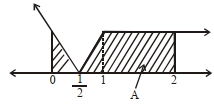
(A) ધારો કે $f(x) = ||x-1|-x|$.
આપણે નિરપેક્ષ મૂલ્યની અંદરના પદનું વિશ્લેષણ કરીએ:
જો $x \geq 1$ હોય,તો $|x-1| = x-1$,તેથી $f(x) = |(x-1)-x| = |-1| = 1$.
જો $x < 1$ હોય,તો $|x-1| = 1-x$,તેથી $f(x) = |(1-x)-x| = |1-2x|$.
આમ,$f(x) = \begin{cases} |1-2x|, & 0 \leq x < 1 \\ 1, & 1 \leq x \leq 2 \end{cases}$.
હવે,આપણે સંકલન મેળવીએ:
$\int_{0}^{2} f(x) dx = \int_{0}^{1} |1-2x| dx + \int_{1}^{2} 1 dx$.
પ્રથમ ભાગ માટે,જ્યારે $x \leq 1/2$ હોય ત્યારે $|1-2x| = 1-2x$ અને જ્યારે $x > 1/2$ હોય ત્યારે $2x-1$ થાય:
$\int_{0}^{1} |1-2x| dx = \int_{0}^{1/2} (1-2x) dx + \int_{1/2}^{1} (2x-1) dx$
$= [x-x^2]_{0}^{1/2} + [x^2-x]_{1/2}^{1}$
$= (1/2 - 1/4) - 0 + (1-1) - (1/4 - 1/2) = 1/4 + 1/4 = 1/2$.
બીજા ભાગ માટે:
$\int_{1}^{2} 1 dx = [x]_{1}^{2} = 2-1 = 1$.
કુલ સંકલન = $1/2 + 1 = 1.5$.
આપણે નિરપેક્ષ મૂલ્યની અંદરના પદનું વિશ્લેષણ કરીએ:
જો $x \geq 1$ હોય,તો $|x-1| = x-1$,તેથી $f(x) = |(x-1)-x| = |-1| = 1$.
જો $x < 1$ હોય,તો $|x-1| = 1-x$,તેથી $f(x) = |(1-x)-x| = |1-2x|$.
આમ,$f(x) = \begin{cases} |1-2x|, & 0 \leq x < 1 \\ 1, & 1 \leq x \leq 2 \end{cases}$.
હવે,આપણે સંકલન મેળવીએ:
$\int_{0}^{2} f(x) dx = \int_{0}^{1} |1-2x| dx + \int_{1}^{2} 1 dx$.
પ્રથમ ભાગ માટે,જ્યારે $x \leq 1/2$ હોય ત્યારે $|1-2x| = 1-2x$ અને જ્યારે $x > 1/2$ હોય ત્યારે $2x-1$ થાય:
$\int_{0}^{1} |1-2x| dx = \int_{0}^{1/2} (1-2x) dx + \int_{1/2}^{1} (2x-1) dx$
$= [x-x^2]_{0}^{1/2} + [x^2-x]_{1/2}^{1}$
$= (1/2 - 1/4) - 0 + (1-1) - (1/4 - 1/2) = 1/4 + 1/4 = 1/2$.
બીજા ભાગ માટે:
$\int_{1}^{2} 1 dx = [x]_{1}^{2} = 2-1 = 1$.
કુલ સંકલન = $1/2 + 1 = 1.5$.
0 likes
View Solution283
MediumMCQ
ધારો કે $[ t ]$ એ $t$ થી નાનો અથવા તેના બરાબર મહત્તમ પૂર્ણાંક દર્શાવે છે. તો $\int_{1}^{2} |2x - [3x]| dx$ નું મૂલ્ય શોધો.
A
$1$
B
$2$
C
$4$
D
$3$
Solution
(A) ધારો કે $I = \int_{1}^{2} |2x - [3x]| dx$. કારણ કે $1 \le x \le 2$,તેથી $3 \le 3x \le 6$.
આપણે $[1, 2]$ અંતરાલને $[3x]$ ના મૂલ્યોના આધારે વિભાજિત કરીએ છીએ:
કિસ્સો $1$: $1 \le x < 4/3$,ત્યારે $3 \le 3x < 4$,તેથી $[3x] = 3$. સંકલ્ય $|2x - 3| = 3 - 2x$ છે.
કિસ્સો $2$: $4/3 \le x < 5/3$,ત્યારે $4 \le 3x < 5$,તેથી $[3x] = 4$. સંકલ્ય $|2x - 4| = 4 - 2x$ છે.
કિસ્સો $3$: $5/3 \le x \le 2$,ત્યારે $5 \le 3x \le 6$,તેથી $[3x] = 5$. સંકલ્ય $|2x - 5| = 5 - 2x$ છે.
હવે,$I = \int_{1}^{4/3} (3 - 2x) dx + \int_{4/3}^{5/3} (4 - 2x) dx + \int_{5/3}^{2} (5 - 2x) dx$.
દરેક સંકલનનું મૂલ્ય શોધતા:
$\int_{1}^{4/3} (3 - 2x) dx = [3x - x^2]_{1}^{4/3} = (4 - 16/9) - (3 - 1) = 2/9$.
$\int_{4/3}^{5/3} (4 - 2x) dx = [4x - x^2]_{4/3}^{5/3} = (20/3 - 25/9) - (16/3 - 16/9) = 3/9 = 1/3$.
$\int_{5/3}^{2} (5 - 2x) dx = [5x - x^2]_{5/3}^{2} = (10 - 4) - (25/3 - 25/9) = 4/9$.
સરવાળો કરતા: $I = 2/9 + 3/9 + 4/9 = 9/9 = 1$.
આપણે $[1, 2]$ અંતરાલને $[3x]$ ના મૂલ્યોના આધારે વિભાજિત કરીએ છીએ:
કિસ્સો $1$: $1 \le x < 4/3$,ત્યારે $3 \le 3x < 4$,તેથી $[3x] = 3$. સંકલ્ય $|2x - 3| = 3 - 2x$ છે.
કિસ્સો $2$: $4/3 \le x < 5/3$,ત્યારે $4 \le 3x < 5$,તેથી $[3x] = 4$. સંકલ્ય $|2x - 4| = 4 - 2x$ છે.
કિસ્સો $3$: $5/3 \le x \le 2$,ત્યારે $5 \le 3x \le 6$,તેથી $[3x] = 5$. સંકલ્ય $|2x - 5| = 5 - 2x$ છે.
હવે,$I = \int_{1}^{4/3} (3 - 2x) dx + \int_{4/3}^{5/3} (4 - 2x) dx + \int_{5/3}^{2} (5 - 2x) dx$.
દરેક સંકલનનું મૂલ્ય શોધતા:
$\int_{1}^{4/3} (3 - 2x) dx = [3x - x^2]_{1}^{4/3} = (4 - 16/9) - (3 - 1) = 2/9$.
$\int_{4/3}^{5/3} (4 - 2x) dx = [4x - x^2]_{4/3}^{5/3} = (20/3 - 25/9) - (16/3 - 16/9) = 3/9 = 1/3$.
$\int_{5/3}^{2} (5 - 2x) dx = [5x - x^2]_{5/3}^{2} = (10 - 4) - (25/3 - 25/9) = 4/9$.
સરવાળો કરતા: $I = 2/9 + 3/9 + 4/9 = 9/9 = 1$.
0 likes
View Solution284
MediumMCQ
જો સંકલન $\int_{0}^{1/2} \frac{x^{2}}{(1-x^{2})^{3/2}} dx$ નું મૂલ્ય $\frac{k}{6}$ હોય,તો $k$ બરાબર શું થાય?
A
$2\sqrt{3}-\pi$
B
$3\sqrt{2}+\pi$
C
$3\sqrt{2}-\pi$
D
$2\sqrt{3}+\pi$
Solution
(A) ધારો કે $I = \int_{0}^{1/2} \frac{x^{2}}{(1-x^{2})^{3/2}} dx$.
અંશને $x^{2} = (x^{2}-1) + 1$ તરીકે લખી શકાય.
તેથી,$I = \int_{0}^{1/2} \frac{x^{2}-1}{(1-x^{2})^{3/2}} dx + \int_{0}^{1/2} \frac{1}{(1-x^{2})^{3/2}} dx$.
$I = -\int_{0}^{1/2} \frac{1}{(1-x^{2})^{1/2}} dx + \int_{0}^{1/2} \frac{1}{(1-x^{2})^{3/2}} dx$.
પ્રથમ સંકલન માટે,$\int \frac{1}{\sqrt{1-x^{2}}} dx = \sin^{-1}(x)$.
$0$ થી $1/2$ સુધી મૂલ્ય લેતા,આપણને $-[\sin^{-1}(1/2) - \sin^{-1}(0)] = -\pi/6$ મળે છે.
બીજા સંકલન માટે,$x = \sin(\theta)$ લો,તો $dx = \cos(\theta) d\theta$.
જ્યારે $x=0, \theta=0$; જ્યારે $x=1/2, \theta=\pi/6$.
$\int_{0}^{\pi/6} \frac{\cos(\theta)}{\cos^{3}(\theta)} d\theta = \int_{0}^{\pi/6} \sec^{2}(\theta) d\theta = [\tan(\theta)]_{0}^{\pi/6} = \tan(\pi/6) - \tan(0) = 1/\sqrt{3}$.
આમ,$I = \frac{1}{\sqrt{3}} - \frac{\pi}{6} = \frac{\sqrt{3}}{3} - \frac{\pi}{6} = \frac{2\sqrt{3}-\pi}{6}$.
આને $\frac{k}{6}$ સાથે સરખાવતા,આપણને $k = 2\sqrt{3}-\pi$ મળે છે.
અંશને $x^{2} = (x^{2}-1) + 1$ તરીકે લખી શકાય.
તેથી,$I = \int_{0}^{1/2} \frac{x^{2}-1}{(1-x^{2})^{3/2}} dx + \int_{0}^{1/2} \frac{1}{(1-x^{2})^{3/2}} dx$.
$I = -\int_{0}^{1/2} \frac{1}{(1-x^{2})^{1/2}} dx + \int_{0}^{1/2} \frac{1}{(1-x^{2})^{3/2}} dx$.
પ્રથમ સંકલન માટે,$\int \frac{1}{\sqrt{1-x^{2}}} dx = \sin^{-1}(x)$.
$0$ થી $1/2$ સુધી મૂલ્ય લેતા,આપણને $-[\sin^{-1}(1/2) - \sin^{-1}(0)] = -\pi/6$ મળે છે.
બીજા સંકલન માટે,$x = \sin(\theta)$ લો,તો $dx = \cos(\theta) d\theta$.
જ્યારે $x=0, \theta=0$; જ્યારે $x=1/2, \theta=\pi/6$.
$\int_{0}^{\pi/6} \frac{\cos(\theta)}{\cos^{3}(\theta)} d\theta = \int_{0}^{\pi/6} \sec^{2}(\theta) d\theta = [\tan(\theta)]_{0}^{\pi/6} = \tan(\pi/6) - \tan(0) = 1/\sqrt{3}$.
આમ,$I = \frac{1}{\sqrt{3}} - \frac{\pi}{6} = \frac{\sqrt{3}}{3} - \frac{\pi}{6} = \frac{2\sqrt{3}-\pi}{6}$.
આને $\frac{k}{6}$ સાથે સરખાવતા,આપણને $k = 2\sqrt{3}-\pi$ મળે છે.
0 likes
View Solution285
MediumMCQ
$\int_{\pi / 6}^{\pi / 3} \tan ^{3} x \cdot \sin ^{2} 3 x\left(2 \sec ^{2} x \cdot \sin ^{2} 3 x+3 \tan x \cdot \sin 6 x\right) d x$ ની કિંમત શોધો.
A
$\frac{9}{2}$
B
$-\frac{1}{9}$
C
$-\frac{1}{18}$
D
$\frac{7}{18}$
Solution
(C) ધારો કે $I = \int_{\pi / 6}^{\pi / 3} \tan ^{3} x \cdot \sin ^{2} 3 x\left(2 \sec ^{2} x \cdot \sin ^{2} 3 x+3 \tan x \cdot \sin 6 x\right) d x$.
નોંધો કે $\sin 6x = 2 \sin 3x \cos 3x$.
સંકલિતને આ રીતે લખી શકાય:
$f(x) = 2 \tan^3 x \sec^2 x \sin^4 3x + 3 \tan^4 x \sin^2 3x (2 \sin 3x \cos 3x) = 2 \tan^3 x \sec^2 x \sin^4 3x + 6 \tan^4 x \sin^3 3x \cos 3x$.
અહીં $\frac{d}{dx} [(\tan x)^4 (\sin 3x)^4] = 4 \tan^3 x \sec^2 x \sin^4 3x + 4 \tan^4 x \sin^3 3x (3 \cos 3x) = 4 [\tan^3 x \sec^2 x \sin^4 3x + 3 \tan^4 x \sin^3 3x \cos 3x]$.
તેથી,સંકલિત $\frac{1}{2} \frac{d}{dx} [(\tan x)^4 (\sin 3x)^4]$ છે.
$I = \frac{1}{2} [\tan^4 x \sin^4 3x]_{\pi/6}^{\pi/3} = \frac{1}{2} [(\tan^4 \frac{\pi}{3} \sin^4 \pi) - (\tan^4 \frac{\pi}{6} \sin^4 \frac{\pi}{2})]$.
કારણ કે $\sin \pi = 0$ અને $\tan \frac{\pi}{6} = \frac{1}{\sqrt{3}}$,$\sin \frac{\pi}{2} = 1$:
$I = \frac{1}{2} [0 - ((\frac{1}{\sqrt{3}})^4 \cdot 1^4)] = \frac{1}{2} [0 - \frac{1}{9}] = -\frac{1}{18}$.
નોંધો કે $\sin 6x = 2 \sin 3x \cos 3x$.
સંકલિતને આ રીતે લખી શકાય:
$f(x) = 2 \tan^3 x \sec^2 x \sin^4 3x + 3 \tan^4 x \sin^2 3x (2 \sin 3x \cos 3x) = 2 \tan^3 x \sec^2 x \sin^4 3x + 6 \tan^4 x \sin^3 3x \cos 3x$.
અહીં $\frac{d}{dx} [(\tan x)^4 (\sin 3x)^4] = 4 \tan^3 x \sec^2 x \sin^4 3x + 4 \tan^4 x \sin^3 3x (3 \cos 3x) = 4 [\tan^3 x \sec^2 x \sin^4 3x + 3 \tan^4 x \sin^3 3x \cos 3x]$.
તેથી,સંકલિત $\frac{1}{2} \frac{d}{dx} [(\tan x)^4 (\sin 3x)^4]$ છે.
$I = \frac{1}{2} [\tan^4 x \sin^4 3x]_{\pi/6}^{\pi/3} = \frac{1}{2} [(\tan^4 \frac{\pi}{3} \sin^4 \pi) - (\tan^4 \frac{\pi}{6} \sin^4 \frac{\pi}{2})]$.
કારણ કે $\sin \pi = 0$ અને $\tan \frac{\pi}{6} = \frac{1}{\sqrt{3}}$,$\sin \frac{\pi}{2} = 1$:
$I = \frac{1}{2} [0 - ((\frac{1}{\sqrt{3}})^4 \cdot 1^4)] = \frac{1}{2} [0 - \frac{1}{9}] = -\frac{1}{18}$.
0 likes
View Solution286
MediumMCQ
ધારો કે $f(x) = |x - 2|$ અને $g(x) = f(f(x))$,$x \in [0, 4]$. તો $\int_{0}^{3} (g(x) - f(x)) \, dx$ ની કિંમત શોધો.
A
$\frac{3}{2}$
B
$0$
C
$\frac{1}{2}$
D
$1$
Solution
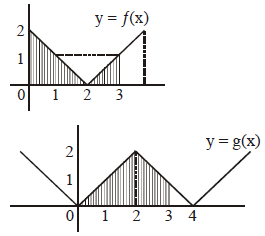
(D) આપેલ છે કે $f(x) = |x - 2|$ અને $g(x) = f(f(x)) = ||x - 2| - 2|$.
આપણે $I = \int_{0}^{3} (g(x) - f(x)) \, dx = \int_{0}^{3} g(x) \, dx - \int_{0}^{3} f(x) \, dx$ ની ગણતરી કરવાની છે.
પ્રથમ,$\int_{0}^{3} f(x) \, dx = \int_{0}^{3} |x - 2| \, dx$ શોધીએ.
આ $x = 0$ થી $x = 3$ સુધીના $f(x)$ ના આલેખ હેઠળનું ક્ષેત્રફળ દર્શાવે છે. આલેખ બે ત્રિકોણનો બનેલો છે: એક $2$ પાયા અને $2$ ઊંચાઈ વાળો ( $0$ થી $2$ સુધી),અને બીજો $1$ પાયા અને $1$ ઊંચાઈ વાળો ($2$ થી $3$ સુધી).
ક્ષેત્રફળ $= \frac{1}{2} \times 2 \times 2 + \frac{1}{2} \times 1 \times 1 = 2 + 0.5 = 2.5$.
હવે,$\int_{0}^{3} g(x) \, dx = \int_{0}^{3} ||x - 2| - 2| \, dx$ શોધીએ.
$x \in [0, 2]$ માટે,$g(x) = |(2 - x) - 2| = |-x| = x$. ક્ષેત્રફળ $= \int_{0}^{2} x \, dx = \frac{1}{2} \times 2 \times 2 = 2$.
$x \in [2, 3]$ માટે,$g(x) = |(x - 2) - 2| = |x - 4| = 4 - x$. ક્ષેત્રફળ $= \int_{2}^{3} (4 - x) \, dx = \frac{1}{2} \times (2 + 1) \times 1 = 1.5$.
કુલ $\int_{0}^{3} g(x) \, dx = 2 + 1.5 = 3.5$.
આમ,$I = 3.5 - 2.5 = 1$.
આપણે $I = \int_{0}^{3} (g(x) - f(x)) \, dx = \int_{0}^{3} g(x) \, dx - \int_{0}^{3} f(x) \, dx$ ની ગણતરી કરવાની છે.
પ્રથમ,$\int_{0}^{3} f(x) \, dx = \int_{0}^{3} |x - 2| \, dx$ શોધીએ.
આ $x = 0$ થી $x = 3$ સુધીના $f(x)$ ના આલેખ હેઠળનું ક્ષેત્રફળ દર્શાવે છે. આલેખ બે ત્રિકોણનો બનેલો છે: એક $2$ પાયા અને $2$ ઊંચાઈ વાળો ( $0$ થી $2$ સુધી),અને બીજો $1$ પાયા અને $1$ ઊંચાઈ વાળો ($2$ થી $3$ સુધી).
ક્ષેત્રફળ $= \frac{1}{2} \times 2 \times 2 + \frac{1}{2} \times 1 \times 1 = 2 + 0.5 = 2.5$.
હવે,$\int_{0}^{3} g(x) \, dx = \int_{0}^{3} ||x - 2| - 2| \, dx$ શોધીએ.
$x \in [0, 2]$ માટે,$g(x) = |(2 - x) - 2| = |-x| = x$. ક્ષેત્રફળ $= \int_{0}^{2} x \, dx = \frac{1}{2} \times 2 \times 2 = 2$.
$x \in [2, 3]$ માટે,$g(x) = |(x - 2) - 2| = |x - 4| = 4 - x$. ક્ષેત્રફળ $= \int_{2}^{3} (4 - x) \, dx = \frac{1}{2} \times (2 + 1) \times 1 = 1.5$.
કુલ $\int_{0}^{3} g(x) \, dx = 2 + 1.5 = 3.5$.
આમ,$I = 3.5 - 2.5 = 1$.
0 likes
View Solution287
MediumMCQ
ધારો કે $f(x) = \int \frac{\sqrt{x}}{(1+x)^2} dx$ $(x \geq 0)$ છે. તો $f(3) - f(1)$ ની કિંમત શોધો.
A
$-\frac{\pi}{6} + \frac{1}{2} + \frac{\sqrt{3}}{4}$
B
$\frac{\pi}{6} + \frac{1}{2} - \frac{\sqrt{3}}{4}$
C
$-\frac{\pi}{12} + \frac{1}{2} + \frac{\sqrt{3}}{4}$
D
$\frac{\pi}{12} + \frac{1}{2} - \frac{\sqrt{3}}{4}$
Solution
(D) આપણે $f(3) - f(1) = \int_{1}^{3} \frac{\sqrt{x}}{(1+x)^2} dx$ ની કિંમત શોધવાની છે.
ધારો કે $\sqrt{x} = t$,તેથી $x = t^2$ અને $dx = 2t dt$.
જ્યારે $x=1$,ત્યારે $t=1$. જ્યારે $x=3$,ત્યારે $t=\sqrt{3}$.
આ કિંમતો સંકલનમાં મૂકતા:
$f(3) - f(1) = \int_{1}^{\sqrt{3}} \frac{t \cdot 2t}{(1+t^2)^2} dt = 2 \int_{1}^{\sqrt{3}} \frac{t^2}{(1+t^2)^2} dt$.
ખંડશઃ સંકલનનો ઉપયોગ કરતા,$u = t$ અને $dv = \frac{t}{(1+t^2)^2} dt$ લેતા,$du = dt$ અને $v = -\frac{1}{2(1+t^2)}$ મળે.
$2 \int \frac{t^2}{(1+t^2)^2} dt = 2 \left[ -\frac{t}{2(1+t^2)} + \int \frac{1}{2(1+t^2)} dt \right] = -\frac{t}{1+t^2} + \tan^{-1}(t)$.
$1$ થી $\sqrt{3}$ ની સીમાઓ માટે ગણતરી કરતા:
$f(3) - f(1) = \left[ -\frac{\sqrt{3}}{1+3} + \tan^{-1}(\sqrt{3}) \right] - \left[ -\frac{1}{1+1} + \tan^{-1}(1) \right]$.
$= \left( -\frac{\sqrt{3}}{4} + \frac{\pi}{3} \right) - \left( -\frac{1}{2} + \frac{\pi}{4} \right) = \frac{1}{2} - \frac{\sqrt{3}}{4} + \frac{\pi}{12}$.
ધારો કે $\sqrt{x} = t$,તેથી $x = t^2$ અને $dx = 2t dt$.
જ્યારે $x=1$,ત્યારે $t=1$. જ્યારે $x=3$,ત્યારે $t=\sqrt{3}$.
આ કિંમતો સંકલનમાં મૂકતા:
$f(3) - f(1) = \int_{1}^{\sqrt{3}} \frac{t \cdot 2t}{(1+t^2)^2} dt = 2 \int_{1}^{\sqrt{3}} \frac{t^2}{(1+t^2)^2} dt$.
ખંડશઃ સંકલનનો ઉપયોગ કરતા,$u = t$ અને $dv = \frac{t}{(1+t^2)^2} dt$ લેતા,$du = dt$ અને $v = -\frac{1}{2(1+t^2)}$ મળે.
$2 \int \frac{t^2}{(1+t^2)^2} dt = 2 \left[ -\frac{t}{2(1+t^2)} + \int \frac{1}{2(1+t^2)} dt \right] = -\frac{t}{1+t^2} + \tan^{-1}(t)$.
$1$ થી $\sqrt{3}$ ની સીમાઓ માટે ગણતરી કરતા:
$f(3) - f(1) = \left[ -\frac{\sqrt{3}}{1+3} + \tan^{-1}(\sqrt{3}) \right] - \left[ -\frac{1}{1+1} + \tan^{-1}(1) \right]$.
$= \left( -\frac{\sqrt{3}}{4} + \frac{\pi}{3} \right) - \left( -\frac{1}{2} + \frac{\pi}{4} \right) = \frac{1}{2} - \frac{\sqrt{3}}{4} + \frac{\pi}{12}$.
0 likes
View Solution288
DifficultMCQ
જો $[.]$ એ મહત્તમ પૂર્ણાંક વિધેય દર્શાવતું હોય,તો $\int_{0}^{\sqrt{\pi / 2}}\left(\left[ x ^{2}\right]+[-\cos x ]\right) d x$ ની કિંમત ............. છે.
A
$0$
B
$1$
C
$-1$
D
$-1 - \sqrt{\frac{\pi}{2}}$
Solution
(C) ધારો કે $I = \int_{0}^{\sqrt{\pi / 2}} ([x^2] + [-\cos x]) dx$.
અહીં $0 \le x \le \sqrt{\pi / 2} \approx 1.25$ હોવાથી,$0 \le x^2 \le \pi / 2 \approx 1.57$ થાય.
તેથી,$0 \le x < 1$ માટે $[x^2] = 0$ અને $1 \le x \le \sqrt{\pi / 2}$ માટે $[x^2] = 1$ થાય.
$0 \le x \le \sqrt{\pi / 2}$ માટે,$0 \le \cos x \le 1$ થાય.
ચોક્કસ રીતે,$x \in (0, \sqrt{\pi / 2}]$ માટે,$0 \le \cos x < 1$ હોવાથી,$-\cos x \in [-1, 0)$ થાય.
તેથી,$x \in (0, \sqrt{\pi / 2}]$ માટે $[-\cos x] = -1$ અને $x = 0$ માટે $[-\cos x] = 0$ થાય.
$I = \int_{0}^{1} (0 - 1) dx + \int_{1}^{\sqrt{\pi / 2}} (1 - 1) dx = \int_{0}^{1} (-1) dx + 0 = -1$.
અહીં $0 \le x \le \sqrt{\pi / 2} \approx 1.25$ હોવાથી,$0 \le x^2 \le \pi / 2 \approx 1.57$ થાય.
તેથી,$0 \le x < 1$ માટે $[x^2] = 0$ અને $1 \le x \le \sqrt{\pi / 2}$ માટે $[x^2] = 1$ થાય.
$0 \le x \le \sqrt{\pi / 2}$ માટે,$0 \le \cos x \le 1$ થાય.
ચોક્કસ રીતે,$x \in (0, \sqrt{\pi / 2}]$ માટે,$0 \le \cos x < 1$ હોવાથી,$-\cos x \in [-1, 0)$ થાય.
તેથી,$x \in (0, \sqrt{\pi / 2}]$ માટે $[-\cos x] = -1$ અને $x = 0$ માટે $[-\cos x] = 0$ થાય.
$I = \int_{0}^{1} (0 - 1) dx + \int_{1}^{\sqrt{\pi / 2}} (1 - 1) dx = \int_{0}^{1} (-1) dx + 0 = -1$.
0 likes
View Solution289
DifficultMCQ
સંકલન $I = \int_{0}^{10} \frac{[x] e^{[x]}}{e^{x-1}} dx$ ધ્યાનમાં લો,જ્યાં $[x]$ એ $x$ થી નાનો અથવા તેના જેટલો મહત્તમ પૂર્ણાંક દર્શાવે છે. તો $I$ નું મૂલ્ય શોધો.
A
$9(e-1)$
B
$45(e+1)$
C
$45(e-1)$
D
$9(e+1)$
Solution
(C) સંકલન $I = \int_{0}^{10} [x] e^{[x]-x+1} dx$ દ્વારા આપવામાં આવે છે.
જ્યારે $x \in [n, n+1)$ હોય ત્યારે $[x] = n$ હોવાથી,આપણે સંકલનને આ રીતે વિભાજિત કરી શકીએ:
$I = \sum_{n=0}^{9} \int_{n}^{n+1} n \cdot e^{n-x+1} dx$.
દરેક પદ માટે સંકલનનું મૂલ્ય મેળવતા:
$I = \sum_{n=0}^{9} n \left[ -e^{n-x+1} \right]_{n}^{n+1} = \sum_{n=0}^{9} n \left( -e^{0} + e^{1} \right) = (e-1) \sum_{n=0}^{9} n$.
સરવાળાના સૂત્ર $\sum_{n=0}^{9} n = \frac{9 \times 10}{2} = 45$ નો ઉપયોગ કરતા,આપણને મળે છે:
$I = 45(e-1)$.
જ્યારે $x \in [n, n+1)$ હોય ત્યારે $[x] = n$ હોવાથી,આપણે સંકલનને આ રીતે વિભાજિત કરી શકીએ:
$I = \sum_{n=0}^{9} \int_{n}^{n+1} n \cdot e^{n-x+1} dx$.
દરેક પદ માટે સંકલનનું મૂલ્ય મેળવતા:
$I = \sum_{n=0}^{9} n \left[ -e^{n-x+1} \right]_{n}^{n+1} = \sum_{n=0}^{9} n \left( -e^{0} + e^{1} \right) = (e-1) \sum_{n=0}^{9} n$.
સરવાળાના સૂત્ર $\sum_{n=0}^{9} n = \frac{9 \times 10}{2} = 45$ નો ઉપયોગ કરતા,આપણને મળે છે:
$I = 45(e-1)$.
0 likes
View Solution290
DifficultMCQ
ધારો કે $P(x) = x^2 + bx + c$ એ વાસ્તવિક સહગુણકો ધરાવતી દ્વિઘાત બહુપદી છે,જેથી $\int_{0}^{1} P(x) dx = 1$ અને $P(x)$ ને $(x-2)$ વડે ભાગતા શેષ $5$ વધે છે. તો $9(b+c)$ ની કિંમત શોધો:
A
$9$
B
$15$
C
$7$
D
$11$
Solution
(C) આપેલ છે કે $P(x) = x^2 + bx + c$.
$P(x)$ નું $0$ થી $1$ સુધી સંકલન કરતા:
$\int_{0}^{1} (x^2 + bx + c) dx = [\frac{x^3}{3} + \frac{bx^2}{2} + cx]_{0}^{1} = \frac{1}{3} + \frac{b}{2} + c = 1$.
$6$ વડે ગુણતા,$2 + 3b + 6c = 6$,તેથી $3b + 6c = 4$ ... $(1)$.
શેષ પ્રમેય મુજબ,$P(2) = 5$:
$2^2 + b(2) + c = 5 \Rightarrow 4 + 2b + c = 5 \Rightarrow 2b + c = 1$ ... $(2)$.
$(2)$ પરથી,$c = 1 - 2b$. આ કિંમત $(1)$ માં મૂકતા:
$3b + 6(1 - 2b) = 4 \Rightarrow 3b + 6 - 12b = 4 \Rightarrow -9b = -2 \Rightarrow b = \frac{2}{9}$.
તેથી $c = 1 - 2(\frac{2}{9}) = 1 - \frac{4}{9} = \frac{5}{9}$.
આમ,$b + c = \frac{2}{9} + \frac{5}{9} = \frac{7}{9}$.
તેથી,$9(b + c) = 9(\frac{7}{9}) = 7$.
$P(x)$ નું $0$ થી $1$ સુધી સંકલન કરતા:
$\int_{0}^{1} (x^2 + bx + c) dx = [\frac{x^3}{3} + \frac{bx^2}{2} + cx]_{0}^{1} = \frac{1}{3} + \frac{b}{2} + c = 1$.
$6$ વડે ગુણતા,$2 + 3b + 6c = 6$,તેથી $3b + 6c = 4$ ... $(1)$.
શેષ પ્રમેય મુજબ,$P(2) = 5$:
$2^2 + b(2) + c = 5 \Rightarrow 4 + 2b + c = 5 \Rightarrow 2b + c = 1$ ... $(2)$.
$(2)$ પરથી,$c = 1 - 2b$. આ કિંમત $(1)$ માં મૂકતા:
$3b + 6(1 - 2b) = 4 \Rightarrow 3b + 6 - 12b = 4 \Rightarrow -9b = -2 \Rightarrow b = \frac{2}{9}$.
તેથી $c = 1 - 2(\frac{2}{9}) = 1 - \frac{4}{9} = \frac{5}{9}$.
આમ,$b + c = \frac{2}{9} + \frac{5}{9} = \frac{7}{9}$.
તેથી,$9(b + c) = 9(\frac{7}{9}) = 7$.
0 likes
View Solution291
DifficultMCQ
ધારો કે $f: R \rightarrow R$ એ $f(x)=e^{-x} \sin x$ તરીકે વ્યાખ્યાયિત છે. જો $F :[0,1] \rightarrow R$ એ વિકલનીય વિધેય છે જેથી $F(x)=\int_{0}^{x} f(t) dt$ થાય,તો $\int_{0}^{1}(F'(x)+f(x)) e^{x} dx$ નું મૂલ્ય કયા અંતરાલમાં આવે છે?
A
$[\frac{327}{360}, \frac{329}{360}]$
B
$[\frac{330}{360}, \frac{331}{360}]$
C
$[\frac{331}{360}, \frac{334}{360}]$
D
$[\frac{335}{360}, \frac{336}{360}]$
Solution
(B) આપેલ છે કે $f(x) = e^{-x} \sin x$.
$F(x) = \int_{0}^{x} f(t) dt$ હોવાથી,કલનશાસ્ત્રના મૂળભૂત પ્રમેય મુજબ,$F'(x) = f(x)$ થાય.
આપણે $I = \int_{0}^{1} (F'(x) + f(x)) e^{x} dx$ ની કિંમત શોધવાની છે.
$F'(x) = f(x)$ મૂકતા,$I = \int_{0}^{1} (f(x) + f(x)) e^{x} dx = \int_{0}^{1} 2f(x) e^{x} dx$ મળે.
$f(x) = e^{-x} \sin x$ મૂકતા,$I = 2 \int_{0}^{1} e^{-x} \sin x \cdot e^{x} dx = 2 \int_{0}^{1} \sin x dx$ મળે.
સંકલન કરતા,$I = 2 [-\cos x]_{0}^{1} = 2(1 - \cos 1)$ મળે.
$\cos x$ માટે ટેલર શ્રેણીનો ઉપયોગ કરતા,$\cos 1 = 1 - \frac{1}{2} + \frac{1}{24} - \frac{1}{720} + \dots$ થાય.
તેથી,$I = 2(1 - (1 - \frac{1}{2} + \frac{1}{24} - \frac{1}{720} + \dots)) = 2(\frac{1}{2} - \frac{1}{24} + \frac{1}{720} - \dots) = 1 - \frac{1}{12} + \frac{1}{360} - \dots$ મળે.
$I = \frac{11}{12} + \frac{1}{360} - \dots = \frac{330}{360} + \frac{1}{360} - \dots = \frac{331}{360} - \dots$ થાય.
આ શ્રેણી એકાંતરે અને ઘટતી હોવાથી,તેનું મૂલ્ય $[\frac{330}{360}, \frac{331}{360}]$ અંતરાલમાં આવે છે.
$F(x) = \int_{0}^{x} f(t) dt$ હોવાથી,કલનશાસ્ત્રના મૂળભૂત પ્રમેય મુજબ,$F'(x) = f(x)$ થાય.
આપણે $I = \int_{0}^{1} (F'(x) + f(x)) e^{x} dx$ ની કિંમત શોધવાની છે.
$F'(x) = f(x)$ મૂકતા,$I = \int_{0}^{1} (f(x) + f(x)) e^{x} dx = \int_{0}^{1} 2f(x) e^{x} dx$ મળે.
$f(x) = e^{-x} \sin x$ મૂકતા,$I = 2 \int_{0}^{1} e^{-x} \sin x \cdot e^{x} dx = 2 \int_{0}^{1} \sin x dx$ મળે.
સંકલન કરતા,$I = 2 [-\cos x]_{0}^{1} = 2(1 - \cos 1)$ મળે.
$\cos x$ માટે ટેલર શ્રેણીનો ઉપયોગ કરતા,$\cos 1 = 1 - \frac{1}{2} + \frac{1}{24} - \frac{1}{720} + \dots$ થાય.
તેથી,$I = 2(1 - (1 - \frac{1}{2} + \frac{1}{24} - \frac{1}{720} + \dots)) = 2(\frac{1}{2} - \frac{1}{24} + \frac{1}{720} - \dots) = 1 - \frac{1}{12} + \frac{1}{360} - \dots$ મળે.
$I = \frac{11}{12} + \frac{1}{360} - \dots = \frac{330}{360} + \frac{1}{360} - \dots = \frac{331}{360} - \dots$ થાય.
આ શ્રેણી એકાંતરે અને ઘટતી હોવાથી,તેનું મૂલ્ય $[\frac{330}{360}, \frac{331}{360}]$ અંતરાલમાં આવે છે.
0 likes
View Solution292
DifficultMCQ
સંકલન $\int_{1}^{3} [x^{2}-2x-2] dx$ નું મૂલ્ય શોધો,જ્યાં $[x]$ એ મહત્તમ પૂર્ણાંક વિધેય દર્શાવે છે:
A
$-\sqrt{2}-\sqrt{3}+1$
B
$-\sqrt{2}-\sqrt{3}-1$
C
$-5$
D
$-4$
Solution
(B) ધારો કે $I = \int_{1}^{3} [x^{2}-2x-2] dx$.
કૌંસની અંદરની પદાવલિને $(x-1)^{2}-3$ તરીકે લખી શકાય.
$3$ એ પૂર્ણાંક હોવાથી,$[f(x)+n] = [f(x)]+n$ ગુણધર્મનો ઉપયોગ કરતા,
$I = \int_{1}^{3} [(x-1)^{2}] dx - \int_{1}^{3} 3 dx$.
$t = x-1$ લેતા,$dt = dx$. જ્યારે $x=1, t=0$ અને જ્યારે $x=3, t=2$.
$I = \int_{0}^{2} [t^{2}] dt - [3x]_{1}^{3} = \int_{0}^{2} [t^{2}] dt - 6$.
હવે,$[t^{2}]$ ના મૂલ્યોના આધારે સંકલનનું વિભાજન કરતા:
$0 \le t < 1$ માટે,$[t^{2}] = 0$.
$1 \le t < \sqrt{2}$ માટે,$[t^{2}] = 1$.
$\sqrt{2} \le t < \sqrt{3}$ માટે,$[t^{2}] = 2$.
$\sqrt{3} \le t < 2$ માટે,$[t^{2}] = 3$.
$I = \int_{0}^{1} 0 dt + \int_{1}^{\sqrt{2}} 1 dt + \int_{\sqrt{2}}^{\sqrt{3}} 2 dt + \int_{\sqrt{3}}^{2} 3 dt - 6$.
$I = 0 + (\sqrt{2}-1) + 2(\sqrt{3}-\sqrt{2}) + 3(2-\sqrt{3}) - 6$.
$I = \sqrt{2} - 1 + 2\sqrt{3} - 2\sqrt{2} + 6 - 3\sqrt{3} - 6$.
$I = -\sqrt{2} - \sqrt{3} - 1$.
કૌંસની અંદરની પદાવલિને $(x-1)^{2}-3$ તરીકે લખી શકાય.
$3$ એ પૂર્ણાંક હોવાથી,$[f(x)+n] = [f(x)]+n$ ગુણધર્મનો ઉપયોગ કરતા,
$I = \int_{1}^{3} [(x-1)^{2}] dx - \int_{1}^{3} 3 dx$.
$t = x-1$ લેતા,$dt = dx$. જ્યારે $x=1, t=0$ અને જ્યારે $x=3, t=2$.
$I = \int_{0}^{2} [t^{2}] dt - [3x]_{1}^{3} = \int_{0}^{2} [t^{2}] dt - 6$.
હવે,$[t^{2}]$ ના મૂલ્યોના આધારે સંકલનનું વિભાજન કરતા:
$0 \le t < 1$ માટે,$[t^{2}] = 0$.
$1 \le t < \sqrt{2}$ માટે,$[t^{2}] = 1$.
$\sqrt{2} \le t < \sqrt{3}$ માટે,$[t^{2}] = 2$.
$\sqrt{3} \le t < 2$ માટે,$[t^{2}] = 3$.
$I = \int_{0}^{1} 0 dt + \int_{1}^{\sqrt{2}} 1 dt + \int_{\sqrt{2}}^{\sqrt{3}} 2 dt + \int_{\sqrt{3}}^{2} 3 dt - 6$.
$I = 0 + (\sqrt{2}-1) + 2(\sqrt{3}-\sqrt{2}) + 3(2-\sqrt{3}) - 6$.
$I = \sqrt{2} - 1 + 2\sqrt{3} - 2\sqrt{2} + 6 - 3\sqrt{3} - 6$.
$I = -\sqrt{2} - \sqrt{3} - 1$.
0 likes
View Solution293
DifficultMCQ
$\int_{-1 / \sqrt{2}}^{1 / \sqrt{2}}\left(\left(\frac{x+1}{x-1}\right)^{2}+\left(\frac{x-1}{x+1}\right)^{2}-2\right)^{1 / 2} d x$ નું મૂલ્ય શોધો.
A
$\log _{e} 4$
B
$\log _{e} 16$
C
$2 \log _{e} 16$
D
$4 \log _{e}(3+2 \sqrt{2})$
Solution
(B) ધારો કે $I = \int_{-1 / \sqrt{2}}^{1 / \sqrt{2}} \sqrt{\left(\frac{x+1}{x-1}\right)^{2} + \left(\frac{x-1}{x+1}\right)^{2} - 2} \, dx$.
આપણે જાણીએ છીએ કે $a^2 + b^2 - 2 = (a-b)^2$. અહીં $a = \frac{x+1}{x-1}$ અને $b = \frac{x-1}{x+1}$ છે.
તેથી,સંકલ્ય $\sqrt{(\frac{x+1}{x-1} - \frac{x-1}{x+1})^2} = |\frac{x+1}{x-1} - \frac{x-1}{x+1}|$ બને છે.
માનાંકની અંદરની પદાવલિનું સાદું રૂપ આપતા: $\frac{(x+1)^2 - (x-1)^2}{x^2-1} = \frac{4x}{x^2-1}$.
આમ,$I = \int_{-1 / \sqrt{2}}^{1 / \sqrt{2}} |\frac{4x}{x^2-1}| \, dx$.
સંકલ્ય યુગ્મ વિધેય હોવાથી,$I = 2 \int_{0}^{1 / \sqrt{2}} |\frac{4x}{x^2-1}| \, dx = 8 \int_{0}^{1 / \sqrt{2}} |\frac{x}{x^2-1}| \, dx$.
$x \in [0, 1/\sqrt{2}]$ માટે,$x^2-1 < 0$,તેથી $|\frac{x}{x^2-1}| = -\frac{x}{x^2-1}$.
$I = -8 \int_{0}^{1 / \sqrt{2}} \frac{x}{x^2-1} \, dx = -4 \int_{0}^{1 / \sqrt{2}} \frac{2x}{x^2-1} \, dx$.
$I = -4 [\ln |x^2-1|]_{0}^{1 / \sqrt{2}} = -4 (\ln |1/2 - 1| - \ln |0-1|) = -4 (\ln(1/2) - 0) = -4 \ln(1/2) = 4 \ln 2 = \ln 16$.
આપણે જાણીએ છીએ કે $a^2 + b^2 - 2 = (a-b)^2$. અહીં $a = \frac{x+1}{x-1}$ અને $b = \frac{x-1}{x+1}$ છે.
તેથી,સંકલ્ય $\sqrt{(\frac{x+1}{x-1} - \frac{x-1}{x+1})^2} = |\frac{x+1}{x-1} - \frac{x-1}{x+1}|$ બને છે.
માનાંકની અંદરની પદાવલિનું સાદું રૂપ આપતા: $\frac{(x+1)^2 - (x-1)^2}{x^2-1} = \frac{4x}{x^2-1}$.
આમ,$I = \int_{-1 / \sqrt{2}}^{1 / \sqrt{2}} |\frac{4x}{x^2-1}| \, dx$.
સંકલ્ય યુગ્મ વિધેય હોવાથી,$I = 2 \int_{0}^{1 / \sqrt{2}} |\frac{4x}{x^2-1}| \, dx = 8 \int_{0}^{1 / \sqrt{2}} |\frac{x}{x^2-1}| \, dx$.
$x \in [0, 1/\sqrt{2}]$ માટે,$x^2-1 < 0$,તેથી $|\frac{x}{x^2-1}| = -\frac{x}{x^2-1}$.
$I = -8 \int_{0}^{1 / \sqrt{2}} \frac{x}{x^2-1} \, dx = -4 \int_{0}^{1 / \sqrt{2}} \frac{2x}{x^2-1} \, dx$.
$I = -4 [\ln |x^2-1|]_{0}^{1 / \sqrt{2}} = -4 (\ln |1/2 - 1| - \ln |0-1|) = -4 (\ln(1/2) - 0) = -4 \ln(1/2) = 4 \ln 2 = \ln 16$.
0 likes
View Solution294
DifficultMCQ
જો સંકલન $\int_{0}^{5} \frac{x+[x]}{e^{x-[x]}} \,dx = \alpha e^{-1} + \beta$ નું મૂલ્ય હોય,જ્યાં $\alpha, \beta \in R, 5\alpha + 6\beta = 0$,અને $[x]$ એ $x$ થી નાનો અથવા તેના જેટલો મહત્તમ પૂર્ણાંક દર્શાવે છે; તો $(\alpha + \beta)^{2}$ નું મૂલ્ય કેટલું થાય?
A
$100$
B
$25$
C
$16$
D
$36$
Solution
(B) ધારો કે $I = \int_{0}^{5} \frac{x+[x]}{e^{x-[x]}} \,dx$. $[x]$ એ મહત્તમ પૂર્ણાંક વિધેય હોવાથી,આપણે સંકલનને પૂર્ણાંક બિંદુઓ પર વિભાજિત કરીએ છીએ:
$I = \sum_{k=0}^{4} \int_{k}^{k+1} \frac{x+k}{e^{x-k}} \,dx$.
ધારો કે $t = x-k$,તો $dx = dt$. જ્યારે $x=k, t=0$ અને જ્યારે $x=k+1, t=1$. સંકલન આ મુજબ બને છે:
$I = \sum_{k=0}^{4} \int_{0}^{1} \frac{t+k+k}{e^{t}} \,dt = \sum_{k=0}^{4} \int_{0}^{1} (t+2k) e^{-t} \,dt$.
$I = \int_{0}^{1} (t+0)e^{-t} dt + \int_{0}^{1} (t+2)e^{-t} dt + \int_{0}^{1} (t+4)e^{-t} dt + \int_{0}^{1} (t+6)e^{-t} dt + \int_{0}^{1} (t+8)e^{-t} dt$.
$I = \int_{0}^{1} (5t + 20)e^{-t} dt = 5 \int_{0}^{1} (t+4)e^{-t} dt$.
ખંડશઃ સંકલનનો ઉપયોગ કરતા $\int (t+4)e^{-t} dt = -(t+4)e^{-t} - \int -e^{-t} dt = -(t+4)e^{-t} - e^{-t} = -(t+5)e^{-t}$.
$0$ થી $1$ સુધી મૂલ્ય લેતા: $5[-(1+5)e^{-1} - (-(0+5)e^{0})] = 5[-6e^{-1} + 5] = -30e^{-1} + 25$.
$\alpha e^{-1} + \beta$ સાથે સરખાવતા,આપણને $\alpha = -30$ અને $\beta = 25$ મળે છે.
શરત તપાસતા: $5(-30) + 6(25) = -150 + 150 = 0$. જે સાચું છે.
આમ,$(\alpha + \beta)^{2} = (-30 + 25)^{2} = (-5)^{2} = 25$.
$I = \sum_{k=0}^{4} \int_{k}^{k+1} \frac{x+k}{e^{x-k}} \,dx$.
ધારો કે $t = x-k$,તો $dx = dt$. જ્યારે $x=k, t=0$ અને જ્યારે $x=k+1, t=1$. સંકલન આ મુજબ બને છે:
$I = \sum_{k=0}^{4} \int_{0}^{1} \frac{t+k+k}{e^{t}} \,dt = \sum_{k=0}^{4} \int_{0}^{1} (t+2k) e^{-t} \,dt$.
$I = \int_{0}^{1} (t+0)e^{-t} dt + \int_{0}^{1} (t+2)e^{-t} dt + \int_{0}^{1} (t+4)e^{-t} dt + \int_{0}^{1} (t+6)e^{-t} dt + \int_{0}^{1} (t+8)e^{-t} dt$.
$I = \int_{0}^{1} (5t + 20)e^{-t} dt = 5 \int_{0}^{1} (t+4)e^{-t} dt$.
ખંડશઃ સંકલનનો ઉપયોગ કરતા $\int (t+4)e^{-t} dt = -(t+4)e^{-t} - \int -e^{-t} dt = -(t+4)e^{-t} - e^{-t} = -(t+5)e^{-t}$.
$0$ થી $1$ સુધી મૂલ્ય લેતા: $5[-(1+5)e^{-1} - (-(0+5)e^{0})] = 5[-6e^{-1} + 5] = -30e^{-1} + 25$.
$\alpha e^{-1} + \beta$ સાથે સરખાવતા,આપણને $\alpha = -30$ અને $\beta = 25$ મળે છે.
શરત તપાસતા: $5(-30) + 6(25) = -150 + 150 = 0$. જે સાચું છે.
આમ,$(\alpha + \beta)^{2} = (-30 + 25)^{2} = (-5)^{2} = 25$.
0 likes
View Solution295
DifficultMCQ
સંકલન $\int \limits_{0}^{1} \frac{\sqrt{x} \, dx}{(1+x)(1+3 x)(3+x)}$ નું મૂલ્ય શોધો:
A
$\frac{\pi}{8}\left(1-\frac{\sqrt{3}}{2}\right)$
B
$\frac{\pi}{4}\left(1-\frac{\sqrt{3}}{6}\right)$
C
$\frac{\pi}{8}\left(1-\frac{\sqrt{3}}{6}\right)$
D
$\frac{\pi}{4}\left(1-\frac{\sqrt{3}}{2}\right)$
Solution
(A) $I = \int_{0}^{1} \frac{\sqrt{x}}{(1+x)(1+3x)(3+x)} \, dx$
ધારો કે $x = t^2$,તેથી $dx = 2t \, dt$. જ્યારે $x=0, t=0$ અને જ્યારે $x=1, t=1$.
$I = \int_{0}^{1} \frac{t(2t)}{(t^2+1)(1+3t^2)(3+t^2)} \, dt = \int_{0}^{1} \frac{2t^2}{(t^2+1)(3t^2+1)(t^2+3)} \, dt$
આંશિક અપૂર્ણાંકનો ઉપયોગ કરીને,આપણે સંકલ્યને આ રીતે લખી શકીએ:
$\frac{2t^2}{(t^2+1)(3t^2+1)(t^2+3)} = \frac{A}{t^2+1} + \frac{B}{3t^2+1} + \frac{C}{t^2+3}$
સહગુણકો શોધતા,આપણને $A = \frac{1}{2}, B = -\frac{3}{8}, C = -\frac{1}{8}$ મળે છે.
$I = \frac{1}{2} \int_{0}^{1} \frac{dt}{t^2+1} - \frac{3}{8} \int_{0}^{1} \frac{dt}{3t^2+1} - \frac{1}{8} \int_{0}^{1} \frac{dt}{t^2+3}$
$I = \frac{1}{2} [\tan^{-1}(t)]_{0}^{1} - \frac{3}{8} \cdot \frac{1}{\sqrt{3}} [\tan^{-1}(\sqrt{3}t)]_{0}^{1} - \frac{1}{8} \cdot \frac{1}{\sqrt{3}} [\tan^{-1}(\frac{t}{\sqrt{3}})]_{0}^{1}$
$I = \frac{1}{2} (\frac{\pi}{4}) - \frac{\sqrt{3}}{8} (\frac{\pi}{3}) - \frac{\sqrt{3}}{24} (\frac{\pi}{6})$
ગણતરી કરતા,અંતિમ જવાબ $I = \frac{\pi}{8}(1 - \frac{\sqrt{3}}{2})$ મળે છે.
ધારો કે $x = t^2$,તેથી $dx = 2t \, dt$. જ્યારે $x=0, t=0$ અને જ્યારે $x=1, t=1$.
$I = \int_{0}^{1} \frac{t(2t)}{(t^2+1)(1+3t^2)(3+t^2)} \, dt = \int_{0}^{1} \frac{2t^2}{(t^2+1)(3t^2+1)(t^2+3)} \, dt$
આંશિક અપૂર્ણાંકનો ઉપયોગ કરીને,આપણે સંકલ્યને આ રીતે લખી શકીએ:
$\frac{2t^2}{(t^2+1)(3t^2+1)(t^2+3)} = \frac{A}{t^2+1} + \frac{B}{3t^2+1} + \frac{C}{t^2+3}$
સહગુણકો શોધતા,આપણને $A = \frac{1}{2}, B = -\frac{3}{8}, C = -\frac{1}{8}$ મળે છે.
$I = \frac{1}{2} \int_{0}^{1} \frac{dt}{t^2+1} - \frac{3}{8} \int_{0}^{1} \frac{dt}{3t^2+1} - \frac{1}{8} \int_{0}^{1} \frac{dt}{t^2+3}$
$I = \frac{1}{2} [\tan^{-1}(t)]_{0}^{1} - \frac{3}{8} \cdot \frac{1}{\sqrt{3}} [\tan^{-1}(\sqrt{3}t)]_{0}^{1} - \frac{1}{8} \cdot \frac{1}{\sqrt{3}} [\tan^{-1}(\frac{t}{\sqrt{3}})]_{0}^{1}$
$I = \frac{1}{2} (\frac{\pi}{4}) - \frac{\sqrt{3}}{8} (\frac{\pi}{3}) - \frac{\sqrt{3}}{24} (\frac{\pi}{6})$
ગણતરી કરતા,અંતિમ જવાબ $I = \frac{\pi}{8}(1 - \frac{\sqrt{3}}{2})$ મળે છે.
0 likes
View Solution296
DifficultMCQ
ધારો કે $[t]$ એ $t$ થી નાનો અથવા તેના જેટલો મહત્તમ પૂર્ણાંક દર્શાવે છે. તો $8 \cdot \int \limits_{-\frac{1}{2}}^{1}([2 x]+|x|) \,d x$ નું મૂલ્ય .... છે.
A
$2$
B
$3$
C
$4$
D
$5$
Solution
(B) ધારો કે $I = \int_{-1/2}^{1} ([2x] + |x|) \, dx$.
આપણે સંકલનને આ રીતે વિભાજિત કરી શકીએ:
$I = \int_{-1/2}^{1} [2x] \, dx + \int_{-1/2}^{1} |x| \, dx$.
પ્રથમ ભાગ માટે,$\int_{-1/2}^{1} [2x] \, dx$:
અંતરાલ $[-1/2, 0)$ માં,$2x \in [-1, 0)$,તેથી $[2x] = -1$.
અંતરાલ $[0, 1/2)$ માં,$2x \in [0, 1)$,તેથી $[2x] = 0$.
અંતરાલ $[1/2, 1)$ માં,$2x \in [1, 2)$,તેથી $[2x] = 1$.
આમ,$\int_{-1/2}^{1} [2x] \, dx = \int_{-1/2}^{0} (-1) \, dx + \int_{0}^{1/2} (0) \, dx + \int_{1/2}^{1} (1) \, dx = -[x]_{-1/2}^{0} + 0 + [x]_{1/2}^{1} = -(0 - (-1/2)) + (1 - 1/2) = -1/2 + 1/2 = 0$.
બીજા ભાગ માટે,$\int_{-1/2}^{1} |x| \, dx$:
કારણ કે $x < 0$ માટે $|x| = -x$ અને $x \geq 0$ માટે $|x| = x$:
$\int_{-1/2}^{0} (-x) \, dx + \int_{0}^{1} x \, dx = \left[-\frac{x^2}{2}\right]_{-1/2}^{0} + \left[\frac{x^2}{2}\right]_{0}^{1} = (0 - (-(-1/2)^2/2)) + (1/2 - 0) = -1/8 + 1/2 = 3/8$.
તેથી,$I = 0 + 3/8 = 3/8$.
માંગેલ મૂલ્ય $8 \cdot I = 8 \cdot (3/8) = 3$ છે.
આપણે સંકલનને આ રીતે વિભાજિત કરી શકીએ:
$I = \int_{-1/2}^{1} [2x] \, dx + \int_{-1/2}^{1} |x| \, dx$.
પ્રથમ ભાગ માટે,$\int_{-1/2}^{1} [2x] \, dx$:
અંતરાલ $[-1/2, 0)$ માં,$2x \in [-1, 0)$,તેથી $[2x] = -1$.
અંતરાલ $[0, 1/2)$ માં,$2x \in [0, 1)$,તેથી $[2x] = 0$.
અંતરાલ $[1/2, 1)$ માં,$2x \in [1, 2)$,તેથી $[2x] = 1$.
આમ,$\int_{-1/2}^{1} [2x] \, dx = \int_{-1/2}^{0} (-1) \, dx + \int_{0}^{1/2} (0) \, dx + \int_{1/2}^{1} (1) \, dx = -[x]_{-1/2}^{0} + 0 + [x]_{1/2}^{1} = -(0 - (-1/2)) + (1 - 1/2) = -1/2 + 1/2 = 0$.
બીજા ભાગ માટે,$\int_{-1/2}^{1} |x| \, dx$:
કારણ કે $x < 0$ માટે $|x| = -x$ અને $x \geq 0$ માટે $|x| = x$:
$\int_{-1/2}^{0} (-x) \, dx + \int_{0}^{1} x \, dx = \left[-\frac{x^2}{2}\right]_{-1/2}^{0} + \left[\frac{x^2}{2}\right]_{0}^{1} = (0 - (-(-1/2)^2/2)) + (1/2 - 0) = -1/8 + 1/2 = 3/8$.
તેથી,$I = 0 + 3/8 = 3/8$.
માંગેલ મૂલ્ય $8 \cdot I = 8 \cdot (3/8) = 3$ છે.
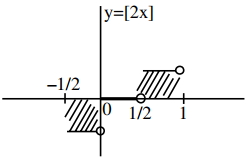
0 likes
View Solution297
DifficultMCQ
જો સંકર સંખ્યા $(1-\cos \theta+2 i \sin \theta)^{-1}$ નો વાસ્તવિક ભાગ $\theta \in(0, \pi)$ માટે $\frac{1}{5}$ હોય,તો સંકલન $\int_{0}^{\theta} \sin x \,dx$ ની કિંમત કેટલી થાય?
A
$2$
B
$-1$
C
$0$
D
$1$
Solution
(D) ધારો કે $z = (1 - \cos \theta + 2i \sin \theta)^{-1} = \frac{1}{(1 - \cos \theta) + 2i \sin \theta}$.
અંશ અને છેદને અનુબદ્ધ $((1 - \cos \theta) - 2i \sin \theta)$ વડે ગુણતા:
$z = \frac{(1 - \cos \theta) - 2i \sin \theta}{(1 - \cos \theta)^2 + 4 \sin^2 \theta}$.
વાસ્તવિક ભાગ $\text{Re}(z) = \frac{1 - \cos \theta}{(1 - \cos \theta)^2 + 4 \sin^2 \theta} = \frac{1}{5}$.
$1 - \cos \theta = 2 \sin^2 \frac{\theta}{2}$ અને $\sin \theta = 2 \sin \frac{\theta}{2} \cos \frac{\theta}{2}$ નો ઉપયોગ કરતા:
$\text{Re}(z) = \frac{2 \sin^2 \frac{\theta}{2}}{4 \sin^4 \frac{\theta}{2} + 16 \sin^2 \frac{\theta}{2} \cos^2 \frac{\theta}{2}} = \frac{1}{2(\sin^2 \frac{\theta}{2} + 4 \cos^2 \frac{\theta}{2})} = \frac{1}{5}$.
તેથી,$2(\sin^2 \frac{\theta}{2} + 4 \cos^2 \frac{\theta}{2}) = 5 \implies 2(1 + 3 \cos^2 \frac{\theta}{2}) = 5 \implies \cos^2 \frac{\theta}{2} = \frac{1}{2}$.
$\theta \in (0, \pi)$ હોવાથી,$\theta = \frac{\pi}{2}$ મળે.
અંતે,$\int_{0}^{\frac{\pi}{2}} \sin x \,dx = [-\cos x]_{0}^{\frac{\pi}{2}} = 1$.
અંશ અને છેદને અનુબદ્ધ $((1 - \cos \theta) - 2i \sin \theta)$ વડે ગુણતા:
$z = \frac{(1 - \cos \theta) - 2i \sin \theta}{(1 - \cos \theta)^2 + 4 \sin^2 \theta}$.
વાસ્તવિક ભાગ $\text{Re}(z) = \frac{1 - \cos \theta}{(1 - \cos \theta)^2 + 4 \sin^2 \theta} = \frac{1}{5}$.
$1 - \cos \theta = 2 \sin^2 \frac{\theta}{2}$ અને $\sin \theta = 2 \sin \frac{\theta}{2} \cos \frac{\theta}{2}$ નો ઉપયોગ કરતા:
$\text{Re}(z) = \frac{2 \sin^2 \frac{\theta}{2}}{4 \sin^4 \frac{\theta}{2} + 16 \sin^2 \frac{\theta}{2} \cos^2 \frac{\theta}{2}} = \frac{1}{2(\sin^2 \frac{\theta}{2} + 4 \cos^2 \frac{\theta}{2})} = \frac{1}{5}$.
તેથી,$2(\sin^2 \frac{\theta}{2} + 4 \cos^2 \frac{\theta}{2}) = 5 \implies 2(1 + 3 \cos^2 \frac{\theta}{2}) = 5 \implies \cos^2 \frac{\theta}{2} = \frac{1}{2}$.
$\theta \in (0, \pi)$ હોવાથી,$\theta = \frac{\pi}{2}$ મળે.
અંતે,$\int_{0}^{\frac{\pi}{2}} \sin x \,dx = [-\cos x]_{0}^{\frac{\pi}{2}} = 1$.
0 likes
View Solution298
MediumMCQ
$b > 3$ ની કઈ કિંમત માટે $12 \int \limits_{3}^{b} \frac{1}{(x^{2}-1)(x^{2}-4)} dx = \log _{e}(\frac{49}{40})$ થાય?
A
$6$
B
$3$
C
$5$
D
$9$
Solution
(A) આપણે સંકલ્ય માટે આંશિક અપૂર્ણાંકનો ઉપયોગ કરીએ: $\frac{1}{(x^2-1)(x^2-4)} = \frac{1}{3} (\frac{1}{x^2-4} - \frac{1}{x^2-1})$.
આને સંકલનમાં મૂકતા: $12 \cdot \frac{1}{3} \int_{3}^{b} (\frac{1}{x^2-4} - \frac{1}{x^2-1}) dx = 4 [\frac{1}{4} \ln |\frac{x-2}{x+2}| - \frac{1}{2} \ln |\frac{x-1}{x+1}|]_{3}^{b} = \log_e(\frac{49}{40})$.
પદને સરળ બનાવતા: $[\ln |\frac{x-2}{x+2}| - 2 \ln |\frac{x-1}{x+1}|]_{3}^{b} = \ln \frac{49}{40}$.
$[\ln |\frac{x-2}{x+2}| - \ln |(\frac{x-1}{x+1})^2|]_{3}^{b} = \ln \frac{49}{40}$.
$[\ln |\frac{(x-2)(x+1)^2}{(x+2)(x-1)^2}|]_{3}^{b} = \ln \frac{49}{40}$.
$b$ અને $3$ પર કિંમત મૂકતા: $\ln |\frac{(b-2)(b+1)^2}{(b+2)(b-1)^2}| - \ln |\frac{(3-2)(3+1)^2}{(3+2)(3-1)^2}| = \ln \frac{49}{40}$.
$\ln |\frac{(b-2)(b+1)^2}{(b+2)(b-1)^2}| - \ln |\frac{1 \cdot 16}{5 \cdot 4}| = \ln \frac{49}{40}$.
$\ln |\frac{(b-2)(b+1)^2}{(b+2)(b-1)^2}| - \ln \frac{4}{5} = \ln \frac{49}{40}$.
$\ln |\frac{(b-2)(b+1)^2}{(b+2)(b-1)^2}| = \ln (\frac{49}{40} \cdot \frac{4}{5}) = \ln \frac{49}{50}$.
પદોની સરખામણી કરતા,આપણને $b = 6$ મળે છે.
આને સંકલનમાં મૂકતા: $12 \cdot \frac{1}{3} \int_{3}^{b} (\frac{1}{x^2-4} - \frac{1}{x^2-1}) dx = 4 [\frac{1}{4} \ln |\frac{x-2}{x+2}| - \frac{1}{2} \ln |\frac{x-1}{x+1}|]_{3}^{b} = \log_e(\frac{49}{40})$.
પદને સરળ બનાવતા: $[\ln |\frac{x-2}{x+2}| - 2 \ln |\frac{x-1}{x+1}|]_{3}^{b} = \ln \frac{49}{40}$.
$[\ln |\frac{x-2}{x+2}| - \ln |(\frac{x-1}{x+1})^2|]_{3}^{b} = \ln \frac{49}{40}$.
$[\ln |\frac{(x-2)(x+1)^2}{(x+2)(x-1)^2}|]_{3}^{b} = \ln \frac{49}{40}$.
$b$ અને $3$ પર કિંમત મૂકતા: $\ln |\frac{(b-2)(b+1)^2}{(b+2)(b-1)^2}| - \ln |\frac{(3-2)(3+1)^2}{(3+2)(3-1)^2}| = \ln \frac{49}{40}$.
$\ln |\frac{(b-2)(b+1)^2}{(b+2)(b-1)^2}| - \ln |\frac{1 \cdot 16}{5 \cdot 4}| = \ln \frac{49}{40}$.
$\ln |\frac{(b-2)(b+1)^2}{(b+2)(b-1)^2}| - \ln \frac{4}{5} = \ln \frac{49}{40}$.
$\ln |\frac{(b-2)(b+1)^2}{(b+2)(b-1)^2}| = \ln (\frac{49}{40} \cdot \frac{4}{5}) = \ln \frac{49}{50}$.
પદોની સરખામણી કરતા,આપણને $b = 6$ મળે છે.
0 likes
View Solution299
DifficultMCQ
ધારો કે $f(x) = \max \{|x+1|, |x+2|, |x+3|, |x+4|, |x+5|\}$. તો $\int_{-6}^{0} f(x) \, dx$ ની કિંમત શોધો.
A
$20$
B
$40$
C
$21$
D
$41$
Solution
(C) આપેલ છે કે $f(x) = \max \{|x+1|, |x+2|, |x+3|, |x+4|, |x+5|\}$.
$x \in [-6, 0]$ માટે,વિધેય $f(x)$ આ નિરપેક્ષ મૂલ્ય વિધેયોના ઉપરના ભાગ દ્વારા વ્યાખ્યાયિત થાય છે.
આલેખ પરથી જોઈ શકાય છે કે $f(x) = |x+5|$ જ્યારે $x \in [-6, -3]$ અને $f(x) = |x+1|$ જ્યારે $x \in [-3, 0]$ છે.
તેથી,$\int_{-6}^{0} f(x) \, dx = \int_{-6}^{-3} |x+5| \, dx + \int_{-3}^{0} |x+1| \, dx$.
ગણતરી કરતા: $\int_{-6}^{-3} -(x+5) \, dx + \int_{-3}^{0} (x+1) \, dx = -\left[\frac{x^2}{2} + 5x\right]_{-6}^{-3} + \left[\frac{x^2}{2} + x\right]_{-3}^{0} = -[(\frac{9}{2} - 15) - (18 - 30)] + [0 - (\frac{9}{2} - 3)] = -[-\frac{21}{2} + 12] - [\frac{3}{2} - 12] = -\frac{3}{2} + \frac{21}{2} = 9 + 12 = 21$.
$x \in [-6, 0]$ માટે,વિધેય $f(x)$ આ નિરપેક્ષ મૂલ્ય વિધેયોના ઉપરના ભાગ દ્વારા વ્યાખ્યાયિત થાય છે.
આલેખ પરથી જોઈ શકાય છે કે $f(x) = |x+5|$ જ્યારે $x \in [-6, -3]$ અને $f(x) = |x+1|$ જ્યારે $x \in [-3, 0]$ છે.
તેથી,$\int_{-6}^{0} f(x) \, dx = \int_{-6}^{-3} |x+5| \, dx + \int_{-3}^{0} |x+1| \, dx$.
ગણતરી કરતા: $\int_{-6}^{-3} -(x+5) \, dx + \int_{-3}^{0} (x+1) \, dx = -\left[\frac{x^2}{2} + 5x\right]_{-6}^{-3} + \left[\frac{x^2}{2} + x\right]_{-3}^{0} = -[(\frac{9}{2} - 15) - (18 - 30)] + [0 - (\frac{9}{2} - 3)] = -[-\frac{21}{2} + 12] - [\frac{3}{2} - 12] = -\frac{3}{2} + \frac{21}{2} = 9 + 12 = 21$.
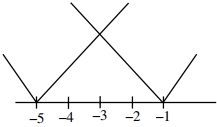
0 likes
View Solution7-2.Definite Integral — Fundamental definite integration · Frequently Asked Questions
1Are these 7-2.Definite Integral questions useful for JEE and NEET?
Yes. All questions in this section are mapped to JEE Main and NEET exam patterns. Previous year questions from JEE Main, NEET, GUJCET and state-level exams are included with full solutions.
2Can I switch to Hindi or Gujarati for these questions?
Yes. Use the language tabs in the hero section or the sidebar to view the same questions and solutions in English, Hindi or Gujarati.
3How do I generate a question paper from this subtopic?
Use the Vedclass Exam Paper Generator — select the chapter and subtopic, set difficulty, and generate Sets A, B, C, D automatically. First 3 chapters of every subject are free.
Vedclass Products
For Students
Vedclass Test Series
Mock tests in real JEE/NEET style with performance analysis. 5-day free trial.
Start Free TrialFor Teachers
Exam Paper Generator
Generate Set A/B/C/D papers from this chapter in 2 minutes. 3 chapters free.
Try FreeFor Institutes
Online Exam Module
Live online exams with unlimited students, 360° analytics & white-label branding.
See DemoFor Teachers & Institutes
Generate a 7-2.Definite Integral Exam Paper in 2 Minutes
Select subtopic & difficulty — Sets A, B, C, D auto-generated with No Repeat logic.
First 3 chapters of every subject are free — no payment required.